Hebrews 13:1
Hebrews 13:2
Hebrews 13:3
Hebrews 13:4
Hebrews 13:5
Hebrews 13:6
Hebrews 13:7
Hebrews 13:8
Hebrews 13:9
Hebrews 13:10
Hebrews 13:11
Hebrews 13:12
Hebrews 13:13
Hebrews 13:14
Hebrews 13:15
Hebrews 13:16
Hebrews 13:17
Hebrews 13:18
Hebrews 13:19
Hebrews 13:20
Hebrews 13:21
Hebrews 13:22
Hebrews 13:23
Hebrews 13:24
Hebrews 13:25
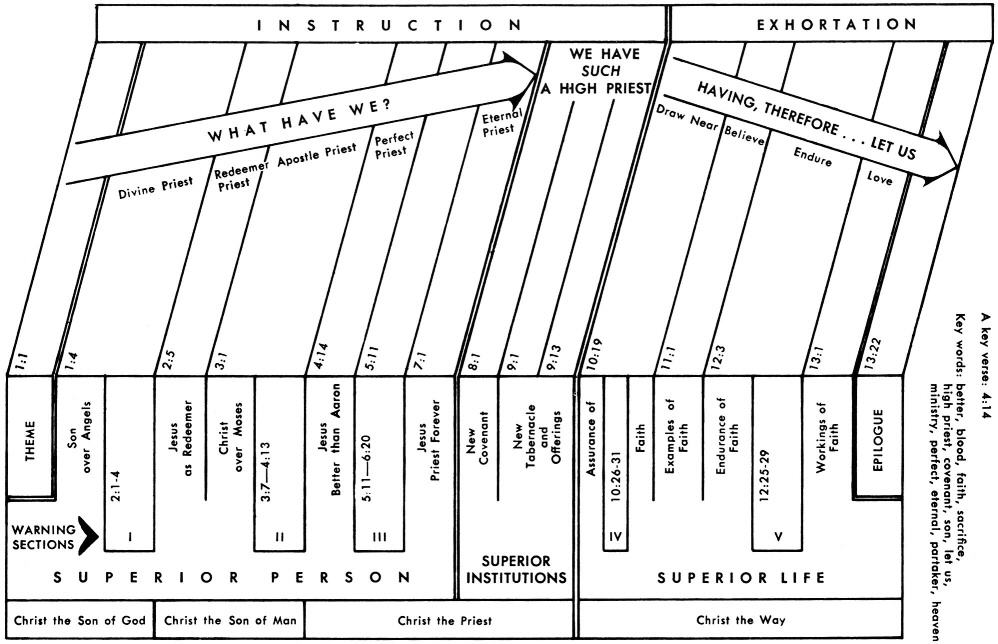
CONSIDER JESUS OUR GREAT HIGH PRIEST
Click chart to enlarge
Charts from Jensen's Survey of the NT - used by permission
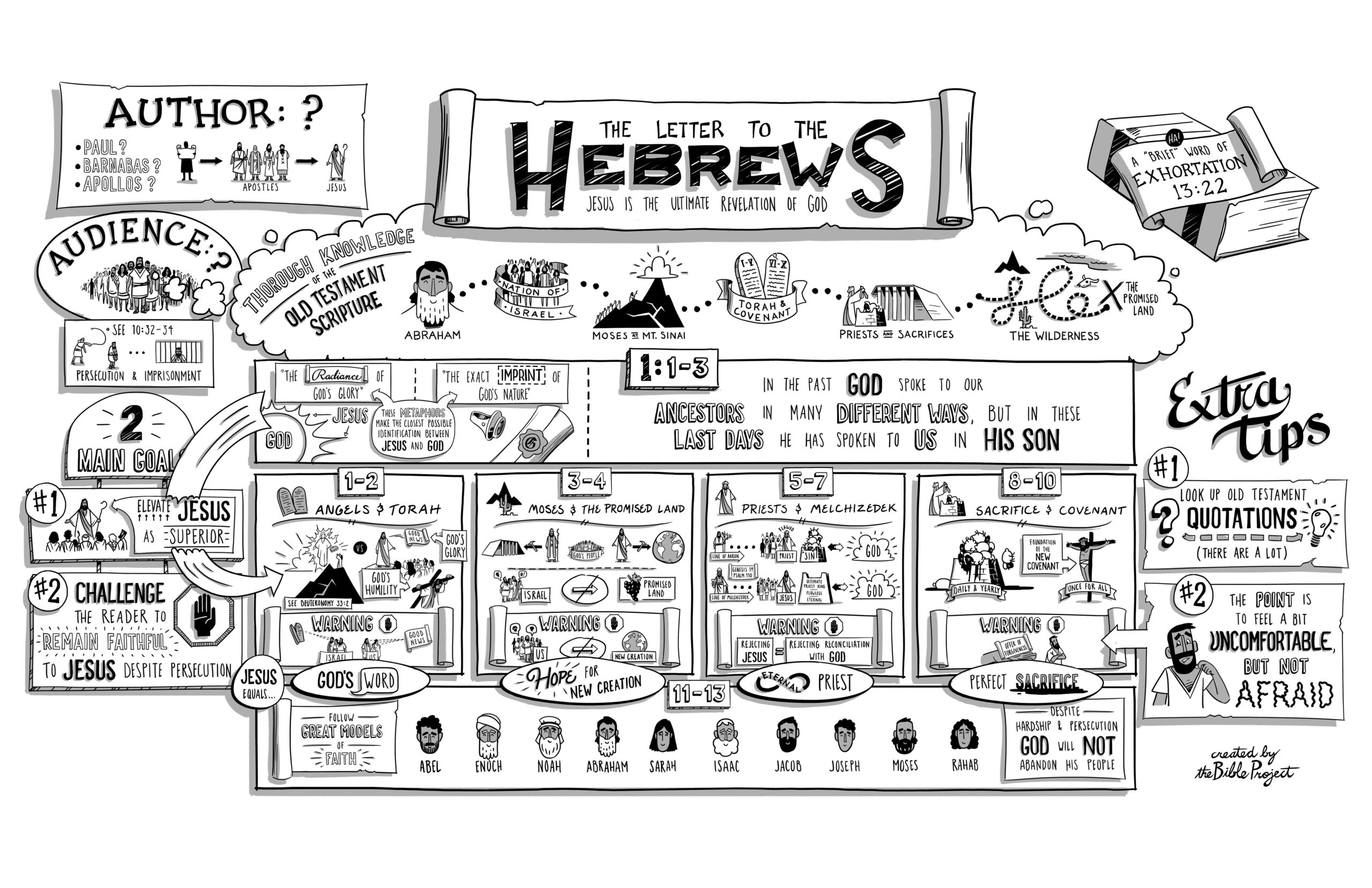
Swindoll's Chart, Interesting Pictorial Chart of Hebrews, Another Chart
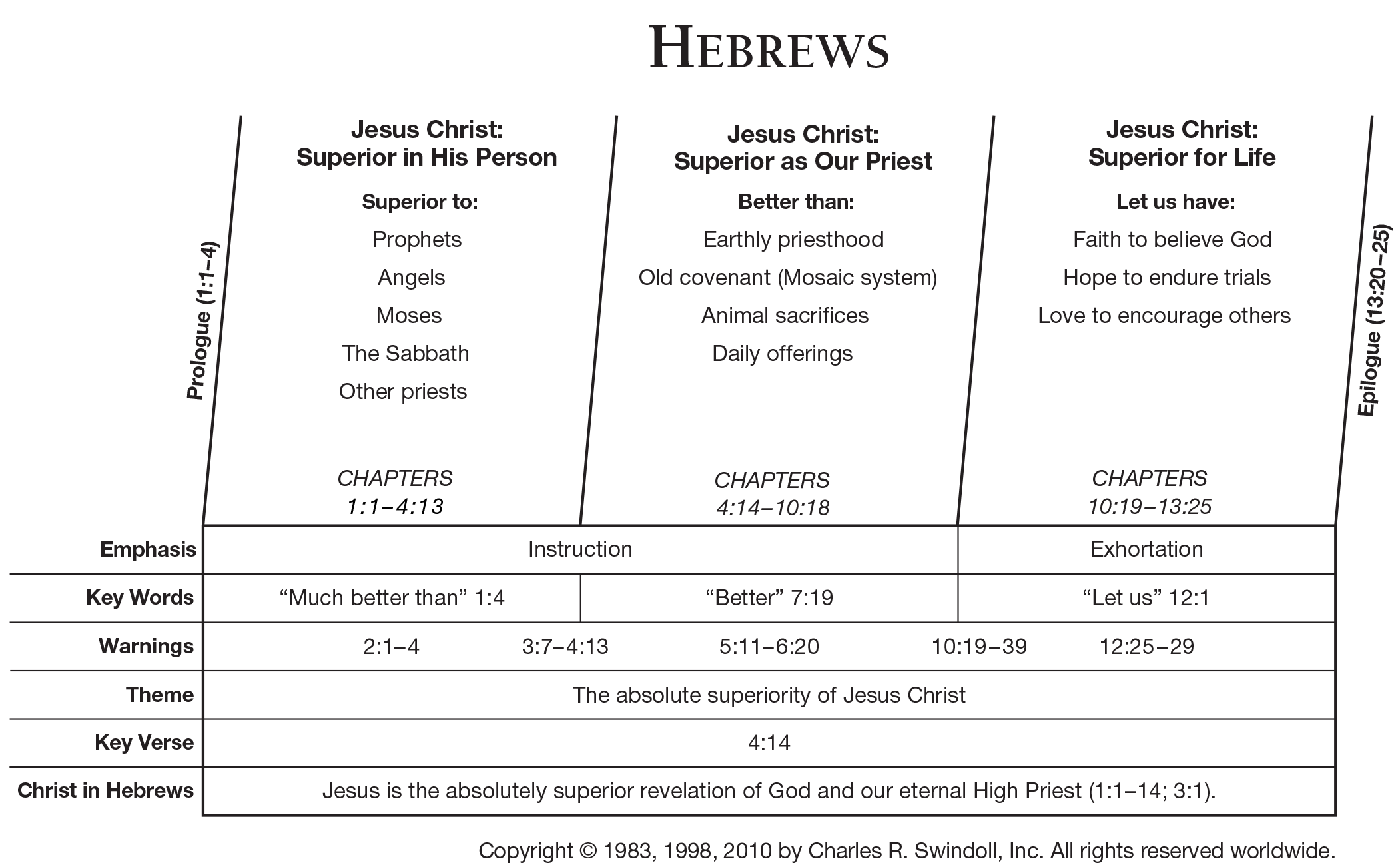
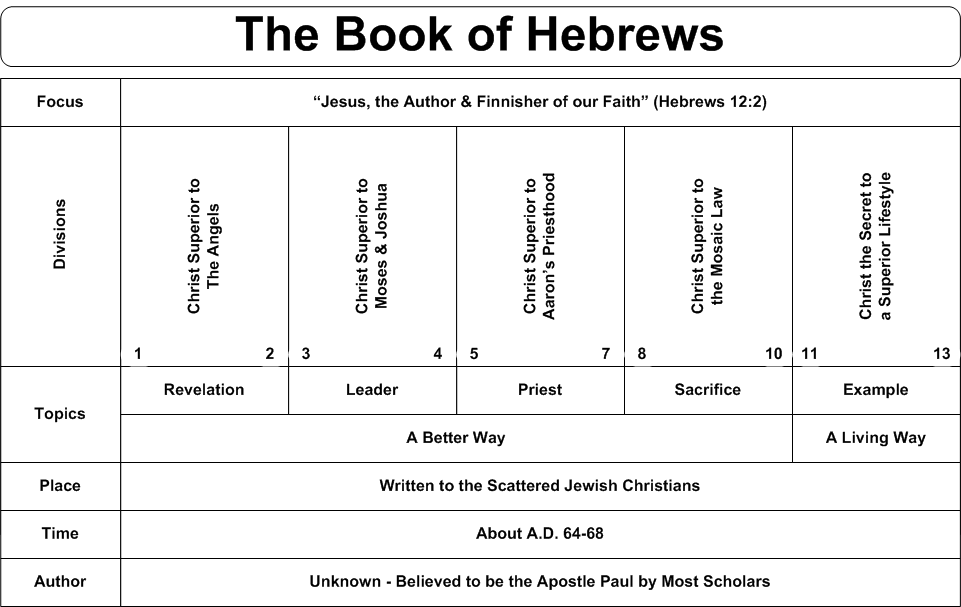
|
The Epistle |
||||
| INSTRUCTION Hebrews 1-10:18 |
EXHORTATION Hebrews 10:19-13:25 |
|||
| Superior Person of Christ Hebrews 1:1-4:13 |
Superior Priest in Christ Hebrews 4:14-10:18 |
Superior Life In Christ Hebrews 10:19-13:25 |
||
| BETTER THAN PERSON Hebrews 1:1-4:13 |
BETTER PRIESTHOOD Heb 4:14-7:28 |
BETTER COVENANT Heb 8:1-13 |
BETTER SACRIFICE Heb 9:1-10:18 |
BETTER LIFE |
| MAJESTY OF CHRIST |
MINISTRY OF CHRIST |
MINISTERS FOR CHRIST |
||
|
DOCTRINE |
DUTY |
|||
|
DATE WRITTEN: |
||||

See ESV Study Bible "Introduction to Hebrews"
(See also MacArthur's Introduction to Hebrews)
Borrow Ryrie Study Bible
Hebrews 13:10 We have an altar from which those who serve the tabernacle have no right to eat (NASB: Lockman)
Greek: echomen (1PPAI) thusiasterion ex ou phagein (AAN) ouk echousin (3PPAI) echousian (3PPAI) oi te skene latreuontes. (PAPMPN)
Amplified: We have an altar from which those who serve and worship in the tabernacle have no right to eat. (Amplified Bible - Lockman)
My Amplified Paraphrase: We as believers have an altar—a true place of spiritual sacrifice and fellowship—that those who cling to the old Levitical system cannot share in; for our altar is not the physical altar of the tabernacle, but Christ Himself and His once-for-all sacrifice. Those who remain devoted to the earthly tabernacle, relying on priestly rituals and ceremonial meals, have no right to partake of the blessings that flow from the cross, because these blessings belong only to those who come to God through Jesus’ finished work.
Barclay: We have an altar from which those who serve in the tabernacle have no right to eat. (Westminster Press)
ESV: We have an altar from which those who serve the tent have no right to eat.
NLT: We have an altar from which the priests in the Temple on earth have no right to eat. (NLT - Tyndale House)
NIV: We have an altar from which those who minister at the tabernacle have no right to eat. (NIV - IBS)
Phillips: We have an altar from which those who still serve the tabernacle have no right to eat. (Phillips: Touchstone)
Wuest: We have an altar from which they have no right to eat who are serving the tent (Eerdmans Publishing - used by permission)
Young's Literal: we have an altar, of which to eat they have no authority who the tabernacle are serving
- altar: 1Co 5:7,8 9:13 10:17,20
- serve: Nu 3:7,8 7:5
THE NEW AND BETTER
ALTAR FOR BELIEVERS
NOTE: Since is felt by many to be the most difficult section in the book of Hebrews to understand, there are comments from several conservative sources which naturally leads to some repetition, but hopefully this repetition will give you a better understanding of Heb 13:10-14.
As the writer to the Hebrews draws near the end of his letter, he contrasts the fading shadows of the Old Covenant with the fullness believers possess in Christ. The audience was tempted to retreat back to the familiar rituals of Judaism—priests, altars, sacrifices, and ceremonial meals that felt tangible (visible) and safe. But the writer reminds them that the Christian’s altar is not a structure in Jerusalem but is related to a Person in heaven (see note). Those who cling to the old, earthly forms of religion are excluded from this privilege. Only those who draw near to God through Christ’s once-for-all sacrifice can feed on the blessings of the New Covenant. Hebrews 13:10 calls wavering believers to stand firm in their allegiance to Jesus, recognizing that all the privileges of grace are found in Him alone.
What the writer is saying is that the Levitical priests (who hold to the Old Covenant sacrificial system) have no right, no authority and no permission, to "eat" at our altar which is the Cross of Christ. Whatever nuances scholars may debate about the meaning of “eat,” (see thoughts below), the central truth must not be missed: you cannot place your trust in both the Old Covenant and the New.
So in this section, the writer again takes up his central theme of the sacrifice of Christ, which contrasts with and is superior to the Levitical (animal) sacrificial system. Recall that he had just exhorted his readers to "be strengthened by grace not by foods" (Heb 13:9+) and now continues the thought by shifting the imagery from literal eating to spiritual nourishment. The Christian’s “altar” is not a table of ritual foods but the once-for-all offering of Christ
In essence, this verse issues a spiritual call to separation: believers in Jesus are summoned to leave behind the obsolete ceremonial system and enter into fellowship with the crucified Savior whose sacrifice inaugurated the New Covenant (Heb 8:6–13). It prepares the way for the next verses (Heb 13:11–13), where the writer reminds us that “Jesus also suffered outside the gate,” and therefore His followers must willingly go “outside the camp” to share in His reproach.
Charles Swindoll (See Insights on Hebrews - Page 221) summarizes Hebrews 13:10-17- In Hebrews 13:10–17, we see five specific things that believers have as they abandon the uncertain beliefs and practices of a shifting world to hold firm to the unchangeable grace of the Lord Jesus. These five things are:
- an altar to use (Heb 13:10),
- a reproach to bear (Heb 13:11–13),
- a city to seek (Heb 13:14),
- a sacrifice to offer (Heb 13:15–16), and
- leaders to follow (Heb 13:17).
Phillip Hughes - Under the Mosaic dispensation the priests were entitled to retain as food for themselves the flesh of certain animal sacrifices and also the cereal offerings that were presented (as explained, for example, in Lev 7:1-38+, especially Lev 7:6+); but there were other sacrifices of which they were not permitted to eat, such as the sin offering described in Leviticus 4:1-5:13+ and—a consideration of special significance in our understanding of the present passage—the great annual sacrifices for sin offered on the Day of Atonement (Lev. 16:1-34+). The close association of the altar with the sacrifice that is offered on it, and of the eater with both, is evident from the question addressed by Paul to the Christians in Corinth: "Consider the practice of Israel; are not those who eat the sacrifices partakers in the altar?" (1Co 10:18+; cf. also the question, posed in a different context, of 1Co 9:13+: "Do you not know that those who are employed in the temple service get their food from the temple, and those who serve at the altar share in the sacrificial offerings?"). The particular ritual which our author has in view here is, once again, that of the Day of Atonement (ED: Hughes deduces this from the fact that Heb 13:11+ speaks of the "blood is brought into the holy place" something that was permitted only on the Day of Atonement, Lev 16:1-34+), when, on this day of the year alone, the blood of the victim slain on the altar is brought into the sanctuary, that is, the holy of holies, by the high priest. Yet those who serve the tent, namely, the priests of the Levitical order, have no right to eat of this, the most portentous (prodigious, wonderful) of all the Jewish sacrifices; for on this day the bodies of the sacrificial animals are totally burned outside the camp (See Lev 16:27+). (See A Commentary on the Epistle to the Hebrews - Page 574) (Bolding, italics, Scripture references added)
We (writer includes himself speaking of believers - but see note below) have (echo) is in the present tense which indicates that this altar is our ongoing, continual possession. Let us avail ourselves and daily come to this altar and "through Him let us continually offer the sacrifice of praise" (Heb 13:15+). It is notable that we have echoes several earlier confessional statements (Heb 4:14 = "a great high priest"; Heb 6:19 ] = "as an anchor of the soul, a hope"; Heb 8:1 = "such a high priest"; Heb 10:10 = "been sanctified"; Heb 10:19 = "confidence to enter the holy place"; Heb 12:1 = "so great a cloud of witnesses"; Heb 13:10 = "an altar"). So it behooves us to understand what is the altar which they (and we as fellow NT believers) possessed, a question which will be dealt with in the following discussion as clearly it is not a literal altar as were the altars in the Old Covenant. The fact that the writer introduces the concept of an altar in his argument (for the superiority of the New Covenant), suggests that some detractors were claiming that Christianity had no altar and was therefore inferior to Judaism. F F Bruce amplifies this thought commenting that indeed "Christians had none of the visible apparatus which in those days was habitually associated with religion and worship—no sacred buildings (Temple), no (Brazen) altars, no sacrificing (Levitical) priests. Their pagan neighbors thought they had no God, and called (NT believers) atheists; their Jewish neighbors too might criticize them for having no visible means of spiritual support."
NOTE: John MacArthur is one of the few who believe the "we" is not believers, writing "I believe the best explanation is to consider that We refers to the writer’s fellow Jews. That is, “We Jews have an altar." Almost every commentary (John Owen, David Guzik, F F Bruce, P E Hughes, etc) I read disagrees with MacArthur (including yours truly)!
Spurgeon says "Those who cling to the external and ceremonial observances of religion have no right to the privileges which belong to those who come to the spiritual altar; they cannot share that secret."
In his little book Practice of Praise (in a quote taken from sermon A Life Long Occupation) Spurgeon adds - “We have an altar” (Hebrews 13:10), not a material altar, but a spiritual one. Yet, “we have an altar.” May the priests of the old law offer sacrifice on it? “Whereof they have no right to eat that serve the tabernacle.” They ate of the sacrifices laid on the altars of the old law, but they have no right here. Those who keep to ritualistic performances and outward ceremonials have no right here. Yet “we have an altar.” Brothers and sisters, can we imagine that this altar is given us by the Lord never to be used? Is no sacrifice to be presented on the best of altars? “We have an altar”—what then? If we have an altar, do not allow it to be neglected, deserted, unused. It is not for spiders to spin their webs upon. It is not fitting that it should be smothered with the dust of neglect. “We have an altar.” What then? “Let us offer the sacrifice of praise to God continually.” Do you not see the force of the argument? Practically obey it.
Believers have a better altar,
a better sacrifice.
John Phillips favors we as believers writing "We have an altar, whereof they have no right to eat which serve the tabernacle" (Heb 13:10). There are some four hundred references to the altar in the Old Testament. The altar is rarely mentioned in the New Testament except in reference to the Old Testament. The great brazen altar, in the Temple court, still beckoned to the Hebrews. But no matter how attractive the symbol seemed, with its appointed priests performing a divine service originally divinely ordained and hallowed by the custom of centuries, the Christian had no part in that altar. It was obsolete. To go on offering the blood of bulls and goats to God, after the shedding of Christ's blood, was an insult, not an inspiration. Believers have a better altar, a better sacrifice. The writer has just warned against trading grace for the "meats" of the Judaistic system. Many of the Old Testament sacrifices were used as food for the priests. Having served their purpose on the altar, they became the basis for a communion feast. Calvary did away with all that. We feast now upon Christ, and our communion is with Him. This is the fruit of Calvary. To go back to Judaism would be to forfeit forever this higher, holier, spiritual communion of which the feasts connected with the Old Testament altar were but a feeble picture. To go back to those feasts would be to deny the reality in Christ. It would mean that the person who did this was never really saved at all and that, by proving himself an apostate, he would never be able to partake of Christ. (BORROW Exploring Hebrews) (Bolding added)
Philip E. Hughes adds that the criticism from the Jewish antagonists that believers in Messiah had "no visible means of spiritual support" (especially no altar) "evokes the rejoinder (an answer in reply) from our author that we have an altar (Heb 13:10), namely, the Cross on which the sacrifice of the Son took place (Ed: Keeping in mind that the OT Tabernacle and Temple Brazen Altar is seen by most conservative writers as a foreshadowing of the NT Cross of Christ), and that this (Christ's crucifixion) is the reality which answers to the shadow of the high-priestly offering on Israel's Day of Atonement (cf Col 2:17+); and, further, that there is this significant distinction, in addition to the important differences mentioned earlier in the epistle, that whereas the Levitical priests have no right to eat of their sin offerings, we Christians, who together constitute a holy priesthood (1Pe 2:5+), enjoy the privilege of partaking (Ed: By faith) of Christ's sacrifice, which is the true and perfect sacrifice for sin (Ed: The once for all sin offering of the Lamb of God to which ALL of the OT animal sin offerings pointed!). (See A Commentary on the Epistle to the Hebrews - Page 574) (Bolding and Scripture references added)
Keep in mind that the Book of Hebrews consistently contrasts the Old Covenant (centered on the Levitical priesthood and earthly tabernacle) with the New Covenant (centered on Christ’s eternal priesthood and heavenly sanctuary). Hebrews 13:10 continues this theme by referring to an "altar" that New Covenant believers have access to—one that Levitical priests (those who "serve the tabernacle") cannot partake of.
An altar (thusiasterion) - What is the altar to which the writer was referring - literal or figurative? There is some disagreement among conservative writers (note), but all agree this altar is figurative. Clearly it is not the literal altar in the Temple, for he has repeatedly demonstrated that the Old Covenant order is ready to disappear (Heb 8:13+) (and the Temple itself would in fact be demolished by the Roman General Titus in 70 AD, not many years after the writing the epistle to the Hebrews).
If we reflect on the OT symbolism in the Tabernacle (and later the Temple), the Brazen Altar was the first piece of sacred furniture one encountered after entering through the one door—a powerful picture of Christ as the sole entrance to God (cf. Jn 10:9+; Jn 14:6+, cp Acts 4:12+). At this altar the blood of a spotless, blemish-free animal was shed, portraying the necessity of substitutionary sacrifice. Yet those sacrifices—the blood of bulls and goats—could never take away sins (Heb 10:4+, Heb 9:9+, Heb 9:13, 14+). Thus the Brazen Altar functioned as a foreshadowing, a type, a symbolic preview of the ultimate sacrificial altar—the Old Rugged Cross, where the sinless Lamb of God offered Himself once for all. There, on that final altar, Jesus bore our sins in His body and accomplished what no animal sacrifice ever could: He takes away the sin of the world (Jn 1:29+).
Simon Kistemaker on we have an altar - For the writer, the altar is the cross on which Jesus offered himself as a sacrifice to God. (A. Snell, “We Have an Altar,” Reformed Theological Review 23) And to the Christian the cross is a symbol that represents the completed work of redemption. As the author of Hebrews repeatedly confirms, Christ offered his sacrifice once for all (Heb 9:25, 26, 28; 10:9, 12, 14). The clause we have an altar, then, stands for the cross, which symbolizes the redemption Christ offers his people. (BORROW Exposition of the Epistle to the Hebrews PAGE 418)
Hugh Montefiore on we have an altar - He is referring not to the altar itself but to the victim upon it. No allegorical interpretation of this altar is intended....Calvary is meant, not some heavenly altar of the true sanctuary." (BORROW A commentary on the Epistle to the Hebrews PAGE 244)
David Guzik on we have an altar - These Jewish Christians had probably been branded as illegitimate by other Jews because they did not continue the Levitical system. But the writer to the Hebrews insists that we have an altar, and it is an altar that those who insist on clinging to the Levitical system have no right to. Essentially, our altar is the cross - the centerpiece of the Christian gospel and understanding (1 Corinthians 1:18-24; 2:1-5).
John Piper on “We have an altar from which those who serve the tabernacle have no right to eat.” - He’s referring to the priests in Jerusalem who have rejected Jesus as their Messiah, but who go on “serving the tabernacle” which was meant to point to Jesus as the final sacrifice and the cross of Jesus as the final altar of sacrifice (Hebrews 9:26; 10:12). So the altar he has in mind is the cross where our final sacrifice was offered once for all for our sins. There is where our food is found. There is the table where grace was prepared. If you want to know where your breakfast of grace was prepared, the answer is (Heb 13:10): We have an altar—the breakfast of grace was prepared on the altar of the cross where Jesus died for our sins. If you want to be strong in your heart, when your heart is groaning with a sense of sin and failure, before you go to the kitchen to eat food, go to the altar to eat the blood-bought grace of forgiveness and hope.....we have an altar—we have an old rugged cross. And there the Savior, Jesus Christ, serves inexhaustible helpings of grace. (Be strengthened by grace)
It should be noted that while some commentators see the Hebrews 13:10 reference to the altar as a reference to the Cross, others see it as a reference to Christ the Sacrifice on the Cross. F F Bruce resolves this by explaining that "The word “altar” is used by metonymy for “sacrifice”—“as when, e.g., we say that a man keeps a good table, meaning thereby good food.”… The Christian altar was the sacrifice of Christ, the benefits of which were eternally accessible to them. Material food, even if it was called sacred, perished with the using; in this new and spiritual order into which they had been introduced by faith, Christ was perpetually available, “the same yesterday, and today, yes, and for ever.” (Heb 13:8) (The Epistle to the Hebrews New International Commentary on the New Testament- F. F. Bruce)
John Owen on we have an altar - “The altar which we now have is Christ alone, and His sacrifice. For He was both priest, altar, and sacrifice, all in Himself” (his italics). (Hebrews 13 Commentary)
Bishop Westcott puts it: "The only earthly altar is the Cross on which Christ offered Himself: Christ is the Offering: He Himself is the feast of the believer."
Craig Koester summarizes interpretations of we have an altar - (a) The cross or sacrificial death of Christ. Hebrews uses metonymy to transfer the term “altar” (Heb 13:10) from the sanctuary to the place where carcasses were burned “outside the camp” on the Day of Atonement (Heb 13:11) and finally to Christ’s suffering “outside the gate” (Heb 13:12). The “altar” is not only Golgotha. Through synecdoche, in which the part stands for the whole, the “altar” encompasses multiple dimensions of Christ’s death (Attridge; Bénétreau; F. F. Bruce; Grässer; P. E. Hughes; Lane; Lindars, “Rhetorical,” 389; Isaacs, “Hebrews,” 280). (b) Heavenly sanctuary. Some suggest that “we have an altar” recalls that “we have a high priest” in the heavenly sanctuary (8:1). Those who serve in the earthly tent (13:10b) do not “eat” from this altar (13:10c) because “foods” (13:9b) belong to the lower, material order (9:10), while grace (13:9) comes from heaven (4:14; Filson, Yesterday, 48–50; Thompson, Beginnings, 146; Laub, Bekenntnis, 271–72.) A problem with this view is that Hebrews does not suggest that the heavenly sanctuary contained an altar of sacrifice. An incense altar (thymiatērion) is mentioned in 9:4, but 13:10 refers to an altar (thysiastērion) on which victims can be offered (7:13). Such an altar stood in the sanctuary’s outer courtyard, not in the inner court. (c) The Eucharist. Some who identify the Christian “altar” with the Eucharist interpret the text positively, relating the “altar” to “foods” that convey “grace” (13:9) in the Lord’s Supper (Haimo; Theophylact; Lombard; Lapide). The Eucharist enabled Christians to taste God’s word (6:5) and to participate in Christ’s death, just as priests partook of the sacrifices made on the altar (1 Cor 10:18; Hegermann; Strobel; Andriessen, “L’eucharistie”; Ruager, “Wir”; Swetnam, “Christology,” 74; deSilva, Despising, 275; Vanhoye, Old Testament, 228–29). Others read Heb 13:9–10 as a critique of eucharistic practice, pointing out that the victims offered on the Day of Atonement were burned, but not eaten, so that Christ’s death cannot be connected with any meal, including the Eucharist (Moffatt; Braun; Dunnill, Covenant, 240–41). Nevertheless, there is little evidence that the term “altar” was used for the Eucharist until the second century (Klauck, “Thysiastērion”), and the silence about the Eucharist elsewhere in Hebrews makes it unlikely that 13:10 refers to it (see pp. 127–29). (Hebrews: A New Translation with Introduction and Commentary)
'Not all the blood of beasts
On Jewish altars slain,
Could give the guilty conscience peace,
Or wash away the stain.
'But Christ, the Heavenly Lamb,
Takes all our sins away,
A sacrifice of nobler name,
And richer blood than they.
Believing, we rejoice
To see the curse remove;
We bless the Lamb with cheerful voice,
And sing His bleeding love.
Richard Phillips - The use of the word "altar" refers to the whole system of religion that Christians have in the place of Judaism. This verse helps date the Book of Hebrews, since it speaks in the present tense of the temple service, indicating that it was written before the destruction of Jerusalem in A.D. 70.....The argument here is familiar to people who convert from Roman Catholicism to biblical Christianity today. They are told, "But you won't be able to partake of the sacraments. You will be denied confession and penance and especially the mass." To this believers may rightly reply in the manner of these early Christians to the Jews, "We have Christ in their place. We receive him by grace and through faith. In him we have an altar at which the unbelieving priests have no right to eat." We might extend the principle to everyone who places the reality of religion in any outward form. Archbishop William Laud, the English champion of the high church, went to Scotland in 1633, and finding no cathedrals or other outward displays of religious grandeur, he reported that Scotland had "no religion at all that I could see—which grieved me much." But the Scots had Christ by faith, and that is true religion indeed. The same is found today where there are no big screens, no dancing fountains, no altar to which people are begged to come—none of the rest of today's machinery of religious persuasion—but where there is simple faith in Jesus Christ. For eternal life comes by none of these external means, but only by the heart inclined to the cross through simple faith in God's Word.(Hebrews: Reformed Expository Commentary)
Spurgeon adds that "Those who cling to the external and ceremonial observances of religion have no right to the privileges that belong to those who come to the spiritual altar; they cannot share that secret. Those whose religion consists in outward rites and ceremonies can never eat of the spiritual altar at which spiritual men eat, for they do not understand the Scripture and they still serve the Mosaic tabernacle." (Spurgeon's Expositional Commentary on Hebrews)
Those who serve (latreuo - present tense) the Tabernacle - Who are those who serve? While this clearly includes the Levitical priests, it could also refer to Jews who came to the Temple bringing sacrifices as their offering of worship, because the verb latreuo also was used to describe worshipers (see latreuo in Heb 9:9+ rendered "worshiper" and Heb 10:2+ rendered "worshipers"). The priests served in the Holy Temple in Jerusalem (Herod's Temple at that time) because it had not yet been destroyed. These Jewish priests who continually performed the ritualistic Temple services (Heb 7:27+, Heb 10:11+ - Offering animal sacrifices, Burning incense, Maintaining the altar, Observing dietary regulations, Performing purification rites, Eating portions of certain sacrifices) had no right to partake of the true sacrifice, the Passover Lamb of God (1Co 5:7+). They preferred the imperfect, daily sacrifices (Heb 7:27+, Heb 10:11+) of animals to the once for all perfect sacrifice of the Lamb of God (cf Jn 19:30+). They failed to see that the very Tabernacle in which they ministered was only a symbol—a temporary illustration (Heb 9:9+)—intended to point beyond itself to the true and final sacrifice of the Messiah on the cross. The rituals they performed were shadows; Christ was the substance (Col 2:17+).
THE OT "SERVERS" HAVE NO
PRIVILEGE OR AUTHORITY
No (ouk - absolutely no) right (exousia - power, privilege, authority) to eat - This implies that believers in Christ do have a right to eat at this altar. But the question that arises is how do we "eat" at this altar? Here are 3 of the more common interpretations:
(1) Most conservative commentaries favor the interpretation that we “eat" at this altar when we trust in Christ's propitiatory (Christ satisfied the righteous demand of God for justice), substitutionary sacrifice, a trust which is shown to be genuine by our obedience to Him (because we now have a new power to obey - Ezekiel 36:27+).
(2) A few commentaries suggest that this may have been an allusion to Jesus' words in Jn 6:53,54+. (Steven Cole)
(3) Finally, some writers (especially Roman Catholics and Greek Orthodox writers) see this as an allusion to the believers partaking of the Lord's Supper (1Cor 11:23-33+)
Homer Kent comments on #3 making a good point that "the author’s consistent purpose throughout the letter has been to show that Christians possess the spiritual realities in sharp contrast to physical types and shadows. How strange it would be for the author now to say that the reality is merely another physical ceremony." (BORROW Hebrews Commentary)
John Brown agrees with Kent - The sentiment of the Apostle is not—We are allowed to eat the Lord’s Supper, which no Jew, nor Jewish priest, continuing such, can have a right to do. It refers not to the Lord’s Supper, but to that of which the Lord’s Supper is an emblematical expression. Nor is it merely—We have a sacrifice, on which we spiritually feed, of which no Jew, no Jewish priest, continuing to be so, can participate. But, we are allowed—really, though spiritually—to feast on the propitiatory sacrifice for our own sins, and for the sins of all the people of God, which, even emblematically, the Jewish people and priests were not permitted to do. (Hebrews Commentary)
Phillip Hughes adds that "The sacrifices of which those Aaronic priests partook imperfectly prefigured the all-availing sacrifice of him who is the Lamb of God and were incapable of effecting more than a ceremonial and external cleansing; whereas the one sacrifice of which we partake purifies us inwardly from all sin (Heb 9:9f, Heb 9:13f, Heb 9:26; Heb 10:1-4, 10-14; cf. 1Jn 1:7, 9). Their eating was physical; ours is spiritual. Their eating, further, was partial, and it was limited, because there could be no eating of their sin offerings, which were incompetent to convey what they portended (foreshadowed, foretold) since the brutish victims were unfitted to take the place of sinful mankind, and it was only with the provision by God of the totally sufficient sin offering of his incarnate Son that such eating at last became a possibility and a reality. Our eating, by contrast, is total and unrestricted. (See A Commentary on the Epistle to the Hebrews)
Spurgeon on we have an altar rightly reminds us that "We have a sacrifice, which, being once offered, avails forever. We have “one greater than the temple” (Mt 12:6+), and He is to us the mercy seat and the High Priest. Take it for granted that all the blessings of the law remain under the Gospel. Christ has restored that which He did not take away, but He has not taken away one single possible blessing of the law. On the contrary, He has secured all to His people (Ed: in the New Covenant, the Law is written on our hearts - Heb 8:10+). I look to the Old Testament, and I see certain blessings affixed to the covenant of works, and I say to myself by faith, “Those blessings are mine, for I have kept the covenant of works in the person of my Covenant Head and Surety. Every blessing that is promised to perfect obedience belongs to me, since I present to God a perfect obedience in the person of my great Representative, the Lord Jesus Christ.” Every real spiritual boon that Israel had, you have as a Christian."
Brian Bell on we have an altar - On one of my 1st trips to Belize, we went with the group out to dinner. Bob Marley our waiter comes over, I’m 1st. I order from the menu. I’ll have the hamburger. He responds, No man! I’ll have the fish. He responds, No man! (Now, John Gotz is bent over laughing at me, I’m not understanding) You simply ask what they have that day...& that's what you want.On God’s menu is 1 selection...Grace...if you try to order anything else...you have no right to eat. Heb 13:10b The altar proclaims that God & man may meet. Lev.15, 5x’s w/ insistent explicitness prescribes all sacrifices to be done there. The altar is the cosmic collision of a holy God & sinful man. The altar screams of sacrifice where God is pleased & alienated man is reconciled. Nothing in our universe is more important to us human beings than the altar, the place where God & men meet. We commemorate this altar this Friday, Good Friday, because this altar is the Cross.
- The Cross, the Hinge of History.
- The Cross, the Lightning Rod of Grace.
- The Cross, the last argument of God. -- Spurgeon
R Kent Hughes adds that "We are all ministers. And the glory of Christianity is that we have an altar - we have an old rugged cross. And there the Savior, Jesus Christ, serves inexhaustible helpings of grace (cp He 13:9+). Do you want your heart to be strong? Do you want to be a strong person who has the resources to love each other (Heb 13:1+), and take in strangers (Heb 13:2+), and care for prisoners (Heb 13:3+), and stay married or single and chaste (Heb 13:4+), and not love money (Heb 13:5+)? (Hebrews: An Anchor for the Soul)
Then stay close to the altar and eat
and eat and eat again -
the grace of God.
Jerry Bridges - The Jewish sacrificial system that foreshadowed Christ’s great atonement contained two altars, the bronze altar of burnt offering in the court and the altar of incense in the holy place. Hebrews 13:10–12 clearly refers to the bronze altar, one that is also described as a table furnished with both bread and the flesh of slain sacrificial victims. The priests whose job it was to “serve the tent” there had the right to eat portions of certain sin offerings and thank offerings brought to this altar by individual sinners (Lev. 6:16–17; 7:5–6). However, no priest could eat meat from the altar in the case of the burnt offerings; those were to be entirely consumed. Similarly, they could not eat meat from the public sin offering made on the annual Day of Atonement.
As Christians we, too, have an altar. It corresponds to the foreshadowed one upon which animals were sacrificed as sin offerings. It is the site of Christ’s sacrificial death, the cross. Believers may freely eat the flesh of this altar; indeed, they must. For partaking by faith of his representative death constitutes our union with him. As Jesus said:
“Truly, truly, I say to you, unless you eat the flesh of the Son of Man and drink his blood, you have no life in you. Whoever feeds on my flesh and drinks my blood has eternal life, and I will raise him up on the last day. For my flesh is true food, and my blood is true drink. Whoever feeds on my flesh and drinks my blood abides in me, and I in him.” (John 6:53–56+)
So the flesh of our altar, Christ crucified, cannot be eaten by those who continue to depend on the law and its foreshadowed system of atonement. In other words, “those who serve the tent have no right to eat” (Heb. 13:10) from Christ; he is not their sin substitute; shadows are. Through his own blood Jesus separated a group of people as his own. This being the case, the author invites all these special, blessed, undeserving people to join him in taking the only logical course of action they can pursue, saying:
Therefore let us go to him outside the camp and bear the reproach he endured. For here we have no lasting city, but we seek the city that is to come. Through him then let us continually offer up a sacrifice of praise to God, that is, the fruit of lips that acknowledge his name. (Heb. 13:13–15)
Yes, let us go to him. Let us leave this ephemeral city and go directly to Christ. Let us contribute our own offering through him—one of gratitude and praise in recognition of who God is and what he has done. (See The Great Exchange)
Steven Cole (The Antidote for False Teaching) summarizes Hebrews 13:10-12:
The Christian faith centers on Jesus Christ and His death on the cross (Hebrews 13:10–12).
Our altar and our feeding on Him are spiritual, not physical,
and are by faith in His finished work on the cross.
These verses are not easy to understand, although the overall point is fairly clear. He is repeating the truth that he has emphasized before, that Christ is superior to the Jewish sacrificial system, because He fulfilled it. Probably the Jews that were trying to draw the Hebrew Christians back to Judaism were saying, “We still have the altar in the temple where we offer sacrifices as our people have done since the days of Moses. But, you Christians have no such altar. So how can you say that Christianity is superior to Judaism when you abandon such a central thing as the altar?”
To answer this taunt, the author replies, “We have an altar from which those who serve the tabernacle have no right to eat.” “Serve” (latreuo) means “worshipful service” and could refer to the priests, who offered the sacrifices, or to the Jewish worshipers who brought sacrifices to the temple. The author is saying that as long as the Jews brought their sacrifices to the temple, they were missing God’s true altar, namely, His Son who gave Himself as the complete and final sacrifice for our sins. We who have trusted in Him for salvation feed on Him by faith as our true food and true drink (as Jesus taught in John 6:48–58).
Then (Hebrews 13:11), he takes an analogy from the Jewish sin offering, particularly on the Day of Atonement (Lev 16:1-34+). The worshipers were allowed to eat some sacrifices, but they were not permitted to eat the sin offering (ED: THERE WAS ACTUALLY NO EATING OF ANY PART OF THE SIN OFFERING ALLOWED ON DAY OF ATONEMENT). After the blood was sprinkled on the altar, the carcass had to be taken outside of the camp and burned. The author then (Hebrews 13:12) applies this to Jesus, Who “suffered outside the gate,” shedding His blood “that He might sanctify the people.” (Sanctify here is used, as it was in Hebrews 9:13+ and Hebrews 10:10+, to refer to cleansing us from sin at the time of our salvation. ED: THUS EQUIVALENT TO OUR ONE TIME JUSTIFICATION BY FAITH)
Thus his point is that Jesus Christ and His death on the cross is our ALTAR, far superior to the Jewish altar, because He fulfilled it. In a spiritual, not material, way we feed on Him by faith, even as the Jewish priests used to feed on some of the sacrifices. But unless a person abandoned Judaism and its literal sacrifices and trusted in Christ as God’s supreme and final sacrifice, he had no right to come to the Christian “ALTAR,” which is Christ.
It is a perversion of these verses to construct physical “altars” in Christian churches and to offer the body and blood of Christ as a perpetual sacrifice, as is done in the Roman Catholic mass. Communion is a commemoration of the once-and-for-all sacrifice of Christ on the cross (Heb 9:12, 9:26, 9:28, 10:10). He does not need to be offered again. Our altar and our feeding on Him are spiritual, not physical, and are by faith in His finished work on the cross. (The Antidote for False Teaching) (For more discussion of this perversion see What is the Catholic sacrament of Holy Eucharist? | GotQuestions.org)
Altar (2379) thusiasterion from thusia = that which is offered as a sacrifice - see Altar) refers to any type of altar or object where gifts may be placed and ritual observances carried out in honor of supernatural beings. The majority of the uses of thusiasterion refer to literal altars - (1) the altar of burnt offering of court of tabernacle or temple (Heb 7:13, (2) the altar of incense before the Holy of holies (Lk 1:11) and (3) the (golden) altar in heaven (Rev 8:3, 5, 9:13, 14:18, 16:7). In the NT thusiasterion is employed to refer to a number of different types of altars, including the altar for burnt offerings in the Temple, the altar of incense, the altar which Abraham built, and the heavenly altar mentioned in the book of Revelation. See the Hebrew word study on mizbeah a masculine noun that is frequent in the OT (338x) and describes the place of sacrifice where offerings were made to a deity. After the theophany on Mount Sinai, in the Tabernacle—and afterwards in the Temple—only two altars were used: the Altar of Burnt Offering, and the Altar of Incense.
THUSIASTERION - 21V - Matt. 5:23; Matt. 5:24; Matt. 23:18; Matt. 23:19; Matt. 23:20; Matt. 23:35; Lk. 1:11; Lk. 11:51; Rom. 11:3; 1 Co. 9:13; 1 Co. 10:18; Heb. 7:13; Heb. 13:10; Jas. 2:21; Rev. 6:9; Rev. 8:3; Rev. 8:5; Rev. 9:13; Rev. 11:1; Rev. 14:18; Rev. 16:7
Hebrews 7:13 For the one concerning whom these things are spoken belongs to another tribe, from which no one has officiated at the altar.
We Have An Altar - From the earliest days of the Christian community, believers have had to face those who would try to reimpose some of the ritual requirements of the Law on Christian believers. Paul, for example, had to deal with Judaizers at Galatia who wanted to impose circumcision upon Gentile converts.
Such legalistic demands add nothing to the Gospel. In fact they take away the freedom that Christ has brought by His atoning sacrifice and resurrection. Moreover, the addition of such demands amounts to no less than another gospel (Gal. 1:8).
The original audience of the book of Hebrews also encountered such problems. Faced with tremendous persecution, the call to return to the practices of the old covenant became quite inviting. This is why the author of the epistle takes such time in chapters 7–10 explaining that Jesus fulfills and supersedes the old covenant. In light of this reality, the last two chapters of his epistle focus on exhorting the audience to cling to Christ and strengthen themselves for the race ahead.
One of the ways in which they were (and we are) to be strengthened is by not allowing ourselves to be led away by strange teachings or partaking of foods that do not benefit those who eat of them (Heb 13:9). The reference here is probably to the old covenant animal sacrifices, which, though manifestations of God’s grace, were not the actual means by which salvation was accomplished.
Under the Law, the priests were often allowed to eat portions of the animals that they offered up. However, this was not true of the Day of Atonement. On that day, the animals were burned outside the camp of Israel and no one could eat of them (Lev. 16; Heb. 13:11).
As the Day of Atonement demonstrates, not only did these animal sacrifices not effect the cleansing of the conscience, there were also times when the meat could not be enjoyed at all even though it did not benefit those who ate of it (Heb 13:9). However, this is not true of the new covenant. For we can eat from Christ’s altar while those who normally offered the animal sacrifices could not because they did not know Christ (v. 10). Today, many still cannot eat from this altar because they do not know Jesus. But by faith, we who are believers can partake of the salvation Jesus offers and receive His benefits.
Coram Deo - When we feed at the altar of Christ we are supplied with the grace and strength that we need to persevere in the race of faith. By His Word and presence, He guarantees and completes our salvation. Today, take some time in prayer to meditate on Christ. Ask Him to give you the strength you need to finish the race.
Strange Culinary Doctrines - R C Sproul
Do not be carried away by all kinds of strange teachings. It is good for our hearts to be strengthened by grace, not by ceremonial foods, which are of no value to those who eat them. [Heb. 13:9]
Strange teachings have always plagued the Christian church. Somebody begins to teach an exotic or bizarre idea that has no place in the historic doctrines of Christianity. Soon a surprising number of people are fascinated by it. In fact, they line up to give money to promote the weird ideas, while they struggle who teach the central truths of Christianity in a sober fashion.
One false teaching circulating on the fringes of the early Jewish Christian community was that the Mosaic food laws must be kept. Evidently there were those who taught that keeping these food laws was a spiritual discipline that would strengthen the heart. The author of Hebrews repudiates such an idea. The heart is strengthened by grace. The food laws of Leviticus were never designed as some kind of ascetic dietary regimen, but were largely symbolic teaching devices whose time has passed with the coming of the new covenant.
The believer eats food from the altar (v. 10). Under the law only priests might eat food given to the Lord in the full sacrificial sense of being given to the altar (see Levit. 7:28–36). In the new covenant, all believers can eat such sacrificial food. The altar here is a metaphor for either the cross or Christ’s body. The altar-food we eat refers either to spiritual feeding on Christ (as in John 6), or to the communion meal—or both. Certainly, the Lord’s Supper fulfills all the food laws and communion meals and festivals of the Old Testament.
The priests of the tabernacle ate only some of the sacrificial food. They never ate the flesh of the goat sacrificed on the Day of Atonement. The Day of Atonement is in view in these verses. Lesser sin offerings were partially eaten by the priests. But on the Day of Atonement, the blood was taken into the Holy of Holies, and the animal was completely burned up (v. 11; see Leviticus 16).
Christian believers, however, feed on Christ, the ultimate sin offering. Why should we return to the mere shadows of the old covenant sacrifices, meals, and food laws. We have lost our taste for them.
Coram Deo Some strange ideas have been in circulation so long that we take them for granted. They seem normal. To avoid being misled, we need to keep immersing our minds in Scripture and the core of historic Christianity expressed in the early creeds and great Reformation confessions. Read the creeds and confessions of your church. If your denomination does not stress creeds, your pastor still can point you to some statements of faith.
Ivan Steeds - In Hebrews 13:10, the writer shows the superiority of the Christian position over the now obsolete Levitical system; ‘We have an altar, whereof they have no right to eat which serve the tabernacle’. Those serving at the altar were not permitted to eat the sin offerings; see v. 11. However, for us believers in this present age of grace, the altar is Christ and His sacrifice, made once for all upon the cross. It is our privileged portion to satisfy our souls with Him who bore our judgement and completed the work of redemption.
Daily Light on the Daily Path - “This is the statute of the Passover: no foreigner shall eat of it.”
We have an altar from which those who serve the tent have no right to eat.—“Unless one is born again he cannot see the kingdom of God.”—You were at that time separated from Christ, alienated from the commonwealth of Israel and strangers to the covenants of promise. . . . But now in Christ Jesus you who once were far off have been brought near by the blood of Christ.
For he himself is our peace, who has made us both one and has broken down in his flesh the dividing wall of hostility by abolishing the law of commandments expressed in ordinances, that he might create in himself one new man in place of the two, so making peace.
So then you are no longer strangers and aliens, but you are fellow citizens with the saints and members of the household of God.
“Behold, I stand at the door and knock. If anyone hears my voice and opens the door, I will come in to him and eat with him, and he with me.”
Ex. 12:43; Heb. 13:10; John 3:3; Eph. 2:12–13; Eph. 2:14–15;
Eph. 2:19; Rev. 3:20
SYMBOLS—necessary Ezekiel 4:1–3; Hebrews 13:10
Relating to Symbols
Radio station KGB in San Diego conceived a brilliant stunt and hired Ted Giannoulas to dress up as a chicken and entertain at promotional events. He expressed himself so imaginatively in the outfit that the one-night stand became a career. For several years he represented the station as the KGB Chicken, regularly appearing at Padres baseball games and even traveling overseas. When a lawsuit broke the original relationship, the station got back its chicken outfit and Ted Giannoulas had to hatch another.
It happened in the San Diego Stadium, June, 1979. A giant egg rolled out of an enormous, gift-wrapped box. Something inside thumped against the shell, a few cracks appeared, and suddenly, before 47,000 screaming fans, the San Diego Chicken was rehatched. He made his fans believe that a real chicken lived in that suit.
God has often used symbols to strengthen his promises and teachings: to Noah he gave the rainbow; to Abraham, circumcision; to Moses, a lamb; to Gideon, the fleece; to Christ’s death, the Lord’s Supper. Symbols relate abstract truths in a visible form. The symbol is a type representing its reality—the anti-type. It is a shadow of the form it represents. It contains something of, but lacks the essential nature of the thing it represents. The radiance it symbolizes is the essence of the source from which it came. A lamb’s blood in Egypt was a symbol; the Lamb of God’s blood on Calvary was the reality.
James Smith - “WE HAVE.” HEBREWS
The Jewish Christians were being taunted by their unconverted countrymen that through espousing the cause of Christ they had lost everything. The Apostle proves to them that they have only lost the shadow for the substance. The “We have’s” of the Apostle must have greatly impressed them. “We have”
1. A Great High Priest (Hebrews 4:14).
2. Such a High Priest (Hebrews 8:1).
3. A Strong Consolation (Hebrews 6:18).
4. A Cheering Hope (Hebrews 6:19).
5. Boldness (Hebrews 10:19).
6. A Better Substance (Hebrews 10:34).
7. An Altar—Christ (Hebrews 13:10).
The Invitation-Only Table
Imagine being invited to a royal palace banquet. The hall is filled with exquisite food, yet many guests stand outside, clinging to their own simple lunches—cold sandwiches from home.
The king opens the door and says, “Come in. The feast is ready.”
But they reply, “No, we cannot abandon what we brought. This is what we trust.”
Hebrews 13:10 reminds us: You cannot feast on Christ while trusting your own “cold sandwich” of religious self-effort.
The King’s table is only for those who abandon the old in order to receive the new.
The Wrong Door at the Airport
At an airport, certain doors require special clearance. Some people in uniform can enter secure zones; others cannot, even if they look important.
Likewise, the writer of Hebrews says the Levitical priests—those who seemed to have the highest “religious clearance”—could not enter the sanctuary of grace to feed on Christ.
Grace is a door that only opens to faith in the finished work of Christ.
Human credentials never unlock this door.
Eating from the Wrong Kitchen
Imagine a chef who refuses to use the new, large, clean commercial kitchen provided for him, insisting instead on cooking in an old, cramped pantry with a flickering bulb and rusty stove.
That old kitchen was once necessary, but now it’s obsolete.
Trying to return to the Levitical system is like trying to cook a banquet for a king in a broken kitchen.
Christ is the new, spacious kitchen of grace—fully equipped, fully sufficient, fully open.
Trying to Live on Yesterday’s Manna
Israel learned that yesterday’s manna would rot if they tried to keep it.
Likewise, those Jews who tried to hold onto the old sacrificial system were attempting to feed on manna that God had already declared spoiled, fulfilled, finished.
Christ is today’s provision.
Christ is our manna.
Christ (and/or His Cross) is our altar.
The Closed Dining Room
When a building undergoes renovation, certain sections are “closed to the public.”
The writer reminds his readers that “those who serve the tabernacle” (i.e., priests clinging to the old system) are effectively serving in a closed, condemned dining room.
The room where they once ate has been locked—because the true feast has moved to Calvary.
The Table Reserved for Family
Picture a restaurant where a large table is set aside with a sign:
“Reserved for Family Only.”
Those who tried to cling to the old covenant could not sit at the new altar, because Christ’s table is reserved for those who have become the family of God through faith in His blood.
Blood-born.
Blood-bought.
The Outdated Membership Card
Think of an old gym membership card that expired years ago. The doors won’t open; the barcode won’t scan; the system rejects it.
Likewise, the “membership card” of Levitical service no longer grants access to spiritual nourishment.
Only the membership of grace—sealed by Christ’s blood—opens the door to the new and living way.
The Feast After the Battle
After a battle, soldiers used to gather around the king’s table to eat from the spoils of victory.
The cross is the ultimate battlefield.
Christ, our Captain, has conquered sin, death, and the devil.
His altar becomes our banquet table—but only victors can eat here.
Those trusting in old rituals stand on the sidelines, unaware the real feast has already begun.
The Unfinished Meal vs. the Finished Feast
At a potluck, imagine one person still stirring ingredients, chopping vegetables, and preparing food—never actually serving anything.
That was the Levitical system: perpetual preparation with no final meal.
But Christ declares from the cross, “It is finished.”
The meal is served.
The table is set.
We feast; they work.
We feed; they strive.
We rest; they labor.
And the difference is grace.
The Two Tables
Imagine two tables:
Table 1: The Old Covenant
A table with shadows, symbols, and continual sacrifices.
Table 2: The New Covenant
A table with the true Lamb, once for all.
Between these tables stands the cross—the dividing line.
Hebrews 13:10 declares that only one table is still open.
The other has been cleared, folded up, and placed in storage.
You cannot feast on grace while clinging to the law.
The old altar pointed the way; the new altar provides the feast.
Rituals feed no one; Christ satisfies everyone who comes.
Those who trust in shadows cannot eat the substance.
You can’t eat at Sinai and Calvary at the same time.
The priesthood of works offers no meal—only Christ gives bread.
Law prepares the table; grace serves the feast.
The Levitical kitchen is closed; the banquet of Christ is open.
We dine at an altar purchased, prepared, and provided by Christ alone.
The old covenant offered scraps; the new covenant offers a feast.
Only those who come by blood of the Lamb have the right to eat at His Marriage Supper (Rev 19:7-9+, Lk 13:24-28+)
Christ is not one altar among many—He is the only altar that gives life. (Jn 14:6+, Acts 4:12+)
The altar of the cross is the believer’s table of continual nourishment.
Cling to the tabernacle and you miss the table.
Grace has a table; religion has a treadmill.
The old system pointed to Christ; the new system is Christ. (Col 2:17+)
We do not live on ceremonies—we live on Christ. (Col 3:4+, Gal 2:20+)
Hebrews 13:11 For the bodies of those animals whose blood is brought into the holy place by the high priest as an offering for sin, are burned outside the camp (NASB: Lockman)
Greek: on gar eispheretai (3SPPI) zoon to haima peri aamartias eis ta hagia dia tou archiereos, touton ta somata katakaietai (3SPPI) exo (3SPPI) tes paremboles.
Amplified: For when the blood of animals is brought into the sanctuary by the high priest as a sacrifice for sin, the victims’ bodies are burned outside the limits of the camp. (Amplified Bible - Lockman)
My Amplified Paraphrase: For on the Day of Atonement, the bodies of those animals whose blood is carried by the high priest into the Holy Place as a sin offering are never eaten but are taken outside the camp and completely burned; their blood enters God’s presence, but their carcasses are removed and destroyed—showing that certain sin offerings are excluded from priestly consumption and must be dealt with outside the sacred precincts.
Barclay: For the bodies of the animals, whose blood is taken by the High Priest into the Holy Place as an offering for sin, are burned outside the camp. (Westminster Press)
ESV: For the bodies of those animals whose blood is brought into the holy places by the high priest as a sacrifice for sin are burned outside the camp.
KJV: For the bodies of those beasts, whose blood is brought into the sanctuary by the high priest for sin, are burned without the camp.
NLT: Under the system of Jewish laws, the high priest brought the blood of animals into the Holy Place as a sacrifice for sin, but the bodies of the animals were burned outside the camp. (NLT - Tyndale House)
NIV: The high priest carries the blood of animals into the Most Holy Place as a sin offering, but the bodies are burned outside the camp. (NIV - IBS)
Phillips: When the blood of animals was presented as a sin-offering by the High Priest in the sanctuary, their bodies were burned outside the precincts of the camp. (Phillips: Touchstone)
Wuest: for the bodies of those animals whose blood is brought into the Holy of Holies by the high priest concerning sin are burned outside the camp. (Eerdmans Publishing - used by permission)
Young's Literal: for of those beasts whose blood is brought for sin into the holy places through the chief priest -- of these the bodies are burned without the camp.
- bodies: Ex 29:14 Lev 4:5-7,11,12,16-21 6:30 9:9,11 16:14-19,27 Nu 19:3
CARCASSES BURNED
OUTSIDE THE CAMP
For (gar) is a term of explanation,- He has just stated that the Levitical priests (those who serve the tabernacle) had no right to eat from this new "altar" (the Cross, Christ crucified). Now he supports that premise (explains why what he had just stated is justified) with an example from the Day of Atonement where the high priest was NOT allowed to eat any of the sin offering, because it was burned outside the camp. This leads into his next point about Jesus (the true "Sin Offering"), the very One the Day of Atonement had foreshadowed as dying on the Cross for the sins of the people (Heb 13:12) which in turn prepares for his exhortation to come outside the camp, in effect to come to this "new altar" the altar that the Levitical priests could not come to. In other words, those who remained devoted to the earthly tabernacle, relying on priestly rituals and ceremonial meals, had no right to partake of the blessings that flowed from the cross.
David L. Allen on why "gar" in this verse -- "Verse 11 is introduced by gar (untranslated in the NIV) which functions as grounds for v. 10 as well as an explanation for the meaning of “altar.” (See Hebrews - Page 617)
Hugh Montefiore - The reference to the holocaust of the sin-offering is explained in phrases taken from Leviticus 16:27." (BORROW A commentary on the Epistle to the Hebrews PAGE 244)
Leon Morris - “For” (gar, which NIV omits) leads from the general idea of serving the altar to a specific example, one taken from the Day of Atonement ceremonies in all probability. (BORROW Expositor's Bible Commentary)
Paul Ellington says "gar connects loosely with v. 10: the Yom Kippur holocausts are burnt, not eaten. But the author’s thought moves rapidly on to a new and more important point. The OT cultus, to which the writer has just referred (οἱ τῇ σκηνῇ λατρεύοντες), though itself superseded, foreshadows another kind of sacrifice—one which took place, not in the sanctuary, but on the contrary “outside the camp.” The significance of this different cultus will be brought out in v. 12. (See The Epistle to the Hebrews - Page 190)
Before the writer explains the believer’s call to “go out to Him outside the camp” (Heb 13:13), he first anchors that exhortation in the Levitical pattern of the Day of Atonement. Hebrews 13:11 takes us back into the shadow-land of old covenant ritual, where the sin offerings of animals—though sacrificed on the altar—had their lifeless bodies taken outside the camp to be wholly burned (Lev 16:27). By invoking this imagery, the writer prepares us to see how Jesus, the ultimate Sin-Bearer, fulfilled this pattern perfectly. As the bodies of the sacrificial animals were carried away from the sanctuary and burned outside the camp, so Christ was led outside the gate of Jerusalem to bear the reproach of our sin (Heb 13:12). Thus, Hebrews 13:11 becomes the bridge between the old covenant shadow and the new covenant reality, setting the stage for the believer’s call to follow Christ in costly separation from the world’s systems, religious formalism, and human approval. This preface helps us understand that the writer is not merely giving historical detail about the Day of Atonement but is laying theological groundwork. He is showing that even the very structure of the Levitical law (specifically the Day of Atonement) anticipated a Savior Who would accomplish redemption outside, not inside; in shame, not in ceremony; in reproach, not ritual. Only then could his readers fully grasp the exhortation that followed in Hebrews 13:13 "let us go out to Him outside the camp, bearing His reproach."
The bodies (soma) of those animals whose blood (haima) is brought into the holy place (hagios) by the high priest (archiereus) as an offering for sin (hamartia), are burned (katakaio) outside the camp (parembole) - This is clearly a description of the Day of Atonement for that is the only day a priest could bring blood into the holy place. And on that day the carcasses of those animals that provided their blood were to be taken outside the camp to be burned. (Lev 16:27+ in the Septuagint uses the same verb katakaio) This truth prepares the reader for the conclusion (indicated by "therefore") in Heb 13:12.
R Kent Hughes explains that "The logic goes like this: the sacrifices offered on the Day of Atonement were a prophetic type for the sacrifice of Christ, the Lamb of God who takes away the sin of the world (Jn 1:29). On the Day of Atonement a bull was slain to atone for the sins of the priest and his family, and a lamb likewise was sacrificed for the sins of the rest of the people. The blood of these sacrifices was taken into the Holy of Holies, but both the carcasses were taken outside the camp and burned up (Lv 16:27+). Therefore, those under the old sacrificial system could not partake of this great offering as a meal. But Jesus, the ultimate atoning lamb, was sacrificed outside the camp—outside Jerusalem’s walls, on Golgotha—as an offering to God. This means two great things: (1) All those who remained committed to the old Jewish system were excluded from the benefit of partaking of Christ’s atoning death. And, (2) Jesus’ death outside the camp means that He is accessible to anyone in the world who will come to Him. Jesus planted His Cross in the world so all the world could have access. And there he remains permanently available! (See Hebrews: An Anchor for the Soul)
John Trapp on burnt without the camp - And so the priests had no part of the sin offering (ED: THEY DID NOT EAT OF SIN OFFERINGS ON THE DAY OF ATONEMENT LIKE IN Lev 6:26, FOR THIS DAY FORESHADOWED JESUS CRUCIFIXION); to show that they have no part in Christ (ED: THE TRUE SACRIFICE FOR SIN) if they cling to the Levitical services.
Charles Spurgeon - The priest was not allowed to burn the bull itself upon the altar, but he was commanded to take up the whole carcass—its skin, flesh, head, and everything—and carry the whole outside the camp. It was a sin offering, and therefore it was loathsome in God’s sight, and the priest went right away from the door of the tabernacle, past all the tents of the children of Israel, bearing this ghastly burden upon him. He went until he came to the place where the ashes of the camp were poured out, and there—not upon an altar, but on wood that had been prepared, upon the bare ground—every single particle of the bull was burned with fire. The distance the bull was carried from camp is said to have been four miles. The teaching of which is just this: when the Lord Jesus Christ took the sin of His people upon Himself, He could not, as a substitute, dwell any longer in the place of the divine favor, but had to be put into the place of separation, and made to cry, “Eli, Eli, lema sabachthani” (Matt 27:46)?
As discussed above, the writer is referring to the Day of Atonement …
But the bull of the sin offering and the goat of the sin offering, whose blood was brought in to make atonement in the holy place, shall be taken outside the camp, and they shall burn their hides, their flesh, and their refuse in the fire. (Lev 16:27+, cp Lev 4:21+).
John records a parallel passage noting that "They took Jesus therefore, and He went out (outside the gates of Jerusalem), bearing His own cross, to the place called the Place of a Skull, which is called in Hebrew, Golgotha. (Jn 19:17+)
Edwin Blum comments: These words fulfill two Old Testament symbols or types (See related discussion on Typology = Study of types). Isaac carried his own wood for the sacrifice (Ge 22:1-6) and the sin offering used to be taken outside the camp or city (cf. Heb 13:11-13). So Jesus was made sin (2Co 5:21+). (The Bible Knowledge Commentary Gospels - Page 80)
John MacArthur adds: In keeping with Old Testament law (Nu 15:36) and Roman practice, executions took place outside the city. Therefore Jesus went out of Jerusalem to the place of execution. That too fulfilled Old Testament typology. According to the Mosaic law, the sin offerings were to be taken outside the camp of Israel. Ex 29:14 reads, "But the flesh of the bull and its hide and its refuse, you shall burn with fire outside the camp; it is a sin offering." Leviticus adds… Lev 4:12; 16:27. Noting the theological significance of Jesus, the final sin offering, being executed outside the city, the author of Hebrews wrote… Heb 13:11, 12. (See John Commentary - Page 348)
John Bennett - Day by Day: LET US GO FORTH THEREFORE UNTO HIM WITHOUT THE CAMP
In these verses the apostle makes a final appeal to his readers, again using the imagery of the tabernacle service which has pervaded the whole epistle. His plea is for a final and complete separation, leaving those things which are but types and shadows, to embrace by faith the One who has brought them to fulfilment.
There was no possibility that the Hebrew reader could hold on to his tangible, visible means of acceptance (ED: TEMPLE WITH ITS RITUALS), and at the same time claim to have faith in the Lord Jesus—it must be one or the other!
In order to emphasise his point, the apostle draws on their familiarity with Old Testament ritual and, in particular, the Day of Atonement. In the regular daily sacrifices the priestly family who ‘served the tabernacle’, Heb 13:10, were instructed to feed upon certain parts of the meal offering, the peace offering and the sin offering. However, the bodies of those animals sacrificed on the Day of Atonement were ‘burned without the camp’, Heb 13:11, with no provision of food made for the priest.
It is very evident that the great final sacrifice of Calvary was offered ‘without the gate’, Heb 13:12, in the outside place. Therefore, those who adhered to the Mosaic ritual could not, by their own law, partake of that offering which was Christ. To do so they would need to abandon the Levitical offerings with their laws and prohibitions, turn their backs upon ‘the camp’ of Judaism, and ‘go forth … unto Him’, in the sure knowledge that suffering and reproach would follow.
Perhaps it is difficult for twenty-first century Gentiles to grasp the significance this had to a first-century Jew! However, the ceremony of the law finds it modern counterpart in the altars, the candles and the vestments of Christendom, none of which have any scriptural support as a means of approach to God. The exhortation of Heb 13:13 is entirely relevant today to those believers entangled in man-made systems of religion. As, indeed, is the call of the apostle to the Corinthians, ‘come out from among them, and be ye separate’, 2 Cor. 6:17.
Blood (129) haima is literally the red fluid that circulates in the heart, arteries, capillaries, and veins of a vertebrate animal carrying nourishment and oxygen to and bringing away waste products from all parts of the body and thus is essential for the preservation of life. Haima gives us English words like hemorrhage (Gk - haimorragia from haimo- + rragia from regnuo - to burst) English derivatives inclue hematology (study of blood) and "leukemia" which is from leuco (white) plus haima (blood), which is fitting as leukemia is a disease that affects the white blood cells. Derivatives of haima are : haimatekchusía (130), shedding of blood; haimorroéō (131), to hemorrhage. Haima was used to describe “descent” or “family” in ancient times. “To shed blood” is to destroy life.
Zodhiates adds that "haima is used to denote life given up or offered as an atonement since, in the ritual of sacrifice, special emphasis is laid upon it as the material basis of the individual life. The life of the animal offered for propitiation appears in the blood separated from the flesh which the Jews were forbidden to eat (Ge. 9:4; Lev. 3:17; 17:10-14; Deut. 12:23; Heb. 9:7-13, 18-25; 11:28; 13:11). This life is, on the one hand, in the blood, presented to God; on the other hand by sprinkling, appropriated to man (Heb. 9:7, 19, 20). This blood thus becomes the blood of the covenant or testament (see diathekē) which God commanded to us (Heb. 9:20). (Complete Word Study Dictionary- New Testament)
HAIMA IS A KEYWORD IN HEBREWS - 22X OUT OF 97X IN NT - Heb. 2:14; Heb. 9:7; Heb. 9:12; Heb. 9:13; Heb. 9:14; Heb. 9:18; Heb. 9:19; Heb. 9:20; Heb. 9:21; Heb. 9:22; Heb. 9:25; Heb. 10:4; Heb. 10:19; Heb. 10:29; Heb. 11:28; Heb. 12:4; Heb. 12:24; Heb. 13:11; Heb. 13:12; Heb. 13:20
Hebrews 2:14 Therefore, since the children share in flesh and blood,
Hebrews 9:7 only the high priest enters once a year, not without taking blood,
Hebrews 9:12 and not through the blood of goats and calves, but through His own blood
Hebrews 9:13 For if the blood of goats and bulls
Hebrews 9:14 how much more will the blood of Christ, who through the eternal Spirit offered Himself
Hebrews 9:18 even the first covenant was not inaugurated without blood.
Hebrews 9:19 he took the blood of the calves and the goats
Hebrews 9:20 saying, “THIS IS THE BLOOD OF THE COVENANT WHICH GOD COMMANDED YOU
Hebrews 9:21 he sprinkled both the tabernacle and all the vessels of the ministry with the blood
Hebrews 9:22 almost say, all things are cleansed with blood,
Hebrews 9:22 and without shedding of blood there is no forgiveness.
Hebrews 9:25 high priest enters the holy place year by year with blood that is not his own.
Hebrews 10:4 For it is impossible for the blood of bulls and goats to take away sins.
Hebrews 10:19 confidence to enter the holy place by the blood of Jesus,
Hebrews 10:29 has regarded as unclean the blood of the covenant by which he was sanctified
Hebrews 11:28 By faith he kept the Passover and the sprinkling of the blood
Hebrews 12:4 have not yet resisted to the point of shedding blood
Hebrews 12:24 Jesus, the mediator of a new covenant, and to the sprinkled blood
Hebrews 12:24 which speaks better than the blood of Abel.
Hebrews 13:11 For the bodies of those animals whose blood is brought into the holy place
Hebrews 13:12 He might sanctify the people through His own blood
Hebrews 13:20 the great Shepherd of the sheep through the blood of the eternal covenant
Spurgeon has the following sermons related to blood…
- Exodus 12:13 The Blood
- Hebrews 12:24-25 The Blood Of Sprinkling
- Hebrews 12:24-25 The Blood Of Sprinkling
- Hebrews 13:20 The Blood Of The Everlasting Covenant
- Hebrews 9:19-20 The Blood Of The Testament
- Hebrews 9:22 Blood-Shedding
Burned (2618) katakaio from kata = intensifies meaning of verb + kaio = to burn) means to burn up, to consume or destroy by fire. The word denotes a violent consuming heat. It means to burn utterly as of chaff (Mt 3:17, Lk 3:17), tares (Mt 13:30,40), magic paraphernalia after citizens of Ephesus had been saved (Ac 19:19), works believers do in their own strength, for their own glory (1Cor 3:15), earth (here in 2Pe 3:10), trees and grass (Rev 8:7), the rebuilt city of Babylon (Re 17:16+, Re 18:8+)
KATAKAIO - 11V - Mt 3:12; Mt 13:30; Mt 13:40; Lk 3:17; Acts 19:19; 1Co 3:15; Heb 13:11; 2Pe 3:10; Rev 8:7; Rev 17:16; Rev 18:8
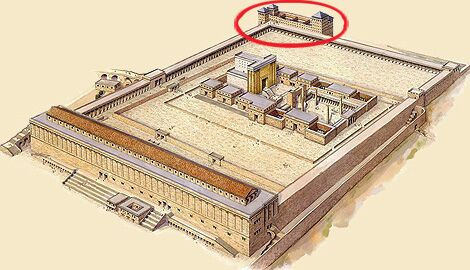
Antonia Fortress Within the City
Camp (3925) parembole from from para = from beside, by the side of + emballo = throw) means something thrown beside something else. Primarily it denotes something enclosed, encircled, or fortified. In military contexts it is used of a fortified camp as a technical term expressing a method of drawing up the troops as in preparation for battle (Heb 11:34). The Septuagint translates machăneh with parembolē, where it often refers to the structured camp of Israel during the Exodus and the years in the wilderness (Ex 14:19; Ex 14:20)
Parembole was used repeatedly in the Septuagint in the phrase "outside the camp" used especially of where defiled things were to be sent - several of the following notes discuss this topic (this exact phrase 28x in 27v in NAS) - Ex 29:14; 33:7; Lev 4:12, 21+; Lev 6:11+.; Lev 8:17+.; Lev 9:11; Lev 13:46+.; Lev 16:27+ (good note by Richard Phillips).; Lev 17:3+.; Lev 24:14, 23+.; Nu 5:3-4; 12:14-15; 15:35-36; 19:3, 9; 31:13, 19; Dt 23:10, 12; Josh 6:23; Heb 13:11+ Heb 13:13+. and "outside the gate" in Heb 13:12+.
It came to mean a military encampment and as a standing camp took on the idea of military quarters or barracks. In Acts 21:34 parembole referred to the Antonia Fortress next to the Temple as shown in the picture above. Parembole was also used to refer to the encampments of the Israelites in the desert (Heb. 13:11, 13 [cf. Lev. 4:12, 21; 16:27]; 1Sa 4:5, 6; 2 Ki 7:5, 7).
PAREMBOLE- 10V - Acts 21:34; Acts 21:37; Acts 22:24; Acts 23:10; Acts 23:16; Acts 23:32; Heb. 11:34; Heb. 13:11; Heb. 13:13; Rev. 20:9
Hebrews 11:34 quenched the power of fire, escaped the edge of the sword, from weakness were made strong, became mighty in war, put foreign armies to flight.
Hebrews 13:11 For the bodies of those animals whose blood is brought into the holy place by the high priest as an offering for sin, are burned outside the camp.
Hebrews 13:13 So, let us go out to Him outside the camp, bearing His reproach.
James Smith - THE SIN-OFFERING.
CHRIST OUR SUBSTITUTE. Leviticus 4:1-12.
Sin, the sinner, and the sin-offering are all vividly before us in this chapter. Ruin and remedy might be written over it. "If a priest that is anointed do sin." Yes, it is possible even for an anointed one to sin, but, blessed be God, provision is made for such (1 John 2:1). But when religious teachers sin, it is like the going wrong of the town clock. Others axe apt to be led astray by their example. As Trapp says, "The sins of teachers are teachers of sin." The way of life is a revelation from God. A ladder let down from Heaven. So this sin-offering may be mentioned here, because it is the lowest step of the ladder, and the first with which we as sinners have to do. Like every other sacrifice—
1. It must be blameless (v. 3). The smallest physical deformity unfitted the ox or the lamb for the altar. The Lord Jesus was perfectly blameless in the eyes of the heart-searching God. In all His close and continuous contact with men and earthly things He remained untainted by the corruptions of lust and of the world. He could touch the uncle-in and yet be untouched with uncleanness. He was holy, harmless, separate from sinners.
2. There had to be imputation and identification (v. 4). The offerer laid his hand on the head of the offering, identifying himself with the sins imputed to the sacrifice, and also with the sacrifice itself. The laying of our sins on Jesus is not our act, but Jehovah's. "He laid on Him the iniquity of us all. It pleased Jehovah to bruise Him." We confess our sins on Him, and by faith lay our hand of appropriation upon Him. He gave Himself for us.
3. The life must be taken. "Kill the bullock before the Lord" (v. 4). The death of the offering had to do with Jehovah. The death of Christ was not an accident, neither was it only an example to us of patience in suffering. It was a death demanded by God. So His life was offered to God as a substitute for others. He died before the Lord. He offered Himself without spot unto God.
4. The fat was burnt on the altar (vs. 8-10). This fat was a sweet savour unto the Lord (v. 31). The fat is frequently referred to, and occupies a prominent place in connection with the sin-offering. It may represent the riches and preciousness of Christ as God sees it all yielded up as an offering to Him on the altar of the Cross, well pleasing.
5. The body was carried outside. The whole bullock shall he carry forth without the camp and burn him (v. 12). Human reason of itself would never have suggested a change of procedure like this. Why should this offering be burnt outside the camp, and not on the altar like the others? Because it is typical of Him who was made a curse for us, and who suffered without the gate (Heb. 13:11, 12), and from whom the Father's face for a season had to be turned away (Matt. 27:46). God cannot look upon sin, but He looks with compassion on the sinner.
6. The blood must be sprinkled. "The priest shall sprinkle of the blood seven times before the Lord" (v. 6). The order in which the blood was sprinkled is sublimely beautiful, and perfectly consistent with the way of salvation as taught in the New Testament. It was sprinkled—(1) Before the Lord. (2) Before the vail. (3) On the altar of incense. (4) Then all that was left was poured out at the bottom of the altar of burnt-offering. The priest sprinkled the blood on his way out, not as he was going in on this instance, teaching us that the way has been made from God out to sinful men. Salvation is of the Lord. But on our approach to God we meet the poured out blood, first of all at the altar, which maketh atonement for the soul.
Typical of Him who poured out His soul unto death on the Cross of Calvary—
1. AT THE ALTAR OF SACRIFICE we have atonement.
2. AT THE ALTAR OF INCENSE we have intercession.
3. THE BLOOD BEFORE THE VAIL speaks of access.
4. THE BLOOD SPRINKLED SEVEN TIMES before the Lord indicates a perfect standing in His presence. Thus we have boldness to enter into the Holiest by the Blood of Jesus. Let us draw near (Heb. 10:19-22).
7. The blessed results. The acceptance by God of the blood of the sin-offering brings within the reach of every believer—
1. THE FORGIVENESS OF SIN. As concerning his sin, it shall be forgiven him (v. 26). Blessed is the man to whom the Lord will not impute sin (Rom. 4:7, 8). It is a blood-bought pardon.
2. THE ASSURANCE OF THIS FORGIVENESS. "It shall." This is the promise of Him who knows the full value of the Blood of His own beloved Son. We are saved by His Blood, and assured by His Word. In the blood-shedding and blood-sprinkling of God's own Son there is provision made for the sins of ignorance (v. 2), as well as for the sins that come to our knowledge (v. 28). "Behold the Lamb of God which taketh away the sin of the world."