Hebrews 13:1
Hebrews 13:2
Hebrews 13:3
Hebrews 13:4
Hebrews 13:5
Hebrews 13:6
Hebrews 13:7
Hebrews 13:8
Hebrews 13:9
Hebrews 13:10
Hebrews 13:11
Hebrews 13:12
Hebrews 13:13
Hebrews 13:14
Hebrews 13:15
Hebrews 13:16
Hebrews 13:17
Hebrews 13:18
Hebrews 13:19
Hebrews 13:20
Hebrews 13:21
Hebrews 13:22
Hebrews 13:23
Hebrews 13:24
Hebrews 13:25
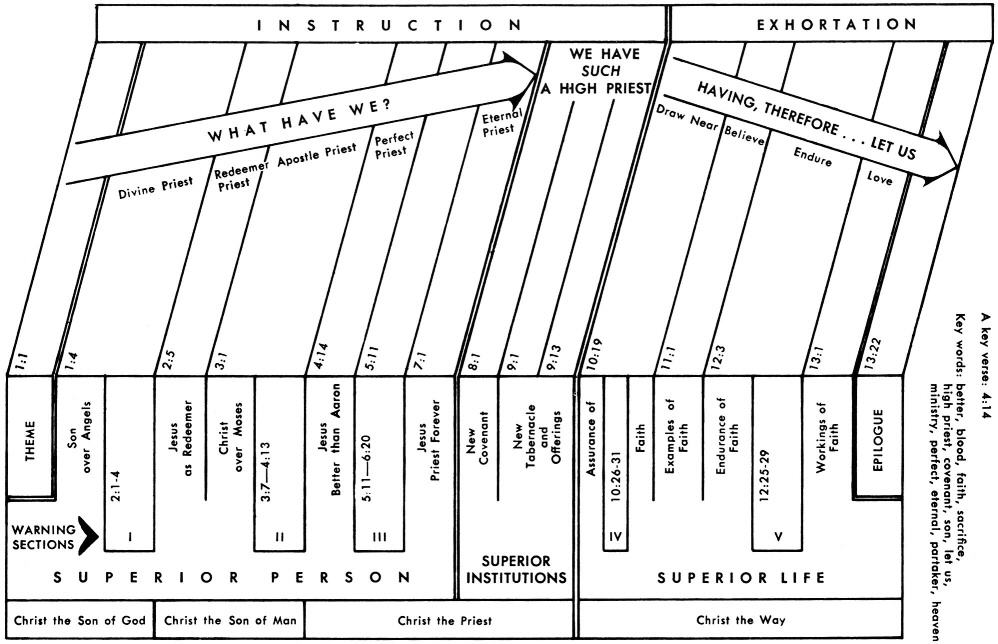
CONSIDER JESUS OUR GREAT HIGH PRIEST
Click chart to enlarge
Charts from Jensen's Survey of the NT - used by permission
Swindoll's Chart, Interesting Pictorial Chart of Hebrews, Another Chart
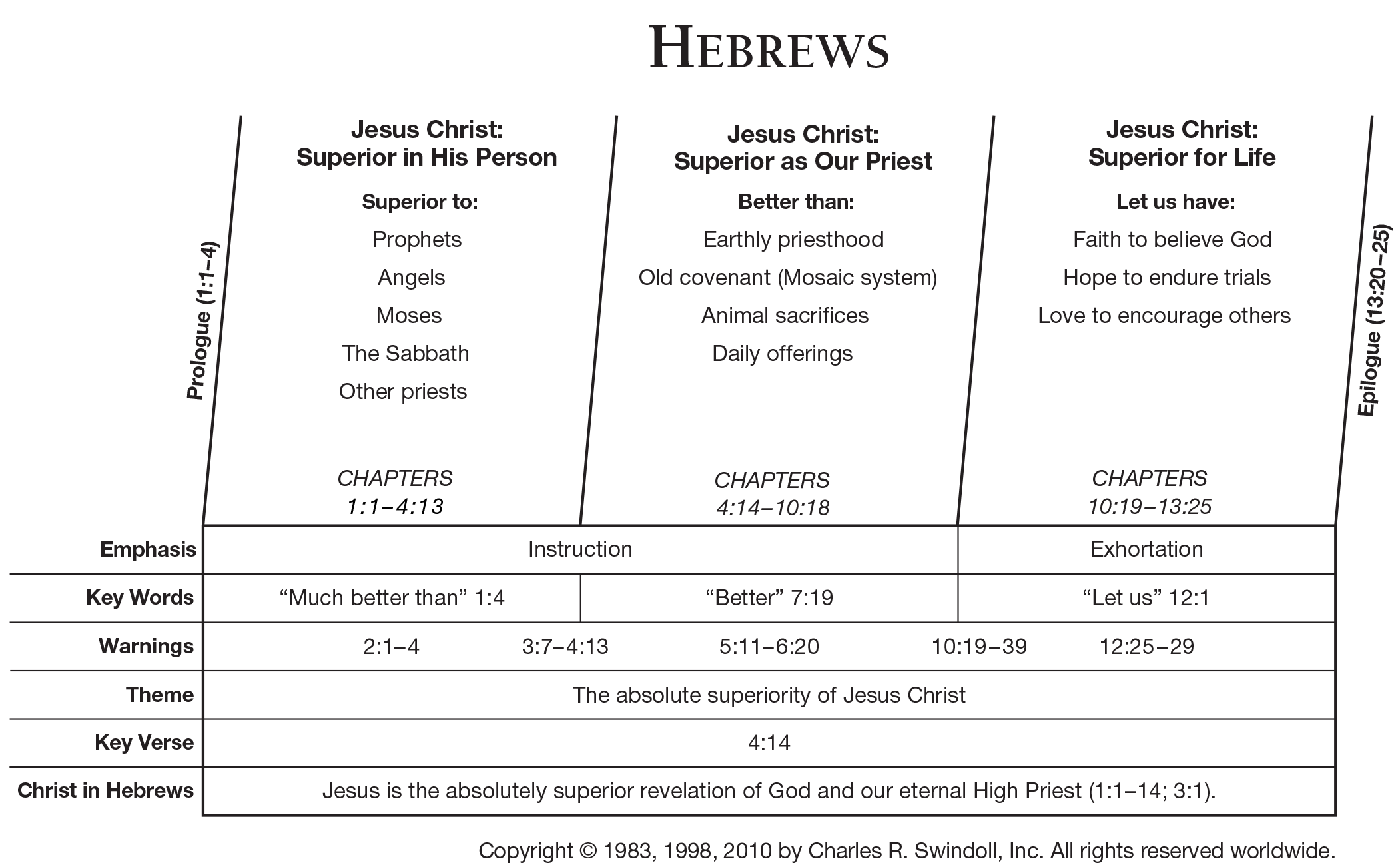

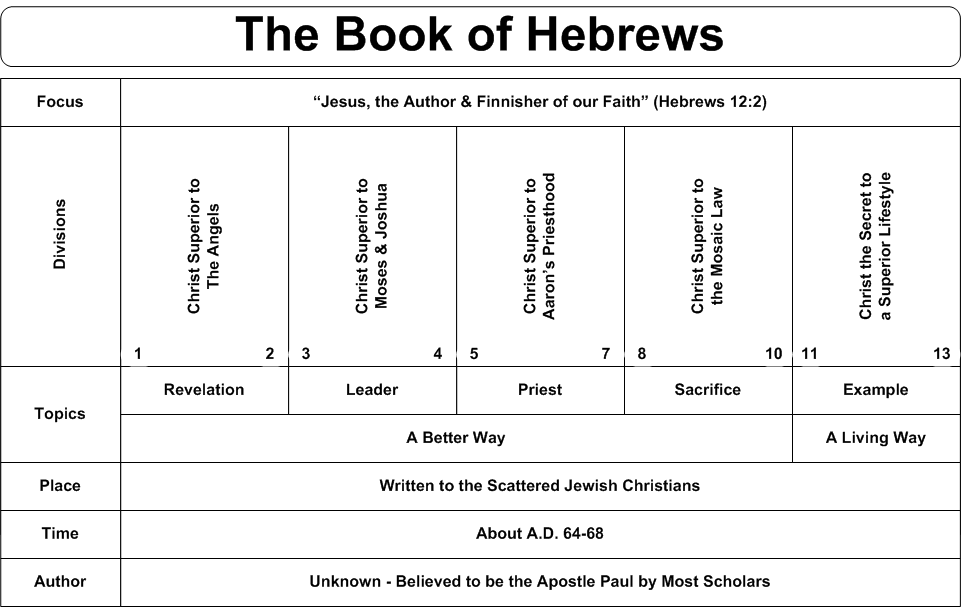
|
The Epistle |
||||
| INSTRUCTION Hebrews 1-10:18 |
EXHORTATION Hebrews 10:19-13:25 |
|||
| Superior Person of Christ Hebrews 1:1-4:13 |
Superior Priest in Christ Hebrews 4:14-10:18 |
Superior Life In Christ Hebrews 10:19-13:25 |
||
| BETTER THAN PERSON Hebrews 1:1-4:13 |
BETTER PRIESTHOOD Heb 4:14-7:28 |
BETTER COVENANT Heb 8:1-13 |
BETTER SACRIFICE Heb 9:1-10:18 |
BETTER LIFE |
| MAJESTY OF CHRIST |
MINISTRY OF CHRIST |
MINISTERS FOR CHRIST |
||
|
DOCTRINE |
DUTY |
|||
|
DATE WRITTEN: |
||||

See ESV Study Bible "Introduction to Hebrews"
(See also MacArthur's Introduction to Hebrews)
Borrow Ryrie Study Bible
Hebrews 13:15 Through Him then, let us continually * offer up a sacrifice of praise to God, that is, the fruit of lips that give thanks to His name. (NASB: Lockman)
Greek: di' autou [oun] anapheromen (1PPAS) thusian aineseos dia pantos to theo, tout' estin (3SPAI) karpon cheileon omologounton (PAPNPG) to onomati autou.
Amplified: Through Him, therefore, let us constantly and at all times offer up to God a sacrifice of praise, which is the fruit of lips that thankfully acknowledge and confess and glorify His name. (Amplified Bible - Lockman)
My Amplified Paraphrase: Through Him (dia autou — through Christ Alone, our perfect High Priest and only Mediator) let us continually offer up (anapherō — bring upward, present, lift like a priest placing a sacrifice on the altar; in the present tense, meaning without ceasing) a sacrifice of praise (thusia aineseōs — a deliberate, God-ward offering of grateful worship; a praise that costs us something—our pride, our comfort, our will) to God, that is, the fruit of lips (karpos cheileōn — verbal praise that is the outward “fruit” produced from an inward heart of gratitude) that confesses His Name (homologeo - present tense — speaking the same thing, to openly acknowledging, declare, and agreeing with God about Who He is and what He has done).
KJV: By him therefore let us offer the sacrifice of praise to God continually, that is, the fruit of our lips giving thanks to his name.
NLT: With Jesus' help, let us continually offer our sacrifice of praise to God by proclaiming the glory of his name. (NLT - Tyndale House)
Phillips: Our constant sacrifice to God should be the praise of lips that give thanks to his name. (Phillips: Touchstone)
Wuest: Through Him, therefore, let us be offering sacrifice of praise continually to God, that is, the fruit of lips which make confession of His Name. (Eerdmans Publishing - used by permission)
Young's Literal: through him, then, we may offer up a sacrifice of praise always to God, that is, the fruit of lips, giving thanks to His name;
- Through Him - Heb 7:25; John 10:9; 14:6; Eph 2:18; Col 3:17; 1Pe 2:5
- Sacrifice Lev 7:12; 2Ch 7:6; 29:31; 33:16; Ezra 3:11; Neh 12:40,43; Ps 50:14,23; Ps 69:30,31; 107:21,22; 116:17-19; 118:19; 136:1-26; 145:1-21; Isa 12:1,2; Eph 5:19,20; Col 1:12; 3:16; 1Pe 4:11; Rev 4:8-11; Rev 5:9-14; Rev 7:9-12; 19:1-6
- Fruit of lips - Ge 4:3,4; Hos 14:2; Ro 6:19; Ro 12:1
- Give thanks - Ps 18:49; Mt 11:25; Luke 10:2
Related Passages:
Hebrews 12:28 Therefore, since we receive a kingdom which cannot be shaken, let us show gratitude, by which we may offer to God an acceptable service with reverence and awe;
Leviticus 7:12 ‘If he offers it by way of thanksgiving, then along with the sacrifice of thanksgiving he shall offer unleavened cakes mixed with oil, and unleavened wafers spread with oil, and cakes of well stirred fine flour mixed with oil.
Psalm 50:23 “He who offers a sacrifice of thanksgiving honors Me; And to him who orders his way aright I shall show the salvation of God.”
Psalm 107:22 Let them also offer sacrifices of thanksgiving, And tell of His works with joyful singing.
Psalm 92:1 A Psalm, a Song for the Sabbath day. It is good to give thanks to the LORD And to sing praises to Your name, O Most High;
Psalm 105:1 Oh give thanks to the LORD, call upon His name; Make known His deeds among the peoples.
Psalms 113:1-3 Praise the LORD! Praise, O servants of the LORD, Praise the name of the LORD. 2 Blessed be the name of the LORD From this time forth and forever. 3 From the rising of the sun to its setting The name of the LORD is to be praised.
1 Thessalonians 5:18 in everything give thanks (present imperative see our need to depend on the Holy Spirit to obey); for this is God’s will for you in Christ Jesus.
Hosea 14:2 Take words with you and return to the LORD. Say to Him, “Take away all iniquity And receive us graciously, That we may present the fruit of our lips.
Psalm 34:1 A Psalm of David when he feigned madness before Abimelech, who drove him away and he departed. I will bless the LORD at all times; His praise shall continually be in my mouth.
A LIFESTYLE OF
PRAISE TO GOD
Through (dia) Him then (oun - therefore) - Through Jesus Christ (no longer through the Levitical priests) for He Alone is our new and living Way (He 10:19-21) All spiritual benefits come through Him! He is our only access to God (cf. Jn 14:6; Acts 4:12; 1Ti 2:5; 1Jn 5:10-12).
Hebrews 13:20-21 explains the way we can offer pleasing "sacrifices" "Now the God of peace, who brought up from the dead the great Shepherd of the sheep through the blood of the eternal covenant, even Jesus our Lord, equip you in every good thing to do His will, working in us that which is pleasing in His sight, through (dia) Jesus Christ, to Whom be the glory forever and ever. Amen. (See notes)
Let us continually (present tense) offer up (anaphero) a sacrifice (thusia) of praise to God, that is, the fruit (karpos) of lips that give thanks (homologeo - present tense) to His name (onoma) - Let us continually (present tense) offer up (anaphero) is a hortatory subjunctive, expressing a call or exhortation and in present tense is calling for our praise to be a continuous, repeated, habitual action. In other words, this exhortation is not calling for an occasional act, a Sunday-only act, a once-in-a-while act, but is to be a lifestyle of worship. Do you (I) praise God every day? Note how the writer begins the exhortation with a vertical (God directed) focus in this verse but immediately follows up with a horizontal (people directed) focus in Heb 13:16. If the later focus is lacking, there is cause to question the former focus, which even borders on hypocrisy (cf 1Jn 3:17, Jas 2:15-17).
Because Christ has opened the way, let us keep bringing to God—day after day, moment by moment—a heartfelt offering of praise, the spiritual fruit that flows from lips continually confessing, honoring, and exalting His Name.
The verb offer up (anaphero) was used in the OT (Septuagint) for bringing (especially animal) sacrifices to God (e.g., Ge 22:1,13, Lev 4:10, 19, etc). The writer of Hebrews is intentionally using the sacrificial vocabulary of the Levitical priesthood, which is apropos for all believers now function as priests (1Pe 2:9, Rev 5:10). Included in the thought of offering up a sacrifice (thusia) are the ideas of offering something voluntarily (volitional offering), and of offering something costly (cf David 2Sa 24:24 = "I will not offer burnt offerings to the LORD my God which cost me nothing.”). Praise is a great antidote for the slings and arrows that pierce our soul each day.
Whereas the Levitical system required yearly and daily outward ritual,
God desires from us an unending offering out of our hearts
-- KJV Study Bible
R C H Lenski - “Through Him” means with His priestly mediation and without any other. “Through Him” we may ever draw nigh to God, both ourselves to get help from the throne of grace for the time of need (Heb 4:14–16), to strengthen our faith and our hope, and to stimulate our love and our good works as we assemble jointly (Heb 10:19–25) and, as the writer now adds, “to offer up constantly to God sacrifice of praise,” which is defined as “fruit of lips confessing his name,” i. e., acknowledging his name or revelation by which he makes himself known to our hearts and by which we know him. (BORROW The Interpretation of the Book of Hebrews)
Let us continually - Spurgeon comments "That is to say, without ceasing. Let us make an analogous precept to that which says, “pray continually” (1Th 5:17), and say, “praise continually.” Not only in this place or that place, but in every place, we are to praise the Lord our God. Not only when we are in a happy frame of mind, but when we are cast down and troubled. The perfumed smoke from the altar of incense is to rise toward heaven both day and night, from the beginning of the year to the year’s end."
Spurgeon - Here we have a description of the believer’s position before God. He has done away with all earthly ordinances, and has no interest in the ceremonies of the Mosaic law. As believers in Jesus, who is the substance of all the outward types, we have, henceforth, nothing to do with altars of gold or of stone: our worship is spiritual, and our altar spiritual. What then? Are we to offer no sacrifice? Very far from it. We are called upon to offer to God a continual sacrifice. Instead of presenting in the morning and the evening a sacrifice of lambs, and on certain holy days bringing bullocks and sheep to be slain, we are to present to God continually the sacrifice of praise. Having done with the outward, we now give ourselves entirely to the inward and to the spiritual.
The Christian’s sacrifice of praise is to be offered continually. It is not to be a fair-weather offering, but an offering in every circumstance. How is it possible to give thanks to God in all circumstances? Obeying this exhortation calls for continual dependence on the Spirit (Ep 5:18, Ep 5:19,20). See Ro 8:28,29 and keep a proper perspective of His hand of loving discipline in Heb 12:5-6, Heb 12:7-10, Heb 12:11.
A rabbinical tradition teaches that all the Mosaic sacrifices would have an end except the thank offering, and all prayers would cease except the prayer of thanksgiving
A grumbling heart cannot
sing a grateful song.
Jack Arnold - You may gauge the spiritual life of a Christian by noting the absence or presence “of a complaining spirit. A Christian cannot praise God and complain at the same time. If all a person does is gripe, grumble, groan, moan, and complain, it shows that he knows nothing about praising God in worship. And mark it down that a murmuring spirit is proof that your gaze has shifted from God to self.
🙏 THOUGHT - Praise and complaint cannot live in the same mouth. When the heart complains, worship withers. In fact grumbling is worship in reverse. Nothing corrodes joy faster than a complaining spirit. On the other hand a sincere, genuine grateful heart turns off the faucet of grumbling. Indeed, every complaint should be a reminder to return to praise. In sum, praise lifts while complaint lowers. Choose your direction! Did you begin to day by praising God or by grumbling about your circumstances? Did you start the day counting blessings or cataloging grumblings? A day that begins with praise is already headed in the right direction and shuts the door on grumbling.
Matthew Henry comments "Now what are the sacrifices which we must bring and offer on this altar, even Christ? Not any expiatory sacrifices; there is no need of them. Christ has offered the great sacrifice of atonement, ours are only the sacrifices of acknowledgment… we must speak forth the praises of God from unfeigned lips; and this must be offered only to God, not to angels, nor saints, nor any creature, but to the name of God alone; and it must be by Christ, in a dependence upon His meritorious satisfaction and intercession.
Jesus, as our Great High Priest , offered up the sacrifice of Himself by bringing His body up to the Cross. Anaphero is used in Hebrews which records that Jesus "does not need daily, like those (Jewish) high priests, to offer up sacrifices, first for His own sins, and then for the sins of the people, because this He did once for all when He offered up Himself." (He 7:27)
Exodus discusses the parallel role of the OT high priests recording that "Aaron shall take away (to lift, to carry) the iniquity of the holy things which the sons of Israel consecrate, with regard to all their holy gifts; and (the turban) shall always be on his forehead, that they may be accepted before the Lord." (Ex 28:38) This picture in Exodus 28 was but a shadow of which Jesus was the Substance.
Isaiah in his famous prophecy of the suffering Servant (the Messiah) records that "Surely our griefs He Himself bore, and our sorrows He carried. Yet we ourselves esteemed Him stricken, smitten of God, and afflicted. But He was pierced through for our transgressions, He was crushed for our iniquities. The chastening for our well-being fell upon Him, and by His scourging we are healed. All of us like sheep have gone astray, each of us has turned to his own way, but the Lord has caused the iniquity of us all to fall on Him. (Isa 53:4-6)
Isaiah adds that "As a result of the anguish of His soul, He will see it and be satisfied; By His knowledge the Righteous One, My Servant, will justify the many, as He will bear (LXX uses anaphero - in 1Pe 2:24) their iniquities. Therefore, I will allot Him a portion with the great, and He will divide the booty (spoils) with the strong, because He poured out Himself to death, and was numbered with the transgressors. Yet He Himself bore (LXX uses anaphero) the sin of many, and interceded for the transgressors. (Isa 53:11, 12)
When John the Baptist saw Jesus coming to him he declared the fulfillment of Isaiah's prophecy (and all the OT Messianic prophecies for that matter) saying "Behold, the Lamb of God Who takes away the sin of the world!" (Jn 1:29)
It is interesting to note that the Jewish people did not crucify criminals. They stoned them to death. But if the victim was especially evil, his dead body was hung on a tree until evening, as a mark of shame (Dt 21:23). Jesus died on a tree—a cross—and bore the curse of the Law (Gal 3:13). The force of ana = up, appears in the fact of the altar was in fact elevated.
E C Wickham (Anglican) on sacrifice of praise - The phrase used is the technical one for the thank-offering of the Levitical Law (Lev. 7:12, &c.). It had already had a spiritual sense put upon it in the Psalms, as Ps 50:23, “the sacrifice of thanksgiving” (R.V.), and Ps 107:22.
Play the old Maranatha chorus We Bring the Sacrifice of Praise
(and praise Him while you listen or sing).
Henry Morris adds that "We no longer sacrifice the blood of animals to cover our sins, for Christ has "offered one sacrifice for sins forever" (He 10:12 ). Instead, we offer praises, the "calves of our lips" (Ps 50:23; Ho 14:2). These are not to be offered only once each week, in a so-called worship service, or praise service, but continually. "In every thing give thanks" (1Th 5:18). )(Hebrews 13 Commentary Notes - Defender's Study Bible)
Spurgeon - If you are believers in Christ, you are God’s priests, and this is the sacrifice that you are continually to offer—the fruit of your lips, giving thanks to God’s name.
J Vernon McGee adds "A child of God is a priest today and can bring sacrifices to God. There are four sacrifices of a believer. (1) You can sacrifice your person (see Rom. 12:1). Someone has said, “When one truly gives himself to the Lord, all other giving becomes easy.” (2) You can sacrifice your purse (see 2 Cor. 8:1–5). If He doesn’t have your purse, He doesn’t have you. (3) You can offer the sacrifice of praise, which we find in this verse: “By him therefore let us offer the sacrifice of praise to God continually, that is, the fruit of our lips giving thanks to his name.” (4) Finally, you can offer the sacrifice of performance or doing good, which we find in the following verse Heb 13:15. (SEE Thru the Bible Hebrews 13)
Fruit (karpos) of lips - This is taken from Hosea 14:2. This speaks of audible praise. The point of this phrase is that fruit is something produced through cultivation, nourishment, and time—and spiritual fruit acceptable to our holy God is produced only by His Holy Spirit (Gal 5:22, Ga 5:23). This means such fruit (karpos) is not borne by simply showing up on Sunday, “praising” God with our lips, and then spending Monday through Saturday living like the world, imagining we can return the next Lord’s Day and offer fruit from our mouths that God will accept. Spiritual fruit is holy fruit, and it is borne only by the Holy Spirit working in a believer who is surrendered to His will and enabled by His grace.
Our hearts are like a "field" that requires constant attention and careful cultivation so that we may be ready at any moment to offer the sacrifice of praise. As wise farmers of the soul, we as believers must “watch over our heart with all diligence” (Pr 4:23), for the fruit that proceeds from our mouths on Sunday is the product of what has been cultivated in our hearts throughout the week. If we have loved the world (Jas 4:4; 2Co 6:14, 16), we will inevitably be shaped by the world’s corrupting influences (Eph 2:2–3), its “lusts of deceit” (2Pe 1:4; Titus 3:3; 1Jn 2:16–17), and the result will be rotten fruit (Mt 12:34–35; Mt 15:19). God sees our hearts (Jas 4:8; 1Sa 16:7) and tests our motives (1Co 4:5).
Yet how thankful we can be that even when we have been defiled by the world’s filth, His mercies are new every morning, and we may still draw near through the blood of Jesus, honestly confessing our sins and turning from them (1Jn 1:9, Pr 28:13).
Donald Guthrie - What proceeds from the lips is regarded as fruit, which reveals the character of its source, as the fruit of a tree reveals the nature of the tree. Lips accustomed to acknowledge God will be constantly singing his praises. The same concept of confessing the name is found in Romans 10:9; Philippians 2:9ff.; Romans 14:11 (from Isa. 45:23). It amounts to an open declaration of allegiance to God. (Borrow Hebrews Commentary)
Give thanks (homologeo - present tense) to His name (onoma) - Give thanks (homologeo - present tense) means to continually acknowledge and in context means to openly confess Who He is and to declare thanks and praise. Such continual confession is the fruit of a heart that draws near to Him. To His Name refers to praising and exalting His revealed character. His Name sums up all that He is, His attributes, His works, His person. It means giving thanks to God for Who He is (His character) and for what He has done (His works). God has revealed Himself in His Name, and therefore His Name is revelation.
Charles Swindoll - In Heb 13:15, the author states that we continually offer to God a “sacrifice of praise,” which he explains as giving thanks to God. This echoes a similar sentiment from the previous chapter, where we were instructed to “show gratitude, by which we may offer to God an acceptable service with reverence and awe” (Heb 12:28). (See Insights on Hebrews - Page 223)
Brian Bell on giving thanks - As Martin Luther said as he lay on his deathbed...between groans he preached... “these pains & troubles here are like the type that printers set. When we look at them, we see them backwards, and they seemed to make no sense & have no meaning. But up there, when the Lord God prints out our life to come, we will find they make splendid reading.” [so, praise & thanks given, even when we don’t understand]
Spurgeon - Bless the Lord at all times. Not alone in your secret chamber, which is pungent with the perfume of your communion with God, but yonder in the field and there in the street. In the hurry and noise of the Exchange, offer the sacrifice of praise to God. You cannot always be speaking His praise, but you can always be living His praise. The heart once set on praising God will, like the stream that leaps down the mountain’s side, continue still to flow in its chosen course. A soul saturated with divine gratitude will continue, almost unconsciously, to give forth the sacred odor of praise, which will permeate the atmosphere of every place and make itself known to all who have a spiritual nostril with which to discern sweetness.
In his little book Practice of Praise (in a quote taken from sermon A Life Long Occupation) Spurgeon adds - “We have an altar” (Hebrews 13:10), not a material altar, but a spiritual one. Yet, “we have an altar.” May the priests of the old law offer sacrifice on it? “Whereof they have no right to eat that serve the tabernacle.” They ate of the sacrifices laid on the altars of the old law, but they have no right here. Those who keep to ritualistic performances and outward ceremonials have no right here. Yet “we have an altar.” Brothers and sisters, can we imagine that this altar is given us by the Lord never to be used? Is no sacrifice to be presented on the best of altars? “We have an altar”—what then? If we have an altar, do not allow it to be neglected, deserted, unused. It is not for spiders to spin their webs upon. It is not fitting that it should be smothered with the dust of neglect. “We have an altar.” What then? “Let us offer the sacrifice of praise to God continually.” Do you not see the force of the argument? Practically obey it.
Philip E Hughes - The offering up of praise is not just a matter of the singing of hymns. As the General Thanksgiving of the Book of Common Prayer reminds us, it is “not only with our lips, but in our lives” that we are to show forth God’s praise. Our spiritual, or logical, worship, says Paul, is to present our bodies “as a living sacrifice, holy and acceptable to God” (Rom. 12:1). This sacrifice of praise and thanksgiving affects our being in its entirety and therefore is to be offered to God continually, at all times and under all circumstances—not occasionally or even at regular intervals, as with the sacrifices of old, but uninterruptedly....The gratitude which is the motive force of the whole life of a Christian cannot fail to burst forth from his lips.....Unlike the thank offerings of the levitical system, this sacrifice requires no presentation or eating of foods (cf. v. 9 above; Lev. 7:11ff.); it is regulated by no outward ceremonial, but rather breaks forth spontaneously from within through the lips. Such praise cannot be silenced by threatenings and persecutions (cf. Acts 4:20; 16:23–25). (A Commentary on the Epistle to the Hebrews)
Dave Guzik comments that…
Because we do have an altar (the cross) and we do have a High Priest (Jesus), we should always offer sacrifices. But they are not the bloody sacrifices of the old covenant, but the sacrifice of praise, the fruit of our lips.
The writer to the Hebrews spells out several essentials for proper praise.
Praise that pleases God is offered by Him, that is, by Jesus Christ, on the ground of His righteousness and pleasing God.
Praise that pleases God is offered continually, so that we are always praising Him.
Praise that pleases God is a sacrifice of praise, in that it may be costly or inconvenient.
Through Him Consider the following simple study - observe and record the wonderful truths that accrue through Him - this would make an edifying, easy to prepare Sunday School lesson - then take some time to give thanks for these great truths by offering up a sacrifice of praise… through Him. Jn 1:3 [Jn 1:3NIV reads "through Him"], Jn 1:7, John 1:10, Jn 3:17, Jn 14:6, Acts 2:22, 3:16, Acts 7:25, Acts 10:43, Acts 13:38, 39, Ro 5:9, Ro 8:37 , Ro 11:36; 1Co 8:6, Ep 2:18, Php 4:13, Col 1:20, Col 2:15, Col 3:17, Heb 7:25, Heb 13:15, 1Pe 1:21, 1Jn 4:9
Would you like more study on the wonderful topic of through Him? Study also the NT uses of the parallel phrase through Jesus (or similar phrases - "through Whom", "through our Lord", etc) - John 1:17, Acts 10:36, Ro 1:4, 5; Ro 1:8, Ro 2:16, Ro 5:1; Ro 5:2 Ro 5:11, Ro 5:21, Ro 7:25, Ro 16:27, 1Cor 15:57, 2Cor 1:5, 2Co 3:4, 2Co 5:18, Gal 1:1, Eph 1:5, Php 1:11, 1Th 5:9; Titus 3:6, He 1:2; He 2:10, Heb 13:21, 1Pe 2:5, 1Pe 4:11, Jude 1:25)
Hortatory Subjunctive - a first-person plural subjunctive verb used to urge a group to do something. (Let us go…” “Let us draw near…” “Let us hold fast…” “Let us consider…”) These are not suggestions; they are strong, urgent exhortations. The hortatory subjunctive expresses: exhortation (strong urging), encouragement, group inclusion (“we together”), an invitation with authority, a call to decisive action. It has the force of:“We must…” “Let us now…” “We should immediately…” It is authoritative yet pastoral.
Why Greek uses the Hortatory Subjunctive - Greek has no first-person imperative (“we, do this!”), so the hortatory subjunctive serves this function. It is the strongest way to urge a group to action.
Summary - This is a statement urging others to join in some action (commanding oneself and one’s associates). (It is roughly the same as first person imperative, which does not exist in Greek.) It is easily identified because it will always be the first person plural form of the subjunctive mood. This verb form will often come near the beginning of the sentence.It is usually translated "let us…." (Thus, as a mnemonic device, it can be referred to as the ‘Salad Subjunctive’. cf "let us" with "lettuce" - a bad joke!)
"LET US" IN HEBREWS - Heb. 4:1; Heb. 4:11; Heb. 4:14; Heb. 4:16; Heb. 6:1; Heb. 10:22; Heb. 10:23; Heb. 10:24; Heb. 12:1; Heb. 12:28; Heb. 13:13; Heb. 13:15
Sacrifice (2378) (thusia from thuo = to sacrifice or kill a sacrificial victim) means that which is offered as a sacrifice. Webster's defines it as act of offering to a deity something precious! Thusia refers literally to animal sacrifices that were slain and offered on the altar (Heb 5:1, Heb 9:26). The thusia par excellence (the supreme sacrifice) is Christ Himself (Heb 7:27). The root meaning is “something slain.” Under the Mosaic system, these sacrifices were continual and repeated. However, Christ’s thusia was unique — a once-for-all, perfect offering of Himself (Hebrews 9:26–28). Once Christ’s atonement was accomplished, believers no longer offer slain animals — they offer their lives, words, and deeds as spiritual sacrifices acceptable to God (SEE Ro 12:1).
Thusia in Scripture unfolds in three movements: (1) Substitutionary (Old Covenant) — animals died in place of sinners. (2) Fulfilled (Christ’s once-for-all offering) — Christ died as the perfect Lamb (Hebrews 9:12). (3) Transformed (Believers’ response) — believers now offer themselves, their praise, and their service as spiritual sacrifices to God (Romans 12:1; Hebrews 13:15–16; Philippians 4:18). Thus, the sacrificial system culminates in a life of worship — a continual offering of love, gratitude, and obedience flowing from hearts redeemed by Christ.
The word thusia teaches us that worship is costly. It involves giving what is precious — first Christ giving Himself for us, and then us offering all we are back to Him. Thusia points to “that which is offered to a deity as precious.” True worship is not merely emotional expression, but sacrificial devotion — giving our time, energy, possessions, and praise to the Lord who gave Himself for us.
Thusia - 28x - Matt. 9:13; Matt. 12:7; Mk. 12:33; Lk. 2:24; Lk. 13:1; Acts 7:41; Acts 7:42; Rom. 12:1; 1 Co. 10:18; Eph. 5:2; Phil. 2:17; Phil. 4:18; Heb. 5:1; Heb. 7:27; Heb. 8:3; Heb. 9:9; Heb. 9:23; Heb. 9:26; Heb. 10:1; Heb. 10:5; Heb. 10:8; Heb. 10:11; Heb. 10:12; Heb. 10:26; Heb. 11:4; Heb. 13:15; Heb. 13:16; 1 Pet. 2:5
Hebrews 5:1 For every high priest taken from among men is appointed on behalf of men in things pertaining to God, in order to offer both gifts and sacrifices for sins;
Hebrews 7:27 who does not need daily, like those high priests, to offer up sacrifices, first for His own sins and then for the sins of the people, because this He did once for all when He offered up Himself.
Hebrews 8:3 For every high priest is appointed to offer both gifts and sacrifices; so it is necessary that this high priest also have something to offer.
Hebrews 9:9 which is a symbol for the present time. Accordingly both gifts and sacrifices are offered which cannot make the worshiper perfect in conscience,
Hebrews 9:23 Therefore it was necessary for the copies of the things in the heavens to be cleansed with these, but the heavenly things themselves with better sacrifices than these.
Hebrews 9:26 Otherwise, He would have needed to suffer often since the foundation of the world; but now once at the consummation of the ages He has been manifested to put away sin by the sacrifice of Himself.
Hebrews 10:1 For the Law, since it has only a shadow of the good things to come and not the very form of things, can never, by the same sacrifices which they offer continually year by year, make perfect those who draw near.
Hebrews 10:5 Therefore, when He comes into the world, He says, “SACRIFICE AND OFFERING YOU HAVE NOT DESIRED, BUT A BODY YOU HAVE PREPARED FOR ME;
Hebrews 10:8 After saying above, “SACRIFICES AND OFFERINGS AND WHOLE BURNT OFFERINGS AND sacrifices FOR SIN YOU HAVE NOT DESIRED, NOR HAVE YOU TAKEN PLEASURE in them” (which are offered according to the Law),
Hebrews 10:11 Every priest stands daily ministering and offering time after time the same sacrifices, which can never take away sins;
Hebrews 10:12 but He, having offered one sacrifice for sins for all time, SAT DOWN AT THE RIGHT HAND OF GOD,
Hebrews 10:26 For if we go on sinning willfully after receiving the knowledge of the truth, there no longer remains a sacrifice for sins,
Hebrews 11:4 By faith Abel offered to God a better sacrifice than Cain, through which he obtained the testimony that he was righteous, God testifying about his gifts, and through faith, though he is dead, he still speaks.
Hebrews 13:15 Through Him then, let us continually offer up a sacrifice of praise to God, that is, the fruit of lips that give thanks to His name.
Hebrews 13:16 And do not neglect doing good and sharing, for with such sacrifices God is pleased.
Hosea describes Israel’s confession to God and the appropriate response to His marvelous mercy and grace which forgives sins..
Take words with you and return to the LORD. Say to Him, "Take away all iniquity, and receive us graciously, that we may present the fruit (praise) of our lips. (Hosea 14:2)
Asaph records God's desire…
He who offers a sacrifice of thanksgiving honors Me and to him who orders his way aright I shall show the salvation of God. (Ps 50:23)
Spurgeon commenting on this Psalm penned the following words…
Whoever offers praise glorifies Me. Praise is the best sacrifice; true, hearty, gracious thanksgiving from a renewed mind. Not the lowing of bullocks bound to the altar, but the songs of redeemed men are the music which the ear of Jehovah delights in. Sacrifice your loving gratitude, and God is honoured thereby.
And to him that orders his conversation aright will I show the salvation of God. Holy living is a choice evidence of salvation. He who submits his whole way to divine guidance, and is careful to honour God in his life, brings an offering which the Lord accepts through His dear Son; and such a one shall be more and more instructed, and made experimentally to know the Lord's salvation. He needs salvation, for the best ordering of the life cannot save us, but that salvation he shall have. Not to ceremonies, not to unpurified lips, is the blessing promised, but to grateful hearts and holy lives.
O Lord, give us to stand in the judgment with those who have worshipped Thee aright and have seen Thy salvation. (Spurgeon's note)
Give thanks (3670) (homologeo) basically means to say the same thing as and can convey several connotations including binding the speaker to his or her word (Mt 14:7), confessing or admitting to something as true (thus agreeing with it) (He 11:13), indicating a binding statement in a judicial matter (Ac 24:14), making a public acknowledgement of allegiance (Ro 10:9, 10), or as in this verse acknowledging that which is rightly due to God.
Here is a synopsis of the nuances of homologeo…
(1) To commit oneself to do something for someone, to make a promise. The nuance here is as if the speaker binds himself to his word and gives a solemn promise. (Acts 7:17, Mt 14:7) The more intensive form of homologeo, exomologeo, is used of Judas' promise (consent) to betray Jesus (Lk 22:6).
(2) To share a common view or be of common mind about a matter, to agree (Acts 23:8)
(3) To confess or concede that something is factual or true, to admit. The opposite is to deny something is true. (Jn 1:20, 1Jn 1:9, Heb 11:13. Homologeo conveys a judicial meaning in the admitting to one's guilt in Acts 24:14 [see notes below regarding this common secular meaning]). The more intensive form of homologeo, exomologeo, is used in Acts 19:18 of confessing their sins.
(4) To acknowledge or profess something, usually publicly. (Mt 7:23, Titus 1:16 = confession can be false and must be tested by one's lifestyle! Ro 10:9 = in a religious sense of making a statement of what one believes. Although there is some overlap with the previous passage, homologeo can also reflect a public acknowledgment of one's allegiance - Jn 9:22, Mt 10:32, Lk 12:8, 1Ti 6:12)
(5) To praise, to celebrate - a sense unknown in Greek secular writings and used with this meaning only in Heb 13:15.
Offer up (399) (anaphero from ana = up, again, back + phero = bear, carry) literally means to carry, bring or bear up and so to to cause to move from a lower position to a higher position. It serves as a technical term for offering sacrifices offer up (to an altar).
Anaphero - 10x - bear(1), bore(1), brought up(2), offer up(3), offered up(2).Matt. 17:1; Mk. 9:2; Heb. 7:27; Heb. 9:28; Heb. 13:15; Jas. 2:21; 1 Pet. 2:5; 1 Pet. 2:24
Hebrews 7:27 Who does not need daily, like those high priests, to offer up sacrifices, first for His own sins and then for the sins of the people, because this He did once for all when He offered up Himself.
Hebrews 9:28 so Christ also, having been offered once to bear the sins of many, will appear a second time for salvation without reference to sin, to those who eagerly await Him.
It is notable that anaphero is used 25 times in the Septuagint translation of Leviticus regarding offerings! For example, Moses records that…Aaron's sons shall offer it up (anaphero = bear, carry) in smoke on the altar on the burnt offering, which is on the wood that is on the fire; it is an offering by fire of a soothing aroma to the LORD. (Lev 3:5)
See also Gen. 8:20; 22:2, 13; 31:39; 40:10; Exod. 18:19, 22, 26; 19:8; 24:5; 29:18, 25; 30:9, 20; Lev. 2:16; 3:5, 11, 14, 16; 4:10, 19, 26, 31; 6:15, 26; 7:5, 31; 8:16, 20f, 27f; 9:10, 20; 14:20; 16:25; 17:5f; 23:11; Num. 5:26; 14:33; 18:17; 23:2, 30; Deut. 1:17; 12:13f, 27; 14:24; 27:6; Jdg. 6:26, 28; 11:31; 13:16, 19; 15:13; 16:8, 18; 20:26, 38; 21:4; 1 Sam. 2:19; 6:14f; 7:9f; 10:8; 13:9f, 12; 15:12; 18:27; 20:13; 2 Sam. 1:24; 6:17; 21:13; 24:22, 24f; 1 Ki. 2:35; 3:4; 5:13; 8:1; 9:15; 10:5; 12:27; 17:19; 2 Ki. 3:27; 4:21; 1 Chr. 15:3, 12, 14; 16:2, 40; 21:24, 26; 23:31; 29:21; 2 Chr. 1:4, 6; 2:4; 4:16; 5:2, 5; 8:12f; 9:4, 16; 23:18; 24:14; 29:21, 27, 29, 31f; 35:14; Ezr. 3:2, 6; Neh. 10:38; 12:31; Job 7:13; Ps. 51:19; 66:15; Prov. 8:6; Isa. 18:7; 53:11f; 57:6; 60:7; 66:3; Jer. 32:35; Ezek. 36:15; 43:18, 24; Dan. 6:23)
Fruit (2590) karpos literal refers to fruit, produce or offspring, describing that which is produced by the inherent energy of a living organism. Karpos is what something naturally produces. Karpos refers to that which originates or comes from something producing an effect, result, benefit, advantage or profit.
Figuratively as in this verse, karpos speaks of the consequence or result of physical, mental, and/or spiritual action. In the NT the figurative (metaphorical) uses of karpos predominate and this is particularly true in the Gospels, where human actions and words are viewed as fruit growing out of a person's essential being or character.
🙏THOUGHT - Our lips can bring forth pleasing, spiritually "fragrant" fruit (cp Pr 16:24, 25:11, 27:9) or "foul-smelling", rotten (unwholesome) "fruit" (cp Ep 4:29). Beloved, what kind of fruit did your lips produce this week?
Karpos - 67x in NT - benefit(2), crop(5), crops(2), descendants(1), fruit(43), fruitful(1),fruits(4), grain(1), harvest(1), proceeds(1), produce(4), profit(1). Matt. 3:8; Matt. 3:10; Matt. 7:16; Matt. 7:17; Matt. 7:18; Matt. 7:19; Matt. 7:20; Matt. 12:33; Matt. 13:8; Matt. 13:26; Matt. 21:19; Matt. 21:34; Matt. 21:41; Matt. 21:43; Mk. 4:7; Mk. 4:8; Mk. 4:29; Mk. 11:14; Mk. 12:2; Lk. 1:42; Lk. 3:8; Lk. 3:9; Lk. 6:43; Lk. 6:44; Lk. 8:8; Lk. 12:17; Lk. 13:6; Lk. 13:7; Lk. 13:9; Lk. 20:10; Jn. 4:36; Jn. 12:24; Jn. 15:2; Jn. 15:4; Jn. 15:5; Jn. 15:8; Jn. 15:16; Acts 2:30; Rom. 1:13; Rom. 6:21; Rom. 6:22; Rom. 15:28; 1 Co. 9:7; Gal. 5:22; Eph. 5:9; Phil. 1:11; Phil. 1:22; Phil. 4:17; 2 Tim. 2:6; Heb. 12:11; Heb. 13:15; Jas. 3:17; Jas. 3:18; Jas. 5:7; Jas. 5:18; Rev. 22:2
Scripture catalogs 3 general kinds of spiritual fruit…
1) Spiritual attitudes that characterize a Spirit-led believer - Galatians 5:22, Gal 5:23
2) Righteous actions - Ro 6:22, Php 4:16, 17; He 13:5
3) New converts - Ro 16:5
Larry Richards summarizes the Biblical concept of spiritual fruit writing that "Fruitfulness is a consistent concept in the OT and the NT. The fruit God seeks in human beings is expressed in righteous and loving acts that bring peace and harmony to the individual and to society. But that fruit is foreign to sinful human nature. Energized by sinful passions, fallen humanity acts in ways that harm and bring dissension. God's solution is found in a personal relationship with Jesus and in the supernatural working of God's Spirit within the believer. As we live in intimate, obedient relationship with Jesus (cf Jn 15:5, Eph 5:18, Gal 5:16), God's Spirit energizes us (Php 2:13NLT) to produce the peaceable fruits of a righteousness that can come only from the Lord (Isa 32:17, Ro 14:17, Heb 12:11, Jas 3:18). (Borrow Expository Dictionary of Bible Words often has some very interesting insights)
QUESTION - What is the key to bearing fruit as a Christian?
ANSWER - In the natural world, fruit is the result of a healthy plant producing what it was designed to produce (Genesis 1:11–12). In the Bible, the word fruit is often used to describe a person’s outward actions that result from the condition of the heart.
Good fruit is that which is produced by the Holy Spirit. Galatians 5:22-23 gives us a starting place: the fruit of His Spirit is love, joy, peace, patience, kindness, goodness, faithfulness, gentleness, and self-control. The more we allow the Holy Spirit free rein in our lives, the more this fruit is evident (Galatians 5:16, 25). Jesus told His followers, “I chose you and appointed you so that you might go and bear fruit—fruit that will last” (John 15:16). Righteous fruit has eternal benefit.
Jesus told us clearly what we must do to bear good fruit. He said, “Abide in Me, and I in you. As the branch cannot bear fruit of itself unless it abides in the vine, so neither can you unless you abide in Me. I am the vine, you are the branches; he who abides in Me and I in him, he bears much fruit, for apart from Me you can do nothing” (John 15:4–5). A branch must stay firmly attached to the trunk to stay alive. As disciples of Christ, we must stay firmly connected to Him to remain spiritually productive. A branch draws strength, nourishment, protection, and energy from the vine. If it is broken off, it quickly dies and becomes unfruitful. When we neglect our spiritual life, ignore the Word of God, skimp on prayer, and withhold areas of our lives from the scrutiny of the Holy Spirit, we are like a branch broken off the vine. Our lives become fruitless. We need daily surrender, daily communication, and daily—sometimes hourly—repentance and connection with the Holy Spirit in order to “walk in the Spirit and not fulfill the lusts of the flesh” (Galatians 5:16). Staying intimately connected to the True Vine is the only way to “bear fruit in old age” (Psalm 92:14), to “run and not grow weary” (Isaiah 40:31), and to not “grow weary in well-doing” (Galatians 6:9).
One counterfeit to bearing good fruit is pretense. We can become experts at the routines, the lingo, and “acting Christian,” while experiencing no real power and bearing no eternal fruit. Our hearts remain self-centered, angry, and joyless even while we go through the motions of serving God. We can easily slip into the sin of the Pharisees of Jesus’ day in judging ourselves by how we think we appear to others and neglecting that secret place of the heart where all good fruit germinates. When we love, desire, pursue, and fear the same things that the rest of the world does, we are not abiding in Christ, even though our lives may be filled with church-related activity. And, often, we don’t realize that we are living fruitless lives (1 John 2:15–17).
Our works will be tested by fire. Using a different metaphor than fruit, 1 Corinthians 3:12–14 says, “If anyone builds on this foundation using gold, silver, costly stones, wood, hay or straw, their work will be shown for what it is, because the Day will bring it to light. It will be revealed with fire, and the fire will test the quality of each person’s work. If what has been built survives, the builder will receive a reward. If it is burned up, the builder will suffer loss but yet will be saved—even though only as one escaping through the flames.”
God is the judge of even our thoughts and motivations. All will be brought to the light when we stand before Him (Hebrews 4:12–13). A poor widow in a one-room hut can bear as much fruit as a televangelist leading giant crusades if she is surrendered to God in everything and using all He has given her for His glory. As fruit is unique to each tree, our fruit is unique to us. God knows what He has entrusted to each of us and what He expects us to do with it (Luke 12:48). Our responsibility before God is to be “faithful with little” so that He can trust us with much (Matthew 25:21).GotQuestions.org
Related Resources:
- What did Jesus mean when He said, “I am the True Vine” (John 15:1)? | GotQuestions.org
- Does the vine and branches passage in John 15 mean that salvation can be lost? | GotQuestions.org
- What does it mean to abide in Christ? | GotQuestions.org
- What is the fruit of righteousness in Philippians 1:11? | GotQuestions.org
- What are some Bible verses about fruit? | GotQuestions.org
- What does it mean that you will know them by their fruit in Matthew 7:16? | GotQuestions.org
- The Fruit of the Holy Spirit – What is love? | GotQuestions.org
- The Fruit of the Holy Spirit – What is joy? | GotQuestions.org
- The Fruit of the Holy Spirit – What is peace? | GotQuestions.org
- The Fruit of the Holy Spirit – What is patience? | GotQuestions.org
- The Fruit of the Holy Spirit – What is kindness? | GotQuestions.org
- The Fruit of the Holy Spirit – What is goodness? | GotQuestions.org
- The Fruit of the Holy Spirit – What is faithfulness? | GotQuestions.org
- The Fruit of the Holy Spirit – What is gentleness? | GotQuestions.org
- The Fruit of the Holy Spirit – What is self-control? | GotQuestions.org
QUESTION - What does it mean to give a sacrifice of praise (Hebrews 13:15)? GOTQUESTIONS.ORG
ANSWER - Hebrews 13:15 says, "Through Jesus, therefore, let us continually offer to God a sacrifice of praise—the fruit of lips that openly profess his name." The terms sacrifice and praise might seem to be opposites. We think of sacrifice as offering something at great cost to ourselves. Praise, on the other hand, sounds joyful as it bubbles from a grateful heart. However, in the spiritual realm, sacrifice and praise are intertwined.
Praise does not always cost us something. We praise our dogs for fetching the ball and people for a job well done. Praise is often our response to some action that directly benefits us, and we feel generous because we extend it. We often find it easy to praise God from the same motivation. When He has blessed us, helped us, and protected us, we feel generous toward Him. We can sing, worship, and talk about how good He is because we can see it. That kind of praise, although worthwhile, does not cost us anything. It is not a sacrifice.
Then there are those times when God did not come through the way we thought He would. The medical test comes back positive. The spouse wants a divorce. A child is wayward. The mortgage company calls in the loan. God seems very far away, and praise is the last thing to bubble up from our hearts. We can’t see His goodness, and circumstances scream that He has forgotten us.
To praise God in those times requires personal sacrifice. It takes an act of the will to lay our all on the altar before a God we don’t understand. When we bring a "sacrifice of praise," we choose to believe that, even though life is not going as we think it should, God is still good and can be trusted (Psalm 135:2; Nahum 1:7). When we choose to praise God in spite of the storms, He is honored, and our faith grows deeper (Malachi 3:13-17; Job 13:15).
The command in Hebrews 13:15 says that this sacrifice is to be offered "continually." Our praise of God is not to be based on our opinion of His job performance. Praise cannot be treated as a "reward" we give God for His obvious blessings. Isaiah 29:13 says, "These people come near to me with their mouth and honor me with their lips, but their hearts are far from me." Real praise continues regardless of circumstances. It flows continually from a worshiping heart in good times and bad (Acts 16:23-25).
The "sacrifice of praise" comes from a humble heart that has been purified by fire. It rises from a spirit that has chosen to honor God in spite of the pain that life is causing. Psalm 51:16-17 expresses this idea when it says, "You do not delight in sacrifice, or I would bring it; you do not take pleasure in burnt offerings. My sacrifice, O God, is a broken spirit; a broken and contrite heart you, God, will not despise."
F B Meyer - THE SACRIFICE OF PRAISE
Serve the Lord with gladness: Come before His presence with singing.-- Ps 100:2.
THE HUNDREDTH Psalm is rightly entitled "A Psalm of Thanksgiving" (R.V.). The Psalmist calls for a "joyful noise," i.e. an audible expression of worship. Do not be content with a thankful heart, but express it! It is good to let God have "the fruit of our lips." As a bird will awaken the whole choir of a woodland glade, so the soul really aglow with loving adoration will spread its own contagion of song. How often Christian people hinder the progress of Christianity by their dullness, gloominess, and depression. His service is perfect freedom, and if we delight ourselves in the Lord, we should serve Him with gladness!
It is very important to maintain the habit of regular church-going because of its opportunity for worship. Let us "enter into His gates with thanksgiving, and into His courts with praise!" By meditation and prayer let us ask that we may be accounted worthy to stand in His Presence, and offer praise and adoration to the Most High God (El Elyon: Most High God - Sovereign Over All), mingled with the fragrance of our Saviour's Name (Rev 8:3, Re 8:4).
"'The Lord is good!" There are many mysteries, and much pain and sorrow in the world. We must dare to believe and affirm the goodness of God beneath all the distressing elements of modem life. With His goodness are combined His mercy and His truth. Let men do their worst, "His truth endureth to all generations." It is an impregnable Rock, on which the waves of sin can make no sensible impression. What comfort there is in knowing that equally His mercy is everlasting. We need so much patience, forbearance, and longsuffering, that if God's mercy were anything less we should despair, but it is extended to every generation till Time shall be no more!
PRAYER - Bless the Lord, O my soul, And forget not all His benefits. AMEN (Our Daily Walk)
Gratitude is an offering precious in the sight of God, and it is one that the poorest of us can make and be not poorer but richer for having made it. —A. W. Tozer in Signposts. Christianity Today, Vol. 39, no. 13.
Jon Courson - Hebrews 13:15
‘I don’t feel like praising the Lord,’ some say. ‘The traffic bugs me,’ or ‘The dishes are getting to me.’ Gang, those are the best times to praise Him—because then it’s a sacrifice of praise as you worship the Lord in spite of your own fleshly inclinations.
You see, here’s the deal: in my Christian walk, I find myself going through seasons...
There’s springtime—when, with new understandings and fresh growth, I sense the Lord’s presence in my heart. Springtime leads to summertime—those warm, wonderful days when the new growth bears fruit from which people glean. Summertime leads to fall—when the winds blow and shake the leaves off my tree. Fall leads to winter—when the fall winds give way to a cold, wintry silence. And I used to freak out in wintertime. Then I learned that if I am going to be a man who walks by faith and not by sight, I must not constantly monitor my feelings because feelings are fickle. The Lord allows you and me to go through regular seasons of wintertime, asking us, ‘Are you going to walk by the state of your emotions—or by the promises of My Word?’
This has afforded me the privilege of being a minister of the Gospel regardless of any tragedy or heartache in my own life. Truly, if I hadn’t learned the lessons of the winter season, I wouldn’t be sitting here right now. But the good news is this: winter doesn’t last forever. It gives way to spring.
Tonight during worship, some of you were elated, caught up in an overwhelming sense of the Lord’s presence. And that’s good. Others of you said, ‘I’m here tonight. But I don’t feel anything. However, I’m still going to lift my hands and my voice in a sacrifice of praise to the One who has done so much for me in the past, to the One whose touch I know I will feel again in the future.’
Johnny Hunt - HEBREWS 13:15, 16
Matt Redman wrote a wonderful song titled, “The Heart of Worship.” Here is the chorus: “I’m coming back to the heart of worship, and it’s all about You. It’s all about You, Jesus. I’m sorry, Lord, for the thing I’ve made it, when it’s all about You. It’s all about You, Jesus.”11 What is the heart of worship? The answer is one simple word: surrender.
The writer of Hebrews challenges us to “offer the sacrifice of praise to God.” If you know anything about a sacrifice, you know that it represents surrender. Once you put a sacrifice on the altar, you lose total control of it and you never get it back. The heart of worship, then, is found in surrender. When you surrender your time, your talents, your treasures, and your testimony, that offering of surrender is an act of worship.
L. B. Cowman, a former missionary and author of Streams in the Desert, wrote, “Life is not wreckage to be saved out of the world but an investment to be used in the world.”12 Make your life useful in bringing glory to God by surrendering to Him and living with a worshipful heart.
Daily Light on the Daily Path - “You shall be to me a kingdom of priests and a holy nation.”
“You were slain, and by your blood you ransomed people for God from every tribe and language and people and nation, and you have made them a kingdom and priests to our God.”—But you are a chosen race, a royal priesthood, a holy nation, a people for his own possession, that you may proclaim the excellencies of him who called you out of darkness into his marvelous light.
You shall be called the priests of the Lord; they shall speak of you as the ministers of our God.—Priests of God and of Christ.
Therefore, holy brothers, you who share in a heavenly calling, consider Jesus, the apostle and high priest of our confession.—Through him then let us continually offer up a sacrifice of praise to God, that is, the fruit of lips that acknowledge his name.
For we are his workmanship, created in Christ Jesus for good works, which God prepared beforehand, that we should walk in them.—God’s temple is holy, and you are that temple.
Ex. 19:6; Rev. 5:9–10; 1 Pet. 2:9; Isa. 61:6; Rev. 20:6; Heb. 3:1; Heb. 13:15; Eph. 2:10; 1 Cor. 3:17
Daily Light on the Daily Path - The cheerful of heart has a continual feast.
“The joy of the Lord is your strength.”—The kingdom of God is not a matter of eating and drinking but of righteousness and peace and joy in the Holy Spirit.—Be filled with the Spirit, addressing one another in psalms and hymns and spiritual songs, singing and making melody to the Lord with your heart, giving thanks always and for everything to God the Father in the name of our Lord Jesus Christ.
Through him then let us continually offer up a sacrifice of praise to God, that is, the fruit of lips that acknowledge his name.
Though the fig tree should not blossom, nor fruit be on the vines, the produce of the olive fail and the fields yield no food, the flock be cut off from the fold and there be no herd in the stalls, yet I will rejoice in the Lord; I will take joy in the God of my salvation.—As sorrowful, yet always rejoicing.—Not only that, but we rejoice in our sufferings.
Prov. 15:15; Neh. 8:10; Rom. 14:17; Eph. 5:18–20; Heb. 13:15; Hab. 3:17–18; 2 Cor. 6:10; Rom. 5:3
Daily Light on the Daily Path - The one who offers thanksgiving as his sacrifice glorifies me.”
Let the word of Christ dwell in you richly, teaching and admonishing one another in all wisdom, singing psalms and hymns and spiritual songs, with thankfulness in your hearts to God. And whatever you do, in word or deed, do everything in the name of the Lord Jesus, giving thanks to God the Father through him.— Glorify God in your body.
But you are a . . . a royal priesthood . . . that you may proclaim the excellencies of him who called you out of darkness into his marvelous light.—You yourselves like living stones are being built up as a spiritual house, to be a holy priesthood, to offer spiritual sacrifices acceptable to God through Jesus Christ.—Through him then let us continually offer up a sacrifice of praise to God, that is, the fruit of lips that acknowledge his name.
My soul makes its boast in the Lord; let the humble hear and be glad. Oh, magnify the Lord with me, and let us exalt his name together!
Ps. 50:23; Col. 3:16–17; 1 Cor. 6:20; 1 Pet. 2:9; 1 Pet. 2:5; Heb. 13:15; Ps. 34:2–3
Daily Light on the Daily Path - Praise is due to you, O God, in Zion.
Yet for us there is one God, the Father, from whom are all things and for whom we exist, and one Lord, Jesus Christ, through whom are all things and through whom we exist.—“That all may honor the Son, just as they honor the Father. Whoever does not honor the Son does not honor the Father who sent him.”—Through him then let us continually offer up a sacrifice of praise to God, that is, the fruit of lips that acknowledge his name.—The one who offers thanksgiving as his sacrifice glorifies me; to one who orders his way rightly I will show the salvation of God!
After this I looked, and behold, a great multitude that no one could number, from every nation, from all tribes and peoples and languages, standing before the throne and before the Lamb, clothed in white robes, with palm branches in their hands, and crying out with a loud voice, “Salvation belongs to our God who sits on the throne, and to the Lamb! . . . Amen! Blessing and glory and wisdom and thanksgiving and honor and power and might be to our God forever and ever! Amen.”
Ps. 65:1; 1 Cor. 8:6; John 5:23; Heb. 13:15; Ps. 50:23; Rev. 7:9–10, 12
Daily Light on the Daily Path - Give to him glorious praise!
“The people whom I formed for myself that they might declare my praise.”—“I will cleanse them from all the guilt of their sin against me, and I will forgive all the guilt of their sin and rebellion against me. And this city shall be to me a name of joy, a praise and a glory before all the nations of the earth.”—Through him then let us continually offer up a sacrifice of praise to God, that is, the fruit of lips that acknowledge his name.—I give thanks to you, O Lord my God, with my whole heart, and I will glorify your name forever. For great is your steadfast love toward me; you have delivered my soul from the depths of Sheol.—“Who is like you, O Lord, . . . majestic in holiness, awesome in glorious deeds, doing wonders?”—I will praise the name of God with a song; I will magnify him with thanksgiving.—And they sing the song of Moses, the servant of God, and the song of the Lamb, saying, “Great and amazing are your deeds, O Lord God the Almighty!”
Ps. 66:2; Isa. 43:21; Jer. 33:8–9; Heb. 13:15; Ps. 86:12–13; Ex. 15:11; Ps. 69:30; Rev. 15:3
OFFER YOUR SACRIFICE OF PRAISE NIV, Once-A-Day: Worship and Praise Devotional: 365 Days to ...
Take words with you and return to the LORD. Say to him: “Forgive all our sins and receive us graciously, that we may offer the fruit of our lips.”
HOSEA 14:2
Giving thanks before serving holy communion, the celebrant says, “We celebrate the memorial of our redemption, O Father, in this sacrifice of praise and thanksgiving. Recalling his death, resurrection, and ascension, we offer you these gifts.”
These words are from the Book of Common Prayer, the worship “manual” of the Episcopal Church, the expression of faith a group of believers have “in common.” But the call to a sacrifice of praise and thanksgiving is for individuals as well. And it has gone out for millennia.
Put it all before the Lord, said the prophets and priests. Offer your petitions. Offer yourself. Why a sacrifice of praise? Sacrifice of praise refers to thank offerings to God — real, heartfelt repentance, not just a “going through the motions” nod to him. It is a continual reminder that we are to offer something, something of value.
Sometimes the offering is costly. “It’s a real sacrifice of time,” complains the person who really would rather not part with those precious minutes. “I’d be sacrificing my career advancement,” says the employee who debates cutting back on hours to care for a family member. “I’d be sacrificing feeling hurt and deprived,” thinks the one not used to giving thanks during the hard times.
The author of the letter to the Hebrews echoed Hosea 14:2. “Through Jesus, therefore, let us continually offer to God a sacrifice of praise — the fruit of lips that openly profess his name” (Hebrews 13:15).
Offer your petitions today. Offer yourself. Offer the sacrifice of praise.
PRAYER
Lord God, please accept my offering of praise …
WHEN PRAISE BECOMES A SACRIFICE - Greg Laurie Beyond: A Devotional - Page 256
Therefore by Him let us continually offer the sacrifice of praise to God, that is, the fruit of our lips, giving thanks to His name. (Hebrews 13:15)
There are times when it is a sacrifice to offer praise to God, quite frankly, because we don’t really want to. There are times when we are down or depressed or things aren’t going that well. We don’t really feel like praising the Lord. Yet the Bible is filled with admonition after admonition to give glory and praise and thanks to God. Psalm 106:1 says, “Praise the Lord! Oh, give thanks to the Lord, for He is good! For His mercy endures forever.”
Notice that the Bible does not say, “Give thanks to the Lord when you feel good.” Rather, it says, “Give thanks to the Lord, for He is good!” I don’t praise God because I feel like it. I praise God because He is worthy, regardless of what I am going through. Praise can be a sacrifice sometimes. I have found that when, out of obedience, I begin to praise the Lord, the emotion will begin to engage with my act of obedience in time. The point is, I should do it because God tells me to.
In the Gospel of Luke, we find the story of ten men who were miraculously touched by Jesus. Because these men had leprosy, they were the outcasts of their society. Yet Jesus went out of His way to touch them and heal them of this dread disease. Only one, a Samaritan, returned and gave thanks and praise to God. Jesus then asked a provocative question: “Were there not any found who returned to give glory to God except this foreigner?” (Luke 17:18). In many ways, I think He is still asking this question today.
Larry Richards - “A sacrifice of praise” Heb. 13:15. Let’s not come empty-handed to the Lord. And let’s not rush into His presence, shouting out our needs and demanding attention without first paying attention to Him.
What we bring Christ as our sacrifice today is praise. And He is worthy to be praised.
Perhaps it’s not surprising, but even in this we find that God thinks of us, even as He asks us to consider Him. When we do focus our attention on the Lord, and praise Him for His great attributes, we pray with much greater confidence. Rehearsing His praises strengthens our faith, and faith is essential to answered prayer.
For the Beauty of the Earth - Kenneth Osbeck - Borrow Hymn Stories
Author—Folliott S. Pierpoint, 1835–1917
Composer—Conrad Kocher, 1786–1872
Tune Name—“Dix”
Meter—77.77.77
Scripture Reference—Hebrews 13:15
Whatsoever things are true, whatsoever things are honest … just, … pure, … lovely, … of good report, … think on these things.
Philippians 4:8
This hymn expresses in fine literary style many of the blessings of life so commonly taken for granted and then directs our “grateful praise” to God, the giver of every good and perfect gift. The author, Folliott S. Pierpoint, begins by reminding us of all the physical beauties of the world—the sun, flowers, and shining stars. He then reminds us of the social joys of friends and home—those relationships that bring such enriching dimensions to life. Above all, however, he gives thanks for the ministry of the church, God’s ordained agency for accomplishing divine purposes in this world.
When he was about twenty-nine years of age, Pierpoint wrote this text in the late spring of the year while he was enjoying his native city of Bath, England. He was entranced by the beautiful countryside with its winding river, Avon, in the distance. As his heart welled up with emotion, he expressed with his pen the feelings of gratitude that were within him.
This hymn first appeared in a collection of poems published in 1864. It was entitled “The Sacrifice of Praise.” It consisted of eight six-line stanzas of which four are omitted in some hymnals. An interesting verse not included in most hymnals gives thanks for God Himself, who has made all of the joys and beauties of life possible:
For Thyself, best Gift Divine! To our race so freely given;
For that great, great love of Thine, peace on earth, and joy in heaven:
Lord of all, to Thee we raise this our hymn of grateful praise.
Little is known about the author of this text. He was born in the interesting historic town of Bath, England, in 1835, and was a lay member of the Anglican Church. Following his graduation from Queen’s College, Cambridge, he taught the classics for a time at Somerset College, and later became an independent writer. Although he published seven volumes of poems and hymn texts, many of them showing his love for nature, he is best remembered for this one beautiful hymn.
The tune name “Dix” came from the association of this melody with William Dix’s hymn, “As With Gladness Men of Old.” Its composer, Conrad Kocher, was born in Wurttëmberg in 1786 and became an important musician and reformer of German church music. The tune produces very interesting effects with this text, because of the antiphonal or answering structures of the music. It has phrases which balance each other, so that one group in the congregation can sing the first couplet, while another group responds with the second, with all of the voices joining to bring out the joyful strength of the refrain.
“For the Beauty of the Earth” was first written for use at a communion service of the church but has since become one of the favorite hymns during the thanksgiving season. It has also proven to be a favorite hymn for children.
“Music religious heat inspires,
It wakes the soul, and lifts it high,
And wings it with sublime desires,
And fits it to bespeak the Deity.”
Joseph Addison
Daily Light on the Daily Path - I give thanks to you, O Lord my God, with my whole heart, and I will glorify your name forever.
The one who offers thanksgiving as his sacrifice glorifies me.—It is good to give thanks to the Lord, to sing praises to your name, O Most High; to declare your steadfast love in the morning, and your faithfulness by night.
Let everything that has breath praise the Lord!
I appeal to you therefore, brothers, by the mercies of God, to present your bodies as a living sacrifice, holy and acceptable to God, which is your spiritual worship.—So Jesus also suffered outside the gate in order to sanctify the people through his own blood. . . . Through him then let us continually offer up a sacrifice of praise to God, that is, the fruit of lips that acknowledge his name.—Giving thanks always and for everything to God the Father in the name of our Lord Jesus Christ.
“Worthy is the Lamb who was slain, to receive power and wealth and wisdom and might and honor and glory and blessing!”
Ps. 86:12; Ps. 50:23; Ps. 92:1–2; Ps. 150:6; Rom. 12:1; Heb. 13:12, 15; Eph. 5:20; Rev. 5:12
Martin Manser - A sacrifice of praise
Through Jesus let us always offer to God our sacrifice of praise, coming from lips that speak his name. (Hebrews 13:15, NCV)
Let’s face it: praising God in hard times or when things aren’t going well isn’t always easy. The truth is, it involves a sacrifice; a sacrifice of our feelings and emotions, of our questions and answers. But whenever people in the Bible chose to make this sacrifice, they always found that God did not disappoint them and that joy was always the final outcome. As God promised through Jeremiah, ‘Again there shall be heard in this place … the voice of joy, and the voice of gladness, the voice of the bridegroom, and the voice of the bride, the voice of them that shall say, Praise the LORD of hosts: for the LORD is good; for his mercy endureth for ever: and of them that shall bring the sacrifice of praise into the house of the LORD’ (Jeremiah 33:10–11, KJV).
Of course, our praise may not be as exuberant in the hard times as in the good times. But that’s not the point. What matters is not the volume, but the sincerity; not the outward manifestation, but the inward heart. We aren’t praising because we feel like it (we probably don’t!), but because of what we know about God.
So, why can we praise in hard times? Well, it’s not because we’re ‘burying our head in the sand’ or ‘whistling in the dark’. It’s because we have come to see that we can trust God, who is the sovereign LORD. Even when things seem to be going wrong, he is still on his throne, still in control, still causing ‘everything to work together for the good of those who love God’ (Romans 8:28, NLT). When we moan rather than praise, what we’re saying is, ‘God, I really don’t think you know what you’re doing!’ But when we praise rather than moan, we’re saying, ‘God I may not understand you; but I do commit myself to trusting you as I wait for your outcome!’
Remember: we may not always be able to rejoice in the circumstance, but we can always rejoice in the Lord. Set your heart to bring him your sacrifice of praise today.
I will bless the LORD at all times: His praise shall continually be in my mouth. (Psalm 34:1, NRSV)
Spurgeon - A life-long occupation
‘By him therefore let us offer the sacrifice of praise to God continually, that is, the fruit of our lips giving thanks to his name.’ Hebrews 13:15
‘We have an altar’. What then? If ‘We have an altar,’ do not allow it to be neglected, deserted, unused. It is not for spiders to spin their webs upon; it is not fit that it should be smothered with the dust of neglect. ‘We have an altar’. What then? ‘Let us offer the sacrifice of praise to God continually’. Do you not see the force of the argument? Practically obey it. Beside the altar we have a High Priest. There is the Lord Jesus Christ, dressed in his robes of glory and beauty, standing within the veil at this moment, ready to present our offerings. Shall he stand there and have nothing to do? What would you think of our great High Priest waiting at the altar, with nothing to present which his redeemed had brought to God? No, ‘By him therefore let us offer the sacrifice of praise to God continually’. Bring hither abundantly, people of God, your praises, your prayers, your thank-offerings, and present them to the Ever-blessed! Well may you do so if you will read the connection, for the passage brings before you many things which should compel you to praise God. Behold your Saviour in his passion, offered ‘without the gate’! Gaze upon his five bleeding wounds, his sacred head so wounded, his face so full of anguish, his heart bursting with the agony of sin! Can you see that sight and not praise God? Behold redemption accomplished, sin pardoned, salvation purchased, hell vanquished, death abolished and all this achieved by your blessed Lord and Master! Can you see all this and not praise him? His precious blood falling on you and making you clean, bringing you near to God, making you acceptable before the infinite holiness of the Most High! Can you see yourself thus favoured, behold the precious blood which did it and not praise his name?
Streams in the Desert - “Let us offer the sacrifice of praise to God continually.” Heb. 13:15.)
A CITY missionary, stumbling through the dirt of a dark entry, heard a voice say, “Who’s there, Honey?” Striking a match, he caught a vision of earthly want and suffering, of saintly trust and peace, “cut in ebony”—calm, appealing eyes set amid the wrinkles of a pinched, black face that lay on a tattered bed. It was a bitter night in February, and she had no fire, no fuel, no light. She had had no supper, no dinner, no breakfast. She seemed to have nothing at all but rheumatism and faith in God. One could not well be more completely exiled from all pleasantness of circumstances, yet the favorite song of this old creature ran:
“Nobody knows de trouble I see,
Nobody knows but Jesus;
Nobody knows de trouble I see—
Sing Glory Hallelu!
“Sometimes I’m up, sometimes I’m down,
Sometimes I’m level on the groun’,
Sometimes the glory shines aroun’—
Sing Glory Hallelu!”
And so it went on: “Nobody knows de work I does, Nobody knows de griefs I has,” the constant refrain being the “Glory Hallelu!” until the last verse rose:
“Nobody knows de joys I has,
Nobody knows but Jesus!”
“Troubled on every side, yet not distressed; perplexed, but not in despair; persecuted, but not forsaken; cast down, but not destroyed.” It takes great Bible words to tell the cheer of that old negro auntie.
Remember Luther on his sick-bed. Between his groans he managed to preach on this wise: “These pains and trouble here are like the type which the printers set; as they look now, we have to read them backwards, and they seem to have no sense or meaning in them; but up yonder, when the Lord God prints us off in the life to come, we shall find they make brave reading.” Only we do not need to wait till then. Remember Paul walking the hurricane deck amid a boiling sea, bidding the frightened crew “Be of good cheer,” Luther, the old negro auntie—all of them human sun-flowers.—Wm. C. Garnett.
Just Because He Says So - Nancy DeMoss
Let us continually offer up a sacrifice of praise to God, that is, the fruit of lips that acknowledge his name.—Hebrews 13:15
OH, HOW I WISH it was enough for you and me to do things just because God has told us to—no other reason required. Not because it would give us whiter teeth and fresh breath, or improve our debt-to-income ratio, or soften a strained relationship. No—just because He says so.
Like being thankful, for instance.
“Offer to God a sacrifice of thanksgiving,” His Word says, “and perform your vows to the Most High” (Ps. 50:14). “Give thanks to the LORD; call upon his name; make known his deeds among the peoples” (105:1). The Psalms alone are filled with exhortations to “thank the LORD for his steadfast love, for his wondrous works to the children of men” (107:8).
Later, in the few pages of his Colossian letter, the apostle Paul challenges believers to be “always” thankful (Col. 1:3), “abounding” in gratitude” (2:7), devoting ourselves to prayer, “being watchful in it in thanksgiving” (4:2). The “attitude of gratitude” is a clear command and expectation of God. Even when we don’t feel so inclined or are more mindful of our problems than our blessings, we are told to give glory and gratitude to Him.
So if you’re sitting down to dinner, be thankful.
If you’re getting ready for bed, be thankful.
If you’re coming out from under a two-week cold and cough, if you’re paying bills, if you’re cleaning up after overnight company, if you’re driving to work, if you’re changing a lightbulb, if you’re worshiping in church, if you’re visiting a friend in the hospital, if you’re picking up the kids from school or practice …
Be thankful. If for no other reason than that God has commanded it.
This day, “let us continually offer up a sacrifice of praise to God”!
C H Spurgeon - A Thankful Spirit
Through Him then, let us continually offer up a sacrifice of praise to God, that is, the fruit of lips that give thanks to His name HEBREWS 13:15 NASB
I believe that when a man begins to pray with thanksgiving, he is upon the eve of receiving the blessing. God’s time to bless you has come when you begin to praise Him as well as pray to Him. God has His set time to favor us, and He will not grant us our desire until the due season has arrived. But the time has come when you begin to bless the Lord.
Our thanksgiving will show that the reason for our waiting is now exhausted, that the waiting has answered its purpose, and we may now come to a joyful end. Sometimes we are not in a fit state to receive a blessing, but when we reach the condition of thankfulness, then is the time when it is safe for God to indulge us. If you will but desire God to be glorified and aim at glorifying Him yourself, then the joys of true godliness will come to you in answer to prayer.
The time for the blessing is when you begin to praise God for it. For, brethren, you may be sure that when you offer thanksgiving on the ground that God has answered your prayer, you really have prevailed with God.
David Jeremiah - A SACRIFICE OF PRAISE Morning and Evening Devotions: Holy Moments ...
HEBREWS 13:15 By Him let us continually offer the sacrifice of praise to God, that is, the fruit of our lips, giving thanks to His name.
In the month that lies before you, you’ll have countless opportunities for sacrifice. Think of that person at work whom you struggle to love. What if you visualize yourself placing that relationship upon the altar as an offering of praise to God?
Your marriage needs to be offered up as a sacrifice every day. So does the way you spend your free time. If you begin to make a list of the things you could offer up in sacrifice, you might never stop writing. The truth, you see, is that when your life becomes a temple, a home for Jesus, you begin to see His face in the faces of all those who surround you. You begin to treat them as you would treat Him. You begin to realize that all ground is holy ground, because God is there. You begin to see every situation as a potential act of worship, a time to magnify the name of the Lord.
Solitude. Service. Struggles. And ultimately, the one that encapsulates them all: sacrifice. Worship in the midst of these. When that happens, be prepared to throw open the doors of your life. The world is waiting to see the person you will become when you live every moment in the wonder of worship.
A. W. Tozer - The Chief End of Man Whatever Happened to Worship?: A Call to True Worship
By him therefore let us offer the sacrifice of praise to God continually, that is, the fruit of our lips giving thanks to his name.—Hebrews 13:15
One of the greatest tragedies that we find, even in this most enlightened of all ages, is the utter failure of millions of men and women ever to discover why there were born.…
Those who have followed the revelation provided by the Creator God have accepted that God never does anything without a purpose. We do believe, therefore, that God had a noble purpose in mind when He created us. We believe that it was distinctly the will of God that men and women created in His image would desire fellowship with Him above all else.
In His plan, it was to be a perfect fellowship based on adoring worship of the Creator and Sustainer of all things.
If you are acquainted with the Shorter Catechism, you know that it asks an age-old, searching question: “What is the chief end of man?”
The simple yet profound answer provided by the Catechism is based upon the revelation and wisdom of the Word of God: “The chief end of man is to glorify God and to enjoy Him forever.”
May You be pleased, Father, as I seek to fulfill my chief aim today—to glorify You and enjoy You forever, Amen.
Work, the Believer’s
Pray - Praise - Preach
- Pray unceasingly 1 Thess. 5:17; Eph. 6:18
- Praise continually Eph. 5:19–20; Heb. 13:15
- Preach unwearingly 2 Tim. 4:2; 1 Cor. 15:58
Matthew Henry - True Sacrifices
Through him then let us continually offer up a sacrifice of praise to God, that is, the fruit of lips that acknowledge his name. Hebrews 13:15
It is taken for granted that people would be inclined to bring offerings to the Lord. The very light of nature directs man, some way or other, to do honor to his Maker, and pay him homage as his Lord … Those who could not offer a bullock, were to bring a sheep or a goat; and those who were not able to do that, were accepted of God, if they brought a turtle-dove, or a pigeon. Those creatures chosen for sacrifices were mild, and gentle, and harmless to show the innocence and meekness that were in Christ, and that should be in Christians. The offering of the poor was as typical of Christ’s atonement as the more costly sacrifices, and expressed as fully repentance, faith, and devotedness to God. We have no excuse, if we refuse the pleasant and reasonable service now required. But we can no more offer the sacrifice of a broken heart or of praise and thanksgiving, than an Israelite could offer a bullock or a goat, except as God has first given to us. The more we do in the Lord’s service, the greater are our obligations to him, for the will, for the ability, and opportunity. In many things God leaves us to fix what shall be spent in his service, whether of our time or our substance; yet where God’s providence has put much into a man’s power, scanty offerings will not be accepted, for they are not proper expressions of a willing mind. Let us be devoted in body and soul to his service, whatever he may call us to give, venture, do, or suffer for his sake.
Vance Havner - THE CHRISTIAN EXPERIENCE
1. The Christian experience is vocal and articulate.
2.Repentance is vocal:
"Take with you words, and turn to the Lord: say unto him, Take away all iniquity, and receive us graciously: so will we render the calves of our lips" (Hos. 14:2).
3. Faith is vocal:
"That if thou shalt confess with thy mouth the Lord Jesus, and shalt believe in thine heart that God hath raised him from the dead, thou shalt be saved. For with the heart man believeth unto righteousness; and with the mouth confession is made unto salvation" (Rom. 10:9, 10).
4. Praise is vocal:
"By him therefore let us offer the sacrifice of praise to God continually, that is, the fruit of our lips giving thanks to his name" (Heb. 13:15).
5. Testimony is vocal:
"Let the redeemed of the Lord say so . . . " (Ps 107:2). If we have been saying what we should not say or have not been saying what we should say, we have voice trouble; back of voice trouble is heart trouble, for out of the abundance of the heart the mouth speaketh.
6. After Isaiah's cleansing came the call, a double-barreled call of divine sovereignty and human responsibility: "Whom shall I send, and who will go for us?"
7. Then came consent, "Here am I, send me."
8.And finally the commission: "Go. . . ." (See Isa. 6:8, 9.)
The call and the commission did not come until after the confession and cleansing. The go followed the woe! And it began with the crisis, the death of King Uzziah; that brought the confrontation, "I saw also the Lord." There is crisis aplenty today, but we are not confronting the Lord.
Give Thanks And Remember
One of today's most popular syndicated newspaper columns is "Dear Abby." Started in 1956 by Abigail Van Buren, the advice column is written today by her daughter Jeanne Phillips. In a recent edition, she included this Thanksgiving Prayer written many years before by her mother:
O Heavenly Father:
We thank Thee for food
and remember the hungry.
We thank Thee for health
and remember the sick.
We thank Thee for friends
and remember the friendless.
We thank Thee for freedom
and remember the enslaved.
May these remembrances
stir us to service.
That Thy gifts to us may be used
for others. Amen.
The words of this prayer echo the clear teaching of Scripture. Our thanksgiving to God should always be accompanied by thinking of those in need. "Therefore," said the writer to the Hebrews, "by [Jesus] let us continually offer the sacrifice of praise to God, that is, the fruit of our lips, giving thanks to His name" (Hebrews 13:15).
But there is more to it than thankfulness. We are to put actions behind our gratitude. "Do not forget to do good and to share, for with such sacrifices God is well pleased" (v.16).
Be thankful for God's many blessings, but be sure to remember those who have less.— David C. McCasland
Serving others is a way of thanking God.
Appreciation
Roger Ascham wrote in The Schoolmaster. "There is no such whetstone, to sharpen a good wit and encourage a will to learning, as is praise." It's not just true in the schoolroom. It's true everywhere in life. Praise will sharpen and improve any situation, any relationship, any person—provided it is truly deserved and sincerely given.
The Lost Voice - Vance Havner
"...I cannot speak..." (Jer. 1:6).
"...I will not...speak..." (Jer. 20:9).
"...We cannot but speak..." (Acts 4:20).
Repentance is articulate (Hos. 14:2).
Faith is vocal (Rom. 10:9, 10).
Praise is the fruit of our lips (Heb. 13:15).
Testimony is with words (Ps. 107:2).
We have lost our voice. We need voice lessons in repentance, faith, praise, and testimony.
F B Meyer - THE BLESSING OF THANKFULNESS
Giving thanks always for all things unto God and the Father in the name of our Lord Jesus Christ."-- Ep 5:20.
SOME PEOPLE seem born with a sullen and feverish temper, and it is very difficult for them to brighten into smiles and songs. But whatever our natural disposition may be, if we belong to Christ it is our bounden duty to cultivate a thankful heart. A melancholy person has a bad effect upon others. It is miserable to have to work with or under a confirmed pessimist. Nothing is right, nothing pleases, there is no word of praise or encouragement. Once, when I was at Aden, I watched a gang of Lascars trans-shipping the mails. It was a pleasure to see them, one after another, carrying the bags cheerily because their leader kept them all the time singing as they did their work. If, instead of finding fault with our employees or servants we would look out for things for which we could commend and thank them, we should probably find a miraculous change in their attitude.
The advantage of joy and gladness is that it is a source of strength to the individual soul, and to all others who come within its range, and commends our Christianity! Sidney Smith says: "I once gave a lady two and twenty recipes against melancholy; one was a bright fire; another, to remember all the pleasant things said to her; another, to keep a box of sugar-plums on the chimney-piece, and a kettle simmering on the hob. I thought this mere trifling at the moment, but have in after life discovered how true it is, that these little pleasures often banish melancholy better than more exalted objects." We may interpret the advice of this humorist and essayist by turning into joyous praise all the incidents of our daily life, arising with gratitude and thankfulness from every good and perfect gift to the Father of our Lord Jesus Christ. The world is sad, and has to pay her jesters and entertainers; it is a mystery to her that the face of the Christian should be bright and smiling, although the fig-tree does not blossom, and there is no fruit in the vine. Let us count up our treasures and blessings, and we shall find that even in the saddest and loneliest life there is something to turn our sorrow into singing (2Co 6:10).
PRAYER - Help us, O Lord, to rejoice always; to pray without ceasing, and in everything to give thanks. AMEN. (Our Daily Walk)
Be Filled With Thankfulness - Throughout history, many cultures have set aside a time for expressing their thankfulness. In the US, Thanksgiving Day originated with the pilgrims. In the midst of extreme hardship, loss of loved ones, and meager supplies, they still believed they were blessed. They chose to celebrate God's blessings by sharing a meal with Native Americans who had helped them survive.
We know we've lost the spirit of that original celebration when we catch ourselves complaining that our Thanksgiving Day has been "spoiled" by bad weather, disappointing food, or a bad cold. It's we who are spoiled—spoiled by the very blessings that should make every day a day of thanksgiving, whatever our circumstances.
Billy Graham wrote,
Ingratitude is a sin, just as surely as is lying or stealing or immorality or any other sin condemned by the Bible.
He then quoted Romans 1:21, one of the Bible's indictments against rebellious humanity. Then Dr. Graham added,
Nothing turns us into bitter, selfish, dissatisfied people more quickly than an ungrateful heart. And nothing will do more to restore contentment and the joy of our salvation than a true spirit of thankfulness.
Which condition describes you? —Joanie Yoder (Our Daily Bread, Copyright RBC Ministries, Grand Rapids, MI. Reprinted by permission. All rights reserved)
A grumbling mood of discontent
Gives way to thankfulness
When we consider all God's gifts
And all that we possess. —Sper
Gratitude is a God-honoring attitude.
SAY SO - Mel Trotter was a drunken barber whose salvation not only turned his own life around but also changed thousands of others. He was saved in 1897 in Chicago at the Pacific Garden Mission, and not long afterward was named director of the City Rescue Mission in Grand Rapids, Michigan.
Thirty-five years later, at a meeting at the mission, Mel Trotter was conducting “Say-So” time. He asked people in the crowd to testify how Jesus had saved them. That night, a 14-year-old boy stood up and said simply, “I’m glad Jesus saved me. Amen.” Trotter remarked, “That’s the finest testimony I ever heard.” Encouraged by those words from such an important leader, that teenager, Mel Johnson, went on to become a Christian leader in his own right.
Young Mel was encouraged to say so, and he did. Six little words, followed by an encouraging comment. A testimony and an affirmation led to a life of service for God.
Let’s look for opportunities to offer “the fruit of our lips,” to tell others that Jesus is Lord and that He saved us. Tell your own salvation story, and ask others to share theirs as well—as a “sacrifice of praise to God” (Hebrews 13:15). Whether we are children, teens, or adults, we who belong to Jesus Christ need to stand up and “say so.”— by Dave Branon (Our Daily Bread, Copyright RBC Ministries, Grand Rapids, MI. Reprinted by permission. All rights reserved)
Tell me the story of Jesus,
Write on my heart every word;
Tell me the story most precious,
Sweetest that ever was heard!
—Crosby
The more you love Jesus,
the more you'll talk about Him.
Sacrifices That Please God - Read: 1Pe 2:1-10 - You… are being built up a spiritual house, a holy priesthood, to offer up spiritual sacrifices acceptable to God. --1Peter 2:5
A man touring a rural area of the Far East saw a boy pulling a crude plow while an old man held the handles and guided it through the rice paddy. The visitor commented, "I suppose they are poor."
"Yes," said his guide. "When their church was built, they wanted to give something to help but they had no money. So they sold their only ox. This spring they are pulling the plow themselves." The tourist was deeply challenged by their sacrificial gift.
Under Old Testament law, God required animal sacrifices, which pointed to Christ dying for our sins. His death brought them to an end, but the Lord still desires to receive spiritual sacrifices from His people.
God puts no merit in any attempts to earn His favor or call attention to oneself. But He delights in deeds that spring from faith that works through love (Ga 5:6). They are spiritual sacrifices that come from giving ourselves completely to Him (Ro 12:1, Ro 12:2). He is pleased when we continually give thanks in Jesus' name, do good, and share with others (He 13:15, 16).
Some spiritual sacrifices will be costly. But what is gained--His praise--is always greater than what is given up. --D J De Haan (Our Daily Bread, Copyright RBC Ministries, Grand Rapids, MI. Reprinted by permission. All rights reserved)
The gifts that we may give,
The deeds that we may do
Most truly honor Christ
When self is given too. --DJD
When Christ's love fills your heart,
the more you give, the more you gain.
Hebrews 13:16 And do not neglect doing good and sharing, for with such sacrifices God is pleased. (NASB: Lockman)
Greek: tes de eupoiias kai koinonias me epilanthanesthe, (2PPMM) toiautais gar thusiais euaresteitai (3SPPI) o theos
BGT τῆς δὲ εὐποιΐας καὶ κοινωνίας μὴ ἐπιλανθάνεσθε· τοιαύταις γὰρ θυσίαις εὐαρεστεῖται ὁ θεός.
Amplified: Do not forget or neglect to do kindness and good, to be generous and distribute and contribute to the needy [of the church as embodiment and proof of fellowship], for such sacrifices are pleasing to God. (Amplified Bible - Lockman)
My Amplified Paraphrase: And do not neglect—epilanthanomai do not grow careless, forgetful, or indifferent toward—doing good (eupoiia - actively seeking Spirit-initiated and energized ways to bless, help, and benefit others with practical kindness), and sharing (koinōnia—entering into genuine fellowship and generous participation in meeting the needs of others; opening your hands because God has opened His heart to you); for with such sacrifices—thusia - acts of love that cost you something, gifts offered with no thought of return, service that rises like incense from a willing heart—God is well-pleased (euaresteo - He takes delight, finds favor, and receives these offerings as fragrant worship).
KJV: But to do good and to communicate forget not: for with such sacrifices God is well pleased.
NLT: Don't forget to do good and to share what you have with those in need, for such sacrifices are very pleasing to God. (NLT - Tyndale House)
NKJ But do not forget to do good and to share, for with such sacrifices God is well pleased.
NET And do not neglect to do good and to share what you have, for God is pleased with such sacrifices.
CSB Don't neglect to do what is good and to share, for God is pleased with such sacrifices.
ESV Do not neglect to do good and to share what you have, for such sacrifices are pleasing to God.
NEB Never forget to show kindness and to share what you have with others; for such are the sacrifices which God approves.
NIV And do not forget to do good and to share with others, for with such sacrifices God is pleased.
Phillips: Yet we should not forget to do good and to share our good things with others, for these too are the sort of sacrifices God will accept. (Phillips: Touchstone)
Wuest: But to do good and to share with others do not keep on forgetting, for with such sacrifices God is well pleased. (Eerdmans Publishing - used by permission)
Young's Literal: and of doing good, and of fellowship, be not forgetful, for with such sacrifices God is well-pleased.
- Do not neglect doing good - Php 1:5, 1Jn 3:17-18, He 13:1,2; Ps 37:3; Mt 25:35, 26-40; Lk 6:35-36; Ac 9:36; 10:38; Ga 6:10; 1Th 5:15; 2Th 3:13; 3Jn 1:11
- Sharing - Lk 18:22; Ro 12:13; 2Co 9:12,13; Ga 6:6; Ep 4:28; Php 4:14; 1Ti 6:18; Philemon 1:6
- God is pleased - Heb 6:10; Ps 51:19; Mic 6:7-8; Phil 4:18
Related Passages:
Psalm 51:16-19 For You do not delight in sacrifice, otherwise I would give it; You are not pleased with burnt offering. 17 The sacrifices of God are a broken spirit; A broken and a contrite heart, O God, You will not despise. 18 By Your favor do good to Zion; Build the walls of Jerusalem. 19 Then You will delight in righteous sacrifices, In burnt offering and whole burnt offering; Then young bulls will be offered on Your altar.
1 John 3:17-18 But whoever has the world’s goods, and sees his brother in need and closes his heart against him, how does the love of God abide in him? 18 Little children, let us not love with word or with tongue, but in deed and truth.
Luke 6:35-36 “But love (present imperative see our need to depend on the Holy Spirit to obey) your enemies, and do good (present imperative see our need to depend on the Holy Spirit to obey), and lend (present imperative see our need to depend on the Holy Spirit to obey), expecting nothing in return; and your reward will be great, and you will be sons of the Most High; for He Himself is kind to ungrateful and evil men. 36“Be merciful, just as your Father is merciful.
Galatians 6:9 Let us not lose heart in doing good, for in due time we will reap if we do not grow weary. 10 So then, while we have opportunity, let us do good (present tense - hortatory subjunctive) to all people, and especially to those who are of the household of the faith.
Micah 6:7-8 Does the LORD take delight in thousands of rams, In ten thousand rivers of oil? Shall I present my firstborn for my rebellious acts, The fruit of my body for the sin of my soul? 8 He has told you, O man, what is good; And what does the LORD require of you But to do justice, to love kindness, And to walk humbly with your God?
Philippians 4:18 But I have received everything in full and have an abundance; I am amply supplied, having received from Epaphroditus what you have sent, a fragrant aroma, an acceptable sacrifice, well-pleasing to God.
GOD DESIRES OUR
CONTINUAL "SACRIFICES"
Hebrews 13:16 reminds us that although the once-for-all sacrifice of Christ has forever ended the Levitical offerings, it has not ended our offerings. In the New Covenant, the sacrifices God desires are not animals laid on an altar, but lives laid down in love. The God who has given us such lavish grace now delights in seeing that grace flow through us in doing good and sharing. These are the fragrant offerings of redeemed hearts, sacrifices that do not atone, but that do please the Father (cf. Eph 5:2).
And do not neglect (epilanthanomai - forget to be) doing good (eupoiia - rendering laudable service) and sharing (koinonia), for (gar) with such sacrifices (thusia) God is pleased (euaresteo) - In Hebrews 13:15 the sacrifices are vertical—directed upward to God in praise—while here in 13:16 they are horizontal, flowing outward toward people in acts of goodness and generosity. Both dimensions belong together: true worship rises to God and then moves toward others, for the grace that lifts our hearts in praise also sends our hands into service. Do not neglect (present imperative with a negative see our need to depend on the Holy Spirit to obey) means to stop a practice that is already going on (i.e., they are neglecting to do good). Stop allowing yourself to forget. Do not keep overlooking. This negative command implies a tendency toward spiritual drift or inattentiveness in this area of worship.
Doing good (eupoiia) refers to acts of kindness, beneficence, practical righteousness. He is calling for tangible, observable deeds not merely "good intentions." And sharing (koinonia) means participating, partnering, contributing, such as carrying others’ burdens (Gal 6:2) or fellowship expressed financially or materially (Phil 4:15).
With such sacrifices (thusia) calls for self-giving (potentially costly) expressions of love viewed as offerings in light of the fact that in the New Testament believers now have a priestly ministry (1Pe 2:9).
God is pleased (euaresteo) is an amazing truth for it means that when we, by the Spirit and for His glory obey this command, it is deeply gratifying to our Father in Heaven. That is staggering, soul-stirring AMAZING GRACE—that sinners, once rebels and enemies, are now redeemed and enabled to do the very thing they were created for: to glorify God! This recalls the Old Testament picture of a “soothing aroma (see note)” associated with offerings (42x in OT - e.g., Ge 8:21, Ex 29:18). God "smiles" upon such Christlike, God glorifying love offerings.
🙏 THOUGHT - In light of our priesthood and our continual access to the "altar" we possess in Christ (Heb 13:10), one of the most fitting offerings we can make each morning is the offering of ourselves. Paul exhorts us "I urge you, brethren, by the mercies of God, to present (paristemi) your bodies a living and holy sacrifice (thusia), acceptable (euaresteo) to God, which is your spiritual service of worship (latreia)." (Ro 12:1) The challenge, of course—and I speak from personal experience—is that “living sacrifices” have a troubling tendency to crawl off the altar as the day unfolds!
In sum beloved, never allow yourself to forget to do genuine good to others, showing kindness in practical, even costly ways, and never hold back from sharing what God has entrusted to you, entering into true fellowship by meeting the needs of the saints. For these are the sacrifices that rise before God like sweet incense, a “soothing aroma” in which He, by His amazing grace, finds deep pleasure (euaresteo).
Genuine worship is authenticated not just
by beautiful words but by beautiful deeds.
F F Bruce - Christianity is sacrificial through and through; it is founded on the one self-offering of Christ, and the offering of His people’s praise and property, of their service and their lives, is caught up into the perfection of His acceptable sacrifice, and is accepted in Him. (See The Epistle to the Hebrews - Page 384)
John Phillips asks "Is praise the glib singing of a chorus, or is it hours spent in God’s presence with heart uplifted in awe and worship at the wonders of His person and His works? Is praise the thoughtless line or two of a hymn sung with others at a worship service, or is it the voice of testimony raised among people in glory to God at home, at work, at play?" Along with spiritual worship, lips used to glorify God, there must be spiritual works, a life spent for God’s glory. (BORROW Exploring Hebrews)
Praise that pleases God is the fruit of our lips, not just our thoughts, and is spoken unto the Lord, either in prose or in song. The writer of Hebrews explained to his Jewish readers that worship which truly pleases God centers not on ritual but on relationship (with and through our Great High Priest Christ Jesus) (cp Ps 51:16, 17). Genuine worship is authenticated not just by beautiful words but by beautiful deeds. This is proper God pleasing worship. Spirit of the living God, enable our entire lives to be a "soothing aroma" which is pleasing to our Father. In Jesus' Name. Amen.
Charles Swindoll - As always, God is more interested in the attitude of the heart, expressed through genuine words and deeds, than in mere external rituals performed by obligation. Beyond singing praises and thanksgiving to God, the text adds “doing good” and “sharing” as aspects of authentic, spiritual worship. In short, God wants all of us, as Paul says, to “Present your bodies a living and holy sacrifice, acceptable to God, which is your spiritual service of worship” (Ro 12:1). In this way, we will be transformed into the image of the unchanging Son rather than conformed to the changing patterns of this world (Ro 12:2). (See Insights on Hebrews - Page 223)
Simon Kistemaker - Living a holy life consists of loving the Lord with heart, soul, and mind, and of loving one’s neighbor as oneself. The early Christians illustrated their love for the Lord by devoting themselves to the teaching of the gospel, the worship services, communion, and prayer (Acts 2:42). But they also showed their love for their fellow man by sharing everything they had (Acts 4:32). In fact, they took care of the poor so that “there were no needy persons among them” (Acts 4:34). Love for the Lord has its counterpart in love for the neighbor. These two go hand in hand. When we say that we love the Lord, we must be ready to help our neighbors in need. This is what the Macedonian believers did. Says Paul, “Entirely on their own, they urgently pleaded with us for the privilege of sharing in this service [showing generosity] to the saints” (2 Cor. 8:3–4). (BORROW Exposition of the Epistle of the Hebrews)
Philip E Hughes - the appeal to them not only to praise God continually but also not to neglect to do good to their fellow men and to share, sacrificially, such things as they have with others who are in need. “Let us not grow weary in well-doing,” Paul urges the Christians in Galatia, “for in due season we shall reap, if we do not lose heart. So, then, as we have opportunity, let us do good to all men, and especially to those who are of the household of faith” (Gal. 6:9f.). This, too, belongs to our service of sacrifice, which, because it springs from a loving and compassionate heart, is pleasing to God. Indeed, it is part of the true imitation of Christ whose love and compassion for mankind were the motive not only for the good that he did on earth, ministering to the afflicted and binding up the heartbroken, but also for his redeeming sacrifice of himself in our stead on the cross of Calvary. “Beloved,” says John, “if God so loved us, we ought also to love one another” (1 Jn. 4:11). (See A Commentary on the Epistle to the Hebrews - Page 584)
Kenneth Wuest - The believer-priests of the New Testament are to offer, not animal sacrifices as did the Aaronic priests, but the sacrifices of praise. The Rabbins had a saying, “in the future time all sacrifices shall cease; but praises shall not cease.” Philo says: “They offer the best sacrifice who glorify with hymns the Saviour and benefactor, God.” But the recipients are cautioned that their obligations as priests are not exhausted with praise. Good deeds must also be included. The Greek word translated “communicate,” koinoneo, in this context means “to make one’s self a sharer or partner” with someone else in his poverty or need. That is, the saints are exhorted to share what they have of earthly goods with their fellow-saints who, undergoing persecution, have been brought to a state of poverty by reason of the fact that their persecutors have confiscated their goods (Heb 10:34). (Hebrews )
Lip service must
be accompanied by life service.
Praise of God in word and deed are inseparable. Lip service must be accompanied by life service. James concludes a section in which he exhorts us to be doers and not merely hearers of the word, writing that "This is pure and undefiled religion in the sight of our God and Father, to visit orphans and widows in their distress, and to keep oneself unstained by the world." (Jas 1:27)
Jack Arnold - Christians are to share their material blessings and monies with their brothers and sisters in need. To share is to offer up a sacrifice to God and to truly worship God. Christianity is “people centered” and we must be concerned about the genuine physical and financial needs of true Christians. “But whoever has the world’s goods, and beholds his brother in need and closes his heart against him, how does the love of God abide in him?” (1 John 3:17) То have all things in common is not Communism. Communism says, “What is yours is mine.” But Christianity says, “What is mine is God’s; therefore it is yours.” Communism is forced, but Christianity is voluntary where we long to help those in need. The giving of money to the Lord’s work is a spiritual sacrifice and a form of worship to Almighty God. God wants His people to give liberally so He can bless them. A general biblical principle is that when we give liberally, God blesses us with more abundance. “Now this I say, he who sows sparingly shall also reap sparingly; and he who sows bountifully shall also reap bountifully. Let each one do just as he has purposed in his heart; not grudgingly or under compulsion; for God loves a cheerful giver. And God is able to make all grace abound to you, that always having all sufficiency in everything, you may have an abundance for every good deed” (2 Cor. 9:6-8). In some cases there may not be any material blessing in return for faithful giving, but there is always spiritual blessing, and that is more important. One thing for sure, we cannot outgive God. Those who dare to step out in faith and give liberally unto the Lord will be greatly blessed of God.
Matthew Henry comments that "We must, according to our power, communicate (sharing) to the necessities of the souls and bodies of men; not contenting ourselves to offer the sacrifice of our lips, mere words, but the sacrifice of good deeds; and these we must lay down upon this altar, not depending upon the merit of our good deeds, but of our Great High Priest; and with such sacrifices as these, adoration and alms thus offered up, God is well pleased; He will accept the offering with pleasure, and will accept and bless the offers through Christ.
Spurgeon - I long to see Christian friends everywhere who will not wait to be asked, but will make the Lord’s business their business, and take in hand some branch of work in the church, or among the poor, or for the spread of the gospel. Let your gift be an outburst of a free and gracious spirit, which takes a delight in showing that it does not praise God in word only, but in deed and in truth. In this church let us excel in generous gifts. See that everything is provided in the house of the Lord, and that there is no lack in any quarter. This practical praising of the Lord is the life-office of every true believer.
Spurgeon - We are to do good to others, to communicate of our own good things to those who need them, and to do this at some sacrifice to ourselves. Christian people should be always doing good. As God is ever doing good, so we can never say we have done all we ought to do, and will do no more.
For (gar) - term of explanation explains the reason believers should keep doing good and sharing.
The explanation is with such sacrifices (thusia) God is pleased (euaresteo - present tense - continually pleased) - Such sacrifices (thusia) are manifestations of deliberate, grace-born acts of goodness, generosity, and loving participation that cost something and reflect a heart surrendered to God. He is continually delighted, His favor resting continually upon these offerings. They rise before Him like the fragrance of Old Testament sacrifices—not to earn His love, but as the grateful response of redeemed hearts—and He never ceases to take pleasure in them.
John Phillips has an interesting comment - When His Son lived on earth, God opened heaven more than once to say, “This is my beloved Son, in whom I am well pleased” (e.g., Matt. 3:17; Matt 17:5). If He does not open heaven now to express the same joy in consecrated lives lived in the power of the Spirit of God for His glory, it is because He is treasuring up such high commendation to be expressed at the judgment seat of Christ. (BORROW Exploring Hebrews)
The OT priest had one special function, to offer sacrifice for the sins of the people. In the New Covenant because of the once for all sacrifice for sin by our Great High Priest, believers now have the incredible privilege of serving as a royal priesthood (1Pe 2:9) who can offer sacrifices to the Most High God! Are you taking advantage of your high position and awesome privilege in Christ Jesus? Take a moment and offer up a sacrifice of praise to the God Who offered up His best for you.
The Puritan writer Guthrie writes that "What proceeds from the lips is regarded as fruit, which reveals the character of its source, as the fruit of a tree reveals the nature of the tree."
A W Pink - A spirit of philanthropy and benevolence is to be manifested by well-doing. It is not enough to be good; we must do good. (The Christian's Sacrifices)
Do not neglect (1950) (epilanthanomai from epí = in + lantháno = lie hidden) means not just forgetting or neglecting but completely forgetting. Do not neglect - A negative with the present imperative means to stop a practice that is already going on (i.e., they are neglecting to do good). See note on present imperative with a negative see our need to depend on the Holy Spirit to obey
Doing good (2140) eupoiia (eu = good, well + poieo = do) means the doing of good, rendering of service, with implication of being generally recognized as laudable, well-doing or the content of well-doing, a good deed. Beneficence. Eupoiia refers to the concrete practice of giving away material resources, i.e., the sharing of what one has with others. Doing “good deeds” (with regard to personal belongings) admittedly often entails great sacrifices, but these acts are pleasing to God.
Sharing (2842) (koinonia from koinos = that which is in common, belonging to several or of which several are partakers) describes the experience (in contrast to koinonia as an act) of having something in common and/or of sharing things in common with others. It describes a close association involving mutual interests and sharing. The idea of koinonia is frequently referred to as fellowship (the state of sharing mutual interests, experiences, activities, etc.; a relation in which parties hold something in common; see excellent article on Fellowship). Believers have fellowship with the Triune God through His Son Christ Jesus and this also leads naturally (supernaturally) to sharing with other believers. Lenski says koinonia "means communion of hearts, these being bound together by faith and then by love, all making the same noble confession."
KOINONIA - 19x - contribution(2), fellowship(12), participation(2), sharing(3). Acts 2:42; Rom. 15:26; 1 Co. 1:9; 1 Co. 10:16; 2 Co. 6:14; 2 Co. 8:4; 2 Co. 9:13; 2 Co. 13:14; Gal. 2:9; Phil. 1:5; Phil. 2:1; Phil. 3:10; Philemon. 1:6; Heb. 13:16; 1 Jn. 1:3; 1 Jn. 1:6; 1 Jn. 1:7
Pleased (2100) (euaresteo from eu = good, well + arestos = pleasing, desirable, proper, fit, agreeable from aresko = to please or be pleasing/acceptable to) means to please, to behave in a manner that is pleasing to another. To take pleasure in. To cause someone to be well-disposed toward another. What is fascinating is that this Greek word is used in the Septuagint in Gen. 5:22; Gen. 5:24; Gen. 6:9, twice for Enoch and once for Noah - it translates the phrase "walked with"! In Ge 17:1 it calls for Abraham to "walk with God".
🙏 THOUGHT - In Psalm 26:3 even David is able to say "I have walked (Lxx - euaresteo) in Your truth!" Ponder that last one for a moment! David an adulterer and murderer and yet because of God's incomprehensible lovingkindness (hesed/chesed/heced), he is able to say (inspired by the Spirit) that he walked with God! O how amazing is God's grace??? Beloved, I pray you "buy in" to this truth, for you may have a "David-like" story in your past, but because of God's amazing grace and lovingkindness, you can still experience a "David-like" ("Enoch-like, Noah-like, Abraham-like") walk with God in your life! Be encouraged by this amazing truth.
EUARESTEO - 3x in the NT - Heb. 11:5-6; 13:16
Hebrews 11:5-6 By faith Enoch was taken up so that he would not see death; AND HE WAS NOT FOUND BECAUSE GOD TOOK HIM UP; for he obtained the witness that before his being taken up he was pleasing to God. 6 And without faith it is impossible to please Him, for he who comes to God must believe that He is and that He is a rewarder of those who seek Him.
EUARESTEO in the Septuagint - Gen. 5:22; Gen. 5:24; Gen. 6:9; Gen. 17:1; Gen. 24:40; Gen. 39:4; Gen. 48:15; Exod. 21:8; Ps. 26:3; Ps. 35:14; Ps. 56:13; Ps. 116:9
SOOTHING AROMA is associated with sacrifices 42 times! God clearly desires these offerings from His people! Gen. 8:21; Exod. 29:18; Exod. 29:25; Exod. 29:41; Lev. 1:9; Lev. 1:13; Lev. 1:17; Lev. 2:2; Lev. 2:9; Lev. 2:12; Lev. 3:5; Lev. 3:16; Lev. 4:31; Lev. 6:15; Lev. 6:21; Lev. 8:21; Lev. 8:28; Lev. 17:6; Lev. 23:13; Lev. 23:18; Num. 15:3; Num. 15:7; Num. 15:10; Num. 15:13; Num. 15:14; Num. 15:24; Num. 18:17; Num. 28:2; Num. 28:6; Num. 28:8; Num. 28:13; Num. 28:24; Num. 28:27; Num. 29:2; Num. 29:6; Num. 29:8; Num. 29:13; Num. 29:36; Ezek. 6:13; Ezek. 16:19; Ezek. 20:28; Ezek. 20:41
GIVE THANKS AND REMEMBER - One of today's most popular syndicated newspaper columns is "Dear Abby." Started in 1956 by Abigail Van Buren, the advice column is written today by her daughter Jeanne Phillips. In a recent edition, she included this Thanksgiving Prayer written many years before by her mother:
O Heavenly Father:
We thank Thee for food
and remember the hungry.
We thank Thee for health
and remember the sick.
We thank Thee for friends
and remember the friendless.
We thank Thee for freedom
and remember the enslaved.
May these remembrances
stir us to service.
That Thy gifts to us may be used
for others. Amen.
The words of this prayer echo the clear teaching of Scripture. Our thanksgiving to God should always be accompanied by thinking of those in need. "Therefore," said the writer to the Hebrews, "by [Jesus] let us continually offer the sacrifice of praise to God, that is, the fruit of our lips, giving thanks to His name" (He 13:15).
But there is more to it than thankfulness. We are to put actions behind our gratitude. "Do not forget to do good and to share, for with such sacrifices God is well pleased" (He 13:16).
Be thankful for God's many blessings, but be sure to remember those who have less.—David C. McCasland (Our Daily Bread, Copyright RBC Ministries, Grand Rapids, MI. Reprinted by permission. All rights reserved)
Serving others is a way of thanking God.
A YOUNG boy from the ghetto area of a large city wandered into a church one morning, heard the news that God loved him, and accepted Christ as his Savior. Not long after-ward, someone tried to shake his newfound faith by asking him this: "If God really loves you, why doesn't someone take better care of you? Why doesn't He tell somebody to send you a new pair of shoes?" The boy thought for a moment. Then, with tears filling his eyes, he gave this wise answer: "I guess He does tell somebody, but somebody forgets!"
While it's true that believers are to preach the Gospel and witness, we are not to use that task as an excuse for not doing the other things Scripture commands. None of us has an excuse for forgetting to "do good to all, especially to those who are of the household of faith" (Ga 6:10). If people who don't even know the Lord are concerned about the poor, how much more should we, who have experienced the love of God personally, be eager to relieve the suffering and lift the burdens of those unable to take care of themselves?
When God tells us to do something for someone, may that per-son never have to make an excuse for us by saying, "I guess they forgot."—R W De Haan (Our Daily Bread, Copyright RBC Ministries, Grand Rapids, MI. Reprinted by permission. All rights reserved)
Nancy DeMoss - No Sacrifice Too Great The Quiet Place: Daily Devotional Readings - Page 26
Do not neglect to do good and to share what you have, for such sacrifices are pleasing to God.—Hebrews 13:16
GOD’S CALL TO LAY DOWN OUR LIVES on the altar of sacrifice means that we give Him all that we are—our rights, our reputation, our desires, our future plans, everything that concerns us—first for a lifetime, and then day by day, moment by moment, decision by decision.
Does that seem too much to ask? Truthfully, there are moments when—yes—I feel as if something God is asking of me is unreasonable. It may be to provide a listening ear and a caring heart for one more woman who wants to talk, when I’m physically and emotionally spent at the end of a long day of ministry. It may be to offer financial support to help a couple provide a Christian education for their children. It may be to stay engaged in a relationship with a difficult, demanding person. It may be to stay positioned in my study on nights and weekends when others are spending time with their families.
In those moments, my emotions sometimes cry out, “I’ve already given so much! I just can’t give any more.” But that’s when I need to take a trip to Calvary and look into the eyes of a bleeding Christ who gave everything to reconcile me to Himself. From that viewpoint, any sacrifice of mine becomes my “reasonable service” (Rom. 12:1 KJV)—“reasonable,” from the Greek word logikos—meaning that a full and complete sacrifice of my life is the only logical response I can make.
God asks us to offer up our lives and daily circumstances as a living sacrifice, signifying our wholehearted consecration and surrender to the One who gave His life for us. Shall we offer to such a Savior only our affordable gifts and free weekends, or all that we are and have?
When was the last time you felt God was leading you to do something that seemed humanly unreasonable? How does Christ’s sacrifice on the cross affect your perspective on what He was asking of you?
Daily Light in the Daily Path - Contribute to the needs of the saints.
And David said, “Is there still anyone left of the house of Saul, that I may show him kindness for Jonathan’s sake?”
“Come, you who are blessed by my Father, inherit the kingdom prepared for you from the foundation of the world. For I was hungry and you gave me food, I was thirsty and you gave me drink, I was a stranger and you welcomed me, I was naked and you clothed me, I was sick and you visited me, I was in prison and you came to me. . . . Truly, I say to you, as you did it to one of the least of these my brothers, you did it to me.”—“And whoever gives one of these little ones even a cup of cold water because he is a disciple, truly, I say to you, he will by no means lose his reward.”
Do not neglect to do good and to share what you have, for such sacrifices are pleasing to God.—For God is not unjust so as to overlook your work and the love that you have shown for his name in serving the saints, as you still do.
Rom. 12:13; 2 Sam. 9:1; Matt. 25:34–36, 40; Matt. 10:42; Heb. 13:16; Heb. 6:10
Do not forget to do good and to share, for with such sacrifices God is well pleased. HEBREWS 13:16
A vital part of worship is giving. Leslie B. Flynn illustrated this kind of personal giving in his book Worship. He wrote, "A man was packing a shipment of food contributed by a school for the poor people of Appalachia. He was separating beans from powdered milk, and canned vegetables from canned meats. Reaching into a box filled with various cans, he pulled oui a little brown paper sack. Apparently one of the pupils had brought something different from the items on the suggested list. Out of the paper bag fell a peanut butter sandwich, an apple, and a cookie. Crayoned in large letters was a little girl's name, `Christy—Room 104.' She had given up her lunch for some hungry person."
Whenever we give out of a heart of concern for people in need, we are making a sacrifice that pleases the Lord. But do not forget to do good and to share, for with such sacrifices God is well pleased" (Heb. 13:16). God considers such gifts as given to Him. —D. C. Egner(Reprinted by permission from Our Daily Bread Ministries. Please do not repost the full devotional without their permission.)
GOD LOOKS AT THE HEART, NOT THE HAND; THE GIVER, NOT THE GIFT.
Rooted Love
Do not forget to do good and to share. — Hebrews 13:16
When I think of all the wonders of God’s magnificent creation, I am especially awed by the giant sequoia tree. These amazing behemoths of the forest can grow to around 300 feet tall with a diameter that exceeds 20 feet. They can live over 3,000 years and are even fire resistant. In fact, forest fires pop the sequoia cones open, distributing their seeds on the forest floor that has been fertilized by the ashes. Perhaps the most amazing fact is that these trees can grow in just 3 feet of soil and withstand high winds. Their strength lies in the fact that their roots intertwine with other sequoias, providing mutual strength and shared resources.
God’s plan for us is like that. Our ability to stand tall in spite of the buffeting winds of life is directly related to the love and support we receive from God and one another. And then, as the writer of Hebrews says, we are to “do good and to share” (13:16). Think of how tough it would be to withstand adversity if someone were not sharing the roots of their strength with us.
There is great power in the entwining gifts of words of encouragement, prayers of intercession, weeping together, holding each other, and sometimes just sitting with one another sharing the presence of our love. — Joe Stowell (Reprinted by permission from Our Daily Bread Ministries. Please do not repost the full devotional without their permission.)
Lord, thank You for entwining Your strength into my life. Lead me today to someone who needs the love of shared strength from resources that You have given to me
Let the roots of God’s love in your life be entwined with others who need your support.
Real-Life Forrest Gump
Rosey Grier has never actually made history, he has just kind of surrounded it. He's in five NFL Championship Games, he's wrestling with Sirhan Sirhan, he's singing with Marlo Thomas, campaigning for Jimmy Carter, praying in jail with O.J. Simpson. He stars in movies and writes a book on needlepoint. He becomes a Christian and preaches on the streets. He corresponds with Jackie Kennedy, shows up in Vietnam with Bob Hope, campaigns for George Bush.
Grier's secret is that he really doesn't seek attention. He simply acts out of his need to do good. Take his involvement with O.J., whom he had never met before visiting him in jail. About seventeen years ago, Grier was in a jam himself, a former athlete in the process of divorce who was paralyzed by his own ineffectualness. So he knew depression. And it occurred to him that Simpson, accused of two murders, might be going through the same thing. "I watched on TV," Grier says, "and I didn't see any minister come down there." And so his own ministry was in motion, simple as that.
Sentiment Doesn't Help
Remember the three whales trapped under the ice in Alaska? All kinds of money was raised. The media covered the story in minute detail. Implements and equipment were flown in from around the world. People volunteered to help rescue the three whales. I've nothing against whales, but what bothered me was this: at the very same time the whales were demanding so much attention and so much help, there were tens of thousands of people starving to death in the Horn of Africa, and no one could get anybody interested. You can be sentimental about whales, but being sentimental about starving Africans doesn't help. It's conviction that's needed. —Stuart Briscoe, "The Love That Compels,"
DON'T FORGET - Some mornings as I leave for work, my wife says to me, “Don’t forget to … ” Later in the day, she’ll phone me and ask, “Did you forget?”
We all have a tendency to forget. I think that may be why God repeats important truths to us. Twice in Deuteronomy 24, the Lord reminded the Israelites that they were slaves in Egypt but they had been rescued and redeemed by Him (Dt 24:18,22). Through Moses, He told them, “You shall remember that you were a slave in Egypt, and the Lord your God redeemed you from there” (Dt 24:18).
Because they had been redeemed, the Israelites had certain responsibilities that the Lord wanted them to remember. Moses said, “I command you to do this thing” (Dt 24:18). What was “this thing”? They were told to care for “the stranger, the fatherless, and the widow” (Dt 24:19). If part of the harvest was left in the fields, they were to leave it for these needy people. He reminds them of the people in Dt 24:20, 21 also.
We are redeemed people through Jesus’ death on the cross and His resurrection. We too are told numerous times to be willing to share with those in need. Hebrews 13:16 says, “Do not forget to do good and to share, for with such sacrifices God is well pleased.” — by Albert Lee (Reprinted by permission from Our Daily Bread Ministries. Please do not repost the full devotional without their permission.)
For Further Study - Read the following Scriptures and determine how you might apply them to your life: Romans 12:1-13; 1 Corinthians 12:1-11; 2 Corinthians 9:6-8; Titus 3:14.
Getting gratifies,
but sharing satisfies.
SOMEBODY FORGETS
... do good and ... forget not .... Hebrews 13:16
The following story emphasizes a much-neglected and yet needful truth. "A little boy, living in the most poverty-stricken section of a great city, found his way into a gospel meeting and was soundly converted. Not long afterward, someone tried to shake his faith by asking him some puzzling questions. 'If God really loves you, why doesn't someone take better care of you? Why doesn't He tell somebody to send you a better pair of shoes?' The boy thought for a moment, and then said, as the tears rushed to his eyes, 'I guess He does tell somebody, and somebody forgets!' "
While it is true that the believer's primary obligation is to "preach the Gospel" and see people saved, I'm afraid that some-times we use that as an excuse to escape our responsibility to do good and to communicate or share (Heb. 13:16). We need to keep our spiritual balance and not forget to ". . . do good unto all men . . . " (Gal. 6:10), thus demonstrating our faith by our works (James 2:18). If unbelievers, who know not the Lord, are so conscious of the needs of their fellow men, how much more should we who bask in the love of God desire to supply the wants of others. Of all men, we who have experienced the Lord's saving grace and the bountiful provisions of His faithfulness should have loving compassion, seeking to relieve the suffering and lift the burdens of those who are less fortunate.
Proverbs 3:27, 28 admonishes, "Withhold not good from them to whom it is due, when it is in the power of thine hand to do it. Say not unto thy neighbor, Go, and come again, and tomorrow I will give, when thou hast it by thee."
When God lays a needy person upon your heart, and there is something you should do for him, may he never say concerning you, "somebody forgot!" (Reprinted by permission from Our Daily Bread Ministries. Please do not repost the full devotional without their permission.)
Somebody did a golden deed,
Proving himself a friend in need;
Somebody sang a cheerful song,
Brightening the sky the whole day long.
Was that somebody you?
—John R. Clements
Good received blesses much—good imparted blesses more.
Doing Good
Luke 6:27-36
Jesus of Nazareth . . . went about doing good and healing all who were oppressed by the devil, for God was with Him. —Acts 10:38
Someone once said, “The good you do today will be forgotten tomorrow. Do good anyway.” I like that; it’s a great reminder. In the book of Acts, Luke summarized Jesus’ earthly ministry by saying that He “went about doing good” (10:38).
What does the Bible mean when it tells us to “do good”? Jesus did good by teaching, healing, feeding, and comforting people. Using Jesus as the perfect example, His followers are called to meet the needs of others, including those who hate them: “Love your enemies, bless those who curse you, do good to those who hate you” (Matt. 5:44; see also Luke 6:27-35). They are to serve their enemies without expecting anything in return.
Moreover, as opportunity arises, His followers are to do good especially to fellow believers (Gal. 6:10). They are not to let persecution, selfishness, and busyness cause them to forget to do good and to share what they have with others (Heb. 13:16).
To be like our Savior and His early followers, we should ask ourselves each day: “What good thing can I do today in Jesus’ name?” When we do good, we will be offering a sacrifice that pleases God (Heb. 13:16) and that draws people to Him (Matt. 5:16). By Marvin Williams (Reprinted by permission from Our Daily Bread Ministries. Please do not repost the full devotional without their permission.)
From the example of Jesus,
Who went about doing good,
We are to honor our Savior
By helping wherever He would.
—Hess
Imitate Jesus—go about doing good.
WHEN SOMEONE FORGETS - The story is told of a young boy living in a poverty-stricken section of a big city who found his way into a gospel meeting and was converted. Not long afterward, someone tried to shake his faith by asking him several puzzling questions: “If God really loves you, why doesn’t someone take better care of you? Why doesn’t He tell somebody to send you a new pair of shoes?” The boy thought for a moment and then said, as the tears filled his eyes, “I guess He does tell somebody, but somebody forgets!”
While it’s true that the believer’s primary obligation is to lead people to Christ, we sometimes use that as an excuse to escape our responsibility to also “do good and to share” (Heb. 13:16). We need to keep our spiritual balance and not forget to “do good to all, especially to those who are of the household of faith” (Gal. 6:10). If unbelievers who don’t even know the Lord are conscious of the needs of other people, how much more should we, who have experienced the love of God personally, seek to relieve the suffering and lift the burdens of those who are less fortunate.
If God gives you a burden for someone in need, may it never be said of you that “somebody forgot!”— by Richard De Haan (Reprinted by permission from Our Daily Bread Ministries. Please do not repost the full devotional without their permission.)
If you once had a heavy load
That drove you to despair,
Then have a heart for those who bend
Beneath their load of care.
—DJD
The more Christ’s love grows in us,
the more His love flows from us.