Hebrews 3:2
Hebrews 3:3
Hebrews 3:4
Hebrews 3:5
Hebrews 3:6
Hebrews 3:7
Hebrews 3:8
Hebrews 3:9
Hebrews 3:10
Hebrews 3:11
Hebrews 3:12
Hebrews 3:13
Hebrews 3:14
Hebrews 3:15
Hebrews 3:16
Hebrews 3:17
Hebrews 3:18
Hebrews 3:19
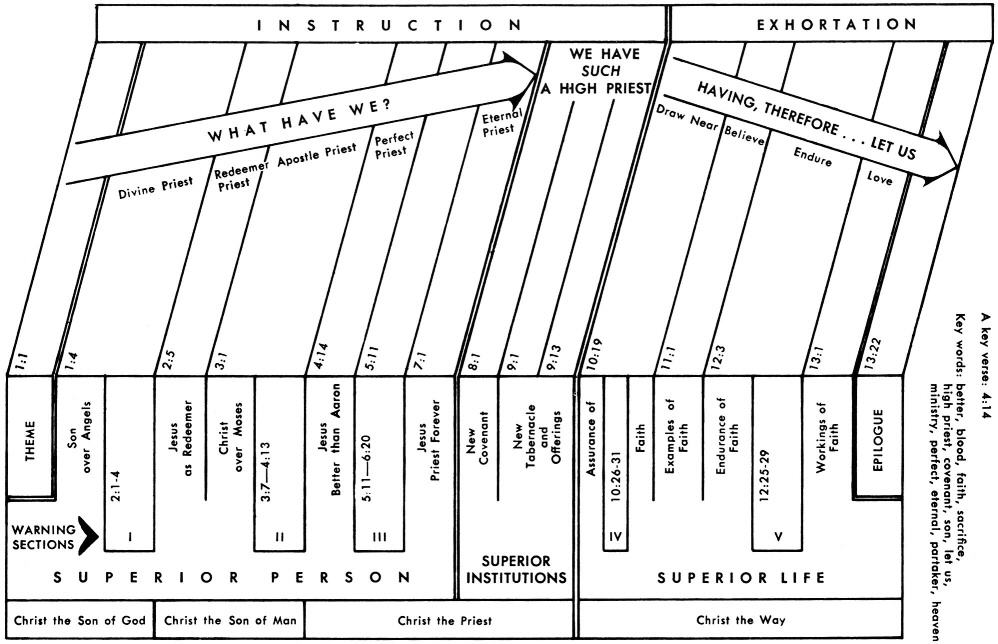
CONSIDER JESUS OUR GREAT HIGH PRIEST
Click chart to enlarge
Charts from Jensen's Survey of the NT - used by permission
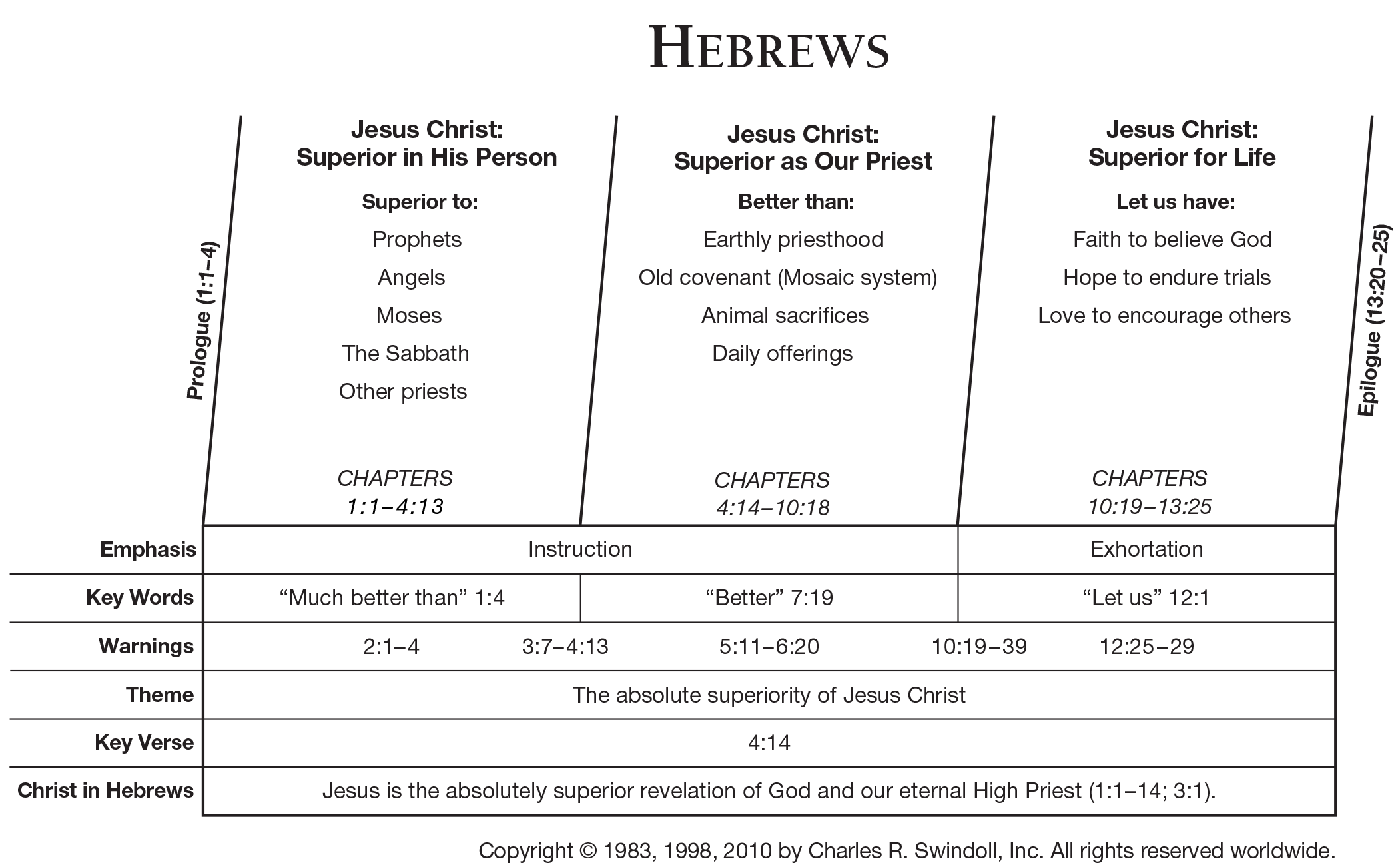
Hebrews - Charles Swindoll
|
The Epistle |
||||
| INSTRUCTION Hebrews 1-10:18 |
EXHORTATION Hebrews 10:19-13:25 |
|||
| Superior Person of Christ Hebrews 1:1-4:13 |
Superior Priest in Christ Hebrews 4:14-10:18 |
Superior Life In Christ Hebrews 10:19-13:25 |
||
| BETTER THAN PERSON Hebrews 1:1-4:13 |
BETTER PRIESTHOOD Heb 4:14-7:28 |
BETTER COVENANT Heb 8:1-13 |
BETTER SACRIFICE Heb 9:1-10:18 |
BETTER LIFE |
| MAJESTY OF CHRIST |
MINISTRY OF CHRIST |
MINISTERS FOR CHRIST |
||
|
DOCTRINE |
DUTY |
|||
|
DATE WRITTEN: |
||||

See ESV Study Bible "Introduction to Hebrews"
(See also MacArthur's Introduction to Hebrews)
Borrow Ryrie Study Bible
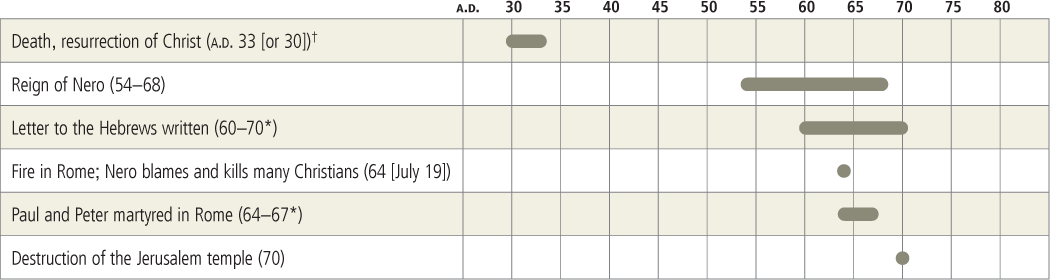
Timeline of Hebrews - ESV Study Bible
Hebrews 3:10 "THEREFORE I WAS ANGRY WITH THIS GENERATION, AND SAID, 'THEY ALWAYS GO ASTRAY IN THEIR HEART, AND THEY DID NOT KNOW MY WAYS' (NASB: Lockman)
Greek:tesserakonta ete; dio prosochthisa (1SAAI) te genea taute kai eipon, (AAI) Aei planontai (3PPPI) te kardia; autoi de ouk egnosan (3PAAI) tas odous mou (from Septuagint of Ps 95:10)
BGT διὸ προσώχθισα τῇ γενεᾷ ταύτῃ καὶ εἶπον· ἀεὶ πλανῶνται τῇ καρδίᾳ, αὐτοὶ δὲ οὐκ ἔγνωσαν τὰς ὁδούς μου,
CSB Therefore I was provoked with that generation and said, "They always go astray in their hearts, and they have not known My ways."
Amplified: And so I was provoked (displeased and sorely grieved) with that generation, and said, They always err and are led astray in their hearts, and they have not perceived or recognized My ways and become progressively better and more experimentally and intimately acquainted with them. (Amplified Bible - Lockman)
ESV Therefore I was provoked with that generation, and said, 'They always go astray in their heart; they have not known my ways.'
NIV That is why I was angry with that generation, and I said, 'Their hearts are always going astray, and they have not known my ways.'
NLT: So I was angry with them, and I said, 'Their hearts always turn away from me. They refuse to do what I tell them.' (NLT - Tyndale House)
Wuest: Because of this I was offended with this generation, and I said, Always are they being led astray in their hearts. And they themselves did not have an experiential knowledge of my paths. (Hebrews)
Young's Literal: "THEREFORE I WAS ANGRY WITH THIS GENERATION, AND SAID, 'THEY ALWAYS GO ASTRAY IN THEIR HEART; AND THEY DID NOT KNOW MY WAYS';
KJV Wherefore I was grieved with that generation, and said, They do alway err in their heart; and they have not known my ways.
NKJ Therefore I was angry with that generation, And said,`They always go astray in their heart, And they have not known My ways.'
NET "Therefore, I became provoked at that generation and said, 'Their hearts are always wandering and they have not known my ways.'
- I was: Ge 6:6 Jud 10:16 Ps 78:40 Isa 63:10 Mk 3:5 Eph 4:30
- go astray: He 3:12 Ps 78:8 Isa 28:7 Ho 4:12 Joh 3:19,20 8:45 Ro 1:28 2Th 2:10-12
- they did not know My ways: Ps 67:2 95:10 147:20 Jer 4:22 Ro 3:7
- Hebrews 3 Resources - Multiple Sermons and Commentaries
WHY GOD'S ANGER AGAINST ISRAEL?
HABITUAL STRAYING AND IGNORANCE OF HIS WAYS
Therefore - Always stop and interrogate the terms of conclusion. Some versions have wherefore’ [KJV], ‘for this reason’ [LN], ‘for that reason’ [WBC], ‘because of this’ [NAB], ‘that is why’ [Mil; NIV, TNT], ‘and so’ [TEV], ‘so’ [NLT], ‘then’ [CEV]. The following conclusion of God's anger is the result of the fact that Israel "tried (God) by testing (Him) and saw (His) works for 40 years."
I was angry (prosochthizo) with this generation (genea) - This is a strong word and the KJV is a bit soft rendering it as "grieved." Yes, God was "grieved" but as Lenski renders it He was "disgusted." God was more than displeased but as the REB says He was "incensed!" To which generation does this refer? Obviously, the wilderness generation. (See ANTHROPOMORPHIC LANGUAGE TO DESCRIBE GOD)
The writer is quoting from the Septuagint (LXX) of Psalm 95:10+. The NAS translation (see comparison of Bible Versions) of Psalm 95:10-11 reads reads "For forty years I loathed (Hebrew verb = abhor, despise, to feel a revulsion toward, dislike greatly and often with disgust) that generation, and said they are a people who err (wander, go astray) in their heart, And they do not know My ways (paths, the path traveled)." 11 Therefore I swore in My anger (Hebrew = nose, nostril, and anger), Truly they shall not enter into My rest."
🙏 THOUGHT - An important point to keep in mind in Hebrews 3-4 is that the writer is using a vivid, well-known Old Testament example to teach his readers (AND US) THE parallels about the rest which is available in Christ.
William MacDonald commenting on Psalm 95:10-11+ writes that "Finally God said, in effect, “I’ve had enough. These tiresome people have hearts that are bent on wandering. They are determined to disregard the pathway that I have mapped for them. So I have made a solemn oath that they shall not enter the rest that I had planned for them in Canaan.” (Borrow Believer's Bible Commentary)
David Guzik explains why God was angry writing that "God’s anger was kindled against that generation on account of their unbelief. They refused to trust God for the great things He had promised, and were unwilling to persist in trust. (Comment: Disobedience is clearly related to unbelief - compare Hebrews 3:18 and Hebrews 3:19+)
John MacArthur adds that angry "does not mean simply unhappy or disappointed. It means vexed, wrought up, incensed. God was extremely angry with Israel’s sin. The people kept it up, kept it up, and kept it up. The Septuagint of this passage could be rendered, “God loathed them.” He rejected and repudiated them. (See Hebrews Commentary - Page 90)
And said "They always go astray (planao) in their hearts (kardia) (Quoting Septuagint of Ps 95:10) - Here is God's reason for His disgust with Israel. Do not miss the important time phrase Always (aei) which means perpetually, incessantly, continually, constantly. In other words, in those 40 years in the desert, the majority of the nation did not just "backslide" for a few days, weeks or months, but for their entire time in the wilderness! Go astray is present tense indicating that they were continually being led astray. Their wanderings in the desert were the outworking of their unregenerate, straying hearts. Imagine seeing His supernatural works for 40 years and still refusing to believe in and submit to Him!
Wuest adds that go astray (planao) is "in the passive voice, means “to be led astray, to be led aside from the right way.” Israel was led astray with respect to the heart (kardia), the seat of one’s personal character and of one’s moral and spiritual life.” The heart of Israel's problem with "in their hearts!" To say it another way go astray (planao) in the passive voice indicates an outside force or influence (their unregenerate heart) was continually leading them astray.
R C H Lenski - The emphasis is on “heart,” which in the Hebrew and in the Greek is not the seat merely of the feelings but of the mind and the will and thus of the real personality. Their wandering in error (planao) like stars out of their orbit is due to their wicked will (Matt. 23:37: “ye would not”). People who have hearts like that are, indeed, hopeless. (BORROW Hebrews Commentary)
C H Spurgeon - God is very tender to errors of judgment—errors of the head. But to err in the heart—this is the heart of erring, and very provoking to the Most High. For it always to be so after having tasted the bitter fruit of erring—after having known God’s angers on account of previous errors—this was sad!
Numbers 14:22-23+ records why God was angry and how He responded (Nu 14:33-34+)...
"Surely all the men who have seen My glory and My signs (Heb = oth = used most often to describe awe-inspiring events), which I performed in Egypt and in the wilderness, yet have put Me to the test (Hebrew = nacah/nasah = test, to try, to prove; Lxx = peirazo) these ten times and have not listened to My voice, shall by no means see the land which I swore to their fathers, nor shall any of those who spurned (naas = reviled, scorned or rejected, especially counsel of a wise person) Me see it."...33 ‘Your sons shall be shepherds for forty years in the wilderness, and they will suffer for your unfaithfulness (zenuth = harlotry, prostitution; Lxx = porneia), until your corpses lie in the wilderness (ALL THOSE 20 YEARS OLD OR OLDER - Nu 14:28-29+). 34 ‘According to the number of days which you spied out the land, forty days, for every day you shall bear your guilt a year, even forty years, and you will know My opposition.
COMMENT - God said He was upset with them because they had tried Him ten times! They did not just fail at Massah and Meribah in (Exodus 17:7+) but over and over they failed to BELIEVE God even though they saw His works. This fact makes the point that signs don't necessarily produce faith. Their sin is referred to in Nu 14:33+ as "unfaithfulness" which is the Hebrew word (zenuth) elsewhere translated "harlotry" and refers to infidelity, adultery, whoredom. The NET NOTE on Nu 14:33+ says the phrase will suffer for your unfaithfulness in Hebrew literally reads "you shall bear your whoredoms." The imagery of prostitution is used throughout the Bible to reflect spiritual unfaithfulness, leaving the covenant relationship and following after false gods. Here it is used generally for their rebellion in the wilderness, but not for following other gods." (See Israel the Wife of Jehovah)
The psalmist says that Israel was not to be
"like their fathers, a stubborn (Lxx = skolios = curving, winding, crooked and figuratively perverse, hard to deal with, harsh) and rebellious (Lxx = parapikraino = continually provoking to bitterness or anger, exasperating, making one bitter towards) generation, a generation that did not prepare (Hebrew = kun = make firm, establish, prepare = primary action is to cause to stand in an upright position and conveying picture of that which is fixed or steadfast; Lxx = to make fully straight - it pictures opening up the way by removal of obstacles so that the desired goal may be reached) its heart, and whose spirit was not faithful (Heb = aman = make firm, build up = providing stability and confidence, like a baby would find in the arms of a parent) to God. (Psalm 78:8+)
Through His prophet Hosea (this of course refers to Israel several generations later than the wilderness generation) God declares that
"My people consult (Heb = ask) their wooden idol, and their diviner's wand informs them; for a spirit of harlotry (Heb = fornication, prostitution, adultery, idolatry; LXX = porneia = immorality) has led them astray (Hebrew =taah= to err, wander, go astray = notion of wandering about; LXX = planao = passive voice = to be led astray), and they have played the harlot (Heb = zanah = fornicate or prostitute oneself = speaks of "spiritual adultery"; LXX = ekporneuo = to be utterly unchaste, to give oneself over to fornication, to indulge in flagrant immorality), departing from (literally from under - the picture of submission to One's authority) their God." (Hosea 4:12+)
Stephen speaking to the Jews who were soon going to pick up stones to stone him to death declared
"You men who are stiff-necked and uncircumcised in heart and ears are always resisting (present tense = continuously "falling against" or "rushing against" in a hostile manner = resisting by actively opposing) the Holy Spirit; you are doing just as your fathers did." (Acts 7:51+)
AND THEY DID NOT (ou, ouk, ouch - absolutely never) KNOW (ginosko) MY WAYS (hodos) - If they did not have intimate knowledge of God's ways, it follows that they did not know God intimately and personally. And by extension it follows that God did not "know" them intimately and personally. Jesus describes the fate of those He does not know declaring "‘I never (ou, ouk, ouch - absolutely never) knew (ginosko) you; DEPART FROM ME, YOU WHO PRACTICE (present tense = habitually) LAWLESSNESS (~ SIN - see 1Jn 3:4+)" (Mt 7:23+) Note the progression -- Israel’s ignorance of the ways of Jehovah (reflecting their unbelief) preceded and was the cause of their being led astray. Belief (and unbelief) always shows itself in behavior. The knowledge they lacked was experiential knowledge which was acquired through obedience to Truth.
Donald Guthrie points out that " Ignorance of God’s ways will naturally lead to people straying away from them. But the writer of the psalm mentions them in the reverse order, as if the habitual attitude of straying had contributed to their ignorance. A hardened state of mind becomes impervious to God’s voice and leads to increasing ignorance of his ways, not because God does not make them known, but because the hardened mind has no disposition to listen. What was true of the Israelites is a commentary on all who resist the claims of God." (BORROW TNTC - Hebrews page 108)
This failure to grow in knowledge of His ways is the danger our author sees as a possibility for some of his readers. He reminds them of this episode in Israel’s history so that they might heed its warning. Full apostasy is present when God says of anyone, "They shall never enter my rest."
Ginosko is used translating the Hebrew verb yada in Psalm 95:10. This Hebrew verb yada can convey an element of personal relationship (E.g., "the man had relations [yada] with his wife Eve" Gen. 4:1+), not just knowledge of facts about someone. The upshot is that genuine saving faith as seen in the Scripture has both a cognitive element (truth) and a personal, volitional (choice) element (trust).
Wuest - Did not know is in the aorist tense in the Greek text, and is therefore a fact antecedent to the verb “go astray.” The distinctive word know here is ginosko which speaks of knowledge gained by experience. Their ignorance was due to their neglect of Jehovah, for the knowledge they lacked was experiential knowledge which was to be acquired through experience with the ways and character of God. (Hebrews)
Spurgeon explains that "The foundation of sin often lies in ignorance. Ignorance can never be of any benefit to us: “a life without knowledge is not good” (Pr 19:2). But ignorance of God is the constant course of the errors of the heart. “All your children shall be pupils of Yahweh” (Isa 54:13) is a very gracious promise, and where it is carried out, there the errors are rectified by the grace of God."
Jamieson writes that not know means "not known practically and believingly the ways in which I would have had them go, so as to reach My rest (Ex 18:20). (Hebrews 3)
Jeremiah records God's assessment of His people (Jeremiah has been speaking; now the LORD answers, giving the reason for the devastation Jeremiah foresees) writing
"For My people are foolish (Heb = 'evil = foolish in sense hating wisdom, walking in folly, despising wisdom and morality; Lxx = aphron from a = without + phren = understanding = not employing one's understanding particularly in practical matters; senseless, unwise). They know Me not. They are stupid (Heb = sakal = a person who acts without wisdom, moral integrity, fear of God or knowledge) children, and they have no understanding. They are shrewd (Heb = hakam = wise = one who is skilled or experienced) to do evil (Heb = raa = root of raa = breaking, which contrast to tamam = to be whole - vivid picture of evil), but to do good they do not know (Lxx - epiginosko)." (Jeremiah 4:22)
The psalmist records the opposite assessment of Moses, writing that God Himself "made known His ways to Moses, His acts to the sons of Israel." (Ps 103:7) God made known His ways to Moses because Moses knew God intimately (face to face) and personally, unlike the majority of the children of Israel in the wilderness wandering.
Over 1000 years later Jesus would pray: "Now this is eternal life: that they may know (ginosko) you, the only true God, and Jesus Christ, whom you have sent” (John 17:3+).
Bob Utley - There are many synonyms in Hebrew referring to God’s Law (cf. Ps. 19:6-9; 119). God’s will was clear to them (i.e. OT Israelites) but they willfully rejected it. This was the problem of the unbelieving Jewish recipients of Hebrews. The message of Jesus had changed “God’s ways.” It was hard for these Jewish worshipers to leave Moses and trust completely in the Apostolic message of a “new covenant” totally apart from human performance! (Hebrews 3 Commentary)
Charles Swindoll - The people of Israel had recently been delivered from bondage in Egypt, had passed through the Red Sea, and were headed for Canaan to take possession of the Promised Land as God’s special covenant people. Had they taken a direct route across the Sinai Peninsula along a well-established trade route, the journey would have taken less than two weeks. But their sin against God and their hardness of heart led to a forty-year delay! Neither a map, a compass, nor a GPS would have done the Hebrews any good. They hadn’t simply lost sight of the road; they had lost sight of their God. Their problem was a heart condition. Instead of having hearts softened by the unspeakable power and glory of God and overwhelmed by His goodness and mercy toward them, they grew numb toward Him. Tough, not tender. Rough, not responsive. Hardened, not humble. This embarrassing scar on the history of God’s covenant people would serve as a painful reminder of the effects of a hardened heart. Although those tragic events of rebellion in the wilderness had occurred centuries earlier, the author of Hebrews brought it to bear on his own readers because he saw in them a strikingly similar tendency toward dullness of hearing and hardness of heart. God knew that the Israelites needed their faith refined and tested as they journeyed to the Promised Land. And God had shown the people over and over again that He who had guided them into the wilderness would also provide them with everything they needed. Sadly, they repeatedly failed to trust the Lord. We see an example of this in Exodus 17:1–7. Instead of responding in faith and obedience, the Israelites grumbled against Moses, God’s chosen mediator and prophet. (See Insights on Hebrews - Page 55)
Angry (4360) (prosochthizo from pros = toward or with + ochtheô = be sorely vexed) means strong displeasure, amounting to offence. It means to to be very upset over something someone has done. To be very upset over something someone has done as God was offended at the actions of Israel. The idea is that of extreme anger and disgust. God was offended at the actions of Israel. Prosochthizo is the translation in the LXX of Hebrew verbs meaning to loathe, be disgusted, to spue or vomit out, to exclude, reject, abhor, repudiate. Clearly this Greek word expresses a strong displeasure, amounting to offense regarding Israel. Grieved in KJV does not adequately express the righteous anger of God intimated in the passage and fails to accurately reflect the extreme anger and disgust of God.
Prosochthizo is used 2 times in the NT, here and in Hebrews 3:17 - And with whom was He angry (prosochthizo) for forty years? Was it not with those who sinned, whose bodies fell in the wilderness?
Prosochthizo is used 16 times in the Septuagint (LXX) (Ge 27:46; Lev. 18:25, 28; 20:22; 26:15, 30, 43-44; Nu 21:5; 22:3; Deut. 7:26; 2Sa 1:21; Ps. 22:24; 36:4; 95:10; Ezek. 36:31). Here are some representative uses…
Leviticus 18:25 'For the land has become defiled, therefore I have visited its punishment upon it, so the land has spewed out (or vomited out - Lxx = prosochthizo) its inhabitants. (Lev 18:28, 20:22 also translate spew out or vomit with prosochthizo!)
Leviticus 26:30 'I then will destroy your high places, and cut down your incense altars, and heap your remains on the remains of your idols; for My soul shall abhor (Lxx = prosochthizo) you.
Leviticus 26:44 'Yet in spite of this, when they are in the land of their enemies, I will not reject them, nor will I so abhor (or loathed; Lxx = prosochthizo) them as to destroy them, breaking My covenant with them; for I am the LORD their God. (Comment: Israel "abhorred My statutes" in Lev 26:43, "we loathe this miserable food" in Nu 21:5, God abhorred them, and yet He declares in a prophecy that He will show them mercy and not completely destroy them!)
Psalm 95:10 "For forty years I loathed (Lxx = prosochthizo) that generation, and said they are a people who err in their heart, and they do not know My ways.
Ezekiel 36:31 "Then you will remember your evil ways and your deeds that were not good, and you will loathe yourselves (when they humble themselves and see themselves as God has seen them!) in your own sight for your iniquities and your abominations. (Comment: This refers to God fulfilling His promise not to destroy them and in fact is in the context of His promise to them of a New Covenant with a new heart that has His laws written on it and His Spirit to enable them to obey).
Know (1097) (ginosko) conveys the basic meaning of taking in knowledge in regard to something or someone, knowledge that goes beyond the merely factual. By extension, the term frequently was used of a special relationship between the person who knows and the object of the knowledge. For example, it was often used of the intimate relationship between husband and wife and between God and His people. It can speak of knowledge gained by experience.
GINOSKO IN HEBREWS - Heb. 3:10; Heb. 8:11; Heb. 10:34; Heb. 13:23
Go astray (4105) (planao) from plane which describes "a wandering" and gives us our English word "planet") means literally made to wander and so to go (active sense) or be led (passive sense as of sheep in Mt 18:12-13) astray. Literal wandering is described in Hebrews 11:38+. Spiritual wandering is described in (1 Peter 2:25+) In spiritual terms, planao means to be made to err from the right way, the highway of truth and holiness. Straying in the spiritual sense occurs when one does not adhere to the truth (James 5:19+) and/or forsakes the right way (see 2 Peter 2:15+)
Friberg on planao - 1) active lead astray, cause to wander; figuratively mislead, deceive, cause to be mistaken (Mt 24.5); (2) passive; (a) literally go astray (Mt 18.12), wander about (Heb 11.38); (b) figuratively, as blameworthy and mistaken evaluation be deceived or led astray, be mistaken, be deluded (1Co 6.9; Gal 6.7); as abandoning what is true and committing oneself to error err (in heart) (Heb 3.10; Jas 5.19) (Borrow Analytical Lexicon of the Greek New Testament)
PLANAO - 37V - deceive(3), deceived(9), deceives(3), deceiving(2), go astray(1), gone astray(3), leads...astray(2), led astray(1), misguided(1), mislead(4), misleads(2), misled(1), mistaken(3), straying(2), strays(1), wandering(1). Matt. 18:12; Matt. 18:13; Matt. 22:29; Matt. 24:4; Matt. 24:5; Matt. 24:11; Matt. 24:24; Mk. 12:24; Mk. 12:27; Mk. 13:5; Mk. 13:6; Lk. 21:8; Jn. 7:12; Jn. 7:47; 1 Co. 6:9; 1 Co. 15:33; Gal. 6:7; 2 Tim. 3:13; Tit. 3:3; Heb. 3:10; Heb. 5:2; Heb. 11:38; Jas. 1:16; Jas. 5:19; 1 Pet. 2:25; 2 Pet. 2:15; 1 Jn. 1:8; 1 Jn. 2:26; 1 Jn. 3:7; Rev. 2:20; Rev. 12:9; Rev. 13:14; Rev. 18:23; Rev. 19:20; Rev. 20:3; Rev. 20:8; Rev. 20:10
Scripture teaches us that various things or classes of people can deceive a person including the following…
- Signs, sorcery, pretenders coming in Jesus' name (Mt 24:4, 5+, Mark 13:5, 6+, Luke 21:8+),
- False teachers (1Co 15:33+, 1 Jn 2:26+, 1 Jn 3:7+),
- False Christs and false prophets (Mt 24:11+, Mt 24:24+, see note on Jezebel the false prophetess Re 2:20+),
- Not understanding the Scriptures or the power of God (Mt 22:29+, Mark 12:24+),
- One's own self (evil flesh) ("self deception" 1Co 6:9+, Gal 6:7+, Titus 3:3+, 1 John 1:8+)
- One's heart (synonymous with evil flesh - Hebrews 3:10+)
- Evil men and imposters (2Ti 3:13+),
- The devil (Rev 12:9+, Rev 20:3+; Re 20:8+;Re 20:10+)
- Babylon (Revelation 18:23+)
- The Antichrist's false prophet (Rev 13:14+, Re 19:20+)
Heart (2588) kardia does not refer to the physical organ but is always used figuratively in Scripture to refer to the seat and center of human life. The heart is the center of the personality, and it controls the intellect, emotions, and will. No outward obedience is of the slightest value unless the heart turns to God.
See 4 page article in Dictionary Of Biblical Imagery article on Heart - kardia
See 5 page article in NT Dictionary Of New Testament Theology on Heart - Kardia
Kardia as stated above refers not to the physical organ (over 800 mentions and none refer to the physical organ!), but is always used figuratively to center of our personality, to so to speak to our "control center" (to make a play on the "air traffic control center" at the airport which carefully guards and guides what flies in and what flies out. How applicable to our "hearts" which are so prone to wander!). In short kardia refers to the the affective center of our being wherein lies the capacity of moral preference and volitional desire. The kardia generates thoughts that make the decisions which the mind works out. In other words, our logic flows out of our heart-decisions and not vice versa. Gleason Archer called the kardia, the "desire-producer that makes us tick" for it is the place where our "desire-decisions" occur, and which establish who we really are. WHO ARE YOU? HAVE YOU HAD A HEART CHECK UP RECENTLY? We are assiduous to do this medically, but woefully lax in doing it spiritually (beloved, I speak from experience!). At regeneration God reverses the spiritual atherosclerosis of our old sinful heart by giving us a total heart transplant! Daily confession and repentance are thereafter necessary to avoid "spiritual atherosclerosis" and gradual, subtle hardening (and becoming cold to the things of God) of our heart! (Read and practice daily "preventative maintenance" = 1 Jn 1:9+, Pr 28:13+).
Ways (road, journey)(3598) (hodos) can refer to a literal road but clearly is used figuratively by Jesus to describe the course of one's conduct or behavior. The ways of the Lord refer to the way, walk, or life which He approves, which He requires but which He graciously empowers.
Gingrich - way—1. literal—a. as a place: way, road, highway Mt 2:12; 3:3; Mk 10:46; Lk 8:5; Ac 8:26, 36. hodon with gen. toward Mt 4:15 .—b. as an action: way, journey Mt 10:10; Mk 8:3; Lk 12:58; 24:35; Ac 9:27. sabbatou odos = a Sabbath day's journey Ac 1:12.—2. figurative—a. way Mt 7:13f; 10:5; Lk 1:79; Jn 14:6; Ac 2:28; 16:17; Ro 3:17.—b. way of life or acting, conduct Mt 21:32; Lk 20:21; Ro 11:33; Jas 5:20; Hb 3:10; 2Pe 2:21; Rev 15:3.—c. the Way or teaching, of Christianity Acts 9:2; 19:9, 23; 22:4; 24:14, 22; 1Co4:17; 2 Pt 2:2. [odometer]
Friberg - (1) literally; (a) as any place along which one travels, translated according to the context: way (Mt 2.12), road (Lu 10.31), path (Mk 4.4), street (Mt 22.10), highway (Mt 4.15); (b) as an act of traveling journey, way, course (Mt 10.10); (c) in adverbial expressions: en route, on the way (Mt 5.25); along the way (Lk 10.4); literally Sabbath day's journey, i.e. about 800 meters or 2,000 paces ( Acts 1.12); day's journey (Lk 2.44); (2) figuratively; (a) as a manner of living and acting way of life, type of conduct (Jude 1:11); (b) as a system of doctrine, specifically Christianity the Way (Acts 24.14); (c) as a means of entering into something way (Mt 3.3; 7.13; Heb 10.20) (Borrow Analytical Lexicon of the Greek New Testament)
Hebrews 3:11 AS I SWORE IN MY WRATH, 'THEY SHALL NOT ENTER MY REST (NASB: Lockman)
Greek: os omosa (1SAAI) en te orge mou, Ei eiseleusontai (3PFMI) eis ten katapausin mou.
Amplified: Accordingly, I swore in My wrath and indignation, They shall not enter into My rest. (Amplified Bible - Lockman)
NLT: So in my anger I made a vow: 'They will never enter my place of rest.' (NLT - Tyndale House)
Wuest: In conformity with which fact I took an oath in my wrath. They shall not enter into my rest. (Hebrews)
Young's Literal: AS I SWORE IN MY WRATH, 'THEY SHALL NOT ENTER MY REST.'"
- As I swore - Heb 3:18,19; 4:3; Nu 14:20-35; Nu 32:10-13; Deut 1:34-35; 2:14
Related Passages:
Psalm 95:11+ “Therefore I swore in My anger, Truly they shall not enter into My rest.”
C H Spurgeon - There can be no rest to an unbelieving heart. If manna and miracles could not satisfy Israel, neither would they have been content with the land which flowed with milk and honey. Canaan was to be the typical resting place of God, where his ark should abide, and the ordinances of religion should be established; the Lord had for forty years borne with the ill manners of the generation which came out of Egypt, and it was but right that he should resolve to have no more of them. Was it not enough that they had revolted all along that marvelous wilderness march? Should they be allowed to make new Massahs and Meribahs in the Promised Land itself? Jehovah would not have it so. He not only said but swore that into His rest they should not come, and that oath excluded every one of them; their carcases fell in the wilderness. Solemn warning this to all who leave the way of faith for paths of petulant murmuring and mistrust. The rebels of old could not enter in because of unbelief, "let us therefore fear, lest, a promise being left us of entering into his rest, any of us should even seem to come short of it." One blessed inference from this psalm must not be forgotten. It is clear that there is a rest of God, and that some must enter into it: but "they to whom it was first preached entered not in because of unbelief, there remaineth therefore a rest to the people of God." The unbelievers could not enter, but "we which have believed do enter into rest." Let us enjoy it, and praise the Lord for it forever. Ours is the true Sabbatic rest, it is ours to rest from our own works as God did from his. While we do so, let us "come into His presence with thanksgiving, and make a joyful noise unto Him with psalms."
Numbers 14:21-39+ (AT KADESH-BARNEA GOD SWEARS THEY WILL NOT ENTER LAND) but indeed, as I live, all the earth will be filled with the glory of the LORD. 22 “Surely all the men who have seen My glory and My signs which I performed in Egypt and in the wilderness, yet have put Me to the test these ten times and have not listened to My voice, 23 shall by no means see the land which I swore to their fathers, nor shall any of those who spurned Me see it. 24 “But My servant Caleb, because he has had a different spirit and has followed Me fully, I will bring into the land which he entered, and his descendants shall take possession of it. 25 “Now the Amalekites and the Canaanites live in the valleys; turn tomorrow and set out to the wilderness by the way of the Red Sea.” 26 The LORD spoke to Moses and Aaron, saying, 27 “How long shall I bear with this evil congregation who are grumbling against Me? I have heard the complaints of the sons of Israel, which they are making against Me. 28 (GOD SWEARING BY HIMSELF) “Say to them, ‘As I live,’ says the LORD, ‘just as you have spoken in My hearing, so I will surely do to you; 29 your corpses will fall in this wilderness, even all your numbered men, according to your complete number from twenty years old and upward, who have grumbled against Me. 30 ‘Surely you shall not come into the land in which I swore to settle you, except Caleb the son of Jephunneh and Joshua the son of Nun. 31 ‘Your children, however, whom you said would become a prey–I will bring them in, and they will know the land which you have rejected. 32‘But as for you, your corpses will fall in this wilderness. 33 ‘Your sons shall be shepherds for forty years in the wilderness, and they will suffer for your unfaithfulness, until your corpses lie in the wilderness. 34 ‘According to the number of days which you spied out the land, forty days, for every day you shall bear your guilt a year, even forty years, and you will know My opposition. 35 ‘I, the LORD, have spoken, surely this I will do to all this evil congregation who are gathered together against Me. In this wilderness they shall be destroyed, and there they will die.’” 36 As for the men whom Moses sent to spy out the land and who returned and made all the congregation grumble against him by bringing out a bad report concerning the land, 37 even those men who brought out the very bad report of the land died by a plague before the LORD. 38 But Joshua the son of Nun and Caleb the son of Jephunneh remained alive out of those men who went to spy out the land. 39 When Moses spoke these words to all the sons of Israel, the people mourned greatly.
Numbers 32:10-13+ “So the LORD’S anger burned in that day, and He swore, saying, 11 ‘None of the men who came up from Egypt, from twenty years old and upward, shall see the land which I swore to Abraham, to Isaac and to Jacob; for they did not follow Me fully, 12 except Caleb the son of Jephunneh the Kenizzite and Joshua the son of Nun, for they have followed the LORD fully.’ 13 “So the LORD’S anger burned against Israel, and He made them wander in the wilderness forty years, until the entire generation of those who had done evil in the sight of the LORD was destroyed.
Deuteronomy 1:34-35+ “Then the LORD heard the sound of your words, and He was angry and took an oath, saying, 35 ‘Not one of these men, this evil generation, shall see the good land which I swore to give your fathers,
Hebrews 3:18-19+ And to whom did He swear that they would not enter His rest, but to those who were disobedient? 19 So we see that they were not able to enter because of unbelief.
Revelation 14:13+ And I heard a voice from heaven, saying, “Write, ‘Blessed are the dead who die in the Lord from now on!’” “Yes,” says the Spirit, “so that they may rest (anapauo) from their labors, for their deeds follow with them.”
Joshua 11:23+ ("REST" UNDER JOSHUA - REST FROM WAR - SEE PASSAGS BELOW) - So Joshua took the whole land, according to all that the LORD had spoken to Moses, and Joshua gave it for an inheritance to Israel according to their divisions by their tribes. Thus the land had rest from war.
Joshua 21:44+ ("REST" UNDER JOSHUA) And the LORD gave them rest on every side, according to all that He had sworn to their fathers, and no one of all their enemies stood before them; the LORD gave all their enemies into their hand.
Joshua 22:4+ ("REST" UNDER JOSHUA) “And now the LORD your God has given rest to your brothers, as He spoke to them; therefore turn now and go to your tents, to the land of your possession, which Moses the servant of the LORD gave you beyond the Jordan.
Joshua 23:1+ ("REST" UNDER JOSHUA) Now it came about after many days, when the LORD had given rest to Israel from all their enemies on every side, and Joshua was old, advanced in years,
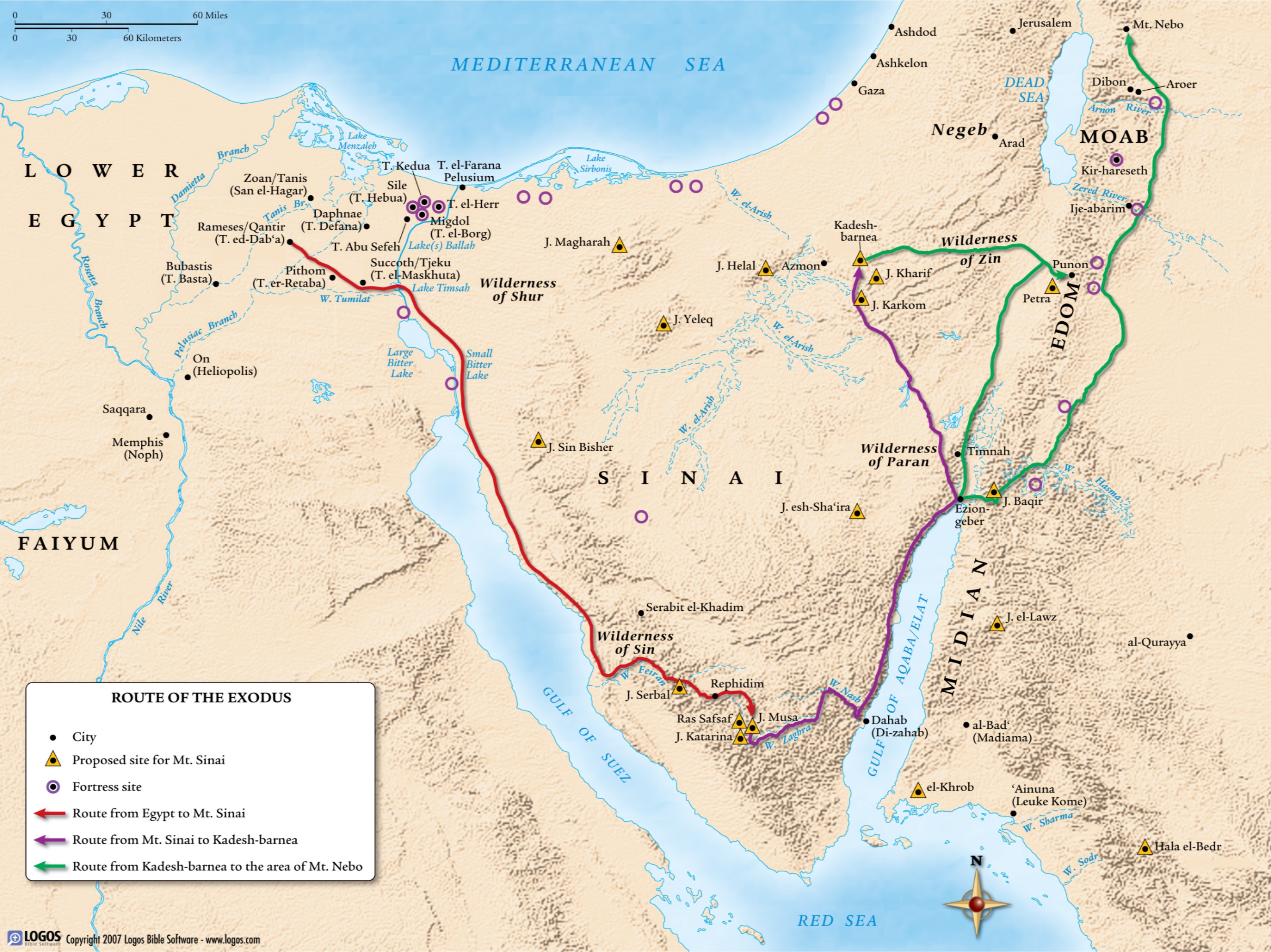
Israel's Wilderness Wandering
MY WRATH! OR
MY REST!
AS - according as, in conformity with which fact. The Greek rendering conveys the meaning: "If they go into the land I am not God"
I SWORE (omnuo) IN MY WRATH (orge) - God often swears by Himself positively to substantiate His statements, but in this verse He swears negatively (as in Heb 4:3+), but in both cases His oath underscores the certainty of His following through, in this context on His warnings regarding the consequences of disobedience. Here, His wrath is directed toward Israel’s persistent grumbling and testing of Him, which led to hardened hearts incapable of seizing the promise of entering the Promised Land. As a result, every Israelite aged 20 and older—except for Joshua and Caleb—perished in the wilderness at the staggering rate of nearly 90 deaths per day, until that entire generation had passed away.
When did Yahweh swear an oath associated with wrath? See Nu 14:21-22+ in context of 12 spies returning to Kadesh-Barnea, 10 spies giving a bad report reflecting unbelief and which prompted God's declaration that the unfaithful nation would not be allowed to enter the Promised Land.
Brian Bell quips "What kicked off the 40 yrs wandering was the 12 spies, 10 of which could only see giant problems rather than a giant God. The 10 were like Robert Fulton’s critics. When he tested his steamboat they stood along the shore yelling, “It will never start, never start, never start”! Then when it started they said, “It will never stop, never stop, never stop!”"
Leon Morris - The seriousness with which God viewed Israel’s sin is shown by the divine oath. This points to an unshakable determination.........The psalmist has brought together two incidents, one from the beginning and one from the end of the wilderness period, to make the impressive point that the Israelites of old consistently provoked God....orge is the usual word for the “wrath” of God and points to the strong and settled opposition of God’s holy nature to all that is evil. God is not passive in the face of wrongdoing; he actively opposes it. (See The Expositor's Bible Commentary)
R C H Lenski says "God’s oath is irrevocable because he never swears, as men so often do, either foolishly or without knowing to what he swears (as is done in the case of all oaths that are asked by lodges, Lev. 5:4). His oath and its irrevocableness are due to the exhaustion of his grace when judgment must follow.....“In my wrath” is the inevitable reaction of God’s holiness and righteousness to sin and ungodliness when the efforts of his grace are exhausted." (Borrow Hebrews Commentary)
THEY SHALL NOT ENTER (eiserchomai) MY REST (katapausis) - Note the striking contrast - MY wrath versus MY rest. God provides both. This negative declaration is one of those promises you won't find in books that collect God's promises. In context this rest refers entrance into the Promised Land. As amplified in Hebrews 4:1-2 the promise of rest in the land was a picture of rest in salvation.
🙏 THOUGHT - Believers then and now can enter not into a land but into a promised life, abundant life in Christ (Jn 10:10+), the One Who is now our life (Col 3:4+), the One in Whom we live by faith (Gal 2:20+), the life that promises every spiritual blessing in the heavenly places in Christ (Eph 1:3+).
Kenneth Wuest has a technical note explaining that "The words “They shall not enter into” in the Greek text include a conditional particle (ei) not brought over into the English. It is, “If they shall enter.” This is a common Hebraistic formula in oaths. In the case where God speaks, as here, it is “may I not be Jehovah if they shall enter.” (Hebrews) The NET NOTE explains it this way -- "if they shall enter my rest," is a Hebrew idiom expressing an oath that something will certainly not happen. Bob Utley says it is "a partial FIRST CLASS CONDITIONAL with no conclusion but with an implied NEGATIVE." Morris says "Here it will be something like “If they shall enter into my rest … then My Name is not God!”
C H Spurgeon applies this picture of Israel to those who claim to be believers today - Oh, that none of us, as professors of the faith of Christ, may be like Israel in the wilderness! I fear there is too much likeness; God grant that it may be carried no further! May we hear the voice of God, as they did not hear it, for their ears were dull of hearing! (cf Acts 7:51+) May we never harden our hearts, as they did, for they kicked against the command of God, and rebelled against the thunders of Sinai! If God has had forty years’ patience with you, take heed, sinner, take heed, lest He swear in His wrath that you shall not enter into His rest. Your entrance into that rest depends upon His good will and pleasure. He will have mercy on whom He will have mercy, and He will have compassion on whom He will have compassion (Ro 9:15). If, then, you provoke Him to swear that you shall not enter into His rest, into that rest you never can enter, for then the gates of hell are barred upon you, and the gates of heaven fast locked against you. Beware, then, lest you provoke Him. (Spurgeon's Expositional Comments on Hebrews)
The unbelief here described excludes not only from typical earthly blessings
but equally from the rest in the heavenly Canaan.
R C H Lenski comments on whether some of those who died in the wilderness were saved or not (you may not agree with his conclusion) - The rest into which those Israelites were not to enter was certainly that in the land of Canaan, but God’s oath cannot be restricted to disbarment from only this rest on the strength of Deut. 12:9–11 or of any other passage. Our epistle could then not have used this psalm, as it does, against a wicked heart of unbelief; David could then not have written this psalm in order to warn his generation against the same thing. The unbelief here described excludes not only from typical earthly blessings but equally from the rest in the heavenly Canaan. We are not left to conclude this for ourselves; Heb 4:8–11 (cf Heb 4:1-2+) states this outright. Those hardened Israelites who were perishing in the wilderness did not after all enter into heaven; they were damned in unbelief as obdurate resistance of the Holy Spirit always damns (Acts 7:51+) (Borrow Hebrews Commentary)
Ray Stedman on My rest - This is the first use of the word REST in Hebrews. This word describes the end of wandering and restlessness, and promises calmness and tranquility. Here it clearly refers to the land of Canaan and the promise of a settled state of peace and full supply. But, as we shall see, this Canaan-rest was a symbol, a shadow, of a greater rest available to the people of God in the future. The failure to correct a habit of grumbling and murmuring against God led over a million Israelites to such a hardened state of heart that they were unable to lay hold of the opportunity to enter the land of promise when they came to its borders. They perished at an average of almost ninety deaths a day, until the generation that left Egypt (except for Joshua and Caleb) had died out. ( When Israel Failed to Enter Rest)
John MacArthur notes that interpreting this literally that "The rest was Canaan, where the toil of wandering would end (ED: I WOULD ADD THAT THE REST WAS SPECIFICALLY REST FROM WAR -- SEE THE JOSHUA CROSS REFERENCES ABOVE). As we shall see in the next chapter, it is a symbol of salvation. That is when TODAY is over. You can stand on the verge of receiving Jesus Christ for a long time, toying with the idea and thinking, “God, prove Yourself some more. I’m not sure. I’m not quite ready yet.” (ED: THIS IS TESTING GOD! see 1Co 10:9+, Nu 21:6+, Ex 17:2, 7+, Dt 6:16+, Ps 78:18, 19+, Ps 95:9+, Ps 106:14+) And one day He will say, “You’ve had enough evidence; it’s over now. It is no longer TODAY; it is tomorrow. You will never see My promised land.” If Israel had more than enough evidence to trust God in Moses’ day, how much more do we have today? (See Hebrews Commentary - Page 91)
J Vernon McGee on REST - The generation of Israel that came out of Egypt doubted God, and because of their doubt they never entered the land of Canaan. "They shall not enter into my REST." I have marked in my Bible that final word rest. There are at least a dozen references in this chapter and the next chapter to the word REST (Heb. 3:11; Heb. 3:18; Heb. 4:1; Heb. 4:3; Heb. 4:5; Heb. 4:8; Heb. 4:9; Heb. 4:10; Heb. 4:11), but it does not always mean the same kind of rest. There is the REST of salvation. The Lord Jesus referred to this in Matthew 11:28+ when He said in effect, "Come unto me, all ye that labour and are heavy laden, and I will REST you; that is, I'll lift the burden of sin from you." Because He bore it for us upon the cross, our sins are forgiven, and we have redemption through His blood, even the forgiveness of sins. Therefore, you don't have to do anything so that God will forgive you; Christ has already done it when He died for you. All you have to do is believe and receive Christ. (See Thru the Bible Hebrews 1-7)
Albert Barnes - Whether this rest refers here to heaven, and whether the meaning is that God would exclude them from that blessed world, will be more appropriately considered in the next chapter. The particular idea is, that they were to be excluded from the promised land, and that they should fall in the wilderness. No one can doubt, also, that their conduct had been such as to show that the great body of them were unfit to enter into heaven.
It is ironic that in Numbers 14:2+ Israel had cried out "would that we had died in this wilderness!" In Nu 14:28-29+ God answered their plea affirmatively declaring "‘As I live,’ says the LORD, ‘just as you have spoken in My hearing, so I will surely do to you; your corpses will fall in this wilderness, even all your numbered men, according to your complete number from twenty years old and upward, who have grumbled against Me."
Not enter My rest - A careful observation of the term rest in Hebrews 3-4 indicates that it is used in in at least three or four different senses. Consider the following nuances of rest and compare with the Scripture references to see if you agree:
(1) The physical land of Canaan (Hebrews 3:7-19)
(2) Salvation as rest (Hebrews 4:1, 3, 8, 9)
(3) God's rest at the completion of creation (Hebrews 4:4)
(4) Heaven, the Christian's ultimate rest (Hebrews 4:10, 11).
In all the uses the basic meaning of REST is to desist from one form of activity in order to give oneself to a wholly new enterprise. There is no reference to sleep or slumber. To enter God's eternal rest even in heaven will be to devote oneself to the worship and work in that perfect environment, in which there is neither frustration nor exhaustion. One other consideration for future rest, is "rest" in the Millennium (possibly seen in Heb 4:8, cf Rev 14:13).
J Vernon McGee - They shall not enter into my rest." I have marked in my Bible that final word rest. There are at least a dozen references in this chapter and the next chapter to the word rest, but it does not always mean the same kind of rest. There is the rest of salvation. The Lord Jesus referred to this in Matthew 11:28 when He said in effect, "Come unto me, all ye that labour and are heavy laden, and I will rest you; that is, I'll lift the burden of sin from you." Because He bore it for us upon the cross, our sins are forgiven, and we have redemption through His blood, even the forgiveness of sins. Therefore, you don't have to do anything so that God will forgive you; Christ has already done it when He died for you. All you have to do is believe and receive Christ.
Walter Kaiser in his article entitled The Promise Theme and the Theology of Rest (Bibliotheca Sacra, Vol 130, page 142, 1973) adds a note clarifying the theology of rest in Hebrews 3-4 writing that…
It is common to observe in some commentaries on this passage that there are three or four rests mentioned in Heb3:7-4:11. The list generally highlights three or four of the following:
1. The Divine Rest (Heb 4:1-3, 10-11 ) or Rest of Faith
2. The Creation Rest (Hebrews 4:4 )
3. The Sabbath Rest (Hebrews 4:4, 4:9) or The Rest that Remains (6-9)
4. The Canaan Rest (Hebrews 4:8)
5. The Redemptive Rest (Hebrews 4:10)
6. The Eternal Rest (Hebrews 4:9)
See also a more detailed discussion of Rest in the Epistle of Hebrews
Peter Toon has an excellent summary of rest in Hebrews 3-4 noting first that …
the verb katapauo (2664) occurs three times and the noun, katapausis (3709), eight times. Also, the Greek text of Psalm 95:11 (“they shall never enter my rest”) is cited eight times. Joshua was given the task by Yahweh of leading the tribes of Israel into the promised land, into the rest promised them by their God. This task was fulfilled in an earthly sense by Joshua, as the Book of Joshua describes. However, the fuller meaning of the everlasting rest of God promised to his people and related to the gift of rest of the seventh day was not achieved by Joshua and the tribes under the old covenant. Jesus the Christ, the greater Joshua, was sent by the Father to bring into being the true nature and fullness of the gift of rest for the people of God.
The rest is rightly called a “sabbath rest” because it is a participation in God’s own rest. When God completed his work of creation, he rested; likewise when his people complete their service to him on earth, they will enter into God’s prepared rest. Now, in this age, the rest is before them as their heritage and by faith they live in the light of it in this world. How this is done is wonderfully illustrated with the wealth of biographical detail in Hebrews 11. Here the rest is also portrayed as a city prepared for God’s faithful people—a city whose builder is God himself. Whatever this rest consists of it is not a state of complete inactivity, such as the rest of the wicked (Job 3:17–19).
In Revelation 14:13–14 the heavenly voice speaks of the blessedness of those who die in the Lord and the Spirit replies: “They will rest from their labor for their deeds will follow them.” Here a different dimension of the meaning of rest is being pointed to—a rest that is not inactivity but is certainly free of the burdens of the flesh and of the present, evil age.
Finally, we note that as the Spirit of the Lord rests on the Messiah (Isa. 11:2), so in the new covenant, “If you [Christian believers] are insulted for the name of Christ, you are blessed, for the Spirit of glory and of God rests on you” (1 Peter 4:14). (See full article in Baker's Evangelical Dictionary of Biblical Theology )
Ray Stedman explains that it is possible to interpret God's "rest" in at least three ways and each has some merit. And so God's rest could refer to
(1) The rest associated with placing one's faith in Christ (see Matthew 11:28-30 above). In context, this appears to be the primary meaning, that is, of coming to Jesus by faith and entering His salvation rest where self effort is to replaced (or at least can and should be replaced) by Spirit initiated and empowered effort. Ray Stedman speaking of those who have entered this salvation rest by faith explains that many believers experience breakdown in their Christianity (not referring to a loss of salvation but a loss of joy and sense of His presence and power) under the pressures of stress or responsibility because they try to work out their salvation in their power (see exposition of Philippians 2:12-13 and Pound's discussion Work out Your Salvation) and have not learned to "operate out of rest". (Stedman, Ray: The Rest Obtained Is New-Creation Rest)
(2).The rest that is promised to Israel (and applies to all believers) in the 1000 year reign of Christ on earth ("the Messianic Age"), the "rest" of which Isaiah records…
"Then it will come about in that day (when Messiah takes His throne in Jerusalem after the "great tribulation" - see Daniel's Seventieth Week - and the defeat of the "antichrist") that the nations will resort to the root of Jesse (Messiah), Who will stand as a signal (a banner lifted up to be a rallying point) for the peoples; and His resting place (LXX uses the related word anapausis) will be glorious." (Isaiah 11:10)
(3). The rest associated with eternity and which is described by John who…
"heard a voice from heaven, saying, "Write, 'Blessed are the dead who die in the Lord from now on!'" "Yes," says the Spirit, "that they may rest from their labors, for their deeds follow with them." (Revelation 14:13)
The KJV Commentary notes that "Rest involves more than mere inactivity. It is that which follows the satisfactory completion of a task. Salvation rest is the gift reckoned to the believer resulting from Christ’s finished work. Heaven (#3 above) and millennial rest is the reward of the believer’s labors for the Lord (see note Revelation 14:13). Verse 11 records the warning one more time: Do not miss through unbelief what God has promised." (Dobson, E G, Charles Feinberg, E Hindson, Woodrow Kroll, H L. Wilmington: KJV Bible Commentary: Nelson)
Matthew Henry explains the "rest" this way - The end proposed-rest spiritual and eternal, the rest of grace here and glory hereafter—in Christ on earth, with Christ in heaven. The way to this end prescribed- labour (KJV), diligent labour; this is the only way to rest; those who will not work now shall not rest hereafter. After due and diligent labour, sweet and satisfying rest shall follow; and labour now will make that rest more pleasant when it comes." (Matthew Henry's commentary on the whole Bible : Complete and unabridged)
Larry Richards writes that "The third and fourth chapters of Hebrews explore the significance of God's voice in the believer's experience. The writer argues that only by hearing and responding to the Lord as he speaks to us in our "today" can we find rest. Such rest is not cessation of activity but repose in activity. God's Sabbath rest is defined: God has ceased creating (Hebrews 4:9-11). But the God of the OT is active. How then is He at rest? He is at rest from bringing into existence and organizing the basic plan and contents of the universe. He knows the end from the beginning, and his purpose will stand (Isaiah 46:8-10). Thus, His voice is able to guide us into the paths He intends for us. The struggle Christians are engaged in is not that of finding their way through life but of entering his rest (Hebrews 4:11). That is, they are to be responsive to the Lord and let his Word and Spirit guide them to the solutions He has already provided for their problems. In knowing God and responding to Him we find true repose. (Richards, L O: Expository Dictionary of Bible Words: Regency)
John MacArthur nicely summarizes rest in Hebrews 3 and 4 writing that…
The basic idea is that of ceasing from work or from any kind of action. You stop doing what you are doing. Action, labor, or exertion is over. Applied to God’s rest, it means no more self-effort as far as salvation is concerned. It means the end of trying to please God by our feeble, fleshly works. God’s perfect rest is a rest in free grace.
Rest also means freedom from whatever worries or disturbs you. Some people cannot rest mentally and emotionally because they are so easily annoyed. Every little nuisance upsets them and they always feel hassled. Rest does not mean freedom from all nuisances and hassles; it means freedom from being so easily bothered by them. It means to be inwardly quiet, composed, peaceful. To enter God’s rest means to be at peace with God, to possess the perfect peace He gives. It means to be free from guilt and even unnecessary feelings of guilt. It means freedom from worry about sin, because sin is forgiven. God’s rest is the end of legalistic works and the experience of peace in the total forgiveness of God.
Rest can mean to lie down, be settled, fixed, secure. There is no more shifting about in frustration from one thing to another, no more running in circles. In God’s rest we are forever established in Christ. We are freed from running from philosophy to philosophy, from religion to religion, from life-style to life-style. We are freed from being tossed about by every doctrinal wind, every idea or fad, that blows our way. In Christ, we are established, rooted, grounded, unmovable. That is the Christian’s rest.
Rest involves remaining confident, keeping trust. In other words, to rest in something or someone means to maintain our confidence in it or him. To enter God’s rest, therefore, means to enjoy the perfect, unshakable confidence of salvation in our Lord. We have no more reason to fear. We have absolute trust and confidence in God’s power and care.
Rest also means to lean on. To enter into God’s rest means that for the remainder of our lives and for all eternity we can lean on God. We can be sure that He will never fail to support us. In the new relationship with God, we can depend on Him for everything and in everything—for support, for health, for strength, for all we need. It is a relationship in which we are confident and secure that we have committed our life to God and that He holds it in perfect, eternal love. It is a relationship that involves being settled and fixed. No more floating around. We know whom we have believed and we stand in Him.
The rest spoken of in Hebrews 3 and 4 includes all of these meanings. It is full, blessed, sweet, satisfying, peaceful. It is what God offers every person in Christ. It is the rest pictured and illustrated in the Canaan rest that Israel never understood and never entered into because of unbelief. And just as Israel never entered Canaan rest because of unbelief, so soul after soul since that time, and even before, has missed God’s salvation rest because of unbelief.
Two other dimensions of spiritual rest will not be found in a dictionary—the Kingdom rest of the Millennium and the eternal rest of heaven. These are the ultimate expressions of the new relationship to God in Christ, the relationship that takes care of us in this life, in the Kingdom, and in heaven forever. (MacArthur, John: Hebrews. Moody Press)
The words “They shall not enter into” in the Greek text include a conditional particle not brought over into the English. It is, “If they shall enter.” This is a common Hebraistic formula in oaths. In the case where God speaks, as here, it is “may I not be Jehovah if they shall enter.”
The earthly rest which God promised to give was life in the land of Canaan which Israel would receive as their inheritance (Dt 12:9,10; Jos 21:44; 1Ki 8:56). Because of rebellion against God, an entire generation of the children of Israel was prohibited from entering into that rest in the Promised Land (cf. Dt 28:65; Lam 1:3). The application of this picture is to an individual’s spiritual rest in the Lord, which has precedent in the OT (Ps 116:7; Isa 28:12). The Promised Land represents our spiritual inheritance in Christ (Ep 1:3, 11, 15-23). And just as the people of God had to “step out by faith” (Jos1:3)(which equates with belief in the promises of God, and relates to Heb11:6) and claim the land for themselves, just as believers today must do. : 2Cor 5:7
Rest according to Wayne Barber means to cease from works with the idea of release from anxiety, worry, insecurity. This is what is offered to us in Jesus Christ. When applied to Israel, rest applied to Canaan, a land. Israel was an earthly symbol of what Jesus offers us of a heavenly kingdom. Jos 22:4 speaks of "rest" in Canaan. For believers "rest" refers not to a land BUT to a life, to all we have in Christ.
Swore (3660) (omnuo) means to affirm the truth of a statement by calling on a divine being to execute sanctions against a person if the statement in question is not true (in the case of a deity taking an oath, his divine being is regarded as validating the statement). In this case God's Own Divine being is regarded as validating the statement.
OMNUO - 26x/20V - make an oath(1), make...oath(1), swear(6), swears(10), swore(6), sworn(2) Matt. 5:34; Matt. 5:36; Matt. 23:16; Matt. 23:18; Matt. 23:20; Matt. 23:21; Matt. 23:22; Matt. 26:74; Mk. 6:23; Mk. 14:71; Lk. 1:73; Acts 2:30; Heb. 3:11; Heb. 3:18; Heb. 4:3; Heb. 6:13; Heb. 6:16; Heb. 7:21; Jas. 5:12; Rev. 10:6
Hebrews 3:11+ As I swore in My wrath, 'They shall not enter My rest.'"
Hebrews 3:18+ And to whom did He swear that they should not enter His rest, but to those who were disobedient?
Hebrews 4:3+ For we who have believed enter that rest, just as He has said, "As I swore in My wrath, They shall not enter My rest," although His works were finished from the foundation of the world.
Hebrews 6:13+ For when God made the promise to Abraham, since He could swear by no one greater, He swore by Himself,
Hebrews 6:16+ For men swear by one greater than themselves, and with them an oath given as confirmation is an end of every dispute.
Hebrews 7:21+ (for they indeed became priests without an oath, but He with an oath through the One who said to Him, "The Lord has sworn And will not change His mind, 'Thou art a priest forever' ")
This verb omnuo is used in the Septuagint (LXX) of God swearing to keep His covenant to bring Israel into the land (Dt 1:8, 35, 2:14, 4:21, 31, 6:10, 18, 23, 7:8, 12, 13, 8:1, 18, etc > 30x in Deut.)
Wrath (3709) (orge from orgaô = to teem, to swell) refers to to an inner, deep resentment that seethes and smolders. Orge as used of God refers to His constant and controlled indignation toward sin, while thumos (which originally referred to violent movements of air, water, etc., and consequently came to mean “well up” or “boil up”) refers more to a passionate outburst of rage. Thumos type anger represents an agitated, vehement anger that rushes along relentlessly. The root meaning has to do with moving rapidly and was used of a man’s breathing violently while pursuing an enemy in great rage!
ORGE - 346X/34V - anger(6), wrath(30). Matt. 3:7; Mk. 3:5; Lk. 3:7; Lk. 21:23; Jn. 3:36; Rom. 1:18; Rom. 2:5; Rom. 2:8; Rom. 3:5; Rom. 4:15; Rom. 5:9; Rom. 9:22; Rom. 12:19; Rom. 13:4; Rom. 13:5; Eph. 2:3; Eph. 4:31; Eph. 5:6; Col. 3:6; Col. 3:8; 1 Thess. 1:10; 1 Thess. 2:16; 1 Thess. 5:9; 1 Tim. 2:8; Heb. 3:11; Heb. 4:3; Jas. 1:19; Jas. 1:20; Rev. 6:16; Rev. 6:17; Rev. 11:18; Rev. 14:10; Rev. 16:19; Rev. 19:15
Orge is derived from the idea of a swelling which eventually bursts, and applies more to an anger that proceeds from one’s settled nature. Orge is used primarily of God's holy, righteous wrath but occasionally refers to the wrath of men (see notes Ephesians 4:31)
Orge is God’s settled opposition to and displeasure with sin!
Orge does not refer to uncontrollable anger to which men are so prone but to God's settled indignation and controlled passionate hostile feeling toward sin in all its various manifestations. "Settled" indignation means that God’s holiness cannot and will not coexist with sin in any form whatsoever. Orge is not the momentary, emotional, and often uncontrolled anger (thumos) to which human beings are prone.
God’s wrath is his holy hatred of all that is unholy. It is His righteous indignation at everything that is unrighteous. It is the temper of God towards sin. It is not God's uncontrollable rage, vindictive bitterness or a losing of His temper, but the wrath of righteous reason and holy law.
John MacArthur writes that orge "signifies the strongest kind of anger, that which reaches fever pitch, when God’s mercy and grace are fully exhausted. It will mark the end of God’s patience and tolerance with unregenerate, unrepentant mankind in the swelling of His final, furious anger which He will vent on those whose works evidence their persistent and unswerving rebellion against Him." (MacArthur, J: Romans 1-8. Chicago: Moody Press)
Larry Richards in describing God's anger writes that "The OT clearly specifies what human actions provoke God to anger. The NT treats wrath as a basic relational state, showing that the unsaved are under God's wrath. But God never acts capriciously in his anger. He always acts in full harmony with his character as a loving, forgiving, compassionate, and just person." (Richards, L O: Expository Dictionary of Bible Words: Regency)
Arthur Pink defined God’s wrath as “His eternal detestation of all unrighteousness. It is the displeasure and indignation of Divine equity against evil. It is the holiness of God stirred into activity against sin” (Arthur W. Pink, The Attributes of God, p83).
Bishop Trench defines orge “a wrath of God who would not love good unless He hated evil, the two being inseparable, that He must do both or neither.” Trench adds that orge is an anger “which righteous men not merely may, but as they are righteous, must feel; nor can there be a surer and sadder token of an utterly prostrate moral condition than the not being able to be angry with sin—and sinners”
Orge is used of our Lord when, after healing the man with the withered hand, He observed the hardness of heart of the Pharisees, and looked upon them with anger (Mk3:5).
Marvin Vincent describes orge as God’s personal emotion with regard to sin. It represents God’s abhorrence and hatred of sin and His constant, invariable reaction to sin.
Wrath is "the personal manifestation of God’s holy, moral character in judgment against sin. Wrath is neither an impersonal process nor irrational and fitful like anger. It is in no way vindictive or malicious. It is holy indignation—God’s anger directed against sin. God’s wrath is an expression of His holy love. If God is not a God of wrath, His love is no more than frail, worthless sentimentality; the concept of mercy is meaningless; and the Cross was a cruel and unnecessary experience for His Son." (BORROW Nelson's new illustrated Bible dictionary. Nashville: T. Nelson) (See also Holman Bible Dictionary)
Rest (2663) (katapausis from katá = intensifies or "down" conveying sense of permanency + paúo = make to cease) describes literally a ceasing from one's work or activity. Thayer cites a use in the active sense of a putting to rest as used in the sentence "a calming of the winds". Metaphorically as used in the present verse, katapausis speaks of the spiritual fulfillment God provides for His people.
Barclay has the following analysis of katapausis noting that "In a complicated passage like this it is better to try to grasp the broad lines of the thought before we look at any of the details. The writer is really using the word rest (katapausis) in three different senses. (i) He is using it as we would use the peace of God. It is the greatest thing in the world to enter into the peace of God. (ii) He is using it, as he used it in Hebrews 3:12, to mean The Promised Land. To the children of Israel who had wandered so long in the desert the Promised Land was indeed the rest of God. (iii) He is using it of the rest of God after the sixth day of creation, when all God’s work was completed. This way of using a word in two or three different ways, of teasing at it until the last drop of meaning was extracted from it, was typical of cultured, academic thought in the days when the writer to the Hebrews wrote his letter. (Daily Study Bible Series, Rev. ed. Philadelphia: The Westminster Press)
Wuest - Pauo the verb, means “to cease or desist.” Thus, this kind of rest refers to a cessation of activity. The prefixed preposition (kata) in its local use means “down,” and speaks of permanency. Thus, the compound word refers to a permanent cessation of activity, a permanent rest. The rest spoken of here is defined in the context as Israel’s rest in Canaan. It is God’s rest, in that He would give it to His people. It refers to the permanent and tranquil abode promised Israel in Canaan. It would be in contrast to the abject slavery of Israel in Egypt. This permanent and tranquil rest will be Israel’s in the Millennium under its covenanted King, the Lord Jesus. The wilderness wanderers failed of it because of unbelief. The new generation did enter the land but enjoyed no permanent rest because of sin, and was taken into captivity. The remnant that returned was governed by the successive Gentile empires, until during the Roman supremacy, it was scattered over the then known earth in the dispersion, A.D. 70. (Hebrews)
Katapausis is used 8 times in the NT, all but one in the epistle to the Hebrews…
Acts 7:49+ 'Heaven is My throne, And earth is the footstool of My feet; What kind of house will you build for Me?' says the Lord; 'Or what place is there for My repose?
Hebrews 3:11+ As I swore in My wrath, 'They shall not enter My rest.'
Hebrews 3:18+ And to whom did He swear that they should not enter His rest, but to those who were disobedient?
Hebrews 4:1+ Therefore, let us fear lest, while a promise remains of entering His rest, any one of you should seem to have come short of it.
Hebrews 4:3+ For we who have believed enter that rest, just as He has said, "As I swore in My wrath, They shall not enter My rest," although His works were finished from the foundation of the world.
Hebrews 4:5+ and again in this passage, "They shall not enter My rest."
Hebrews 4:10+ For the one who has entered His rest has himself also rested from his works, as God did from His.
Hebrews 4:11+ Let us therefore be diligent to enter that rest, lest anyone fall through following the same example of disobedience.
Katapausis is used 9 times in the Septuagint (LXX) and refers to God's rest in several of the contexts.
Exodus 35:2 "For six days work may be done, but on the seventh day you shall have a holy day, a sabbath of complete rest to the LORD; whoever does any work on it shall be put to death.
Numbers 10:36 And when it (the Ark of the Covenant) came to rest, he said, "Return Thou, O LORD, to the myriad thousands of Israel."
Comment: The Israelites were ready to leave Sinai under God's leadership. This prayer presents Moses' understanding of God. With the presence of God resting in the center of the tribes and His glory radiating outward from the camp, His enemies would flee. On the other hand as the Ark rested in their midst the "Shekinah" glory would be the manifestation of His presence among His people and they would worship Him and rightly fear Him.
Deuteronomy 12:9 for you have not as yet come to the resting place and the inheritance which the LORD your God is giving you.
1 Kings 8:56 "Blessed be the LORD, who has given rest to His people Israel, according to all that He promised; not one word has failed of all His good promise, which He promised through Moses His servant.
1 Chronicles 6:31 Now these are those whom David appointed over the service of song in the house of the LORD, after the ark rested there.
2 Chronicles 6:41 "Now therefore arise, O LORD God, to Thy resting place, Thou and the ark of Thy might; let Thy priests, O LORD God, be clothed with salvation, and let Thy godly ones rejoice in what is good.
Psalm 95:11 "Therefore I swore in My anger, Truly they shall not enter into My rest."
Psalm 132:14 "This is My resting place forever; Here I will dwell, for I have desired it.
Isaiah 66:1 Thus says the LORD, "Heaven is My throne, and the earth is My footstool. Where then is a house you could build for Me? And where is a place that I may rest?
Rest in Six Aspects
• Creation rest, broken by sin - Genesis 2:2
• Redemption rest, secured in Christ - Zephaniah 3:17
• The sinner’s rest, by coming to Christ - Matthew 11:28
• The saint’s rest, in communion with Christ - Mark 6:30
• Paradise rest, present - Rev 16:13 and 2 Cor. 5:1-8
• Eternal rest, future - Hebrews 4:9; Rev. 22:5
From the Book of 750 Bible and Gospel Studies, 1909, George W Noble, Chicago
QUESTION - What is the biblical understanding of the wrath of God? GOTQUESTIONS.ORG
ANSWER - Wrath is defined as “the emotional response to perceived wrong and injustice,” often translated as “anger,” “indignation,” “vexation,” or “irritation.” Both humans and God express wrath. But there is vast difference between the wrath of God and the wrath of man. God’s wrath is holy and always justified; man’s is never holy and rarely justified.
In the Old Testament, the wrath of God is a divine response to human sin and disobedience. Idolatry was most often the occasion for divine wrath. Psalm 78:56-66 describes Israel’s idolatry. The wrath of God is consistently directed towards those who do not follow His will (Deuteronomy 1:26-46; Joshua 7:1; Psalm 2:1-6). The Old Testament prophets often wrote of a day in the future, the "day of wrath" (Zephaniah 1:14-15). God’s wrath against sin and disobedience is perfectly justified because His plan for mankind is holy and perfect, just as God Himself is holy and perfect. God provided a way to gain divine favor—repentance—which turns God’s wrath away from the sinner. To reject that perfect plan is to reject God’s love, mercy, grace and favor and incur His righteous wrath.
The New Testament also supports the concept of God as a God of wrath who judges sin. The story of the rich man and Lazarus speaks of the judgment of God and serious consequences for the unrepentant sinner (Luke 16:19–31). John 3:36 says, “Whoever believes in the Son has eternal life, but whoever rejects the Son will not see life, for God’s wrath remains on him.” The one who believes in the Son will not suffer God’s wrath for his sin, because the Son took God’s wrath upon Himself when He died in our place on the cross (Romans 5:6–11). Those who do not believe in the Son, who do not receive Him as Savior, will be judged on the day of wrath (Romans 2:5–6).
Conversely, human wrath is warned against in Romans 12:19, Ephesians 4:26, and Colossians 3:8-10. God alone is able to avenge because His vengeance is perfect and holy, whereas man’s wrath is sinful, opening him up to demonic influence. For the Christian, anger and wrath are inconsistent with our new nature, which is the nature of Christ Himself (2 Corinthians 5:17). To realize freedom from the domination of wrath, the believer needs the Holy Spirit to sanctify and cleanse his heart of feelings of wrath and anger. Romans 8 shows victory over sin in the life of one who is living in the Spirit (Romans 8:5-8). Philippians 4:4-7 tells us that the mind controlled by the Spirit is filled with peace.
The wrath of God is a fearsome and terrifying thing. Only those who have been covered by the blood of Christ, shed for us on the cross, can be assured that God’s wrath will never fall on them. “Since we have now been justified by His blood, how much more shall we be saved from God’s wrath through Him!” (Romans 5:9).
Kent Hughes comments that "The point the writer of Hebrews wants his readers to see is that it is possible to have a remarkable spiritual “exodus” and yet fall by the way when trouble comes. This was the Holy Spirit’s message to the beleaguered little church from Ps95, and it is his message to us. If we have been Christians for any length of time, we have seen this lived out. During my years as a youth pastor, I had a spectacular “convert” in my group—a classic hippie who turned overnight into a classic “Jesus person.” He was intelligent, winsome, handsome and spiritual. Just a few weeks after this “exodus,” he would stand regularly to give testimony, entrancing all who heard. He even reproached the lukewarm. I was so proud! But it all came down in one unforgettable week when a relationship he was pursuing fell through and he hurt himself in a church softball game. The result? Rejection of Christ—and a lawsuit against the church! Jesus said of such, “What was sown on rocky places is the man who hears the word and at once receives it with joy. But since he has no root, he lasts only a short time. When trouble or persecution comes because of the word, he quickly falls away” (Mt 13:20, 21). The problem today is that so many people when asked about faith point to their “exodus”—when they began with Christ. They can wax eloquent about their experience. How dare anyone question that! They “went forward”—they left Egypt—they were baptized and identified with God’s people—they visibly drank from the same rock (Christ)—they use the same redemptive vocabulary with the same pious inflections. But troubles came, and they turned away. Their “exodus” is a convenient memory. But to trust God now? That is a problem, for their faith is dead. (Hughes, R. K. Hebrews: An Anchor for the Soul. Volume 1. Crossway Books; Volume 2)
F B Meyer - Our Daily Homily - Devotional on Rest
Therefore I swore in My anger, Truly they shall not enter into My rest. Psalm 95:11
God’s Rest has been waiting for man’s entrance, since He rested from all the work that He created and made. To all other days there were evening and morning, but not to this. It does not consist in circumstances, or conditions of existence, but in disposition. It does not lie, as sacred poets have too often suggested, beyond the confines of this world — it is now, and here. Canaan is not primarily a type of heaven; but of that blessed experience which is ours when we have passed the Jordan of death to natural impulse or selfish choice, and have elected for evermore to accept, and delight in, the will of God.
Will you not take up this position today? Today! Oh that ye would hear his voice! To hear his voice speaking in the heart, in circumstances, and in nature, and to obey promptly, gladly, blithely, — this would bring the soul into the rest that remains unexhausted for the people of God. Are you hardening your heart against some evident duty to which you are called, but which you are evading? Are you hardening your heart to some appeal which comes to you through the ties of kinship and nature? Are you saying, Can God subdue these Canaanites, instead of God can? Beware, for this is the sin of Massah and Meribah, which, being interpreted, means strife. Woe to those that strive with their Maker; let the potsherd strive with the potsherds of the earth.
Every one comes in the Christian life, once at least, to Kadesh-Barnea. On the one hand the land of rest and victory; on the other the desert wastes. The balance, quivering between the two, is turned this way by faith; that by unbelief. Trust God, and rest. Mistrust Him, and the door closes on rest, to open to wanderings, failure, and defeat. (Meyer, F. B. Our Daily Homily)
F B Meyer - Our Daily Homily - Devotional on Rest
As the cattle which go down into the valley,
The Spirit of the LORD gave them rest.
So didst Thou lead Thy people,
To make for Thyself a glorious name. (Isaiah 63:14)
It is the noonday glare in Palestine. The sun’s rays like spears of flame are striking down upon the parched sand-wastes, and all the land burns like a furnace. Away yonder is a sequestered glen, where mosses line the margins of streamlets and pools, and rich pasture keeps green in the shadow of the hills. Thither the cattle descend at noon. As the shadows creep down the mountain-sides they follow them, and presently the herd browses on the succulent herbage or reclines beneath the shadows of the spreading trees, while the brooks purl past clear and cool. Similarly Isaiah says God brought his people through the wilderness, leading them as a horse that might not stumble, and finally conducted them into the rest of Canaan.
But how fit an emblem is suggested of our Father’s dealings with us. The scorching sun of temptation shines around us. The glare of publicity, the fever of money-making, the strife of tongues, torment the children of men. But for God’s beloved ones there is a secret place by Him, a green and verdant nook, watered by the river of God. Over its portals these words are written: “I will give you rest.”
When once we learn to trust our Fathers unfailing love, we are caused to rest. Notice that forcible expression: the Spirit of the Lord caused them to rest. Here is anew thought of the omnipotence of love. It can so reveal itself that it almost compels rest. Cause us to lie down, O Lord, we pray Thee! Job speaks of Him as giving quietness: and then who can make trouble? Seek quietness as his gift! Lo! there is a place by Him, in the mountain-shadowed valley of his care, where disquieted souls are at peace. Seek it! (Meyer, F. B. Our Daily Homily)
F B Meyer - Our Daily Homily - Devotional on Rest
My people have become lost sheep;
Their shepherds have led them astray.
They have made them turn aside on the mountains;
They have gone along from mountain to hill
And have forgotten their resting place. (Jer 50:6)
These words may often be said of us. A time of emergency arises; the necessity for instant and vigorous action seems overpowering; we fail to see what course to adopt — and immediately we get flurried and excited; we run from one to another; we lose our sleep. All our earnest resolutions to abide in Christ and live in his fellowship are forgotten. We have forgotten our resting-place.
Or we are in the midst of a great campaign of work. From morning to night we are plunged in a mass of calculations and activities. There is no time to take our meals, much less to obtain opportunities for prayer and fellowship with God. Our rooms without, our souls within, are littered with the symptoms of the many absorbing interests which are monopolizing our attention. We have forgotten our resting-place. Or, perhaps, it is a time of great temptation. Hour after hour the foe returns to the attack. We have done our best to withstand him; but have hit out without precision, have fired at random. Again, we have forgotten our resting-place.
The place where we lie down to rest is under the shadow of the Cross. Whilst we remain there, we are perfectly safe and blessed. Return unto thy rest, O straying sheep! Back to the arms of Jesus, where only such frail ones as thou art are safe.
I knew a man, who had to bear a thousand crosses belonging to others, and who grieved himself into an illness because others did not love God as He deserves, till all at once his own foolishness and sinfulness struck him to the heart. He could do nothing then but cast himself and them into the endless depths of the love of God; and he ended by having rest in his heart, and a song on his lips. (Meyer, F. B. Our Daily Homily)
F B Meyer - Our Daily Homily - Sabbath rest -
There is a rest for weary souls. — God speaks of it as his Rest. He entered it, we are told, when He had finished his work; and beheld it to be very good; and ever since the door has been standing open for the travel-stained, weary children of men to enter it. To every other creation-day there were evening and morning, but not to this; it partakes of the nature of eternity in its timeless bliss.
Let us rejoice that this rest remaineth. — Of course, the Sabbath, which was and is a type of it, could not exhaust it. And Canaan, with its sweet plains and cessation of the wilderness wanderings, could not completely fulfill it; because centuries after it had been given through Joshua, in the Ps God spoke of yet another day, as though his rest were still future.
The rest may be a present experience. — The word “remaineth” has diverted the thoughts of commentators who have supposed it referred to heaven. There is rest, sweet rest, there. But “remaineth” means “unexhausted, unrealized, by aught which has taken place.” The rest is for us here and now. “We which have believed do enter into rest.” Where is it? In the bosom of Christ: “Come unto Me, and I will give you rest.” It is in ploughing the furrow of daily duty — “Take my yoke; … and find rest.”
This rest is compatible with great activity. — He that enters into the Divine rest is not reduced to quietism. On the seventh day the Creator rested from creation; but He works in providence. Jesus, on the seventh day, rested from Calvary; but He pleads in heaven. Cease from your own works, after a similar fashion; abandon your restless planning and striving; by the grace of the Holy Spirit better service will be produced. (Meyer, F. B. Our Daily Homily)
F B Meyer - Our Daily Homily - Devotional on Rest
A man of rest … he shall build. (1 Chronicles 22:9-10)
The men of rest are the builders of the most lasting structures. Solomon builds the Temple, not David. Mary’s deed of anointing, learned in much sitting at the Lord’s feet, fills the world with its aroma. What is needed to make us men and women of rest?
First, a profound conviction that God is working.— Never despair of the world, said the late Mrs. Beecher Stowe, when you remember what God did with slavery: the best possible must happen. This serene faith, that all things are working out for the best— the best to God, the best to man— and that God is at the heart of all, will calm and still us in the most feverish days. There is a strong and an experienced Hand on the helm.
Next, an entire surrender to His will.— God’s will is certain to mean the destruction of the flesh, in whatever form He finds it; but it is our part to yield to Him; to will His will even to the cross; to follow our leader Christ in this, that He yielded Himself without reserve to execute His Father’s purpose.
Thirdly, a certain knowledge that He is working within to will and do of His good pleasure.— What a blessed peace possesses us when once we realize that we are not called on to originate or initiate, nor to make great far-reaching plans and try to execute them; but just to believe that God is prepared to work through our hands, speak by our life, dwell in our bodies, and fulfill in us the good purposes of His will. Be full of God’s rest. Let there be no burry, precipitation, or fret; yield to God’s hands, that He may mould thee: hush thy quickly throbbing pulse! So shalt thou build to good and lasting purpose. (Meyer, F. B. Our Daily Homily)
F B Meyer - Our Daily Homily - Devotional on Rest
Now the Lord my God hath given me rest on every side. (1Kings 5:4)
God is the Rest-Giver. When He surrounds us on every side with His protecting care, so that our life resembles one of the cities of the Netherlands in the great war— inaccessible to the foe because surrounded by the waters of the sea, admitted through the sluice— then neither adversary nor evil occurrence can break in, and we are kept in perfect peace, our minds being stayed on God.
Hidden in the hollow of His blessed hand,
Never foe can enter, never traitor stand.
Have you experienced the rest which comes by putting God round about you, on every side—like the light which burns brightly on a windy night because surrounded by its four panes of clear glass? Ah! what a contrast between the third (1 Kings 5:3) and fourth verse: Wars on every side; Rest on every side. And yet the two are compatible, because the wars expend themselves on God, as the waves on the shingle; and there are far reaches of rest within, like orchards and meadows and pasture-lands beyond the reach of the devastating water.
Out of such rest should come the best work. We are not surprised to find Solomon announcing his purpose to build a house unto the name of the Lord. Mary, who sat at the feet of Jesus, anointed Him. Out of quiet hearts arise the greatest resolves; just as from the seclusion of country hamlets have come the greatest warriors, statesmen, and patriots. Men think, foolishly, that the active, ever-moving souls are the strongest. It is not so, however. They expend themselves before the day of trial comes. Give me those who have the power to restrain themselves and wait; these are they that can act with the greatest momentum in the hour of crisis. (Meyer, F. B. Our Daily Homily)
C H Spurgeon in Faith's Checkbook has a devotional entitled "Work Is Done; Rest in Him" - GOD has provided a Sabbath, and some must enter into it. Those to whom it was first preached entered not in because of unbelief; therefore, that Sabbath remains for the people of God. David sang of it; but he had to touch the minor key, for Israel refused the rest of God. Joshua could not give it, nor Canaan yield it: it remains for believers.
Come, then, let us labor to enter into this rest. Let us quit the weary toil of sin and self. Let us cease from all confidence, even in those works of which it might be said “They are very good.” Have we any such? Still, let us cease from our own works, as God did from His. Now let us find solace in the finished work of our Lord Jesus. Everything is fully done: justice demands no more. Great peace is our portion in Christ Jesus.
As to providential matters, the work of grace in the soul, and the work of the Lord in the souls of others, let us cast these burdens upon the Lord and rest in Him. When the Lord gives us a yoke to bear, He does so that by taking it up we may find rest. By faith we labor to enter into the rest of God, and we renounce all rest in self-satisfaction or indolence. Jesus Himself is perfect rest, and we are filled to the brim in Him. (Spurgeon, C. Faith's Checkbook)
Morning and evening: Daily readings (January 18 AM) - How different will be the state of the believer in heaven from what it is here! Here he is born to toil and suffer weariness, but in the land of the immortal, fatigue is never known. Anxious to serve his Master, he finds his strength unequal to his zeal: his constant cry is, “Help me to serve thee, O my God.” If he be thoroughly active, he will have much labour; not too much for his will, but more than enough for his power, so that he will cry out, “I am not wearied of the labour, but I am wearied in it.” Ah! Christian, the hot day of weariness lasts not for ever; the sun is nearing the horizon; it shall rise again with a brighter day than thou hast ever seen upon a land where they serve God day and night, and yet rest from their labours. Here, rest is but partial, there, it is perfect. Here, the Christian is always unsettled; he feels that he has not yet attained. There, all are at rest; they have attained the summit of the mountain; they have ascended to the bosom of their God. Higher they cannot go. Ah, toil-worn labourer, only think when thou shalt rest for ever! Canst thou conceive it? It is a rest eternal; a rest that “remaineth.” Here, my best joys bear “mortal” on their brow; my fair flowers fade; my dainty cups are drained to dregs; my sweetest birds fall before Death’s arrows; my most pleasant days are shadowed into nights; and the flood-tides of my bliss subside into ebbs of sorrow; but there, everything is immortal; the harp abides unrusted, the crown unwithered, the eye undimmed, the voice unfaltering, the heart unwavering, and the immortal being is wholly absorbed in infinite delight. Happy day! happy! when mortality shall be swallowed up of life, and the Eternal Sabbath shall begin. (Spurgeon)
Henry Bosch tells the following story entitled "Oh Rest in the Lord"…
Years ago the English steamer Stella was wrecked on a rocky coast. Twelve women put into a lifeboat, but the boisterous sea immediately carried it away. Having no oars, they were at the mercy of the winds and the waves, and they spent a fearful night being tossed about by the raging tempest.
They probably would have lost hope if it had not been for the spiritual stamina of one of the ladies, Margaret Williams, who was well-known for her work in sacred oratorios. Calmly she prayed aloud for Divine protection. Then, urging her companions to put their trust in the Lord, she encouraged them by singing hymns of comfort.
Throughout the dark hours her voice rang out across the water. Early the next morning a small craft came searching for survivors. The man at the helm would have missed the women in the fog if he had not heard Miss Williams singing the selection from Elijah. “Oh, rest in the Lord, wait patiently for Him!” Steering in the direction of her strong voice, he soon spotted the drifting lifeboat. While many others were lost that night, these trusting few were rescued.
Augustine in a frequently quoted saying wrote of God that "Thou have created us for Thyself, and our heart cannot be stilled until it finds rest in Thee."
Our Daily Bread - Loosen the Bow
According to a Greek legend, in ancient Athens a man noticed the great storyteller Aesop playing childish games with some little boys. He laughed and jeered at Aesop, asking him why he wasted his time in such frivolous activity.
Aesop responded by picking up a bow, loosening its string, and placing it on the ground. Then he said to the critical Athenian,
"Now, answer the riddle, if you can. Tell us what the unstrung bows implies."
The man looked at it for several moments but had no idea what point Aesop was trying to make. Aesop explained,
"If you keep a bow always bent, it will break eventually; but if you let it go slack, it will be more fit for use when you want it."
People are also like that. That's why we all need to take time to rest. In today's Scripture, Jesus prescribed time off for His wearied disciples after they had returned from a prolonged period of ministry. And in the Old Testament, God set a pattern for us when He "rested from all His work" (Genesis 2:3).
Shouldn't we take His example seriously? Start by setting aside a special time to relax physically and renew yourself emotionally and spiritually. You will be at your best for the Lord if you have taken time to loosen the bow. (Our Daily Bread, Copyright RBC Ministries, Grand Rapids, MI. Reprinted by permission. All rights reserved)
Hebrews 3:7-19 a - Today, if you hear his voice, do not harden your hearts. - Hebrews 3:7-8- What one national park worker calls ""a false sense of security"" continues to lead visitors of national parks to ignore warnings and to take dangerous chances. Despite clear warnings, for example, people still try to pose with the bears, to get too close to other wild animals, or to enter waters that are not safe for swimming. This park worker suggests that perhaps the word ""park"" itself helps to lull people into feeling safe when they are actually in a potentially dangerous environment.
It seems to be part of our human nature to ignore warning signs. The recipients of the letter to the Hebrews had a very clear warning posted before them of the tragic consequences of allowing their hearts to be hardened through unbelief. But the writer was afraid these believers were about to crash through the warning sign and commit the same error that a previous generation of God's people had committed. These verses are part of an ongoing series of warnings directed at a group of people who were wavering in their commitment to Christ. They were reminded that the generation of Israelites that came out of Egypt under Moses never reached God's promised rest in Canaan, although it was waiting to be claimed.
The problem was the people's hardness of heart, which led them to test God, to doubt His provision, and to rebel against His will for them. These Israelites provoked God to anger, and He ""declared on oath"" (Heb 3:11) that their bones would bleach in the desert until the entire generation died out (Heb 3:17). We also need to take this warning to heart. Unbelief always displeases God. The solution to this problem is to keep our hearts tender toward Him, something believers need to help one another do every day (Heb 3:13). The urgency of doing this today is obvious from the fact that sin is very deceitful. If we ignore it, sin will harden our spirits as surely as cement hardens once it has been poured. We need the same kind of faithfulness the writer of Hebrews urged his readers to maintain (Heb 3:14). Just to make sure the point wasn't missed, the writer returned to the example of Moses' unbelieving generation (Heb 3:15- 19). It's a warning we can't hear too often. God honors faith, whereas unbelief invites His judgment.
TODAY ALONG THE WAY - This very day is one of the ""todays"" that the author of Hebrews urges us to take advantage of as we encourage one another.Through today's study, we have attempted to encourage you to walk faithfully with Christ. Do you know someone you can encourage in his or her walk? It might be a family member or a friend who is experiencing doubt or a trial. Ask God to lead you to someone who needs an encouraging word this week. (TODAY IN THE WORD)
Rest is Not Cessation from Labor - A man named Frederick W. Taylor, may provide some answers. Taylor worked for a large steel mill during the Spanish-American War 1898.
He was an ambitious young executive and was one of the first to apply scientific methods—as then known—to study the productivity of manual labor. In those days there were no cranes to load steel bars onto railroad cars. It was backbreaking manual work and, after some experimentation, Taylor concluded that the men could do more work if they took rest pauses at definite intervals.
He induced some of the workers to try his new method. He offered a dollar a day more and flattered them by calling them his “high-priced men.” Under this system, a whistle was blown after the men had carried iron for twelve minutes. At this whistle they were to sit down and rest. After three minutes’ rest, the whistle was blown again as a signal for the men to resume work.
The result—the amount of iron carried increased from 12 and a half to 47 tons a day! This seeming miracle ushered in the era of rest pauses, the forerunner of today’s coffee breaks.