Hebrews 4:2
Hebrews 4:3
Hebrews 4:4
Hebrews 4:5
Hebrews 4:6
Hebrews 4:7
Hebrews 4:8
Hebrews 4:9
Hebrews 4:10
Hebrews 4:11
Hebrews 4:12
Hebrews 4:13
Hebrews 4:14
Hebrews 4:15
Hebrews 4:16
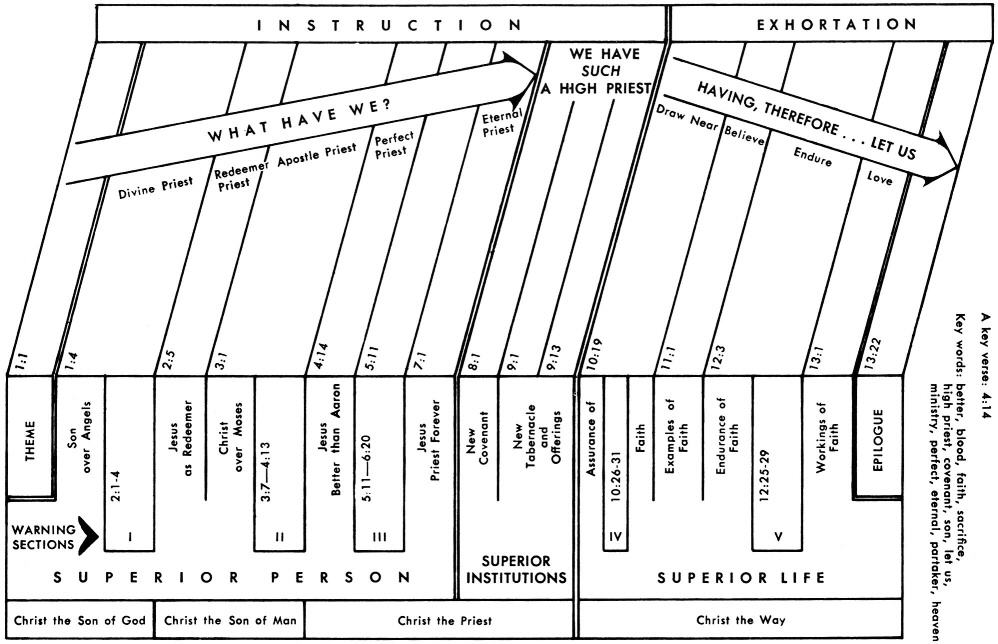
CONSIDER JESUS OUR GREAT HIGH PRIEST
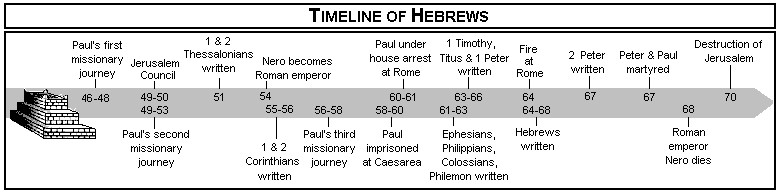
Click chart to enlarge
Charts from Jensen's Survey of the NT - used by permission
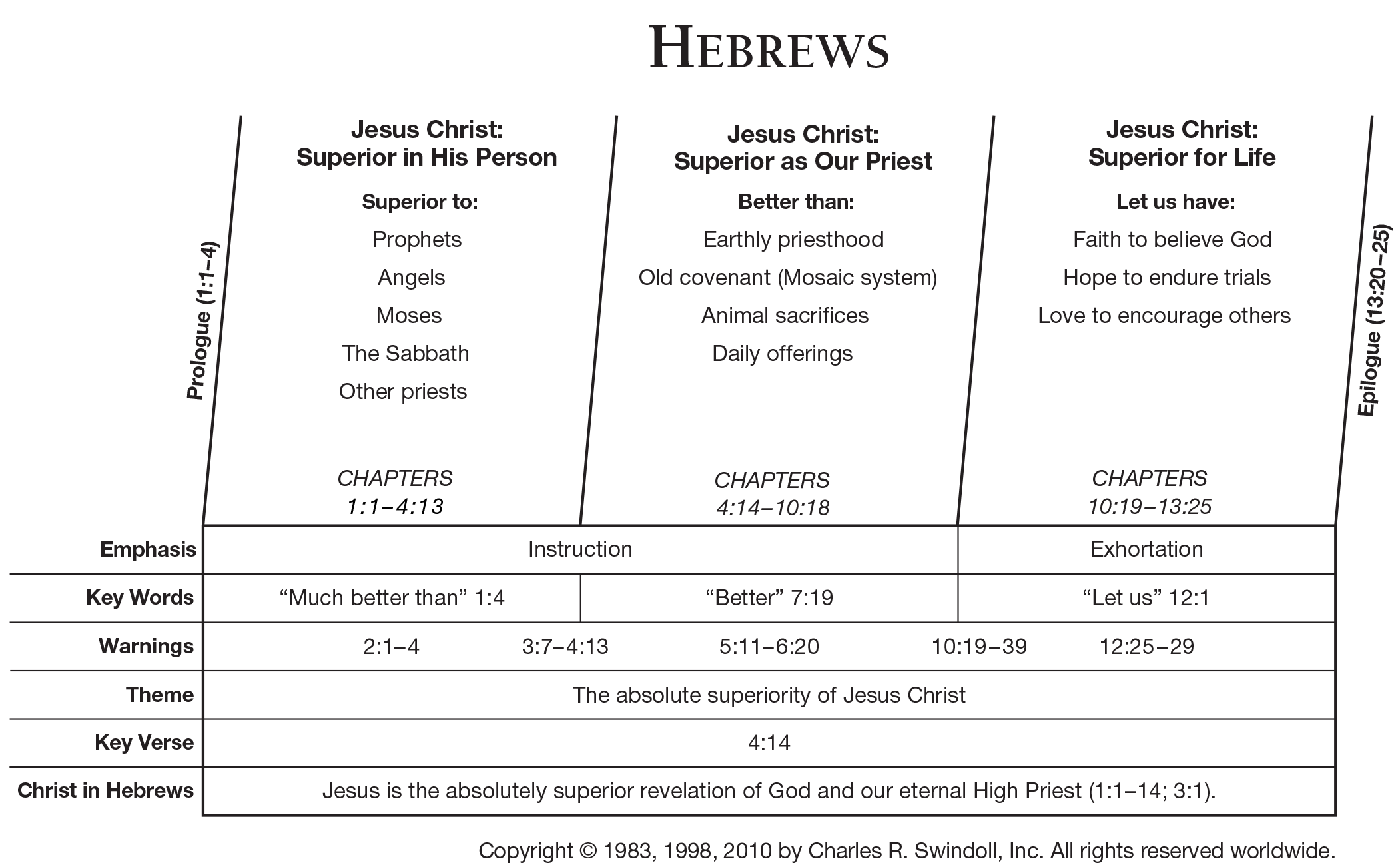
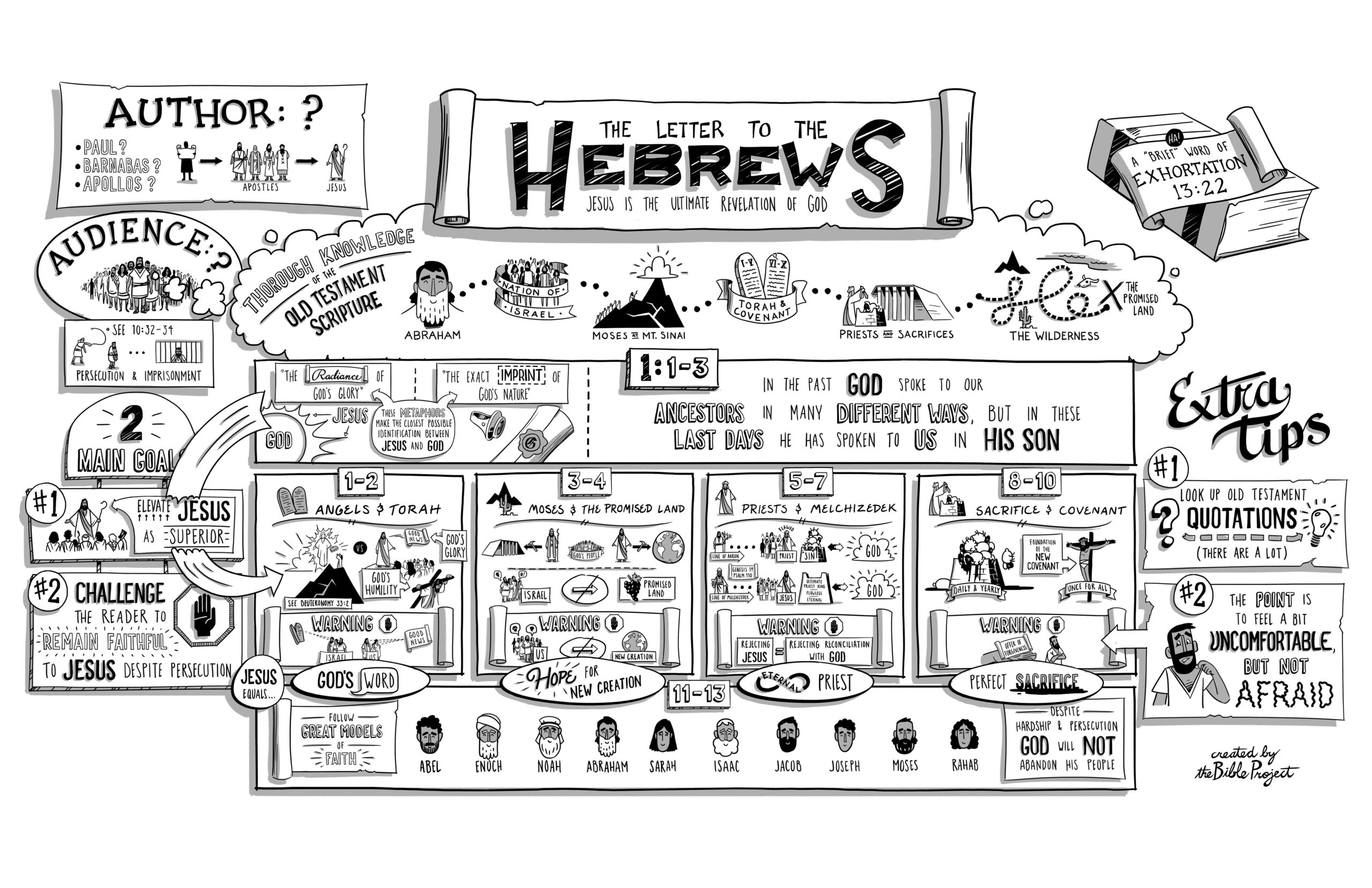
Swindoll's Chart, Interesting Pictorial Chart of Hebrews, Another Chart
|
The Epistle |
||||
| INSTRUCTION Hebrews 1-10:18 |
EXHORTATION Hebrews 10:19-13:25 |
|||
| Superior Person of Christ Hebrews 1:1-4:13 |
Superior Priest in Christ Hebrews 4:14-10:18 |
Superior Life In Christ Hebrews 10:19-13:25 |
||
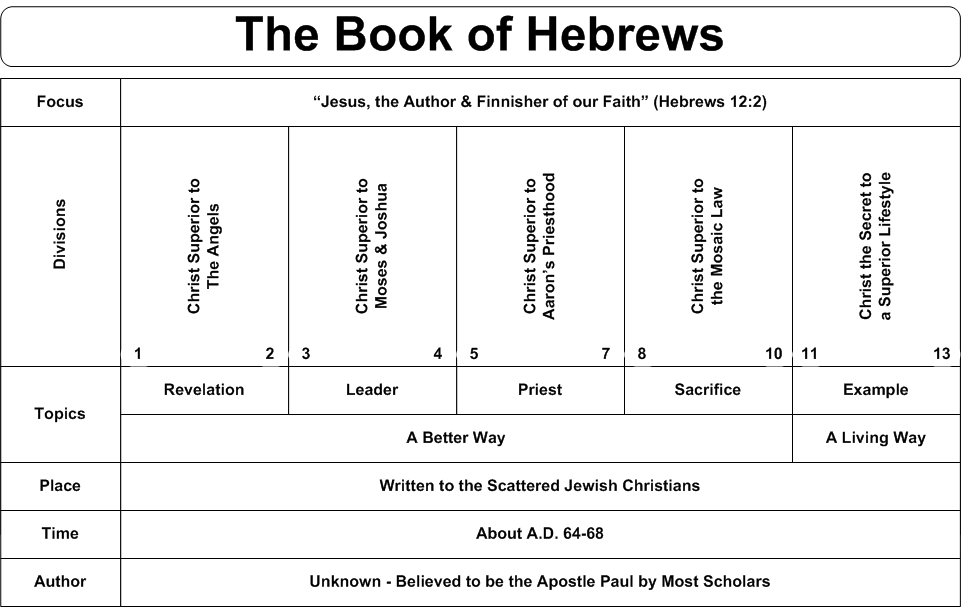
| BETTER THAN PERSON Hebrews 1:1-4:13 |
BETTER PRIESTHOOD Heb 4:14-7:28 |
BETTER COVENANT Heb 8:1-13 |
BETTER SACRIFICE Heb 9:1-10:18 |
BETTER LIFE |
| MAJESTY OF CHRIST |
MINISTRY OF CHRIST |
MINISTERS FOR CHRIST |
||
|
DOCTRINE |
DUTY |
|||
|
DATE WRITTEN: |
||||

See ESV Study Bible "Introduction to Hebrews"
(See also MacArthur's Introduction to Hebrews)
Borrow Ryrie Study Bible
Hebrews 4:11 Therefore let us be diligent to enter that rest, so * that no one will fall, through following the same example of disobedience. (NASB: Lockman)
Greek: spoudasomen (1PAAS) oun eiselthein (AAN) eis ekeinen ten katapausin, hina me en to auto tis hupodeigmati pese (3SAAS) tes apeitheias
BGT Σπουδάσωμεν οὖν εἰσελθεῖν εἰς ἐκείνην τὴν κατάπαυσιν, ἵνα μὴ ἐν τῷ αὐτῷ τις ὑποδείγματι πέσῃ τῆς ἀπειθείας.
Amplified: Let us therefore be zealous and exert ourselves and strive diligently to enter that rest [of God, to know and experience it for ourselves], that no one may fall or perish by the same kind of unbelief and disobedience [into which those in the wilderness fell]. (Amplified Bible - Lockman)
My Amplified Paraphrase: Therefore, in light of Israel’s tragic example and God’s still-open promise of rest, let us be diligent—make every earnest effort, be zealous, exert ourselves with wholehearted devotion—to enter into that rest, God’s saving, sanctifying, soul-satisfying rest in Christ, so that no one among us—through unbelief, carelessness, apathy, or disobedience—should fall into the same pattern, the same tragic outcome, of disobedience that kept the wilderness generation from entering God’s rest.
Barclay: Let us then be eager to enter into that rest, lest we follow the example of the Israelites and fall into the same kind of disobedience. (Westminster Press)
KJV Let us labour therefore to enter into that rest, lest any man fall after the same example of unbelief.
NKJ Let us therefore be diligent to enter that rest, lest anyone fall according to the same example of disobedience.
NLT: Let us do our best to enter that place of rest. For anyone who disobeys God, as the people of Israel did, will fall. (NLT - Tyndale House)
Phillips: Let us then be eager to know this rest for ourselves, and let us beware that no one misses it through falling into the same kind of unbelief as those we have mentioned. (Phillips: Touchstone)
Wuest: Let us give diligence, therefore, to enter that rest, lest anyone fall in the same example of disobedience;
Young's Literal: May we be diligent, then, to enter into that rest, that no one in the same example of the unbelief may fall
NET Thus we must make every effort to enter that rest, so that no one may fall by following the same pattern of disobedience.
CSB Let us then make every effort to enter that rest, so that no one will fall into the same pattern of disobedience.
ESV Let us therefore strive to enter that rest, so that no one may fall by the same sort of disobedience.
NIV Let us, therefore, make every effort to enter that rest, so that no one will fall by following their example of disobedience.
MIT Let us be intent on entering that rest, lest anyone miss out by falling into the same pattern of disobedience.
NJB Let us, then, press forward to enter this place of rest, or some of you might copy this example of refusal to believe and be lost.
NRS Let us therefore make every effort to enter that rest, so that no one may fall through such disobedience as theirs.
RSV Let us therefore strive to enter that rest, that no one fall by the same sort of disobedience.
NAB Therefore, let us strive to enter into that rest, so that no one may fall after the same example of disobedience.
GWN So we must make every effort to enter that place of rest. Then no one will be lost by following the example of those who refused to obey.
BBE Because of this, let us have a strong desire to come into that rest, and let no one go after the example of those who went against God's orders.
ASV Let us therefore give diligence to enter into that rest, that no man fall after the same example of disobedience.
- Let us therefore be diligent - He 4:1; 6:11; Mt 7:13; 11:12,28, 29, 30; Lk 13:24; 16:16; John 6:27; Php 2:12; 2Pe 1:10,11
- That no one will fall - Heb 3:12,18,19
- Same example of disobedience - Acts 26:19 Ro 11:30-32 Eph 2:2 Eph 5:6 Col 3:6 Titus 1:16 Titus 3:3
- Hebrews 4 Resources - Multiple Sermons and Commentaries
Related Passages:
Luke 13:24+ (THE COMMAND IN THIS VERSE PARALLELS "BE DILIGENT TO ENTER") “Strive (present imperative see our need to depend on the Holy Spirit to obey) to enter (eiserchomai - same verb in Hebrews 3-4) through the narrow door; for many, I tell you, will seek to enter (eiserchomai - same verb in Hebrews 3-4) and will not be able.
Comment - They are not able because they did not strive and were not diligent to enter the narrow gate. They refused to receive Jesus gift of salvation by faith.
Matthew 7:13-14+ (PARALLEL OF "BE DILIGENT TO ENTER") Enter (aorist imperative - Command to "Do it now!" "Do not delay" - tomorrow may be too late! See need to depend on the Holy Spirit to come - cf Ro 3:11b+)(eiserchomai - same verb in Hebrews 3-4) by the narrow gate to enter by the narrow door door; for many, I tell you, will seek to enter and will not be able."; for the gate is wide, and the way is broad that leads to destruction, and many are those who enter by it. For the gate is small, and the way is narrow that leads to life, and few are those who find it
Comment: Jesus says that most people will never be saved in spite of the fact that He offers salvation as a free gift to all who will receive it in faith.
Matthew 11:28-30+ (INVITATION TO ENTER HIS REST) Come (aorist imperative - Command to "Do it now!" "Do not delay" - it may be too late! See need to depend on the Holy Spirit to come) to Me, all who are weary and heavy-laden, and I will give you rest (anapauo). 29 “Take (aorist imperative see our need to depend on the Holy Spirit to obey) My yoke upon you and learn from Me, for I am gentle and humble in heart, and YOU WILL FIND REST (anapausis) FOR YOUR SOULS. 30 “For My yoke is easy and My burden is light.”
Comment: Note man's responsibility is to come and take, but it is a sovereign gift from God. The gift cannot be earned, only received. So both verbs call for the hearer to be diligent to enter His rest, a "narrow gate" which ultimately is entered by faith. However in the mystery of God, the only way we would be diligent to come and take is if the Father draws us (see Jn 6:37+, Jn 6:44-45+)
John 6:27+ (THE RIGHT KIND OF STRIVING) “Do not work for the food which perishes, but for the food which endures to eternal life, which the Son of Man will give to you, for on Him the Father, God, has set His seal.”
Hebrews 3:12+ Take care ((blepo in the present imperative see our need to depend on the Holy Spirit to obey), brethren, that there not be in any one of you an evil, unbelieving heart that falls away from the living God.
Hebrews 3:18-19+ And to whom did He swear that they would not enter His rest, but to those who were disobedient? 19 So we see that they were not able to enter because of unbelief.
Jude 1:5+ (THE EXAMPLE TO BE AVOIDED) Now I desire to remind you, though you know all things once for all, that the Lord, after saving a people out of the land of Egypt, subsequently destroyed those who did not believe (pisteuo)(THEIR EXAMPLE OF DISOBEDIENCE).
Numbers 14:22-23+ (THE EXAMPLE TO BE AVOIDED) “Surely all the men who have seen My glory and My signs which I performed in Egypt and in the wilderness, yet have put Me to the test these ten times and have not listened to My voice, 23 shall by no means see the land (NOT ENTER THAT REST BECAUSE OF DISOBEDIENCE) which I swore to their fathers, nor shall any of those who spurned Me see it.
Acts 7:51+ (STEPHEN TO THE DISOBEDIENT JEWS IN JERUSALEM) “You men who are stiff-necked and uncircumcised in heart and ears are always resisting the Holy Spirit; you are doing just as your fathers did.
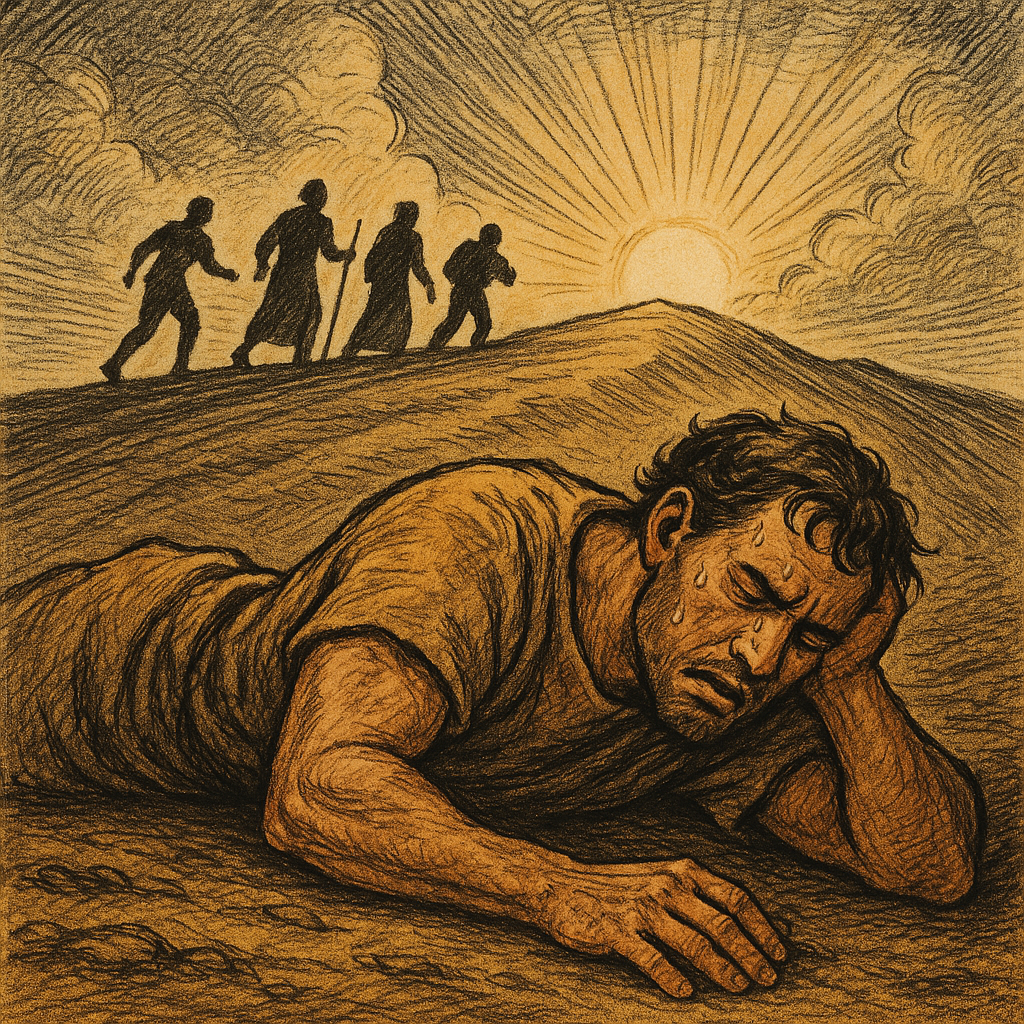
DILIGENCE AVOIDS ISRAEL'S DANGEROUS
EXAMPLE OF DISOBEDIENCE
Therefore (oun = term of conclusion) means consequently and introduces a logical conclusion based on the preceding verses, specifically the Old Testament example of Israel in Heb 4:1-10+. In Hebrews 4 the writer gives a strong exhortation based upon this well known Old Testament example.
Let us is a frequent phrase in Hebrews, introducing an exhortation—an earnest urging or strong appeal in which the writer advises, warns, and persuades his first-century readers with urgency." A doctrinal truth is presented - in this case, the truth of a remaining rest available by faith - then the truth is applied. Notice how the writer includes himself in this exhortation. Let us is a hortatory subjunctive which is used 12 times in Hebrews.
Be diligent (spoudazo) to enter (eiserchomai) that rest (katapausis), so that (hina - term of purpose) no one will fall (pipto), through following the same example (hupodeigma) of disobedience (apeitheia) - The writer issues a strong exhortation (bordering on a command). Earlier he warned don't drift (He 2:1+) and now he exhorts them to be diligent (spoudazo), an admonition that some some in the group needed to heed as they were considering going back to Judaism, the Temple sacrifices and dead works.
Be diligent (strive, make every effort - but see Spurgeon's note) is in the active voice, calling the readers not to remain passive but to make a deliberate, active choice to pursue diligence. As noted above, the writer does not leave anyone out of this exhortation (even himself - "let US") calling on all in the congregation (spoudazo is plural) to hasten to enter God's rest, to do this quickly, earnestly applying themselves to this pursuit. In short, this Old Testament warning calls for active, intense, and eager exertion from the reader—especially those wavering in faith or merely professing without truly possessing saving faith.
We do not labor to rest. That is a contradiction.
We labor to enter into rest, we make it our resolute purpose,
we go about it in dead earnest.
-- Vance Havner
Enter (eiserchomai) that rest (katapausis) speaks of entering by faith and trust in the Messiah. The rest they were to enter was the spiritual rest from works and eternal rest in heaven (Rev 14:13+), prefigured by the Sabbath rest in Hebrews 4:9, which many commentators see as having both present and future aspects. Enter (eiserchomai) that rest (katapausis) - In this context, the primary meaning of katapausis is ceasing from work or any kind of action—a state in which labor or exertion is finished. Applied here to God’s rest, it signifies the end of all self-effort in regard to salvation, the cessation of trying to please God through fleshly works. The writer’s point is that God’s salvation rest, found in His Son Jesus Christ, is available to all, but He will not compel anyone to enter it—for a ‘forced rest’ would hardly be rest at all. Each person must enter by faith, not by works.
So that (hina - term of purpose) no one will fall (pipto) - The writer now states the purpose or goal of applying diligence. It was to avoid the danger of falling like Israel did in the wilderness and failing to enter God's rest. And thus we see that based upon what the writer has just said about entering or not entering God's rest (Heb 4:1-10+)., he is cautioning his readers to not make the same mistake that the majority of Israel made in the wilderness. Will fall (pipto) is of course a metaphorical description of failing to enter God's rest by faith which would result in spiritual ruin (and eternal punishment). Paul gives a parallel warning (a command) in 1Co 10:12+ "Therefore (based upon fact that the wilderness generation disobeyed and fell - 1Co 10:1-11+) let him who thinks he stands take heed (blepo [also used in Heb 3:12+] in present imperative see our need to depend on the Holy Spirit to obey) that he does not fall (pipto - same danger as in Heb 4:11!)."
Let us not repeat the story of unbelieving Israel in our own lives.
Let us not live and die in the wilderness, but let us go in
and take possession of the promised land, the promised rest,
in the power of the Holy Spirit.
-- C H Spurgeon
In 2 Peter 1:10+ the apostle Peter gives a command to his readers similar to the exhortation here in Hebrews 4:11 "Therefore, brethren, be all the more diligent (spoudazo - command in aorist imperative "Do not delay!" See need to depend on the Holy Spirit to be diligent) to make certain (bebaios) about His calling (klesis) and choosing (ekloge) you; for (term of explanation) as long as you practice (present tense - as your lifestyle, energized by the Spirit - Php 2:13NLT+) these things (the "things" in 2Pe 1:5-8+), you will never stumble (ptaio)." Peter is not warning that they might lose their salvation, but to the contrary is saying that if they obey his command and in effect "hold fast" as Hebrews emphasizes (Heb 3:6+, Heb 3:14+), they will demonstrate that their calling and election were genuine.
Through following the same example (hupodeigma) of disobedience (apeitheia) - The writer presents a negative pattern (hupodeigma) to be diligently avoided—a model of behavior that serves as a warning. The wilderness generation stands as such an example (hupodeigma): study their failure and let it motivate you to continual diligence, lest you repeat their mistake and miss God’s spiritual rest. Israel’s example was one of disobedience (apeitheia)—a refusal to be persuaded, marked by obstinacy and a willful refusal to obey. Their persistent unbelief expressed itself in open rebellion against God and His word. They were not ignorant—they knew what God had commanded and promised, yet stubbornly rejected His Word, "always resisting (antipipto in present tense) the Holy Spirit" (See Acts 7:51+).
Leon Morris on be diligent - The idea of the rest of God is not simply a piece of curious information not readily accessible to the rank and file of Christians. It is a spur to action. So the writer proceeds to exhort his readers to make that rest their own… These earlier people had perished. Let the readers beware! (Expositor's Bible Commentary)
Spurgeon has an interesting comment on let us be diligent - It is an extraordinary injunction, but I think he means, let us labor not to labor. Our tendency is to try to do something in order to save ourselves; but we must beat that tendency down, and look away from self to Christ. Labor to get away from your own labors; labor to be clean rid of all self-reliance; labor in your prayers never to depend upon your prayers; labor in your repentance never to rest upon your repentance; and labor in your faith not to trust to your faith, but to trust alone to Jesus… I remember an old countryman saying to me, long ago, “Depend upon it, my brother, if you or I get one inch above the ground, we get just that inch too high”; and I believe it is so. Flat on our faces before the cross of Christ is the place for us; realizing that we ourselves are nothing, and that Jesus Christ is everything.
And once you have enter that rest you can joyfully sing...
Jesus! I am resting, resting
In the joy of what Thou art;
I am finding out the greatness
Of Thy loving heart.
William MacDonald on let us be diligent - adds that "We must diligently resist any temptation merely to profess faith in Him and then to renounce Him in the heat of suffering and persecution. The Israelites were careless. They treated God’s promises lightly. They hankered for Egypt, the land of their bondage (Ex 16:2, 3, Nu 11:4, 5, 6) They were not diligent in appropriating God’s promises by faith. As a result, they never reached Canaan. We should be warned by their example (1Co 10:6, 11). (Borrow Believer's Bible Commentary)
William Newell on let us be diligent - "We shall find that this “universal earnestness” is a great secret of progress, and the great guardian against the sad condition of the Hebrew believers; who, we are to see in Chapter 5, became “needers of milk, and not of solid food … without experience of the word of righteousness,” instead of teachers of others. Remember, believer, that this world is an “Enchanted Ground.” Here again Pilgrim’s Progress, which astonishes us by its pictures of spiritual facts and folks, illustrates the danger of lack of diligence in our Christian path. See note† below! (Hebrews Commentary)
The KJV translates let us be diligent as "let us labor" which picks up on the idea that there effort is necessary. Don't misunderstand. The writer is not calling us to work to enter into His rest (in the sense that we in any way might be able to earn or merit salvation). Rather what does he specifically say we are to do? We are to believe the promise of God's Word and His work. One who has entered His rest of salvation is then God's "workmanship (poiema = the result or product of someone's work = sounds like "poem" = believers are now God's "masterpiece" as it were), created in Christ Jesus for (expresses a believer's purpose) good works (aka "God works"), which God prepared beforehand, that we should walk in them (it follows that IF the works are "OUR" works, not "HIS works", they may look "good" but they are not truly "good works" - Jesus said "apart from Me you can do nothing" good Jn 15:5+)." (Eph 2:10+, Ep 2:8, 9+)
Not "Let go, let God," but
"Let God, let's go!"
Ray Stedman, commenting on the paradoxical link between diligence and rest, explains that the need for diligence - Of course, effort is needed to resist self dependence. If we think that we have what it takes in ourselves to do all that needs to be done, we shall find ourselves rest-less and ultimately ineffective. Yet decision is still required of us and exertion is needed; but results can only be expected from the realization that God is also working and he will accomplish the needed ends. This is also the clear teaching of Psalm 127:1, “Unless the lord builds the house (AKA - "LET GOD"), its builders labor (AKA - "LET'S GO") in vain. Unless the Lord watches over the city, the watchmen stand guard in vain.” Human effort is still needed, but human effort is never enough." (The Rest Obtained Is New-Creation Rest)
COMMENT - Resting in Christ is not "Let go, let God!" More accurately it is "Let God, let's go." It is believers working out their salvation in fear and trembling. Yet their every action flows from the strength generously supplied by the Spirit of God. See Php 2:12+ and Php 2:13NLT+ for the Scriptural basis for this important spiritual principle. See discussion of "Paradoxical Principle of 100% Dependent and 100% Responsible" (100/100)
John Piper explains the seemingly paradoxical phrase Be Diligent to Enter God's Rest noting that this is "The main point of the paragraph: Fear unbelief. In the last sentence of the paragraph he says the same thing in different words. Verse 11: "Let us therefore be diligent to enter that rest, lest anyone fall through following the same example of disobedience." In other words, Israel fell from the promised joy of God because of the disobedience of unbelief. And the same thing can happen to any professing Christian. To keep it from happening -- and to show that we are more than mere professing Christians (Ed: Their lips speak but their ungodly life does not support their profession) -- he says, "Be diligent to enter God's rest" -- God's heaven. Be diligent! Pay close attention to what you've heard (He 2:1+); don't neglect your great salvation (He 2:3+); consider Jesus (He 3:1+); do not harden your hearts (He 3:8+); take care against an unbelieving heart (He 3:12+); exhort one another every day against the deceitfulness of sin (He 3:14+); and FEAR the unbelief that will keep you from your promised rest (He 4:1+). (ED: ALL OF THESE ARE COMPONENTS OF WHAT IT MEANS TO BE DILIGENT TO ENTER THAT REST!) (Hebrews 4:1-11 Be diligent to enter God's rest) (Bolding added)
As we labor for Christ and the glory of God,
May we also learn to rest in Christ and the grace of God.
The KJV Commentary adds that "Rest involves more than mere inactivity. It is that which follows the satisfactory completion of a task. Salvation rest is the gift reckoned to the believer resulting from Christ’s finished work. Heaven and millennial rest is the reward of the believer’s labors for the Lord (Re 14:13+). Hebrews 4:11 records the warning one more time: Do not miss through unbelief what God has promised. (KJV Bible Commentary page 2854)
William Newell - Analyze this carefully. All unbelief is evil; but an “evil heart of unbelief” is that set over, in the parable of the sower, against the good-ground hearers: “These are such as in an honest and good heart, having heard the word, hold it fast and bring forth fruit.” An evil heart of unbelief is one that holds fast to sin, and tries to believe at the same time! But this terrible state Paul shows up, in the words, “Holding faith and a good conscience; which some having thrust from them made shipwreck concerning the faith” (1 Tim. 1:19). You cannot ride two horses going in different directions; you must let one go. So “an evil heart of unbelief” has chosen evil. Let us remember that Paul says an apostate is not a backslider: an apostate is one who has, by his own will, turned his back on Christ and Christianity. Having “tasted” all things, he has “fallen away,” as we show elsewhere (Heb 6:4–8).
Lord, I believe a rest remains
To all Thy people known,
A rest where pure enjoyment reigns,
And Thou art loved alone.
--Charles Wesley
Alexander Maclaren writes that "Important lessons are given by this alternation of the two ideas of faith and unbelief, obedience and disobedience. Disobedience is the root of unbelief (Ed: I think the next statement is more accurate. I think "disobedience" is not the "root" but the "fruit" of unbelief!). Unbelief is the mother of further disobedience. Faith is voluntary submission within a person’s own power. If faith is not exercised, the true cause lies deeper than all intellectual reasons. It lies in the moral aversion of human will and in the pride of independence, which says, “who is Lord over us? Why should we have to depend on Jesus Christ?” As faith is obedience and submission, so faith breeds obedience, but unbelief leads on to higher-handed rebellion. With dreadful reciprocity of influence, the less one trusts, the more he disobeys; the more he disobeys, the less he trusts…Trust brings rest because it sweeps away, as the north wind does the banded clouds on the horizon, all the deepest causes of unrest. (Man's Share in God's Rest)
Our rest does not entail inactivity on our part but
reliance upon God and upon Jesus’ sacrifice for our sins.
-- James Girdwood
Let's summarize Hebrews 4:11 - The writer warns against repeating Israel’s fatal error in the wilderness—perishing in unbelief. This is not about occasional lapses but a stubborn, unrepentant defiance springing from a hardened heart. Such disobedience leads to eternal loss. His warning cuts like a sword—urgent, penetrating, and impossible to ignore. And so these first-century Jews, tempted to abandon Christ for the rituals of Judaism, are urged to press on and enter His rest. Like the generation under Moses, unbelief would lead to ruin—both physical and eternal. Their fate stands as a solemn warning: do not repeat their sin.
REST OR RUIN
They stood so near the promised land,
Yet turned away from God’s command;
Unbelief became their grave,
No power left, no soul to save.
So press to Christ, the true and best,
Refuse the lies, and find His rest;
For those who spurn His voice today,
Will fall, and lose the narrow way.
Be diligent (4704) (spoudazo from spoude = earnestness, diligence) means to apply earnestness and speaks primarily of an attitude which then is associated with or leads to an appropriate action (in this case "entering God's rest"). Spoudazo conveys the idea of hastening to do something with the implication of associated energy or with intense effort and motivation. Spoudazo means to be marked by careful unremitting attention or persistent application. The idea is to give maximum effort, to do your best, to spare no effort, to hurry on, to be eager! Hasten to do a thing, exert yourself, endeavour to do it. It means not only to be willing to do something with eagerness, but to follow through and make the effort. In other words spoudazo does not stop with affecting one's state of mind, but also affects one's activity. Spoudazo means to be conscientious, zealous and earnest in discharging a duty or obligation. It speaks of intensity of purpose followed by intensity of effort toward the realization of that purpose.
Let us be diligent - Let us occurs 13x in 12v - Heb 4:1, 11, 14, 16; 6:1; 10:22, 23, 24; 12:1 (2x), He 12:28; 13:13, 15
Be diligent in KJV is "let us labor” (KJV) which almost conveys the sense that one has to work and merit entrance into the rest of salvation. The better sense is “to hasten, make haste, to exert one’s self, endeavor, give diligence.” It is used in the papyri in such senses as “do your best, take care, hurry on the doing of something.” Spoudazo speaks of intensity of purpose followed by intensity of effort toward the realization of that purpose.
SPOUDAZO - 11V - Gal. 2:10; Eph. 4:3; 1 Thess. 2:17; 2 Tim. 2:15; 2 Tim. 4:9; 2 Tim. 4:21; Tit. 3:12; Heb. 4:11; 2 Pet. 1:10; 2 Pet. 1:15; 2 Pet. 3:14
Later the writer uses the related noun spoude (diligence) writing "we desire that each one of you show the same diligence (as those among them who had ministered to the saints) so as to realize the full assurance of hope until the end, that you may not be sluggish, but imitators of those who through faith and patience inherit the promises." (Hebrews 6:11, 12+)
Hortatory Subjunctive - a first-person plural subjunctive verb used to urge a group to do something. (Let us go…” “Let us draw near…” “Let us hold fast…” “Let us consider…”) These are not suggestions; they are strong, urgent exhortations. The hortatory subjunctive expresses: exhortation (strong urging), encouragement, group inclusion (“we together”), an invitation with authority, a call to decisive action. It has the force of:“We must…” “Let us now…” “We should immediately…” It is authoritative yet pastoral.
Why Greek uses the Hortatory Subjunctive - Greek has no first-person imperative (“we, do this!”), so the hortatory subjunctive serves this function. It is the strongest way to urge a group to action.
Summary - This is a statement urging others to join in some action (commanding oneself and one’s associates). (It is roughly the same as first person imperative, which does not exist in Greek.) It is easily identified because it will always be the first person plural form of the subjunctive mood. This verb form will often come near the beginning of the sentence.It is usually translated "let us…." (Thus, as a mnemonic device, it can be referred to as the ‘Salad Subjunctive’. cf "let us" with "lettuce" - a bad joke!)
"LET US" IN HEBREWS - Heb. 4:1; Heb. 4:11; Heb. 4:14; Heb. 4:16; Heb. 6:1; Heb. 10:22; Heb. 10:23; Heb. 10:24; Heb. 12:1; Heb. 12:28; Heb. 13:13; Heb. 13:15
Enter (come into)(1525) eiserchomai (from eis = into + erchomai = to come, go) means to go in (to), enter. Eiserchomai can speak of a thought “coming into” mind (Herodotus), wisdom entering someone (Wisdom of Solomon 1:4), the “entering” of the prophetic spirit (Josephus Antiquities 4.6.5), demonic spirits that “enter” into men (Mk 9:25; Lk 8:30), and Satan “entering” Judas (Lk 22:3). Figuratively eiserchomai can denote the acquiring of something, i.e., “to attain something” (wealth, property, and so on). It is used of the kingdom of God/heaven (Mt 5:20; Mt 7:21; Mt 19:24; Mk 9:47; Mk 10:15; et al); eiserchomai describes attaining eternal life (Mt 18:8f.; Mt 19:17; Mk 9:43,45); or eiserchomai can speak of entering rest (Heb 3:11,18; Heb 4:11).
EISERCHOMAI IN HEBREWS - KEY WORD IN HEBREWS 3-4 - Heb. 3:11; Heb. 3:18; Heb. 3:19; Heb. 4:1; Heb. 4:3; Heb. 4:5; Heb. 4:6; Heb. 4:10; Heb. 4:11; Heb. 6:19; Heb. 6:20; Heb. 9:12; Heb. 9:24; Heb. 9:25; Heb. 10:5
Friberg - (1) literally, in a local sense go or come into, enter (Mt 2.21); (2) figuratively; (a) of the birth of Jesus come into (the world) ( Heb 10.5); (b) of demons enter in, take possession of (Mk 9.25 ); (c) of persons; (i) in a good sense come into, enter into, begin to enjoy (Mt 5.20); (ii) in a bad sense begin to experience, meet, encounter (Mt 26.41); (d) as the first stage of an activity -- begin, come up (Lk 9.46) (Borrow Analytical Lexicon of the Greek New Testament)
Rest (2663) (katapausis fromkatá = intensifies the meaning of the following word or signifies "down" which figuratively conveys the sense of permanency + pauo = make to cease) describes literally a ceasing from one's work or activity. Thayer cites a use in the active sense of a putting to rest as used in the sentence "a calming of the winds". Metaphorically as used in the present verse, katapausis speaks of the spiritual fulfillment God provides for His people. Katapausis is a ceasing from one form of activity IN ORDER TO give oneself to a wholly new enterprise, in the context, to believe God's promise. (See excursus on Rest in Hebrews 4)
KATAPAUSIS - KEY WORD IN HEBREWS 3-4 - Acts 7:49; Heb. 3:11; Heb. 3:18; Heb. 4:1; Heb. 4:3; Heb. 4:5; Heb. 4:10; Heb. 4:11
Gilbrant - In classical Greek katapauō carries the meaning of “to stop” or “to put an end to” in relation to all kinds of actions and conditions. With reference to persons, katapauō can even carry the very negative aspect of “to kill” (cf. Moulton-Milligan). However, the Septuagint uses katapauō in the more positive sense of “giving someone good rest.” The most common Septuagint usage of katapauō is to translate the Hebrew nuach which means “rest, settle down, be quiet.” Katapauō is used in connection with God giving one “rest” from his enemies (Exodus 33:14; Deuteronomy 3:20) and with reference to “rest” in the Promised Land (Joshua 1:13). (Complete Biblical Library Greek-English Dictionary)
As has been alluded to in previous notes on Hebrews 4 is possible to interpret God's "rest" in at several ways…
(1) The rest associated with placing one's faith in Christ (see Mt 11:28, 29, 30). In the context of the entire epistle, this appears to be the primary meaning, that is, of coming to Jesus by faith and entering His salvation rest where self effort is replaced (or at least can and should be replaced) by Spirit initiated and empowered effort.
(2) The rest of those who are believers in Christ, and who are living their Christian life in the power of the Spirit, keeping short accounts, and thus experiencing the "peace of God". This aspect of rest is that which is associated with sanctification, our day to day living out of the Christ life. Ray Stedman speaking of those who have entered this salvation rest by faith explains that tragically many believers experience breakdown in their Christianity (not referring to a loss of salvation but a loss of joy and sense of His presence and power) under the pressures of stress or responsibility because they try to work out their salvation in their power (cp Php 2:12-note, Php 2:13-note) and have not learned to "operate out of rest". (Stedman, Ray: The Rest Obtained Is New-Creation Rest)
(3). Some who believe in a literal 1000 year kingdom (see Millennium) feel that the rest that is promised to Israel (and applies to all believers) will be partially fulfilled in the reign of Christ on earth ("the Messianic Age"), the "rest" of which Isaiah records…
Then it will come about in that day (when Messiah takes His throne in Jerusalem after the Great Tribulation - see Daniel's Seventieth Week - and the defeat of the Antichrist) that the nations will resort to the root of Jesse (the Messiah), Who will stand as a signal (a banner lifted up to be a rallying point) for the peoples; and His resting place (LXX uses the related word anapausis) will be glorious. (Isaiah 11:10)
(3). The rest associated with eternity and which is described by John who…
Example (5262) (hupodeigma from hupo = under + deiknúo/deíknumi = to show, to point to something, to make known the character or significance of something) means literally that which is shown below. It means an example, pattern, illustration. It refers to a sign suggestive of anything, an outline, a delineation, a suggestion. Richards notes that "In the NT the pattern is nearly always established by a person whose words and actions provide a living expression of that which Scripture calls for from all believers. At times the example found in the Bible is negative (Heb 4:11). But the concept of example is more often positive. Barclay writes that hupodeigma means "a specimen, or, still better, a sketch-plan." Vine says hupodeigma signifies "(a) a sign suggestive of anything, the delineation or representation of a thing, and so, a figure, “copy”; in Heb. 9:23; (b) an example for imitation, John 13:15; Jas. 5:10; for warning, Heb. 4:11; 2 Pet. 2:6.
Hupodeigma refers not to an example of disobedience, but to an example of falling into destruction as a result of disobedience. In contrast is the good example of Jesus the Servant Who instructed His disciples to wash one another's feet because "I gave you an example (hupodeigma) that you also should do as I did to you." (John 13:15) Here the meaning is that of a model or pattern of behavior used for the purpose of moral instruction.
Here are the 5 other NT uses (other than the above use from Jn 13:15 - there is only one LXX use - Ezekiel 42:15) of hupodeigma
Hebrews 4:11+ Let us therefore be diligent to enter that rest, lest anyone fall through following the same example of disobedience.
Hebrews 8:5+ who serve a copy (image, pattern) and shadow of the heavenly things, just as Moses was warned by God when he was about to erect the tabernacle; for, "See," He says, "that you make all things according to the pattern which was shown you on the mountain." (Comment: Here hupodeigma is used as a representative copy or likeness of the original and/or genuine. What Moses saw on the mountain was the original, and the constructed tabernacle [and the furnishings] the copy which reflected the original, as well as the model which pointed to the original.)
Hebrews 9:23+ Therefore it was necessary for the copies of the things in the heavens to be cleansed with these, but the heavenly things themselves with better sacrifices than these.
2 Peter 2:6+ and if He condemned the cities of Sodom and Gomorrah to destruction by reducing them to ashes, having made them an example to those who would live ungodly thereafter; (Comment: The meaning of hupodeigma is similar to Hebrews 4:11, where the example is a "negative" one, something that should be avoided.)
James 5:10+ As an example, brethren, of suffering and patience (literally a long holding out of one's mind before giving room to passion = reflects emotional calm in face of provocation or misfortune - see makrothumia), take the prophets who spoke in the name of the Lord. (Comment: What did the patience or endurance of the prophets demonstrate? They serve as an example of the perseverance of the saints demonstrating that it is possible to endure to the end (in His power not our power). As the writer of Hebrews reminded his readers earlier - "we have become partakers of Christ, if we hold fast (if we are genuinely saved, we will hold fast - holding fast is not a meritorious work and does not earn salvation, but only "proves" one is saved) the beginning of our assurance firm until the end (He 3:14+)
Disobedience (543) (apeitheia from a = without + peítho = persuade) describes a refusal or an unwillingness to be persuaded and thus describes an obstinate and rebellious unbelief. Men do not avoid God's promised rest because of insufficient facts but because of proud and unrepentant hearts.
APEITHEIA - 6V - Rom. 11:30; Rom. 11:32; Eph. 2:2; Eph. 5:6; Heb. 4:6; Heb. 4:11
Paul gives us an example of obedience testifying before King Agrippa declaring "I did not prove disobedient (adjective apeithes) to the heavenly vision but kept declaring both to those of Damascus first, and also at Jerusalem and then throughout all the region of Judea, and even to the Gentiles, that they should repent and turn to God, performing deeds appropriate to repentance. (Acts 26:19)
Paul explaining to the Ephesian believers their pre-conversion state declared "you were dead (spiritually dead - past tense - before you placed your faith in Christ) in your trespasses and sins, in which you formerly walked according to the course of this world, according to the prince of the power of the air, of the spirit that is now working in the sons of disobedience (apeitheia). (Ephesians 2:1; 2:2+) And again Paul exhorted the saints "Let no one deceive you with empty words, for because of these things the wrath of God comes upon the sons of disobedience (apeitheia). (Ephesians 5:6+)
In Romans again Paul equates disobedience with unbelief writing to the Gentile Roman saints "just as you (Roman Gentile believers) once were disobedient (verb form apeitheo) to God, but now have been shown mercy because of their (the Jew's) disobedience (apeitheia), so these (Jews) also now have been disobedient (apeitheo), in order that because of the mercy shown to you they (Jews) also may now be shown mercy. For God has shut up all (Jews and Gentiles) in disobedience (apeitheia) that He might show mercy to all. (Ro 11:30, 31, 32+)
Writing to Titus on Crete warned him about false believers declaring that "They profess to know God, but by their deeds they deny (present tense = this is their habitual practice, their lifestyle) Him, being detestable (abominable, abhorrent = from root word meaning to "stink"!) and disobedient (apeithes), and worthless for any good deed. (Titus 1:16+)
Finally Paul reminded Titus about their pre-conversion condition declaring that "we also once were foolish ourselves, disobedient, deceived, enslaved to various lusts and pleasures, spending our life in malice and envy, hateful, hating one another. But when the kindness of God our Savior and His love for mankind appeared, He saved us, not on the basis of deeds which we have done in righteousness, but according to His mercy, by the washing of regeneration and renewing by the Holy Spirit, Whom He poured out upon us richly through Jesus Christ our Savior (Titus 3:3-6+)
In summary, it is clear that this disobedience is used by the Holy Spirit as a synonym for unbelief. Conversely saving faith is accompanied by sure (albeit not perfect) obedience.
An Eclipse Is Not Unseen - Take heed to yourselves also because there are many eyes upon you. So there will be many who observe your fall. If you miscarry, the world will also echo with it. It is the same as the eclipses of the sun in broad daylight—they are seldom without witnesses. —Richard Baxter in his classic work The Reformed Pastor
Vance Havner - "Trying to Rest"
Let us labor therefore to enter into that rest. Hebrews 4:11.
We do not labor to rest. That is a contradiction. We labor to enter into rest, we make it our resolute purpose, we go about it in dead earnest. But when we have ceased from our works and entered, then we rest. We make an effort to reach a vacation spot but after we arrive we rest. The Saviour invites us to His rest, and we are not to live in a tense strain, holding on to it for dear life for fear "it" will slip from us. We do not keep Him, He keeps us. We are His guest, not His host, we sit at His table and we need never go away.
The rest of the Christian is not a pose of faith rigidly fixed and maintained. It is not something we screw ourselves up to, it is the very opposite of all strenuous effort. We labor to enter in, we earnestly commit all in a positive, definite, businesslike way. Then the responsibility is His to keep what we have committed; we have simply to abide. (ED: BUT SEE HENRY MORRIS' NOTE ON THE ROLE OF DILIGENCE WHILE WE ABIDE IN CHRIST) Like some vacationists, we exhaust ourselves trying to rest! Let go and let God!
><>><>><>
Our Bible tells us: "Let us labour therefore to enter into that rest" (Hebrews 4:11), but it is God's rest. God rested after a finished creation. We rest after a finished redemption. We also rest in that redemption as we cease from our own labors and abide in the provision made for us through Christ. We labor to enter into it, we make it our chief concern, to move into that blessed experience of complete trust. We do not labor to rest, but to enter into rest. He who has entered does not dash around frantically on a holiday looking for rest. He carries his vacation inside, with a mind at leisure from itself. If we do not know rest within we will never find it without.
><>><>><>
We receive His rest when we receive Him; but only as we learn of Him
and practice His presence do we realize His rest.
The Christian life begins with a B. A. degree—Born Again—but, still, we must learn. Our Lord promised to give rest to those who came to Him (Matthew 11:28). But in the very next verse He says: "Take my yoke upon you, and learn of me; for I am meek and lowly in heart: and ye shall find rest unto your souls." There is a sense in which His rest is an obtainment and another sense in which it is an attainment. (ED: REST IS OUR POSITION, BUT REST IS NOT ALWAYS OUR PRACTICE!) We receive His rest when we receive Him; but only as we learn of Him and practice His presence do we realize His rest. One finds a kindred thought in Hebrews 4:10, 11: "For he that is entered into his rest, he also hath ceased from his own works, as God did from his. Let us labour therefore to enter into that rest."
Grace does not involve anything we may earn, but it involves much that we may learn. "The Comforter, which is the Holy Ghost, whom the Father will send in my name, he shall teach you all things, and bring all things to your remembrance, whatsoever I have said unto you" (John 14:26). Luke tells us that his Gospel was a record only of what Jesus began to do and teach (Acts 1:1). Paul says: "We speak, not in the words which man's wisdom teacheth, but which the Holy Ghost teacheth" (I Corinthians 2:13).
We must be disciples if we are to be doers. Through the Word, through prayer, through meditation, through worship and books and conversation and godly teachers and daily experiences, God teaches us by the Spirit, and blessed is he that heareth. Let us give heed to the "things... written for our learning" (Romans 15:4). Let us not be among those "ever learning, and never able to come to the knowledge of the truth." We are to continue in the things we have learned (II Timothy 3:14). We are to learn to maintain good works (Titus 3:14) and, like Paul, to learn in whatsoever state we are, therewith to be content (Philippians 4:11).
Henry Morris - Be Diligent
"And beside this, giving all diligence, add to your faith virtue; and to virtue knowledge" (2 Pet. 1:5).
The importance of diligence is urged by Peter as basic in the development of the seven other virtues listed by him—that is, virtue, knowledge, temperance, patience, godliness, brotherly kindness, charity—as vital additions to our faith. Diligence is seldom considered as a particular Christian attribute, but it is essential if we really desire to develop the other Christian virtues in our lives. They do not come by wishing or hoping. Peter also exhorts us to "give diligence to make your calling and election sure" (2 Pet. 1:10), and then to "be diligent that ye may be found of him in peace, without spot, and blameless" (2 Pet. 3:14).
Essentially the same Greek word is also translated "study" and "labor" and "endeavor." Paul commands: "Study to show thyself approved unto God, a workman that needeth not to be ashamed, rightly dividing the word of truth" (2 Tim. 2:15). He beseeches us always to be "endeavoring to keep the unity of the Spirit in the bond of peace" (Eph. 4:3). We are even told to "labor therefore to enter into that rest" (Heb. 4:11).
There are many other such exhortations in which Christian diligence is urged or shown in reference to other Christian virtues. There is one key verse, however, in which diligence itself is commanded as a Christian duty: "Not slothful in business; fervent in spirit; serving the Lord" (Rom. 12:11). Here the word "business" is the same as "diligence." That is, each Christian is commanded to "be diligent in diligence!"
Christian salvation is received solely by grace through faith. The Christian life, however, demands diligence. Can we not, as our text commands, give all diligence in our service to the Lord who gave His life for us?
DILIGENT DEVOTION Discovering God's Daily Agenda: 365 Devotions to Live in ... - Page 13
Be diligent to be found by Him in peace, without spot and blameless. 2Pe 3:14
Webster’s defines diligent as “characterized by steady, earnest, and energetic effort; painstaking” and “earnest application to some specific object or pursuit.” What God is telling us through Peter, then, is that we believers must never treat our spiritual life casually. We are to pursue the Christian life with great effort, for we know the day of the Lord is fast approaching.
We believers must also endeavor to maintain unity (Ephesians 4:3); to persevere to present ourselves approved unto God (2 Timothy 2:15); to seek carefully to enter God’s rest (Hebrews 4:11); and to work to be found blameless (2 Peter 3:14). Similarly, the apostle Paul urges believers to “work out your own salvation with fear and trembling” (Philippians 2:12).
What specific steps are you taking to “work out your salvation,” to live a life that pleases your Lord? You’ll be more successful if you have a specific plan—a program for reading the Bible, a person to pray with, a small group for Bible study and discussion, a church home in which to worship. As you invest time and effort in your relationship with God, you are investing in eternity.
W Glyn Evans - Working to Conquer Canaan Daily With The King - Page 27
A disciple must understand the difference between “rest” and “works” if he is to be successful. The Bible says, “We who have believed enter that rest” (Hebrews 4:3), but that refers to the rest of not having to strive for our salvation. It does not refer to the rest of not having to strive for our victory. That is why we read, “Let us … be diligent to enter that rest” (Heb 4:11).
Too often we evangelicals have a carry-over attitude toward our Christian life. Because we are saved through faith alone, we feel that victory comes to us the same way. (ED: I WOULD ADD A CAVEAT TO EVANS' STATEMENT -- REMEMBER WE MUST CONTINUE DAILY TO WALK BY FAITH - 2Co 5:7+. SEE ALSO HYMN BELOW. SEE PAUL'S WARNING IN Gal 3:3+) While of course we trust God to help us and see us through, we are not exempt from suffering, struggling, and striving in order to achieve victory. The land of Canaan, while promised to the Israelites, had to be fought for, maintained, and worked before it began to yield its fruit of possession to them. So it is with me. Christ has provided me all the provisions I will ever need for my Christian life (and more), but those provisions will never become mine practically simply by believing that they are there. They will become mine as I need them in the struggle, just as Canaan became Israel’s by warfare and hard work.
I conquer my Canaan by working it. I work it by hard work in prayer, in self-denial, in witnessing to a hostile world, in facing opposition, in living according to the Bible, in obeying God’s Word regardless of the obstacles, in challenging Satan’s right to trespass.
That way of life is anything but easy. But when Canaan begins to yield its fruits, what blessing and what glory! The victory will not come without a battle, but my faith is like Caleb’s: “Give me this mountain … the Lord will be with me, then, I shall be able to drive them [the enemy] out, as the Lord said” (Joshua 14:12, KJV).
“Therefore, let us fear lest, while a promise remains of entering His rest, any one of you should seem to have come short of it” (Hebrews 4:1).
FAITH IS THE VICTORY
Encamped along the hills of light,
Ye Christian soldiers rise,
And press the battle ere the night
Shall veil the glowing skies;
Against the foe in vales below
Let all our strength be hurled;
Faith is the victory, we know,
That overcomes the world.
Faith is the victory!
Faith is the victory!
O glorious victory,
That overcomes the world.
David Jeremiah - Let us therefore be diligent to enter that rest. - Borrow Life Changing Moments with God page 164
Lord God, I enter by the narrow gate; for wide is the gate and broad is the way that leads to destruction. Narrow is the gate and difficult is the way which leads to life, and few find it. Your kingdom suffers violence, and the violent take it by force. I do not labor for the food which perishes, but for that which endures to everlasting life, which the Son of Man will give me. I will be even more diligent to make my calling and election sure, for so an entrance will be supplied to me abundantly into the everlasting kingdom of my Lord and Savior Jesus Christ. I will run in such a way that I may obtain it. Everyone who competes for the prize is temperate in all things. Now they do it to obtain a perishable crown, but I for an imperishable crown.
For I who have entered Your rest have myself also ceased from my works as You, God, did from Yours. You, Lord, will be to me an everlasting light, and You, God, my glory.
Help me, Lord God, live for You and walk the narrow path so I may rest in You.
HEBREWS 4:11; MATTHEW 7:13–14; MATTHEW 11:12; JOHN 6:27; 2 PETER 1:10–11; 1 CORINTHIANS 9:24–25; HEBREWS 4:10; ISAIAH 60:19
- See 9 results with word "diligent" (see left side of page) Life Changing Moments with God
- See 34 results with word "rest" (see left side of page) Life Changing Moments with God (See especially this one)
Henry H Halley - Our best hope of reaching our Promised Land lies in obedience to God’s Word. If only our churches could realize what power they would gain by giving God’s Word its proper place in the services!
Spurgeon - We are to “labour to enter into that rest” (Heb. 4:11). This is a singular expression, and reminds us of our Saviour’s words: “Labour not for the meat which perisheth, but for that meat which endureth unto everlasting life” (John 6:27). Here he utters a paradox. He bids us not to labour for that which we cannot get without labour, and commands us to labour for that which we cannot earn by labour. Blessed is he that understandeth!
Daily Light on the Daily Path - Let us therefore strive to enter that rest.
“Enter by the narrow gate. For the gate is wide and the way is easy that leads to destruction. . . . For the gate is narrow and the way is hard that leads to life, and those who find it are few.”—“The kingdom of heaven has suffered violence, and the violent take it by force.”—“Do not work for the food that perishes, but for the food that endures to eternal life, which the Son of Man will give to you.”—Therefore, brothers, be all the more diligent to confirm your calling and election. . . . For in this way there will be richly provided for you an entrance into the eternal kingdom of our Lord and Savior Jesus Christ.—So run that you may obtain it. Every athlete exercises self-control in all things. They do it to receive a perishable wreath, but we an imperishable.
Whoever has entered God’s rest has also rested from his works as God did from his.—The Lord will be your everlasting light, and your God will be your glory.
Heb. 4:11; Matt. 7:13–14; Matt. 11:12; John 6:27; 2 Pet. 1:10–11; 1 Cor. 9:24–25; Heb. 4:10; Isa. 60:19
REST “Rest in the Lord, and wait patiently for him: fret not thyself” (Ps. 37:7a). “Return unto thy rest, O my soul; for the Lord hath dealt bountifully with thee” (Ps. 116:7). “Come unto me, all ye that labour and are heavy laden, and I will give you rest. Take my yoke upon you, and learn of me; for I am meek and lowly in heart: and ye shall find rest unto your souls” (Matt. 11:28–29). “He said unto me, My grace is sufficient for thee: for my strength is made perfect in weakness. Most gladly therefore will I rather glory in my infirmities, that the power of Christ may rest upon me” (II Cor. 12:9b). “Let us labour therefore to enter into that rest, lest any man fall after the same example of unbelief” (Heb. 4:11).
HEBREWS 4:11 Don’t work so hard that you miss your time with God. Rest is important for your spiritual and physical life. The need for rest can’t be ignored; it is a law of God. Just like the laws concerning eating, sowing, and reaping, we cannot break the principle of rest without paying the price of disobedience.
Paul sent Epaphroditus home saying that he came near death through working for Christ (see Philippians 2:25- 30), but God had mercy on him and spared his life. Find time to be still on a regular basis. It is in moments of rest that you are most likely to hear God speak to you.
Rest Is Celebration and Community
Today’s Reading: Hebrews 4:1–12
Let us, therefore, make every effort to enter that rest, so that no one will perish by following their example of disobedience. -Hebrews 4:11
Several years ago, I was bragging to a fellow pastor that for the first twelve years of ministry, I took only two vacations. As the words were coming out of my mouth, I sensed the Holy Spirit whisper to me, “Don’t brag. You sinned against your family.”
How can that be? I gave all I had to the church. I worked constantly. I deprived my family for the purpose of expanding the ministry. I was totally dedicated to doing the work of the ministry. But I was missing one thing: I had confused activity with fruitfulness. I thought God would be impressed with how much I was doing. However, I had not put God first nor my family and others as a priority.
In reading Hebrews 4:11, I was confronted with a statement that appeared to be a contradiction: “Let us therefore strive to enter that rest” (ESV). How can I strive to rest? How can I rush to be seated? Then it occurred to me that God was seated, Christ was seated, and I was the only one running around like a chicken with my head cut off. Yet this Scripture bids me to come to Jesus and rest in the salvation He has already provided for me. That same thought is echoed in Ephesians 2:6 where the believer saved by grace through faith is invited to be seated with Christ in heavenly places.
I invite you, friend, to seek a place of rest, at the Father’s feet. The work for our salvation has already been accomplished; no amount of striving can do this because it is already done. Have a seat and enjoy the victory. Relax, find peace in Christ’s finished work of the cross. Larry Titus (Reprinted by permission from Our Daily Bread Ministries. Please do not repost the full devotional without their permission.)
What do you need to stop striving toward as you accept the rest available through salvation? How can you thank God for the gift of rest?
Heavenly Father, thank You for the reminder that You’ve provided all I need through Christ. Please help me to rest in You and trust You for everything.
David Wilkerson - FOUR EXPECTATIONS
God is a promise maker and a promise keeper, and He has spoken to my heart about four things His people are to trust Him for. These expectations are based on God’s promises.
1. Expect to be rewarded as you diligently seek the Lord. “[God] is a rewarder of those who diligently seek Him” (Hebrews 11:6).
God is always on time, and He knows you need a ray of hope and good news in your testing time. Expect Him to keep His promise to reward you when you are in greatest need. God says He rewards those who diligently seek Him—and He cannot lie.
2. Expect to see evidence of a progressive miracle in your life. “With God all things are possible” (Mark 10:27).
I believe in instantaneous and progressive miracles. Progressive miracles start in unseen, quiet ways and unfold little by little, one small mercy at a time. Expect to see God working in mysterious ways, unseen to the human eye. (ED: BUT DO NOT NAME IT, CLAIM IT!)
3. Expect to enter into God’s promised place of rest. “There remains therefore a rest for the people of God … enter that rest” (Hebrews 4:9, 11).
In the last few years the world has seen an outpouring of incredible calamities, problems and trials. In the midst of this, the Lord desires that you believe Him to bring you into His promised rest. God never intended that His children live in fear and despair.
4. Expect the Holy Spirit to be always in His temple. “Do you not know that your body is the temple of the Holy Spirit?” (1 Corinthians 6:19).
The Holy Spirit abides in the heart of every believer. Face each day knowing He is in His temple to comfort you, guide you, encourage you, anoint you and reveal the glory of Jesus Christ in you. He wants to bring you into unshakable faith. Believe these promises! Lay hold of these expectations and you will see God do marvelous things. (SEE ALSO The Holy Spirit-Walking Like Jesus Walked!)
Avoid the Whirlpool
Let us labor therefore to enter into that rest, lest any man fall after the same example of unbelief.—Heb. 4:11.
Unbelief, in leading on to open infidelity, is a whirlpool, as destructive to the souls of men as the one described in this incident was to their bodies. The following is related by the journalist of the United States Exploring Expedition, and shows with what fearful suddenness men sometimes pass unexpectedly from time to eternity:—
“Mr. Ogden was descending the Columbia River in one of the company’s boats, with ten Canadian voyagers, all well experienced in their duties. On arriving at the Dalles, they deemed it practicable to run them, in order to save the portage. Mr. Ogden determined, however, that he would pass the portage on foot, believing, nevertheless, the river was in such a state that it was quite safe for the boat to pass down. He was accordingly landed, ascended the rocks, from which he had a full view of the water beneath, and of the boat in its passage. At first she seemed to skim over the waters like the flight of a bird; but he soon perceived her stop, and the struggle of the oarsmen, together with the anxious shout of the bowman, soon told him that they had encountered the whirl. Strongly they plied their oars, and deep anxiety, if not fear, was expressed in their movements. They began to move, not forward, but onward with the whirl. Round they swept with increasing velocity, still struggling to avoid the now evident fate that awaited them. A few more turns, each more rapid than the last, until they reached the center, when in an instant the boat, with all her crew, disappeared. So short had been the struggle, that it was with difficulty Mr. Ogden could realize that all had perished. Only one body out of the ten was afterward found at the bottom of the Dalles, torn and mangled by the strife it had gone through.
Humor: Mom and Dad Get a Rest
My husband and I were young parents of three on a tight budget. After surviving measles, mumps, and chicken pox—times three—my nerves were frayed. Wonderfully for us, Pop and Mom agreed to babysit so we could get away.
"Why are we going to stay with Grandma and Grandpa?" four-year-old Nick, our oldest, asked his father.
"Because your mother needs a rest. I'm taking her away someplace to rest."
We packed up their things and took them to south San Francisco where their grandfather pastored. Of course, they were fussed over after the service on Sunday morning.
"What darling children. Where are your parents?" one person asked Nick.
Nick looked for help, but Grandad was shaking hands, and Grandmom was in the choir loft pumping out the postlude.
Finally, he said earnestly, "They went to their resting place."
Salmon Run - Salmon fascinate me. Each August I drive a few miles north of my home in Idaho and watch them make their weary way through the last stages of their spawning run to the sandbars along Lake Creek. I always think of the long journey they've taken.
Some months earlier, they leave the Pacific Ocean and begin their run up the Columbia to the Snake River, then up the main fork of the Salmon River to the East Fork, up the Secesh River to Lake Creek—more than 700 miles.
Driven by instinct, they swim against currents, up waterfalls, and around hydroelectric dams. Despite eagles, bears, and many other predators, they struggle to reach their ancestral spawning grounds to lay their eggs.
Their journey reminds me of the human journey. We too have a homing instinct. "There exists in the human mind, and indeed by natural instinct, a sense of Deity," John Calvin said. We are born and we live for the express purpose of knowing and loving God. He is the source of our life, and our hearts are restless until they come to Him.
Are you restless today, driven by discontent and a longing for that elusive "something more"? Jesus Christ is the source and satisfaction of all you seek. Come to Him today and find rest for your soul (Matthew 11:28). —David H. Roper (Our Daily Bread, Copyright RBC Ministries, Grand Rapids, MI. Reprinted by permission. All rights reserved)
Looking to Jesus, my spirit is blest,
The world is in turmoil, in Him I have rest;
The sea of my life around me may roar,
When I look to Jesus, I hear it no more.
—Anon.
Our hearts are restless till they find their rest in Christ.
- Alexander Maclaren's sermon on Hebrews 4:11
WITH this simple, practical exhortation, the writer closes one of the most profound and intricate portions of this Epistle. He has been dealing with two Old Testament passages, one of them, the statement in Genesis that God rested after His creative work; the other, the oath sworn in wrath that Israel should not enter into God’s rest. Combining these two, he draws from them the inferences that there is a rest of God which He enjoys, and of which He has promised to man a share; that the generation to whom the participation therein was first promised, and as a symbol of that participation, the outward possession of the land, fell by unbelief, and died in the wilderness; that the unclaimed promise continued to subsequent generations and continues to this day. All the glories of it, all the terrors of exclusion, the barriers that shut out, the conditions of entrance, the stringent motives to earnestness, are one in all generations. Surface forms may alter; the fundamentals of the religious life, in the promise of God, and the ways by which men may win or miss it, are unchangeable.
And so the reiterated appeal comes to us with its primeval freshness, saying, after so long a time,
‘Today, if ye will hear His voice, harden not your hearts.’
We have, then, in the words before us, these three things — the rest of God; the barriers against, and the conditions of, entrance; and the labour to secure the entrance.
I. Note then, first, the rest of God.
Now it is quite possible that the Psalmist, in the passage on which our text foots itself, may have meant by ‘My rest’ nothing more than repose in the land, which rest was God’s since He was the giver of it. But it seems more probable that something of the same idea was floating in his mind, which the writer of this Epistle states so expressly and strongly — viz., that far beyond that outward possession there is the repose of the divine nature in which, marvelous as it may seem, it is possible for a man, in some real fashion, to participate.
What, then, is the rest of God? The ‘rest’ which Genesis speaks about was, of course, not repose that recruited exhausted strength, but the cessation of work because the work was complete, the repose of satisfaction in what we should call an accomplished ideal.
And, further, in that august conception of the rest of God is included, not only the completion of all His purpose, and the full correspondence of effect with cause, but likewise the indisturbance and inward harmony of that infinite nature whereof all the parts co-operant to an end move in a motion which is rest.
And, further, the rest of God is compatible with, and, indeed, but another form of, unceasing activity. ‘My Father worketh hitherto, and I work,’ said the Master; though the works were, in one sense, finished from the foundation of the world.
Now can we dare to dream that in any fashion that solemn, divine repose and tranquillity of perfection can be reproduced in us? Yes! The dewdrop is a sphere, as truly as the sun; the rainbow in the smallest drop of rain has all the prismatic colours blended in the same harmony as when the great iris strides across the sky. And if man be made in the image of God, man perfected shall be deiform, even in the matter of his apparently incommunicable repose. For they who are exalted to that final future participation in His life will have to look back, too, upon work which, stained as it has been in the doing, yet, in its being accepted upon the altar on which it was humbly laid, has been sanctified and greatened, and will be an element in their joy in the days that are to come. ‘They rest from their labours, and their works do follow them’ — not for accusation, nor to read to them bitter memories of incompleteness, but rather that they may contribute to the deep repose and rest of the heavens. In a modified form, but yet in reality, the rest of God may be possessed even by the imperfect workers here upon earth.
And, in like manner, that other aspect of the divine repose, in the tranquillity of a perfectly harmonious nature, is altogether, and without restriction, capable of being reproduced, and certain in the future to be reproduced in all them that love and trust Him, when the whole being shall be settled and centred upon Him, and will and desires and duty and conscience shall no more conflict. ‘Unite my heart to fear Thy name,’ is a prayer even for earth. It will be fully answered in heaven, and the souls made one through all their parts shall rest in God, and shall rest like God.
And further, the human participation in that divine repose will have, like its pattern, the blending without disturbance of rest with motion. The highest activity is the intensest repose. Just as a light, whirled with sufficient rapidity, will seem to make a still circle; just as the faster a wheel moves the more moveless it seems to stand; just as the rapidity of the earth’s flight through space, and the universality with which all the parts of it participate in the flight, produce the sensation of absolute immobility. It is not motion, but effort and friction, that break repose; and when there is neither the one nor the other, there will be no contrariety between activity and rest; but we shall enjoy at once the delights of both without the wear and tear and disturbance of the one or the languor of the other.
This participation by man in the rest of God, which has its culmination in the future, has its germ in the present. For I suppose that none of the higher blessings which attach to the perfect state of man, as revealed in Scripture, do so belong to that state as that their beginnings are not realised here. All the great promises of Scripture, except those which may point to purely physical conditions, begin to be fulfilled here in the earnest of the inheritance. And so, though toil be our lot, and work against the grain, beyond the strength, and for merely external objects of passing necessity., may be our task here, and the disturbance of rest through sorrows and cares is the experience of all, yet even here, as this Epistle has it, ‘we who have believed do enter into rest.’ The Canaan of the Jew is treated by the writer of this Epistle as having only been a symbol and outward pledge of the deeper repose to which the first receivers of the promise were being trained, if they had been faithful, to look forward and aspire; and the heaven that awaits us, in so far as it is a place and external condition, is in like manner but a symbol and making manifest to sense of the spiritual verity of union with God and satisfaction and rest in Him.
II. So look, secondly, at the barriers against, and the conditions of, entrance into that rest.
My text says, ‘Lest any man fall after the same example of unbelief.’ Now it is to be observed that in this section, of which this is the concluding hortatory portion, there is a double reason given for the failure of that generation to whom the promise was addressed to appropriate it to themselves; and that double representation has been unfortunately obscured in our Authorised Version by a uniform rendering of two different words. Sometimes, as here in my text, we find that the word translated ‘unbelief’ really means disobedience; and sometimes we find that it is correctly translated by the former term. For instance, in the earlier portions of the section, we find a warning against ‘an evil heart of unbelief.’ The word there is correctly translated, Then we find again, ‘To whom He ‘sware in His wrath that they should not enter into His rest; but unto them that believed not,’ where the word ought rather to be ‘them that were disobedient.’ And in the subsequent verse we find the ‘unbelief’ again mentioned. So there are not one but two things stated by the writer as the barriers to entrance — unbelief and its consequence and manifestation as well as root, disobedience.
And the converse, of course, follows. If the barrier be a shut door of unbelief, plated with disobedience, like iron upon an oak portal, then the condition of entrance is faith, with its consequence of submission of will, and obedience of life.
Notice the important lessons that are given by this alternation of the two ideas of faith and unbelief, obedience and disobedience. Disobedience is the root of unbelief. Unbelief is the mother of further disobedience. Faith is submission, voluntary, within a man’s own power. If it be not exercised the true cause lies deeper than all intellectual ones, lies in the moral aversion of his will and in the pride of independence, which says, ‘Who is Lord over us?’ Why should we have to depend upon Jesus Christ? And as faith is obedience and submission, so faith breeds obedience, and unbelief leads on to higher-handed rebellion. The two interlock each other, foul mother and fouler child; and with dreadful reciprocity of influence the less a man trusts the more he disobeys, the more he disobeys the less he trusts.
But, then, further, note the respective influence of these two — faith and unbelief; and the other couple, obedience and disobedience, in securing entrance to the rest. Now I desire to bring into connection with this duality of representation, which, as I have said, pervades this section of our letter, our Lord’s blessed words, ‘Come unto Me all ye that labour and are heavy laden and I will give you rest. Take My yoke upon you and learn’ of Me
‘and ye shall find rest.’ There again, we have the double source of rest, and by implication the double source of unrest. For the rest which is given, and the rest which is found, that which ensues from coming to Christ, and that which ensues from taking His yoke upon us and learning of Him, are not the same. But the one is the rest of faith, and the other is the rest of obedience.
So, then, consider the repose that ensues from faith, the unrest that dogs unbelief. When a man comes to Christ, then, because Christ enters into him, he enters into rest. There follow the calming of the conscience and reconciliation with God, there is the beginning of the harmonising of the whole nature in one supreme and satisfying love and devotion. These things still the storm and make the incipient Christian life in a true fashion, though in a small measure, participant of the rest of God.
People say that it is arbitrary to connect salvation with faith, and talk to us about the ‘injustice’ of men being saved and damned because of their creeds. We are not saved for our faith, nor condemned for our unbelief, but we are saved in our faith, and condemned in our unbelief. Suppose a man did not believe that prussic acid was a poison, and took a spoonful of it and died. You might say that his opinion killed him, but that would only be a shorthand way of saying that his opinion led him to take the thing that did kill him. Suppose a man believes that a medicine will cure him, and takes it, and gets well. Is it the drug or his opinion that cures him? If a certain mental state tends to produce certain emotions, you cannot have the emotions if you will not have the state. Suppose you do not rely upon the promised friendship and help of some one, you cannot have the joy of confidence or the gifts that you do not believe in and do not care for. And so faith is no arbitrary appointment, but the necessary condition, the only condition possible, in the nature of things, by which a man can enter into the rest of God. If we will not let Christ heal our wounds, they must keep on bleeding; if we will not let Him soothe our conscience, it must keep on pricking; if we will not have Him to bring us nigh, we must continue far off; if we will not open the door of our hearts to let Him in, He must stop without. Faith is the condition of entrance; unbelief bars the door of heaven against us, because it bars the door of our hearts against Him who is heaven.
And then, in like manner, obedience and disobedience are respectively conditions of coming into contact or remaining untouched by the powers which give repose. Submission is tranquillity. What disturbs us in this world is neither work nor worry, but wills unconformed to our work, and unsubmissive to our destiny. When we can say, ‘Thy will be done,’ then some faint beginnings of peace steal over our souls, and birds of calm sit brooding even on the yet heaving deep. The ox that kicks against the pricks only makes its hocks bloody. The ox that bows its thick neck to the yoke, and willingly pulls at the burden, has a quiet life. The bird that dashes itself against the wires of its cage bruises its wings and puts its little self into a flutter. When it is content with its limits, its song comes back. Obedience is repose; disobedience is disturbance, and they who trust and submit have entered into rest.
III. Now, lastly, a word about the discipline to secure the entrance.
That is a singular paradox and bringing together of opposing ideas, is it not, Let us labour to enter into rest? The paradox is not so strong in the Greek as here, but it still is there. For the word translated ‘labour’ carries with it the two ideas of earnestness and of diligence, and this is the condition on which alone we can secure the entrance, either into the full heaven above, or into the incipient heaven here.
But note, if we distinctly understand what sort of toil it is that is required to secure it, that settles the nature of the diligence. The main effort of every Christian life, in view of the possibilities of repose that are open to it here and now, and yonder in their perfection, ought to be directed to this one point of deepening and strengthening faith and its consequent obedience.
You can cultivate your faith, it is within your own power. You can make it strong or weak, operative through your life, or only partially, by fits and starts. And what is required is that Christian people should make a business of their godliness, and give themselves to it as carefully and as consciously and as constantly as they give themselves to their daily pursuits. The men that are diligent in the Christian life, who exercise that commonplace, prosaic, pedestrian, homely virtue of earnest effort, are sure to succeed;and there is no other way to succeed. You cannot go to heaven in silver slippers. But although it be true that heaves is a gift, and that the bread of God is given to us by His Son, the old commandment remains unrepealed, and has as direct and stringent reference to the inward Christian life as to the outward. ‘In the sweat of thy brow thou shalt eat bread,’ though it be at the same time bread that is given thee. And how are we to cultivate our faith? By contemplating the great object which kindles it. Do you do that?
By resolving, with fixed and reiterated determinations, that we will exercise it. ‘I will trust and not be afraid.’ Do you do that? By averting our eyes from the distracting competitors for our interest and attention, in so far as these might enfeeble our confidence. Do you do that? Diligence; that is the secret — a diligence which focuses our powers, and binds our vagrant wills into one strong, solid mass, and delivers us from languor and indolence, and stirs us up to seek the increase of faith as well as of hope and charity. Then, too, obedience is to be cultivated. How do you cultivate obedience? By obeying — by contemplating the great motives that should sway and melt, and sweetly subdue the will, which are all shrined in that one saying.
‘Ye are not your own; ye are bought with a price,’ and by rigidly confining our desires and wishes within the limits of God’s appointment, and religiously referring all things to His supreme will. If thus we do, we shall enter into rest.
So, dear friends, the path is a plain enough one. We all know it. The goal is a clear enough one. I suppose we all believe it. What is wanted is feet that shall run with perseverance the race that is set before us. The word of my text which is translated ‘labour,’ is found in this Epistle in another connection, where the writer desires that we should show ‘the same diligence to the full assurance of hope unto the end.’ It is also caught up by one of the other apostles, who says to us, ‘Giving all diligence, add to your faith’ the manifold virtues of a practical obedience, and so ‘the entrance shall be ministered unto you abundantly into the everlasting kingdom of our Lord and Saviour Jesus Christ.’ A more authoritative voice points us to the same strenuous effort, for our Lord has said, ‘Labour not for the meat which perisheth, but for that meat which endureth unto everlasting life, which the Son of man shall give unto you,’ and when the listeners asked Him what works He would have them do, He answered, bringing all down to one, which being done would produce all others, ‘This is the work of God, that ye believe on Him whom He hath sent.’
So if we labour to increase our faith, and its fruits of obedience, with a diligence inspired by our earnestness which is kindled by the thought of the sublimity of the reward, and the perils that seek to rob us of our crown, then, even in the wilderness, we shall enter into the Promised Land, and though the busy week of care and toil, of changefulness and sorrow, may disturb the surface of our souls, we shall have an inner sanctuary, where we can shut our doors about us and enjoy a foretaste of the Sabbath-keeping of the heavens, and be wrapped in the stillness of the rest of God.