THE THREE COMPONENTS
OF INDUCTIVE BIBLE STUDY

INTRODUCTION TO INDUCTIVE BIBLE STUDY
- OBSERVATION: What does it say?
- INTERPRETATION: What does it mean?
- APPLICATION: How do I respond?
- BIBLE VERSIONS How Literal is your translation?
OBSERVE, MARK & INTERROGATE 2TIMOTHY 1
(Click for main notes on Observation)
Note: Please read all the instructions before you begin. Remember that our goal is to read the chapter in order to begin to establish the context.
In a formal Precept study on 2Timothy (Click for Pdf of lesson 1 on the Precept course on 2 Timothy), you would begin by reading all four chapters, first observing for the author, (because people, places and events are the easiest facts to observe and the Pauline letters always have both author and recipient) reading the book again for the recipient and then reading a third time for key words.
While you could simply read the book over and over in an attempt to establish the context, that process might become "vain repetition". On the other hand, when you read to observe for specific truths (author, recipient, key words), your reading is more interactive, purposeful and ultimately more productive than simple rote reading and re-reading. Don't lose sight of the fact that your goal is to establish the context...context rules and facilitates accurate interpretation without which valid application is not likely to occur.
1) In the box below you will find an Observation Worksheet on 2Timothy 1 in the NASB translation (or download Pdf which has observation worksheet of all 4 chapters), the translation which is recommended because it is more faithful to the original Greek and Hebrew. Remember that the more interpretative the translation (NIV is more interpretative than NASB click chart for comparison) the more you as inductive student are allowing another individual other than God's Spirit to influence your observations and interpretation.
2) In the next section below there is a copy of what is referred to as an "observation worksheet", which is just that...a copy of the text which is for marking, taking notes, making lists and making changes. You are in the process of learning the inductive Bible study method and the observation worksheet gives you the "freedom" to make some mistakes without permanently marking your Bible.
Copy 2 Timothy chapter 1 to your word processor - highlight the text below, click copy or "control + C", and then use "paste" or "control + V" function to place the text on your word processor. Notice that there is some "extra space" between the verses which facilitates marking the text (see instruction #4). To reiterate, please do not perform this practice exercise in your personal Bible.
3) Prayerfully, slowly read the text with the specific purpose of observing carefully for every use of the key word "God" and synonyms (e.g., "God the Father") and note that with certain words like "Lord" you may not be able (from the context) to clearly differentiate God the Father from God the Son. Don't mark (see below) specific references to "Jesus" at this time.
4) With each "encounter with God" stop and perform three maneuvers:
(a) MARK: Place a small triangle in the space over "God". Color is also helpful so if you have a purple pen make the triangle purple.
Note that if you decide to begin to study inductively in your personal Bible, be careful in your choice of pens used to mark your Bible as most ink will bleed through the page and as the British might say, "You'll have a bloody mess"! Click here for discussion of "Pigma micron pens" which are highly recommended for marking your Bible.
(b) INTERROGATE: Secondly, when you mark "God" interrogate this specific occurrence with the "5W's and H" questions. Don't come to the text with a previously prepared list of questions, but instead let the context guide your questions. For example, in verse 1, as you mark the first occurrence of "God", you might ask something like "What does God have?" (a will). "How does this relate to Paul?" (explains how he became an apostle - not by his will but by the will of God), etc.
Interrogation of Scripture may feel cumbersome at first or even somewhat mechanical but don't be frustrated or discouraged because you have already accomplished a major purpose even if you were not able to ask a specific question...you have slowed down and thought about what you just read. In essence, what you have just done is begun to learn to meditate on Scripture.
c) MAKE A LIST: When you have finished marking every reference to God in chapter 1, read back through the chapter once again and on a separate piece of paper (or in the margin on your Observation Worksheet) make a simple list of each of your observations about "God" listing the observation and the verse it occurred in. (E.g., "Verse 1: God has a will").
CHAPTER THEME:_____________________________________________________________
1 Paul, an apostle of Christ Jesus by the will of God, according to the promise of life in Christ Jesus,
2 to Timothy, my beloved son: Grace, mercy and peace from God the Father and Christ Jesus our Lord.
3 I thank God, whom I serve with a clear conscience the way my forefathers did, as I constantly remember you in my prayers night and day,
4 longing to see you, even as I recall your tears, so that I may be filled with joy.
5 For I am mindful of the sincere faith within you, which first dwelt in your grandmother Lois, and your mother Eunice, and I am sure that it is in you as well.
6 And for this reason I remind you to kindle afresh the gift of God which is in you through the laying on of my hands.
7 For God has not given us a spirit of timidity, but of power and love and discipline.
8 Therefore do not be ashamed of the testimony of our Lord, or of me His prisoner; but join with me in suffering for the gospel according to the power of God,
9 who has saved us, and called us with a holy calling, not according to our works, but according to His own purpose and grace which was granted us in Christ Jesus from all eternity (before the beginning of time, NIV),
10 but now has been revealed by the appearing of our Savior Christ Jesus, who abolished death, and brought life and immortality to light through the gospel,
11 for which I was appointed a preacher and an apostle and a teacher.
12 For this reason I also suffer these things, but I am not ashamed; for I know Whom I have believed and I am convinced that He is able to guard what I have entrusted to Him until that day.
13 Retain the standard of sound words which you have heard from me, in the faith and love which are in Christ Jesus.
14 Guard, through the Holy Spirit who dwells in us, the treasure which has been entrusted to you.
15 You are aware of the fact that all who are in Asia turned away from me, among whom are Phygelus and Hermogenes.
16 The Lord grant mercy to the house of Onesiphorus for he often refreshed me, and was not ashamed of my chains;
17 but when he was in Rome, he eagerly searched for me, and found me--
18 the Lord grant to him to find mercy from the Lord on that day-- and you know very well what services he rendered at Ephesus.
Click here for an example of what your list of observations and questions might look like.
Click here if you would like more practice establishing context using 1Thessalonians chapter 1
THE IMPORTANCE OF
INTERPRETATION IN CONTEXT
(Click discussion of Context)
1) Read the following passage
Colossians 1:15 "And He (Christ as determined by the immediate context) is the image of the invisible God, the first-born of all creation."
2) Now, focusing on the last part of this verse, what is one possible conclusion you might draw about Christ?
Did you say "He was created" or the first one who was created? This section certainly could be misinterpreted in that way. In fact the Jehovah’s Witnesses cite this very verse as a “proof text” that Jesus Christ is not God, but rather the first angel that God created. What "fatal" flaw (and if they die believing this lie about Jesus it is ultimately a flaw that results in their eternal death!) have they made? Clearly they are basing their false teaching on one verse "yanked, screaming" out of its context. Now read the verse with its "neighbors" in context:
Colossians 1:15 "And He is the image of the invisible God, the first-born of all creation. 16 For by Him all things were created, both in the heavens and on earth, visible and invisible, whether thrones or dominions or rulers or authorities-- all things have been created by Him and for Him."
3) How does the interpretation in context counter the false teaching of the Jehovah's Witnesses that Christ is a created being? What do you learn about Christ in verse 16? What action did Christ perform? What truth about Christ is repeated for emphasis?
Colossians 1:16 (the immediate "context" of verse 15) teaches that Christ created all things. Do you agree? Paul even repeats this grand truth for emphasis. "All things" is just that in Greek or English. The plain (literal) reading of this text allows for no exceptions.
4) Then what is the logical conclusion and the accurate interpretation of Colossians 1:15 as determined by the context?
In view of the truth that Christ is the Creator of all things, He cannot be a created being as taught by the Jehovah's Witnesses. Do you understand how we arrived at this conclusion?
5) You may be saying "I'm still confused because 'first-born' if interpreted literally (which is how you say is the best way to interpret Scripture) certainly sounds like Paul is saying Jesus is the first Who was born". The question then is what does "first-born" mean or can this word have more than one meaning in Scripture?
This is a situation in which interpretation is aided by performing "Word Studies". Although Greek Word Studies are discussed elsewhere on this site (e.g., How to Do a Greek Word Study using free Web Tools, Greek Word Studies, Greek Quick Reference Guide) let's do an abbreviated Greek Word study to supplement the interpretation that Christ as the first-born cannot be interpreted as meaning that this use refers to Christ as the first born created Being.
To determine the Greek Word for first-born go to Studylight.org. Select "NAS with Strong's Numbers". Enter Col 1:15 and click on the underlined word "first-born" which pops up a window with the Greek word prototokos with a brief definition that is not very helpful but at least now you know the Greek word.
6) Now let's dig deeper on the meaning of this Greek word "prototokos" by clicking here for the search engine for Vine's NT Greek Lexicon. Enter "prototokos" in the Greek box or "firstborn" in the English box. Click enter and you will retrieve Vine's definition for prototokos which is quoted in part below...
PROTOTOKOS: "firstborn" (from protos, "first," and tikto, "to beget"), is used of Christ as born of the Virgin Mary, Luke 2:7; further, in His relationship to the Father, expressing His priority to, and preeminence over, creation, not in the sense of being the "first" to be born. It is used occasionally of superiority of position in the OT; see Exodus 4:22; Deut 21:16-17, the prohibition being against the evil of assigning the privileged position of the "firstborn" to one born subsequently to the "first" child (Ed note: Highlighting in red added for emphasis)
7) Since Vine gives two definitions for prototokos in the example above, one literally referring to the one who is born first but the other use signifying priority in importance or rank, rather than actual birth order, we determine which is the most appropriate definition for Colossians 1:15 from the context.
As you observed above from the context, prototokos cannot refer to a literal first born in a family ,but instead must refer to the one who has "priority to and pre-eminence over".
Although it is not obvious in Vine's definition, notice that in Vine's subsection (d), the reference notation "cp. Psalm 89:27" (which reads "I also shall make him My first-born, the highest of the kings of the earth." Note: the Jehovah's Witnesses own translation also reads this way and can be used to illustrate why their teaching on Colossians 1:15 is not true). In Psalm 89:27, the Septuagint (abbreviated LXX and representing the Greek translation of the Hebrew OT) utilizes "prototokos" to translate "first-born". In the context of this psalm "first-born" is clearly a reference to David (and prophetically points to the Messiah), who was in fact not Jesse's first-born son but was actually his "last born" son! Using the normal, natural rule of literal interpretation in context, clearly God did not say He was reversing David's birth order but that He would give David priority in importance and make him pre-eminent among the kings of the earth. In short, in Colossians 1:15, Paul is teaching that Christ is pre-eminent over Creation!
Now we can read the Commentaries for their interpretation and you will always find Dr. John MacArthur's comments to be an excellent resource. Commenting on Colossians 1:15 Dr MacArthur writes...
Paul further describes Jesus as the first-born of all creation. From the Arians of the early church to the Jehovah’s Witnesses of our own day, those who would deny our Lord’s deity have sought support from this phrase. They argue that it speaks of Christ as a created being, and hence He could not be the eternal God. Such an interpretation completely misunderstands the sense of prototokos (first-born) and ignores the context. Although prototokos can mean first-born chronologically (Luke 2:7), it refers primarily to position, or rank. In both Greek and Jewish culture, the first-born was the son who had the right of inheritance. He was not necessarily the first one born. Although Esau was born first chronologically, it was Jacob who was the “first-born” and received the inheritance. Jesus is the One with the right to the inheritance of all creation (cf. Hebrews 1:2 [note]; Revelation 5:1-7 [note] Revelation 5:13 [note]). Israel was called God’s first-born in Exodus 4:22 and Jeremiah 31:9. Though not the first people born, they held first place in God’s sight among all the nations. In Psalm 89:27, God says of the Messiah, “I also shall make him My first-born,” then defines what He means—“the highest of the kings of the earth.” In Revelation 1:5 (note), Jesus is called “the first-born of the dead,” even though He was not the first person to be resurrected chronologically. Of all ever raised, He is the preeminent One. Romans 8:29 (note) refers to Him as the first-born in relation to the church. In all the above cases, first-born clearly means highest in rank, not first created. (MacArthur, J. Colossians. Chicago: Moody Press or Logos)
Refer also to the Verse by Verse Commentary notes on Colossians 1:15 this website.
Finally you might check Greek Word Studies also located on this website for in depth word studies (which are continually being updated).
For example you will find an entry to the word we studied above, where the Strong's number links to Studylight.org and the Greek word links to an on site in depth study...
First-born (firstborn) (4416) prototokos
Remember that the cults "major on the minors" and they are experts in taking Scripture out of context and twisting the literal meaning.
A text out of context is either
(1) a pretext (an excuse given to hide the real reason for something) or
(2) a proof text (use of isolated passage to defend one's position).
It may surprise you that many of the cults give considerable attention to Bible study, but their study is carefully orchestrated by clever leaders who provide their own interpretation of Scripture. Cult members are usually warned not to read material from those outside of their cult.
As you can see from this exercise, interpreting Scripture out of context can have eternal consequences! The best protection against Satan's lies is to know God's truth and to interpret that truth in its proper context!
C H Spurgeon aptly stated
"Beware! Error often rides to its deadly work on the back of truth!" (cf 2Cor 11:13-15)
THE PRINCIPLE OF
COMPARING SCRIPTURE WITH SCRIPTURE
"If you abide in Me,
and My words abide in you,
ask whatever you wish,
and it shall be done for you."
(John 15:7, NASB)
Some interpret this verse to be a "carte blanche" prayer...they focus on the last half of the verse and then when God does not answer them according to "their" will, they are frustrated, disappointed, etc. Remember inaccurate interpretation births inaccurate application which "tears down" instead of "building up" the believer. But is this what Jesus is really saying? Remembering that context is king for accurate interpretation, you can determine that Jesus is not saying that we will receive whatever we pray for if we are believers.
What is the condition under which the promise will be fulfilled? Abiding. Right? Well, what is an "abiding" believer? What would an "abiding" believer ask for? What abides in such a believer and what does that look like? Although you may understand what Jesus is saying in this verse, an examination of other Scripture can be revealing because we know that Scripture will never contradict Scripture. An excellent tool for examining related Scripture is the Treasury of Scripture Knowledge (TSK), widely available on the web and part of most Bible software packages. Let's compare the cross references in the TSK with those in the NASB margin.
REFERENCES IN THE MARGIN OF THE NASB
- My (KJV): John 8:37; Dt 6:6; Job 23:12; Ps119:11; Pr 4:4; Jer 15:16; Col 3:16; 1Jn 2:14 ,27 2Jn 1:1, 1:2
- ye shall (KJV): John 15:16; 14:13; 16:23; Job 22:26; Ps 37:4; Pr 10:24; Is 58:8; Gal 4:2; 5:16; 1Jn3:22; 1Jn5:14
Matt 7:7 "Ask, and it shall be given to you; seek, and you shall find; knock, and it shall be opened to you."
This cross reference taken from the margin of the NAS Bible does not help understand the meaning of John 15:7. It is notable that that the TSK does not list this verse. This demonstrates the point mentioned earlier that the references in the TSK are generally more relevant and helpful in discerning the meaning of the verse in question.
1John 5:14 "And this is the confidence which we have before Him, that, if we ask anything according to His will, He hears us. 15 And if we know that He hears us in whatever we ask, we know that we have the requests which we have asked from Him."
In comparing these two cross references it clear that Matthew 7:7 does not help that much in the interpretation of Jesus' promise. This cross reference still suggests that one needs to do is to ask and they will receive what they request, as if God were obligated to fulfill our every whim! Common sense and everyday experience tell us that this is not the case and that there must be limiting factors. As noted earlier the context of the verse emphasizes that one of those limiting factors is "if you abide in Me and My Words abide in you".
Compare the cross references associated with My, which refers to Jesus' words abiding in us. What do these verses teach about His Word abiding in us? Do you receive any insights about what Jesus' word abiding in us means? Where does it abide? What effect does His Word abiding in us have on our conduct? Observe the next set of TSK references (after ye shall), noting especially that John 14:13 adds that one of the reasons prayer is answered affirmatively is "that the Father may be glorified in the Son."
What insight do you glean from 1 John 3:22 (Hold pointer over link for verse - Clue: Observe the word "because" which introducing some qualifying statements that aid accurate interpretation of John 15:7)?
Finally, note that 1John 5:14 adds another factor favoring affirmative answer to prayer. What is it? Clearly, John says it is asking according to God's will. And where is God's will most clearly stated? The Word of God of course. So if the Word of God is abiding in a believer, he or she is more likely to pray according to the perfect will of God.
If you read all the cross references, you probably noticed that not every cross reference in the TSK yields relevant insights. Remember that you need to maintain the attitude not of a tourist on a holiday but of an explorer who is seeking for the rich, true meaning of the passage which is like nuggets of gold that are yielded up only to the one willing to dig deeper. Yes, comparing Scripture with Scripture takes some time, but aren't you more likely to retain the insights you've discovered on your own?
By the way, let me encourage you to write the TSK cross references that you found helpful in your Bible margin next to John 15:7. Then, you'll be equipped to answer a friend's question or to lead a short devotional on prayer by referring to these references.
One caveat with the TSK is that in view of the fact that these cross references were compiled by a man and are not "inspired" by God and are fallible. This caution applies especially to the cross references on Scriptures that are clearly prophetic. Like the noble Bereans of old, don't blindly accept another man's interpretation, but always seek to be a Berean (Acts 17:11). For example, Torrey's cross references for the phrase the thousand in Revelation 20:3 are Psalm 90:4 and 2 Peter 3:8...
Psalm 90:4 For a thousand years in Thy sight are like yesterday when it passes by, or as a watch in the night.
2 Peter 3:8 But do not let this one fact escape your notice, beloved, that with the Lord one day is as a thousand years, and a thousand years as one day.
Some commentators have misapplied these Scriptures in their attempt to interpret the number 1000 in Revelation 20. They say that based on the passage in Peter (who is alluding to Psalm 90) the number 1000 is clearly symbolic and is like one day. At first glance it appears they are utilizing good hermeneutical techniques by comparing Scripture with Scripture. The problem is that they have "mixed apples and oranges" so to speak. In other words both the psalmist and Peter clearly utilize a day and 1000 in a simile (see term of comparison - simile & metaphor) as indicated by the words like in Psalm 90:4 and as in 2 Peter 3:8.
Now read Revelation 20:1-7 carefully observing John's six uses of 1000. Do you see any evidence that John is utilizing 1000 as a "term of comparison"? Does he use "like" or "as" in any of the six occurrences of "1000"? Based on this simple observation, it is clear that 1000 is not utilized in the same way as in Psalm 90:4 or 2 Peter 3:8. The point of this example is that one cannot rely on the TSK cross references to "refute" the premise that "1000 years" is literally "1000 years". It would be more intellectually honest to say something like "I just don't like the idea of a 1000 year reign during which God will finally fulfill all of His promises to the nation of Israel." (Click for more on interpretation of symbols and numbers in Scripture)
Now back to our original objective - to accurately interpret John 15:7.
And since you have finished your own inductive study, you are now better prepared to reasonably assess the accuracy of the comments in commentaries like the one by William MacDonald who writes that...
Abiding is the secret of a successful prayer life. The closer we get to the Lord, the more we will learn to think His thoughts after Him. The more we get to know Him through His Word, the more we will understand His will. The more our will agrees with His, the more we can be sure of having our prayers answered. (MacDonald, W & Farstad, A. Believer's Bible Commentary: Thomas Nelson or Logos) (Note: You may not be familiar with this one volume commentary by Dr MacDonald but it is without question one of the best conservative commentaries available. It is available in computer format [Logos, Wordsearch and Biblesoft] or in the single volume book)
Warren Wiersbe adds that...
To abide in Christ means to be in communion with Him so that our lives please Him." (Wiersbe, W: With the Word: Chapter-by-Chapter Bible Handbook. Nelson or Logos)
The Bible Knowledge Commentary says that...
Christ’s words condition and control such a believer’s mind so that his prayers conform to the Father’s will. Since his prayer is in accord with God’s will, the results are certain—it will be given you (cf. 1John 5:14-15). (Walvoord, J. F., Zuck, R. B., et al: The Bible Knowledge Commentary. 1985. Victor or Logos)
J Vernon McGee comments...
This is a marvelous prayer promise, but notice the condition. “If ye abide in me, and my words abide in you” means to be obedient to Him. Then we will have effectual prayer. The whole purpose of the abiding and of the praying is that the Father may have glory. This eliminates prayer for selfish reasons. The issue is fruit-bearing. God is glorified when we do bear fruit. (McGee, J V: Thru the Bible Commentary: Thomas Nelson or Logos) (Bolding added)
IDENTIFY THE CONTRASTS IN PSALM 1
1) Copy and print out Psalm 1 double spaced (below) to use as your Observation Worksheet. (Don't do this exercise in your Bible). Note Psalm 1 is in the NASB, one of the most literal and least interpretative versions - click for chart comparing different Bible versions.
2) Prayerfully read Psalm 1 observing for the obvious facts or truths (F.O.T.O. - do not become "bogged down" in details you may not understand), in order to get an overview and to establish the context. Did you observe what or who is being contrasted?
3) Read Psalm 1 again specifically observing for what or who is being contrasted? As you identify the contrasts, mark the two major contrasting truths in a unique way. Each time you stop to mark a contrasting truth, also ask as many 5W and H type questions as possible.
4) Read Psalm 1 again, this time noting the figures of speech. Don't forget to interrogate each figure of speech with the 5W and H type questions.
5) Now go back through Psalm 1 and make a LIST of what you observed about the two major contrasts. Record the truth or fact using as many of the actual words of Scripture as possible and be sure to write down the verse where the truth is found.
6) Now click here to compare your list with mine.
If your list differs, that is fine. Our goal in this exercise is to practice the skills of observation, marking, interrogation and construction of a simple list.
In this process you read Psalm 1 at least four times, but each time you read with a different purpose. As you observed the Psalm again and again, did you notice how your observations began to give birth to interpretation and possibly even application? The more time spent in observation of a text, the more accurate will be our interpretation.
7) Application: Don't leave this great psalm without taking some time to ask yourself some specific questions, allowing God's Spirit to "Search (you) and know (your) heart, (to) try (your) and know (your) anxious thoughts and (to) see if there be any hurtful way in (you), and (finally to) lead (you) in the everlasting way." Psalm 139:23-24
What path are you walking on, that of the righteous or the wicked?
What changes do you need to make in your lifestyle?
Why might you not have a desire to read and study God's Word inductively?
What does God promise will happen if you begin to meditate on His Word?
What kind of prosperity do you think the psalmist promises - spiritual or material?
What is the destiny of these two lifestyles? Where will you spend eternity?
Consider writing Psalm 1 on an index card, using spare moments to memorize this great psalm...
How would this enable you to meditate on this Psalm?
8) After you have observed Psalm 1 for contrasts and compared your list of observations (here), you might want to compare your interpretation by consulting a conservative commentary.
One of the best commentaries on the Psalms is the Treasury of David by C H Spurgeon which is available on the Internet. (Click here for Spurgeon's comments on Psalm 1) Other conservative resources can be found at Bible.org. (see Psalm 1: The Life that Is Blessed by Allen Ross or Psalm 1 by Bob Deffinbaugh).
If you want some more practice identifying contrasts, take time to read Psalm 73 and note the dramatic contrasts (then you can read Spurgeon on Chapter 73 or Bible.org on Psalm 73).
Finally if you want to practice your observation for contrasts, read 2Cor 6:14-18 and make a simple list of the contrasts you observe. Then ponder the great application in the verse that follows in 2 Cor 7:1
1 How blessed (fully satisfied, "happy") is the man
who does not walk in the counsel of the wicked,
nor stand in the path of sinners,
nor sit in the seat of scoffers!
2 But his delight is in the law of the LORD,
and in His law he meditates day and night.
3 And he will be like a tree
firmly planted by streams of water,
which yields its fruit in its season,
and its leaf does not wither;
and in whatever he does, he prospers.
4 The wicked are not so,
But they are like chaff which the wind drives away.
5 Therefore the wicked will not stand in the judgment,
Nor sinners in the assembly of the righteous.
6 For the LORD knows the way of the righteous,
But the way of the wicked will perish.
What is this? On the photograph of the Observation Worksheet for this chapter you will find handwritten 5W/H questions on each verse to help you either personally study or lead a discussion on this chapter. The questions are generally very simple and are stated in such a way as to stimulate you to observe the text to discern the answer. As a reminder, given the truth that your ultimate Teacher is the Holy Spirit, begin your time with God with prayer such as Psalm 119:12 "Blessed are You, O LORD; Teach me Your statutes." (you can vary it with similar prayers - Ps 119:18, 26, 33, 64, 66, 68, 108, 124, 135, 171, etc) The questions are generally highlighted in yellow and the answers in green. Some questions have no answers and are left to your observations and the illuminating/teaching ministry of the Holy Spirit. Some qualifying thoughts - (1) Use "As is" - these are handwritten and will include mistakes I made, etc. (2) They may not be the best question for a given verse and my guess is that on some verses you will think of a far superior 5W/H question and/or many other questions.
Why am I doing this? Mortimer Adler among others helped me develop a questioning mindset as I read, seeking to read actively rather than passively. Over the years I have discovered that as I have practiced reading with a 5W/H questioning mindset, it has yielded more accurate interpretation and the good fruit of and meditation. In other words, consciously interacting with the inspired Holy Word of God and the illuminating Holy Spirit has honed my ability to meditate on the Scripture, and my prayer is that this tool will have the same impact in your spiritual life. The benefits of meditation are literally priceless in regard to their value in this life and in the life to come (cf discipline yourself for godliness in 1Ti 4:8.) For some of the benefits - see Joshua 1:8 and Psalm 1:2-3. It will take diligence and mental effort to develop an "inductive" (especially an "observational"), interrogative mindset as you read God's Word, but it bears repeating that the benefits in this life and the rewards in the next will make it more than worth the effort you invest! Dear Christian reader let me encourage you to strongly consider learning the skills of inductive Bible study and spending the rest of your life practicing them on the Scriptures.
Although Mortimer Adler's advice is from a secular perspective, his words are worth pondering...
Strictly, all reading is active. What we call passive is simply less active. Reading is better or worse according as it is more or less active. And one reader is better than another in proportion as he is capable of a greater range of activity in reading. (Adler's classic book How to Read a Book is free online)
John Piper adds that "Insight or understanding is the product of intensive, headache-producing meditation on two or three verses and how they fit together. This kind of reflection and rumination is provoked by asking questions of the text. And you cannot do it if you hurry. Therefore, we must resist the deceptive urge to carve notches in our bibliographic gun. Take two hours to ask ten questions of Galatians 2:20 and you will gain one hundred times the insight you would have attained by reading thirty pages of the New Testament or any other book. Slow down. Query. Ponder. Chew.... (John Dewey rightly said) "People only truly think when they are confronted with a problem. Without some kind of dilemma to stimulate thought, behavior becomes habitual rather than thoughtful.”
“Asking questions is the key to understanding.”
--Jonathan Edwards
That said, below are the 5W/H questions for each verse in this chapter (click page to enlarge). This is not neatly typed but is handwritten and used for leading a class discussion on this chapter, so you are welcome to use it in this "as is" condition...
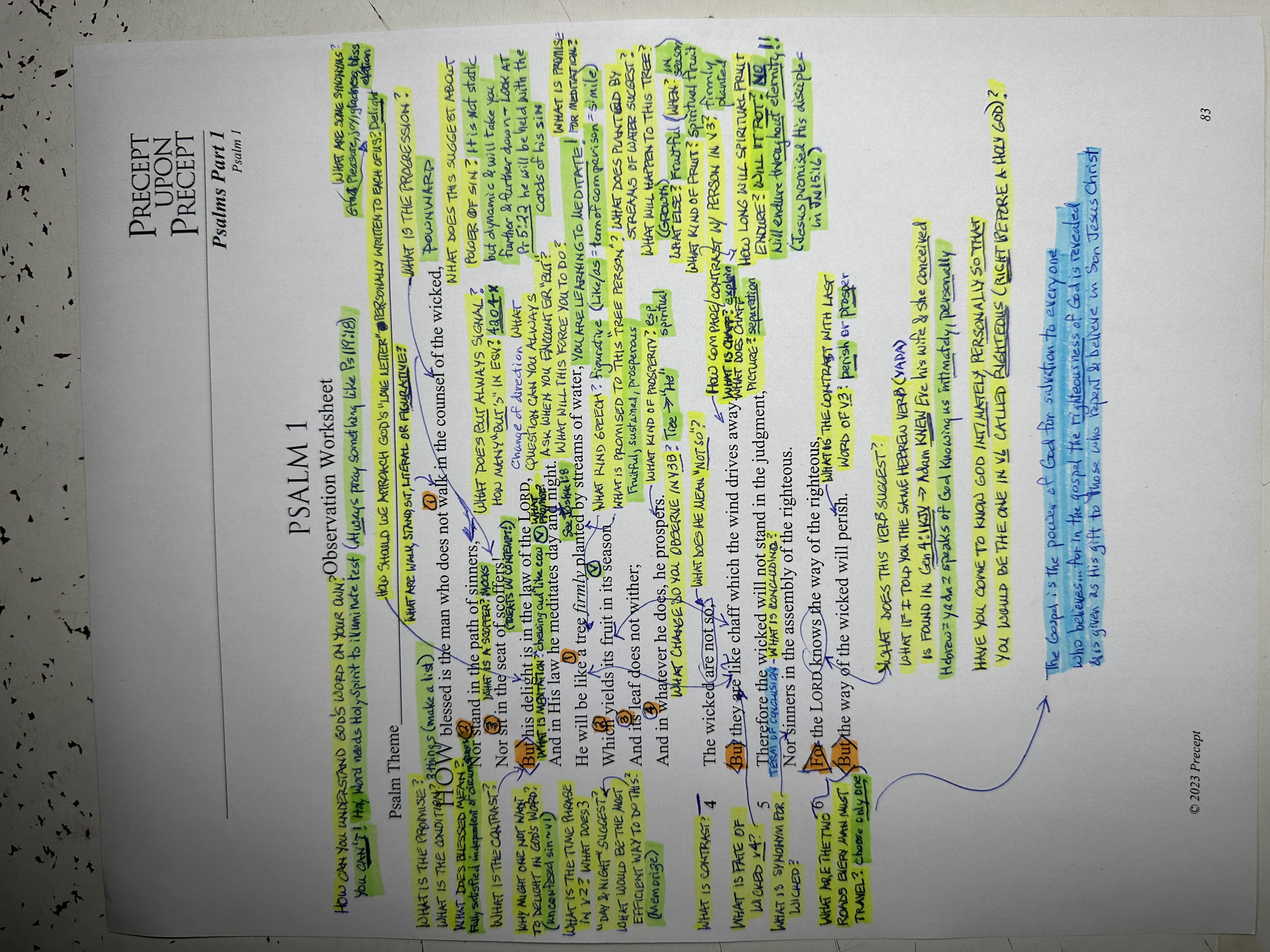
CLICK TO ENLARGE
The danger of incorrect interpretation and application:
John MacArthur gives the following example of the...
"young couple from another church came to one of our assistant pastors for counseling about marital problems they started having soon after their wedding. After just a few minutes of interviewing the two, he could see they were miles apart in tastes, ideas, and opinions. “What made the two of you get married?” he asked. “A sermon our pastor preached on Joshua conquering Jericho.” (to which the pastor replied)“ What did that have to do with getting married?”
“Well,” explained the husband, “Joshua and his army claimed Jericho, marched around it seven times, and the walls fell down. Our pastor told us that if we trusted God, claimed a certain young girl and marched around her seven times, the walls of her heart would collapse, and she would be willing to marry. So, I did it, and we got married.”
Our assistant pastor stared in disbelief. Was this man putting him on? No, indeed. In fact, several couples in that particular church had gotten married on the same basis after hearing the same sermon. This amazing story illustrates that first of all people can become extremely confused on what the Bible means and what to do about it; and second the interpretation and application of Scripture is crucial to life decisions." (Borrow - How to Get the Most from God's Word)
Making a point at the price of proper interpretation is a common temptation for pastors who want to force the Scriptures to agree with their sermons and lay people can fall into the same deceptive and dangerous trap. I know of a pastor who preached a sermon based on the King James rendering of the first part of Proverbs 29:18 which reads
Where there is no vision, the people perish
He related to his congregation that God had given him a "vision" to grow their church and went on to elaborate on this "vision". Less than a year later, this pastor was asked to leave the church resulting in a church split. About 2 years later, this same pastor was asked to leave his new church by the very individuals who had followed him from the previous church! How did this tragedy occur? While the situation is clearly more complex, there is little doubt that inaccurate interpretation by the chief shepherd led to inappropriate application which in turn had a catastrophic effect on the "sheep" in two different churches!
What Proverbs 29:18 (see discussion) really means is that when there is no oracle or word from God, the result is that people "cast off restraint" (NIV) or "run wild" (NLT), which is unfortunately what transpired as the result of the misapplication of the truth in this passage! This tragedy could have been averted by looking up the meaning of the Hebrew word for vision (Hebrew = chazon - 02377) and sticking with the literal interpretation based on that meaning. And it would have also been edifying to emphasize the latter portion of Proverbs 19:18...
But happy (blessed) is he who keeps the law.
(cf Psalm 1:1-3)
The writer of this proverb is not advocating legalistic adherence to the Law, but in NT terms what we would refer to as a Spirit empowered, love motivated obedience to the Law, which is now actually written on the hearts of all believers. (See related study on the obedience of faith)
John MacArthur emphasizes how important it is that pastors and bible teachers constantly strive to derive...
the right message from the right passage. Don’t “proof text” your bias or opinions by making the Bible say what you already know you want it to say...like the guy who said, “I’ve already got a sermon; I just have to find a verse for it.” That’s having a preconceived idea and then getting some verses to support it....so there are three errors to avoid: Don’t make a point at the price of a proper interpretation, avoid a superficial interpretation, and don’t spiritualize." (Borrow How to get the most from God's word)
MacArthur goes on to write
Another illustration I can give you is in Matthew 18:20. (hold pointer over reference to pop up verse - cp context Mt 18:12, 13, 14, 15, 16, 17, 18, 19) How many times have you heard somebody say this in a prayer meeting: “ ‘Where two or three are gathered together in my name, there am I in the midst of them.’ Friends, two or three of us are here, so the Lord is here”? Do you want to know something? If I’m there alone, the Lord is there! That verse has nothing to do with a prayer meeting. If you study the context and the grammar you find that out. What it’s saying is that when you discipline somebody, when you put somebody out of the church, and his sin has been confirmed by two or three witnesses, Christ said that He is in the midst. (See sermon How to Study the Bible)
Correct and Incorrect
Observation and Interpretation
Dr. Howard Hendricks offers the following humorous example of observation and interpretation from the pen of a 10 year old boy who wrote
The cow is a mammal. It has six sides. Right, left, an upper and below. At the back it has a tail on which hangs a brush. With this it sends the flies away so that they do not fall into the milk. The head is for the purpose of growing horns and so that the mouth can be somewhere. The horns are to butt with and the mouth is to moo with. Under the cow hangs the milk. It is arranged for milking. When people milk the milk comes and there is never an end to the supply. How the cow does it I have not yet realized. But it makes more and more. The man cow is called an ox. It is not a mammal. The cow does not each much, but what it eats, it eats twice so that it gets enough. When it is hungry it moos, and when it says nothing it is because its inside is all filled up with grass." (Borrow Living by the Book)
Hendricks adds that...
As you can see, we need to be very precise in how we go about this process of interpretation. We must make sure our observations are accurate so that we have a basis for accurate interpretation. (Borrow Living by the Book)
Living by the Book by Dr Howard Hendricks - click here for all 19 sessions of about 20-25 minute each - this was a powerful tool God's Spirit used in my life about 30 years ago but it was not free at that time. There is also another set of videos in which Dr Hendrick's gives shorter sessions - 15 sessions, each about 6 minutes. Could you invest an hour and a half in something that might change the way you read the Bible for the rest of your life? That question is of course rhetorical. And don't say you're too old to learn now! Many Christians read the Bible, but they have never been taught HOW to read the Bible. Dr Hendricks will give you some basic pointers in the overview sessions and this may motivate you to view his 19 full sessions (and even better to use them to teach your Bible Study group or Sunday School class HOW TO READ THE BOOK, because most of them have never been taught!) Either way, your investment in time will yield precious fruit for eternity! Here is the same material in book form - borrow Living by the Book or pdf of revised edition Living by the Book.
What is the "Binding" of Satan
in Revelation 20?
(See also Consulting a conservative commentary)
The relatively well known, brilliant theologian B. B. Warfield, (see Biblical Doctrines, p. 650) has the following interpretative comments on the events in Revelation 20, specifically addressing the binding of Satan for 1000 years. He writes:
The ‘binding of Satan’ is, therefore, in reality, not for a season, but with reference to a sphere; and his ‘loosing’ again is not after a period but in another sphere: it is not subsequence but exteriority that is suggested. There is, indeed, no literal ‘binding of Satan’ to be thought of at all: what happens, happens not to Satan but to the saints, and is only represented as happening to Satan for the purposes of the symbolical picture. What actually happens is that the saints described are removed from the sphere of Satan’s assaults. The saints described are free from all access of Satan—he is bound with respect to them: outside of their charmed circle his horrid work goes on. This is indicated, indeed, in the very employment of the two symbols ‘a thousand years’ and ‘a little time.’ A ‘thousand years’ is the symbol of heavenly completeness and blessedness; the ‘little time’ of earthly turmoil and evil. Those in the ‘thousand years’ are safe from Satan’s assaults: those outside the thousand years are still enduring his attacks.
Thus if one understands Revelation 20:1-15 as does this respected scholar, there is no chronological system whatever to Revelation 20. The millennium is not a millennium. The loosing of Satan is not an event. Actually Satan is not bound at all, but saints are really removed from his power by being taken to heaven. The nations mentioned in Revelation 20:3 are not nations upon earth but glorified saints in heaven!
It is obvious that Dr Warfield’s interpretation is non-literal to the maximum and involves complete allegorization/spiritualization of all essential terms and events in Revelation 20. It is true what John records in many sections of the Revelation is a vision and that as such it is often presented in very symbolic ("apocalyptic") terms but what is ignored by Warfield and others who tend to allegorize or spiritualize prophecy is the distinction between what John saw and the interpretation that was revealed in the immediate context.
Thus we note that John saw the angel having the key of the abyss, binding Satan and casting him into the abyss, shutting it, and sealing it over him. Then we note that the interpretation is given by the inspired Scripture — this binding was for a period of time—one thousand years—and that the purpose of this binding was that Satan should no longer deceive the nations. When he was bound, for how long he was bound and why he was bound are clearly stated.
Then John adds the further revelation that after the one thousand years, Satan will be loosed for a short period of time. Now if the reader was left without an explanation of the binding of Satan, it might justify some spiritualization of the terms but, inasmuch as the literal reading of the Scriptures explicitly states the meaning, there is no justification for denying a literal interpretation.
Never attempt to allegorize or spiritualize a passage if the sense of the passage can be readily understood with a literal reading of the text or else you may end up with complete nonsense.
"The book of Revelation isn't hard to understand--
It's hard to believe!"
One of the main reasons why so many commentaries resort to an allegorical interpretation of prophecies like the Revelation and Daniel is that they find the literal meaning of the prophecies difficult to accept and attempt to explain them in a less offensive manner!
As an aside some might think that preceptaustin.org is "Dispensationalist" but frankly I am not sure what that term even signifies. What this website does seek to be is a "systematic literalist", even to the point of interpreting symbolic/ figurative language with its literal meaning as far as that is possible.
If you approach the study of any passage of Scripture with the preconceived mindset of a particular "system" of theological interpretation (Dispensational, Reformed, Covenant, etc), it is difficult to avoid that "system's" built in bias which can potentially impede the accurate observation and interpretation of the Word of Truth.
For more discussion on the dangers inherent in the allegorical method of interpretation especially in the prophetic books Revelation and Daniel click here for Anthony Garland's analysis. He also has an interesting discussion on
- Understanding Symbols and Figures
- Abuse of Numbers in Biblical Interpretation
- Literal Interpretation of Numbers.
This background will help you understand how men like B. B. Warfield could drift so far from the literal interpretation of numbers like 1000 in Revelation 20.
If you are interested in prophecy, I would strongly encourage you to take the excellent four part Precept Ministries International inductive study on the Revelation. The four part Precept Revelation course takes 47 weeks to complete but when you have finished, you will be in awe of your understanding of The Revelation and saddened by the great confusion in the commentaries and the unfounded fear many believers express toward this wonderful book.
Click the following links to download lesson 1 in Pdf format from each of the four parts.
Revelation - Pt 1 - Revelation 1-3, 10 lessons
Revelation - Pt 2 - Revelation 4-22, 12 lessons
Revelation - Pt 3 - Revelation 4-22, 11 lessons
Revelation - Pt 4 - Revelation 4-22, 14 lessons
Click link to the transcribed lectures by Kay Arthur on Revelation Parts 2-4, but not until you've done your own inductive study!
Click Anthony Garland's excellent literal, conservative commentary on the Revelation entitled "The Testimony of Jesus"
LIST OF OBSERVATIONS
GLEANED FROM MARKING "GOD" & PRONOUNS
| 1) Made Paul an apostle by His will | 2Ti 1:1 |
| 2) Gives grace, mercy and peace | 2Ti 1:2 |
| 3) Is the Father | 2Ti 1:2 |
| 4) Is thanked | 2Ti 1:3 |
| 5) Is served with a clear conscience | 2Ti 1:3 |
| 7) Gave a gift (gives gifts) | 2Ti 1:6 |
| 8) Does not give us a spirit of timidity | 2Ti 1:7 |
| 9) Gives a spirit of power and love and discipline | 2Ti 1:7 |
| 10) Gives us His power which enables us to suffer for the gospel | 2Ti 1:8 |
| 11) Saved us | 2Ti 1:9 |
| 12) Called us with a holy calling | 2Ti 1:9 |
| 13) Calls us not according to works | 2Ti 1:9 |
| 14) Calls according to His own purpose and grace | 2Ti 1:9 |
| 15) Called us in Christ Jesus from all eternity (before time began) | 2Ti 1:9 |
SOME "5 W's & H" TYPE QUESTIONS
DERIVED FROM 2 TIMOTHY 1
WHAT have you learned about God from this exercise? (Always try to ask this question - What does this text teach about God the Father, Jesus and/or the Spirit?)
WHAT do you see repeated about God (see points in bold)?
WHO is God to us in terms of our relationship with Him?
WHAT does this teach us about God's character?
WHY did Paul become an apostle?
HOW did Paul serve God?
HOW should we serve God?
WHAT have you learned about your salvation?
WHAT has God given us that should embolden our walk with Him and for Him?
WHAT and Who are we to count on when we suffer for the gospel?
HOW is our calling described?
WHY were any called? (see 2Ti 1:9)
WHEN did God call those He would save?
HOW do we (or should we) respond?
Notice that each of the questions above begins with a "Who, What, Why, Where, When, or How" which is abbreviated as the "5 W's & H". As one observes the text and marks references to God, it is important to not do so "mechanically" but with your mind in gear so to speak, pausing with each observation to interrogate with one of the "5 W's & H" type of question if that is possible.
Don't panic at this point, because the skill of becoming a good "investigative reporter" comes with patient practice. As you begin to refine the discipline of stopping to mark the text and ask pertinent "5 W's & H" questions, you will begin to experience the joy of self discovery, and you can be assured that your personal "Tutor", the Holy Spirit, will lead you into all truth.
Careful Observation does take more effort than that which is expended by simply reading through a chapter, but as you learn to read with a purpose, actively rather than passively, you will begin to experience the Bible and the God of the Bible in an entirely new light that heretofore you probably thought was only reserved for those who had seminary degrees!
Well, now you're on your own. If you want to practice your already expanding skills in careful observation, read through chapter one again, this time marking Jesus (consider using a red cross and don't forget the pronouns - read verse 12 carefully in this regard), making a list of what you learn and interrogating what you learn about Him with the "5 W's & H". Note that when Paul records "Lord" it is not always possible (from the context) to distinguish between God the Father and Jesus the Son. If you want to practice with a shorter exercise read verses 9-10 and record what you learn about "Salvation". It's a passage that is indeed rich in truth isn't it? As you record your observations about salvation don't forget to practice asking any of the "5 W's & H" which are appropriate. And when you finish recording and pondering the principles you learn about salvation, you might want to pause and offer a prayer of praise and thanksgiving. Over time, inductive Bible study will almost certainly affect the way you pray and you will find yourself more and more praying specific Scriptures back to your Father Who is in heaven.
In sum, by now should have experienced some of the joy in personal discovery through the inductive approach and you are seeing some of the other "offshoots" -- for example, how many times have you read chapter 1? How fast did you read the chapter compared to how you may have read the chapter in the past? Did your study prompt a prayer of praise and thanksgiving? Can you see how in the inductive approach one begins to treasure God's word in their heart (because you have slowly read and re-read chapter one)? Can you see how this approach can also help you with the spiritual discipline of meditation on God's Word? As you pause at various times and ask questions of the text, you are in fact meditating on the Scriptures! And these are just the "first fruits" of inductive Bible study dearly beloved!
Wisdom or wise (wiser) are found 118 times in 915 verses (in the NAS) in the Book of Proverbs
Wisdom or wise (wiser) occur at least once in every chapter and clearly represent key words.
If key words reveal the theme, what is the theme of Proverbs? Clearly it is WISDOM, the ability to relate God’s truth to daily life.
Train yourself to continually be on the alert for those words or phrases (and synonyms) that are repeated or emphasized in a chapter or book, for their recognition will function like "keys" to help unlock and understand the author's theme, purpose, etc - the unspeakable treasures buried throughout God's Word.
WORTHLESS
PERISHES
| The Righteous (v5,6) | The Wicked (v1,4, 6) |
|
VERSE 1 Blessed Does not walk in counsel of wicked Does not stand in path of sinners Does not sit in seat of scoffers VERSE 2 "BUT" Delights in law of LORD Meditates on Law day & night VERSE 3 Like a tree (figure of speech - simile) by water Yields fruit (figure of speech) in season (time phrase) Leaf (figure of speech) does not whither Prospers in whatever he does VERSE 5 Stand in the judgment Stand in assembly of righteous VERSE 6 LORD knows their way |
VERSE 1 Described as Wicked Sinners Scoffers VERSE 4 Not so (All the truths in verses 1-3) "BUT" Like chaff (figure of speech - simile) wind drives away VERSE 5 THEREFORE (term of conclusion) Will not stand in the judgment Will not stand in assembly of righteous VERSE 6 "BUT" Their Way will perish PROSPERS |
|
MORE |
MORE |
|||||||||
| Young's Literal |
NAS ASV |
Amp ESV |
KJV NKJV RSV |
NRSV NAB |
NIV NJB |
NCV ICB |
NLT Phillips |
GNT CEV |
TLB | Msg |
| NAS = New American Standard Amp = Amplified Version ASV = Authorized Standard Version 1901 ESV = English Standard Version RSV = Revised Standard Version KJV = King James Version NKJV = New King James Version |
NRSV = New Revised Std Version NAB = New American Bible NJB = New Jerusalem Bible NIV = New International Version NCV = New Century Version ICB = International Children's Bible |
NLT = New Living Translation Phillips = J B Phillips Paraphrase GNT = Good News Translation CEV = Contemporary English Version TLB = The Living Bible Msg = The Message (but Be a Berean!) |
||||||||
|
** MORE INTERPRETATIVE: For the most objective, non-biased and "pure" inductive study, do not use paraphrased versions as your primary resource for they provide no way to determine whether or not the translator's interpretation of the original Greek and Hebrew is accurate. The more literal versions such as NAS, ESV, KJV, NKJV more accurately render the words of the original biblical authors and are therefore recommended for inductive Bible study. Although more literal, the Amplified is not recommended as your primary text, but can be helpful once you have done your study because in many verses it functions like a "mini-commentary". Consultation (after your own inductive study) with some paraphrases (e.g., NLT and Phillips) may also yield insights into the meaning of the passage. Note that the NIV is a thought-for-thought (dynamic equivalence) translation which can be helpful for new believers, but it is not recommended for in depth bible study because of the inconsistent way in which it renders the Hebrew and Greek texts. In some cases, the NIV includes significant interpretation which leaves the reader without any indication of the other possible ways to understand that particular verse. Although every translation has some degree of interpretation, the NAS is the least interpretative and has the advantage over the NIV in that it identifies words in italics that are not in the original language but which have been added by the translators to make the passage more readable and/or understandable. Do not base your interpretation on the words in italics. |
||||||||||
- Inductive Bible Study - Observation
- Inductive Bible Study - Interpretation
- Inductive Bible Study - Application
- Simple Study on the Power of God's Word
- Authority of God's Word - study on 2Timothy 3:16-17
- A Primer on the Lost Art of Biblical Meditation
- Memorizing God's Word - Why? How? Resource links...
- Navigator's Topical Memory System (TMS)
- How to Perform A Greek Word Study on the Web
- Greek Tense, Voice, Mood Reference Guide
- Greek Word Studies - in depth
- Bible Interpretation - Scroll down to Figures of speech
- Is Your Interpretation Supernaturalistic, Naturalistic, Existentialistic, Dogmatic?
- Jensen's Survey of the New Testament and Jensen's Survey of the Old Testament (over 2500 pages total) available in one Pdf download. If you are studying a particular book, check out this resource to help guide your inductive study of that book. It is a treasure chest of material!