Isaiah 2:2
Isaiah 2:3
Isaiah 2:4
Isaiah 2:5
Isaiah 2:6
Isaiah 2:7
Isaiah 2:8
Isaiah 2:9
Isaiah 2:10
Isaiah 2:11
Isaiah 2:12
Isaiah 2:13
Isaiah 2:14
Isaiah 2:15
Isaiah 2:16
Isaiah 2:17
Isaiah 2:18
Isaiah 2:19
Isaiah 2:20
Isaiah 2:21
Isaiah 2:22

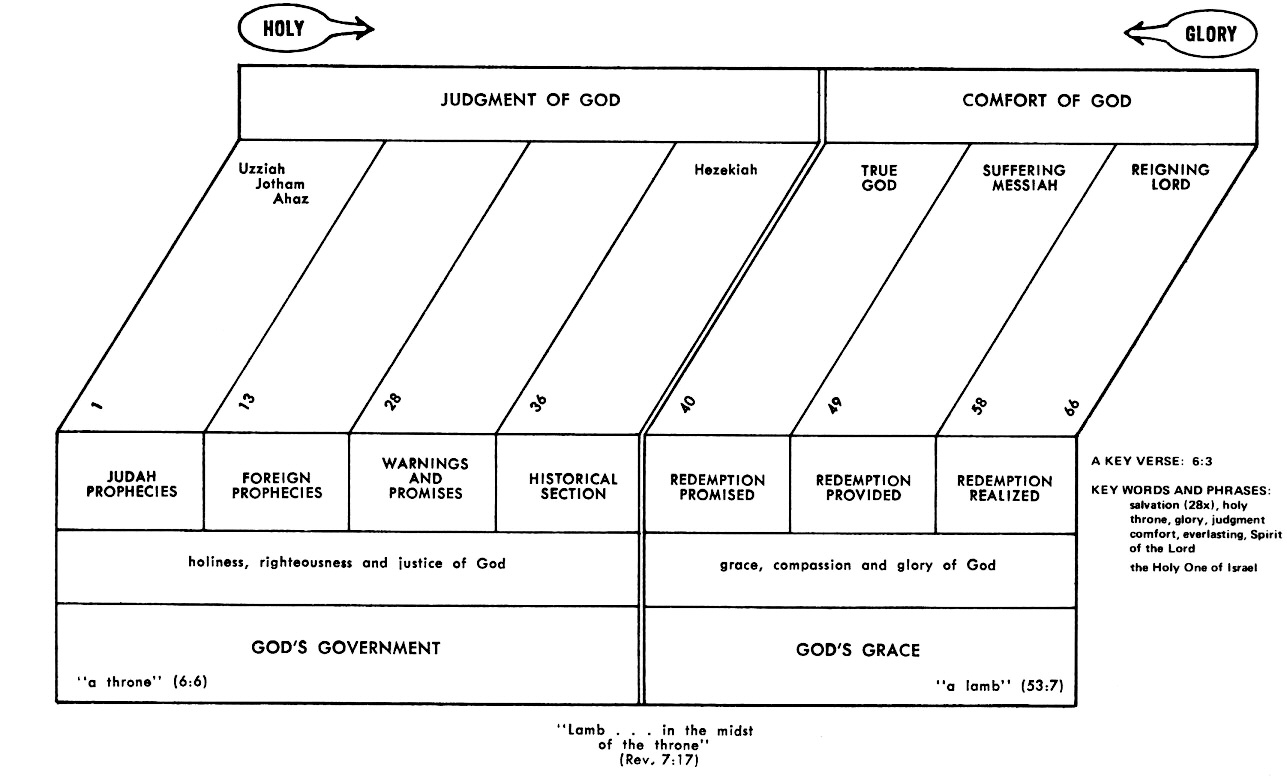
Click chart to enlarge
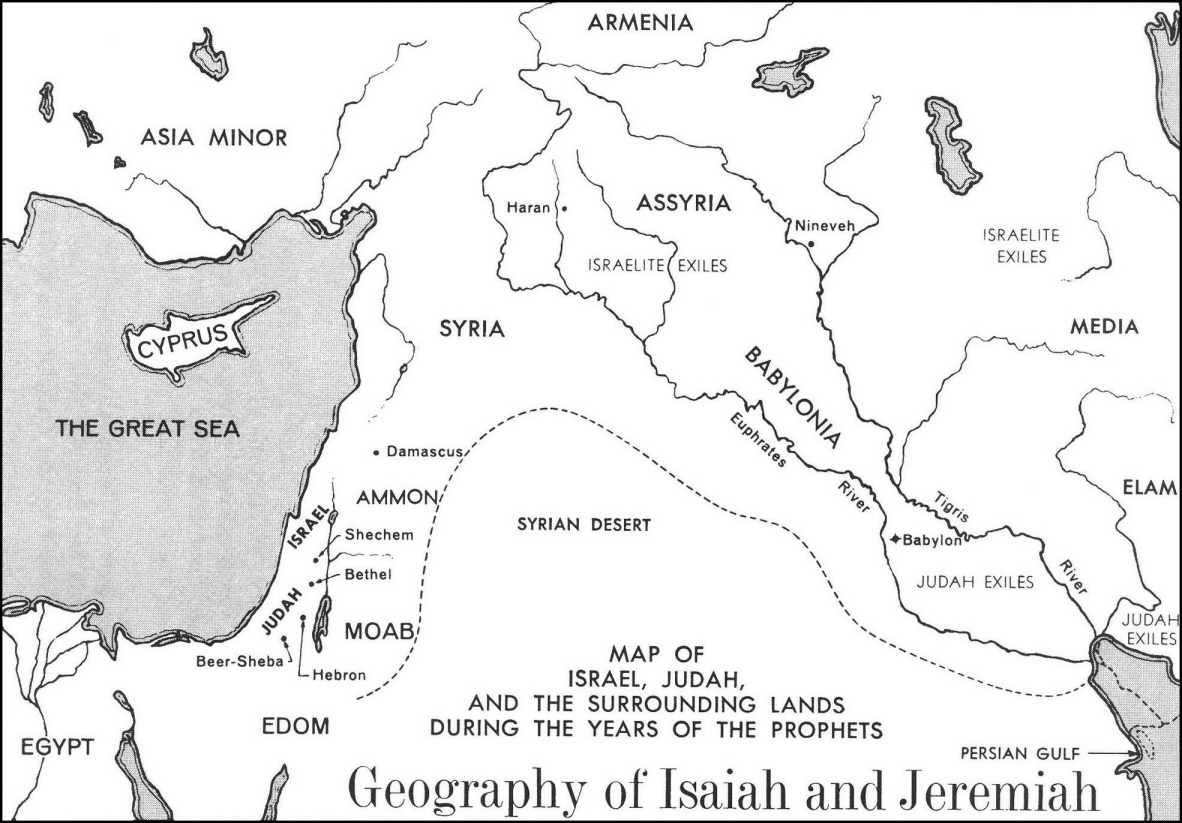
Click chart to enlarge
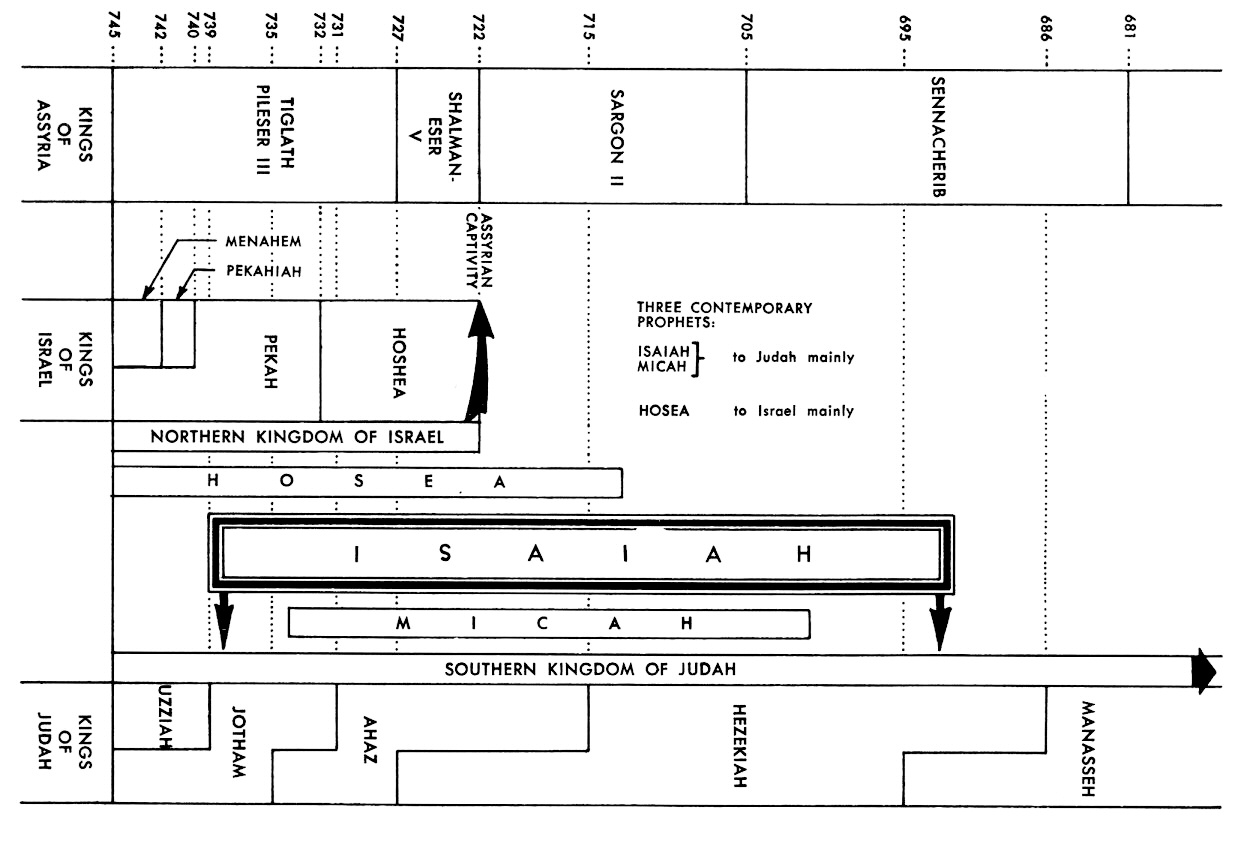
Chart from recommended resource Jensen's Survey of the OT - used by permission
Another Isaiah Chart see on right side
| ISAIAH ("Jehovah is Salvation") See Excellent Timeline for Isaiah - page 39 |
||||||
| JEHOVAH'S Judgment & Character (Isaiah 1-39) |
JEHOVAH'S Comfort & Redemption (Isaiah 40-66) |
|||||
| Uzziah Jotham Ahaz 1-12 |
13-27 |
28-35 |
Hezekiah's Salvation & Blessing 36-39 |
True God 40-48 |
Suffering Messiah 49-57 |
Reigning Lord 58-66 |
| Prophecies Regarding Judah & Jerusalem Is 1:1-12:6 |
Prophecies Against the Nations |
Warnings & Promises |
Historical Section |
Redemption Promised: Israel's Deliverance |
Redemption Provided: Israel's Deliverer |
Redemption Realized: Israel's Glorious Future |
| Prophetic | Historic | Messianic | ||||
| Holiness, Righteousness & Justice of Jehovah | Grace, Compassion & Glory of Jehovah | |||||
| God's Government "A throne" Is 6:1 |
God's Grace "A Lamb" Is 53:7 |
|||||
| Time 740-680BC |
||||||
Isaiah 2:10 Enter the rock and hide in the dust from the terror of the LORD and from the splendor of His majesty. (NASB: Lockman)
English Translation of the Greek (Septuagint): Now therefore enter ye into the rocks, and hide yourselves in the earth, for fear of the Lord, and by reason of the glory of his might, when he shall arise to strike terribly the earth.
Amplified: Enter into the rock and hide yourself in the dust from before the terror of the Lord and from the glory of His majesty. (Amplified Bible - Lockman)
KJV: Enter into the rock, and hide thee in the dust, for fear of the LORD, and for the glory of his majesty.
NET: Go up into the rocky cliffs, hide in the ground. Get away from the dreadful judgment of the LORD, from his royal splendor! (NET Bible)
NJB: Go into the rock, hide in the dust, in terror of Yahweh, at the brilliance of his majesty, when he arises to make the earth quake. (NJB)
NLT: Enter the rock and hide in the dust From the terror of the LORD and from the splendor of His majesty.(NLT - Tyndale House)
Young's Literal: Enter into a rock, and be hidden in dust, Because of the fear of Jehovah, And because of the honour of His excellency.
Enter the rock and hide in the dust from the terror of the LORD and from the splendor of His majesty:
- Is 2:19, 20, 21; 10:3; 42:22; Judges 6:1,2; Job 30:5,6; Hosea 10:8; Luke 23:30; Revelation 6:15,16
- Terror - Is 6:3, 4, 5; Job 31:23; 37:22-24; Psalm 90:11; Jeremiah 10:7,10; Luke 12:5; Revelation 15:3,4
Proud, lofty men are without defense before the Exalted One (Is 2:11)!
Enter (command) the rock and hide (command) in the dust - In this verse it is commanded, and in Is 2:19, 21 (see notes) it is declared as what will come to pass! This command is addressed to Judah and Jerusalem and would be partially fulfilled in the destruction of Jerusalem wrought by Nebuchadnezzar of Babylon in 586BC, when the temple and city were razed. Isaiah's description however also will have a second fulfillment, which geographically is not restricted to the proud and haughty in Judah and Jerusalem, but which impacts the entire world. How can one interpret this passage as both local and global? Here the context helps us discern the time Isaiah is referring to in this prophecy, because in Isaiah 2:19, 21 (see notes) he again mentions "the rocks" ("the caverns of the rocks… ") and "the terror of the LORD and the splendor of His majesty". But in this latter passage, he adds the important time phrase "when He arises to make the earth tremble" which parallels an identical phrase in Isaiah 2:19 which also mentions "caves of the rocks". From other Scriptures, this world wide "terror of the LORD" will be clearly manifest for all to see in the time of the Tribulation (Daniel's Seventieth Week). And so in the Revelation which from chapter 6 through 20 describes this "day" (the Day of the LORD), we read…
And the kings of the earth and the great men and the commanders and the rich and the strong and every slave and free man, hid themselves in the caves and among the rocks of the mountains; and they said to the mountains and to the rocks, "Fall on us and hide us (cp Ge 3:8 = Adam and Eve - hiding is the effect of sin in the presence of God's holiness!) from the presence of Him who sits on the throne, and from the wrath of the Lamb" (Rev 6:15-note, Re 6:16-note)
Tony Garland commenting on Rev 6:15, 16 writes…
Here is the classic record of man’s response to his own sin—a vain attempt to hide from the omnipresent, omniscient, almighty God (Ge 3:8; Re 6:16). In the irony of God, those who persecuted God’s servants, who were “destitute, afflicted, tormented—of whom the world was not worthy,” who “wandered in deserts and mountains, in dens and caves of the earth” (Heb. 11:38) now experience firsthand a similar affliction from the very hand of God.
So intense is their fear of God’s judgments that they temporarily seek even death—anything to flee from His manifest presence (Ho 10:8; Lk 23:30; Re 9:6-note).
Hide us - Attempting to hide from God illustrates how sin and fear warp the intellect, for it is impossible to hide from the Omnipresent One (Job 34:22). How different the motivation of the godly from the ungodly. Those with faith in Christ desire His presence and seek His face. (Ps. 17:15; Pr. 8:7; Isa. 45:19; Is 58:2; 65:1; Je 29:13; Amos 5:4). Those who reject God fear His presence and flee His face. This dichotomy is seen today in the reaction of people to the preaching of the gospel:
For we are to God the fragrance of Christ among those who are being saved and among those who are perishing. To the one we are the aroma of death leading to death, and to the other the aroma of life leading to life. And who is sufficient for these things? (2Co 2:15, 16)
At the scene of God’s final judgment of the ungodly, there will be nowhere available to hide from His face, for heaven and earth will have fled away (Rev. 20:11). All things are naked in His sight!
The wrath of the Lamb - Here we encounter a phrase of seeming contradiction. The Lamb Who was silently led to the slaughter (Is 53:7) now metes out wrath. It is the Lamb which opens each of the seals bringing forth these judgments which are indicative of the wrath of God. See commentary on Revelation 5:5.
The wrath of God began earlier, when the Lamb arose from His seat to open the first seal. Now it is recognized for what it is.
“It should be noted that the passage does not say that the wrath of God begins only with the sixth seal, but that only with the sixth seal do unbelievers recognize that it is the wrath of God.” (Arnold G. Fruchtenbaum, The Footsteps of Messiah, rev ed. Tustin, CA: Ariel Ministries, 2003, 221)
Those on the earth are ignorant of the Scriptures. Yet even they recognize that the time of God’s wrath has now come upon the earth (Re 11:18-note; Re 14:9-note, Re 14:10-note, Re 14:19-note; Re 15:1-note, Re 15:7-note; Re 16:1-note, Re 16:19-note). See commentary on Revelation 5:6-note. (A Testimony of Jesus Christ - Revelation 6:16)
John MacArthur comments that Isaiah 2:10-22…
pictures conditions during the future day of the Lord. Though some elements of the description could fit what Judah experienced in the Babylonian captivity, the intensity of judgment predicted here could not have found fulfillment at that time. The tribulation period before Christ’s return will be the time for these judgmental horrors. (MacArthur, J.: The MacArthur Study Bible Nashville: Word)
This prophetic passage blends Judah’s historical judgment (586BC) (the first installment fulfilled - this event was future at the time Isaiah wrote) with that of God’s judgment culminating with His final judgment in the day of the LORD. The major point throughout this Isaiah 2:10ff is the punishment of man’s self-exaltation (haughtiness) in place of his proper exaltation of God.
Terror (06343) (pachad) describes terror, fear, panic or dread often caused by the Lord (1Sa 11:7; Job 13:11; Isa. 2:10, 19, 21). Pachad can be a strong emotion of fear or terror or can refer to the person or thing which arouses the terror (usually the latter sense, cp Ps 31:11). Pachad describes the state or condition of severe distress over impending trouble. Pachad is used as a Name of God in Ge 31:42, 53). The Lxx translates pachad in this passage with the noun phobos which in this negative context describes terrifying fear, dread and alarm. When men refuse to rightly fear God (sense of reverential awe), then they have good reason to be terrified of His just wrath!
Young comments that "The appearance of Yahweh in judgment is thus depicted as something that is most glorious and terrible. Not only is God’s glory manifested in His grace, but in His judgment as well. It is from such an appearance that men are commanded to flee, the very command in itself making clear how impossible this is: men cannot flee from God and hide themselves from Him. In preaching as he does here, Isaiah is going contrary to modern psychological theories which assert that it is unwise and even wrong to use fear as a motif in preaching and teaching. How different God’s appraisal of preaching! The judgment, and it is primarily the last judgment that is here in view, is set before sinful men as a terrible reality. They must turn from their sins, if they would escape such judgment. This is the only motif in preaching that will prevail with sinners. Then men might begin somewhat to understand the hatred that God has for sin and to turn from their evil ways to flee to Christ for refuge. The only way to run from God is to run to Him." (The Book of Isaiah: Volume 1. Page 121-122).
Isaiah 2:11 The proud look of man will be abased and the loftiness of man will be humbled, and the LORD alone will be exalted in that day. (NASB: Lockman)
English Translation of the Greek (Septuagint): For the eyes of the Lord are high, but man is low; and the haughtiness of men shall be brought low, and the Lord alone shall be exalted in that day.
Amplified: The proud looks of man shall be brought low, and the haughtiness of men shall be humbled; and the Lord alone shall be exalted in that day. (Amplified Bible - Lockman)
KJV: The lofty looks of man shall be humbled, and the haughtiness of men shall be bowed down, and the LORD alone shall be exalted in that day.
NET: Proud men will be brought low, arrogant men will be humiliated; the LORD alone will be exalted in that day. (NET Bible)
NJB: Human pride will lower its eyes, human arrogance will be humbled, and Yahweh alone will be exalted, on that day. (NJB)
NLT: The proud look of man will be abased, And the loftiness of man will be humbled, And the LORD alone will be exalted in that day.(NLT - Tyndale House)
Young's Literal: The haughty eyes of man have been humbled, And bowed down hath been the loftiness of men, And set on high hath Jehovah alone been in that day.
The proud look of man will be abased and the loftiness of man will be humbled:
- Is 2:17; 5:15,16; 13:11; 24:21; Job 40:10, 11, 12; Psalms 18:27; Jeremiah 50:31,32; Malachi 4:1; Luke 18:14; 1Peter 5:5
MEN HUMBLED
GOD EXALTED
Proud (01365) (gabhut) speaks of that which is lofty and thus describes men as arrogant, haughty, conceited. In Is 2:17 (the only other OT use of gabhut), Isaiah describes the end result of man's pride.
Young - Haughty looks and proud eyes must be abased (cf. Ps. 18:27; Prov. 21:4; Isa. 10:12).
Look (eye) (05869) ('ayin) is a word which occasionally represents whole process of seeing. It is used in the phrase the "eyes ('ayin) of the LORD" (Ps 34:15, 19:8). And so more literally the Hebrew reads "the proud eye" (a good "pun" isn't it? = The proud "I", rather than the "bent over", surrendered or yielded "I" = yield to God's Spirit of course) The eye is a good barometer of the inner thoughts of man, in this case thoughts of pride, with self exalted and on the "throne" of the heart (figuratively used of the "control center" of our being - our emotions, thoughts, words, deeds).
See Scriptures on Pride - Click PRIDE
Will be abased… will be humbled - Young explains "This has not yet occurred, although the prophet uses a verb in the perfect (Ed: Both verbs are in the perfect tense) to express the certainty that it will take place." (See prophetic perfect)
Abased (08213) (shaphel/sapal) conveys the basic sense of to be low physically, which leads to the more important figurative meanings of abasement, humbling, humility
Humbled (07817) (shachach/sahah) (Is 2:9-note, Is 2:11-note, Is 2:17-note) means to be bowed down, prostrated, humbled which is the sense in this passage. It can also mean to bow in homage (Pr 14:19), to bow (as a mourner Ps 35:14, 38:7), to crouch (as a wild beast, Job 38:40). Later in Isaiah shachach is used of laying low a city or city walls (Is 25:12, 26:5).
Sachach/sahah - 21v in the OT - Job 9:13; 38:40; Ps 10:10; 35:14; 38:6; 42:5, 6, 11; 43:5; 107:39; Pr 14:19; Eccl 12:4; Isa. 2:9, 11, 17; 5:15; 25:12; 26:5; 29:4; 60:14; Hab 3:6 and is rendered in the NAS as been humbled(1), bow down(1), bowed down(3), bowing(1), bows down(1), bring down(1), brought low(1), collapsed(1), crouch(2), despair(4), humbled(3), prostrate(1), sing softly(1).
And the LORD alone will be exalted in that day:
- Is 5:16; 12:4; Je 9:24; 1Co 1:29, 30, 31; 2Co 10:17)
- That day - Is 4:1; 11:10,11; 12:1,4; 24:21; 25:9; 26:1; 27:1,2,12,13; 28:5; 29:18; 30:23; 52:6; Je 30:7,8; Ezek 38:14,19; 39:11,22; Ho 2:16,18,21; Joel 3:18; Am 9:11; Ob 1:8; Mic 4:6; 5:10; 7:11,12; Zeph 3:11,16; Zec 9:16
THAT DAY: THE DAY OF THE LORD
Exalted in that day - Parallels Isaiah 2:17-note
In that day - Expressions of time should always prompt a simple question What time? or in this this context specifically What Day? In context this day refers to the Day of the Lord (See related discussion in 1Thes notes although there is some overlap in these descriptions) a time phrase found in the Old and New Testaments and sometimes is referred to simply as "the day" or "that day" (e.g., Is 2:17,2:20, 3:18, 4:1, 4:2) . The Day of the LORD stands in stark contrast to the "day of man", typified by this present evil age (Gal 1:4) during which God permits (but does not condone) rebellious, sinful mankind from going their own way, planning their own plans, and in short living as if God did not exist (this is the essence of ungodliness) and independent of His power and rule (their so-called "independence" being a deception of their vain imagination, for they fail to understand that even every rebellious breath they take is a gift of God's grace!)
As an aside it is interesting that Edward Young describes this day as "the time of world judgment." So even though Isaiah 2 opens by addressing Judah and Jerusalem, the judgment prophesied in this section goes far beyond the local effect.
The phrase "the day of the LORD" - 16v in OT - Amos 5:18, 20; Joel 1:15; 2:1, 11; 3:14; Obad. 1:15; Zeph. 1:7, 14; Isa. 2:12; 13:6, 9; Jer. 25:33; Ezek. 7:10; 13:6; 30:3
|
Earth & Heaven |
||||
|
Pre-Tribulation |
The Tribulation |
(2) Day of Lord 2Pe 3:10-note > |
Great White < Throne |
|
|
(1a) Day of the Lord begins > |
Mid-Tribulation |
1000 Years |
New Heaven |
|
| 3.5 Years |
3.5 Years |
|||
QUESTIONS ON
THE DAY OF THE LORD
- When does the Day of the Lord (DOL) begin? Click for discussion
- Why the Day of the Lord is not a single day? Click for discussion
- What will the Day of the Lord look like? Click for discussion
- What should be Israel's (and the NT believer's) response to the Day of the Lord? Click for discussion
- How does the DOL compare with the Day of Christ and the Day of God? Click for discussion
Richard Mayhue in his journal article on the Day of the Lord (DOL) explains that…
The DOL is a biblical phrase used by God’s prophets to describe either the immediate future or the ultimate eschatological (Ed: eschatos = last - refers to prophesy) consummation. It is not a technical term in the sense that it always refers only to one event in God’s plan.
It may designate a divinely-sent locust plague (Joel 1:15) or the providential fall of Babylon (Isa 13:6) or of Jerusalem (Zeph 1:14, 15, 18; 2:1); and in one given context it may describe first a judgment and then a corresponding deliverance (compare with the above prophecies Joel 3:14, 18 and Zeph 3:8, 11, 16; cf. also Obad 15, 17; Zech 14:1, 9, 10, 11). (from Payne, The Imminent Appearing of Christ)
DOL is used to describe several events and is limited only by its mention in biblical revelation. Each appearance of DOL must be interpreted in its context to determine whether the prophet expected the immediate historical act of God or Yahweh’s ultimate eschatological visitation. (Ladd, The Presence of the Future, 74.) DOL is not bound to a definite time duration. It could last only for hours or it could continue for days. Only context can determine DOL longevity, and even then only general approximation can be made. (The Prophet’s Watchword Day of the Lord -- By Richard L. Mayhue Grace Theological Journal 6:2 Fall 1985) (See also THE BIBLE’S WATCHWORD: DAY OF THE LORD by Richard Mayhue)
The ESV Study Bible comments that …
Isaiah's future orientation in this section is also marked by his sevenfold use of “in that day” (Is 2:11, 17, 20; 3:7, 18; 4:1, 2) and “the Lord of hosts has a day” (Isa 2:12ESV), including both the near and distant future. To the prophetic eye, the crises of the present are to be measured by the ultimate crisis of judgment and salvation toward which God is moving history (see Joel 2:28-3:21; Zeph 1:7-2:3). (ESV Online Study Bible Crossway)
Beecher (The Prophets and the Promise) would classify DOL as a generic prophecy which is one which
regards an event as occurring in a series of parts, separated by intervals, and expresses itself in language that may apply indifferently to the nearest part, or to the remoter part, or to the whole—in other words, a prediction which, in applying to the whole of a complex event, also applies to some of its parts.
Mayhue has a nice summary of the teaching on the Day of the Lord in Isaiah…
Isa 2:12 is the first mention of DOL in Isaiah’s prophecy. This chapter emphasizes the future establishment of God’s kingdom (Isa 2:2, 3, 4 ), the present sinful state of Israel (Isa 2:5, 6, 7, 8, 9), and the future day of reckoning (Isa 2:10, 11, 12, 13, 14, 15, 16, 17, 18, 19, 20, 21, 22 ). The prophet appears to look beyond the near to the far future in the judgment emphasis of Isa 2:10-22 , just as he had looked to the eschatological kingdom in Isa 2:1-4. There are several indicators of millennial conditions in Isa 2:1-4 (cf. Rev 20:1-6). Mt. Zion will be the world capital and all the nations will come to it (Isa 2:1, 2) in order to seek God’s word (Isa 2:3). God will judge between the nations and war will be no more (Is 2:4,5). This eschatological emphasis in Isa 2:2, 3, 4 makes it reasonable to conclude that eschatological judgment is in view in Is 2:10-22 , rather than to God’s chastisement of Judah by Assyria and Babylon.
DOL is described by Isaiah as a time of universal humiliation for all who are proud (Is 2:11, 12, 17). In contrast, the splendor of God’s majesty (Is 2:10, 19, 21 ) will be displayed and the Lord alone will be exalted in that day (Is 2:11, 17). Isaiah’s portrayals of DOL here should be interpreted as referring to that time immediately preceding the establishment of Christ’s kingdom on earth. It is a day when God’s majesty will be outwardly manifested (Is 2:10, 19, 21), and the population will be driven in terror to caves for protection (Is 2:21 , cf. Re 6:16, 17).
The timing and terminology of Is 2:21 are strikingly similar to the description of the sixth seal in Re 6:16, 17. If these passages are correlated, it can be concluded that the sixth seal is a part of DOL and occurs at the end of the Tribulation. The correlation also confirms that Isa 2:12 refers to the far future. As will be noted later, Zec 14:1 and Mal 4:5 also emphasize only the far eschatological implications of DOL.
Isaiah 13 is the next chapter to be considered. It is an oracle concerning Babylon. Is 13:1-8 deals with God’s use of Babylon as his instrument of indignation for the destruction of Israel (Is 13:5, 6 ). This reminds one of Habakkuk’s dismay that God would do such a thing (Hab 1:2, 3, 4). The DOL was near in the mind of Isaiah (Is 13:6), although it would not come for over one hundred years. It would be a day of destruction, terror, and pain (Is 13:8). There is little doubt that this refers to the near eschatological event fulfilled by Babylon from 605-586 B.C.
However, there is good reason to believe that Isa 13:9-16 speaks of DOL implications for the far future. The near emphasis returns in Isa 13:17-22 where the end of Babylon is described. That the far future is described in 13:9-16 is shown by the cosmic disturbances (Isa 13:10, 13 ; cf. Matt 24:29; Rev 6:12, 13; Joel 2:31) and the universal judgment of mankind (Isa 13:11 ; cf. 2:11, 12 ). Ladd accurately describes the interplay of the near and far views:
These two visitations, the near and the far, or, as we may for convenience call them, the historical and the eschatological, are not differentiated in time. In fact, sometimes the two blend together as though they were one day. Isaiah 13 calls the day of the visitation of Babylon the Day of the Lord. The Lord is mustering a host for battle (Isa 13:4-6), he will stir up the Medes against Babylon (Isa 13:17). Therefore, men are to “wail, for the day of the Lord is near; as destruction from the Almighty it will come!” (Isa 13:6). This historical Day of the Lord is painted against the backdrop of the eschatological Day of the Lord. The Day of the Lord will bring disaster to the earth and a disruption of the heavenly order (Isa 13:9-13). Judgment will fall both upon the world of nature and upon men (Isa 13:7) when God punishes the world for its evil and the wicked for their iniquity (Isa 13:11). Here is a picture of universal judgment. The Day of the Lord is the eschatological judgment of mankind; but the two are seen as though they were one day, one visitation of God.27
Isa 13:6, 9 is therefore similar to other passages previously noted which portray the DOL in one context as both a near historical and a far eschatological happening. (The Prophet’s Watchword Day of the Lord -- By Richard L. Mayhue Grace Theological Journal 6:2 Fall 1985)
The great American theologian Jonathan Edwards had these words related to God's exaltation (which will come to fruition in the Millennium)…
God is glorified not only by His glory’s being seen, but by its being rejoiced in. When those that see it delight in it, God is more glorified than if they only see it. His glory is then received with the whole soul, both by the understanding and by the heart. God made the world that He might communicate, and the creature receive, His glory. (Ed: And this divine purpose will be consummated in the glorious Millennial reign of the Messiah.)
Isaiah 2:12 For the LORD of hosts will have a day of reckoning against everyone who is proud and lofty and against everyone who is lifted up, that he may be abased. (NASB: Lockman)
English Translation of the Greek (Septuagint): For the day of the Lord of hosts shall be upon every one that is proud and haughty, and upon every one that is high and towering, and they shall be brought down;
Amplified: For there shall be a day of the Lord of hosts against all who are proud and haughty and against all who are lifted up—and they shall be brought low—[Zeph. 2:3; Mal. 4:1.] (Amplified Bible - Lockman)
KJV: For the day of the LORD of hosts shall be upon every one that is proud and lofty, and upon every one that is lifted up; and he shall be brought low:
NET: Indeed, the LORD who commands armies has planned a day of judgment, for all the high and mighty, for all who are proud– they will be humiliated; (NET Bible)
NJB: That will be a day for Yahweh Sabaoth, for all who are majestic and haughty, for all who are proud, to be brought low, (NJB)
NLT: For the LORD of hosts will have a day of reckoning Against everyone who is proud and lofty, And against everyone who is lifted up, That he may be abased. (NLT - Tyndale House)
Young's Literal: For a day is to Jehovah of Hosts, For every proud and high one, And for every lifted up and low one,
For the LORD of hosts will have a day of reckoning against everyone who is proud and lofty and against everyone who is lifted up, that he may be abased:
- Isa 13:6,9; Jeremiah 46:10; Ezekiel 13:5; Amos 5:18; Malachi 4:5; 1Corinthians 5:5; 1Thessalonians 5:2
- Is 23:9; Proverbs 6:16,17; 16:5; Daniel 4:37; 5:20, 21, 22, 23, 24; Matthew 23:12; Luke 14:11; James 4:6
PAY DAY
SOME DAY!
Robert G. Lee preached a classic sermon on 1Ki 21:18-19, 23 entitled "Payday Someday." Here Isaiah prophesies of a coming day of reckoning ("day of judgment" - NET). Indeed, all mankind (Rev 22:12-note where "I am coming quickly" is present tense = His arrival is imminent—He is already underway!) both believers in Jesus (2Cor 5:10-note) and non-believers will experience a payday someday (Rev 20:11-15-note)! Dear child of God, are you busily storing up for yourself treasure in heaven where moth and rust will not destroy and thief will not break in and steal and doing so (enabled by His Spirit) because you are aware that where you treasure is (your heart will seek what you treasure!)? (Mt 6:19-21-note).
For = term of explanation. What is Isaiah explaining? Check the context (Isaiah 2:11).
The LORD of hosts - See study on Jehovah Sabaoth, LORD of of armies.
A day - Literally a day of the LORD of hosts. Again referring to the Day of the LORD (See related discussion in 1Thes notes although there is some overlap in these descriptions)
Edward Young paraphrases the idea in this section - “In that day Yahweh alone will be exalted, for, as a matter of fact, there is a day which belongs alone to Yahweh of hosts. Man has had his day, a day in which he has chosen the idols to be his supports. Now, Yahweh is to have His day, and that day of His will affect all that in the sight of man is high and lifted up.” (Ibid)
Everyone… everyone - Along with the words "all" (Is 2:13, 14, 16) and "every" (Is 2:15), this picture of completeness is found 10 times in the Hebrew text (Hebrew = kol = includes all or every one of something, no exceptions is the idea) in Isa 2:12-19. Whatever is exalted against God will be brought low when Messiah returns to bring in the Millennial Kingdom!
Against everyone who is proud - Everyone widens this audience of this prophecy to the entire world, not just Judah and Jerusalem. This verse sums up the object of God's wrath = man's pride! Then in Isa 2:13, 14, 15, 16, 17, 18 Isaiah describes that the scope of God's wrath in the Day of the LORD will include trees, mountains, etc. Every visitation of man by God is but a foretaste of His coming judgment, and God's righteous judgment of man's pride and sin in the worldwide Genesis flood was one such "foretaste" against everyone who was too proud to enter the Ark before the LORD closed the door…
And those that entered (the Ark), male and female of all flesh, entered as God had commanded him; and the LORD closed it behind him. Then the flood came upon the earth for forty days; and the water increased and lifted up the ark, so that it rose above the earth… 23 Thus He blotted out every living thing (cp "everyone who is proud") that was upon the face of the land, from man to animals to creeping things and to birds of the sky, and they were blotted out from the earth; and only Noah was left, together with those that were with him in the ark. (Ge 7:16, 17, 23)
Proud (01343) (geeh) describes a proud, haughty attitude that will be judged by the Lord (see all 9 uses below) .
Geeh - 9v in the OT - Job 40:11, 12; Ps. 94:2; 140:5; Pr 15:25; 16:19; Is 2:12; 16:6; Je 48:29
Lofty (07311) (rum) is a verb and means actively to raise or lift up and passively to be exalted. This verb is used over 600 times in the OT
What are the results of the Day of the LORD in regard to the proud and lofty? The day of the LORD will bring them low (down), humble them and even humiliate them. Woe!
Abased (08213) (shaphel/sapal) is clearly a key word in Isaiah 2 where it is used four times - Isa 2:9, 11, 12, 17. (Also used in Isaiah 5:15; 10:33; 13:11; 25:11, 12; 26:5; 29:4; 32:19; 40:4; 57:9) conveys the basic sense of to be low physically, which leads to the more important figurative meanings of abasement, humbling, humility
TWOT explains that "The most frequent use of the root is in those passages dealing with God’s threat or promise to bring low and abase those who are haughty and proud, while he exalts those who have walked humbly before him. The humbling and restoration of Nebuchadnezzar in Dan 4 affords a graphic example. Even though this passage is in Aramaic, Da 4:34, which is part of the king’s testimony, uses the root šĕpēl in exactly the same sense as in Hebrew, “He is able to humble those who walk in pride.” Similarly Dan 5:19, also Aramaic and 1Sa 2:7, Hannah’s prayer, and 2Sa 22:28, David’s testimony. This truth is an important part of Israel’s eschatology. Isaiah 2:6-22 warns of the coming downfall of the haughty and arrogant, in which there will be a day of reckoning against them. The enemies of Israel will all suffer this fate (Isa 25:11, 12; 26:5). The ability to humble and exalt in this fashion is God’s alone, and in Job 40:11, Job is challenged and asked, “Are you able to do this?” (Harris, R L, Archer, G L & Waltke, B K Theological Wordbook of the Old Testament. Moody Press)
Shaphel - 27v in the OT - 1Sa 2:7; 2Sa 22:28; Job 22:29; 40:11; Ps 18:27; 75:7; 113:6; 147:6; Pr 25:7; 29:23; Is 2:9, 11, 12, 17; 5:15; 10:33; 13:11; 25:11, 12; 26:5; 29:4; 32:19; 40:4; 57:9; Jer. 13:18; Ezek. 17:24; 21:26 and rendered in the NAS as abase(4), abased(6), been abased(1), bring down(1), bring low(1), brings down(1), brings low(1), brought low(1), cast down(1), go down(1), humbles(1), laid low(1), lay low(2), lays low(2), lowly(1), made low(1), make low(1), put lower(1), puts down(1).
W A Criswell - In these verses (Is 2:12-22) the prophet portrays the terrors of "the Day of the LORD." It is a day of universal judgment which will affect all mankind, all civilization, and all nature. The phrase "Day of the LORD" is another title for the end times and does not mean that the events of this period will occur in one solar day. (Criswell, W A. Believer's Study Bible: New King James Version. 1991. Thomas Nelson)
Ryrie explains that this day equates with the Day of the LORD - A time of God's judgment, referring to Babylon's coming conquest of Judah and similar to events before the second coming of Christ. (The Ryrie Study Bible: New American Standard Translation: 1995. Moody Publishers)
The ESV Study Bible observes that in Isaiah 2 "Ten times Isaiah asserts God's settled opposition to all human pride." (ESV Online Study Bible Crossway)
This passage reminds us of Phil 2:9-10 which describes the fate of every man be they proud or humble. Bow today dear reader while it is still the day of grace and redemption. If not, you will have to bow some day in the future and thereafter face a Christless eternity! -
Therefore also God highly exalted Him, and bestowed on Him the name which is above every name, 10that at the name of Jesus EVERY KNEE SHOULD BOW, of those who are in heaven, and on earth, and under the earth,