James 2:2
James 2:3
James 2:4
James 2:5
James 2:6
James 2:7
James 2:8
James 2:9
James 2:10
James 2:11
James 2:12
James 2:13
James 2:14
James 2:15
James 2:16
James 2:17
James 2:18
James 2:19
James 2:20
James 2:21
James 2:22
James 2:23
James 2:24
James 2:25
James 2:26
James 2:24 You see that a man is justified by works and not by faith alone. (NASB: Lockman)
Greek: horate (2PPAI) hoti ex ergon dikaioutai (3SPPI) anthropos kai ouk ek pisteos monon.
BGT ὁρᾶτε ὅτι ἐξ ἔργων δικαιοῦται ἄνθρωπος καὶ οὐκ ἐκ πίστεως μόνον.
Amplified: You see that a man is justified (pronounced righteous before God) through what he does and not alone through faith [through works of obedience as well as by what he believes]. (Amplified Bible - Lockman)
CSB You see that a man is justified by works and not by faith alone.
ESV You see that a person is justified by works and not by faith alone.
KJV: Ye see then how that by works a man is justified, and not by faith only.
NET You see that a person is justified by works and not by faith alone.
NIV You see that a person is justified by what he does and not by faith alone.
NLT So you see, we are shown to be right with God by what we do, not by faith alone. (Revised)
NLT: So you see, we are made right with God by what we do, not by faith alone. (NLT - Tyndale House)
Phillips: A man is justified before God by what he does as well as by what he believes. (Phillips: Touchstone)
Wuest: You see that by works a man is justified and not by faith alone.
Young's Literal: Ye see, then, that out of works is man declared righteous, and not out of faith only;
- Jas 2:15-18,21,22; Ps 60:12
- James 2 Resources - Multiple Sermons and Commentaries (includes multiple journal articles on faith)
- James 2:21-26: Living Faith - John MacArthur
- James 2:20-26 Are We Justified by Works? - Steven Cole
- Saved by Faith [Alone] in Paul Vs Not Saved by Faith Alone in James - Robert Stein
- Faith, Works, and the Christian Religion in James 2:14-26 - Mark Proctor
- James 2:21-24 And the Justification of Abraham - R Bruce Compton (Detroit Baptist Seminary Journal 2: pages 19-45, 1997)
- 5W/H QUESTIONS to aid your study and teaching of James
MARTIN LUTHER'S
STICKING POINT
You see - You is plural here in contrast to the phrase you see in Jas 2:22+ which is in the singular and addresses the "foolish fellow." In the present passage James is addressing his readers.
You see that a man is justified by works and not by faith alone - Plural "you" in contrast to "you see" in the plural in Jas 2:22+. - Notice that the present tense indicates that this is God's standing practice. As we have sought to explain in this passage James is not to be understood as teaching that a man is declared righteous as the result of his works, without faith.
James' concluding statement in this verse is his answer to the opening question in James 2:14 "What use is it, my brethren, if a man says he has faith, but he has no works? Can that faith save him?"
Some scholars such as Blackman feel that James' conclusion "is a deliberate contradiction of Paul." (The Epistle of James, Torch Bible Commentaries) It is clear that Blackman and his ilk do not understand the basic premise that God is not a God of confusion and since all Scripture is inspired by one Spirit, no passage of Scripture will contradict another passage, but instead such "apparent contradictions" reflect our failure as finite natural men to fully understand God's supernatural Words. Furthermore, those who hold the erroneous view that James contradicts Paul, have not applied the principles of sound hermeneutics in their analysis of James 2:14-26. As we have sought to demonstrate, when one approaches this "strawy" section with an open mind and applies accepted techniques of interpretation (see Interpretation of Scripture; see also Stephen R Lewis' Hermeneutics - Study of Interpretation of Scriptures), there is clearly no contradiction between Paul and James.
As Plumptre wrote "the teaching of St James was not meant … to be antagonistic to that of St Paul, nor even to correct mistaken inferences from it, but was altogether independent, and probably prior in time, moving in its own groove, and taking its own line of thought." (The Genera! Epistle of St James, The Cambridge Bible for Schools and Colleges, pp. 669-70)
Justified (1344)(dikaioo from dike = right, expected behavior or conformity, not according to one’s own standard, but according to an imposed standard with prescribed punishment for nonconformity) (Click for more discussion of dikaioo) means to show or declare the rightness of something or someone.
As used by Paul in Romans (where Romans 14 of 39 NT uses are found) dikaioo had primarily a forensic (legal) use meaning that one is declared righteous, acquitted. It is important to understand that dikaioo is not a process but an act. Justification is what God does when a sinner repents and believes on Christ. God does not "make" a sinner righteous ("make" implies an ongoing process) but declares them righteous at that moment. Justification is a once-for-all event that never needs to be repeated, is never altered and is never revoked nor rescinded. Justification is a change in a man's relation or standing before God which has to do with relations that have been disturbed by sin, and these relations are personal. It is a change from guilt and condemnation to acquittal and acceptance. As already stated justification in the sense just described is by faith alone in Christ alone apart from works.
So how does one reconcile James' "right strawy" statement that a man is justified by works and not by faith? A plain reading of the text seems to clearly contradict the doctrine of justification as taught by Paul. The answer has been previously discussed in part in James 2:21 (see notes), where (1) we see from context that James believed in justification by faith and (2) Paul and James both agreed that works were the fruit of the root of genuine faith and salvation. Now we will look at the third line of evidence that helps us understand that James is not contradicting Paul.
THE MEANING OF DIKAIOO
… AS USED BY PAUL
… AS USED BY JAMES
The meaning of dikaioo depends on the context and depending on which lexicon you consult you will come up with a variety of definitions so please be an Acts 17:11+ Berean and do you own study of this word. With that caveat, here is a summary of my investigation of dikaioo:
(1) To cause someone to be in a proper or right relation with someone else. This use corresponds to the vitally important truth imputed righteousness and thus means to justify or to declare righteous, which is only accomplished by faith and not by works. Most of the NT uses of dikaioo are by Paul (with only 3 uses in James), so it follows that in order to understand the doctrine of justification one would focus primarily on the writings of Paul and not on these 3 isolated uses of dikaioo by James (as some do who teach that James believed in salvation by faith plus works).
Douglas Moo - Specifically, Paul uses “justify” (Gk. dikaioō) to denote God’s initial judicial verdict of “innocence” pronounced over the sinner who trusts Jesus Christ in faith. (The Letter of James - Page ii)
Romans 3:24+ being justified (declared righteous and in proper or right relation to God) as a gift by His grace through the redemption which is in Christ Jesus. (Clearly the implication is that a gift cannot be earned or merited but only received!)
Romans 3:28+ For we maintain that a man is justified by faith apart from works of the Law.
Romans 4:2+ For if Abraham was justified by works, he has something to boast about; but not before God. (Clearly Paul is teaching that before no man is justified by his works or his merit.)
Romans 4:5+ But to the one who does not work, but believes in Him who justifies the ungodly, his faith is reckoned as righteousness,
Romans 5:1+ Therefore having been justified by faith, we have peace with God through our Lord Jesus Christ,
Galatians 2:16+ (Observe the "concentration" of dikaioo in this single verse - Paul's 3 uses of dikaioo in one verse equal all of James uses!) nevertheless knowing that a man is not justified by the works of the Law but through faith in Christ Jesus, even we have believed in Christ Jesus, that we may be justified by faith in Christ, and not by the works of the Law; since by the works of the Law shall no flesh be justified.
Galatians 3:8+ And the Scripture, foreseeing that God would justify the Gentiles by faith, preached the gospel beforehand to Abraham, saying, "ALL THE NATIONS SHALL BE BLESSED IN YOU."
Galatians 3:24+ Therefore the Law has become our tutor to lead us to Christ, that we may be justified by faith.
Titus 3:7+ that being justified (declared righteous and in proper or right relation to God) by His grace we might be made heirs according to the hope of eternal life. (Grace is unmerited favor, so again we see that justification is a decree by God independent of one's personal merits or works!)
(2) To show to be right or righteous.
Matthew 11:19+ "The Son of Man came eating and drinking, and they say, 'Behold, a gluttonous man and a drunkard, a friend of tax-gatherers and sinners!' Yet wisdom is vindicated (dikaioo - shown to be right, proved to be in the right and accepted by God) by her deeds."
Luke 7:35+ "Yet wisdom is vindicated (dikaioo - shown to be right) by all her children."
In some cases dikaioo refers to Jesus or God Who are demonstrated to be morally right (Divine vindication)…
Romans 3:4+ May it never be! Rather, let God be found true, though every man be found a liar, as it is written, "That Thou mightest be justified (shown to be just) in Thy words, And mightest prevail when Thou art judged." (quoting Ps 51:4)
1Timothy 3:6+ (This description refers to Jesus) And by common confession great is the mystery of godliness: He who was revealed in the flesh, Was vindicated (dikaioo - shown to be right) in the Spirit, Beheld by angels, Proclaimed among the nations, Believed on in the world, Taken up in glory.
James uses dikaioo in this sense - to show to be righteous. And so we see that Abraham's works show that he was righteous. He had been declared righteous by faith several decades almost 40 years earlier (an estimate) in Genesis 15:6+, but was shown to be righteous in Genesis 22+, which is the point that James is making in the following passages.
James 2:21 Was not Abraham our father justified by works, when he offered up Isaac his son on the altar? (Note: Do not misunderstand. James is not using dikaioo in this context to say a Abraham was declared righteous but that he was shown to be righteous by his work - his willingness to offer Isaac. This "work" was the visible manifestation to men of the fact that at some point in time in the past -- Genesis 15:6+ -- Abraham had been justified by faith and declared righteous by God on the basis of his faith, not on the basis of his works. This verse illustrates why one has to be very careful to observe the context when defining any Greek word. Many people read these three passages in James and are confused because they read them in light of definition #1 above which does not apply to this context. The New Living Translation (Revised Version) does an excellent job of accurately paraphrasing this passage to give it the intended meaning…
James 2:21 Don't you remember that our ancestor Abraham was shown to be right with God by his actions when he offered his son Isaac on the altar? (NLT - Revised)
James 2:24 You see that a man is justified (shown to be righteous) by works, and not by faith alone.
James 2:25 And in the same way was not Rahab the harlot also justified (shown to be righteous) by works, when she received the messengers and sent them out by another way?
In summary a brief survey of the different contextual meanings of dikaioo indicates that dikaioo does not always mean to declare righteous but can also mean to show or demonstrate that one is righteous. Clearly, James is using dikaioo in the latter sense in his illustrations of genuine faith in the lives of Abraham the friend of God and Rahab the harlot, for the premise of his entire argument is that while faith is an invisible attribute, it can (and must) be assessed as genuine or not on the basis of the works that come forth from that faith.
Faith and works are like the light and heat of a candle; they cannot be separated. (Anonymous)
Douglas Moo agrees and writes that "“justify” in Paul refers to how a person gets into relationship with God, while in James it connotes what that relationship must ultimately look like to receive God’s final approval. James is intent on demonstrating that Abraham’s faith went much further than mere intellectual assent…. He therefore emphasizes that Abraham’s faith was not confined to a mental reorientation at the time of his “conversion” or to an occasional verbal profession but that it was an active force, constantly at work along with his deeds. (The Letter of James - Page ii)
Wayne Grudem explains justified by works and not by faith alone…James is simply saying here that “faith” that has no results or “works” is not real faith at all; it is “dead” faith. He is not denying Paul’s clear teaching that justification (in the sense of a declaration of right legal standing before God) is by faith alone apart from works of the law; he is simply affirming a different truth, namely, that “justification” in the sense of an outward showing that one is righteous only occurs as we see evidence in a person’s life. To paraphrase, James is saying that a person is “shown to be righteous by his works, and not by his faith alone.” This is something with which Paul also would certainly agree (2 Cor. 13:5; Gal 5:19-24). (Systematic Theology) (Bolding added)
D Edmond Hiebert comments on faith alone that "The rendering of the ASV, "and not only by faith," places the emphasis on "faith" and does not adequately convey the force of "only," which stands emphatically at the end, "not by faith alone." "The accent falls not only on the necessity of works, but on the indissoluble union between faith and works (quoting Richard Wolfe).' James believes in justification by faith, a faith that produces works. But in refuting the position of his "faith only" opponent, James here accepts his opponent's way of speaking and denies that his inoperative faith alone saves. James believes that faith justifies but not a "faith" that remains alone and produces no works. (Commentary on James or digital copy)
Steven Cole has these comments on "faith alone" writing that…
There is one other factor to consider in reconciling James and Paul. When James says (2:24) “that a man is justified by works and not by faith alone,” the addition of the word “alone” shows that he is referring to the false faith that he has been talking about in this section (Moo, p. 141). This “bare faith,” or faith that does not result in a life of good deeds, is not the kind of justifying faith that Paul talks about in Romans 3 and 4.
Paul often spoke about “the obedience of faith” (Ro 1:5+, Ro 16:26+, cf Ro 15:18+). He often emphasized the role of good deeds as a result of God’s grace in the lives of His people (Titus 2:14+, Titus 3:5-8+).
So both Paul and James would agree that genuine faith that justifies always results in a life of good deeds. False faith that is an empty profession does not justify. Moo (p. 141) sums it up this way,
If a sinner can get into a relationship with God only by faith (Paul), the ultimate validation of that relationship takes into account the works that true faith must inevitably produce (James). (Are We Justified by Works?)
David Platt - What James is confronting in his letter is different from what Paul is confronting. Paul wants us to avoid thinking we need to work in order to earn salvation. Then there’s the danger James wants us to avoid: thinking that works are not necessary as evidence of our salvation. Again, works are not the basis of our justification. Final justification is not based on our works, but rather James is wanting us to see that when we stand before God on the day of judgment, it will be clear whether we had real, true, and authentic faith or dead, demonic faith. You may ask, “How will I know if my faith was real?” And the answer is, “Was there any fruit?” Because if there was faith, then there will be fruit. Paul says Abraham’s faith was credited to him as righteousness at the moment he believed. That leads us to ask questions like, “How do we know Abraham’s faith was real?” And James tells us Abraham was willing to sacrifice his son in obedience to God. This can only be the fruit of faith. When Paul says, “For we conclude that a man is justified by faith apart from the works of the law” (Rom 3:28), he is saying a man is justified by wholehearted trust in the grace of Christ, not from any work he can do to earn his way to God. And James is in the background saying, “Amen!” And when James says, “You see that a man is justified by works and not by faith alone” (Jas 2:24), he is saying a man is not justified by a cold, intellectual belief in Jesus that even the demons have. Instead, a man is justified by a faith that produces radical obedience and sacrifice. And Paul is in the background saying, “Amen!” (Exalting Jesus In James - Page 55)
Albert Barnes comments on the faith described in James 2:24…
that by works a man is justified, and not by faith only. Not by a cold, abstract, inoperative faith. It must be by a faith that shall produce good works, and whose existence will be shown to men by good works.
As justification takes place in the sight of God, it is by faith, for He sees that the faith is genuine, and that it will produce good works if the individual who exercises faith shall live; and He justifies men in view of that faith, and of no other.
If He sees that the faith is merely speculative; that it is cold and dead, and would not produce good works, the man is not justified in His sight. As a matter of fact, therefore, it is only the faith that produces good works that justifies; and good works, therefore, as the proper expression of the nature of faith, foreseen by God as the certain result of faith, and actually as seen by performed men, are necessary in order to justification. In other words, no man will be justified who has not a faith which will produce good works, and which is of an operative and practical character. The ground of justification in the case is faith, and that only; the evidence of it, the carrying it out, the proof of the existence of the faith, is good works; and thus men are justified and saved not by mere abstract and cold faith, but by a faith necessarily connected with good works, and where good works perform an important part. James, therefore, does not contradict Paul, but he contradicts a false explanation of Paul's doctrine, he does not deny that a man is justified in the sight of God by faith, for the very passage which he quotes shows that he believes that; but he does deny that a man is justified by a faith which would not produce good works, and which is not expressed by good works; and thus he maintains, as Paul always did, that nothing else than a holy life can show that a man is a true Christian, and is accepted of God. (Albert Barnes. Barnes NT Commentary)
SUMMARY OF JAMES' TEACHING ON SALVATION
First, the discerning reader will avoid confusion if he or she remembers that the primary purposes of Paul and James, while related, are distinct…
The main goal of Paul is to teach the true meaning of justification by faith alone or how a person is saved (justified).
The main goal of James is to teach how to discern the genuineness of one's faith and distinguish it from a dead faith that does not result in justification (salvation).
As Augustus Toplady explained there is no disagreement between Paul and James for "If God gives you St Paul's faith, you will soon have St James' works."
Justification by faith pertains to a person’s standing before God.
Justification by works pertains to a person’s standing before men.
To summarize James is not teaching that salvation is by faith plus works but he is teaching that a faith that truly saves really has good works.
(1) In context James believes in salvation by faith alone
(2) James uses dikaioo with a different meaning then Paul
(3) James and Paul both teach that works are a reflection of genuine salvation.
John MacArthur adds James "was not dealing with the means of salvation at all, but rather with its outcome, the evidence that it had genuinely occurred." (James Commentary - Page 136)
Let all who hold this faith and hope in holy deeds abound
Thus faith approves itself sincere by active virtue crowned.
-Unknown
THE WORKS OF FAITH - by Andrew Murray - IT has often been supposed that there was opposition betwixt this utterance of James and the doctrine of Paul. It is to be nevertheless acknowledged at once that this is not the case, when one reflects that the works of which Paul speaks are entirely different from those which James intends. Paul always speaks of the works of the law: James has his eye upon the works of faith. The works of the law are those which are done out of the personal power of man, m the direction of fulfilling the law of God in order to merit the favour of God and make himself worthy of it. Of these the word of God says, that man is justified without the works of the law. He can do nothing that is good or meritorious: all that comes from him is impure and deserving of wrath. On the contrary, the works of faith of which James speaks are those which must be done for the confirmation and the perfecting of faith, and thus out of the power which God gives and not to merit anything. They serve to manifest that which faith has received from free grace. They follow upon conversion, while the works of the law can only precede this change. The works of the law will be able to glorify man: the works of faith give God all the honour; for they are done in the acknowledgment of personal unworthiness. Works and faith go together, as being both fruits of grace and tokens of the renewing of the mind; faith as the root of the works, the works as the perfecting of faith.
In this way it can now be clearly understood what the word of God means, when in one passage it says: "To him that worketh not but believeth, his faith is reckoned for righteousness," and then again insists on works. The works which are done apart from faith, as an endeavour to make ourselves worthy of God's favour and thus keep us back from faith, the reception of God's free grace, are not to be done: they are abominable in the eyes of God: "He that worketh not is justified." The works which are done with and in faith, while the soul in the sense of its unworthiness commits itself to the gracious promises of God, just because it hopes or knows that the Lord receives it apart from its merits, and seeks to praise Him for them, are acceptable to God, and must be done, the more the better. And it is of these that it is said that "man is justified by works": they are the manifestation of faith and actual fruit-bearing, and not merely of a faith that continues inactive, and is thus dead.
Let the soul which seeks to come to Jesus in faith thus understand what it is to think of works. As soon as it begins to look upon its works as the ground of merit, as soon as it begins to say in fear, "My works are too small, too trifling, too sinful for me to be received," it must at once remember that "man is justified without works." No sin or ungodliness of which you have been guilty ought to keep you back from the hope of grace. Yet, on the other side, in order that the soul may not perhaps sit down in idle inactivity, in order that it may not go on in sin while it relies upon grace, let it be remembered that as soon as the first beginnings of the desire for grace awake within us -- this, if it is sincere, will necessarily show itself active in the doing of God's will. We shall be able to pray with confidence and in truth, "forgive us our debts," only when at the same time we just as heartily endeavour to say, "as we forgive our debtors"; just as John writes, "Let us not love in word, neither with the tongue but in deed and truth. Hereby shall we know that we are of the truth, and shall assure our heart before Him"; and, "If our heart condemn us not, we have boldness toward God." (Compare further 1John 3:21, 22, as also Psalm 18:22, 23, 24, 25, 26, 27.) Thus we learn to understand rightly the word, "work for God worketh in you," that is, by faith; and our works become the lovely evidences of His heavenly grace, the foretokens of His everlasting favour. (Andrew Murray. Why Do You Not Believe)
James 2:25 In the same way, was not Rahab the harlot also justified by works when she received the messengers and sent them out by another way? (NASB: Lockman)
Greek: homoios de kai Raab e porne ouk ex ergon edikaiothe, (3SAPI) hupodexamene (AMPFSN) tous aggelous kai etera odo ekbalousa? (AAPFSN)
BGT ὁμοίως δὲ καὶ Ῥαὰβ ἡ πόρνη οὐκ ἐξ ἔργων ἐδικαιώθη ὑποδεξαμένη τοὺς ἀγγέλους καὶ ἑτέρᾳ ὁδῷ ἐκβαλοῦσα;
Amplified: So also with Rahab the harlot—was she not shown to be justified (pronounced righteous before God) by [good] deeds when she took in the scouts (spies) and sent them away by a different route? (Amplified Bible - Lockman)
KJV: Likewise also was not Rahab the harlot justified by works, when she had received the messengers, and had sent them out another way?
CSB And in the same way, wasn't Rahab the prostitute also justified by works when she received the messengers and sent them out by a different route?
ESV And in the same way was not also Rahab the prostitute justified by works when she received the messengers and sent them out by another way?
NET And similarly, was not Rahab the prostitute also justified by works when she welcomed the messengers and sent them out by another way?
NIV In the same way, was not even Rahab the prostitute considered righteous for what she did when she gave lodging to the spies and sent them off in a different direction?
NLT Rahab the prostitute is another example. She was shown to be right with God by her actions when she hid those messengers and sent them safely away by a different road.
NLT: Rahab the prostitute is another example of this. She was made right with God by her actions—when she hid those messengers and sent them safely away by a different road. (NLT - Tyndale House)
Phillips: Rahab who was a prostitute and a foreigner has been quoted as an example of faith, yet surely it was her action that pleased God, when she welcomed Joshua's reconnoitering party and got them safely back by a different route. (Phillips: Touchstone)
Wuest: Now, similarly, was not Rahab the prostitute also vindicated in that she entertained as guests the messengers and thrust them forth by means of a different way?
Young's Literal: and in like manner also Rahab the harlot--was she not out of works declared righteous, having received the messengers, and by another way having sent forth?
- Was not Rahab - Joshua 2:1; Mt 1:5
- The harlot - Mt 21:31
- Justified - Jas 2:18,22
- When - Josh 2:19-21; 6:17,22-25; He 11:31
- James 2 Resources - Multiple Sermons and Commentaries (includes multiple journal articles on faith)
- James 2:21-26: Living Faith - John MacArthur
- James 2:20-26 Are We Justified by Works? - Steven Cole
- Saved by Faith [Alone] in Paul Vs Not Saved by Faith Alone in James - Robert Stein
- Faith, Works, and the Christian Religion in James 2:14-26 - Mark Proctor
- James 2:21-24 And the Justification of Abraham - R Bruce Compton (Detroit Baptist Seminary Journal 2: pages 19-45, 1997)
- 5W/H QUESTIONS to aid your study and teaching of James
Related Passages:
Matthew 1:5+ (A HARLOT IN THE LINE OF MESSIAH) and to Salmon was born Boaz by Rahab; and to Boaz was born Obed by Ruth; and to Obed, Jesse;
Hebrews 11:31+ By faith Rahab the harlot did not perish along with those who were disobedient, after she had welcomed the spies in peace.
Matthew 21:31+ "Which of the two did the will of his father?" They said, "The latter." Jesus said to them, "Truly I say to you that the tax-gatherers and harlots will get into the kingdom of God before you.
RAHAB THE HARLOT
JUSTIFIED BY WORKING FAITH
First a patriarch and here a prostitute, both illustrations of a working faith! Notice again with Rahab, as in his discussion of Abraham, James frames this illustration in the form of a question which serves to draw the reader into his argument and challenges them to consider this additional illustration. The manner in which the question is phrased in Greek implies that the reader must admit that the facts substantiate his argument regarding faith and works.
In the same way (homoios) means Rahab was similar to Abraham in one important aspect, specifically that she like Abraham in that she was shown to be righteous by her actions (works). Her faith was conspicuous and she demonstrated it (was justified) by receiving the spies and risking her life to protect them. James saw her actions as proof that she was truly a believer.
Was not Rahab the harlot (porne) also justified (dikaioo) by works (ergon) when she received (hupodechomai) the messengers (aggelos) and sent them out (ekballo) by another way - Since Rahab's immoral past is not minimized, why would James illustrate his point in such a way? In Abraham's case one might reason that good deeds would be those expected from such a one as he was called by God "exalted father". On the other hand, from Rahab the harlot good deeds would hardly be expected. James' juxtaposition of Biblical characters is his way of saying that from the "best" to the "worst" of saved sinners, good deeds are still an expected fruit.
"Moral virtue may wash the outside,
but faith washes the inside."
--Thomas Adams
A T Robertson remarks on the use of the term harlot in Hebrews 11:31 noting that "Certainly, there is no desire in James nor in Hebrews to dignify her infamous trade which she renounced, but only to single her out as a brand snatched from the burning by the power of God." (Word Pictures)
The fact that Rahab is in the lineage of the Messiah emphasizes the lovingkindness, grace and power of God to redeem a life from immoral uselessness to immortal usefulness…"and to Salmon was born Boaz by Rahab; and to Boaz was born Obed by Ruth; and to Obed, Jesse' (Mt 1:5+)
David Guzik has an interesting thought that "James perhaps is subtly rebuking the partiality that may have developed on the part of Jewish Christians against the Gentile believers starting to come into the church."
In regard to the effect of faith in Rahab's life, Matthew Henry calls us to observe "The wonderful power of faith in transforming and changing sinners."
Although James does not mention Rahab's faith as it did with Abraham, the writer of Hebrews does provide a record of Rahab's faith recording that "By faith Rahab the harlot did not perish along with those who were disobedient" (Implication? Her faith showed itself genuine in her obedience. Her courageous actions demonstrated her faith), after she had welcomed the spies in peace.
The Christian martyr Dietrich Bonhoeffer once said "Only he who believes is obedient; only he who is obedient believes."
James assumes Rahab's faith and emphasized that it was a genuine faith as evidenced by the deeds it produced. In New Testament terms Paul's description would be appropriate of Rahab the harlot who became Rahab the true believer…
Therefore if any man (or woman) is in Christ, he (or she) is a new creature; the old things passed away; behold, new things have come. (2Cor 5:17+) (Comment: The concept of "in Christ" obviously was not developed in the OT, but the changed life has always been indicative of a faith that saves.)
Rahab did not just declare "Lord, Lord" but her obedient actions gave evidence of her changed life…
Matthew 7:21 + "Not everyone who says to Me, 'Lord, Lord,' will enter the kingdom of heaven; but he who does (present tense = as their general practice) the will of My Father who is in heaven. 22 Many will say to Me on that day, 'Lord, Lord, did we not prophesy in Your name, and in Your name cast out demons, and in Your name perform many miracles?' 23 "And then I will declare to them, 'I never knew you; DEPART FROM ME, YOU WHO PRACTICE (present tense = as their general practice) LAWLESSNESS.' (Comment: In other words, their continual practice of lawless works or fruit proved that they lacked the "root" of genuine, saving faith which shows itself in a holy life initiated and energized by the Holy Spirit.)
Warren Wiersbe makes a convicting point writing that "When you realize the small amount of information Rahab had, you can see how truly marvelous her faith really was. Today we have the full revelation of God through His Word and His Son. We live on the other side of Calvary, and we have the Holy Spirit to convict and to teach us the Word. "For unto whomsoever much is given, of him shall be much required" (Luke 12:48). Her faith is an indictment against the unbelief of sinners today. (Bible Exposition Commentary)
John MacArthur: Abraham’s and Rahab’s justification by works was not demonstrated by their profession of faith, their worship or ritual, or any other religious activity. In both cases it was demonstrated by putting every thing that was dear to them on the line for the Lord, entrusting it to Him without qualification or reservation. They were supremely committed to the Lord, whatever the cost. It is in the vortex of the great plans, decisions, and crossroads of life—where ambitions, hopes, dreams, destinies, and life itself are at stake—where true faith unfailingly reveals itself. (The MacArthur Commentary)
Faith is the root, and the root produces the kind of fruit that the root itself is.
If you have a living faith, there is going to be fruit in your life.
J Vernon McGee writes "That woman living there in the city of Jericho jeopardized her life by turning her back on her old life and on her own people. What was gain to her became loss. She did not say to the Israelite spies, "I'll just stand on the sidelines when you enter the city and sing, 'Praise God from whom all blessings flow.' " She did not just say, "Jesus saves and keeps and satisfies." She did not say, "Hallelujah! Praise the Lord!" She said to them, "I'm going to do something. I will hide you because I believe God is going to give the people of Israel this land. We have been hearing about you for forty years, and I believe God." My friend, she believed God, and she became involved. She was justified before God by her faith: "By faith the harlot Rahab perished not with them that believed not, when she had received the spies with peace" (He 11:31-note). However, before her own people and before the Israelites, she was justified by works. (ILLUSTRATION) Many years ago I went to a nursery and bought a bare root which was labeled "Santa Rosa plum." It wasn't even as big as a broom handle, and it looked no more alive than a broom handle. I was told to put it in the ground in a certain way, and I did that. I watched it, and the next spring it began to shoot out leaves. In three years there were blossoms on it, and then there was fruit. Do you know what kind of fruit was on that tree? Plums. The root of that tree was a plum root. Faith is the root, and the root produces the kind of fruit that the root itself is. If you have a living faith, there is going to be fruit in your life. Paul says, "Examine yourselves, whether ye be in the faith; prove your own selves" (2Co 13:5). (see Thru the Bible- James)
Robert Jamieson makes an interesting point writing - "She believed assuredly what her other countrymen disbelieved, and this in the face of every improbability that an unwarlike few would conquer well-armed numbers. In this belief she hid the spies at the risk of her life."
John Calvin explains that James "designedly put together two persons so different in their character in order more clearly to shew that no one, whatever may have been his or her condition, nation, or class in society, has ever been counted righteous without good works."
She received (hupodechomai) the messengers and sent them out (ekballo) by another way summarizes the deeds of Rahab the harlot as described in more detail in Joshua 2+…
1 Then Joshua the son of Nun sent two men as spies secretly from Shittim, saying, "Go, view the land, especially Jericho." So they went and came into the house of a harlot whose name was Rahab, and lodged there. 2 And it was told the king of Jericho, saying, "Behold, men from the sons of Israel have come here tonight to search out the land." 3 And the king of Jericho sent word to Rahab, saying, "Bring out the men who have come to you, who have entered your house, for they have come to search out all the land." 4 But the woman had taken the two men and hidden them, and she said, "Yes, the men came to me, but I did not know where they were from. 5 "And it came about when it was time to shut the gate, at dark, that the men went out; I do not know where the men went. Pursue them quickly, for you will overtake them." 6 But she had brought them up to the roof and hidden them in the stalks of flax which she had laid in order on the roof. 7 So the men pursued them on the road to the Jordan to the fords; and as soon as those who were pursuing them had gone out, they shut the gate. 8 Now before they lay down, she came up to them on the roof, 9 and said to the men, (Now read Rahab the harlot's expression of faith) "I know that the LORD has given you the land, and that the terror of you has fallen on us, and that all the inhabitants of the land have melted away before you. 10 For we have heard how the LORD dried up the water of the Red Sea before you when you came out of Egypt, and what you did to the two kings of the Amorites who were beyond the Jordan, to Sihon and Og, whom you utterly destroyed. 11 And when we heard it, our hearts melted and no courage remained in any man any longer because of you; for the LORD your God, He is God in heaven above and on earth beneath. (This statement in bold reflects Rahab's specific verbal confession of personal faith in Jehovah.) 12 Now therefore, please swear to me by the LORD, since I have dealt kindly with you, that you also will deal kindly with my father's household, and give me a pledge of truth, 13 and spare my father and my mother and my brothers and my sisters, with all who belong to them, and deliver our lives from death." 14 So the men said to her, "Our life for yours if you do not tell this business of ours; and it shall come about when the LORD gives us the land that we will deal kindly and faithfully with you." 15 Then she let them down by a rope through the window, for her house was on the city wall, so that she was living on the wall. 16 And she said to them, "Go to the hill country, lest the pursuers happen upon you, and hide yourselves there for three days, until the pursuers return. Then afterward you may go on your way." 17 And the men said to her, "We shall be free from this oath to you which you have made us swear, 18 unless, when we come into the land, you tie this cord of scarlet thread in the window through which you let us down, and gather to yourself into the house your father and your mother and your brothers and all your father's household. 19 "And it shall come about that anyone who goes out of the doors of your house into the street, his blood shall be on his own head, and we shall be free; but anyone who is with you in the house, his blood shall be on our head, if a hand is laid on him. 20 "But if you tell this business of ours, then we shall be free from the oath which you have made us swear." 21 And she said, "According to your words, so be it." So she sent them away, and they departed; and she tied the scarlet cord in the window. 22 And they departed and came to the hill country, and remained there for three days until the pursuers returned. Now the pursuers had sought them all along the road, but had not found them. 23 Then the two men returned and came down from the hill country and crossed over and came to Joshua the son of Nun, and they related to him all that had happened to them. 24 And they said to Joshua, "Surely the LORD has given all the land into our hands, and all the inhabitants of the land, moreover, have melted away before us."
Steven Cole emphasizes that "James’ point is that Rahab didn’t just say, “I believe in your God,” and then allow the king’s men to arrest the spies. Rather, at the risk of her own life, she helped these men to escape and then she carefully obeyed their instructions about how she and her family could be spared when Israel invaded Jericho. Her faith was not just empty words. Her faith worked." (James 2:20-26 Are We Justified by Works?)
Because of her good deeds Rahab the harlot was spared in Joshua 6…
Joshua 6:22+ And Joshua said to the two men who had spied out the land, "Go into the harlot's house and bring the woman and all she has out of there, as you have sworn to her." 23 So the young men who were spies went in and brought out Rahab and her father and her mother and her brothers and all she had; they also brought out all her relatives, and placed them outside the camp of Israel. 24 And they burned the city with fire, and all that was in it. Only the silver and gold and articles of bronze and iron, they put into the treasury of the house of the LORD. 25 However, Rahab the harlot and her father's household and all she had, Joshua spared; and she has lived in the midst of Israel to this day, for she hid the messengers whom Joshua sent to spy out Jericho.
Jesus made it clear that God does not look at what we have been or done but what we can be when we are justified by faith, a faith like Rahab's that shows itself to be genuine by the deeds it produces…
"Which of the two did the will of his father?" They said, "The latter." Jesus said to them, "Truly I say to you that the tax-gatherers and harlots will get into the kingdom of God before you. (Matthew 21:31+)
In the same way (3668) homoios from hómoios = like, resembling) means similarly, likewise, of equal degree or manner and denoting perfect agreement. In like manner. Equally. Too. In the same way. Similar in some respect. Resembling. In most of the NT uses homoios conveys the sense of "to do likewise".
Received (5264) (hupodechomai from hupo = under + dechomai = receive, welcome, "put the welcome mat" out) means to receive under one's roof, to take under one's care (as if placing the hands or arms under a person or thing), to welcome, receive, entertain as a guest. The idea is to receive one hospitably and kindly.
Here are the 4 NT uses of hupodechomai…
Luke 10:38 Now as they were traveling along, He entered a certain village; and a woman named Martha welcomed Him into her home.
Luke 19:6 And he hurried and came down, and received Him gladly.
Acts 17:7 and Jason has welcomed them, and they all act contrary to the decrees of Caesar, saying that there is another king, Jesus."
James 2:25 And in the same way was not Rahab the harlot also justified by works, when she received the messengers and sent them out by another way?
Sent off (1544) (ekbállō from ek = out + ballo = cast) is literally to cast out. Some NT context indicate a somewhat violent driving out (eg, Mt 21:12, Mk 9:15, John 2:15)
Hiebert explains that in the present context ekbállō… "indicates energetic action but not violence. She acted with urgency and personal concern for their safety. Her inventiveness to insure their safety is evident in the fact that she sent them forth "in a different direction", not through her door but her window, not back to their camp but to the mountains (Josh 2:15, 16). Her works were entirely different than those of Abraham, but both alike prove that a living faith is a working faith. (Commentary on James or digital copy)
John MacArthur - SACRIFICIAL FAITH ON DISPLAY Drawing Near: Daily Readings for a Deeper Faith - Page 39
“In the same way was not Rahab the harlot also justified by works, when she received the messengers and sent them out by another way? Just as the body without the spirit is dead, so also faith without works is dead” (James 2:25–26).
True faith willingly makes whatever sacrifices God requires.
It’s understandable that James would use Abraham as an illustration of living faith—especially to his predominately Jewish readers. Rahab, however, is a different story. She was a Gentile, a prostitute, a liar, and lived in the pagan city of Jericho. How could such a person illustrate true faith?
Rahab knew very little about the true God, but what she knew, she believed, and what she believed, she acted on. She believed that God had led His people out of Egypt and defeated the Amorite kings (Josh. 2:9–10). She openly confessed that the Lord “is God in heaven above and on earth beneath” (v. 11). Her faith was vindicated when she aided the Hebrew spies who entered Jericho just prior to Joshua’s invasion.
Both Abraham and Rahab valued their faith in God above all else. Both were willing to sacrifice what mattered most to them. For Abraham it was Isaac; for Rahab it was her own life. Their obedience in the face of such great sacrifice proved the genuineness of their faith.
James calls each of us to examine ourselves to be sure we have a living faith. The acid test is whether your faith produces obedience. No matter what you claim, if righteousness doesn’t characterize your life, your faith is dead, not living. James likened that kind of faith to hypocrites who offer pious words to the needy but refuse to meet their needs, to demons who believe the truth about God but are eternally lost, and to a lifeless, useless corpse. Those are strong analogies, but God does not want you to be deceived about the quality of your own faith.
I pray that you are rejoicing in the confidence that your faith is genuine. God bless you as you live each day in His wonderful grace.
✧✧✧
Suggestions for Prayer: Ask God for the grace and courage to make any sacrifice necessary as you live out your faith.
For Further Study: Read Joshua 2:1–24, 6:1–27, and Matthew 1:1–5. ✧ How did Rahab protect the spies? ✧ How did God bless Rahab?
Was Rahab Right to Lie? - see page 153 in Hard Sayings
Justified by What You Do? - Hard Sayings
Ever since Martin Luther, Christians have struggled with putting James 2:24 together with such statements of Paul’s as “we maintain that a man is justified by faith apart from observing the law” (Rom 3:28). It appears at first glance that James is advocating a justification through works and Paul one through faith. This impression grows when we realize that each cites the example of Abraham to support his argument. Are these two authors opposed to one another? Must we choose between the two for our theology? Was Luther correct that James is an “epistle of straw” that contradicts Paul’s essential insight into the gospel?
The answer to all of these questions is no. A surface reading of James and Paul is apt to miss what both authors were saying. Therefore, we must examine each of the critical terms in the verse in James: faith, works and justified.
The first term James and Paul have in common is faith. In James 2:19, the author gives a clear definition of what he means by “faith alone”: “Do you believe that God is one?” This is not only the basic creed of Judaism (Deut 6:4) but also a truth about God that Jews believed Abraham discovered. It is orthodoxy, but in James it is an orthodoxy totally separated from obedience (“You have faith; I have deeds,” Jas 2:18), an orthodoxy that demons have as well. Elsewhere James gives a different definition of faith. The faith of James 1:6 and 2:1 is that of personal commitment, which includes trust and obedience; in contrast, the faith that James sees his opponents claiming in James 2:14–26 is orthodoxy without acton.
Paul also has a definition of faith, which he gives in Romans 10:9–10. Faith means a commitment to a living Lord Jesus and a confession that “Jesus is Lord.” This is similar to the relational trust type of faith that James refers to in chapter 1. In Galatians 5:6, Paul goes on to state that in Christ the issue is not one of Jewish rituals (circumcision), but of “faith working through love” (RSV). This faith-love pairing is not accidental, for it occurs repeatedly in Paul (see 1 Cor 13:13; 1 Thess 1:3; 3:6). Love, of course, is not a feeling or emotion, but loving action, that is, deeds or works. For Paul, then, faith is a commitment to Jesus as Lord that results in a life of love. If the love is lacking (as “the deeds to the flesh” or “unrighteousness” show), then such a person is no heir of God’s kingdom (1 Cor 6:9–10).
Since James (in Jas 2:14–26) and Paul are using different definitions of faith, it is not surprising that they use the example of Abraham differently. For Paul (in Rom 4 and Gal 3), the critical issue is that Abraham was declared righteous in Genesis 15:6, which comes chronologically before the institution of circumcision in Genesis 17. Since ritual law is the issue for Paul, as we will see below, the fact that Genesis 15 comes after significant acts of obedience by Abraham (such as leaving Haran to journey to Palestine) is no problem. For James, on the other hand, the critical issue is that the declaration of actual righteousness in Genesis 22:12 shows that the faith referred to in Genesis 15:6 is not mere orthodoxy but a trust leading to actual righteous deeds, so that “[his] faith worked together with his deed and the faith was completed by the deeds” (Jas 2:22). In other words, the two men come at the Abraham narrative from different directions, using different definitions of faith, and as a result argue for complementary rather than contradictory conclusions.
The second term James and Paul share is “works” or “deeds,” the Greek word ergon. In the verse cited above (seen against the wider context of Jas 2:14–26), James is clearly arguing for certain works. The two deeds he cites are (1) Abraham’s offering of Isaac and (2) Rahab’s hospitality to the spies. Within the epistle he mentions other acts of charity and the control of language. These fit well with Abraham’s act, for in Jewish eyes this offering was the culmination of a lifetime of obedience to God and charity toward others. The fact that Isaac was not sacrificed was seen as a declaration of Abraham’s righteousness.3 Furthermore, Rahab’s hospitality, like some of Abraham’s actions, was viewed as an act of charity. We are not surprised, then, to discover that charity is the issue that begins the argument leading to James 2:14–17. Thus the works James is arguing for are good deeds (charitable acts, generosity).
Paul is clearly against certain works as a means of becoming righteous, but the works he is against are “the works of the law,” a phrase also found in the Dead Sea Scrolls, but never used by James. The “of the law” is always present, at least in the near context, when Paul speaks negatively of works. What are these deeds? The principal one Paul mentions is circumcision, although he also speaks of the observance of (Jewish) holy days and (Jewish) dietary laws. In other words, while Paul never mentions charity and other good deeds in these negative contexts, he is against those cultic acts of the Mosaic law that set apart a Jew from a Gentile. This fits the context of the Pauline letters, for the issue he is facing is that some Jewish Christians are demanding that the Gentile believers become proselytes to Judaism to be saved. Paul denies there is any such need to become Jewish, although there is a need to become godly.4
There is, then, no real conflict between James and Paul on the issue of works. Just as his use of “faith” is different from James’s, so is Paul’s use of “works” different. Not only does Paul always use a phrase James never uses, but in places such as Galatians 5:19–21 he can list evil deeds (similar to James’s list in 3:14–16) and then say, “I warn you [now] as I did [earlier] that those who live like this will not inherit the kingdom of God.” Paul will not separate moral righteousness from eternal salvation.
Perhaps the most misunderstood of the three terms used in common by James and Paul is the Greek word group including dikaiosynē (“righteousness”), dikaiōsis (“justification”) and dikaioō (“declare righteous,” or “justify”). The usual meaning of these words in the Septuagint is actual righteousness or a declaration of such righteousness (for example, Rom 1:17; 2:13). James invariably uses these traditional meanings (he never uses dikaiōsis). Paul, on the other hand, often writes of God’s making a sinner righteous (justifying a sinner, Rom 3:24) or of a righteousness obtained by Christ’s being given to the sinner (Rom 5:17) or of the resulting state (justification, Rom 4:25; 5:18).
The Pauline meaning (of which James may well have been ignorant) has dominated Protestant thinking since the Reformation and has been read into James by many translations (as the KJV, RSV and NIV all do in Jas 2). This creates an artificial conflict between James and Paul. James, on the one hand, is asking how God knew Abraham was righteous when he made the statement in Genesis 22:12 and how the reader can know that the faith in Genesis 15:6 was a trust that actually made Abraham righteous. The answer is—from his deeds. And without such deeds any claim of righteousness or of faith is empty. Paul, on the other hand, is pointing out that both Jews and Gentiles are equally short of God’s standard of righteous judgment, and thus the issue is how God will make the unrighteous righteous. The answer is—not through cultic ritual but through commitment to (faith in) Jesus Christ. The two authors use their terms in different ways because they address different issues.
It is clear, then, that James and Paul are moving in two different worlds. In James’s world Jewish ritual is not an issue (perhaps because all of those in his church are Jews), but ethics is. His problems are with those who claim to be right with God on the basis of their orthodoxy although they are ignoring obedience issues, especially charity. Abraham and Rahab, in contrast to the demons, demonstrate that saving faith is seen in its deeds. Paul, on the other hand, is concerned about the relationship of Jews and Gentiles in the church. His concern is that commitment to Jesus as Lord is all that is necessary for salvation. A Gentile does not have to become a Jew to enter the kingdom; those ritual deeds that marked the Jew are unnecessary. In the places where Paul does address the issue of whether a person can enter the kingdom while living in sin, he emphatically denies this is possible, agreeing with James.
Paul himself realized that he was at times misunderstood. Some misinterpreted his denial that legal ritual was needed for salvation, making it into an argument that ethical issues were irrelevant to salvation (Rom 3:8; 6:1; 1 Cor 6:12). Paul strongly repudiated these people. It is unclear whether James was contending with an orthodoxy-without-deeds rooted in Judaism (such as rabbis would later attack) or a misunderstood Paulinism (such as Paul himself attacked). Both are possible backgrounds. It is clear that James is not attacking any actual belief of Paul’s, but that Paul could endorse everything James wrote, although given his differing use of vocabulary, Paul would not have said it the same way.
This verse, then, remains hard, but it is hard because its teaching is uncomfortable. God is concerned with our deeds, and they are related to whether or not we enter the kingdom. It is not hard because there is any conflict between this teaching and Paul’s. The two merely sound contradictory rather than are contradictory. In fact, a lot of the apparent contradiction is due to the misunderstanding of Paul found in Luther and perpetuated by those who fail to put Paul into his proper Jewish background.
If James is dealing with a misunderstood Paulinism, then, it is probable that the sermon in James 2:14–26 comes from a period before he met Paul, for it is likely that once they discussed the gospel together James would have cited Paul’s own words against anyone who claimed Paul as an authority for such a twisted doctrine as James is countering.
The James-Paul issue, then, is partially a misunderstanding of Paul (stemming from the fact that Luther was concerned with earning his salvation through penance and pious deeds rather than with Jewish ritual, thus a reading of Luther into Paul) and partially a problem of reading Paul into James. In reality, the writings of James and Paul demonstrate a relative harmony, combined with differing spheres of ministry and thus differing perspectives (which are apparent in Galatians and Acts).
I have often tried to put myself in Rahab’s place and have said, ‘Suppose I had been hiding two servants of God during the days of Claverhouse’s dragoons; for instance, if I had Alexander Peden and Cameron in the back room, and two dragoons should ride up to my door and demand, “Are the ministers here?” ’ I have tried to imagine what I should say and I have never yet been able to make up my mind. I suppose I have more light than Rahab and certainly more leisure to consider the case, and yet I do not see my way. I do not wonder, therefore, that she blundered. I am not astonished that she said what she did, for it would readily suggest itself to her ignorant and anxious mind. I have turned over a great many schemes of what I would have said. I do not see how I could have said, ‘Yes, they are indoors.’ That would be to betray God’s servants, and that I would not do. I have concocted a great many pretty-looking plans, but upon examination they appear to be more or less tinctured with the deceit which tries to justify or conceal deceit, and I have had to abandon them as being no better than falsehood and perhaps not quite so good. I am not sure whether Rahab’s lie was not more honest and outspoken than many an evasion which has suggested itself to very clever people; as a rule things which are not obvious, and need cleverness to suggest them, are rather suspicious. If you strip these clever plans, they peel into falsehoods. I do not want to say a word of apology for the falsehood. It is altogether wrong; but before you condemn Rahab, be sure that you do not condemn yourself; ask yourself what you would have said, or done under the circumstances. To tell the truth is always right.
James 2:26 For just as the body without the spirit is dead, so also faith without works is dead. (NASB: Lockman)
Greek: hosper gar to soma choris pneumatos nekron estin, (3SPAI) houtos kai e pistis choris ergon nekra estin. (3SPAI)
BGT ὥσπερ γὰρ τὸ σῶμα χωρὶς πνεύματος νεκρόν ἐστιν, οὕτως καὶ ἡ πίστις χωρὶς ἔργων νεκρά ἐστιν.
Amplified: For as the human body apart from the spirit is lifeless, so faith apart from [its] works of obedience is also dead. (Amplified Bible - Lockman)
KJV: For as the body without the spirit is dead, so faith without works is dead also.
CSB For just as the body without the spirit is dead, so also faith without works is dead.
ESV For as the body apart from the spirit is dead, so also faith apart from works is dead.
NET For just as the body without the spirit is dead, so also faith without works is dead.
NIV As the body without the spirit is dead, so faith without deeds is dead.
NLT Just as the body is dead without breath, so also faith is dead without good works. (Revised)
NLT: Just as the body is dead without a spirit, so also faith is dead without good deeds. (NLT - Tyndale House)
Phillips: Yes, faith without action is as dead as a body without a soul. (Phillips: Touchstone)
Wuest: For even as the body apart from breath is dead, so also the aforementioned faith apart from works is dead.
Young's Literal: for as the body apart from the spirit is dead, so also the faith apart from the works is dead.
- Just as the body - Job 34:14,15; Ps 104:29; 146:4; Eccl 12:7; Isa 2:22; Lk 23:46; Acts 7:59,60
- So also faith without works is dead - Jas 2:14,17,20
- James 2:21-26: Living Faith - John MacArthur
- James 2:20-26 Are We Justified by Works? - Steven Cole
- Saved by Faith [Alone] in Paul Vs Not Saved by Faith Alone in James - Robert Stein
- Faith, Works, and the Christian Religion in James 2:14-26 - Mark Proctor
- James 2:21-24 And the Justification of Abraham - R Bruce Compton (Detroit Baptist Seminary Journal 2: pages 19-45, 1997)
- 5W/H QUESTIONS to aid your study and teaching of James
Related Passages:
James 2:17; 20 Even so faith, if it has no works, is dead, being by itself....20 But are you willing to recognize, you foolish fellow, that faith without works is useless?
DEAD/LIVE FAITH
COMPARED TO BODY/SPIRIT
For (gar) ties this truth with the two illustrations previously given. Just as (hosper) means similar to the previous illustrations. A body without the spirit is dead and does not move, act, live, or work because it is empty, totally useless and worthless just like a faith without works.
For just as the body (soma) without (choris) the spirit (pneuma) is dead (nekros), so also faith (pistis) without (choris) works (choris) is dead (nekros) - A dead body can produce no deeds. In the same way a dead faith can produce no deeds, proving it is dead. As Burdick says "Therefore, if no deeds are forthcoming, it is proof that the professed faith is dead. Notice that James does not deny that it is faith. He simply indicates that it is not the right kind of faith. It is not living faith, nor can it save.” (EBC,p1850)
D Edmond Hiebert observes that "The order in the analogy is remarkable: "faith" corresponds to "body," and "works" to "spirit." It may be felt that it would have been more appropriate to reverse the order, to compare works with the body and faith with the spirit. It may be replied that the one point in the analogy is the fact that the absence of the second member means sure death, and that it is the aim of James to establish that faith and works are inseparable. But in the light of the discussion, the order used is not inappropriate." (Commentary on James or digital copy)
So (houtos) means in this way. Just as the human body which lacks the spirit is considered dead, in precisely the same way as faith without works is considered dead, lifeless.
James is saying that faith that one professes to possess is actually dead, lifeless and useless, without fruit or deeds. We had might as well place this faith in a coffin and bury it in the cemetery. That is a tragic picture of a faith without works for it will end in eternal punishment!
James is not saying that works are to be added to faith, but that one possess the right kind of faith as evidenced by a faith that works.
D Edmond Hiebert comments that "An inactive faith, entombed in an intellectually approved creed, is of no more value than a corpse. A saving faith is an active faith. (Commentary on James or digital copy)
Albert Barnes writes that “There is as much necessity that faith and works should be united to constitute true religion, as there is that body and soul should be united to constitute a living man.”
Alexander Ross: James concludes his argument here by making use of this figure of the body and the soul. When body and spirit are separated, death and putrefaction result: so, if faith be separated from works, it is a dead faith; it is 'dead in itself' (v. 17). Faith of that kind indicates the absence of all real spiritual life, and shows that spiritual death and corruption still reign.
Warren Wiersbe ends this very important teaching by James on how to know one has genuine faith with the following excellent summary and practical application…
James 2 emphasized that the mature Christian practices the truth. He does not merely hold to ancient doctrines; he practices those doctrines in his everyday life. His faith is not the dead faith of the intellectuals, or the demonic faith of the fallen spirits. It is the dynamic faith of men like Abraham and women like Rahab, faith that changes a life and goes to work for God.
It is important that each professing Christian examine his own heart and life and make sure that he possesses true saving faith, dynamic faith. "Examine yourselves, whether ye be in the faith; prove your own selves" (2 Cor. 13:5a). Satan is the great deceiver; one of his devices is imitation. If he can convince a person that counterfeit faith is true faith, he has that person in his power.
Here are some questions we can ask ourselves as we examine our hearts:
1. Was there a time when I honestly realized I was a sinner and admitted this to myself and to God?
2. Was there a time when my heart stirred me to flee from the wrath to come? Have I ever seriously been exercised over my sins?
3. Do I truly understand the Gospel, that Christ died for my sins and arose again? Do I understand and confess that I cannot save myself?
4. Did I sincerely repent of my sins and turn from them? Or do I secretly love sin and want to enjoy it?
5. Have I trusted Christ and Christ alone for my salvation? Do I enjoy a living relationship with Him through the Word and in the Spirit?
6. Has there been a change in my life? Do I maintain good works, or are my works occasional and weak? Do I seek to grow in the things of the Lord? Can others tell that I have been with Jesus?
7. Do I have a desire to share Christ with others? Or am I ashamed of Him?
8. Do I enjoy the fellowship of God's people? Is worship a delight to me?
9. Am I ready for the Lord's return? Or will I be ashamed when He comes for me?
To be sure, not every Christian has the same personal experience; and there are degrees of sanctification. But for the most part, the preceding spiritual inventory can assist a person in determining his true standing before God. (Bible Exposition Commentary)
Search me, O Lord, and know my heart: try me, and know my thoughts: and see if there be any wicked way in me, and lead me in the way everlasting (Ps 139:23, 24).
Harry Ironside writes that…Death is the separation of the spirit (the real man) from the body (the temporary tabernacle). As the preacher wrote in Ecclesiastes 12:7, "Then shalt the dust return to the earth as it was: and the spirit shall return unto God who gave it." A faith that is not demonstrated by works of righteousness and deeds of piety is as dead as the lifeless clay. Were we to lose this second chapter of James we would lose much indeed. We need just such clear, practical instruction to save us from antinomianism and false confidence. (Expository Commentary)
I particularly like J C Ryle's straightforward challenge to all who make a claim to possessing a saving faith in Christ…If we would know whether our faith is genuine, we do well to ask ourselves how we are living.
🙏 THOUGHT - Dear Reader, how are you living? What is the testimony of your life, not just your lips? Do not be deceived by those who would say that all you must do to be saved is simply believe in Christ (a statement with which I would fully concur!), but then add that it makes not one whit of difference how you live the rest of your days on earth (a lie with which James 2:14-26 strongly disagrees). The tragedy is that there are some even in so-called evangelical circles under who are teaching this aberrant deadly doctrine and leading people astray.
J Vernon McGee reminds us that "One of the greatest dangers for us preachers of the gospel is that we like to see people converted, and we are willing to accept a brazen and flippant yes from some individual who says, "Yes, I'll trust Jesus." However, it might be just an impertinent, impudent, and insolent nod of the head; it is so easy today to be as phony as a three-dollar bill. (ILLUSTRATION) The story is told that the Devil had a meeting with his demons to decide how to persuade men that God was nonexistent. Since they themselves believed in His existence, they wondered just how to do it. One demon suggested that they tell people Jesus Christ never really existed and that men should not believe such fiction. Another demon suggested that they persuade men that death ends all and there is no need to worry about life after death. Finally, the most intelligent demon suggested that they tell everyone that there is a God, that there is Jesus Christ, and that believing in Him saves, but all you have to do is profess faith in Christ and then go on living in sin as you used to. They decided to use this tactic, and it is the tactic the Devil uses even today. (See Thru the Bible Vol. 53: The Epistles - James)
Craig Blomberg: Here is the final answer to the question first raised in 2:14, “is such faith able to save a person?” The answer, throughout all the arguments and examples of 2:14–26, has been a resounding “no.” Faith that does not reveal itself in works—in a changed lifestyle that glorifies God and seeks his heart for the world—is dead, lifeless, workless, and worthless. In reality, it is not faith at all; it is only the shell or the corpse of faith. As Davids declares, “dead orthodoxy has absolutely no power to save and may in fact even hinder the person from coming to living faith, a faith enlivened by works of charity.” (James - Page 141)
Nothing in this passage suggests that James believes in two kinds of faith,
one that is mature and one that is nominal.
One either has saving faith or one does not.
-- Quoted by Douglas Moo
Steven Cole summarizes James 2:14-26 writing that…
Although we’ve had to wade through some detailed explanations to see how James and Paul fit together, as I said at the outset, this is not just an academic matter! The entire gospel is at stake! Charles Simeon (Expository Outlines on the Whole Bible [Zondervan], 20:70) offers two wise bits of counsel:
(1) Do not separate faith and works;
(2) Do not confound them.
There are those in our day that separate faith and works. One of my former seminary professors and many men from that seminary have formed a group called the Grace Evangelical Society. They think that they are preserving salvation by faith alone in Christ alone by their teaching. But in reality they deny what Scripture teaches about the nature of genuine faith, that it is inseparable from a life of good works. For example, they teach that someone may believe in Christ for salvation, and yet live a completely sinful, worldly life. He may even deny Christ subsequent to his profession of faith, but he will be saved because he believed, and “once saved, always saved!”
But the Bible clearly teaches that if God imparts new life to a formerly dead sinner, that new life and the saving faith that God grants will inevitably show itself in a life of good deeds (John 5:28-29; 1 John 3:7-10). This does not mean that true believers never sin. It does not mean that anyone ever perfectly follows the Lord.
But it does mean that the direction and motivation of life is decidedly different in the one whose heart has been changed by God’s grace. Don’t separate faith and works! But, also, do not confound faith and works. Two factors make this a prevalent error. First, human nature since the fall is oriented towards works-righteousness. Pride makes us think that we can be good enough to earn God’s favor. We erroneously think that God will grade on the curve, and since we’re better than average, we’ll get into heaven because of our good works. That is a spiritually fatal mistake!
Second, the pervasive influence of the Roman Catholic Church has led many to confound faith and works. At the Councils of Trent, the Catholic Church specifically countered the teaching of the Reformers on justification by faith alone. I could quote many similar statements, but one must suffice:
“If any one saith, that justifying faith is nothing else but confidence in the divine mercy which remits sins for Christ’s sake; or, that this confidence alone is that whereby we are justified: let him be anathema” (Session 6, Canon 12, in Philip Schaff, The Creeds of Christendom [Baker], 2:113.)
To believe that is to confound faith and works and to deny the gospel of God’s grace alone through faith alone in Christ alone. The following quote sums up well what James is saying:
Oh, it is a living, busy, active, might thing, this faith; and so it is impossible for it not to do good works incessantly. It does not ask whether there are good works to do, but before the question rises, it has already done them, and is always at the doing of them. He who does not these works is a faithless man. He gropes and looks about after faith and good works, and knows neither what faith is nor what good works are, though he talks and talks, with many words, about faith and good works.
That quote is from none other than Martin Luther (Borrow Commentary to the Romans [Kregel], p. xvii)! Luther and James agree after all! The biblical truth is, we are justified by faith alone, but good works prove that our faith in Christ alone is genuine, saving faith. (James 2:20-26 Are We Justified by Works?)
Bob Utley - Active love is to faith what the breath is to the human body. We could summarize James' description of lifeless faith as demonic, James 2:19, vain, James 2:20 and dead, James 2:26.
After reading this section perhaps you have questions about the genuineness of your faith. If so then consider assessing your life with the following 3 questions adopted from Dr Grudem's text on Systematic Theology
(1) Do I Have a Present Trust in Christ for Salvation?
(2) Is There Evidence of a Regenerating Work of the Holy Spirit in My Heart?
(3) Do I See a Long-Term Pattern of Growth in My Christian Life?
R Kent Hughes - Diagram of 4 Illustration (from Paul Apple page 131)
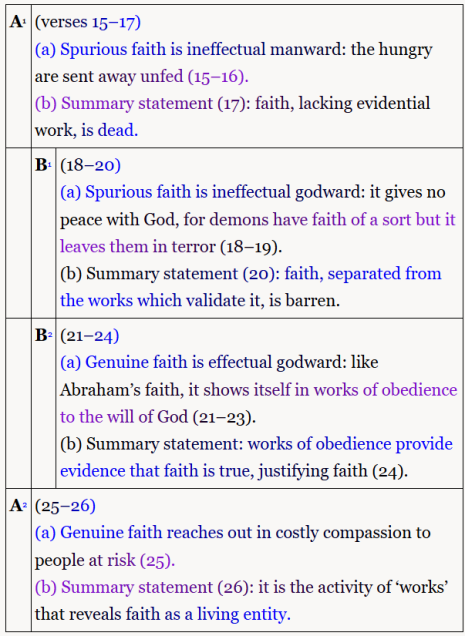
David Platt - (Exalting Jesus In James - Page 44)
I. Two Pictures of Faith (2:20)
A. Dead faith, which does not save
B. Living faith, which does saveII. Two Pictures of Righteousness (2:21)
A. Positional righteousness: how we stand before God
B. Practical righteousness: how we live before GodIII. Two Pictures of Works (2:22-24)
A. Works fueled by the flesh, which do not honor God
B. Works that are the fruit of faith, which bring great glory to God
Faith That Works - Mary is a senior citizen with many health problems. She is also a widow with a home to keep up. No use expecting Mary to do much in the church or community anymore, right? Wrong! In spite of her limitations, her faith continues to work.
Although Mary and her late husband had no children, they had a ministry to other people's children. Now alone, she coordinates a new ministry in her church for women who might be considering abortion.
Mary writes, "If we are preaching against abortion, we should offer pregnant women our help. Within 2 days I've had four volunteers to help me. Now we must meet to set up a plan of action."
A plan of action--how typical of a working faith! How different from people who see a desperate need and moan, "Why doesn't somebody do something?" but are unwilling to be that somebody!
In James 2 we read that Abraham obediently offered his son Isaac on the altar. This act is cited as a work that proved the reality of his faith (Jas 1:21, 22, 23).
Mary, like Abraham, has a faith that works. Our needy world could use many more like them. How can you put your faith into action today? — Joanie Yoder (Our Daily Bread, Copyright RBC Ministries, Grand Rapids, MI. Reprinted by permission. All rights reserved)
Faith is the power that prompts us to go
And give to the hungering, bread;
Faith means much more than a doctrine or two,
For faith without works is dead. --Anon.
Faith never stands around with its hands in its pockets.
Jailed To Free Others - The missionary had been in jail for more than 2 weeks. He was stuck behind bars in a Kosovo prison because he had tried to tell others about Jesus Christ.
Other missionaries tried to negotiate for his freedom, but day after day they were turned down. Eventually they received the good news that their friend would soon be released, so they went to the jail to tell him.
The missionaries discovered that their friend had been witnessing to his fellow inmates, and when they told him that he was about to be let out of jail, he said, "No, not yet. Give me another week. I need more time to share the gospel with these people."
What does it take for a person to be so burdened for others that he is willing to stay locked up so he can continue to proclaim the gospel? First, it takes an unwavering faith that Jesus Christ is the only way to heaven (John 14:6; Hebrews 11:1, 2, 3, 4, 5, 6) and that life without Him leads to a hopeless future. Second, it takes a faith that God is in control and that He can be trusted with our lives when we are not in control at all (Pr 3:5-6; He 11:32, 33, 34, 35, 36, 37, 38, 39, 40). And third, it takes a faith that results in action—not just thoughts and words (Jas 2:26).
Do we have that kind of faith? —Dave Branon (Our Daily Bread, Copyright RBC Ministries, Grand Rapids, MI. Reprinted by permission. All rights reserved)
Lord, help me to love with both words and deeds,
To reach out to sinners and meet their needs;
Lord, burden my heart for those lost in sin,
With mercy and love that flows from within. —FitzhughTrue faith produces a life full of actions,
not a head full of facts.
Parking Lot Christianity - Long lines of cars were filling up the huge parking lot of a church where I was attending a conference. As I parked, I noticed the word Love on a lightpost in one section. In another area, I saw the word Faithfulness. The next day I pulled into a different lot at the same church and saw Patience on another sign. Like numbers in a mall parking lot, these words help people find their cars.
No doubt these signs served another purpose. After each session, some people were in a hurry to get home-- even cutting others off to get out of the lot. Patience wore thin and tempers flared. How appropriate those signs are! I thought. It's amazing how quickly the love we have for our brothers and sisters in Christ can disappear in a parking lot!
Martin Luther told of reading the Scriptures and praying until his heart was filled with love for his fellowman. But how quickly that love disappeared when a person with offensive body odor sat down beside him!
The testing of our faith may not come through severe oppression or heavy burdens. It's more likely to occur in a checkout line, on the expressway, or in a parking lot. That's where we'll know whether we've really become serious about our faith in Christ. — David C. Egner (Our Daily Bread, Copyright RBC Ministries, Grand Rapids, MI. Reprinted by permission. All rights reserved)
Help us, O Lord, to live our lives
So people clearly see
Reflections of Your loving heart,
Your kindness, purity. --SperThe clear sign of your faith
is not what you say but what you do.
PRACTICAL CHRISTIANITY - Our Daily Walk by F B Meyer - JAMES IS described as "the Lord's brother" in Gal 1:19. He was surnamed "the Just," and was much respected beyond the limits of the Christian Church for his saintly life. While St. Paul deals specially with doctrine, James is concerned with practice; Paul expounds the wonderful significance of Christ's death and resurrection; James expounds the teaching of our Lord, especially in the Sermon on the Mount. Paul insists on faith as the means of justification before God; James lays stress on the works to which faith must lead.
It seems likely that James had seen Paul's Epistles, for he uses so many of the same phrases and examples, and probably set himself to combat those who abused the teaching of the great Apostle. There were plenty in his time who believed about Christ, and prided themselves in the orthodoxy and accuracy of their creed; and James maintains that this is not sufficient to save the soul.
As far as orthodoxy goes, no creed can be more absolutely orthodox than that held by evil spirits. Repeatedly, during our Lord's life, they acknowledged that He was the Holy One of God, but their belief had no effect on their character; it only filled them with fear and dread James 2:19).
"Faith without works is dead." It is good to test ourselves. We must see to it that our heart is pure and our way absolutely transparent. In our dealings with those around us, we must always seek to realize our highest conceptions of love and duty. Even when our efforts of goodwill and affection are not reciprocated, we must never lower the high standard of our action, but always keep before us the conception of our Saviour's life in the Home at Nazareth. Be merciless to yourself, but always merciful to others, always bearing the burdens of those around you, always moderating your pace to the weak and weary, as Greatheart did for the pilgrims. Even Rahab was justified by a faith which wrought itself out in beautiful and unselfish action (James 2:25; He 11:31). Remember our Lord's words in Mt 7:20, 21.
PRAYER - Help us, we beseech Thee, O Lord, to add to our faith, brotherly kindness, and pardon the unkind word or impatient gesture; the hard and selfish deed, the failure to give kindly help where we had the opportunity. Enable us so to live that we may daily do something to lessen the tide of human sorrow and need, and add to the sum of human happiness. AMEN. (F. B. Meyer. Our Daily Walk)