James 4:2
James 4:3
James 4:4
James 4:5
James 4:6
James 4:7
James 4:8
James 4:9
James 4:10
James 4:11
James 4:12
James 4:13
James 4:14
James 4:15
James 4:16
James 4:17
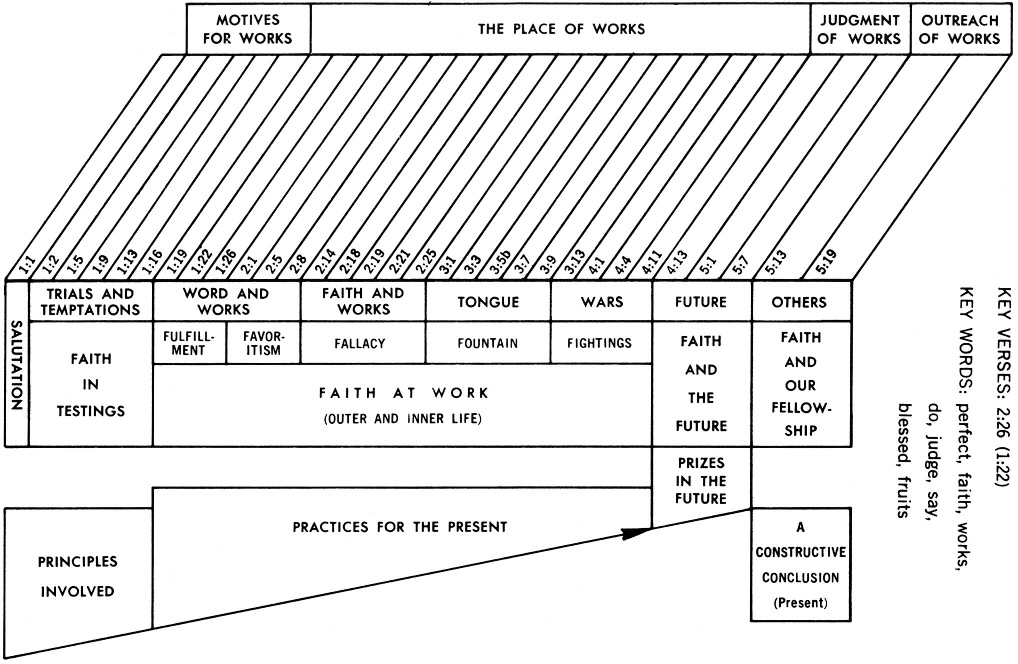
Click chart to enlarge
Chart from recommended resource Jensen's Survey of the NT - used by permission
See also Overview Chart by Charles Swindoll

|
JAMES |
|||||||
| Motives for Works |
The Place of Works: Outward Demonstration of Inner Faith |
Outreach of Works |
|||||
| Jas 1:1-18 | Jas 1:19-2:13 | Jas 2:14-25 | Jas 3:1-12 | Jas 3:13-4:12 | Jas 4:13-5:12 | Jas 5:13-19 | |
| Trials & Temptations |
Word & Works |
Faith & Works |
Tongue | Wars | Future | Others | |
|
Faith |
Fulfill |
Favor |
Fallacy |
Fountain |
Factions |
Faith |
Faith |
|
FAITH AT WORK |
|||||||
The Reactions of Living Faith to Worldliness
The reaction of living faith to selfish strife (James 4:1–5:12)
A. The condition manifesting worldliness (James 4:1–6)
1. The description of the condition (James 4:1–3)
a. The questions exposing the source (James 4:1)
b. The outcome of the condition (James 4:2a)
c. The reasons for the condition (James 4:2b–3)
2. The rebuke for the condition (James 4:4–6)
a. The adulterous character of worldliness (James 4:4)
(1) The question of rebuke (James 4:4a)
(2) The significance of their attitude (James 4:4b)
b. The authoritative message of Scripture (James 4:5a)
c. The divine response to the worldly (James 4:5b–6)
(1) The yearning of the Spirit (James 4:5b–6a)
(2) The verification from Scripture (James 4:6b)
B. The exhortation to the worldly (James 4:7–12)
1. The call to return to God (James 4:7–10)
a. The statement of the basic demand (James 4:7)
(1) Nearness to God (James 4:8a)
(2) Personal cleansing (James 4:8b)
(3) Open repentance (James 4:9)
(4) Godly humility (James 4:10)
2. The injunction against censoriousness (James 4:11–12)
a. The statement of the prohibition (James 4:11a)
b. The justification for the prohibition (James 4:11b–12)
The reaction of living faith to presumptuous planning (4:13–17)
A. The rebuke of their self-sufficient attitude (James 4:13–14)
1. The delineation of the attitude (James 4:13)
2. The presumption in the attitude (James 4:14)
B. The indication of the proper attitude (James 4:15)
C. The evil of their present attitude (James 4:16–17)
1. The evil of their boasting (James 4:16)
2. The sin of their inconsistency (James 4:17) (Hiebert - James Commentary)
James 4:8 Draw near to God and He will draw near to you. Cleanse your hands, you sinners; and purify your hearts, you double-minded. (NASB: Lockman)
Greek: eggisate (2PAAM) to theo kai eggiei humin. katharisate (2PAAM) cheiras, hamartoloi, kai hagnisate (2PAAM) kardias, dipsuchoi.
Amplified: Come close to God and He will come close to you. [Recognize that you are] sinners, get your soiled hands clean; [realize that you have been disloyal] wavering individuals with divided interests, and purify your hearts [of your spiritual adultery]. (Amplified Bible - Lockman)
ASV: Draw nigh to God, and he will draw nigh to you. Cleanse your hands, ye sinners; and purify your hearts, ye doubleminded.
BBE: Come near to God and he will come near to you. Make your hands clean, you evil–doers; put away deceit from your hearts, you false in mind.
ESV: Draw near to God, and he will draw near to you. Cleanse your hands, you sinners, and purify your hearts, you double-minded. (ESV)
KJV: Draw nigh to God, and he will draw nigh to you. Cleanse your hands, ye sinners; and purify your hearts, ye double minded.
NET: Draw near to God and he will draw near to you. Cleanse your hands, you sinners, and make your hearts pure, you double-minded. (NET Bible)
NJB: The nearer you go to God, the nearer God will come to you. Clean your hands, you sinners, and clear your minds, you waverers. (NJB)
NLT: Come close to God, and God will come close to you. Wash your hands, you sinners; purify your hearts, for your loyalty is divided between God and the world. (NLT - Tyndale House)
Phillips: Come close to God and he will come close to you. Realise that you have sinned and get your hands clean again. Realise that you have been disloyal and get your hearts made true once more. (Phillips: Touchstone)
Wuest: Draw near to God and He will draw near to you. Cleanse [your] hands, O sinners, and purify [your] hearts, O double-minded.
Weymouth: Draw near to God, and He will draw near to you. Cleanse your hands, you sinners, and make your hearts pure, you who are half–hearted towards God.
Young's Literal: draw nigh to God, and He will draw nigh to you; cleanse hands, ye sinners! and purify hearts, ye two-souled!
Draw near to God and He will draw near to you: eggisate (2PAAM) to theo kai eggiei humin:
- Ge 18:23; 1Chr 28:9; 2Chr 15:2; Ps 73:28, Ps 73:28KJV; 145:18; Isa 29:13; 55:6,7; Hos 6:1,2; Zech 1:3; Mal 3:7; Ro 5:2, Eph 3:12, Heb 7:19; 10:22
- James 4 Resources - Multiple Sermons and Commentaries
- James 4:7-10 Resolving Conflicts God's Way - Steven Cole
- James 4:8-10 Drawing Near to God, Pt. 2 - John MacArthur
SINNERS CALLED TO DRAW NEAR
TO THE MOST HOLY GOD!
Delay not, delay not, O sinner, draw near.
The waters of life are now flowing for thee;
No price is demanded, the Savior is here;
Redemption is purchased, salvation is free.
Delay not, delay not, O sinner, to come,
For mercy still lingers and calls thee today.
Her voice is not heard in the vale of the tomb;
Her message, unheeded, will soon pass away.
Delay not, delay not, the Spirit of grace,
Long grieved and resisted, may take His sad flight,
And leave thee in darkness to finish thy race,
To sink in the gloom of eternity’s night.
Delay not, delay not, the hour is at hand,
The earth shall dissolve, and the heavens shall fade;
The dead, small and great, in the judgment shall stand;
What helper, then, sinner, shall lend thee his aid?
Delay not, delay not, why longer abuse
The love and compassion of Jesus thy God?
A fountain is open, how canst thou refuse
To wash and be cleansed in His pardoning blood?
Keep the context in mind, remembering that James 4:7-9 is a description of how to have a humble walk with God and I agree with Thomas Manton who feels that "You may look upon these words as spoken to sinners or to convert."
Hiebert writes that…
Involved in the basic demand of Jas 4:7 are various injunctions to be obeyed. Involved are a wholehearted return to God (Jas 4:8a), personal cleansing (Jas 4:8b), open repentance (Jas 4:9), and humility (Jas 4:10). (D Edmond Hiebert - James)
Near to the heart of God,
Nearer I cannot be,
For in the Person of His Son
I'm just as near as He.
Draw near… He will draw near - This is one of those great commandments that comes "packaged" with the "built in" encouragement of God's promise of fellowship. In the Old Testament the picture of drawing near to God was a general expression for the one who approached God in sincere penitence and humility. (see Isa 29:13 below for the "counterfeit").
The command to draw near implies that their ungodly behavior (Jas 4:1-3) and worldliness (Jas 4:4) has put distance between the readers and God. James is calling for his readers to pursue intimacy with God.
As Blanchard has so aptly stated…
There is only one view more welcome than the backside of the Devil—and that is the face of God. (John Blanchard, Truth for Life. West Sussex, England: H. E. Walter Ltd., 1982)
Draw near - Come close to God by entering His courts with prayer, praise and thanksgiving, by spending time with Him in His Word, by spending time with Him in corporate worship. But don't confuse one time Sunday worship as what James means by his command to draw near. To be sure, worship on Sunday can be a special time of drawing near to God, but the practice of drawing near needs to saturate, permeate and "marinate" our lives throughout the week. If we only draw near to worship God on Sunday, we are not really drawing near, but only making an occasional "visit".
In context, the love of the world (worldliness, cp Jas 4:4-note, cp 1Jn 2:15,16, 17, Gal 6:14) results in straying from God (cp "double minded", Jesus' warning in Mt 6:24-note). James is saying (as recipients of greater grace) we must counter the anti-God influences of this world (and even our own fallen flesh) and draw near to God.
C H Spurgeon exhorts us to…
Hear this command, and practice it; get near to God in Christ Jesus, and you shall soon find him come to your help in every hour of need.
Lehman Strauss offers a provocative analysis of this passage…
Real comfort and courage come to every child of God who experiences His nearness, and it seems to me that the heart of the average man cries out with Job: "Oh that I knew where I might find Him!" (Job 23:3). Many persons facing complex problems yearn for God's nearness. On this hunger many psychiatric quacks are getting rich. Even some Protestant clergymen have resorted to operating clinics where sentimental and emaciated peace of mind gimmicks are offered to resolve inner tension and restlessness. The quiet mood of "positive thinking" is negative compared with what the Bible teaches.
The nearness to God here promised is available to every child of God meeting divine requirements for it. Most expositors hold prayer to be the most prominent element in our drawing near to God. Personally, I feel safer if I commence with the Word of God and then pray according to the Scriptures. We have already indicated that prayers offered contrary to the plain teaching of the Bible remain unanswered, for the heart must be right as a condition to effective prayer. The greatest privilege ever afforded the sinful human race is to draw nigh to God. When we think of God's majesty and might and holiness, we stand in awe that He would allow us to come near to Him. (Lehman Strauss: James, Your Brother: Studies in the Epistle of James)
David gives us a sense of what drawing near looks like in the psalms writing…
(A Psalm of David, when he was in the wilderness of Judah.) O God, Thou art my God; I shall seek Thee earnestly; My soul thirsts for Thee, my flesh yearns for Thee, In a dry and weary land where there is no water. (Ps 63:1)
And do not hide Thy face from Thy servant, for I am in distress; answer me quickly (Ed: David draws near to God in this prayer and calls on God to draw near). Oh draw near to my soul and redeem it; Ransom me because of my enemies! (Ps 69:17, 18)
Dearest Jesus, draw Thou near me,
Let Thy Spirit dwell with mine;
Open now my ear to hear Thee,
Take my heart and seal it Thine;
Keep me, lead me on my way,
Thee to follow and obey,
E’er to do Thy will and fear Thee,
And rejoice to know and hear Thee.Underneath Thy wings abiding,
In Thy Church, O Savior dear,
Let me dwell, in Thee confiding,
Hold me in Thy faith and fear;
Take away from me each thought
That with wickedness is fraught,
Tempting me to disobey Thee,
Root it out, O Lord, I pray Thee.
(Dearest Jesus, Draw Thou Near Me)
Isaiah quotes God's description of counterfeit drawing near to God…
Then the Lord said, "Because this people draw near with their words and honor Me with their lip service, but they remove their hearts far from Me, and their reverence for Me consists of tradition learned by rote (Isa 29:13)
Comment: It follows that if we are to genuinely draw near we must do so both externally (our body and our members) and internally (our heart and soul). Superficial and/or hypocritical drawing near will never please God, and since such worship is ultimately a reflection of pride, the Almighty will actively oppose such feigned worship. Our words and actions should be the outflow of a heart surrendered to God and not a faithless heart that seeks after the emptiness and transience of this present evil age (Gal 1:4), this godless world system. And so James follows his command to draw near with a series of "machine gun-like" commands that if obeyed demonstrate that our drawing near is not sham religiosity (cp Jas 1:26, 27-note).
David explains to his son Solomon the prerequisites for drawing near to God (finding God)…
As for you, my son Solomon, know the God of your father, and serve Him with a whole heart and a willing mind; for the LORD searches all hearts, and understands every intent of the thoughts. If you seek Him, He will let you find Him; but if you forsake Him, He will reject you forever. (1Chr 28:9)
Hebrews exhorts believers, that because of the fully atoning work of our sinless Great High Priest, we can now draw near to God through Him…
Let us therefore draw near (proserchomai = literally come before) with confidence to the throne of grace, that we may receive mercy and may find grace to help in time of need. (Heb 4:16-note)
Comment: This is an all the more incredible truth when one considers that in ancient times kings were totally unapproachable by the common people and only the Jewish high priest could actually enter the Holy of holies symbolic of the presence of God and then only once per year.
Hence, also, He (Christ) is able to save forever those who draw near (proserchomai = literally come before) to God through Him (As our Great High Priest, through Who we can boldly approach God), since He always lives to make intercession for them. (Heb 7:25-note)
(In light of the truth that we have a Great High Priest, Christ Jesus seated at the right hand of the Father) let us draw near (proserchomai = literally come before) with a sincere heart in full assurance of faith, having our hearts sprinkled clean from an evil conscience and our bodies washed with pure water ( Hebrews 10:22-note).
As noted below the writer of Hebrews uses the same verb as James (eggizo - draw near) writing…
(for the Law made nothing perfect), and on the other hand there is a bringing in of a better hope (the New Covenant in His blood, with a Better Mediator than the OT priesthood), through (dia) which we draw near to God. (Hebrews 7:19-note)
Related Resource: The Happiness of Drawing Near to God - Thomas Watson
Steven Cole writes that when James commands us to draw near, he is not saying…
that God is waiting for sinners to make the first move toward Him, and then He will respond. Not only does that run counter to all of Scripture, it also runs counter to this verse, which is God commanding us to draw near to Him! Jesus said, “No one can come to Me unless the Father who sent Me draws him” (Jn 6:44). In case we missed it, He repeated, “For this reason I have said to you, that no one can come to Me unless it has been granted him from the Father” (Jn 6:65). God always makes the first move toward us… these words in James are written primarily to believers. It is easy even for believers to drift away from the Lord. James’ point is, “Guess who moved?” It wasn’t God! If you’re engaging in continuing quarrels and conflicts (Jas 4:1), you are not close to God. You’ve drifted. He is calling you to draw near to Him, with the promise that He is ready and waiting to draw near to you. The thought of not enjoying sweet fellowship with our loving Lord should move you to clear up whatever stands between you and Him. You cannot be close to God at the same time that you’re angry or bitter toward someone else. That’s why immediately after teaching how serious the sin of anger is, Jesus said (Mt 5:23,24), “Therefore if you are presenting your offering at the altar, and there remember that your brother has something against you, leave your offering there before the altar and go; first be reconciled to your brother, and then come and present your offering.” You can’t draw near to God until you first clear up, as much as it is in your power, any relational difficulties. If you think that you’re close to God, but you’re angry and bitter, you’re deceiving yourself! Submit to God; draw near to God. (James 4:7-10 Resolving Conflicts God's Way)
Arthur Pink notes that…
It is one thing to know theoretically the legal way and right of approach unto God—but it is quite another to enjoy conscious access to Him. For that, the aid of the Spirit is imperative—but He will not perform His gracious operations within us if He is grieved (Ep 4:30-note). If we have spent the night in ransacking the newspapers, in worldly conversation—or in backbiting the servants and saints of God (Ed: In other words, we let an "unwholesome word proceed from" our mouth! Ep 4:29-note)—do you think that the Holy Spirit will draw out your heart unto the Father, when you perform your evening devotions? Not so, unless you penitently confess those sins, and sincerely determine there shall be no repetition of them. "Draw near to God—and He will draw near to you" (James 4:8). (Access to God)
In the OT David wrote…
But it is good for me to draw near to God: I have put my trust in the Lord GOD, that I may declare all thy works. (Psalm 73:28KJV)
Spurgeon comments on David's declaration: But it is good for me to draw near to God. Had he done so at first he would not have been immersed in such affliction; when he did so he escaped from his dilemma, and if he continued to do so he would not fall into the same evil again. The greater our nearness to God, the less we are affected by the attractions and distractions of earth. Access into the most holy place is a great privilege, and a cure for a multitude of ills. It is good for all saints, it is good for me in particular; it is always good, and always will be good for me to approach the greatest good, the source of all good, even God himself.
(Drawing near) is not one isolated act. It is nor merely turning to God, and saying, "I have come to him." The expression is draw. It is not a single act; it is the drawing, the coming, the habitual walk, going on, and on, and on, so long as we are on earth. It is, therefore, an habitual religion which must be pressed and enforced upon us. Montagu Villiers. 1855.
The Lord is near to all who call upon Him, to all who call upon Him in truth. (Ps 145:18)
Spurgeon comments: The LORD is nigh unto all them that call upon him. Not only near by his omnipresence, but to sympathize and favour. He does not leave praying men, and men who confess his name, to battle with the world alone, but he is ever at their side. This favour is not for a few of those who invoke him; but for each one of the pious company. "All" who place themselves beneath the shield of His glorious name by calling themselves by it, and by calling upon it in supplication, shall find him to be a very present help in trouble. "To all that call upon him in truth": for there are many whose formal prayers and false professions will never bring them into communion with the Lord. To pray in truth, we must have a true heart, and the truth in our heart; and then we must be humble, for pride is a falsehood; and be earnest, or else prayer is a lie. A God of truth cannot be nigh to the spirit of hypocrisy; this he knows and hates; neither can he be far removed from a sincere spirit, since it is his work, and he forsakes not the work of his own hands.
Manton comments that…
Sin is departing from God; grace is returning. Come near to him, aim for the support of his presence; Christ is the way, but you must resolve upon it: I must and I will. “Your face, Lord, I will seek” (Ps 27:8); there must be a concern to bring the soul to this resolve. Note what it says in Jer 30:21, “‘I will bring him near and he will come close to me, for who is he who will devote himself to be close to me?’ declares the Lord.” But will you devote yourselves? A practical commandment arises from conviction of the necessity and excellence of the duty; as David says, “It is good to be near God” (Ps 73:28).
There is one doubtful point in the text that must be cleared up before we go any further, arising from the use of the phrase come near to God, as if it were in our own power.
Solution. First, this passage and similar ones show not what man wants to do but what he ought to do. We left God before he left us; we should be the first to return, as we were the first to leave. The wronged party may in justice wait for us to submit. Yet such is the Lord’s kindness that He loves us first (1John 4:19).
Second, commandments are not measures of our strength; it is not valid to argue from what ought to be done that it can or will be done. These things are expressed in this way for another purpose: to show God’s right, to convince the creature of weakness, to show us our duty, to show us that we should do our utmost, and to convince us of the things we have failed to do.
Third, these precepts are not useless; they convey grace to those who are chosen. God fulfills what He commands, for, by means of the Spirit working with them, they are stirred up and made to come near to God…
I shall conclude with Bernard’s wonderful saying: “We cannot seek God until we have found him; he wants to be sought in order that he may be found, and found in order that he may be sought: it is grace that must bring us to grace.” The stray sheep cannot be brought home unless it is on Christ’s shoulders…
Coming near to God is not something we must do for an hour, it is not something appropriate merely when we are converted, but it is the work of our whole lives. (A Practical Exposition of James)
Nearer, still nearer, close to Thy heart,
Draw me, my Savior—so precious Thou art!
Fold me, oh, fold me close to Thy breast.
Shelter me safe in that “Haven of Rest”;
Shelter me safe in that “Haven of Rest.”Nearer, still nearer, nothing I bring,
Naught as an offering to Jesus, my King;
Only my sinful, now contrite heart.
Grant me the cleansing Thy blood doth impart.
Grant me the cleansing Thy blood doth impart.Nearer, still nearer, Lord, to be Thine!
Sin, with its follies, I gladly resign,
All of its pleasures, pomp and its pride,
Give me but Jesus, my Lord, crucified.
Give me but Jesus, my Lord, crucified.Nearer, still nearer, while life shall last.
Till safe in glory my anchor is cast;
Through endless ages ever to be
Nearer, my Savior, still nearer to Thee;
Nearer, my Savior, still nearer to Thee!
(Nearer, Still Nearer)
The call of the prophet Isaiah in chapter 55 is very similar to James' commands in James 4:8, 9…
Seek (A command in Hebrew; Lxx = zeteo in aorist imperative = command for decisive action!) the Lord while He may be found; Call upon (A command in Hebrew; Lxx =aorist imperative = command for decisive action!) Him while He is near. Let the wicked forsake his way and the unrighteous man his thoughts; and let him return to the Lord, and He will have compassion on him, and to our God, for He will abundantly pardon. (Isaiah 55:6, 7)
The prophet Hosea cries out (primarily to the Northern 10 tribes, called "Israel" or sometimes "Ephraim" the name of the largest tribe)…
Come, (Command in Hebrew) let us return to the Lord. For He has torn us, but He will heal us; He has wounded us, but He will bandage us. He will revive us after two days; He will raise us up on the third day that we may live before Him. (Hosea 6:1, 2)
The prophet Zechariah (prophesying to the Jews who returned to Palestine after the 70 year exile in Babylon - his call was to urge them to complete the rebuilding of the Temple) echoes Hosea and clearly parallels James' call to his Jewish readers to draw near to God and He would draw near to them…
“Therefore say to them, ‘Thus says the Lord of hosts, “Return (Command in Hebrew) to Me,” declares the Lord of hosts, “that I may return to you,” says the Lord of hosts. (Zechariah 1:3)
C. H. Spurgeon Anecdotes.
Prayer, a Drawing Near to God -There was a time, late in the fifties, when Mr. Spurgeon had the use of the Congregational Church, Tunbridge Wells, secured for him by a friend. He preached there many times, and the present writer did not miss any one of the sermons. He remembers especially two of them. "Things that accompany Salvation" was one; the other was on prayer as drawing near to God: "It is good for me to draw near to God." His remarks went to show that, whether in a form of prayer or in extemporaneous supplication, that alone is true prayer in which the soul seeks to draw near to God. The divisions of the sermon were very remarkable and original.
He said: "First, I shall use the text as a Touchstone."
Second, I shall use it as a Whetstone, to sharpen the activity of the soul God-ward.
"Third, I shall set it up as a Tombstone over the myriads of dead prayers, both formal and extempore."
The discourse throughout was striking, telling, and searching. Three evangelical clergymen who were present evidently thought the sermon calculated to be profitable to others besides those who had listened to it, and they sought Mr. Spurgeon's permission to have it printed as a booklet for distribution in the town and neighborhood. Those services in the Congregational Church were the means of much good, and people came in from the country around to listen to the preacher, whose usefulness and popularity were extending on every side.
Praise to the Lord, the Almighty, the King of creation!
O my soul, praise Him, for He is thy health and salvation!
All ye who hear, now to His temple draw near;
Praise Him in glad adoration.
(Praise to the Lord, the Almighty)
Draw near (1448) (eggizo) means to approach, draw closer to, draw near, be near, come near. So drawing near in space and drawing closer to some point. In short, to draw near in space. (Mt 21:1, Lk 7:12, 15:1, 25, 18:35. 19:29, 37, 41). Also used of drawing near in regard to time (Lk 22:1).
Friberg's summary of eggizo - intransitively in the NT approach, draw near, be near; (1) with the dative of person or place draw near to, approach (Acts 9.3); (2) with eis draw near, approach a place (Mk 11.1); (3) absolutely, of approaching in space be near (Mt 26.46); of approaching in time draw near, be at hand (Lk 22.1); perfect have come (Ro 13.12)
Hiebert writes that in eggizo
was used in the Septuagint of the priests in the Tabernacle, duly qualified to approach God with their sacrifices (Lev 10:3; 21:21, 22, 23); it also was used in a wider sense of man's approach to God in worship (Isa. 29:13; Hos 12:6). Thus the term conveys the thought of entering into communion with God as acceptable worshipers. Such drawing near to God marks "those who long to come into the closest possible relation to Him, in contrast to those who are His enemies and who keep at a distance from Him. Their sincere approach is assured of God's favorable response: "and he will come near to you." Like the returning prodigal (Lk 15:20), they will find God waiting to welcome and restore them. (Ibid)
Fruchtenbaum agrees that eggizo that…
is used in the Septuagint for “worship.” It is the Levitical term for worship (cp Lev 10:3, 21:21). The promise is draw nigh to God and He will draw nigh to you, which is a pledge of fellowship and communion. (Fruchtenbaum, A. G. The Messianic Jewish Epistles : Hebrews, James, First Peter, Second Peter, Jude. Page 292. Tustin, CA: Ariel Ministries)
Lenski notes that the aorist imperative
is again decisive and indicates that the readers are not to draw a step or two nearer to God but are to approach him completely. This is said to Christians (Ed: Some feel that Jas 4:6-10 could also apply to non-believers) who are to flee to God by repentance and faith, who will then always find him drawing near to them in grace, pardon, protection. The devil will flee from us, God will draw near to us. James intends to use this contrast. The parable of the Prodigal illustrates the returning to God in repentance and his drawing near to the repentant one. (Lenski, R. C. H. The Interpretation of the Epistle to the Hebrews and of the Epistle of James. Page 632. 1938)
The other NT meaning of eggizo is to draw near in time: the kingdom of Heaven/of God (Mt 3:2, 4:17, 10:7, Mk 1:15, Lk 10:9, 11), hour (Mt 26:45), day (Ezek 12:23; Ro 13:12-note, He 10:25-note), harvest time (Mt 21:34), feast day (Lk 21:8, Mt 21:34, Lk 21:20, 22:1), redemption (Lk 21:28), the end of all things (1Pe 4:7-note)
James uses eggizo in Jas 4:8 of drawing near in a spiritual sense (also used in this sense in Heb 7:19-note), while in James 5:8 he uses eggizo in a temporal sense.
Eggizo - 42x in 41v in the NT - approached(10), approaching(7), at hand(12), came close(1), came up(1), come near(3),comes near(2), coming near(1), draw near(3), drawing near(2).
Mt 3:2; 4:17; 10:7; 21:1, 34; 26:45, 46; Mark 1:15; 11:1; 14:42; Luke 7:12; 10:9, 11; 12:33; 15:1, 25; 18:35, 40; 19:29, 37, 41; 21:8, 20, 28; 22:1, 47; 24:15, 28; Acts 7:17; 9:3; 10:9; 21:33; 22:6; 23:15; Ro 13:12; Phil 2:30; Heb 7:19; 10:25; Jas 4:8; 5:8; 1 Pet 4:7.
Here are some representative uses…
Mt 3:2 (John the Baptist) "Repent (present imperative = make this your continual practice!), for the kingdom of heaven is at hand (perfect tense = to have drawn near and as a result to be present or at hand)."
Comment: At hand is in the perfect tense which means in essence that the kingdom (King) has come and is still present. How so since John is on earth not heaven? He is surely referring to the King of the Kingdom Who had arrived. In fact John been prepared to herald the King's coming [Isa 40:3]. The kingdom has a spiritual aspect, a present physical aspect, and a future eternal aspect, depending on context, but always refers to God's reign over His created and redeemed world and its believing inhabitants.
Mt 4:17 From that time Jesus began to preach and say, "Repent (present imperative), for the kingdom of heaven is at hand (perfect tense)"
Matthew 26:45 Then He came to the disciples, and said to them, "Are you still sleeping and taking your rest? Behold, the hour is at hand (perfect tense) and the Son of Man is being betrayed into the hands of sinners. 46 "Arise, let us be going; behold, the one who betrays Me is at hand!"
Luke 21:8 And He said, "See to it that you be not misled; for many will come in My name, saying, 'I am He,' and, 'The time is at hand'; do not go after them.
Luke 21:28 "But when these things begin to take place, straighten up and lift up your heads, because your redemption is drawing near."
Comment: Redemption demands a redeemer and thus this clearly speaks of Messiah's Second Coming.
Luke 22:47 While He was still speaking, behold, a multitude came, and the one called Judas, one of the twelve, was preceding them; and he approached Jesus to kiss Him.
Acts 7:17 "But as the time of the promise was approaching which God had assured to Abraham (Ge 15:13, 14, 15, 16 - when the "cup" of iniquity of the Amorites who lived in the Promised Land had been filled to the brim), the people increased and multiplied in Egypt,
Acts 9:3 (Paul's encounter with the Risen Christ - and his radical conversion) And it came about that as he journeyed, he was approaching Damascus (see also Acts 22:6), and suddenly a light from heaven flashed around him;
Romans 13:12-note The night is almost gone, and the day is at hand (perfect tense = to have drawn near and as a result to be present or at hand). Let us therefore lay aside the deeds of darkness and put on (like a new changes of clothes - "Jesus dress"!) the armor of light.
Comment: At hand speaks of the day of the Return of Christ which is the next event on God’s Plan for the Ages and could happen at any moment (Imminent). God delays the Son's return because He is still redeeming those whom He “chose … in Him before the foundation of the world” (Ep 1:4-note). From the human perspective, Christ’s return has been Imminent since He ascended into heaven (Acts 1:9, 10, 11) and this assurance has always been the church’s "blessed hope" (Titus 2:13-note).
Philippians 2:30-note because (Epaphroditus - cp Php 2:25, 26, 27, 28, 29) he came close to death for the work of Christ, risking his life to complete what was deficient in your service to me.
Hebrews 7:19-note (for the Law made nothing perfect), and on the other hand there is a bringing in of a better hope, through which we draw near to God.
Hebrews 10:25-note not forsaking our own assembling together, as is the habit of some, but encouraging one another; and all the more, as you see the day drawing near (perfect tense).
James 5:8 You too be patient (aorist imperative = command for decisive action); strengthen (firmly fix, be resolute, even in face of trials and persecution!) (aorist imperative = command calling for decisive action) your hearts, for the coming (parousia) of the Lord is at hand (= speaks of the Imminency [see notes] of the Messiah's Return).
Comment: The imminent return (parousia) of the Bridegroom should stimulate every member of His Church (the Bride) to patience and persistence. See related discussion regarding the Second Coming.
MacArthur rightly remarks that "Any view of eschatology which eliminates Imminency (believers in every age living with the hope that Christ could come at any moment) is in conflict with all those passages which provide hope for suffering believers by anticipating the Lord’s coming." (Macarthur J. James. Moody or Logos)
1Peter 4:7-note The end (telos = consummation, an achieved goal) of all things is at hand (perfect tense = to have drawn near and as a result to be present or at hand. The Return of Christ = Imminent = it could occur at any moment); therefore (If you are looking expectantly for Christ at any moment, your daily conduct will [or should] be a clear reflection of such a belief), be of sound judgment (aorist imperative = command for decisive action) and sober spirit (aorist imperative = command for decisive action) for the purpose of prayer.
Eggizo - 103v in the Septuagint (LXX) -
Gen 12:11; 18:23; 19:9; 27:21, 22, 26, 27, 41; 33:3; 35:16; 37:18; 44:18; 45:4; 47:29; 48:7, 10, 13; Ex 3:5; 19:21, 22; 24:2; 32:19; 34:30; Lev 10:3; 21:3, 21, 23; 25:25; Nu 24:17; Deut 4:7; 13:7; 15:9; 20:2; 21:3, 6; 22:2; 25:5; 31:14; Jdg 9:52; 19:13; 20:23; Ruth 2:20; 2Sa 11:20; 15:5; 18:25; 19:42; 20:16; 1Ki 2:1, 7; 8:59; 2 Ki 2:5; 4:6, 27; 5:13; 2Chr 18:23; Ezra 4:2; 9:1; Job 33:22; Ps 27:2; 32:6, 9; 38:11; 55:18, 21; 88:3; 91:7, 10; 107:18; 119:169; 148:14; Pr 3:15; 5:8; 10:14; 19:7; Isa 5:8, 19; 8:15; 26:17; 29:13; 30:20; 33:13; 38:12; 41:1, 5, 21f; 45:21; 46:13; 50:8; 51:5; 54:14; 55:6; 56:1; 58:2; 65:5; Jer 23:23; 51:9; Lam 3:57; 4:18; Ezek 7:7; 9:1, 6; 12:23; 22:4f; 23:5; 36:8; 40:46; 42:13; 43:19; 44:13; 45:4; Dan 4:11, 22; 6:20; Hos 12:6; Amos 6:3; 9:10; Jonah 3:6; Mic 2:9; 4:10; Hab 3:2; Zeph 3:2; Hag 2:14.
Genesis 12:11 And it came about when he came near (Lxx = eggizo) to Egypt, that he said to Sarai his wife, "See now, I know that you are a beautiful woman;
Genesis 18:23 And Abraham came near (Lxx = eggizo) and said, "Wilt Thou indeed sweep away the righteous with the wicked?
Genesis 27:21 Then Isaac said to Jacob, "Please come close (Lxx = eggizo), that I may feel you, my son, whether you are really my son Esau or not." 22 So Jacob came close (Lxx = eggizo) to Isaac his father, and he felt him and said, "The voice is the voice of Jacob, but the hands are the hands of Esau."
Leviticus 10:3 Then Moses said to Aaron, "It is what the LORD spoke, saying, 'By those who come near (Lxx = eggizo) Me I will be treated as holy, And before all the people I will be honored.'" So Aaron, therefore, kept silent.
Job 33:22 "Then his soul draws near (Lxx = eggizo) to the pit, And his life to those who bring death.
Hosea 12:6 Therefore, return to your God, observe kindness and justice, and (Lxx = eggizo = Draw near = present imperative - Command to make this your lifestyle, daily, moment by moment, habitually draw near) wait for your God continually.
Motyer offers a practical analysis of this section noting first that…
if we are true to James, we will see this command to draw near as the first obedience required of those who have subordinated themselves to God (Jas 4:7-note) and propose to resist the devil. For James is not snatching haphazard commands out of the air. He is setting out for us an ordered program of obedience. The first element in the conflict is this central battle to live near God, the battle for regularity and discipline in Bible reading, prayer, private and public worship, feasting at the Lord’s Table, devoting ourselves to Christian fellowship, cultivating every appointed avenue whereby we can draw near to him.
Fellowship with God—and its consequent blessing of His fellowship with us—does not ‘just happen’; we cannot drift into it any more than we drift into holiness. It is our first obedience. (The Message of James: The Tests of Faith. The Bible Speaks Today) (Bolding added for emphasis)
The humble souls who mourn and pray,
The Lord approves and knows;
His mark secures them in the day
When vengeance strikes his foes.
(John Newton - The Gathering Clouds, with Aspect Dark)
Thomas Manton writes that God…
will make us find that He is near to us by His favor and blessing. We have a similar promise in Zechariah 1:3, “‘Return to Me,’ declares the Lord Almighty, ‘and I will return to you.’” It is the same in Malachi 3:7.
The way to have God turn to us in mercy is to turn to Him in duty. This is the standing law of heaven, and God will not vary from it; it is the best way for God’s glory and for the creatures’ good. Mercies are most delightful and good to us when we are prepared for them by duty. Do not, then, separate mercy from duty. Expectations in God’s way cannot be disappointed. Ephraim wanted blessings but could not endure the yoke of obedience. We are apt to lie upon the bed of ease and complacently look to see what God will do, but will not stir ourselves to do what we should do.
God will be near those who are careful to hold communion with him. “The Lord is near to all who call on him, to all who call on him in truth” (Psalm 145:18). Near to bless, to comfort, to give life, to guide, to support them. Let this encourage us to come to God—indeed, to run to him. The father ran to meet the returning prodigal (Luke 15:20). God will be first with loving-kindness: “You will call, and the Lord will answer; you will cry for help, and he will say: Here am I” (Isaiah 58:9). God says, in effect, “What have you to say to me? What do you want from me? Here am I to satisfy all your desires.” Elsewhere it says, “Before they call I will answer” (Isaiah 65:24). When we apply ourselves to seeking God, he is near to counsel, to give life, to defend—ready with blessing before our imperfect desires can be formed into requests. (A Practical Exposition of James)
Drawing Near to God - THE nearer we come to God, the more graciously will He reveal Himself to us. When the prodigal comes to his father, his father runs to meet him. When the wandering dove returns to the ark, Noah puts out his hand to pull her in unto him. When the tender wife seeks her husband’s society, he comes to her on wings of love. Come then, dear friend, let us draw nigh to God who so graciously awaits us, yea, comes to meet us. Did you ever notice that passage in Isaiah 58:9? There the Lord seems to put Himself at the disposal of His people, saying to them, “Here I am,” as much as to say: “What have you to say to me? What can I do for you? I am waiting to bless you.” How can we hesitate to draw near? God is nigh to forgive, to bless, to comfort, to help, to quicken, to deliver. Let it be the main point with us to get near to God. This done, all is done. If we draw near to others, they may before long grow weary of us and leave us; but if we seek the Lord alone, no change will come over His mind, but He will continue to come nearer and yet nearer to us by fuller and more joyful fellowship. (Spurgeon, C.. Faith's Checkbook)
ILLUSTRATION - Some of us have tried to have a daily quiet time and have not been successful. Others of us have a hard time concentrating. And all of us are busy. So rather than spend time with God, listening for his voice, we’ll let others spend time with him and then benefit from their experience. Let them tell us what God is saying. After all, isn’t that why we pay preachers? …If that is your approach, if your spiritual experiences are secondhand and not firsthand, I’d like to challenge you with this thought: Do you do that with others parts of your life? …You don’t do that with vacations… You don’t do that with romance… You don’t let someone eat on your behalf, do you? [There are] certain things no one can do for you. And one of those is spending time with God. (Lucado, M., & Gibbs, T. A. Grace for the moment : Inspirational thoughts for each day of the year. Nashville, Tenn.: J. Countryman)
Cleanse your hands, you sinners: katharisate (2PAAM) cheiras, hamartoloi:
- Job 9:30; 16:17; 17:9; Ps 18:20; 24:4; 26:6; 73:13; Isa 1:15,16; 13:15; Mt 15:2; 27:24; 1Ti 2:8; 1Pe 3:21
- James 4 Resources - Multiple Sermons and Commentaries
- James 4:7-10 Resolving Conflicts God's Way - Steven Cole
- James 4:8-10 Drawing Near to God, Pt. 2 - John MacArthur
James now calls for his readers to carry out a thorough moral/ethical personal cleansing, for they had become stained with worldliness (cp Jas 1:27, Jas 4:1-4) and only those pure in hand and heart would be allowed to enter into the presence of God's holiness.
David asks…
Who may ascend into the hill of the LORD? And who may stand in His holy place? He who has clean hands and a pure heart, Who has not lifted up his soul to falsehood, And has not sworn deceitfully. He shall receive a blessing from the LORD And righteousness from the God of his salvation. (Ps 24:3, 4, 5)
The prophet Isaiah issued a similar call to Judah…
Wash yourselves, make yourselves clean; Remove the evil of your deeds from My sight. Cease to do evil (Isaiah 1:16-note) (Note: Four commands in this verse and five more in Isa 1:17-note. Remove… cease following wash yourselves make it clear that the washing Jehovah is calling for is a spiritual cleansing from the filth and stain of sin.)
How appropriate that cleanse and purify follow God drawing near to us who are sinners, whether we be saved sinners or unconverted sinners! Holiness always highlights the heinousness of sinfulness. It is a spiritual maxim that the closer the Holy One draws to us, the greater is (or should be) our sense of sinfulness. Those who are most conscious of His holiness, logically are those who are most acutely convicted of their sin. Oswald Chambers was right when he said that we should "measure our growth in grace by our sensitiveness to sin". In fact, is not the antithesis of God's holiness, man's sinfulness!
Young's Literal rendering pierces us ever so sharply…
Cleanse hands, ye sinners! and purify hearts, ye two-souled!
Alexander Maclaren spoke to this point in his sermon on Mt 5:4 writing that…
if you and I have ever had anything like a glimpse of what we really are, and have brought ourselves into the light of God’s face, and have pondered upon our characters and our doings in that—not ‘fierce’ but all-searching, ‘light’ that flashes from Him (cp what happens when He draws "near to us"!) , there can be no attitude, no disposition, more becoming the best, the purest, the noblest of us, than that ‘Woe is me, for I am undone!’
Oh, dear friends, if—not as a theological term, but as a clinging, personal fact—we realize what sin against God is, what must necessarily come from it, what aggravations His gentleness, His graciousness, His constant beneficence cause, how facilely we do the evil thing and then wipe our lips and say, ‘We have done no harm,’ we should be more familiar than we are with the depths of this experience of mourning for sin.
I cannot too strongly urge upon you my own conviction—it may be worth little, but I am bound to speak it—that there are few things which the so-called Christianity of this day needs more than an intenser realisation of the fact, and the gravity of the fact, of personal sinfulness. There lies the root of the shallowness of so much that calls itself Christianity in the world to-day. It is the source of almost all the evils under which the Church is groaning. And sure I am that if millions of the people that complacently put themselves down in the census as Christians could but once see themselves as they are, and connect their conduct with God’s thought about it, they would get shocks that would sober them. And sure I am that if they do not thus see themselves here and now, they will one day get shocks that will stupefy them. And so, dear friends, I urge upon you, as I would upon myself, as the foundation and first step towards all the sunny heights of God-likeness and blessedness, to go down, down deep into the hidden corners, and see how, like the elders of Israel whom the prophet beheld in the dark chamber, we worship creeping things, abominable things, lustful things, in the recesses within. And then we shall possess more of that poverty of spirit, and the conscious recognition of our own true character will merge into the mourning which is altogether blessed. (The Second Beatitude)
Motyer comments on the position of the commands to cleanse and purify after we draw near and God draws near explaining that…
when we know the reality of His presence and come under its holy influence that we are at last in a position to face the demands of holiness, and find ourselves motivated by the desire to be like our God. (The Message of James: The Tests of Faith. The Bible Speaks Today)
Remember that it is the greater grace generously given by God (Jas 4:6-note) that makes possible our obedience to these commands calling us to take decisive action.
Cleanse… purify - Both verbs are used in Scripture to indicate ritual cleansing, but here James is obviously calling for far more than "going through the motions" as so often happens in religious rituals. These two verbs (katharizo and hagnizo - see following discussions) were frequently used in the Old Testament Bible (The Septuagint) to which many of his Jewish readers had undoubtedly been exposed. As Lenski says these verbs would therefore "retain some of their ritual flavor for Jewish readers."
Hiebert observes that cleanse your hands…
employs the language of ceremonial cleansing for the priestly approach to God (Ex 30:19, 20, 21; Lev 16:4), but it is now employed with a moral connotation to denote a definite cleansing from the defilement of sin (2Co 7:1). This figurative usage appears in the Old Testament (Ps 24:4; Isa 1:15,16). As the instruments of ethical conduct, their "hands" are symbolic of their defiling deeds. (Ibid)
Search me, O God,
And know my heart today;
Try me, O Savior,
Know my thoughts, I pray.
See if there be
Some wicked way in me;
Cleanse me from every sin
And set me free.
O Holy Ghost,
Revival comes from Thee;
Send a revival,
Start the work in me.
Thy Word declares
Thou wilt supply our need;
For blessings now,
O Lord, I humbly plead.
Cleanse (2511) (katharizo [word study] from katharos = pure, clean, without stain or spot; English words - catharsis = emotional or physical purging, cathartic = substance used to induce a purging, Cathar = member of a medieval sect which sought the purging of evil from its members) means to make clean by taking away an undesirable part. To cause to become clean as from physical stains and dirt (Mt 23:25). To cleanse from filth or impurity. Click here (and here) for more background on the important Biblical concept of clean and cleansing. This word group conveys the idea of physical, religious, and moral cleanness or purity in such senses as clean, free from stains or shame, and free from adulteration.
Figuratively katharizo referred to cleansing from ritual contamination or impurity as in (Acts 10:15). In a similar sense katharizo is used of cleansing lepers from ceremonial uncleanness (Mt 8:2,3, et al) Other figurative uses that convey a sense similar to James are found in 1Jn 1:9 and Heb 10:2, where katharizo describes the purifying or cleansing from sin and a guilty conscience thus making one acceptable to God and reestablishing fellowship.
Katharizo - 94 uses (35x in Leviticus!) in the Septuagint (LXX) -
Ge 35:2; Ex 20:7; 29:36, 37; 30:10; 34:7; Lev 8:15; 12:7, 8; 13:6, 7, 13, 17, 23, 28, 34, 35, 37, 59; 14:2, 4, 7, 8, 11, 14, 17, 18, 19, 23, 25, 28, 29, 31, 48, 57; 15:13, 28; 16:19, 20, 30; 22:4; Nu 6:9; 8:15; 12:15; 14:18; 30:5, 8, 12; 31:23, 24; Dt 5:11; 19:13; Josh 22:17; 1Sa 20:26; 2Ki 5:10, 12, 13, 14; 2Chr 29:15; 34:3, 5, 8; Ezra 6:20; Neh 12:30; 13:9, 22, 30; Job 1:5; Ps 12:6; 19:12, 13; 51:2, 7; Pr 25:4; Isa 53:10; 57:14; 66:17; Jer 13:27; 25:29; 33:8; Ezek 24:13; 36:25, 33; 37:23; 39:12, 14, 16; 43:26; 44:26; Da 8:14; 11:35; Hos 8:5; Mal 3:3
In Second Corinthians Paul uses katharizo to exhort the saints living in a sin soaked society to be set apart…
Therefore (term of conclusion), having these promises (ponder the incredible promises in 2Co 6:16, 17, 18), beloved, let us cleanse (katharizo) ourselves from all defilement (molusmos) of flesh and spirit, perfecting (epiteleo) holiness (hagiosune) in the fear (phobos) of God. (2Cor 7:1-note) (Brethren, beloved of God our Father, let us continually remember that holy privilege and holy promise go hand in hand and should serve to stimulate holy living!)
John Donne spoke of spiritual cleansing when he exhorted believers to…
Sleep with clean hands, either kept clean all day by integrity or washed clean at night by repentance.
Roy Hession (The Calvary Road) noted that one of the dominant themes of the great awakening in East Africa was a constant cleansing from sin which prompted him to write
We do not lose peace with God over another person's sin, but only over our own. Only when we are willing to be cleansed, will we have His peace.
(Revival) is the constant experience of any simplest Christian who "walks in the light," but I saw that walking in a the light means an altogether new sensitiveness to sin, a calling things by their proper name of sin, such as pride, hardness, doubt, fear, self pity, which are often passed over as merely human reaction. It means a readiness to "break" and confess at the feet of Him who was broken for us, for the Blood does not cleanse excuses, but always cleanses sin, confessed as sin: then revival is just the daily experience of a soul full of Jesus and running over. (Hession, R. The Calvary Road)
Hands… heart - Hands speaks of our deeds, which are much employed for carrying out evil deeds, while hearts speaks of the center or seat of the thoughts and will, the inner source of all our evil actions.
Ralph Martin observes that…
The washing of hands, originally a purely external rite (Ex 30:19, 20, 21; Meyer, TDNT 3:421–22; Hauck, TDNT 3:424), soon became associated with the social as well as the internal religious emphasis of the prophets and sages (Isa 1:16; Jer 4:14; Job 22:30; Ps 24:4; 26:6). Thus James connects inward disposition with outward social concern and action. He is calling his readers to a radical repentance-conversion that orients the whole person to God and his ways in this world. Setting aside the affectionate “brethren” (Jas 2:1), James underlines the seriousness of the situation by addressing his readers as “sinners” (cf. Ps 31:1-5; 51:15) and double-minded (both terms are taken as vocative) (Martin, R. P. Vol. 48: Word Biblical Commentary : James. Dallas: Word, Incorporated)
Sinners - Not brethren as used some 15 times in this short epistle! James is emphasizing what needs to be removed and his use of this potent word sinners seems calculated to pierce his reader's heart and conscience.
As someone has well said it is a universal law of the higher life that the better a man becomes, the more sensitive he is to sin. J H Jowett echoed this when he said…
The sorest injury we can do to any man is to lighten his conception of the enormity of sin.
Sinners (268) (hamartolos from hamartano = to miss a mark) is an adjective which describes a person who is continually missing the mark, one who is devoted to sin and thus lives in continual opposition to God's will (as used here by James). As seen in the passages below, religious Jews in the first century interpreted hamartolos as descriptive of those Jews who were not religious or did not observe the burdensome traditions and thus considered them as virtual outcasts, in the same category as despised tax collectors.
Martin Luther, the great reformer, never got very far from an acute awareness of his sinful nature once declaring…
I have no other name than sinner; sinner is my name, sinner is my surname.
The TDNT writes that hamartolos was used as either
a value judgment for a class of people as well as a description of our natural relationship to God (Ro 5:8-note).
Indeed, J I Packer amplified this definition when he said that…
A sense of defilement before God is not morbid, neurotic or unhealthy in any way. It is natural, realistic, healthy, and a true perception of our condition.
Return, O holy Dove, return,
Sweet messenger of rest!
I hate the sins that made Thee mourn
And drove Thee from my breast.
The dearest idol I have known,
Whate’er that idol be
Help me to tear it from Thy throne,
And worship only Thee.
(William Cowper - O for a Closer Walk with God)
BDAG writes that hamartolos…
pertains to behavior or activity that does not measure up to standard moral or cultic expectations (being considered an outsider because of failure to conform to certain standards is a frequent semantic component. Persons engaged in certain occupations, e.g. herding and tanning, that jeopardized cultic purity, would be considered by some as ‘sinners’, a term tantamount to ‘outsider’.
Non-Israelites were especially considered out of bounds (cp. Acts 10:28)… irreligious, unobservant people, outsiders of those who did not observe the Law in detail and therefore were shunned by observers of traditional precepts
NIDNTT writes that the root verb…
hamartano (Homer onwards) originally meant to miss, miss the mark, lose, not share in something, be mistaken. The Gk. view of a mistake is intellectually orientated. hamartano is the result of some agnoia, ignorance. The cognate noun is hamartia (Aesch. onwards), mistake, failure to reach a goal (chiefly a spiritual one). The result of such action is hamartema, failure, mistake, offense, committed against friends, against one’s own body, etc. From these was derived (in the 5th cent. B.C.) the adj. and noun hamartolos, that thing or person that fails; in Aristoph. it occurs as a barbarism used with a deprecatory and ironic ring. hamartetikos (the better form) is also uncommon and late. The root hamart-, with its meaning of fail, produced many popular compounds, e.g. hamartinoos, madman.
Hamartolos - 47x in 45v - sinful(3), sinner(12), sinners(31).
Mt 9:10, 11, 13; 11:19; 26:45; Mk 2:15, 16, 17; 8:38; 14:41; Lk 5:8, 30, 32; 6:32ff; 7:34, 37, 39; 13:2; 15:1f, 7, 10; 18:13; 19:7; 24:7; John 9:16, 24f, 31; Rom 3:7; 5:8, 19; 7:13; Gal 2:15, 17; 1Ti 1:9, 15; Heb 7:26; 12:3; Jas 4:8; 5:20; 1Pe 4:18; Jude 1:15.
Here are a few of these NT uses…
Matthew 9:10 And it happened that as He was reclining at the table in the house, behold many tax-gatherers and sinners came and were dining with Jesus and His disciples. 11 And when the Pharisees saw this, they said to His disciples, "Why is your Teacher eating with the tax-gatherers and sinners?"… 13 "But go and learn what this means, 'I desire compassion, and not sacrifice,' for I did not come to call the righteous, but sinners."
Matthew 11:19 "The Son of Man came eating and drinking, and they say, 'Behold, a gluttonous man and a drunkard, a friend of tax-gatherers and sinners!' Yet wisdom is vindicated by her deeds."
Matthew 26:45 Then He came to the disciples, and said to them, "Are you still sleeping and taking your rest? Behold, the hour is at hand and the Son of Man is being betrayed into the hands of sinners.
Luke 6:32 "And if you love those who love you, what credit is that to you? For even sinners love those who love them. 33 "And if you do good to those who do good to you, what credit is that to you? For even sinners do the same. 34 "And if you lend to those from whom you expect to receive, what credit is that to you? Even sinners lend to sinners, in order to receive back the same amount.
Luke 7:39 Now when the Pharisee who had invited Him saw this, he said to himself, "If this man were a prophet He would know who and what sort of person this woman is who is touching Him, that she is a sinner."
Luke 13:2 And He answered and said to them, "Do you suppose that these Galileans were greater sinners than all other Galileans, because they suffered this fate?
Luke 15:1 Now all the tax-gatherers and the sinners were coming near Him to listen to Him. 2 And both the Pharisees and the scribes began to grumble, saying, "This man receives sinners and eats with them."… 7 "I tell you that in the same way, there will be more joy in heaven over one sinner who repents, than over ninety-nine righteous persons who need no repentance… 10 "In the same way, I tell you, there is joy in the presence of the angels of God over one sinner who repents."
Oh, may all this saying ponder
Who in sin’s delusions live
And from God and Heaven wander!
Here is hope for all who grieve—
Jesus sinners doth receive.
Luke 18:13 "But the tax-gatherer, standing some distance away, was even unwilling to lift up his eyes to heaven, but was beating his breast, saying, 'God, be merciful to me, the sinner!'
Luke 19:7 And when they saw it, they all began to grumble, saying, "He has gone to be the guest of a man who is a sinner."
Jesus! what a Friend for SINNERS!
Jesus! Lover of my soul;
Friends may fail me, foes assail me,
He, my Savior, makes me whole.
Refrain
Hallelujah! what a Savior!
Hallelujah! what a Friend!
Saving, helping, keeping, loving,
He is with me to the end.
Luke 24:7 saying that the Son of Man must be delivered into the hands of sinful men, and be crucified, and the third day rise again."
John 9:16 Therefore some of the Pharisees were saying, "This man is not from God, because He does not keep the Sabbath." But others were saying, "How can a man who is a sinner perform such signs?" And there was a division among them… 24 So a second time they called the man who had been blind, and said to him, "Give glory to God; we know that this man is a sinner." 25 He therefore answered, "Whether He is a sinner, I do not know; one thing I do know, that, whereas I was blind, now I see."… 31 "We know that God does not hear sinners; but if anyone is God-fearing, and does His will, He hears him.
Romans 3:7-note But if through my lie the truth of God abounded to His glory, why am I also still being judged as a sinner?
Romans 5:8-note But God demonstrates His own love toward us, in that while we were yet sinners, Christ died for us… 19-note For as through the one man's disobedience the many were made sinners, even so through the obedience of the One the many will be made righteous.
Romans 7:13-note Therefore did that which is good become a cause of death for me? May it never be! Rather it was sin, in order that it might be shown to be sin by effecting my death through that which is good, that through the commandment sin might become utterly sinful.
1Timothy 1:9 realizing the fact that law is not made for a righteous man, but for those who are lawless and rebellious, for the ungodly and sinners, for the unholy and profane, for those who kill their fathers or mothers, for murderers…
1Timothy 1:15 It is a trustworthy statement, deserving full acceptance, that Christ Jesus came into the world to save sinners, among whom I am foremost of all.
Comment - Here Paul calls himself a sinner and note that the verb "I am" is present active indicative, which speaks of continuous action. In short, Paul still refers to himself as a "sinner" even though he has walked with Christ for some 30 years (estimate) and written a majority of the NT epistles and done the major NT teaching on progressive sanctification. And one other point is worth noting = notice Paul's estimate of himself as He grew closer to Jesus. Notice the progression in Paul's estimate of self ...
- (55 AD) 1 Co 15:9 For I am the least of the apostles, who am not fit to be called an apostle, because I persecuted the church of God.
- (61 AD) Ep 3:8 To me, the very least of all saints, this grace was given, to preach to the Gentiles the unfathomable riches of Christ,
- (63-66 AD) 1 Ti 1:15 It is a trustworthy statement, deserving full acceptance, that Christ Jesus came into the world to save sinners, among whom I am foremost of all.
I think that is the Biblical pattern -- the more we grow in the grace and knowledge of our Lord Jesus Christ (2 Peter 3:18), the more magnified (so to speak) we see our sins we commit as we heed our old sin nature. Sins that used to not bother us become magnified. Since we still commit sins, one might say we are "sinners" (AS PAUL SAID) but that is certainly no longer our lifestyle nor our habitual practice (IF IT IT, THEN WE ARE DECEIVED AND ARE STILL SINNERS DEAD IN OUR TRESPASSES AND SINS). Paul's NT example is similar to that of Isaiah who was probably "the best man in the land" and what happened to him when he saw the Lord high and lifted up in Isaiah 6?
In the year of King Uzziah’s death I saw the Lord sitting on a throne, lofty and exalted, with the train of His robe filling the temple. 2 Seraphim stood above Him, each having six wings: with two he covered his face, and with two he covered his feet, and with two he flew. 3 And one called out to another and said, “Holy, Holy, Holy, is the LORD of hosts, The whole earth is full of His glory.” 4 And the foundations of the thresholds trembled at the voice of him who called out, while the temple was filling with smoke. 5Then I said, “Woe is me, for I am ruined! Because I am a man of unclean lips, And I live among a people of unclean lips; For my eyes have seen the King, the LORD of hosts.” 6 Then one of the seraphim flew to me with a burning coal in his hand, which he had taken from the altar with tongs. 7 He touched my mouth with it and said, “Behold, this has touched your lips; and your iniquity is taken away and your sin is forgiven.” 8Then I heard the voice of the Lord, saying, “Whom shall I send, and who will go for Us?” Then I said, “Here am I. Send me!” 9He said, “Go, and tell this people: ‘Keep on listening, but do not perceive; Keep on looking, but do not understand.’ (Isaiah 6:1-8)
Isaiah teaches us that the closer we draw to the thrice holy God and His incomprehensible holiness, the more we see ourselves for who we still are in these bodies of flesh still inhabited by the "old man." So this raises
John MacArthur on 1 Ti 1:15 - In the realm of sinners, Paul saw himself as foremost of all (cf. 1 Cor. 15:9; Eph. 3:8). Many in our day would hasten to correct Paul’s self-image and restore his self-esteem. But that was a healthy self-view for Paul because it was accurate. It’s hard to imagine anyone worse than a blasphemer of God and persecutor of His church. Such a view of himself also served to keep Paul humble and grateful.
Bruce Barton on 1 Ti 1:15 - If Paul meant to emphasize the present tense “I am the worst,” it would mean the more Paul understood God’s grace, the more he became aware of his own sinfulness (see also 1 Corinthians 15:9–10; Ephesians 3:8). Some people teach that we should never speak of ourselves as sinners, but as saints. Yet Paul recognized both that he had been a sinner and that he was now saved by grace. He recognized his past, but did not wallow in it. Humility and gratitude should mark the life of every Christian. Never forget that you too are a sinner saved by grace. (Life Application Commentary)
Ernest Brown on 1 Ti 1:15 - “The fact is that it is always the characteristic of a true saint to feel himself a real sinner. The air in a room seems to be clear, but when it is penetrated by the sunlight it is seen to be full of dust and other impurities: and so as men draw nearer to God, and are penetrated by the light of God (1 John i. 5), they see more clearly their own infirmities, and begin to feel for sin something of the hatred which God feels for it.” (Pastoral Epistles)
- Related Resource - See article below entitled “SINNERS” WHO ARE FORGIVEN OR “SAINTS” WHO SIN? by Robert L. Saucy
Hebrews 7:26-note For it was fitting that we should have such a high priest, holy, innocent, undefiled, separated from sinners and exalted above the heavens;
Hebrews 12:3-note For consider Him who has endured such hostility by sinners against Himself, so that you may not grow weary and lose heart.
James 5:20 let him know that he who turns a sinner from the error of his way will save his soul from death, and will cover a multitude of sins.
1Peter 4:18-note And if it is with difficulty that the righteous is saved, what will become of the godless man and the sinner?
Jude 1:15 to execute judgment upon all, and to convict all the ungodly of all their ungodly deeds which they have done in an ungodly way, and of all the harsh things which ungodly sinners have spoken against Him."
Hamartolos is used 85 times in the Septuagint (LXX) -
Ge 13:13; Nu 16:38; 32:14; Deut 29:19; 1Ki 1:21; 2Chr 19:2; Ps 1:1, 5; 3:7; 7:9; 9:16f; 10:3, 15; 11:2, 6; 28:3; 32:10; 34:21; 36:11; 37:10, 12, 14, 16f, 20f, 32, 34, 40; 39:1; 50:16; 55:3; 58:3, 10; 68:2; 71:4; 73:3, 12; 75:8, 10; 82:2, 4; 84:10; 91:8; 92:7; 94:3, 13; 97:10; 101:8; 104:35; 106:18; 109:2, 6; 112:10; 119:53, 61, 95, 110, 119, 155; 125:3; 129:3f; 139:19; 140:4, 8; 141:5, 10; 145:20; 146:9; 147:6; Pr 11:31; 12:13; 23:17; 24:19; Isa 1:4, 28, 31; 13:9; 14:5; 65:20; Ezek 33:8, 19; Dan 12:10; Amos 9:8, 10
Come, Ye Sinners, Poor and Needy
Come, ye sinners, poor and needy,
Weak and wounded, sick and sore;
Jesus ready stands to save you,
Full of pity, love and power.
Refrain
I will arise and go to Jesus,
He will embrace me in His arms;
In the arms of my dear Savior,
O there are ten thousand charms.
Come, ye thirsty, come, and welcome,
God’s free bounty glorify;
True belief and true repentance,
Every grace that brings you nigh.
Refrain
Come, ye weary, heavy laden,
Lost and ruined by the fall;
If you tarry till you’re better,
You will never come at all.
Refrain
View Him prostrate in the garden;
On the ground your Maker lies.
On the bloody tree behold Him;
Sinner, will this not suffice?
Refrain
Lo! th’incarnate God ascended,
Pleads the merit of His blood:
Venture on Him, venture wholly,
Let no other trust intrude.
Refrain
Let not conscience make you linger,
Not of fitness fondly dream;
All the fitness He requireth
Is to feel your need of Him.
Refrain
and purify your hearts, you double-minded ("double-souled") : ekai hagnisate (2PAAM) kardias, dipsuchoi:
- Ps 51:6,7,10; Jer 4:11; Ezek 18:31; 36:25, 26, 27; Mt 12:33; 23:25,26; Lk 11:39,40; Acts 15:9; 2Cor 7:1; 1Pe 1:22; 1Jn 3:3
- James 4 Resources - Multiple Sermons and Commentaries
- James 4:7-10 Resolving Conflicts God's Way - Steven Cole
- James 4:8-10 Drawing Near to God, Pt. 2 - John MacArthur
O blessèd souls are they
Whose sins are covered o’er;
Divinely blessed, to whom the Lord
Imputes their guilt no more.
They mourn their follies past,
And keep their hearts with care;
Their lips and lives without deceit
Shall prove their faith sincere.
(O Blessèd Souls Are They)
Purify your hearts speaks of the attitude and motives leading to the actions while cleanse your hands speaks of our actions. These two ethical/moral actions clean both the outside and the inside of "the cup" (see Jesus address to the Pharisees below) and by His Spirit bring about both external and the internal cleansing (cp 2Co 7:1-note).
THOUGHT - Beloved, we cannot initiate these actions in our own power, but that which God commands, He always gives provision. And His provision is the Holy Spirit, Who before we were saved, convicted us of sin, righteousness and the judgment to come and after salvation is in us, continually "working in (us) to help (us) want to do (Ed: Left to ourselves we don't have the "want to"!) and be able to do what pleases Him." (NCV, Php 2:13NLT-note)
Jesus addressed the hypocrisy of the Pharisees, the "religious" folks of His day with a series of "Woes!"…
"Woe to you, scribes and Pharisees, hypocrites! For you clean the outside of the cup and of the dish, but inside they are full of robbery and self-indulgence. 26 "You blind Pharisee, first clean the inside of the cup and of the dish, so that the outside of it may become clean also. 27 "Woe to you, scribes and Pharisees, hypocrites! For you are like whitewashed tombs which on the outside appear beautiful, but inside they are full of dead men's bones and all uncleanness. 28 "Even so you too outwardly appear righteous to men, but inwardly you are full of hypocrisy and lawlessness. (Mt 23:25, 26, 27, 28)
Mitton writes that…
"It is not, of course, that our lives have to be made entirely satisfactory, before we may draw near to God. Otherwise, who would ever be able to come? Often it is the very act of drawing near which first awakens the desire to have things put right, and then bestows the means for this to be done. But he who comes to God must be willing to be put right. Faith is not identical with obedience, but it must imply the readiness to be obedient, if only the power to obey is granted to us. Genuine faith, therefore, while fully aware that only God can really heal a sick soul will at the same time want to put right immediately those things which lie within its own power" (Mitton, C. Leslie. The Epistle of James. Grand Rapids, MI: Wm. B. Eerdmans Publishing Co., 1966)
Arnold Fruchtenbaum remarks that cleanse your hands you sinners, purify your hearts you double-minded is in a grammatical structure which…
is typical Hebrew parallelism: a double line with the second line referring back to the first in some way. The first line is, Cleanse your hands, ye sinners; the second line is, purify your hearts, ye double-minded. The first line refers to outward acts of sin, the language of ceremonial cleansing for the priestly approach to God; the expression ye sinners is addressed to believers who need cleansing. The second line, purify your hearts, refers to the inward aspect of ceremonial cleansing. The word double-minded, as in the previous passage, means “two-souled.” Trying to hold onto God, and yet hankering for the world, it describes a struggle in the mind between the heart and the hands. The hands are not fulfilling what the heart knows is right. Therefore, guilty of trying to serve two masters (Mt 6:24-note), the end result for the believer is spiritual instability. The origin of these concepts is Psalm 24:3,4 (note). (Fruchtenbaum, A. G. The Messianic Jewish Epistles : Hebrews, James, First Peter, Second Peter, Jude. Page 292. Tustin, CA: Ariel Ministries)
Purify (48) (hagnizo from hagnos [word study] = freedom from defilements or impurities; see also word study on related word hagios = holy, saint) in the literal sense refers to ceremonial washings and purifications undertaken to purify oneself from ritual defilement. In the context of this ceremonial purification the idea was withdrawal from the profane (common) and dedication to God, thereby making one ceremonially ready. This sense is seen in the OT uses in the Septuagint (LXX), where hagnizo was used of the the Nazirites who took upon themselves a temporary or a life-long vow to abstain from wine and all kinds of intoxicating drink, from every defilement and from shaving the head. Luke seems to make allusion to a similar Nazirite-like practice by Paul in Acts 21:24, 26, 24:18.
Hagnizo basically denotes a removal of that which disqualifies one for acceptable worship, resulting in a condition of purity and chastity.
Three NT uses of hagnizo refer not to literal (ritual/ceremonial) purification, but to ethical/moral or internal/heart purification (Jas 4:8, 1Pe 1:22-note; 1Jn 3:3), emphasizing the idea of one's heart being fully devoted to the Lord and His will and way. Peter says a person is purified when he obeys the truth (the Word of God, the Gospel) and in this context Peter is referring to the initial experience of salvation (justification) by grace through faith. Here is James the
In sum, hagnizo is a verb used in Scripture to describe ceremonial and/or spiritual purification, and addressing both the external and internal aspects of our being. As stated, James is commanding his readers to undertake an internal cleansing.
The root word hagnos describes what is morally undefiled and when used ceremonially describes that which has been so cleansed that it is fit to be brought into the presence of God and used in His service. James uses this root word hagnos in his list of characteristics of heavenly wisdom (Jas 3:17). Hagnos describes a purity which affects a not only a person’s motives but also their conduct.
Vincent writes that hagnizo was used in…
The Septuagint translation of the Old-Testament (as a) technical term for the purification of the people and priests (Josh 3:5; 1Chr 15:12; 1Sa 16:5). Also, of the separation from wine and strong drink by the Nazirite (Nu 6:2, 3, 4, 5, 6).
Hagnos means free from admixture of evil, and is once applied to God, John writing that
everyone who has this hope fixed on Him purifies himself, just as He is pure (hagnos) (1Jn 3:3)
Barclay (critique) emphasizing the secular origin and use of the root word hagnos writes that…
hagnos and its root meaning is pure enough to approach the gods. At first it had only a ceremonial meaning and meant nothing more than that a man had gone through the right ritual cleansings. So, for instance, Euripides can make one of his characters say, “My hands are pure, but my heart is not.” At this stage hagnos describes ritual, but not necessarily moral, purity. But as time went on the word came to describe the moral purity which alone can approach the gods. On the Temple of Aesculapius at Epidaurus there was the inscription at the entrance: “He who would enter the divine temple must be pure (hagnos); and purity is to have a mind which thinks holy thoughts." (Barclay, W: The Daily Study Bible Series. The Westminster Press)
The TDNT says Hagnizo…
The word means “to set in a state of cultic qualification,” and thus applies to the various measures serving this end (e.g., washing garments in Ex 19:10). (Kittel, G., Friedrich, G., & Bromiley, G. W. Theological Dictionary of the New Testament. Eerdmans)
NIDNTT has this note on the classic use in Greek…
hagnos, adj. from the verb. hazomai which is in turn derived from hagiomai, to stand in awe of someone, originally meant that which inspires (religious) awe, tabu (Godliness, art. sebomai). In secular Gk. usage hagnos is found from Homer onwards. In religious language it is primarily an attribute of deity; then it refers to things having some relation to the deity. It thus comes to mean holy, in the sense of pure. Ritual purity is in mind here, e.g. avoidance of blood-guilt, touching corpses. Since to the primitive mind sexual intercourse also makes a person ritually unclean, hagnos came to mean chaste. The originally cultic, religious term was then transferred to the sphere of morality, and is frequently used in the Hellenistic period in the sense of innocent, morally faultless. It is also used as a compliment for faultless execution of office. From hagnos are derived the verb hagnizo, to purify (by means of expiatory rites), first found in Soph., and the cognate noun hagnismos, purification. Both terms are limited to the cultic sphere. hagneia, a noun derived from hagnos, is likewise found first in Soph., and is used of cultic purity, chastity, purity of mind. Another noun derived from hagnos is hagnotes, which is unknown outside the NT and means purity, moral blamelessness.
More common in the LXX is the verb hagnizo, which describes the measures taken to achieve eligibility for the cult. Whereas hagios (holy) always includes the thought of the power and might of that which is holy, hagnizo expresses consistently the removal of what is not seemly (e.g. Ex 19:10, washing of garments; Nu 6:3, abstinence from alcohol [Nazirites]), especially in the sense, to purify oneself from sin or uncleanness (hith. of chata', e.g. Nu 8:21; 19:12). hagneia also refers in the OT (Nu 6:2-21, law of the Nazirite; 2Chr 30:19, sanctuary) and Apocrypha (1Macc. 14:36, temple) to ritual purity. (Brown, Colin, Editor. New International Dictionary of NT Theology. 1986. Zondervan)
Here are the 7 uses of hagnizo in the NT…
John 11:55 Now the Passover of the Jews was at hand, and many went up to Jerusalem out of the country before the Passover, to purify themselves.
Comment: John of course refers here to ceremonial purification, which in context had more to do with external than internal (heart) purification, for the very ones who "purified" themselves called out the crucifixion of the Passover Lamb of God (1Co 5:7, Jn 1:29). The Jewish readers of James' epistle would have been familiar with this and similar ceremonial uses of hagnizo.
Acts 21:24 take them and purify (aorist imperative) yourself along with them, and pay their expenses in order that they may shave their heads; and all will know that there is nothing to the things which they have been told about you, but that you yourself also walk orderly, keeping the Law.
Comment: Here Luke uses the passive voice meaning to be purified, while James 4:8 uses the active voice which speaks of the reader making a decision of their will to carry out the necessary action to purify oneself).
Acts 21:26 Then Paul took the men, and the next day, purifying himself along with them, went into the temple, giving notice of the completion of the days of purification, until the sacrifice was offered for each one of them.
Acts 24:18 in which they found me occupied in the temple, having been purified, without any crowd or uproar. But there were certain Jews from Asia--
James 4:8 Draw near to God and He will draw near to you. Cleanse your hands, you sinners; and purify your hearts, you double-minded.
1Peter 1:22-note Since you have in obedience to the truth purified (perfect tense = describes a past action with continuing results which speaks of the permanence of our salvation) your souls for a sincere love of the brethren, fervently love one another from the heart,
Comment: Clearly it is God Who purifies our souls when we are saved, for we as fallen men do not have the power to bring about personal purity as occurs when we are saved and made holy (hagios [word study]). Hagnizo thus is used as a figure of speech to describe those who have experienced purification when they believed. In this passage the "instrument" which the Holy Spirit uses to purify us is the "living and abiding word" (1Pe 1:23).
1John 3:3 And everyone who has this hope fixed on Him purifies himself, just as He is pure.
Comment: Vine writes that hagnizo "here is used with a moral significance. The purification is from everything that is inconsistent with the character and will of the Lord. This truth is directed against the Gnostic teaching that sin does not pollute the enlightened person. The tense is the continuous present and thus indicates the habit of resisting every defiling influence and keeping oneself free from it. Compare and contrast 1Jn 1:7, where cleansing from sin that has been committed is bestowed on the ground of the blood of Christ.
Hagnizo - 25 times in the non apocryphal Septuagint (LXX) - Ex 19:10;
Num 6:3; 8:21; 11:18; 19:12; 31:19, 23; Josh 3:5; 1 Sam 21:5; 1Chr 15:12, 14; 2Chr 29:5, 15ff, 34; 30:3, 15, 17f; 31:18; Isa 66:17; Jer 12:3
The Lxx uses hagnizo to translate Hebrew words that have to do with making oneself ritually pure or to consecrate oneself. Below are some representative uses…
Exodus 19:10 The LORD also said to Moses, "Go to the people and consecrate (Heb = qadash = to set apart; Lxx = hagnizo) them today and tomorrow, and let them wash their garments;
Numbers 8:21 The Levites, too, purified (Heb = chata = to sin or to purify from uncleanness; Lxx = hagnizo) themselves from sin and washed their clothes; and Aaron presented them as a wave offering before the LORD. Aaron also made atonement for them to cleanse them.
Joshua 3:5 Then Joshua said to the people, "Consecrate (Heb = qadash = to set apart; Lxx = hagnizo) yourselves, for tomorrow the LORD will do wonders among you."
Jeremiah 12:3 But Thou knowest me, O LORD; Thou seest me; And Thou dost examine my heart's attitude toward Thee. Drag them off like sheep for the slaughter And set them apart (Heb = qadash = to set apart; Lxx = hagnizo) for a day of carnage!
Isaiah 66:17 "Those who sanctify (Heb = qadash = to set apart; Lxx = hagnizo) and purify (Heb = taher = to cleanse; katharizo = make clean) themselves to go to the gardens, Following one in the center, Who eat swine's flesh, detestable things, and mice, Shall come to an end altogether," declares the LORD.
Comment: Notice that this passage uses the same two Greek verbs James uses here in Jas 4:8!
Thomas Manton writes that "If you want to have a holy life, you must get a clean heart. True conversion begins there; spiritual life, as well as natural life, is in the heart first. “Abstain from sinful desires … live … good lives” (1 Pe 2:11,12). First mortify the sinful desires, then the deeds of the body of sin. If you want to cure the disease, purge away the sick matter; otherwise sin may return and put salt in the spring: “Let the wicked forsake his way and the evil man his thoughts” (Isa 55:7). Notice that it is not only his “way,” or course of life, but his “thoughts,” the frame of his heart; the heart is the womb of thoughts, and thoughts are the first things that come from corruption (see Mt 15:19). What God looks for and loves is “truth in the inner parts” (Ps 51:6). Do not be concerned only for honor before people, but for your hearts before God; and let conscience be dearer to you than reputation. Many people are aware of failings in their behavior because they expose them to shame; we should be as aware of things that are not right in the heart. Sinful desires must not be digested without regret and remorse any more than acts of sin. (A Practical Exposition of James)
Lehman Strauss writes "My Christian friends, James is speaking to us, as well as to the Christians of his own day, and he calls us "sinners" and "double minded" men and women. Too often we give way to the soft sentimental jargon that winks at the sins of saints. You and I need God's presence in these days, and the need will increase with the passing of time; but we cannot expect God to draw nigh to us if we fail to draw nigh to Him, and we cannot draw nigh to Him with soiled hands and stained hearts (cp Ps 24:3, 4). All hypocrisy and double-mindedness must be put aside. (Lehman Strauss – James, Your Brother: Studies in the Epistle of James)
Heart (2588)(kardia [word study]) does not refer to the physical organ but is always used figuratively in Scripture to refer to the seat and center of human life. The heart is the center of the personality, and it controls the intellect, emotions, and will. No outward obedience is of the slightest value unless the heart turns to God. The heart denotes their whole inner life (cf. Jas 1:26; Jas 3:14). A similar purity of hand and heart is called for in Psalm 24:4 for those approaching God. As David asks…
Who shall go up into the mountain of the Lord? Or who shall stand in His Holy Place? He who has clean hands and a pure heart, who has not lifted himself up to falsehood or to what is false, nor sworn deceitfully. (Ps 24:3, 4)
Spurgeon comments: Outward, practical holiness is a very precious mark of grace. To wash in water with Pilate is nothing, but to wash in innocence is all important. It is to be feared that many professors have perverted the doctrine of justification by faith in such a way as to treat good works with contempt; if so, they will receive everlasting contempt at the last great day. It is vain to prate of inward experience unless the daily life is free from impurity, dishonesty, violence, and oppression. Those who draw near to God must have clean hands. What monarch would have servants with filthy hands to wait at his table? They who were ceremonially unclean could not enter into the Lord's house which was made with hands, much less shall the morally defiled be allowed to enjoy spiritual fellowship with a holy God. If our hands are now unclean, let us wash them in Jesu's precious blood, and so let us pray unto God, lifting up pure hands. But "clean hands" would not suffice, unless they were connected with a pure heart. True religion is heart work. We may wash the outside of the cup and the platter as long as we please; but if the inward parts be filthy, we are filthy altogether in the sight of God, for our hearts are more truly ourselves than our hands are. We may lose our hands and yet live, but we could not lose our heart and still live; the very life of our being lies in the inner nature, and hence the imperative need of purity within. There must be a work of grace in the core of the heart as well as in the palm of the hand, or our religion is a delusion.
May God grant that our inward powers may be cleansed by the sanctifying Spirit (1Pe 1:2-note), so that we may love holiness (cp Ro 12:9-note) and abhor all sin (1Th 5:21-note). The pure in heart shall see God (Mt 5:8-note), all others are but blind bats; stone blindness in the eyes arises from stone in the heart. Dirt in the heart throws dust in the eyes.
Kardia represents the inner man, the seat of motives and attitudes, the center of personality (including emotions, feelings) and also includes the thinking process. For example, Jesus asked a group of scribes, “Why are you thinking evil in your hearts?” (Mt 9:4). The heart is the control center of mind and will as well as emotion.
The Scottish writer John Eadie says that "The “heart” belongs to the “inner man,” is the organ of perception as well as of emotion; the centre of spiritual as it is physically of animal life.
Vine writes that kardia "came to denote man’s entire mental and moral activities, and to stand figuratively for the hidden springs of the personal life, and so here signifies the seat of thought and feeling. (Vine, W. Collected writings of W. E. Vine. Nashville: Thomas Nelson )
MacArthur commenting on kardia writes that "While we often relate heart to the emotions (e.g., “He has a broken heart”), the Bible relates it primarily to the intellect (e.g., “Out of the heart come evil thoughts, murders, adulteries, fornications, thefts, false witness, slanders,” Mt 15:19). That’s why you must “watch over your heart with all diligence” (Pr 4:23-note). In a secondary way, however, heart relates to the will and emotions because they are influenced by the intellect. If you are committed to something, it will affect your will, which in turn will affect your emotions." (Drawing Near- Daily Readings for a Deeper Faith)
MacArthur adds that "In most modern cultures, the heart is thought of as the seat of emotions and feelings. But most ancients—Hebrews, Greeks, and many others—considered the heart to be the center of knowledge, understanding, thinking, and wisdom. The New Testament also uses it in that way. The heart was considered to be the seat of the mind and will, and it could be taught what the brain could never know. Emotions and feelings were associated with the intestines, or bowels." (MacArthur, J: Ephesians. 1986. Chicago: Moody Press)
Tony Evans writes that "Cleansing the hands refers to confessing and getting rid of the wrong things we are doing. But notice that James goes beyond the hands to the heart. We must purify our hearts, because if we merely stop doing wrong things without dealing with the internal problem that caused the wrong behavior, we will soon go back to the wrong behavior.This is why so many people’s New Year’s resolutions fail and why so many Christians’ good intentions never get fulfilled. What they are doing is not the main problem. They need to fix the root that is producing the fruit. (Evans, A. T. The Battle is the Lord's: Chicago, Ill.: Moody Press)
We mourn that e’er our hearts should be
One with a world that loves not Thee;
That with the crowd we passed Thee by,
And saw, but did not feel, Thee die.
Not till we knew our guilt and shame
Did we esteem our Savior’s Name.
(We Worship Thee, O Crucified)
Double-minded (1374) (dipsuchos from dís = twice + psuche = soul, mind) is an adjective which literally describes one who has two minds or one who is two-spirited. In context it is the "sin of being two-faced with God, of wavering inconsistency" (Motyer). Double psyche. See also notes on use of dipsuchos in James 1:8.
James sharply reproves those readers who had divided affections, on one side longing for the world's trifles while all the while trying to hold on to God! This "spiritual schizophrenia" is exactly what Jesus had warned against in Matthew 6:24 (note). Speaking on behalf of the Holy One of Israel, James is saying that God demands not only undivided affection (single minded heart) but undefiled conduct ("clean hands").
Dipsuchos is the one who hesitates or vacillates between two or more opinions. This person in a sense has a divided loyalty which is manifest by indecision and doubting. Some might see such a person as "fickle" (marked by lack of steadfastness, constancy, or stability -- given to erratic changeableness). This is the man or woman who is uncertain about the truth of something.
Spurgeon warns us that "if you are double-minded, your hands and your hearts must both need to be cleansed. The apostle does not say, "Concentrate your thoughts," but he does say, "Cleanse your hearts;" for, to have two objects in life, is a kind of spiritual adultery, from which we need to be purged, so the command is, "Purify your hearts, ye double-minded."
Ralph Martin observes that double-minded "is of special importance in this letter. Dipsuchoi (“double-minded”) characterizes those obviously in need of this type of repentance. James had used the term to depict the one who was unstable, who doubted God (Jas 1:8). But in our present context the idea is expanded and made more specific, involving the double-nature (or two-world) syndrome (Sir 2:12: “woe to … the sinner who leads a double life,” neb). The reader who is double-minded seeks to be friendly with the world and with God (Jas 4:4-note). But such double allegiance is impossible. To befriend the world (i.e., resort to worldly methods to bring in the kingdom) is to oppose God and his way. This is reflected in the inconsistent behavior in the Jacobean church (Jas 3:9, 10, 11, 12). (Martin, R. P. Vol. 48: Word Biblical Commentary : James. Dallas: Word, Incorporated)
Richison writes that "A double-souled person has a problem with integrity, unity and harmony of soul because he wants to have a soul devoted to God and a soul devoted to the devil at the same time. (James 4:8 James 4:8b James 4:8c)
Barton writes that dipsuchos in this verse "refers to someone who is trying to maintain a friendship with both God and the world. Purity of heart, then, implies single-mindedness. (Barton, B. B., et al. Life Application Bible Commentary. Romans: Tyndale House Publishers)
Double minded literally means "Two souled" as if two distinct souls were effecting this man's attitudes and actions! One of the souls is oriented as it were toward God and trusts in God, while the other is oriented toward the natural world and disbelieves God. As one writer has put it James is describing a man who is "a walking civil war in which trust and distrust of God wage a continual battle against each other." John Bunyan in Pilgrims Progress (The Seventh Stage) gives a similar picture in his description of "Mr. Facing-both-ways"!
Lenski remarks that double-minded "fittingly describes the bad condition of the heart; it is like adulteresses which was used in Jas 4:4-note. They have a hankering after the world while they think that they are holding to God. (Lenski, R. C. H. The Interpretation of the Epistle to the Hebrews and of the Epistle of James. Page 633. 1938)
ILLUSTRATION OF DOUBLE MINDED - Driving in country at night when headlights showed up a field mouse dead ahead. He first started toward the left, then right, then left, and finally stood still as the car passed over him.
CAUGHT BETWEEN TWO WORLDS - Once when the Cleveland Symphony was performing The Magic Flute by Mozart, an electrical storm caused the lights to go out. Undaunted by the difficulties, the members of the orchestra knew the music so well that they completed the performance in the dark. At the end of the performance, the audience burst into thunderous applause, and a stagehand illuminated the orchestra and conductor with a flashlight so that they could take their bows. It is much the same in the spiritual realm. If you know the Master, you can play His music even in the dark. You can live a holy life in an unholy realm. When caught between two worlds, the secret is learning to see beyond the style of this world to the substance of the next. (Discipleship Journal, May/June 1987)
A similar thought is described in the OT passages which describe a person with a divided (versus a whole) heart (1Ki 8:61, 11:4, 15:3,14, 2Ki 20:3, 1Ch 12:38, 28:9, 29:19, 2Chr 15:17, 16:9, 19:9, 25:2).
James 1:8-note helps define double-minded as one who is unstable. This is the person who lacks integrity, who claims one thing and lives another. This is the hypocrite in the assembly of believers.
The Puritan writer Thomas Manton says that dipsuchos…
signifies a person who has two souls, and so it may imply:
(1) A hypocrite, since the same word is used with that meaning in Jas 4:8… As he speaks to open sinners to cleanse their hands, so he speaks to secret hypocrites (whom he calls double-minded since they pretend one thing but mean another) to purify their hearts—that is, to grow more inwardly sincere. This word is similar to the Hebrew word for “deceive.” “Their flattering lips speak with deception” (Ps 12:2); in the Hebrew this is “with a heart and a heart,” which is their way of expressing something that is double or deceitful (deceitful weights are “a weight and a weight” in the Hebrew of Pr 20:23). As Theophrastus says of the partridges of Paphlagonia that they had two hearts, so every hypocrite has two hearts or two souls.
(2) It implies a person who is distracted and divided in his thoughts, floating between two different opinions, as if he had two minds or two souls. In the apostle’s time there were some Judaizing brethren who sometimes sided with the Jews, sometimes with the Christians. They were not settled in the truth. See also 2Ki 17:33 , “They worshiped the Lord , but they also served their own gods”; they were divided between God and idols. The prophet says this shows a double or divided heart: “Their heart is deceitful, and now they must bear their guilt” (Hos 10:2). Thus Athanasius applied this description to the Eusebians, who sometimes held one thing and then another.
(3) In the context of James this may refer to those whose minds were tossed to and fro with various ideas: now lifted up with a wave of presumption, then cast down in a gulf of despair, being torn between hopes and fears concerning their acceptance with God. I prefer this latter sense, as it conveys the apostle’s purpose best. (Manton, T. Exposition of James)
The question of the true identity of the Christian has been the topic of discussion for some time. Although not directly framed as a question of identity, the issues of self-love, self-esteem, and self-worth all relate in some way to the question, “Who am I?” This question has been posed more sharply in the alternatives, “Am I as a Christian basically a sinner who is forgiven, or a saint who sins?”
The first of these alternatives may be associated with what Warfield favorably termed “miserable-sinner Christianity.” He referred to it this way because similar terminology runs through Protestant confessional formulas and catechisms. Luther’s Short Catechism, for example, teaches the believer to say,
“I, miserable sinner, confess myself before God guilty of all manner of sins.”
A Lutheran Confession of Sin reads:
I, poor sinful man, confess to God, the Almighty, my Creator and Redeemer, that I not only have sinned in thoughts, words and deeds, but also was conceived and born in sin, and so all my nature and being is deserving of punishment and condemnation before His righteousness. Therefore I flee to His gratuitous mercy and seek and beseech His grace. Lord, be merciful to me, miserable sinner.
A similar expression is found in the prayers of the Church of England. After acknowledging sinfulness and declaring that “there is no health in us,” the prayer closes with the petition, “But thou, O Lord, have mercy upon us, miserable offenders.” One of the most rhetorical expressions of the concept of “miserable-sinner Christianity” is given by the Scottish minister, Alexander Whyte, in his work Bunyan Characters.
Our guilt is so great that we dare not think of it.… It crushes our minds with a perfect stupor of horror, when for a moment we try to imagine a day of judgment when we shall be judged for all the deeds that we have done in the body. Heart-beat after heart-beat, breath after breath, hour after hour, day after day, year after year, and all full of sin; all nothing but sin from our mother’s womb to our grave.
It would be wrong to take such a statement as necessarily signifying “miserable Christianity” rather than “miserable-sinner Christianity.” Many of those who confessed their situation in this way knew how to flee to the grace of God and find the joy of forgiveness. But such statements would also seem to color the self-understanding of believers as to their basic nature.
An example of the alternative understanding of Christian identity as a “saint who sins” is a statement by Neil Anderson in one of his popular books.
Many Christians refer to themselves as sinners saved by grace. But are you really a sinner? Is that your scriptural identity? Not at all. God doesn’t call you a sinner; He calls you a saint—a holy one.… Why not identity yourself for who you really are: a saint who occasionally sins.
If the word “occasionally” is excluded from Anderson’s statement, there is truth in both alternatives of the question. Believers are sinners in that they continue to sin, but Scripture also refers to them as saints. Believers therefore are sinners who by God’s grace are forgiven, and they are saints who sin.
Thus in a sense Christians have a kind of double identity. But this does not mean they are schizophrenic or multiple persons. Each believer is one person, one ego or “I.” The Apostle Paul wrote, “I have been crucified with Christ; and it is no longer I who live, but Christ lives in me; and the life which I now live in the flesh I live by faith in the Son of God” (Gal. 2:20). There was only one “I” and one Paul throughout this transition. The question of the believer’s identity is therefore the question of the identity of that ego or “I.” And it would seem that that identity must be related to the actual nature and behavior of that ego. If the nature and activity of the person is primarily sinful, then it is difficult not to see his core identity as a “sinner.” On the other hand if the believer’s nature and activity is primarily holy, then that person’s real identity is that of a “saint.”
THE BELIEVER’S POSITIVE IDENTITY
Consideration of the scriptural description of the believer and his activity obviously reveals a mixture of sin and holiness. But when the focus is on the actual description of the person’s identity, the picture is decidedly positive. Even in the Old Testament, believers are described as living with a heart of integrity, soundness, and uprightness (e.g., 1 Kings 8:61; 9:4; Pss. 78:72; 119:7). This of course does not mean that they were sinless or unaware of their sin. But they had a heart and life that was fundamentally devoted to God. Turning to the New Testament, Christians are frequently addressed as “saints” (e.g., Acts 9:32; Eph. 1:1; Col. 1:2). This surely has reference to their status in Christ, but other descriptions reveal that it also denotes something about their nature. Believers in the Lord are “sons” and “children of God” which, along with speaking of position or status, also depicts something of the nature of believers who are now oriented toward righteousness (1 John 2:29–3:2). Those in Christ are also called “light” (Eph. 5:8) and “sons of light” (1 Thess. 5:5), which means “they are characterized by light” as a result of the “transformation that takes place when anyone believes.”
The believer is part of the “new creation” (2 Cor. 5:17). He has put off the “old man” and put on the “new man” (Col. 3:9–10; cf. Rom. 6:6). This transition refers to the believer’s transference from the old corporate humanity under the headship of Adam to the new humanity with Christ as Head. But it also has reference to a change in the individual. Pointing to the imagery used of putting off and putting on clothing, Lincoln rightly explains that this “change of clothing imagery signifies an exchange of identities, and the concepts of the old and the new persons reinforce this.” Since the appellation “new man” also has reference to the individual, the descriptions of it as “created in righteousness and holiness of the truth” (Eph. 4:24) and “being renewed … according to the image of the One who created him” (Col. 3:10) both have reference to the individual believer. Thus Bruce says, “The new man who is created is the new personality that each believer becomes when he is reborn as a member of the new creation whose source of life is Christ.” Putting off the old man and putting on the new are related to the teaching of the believer’s death and resurrection with Christ (Rom. 6:4–6). In codeath and coresurrection the individual’s identity is radically changed. The old “I” dies and the new “I” rises in newness of life (Gal. 2:20).
These descriptions of the Christian clearly indicate a positive identity and refer not only to status but also to the nature of the believer. This conclusion is borne out by the fact that the apostolic exhortation to new ethical behavior is made directly on the basis of the believer’s new identity. The apostles were not grounding their hope for a new behavior simply on a new position or status, but on a new nature which can produce new actions. True, these actions are due to the life of God in the believer and are called “the fruit of the Spirit.” But at the same time they are the product of the believer even as the fruit of the vine is the fruit of the branches (John 15:2–5, 16). The exhortations to new ethical life are based on the principle Jesus taught that “good fruit” is borne by “good trees” (Matt. 7:17). The nature as well as the identity of the believer is therefore seen as primarily “good.”
These descriptions of the believer point in the direction of the root identity of the Christian as “a saint who sins,” rather than “a sinner who is saved.” But that is not the whole of the matter. Practical experience as well as biblical teaching still relate the believer to sin. Consideration of the identity of the believer therefore cannot avoid discussion of his relationship to sin.
THE BELIEVER’S RELATION TO SIN
BELIEVERS STILL SIN
It is not difficult to convince most believers from Scripture as well as from experience that sin is still a part of their existence. They sometimes act carnally (1 Cor. 3:1–3). The promise of continual cleansing of sin as they walk in the light (1 John 1:7) as well as the present tense used for the confession of sins (1:9) suggest that sin is continually present with believers. To say “we have no sin,” John wrote, is self-deception and impossible for believers (1:8). Although the personal identity of the believer is in Christ, and thus in the new man which is being transformed into His image, the manner of life of the old man remains a part of the believer’s experience. This is why Paul directed believers to put off the practices of the old man (Eph. 4:22; Col. 3:8–9).
Calvin’s statement of what Christians ought to be should convince any believer that he or she has not attained sinlessness. “Since all the capacities of our soul ought to be so filled with the love of God,” he said, “it is certain that this precept [to love God with all our heart, soul, and mind] is not fulfilled by those who can either retain in the heart a slight inclination or admit to the mind any thought at all that would lead them away from the love of God into vanity.” “There remains in a regenerate man a moldering cinder of evil, from which desires continually leap forth to allure and spur him to commit sin.”
Does this true but rather bleak perspective make the identity of the believer a “sinner” as well as a “saint” so that he or she is actually both? Interestingly, although the New Testament gives extensive evidence that believers sin, it never clearly identifies believers as “sinners.” Paul’s reference to himself in which he declared, “I am foremost” of sinners is often raised to the contrary (1 Tim. 1:15). Guthrie’s comment on Paul’s assertion is illustrative of a common understanding of Paul’s statement and what should be true of all believers.
“Paul never got away from the fact that Christian salvation was intended for sinners, and the more he increased his grasp of the magnitude of God’s grace, the more he deepened the consciousness of his own naturally sinful state, until he could write of whom I am chief (prōtos).”
Despite the use of the present tense by the apostle, several things make it preferable to see his description of himself as “the foremost of sinners” as a reference to his preconversion activity as an opponent of the gospel. First, the reference to himself as “sinner” is in support of the statement that “Christ Jesus came into the world to save sinners” (v. 15). The reference to “the ungodly and sinners” a few verses earlier (v. 9) along with the other New Testament uses of the term “sinners” for those who are outside of salvation shows that he was referring to “sinners” whom Christ came to save rather than believers who yet sinned.
Second, Paul’s reference to himself as a “sinner” is followed by the statement, “And yet … I found [past tense] mercy” (v. 16), clearly pointing to the past occasion of his conversion. Paul was grateful for God’s mercy toward him, “the foremost of sinners.” A similar present evaluation of himself based on the past is seen when the apostle wrote, “I am [present tense] the least of the apostles, who am not fit to be called an apostle, because I persecuted the church of God” (1 Cor. 15:9). Because of his past action, Paul considered himself unworthy of what he presently was by God’s grace and mercy, an apostle who was “not in the least inferior to the most eminent apostles” (2 Cor. 11:5; cf. 12:11).
Declaring that he was “the foremost of sinners,” the apostle also declared that Christ had strengthened him for the ministry, having considered him “faithful” or “trustworthy” for it, to which He had called him (1 Tim. 1:2). As Knight concludes, “Paul regards this classification of himself as ‘foremost of sinners’ as still valid (εἰμι, present tense); though he is fully forgiven, regarded as faithful, and put into service, he is still the notorious opponent who is so received.” Thus the apostle was not applying the appellation “sinner” to himself as a believer, but rather in remembrance of what he was before Christ took hold of him.
James’ reference to turning “a sinner” from the error of his ways is also best seen as bringing someone into salvation rather than restoring a genuine believer to repentance (James 5:19–20). Though the erring one is described as one “among you,” the resultant outcome of saving the soul of the turned “sinner” from “death,” which is most likely spiritual death, suggests that the person was not a Christian. Scripture surely teaches that unbelievers can be “among” the saints (cf. 1 John 2:19).
This is not to say that in the Scriptures believers did not see themselves as sinful. Confrontation with the righteousness and holiness of God frequently brought deep acknowledgment of an individual’s own sinful condition. Peter’s recognition of himself before the Lord as a “sinful man” is not uncommon among the saints (Luke 5:8; cf. Gen. 18:27; Job 42:6; Isa. 6:5; Dan. 9:4–20). The believer is sinful, but Scripture does not seem to define his identity as a “sinner.”
BELIEVERS ARE OPPOSED TO SIN
Instead of being identified as a “sinner,” the real person or “I” of the believer is opposed to sin. Before salvation the “I” or the “ego” of the believer, like the “I” of all “sinners,” was in radical rebellion against the true God. Now the “I” of the believer is on God’s side seeking to mortify the rebellion that is still present in the believer. Several truths combine to teach this new identity of the believer and his change of nature.
First, death and resurrection with Christ severed the believer from sin. The believer’s participation in Christ’s death and resurrection is a way in which Paul expressed the change that takes place when one becomes a Christian. According to the most extensive explanation of this truth in Romans 6, the primary significance of this transaction is the change of dominions over the believer. Christ’s death and resurrection signify (a) death to the old age of sin and its dominion and (b) resurrection to a new sphere ruled by God. These objective realities take place in Christ as the Head of the new humanity much like His actions as the Head of the corporate “new man.” (“When Paul speaks of dying and rising with Christ, he is referring to Christ’s death and resurrection as eschatological events. As such, they concern the old and new aeons. Through this death and resurrection the believers are freed from the old aeon and the new aeon is founded.… Because the existence of all within an aeon is based upon and determined by the founding events, the whole of the aeon shares in these events” Tannehill, Dying and Rising with Christ, 39). On the similar significance of dying and rising with Christ and stripping off the old man and putting on the new, see ibid., 52.) But also like the transfer from the “old” to the “new” man, Christ’s death and resurrection apply subjectively to the person of the believer who participates with Him.
In Rom. 6 Paul is not simply concerned with the two dominions, but with the decisive transfer of the believer from the one dominion to the other. The believers were enslaved to sin, but now they stand under a new master. This change has taken place through dying with Christ.… Dying with Christ means dying to the powers of the old aeon and entry into a new life under a new power.
The believers’ union with Christ in His death and resurrection transforms them not just legally but also personally. As the person’s “I” previously had a nature that willingly chose to serve sin, now he or she is a new “I” who willingly chooses God. Paul’s testimony was that having been crucified with Christ, he now lived in such union with Him that his “I” could hardly be separated, not just legally but morally. Paul’s “I” was willingly united with Christ, who continually and willingly obeyed the Father’s will. As Bonar said, “The cross, then, makes us decided men. It brings both our hearts and our wills to the side of God.”
Second, the transformation of the believer in the change of dominions over him through dying and rising with Christ is further seen in the biblical concept of having a “new heart.” As Jewett explains, “A characteristic of the heart as the center of man is its inherent openness to outside impulses, its directionality, its propensity to give itself to a master and to live towards some desired goal.” This characteristic stems from the fact that Christians as finite persons can live only in “radical dependence on otherness.”
Most significantly, as Jewett noted, what the heart takes in becomes its master, stamping the heart with its character. What truly determines the heart and consequently the person is therefore the nature of the desire of the heart. After defining the heart as “our center, our prefunctional root,” Kreeft adds, “at this center we decide the meaning of our lives, for our deepest desires constitute ourselves, decide our identity.”
According to Scripture the deepest desire of the believer has been changed. This truth is seen in the apostle’s words to the Galatians: “And because you are sons, God has sent forth the Spirit of His Son into our hearts, crying, ‘Abba! Father!’ ” (4:6). The cry, “Abba! Father!” is typical of a son and represents the believer’s most basic relationship with God. This cry is determined by the presence of the Spirit who brings Christ the Son into the center of one’s personality to live within his or her heart. “The center of man is thus his heart; the heart’s intentionality [or desire] is determined by the power which rules it. In the case of Christian[s], the direction of the heart’s intentionality is determined by Christ’s Spirit.”
The desire or intentionality of the human heart is in reality its love. As Augustine noted, love is what moves an individual. A person goes where his love moves him. His identity is determined by his love. The identity of the believer is thus a person who basically loves God rather than sin.
The presence of sin in the life of the believer indicates that remnants of the old disordered love of self remain. But those remnants now stand at the periphery of the real core of the person who is redeemed, God-oriented, and thus bent toward righteousness in his nature. “God begins his good work in us, therefore, by arousing love and desire and zeal for righteousness in our hearts; or, to speak more correctly, by bending, forming, and directing, our hearts to righteousness.”
This core of the new person is often not evident in conscious life, but it is nevertheless the dominating aspect of his being. As Delitzsch notes, there is a kind of will of nature that is basically self-consciously unreflected. This deep will of nature precedes the conscious actions of the person. The will of the believer has been changed through regeneration despite the fact that remnants of the old life still remain and continue to express themselves. The action of regeneration is directed not so much to “our occasional will, as to the substance of our will, i.e. to the nature and essence of our spiritual being.”
Thus the regenerate individual in the depth of his heart is changed; he has a nature oriented toward God. Although the person can still sin, this sin is related to a more surface level of his being which can still act contrary to the real person of the heart. But these surface actions do not change the real nature of the heart and thus the person’s identity. The relationship of the real core nature of the human heart to its more surface activities is seen in Pedersen’s discussion of the “soul” or what is perhaps better termed the heart.
It [the soul] is partly an entirety in itself and partly forms an entirety with others. What entireties it is merged in, depends upon the constant interchange of life.
Every time the soul merges into a new entirety, new centres of action are formed in it; but they are created by temporary situations, only lie on the surface and quickly disappear. There are other entireties to which the soul belongs, and which live in it with quite a different depth and firmness, because they make the very nucleus of the soul. Thus there may be a difference between the momentary and the stable points of gravity in the soul. But none of the momentary centres of action can ever annul or counteract those which lie deeper.
The deepest-lying contents of the soul are, it is true, always there, but they do not always make themselves equally felt.
This understanding of the human heart helps explain the practice of sin in the believer’s life as well as the “good” in the life of the unbelieving sinner. The true nature of the person does not always express itself fully in actual life. But the basic identity of the individual is still there, and in the case of the believer it is positive.
Third, this same truth is seen in the positive nature of the ego or “I” of Romans 7:14–25. Paul’s description of the “I” in this passage suggests that it refers to someone who has experienced the regenerative grace of God. Also this person is viewed in relation to the law of God apart from the empowerment of the Spirit of God. It could thus have reference to a Christian living according to the flesh in his own strength, or more probably to the experience of the pious Jew living under the Mosaic Law viewed from a Christian perspective.
Of interest in this passage is the description of the “I” which is solidly on God’s side. If what is said of this “I” or ego could refer to a pious Jew living under the Old Covenant, how much more would it be fitting for the believer of the New Covenant as part of the new creation through union with Christ. Considering the actions of the “I,” all three dimensions normally seen as constituting personhood, that is, thought, emotion, and will, are all oriented toward God and His righteous law. Regarding the element of thought, the apostle wrote in 7:15, “For that which I am doing, I do not understand,” or perhaps better with Cranfield, “I do not acknowledge” or “approve.” In other words his thinking was opposed to his action of sin. This is also seen in verse 25: “I myself with my mind am serving the law of God, but … with my flesh the law of sin.”
His emotion is likewise seen to be on God’s side in opposition to sin. “I am doing the very thing I hate” (v. 15). As Dunn puts it, “he wholly detests and abhors what he does.” If hatred is the opposite of love, then his love is directed toward righteousness. A further expression of emotion is indicated in verse 22. “I joyfully concur with the law of God in the inner man.”
Also his will or volition is for God and against sin. “What I want [or ‘will,’ θέλω] to do,” Paul wrote, “I do not do.… I have the desire [θέλειν] to do what is good” (vv. 15, 18, NIV). The verb θέλειν is used seven times in the passage, the last when he described himself as “the one who wishes to do good” (v. 21).
These descriptions of the personal attributes of the “I” clearly define it as one with a positive nature. But more than this, the apostle went so far as to absolve, as it were, the “I” from sinning: “if I do the very thing I do not wish to do … no longer am I the one doing it, but sin which indwells me” (vv. 16–17; cf. the same thought in v. 20).
Since the same passage clearly shows the “I” as the subject of sinful actions as well as being opposed to sin, the apostle was not trying to evade the personal responsibility of the “I” in sin. But when the “I” is related to sin, it is never described in terms of the functions of personhood. There are no equal statements of thought, emotion, and will on the side of sin. Paul did not say, “I want to do the will of God, but I also want to sin.” Nor did he say, “I love the law of God, but I also love sin.” Thus the “I” that is positively oriented toward God is the person in the deepest sense of his personhood or identity. He is the “I” of the “inner man” (v. 22), the “I” that is the subject of the “mind” (v. 25).
The assertion that it is no longer “I” but sin that actually does the sinning is similar to other apparently contradictory statements of the apostle when he was referring to the dominating power that mastered him: “it is no longer I who live, but Christ lives in me; and the life which I now live …” (Gal. 2:20); “I labored even more than all of them, yet not I, but the grace of God with me” (1 Cor. 15:10; cf. Matt. 10:20). In these statements Paul was not intending to disavow responsibility, but to affirm the existence in himself of a power that exercised a dominating influence on him. The real person of the believer willingly assents to this dominating power, but in the case of sin as in Romans 7 the real “I” opposes it and can thus be set against it. Here the ego or real “I” in the believer is viewed as so opposed to sin that they can be isolated from each other. And the actual committing of sin, instead of being the action of the ego can be regarded as the action of the sin that enslaves the ego contrary to its will. As Delitzsch says, “the Ego is no longer one with sin—it is free from it; sin resides in such a man still, only as a foreign power.”
Romans 7 thus presents the real person of the believer as positive. To be sure, he commits sin both in thought and act but he also does righteousness. Sin and righteousness, however, do not characterize the real person of the believer in the same way. The believer is capable of experiencing a double servitude expressed in the apostle’s words, “on the one hand I myself with my mind am serving the law of God, but on the other, with my flesh the law of sin” (v. 25). But as this statement, along with the entire passage, indicates, the real person of the believer willingly serves God.
The description of the believer in Romans 7 thus fits the same picture of the believer seen in the teaching of his death and resurrection with Christ and his new heart. The Christian has been radically changed in his relationship to sin and righteousness from what he was before salvation. And this change is more than simply positional or judicial consisting in the forgiveness of sin and the imputation of righteousness. It includes a radical change of nature. The Christian is a new person. He has a new heart which is the real identity of the person.
CONCLUSION
The full picture of the believer’s relationship to sin and righteousness is obviously beyond the scope of this study. But when the question of his identity is posed—is the Christian a saved sinner or a saint who sins?—the Scriptures seem to point to the latter.
There is truth in the following explanation of so-called “miserable-sinner Christianity” expressed by Luther:
A Christian is at the same time a sinner and a saint; he is at once bad and good. For in our own person we are in sin, and in our own name we are sinners. But Christ brings us another name in which there is forgiveness of sin, so that for His sake our sin is forgiven and done away. Both then are true. There are sins … and yet there are no sins.… thou standest there for God not in thy name but in Christ’s name; thou dost adorn thyself with grace and righteousness although in thine own eyes and in thine own person, thou art a miserable sinner. Christians are sinners who are forgiven. But there is more to it than that. They are regenerated persons whose root core has been changed. They are forgiven, but also their heart—the spring of their life and their true identity—is new.
To confess as present-day Anglicans do that “there is no health in us” or that “all my nature and being is deserving of punishment,” as also stated in the old German Lutheran confession, is contrary to the biblical picture of the believer.
All the apostles’ ethical imperatives are addressed to believers on the premise that their natures are now on God’s side and have a new ability to obey God. The very assumption that Christians should grow demonstrates a belief that the positive dominates over the negative in their being. For a Christian to grow, there must be a stronger inclination toward God than toward sin.
Although the terminology “miserable sinner” does not adequately define the true identity of the believer, several truths at the heart of so-called “miserable-sinner Christianity” must be retained even when viewing the believer as a “saint who sins.”
First, despite the truth that the believer’s heart and thus his or her identity have been transformed to an orientation toward God and His righteousness, one’s acceptance before God is only on the basis of Christ’s righteousness. One’s salvation is complete in Christ’s righteousness alone.
Second, the believer who sins must experience misery over sin. If a persons’ affections have truly been changed so that he or she is now on God’s side, then that one must hate sin and experience a godly sorrow over what grieves and wounds the One who loves believers deeply. Fisher’s description of sorrow over sin should be the experience of all believers.
When faith hath bathed a man’s heart in the blood of Christ, it is so mollified that it generally dissolves into tears of godly sorrow; so that if Christ turn and look upon him, O then, with Peter he goes out and weeps bitterly. And this is true gospel mourning; this is right evangelical repenting.
Third, even though God in His grace has created in believers the germ of a new nature which gives them a new identity, their focus in life must be not on themselves, but on Christ. Dying and rising with Christ means the end of self-trust. Therefore, even though they are new persons, their source of life and growth is not in their own identity but in Christ. Their focus must be on Him and not on their own new identity. In Him they are new creatures (2 Cor. 5:17).