|
RUN INTO Play and make it your prayer... |
||
| APPELLATION | ATTRIBUTE | APPLICATION |
|
Does God have a proper name?
The prophet Isaiah records this declaration by God Himself...
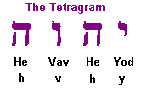
Hemphill concludes: Most Bible scholars would agree that the name Yahweh, or Jehovah, as it is sometimes translated, would be the proper name of God. The other names, including the compound names, provide further revelation of His character and His activity. (Names of God) JEHOVAH Note that the 4 letters (tetra = 4) of YHWH are often referred to as the Tetragrammaton Vowels were added to the "Tetragrammaton" (literally "four lettered name") YAHWEH ... which is most commonly transliterated (transcribed from one alphabet into corresponding letters of another alphabet) Note that when a Bible translation has LORD in all caps (actually capital L and small capital letters) it signifies... LORD is used in the NASB, ESV, GWT, KJV, NKJV, NAB, NIV, NLT, NRSV. Some versions retain Yahweh (NJB). A few versions transliterate YHWH as Jehovah (ASV, Darby, YLT). As wonderful as the Name "LORD" is, there is something especially beautiful when one speaks forth the Name "Jehovah".
Note: Lord ><>><>><>
><>><>><> First occurrence of A full revelation of the meaning and character of the Name Jehovah is not given by God ><>><>><> JEHOVAH
I AM [hayah] that I AM [hayah] The Greek translation (Septuagint - LXX) of the Hebrew I AM is Ego eimi (Verb eimi is in present tense God goes on to say to Moses... What truths do you see in the fact that Jehovah is the God of the patriarchs? 1) Speaks of God's eternality (Eternal) and life beyond the grave (not "I was" but "I am" implying they still exist) (cp Col 1:17) 2) Alludes to God's eternal covenant and the inherent promises (See Ex 2:24) (See also Abrahamic covenant) Jehovah is God's Memorial Name - What is the context Moses tells us
God God God God ><>><>><> JEHOVAH Repeatedly (854x) the KJV Scriptures declare saith the LORD and only twice saith God The name Jehovah affirms that God not only exists but that He communicates with us and desires to reveal Himself in such a way that we can come to know Him, ultimately only through "The Way", Who is Jesus, Who in turn (discussed below) is Jehovah. ><>><>><> JEHOVAH Ge 15:18 On that day Jehovah made (cut) a covenant with Abram, saying, "To your descendants I have given this land, From the river of Egypt as far as the great river, the river Euphrates. JEHOVAH "I am the LORD (Jehovah) and I appeared to Abraham, Isaac, and Jacob, as God Almighty (El Shaddai), but by My Name, LORD (Jehovah), I did not make Myself known to them. (Exodus 6:2-3)(see note) ><>><>><> Who is "I Am"? John 12:41 These things Isaiah said, because he saw His (Jesus') glory (Isaiah 6) and he spoke of Him (Jesus). CONCLUSION? What did Jesus teach in John 8:24 and Jn 8:58 Jesus declared to the Jews... (v24) I said therefore to you, that you shall die in your sins; for unless you believe that I Am (Ego eimi) He, you shall die in your sins... (v58)Truly, truly, I say to you, before Abraham was born, I Am (Ego eimi = present tense). CONCLUSION? Revelation 1:8 Again Jesus clearly declares... I am the Alpha and the Omega," says the Lord God, "Who is and Who was and Who is to come, the Almighty. (cp Re 22:13; Re 21:6) Hebrews 13:8 Jesus Christ is the same yesterday and today, yes and forever. (Immutable Christ) |
JEHOVAH (See also self-existent, eternal, infinite) I AM = Hayah = to be, exist (See Maclaren's eloquent explanation) Jesus amplified the "I Am" with seven great I AM revelations - the Bread of Life, the Light of the Word, the Door, the Good Shepherd, the Way, the Truth, the Life, Resurrection & the Life, the Vine (John 6:35; 8:12; 10:9, 11; 11:25; 14:6; 15:1, 5) Hemphill writes that...
Nathan Stone comments that I am that I am
Swanson writes that
God within His own being possesses the The "IS-ness" of God is expressive both of His presence and His existence. He is in a sense in which no other being is. He is, and the cause of His being is in Himself. He is because He is. ><>><>><> JEHOVAH Self Existence of God All created entities have a beginning, including time itself (Ge 1:1, cp Jn 1:1). As creatures, we must reckon in terms of the past and future, but to the Creator of time, all is present. He is transcendent or beyond our comprehension. ><>><>><> JEHOVAH I am Jehovah your God. Consecrate yourselves therefore, and be holy for I am holy (Lev 11:44, Lev 10:3, 19:2, 20:7,26) Jehovah may be transcendent but He is also personal as well as holy (set apart from the profane) ><>><>><> JEHOVAH Jehovah is righteous; He loves righteousness The upright will behold His face. (Psalm 11:7, cp Isa 45:7, Ps 99:4, Ps 146:8) Jehovah possesses righteousness as a personal attribute, loves it in the abstract, and blesses those who practise it. ><>><>><> JEHOVAH I, Jehovah do not change (Malachi 3:6)
When life takes unexpected turns or suffering sets in, be comforted knowing that Jehovah was not created, nor does His character change. His name refers to what He is and does from all eternity. Cast your burdens on the changeless, steadfast, everlasting I AM Who simply and yet profoundly "IS" and so is the unmoving center point around which all time and space revolves. ><>><>><> The respected Jewish commentator of the Middle Ages, Moses Maimonides, had these comments on Jehovah... All the names of God which occur in Scripture are derived from His works except one, and that is Jehovah; and this is called the plain name, because it teaches plainly and unequivocally of the substance of God. In the name Jehovah the personality of the Supreme is distinctly expressed. It is everywhere a proper name denoting the person of God and Him only.” ><>><>><> Dr. Charles Ryrie writes Jehovah... occurs 6,823 times in the OT and is especially associated with God's holiness (Lev 11:44, 45), His hatred of sin (Ge 6:3, 4, 5, 6,7), and His gracious provision of redemption (Isa 53:1, 5, 6, 10). ><>><>><> Smith and Cornwall summarize Jehovah writing that...
><>><>><> Spurgeon adds that
><>><>><> JEHOVAH
Listen to Chris Tomlin's - Indescribable; How Great Is Our God. Or watch (and listen prayerfully to the words) of In The Presence Of Jehovah by Chonda Pierce - this will surely soften your heart and moisten your eyes. Here are the lyrics to allow you to follow along... In and out of situations, But then I come into His presence, All my questions become clear Chorus |
Jehovah most clearly revealed Himself in a time of great need (read Exodus 3:1-22) for Israel was in bondage in Egypt and without hope from a human perspective. In response to their cry Jehovah revealed Himself as the I AM... I AM...the answer to your affliction. He still reveals Himself as Jehovah in our times of affliction and adversity. THOUGHT- Will you humble yourself and cry out to I AM? JEHOVAH Jehovah...
Although originally given to Israel this promise is applicable to all of God's children for all are in covenant with I AM (cf Gal 3:29 Jn 1:12) -- Guide Me O Thou Great Jehovah Jehovah Jesus (note) is the same even when the world is spinning seemingly out of control (He is in control) and many times our lives seem to be out of control. We can take those "out of control" thoughts captive and can rest in the absolute Truth that I AM never changes. He is the same regardless of the times, circumstances, etc. Jesus is the 'I AM' Who by His Spirit is active in empowering us for daily living and difficult circumstances. In the Greek "ego eimi" is present tense, signifying continuous activity. Whatever your present tense NEED, Jesus is the "I AM" provision for that need. THOUGHT- Do you know God as active in your life to overcome doubt or depression? Do you know Him as the present tense answer to the healing of broken relationships? Do you know Him as the God who can deal with your anger and resentment, as the God who can change your life? He is the "I AM" who is active to transform and empower daily living. Whatever your present tense need, Jesus is the "I AM" of God. He always was. He always is. He always will be. We all need Someone in this life Who will never change. We need someone Who is always there because we live in a day of broken relationships, when those we had trusted have betrayed us or forsaken us. Jehovah is the same, yesterday, today, yes and forever. THOUGHT- Why do we look elsewhere? Why not rest in Jehovah's unchangeableness? "I Am" has never failed. And so Isaiah can confidently declare... "Trust in Jehovah forever, for in GOD the I AM, we have an everlasting Rock." Jesus is Jehovah (note) I AM anything & everything you will ever need. If this is true then I must make the daily choice to come into His presence, to cry out to Him, to listen to Him and then to trust His guidance. ><>><>><> JEHOVAH: Jeremiah knew His God as "I Am" and even when all "hope" appeared lost, because He knew His Name and His character, he could confidently declare... Jehovah is my portion (Hebrew = inheritance) says my soul. Therefore I have hope in Him ><>><>><> JEHOVAH EZER — YOUR HELPER The writer of Hebrews writes to saints who are in need of stabilizing truth which he draws from the OT declaration by Jehovah: Let your character be free from the love of money, being content with what you have; for He Himself (Jehovah in Deut 31:6) has said, "I WILL NEVER (ever) DESERT YOU, NOR WILL I (never) EVER FORSAKE YOU," so that we confidently say, "THE LORD (Jehovah in Deut 31:6) IS MY HELPER*, I WILL NOT BE AFRAID. WHAT SHALL MAN DO TO ME?" (He 13:5, 6-see notes Heb 13:5; 13:6). (Spurgeon's note) *HELPER is Greek boethos (click boethos from boe = cry out for help + théo = run to) which gives us the incredible word picture of the great "I AM" Who is willing and able to run to our side when we cry out for help! Now what must we do? See related studies: ><>><>><> JEHOVAH: "This poor man cried and Jehovah heard him, and saved him out of all his troubles.... The righteous cry and Jehovah hears, and delivers them out of all their troubles." ><>><>><> JEHOVAH: "O JEHOVAH I remember Thy Name in the night and keep Thy law." (Ps 119:55) ><>><>><> Psalm 9:10 And those who know Thy name will put their trust in Thee, for Thou, O Jehovah, hast not forsaken those who seek Thee. (See note) The revelation and experiential (not just intellectual) knowledge of Jehovah and His character (which is inherent in His name) inspires trust. Spurgeon encourages us to
As Guzik says...
><>><>><> PASSING THROUGH “When Thou passest through the waters,” For the LORD Himself hath said it, Seas of sorrow, seas of trial, They shall never overflow us, Threatening breakers of destruction, Praise the LORD, Whose word is true! Ray Stedman makes an interesting observation that... it has been pointed out often that here (Ge 2:4,5, 7, 8, 9) the name of God appears in a different form than in Genesis 1. We have for the first time the great name of God that appears in so much of the rest of the Bible, Jehovah (or in the Hebrew, Yahweh) Elohim, translated in our version, LORD God. There is a special reason for this change. In Chapter 1 we are dealing with the making of things, and God is presented to us under the name of Elohim, i.e., the Creator. But when man appears on the scene God appears also in a different character. He now appears under the title of Jehovah, which means essentially the covenant-making God, the God Who keeps a promise. It is particularly significant that when God first reveals Himself to this race of ours, it is as a God who intends to keep His promises. (The Making of Man - Genesis 2:4-17) |
I AM
I was regretting the past
And fearing the future...
Suddenly my Lord was speaking:
“MY NAME IS I AM.” He paused.
I waited. He continued,
“When you live in the past,
With its mistakes and regrets,
It is hard. I am not there.
My name is not I was.
When you live in the future,
with its problems and fears,
it is hard. I am not there.
My name is not I will be.
When you live in this moment,
It is not hard.
I am here.
My name is I am.”
--Helen Mallicoat
Spurgeon has the following exposition of the Name Jehovah...
Jehovah: “the God of the whole earth shall He be called.” His kingdom ruleth over all: there is universality. But He calls Himself “Thy God”: there is specialty. The goodness of God surrounds all the creatures He has made; but there is a love which is peculiar to His own. To all the nations of the earth He was the one only Lord and God; but yet he said of Israel, “You only have I known, of all the families of the earth.” Limit not the benevolence of God; but, at the same time, do not deny the specialty of His love to His people.
Wide is the circumference of mercy, but the chosen dwell in the innermost center of His love. Thus, the one ever glorious Jehovah, while He is God unto the ends of the earth, is Israel’s God in a sense in which He is not the God of Assyria, or Persia, or Egypt, or Ethiopia; He has made Himself over to His own chosen people, saying, “I will be their God.”
Jehovah, the glorious I AM, signifies self-existence. He borrows nothing from others; indeed, in a sense, there are no others apart from Him, since all live by His permit and power. He is as complete without His creatures as with them. When there were no heavens, no earth, no twinkling star, nor flying seraph, He was as truly God, and as complete within Himself, as He is now that He has made creatures innumerable. Yet, though He be thus all-sufficient, self-sufficient, and self-existent, still He deigns to link Himself with our nothingness, and call Himself “Jehovah, thy God.”
The Self-existent gives His people existence, and then exists that He may bless them, and magnify the glory of His own existence in them.
The Lord liveth, and we live in Him, and by Him.
In Jesus we hear God saying to us, “Because I live, ye shall live also.” Oh, blessed union to God in Christ Jesus, by which we are supplied with every good from the self-existent fountain of life and being.
Jehovah, again, is a Name which means immutability.
“I Am That I Am” was his name to Moses. God always is in the present. To Him there is no past or future.
“He fills his own eternal NOW,
And sees our ages pass.”
This unchanging One here declares himself to be the God of beings who are but of yesterday, and full of change. Yes, great Lord, Thou wast my God when first my pulse began to beat; Thou didst care for me when I lay upon my mother’s lap. Thou hast watched over me when, in youthful days, I foolishly wandered; Thou hast called me back, and taught me to lay my finger in the print of my Savior’s wounds, and say, “My Lord, and my God.” Yes, Jehovah has been our God — “The same yesterday, to-day, and for ever.” (note Hebrews 13:8) He never changes nor ceases as to His love to us. He cannot love us more; He will not love us less. Without “variableness or shadow of turning” is Jehovah in His relation to those whom He has called into His favor.
Furthermore, Jehovah means sovereignty.
“Jehovah reigneth, let the people tremble.” His is a name of lofty royalty; for “Jehovah is a great God, and a great King above all gods.” He exercises the absolute prerogative, and “doeth according to His will in the army of heaven, and among the inhabitants of the earth.” He giveth no account of His matters. As the potter He disposeth of the clay at His own pleasure.
Yet, stooping from His boundless sovereignty and freedom, our Lord binds Himself to His own people by bonds of covenant pledge and promise, and says, “I am Jehovah, thy God.” He is our God, ready to hear our prayers, prompt to help our needs, held by His own oath and promise to be the Guardian and Helper of His people. I do not know how to admire enough these words of title, so glorious and so gracious; so high above us, and yet so near to us — “Jehovah, thy God!” Here is matter of thought, and motive for love. (See Spurgeon's full sermon "Jehovah's Valuation of His People" - Pdf)
In another sermon Spurgeon writes...
The name of Jehovah reminds us that He has within Himself sufficiency for all His will; He hath adequate power of performance for all His purposes and decrees; Jehovah wills, and it is done. He has created legions of angels, but He borrows nothing from them. He can truly say, “I am, and there is none beside Me.” Those mysterious living creatures which are nearest to His throne are His creatures, and not His helpers. The best instructed and the most willing of His servants, derive their all from Him, but supply Him with nothing. (Read Spurgeon's full sermon - Jeremiah 32:26,27 Is Anything too Hard for the LORD? - Pdf)
Warren Wiersbe has a very interesting analysis of Psalm 23 which begins with the name Jehovah...
- "The Lord" is Jehovah God, the covenant making God of Israel. The compound names of Jehovah in the Old Testament reflect the contents of this psalm.
- "I shall not want"—Jehovah-Jireh, the Lord will provide" (Gen. 22:14)
- "still waters"—Jehovah-Shalom, "the Lord our peace" (Jdg. 6:24)
- "restores my soul"—Jehovah-Rophe, "the Lord who heals" (Ex. 15:26)
- "paths of righteousness"—Jehovah-Tsidkenu, "the Lord our righteousness" (Jer. 33:16)
- "you are with me"—Jehovah-Shammah, "the Lord is there" (Ezek. 48:35)
- "presence of my enemies"—"Jehovah-Nissi, "the Lord our banner" (Ex. 17:15)
- "anoint my head"—Jehovah-M'Kaddesh, "the Lord who sanctifies" (Lev. 20:8) (Bible Exposition Commentary - Old Testament )
See in depth article "On the Divine Name (Jahveh, Jehovah)" in volume 1 of the 8 volume work entitled "The History of Israel" by Heinrich Ewald (1843-1859)
W E Vine on Isaiah 42:5-6 - The Lord now makes the solemn affirmation “I am Jehovah; that is My Name,” recalling His twice repeated Name in verses 5 and 6. That was the Name by which He revealed Himself to Moses, as a pledge that He would fulfill His word in regard to the commission given to him. By this title He declared (1) His self-existence, Exodus 3:14; (2) the assurance of the everlasting and unchangeable nature of His character, verse 15; (3) His power to redeem, 6:2–6; (4) His authority as the One who, having redeemed, claims obedience to His commands, 20:2. That His Name is the guarantee of the fulfillment of His word, is the clear intimation here in Isaiah 42:8.
How sure and steadfast is His word! What an incentive it provides for faith to lay hold of His promises, even in the darkest hour and amidst the most perplexing and distressing circumstances!
Several times in the Gospels Jesus made the amazing claim to be the “I AM” of the Old Testament. In the 8th chapter of John He was debating with the Jewish leaders over identity. They claimed to be of their father Abraham, but He said they were of their father the devil (Jn 8:44). Towards the end of this confrontation, Jesus said that Abraham rejoiced to see His day (Jn 8:56). The Jewish leaders pointed out that Jesus was not yet fifty years old, and so how could He have seen Abraham. That is when He answered, “Before Abraham was, I AM.” At this they picked up stones to stone Him, for they knew what He was claiming.
Likewise in the Garden of Gethsemane when they came to arrest Jesus, Jesus said to them, “I AM” — and they all drew back and fell to the ground (John 18:6,7). It was not the simple boldness of identifying Himself as the one they sought that caused this, but the claim He was making, and had been making throughout His life.
In John 10:30 Jesus declared, “I and the Father are one.” And there also they took up stones to kill Him.
In the Old Testament God revealed Himself to Moses as “I AM that I AM” (Exod. 3:13-1614); and that name was then put into the third person form to be used by the people of God: “Yahweh.” Throughout the Old Testament this name “Yahweh” revealed the Lord God as the one who was sovereignly independent of all creation. And as the Lord Himself used the name, it came to express His complete provision for all of the needs of the people: I AM—your healer, your rock, your redeemer, your sustainer, etc. In Isaiah 41:4 He revealed Himself as the first and the last, an expression that Jesus used to describe Himself in the Revelation (Rev 1:8) to John (see again Isaiah 44:6). In fact, throughout the Gospel of John Jesus followed this Old Testament use of the “I AM”: I am the bread of life (John 6:32-35); I am the light of the world (John 8:12-20); I am the door (John 10:7-10); I am the good shepherd (John 10:11-16); I am the resurrection and the life (John 11:25-27); I am the way, the truth and the life (John 14:6); and I am the vine (John 15:1-8). These are largely statements that only God could make; and the use of “I am” in each underscores that connection.
Jesus was claiming to be divine, and that is why they killed Him. People today often say that Jesus never really claimed to be God. But the leaders crucified Him, and the charge was blasphemy. The people of His day surely understood the claim. He was in fact making that claim, because He was, and is, in fact, the Lord God, the Holy One of Israel.
If the Lord Jesus Christ is the great I AM, then it was He, in a pre-incarnate appearance, who appeared to Moses at the burning bush as “I AM.” It was He in a pre-incarnate appearance who met with Moses on Mount Sinai as a man speaks to a friend, who put Moses in the cleft of the rock as He passed by, who caused Moses’ face to shine with His glory (compare the transfiguration in Matthew 17). It was He whom the Israelites saw when they “ate with God” the peace offering on the slopes of Sinai (Exod. 24:10). What they saw was a glimpse of the God of glory, the expanse that was the base of His throne, something of what Isaiah saw (Isaiah 6), or Ezekiel (Ezekiel 1), or John on Patmos (Rev. 1).
And if our Lord is the I AM of the Old Testament, then Old Testament references to “Yahweh” could just as easily refer to Him as to the Father. That is why the New Testament writers often quote Old Testament passages that refer to Yahweh and interpret them to mean Christ. Hebrews 1 is an explanation of who Jesus truly was and is. And after rehearsing the Old Testament passages that predicted His messianic kingship, the writer refers to Him as the Creator by applying Psalm 102 to Jesus: “In the beginning, O Yahweh, you laid the foundations of the earth.” The passage goes on to say that they will all wear out, but our Lord remains the same forever.
The writers came to understand that there were three persons in the Godhead, a trinity. One God, but three persons. If the Son of God, our Lord Jesus Christ, is in truth the second person of the trinity, if the title “Son of God” means more than a title for a king, then we should not be surprised at all to see Him revealed in the Old Testament Scriptures (see Proverbs 30:4, “What is His [God’s] name, and what is His Son’s name?”). After all, the second person of the trinity is the One Who reveals the Godhead to all of mankind. So before the Son of God entered the human race in Bethlehem, He did in fact come to earth in various ways in the Old Testament. And He did reveal Himself as the “I AM,” as “Yahweh,” in the Old Testament. Such an identity for Jesus ought to inspire greater devotion from us, and greater trust as well, for He is the One who can provide all our needs, not only spiritual but physical as well.
Genesis 2:4 This is the account of the heavens and the earth when they were created, in the day that the LORD (Yahweh/Jehovah) God (Elohim) made earth and heaven.
LORD...God - Two names of God should not confuse us. We do not have a pantheon of gods. We worship one God, Elohim, the Creator of the heavens and the earth, Who reveals Himself in such a manner (Jehovah) that we can know Him in a personal way.
Believer's Study Bible has an excellent summary of Jehovah/Yahweh noting that...
Up to this point only elohim (Heb.), translated "God," indicating the transcendent God of Creation, has been used (1:1); but here the personal name occurs, introducing God in His redemptive capacity. The divine name Yahweh is identified as God's covenant name (Ex. 3:13, 14, 15, 16; 6:1, 2, 3), showing His personal relationship to those who believe. This is the appropriate time for the appearance of God as Redeemer -- at the very moment that man appears in history. Yahweh is man's tutor (Ge 1:9, 10, 11, 12, 13, 14, 15, 16, 17); He is man's benefactor, providing him with the garden in which to work out his stewardship; and He is man's provider, supplying man with a counterpart, i.e., a wife, equal to him in all things and indispensable to the continuity of the race (Ge 1:18-25). The precise pronunciation and spelling of the name Yahweh has been lost. Judaism in the postexilic period (fifth century B.C. and later) prohibited the pronunciation of the name, reasoning that the most certain way not to take God's name in vain was never to pronounce it at all (Ex. 20:7). The Jews substituted for this name in their reading tradition the title "Lord" (Adonai, Heb.), reminding the reader to say Adonai instead of Yahweh by writing the vowels of Adonai with the consonants of Yahweh. The result appears to be the hybrid form YeHoWaH, which many unfamiliar with the Jewish tradition came to pronounce "Jehovah." Today, Jews and Christians alike refer to Yahweh as Lord. The precise etymology of Yahweh is uncertain, but it evidently derives from the verb "to be" (hayah, Heb.). The explanation for the divine name is given in Ex. 3:14, 15, where God identifies Himself as "I AM WHO I AM" (see Ex. 3:14). This expression means that God is the self-existent One who is independent and autonomous. Another view interprets the name as causative, meaning "He causes to be." Thus, in addition to being an appropriate personal name for God as the covenant-making and covenant-keeping God of the Hebrews, it is a fitting name for the God of salvation, the Deliverer, the Friend of His people. Thus, the title Yahweh Elohim, "Lord God," together with implications throughout the creation narrative, pictures God as both transcendent and immanent. Though He is self-sufficient, He has chosen to bind Himself in covenant to His creation. (Believer's Study Bible)
The Context Exodus 3:1-13 (see commentary)
Exodus 3:1 Now Moses was pasturing the flock of Jethro (See note - Moses' father in law also called Reuel) his father-in-law, the priest of Midian; and he led the flock to the west side of the wilderness, and came to Horeb, the mountain of God.
Comment: Remember that the background for this chapter is the fact that the children of Israel were slaves in Egypt and had been crying out to God for deliverance.
Horeb (description) - most interpret Horeb as synonymous with Mount Sinai (ISBE article on Sinai - discusses Horeb) (cf. Deut 5:2) which could be the 7,363 ft peak in the SW Sinai Peninsula, although the exact peak is open to question.
Now Moses - You never know what a day may bring, so keep your eyes and ears open to the leading of the Lord. Childlike curiosity completely changed Moses’ life. God calls busy people to serve Him, and He reveals Himself to them. God is faithful. He called Abraham, cared for Isaac, guided and protected Jacob, and He would be with Moses. He is the God of the individual as well as the nation, and He does not change from generation to generation. God is concerned and compassionate. He saw the affliction of His people, and He heard their cries. Then why didn’t He act sooner? Because He was following a perfect timetable Ge 15:16 ("Then in the fourth generation they shall return here, for the iniquity of the Amorite is not yet complete."). You must learn to wait on the Lord. See Ps 37 (Spurgeon's notes). God is long-suffering. The Lord answered all of Moses’ objections and gave one assurance after another to encourage him. Moses said, “I am not!” and God replied, “I AM!” Faith lays hold of what God is and obeys what God says. Faith sees the opportunities while unbelief sees the obstacles. Are you arguing with God about something He wants you to do?
Exodus 3:2 And the Angel of the LORD appeared to him in a blazing fire from the midst of a bush; and he looked, and behold, the bush was burning with fire, yet the bush was not consumed.
Comment: The idea of appeared is clearly that God allowed something of Himself to be seen in the Theophany (Christophany), the Angel of the LORD. It is notable that God only appeared this way to individuals and never to large groups of people, to whom it was His glory that was revealed (although Judges 2:1ff may be an exception).
He looked - The NET Bible note says "The text again uses (a construction) traditionally rendered “and behold.” The particle goes with the intense gaze, the outstretched arm, the raised eyebrow – excitement and intense interest: “look, over there.” It draws the reader into the immediate experience of the subject." (Note )
Fire - Fire frequently accompanied the revelation of Jehovah (Yahweh) in Exodus in various contexts - delivering, guiding or purifying her (His "wife", Israel). Some like Philo (a Jewish writer in the first century AD) interpreted the burning bush allegorically (for more discussion of allegory and related topics see [i.] Art and Science of Interpretation; [ii.] The Rise of Allegorical Interpretation; [iii.] Understanding Symbols and Figures and [iv.] Understanding Numbers). Allegorical interpretation assigns so-called "deeper meanings" to biblical persons, events, things or institutions, thus minimizing and even destroying the literal and historical meaning. The allegorical method of interpretation is to be assiduously avoided! Moses saw a bush actually burning, but not consumed. Explanations such as Philo's allegorical interpretation or others that it was like a bush with brilliant berries or leaves do not do justice to a literal interpretation of the text. God said it. That settles it, whether I believe it or not!
Exodus 3:3 So Moses said, "I must turn aside now, and see this marvelous sight, why the bush is not burned up."
I must turn aside now - As Matthew Henry reminds us "Things revealed belong to us, and we ought diligently to enquire into them."
THOUGHT - Are you taking advantage of the things revealed to you by God in His holy Word? As someone has well said sin will keep you from the Bible or the Bible will keep you from sin. Bibles that are "falling apart" usually belong to people who are not. God has chosen to reveal Himself to us in ways just as miraculous and supernatural as He did to Moses. May God grant that each of us have the same reaction of "I must turn aside now and see this marvelous sight." Amen.
Exodus 3:4 When the LORD (Jehovah, Yahweh) saw that he turned aside to look, God (Elohim) called to him from the midst of the bush (remember this is still in the context of the Angel of the LORD), and said, "Moses, Moses!" And he said, "Here I am."
Moses, Moses - The repetition of the name of the person addressed always seems to indicate a message of special importance - here the repetition of Moses' name adds emphasis and makes the appeal direct and immediate. Other examples of repetition of one's name include: Abraham (Ge 22:11); Samuel (1Sa 3:10); Jerusalem (Mt 23:37) Martha (Lu 10:41) Simon (Lu 22:31), Saul (Acts 9:4, 22:7, 26:14). Furthermore, this same response (Here I am) was given to God by several other OT saints - Abraham (Ge 22:11), Jacob (Ge 46:2), and Samuel (1 Sa 3:4).
Exodus 3:5 Then He said, "Do not come near here; remove your sandals from your feet, for the place on which you are standing is holy ground."
Remove your sandals - Removing one’s sandals was a sign of respect toward a superior, or toward a person’s dwelling. Sandals were often removed before entering someone’s home, or before entering a sacred place like a temple. The removal of sandals in the East is still a sign of humility and reverence. It pictures one removing the dust and dirt of this world, so as not to profane that which was set apart from the world (i.e., Holy). The ground God says is "holy" or "set apart, distinct, unique" ground, because of the presence of the Holy One of Israel.
THOUGHT - Have you ever set aside a time and/or a place as "holy" (under grace and enabled by the Spirit not under law or in ritual) that you might have a reverent time of communing with the precious Holy One of Israel? Or are you too busy to "give Him the time of day" (and in so doing miss the very best portion of that entire day!)?
Exodus 3:6 He said also, "I am the God of your father, the God of Abraham, the God of Isaac, and the God of Jacob." Then Moses hid his face, for he was afraid to look (gaze) at God.
I am the God of your father... - It is significant that God first identified Himself in terms of His historic relationship to Israel's patriarchs, Abraham, Isaac and Jacob, the recipients of the eternal covenant. This designation (the naming of the three patriarchs) obviously brings to mind His covenant and His immutable covenant promises. He is a covenant keeping God, unlike the so-called fickle, vain "gods" of this world. Moses' response of hiding his face reflects a combination of fear, reverence and humility.
Exodus 3:7 And the LORD said, "I have surely seen the affliction of My people who are in Egypt, and have given heed to their cry because of their taskmasters, for I am aware of their sufferings.
I have surely seen - Hebrew verb structure intensifies this statement so that there is no doubt that God has seen and no doubt that He will respond!
THOUGHT- Would it be that we all grow to trust that He sees our plight and in His timing He will deliver us either out of or through the fire!
Exodus 3:8 "So I have come down to deliver them from the power of the Egyptians, and to bring them up from that land to a good and spacious land (both good in quality and large in size), to a land flowing with milk and honey (hyperbole describing a land with an abundance of these products and so a very desirable land), to the place of the Canaanite and the Hittite and the Amorite and the Perizzite and the Hivite and the Jebusite.
I have come down - an idiom describing divine intervention and a frequent anthropomorphism in Genesis and Exodus which speaks of God's direct involvement, often in carrying out judgment but in the present context of bringing about deliverance
To deliver - (Hebrew = natsal) means to rescue, snatch out of danger, to save, to deliver from enemies or troubles or death. Deliverance often indicated the power of one entity overcoming the power of another and was frequently expressed as deliverance from the hand or power of another. The idea can be to deliver so that one is safe from danger and thus in a more favorable circumstance. The Septuagint (LXX) translates the Hebrew verb natsal with the Greek verb exaireo which means to pluck out, tear out, draw out or remove (Jesus used it to describe what we should do with our right eye if it makes us stumble "tear [exaireo] it out!"
Bring them...to a good and spacious land - God was reminding Moses He would fulfill His covenant promises to Abraham. An deep understanding of God's covenants, especially the Abrahamic, Mosaic and New, will greatly strengthen your trust in God and His Word, especially His covenant promises of provision, protection and prospects (future). I am not just referring to being able to list off the details of each covenant, but of truly understanding the foundational aspects of each covenant. God has chosen to reveal Himself in two testaments (virtually synonymous with the word covenant [Concise Oxford English Dictionary - testament = a covenant or dispensation]) (If you have never studied covenant in this way, you are strongly encouraged to study the notes beginning with Covenant: Why Study It? - even better order Precept's course on Covenant - download lesson 1 free. Kay Arthur also has an excellent book on Covenant [Our Covenant God: Learning to Trust Him and the also get the accompanying guide Our Covenant God Study Guide: Learning to Trust Him]. Whichever you choose to do, be sure to carefully read the Scriptures that relate to the specific aspects of covenant which you are studying. The word and the truth of covenant will take on an entirely new meaning and significance in your life. Guaranteed!)
Exodus 3:9 "And now, behold, the cry of the sons of Israel has come to Me; furthermore, I have seen the oppression with which the Egyptians are oppressing them.
Cry - The Hebrew word is a technical term describing the outcry that one might make for example to a judge. Jacobs writes that "God had seen the oppression and so knew that the complaints were accurate, and so he initiated the proceedings against the oppressors" (Jacobs, B. Exodus: The Second Book of the Law)
Oppressing - (Hebrew = lachats) means to oppress, to crush and conveys the idea of pressure with the oppression and thus a squeezing or pressuring. This word was used later for torturing or tormenting. The Greek Septuagint (LXX) translates the Hebrew verb lachats with thlibo (see word study) (see also picturesque related noun thlipsis = affliction) which literally conveys the idea of pressing or rubbing together and hence compressing or making narrow. Figuratively, thlibo means to oppress or afflict.
Exodus 3:10 "Therefore, come now (or "Go" - a command), and I will send (Septuagint = apostello - English "apostle") you to Pharaoh, so that you may bring My people, the sons of Israel, out of Egypt."
I will send... bring My people...out - The NET Bible Note comments that...
These instructions for Moses are based on the preceding revelation made to him. The deliverance of Israel was to be God’s work – hence, “I will send you.” When God commissioned people, often using the verb “to send,” it indicated that they went with his backing, his power, and his authority. Moses could not have brought Israel out without this. To name this incident a commissioning, then, means that the authority came from God to do the work (compare John 3:2).
Exodus 3:11 But Moses said to God, "Who am I, that I should go to Pharaoh, and that I should bring the sons of Israel out of Egypt?"
Who am I - Some commentators consider Moses' question, "Who am I?" as irrelevant as well as irreverent, because the covenant God had just promised that He Himself would deliver Israel. They reason that Moses' question was irreverent because it called into question God's judgment in His choice of such a lowly servant. To be sure later on Moses gave God excuses about his inability to speak or to stand before the Pharaoh. But who could imagine the created one arguing against the Creator? And yet don't we find ourselves reacting in a similar way when God asks us to do something like "Husbands, love your wives" or "Wives, respect your husbands" or "Children obey your parents"? We're just like Moses and we say "Who am I?" We each have our excuses why God's commands don't seem reasonable in our particular situation! Fallen human nature hasn't changed much since the days of Moses! We make excuses about our inability to love, to respect, or to obey and we question God's right or wisdom in calling us to do so.
Hemphill adds that...
We, like Moses, suffer from the mistaken idea that we can do God's work in our own strength. When God calls us to a task, we can rest assured that He has created us for this very purpose and will empower us to accomplish it. He is active in the present. I believe that Moses asked such an irrelevant and irreverent question because he suffered from a problem that affects men and women today. Until God approached Moses at the burning bush, He was only a God of history to Moses, not a God of the present. Perhaps Moses had absolute confidence that God had worked miraculously in the lives of Abraham, Isaac, and Jacob. He probably never would have considered calling these historical accounts into question. Yet, at the moment of truth, he struggled to believe that the God of history could work through his life to deliver Israel.
Tragically, many of us are at the same point in our Christian pilgrimages. We have no problem affirming the historical accuracy of the Bible. We don't question that God opened the Red Sea. We may not be sure how He accomplished this feat or how wide the opening was, but we're sure it was big enough to get the children of Israel through on dry land. We believe that God fed the five thousand with five loaves and two fishes. We believe that all the miracles are historically true!
What if you were asked: "Do you believe that God can work in your life today? Do you believe He can use you to change your nation? Do you believe that God can work in your church today to transform your city and the world? Do you believe that God can change your marriage and restore broken relationships? Do you believe that God can forgive your sin? Do you believe that God can work in your life, enabling you to teach that Sunday school class? Do you believe that God can work in your life to reach that unsaved friend that you've been thinking is beyond His reach?" Is your God merely a God of history, and not necessarily a God of the present? (BORROW Names of God)
Warren Wiersbe interprets Moses' interaction with God in a totally different light writing...
We admire Moses for his humility, for forty years before he would have told God who he was! He was “learned...and mighty in words and in deeds” (Acts 7:22). But years of communion and discipline in the desert had humbled Moses. A person acting in the flesh is impulsive and sees no obstacles, but a person humbly walking in the Spirit knows the battles that lie ahead. God’s reply was to assure him: “I will be with you!” This promise sustained him for forty years, as it later did Joshua (Josh. 1:5). Who we are is not important; that God is with us is important, for without Him we can do nothing (John 15:5). (BORROW Wiersbe's Expository Outlines on the New Testament)
Exodus 3:12 And He said, "Certainly I will be with you, and this shall be the sign to you that it is I who have sent you: when you have brought the people out of Egypt, you shall worship God at this mountain."
Certainly I will be with you - God responds to Moses’ first concern about his own inadequacies. Jehovah's promised presence is enough! And Jesus says the same thing to believers today who feel inadequate for the task to "Go therefore and make disciples" promising them "lo, I am with you always, even to the end of the age." (Mt 28:19-20, cf Heb 13:5-notes)
Worship - John Hannah writes that...
The purpose of the deliverance was that Israel might “worship God.” This purpose is stated frequently in Exodus (Ex 4:23; 7:16; 8:1, 20; 9:1, 13; 10:3, 7, 8, 11, 24, 26; 12:31). The Hebrew word for “worship” is the same word for “to be a slave” ('abad). Israel had been slaves ('abodim) of Egypt (Ex 6:6), and was in slavery ('abodah, Ex 2:23) in Egypt (“the land of slavery,” lit., “the house of slaves, ”bet abadim Ex 1:3, 14; 20:2). Having served as slaves to the Egyptians, Israel was now to serve the LORD, worshiping Him as His subjects. (BORROW Bible Knowledge Commentary - Old Testament)
Exodus 3:13 Then Moses said to God, "Behold, I am going to the sons of Israel, and I shall say to them, 'The God of your fathers has sent me to you.' Now they may say to me, 'What is His name?' What shall I say to them?"
What is His name? - Moses second question/concern (the first was "Who am I?" which shifts to "Who are You?") is both both relevant and reverent and is really the only question that has any relevance in his life or in ours.
THOUGHT - What is His Name? This should be our objective for the remainder of our life on earth, to grow in our knowledge of His Name which ultimately reflects His character and His attributes. Intimately, experientially knowing His personal name Jehovah should be the warp and woof of our lives, beloved. And in this task we shall never reach the end for the more we know, the more we know we don’t know!
Jesus said...
And this is eternal life, that they may know Thee, the only true God, and Jesus Christ Whom Thou hast sent. (John 17:3)
Paul declared the warp and woof of his life was...
that I may know Him (Jehovah Jesus), and the power of His resurrection and the fellowship of His sufferings, being conformed to His death in order that I may attain to the resurrection from the dead. (See notes Philippians 3:10; 11)
Wiersbe adds that...
This was no evasive question, for the Jews would want assurance that the Lord had sent Moses on his mission. God revealed His name, Jehovah—“I AM WHO I AM” or “I was, I am, I always will be!” Our Lord Jesus added to this name in the Gospel of John where we find the seven great I AM statements (John 6:35; 8:12; 10:9, 11; 11:25; 14:6;15:1, 2, 3, 4, 5). If God is “I AM,” then He is always the same, and His purposes will be fulfilled. God promised Moses that He would see to it that the work was done, in spite of the opposition of Pharaoh. (Ibid) (Bolding added)
Fretheim explains Moses' question of God this way reasoning that...
God’s commission is that Moses go to Pharaoh. Moses understands that this entails being sent to Israel. But Israel has not acknowledged his leadership; he in fact may be a stranger to most. Hence the importance of going to the elders first (Ex 3:16). Moses’ question is natural: Will the people listen to him? The name of the God for whom he speaks will establish his credentials. For this purpose the divine self-identification given in verse 6 is insufficient. The assumption seems to be that, if Moses has been commissioned to bring the people out of Egypt, Moses should have a divine name commensurate with this new development in God’s relationship with Israel. God’s double command (Ex 3:15, 16) that the new identification be repeated to the people shows its importance. (Fretheim, T. E. Exodus. Interpretation, a Bible Commentary for Teaching and Preaching. Louisville: John Knox Press)
Exodus 3:14 (see commentary) And God said to Moses, "I AM WHO I AM"; and He said, "Thus you shall say to the sons of Israel, 'I AM has sent me to you.'"
Is God-?' 'Does God-?'
Man's 'Why?' and 'How?'
In ceaseless iteration storm the sky.
'I am'; I will'; 'I do'—sure Word of God,
Yea and Amen, Christ answers each cry;
To all our anguished questionings and doubts
Eternal affirmation and reply.
I Am - The Hebrew verb for I AM is hayah means to exist or to be or become. The Septuagint (LXX) translates the Hebrew phrase with the Greek phrase "Ego eimi" where the verb eimi is in the present tense. This Greek phrase is exactly what Jesus used in His claims in John 8:24 and John 8:58 (see discussion below).
The most common translation is "I AM WHO I AM” (NASB ,ESV, GWT, ICB, NKJV, NRSV, TEV)
Other renderings include:
I AM WHO I AM and WHAT I AM, and I WILL BE WHAT I WILL BE (Amplified)
I AM THAT I AM (Darby, KJV)
I WILL BE WHAT I WILL BE (Marginal Readings of NIV, NRSV)
I Am He Who is (NJB)
I AM THE ONE WHO ALWAYS IS (NLT)
I WILL BE WHAT I WILL BE (NLT Marginal reading)
I AM THAT WHICH I AM (Young's Literal)
“I will cause to be what I will cause to be”
“I will be who I am / I am who I will be”
Gianotti reasons that...
If Moses indeed had a revelation from God, then the Israelites would want to have that verified with Moses relating something hitherto unknown about their God. Exodus 3:14 is God’s response to Moses’ concern about validating his mission to the Israelites with newly revealed information about God’s character. (The Meaning of the Divine Name YHWH - Bibliotheca Sacra: Volume 142, 1985 Charles Gianotti ).
Wiersbe explains God's answer to Moses this way...
What Moses asked was, “What does Your name mean? What kind of a God are You?” God explained that the name Jehovah is a dynamic name, based on the Hebrew verb “to be” or “to become.” He is the self-existent One who always was, always is, and always will be, the faithful and dependable God who calls Himself “I AM.” Centuries later, Jesus would take the name “I AM” and complete it: “I am the bread of life” (John 6:35), “I am the light of the world” (John 8:12), “I am the true vine” (John 15:1), and so on. (Bible Exposition Commentary - Old Testament )
Guzik writes that...
Rightfully, Moses sensed he needed credentials before the people of Israel. Before, he thought he had the credentials because he was a prince of Egypt. 40 years of tending sheep took away his sense of self-reliance.
When God revealed Himself to man in the days of the patriarchs it was often associated with a newly revealed name or title for God.
Abraham, in the encounter with Melchizedek called on God Most High (Genesis 14:22) - El Elyon
Abraham later encountered Almighty God (Genesis 17:1) - El Shaddai
Abraham came to know the Lord as Everlasting God (Genesis 21:33), and The-Lord-Will-Provide (Genesis 22:14) - Jehovah Jireh
Hagar encountered You-Are-the-God-Who-Sees (Genesis 16:13) - El Roi
Jacob met El Elohe Israel (Genesis 33:20) and El Bethel (Genesis 35:7).
Now, when Moses comes to the elders of Israel with a "new message" from God, it is logical to think they would ask, "What name did He reveal Himself to you under? What new revelation from God do you have?"
The name I Am has within it the idea of aseity - that God is completely independent; that He relies on nothing for life or existence (Isaiah 40:28, 29; John 5:26). God doesn't need anybody or anything - life is in Himself.
Also inherent in the idea behind the name I Am is the sense that God is "the becoming one"; God becomes whatever is lacking in our time of need. The name I Am invites us to fill in the blank to meet our need - when we are in darkness, Jesus says I am the light; when we are hungry, He says I am the bread of life, when we are defenseless, He says I am the Good Shepherd. God is the becoming one, becoming what we need.
Hemphill commenting on I Am notes that...
Various scholars have suggested different translations of the name of God used in this passage. The name is from the imperfect stem of the Hebrew verb "to be." The imperfect tense denotes an action that started in the past, continues in the present, but is not yet complete. Many Bible scholars follow the simple translation that we have in our text, "I am who I am." One of our Old Testament scholars at Southwestern translates it this way: "I AM who I have always been." I like this translation because it affirms that the God who spoke from the burning bush is the same God who worked through the lives of Abraham, Isaac, and Jacob. It also implies His ability and desire to work through Moses in the present and the future. However we translate this name, we can be assured that it affirms God's self-existence and His eternality (BORROW Names of God)
Keil and Delitzsch suggest that...
The repetition of the same word [I am] suggests the idea of uninterrupted continuance and boundless duration.
Thomas Constable quotes several sources writing that...
“To the Hebrew ‘to be’ does not just mean to exist as all other beings and things do as well—but to be active, to express oneself in active being, ‘The God Who acts.’ ‘I am what in creative activity and everywhere I turn out to be,’ or ‘I am (the God) that really acts.’ (Sigmund Mowinckel, “The Name of the God of Moses,)
“I am that I am” means “God will reveal Himself in His actions through history.” (Charles Gianotti, “The Meaning of the Divine Name YHWH" Bib Sac)
Another writer paraphrased God’s answer, “It is I Who am with you.” In other words, the One Who had promised to be with the descendants of Abraham, Isaac, and Jacob had sent Moses to them.
“The answer Moses receives is not, by any stretch of the imagination, a name. It is an assertion of authority, a confession of an essential reality, and thus an entirely appropriate response to the question Moses poses. (Durham) (Expository Notes)
Swanson writes that
I AM WHO I AM, i.e., a title of God with a focus on presence, care, concern, and relationship (Swanson, J. Dictionary of Biblical Languages with Semantic Domains : Hebrew (Old Testament)
I Am sent you - In His giving the name "I Am" to Moses to declare to the people, God was expressing the unchanging, eternal, self-existence of His being. He is ever able to act at will, to keep promises, to redeem Israel.
Related Resource:
In his Expositions of Holy Scripture, Alexander Maclaren beautifully connects God's self revelation with the burning bush writing
That is to say, the fire that burns and does not burn out, which has no tendency to destruction in its very energy, and is not consumed by its own activity, is surely a symbol of the One Being, whose being derives its law and its source from itself, who only can say—“I AM THAT I AM”—the law of his nature, the foundation of His being, the only conditions of His existence being, as it were, enclosed within the limits of His own nature.
You and I have to say, “I AM THAT WHICH I HAVE BECOME,” or “I AM THAT WHICH I WAS BORN,” or “I AM THAT” WHICH CIRCUMSTANCES HAVE MADE ME.”
He says, “I AM THAT I AM.” All other creatures are links; this is the staple from which they all hang. All other being is derived, and therefore limited and changeful; this being is underived, absolute, self-dependent, and therefore unalterable forevermore. Because we live, we die. In living, the process is going on of which death is the end. But God lives forevermore, a flame that does not burn out; therefore His resources are inexhaustible, His power unwearied. He needs no rest for recuperation of wasted energy. His gifts diminish not the store which He has to bestow. He gives and is none the poorer. He works and is never weary. He operates unspent; He loves and He loves forever. And through the ages, the fire burns on, unconsumed and undecayed. (Ed note: And all God's people said "Hallelujah!")
Exodus 3:15 And God, furthermore, said to Moses, "Thus you shall say to the sons of Israel, 'The LORD, the God of your fathers, the God of Abraham, the God of Isaac, and the God of Jacob, has sent me to you.' This is My name forever, and this is My memorial-name to all generations.
God not only declares His absolute existence as in verse 14, but here He declares His relationship to His people. He is the God Who made an eternal covenant with Abraham, Isaac, and Jacob. Jehovah is His name forever and is His memorial name, a name that causes Him not to be forgotten.
WHAT DO WE LEARN ABOUT THE REVELATION OF JEHOVAH IN EXODUS 6:2-4?
God spoke further to Moses and said to him, "I am the LORD (Jehovah) and I appeared to Abraham, Isaac, and Jacob, as God Almighty (El Shaddai), but by My Name, LORD (Jehovah), I did not make Myself known to them. And I also established My covenant with them, to give them the land of Canaan, the land in which they sojourned." (Ex 6:2, 3, 4)
Septuagint of Exodus 6:3 reads...
And I appeared to Abram and Isaac and Jacob, being their God, but I did not manifest (deloo [word study] - make clear or plain, of something divinely communicated) to them my name Lord.
Related Resources:
J. A. Motyer emphasizes the association of God's Name with His character rendering Exodus 6:3...
And I showed myself to Abraham, to Isaac, and to Jacob in the character of El Shaddai, but in the character expressed by my name Yahweh I did not make myself known to them. (Bolding added)
Motyer concludes that
it was the character expressed by the name that was withheld from the patriarchs and not the name itself. To know by name means to have come into intimate and personal acquaintance with a person.
Gianotti Pastor, Hillside Bible Chapel, Orillia, Ontario, Canada agrees noting that...
Without doubt, the Tetragrammaton, YHWH,1 is the most significant name in the Old Testament. As one writer observed, “no single word in Hebrew has ever evoked such a torrent of discussion as…YHWH, the personal name of the Hebrew god [sic].”2 In distilling the vast amount of literature on the subject, five popular views rise to the surface. But before discussing these, certain observations should be made.3
For the Biblicist, the divine name YHWH was known as early as the time of Enosh (Ge 4:26) and was used not infrequently during the patriarchal period (cf. Gen 12:1, 4; 13:4 , etc.). Yet Exodus 6:2–3 seems to indicate that the name was not known until the time of Moses hundreds of years later: “God spoke further to Moses and said to him, I am the Lord and I appeared to Abraham, Isaac, and Jacob, as God Almighty (Shaddai, but by My name, Lord - YHWH], I did not make Myself known to them.”
But this tension is resolved by a correct understanding of the passage. Motyer offers an excellent exegesis translating it as follows: “And God spoke to Moses, and said to him: I am Yahweh. And I showed myself to Abraham, to Isaac, and to Jacob in the character of El Shaddai, but in the character expressed by my name Yahweh I did not make myself known to them….”4 He concludes that “it was the character expressed by the name that was withheld from the patriarchs and not the name itself….to know by name means to have come into intimate and personal acquaintance with a person.”5 Mowinckel concurs in reference to the burning bush incident that:
Exodus 3 does not support the theory that the name of Yahweh was not known to the Israelites before Moses…. A name may have deeper meaning than the one discernible at first glance and recognizable to everybody…a man who knows the “real” deeper meaning of the name of a god, really “knows the god” in question.6
Thus though the name YHWH existed well before the time of Moses, the meaning of that name was not revealed until the time of Moses. To understand the meaning of the divine name is to understand the character of God revealed by that name. Clearly Exodus 3:14 provides the beginning point for this discussion. (The Meaning of the Divine Name YHWH: Bibliotheca Sacra: Volume 142, 1985). (SEE Vital Old Testament Issues: Examining Textual and Topical ... - Page 28 for article by Gianotti entitled The Meaning of the Divine Name YHWH)
In his study on the tetragrammaton, scholar Charles Gianotti
outlines five major theological views regarding the meaning of YHWH
, which is
tied to the Hebrew verb meaning "to be"
. Ultimately, Gianotti notes that discovering the "meaning" of the divine name is primarily about understanding the active, covenantal character of God that the name reveals.
Gianotti’s five perspectives include:
Self-Existence:
The name points to God as the only self-existing, stable, and eternal being in the universe, emphasizing His unchangeable nature.
Divine Unknowability:
God essentially says to Moses, "I am who I am", conveying that human comprehension cannot fully grasp or define Him, and that He simply is.
Causative/Creator:
Interprets the name to mean "the one who causes things to happen," highlighting God as the active Creator and orchestrator of history.
Active Presence:
The name communicates "I will be with you" (Exodus 3:12). Instead of a purely abstract or philosophical statement, it serves as an assurance of God’s active, personal presence with His people.
Covenantal Faithful Action:
Rather than a strict focus on the metaphysical "to be," this view emphasizes God's active involvement in human affairs, demonstrating His enduring faithfulness to His covenant promises.
The comments of the liberals and "higher" critics who say Exodus 6:3 is indicative of an error in Scripture should be totally discounted as errant comments! Admittedly, some texts may be difficult to resolve with other texts, but this reflects man's partial, finite understanding of the infinite God's inerrant Word! (See also related note on Exodus 6:3)
Guzik writes that...
Yahweh was not a new name, nor an unknown name - it appears more than 160 times in the book of Genesis. Moses' mother's name was Jochabed meaning, Yahweh is my glory. Moses and Israel knew the name Yahweh. God did not give Moses a "new and improved" name of God, but the name they had known before. (Ibid)
Hemphill writes that...
We first encountered the name Yahweh in Genesis 2:4, but with no explanation of its meaning. Here in Exodus, Moses, the author of the first five books of the Bible, shows us the significance of God's name by connecting it to the covenant and a promise to the people. He affirms that the God of creation is the God of the patriarchs who has now manifested Himself as a personal, living God who will fulfill to the people of Israel the promise that He made to their fathers. The name Jehovah declares that God is personal, self-existent, and unchanging in His desire to reveal Himself in the personal redemption of those He has created (cf. Exod. 6:3-6). (Ibid)
Scofield comments that...
On the basis of this verse (Exodus 6:3) many critics have claimed that two of the sources of the books of Moses are a document using Elohim for the name of God, and one employing Jehovah; and that this passage reveals that the writer was ignorant of the many sections of Genesis in which Jehovah (usually written LORD) is used. It is further assumed that the writer of Exodus 6:3 believed that the name Jehovah was first made known in Moses' time. The answer to these assumptions is as follows: (1) The statement, "by my name the LORD [JEHOVAH] I did not make myself known to them" can also be translated as a rhetorical question, "By my name the LORD [JEHOVAH] was I not known to them?" (2) In the O.T. the verb "to know" generally means far more than to have an intellectual knowledge. There are many instances of this, such as Hosea 6:3: "Let us acknowledge the LORD." (3) The patriarchs were familiar with the name Jehovah, but their experience of God was largely that of Him as El-Shaddai (cp. Ge 17:1), the One who provided for all their needs. Here in Exodus 6:3 God tells Moses that He is now about to be revealed in that aspect of His character signified by Jehovah - i.e. His covenant-relation to Israel as the One who redeems her from sin and delivers her from Egypt (cp. Ex 6:6-8). (4) Actually there is no contrast in Ex 6:3 between Elohim and Jehovah, the names in this text being El-Shaddai and Jehovah. And (5) the Genesis record over and over reveals knowledge of the name Jehovah; for an outstanding example, cp. Ge 49:18. (Scofield Study Bible notes)
Although Jehovah was identified with the establishment of the Abrahamic covenant in Genesis 15:18, it was not until the time of the Exodus some 400 years later that the experiential knowledge of the name Jehovah was revealed to Israel. In other words, although Abraham and the other patriarchs Isaac and Jacob were clearly familiar with the name Jehovah as God's name associated with His covenant (Genesis 15:18) and had received specific covenant promises (Abraham received the son of promise, Isaac), they still did not possess a full knowledge of the meaning of Jehovah. In the redemptive events of the exodus from Egyptian bondage, Jehovah demonstrated not only His immutable (note) (unchangeable) character but also His faithfulness (note) to keep His covenant. In other words, in the Exodus which Jehovah supernaturally brought about, Israel received a revelation and experiential knowledge of Jehovah. Previously, as shepherds in Palestine, Abraham, Isaac, and Jacob had known God experientially, primarily as El Shaddai (note) (God Almighty) the Name which revealed His power and sufficiency but they had not known Him experientially as the God Who would bring about redemption in order to keep His covenant promises. (See additional note)
Recall that the name Yahweh (Jehovah, LORD) was known to Abraham even before the Name El Shaddai, as we note in such passages as Genesis 12:8, 13:4, 15:7 (and to Jacob in Ge 38:13). Clearly in Exodus 6 Jehovah does not introduce a new Name but a new revelation of that Name. Remember that the OT Names of God were a revelation of some aspect of His character and/or attributes. And so in Exodus 6 we see Jehovah reveals His character as the Covenant keeping God, faithful to keep His promises and faithful to redeem Israel from bondage. In other words, God would make Himself known to Israel in actions by which He had not revealed Himself to the patriarchs and which they knew only as promises of the covenant.
If we remember that God is infinite, it is not at all surprising that the generation of the patriarchs might not "know" God experientially in the same way that a later generation would come to know Him.
John MacArthur agrees reasoning that...
Since the name Yahweh was spoken before the Flood (Ge. 4:26) and later by the patriarchs (Gen. 9:26; 12:8; 22:14; 24:12), the special significance of Yahweh, unknown to them, but to be known by their descendants, must arise from what God would reveal of Himself in keeping the covenant and in redeeming Israel. (MacArthur, J.: The MacArthur Study Bible Nashville: Word)
The Jewish rabbi Rashi explains that this the text means
“I did not make Myself known, I did not allow My real character to be recognized.“ (prior to the time of the events of Exodus)
Some feel that the last clause in Exodus 6:3 might represent a rhetorical question which is permissible in the Hebrew and which would read "by my name JEHOVAH was I not also known to them?" Given the fact that God's Names are a revelation of His character, I think this is a less likely explanation.
Richards agrees writing that...
While the four–letter name YHWH appears in Genesis, its true significance was only revealed in the acts of power by which God intervened in Egypt to free Israel. From this time on, God’s people will know not only what God’s name is, but what that name means! (The Bible Readers Companion)
KJV Bible Commentary explains that...
They had not known the riches of God as Jehovah, the name now to be associated with God’s activity in keeping His covenant with Abraham. This is not to say that they did not know the name of Yahweh (thought by many to be the original pronunciation of the name, Jehovah); but they would now come to know the benefits of that name as Israel’s covenant-keeping God... God’s gracious loving-kindness would be manifested to them through a powerful deliverance. (Dobson, E G, Charles Feinberg, E Hindson, Woodrow Kroll, H L. Wilmington: KJV Bible Commentary: Nelson)
Keil and Delitzsch add that
When the establishment of the covenant commenced, as described in Genesis 15, with the institution of the covenant sign of circumcision and the promise of the birth of Isaac, Jehovah said to Abram, “I am El Shaddai, God Almighty,” and from that time forward manifested Himself to Abram and his wife as the Almighty, in the birth of Isaac, which took place apart altogether from the powers of nature, and also in the preservation, guidance, and multiplication of his seed.
It was in His attribute as El Shaddai that God had revealed His nature to the patriarchs; but now He was about to reveal Himself to Israel as Jehovah, as the absolute Being working with unbounded freedom in the performance of His promises. For not only had He established His covenant with the fathers (Ex 6:4), but He had also heard the groaning of the children of Israel, and remembered His covenant (Ex 6:5; not only—but also). The divine promise not only commences in Ex 6:2, but concludes at Ex 6:8, with the emphatic expression, “I Jehovah,” to show that the work of Israel’s redemption resided in the power of the Name Jehovah. In Ex 6:4 the covenant promises of Ge 17:7, 8; 26:3; 35:11, 12, are all brought together and in Ex 6:5 we have a repetition of Ex 2:24, with the emphatically repeated "I". On the ground of the erection of His covenant on the one hand, and, what was irreconcilable with that covenant, the bondage of Israel on the other, Jehovah was not about to redeem Israel from its sufferings and make it His own nation.
This assurance, which God would carry out by the manifestation of His nature as expressed in the name Jehovah, contained three distinct elements:
(a) the deliverance of Israel from the bondage of Egypt, which, because so utterly different from all outward appearances, is described in three parallel clauses: bringing them out from under the burdens of the Egyptians; saving them from their bondage; and redeeming them with a stretched-out arm and with great judgments;
(b) the adoption of Israel as the nation of God;
(c) the guidance of Israel into the land promised to the fathers (Ex 6:6-8). a stretched-out arm, is most appropriately connected with great judgments; for God raises, stretches out His arm, when He proceeds in judgment to smite the rebellious. These expressions repeat with greater emphasis the “strong hand” of Ex 6:1, and are frequently connected with it in the rhetorical language of Deuteronomy (e.g., Deut. 4:34; 5:15; 7:19). The “great judgments” were the plagues, the judgments of God, by which Pharaoh was to be compelled to let Israel go. (Keil, C. F., & Delitzsch, F.. Commentary on the Old Testament 1:303-304).
John 8:24 (Jesus in the Temple declared to the Jewish audience including scribes and Pharisees when they asked "Who are You?") "I said therefore to you, that you shall die in your sins; for unless you believe that I am (Ego eimi = present tense - "I am continually" is what Jesus is saying) He (note that "He" is in italics in NAS indicating that it is not in the original Greek text), you shall die in your sins." (Compare the paraphrase TEV [The English Version], noting how interpretative it is "you will know that 'I Am Who I Am'". Although the TEV is accurate in this interpretation, paraphrases [or the NIV = dynamic equivalence = not word for word] are not recommended for in depth Bible study.)
Commenting on John 8:24 MacArthur explains that "The Lord’s use of the absolute, unqualified phrase I am (the pronoun He does not appear in the Greek text) is nothing less than a direct claim to full deity. When Moses asked God His name He replied, “I AM WHO I AM” (Ex 3:14). In the Septuagint - LXX (the Greek translation of the Old Testament), that is the same phrase (ego eimi) Jesus used here (the Septuagint similarly uses ego eimi of God in Deut 32:39; Isaiah 41:4; 43:10, 25; 45:18; 46:4). Jesus was applying to Himself the Tetragrammaton (YHWH, often transliterated as Yahweh)—the name of God that was so sacred that the Jews refused to pronounce it. Unlike many modern cult groups (such as the Jehovah’s Witnesses - see notes), the Jews of Jesus’ day understood perfectly that He was claiming to be God. In fact, they were so shocked by His use of that name, in reference to Himself (cf. vv. 28, 58), that they attempted to stone Him for blasphemy (v. 59). (MacArthur New Testament Commentary: John 1-11. Page 348. Chicago: Moody Press)
John 8:58 Jesus said to them, "Truly, truly, (Amen, Amen - this should get their attention) I say to you, before Abraham was born, I am (Ego eimi = present tense - "I am continually" is what Jesus is saying)." 59 Therefore (term of conclusion) they picked up stones to throw at Him; but Jesus hid Himself, and went out of the temple. (See discussion of John 8:58 and Jehovah's Witnesses) (See related discussion of JW's and John 8:58 and John 10:30-33 and "I AM")
Comment: Why did they attempt to stone Jesus? Obviously they understood that He had just claimed to be God and to their ears was blaspheming. Remember who it is that sought to stone Him. From the context we see that these are the same group that John described earlier as "those Jews who had believed in Him" (John 8:31) They are the same audience to whom Jesus declared "you are of (the Greek preposition ek which here emphasizes the idea of source or origin. Jesus was saying in essence that they were the devil’s very offspring) your father the devil" (John 8:44) What is your conclusion? They had believed in Jesus but were they genuinely saved? Did they bring fruit in keeping with repentance? Who was their father - God or the devil? Clearly they were unregenerate. They believed He was Messiah but they did not really know Him for their believe was intellectual assent without a genuine heart response (see related notes Matthew 7:23)
MacArthur comments that...
Jesus’ climactic reply, “Truly, truly, I say to you, before Abraham was born, I am,” was nothing less than a claim to full deity. The Lord once again took for Himself the sacred Name of God. Obviously, as the eternal God (John 1:1-2), He existed before Abraham’s time.
Homer Kent explains, “By using the timeless ‘I am’ rather than ‘I was,’ Jesus conveyed not only the idea of existence prior to Abraham, but timelessness—the very nature of God Himself (Ex 3:14)” (Light in the Darkness [Grand Rapids: Baker, 1974], 128-29). (Ibid)
The NET Bible agrees writing that "I am is an explicit claim to deity. Although each occurrence of the phrase “I am” in the Fourth Gospel needs to be examined individually in context to see if an association with Exodus 3:14 is present, it seems clear that this is the case here (as the response of the Jewish authorities in the following verse shows).
- See Related Study: Angel of the LORD
- See Caveats Regarding the Name Jehovah
- See note above by Allen Ross
Whenever one reads LORD in all capital letters in the OT (in NAS but not capitalized in ESV), the Hebrew word is Jehovah. Jehovah also identifies Himself as "I Am" in Exodus 3:14. So Who is "I Am"? And Is "Jehovah" mentioned in the New Testament? In John's Gospel we read "These things Isaiah said, because he saw His glory and he spoke of Him." (Jn 12:41).
John in explaining the judicial hardening of Israel records
38 that the word of Isaiah the prophet might be fulfilled, which he spoke, "LORD, WHO HAS BELIEVED OUR REPORT? AND TO WHOM HAS THE ARM OF THE LORD BEEN REVEALED? (quoting Isaiah 53:1 - note that in the NAS, NT verses in all caps are indicative of direct OT quotes - and most of the OT quotes are actually from the Septuagint rather than the Hebrew text)"
39 For this cause they could not believe, for Isaiah said again,
40 "HE (Who is He? Jehovah = Jesus) HAS BLINDED THEIR EYES, AND HE HARDENED THEIR HEART; LEST THEY SEE WITH THEIR EYES, AND PERCEIVE WITH THEIR HEART, AND BE CONVERTED, AND I HEAL THEM."
41 These things Isaiah said, because he saw His (Whose? Jesus') glory (When? Isaiah 6:3 "Jehovah of hosts"), and he spoke of Him (Jesus). (John 12:38-41)
Here is Isaiah's record of this event in Isaiah 6:1-3 (See also Isaiah 6 Commentary) ...
1 In the year of King Uzziah's death, I saw the Lord (Adonai) sitting on a throne, lofty and exalted, with the train of His robe filling the temple. (This is His glory!)
2 Seraphim stood above Him, each having six wings; with two he covered his face, and with two he covered his feet, and with two he flew.
3 And one called out to another and said, "Holy, Holy, Holy, is the LORD (Jehovah) of hosts, the whole earth is full of His glory."
Numerous commentators in this century and prior centuries have concluded from John's passage that Jesus is Jehovah or Yahweh in the context of Isaiah's vision. However as discussed more below, not every use of Jehovah in the OT can be identified as Jesus. .
MacArthur concludes that John 12:41 "is a reference to Isaiah 6:1-note. John unambiguously ties Jesus to God or Yahweh of the OT (see John 8:58). Therefore, since John 12:41 refers to Jesus, it makes Him the Author of the judicial hardening of Israel. That fits His role as Judge (see John 5:22, 23, 27, 30; 9:39). (The MacArthur Study Bible Nashville: Word) (Bolding added)
James Montgomery Boice commenting on John 12:41 writes that "The Gospel of John is a book filled with many extraordinary verses. But none is more extraordinary than (and few are equal to) the verse to which we come now. It is a verse in which John refers to one of the most glorious visions of God ever given to a human being—the vision received by Isaiah at the beginning of his ministry as a prophet, in which he saw Jehovah sitting upon a throne, high and lifted up, with his train filling the temple—saying quite naturally, it would seem, that this applies to Jesus. John says, “Isaiah said this because he saw Jesus’ glory and spoke about Him” (Jn 12:41). (The Gospel of John: An Expositional Commentary) (Bolding added)
MacDonald - In Isaiah 6 the prophet was described as seeing the glory of God. John now added the explanation that it was Christ’s glory which Isaiah saw, and it was of Christ that he spoke. Thus, this verse is another important link in the chain of evidence that proves Jesus Christ to be God. (Believer's Bible Commentary: Thomas Nelson) (Bolding added)
Edwin Blum in the respected Bible Knowledge Commentary agrees writing that "John wrote that this glory Isaiah saw was Jesus’ glory. The implication is startling: Jesus is Yahweh! (Walvoord, J. F., Zuck, R. B., et al: The Bible Knowledge Commentary. 1985. Victor) (Bolding added)
Adam Clarke - It appears evident, from this passage, that the glory which the prophet saw was the glory of Jehovah: John, therefore, saying here that it was the glory of Jesus, shows that he considered Jesus to be Jehovah. (Bolding added)
Jamieson et al write that John 12:41 is "a key of immense importance to the opening of Isaiah’s vision (Isaiah 6:1-13), and all similar Old Testament representations. “The Son is the King Jehovah Who rules in the Old Testament and appears to the elect, as in the New Testament the Spirit, the invisible Minister of the Son, is the Director of the Church and the Revealer in the sanctuary of the heart” [Olshausen]. (Jamieson, R., Fausset, A. R., & Brown, D. A Commentary, Critical and Explanatory, on the Old and New Testaments) (Bolding added)
Life Application commentary - Isaiah had seen the Lord of glory, Who is none other than Jesus Himself—Jesus is God, yet He is also a distinct part of the mysterious Trinity, and He is also Jesus the Son. (Bolding added)
Matthew Poole - Isaiah’s sight of God’s glory is described, Isaiah 6:1, “I saw the Lord sitting upon a throne, high and lifted up, etc.” The evangelist expounds this of Christ, which is an evident proof of the Deity of Christ, that He is Jehovah; for it was Jehovah Whom the prophet there saw (Matthew Poole's Commentary on the New Testament) (Bolding added)
Believer's Study Bible - The passage undoubtedly refers to the magnificent vision of Isaiah (cf Isaiah 6:1-9), but also to the great Suffering Servant prophecy of Isaiah 53:1-12. Again the theme is sounded: the Messiah’s glory is revealed in His suffering. Since John declares that Isaiah saw the glory of Jesus, it is certain that this vision was a Christophany, i.e., a preincarnate appearance of the living Lord. (Bolding added)
Beasley-Murray - The glory of God that Isaiah saw in his vision (Isa 6:1-4) is identified with the glory of the Logos-Son (See John 1:1 Commentary), in accordance with John 1:18 and John 17:5. (John 8:56 is a little different; Abraham had a vision of the day of Jesus in the future, i.e., in the time of the coming kingdom of God). (Word Biblical Commentary : John. Word Biblical Commentary. Dallas: Word, Incorporated)
John Calvin commenting on John 12:41 writes - Lest readers should think that this prediction was inappropriately quoted, John expressly states, that the prophet (Isaiah) was not sent as a teacher to a single age, but, on the contrary, that the glory of Christ was exhibited to him, that he might be a witness of those things which should take place under his reign. Now the Evangelist takes for granted, that Isaiah saw the glory of Christ. (Bolding added)
Jamieson comments that "JEHOVAH, (is) a name implying His immutable constancy to His promises. From the Hebrew root, meaning "existence." "He that is, was, and is to be," always the same (see Heb 13:8; Rev 1:4; Rev 1:8; compare Ex 3:14, 15; 6:3). As He was unchangeable in His favor to Jacob, so will He be to His believing posterity. (Jamieson, R., Fausset, A. R., & Brown, D. A Commentary, Critical and Explanatory, on the Old and New Testaments) (Bolding added)
Spurgeon comments "“Behold, He cometh with clouds; and every eye shall see him, and they also which pierced him” (Revelation 1:7). This judgment by Christ is by our apostle proved from an Old Testament prophecy which certainly refers to Jehovah Himself. Read Isaiah 45:23, and learn from it that our Lord Jesus is Jehovah, and let us joyfully adore Him as our Savior and God, to Whom be glory for ever and ever.
Spurgeon in his comments on Psalm 47:5 writes "The Lord with the sound of a trumpet. Jesus is Jehovah. The joyful strain of the trumpet betokens the splendor of his triumph, leading captivity captive, and well might the clarions ring out the tidings of Emmanuel’s victorious return."
Harry Bultema in his assessment of the heresies of Emanuel Swedenborg writes "The Trinitarians received, according to his (Swedenborg's) visions, the greatest punishment. He fairly burned with hatred against this foundation-doctrine (The Trinity), which the church universal has always stood for. We need not sniff and smell here the heresy from afar, it is avowed and thrust forward upon every occasion, supported with revelations and visions from heaven. This undermines the very foundation of Christianity, just what Satan wants. Christ claimed Himself to be God, John 5:17, 20; 10:33, 36; 8:58; 19:7. He has the names, attributes, works and honor of God. He is the Jehovah of the Old Testament as appears from the quotation of Isa 40:3: “Prepare ye the way of Jehovah.” John the Baptist prepared the way of Jehovah-Jesus, Jehovah is Jesus manifested in the flesh as a real man. This is the great mystery of godliness and it is as true as great, and we may safely say that Swedenborg did his best to rob Him of His divine glory. (Emanuel Swedenborg Part 1 -- By- Harry Bultema: Bibliotheca Sacra: Volume 096:383 - July 1939) (Ed Comment: Isaiah 40:3 can be used to refute the belief by Jehovah's Witnesses that Jesus is not Jehovah. Andrew Thomson writes "This is a useful text to quote to Jehovah’s Witnesses, as their New World Translation of Isaiah 40 uses the name ‘Jehovah’. So you can ask them whom John the Baptist prepared the way for, and, when they answer ‘Jesus’, you can show them from their own Bible that the passage in Isaiah 40 shows that Jesus is Jehovah." [Opening Up Isaiah])
John Walvoord - A comparison of the Old Testament and New Testament passages proves beyond doubt that the Christ of the New Testament bears the title Jehovah or Lord in the Old Testament. This fact has long been recognized by conservative theologians. This does not deny that the Father and the Spirit bear the title Jehovah, but affirms that it also belongs to Christ. The name is used both of the Persons of the Trinity severally and of the Trinity as a whole.
Many passages link Christ with the name Jehovah. In Zechariah 12:10b (ASV), where Jehovah is speaking, the description is to be applied clearly to Christ: “They shall look unto me whom they have pierced.” Revelation 1:7 describes Christ in the same language. Again in Jeremiah 23:5–6 (ASV) , Christ is declared to be “Jehovah our righteousness” (cf. I Cor. 1:30). Similar comparisons are found in other passages (Ps. 68:18, cf. Eph. 4:8–10; Ps. 102:12, 25–27, cf. Heb. 1:10–12; Isa. 6:5, cf. John 12:41). Christ is the Jehovah of the temple (Mal. 3:1; Matt. 12:6; 21:12–13) and the Jehovah of the Sabbath (Matt. 12:8).
The fact that the term Jehovah was used of Jesus Christ is most significant as it affirms that Jesus Christ is worthy of the most ineffable name of God used in Scripture. This is confirmed by the New Testament use of Kyrios for Christ, the word used in the LXX as equivalent to Jehovah (cf. Acts 2:36). So holy was this name regarded that Jews reading the Old Testament would substitute some other name for Deity rather than to express vocally what the text actually said when it used the word Jehovah. The use of this term alone affirms beyond any question the deity of Jesus Christ and with this all the attributes of God. (Jesus Christ Our Lord )
(1) Norman Geisler and Ron Rhodes comment on the perversion of Romans 10:13 - "for “WHOEVER WILL CALL UPON THE NAME OF THE LORD WILL BE SAVED.”"
MISINTERPRETATION - The New World Translation renders Romans 10:13, "Everyone who calls on the name of Jehovah will be saved." Jehovah's Witnesses cite this verse in arguing for the necessity of using God's proper name, Jehovah, in attaining salvation (Reasoning from the Scriptures, 1989, 149).
CORRECTING THE MISINTERPRETATION - The New World Translation mistranslates this verse. It is correctly rendered, "Whoever will call upon the name 'of the Lord' (Gk: kurios) will be saved" (NASB). In context, "Lord" refers to Jesus Christ, as is made clear in Ro 10:9 (note): "If you confess with your mouth Jesus as Lord, and believe in your heart that God raised Him from the dead, you shall be saved." So, by their own argument, if Lord means "Jehovah"—and Lord refers to Jesus here—then Jesus must be Jehovah, a doctrine they emphatically reject. Likewise, if "Lord" (kurios) means Jehovah, then Jehovah's Witnesses should accept Jesus as Jehovah, since Philippians 2:10-11 (NIV) declares that "at the name of Jesus every knee should bow... and every tongue should confess that Jesus Christ is Lord (kurios)." Hence, if kurios is Jehovah, then Jesus is Jehovah. (Correcting the Cults- Expert Responses to Their Scripture Twisting)
(2) Jesus is clearly Jehovah in Isaiah 43:10-11
You are My witnesses,” declares the LORD (Jehovah), “And My servant whom I have chosen, In order that you may know and believe Me, and understand that I am He (Lxx = ego eimi just as in Jn 8:58, Ex 3:14). Before Me there was no God formed, and there will be none after Me. 11 “I, even I, am the LORD (Jehovah); And there is no Savior (yasha') besides Me.
Ray Stedman Comments - There is no Savior besides the LORD. He, alone, has power to deliver men from their sins. This brings to mind those wonderful words of the angels to the shepherds at Bethlehem, "Behold, I bring you glad tidings of great joy which shall be to all people, for there is born to you this day in the city of David a Savior (soter)," (Luke 2:10-11a). This verse in Isaiah says there is no Savior besides the LORD: "I am the LORD and besides me there is no Savior." But the angels declare, "there is born to you this day ... a Savior, Who is Christ the Lord," ( Luke 2:11). Clearly, Jehovah is Jesus, and Jesus is Jehovah. (Who is Like our God- - Isaiah 40-43)
None other Lamb, none other Name,
None other hope in land, or earth, or sea.
None other hiding place from guilt and shame,
None, but in Thee
(3) Jesus is Jehovah in Isaiah 44:6
“Thus says the LORD (Jehovah) , the King of Israel and his Redeemer, the LORD (Jehovah) of hosts: ‘I am the first and I am the last, and there is no God besides Me." (See Jehovah Sabaoth, LORD of hosts (of armies)
Comment: Jesus is the King of Israel, so this declaration by Jehovah clearly links Jesus with Jehovah. (See also Isa 33:22 Isa 43:15 Mal 1:14, Mt 25:34 Mt 27:37, Mk 15:26 Lk 23:38 John 19:19-22 )
Charles Roll comments: The profound and awesome title Jehovah, which is mostly rendered by the word Lord in the Authorized Version, is used 7,600 times in the Scriptures and is definitely applied to Jesus Christ our Saviour and Lord. We may confidently say in the light of this wonderful designation that the Bible as a book is the revelation of the name. In the Greek language there is no equivalent for this Hebrew title; therefore, whenever a quotation in which it occurs is made from the Old Testament, the word Lord is substituted. The One who affirmed five times over in the book of the Revelation, "I Am the first and the last," added further confirmation of His identity with the name Jehovah by also declaring on four occasions in the unveiling, "I am Alpha and Omega." The use here made of the first and last letters in the Greek alphabet not only corroborates the statement of our heading, but the letters also comprise the two vowels used in the Hebrew word Jehovah.
Wherefore, Jesus is Jehovah. Notice, John the forerunner of Jesus was to go before the face of Jehovah to prepare His ways (Luke 1:76, Isa 40:3-5 Newberry).
Jehovah is the age-abiding, all-pervading One, who, in His eternal being, inhabits eternity. Our finite minds falter when we attempt to comprehend that the repository of infinite wisdom, the residence of infinite power, and the reservoir of infinite love are centered in the intrinsic holiness of the Christ, bodily (Colossians 2:9). This magnificent name, Jehovah, incorporates every capacity conceivable of creative ability, redemptive activity, and mediative authority. All the benefits and blessings emanating from such attributes have been made available to man through the manifestation and mediation of Jesus, which title in Hebrew means "Jehovah saves." Wherefore, in Jesus the Saviour we are able to comprehend the incomprehensible, and know the unknowable, because He verifies the invisible realities.
We remember that under the old economy the lights and perfections of the adorable name Jehovah were made known to Israel through the medium of Urim and Thummim, which appeared on the breastplate worn by the high priest (Exodus 28 -30). That which would otherwise have been hidden in mystery concerning God's justice and judgments was made known through the breastplate worn over Aaron's heart. Urim means lights, and Thummim, perfections, indicating that Jehovah's character consists of lights and perfections, in whom is no darkness at all, and whose entire nature is absolutely free of all imperfection. The instruction contained in this teaches us that the true character of Deity is expressed most clearly in the righteousness of His judgments. Even His mercy is based on His justice. (See Charles Roll)
Jesus bruised and put to shame
Tells me all Jehovah's name,
God is love I surely know
By my Saviour's depth of woe
--R C Chapman
(4) Jesus is Jehovah in Isaiah 45:21-23
Declare and set forth your case; Indeed, let them consult together. Who has announced this from of old? Who has long since declared it? Is it not I, the LORD (Jehovah)? And there is no other God besides Me, A righteous God and a Savior; There is none except Me. 22“Turn to Me, and be saved, (cp Acts 4:12) all the ends of the earth; For I am God, and there is no other. 23 “I have sworn by Myself, The word has gone forth from My mouth in righteousness And will not turn back, That to Me every knee will bow, every tongue will swear allegiance."
Comment: This is obviously Jesus speaking in the OT and offering salvation to all who will turn to Him!
(5) Robert Hawker (1753-1827) in his "Reflections" after his commentary on 1 Corinthians 12 has these words - "BLESSED GOD the SPIRIT! suffer my poor soul never to be ignorant of spiritual gifts! I know, indeed, 0 LORD, through thy divine quickenings, and gracious teachings, that like those Corinthians, I was once an ignorant, blind, and senseless Gentile; carried away unto the idols, and stumbling blocks of sin, and iniquity, which a fallen nature, under the dominion of Satan, had set up in my heart, Blessed be the LORD the SPIRIT, which brought me out of darkness, and hath enabled me to say, that JESUS is JEHOVAH, and my LORD! (Hawker's Poor Man's Commentary)
(6) Norman Geisler and Ron Rhodes write "That Jesus is Jehovah (Yahweh) is clear from the fact that the New Testament consistently applies to Jesus passages and attributes which in the Old Testament apply only to Jehovah (compare Ex 3:14 with John 8:58; Isa. 6:1-5 with John 12:41; Isa. 44:24 with Col. 1:16; Ezek. 43:2 with Rev. 1:15; Zech. 12:10 with Rev. 1:7) (Ed; See Scriptures below). (Correcting the Cults- Expert Responses to Their Scripture Twisting)
Exodus 3:14 And God (cf Ex 3:4 God = LORD = Jehovah) said to Moses, “I AM WHO I AM” (Lxx = ego eimi); and He said, “Thus you shall say to the sons of Israel, ‘I AM has sent me to you.’”
John 8:58 Jesus said to them, “Truly, truly, I say to you, before Abraham was born, I am (ego eimi).” (Comment: Notice the reaction by the Jewish audience! They clearly understood what Jesus had just claimed - that He was God, that He was Jehovah of the Old Testament!)
John 8:59 Therefore they picked up stones to throw at Him; but Jesus hid Himself, and went out of the temple.
Isaiah 44:24 Thus says the LORD, your Redeemer, and the One who formed you from the womb, “I, the LORD (Jehovah), am the maker of all things, Stretching out the heavens by Myself, And spreading out the earth all alone,
Colossians 1:16 For by Him (Jesus) all things were created, both in the heavens and on earth, visible and invisible, whether thrones or dominions or rulers or authorities–all things have been created by Him and for Him.
Ezekiel 43:2 (The context of this passage is a reference to the Second Coming) and behold, the glory of the God of Israel (Ezek 43:5 = " the glory of the LORD [Jehovah] filled the house") was coming from the way of the east. And His voice was like the sound of many waters; and the earth shone with His glory.
Revelation 1:15 and His feet were like burnished bronze, when it has been caused to glow in a furnace, and His voice was like the sound of many waters.
Zechariah 12:10 (Note that in context clearly Jehovah is the One Who is speaking) “And I will pour out on the house of David and on the inhabitants of Jerusalem, the Spirit of grace and of supplication, so that they will look on Me whom they have pierced; and they will mourn for Him, as one mourns for an only son, and they will weep bitterly over Him, like the bitter weeping over a first-born.
Revelation 1:7 BEHOLD, HE IS COMING WITH THE CLOUDS, and every eye will see Him, even those who pierced Him; and all the tribes of the earth will mourn over Him. Even so. Amen.
(7) Adrian Rogers comments on Isaiah 9:6
For a child will be born to us, a son will be given to us; And the government will rest on His shoulders; And His name will be called Wonderful Counselor, Mighty God, Eternal Father, Prince of Peace. (Isaiah 9:6 Commentary)
Do you see the problem that they have, if they do not accept that He is the Mighty God? They say, "Well, give me a verse of Scripture that shows that Jesus is God." And, I always tell them, "Well, I have problems doing that." They kind of smile. And then, I say, "You know, there are so many Scriptures, I don't know which one to begin with. But, let's just take this: Isaiah 9:6. And, this Son is called 'The everlasting Father' (Isaiah 9:6). And, 'the government shall be upon his shoulder,' and He is called 'The mighty God'" (Isaiah 9:6). Now, you know what they will say? They will say, "Oh, well, yes, He is a god, but not the God," or, "He is mighty God, but He is not Almighty God." Now, here, I want to give you a verse of Scripture, and I want you to write it down very clearly, because you'll use this. Turn to Jeremiah 32:18. You're in Isaiah; now, just fast-forward to Jeremiah 32:18, and look at this, in verse 18—speaking to Jehovah, "Thou showest lovingkindness to thousands, and recompense the iniquity of the fathers into the bosom of their children after them: the Great, the Mighty God, the LORD of hosts, is his Name" (Jeremiah 32:18). And, when it says, "the LORD of hosts," it actually says, "the Jehovah of hosts." Jehovah is the Mighty God, and Jesus is Jehovah. That's what Isaiah 9:6 says.
(8) John Trapp (1601-1669) English Anglican Bible commentator writing on Hebrews 4:8-note writes "That is, Joshua, who had his name changed when he was sent as a spy into Canaan, Nu 13:16, from Hoshea to Joshua, from "Let God save," to "God shall save." Under the law (which brings us, as it were, into a briery wilderness) we may desire, wish, and pray, that there were a Saviour, but under the Gospel we are sure of salvation. Our Jesus is Jehovah our Righteousness. (Hebrews 4 Commentary - John Trapp Complete Commentary)
(9) F B Meyer - When genius aspires to immortality, it leaves the artist’s name inscribed on stone or canvas: and so Inspiration, “dipping her pen in indelible truth, inscribes the name of Jesus on all we see—on sun and stars, flower and tree, rock and mountain, the unstable waters and the firm land; and also on what we do not see, nor shall, until death has removed the veil—on angels and spirits, on the city and heavens of the eternal world.” This thought comes out clearly in the sublime quotation made in Psalm 102:25. That inspired poem is obviously inscribed to Jehovah: “Of old Thou didst found the earth; And the heavens are the work of Thy hands.” (Ps 102:25 quoted in Heb 1:10 - Septuagint of Ps 102:25 reads "In the beginning thou, O Lord, didst lay the foundation of the earth; and the heavens are the works of thine hands.") But here (in Hebrews 1:10), without the least apology, or hint of accommodating the words to an inferior use, it is applied directly to Christ. Mark the certainty of this inspired man that Jesus is Jehovah! How sure of the Deity of his Lord! And what a splendid tribute to His immutability! (Hebrews 1:4-5 Commentary)
(10) Adolph Saphir (a believing Jewish commentator) writing on Jeremiah 23:6 comments specifically on the phrase "The LORD (Jehovah) our righteousness." - "There is another righteousness of which both the law and the prophets have continually testified; which is apart from the law, which man does not work out, which is as much given to man as bread is given to a hungry person, and as water is given to a thirsty person. “Blessed are they that hunger and thirst after righteousness.” (Mt 5:6) What is the sad condition of the Jews? They do not see two things: they do not know that Jesus is Jehovah, and they do not know that this is our only righteousness. “Jesus our Righteousness.” And what is the lamentable condition of (professed) Christians who do not know the Lord? Simply the same thing, for if they knew Jehovah-Tsidkenu then they would have the knowledge of salvation, they would put no confidence in the works of the law, they would simply rejoice in Christ Jesus. (Jeremiah 23 Commentary - see comments on Jehovah-Tsidkenu) (See his acclaimed work The hidden life - thoughts on communion with God - Saphir, Adolph, 1831-1891)
(11) Ken Hemphill in his recommended book on the Names of God has this conclusion after his exposition of the Name Jehovah Rophe and Jehovah Shammah - "Jesus is Jehovah Rophe, almighty to heal."...The simple point is that Jesus embodied the presence of God. When we see Jesus we see the Father, for He and the Father are one. Jesus is Jehovah Shammah. God's presence was not to be known in a building or in a specific location, but in His Son, the abiding presence of Holy God is experienced in relationship with Jesus Christ. (Borrow The Names of God- Ken Hemphill) (See study of Jehovah Rapha or Jehovah Rophe = The LORD our Healer and Jehovah Shammah - The LORD is There)
(12) Adrian Rogers relates the following story of his encounter with a Jehovah's Witness - I was in my yard working one day and a person came up and they were carrying a satchel, and they wanted to talk about the Bible. And religion. And I was happy to do that. And we talked a little bit. And I said by the way, I said tell me a little about yourself. I said oh where do you worship? And he said, oh we meet in thus and such a place. I said, well, tell me what do you call yourself? He said, well, I just, we just want to study the Bible. I said, no, I said, don't beat around the bush. Said, tell me, of course I already knew, but I said tell me. Who are you, what are you? Well, he said, I'm a Jehovah Witness, does that make any difference? I said no, so am I. He said what? You're a Jehovah Witness? I said I surely am. I said you know, I'm going to tell you something else. I believe that Jesus is Jehovah. And Jesus said, ye shall be witness unto me (Acts 1:8). And I said I get no greater joy than to witness about Jesus, our Jehovah. END OF CONVERSATION!!!
Walter Martin in his classic work "The Kingdom of the Cults (borrow)" has the following note which helps us understand why the conversation of Adrian Rogers and the JW came to an abrupt halt! Martin writes "Jehovah’s Witnesses know beyond doubt that if Jesus is Jehovah God, every one of them is going to a flaming hereafter; and hell they fear above all else. This no doubt explains a great deal of their antagonism toward the doctrines of the Trinity and hell. The Witnesses, it must be remembered, consistently berate the Trinity doctrine as of the devil and never tire of proclaiming that the hell of the Bible is the grave. The thought of being punished in unquenchable fire for their disobedience to God is probably the strongest bond holding the Watchtower’s flimsy covers together."
(13) Josh McDowell has an interesting chart entitled Jesus is Jehovah (Yahweh) (Ed comment: I am not sure I agree that all of his OT references can be clearly identified as Jesus. Some seem to be more general associations which could just as easily be ascribed the the Father - e.g., Ps 148:2.) (Borrow Evidence for Christianity)
(14) Stuart Olyott writes "Seeing Jesus is actually called God, we are not surprised to find that the characteristics which belong to God are ascribed to Him. For instance, in Isaiah 44:6 we read of Jehovah saying, ‘I am the First and I am the Last.’ Yet in Revelation, Jesus says, ‘I am the Alpha and the Omega, the Beginning and the End, the First and the Last’ (Revelation 22:13). Jehovah is eternal; Jesus is eternal. Clearly Jesus is Jehovah: he is God. (What the Bible Teaches about the Trinity)
Comment - It is interesting that in Rev 21:6 (see Tony Garland's comment below) the Father calls Himself the "Alpha and the Omega" so clearly we should not be surprised that some OT uses of Jehovah clearly refer to the Father [Ps 2:7, Ps 110:1]. Similarly, although we normally think of Jesus as Savior in the NT, clearly in Jude 1:24-25 the Name "God our Savior" refers to the Father and not to the Son. These examples make it imperative to examine the context to arrive at the correct interpretation of a specific use of Jehovah. See related discussion below under "Caveats." As Garland explains below, the use of the same Name for Father and Son should not be surprising in view of the fact that Jesus and His Father are One (Jn 10:30).
Tony Garland's comment on Rev 21:6 and the phrase "I am the Alpha and the Omega" - I am is egō eimi : I, am. Great emphasis is placed upon the One speaking and His uniqueness. This unique title of God is applied both to the Father (here) and the Son (Rev. 22:13). The phrase is also applied to the Son in two parts (Rev. 1:11; 2:8). See commentary on Revelation 1:11. The same title, with the addition of “the First and the Last,” is taken by Jesus (Rev. 22:13). Jesus and the Father are One (John 10:30)! Jesus is “the Beginning of the creation of God” (Rev. 3:14).
(15) C H Spurgeon in his devotional on Isaiah 7:14 writes "Let us to-day go down to Bethlehem, and in company with wondering shepherds and adoring Magi, let us see him who was born King of the Jews, for we by faith can claim an interest in him, and can sing, “Unto us a child is born, unto us a son is given.” Jesus is Jehovah incarnate, our Lord and our God, and yet our brother and friend; let us adore and admire." (Morning and Evening-Morning, December 25)
(16) Jay Adams in an article entitled "Outwitnessing the Witnesses" gives a suggestion for making a tract to hand to JW's -
Pastor, how have you equipped your people to handle Jehovah’s Witnesses when they come to the door? Sure, you have some members who can take them on. But probably most of your members can’t. So, what do they do? They close the door saying, “No thanks.” Or, worse, they allow them in to peddle their wares. Neither of these responses is acceptable. I’m offering an alternative. It’s a brief tract that you can reproduce for your people to have on hand to give to them when they call.
On the cover are the words:
You are NOT Jehovah’s Witness!
Then, as the Jehovah’s Witness opens it, on the left hand page are these words:
You are NOT!
There are good reasons for saying this.
Consider just two:
1. Scripture shows that Jesus is God.
In Isaiah 43:10 we read, Before me there was no God formed, and after me there continued to be none. I–I am Jehovah, and besides me there is no savior.
The verse appears in the context of God putting idols and false gods on trial (v. 9). He calls them to witness to their true existence. They fail. Then, He calls His people to take the stand and witness for Him (v. 10). In doing so, He not only refers to Himself as Jehovah, but says that no god was formed before or after Him. Yet, YOU SAY JESUS IS “A GOD.” So He must be Jehovah since there is no other. Also, in verse 10, Jehovah says that He is the only Savior. But Luke 2:11 plainly calls Jesus the Savior!
[On page two he reads:]
2. According to Isaiah 44:6, Jesus is Jehovah.
Jehovah said … I am the first and the last, and besides me there is no God.
In Revelation 1:18, and in 22:13, 16, Jesus referred Isaiah 44:6 to Himself. Clearly, then, this indicates that Jehovah died and rose from the dead as the passage indicates!
Instead of spending time discussing John 1, try to focus on these pivotal verses from Isaiah, verses from which you took your name! Having considered them, can’t you see that you have been led astray since these verses refer to Jesus’ Deity?
(The verses cited are quoted from your New World Translation).
-----
Well, pastor, there you are. A short thrust aimed at the very passages they claim to believe in so strongly. It’s short because it goes to the heart of things, and because they probably wouldn’t read much more. If your church member can wring a promise out of them that if he reads their literature, they will read his—all the better. But, at any rate, if you prepare your members with a tract that you run off on your computer and printer, you will prepare them for the next onslaught of the Jehovah’s Witnesses best wishes! (The Journal of Modern Ministry, Volume 6, Issue 1, Winter, 2009)
(17) William MacDonald has the following comment on Luke 1:76, 77 - The mission of John, the Savior’s herald. John would be the prophet of the Most High, preparing the hearts of the people for the coming of the Lord, and proclaiming salvation to His people through the forgiveness of their sins. Here again we see that references to Jehovah in the OT are applied to Jesus in the New. Malachi predicted a messenger to prepare the way before Jehovah (Mal 3:1). Zacharias identifies John as the messenger. We know that John came to prepare the way before Jesus. The obvious conclusion is that Jesus is Jehovah. (Borrow Believer's Bible Commentary)
(18) Morton Smith in his comments on kurios (used some 6000 times in the Old Testament to translate the Hebrew Name Jehovah) writes "This word, which thus carried the full weight of the Old Testament name kurios, was also applied to Jesus. Paul speaks of this in connection with his humiliation and subsequent exaltation, “Wherefore also God highly exalted him, and gave unto him the name which is above every name; that at the name of Jesus every knee should bow, of things in heaven and things on earth and things under the earth, and that every tongue should confess that Jesus Christ is Lord (kurios ’Iesous Christos ), to the glory of God the Father.” The name to which Paul referred with the definite article is kurios. This is saying that Jesus is Jehovah. Peter had affirmed the same thing in Acts 2:36, “Let all the house of Israel therefore know assuredly, that God hath made him both Lord and Christ, this Jesus whom ye crucified.” In Revelation John speaks of him as King of Kings and Lord of Lords (Rev 17:14; 19:16). No more exalted language is known to the human tongue to praise God." (Systematic Theology)
(19) Robert Picirilli in his commentary on Second Corinthians comments on 2Cor 4:5 (For we do not preach ourselves but Christ Jesus as Lord, and ourselves as your bond-servants for Jesus’ sake.) - "In the original Greek, “Lord” (kurios) has no definite article “the.” Probably, then, we should understand Paul to say, “We preach Christ Jesus as Lord.” Once again, he says this with all the Jewish consciousness that “Lord” was the regular Greek word (in the Greek translation of the O.T.) for Jehovah. As the visible expression of the invisible God (2Cor 4:4), Jesus is Jehovah. Thus Paul preached Him. (Randall House Bible Commentary)
(20) J. Vernon McGee in his comments on Hebrews 2:9 says “Crowned with glory and honor” He wasn’t crowned with glory and honour by His death but because He came to this earth and died on the Cross for you and for me. Let me emphasize again and again that there is a Man in the glory. He wasn’t there some twenty-five hundred years ago. Instead He was the second Person of the Godhead—let’s call Him Jehovah, for Jesus is Jehovah. And He was and is God, very God of very God. But today He is also very man of very man. He took upon Himself humanity, and because He did this, He was given glory and honor in heaven that wasn’t there before. (Thru the Bible with Dr. J. Vernon McGee)
(21) In the 1902 edition of Bibliotheca Sacra, we find an entire article entitled Jehovah-Jesus-Messiah which addresses to the issue of Jesus as Jehovah - Along with seeing Jesus of Nazareth as the Messiah of the Old Testament prophets, Saul also saw him as Jehovah incarnate. As he gazed upon Jesus standing in the midst of that “great light” “above the brightness of the sun,” even the Shechinah of God, “the glory of that light” flashed into his deepest soul, as a revelation from God, the conviction that He upon whom he was gazing, and whose voice he heard declaring, “I am Jesus of Nazareth whom thou persecutest,” was also the human embodiment of the very Jehovah of the Old Testament; and that this was how he was “the Son of God.” In that glorious, blinding vision it was disclosed to Saul, that to Him upon whom he was gazing there really belonged the threefold character rightly expressed by the threefold name, Jehovah-Jesus-Messiah; and at once he realized that he had been persecuting, and was now on his way still further to persecute, the disciples of that very being whom he and all Israel had worshiped as Jehovah from the beginning of the nation; and whom the prophets had foretold should come as the Messiah. And it was the direct sight of this to him astounding, manifold reality, which completely overwhelmed his soul.....As our third passage we will examine Phil. 2:9–11, which may be rendered as follows: “Wherefore also God highly exalted him, and of his free grace bestowed upon him the Name which is above every name: in order that in the name of Jesus every knee should bow (Isa. 45:23), of those in heaven, and those on earth, and those under the earth; and every tongue should confess, Kurion Ieson Christon, to the glory of God the Father.” Here again both kurios and Christos are without the article, just as in the heralding by the angels to the shepherds; the former standing, as there, for Jehovah, and the latter for Messiah. Hence the translation should be either, “confess Jehovah-Jesus-Messiah,” or “confess that Jehovah is Jesus-Messiah, to the glory,” etc. Thus in this passage again is the view that Jesus is Jehovah shown to be the spinal cord of all Paul’s conception of Christ and Christianity. (Excerpt from the article Jehovah-Jesus-Messiah = A very intriguing 27 page article by an anonymous author. It is worth perusing.) (Bolding Added) (See a related article from Bibliotheca Sacra, Volume 70, July, 1913, page 486, by Rev William M Langdon - Bibliotheca Sacra - "Some Merits of the American Standard Bible" - scroll down to subsection "The Restoration of the Memorial Name, Jehovah")
(22) Henry Alford commenting on Romans 10:13 - "for (Scripture proof of this assertion - [Ed: Referring to Ro 10:12; cf for = a term of explanation]) every one whosoever shall call upon the name of the Lord (JEHOVAH,—but used here of Christ beyond a doubt, as the next verse shews [Ro 10:14]. There is hardly a stronger proof, or one more irrefragable by those who deny the Godhead of our Blessed Lord, of the unhesitating application to Him by the Apostle of the Name and attributes of Jehovah) shall be saved. (Romans 10 Commentary - Greek Testament Critical Exegetical Commentary)
(23) Richard Shepherd has a short study on "Jesus is Jehovah" - "In the Old Testament the word YHWH is translated Jehovah or Yahweh in its literal rendering, but is most often translated LORD (spelled with all capital letters) in our English versions. The Greek translation of the Old Testament (the Septuagint) uses the Greek word kurios (“Lord”) when it translates YHWH. Kúrios, from its root word kuria, translated “Lord” or “Master,” literally means “having power or authority.” Kurios is used of an owner of anything, a master over many servants, or of a king or emperor. Jesus referred to Himself as Lord (John 13:13), and the disciple Thomas declared when he saw the resurrected Jesus, “My Lord and my God” (John 20:28). Paul spoke often of the Lord Jesus Christ (1Corinthians 1:3; 8:6; 12:3; Philippians 1:2). Elohim and Adon or Adonai, two other names for God in the Old Testament, are sometimes translated with kúrios as in the quotes from the Old Testament in Matthew 22:44 and 1 Peter 1:25. (See also Psalm 34:8 with 1Peter 2:3.) Jesus is YHWH, Elohim, and Adonai, the sovereign Lord. (Life Principles for Praying God's Way)
(24) C H Spurgeon commenting on Psalm 47:5 writes "God is gone up with a shout. Faith hears the people already shouting. The command of verse 1 is here regarded as a fact. The fight is over; the conqueror rides up to the gates of the city which is made resplendent with the joy of his return. The words are fully applicable to the ascension of the Redeemer. We doubt not that angels and glorified spirits welcomed him with acclamations. He came not without song; shall we imagine that he returned in silence? The Lord with the sound of a trumpet. Jesus is Jehovah. The joyful strain of the trumpet betokens the splendor of His triumph, leading captivity captive, and well might the clarions ring out the tidings of Emmanuel’s victorious return. (Treasury of David—Psalm 47)
C H Spurgeon on Psalm 98:1 - O sing unto the Lord a new song; for he hath done marvelous things.” We had a new song before (Ps. 96) because the Lord was coming, but now we have another new song because he has come, and seen and conquered. Jesus, our King, has lived a marvelous life, died a marvelous death, risen by a marvelous resurrection, and ascended marvelously into heaven. By his divine power he has sent forth the Holy Spirit doing marvels, and by that sacred energy his disciples have also wrought marvelous things and astonished all the earth. Idols have fallen, superstitions have withered, systems of error have fled, and empires of cruelty have perished. For all this he deserves the highest praise. His acts have proved his Deity, Jesus is Jehovah, and therefore we sing unto him as the LORD. (Treasury of David—Psalm 98)
(25) John Newton writes "Labored explications of the Trinity I always avoid. I am afraid of darkening counsel by words without knowledge. Scripture, and even reason assures me, there is but one God, whose name alone is Jehovah. Scripture likewise assures me, that Christ is God, that Jesus is Jehovah. I cannot say that reason assents with equal readiness to this proposition as to the former. But admitting what the Scripture teaches concerning the evil of sin, the depravity of human nature, the method of salvation, and the offices of the Savior; admitting that God has purposed to glorify, not his mercy only, but his justice—in the work of redemption; that the blood shed upon the cross is a proper, and adequate atonement for sin; and that the Redeemer is at present the Shepherd of all who believe in Him. We depend upon Him—and He gives us the effectual help which we need. He is intimately acquainted with us—and knows every thought and intent of our hearts. He has His eye always upon us. His ear always open us. His arm ever stretched out for our relief. We can receive nothing—but what He bestows. We can do nothing—but as He enables us. Nor can we stand a moment—but as He upholds us!" (John Newton - Seven Letters to a Christian Friend)
(26) Joe Nesom in his article "The Lord's Way of Evangelism" writes - "The gospel calls people from ignorance about Christ to knowledge of his uniqueness (John 4:10–12). The Lord told the woman at the well that she would have sought living water from Him had she known who He was. This was not the beginning of an attempt to teach a full blown doctrine of Christ’s deity and humanity. It was a reference to the grace of God which was being revealed in Him. “If you knew the gift of God and who it is that is saying to you, ‘Give me a drink,’ you would have asked Him, and He would have given you living water.” Our evangelism has to have enough of Christ’s person in it to make people understand that there is no way of salvation outside of His divine person. And they must also be told that salvation through Christ is a gift of the Father Himself. Christ Jesus must be presented to poor lost sinners as the embodiment of grace. “Are you greater than our father Jacob?,” was her reply. We must convince men and women that there is none greater than our Lord. This becomes clear when we attempt to explain the gospel to those who have been taken captive by cultic groups. They have a doctrine of Christ, but it is false and we must work to show them that the Word of God does not support their claims. A “Jehovah’s Witness,” for example must be shown that Jesus is Jehovah God. He must not be allowed to think that the Lord is merely a glorious lesser deity. He must be shown that prophets like Isaiah prophesied the coming of Jehovah God to the earth, and that Jesus Christ is the fulfillment of those prophecies. There is none greater! (The Lord’ Way of Evangelism - Founders Journal)
(27) John Braun writes in expositing the text of Acts 2:14, 36-47 writes - "In verses 15 to 35 (of Acts 2:14, 36-47), Peter used the Old Testament references to show that the events of Pentecost and, for that matter, the New Testament era were foretold in Joel 2:28–32. Picking up on the last verse of the Joel prophecy, “Everyone who calls on the name of the LORD (Jehovah) will be saved,” (Ed: What other Name could this refer to but Jesus [cf Acts 4:12]. This passage is a clear identification of Jehovah in the OT with Jesus in the NT.) Peter argued from the messianic Psalms 16 and 110 that Jesus of Nazareth is that LORD (Jehovah) of Joel 2:32. Peter indicated that the Jews had killed Jesus, but God raised Him from the dead (Ac 2:23, 24). In Acts 2:36 Peter makes the connection that Jesus is the Messiah. Moreover, in respect to his divine nature, Jesus is Jehovah of the Old Testament (cp. Joel 2:32; Ac 2:21, 36). With his incarnation Jesus’ human nature shares in the dominion of the universe—a dominion most evident in Jesus’ exaltation (Php 2:9–11; Eph 1:18–23). (Sermon Studies on the Old Testament)
(28) Jamieson, Fausset, and Brown comment on Joel 2:32 "call on … name of … LORD = Hebrew, Jehovah. Applied to Jesus in Ro 10:13 (compare Acts 9:14; 1Co 1:2). Therefore, Jesus is Jehovah; and the phrase means, “Call on Messiah in His divine attributes.” (Joel 2 Commentary - Commentary Critical and Explanatory on the Whole Bible)
(29) John MacArthur says "Just to compare a couple things that were most fascinating, do you remember the vision that Isaiah had in the year that King Uzziah died I saw also the LORD high lifted up and His train filled the temple." The word "LORD." all through here is "Jehovah". You can always tell the word ."LORD" is "Jehovah." It is capitalized (Ed: In the NASB, not ESV) in Isa 6:3 ‑ "Holy, holy, holy is Jehovah of hosts." Now here Isaiah is having a vision of Jehovah, God. Now I want you to notice John 12:39. "Here according form Isaiah is our Lord. Therefore, they could not believe because Isaiah said he blinded their eyes, hardened their hearts, they should not see with their eyes, understand with their hearts and be converted and I should heal them." These things said Isaiah when he saw his glory and spoke of Him. Of whom? Of Christ. Notice, the antecedent to "His" and the antecedent to "Him" in Jn 12:41 is Christ. Now what does that say? The passage Isaiah 6, "I saw Jehovah," is referred to Christ in John 12:39-41. Jesus is Jehovah. In Isaiah 40:1-3, you have amazing prediction regarding the work of John the Baptist. I want to show you just this illustration. Isaiah 40:1-3 ‑ "Comfort ye, comfort ye, my people," saith your God. "Speak tender to Jerusalem. Cry unto her that her warfare is accomplished. Her inequity is pardoned. She hath received of the Lord's hand double for all her sins. The voice of him that cries in the wilderness prepare ye the way of the LORD (Jehovah). Make straight in the desert a highway for our God." Prepare ye the way of the LORD (Jehovah). Capital letters again, "Jehovah." Prepare ye the way of Jehovah. Matthew 3:3, here came John fulfilling the prophecy preaching...."For this is He." He's preaching about Christ. "This is He that was spoken of by the prophet Isaiah when he said, 'The voice of one crying in the wilderness prepare ye the way of the Lord.'" Who is the Lord that is the Jehovah of Isaiah 40? It is the Jesus of the gospels. Jesus is Jehovah. Leviticus 19:3 ‑ "Keep my Sabbaths. I am Jehovah, your God." Matthew 12:8 ‑ Jesus said, "For the son of man is Jehovah of the Sabbath.." He is the Jehovah of the Old Testament. Joel 2:32 ‑ "It shall come to pass that whosoever shall call on the name of the LORD (Jehovah) shall be saved - "on the name of Jehovah." (Romans 10:13) Paul points to Jesus and says, "Whosoever shall call upon the name of the LORD shall be saved." He applies that passage to Jesus. (The Paradox of Christmas)
Sing unto God, sing praises to His name. To time and tune, with order and care, celebrate the character and deeds of God, the God of His people. Do it again and again; and let the praise, with resolution of heart, be all directed to Him. Sing not for ostentation, but devotion; not to be heard of men, but of the Lord Himself. Sing not to the congregation, but "unto God,"
Extol him that rideth upon the heavens by His name JAH. Remember his most great, incomprehensible, and awful name; reflect upon His self existence and absolute dominion, rise to the highest pitch of joyful reverence in adoring Him. Heaven beholds Him riding on the clouds in storm, and earth has seen Him marching over its plains with majesty. The Hebrew seems to be: "Cast up a highway for Him who marches through the wilderness," in allusion to the wanderings of the tribes in the desert. The marches of God were in the waste howling wilderness. His eternal power and Godhead were there displayed in His feeding, ruling, and protecting the vast hosts which He had brought out of Egypt. The ark brought all this to remembrance, and suggested it as a theme for song. The name JAH (or "YAH") is an abbreviation of the name Jehovah; it is not a diminution of that name, but an intensified word, containing in it the essence of the longer, august title. It only occurs here in our version of Scripture, except in connection with other words such as Hallelujah.
And rejoice before Him. In the presence of Him Who marched so gloriously at the head of the elect nation, it is most fitting that all his people should display a holy delight. We ought to avoid dulness in our worship. Our songs should be weighty with solemnity, but not heavy with sadness. Angels are nearer the throne than we, but their deepest awe is consonant with the purest bliss; our sense of divine greatness must not minister terror but gladness to our souls; we should rejoice before him. It should be our wish and prayer, that in this wilderness world, a highway may be prepared for the God of grace. "Prepare ye the way of the Lord, make straight in the desert a highway for our God," is the cry of gospel heralds, and we must all zealously aim at obedience thereto; for where the God of the mercy seat comes, blessings innumerable are given to the sons of men.
Psalms 11:6 Upon the wicked He will rain snares; Fire and brimstone and burning wind will be the portion of their cup (Why?). 11:7 For (because) Jehovah is righteous. He loves righteousness. The upright will behold His face. (See Righteous = Attribute of God)
Spurgeon commenting on Psalm 11:7 writes that...
The delightful contrast of the Ps 11:6 is well worthy of our observation, and it affords another overwhelming reason why we should be steadfast, unmoveable, not carried away with fear, or led to adopt carnal expedients in order to avoid trial.
For the righteous Lord loveth righteousness. It is not only his office to defend it, but his nature to love it. He would deny himself if he did not defend the just. It is essential to the very being of God that he should be just; fear not, then, the end of all your trials, but "be just, and fear not." God approves, and, if men oppose, what matters it?
His countenance doth behold the upright. We need never be out of countenance, for God countenances us. He observes, he approves, he delights in the upright. He sees his own image in them, an image of his own fashioning, and therefore with complacency he regards them. Shall we dare to put forth our hand unto iniquity in order to escape affliction? Let us have done with byways and short turnings, and let us keep to that fair path of right along which Jehovah's smile shall light us. Are we tempted to put our light under a bushel, to conceal our religion from our neighbours? Is it suggested to us that there are ways of avoiding the cross, and shunning the reproach of Christ? Let us not hearken to the voice of the charmer, but seek an increase of faith, that we may wrestle with principalities and powers, and follow the Lord, fully going without the camp, bearing his reproach. Mammon, the flesh, the devil, will all whisper in our ear, "Flee as a bird to your mountain;" but let us come forth and defy them all. "Resist the devil, and he will flee from you." There is no room or reason for retreat. Advance! Let the vanguard push on! To the front! all ye powers and passions of our soul. On! on! in God's name, on! for "the Lord of hosts is with us; the God of Jacob is our refuge."
Stephen Charnock writes that...
The righteous Lord loveth righteousness; his countenance doth behold the upright; he looks upon him with a smiling eye, and therefore he cannot favorably look upon an unrighteous person; so that this necessity is not founded only in the command of God that we should be renewed, but in the very nature of the thing, because God, in regard to his holiness, cannot converse with an impure creature. God must change his nature, or the sinner's nature must be changed. There can be no friendly communion between two of different natures without the change of one of them into the likeness of the other. Wolves and sheep, darkness and light, can never agree. God cannot love a sinner as a sinner, because he hates impurity by a necessity of nature as well as a choice of will. It is as impossible for him to love it as to cease to be holy. Stephen Charnock.
Spurgeon on Psalm 9:10 writes that...
Ignorance is worst when it amounts to ignorance of God, and knowledge is best when it exercises itself upon the Name of God. This most excellent knowledge leads to the most excellent grace of faith. O, to learn more of the attributes and character of God. Unbelief, that hooting night bird, cannot live in the light of divine knowledge, it flies before the sun of God's great and gracious name. If we read this verse literally, there is, no doubt, a glorious fulness of assurance in the names of God. We have recounted them in the "Hints for Preachers," and would direct the reader's attention to them. By knowing his name is also meant an experimental acquaintance with the attributes of God, which are every one of them anchors to hold the soul from drifting in seasons of peril. The Lord may hide his face for a season from his people, but he never has utterly, finally, really, or angrily forsaken them that seek him. Let the poor seekers draw comfort from this fact, and let the finders rejoice yet more exceedingly, for what must be the Lord's faithfulness to those who find if he is so gracious to those who seek.
"O hope of every contrite heart,
O joy of all the meek,
To those who fall how kind thou art,
How good to those who seek."But what to those who find, ah, this
Nor tongue nor pen can show
The love of Jesus what it is,
None but his loved ones know."
The Lord shall guide thee Isaiah 58:11
Not an angel, but Jehovah shall guide thee. He said he would not go through the wilderness before his people, an angel should go before them to lead them in the way; but Moses said, “If thy presence go not with me, carry us not up hence.” Christian, God has not left you in your earthly pilgrimage to an angel’s guidance: He Himself leads the van (Ed note: "I Am anything and everything you will need for your pilgrimage). You may not see the cloudy, fiery pillar, but Jehovah will never forsake you. Notice the word shall —“The Lord shall guide thee.” How certain this makes it! How sure it is that God will not forsake us! His precious “shalls” and “wills” are better than men’s oaths. “I will never leave thee, nor forsake thee.” Then observe the adverb continually. We are not merely to be guided sometimes, but we are to have a perpetual monitor; not occasionally to be left to our own understanding, and so to wander, but we are continually to hear the guiding voice of the Great Shepherd; and if we follow close at his heels, we shall not err, but be led by a right way to a city to dwell in. If you have to change your position in life; if you have to emigrate to distant shores; if it should happen that you are cast into poverty, or uplifted suddenly into a more responsible position than the one you now occupy; if you are thrown among strangers, or cast among foes, yet tremble not, for “the Lord shall guide thee continually.” There are no dilemmas out of which you shall not be delivered if you live near to God, and your heart be kept warm with holy love. He goes not amiss who goes in the company of God. Like Enoch, walk with God, and you cannot mistake your road. You have infallible wisdom to direct you, immutable love to comfort you, and eternal power to defend you. “Jehovah”—mark the word—“Jehovah shall guide thee continually.” (Bolding added for emphasis -- from Spurgeon: Morning and evening : Daily readings -December 27 PM)
Spurgeon's devotional on Lamentations 3:24 :
"It is not “The LORD ("I AM") is partly my portion,” nor “The Lord is in my portion”; but He Himself makes up the sum total of my soul’s inheritance. Within the circumference of that circle lies all that we possess or desire. The LORD ("I AM") is my portion. Not His grace merely, nor His love, nor His covenant, but Jehovah Himself. He has chosen us for Hs portion, and we have chosen Him for ours. It is true that the LORD ("I AM") must first choose our inheritance for us, or else we shall never choose it for ourselves; but if we are really called according to the purpose of electing love, we can sing— The LORD ("I AM") is our all-sufficient portion. God fills Himself; and if God is all-sufficient in Himself, he must be all- sufficient for us. It is not easy to satisfy man’s desires. When he dreams that he is satisfied, anon he wakes to the perception that there is somewhat yet beyond, and straightway the horse-leech in his heart cries, “Give, give.” But all that we can wish for is to be found in our divine portion, so that we ask, “Whom have I in heaven but Thee? and there is none upon earth that I desire beside Thee.” Well may we “delight ourselves in the LORD ” who makes us to drink of the river of His pleasures. Our faith stretches her wings and mounts like an eagle into the heaven of divine love as to her proper dwelling-place. “The lines have fallen to us in pleasant places; yea, we have a goodly heritage.” Let us rejoice in the Lord always; let us show to the world that we are a happy and a blessed people, and thus induce them to exclaim, “We will go with you, for we have heard that God is with you.” (Note: comments in parentheses added to emphasize God's Name, Jehovah, I AM from Spurgeon - Morning & evening - Nov 16 AM)
Spurgeon's devotional on Isaiah 26:4
"Seeing that we have such a God ("I AM") to trust to, let us rest upon him with all our weight; let us resolutely drive out all unbelief, and endeavour to get rid of doubts and fears, which so much mar our comfort; since there is no excuse for fear where God ("I AM") is the foundation of our trust. A loving parent would be sorely grieved if his child could not trust him; and how ungenerous, how unkind is our conduct when we put so little confidence in our heavenly Father who has never failed us, and who never will. It were well if doubting were banished from the household of God; but it is to be feared that old Unbelief is as nimble nowadays as when the psalmist asked, “Is his mercy clean gone for ever? Will he be favourable no more?” David had not made any very lengthy trial of the mighty sword of the giant Goliath, and yet he said, “There is none like it.” He had tried it once in the hour of his youthful victory, and it had proved itself to be of the right metal, and therefore he praised it ever afterwards; even so should we speak well of our God ("I AM") , there is none like unto Him in the heaven above or the earth beneath; “To whom then will ye liken me, or shall I be equal? saith the Holy One.” There is no rock like unto the rock of Jacob, our enemies themselves being judges. So far from suffering doubts to live in our hearts, we will take the whole detestable crew, as Elijah did the prophets of Baal, and slay them over the brook; and for a stream to kill them at, we will select the sacred torrent which wells forth from our Saviour’s wounded side.
We have been in many trials, but we have never yet been cast where we could not find in our God ("I AM") all that we needed. Let us then be encouraged to trust in the LORD ("I AM") for ever, assured that his ever lasting strength will be, as it has been, our succor and stay." (Note: comments in parentheses added to emphasize God's Name, Jehovah, I AM from Spurgeon's Morning and evening : Daily readings -December 27 PM)
Spurgeon's devotional on Isaiah 26:4
"Seeing that we have such a God ("I AM") to trust to, let us rest upon him with all our weight; let us resolutely drive out all unbelief, and endeavour to get rid of doubts and fears, which so much mar our comfort; since there is no excuse for fear where God ("I AM") is the foundation of our trust. A loving parent would be sorely grieved if his child could not trust him; and how ungenerous, how unkind is our conduct when we put so little confidence in our heavenly Father who has never failed us, and who never will. It were well if doubting were banished from the household of God; but it is to be feared that old Unbelief is as nimble nowadays as when the psalmist asked, “Is his mercy clean gone for ever? Will he be favourable no more?” David had not made any very lengthy trial of the mighty sword of the giant Goliath, and yet he said, “There is none like it.” He had tried it once in the hour of his youthful victory, and it had proved itself to be of the right metal, and therefore he praised it ever afterwards; even so should we speak well of our God ("I AM") , there is none like unto Him in the heaven above or the earth beneath; “To whom then will ye liken me, or shall I be equal? saith the Holy One.” There is no rock like unto the rock of Jacob, our enemies themselves being judges. So far from suffering doubts to live in our hearts, we will take the whole detestable crew, as Elijah did the prophets of Baal, and slay them over the brook; and for a stream to kill them at, we will select the sacred torrent which wells forth from our Saviour’s wounded side.
We have been in many trials, but we have never yet been cast where we could not find in our God ("I AM") all that we needed. Let us then be encouraged to trust in the LORD ("I AM") for ever, assured that his ever lasting strength will be, as it has been, our succor and stay." (Note: comments in parentheses added to emphasize God's Name, Jehovah, I AM from Spurgeon's Morning and evening: Daily readings -December 27 PM)
Spurgeon writes on: Absolute Assurance: “He hath said, I will never leave thee, nor forsake thee.”— He 13:5
SEVERAL times in the Scriptures the LORD ("I AM") hath said this. He has often repeated it to make our assurance doubly sure. Let us never harbor a doubt of it. In itself the promise is specially emphatic. In the Greek it has five negatives, each one definitely shutting out the possibility of the LORD’s ever leaving one of His people so that he can justly feel forsaken of his God. This priceless Scripture does not promise us exemption from trouble, but it does secure us against desertion. We may be called to traverse strange ways, but we shall always have our LORD’s ("I AM's") company, assistance, and provision. We need not covet money, for we shall always have our God ("I AM"), and God ("I AM") is better than gold. His ("I AM's") favor is better than fortune. We ought surely to be content with such things as we have, for he who has God ("I AM") has more than all the world besides. What can we have beyond the Infinite? What more can we desire than Almighty Goodness. Come, my heart; if God ("I AM") says He will never leave thee nor forsake thee, be thou much in prayer for grace, that thou mayest never leave thy LORD ("I AM"), nor even for a moment forsake His ("I AM's") ways." (Note: comments in parentheses added to emphasize God's Name, Jehovah, I AM from Faith's Checkbook)
Spurgeon on JEHOVAH YOUR GOD (Leviticus 11:44)
In the worst of times our great consolation is God. The very name of our covenant God, “The LORD your God,” is full of good cheer. “The Lord your God” is Jehovah, the Self-existent One, the unchangeable One, the ever-living God, who cannot change or be moved from His everlasting purpose (Heb 7:24).Child of God, whatever you do not have, you have a God in whom you may greatly glory. Having God, you have more than all things, for all things come from Him. If everything was blotted out, He could restore it by His will. He speaks and it is done. He commands and it does not move. Blessed are you if the God of Jacob is your help and hope (Ps 146:5). The Lord Jehovah is our righteousness and everlasting strength (Isa 26:4). Trust Him forever. Let the times roll on; they cannot affect our God. Let troubles run like a storm; they will not come close because He is our defense. Jehovah is as much your God as if no other person in the universe could use that covenant expression. All His wisdom, all His foresight, all His power, all His immutability—all of Him is yours. Let us rejoice in our possession. Poor as we are, we are infinitely rich in having God. Weak as we are, there is no limit to our strength since the Almighty Jehovah is ours. “If God is for us, who can be against us?” (Ro 8:31). Sorrowful one, rejoice! If God is yours, what more do you need? He is our God by our own choice of Him, by our union with Christ Jesus, and by our experience of His goodness. By the spirit of adoption, we cry, “Abba, Father” (Ro 8:15)." (Note: bolding added to emphasize God's Name, Jehovah, I AM from Spurgeon, C., & Clarke, R. H. - Beside still waters : Words of comfort for the soul)
Spurgeon's devotional on Psalm 34:6 The Lord Heard Him
The poor man cried out, and the LORD heard him” (Ps 34:6). The man was alone, and the only one who heard him was the LORD . Yes, the LORD , Jehovah of Hosts, the All-glorious, heard his prayer. God stooped from His eternal glory and gave attention to this cry. Never think that a praying heart pleads to a deaf God. Never imagine that God is so far removed that He fails to notice our needs. God hears prayer and grants His children’s desires and requests. We can never pray earnestly until we believe that God hears prayer. I have been told, “Prayer is an excellent exercise, highly satisfying and useful, but nothing more. Prayer cannot move the Infinite Mind.” Do not believe so gross a lie or you will soon stop praying. No one prays for the mere love of the act. Amid all the innumerable actions of divine power, the LORD never ceases to listen to the cries of those who seek His face. This verse is always true, “The righteous cry out, and the LORD hears, and delivers them out of all their troubles” (Ps 34:17). What a glorious fact! Truly marvelous! This is still Jehovah’s special title: the God who hears prayer. We often come from the throne of grace as certain that God heard us as we were sure that we had prayed. The abounding answers to our supplications are proof positive that prayer climbs above the regions of earth and time and touches God and His infinity. Yes, it is still true, the LORD will hear your prayer." (Note: bolding added to emphasize God's Name, Jehovah, I AM from Spurgeon, C., & Clarke, R. H. - Beside still waters : Words of comfort for the soul)
Spurgeon's devotional on Psalm 119:55
When we hear the night songs of revelers, we have evidence that they do not keep God’s Law. But the quiet thoughts of the gracious are proof positive that the LORD’s Name is precious to them. We may judge both people and nations by their songs. The singing and thinking of the righteous show their love for God, and whether they lift their voices or sit in silence, they are the LORD’s. Blessed are those whose night thoughts are memories of the eternal light. They will be remembered by their Lord when the night of death comes. Are your night thoughts full of light because they are full of God? Is His Name the natural subject of your evening reflections? If so, it will give tone to your morning and noonday hours. Or do you give your mind to the fleeting cares and pleasures of this world? If so, it is little wonder that you do not live as you should. No one is holy by chance. If we have no memory for Jehovah’s Name, then we are not likely to remember His commandments. If we do no think of Him secretly, we will not obey Him openly." (Note: bolding added to emphasize God's Name, Jehovah, I AM from Spurgeon, C., & Clarke, R. H. - Beside still waters: Words of comfort for the soul)
Two notes of caution - Before these are discussed it must be understood that not every use of Jehovah in the OT can be identified as the Pre-existent Christ. One needs to carefully examine the context to see if a particular reference can be considered as speaking of Christ. Many of the uses of LORD cannot be identified as Messiah, and some references would even suggest that Jesus can never be called Jehovah. Thus John Weldon in his book "The Mormon Deception" makes the statement "Biblically, it is impossible that Jesus could have been the Jehovah of the Old Testament." If that is true than how could one interpret John 12:41 (see interpretations above from numerous conservative commentators who see in John 12:41 a reference to Jesus as Jehovah). So it seems Weldon paints with a broad brush stroke when he says Jesus is not Jehovah in the OT. On the other hand, he is certainly correct in referencing passages like Psalm 2:7 “I will proclaim the decree of the LORD [Jehovah]: He [Jehovah] said to me [Jesus], ‘You [Jesus] are my Son; today I [Jehovah] have become your Father.’” Clearly the context of this passage Jehovah has to be God the Father not Jesus.
Please be aware that the fact that Jesus appeared as Jehovah in the OT in no way impugns the integrity of the Trinity of the Godhead. God is Triune. Jesus is NOT the Father. There are two cultic teachings to be aware of...
1) Beware of the very subtle, dangerous (because it is so subtle) false teaching of Oneness Pentecostal theology (Jesus only theology).
2) Beware of one other danger when speaking of Jesus as Jehovah in the OT. Reed and Farkas explain the false teaching of the Mormon Church in the area of Jesus and Jehovah...
Unlike many pseudo-Christian cults that deny the deity of Christ, the Mormon Church teaches that Jesus Christ is Jehovah (the Lord) of the Old Testament. Mormons may even properly associate Old Testament verses with New Testament verses to show that Jesus is Jehovah: Deuteronomy 1:32, 33 with 1Corinthians 10:1–4; Isaiah 43:3, 11 with Luke 2:11; and Isaiah 48:17 with Romans 3:24. If the discussion goes only this far, a Christian may assume that his Mormon acquaintance agrees with him theologically. But that is not actually the case. While the Christian understands Jehovah to be one of the Hebrew names of the triune deity—Father, Son, and Holy Spirit—the Mormon believes quite differently. His church’s Bible Dictionary (Salt Lake City, 1990 printing, p. 681) explains it this way:
When one speaks of God, it is generally the Father who is referred to; that is, Elohim. All mankind are his children. The personage known as Jehovah in Old Testament times, and who is usually identified in the Old Testament as Lord (in capital letters), is the Son, known as Jesus Christ, and who is also a God … he being the eldest of the spirit children of Elohim.… The Holy Ghost is also a God.
The Mormon sees the Father, Son, and Holy Spirit as three Gods who are merely “unified in purpose.” While Christians understand Elohim and Jehovah to be names belonging to the one true God of the Bible, Mormons believe that each of these names designates a different God.
This view, however, that Elohim and Jehovah are distinct individuals can be maintained only when reading a Bible that substitutes the less specific words God and Lord. Examination of the Hebrew text immediately shows that Elohim and Jehovah are one and the same. For example, throughout Genesis chapter 2 wherever “the Lord God” is spoken of, this is “Jehovah Elohim” in Hebrew. When Jacob says to Isaac, “Because the Lord thy God brought it to me,” the literal reading is, “Because Jehovah thy Elohim brought it to me” (Gen. 27:20). When the Lord (Jehovah) speaks to Moses at the burning bush, he introduces himself by saying, “I am the God [Elohim in Hebrew] of thy father, the God of Abraham, the God of Isaac, and the God of Jacob.… And the Lord [Jehovah in Hebrew] said … ” (Ex. 3:6, 7). (Reed, D. A., & Farkas, J., R. Mormons: Answered Verse by Verse. Grand Rapids: Baker Book House.) (Bolding added)