Judges 17:2
Judges 17:3
Judges 17:4
Judges 17:5
Judges 17:6
Judges 17:7
Judges 17:8
Judges 17:9
Judges 17:10
Judges 17:11
Judges 17:12
Judges 17:13
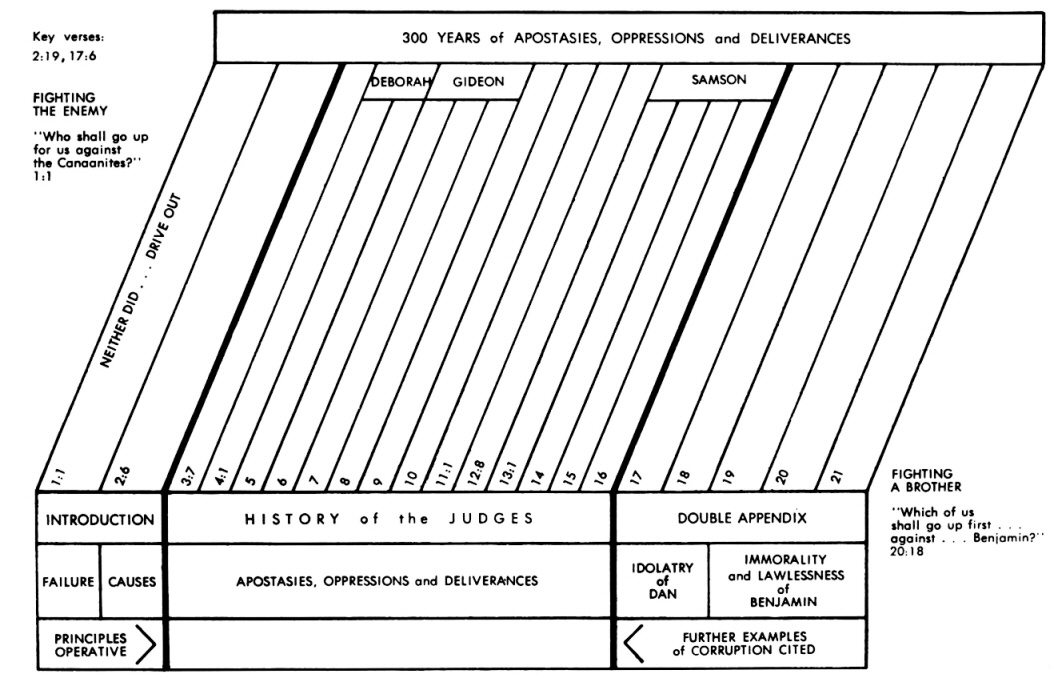
Chart from recommended resource Jensen's Survey of the OT - used by permission
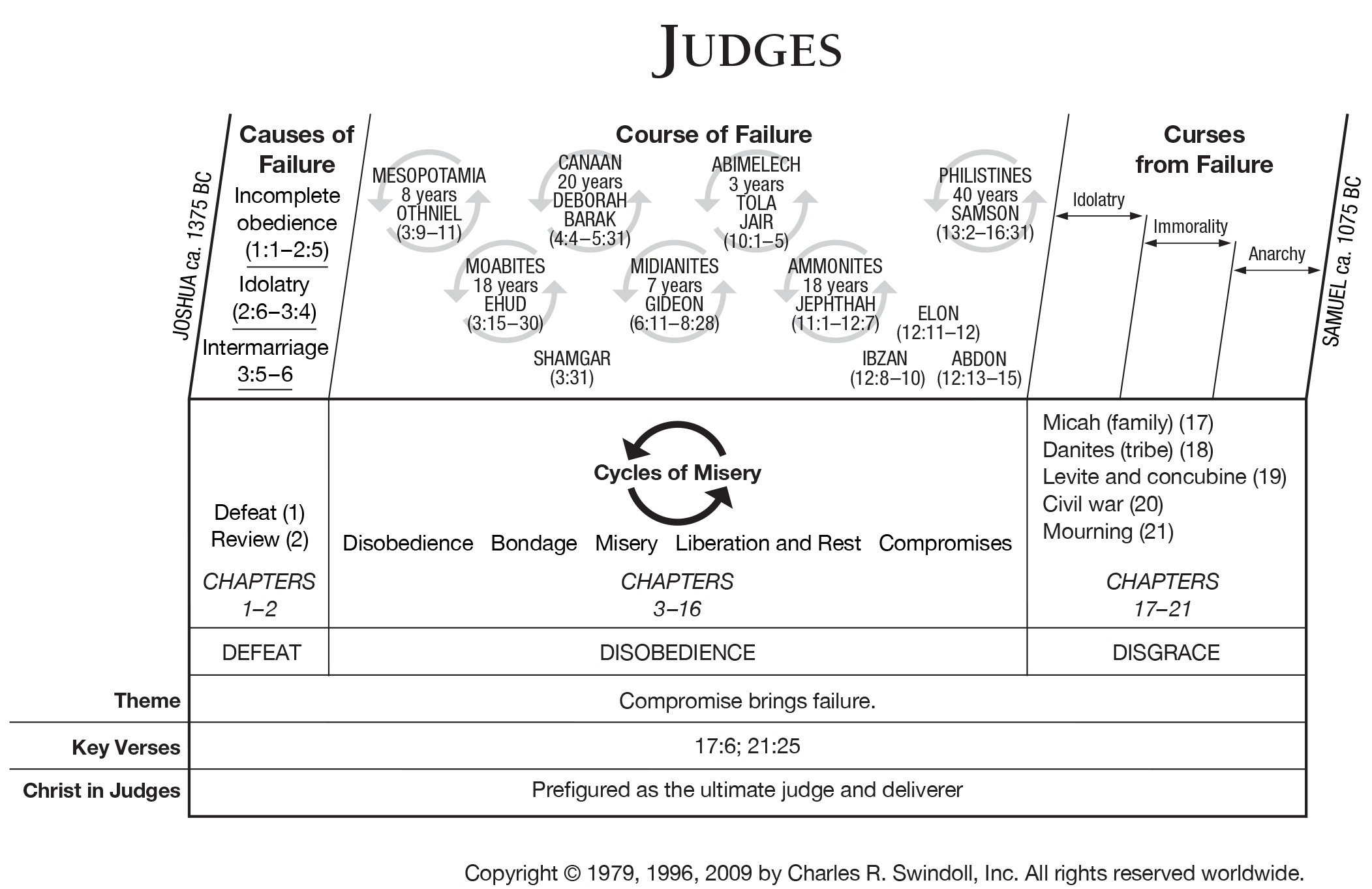
Chart on Judges - Charles Swindoll
|
RECYCLING SIN |
|||||
| Jdg 1:1-3:6 | Jdg 3:7-16:31 | Jdg 17:1-21:25 | |||
| Introduction | History of the Judges | Appendix | |||
| Causes of the Cycles THE REASON |
Curse of the Cycles THE RECORD |
Conditions in the Cycles THE RESULTS |
|||
| Failure to Complete Conquest Jdg 1:1-36 God's Judgment for Failure Jdg 2:1-3:6 |
Curse of the Cycles |
Conditions in the Cycles |
|||
| Living with Canaanites |
War with the Canaanites |
Living Like the Canaanites |
|||
| Religious Laxity |
Political Uncertainty |
Moral Anarchy |
|||
| About 350 Years of Israel's History - Almost 25%! From Compromise to Confusion! |
|||||

Another Timeline of Israel's History
Click to Enlarge
from Jensen's Survey of the OT
Click to Enlarge
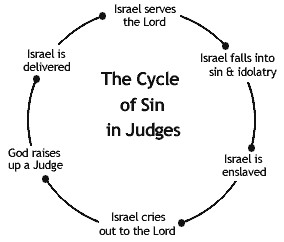
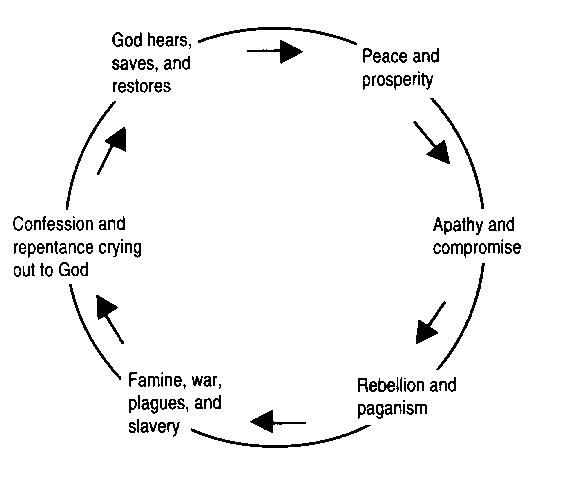
Other ways to describe Israel's cycle…
- Rest > Rebellion > Retribution > Repentance (?) > Restoration
- Sin > Suffering/Servitude > Supplication > Salvation
- Apathy > Apostasy > Affliction > Answered Prayer
- Disobedience > Desperation > Deliverance
- Disobedience > Bondage >Misery > Liberation and Rest > Compromises
Judges 17:1 Now there was a man of the hill country of Ephraim whose name was Micah.
- there was. Jdg 17: 6
- a man of the hill country of Ephraim Jdg 10:1. Josh 15:9. 17:14-18.
- Micah Jdg 17:4.
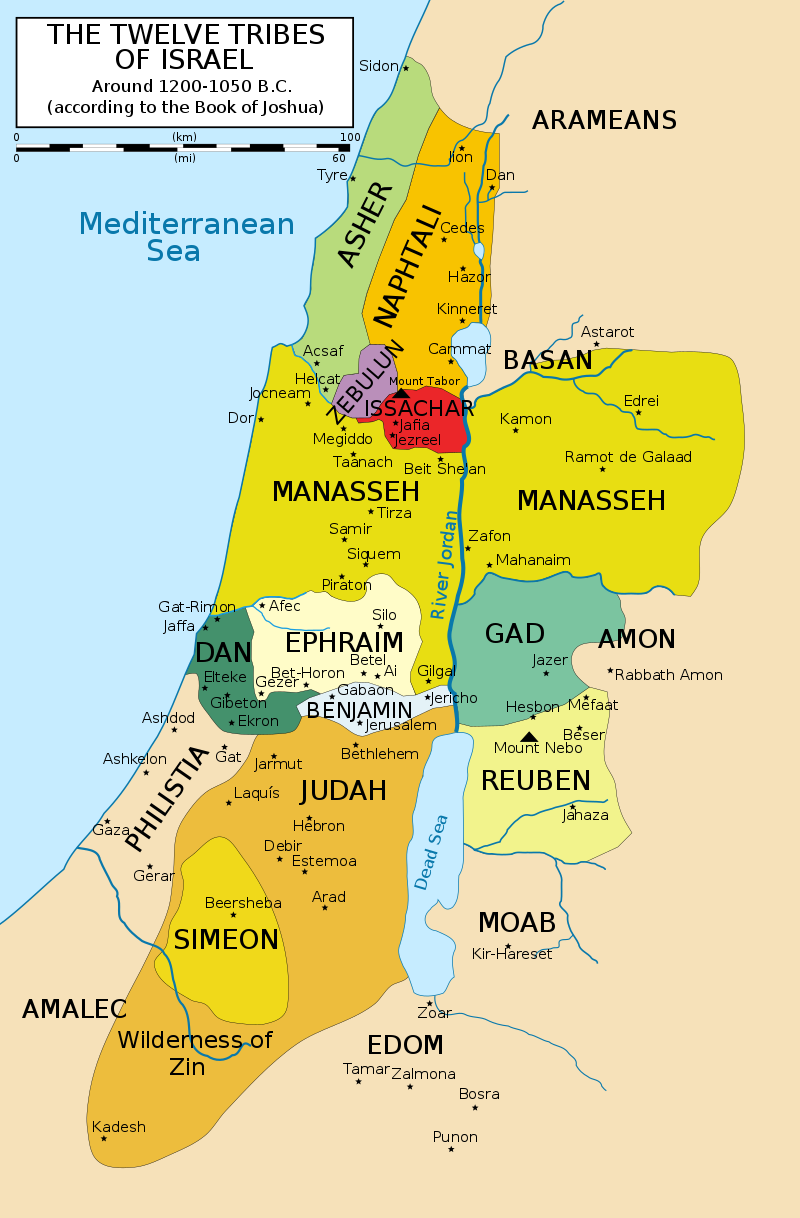
Location of Ephraim
MICAH THE MAN
WHO MADE IDOLS
An accurate subtitle for Judges 17 would be "The Marks of False Religion" which is followed in Judges 18 by "The Motivation of False Religion".
In Judges 1-16 the enemies were primarily external (pagans), whereas Judges 17-21 deal with the deadly enemy which is internal, our fallen flesh which is godless, hates God and constantly seeks to dethrone Jesus.
G. Campbell Morgan on Judges 17–21: “The events here recorded must have taken place closely following the death of Joshua. They give us a picture of the internal condition of the people, and it is probably that they were added with that intention by the historian.”
Dr Donald Campbell makes an interesting observation regarding how Judges 17 connects to Judges 18 writing that "It seems apparent there is a direct relationship between the story of Micah and the story of the migration of the tribe of Dan. The record of Micah's idolatry is graphically explained in order to show how the tribe of Dan became an idolatrous tribe." (Borrow this Judges Commentary)
Now - The final five chapters of Judges constitute two non-chronological appendixes to the book, omitting any reference to judges or times of oppression. While Judges 2-16 describe primarily foreign threats to Israel, these last 5 chapters show an internal breakdown of Israel’s worship and unity. This episode illustrates how low even the true spiritual leadership of the nation had gone, setting up rival sanctuaries (with idols) in a land meant to have the Tabernacle and worship the true God. Sadly these appendices do not contain any references to great leaders. Judges 17-21 underscores the principle that when that foundation of a society based on God's principles begins to crumble, the society begins to fall apart. The psalmist testifies that "If the foundations are destroyed, what can the righteous do?" (Psalm 11:3+)
Rabbinic commentators placed the story of Micah in the time of Othniel.
L M Grant writes that "Samson was the last judge in Israel. The last five chapters of Judges 17 to 21 deal with conditions during the time of the Judges, so do not necessarily take place after Samson. The history of Micah and the Danites (Jdg 17 and 18) illustrates the spiritual corruption (idolatry) into which Israel sank so soon after coming into their land, while Judges 19-21 emphasize the moral corruption of the people. Certainly idolatry is the worst of these two, for it is against God, but no opposition from Israel was raised against idolatry, though they were incensed against the moral corruption (Jdg 20:11-13). How sad it is that we generally think more of the people's rights than of God's rights!" (Comments On Judges LM Grant)
How did the state of the chosen people who were to be a separate and holy people unto Jehovah get to be so bad? The answer echoes forth over and over (with some variation), on four separate occasions (Jdg 17:6, Jdg 18:1, Jdg 19:1, Jdg 21:25) "In those days there was no king in Israel; everyone did what was right in his own eyes.”
THOUGHT - Note the problem - NO KING. So what's the solution - A KING. And not just any king but the King of king and Lord of lords, Jesus Christ. You might want to pause and sing to Him an apropos hymn Crown Him With Many Crowns. Is He your King? Who is ruling your life today (check your thoughts, words and actions)? And if you do not know Jesus as King, then you need to heed Paul's wise words "that if you confess with your mouth Jesus as Lord (kurios = MASTER, OWNER - cf 1Co 6:19-20+), and believe (pisteuo - FAITH IS NOT JUST INTELLECTUAL BUT FAITH THAT OBEYS) in your heart that God raised Him from the dead (cf THE "ESSENTIAL GOSPEL" = 1Co 15:1-8+), you will be saved (sozo - RESCUED FROM THE POWER OF SIN, DEATH, WORLD, DEVIL!); for with the heart a person believes, resulting in righteousness, and with the mouth he confesses, resulting in salvation (soteria - DELIVERANCE)." (Romans 10:9-10+)
After the death of Samson, the chronological sequence in Judges ends so that one cannot assign the events in the last five chapters to any specific time. Some therefore consider these chapters almost like an "appendix' which exemplifies the utter apostasy of Israel in their religious, civil, and moral life. These chapters picture the climax of the downward path of Israel resulting from departure from the Word of God.
David Jackman has a sobering comment reminding us that "These closing chapters are actually very dark indeed. They show the depths to which even God’s covenant people can sink when once they begin to disobey His instructions and trample His grace and mercy under their feet. They prove beyond all doubt the truth that God has not chosen us because we are costly, or impressive, or morally any better than anyone else, for we are not. The grace of God is that He chooses to have mercy on totally undeserving sinners, such as Israel and today’s church. In the end, we cannot get further than that magnificent statement to Israel about God’s covenant love and mercy, recorded in Deuteronomy 7:7, 8. “The Lord did not set His love on you nor choose you because you were more in number than any other people, for you were the least of all peoples; but because the Lord loves you ….”He loves us because He loves us! (See context in The Preacher's Commentary Series, Volume 7 : Judges, Ruth)
Now there was a man of the hill country of Ephraim whose name was Micah - As shown on the map above, Ephraim is in the highlands of central Palestine begin some 12 miles N of Jerusalem. Ephraim also played an important role in the success of Ehud, Deborah, and Gideon (Jdg 3:27; 4:5; 7:24). Micah means “Who is like Jehovah?” an ironical name for a man who clearly was himself not like Jehovah but was an out and out idolater! It's not how we begin our walk with Christ but how we end and just because we can claim the name of Christ does not guarantee a good ending. Let us all learn the danger of drifting from God's foundational truths in His Word.
It is also sad to note that God honoring names such as Micah were usually only given in homes where Jehovah was at least outwardly recognized. Nothing is said about Micah's family or his wife; and one gets the impression that his mother lived with him and that she was wealthy. Extended families were common in Israel.
Keil and Delitzsch—The account of the image-worship which Micah established in his house upon the mountains of Ephraim is given in a very brief and condensed form, because it was simply intended as an introduction to the account of the establishment of this image-worship in Laish-Dan in northern Palestine. Consequently only such points are for the most part given, as exhibit in the clearest light the sinful origin and unlawful character of this worship. A man of the mountains of Ephraim named Micah (מִיכָיְהוּ, vv. 1, 4, when contracted into מִיכָה, vv. 5, 8, etc.), who set up this worship for himself, and “respecting whom the Scriptures do not think it worth while to add the name of his father, or to mention the family from which he sprang” (Berleb. Bible), had stolen 1100 shekels of silver (about £135) from his mother. This is very apparent from the words which he spoke to his mother (v. 2): “The thousand and hundred shekels of silver which were taken from thee (the singular לֻקַּח refers to the silver), about which thou cursedst and spakest of also in mine ears (i.e., didst so utter the curse that among others I also heard it), behold, this silver is with me; I have taken it.” אָלָה, to swear, used to denote a malediction or curse (cf. קֹול אָלָה, Lev. 5:1). He seems to have been impelled to make this confession by the fear of his mother’s curse. But his mother praised him for it,—“Blessed be my son of Jehovah,”—partly because she saw in it a proof that there still existed a germ of the fear of God, but in all probability chiefly because she was about to dedicate the silver to Jehovah; for, when her son had given it back to her, she said (v. 3), “I have sanctified the silver to the Lord from my hand for my son, to make an image and molten work.” The perfect הִקְדַּשְׁתִּי is not to be taken in the sense of the pluperfect, “I had sanctified it,” but is expressive of an act just performed: I have sanctified it, I declare herewith that I do sanctify it. “And now I give it back to thee,” namely, to appropriate to thy house of God. (Judges 17 Commentary)
|
ANARCHY WITHOUT A KING |
|||
|
Micah and the Danite Migration |
Gibeah’s Deed and Their Punishment |
||
|
Religious Deterioration |
Moral Deterioration |
||
|
Beginning |
“In those days there was no king in Israel. Everyone did what was right in his own eyes” (Jdg 17:6+). |
“In those days, when there was no king in Israel...” (Jdg 19:1+). |
Beginning |
|
Ending |
“In those days there was no king in Israel” (Jdg 18:1+) |
“In those days there was no king in Israel. Everyone did what was right in his own eyes” (Jdg 21:25+). |
Ending |
Henrietta Mears summarizes these last chapters noting that…
- First, we find confusion in the religious life of the nation (Judges 17, Judges 18).
- Second, we find confusion in the moral life of the nation (Judges 19).
- Third, we find confusion in the political life (Judges 21).
The story of the backsliding of individuals is followed by the backsliding of the nation. The last chapter proves that the children of Israel had lost the way to God’s house, so low had they sunk. We find faithlessness, failure and forfeiture! But God loves His own.
The history of the Church through the ages has been like this with Martin Luther (1483-1546, leader of the Protestant Reformation); John Knox (1513-1572, Scottish Reformer); and John Wesley (1703-1791, founder of the Methodists) as deliverers.
The biography of many a Christian in just the common run of life is like this. God opens doors and gives us grace for great tasks. Then we forget Him and begin to have our interests in the world about us. This brings loss and defeat. But God hears our cry of repentance and restores us to favor again.
A C Gaebelein Summary of Judges 17 The Images Made and the Hired Priest
1. The stolen money restored and the images (Jdg 17:1-6)
2. The Levite hired for a priest (Jdg 17:7-13)
The last five chapters of the book form an appendix. The events given did not occur after Samson's death, but they happened many years before. These chapters are not in chronological order but arranged in this way to teach the root of the evil and its results. This answers much, if not all, of the objections of the critics. These chapters reveal the internal corruption which existed in Israel during the different declensions. Idolatry and lawlessness are the two characteristic features. True worship and dependence on God is given up and then follows the dreadful fruit of this, which is hatred, strife culminating in lawlessness. The predictions in the New Testament reveal the same two phases. Departure from the faith is followed by moral corruption (1Ti 4:1; 2Ti 3:1, 2+, 2Ti 3:3, 4+). Then we find in these chapters a statement which does not appear elsewhere in the book. "There was no king in Israel " is the statement made four times (Jdg 17:6; 18:1, 19:1; 21:25). A king was needed to remedy these sad internal conditions, this departure from God and strife of one against the other. This is an evident link with and preparation for the history which follows. Even so in this age of evil, darkness and cunning lawlessness; what the world needs is a king, the King of Righteousness and Peace. When He comes, order will be brought out of chaos, all strife and war, all bloodshed and lawlessness will cease.
Into what a scene this chapter introduces us! The thieving son, the cursing mother. He, for the fear of the curse (true faith was not there, but superstition), restores the money and that ungodly woman can say, "Blessed be thou of the LORD, my son." Then she used two hundred shekels of silver and has two images made. Micah, whose wicked life belies his name (Micah means "who is like Jehovah"), had a house full of gods, made an ephod, teraphim and then "ordained" one of his sons for a priest. Then a wandering Levite passed by and to make his idolatrous worship a little more "religious" he hires the Levite to be a "father" and "a priest." He also promises him a yearly salary, his board and clothing. Then he settled down and said, "Now know I that the Lord will do me good, seeing I have a Levite to my priest."
There is no need of much comment. The typical application is seen at a glance. Here is a man-made god, a man-made worship and a man-made priest. Such is the state of ritualistic Christendom. Much of that which is called worship is simply man-made and dishonors God as much, or even more, than the idolatry of heathendom. And how the false priesthood is here typified! We have but one Priest as the people of God and that is our gracious Lord. Through His infinite grace all true believers are constituted priests with Him. We are a holy and a royal priesthood. Any other priesthood is man-made and a wicked assumption which has corrupted and is corrupting Christianity. The hirelings too are represented in this scene. Religious service is so much reduced to a commercial basis. And there is the delusion of thinking that the Lord must surely bless and give prosperity.
The Levite himself is another sign of the times. He is of the Levites of Judah, has been for a while in Bethlehem-judah and wandered away again to find, where he may, another temporary resting place. His is the restless foot of a stranger where he might have claimed inheritance, and he is ready to find a home where he should have been a stranger. Little solicitation prevails with him: his sustenance, a suit of clothes, a salary, has prevailed with many in all ages of the world, and the Levite exchanges his ministry for priesthood in the house of Micah, where the idolatry of the place is sanctified with Jehovah's name. All this is simple enough to read by those that care, and Christendom has exhibited every detail of this transformation--not, alas, as it would seem, a long process: a manufactured priesthood for manufactured gods, all covered with a fair name of orthodoxy, and men doing with great satisfaction what is right in their own eyes! (Commentary)
Walter Kaiser - Hard Sayings (go to page 169) - Judges 17:1–2 A Thief Cursed and Then Blessed?
Here is a story that seems so mixed up and crazy that it easily raises as much embarrassment as anything else. What is happening in this densely packed exchange between mother and son?
One wonders where the writer’s—or even God’s—evaluation of things appears in this bizarre narrative. How can a mother curse a thief and then turn around and bless him when she finds out the culprit was her own son? Isn’t thievery still wrong for all the Bible and its people? And how can God suddenly bless what was just cursed? What did the woman expect to happen? Why did she utter such a strange response upon learning that her money was in the hands of one of her own children?
The writer of the book of Judges wanted us to see that everything was out of control in Israel. Almost every aspect of this story discloses a violation of the will of God as he had revealed it to Israel.
Clearly the narrative is compressed and in a tightly woven form. Micah’s mother, realizing that she had been swindled out of eleven hundred shekels of silver, responded with an oath. The effect of such an oath was not taken lightly in that culture, for once the word was uttered, it was as if it were an accomplished fact. It was not, as it often is in our culture, where someone might say something off the cuff and then quickly, or even later, retrieve it: “Aw, forget I said that; I didn’t mean anything by it.” The Israelites of Old Testament times believed that God monitored all speech and saw to it that vows, oaths and even idle words fulfilled their mission. Theirs was not a magical view of words, but they did know that talk is not cheap and words often carry consequences.
When Micah heard his mother cut loose with this oath, he immediately confessed that he was the thief. He obviously feared the consequences of the oath. It is doubtful that his mother had suspected her son and spoken her curse in his hearing deliberately. Probably she had been unaware of her son’s presence. Curses were taken too seriously in those days for us to think otherwise.
Delighted to have the money back, the mother was not immediately concerned to ask Micah why he had stolen. On the contrary, she was now worried about reversing the effect of the curse she had invoked over her son’s head. That is why she said, “The LORD bless you, my son.” She hoped that this blessing would mitigate, if not nullify, the negative effect of the curse placed on Micah.
Now it must be made clear that the Bible only reports what happened here; it does not teach that any of this is normative or worth emulating. The narrative must be read in the context of the revelation of God up to this point.
At least six sins can be discovered in this story. First, the eighth commandment (Ex 20:15) is clear: “You shall not steal.” Micah stole from his mother, and later the tribe of Dan stole his religious articles from his private sanctuary.
In the second place, Micah and his mother, wishing to buy some insurance, as it were, against God’s carrying out her original oath, gave part of the money for the making of several images. This ran counter to the second commandment. But notice how dulled their theological senses were. How could they have expected God’s blessing when they had substituted graven and molten images for the sovereign Lord of the universe?
Third, Micah established a private sanctuary in his home. God had said there was to be only one sanctuary for all the people, and that was at the tabernacle in Shiloh (Deut 12:4–14). God had promised to dwell there and place his name in a central sanctuary, not in individual tents or homes throughout Israel.
Then Micah made one of his sons his private priest, though God had said that only members of the family of Aaron in the tribe of Levi were to represent the people before the altar. Apparently that arrangement did not work out, and Micah then hired a Levite who had been wandering the countryside looking for work. Here again, Micah (and later the tribe of Dan) was still in violation of God’s directive, for Aaron and his family were the sole legitimate priests.
When the tribe of Dan decided to leave the coastal plain, they committed the fifth sin in this narrative by moving from their allotted inheritance. They should have conquered the territory assigned to them rather than capitulating to the Philistines and moving north to the exposed city of Laish.
Finally, the movement of the Levite from his assigned city to work for Micah and then for the tribe of Dan shows that he was an opportunist. As a Levite, he would have had an assigned place to work. Instead of remaining there, he determined to make his own way in the world; as a result a number of people were impacted by his sin.
Neither the story nor the times are pretty; but this account is entirely realistic, and its implied warning is instructive. We should not doubt in the darkness what God has already told us in the light.
Judges 17:2 And he said to his mother, "The eleven hundred pieces (shekels) of silver which were taken from you, about which you uttered a curse in my hearing, behold, the silver is with me; I took it." And his mother said, "Blessed be my son by the LORD."
- uttered a curse in my hearing: Jdg 5:23 Dt 27:16 1Sa 14:24,28 26:19 Ne 13:25 Jer 48:10 Mt 26:74 Ro 9:3 1Co 16:22
- I took it: Pr 28:24
- Blessed: Ge 14:19 24:30,31 Ex 20:7 Ru 3:10 1Sa 23:21 Ne 13:25 Ps 10:3 2Jn 1:11
Related Passage:
Malachi 2:1-2+ (GOD NULLIFIED THE PRIEST'S BLESSINGS TURNING THEM INTO CURSES!) “And now this commandment is for you, O priests. 2 “If you do not listen, and if you do not take it to heart to give honor to My name,” says the LORD of hosts, “then I will send the curse upon you and I will curse your blessings; and indeed, I have cursed them already, because you are not taking it to heart.
HOW TO TURN A CURSE
INTO A BLESSING
And he said to his mother, "The eleven hundred pieces (shekels) of silver (about 28 lbs) - Micah the thief confesses to the crime, the first of a number of sins! This is no small sum stolen, because compared with a yearly wage of ten pieces of silver (Jdg 17:10), its value represents a fortune. No wonder Micah's mother cursed the thief! While we cannot be absolutely sure, it is highly likely that Micah confessed not because he was convicted of His sin, but because he feared the curse from his mother!
L M Grant - Micah was from Mount Ephraim. We are introduced to him as confessing to his mother that he had stolen 1100 shekels of silver from her, reminding her also that she had pronounced a curse against the thief. His mother said nothing about the curse, but told him, "May you be blessed by the Lord, my son!" (Jdg 17:2). (Comments On Judges LM Grant)
Which were taken from you, about which you uttered a curse in my hearing - As alluded to above, it was likely the fear of the curse, not the fear of the Lord, that motivated Micah to confess and return the stolen silver. Ancient peoples greatly feared the power of a parental curse. Thus Micah is superstitiously fearful of a curse, but not afraid to be displeasing to Yahweh. Someone has rightly concluded that outward losses drive good people to prayer, but bad people to curses.
Behold, the silver is with me; I took it." And his mother said, "Blessed be my son by the LORD." - Instead of his mother turning him across her knee and applying the board of education to the seat of knowledge, she congratulated him responding to the confession of theft with a blessing! Values were certainly upside down. As a reward for such “honesty,” his mother sought to neutralize her curse with a blessing. Blessing was superstitiously believed to countermand a cursing! This is a striking example of the permissive spirit that had infected Israel at this time. There is an old saying: “As goes the home, so goes the nation.” Israel was in trouble for everything about this home violated the law of God. Corruption in the home spreads into society; and in this specific instance it spread to a whole tribe (see Judges 18:1ff). False doctrine is like yeast: it grows quietly in secret and affects everything it touches. "A little leaven leavens the whole lump of dough." (Galatians 5:9).
The events in this section are a dramatic example of what James warned about writing…from the same mouth come both blessing and cursing. My brethren, these things ought not to be this way." (James 3:10).
Spurgeon…Very little was her blessing worth, since she had been so ready at cursing. Her silver was her god while it was in the form of shekels, quite as much as when it was fashioned into an image, or else she had not cursed because of the loss of it. Her son Micah, who became so ostentatiously religious, was a thief to begin with. A superstitious dread made him restore what his conscience did not forbid him to steal. The man was made of the right material to become a Ritualist. (The Interpreter: Spurgeon's Devotional Bible)
Thomas Watson on relation of murmuring and cursing…
Murmuring is a quarrelling with God, and inveighing against him. “They spake against God.” Nu 21:5. The murmurer saith interpretatively that God hath not dealt well with him, and that he hath deserved better from him. The murmurer chargeth God with folly. This is the language, or rather blasphemy, of a murmuring spirit,—God might have been a wiser and a better God. The murmurer is a mutineer. The Israelites are called in the same text “murmurers” and “rebels” (Nu 17:10); and is not rebellion as the sin of witchcraft? 1Sa 15:23. Thou that art a murmurer art in the account of God as a witch, a sorcerer, as one that deals with the devil. This is a sin of the first magnitude.
Murmuring often ends in cursing: Micah’s mother fell to cursing when the talents of silver were taken away. Judges 17:2. So doth the murmurer when a part of his estate is taken away. Our murmuring is the devil’s music; this is that sin which God cannot bear: “How long shall I bear with this evil congregation, which murmur against me?” Nu. 14:27. It is a sin which whets the sword against a people; it is a land-destroying sin: “Neither murmur ye, as some of them also murmured, and were destroyed of the destroyer.” 1Co 10:10.
Judges 17:3 He then returned the eleven hundred pieces of silver to his mother, and his mother said, "I wholly dedicate the silver from my hand to the LORD for my son to make a graven image and a molten image; now therefore, I will return them to you."
- I wholly dedicate Jdg 17:13. Jdg 18:5. Is 66:3.
- for my son to make a graven image and a molten image Ex 20:3-4, 23. Ex 32:4, 5. Lev 19:4. Dt 12:3. Ps 115:4-8. Is 40:18-25. 44:9-20. Je 10:3-5, 8. Hab 2:18, 19. Jn 16:2.
Related Passages:
Deuteronomy 4:23-25+ (MOSES HAD CLEARLY WARNED AGAINST MAKING GRAVEN IMAGES!) “So watch yourselves, that you do not forget the covenant of the LORD your God which He made with you, and make for yourselves a graven image (pesel) in the form of anything against which the LORD your God has commanded you. 24 “For (TERM OF EXPLANATION = WHY IT IS DANGEROUS TO MAKE GRAVEN IMAGES!) the LORD your God is a consuming fire, a jealous God. 25 (MOSES PREDICTS THEY WILL MAKE GRAVEN IMAGES!) “When you become the father of children and children’s children and have remained long in the land (IN JUDGES 17 THEY HAVE BEEN IN THE LAND LESS THAN 50 YEARS! HOW FAST THEY FELL!!!), and act corruptly, and make an idol (A GRAVEN IMAGE - pesel) in the form of anything, and do that which is evil in the sight of the LORD your God so as to provoke Him to anger."
MOTHER'S UNHOLY
"WHOLLY"
He then returned the eleven hundred pieces of silver to his mother - Micah had stolen a small fortune (1100 pieces of silver) as indicated by the fact in Jdg 17:10 where the Levite was pleased to get a position for an annual salary of 10 pieces of silver!. These 1,100 silver shekels are not to be confused with the 1,100 silver shekels that each of the Philistine rulers gave Delilah Judges 16:5, 18+.
And his mother said, "I wholly dedicate the silver from my hand to the LORD for my son - Wholly dedicate to Yahweh is a clear example of religious syncretism because she says the purpose is to make idols which Micah immediately goes out does (Jdg 17:4). Now watch the mother still from Yahweh! Any guesses at where Micah learned how to steal silver?
L M Grant…Then she made it evident that she idolized her son, by telling him she had wholly dedicated this money to the Lord to make a carved image and a molded image for her son (Jdg 17:3). She evidently wanted her son to be religious, but was teaching him to refuse to obey the Word of God! The first of the ten commandments sternly forbad idolatry and image making (Ex. 20:3, 4), but here this wickedness was rising in the midst of the land of Israel! Micah's mother used 200 shekels for the making of the images. Are we like her in any respect? Do we speak of devoting everything to the Lord, then keep back nine elevenths for ourselves? But of course none of this was really devoted to the Lord, but to an evil purpose. (Comments)
Spurgeon - An image was to be made contrary to the divine law, and yet it was to be dedicated unto Jehovah. Good intentions are no excuse for disobedience. Image-makers, now-a-days, tell us that they do not worship them, but worship God through them; if this be accepted as an apology, there remains no idolatry in the world. But God thinketh not so.(The Interpreter: Spurgeon's Devotional Bible)
Out of gratitude for getting her silver back, Micah's mother decided to consecrate it to the Lord. Yet the desire to make an idol was counter to God's command and made Micah's mother liable to God's curse, Moses recording…
Cursed is the man who makes an idol or a molten image (massekah), an abomination to the LORD, the work of the hands of the craftsman, and sets it up in secret.' And all the people shall answer and say, 'Amen.' (Dt 27:15+)
Compare what happened to Ananias and Sapphira in Acts 5:1-11+ when they held some of the money back!
But a certain man named Ananias, with his wife Sapphira, sold a piece of property, 2 and kept back some of the price for himself, with his wife's full knowledge, and bringing a portion of it, he laid it at the apostles' feet. 3 But Peter said, "Ananias, why has Satan filled your heart to lie to the Holy Spirit, and to keep back some of the price of the land? 4 "While it remained unsold, did it not remain your own? And after it was sold, was it not under your control? Why is it that you have conceived this deed in your heart? You have not lied to men, but to God." 5 And as he heard these words, Ananias fell down and breathed his last; and great fear came upon all who heard of it. 6 And the young men arose and covered him up, and after carrying him out, they buried him. 7 Now there elapsed an interval of about three hours, and his wife came in, not knowing what had happened. 8 And Peter responded to her, "Tell me whether you sold the land for such and such a price?" And she said, "Yes, that was the price." 9 Then Peter said to her, "Why is it that you have agreed together to put the Spirit of the Lord to the test? Behold, the feet of those who have buried your husband are at the door, and they shall carry you out as well." 10 And she fell immediately at his feet, and breathed her last; and the young men came in and found her dead, and they carried her out and buried her beside her husband. 11 And great fear came upon the whole church, and upon all who heard of these things.
Note that she dedicated only 200 of the 1100 which also brings even her motivation into question. In fact "MOTHER MICAH" proved also to be a THIEF, as well as an IDOLATER! And she eventually even leads her own son into this abominable practice of IDOLATRY! Why is there such perversion of God's order? The ROOT cause goes back to Judges 1 where Israel failed to DRIVE OUT THEIR ENEMIES but instead COMPROMISED WITH THEM and ultimately ADOPTED THEIR ABOMINABLE PAGAN PRACTICES.. Judges 17-21 represents the FRUIT of the ROOT OF WICKEDNESS and REBELLION TO GOD'S STANDARDS that Israel was now REAPING because they failed to TOTALLY ERADICATE the EVIL LEAVEN!
THOUGHT - What a lesson for modern day saints… let us be warned and return to the LORD and repent and amend our ways while we still live in the day of His mercy and grace.
Repent therefore and return, that your sins may be wiped away, in order that times of refreshing may come from the presence of the Lord and that He may send Jesus, the Christ appointed for you" (Acts 3:19+)
Wash yourselves, make yourselves clean; Remove the evil of your deeds from My sight. Cease to do evil, Learn to do good; Seek justice, Reprove the ruthless; Defend the orphan, Plead for the widow. Come now, and let us reason together," Says the LORD, "Though your sins are as scarlet, They will be as white as snow; Though they are red like crimson, They will be like wool. (Isaiah 1:16-18+)
Seek the LORD while He may be found; Call upon Him while He is near. Let the wicked forsake his way, And the unrighteous man his thoughts; And let him return to the LORD, And He will have compassion on him; And to our God, For He will abundantly pardon. (Isaiah 55:6-7)
And rend your heart and not your garments." Now return to the LORD your God, For He is gracious and compassionate, Slow to anger, abounding in lovingkindness, And relenting of evil. (Joel 2:13+)
To make a graven image (pesel) and a molten image (massekah); now therefore, I will return them to you - The same two Hebrew terms for idols occur together also in Dt 27:15+ where Moses warns "‘Cursed is the man who makes an idol or a molten image, an abomination to the LORD, the work of the hands of the craftsman, and sets it up in secret.’ And all the people shall answer and say, ‘Amen.’
The mother is completely ignoring the first two commandments...
Exodus 20:3-4+ “You shall have no other gods before Me. 4 “You shall not make for yourself an idol, or any likeness of what is in heaven above or on the earth beneath or in the water under the earth.
Graven image (idol) (06459) (pesel from pasal = to hew, cut as in Ex 34:1) is a noun that refers to something carved (graven) or cast image - normally carved from wood or chiseled from rock, but it can also be poured or cast (Isa40:19; 44:10). Isa40:19 describes the “casting” of an idol that is then plated or overlaid with gold. The first use of pesel is Ex 20:4 (Lev 26:2, Dt 5:8)which is God's command "You shall not make for yourself an idol." In the Septuagint (Lxx) the Greek word used for pesel here in Ex 20:4 is eidolon (from eídos = that which is seen, what is visible, figure, appearance) is primarily a phantom, form, image, shadow or likeness. Note that other uses of pesel are translated with a word found only in the Septuagint (Lxx), the adjective gluptos which means a thing carved or a graven image. (Used in Lxx of Lev 26:1, Dt 4:16, 23, 25 - Judges uses a different word - gluptos which is from glupho = to carve and thus a carved image). In Dt 4:23 the result of forgetting the Mosaic covenant is that they make a graven image. Dt 4:25 is a prophecy saying Israel would make idols. In Dt 27:15 God says the man who makes an idol is cursed! The concentration of uses of pesel in Judges 17:1-13 and Judges 18:1-33+ shows the defiling, abominable effect of forgetting the LORD their God, Judges 3:7+ recording "The sons of Israel did what was evil in the sight of the LORD, and forgot the LORD their God and served the Baals and the Asheroth."
Pesel - carved image(2), graven image(14), graven images(1), idol(10), idols(3), image(1). - Exod. 20:4; Lev. 26:1; Deut. 4:16; Deut. 4:23; Deut. 4:25; Deut. 5:8; Deut. 27:15; Jdg. 17:3; Jdg. 17:4; Jdg. 18:14; Jdg. 18:17; Jdg. 18:18; Jdg. 18:20; Jdg. 18:30; Jdg. 18:31; 2 Ki. 21:7; 2 Chr. 33:7; Ps. 97:7; Isa. 40:19; Isa. 40:20; Isa. 42:17; Isa. 44:9; Isa. 44:10; Isa. 44:15; Isa. 44:17; Isa. 45:20; Isa. 48:5; Jer. 10:14; Jer. 51:17; Nah. 1:14; Hab. 2:18
Molten image (04541) massekah is from the root nasak mainly used for the "pouring out" of a drink offering or libation, and for the "casting" of metal images. When the word means a libation or drink offering, it is associated with sacrifices that seal a covenant relationship (Isa. 25:7; 28:20; 30:1); however, the word usually signifies an image or molten metal, a cast metal image, molten image, an image of an idol made out of metal. The most glaring use is the molten calf in Ex 32:4 and Ex 32:8 (Ps 106:19). God then make it clear " “You shall make for yourself no molten gods." (Ex 34:17, cf Lev 19:4, Dt 27:15). "Later, when God renews his covenant following this early act of idolatry, he first warns them to not worship any other gods and then explicitly forbids them from making “gods of cast metal” (massēkâ; Exod 34:13–17; compare Deut 27:15). Several other times when massēkâ is used, it refers back to the event at Sinai when Israel worshiped this calf (Deut 9:12, 16; Neh 9:18; Psa 106:19). The word may be used to make explicit that a certain idol was overlaid in metal, especially with the phrase pesel umassēkâ (פֶסֶל וּמַסֵּכָה), which literally means “image and molten image” but functions as a hendiadys meaning “image of cast metal” (Deut 27:15; Jdg 17:3). The word is also used in general contexts condemning idolatry that frequently pile up multiple synonyms for idolatrous images (Isa 30:22; Hos 13:2)." (Lexham Theological Wordbook)
Massekah - 26v - alliance(1), image(2), molten(5), molten image(8), molten images(9), molten metal(1). Exod. 32:4; Exod. 32:8; Exod. 34:17; Lev. 19:4; Num. 33:52; Deut. 9:12; Deut. 9:16; Deut. 27:15; Jdg. 17:3; Jdg. 17:4; Jdg. 18:14; Jdg. 18:17; Jdg. 18:18; 1 Ki. 14:9; 2 Ki. 17:16; 2 Chr. 28:2; 2 Chr. 34:3; 2 Chr. 34:4; Neh. 9:18; Ps. 106:19; Isa. 30:1; Isa. 30:22; Isa. 42:17; Hos. 13:2; Nah. 1:14; Hab. 2:18
QUESTION - What is a graven image?
ANSWER - The phrase “graven image” comes from the King James Version and is first found in Exodus 20:4 in the second of the Ten Commandments. The Hebrew word translated “graven image” means literally “an idol.” A graven image is an image carved out of stone, wood, or metal. It could be a statue of a person or animal, or a relief carving in a wall or pole. It is differentiated from a molten image, which is melted metal poured into a cast. Abstract Asherah poles, carved wooden Ba’als covered in gold leaf, and etchings of gods accompanying Egyptian hieroglyphics are all graven images.
The progression of idolatry in a pagan religion generally starts with the acknowledgement of a power that controls natural forces. The presence of the force is then thought to indwell an object, like a stone, or a place, like a mountain. The next step is altering a naturally occurring object, like a standing stone, a deliberately planted tree, or a carved Asherah pole and asking the force to indwell it. When the idolatrous culture has had time to contemplate the personality of the god, they then make corresponding physical images—a statue that looks like a woman or a relief carving that looks like an animal. Graven images can be either of the last two steps.
The spiritual progression is similar. People start with wanting something (Ephesians 5:5; Colossians 3:5), often children or prosperity or good crops. They observe the circumstances (which some acknowledge are God-ordained, and others think are independent) that lead to these things and begin to ascribe to the causal forces human characteristics—thus creating gods. Places are set aside to commune with these false gods. For convenience sake, smaller items, thought to hold the power or the communication line of the gods, are brought into homes. Before long, the people are ensnared by the compulsion to give homage to a thing of their own definition instead of to the God of the universe.
The second commandment, recorded in Exodus 20:4–5, reads, “You shall not make for yourself an idol, or any likeness of what is in heaven above or on the earth beneath or in the water under the earth. You shall not worship them or serve them.” Likely, this refers back to the first commandment, “You shall have no other gods before Me,” and specifically forbids the creation of idols. But it is equally dangerous to create an image of God Himself. God has given us reminders enough of His power and glory (Romans 1:20) without man attempting to use created things to represent the Creator.
Functionally, there is no difference between a “graven” image (Deuteronomy 4:16) and a “molten” image (Exodus 34:17). Both are man’s attempt to define and confine the power of God who works over creation. Both are the result of greed and covetousness, along with the fear that God does not have the worshipers’ best interests at heart. Graven images, whether an idol, a crystal, or a charm, are attempts to limit the power of God and reduce it to a small package that we can control. As with any kind of worship, the object of adoration inevitably controls us. GotQuestions.org
Judges 17:4 So when he returned the silver to his mother, his mother took two hundred pieces of silver and gave them to the silversmith who made them into a graven image and a molten image, and they were in the house of Micah.
- two hundred. Is 46:6, 7. Je 10:9, 10
- gave them to the silversmith Is 40:19. 41:7 46:6.
TURNING THE IDOL OF MONEY
INTO AN IDOL TO LOOK AT
So when he returned the silver to his mother, his mother took two hundred pieces of silver and gave them to the silversmith who made them into a graven image (pesel) and a molten image (massekah), and they were in the house of Micah. - So much for wholly dedicating the money to the LORD! The mother's also a thief! Since they won't obey God, they'll make a "god" who is deaf and dumb and won't ask much of them! And later the same idol would associated with the apostate city of Dan (Jdg 18:30+) which became the site of false worship of the golden calf in the Northern Kingdom (1Ki 12:28-29)! This was a "gift" that just kept on giving (so to speak)!
Wiersbe - The family was devoted to idolatry. The son had established his own priesthood and was a thief, and the mother was guilty of speaking both curses and blessings (James 3:9-10+). She was concerned more about her money than about her son’s character. (See context With the Word: The Chapter-by-Chapter Bible Handbook or borrow With the Word)
Keil and Delitzsch - His mother did this, because her son Micah had a house of God, and had had an ephod and teraphim made for himself, and one of his sons consecrated to officiate there as a priest. הָאִישׁ מִיכָה (the man Micah) is therefore placed at the head absolutely, and is connected with what follows by לֹו: “As for the man Micah, there was to him (he had) a house of God.” The whole verse is a circumstantial clause explanatory of what precedes, and the following verbs וַיַּעַשׂ, וַיְמַלֵּא, and וַיְהִי, are simply a continuation of the first clause, and therefore to be rendered as pluperfects. Micah’s beth Elohim (house of God) was a domestic temple belonging to Micah’s house, according to Judg. 18:15–18. מִלֵּא אֶת־יָד, to fill the hand, i.e., to invest with the priesthood, to institute as priest (see at Lev. 7:37). The ephod was an imitation of the high priest’s shoulder-dress (see at Jdg. 8:27). The teraphim were images of household gods, penates, who were worshipped as the givers of earthly prosperity, and as oracles (see at Gen. 31:19).—In v. 6 it is observed, in explanation of this unlawful conduct, that at that time there was no king in Israel, and every one did what was right in his own eyes. (Judges 17 Commentary)
Judges 17:5 And the man Micah had a shrine and he made an ephod and household idols and consecrated one of his sons, that he might become his priest.
- And the man Micah had a shrine Jdg 18:24. Ge 31:30. Ezra 1:7. Ho 8:14.
- and he made an ephod. Jdg 8:27. 18:14. Ex 28:4, 15. 1 S 23:6.
- and household idols Ge 31:19, 30 Ho 3:4.
- consecrated Ex 28:41 Ex 29:9. 1 Ki 12:31. 13:33, 34. He 5:4.
- one of his sons Ex 24:5.
HOMEMADE
RELIGION
And the man Micah had a shrine (bayith = house + elohim = gods) and he made an ephod (epod) and household idols (teraphim; Lxx = theraphim - transliterated) - A shrine is literally "a house of gods" which may be an intentional contrast with "the house of God," which was probably not that far from Micah's house, since it was located at Shiloh (Jdg 18:31+) which was in the same territory of Ephraim. The household idols (teraphim) is used for “idols.” Though plural in form, “teraphim” can refer either to one or more “household idols”. Scripture consistently condemns the use of teraphim, Samuel declaring to King Saul that "Rebellion is as the sin of divination, and insubordination is as iniquity and idolatry (Hebrew = teraphim). Because you have rejected the word of the LORD, He has also rejected you from being king." (1Sa 15:23).
SHRINE - "a sanctuary or sacred place set apart for worship. The Israelites worshiped God first in the tabernacle and later in the Temple after its completion by Solomon. But they never spoke of worshiping God in a shrine. This word was always used to describe the temples or sacred places where pagan gods were worshiped (Jdg 17:1-5). The prophet Ezekiel spoke of adulterous and idolatrous Jerusalem erecting a pagan shrine at every road and building (Eze 16:24, 31)." (See Nelson's Illustrated Bible Dictionary)
L M Grant…Micah also had a shrine. Where did he learn of this but from the idolatrous nations in the land? He made an ephod also, copying what was only to be worn by the high priest of Israel (Lev. 8:7). Then to crown his wickedness, he consecrated his son as his priest (Jdg 17:5). Scripture had declared plainly that only those of the line of Aaron were priests, and anyone who dared to infringe on this was to be put to death (Nu 18:1, 2, 3, 4, 5, 6, 7). Also, a priest was a priest for all Israel, not for a family. But independence is a natural weed of the human heart, and that independence expressed itself everywhere in Israel at the time: "everyone did what was right in his own eyes" (Jdg 17:6). (Comments On Judges)
Spurgeon - Children imitate their parents. The mother makes one image, the son has a house-full of gods, and the grandson becomes a priest. If we once leave the spiritual worship of God, there is no telling how far we shall wander. (The Interpreter: Spurgeon's Devotional Bible)
Calvin wrote the following regarding images - "A true image of God is not to be found in all the world and hence His glory is defiled, and His truth corrupted by the lie, whenever He is set before our eyes in visible form. Therefore to devise any image of God is itself impious, because by this corruption His majesty is adulterated and He is figured to be other than He is."
Consecrated one of his sons, that he might become his priest - Consecrated is an idiom composed of 2 Hebrew words (male = fill + yad = hand) and so literally reads "he filled the hand of one of his sons" which conveys the sense of to ordain or to consecrate. This idiom was used as the standard expression for induction into genuine priestly service! The background for this unusual figure of speech is the filling of the hand of the officiating priest with portions of a sacrifice, particularly the wave offering. Observe the fact that when a Levite appears on the scene in the next section and is immediately preferred over one of Micah's sons, this action suggests that Micah had some remnant of knowledge that priests were to be from the tribe of Levi.
This is a sad sampling of syncretistic worship… Micah took a bit of the pagan world and a bit of that which had been revealed by God and mixed them together like oil and water until he had something that was right in his own eyes and that he thought might please the Lord! Micah had a Place, the Paraphernalia (ephod, etc) and a Priest, a sad illustration of man-made religion which was right in his eyes but evil in God's eyes! Today the temptation to mix elements of true worship of God with practices unacceptable to Him remains with us, albeit in different ways. Have you ever seen a family more spiritually and morally confused than this one? They managed to break almost all the Ten Commandments (Ex 20:1-17) and yet not feel the least bit guilty before the Lord! In fact, they thought they were serving the Lord by the bizarre things they did! The man’s mother broke the first two commandments by making an idol and encouraging her son to maintain a private “shrine” in his home. According to Deut 12:1-14, there was to be but one place of worship in Israel; and the people were not permitted to have their own private shrines. Furthermore, Micah’s mother didn’t really deal with her son’s sins; his character certainly didn’t improve by the way she handled the matter. But she was a corrupt person herself, so what else could he expect?
We need to pause a moment and summarize Micah's perversions of real worship...
(1) He was either grossly ignorant (or blatantly rebellious to) of the most obvious of God's laws (Ex 20:4-16+).
(2). We can see the clear influence of Canaanite practices on Micah. The Canaanites worshiped with the aid of images at local sanctuaries (shrines) called "high places" (bamah).
(3) Micah was living a life of religious syncretism, blending Canaanite practices and the traditional worship of Yahweh. Micah intended to worship Israel's God with his idols much as Aaron in (Ex 32:4-5+). God condemns the worship of the one true God by images.
David Jackman applies the truth in this section to our age noting that…At a time when subjective “worship experiences” are all the rage, these sobering reflections should provide a much-needed assessment of some of our current practices. Of course, we are liberated in the New Testament from geographical restrictions on corporate worship, as we are from the whole Old Testament cultus. But we are not free to worship God in any way we choose. There is still the qualification that He seeks those who will worship Him “in spirit and in truth” (John 4:24) (ADDING THAT) "it is helpful not just to point out the more obvious materialistic idols of our culture, but to explore their Christian equivalents, which we so often justify and sanctify. Religious idols are the most dangerous of all. We may be liberated from idolatry to the toys of our society—the cars and boats, the airplanes and swimming pools, the exotic travel trips and even larger houses—but at the same time, in Christian circles, we can often substitute our own much more respectable and accepted idol shrines. After all, if lots of other people worship there too, that gives the idol greater credibility. An idol is anything that usurps the place of God, because I am looking to it to give me real life, to protect or to enrich me. It is anything that squeezes God into the margin of my life because that thing has now become worth more to me than He is. It could be our marriage or family life, the achievements of our kids, the success of our church, our position as a valued Christian leader or a growing disciple, our service for the Lord, our financial generosity, our biblical or doctrinal knowledge, our spiritual gifts. Once we fall in love with any of these good and potentially godly ingredients of life rather than with the Lord as the undisputed Number One in our experience, we are casting our idol, as surely as Micah did. For behind each of these good things when it usurps the central position of our affections and worship lies ourselves. I am really worshiping acceptable extensions of little me, while all the time fooling myself and my fellow Christians that it’s all for the Lord. Only God can read our hearts, and we each have enough to do coping with our own depravity without trying to sit in judgment on one another, but we do need to take the closing injunction of John’s first letter with deadly seriousness. “Little children, keep yourselves from idols” (1John 5:21+). The Bible places the responsibility fairly and squarely with us." (See context in The Preacher's Commentary and The Preacher's Commentary)
This story illustrates the powerful inclination in the heart of unredeemed man toward idolatry. It is vital that the church pay careful attention to John's warning to believers, writing "Little children, guard (aorist imperative which conveys a sense of urgency) yourselves from idols" (1Jn 5:21+) John is speaking to believers ("little children") which is a clear warning to all of us to continually be on guard. And remember that an idol is anything that substitutes for God. And even closer to home Paul warns believers "Don't be greedy for the good things of this life, for that is idolatry. (Colossians 3:5NLT+) Note that Greed equates with idolatry. That brings this warning "close to home" for all of us doesn't it!
How could such improprieties come into existence? As discussed earlier it begins with failure to obey God and drive out the enemies. When men reject God's law as the standard of conduct and righteousness, the only other alternative is the subjective determination of man in regard to what is right or wrong. This moral and spiritual relativism is where we find Israel during the period of the Judges and also where we find America at the beginning of the 21st century. How long can it last? The point is clear that if we do what is right in our eyes we end up doing what is wrong in God's eyes. People will not just hit bottom morally. They will break clean through with gross idolatry, immorality, brutality, injustice, etc. This is INEVITABLE when God's standards of right and wrong are discarded. America is in a precarious situation beloved. Godly Daniel recognized that
Jehovah brought against us the disaster He prepared, for we did not obey him, and the LORD our God is just in everything he does. (Daniel 9:14)
All those who are godly need to cry out for America as Daniel did for faithless, rebellious Israel…
"Alas, O Lord, the great and awesome God, who keeps His covenant and lovingkindness for those who love Him and keep His commandments we have sinned, committed iniquity, acted wickedly, and rebelled, even turning aside from Thy commandments and ordinances. (Daniel 9:4-5)
Keil and Delitzsch - Micah had a house of God, and had had an ephod and teraphim made for himself, and one of his sons consecrated to officiate there as a priest. הָאִישׁ מִיכָה (the man Micah) is therefore placed at the head absolutely, and is connected with what follows by לֹו: “As for the man Micah, there was to him (he had) a house of God.” The whole verse is a circumstantial clause explanatory of what precedes, and the following verbs וַיַּעַשׂ, וַיְמַלֵּא, and וַיְהִי, are simply a continuation of the first clause, and therefore to be rendered as pluperfects. Micah’s beth Elohim (house of God) was a domestic temple belonging to Micah’s house, according to Jdg. 18:15–18. מִלֵּא אֶת־יָד, to fill the hand, i.e., to invest with the priesthood, to institute as priest (see at Lev. 7:37). The ephod was an imitation of the high priest’s shoulder-dress (see at Jdg. 8:27). The teraphim were images of household gods, penates, who were worshipped as the givers of earthly prosperity, and as oracles (see at Gen. 31:19).—In v. 6 it is observed, in explanation of this unlawful conduct, that at that time there was no king in Israel, and everyone did what was right in his own eyes. (Judges 17 Commentary)
ILLUSTRATION - When you get "off course" and think you are "on course" it is a sad state of deception… Micah is like the two Florida men charted a course and drove their fishing boat out into the Gulf of Mexico. Using the boat's compass, they headed to deep waters 60 miles offshore where they hoped to catch grouper. When they arrived at what they thought was the right place, they turned on their depth finder and realized they were nowhere near their target. They discovered that one of them had laid a flashlight near the ship's compass, and the attached magnet had affected the reading. Just as that magnet changed the compass, so our sinful hearts can influence our thinking. Micah thought he was moving in the right direction. We too can be self-deceived, and must continually ask the Lord to expose the inner motives that cast shadows across our minds and dim our spiritual discernment (Ps 139:24 - Spurgeon's comment). With His help, we can get back on course. To avoid self-deception, seek God's direction.
Often I have walked in my own way,
Trusting in my self-deceiving heart;
Now I realize that I must pray,
"Lord, from Your way I will not depart."
–Hess
The sins that would entangle us
Must never be ignored;
If we do not get rid of them
They'll pierce us like a sword.
–Sper
Fill (ordained) (04390) male means to fill or to be full, to complete, to fulfill, to finish, to satisfy. Male is used of something full in both the spatial and temporal sense.
Ephod (Thumbnails and descriptions) (0646)(epod) is a masculine noun referring to the sacred vestment worn by the high priest. "A garment worn around the high priest’s upper body that featured twelve semiprecious and precious stones on the front, each one bearing the name of one of the tribes of Israel (Ex. 28:4, 6, 12, 15, 25–28). The breastplate bearing the stones was on the front of the ephod itself. The ephod was made by a skilled workman and had two shoulder pieces which were fastened together to hold it securely. It also bore two stones, one on each of its shoulders that represented the tribes of Israel. Each stone had six of the tribes of Israel engraved on it." (Baker) The Hebrew word ephod also described a vestment worn by David (2Sa 6:14, 1Ch 15:27) and the boy Samuel (1Sa 2:18). Gideon made an ephod which was an idolatrous cultic object (Jdg 8:27) In Hos 3:4 it is one of the sacred items the sons of Israel will lose access to for a period of time (because of disobedience).R K Harrison adds that "The term ephod was also used occasionally to describe an ‘idol’ (cf. Jdg. 8:27; 17:5) which was employed in family worship, but precisely why such an image was described by a name used for a well-attested object in Israelite tabernacle worship is unknown." (Tyndale Old Testament Commentaries - Leviticus)
Related Resource:
Household idols (08655)(teraphim) refers to a kind of idol, culti objects. It was sometime used in divination Vine says that teraphim "is a loanword from Hittite-Hurrian (tarpis) which in West Semitic assumes the basic form tarpi. Its basic meaning is spirit or demon (INTERESTING)."
TWOT (borrow a copy) Their primary function among the apostate element in Israel's population seems to have been that of divination (1 Samuel 15:23; 2 Kings 23:24; Ezekiel 21:21 [H 26]; Zech. 10:2), in which role they are often found in context with the ephod (see Judges 17:5; Judges 18:14, 17, 18, 20; Hosea 3:4)....Needless to say, teraphim were never condoned in the OT as legitimate appurtenances to the worship of the Lord; in fact, they came under frequent prophetic condemnation (1 Samuel 15:23; 2 Kings 23:24; Zech. 10:2).
Gilbrant - Referring to "household gods," the noun terāphîm occurs fifteen times in the OT, always with the plural ending -îm. Most often, the word has the article (four times it does not; cf. Jdg. 17:5; 18:14; 1 Sa 15:23; Hos. 3:4). The plural form indicates real plurality only two times (2Ki. 23:24; Zech. 10:2). Koehler-Baumgartner (4:1795) prefers the English word "image" as the best translation. It may be, more specifically, a "statuette" (cf. Gen. 31:19, 34f) or even a "mask" of some kind. These objects functioned in the religious sphere as "household gods" or "family gods." Ge 31:34 indicates that relatively small objects were involved since Rachel put them inside her camel's saddle (SEE PICTURE). In 1Sa 19:13, 16, it is suggested that an image of average human size is indicated, possibly a "ceremonial mask" or even "rags" are the best translations. The meaning, in fact, remains enigmatic. The terāphîm possibly functioned as a source of oracles or even divination (cf. Jdg. 17:5; Hos. 3:4; Zech. 10:2). The terāphîm were indeed eventually outlawed in Israel (cf. Ge 31:19ff; 1Sa 15:23; 19:13, 16; 2 Ki. 23:24; Zech. 10:2f); rather, obedience and faith in God's Word were expected and inculcated. The terāphîm were used for divination by a Babylonian king (Ezek. 21:21). (Complete Biblical Library)

Teraphim - 15x in 15v - household idol(2), household idols(10), idolatry(1), teraphim(2). Gen. 31:19; Gen. 31:34; Gen. 31:35; Jdg. 17:5; Jdg. 18:14; Jdg. 18:17; Jdg. 18:18; Jdg. 18:20; 1 Sam. 15:23; 1 Sam. 19:13; 1 Sam. 19:16; 2 Ki. 23:24; Ezek. 21:21; Hos. 3:4; Zech. 10:2
Related Resources:
QUESTION - What are teraphim?
ANSWER - The word teraphim comes from the Hebrew word hatterapim that in the Bible usually refers to household idols or family gods. We first see this word in Genesis 31:19 when Rachel stole her father’s household idols as she fled with her husband and family back to Jacob’s homeland. Throughout the Bible, teraphim is used in conjunction with idolatry and pagan worship.
Judges 17 relates another example of the use of teraphim in the days when “there was no king in Israel and every man did what was right in his own eyes” (verse 6). A man named Micah took silver from his mother, had it made into an idol, hired a Levite to be his personal priest, and then declared that the Lord must be pleased with his self-defined religion (verse 13).
Even though teraphim were sometimes used by the Israelites to represent the Lord God, they were still idols. In the days before the temple was built and after the temple had been destroyed, Israel often resorted to bringing teraphim into their homes, while pretending that those idols represented God. In their self-deception, they wanted to cling to a form of godliness (2 Timothy 3:5) while defying the commandments of the Lord against making graven images (Leviticus 26:1; Deuteronomy 5:8). We see a form of teraphim worship in modern culture when people revere objects, photos, or statutes as though those things had supernatural powers within themselves. The revered or venerated object may be a crucifix or a painting of Jesus, but honoring physical representations of the Lord as though they were God Himself is idol worship (see 1 Kings 14:9 and Isaiah 37:19).
Since earliest times, mankind has wanted a physical god he could touch and see. The imaginary gods and goddesses of ancient mythology are symptoms of this fleshly desire. The use of teraphim in the Bible is evidence that even those who have interacted with Yahweh can be misled by a sinful longing for a god-object they can possess. Idols we can hold in our hands feel to us more manageable. We think we can understand and control a god we can hold. But teraphim have no power, even if they supposedly represent the Lord (Zechariah 10:2). God is Spirit, and those who worship Him must worship Him in spirit and in truth (John 4:24). Any other kind of worship is idolatry.GotQuestions.org
QUESTION - What is religious syncretism?
ANSWER - Syncretism, as defined by the American Heritage Dictionary, is “the reconciliation or fusion of differing systems of belief.” (ED: MULTIPLE DICTIONARIES) This is most evident in the areas of philosophy and religion, and usually results in a new teaching or belief system. Obviously, this cannot be reconciled to biblical Christianity.
Religious syncretism often takes place when foreign beliefs are introduced to an indigenous belief system and the teachings are blended. The new, heterogeneous religion then takes a shape of its own. This has been seen most clearly in Roman Catholic missionary history. Take, for example, the Roman Catholic Church’s proselytizing of animistic South America. Threatened with the fear of death, natives were baptized into the church by the tens of thousands without any preaching of the Gospel whatsoever. Former temples were razed, with Catholic shrines and chapels built on the same spot. Natives were allowed to substitute praying to saints instead of gods of water, earth and air, and replaced their former idols with new images of the Roman Catholic Church. Yet, the animistic religion the natives had formerly practiced was never fully replaced—it was adapted into Catholic teachings, and this new belief system was allowed to flourish.
More recently, religious syncretism can be seen in such religious systems as the New Age, Hinduism, Unitarianism, and Christian Science. These religions are a blending of multiple different belief systems, and are continually evolving as the philosophies of mankind rise and fall in popularity.
Therein lies the problem, for syncretism relies on the whim of man, not the standard of Scripture. The Bible makes it very clear what true religion is. Think on just a few things stated in Scripture: "Love the Lord your God with all your heart and with all your soul and with all your mind" (Deuteronomy 6:5; Matthew 22:37); "Jesus replied, 'I am the way and the truth and the life. No one comes to the Father except through me'" (John 14:6); "Jesus did many other miraculous signs in the presence of his disciples, which are not recorded in this book. But these are written that you may believe that Jesus is the Christ, the Son of God, and that by believing you may have life in his name" (John 20:31); and “Salvation is found in no one else, for there is no other name under heaven given to men by which we must be saved" (Acts 4:12).
Religious syncretism is simply not compatible with true Christianity. In fact, any modification to biblical law and principle for the sake of a “better” religion is heresy (Revelation 22:18-19).GotQuestions.org
Related Resources:
Judges 17:6 In those days there was no king in Israel; every man did what was right in his own eyes.
- no king. Jdg 18:1. 19:1. 21:3, 25. Ge 36:31. Dt 33:5. 1 S 12:12.
- right. Dt 12:8. Ps 12:4. Pr 12:15. Pr 14:12. Pr 16:2. Ec 11:9. Je 44:16, 17
Related Passages:
Proverbs 12:15 The way of a fool is RIGHT IN HIS OWN EYES, But a wise man is he who listens to counsel.
Proverbs 14:12 There is a way which SEEMS RIGHT to a man, But its end is the way of death.
Deuteronomy 17:18-20+ (GOD SHOULD HAVE BEEN THEIR KING BUT EVEN A HUMAN KING WAS CALLED TO BE GODLY) “Now it shall come about when he sits on the throne of his kingdom, he shall write for himself a copy of this law on a scroll in the presence of the Levitical priests. 19 (WHAT'S THE KEY TO GODLY KING? THE WORD! IT IS ALSO OUR "KEY" SO THAT JESUS MIGHT REIGN IN OUR HEARTS!) “It shall be with him and he shall read it all the days of his life, that he may learn to fear the LORD his God, (FEAR OF THE LORD WILL LEAD TO OBEDIENCE TO THE LORD) by carefully observing all the words of this law and these statutes, 20 that his heart may not be lifted up above his countrymen and that he may not turn aside from the commandment, to the right or the left, so that (NOTE PURPOSE OF A GODLY KING) he and his sons may continue long in his kingdom in the midst of Israel.
THE THEME OF JUDGES
MORAL RELATIVISM*
In those days there was no king in Israel; every man did what was right in his own eyes - No king means no authority that I have to submit to or I have to obey. If I don't have to obey a higher authority, I can do whatever I want to do. And if I do bad things long enough, I will blunt my "inner compass" (of right and wrong), my conscience. And then when I do things that before I would have recognized as sin, now I cannot recognize them as sinful and the net result is I begin to think that what I am doing is not wrong but is in fact right. In effect I have become my own authority of what is right and what is wrong. I have become utterly, completely, totally deceived by sin's power to deceive! Another way to look at it is one chooses not to follow the law of God and becomes a law unto himself. If I establish the rules, I can call wrong things right like they did in Isaiah 5:20+ "Woe to those who call evil good, and good evil; Who substitute darkness for light and light for darkness; Who substitute bitter for sweet and sweet for bitter! "
Spurgeon says doing what is right in one's own eyes "means that every man did what evil he liked." (The Interpreter: Spurgeon's Devotional Bible)
Disciple's Study Bible - Repeated breach of God’s covenant led Israel to forsake all moral and spiritual values to become completely self-centered. Self blinds us to spiritual reality. We need strong leadership to show us the way back to God. Israel soon learned, though, that strong leaders can become self-centered false leaders. (See context Disciple's Study Bible or borrow Disciple's study Bible) (ED: THIS COMMENT REMINDS ME THAT THE MIDDLE LETTER OF sIn IS A "CAPITAL I" SO TO SPEAK!)
Rather than follow the law of God, their King, they became a law unto themselves. It is interesting to note that this description did not begin in judges as we see a virtually identical phrase in (Deut 12:8+), Moses prophetically declaring that "You shall not do at all what we are doing here today, every man doing whatever is right in his own eyes"
Israel should have known better, for Jehovah through His prophet Moses had clearly commanded that…
"You shall utterly destroy all the places where the nations whom you shall dispossess serve their gods, on the high mountains and on the hills and under every green tree. 3 "And you shall tear down their altars and smash their sacred pillars and burn their Asherim with fire, and you shall cut down the engraved images of their gods, and you shall obliterate their name from that place. 4 "You shall not act like this toward the LORD your God. 5 "But you shall seek the LORD at the place which the LORD your God shall choose from all your tribes, to establish His name there for His dwelling, and there you shall come. 6 "And there you shall bring your burnt offerings, your sacrifices, your tithes, the contribution of your hand, your votive offerings, your freewill offerings, and the first-born of your herd and of your flock. 7 "There also you and your households shall eat before the LORD your God, and rejoice in all your undertakings in which the LORD your God has blessed you. 8 "You shall not do at all what we are doing here today, every man doing whatever is right in his own eyes" (This was the "virus" that infected Israel because she failed to take radical action and eradicate the highly infectious and deadly "strain".) (Deuteronomy 12:2-8)
Commenting on Deuteronomy 12:8, John MacArthur writes that "There seems to have been some laxity in the offering of the sacrifices in the wilderness which was not to be allowed when Israel came into the Promised Land. This self-centered attitude became a major problem in the time of Judges (See context in The MacArthur Bible Commentary)
L M Grant…At this time a young man, a Levite from Bethlehem in Judah, was traveling, looking for a convenient place to stay (Jdg 17:7). A Levite at least ought to have consulted God and been guided by God as to where he should be, but he was like some preachers today who are looking for a church where they might find amore or less permanent position. One who is the Lord's servant should not be aimless and haphazard in what he does. (Comments On Judges LM Grant)
As we learned in Judges 2 (note) (see death of Joshua in Jdg 2:8), without leaders the past history of God's acts and the future hope based on those acts can be easily forgotten. Lack of leadership and forgetting of history lead to self-centered life where wrong begins to look right! God's people need role models and spiritual leaders. The writer of Hebrews exhorted his readers not to "be sluggish, but imitators of those who through faith and patience inherit the promises." (Heb 6:12+)
Israel ignored God's moral and religious demands when no one led them to remember His historical deliverances.
Judges 3-16 of report external disasters that came on Israel, especially enemies from without who were literally sent by God to judge His people and bring them to repentance. What we discover in Judges 17-20 is the internal enemy of the wicked unredeemed flesh, which produces decay and deterioration of our moral compass with consequent loss of direction and ever increasing conflict from others who are also infected with "the corruption that is in the world by lust." (2Pe 1:4+) As emphasized earlier, these last chapters show us what happened within Israel when they abandoned God and His ways. Abandoning God’s standards sears the conscience and confuses the ability of the individual to distinguish between good and evil. No wonder Proverbs says “There is a way which seems right to a man, but its end is the way of death” (Pr 14:12).
The “way which seems right" is a deceptive illusion. The hard reality that it leads to death is not an illusion but a certainty!
THOUGHT - WHEN I DO MY OWN THING (i.e., do "right" in my own eyes) I DO JUST LIKE MICAH and HIS MOTHER and REJECT GOD AS KING and HIS KINGDOM STANDARDS AS MY GUIDE FOR LIVING! THIS IS THE MANTRA OF OUR MODERN WORLD. LISTEN TO THE POPULAR SLOGANS - "JUST DO IT!" "YOU ONLY GO AROUND ONCE. GO FOR ALL THE GUSTO YOU CAN GET!"
Because Micah and his family didn’t submit to the authority of God’s Word, their home was a place of religious and moral confusion. What a vivid example of Do-It-Yourself Religion! But is the situation any different today? People ignore [Isa 8:20, La 2:14] and do what is right in their own eyes. The prophet Isaiah witnessed this dynamic and recorded that…
"To the law and to the testimony! If they do not speak according to this word, it is because they have no dawn." (Isaiah 8:20)
Their home was a good deal like many homes today where money is the god the family worships, where children steal from their parents and lie about what they do, where family honor is unknown, and where the true God is unwanted. Television provides all the “images” the family will ever want to “worship,” and few worry about “thus saith the Lord.”
Vance Havner speaking specifically about America had a quip that would have been relevant to Micah's day…“We shouldn’t worry because the government won’t allow children to have Bibles in school. They’ll get free Bibles when they go to prison.”
But today our prisons are so crowded that the government doesn’t know what to do. If every family would make Christ the Head of the home, we could stop some of the nation’s crime right at the source. Godly homes are the foundation for a just and happy society. Ungodly homes end up with dramas like that in Judges 17.
Dale Ralph Davis notes three characteristics of spiritual apostasy in this story: religious syncretism, moral relativism, and extreme materialism. (Quoted in King James Version Bible Commentary)
Wood summarizes the sins that openly occurred in this account in Judges 17 (Quoted in King James Version Bible Commentary)
- The failure and apostasy of the Danites;
- the making of graven images;
- unauthorized priests serving for hire;
- establishment of private worship sanctuaries;
- the movement of the Levites from their assigned cities (click map above); and
- the justification of stealing.
CONFUSION
WHAT confusion! Never had I seen anything like it. On the road from the Leonardo da Vinci Airport to downtown Rome was an intersection where a host of cars had converged from every direction. Each driver was inching forward. Horns were blaring. Passions were flaring. No stoplights or traffic cops were there to bring order to this chaos of cars. A first-come-first through principle prevailed. But there was one positive note: no one was breaking the law—there was no law!
Something like that marked the time of the judges. God's people did what was right in their own eyes. And what a bitter price they paid for such freedom. The book of Judges is a sad tale of repeated waywardness requiring God to use oppression by their heathen neighbors to bring them back to their senses.
Still today, professing Christians ignore God's clear revelation of Himself in His Word. They form their own ideas of what God is like and what He expects. Strongly influenced by humanistic thinking, they live at the center of their own little world. Though claiming to be people of God, they actually walk in their own ways. And it creates moral and spiritual confusion.
When we take God's Word seriously and live by it, we will show the world the value of doing what God says is right. —D J De Haan (Our Daily Bread, Copyright RBC Ministries, Grand Rapids, MI. Reprinted by permission. All rights reserved)
In those days there was no king in Israel: every man did that which was right in his own eyes. Judges 17.6.
These words constitute a commentary on the conditions obtaining in this particular period; and they were doubtless written at a later time, when the nation was brought to a more orderly state under the rule of its kings. Whether the writer intended to or no, there is a deeper note in them than that. The nation had turned away from its one true King. He had not abandoned them utterly. That He had never done. But they had flung off restraint, and were acting according to their own desires. This chapter, and the next four, do not continue a consecutive history. That ended with the story of Samson. In these five chapters we have illustrations of the internal conditions of the national life, and it is most probable that they were written with that intention. The strange and deadly mixture of motive is set forth in the story of Micah. His act was a violation of the second Commandment. When he made images to himself and to his household, he was not adopting the idolatries of the heathen. His mother's words reveal her recognition of Jehovah, "Blessed be my son of Jehovah." So also do his own words to the Levite : "Now know I that Jehovah will do me good." Micah was desirous of maintaining his relations with God, but be attempted to do so by violating the commands of God. When in full and practical loyalty the King is dethroned, it is impossible to maintain relationship with Him. (Borrow Life applications from every chapter of the Bible)
QUESTION - What is moral relativism?
ANSWER - Moral relativism is more easily understood in comparison to moral absolutism. Absolutism claims that morality relies on universal principles (natural law, conscience). Christian absolutists believe that God is the ultimate source of our common morality, and that it is, therefore, as unchanging as He is. Moral relativism asserts that morality is not based on any absolute standard. Rather, ethical “truths” depend on variables such as the situation, culture, one’s feelings, etc.
Several things can be said of the arguments for moral relativism which demonstrate their dubious nature. First, while many of the arguments used in the attempt to support relativism might sound good at first, there is a logical contradiction inherent in all of them because they all propose the “right” moral scheme—the one we all ought to follow. But this itself is absolutism. Second, even so-called relativists reject relativism in most cases. They would not say that a murderer or rapist is free from guilt so long as he did not violate his own standards.
Relativists may argue that different values among different cultures show that morals are relative to different people. But this argument confuses the actions of individuals (what they do) with absolute standards (whether they should do it). If culture determines right and wrong, how could we have judged the Nazis? After all, they were only following their culture’s morality. Only if murder is universally wrong were the Nazis wrong. The fact that they had “their morality” does not change that. Further, although many people have different practices of morality, they still share a common morality. For instance, abortionists and anti-abortionists agree that murder is wrong, but they disagree on whether abortion is murder. So, even here, absolute universal morality is shown to be true.
Some claim that changing situations make for changing morality—in different situations different acts are called for that might not be right in other situations. But there are three things by which we must judge an act: the situation, the act, and the intention. For example, we can convict someone of attempted murder (intent) even if they fail (act). So situations are part of the moral decision, for they set the context for choosing the specific moral act (the application of universal principles).
The main argument relativists appeal to is that of tolerance. They claim that telling someone their morality is wrong is intolerant, and relativism tolerates all views. But this is misleading. First of all, evil should never be tolerated. Should we tolerate a rapist’s view that women are objects of gratification to be abused? Second, it is self-defeating because relativists do not tolerate intolerance or absolutism. Third, relativism cannot explain why anyone should be tolerant in the first place. The very fact that we should tolerate people (even when we disagree) is based on the absolute moral rule that we should always treat people fairly—but that is absolutism again! In fact, without universal moral principles there can be no goodness.
The fact is that all people are born with a conscience, and we all instinctively know when we have been wronged or when we have wronged others. We act as though we expect others to recognize this as well. Even as children we knew the difference between “fair” and “unfair.” It takes bad philosophy to convince us that we are wrong and that moral relativism is true.GotQuestions.org
Judges 17:7 Now there was a young man from Bethlehem in Judah, of the family of Judah, who was a Levite; and he was staying there.
- Bethlehem in Judah. Jdg 17:8, 9. Jdg 19:1, 2, 18, 18. Ge 35:19. Josh 19:15. Ru 1:1, 2. 1 S 17:12. Mic 5:2. Mt 2:1, 5, 6.
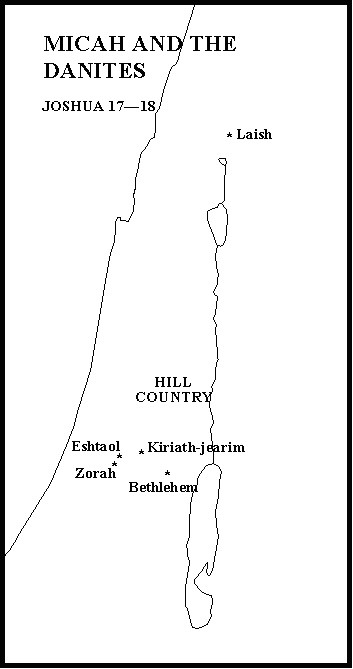
From Constable Judges 17
THE LEVITE
"A WANDERING JEW"
Now there was a young man from Bethlehem in Judah, of the family of Judah, who was a Levite - How was he both a Levite and from family of Judah? Quite likely the Levite father had married a mother from the tribe of Judah. But we cannot be absolutely certain. This Levite was named Jonathan and was identified further as Moses' grandson (Jdg 18:30). He compromised in departing from one of the 48 cities God gave for Levite service to Israel (Nu 35:7+, see map of cities). His compromise in this small point then led him to greater sin as he prostituted himself as priest for hire in Micah's private sanctuary of graven images and molten images, complete even with a priestly ephod for "discerning" the will of God. How blind we can be when we are deceived and begin to travel further and further from God's standard.
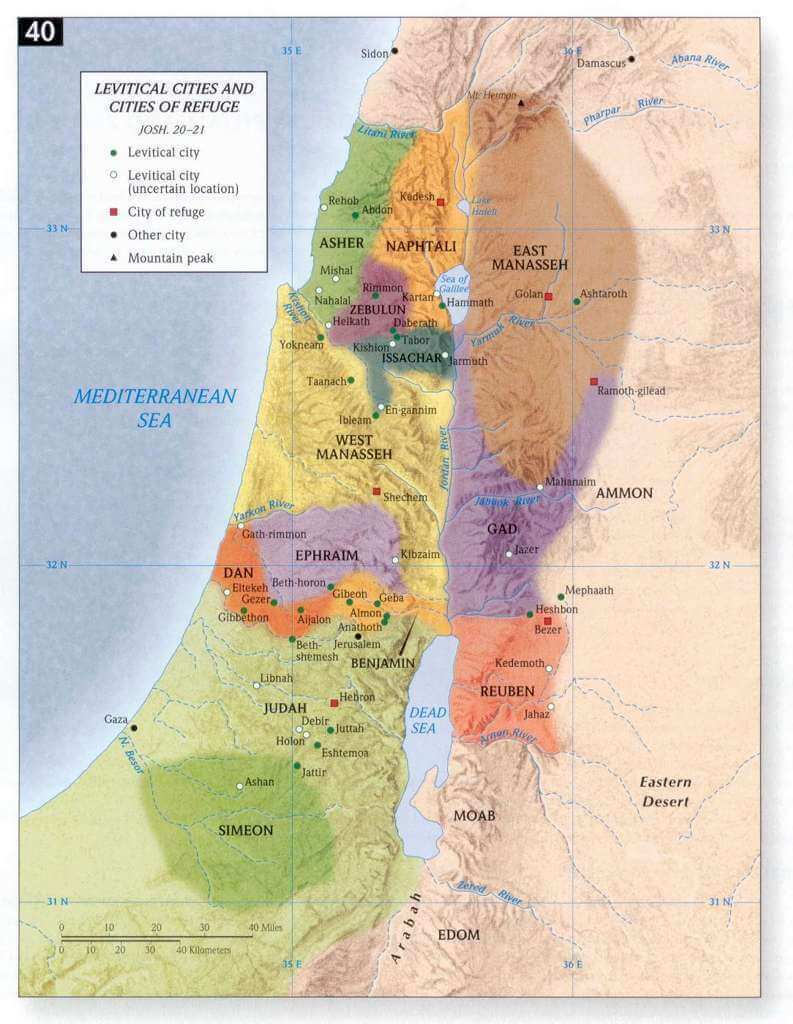
Remember that while every priest in Israel was to be of Levitical lineage, not every Levite was a priest. They were however to be associated with the Levitical cities.
Related Resources:
- What was the Levitical priesthood? | GotQuestions.org
- What is the difference between priests and Levites? | GotQuestions.org
And he was staying there - This was a violation of his Levitical lineage which probably set him up for restlessness. After all he had been given a great and glorious purpose for his life, having been set apart wholly unto God, and undoubtedly assigned a specific city from the 48 Levitical cities (cf Nu 35:7-8+, Joshua 21:3-11+). So as this wandering Jewish Levite began to seek his will and what was right in his own eyes, became restless. And so he wandered even farther from the way, the truth and the life as the following verses illustrate. He also may have been in search of support as the context suggests. Recall that the nation of Israel was clearly instructed to support the Levites, Moses declaring "And to the sons of Levi, behold, I have given all the tithe in Israel for an inheritance, in return for their service which they perform, the service of the tent of meeting. (Nu 18:20-24+). In the days of the Judges, Israel "forsook the LORD" (Jdg 2:12-13+) and as part of their forsaking Yahweh, they must have also forsaken their obligation to support the Levites (priests and non-priests). Israel had been clearly warned by Moses to "Be careful (a command) that you do not forsake ('azab) the Levite as long as you live in your land." (Dt 12:19+) Clearly in the days of the Judges Israel was not conducting their lives "according to the Book" so to speak! As a aside, it is a sign that true religion will begin to decay when godly ministers are neglected and at a loss for a livelihood.
Keil and Delitzsch… Appointment of a Levite as Priest.—Vv. 7ff. In the absence of a Levitical priest, Micah had first of all appointed one of his sons as priest at his sanctuary. He afterwards found a Levite for this service. A young man from Bethlehem in Judah, of the family of Judah, who, being a Levite, stayed (גָּר) there (in Bethlehem) as a stranger, left this town to sojourn “at the place which he should find,” sc., as a place that would afford him shelter and support, and came up to the mountains of Ephraim to Micah’s house, “making his journey,” i.e., upon his journey. (On the use of the inf. constr. with לְ in the sense of the Latin gerund in do, see Ewald, § 280, d.) Bethlehem was not a Levitical town. The young Levite from Bethlehem was neither born there nor made a citizen of the place, but simply “sojourned there,” i.e., dwelt there temporarily as a stranger. The further statement as to his descent (mishpachath Judah) is not to be understood as signifying that he was a descendant of some family in the tribe of Judah, but simply that he belonged to the Levites who dwelt in the tribe of Judah, and were reckoned in all civil matters as belonging to that tribe. On the division of the land, it is true that it was only to the priests that dwelling-places were allotted in the inheritance of this tribe (Josh. 21:9–19), whilst the rest of the Levites, even the non-priestly members of the family of Kohath, received their dwelling-places among the other tribes (Josh. 21:20ff.). At the same time, as many of the towns which were allotted to the different tribes remained for a long time in the possession of the Canaanites, and the Israelites did not enter at once into the full and undisputed possession of their inheritance, it might easily so happen that different towns which were allotted to the Levites remained in possession of the Canaanites, and consequently that the Levites were compelled to seek a settlement in other places. It might also happen that individuals among the Levites themselves, who were disinclined to perform the service assigned them by the law, would remove from the Levitical towns and seek some other occupation elsewhere (see also at Jdg. 18:30). (Judges 17 Commentary)
QUESTION - What is the legend of the Wandering Jew?
ANSWER - The legend of the Wandering Jew is a cautionary tale that has been in circulation for centuries. Basically, the Wandering Jew is an immortal man who is doomed to travel from place to place in constant state of sorrow until the second coming of Christ as a punishment for his mistreatment of Christ in His passion. It is not a biblical story, as the Bible does not mention anyone, Jewish or otherwise, who is cursed in the same way that the Wandering Jew supposedly is.
Depending on the version of the story, the fanciful details concerning the Wandering Jew are slightly different. Most all of the versions emphasize his inability to die and his curse of restlessness: he travels the globe and can only stop to eat meals before moving on again.
One version, from the Middle Ages, identifies the Wandering Jew as a man named Cartaphilus, who taunted Jesus Christ as He was carrying His cross to Calvary. The story goes that, when this man saw Jesus passing by, he told Him to go faster and stop loitering, to which the Savior replied with something like, “I go, but thou shalt wait till I come.” Jesus’ words to Cartaphilus cursed him to roam the earth until the second coming.
In an Italian version of the story from the fourteenth century, the Wandering Jew’s name is John Buttadeus—Buttadeus being Latin for “strike God,” a reference to John’s supposed physical attack upon Jesus. Other versions also associate the Wandering Jew’s crime with physical violence: in 1228, a man claimed to have met a man in Armenia who reportedly had been Pontius Pilate’s doorkeeper and had struck Jesus on His way to Calvary.
In other versions of the tale, the crime of the Wandering Jew was to simply withhold aid from the suffering Christ. In the sixteenth century, a German bishop claimed to have met a tall, barefoot, long-haired man in Hamburg. The man said his name was Ahasuerus and that he was a Jewish shoemaker who had refused to help the Lord in His hour of need. Later, this same Ahasuerus was supposedly spotted in Madrid, Spain, where he evinced a fluency in every language.
There are many other variations of the myth of the Wandering Jew, and they have been told in many cultures around the world. In some iterations, the Wandering Jew converts to Christianity and acts as an evangelist everywhere he goes. In others, he is simply cursed in his misery. Various versions give him various names: Melmoth, Matathias, Malchus, Isaac Laquedem (French), Juan Espera a Dios (Spanish for “John waits for God”), and Jerusalemin suutari (Finnish for “Shoemaker of Jerusalem”). In all versions, the theme is that cursing Christ brings a curse.
The curse of the Wandering Jew bears some similarities to the curse God placed upon Cain after his murder of Abel. Besides decreeing that Cain would no longer be able to till the ground to produce crops, God said, “You will be a restless wanderer on the earth” (Genesis 4:14). Millennia-long wandering is not mentioned as part of Cain’s punishment, and immortality is not implied, although God does put a mark on him so that no one would kill him (Genesis 4:15).
Some see the Wandering Jew legend as a metaphor for the plight of the Jewish people at large: under Moses, the Jews wandered for forty years in the wilderness; and forty years after rejecting Jesus as the Messiah, the Jews lost their temple and their nation and were forced to disperse to various places around the world. Some anti-Semitic groups have used the concept of the Wandering Jew to propagandize, and the term Wandering Jew, used as an epithet, is considered offensive.
Again, the legend of the Wandering Jew has no basis in the Bible. It is a fable that has borrowed some elements from the Bible, including a mention of Jesus, but it is a fictional story. During His trial and crucifixion, Jesus was indeed mocked; on the road to Calvary, however, we have no record of anyone mistreating Him. Luke 23:27 records that women from Jerusalem bewailed and cried for Him. In His response, Jesus never spoke a curse on anyone. In all He said, He was an example of grace and truth. When He was attacked and humiliated by the Roman soldiers, He didn’t retaliate (Matthew 27:27–31). When false accusers lied against Him, “Jesus remained silent and gave no answer” (Mark 14:61). Any supposed interaction with a man who mocked Him, with Jesus cursing him, is simply a myth.GotQuestions.org
Judges 17:8 Then the man departed from the city, from Bethlehem in Judah, to stay wherever he might find a place; and as he made his journey, he came to the hill country of Ephraim to the house of Micah.
- Then the man departed from the city. Jdg 17:11. Ne 13:10, 11.
A LEVITE LONGING
FOR "GREENER PASTURES"
Then - Remember that this conjunction usually marks progression in a narrative, so be alert to this "time marker" which will help you understand the flow of thought and the context.
The man departed from the city, from Bethlehem in Judah, to stay wherever he might find a place; and as he made his journey, he came to the hill country of Ephraim to the house of Micah - The man is not even referred to as a Levite now! He is clearly looking for greener pastures! It is worth noting that Bethlehem in Judah was not one of the 48 Levitical cities assigned by Moses (see map of cities). Levites were doubtless scattered hither and yon (from the 48 designated cities) because of lack of support, a situation that prevailed all too often in Israel's history. For example, years later Nehemiah "discovered that the portions of the Levites had not been given them, so that the Levites and the singers who performed the service had gone away, each to his own field." (Nehemiah 13:10).
The young Levite in our story apparently lacked financial support which is further indirect evidence that Israel had wandered far from the command of God that Levites were to be supported by offerings from the people of Israel. What is notable is that this omission (of Levitical support) was an early effect of their apostasy that lasted 300 years. This would not have been a good time to be a Levite!
Judges 17:9 And Micah said to him, "Where do you come from?" And he said to him, "I am a Levite from Bethlehem in Judah, and I am going to stay wherever I may find a place."
MICAH'S "PROVIDENTIAL"
LEVITICAL ENCOUNTER
And Micah said to him, "Where do you come from?" And he said to him, "I am a Levite from Bethlehem in Judah And I am going to stay wherever I may find a place - While this encounter between Micah and the Levite was providential, it was not a "gift" to Micah, but a test of Micah, a test who miserably failed. If Micah had been a man of God, we would credit him here with asking a good question, something like "Since you are a Levite, why are you not in one of the 48 levitical cities?" As alluded to indirectly above, the Mosaic law had specified that the priests were to come from the tribe of Levi. Whether Micah knew the law or not it did not deter him (NOTE ASSOCIATION OF APOSTASY AND APATHY!). All Micah desired was quick "upgrade" to his homemade religious setup. Here was his golden opportunity to get him a Levite as a "pseudo-priest." So clearly he had some knowledge of what was right in God's eyes and either did not know the letter of the law or simply choose to ignore it as a minor detail. The Levite on his part seems to be aiming to get bread, not to do good
Judges 17:10 Micah then said to him, "Dwell with me and be a father and a priest to me, and I will give you ten pieces of silver a year, a suit of clothes, and your maintenance." So the Levite went in.
- a father. Jdg 17:11. Jdg 18:19. Ge 45:8. 2Ki 6:21. 8:8, 9. 13:14. Job 29:16. Is 22:21.
- I will give. Jdg 18:20. 1 S 2:36. Ezek 13:19. Mt 26:15. Jn 12:6. 1 Ti 6:10. 1Pe 5:2.
- year. Ge 24:55.
PRIEST FOR HIRE
"MY OWN PRIVATE PRIEST!"
Micah then said to him, "Dwell with me and be a father and a priest to me - So Micah promises the Levite PREFERENTIAL TREATMENT and honor as one would one's own father. Micah does not seem interested in his credentials and takes no time to look at his "Levitical C.V" and inquire how he behaved in his last residence. Micah is focused. He wants a "full-fledge" priest, or at least he thinks the Levite would so qualify! Micah's actions are a foreshadowing of similar actions by Jeroboam I who was even more perverted because he "made priests from among all the people who were not of the sons of Levi." (1Ki 12:31) Micah's actions may have been the "leaven" that would later make the yeast rise (so to speak).
Micah's action should not surprise us. If he can make anything an image of God, he wouldn't hesitate to make anyone a priest of God. The Levite became both a "father" and a "son" to Micah (Jdg 17:10-11). "Father" is a term of honor used of Joseph's position in Egypt (Ge 45:8) and of Elisha as a respected prophet (2Ki 13:14, Ge 45:8).
And I will give you ten pieces of silver a year, a suit of clothes, and your maintenance - Compare this annual pay to the stolen 1100 pieces of silver in Jdg 17:3+! This is poor salary in comparison of what God provided for the Levites that behaved well. However those that forsake God’s service will never better themselves, nor find a better master! As someone has said the ministry is the best calling but the worst trade in the world.
THOUGHT - You must listen to this classic sermon 10 SHEKELS & A SHIRT (audio - a must listen!) based on some of the events in Judges 17. It is a riveting sermon by Paris Reidhead which preaches could be called one of the most influential sermons of the 20th century. The real point of this sermon is an indictment of individuals and organizations practicing humanism behind a mask of Christianity! (cf 2Ti 3:5+) "This sermon should be preached on a regular basis in every church in America!"
Spurgeon - It was but poor pay: two hundred shekels had been spent on an image, and now ten is thought enough for the priest. A rich idol they must have, even though the priest be poor as charity. The pay was worse when we remember that the Levite was selling his soul for the pittance. How degrading for a servant of the living God to be waiting upon dumb idols. (The Interpreter: Spurgeon's Devotional Bible)
So the Levite went in - What the Levite should have done is go in an rebuke Micah for his idolatrous setup (Ex 20:2-4, La 2:14). But then Micah should have rebuked the nameless Levite for not remaining as he should in one of the Levitical cities! Two wrongs definitely don't make a right as the subsequent sad tale reveals
L M Grant…Coming into the mountains of Ephraim, the man happened to stop at Micah's house (Jdg 17:8). Micah inquired as to where he cane from, and when he learned the man was a Levite from Bethlehem in Judah, Micah discerned a wonderful opportunity of having a Levite as his priest instead of his son (Jdg 17:9-10). He offered him 10 shekels of silver per year, plus his sustenance (room and board) and a suit of clothes. Such bargains are made also today in Christian circles, and preachers are hired on agreed terms. This is not scriptural at all, but is plausible in the eyes of unspiritual people. The Levite ought to have had sense enough to refuse this, specially when it involved him with idols and also elevating him to the priesthood (which was gross wickedness), but he was evidently insensible to the serious evil that was laid as a snare to his feet. The agreement was made, and then Micah consecrated the Levite as a priest, as he had done with his son. Who gave Micah the authority to consecrate a priest? Yet similarly today, people are "ordained" by those who have no God-given authority whatever. In fact, each independent "church" has its own policies of ordaining. They think that the fact that God instructed Moses to consecrate priests of the line of Aaron is a justification for their consecrating priests or pastors or "reverends" as they see fit! They think that since God gave Moses such authority, they are within their rights to assume such authority too! But in the New Testament there is no suggestion of God giving to any man the authority to ordain others to any spiritual position. (Comments On Judges LM Grant)
Keil and Delitzsch: “Dwell with me, and become my father and priest; I will give thee ten shekels of silver yearly, and fitting out with clothes and maintenance.” אָב, father, is an honourable title give to a priest as a paternal friend and spiritual adviser, and is also used with reference to prophets in 2 Kings 6:21 and 13:14, and applied to Joseph in Gen. 45:8. לַיָּמִים, for the days, sc., for which a person was engaged, i.e., for the year (cf. 1 Sam. 27:7, and Lev. 25:29). “And the Levite went,” i.e., went to Micah’s house. This meaning is evident from the context. The repetition of the subject, “the Levite,” precludes our connecting it with the following verb וַיֹּואֶל.—In vv. 11–13 the result is summed up. The Levite resolved (see at Deut. 1:5) to dwell with Micah, who treated him as one of his sons, and entrusted him with the priesthood at his house of God. And Micah rejoiced that he had got a Levite as priest, and said, “Now I know that Jehovah will prosper me.” This belief, or, to speak more correctly, superstition, for which Micah was very speedily to atone, proves that at that time the tribe of Levi held the position assigned it in the law of Moses; that is to say, that it was regarded as the tribe elected by God for the performance of divine worship. (Judges 17 Commentary)
F B Meyer Our Daily Homily Judges 17:10
Dwell with me, and be unto me a priest.
Men crave for a priest. In every age of the world’s history, where there has been a tent indicting the presence of human life, there has been an altar indicating man’s consciousness of God, and a priest suggesting his consciousness of unworthiness to enter into the Divine presence. Man has perpetually taken one of his fellows whose character seemed less blemished than that of others, and after setting him apart with special rites from the ordinary engagements of life, has promised him maintenance and honor, if only he will act as priest. Be my priest; say for me to God what I cannot say. The sacrifices offered by thy hands are more likely to avail with Him than those rendered by mine.
(1) Let us beware of the religion which ignores man’s craving for a priest. — The world abounds with attempts at religious systems, from which the conception of the priest is eliminated. These reduce the worship of God to a system of high-thinking, but fail to deal with man’s consciousness of sin, and his yearning for a settled basis of peace.
(2) Let us remember that all human priests must ultimately fail. — God has put them all aside, setting up the priesthood of the blessed Lord. “We have such a High Priest, who is set on the right hand of the throne of the Majesty in the heavens; a minister of the sanctuary, and of the true tabernacle which the Lord pitched, and not man.” Stars are needless when the sun has arisen. The human priesthood is rendered unnecessary since the Son of God has passed into the heavens to be a priest after the order of Melchizedek. No one has a right to pose as a priest to others, except in the sense that all Christians are such.
Judges 17:11 And the Levite agreed to live with the man; and the young man became to him like one of his sons.
LEVITE IS
LURED
And the Levite agreed to live with the man; and the young man became to him like one of his sons: Now think about this for a moment -- what did Micah have in his house? Shouldn't a Levite who was to able to teach the Law know that Micah had broken God's law? How could a holy (set apart) man be be lured into such a den of wickedness? This Levite may be the same man named Jonathan in Jdg 18:30+. If indeed this Levite was Moses' grandson, it is a sad reminder that godly ancestors do not necessarily guarantee godly offspring. Every generation must make its own personal decision to follow Jehovah and His Word. Or to say it another way, as we learned in Judges 2:10+, each generation is only one generation from apostasy - the generation of those who associated with Joshua died, the writer recording that "All that generation also were gathered to their fathers; and there arose another generation after them who did not know the LORD (APOSTASY), nor yet the work which He had done for Israel." To me this is one of the most amazing verses in the book of Judges (it rivals the sad words of Jesus in Rev 2:1-7+ that the church at Ephesus, once "on fire" within about one generation "had left their first love!" WARNING! WE MUST ALL BE DILIGENT TO GUARD OUR HEARTS! Pr 4:23+) Why did Israel forget Yahweh so quickly? Read the words from Psalm 106 and see if they do not give you a clue...
They did not destroy the peoples, As the LORD commanded them, but they mingled with the nations and learned their practices, and served their idols, which became a snare to them. (Ps 106:34-36)
THOUGHT - Can you see Israel's fatal mistake? What sin keeps recurring in your life that you are not willing to utterly destroy? Be careful!
Judges 17:12 So Micah consecrated the Levite, and the young man became his priest and lived in the house of Micah.
- consecrated. Ex 28:41. Jdg 17:5.
- his priest. Jdg 18:30. Nu 16:5, 8-10. 1Ki 12:31. 13:33, 34.
MICAH'S MANMADE
MINISTER
So Micah consecrated the Levite, and the young man became his priest and lived in the house of Micah: This verse is crazy! Micah did not have the authority to consecrate the Levite. In the next verse, Micah makes the naive assumption that the Lord would do him good, since he had a Levite for a priest! It is obvious that Micah’s motivation was based on superstition, not faith in God’s revelation. Micah had what Paul years later called a "form of godliness" (2 Timothy 3:5+), with the external trappings of a mixed up religion that included idols, his house of gods and his own priest (See religious syncretism) It may have looked right in Micah's eyes but it was blatantly evil in God's eyes!
THOUGHT - Similarly today in American "Christianity" there are many sincere individuals who sadly are beguiled and misguided in their religious activity because they have failed to hold their activity up to the plumbline of God's Word and be a Berean (Acts 17:11+).
We need to be alert to the danger of the church imagining that it employs rather than God calls,
and of the minister pleasing men rather than God!
-- David Jackman
David Jackman addresses the premise that churches today do the same thing as Micah did - Listen to a church council or a congregational meeting discussing the sort of minister the church wants to call. So often, what God wants is assumed to be the same as what we want, because in practice God has become a pocket-sized idol. What churches always need is ministry that presents the true Word of God, without fear or favor, and a minister who serves for the glory of God, not the rewards of the church (cf 2Ti 2:15+, 2Ti 4:1-2, 5+). We need to be alert to the danger of the church imagining that it employs rather than God calls, and of the minister pleasing men rather than God (cf 2Ti 4:3-4+). We need to ask whether we are really open for God to work among us as He wants to." (See context in Jackman, D., & Ogilvie, L. J. The Preacher's Commentary Series, Volume 7 : Judges, Ruth. Page 259)
Judges 17:13 Then Micah said, "Now I know that the LORD will prosper me, seeing I have a Levite as priest."
- Now I know Pr 14:12. Is 44:20. 66:3, 4. Mt 15:9, 13. Jn 16:2. Ac 26:9. Ro 10:2, 3
TALK ABOUT SELF
DELUSION!
Then Micah said, "Now I know that the LORD will prosper me, seeing I have a Levite as priest - Whenever we human beings imagine that we have God in our pocket, we are desperately misguided. What Micah did not know (or blatantly disobeyed if he knew it) was the Word of God in which appointment of anyone to the priesthood other than from lineage of Aaron was strictly forbidden (cf. Nu 3:10+ "So you shall appoint Aaron and his sons that they may keep their priesthood."). Micah practiced a false religion and worshiped false gods (with a "pinch of Jehovah" thrown in to add a little "flavor"). Now he is so self deluded that he falsely believed that God was blessing him! Micah's smug assertion of "now I know… " ranks with Aaron's declaration the day after the golden calf was made, Moses recording that "when Aaron saw this, he built an altar before it; and Aaron made a proclamation and said, "Tomorrow shall be a feast to the LORD." (Exodus 32:5+). Both Aaron and Micah were sadly deceived in their expectations. When a person is a deceived by definition they don't even realize their tragic state. The writer of Hebrews offered the preventative for deception exhorting us to "encourage one another day after day, as long as it is still called "Today," lest any one of you be hardened by the deceitfulness of sin." (Heb 3:13+ and The Deceitfulness of Sin)
Solomon wrote that ""He who trusts in his own heart is a fool, But he who walks wisely will be delivered." (Proverbs 28:26)
Micah and most others in Israel during this dark time were "being corrupted by (their) deceitful desires" (Eph 4:22+)
Micah’s naive, complacent confidence that God would bless him because he has installed a Levite priest illustrates the shocking degree to which truth had been corrupted because of Israel's apostasy. The people had lost the ability to distinguish between God’s truth and mixture of God with idolatry, or pagan syncretism. They had apparently forsaken the intake of solid food for so long that they were like those described by the writer of Hebrews who recorded that "solid food is for the mature, who because of practice have their senses trained to discern good and evil." (Heb 5:14+).
L M Grant - Micah did not seek God's guidance at all, yet he said, "Now I know that the Lord will be good to me, since I have a Levite as priest!" (v13). He did not remember that when Korah (a Levite) wanted to usurp the priesthood of Israel, God caused the earth to open and swallow him up (Num. 16:10, 31, 32). Thus, at the first God had shown His great anger against such evil, which should have been enough to warn men, but later He allowed the evil to go unchecked. Why? Not that He hated it less, but patiently waited with a view to testing all Israel, so that when they failed the test, judgment was all the more severe when it eventually fell. (Comments On Judges LM Grant)
J V McGee - "This chapter is certainly a revelation of the low spiritual ebb to which the nation Israel had come. Here is a man who thinks just because he has a Levite for his preacher that that is all he needs. How tragic is that kind of thinking. Yet Micah expected the blessing of God upon him. And how many people are like that today?" (See context in Thru the Bible)
THOUGHT - Let us remember what Israel (and Micah) should have known according to God's Word: (1) making idols was forbidden (2) Aaron’s descendants only were to serve as priests (3) sacrifices were to be made only at the tabernacle (4) and blessing was an outcome of obedience rather than ritual observance. Micah violated every basic principle and yet was so self-deceived that he was convinced that his actions merited God’s favor!
David Jackman warns that "The attraction of the idol is that it belongs to me, so that I can control it and enjoy a special relationship of favor with it. When my church, or my work for the Lord, or my financial capacity, or my status in the community begin to whisper to me that now God’s blessing is certain or inevitable, I can be sure that these things have become idols, by means of which I am actually worshiping myself. They provide only a thin veneer of godliness over the unmistakable features of a worldly idol (2 Timothy 3:1–5).Such idols drain the church of the power of the Holy Spirit which could otherwise be experienced in all his fullness. They paralyze us (see 18:24). Their worshipers become as inert and ineffective as they are, so that far from the future providing certain blessings from God, it is condemned to be a predictable, boring round of self-worship. Then the devil has won. Spiritually, he has destroyed us because we were not prepared to venture out on the bare word of God’s promises in faith. Instead, every time we chose to operate on the basis of sight and of what our own hands and minds could achieve for ourselves, we were playing the devil’s game and becoming enmeshed in a web of idolatrous self-reliance “Little children, keep yourselves from idols” (1 John 5:21)." (See context in Jackman, D., & Ogilvie, L. J. The Preacher's Commentary Series, Volume 7 : Judges, Ruth. Page 260)
Brensinger adds that "Both the veneration of idols and the equation of divine favor with external religious practice have this in common: God is reduced to a controllable and totally predictable deity. In the case of idols, God takes on whatever form we humans desire. We do the shaping and the fashioning. We determine the expectations and demands. We regulate the sphere of influence. We handle God, move God, spend God, control God, and play God. As a result, the God we worship is in reality nothing more than what Martin Luther labels an idol concocted for ourselves. When people associate divine favor simply with religious possessions and behaviors, they put God into the role of a convenient and manageable checklist. From the beginning of time, people have sought after gods who are consistent and predictable, gods with unambiguous likes and dislikes. In this way, everyone knows precisely what to do and when to do it. We may assume that God automatically delights in regular church attendance, hour-long prayers, and the sharing of financial resources, for example. Then we confidently go ahead and do them, fully anticipating his blessings in return. What results, all too often, is a contract or bargain… God’s favor cannot be bought with a list of “religious” behaviors. (Judges Believers Church Bible Commentary)
True shepherds receive their calling and authority from God, not from people (Gal 1:6ff); and they honor the true God, not the idols that people make. It must grieve the Lord today to see people worshiping the idols of ministerial “success,” statistics ("nickels and noses" as someone has quipped), buildings, and reputation. In today’s “consumer society,” self-appointed preachers and “prophets” have no problem getting a following and peddling their religious wares to a church that acts more like a Hollywood fan club than a holy people of God. And to make it worse, these hirelings will call what’s happening “the blessing of God.” Jonathans and Micahs will always find each other because they need each other.
Spurgeon - So superstition always talks. This was an ordained man and one of the regular clergy, therefore a blessing must attend his performances. Though the images and ephods were all forbidden, and the whole worship was a direct opposition to the Lord’s true worship at Jerusalem, yet they looked for a blessing because the priest was in the succession; even as in these days, those who set up crosses, and pictures, and altars—and so insult the Lord Jesus, nevertheless expect peculiar favours because of some imaginary apostolical succession. “God is a spirit, and they that worship him must worship him in spirit and in truth.” Outward formalities and performances not commanded in Scripture, we ought not to sanction by our presence, but avoid them lest we partake in the sin of them. (The Interpreter: Spurgeon's Devotional Bible)
Charles Simeon's Judges 17:13 MICAH'S FALSE CONFIDENCE
Jdg. 17:13. Then said Micah, Now know I that the Lord will do me good, seeing I have a Levite to my priest.
IN the history before us we see the commencement of that defection to idolatry, which at no distant period prevailed throughout all the tribes of Israel. The account in point of time precedes the reign of the Judges; for it occurred whilst Phinehas, the grandson of Aaron, was the high-priest, and consequently soon after the death of Joshua (Jdg 20:28). And, as being the first step of Israel’s departure from God, it is related more circumstantially than its intrinsic importance seems otherwise to have deserved.
Micah was of the tribe of Ephraim. He had stolen from his mother a large sum of money which she had amassed: but from a dread of the curses which she had imprecated on the head of the guilty person, he had confessed his crime, and restored the money. She, pleased with the repentance of her son, would have given him the money: but he persisting in the refusal of it, she gave two hundred shekels of silver out of the eleven hundred which she had recovered, to form a graven image and a molten image; which she gave to her son, that he might have them to consult on all occasions. He on his part appropriated to them an apartment of his house for a temple, and consecrated his son to be a priest, to officiate before them with an ephod, which was made for his use (Jdg 17:2, 3, 4, 5). But a Levite, who wanted employment, coming that way, Micah engaged him to minister before the idols; and concluded, that now he could not fail of being happy, since he had a duly authorized person for his priest.
Just at that time the Danites, who had not yet gained possession of all the land that had been as signed them, determined to go up to Laish, and seize it for their inheritance. But previous to their attack upon the inhabitants, they sent forth spies to search out the state of the people, in order that they might the better judge what force to send against them, and what prospect there was of ultimate success. These spies coming to Mount Ephraim, where Micah lived, desired him to consult God through the medium of his idols; and received from him an encouraging reply. The report of the spies being favourable, six hundred Danites went forth upon the expedition; and coming to the house of Micah in their way, robbed him of his idols, and bribed his priest to accompany them, and to minister to them, as he had done to Micah. After they had succeeded in destroying the inhabitants of Laish, and in taking possession of their land, they set up these idols for their gods, and thus established idolatry, which in process of time spread over the whole land.
But it is not of idolatry in general that we propose to speak, but only of that particular modification of it which Micah established, and of the confidence which he expressed, when his newly-invented religion was made to bear some faint resemblance to the Mosaic ritual. This so exactly represents the false confidences to which ungodly men of every age resort, that we shall find it a very profitable subject for our present consideration.
We take occasion then from our text to notice,
I. The false confidences of ungodly men—
The worship established by Micah was a mixture of heathenism and of the Jewish ritual: it was heathenism, as far as it had respect to idols; and it was Judaism, as far as the use of an ephod and the ministration of a Levite were concerned. But, faint as its resemblance was to any thing authorized by God, it was sufficient in Micah’s judgment to justify a most assured confidence in the divine favour.
Somewhat of a similar mixture is the religion of the generality in the present day—
[It is a combination of Heathenism, and Judaism, and Christianity. It is in part Heathenism. What are the views which men in general have of God, but such as were entertained by the heathen philosophers? We have, it is true, clearer views of the unity of God: but of his perfections we have scarcely juster apprehensions than the heathen had. Christians in general account of God as a Being who is but little interested about the affairs of this world, either in a way of present control, or of future retribution. All, in their apprehension, is left either to chance, or to the will of man: and, provided only some of the more heinous sins be not committed by us, the state of our minds and the habits of our lives will pass altogether unnoticed by him. To see the hand of God in every thing; to expect from him the blessings which we ask at his hands; to be sensible of his favour or displeasure; to regard him as pledged to order all things for his people’s good; and to rest assured, that he will fulfil to us his promises; is, in the estimation of the world at large, no better than presumptuous pride and enthusiastic folly: so entirely do they exclude Jehovah from the government of the world, and reduce him to the state of the god of Epicurus. In like manner the morality of men in general is simply that of the wiser heathens; the more refined and exalted requirements of Christianity being deemed unnecessarily precise, and absurdly strict. An entire deadness to the world, and devotedness to God, are never contemplated by them, but as the dictates of ascetic gloom or fanatical conceit.
Whilst in their principles they sink into heathenism, in their adherence to forms they trench on Judaism. Every sect has its favourite forms, which, though of human origin only, are of more weight in the estimation of the generality than either principles or morals. A man may be sceptical in his principles, and licentious in his morals, and yet offend no one: but let him violate the forms which have been established by his own particular sect or party, and he will raise an outcry against him immediately. This is common both with Papists and Protestants, yes, and with Protestants of every description. The rules of their own particular denomination are more to them than the oracles of truth; and a neglect or violation of a human institution is more heinous in their eyes than any departure from the commands of God. Thus it was with the Pharisees of old, who made void the law of God, and regarded only their own self-appointed usages: and thus it is at this day amongst multitudes who name the name of Christ.
A small portion of Christianity is for the most part added to this, to complete the system. Christ is acknowledged to have purchased for us such a relaxation of the divine law as we are pleased to claim, and a power to save ourselves by any measure of obedience which we choose to pay to the code we have devised — — —]
Whilst such is the religion of the generality, it is supposed to constitute a just ground of confidence before God—
[Micah had now no doubts or fears but that all would go well with him both in this world and the next. And similar to this is the confidence which almost universally obtains amongst ungodly men. They have no fears but that God will do them good, because they are free from those crimes which outrage the common feelings of mankind, and serve God according to such rules as they have laid down for themselves. Whosoever dies in such a state, they send to heaven, as a matter of course; thinking, that to entertain a doubt of their safety would be the height of uncharitableness. It is surprising to what an extent their confidence is carried. The bare possibility of such persons having perished in their sins is never once contemplated by them: and, if a doubt were expressed respecting the issue of their own expectations, they would be quite indignant. Were a truly pious man to express the same confidence as arising from the promises of God, they would inveigh against his presumption: but in their own delusive speculations their confidence is such as to preclude all doubt. We may see this exemplified in the Jews of old. To have Abraham for their father, and the temple of the Lord for their religious services, was in their estimation sufficient ground of hope, though they lived in a constant violation of every known duty. And precisely thus it is with the generality of Christians: they have been baptized into the faith of Christ, and they have lived according to a system which the world approves; and therefore they can say without fear, “I know that the Lord will do me good.”]
But whilst ungodly men are buoying themselves up with such delusive hopes, let us contemplate,
II. Their bitter disappointments—
What was the issue of Micah’s confidence? Was it justified by facts? Could his idols help him in the day of adversity? or did Jehovah interpose for his support? No: his idols could not even protect themselves: and when he complained of the spoilers who had robbed him, his pathetic expostulations were of no avail; and he was constrained to submit in silence to the loss of all wherein he had put his trust. Hear to what straits he was reduced: “Ye have taken away my gods; and what have I more?” And thus will it be with the ungodly in the last day.
Their “refuges of lies” will be swept away—
[The religion in which they now so confidently trust, will be proved a baseless fabric. No foundation will then stand, but that which God himself has laid: nor will any superstructure endure, but that which is able to abide the fiery test which shall be applied to it (1Cor. 3:11, 12, 13). The law, which sinners reduce to their own standard, will be found immutable: the obedience which they pay to it will be found so imperfect, as to be incapable of affording the smallest ground of justification before God. The Lord Jesus Christ will then be seen to have been the only Saviour of sinful men; and his obedience unto death the only hope of a ruined world. The religion of the Bible will then appear to be, what it really is, the only means of a sinner’s access to God, and acceptance with him.]
Their destitution and misery will be then complete—
[“Ye have taken away my gods; and what have I left?” may then be considered as the bitter lamentation of every self-deceived soul. How gladly would they who were once so confident in their expectations of bliss, take refuge, if it were possible, under rocks and mountains! How thankfully would they accept of utter annihilation, instead of a protracted existence under the wrath of God! In vain are now their pleas, “I thought that I was right.” Why did they rest in vain conjectures? Why did they presume to substitute a system of their own in the place of that which God had revealed? Why would they not submit to be saved in God’s own way? Why would they venture the salvation of their souls on plans and systems of their own devising? Alas! it is now too late to rectify their error: they are gone beyond redemption; and are consigned to those regions of darkness and despair, where not a single ray of hope can ever enter to dispel their gloom. “They have walked in the light of the sparks which they themselves have kindled: and now they lie down in sorrow.” (Isa 50:11)
Thus it will be, whatever men may now say to the contrary (Job 15:31); and, if they will not believe, they shall soon “see whose word shall stand, God’s or theirs (Jer 44:28).”]
See then from hence,
1. The importance of having right sentiments in religion—
[If we consider religion only as influencing the mind in this present life, it is no unimportant matter whether we have such a vain system as men form for themselves, or such a grand and glorious system as God has revealed in his word. Compare that of Micah with that of Daniel and the Hebrew Youths, and say, which of the two was the more effectual in the hour of trial? — — — But extend your views to the eternal world; and compare the states of the Pharisee and the Publican, or of the martyred Stephen and his self-applauding murderers; and then say, what principles are most salutary, and, what practice is most conducive to our true happiness. Away with all the systems then of man’s device; and embrace with your whole hearts “the glorious Gospel of the blessed God.”
2. The comfort of having the Lord for our God—
[Who can ever rob us of that? Who can take our God from us? or what can we want, if we have him for our friend? We may be spoiled of all else; but still we shall be rich. With his favour secured to us, and his love shed abroad in our hearts, we shall be truly happy; like Paul, “having nothing, and yet possessing all things.” Seek ye then to have the Lord Jesus Christ abiding with you. Seek to have him for your sacrifice; him for your altar; “him for your Priest;” and you may then be as confident of the divine favour as your hearts can wish. You may then safely adopt the language of Micah, and say, “I know that the Lord will do me good.” God’s favour is then made over to you by an everlasting covenant: it is confirmed to you by promise and by oath, “by two immutable things, in which it is impossible for God to lie.” So that from henceforth you “may have strong consolation, if only you flee for refuge, to lay hold on the hope that is set before you.” (He 6:17-note, He 6:18, 19-note) Then you may look forward also to the day of judgment with assured confidence, that he who has witnessed the desires of your heart, will acknowledge you as his, and “claim you as his own when he shall make up his jewels.” (Mal 3:16, 17) Then shall it be seen, beyond all contradiction, who was right; the self-confident framer of a human system, or the humble follower of the Lamb: for “then shall all discern between the righteous and the wicked; between him who served God, and him who served him not.” (Mal 3:18) (Simeon, C. 1832-63. Horae Homileticae Vol. 3: Judges 17:3 Micah's False Confidence)
Judges 17‑21. Religious and Moral Corruption of Israel.
The Levite of Judah (Judges 17)
Chapters 17 to 21 form a kind of appendix to the book of Judges, an appendix of all importance for the completion of the moral picture of the declension of Israel, but which, in reality, as to time, precedes the opening of the book we are considering, and goes back to the last days of Joshua and of the elders that outlived him. It was important to show that if, on the one hand, declension was gradual, that on the other, the ruin was immediate and irremediable from the moment that God had confided to the people the responsibility of preserving the blessings bestowed on them at the beginning.
It was important, too, as we shall see later on, to demonstrate that the end God had in view was not the ruin, but the restoration of a people who might dwell before Him in unity, after the chastisements had run their course. It was, furthermore, of importance to show the connection of the priesthood with the ruin, and how it was associated therewith, and contributed thereto. All these weighty subjects, and many others besides, are touched upon in the small compass of the chapters, which we are about to consider. The date of them is shown us in three passages which I mention for those who are interested in the arrangement of the book, and also that it may not be necessary to refer to them again.
- The first of these is in Judges 18:1. We learn from Joshua 19: 47, that the tribe of Dan took possession of Leshem (the Leshem of Joshua being the Laish of Judges), at the time when the twelve tribes were called to conquer their inheritance.
- In the second passage, Judges 18:12, "Mahaneh‑dan" received its name from the expedition of Dan, whereas at the commencement of the history of Samson (Judges 13:25) it was a place already known. - Finally, in Judges 20:28, "Phinehas, the son of Eleazar, the son of Aaron, stood before it (the ark) in those days;" from which we necessarily conclude that those days followed immediately what is related in Joshua 24:33.
These details established, we find in Judges 17 and Judges 18 the picture of the religious corruption of Israel whilst still in possession of their original blessings - a picture which does not offer a single spot where the heart can rest amid the ruin; and, when we come to examine it by the light of the word, we shall understand that our only refuge in this terrible flood of evil is God Himself.
These chapters are linked together by a characteristic phrase occurring four times. "In those days there was no king in Israel, but every man did that which was right in his own eyes" (Judges 17:6; Judges 21:25). "In those days there was no king in Israel" (Judges 18:1; Judges 19:1).
Thus the state of the people is depicted by two facts. First: "There was no king in Israel." The time had not yet come when Israel would say: "Make us a king to judge us like all the nations" (1Sa 8:5). Hitherto the people had Jehovah as their king; now, God was forgotten or set aside, although royalty after the manner of the nations was not yet established. The people had abandoned the system of divine government, without having as yet proclaimed that of the world, and this fact characterizes also Christendom in our days.
In the second place: "Every man did that which was right in his own eyes." They had, as in the present day, the reign of liberty of conscience. Each laid claim to having the "light of his conscience" for guidance, whilst the true light of the word of God was set aside and no longer referred to. How greatly these times differed from those of Joshua, when the word was the only guide and the only authority for Israel, in all that they undertook (Joshua 1:7, 8, 9; see also, amongst others, Joshua 3, Joshua 4:6; Joshua 8:30, 31, 32, 33, 34, 35, etc). Now in reality, conscience, notwithstanding its immense value for man, is not a guide, but a judge - a wholly different thing. This judge which he does not listen to, man pretends to honour by choosing him as a guide. But how will it lead him, when perhaps it may become asleep, hardened, or even seared? These chapters show us where it led the Israelites when every man did that which was right in his own eyes. Idolatry had taken root alongside of some religious forms which still continued. They followed the impulses of their own hearts provided they thought they were doing right, and were precipitated into frightful iniquities. "They thought they were doing right" is in the present day, as it was formerly, a current phrase used to sanction even what is apostasy from Christianity.
Utter disregard of the injunctions of God's word characterized Micah, this man of Mount Ephraim, and his mother. The one stole, when the law had said, "Thou shalt not steal" (Ex. 20:15), and his conscience was untouched when he avowed the fact. The mother "had wholly dedicated the silver unto Jehovah" for her son "to make a graven image and a molten image" (Jdg 17:3), although it had been said: "Thou shalt have no other gods before me. Thou shalt not make unto thee any graven image" (Ex. 20: 3,4). She joined Jehovah's name to her idols, a worse thing than mere idolatry, and her conscience was silent. She set up a form of worship of her own, with which her guilty son fully identified himself. The so‑called worship of the religious world in the present day does not differ so much from this as would at first appear; for the Lord's name is mixed up with many things coveted by the natural heart, as to all of which it is said: "Little children, keep yourselves from idols" (1John 5:21). Art, music, gold, silver and articles of value adorn what is called divine worship; and man makes room for what the world esteems and runs after, wealth, influence and worldly wisdom.
"Micah had an house of gods, and made an ephod and seraphim," associating the false gods with the ephod, a valueless part of Jewish worship when separated from the high priest who wore it. Then "he consecrated one of his sons, who became his priest" (ver 5). More than ever was the word of God forgotten. His son had no right to the priesthood and Micah had no right to consecrate him.
A fresh circumstance arose. A Levite of Judah, having as such a connection with the house of the Lord, but without any right as to the priesthood, happened to pass that way looking for a place wherein to sojourn. Micah got hold of this man, who brought him a semblance of religious succession. "Dwell with me, and be unto me a father and a priest, and I will give thee ten shekels of silver by the year, and a suit of apparel and thy victuals" (Jdg 17:10). Micah was getting on; he had installed a bona fide Levite in his house; valuing him more highly than his son, he supported and paid him. This was a ministry of man's appointing, constituted on the same principles as what we have all around us in our days. Let us notice, in passing, how God recounts these things.
He does not censure, nor express indignation; He enumerates the facts, and places them before us. Those who are spiritual discern what God condemns and what He approves of, and learn also to keep aloof, as He Himself does, from all the principles of which this chapter gives us so sad a picture. The carnal man continues in his blindness. Micah, in doing that which was right in his own eyes, thought to conciliate the favour of Jehovah! "Then said Micah, Now know I that Jehovah will do me good, seeing I have a Levite to my priest" (Jdg 17:13).
L M Grant…CHAPTER 17 BOLD IDOLATRY IN ISRAEL (JUDGES 17:1-13)
Samson was the last judge in Israel. The last five chapters of Judges -- 17 to 21 -- deal with conditions during the time of the Judges, so do not necessarily take place after Samson. The history of Micah and the Danites (chapters 17 and 18) illustrates the spiritual corruption (idolatry) into which Israel sank so soon after coming into their land, while chapters 19-21 emphasize the moral corruption of the people. Certainly idolatry is the worst of these two, for it is against God, but no opposition from Israel was raised against idolatry, though they were incensed against the moral corruption (Jdg 20:11, 12, 13). How sad it is that we generally think more of the people's rights than of God's rights!
Micah was from Mount Ephraim. We are introduced to him as confessing to his mother that he had stolen 1100 shekels of silver from her, reminding her also that she had pronounced a curse against the thief. His mother said nothing about the curse, but told him, "May you be blessed by the Lord, my son!" (Jdg 17:2).
Then she made it evident that she idolized her son, by telling him she had wholly dedicated this money to the Lord to make a carved image and a molded image for her son (Jdg 17:3). She evidently wanted her son to be religious, but was teaching him to refuse to obey the Word of God! The first of the ten commandments sternly forbad idolatry and image making (Ex. 20:3,4), but here this wickedness was rising in the midst of the land of Israel!
Micah's mother used 200 shekels for the making of the images. Are we like her in any respect? Do we speak of devoting everything to the Lord, then keep back nine elevenths for ourselves? But of course none of this was really devoted to the Lord, but to an evil purpose.
Micah also had a shrine. Where did he learn of this but from the idolatrous nations in the land? He made an ephod also, copying what was only to be worn by the high priest of Israel (Lev. 8:7). Then to crown his wickedness, he consecrated his son as his priest (Jdg 17:5). Scripture had declared plainly that only those of the line of Aaron were priests, and anyone who dared to infringe on this was to be put to death (Num. 18:1, 2, 3, 4, 5, 6, 7). Also, a priest was a priest for all Israel, not for a family. But independence is a natural weed of the human heart, and that independence expressed itself everywhere in Israel at the time: "everyone did what was right in his own eyes" (Jdg 17:6).
At this time a young man, a Levite from Bethlehem in Judah, was traveling, looking for a convenient place to stay (Jdg 17:7). A Levite at least ought to have consulted God and been guided by God as to where he should be, but he was like some preachers today who are looking for a church where they might find amore or less permanent position. One who is the Lord's servant should not be aimless and haphazard in what he does.
Coming into the mountains of Ephraim, the man happened to stop at Micah's house (Jdg 17:8). Micah inquired as to where he cane from, and when he learned the man was a Levite from Bethlehem in Judah, Micah discerned a wonderful opportunity of having a Levite as his priest instead of his son (Jdg 17:9,10). He offered him 10 shekels of silver per year, plus his sustenance (room and board) and a suit of clothes. Such bargains are made also today in Christian circles, and preachers are hired on agreed terms. This is not scriptural at all, but is plausible in the eyes of unspiritual people.
The Levite ought to have had sense enough to refuse this, specially when it involved him with idols and also elevating him to the priesthood (which was gross wickedness), but he was evidently insensible to the serious evil that was laid as a snare to his feet. The agreement was made, and then Micah consecrated the Levite as a priest, as he had done with his son. Who gave Micah the authority to consecrate a priest?
Yet similarly today, people are "ordained" by those who have no God-given authority whatever. In fact, each independent "church" has its own policies of ordaining. They think that the fact that God instructed Moses to consecrate priests of the line of Aaron is a justification for their consecrating priests or pastors or "reverends" as they see fit! They think that since God gave Moses such authority, they are within their rights to assume such authority too! But in the New Testament there is no suggestion of God giving to any man the authority to ordain others to any spiritual position.
Micah did not seek God's guidance at all, yet he said, "Now I know that the Lord will be good to me, since I have a Levite as priest!" (Jdg 17:13). He did not remember that when Korah (a Levite) wanted to usurp the priesthood of Israel, God caused the earth to open and swallow him up (Num. 16:10, 31-32). Thus, at the first God had shown His great anger against such evil, which should have been enough to warn men, but later He allowed the evil to go unchecked. Why? Not that He hated it less, but patiently waited with a view to testing all Israel, so that when they failed the test, judgment was all the more severe when it eventually fell.
F B Meyer… JUDGES 17 MICAH'S IDOLS
The incidents related in this book do not follow in strict chronological order. They are fragments of history, strung together to show the confusion and sin which arise in the absence of a properly constituted central authority (Judges 17:6; 18:1; 19:1).
It is probable that what is here related, and to the close of this book, took place before Samson's time, for the origin of the name given to the camp, mentioned in the time of Samson's youth (Judges 17:13) is given in the narrative (Judges 18:12).
Judges 17:1-5 Idol-making. -- A miserable home was this. The mother hoarding (1 Tim. 6:9); the son robbing. It is best not to do evil; but it is next best, when it is done, to undo it, so far as may be, by confession and restitution. This is what Micah did. The money had been their god; but it remained the mother's god, for she devoted less to the images than she had vowed.
The family might be outwardly religious and accustomed to speak familiarly of God, and yet was evidently eaten through with lying, deceit, and such-like sins. We should be very careful that with a form of godliness in our homes, we also have its power, and train our children in the nurture and admonition of the Lord. Here for the first time we meet the phrase which often recurs in the latter chapters of this book, "there was no king in Israel, every man did that which was right in his own eyes" It is always so when Christ is not on the throne; we do as we like, and perhaps are more careful than ever in the observance of a ceremonial and outward religion.
Judges 17:7-13 Priest-making. -- Micah thought that the Lord would do him good, because he had made a house of gods, an ephod and teraphim, and had secured a Levite to be his priest. But this Levite had no right to the priesthood, or Micah to consecrate him. How little did Micah know that disobedience to the second commandment did him more harm in God's sight and in his own soul, than these externals could do him good. "Neither circumcision availeth anything, nor uncircumcision, but a new creation and faith that worketh by love" (Gal. 5:6). There is a strong tendency among men to manufacture their own priests, and to suppose that things must go well when they have their presence and blessing. But a religion which man invents will not suffice him in the sight of God, and will some day desert him, as we shall see. He alone is the true Priest of souls who has been set apart to the work by the hand of God Himself (Heb 2:17-note). (F. B. Meyer. CHOICE NOTES ON JOSHUA THROUGH 2 KINGS)