Judges 7:2
Judges 7:3
Judges 7:4
Judges 7:5
Judges 7:6
Judges 7:7
Judges 7:8
Judges 7:9
Judges 7:10
Judges 7:11
Judges 7:12
Judges 7:13
Judges 7:14
Judges 7:15
Judges 7:16
Judges 7:17
Judges 7:18
Judges 7:19
Judges 7:20
Judges 7:21
Judges 7:22
Judges 7:23
Judges 7:24
Judges 7:25
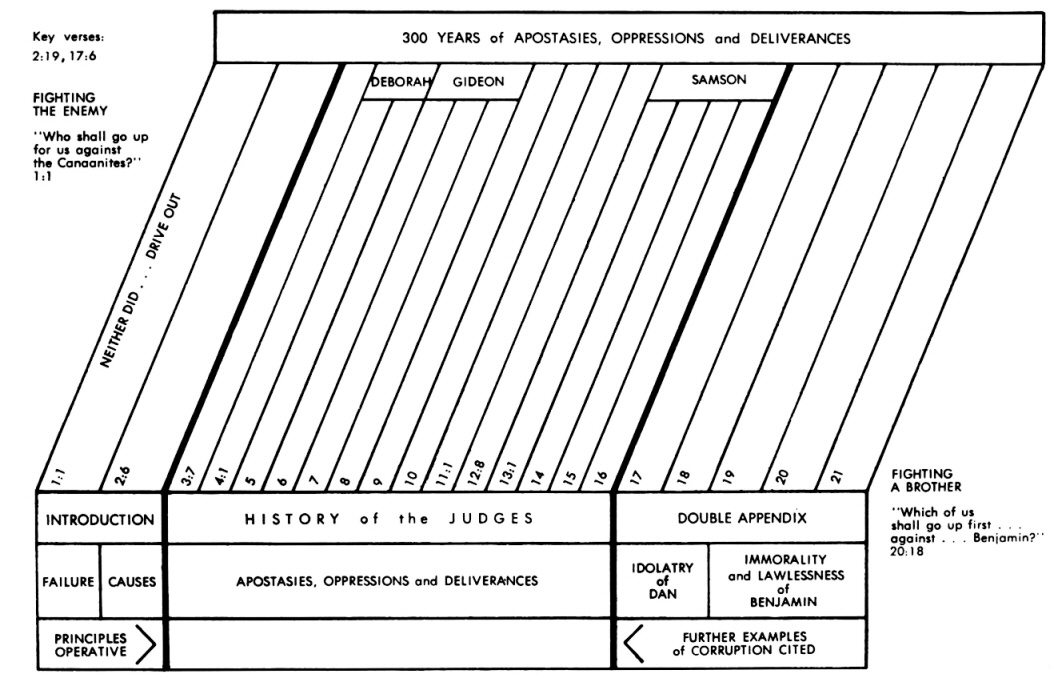
Chart from recommended resource Jensen's Survey of the OT - used by permission
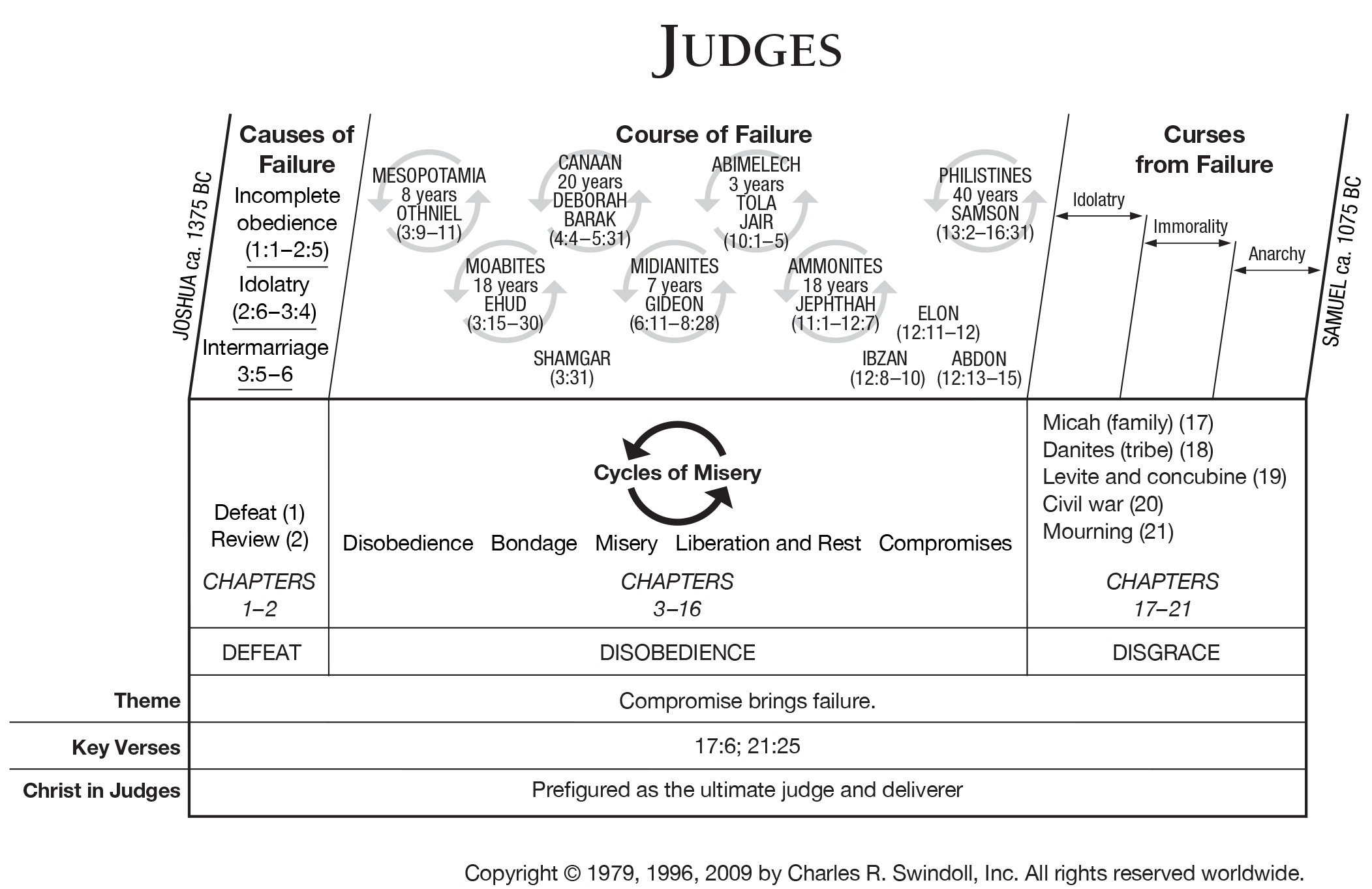
Chart on Judges - Charles Swindoll
|
RECYCLING SIN |
|||||
| Jdg 1:1-3:6 | Jdg 3:7-16:31 | Jdg 17:1-21:25 | |||
| Introduction | History of the Judges | Appendix | |||
| Causes of the Cycles THE REASON |
Curse of the Cycles THE RECORD |
Conditions in the Cycles THE RESULTS |
|||
| Failure to Complete Conquest Jdg 1:1-36 God's Judgment for Failure Jdg 2:1-3:6 |
Curse of the Cycles |
Conditions in the Cycles |
|||
| Living with Canaanites |
War with the Canaanites |
Living Like the Canaanites |
|||
| Religious Laxity |
Political Uncertainty |
Moral Anarchy |
|||
| About 350 Years of Israel's History - Almost 25%! From Compromise to Confusion! |
|||||

Another Timeline of Israel's History
Click to Enlarge
from Jensen's Survey of the OT
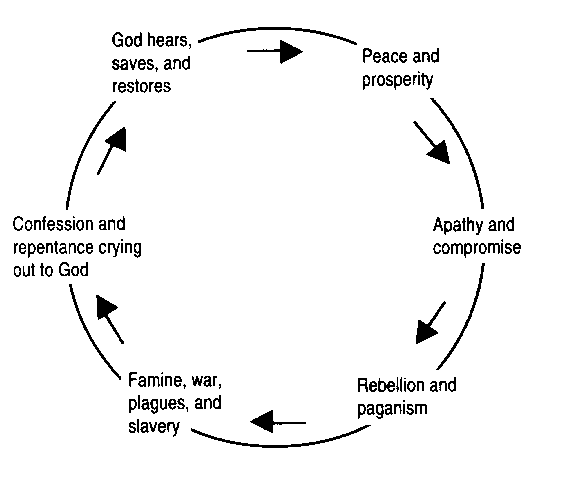
Click to Enlarge
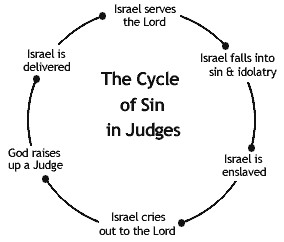
Other ways to describe Israel's cycle…
- Rest > Rebellion > Retribution > Repentance (?) > Restoration
- Sin > Suffering/Servitude > Supplication > Salvation
- Apathy > Apostasy > Affliction > Answered Prayer
- Disobedience > Desperation > Deliverance
- Disobedience > Bondage >Misery > Liberation and Rest > Compromises
FOLLOWING NOTES ARE COMPLETELY REVISED SPRING, 2022
Hannah's Bible Outline
- Gideon (Judges 6:1-8:32)
- Gideon's death (Judges 8:29-32)
- Israel's rest (Judges 8:28)
- Israel's deliverance (Judges 6:7-8:27)
- The promise of deliverance (Judges 6:7-10)
- The summons of the deliverer (Judges 6:11-32)
- The angelic visit (Judges 6:11-18)
- The worship by Gideon (Judges 6:19-24)
- The destruction of the pagan altars (Judges 6:25-32)
- The conflict for deliverance (Judges 6:33-8:27)
- The army gathered (Judges 6:33-35)
- The assurance of victory (Judges 6:36-40)
- The army reduced (Judges 7:1-8)
- The dream of the Midianite (Judges 7:9-14)
- The defeat of the Midianites (Judges 7:15-8:21)
- The strategy (Judges 7:15-18)
- The confusion (Judges 7:19-23)
- The scattering (Judges 7:24-25)
- The jealousy of Ephraim (Judges 8:1-3)
- The search for the Midian kings (Judges 8:4-21)
- The refusal of Succoth and Penuel (Judges 8:4-9)
- The capture of the kings (Judges 8:10-12)
- The punishment of Succoth and Penuel (Judges 8:13-18)
- The death of the Midian kings (Judges 8:19-21)
- Gideon's failure (Judges 8:22-27)
- Israel's servitude (Judges 6:2-6)
- Israel's sin (Judges 6:1)
- Parenthesis: the tyranny of Abimelech (Judges 8:33-16:31)
- Israel's idolatry (Judges 8:33-35)
- Shechem's submission to Abimelech (Judges 9:1-5)
Judges 7:1 Then Jerubbaal (that is, Gideon) and all the people who were with him, rose early and camped beside the spring of Harod; and the camp of Midian was on the north side of them by the hill of Moreh in the valley.
- Then Jerubbaal (that is, Gideon) Jdg 6:32
- rose early and camped beside the spring of Harod: Ge 22:3 Jos 3:1 6:12 Ec 9:10
- on the north side of them by the hill of Moreh: Ge 12:6
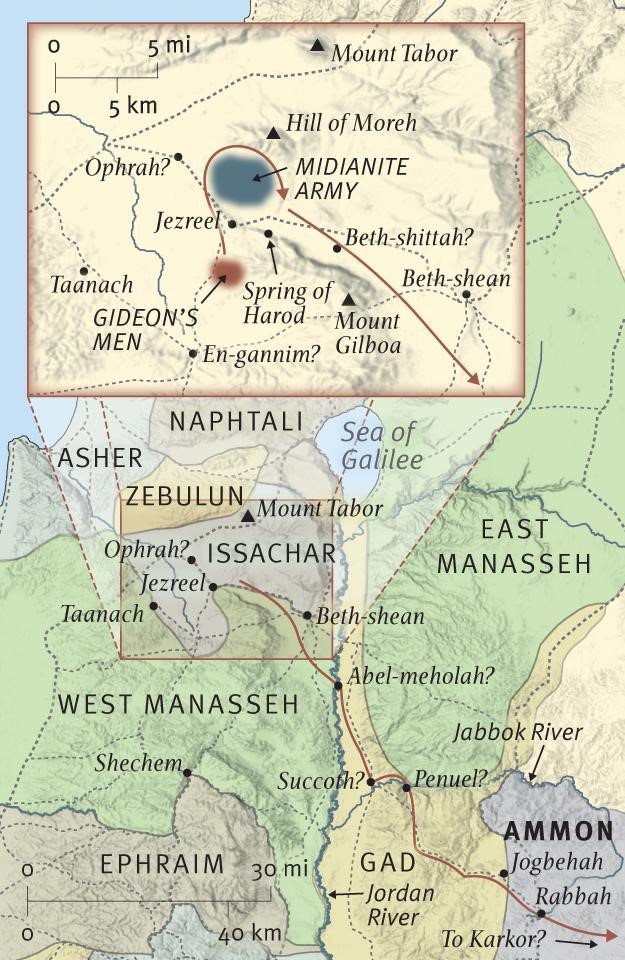
Gideon Defeats the Midianites
(Source: ESV Global Study Bible)
GIDEON'S ARMY CAMPED AT
THE "SPRING OF TREMBLING"
Paul Apple introduces this famous chapter writing that "This is one of my favorite OT stories because it is the best illustration of a key biblical principle: God demonstrates His strength in our weakness. We always want to be as strong as possible in facing any challenge; we prefer to have as many resources as possible at our disposal. We have no problem if the odds are on our side; in fact we prefer that to be the case. But God has a different perspective....You have to be at the point of desperation in weakness to ensure that God gets all of the glory." (Strength Through Weakness)
Then Jerubbaal (that is, Gideon) and all the people who were with him, rose early and camped beside the spring of Harod; and the camp of Midian was on the north side of them by the hill of Moreh in the valley: The meaning of Gideon's name is "Baal will contend". His new name would have been a constant reminder of the futility and impotence of the lifeless Baals! It was as if every time the Israelites heard his name, it was a rebuke in their face for worshipping the Baals!
In the map cutout above notice the location of Gideon's camp is in the vicinity of the Jezreel Valley where Deborah and Barak had defeated Jabin and Sisera approximately 47 years earlier (40 years rest + 7 years Midianite oppression). The Midianites were camped on the north side of the Spring of Harod ("Spring of Trembling" or "Spring of Palpitation" - see picture around 1900 and then a modern picture and so-called "Gideon's Cave" from which the spring originates)
_LOC_matpc.06985.jpg)


JERUBBAAL [ISBE] - jer-u-ba'-al, je-rub'-a-al (yerubba`al, "let Baal contend"): The name given to Gideon by his father, Joash, and the people in recognition of his destruction of the altar of Baal at Ophrah (Jdg 6:32). For this name the form "Jerubbesheth" (2 Sam 1:21) was substituted after the analogy of "Ishbosheth" and "Mephibosheth," in which bosheth, the Hebrew word for "shame," displaced the word ba`al, no doubt because the name resembled one given in honor of Baal.
HAROD [EBD] (Meaning - "palpitation"), a fountain near which Gideon and his army encamped on the morning of the day when they encountered and routed the Midianites (Judg. 7). It was south of the hill Moreh. The present 'Ain Jalud ("Goliath's Fountain"), south of Jezreel and nearly opposite Shunem, is probably the fountain here referred to (7:4, 5).
MOREH [SMITH] (teacher). The hill of Moreh, at the foot of which the Midianites and Amalekites were encamped before Gideon?s attack upon them. (Judges 7:1) It lay in the valley of Jezreel, rather on the north side of the valley, and north also of the eminence on which Gideon?s little band of heroes was clustered. These conditions are most accurately fulfilled if we assume Jebel ed-Duhy , the "Little Hermon" of the modern travellers, 1815 feet above the Mediterranean, to be Moreh, the Ain-Jalood to be the spring of Harod, and Gideon's position to have been on the northeast slope of Jebel Fukua (Mount Gilboa), between the village of Nuris and the last-mentioned spring.
MOREH, HILL OF [ISBE] - mo'-re (gibh`ath ha-moreh, "hill of the teacher"; Codex Vaticanus Gabaathamora; Codex Alexandrinus, tou bomou tou Abor): The Hebrew moreh is derived from the verb yarah, "to teach," "to direct," and indicates one who directs, or gives oracular answers. We might therefore read "hill of the teacher," the height being associated with such a person who had his seat here. The hill is named only in describing the position of the Midianites before Gideon's attack (Jdg 7:1). (ED: THE NAME OF THE HILL IS INTRIGUING AS IT WOULD BE THE SITE AT WHICH GOD "TEACHES" GIDEON HIS FINAL "FAITH LESSON"!) If the identification of the Well of Harod with `Ain Jalud is correct, Gideon must have occupied the slopes to the East of Jezreel. The Midianite camp was in the valley of Jezreel (Jdg 6:33). The Hebrew text in Jdg 7:1, which has probably suffered some corruption, seems to mean that the Midianites lay North of the position held by Gideon, their lines running from the hill of Moreh in the plain. The hill can hardly have been other than Jebel ed-Duchy, often called Little Hermon, which rises boldly from the northern edge of the vale of Jezreel, with Shunem (Solam) lying at its western foot. Moore ("Judges," ICC, 200) would lay the scene in the neighborhood of Shechem, but there is no good reason to doubt the accuracy of the tradition which places it at the eastern end of the plain of Esdraelon. W. Ewing
Note the Hill of Moreh is a different location then the Oak of Moreh
QUESTION - Why is Gideon referred to as Jerubbaal?
ANSWER - Gideon earned the title Jerubbaal (or Jerub-Baal) after he destroyed his family’s altar of Baal. “Because Gideon broke down Baal’s altar, they gave him the name Jerub-Baal that day, saying, ‘Let Baal contend with him’” (Judges 6:32). The name Jerubbaal means “Baal will contend” and is a combination of two Hebrew words: the first is riyb or rub, which means literally “to grapple” and holds the figurative meaning “to wrangle” or “to hold a controversy.” The second is the proper noun Baal, the name of the Phoenician god that Gideon picked a fight with.
In Gideon’s day, Israel was rife with idolatry, and the Lord “gave them into the hands of Midianites” for seven years (Judges 6:1). When Israel cried out to God for help (verse 6), He sent a prophet who reminded the Israelites of God’s past deliverance and God’s commands against honoring false gods (verse 10). Israel had disobeyed, and Baal and Asherah worship was rampant. It was time for Gideon to become Jerubbaal.
To create His Jerubbaal, God sent the Angel of the Lord to Gideon, the son of Joash the Abiezrite. The angel sat under a tree watching Gideon thresh wheat in the winepress to keep it hidden from the Midianite raiders. The angel said to Gideon, “The Lord is with you, mighty warrior” (Judges 6:12). Gideon’s reply showed a weak faith: “If the Lord is with us, why has all this happened to us? Where are all his wonders that our ancestors told us about when they said, ‘Did not the Lord bring us up out of Egypt?’ But now the Lord has abandoned us and given us into the hand of Midian” (verse 13). The Lord then commissioned Gideon to “save Israel out of Midian’s hand” (verse 14). The angel confirmed God’s Word with a miracle (verses 20–22) and gave Gideon a promise: “I will be with you” (verse 16).
That night, after his meeting with the Lord, Gideon was ready to transform into Jerubbaal. Following God’s specific instructions (Judges 6:25–26), Gideon and ten of his servants tore down Baal’s altar on his family’s property and cut down the Asherah pole next to it. Gideon then built a proper altar to God, laid the wood of the Asherah image on top, and sacrificed a bull to the Lord. “But because he was afraid of his family and the townspeople, he did it at night” (Judges 6:27).
The next morning, the men of the town discovered that Gideon had torn down the altar to Baal, and they were incensed that someone had disrespected their god. The men came to Joash, Gideon’s father, and said, “Bring out your son. He must die, because he has broken down Baal’s altar and cut down the Asherah pole beside it” (Judges 6:30). Defending his son, Joash replied to the mob, “Are you going to plead Baal’s cause? Are you trying to save him? . . . If Baal really is a god, he can defend himself when someone breaks down his altar” (verse 31). The logic was irrefutable. If Baal was really a god, then Baal could save himself. If Gideon should be punished, then let the god he destroyed punish him personally. After that, Gideon was called Jerubbaal, or “Let Baal contend with him” because Gideon had broken down the altar of Baal (verse 32).
Gideon not only contended with Baal but also with the Midianites. God was true to His promise, and Gideon won a decisive victory over the enemy. Later, Gideon is still being called Jerubbaal (Judges 7:1; 8:29; 9:1). Scripture uses the names Gideon and Jerubbaal interchangeably in those passages. Baal never did exact vengeance upon Jerubbaal; rather, God poured out His blessing on Gideon. (GotQuestions.org)
Judges 7:2 And the LORD said to Gideon, "The people who are with you are too many for Me to give Midian into their hands, lest Israel become boastful, saying, 'My own power has delivered me.'
- The people who are with you are too many for Me: 1Sa 14:6 2Ch 14:11 Zec 4:6 12:7 1Co 1:27-29 2:4,5 2Co 4:7 2Co 10:4,5
- lest Israel become boastful: Dt 32:27 Isa 2:11,17 Jer 9:23 Ro 3:27 11:18 1Co 1:29 Eph 2:9 Jas 4:6
- My own power has delivered me: Dt 8:17 Isa 10:13 Eze 28:2,17 Da 4:30 Hab 1:16
Deuteronomy 8:16-17+ “In the wilderness He fed you manna which your fathers did not know, that He might humble you and that He might test you, to do good for you in the end. “Otherwise, you may say in your heart, ‘My power and the strength of my hand made me this wealth.’
THE SECRET OF DELIVERANCE
HIS POWER NOT OURS
And the LORD said to Gideon, "The people who are with you are too many for Me to give Midian into their hands: God frequently cuts down on our resources in order that we may depend entirely upon Him. Sometimes He sends sickness or financial reverses or difficulties of one kind or another to train us to rely solely on His power. (See Scripture above)
ILLUSTRATION - Hudson Taylor, pioneer missionary to China firmly believed God knew his needs and would meet them. On one occasion, when Taylor's assets were down to 87 cents, he wrote to a friend "We have this--and all the promises of God." That is faith that sees the invisible, the eternal and it is faith that pleases the Father.
When God finished preparing Gideon for battle, he had no other choice but to trust God. Man's extremity is always God's opportunity. He delights to reveal His power when men acknowledge their weaknesses. When odds are overwhelming, God overwhelms the odds!
Lest Israel become boastful, saying, 'My own power has delivered me: As we soon discover, some 32,000 Israelites had come to join Gideon's army. This was still far fewer than the 135,000 Midianites encamped several miles north at Mt Moreh. But God says even with these odds stacked against Israel, if they were to defeat the Midianites, they would be tempted to take credit for the victory. God wants to remove any doubt from this equation, so that the only one who can take credit for the victory is God Himself.
THOUGHT - Isn't this true for all of us? The pews fill up and we begin to take just a tiny fraction of the glory. There is a side of us (probably the old Adam, the Sin nature within us that remains in these fleshly bodies, defeated at the cross to be sure, but ever seeking to reign in these mortal bodies). Sometimes God cannot trust us with His work unless we realize how inadequate we are and this may explain why God frequently chooses such unlikely instruments (1Cor 1:27-30).
Ralph Davis writes that…"Few would ever have suspected William M’Culloch of kindling a revival. He was parish minister in Cambuslang (Scotland) about 1740. A scholarly pastor excelling in languages, especially Hebrew, he had, nevertheless, little gift for the pulpit. His own son described him as “not a very ready speaker…not eloquent … his manner [was] slow and cautious.” In fact, he was called an “Ale–minister,” which meant that, when he rose to speak, a number in the audience left to quench their thirst at the local tavern. Yet God chose to use William M’Culloch’s ministry as the means of revival at Cambuslang, some time before George Whitefield visited there. Now I cannot divine the divine ways. But I wonder if God was pleased to use William M’Culloch in order to make clear that the Cambuslang work could not be explained by eloquence or human dynamism but only by the Spirit of God. The necessity of weakness — that is often Yahweh’s method." (Focus on the Bible: Judges)
Judges 7:3 "Now therefore come, proclaim in the hearing of the people, saying, 'Whoever is afraid and trembling, let him return and depart from Mount Gilead.'" So 22,000 people returned, but 10,000 remained.
- Whoever: Dt 20:8 Mt 13:21 Lk 14:25-33 Rev 17:14 21:8
- So 22,000 people returned Mt 20:16
Now therefore come, proclaim in the hearing (literally "the ears") of the people, saying, 'Whoever is afraid and trembling (chared), let him return and depart from Mount Gilead.'" So 22,000 people returned - Fear can have disastrous effects on an army and especially if over 2/3's of the army is fearful as in this case!
In Deuteronomy 20:8 Moses records “Then the officers shall speak further to the people and say, ‘Who is the man that is afraid and fainthearted? Let him depart and return to his house, so that he might not make his brothers’ hearts melt like his heart.’
Put yourself for a moment in Gideon's sandals… imagine his heart sink as he watched his numbers dwindle by 2/3's in keeping with the instruction in [Dt 20:8]. They were keenly aware that up to 135,000 Midianites (8:10) were camped just 3-4 miles N at the foot of the Hill of Moreh. RESULT? many had greater fear of man than trust in God and so they departed from what appeared to be a humanly impossible situation. How could 32,000 untrained and unqualified Israelis hope to defeat a heavily armed force of 135,000? One mighty God would be the soon coming answer. God wanted the victory in battle to teach Israel to trust Him and give Him the glory. In the Christian life if our victories make us self-reliant, they ultimately work against us and they dishonor the God we serve.
Treasury of Scripture note on Mount Gilead - Gideon was certainly not at mount Gilead, east of Jordan at this time; but rather near mount Gilboa, west of Jordan. Calmet thinks there must either have been two Gileads, which does not appear from Scripture to have been the case, or that the Hebrew text is corrupt, and that for Gilead we should read Gilboa. This reading, though adopted by Houbigant, is not confirmed by an MS. or version. Dr. Hales endeavours to reconcile the whole, by the supposition that in Gideon's army there were many eastern Manassites from mount Gilead, near the Midianites; and therefore proposes to read, "Whosoever from mount Gilead is fearful and afraid, let him return (home) and depart early."
But 10,000 remained Gideon likely had heard the story of Barak's army of 10,000 and how God had used them to route Sisera's invincible forces and must have reasoned 'If 10,000 are good enough for Barak, then it is good enough for me.' But God was not finished paring down the numbers.
THOUGHT - You cannot be too small for God to use but you can be too big. If you want the credit for what God is doing, God will not use you. He says that He alone is Lord and there is no other and that He will not give His glory to another. And so we often see God working powerfully in the lives of some very weak people. They are the ones who know that only He could get the glory and they are careful to give it to Him
Trembling (startled, frightened, make afraid, terrified) (02730)(chared from charad = human trembling before some strange or fearsome event) means fearful, afraid, but in a number of the uses (see below) speaks more of a reverential reaction (usually to God or His Word).
Chared - tremble(1), trembled(1), trembling(2), who tremble(1), who trembles(1). Jdg. 7:3; 1Sa 4:13 = "his heart was trembling for the ark of God"; Ezr. 9:4 = "everyone who trembled at the words of the God of Israel"; Ezr. 10:3 = " those who tremble at the commandment of our God"; Isa. 66:2 = "To him who is humble and contrite of spirit, and who trembles at My word."; Isa. 66:5 = "you who tremble at His word."
Judges 7:4 Then the LORD said to Gideon, "The people are still too many; bring them down to the water and I will test them for you there. Therefore it shall be that he of whom I say to you, 'This one shall go with you,' he shall go with you; but everyone of whom I say to you, 'This one shall not go with you,' he shall not go."
- The people are still too many: Ps 33:16
- I will test them for you there: Ge 22:1 1Sa 16:7 Job 23:10 Ps 7:9 66:10 Jer 6:27-30 Mal 3:2,3
GOD WHITTLES THEM DOWN
WITH A "WATER TEST"
Then the LORD said to Gideon, "The people are still too many; bring them down to the water and I will test them for you there. Therefore it shall be that he of whom I say to you, 'This one shall go with you,' he shall go with you; but everyone of whom I say to you, 'This one shall not go with you,' he shall not go: Keep in mind that the Harod (means "trembling") springs were in plain view of the Midianites, so going down to the water took some courage.
Warren Wiersbe comments that "A faith that can’t be tested can’t be trusted. Too often, what people think is faith is really only a “warm fuzzy feeling” about faith or perhaps just “faith in faith.” J. G. Stipe said that faith is like a toothbrush: Everybody should have one and use it regularly, but it isn’t safe to use somebody else’s. We can sing loudly about the “Faith of Our Fathers,” but we can’t exercise the faith of our fathers. We can follow men and women of faith and share in their exploits, but we can’t succeed in our own personal lives by depending on somebody else’s faith. God tests our faith for at least two reasons: first, to show us whether our faith is real or counterfeit, and second, to strengthen our faith for the tasks He’s set before us. Spurgeon was right when he said that the promises of God shine brightest in the furnace of affliction, and it is in claiming those promises that we gain the victory. Victories won because of faith bring glory to God because nobody can explain how they happened. “If you can explain what’s going on in your ministry,” Dr. Bob Cook used to remind us, “then God didn’t do it.” Too often, we’re like King Uzziah who was “marvelously helped, till he was strong. But when he was strong, his heart was lifted up to his destruction” (2Ch 26:15–16). People who live by faith know their own weakness more and more as they depend on God’s strength. “For when I am weak, then am I strong” (2Co 12:10) (See The Wiersbe Bible Commentary: Old Testament)
G. Campbell Morgan wrote that “The fearful and trembling man God cannot use. The trouble today is that the fearful and trembling man insists upon remaining in the army. A decrease that sifts the ranks of the Church of men who fear and tremble is a great, a gracious and a glorious gain.”
Wiersbe adds that "Pride after the battle robs God of glory, and fear during the battle robs God’s soldiers of courage and power. Fear has a way of spreading, and one timid soldier can do more damage than a whole company of enemy soldiers. Fear and faith can’t live together very long in the same heart. Either fear will conquer faith and we’ll quit, or faith will conquer fear and we’ll triumph. John Wesley may have been thinking of Gideon’s army when he said, “Give me a hundred men who fear nothing but sin and love nothing but God, and I will shake the gates of hell!” (See The Wiersbe Bible Commentary: Old Testament)
If Gideon’s faith had been in the size of his army, then his faith would have been very weak by the time God was through with them! Less than 1 percent of the original 32,000 ended up following Gideon to the battlefield. The words of Winston Churchill concerning the RAF in World War II certainly applies to Gideon’s 300: “Never in the field of human conflict was so much owed to so many by so few.”
Judges 7:5 So he brought the people down to the water. And the LORD said to Gideon, "You shall separate everyone who laps the water with his tongue, as a dog laps, as well as everyone who kneels to drink."

THE FINAL TEST
DRINKING WATER
So he brought the people down to the water. And the LORD said to Gideon, "You shall separate everyone who laps the water with his tongue, as a dog laps, as well as everyone who kneels to drink: No explanation for this choice is given, but it possibly was related to alertness, just as the first was based on courage. One explanation is that the 300 men, who satisfied their thirst in the most expeditious manner indicated their spirit, and alacrity to follow Gideon in his dangerous enterprise. This proved them to be watchful and alert in contrast to those who knelt The rest may have revealed their love of ease, self-indulgence, and want of courage.
On the other hand there is no indication in the text that God commended those who "lapped"; He only used this device to reduce Gideon's army (cf. v2).
Adam Clarke on laps - The original word yalok is precisely the sound which a dog makes when he is drinking.
God put Gideon’s surviving 10,000 men through a second test by asking them all to take a drink down at the river. We never know when God is testing us in some ordinary experience of life.
One of Warren Wiersbe's favorite quotes is from a man named Marsden who said "“Make every occasion a great occasion, for you can never tell when somebody may be taking your measure for a larger place.”
Paul Apple writes "You never know when the Lord is testing you – need to be alert; sober minded; in one sense, all of life is a test
Rich Cathers: This was taken out of Duke University's Staff newsletter.
At Duke University, there were four sophomores taking Organic Chemistry. They did so well on all the quizzes, midterms and labs, etc., that each had an “A” so far for the semester. These four friends were so confident that the weekend before finals, they decided to go up to University of Virginia and party with some friends up there. They had a great time. However, after all the partying, they slept all day Sunday and didn’t make it back to Duke until early Monday morning. Rather than taking the final then, they decided to find their professor after the final and explain to him why they missed it. They explained that they had gone to UVA for the weekend with the plan to come to study, but, unfortunately, they had a flat tire on the way back, didn’t have a spare, and couldn’t get help for a long time. As a result, they missed the final. The Professor thought it over and then agreed they could make up the final the following day. The guys were elated and relieved. They studied that night and went in the next day at the time the professor had told them. He placed them in separate rooms and handed each of them a test booklet, and told them to begin. They looked at the first problem, worth 5 points. It was something simple about free radical formation. “Cool,” they thought at the same time, each one in his separate room, “this is going to be easy.” Each finished the problem and then turned the page. On the second page was written: (For 95 points): Which tire?
Judges 7:6 Now the number of those who lapped, putting their hand to their mouth, was 300 men; but all the rest of the people kneeled to drink water.
TRIMMING THE TROOPS
FROM 22,000 TO 300
Now the number of those who lapped, putting their hand to their mouth, was 300 men; but all the rest of the people kneeled to drink water: What significance was there in the two different ways the men drank from the river? Since the Scriptures don’t tell us, we would be wise not to read into the text some weighty spiritual lesson that God never put there. Most expositors say the men who bowed down to drink were making themselves vulnerable to the enemy, while the 300 who lapped water from their hands stayed alert. This is not an unreasonable consideration. After all, the enemy was four miles away (See the cut out of map above) (Jdg 7:1) waiting to see what the Jews would do. Another source writes that the 300 men drank as they did so they could keep their eyes on Gideon, but the text doesn’t say that either.
Warren Wiersbe's assumption is that God chose this method of sifting the army because it was simple, unassuming (no soldier knew he was being tested), and easy to apply. We shouldn’t think that all 10,000 drank at one time, because that would have stretched the army out along the water for a couple of miles. Since the men undoubtedly came to the water by groups, Gideon was able to watch them and identify the 300. It wasn’t until after the event that the men discovered they had been tested.
Alexander Maclaren: God required but few men, but He required that these should be fit. The first test had sifted out the brave and willing. The liquor was none the less, though so much froth had been blown off. As Thomas Fuller says, there were ‘fewer persons, but not fewer men,’ after the poltroons had disappeared. The second test, ‘a purgatory of water,’ as the same wise and witty author calls it, was still more stringent. The dwindled ranks were led down from their camp on the slopes to the fountain and brook which lay in the valley near the Midianites’ camp. Gideon alone seems to have known that a test was to be applied there; but he did not know what it was to be till they reached the spring, and the soldiers did not know that they were determining their fate when they drank. The two ways of drinking clearly indicated a difference in the men. Those who glued their lips to the stream and swilled till they were full, were plainly more self-indulgent, less engrossed with their work, less patient of fatigue and thirst, than those who caught up enough in their curved palms to moisten their lips without stopping in their stride or breaking rank. The former test was self-applied, and consciously so. This is no less self-applied, though unconsciously. God shuts out no man from His army, but men shut themselves out; sometimes knowingly, by avowed disinclination for the warfare, sometimes unknowingly, by self-indulgent habits, which proclaim their unfitness. (Judges 7:1-8 Fit Though Few)
Judges 7:7 And the LORD said to Gideon, "I will deliver you with the 300 men who lapped and will give the Midianites into your hands; so let all the other people go, each man to his home."
- Jdg 7:18-22 1Sa 14:6 Isa 41:14-16
YAHWEH PROMISES
DELIVERANCE
And the LORD said to Gideon, "I will deliver you with the 300 men who lapped and will give the Midianites into your hands; so let all the other people go, each man to his home: Their options were reduced to trust God and His promise or perish. God graciously gave Gideon one more promise of victory: “By the 300 men that lapped will I save you” (v7). By believing the promise and obeying the Lord’s directions (his obedience indicates his genuine belief), Gideon defeated the enemy and brought peace to the land for forty years (Jdg 8:28).
Wherever there is a clear command in Scripture, we are to seek to obey it in every detail in our lives. But God may well reduce our resources to almost nothing in order to prove that it is by His power alone that we can be victorious and that His strength is made perfect in our weakness. Paul testified that God had spoken to him…
"My grace is sufficient for you, for power is perfected in weakness." Most gladly, therefore, I will rather boast about my weaknesses, that the power of Christ may dwell in me. Therefore I am well content with weaknesses, with insults, with distresses, with persecutions, with difficulties, for Christ's sake; for when I am weak, then I am strong." (2 Corinthians 12:9-10+).
The Preacher's Commentary adds some practical thoughts commenting that "Gideon’s story proves that when we are at our least, God can be at His greatest. Like Gideon, we may think that we are proving God, but actually He is proving us. Yet all the while, in grace and mercy, He is giving us far more than we could legitimately ask for or expect, because He knows and understands our needs and because He sympathizes with our weaknesses… we are to take seriously the words of Jesus when He said to His disciples, “without me you can do nothing” (John 15:5). If we truly identify with Gideon, it should drive us to our knees, seeking from God to rightly discern what He is calling us to do and, secondly, that we might have the faith to believe that He will do it through us. There is all the difference in the world between writing our own agenda and striving to do it for God as best we can and, on the other hand, allowing Him to pick us up and use us in whatever way He chooses. (Briscoe, D. S., & Ogilvie, L. J. The Preacher's Commentary)
While facing the threat of imprisonment in Nazi Germany, Dietrich Bonhoeffer pondered the opening petition of the Lord’s Prayer “Thy kingdom come. Thy will be done” and based on these meditations, he advised his friends and fellow dissenters that “by these we learn to forget ourselves and our personal condition and to hold them as of little account… How are we to remain steadfast as long as we remain so important to ourselves?”
John Wesley once said that the people of God must demonstrate “a willingness to be as the ‘filth and off scouring of the world’ ”
Dale Ralph Davis: It is amazing how virtuous the lappers become in the view of expositors. They are heralded as the vigilant, watchful ones who lean down, scoop a little water, always with their eyes on the enemy (which may yet have been several miles to the north!), while the kneelers are the careless, who think only of their thirst. For example, one expositor (who shall remain anonymous, concludes:
God saw how untrustworthy would be those thousands who carelessly indulged under the lure of the flesh, over against the three hundred who exemplified a spirit of vigilance [sic] and disciplined life in the Spirit. Thus were selected the strong and resolute, the men who could be trusted under rigorous conditions, those who did not think of themselves before the enemy’s unexpected assault. This is ever the divine principle of selection for service.
The problem with this kind of exposition is that it has no basis in the text. The text does not hint at any virtue or vice in how one guzzles water. The water-drinking episode was simply Yahweh’s mechanism for further reducing Gideon’s army …God’s strength made perfect in weakness But God clearly says He is testing the people here – so just as the first test chose out those with a positive characteristic of faith, this second test differentiated those who were more inclined to a focused and alert sense that would lend itself to obedience (Focus on the Bible: Judges)
Motyer adds "The object was to reduce Gideon’s army to a force not of a particular kind, but of a particular number. A small corps of crack troops is precisely what God does not want. The three hundred are meant to be not an elite, but a group so inadequate that when the battle is won (God declares) it cannot be a case of Israel’s saying “My own hand has delivered me.” Until the numbers are reduced to the level at which it is clearly the Lord and not Israel who wins the battle, they are too many.
By the three hundred men that lapped will I save you. Judges 7.7
This is a wonderful illustration of the kind of men that God needs in order to carry out His enterprises in the world. This company of three hundred was an elect remnant, carefully separated from an army of thirty-two thousand. It becomes valuable when we observe the principles of selection. Two were applied. The first was stated in the words: "Whosoever is fearful, and trembling, let him return." On this test, twenty-two thousand retired. Those who were left were devoid of fear. The second was stated in the words : "Every one that boweth down upon his knees to drink." All such were to be sent home. The test was peculiarly military. Men in such a position were not on guard against sudden surprise. Those who took unnecessary time over necessary things were sent back. On this test nine thousand seven hundred were retired. Those who were left were full of caution. It is an old story, and full of Eastern colour, but the central values abide. God needs, to do His work, those who know no fear; and those whose devotion forbids them taking any risks. Courage and caution are the essentials of victorious campaigning. If all those to-day who are fearful about the issue of God's work would retire from the ranks, the armies of the Lord would be much stronger. If those who lack the uttermost devotion, which watches as well as prays, would stand aside, the sacramental hosts would do better work. The work of God needs quality more than quantity. This is the death-warrant of statistics. (Borrow Life applications from every chapter of the Bible)
Judges 7:8 So the 300 men took the people's provisions and their trumpets into their hands. And Gideon sent all the other men of Israel, each to his tent, but retained the 300 men; and the camp of Midian was below him in the valley.
- trumpets: Jdg 3:27 Lev 23:24 25:9 Nu 10:9 Jos 6:4,20 Isa 27:13 1Co 15:52
- in the valley: Jdg 6:33
THE CHOSEN
300 MEN
So the 300 men took the people's provisions and their trumpets (shophar) into their hands - NET - "The men who were chosen took supplies and their trumpets." Note the surprising "weapons" which were trumpets not swords! Holding a shophar had to done with two hands, so they could not hold either a shield or a sword. Clearly Gideon's orders (a "Spirit controlled man") were persuasive, even though they did not seen humanly logical. They 300 did take provisions which would be needed as they pursued the fleeing Midianites. And in fact we see they ran out of provisions and had to request supplies from fellow Israelites in Judges 8:4-9+!
And Gideon sent all the other men of Israel, each to his tent, but retained the 300 men; and the camp of Midian was below him in the valley (See map above) - Note usually accurate NET says "Gideon sent all the men of Israel back to their homes." That is not correct. He sent them back to the tents. Presumably he would call on them for the cleanup operation. Below him in the valley indicates the Midianites were camped out in the open because they were confident in their numbers and military supremacy.
Brensinger concludes that "Acts of reduction and self-denial repeatedly prepare people for spiritual service. The Bible makes plain that power, pride, and possessions often obstruct divine activity. Yet genuine human weakness provides God with fertile soil in which to perform his mighty works (2 Cor. 12:9). In all divine-human partnerships, God alone brings victory…Frustrated by the failure of conventional missionary strategies to bring people closer to God, Vincent Donovan began to work among the Masai of East Africa. Without the aid of schools, buildings, and sizeable resources, Donovan simply decided to take the message of Christ to the Masai. “I have no theory, no plan, no strategy, no gimmicks—no idea of what will come” (Donovan: 16). What “came” was a reception of the gospel among the Masai well beyond anything previously seen. Frequently today, Christians are enticed into believing that sophisticated equipment and elaborate facilities are essential in proclaiming the gospel of Jesus Christ. Yet Gideon’s potsherds and Donovan’s gimmick-free approach remind us that equipment is far less important than the divine Supplier. (Judges Believers Church Bible Commentary)
Trumpets (horn, ram's horn)(07782) shophar/shopar/sopar is masculine noun referring to a trumpet or a ram's horn and is made out of a curved ram's horn. At Mt Sinai the trumpet was the signal that Israel could approach the awesome site (Ex 19:16; 19; 20:18). It was used to signal the year of Jubilee (Lev 25:9). Seven trumpets were to be carried before the Ark of the Covenant as the priests and blown on the seventh day after marching around the city seven times (Josh 6:4, 5, 6, 8, 9, 12, 16, 20). The trumpet was used by Gideon and his men to route the enemy (Jdg 7:8, 16, 18-20, 22). In short, these first three uses of the shophar were all associated with miraculous events! The shophar was sounded to announce a new king in Israel (1 Ki. 1:34, 39, 41; 2 Ki. 9:13). The trumpet was sounded at the celebration of God as King over all the earth (Ps. 47:5). The trumpet sound was used to warn of approaching danger (Hos. 5:8; 8:1), and here in Joel, to warn of the dread Day of the Lord (Joel 2:1, 15).
Shophar in Judges - Jdg. 3:27; Jdg. 6:34; Jdg. 7:8; Jdg. 7:16; Jdg. 7:18; Jdg. 7:19; Jdg. 7:20; Jdg. 7:22
Judges 7:9 Now the same night it came about that the LORD said to him, "Arise, go down against the camp, for I have given it into your hands.
- Now the same night: Ge 46:2,3 Job 4:13 33:15,16 Mt 1:20 2:13 Ac 18:9,10 27:23
- Arise, go down against the camp: Jos 1:5-9 Isa 41:10-16 43:1,2
- I have given it into your hands: Jdg 3:10,28 4:14,15 2Ch 16:8,9 20:17
THE COMMANDER IN CHIEF
COMMANDS GIDEON
Now the same night - Night (layil) is the Hebrew word describing the time between sunset and sunrise. Earlier we saw Gideon destroy the Baal altar at night out of fear (Jdg 6:27). Then to bolster his sagging faith he carried two fleece tests at night (Jdg 6:36-40). Now the Commander in Chief (Yahweh) encountered Gideon at night commanding Him that now was the time to attack.
it came about that the LORD said to him, "Arise, go down against the camp, for I have given it into your hands: Note Gideon's part is to obey, and God's part is to deliver, once again showing the mysterious interaction of human responsibility and God's sovereignty. Note Yahweh's use of the past tense "I have given," indicating the future even is a "done deal!" God is telling Gideon God had won the victory for them before the battle even began. That should have greatly encouraged Gideon.
This should have encouraged Gideon. Although the battle must be fought, Israel had already won! The 300 men could attack the enemy host confident that Israel was the victor. But God who sees Gideon's heart gives him one more encouraging word in the following verses.
It may be a cliché, but the old formula is still true “God says it—I believe it--that settles it". In fact you can subtract the "I believe" and the formula is still true for Psalm 119:89 (+) declares "Forever, O LORD, Thy word is settled in heaven."
Judges 7:10 "But if you are afraid to go down, go with Purah your servant down to the camp,
- Jdg 4:8,9 Ex 4:10-14
ONE MORE SIGN
FOR GIDEON
But if you are afraid to go down, go with Purah your servant down to the camp - Presumably it is still night and God promises Gideon and Puah will receive inside information (from inside a Midianite tent)! This is the fifth time God encourages Gideon's faith. He had already promised victory in Jdg 6:14, 16; 7:7, 7:9. Not only that, but He also gave Gideon three confirmatory signs - (1) fire from the rock (Jdg 6:19–21), the wet fleece (Jdg 6:36–38), and the dry fleece (Jdg 6:39–40). But in spite of all this evidence He knew Gideon's faith was still vacillating and so He gives him this additional sign. As the Psalmist said "For He Himself knows our frame. He is mindful that we are but dust." (Ps 103:14)
Ralph Davis writes that "In light of this, we may need to alter our current stereotypes of what a servant of Christ is (or, is like). We sometimes dupe ourselves into thinking that a real servant of Christ is only someone who is dynamic, assured, confident, brash, fearless, witty, adventuresome, or glamorous — with one or two appearances on a Christian television network (Ed note: Or maybe a famous athlete). Don’t think you are unusable because you don’t have that air about you. Christ takes uncertain and fearful folk, strengthens their hands in the oddest ways, and makes them able to stand for him in school or home or work. We must not forget how the writer of Hebrews describes those we sometimes call the “heroes of faith”: “They were weak people who were given strength to be brave in war and drive back foreign invaders” (Heb. 11:34 NJB). (Judges: Such a Great Salvation - Focus on the Bible)
Wiersbe - How grateful we should be that God understands us and doesn’t condemn us because we have doubts and fears! He keeps giving us wisdom and doesn’t scold us when we keep asking (James 1:5). Our great High Priest in heaven sympathizes with our weaknesses (Heb. 4:14–16) and keeps giving us more grace (James 4:6). God remembers that we’re only dust (Ps. 103:14) and flesh (78:39). (See The Wiersbe Bible Study Series)
Judges 7:11 and you will hear what they say; and afterward your hands will be strengthened that you may go down against the camp." So he went with Purah his servant down to the outposts of the army that was in the camp.
- you will hear what they say: Jdg 7:13-15 Ge 24:14 1Sa 14:8,12
- your hands will be strengthened: 1Sa 23:16 Ezr 6:22 Ne 6:9 Isa 35:3,4 2Co 12:9,10 Eph 3:16 Eph 6:10 Php 4:13
- to the outposts of the army that was in the camp., Ex 13:18
GIDEON HEARS AND
HEEDS GOD'S WORD
And you will hear what they say - Notice the details are very clear. God wanted Gideon to be certain that He would give him the victory with only 300 men. God is not guessing they will hear but knows they will hear because he is the God of providence.
And afterward your hands will be strengthened (chazaq; Lxx = ischuo) that you may go down against the camp - The prophetic promise is in the passive voice indicating the strength would be divine, not human. Undoubtedly this would reflect the empowering work of the Holy Spirit Who had come on him (Jdg 6:34+).
So - This is a small word marking a term of conclusion, but in this case it has huge implications.
He went with Purah his servant down to the outposts of the army that was in the camp - For Gideon to go into the enemy camp in obedience to the LORD reflects a trust in His word. Notice how trust and obey always seem to go together.
“Trust and Obey because there is no other way to be happy in Jesus”
Be strengthened (02388) chazaq conveys the basic meaning of to be or become strong, to make strong or strengthen, in the Hiphil to take hold of or seize ("retain His anger" - Mic 7:18+), in the Hithpael to strengthen oneself (to take courage 1 Sa 30:6). To be courageous. To overpower. Chazaq describes strength - severity of a famine (a "strong" famine) (2 Ki 25:3, Jer 52:6), strength of humans to overpower (David and Goliath 1 Sa 17:50, cf 1 Sa 17:35 = seized;, Amnon and Tamar = 2 Sa 13:14), in a battle, to capture (2 Chr 8:3), Samson's last demonstration of supernatural strength he prays "please strengthen me" (Jdg 16:28). Used in the charge "Be strong and courageous" (Josh 1:6, 7, 9,18, Josh 10:25, "be firm" = Josh 23:6; "Be strong and courageous" = Dt 31:6-7, 23). Chazaq used 12 times in Ex 4-14 of hardening Pharaoh's heart (cf similar use in Josh 11:20). In a great passage in Da 11:32+ we read "“By smooth words he will turn to godlessness those who act wickedly toward the covenant, but the people who know their God will display strength (chazaq) and take action.""
Judges 7:12 Now the Midianites and the Amalekites and all the sons of the east were lying in the valley as numerous as locusts; and their camels were without number, as numerous as the sand on the seashore.
- the Midianites and the Amalekites and all the sons of the east: Jdg 6:3,5,33 1Ki 4:30
- as numerous as locusts: Jdg 8:10 2Ch 14:9-12 Ps 3:1 33:16 118:10-12 Isa 8:9,10
MEN LIKE LOCUSTS
CAMELS LIKE SAND
Now the Midianites and the Amalekites and all the sons of the east were lying in the valley as numerous as locusts - This was a coalition of forces from at least three regions numbering about 135,000 men. The odds were stacked against Gideon's 300 men, some 450 to 1. No one would have given Gideon even a slight chance of victory. Of course, 300 men plus one omnipotent God is a majority which erases all human odds.
Gary Inrig on the odds 450 to 1 - That is the first part of God’s preparation. Gideon’s army had been reduced to such proportions that they had no alternative. They could either depend totally upon God, or they could perish. Their only hope lay in God. Now comes the second stage of preparation. With their self-confidence destroyed, they were not prepared to learn the lesson of confidence in God. (Borrow Hearts of Iron, Feet of Clay)
Brensinger: Acts of reduction and self-denial repeatedly prepare people for spiritual service. The Bible makes plain that power, pride, and possessions often obstruct divine activity. Yet genuine human weakness provides God with fertile soil in which to perform his mighty works. In all divine-human partnerships, God alone brings victory. (Judges Believers Church Bible Commentary)
And their camels were without number, as numerous as the sand on the seashore - One has to wonder if there were also 135,000 camels in the camp? In any event, they were beyond number.
Judges 7:13 When Gideon came, behold, a man was relating a dream to his friend. And he said, "Behold, I had a dream; a loaf of barley bread was tumbling into the camp of Midian, and it came to the tent and struck it so that it fell, and turned it upside down so that the tent lay flat."
- a loaf of barley bread: Jdg 3:15,31 4:9,21 6:15 Isa 41:14,15 1Co 1:27
GIDEON HEARS
WHAT THEY SAY
When Gideon came, behold, a man was relating a dream to his friend. And he said, "Behold, I had a dream: God had given one of the soldiers a dream, and that dream told Gideon that God would deliver the Midianites into his hand. The Lord had already told Gideon this fact, but now Gideon heard it from the lips of the enemy!
Wiersbe reminds us that "In the biblical record, you often find God communicating His truth through dreams. Among the believers He spoke to through dreams are Jacob (Gen. 28, 31), Joseph (Gen. 37), Solomon (1 Kings 3), Daniel (Dan. 7), and Joseph, the husband of Mary (Matt. 1:20–21; 2:13–22). But He also spoke to unbelievers this way, including Abimelech (Gen. 20), Nebuchadnezzar (Dan. 2, 4), Joseph’s fellow prisoners (Gen. 40), Pharaoh (Gen. 41), and Pilate’s wife (Matt. 27:19). However, we must not conclude from these examples that this is the Lord’s normal method of communicating with people or that we should seek His guidance in our dreams today. Dreams can be deceptive (Jer. 23:32; Zech. 10:2), and apart from divine instruction we can’t know the correct interpretation. The best way to get God’s guidance is through the Word of God, prayer, and sensitivity to the Spirit as we watch circumstances. (See The Bible Exposition Commentary)
A loaf of barley bread was tumbling into the camp of Midian, and it came to the tent and struck it: This bread metaphorically pictures the 300 soldiers of Israel, routing the tents (the soldiers in those tents) of the nomadic Midianites. The interpretation by a Midianite gave Gideon final assurance. Ponder this for a moment. A non-believing Midianite soldier has given a prophecy that will soon prove to be true! If God can speak through Balaam's donkey, He can speak truth through a pagan Midianite! The interpretation by the Midianite gave Gideon the final assurance he needed to complete his God ordained task.
Note the minute detail that it is barley bread and not wheat bread. You may be asking so what? The specific fact that this is barley rather than wheat represents the poor farmers of Israel, as barley was considered of lesser value than wheat. Undoubtedly there is a play on the fact that the Midianites road in, ravaging the harvests and riding out with the grains Israel needed to make bread.
So that it fell, and turned it upside down so that the tent lay flat: A tent flattened by a barley loaf! The following passage interprets what otherwise literally would have been nonsensical and an impossibility (one loaf will not flatten a tent).
Lay flat (napal) means to fall, to lie, to overthrow and can be used literally of something falling down. This same verb describing the tent's collapse was used to depict the fallen pagan Moabite king Eglon who had "fallen (naphal) to the floor (Jdg 3:25) and Sisera who "was lying (naphal) dead with the tent peg in his temple" (Jdg 4:22; "he fell [naphal]" - 3 times in Jdg 5:27).
Lay flat (naphal) uses in Judges - Jdg. 2:19; Jdg. 3:25; Jdg. 4:16; Jdg. 4:22; Jdg. 5:27; Jdg. 7:12; Jdg. 7:13; Jdg. 8:10; Jdg. 9:40; Jdg. 12:6; Jdg. 13:20; Jdg. 15:18; Jdg. 16:30; Jdg. 18:1; Jdg. 19:26; Jdg. 19:27; Jdg. 20:44; Jdg. 20:46;
Related Resource:
.Judges 7:13 F B Meyer Our Daily Homily
A cake of barley bread.
Like most dreams, incoherent and grotesque! Who ever heard of a cake of barley bread upsetting a tent! To the dreamer and his comrade, there was no sense in it. But how much it meant to the two Hebrews, who had crept up to the other side of the curtain, in the thick darkness, and were drinking in each word!
The dream was very humbling — It brought Gideon back to the simplicity and helplessness of his own resources. In the gathering of these crowds of warriors, in the notoriety he had achieved, in the loyalty of the three hundred, there was much to inflate his pride. Therefore God brought him face to face with himself. He was only a cake of barley bread at the best. Before God can uplift, use, and anoint us, He must show us what we are, humbling and emptying us, bringing us into the dust of death. Before God can use thee to work a great deliverance, He must convince thee of being only a cake of barley bread. “Five barley loaves, and two small fishes.”
It was full of hope — A cake of barley bread might be a worthless thing; but if God were behind it, it would upset a tent! So when the weakest life is placed at the disposal of the Almighty, and taken in hand by Him, it becomes mighty to the pulling down of strongholds.
It is full of teaching — How much has to be learned by us on these lines! We are too strong for God. We vaunt our might, we count our warriors, we magnify our generalship. This may not be! So God brings us down to the brook and tests us there; and reduces our force to three hundred men, and ourselves to barley-cakes, and there gets the victory with his right hand, and his holy arm.
QUESTION: How did God use dreams and visions in the Bible?
ANSWER: God used dreams and visions (visions are “waking dreams”; see Numbers 24:4) several times in the Bible to communicate with people. Visions seem to have been common enough that their lack was sorely noted. An absence of visions was due at times to a dearth of prophets (1 Samuel 3:1) and other times due to the disobedience of God’s people (1 Samuel 28:6).
Old Testament Dreams and Visions
God used visions in the Old Testament to reveal His plan, to further His plan, and to put His people in places of influence.
Abraham (Genesis 15:1): God used a vision to restate the Abrahamic Covenant, reminding Abram that he would have a son and be the father of many nations.
Abimelech (Genesis 20:1-7): Abraham’s wife, Sarah, was beautiful—so beautiful that when Abraham came into a new area he occasionally feared that the local ruler would kill him and take Sarah for himself. Abraham told Abimelech king of Gerar that Sarah was his sister (she was his half-sister). Abimelech took Sarah into his harem, but God sent him a dream telling him not to touch Sarah because she was Abraham’s wife. The king returned Sarah to her husband the next morning; the dream had protected Sarah and safeguarded God’s plan for Sarah to be the mother of His chosen people.
Jacob (Genesis 28:10-17): Jacob, with his mother’s help, stole Esau’s firstborn inheritance. Jacob then fled Esau’s anger, and on his journey he had his famous dream of a ladder reaching to heaven on which angels ascended and descended. In this dream Jacob received God’s promise that Abraham’s blessing would be carried on through him.
Joseph (Genesis 37:1-11): Joseph is one of the most famous dreamers, and one of the most famous dream-interpreters, in the Bible. His first recorded dreams are found in Genesis 37. They showed through easily deciphered symbols that Joseph’s family would one day bow to him in respect. His brothers didn’t appreciate the dream and in their hatred sold Joseph into slavery. Eventually, Joseph ended up in prison in Egypt.
Pharaoh’s cupbearer and baker (Genesis 40): While in prison Joseph interpreted some dreams of Pharaoh’s cupbearer and baker. With God’s guidance, he explained that the cupbearer would return to Pharaoh’s service, but the baker would be killed.
Pharaoh (Genesis 41): Two years later, Pharaoh himself had a dream which Joseph interpreted. God’s purpose was to raise Joseph to second-in-command over Egypt and to save the Egyptians and the Israelites from a horrible famine.
Samuel (1 Samuel 3): Samuel had his first vision as a young boy. God told him that judgment was coming upon the sons of Samuel’s mentor, Eli. The young Samuel was faithful to relay the information, and God continued to speak to Samuel through the rest of his life.
The Midianite and Amalekite armies (Judges 7:12-15): The pagan enemies of Israel had a divinely inspired dream. God told Gideon to sneak into the enemy camp at night, and there in the outposts of the camp, Gideon overheard an enemy soldier relate a dream he had just had. The interpretation, from another enemy soldier, mentioned Gideon by name and predicted that Israel would win the battle. Gideon was greatly encouraged by this revelation.
Solomon (1 Kings 3:5): It was in a dream that God gave Solomon the famous offer: "Ask what you wish Me to give you." Solomon chose wisdom.
Daniel (Daniel 2; 4): As He had done for Joseph, God placed Daniel in a position of power and influence by allowing him to interpret a foreign ruler’s dream. This is consistent with God’s propensity to use miracles to identify His messengers. Daniel himself had many dreams and visions, mostly related to future kingdoms of the world and the nation of Israel.
New Testament Dreams and Visions
Visions in the New Testament also served to provide information that was unavailable elsewhere. Specifically, God used visions and dreams to identify Jesus and to establish His church.
Zacharias (Luke 1:5-23): God used a vision to tell Zacharias, an old priest, that he would soon have an important son. Not long after, Zacharias and his wife, Elizabeth, had John the Baptist.
Joseph (Matthew 1:20; 2:13): Joseph would have divorced Mary when he found out she was pregnant, but God sent an angel to him in a dream, convincing him that the pregnancy was of God. Joseph went ahead with the marriage. After Jesus was born, God sent two more dreams, one to tell Joseph to take his family to Egypt so Herod could not kill Jesus and another to tell him Herod was dead and that he could return home.
Pilate’s wife (Matthew 27:19): During Jesus’ trial, Pilate’s wife sent an urgent message to the governor encouraging him to free Jesus. Her message was prompted by a dream she had—a nightmare, really—that convinced her that Jesus was innocent and that Pilate should have nothing to do with His case.
Ananias (Acts 9:10): It would have taken nothing less than a vision from God to convince Ananias, a Christian in Damascus, to visit Paul, the persecutor of Christians. But because Ananias was obedient to God’s leading, Paul regained his sight and found the truth about those he was trying to kill.
Cornelius (Acts 10:1-6): God spoke to an Italian centurion named Cornelius who feared the God of the Jews. In his vision, Cornelius saw an angel who told him where to find Simon Peter and to send for him and listen to his message. Cornelius obeyed the vision, Peter came and preached, and Cornelius and his household full of Gentiles were saved by the grace of God.
Peter (Acts 10:9-15): While Peter was praying on the rooftop of a house in Joppa, God gave him a vision of animals lowered in something like a sheet. A voice from heaven told Peter to kill the animals (some of which were unclean) and eat them. The vision served to show that Christians are not bound by kosher law and that God had pronounced Gentiles “clean”; that is, heaven is open to all who follow Jesus.
Paul: Paul had several visions in his missionary career. One sent him to preach in Macedonia (Acts 16:9-10). Another encouraged him to keep preaching in Corinth (Acts 18:9-11). God also gave him a vision of heaven (2 Corinthians 12:1-6).
John (Revelation): Nearly the entire book of Revelation is a vision John had while exiled on the island of Patmos. John’s vision explains in more detail some of the events that God had shown Daniel.
Today’s Dreams and Visions
With the completion of the Bible, God does not have to use dreams and visions as much as He did before. That is not to say that He cannot or does not; God can communicate with us however He chooses. But when we have a decision to make, our first stop should always be the Bible, not a dream.GotQuestions.org
Related Resource:
Judges 7:14 And his friend answered and said, "This is nothing less than the sword of Gideon the son of Joash, a man of Israel; God has given Midian and all the camp into his hand."
- his friend answered : Nu 22:38 23:5,20 24:10-13 Job 1:10
- into his hand: Ex 15:14,15 Jos 2:9,24 5:1 2Ki 7:6,7
A SECOND MIDIANITE
INTERPRETS THE PROPHECY
And his friend answered and said, "This is nothing less than the sword of Gideon the son of Joash, a man of Israel; God has given Midian and all the camp into his hand: Although we cannot know with certainty, it is possible them made have heard about the Israelite named Gideon who contended with Baal and won. I think more likely is that God simply placed this truth in their minds for them to speak it to encourage Gideon's faith and resolve. We will have to wait until heaven to find out the answer. The interpretation of the prophecy is however not difficult. He acknowledges Gideon as a warrior (has a "sword") and that this warrior would give him victory over the 135,000 strong Midianite army! To give into his hand means to give into the power of another.
It is notable that Judges 7:14 is actually the fifth time the LORD had prophesied that He would deliver Israel into the hand of Gideon, having initially promised in Judges 6:14. Yahweh alluded to this promise three more times in Judges 7:2, Judges 7:7 and Judges 7:9.
Judges 7:15 And it came about when Gideon heard the account of the dream and its interpretation, that he bowed in worship. He returned to the camp of Israel and said, "Arise, for the LORD has given the camp of Midian into your hands."
- its interpretation Ge 40:8 41:11
- he bowed in worship: Ge 24:26,27,48 Ex 4:30,31 2Ch 20:18,19
- Arise: Jdg 4:14 2Co 10:4-6
Related Passages:
Joshua 5:13-15+ Now it came about when Joshua was by Jericho, that he lifted up his eyes and looked, and behold, a man was standing opposite him with his sword drawn in his hand, and Joshua went to him and said to him, “Are you for us or for our adversaries?” 14 He said, “No; rather I indeed come now as captain of the host of the LORD.” And Joshua fell on his face to the earth, and bowed down, and said to him, “What has my lord to say to his servant?” 15 The captain of the LORD’S host (A CHRISTOPHANY) said to Joshua, “Remove your sandals from your feet, for the place where you are standing is holy.” (cf Ex 3:1-4,5+) And Joshua did so.
GIDEON'S FIRST REACTION
WORSHIP YAHWEH
And it came about when Gideon heard the account of the dream and its interpretation: As Gideon listened to their words, he realized as he had never before, that it was not a battle between 300 Israelites and 135,000 Midianites. It was God Who was fighting Midian and the 300 of Gideon's band were just His channels. Right there, beside a Midianite campsite, Gideon learned one of the greatest lessons of his life and so he bowed in worship before God. For the first time, Gideon had come to realize the absolute greatness of Jehovah God. In a real sense we are never really prepared for battle until we have bowed before God in worship.
That he bowed in worship (shachah): Worship is a proper response to revelation from God. Gideon was so overwhelmed by the Lord’s goodness and mercy that he fell on his face in submission and gratitude. Joshua did the same thing before taking the city of Jericho (Joshua 5:13-15+), and it’s a good practice for us to follow today.
Before we can be successful warriors,
we must first become sincere worshipers.
Finally we see the fruit of a transformed life in Gideon…
Doubt sees the obstacles,
Faith sees the way.
Doubt sees the darksome night,
Faith sees the day.
Doubt dreads to take the step,
Faith soars on high.
Doubt whispers, "Who believes?"
Faith answers - "I."
He returned to the camp of Israel and said, "Arise, for the LORD has given the camp of Midian into your hands - Having heard God's promise repeatedly, now he believes and quotes God’s promise of certain victory his "army". This victory would be won by the power of God, for their weapons were useless in the battle and such overwhelming odds.
Notice that once again the verb has given is past tense (as in Jdg 7:9) emphasizing the certainty of the event, in essence speaking of it as if it had already taken place. This reminds one of the certainty of God's Word and His promises for as He states clearly in Isaiah…
Truly I have spoken; truly I will bring it to pass. I have planned it, surely I will do it. (Isaiah 46:11)
How did God reward Gideon’s faith? God gave him wisdom to prepare the army (Judges 7:15-18) In a sense Gideon was a new man when he and his servant returned to the Israelite camp. He had already been clothed with the Spirit and now he had (in effect) the "sword of the Spirit, which is the Word of God." (Eph 6:17). He had God's sure promise. His fears and doubts were gone as he issued the command "Arise" to his small army assuring them that “The Lord has delivered the camp of Midian into your hand."
As Vance Havner said, faith sees the invisible (victory in a battle not yet fought) and does the impossible (wins the battle with few men and peculiar weapons).
Bow in worship (prostrate, worship) (07812) shachah means to bow down, to prostrate oneself, to crouch, to fall down, to humbly beseech, to do reverence, to worship. The idea is to assume a prostrate position as would in paying homage to royalty (Ge 43:28) or to God (Ge 24:26, Ps 95:6). In the first use in Genesis (which has most of the uses - 21v), when Abraham saw "three men (one of Whom was most likely the pre-incarnate Christ)… standing opposite him… he ran from the tent door to meet them and bowed (shachah) himself to the earth (Ge 18:2, cp Lot bowing to the two angels - Ge 19:1) It is used to describe Joseph's brother's sheaves which "bowed down to my sheaf.” (Ge 37:7) When God told Abraham to sacrifice his son, he told his men to remain for they would go to "worship and return to you." (Ge 22:5) Joshua bowed down to the "Captain of the host of the LORD," (Joshua 5:14) almost assuredly a preincarnate appearance of Messiah. In Josh 23:7, 16 Joshua warned Israel NOT to bow down to the idols of the land, but in Jdg 2:12, 17, 19 that is exactly what they did! The Septuagint translates this with proskuneo
Judges 7:16 And he divided the 300 men into three companies, and he put trumpets and empty pitchers into the hands of all of them, with torches inside the pitchers.
- he put trumpets and empty pitchers: 2Co 4:7
THREE'S COMPANY
And he divided the 300 men into three companies: This tactic was often seen in the ancient world. This is interesting because it means that he needed two other leaders for the other 2 companies.
Treasury of Scripture Knowledge - This small number of men, thus divided, would be able to encompass the whole camp of the Midianites. Concealing the lamps in the pitchers, they would pass unobserved to their appointed stations; then, in the dead of the night, when most of the enemy were fast asleep, all at once breaking their pitchers one against another, with as much noise as they could, and blowing the trumpets and shouting; they would occasion an exceedingly great alarm. The obedience of faith alone could have induced such an expedient, which no doubt God directed Gideon to employ.--Scott.
And he put trumpets and empty pitchers into the hands of all of them, with torches inside the pitchers: These are hardly respectable "weapons" against 135,000 armed Midianites! But these men were hand picked by God and were apparently inspired by the confidence that their leader Gideon had in God's promises (Jdg 6:14, Jdg 7:7,14,15, 22) . Gideon now gives no indication of doubt, fear or questioning. And so they willingly trusted Gideon's strange plan, even though they had no idea how victory would be realized. The brave 300 walked into battle by faith, not by sight (2Cor 5:7)! Imagine what must have been going through their minds!
Gary Inrig: Years later, in Judah’s history, King Asa was confronted with an army of over a million Ethiopians, led by 300 chariots. He could fight them with 580,000 foot soldiers, but the odds were obviously overwhelming. In response to that problem, Asa prayed one of the great prayers of Scripture. “Lord, there is no one besides You to help in the battle between the powerful and those who have no strength; so help us, O Lord our God, for we support ourselves on You, and in Your name we have come against this multitude. O Lord, You are our God; let not man prevail against You” (2Chr 14:11). God answered that prayer with a resounding victory over the Ethiopians. (Borrow Hearts of Iron, Feet of Clay)
Herbert Wolf: The “trumpets” were the same ram’s horn type used by Ehud and Gideon to summon the troops. Their value was not as musical instruments but as noise-making devices. Only the leaders would give signals on the trumpets; so three hundred trumpets normally represented a sizable army. When Joshua captured Jericho, only seven priests had trumpets (Josh. 6:6).
Judges 7:17 And he said to them, "Look at me, and do likewise. And behold, when I come to the outskirts of the camp, do as I do.
- Jdg 9:48 Mt 16:24 1Co 11:1 Heb 13:7 1Pe 5:3
FOLLOW THE LEADER!
And he said to them, "Look at me, and do likewise. And behold, when I come to the outskirts of the camp, do as I do: Gideon was the example for them to follow. “Watch me… Follow my lead… Do exactly as I do”. Gideon had come a long way since the day God had found him hiding in the winepress! No longer do we hear him questioning God's orders or seeking a sign. Instead, he confidently gave orders to his men, knowing that the Lord would give them the victory.
It has been well said that the Good News of the Gospel is we don’t have to stay the way we are. Through faith in Jesus Christ, anybody can be changed. “Therefore, if anyone is in Christ, he is a new creation; old things have passed away; behold, all things have become new” (2 Cor. 5:17, NKJV). Jesus said to Andrew’s brother, “You are Simon [“a hearer”]… You shall be called Cephas [“a stone”]” (John 1:42NKJV). “You are—you shall be!” That’s good news for anybody who wants a new start in life. God can take a weak piece of clay like Simon and make a rock out of him! God can take a doubter like Gideon and make a general out of him!
Judges 7:18 "When I and all who are with me blow the trumpet, then you also blow the trumpets all around the camp, and say, 'For the LORD and for Gideon.'"
- blow the trumpet: Jdg 7:20
- the sword: The word {cherev,} "sword," necessarily implied, and rightly supplied by our venerable translators from ver. 20, is found in this place, in the Chaldee, Syriac, and Arabic, and in eight MSS.; and evidently appears to be genuine. 1Sa 17:47 2Ch 20:15-17
BLOW THE TRUMPET
ALL AROUND THE CAMP
When I and all who are with me blow the trumpet, then you also blow the trumpets all around the camp, and say, 'For the LORD and for Gideon: Why would they say this particular phrase? Given the superstitious nature of pagans, it is quite likely that the strange dream of a tumbling loaf of barley flattening a tent and it's even more unbelievable interpretation had spread through the 135,000 Midianites like wildfire… they didn't know who this Gideon was but they knew his name was to be feared. And their fears were flamed to riot when they heard the war chant from the 300 men around their camp. Some writers see the addition of Gideon's name to the war cry as a premonition of the future problems Gideon experienced, but that is conjecture. More likely is that the Midianites had heard about the name Gideon.
Judges 7:19 So Gideon and the hundred men who were with him came to the outskirts of the camp at the beginning of the middle watch, when they had just posted the watch; and they blew the trumpets and smashed the pitchers that were in their hands.
- at the beginning: Ex 14:24 Mt 25:6 1Th 5:2 Rev 16:15
- they blew: Jdg 7:8
- smashed the pitchers: Jdg 7:16 Ps 2:9 Jer 13:13,14 19:1-11
So Gideon and the hundred men who were with him came to the outskirts of the camp at the beginning of the middle watch, when they had just posted the watch; (About 10 P.M.) Why this detail of just as they changed watch? It could be those returning to their tents in the dark were mistaken as enemy invaders by the suddenly awakened and confused soldiers who began to attack their own men… ultimately it was God Who set their swords one against another.
Deffinbaugh on the watch just posted - the author’s main interest seems to be that it is the beginning of the watch. That must have been an important detail. My friend and fellow-elder, Stan Schultz, informs me that the change of watch is the time when there is the greatest confusion. If an emergency occurs, who is now in charge? Is it the one going off his watch or the one coming on? What is clear in all this is that the “attack” (if you dare call a 300-man light and sound show an attack) took place at just the perfect time, God’s time. Gideon’s descent to the Midianite camp perfectly synchronized with God’s schedule.
Brensinger: In ancient Israel, the night was divided into three watches, each four hours in duration . . . By the beginning of the middle watch, around ten o’clock, a sizeable portion of the Midianite army no doubt lies fast asleep. Furthermore, insofar as new guards are posted between watches, the recently positioned replacements need to adjust to nighttime duty. As a result, such transition periods are marked by increased vulnerability, regardless of the precision with which such changes are made. (Judges Believers Church Bible Commentary)
And they blew the trumpets and smashed the pitchers that were in their hands - These activities require no skill in warfare at all! Ponder the chaos produced in this scene: Gideon and 300 men w/ earthen pitchers, jars of clay, that contained lights. First 100 shophars echoing all around your camp and then the cumulative crashing noise of 100 jars of clay followed by the encircling light that suddenly surrounded the Midianites. The Midianites must have quickly as those who are trained for war, reasoned they were under surprise attack and that they were surrounded by a vast army. Three hundred people turned the Midianites to flight because the greatness of the power wasn’t Gideon’s but God’s. It was all God’s grace at work. And He loves to use earthen vessels (2Cor 4:7) to show the light most clearly when they are broken. He loves to use them as His means of grace. But what had happened if Gideon had not obeyed. Grace flows thru obedient hearts.
Judges 7:20 When the three companies blew the trumpets and broke the pitchers, they held the torches in their left hands and the trumpets in their right hands for blowing, and cried, "A sword for the LORD and for Gideon!"
- blew the trumpets: Nu 10:1-10 Jos 6:4,16,20 Isa 27:13 1Co 15:52 1Th 4:16
- brake (KJV): 2Co 4:7 Heb 11:4 2Pe 1:15

GIDEON'S BAND
BLASTS AND BREAKS
When the three companies blew the trumpets and broke the pitchers, they held the torches in their left hands and the trumpets in their right hands for blowing, How astonishing and overwhelming must the effect have been, in a dark night, of the sudden glare of 300 torches, darting their splendour in the same instant on the half-awakened eyes of the terrified Midianites; accompanied with the ominous tones of 300 trumpets, alternately mingled with the thundering shouts of "The sword of Jehovah and of Gideon!"
and cried, "A sword for the LORD and for Gideon!" This passage is widely known as a key motto of the Christian laymen's organization known as the Gideons, with their local chapters known as camps and with their strong emphasis on the Scriptures as the sword of the Spirit, able to conquer the enemy and win victories for the Lord. The victory was a great testimony both to the remarkably effective stratagem devised by Gideon and the providential working of God.
Treasury of Scripture - How astonishing and overwhelming must the effect be, in a dark night, of the sudden glare of 300 torches, darting their splendour in the same instant on the half-awakened eyes of the terrified Midianites; accompanied with the clangor of 300 trumpets, alternately mingled with the thundering shout of "The sword of Jehovah and of Gideon!"
Morning and evening - C H Spurgeon
Gideon ordered his men to do two things: covering up a torch in an earthen pitcher, he bade them, at an appointed signal, break the pitcher and let the light shine, and then sound with the trumpet, crying, “The sword of the Lord, and of Gideon! the sword of the Lord, and of Gideon!” This is precisely what all Christians must do. First, you must shine; break the pitcher which conceals your light; throw aside the bushel which has been hiding your candle, and shine. Let your light shine before men; let your good works be such, that when men look upon you, they shall know that you have been with Jesus. Then there must be the sound, the blowing of the trumpet. There must be active exertions for the ingathering of sinners by proclaiming Christ crucified. Take the gospel to them; carry it to their door; put it in their way; do not suffer them to escape it; blow the trumpet right against their ears. Remember that the true war-cry of the Church is Gideon’s watchword, “The sword of the Lord, and of Gideon!” God must do it, it is his own work. But we are not to be idle; instrumentality is to be used—“The sword of the Lord, and of Gideon!” If we only cry, “The sword of the Lord!” we shall be guilty of an idle presumption; and if we shout, “The sword of Gideon!” alone, we shall manifest idolatrous reliance on an arm of flesh: we must blend the two in practical harmony, “The sword of the Lord, and of Gideon!” We can do nothing of ourselves, but we can do everything by the help of our God; let us, therefore, in his name determine to go out personally and serve with our flaming torch of holy example, and with our trumpet tones of earnest declaration and testimony, and God shall be with us, and Midian shall be put to confusion, and the Lord of hosts shall reign for ever and ever.
Judges 7:21 And each stood in his place around the camp; and all the army ran, crying out as they fled.
- And each stood in his place around the camp: Ex 14:13,14 2Ch 20:17 Isa 30:7,15
- and all the army ran: Ex 14:25 2Ki 7:6,7 Job 15:21,22 Pr 28:1
MIDIANITES RUNNING,
CRYING AND FLEEING
And each stood in his place around the camp; and all the army ran, crying out as they fled. God's army stood firm while the enemy fled in fear. So when they did their part, the Lord did His part (v22). Again we see Man's Responsibility, God's Sovereignty.
Daniel Block - The bedlam in the enemy camp is described in three verbs: “and they [all the camp] ran”; “and they cried out [wildly]”; “and they fled.” This is the natural response of those who have been awakened from the deepest of sleep (at midnight) to the sound of horns blowing, jars smashing, people shouting, and the sight of three hundred blazing torches around the camp. This is psychological warfare at its best. (Borrow Judges, Ruth. Vol. 6: New American Commentary)
Judges 7:22 And when they blew 300 trumpets, the LORD set the sword of one against another even throughout the whole army; and the army fled as far as Beth-shittah toward Zererah, as far as the edge of Abel-meholah, by Tabbath.
- they blew 300 trumpets: Jos 6:4,16,20 2Co 4:7
- the LORD set the sword of one against another: 1Sa 14:16-20 2Ch 20:23 Ps 83:9 Isa 9:4 19:2
- the army fled as far as Beth-shittah toward Zererah: 1Ki 4:12
- as far as the edge of Abel-meholah: Situated, according to Eusebius 16 miles south from Scythopolis, or Bethshan. 1Ki 4:12 19:16
The Lord Defeats the Midianites
(Source: ESV Global Study Bible)
THE BATTLE IS
THE LORD'S
And when they blew 300 trumpets, the LORD set the sword of one against another even throughout the whole army - Once again God made His sovereign power very clear. Only the power of God's hand could bring such a miraculous victory. God's power often takes the seemingly insignificant resources at hand to perform His mighty works.
Thanks be to God, who always leads us in His triumph in Christ (2 Cor 2:14). His TRIUMPH not Gideon's! Not mine! Gideon had learned through his matriculation as Israel's deliverer that his power came from total dependence upon God and that led to complete confidence in God's promise to deliver against all odds.
and the army fled as far as Beth-shittah toward Zererah, as far as the edge of Abel-meholah, by Tabbath.
Judges 7:23 And the men of Israel were summoned from Naphtali and Asher and all Manasseh, and they pursued Midian.
- Jdg 6:35 1Sa 14:21,22
And the men of Israel were summoned from Naphtali and Asher and all Manasseh, and they pursued Midian - It is interesting that "Asher set at the seashore" and did not aid Deborah and Barak but now join Gideon in the chase after the fleeing Midianites.
Judges 7:24 And Gideon sent messengers throughout all the hill country of Ephraim, saying, "Come down against Midian and take the waters before them, as far as Beth-barah and the Jordan." So all the men of Ephraim were summoned, and they took the waters as far as Beth-barah and the Jordan.
- And Gideon sent messengers: Jdg 3:27 Ro 15:30 Php 1:27
- take the waters before them: Jdg 3:28 12:5
- as far as Beth-barah: Jn 1:28
And Gideon sent messengers throughout all the hill country of Ephraim, saying, "Come down against Midian and take (lakad) the waters before them, as far as Beth-barah and the Jordan." So all the men of Ephraim were summoned, and they took (lakad) the waters as far as Beth-barah and the Jordan. Gideon called upon the tribe of Ephraim to race to the Jordan, control access to it as far as Beth–barah, and thus prevent the Midianites’ eastward escape.
Take...took (captured) (03920) lakad means to capture, seize, catch, as in a net, trap or pit (Ps 9:15). Most of the 121 uses of lākad deal with men capturing or seizing towns, men, spoils, and even a kingdom (1Sa 14:47). It is used figuratively of the entrapment of men who are caught in snares of all sorts laid by their enemies (Jer 5:26; 18:22; Ps 35:8). A poignant figuratively use is illustrated in Pr 5:22 where Solomon notes that the wicked is captured with the cords of his own sins (Josh 6:20, cf 1Sa 14:41-42). Captured (defeated) cities (Dt 2:34, 35; 3:4, Jericho = Josh 6:20; Jdg 1:8, 12-13, 18). Speaks of tribes providentially "taken" to discern who committed the sin that caused Israel to lose the battle at Ai (Josh 7:14-16) To be "immoveable, frozen, i.e., make a collection or mass hard and immoveable, as an extension of capturing or binding up and object (Job 38:30)." (Swanson)
Lakad in Judges - Jdg. 1:8; Jdg. 1:12; Jdg. 1:13; Jdg. 1:18; Jdg. 3:28; Jdg. 7:24; Jdg. 7:25; Jdg. 8:12; Jdg. 8:14; Jdg. 9:45; Jdg. 9:50; Jdg. 12:5; Jdg. 15:4
Judges 7:25 And they captured the two leaders of Midian, Oreb and Zeeb, and they killed Oreb at the rock of Oreb, and they killed Zeeb at the wine press of Zeeb, while they pursued Midian; and they brought the heads of Oreb and Zeeb to Gideon from across the Jordan.
- the two leaders of Midian: Jdg 8:3 Ps 83:11,12
- they killed Oreb at the rock of Oreb: Jos 7:26 Isa 10:26 Oreb: Eusebius and Jerome speak of a small place called Araba, three miles west from Scythopolis, which is supposed by some to have had its name from Oreb.
- across the Jordan. Jdg 8:4
Related Passages:
Isaiah 10:26 “The Lord of hosts will arouse a scourge against him like the slaughter of Midian at the rock of Oreb
They also captured (lakad) the two leaders of Midian and and they killed Oreb at the rock of Oreb, and they killed Zeeb at the wine press of Zeeb, while they pursued Midian - "The story of Gideon began with a man hiding in a winepress (Judges 6:11), but it ended with the enemy prince being slain at a winepress." (Wiersbe)
Constable quips that "Oreb (lit. the Raven) and Zeeb (the Wolf), east of the Jordan. The Midianites had acted like scavengers and predators, so these names were ironically appropriate."
And they brought the heads of Oreb and Zeeb to Gideon from across the Jordan -
Treasury of Scripture Knowledge on the phrase brought the heads - Among ancient nations, the head of the conquered chief was usually brought to the conqueror. Thus Pompey's head was brought to Cesar, Cicero's head to Mark Anthony, and the heads of Ahab's children to Jehu. These barbarities are seldom practised now, except among the Mahommedans, or the savages of Africa and America; and for the credit of human nature, it is to be wished that such atrocities had never been committed.
Gideon’s great victory over the Midianites became a landmark event in the history of Israel, not unlike the Battle of Waterloo for Great Britain, for it reminded the Jews of God’s power to deliver them from their enemies. The day of Midian was a great day that Israel would never forget (Ps. 83:11; Isa. 9:4; 10:26).
The church today can also learn from this event and be encouraged by it. God doesn’t need large numbers to accomplish His purposes, nor does He need especially gifted leaders. Gideon and his 300 men were available for God to use, and He enabled them to conquer the enemy and bring peace to the land. When the church starts to depend on “big- ness”—big buildings, big crowds, big budgets—then faith becomes misplaced, and God can’t give His blessing. When leaders depend on their education, skill, and experience rather than in God, then God abandons them and looks for a Gideon.
The important thing is for us to be available for God to use just as He sees fit. We may not fully understand His plans, but we can fully trust His promises; and it’s faith in Him that gives the victory.
F B Meyer…JUDGES 7 "TRUMPETS AND PITCHERS"
This is one of the most searching chapters in the Old Testament. It is full of teaching to those among us who are full of their own plans and strength, and who can count on many great alliances to assist them. God will not give His glory to another, and He cannot give the Midianites into our hand so long as there is a likelihood of our laying claim to the results. Success in spiritual work must be denied us if it would tend to our vaunting ourselves. Hence it is that so many of God's most successful workers have had to pass through periods of humiliation at the river's brink.
Judges 7:3-8 The test. -- Two methods were employed for thinning the army. First, the usual proclamation was made (Deut. 20:8). Then the way in which the soldiers drank was carefully observed. Those that threw themselves at full length were evidently apt to prefer their own comfort and refreshment to their soldierly self-denial, which prefers duty to pleasure; these were, therefore, dismissed. And the little body which remained was specially equipped; taking no more victuals than they could easily carry, because the campaign would be short in spite of the numbers of the foe. A good equipment for the Christian, -- a light to shine, a trumpet to proclaim the victory of Jehovah; though at the best we are but earthen vessels (2Cor. 4:6, 7). "God counts hearts, not heads" (Rev. J. M'Neill).
Judges 7:9-15 Encouragement. -- What a graphic picture! The leader listening under the covert of the night, and worshipping on the spot, and returning with new courage to make his careful preparations. If a cake of barley-bread overthrew a tent, what may not we do, if our God use us? Oh, to be nothing, nothing! Not wheat, but barley!
Judges 7:16-25 Victory. -- The preparations made by Gideon were of the rudest description possible, and totally inadequate to account for the marvelous result; but the terror produced by the crashing vessels, the flashing lights, the blowing of trumpets, filled Midian with panic, and they fled. There is nothing in us to make the tents of Midian collapse. It is only as God delivers Midian into our hands that any victory is possible. We shall do more execution against Satan's kingdom by blowing the Gospel trumpet, and by shining, even though we be broken in the attempt, than by our most splendid arguments. The two princes of Midian also fell. Oreb signifies a raven; Zeeb a wolf. This was "the day of Midian" (Isa. 9:4). (F. B. Meyer. CHOICE NOTES ON JOSHUA THROUGH 2 KINGS)
“And when Gideon was come, behold, there was a man that told a dream unto his fellow, and said, Behold, I dreamed a dream, and, lo, a cake of barley bread tumbled into the host of Midian, and came unto a tent, and smote it that it fell, and overturned it, that the tent lay along. And his fellow answered and said, This is nothing else save the sword of Gideon the son of Joash, a man of Israel: for into his hand hath God delivered Midian, and all the host.” — Judges 7:13, 14.
The Midianites were devastating the land of Israel. These wandering tribes purposely kept away during the times of ploughing and sowing, and allowed the helpless inhabitants to dream that they would be able to gather in a harvest; but no sooner did there come to be anything eatable by man or beast, than these Bedouin hordes came up like locusts, and devoured everything. Imagine a country like Israel, which had at one time been powerful, so greatly reduced as to be unable to keep off these desert rangers; brought so low that the cities and villages were empty, and the inhabitants were hidden in the hill-sides, in the water-courses, and in the huge caverns of the rocks. God had forsaken them for their sins, and therefore their own manhood had forsaken them, and they hid themselves from enemies, whom, in better days, they had despised.
In her extremity, the guilty nation began to cry to Jehovah her God; and the answer was not long delayed. An angel came to Gideon and announced to him that the Lord had delivered Midian into his hand, and that he should smite them as one man. Gideon was a man of great faith: his name shines among the heroes of great faith in the eleventh chapter of the Epistle to the Hebrews; and you and I will do well if we attain to the same rank in the peerage of faith as he did. But for all that, the best of men are men at the best; and men of strong faith are often men of strong conflicts; and so it was with Gideon. This man’s great faith and great weakness of faith both showed themselves in a desire for signs. Once assure him that God is with him, and Gideon has no fear, but hastens to the battle, bravest of the brave. With a handful of men, he is quite prepared to go against a host of adversaries; but he pines for a sign. Again and again he asks it. The anxious question seems to be constantly recurring to him, “Is the Lord with us? If the Lord is with us, where are all his miracles which our fathers told us of, saying, Did not the Lord bring us up from Egypt?” Hence his frequent prayer is, “If now I have found grace in thy sight, shew me a sign.” He began with this, and this ill beginning coloured his whole after career. I have known many persons like this son of Joash: they say, “Let me but know that God is with me, and my fear is gone”; but their repeated question is, “Is the Lord with me? Is Jesus mine, and am I his? Let me but know that I am a true believer, and I am sure that I shall not perish, for God will not forsake his own; but then, am I a believer? Have I the marks and evidences of a child of God?” Hence the practice of severe self-examination, and hence also the weakening habit of craving for tokens and feelings. How many are crying, “We see not our signs”; when they ought to say, “But we see Jesus!” How many are praying, “Shew me a token for good” when the Lord Jesus has given himself for them, and has thereby given the best token of his grace!
So it happened unto Gideon, that the Lord knowing his hunger for signs and yet knowing the sincerity of his faith, bade him, on the night of the great battle which was to rout Midian, go down as a spy into the camp with his servant, and there he should receive a token for good, which would effectually quiet all his fears.
I picture Gideon and his attendant creeping down the hill in the stillness of the night, when the camp was steeped in slumber. It was about the end of the first watch, when they were soon to change sentinels. The two brave men, with stealthy footsteps, drew near the pickets, and even passed them. From long habit they had learned to make no more sound with their footfalls than if they had been cats. As they move along they come near to a couple of men who are talking together, and they listen to their conversation. Whether they were inside the tent, lying on their beds, or whether they were sitting by the camp-fire whiling away the last half-hour of their weary watch, we do not know: but there they were, and Gideon remained breathless to hear their talk. One of them told his fellow that he had dreamed a dream, and he began the telling of it. Then the other ventured an interpretation, and Gideon must have been awe-stricken when he heard his own name mentioned, and his own success foretold. Do you not see him with streaming eyes and clasped hands silently worshipping God? His assurance overflows, and motioning to his servant, they steal away through the shadows, and quietly ascend the hill to the place where the little band of three hundred lay in hiding. They look down upon the sleeping camp, and Gideon cries, “The Lord hath delivered into your hands the hosts of Midian.” Obedient to their leader they descend with their trumpets, and with torches covered over with pitchers. At a signal they break the pitchers, display the lights, sound the trumpets, and shout, “The sword of the Lord and of Gideon.” Imagining that a vast army is upon them, the tribes of the desert run for their lives, and in the darkness fall foul of one another. Midian is scattered: Israel is free.
In quiet contemplation let us now play the part of spies. With all our wits about us let us thread our way among the sleepers, and listen to this dream and the interpretation thereof.
—————
I. The first thing that I shall bring under your observation is The Striking Providence which must have greatly refreshed Gideon.
Just as he and Phurah stealthily stole up to the tent, the Midianite was telling a dream, bearing an interpretation so appropriate to Gideon. It may appear to be a little thing, but an occurrence is none the less wonderful because it appears to be insignificant. The microscope reveals a world of marvels quite as surprising as that which is brought before us by the telescope. God is as divine in the small as in the stupendous, as glorious in the dream of a soldier as in the flight of a seraph.
Now observe, first, the providence of God that this man should have dreamed just then, and that he should have dreamed that particular dream. Dreamland is chaos, but the hand of the God of order is here. What strange romantic things our dreams are! — fragments of this, and broken pieces of the other, strangely joined together in absurd fashion.
“How many monstrous forms in sleep we see,
That neither were, nor are, nor e’er can be!”
Yet observe that God holds the brain of this sleeping Arab in his hand, and impresses it as he pleases. Dreams often come of previous thoughts; see then the providence which had taken this man’s mind to the hearth and the cake-baking. The Lord prepares him when he is awake to dream aright when he is asleep. God is omnipotent in the world of mind as well as in that of matter: he rules it when men are awake, and does not lose his power when men fall asleep. The heathen ascribed dreams to their gods; we read of one, that
“Pallas poured sweet slumbers on his soul,
And balmy dreams, the gift of soft repose.”
Thin as the air, inconstant as the wind, the stuff that dreams are made of is vanity of vanities; and yet the Lord fashions it according to his own good pleasure. The man must dream, must dream then and there, and dream that dream which should convey confidence and courage to Gideon. Oh, believe it, God is not asleep when we are asleep: God is not dreaming when we are. I admire the providence of God in this: do not you? Is it not specially well ordered that this man shall dream, and therein declare a truth as deep as any in the compass of philosophy?
Further, I cannot but admire that this man, should be moved to tell his dream to his fellow. It is not everybody that tells his dream at night; he usually waits till the morning. We are grossly foolish sometimes, but we are not always so: and hence we do not hurry to tell such disjointed visions as that which this Arab had just seen. What was there in it? Many a time, no doubt, this son of the desert would have cried, “I have had a dream — past the wit of man to say what dream it was.” But this time he cannot shake it off. It burdens him, and he must tell it to his comrade by the camp-fire. Look you into the face of Gideon as he catches every syllable. Now, if this dream-telling had been arranged by military authority, and if it had been part of a programme that Gideon should be present at the nick of time to hear it, there would have been a failure somehow or other. If the man had known that he had a listener, he might not have been punctual with his narrative; but he did not know a word about being overheard, and yet he was punctual to the tick of a clock. God ruleth men’s idle tongues as well as their dreaming brains, and he can make a talkative soldier in the camp say just as much and just as little as will subserve the purposes of wisdom.
It is remarkable that the man should tell his dream just when Gideon and Phurah had come near. Just think a minute of the many chances against such a thing. We are on the side of the hill, and we glide down among the trees and the great rocks till we are nearly in the grass lands in the valley. Here lie the Midianites in their long lines of black tents, and the hush of deep slumber is over all, save where a few maintain a sleepy watch. Why does Gideon go to that particular part of the camp? Going there, why does he happen to drop on this particular spot where two men are talking? If he was spying out the camp, he would naturally wander along where there was most quiet, in order that he might not be discovered; for if the warriors had suddenly started up and snatched their spears these two men would have had small chance of life. It was singular that out of tents so countless Gideon should alight upon the very one in which were the two wakeful sentinels, and that he should come just as they were talking to one another about Gideon the son of Joash, a man of Israel. Considering that there were fifty thousand other things that they might have talked of, and considering that there were fifty thousand other persons upon whom Gideon might have lighted, there were so many chances against Gideon’s hearing that singular talk, that I do not hesitate to say, this is the finger of God. If this were but one instance of the accuracy of Providence it might not so much surprise us; but, history bristles with such instances: I mean not only public history, but our own private lives. Men sometimes make delicate machines where everything depends upon the touching of a certain pin at a certain instant, and their machinery is so arranged that nothing fails. Now, our God has so arranged the whole history of men, and angels, and the regions of the dead, that each event occurs at the right moment so as to effect another event, and that other event brings forth a third, and all things work together for good.
I think it I had been Gideon I should have said to myself, “I do not so much rejoice in what this dreamer saith as I do in the fact that he has told his dream at the moment when I was lurking near him: I see the hand of the Lord in this, and I am strengthened by the sight. Verily, I perceive that the Lord worketh all things with unfailing wisdom, and faileth not in his designs. He that has ordered this matter can order all things else.” O child of God, when you are troubled it is because you fancy that you are alone; but you are not alone; the Eternal Worker is with you. Listen, and you will hear the revolution of those matchless wheels which are for ever turning according to the will of the Lord. These wheels are high-and dreadful, but they move with fixed and steady motion, and they are all “full of eyes roundabout.” Their course is no blind track of a car of Juggernaut, but the eyes see, the eyes look towards their end, the eyes look upon all that comes within the circuit of the wheels. Oh for a little heavenly eyesalve to touch our eyes that we may perceive the presence of the Lord in all things! Then shall we see the mountain to be full of horses of fire and chariots of fire round about the prophets of the Lord. The stars in their courses are fighting for the cause of God. Our allies are everywhere. God will summon them at the right moment.
—————
II. But now, secondly, I want to say something to you about The Comfortable Trifle which Gideon had thus met with.
It was a dream, and therefore a trifle, or a nothing, and yet he took comfort from it. He was solaced by a dream, a gipsy’s dream, and a poor dream at that. He took heart from an odd story of a barley bannock which overturned a tent. It is a very curious thing that some of God’s servants do draw a very great deal of consolation from comparatively trivial things. We are all the creatures of sentiment as well as of reason, and hence we are often strongly affected by little things. Gideon is cheered by a dream of a barley cake. When Robert Bruce had been frequently beaten in battle, he despaired of winning the crown of Scotland; but when he lay hidden in the loft among the hay and straw, he saw a spider trying to complete her web after he had broken the thread many times. As he saw the insect begin again, and yet again, until she had completed her net for the taking of her prey, he said to himself, “If this spider perseveres and conquers, so will I persevere, and succeed.” There might not be any real connection between a spider and an aspirant to a throne; but the brave heart made a connection, and thereby the man was cheered. If you and I will but look about us, although the adversaries of God are as many as grasshoppers, yet we shall find consolation. I hear the birds sing, “Be of good cheer,” and the leafless trees bid us trust in God and live on, though all visible signs of life be withered. If a dream was sufficient to encourage Gideon, an every-day fact in nature may equally well serve the same purpose to us.
But what a pity it is that we should need such little bits of things to cheer us up, when we have matters of far surer import to make us glad! Gideon had already received, by God’s own angel, the word, “Surely I will be with thee, and thou shalt smite the Midianites as one man.” Was not this enough for him? Whence is it that a boy’s dream comforts him more than God’s own word. O child of God, how you degrade yourself and your Master’s word, when you set so much store by a small token! Thy Lord’s promise — is that little in thine eyes? What surer pledge of love dost thou desire than the blood of Jesus spilt for thee? When Jesus saith, “Verily, verily, I say unto you,” what more can you require? Is not the word of the Lord absolute truth? What seal dost thou want to the handwriting of God? The Lord may grant us further tokens for good, but we ought not to require them.
I have said that our gracious God does condescendingly grant us even trifles, when he sees that they will cheer us, and this, I think, calls for adoring gratitude, and also for practical use of this comfort. God grant us grace to do great things, as the result of that which to others may seem a trifle. Let us not make a sluggard’s bed out of our tokens; but let us hasten to the fight as Gideon did. If thou hast received a gleam of comfort, hasten to the conflict before the clouds return; go to thy consecrated labor before thou hast lost the fervor of thy spirit. May the Holy Ghost lead thee so to do.
—————
III. I have been brief upon that point, because I want you to notice, thirdly, The Cheering Discovery. Gideon had noticed a striking providence, he had received a comfortable trifle, but he also made a very cheering discovery; which discovery was, that the enemy dreamed of disaster.
You and I sometimes think about the hosts of evil, and we fear we shall never overcome them, because they are so strong, and so secure. Hearken: we over-estimate them. The powers of darkness are not so strong as they seem to be. The subtlest infidels and heretics are only men. What is more, they are bad men; and bad men at bottom are weak men. You fret because in this war you are not angels: be comforted to think that the adversaries of the truth are men also. You sometimes grow doubtful; and so do they. You half despair of victory; and so do they. You are at times hard put to it; so are they. You sometimes dream of disaster; so do they. It is natural to men to fear, and doubly natural to bad men. It must have been a great comfort to Gideon to think that the Midianites dreamed about him, and that their dreams were full of terror to themselves. He did not think much of himself, he reckoned himself to be the least of all his father’s house, and that his fathers house was little in Israel — but the foes of Israel had taken another gauge of Gideon — they had evidently the notion that he was a great man, whom God might use to smite them; and they were afraid of him. He that interpreted the dream made use of the name of “Gideon, the son of Joash,” evidently knowing a great deal more about Gideon than Gideon might hay-e expected. “This,” said the soldier, “is the sword of Gideon the son of Joash, a man of Israel: for into his hand hath God delivered Midian, and all the host.” Notice how his words tallied with those which the Lord had spoken to Gideon. The enemy had begun to dream, and to be afraid of him who now stood listening to their talk. A dread from the Lord had come upon them. Let us say to ourselves, “Why should we be afraid of sinners? they are afraid of us.” A Christian man, the other day, was afraid to speak about his Lord to one whom he met. It cost him a deal of trouble to screw his courage up to speak to a sceptic; but when he had spoken, he found that the sceptic had all along been afraid that he would be spoken to. It is a pity when we tremble before those who are trembling because of us. By want of faith in God we make our enemies greater than they are.
Behold the host of doubters, and heretics, and revilers, who, at the present time, have come up into the inheritance of Israel, hungry from their deserts of rationalism and atheism! They are eating up all the corn of the land. They cast a doubt upon all the verities of our faith. But we need not fear them; for if we heard their secret counsels, we should perceive that they are afraid of us. Their loud blusterings and their constant sneers, are the index of real fear. Those who preach the cross of our Lord Jesus are the terror of modern thinkers. In their heart of hearts they dread the preaching of the old-fashioned gospel, and they hate what they dread. On their beds they dream of the coming of some evangelist into their neighborhood. What the name of Richard was to the Saracens, that is the name of Moody to these boastful intellects. They wish they could stop those Calvinistic fellows and those evangelical old fogies. Brethren, so long as the plain gospel is preached in England there will always be hope that these brigands will yet be scattered, and the church be rid of their intrusion. Rationalism, Socinianism, Ritualism, and Universalism will soon take to their legs, if the clear, decided cry of “the Sword of the Lord and of Gideon” be once more heard.
There is nothing of which a child of God need be afraid either on the earth or under it. I do not believe that in the lowest depths of hell we should hear or see anything that need make a believer in the Lord Jesus to be afraid. On the contrary, tidings of what the Lord has wrought have made the enemy to tremble. Goodness wears in her innocence a breastplate of courage, but sin gendereth to cowardice. Those who follow after falsehood have a secret monitor within, which tells them that theirs is a weak cause, and that truth must and will prevail over them. Let them alone; the beating of their own hearts will scare them. The Lord liveth, and while he liveth let none that trusteth in his word suffer his heart to fail him; for the mountains shall depart, and the hills be removed, but the word of the Lord endureth for ever. Our adversaries are neither so wise, nor so brave, nor so influential as we think them to be. Only have courage, and rely upon God, and you will overcome them. David, thou needest not fear the giant because of his size; the vastness of his shape will only make him an easier target for thy smooth stone. His very bulk is his weakness; it were hard to miss so huge a carcase. Be not afraid, but run to meet him; the Lord hath delivered him into thine hand. Why should the servants of the Lord speak doubtfully when their God pledges his honor that he will aid them? Let us change our manner of speech, and say with the Psalmist, “Ascribe ye strength unto God: his excellency is over Israel. Let God arise, let his enemies be scattered; let them also that hate him flee before him.” We have received a kingdom which cannot be moved. We have believed the faith once delivered unto the saints, and we will display it as a banner because of the truth. Yet shall this song be sung in our habitations — “The Lord gave the word: great was the company of those that published it. Kings of armies did flee apace: and she that tarried at home divided the spoil.”
—————
IV. Lastly, and most important of all, let us think for a little of The Dream Itself And Of Its Interpretation.
The Midianite in his dream saw a barley cake. Barley cakes were not much valued as food in those days, any more than now. People ate barley when they could not get wheat; but they would need to be driven to such food by poverty, or famine. Barley-meal was rather food for dogs or cattle than for men; and therefore the barley cake would be the emblem of a thing despised. A barley cake was generally made upon the hearth. A hole was made in the ground, and paved with stones; in this a fire was made, and when the stones were hot, a thin layer of barley-meal was laid upon them, covered over with the ashes, and thus quickly and roughly baked. The cake itself was a mere biscuit. You must not interpret the dream as having in it a large quartern loaf of barley bread, tumbling down the hill and smashing up the tent with its own weight. No, it was only a cake, that is to say, a biscuit, of much the same form and thinness as we see in the Passover cakes of the Jews. It may have been a long piece of thin crust, and it was seen in the dream moving onward and waving in the air something like a sword. It came rolling and waving down the hill till it came crash against the pavilion of the prince of Midian, and turned the tent completely over, so that it lay in ruins. Perhaps driven by a tremendous wind, this flake of barley-bread cut like a razor through the chief pole of the pavilion, and over went the royal tent. That was his vision: an odd, strange dream enough. His fellow answered, “The dream means mischief for our people. One of those barley-cake-eaters from the hills will be upon us before long. That man Gideon, whom we have heard of lately, may fall upon us on a sudden, and break down our power.” That was the interpretation: the barley biscuit the ruin of the pavilion.
Now, what we have to learn from it is just this, God can work by any means. He can never be short of instruments. For his battles he can find weapons on the hearth, weapons in the kneading-trough, weapons in the poor man’s basket. Omnipotence has servants everywhere. For the defense of his cause God can enlist all the forces of nature, all the elements of society, all the powers that be. His kingdom cannot fail, since the Lord can defend it even by the cakes which are baking upon the coals. Gideon, who threshes corn to-day, will thresh the Lord’s enemies to-morrow. Preachers of the word are being trained everywhere.
God can work by the feeblest means. He can use a cake which a child can crumble to smite Midian, and subdue its terrible power. Alas, sirs! we often consider the means to be used, and forget to go onward to him who will use them. We often stop at the means, and begin to calculate their natural force, and thus we miss our mark. The point is to get beyond the instruments, to the God who uses the instruments. I think I have heard that a tallow candle fired from a rifle will go through a door: the penetrating power is not in the candle, but in the force impelling it. So in this case, it was not the barley-biscuit, but the almighty impulse which urged it forward, and made it upset the pavilion. We are nothing; but God with us is everything. “He giveth power to the faint; and to them that have no might he increaseth strength.”
By using weak means our Lord gets to himself all the glory, and hides pride from men. The Lord had said to Gideon in the early part of this chapter, “The people are yet too many for me to give the Midianites into their hands, lest Israel vaunt themselves against me, saying, Mine own hand hath saved me.” Their oppression was a punishment for sin, and their deliverance must be an act of mercy. They must be made to see the Lord’s hand, and they cannot see it more clearly than by being delivered by feeble means. Out of jealousy for his own glory it often pleases God to set aside likely means and use those which we looked not for. Now I know how it is to-day: men think that if the world is to be converted it must be done by learned men, men of noble family, or at least of eminent talent. But is this the Lord’s usual way? Is there anything in the Acts of the Apostles, or in the life of Christ, that should lead us to look to human wisdom, or talent, or prestige? Does not everything look in the contrary direction? The lake of Galilee was Christ’s apostolic College. Has not God always acted upon his own declaration that he hath hid these things from the wise and prudent, and hath revealed them unto babes? Is it not still true that the Lord hath chosen the weak things of the world to confound the things which are mighty; and base things of the world, and things which are despised hath God chosen, yea, and things which are not, to bring to nought things that are? Are we not on the wrong track altogether when we look to men, and means and measures, instead of considering the right hand of the Most High? Brethren, let us never forget that out of the mouth of babes and sucklings hath the Lord ordained strength because of his enemies, that he might still the enemy and the avenger.
The Lord employs feeble means, that so he may have an opening for you and for me. If he used only the great, the wise, the strong, we should have to lie in the corner. Then might the men of one talent be excused for hiding it. But now the least among us may through God’s grace aspire to usefulness. Brothers, let not your weakness keep you back from the Lord’s work: you are at least as strong as barley cakes. I find that the original text suggests a noise, such as might be made by chestnuts or corn when roasting in the fire. The dreamer marked that it was a noisy cake which tumbled into the host of Midian. More noise than force, one would say. It was like a coal which dies out of the fire, makes a little explosion, and is never more heard of. Thus have many of God’s most useful servants been spoken of at the first. They were nine-day wonders, mere flashes in the pan, much ado about nothing, and so forth. And yet the Lord smites his enemies by their feeble means. My brother, perhaps you have begun to make a little stir by faithfully preaching the gospel, and this has opened the mouths of the adversaries, who are indignant that such a nobody as you should be useful. “Why, there is nothing in the fellow: it is sheer impudence for him to suppose that he has any right to speak.” Never mind. Go on with your work for the Lord. Cease not because you are of such small account, for by such as you are God is pleased to work.
Never are his adversaries so shamefully beaten as when the Lord uses feeble instrumentality. The Lord smote the hosts of Jabin by the hand of a woman, and the hosts of Philistia by the hand of Shamgar the ploughman. It was to their everlasting reproach that the Lord put his foes to the rout with pitchers and trumpets in the hand of the little band who followed the thresher of Abiezer. The Lord will tread Satan under our feet shortly, even under our feet, who are less than the least of all saints.
Note, next, God uses unexpected means. If I wanted to upset a tent I certainly should not try to overturn it by a barley cake. If I had to cannonade an encampment I should not bombard it with biscuits. Yet how wonderfully God hath wrought by the very persons whom we should have passed over without a thought. O Paganism, thy gigantic force and energy, with Caesar at their head, shall be vanquished by fishermen from the sea of Galilee! God willed it so, and so it was clone. Rome Papal met as signal a downfall from reformers rude of speech, and poor in estate. Expect the unexpected. Thus the Lord works to call men’s attention to what he does. If he doeth what men commonly reckon upon, they take no notice of his doings, however splendid they may be in themselves; but if he steppeth aside and doeth that which none could have looked for, then is their attention arrested, and they consider that the hand of the Lord is in it. Then also they admire and feel somewhat of awe of him. For the tent to fall seems nothing, but for the tent to fall by being smitten with a barley cake is something to be marvelled at. For souls to be saved is in itself remarkable, but for them to be saved by some simple child-like evangelist who can scarcely speak grammatically, this is the talk of the town. For the Lord to call out a thief or a blasphemer and speak by his lips, is a thing to make men feel the greatness of God. Then they cry, “How unsearchable are his ways!” For an error to be blasted and dried up is a blessed thing — and yet it is all the more miraculous when this is done, not by reasoning, nor by eloquent argument, but by the simple declaration of Gospel truth. O sirs, we never know what the Lord will do next. He can raise up defenders of the faith from the stones of the river. I despair not for the grand old cause. Nay, I hope against hope. Driven back as we may be, I see the very dust breeding warriors, and the grass of the field hardening into spears. Courage! Courage! Stand still, and see the salvation of God!
But the dream hath more in it than this: God useth despised means. This man Gideon is likened to a cake, and then only to a barley-cake; but the Lord styles him “a mighty man of velour.” God loves to take men whom others despise, and use them for his glorious ends.” He is a fool,” they say, “an uneducated man, one of the very lowest class of minds. He has no taste, no culture, no thought. He is not a person of the advanced school.” My dear brother, I hope no one among you will be influenced by this kind of silly talk. The “mashers” in our churches talk in this fashion; but who cares for their proud nonsense? It is time that men who despise others should be themselves despised, and be made to know that they are so. Those who boast their intellect are of small account with God. The whole tenor of this inspired Book is that way; it speaks kindly of things that are despised, but it has no word of reverence for the boastful and pretentious. Therefore, ye despised ones, let the proud unbelievers laugh at you, and sing concerning you their song of a barley cake; but do you in patience possess your souls, and go on in the serf ice of your Lord. They think to render you contemptible; but the scorn shall return upon the scorners. You shall yet by the Lord’s strength have such force and vigor put into you, that you shall put to flight the armies of the aliens. Say you with Paul, “When I am weak, then am I strong.” “Fear not, little flock; for it is your Father’s good pleasure to give you the kingdom.” “He hath put down the mighty from their seats, and exalted them of low degree.”
But, then, God ever uses effectual means. This cake of barley-bread came unto a tent and smote it, that it fell, and overturned it, that the tent lay along. The Lord never does his work by halves. Even if He works by barley-cakes, he makes a clean overthrow of his enemy. A cannon-ball could not have done its work better than did this barleycake. Friend, if the Lord uses thee for his own purpose, he will do his work by thee as effectually and surely as if he had selected the best possible worker. He lifts our weakness out of itself, and elevates it to a level of power and efficacy little dreamed of by us. Wherefore, be not afraid, ye servants of God, but commit yourselves into the hands of him who, out of weakness, can bring forth strength.
I have done when I have made an application of all this to certain practical purposes. Brethren, do you not think that this smiting of the tent of Midian by the barley cake, and afterwards the actual overthrow of the Midianite hordes by the breaking of the pitchers, the blazing of the torches, and the blowing of the trumpets, all tends to comfort us as to those powers of evil which now cover the world? I am appalled sometimes as I think of the power of the enemy, both in the matter of impurity and falsehood. At this present moment you seem as if you could do nothing: you cannot get in to strike a blow. Sin and error have so much the upper hand that we know not how to strike them. The two great parties in England, the Puritan and the Cavalier, take turn about, and just now the Cavalier rules most powerfully. At one time sound doctrine and holy practice had sway; but in these days loose teaching and loose living are to the fore. But our duty clearly lies in sticking to the word of the Lord and the gospel of our fathers. God forbid that we should glory save in the cross of our Lord Jesus Christ. By this sign we shall conquer yet. The impurity of the age will never be cleansed except by the prevalence of the gospel; and the infidelity of the period will never die before any assault but that of the pure truth of the living Lord. We must tell of pardon bought with blood, of free forgiveness according to the riches of divine grace, and of eternal power changing fallen human nature, and making men new creatures in Christ Jesus. They call this a worn-out doctrine: let us put its power to the test on the largest scale, and we shall see that it is the power of God unto salvation to every one that believeth. As for me, I shall preach the gospel of the grace of God, and that only, even if I be left alone. The hosts of Israel are melting away, and they will melt much more. As in Gideon’s day, out of the whole host twenty and two thousand have gone altogether away from true allegiance to the cause, and many more have no stomach for the fight. Let them go. The thousands and the hundreds. Let the thirty thousand who came at the trumpet call decrease to the three hundred men that lap in haste as a dog lappeth, because they are eager for the fray. When we are thinned out, and made to see how few we are, we shall be hurled upon the foe with a power not our own. Our weapon is the torch of the old gospel, flaming forth through the breaking of our earthen vessels. To this we add the trumpet sound of an earnest voice. Ours is the midnight cry “’Behold he cometh!” We cannot get victory by any might or skill of ours, and yet in the end the foe shall be defeated, and the Lord alone shall be exalted. Were things worse than they are, we would still cry, “The sword of the Lord and of Gideon,” and stand each man in his place till the Lord appeared in strength.
Another lesson would I draw from the text as to our inward conflicts. Dear friend, you are feeling in your heart the great power of sin. The Midianites are encamped in your soul; in the little valley of Esdrelon which lies within your bosom, there are countless evils, and these, like the locusts, eat up every growing thing, and cause comfort, and strength, and joy, to cease from your experience. You sigh because of these invaders. I counsel you to try what faith can do. Your own earnest efforts appear to make you worse; try faith. Neither tears, nor prayers, nor vows, nor self-denials, have dislodged the foe; try the barley cake of faith. Believe in the Lord Jesus Christ. In him you are saved; in him you have power to become a child of God. Believe this and rejoice. Poor sinner! try faith. Poor backslider! try faith. Poor desponding heir of heaven! try faith. This barley cake of faith will smite the power of sin and break the dominion of doubt, and bring you victory. Remember that ancient Scripture, “Call upon me in the day of trouble, and I will deliver thee, and thou shalt glorify me.” Make bold to believe. Say at once,
“I do believe, I will believe, That Jesus died for me.”
This seems a very poor means of getting the victory, as poor as the barley cake baked on the coals — but God has chosen it, and he will bless it, and it will overthrow the throne of Satan within your heart, and work in you holiness and peace.
Once again, still in the same vein: let us, dear friends, try continually the power of prayer for the success of the gospel, and the winning of men’s souls. Prayer will do anything — will do everything. It fills the valleys and levels the mountains. By its power men are raised from the door of hell to the gate of heaven. What is to become of London? What is to become of heathen nations? I listen to a number of schemes, very visionary, and very hard to work out. But I put these aside. There remaineth to believers but one scheme: our Lord hath said, “Go ye into all the world and preach the gospel to every creature.” This, therefore, we must do, and at the same time we must cry mightily unto God by prayer that his Holy Spirit may attend the proclamation of the Word. Let us more and more prove the power of prayer, resting assured that the Lord is able to do exceeding abundantly above what we ask or even think. Let each man stand with the flaming torch of truth in his hand, and the trumpet of the gospel at his lips, and so let us compass the army of the aliens.
This is our war cry — Christ and Him crucified!
God forbid that we should know anything else among men, but the death, the blood, the resurrection, the reign, the coming, the glory of Christ. Let us not lose faith in our calling, nor in our God; but rest assured that the Lord reigneth and his cause must triumph. Where sin abounded grace doth much abound. We shall see better and brighter days than these. Grant it, O Lord, for thy Son’s sake. Amen.
Charles Simeon…Gideon's Victory over Midian Jdg 7:19, 20, 21, 22
WE are so familiar with scripture history, that we cease to be struck with the most astonishing events. Great events in profane history are handed down from generation to generation, and are made subjects of universal admiration: but those which are related in the Bible are passed over with little notice. How can we account for this? Is it that, in the one, the feats of men are seen, and in the other the feats of God? and that we are gratified with contemplating whatever advances the glory of man, but have no disposition to magnify and adore our God? We fear that this is the true solution of the difficulty. But, if we feel as we ought, we cannot be insensible to the display of God’s power and goodness in the passage we have now read. Indeed the whole history of Gideon is so curious and instructive, that, instead of confining ourselves to the particular action specified in the text, it will be desirable,
I. To notice the circumstances which led to this victory—
Here we must notice,
1. His call to his work—
[He was by nature qualified for the office of a deliverer, being “a mighty man of valour.” Yet that circumstance would not have justified so hopeless an attempt as that which he engaged in, if he had not been called to it by God himself. But God (under the appearance of an angel) called him to it, and assured him of his presence in the undertaking, and of ultimate success in it: “Thou shalt save Israel out of the hands of the Midianites: have not I sent thee? Surely I will be with thee; and thou shalt smite the Midianites as one man.” (Jdg. 6:12, 13, 14, 16)
In confirmation of his call, God accepted his offering, which he caused to be miraculously consumed by fire out of the rock; and thereby gave him an undoubted evidence that he was that same Almighty Being, who had formerly commissioned Moses to deliver Israel from their Egyptian bondage.(Jdg. 6:17, 18, 19, 20, 21, 22, 23, 24)]
2. His preparation for it—
[The work to which he was called was exceeding arduous; and it was desirable that before he undertook it, he should have an opportunity of proving his zeal for God, and of seeing the sufficiency of God to carry him through it. God therefore ordered him to begin the work of reformation in his father’s house; to cast down the altar of Baal, and cut down the grove where that idol was worshipped, and build an altar to Jehovah, and offer a bullock for a sacrifice upon it. This was impracticable by day, because the worshippers of Baal would have interfered to prevent it: but he effected it by night; and executed in every respect the divine mandate. The people, as might be expected, demanded that he should be given up and put to death: but, notwithstanding his father was a worshipper of Baal, he was overruled by God to protect his son, and to threaten with death any that should take part with Baal; since, if he was a god, he was able to plead for himself; and, if he was not, his worship ought not to be upheld. (Jdg. 6:25, 26, 27, 28, 29, 30, 31, 32)
Thus, by this successful effort, Gideon was prepared for that far greater work which he was now to undertake against the Midianites.]
3. His encouragement to it—
[The attempt, according to human appearance, was madness itself; so dispirited was the state of Israel, and so great the power of their oppressors (Jdg. 6:2, 3, 4, 5, 6). We wonder not therefore that he should request of the Lord a sign, whereby he might be assured of success in his enterprise. He begged of God that a fleece of wool should be put out into the open air, and be filled with dew, whilst all the surrounding ground was dry: and on that sign being given him, he entreated permission to reverse the sign, the fleece being kept dry, whilst all the earth around it was wet. The events corresponding with his desires, he was assured, that God could make that distinction between the Midianites and him, which was necessary to a successful issue of his contest with them.
Thus encouraged, he entered on the office that had been assigned him; and went with two and thirty thousand men whom he had assembled, to attack the Midianites. But God knew that if so many were to go down to the attack, they would ascribe the victory to their own prowess: and therefore he ordered Gideon to dismiss from his army all who were afraid: in consequence of which no less than twenty-two thousand forsook his standard in one night. Still there was the same objection to his retaining ten thousand; and therefore God undertook to determine, by a particular test, who should go to the attack: those who on being taken to the water bowed down on their knees to drink, were not to go; but those who in a more temperate and self-denying way took up water in their hands and lapped it, as a dog lappeth, were to be the chosen band. But by this test no less than nine thousand seven hundred were cut off from his army, and he was left with only three hundred persons to undertake this arduous work. (Jdg. 6:33, 34, 35, 36, 37, 38, 39 and Jdg 7:8)
It should seem that this reduction of his numbers filled him with some secret misgivings. God therefore graciously offered him a further sign, whereby his faith should be confirmed, and his fear altogether dispelled. This was a sign that should be given him by the enemy themselves. He was to go down with his servant to the enemy’s camp, and hear what they themselves said. Accordingly he went, and heard one telling a dream that he had had, namely, that a cake of barley-bread had rolled down a hill into the camp, and had overturned a tent: which dream was immediately interpreted by his comrade, as importing that this cake was no other than the sword of Gideon, and that God had delivered Midian into Gideon’s hand (Jdg 7:9, 10, 11, 12, 13, 14). This perfectly satisfied the mind of Gideon: he had no doubt now but that God would fulfil his promise: and in a full assurance of faith he instantly arranged every thing for the encounter (Jdg 7:15,16, 17, 18).]
4. His success in it—
[The means he used were, no doubt, suggested to him by God himself. The little band were armed, not with sword and shield, but with a pitcher, a lamp, and a trumpet. They were instructed to surround the camp, and, at a given signal, to break their pitchers, display their lights, and sound their trumpets, and, without moving from their places, to cry, “The sword of the Lord and of Gideon.” This was executed in due order: and instantly a panic struck the whole host of Midian, who in their fright destroyed each other; and, when put to flight, were followed by the other troops that had been dismissed, and were thus entirely destroyed. (Jdg 7:19, 20, 21, 22, 23, 24, 25)
Thus have we taken a connected view of the most important circumstances, in order that we may have our minds fully prepared for such observations as naturally arise from them.]
We proceed then,
II. To suggest some instructions arising from them—
Every part of the history is truly instructive: we may learn from it,
1. To undertake nothing in our own strength—
[Though God addressed Gideon as “a mighty man of valour,” Gideon did not presume upon his character, or think himself competent to the undertaking: yea, though commissioned by God himself, he shrunk back from the undertaking, saying, “Oh, my Lord, wherewith shall I save Israel? behold my family is poor in Manasseh, and I am the least in my father’s house.” We mean not to commend unbelief, but to express our approbation of humility. It is well to be diffident of ourselves, and to confide only in the Lord our God. We are all called to “wrestle, not only against flesh and blood, but against all the powers of darkness:” but “who is sufficient for these things?” Let us bear in mind that “we are not of ourselves sufficient even to think a good thought as of ourselves,” and that “our whole sufficiency is of God” — — —]
2. To draw back from nothing to which we are called—
[When Gideon was assured that God had called him to the work, he cheerfully addressed himself to the performance of it. His question seems to have resembled that of the blessed Virgin, rather than of Zacharias (Luke 1:18, 34), and to have flowed from a gracious, rather than an unbelieving, principle. Thus should we act: our great labour should be to ascertain the mind and will of God; and being informed of that, we should, like Paul, when he was called to preach the Gospel, “not confer with flesh and blood,” but set ourselves to discharge our duty to the uttermost. We indeed cannot expect our call to any particular office to be made as clear as Gideon’s; but, having discovered the duties of our respective callings, we should make no account either of difficulties or of danger, but determine instantly, and in all things, to approve ourselves faithful unto God — — —]
3. To doubt of nothing wherein God promises his aid—
[Gideon is particularly commended for his faith, to which his success in this enterprise is more especially ascribed. And what can we desire more than a promise of God’s presence and co-operation? “If he be for us, who can be against us?” God has said, “Fear not, for I am with thee; be not dismayed, for I am thy God: I will strengthen thee, yea, I will help thee, yea, I will uphold thee with the right hand of my righteousness:” though therefore our enemies come forth like Goliath, and we be only like David with a sling and a stone, we need not fear the issue of the contest; for “we shall be more than conquerors through Him that loved us” — — —]
4. To take the glory of nothing which God does by us—
[God is a jealous God: and the ground of his reducing Gideon’s army to three hundred men was, lest, if their numbers bore ever so small a proportion to the number of their enemies, they should ascribe to themselves the honour of the victory, instead of giving all the glory of it to God. In like manner has God treasured up for us a fulness of all blessings in Christ Jesus, and required us to live by faith upon him, and to receive out of his fulness our daily supplies of grace and strength. He would have us to glory in Christ alone, and to possess now the very spirit which we shall have in heaven, when with all the glorified saints we shall cast our crowns at his feet, and ascribe salvation to God and to the Lamb for ever and ever — — —] (Simeon, C. 1832-63. Horae Homileticae)
Discipleship Journal (Issue 41 - Sept/Oct, 1987)
THE OTHER DAY I noticed a man sauntering along, listening to one of those miniature radio and cassette players. He was snapping his fingers to the music and swaying to the rhythm. But it was music and rhythm I couldn’t hear. In fact, had I not seen the little earphones, I might have thought he was crazy!
I was reminded of the expression, "He’s marching to the beat of a different drummer." Which is just a polite way of saying, "Boy, is he strange!"
It strikes me that Christians must look like that to those who don’t understand a life of faith. When we really walk according to spiritual principles, we must appear almost crazy. Our non-Christian friends don’t know we’re trying to tune our lives to a different frequency. We hear music they don’t.
And, according to the Scriptures, the great men and women of faith did act a little differently, because they were tuned to following the Lord. A good example is Gideon, in the book of Judges.
In Gideon’s day Israel was in desperate straits spiritually. The nation would rebel against the Lord, only to fall into the oppressive hands of its enemies. After years of hardship and pain the people would repent, and God would raise up a deliverer, a judge, to rally an army and cast off the yoke of heathen bondage.
Gideon was one of those judges whom God commissioned (Judges 6) to deliver Israel. He marshaled an army and waged a successful battle against the Midianites (ch. 7).
Summarized that way, it sounds straightforward enough. But a closer look reveals that Gideon was definitely marching to the beat of a different drummer. In his obedience to God, he did some things that were, to someone without faith, very strange. And it is this example of Gideon’s "faith march" that can help us better "tune in" to the Lord. Let me mention three lessons from his story.
Faith means believing what God says about you.
At the time God called him to deliver Israel, Gideon was threshing wheat—admittedly not standard preparation for military leadership! And he wasn’t exactly enthusiastic when the angel of the Lord called him.
When the angel of the LORD appeared to Gideon, he said, "The LORD is with you, mighty warrior."
"But sir," Gideon replied, "if the LORD is with us, why has all this happened to us? Where are all his wonders that our fathers told us about… ? But now the LORD has abandoned us and put us into the hand of Midian."
The LORD turned to him and said, "Go in the strength you have and save Israel out of Midian’s hand. Am I not sending you?"
"But Lord," Gideon asked, "how can I save Israel? My clan is the weakest in Manasseh, and I am the least in the family."
The LORD answered, "I will be with you, and you will strike down the Midianites as if they were but one man."
—Jdg. 6:12–16
Hearing the angel of the Lord caused Gideon to do a double-take. "Who, me? Mighty Warrior? You’ve got to be kidding! If the Lord is with me, why are the Midianites oppressing me and my people?"
Undaunted, the Lord replied, "Go in the strength you have, and save your people." And again Gideon objects. "What strength? In all of Manasseh, my family is the weakest. And I’m the runt of the litter!"
Then God’s answer: "I will be with you, and what I’ve called you to do, you will do."
Can’t you identify with Gideon? Introspection is a pretty grim business. Analyzing your inadequacies can paralyze you. As long as Gideon looked at himself, his confidence was zero. His walk of faith began only when he chose to believe God instead of his own feelings of inferiority.
And that’s how we must proceed, if we would begin a faith march to the beat of our heavenly Drummer.
Some time ago I was given an evaluation of myself and my ministry by someone I respected, although the individual did not know me particularly well. His assessment made me question abilities I felt God had given me. He even urged me to pursue a totally different course of ministry. I entered a period of doubt that lasted for more than a year.
Finally I talked the evaluation over with a trusted friend. One of his comments freed me from introspection and allowed me to go on: "Maybe the Lord sees you differently than (the evaluator) does."
Maybe the Lord sees you differently than you see yourself. "The LORD is with you, mighty warrior." Faith means listening to His voice, not the voices of doubt and discouragement that you can hear on every side. What does God say about you? Look into His Word, study the position you have in Christ, and trust God’s assessment of your character and abilities. If He has called you to do it, He will supply the strength and guidance to succeed, just as He did for Gideon.
Gideon did heed God’s voice, and in obedience called together a great army (Judges 7). But God’s next instructions to Gideon were, for those deaf to the frequency of faith, foolhardy and dangerous. Yet it was in heeding those instructions that Gideon teaches us another lesson.
Faith means deliberately trusting God’s power, rather than your own.
The LORD said to Gideon, "You have too many men for me to deliver Midian into their hands. In order that Israel may not boast against me that her own strength has saved her, announce now to the people, ’Anyone who trembles with fear may turn back and leave Mount Gilead.’" So twenty-two thousand men left, while ten thousand remained.
—Jdg. 7:2–4
The first thing God told Gideon to do was to reduce the size of the army! And God wasn’t through. He commanded another reduction, this one based on a criterion that was much stranger:
The LORD told him, "Separate those who lap the water with their tongues like a dog from those who kneel down to drink." Three hundred men lapped with their hands to their mouths. All the rest got down on their knees to drink.
—Jdg. 7:5–6
From an army of thirty-two thousand men, there remained only a small band of three hundred.
Some have suggested God’s "water test" was a way of finding the best troops. Those who drank by putting their hands to their mouths could still be watchful, and hence, better soldiers. But regardless of how alert they were, of what value would such a tiny band be against the armed multitudes of Midian?
The real point of shrinking the army was to leave no doubt as to the source of victory. Only God could defeat a huge army using only three hundred men.
A friend of mine told me he likes his new job because it forces him out of his "comfort zone" and makes him trust God. Faith means deliberately moving beyond our comfort zone, that area of security where it’s easy to trust our own abilities. Taking the risk to go beyond that, in obedience to our Lord, forces us to depend upon Him.
Sometimes God does for us what He did for Gideon. He reduces the size of our army, He eliminates part of our support system, He knocks the props out from under us—not because He’s cruel, but because He wants to show His power. In those times our response often is to question God’s goodness, or to agonize that we’re out of His will. Instead, maybe we ought to realize that the battlefield is being prepared for a God-sized victory.
What area of weakness in your life can be explained only as a showcase for the power of God? Faith means a deliberate decision to rely upon God’s power and resources. And sometimes we’ll do that only when we have none of our own.
Then there’s a third lesson.
Faith means depending on God’s methods.
Gideon and his army executed a battle plan that was just plain laughable—to anyone not tuned to Gideon’s marching orders. Gideon divided the three hundred men into three companies, and he gave each man a trumpet and an empty jar with a torch inside. When Gideon and his men reached the enemy camp, they blew the trumpets and smashed the jars, shouting, "A sword for the LORD and for Gideon!" (Jdg. 7:16, Jdg. 7:19–20).
Just imagine Gideon trying to explain his battle plan to a military expert: reducing his army from thirty-two thousand to three hundred, and using trumpets, torches, and clay jars instead of weapons! It reminds me of God’s strange method of taking the city of Jericho (Joshua 6). He commanded the Israelites to march around the city once a day for six days. Then on the seventh day, after marching around seven times, the priests were to blow their trumpets, and the city wall would fall down flat!
You see, God’s tactics, His methods, usually don’t make sense to those who are not tuned to the frequency of our faith. But God’s methods do accomplish His purposes. The Midianite army, confused by the sudden burst of light and sound, began to attack one another and were put to flight. Gideon won a great victory that day, and he won it by faith.
The world’s methods are predicated on the lordship of "self": self-interest, self-improvement, self-image, self-fulfillment. God’s methods are directed toward dethroning self and crowning Jesus Christ Lord of every area of life.
The world says in order to get ahead, you need to scratch and claw, and look out for number one. God says to deny yourself, take up your cross, and follow Jesus.
The world says, "You only go around once in life, so grab all the gusto you can." God tells us to live circumspectly; what we do in the here-and-now impacts eternity.
The world says, "Get all you can, and keep it." God says, "Give yourself away, and you’ll have riches in Heaven."
Faith means depending on God’s methods, even when those methods seem strange, even stupid, to those around you. It means being honest in all your business dealings, even when it means losing clients. It means sacrificing your time to help the disadvantaged, even though there are no visible rewards.
It means putting your relationship with God and your work for His Kingdom first in your life, and trusting Him to take care of the desires that seem to fall by the wayside.
The story of Gideon helps us pose a critical question: As those who would be disciples of Jesus, what "frequency" are we on? Most of us know how to tune to the frequency of faith in tough times. But a faith march demands more than crisis obedience. It demands daily communion, moment-by-moment listening.
My car radio is equipped with those little buttons that allow you to pre-select a few favorite stations. There are dozens of frequencies I could pick up, but I have chosen only three or four to which I regularly listen.
The same is true in my spiritual life. There are dozens, probably even hundreds, of "stations" clamoring for my attention. But, if I would follow Jesus, I must be selective. I must carefully choose the few frequencies through which I can hear the heavenly cadence of my Lord.