Matthew 7:2
Matthew 7:3
Matthew 7:4
Matthew 7:5
Matthew 7:6
Matthew 7:7
Matthew 7:8
Matthew 7:9
Matthew 7:10
Matthew 7:11
Matthew 7:12
Matthew 7:13
Matthew 7:14
Matthew 7:15
Matthew 7:16
Matthew 7:17
Matthew 7:18
Matthew 7:19
Matthew 7:20
Matthew 7:21
Matthew 7:22
Matthew 7:23
Matthew 7:24
Matthew 7:25
Matthew 7:26
Matthew 7:27
Matthew 7:28
Matthew 7:29

Sermon on the Mount
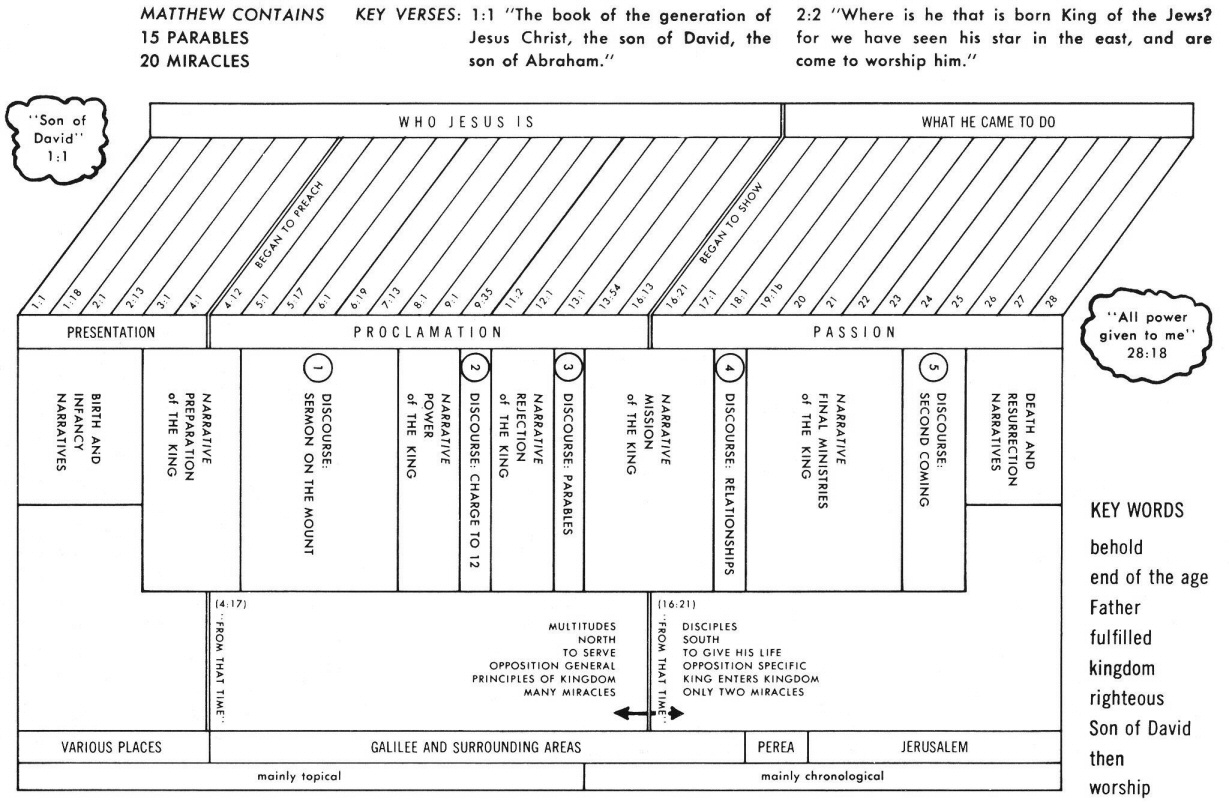
Click chart to enlarge
Charts from Jensen's Survey of the NT - used by permission
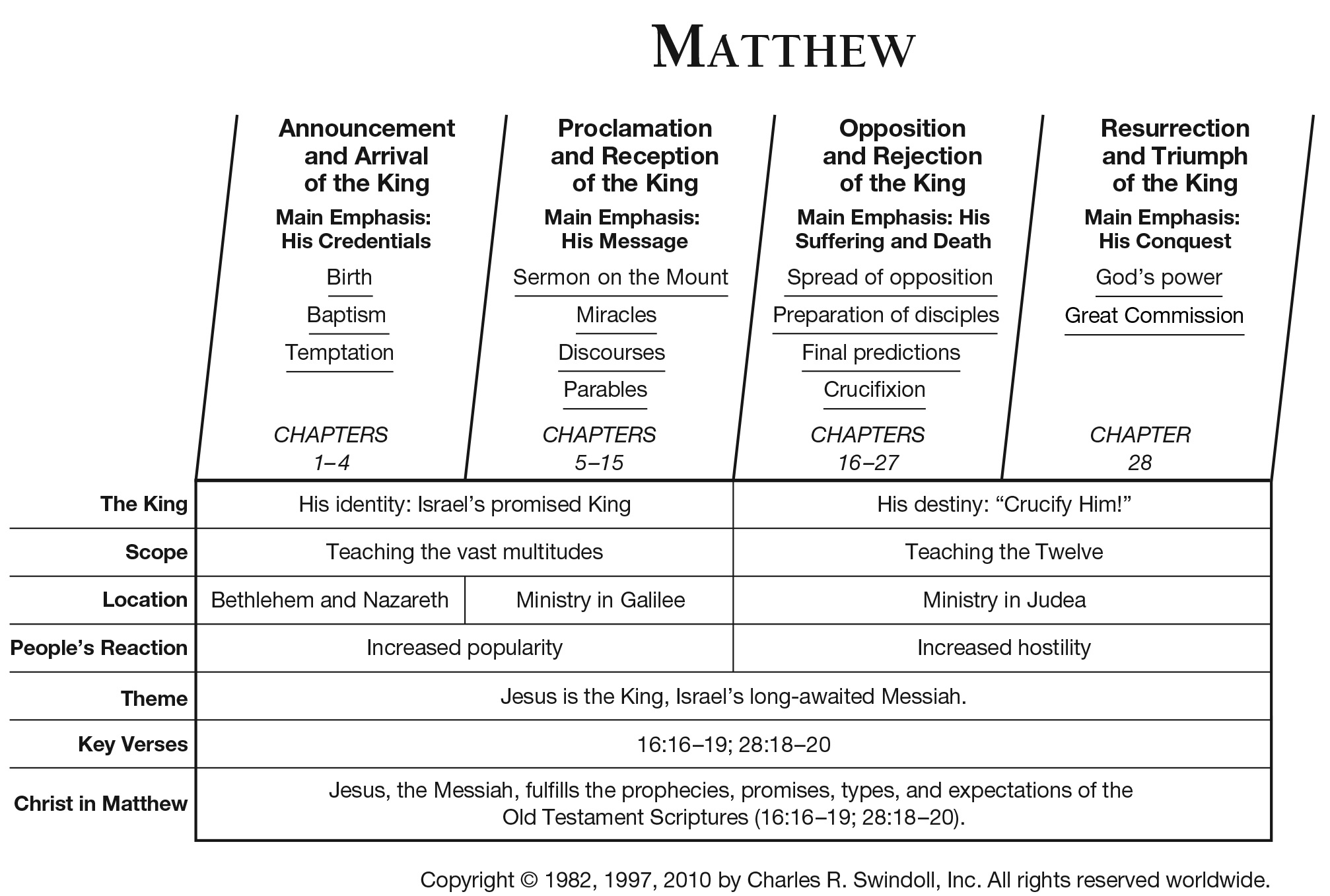
Another Chart from Charles Swindoll
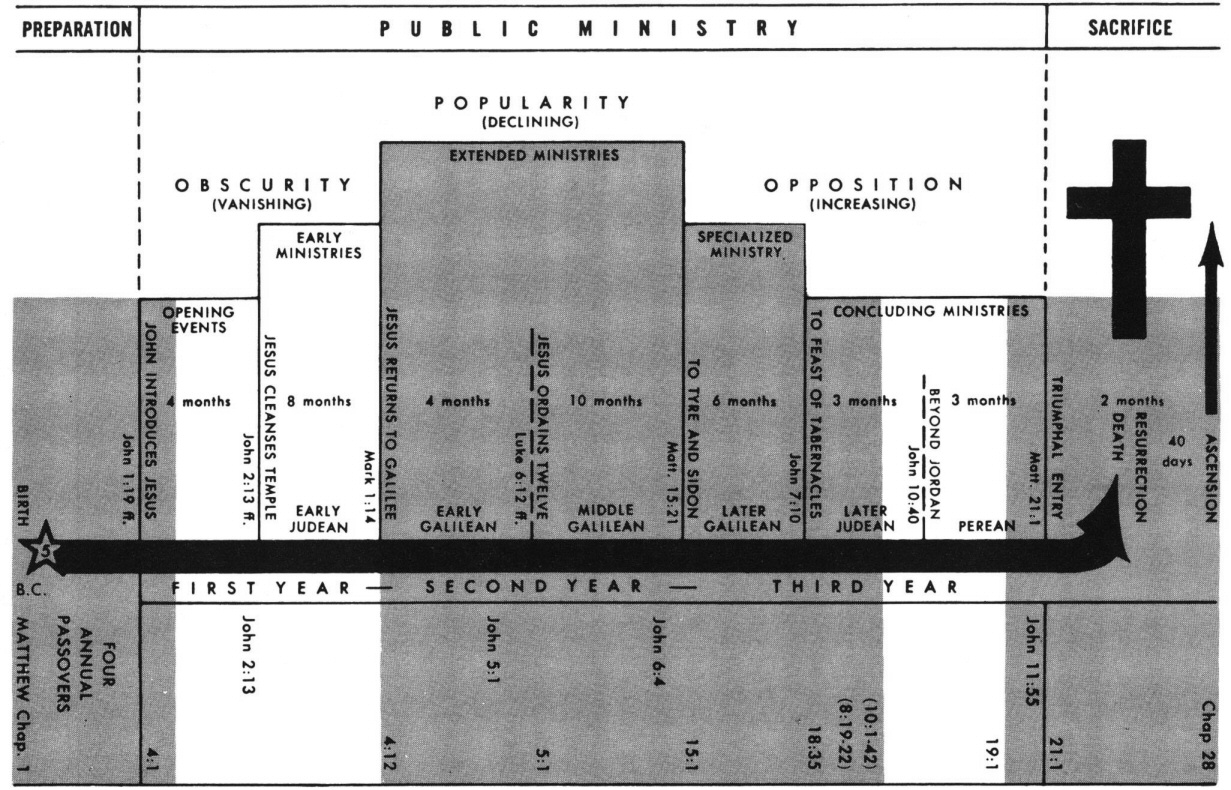
THE LIFE OF JESUS AS COVERED
BY MATTHEW (shaded area)
Click chart to enlarge

Jesus Birth and Early Years
Leading up to the Sermon on the Mount
Matthew 1-7
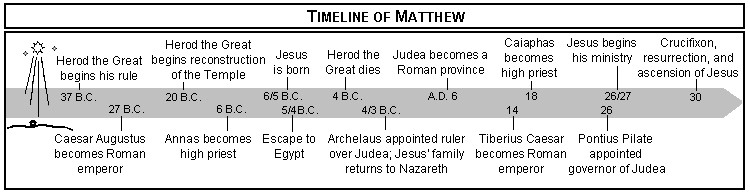
Source: Ryrie Study Bible
Matthew 7:1 Do not judge so that you will not be judged. (NASB: Lockman)
Greek: Me krinete, (2PPAM) hina me krithete; (2PAPS)
Amplified: Do not judge and criticize and condemn others, so that you may not be judged and criticized and condemned yourselves. (Amplified Bible - Lockman)
KJV: Judge not, that ye be not judged.
NLT: "Stop judging others, and you will not be judged. (NLT - Tyndale House)
Philips: "Don't criticise people, and you will not be criticised. (New Testament in Modern English)
Wuest: Stop pronouncing censorious criticism, in order that you may not be the object of censorious criticism, (Wuest: Expanded Translation: Eerdmans)
Young's Literal: Judge not, that ye may not be judged,
Do not judge so that you will not be judged: Me krinete, (2PPAM) hina me krithete; (2PAPS)
- Isaiah 66:5; Ezekiel 16:52-56; Luke 6:37; Romans 2:1,2; 14:3,4,10, 11, 12, 13; 1Cor 4:3, 4, 5; James 3:1; 4:11,12
- Matthew 7 Resources - Multiple Sermons and Commentaries
Spurgeon encourages us...
While we .are reading, let us also be adoring at the same time, for the. words of Christ have a gracious divinity about them; they are infinite; they are omnipotent. There is a kind of life in them; a life which communicates itself to those who hear them. Our Savior did not preach sermons: he preached texts; all his sermons are full of golden sentences, not hammered gold leaf, like those of men, but they are ingots of solid gold, and the gold of that land is good, the most fine gold; there is none like it. Thus he preaches in the seventh chapter of Matthew.
Here are some other translations...
Do not criticize, do not sit as a judge upon another man’s motives, do not attempt to interpret the desires of his heart. (Pentecost)
Do not judge others until you are prepared to be judged by the same standard. And then, when you exercise judgment toward others, do it with humility. (Weber, Stuart, Max E. Anders, Ed: Holman New Testament Commentary: Matthew)
John Lightfoot writes that...
This is a very common proverb among the Jews: In the measure that a man measureth, others measure to him.
Spurgeon writes...
Use your judgment, of course: the verse implies that you will judge in a right sense. But do not indulge the criticizing faculty upon others in censorious manner, or as if you were set in authority, and had a right to dispense judgment among your fellows. If you impute motives, and pretend to read hearts, others will do the same towards you. A hard and censorious behavior is sure to provoke reprisals. Those around you will pick up the peck measure you have been using, and measure your corn with it. You do not object to men forming a fair opinion of your character, neither are you forbidden to do the same towards them, but as you would object to their sitting in judgment upon you, do not sit in judgment upon them. This is not the day of judgment, neither are we his Majesty’s judges, and therefore we may not anticipate the time appointed for the final assize, nor usurp the prerogatives of the Judge of all the earth.
Surely, if I know myself aright, I need not send my judgment upon circuit to try other men, for I can give it full occupation in my own Court of Conscience to try the traitors within my own bosom.
Oswald Chambers writes...
Jesus says regarding judging - Don't.
This is not completely accurate however and in fairness to Chambers he does speak to the "quality" of this judgment noting that Christians can be exceedingly critical individuals. God is the only One Who can be justifiably and perfectly (in turns of motive) critical, for He alone can tell us what is wrong without destroying us. And so Chambers is not saying don't ever make a judgement, but be careful about the spirit in which you pass a judgement. If you are going to judge with a critical spirit - Don't. Citizens of the Kingdom of heaven are challenged (and empowered by the Spirit and grace) to cultivate an uncritical temperament. They must ever be alert to the temptation to place themselves in a position of superiority over others. Superiority belongs to God's alone and He will not allow it to be usurped, subverted, supplanted or superseded! Obedience to Jesus' command is good for your spiritual health! To break this command is sin and to suffer disruption of fellowship with your Father Who is in heaven. Do you need to confess and repent of this sin (and/or this sinful attitude) even as you read these notes? Why is this so important to your spiritual health? John explains that...
If we say that we have fellowship with Him and yet walk in the darkness, we lie and do not practice the truth but if we walk in the light as He Himself is in the light, we have fellowship with one another, and the blood of Jesus His Son cleanses us from all sin... If we confess our sins (naming specific sins, agreeing they are offensive to Him and destructive to us and exhibit a willingness to genuinely repent from the sin - not just "confess" so we can get a "clean slate" and go out and immediately commit that sin again), He is faithful and righteous to forgive ("send them away from") us our sins and to cleanse (katharizo - give us a spiritual "catharsis" so to speak) us from all unrighteousness. (1John 1:6,7, 9)
Spurgeon writes...
You are not called to judge; you are not qualified to judge: “&God is the Judge: he putteth down one, and setteth up another.&” There is much better work to be done by us than that of setting up as judges of others.
Set not up for critics, especially in the act of worship. Probably there. is no greater destroyer of profit in the hearing of the word than is the spirit of carping criticism.
Do not judge (2919) (krino related to English > critic, criticize) primarily signifies to distinguish, choose, separate or discriminate; then, to distinguish between good and evil, right and wrong, without necessarily passing an adverse sentence, though this is usually involved. It means to sift out and analyze evidence.
A judge observes the evidence, evaluates it, and arrives at a certain conclusion. In sum, krino has a wide semantic range that can mean to: judge (judicially), to condemn, or to discern. In context, Jesus clearly does not forbid all judging of any kind, for the moral distinctions drawn in the Sermon on the Mount require that decisive judgments be made and are even mandated (eg "you will know them by their fruits" Mt 7:20-note).
What Jesus is addressing is the spirit and/or motivation of one's judgment. The OT prophets were often very judgmental toward Israel, but the difference is that they were speaking God's words to His rebellious chosen people!
Do not judge is in the present imperative with a negative particle (Greek = "me" = negates) which calls for them to stop doing this implying that they were judging. The truth is that fallen flesh is by nature critical and condemning. And so in these first two verses of chapter 7 Jesus is telling His audience (and us) to...
Stop hypercritically judging others, in order that you may not be the recipient of similar judgment.
He is saying cease judging others with a spirit which is censorious, carping (marked by or inclined to querulous and often perverse criticism), caviling (raising annoying, petty, trivial and/or frivolous objections), condemnatory, critical, disapproving, disparaging, fault-finding, hypercritical, scathing or severe. Why? For such judgment is harsh, self-righteous, lacking in mercy and short on love. Unfortunately the church of Jesus Christ is far from immune and as someone has quipped a few in the church even think their critical spirit is their spiritual gift! They euphemistically call it a "spirit of discernment"!
Even Shakespeare saw the light on this precept writing...
Forebear to judge, for we are sinners all.
James has a similar admonishment...
Do not speak against (present imperative + negative particle = Stop speaking ill of, in a degradingly, defaming or slandering manner) one another, brethren. He who speaks against a brother, or judges his brother, speaks against the law (NLT "If you criticize each other and condemn each other, then you are criticizing and condemning God's law"), and judges the law; but if you judge the law, you are not a doer of the law, but a judge of it. There is only one Lawgiver and Judge, the One who is able to save and to destroy; but who are you who judge your neighbor? (James 4:11, 12) (The person who judges his brother disobeys the law, thus in effect placing himself in a position above the law and thus treating it with contempt.)
In a parallel passage Luke quotes Jesus' (four) commands including...
Be (present imperative) merciful, (How? What is our "standard"?) just as your Father is merciful. And (note the connection of mercy and inappropriate judging - a judgmental attitude is not merciful) do not judge (present imperative + negative particle = Stop passing unfavorable, critical, fault finding, condemnatory judgment) and you will not be judged; and do not condemn (this is God's right) (present imperative + negative particle = Stop declaring or pronouncing others guilty [as if you were the Judge of men!]) , and you will not be condemned; pardon (present imperative), and you will be pardoned. (Luke 6:36, 37)
So that (2443) (hina) introduces a purpose clause - in this case the reason we should not judge others hypocritically and/or hypercritically is so that we "cut off" a similar judgment upon ourselves. This purpose clause should serve to motivate us to obey this command enabled by the Spirit and grace.
Be patient with the faults of others.
They have to be patient with yours!
D A Carson comments that...Those who "judge" like this will in turn be "judged," not by men (which would be of little consequence), but by God (which fits the solemn tone of the discourse). The disciple who takes it on himself to be the judge of what another does usurps the place of God ("Why do you judge your brother? Or you again, why do you regard your brother with contempt? For we will all stand before the judgment seat of God" - see note Romans 14:10) and therefore becomes answerable to Him. The hina me ("in order that...not"; NIV, "or") should therefore be given full telic (tending toward an end) force
Do not assume the place of God by deciding you have the right to stand in judgment over all-do not do it, I say, in order to avoid being called to account by the God whose place you usurp (cf. b Shabbath 127b; M Sotah 1:7; b Baba Metzia 59b). (Gaebelein, F, Editor: Expositor's Bible Commentary 6-Volume New Testament. Zondervan Publishing)
Judge Not
Judge not: the work of his brain
And of his heart thou canst not see;What looks to thy dim eyes a stain,
In God's pure light may only be
A scar, brought from some well-fought field
Where thou wouldst only faint and yield.
The look, the air, that frets thy sight,
May be a token that below
The soul has closed in deadly fight
With some internal fiery foe,
Whose glance would scorch thy smiling grace,
And cast thee shuddering on thy face.
--Selected
Guzik has an excellent exposition of this command writing that...
This is the Bible verse that seems to be most popular in our present day. But most the people who quote this verse don't understand what Jesus said. They seem to think Jesus commanded a universal acceptance of any lifestyle or teaching. If we see what Jesus said in Matthew 7:15-16, He commands us to know people by the fruit of their life, and some sort of assessment is necessary for that.. The Christian is called to unconditionally love. But the Christian is not called to unconditional approval. We really can love people who do things that should not be approved of. Instead, Jesus is speaking against being judgmental, that is, judging motives and the inner man, which only God can know. We can judge the fruit of a man, but we can rarely judge their motives with accuracy.
Jesus does not prohibit judgment of others. He only requires that our judgment be completely fair, and that we only judge others by a standard we would also like to be judged by. Most of our judgment in regard to others is wrong, not because we judge according to a standard, but because we are hypocritical in the application of that standard - we ignore the standard in our own life.
We judge others by one standard, and ourselves by another standard - being far more generous to ourselves than others. With the measure you use, it will be measured back to you:
According to the teaching of some rabbis in Jesus' time, God had two measures that He used to judge people. One was a measure of justice and the other was a measure of mercy. Which measure do you want God to use with you? Then you should use that same measure with others. (Mt 7:2). (Matthew 7)
Be quick to judge yourself
But slow to judge others.
People Magazine was interviewing a well-known actor who was defending the moral indiscretions of former President Clinton.
Why should we be upset over such a thing? We're all sinners, and it just shows that President Clinton is just like the rest of us. The Bible says, 'Judge not, that ye be not judged.'
Whenever Christians warn against or condemn our society for its loss of moral moorings, it is not uncommon to have them misquote Matthew 7:1 to counter our "judgmental attitude", but as discussed in this section such a use represents a distortion of what Jesus actually meant in context (remember context is "king" in [accurate] interpretation). Clearly Jesus was not forbidding one from making moral evaluations which is the way this actor and the unregenerate world interprets this verse. They say "Do not judge. Do not make moral evaluations. Do not condemn anything." Wrong! That is not what Jesus is commanding, for all through the Gospels He teaches we are to continually make moral judgments about both issues and people (cp Jesus' moral judgment regarding adultery - Mt 5:27, 28-notes) If we interpreted Matthew 7:1 the way the world wants us to interpret it, we could not say there was such a thing as adultery... it's just an "affair" (note the world's euphemistic way of toning down evil.) Christians as salt and light are to make sound moral judgments, but we must do so with a humble, loving attitude for nothing is more harmful to the cause of Christ than believers who cry out with a shrill voice using harsh language which condemns others (there is only one Judge) with an angry, unkind attitude. The point is that believers are not to manifest a judgmental, critical, fault-finding attitude, always being negative, always carping about things, always being aware of minor problems in the lives of others while oblivious to the faults they are demonstrating in there negative, judgmental attitudes. Believers can and should make Spirit-led moral judgments, but not in an unloving, unkind manner. We are never to despise others or regard them with contempt. As we have often heard, God hates the sin, but loves the sinner, which is why He sent His Son. We are to "be imitators of God, as beloved children and walk in love." (Ep 5:1, 2+)
Dwight Pentecost addresses the problem of judging others by reminding us that...
God’s standard of conduct for His children is His own unalterable, intrinsic righteousness and holiness. Peter stated this so clearly in 1 Peter 1:15, 16+
As he which hath called you is holy, so be ye holy in all manner of conversation; because it is written, Be ye holy; for I am holy.
When a man asks himself, “How good must I be?” the biblical answer is, “As good as God.” While that standard is written into the hearts of all, they acknowledge they cannot attain it. So men universally set aside God’s standards and substitute their own. Every religion, no matter how depraved it may be, has its own standards of conduct. But the standard of conduct is not the standard of the character of God, nor of the Word of God...
When a man sets up his own standards of conduct in lieu of the standards of God, he must become a judge of men’s conduct. When men make their own rules, they then become judges to determine what is acceptable and what is not acceptable, and to distinguish who conforms to their standards and who does not. The peril of legalism is that it will not lead a man to holiness in his conduct. Also, inevitably, it makes a man judge both the actions and the motives of other men. (BORROW Design for living: Lessons in Holiness from the Sermon on the Mount. page 166)
The fault we see in another
may be the reflection of our own.
Oswald Chambers writes that Jesus is charging His disciples to "Stop having a measuring rod for other people. There is always one fact more in every man's case about which we know nothing. The first thing God does is to give us a spiritual spring-cleaning; there is no possibility of pride left in a man after that. I have never met the man I could despair of after discerning what lies in me apart from the grace of God.
"It is one thing to exercise judgment,
and quite another to have a judgmental attitude
Max Anders and Stu Web write that "It is one thing to exercise judgment, and quite another to have a judgmental attitude. One is an action that might be carried out with right or wrong motives; the other is a negative character quality... This is the central application of Mt 7:1-5. Our habitual response to Scripture must be to say, "What about me?" rather than, "What about others?" (See Holman New Testament Commentary)
An Appropriate
Time to Judge
As alluded to Jesus is not saying we are to condone or excuse sin, for the Scriptures clearly do not forbid men to distinguish between good and evil. Yes, we are to get rid of a critical spirit, but we are encouraged to cultivate a discerning spirit as in the exhortation in Hebrews where we note that...
solid food is for the mature (see teleios), who because of practice have their senses (see aistheterion) trained to discern (gumnazo - perfect tense = they have been mentally and spiritually trained and are still in that condition) good (see kalos) and evil (Heb 5:14+)
And so contrary to popular opinion, Jesus is not forbidding all judgment but He is condemning hypocritical judgment of those who held others to a higher standard than they themselves were willing to live by. In fact, in the following verses Jesus clearly indicates that taking a speck out of your brother’s eye is the correct thing to do, as long as you have been careful to first remove the log out of your own eye. On the other hand, we are forbidden to judge the motives or attitudes of others for unlike God, we are not able to discern “the thoughts and intentions of the heart” (see note Hebrews 4:12). Only God can judge the heart, because only God can see the heart (1Sa 16:7). As the psalmist rightly asks...
Would not God find this out? For He knows the secrets of the heart. (Ps 44:21)
As Spurgeon rhetorically asks...Would God not with holy indignation have detected unfaithfulness to itself, even had it been hidden in the heart and unrevealed in the life? For He knows the secrets of the heart. He is acquainted with the inner workings of the mind, and therefore this could not have escaped Him. Not the heart only which is secret, but the secrets of the heart, which are secrets of the most secret thing, are as open to God as a book to a reader.
As God cannot be deceived by our subtlety, so he cannot be excluded by our secrecy. Thomas Watson.
In Proverbs we read...
All the ways of a man are clean in his own sight, but the LORD weighs the motives. (Pr 16:2).
And in Romans Paul instructs us that there is coming a day when...
according to my gospel, God will judge the secrets of men through Christ Jesus. (Ro 2:16+)
And writing to the Corinthians Paul instructs his readers...to
not go on passing judgment before the time, but wait until the Lord comes who will both bring to light the things hidden in the darkness and disclose the motives of men's hearts; and then each man's praise will come to him from God. (1 Cor 4:5+)
The upshot is that judgment of other's motives is not our job but God's job.
To reiterate, Scripture does urge us to judge between truth and error, right and wrong, good and evil. For example, Jesus said
Do not judge according to appearance, but judge (present imperative) with righteous judgment. (John 7:24+) ("Righteous judgment" implies we are in communion with God, that our conscience is clear, that we are filled with His Spirit, and we are motivated by a desire to further His glory. Fulfill these requirements [among others] and then you can "judge according to appearance.")
Paul wrote to the Corinthian believers
I speak as to wise men; you judge what I say. (1 Cor 10:15+) (In context Paul is saying he is confident that the Corinthians had the wisdom to understand the correctness of what he was about to tell them and that they could make correct judgments about what they should do - read 1 Cor 10 for the full context)
Clearly, God requires us to be discriminating when it comes to matters of sound doctrine.
We are also instructed to judge one another with regard to overt acts of sin. Writing again to the Corinthians, he asked...
Is it not those inside the church whom you are to judge? God judges those outside. ‘Remove (aorist imperative = do it effectively. This command even conveys a sense of urgency.) the evil person from among you’ (1 Cor 5:12-13+)
Comment: Paul is referring to the ministry of other believers in judging sin which took place within members of the body. In addition to rightly judging sinful behavior, disciplining was called for as shown by the context. This type of prescribed proper judgment within the body of Christ is often shied away for fear of being too confrontational when in fact it is the very process by which the body is kept spiritually sound and vibrant.
This same process of discipline ("judging") is outlined by Jesus Himself in Matthew 18...
"And if your brother sins, go and reprove him in private; if he listens to you, you have won your brother. 16 "But if he does not listen to you, take one or two more with you, so that BY THE MOUTH OF TWO OR THREE WITNESSES EVERY FACT MAY BE CONFIRMED. 17 "And if he refuses to listen to them, tell it to the church; and if he refuses to listen even to the church, let him be to you as a Gentile and a tax-gatherer. 18 "Truly I say to you, whatever you shall bind on earth shall be bound in heaven; and whatever you loose on earth shall be loosed in heaven. 19 "Again I say to you, that if two of you agree on earth about anything that they may ask, it shall be done for them by My Father who is in heaven. 20 "For where two or three have gathered together in My name, there I am in their midst. (Mt 18:15-20+)
Comment: Note that the verse often quoted in the context of prayer or fellowship is in fact usually taken out of context for it is clearly in the context of disciplining a brother - compare the phrase "two or three" to the previous verses!
Thomas Constable agrees writing that "It should be obvious from the context that this promise does not refer to whatever two or three disciples agree to ask God for in prayer. The Bible contains many promises concerning prayer but this is not one of them. In the context “anything” {v19} refers to any judicial decision involving an erring disciple that the other disciples may make corporately. God has always stood behind His judicial representatives on earth when they carry out His will (cf. Ps. 82:1). This is a wonderful promise. God will back up with His power and authority any decision involving the corporate discipline of an erring brother or sister that His disciples may make after determining His will. Here again Jesus takes God’s place as “God with us”. This statement implies a future time when Jesus would not be physically present with His disciples, the inter-advent age, specifically the period following His ascension and preceding His return. Jesus anticipated His ascension.
Another kind of judgment which is required of every believer is to examine and judge our own selves at the Lord's Table for Paul states that...
if we judged ourselves rightly, we should not be judged. (1 Cor 11:31+)
This self-judgment calls for an honest, transparent searching of one's own heart every time we partake of the Lord’s Supper. And Paul preceded this admonition by giving us ample motivation to judge ourselves rightly...
For he who eats and drinks, eats and drinks judgment to himself, if he does not judge the body rightly. For this reason many among you are weak and sick, and a number sleep (some even died). (1Cor 11:29,30+)
🙏 THOUGHT When was the last time Paul's complete admonition was emphasized in your church prior to communion? Could it be that some of those in your church are weak and sick or have even died because they have taken the Lord's Supper in an unholy manner with unclean hands and unconfessed hearts? God has not changed, and His strong words caution through Paul are not meant to hurt us but to heal us. We must not back away from speaking the whole counsel of God's Word. The reason I am so emphatic is I have been in so many communion services where Paul's warning was not read in its entirety. Only rarely has it been read in its entirety and then without any significant exposition. Am I being judgmental? Perhaps!
In a similar way, all other righteous forms of judgment depend on this honest self-examination which is exactly what Jesus was alluding to when He said
Or how can you say to your brother, 'Brother, let me take out the speck that is in your eye,' when you yourself do not see the log that is in your own eye? You hypocrite, first take the log out of your own eye, and then you will see clearly to take out the speck that is in your brother's eye. (Luke 6:42+).
William Hendriksen explains that "To be discriminating and critical is necessary; to be hypercritical is wrong. One should avoid saying what is untrue (Ex 23:1), unnecessary (Pr 11:13), and unkind (Pr 18:8)... the habitual self-righteous faultfinder must remember that he himself can expect to be condemned, and this not only by men but also and especially by God, as Mt 6:14, 15 has already indicated. Cf. Mt 18:23-35." (Borrow Exposition of the Gospel According to Matthew Page 356)
Writing to the Corinthians, Paul addressed the issue of the church's lack of action and failure to mourn over and deal with the grievous immorality in their body...
For I, on my part, though absent in body but present in spirit, have already judged him who has so committed this, as though I were present. In the name of our Lord Jesus, when you are assembled, and I with you in spirit, with the power of our Lord Jesus, I have decided to deliver such a one to Satan for the destruction of his flesh, that his spirit may be saved in the day of the Lord Jesus...For what have I to do with judging outsiders (unbelievers)? Do you not judge those who are within the church (The NLT paraphrases it "but it certainly is your job to judge those inside the church who are sinning in these ways")? But those who are outside, God judges. (1Cor 5:3-5, 12-13+)
Similarly believers must distinguish (judge) between true and false doctrine. And thus we read passages like...
Beloved, do not believe (present imperative with a negative) every spirit, but test (present imperative see our need to depend on the Holy Spirit to obey) the spirits to see whether they are from God; because many false prophets have gone out into the world. (1Jn 4:1+)
Now these (Bereans) were more noble-minded than those in Thessalonica, for they received the word with great eagerness, examining (a word used in Greek to describe the questioning of someone in order to pass a judicial sentence!) the Scriptures daily, to see whether these things were so. (Acts 17:11+)
But examine (present imperative = command to continually be testing in order to draw a conclusion about the worth of - see our need to depend on the Holy Spirit to obey) everything carefully; hold fast to that which is good (1Th 5:21+)
Beware (present imperative = command to continually be watching out for or guard for - see our need to depend on the Holy Spirit to obey) of the false prophets, who come to you in sheep's clothing, but inwardly are ravenous wolves... So then, you will know them by their fruits." (Mt 7:15+, Mt 7:20+)
We are also at times called to judge whether others are true believers, for otherwise we could never recognize the unequal yoke that Paul commands us to avoid...
Do not be (present imperative + negative particle = Stop being unevenly yoked or mismatched) bound together with unbelievers; for what partnership have righteousness and lawlessness, or what fellowship has light with darkness? (2 Cor. 6:14+)
Jesus is telling His audience to avoid the hypocrisy and condemning spirit that arises from self-righteousness. Believers are not in the condemning business and are to leave any necessary condemnation to God the only righteous Judge. To reiterate, we are not to judge other peoples motives for as Scripture clearly teaches "God sees not as man sees, for man looks at the outward appearance, but the LORD looks at the heart." (1Samuel 16:7b)
"Speck ministers" tend to emphasize the faults of others rather than their strengths and to focus on other's faults rather than their own faults. Criticism of others is foolish because our knowledge of them is only partial at best. But even if we had all the facts, we still might misinterpret them because our judgment, unlike God's, is fallible. And such judgmentalism generally tears down rather than building up.
Stated another way, we can judge what people do or say, but we cannot judge why they do it or why they say it. How can we know the heart motives of other people when Jeremiah tells us that our "heart is more deceitful than all else and is desperately sick. Who can understand it? (Jeremiah 17:9)
Solomon warns us that...
Death and life are in the power of the tongue, and those who love it will eat its fruit. (Proverbs 18:21)
Ray Pritchard elaborates on "faultfinders" ("spiritual vultures") concluding that "Faultfinding is the “venom of the soul.” It destroys our joy, drains our happiness, and prevents us from having close friendships. No one likes a faultfinder because no one likes being around a nit-picking critic. This sin comes partly from spiritual pride and partly from disguised envy. We criticize others in order to bring them down to our level. Or worse, we tear them down to prove they are really beneath us. Faultfinding is a deadly disease because if not kept in check, it turns us into cynics (people who believe the worst about other people or the outcome of events) who expect the worst from others. The faultfinder expects failure and secretly gloats when he finds it. Is it any wonder that the faultfinder almost always is a gossip and a talebearer? First we spot the flaws of others and then we can’t wait to spread the news. There is such a thing as a spiritual vulture. Like the vultures of the air that live off dead, rotting flesh, these sad individuals thrive on the mistakes and sins of others. They fly across the landscape, keeping a close eye out for the failures of others. Then they swoop in for their daily feast. (Matthew 7:1-5 Judge Not!) (Bolding added)
H W Beecher once said that...
The cynic is one who never sees a good quality in a man, and never fails to see a bad one
Richard Strauss adds that "Negative criticism is a poison that kills the enthusiasm of Christian leaders and hinders the progress of God’s work. It is a contagious disease that spreads among God’s people, and can turn a loving community of believers into a battleground. It is a sledgehammer that breaks marriages, homes and lives into little pieces. That is why Jesus said, “Don’t judge.” Stop dwelling on the flaws in others, real or perceived. (Matthew 7:1-5 Bits and Beams)
In Romans Paul addresses the religious person (including unsaved, orthodox Jews) who were judging the pagans for their horrible sins in Romans 1...
You (you self righteous religious people), therefore, have no excuse, you who pass judgment on someone else, for at whatever point you judge the other, you are condemning yourself, because you who pass judgment do the same things. Now we know that God's judgment against those who do such things is based on truth. (see notes on Romans 2:1-2) (NIV) (The principle in this verse is that the things we criticize most in others are usually the very things of which we ourselves are guilty. We don’t like those things in ourselves, but we have a tendency to overlook them. Seeing them in others reminds us of these ugly faults, but instead of dealing with them in our own lives, we focus attention on the same faults in other people's lives. As long as we are occupied with the "speck" in the eye of others, we can avoid dealing with the "log" in our eye. And if we can keep the attention on them, they will not be putting pressure on us to change.)
In Romans 14-15 Paul addresses the issue of judging other believers in the body of Christ writing...
1 Now accept the one who is weak in faith (one who does not yet have full knowledge of how to live as a Christian. In this case it is one who eats only "vegetables" and not meat.), but not for the purpose of passing judgment on his opinions.
2 One man has faith that he may eat all things, but he who is weak eats vegetables only.
3 Let not him who eats regard with contempt him who does not eat, and let not him who does not eat judge him who eats, for God has accepted him.
4 Who are you to judge the servant of another? To his own master he stands or falls; and stand he will, for the Lord is able to make him stand.
5 One man regards one day above another, another regards every day alike. Let each man be fully convinced in his own mind.
6 He who observes the day, observes it for the Lord, and he who eats, does so for the Lord, for he gives thanks to God; and he who eats not, for the Lord he does not eat, and gives thanks to God.
7 For not one of us lives for himself, and not one dies for himself;
8 for if we live, we live for the Lord, or if we die, we die for the Lord; therefore whether we live or die, we are the Lord's.
9 For to this end Christ died and lived again, that He might be Lord both of the dead and of the living.
10 But you, why do you judge your brother? Or you again, why do you regard your brother with contempt? For we shall all stand before the judgment seat of God.
11 For it is written, "AS I LIVE, SAYS THE LORD, EVERY KNEE SHALL BOW TO ME, AND EVERY TONGUE SHALL GIVE PRAISE TO GOD."
12 So then each one of us shall give account of himself to God. (so be careful how you judge others!)
13 Therefore let us not judge one another anymore, but rather determine this-- not to put an obstacle or a stumbling block in a brother's way.
(Comment: In this section Paul is referring to making critical judgments regarding the inward reasonings of others and says don't argue with them about what they think is right or wrong. We dare not be judgmental in disputable or "gray" areas. Unless a practice is specifically revealed in Scripture to be right or wrong, each believer should be free to formulate his own personal convictions about it. New Christians may still feel constrained by certain criteria they had followed earlier, and thus may be reluctant to change when they become saved. Unless the practices are specifically prohibited in the Word of God, older believers should receive them into fellowship without arguing or critically judging them. Paul emphasizes that believers are not to judge one another in the matters such as food, etc, because God has received both the weaker and stronger believer, because we can differ in good conscience (as discussed in verses 4-6) and because we shall all be judged by the Lord (verses 7-12). (See notes on Romans 14:1-6, Romans 14:7-9, Romans 14:10-12, Romans 14:13-15, Romans 14:16-22, Romans 15:1-3, Romans 15:4-6, Romans 15:7-10)
Ryrie adds that Jesus "does not mean that one is never, in any sense or to any extent, to judge another, for verse 5 indicates that when one's own life is pure he should take the speck out of the brother's eye. It does mean, however, that a follower of Christ is not to be censorious. (The Ryrie Study Bible: New American Standard Translation: 1995. Moody Publishers)
Henry Morris adds that "Here Jesus warns against condemning the actions or motives of others. Only the Lord has the right to condemn since only He has full knowledge of a person's actions and motives (John 5:22; Romans 14:4,10). On the other hand, He has commanded us to "judge righteous judgment" (John 7:24). We should be able to recognize false teachers and "from such turn away" (2 Timothy 3:5; see also Matthew 7:15-20). Also, we should discern and rebuke these false brethren who are encouraging others to sin (Ephesians 5:7,11). In other words, we should be able to judge that which is wrong, in either doctrine or practice, and avoid (or correct) those who are involved, but we must not condemn them--God will do that. (Borrow The Defender's Study Bible)
Alexander Maclaren has a rather graphic explanation of "do not judge" writing that...
The ‘judging’ of which He speaks sees motes in a brother’s eye. That is to say, it is one-sided, and fixes on faults, which it magnifies, passing by virtues. Carrion flies that buzz with a sickening hum of satisfaction over sores, and prefer corruption to soundness, are as good judges of meat as such critics are of character. That Mephistophelean spirit of detraction has wide scope in this day. Literature and politics, as well as social life with its rivalries, are infested by it, and it finds its way into the church and threatens us all. The race of fault-finders we have always with us, blind as moles to beauties and goodness, but lynx-eyed for failings, and finding meat and drink in proclaiming them in tones of affected sorrow. How flagrant a breach of the laws of the kingdom this temper implies, and how grave an evil it is, though thought little of, or even admired as cleverness and a mark of a very superior person, Christ shows us by this earnest warning, embedded among His fundamental moral teachings.
He points out first how certainly that disposition provokes retaliation. Who is the Judge that judges us as we do others? Perhaps it is best to say that both the divine and the human estimates are included in the purposely undefined expression. Certainly both are included in fact. For a carping spirit of eager fault-finding necessarily tinges people’s feelings towards its possessor, and he cannot complain if the severe tests which he applied to others are used on his own conduct. A cynical critic cannot expect his victims to be profoundly attached to him, or ready to be lenient to his failings. If he chooses to fight with a tomahawk, he will be scalped some day, and the bystanders will not lament profusely. But a more righteous tribunal than that of his victims condemns him. For in God’s eyes the man who covers not his neighbor's faults with the mantle of charity has not his own blotted out by divine forgiveness. (Sermon: Judging, Asking and Giving)
As the context reveals, Jesus clearly does not prohibit all types of judging (see Mt 7:5, 16). There is a righteous kind of judgment we are supposed to exercise with careful discernment...
"Do not judge according to appearance, but judge with righteous judgment." (Jn 7:24) (Jesus commands us to judge, but to do so fairly and on the basis of truth and fact rather than by outward appearances)
Censorious, hypocritical, self-righteous, or other kinds of unfair judgments are forbidden. On the other hand the church is in a desperate need for sound Biblical correction. Some actually misapply Mt 7:1 to avoid correction. My children memorized this verse at a young age! As alluded to in Mt 7:2-4, Jesus is warning us not to judge someone's motives, for we cannot see into their heart.
Ray Pritchard explains what our Lord does not mean by the command "Do not judge" writing that "Jesus is not saying we should never pass any sort of judgment. Every day we make hundreds of judgments about things around us. It is not wrong, for instance, to sit on a jury and render a verdict. Nor it is wrong for an admissions committee to decide which students to accept and which to reject. Nor it is wrong for an employer to decide who gets a promotion and who doesn’t. Nor is it wrong for schools to judge certain students worthy of high honor at graduation. Nor is it wrong for Glenbrook North High School to expel the students who participated in that ugly hazing incident and to ban them from attending graduation ceremonies. We all have to make decisions every day that involve other people. We pass judgment on appearance, behavior, speech, deportment, attitude, work ethic, productivity, keeping or breaking a promise, guilt or innocence, which person we believe and which person we do not believe. Whatever the words of Jesus mean, they can’t mean that we never pass judgment in any sense at any time. (Matthew 7:1-5 Judge Not!)
John Stott adds that here "the command to judge not is not a requirement to be blind, but rather a plea to be generous. Jesus does not tell us to cease to be men (by suspending our critical powers which help to distinguish us from animals) but to renounce the presumptuous ambition to be God (by setting our selves up as judges) (Borrow The Message of the Sermon on the Mount)
John Wesley told of a man he had little respect for because he considered him to be miserly and covetous. One day when this person contributed only a small gift to a worthy charity, Wesley openly criticized him. After the incident, the man went to Wesley privately and told him he had been living on parsnips and water for several weeks. He explained that before his conversion, he had run up many bills. Now, by skimping on everything and buying nothing for himself he was paying off his creditors one by one.
Christ has made me an honest man and so with all these debts to pay, I can give only a few offerings above my tithe. I must settle up with my worldly neighbors and show them what the grace of God can do in the heart of a man who was once dishonest.
Needless to say, Wesley apologized to the man for judging him unrighteously and asked his forgiveness.
Reminiscent of this is another story of the rural church member who used tobacco by dipping snuff. When the preacher thundered out in his sermon, “And God is going to judge the idolaters,” the brother shouted, “Amen!” When the preacher, waxing more vigorous, shouting “And God is going to judge the adulterers,” the brother followed with “Amen!” But when the preacher then bellowed, “And God is going to judge the snuff dippers,” the unhappy brother in a barely audible voice responded, “Now he’s done stopped preachin’ and gone to meddlin.’“ Sinning Davids are always unhappy with Nathan's proclamation that "Thou art the man!" (Ed comment: I do not consider snuff dipping a sin. As a physician, I think it is very harmful and deleterious to the health of one's oral mucosa, but in and of itself is not a sin...in my opinion.)
Pastor Ray Pritchard presents a practical checklist to assess whether one is prone to judging with a critical or condemnatory spirit...
Blowing small things all out of proportion.
Maximizing the sins of others—their faults, foibles and their petty ways.
Coming to quick, hasty, negative conclusions.
Making mountains out of molehills.
Getting involved in situations where you should not be involved.
Passing along critical stories to others.
Having a strong bias to find others guilty.
Being too harsh even when speaking the truth.
Adding aggravating remarks when telling a story.
Dismissing an unkind remark by saying, “I was only joking.”
Saying something critical and then trying to cover it up.
Being unkind and then quickly changing the subject.
Telling too many people about what others have done to us.
Taking pleasure in condemning others.
Telling the truth in order to hurt, not to help.
Putting others down in order to make yourself look better.
Minimizing your sins while magnifying the sins of others.
Note that it is quite possible to have a judgmental spirit even while telling the truth. Some people use the truth as a club to beat others over the head. Simply saying, “Well, it was the truth, you know,” does not get you off the hook.
Our judgment is wrong when it is—Needless, Unfounded, Hasty, Severe.
Here is a simple guide to help guide our speech. It’s an acrostic based on the word NEED.
N—Is it necessary?
E—Will it encourage?
E—Will it edify?
D—Will it dignify the other person?
When I shared that in the first service on Sunday, a friend told me that when his family eats dinner, they have a similar rule: The TKN rule.
T—It is true?
K—Is it kind?
N—Is it necessary?
If the statement doesn’t meet the rule, it doesn’t get said. It might be a good idea if every family in our church adopted that rule for mealtime conversation, although it might mean most of our meals would be eaten in total silence. But silence would be preferable to breaking the Lord’s command. And that brings me back to the speck and the log. It’s easy to see the speck in your brother’s eye, much harder to see the log in your own. In dealing with the faults of others, our greatest need is clear vision. (Matthew 7:1-5 Judge Not!)
R Kent Hughes gives an illustration of this critical spirit in the experience of a young bachelor - Every time he brought a prospective wife home, his mother criticized her unmercifully. The young man was at his wit's end when a friend offered this advice: "Find someone like your mother." So he looked and looked until he found a clone. She looked like his mother, her gait was like his mother's, she talked like his mother, and she even thought like his mother. It was amazing! So he took her home. The next time he saw the friend who had given the advice and was asked how his mother liked the girl, the bachelor answered, "It went great. My mother loved her, but my father couldn't stand her." (See The Sermon on the Mount)
Judge (decide, determine, condemn)(2919) krino and its cognates [see below] is a root of English words like critic, critical [kritikos] = a decisive point at which judgment is made) primarily signifies to distinguish, to decide between (in the sense of considering two or more things and reaching a decision), to make up one's mind, to separate, to discriminate. to distinguish between good and evil, right and wrong, without necessarily passing an adverse sentence, although that is often what is usually involved. As you will see from this study, krino has various shades of meaning which must be determined from the context.
The basic meaning of krino is to form an opinion after separating and considering the particulars in the case. Krino means to evaluate and determine what is right, proper, and expedient for correction.
Wuest gives an excellent sense of the progression of meaning of this Greek word - The word krino meant originally to separate, then to distinguish, to pick out, to be of opinion, and finally, to judge. The act of judgment was therefore that of forming an accurate and honest opinion of someone, thus, appraising his character, and placing him in a certain position with respect to the law of God. The result of such a judgment is commonly condemnation. (Wuest's word studies from the Greek New Testament)
Krínō should be distinguished from a cognate verb katakrino, "to condemn," derived from kata, "down, against," and krínō, "to judge." In Romans 2:1 both verbs are used - "Therefore you are without excuse, every man [of you] who passes judgment (krino), for in that you judge (krino) another, you condemn (katakrino) yourself; for you who judge (krino) practice the same things. The understanding of this verse lies in the proper rendering of what is translated "another" (heteros). It is another who is different than you are. If the only reason you judge another person is because he is different than you are, the basis of your judgment is faulty; and it is no surprise that you will condemn him, for who is better than self! Only God knows the extent of suffering there has been in this world because people have judged their fellowmen by the color or physical features specific to their race. "Undoubtedly much of the warring and rioting and bloodshed in the world today is due to just such judgment." (Zodhiates)
KRINO -99V - Matt. 5:40; Matt. 7:1; Matt. 7:2; Matt. 19:28; Lk. 6:37; Lk. 7:43; Lk. 12:57; Lk. 19:22; Lk. 22:30; Jn. 3:17; Jn. 3:18; Jn. 5:22; Jn. 5:30; Jn. 7:24; Jn. 7:51; Jn. 8:15; Jn. 8:16; Jn. 8:26; Jn. 8:50; Jn. 12:47; Jn. 12:48; Jn. 16:11; Jn. 18:31; Acts 3:13; Acts 4:19; Acts 7:7; Acts 13:27; Acts 13:46; Acts 15:19; Acts 16:4; Acts 16:15; Acts 17:31; Acts 20:16; Acts 21:25; Acts 23:3; Acts 23:6; Acts 24:6; Acts 24:21; Acts 25:9; Acts 25:10; Acts 25:20; Acts 25:25; Acts 26:6; Acts 26:8; Acts 27:1; Rom. 2:1; Rom. 2:3; Rom. 2:12; Rom. 2:16; Rom. 2:27; Rom. 3:4; Rom. 3:6; Rom. 3:7; Rom. 14:3; Rom. 14:4; Rom. 14:5; Rom. 14:10; Rom. 14:13; Rom. 14:22; 1 Co. 2:2; 1 Co. 4:5; 1 Co. 5:3; 1 Co. 5:12; 1 Co. 5:13; 1 Co. 6:1; 1 Co. 6:2; 1 Co. 6:3; 1 Co. 6:6; 1 Co. 7:37; 1 Co. 10:15; 1 Co. 10:29; 1 Co. 11:13; 1 Co. 11:31; 1 Co. 11:32; 2 Co. 2:1; 2 Co. 5:14; Col. 2:16; 2 Thess. 2:12; 2 Tim. 4:1; Tit. 3:12; Heb. 10:30; Heb. 13:4; Jas. 2:12; Jas. 4:11; Jas. 4:12; Jas. 5:9; 1 Pet. 1:17; 1 Pet. 2:23; 1 Pet. 4:5; 1 Pet. 4:6; Rev. 6:10; Rev. 11:18; Rev. 16:5; Rev. 18:8; Rev. 18:20; Rev. 19:2; Rev. 19:11; Rev. 20:12; Rev. 20:13
QUESTION - What does the Bible mean when it says, “Do not judge”? See associated video.
ANSWER - Jesus’ command not to judge others could be the most widely quoted of His sayings, even though it is almost invariably quoted in complete disregard of its context. Here is Jesus’ statement: “Do not judge, or you too will be judged” (Matthew 7:1). Many people use this verse in an attempt to silence their critics, interpreting Jesus’ meaning as “You don’t have the right to tell me I’m wrong.” Taken in isolation, Jesus’ command “Do not judge” does indeed seem to preclude all negative assessments. However, there is much more to the passage than those three words.
The Bible’s command that we not judge others does not mean we cannot show discernment. Immediately after Jesus says, “Do not judge,” He says, “Do not give dogs what is sacred; do not throw your pearls to pigs” (Matthew 7:6). A little later in the same sermon, He says, “Watch out for false prophets. . . . By their fruit you will recognize them” (verses 15–16). How are we to discern who are the “dogs” and “pigs” and “false prophets” unless we have the ability to make a judgment call on doctrines and deeds? Jesus is giving us permission to tell right from wrong.
Also, the Bible’s command that we not judge others does not mean all actions are equally moral or that truth is relative. The Bible clearly teaches that truth is objective, eternal, and inseparable from God’s character. Anything that contradicts the truth is a lie—but, of course, to call something a “lie” is to pass judgment. To call adultery or murder a sin is likewise to pass judgment—but it’s also to agree with God. When Jesus said not to judge others, He did not mean that no one can identify sin for what it is, based on God’s definition of sin.
And the Bible’s command that we not judge others does not mean there should be no mechanism for dealing with sin. The Bible has a whole book entitled Judges. The judges in the Old Testament were raised up by God Himself (Judges 2:18). The modern judicial system, including its judges, is a necessary part of society. In saying, “Do not judge,” Jesus was not saying, “Anything goes.”
Elsewhere, Jesus gives a direct command to judge: “Stop judging by mere appearances, but instead judge correctly” (John 7:24). Here we have a clue as to the right type of judgment versus the wrong type. Taking this verse and some others, we can put together a description of the sinful type of judgment:
Superficial judgment is wrong. Passing judgment on someone based solely on appearances is sinful (John 7:24). It is foolish to jump to conclusions before investigating the facts (Proverbs 18:13). Simon the Pharisee passed judgment on a woman based on her appearance and reputation, but he could not see that the woman had been forgiven; Simon thus drew Jesus’ rebuke for his unrighteous judgment (Luke 7:36–50).
Hypocritical judgment is wrong. Jesus’ command not to judge others in Matthew 7:1 is preceded by comparisons to hypocrites (Matthew 6:2, 5, 16) and followed by a warning against hypocrisy (Matthew 7:3–5). When we point out the sin of others while we ourselves commit the same sin, we condemn ourselves (Romans 2:1).
Harsh, unforgiving judgment is wrong. We are “always to be gentle toward everyone” (Titus 3:2). It is the merciful who will be shown mercy (Matthew 5:7), and, as Jesus warned, “In the same way you judge others, you will be judged, and with the measure you use, it will be measured to you” (Matthew 7:2).
Self-righteous judgment is wrong. We are called to humility, and “God opposes the proud” (James 4:6). The Pharisee in Jesus’ parable of the Pharisee and the tax collector was confident in his own righteousness and from that proud position judged the publican; however, God sees the heart and refused to forgive the Pharisee’s sin (Luke 18:9–14).
Untrue judgment is wrong. The Bible clearly forbids bearing false witness (Proverbs 19:5). “Slander no one” (Titus 3:2).
Christians are often accused of “judging” or intolerance when they speak out against sin. But opposing sin is not wrong. Holding aloft the standard of righteousness naturally defines unrighteousness and draws the slings and arrows of those who choose sin over godliness. John the Baptist incurred the ire of Herodias when he spoke out against her adultery with Herod (Mark 6:18–19). She eventually silenced John, but she could not silence the truth (Isaiah 40:8).
Believers are warned against judging others unfairly or unrighteously, but Jesus commends “right judgment” (John 7:24, ESV). We are to be discerning (Colossians 1:9; 1 Thessalonians 5:21). We are to preach the whole counsel of God, including the Bible’s teaching on sin (Acts 20:27; 2 Timothy 4:2). We are to gently confront erring brothers or sisters in Christ (Galatians 6:1). We are to practice church discipline (Matthew 18:15–17). We are to speak the truth in love (Ephesians 4:15). GotQuestions.org
Related Resources: All from GotQuestions.org
- What does it mean to judge not lest you be judged (Matthew 7:1)?
- Isn’t it unloving to tell someone he/she is sinning?
- What was Jesus writing in the dirt when the Pharisees brought to Him a woman caught in adultery?
- Why are Christians so judgmental?
Judge Not
Matthew 7:1
Let us believe the best; there are enough, you know,
Judging by what they see–wronging each other so.
Let us believe the best; there are enough to blame,
Numbers to think the worst–numbers to brand a name.Many a man would rise out of his dark despair,
If there were only one, just to believe and care–
Out on the losing side, daring to take his stand–
Heedless of what men say, holding a brother’s hand.E. H. Divall (By Permission of the Sunday School Union)
D L Moody - You may find hundreds of faultfinders among professed Christians; but all their criticism will not lead one solitary soul to Christ. I never preached a sermon yet that I could not pick to pieces, and find fault with. I feel that Jesus Christ ought to have a far better representative than I am. But I have lived long enough to discover that there is nothing perfect in this world. If you are to wait till you find a perfect preacher, or perfect meetings, I am afraid you will have to wait till the millennium arrives. What we want is to be looking up to Christ. Let us be done with faultfinding.
Our society detests moral absolutes - A recent poll estimated that 72% of Americans between the ages of 18-25 do not believe in absolute truth or in moral absolutes. Daniel Taylor, a professor at Bethel College in St. Paul, Minnesota, put it this way: "(Relativism) takes the clearly observable fact that we have a multitude of views and values and practices in the world--pluralism--and draws the illegitimate conclusion that there is no justifiable way of choosing among them. Truth is merely opinion, goodness only what the majority says it is." In one public high school, the sociology textbook being used says "Everything is right somewhere, and nothing is right everywhere." Translation - There are no absolute moral standards in the universe. Everything is relative.
The mantra of "No Absolutes" causes many to shy away from the exclusivity of the Christian message for fear of backlash. The Wall Street Journal had a story on Reverend Bruce Robbins the ecumenical staff leader for the United Methodist Church, who was explaining that Methodists are encouraged to share their faith but qualified this statement with the caution to be very careful about trying to target other groups for evangelism, explaining "We have to honor diversity. We believe that God's call through Jesus is universal and that other people know God through their religious traditions."!
HASTY CONCLUSIONS - The folly of snap judgments of others is well illustrated by a story the last Bishop Potter of New York used to tell on himself.
He was sailing for Europe in one of the great trans-Atlantic liners. When he went on board, he found another passenger was to share the cabin with him. After going to see his accommodations, he came up to the purser's desk and inquired if he could leave his gold watch and other valuables in the ship's safe. He explained that ordinarily he never availed himself of that privilege, but he had been to his cabin and had met the man who was to occupy the other berth and, judging from his appearance, he was afraid that he might not be a very trustworthy person.
The purser accepted the responsibility of caring for the valuables, and remarked, "It's all right, bishop, I'll be very glad to take care of them for you. The other man has been up here and left his for the same reason."
One is reminded of the lines of Robbie Burns,
"Oh, wad some power the giftie gie us,
To see oursel's as others see us."
It is very easy to form snap judgments, only to find out afterwards that they are utterly unfounded. Love "believeth all things, hopeth all things." (Harry A. Ironside)
It is much easier to be critical than to be correct.
—Disraeli
F B Meyer has a chapter entitled "TO THEM THAT ARE WITHOUT" (Matt. 7:1-6.)
Along as we are in this mortal life we shall necessarily come into contact with those whose lives are godless and evil. Evil men and seducers will wax worse and worse. People will always abound who will not consent to wholesome words, even the words of our Lord Jesus Christ, and the doctrine which is according to godliness. There will always be perverse disputings of men of corrupt minds, destitute of the truth, and enemies to whatever is pure, lovely, holy, and of good report. In this paragraph of the Sermon on the Mount our Lord sets Himself to show us how to act towards such. It is clear that the Master had no desire that His servants should retire from human society, but should live amongst men as salt and light arresting the progress of corruption, and abashing the evil deeds that hide under the cover of darkness; but, in addition to the quiet influence of our character, there will always be scope for a further exercise of Christian principle. In what direction, and to what extent, is this to take effect, and by what laws is it to be governed? In answer to these questions our Lord lays down a general principle, which is removed as far as possible from that which obtains among men. He says: Whatever you do, think, or say about others must be in precise accordance with what you would like them to do, think, or say about yourself. Judge not, for with what judgment ye judge, ye shall be judged. With what measure ye mete, it shall be measured to you again. All things whatsoever ye would that men should do unto you, do ye even so to them; and all things whatsoever ye would not that men should do unto you, do ye not so to them.
It is clear that there are three circles in this paragraph of men with whom we are constantly thrown into contact. First, our Associates and Neighbours, whose characters and conduct are constantly passing in review before us; secondly, the Erring Ones, whose motes trouble us; and, thirdly, the Dogs and Swine, which stand for the notoriously vicious and profane.
As to our Associates and Neighbours, Our Lord says:
(1) "Judge not." We need hardly say that there is a sense in which we are bound to form careful judgments on those around us. The judgment is one of the noblest faculties of our moral life, and our surest safeguard from the sharks that infest the seas. The young girl must use it of the man who is seeking to engage her affections; the young man must use it of the man who offers him a partnership; the seeker after truth must use it of the teacher who professes to be able to lead him. There is no prayer that we need more often or more fervently to make than that God would give us right judgment in all things. "He that is spiritual judgeth all things."
But the judgment prohibited by our Lord is altogether different from this, and is that spirit of censoriousness and unkindness which is always lying in wait for others, and making strong and uncharitable statements on the most superficial view of their words and actions, without trying to understand the motives by which they have been actuated or the difficulties of their position.
The natural man is proud, haughty, and self-opinionated. He has a great contempt of and a great prejudice towards those who do not belong to his own sect or party. He is, therefore, very censorious of them, making faults where there are none, and aggravating them where they are. When he has formed, however hastily, his judgment, he is not content with contemplating it for himself, but takes every opportunity of venting it in word and act. If such men can win another to their party, they are perfectly willing to condone his faults; otherwise they will not scruple to extinguish him and his influence by poisoning the minds of his neighbours and contemporaries. This sin of censorious judgment is a constant peril to us all, and one against which we need to watch and pray.
Beware lest you have a secret joy in seeing that another who had borne an irreproachable character has failed! Beware lest you form your estimate of another on idle stories, suspicions, suggestions, and surmises, and without sufficient evidence! Beware of seeking after a reputation for quickness in estimating the true worth of others, since the desire to maintain such a reputation is fraught with temptation! Beware of speaking of the faults of others, except you have prayed about them first! Beware of uttering your criticisms unless there is some end to be gained in warning others! Beware of speaking of others till you have looked at home! Remember the proverb about glass houses!
There are some who seem unable of forming a generous estimate of any. According to them there is always some evil motive behind apparent goodness, which 'detracts from all merit or virtue. "Yes, he does seem religious and humane, but then, you know, there is a rich old relative in the background, and it is all-important to keep in touch with him, and that sort of thing goes down well in that quarter." Or, "Yes, he is religious enough just now, but, you know, there is a lady in the question, and he is perfectly right in the way he is taking to win her." Ah, it is a sad and miserable state of mind to have no eyes but for wounds, and bruises, and putrefying sores, and to find these beneath the surface when they do not appear to the eyes of others. There are many young men and women amongst us in society who can hardly indulge in any language but that of depreciation.
(2) Our ignorance of most of the facts should give us pause before passing harsh and censorious judgments. Take this, for instance: A merchant was thought to be very selfish with his money. He was known to be very rich, and yet when asked for subscriptions he gave always a small sum (5 Pounds) where his neighbours thought he ought to give 20 Pounds. He was therefore in ill odour for miserliness and greed. This went on for years, and many closed their hearts against him. One of his friends, however, who felt that there might be some other explanation, set himself, with careful inquiry, to ascertain the facts. It was with some difficulty that he finally discovered that this much-abused man was supporting handsomely a large family of poor relatives. He educated them well, and put them out in life with no niggard hand. They lived in another town, and no one knew of the source of their income. Their benefactor never allowed his left hand to know what his right hand did. Here was a man whom all were misjudging because they did not know all the facts. Is it a solitary instance?
(3) The fact that we cannot judge others adversely without revealing ourselves may also make us pause.
The man who imputes low motives to the conduct of another is probably conscious of their presence within himself. He is already actuated by them, or would be if he were in the place of the man he criticises. He has no higher standard for another than that which rules in his own breast, and almost unconsciously in his criticisms he is revealing his own soul.
(4) It is inevitable that our harsh judgments of others will come back on ourselves.
A man receives back what he gives. There is an automatic law of compensation in society. Kindness begets kindness, censoriousness begets censoriousness. Ishmael's hands were against everyone, and every man's hand was against him. Adonibezek cut off the thumbs and great toes of seventy kings; and as it was done by him it was done to him. Haman was hanged on the gallows which he had erected for Mordecai. The Jew, who banned all men as heathen dogs, is himself banned. The world may fitly be compared to a vast field in which each man drops his seed, and it comes back to him, not just the same that it was when he dropped it in, any more than in the autumn you reap from the earth the black berry which you hid in its broad bosom in the spring, hut something which has its true correspondence and proportion to it. Every gift has its return, every act its rebound, every voice its echo. The Lord states the alternative in another discourse, closely corresponding to this, when He says:
"Give and it shall be given unto you' good measure, pressed down, and shaken together, and running over, shall men give into your bosom. For with the same measure that ye mete withal it shall be measured to you again."
"Wherefore judge nothing before the time, until the Lord come, who will both bring to light the hidden things of darkness, and will make manifest the counsels of the hearts, and then shall each man have his praise from God" (1 Cor. 4:5, R.V.). Especially guard against prejudice, that is, pre-judgment. Remember that there are dogs and swine in the makeup of your own heart, and you must see to it that their presence does not trample under feet what is purest, noblest, and best, and rend men and women who, if you did but know and understand them more fully, would attract your loving veneration. Remember the words with which our Lord prefaced His warning against censorious judgment: "Be ye therefore merciful, as your Father also is merciful."
As to the Erring,
(1) Consider the beam that is in your own eye.
The beam is, of course, a log, rafter, or joist, and is the extreme contrast to the chip or splint of wood which is light enough to float in the air; and a child can understand what our Lord means when He employs a well-known Jewish proverb to give the flavour of homeliness to His speech.
(2) By nature we are extremely prone to put other people right.
We behold the mote that is in our brother's eye till we can think of nothing else. All the good qualities he possesses weigh lighter than swansdown against that one inconsistency that presents itself to us at each mention of his name. Finally, we go to him with the fixed resolve of ridding him of his mote, saying, "Let me pull out the mote that is in thine eye." Now in all this there would be nothing to condemn, indeed, there would be much to commend, if it were done lovingly, humbly, and after the due confession and putting away from our own life of all inconsistency and sin; but it is the height of absurdity to attempt to extract the mote when your own vision is distorted by the presence of the unextracted beam. How dare you presume to deal with the faultiness of others when your own faults have not been corrected! It is like Satan rebuking sin. Well may men cry, "Physician, heal thyself."
(3) It is evidently a very delicate operation to correct the faults of others.
Our Lord compares it to the extraction of a little piece of grit, or dust, or a minute insect, from an inflamed eye. A clumsy hand may well make the matter worse. Only the tenderest, strongest hand can be trusted for the operation; and, if I might choose, let me have one who has himself suffered, being tempted. It is only He, who has been tempted in all points like as we are, though without sin, who can be trusted to deal with our inner temptations, inconsistencies, and failures. It is the man whose own transgressions have been forgiven according to the multitude of God's tender mercies who can teach transgressors His ways.
(4) First cast out the beam out of thine own eye.
There is a beam there, if you only knew it. We look, it has been said, at our neighbor's errors with a microscope, but at our own through the wrong end of a telescope. We have two sets of weights and measures, one for home use and the other for foreign. Every vice has two names; and we call it by the flattering and minimizing one when we commit it, and by the ugly one when our neighbour does. Everybody can see the hump on his friend's shoulders, but it takes some effort to see our own. A blind guide is bad enough, but a blind oculist is a still more ridiculous anomaly. The more we know of ourselves the more pitiful we shall be of others; the less likely to form rash and harsh judgments; the more sweet and tender we shall be in trying to make men better.
(5) Then thou shalt see clearly.
Only the pure heart sees; and when once some heart-sin is put away a flood of light pours on all things in heaven and on earth. We see sin as we never saw it, and the love of God and the grace of our Lord Jesus Christ.
"Heaven above is softer blue,
Earth around is sweeter green;
Something shines in every hue
Christless eyes have never seen.
Birds with gladder songs o'erflow,
Flowers with brighter beauties shine,
While Christ whispers in my ear,
I am His and He is mine."
"To Them that are without."
As to Dogs and Swine, Use a wise discrimination Suppose a priest, on coming out of the Temple, encounters a hungry dog, one of those yelping, voracious, unclean animals, which are the scavengers and pests of Oriental cities, would it be seemly for him to return to the Temple and take a piece of the flesh which was reserved from the sacrifices for the use of priests, and therefore holy, and give it to the dog for food? He might relieve the creature's hunger, but not with such food as that. Or suppose a man, carrying a bag of pearls through a forest, were to encounter a hog, would it be wise or seemly for him to place the pearls before it, when it needed acorns?
Similarly, it is unseemly to offer the sacraments of our holy religion or the forgiveness of Christ's Gospel to the notoriously unclean and untrue, or to discuss the sacred mysteries of the Epistle to the Ephesians with those who are set on coarse and carnal pleasures. First, their natures must be changed. They must be born from above. Old things must pass away, and all things become new. Then, when the heart of stone has been removed and the heart of flesh substituted, the soul will hunger after the Divine mysteries, and will be able to appreciate them in such a way as to justify us in presenting them. The raven may feed on carrion, but the dove will return to Noah's Ark until she can find her natural food.
For all this we need something which was not fully revealed when our Lord was speaking, but has been revealed since. The soul which stands before this high ideal is filled with despair until it remembers, first, that the precious Blood cleanses from all sin and shortcoming; and, secondly, that the Holy Spirit longs to make possible and real these heavenly ideals. May that Blood cleanse and that Spirit renew and perfect thee and me! (F. B. Meyer. The Directory of the Devout Life)
Matthew 7:2 For in the way you judge, you will be judged; and by your standard of measure, it will be measured to you. (NASB: Lockman)
Greek: en o gar krimati krinete (2PPAI) krithesesthe, (2PFPI) kai en ho metro metreite (2PPAI) metrethesetai (3SFPI) humin.
Amplified: For just as you judge and criticize and condemn others, you will be judged and criticized and condemned, and in accordance with the measure you [use to] deal out to others, it will be dealt out again to you. (Amplified Bible - Lockman)
KJV: For with what judgment ye judge, ye shall be judged: and with what measure ye mete, it shall be measured to you again.
NLT: For others will treat you as you treat them. Whatever measure you use in judging others, it will be used to measure how you are judged. (NLT - Tyndale House)
Philips: and the measure you give will be the measure you receive (New Testament in Modern English)
Wuest: and with that standard of judgment with which you are judging, by that standard will judgment be passed on you. (Wuest: Expanded Translation: Eerdmans)
Young's Literal: for in what judgment ye judge, ye shall be judged, and in what measure ye measure, it shall be measured to you.
For in the way you judge, you will be judged; and by your standard of measure, it will be measured to you: en o gar krimati krinete (2PPAI) krithesesthe, (2PFPI) kai en ho metro metreite (2PPAI) metrethesetai (3SFPI) humin
- Judges 1:7; Ps 18:25,26; 137:7,8; Jeremiah 51:24; Obadiah 1:15; Mark 4:24; Luke 6:38; 2Cor 9:6; 2Th 1:6,7; James 2:13; Revelation 18:6
- Matthew 7 Resources
"the same measuring stick that you use to measure others will be applied to you, and you will be measured by it" (Pentecost)
THE BOOMERANG EFFECT
WHEN JUDGING OTHERS
For (gar) - Term of explanation. What is Jesus explaining? For introduces the explanation of and gives the grounds for the danger of wrong judging. Jesus explains that a judgmental, critical spirit functions like a boomerang: the very measure or standard we use to evaluate others will inevitably return to us. When we criticize someone, we are typically insisting that they be held to a high standard of conduct, often with little mercy. Jesus warns that this same standard—no lower, no softer—will be applied to us in return.
The danger is twofold. First, people often judge us by the standards we ourselves impose. But more seriously, God Himself uses that same measuring rod. In effect, the standard we demand for others becomes the standard we invite God to use in His evaluation of us.
Why is this so perilous? Because fallen human nature tends toward blindness to self. As Paul explains in Romans 2:1,2+, those who judge others often practice the very same sins they condemn. Judgment, therefore, exposes hypocrisy rather than righteousness. Jesus has already warned of this reality in Matthew 7:1, and He now presses the point further explaining that the act of condemning others places us under the same scrutiny.
In short, a critical spirit does not elevate us above others, but to the contrary it summons judgment upon ourselves! The measuring rod we raise against others will inevitably become God’s measuring rod for us.
In the way you judge (krino), you will be judged (krino) - This is almost like a prophetic promise and is also a permanent principle. This statement is deliberately reciprocal and measured. Jesus repeats the same verb judge (krino) to stress that the standard, spirit, and severity you use in judging others will become the standard applied to you. WOE! WATCH OUT! When you point your index finger at someone else, remember 4 fingers are pointing back at you (if your thumb is flexible)! The idea of judge is not just to notice or to discern but in effect to take the bench in the courtroom of your mind and to sit as judge and jury with the sense of condemnation or final assessment. Obviously Jesus is not forbidding moral discernment (cf. Mt 7:15–20), but self-assumed judicial authority over others. The reciprocity principle is simple - AS YOU JUDGE SO YOU WILL BE JUDGED. This is a sure promise. It is inevitable, not hypothetical. Aspects that it might include would be (1) Manner: harsh, merciless, censorious judgment invites the same. (2) Measure: the degree of strictness will be matched. (3) Disposition: a condemning spirit returns condemnation
Note BE JUDGED is divine passive in this context. HERE COME DA' JUDGE! God is the ultimate judge. Thus human judgment invokes God’s judgment. So in reality, what you demand of others, you are effectively asking God to demand of you. WOE! It follows that if we judge others without mercy while expecting God to judge us with mercy we are very deceived! God does not operate with double standards.
If you judge harshly, expect harshness. If you judge mercifully, you invite mercy. If you judge hypocritically, you invite exposure. If you judge humbly, you position yourself under grace. This passage prepares us for Jesus' illustration that follows (the log and the speck).
and by your standard of measure, it will be measured to you - How you judge others determines how you yourself will be judged, and the standard you use will be used on you. If you are harsh in judgment, expect harsh judgment in return; the scale you use on others will be used on you, coming back on you like a boomerang! Jesus is warning against a hypocritical and self-righteous attitude toward others. We are not told to abandon discernment altogether, but to examine our own hearts before we evaluate someone else’s sin or failure.
Spurgeon writes...
Do not judge the whole character of a man by one single action; do not attempt to judge his motives; you cannot read his heart; you are not omniscient; you are not infallible. You will very soon find other people judging you; and when, one of these days, you shall be falsely judged and condemned, you will not need to have any surprise if you have done the same thing yourself; it will be only your corn measured back to you with the bushel you used in measuring other people’s.
***
Some people are of a censorious disposition; they see nothing in others to praise, but everything to blame, and such people generally find that they are condemned according to their own wicked rule. Other people begin to judge those who are so fond of judging. If they are so wise, and so discriminating, others expect more from them; and not finding it, they are not slow to condemn them. It is an old proverb that chickens come home to roost, and so they do. If you judge ill of others, that judgment will, sooner or later, come home to yourself.
***
When the Lord comes in judgment, he might almost decline to mount the throne, for he might say, “&These men have already tried and condemned each other; let their sentences abide.&” If he were to judge us as we have judged others, who amongst us would stand? But we may rest assured that our fellow-men will usually exercise towards us: much the same judgment that we exercise towards them.
Be aware that every judgment that a person makes becomes a basis for his or her own judgment. (Now believers won't be judged for sins for they are forgiven but they will be judged for "rewards", cf 2Cor 5:10). It is interesting that Jesus did not say here who would judge us with this "judgment in kind", which leaves open the two possibilities of judgment by other men in this life and of course judgment by God (which could be in this present life if it took the form of His loving discipline or chastisement or it could be at the Judgment Seat of Christ, 2Cor 5:10)
James has a similar stern warning for teachers writing...
Let not many of you become teachers, my brethren, knowing that as such we shall incur a stricter judgment. (James 3:1+)
James also writes that...
judgment will be merciless to one who has shown no mercy; mercy triumphs over judgment. (James 2:13+)
The phrase "measure...measure" may have been a proverbial saying for Jesus makes a similar statement in Mark declaring...
And He was saying to them, "Take care what you listen to. By your standard of measure it shall be measured to you; and more shall be given you besides. (Mark 4:24+)
The general concept of "measure for measure" has already arisen in the sermon...
"Blessed are the merciful, for they shall receive mercy. (Mt 5:7+)
'And forgive us our debts, as we also have forgiven our debtors..."For if you forgive men for their transgressions, your heavenly Father will also forgive you. "But if you do not forgive men, then your Father will not forgive your transgressions. (notes on Matthew 6:12, Matthew 6:14-15)
Our Lord means to put a holy fear in us
so we will put away our critical hearts!
Kent Hughes explains that Jesus is giving us a fearful warning in this verse for...
We set the standard and tone for our own final judgment by our judgmental conduct in life. And we prove by our judging of others that we know what is right. So if we do not do what is right, we condemn ourselves.. Do I claim to have an exceptional knowledge and grasp of Scripture? I will be judged accordingly. Do I claim to have been an especially wise and discerning servant? I will be judged according to the position I have assumed. If we set ourselves as authorities and judges over others, we should not be surprised or complain when we are judged by our own standard.... We need to face and apply this text with all its fearful force.
How will this affect us eternally?... Judgmental believers will still go to be with God forever, but they will have very little reward, for their hypercritical spirit will have vitiated much of the good they had done. Very few of us dare to pray,
"God, judge me as I judge my fellow men and women."
Our Lord means to put a holy fear in us so we will put away our critical hearts! God is going to judge us as we judge others. The tone of our life is going to become the tone of our judgment. (See The Sermon on the Mount: The Message of the Kingdom) (Bolding added)
How rarely we weigh our neighbor in the same balance
in which we weigh ourselves.
--Thomas à Kempis
F B Meyer has the following devotional entitled CHRIST'S TEACHING ABOUT JUDGING OTHERS- "Judge not, that ye be not judged. For with what judgment ye judge, ye shall be judged."--Matt. 7:1-2.
OUR LORD evidently does not, in these words, condemn that honest judgment which, for our own safety and for the good of society, we are compelled to form of men and women with whom we come in contact. Such judgments are inevitable. But He condemns that censorious and uncharitable judgment which is always finding fault, always neglecting the good and dwelling on the bad, always spreading unfavourable and inaccurate reports, which are often founded on very superficial and insufficient grounds.
How true it is that we are measured by the measure we use for others. There is a remarkable Nemesis in life, which is the judgment-seat of God. The evils we inflict on others, like the Australian boomerang, which becomes almost a speck in the sky, come back to ourselves. If you are generous in your estimate of others, you will be estimated generously. If you are mean and stingy, others will treat you in the same spirit.
We are all would-be oculists! (Ed note: Not occultists!) Nothing pleases us better than to try our hand at recovering motes of sawdust, as well as splints, from the eyes of others, while we are indifferent to the beams of timber which obstruct our own vision. Christ is always saying to us, "Cast out the filthiness from the holy place"; and as His light falls deeper and deeper into our nature, it must reveal hidden evils which need to be put away. "Let us be true to the inner light, and then with tender and chastened spirits, from which all consciousness of superiority has departed, we shall help others to be rid of their own obstructions."
In Matt 7:15-20, Christ gives us the infallible test. He suggests that in every age there will be those who care for the fleece more than for the flock, and who come into the fold under a most winsome and bewitching guise. Beware of such people, and judge them, not by their doctrine, but by their fruits. The Devil is the most orthodox theologian in the world: "I know Thee, who Thou art, the Holy One of God."
"By their fruits ye shall know them." You cannot judge what a man is by hearing him repeat a creed; but as you observe his character, his disposition, his behaviour; not in public, but in private; not for a day, but for a year, you can come to an almost certain judgment as to whether God or self be the ruling consideration of the inner being.
PRAYER - Make us merciful, O Christ, in our judgments of others. May we think no evil. May we forbear and forgive one another as Thou dost forgive us. AMEN. (F. B. Meyer. Our Daily Walk)
WITH WHAT MEASURE YE METE,
IT SHALL BE MEASURED TO YOU. Matt. 7:2
by F B Meyer
(Our Daily Homily)
THIS is an invariable principle. Christ did not make it true by saying it; He said it because it was true. There are at least three policies of life--that of the churl, who never gives unless he is compelled; of the niggard, who metes out from the tiniest measure on which he can lay hands; of the bountiful man, who is ever meting out his stores with lavish hand. If he gives, it is to his uttermost; if he loves, it is with all his heart; if he forgives, he crowns the forgiven one with loving kindness; if he puts his hand to constructing aught, every part of it bears trace of the wealth of his taste, and gift, and self-sacrifice.
It might be supposed that such a policy would lead to bankruptcy of resources and speedy impoverishment; and for fear of this most refrain from adopting it. They either do not give, or give stintingly and fearfully. But the remarkable fact is, that when a man is using this large measure toward others, they catch it up and fill it with their bountifulness toward him. They mete out their love and gifts according to the measure of his giving. This is an invariable principle: begin serving men with a miser's hand, and they will do the same to you; begin, on the contrary, by serving men without stint, and they will do the same to you.
Live a royal life, child of God, as becomes such a Father. Give, expecting nothing again, with full measure, pressed down, and running over. Give, not so much money, as love, and tenderness, and human sympathy: give as one who is always receiving from the boundless resources of God. And, provided always that thy motives are pure, it will come back to thee. God will see thee bountifully rewarded. (F. B. Meyer. Our Daily Homily)
WE sometimes criticize others unfairly. We don't know all their circumstances nor their motives. Only God, who knows all the facts, is able to judge righteously.
John Wesley told of a man for whom he had little respect because he considered him to be miserly and covetous. One day when this person contributed only a small gift to a worthy charity, Wesley openly criticized him.
After the incident, the man went to Wesley privately and told him he had been living on parsnips and water for several weeks. He explained that before his conversion, he had run up many bills. Now, by skimping on everything and buying nothing for himself, he was paying off his creditors one by one. "Christ has made me an honest man," he said, "and so with all these debts to pay, I can give only a few offerings above my tithe. I must settle up with my worldly neighbors and show them what the grace of God can do in the heart of a man who was once dishonest." Wesley then apologized to the man and asked his forgiveness.
Judgmental attitudes spring from pride and are offensive to the Lord. A critical Christian is not operating from the principle of love. That's the real fault with faultfinding!—H G Bosch (Our Daily Bread, Copyright RBC Ministries, Grand Rapids, MI. Reprinted by permission. All rights reserved)
For some reason, it is easier to jump to negative conclusions about people than it is to assume the best about them. When we do this, we ascribe to them bad intentions and evil purposes that may not be true. We also reveal something about ourselves, for the faults we see in others are usually a reflection of our own.
Bishop Potter "was sailing for Europe on one of the great trans-Atlantic ocean liners. When he went on board, he found that another passenger was to share the cabin with him. After going to see the accommodations, he came up to the purser's desk and inquired if he could leave his gold watch and other valuables in the ship's safe. He explained that ordinarily he never availed himself of that privilege, but he had been to his cabin and had met the man who was to occupy the other berth. Judging from his appearance, he was afraid that he might not be a very trustworthy person. The purser accepted the responsibility for the valuables and remarked, `It's all right, Bishop, I'll be very glad to take care of them for you. The other man has been up here and left his for the same reason— (H. A. Ironside, Illustrations of Bible Truth).
We need to make sure we have all the facts before we speak and guard ourselves against making snap judgments about people. The standards we use to judge others will be used to judge us. —D. C. Egner (Our Daily Bread, Copyright RBC Ministries, Grand Rapids, MI. Reprinted by permission. All rights reserved)
It is much easier to be critical than to be correct.—Disraeli
A GROUP of residents in a Connecticut town were terribly upset about the reckless driving on their suburban streets. So fifty-three of them signed a petition calling for tighter traffic control in their neighborhoods. The sheriff responded by setting up a watch a few nights later. He caught five violators in all—and each of them had signed the petition! They themselves were guilty of the very transgressions of which they were so critical.
Many Christians are like this. They see themselves as self-appointed correctors of the wrongs of their brothers and sisters in Christ. They see clearly the shortcomings and faults of others—and they are quick to point them out. But they are often blind to the same deficiencies in their own spiritual lives (see Romans 2:1).
Sometimes other Christians need correction, and we have a responsibility to help them. But before we undertake this delicate and challenging task, we must be honest about where we stand. When the apostle Paul wrote to the Galatian believers, he urged them to take steps to confront and restore a sinning brother (Gal 6:1). But he also called for it to be done in "a spirit of gentleness." Why? Because any one of us could fall to temptation and be found guilty of the same crime.—D C Egner (Our Daily Bread, Copyright RBC Ministries, Grand Rapids, MI. Reprinted by permission. All rights reserved)
Bread And Butter - A small-town baker bought his butter from a local farmer. One day he weighed the butter and concluded that the farmer had been reducing the amount in the packages but charging the same. So the baker accused the farmer of fraud.
In court the judge asked the farmer, "Do you have measuring weights?"
"No sir," replied the farmer.
"How then do you manage to weigh the butter that you sell?"
The farmer answered, "When the baker began buying his butter from me, I thought I'd better get my bread from him. I have been using his 1-pound loaf as the weight for the butter I sell. If the weight of the butter is wrong, he has only himself to blame."
Making hasty, unjust judgments about others is sin. The Pharisees of Jesus' day seemed to be especially adept at this. They would try to elevate themselves by tearing down and slandering people's character. Not only is this a sign of pride and self-satisfaction, but it is certain that we will be judged in a similar manner. Jesus said, "With what judgment you judge, you will be judged; and with the measure you use, it will be measured back to you" (Mt. 7:2).
What is the measure you use? —Henry G. Bosch (Our Daily Bread, Copyright RBC Ministries, Grand Rapids, MI. Reprinted by permission. All rights reserved)
Don't be too hard on the person who sins,
For the yardstick you lay on another
May someday be used as a measure for you;
Oh, be gracious and judge not, my brother! --HGB
The fault we see in another
may be the reflection of our own.
Beware Of A Judgmental Spirit - A young married man began going to a pornography store. When his parents learned of this, they gently and tactfully confronted him, but made no accusations. The son responded with anger and said that he saw no harm in what he was doing. He accused his parents of being judgmental. With broken hearts they had to stand by and watch him as he left his wife and family, lost his job, and eventually ruined his life.
Many people today would say that his parents had no right to imply that he was doing wrong. They may even quote Jesus' words: "Judge not, that you be not judged" (Matthew 7:1).
But the Bible makes it clear that we are responsible to humbly confront fellow believers when we see them caught in sin (Galatians 6:1, 2). These parents were lovingly doing just that.
Jesus wasn't saying we shouldn't confront sin. He was saying we must be very careful in making judgments. Paul wrote that love thinks no evil (1Co 13:5-note). We must give others the benefit of the doubt, recognizing our own limitations. And we must reject any feeling of spiritual superiority, lest we also fall into sin.
Confronting someone is a serious responsibility. Exercise it carefully, and always beware of judging.—Herbert Vander Lugt (Our Daily Bread, Copyright RBC Ministries, Grand Rapids, MI. Reprinted by permission. All rights reserved)
Your Word instructs us not to judge;
So, Lord, we humbly pray,
"Restrain our lips when we would speak
The things we should not say." —D. De Haan
Judge yourself before you judge another.
A CURE FOR CRITICISM - A church bulletin had a clever poem about criticism that began:
A little seed lay in the ground
And soon began to sprout;
“Now, which of all the flowers around,
Shall I,” it mused, “come out?”
The seed could then be heard saying, “I don’t care to be a rose. It has thorns. I have no desire to be a lily. It’s too colorless. And I certainly wouldn’t want to be a violet. It’s too small, and it grows too close to the ground.”
The poem concludes with this verse about that faultfinding seed:
And so it criticized each flower,
That supercilious seed,
Until it woke one summer hour
And found itself a weed!
The apostle Paul indicated in Romans 12:3 that we are not to think of ourselves too highly. Rather, we are “to think soberly.” To the church in Philippi he wrote, “Let nothing be done through selfish ambition or conceit, but in lowliness of mind let each esteem others better than himself” (Phil. 2:3). When we fail to follow these instructions and begin finding fault with others, we are actually passing judgment on ourselves (Mt. 7:1-2; Ro 2:1, 2, 3). (Our Daily Bread, Copyright RBC Ministries, Grand Rapids, MI. Reprinted by permission. All rights reserved)
A good cure for a critical spirit is an honest look at ourselves—not at others.
When you see faults in someone else,
Before you criticize, beware;
For you have flaws and failures too
That other people have to bear. —Sper
Be patient with the faults of others;
they have to be patient with yours.
AMONGST the many faults with which the Pharisees of old were chargeable, that of censoriousness appears to have been peculiarly prominent. In the parable of the Pharisee and the Publican, the Pharisee is represented as condemning his fellow-worshipper, and building his own reputation on the ruin of his. To correct that evil disposition, our Lord proceeds to shew the danger of indulging it. We must not however limit his observations as though they were applicable to that people only; for they are of general utility; and the subject they refer to is as necessary for our consideration as for theirs. Some indeed imagine, that a sermon upon such a subject as this is scarcely to be called evangelical: but it should be remembered, that in the Gospel there are two things, a foundation, and a superstructure; that both of them are necessary to a complete building; and that if the distinction between their respective uses be kept in view, they equally tend to the edification of our souls.
In discoursing on the words before us, we must notice,
I. The prohibition—
The prohibition, though given in general terms, must of necessity be limited: and it is of great importance to have its limits clearly defined. We shall therefore,
1. Point out what is not included in it—
[It does not forbid the exercise of magisterial judgment. Magistracy is of God’s appointment. It was ordained by him for the restraining of iniquity; and those who are invested with it are “not to bear the sword in vain.” They must hear, must judge, must determine, must enforce and execute the laws: and they who fulfil their magisterial duties with zeal and uprightness, are to be regarded among the brightest ornaments and the richest blessings of a land.
It does not forbid the forming of a discreet judgment, whether of things or persons, for the regulation of our own conduct. We are rational beings, and must walk agreeably to the dictates of reason and religion. Are any things proposed to us for adoption? We must examine whether they be worthy of our choice: we must “prove all things, and hold fast that which is good.” Do any persons tender their advice, and profess to have their views rectified by the word and Spirit of God? We must not immediately take for granted that they are right, or yield ourselves implicitly to their direction: “Believe not every spirit,” says St. John; “but try the spirits, whether they be of God.”
It does not forbid our declaring of the judgments of God against sin and sinners. When we state, that “the wrath of God is revealed against all ungodliness and unrighteousness of men,” we are considered by many as violating the rules of charity. But charity does not require us to confound good and evil, or to contradict the plainest assertions of Holy Writ: it would be no charity, but rather the greatest cruelty, to act thus: and it is at the peril of our souls to do so. We must “in any wise rebuke a brother:” we not only must “have no fellowship with the unfruitful works of darkness, but must rather reprove them.” It was no violation of this law when Paul reproved Peter for his dissimulation: nor will it be any infringement of our duty to declare, that “the unrighteous shall not inherit the kingdom of God,” or to suspend from intercourse with ourselves, and from the communion of the Church, an offending brother.
Doubtless, if these things be done in an uncharitable spirit, they are wrong: but, if done with kindness, and from a sense of duty to God, they will be approved and applauded by him.]
2. Mark distinctly what is forbidden—
[The judgment which we pass on others is then faulty, when it is needless, unfounded, hasty, or severe.
We are not appointed judges over all mankind; nor have we a right to summon all our fellow-creatures to our bar. If their actions do not concern us, we should let them pass without presuming to pry into the merits of them. We are not to be “busy- bodies in other men’s matters.” God repeatedly puts the question to us, “Who art thou that judgest another?” The same question we should put also to ourselves: “What right have I to judge him? what call? what occasion?” And if no necessity is imposed upon us, we should leave the exercise of judgment to those to whom it properly belongs.
Not unfrequently do men form a judgment without any just or adequate grounds. There is a strong propensity in the human mind to indulge prejudice, and to harbour unkind thoughts both against individuals and bodies of men without any specific reason. When this is done, we readily listen to any report against the object of our aversion, and put a bad construction upon every thing he says or does. It was thus that our Lord was treated by the Scribes and Pharisees: though he “spake as never man spake,” and was altogether “without sin,” yet they always found fault with him, and loaded him with all manner of accusations. The same kind of prejudice still operates in the minds of many, especially against religious characters; so that if a person be only branded with some opprobrious name, it shall be sufficient to degrade him in their eyes, and to give validity to every calumny that malice can invent. Indeed where religion is out of the question, such “evil surmisings” frequently arise; and a mere look, or motion, or word, that was perfectly innocent, shall be construed into a grievous offence, and be made an occasion of vehement indignation. That such judgment as this is wrong, needs no proof: it is too palpable a violation of the golden rule to admit of the smallest defence. Happy would it be if religious people themselves were not too often blameable on this account. They are but too prone to lay a stress on matters of indifference, and to condemn those who differ from them, as severely as if their practice were ever so criminal. But, however this conduct be cloked with a plea of religion, it is most hateful in itself, most injurious to the Church, and most offensive to God.
But further, if our judgment have some foundation, yet is it faulty, if it be rash. We should give to every person an opportunity of assigning the reasons of his own conduct. It is the motive which chiefly stamps the quality of an action; and, till we have ascertained the principle from which any thing proceeded, we never can form a proper estimate respecting it. What injustice was there in the construction which Michal put on the conduct of David when he danced before the ark! Had she waited till she was informed respecting the reason of his gestures, which appeared to her in such an unfavourable light, she would have seen cause rather to adore God for him, than to load him with such bitter reproaches. On the other hand, the benefit resulting from inquiry may be seen in the termination of the cause between the Reubenites and the other tribes, on the subject of raising an altar on the side of Jordan. Had not inquiry been made into the reasons of that act, thousands of lives would have been lost in causeless warfare: whereas, on an explanation of the matter, the act was approved, and every heart was filled with joy. A similar effect was produced by Peter’s explanation of his reasons for going to eat with uncircumcised Gentiles. The law of Moses, and even the Roman law, required, that no man should be condemned unheard: and certainly the same equitable rule is proper to be observed by us also.
It is possible, however, that where we have cause for censure, our judgment may be too severe. The act which we condemn may have been wrong, and the principle may have been wrong also; but yet there may have been many circumstances to palliate the fault; and, if we do not take them into consideration, we shall load the offender with an unmerited degree of blame. In like manner, if because of a single act we impute to him a habit of any sin; or if because one or two persons have done any thing amiss, we impute blame to all the body or party to which they belong; this is a most unjustifiable severity, though, alas! it is but too common. It was in this manner that David’s enemies acted, when they made his sin an occasion of condemning religion altogether, and of “blaspheming the very name of that God” whom he professed to serve. And the Apostle tells us, that such would be the effect of misconduct in religious persons, whether servants or others, that “the way of truth would be evil spoken of,” and that “the name of God and his doctrine would be blasphemed.” But the persons who indulge such unhallowed tempers will ultimately be the victims of their own severity.]
Such are the limits of the prohibition before us. Let us now proceed to notice,
II. The considerations with which it is enforced—
There is frequently, though not always, a visible correspondence between the work and the reward of men, even in this life. “With the merciful thou wilt shew thyself merciful,” says the Psalmist; “and with an upright man thou wilt shew thyself upright; with the pure thou wilt shew thyself pure; and with the froward thou wilt shew thyself froward.” In the beginning of the Sermon on the Mount we have many expressions to the same effect. Now this consideration should operate to guard us against indulging uncharitable censures: for if we do, we may expect,
1. A similar recompence from man—
[People are invariably grieved when they are loaded with unmerited blame: and though they may not have it in their power to punish the injurious person in any other way, they will almost universally repay him, measure for measure, according to his desert. This is a species of revenge which every man has within his own reach, and can indulge without much danger of reprisal. Accordingly we find, that a censorious and uncharitable man, though listened to on account of the fondness which all men have for scandal, is yet disliked and dreaded by the neighbourhood in which he dwells; because the very persons who listen to his censures, expect that they themselves in their turn shall be the objects of his invective. A man that is kind and amiable, and ready to make allowance for the frailties of others, will usually find reciprocal kindness at the hands of others: but the harsh, uncharitable, censorious person has little to expect but merited hatred and general condemnation. If, like Adoni-bezek, we exercise wanton cruelty towards men, we cannot hope for much mercy when we fall into their power. We do not indeed justify this kind of recrimination, because it is the duty of all to render good for evil, blessing for cursing: but, where divine grace has not subdued the vindictive principle, men will “measure to us according as we mete to them.”]
2. A suitable recompence from God—
[God considers the sin of censoriousness in a far different light from that in which it is generally viewed. He regards it as an invasion of his right, and an usurpation of his prerogative: and the indignation with which he addresses those who presume to judge their brethren, is perhaps as marked as any that is expressed on any occasion whatever: “He that speaketh evil of his brother, and judgeth his brother, speaketh evil of the law, and judgeth the law: but if thou judge the law, thou art not a doer of the law, but a judge. There is one Lawgiver, who is able to save and to destroy: who art thou that judgest another?” So again by another Apostle, “Who art thou that judgest another man’s servant? to his own master he standeth or falleth.” “Why dost thou judge thy brother? or why dost thou set at nought thy brother? We shall all stand at the judgment-seat of Christ. Let us not therefore judge one another any more.” “It is a righteous thing with God to recompense” good or evil unto men according to their conduct towards others: and these are solemn warnings: and, if we will not attend to them, we shall disobey them at our peril: for the express determination of God is this, “He shall have judgment without mercy who hath shewed no mercy.”]
Advice—
1. Search out diligently your own frailties—
[Those who are most inattentive to their own faults, are most observant of the faults of others, and most harsh in passing censures upon them. If we did but see the numberless evils that we have committed, and the base motives by which our more specious actions have been defiled, we should blush and be confounded before God; and, like those who accused the adulterous woman before our Lord, should find other employment than that of casting stones at others.]
2. Consider what mercy you have received at the Saviour’s hands—
[How justly might he have left you, as he did the fallen angels, to receive the due reward of your sins! Yet, instead of that, he pitied your state; he came down from heaven in order to apply a remedy; he even shed his own precious blood to wash away your guilt, and to cover it from the sight of an offended God. Go now, with this mercy before your eyes, and gratify your spleen in censuring and condemning your fellow-creatures. No; you cannot do it, if your minds be suitably impressed with the mercy you have received. Go then, and imitate your Lord; and exercise that “charity that shall cover a multitude of sins.”]
3. Cultivate a spirit of love towards all mankind—
[See how you are accustomed to act towards those of your own family, or of your own party: how ready are you to veil or to extenuate their faults! Think also how tender you are towards your own faults; and how ingenious in finding excuses for any thing which you have done amiss. Deal thus then with all mankind: regard them all as your friends, and love them as yourself. Only think what, in a change of circumstances, you would judge it right for them to do to you, and let that be the rule of your conduct towards them. Would you have them manifest towards you the “love that helieveth all things and hopeth all things?” exercise it towards them. Where their conduct will admit of a favourable construction, fail not to view it on the charitable side: and where necessity compels you to condemn, still cast a veil of love over their transgressions, and hide them, as far as the rights of justice, and the good of the community will permit. If judged yourselves, “let it be a small matter to you to be judged of man’s judgment:” and be content to leave both yourselves and others to the judgment of a righteous God.]