Matthew 7:2
Matthew 7:3
Matthew 7:4
Matthew 7:5
Matthew 7:6
Matthew 7:7
Matthew 7:8
Matthew 7:9
Matthew 7:10
Matthew 7:11
Matthew 7:12
Matthew 7:13
Matthew 7:14
Matthew 7:15
Matthew 7:16
Matthew 7:17
Matthew 7:18
Matthew 7:19
Matthew 7:20
Matthew 7:21
Matthew 7:22
Matthew 7:23
Matthew 7:24
Matthew 7:25
Matthew 7:26
Matthew 7:27
Matthew 7:28
Matthew 7:29

Sermon on the Mount
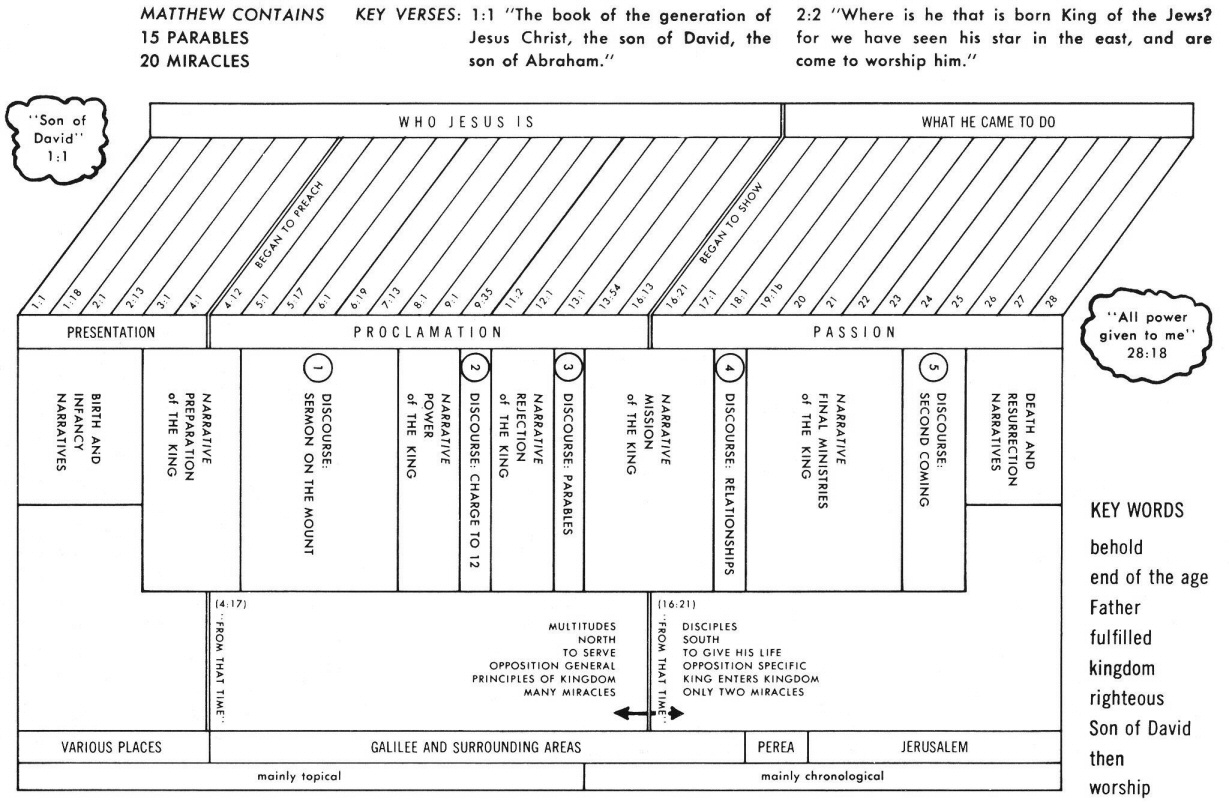
Click chart to enlarge
Charts from Jensen's Survey of the NT - used by permission
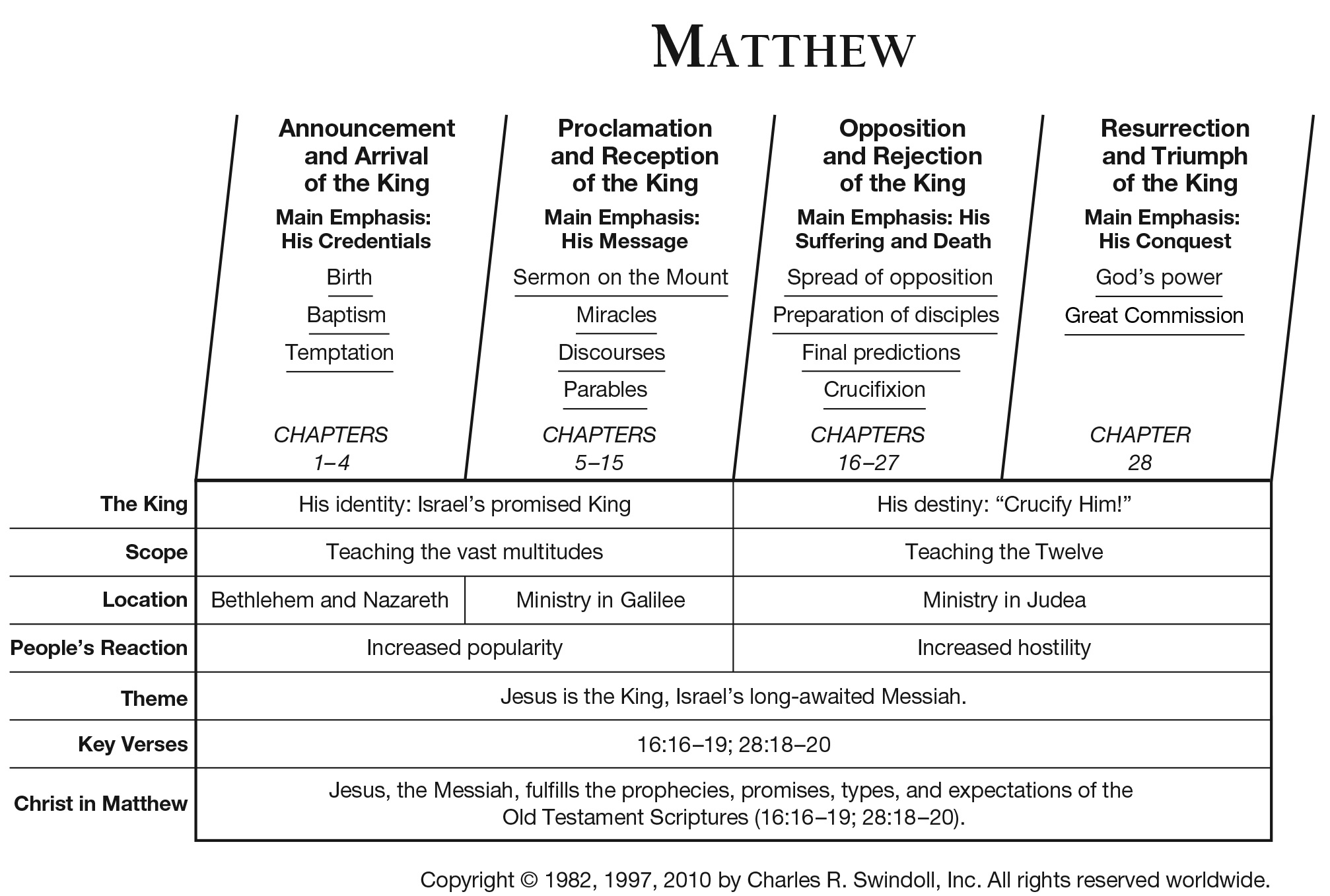
Another Chart from Charles Swindoll
THE LIFE OF JESUS AS COVERED
BY MATTHEW (shaded area)
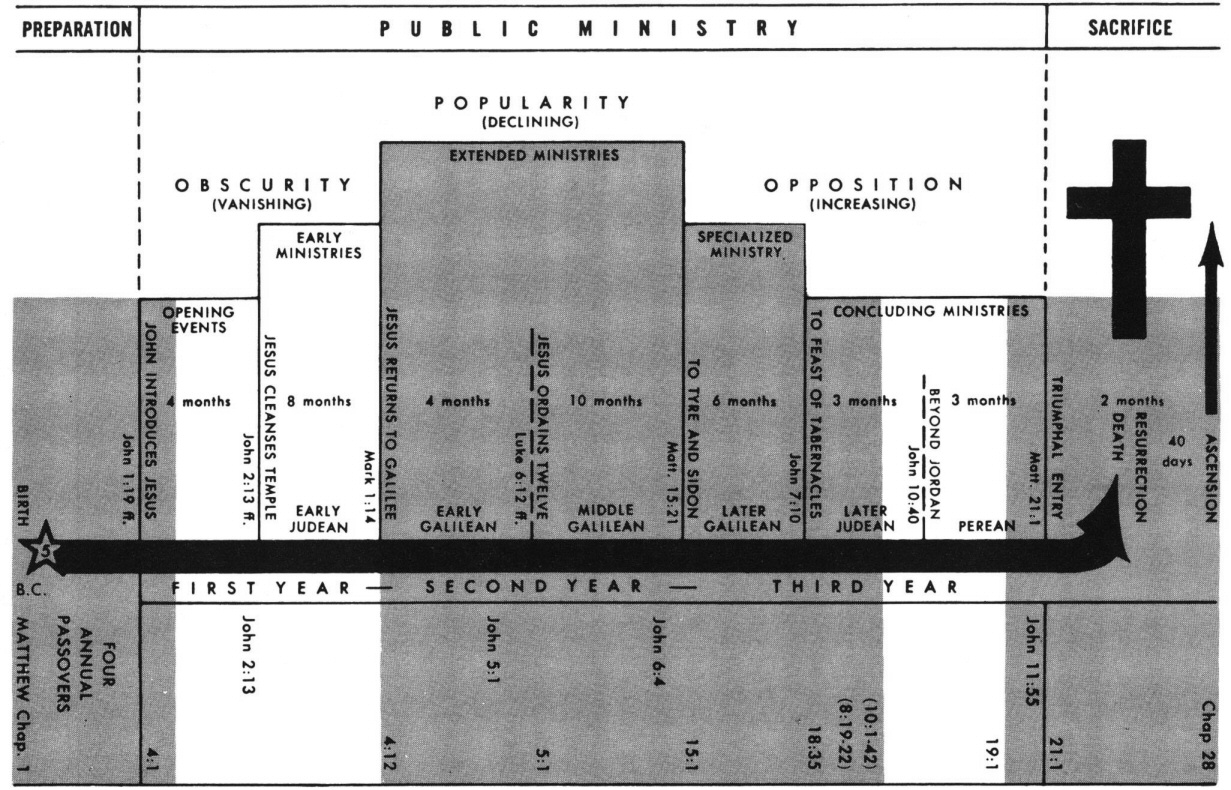
Click chart to enlarge

Jesus Birth and Early Years
Leading up to the Sermon on the Mount
Matthew 1-7

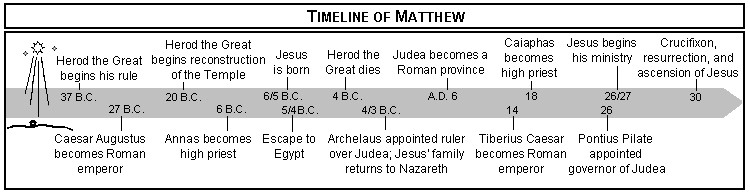
Source: Ryrie Study Bible
Matthew 7:3 "Why do you look at the speck that is in your brother's eye, but do not notice the log that is in your own eye? (NASB: Lockman)
Greek: ti de blepeis (2SPAI) to karphos to en to ophthalmo tou adelphou sou, ten de en to so ophthalmo dokon ou katanoeis? (2SPAI)
Amplified: Why do you stare from without at the very small particle that is in your brother’s eye but do not become aware of and consider the beam of timber that is in your own eye? (Amplified Bible - Lockman)
KJV: And why beholdest thou the mote that is in thy brother's eye, but considerest not the beam that is in thine own eye?
NLT: And why worry about a speck in your friend's eye when you have a log in your own? (NLT - Tyndale House)
Philips: Why do you look at the speck of sawdust in your brother's eye and fail to notice the plank in your own? (New Testament in Modern English)
Wuest: And why do you contemplate the splinter of wood in the eye of your brother and do not put your mind upon the log in your own eye? (Wuest: Expanded Translation: Eerdmans)
Young's Literal: And why dost thou behold the mote that is in thy brother's eye, and the beam that is in thine own eye dost not consider?
Why do you look at the speck that is in your brother's eye: ti de blepeis (2SPAI) to karphos to en to ophthalmo tou adelphou sou
- Luke 6:41,42; 18:11
- Matthew 7 Resources - Multiple Sermons and Commentaries
Related Passages:
Luke 6:41-42 “Why do you look at the speck that is in your brother’s eye, but do not notice the log that is in your own eye?) “Or how can you say to your brother, ‘Brother, let me take out the speck that is in your eye,’ when you yourself do not see the log that is in your own eye? You hypocrite, first take the log out of your own eye, and then you will see clearly to take out the speck that is in your brother’s eye.
Luke 18:11 “The Pharisee stood and was praying this to himself: ‘God, I thank You that I am not like other people: swindlers, unjust, adulterers, or even like this tax collector.
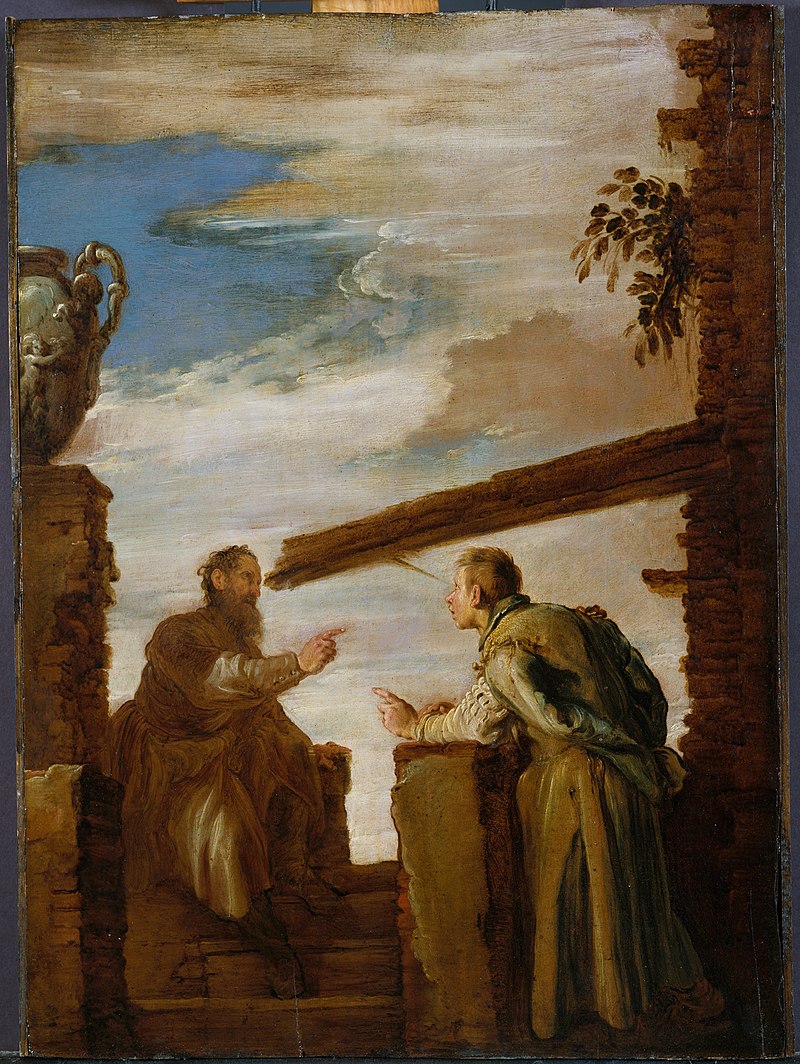
The Metropolitan Museum of Art
THE MOTE
MINISTRY
Why do you look at the speck that is in your brother's eye - Look at (991) (blepo) means to look at or behold. Blepo generally denotes simply a voluntary observation or taking notice of something or someone. In some contexts blepo conveys the sense of directing one's attention to something so as to take notice of it or consider it (eg, 1Co 1:26). Jesus uses blepo 5 times in this Sermon (Mt 5:28; 6:4, 6, 18; 7:3) The present tense pictures continual action as if we can't get our eye off the speck in the other person's eye!
Speck (mote, KJV) (karphos) refers to anything that is dry and light, such as straw, stubble, chaff, a little splinter of wood, a mote. It describes any tiny bit of dry material that might blow into the eye, such as a speck of dust, sawdust, wool, etc. Kárpho could refer to almost any tiny bit of substance. Figuratively kárphos refers to some slight moral defect seen in another. The self-righteous man is likely to see these, while being unconscious of greater evils in himself.
Disraeli rightly concluded that "It is much easier to be critical than to be correct."
In his Essay on Criticism Alexander Pope wrote that "Fools rush in where angels fear to tread."
Jesus addresses a similar type of judgmental hypocrisy in Luke 18...
And He also told this parable to certain ones who trusted in themselves that they were righteous, and viewed others with contempt:
"Two men went up into the temple to pray, one a Pharisee, and the other a tax-gatherer. "The Pharisee stood and was praying thus to himself, 'God, I thank Thee that I am not like other people: swindlers, unjust, adulterers, or even like this tax-gatherer. 'I fast twice a week; I pay tithes of all that I get.'
"But the tax-gatherer, standing some distance away, was even unwilling to lift up his eyes to heaven, but was beating his breast, saying, 'God, be merciful to me, the sinner!'" I tell you, this man went down to his house justified rather than the other; for everyone who exalts himself shall be humbled, but he who humbles himself shall be exalted." (Luke 18:9-14)
As someone has well said fault-finders seldom find anything else.
Kent Hughes adds that believers "are to refrain from hypercritical, condemning judgment. There is a universe of difference between being discerningly critical and hypercritical. A discerning spirit is constructive. A hypercritical spirit is destructive. The person with a destructive, overcritical spirit revels in criticism for its own sake. He expects to find fault, like the man who sat watching his preacher neighbor nail up a trellis in his backyard. The preacher, seeing him watching intently from his yard, asked, "Trying to pick up some pointers on carpentry?" To which his neighbor replied, "Nope. Just waiting to see what a preacher says when he hits his thumb." When a critic discovers faults in another, he feels a malignant satisfaction and always sees the worst possible motives in the other's actions. The critical spirit is like the carrion fly that buzzes with a sickening hum of satisfaction over sores, preferring corruption to health.One of the most prominent characteristics of this critical, fault-finding person is that he predictably focuses on things that are of little importance (cf "speck") and treats them as matters of vital importance. Within the church this takes bizarre forms - judging the spirituality of a young couple by observing whether they spank their children with a bare hand or an implement, judging others by where they sit in church or the Bible version they carry or whether their theology agrees with the critic's point for point . . . and so it goes! (See The Sermon on the Mount: The Message of the Kingdom)
Ray Stedman observes that "All of us know someone whom we consider a little bit lower on the ethical scale than we are, and what a comfort they are to our hearts! Every time our conscience gives us a little stab, we immediately remember these people, and we take courage, and feel a lot better. If we analyze our thoughts, we find that we secretly feel God has no right to bother us while these people are around. Let him concentrate on them! They are the ones who need it!...We all want a lightning rod that will divert the stroke of divine wrath from us, and channel it off to someone we consider a little more worthy of it. (Romans 2:1-16: The Secrets of Men)
Spurgeon gave the following illustration of who is most guilty when they manifest a censorious spirit - Pedley, who was a well-known natural simpleton, was wont to say, "God help the fool." None are more ready to pity the folly of others than those who have a small share of wit themselves. "There is no love among Christians," cries the man who is destitute of true charity. "Zeal has vanished," exclaims the idle talker. "O for more consistency," groans out the hypocrite. "We want more vital godliness," protests the false pretender. As in the old legend, the wolf preached against sheep-stealing, so very many hunt down those sins in others which they gladly shelter in themselves. — Feathers for Arrows
Speck (2595)(karphos from karpho - to dry up, wither) any small dry piece of straw, wood, etc. speck, splinter, chaff, and figuratively to denote something quite insignificant Speck is a small piece of wood (like a piece of sawdust), chaff, or straw and is used figuratively of faults (defects of secondary importance, slight imperfections, minor personal faults, small moral faults) we detect and pick on in others. "Speck was used by Classical Greek writers for the material that made up a bird's nest. Therefore, we are talking about bits of plant material and similar insignificant small items." (Utley)
Gilbrant - Attested to in both Aeschylus and Herodotus (Fifth Century B.C.), karphos, “chip of wood, dry stalk,” was often used to speak of something that was insignificant. Polybius made reference to a small piece of wood upon which the watchword was written (6.36.3). An example of the use of karphos in the Septuagint is at Genesis 8:11, referring to the “olive branch” brought to Noah by the dove. In the New Testament karphos is used figuratively of the “mote” (a rather insignificant weakness in one’s life) that some will point to in another’s eye while they themselves have a dokos (1379), “beam” (a worse failure in one’s life) in their own eye (Matthew 7:3; Luke 6:41). (Complete Biblical Library)
Moulton-Milligan - Karphos is found in a sepulchral epitaph Kaibel 9809 where it is said of the pious man (ὁ εὐσεβής)—οὐδὲ κάρφος ἐβλάβη, “he was not a whit injured” (cf. LS s.v.): see Mt 7:3, where all our English versions from Wycliffe down to RV adopt the translation “mote” = “a very small particle.” The Old Lat. has stipula, and the Vulg. festuca: cf. Hesych. κάρφος· ἄχυρον, χόρτος. κεραία ξύλου λεπτή.
Liddell-Scott - κάρφος, εος, τό, any small dry body, esp. dry stalk, as of the dry sticks of cinnamon, Hdt.3.111; of rice-straw, Polyaen.4.3.32, cf. Luc.Herm.33: generally, in pl., dry twigs, chips, straws, bits of wool, such as birds make their nests of, Ar.Av.643, Sophr.32, Arist.HA612b23, AP10.14 (Agath.) κάρφη· ξύλα λεπτά, καὶ ξηρά Hsch.: collectively in sg., A.Fr.24, Arist.HA560b8, Ath.5.187c: in sg., chip of wood, Ar.V.249; toothpick, Alciphr.1.22: prov., κονοῦσα μηδὲ κ. ‘not stirring an inch’, Ar.Lys.474, cf. Herod.3.67; οὐδὲ κ. ἐβλάβη Epigr.Gr.980.9 (Philae); ἀπὸ τῆς κύλικος κάρφος τῷ μικρῷ δακτύλῳ ἀφαιρετεῖν Ion Hist.1. 2. hay (cf. κάρφη), SEG9.35 (Cyrene, iii B.C.). II. = Lat. festuca, Plu.2.550b, cf. καρπίζω (B). III. a small piece of wood on which the watchword was written, Plb.6.36.3. IV. in pl., ripe fruit, Nic.Al.230, 491, Th.893, 941. V. = τῆλις, Dsc.2.102. (σκάρφος is v.l. (perh. right) in A.l.c., Plb. l.c.: perh. cogn. with Engl. sharp.), Plin.HN24.184.
Karphos - 6x in 5v - Matt. 7:3; Matt. 7:4; Matt. 7:5; Lk. 6:41; Lk. 6:42. Used only once in Septuagint - Ge 8:11
but do not notice the log that is in your own eye?: ten de en to so ophthalmo dokon ou katanoeis? (2SPAI)
- 2Samuel 12:5,6; 2Chronicles 28:9,10; Ps 50:16
- Matthew 7 Resources - Multiple Sermons and Commentaries
The Metropolitan Museum of Art
Spurgeon writes "There is something in yourself that is worthy of your consideration, something that you ought to consider, it big, blinding beam in your own eye. As for the mote that is in your brother’s eye, there is no need that you should even see it. Why beholdest thou it? Charity is ever a little blind to the faults of others, for it remembers so well its own.
Thomas Adams - Many are like barbers, that trim all men but themselves.
Notice (2657) (katanoeo [word study] from kata = down [kata can be used to intensify the meaning] + noéo = think) means literally to put the mind down on something and so to observe or consider carefully. It means to fix one’s eyes or mind upon and to perceive clearly. Katanoeo means to look carefully, cautiously, observantly. The idea is to think about something very carefully or consider closely which denotes the action of one's mind apprehending certain facts about a thing so as to give one the proper and decisive thought about the thing considered.
The hypocrite continually (present tense) fails to look carefully in the mirror and make a self-examination.
Jesus is illustrating that it so easy to turn a microscope on another person's sin while we look at ours through the wrong end of a telescope! We use some strong term for someone else's sin but a euphemism for our own (Click here for some pithy examples!).
Katanoeo - 14x in 14v - Matt 7:3; Luke 6:41; 12:24, 27; 20:23; Acts 7:31f; 11:6; 27:39; Rom 4:19; Heb 3:1; 10:24; Jas 1:23f. NAS = consider(4), contemplated(1), detected(1), look(1), look more closely(1), looked(1), looks(1), notice(2), observe(1), observing(1).
Log (1385) (dokos) refers to a piece of heavy timber such as a beam used in roof construction or to bar a door. Vine says dokos refers to the "beam supporting the roof of a building." The “beam” is thus a large, hewn timber used in the structure of a building and the point is that the man behind that timber cannot see and thus cannot determine the true nature of things because he is blinded.
Jesus is making the point that we are generally far more tolerant to our own sin than we are to the sin of others. Jesus doesn't say that it is wrong for us to help our brother with the speck in his eye. It is a good thing to help your brother with his speck, but not before dealing with the plank in your own eye.
For some reason, it is easier to jump to negative conclusions about people than it is to assume the best about them. When we do this, we ascribe to them bad intentions and evil purposes that may not be true. We also reveal something about ourselves, for the faults we see in others are actually are reflection of our own. In his little book Illustrations of Bible Truth, H. A. Ironside pointed out the folly of judging others. He related an incident in the life of a man called Bishop Potter writing...
“He was sailing for Europe on one of the great transatlantic ocean liners. When he went on board, he found that another passenger was to share the cabin with him. After going to see the accommodations, he came up to the purser’s desk and inquired if he could leave his gold watch and other valuables in the ship’s safe. He explained that ordinarily he never availed himself of that privilege, but he had been to his cabin and had met the man who was to occupy the other berth. Judging from his appearance, he was afraid that he might not be a very trustworthy person. The purser accepted the responsibility for the valuables and remarked, ’It’s all right, bishop, I’ll be very glad to take care of them for you. The other man has been up here and left his for the same reason!’“
Alexander Maclaren writes that "This spirit is always accompanied by ignorance of one’s own faults, which makes him who indulges in it ludicrous. So our Lord would seem to intend by the figure of the mote and the beam. It takes a great deal of close peering to see a mote; but the censorious man sees only the mote, and sees it out of scale. No matter how bright the eye, though it be clear as a hawk’s, its beauty is of no moment to him. The mote magnified, and nothing but the mote, is his object; and he calls this one-sided exaggeration ‘criticism,’ and prides himself on the accuracy of his judgment. He makes just the opposite mistake in his estimate of his own faults, if he sees them at all. We look at our neighbor's errors with a microscope, and at our own through the wrong end of a telescope. We see neither in their real magnitude, and the former mistake is sure to lead to the latter. We have two sets of weights and measures: one for home use, the other for foreign. Every vice has two names; and we call it by its flattering and minimizing one when we commit it, and by its ugly one when our neighbour does it. Everybody can see the hump on his friend’s shoulders, but it takes some effort to see our own. David was angry enough at the man who stole his neighbor's ewe lamb, but quite unaware that he was guilty of a meaner, crueller theft. The mote can be seen; but the beam, big though it is, needs to be ‘considered.’ (2657 katanoeo) So it often escapes notice, and will surely do so, if we are yielding to the temptation of harsh judgment of others. Every one may be aware of faults of his own very much bigger than any that he can see in another, for each of us may fathom the depth of our own sinfulness in motive and unspoken, unacted thought, while we can see only the surface acts of others. (Sermon: Judging, Asking and Giving)
Log (1385)(dokos from dechomai through the idea of holding up) a beam of timber. BDAG - "a piece of heavy timber such as a beam used in roof construction or to bar a door, beam of wood " Extra-Biblical references commonly indicate that this word is generally used to indicate very large beams of wood suitable to provide heavy foundational support for large buildings and construction needs.
Moulton-Milligan - In P Petr II. 33A. 24 (a steward’s account) we have mention of δοκοί in a fragmentary context, but following τὰ ξύλα. Cf. P Lond 28011 (A.D. 55) (= II. p. 194, Chrest. I. p. 371) ἐκ τῶν ἐμ]ῶν δαπανῶ[ν μ]ηχανὴν ἐλαιου[ργικὴν καὶ τ]ῆς αὐτῆς θυίαν καὶ τὰ ἀνήκοντα ξυλικὰ ἀργαλεῖ[α] καὶ δοκὸν τὴν ὑπὲρ τ[ὴ]ν μηχανὴν προσανγέλλω, τοῦτο κτλ., Chrest. I. 17615 (middle i/A.D.) ἐπεὶ οὖν καὶ αὐτὸ τὸ ἐλαιουργῖον συνεχυτρώθη καὶ ἠναγκάσθην δοκοὺς καὶ ἐρείσματα παρατιθένα[ι, “props” for the repair of an oil-press, P Flor II. 1275 (A.D. 256) τὸ βαλανεῖον παντὶ τρόπῳ ποίησον ὑποκαυθῆναι καὶ δοκοὺς εἰς αὐτὸ παρενεχθῆναι ποιήσας, “logs” for the heating of a bath. Syll 58762 (B.C. 329–8) mentions δοκοί and στρωτῆρες together in the accounts for the building of a temple τοῖν θεοῖν: Dittenberger shows that the prices indicate the former to be heavy beams on which the latter were laid transversely. It is obvious that the Oriental hyperbole in Mt 7:3 ff. will admit of no tempering from the usage of the word. A new verb δοκόω, “furnish with beams,” occurs in the P Grenf II 356 (B.C. 98), P Amh II. 5113, 28 (B.C. 88), P Ryl II. 2493 (B.C. 118).
Liddell-Scott - δοκός, ἡ, later also ὁ, Luc.VH2.1: (δέχομαι):—bearing-beam, main beam, esp. in the roof or floor of a house, Od.22.176, Ar.Nu.1496; any balk or beam, Il.17.744, Th.4.112; bar of a gate or door, Ar.V.201: also, in pl., firewood, PFlor.127.5 (iii A.D.): prov., ὁ τὴν δοκὸν φέρων of a stiff or inflexible speaker, Arist.Rh.1413b28; ἐν δοκοῖσι is prob. f.l. for ἐνδόκοισι in Archil.66.3, cf. Hsch. s.v. ἔνδοκος. II. a kind of meteor, Plin.HN2.96, Lyd.Ost.10b, Hsch.; cf. δοκεύς, δοκίας, δοκίς II.
Dokos - 6x in 5v - Matt. 7:3; Matt. 7:4; Matt. 7:5; Lk. 6:41; Lk. 6:42
Bread and Butter - A small-town baker bought his butter from a local farmer. One day he weighed the butter and concluded that the farmer had been reducing the amount in the packages but charging the same. So the baker accused the farmer of fraud.
In court the judge asked the farmer,
"Do you have measuring weights?"
"No sir," replied the farmer.
"How then do you manage to weigh the butter that you sell?"
The farmer answered,
"When the baker began buying his butter from me, I thought I'd better get my bread from him. I have been using his 1-pound loaf as the weight for the butter I sell. If the weight of the butter is wrong, he has only himself to blame."
Making hasty, unjust judgments about others is sin. The Pharisees of Jesus' day seemed to be especially adept at this. They would try to elevate themselves by tearing down and slandering people's character. Not only is this a sign of pride and self-satisfaction, but it is certain that we will be judged in a similar manner. Jesus said, "With what judgment you judge, you will be judged; and with the measure you use, it will be measured back to you" (Mt. 7:2).
What is the measure you use? --H G Bosch (Our Daily Bread, Copyright RBC Ministries, Grand Rapids, MI. Reprinted by permission. All rights reserved)
Don't be too hard on the person who sins,
For the yardstick you lay on another
May someday be used as a measure for you;
Oh, be gracious and judge not, my brother!
--HGB
The fault we see in another may be the reflection of our own.
Can You Hear Me? - A man was having difficulty communicating with is wife and concluded that she was becoming hard of hearing. So he decided to conduct a test without her knowing about it.
One evening he sat in a chair on the far side of the room. Her back was to him and she could not see him. Very quietly he whispered, “Can you hear me?” There was no response.
Moving a little closer, he asked again, “Can you hear me now?” Still no reply.
Quietly he edged closer and whispered the same words, but still no answer.
Finally he moved right in behind her chair and said, “Can you hear me now?” To his surprise and chagrin she responded with irritation in her voice, “For the fourth time, yes!” What a warning to us about judging!
Criticism leaves you with the flattering unction that you are a superior person. It is impossible to develop the characteristics of a saint and maintain a critical attitude. -- Oswald Chambers
A malignant deity, called Criticism . . . At her right hand sat Ignorance, her father and husband, blind with age; at her left, Pride, her mother, dressing her up in scraps of paper she herself had torn. There was Opinion, her sister, light of foot, hoodwinked, and headstrong, yet giddy and perpetually turning. About her played her children, Noise and Impudence, Dullness and Vanity, Positiveness, Pedantry, and Ill-Manners. The goddess herself had claws like a cat, her head, and ears, and voice resembled those of an ass; her teeth fallen out before, her eyes turned inward, as if she also looked only upon herself; her diet was the overflowing of her own gall. --Jonathan Swift
Speck Inspectors - Why do some people seem to be experts at finding a speck in the eye of someone else? (Mt 7:3). Is it because the fault stands out like Santa Claus at a Fourth of July picnic? No, they deliberately search for specks because they're looking for something to criticize.
The chief speck inspector is Satan. When the Lord called his attention to the good character of Job, the devil responded with a raised eyebrow. "Does Job fear God for nothing?" he smirked (Job 1:9). He insinuated that Job was good only because God made it pay to be good. Satan was so sharp-eyed he could see a speck that wasn't there.
Faultfinders are never reliable fact-finders. The enemies of our Lord even tried to find fault in the only One who ever lived a perfect life (Mt. 12:24; Lk. 7:34; Jn. 9:16). Because they looked for the worst, they were blind to the best.
Do we really understand the wickedness of faultfinding? It's a cruel habit that damages ourselves and those around us.
Jesus said we must first get the plank out of our own eye. That means we must recognize and confess our sins. As we learn to see people through eyes of love, we won't be so quick to point out specks in theirs. --H W Robinson (Our Daily Bread, Copyright RBC Ministries, Grand Rapids, MI. Reprinted by permission. All rights reserved)
Let me not judge my fellowmen,
But understand them, Lord, and when
The casting of the stones begins,
Remind me of my many sins. --Vandegrift
Inspect your own life
before you look for specks in others.
J R Miller (Who Is He?) - Finding Fault with Others - Matthew 7:3
It is strange how oblivious we can be of our own faults and blemishes, and how clearly we can see those of other people. One old writer says: “Men are more apt to use spectacles than looking-glasses — spectacles to behold other men’s faults than looking-glasses to behold their own.” A man can see a little speck of dust in his neighbour’s eye while utterly unaware of the great beam in his own eye. He observes the most minute fault in his brother while unconscious of his own far greater fault.
We would say that a beam in a man’s eye would so blind him that he could not see the mote in another’s eye. As our Lord represents it, however, the man with the beam is the very one who sees the mote and thinks himself competent to pull it out. So it is in morals. No man is so sharp at seeing a fault in another as he who has the same or a similar fault of his own. A vain man is the first to detect the indications of vanity in another. A bad-tempered person is most apt to be censorious toward a neighbour who displays bad temper. One with a sharp uncontrolled tongue has the least patience with another whose speech is full of poisoned arrows. A selfish man discovers even motes of selfishness in others. Rude people are the very first to be hurt and offended by rudeness in a neighbour.
So it is always. If we are quick to perceive blemishes and faults in others, the probability is that we have far greater blemishes and faults in ourselves. This truth ought to make us exceedingly careful in our judgments and exceedingly modest in our expressions of censure, for we really are telling the world our own faults. It is wiser, as well as more in accordance with the spirit of Christ, for us to find lovely things in others, and to be silent regarding their faults.
And so it criticized each flower,
This supercilious seed;
Until it woke one summer hour,
And found itself a weed.
---Mildred Howells
CRITICS AND SURGEONS - John Henry Jowett on Mt 7
"Why beholdest thou the mote that is in thy brother's eye? . . . First cast out the beam out of thine own eye; and then shalt thou see clearly to cast out the mote out of thy brother's eye."--Matt. 7:3, 5.
THE contrast is between bad critics and good surgeons. On the one hand there is a man with very defective eyes passing judgment on another man's sight. The partially blind is presuming to be a judge of other people's eyes. It is a case of a blind oculist. On the other hand, there is a man whose eyes are healthy and full of light, and. he is gently removing a spell from his brother's eyes, and restoring him to cool and normal sight. So that the contrast presented by our Lord is not merely a contrast between a good critic and a bad critic. The word passes beyond the circle of criticism to the realm of service. And Christ presents an ideal to us, and His ideal is that of a man whose eyes are full of discernment, whose heart is full of gentleness, and whose hands are disciplined in helpfulness, and the man is busy restoring sight to others. Our eyes are raised to contemplate a chivalrous surgeon engaged in ministries of emancipation. "If any man be overtaken in a fault, ye which are spiritual restore such a one in the spirit of meekness." It is the work of the noblest surgeon.
Now, our Lord says that the first necessity to becoming a good surgeon is to acquire true vision. We cannot take splinters out of another man's eyes if our own eyes are filled with planks. "First cast out the beam!" But the trouble is, we do not always know that the beam is there. That is the subtle, deadening influence of perverted sight. A man's eyes can be half-full of planks, and yet he may think he has perfect sight. We cannot see ourselves.
"O wad some pow'r the gait gie us,
To see oursels as idlers see us;
It wad frae mony a blunder free us,
And foolish notion."
A man can have a woodyard in his eyes and not know it! How much arrogance a man's eyes can carry, and yet he may not be aware of the load! How much prejudice may dwell in his eyes, and he may be entirely ignorant of the harmful tenants! How much ignorance may be piled up in his eyes, and yet he may assume they are full of enlightenment and knowledge How much sin may be gathered in his eyes, and yet he may walk and talk as though he were pure!
And so it is a great problem how we are to see the beams that are in our own eyes. And the only way to see them is to go where there is plenty of light. Where can we find the light? We cannot find it in the ordinary light of conventional social standards. They will not reveal us to ourselves, for that sort of dim, dull light brings nothing into sight. We need a stronger light. Who has not seen shopmen bringing their goods to the doors of their shops in order to have their customers see them in the bright sunshine? The dull background, with its twilight, does not reveal the things in their true colours. Suppose we could bring our lives into a sunshine where their real colours would be revealed. Suppose there were some "burning bliss" in which everything stands unveiled. And that is just what there is, and that is just what we can do. We can bring our lives into the light of God's holiness. We must get into this light; and to see our faults in that light, and to cry out to God for their removal, is to have God for an immediate ally in the work of their destruction.
And then do we become surgeons after the Lord's pattern. "Then shalt thou see clearly to cast out the mote out of thy brother's eye." We become experts in gentle spiritual surgery. And who would not like to be wrought upon by firm, yet gentle hands of this order? I am always attracted by Paul's description of a spiritual surgeon: "Full of goodness, filled with all knowledge, able to admonish." An admonition born of those conditions would be like medicinal air from the mountains, healing air made fragrant with the heather and the wild thyme. (John Henry Jowett - The Friend on the Road and Other Studies in the Gospels- Chapter 1 - Critics and Surgeons)
Matthew 7:4 "Or how can you say to your brother, 'Let me take the speck out of your eye,' and behold, the log is in your own eye? (NASB: Lockman)
Greek: e pos ereis (2SFAI) to adelpho sou, Aphes (2SAAM) ekbalo (1SAAS) to karpos ek tou ophthalmou sou, kai idou (2SAMM) e dokos en to ophthalmo sou?
Amplified: Or how can you say to your brother, Let me get the tiny particle out of your eye, when there is the beam of timber in your own eye? (Amplified Bible - Lockman)
KJV: Or how wilt thou say to thy brother, Let me pull out the mote out of thine eye; and, behold, a beam is in thine own eye?
NLT: How can you think of saying, `Let me help you get rid of that speck in your eye,' when you can't see past the log in your own eye? (NLT - Tyndale House)
Philips: How can you say to your brother, 'Let me get the speck out of your eye', when there is a plank in your own? (New Testament in Modern English)
Wuest: Or, how is it that you will say to your brother, Permit me to draw out the splinter from your eye, and, behold, the log is in your eye? (Wuest: Expanded Translation: Eerdmans)
Young's Literal: or, how wilt thou say to thy brother, Suffer I may cast out the mote from thine eye, and lo, the beam is in thine own eye?
Or how can you say to your brother, `Let me take the speck out of your eye,' and behold, the log is in your own eye?: e pos ereis (2SFAI) to adelpho sou, aphes (2SAAM) ekbalo (1SAAS) to karpos ek tou ophthalmou sou, kai idou (2SAMM) e dokos en to ophthalmo sou?
- Matthew 7 Resources - Multiple Sermons and Commentaries

BLIND TO THE BEAN
BUSY WITH THE SPECK
Or how can you say to your brother, `Let me take the speck (kárphos) out of your eye,' and behold (idou), the log (dokos) is in your own eye? - Jesus paints a deliberately absurd scene to expose hypocrisy. The man with a log in his own eye is blind to his greater fault, yet feels qualified to correct a minor flaw in someone else. The point isn’t that correction is wrong, but that self-examination must come first—otherwise our “help” is clumsy, harmful, and self-deceived.
Spurgeon writes...A blind man cannot be a good oculist; he should see well who tries to mend other people’s eyes; but with a beam in one’s own eye, it must be poor work to attempt to take motes out of the eyes of others. This does not prevent our using reproof and rebuke when they are needed. Even under the Law, the command was given, “&Thou shalt not hate thy brother in thine heart: thou shalt in any wise rebuke thy neighbor, and not suffer sin upon him,&” as if it were a kind of hatred to avoid the duty of kindly and gentle rebuke. That is a very different thing from exposing the faults of others, and aggravating and exaggerating the faults of others, as, alas, so many do! Oh, how much misery might be saved in the world if the scandal-market were not so brisk! Perhaps tongues would not move so fast if eyes were used to a better purpose.
John Lightfoot writes that...This is a very common proverb among the Jews: In the measure that a man measureth, others measure to him. And this also was a known proverb among them: "It is written in the days when they judged the judges, that is, in the generation which judged their judges, When any [judge] said to another, Cast out the mote out of thine eye; he answered, Cast you out the beam out of your own eye," etc.
A Chinese proverb says do not remove a fly from your friend’s forehead with a hatchet!
Speck (mote, KJV) (2595) (kárphos from kárpho = to dry or wither) refers to anything that is dry and light, such as straw, stubble, chaff, a little splinter of wood, a mote. It describes any tiny bit of dry material that might blow into the eye, such as a speck of dust, sawdust, wool, etc. Kárpho could refer to almost any tiny bit of substance. Figuratively kárphos refers to some slight moral defect seen in another. The self-righteous man is likely to see these, while being unconscious of greater evils in himself.
This was a common proverb familiar among the Jews that referred to the one who with greater sins, reproved the lesser faults of others. Tragically these fault-finders seldom find anything else!
Jesus was referring to the hypocrisy of people who try to improve others while remaining blind to their own faults.
Let me take...out - His "concern" is a sham. It is evil parading as good. It is the essence of hypocrisy, a feigning to be what one is not, assuming a false appearance of virtue and a deceitful show of a good character, thus counterfeiting pure religion in the sight of God (Jas 1:27)
This type of pious judgmental behavior is often a form of self-boasting.
Gehold (idou), the log (dokos) is in your own eye - Stated another way (as someone has said), when looking for faults, use a mirror, not a telescope.
ILLUSTRATION - Speaking of logs - When the family returned from Sunday morning service, father criticized the sermon, daughter thought the choir's singing atrocious, and mother found fault with the organist's playing. But the subject had to be dropped when the small boy of the family piped up: "But it was a good show for a nickel, don't you think, Dad?"
Log (1385) (dokos) refers to a piece of heavy timber such as a beam used in roof construction or to bar a door. Vine says dokos refers to the "beam supporting the roof of a building." The “beam” is thus a large, hewn timber used in the structure of a building and the point is that the man behind that timber cannot see and thus cannot determine the true nature of things because he is blinded.
The contrast between the “speck” and the “log” is deliberate hyperbole, a purposeful, extravagant exaggeration meant to shock the listener and drive the lesson home. Jesus is not being subtle. He wants us to see the absurdity. Picture a man with a beam protruding from his eye, like a log, a tree trunk, even a railroad tie, who is earnestly trying to help another person remove a tiny speck of dust from theirs. The scene is comical, even ridiculous. And that is precisely the point. Jesus paints an intentionally ludicrous image to expose the blindness and danger of self-righteous judgment.
Far from being helpful, the “log-bearing” judge would almost certainly end up poking out the other person’s eye. The irony is biting: in attempting to correct another’s minor fault, the judge inflicts far greater harm.
The implication is clear. Those who rush to judge others often harbor in their own lives a much larger version of the very same fault they are condemning. Until that deeper issue is honestly faced and dealt with, any attempt to correct others is not only hypocritical but destructive. The would-be helper becomes a hazard.
Jesus’ warning is not against discernment, but against unexamined judgment. Correction without self-examination does not heal—it wounds. Only when the “log” is removed can one see clearly enough to help another with their “speck,” gently, humbly, and without harm.
Jesus uses this absurd picture to rebuke officiousness (the volunteering one’s services where they are neither asked nor needed and thus are annoying) in correcting small faults of others, while cherishing greater ones of our own.
There is so much good in the worst of us,
And so much bad in the best of us,
That it hardly becomes any of us
To talk about the rest of us.
Dwight Pentecost writes that "Our Lord said, when you put yourself in the position of a judge, you are like a blind surgeon trying to remove a splinter in someone else’s eye. It cannot be done. What our Lord was teaching is that man can look only on the external appearance; therefore, he cannot judge the motives of another’s mind and heart. When he judges by externals, he does not deal with the true nature of things. Therefore our Lord said, “Since you in your blindness do not have the ability to determine the true nature of things, do not judge.” (BORROW Design for living: Lessons in Holiness from the Sermon on the Mount)
Now this is really nothing new because historically, we have always seen the speck in the other person's eye. It all began when Adam blamed Eve for enticing him to take of the forbidden fruit rationalizing to God that...
"The woman whom Thou gavest to be with me, she gave me from the tree, and I ate." (Genesis 3:12, context Ge 3:1-11)
Eve blamed the serpent declaring...
"The serpent deceived me, and I ate." (Genesis 3:13)
Fallen men and women are still in the speck removal ministry. One of the hardest things we have to learn is that when we point a finger at others, we point four at ourselves!
The prophet Nathan's confrontation of King David is a classic example of the judge himself being condemned, Scripture recording that the prophet began by telling the king a tragic tale...
"Now a traveler came to the rich man, And he was unwilling to take from his own flock or his own herd, To prepare for the wayfarer who had come to him; Rather he took the poor man's ewe lamb and prepared it for the man who had come to him." Then David's anger burned greatly against the man, and he said to Nathan, "As the LORD lives, surely the man who has done this deserves to die. And he must make restitution for the lamb fourfold, because he did this thing and had no compassion." (2Samuel 12:4-7, see also 2Sa 12:8, 9, 10, 11, 12 - note Who and what David despised!!!)
In response to David's judgment on the "rich man" Nathan declared "You are the man!" (2Sa 12:7)
David in judging the rich man's sin ("speck"), had condemned himself ("log")!
ILLUSTRATION - Did you read the true story about a Connecticut city, where 53 residents of a certain neighborhood signed a petition to stop reckless driving on their streets. The police set a watch. Guess what happened! A few nights later five violators were caught. All five had signed the petition!
A Cure For Criticism - A church bulletin had a clever poem about criticism that began:
A little seed lay in the ground
And soon began to sprout;
"Now, which of all the flowers around,
Shall I," it mused, "come out?"
The seed could then be heard saying,
"I don't care to be a rose. It has thorns. I have no desire to be a lily. It's too colorless. And I certainly wouldn't want to be a violet. It's too small, and it grows too close to the ground."
The poem concludes with this verse about that faultfinding seed:
And so it criticized each flower,
That supercilious seed,
Until it woke one summer hour
And found itself a weed!
The apostle Paul indicated in Ro 12:3 (note) that we are not to think of ourselves too highly. Rather, we are "to think soberly." To the church in Philippi he wrote, "Let nothing be done through selfish ambition or conceit, but in lowliness of mind let each esteem others better than himself" (Php 2:3). When we fail to follow these instructions and begin finding fault with others, we are actually passing judgment on ourselves (Mt. 7:1, 2; Ro 2:1, 2-notes; Ro 2:3).
A good cure for a critical spirit is an honest look at ourselves--not at others. --R W De Haan (Our Daily Bread, Copyright RBC Ministries, Grand Rapids, MI. Reprinted by permission. All rights reserved)
When you see faults in someone else,
Before you criticize, beware;
For you have flaws and failures too
That other people have to bear. --Sper
Be patient with the faults of others;
They have to be patient with yours
Helpful Humor - Humor can be cruel and offensive, but it can also be kind and helpful. I have used it in sermons to make a point or in meetings to break the tension. I have also profited from humor when it pointed out my faults.
Recently, while watching a film series on family living, I laughed at the comical examples of foibles and failures to which we as husbands are so prone. Yet even though I was amused, I saw enough of myself in these funny situations to feel convicted. As a result, I think I'll be a better husband from now on -- and after more than 50 years of marriage!
God gave us the gift of humor and the capacity to laugh. I believe Jesus had a twinkle in His eye when He said that a person should take the plank out of his own eye before trying to remove a speck of sawdust from the eye of someone else (Mt. 7:4). I can just see His listeners smile and hear them laugh softly. But I'm sure they also understood His point, and some may have been convicted about their own judgmental attitude.
Similarly, the writer of Proverbs portrayed a lazy man in three exaggerated word pictures (26:13-16). They are humorous, but they drive home a solemn warning.
Try using humor to help -- never to hurt. -- Herbert Vander Lugt (Our Daily Bread, Copyright RBC Ministries, Grand Rapids, MI. Reprinted by permission. All rights reserved)
Give us a sense of humor, Lord,
Give us the grace to laugh and smile;
But check our lips from needless jest
That what we speak may be worthwhile.- Anon
Humor can make a serious difference.
Logs And Dust - Jesus sometimes used humor to drive home a truth. Think of the serious point in His humorous description in our Bible reading today. He accused the religious leaders of being like a man with a great big beam in his eye offering to remove a tiny speck from his brother's eye (Mt. 7:1-6). How ludicrous!
We are so blind to our own faults but think we can detect the slightest inconsistency in others. We carry two measuring sticks—one for ourselves and one for others.
We have two different sets of words to describe our actions. A "bad temper" in another, we call "righteous indignation" in ourselves. "Stinginess" in others is "frugality" when we practice it.
In addition, we tend to blame others for our own faults. A husband and wife, married 20 years, were driving along, when she suddenly remarked, "You know, John, you are not like you used to be in our early married years—romantic, loving, and affectionate. Then we used to sit close to each other when we went driving, and now you sit so far from me." The husband gently replied, "Mary dear, I am sitting exactly where I always sit when I drive."
Let's beware of a critical attitude. It not only blinds us to our own faults but also has a way of backfiring! —M. R. De Haan (Our Daily Bread, Copyright RBC Ministries, Grand Rapids, MI. Reprinted by permission. All rights reserved)
Let me be a little kinder, to the faults of others blinder;
Let me praise a little more.
Let me walk in full surrender, and like Jesus be more tender;
Blessing all who pass my door. —HGB
One who has a true Christian spirit
takes no delight in the faults of others.
Matthew 7:5 "You hypocrite, first take the log out of your own eye, and then you will see clearly to take the speck out of your brother's eye. (NASB: Lockman)
Greek: hupokrita, ekbale (2SAAM) proton ek tou ophthalmou sou ten dokon, kai tote diablepseis (2SFAI) ekbalein (AAN) to karpos ek tou ophthalmou tou adelphou sou.
Amplified: You hypocrite, first get the beam of timber out of your own eye, and then you will see clearly to take the tiny particle out of your brother’s eye. (Amplified Bible - Lockman)
KJV: Thou hypocrite, first cast out the beam out of thine own eye; and then shalt thou see clearly to cast out the mote out of thy brother's eye.
NLT: Hypocrite! First get rid of the log from your own eye; then perhaps you will see well enough to deal with the speck in your friend's eye. (NLT - Tyndale House)
Philips: You fraud! Take the plank out of your own eye first, and then you can see clearly enough to remove your brother's speck of dust." (New Testament in Modern English)
Wuest: O actor on the stage of life, draw out first from your eye the log, and then you will see clearly to draw out the splinter from the eye of your brother. (Eerdmans)
Young's Literal: Hypocrite, cast out first the beam out of thine own eye, and then thou shalt see clearly to cast out the mote out of thy brother's eye.
You hypocrite, first take the log out of your own eye: hupokrita, ekbale (2SAAM) proton ek tou ophthalmou sou ten dokon
- Mt 22:18; 23:14-28; Luke 12:56; 13:15
- Ps 51:9, 10, 11, 12, 13; Luke 4:23; 6:42; Acts 19:15
- Matthew 7 Resources - Multiple Sermons and Commentaries
The irony of the "speck removal ministry" is that a man often condemns most vehemently in others that to which he is himself prone! Be careful where you throw stones!
Spurgeon writes that...
At the bottom of all censoriousness lies hypocrisy. An honest man would apply to himself the judgment which he exercises upon others, but it usually happens that those who are so busy spying Out other people’s faults have no time to see their own; and what is this, at the bottom, but insincerity and hypocrisy?
***
The judging faculty is best employed at home. Our tendency is to spy out splinters in other men’s eyes, and not to see the beam in our own. Instead of beholding, with gratified gaze, the small fault of another, we should act reasonably if we penitently considered the greater fault of ourselves. It is the beam in our own eye which blinds us to our own wrong doing; but such blindness does not suffice to excuse us, since it evidently does not shut our eyes to the little error of our brother. Officiousness pretends to play the oculist; but in very truth it plays the fool. Fancy a man with a beam in his eye pretending to deal with so tender a part as the eye of another, and attempting to remove so tiny a thing as a mote or splinter! Is he not a hypocrite to pretend to be so concerned about other men’s eyes, and yet he never attends to his own? Jesus is gentle, but he calls that man a “hypocrite “ who fusses about small things in others and pays no attention to great matters at home in his own person. Our reformations must begin with ourselves, or they are not true, and do not spring from a right motive. Sin we may rebuke, but not if we indulge it. We may protest against evil, but not if we wilfully practice it. The Pharisees were great at censuring, but slow at amending. Our Lord will not have his kingdom made up of hypocritical theorists, he calls for practical obedience to the rules of holiness.
After we are ourselves sanctified, we are bound to be eyes to the blind, and correctors of unholy living; but not till then. Till we have personal piety, our preaching of godliness is sheer hypocrisy. May none of us provoke the Lord to say to us, “Thou hypocrite”!
***
There may be, dear friends, a great deal of hypocrisy about us, of which we are not aware, for when a man sees a fault in another, and tells him of it, he says, “You know I am a very plain-spoken person; there is no hypocrisy about me.” Well, but there is, and, according to the Savior’s description, this may be sheer hypocrisy because meanwhile in your own eye there is something else worse than you see in your fellow, and this you pass over, and this is simply untruthful dealing, and it amounts to hypocrisy. If you were really so zealous to make people see, you would begin by being zealous to see yourself, and if you were so concerned to have ,all eyes cleansed from impurity, you would begin by cleansing your own, or seeking to have them cleansed.
Remember that it is only a short step from critical to hypocritical.
Hypocrite (hupokrites) describes one who acts pretentiously, a counterfeit, a man who assumes and speaks or acts under a feigned character. Hypocrite had its origins in Greek theater, in which it described a character who wore a mask. In the New Testament a hypocrite normally refers to an unregenerate person who is self-deceived. Unless prompted by the right motives, religious activities, including doing good deeds to others, are of no real spiritual value and receive no commendation from God. It does matter greatly why we do what we do. The hypocrite has a duplicitous life – often without realizing it – giving appearance of one motive when in reality a hidden motive drives him. The most difficult type of hypocrisy to spot is not in someone else but is in ourselves (even if it's a huge log)! We can often spot ill motives (specks) in someone else and be judgmental but quickly make excuses for similar motives in our own heart! And remember that it is but a short step from the critical to the hypocritical.
The 1828 Webster's English dictionary says a hypocrite is "One who feigns to be what he is not; one who has the form of godliness without the power (cf 2Ti 3:5), or who assumes an appearance of piety and virtue, when he is destitute of true religion (cf Jas 1:27 for definition of "true religion").
Harry Ironside - The original word translated hypocrite was used by the Greeks to designate an actor. It means literally "a second face," as Greek actors wore masks to represent the characters portrayed. We speak of being "two-faced." God demands reality. Our Lord insists on this. No shallow, empty religiousness will do for Him. We cannot know Him as our Father who loves to meet our needs in His grace and mercy, unless we are honest in seeking His face. To judge others superciliously, while living in sin ourselves, is abominable in His sight. If we are honestly seeking to know Him and ready to do His will, He will guide us into the narrow way of unselfish devotion to God. (Ironside, Harry: Commentary on Matthew) (Bolding added)
First (4413) (proton from protos = leading, foremost, prominent, most important) means first in time, place, order, importance. In short, give priority to your own "eyesight" before looking at others.
The best place to criticize your neighbor is in front of your own mirror. -Anonymous
The critic who starts with himself will have no time to take on outside contracts. - Anonymous
Or as wise old Ben Franklin put it...
Clean your fingers before you point at my spots.
Take out (1544) (ekbállō from ek = out + ballo = throw, cast) means literally to cast out, a word that includes a sense of to force, thrust or drive out. The aorist imperative commands urgent, effective attention. Do this now! Do it first if you want to be a "speck minister"! As William Secker said "They are fittest to find fault in whom there is no fault to you be found."
Many are like barbers, that trim all men but themselves. -Thomas Adams
Ekballo - 81x in 75v - Matt 7:4f, 22; 8:12, 16, 31; 9:25, 33f, 38; 10:1, 8; 12:20, 24, 26ff, 35; 13:52; 15:17; 17:19; 21:12, 39; 22:13; 25:30; Mark 1:12, 34, 39, 43; 3:15, 22f; 5:40; 6:13; 7:26; 9:18, 28, 38, 47; 11:15; 12:8; 16:9, 17; Luke 4:29; 6:22, 42; 9:40, 49; 10:2, 35; 11:14f, 18ff; 13:28, 32; 19:45; 20:12, 15; John 2:15; 6:37; 9:34f; 10:4; 12:31; Acts 7:58; 9:40; 13:50; 16:37; 27:38; Gal 4:30; Jas 2:25; 3 John 1:10; Rev 11:2. NAS = brings(3), cast(28), casting(5), casts(5), drive(4), driven(1), drove(4), eliminated*(1), leads(1), leave(1), put(2), puts(1), puts forth(1), putting(1), scorn(1), send(2), sending...away(1), sent(3), sent...away(1), take(6), threw(3), throw(3), throwing(1), thrown(1), took(1).
James Gordon - We have a bat's eye for our own faults, and an eagle's for the faults of others.
Spurgeon comments on the log - It is a beam. You do not see it because it is in your own eye. How is it that you can be so severe towards that which is in another, and so lenient towards yourself?
As someone has written "Rare is the person who can weigh the faults of others without putting his thumb on the scales."
Hendricksen writes that "A person may be ever so good in his own eyes (Cf. Luke 18:11, 12); yet, if he is not humble, then, as God sees him, there is a beam in his eye, the beam of self-righteousness. This makes him a blind eye-doctor who tries to perform an operation on someone else’s eye! However grievous the other man’s error may have seemed to the eye of the would-be corrector, was it not a mere “speck” compared with his own self-righteousness, a defect so glaring that in the sight of God it amounts to a beam in the critic’s eye? When by sovereign grace this beam has been removed, the former fault-finder will be able to see clearly enough to take the speck out of his brother’s eye; that is, he will then be able to “restore such a person in the spirit of gentleness,” and, examining himself in the light, let us say, of 1Cor. 13, will look to himself lest he also be tempted (Gal. 6:1). (BORROW Exposition of the Gospel According to Matthew)
We are hypocrites when we judge and condemn others without first judging ourselves. When we become provoked by the faults of others and have far bigger faults in our own life we are hypocrites. When we are acting out the part of righteous speck removers, oblivious to our own sin, we are hypocrites! Woe!
Never put your finger on someone's faults
unless it is part of a helping hand.
Warren Wiersbe warns that...
Two extremes must be avoided in this matter of spiritual self-examination.
The first is the deception of a shallow examination.
Sometimes we are so sure of ourselves that we fail to examine our hearts honestly and thoroughly. A quick glance into the mirror of the Word will never reveal the true situation (James 1:22-25).
The second extreme is what I call a “perpetual autopsy.”
Sometimes we get so wrapped up in self-examination that we become unbalanced. But we should not look only at ourselves, or we will become discouraged and defeated. We should look by faith to Jesus Christ and let Him forgive and restore us. Satan is the accuser (Rev 12:10), and he enjoys it when we accuse and condemn ourselves!
After we have judged ourselves honestly before God, and have removed those things that blind us, then we can help others and properly judge their works.
But if we know there are sins in our lives, and we try to help others, we are hypocrites. In fact, it is possible for ministry to be a device to cover up sin! The Pharisees were guilty of this, and Jesus denounced them for it. (Borrow Be loyal) (Bolding added)
Pastor Ray Pritchard illustrates the tendency we all have to hypocritically criticize others of the very things we are guilty of writing that...
"The tendency toward hypocrisy shows itself in many subtle ways. Have you ever noticed how we like to "rename" our sins? We do that by ascribing the worst motives to others, while using other phrases to let ourselves off the hook. If you do it, you're a liar; I merely "stretch the truth." If you do it, you're cheating; I am "bending the rules."
And then Pritchard lists additional examples of such hypocritical statements, some of which come too close to home (!)...
You lose your temper; I have righteous anger.
You're a jerk; I'm having a bad day.
You have a critical spirit; I bluntly tell the truth.
You gossip; I share prayer requests.
You curse and swear; I let off steam.
You're pushy; I'm intensely goal-oriented.
You're greedy; I'm simply taking care of business.
You're a hypochondriac; but I'm really sick.
You stink; I merely have an "earthy aroma (Mr. I. M. Okay Meets His Maker)
A Talent To Be Buried - One of the best stories told at a missionary conference in Shanghai was of a man who said he was afraid he was going to be of no use in the world because he had only one talent. "Oh, that need not discourage you," said his pastor. "What is your talent?" "The talent of criticism." "Well, I advise you," said his pastor, "to do with it what the man of one talent did with his. Criticism may be useful when mixed with other talents, but those whose only activity is to criticize the workers might as well be buried, talent and all." —Expositor
Hypocrites in the church? Yes, and in the lodge, and at home. Don’t hunt through the church for a hypocrite. Go home and look in the glass. Hypocrites? Yes. See that you make the number one less. -- Billy Sunday
Hypocrite (5273)(hupokrites from from hupó = under, indicating secrecy + krino = to judge) describes one who acts pretentiously, a counterfeit, a man who assumes and speaks or acts under a feigned character. Souter says a hypocrite is “one who outwardly plays the part of a religious man to perfection, but is inwardly alien to the spirit of true religion” One pretends that sin offends while ignoring one’s own sin, a person acting in one way, but being another (Luke 18:9). In a nutshell, a hypocrite is someone who pretends to be someone else! Hypokrites comes from the theatrical world describing an actor performing behind a mask Will Durant on hypocrite - "The actor – who is always a male – is not disdained as in Rome, but is much honored; he is exempt from military service, and is allowed safe passage through the lines in time of war. He is called hypocrites, but this word means answerer – i.e., to the chorus; only later will the actor’s role as an impersonator lead to the use of the word as meaning hypocrite." (The Story of Civilization II, The Life of Greece, by Will Durant, page 380) All uses- Matt. 6:2; Matt. 6:5; Matt. 6:16; Matt. 7:5; Matt. 15:7; Matt. 22:18; Matt. 23:13; Matt. 23:14; Matt. 23:15; Matt. 23:23; Matt. 23:25; Matt. 23:27; Matt. 23:29; Matt. 24:51; Mk. 7:6; Lk. 6:42; Lk. 12:56; Lk. 13:15
See clearly (1227)(diablepo from dia = through or intensifier + blepo = to see, look) means literally to look through, to see clearly or fully, see in an easily perceivable manner, view attentively. BDAG has "to stare w. eyes wide open, look intently, or open one’s eyes (wide)." Three NT uses - looked intently(1), see(1), see clearly(2). - Matt. 7:5; Mk. 8:25; Lk. 6:42. No uses in the Septuagint.
and then you will see clearly to take the speck out of your brother's eye: kai tote diablepseis (2SFAI) ekbalein (AAN) to karpos ek tou ophthalmou tou adelphou sou
- Matthew 7 Resources - Multiple Sermons and Commentaries
First, we take the log out by asking God to show us our sins (cf Ps 139:23,24), for until we have done this bit of spiritual surgery, the “speck” in our brother’s eye will look like a log to us and we won’t be able to see the log in our own eye. Once the Spirit has been allowed to perform His painful surgery and we have confessed, repented and mourned over our own sin, then we ready to function as ministers in the "speck removal ministry" and perform surgery on someone else. How do you know you are seeing clear enough to perform is delicate surgery on another's eye? Your own sins will bother you a lot more than the sins of others. The failures of others won’t seem so huge to you. And finally you will know you’re ready to talk to a brother or sister when you don’t want to do it any more. The person who has judged himself rightly will display humility, godly sorrow, gentleness, tenderness, restraint, longsuffering and cautious reserve in their speech. Then you are ready to judge rightly and remove the speck in your brother's eye.
See clearly (diablepo) means literally to see through and so to look intently or view attentively. To be able to see fully or to stare with eyes wide open so that one can distinguish clearly.
Take out (1544) (ekbállō from ek = out of + ballo = cast, throw) means to cast or throw out.
As someone has wisely put it, don't put your finger on someone's faults unless that "finger" is part of a "helping hand".
Hughes wisely warns that the speck removal ministry is not easy even when the speck remover has clear vision "The procedure for removing a speck from an eye is very difficult and delicate. There is nothing in the human body more sensitive than the eye. The instant we touch it, it closes up. What is required in clearing an eye is gentleness, carefulness, patience, and sympathy for the other person. In the spiritual realm, the care is even more delicate, for we are handling a soul - the most sensitive part of a human being. We must be humble, sympathetic, conscious of our own sins, and without condemnation. We need God's mercy. We need to be people who speak the truth in love because the love of God controls us. (See The Sermon on the Mount: The Message of the Kingdom)
Alexander Maclaren explains that...
Our Lord points out, in Mt 7:4, a still more subtle form of this harsh judgment, when it assumes the appearance of solicitude for the improvement of others, and He thus teaches us that all honest desire to help in the moral reformation of our neighbours must be preceded by earnest efforts at mending our own conduct. If we have grave faults of our own undetected and unconquered, we are incapable either of judging or of helping our brethren. Such efforts will be hypocritical, for they pretend to come from genuine zeal for righteousness and care for another’s good, whereas their real root is simply censorious exaggeration of a neighbor's faults; they imply that the person affected with such a tender care for another’s eyes has his own in good condition. A blind guide is bad enough, but a blind oculist is a still more ridiculous anomaly. Note, too, that the result of clearing our own vision is beautifully put as being, not ability to see, but ability to cure, our fellows. It is only the experience of the pain of casting out a darling evil, and the consciousness of God’s pitying mercy as given to us, that makes the eye keen enough, and the hand steady and gentle enough, to pull out the mote. It is a delicate operation, and one which a clumsy operator may make very painful, and useless, after all. A rough finger or a harsh spirit makes success impossible. (Sermon: Judging, Asking and Giving))
Christian love is not blind for God never says, “Ignore the faults of others.” In fact He says that love covers a multitude of sins. But God does say, “Look at the mirror of My Word. Take care of your own faults first.” We need to ask God...
Search me, O God, and know my heart! Try me and know my thoughts! And see if there be any grievous way in me, and lead me in the way everlasting!” (Psalm 139:23-24)
If we would prayed it and meant it, we would all do a lot more confessing and a lot less judging.
Ray Pritchard has a practical prayer for all of us who from time to time display critical judgmental spirits writing...
I’d like to suggest a simple prayer for the Holy Spirit to take over your life. Saying words alone won’t change your heart, but if these words reflect your deepest desire, then today could be a new beginning for you.
Heavenly Father, our problem is not with your Word. We know what it says. And our problem is not with other people, not even the ones who have hurt us deeply. Our problem is on the inside. For too long we have tried to solve our own problems and it has not worked. We confess that too many times we have been critical of those around us. Forgive us our thoughtless, unkind, hurtful words. O Lord, show us a better way! Without you, we will never change.
Lord Jesus, thank you for showing us how to live. Thank you for showing us how to die. Thank you for showing us how to forgive the people who have hurt us the most.
Holy Spirit, fill us with your power so that we might become truly different people. Set us free from bitterness, from anger, and from a judgmental spirit. Grant us power to love each other.
Make us like Jesus, full of grace and truth. And do it now, in this moment, as we pray this prayer. Amen.
May God grant you new life through Christ in the power of the Holy Spirit. And may you experience the freedom of forgiveness and the joy that comes from letting him take control. Amen. (Matthew 7:1-5 Judge Not!)
Speckology And Plankitis - According to Jesus, it's a bad idea to major in "speckology" while suffering from "plankitis." During His Sermon on the Mount, our Lord said, "Why do you look at the speck in your brother's eye, but do not consider the plank in your own eye?" (Matthew 7:3).
If speckology were listed in a university catalog, the course description might read:
"The identifying and criticizing of small shortcomings in the lives of everyone around you. Very popular course; fills early."
Should plankitis appear in a medical dictionary, it might be identified this way:
"A disease that distorts self-perception and renders an individual incapable of recognizing personal faults. Occurs worldwide."
According to our Lord, the solution is to
"remove the plank from your own eye, and then you will see clearly to remove the speck from your brother's eye" (Mt 7:5).
It doesn't take a carpenter or an ophthalmologist to understand this metaphor of Jesus. We've all enrolled in the course while suffering from the disease. But today, if we would shift our focus from the specks we see in others to the planks in our own eyes, what a difference it would make for us all! —D C McCasland (Our Daily Bread, Copyright RBC Ministries, Grand Rapids, MI. Reprinted by permission. All rights reserved)
The faults I see in others' lives
Are often true of me;
So help me, Lord, to recognize
My own hypocrisy. —Sper
Be quick to judge yourself but slow to judge others.
- Be severe with yourself, gentle with others
- Judge yourself first; help others second
- Self-judgment before sibling correction
- Examine yourself deeply, others carefully
- Deal with your beam before their speck
- Quick to repent, slow to rebuke
- Harsh on self, gracious to others
A lady in Switzerland bought a small package of greatly aged cheese. Putting it into her handbag, she continued her shopping in different stores. She was greatly repelled at what she thought to be the malodor of the different clerks encountered. Her thoughts ran something like this: "How can these ill-smelling clerks maintain their positions?" Imagine her embarrassment when, upon opening her hand bag, she discovered that it was she, not others, who was responsible for the offensive odor!
Who's Guilty? - A North Carolina man accused his estranged wife of being married to two men. When the woman was arrested, she didn't deny the charge of bigamy. She not only admitted her guilt, but she also told authorities that she must have been crazy to get married twice without having gone through divorce or widowhood.
That was only half the story. What surprised her, she said, was that her husband would turn her in, because he was guilty of the same crime. When the countercharges were explored, the husband admitted that he too was illegally married to two women.
This husband is an example of what Jesus described in Matthew 7:1-5. While having a "plank" in his own eye, the man pointed critically to a "speck" in the eye of his wife. Both had broken the law by being married to two people at the same time. His sin, however, was the greater because he was arrogant to think that he could get away with judging another person for the same sin he was committing.
The message is clear. Christ shows mercy to us when we admit our sin, but He judges our hypocrisy and pride when we refuse to be humbled in His presence.
Let's deal with our own sin and not become experts in pointing out the sins of others. —Mart De Haan (Our Daily Bread, Copyright RBC Ministries, Grand Rapids, MI. Reprinted by permission. All rights reserved)
Don't be too harsh with the one who sins,
Nor pelt him with word or stone,
Unless you are sure, yes, doubly sure,
That you have no sins of your own. —Anon.
Most of us are far-sighted about sin—
we see the sins of others but not our own.
- Most of us are far-sighted about sin—we spot flaws at a distance but miss the ones right in front of our eyes.
- We have eagle eyes for the sins of others and blind spots the size of beams for our own.
- Sin is easiest to diagnose in someone else; hardest to admit in ourselves.
- We see clearly what’s wrong with others, but need glasses for our own hearts.
- Our vision is sharp when judging others and blurry when examining ourselves.
- We are experts at noticing specks in others and amateurs at removing beams from our own eyes.
When To Judge - Many people believe that Christians are told never to judge others. As “proof,” they quote Jesus’ words in Matthew 7: “Judge not, that you be not judged” (Mt 7:1). But a closer look at what Jesus said shows that there are times when we must make judgments.
In verses 1 to 5, Jesus warned us how easy it is to be blind to our own faults while we pick at the faults of others. In verse 6, however, He showed us the necessity of judging. He told us, “Do not give what is holy to the dogs; nor cast your pearls before swine, lest they trample them under their feet, and turn and tear you in pieces.”
To follow Jesus’ teaching, we must learn the difference between judging people and evaluating situations. But who among us is wise enough to consider any situation without condemning or judging the persons involved? That is why, in Mt 7:7-11, we are told to earnestly ask, seek, and implore help from our heavenly Father. “Your Father who is in heaven [will] give good things to those who ask Him” (Mt 7:11).
Whenever we must make judgments, we must prayerfully bear in mind that our God is the one who “will bring every work into judgment, including every secret thing, whether good or evil” (Ecclesiastes 12:14). —Albert Lee (Our Daily Bread, Copyright RBC Ministries, Grand Rapids, MI. Reprinted by permission. All rights reserved)
If you are called upon to judge—
A situation to discern,
Don’t shy away when duty calls,
But to God’s Word for wisdom turn. —Hess
The righteous Judge gives discernment to those who ask Him.
- The righteous Judge grants clear sight to those who humbly ask Him.
- God gives discernment not to the proud eye, but to the praying heart.
- True spiritual sight comes from the Judge, not the critic.
- Those who seek God’s verdict learn to judge themselves rightly.
- The Lord sharpens vision where humility invites His light.
- Discernment is a gift of the righteous Judge, not a trophy of the self-confident.
- When God is consulted, judgment becomes wisdom instead of condemnation.
J R Miller (Who Is He?) - Begin at Home
“First cast out the beam out of thine own eye; and then shalt thou see clearly to cast out the mote out of thy brother‘s eye.” Matthew 7:5
Begin at home — that is the teaching; not at home in the general sense, with other members of thy family, but very close at home, with thyself. It is a good deal easier, of course, to pull motes out of other people’s eyes than beams out of one’s own. Yet we are not put in this world to look after other people’s faults, to pick the dust out of their eyes, to remove their specks of blemish. Our first business is to get rid of our own faults. At least we are scarcely competent to take the grain of dust out of another’s eye while a beam protrudes from our own. We are not ready to do much toward curing our friend of his faults until we have sincerely tried to rid ourselves of our own.
We all know people whose very presence is a silent rebuke of sin. Their lives are pure and holy, and their unconscious influence is a restraint upon all evil. We are ofttimes told that one of the truest tests of a good friendship is that our friend can tell us of our faults and we shall receive it kindly. That depends first on ourselves, and then upon our friend. If we are proud and vain, it will be very hard for any friend, the wisest and gentlest, to speak to us of our faults, save at the peril of the friendship. Then if the friend treats our faults in a conceited and censorious way, it will be equally dangerous. He who would truly help to take the motes out of our eyes must come to us in tender love, proving his generous and unselfish interest in us. He must come to us humbly, not as our judge but as our brother, with faults like our own which he is trying to cure. If he approaches us in this way, conscious of his own infirmity, desiring to be helpful to us, as Christ has been helpful to him, nothing but unpardonable vanity and self-conceit will prevent our accepting his kind offer.
I. How can we help ‘judging,’ and why should we not ‘judge’?
The power of seeing into character is to be coveted and cultivated, and the absence of it makes simpletons, not saints. Quite true: but seeing into character is not what Jesus is condemning here. The ‘judging’ of which He speaks sees motes in a brother’s eye. That is to say, it is one-sided, and fixes on faults, which it magnifies, passing by virtues. Carrion flies that buzz with a sickening hum of satisfaction over sores, and prefer corruption to soundness, are as good judges of meat as such critics are of character. That Mephistophelean spirit of detraction has wide scope in this day. Literature and politics, as well as social life with its rivalries, are infested by it, and it finds its way into the church and threatens us all. The race of fault-finders we have always with us, blind as moles to beauties and goodness, but lynx-eyed for failings, and finding meat and drink in proclaiming them in tones of affected sorrow. How flagrant a breach of the laws of the kingdom this temper implies, and how grave an evil it is, though thought little of, or even admired as cleverness and a mark of a very superior person, Christ shows us by this earnest warning, embedded among His fundamental moral teachings.
He points out first how certainly that disposition provokes retaliation. Who is the Judge that judges us as we do others? Perhaps it is best to say that both the divine and the human estimates are included in the purposely undefined expression. Certainly both are included in fact. For a carping spirit of eager fault-finding necessarily tinges people’s feelings towards its possessor, and he cannot complain if the severe tests which he applied to others are used on his own conduct. A cynical critic cannot expect his victims to be profoundly attached to him, or ready to be lenient to his failings. If he chooses to fight with a tomahawk, he will be scalped some day, and the bystanders will not lament profusely. But a more righteous tribunal than that of his victims condemns him. For in God’s eyes the man who covers not his neighbour’s faults with the mantle of charity has not his own blotted out by divine forgiveness.
This spirit is always accompanied by ignorance of one’s own faults, which makes him who indulges in it ludicrous. So our Lord would seem to intend by the figure of the mote and the beam. It takes a great deal of close peering to see a mote; but the censorious man sees only the mote, and sees it out of scale. No matter how bright the eye, though it be clear as a hawk’s, its beauty is of no moment to him. The mote magnified, and nothing but the mote, is his object; and he calls this one-sided exaggeration ‘criticism,’ and prides himself on the accuracy of his judgment. He makes just the opposite mistake in his estimate of his own faults, if he sees them at all. We look at our neighbour’s errors with a microscope, and at our own through the wrong end of a telescope. We see neither in their real magnitude, and the former mistake is sure to lead to the latter. We have two sets of weights and measures: one for home use, the other for foreign. Every vice has two names; and we call it by its flattering and minimising one when we commit it, and by its ugly one when our neighbour does it. Everybody can see the hump on his friend’s shoulders, but it takes some effort to see our own. David was angry enough at the man who stole his neighbour’s ewe lamb, but quite unaware that he was guilty of a meaner, crueller theft. The mote can be seen; but the beam, big though it is, needs to be ‘considered.’ So it often escapes notice, and will surely do so, if we are yielding to the temptation of harsh judgment of others. Every one may be aware of faults of his own very much bigger than any that he can see in another, for each of us may fathom the depth of our own sinfulness in motive and unspoken, unacted thought, while we can see only the surface acts of others.
Our Lord points out, in verse 4, a still more subtle form of this harsh judgment, when it assumes the appearance of solicitude for the improvement of others, and He thus teaches us that all honest desire to help in the moral reformation of our neighbours must be preceded by earnest efforts at mending our own conduct. If we have grave faults of our own undetected and unconquered, we are incapable either of judging or of helping our brethren. Such efforts will be hypocritical, for they pretend to come from genuine zeal for righteousness and care for another’s good, whereas their real root is simply censorious exaggeration of a neighbour’s faults; they imply that the person affected with such a tender care for another’s eyes has his own in good condition. A blind guide is bad enough, but a blind oculist is a still more ridiculous anomaly. Note, too, that the result of clearing our own vision is beautifully put as being, not ability to see, but ability to cure, our fellows. It is only the experience of the pain of casting out a darling evil, and the consciousness of God’s pitying mercy as given to us, that makes the eye keen enough, and the hand steady and gentle enough, to pull out the mote. It is a delicate operation, and one which a clumsy operator may make very painful, and useless, after all. A rough finger or a harsh spirit makes success impossible.
II. Verse 6 comes in singular juxtaposition with the preceding warning against uncharitable judgments.
Christ’s calling men dogs and swine does not sound like obeying His own precept. But the very shock which the words give at first hearing is part of their value. There are men whom Jesus, for all His gentleness, has to estimate thus. His pitying eyes were not blind to truth. It was no breach of infinite charity in Him to see facts, and to give them their right names; and His previous precept does not bid us shut our eyes, or give up the use of common sense. This verse limits the application of the preceding one, and inculcates prudence, tact, and discernment of character, as no less essential to His servants than the sweet charity, slow to suspect and sorrowful to expose a brother’s fault. The fact that His gentle lips used such words may well make us shudder as we think of the deforming of human nature into pure animalism which some men achieve, and which is possible for all.
The inculcation of discretion in the presentation of the truth may easily be exaggerated into a doctrine of reserve which is more Jesuitical than Christian. Even when guarded and limited, it may seem scarcely in harmony with the commission to preach the gospel to every creature, or with the sublime confidence that God’s word finds something to appeal to in every heart, and has power to subdue the animal in every man. But the divergence is only apparent. The most expansive zeal is to be guided by prudence, and the most enthusiastic confidence in the universal power of the gospel does not take leave of common sense. There are people who will certainly be repelled, and perhaps stirred to furious antagonism to the gospel and its messengers, if they are not approached with discretion. It is bad to hide the treasure in a napkin; it is quite as bad to fling it down before some people without preparation. Jesus Himself locked His lips before Herod, although the curious ruler asked many questions; and we have sometimes to remember that there are people who ‘will not hear the word,’ and who must first ‘be won without the word.’ Heavy rains run off hard-baked earth. It must first be softened by a gentle drizzle. Luther once told this fable: ‘The lion made a great feast, and he invited all the beasts, and among the rest, a sow. When all manner of costly dishes were set before the guests, the sow asked, "Have you no bran?" Even so, said he, we preachers set forth the most dainty dishes, — the forgiveness of sins, and the grace of God; but they turn up their snouts, and grub for guilders.’
This precept is one side of the truth. The other is the adaptation of the gospel to all men, and the obligation on us to preach it to all. We can only tell most men’s disposition towards it by offering it to them, and we are not to be in a hurry to conclude that men are dogs and swine.
III. It may be a question whether, in verse 8, the emphasis is to be laid on ‘every one’ or on ‘that asketh,’ or, in other words, whether the saying is an assurance that the universal law will be followed in our case, or a statement of the universal condition without which no receiving is possible, and, least of all, the receiving of the gifts of the kingdom by its subjects.
In either case, this verse gives the reason for the preceding exhortation. Then follows the tender illustration in which the dim-sighted love of earthly fathers is taken as a parable of the all-wise tenderness and desire to bestow which move the hand of the giving God. There is some resemblance between an Eastern loaf and a stone, and some between a fish and a serpent. However imperfect a father’s love, he will neither be cruel enough to cheat his unsuspecting child with what looks like an answer to his wish but is useless or hurtful, nor foolish enough to make a mistake. All human relationships are in some measure marred by the faults of those who sustain them. What a solemn attestation of universal sinfulness is in these words of Christ’s, and how calmly He separates Himself by His sinlessness from us! I do not know that there is anywhere a stronger scriptural proof of these two truths than this one incidental clause, ‘ye, being evil.’ I wonder whether the people who pit the Sermon on the Mount against evangelical Christianity are ready to take this part of it into their creeds. It is noteworthy, also, that the emphasis is laid, not on the earthly father’s willingness, but on his knowing how to give good gifts. Our Lord seems to think that He need not assure us of the plain truth that of course our Father in heaven is willing, just because He is our Father, to give us all good; but He heartens us with the assurance that His love is wisdom, and that He cannot make any mistakes. There are no stones mingled with our bread, nor any serpents among the fish. He gives good, and nothing but good.
IV. The great precept which closes the section is not only to be taken as an inference from the immediately preceding context, but as the summing up of all the duties to our neighbours, in which Christ has been laying down the law of the kingdom from Matthew 5:17.
This general reference of the ‘therefore’ is confirmed by the subsequent clause, ‘this is the law and the prophets’; the summing up of the whole past revelation of the divine will, and therefore in accordance with our Lord’s previous exposition of the relation between His new law and that former one. As Luther puts it in his vigorous, homely way, ‘With these words He now closes His instructions given in these three chapters, and ties it all up in a little bundle.’
But a connection may also be traced with the preceding paragraph. There our desires were treated as securing God’s corresponding gifts. Here our desires, when turned to men, are regarded, not as securing their corresponding conduct, but as obliging us to action. By taking our wishes as the rule of our dealings with others, we shall be like God, who in regard to His best gifts takes our wishes as the rule of His dealings with us. Our desires sent heavenward procure blessings for us; sent earthward, they prescribe our blessing of others. That is a startling turn to give to our claims on our fellows. It rests on the principle that every man has equal rights, therefore we ought not to look for anything from others which we are not prepared to extend to others. A. should give B. whatever A. thinks B. should give him. Our error is in making ourselves our own centre, and thinking more of our claims on others than of our obligations to them. Christ teaches us that these are one. Such a principle applied to our lives would wonderfully pull down our expectations and lift up our obligations. It is really but another way of putting the law of loving our neighbours as ourselves.
If observed, it would revolutionize society. Nothing short of it is the law of the kingdom, and the duty of all who call themselves Christ’s subjects.
This is the inmost meaning, says Jesus, of the law and the prophets. All former revelations of the divine will in regard to men’s relations to men are summed in this. Of course, this does not mean, as some people would like to make it mean, that morality is to take the place of religion, but simply that all the precepts touching conduct to men are gathered up, for the subjects of the kingdom, in this one. ‘Love worketh no ill to his neighbour: therefore love is the fulfilling of the law.’
OBSERVATION and experience shew, that the less any person is acquainted with his own infirmities, the more he will be disposed to censure the infirmities of others. But as such a disposition is totally repugnant to that love which Christianity inculcates, our Lord cautioned his hearers against it, and taught them, in the parable before us, to scrutinize and reform themselves before they presumed to take upon themselves the office of censuring and reclaiming others.
In this parable we may observe,
I. The evil of censoriousness—
Censoriousness is a compound of pride and malice. It originates in a high conceit of our own worth, and a desire to reduce others to a level with ourselves, or to a state below us. It is an evil,
1. Base in itself—
[The man who censures others professes a high regard for virtue, and a zeal for the honour of God. But what regard has he for virtue who does not cultivate it in his own soul? or what zeal has he for the honour of God, who does not bring his own heart into an obedience to his will? Even supposing that he were not himself notoriously faulty in other respects (which supposition however will never be found true) how flagrant is his breach of duty at the very instant he pretends such a regard for duty! He violates the most acknowledged principle of common equity; he acts not towards others as, in a change of circumstances, he would think it right for them to act towards him; and therefore at the very instant he condemns others, he unwittingly condemns himself. Who does not see the hypocrisy of the Pharisees, who were indignant with our Lord for working miracles on the sabbath, while they themselves were conspiring against his life? Such, in their degree, are all they, who are offended with a mote in their brother’s eye, while they have a beam in their own. Well therefore does our Lord address them by that humiliating appellation, “Thou hypocrite.” A baser character than this can scarcely exist.]
2. Injurious to our neighbour—
[Every person values his reputation, and esteems the loss of it as a great misfortune. But in judging any man with severity, or exposing needlessly his faults, we rob him of his good name, and impoverish him without enriching ourselves. How injurious such conduct is we may see, if we will only consider what we feel when we are rigorously or unjustly censured. The sensibility we manifest, and the keen resentment we express, are sufficient indications of the injury which we suppose ourselves at least to have sustained.]
3. Insulting to our God—
[God claims it as his prerogative to judge. As he alone is privy to all the circumstances of any case, he alone can judge of it aright: besides, he has appointed a day wherein he will display his righteousness, in awarding to every one a judgment suited to his real character: and he requires us to defer our judgment till that time&&. But in taking upon ourselves to censure and condemn others we invade his prerogative, we usurp his power, we set ourselves in his throne, we supersede, or anticipate at least, his judgment. In this light censoriousness is often stated by God himself; and a holy indignation is invariably expressed against those who shall presume to indulge it&&.]
Our Lord having exposed the unreasonableness and impiety of this sin, gives,
II. The advice properfor those who are addicted to it—
The evil here reprobated is but too common, and that too, even among the professors of religion: yea, perhaps, (their profession not being sufficiently tempered with humility and love) they are more exposed to it than others, from a mistaken idea, that their professed regard for religion entitles them, as it were, to the office of censors. But to every one who has been guilty of it we should say,
1. Consider your own great and manifold infirmities—
[There is no greater antidote to censoriousness than this. While we continue ignorant of ourselves, we shall consider our own faults as few and venial, and shall be disposed to magnify whatever we may see amiss in others. But a knowledge of our own hearts will convince us, that if there is “a mote in our brother’s eye, there is a beam in our own.” We may conceive many extenuating circumstances that may lessen the enormity of his conduct; but we shall know many aggravating circumstances to which God and ourselves alone are privy, which may serve to heighten our guilt, and to humble us as the very chief of sinners. When the woman taken in adultery was brought to our Lord, he bade those of her accusers who were without sin to execute the law upon her. We all know the effect which a conviction of their own personal guilt produced upon them&&. Thus shall we also drop the stone which we have taken up to cast at our neighbour, when once we are acquainted with our own vilencss.]
2. Recollect the relation in which he, whom you would condemn, stands to you—
[As every person wishes to conceal his own faults, so he will be ready to extenuate the faults of those who are near and dear to him. We do not usually hear men descanting on the infirmities of their parents or children, their wife or brethren. Now the person whom the calumniator would traduce, is his brother. No less than thrice in the short space of the text is this endearing appellation given to our neighbour. Is he not entitled then, from this consideration, to some portion of that regard which we pay to our more immediate relatives? Should we officiously pry into his defects? Should we presume to criminate his motives? Should we judge of his general character by a single act; or take an instance or two of indiscretion, and consider them as fixed and accustomed habits? Surely our “brother” should receive far different treatment at our hands. We should cast a veil over his infirmities, and exercise towards him that charity which hopeth all things and believeth all things&&.]
3. Purge your own heart from evil, that you may be the better qualified to reprove or advise others as occasion shall require—
[As persons who dispense the laws must of necessity pass judgment on those who are brought before them, so must all the members of Christ’s Cliurch administer fraternal correction or reproof to each other&&. It is not all judgment that the text forbids, but all harsh and severe judgment. It prohibits an over-officious prying into the faults of others, and a needless exposing of them to the world; but it leaves us at liberty to give that reproof which is necessary for the reclaiming of an offending brother. But to admonish others with effect, we must attain some measure at least of purity ourselves. Let every one then begin with rectifying his own conduct. Let every one be solicitous to cast the beam out of his own eye, that he may afterwards assist with more propriety and effect in pulling out the mote from his brother’s eye. We must not indeed stay till we are perfect before we attempt to benefit our brother; but we should study to attain an unbiassed judgment, and should hide the lancet in a sponge if we would open an imposthume; and in every case we should regulate our endeavours with charity and discretion.]