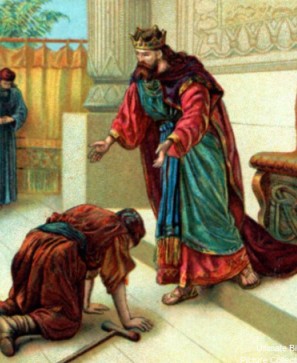
NOTE: See verse by verse commentary on 2 Samuel 9:1-13
Alexander Maclaren
THIS charming idyll of faithful love to a dead friend and generous kindness comes in amid stories of battle like a green oasis in a wilderness of wild rocks and sand. The natural sweetness and chivalry of David’s disposition, which fascinated all who had to do with him, comes beautifully out in it, and it may well stand as an object-lesson of the great Christian duty of practical mercifulness.
I. So regarded, the narrative brings out first the motives of true kindliness.
Saul and three of his four sons had fallen on the fatal field of Gilboa; the fourth, the weak Ishbosheth, had been murdered after his abortive attempt at setting up a rival kingdom had come to nothing. There were only left
Saul’s daughters and some sons by a concubine. So low had the proud house sunk, while David was consolidating his kingdom, and gaining victory wherever he went.
But neither his own prosperity, nor the absence of any trace of Saul’s legitimate male descendants, made him forget his ancient oath to Jonathan. Years had not weakened his love, his sufferings at Saul’s hands had not embittered it. His elevation had not lifted him too high to see the old days of lowliness, and the dear memory of the self-forgetting friend whose love had once been an honour to the shepherd lad. Jonathan’s name had been written on his heart when it was impressionable, and the lettering was as if ‘graven on the rock for ever.’ A heart so faithful to its old love needed no prompting either from men or circumstances. Hence the inquiry after ‘any that is left of the house of Saul’ was occasioned by nothing external, but came welling up from the depth of the king’s own soul.
That is the highest type of kindliness which is spontaneous and self motivated. It is well to be easily moved to beneficence either by the sight of need or by the appeals of others, but it is best to kindle our own fire, and be our own impulse to gracious thoughts and acts. We may humbly say that human mercy then shows likest God’s, when, in such imitation as is possible, it springs in us, as His does in Him, from the depths of our own being. He loves and is kind because He is God. He is His own motive and law. So, in our measure, should we aim at becoming.
But David’s remarkable language in his questions to Ziba goes still deeper in unfolding his motives. For he speaks of showing ‘the kindness of God’ to any remaining of Saul’s house. Now that expression is no mere synonym for kindness exceeding great, but it unfolds what was at once David’s deepest motive and his bright ideal. No doubt, it may include a reminiscence of the sacred obligation of the oath to Jonathan, hut it hallows David’s purposed ‘mercy’ as the echo of God’s to him, and so anticipates the Christian teaching, ‘Be ye merciful, even as your Father is merciful.’ We must receive mercy from Him before our hearts are softened, so as to give it to others, just as the wire must be charged from the electric source before it can communicate the tingle and the light.
The best basis for the beneficent service of man is experience of the mercy of God. Philanthropy has no roots unless it is planted in religion. That is a lesson which this age needs. And the other side of the thought is as true and needful; namely, that our ‘ religion’ is not ‘ pure and undefiled’ unless
it manifests itself in the service of man. How serene and lofty, then, the ideal! How impossible ever to be too forgiving or too beneficent! ‘As your heavenly Father is,’ — that is our pattern. We have not shown our brother all the kindness which we owe him unless we have shown him ‘the kindness of God.’
II. The progress of the story brings out next the characteristics of David’s kindliness, and these may be patterns for us.
Ziba does not seem to be very. communicative, and appears a rather unwilling witness, who needs to have .the truth extracted bit by bit. He evidently had nothing to do with Mephibosheth, and was quite content that he should be left obscurely stowed away across Jordan in the house of the rich Machir (2Sa 17:27 28 29). Lo Debar was near Mahanaim, on the eastern side of the river, where Ishbosheth’s short-lived kingdom had been planted, and probably the population there still clung to Saul’s solitary representative. There he lived so privately that none of David’s people knew whether he was alive or dead. Perhaps the savage practice of Eastern monarchs, who are wont to get rid of rivals by killing them, led the cripple son of Jonathan to ‘lie low,’ and Ziba’s reticence may have been loyalty to him. It is noteworthy that Ziba is not said to have been sent to bring him, though that would have been natural.
At any rate, Mephibosheth came, apparently dreading whether his summons to court was not his death-warrant. But he is quickly featured. David again recalls the dear memory of Jonathan, which was, no doubt, stirred to deeper tenderness by the sight of his helpless son; but he swiftly passes to practical arrangements, full of common-sense and grasp of the case. The restoration of Saul’s landed estate implies that it was in David’s power. It had probably been ‘forfeited to the crown,’ as we in England say, or perhaps had been ‘squatted on’ by people who had no right to it. David, at any rate, will see that it reverts to its owner.
But what is a lame man to do with it? and will it be wise to let a representative of the former dynasty loose in the territory of Benjamin, where Saul’s memory was still cherished? Apparently, David’s disposition of affairs was prompted partly by consideration for Mephibosheth, partly by affection for Jonathan, and partly by policy. So Ziba, who had not been present, is sent for, and installed as overseer of the estate, to work it for his new master’s benefit, while the owner is to remain at Jerusalem in David’s establishment. It was prudent to keep Mephibosheth at hand. The best way to weaken a pretender’s claims was to make a pensioner of him, and the best way to hinder his doing mischief was to keep him in sight.
But we need not suppose that this was David’s only motive. He gratified his heart by retaining the poor young man beside himself, and, no doubt, sought to win his confidence and love. The recipient of his kindness receives it in characteristic Eastern fashion, with exaggerated words of self-depreciation, which sound almost too humble to be quite sincere. A little gratitude is better than whining professions of unworthiness.
And how did Ziba like his task? The singular remark that he had ‘fifteen sons and twenty servants’ perhaps suggests that he was a person of some importance; and the subsequent one that ‘all in his house were servants to Mephibosheth may imply that neither they nor he quite liked their being handed over thus cavalierly.
But, however that may be, we may note that common-sense and practical sagacity should guide our mercifulness. Kindly impulses are good, but they need cool heads to direct them, or they do more harm than good. It is useless to set lame men to work an estate, even if they get a gift of it. And it is wise not to put untried ones in positions where they may plot against their benefactor. Mercifulness does not mean rash trust in its objects. They will often have to be watched very closely to keep them from going wrong. How many most charitable impulses have been so unwisely worked out that they have injured their objects and disappointed their subjects! We may note, too, in David’s kindliness, that it was prompt to make sacrifice, if, as is probable, he had become owner of the estate. The pattern of all mercy, who is God, has not loved us with a love which cost Him nothing. Sacrifice is the life-blood of service.
III. The subsequent history of Mephibosheth and Ziba is somewhat enigmatical.
Usually the former is supposed to have been slandered by the latter, and to have been truly attached to David. But it is at least questionable whether Ziba was such a villain, and Mephibosheth such an injured innocent, as is supposed. This, at least, is plain, that Ziba demonstrated attachment to David at the time when self-love would have kept him silent. It took some courage to come with gifts to a discrowned king (2Sa 16:1 2 3 4); and his allegation about his master has at least this support, that the latter did not come with the rest of David’s court to share his fortunes, and that the dream that he might fish to advantage in troubled waters is extremely likely to have occurred to him. Nor does it appear clear that, if Ziba’s motive was to get hold of the estate, his adherence to David would have seemed, at that moment, the best way of effecting it.
If we look at the sequel (2Sa 19:24, 25, 26, 27, 28, 29, 30) Mephibosheth’s excuse for not joining David seems almost as lame as himself. He says that Ziba ‘deceived him,’ and did not bring him the ass for riding on, and therefore he could not come. Was there only one ass available in Jerusalem? and, when all David’s entourage were streaming out to Olivet after him, could not he easily have got there too if he had wished? His demonstration of mourning looks very like a blind, and his language to David has a disagreeable ring of untruthfulness, in its extreme professions of humility and loyalty. ‘Methinks the cripple doth protest too much.’ David evidently did not feel sure about him, and stopped his voluble utterances somewhat brusquely: ‘Why speakest thou any more of thy matters?’ That is as much as to say, ‘Hold your tongue.’ And the final disposition of the property, while it gives Mephibosheth the benefit of the doubt, yet looks as if there was a considerable doubt in the king’s mind.
We may take up the same somewhat doubting position. If he requited David’s kindness thus unworthily, is it not the too common experience that one way of malting enemies is to load with benefits? But no cynical wisdom of that sort should interfere with our showing mercy; and if we are to take ‘the kindness of God’ for our pattern, we must let our sunshine and rain fall, as His do, on ‘the unthankful and the evil.’
Paul Apple - See Full Commentary on 2 Samuel
TEXT: 2 Samuel 9:1-13 TITLE: DAVID FAVORS MEPHIBOSHETH WITH UNEXPECTED KINDNESS
BIG IDEA: POWERFUL SOVEREIGN DEMONSTRATES UNEXPECTED COVENANT LOYALTY TO CRIPPLED LEFTOVER FROM FORMER REGIME
Background:
1 Sam. 20:14-15 – Jonathan was concerned that his family be preserved when David eventually took over the kingdom; covenant loyalty
1 Sam. 20:41-42 – bond between David and Jonathan; exchanged promises of a continuing relationship between their two families
2 Sam 4:4 – account of how Mephibosheth was injured – son of Jonathan (not son of Saul mentioned once elsewhere 2 Sam. 21:8) Name means: “a shameful thing” “he scatters shame” Read Passage – 2 Sam 9
Carr: For just a moment, let’s put ourselves in the shoes of Mephibosheth. He is one of the few remaining members of the house of Saul. He is living in a place called Lodebar, which means “no pasture.” He is probably living each day in fear for his life; afraid that King David will come and take his life way. No doubt he is a poor man. He does not have access to the wealth or the lands of his family. He is a crippled man. His father was killed in battle and when the news came, his nurse tried to flee with the child and he was dropped and his legs were permanently damaged, 2 Sam. 4:4. He was five when this happened. All of his life he has been warned that David might find him. He lives in fear and he lives in misery every day.
INTRODUCTION: This is a beautiful picture of divine grace (especially when you remember the unkind and unjust treatment David suffered at the hand of Saul) – with the caveat that David had earlier promised Jonathan that he would care for his family (so the story in its context is also about loyalty). Still you can see all of the aspects of grace:
- sovereign initiative
- seek him kindness for Jonathan’s sake?’”
- showering him with undeserved mercy and love and favor
- protecting him and caring for him - yet requiring some aspect of personal responsibility
I. (2 Sa 9:1-8) DAVID REACHES OUT TO BLESS MEPHIBOSHETH – GRACIOUS HEART OF DAVID EXTENDS UNEXPECTED COVENANT LOYALTY TO CRIPPLED MEPHIBOSHETH
A. (2 Sa 9:1) Sovereign Initiative of a Loyal Heart “Then David said, ‘Is there yet anyone left of the house of Saul, that I may show him kindness for Jonathan’s sake?’”
David gets a chance to catch his breath from his intense military campaigns and desires to follow up on his former commitment to his good friend Jonathan.
Ryrie (on 1 Sam. 20:14-15) – hesed – Love and loyalty, the two essential aspects of a covenant relationship, are bound together in this word. Jonathan recognized that David would one day be king and requested protection for himself and his family when David would take the throne.
B. (2 Sa 9:2-5) Compassionate Empathy of a Loving Heart
1. (2 Sa 9:2) Reconnecting to the House of Saul
“Now there was a servant of the house of Saul whose name was Ziba, and they called him to David; and the king said to him, ‘Are you Ziba?’ And he said, ‘I am your servant.’”
Very dangerous situation for Ziba; must have been very fearful
Blaikie: Re Ziba – a man of more substance than principle, as his conduct showed at a later period of his life. Ziba, we are told, had fifteen sons and twenty servants. He seems to have contrived to make himself comfortable notwithstanding the wreck of his master’s fortunes, more comfortable than Mephibosheth, who was living in another man’s house.
2. (2 Sa 9:3a) Seeking out an Opportunity to Show Kindness “
And the king said, ‘Is there not yet anyone of the house of Saul to whom I may show the kindness of God?’”
We must always remember that it is the life of God flowing through us that can be a blessing to others. It is not our kindness, but God’s kindness that we are privileged to be able to show to others. The origin of the grace and the goodness is not from ourselves.
3. (2 Sa 9:3b) Discovering a Helpless Cripple
“And Ziba said to the king, ‘There is still a son of Jonathan who is crippled in both feet.’”
Not someone that would be much of a threat to the king Requires quite a commitment to take on the care of the handicapped.
4. (2 Sa 9:4-5) Bringing Him Into the King’s Presence
a. (2 Sa 9:4) Locating Mephibosheth in Humble Circumstances
“So the king said to him, ‘Where is he?’” And Ziba said to the king, ‘Behold, he is in the house of Machir the son of Ammiel in Lo-debar.”
Matthew Henry: This Machir appears to have been a very generous free-hearted man, and to have entertained Mephibosheth, not out of any disaffection to David, or his government, but in compassion to the reduced son of a prince, for afterward we find him kind to David himself, when he fled from Absalom; he is named (ch. xvii.27.) among those that furnished the king with what he wanted at Mahanaim; though when David sent for Mephibosheth from him, he little thought that the time would come when he himself would gladly be beholden to him; and perhaps Machir was then the more ready to help David, in recompence for his kindness to Mephibosheth; therefore we should be forward to give, because we know not but we ourselves may sometimes be in want.”
b. (2 Sa 9:5) Relocating Mephibosheth to the Royal Palace “Then King David sent and brought him from the house of Machir the son of Ammiel, from Lo-debar.”
C. (2 Sa 9:6-7) Abundant Blessings of a Gracious Heart
1. (2 Sa 9:6) Formal Introduction
And Mephibosheth, the son of Jonathan the son of Saul, came to David and fell on his face and prostrated himself. And David said, ‘Mephibosheth.’ And he said, ‘Here is your servant!’”
Name means “he scatters shame” or “shameful thing”
2. (2 Sa 9:7) Three Gracious Promises
a. Blessing of Protection – based on covenant loyalty and kindness
“And David said to him, ‘Do not fear, for I will surely show kindness to you for the sake of your father Jonathan,”
b. Blessing of Possessions
“and will restore to you all the land of your grandfather Saul;”
This would constitute a considerable fortune. What would be the reaction of those who had to give it up??
c. Blessing of Provisions “ and you shall eat at my table regularly.’”
D. (2 Sa 9:8) Humble Thankfulness of a Servant Heart
“Again he prostrated himself and said, ‘What is your servant, that you should regard a dead dog like me?’”
Ryrie: someone contemptible and useless
II. (2Sa 9:9-13) DAVID INSTRUCTS ZIBA REGARDING PRACTICAL DETAILS -- ADMINISTRATIVE WISDOM OF DAVID INSTRUCTS ZIBA REGARDING STEWARDSHIP OF HOUSEHOLD OF MEPHIBOSHETH
A. (2 Sa 9:9-10) David’s Charge to Ziba Regarding Stewardship
1. (2 Sa 9:9) Laying out the Privileges “Then the king called Saul’s servant Ziba, and said to him, ‘All that belonged to Saul and to all his house I have given to your master’s grandson.’”
2. (2 Sa 9:10) Laying out the Responsibilities
a. Farming the Land “And you and your sons and your servants shall cultivate the land for him, and you shall bring in the produce so that your master’s grandson may have food”
b. Royal Treatment “nevertheless Mephibosheth your master’s grandson shall eat at my table regularly.”
c. Impressive Work Force and Resources “Now Ziba had fifteen sons and twenty servants.”
B. (2 Sa 9:11a) Ziba’s Commitment to Obey the King’s Charge
“Then Ziba said to the king, ‘According to all that my lord the king commands his servant so your servant will do.’”
C. (2 Sa 9:11b-13) Mephibosheth’s Enjoyment of the King’s Favor
1. (2 Sa 9:11b) Treated as the King’s Son “So Mephibosheth ate at David’s table as one of the king’s sons.”
2. (2 Sa 9:12a) Provision for His Own Son “And Mephibosheth had a young son whose name was Mica.”
3. (2 Sa 9:12b) Faithful Service from House of Ziba “And all who lived in the house of Ziba were servants to Mephibosheth.”
4. (2 Sa 9:13a) Royal Treatment “So Mephibosheth lived in Jerusalem, for he ate at the king’s table regularly.”
5. (2 Sa 9:13b) Undeserving of Such Favor – Key point to the story “Now he was lame in both feet.”
DEVOTIONAL QUESTIONS:
1) How would our life be different if we were more aggressive in taking the initiative to show kindness to others – especially to those who do not have much to offer in return?
2) How faithful are we in our relationships with our friends as David was to Jonathan?
3) Do we appreciate the blessings we enjoy from our King – those of protection (never any reason to fear); of possessions (an eternal inheritance that can never be taken away from us); of provisions (privilege of eating at the King’s table – both physical sustenance and more importantly partaking of the bread of life)?
4) Do we appreciate being treated as the King’s son in every respect?
QUOTES FOR REFLECTION:
Davis: David’s kindness to this surviving son of Jonathan was prompted by two things: (1) The covenant which he had made with Jonathan, and (2) the attempt to end any conflict between his household and the household of Saul [But David’s reign was so well established at this time that there was no real threat remaining from the household of Saul … so reason #1 must be primary. On the other hand, this passage makes constant reference to the household of Saul – not just Jonathan. – PGA]
Blaikie: This proceeding of David’s in making inquiry for a fit object of beneficence may afford us a lesson as to the true course of enlightened kindness. Doubtless David had numberless persons applying for a share of his bounty; yet he makes inquiry for a new channel in which it may flow. The most clamorous persons are seldom the most deserving, and if a bountiful man simply recognizes, however generously, even the best of the cases that press themselves on his notice, he will not be satisfied with the result; he will feel that his bounty has rather been frittered away on miscellaneous undertakings, than that it has achieved any solid and satisfying result.
Matthew Henry: Now, because David was a type of Christ, his Lord and Son, his Root and Offspring, let his kindness to Mephibosheth serve to illustrate the kindness and love of God our Saviour toward fallen man, which yet he was under no obligation to, as David was to Jonathan. Man was convicted of rebellion against God, and, like Saul’s house, under a sentence of rejection from him, was not only brought low and impoverished, but lame and impotent, made so by the fall: the Son of God inquires after this degenerate race, that inquired not after him; comes to seek and save them. To those of them that humble themselves before him and commit themselves to him, he restores the forfeited inheritance, he entitles them to a better paradise than that which Adam lost, and takes them into communion with himself, sets them with his children at his table, and feasts them with the dainties of heaven. Lord, what is man, that thou shouldst thus magnify him!
Pink: Next, we may notice the object of David’s quest. It was not one who had befriended him during the days of his own dire need. Nor was it one whom men of the world would call "a deserving case." Nor was it one from whom David could expect anything again in return. Instead, it was one immediately descended from his most merciless and implacable foe; it was one who was hiding away from him; it was one who had nothing of his own, having lost his heritage. How accurate the picture The Gospel of God’s grace is not seeking those who have something of their own to commend them unto the Lord, nor does it offer salvation in return for service to be rendered afterwards. Its inestimable riches are for worthless wretches, spiritual paupers, lost and undone sinners; and those riches are freely proffered "without money and without price." . . .
Next, let us look more closely at this one to whom David showed "the kindness of God"—covenant-kindness. First, his name, for no detail here is meaningless. The son of Jonathan was called "Mephibosheth" (v. 6), which signifies "a shameful thing." How accurately does that appellation describe the natural man! "We are all as an unclean thing" (Isa. 64:6) says God’s Word—polluted by sin. We are by birth and practice thoroughly depraved and corrupt. Our understanding is darkened so that we cannot apprehend spiritual things, our will are opposed to God’s, our hearts are desperately wicked, our consciences are seared, our strength spent in the service of Satan; and in the sight of the Holy One our very righteousnesses are "as filthy rags." "A shameful thing," then, we truly are: "from the sole of the foot even unto the crown of the head there is no soundness" in us by nature, but instead "wounds and bruises and putrefying sores" (Isa. 1:6). O what cause have we to cry with the leper "Unclean! unclean!" and say with Job "I am vile."
Second, Mephibosheth was a fugitive from David. When news reached the survivors of his family that Saul and his sons had been slain in battle, and David had ascended the throne, Mephibosheth and his nurse fled in terror: "he was five years old when the tidings came of Saul and Jonathan out of Jezreel, and his nurse took him up, and fled" (2 Sam. 4:4). They were anxious to keep out of David’s way. So it is with the sinner, he is afraid of God, and seeks to banish Him from his thoughts. The knowledge of God’s holiness, power and omniscience fills him with dismay, and he seeks to have nothing to do with Him. "The wicked flee when no man pursueth."
Third, Mephibosheth was a cripple. He was "lame of his feet" (2 Sam. 4:4): as the closing words of our chapter states, he "was lame on both his feet" (v. l3). How accurately that portrays the condition of those who are out of Christ! The natural man is unable to run m the path of God’s commandments, or tread the narrow way which leadeth unto Life. He is a spiritual cripple; "without strength" (Rom. 5:6). The utter inability of the unregenerate to meet God’s requirements and walk acceptably before him, is a truth written plain across the Scriptures, though it is given little place indeed in much modern preaching. The greatness of man, the freedom of his will, his ability to accept Christ any time, is now the sweet opiate which is chloroforming millions. "No man can come to Me except the Father which hath sent Me draw him" (John 6:44): how those words of Christ’s attest the solemn fact that the sinner is "lame of bath his feet"!
Fourth, Mephibosheth became a cripple through a fall: "and his nurse took him up and fled: and it came to pass, as she made haste to flee that he fell, and became lame" (2 Sam. 4:4). What a truly marvelous book the Bible is! Yet how it needs eyes anointed by the Divine Inspirer to perceive its wonders and beauties! How obvious it is to those favored with spiritual discernment that we have here far more than an historical account pertaining to a single individual: that it is rather a typical picture having a universal application. Man was not originally created in the condition he is now in. Man was far from being "lame on both his feet" when his Maker proclaimed him "very good." The faculties of mans soul have become spiritually crippled as the result of the fall—our fall in Adam. In consequence of that fall, "they that are in the flesh cannot please God" (Rom. 8:8).
Fifth, the place where Mephibosheth resided. It was not at Jerusalem, no, indeed; none out of Christ live there. Jerusalem signifies "the foundation of peace" and as Holy Writ truly declares, "There is no peace, saith the Lord, unto the wicked" (Isa. 48:22): how can there be while they despise Him in whom alone peace is to be found? "But the wicked are like the troubled sea, when it cannot rest" (Isa. 57:20)—discontented, dissatisfied. No, it was not at Jerusalem that poor Mephibosheth resided. Instead, he dwelt at "Lodebar" (2 Sam. 9:4), which means, "the place of no pasture." What a significant line in our picture is this, so obviously drawn by more than a human artist. How aptly does it portray the world in which we live, the world which is away from God, which lieth in the wicked one. It is a world which provides no food for the soul: it is a great "howling wilderness" so far as spiritual provisions are concerned. Yet how little is that fact realized by those who are in it and of it.
Constable: The sensitive reader will observe many parallels between Mephibosheth and himself or herself and between David and God. As Mephibosheth had fallen, was deformed as a result of his fall, was hiding in a place of barrenness, and was fearful of the king, so is the sinner. David took the initiative to seek out in spite of his unloveliness, bring into his house and presence, and adopt as his own son Mephibosheth. He also shared his bounty and fellowship with this undeserving one for the rest of his life because of Jonathan, as God has done with us for the sake of Christ (cf. Ps. 23:6).
Redpath: The first word in connection with the salvation which grace ministers is acceptance by virtue of the merit of another. The second word is abasement by the revelation of that grace bestowed upon us all in Christ. My third word is abundance. “I . . . will restore thee all the land of Saul thy father,” said David to Mephibosheth, “and thou shalt eat bread at my table continually” (II Samuel 9:7). . .
One of the evidences that grace has been genuine in a man’s life is that there is something about him of abstinence: something about his character, his speech, his behavior, his dress, that indicates he shares in the suffering and rejection of Christ until He comes again.
CONTRAST:
Look at the type of person that refuses to repent and seek God’s mercy
– they think they need no salvation from God = the Pharisees
- self-righteous Matt 5:20; 9:11-14 had no concept they were sinners in need of salvation - trusted in their national lineage
– “We have Abraham for our father” Matt. 3:9 “brood of vipers” = snakes
– children of Satan - unwilling to truly repent and bring forth fruit of repentance - wise in their own eyes - legalistic in their behavior
– checking off boxes of self-imposed external requirements
- leading others down the same road of destruction; like blind leading the blind - self-sufficient
– imagine that they are the experts on God’s revelation - Do what they say; don’t do what they do
- lack compassion and mercy towards others; characterized by judgmental spirit Matt 12:2
- conspiring against Christ and His kingdom – Matt 12
- seeking to destroy Christ vs. 14
- attributing works of the Holy Spirit to the devil vs 24
- how can you being evil speak what is good vs 34
- characterized as hypocrites – the leaven of the Pharisees = their teaching 16:6,11,12
Matthew 23 – scathing rebuke of the Pharisees
Brian Bell - Tablecloth of Grace -
- INTRO:
- As Luther said, “Let’s shake some passages till fruit fall from its branches.”
- I believe this ch. is the high point in David’s life. His finest hour!
- Theme: Kindness, that state of being that includes the attributes of loving affection, sympathy, friendliness, patience, pleasantness, gentleness, and goodness.
- Henry Drummond said, “The greatest thing a man can do for his heavenly Father is to be kind to some of His other children.”
- Hesed דֶסֶחcould & should be translated “Grace”.
- What is Grace?
- What a ballet dancer has when she shows dignity & elegance?
- What we say before we eat...We say grace!
- What we are allowed when a payment is extended for a period of time.
- No, biblical Grace is…
- Grace is unmerited favor; or its extending favor to someone who doesn’t deserve it, who hasn’t earned it, & can never repay it.
- Grace is positive & unconditional acceptance in spite of the other person.
- Grace is a demonstration of love that is undeserved, unearned & unrepayable.
- What is Grace?
- Here we get to witness the greatest illustration of grace in the whole OT! :)
- This event illustrates God’s Kindness & Grace to us in Christ.
- Eph.2:7 that in the ages to come He might show the exceeding riches of His grace in Hiskindness toward us in Christ Jesus. For by grace you have been saved through faith, and that not of yourselves; it is the gift of God.
- TABLECLOTH OF GRACE!
- THE LAME PRINCE! (1-4)
- (1) Do you take time to reflect these things? (God 7:1; fellow man 9:1)
- Who might be a Mephibosheth in your life you can show kindness to?
- (3) A sad infirmity dated back to kindergarten 4:4 (5 yr old).
- We too, were lame spiritually from birth.
- Yes, but he’s cripled. He’s got a serious disability. How will that look in your court?
- David moves right on...Where is he? Not, how bad is it? Does it look gross?
- That’s the way grace is. Grace isn’t picky. Grace doesn’t look for things that have been done that deserve love. Grace operates apart from the response or the ability of the individual. Grace is one-sided. (Charles Swindoll, David, pg.172.)
- I repeat, Grace is God giving Himself in full acceptance, to someone who does not deserve it & can never earn it & will never repay it.
- So, a strong & famous king stoops down & reaches out to one who represents everything David is not!
- (4) Lo Debar - Lo/no; Debar/pasture or pastureland. [Literally, “Not a Pasture”]
- He lives out in some obscure, barren field in the house of Machir.
- (5) He must have thought, “Well this is the end!”
- (6) Picture this permanently disabled man, crippled in both legs, throwing himself down on his face before the king.
- Expecting a sword to strike his neck...only to hear the words in vs.7.
- (7) He didn’t have to fear because David would keep his word.
- You don’t need to fear because the Son of David/Jesus will keep His word.
- There was nothing to worry about!
- Listen to this and ask yourself...Why should I worry? (Eph.1:3; 2:4-10)
- He might not have even known about this covenant; but to David it was sacred.
- Even the unloveable son was dear to him, for his fathers sake.
- You may never have known about this redemptive covenant before this morning; but to Jesus it is sacred!
- (8) What is your servant, that you should look upon a dead dog such as I?
- When you move from, “I’m a pretty good person”, to the realization of you being dead in trespasses & sin, is where it all begins.
- Notice Grace doesn’t even answer the question.
- (9,10) Though consciously unworthy, he received again Saul’s family estate.
- Mephibosheth’s story is our story of redemption!
- He belonged to a royal line, but was made cripple by a fall (4:4).
- Adam was of a royal line but then was made spiritually cripple because of his fall.
- He was sought by the king(1-4).
- We didn’t “find God”, He found us. There is none who seeks after God.
- Today, God is still seeking people who are spiritually disabled, dead due to depravity, lost in trespasses & sins, hiding from God, broken, fearful, & confused.
- He was lame in his feet(3b).
- We are lame in our powers of spiritual obedience.
- He lived in exile from the king.
- Mephibosheth didn’t even try to win the king’s favor. He was hiding from the king.
- Same is true of us. We deserved nothing, had nothing, & could offer God nothing. We were hiding when He found us.
- From Lo Debar to Mnt Zion.
- From a hiding place where there was no pastureland to a place of plenty!
- From where we were to where He is!
- He was remembered because of a covenant.
- Our sin separated us from our King, but there exists this incredible covenant!
- Jer.31:31-34 But this is the covenant that I will make with the house of Israel after those days, declares the Lord: I will put my law within them, and I will write it on their hearts. And I will be their God, and they shall be my people. And no longer shall each one teach his neighbor and each his brother, saying, ‘Know the Lord,’ for they shall all know me, from the least of them to the greatest, declares the Lord. For I will forgive their iniquity, and I will remember their sin no more.”
- Our sin separated us from our King, but there exists this incredible covenant!
- He was brought to the king(5).
- We were called into the kings presence & exalted because of the merits of another.
- He was called by name (6).
- He responded in humility (6b).
- He was told not to fear (7a).
- He received 3 promises [kindness, restoration & a place at the big table] (7b).
- He responded in humility again (8).
- There’s something freeing about Grace. It takes away all of the demands & it puts all of the response on God’s shoulders as He comes to us & says, “You’re mine. I take you just as you are, crutches & hang-ups & liabilities, & all.”
- He was given a glorious heritage (9,10).
- He received sonship/adoption/relationship (11, like 1 of the kings sons).
- As part of Saul’s family Mephibosheth had no claim to the kingdom. Yet David treated him as one of his own sons.
- God has adopted every Jesus Follower into His family.
- 1Jn.3:1 Behold what manner of love the Father has bestowed on us, that we should be called children of God!
- Sitting down at the table he was treated like any other son of the king.
- Can you imagine sitting w/the rest of His sons/daughters? There’s Peter, Paul, John. Hey James can you pass the potatoes? Talking to Issac Watts, Martin Luther, Calvin, Wycliffe, the Wesley brothers, George Whitefield. To break bread w/Abraham, Esther, Isaiah, & King David himself. And don’t forget Mephibosheth.
- He received esteem(12b servants).
- Eph.1:3 Blessed be the God and Father of our Lord Jesus Christ, who has blessed us in Christ with every spiritual blessing in the heavenly places.
- He received a perpetual feast (13 continually).
- Mt.8:11 I tell you, many will come from east and west and recline at table with Abraham, Isaac, and Jacob in the kingdom of heaven.
- He enjoyed uninterrupted fellowship (13 continually).
- As Adam did, when God walked w/him in the cool of the day.
- As 1 day we will enjoy uninterrupted fellowship w/God. Behold, the dwelling place of God is with man. He will dwell with them, and they will be his people, and God himself will be with them as their God. Rev.21:3
- He received a seat at the kings banqueting table (13b)
- This is where the Lord covers our feet w/His tablecloth & says, “Have a seat. You’re mine. I choose you simply because I wanted to.”
- Reclining in Eastern fashion, it was the 1 place his disability would be completelyunnoticed!
- Yet, he was still lame in both his feet. (no miraculous healing; still had his old nature to struggle w/)
- But, our continual problem w/Sin is a continual reminder of His Grace!
- Being 1 of the Kings kids, we still are subject to persecution & slander (16:1-4)
- We should be looking for our Kings return & not concerned for material things. (see 19:24-30)
- He belonged to a royal line, but was made cripple by a fall (4:4).
- I like saying, when it came to my salvation, “I did my part & God did His part!”
- His part: He called my, sought me, caught me, loved me, saved me, cleansed me, healed me, & delivered me. My part...was running away!
- It really is Amazing Grace!
- Before Communion I would like to give you the opp to respond to His Amazing Grace.
- Communion:
- Its hard for us to appreciate the scandal Jesus caused by His table fellowship w/sinners.
- Remember to share a meal w/someone is a guarantee of peace, trust, fraternity, & forgiveness: the shared table symbolizes a shared life.
- For an orthodox Jew to say, “I would like to share a meal w/you” was like saying, “I would like to enter fellowship w/you.”
- That’s what the corrupt tax collector Zacchaeus heard when Jesus called him down from the sycamore tree. Lk.19:7 And when they saw it, they all grumbled, “He has gone in to be the guest of a man who is a sinner.”
- Bread:
- Forgive us for running from You & hiding from You.
- Forgive us for our discontent w/our daily bread; & only being content when we have tomorrows bread also, & our retirement bread, & lots of it.
- Forgive us for leaning back on our crutches when we can lean on You.
- Forgive us for thinking we deserve anything besides death & hell.
- Forgive us for showing pride & not humility.
- Cup:
- Thank you for calling us by name!
- Thank you for reminding us we don’t have to fear!
- Thank you for being our Jehovah Jireh, our God that provides.
- Thank you for proving Your Son Jesus as the Lamb that was needed for taking away our sins.
- Thank you for our sonship, our adoption, our relationship w/You!
- Thank you for the invitation to your banqueting table...continually!
- Thank you for your tablecloth of grace!
- End: Spend some time today just basking in the kindness God has shown you!
- Its hard for us to appreciate the scandal Jesus caused by His table fellowship w/sinners.
Alan Carr - 2 Samuel 9:1-13 THE CASE OF THE LAME PRINCE
Intro: A story is told about Fiorello LaGuardia, who, when he was mayor of New York City during the worst days of the Great Depression and all of WWII, was called by adoring New Yorkers “the Little Flower” because he was only five foot four and always wore a carnation in his lapel.
He was a colorful character who used to ride the New York City fire trucks, raid speakeasies with the police department, take entire orphanages to baseball games, and whenever the New York newspapers were on strike, he would go on the radio and read the Sunday funnies to the kids.
One bitterly cold night in January of 1935, the mayor turned up at a night court that served the poorest ward of the city. LaGuardia dismissed the judge and took over the bench himself.
Within a few minutes, a tattered old woman was brought before him, charged with stealing a loaf of bread. She told LaGuardia that her daughter's husband had deserted her, her daughter was sick, and her two grandchildren were starving to death.
The shopkeeper, from whom the bread was stolen, refused to drop the charges. “It's a real bad neighborhood, your Honor.” The man told the mayor. “She's got to be punished to teach other people around here a lesson.”
LaGuardia sighed. He turned to the woman and said, “I've got to punish you. The law makes no exceptions--ten dollars or ten days in jail.”
But even as he pronounced sentence, the mayor was already reaching into his pocket. He extracted a bill and tossed it into his famous sombrero saying: “Here is the ten dollar fine which I now remit, and furthermore, I am going to fine everyone in this courtroom fifty cents for living in a town where a person has to steal bread so that her grandchildren can eat. Mr. Bailiff, collect the fines and give them to the defendant.”
That poor, little grandmother left that courtroom with $47.50 in her pocket, fifty cents of that amount being contributed by the red-faced grocery store owner. Around that courtroom some seventy petty criminals, people charged with traffic violations, and New York City policemen, each of whom had just paid fifty cents for the privilege of doing so, gave the mayor a standing ovation.
That is the very essence of God’s saving grace!
Grace recognizes our wretched condition; pays our debt and gives us more than we could ever have imagined.
John Newton got it right when he called it amazing!
This passage we have read today is one of the clearest portraits of amazing grace in the Word of God. God uses David and Mephibosheth as a living canvas upon which He paints an illustration of what grace is all about. In this text, David rescues a man from a hopeless situation and forever changes his life.
I want to preach on The Case Of The Lame Prince. I want to examine the facts of this case, facts that demonstrate that this is a case study in grace.
I. v. 1-5 HOW GRACE IS EXTENDED
This story opens in the throne room of King David in Jerusalem. David has it in his heart to extend grace to a member of Saul’s family.
A. v. 1 The Reason For This Grace – David says that he wants to show someone from the family of Saul “kindness for Jonathan’s sake.”
• The word for “kindness” is also translated “goodness, mercy, favor, and loving kindness.”
• It is the O.T. word for “Grace.”
• “Grace” is often defined as “the unmerited love and favor of God toward the undeserving.”
• Grace is one person accepting another person in a positive manner in spite of the unworthiness of the person being accepted.
David’s desire to extend grace to a member of Saul’s family is amazing in light of what new kings usually did when they came to power. Many ancient kings totally eradicated the families of their predecessors to ensure that no one would launch a claim for the throne.
For example, Ashurbanipal mutilated, executed and fed the bodies of his rivals to dogs as part of his first official acts as king of Assyria. What Ashurbanipal did would be justice! What David did was grace! David had the right execute judgment, but he chose to demonstrate grace instead.
David did this, not because the house of Saul deserved it; he did it for two reasons:
• He did it because of his relationship with Jonathan. They were closer than brothers. Ill. 1 Sam. 18:1-3
• He did it because of two promises he had made many years before. David had promised both Jonathan and Saul that he would not totally destroy their offspring, 1 Sam. 20:13-17; 1 Sam. 24:20-22.
So, this grace is extended because of another. That is the nature of grace!
God extends His grace to the descendants of Adam. We do not deserve His grace, His love and His mercy. We deserve judgment, damnation and Hell, Rom. 6:23; Eze. 18:4. Yet, God extends His amazing grace to us because of Another.
He reaches out to fallen, depraved sinners because He loves His Son; and because Jesus died for us on the cross. We have nothing to merit us to God, but because of Jesus, we can experience God’s amazing grace 1 John 2:12; Eph. 4:32. No wonder it’s called amazing!
B. v. 1 The Reach Of This Grace – When David decides to extend grace, he does so without any limits. He is looking for “ANY that is left of the house of Saul.” The house of Saul was the house of his predecessor and bitter enemy, but that did not matter. David placed no limits on his grace. He was willing to extend it to “any” member of the house of Saul.
David was not looking for people who met any certain criteria. He wasn’t looking for people who were soldiers, or intellectuals, or who possessed certain abilities, etc. “Any” person who was of the family of Saul was a candidate for the grace of King David.
• God’s amazing grace knows no boundaries!
• God extends His grace to all people regardless of their pasts, their racial, their socialstanding, or their deeds.
• God does not reach out to save the righteous, but the sinner, Mark 2:17.
• If you have never been saved, you are qualified to be saved.
• He will save anyone who will come (Ill. 1 Cor. 1:26-29)
Ill. Eph. 2:1-3 – Ill Our condition – Dead, Deceived, Depraved and Doomed! Sadly, many don’t see themselves as sinners, but the facts speak for themselves! (Ill. “4 Roman Nuns!”) Ill. Rom. 3:10-23
Ill. Where Mephibosheth was when David found him.
• He was in the house of “Machir” in a place called “Lodebar”. Both the house and the place describe Mephibosheth’s condition.
• “Machir” means “Sold” and “Lodebar” means “No Pasture”.
• Both the place and the house describe his condition.
• Mephibosheth was a man injured in a fall. His condition was not his own fault.
• He was the son of royalty, crippled, unable to seek or to get to the king.
• He was separated, in hiding, and afraid.
• By the way, his name means “Shameful.”
• He was in a hopeless condition and he was helpless to do anything about it!
What a picture that is of the lost sinner. Like Mephibosheth, the lost person is “sold” under sin and he is in a place where there is “no hope.” (Ill. Rom. 7:14; Ill. The Prodigal Son - Luke 15:14)
He is in a place where he cannot help himself. Ill. Eph. 2:12, “That at that time ye were without Christ, being aliens from the commonwealth of Israel, and strangers from the covenants of promise, having no hope, and without God in the world:”
The lost sinner is a slave to his passions and to the devil. He is in a place of absolute slavery! The lost sinner is in a place of “no pasture, and of no hope.”
• There is no Friend for the hard day, and all his days are hard, Pro. 13:15.
• There is no one to hear when he prays.
• There is no one to help him shoulder the burdens of life.
• There is no one to turn to in the dark hours.
• There is no help for today, and no hope for tomorrow.
• That is where all those who are outside grace find themselves today!
I praise His name that God extends His grace to all those who are in that condition, Ill. Eph. 2:4 – “But God!”.
• His salvation is available to “whosoever will”, Rev. 21:17; Matt. 11:28; John 7:37.
• There are no limits on who can come.
• Grace is extended to all who will!
• If you are a descendant of Adam by virtue of your first birth, you are a candidate for salvation through the second birth!
• He won’t turn you away, John 6:37.
God’s amazing grace is how you and I got saved. If you are lost, that is how you will get in as well! No one deserves grace and salvation, but anyone can have it. That is what makes grace so amazing!
C. v. 1-5 The Response Of This Grace – David discovers that one of Jonathan’s sons is still living. He also hears the news that this man is crippled. The response of grace is not to ask what kind of man he is, or even how bad he is crippled. Grace does not concern itself with the man’s background, his surroundings, his abilities, his appearance, his future potential, etc.
• The response of grace is to ask “Where is he?”
• As soon as David hears where this man is, he sends his servants to “fetch” him.
• Grace said, “I am not concerned about his condition, I want him just like he is.”
• David said, “I’ll take him just like he is!”
So it is with the amazing grace of God.
• He does not look upon us and concern Himself with our crippled spiritual condition.
• He looks upon us through the eyes of grace.
• He sees us exactly like we are, but He loves us in spite of what we are.
• He knows all about our past, our problems and our potential, yet He responds by drawing us to Himself anyway!
We must be “fetched” by Him before we can and will come to Him, John 6:44; 65.
Do you remember being “fetched?”
• Do you have a fetching story?
• I praise the Lord that I have one!
• If you have one, you ought to tell it!
When grace fixes its gaze on one of the crippled sons of Adam’s race, it cares for nothing but fetching us to itself.
No wonder it’s called amazing!
Grace is the only means of salvation – Titus 3:5; Eph. 2:8-9; 2 Tim. 1:9.
• Mephibosheth was one of the last survivors of the family of Saul. Were it not for the grace David demonstrated here, the entire family would have soon vanished away.
• Were it not for the grace of God in Jesus Christ, no son of Adam would survive, 1 Cor. 15:22, but all would be lost in their sins and would go to Hell for eternity!
No wonder it’s called amazing!
I. How Grace Is Extended
II. v. 6-8 HOW GRACE IS EMBRACED
For just a moment, put yourself in the shoes of Mephibosheth.
• You are one of the few remaining members of the house of Saul.
• You are living in a place called Lo-debar, which means “no pasture.”
• You are helpless and your life is hopeless!
• He is poor.
• He is a cripple, and he has been since he was five.
• When he was five, his father was killed in battle, and when that horrible news came, Mephibosheth’s nurse tried to flee with the child, she dropped him and his legs were permanently damaged, 2 Sam. 4:4.
• All of his life, since he was a five-year-old boy he has been warned that David might find him. He has lived his whole life in fear and misery.
• You do not have access to the wealth or the lands of his family.
• You have been warned that David might come for you one day.
• Then one day you hear the sound of horses and chariots outside.
• The men enter and tell him the king has sent for him.
• They load him up and take him from his home to see the king he has always feared.
• After a while the chariots arrive at the King’s palace.
• Mephibosheth is carried into the King’s presence.
• When he arrives there, nothing is like he had imagined it.
• Mephibosheth has entered the presence of grace.
• Notice how he embraces it.
A. v. 6a He Embraces It With A Humble Heart – When Mephibosheth comes into David’s presence, he is aware that as a descendant of Saul he deserves nothing but judgment from the King. So, he humbles himself in the presence of David.
B. v. 6b-7 He Embraces It With A Happy Heart – Instead of judgment, Mephibosheth experiences tenderness. Ill. What David could have said!
I believe that when David looked at Mephibosheth, he was actually seeing Jonathan. David identified Mephibosheth with Jonathan. That’s what God does with us, Ill. Gen. 3:21; 2 Cor. 5:21.
Ill. What you see here is imputation at work!
• He hears David call his name.
• Then to his amazement, David speaks peace to him.
• He hears as the King promises him restoration of all the wealth and glory that once belonged to the family of Saul.
• Then, the icing on the cake, David promises to give Mephibosheth a place at the King’s table.
• It is with a happy heart that Mephibosheth embraces the treasures of grace!
C. v. 8 He Embraces It With An Honest Heart – Mephibosheth is overwhelmed by the grace he has received. He acknowledges that he is undeserving of such love and mercy. Grace has been extended and it has been embraced and nothing will ever be the same in Mephibosheth’s life again!
What a picture this is of the lost sinner who encounters grace!
• When the King first calls there is fear in the sinner’s heart brought about by conviction, John 16:7-11.
• The sinner knows that he deserves nothing but judgment and damnation from the hand of God. (By the way, there is no salvation apart from conviction, John 6:44.)
• So, the call of God comes and it cannot be denied.
• When the sinner responds to God’s call and is ushered into the presence of the Lord, he falls down in humility, reverence and worship.
Then, the King speaks, and He reveals the truth that grace has turned away His wrath, opened His heart ,and His Heaven, and that grace promises to restore to the sinner everything that sin took away! If you have experienced God’s saving grace in your life, then you know how overwhelming it truly is.
Think back and remember that day when as a lost sinner you were brought by the Spirit of God into the presence of God.
• Do you remember the fear?
• Do you remember the feeling of dread?
• Do you remember how that He spoke peace to your soul that day?
• Do you remember how you came with nothing and left with everything?
What a great, wonderful, matchless, glorious Savior we have! When His grace is embraced, everything changes. No wonder it’s called amazing!
• Have you ever had an encounter with grace?
• If you can’t remember a time when you embraced grace, you need to come to Jesus today and make a memory!
• You need a fetching story
I. How Grace Is Extended
II. How Grace Is Embrace
III. v. 9-13 HOW GRACE IS EXPANDED
When Mephibosheth came to David, he did not get what he deserved. He received grace. When he received grace, he also received more blessings than he could have ever imagined. Grace was expanded. Notice what grace provided to Mephibosheth and what saving grace provides to you and me.
A. v. 9-11a Grace Provided A Future – In Lo-debar, Mephibosheth had nothing. He was poor. He was an outcast. He was a fugitive. He had no hope and no prospects for his future. But, when he met grace, everything changed! All of his present needs were met and his future was secured.
Grace gave Mephibosheth something he never could have had in Lo-debar: grace gave him a future.
• Grace gave him the plenty of the King!
• Grace gave him peace with the King!
• This one man’s encounter with grace affected his family too!
• All of them were delivered from Lodebar and brought into the presence of the king! Ill. Micha - v. 12.
Ill. “alway”, v. 10 – Mephibosheth was expected to come to the King’s table on all stated days, but he could come to that table anytime he wanted to! He had an open invitation. He had access to the king!
The same is true for all those who experience God’s saving grace.
• In Adam, our Lo-debar, we had nothing!
• We were lost, undone, and headed to Hell.
• We were outcasts and fugitives, running for our lives from a holy God Who possessed the right, and the power to send us to a lost eternity.
Ill. Eph. 2:1-3. Ill. Eph. 2:4 - “But God!!!”
But, when grace was extended and embraced, everything changed! What sin could never give us became ours in Jesus! For the first time, there was hope for the future.
• We had no future, but we are promised security – John 6:37-40; John 10:28; 1 Pet. 1:5.
• We had no home of our own, but we are promised a home in Heaven – John 14:1-3.
• We has no hope, but we are promised that our needs would be met – Phil. 4:19, Matt. 6:25-34.
• We had no one, but we are promised His presence all the way home to Heaven – Heb. 13:5; Matt. 28:20.
• I used to be a nobody headed nowhere but Hell. But now, by grace, I am a somebody headed somewhere big!
• That is what grace gives to all those who embrace it!
No wonder it’s called amazing!
Grace restores everything PawPaw Adam threw away in the Garden of Eden!
B. v. 11b Grace Provided A Family – Mephibosheth was adopted out of Saul’s family and into David’s. Grace gave him something that he did not have before it was extended to him. Grace gave him a family!
Every day he lived, Mephibosheth was reminded by his surroundings, and by the presence of the King that he was the recipient of grace. He was where he was because of the grace of the King! David claimed him as a son! Grace took Mephibosheth out of death and brought him into life!
When a sinner responds to the call of grace and is saved, that sinner is immediately adopted into the family of God, Rom. 8:15; Gal. 4:5; Eph. 1:5. He is taken out of Adam, and is placed into Christ, Col. 1:13; 1 Cor. 12:13.
• In Adam, we were doomed to die, 1 Cor. 15:22a.
• In Jesus, we are destined for life, 1 Cor. 15:22b.
Grace took us from our Lo-debar and brought us into the family of God, 1 John 3:1-3. May we never forget that we have what we have and that we are what we are simply by the good grace of God, 1 Cor. 15:10.
No wonder it’s called amazing!
C. v. 13 Grace Provided Fulfillment – Mephibosheth was a nobody in a house full of somebodies. Imagine the scene. It’s suppertime in David’s palace, and the royal family enters the dining hall and takes their places at the king’s table.
• There was Absalom, perfect and handsome.
• There were David’s other sons.
• There were David’s beautiful wives and daughters.
• There was Joab the general, proud and strong.
• There were princes and princesses; soldiers and statesmen; men of wealth, men of degree, and men of power.
• All of these took their place at the table of King David.
Wait! As the family gathers, there is the sound of a crippled man coming down the hallway. Can you hear the clump of his crutches and the sound of his feet being dragged? It is Mephibosheth and he takes his place at the King’s table with all the rights and privileges as the rest. Then, when he takes his seat and the tablecloth falls across his legs. He looks just like the rest. Because of grace Mephibosheth belonged at that table!
Grace took a nobody from nowhere and made him a child of the King! Mephibosheth would have never known joy, happiness, peace, fulfillment, contentment or unconditional love apart from the grace of King David!
Mephibosheth knew that he was a just a sinner and a nobody; but when he sat down at the table, he was just like anyone else!
That is the power of grace!
• It takes the lost sinner, changes him completely and gives him a seat at the Lord’s Table, 2 Cor. 5:17; 2 Pet. 1:4.
• It takes us from our Lo-debar and makes us one of God’s children, 1 John 3:1-2.
• It puts us on even footing with all the rest of God’s precious saints.
• Because of grace I belong where He has placed me!
• When “fetched” you, and you embraced His grace and were saved, God elevated you to a new position, Eph. 2:6.
• You are not beneath Abraham, Moses, the Apostles or any other saint of God. You are His child, 1 John 3:1-2.
• He has seated at His table and His grace has taken care of your past and your infirmities. That is the power of grace
No wonder it’s called amazing!
Verse 13 - Even after he was adopted into the family, Mephibosheth was still “lame on both his feet”. He was still a cripple, but he was welcomed at the king’s table.
The same is true of us! Even though we are saved by His grace, we are still far less than perfect. Ill. We need a crutch. We are all just a bunch of spiritual cripples. Ill. Rom. 7:14-25.
Even though I still fail Him and often prove my crippled condition by stumbling and falling, I am still His son and I am always welcome at His table. That is grace!
Conc: Thank God for grace! Thank God for His soul saving, life changing grace! No wonder it’s called amazing!
• Have you been “fetched” by grace?
• Has its power, promises and provisions been made real in your heart and soul?
If you are saved by grace, you know what I am talking about.
If you haven’t, but you know the King is calling you to come to Him, the time to do that is now.
• Do you need to be saved? Is He “fetching” you? Come to Jesus right now. He will save your soul, adopt you in to His family, change your life, and your eternal destiny!
• Are you saved, but not walking with the Lord as you should be? Come to Him now and He will restore you to a place of fellowship and blessing.
• Are you saved and grateful for it? Have you been “fetched” by grace? Why don’t you come before Him and praise Him for His grace!
Alan Carr - 2 Samuel 9:1-13 EVERYTHING CHANGES WHEN THE KING COMES CALLING
Intro: How would you define the word "grace"? Webster's defines it as, "Undeserved divine assistance given to humans for their regeneration and sanctification." Others have defines it as "unmerited divine love and favor extended to sinners." Maybe you have heard the following: "Justice is getting what you deserved. Mercy is not getting what you deserve. Grace is getting what you do not deserve." Each of those is true. The following story illustrates what grace is all about.
It seems that Fiorello LaGuardia, who, when he was mayor of New York City during the worst days of the Great Depression and all of WWII, was called by adoring New Yorkers 'the Little Flower' because he was only five foot four and always wore a carnation in his lapel. He was a colorful character who used to ride the New York City fire trucks, raid speakeasies with the police department, take entire orphanages to baseball games, and whenever the New York newspapers were on strike, he would go on the radio and read the Sunday funnies to the kids. One bitterly cold night in January of 1935, the mayor turned up at a night court that served the poorest ward of the city. LaGuardia dismissed the judge for the evening and took over the bench himself.
Within a few minutes, a tattered old woman was brought before him, charged with stealing a loaf of bread. She told LaGuardia that her daughter's husband had deserted her, her daughter was sick, and her two grandchildren were starving. But the shopkeeper, from whom the bread was stolen, refused to drop the charges. "It's a real bad neighborhood, your Honor." the man told the mayor. "She's got to be punished to teach other people around here a lesson." LaGuardia sighed. He turned to the woman and said "I've got to punish you. The law makes no exceptions--ten dollars or ten days in jail." But even as he pronounced sentence, the mayor was already reaching into his pocket. He extracted a bill and tossed it into his famous sombrero saying: "Here is the ten dollar fine which I now remit; and furthermore I am going to fine everyone in this courtroom fifty cents for living in a town where a person has to steal bread so that her grandchildren can eat. Mr. Baliff, collect the fines and give them to the defendant." So the following day the New York City newspapers reported that $47.50 was turned over to a bewildered old lady who had stolen a loaf of bread to feed her starving grandchildren, fifty cents of that amount being contributed by the red-faced grocery store owner, while some seventy petty criminals, people with traffic violations, and New York City policemen, each of whom had just paid fifty cents for the privilege of doing so, gave the mayor a standing ovation.
This chapter is all about that kind of grace. It is about the kind of grace that reaches out to the undeserving and lifts them out of their condition, forever changing them and their surroundings. It may be that there are some here this morning who need this kind of grace in their lives. If so, I want to tell you that there is hope in the Lord Jesus Christ. Some already enjoy this kind of grace. For those, this message will be a mere reminder of what Jesus has done in and for them. Wherever you stand with the Lord, there will be help for you in this passage today. Now, let's join David as he extends his grace to a man named Mephibosheth. Let's watch David take Mephibosheth From The Poor House To The King's House. As we do, know that what David did for Mephibosheth, Jesus can do for you and much more too! I want to show you from these verses that Everything Changes When The King Comes Calling!
I. MEPHIBOSHETH'S FAMILY
(Ill. In the South, a person's family tells you a lot about them! If a person has the wrong family heritage, it can cost them social standing. In fact, one of the first things we want to know about someone new is, "What kind of family does he come from." While that is true in the physical realm, it is also true in the spiritual realm.)
A. V. 1 A Disgraced Family - He was the descendant of king Saul. He was born into a family that had been rejected by God, 1 Sam 15:23. This family had once been in power, now they were out of favor with God and with men.
(Ill. The same is true for every person born into the human family. There was a time when humans were given dominion over the earth, Gen. 1:26, 28. However, when man sinned in the Garden of Eden, the entire human race fell from power and from favor. Now, all humans that are born into this world are born as members of a disgraced and fallen family, Rom. 3:10; 23; 5:12.
B. V. 1 A Doomed Family - All the descendants of Saul had been earmarked for death. In fact, David had been busy purging the sons of Saul, 2 Sam. 3:1. Because Mephibosheth was a descendant of Saul, he too was doomed to die an inglorious death.
(Ill. So it is with those born into the human family. We are born under the curse of death, Eze. 18:4. Every person who is born into this world is born destined to die. Why? Because was are sinners before the Lord, Rom. 6:23. There is a death sentence on the entire human family!)
C. V. 4 A Destitute Family - The Bible tells us in verse 4 that Mephibosheth was living in a place called "Lodebar." This is a word that means "No Pasture." This was in the house of "Machir", which means "Sold". Mephibosheth was living in a place of poverty and want. Consider the fact that Mephibosheth was a cripple. He had been dropped by his nurse when he was 5 years old and as a result he was lame on both of his feet, 2 Sam. 4:4.
Because he was lame, he could not work. He had inherited nothing but poverty and death from his family. He was a man who was in a desperate situation. He was a man who was missing the best life had to offer. He was a man in a terrible condition.
(Ill. The human family is in a destitute condition as well. He is in a position of having "no pasture". He is "sold" under his sins. He is lost and needs a Redeemer to deliver him from his slavery! We are born in sin and are doomed to Hell and there is nothing at all that we can do about it. You see, a lost sinner cannot save himself. He cannot turn over a new leaf and be better. He cannot purchase salvation. The lost sinner is absolutely destitute before the Lord God. Helpless, hopeless and completely without power. The human condition is summed up quite plainly in Eph. 2:12, "That at that time ye were without Christ, being aliens from the commonwealth of Israel, and strangers from the covenants of promise, having no hope, and without God in the world:"
D. V. 1, 3 A Desired Family - Notice that despite all the bad blood between David and Saul, David wants to honor the covenant he made with Saul's son Jonathon, 1 Sam, 20:11-23. David, therefore, reached out to Mephibosheth because of the love he had for Jonathon. This family that was disgraced, doomed and destitute has become a desired family. David wants to reach out to them and bring them into a relationship with himself.
(Ill. This is a picture of what God has done for the sinner. Just like Mephibosheth, our family was doomed, disgraced, and destitute. And, just like the family of Saul, there was one who loved us. As amazing as it may seem, God loves the human family, Jer. 31:3. He proved His love when He sent His Son Jesus to die on the cross for our sins, John 316; Rom. 5:8. Now, God reaches out to sinners on the basis of His love for us! You see, we cannot buy our way to God. We cannot work our way to God. Just like Mephibosheth, we are lame on our feet and we are helpless and hopeless before God. But, because the Son of God went to the cross in our place and died for our sins, God desires that every member of the human family be saved, 2 Pet. 3:9.)
(Ill. Mephibosheth's family left a lot to be desired, but being who he was placed him a position to experience the grace of King David. Now, it may not thrill your soul to have the Bible call you a sinner, but being a sinner places you in a position to experience the grace of God. Why? Because of the simple fact that Jesus Christ came into this world to save sinners just like you and me, "When Jesus heard it, he saith unto them, They that are whole have no need of the physician, but they that are sick: I came not to call the righteous, but sinners to repentance.", Mark 2:17.
I. Mephibosheth's Family
II. MEPHIBOSHETH'S FRIEND
A. V. 1-4 He Sought Him - When David heard that Jonathon had a son, he began the process of finding Mephibosheth. David sought him out.
(Ill. I am grateful this morning that the sinner has a Friend Who seeks for the sinner's soul, Luke 19:10. Jesus is the lover of the soul and He actively seeks those who are separated from Him by their sins. He reveals this to us in Luke 15. There we see Jesus seeking that which is lost until He finds it. So it is with those who are lost in their sins. The Lord seeks them and pursues them because He loves them and wants to save their souls. I thank God there was One Who came looking for me one day!)
B. V. 5 He Sent For Him - When David discovered where Mephibosheth could be found, he started the process of bringing Mephibosheth unto himself. He sent his servants to fetch Mephibosheth from the place of death, defeat, disgrace and doom. Please note that this whole this was not Mephibosheth's idea! It was conceived in the heart of David and it was carried out through the efforts of David alone. Also, put yourself in the place of poor old Mephibosheth. He must have been terrified when the King's soldiers came to take him to Jerusalem. Surely, he feared the worst. However, David did not have evil plans for Mephibosheth, only plans that were good. In fact, the day the servants of David came to get that poor crippled man turned out to be the best day of his life!
(Ill. My, what a picture of that which the Lord has done for the redeemed! He sent His servant, the Holy Spirit, to call us unto Him, John 16:8. When the Spirit of God comes by and shows you yourself as a sinner, that is a terrifying day! For the first time, you really see yourself as you actually are. You can see how wicked and how wretched you are. You know without a shadow of a doubt that you deserve to go to Hell. You know you are guilty and you need a Savior. That is a state known as "conviction." It is a fearful thing, but when a soul is convicted, that is the greatest day that soul has ever enjoyed! Nothing hurts quite so much, but salvation hinges on our being called to come to God for salvation, John 6:44; John 6:65.)
(Ill. I remember the day when the Spirit of God came calling me to Jesus! It was a hard day, but it was the best day of my life! Is the Lord calling you today?)
C. V. 6 He Spoke To Him - When Mephibosheth came before King David, he bowed himself before David in humility. He even referred to himself as a "dead dog", v. 9. This man knew he deserved nothing short of judgment and death, yet when David opened his mouth to speak, he spoke words of peace and encouragement to Mephibosheth! He could have said "No!" to David, but where else was he going to go?
(Ill. This is just what the Lord Jesus does to every sinner who comes before Him in repentance. I remember how I felt when I faced the lord the first time. I was terrified and I knew I deserved Hell. But, what I received was something far different and far better. When a sinner comes before Jesus they will find a Friend and not an enemy. They will find One Who cares and not One Who condemns. They will find help and not hell. They will hear Him speak peace to their souls! That is the greatest sound the soul has ever heard! I could have said no to Jesus, but where else could I go, John 6:66-69? You may be thinking of telling Jesus no this morning, but friend, where will you go, Heb. 2:3?)
D. V. 7 He Spared Him - When David speaks to Mephibosheth, he does not condemn him to death. Instead, he speaks to him as one who is much loved. He promises Mephibosheth that he will experience kindness (read "grace"), restoration and provision. David is telling him that everything has changed now that the king has come calling!
(Ill. Every person under the sound of my voice this morning deserves to go to Hell! We do not deserve mercy, we do not deserve grace and we do not deserve salvation. However, those are just the things we receive when we come to Jesus by faith. Every Hell bound sinner who will come to the Lord to be saved will find his sins forgiven, his sentence stricken from the books, his future changed and his destiny sewed up. We cast ourselves upon the mercy of a God Who has the power and the right to cast us all into Hell. Yet, when we accept Jesus Christ as Savior, everything changes! We are no longer God's enemies, but we become His sons! We are no longer doomed to Hell, but we become destines for Heaven. We are not sinners, but saint. Not separated but sons. We find ourselves brought into the family of God the Father. Thank God, there is a Friend in Jesus, Pro. 18:24.)
I. Mephibosheth's Family
II. Mephibosheth's Friend
III. MEPHIBOSHETH'S FUTURE
A. V. 13 A New Place - This man is moved from the poor house to the king's palace. He is taken from nothing and given everything. He has a new place to live his life.
(Ill. So it is with the child of God! We are brought out of the horrible pit and given a brand new life to live for His glory, Psa. 40:1-3; 2 Cor. 5:17. Beyond that, we have the precious promise that there is a home awaiting us when the pilgrimage of this life is past, John 14:1-3. Everything changes when the king comes calling!)
B. V. 7, 10-11, 13 A New Provision - Notice that we are told four times that Mephibosheth is going to eat "from the king's table." This implies that his every need is going to be met out of the resources of the king. He is to live as if he were a king's son and the king is going to take care of him from that day forward.
(Ill. The same promise belongs to the child of God this morning! When we get into God's family, we become His responsibility. And, He has promised to take good care of His own, Psa. 37:25; Phil. 4:19; Matt. 6:25-34.Thank God, everything changes when the King comes calling!)
C. V. 11 A New Parent - Among all the things this man got, the most precious was his new relationship with David. The king was his enemy that morning and by nightfall, he was his father! David adopted Mephibosheth into his family and he became the some of David.
(Ill. This is the same thing that happens to every repentant sinner! The instant that a sinner trusts Jesus as his Lord and Savior, that sinner ceases being the enemy of God and becomes a child of God, 1 John 3:1-3. God becomes our Father and we become His children. It is a special and intimate relationship that we are given in the Lord Jesus Christ. As His son, I can dine at His table. I can fellowship with Him. I can come before His throne whenever I need Him. I can be as close and as intimate as I want to be with my heavenly Father. He changes everything when He comes calling!)
Conc: There are many things I haven't figured out in this life. But, there is one thing I know for certain. I know that everything changes when the King comes calling! How? Nearly 18 years ago, He came calling at the door of that wretched place I used to live. A place called sin. He came knocking on my heart's door and when I responded to His knock, He came in and changed everything!
He longs to do the same for you this morning! Some of you have never been saved. If you died today, you would go to Hell. But, this morning, the Spirit of God is calling you to come to King Jesus. The Lord has sent His Servant to call you to come to the palace. What will you do this morning? Will you go to Him, or will you stay in your Lodebar? Everything changes when the King comes calling, but only if you will answer His knock, Rev. 3:20.
Steven Cole - The Beauty Of God’s Grace (2 Samuel 9; 16:1-4; 19:24-30)
I want to talk about the most important concept in the whole Bible. That’s quite a claim, isn’t it? But without grasping this concept, you cannot be right with God, because it is the basis of all God’s dealings with us. Without understanding this concept you can’t have consistent victory over sin. You will struggle with guilt, you will lack joy, you will lack motivation to serve God, if you do not understand and apply this concept to your walk with God. I am referring to the glorious truth of the grace of God.
God’s grace is not some stuffy theological doctrine to be filed away in your set of notes. It is the most practical, beautiful truth in all of God’s Word. It ought to be at the core of your daily experience with God. We cannot begin even to scratch the surface of the subject today, but I want to motivate you to begin a lifelong pursuit of understanding and applying God’s grace. You will be richly rewarded.
I need to warn you that Satan works overtime to confuse people on this essential truth. Some turn the grace of God into licentiousness (Jude 4). If you speak of the need for obedience, they cry, “Legalism!” But they don’t understand the true grace of God that instructs us “to deny ungodliness and worldly desires” (Titus 2:11-12). Others give lip service to grace but live under the strangle hold of legalism. Their lives deny the joy that comes from knowing God’s grace.
The doctrine of God’s grace is expounded at length in such New Testament epistles as Romans, Galatians, and Ephesians. But who would expect to find it shining forth from the pages of 2 Samuel 9? David, the man after God’s heart, knew and applied God’s grace in his life. Because David was a type of Christ, his showing God’s kindness (9:3) to the crippled Mephibosheth serves as an illustration of God’s grace to fallen sinners as spelled out clearly in the New Testament.
This incident occurs about half way through David’s reign. The story is tucked between two accounts of battles which David fought, and so it sparkles all the more by way of contrast. David was reflecting on his dear friend Jonathan, who had been killed in battle along with his father Saul about 20 years previously. “Then David said, ‘Is there yet anyone left of the house of Saul, that I may show him kindness for Jonathan’s sake?’” (9:1).
The word “kindness” (9:1, 3, 7) is the key to this chapter. It is the Hebrew word chesed, often translated “lovingkindness.” It points to God’s loyal, unfailing love for His people. It’s related to chasidah, the Hebrew word for “stork.” Perhaps you’ve wondered why we associate storks and babies. It comes from the Hebrews, who observed the exceptional love and care which the stork demonstrated toward its young. It would make its nest in the tallest fir trees, safe from its enemies. It would nurture and care for those ugly, gawking baby storks with an unfailing, loyal love. The Hebrews said, “That’s how God loves us!” There is nothing in us to merit or deserve it. Grace stems from God’s nature.
You will notice that David said, “Is there not yet anyone?” Not, “anyone qualified”; not, “anyone worthy?”; just, “anyone?” When Ziba informed David, perhaps with a twinge of warning in his voice, “(he) is crippled in both feet,” David didn’t ask, “How badly is he crippled?” David didn’t think, “He would be useless to have around here.” Instead, he asked, “Where is he?” and he sent for him. Grace doesn’t depend on the recipient. Grace is God’s unmerited favor.
There are three things about God’s grace that are illustrated in the story of Mephibosheth:
Grace seeks us where we’re at, brings us to the King’s presence, and keeps us for the King’s return.
1. Grace seeks us where we’re at.
God’s grace initiates the relationship. He does not wait around for us to come to Him. In fact, we cannot and do not come to God in and of ourselves. God seeks us out and finds us where we’re at. As C. S. Lewis put it,
I never had the experience of looking for God. It was the other way round: He was the hunter (or so it seemed to me) and I was the deer. He stalked me ... took unerring aim, and fired. And I am very thankful that this is how the first (conscious) meeting occurred. It forearms one against subsequent fears that the whole thing was only wish fulfillment. Something one didn’t wish for can hardly be that. (Christian Reflections, p. 169.)
David sought out Mephibosheth. This cripple deserved nothing and was not seeking David’s favor. He hadn’t turned in an application to be considered for a position in the palace. In fact, he was in hiding when the king found him. Notice three things about where God found us, as illustrated in this story:
A. WE WERE FALLEN IN SIN.
Twice we are told that Mephibosheth was lame in both feet (9:3, 13). When Mephibosheth’s father, Jonathan, and grandfather, Saul, were killed in battle, his nurse realized that five-year-old Mephibosheth was the heir to the throne and his life was in danger. The common custom of eastern monarchs in that day was to eliminate all rivals to the throne. So she grabbed the boy in her arms and ran in panic. He fell and, I would surmise, broke both of his ankles. Without modern medicine to set the bones properly, he was left a cripple for life.
The spiritual parallel is obvious. Just as Mephibosheth once walked with his father, so man originally walked with God. But sin came and man suffered a fall which left him as a permanent spiritual cripple, alienated from God. We are born with a nature that separates us from God and prevents us from coming to God (“dead in your trespasses and sins,” Eph. 2:1). That is the condition in which we were when God sought us out with His great love: fallen in sin, permanently damaged by that fall.
By the way, notice that Mephibosheth was not super-naturally healed of his lameness even though he lived in David’s presence in the palace. Every time he clonked along on his crutches in the splendor of the palace, Mephibosheth must have thought, “Grace, grace, grace!” Even though God has saved us and seated us in the heavenlies in Christ Jesus, He has not eradicated our old sin nature. Every time we struggle against the lusts of the flesh, we ought to be reminded, “Grace, grace! It was God’s grace that sought me when I was fallen in sin. Right now I am just a spiritual cripple, but I’m living in the palace of the king, thanks to His grace.”
B. WE WERE FAR FROM GOD.
David asks, “Where is he?” (9:4). Ziba says, “He is in Lo-debar.” We could paraphrase, “He is out in the tules.” Lo-debar was an obscure village quite a ways north of Jerusalem and on the other side of the Jordan River. Mephibosheth knew that by virtue of his lineage, he could be put to death by King David, and so he was living in quiet obscurity out in Lo-debar.
That’s where we were when God found us. Due to our lineage from our father, Adam, we were deserving of God’s condemnation and judgment. And so we just quietly blocked God out of our lives and moved as far away from His presence as we could get, hoping that He would not come looking. But He did!
And that leads to the third aspect of our condition when God sought us out: We were fallen in sin; we were far from God.
C. WE WERE FEARFUL OF GOD.
Can you imagine what Mephibosheth must have thought when the king’s messengers knocked on his door and said, “Come with us. King David wants to see you at the palace!” Verses 6 & 7 show us what he thought: he was afraid! He thought he would be executed.
Fear is the response of any sinner who is aware of his sin and who knows anything of God’s holiness. In our day we are in danger of portraying God as so syrupy sweet that we remove all fear of judgment from the hearts of sinners. If you do not know Christ as Savior, you have much to fear in the presence of God. You should be afraid of death. I once heard Norman Vincent Peale tell his radio audience, “You do not need to fear death. Death is peaceful, like going to sleep.” That is a lie straight from hell! If you are outside of Christ, you face the “terrifying expectation of judgment, and the fury of a fire which will consume the adversaries” (Heb. 10:27)! You rightly ought to be afraid, until you understand what God’s grace is all about.
God’s grace seeks us where we’re at: Fallen in sin, far from God, and fearful of God. Then what does grace do? Does God seek us out to condemn us? No!
2. Grace bring us to the King’s presence.
Mephibosheth’s affliction was a blessing in disguise. If he had not been crippled, he might have tried to challenge David for the throne or to escape from the king’s messengers. But being crippled, there wasn’t much he could do except go along with them. It is those who recognize their needy spiritual condition who respond to God’s grace. Those who think that they are spiritually well often rebel or resist. But Mephibosheth came. And did he find judgment? No! He found the A, B, C’s of grace--Acceptance, Blessing, and Communion.
A. GRACE BRINGS ACCEPTANCE IN THE BELOVED.
Note 9:7: “Do not fear, for I will surely show kindness to you for the sake of your father Jonathan, ...” David and Jonathan had made a covenant with one another (1 Sam. 20:13-17). Mephibosheth found that he was accepted by David because of David’s beloved friend, Jonathan.
Even so, God the Father made a covenant with His beloved, the Lord Jesus Christ. For His sake, He shows us kindness. Paul wrote that God “predestined us to adoption as sons through Jesus Christ to Himself, according to the kind intention of His will, to the praise of the glory of His grace, which He freely bestowed on us in the Beloved” (Eph. 1:5-6). God accepts us, crippled feet and all, because of His beloved Son.
Before I met Marla, I’m sure that if my parents had met her, they would have thought that she was a nice girl, but they wouldn’t have had any reason to accept her as a daughter. But when she became the bride of their son, they immediately accepted her as their own daughter. Even so, because of our relationship with His Son, God accepts us into His family. Someone has pointed out that when Mephibosheth sat at David’s table, the tablecloth covered his feet. That may be reading a 20th century western custom into Bible times. But it still makes the point, doesn’t it! As we sit at the Lord’s Table, the blood of Christ covers our crippled feet! That’s the “A” of grace: Acceptance in the Beloved. Now the “B”:
B. GRACE BRINGS BLESSINGS BEYOND ALL MEASURE.
Note 9:7, “I ... will restore to you all the land of your grandfather Saul ...” (see also, 9:9-10). Why does it mention (9:10) how many sons and servants Ziba had? The answer is in 9:12: They all were servants to Mephibosheth! Grace upon grace, super-abundant and overflowing!
The English preacher Rowland Hill once received 100 pounds from a generous man to pass on to a poor minister. Thinking it might be too much to send all at once, Mr. Hill forwarded five pounds along with a note that said, “More to follow.” In a few days, he sent another five pounds with the same note, “More to follow.” Later a third, fourth, fifth, and more gifts were sent with the same message: “More to follow.” The overjoyed preacher soon became familiar with those encouraging words and his heart was filled with gratitude to God each time he read them.
God’s grace toward us is like that--more to follow:
He who did not spare His own Son, but delivered Him up for us all, how will He not also with Him freely give us all things? (Rom. 8:32).
Blessed be the God and Father of our Lord Jesus Christ, who has blessed us with every spiritual blessing in the heavenly places in Christ (Eph. 1:3).
Grace and peace be multiplied to you in the knowledge of God and of Jesus our Lord; seeing that His divine power has granted to us everything pertaining to life and godliness ...” (2 Pet. 2, 3).
God’s grace does not withhold any blessing that would be for our benefit. “No good thing does He withhold from those who walk uprightly” (Ps. 84:11).
“A” = acceptance; “B” = blessing; “C”:
C. GRACE BRINGS COMMUNION WITH THE KING AND HIS CHILDREN.
Mephibosheth ate regularly at the king’s table. In case you missed it, it’s stated four times: 9:7, 10, 11, 13. Can you imagine what that must have been like for Mephibosheth? He was a cripple living in obscurity at Lo-debar, where the most exciting thing to do was to sit around watching tumbleweeds blow. He is brought to the capital city of Jerusalem where he ate all of his meals at the same table as the most powerful monarch in the world, sharing life with the royal family.
Even so, God has called us into fellowship with Himself and with His Son. He has made us members of His family where we share together the bounty of His table. His grace has brought us into sweet, daily communion with the King of Kings and His children.
Thus, Grace seeks us where we’re at; Grace brings us to the King’s presence.
3. Grace keeps us for the King’s return.
To see this point, we must turn to the sequel (19:24-30). At this point, David’s son Absalom has rebelled, and David was forced to flee Jerusalem. Mephibosheth had planned to go along, but Ziba deceived him and left without him. He then lied by telling David that Mephibosheth was hoping for the kingdom to be restored to him (16:1-4). David hastily gave Mephibosheth’s land to Ziba. Now David has returned and Mephibosheth goes to meet him (read 19:24-30).
This part of the story illustrates the believer, who has received God’s grace, waiting faithfully for the return of the King. Mephibosheth’s appearance and his words demonstrate his response to David’s kindness and reveal how God’s grace keeps us for the return of Christ.
A. GRACE KEEPS US LIVING LOYALLY IN HIS ABSENCE.
Mephibosheth adopted the appearance of a mourner. A usurper was on the throne, and Mephibosheth could not enter into the frivolity of Absalom’s court while David was in rejection. Mephibosheth’s heart was loyal to David, and his lifestyle reflected it.
Right now, our King is absent from this earth. A usurper, the ruler of this world, is temporarily on the throne. But the day is coming when the usurper will be put down and Christ will return to rule. In His absence, the fact that we have received His grace should cause us to live apart from the things of this world. It must grieve our Lord when those upon whom He has poured out His grace live for worldly pleasures as if the King were not returning.
B. GRACE KEEPS US LIVING LONGINGLY FOR HIS PRESENCE.
When David realized his mistake in giving Ziba the land, he says, “You and Ziba shall divide the land” (19:29). Scholars are not sure whether this means that David restored the original agreement, with Mephibosheth owning and Ziba working the land; or, whether David wasn’t sure who was right and divided things evenly. Or, David may have been testing Mephibosheth, even as King Solomon later tested the two women claiming the same baby. The important thing is to note Mephibosheth’s response (19:30): He “said to the king, ‘Let him even take it all, since my lord the king has come safely to his own house.’” He didn’t want the land; he wanted the person of the one who had shown him such kindness.
Many years ago, Shah Abbis reigned in Persia. He deeply loved his people. To understand them and their needs, he would mingle with them in various disguises. One day he went as a poor man to the public baths where he sat with the common man who tended the furnace. He talked with him and shared his common food. In the weeks that followed he returned often, so that the man grew to love him as a dear friend.
Then one day the Shah revealed his true identity. The Shah waited, expecting the poor man to ask for some expensive gift. But the man just sat there, gazing in awe. Finally, he spoke: “You left your palace and your glory to sit with me in this humble place, to partake of my common food, to care about me. On others you may bestow great riches; but to me you have given a much greater gift--yourself. Please, your majesty, never withdraw the priceless gift of your friendship.”
Are you after God for His gifts or for the joy of knowing God Himself? God’s grace should make us long for Christ’s return, when we will see Him face to face. The King himself is our delight.
Conclusion
In 1981, California police staged an intensive search for a stolen car and its driver. They even placed announcements on radio stations in their attempt to contact the thief. On the front seat of the car sat a box of crackers that, unknown to the thief, were laced with poison. The car owner had intended to use them as rat killer. But now the police and car owner were more interested in apprehending the thief to save his life than to recover the car.
Like that thief, many people run from God, thinking that He is after them to punish them for the wrongs they’ve done. But God is after you so that He can show you His grace and kindness. His Son, Jesus Christ, bore the penalty for your sins. If you do not receive His grace now, you will face His judgment in the future. But today is the day of salvation.
Perhaps you have trusted Christ as Savior, but you have forgotten His grace. You have been trying to earn His favor instead of realizing that His grace has provided all. Perhaps you have forgotten His grace and have drifted into the world. His grace is seeking you, to bring you back to His presence and to keep you for His return.
Discussion Questions
- Is God’s grace the most important concept in the Bible? Why/why not?
- Agree/disagree: Emphasizing grace will lead to licentious living.
- Discuss: American Christianity overemphasizes the love of God to the neglect of His judgment.
- How can a Christian know which activities are “worldly” and which are okay for God’s people?
2 Samuel 9 God’s Gift
A British factory worker and his wife were excited when, after many years of marriage, they discovered they were going to have their first child. According to author Jill Briscoe, who told this true story, the man eagerly relayed the good news to his fellow workers. He told them God had answered his prayers. But they made fun of him for asking God for a child. When the baby was born, he was diagnosed as having Down’s syndrome. As the father made his way to work for the first time after the birth, he wondered how to face his co-workers. “God, please give me wisdom,” he prayed. Just as he feared, some said mockingly, “So, God gave you this child!” The new father stood for a long time, silently asking God for help. At last he said, “I’m glad the Lord gave this child to me and not to you.” As this man accepted his disabled son as God’s gift to him, so David was pleased to show kindness to Saul’s son who was “lame in his feet” (2 Sam. 9:3). Some may have rejected Mephibosheth because he was lame, but David’s action showed that he valued him greatly. - Our Daily Bread, April 6, 1994
Don Fortner “IS THERE ANY LEFT?”2 Samuel 9:1-13— August 5, 2007 David and Mephibosheth
Turn with me to 2nd Samuel 9. Tonight, I want to tell you a story. It is the story of a great, great king, and a poor lame man. The great king is David, the King of Israel. Sixteen years earlier, before he ever became king, David made a covenant with Jonathan, King Saul’s son and David’s cherished friend. Now, the time had come for David to fulfill his covenant promise to Jonathan (1 Sam. 20:14-17).
(1 Samuel 20:14-17) “And thou shalt not only while yet I live show me the kindness of the LORD, that I die not: (15) But also thou shalt not cut off thy kindness from my house for ever: no, not when the LORD hath cut off the enemies of David every one from the face of the earth. (16) So Jonathan made a covenant with the house of David, saying, Let the LORD even require it at the hand of David’s enemies. (17) And Jonathan caused David to swear again, because he loved him: for he loved him as he loved his own soul.”
Now David is determined to fulfill his covenant promise to Jonathan. So he sought out last survivor of his dear friend and companion.
(2 Samuel 9:1) “And David said, Is there yet any that is left of the house of Saul, that I may show him kindness for Jonathan’s sake?
(2) And there was of the house of Saul a servant whose name was Ziba. And when they had called him unto David, the king said unto him, Art thou Ziba? And he said, Thy servant is he.
(3) And the king said, Is there not yet any of the house of Saul, that I may show the kindness of God unto him? And Ziba said unto the king, Jonathan hath yet a son, which is lame on his feet.
(4) And the king said unto him, Where is he? And Ziba said unto the king, Behold, he is in the house of Machir, the son of Ammiel, in Lodebar.
(5) Then king David sent, and fetched him out of the house of Machir, the son of Ammiel, from Lodebar.
(6) Now when Mephibosheth, the son of Jonathan, the son of Saul, was come unto David, he fell on his face, and did reverence. And David said, Mephibosheth. And he answered, Behold thy servant!
(7) And David said unto him, Fear not: for I will surely show thee kindness for Jonathan thy father’s sake, and will restore thee all the land of Saul thy father; and thou shalt eat bread at my table continually.
(8) And he bowed himself, and said, What is thy servant, that thou shouldest look upon such a dead dog as I am?
(9) Then the king called to Ziba, Saul’s servant, and said unto him, I have given unto thy master’s son all that pertained to Saul and to all his house.
(10) Thou therefore, and thy sons, and thy servants, shall till the land for him, and thou shalt bring in the fruits, that thy master’s son may have food to eat: but Mephibosheth thy master’s son shall eat bread alway at my table. Now Ziba had fifteen sons and twenty servants.
(11) Then said Ziba unto the king, According to all that my lord the king hath commanded his servant, so shall thy servant do. As for Mephibosheth, said the king, he shall eat at my table, as one of the king’s sons.
(12) And Mephibosheth had a young son, whose name was Micha. And all that dwelt in the house of Ziba were servants unto Mephibosheth.
(13) So Mephibosheth dwelt in Jerusalem: for he did eat continually at the king’s table; and was lame on both his feet.”
David sent for Mephibosheth, and brought him to the palace. When Mephibosheth first learned that the king had found him, he must have been terrified. He knew what had become of Saul’s sons. David had killed them all by the command of God. Fearful and trembling, he came into David’s presence, expecting to be slain. What a blessed surprise he found! David showed him nothing but kindness and mercy. He was made to be as one of the king’s sons.
Follow along in the Scriptures, as I tell you the story and show you how it story illustrates the gospel of Christ. Behind the noble kindness of David toward Mephibosheth, the marvelous grace of God towards us shines forth brilliantly. When the poor, crippled son of Jonathan was brought from Lodebar to Jerusalem, and made to sit at the king’s table, I am sure that words could not begin to express his gratitude. And when a slave of sin and Satan is made an heir of God and joint-heir with Christ, he is lost in wonder, love, and praise. Eternity itself cannot render to the Lord the praise and adoration we desire to give him.
Proposition: David’s kindness to Mephibosheth for Jonathan’s sake is a beautiful picture of God’s lovingkindness and tender mercy to sinners for Christ’s sake.
Divisions: As we go through this chapter, I want to show you five things about this man Mephibosheth, and show you how they speak of the grace of God to us in Christ.
1. Mephibosheth was in a very miserable condition, when the king sought him out.
2. Mephibosheth was called by the king.
3. Mephibosheth was reconciled to the king by an act of the king’s mercy.
4. Mephibosheth was granted perpetual fellowship and communion with the king.
5. All of this was done for Mephibosheth, because of a covenant made long before he was born.
A SHAMEFUL MAN
I. Mephibosheth was in a very miserable condition when the king sought him out.
Mephibosheth was Jonathan’s son, the last living survivor of the royal house of Saul. When the news of Saul’s death and of the death of his sons on the battlefield of Gilboa reached the royal palace, Mephibosheth was only five years old. His nurse took Jonathan’s little boy up in her arms and fled down to Lodebar. In her panic, Mephibosheth fell from her arms and was crippled. From that day on, he was lame on both of his feet.
He was altogether unworthy of David’s attention, regard, and favor. But David freely showed kindness and mercy to him. And we are unworthy to receive anything from God; nevertheless, he is gracious to us.
A. The name “Mephibosheth” means shameful, and a shameful man he was.
He was poor, destitute, and helpless. Well may all the sons of Adam be called “Mephibosheth.” We are “a shameful thing.” “We are all as an unclean thing” (Isa. 64:6). “From the soul of the foot even unto the crown of the head, there is no soundness in us, but wounds, and bruises, and putrefying sores” (Isa. 1:6). “Man, at his best estate, is altogether vanity.” Like the leper, we have an incurable disease. Like the harlot, we are defiled. Your name and mine is Mephibosheth, “a shameful thing,” in heart, in will, and in deed.
B. Mephibosheth was the king’s enemy.
He was the son of Saul, a natural enemy to David. He was hiding from David. But David was not his enemy.
1. By nature, all the sons of Adam are enemies of God (Rom. 8:7).
2. We were hiding from God when he saved us.
3. But God is not the enemy of his people.
·Through Jesus Christ God has reconciled us to himself (Rom. 5:9-10; 2 Cor. 5:19-20).
(Romans 5:5-10) “And hope maketh not ashamed; because the love of God is shed abroad in our hearts by the Holy Ghost which is given unto us. (6) For when we were yet without strength, in due time Christ died for the ungodly. (7) For scarcely for a righteous man will one die: yet peradventure for a good man some would even dare to die. (8) But God commendeth his love toward us, in that, while we were yet sinners, Christ died for us. (9) Much more then, being now justified by his blood, we shall be saved from wrath through him.(10) For if, when we were enemies, we were reconciled to God by the death of his Son, much more, being reconciled, we shall be saved by his life.”
(2 Corinthians 5:19-21) “To wit, that God was in Christ, reconciling the world unto himself, not imputing their trespasses unto them; and hath committed unto us the word of reconciliation.(20) Now then we are ambassadors for Christ, as though God did beseech you by us: we pray you in Christ’s stead, be ye reconciled to God. (21) For he hath made him to be sin for us, who knew no sin; that we might be made the righteousness of God in him.”
·And God is ever beseeching lost, lame, languishing sinners to be reconciled to him.
C. Mephibosheth became lame through a fall (v. 3).
(2 Samuel 9:3) “And the king said, Is there not yet any of the house of Saul, that I may show the kindness of God unto him? And Ziba said unto the king, Jonathan hath yet a son, which is lame on his feet.”
(2 Samuel 4:4) “And Jonathan, Saul’s son, had a son that was lame of his feet. He was five years old when the tidings came of Saul and Jonathan out of Jezreel, and his nurse took him up, and fled: and it came to pass, as she made haste to flee, that he fell, and became lame. And his name was Mephibosheth.”
Even so, “God created man upright,” but we became helpless, lame cripples through the fall of our father Adam (John 6:44).
(John 6:44) “No man can come to me, except the Father which hath sent me draw him: and I will raise him up at the last day.”
D. And Mephibosheth was in a far country (v. 4).
(2 Samuel 9:4) “And the king said unto him, Where is he? And Ziba said unto the king, Behold, he is in the house of Machir, the son of Ammiel, in Lodebar.”
1. He was far away from the king.
2. He was far away from Jerusalem.
·The place of blessing.
·The place of peace.
·The place of worship.
3. He was in the house of Machir, which means “sold.”
4. He was down in Lodebar, the place of no bread.
5. This is our condition by nature.
You who are yet without faith in Christ are far away from God. You are far away from Christ. You are sold under sin. You are in a desert place, where there is no bread.
NOTE: “Lodebar” is written across the fields of this world. When will you wandering prodigals realize this? Come to your senses, man; and come to Christ (Psa. 68:6; Lk. 15:16).
(Psalms 68:6) “God setteth the solitary in families: he bringeth out those which are bound with chains: but the rebellious dwell in a dry land.”
(Luke 15:16) “And he would fain have filled his belly with the husks that the swine did eat: and no man gave unto him.”
Like Mephibosheth, you who are without Christ are in a miserable condition. Oh, may the Lord show you your condition!
FETCHED
II. Mephibosheth was called by the king (vv. 4-5).
(2 Samuel 9:4-5) “And the king said unto him, Where is he? And Ziba said unto the king, Behold, he is in the house of Machir, the son of Ammiel, in Lodebar. (5) Then king David sent, and fetched him out of the house of Machir, the son of Ammiel, from Lodebar.”
David sought Mephibosheth and fetched him to the palace. I love that word “fetched.” Don’t you? Here again, we see God’s marvelous grace toward sinners. He seeks his own sheep. And when he finds his sheep, he fetches it home.
A. David sought Mephibosheth — Mephibosheth did not seek David.
·A Sovereign Choice
·A Personal Call
·An Irresistible Fetch (Ps. 65:4; 110:3)
Salvation begins with God. He takes the initiative. Man goes astray. Man hides from God. But God seeks and finds his own. It is written, “I am found of them that sought me not.”
God almighty sends his Spirit to seek and find his people, who have strayed far away from him. He always finds them; and he always brings them home. He says, “Follow me,” and they follow. He says, “Come unto me,” and they come.
·Abraham was in Ur.
·Moses was in Midian.
·Zachaeus was up in a tree.
·Saul was in the desert.
·The Ethiopian Eunuch
B. Mephibosheth came before the king in reverent submission (v. 6).
(2 Samuel 9:6) “Now when Mephibosheth, the son of Jonathan, the son of Saul, was come unto David, he fell on his face, and did reverence. And David said, Mephibosheth. And he answered, Behold thy servant!”
1. When he first came before David, he reverenced him with fear and trembling. He did not know what David would do with him. He could kill him, or he could let him live. So Mephibosheth threw himself at the king’s feet.
2. David broke the poor man’s fear. He called him by name and spoke peaceably to him. “Mephibosheth, fear not, for I will surely show thee kindness.”
3. Have you thrown yourself down at the feet of Christ the great King? That’s the way to obtain mercy.
Blessed be his name, he calls his own by name; and he speaks peace to our souls!
C. Now get this — Mephibosheth was received in all his deformity.
Just as he was, without any improvement, David received the poor cripple. And the Lord our God receives sinners in all their deformity.
Just as I am, without one plea,
But that Thy blood was shed for me,
And that Thou bidst me come to Thee -
O Lamb of God, I come.
Come ye weary, heavy laden,
Lost and ruined by the fall.
If you tarry till you’re better,
You will never come at all.
D. Mephibosheth was received for the sake of another (v. 7).
(2 Samuel 9:7) “And David said unto him, Fear not: for I will surely show thee kindness for Jonathan thy father’s sake, and will restore thee all the land of Saul thy father; and thou shalt eat bread at my table continually.”
David received Mephibosheth altogether for Jonathan’s sake, because he loved Jonathan. And God receives us altogether for Christ’s sake, because he loves his Son (Tit. 3:3-7).
(Titus 3:3-7) “For we ourselves also were sometimes foolish, disobedient, deceived, serving divers lusts and pleasures, living in malice and envy, hateful, and hating one another. (4) But after that the kindness and love of God our Saviour toward man appeared, (5) Not by works of righteousness which we have done, but according to his mercy he saved us, by the washing of regeneration, and renewing of the Holy Ghost; (6) Which he shed on us abundantly through Jesus Christ our Saviour; (7) That being justified by his grace, we should be made heirs according to the hope of eternal life.”
On the basis of Christ’s righteous obedience as our Representative and voluntary death as our Substitute, God receives believing sinners. It pleases God to look on Christ and pardon all who believe on him. Just as David received Mephibosheth because of his relationship to Jonathan, God receives us because of our relationship to Christ.
E. When Mephibosheth came to David, he learned to have a proper estimate of himself (v. 8).
(2 Samuel 9:8) “And he bowed himself, and said, What is thy servant, that thou shouldest look upon such a dead dog as I am?”
Listen to me now. It is only after we come to Christ that we truly have a proper view of ourselves. Do not expect to find repentance until you come to Christ by faith.
RECONCILED
III. Mephibosheth was reconciled to the king by an act of the king’s own mercy (vv. 9-10).
(2 Samuel 9:9-10) “Then the king called to Ziba, Saul’s servant, and said unto him, I have given unto thy master’s son all that pertained to Saul and to all his house. (10) Thou therefore, and thy sons, and thy servants, shall till the land for him, and thou shalt bring in the fruits, that thy master’s son may have food to eat: but Mephibosheth thy master’s son shall eat bread alway at my table. Now Ziba had fifteen sons and twenty servants.”
David restored Mephibosheth and made him as one of the king’s sons. Once again, he was made to be a prince in Israel.
A. Mephibosheth got more in David than he had lost in Saul. — And we got more in Christ than we lost in Adam.
1. He has given us life eternal.
2. He has given us peace (Rom. 5:1).
3. Christ has given us an incorruptible inheritance.
4. Christ has provided for us all that we need.
5. And in Christ we are given the highest possible honor and dignity (1 John 3:1).
B. And under the king’s table Mephibosheth’s crippled feet were covered.
He was still lame on both his feet, but his deformity was covered under David’s table. Now, blessed be God, in Christ all the deformities of his people are covered!
PERPETUAL COMMUNION
IV. Once more, Mephibosheth was granted perpetual fellowship and communion with the king.
The king’s house was his house. He dwelt with David. He was always accepted in David’s presence.
A. Children of God, it is our privilege and joy to dwell with the King.
1. We walk in his company.
2. We are allowed to speak freely to him.
3. We live upon his riches.
4. We rest under his protection.
B. Because of the grace he had received, Mephibosheth loved the king above everything (19:24-30).
(2 Samuel 19:24-31) “And Mephibosheth the son of Saul came down to meet the king, and had neither dressed his feet, nor trimmed his beard, nor washed his clothes, from the day the king departed until the day he came again in peace. (25) And it came to pass, when he was come to Jerusalem to meet the king, that the king said unto him, Wherefore wentest not thou with me, Mephibosheth? (26) And he answered, My lord, O king, my servant deceived me: for thy servant said, I will saddle me an ass, that I may ride thereon, and go to the king; because thy servant is lame. (27) And he hath slandered thy servant unto my lord the king; but my lord the king is as an angel of God: do therefore what is good in thine eyes. (28) For all of my father’s house were but dead men before my lord the king: yet didst thou set thy servant among them that did eat at thine own table. What right therefore have I yet to cry any more unto the king? (29) And the king said unto him, Why speakest thou any more of thy matters? I have said, Thou and Ziba divide the land. (30) And Mephibosheth said unto the king, Yea, let him take all, forasmuch as my lord the king is come again in peace unto his own house.”
1. He waited patiently for the king’s return.
2. He wanted nothing but the king.
3. Because of his great love for the king, Ziba despised him.
4. Children of God, we ought to imitate this man Mephibosheth.
·Ought we not love King Jesus supremely?
·Give up everything to him and for him.
·Wait patiently for the King’s return.
·Desire nothing but Christ himself.
A COVENANT
V. Now, I want you to see one more thing — All of this was done for Mephibosheth, because of a covenant made long before he was born (1 Sam. 21:7).
When the King returned and finally destroyed all the sons of Saul (seven of them), Mephibosheth was spared because of David’s love for Jonathan. David loved Mephibosheth because of his relation to Jonathan and because of the covenant he made with Jonathan.
(2 Samuel 21:7) “But the king spared Mephibosheth, the son of Jonathan the son of Saul, because of the LORD’S oath that was between them, between David and Jonathan the son of Saul.”
And, my dear brothers and sisters in Christ, all that we have in Christ and all that we have experienced of divine grace, has been given to us because of a covenant made between God the Father and God the Son long before we were born. Mephibosheth did not know anything about the covenant, but David did! God our Father loves us and deals graciously with us because of Christ and our relation to him. Indeed, he loves us as he loves his dear Son!
Application:
1. Is there in this house of worship any Mephibosheth? Any poor, shameful, helpless sinner who needs mercy? Come, throw yourself down at the feet of King Jesus and sue for mercy.
2. Children of God, let our hearts be filled with love, adoration, praise, and thanksgiving for the kindness of God which he has shown unto us for Christ’s sake. As David fulfilled his covenant with Jonathan in Mephibosheth, so the Lord Jesus Christ, our God and Savior, will fulfill all his covenant in us (Rom. 8:28-39).
(Romans 8:28-39) “And we know that all things work together for good to them that love God, to them who are the called according to his purpose. (29) For whom he did foreknow, he also did predestinate to be conformed to the image of his Son, that he might be the firstborn among many brethren. (30) Moreover whom he did predestinate, them he also called: and whom he called, them he also justified: and whom he justified, them he also glorified. (31) What shall we then say to these things? If God be for us, who can be against us? (32) He that spared not his own Son, but delivered him up for us all, how shall he not with him also freely give us all things? (33) Who shall lay any thing to the charge of God’s elect? It is God that justifieth. (34) Who is he that condemneth? It is Christ that died, yea rather, that is risen again, who is even at the right hand of God, who also maketh intercession for us. (35) Who shall separate us from the love of Christ? shall tribulation, or distress, or persecution, or famine, or nakedness, or peril, or sword? (36) As it is written, For thy sake we are killed all the day long; we are accounted as sheep for the slaughter. (37) Nay, in all these things we are more than conquerors through him that loved us. (38) For I am persuaded, that neither death, nor life, nor angels, nor principalities, nor powers, nor things present, nor things to come, (39) Nor height, nor depth, nor any other creature, shall be able to separate us from the love of God, which is in Christ Jesus our Lord.” AMEN.
Don Fortner
John Kitto - Monday. Mephibosheth—II Samuel 9
Knowing, as we do know, that Jonathan had left a son, it is not without some misgiving that, we have beheld him so long neglected by David, who owed so much to his father. We remember the brotherly covenant, and begin to be fearful that David has forgotten it. It has, however, been perhaps too hastily assumed, that the king was aware of the existence of Jonathan’s son. The probability seems to us to be that he did not know it.
Let us look unto this matter somewhat more closely.
Mephibosheth was a child, five years of age, at the time of his father’s death. At that time, it was at least six years since David had fled the court of Saul. At the birth of this son he was wandering about in the wildernesses, and was not in the way of receiving the information; and at any considerably later period, when the fact was no longer new, and was not brought under notice by any public transactions, no one would think of reporting to David the circumstance, but would suppose that it was already known to him.
When the intelligence came to Gibeah that the Philistines were victorious, and that Saul and Jonathan were slain, the nurse supposing the Philistines close at hand, and that all belonging to Saul would be sought for and rooted out, hastened to flee with the young child, and as his speed was not equal to her fears, she seems to have carried him in her arms. In her extreme haste she either let him fall, or stumbled and fell with him, by which his feet were so badly injured that he remained lame for life. He was taken for safety beyond the Jordan, and was brought up in the house of the generous and wealthy Machir, the son of Ammiel, at Lo-debar, in Gilead. There he remained, probably in such obscurity as left few aware of his existence, for it could not have consisted with the policy of Ishbosheth or Abner, to bring him conspicuously into notice, and David could have had little opportunity of becoming acquainted with a fact, shrouded from view in a quarter so remote, and in the dominions of his rival. Besides, if David had ever heard of his existence, it had been by his rightful name of Meribaal, and he would hardly recognize him under the altered name of Mephibosheth. This nickname was not at all a pleasant one for any man to be called by, but having got into use it would be preferred by those anxious for his safety on the one hand, and by those whose interest it was to keep him out of mind on the other. When Ishbosheth was slain, and all Israel went over to David, Mephibosheth was about twelve years old, and there were obvious reasons why the friends who had taken charge of him should desire his existence to be forgotten. Thus Mephibosheth lived a quiet and peaceful life among his friends at Lo-debar; and when he grew to manhood, he married and had a son.
When David was well established on his throne, and all his enemies were subdued around him, he inquired one day of those about him, “Is there yet any left of the house of Saul, that I may show him kindness for Jonathan’s sake?” This confirms the opinion we have advanced, that he did not know that Jonathan had a son living; and we think it shows that he did not even suspect such to be the case. Had it been so, and seeing that the inquiry arose out of his tender regard for the memory of his friend, he would surely rather have inquired whether Jonathan himself had any children remaining.
The obscurity in which Mephibosheth had been kept, is further shown by the fact that those of whom the king inquired were unable to give him the information he desired. They knew, however, of one Ziba, an old and trusted servant of Saul, now a prosperous man with fifteen sons and twenty servants, and supposed that he could acquaint the king with that which he desired to know. This man was sent for. The king asked: “Is there yet any of the house of Saul, that I may show the kindness of God unto him.” Ziba then told him of Mephibosheth, and where he was to be found; on which the king forthwith sent messengers to bring him to Jerusalem. They were probably charged not to disclose the king’s object; for when the lame youth appeared before the king, and prostrated himself in humble reverence, some trepidation seems to have been visible in his manner, as we may gather from the kind and assuring words which David addressed to one in whose countenance he probably found some traces of the friend he had loved so well. He called him by his name, and said to him, “Fear not: for I will surely show thee kindness for Jonathan thy father’s sake.” He then proceeded to state that he meant to restore him the private estate of Saul—for the maintenance of his household—but as for himself, he said: “Thou shalt eat bread at my table continually.” Here was comfort, independence, and the highest honor the king could bestow, conferred with most paternal and kingly grace upon this afflicted man. What more could David do for one incapacitated by his infirmity for the employments of active life? and it was done, not grudgingly nor with cold reserve, but with the heartfelt tenderness which made him desire to have always near him this living memorial of his lost friend. A less noble mind might have shrunk from thus keeping before the public eye, in connection with himself, the true heir of the house of Saul; especially as, though lame himself, Mephibosheth had a son who would eventually inherit whatever claims his father might be supposed to possess. But in the large heart of David there was found no room for such low suspicions and mean misgivings. God had promised to perpetuate the royal power in his house,—and what had he to fear? Mephibosheth was the son of his heart’s friend,—what could he suspect?
It is to be observed that the estate now made over to Mephibosheth, was assigned for cultivation to Ziba, who, with his sons and servants, was to devote himself to it, and was to retain one half the produce in recompense for his expense and labor, paying the other money as rent to the owner of the land. The numerous land-owners in Israel so generally cultivated their own grounds, that there is scarcely another instance which enables us to see on what terms farming was conducted. It was probably on some plan like this, which is indeed a very common one in the East. It is found to be in most soils a very equitable arrangement, especially when, as is usually the case, the land-owner supplies the seed.
Mephibosheth was thus enabled to keep up a becoming establishment for his family in Jerusalem, while habitually taking his principal meals at the royal table, and associating with the king’s sons, some of whom were nearly of his own age. As men do not sit down at table with their wives and children in the East, this constant dining at court was a distinction unaccompanied by any of the drawbacks it would bring to us.
John Kitto - Daily Bible Illustrations - Sunday. A Dead Dog—II Samuel 9:8
When the son of Jonathan received the assurance of kindness and protection from David, he said, “What is thy servant, that thou shouldest look upon such a dead dog as I am?” This, according to Jewish notions and phraseology is the strongest expression of humility and unworthiness, nay of vileness, that could be devised, or that the language could express. On account of its various unclean habits, the dog was abhorred by the Hebrews, and became the type of all that was low, mean, and degraded—although, by reason of its usefulness, its presence was endured in certain capacities—chiefly in the care of flocks and in hunting. To be called a dog, was therefore the height of ignominious reproach and insult, and for a man to call himself a dog, was the depth of humiliation and self-abasement. The reader will call to mind many instances of this, which it is therefore not needful to point out. Now, if such were the disesteem in which the living animal was held if to be called “a dog” merely was so shocking—for one to be called, or to call himself, not merely a dog, but “a dead dog,” is the strongest devisable hyperbole of unworthiness and degradation, for in a dead dog the vileness of a corpse is added to the vileness of a dog.
And who is it that uses this expression? One who was by his birth a prince, of whom we know nothing but what is good—whose sentiments, whenever they appear, are just, generous, and pious—whose private character appears to have been blameless, and his public conduct without spot. Yet this man calls himself a “dead dog”—that is, the most unworthy of creatures—the vilest of wretches. The phrase “I am a worm, and no man,” is nothing to this. Allowing for the hyperbole, it may thus seem that Mephibosheth abused himself far more than he needed, and confessed himself to be that which he really was not.
This raises a question of wider meaning than the particular instance involves, and which concerns us very deeply. It touches upon one of the things that are foolishness to the wisdom of the world, and which its philosophy cannot apprehend, because it is spiritually discerned. The world sees men like Mephibosheth, not only “decent men,” as they call them in Scotland, and “respectable men,” as they are called in England—men not only of stainless moral character, but men of distinguished piety, jealous in every work by which God may be glorified and mankind advantaged—men ready, if need be, to suffer the loss of all things, and to give their bodies to be burned for conscience’ sake, and who, like Count Godomar, would “rather submit to be torn to pieces by wild beasts than knowingly or willingly commit any sin against God;” the world sees this, and yet bears these very men speak of themselves in terms which seem to them applicable to only the vilest of criminals—the offscourings of the earth. This is a case the world’s philosophy has never yet been able to fathom. It sees but the alternative of either taking these men at their own valuation, and holding that whatever fair show they present, they really are what they say, and therefore unfit for the company of honest men—unfit to live upon the earth; or else, that they speak with a disgusting mock humility, in declaring themselves to be what they know that they are not; and there is, perhaps, a general suspicion in the world that these persons would not like to be really taken for such “dead dogs” as they declare themselves to be.
How does this matter really stand? The obligations of truth are superior to all others. A man must not consciously lie even in God’s cause, nor even to his own disparagement, nor to express his humility. He has no more right to utter untruths to his own disparagements than to his own praise. Truth is absolute. It is obligatory under all circumstances, and in all relations. There is nothing in heaven or on earth that can modify the obligation to observe it. Yet such is the tendency to think well of ourselves, that although it is counted ignominious and contemptible for a man to utter a falsehood, or even a truth, to magnify himself, it is not observed to be in the same degree dishonorable for him to speak in his own disparagement. Perhaps it might be so, were it supposed that be spoke the truth, or what he believed to be true; for so intense is the degree of self-love, for which men give each other credit, that perhaps no man is ever believed to be sincere in whatever he says to his own disadvantage; and it is because nobody believes him—because it is concluded that he either deceives himself, or says what he knows to be untrue, that self-disparagement is not regarded as dishonorable in the same degree with self-praise. Yet it is not less the fact, that if self-disparagement be knowingly untrue, it is not less culpable than self-praise.
Yet Mephibosheth calls himself a “dead dog;” Agur calls himself “more foolish than any man,” Proverbs 30:1–3; and Paul declares himself “the chief of sinners,” I Timothy 1:15. Nevertheless, Mephibosheth was a worthy man—and there were far more foolish men than Agur—far greater sinners than Paul. What, then, did they lie? By no means. The man of tender and enlightened conscience knows that in God’s sight the very heavens are not clean, and that he charges even his angels with folly. The more advanced he is in spiritual life the more clear is the perception which he realizes of the holiness of God, the more distinctly he feels how abhorrent all sin, of thought, word, or action, must be to Him, and how it separates the soul from Him. He knows not the heart of others, and he does not judge them. But he knows something of the evil of his own heart; he knows that he is to be judged according to his light—according to what he has, and not according to what he has not; and judging by that measure, considering how much has been given to him, he knows, he feels, that a doubt, a misgiving, an evil thought, a carnal impulse, involves him—with his light, and with the proofs of God’s love in Christ towards him, which have been brought home to his heart, in far greater sin than belongs to the grosser offences of less instructed men. He reasons also that if he, with eyes blinded by self-love, is able to see so much of the plague of his own heart, what must be the sight presented to the view of the pure and holy God, who sees far more of defilement in the best of our duties, than we ever saw in the worst of our sins. What man of wakeful conscience is there, who, when he looks well to the requirements of God’s holy law—meditates upon the essential holiness of the Divine character—considers his own neglected means and mercies—sees how the remaining depravities of his nature have defiled his holiest things—and knows how unthankful, how wayward, how rebellious, his heart has often been, is not compelled to smite upon his breast and cry out, “Behold, I am vile; what shall I answer thee?” Ah, it is well for him that he is not required to answer. Through the cloud of sin and grief, he hears that Voice which it is life to hear, “Son of man, be not afraid.” This is He who has taken the burden not only of his cares but of his sins. This is his Beloved; this is his Friend. All is well.
Monday. Mephibosheth—II Samuel 9
Knowing, as we do know, that Jonathan had left a son, it is not without some misgiving that, we have beheld him so long neglected by David, who owed so much to his father. We remember the brotherly covenant, and begin to be fearful that David has forgotten it. It has, however, been perhaps too hastily assumed, that the king was aware of the existence of Jonathan’s son. The probability seems to us to be that he did not know it.
Let us look unto this matter somewhat more closely.
Mephibosheth was a child, five years of age, at the time of his father’s death. At that time, it was at least six years since David had fled the court of Saul. At the birth of this son he was wandering about in the wildernesses, and was not in the way of receiving the information; and at any considerably later period, when the fact was no longer new, and was not brought under notice by any public transactions, no one would think of reporting to David the circumstance, but would suppose that it was already known to him.
When the intelligence came to Gibeah that the Philistines were victorious, and that Saul and Jonathan were slain, the nurse supposing the Philistines close at hand, and that all belonging to Saul would be sought for and rooted out, hastened to flee with the young child, and as his speed was not equal to her fears, she seems to have carried him in her arms. In her extreme haste she either let him fall, or stumbled and fell with him, by which his feet were so badly injured that he remained lame for life. He was taken for safety beyond the Jordan, and was brought up in the house of the generous and wealthy Machir, the son of Ammiel, at Lo-debar, in Gilead. There he remained, probably in such obscurity as left few aware of his existence, for it could not have consisted with the policy of Ishbosheth or Abner, to bring him conspicuously into notice, and David could have had little opportunity of becoming acquainted with a fact, shrouded from view in a quarter so remote, and in the dominions of his rival. Besides, if David had ever heard of his existence, it had been by his rightful name of Meribaal, and he would hardly recognize him under the altered name of Mephibosheth. This nickname was not at all a pleasant one for any man to be called by, but having got into use it would be preferred by those anxious for his safety on the one hand, and by those whose interest it was to keep him out of mind on the other. When Ishbosheth was slain, and all Israel went over to David, Mephibosheth was about twelve years old, and there were obvious reasons why the friends who had taken charge of him should desire his existence to be forgotten. Thus Mephibosheth lived a quiet and peaceful life among his friends at Lo-debar; and when he grew to manhood, he married and had a son.
When David was well established on his throne, and all his enemies were subdued around him, he inquired one day of those about him, “Is there yet any left of the house of Saul, that I may show him kindness for Jonathan’s sake?” This confirms the opinion we have advanced, that he did not know that Jonathan had a son living; and we think it shows that he did not even suspect such to be the case. Had it been so, and seeing that the inquiry arose out of his tender regard for the memory of his friend, he would surely rather have inquired whether Jonathan himself had any children remaining.
The obscurity in which Mephibosheth had been kept, is further shown by the fact that those of whom the king inquired were unable to give him the information he desired. They knew, however, of one Ziba, an old and trusted servant of Saul, now a prosperous man with fifteen sons and twenty servants, and supposed that he could acquaint the king with that which he desired to know. This man was sent for. The king asked: “Is there yet any of the house of Saul, that I may show the kindness of God unto him.” Ziba then told him of Mephibosheth, and where he was to be found; on which the king forthwith sent messengers to bring him to Jerusalem. They were probably charged not to disclose the king’s object; for when the lame youth appeared before the king, and prostrated himself in humble reverence, some trepidation seems to have been visible in his manner, as we may gather from the kind and assuring words which David addressed to one in whose countenance he probably found some traces of the friend he had loved so well. He called him by his name, and said to him, “Fear not: for I will surely show thee kindness for Jonathan thy father’s sake.” He then proceeded to state that he meant to restore him the private estate of Saul—for the maintenance of his household—but as for himself, he said: “Thou shalt eat bread at my table continually.” Here was comfort, independence, and the highest honor the king could bestow, conferred with most paternal and kingly grace upon this afflicted man. What more could David do for one incapacitated by his infirmity for the employments of active life? and it was done, not grudgingly nor with cold reserve, but with the heartfelt tenderness which made him desire to have always near him this living memorial of his lost friend. A less noble mind might have shrunk from thus keeping before the public eye, in connection with himself, the true heir of the house of Saul; especially as, though lame himself, Mephibosheth had a son who would eventually inherit whatever claims his father might be supposed to possess. But in the large heart of David there was found no room for such low suspicions and mean misgivings. God had promised to perpetuate the royal power in his house,—and what had he to fear? Mephibosheth was the son of his heart’s friend,—what could he suspect?
It is to be observed that the estate now made over to Mephibosheth, was assigned for cultivation to Ziba, who, with his sons and servants, was to devote himself to it, and was to retain one half the produce in recompense for his expense and labor, paying the other money as rent to the owner of the land. The numerous land-owners in Israel so generally cultivated their own grounds, that there is scarcely another instance which enables us to see on what terms farming was conducted. It was probably on some plan like this, which is indeed a very common one in the East. It is found to be in most soils a very equitable arrangement, especially when, as is usually the case, the land-owner supplies the seed.
Mephibosheth was thus enabled to keep up a becoming establishment for his family in Jerusalem, while habitually taking his principal meals at the royal table, and associating with the king’s sons, some of whom were nearly of his own age. As men do not sit down at table with their wives and children in the East, this constant dining at court was a distinction unaccompanied by any of the drawbacks it would bring to us
F B Meyer - 2 Samuel 9:7 Thou shalt eat bread at my table continually.
Four times in this chapter we are told of the lame man eating bread at the royal table. But what are these facts recorded and repeated for, save to accentuate the infinite blessings which come to us through the Divine love?
Mephibosheth had done nothing to merit the royal favor. Not a word is said of his being well-favored and attractive. So far from that, he was lame on both his feet, and probably a sickly invalid. In his own judgment he was worthless as a dead dog. His state was impoverished; no deed of prowess could win David’s notice; he was almost entirely at the mercy of his servant, Ziba. In these respects there are many analogies to our own condition in the sight of God. We are lame indeed; and, so far as we are concerned, it is quite impossible that we should ever win the Divine regard, or sit at His table among His sons.
But between David and Jonathan a covenant had been struck, which had provided for the children of the ill-fated Jonathan (1 Samuel 20:14–16). It was because of this sacred obligation that Mephibosheth fared as he did. Look away, child of God, to the covenant struck between God and thy representative, the Son of His love. It is idle of thee to seek to propitiate the Divine favor, or earn a seat at His table; but if thou art willing to identify thyself with thy Lord, and to shelter thyself in Him by the living union of faith; if thou canst base thy plea on the Blood of the everlasting covenant— then the provisions of that covenant between Father and Son shall be extended to thee: and because of God’s love to Jesus thou shalt sit at the Divine table, and be regarded as one of the heirs of the great King.
J D Watson - Mercy [and] Grace cheseḏ [and] chānan <H2617> <H2603>
While not interchangeable, cheseḏ (mercy) and chānan (grace) are closely related. While mercy is the withholding of what is deserved (e.g., death and hell), grace is the bestowing of what is not deserved (e.g., life and heaven). 2 Samuel 9 gives one of the most graphic pictures in all the Bible of both mercy and grace, with ten startling parallels to the Savior and sinner:
First, Mephibosheth, the son of King David's friend Jonathan, was crippled by a fall (2Sa 4:4), just as each of us was crippled by Adam's fall, even rendered "dead in trespasses and sins" (Eph. 2:1-3). Second, as David wanted to show Mephibosheth "kindness [cheseḏ] for Jonathan's sake" (2 Sam. 9:1), God has shown us mercy and grace for the sake of the Lord Jesus (Eph. 4:32). Third, that kindness was neither deserved nor earned by Mephibosheth, who could do little for himself, much less do anything for the king of Judah and Israel. We in turn deserved nothing but death, and there are not enough works in the universe to save a single soul (Eph. 2:8, 9; Titus 3:5). Fourth, Mephibosheth was sought by the king (2Sa 9:1, 5), again picturing unmerited favor. Likewise, not a single person has ever "[sought] after God" by his own power (Rom. 3:11). "Ye have not chosen me, but I have chosen you," Jesus declared (John 15:16). A dead man can do nothing, so "no man can come to [Christ], except the Father which hath sent [Him] draw him" (John 6:44; 65; Acts 16:13, 14). Fifth, David ordered and empowered servants to fetch Mephibosheth (2Sa 9:5), a graphic picture of evangelism. God has likewise called and empowered each of us as witnesses (Acts 1:8; Matt. 28:19, 20).
Sixth, a result of all this was that Mephibosheth reverenced the king (2 Sam. 9:6), a challenge to us to worship Jesus. Seventh, he became a servant of the king (v. 6), as are we of Christ (e.g., Rom. 6:16). Eighth, he was given riches and security (v. 7), just as we have spiritual riches (Eph. 1) and security in Christ (John 10:28, 29; Rom. 8:29-39). Ninth, he was made a king's son (v. 11), as we are God's children (John 1:12, 13). And tenth, his physical condition was hidden from view when he sat at the king's table (v. 13). We, too, have been sanctified by Christ (Heb. 9:12-15) and "sit together in heavenly places in Christ Jesus" (Eph. 2:6).
Scriptures for Study: If you haven't already done so, read this wonderful account and rejoice in God's mercy and grace.
Adrian Rogers - The Story of David, Jonathan, and Mephibosheth
Now, in 1 Samuel 18, here is the story of a covenant that two men made. One man's name was David, and the other man's name was Jonathan. Jonathan was the son of King Saul. King Saul was the first king of Israel, and Jonathan was his son, a prince. David, you know, later became the king of Israel, and, at this particular time, he was just sort of a young man. And, that's the time when this episode takes place. David has just slain Goliath of Gath.
And, I begin reading in 1 Samuel 18:1: "And it came to pass, when he had made an end of speaking unto Saul,"—that is, David is finished talking to Saul—"that the soul of Jonathan was knit with the soul of David, and Jonathan loved him as his own soul." That is, David and Jonathan now are very close. As we would say, they're very tight. David loved Jonathan, and Jonathan loved David, as his own soul. Now, notice verse 2: "And Saul took him that day,"—that is, David—"and would let him go no more home to his father's house. Then Jonathan and David made a covenant,"—do you see that? Now, actually, remember that the word covenant here means, "to cut." It can be translated, "Then Jonathan and David cut a covenant"—"because he loved him as his own soul." And, I can see Jonathan and David, now, as they mingle the blood there at their wrists. And, there is a sharing of persons. Now, watch it, in verse 4: "And Jonathan stripped himself of the robe that was upon him, and gave it to David,"—there is the sharing of possessions. Remember, now, that Jonathan is the prince, and he takes the robe off of him, and he puts it on David. It's his way of saying, "David, now all that I have belongs to you." Now, watch it—"and his garments, even to his sword, and to his bow, and to his girdle" (1 Samuel 18:1-4).
The girdle was the thing they held the weapons on. And so, what he's saying now is, "I'm going to give you my bow, and I give you my sword, and I give you my girdle that I hold my weapons on." He's saying, "Not only now are we one in person, not only are we one in possession, but we are one in protection. Your enemies are my enemies." And, David and Jonathan have become blood brothers. They have entered into a blood covenant.
Now, I want you to see what happens as a result of the blood covenant that Jonathan and David enter into. This has so much to do with you, and your relationship with the Lord Jesus Christ, and the covenant that Malachi was talking about. Now, at first, Saul was very proud of David, because David was such a handsome and young warrior. But, after a while, the young maidens were saying, "Saul has slain his thousands, but David has slain his tens of thousands" (1 Samuel 18:7). All of the young maidens, and everything, were praising David. And, Saul became insane with jealousy.
And now, no longer does he love David; he fears David, and wants to kill David. And so, he sends out a word that David is to be killed. Poor David, he was just a little boy; but now, this mighty king is after him. David has to flee for his life, and he's hunted like a partridge on the mountains of Israel. And, all of the desires of the kingdom and the ambition of the kingdom are brought into this focus: kill David, kill David, kill David. Now, Jonathan doesn't help to kill David. Even though he's Saul's son, he is David's friend, and he is now closer to David than he is to his own father, King Saul. Jonathan helped protect David, and save David's life.
Finally, both Jonathan and Saul are slain in battle, and David does become the king of Israel. Now, when David became king of Israel, there was blind panic in the household of Saul, because there's a change of rulership, there's a new regime. And, all of those who have been part of Saul's kingdom say, "Oh, David is now king. David has that unlimited power. David is going to come, and he's going to purge the kingdom. He's going to put many of us to death, especially those who are relatives of Saul."
There was a nurse who had this all figured out, and she said, "There's a little child who is in great danger." The little child had a funny name: Mephibosheth was his name. And, the nurse said, "Little Mephibosheth is in danger, because Mephibosheth is Saul's grandson, Jonathan's son." This nurse—not knowing anything about the blood covenant, just simply thinking that little Mephibosheth may be put to death by a vengeful King David—runs into the royal nursery, she picks up this little baby, she hugs it to her bosom, and she begins to run to hide the little baby from David. As she runs out, she trips and falls. She's carrying that baby, and the weight of that heavy nurse falls on that little baby. His little legs get twisted beneath the weight of that body, and his legs are mangled. There's not an orthopedic surgeon anywhere like that. She doesn't have time, and she doesn't know anything about how to bandage or straighten the legs. She does the best she can, but she just takes the little baby and, blind panic, she runs.
That little baby is crippled the rest of his life, because of that accident, that fall. She takes that baby, and hides that baby in a place called Lodebar. And, it's a Hebrew word, which simply means "the place of no pasture." That is, it was a dingy, dusty, dirty, hideout somewhere on the backside of nowhere. She goes out there, saying, "I've got to keep this little baby, this little grandson of Saul, out here. I've got to keep him, because, if I don't keep him out here, David will find him and kill him."
And, that's where Mephibosheth grew up: in "a place of no pasture." Can you imagine, now? He is a grandson of a king. He is a prince. But, he's living in exile. He's living in fear. If he were to ask his nurse, "Why are we out here?" she would say, "Because of your enemy, David. If David ever finds you, he's going to kill you." "Why am I crippled?" "You're crippled, because of David. You were fleeing from David. And, you'd better hope that David never catches you. You'd better hope that David never finds out where you are." And so, here's this poor little ole' boy Mephibosheth out there on the backside of nowhere. He is dragging his dead limbs behind him, drinking from a tin cup, breathing dust, eating dust, hating David, and fearing David. There's where he is.
Now, you've got all of that in mind. Remember that David has a covenant with Jonathan, and Mephibosheth is Jonathan's son. So, keep that in mind, and I want you to turn to another place in the Word of God. This time, I want you to turn with me to 2 Samuel 9, and the story takes up there—begin in verse 1: "And David said, Is there yet any that is left of the house of Saul?" (2 Samuel 9:1). Now, when he said that, I imagine people said, "Yeah, it's wasted, the purge has started. David is going to track down every relative of the house of Saul, and David is going to do him in." "Is there anybody left of the house of Saul?" They weren't prepared for the next statement. Listen to it. "Is there any left of the house of Saul"—"that I may shew him kindness for Jonathan's sake?" (2 Samuel 9:1). What I said, kindness is a blood covenant word—"That I may show him kindness for Jonathan's sake?" Oh, they weren't expecting that.
And verse 2: "And there was of the house of Saul a servant whose name was Ziba. And when they had called him unto David, the king said unto him, Art thou Ziba? And he said, Thy servant is he. And the king said, Is there not yet any of the house of Saul, that I may shew the kindness of God unto him? And Ziba said unto the king, Jonathan hath yet a son, which is lame on his feet. And the king said unto him, Where is he? And Ziba said unto the king, Behold, he is in the house of Machir, the son of Ammiel, in Lodebar. Then king David sent, and fetched him out of the house of Machir, the son of Ammiel, from Lodebar." Now, the plot thickens: "Now when Mephibosheth, the son of Jonathan, the son of Saul, was come unto David, he fell on his face, and did reverence. And David said, Mephibosheth. And he answered, Behold thy servant! And David said unto him, Fear not: for I will surely shew thee kindness for Jonathan thy father's sake, and will restore thee all the land of Saul thy father; and thou shalt eat bread at my table continually. And he"—Mephibosheth—"bowed himself, and said, What is thy servant, that thou shouldest look upon such a dead dog as I am?" (2 Samuel 9:2-8).
Now, here's the story. David says, "Well, there's little Mephibosheth. I'm going to show him kindness for Jonathan's sake" (2 Samuel 9:1). And, he calls his servants and he says, "Go get Mephibosheth and bring him to me." Now, Mephibosheth knows that his cover is blown. He sees the king's entourage come out in front. There are the king's horses and the king's guards. He says, "Oh no, they've found me, they've found me." They throw open the door. "Mephibosheth!" "Yes." "Come, Mephibosheth—David wants you." And, they pick him up, and drag him along. They put him in the carriage, and they carry him there to the royal palace.
He comes there to the palace, and there upon the throne is David. He falls on his face, and he's quivering, trembling, like a bird in a trap. And, he's saying in his heart, "I'm certain. David, go ahead and let the blow fall. Get it with, David; go ahead and do it. I've been told that you hate me. I've been told that you want to kill me. Please, be merciful." He's not prepared for what David says. David says, "Mephibosheth, don't be afraid. Fear not, Mephibosheth. I want to restore your fortune. I want you at my table. Mephibosheth, I want you to be like my very own son."
Mephibosheth can't take it in. He said, "I don't understand this. That doesn't make sense. Why should you treat me that way? I am a dead dog. I know what I deserve. I've been on the other side. I've been your enemy. Why should you show me this kind of respect, to a dead dog like me?" "Mephibosheth, I'm not doing this for you. I'm doing it for Jonathan. I am in a blood covenant with your father. And, if you want to ratify the covenant, if you want to accept the terms of the covenant, then that's up to you, because you may. And, I'm offering you the same covenant that I had with Jonathan. How about it, Mephibosheth? Do you want to be part of the family?"
This moment, Mephibosheth has a decision he must make. He can choose the judgment that is due to him, or he can receive the mercy that's offered to him. He must change his mind about David. He must see David no longer as the enemy, but he must see David as the friend. There must be a change of kings, and there must be a change of attitude. Mephibosheth says, "Well, since you explained it that way, I believe I'd rather have it your way, David. I just believe I'd rather be your friend. I'd rather have the king's fortune, and the king's fellowship." And so, David says, "All right, servants. Ziba, bring a robe, put it on him, take care of him, and give him everything. Till the land for him, serve him, feed him, bathe him, and take care of him."
Now, dear friend, what a transformation has taken place in the life of this man, Mephibosheth! Yesterday, he was an outcast. He was a rebel, hating and fearing David. Today, he's in the palace. He is in, and he's treated as the king's son. He saw a transformation, and he can't believe it. Yesterday, he slept on an empty mat. Today, he awakens on silken sheets. Yesterday, he ate from a tin plate, and drank from a tin cup. Today, he sits at the king's table with the king's sons. He's awakened in the morning by servants. They say, "Good morning, my lord Mephibosheth. Is my lord Mephibosheth ready for his bath? Here's a robe for my lord Mephibosheth. My lord Mephibosheth, the king and his sons are waiting for you at breakfast."
And, Mephibosheth comes down for breakfast. There he sits at the king's table. It's groaning with food. He puts those shriveled legs under that white linen tablecloth. They can't even be seen at all. He's sitting at the right hand of the king, having fellowship with David himself. He looks around. He's never seen anything like this all of his life. He's never known anything like this. It's very hard for him to explain, but even more hard for him to deny. And, I imagine, as the food is passed, he looks down there on the wrist of David, and he sees that mark, the mark of the covenant. And, he says, "I'm not worthy of this, but it makes no difference. It's not because of me. It is because of Jonathan, my father who made a covenant with David. And, I'm not going to deny it; I'm going to enjoy it. Pass the biscuits." There he is, my dear friend, sitting at the table—not what he has done at all, but what God had offered him, because of a covenant that was made so long ago.
The Application in Our Lives
Now, my dear friend, I want to take that, and apply that to you. Many of you are way ahead of me. Many of you have already made the application. Many of you already understand what a blood covenant, therefore, means. Because, look again, if you will, in 2 Samuel 9:1: "And David said, Is there yet any that is left of the house of Saul, that I may shew him kindness for Jonathan's sake?" (2 Samuel 9:1). Now, notice: "kindness for Jonathan's sake." Now, if you will, take that, my dear friend, and put by that verse a very wonderful verse in the Word of God that teaches, dear friend, that God has done the same thing for us. Ephesians 4:32 says—the Bible says: "And be ye kind one to another, tenderhearted, forgiving one another, even as God for Christ's sake hath forgiven you" (Ephesians 4:32). Do you see that? "That I may show him kindness for Jonathan's sake" (2 Samuel 9:1)—"even as God for Christ's sake hath forgiven you" (Ephesians 4:32).
A. Jonathan Represents the Lord Jesus Christ
Now, friend, Jonathan represents the Lord Jesus Christ. Two thousand years ago, on the cross, the Lord Jesus Christ entered into a blood covenant with God the Father for the sons of men. That's the reason Jesus became a man: that He might make a blood covenant with God. A covenant is an agreement between two persons based on blood. When the Lord Jesus Christ shed his blood on the cross, he was mingling the blood of God and the blood of man. You say, "Well, God doesn't have blood." Yes He did, when Jesus was here on this earth.
The Bible teaches that God Himself took human blood. Acts 20:28—Paul said to those Ephesian elders, "Take heed therefore unto yourselves, and to all the flock, over which the Holy Ghost hath made you overseers,"—now, listen to this—"to feed the church of God, which he hath purchased with his own blood" (Acts 20:28)—the church of God, which God purchased with His own blood.
Whose blood was shed on the cross? The blood of man? Yes, because Jesus was man. The blood of God? Yes, because, in the veins of Jesus Christ was the very blood of God—Acts 20:28. And, on that cross, the blood of man and the blood of God mingled. The Lord Jesus Christ was cutting a covenant between God and man—a blood covenant—that man might say, "Dear God, all that You have is now mine. Lord God, we are one—I in You, and You in me." That's wonderful, isn't it?
And then, dear friend, God takes his robe, and He puts it on us. We're dressed in His righteousness alone. And then, my dear friend, God takes not only His possessions, and gives it to us, but God gives us His mighty power and His protection. He gives us the sword of the Spirit, and the indwelling power of the Holy Ghost comes upon us: "But ye shall receive power, after that the Holy Ghost is come upon you" (Acts 1:8). And, all that belongs to Heaven now belongs to you, because all that belongs to you now belongs to Him. And, there's a covenant cut between God and man. When the Lord Jesus Christ instituted the Lord's Supper, that last supper, the Lord Jesus took that cup, and he held it up, and this is what he said: "This cup is the new [covenant] in my blood" (Luke 22:20). The word covenant and the word testament are the same word. Jesus said, "I made a covenant with you." And, Jonathan represents the Savior.
B. Mephibosheth Represents the Sinner
Now, Mephibosheth represents the sinner. My dear friend, you are like Mephibosheth. Mephibosheth pictures you. And, how does Mephibosheth picture you?
1. He was Deformed
Well, first of all, he was deformed, and so are we. He was crippled by the fall, and so are we. And so, Mephibosheth was deformed. He couldn't come. He had to be brought. He did not want to come. He had to be sought. And, that's the way we are. We are spiritually and morally crippled by sin.
2. He was Dethroned
But, not only, dear friend, was he deformed. Mephibosheth was dethroned. You see, he was a prince. But, he was living in exile. Did you know that God made us to be kings and princes, but we've been living on the backside of nowhere, without the Lord Jesus Christ? Breathing dust, and dragging our dead limbs behind us, when we ought to be sitting enthroned with our Lord. But, here was a prince, who had lost his kingdom. He was dethroned.
3. He was Doomed
And, not only was he deformed and dethroned, but, friend, he was doomed. He knew he had the sentence of death on him. He knew that he was an enemy, and that he deserved no mercy. He said, "Why should you do this to such a dog as I am?" (2 Samuel 9:8). He realized that the sentence of death was his. And, so should we. "For the wages of sin is death" (Romans 6:23). "The soul that sinneth, it shall die" (Ezekiel 18:20).
4. He was Deceived
That's what we were. We were deformed, dethroned, and doomed; and, I guess the worst thing, is deceived. All of this time, Mephibosheth was thinking David was his enemy, when David was his friend. Did you know that people feel that way about God? Did you know that God has to run us down in order to save us? Did you know that? We don't seek Him? We fear God. There's something—sin has put a negative attitude; the devil has done a trick on us. And, the devil says, "God's out to get him; don't let him—don't let him save you." And, you'll sit in a service like this, and be negative toward God like somehow you've got to become one of those old Christians.
Oh, my dear friend, all God wants to do is to bless you, love you, and to share the blessings of the blood covenant with you. And, here's Mephibosheth, who's been told he's been deceived about David. He's been told that David was his enemy, when David was really his friend. What a picture of a lost sinner is Mephibosheth! Jonathan pictures, my friend, the Savior, who made a blood covenant with you. Mephibosheth pictures the sinner, who needs to enter into the blood covenant.
C. David Represents the Father
And, David pictures the Father, who offers the salvation.
D. What Mephibosheth Received
Now, I want to show you what Mephibosheth received. And, what Mephibosheth received is what you will receive, if you enter into the blood covenant. And, it's so very wonderful. There are four basic things that he received. And, I want you to see them.
1. The King's Forgiveness
Second Samuel 9—the very first thing he received is what I want to call the king's forgiveness. Look in verse 7: "And David said unto him, Fear not: for I will surely shew thee kindness" (2 Samuel 9:7). Hallelujah! He deserved judgment, and he received kindness. Friend, because of the covenant, you don't have to be afraid. Hallelujah! You don't. You deserve Hell, but you're not going to Hell, because of the blood covenant. And so, he received the king's forgiveness.
2. The King's Fellowship
But, not only did he receive the king's forgiveness; he received the king's fellowship. Four times it is mentioned that he is to eat with the king. Look, if you will, in verse 7: "Thou shalt eat bread at my table continually" (2 Samuel 9:7). Look, if you will, in verse 10: "Thy master's son shall eat bread alway at my table" (2 Samuel 9:10). Look, if you will, at the last part of verse 11: "He shall eat at my table" (2 Samuel 9:11). Look, if you will, in verse 13: "He did eat continually at the king's table" (2 Samuel 9:13). Why does God say that? Because, my dear friend, a fellowship meal is the most intimate association that you can have.
Now, if you were invited to meet with the President of the United States, that would be one thing. But, friend, if you were invited to dine with the President of United States, that would be something else, wouldn't it? It's saying, "You're not just going to have a once-in-a-while meal; you're going to sit at my table continually." You see, salvation, my friend, is not a funeral; it's a feast. Do you understand that? Listen—I'm not inviting you to something bad; I'm inviting you to something wonderful. Jesus said, "Behold, I stand at the door, and knock: if any man hear my voice, and open the door, I will come in to him,"—and do what?—"and will sup with him, and he with me" (Revelation 3:20).
3. The King's Fortune
You see, there's the king's fellowship. But, not only the king's forgiveness, and the king's fellowship; my dear friend, there's the king's fortune. And, the king called to Ziba, Saul's servant, and said unto him, "I have given unto thy master's son all that pertained to Saul and to all his house" (2 Samuel 9:9). Now, who was Saul? Saul was the king. And, he's saying, "Mephibosheth, enough; and, you don't understand enough; and, you are not worthy." The devil will say that to you, dear friend. I'm going to tell you something. Don't you argue with him, because you'll lose the argument. You are not worthy. Just point him to the blood covenant, and step out of the argument. Now, the argument's between him and God, and he's going to lose.
Conclusion
Dear friend, it doesn't make any difference. God has done it for Jesus' sake, and on the cross, with his rich, red, royal blood, He made a covenant for you. And, you can enter into that covenant of life and peace. And, I pray God you'll not miss it. Heads are bowed, and eyes are closed. God, I pray that You'll seal the truth of the blood covenant to our hearts. And, help us, Lord, not to despise the covenant, and not to depart from it. In Jesus' precious name.
F B Meyer - 2 SAMUEL 9 MEPHIBOSHETH
David's kindness to Mephibosheth is a beautiful incident in his history, and strikingly illustrates the grace of our Lord Jesus.
It was unexpected and unsought. -- The young prince was spending a retired life with one of the great families of the trans-Jordanic region. The thought of becoming an inmate of David's palace never occurred to him; and his great nervousness needed David's most careful reassurances. "What is thy servant, that thou shouldest look upon such a dead dog as I am?" "Behold, what manner of love the Father hath bestowed upon us, that we should be called the sons of God" "Depart from me, for I am a sinful man, O Lord"
2 Sam. 9:3-13 It was unlikely. -- He was lame. This sad infirmity dated from his birth (2 Sam. 4:4). We, too, are lame in our powers of spiritual obedience. We cannot do anything to merit the Divine regard.
It was not without good reason. -- Probably Mephibosheth knew nothing of the covenant into which David and Jonathan had entered so long before (1 Sam. 20:14-16). But to David it was sacred; and even the unlovable son was dear to him for his father's sake. For a similar reason does God look on us. We are loved in Him in whom we have been chosen. God will ever be mindful of His covenant with His well-beloved Son.
It admitted him into the royal circle. -- Though consciously unworthy, he received again Saul's family estate (2 Sam. 9:7), was admitted to the royal table, and treated as one of the king's sons (2 Sam. 9:11); he had, in Ziba and his household, a retinue worthy of a prince (2 Sam. 9:10). All was due to the unmerited favor of the king; and is a type of all those spiritual blessings with which the God and Father of our Lord Jesus Christ has blessed us in heavenly places in Him (Eph. 1:3).
Greg Laurie - DROPPED
Now David said, “Is there still anyone who is left of the house of Saul, that I may show him kindness for Jonathan’s sake?” (2 Samuel 9:1)
Mephibosheth was only five years old when his father Jonathan and his grandfather Saul were killed on the battlefield. Imagine, if you will, life as he had known it up to this point. The privilege and potential of his present could not have prepared him for the hard life he would face in the future. There was life in the palace as a young prince … people waiting on him hand and foot … being raised by his godly father Jonathan. Life was good for this young boy.
But there were dark clouds gathering in his world. In one moment, through no fault of his own, his entire life would change forever. Jonathan knew things were going to change. Thus, he persuaded David to make an agreement to look out for his descendants. He made David promise to show kindness to his family forever. David made that promise. And he kept it.
When news hit the palace that Saul and Jonathan had been killed on the battlefield, the nurse who was caring for Mephibosheth, in her frenzied state, dropped this little boy on the ground. As a result, he was crippled for life.
Perhaps you have gone through hardships in your childhood. Maybe something traumatic has happened to you. You have been dropped in life, so to speak. You wonder if anything good can come out of your life.
Mephibosheth was dropped in life, but God intervened. In fact, God specializes in taking people who have been dropped in life and picking them back up again. That is just what David did for Mephibosheth. That is just what God will do for you.
Robert Neighbour - David and Mephibosheth
"And David said unto him, Fear not: for I will surely shew thee kindness for Jonathan thy Father's sake, and will restore thee all the land of Saul thy father; and thou shalt eat bread at my table continually" (II Sam. 9:7).
David is one of the Bible's outstanding types of David's greater Son. The chapter which is before us is one which follows the ascent of David to the throne of Israel.
1. "Saul sought to smite David" (I Sam. 19:10).
There were many vicissitudes which befell David in the days of Saul's wrath. With javelin, Saul sought to pin him to the wall, and when David escaped out of his hands, he pursued him to the fastnesses of the mountain.
Saul turned every stone that could be turned in seeking to slay David.
2. "Saul is dead" (II Sam. 2:7).
When Saul was dead, and David was victor, David said: "Saul, who clothed you in scarlet, with other delights, who put on ornaments of gold upon your apparel. How are the mighty fallen in the midst of the battle!"
Saul was swifter than an eagle and stronger than a lion, yet he perished by the way.
This is the story of Christ's meeting the antichrist and overwhelming him. He who sits in the Heavens will hold him in derision.
3. "And they anointed David king over Israel" (II Sam. 5:3).
After the death of Saul, David was made king. Saul had been the choice of the people — David was the choice of God.
The antichrist comes in his own name, and the people receive him; Jesus Christ will come in the Father's name, and God will say, "Yet have I set My King upon My holy hill of Zion."
4. "David said, Is there yet any that is left of the house of Saul?" (II Sam. 9:1).
After David took the kingdom, he immediately inquired after the house of Saul, and he heard that there was one, Mephibosheth, the son of Jonathan, the son of Saul.
In this chapter, through verse 8, we have detailed a wonderful picture of the recalling of the children of Israel and of their joint-reign with Christ.
(1) "THAT I MAY SHEW HIM KINDNESS THE KINDNESS OF GOD" (II Sam. 9:1-3).
The Lord God will have nothing but kindness toward those who crucified His Son, and followed the antichrist.(2) "JONATHAN HATH YET A SON, WHICH IS LAME ON HIS FEET" (II Sam. 9:3).
Poor Israel is broken, she is lame, she cannot walk. Israel has suffered sorely at the hands of her enemies.(3) "HE IS IN LO-DEBAR" (II Sam. 9:4).
"Lo-debar" means the "place of no pasture" — Israel has been driven from her land, a land of pomegranates and olives, of oil and of wine, of milk and of honey, and she is scattered throughout the nations, dwelling at Lodebar.(4) "KING DAVID SENT, AND FETCHED HIM" (II Sam. 9:5).
Poor Jacob could not believe that Joseph was alive. But when he saw the wagons which Joseph had sent to fetch him, his spirit revived and he said that Joseph lived. Mephibosheth was lame, so David fetched him. Our Lord Jesus will send the Gentiles and they will fetch the children of Israel in their arms to see the King in Jerusalem.(5) "MEPHIBOSHETH FELL ON HIS FACE, AND DID REVERENCE" (II Sam. 9:6).
When Israel returns to Christ, there will be a day of confession, and Israel will reverence and worship the Lord their God.(6) "I WILL RESTORE THEE ALL THE LAND" (II Sam. 9:7).
The Lord Jesus in His Second Coming will fulfil every promise made to the fathers. All the land promised to Abraham, to Isaac, and to Jacob will be given unto the twelve tribes.(7) "THOU SHALT EAT BREAD AT MY TABLE CONTINUALLY" (II Sam. 9:7, l. c.).
Mephibosheth looked upon himself as a dead dog, and yet he was exalted to the king's presence and to the king's table; so shall the people of Israel in honest contrition, be fully restored to the favor of the Lord; He will dwell with them, and they shall be His people and He will be their God.
A W Pink - HIS KINDNESS TO MEPHIBOSHETH (2 SAMUEL 9)
2 SAMUEL 9 presents to us one of the loveliest scenes in the life of David. To appreciate it properly we need to recall his earlier experiences, particularly the unkind treatment he received from the hands of Saul. We will only refer briefly now to the jealousy which was awakened in that king’s heart when he heard the women celebrating in song the victory of Jesse’s youthful son over Goliath. How that later he sought to kill David again and again by throwing a javelin at him. Finally, how that David had to flee for his life and how relentlessly the king pursued him, determining to kill him. But things had been completely altered. Saul and his sons were slain in battle, and David had ascended the throne of Israel. A most admirable spirit did our hero now display: instead of using his royal power tyrannically or maliciously, he put it to a most noble use: to return good For evil, to extend pity to the descendant of his foe, to befriend one who might well have feared death at his hands, was David’s next act.
“And David said, Is there yet any that is left of the house of Saul, that I may show him kindness for Jonathan’s sake?” (2 Sam. 9:1). First of all let us observe the pathos of such a question. 1 Chronicles 8:33 furnishes a list of Saul’s sons, but now his family had been so reduced by the judgments of God that inquiry has to be made “is there yet any that is left of the house of Saul?” How true it is that “the sins of the fathers are visited upon the children”—O that more parents would take this to heart. But, second, let us note the benevolent designed of David: he sought any possible survivor of Saul’s family, not that he might imprison or slay, but that he might show him “kindness.” It was no passing whim which had actuated him. “Jonathan” was before his heart, and for his “sake” he was determined to show clemency and display his magnanimity. At length they brought to David an old retainer of Saul’s family, who knew well the sad state into which it was fallen; and to him also David said, “Is there not yet any of the house of Saul, that I may show the kindness of God unto him?” (v. 3).
But beautiful as was David’s conduct on this occasion, something yet more blessed was shadowed forth by it, and upon that we would particularly concentrate our attention. As other writers on this sweet incident have pointed out, David as monarch over Israel suggests to us God upon His throne in heaven: David showing kindness to the family of his archenemy, foreshadowed God’s dealing in grace with sinners. The name of the one whom David befriended, the place he had hitherto occupied, the condition he was then in, the wondrous portion he received, all typified the case of those upon whom God bestows saving mercy. The picture here presented is perfect in its accuracy in every detail, and the more closely it be examined, the more clearly will its evangelical character appear. O that our hearts may be melted by its exquisite light and shade.
“And David said, Is there yet any that is left of the house of Saul, that I may show him kindness for Jonathan’s sake?” Let us first observe that David was the one who here took the initiative. No overtures were made unto him by the one remaining descendant of Saul; the king himself was the one to make the advance. So it is in the antitype: it is not the sinner, but God, who makes the first move. Through the Gospel He makes overtures of mercy, and in each instance of salvation He is found of them that seek Him not. “All we like sheep have gone astray” (Isa. 53:6), and it is the nature of a lost sheep to wander farther and farther afield. The shepherd must do the seeking, for sheep astray never go after the shepherd—true alike both naturally and spiritually. It was God who sought out Abraham in Ur, Jacob at Bethel, Moses in Midian, Saul of Tarsus on the road to Damascus, and not they who sought unto Him.
Next, we may notice the object of David’s quest. It was not one who had befriended him during the days of his own dire need. Nor was it one whom men of the world would call “a deserving case.” Nor was it one from whom David could expect anything again in return. Instead, it was one immediately descended from his most merciless and implacable foe; it was one who was hiding away from him; it was one who had nothing of his own, having lost his heritage. How accurate the picture The Gospel of God’s grace is not seeking those who have something of their own to commend them unto the Lord, nor does it offer salvation in return for service to be rendered afterwards. Its inestimable riches are for worthless wretches, spiritual paupers, lost and undone sinners; and those riches are freely proffered “without money and without price.”
But let us pay attention to the motive which actuated David. Very beautiful is this line in our typical picture. “And David said, Is there yet any that is left of the house of Saul, that I may show him kindness for Jonathan’s sake.” Here was what moved the king to make overtures of mercy toward the house of his sworn enemy. Though there was nothing whatever in Saul’s survivor to commend him unto the royal favor, David found a reason outside of him, in that bond of love and friendship which existed between his own heart and Jonathan. And thus it is too in the antitype: “For we ourselves also were sometime Foolish, disobedient, deceived, serving divers lusts and pleasures, living in malice and envy, hateful, hating one another. But after that the kindness and pity of God our Saviour toward man appeared, not by works of righteousness which we have done, but according to His mercy He saved us, by the washing of regeneration and renewing of the Holy Spirit; which He shed on us abundantly through Jesus Christ our Saviour” (Titus 3:3–6). It is because of Another that God is gracious to His people: “God for Christ’s sake hath forgiven you” (Eph. 4:32).
One more item completes this point, and a very striking one it is. When Zeba, Saul’s servant, had been found and brought to David, the king asked, “Is there not yet any of the house of Saul, that I may show the kindness of God unto him?” (v. 3). This language goes further than his words in the first verse. It takes us back to 1 Samuel 20. There we find Jonathan acted the part of a mediator between Saul and David (vv. 27–34). There too we read of a solemn “covenant” (vv. 16, 17, 42) between Jonathan and David, in which the latter swore to show kindness unto the house of the former forever: “Jonathan caused David to sware again, because he loved him: for he loved him as he loved his own soul” (v. 17). It was to that incident the words of David “that I may show the kindness of God unto him” looked back: it was that kindness of which God Himself had been the witness; it was covenant “kindness” which he had promised to exercise.
Thus, the one who here obtained kindness at the hands of the king, received favor not because of anything he had done, nor because of any personal worthiness he possessed, but wholly on account of a covenant promise which had been made before he was born. So it is with those toward whom God now acts in free and sovereign grace. It is not because of any personal claims they have upon Him, but because of the love He bears toward the Mediator, that He shows “kindness.” Nor is that all: long, long before they first saw the light, God entered into a covenant with Christ, promising to extend mercy unto all who belonged to His “house:” “Wherein God, willing more abundantly to show unto the heirs of promise, the immutability of His counsel, confirmed it by an oath: that by two immutable things, in which it was impossible for God to lie, we might have a strong consolation, who have fled for refuge to lay hold upon the hope set before us” (Heb. 6:17, 18). It is “through the blood of the everlasting covenant” that God makes His people “perfect in every good work to do His will” (Heb. 13:20, 21).
Next, let us look more closely at this one to whom David showed “the kindness of God”—covenant-kindness. First, his name, for no detail here is meaningless. The son of Jonathan was called “Mephibosheth” (v. 6), which signifies “a shameful thing.” How accurately does that appellation describe the natural man! “We are all as an unclean thing” (Isa. 64:6) says God’s Word—polluted by sin. We are by birth and practice thoroughly depraved and corrupt. Our understanding is darkened so that we cannot apprehend spiritual things, our will are opposed to God’s, our hearts are desperately wicked, our consciences are seared, our strength spent in the service of Satan; and in the sight of the Holy One our very righteousnesses are “as filthy rags.” “A shameful thing,” then, we truly are: “from the sole of the foot even unto the crown of the head there is no soundness” in us by nature, but instead “wounds and bruises and putrefying sores” (Isa. 1:6). O what cause have we to cry with the leper “Unclean! unclean!” and say with Job “I am vile.”
Second, Mephibosheth was a fugitive from David. When news reached the survivors of his family that Saul and his sons had been slain in battle, and David had ascended the throne, Mephibosheth and his nurse fled in terror: “he was five years old when the tidings came of Saul and Jonathan out of Jezreel, and his nurse took him up, and fled” (2 Sam. 4:4). They were anxious to keep out of David’s way. So it is with the sinner, he is afraid of God, and seeks to banish Him from his thoughts. The knowledge of God’s holiness, power and omniscience fills him with dismay, and he seeks to have nothing to do with Him. “The wicked flee when no man pursueth.”
Third, Mephibosheth was a cripple. He was “lame of his feet” (2 Sam. 4:4): as the closing words of our chapter states, he “was lame on both his feet” (v. 13). How accurately that portrays the condition of those who are out of Christ! The natural man is unable to run m the path of God’s commandments, or tread the narrow way which leadeth unto Life. He is a spiritual cripple; “without strength” (Rom. 5:6). The utter inability of the unregenerate to meet God’s requirements and walk acceptably before him, is a truth written plain across the Scriptures, though it is given little place indeed in much modern preaching. The greatness of man, the freedom of his will, his ability to accept Christ any time, is now the sweet opiate which is chloroforming millions. “No man can come to Me except the Father which hath sent Me draw him” (John 6:44): how those words of Christ’s attest the solemn fact that the sinner is “lame of bath his feet!”
Fourth, Mephibosheth became a cripple through a fall: “and his nurse took him up and fled: and it came to pass, as she made haste to flee that he fell, and became lame” (2 Sam. 4:4). What a truly marvellous book the Bible is! Yet how it needs eyes anointed by the Divine Inspirer to perceive its wonders and beauties! How obvious it is to those favored with spiritual discernment that we have here far more than an historical account pertaining to a single individual: that it is rather a typical picture having a universal application. Man was not originally created in the condition he is now in. Man was far from being “lame on both his feet” when his Maker proclaimed him “very good.” The faculties of mans soul have become spiritually crippled as the result of the fall—our fall in Adam. In consequence of that fall, “they that are in the flesh cannot please God” (Rom. 8:8).
Fifth, the place where Mephibosheth resided. It was not at Jerusalem, no, indeed; none out of Christ live there. Jerusalem signifies “the foundation of peace” and as Holy Writ truly declares, “There is no peace, saith the Lord, unto the wicked” (Isa. 48:22): how can there be while they despise Him in whom alone peace is to be found? “But the wicked are like the troubled sea, when it cannot rest” (Isa. 57:20)—discontented, dissatisfied. No, it was not at Jerusalem that poor Mephibosheth resided. Instead, he dwelt at “Lodebar” (2 Sam. 9:4), which means, “the place of no pasture.” What a significant line in our picture is this, so obviously drawn by more than a human artist. How aptly does it portray the world in which we live, the world which is away from God, which lieth in the wicked one. It is a world which provides no food for the soul: it is a great “howling wilderness” so far as spiritual provisions are concerned. Yet how little is that fact realized by those who are in it and of it.
“Lodebar” is written across all the varied fields of this world, though the great masses of people realize it not. Multitudes are seeking to find something to fill that void in the heart which God should occupy. They seek satisfaction in sport, in novel reading, in an endless round of pleasure, in making money, in fame; but soul satisfaction is not to be found in such things—things which perish with the using of them. Despising Him who is “the true Bread,” the “Bread of life,” no food is to be found here but “the husks that the swine” feed upon. The prodigal son discovered that when he left his patrimony and went into the far country: “I perish with hunger” was his plaintive cry. Life, peace, joy, satisfaction, are to be found only in the Lord.
One other point and we must conclude this chapter: the provision David made for Mephibosheth. There was this poor creature, belonging to a family that was in rebellion against David, lame in both feet, and dwelling in the place of no pasture. And here was the king upon his throne, with purpose of heart to show him kindness for the sake of another. What, then, was the next move? Did David send a message of welcome, inviting him to come to Jerusalem? Did he notify Mephibosheth that if he “did his part” mercy should be accorded him? Did he forward the cripple a pair of crutches, bid him make use of them, and hobble to Jerusalem as best he could? No, indeed; had anything like that been David’s policy, our typical picture had failed completely to exhibit “the kindness of God” unto those on whom He bestows His so great salvation. God does much more than provide “means of grace.”
“Then king David sent and fetched him” (v. 5). This blessed item shadows forth the efficacious work of the Holy Spirit in those whom God brings unto Himself. Had He done nothing more than give His Son to die for sinners, and then sent forth His servants with the gospel invitation, none had ever been saved. This is clear from the parable of the Great Supper: men were hade to come and assured that “all things were now ready.” And what was their response? This, “they all with one consent began to make excuse” (Luke 14:18). But God was not to be foiled, and said to the servant (the Spirit), “Go out quickly into the streets and lanes of the city, and bring in hither the poor, and the maimed, and the halt, and the blind.” Thank God for bringing grace; that He does all, both for and in His people.
‘Twas the same grace that spread the feast,
That gently forced me in;
Else I had still refused to taste,
And perished in my sin.
HIS KINDNESS TO MEPHIBOSHETH (CONTINUED) (2 SAMUEL 9)
BEHIND the noble magnanimity exercised by David toward the last descendant of his archenemy Saul, we may perceive the shining forth of the glory of God’s grace unto His fallen and sinful people. Alas, how feeble are our apprehensions of this wonderful attribute of God, how altogether inadequate our best efforts to set forth its excellency! Those who are the most indebted to the divine favor, are most conscious of the poverty of their language to express the gratitude and praise, the admiration and adoration which is due from them. When the poor outcast and crippled son of Jonathan was brought from Lodebar to Jerusalem, and was received not only with kindness, but accorded a place in the king’s family and given a seat at David’s own table, he must have found words to utterly fail him. And when a slave of sin and captive of Satan is not only set free by Christ but made a joint heir with Him, he is lost in wonderment. Eternity will be required to render unto God that worship to which He is entitled.
Grace is the opposite of justice. Justice gives to each his exact due: it shows no favor and knows no mercy. It gives impartially to all precisely by the wages which thy have earned. But grace is free favor, unwarranted and unmerited by the recipients of it. Grace is the very last thing to which rebellious sinners are entitled; to talk of deserving “grace” is a contradiction in terms. Grace is purely a matter of charity, exercised sovereignly and spontaneously, attracted by nothing praiseworthy in its object. Divine grace is the free favor of God in the bestowment of mercies and blessings upon those who have no good in them, and concerning whom no compensation is demanded from them. Nay more: divine grace is not only shown to those who have no merit, but who are full of positive demerit; it is not only bestowed upon the ill-deserving, but the hell-deserving.
How completely grace sets aside every thought of personal desert, may be seen from a single quotation of Scripture: “Being justified freely by His grace” (Rom. 3:24). The word “freely” gives intensity to the term “grace,” though the Greek does not convey the thought of abundance, but rather emphasizes its gratuitousness. The same word is rendered “without a cause” in John 15:25. There was nothing whatever in the Lord Jesus to deserve such vile treatment from the hands of His enemies, nothing whatever that He had done warranting such awful enmity on their part. In like manner, there is nothing whatever in any sinner to call forth the favorable regard of a holy God, nothing done by him to win His love; instead, everything to the contrary. Grace, then, is gratis, a free gift.
The very expression “the grace of God” implies and denotes that the sinner’s condition is desperate to the last degree, and that God may justly leave him to perish; yea, it is a wonder of wonders that he is not already in hell. Grace is a divine provision for those who are so depraved they cannot change their own nature, so averse from God they will not turn to Him, so blind they can neither see their malady nor the remedy, so dead spiritually that God must bring them out of their graves on to resurrection ground if ever they are to walk in newness of life. Grace is the sinner’s last and only hope; if he is not saved by grace, he will never be saved at all. Grace levels all distinctions, and regards the most zealous religionist on the same plane as the most profligate, the chaste virgin as the foul prostitute. Therefore God is perfectly free to save the chiefest of sinners and bestow His mercy on the vilest of the vile.
In our last, we got as far as Mephibosheth being actually brought into the presence of David. What a meeting was that! For the first time in his life this man now sees the one whom his grandfather had so mercilessly and unrighteously persecuted. “Now when Mephibosheth the son of Jonathan, the son of Saul, was come unto David, he fell on his face, and did reverence” (v. 6). Fitting position was this to take for one whose very life hung upon the mere mercy of the king. What could he expect but to hear from his lips the sentence of death! There he lies, aptly portraying a trembling sinner, who, in his understanding and conscience, is brought, for the first time, face to face with the thrice holy God, with the One whom he has so long slighted, so wickedly ignored, so grievously offended. It was thus with Saul of Tarsus when the Lord first appeared to him: “he fell to the earth” (Acts 9:4). Reader, have you ever taken your place before Him in the dust?
Most probably David had never before seen Mephibosheth, yet he now addressed him in the most intimate terms: “And David said, Mephibosheth” (v. 6). It is blessed to see that the king was the first one to break the silence, showing us in type how God takes the initiative at every point in connection with the saving of His people. This recalls to us that word of the apostle to the Galatians, “But now, after that ye have known God, or rather are known of God” (4:9). A single word was all that David yet uttered—“Mephibosheth”—yet how much was expressed by it! How it reminds us of that precious declaration from the lips of the good Shepherd, “He calleth His own sheep by name” (John 10:3). When, at the burning bush, the Lord first revealed Himself to Israel’s deliverer from Egypt, He said, “Moses, Moses” (Ex. 3:4). The first word of the Saviour to the one in the sycamore tree was “Zaccheus” (Luke 19:5). When He made known Himself unto the tear-blinded seeker at His sepulcher, it was by the single word, “Mary” (John 20:16). His first word to the persecutor of His church was “Saul” (Acts 9:4). Thus it was in our present incident. “And Mephibosheth answered, Behold thy servant.”
But the next word of David’s was yet more blessed: “Fear not” (v. 7) he said to the cripple prostrate before him. There was no rebuke for his having so long kept away from him, no reproaching him because he was of the house of Saul; but instead, a word to assure him, to put him at his ease. O how this should comfort every contrite soul: we have nothing whatever to fear, once we take our place in the dust before the Lord. “God resisteth the proud, but giveth grace unto the humble” (James 4:6). Was it not thus with the Father, when the penitent prodigal cast himself on His mercy! No word of censure left His lips: instead He quickly assured him of His love. How this “fear not” of David to Mephibosheth reminds us of the same language found so often on the lips of the Redeemer when addressing His own! Wondrous is it to observe that, when the glorified Saviour appeared unto John in Patmos, when that apostle fell at His feet as dead, it was the same old familiar “Fear not” (Rev. 1:17) which reassured him.
Not only did David address Mephibosheth by name, and quiet his heart with a “Fear not,” but he also added, “For I will surely show thee kindness for Jonathan thy father’s sake, and will restore thee all the land of Saul thy father; and thou shalt eat bread at My table continually” (2 Sam. 9:7). This was grace pure and simple, wondrous grace, the “exceeding riches of grace.” There was no contingency here, no bargain made, no conditions stipulated; but instead “I will surely show thee kindness.” David did not say “If you do this or that” or “if you will keep your part of the contract, I will adhere to mine.” No, no; it was free favor, gratuitous mercy, unmerited bounty; everything for nothing. David acted royally, like a king, for it becomes not a monarch to barter. How much more is this the case with the King of kings: He is “the God of all grace” (1 Peter 5:10), and eternal life is a gift (Rom. 6:23) wherever He is pleased to bestow it. To preach salvation by works is not only to mock impotent sinners, but is to grossly insult the ineffable Jehovah.
And what effect did this astonishing kindness have upon Mephibosheth? Did it puff him up with self-importance, and cause him to act as though he was other than a poor cripple? No, indeed; such is never the effect of divine grace applied to the heart, though often it is the ease where airy notions of it sink no deeper than the head. “And he bowed himself, and said, What is thy servant, that thou shouldest look upon such a dead dog as I am?” (v. 8). Is not that truly beautiful? The exceeding kindness of David did not work in him self-elation and sell-exaltation, but self-abasement: it wrought in him a deeper consciousness of his utter unworthiness before such un-thought-of favors. He was amazed that the king should even notice, much less favorably regard, such a worthless creature as he felt himself to be. Did he not now conduct himself in suitable accord with his name, when he called himself “a dead dog;” for “Mephibosheth” signifies “a shameful thing.” And what is the name which Scripture gives to me?—sinner!: do I, by my attitude, own the truthfulness of it?
This line in our picture calls for particular notice in such a day as we are living in, wherein there is so much self-esteem, creature boasting, Laodicean complacency and Pharisaic self-righteousness. O what a stench in the nostrils of the Almighty must be the reeking pride of modern Christendom. How little practical exemplification of that principle, “Let nothing be done through strife or vainglory; but in lowliness of mind let each esteem other better than themselves” (Phil. 2:3). How few feel, like Paul did, that they are “the chief of sinners.” And why is this? Because the hearts of so very few are really touched and affected by the grace of God. Grace ever humbles. The goodness of God leadeth to repentance (Rom. 2:4). Where the kindness of God is truly felt in the soul we are “little in our own eyes.” Just as the royal magnanimity of David bowed Mephibosheth before him, causing him to own that he was but “a dead dog,” so when the love of God melts our hard hearts, we realize and own what unworthy wretches, vile creatures, and corrupt worms we are.
We must now consider the wondrous portion which was bestowed upon Mephibosheth as the result of the great kindness which David showed him, for this was a striking figure of the “riches” which divine grace imparts to those who are blessed with all spiritual blessings in Christ. First, there was life for him, for the king refused to slay him when he was in his power. That his life was spared him was a notable act of clemency on the part of the monarch. Blessedly did this illustrate the abounding mercy of God unto those who have flouted His authority, broken His laws, and deserved naught but unsparing judgment at His hands: though the wages of sin is death, yet the gift of God is “eternal life” through Jesus Christ our Lord.
Second, there was peace for him: David’s “Fear not” was designed to allay his terror, quiet his heart, and set him at perfect ease in the presence of the king. So it is with the believer: “Therefore being justified by faith, we have peace with God” (Rom. 5:1).
Third, there was an inheritance for him. “Then the king called Ziba, Saul’s servant, and said unto him, I have given unto thy master’s son all that pertained to Saul and to all his house” (v. 9). What a truly wonderful line in our typical picture is that!—one, we are again constrained to say, which no merely human artist could have drawn. How it portrays to us the bounty of our God in bestowing upon poor bankrupt paupers the riches of His grace. Though we come to Him empty-handed, He does not suffer us to remain so. But there is something there yet more definite: Mephibosheth had restored to him the forfeited inheritance. The heritage which had originally belonged to Saul had been lost to his family. In like manner, through our first father’s apostasy, we lost our primitive heritage, even the life, image, and blessing of God. Nor could we possibly do anything to regain it. But as David “for Jonathan’s sake” restored unto Mephibosheth the estate of his father, so God for Christ’s sake gives back to His people all that they lost in Adam.
Fourth, there was a wondrous portion granted him. Said David to Mephibosheth, “Thou shalt eat bread at my table continually” (v. 7). What a tremendous contrast was that from being an outcast at Lodebar—“the place of no pasture:” now to feast at the king’s own table, and that, not merely for once, but “continually!” Truly it was the “kindness of God” which David showed unto him. How forcibly this reminds us of what we find at the close of the parable of the prodigal son, when he who, having been “in want” in the far country, after his return in penitence, is feasted by his Father with the “fatted calf.” Nothing short of giving us His best will satisfy the great heart of “the God of all grace:” and what is His “best” but fellowship with Himself, of which eating at His table is the symbol.
Fifth, there was an honored position for him: “As for Mephibosheth said the king, he shall eat at my table, as one of the king’s sons” (v. 11). He eats not as an alien or stranger, but as a member of the royal family. Not only was he sumptuously fed, but highly honored: a place in the king’s own palace was now his, and that, not as a servant, but as a son. How this makes us think of “Behold what manner of love the Father hath bestowed upon us, that we should be called the sons of God” (1 John 3:1)! O what a marvellous place does divine grace give unto those that are the objects of it: all believers stand accepted as the children of God, the subjects of His everlasting favor. That is something which Saul never enjoyed, but for Jonathan’s sake Mephibosheth now gained more than he had previously lost. So through Christ the believer obtains far, far more than he lost in Adam. Where sin abounds, grace does much more abound. “That as sin hath reigned unto death, even so might grace reign through righteousness unto eternal life by Jesus Christ our Lord” (Rom. 5:21). Under the king’s table the crippled feet of Mephibosheth were lost to sight: in Christ all our deformities are hid!
There is a sequel, both pathetic and blessed, recorded in the later chapters of 2 Samuel which we will here briefly notice, for it provides a lovely completeness to all which has been before us. First, in 2 Samuel 16:1–4 we learn that when David fled from Absalom, Ziba, the servant of Mephibosheth, met the king with a liberal provision of food for his men. When David inquired where Mephibosheth was, Ziba answered him, “Behold, he abideth at Jerusalem: for he said, Today shall the house of Israel restore me the kingdom of my father.” This is one of many warnings given to the saints in Scripture that they must be prepared for calumny and unkind treatment: often—as was the case here—by those from whom it should be the least expected.
Second, after Absalom’s death, there went forth a company to do honor to the returned king. Among them was Mephibosheth, of whom it is said, that he “had neither dressed his feet, nor trimmed his beard, nor washed his clothes, from the day the king departed until the day he came again in peace” (2 Sam. 19:24). What a lovely picture does that present to us of a loyal soul, whose heart had remained true to the (temporarily) rejected king! How clearly Mephibosheth’s condition evidenced where his affections had been during David’s absence! David now repeated the tale which Ziba had told him, and is informed it was utterly false. Mephibosheth then cast himself on the spiritual discernment and sovereign pleasure of his royal master (vv. 27, 28). The king then put his heart to the test, suggesting that the land be divided between Mephibosheth and his servant—the same in principle as Solomon’s proposal that the living child be divided between the two women who claimed it as hers.
Had Mephibosheth been the false-hearted wretch which Ziba has painted him, he had acquiesced promptly to David’s suggestion, glad to escape so easily: “a wise settlement” he would have exclaimed. Instead, he nobly replied, “Yea, let him take all, forasmuch as my lord the king is come again in peace unto his own house” (2 Sam. 19:30). How that gave the lie to Ziba’s accusation: how it demonstrated he was clear of any carnal covetousness. It was not land which he wanted: now that his beloved master had returned, he was quite satisfied. O how this should speak to and search us: are our affections set upon the Person of the absent King? Is it His presence that we long for above everything else?
J Vernon McGee - DAVID BEFRIENDS THE SON OF JONATHAN
I’d like you to imagine a big blank screen, about the size of a movie screen. There’s nothing on it at all—it is just a plain white canvas. Now imagine there’s a black dot—about twelve inches in diameter—somewhere on that screen. It doesn’t matter where it is—just imagine a black dot on this white screen. As you concentrate on that little black spot and the screen, allow me to ask you a question: Which is more impressive—that vast area of white or the black spot? Which is it that draws your attention? It’s the black spot, isn’t it? Next, let’s imagine a picture on the screen. How about a picture of a flock of sheep? Imagine a big field with hundreds of white sheep grazing. Among those white sheep I want you to imagine there is only one black sheep. When you look at that picture, which sheep do you notice? Which sheep is it that stands out above all the others? I’ll guarantee you it’s the black sheep that stands out.
Likewise, friends, in observing the life of David we concentrate on one big sin in his life and give sparse attention to his noble acts and his exploits of courage. We forget that most of David’s life was a life in which he had a real desire to serve God. You see, that one sin of his looms up and causes all else to sink into insignificance. We see the black spot, but we do not see that wide area in his life in which this man served God. I wonder if we do not look at each other in very much the same way. We see easily each other’s faults, but we do not see each other’s good points very often, do we? Someone has put it like this: “There’s so much good in the worst of us, and so much bad in the best of us, that it behooves some of us not to talk about the rest of us.” We ought to be very careful about talking about others.
That which stands out, of course, is usually a fault and a failing; but there are many bright spots in the long life of David. From the time we met him as a young shepherd boy who slew a giant until he was an old man, wise and experienced, he was a man who could look back upon his life and write out of that experience, “The LORD is my shepherd; I shall not want.” And out of the many outstanding events in his life, I do not believe you could pick one that’s more lovely than the one at which we are about to look. There is a word I’d like to use to describe it: it is the word “precious.” This is a precious event in the life of David, and it holds many spiritual lessons for us today.
Saul had been the pitiless foe and the bitter enemy of David, and after Saul died, David began to marshal his forces. According to oriental custom, which was the law of that day, the king of a new dynasty could put to death all contenders to the throne from the former dynasty. Any claimant to the throne could be removed by execution. That was the law of the day. Now according to that law, David would have been justified in putting to death any of the offspring of Saul. David, by the way, was not amiss or squeamish about putting to death those whom he wanted removed (just ask Uriah the Hittite!). So I do not believe David would have hesitated to remove any of the line of Saul, had he seen fit to do it.
Now Jonathan, who was the son of Saul and a dear friend of David, died with his father in the same battle. But Jonathan had a son who, at the death of Saul and Jonathan, had been hidden away. The reason is obvious—he was hidden away lest David would take him and kill him. The name of this boy was Mephibosheth, and he was a cripple. He was lame in his feet, so David could easily have killed him. After all, at this particular time David was beginning to consolidate the kingdom, and in order to consolidate the kingdom he had to unify it, and in order to unify it he needed to put down all areas of rebellion and remove all threats to his throne. As long as Mephibosheth lived he was a constant danger to this man David. Therefore, David had the right and the ability to remove Mephibosheth. Actually, if David had removed him, he could have more firmly established his throne and never had another vestige of rebellion. You can see how tense the air was at this particular time, how the atmosphere must have been charged. David had come to the throne, and according to custom the thing for him to do next was hunt out all the survivors of the house of Saul and exterminate them.
Let’s look at what happened:
And there was a servant of the house of Saul whose name was Ziba. So when they had called him to David, the king said to him, “Are you Ziba?” He said, “At your service!” Then the king said, “Is there not still someone of the house of Saul, to whom I may show the kindness of God?” And Ziba said to the king, “There is still a son of Jonathan who is lame in his feet.”
(2 Samuel 9:2–3)
May I say to you, I actually believe that Ziba betrayed Mephibosheth by revealing his hiding place, for no one knew at this particular juncture just what David would do. David may have been lying. After all, he spent probably ten years out in the dens and caves of the earth learning to live by his wits. David could have been saying this in order that he might lay hands on any survivor of the family of Jonathan. So I’m very candid in saying that I believe Ziba betrayed Mephibosheth into David’s hands.
So David sent for Mephibosheth to be brought into his presence. I’m confident that some in David’s court had dark and dubious thoughts as this boy was brought in—there were some, I’m sure, who believed that David would kill him. Even Mephibosheth himself, when he came before David, fully expected to be executed.
Now as I’ve already said, this is one of the loveliest episodes in the life of David. His life was filled with bright spots and dark spots—in fact he had a checkered career. But this is a lovely thing. I want you to notice what happened:
Now when Mephibosheth the son of Jonathan, the son of Saul, had come to David, he fell on his face and prostrated himself. Then David said, “Mephibosheth?” And he answered, “Here is your servant!” So David said to him, “Do not fear, for I will surely show you kindness for Jonathan your father’s sake, and will restore to you all the land of Saul your grandfather; and you shall eat bread at my table continually.”
(vv. 6–7)
I’ll bet this boy couldn’t believe his ears when David said that he was going to be kind to him. So he bowed down and said to David,
What is your servant, that you should look upon such a dead dog as I?
(v. 8)
My friend, when an Israelite calls himself a dog, he has called himself the lowest thing he possibly can. It’s bad enough to be a dog, but Mephibosheth felt he was a dead one. He felt that his life was not worth that of a dead dog. He said, “Why in the world are you doing this for me? I’m a dead dog!”
But David put him at ease. He said to him, “Mephibosheth, you don’t need to be afraid. First of all, I’m going to show you kindness—not because of who you are, but I’m going to show you kindness because of your father, Jonathan. I loved him. He was my friend, and it’s for his sake I’m showing you kindness. The second thing I’m going to do is restore to you all the possessions of Saul.” You see, it would naturally stand that since Saul had been removed from the throne, he’d lose all of his former possessions and his line would be removed. But David said, “Not only am I going to restore it to you, but I’m going to have Ziba and his sons and servants bring you every year the profit that comes from the increase of that land so that you will not have to take care of it.”
There is a third thing David did for Mephibosheth: he gave him a place at the king’s table. When telling Ziba that he was to work the land for Mephibosheth, David said:
You therefore, and your sons and your servants, shall work the land for him, and you shall bring in the harvest, that your master’s son may have food to eat. But Mephibosheth your master’s son shall eat bread at my table always.
(v. 10)
You know, that’s a very peculiar place for a dead dog. You ordinarily do not see dead dogs sitting at the table of a king. But David said, “This boy is going to sit at my table the rest of his life.” Tremendous, is it not? It was all unexpected and, actually, it was all undeserved. And notice that the place David gave him was a place of honor; it was the table where the princes ate. And David took the crippled boy and just pushed him right up to the table and said, “From now on you can help yourself. This is your place, it’s your honor. It will be your position from now on to sit here.”
This is one of the loveliest things that David ever did. There are some impressive lessons here for us and some spiritual truths we ought not to miss.
First of all, a child of God recognizes that he too is crippled in his feet. I believe that every child of God knows a great deal about lame feet. We are told in Romans 3:15–16: “Their feet are swift to shed blood; destruction and misery are in their ways.” That is the report from God’s clinic on the human race. Our feet lead us astray. All the way through the Bible it’s the feet that seem to get us into trouble. Notice what Isaiah said:
All we like sheep have gone astray; we have turned, every one, to his own way; and the LORD has laid on Him the iniquity of us all.
(Isaiah 53:6)
“We have turned, every one, to his own way.” What a picture of the human family today. The Word of God, from Genesis to Revelation, reveals that man attempts to make his own way and insists on staggering and stumbling down that way.
There is a way that seems right to a man, but its end is the way of death.
(Proverbs 14:12)
Have you ever noted how closely connected in Scripture are the soul and the feet? They are together in sin, and they are put together in salvation. One of the psalmists wrote: “But as for me, my feet had almost stumbled; my steps had nearly slipped” (Psalm 73:2). David knew something about this, too. I’ve often wondered if he had Mephibosheth in mind when he wrote about the feet that get us in trouble—the stumbling feet, the feet that slip. After all, he saw Mephibosheth every day at his table. Every day he watched this lame boy as he hobbled in and out. And David could say, “I’ve got feet just like those. Before God my spiritual feet never go in the right way. My feet never lead me to God, they lead to death.” In Psalm 56:13 he said,
For You have delivered my soul from death. Have You not kept my feet from falling, that I may walk before God in the light of the living?
David realized that God would save his soul and deliver his feet. Why? Because Mephibosheth was not the only one with foot trouble. David had crippled feet also. He mentioned feet again in Psalm 116:8:
For You have delivered my soul from death, my eyes from tears, and my feet from falling.
It’s interesting that David acknowledged that when God saves a man, He saves his feet also. Why? Because you and I have lame feet.
Modern philosophy and humanism present another picture of man. I once heard a liberal say that Christ came to reveal the splendors of the human soul! God said, “The heart is deceitful above all things, and desperately wicked; who can know it?” (Jeremiah 17:9). Out of the heart proceed evil thoughts and a mess of bad things. May I say to you, my beloved, the Word of God does not expect to get anything good from human nature. The Word of God says through Paul, “For I know that in me (that is, in my flesh) nothing good dwells” (Romans 7:18). Paul could say that he had no confidence in the flesh. May I ask you, have you found that to be true in your life—that you today are actually spiritually crippled? That you are lame on your spiritual feet? That you are not walking well–pleasing to God?
To all who are in that desperate condition the invitation goes out: “This is the way, walk in it” (Isaiah 30:21). And what way is that? Well, in the Old Testament it was the Law. And, my beloved, the Law was never given to save any man. The Law was given to reveal to man that he is a sinner—it was a ministration of condemnation. I disagree with some of my dispensational brethren who say the Law and the Sermon on the Mount are not for today and that we shouldn’t mention them. We are to mention them! That’s God’s standard. And if you are honest and will read it, you will know you’ve got lame feet today and that you can’t walk on them. So God moves in and says, “This is the way, walk in it.” Are you walking in it? Take the Ten Commandments and put them down on your life—are you walking in them today? Are you walking in the Sermon on the Mount today? You’ll say, “Of course I’m not,” if you are honest. You know today you are lame. And David knew about lame feet. He saw that crippled boy every day, and it reminded him of the fact that he himself had lame feet. Therefore, the Lord Jesus says,
I am the way, the truth, and the life. No one comes to the Father except through Me.
(John 14:6)
Let me move on; there is another wonderful lesson here. You see, David extended kindness to Mephibosheth for the sake of Jonathan whom he loved. Do you know how deeply David loved Jonathan? Well, when word of Jonathan’s death reached him, David said,
How the mighty have fallen in the midst of the battle! Jonathan was slain in your high places. I am distressed for you, my brother Jonathan; you have been very pleasant to me; your love to me was wonderful, surpassing the love of women.
(2 Samuel 1:25–26)
David and Jonathan had made a love covenant, and in that covenant Jonathan said to David, “I know that you will come to the throne, and I want to be next to you when you do. I will be your faithful follower.” When David looked at Mephibosheth, he didn’t see a cripple; he saw Jonathan. Mephibosheth must have looked like Jonathan, and I think David probably wept when he first saw him. But David didn’t know Mephibosheth—he did what he did for him because of Jonathan. Kindness extended to a helpless person for the sake of another—that’s the grace of God. My friend, when God saves you and me it’s through grace.
For by grace you have been saved through faith, and that not of yourselves; it is the gift of God.
(Ephesians 2:8)
That’s a verse we all know, but do you want to see a picture of it? Here it is in action: a crippled boy, deserving to die, brought into the presence of David and spared for the sake of Jonathan.
Paul said in Ephesians 4:32, “And be kind to one another, tenderhearted, forgiving one another, even as God in Christ forgave you.” Do you know the reason why God will forgive your sins? It’s not because of who you are—we are all cripples, enemies of God. The only reason you can be forgiven is because when you come to Him and trust Christ as your Savior, God looks at you and sees Christ, not you. “For when we were still without strength [we have bad feet], in due time Christ died for the ungodly” (Romans 5:6). We are saved for the sake of Another—the Lord Jesus Christ. Paul went on to say, “But God demonstrates His own love toward us, in that while we were still sinners, Christ died for us” (v. 8).
There is another great lesson for us in this episode, and I really like this one. Did you happen to notice that David said nothing about the lame feet of Mephibosheth? He didn’t say, “Boy, what’s the matter with you?” He didn’t say, “It’s too bad you’re crippled.” He didn’t mention it at all, and he made no allusion to it. Do you know what he did? “As for Mephibosheth,” said the king, “he shall eat at my table as one of the king’s sons. He will sit between Absalom and Solomon as if he were one of my sons.”
You know, friends, when God forgives us our sins, He really forgives us!
For I will forgive their iniquity, and their sin I will remember no more.
(Jeremiah 31:34b)
When God saves you and forgives you, He forgets your sins because they have been blotted out and covered by the blood of Christ. That is the only way our sins can be forgiven.
Notice also that Mephibosheth said nothing about his lame feet. May I say to you, my beloved, some Christians today take a keen delight in telling about their old days. They like to give their testimony of when they lived in sin, and they like to go over the dirty business about as often as they can. It seems as if they revel in it. There used to be a man back East who, every time he had an opportunity to give a testimony, got up and told about how he was a drunkard and a whoremonger and all those things. He’d always end up saying something about his “old black heart.” Some of the wags in the church got tired of listening to him, so when they’d see him on the street they’d say, “How’s your old black heart today?”
Well, then, I wonder what David and Mephibosheth did talk about when they got together. Lame feet? No sir. Do you know what they talked about? They likely talked about the one person whom both of them loved—Jonathan. My beloved, if you’re a child of God and have confessed your sin and been forgiven, the sin question is settled, and you should remain silent about it. We should be talking about Jesus, not about our sins.
Forgetting those things which are behind and reaching forward to those things which are ahead, I press toward the goal for the prize of the upward call of God in Christ Jesus.
(Philippians 3:13–14)
Now if David didn’t talk about Mephibosheth’s lame feet, and if Mephibosheth didn’t talk about his own lame feet, what about the others present at David’s table? There was a big company at the palace every day for dinner. In fact, David ran the biggest boardinghouse—all kings did in those days. The king of Persia had a thousand out for one dinner—that’s quite a few to cook for! But do you know something? The others at David’s table didn’t talk about Mephibosheth’s lame feet, either.
I would imagine that one day they saw David come in with a stranger. He was taking his time because this stranger with him was lame on both his feet. All of the captains and sergeants and privates were sitting at their tables wondering where the stranger was going to sit. When David took him up to sit at his own table, everyone wondered who this boy was. But nobody talked about his lame feet! The gossips didn’t say, “Have you heard how it happened? I’m just telling you what somebody told me, but Miss So–and–So called me on the phone and told me all about Mephibosheth, and I don’t think David ought to bring him in here.” They didn’t do that. Instead they listened to the king. They heard David praising Mephibosheth, and their hearts went out in love to this boy. You see, love “bears all things, believes all things, hopes all things, endures all things. Love never fails”
(1 Corinthians 13:7–8).
As far as I know, David was never able to make Mephibosheth walk. I suppose they brought in the best doctors of that day, but he was never able to walk. This is a very important lesson for us today. My friend, if you see that you cannot walk well–pleasing to God, turn to the Lord Jesus Christ! Christ said to the man with palsy, whose friends had let him down through the roof, “Son, your sins are forgiven you … Arise, take up your bed and walk” (Mark 2:5, 9). David never could do that, but Jesus Christ can. And He will do it for you if you are out trying to walk on lame spiritual feet. Paul said to believers,
I, therefore, the prisoner of the Lord, beseech you to walk worthy of the calling with which you were called.
(Ephesians 4:1)
Christ alone is the One who can say to you, “Rise and walk,” and He alone can forgive sin.
Christ is sending out an invitation today into the highways and byways and out into the streets of your town. He is saying, “Come to My table of salvation, crippled as you are, and I will feed you and make you walk.” Do you recognize that you have lame feet? Are you trying to stagger and stumble along through life? May I say, there’s One today who can make you walk. There’s One today who has invited you to come to His table. Will you come?
Spurgeon - If there be a Mephibosheth anywhere who is lame or halt, help him for Jonathan’s sake. If there be a poor tried believer, weep with him, and bear his cross for the sake of him who wept for thee and carried thy sins. Since thou art thus forgiven freely for Christ’s sake, go and tell to others the joyful news of pardoning mercy. Be not contented with this unspeakable blessing for thyself alone, but publish abroad the story of the cross. Holy gladness and holy boldness will make you a good preacher, and all the world will be a pulpit for you to preach in. Cheerful holiness is the most forcible of sermons, but the Lord must give it you. Seek it this morning before you go into the world. When it is the Lord’s work in which we rejoice, we need not be afraid of being too glad.
Spurgeon - Morning and Evening - “What is thy servant, that thou shouldest look upon such a dead dog as I am?”—2 Samuel 9:8
If Mephibosheth was thus humbled by David’s kindness, what shall we be in the presence of our gracious Lord? The more grace we have, the less we shall think of ourselves, for grace, like light, reveals our impurity. Eminent saints have scarcely known to what to compare themselves, their sense of unworthiness has been so clear and keen. “I am,” says holy Rutherford, “a dry and withered branch, a piece of dead carcass, dry bones, and not able to step over a straw.” In another place he writes, “Except as to open outbreakings, I want nothing of what Judas and Cain had.” The meanest objects in nature appear to the humbled mind to have a preference above itself, because they have never contracted sin: a dog may be greedy, fierce, or filthy, but it has no conscience to violate, no Holy Spirit to resist. A dog may be a worthless animal, and yet by a little kindness it is soon won to love its master, and is faithful unto death; but we forget the goodness of the Lord, and follow not at his call. The term “dead dog” is the most expressive of all terms of contempt, but it is none too strong to express the self-abhorrence of instructed believers. They do not affect mock modesty, they mean what they say, they have weighed themselves in the balances of the sanctuary, and found out the vanity of their nature. At best, we are but clay, animated dust, mere walking hillocks; but viewed as sinners, we are monsters indeed. Let it be published in heaven as a wonder, that the Lord Jesus should set his heart’s love upon such as we are. Dust and ashes though we be, we must and will “magnify the exceeding greatness of his grace.” Could not his heart find rest in heaven? Must he needs come to these tents of Kedar for a spouse, and choose a bride upon whom the sun had looked? O heavens and earth, break forth into a song, and give all glory to our sweet Lord Jesus.
Spurgeon - Morning and Evening - “So Mephibosheth dwelt in Jerusalem: for he did eat continually at the king’s table; and was lame on both his feet.” —2 Samuel 9:13
Mephibosheth was no great ornament to a royal table, yet he had a continual place at David’s board, because the king could see in his face the features of the beloved Jonathan. Like Mephibosheth, we may cry unto the King of Glory, “What is thy servant, that thou shouldst look upon such a dead dog as I am?” but still the Lord indulges us with most familiar intercourse with himself, because he sees in our countenances the remembrance of his dearly-beloved Jesus. The Lord’s people are dear for another’s sake. Such is the love which the Father bears to his only begotten, that for his sake he raises his lowly brethren from poverty and banishment, to courtly companionship, noble rank, and royal provision. Their deformity shall not rob them of their privileges. Lameness is no bar to sonship; the cripple is as much the heir as if he could run like Asahel. Our right does not limp, though our might may. A king’s table is a noble hiding-place for lame legs, and at the gospel feast we learn to glory in infirmities, because the power of Christ resteth upon us. Yet grievous disability may mar the persons of the best-loved saints. Here is one feasted by David, and yet so lame in both his feet that he could not go up with the king when he fled from the city, and was therefore maligned and injured by his servant Ziba. Saints whose faith is weak, and whose knowledge is slender, are great losers; they are exposed to many enemies, and cannot follow the king whithersoever he goeth. This disease frequently arises from falls. Bad nursing in their spiritual infancy often causes converts to fall into a despondency from which they never recover, and sin in other cases brings broken bones. Lord, help the lame to leap like an hart, and satisfy all thy people with the bread of thy table!
Spurgeon - I once thought, that if I might but get the broken crumbs at God's back door of grace—that I would be satisfied; like the woman who said, "even the dogs eat of the crumbs which fall from the master's table." But no child of God is ever served with scraps and leftovers! Like Mephibosheth, they all feast from the King's own table. In matters of grace, we all have Benjamin's portion—we all have ten times more than we could have expected! And though our necessities are great—yet are we often amazed at the marvelous plenty of grace, which God gives us experimentally to enjoy!
Spurgeon - From this story (OF MEPHIBOSHETH) we learn to remember past kindnesses. If in his prosperity any man has been good to us, let us deal well with him if we ever see either him or his children in want. Never let it be said that a child of God is ungrateful to his fellow-men. If we are to do kindness to those who have treated us ill, much more are we bound to repay the favours of those who have been our friends. A further lesson may be found in the fact that David and Jonathan had made a covenant, and that David was faithful to it, even though Jonathan’s son was both obscure in his abode, poor in his estate, and deformed in his person. The Lord also is true to his covenant; he will not forsake those who put their trust in him. Though many of his people are, spiritually, as lame as Mephibosheth, yet he remembers them, and even deigns to invite them to sit at his table in familiar intercourse with him. The Lord is not ashamed of the poor; feeble friends of Jesus, but out of love to their well-beloved Lord and Master he will grant to them to eat continually at the king’s table, even though they be lame on both their feet.
Poor, weak, and worthless, though I am,
I have a rich almighty Friend;
Jesus, the Saviour, is His name:
He freely loves, and without end.
He cheers my heart, my wants supplies,
And says that I shall shortly be
Enthroned with him above the skies:
Oh! what a friend is Christ to me!
God is gone up with shouts of joy,
And angels harping round;
Our Lord is welcomed to the sky
With trumpet’s joyful sound.
Open, ye heavenly gates, to let
The King of glory in;
The Lord of hosts, of saying might,
Who vanquished death and sin.
And shall not mortals join their songs,
Though poor their notes may be?
The lisping of believing tongues,
Makes heavenly minstrelsy.
2 Samuel 9 GREATLY VALUED
"Mephibosheth...shall eat at my table like one of the king's sons." -2 Samuel 9:11
A British factory worker and his wife were excited when, after many years of marriage, they discovered they were going to have their first child. According to author Jill Briscoe, who told this true story, the man eagerly relayed the good news to his fellow workers. He told them God had answered his prayers. But they made fun of him for asking God for a child.
When the baby was born, he was diagnosed as having Down’s syndrome. As the father made his way to work for the first time after the birth, he wondered how to face his co-workers. “God, please give me wisdom,” he prayed. Just as he feared, some said mockingly, “So, God gave you this child!” The new father stood for a long time, silently asking God for help. At last he said, “I’m glad the Lord gave this child to me and not to you.”
As this man accepted his disabled son as God’s gift to him, so David was pleased to show kindness to Saul’s son who was “lame in his feet” (2 Samuel 9:3). Some may have rejected Mephibosheth because he was lame, but David’s action showed that he valued him greatly.
In God's eyes, every person is important. He sent His only Son to die for us. May we remember with gratitude how much He values each human life. -J D Branon
Lord, may we see in those we meet
The imprint of Your image fair,
And may their special dignity
Grow stronger from our love and care. -DJD
Everyone is valuable to God. (Our Daily Bread, Copyright RBC Ministries, Grand Rapids, MI. — Reprinted by permission. All rights reserved)
Life Application Study Bible -
2 Samuel 9:1ff Most kings in David's day tried to wipe out the families of their rivals in order to prevent any descendants from seeking the throne. But David showed kindness to Mephibosheth, whose father was Jonathan and whose grandfather was King Saul. David was kind, partly because of his loyalty to God's previously anointed king (see the note on 1 Samuel 24:5, 6); partly for political reasons-to unite Judah and Israel (see the notes on 3:13, 14 and 3:29); and mainly because of his vow to show kindness to all of Jonathan's descendants (1 Samuel 20:14-17).
2 Samuel 9:3 How Mephibosheth became crippled is recorded in 4:4. Mephibosheth was five years old when Saul and Jonathan died.
2 Samuel 9:5, 6 Mephibosheth was afraid to visit the king, who wanted to treat him like a prince. Although Mephibosheth feared for his life and may have felt unworthy, that didn't mean he should refuse David's gifts. When God graciously offers us forgiveness of sins and a place in heaven, we may feel unworthy, but we will receive these gifts if we accept them. A reception even warmer than the one David gave Mephibosheth waits for all who receive God's gifts through trusting Jesus Christ, not because we deserve it, but because of God's promise (Ephesians 2:8, 9).
2 Samuel 9:7 His treatment of Mephibosheth shows David's integrity as a leader who accepted his obligation to show love and mercy. His generous provision for Jonathan's son goes beyond any political benefit he might have received. Are you able to forgive those who have wronged you? Can you be generous with those less deserving? Each time we show compassion, our character is strengthened.
Defender's Study Bible
2 Samuel 9:1
for Jonathan's sake. David knew that all of Saul's sons were dead, but he remembered his promises to Jonathan and to Saul (1 Samuel 20:15, 42; 24:21).
2 Samuel 9:3
lame on his feet. The account of the accident which crippled Mephibosheth is given in 2 Samuel 4:4.
2 Samuel 9:7
Fear not. Mephibosheth had reason to fear: it was customary for victorious kings to slay all the sons of the previous king, to prevent one of them trying to regain the kingdom. But David—like God acting toward us—acted in grace toward Mephibosheth for Jonathan's sake.
2 Samuel 9:12
whose name was Micha. From this great-grandson of Saul's the family of Saul continued on for many generations (1 Chronicles 8:34-40).
2 Samuel 9:13
Mephibosheth. Mephibosheth, in a sense, can be considered a type of the helpless sinner, saved by grace, and raised from his helpless condition to sup at the table of the King, all because the great King loved the Friend who died.
2 Samuel 9 The Value Of A Life
January 26, 2003 — by Dave Branon
Mephibosheth . . . shall eat at my table like one of the king's sons. —2 Samuel 9:11
A British factory worker and his wife were excited when, after many years of marriage, they discovered they were going to have their first child. According to author Jill Briscoe, who told this true story, the man eagerly relayed the good news to his fellow workers. He told them God had answered his prayers. But they made fun of him for asking God for a child.
When the baby was born, he was diagnosed as having Down syndrome. As the father made his way to work for the first time after the birth, he wondered how to face his co-workers. “God, please give me wisdom,” he prayed. Just as he feared, some said mockingly, “So, God gave you this child!” The new father stood for a long time, silently asking God for help. At last he said, “I’m glad the Lord gave this child to me and not to you.”
As this man accepted his disabled son as God’s gift to him, so King David was pleased to show kindness to Saul’s grandson who was “lame in his feet” (2 Samuel 9:3). Some may have rejected Mephibosheth because he was lame, but David’s action showed that he valued him.
In God’s eyes, every person is important. He sent His only Son to die for us. May we remember with gratitude how much He values each human life.
Lord, we would see in those we meet
The likeness of Your image there,
And may their special dignity
Grow stronger from our love and care. —D. De Haan
Everyone is valuable to God. (Our Daily Bread, Copyright RBC Ministries, Grand Rapids, MI. — Reprinted by permission. All rights reserved)
Wade Horton - The Lame Prince 2 Samuel 9:7
INTRODUCTION: How welcome this royal "Fear not" must have been to the trembling and fearful prince, Mephibosheth! How unexpected it was!
What a surprise! So different from what he had expected!
The king's "Fear not" fell on his ears like the peal of silvery bells, like the sound of clear water running in a fountain.
But who was this prince, Mephibosheth? He was Jonathan's son, the last of the house of Saul. When the news of Saul's death on the battlefield of Gilbos reached the royal palace, the nurse grabbed Jonathan's infant son and fled to Lo-debar. In hurrying, she let him fall, and his feet were permanently injured.
Sixteen years had passed when David inquired, "Is there any left of the house of Saul, that I may show him kindness for Jonathan's sake?" They bought the prince into his royal presence.
The prince expected death, but nothing but grace was meted out to him.
This is a wonderful picture of salvation! A sinner, convicted of sin, dare not entertain the hope of securing favor. So says the devil. But God says, "Come unto me" (Matthew 11:28).
I. HE WAS THE KING'S ENEMY.
A. Owing to his relation to Saul, he was the king's enemy. But King David was not an enemy to the poor, trembling prince.
B. We, by nature, are at enmity with God. "Because the carnal mind is enmity against God: for it is not subject to the law of God..." (Romans 8:7).
C. God is not at enmity with us. He ever beseeches us, "Be ye reconciled..." (2 Corinthians 5:20).
Isaiah 1:18—"Come now, and let us reason together."
2 Corinthians 5:18—"Who hath reconciled us to himself by Jesus Christ...."
II. HE WAS LAME THROUGH A FALL.
A. So it is with us. What moral and spiritual weaknesses and infirmities are ours through the Fall?
B. When Adam fell, we fell with him. What a terrible fall... banishment from God!
III. HE WAS IN A FAR COUNTRY.
A. Far away from the king; far away from Jerusalem, the "place of blessing," and from Lo-debar, the "place of bread."
B. We are by nature, in a far country—far, far from God. We are "strangers and pilgrims" (Hebbrews 11:13; 1 Peter 2:11).
Ephesians 2:17-19—"And came and preached peace to you which were afar off.... For through him we both have access by one Spirit.... Now therefore ye are no more strangers and foreigners, but fellow citizens with the saints, and of the household of God."
IV. HE WAS SOUGHT OUT BY THE KING.
A. Mephibosheth was not seeking the king. But the king was seeking him!
B. Man himself does not want God. Man is indifferent to God; but God is not indifferent to man.
C. Matthew 11:28—"Come unto me." "Whosoever will, let him take the water of life freely" (Revelation 22:17).
V. HE WAS RECEIVED IN HIS DEFORMITY.
A. Just as he was, without any attempt to improve himself, Mephibosheth was accepted.
B. "Just as I am! without one plea,
But that Thy blood, was shed for me, And that Thou biddst me come to Thee, O Lamb of God, I come! I come!"
C. Romans 5:6—"When we were yet without strength, in due time Christ died for the ungodly." Jesus loves and saves (Hebrews 7:25).
VI. HE WAS RECEIVED FOR ANOTHER'S SAKE.
A. Mephibosheth was received for the sake of Jonathan.
B. We, also, are received for another's sake—"his [Jesus'] sake" (Romans 4:23).
John 1:11, 12—"He came unto his own and his own received him not. But as many as received him, to them gave he the power to become the sons of God."
VII. HE LEARNED TO ESTIMATE HIMSELF ARIGHT.
A. After coming to David, Mephibosheth said, "What is thy servant, that thou shouldest look upon such a dead dog as I am?" (2 Samuel 9:8).
B. It was an Eastern custom of self-depreciation, abasement, in the presence of a superior. Yet it may have been a sincere feeling, a genuine expression of Mephibosheth's humble place before a king.
C. It is only after we come to Christ that we take a low position—that we see sin in the light of heaven (James 4:10).
D. Daniel, John, and other outstanding saints fell down before God.
VIII. HE GOT IN DAVID MORE THAN HE HAD LOST.
A. What the prince had lost he regained, along with David's friendship and fellowship.
B. Likewise, we gain more in Christ than we lost in Adam (1 Corinthians 15:45-49).
IX. HE DWELT WITH THE KING.
A. "So Mephibosheth dwelt in Jerusalem: for he did eat continually at the king's table" (2 Samuel 9:13).
B. What blessed news: we may leave the pit and the dunghill and dwell in the holiest place of all through the blood of Jesus (Psalm 40:2; Hebrews 10:19).
CONCLUSION: Poor, conscience-stricken sinner, fearful of judgment, listen to God: "Fear not, I will show you kindness for Jesus' sake.
Rod Mattoon - 2 Samuel 9:1-13 15. Grace in a Barren Place
Chapter nine is a beautiful story about grace, integrity, keeping your word, loving others, and getting involved in their lives. The story is about David's love and care for Jonathan's crippled son Mephibosheth. In David's care for Mephibosheth, we find God's care and concern for lost sinners and the steps the Lord takes to save the sinner and bring him to Himself. It is a story of God's grace in a barren place.
I. THE ATTITUDE OF DAVID—2 Sa 9:1-4
Battles have been won, enemies have been subdued and conquered. What was lost to the enemy was won by David, including Saul's property. David turns his attention now to a promise, a covenant made years earlier with his best friend Jonathan and to King Saul. Both of these men are dead. The promise was one of showing kindness to the descendants of Saul.
In that day, most kings acted like a lion that took over a pride of lions on the African plains. When the male lion was driven out by a new one, the new lion would kill any cubs that existed so the lioness would go into heat immediately and he could sire them to perpetuate his own bloodline. Kings would kill descendants in order to prevent future threats or competition to the throne. David promised Saul and Jonathan he would not do this. David wants to show God's kindness to anyone left of Saul's house. The word "kindness" means "loyal love, loving kindness, grace, and mercy." An old servant of Saul is located, Ziba, and he informs the king that Jonathan's son is alive. His name is Mephibosheth and he continues to tell the king that he is crippled or lame on his feet. Why? Lameness was considered shameful or reproachful in that day. Zeba was implying "You sure you want someone in this condition around the palace?" It is interesting to note that Mephibosheth's name means "shameful thing or dispeller of shame."
Mephibosheth became a cripple in both feet when he was five years old. The news of Jonathan and Saul's death by the Philistines had reached the nurse of Mephibosheth. She fled with the child believing the Philistines would come to her home next to kill Mephibosheth. In their flight, she drops him and he is severely injured for life. His injury would always be a reminder of that dark day in his life. For the first five years no need was unmet in this little boys life. Yet, his entire little world would change with the news and tragedy of a single day.
• His stand became a fall.
• His ease became a struggle.
• His mountain tops turned into deserts and valleys. Saul's home was in Gibeah which means "the hill." Mephibosheth ended up in Lodebar which means "no pasture." It was a place of barrenness and typifies what was happening in his life.
• His security became insecurity.
• His comfort became pain.
Listen beloved, your life can change quickly in one day, in one moment. One sinful fling in a moment can scar you for the rest of your life. Death can also come at any time.
Proverbs 27:1—Boast not thyself of to morrow; for thou knowest not what a day may bring forth.
James 4:14—Whereas ye know not what shall be on the morrow. For what is your life? It is even a vapor, that appeareth for a little time, and then vanisheth away.
Mephibosheth had been hiding in Lodebar in the house of Machir, son of Ammiel. He is about 23 years old and has been hiding for fear of the king. It is interesting to note that in 1 Chronicles 3:5 it says that Bathsheba's father was a man named Ammiel. If this is that man, Machir was Bathsheba's brother. This is not for certain though. We know Machir will later help David with food and provisions when he flees from Absalom (2 Samuel 17:27-29).
The first four verses are rich in important insights and lessons.
Prosperity is a test of our integrity. When life is going good, there can be a tendency to not depend on the Lord, forget Him and others. David could have said, "I don't need to check on Saul's family. That was an old promise. It's not important now." David, however, was a man of integrity because his attitude was right. He wanted to get involved with Saul's family. True integrity comes from deep within the heart, a heart that seeks after God.
Proverbs 20:6, 7—Most men will proclaim every one his own goodness: but a faithful man who can find? The just man walketh in his integrity: his children are blessed after him.
David wanted to get involved with Mephibosheth because he had a burden to do so. David was in a position to be a blessing to others and he didn't want to waste the opportunity. What a lesson for us! Don't waste opportunities to be blessings to others. Get involved with others. Invest your life into others. Don't follow the philosophy of our society that doesn't like to get involved in helping others in need. We are becoming more isolated from other people. What happened to the days when we knew all our neighbors or left our doors unlocked? What happened to the days when we took walks at night on the street without fear? The watchword of society today is "privacy." People want to be left alone or given their space. Our commitments have become short term, even in marriage. We are adopting the unwritten regulation observed in elevators, "Absolutely no eye contact, talking, smiling, or relating without the written permission from the management." Our role model is becoming the Lone Ranger, mask and all. Beloved, this kind of life of isolation is not what God intended for us. We are not to be turtles in a shell. We are to get involved in blessing others and reaching them for Christ. You won't do this in your shell. Webster says, "Involvement means to draw in as a participant, relate closely, to connect or include." We are to be involved with God, family, Christians, and reaching the lost for Christ.
True involvement involves fellowship. Fellowship is never something done alone. One reason church is so important is because of the fellowship with other Christians. You miss out when you miss a service. In fact, when you miss church, you may miss the message that could change your entire life. God wants us to get involved like David did with Mephibosheth because He commands it.
Romans 12:9-16—Let love be without dissimulation. Abhor that which is evil; cleave to that which is good. [10] Be kindly affectioned one to another with brotherly love; in honor preferring one another; [11] Not slothful in business; fervent in spirit; serving the Lord; [12] Rejoicing in hope; patient in tribulation; continuing instant in prayer; [13] Distributing to the necessity of saints; given to hospitality. [14] Bless them which persecute you: bless, and curse not. [15] Rejoice with them that do rejoice, and weep with them that weep. [16] Be of the same mind one toward another. Mind not high things, but condescend to men of low estate. Be not wise in your own conceits.
Many offer excuses hindering their involvement with others.
• I can't help anyone, I don't know what to do.
• I'm too busy or too tired.
• It's not worth the trouble.
• I don't need anyone.
• No one needs me.
• I'm afraid I'll get burned or taken advantage of.
• It's none of my business.
• I might look foolish.
• I'm too shy.
Am I my brother's keeper? Yes, we are to care for one another and get involved in their needs. God commands us to do this and the body of Christ needs it. We need each other.
1 Corinthians 12:20-27—But now are they many members, yet but one body. [21] And the eye cannot say unto the hand, I have no need of thee: nor again the head to the feet, I have no need of you. [22] Nay, much more those members of the body, which seem to be more feeble, are necessary: [23] And those members of the body, which we think to be less honorable, upon these we bestow more abundant honor; and our uncomely parts have more abundant comeliness. [24] For our comely parts have no need: but God hath tempered the body together, having given more abundant honor to that part which lacked: [25] That there should be no schism in the body; but that the members should have the same care one for another. [26] And whether one member suffer, all the members suffer with it; or one member be honored, all the members rejoice with it. [27] Now ye are the body of Christ, and members in particular.
David wanted to show loving kindness to anyone in Saul's family. He wanted to keep his word. He wanted to unite Israel and Judah by kindness to Saul's family. Grace is a demonstration of love that is undeserved, unearned, and un-repayable. It is not picky. It is one sided. It just gives. Even though Mephibosheth was crippled, David loved him anyway. David kept his word to one that was easy to love (Jonathan) and hard to love (Saul). This is what God did for you and me. He gave what we did not deserve when we were sinful, crippled by our sin.
Romans 5:8—But God commendeth his love toward us, in that, while we were yet sinners, Christ died for us.
In David's care of Mephibosheth, we begin to see God's care for us. We are in the same place as Mephibosheth.
Mephibosheth was crippled by a fall. Men and women without Christ are crippled by sin. They are crippled by the fall of Adam in the Garden of Eden.
Romans 5:12—Wherefore, as by one man sin entered into the world, and death by sin; and so death passed upon all men, for that all have sinned:
Our feet give us problems just like Mephibosheth's. They lead us away from the Lord.
Isaiah 53:6—All we like sheep have gone astray; we have turned every one to his own way; and the Lord hath laid on him the iniquity of us all.
Mephibosheth lived in the house of Machir which means "sold." As sinners without God, we are sold under sin and are in spiritual bondage to our carnal nature.
Romans 7:14—For we know that the law is spiritual: but I am carnal, sold under sin.
We cannot save ourselves because we have no power over our sin without the Lord.
Mephibosheth lived in Lodebar, the place of barrenness. Life without Jesus Christ is barren too. You have no true peace, joy, security, or purpose for living. We are barren.
Ecclesiastes 5:10—He that loveth silver shall not be satisfied with silver; nor he that loveth abundance with increase: this is also vanity.
Without Christ we are like the prodigal son.
Luke 15:14—And when he had spent all, there arose a mighty famine in that land; and he began to be in want.
Mephibosheth was shown kindness and grace for Jonathan's sake. David did not mention his handicap at all. He totally accepted Mephibosheth. The sinner without Christ receives God's grace for Jesus' sake when he puts his faith in Christ.
Titus 3:4,5—But after that the kindness and love of God our Savior toward man appeared, Not by works of righteousness which we have done, but according to his mercy he saved us, by the washing of regeneration, and renewing of the Holy Ghost;
Because of God's saving grace we are accepted by the Lord as David accepted Mephibosheth.
Ephesians 1:6,7—To the praise of the glory of his grace, wherein he hath made us accepted in the beloved. In whom we have redemption through his blood, the forgiveness of sins, according to the riches of his grace;
In Christ we find grace in a barren place. He is the Bread of Life for our barrenness.
II. THE ARRAIGNMENT OF MEPHIBOSHETH—2 Sa 9:5,6
David seeks out Mephibosheth and has his men fetch him. He is brought before the king and falls upon his face in reverence and respect for David. He humbly acknowledges himself as David's servant. Here again we find a picture of ourselves and God's care for us.
As King David sought Mephibosheth who was hiding, we were hiding and sought out by Jesus Christ, the King of kings. The Lord has been seeking men since the Garden of Eden.
Luke 19:10—For the Son of man is come to seek and to save that which was lost.
David fetched Mephibosheth and drew him to himself. God does the same to the one's without Jesus Christ.
John 6:44—No man can come to me, except the Father which hath sent me draw him: and I will raise him up at the last day.
John 12:32—And I, if I be lifted up from the earth, will draw all men unto me.
Hosea 11:4—I drew them with cords of a man, with bands of love: and I was to them as they that take off the yoke on their jaws, and I laid meat unto them.
Jeremiah 31:3—The Lord hath appeared of old unto me, saying, Yea, I have loved thee with an everlasting love: therefore with lovingkindness have I drawn thee.
As Mephibosheth humbled himself before the king, the sinner must humble himself before God. We must have the attitude of the repentant publican who asked the Lord to be merciful to him, a sinner.
Matthew 18:3, 4—And said, Verily I say unto you, Except ye be converted, and become as little children, ye shall not enter into the kingdom of heaven. Whosoever therefore shall humble himself as this little child, the same is greatest in the kingdom of heaven.
III. THE ASSURANCE OF DAVID—2 Sa 9:7
David could see the distress and fear on the face of Mephibosheth. He is expecting the worst, to die, but instead, he receives the best. David treats him royally. He doesn't have to do this. Mephibosheth doesn't deserve this royal treatment, but David does it anyway willingly by grace and Mephibosheth welcomes these words.
• Fear Not- Mental Need
• I Will Shew You Kindness- Emotional need
• I Will Restore All Your Inheritance- Physical need
• You Will Fellowship with Me- All three needs in one, continually and permanently.
Again all that David does for Mephibosheth is what God does for us. He meets all our needs.
As Mephibosheth's land and inheritance was restored, the saved sinner is given an inheritance. What we lost in Adam is restored in Christ. Mephibosheth did not deserve this, neither do we. God gives us His best.
1 Peter 1:3, 4—Blessed be the God and Father of our Lord Jesus Christ, which according to his abundant mercy hath begotten us again unto a lively hope by the resurrection of Jesus Christ from the dead, To an inheritance incorruptible, and undefiled, and that fadeth not away, reserved in heaven for you,
David said, "I will restore and take care of you. God does the same for you and me.
1. I will provide for you.
Philippians 4:19—But my God shall supply all your need according to his riches in glory by Christ Jesus.
2. I will protect you and give you security. We are secure in Christ.
1 Peter 1:5—Who are kept by the power of God through faith unto salvation ready to be revealed in the last time.
IV. THE ABASEMENT OF MEPHIBOSHETH—2 Sa 9:8
Mephibosheth believed David's words. He accepts them by faith but feels so unworthy. He refers to himself as a dead dog. Dogs were considered as worthless animals. A dead, stinking, rotting dog was considered with contempt. Mephibosheth's humble spirit brought him honor.
Proverbs 29:23—A man's pride shall bring him low: but honor shall uphold the humble in spirit.
Though unworthy of salvation, we too must accept Christ by faith and trust His word and promises.
Romans 10:17—So then faith cometh by hearing, and hearing by the word of God.
As Mephibosheth saw himself as unworthy, we must recognize our sinfulness.
Romans 3:10, 23—As it is written, There is none righteous, no, not one: For all have sinned, and come short of the glory of God;
V. THE ADMONITION OF DAVID—2 Sa 9:9,10
David gives Zeba instructions to care for Mephibosheth's estate as he cared for Saul. Mephibosheth would be provided for. These verses remind us of God's provisions for us. As Mephibosheth was given servants to help him, the saved sinner is given the Holy Spirit as a helper.
John 14:16—And I will pray the Father, and he shall give you another Comforter, that he may abide with you for ever;
God has given us a path to Heaven, patience, peace, power over fear, and a purpose in life. God provided abundantly for us as David provided for Mephibosheth.
1. He provides abundant joy for our gloom.
Psalm 36:8—They shall be abundantly satisfied with the fatness of thy house; and thou shalt make them drink of the river of thy pleasures.
2. He provides abundant grace.
2 Corinthians 9:8—And God is able to make all grace abound toward you; that ye, always having all sufficiency in all things, may abound to every good work:
3. He provides abundant life.
John 10:10—The thief cometh not, but for to steal, and to kill, and to destroy: I am come that they might have life, and that they might have it more abundantly.
4. He provides abundant power.
Ephesians 3:20—Now unto him that is able to do exceeding abundantly above all that we ask or think, according to the power that worketh in us,
5. He provides abundant supplies.
Philippians 4:19—But my God shall supply all your need according to his riches in glory by Christ Jesus.
VI. THE ABUNDANCE OF MEPHIBOSHETH—2 Sa 9:11-13
Mephibosheth's loneliness was replaced with companionship. Faith banished the doubts. Joy replaced sadness. Smiles removed the frowns. Mephibosheth would be as one of the king's sons and fellowship with the king, eating at his table continually. In Mephibosheth, David looked for anybody, found a crippled nobody, and made him a somebody. All of this is what God has done for you and me in Christ. He is our provider.
Matthew 6:33—But seek ye first the kingdom of God, and his righteousness; and all these things shall be added unto you.
As David brought Mephibosheth from a place of barrenness to a place of honor, God has taken us from where we were to where He is, to a place of fellowship and a new walk with Him. He has restored to us what we once had in Adam.
2 Corinthians 5:17—Therefore if any man be in Christ, he is a new creature: old things are passed away; behold, all things are become new.
As Mephibosheth became as one of the king's sons, the believer becomes a son of God.
John 1:12—But as many as received him, to them gave he power to become the sons of God, even to them that believe on his name:
Romans 8:15—For ye have not received the spirit of bondage again to fear; but ye have received the Spirit of adoption, whereby we cry, Abba, Father.
As Mephibosheth lived in a prepared place in Jerusalem, the believer has a prepared place in Heaven.
John 14:2, 3—In my Father's house are many mansions: if it were not so, I would have told you. I go to prepare a place for you. And if I go and prepare a place for you, I will come again, and receive you unto myself; that where I am, there ye may be also.
One woman shared this story about an event that happened at Christmas time. The story reflects the blessing of investing our life in others and the peace we have as Christians in knowing God has prepared a place for us. Here is what she wrote.
It was only four days before Christmas. The spirit of the season had not caught up with me yet, even though cars packed the parking lots of shopping malls like sardines in a can. It was even worse inside a discount store I entered. The aisles were jammed with shopping carts and last minute shoppers. I wondered, "Why did I come today? What in the world was I thinking?" My feet ached as much as much as my head did. My list contained the names of several people who claimed they wanted nothing, but I knew their feelings would be hurt if I didn't buy them anything. Hurriedly, I filled my shopping cart and proceeded to the checkout lines that looked a mile long. I knew I would be waiting in line at least twenty minutes. In front of me were two small children, a little boy about five years old and a little girl a little younger. The boy wore a ragged coat. Enormously large, tattered tennis shoes jutted far out in front of his much too short jeans. He clutched several crumpled dollar bills in his grimy hands. The little girl's clothing resembled her brother's. Her head was a mass of curly hair. Reminders of an evening meal showed upon her tiny face. She carried a beautiful pair of shiny, gold, house slippers. As the Christmas music sounded on the store's stereo system, the girl hummed along, off-key but happily.
When we finally approached the checkout register, the girl carefully placed the shoes on the counter. She treated the slippers like treasure. The clerk rang up the bill and it came to $6.09. The little boy laid his crumpled dollars on the counter while he searched his pockets. He finally came up with $3.12. He said, "I guess we will have to put them back. We will come back some other time, maybe tomorrow." With that statement, a soft sob broke from the little sister, "But Jesus would have loved these shoes." The brother said, "We will go home and work some more. Don't cry. We will come back."
As I watched this unfold, I quickly handed $3.00 to the cashier. These children waited a long time in line and it was Christmas. Suddenly, a pair of arms came around me and a small voice said, "Thank you lady." I asked the little girl, "What did you mean when you said that Jesus would like the slippers?" The boy answered and said, "Our mommy is sick and is going to Heaven. Daddy said she might go before Christmas to be with Jesus." The little girl spoke up, "My Sunday school teacher said the streets in Heaven are shiny gold, just like these slippers. Won't Mommy be beautiful walking on those streets that match these slippers?" My eyes flooded as I looked into her tear streaked face. I answered, "Yes, I'm sure she will." Silently I thanked God for using these little ones to remind me of the true spirit of giving and of the importance of getting involved and loving others and providing grace in a barren place.
Grace is getting something from God that doesn't belong to us.
2 Samuel 9:1-13 SPECIAL PEOPLE
"Be of one mind, having compassion for one another; love as brothers, be tenderhearted." - 1 Peter 3:8
Hubert H. Humphrey, former senator, vice-president, college professor, and family man, spoke proudly and lovingly of his family in a television interview. Then his eyes moistened as he recalled the birth of a very special granddaughter with Down's syndrome. "It happened several years ago," he said, "and do you know, that little girl has brought more love into our family circle than had existed before."
A few years later Humphrey died, and after the graveside service the family found it difficult to leave the cemetery. But it was this grandchild who lifted their spirits. "Grandpa is in heaven, not in this casket," she said. What a blessing that little girl with a disability has been to the Humphrey family!
As king, David could have eliminated Saul's household for Saul's attempts to kill him. But he desired instead to show favor to any living member of Saul's family for Jonathan's sake. When told about Mephibosheth, who was "lame in his feet" (2 Samuel 9:3), David showed him special kindness. I believe his physical condition, as well as his place in Saul's household, brought out the best in David.
People with disabilities fulfill a unique place in God's plan. Let's learn from David's example.- H. V. Lugt
They will not realize right away
The leading role they're asked to play,
But with this child sent from above
Comes stronger faith and richer love.-- Massimilla
People with a disability have a unique ability to teach us how to love. (Our Daily Bread, Copyright RBC Ministries, Grand Rapids, MI. — Reprinted by permission. All rights reserved)
James Smith - Handfuls of Purpose - THE LAME PRINCE.
Bible "Fear Nots, No. 4.
"And David said unto him, Fear not, for I will surely show thee kindness for Jonathan thy father's sake" (2 Sam. 9:7).
How welcome this royal "Fear not" must have been to the trembling and fearful prince, Mephibosheth! How unexpected it was! What a surprise it was to him, being altogether different to what he really expected.
The King's "Fear not" would fall on his ears as a peal of silvery bells. But who was this Prince Mephibosheth? He was Jonathan's son, the last survivor of the royal house of Saul. When news of the death of King Saul and his sons on the fatal battlefield of Gilboa reached the royal palace, the nurse, snatching up in her arms this infant son of Jonathan, fled with him to Lo-debar. In the hurry she let him fall, when his feet were permanently injured. Sixteen years had passed when, upon David inquiring, "Is there any that is left of the house of Saul that I may show him kindness for Jonathan's sake?" and hearing of the survival of this lame prince, sent and had him brought into his royal presence. Tremblingly must Mephibosheth have made that journey; and, at last, ushered into the king's presence, must have expected his death. When lo! nothing but grace was meted out to him.
It is a lovely picture of salvation. Convicted of sin, and aware of your lost and ruined condition, do you feel you dare not entertain any hope of securing His grace and favour? Then listen and take to heart this story.
I. He was the King's Enemy, owing to his relation to Saul, though, thank God, the king was not an enemy of the poor trembling prince. We are by nature at enmity with God, though God is not at enmity with us, and is ever beseeching us to be reconciled to Him.
II. He was Lame Through a Fall. And so is it with us. What moral and spiritual weakness and sickness and infirmities are ours by the Fall.
III. He was in a Far Country, away from the king. Far, far away from Jerusalem, the place of blessing, of peace and worship, at Lo-debar, "the place of no bread." We, too, are by nature in the far country, away, far away, from God.
IV. He was Sought Out by the King. No, it was not a matter of Mephibosheth seeking the king, but the king seeking him. Wherein do you think our Christian faith differs from all other faiths that have ever been or are? In this, and this alone, all other faiths represent man, in the first instance, seeking God (which is not true, for man, left to himself, does not want God), but the Christian faith represents God as seeking man, which alone is true to fact. Man is indifferent to God; but God is not indifferent to him.
V. He was Received In his Deformity, just as he was, without any attempt to improve himself. Ah, that we must remember:
"Just as I am without one plea,
But that Thy blood was shed for me,
And that Thou bid'st mo come to Thee:
O Lamb of God, I come."
VI. He was Received for Another's Sake, for the sake of Jonathan. And we are received for Another's sake, for the sake of the Lord Jesus Christ. "Accepted in the Beloved."
VII. He Learned to Estimate Himself Aright, but only after he came to David When Mephibosheth said, "What is thy servant, that thou shouldest look upon such a dead dog as I am?" he may have simply indulged in an Eastern's habit of self-depreciation in the presence of his superior. Yet it may have been a genuine and sincere expression of his deepest feelings. But, pray note, he only expressed this view after he came to David. It is only after we come to the Lord Jesus that we take low and truer views of ourselves, and get to see sin in the light of Heaven.
VIII. He Got in David More than he had Lost. What he had lost he regained, plus David's friendship and fellowship. We gain more in Christ than we lost in Adam.
IX. He Dwelt with the King in the royal palace, and upon royal fare: "For he did eat continually at the king's table." Oh, what blessed news! And we, too, may leave the pit and the dunghill and dwell in the holiest of all by the Blood of Jesus.
Poor conscience-stricken sinner, fearful of just and deserved judgment, listen to our blessed Lord's "Fear not, for I will surely show thee kindness for Jesus' sake." Dare, therefore, to entertain hope of finding mercy, and cling to the Rock of Ages.
Roger Campbell - The Man with Lame Feet 2 Samuel 9
I. Introduction
A. The Sounds of War
1. One of the marks of the sinfulness of man
2. Wars and rumors of wars (Matt. 24:6)
3. A scene with a war setting
B. The Setting Up of David’s Kingdom
1. David’s kingdom to be established again
2. Saul, the first king, had failed
3. God had touched the heart of a young shepherd, and he had been anointed king
C. King David’s Question (v. 1)
II. Body
A. The Man with Lame Feet (vv. 1–3)
1. The national turmoil … Saul’s kingdom falling
2. Mephibosheth, five years old, Jonathan’s son, the fall (2 Sam. 4:4)
3. The man with lame feet pictures all of us
a. We are lame from a fall (Gen. 3)
b. We do not walk as we should
4. How we show our infirmities (Gal. 5:19–21)
5. The two great distressing problems in Mephibosheth’s life
a. Those awful lame feet
b. His fear of one day having to face the king
c. (Usually all members of a deposed king’s family were killed)
6. Mephibosheth pictures a sinner hiding, running from God, unhappy
B. The King’s invitation to the Man with Lame Feet (vv. 4–8)
1. David sends his servant to bring the man with lame feet to him
a. That knock finally comes, the one he has dreaded
b. He is living in Lodebar, the place of no pasture
c. Doesn’t realize the king’s invitation is for his good
2. Why David sought the man with lame feet:
a. To show him the kindness of God (v. 3)
b. To get to know him on a first-name basis (v. 6)
c. To take away his fears (v. 7)
d. To bless him for Jonathan’s sake (v. 7)
e. To restore to him what he had lost (v. 7)
f. To give him satisfaction (v. 7)
g. To give him security (v. 7)
3. Mephibosheth’s surprise … like your surprise if you come to Jesus
C. The Man with Lame Feet Sitting at The King’s Table (vv. 9–13)
1. The king gave him all that he had lost … and that his father had lost (v. 9)
2. Everything now will be for his good
3. He will always eat bread at the king’s table (v. 10)
4. He will have the position of one of the king’s sons (v. 11)
5. He dwells now in the king’s city, Jerusalem, the city of peace instead of Lodebar, the place of no pasture
6. He continued to be lame in both his feet (v. 13)
a. But they were now under the king’s table
b. No one could see them
III. Conclusion
A. God Seeks To Do You Kindness for Jesus’ Sake
B. Respond To His Invitation
C. Place Your Lame Feet Under God’s Table
Jim Wilson - Flowing Grace 2 Samuel 9:1–13
“Then David said, ‘Is there yet anyone left of the house of Saul, that I may show him kindness for Jonathan’s sake?‘[2] Now there was a servant of the house of Saul whose name was Ziba, and they called him to David; and the king said to him, ‘Are you Ziba?‘And he said, ‘I am your servant.‘[3] And the king said, ‘Is there not yet anyone of the house of Saul to whom I may show the kindness of God?‘And Ziba said to the king, ‘There is still a son of Jonathan who is crippled in both feet.‘[4] So the king said to him, ‘Where is he?‘And Ziba said to the king, ‘Behold, he is in the house of Machir the son of Ammiel in Lo-debar.’
I don’t believe I could ever run a Bed & Breakfast. Can you imagine transforming a part of your home into a B&B? Not me. For one thing, I like my privacy too much. For another … well I just am not taken with the idea of catering to strangers and I doubt very seriously if their idea of breakfast and mine is the same thing. For us, it’s a bowl of organic cereal with 2% Milk and a couple glasses of water, which we usually eat in bed while watching the news. At our house, we pick up the place every couple of weeks and usually clean it whenever it gets so dirty that we don’t have an alternative. I’m not saying we’re slobs-you can draw your own conclusions, but I don’t think anyone in their right mind would hand over their hard earned money to stay with us. Really, I don’t like staying at Bed & Breakfasts either. I usually feel like I’m intruding on someone else’s space. But that’s not the way I felt a couple weeks ago when we stayed in at Ingrid’s Inn, a Bed and Breakfast just outside of Kenai, Alaska. Rev. and Mrs. Edgerly run the Inn and opened their home and hearts up to us when we were there. It was a grand experience. They provided us with a beautiful room, wonderful breakfasts and even drove us to our speaking engagements so we wouldn’t have to rent a car. They definitely have the gift of hospitality-the ability to make a stranger feel at home.
Machir had the same gift. When David heard that Machir was housing Mephibosheth, he must have flashed back to when Machir had cared for him when he was in exile. 2 Samuel 17:27–29 says, “Now when David had come to Mahanaim, Shobi the son of Nahash from Rabbah of the sons of Ammon, Machir the son of Ammiel from Lo-debar, and Barzillai the Gileadite from Rogelim, [28] brought beds, basins, pottery, wheat, barley, flour, parched grain, beans, lentils, parched seeds, [29] honey, curds, sheep, and cheese of the herd, for David and for the people who were with him, to eat; for they said, ‘The people are hungry and weary and thirsty in the wilderness.’ ”
In many ways, Machir is just a biblical footnote, playing a supporting role in the Biblical narrative. The most significant thing the scripture records that he ever did is to provide hospitality to David when he was in exile and to Jonathan’s son when he had no where else to turn. But really, is there anything more significant he could have done with his life than to be God’s instrument of grace and mercy to people who were down on their luck?
When the messenger showed up at Machir’s door to summon Mephibosheth, I’m sure Mephibosheth thought his luck had gone from bad to worse. Why would the King want to see him? Was he on a witch hunt trying to exterminate any of Saul’s descendants? It would have been very easy for Mephibosheth to grow bitter over the years-after all, he was born a prince of Israel, but now he was a nobody, depending on the kindness of strangers for his subsistence. Certainly if he wasn’t bitter he could have been paranoid. I’m sure his mind raced when he heard David wanted to see him, and I doubt if he couldn’t have dreamed in a million years what was about to happen.
Let’s rejoin the narrative in verse 5. “Then King David sent and brought him from the house of Machir the son of Ammiel, from Lo-debar. [6] And Mephibosheth, the son of Jonathan the son of Saul, came to David and fell on his face and prostrated himself. And David said, ‘Mephibosheth.‘And he said, ‘Here is your servant!’ ”
What do you think Mephibosheth is thinking now? Is he on his face as a way to beg for mercy? Was he afraid? David thought he was, he said, “ ‘Do not fear, for I will surely show kindness to you for the sake of your father Jonathan, and will restore to you all the land of your grandfather Saul; and you shall eat at my table regularly.‘[8] Again he prostrated himself and said, ‘What is your servant, that you should regard a dead dog like me?’ ”
Let’s pause the story for a moment. Look at the question he asks in verse 8 again, “What is your servant, that you should regard a dead dog like me?” I suppose that even the most schooled in the theology of grace still is surprised when he encounters the richness of the grace of God. Even when we understand that our salvation is not something that we can earn, that it is totally a gift from God, we are still amazed that God would give it to us-because we are not worthy. Mephibosheth knew he was unworthy of David’s grace. But what he didn’t know is that David and his father had made a promise to each other. When we read 1 Samuel 20:42 I told you to bookmark it in your mind because it would play a significant role later in the sermon series. That time has arrived. The verse says, “And Jonathan said to David, ‘Go in safety, inasmuch as we have sworn to each other in the name of the Lord, saying, ‘The Lord will be between me and you, and between my descendants and your descendants forever.’ ‘Then he rose and departed, while Jonathan went into the city.’ ”
Jonathan had already kept his end of the vow. To his dying breath, he remained loyal to his friend, and now David was keeping his end of the bargain. With Mephibosheth still on the ground, David sprung into action. Resuming our reading with verse 9: “Then the king called Saul’s servant Ziba, and said to him, ‘All that belonged to Saul and to all his house I have given to your master’s grandson. [10] And you and your sons and your servants shall cultivate the land for him, and you shall bring in the produce so that your master’s grandson may have food; nevertheless Mephibosheth your master’s grandson shall eat at my table regularly.‘Now Ziba had fifteen sons and twenty servants. [11] Then Ziba said to the king, ‘According to all that my lord the king commands his servant so your servant will do.‘So Mephibosheth ate at David’s table as one of the king’s sons. [12] And Mephibosheth had a young son whose name was Mica. And all who lived in the house of Ziba were servants to Mephibosheth. [13] So Mephibosheth lived in Jerusalem, for he ate at the king’s table regularly. Now he was lame in both feet.”
King David gave Mephibosheth all of his grandfather’s wealth and gave him a place at the King’s table just like he would have had if his grandfather was still on the throne. Grace is a beautiful thing.
It is never something we deserve; it always flows out of the heart of the person giving it. Just as Mephibosheth didn’t deserve his grandfather’s wealth, and he didn’t deserve to place his feet under the King’s table, neither did he deserve the hospitality of Machir. He deserved nothing. He didn’t get anything because he had it coming to him. He received respite from Machir because of the kindness of Machir’s heart and he received succor from David because of the integrity of David’s heart.
Grace is powerful. In an interview with beliefnet.com, Bono Vox of U2 said, “The most powerful idea that’s entered the world in the last few thousand years—the idea of grace—is the reason I would like to be a Christian. Though, as I said to The Edge (U2 guitarist) one day, I sometimes feel more like a fan, rather than actually in the band. I can’t live up to it. But the reason I would like to is the idea of grace. It’s really powerful.” (beliefnet.com (February 2001), submitted by Dave Bootsma)
Yes, it is powerful. By grace, God saves our souls and gives us purpose. Ephes. 2:8–9 says, For it is by grace you have been saved, through faith—and this not from yourselves, it is the gift of God—[9] not by works, so that no one can boast. (NIV)
Have you received God’s grace? If not you can today. Not because you deserve it, but because you don’t. Just as David gave grace to Mephibosheth because of Jonathan, God gives us grace because of His son, Jesus Christ. Will you receive it today?
For the rest of his life, Mephibosheth sat at the kings’s table, but he didn’t have too-he could have refused the grace of the king or the hospitality of Machir for that matter and spent his life living in the street. But he didn’t. He accepted the hospitality of Machir and the grace of the King. And it would have been a tragedy if he didn’t.
And it will be a tragedy if you don’t accept the grace of God today.
James Smith - Handfuls of Purpose - DAVID AND MEPHIBOSHETH,; OR, SAVED BY GRACE.
2 Samuel 9.
"Man's forgiveness may be true and sweet,
But yet he stoops to give it. More complete
Is love that lays forgiveness at thy feet,
And pleads with thee to raise it! Only Heaven
Means Crowned, not Vanquished, when it says Forgiven!"—A. Procter.
Much food for reflection might be found in comparing this chapter with Romans 9-11. The purposes of God concerning Israel, as revealed in these chapters, ought to be better known than they are among believers everywhere. We might observe here—
I. Mephibosheth's Condition; or, The Sinner's Need.
1. FEARFULNESS. From the fact that such inquiry had to be made, we may learn that Mephibosheth was hiding from the king. They dread God who know not His love (v. 1). Hiding from his best friend. So like the sinner (Gen. 3:8).
2. DESTITUTION. "In the house of Machir (sold) in Lodebar" (without pasture) (v. 4). How true! The rebellious dwell in a dry land (Psa. 68:6). Away from God the sinner is but lodging in the house of poverty (Isa. 44:20; Luke 15:16).
3. HELPLESSNESS. "Lame on both feet" (v. 13). At that time ye were without strength (Rom. 5:6). With regard to the things of God the unregenerated are heartless, handless, footless. Any ability we have is God-given (1 Peter 4:11).
II. David's Purpose; or, The Love of God. He wished to show kindness to the house of Saul (his enemy) for Jonathan's sake (the gift of God). What an illustration of 2 Corinthians 5:19. This—
1. LOVE WAS SPONTANEOUS. It was the voluntary impulse of a kind and merciful heart. "God is Love." God takes the first step towards man's redemption (Eph. 1:4; 1 Peter 1:2). He so loved the world that He gave His Son. "We love Him because He first loved us."
2. LOVE WAS GRACIOUS. It sought out the undeserving. It offered favour to an enemy. While we were yet enemies Christ died for us. It was, indeed, the "Gospel of Grace" that David's servant carried to the poor cripple. What a privilege to belong to such "sent ones" (v. 5). This is a beautiful illustration of Romans 10:14, 15. What is the meaning of John 20:21?
3. LOVE WAS SELF-SACRIFICING. "I have given all that pertained to Saul" (v. 9). This was a great gift, but it was for Jonathan's sake. In John 3:16 we see a greater gift, and with this gift comes the pledge of all things (Rom. 8:32; 2 Peter 1:3).
III. Mephibosheth's Faith; or, Salvation Enjoyed.
He—
1. BELIEVED THE MESSAGE. So proved his faith by obeying the call. "He came unto David" (v. 6). See 2 Chron. 30:10, 11). The Master is come, and calleth for thee. We test the truth of the Gospel when we believe it.
2. HUMBLED HIMSELF. "He fell on his face." So well he may. He confesses himself to be as a "dead dog" (v. 8). You hath he quickened who were dead in sin—worse than a dead dog. The goodness of God leads to repentance (2 Cor. 5:14).
3. WAS ACCEPTED. "David said, Fear not, I will show thee kindness" (v. 7). The God who invites will surely receive (John 7:37). Think of His kindness towards us through Christ Jesus (Eph. 2:7).
4. WAS ADOPTED. "He shall eat at my table as one of the king's sons" (v. 11). Although he was lame on both his feet he sat continually at the king's table. His table of mercy covers many an infirmity (1 John 3:1, 2).
5. WAS MADE AN HEIR. "David said, I will restore thee all the land of Saul thy father" (v. 7). From poverty to plenty through the grace of the king (1 Peter 1:3, 4). By grace are ye saved through faith (Eph. 2:8).
Jerry Bridges - AT THE KING’S TABLE
You shall eat at my table always. (2 SAMUEL 9:7)
There’s a beautiful story in the life of King David illustrating God’s grace to us through Christ. Mephibosheth was the son of David’s bosom friend, Jonathan, son of Saul. He’d been crippled in both feet at age five. After David was established as king over all Israel, he desired to show kindness to anyone remaining of Saul’s family, “for Jonathan’s sake.” So Mephibosheth—crippled and destitute, unable to care for himself and living in someone else’s house—was brought into David’s house and “ate at David’s table like one of the king’s sons” (2 Samuel 9:11, NIV).
Why was Mephibosheth treated this way? It was for Jonathan’s sake. We might say Jonathan’s loyal friendship with David “earned” Mephibosheth’s seat at David’s table. Mephibosheth, in his crippled and destitute condition, unable to improve his lot and wholly dependent on the benevolence of others, is an illustration of you and me, crippled by sin and unable to help ourselves. David, in his graciousness, illustrates God the Father, and Jonathan illustrates Christ.
Just as Mephibosheth was elevated to a place at the king’s table for Jonathan’s sake, so you and I are elevated to the status of God’s children for Christ’s sake. And just as being seated at the king’s table involved not only daily food but other privileges as well, so God’s salvation for Christ’s sake carries with it all the provisions we need, not only for eternity but for this life as well.
This account both begins and ends with the statement that Mephibosheth was crippled in both feet (2 Sa 9:3, 13). Mephibosheth never got over his crippled condition. He never got to the place where he could leave the king’s table and make it on his own. And neither do we.
Jerry Bridges in Transforming Grace - There is a beautiful story in the life of King David illustrating God’s grace to us through Christ. Mephibosheth was the son of David’s bosom friend, Jonathan, son of Saul. He had been crippled in both feet at age five. After David was established as king over all Israel, he desired to show kindness to anyone remaining of Saul’s house “for Jonathan’s sake.” So Mephibosheth—crippled and destitute, unable to care for himself and living in someone else’s house—was brought into David’s house and “ate at David’s table like one of the king’s sons” (2 Samuel 9:11).
Why was Mephibosheth treated like one of David’s sons? It was for Jonathan’s sake. We might say Jonathan’s loyal friendship with David “earned” Mephibosheth’s seat at David’s table. Mephibosheth, in his crippled and destitute condition, unable to improve his lot and wholly dependent on the benevolence of others, is an illustration of you and me, crippled by sin and unable to help ourselves. David, in his graciousness, illustrates God the Father, and Jonathan illustrates Christ.
Just as Mephibosheth was elevated to a place at the king’s table for Jonathan’s sake, so you and I are elevated to the status of God’s children for Christ’s sake. And just as being seated at the king’s table involved not only daily food but other privileges as well, so God’s salvation for Christ’s sake carries with it all the provisions we need, not only for eternity but for this life as well.
As if to emphasize the special privilege of Mephibosheth, the inspired writer mentions four times in one short chapter that Mephibosheth ate at the king’s table (see 2 Samuel 9:7, 10, 11, 13). Three of those times he says he always ate at the king’s table. But the account both begins and ends with the statement that Mephibosheth was crippled in both feet (see verses 3, 13). Mephibosheth never got over his crippled condition. He never got to the place where he could leave the king’s table and make it on his own. And neither do we.
H A Ironside - Continual Burnt Offering
2 Samuel 19:30 Mephibosheth was the lame son of Jonathan to whom David had shown the kindness of God for his father’s sake (2 Samuel 9). When David fled from Absalom he was unable, because of his infirmity, to go with his benefactor and was lied about and his motives in remaining behind misrepresented by his servant Ziba to whom David gave all the property of Mephibosheth because of the deception. Returning at last in triumph Jonathan’s son came to greet him and soon cleared himself of the charges of disloyalty. Sorry that he had mistrusted him, David gave instructions that Ziba and he should divide the land. In his answer Mephibosheth showed that David himself meant more to him than all his benefits. His heart was satisfied to have the king at home in peace. So Christ can satisfy every yearning of the heart, and all else counts as naught compared with Him.
Take the world but give me Jesus,
Let me have His constant smile,
Then throughout my pilgrim journey
Faith shall cheer me all the while.
Ivan Steeds - Day by Day
April 23rd 2 Samuel 9:1–13
DAVID’S HEART FOR MEPHIBOSHETH
David’s name means ‘loving’ and he showed here ‘the kindness of God’, 2 Sa 9:3. Mephibosheth was linked with rebellious Saul, lived in fear in Lo-debar (‘no pasture/no bread’) and was lame. He described himself as ‘a dead dog’, 2 Sa 9:8. Any change in his condition could only be brought about by David’s kindness. He reminds us of God’s kindness toward us through Christ Jesus’, Eph. 2:7. David displayed the nature of God’s kindness.
It does not treat us as we deserve. Mephibosheth might have expected judgment and death as a result of his links with Saul, but he found love which embraced and forgave him.
It loves us in spite of our condition. There was nothing attractive about Mephibosheth and yet David showed him the kindness of God. It was ‘while we were yet sinners, Christ died for us … when we were enemies, we were reconciled to God by the death of his Son’, Rom. 5:8, 10.
It makes the first move. It was David who enquired after, searched and sent for Mephibosheth. We should be thankful that divine love made the first move towards us. ‘Herein is love, not that we loved God, but that he loved us and sent his Son …’, 1 John 4:10.
It reaches out to us where we are. Mephibosheth was not able to reach out to David, so David’s kindness went out to him. ‘But now in Christ Jesus ye who sometimes were far off are made nigh by the blood of Christ’, Eph. 2:12
It removes our fear. It was a comfort to Mephibosheth’s trembling heart to hear David say, ‘Fear not: for I will surely show thee kindness for Jonathan thy father’s sake’, v. 7. ‘Even as God for Christ’s sake has forgiven you’, Eph. 4:32, are words to allay any fears that might arise in our hearts.
It restores what it did not take away. Mephibosheth received back his land, but he also ate continually at the king’s table, vv. 7, 10, 11, 13. David’s words in Psalm 69, ‘I restored that which I took not away’, point us to Christ. ‘But God, who is rich in mercy, for his great love wherewith he loved us … hath raised us up together, and made us sit together in heavenly places in Christ Jesus’, Eph. 2:4, 6.
2 Samuel 9:1–13
DAVID’S KINDNESS TO MEPHIBOSHETH
Jonah described the God that he knew as One characterized by ‘great kindness’, Jonah 4:2, and that is the aspect of the Lord Jesus shown in David’s actions in today’s reading; see vv. 1, 3 and 7. Mephibosheth was but five years old when his father Jonathan, his grandfather Saul, and his uncles were slain in one day in battle with the Philistines. In the rush to save the toddler from possible attack by the armies of the enemy his nurse dropped him and in the resulting fall he was made lame. His injuries were severe and ever after his feet needed daily attention. His life story was one of disaster, disappointment and disapproval by others. The passage opens with him staying in the remote town of Lodebar (‘no pasture’) in Gilead where there was neither balm nor physician to help.
Being of the family of Saul he was in fact an enemy of David who could legitimately have killed him with a view to preserving the kingdom. Yet David, because of an earlier commitment to Jonathan, was determined to show kindness, unexpected and undeserved, to Mephibosheth and so he set about finding him. He was intent, in spite of his incapacity, to bring Mephibosheth to the palace and set him at his table.
Mephibosheth arrived in Jerusalem fearful, agitated and expecting the worst, only to find in David reassurance (‘fear not’); kindness; restoration (of land); and provision for the rest of his life at the king’s table. While David had made a commitment to Jonathan in legal terms, he not only acted in justice but also in love. No mention is made of Mephibosheth’s lameness and David himself later wrote, ‘Thou hast delivered my soul from death and my feet from falling’, evidence that he appreciated what this action meant to the fallen son of Saul’s stricken regime.
In this gesture of great kindness David is a vivid picture of the Lord Jesus in that He too, after His victory at Calvary, invites those crippled in the original ‘fall’ to come to Him. All who do respond find eternal salvation and blessings from His hand. Their past is no longer an issue and their allegiance to the King is unquestioned, even when misrepresented and wickedly maligned (e.g., by Ziba, ‘the strong one’, 2 Sam. 16:1–4). For such kindness we give thanks.
SHOWING THE KINDNESS OF GOD
AT FIVE YEARS of age, Mephibosheth suffered an accident. He was a cripple all his life, a condition demanding daily attention. What care has to be taken of the young. When summoned to David, 2 Sa 9:9:4f, he had a young son of his own, 2 Sa 9:12.
The Preliminaries, 2 Sa 9:9:1–5. David’s initial question finely expresses his steadfast love “for Jonathan’s (=gift of the Lord) sake”, 2 Sa 9:1; cf. Rom. 11:29. The remaining questions are all prefaced by reference to “the king”, 2 Sa 9:2, 3, 4, as are Ziba’s answers, 2 Sa 9:3b, 4b. With authority “king David” sent for Mephibosheth to Lo-debar (=place of no pasture), 2 Sa 9:4f.
The Amazing Proportions of Steadfast Love, 2 Sa 9:6–8. The word king is not used here. Note Mephibosheth’s responses, initially, 2 Sa 9:6a, and finally on being overwhelmed by David’s determined love to him. Only when we rightly estimate our own nothingness as but “dead dogs”, does the causeless and measureless character of divine love bring us to love much, 2 Sa 9:8. That which “David said” is central. First, as the good shepherd he calls his own sheep by name, 2 Sa 9:6b; cf. John 10:3. Then the fourfold expression of his love falls upon Mephibosheth’s ears: “Fear not”—assurance; “I will surely show thee kindness”—guaranteed covenant love; “I will restore thee all the land”—a complete inheritance regained, and “thou shalt eat bread at my table continually”—loftiest grace and privilege. Sadly, Mephibosheth still only saw himself as “thy servant” rather than as “one of the king’s sons”. The servile spirit ill-befits one in whom “grace reigns”.
“Royal Authority and Royal Grace Establish All, 2 Sa 9:9–13. Whenever Ziba is involved it is with “the king”, 2 Sa 9:9, 11; there is authority but no nearness. Contrast the tone following “As for Mephibosheth”, 2 Sa 9:11b. The use of “king” here stresses the regal character of David’s love, for Mephibosheth was to be “as one of the king’s sons”, 2 Sa 9:11, eating “at the king’s table”, 2 Sa 9:13 (omit italicized ref. in v. 11), in Jerusalem. What a contrast to the “place of no pasture”! True, he was still lame, 2 Sa 9:13b, but the grace that had brought him to the table, had provided by that very means a hiding of all his infirmities. Rejoice, my heart, for the Lord has “brought me to the banqueting house, and his banner over me was love”.
Greg Laurie - For Every Season -
DROPPED
Now David said, “Is there still anyone who is left of the house of Saul, that I may show him kindness for Jonathan’s sake?” (2 Samuel 9:1)
Mephibosheth was only five years old when his father Jonathan and his grandfather Saul were killed on the battlefield. Imagine, if you will, life as he had known it up to this point. The privilege and potential of his present could not have prepared him for the hard life he would face in the future. There was life in the palace as a young prince … people waiting on him hand and foot … being raised by his godly father Jonathan. Life was good for this young boy.
But there were dark clouds gathering in his world. In one moment, through no fault of his own, his entire life would change forever. Jonathan knew things were going to change. Thus, he persuaded David to make an agreement to look out for his descendants. He made David promise to show kindness to his family forever. David made that promise. And he kept it.
When news hit the palace that Saul and Jonathan had been killed on the battlefield, the nurse who was caring for Mephibosheth, in her frenzied state, dropped this little boy on the ground. As a result, he was crippled for life.
Perhaps you have gone through hardships in your childhood. Maybe something traumatic has happened to you. You have been dropped in life, so to speak. You wonder if anything good can come out of your life.
Mephibosheth was dropped in life, but God intervened. In fact, God specializes in taking people who have been dropped in life and picking them back up again. That is just what David did for Mephibosheth. That is just what God will do for you.
Warren Wiersbe - Sharing God’s kindness (2 Sam. 9:1–13)
“The kindness of God” is the one of two themes in this chapter (vv. 1, 3, 7), and it means the mercy and favor of the Lord to undeserving people. Paul saw the kindness of God in the coming of Jesus Christ and His work on the cross (Titus 3:1–7 [3:4]; Eph. 2:1–9 [2:7]), and we see in David’s dealings with Mephibosheth a picture of God’s kindness to lost sinners. David had promised both Saul and Jonathan that he would not exterminate their descendants when he became king (1 Sam. 20:12–17, 42; 24:21), and in the case of Jonathan’s son Mephibosheth, David not only kept his promise but went above and beyond the call of duty.
The second major theme is the kingship of David. The name “David” is used by itself six times in the chapter: six times he’s called “the king,” and once the two are united in “King David” (v. 5). Nobody in all Israel except David could have shown this kindness to Mephibosheth because David was the king. He had inherited all that had belonged to King Saul (12:8) and could dispose of it as he saw fit. Surely we have here a picture of the Son of David, Jesus Christ, who through His death, resurrection, and ascension has been glorified on the throne of heaven and can now dispense His spiritual riches to needy sinners. The name “David” means “beloved,” and Jesus is God’s beloved Son (Matt. 3:17; 17:5), sent to earth to save lost sinners.
Finding Mephibosheth (2 Sa 9:1–4). It’s important to note that David’s motivation for seeking Mephibosheth was not the sad plight of the crippled man but David’s desire to honor Jonathan, the father. He did what he did “for Jonathan’s sake” (1 Sam. 20:11–17). Mephibosheth was five years old when his father died in battle (4:4), so he was now about twenty-one years old and had a young son of his own (v. 12). David couldn’t show any love or kindness to Jonathan, so he looked for one of Jonathan’s relatives to whom he could express his affection. So it is with God’s children: they are called and saved, not because they deserve anything from God, but for the sake of God’s Son, Jesus Christ (Eph. 1:6; 4:32). God in His grace gives us what we don’t deserve, and in His mercy doesn’t give us what we do deserve.
David found out where Mephibosheth was living by asking Ziba, who served as an “estate manager” for Saul. Ziba answered David’s questions about Mephibosheth, but he turned out to be very deceitful and lied to the king about Mephibosheth when David fled from Absalom (2 Sa 16:1–4) and when David returned to Jerusalem (2 Sa 19:17, 24–30). The combination of David’s impulsiveness and Ziba’s deceit cost Mephibosheth half his property.
Calling Mephibosheth (2 Sa 9:5–8). What were the lame prince’s thoughts when the summons came to appear before the king? If he believed what his grandfather had said about David, he would have feared for his life; but if he had listened to what his father told him about David, he would have rejoiced. Someone had to help the young man to the palace, where he fell before David—something difficult for a person with crippled legs—and acknowledged his own unworthiness. The king spoke his name and immediately assured him that there was nothing to fear. David then unofficially “adopted” Mephibosheth by restoring to him the land that his father, Jonathan, would have inherited from Saul, and then by inviting him to live at the palace and eat at the king’s table. David had eaten at Saul’s table and it had nearly cost him his life, but Mephibosheth would eat at David’s table and his life would be protected.
The fact that David made the first move to rescue Mephibosheth reminds us that it was God who reached out to us and not we who sought Him. We were estranged from God and enemies of God, yet He loved us and sent His Son to die for us. “But God demonstrates His own love toward us, in that while we were still sinners, Christ died for us” (Rom. 5:8 NKJV). For David to rescue and restore Mephibosheth cost him only the land of Saul, which he had never paid for to begin with; but for God to restore us and bring us into His family, Jesus had to sacrifice His life. Our inheritance is much more than a piece of real estate on earth: it’s an eternal home in heaven!
Enriching Mephibosheth (2 Sa 9:9–13). David took him into his own family, provided for him, protected him, and let him eat at his own table. It wouldn’t be easy to care for a grown man who was lame in both feet, but David promised to do so. Whereas previously Mephibosheth had Ziba and his fifteen sons and twenty servants working for him (v. 10), now all the resources and authority of the king of Israel were at his disposal! Ziba and his sons and servants would still work the land for Mephibosheth and give him the profits, but those profits would be insignificant compared with the king’s wealth. David’s words “eat at my table” are found four times in the passage (vv. 7, 10, 11, 13) and indicate that Jonathan’s son would be treated like David’s son.
Mephibosheth looked upon himself as a “dead dog” (v. 8), and we were “dead” in our trespasses and sins when Jesus called us and gave us new life (Eph. 2:1–6). We have a higher position than that which David gave Mephibosheth, for we sit on the throne with Jesus Christ and reign in life through Him (Rom. 5:17). God gives us the riches of His mercy and grace (Eph. 2:4–7) and “unsearchable riches” in Christ (Eph. 3:8). God supplies all our needs, not out of an earthly king’s treasury, but according to “his riches in glory” (Phil. 4:19). Mephibosheth lived the rest of his life in the earthly Jerusalem (v. 13), but God’s children today are already citizens of the heavenly Jerusalem, where they will dwell forever with the Lord (Heb. 12:22–24).
This touching event in the life of David not only illustrates the believer’s spiritual experience in Christ, but it also reveals to us that David was indeed a man after God’s own heart (1 Sam. 13:14; Acts 13:22). He was a shepherd who had a special concern for the lame sheep in the flock.
One last fact should be noted: when some of Saul’s descendants were chosen to be slain, David protected Mephibosheth from death (21:1–11, especially v. 7). There was another descendant named Mephibosheth (v. 8), but David knew the difference between the two! The spiritual application to believers today is obvious: “There is therefore now no condemnation to those who are in Christ Jesus” (Rom. 8:1 NKJV). “For God did not appoint us to wrath, but to obtain salvation through our Lord Jesus Christ” (1 Thes. 5:9 NKJV). “He who believes in Him is not condemned; but he who does not believe is condemned already, because he has not believed in the name of the only begotten Son of God” (John 3:18 NKJV).
Mephibosheth is a difficult name to remember and pronounce, but he reminds us of some wonderful truths about “the kindness of God” shown to us through Jesus Christ our Savior and Lord. (Be Restored)
G Campbell Morgan - 2Sa. 9:1 Is there yet any that is left of the house of Saul, that I may shew him kindness for Jonathan's sake?—2 Sam. 9.1.
There is an exquisite tenderness about the story of this chapter. David's love for Jonathan was still fresh. One can easily imagine how, in the days of his growing prosperity, the king would often think of the old strenuous times, and of his friend's loyalty to him under circumstances so full of stress and peril. For David, the house of Saul, which had caused him so much suffering, was redeemed by his love for Jonathan; and therefore he instituted inquiry as to whether there were any left of that house, to whom he might show kindness for the sake of his friend. This inquiry resulted in the finding of Mephibosheth, whose lameness was tragic and pathetic, in that it had been caused by a fall on the awful day of Jezreel, when his father and grandfather had fallen together. To him the king restored the lands of Saul, and he set him as an honoured guest at his own table. David's own account of this was that he desired to "show the kindness of God unto 'dim." This declaration recalls the words of the covenant made between him and Jonathan long before, in which his friend had charged him to show him "the loving kindness of Jehovah," and also that he should show this same kindness to his house for ever. In this action David is seen as the man after God's own heart, keeping covenant and heaping benefits upon those who might be accounted enemies. The common attitude of human nature would not prompt such action. It was indeed the kindness of God.
Greg Laurie - For Every Season -
LIVING IN LO-DEBAR
“As for Mephibosheth,”said the king, “he shall eat at my table like one of the king’s sons.” … So Mephibosheth dwelt in Jerusalem, for he ate continually at the king’s table. And he was lame in both his feet. (2 Samuel 9:11, 13)
The Bible tells us that when David sought out Jonathan’s son to show him kindness, Mephibosheth was living in Lo-debar. When the prophet Amos spoke of this place, he said, “And just as stupid is this bragging about your conquest of Lo-debar …” (Amos 6:13 NLT). The name really means “the place of no pasture.” You didn’t want to live in Lo-debar. It was a dry, parched, crummy place to live.
But where were we when Jesus Christ found us? We were living in Lo-debar, a parched, dried-up place. And just like David sought out Mephibosheth, Jesus Christ sought us. It is worth noting that it was not Mephibosheth who looked for David; it was David who looked for Mephibosheth. That might not seem significant, but it really is. David wanted to have a relationship with him. We read in 2 Samuel 9:5, “Then King David sent and brought him out of the house of Machir the son of Ammiel, from Lo Debar.” David was persistent. He would not give up on Mephibosheth.
This is a reminder to us that we need to reach out to our friends, neighbors, and even enemies who don’t know Christ. They don’t realize it, but they are living in Lo-debar. They are living in a parched place—separated from God. So we need to ask God to place an urgency in our hearts. We all know people who need someone to reach out to them. That is exactly what David did. And that is what we need to do.
P G Matthew - Daily Delight -
August 3 David asked, “Is there anyone still left of the house of Saul to whom I can show kindness for Jonathan’s sake?” —2 Samuel 9:1
What does Mephibosheth mean? In Hebrew, bosheth means “shame,” so I believe it means “big shame.” Mephibosheth represents all sinners who are redeemed. We must therefore give special attention to 2 Samuel 9 because it speaks of the redemption of God’s people.
Mephibosheth deserved death. His grandfather Saul was an unregenerate who refused to obey God’s command and sought his own glory instead. After David ascended to the throne, it would have been proper and just for him to kill all the descendants of his rival Saul, as kings normally did in those days. As a direct descendant of Saul, Mephibosheth son of Jonathan knew and acknowledged that he was liable to being killed. He later said as much to King David after
Absalom’s rebellion: “All my grandfather’s descendants deserved nothing but death from my lord the king” (2 Sam. 19:28).
But David had made a covenant with Jonathan, and he wanted to honor it. After being established by God as the undisputed king of Israel, David expressed his desire to show kindness to any living descendant of his mortal enemy Saul. And so we find the amazing language seen in verse one above.
That invitation is still going out even this day wherever the gospel is preached. It is the invitation of the great King, who, rather than showing justice, chooses to show kindness to his enemies. What is the invitation? “Come unto me; I will give you rest.” This is what the gospel is all about. We are all, by nature, Mephibosheths—sinners, people of great shame, enemies of God and deserving of his wrath. But God in mercy sends out his great gospel invitation, and we are saved. Why? “For God so loved the world that he gave his one and only Son, that whoever believes in him shall not perish but have everlasting life” (John 3:16).
This is the great theme of this chapter: God’s covenant mercy shown to the Mephibosheths of the world. The great King, of his own initiative, shows his kindness, grace, and unfailing mercy, not to well-deserving, or even ill-deserving people, but to his hell-deserving shameful enemies. And, like Mephibosheth, we are given a place at the banqueting table of the great King.
William MacDonald - Truths to Live By
December 30
“And David said, Is there yet any that is left of the house of Saul, that I may show him kindness for Jonathan’s sake?” (2 Sam. 9:1)
Mephibosheth was a grandson of King Saul, who had repeatedly tried to take David’s life. He therefore came from a rebel family that might have expected to be wiped out when David came to the throne. In addition to that, Mephibosheth was a helpless cripple, having been dropped by his nurse when he was young. The fact that he lived in someone else’s home in Lo-debar, meaning “no pasture,” suggests that he was impoverished. Lo-debar was on the east side of the Jordan and therefore “afar off” from Jerusalem, God’s dwelling. There was no merit in Mephibosheth as far as David’s favor was concerned.
In spite of all that, David inquired concerning him, sent messengers after him, brought him to the royal palace, assured him that there was nothing to fear, enriched him with all Saul’s land, provided him with a retinue of servants to wait on him and honored him with a permanent place at the king’s table as one of the king’s sons.
Why did David show such mercy, grace and compassion to one who was so unworthy? The answer is “for Jonathan’s sake.” David had made a covenant with Jonathan, the father of Mephibosheth, that he would never cease to show kindness to Jonathan’s family. It was an unconditional covenant of grace (1 Sam. 20:14-17).
Mephibosheth realized this, for when he was first ushered into the king’s presence, he prostrated himself and said that “a dead dog” like he did not deserve such kindness.
It should not be difficult for us to find ourselves in this picture. We were born of a rebel, sinful race under the condemnation of death. We were morally deformed and paralyzed by sin. We too dwelt in a land of “no pasture,” spiritually starved. Not only were we doomed, helpless and impoverished, we were “afar off” from God, without Christ and without hope. There was nothing in us to draw forth God’s love and kindness.
Yet God sought us, found us, delivered us from the fear of death, blessed us with all spiritual blessings in the heavenlies, brought us to His banqueting table, and raised the banner of His love over us.
Why did He do it? It was for Jesus’ sake. And it was because of His covenant of grace under which He chose us in Christ before the foundation of the world.
The fitting response for us is to prostrate ourselves in His presence and say, “What is thy servant, that thou shouldest look upon such a dead dog as I am?”
Robert Neighbour - Mephibosheth
Grace Longing
"And David said: Is there yet any left of the house of Saul, that I may shew the kindness of God unto him?" (II Sam. 9:1).
The spirit of grace is beautifully expressed in this passage. One can easily discern yearnings of the heart; one can readily discover the longings of the soul, in the words, "Is there any left?"
Oh, that we might better understand the heart of God! The Bible gives some striking examples of this very thing.
1. Christ longs for Israel. Hear Him as He opens up His heart! "All day long have I stretched forth My hands unto a disobedient and a gainsaying people" (Rom. 10:21). What words of love are these! Words expressing no superfluity of suave insincerity, but words expressing the innermost yearnings of the great heart of the great and eternal God.
Is there anything more tender than this? "When Israel was a child, I loved him." "I taught Ephraim also to go, taking them by the arms." "I drew them with the cords of a man, with bands of love." "How shall I give thee up, Ephraim? How shall I deliver thee, Israel?" (Hos. 11:1-8).
What depths of yearning we have in these words — words, expressing a love that cannot be shaken. Chastisement may endure for the night, but forgiveness will come to Israel in the morning.
2. Christ longs after His Church. Listen! "He loved His Church and bought it." The Church wanders, forgetting its first love, and touching the farthest reach of its defection in Laodicea. Yet, it is unto the Church at Laodicea, that Christ says: "Behold, I stand at the door and knock, if any man hear My voice and open the door, I will come in unto him and sup with him, and he with Me." What words of grace and of longing are these!
Surely the Church is dear to the heart of our Lord; and His grace will finally present us, without spot, or blemish or any such thing, before the presence of His glory.
3. Christ longs after the whole world. "God so loved the world," is enough; but much more than this is said. Behold the depths of God's grace in such words as these: "Come unto Me ALL ye that labor and are heavy laden, and I will give you rest:" "I am the Door, by Me if any man will enter in, he shall be saved:" Twice in one chapter, in John 3:15 and in John 3:16, do we find the very same words: "That whosoever believeth in Him, should not perish." The very last call of the Bible is: "Whosoever will, let him come."
Of a truth, God longs after the lost. He calls for him to come. He would that "all should come unto repentance." Our God is "The God of all grace."
Grace Unfolding
"That I may shew the kindness of God unto him" (II Sam. 9:1).
The word translated "kindness" in this passage is the Hebrew, "chesed" and it means "grace." And wherein is the grace of God "unfolded" in this verse? In that it is kindness unto the house of Saul. The "House of Saul" stood for a dynasty opposed and antagonistic to David. Those of the "house of Saul" were enemies.
Grace is "the kindness of God toward enemies."
"God commendeth His love toward us, in that while we were yet sinners Christ died for us" (Rom. 5:8).
"Scarcely for a righteous man will one die, yet peradventure for a good man some would even dare to die, but GOD," but God, but God — You "were dead in trespasses and sins; ye * * walked according to the course of this world, according to the prince of the power of the air * * children of disobedience * * conversation * * in the lusts of the flesh * * fulfilling the desires of the flesh and the mind * * by nature the children of wrath * * but God, but God, but God * * quickened, * * raised * * made us to sit with Him * * for, by grace are ye saved."
"Majestic sweetness sits enthroned,
Upon the Saviour's brow:
His head with radiant glories crowned,
His lips with grace o'erflow.
No mortal can with Him compare,
Among the sons of men;
Fairer is He, than all the fair
That fill the Heavenly train.
He saw me plunged in deep distress,
He flew to my relief;
For me He bore the shameful Cross,
And carried all my grief.
To Him I owe my life and breath,
And all the joys I have;
He makes me triumph over death,
He saves me from the grave."
Grace Explaining
"For Jonathan's sake" (2 Sam. 9:1).
Wonderful depths are to be discovered in these simple words. "I will shew him the kindness of God for Jonathan's sake." The heart of David had been knit to Jonathan. Now, for Jonathan's sake, David will show grace to Saul.
No human example can fully set forth the grace of God, much less can any human basis of kindness fully set forth the basis of the grace of God.
Still we all know that there is declared in our key verse the fact that God's grace is made possible only in Christ, God's well-beloved Son.
"God Who is rich in love, for the great love wherewith He loved us, * * hath quickened us together with Christ, (for by grace are ye saved)."
All the grace of God, both now and in the ages to come, is made possible unto us, only in God's "kindness toward us, in Christ Jesus."
It is in Christ Jesus that we are made new creatures. It is in Christ Jesus that we, who were afar off, are made nigh. It is in Christ Jesus that we have our access by the Spirit unto the Father.
God is a God of all grace, but God is also a God of infinite holiness and justice. God's holiness could not fellowship the unclean, and God's justice could not justify the ungodly. God's grace operated upon the only basis upon which it could operate. Christ died for sinners, and imputed unto them who believe His holiness; Christ died for sinners and fully met every demand of the justice of God. So it is that we are saved by grace, but a grace made possible in our Lord Jesus Christ.
"For nothing good have I,
Whereby Thy grace to claim;
I'll wash my garments white,
In the Blood of Calvary's Lamb,
for
Jesus paid it all,
All to Him, (God) I owe;
Sin had left a crimson stain,
He washed it white as snow."
Grace Designating
"Jonathan hath yet a son, which is lame on his feet.
"And the king said unto him, Where is he? And Ziba said unto the king, Behold, he is in the house of Machir, the son of Ammiel, in Lo-debar" (II Sam. 9:3, 4).
Let us observe the condition of Mephibosheth. How wonderful it all is! Grace designates its blessings to one so helpless and impoverished as poor Mephibosheth, the lame son of Jonathan.
1. He was at Lo-debar. Lo-debar means "no pasture." This is just where the sinner dwells. He is living in Egypt with its onions, and garlic, and melons. He knows nothing of Canaan with its finest of the wheat, its olives and pomegranates, its milk and honey.
The sinner is "filling his belly with the husks that the swine did eat." The sinner is starving for the Bread of Life and dying in thirst for the Water of Life.
Grace stands and cries to the one who dwells at Lo-debar: "Ho, every one that thirsteth, come ye to the waters, and ye who have no money come ye, buy and eat; yea, buy wine and milk, without money and without price."
Grace stands and calls to the thirsty: "If any man thirst, let him come unto Me and drink." To the hungry, grace says: "I am the Bread of Life. He that eateth of Me shall never hunger."
2. He was in the home of Machir. The word means "sold." That is where the sinner is today. Sold under sin. But Machir was the son of Ammiel, and Ammiel means, "People of God."
How striking is the analogy. Mephibosheth, a son of Jonathan, who was the son of Saul, king of Israel; Mephibosheth, who should have been heir to a kingdom — sold, impoverished.
3. He was lame in both of his feet. His nurse had dropped him as she fled with him, when the news of Saul's and of Jonathan's death in the battle had come to her. In her haste, she had dropped him. He was lame in both of his feet.
The sinner too is lame. He has no strength to get to God. How beautiful it all is. "When we were yet without strength, Christ died." When Mephibosheth was without strength, David sent and fetched him from Lo-debar.
God's grace is designated toward the ungodly, the unworthy. Christ came into the pool of Bethesda, the house of God; and said to the man thirty-eight years sick, "Arise, take up thy bed and walk."
Illustration: One day Dr. Bernardo was accosted by a dirty urchin, asking admission to the shelter of his great London Orphanage. Dr. Bernardo questioned the lad: "My boy, I do not know you. Who are you? What have you to recommend you?" Immediately the youthful waif held up the threads of his torn and ragged coat and said: "If you please sir, I thought these here would be all I needed to recommend me." No wonder that the man of God caught the lad in his arms and received him. He had appealed to grace.
Grace Fetching
"Then King David sent, and fetched him out of the house of Machir, the son of Ammiel from Lo-debar" (II Sam. 9:5).
The word "fetching" is not much used, but it is a word which is very expressive. It is not only "tell him to come;" but it is also "provide all means for his coming."
This is just what our Blessed Lord does. He invites us to come to Him! and then He sends us One to conduct us to Him; and then He provides for all the exigencies of our coming.
"He found him in a desert land, and in the waste and howling wilderness; He led him about, He instructed him. * * He kept him. * * As an eagle fluttereth over her young, spreadeth abroad her wings, taketh them, beareth them on her wings: so the Lord did lead him" (Deut. 32:11, 12).
Abraham sent Eliezer for his son's bride. Eliezer said to Rebekah, "Will you go?" The damsel answered, "I will go." Then she was escorted across the desert sands unto Abraham and unto Isaac. Eliezer "fetched her." He furnished the camel, and he conducted her, and he provided all things for her safety and comfort.
God has sent the Holy Spirit to call us from Lo-debar. He "fetches us" over the sands of this life. In Him — our Paraclete, our Heavenly Conductor we will find all our needs supplied; until He brings us home to Glory, and to our God, and to our blessed Bridegroom.
Grace Bestowing
"Now when Mephibosheth * * was come unto David, he fell on his face, and did reverence. And David said, Mephibosheth. And he answered, Behold thy servant!
"And David said unto him, Fear not * * I will restore thee all * * thou shalt eat bread at my table continually" (II Sam. 9:6, 7).
How precious is this scene.
1. The picture of Mephibosheth's appreciation. Jonathan's son came with no sounding of trumpets, as though he had accomplished some worthy feat. He came in humility, confessing his own worthlessness. He said, "What is thy servant that thou shouldest look upon such a dead dog as I am?"
Grace excludes boasting, because grace is bestowed where there is no worth. The sinner cannot begin to recount before God his merits. There is no merit. The sinner deserves nothing but the house of Machir, nothing but Lo-debar. The sinner deserves no more than judgment and eternal death.
The sinner will not so much as lift up his face, but beating upon his breast he says: "God be merciful unto me the sinner."
2. The picture of David's kindness. To David and to him alone belongs the praise of lifting up Mephibosheth. It was not David and Mephibosheth, but David alone.
The sinner gives all glory to God. Grace does it all and therefore deserves all the praise.
Consider the results of David's kindness. He restored to Mephibosheth all he had lost, and besides all of that, he gave him place at his own table continually.
Such kindness bespeaks the gifts of God. We receive back all we lost in Adam, and besides we receive much more, because we are made to sit with Him in the Heavenlies forevermore. Grace gives to us all that belongs to the Giver of grace. "Father, I will that they may be with Me where I am; that they may behold My glories." This is good, but this is not all. "And the glory that Thou hast given Me I have given to them."
To the elder son the father said, "Son, thou art ever with me, and all that I have is thine."
Thank God, for the bestowals of grace. And what will it be in the by and by? For in the ages to come, God will reveal unto us "the exceeding riches of His grace in His kindness toward us in Christ Jesus."
Grace Praised
"My lord the king, is as an angel of God" (2 Sam. 19:27).
It is necessary here to study a bit of David's subsequent history, after he had restored Mephibosheth.
1. Absalom had raised an insurrection against his father David.
2. David had fled from the city followed by his faithful servants.
3. Absalom had been slain in battle and the kingdom made sure unto David.
4. David had been met by Ziba, who was steward over all of the goods of Saul, which had been restored unto Mephibosheth. Ziba had lied unto David concerning Mephibosheth, stating that Mephibosheth had refused to follow him, thinking that David's discomfiture might mean the restoring of the kingdom unto his own hands, as one of Saul's sons.
5. Howbeit, from the day David had left, and until his return Mephibosheth had remained loyal and true to David. He had neither "dressed his feet, nor trimmed his beard, nor washed his clothes."
6. Now that David had returned in peace, Mephibosheth hasted to meet him. He reminded David of how he had received him, when he was a dead man; how he had accorded him a seat at his own table and how he was unto him, "as an angel of God."
7. Mephibosheth had but one great joy, and that was that his lord, the king, had "come again in peace to his own house."
The brief stating of this history, reminds us of the fact that our Lord Jesus Christ is rejected among men. He has gone into the Heavens. We, too, should stand aloof from any fellowship which might in any way discredit our allegiance to the King. Our one chief desire should be the return of Christ and crowning.
Lift up your heads, pilgrims a-weary,
See day's approach, now crimson the sky:
Night shadows flee, and your Beloved,
Awaited with longing, at last draweth nigh.
Dark was the night, sin warred against us,
Heavy the load of sorrow we bore:
But now we see signs of His coming;
Our hearts glow within us, joy's cup runneth o'er.
O blessed hope! O blissful promise!
Filling our hearts with rapture Divine:
O day of days! Hail Thy appearing!
Thy transcendent glory, forever shall shine.
Even so come, precious Lord Jesus
Creation waits redemption to see:
Caught up with clouds, soon we shall meet Thee.
O blessed assurance, forever with Thee.
— Mabel Johnston Camp.
Mephibosheth Represents the Sinner
Now Mephibosheth represents the sinner. My dear friend, you are like Mephibosheth. Mephibosheth pictures you. And how does Mephibosheth picture you?
1. He Was Deformed
Well, first of all, he was deformed—and so are we. He was crippled by the fall—and so are we. And so Mephibosheth was deformed. He couldn’t come. He had to be brought. He did not want to come. He had to be sought. And that’s the way we are. We are spiritually and morally crippled by sin.
2. He Was Dethroned
But not only, dear friend, was he deformed; Mephibosheth was dethroned. You see, he was a prince, but he was living in exile. Did you know that God made us to be kings and princes, but we’ve been living on the backside of nowhere without the Lord Jesus Christ, breathing dust and dragging our dead limbs behind us, when we ought to be sitting enthroned with our Lord? But here was a prince who had lost his kingdom. He was dethroned.
3. He Was Doomed
And not only was he deformed, and dethroned; but, friend, he was doomed. He knew he had the sentence of death on him. He knew that he was an enemy and that he deserved no mercy. He said, “Why should you do this to such a dog as I am?” (2 Samuel 9:8) He realized that the sentence of death was his. And so should we. “For the wages of sin is death.” (Romans 6:23) “The soul that sinneth, it shall die.” (Ezekiel 18:20)
4. He Was Deceived
That’s what we were. We were deformed, dethroned, and doomed; and I guess the worst thing is deceived. All of this time Mephibosheth was thinking David was his enemy, when David was his friend. Did you know that people feel that way about God? Did you know that God has to run us down in order to save us? Did you know that? We don’t seek Him. We fear God. There’s something—sin has put a negative attitude; the devil has done a trick on us. And the devil says, “God’s out to get you; don’t let Him save you.” And you’ll sit in a service like this and be negative toward God like somehow you’ve got to become one of those old Christians.
Oh, my dear friend, all God wants to do is to bless you, love you, and to share the blessings of the blood covenant with you. And here’s Mephibosheth, who’s been deceived about David. He’s been told that David was his enemy, when David was really his friend. What a picture of a lost sinner is Mephibosheth! Jonathan pictures, my friend, the Savior, who made a blood covenant with you. Mephibosheth pictures the sinner, who needs to enter into the blood covenant.
What Mephibosheth Received
Now I want to show you what Mephibosheth received. And what Mephibosheth received is what you will receive if you enter into the blood covenant. And it’s so very wonderful. There are four basic things that he received. And I want you to see them.
1. The King’s Forgiveness
Second Samuel chapter 9—the very first thing he received is what I want to call the king’s forgiveness. Look in verse 7: “And David said unto him, Fear not: for I will surely shew thee kindness.” (2 Samuel 9:7) Hallelujah! He deserved judgment, and he received kindness.
Friend, because of the covenant, you don’t have to be afraid. Hallelujah! You don’t! You deserve hell, but you’re not going to hell, because of the blood covenant. And so he received the king’s forgiveness.
2. The King’s Fellowship
But not only did he receive the king’s forgiveness; he received the king’s fellowship. Four times it is mentioned that he is to eat with the king. Look, if you will, in verse 7: “Thou shalt eat bread at my table continually.” (2 Samuel 9:7) Look, if you will, in verse 10: “Thy master’s son shall eat bread alway at my table.” (2 Samuel 9:10) Look, if you will, at the last part of verse 11: “He shall eat at my table.” (2 Samuel 9:11) Look, if you will, in verse 13: “He did eat continually at the king’s table.” (2 Samuel 9:13) Why does God say that? Because, my dear friend, a fellowship meal is the most intimate association that you can have.
Now if you were invited to meet with the President of the United States, that would be one thing; but, friend, if you were invited to dine with the President of United States, that would be something else, wouldn’t it? It’s saying, “You’re not just going to have a once-in-a-while meal; you’re going to sit at my table continually.” You see, salvation, my friend, is not a funeral; it’s a feast. Do you understand that? Listen. I’m not inviting you to something bad; I’m inviting you to something wonderful. Jesus said, “Behold, I stand at the door, and knock: if any man hear my voice, and open the door, I will come in to him,”—and do what?—“and will sup with him, and he with me.” (Revelation 3:20)
3. The King’s Fortune
You see, there’s the king’s fellowship. But not only the king’s forgiveness, and the king’s fellowship; my dear friend, there’s the king’s fortune. And the king called to Ziba, Saul’s servant, and said unto him, “I have given unto thy master’s son all that pertaineth to Saul and to all his house.” (2 Samuel 9:9) Now, who was Saul? Saul was the king. And he’s saying, “Mephibosheth, enough; and you don’t understand enough; and you are not worthy.”
The devil will say that to you, dear friend. I’m going to tell you something. Don’t you argue with him, because you’ll lose the argument. You are not worthy. Just point him to the blood covenant and step out of the argument. Now the argument is between him and God—and he’s going to lose.
Conclusion Dear friend, it doesn’t make any difference: God has done it for Jesus’ sake, and on the cross, with his rich, red, royal blood, He made a covenant for you. And you can enter into that covenant of life and peace. And I pray God you’ll not miss it. (From "Enjoying Covenant Blessings" - Adrian Rogers)
Related Resources:
- Covenant: Withholding Nothing from God
- 2 Samuel 9:1-13 In Depth Expositional & Devotional Commentary
- Lovingkindness-Definition of Hesed
- Christmas in 1st and 2nd Samuel
- 2 Samuel 9:1-13 In Depth Expositional & Devotional Commentary
- Who was Mephibosheth?
- What is the significance of Lo Debar in the Bible?
- American Tract Society Mephibosheth
- Easton's Bible Dictionary Mephibosheth
- Fausset Bible Dictionary Mephibosheth
- Holman Bible Dictionary Mephibosheth
- Hitchcock Bible Names Mephibosheth
- Hastings' Dictionary of the Bible Mephibosheth
- Whyte's Bible Characters Mephibosheth
- Wilson's Bible Types Mephibosheth
- International Standard Bible Encyclopedia Mephibosheth
- Kitto Biblical Cyclopedia Mephibosheth
- McClintock and Strong's Bible Encyclopedia Mephibosheth
- The Jewish Encyclopedia Mephibosheth