Philippians 1:2
Philippians 1:3
Philippians 1:4
Philippians 1:5
Philippians 1:6
Philippians 1:7
Philippians 1:8
Philippians 1:9
Philippians 1:10
Philippians 1:11
Philippians 1:12
Philippians 1:13
Philippians 1:14
Philippians 1:15
Philippians 1:16
Philippians 1:17
Philippians 1:18
Philippians 1:19
Philippians 1:20
Philippians 1:21
Philippians 1:22
Philippians 1:23
Philippians 1:24
Philippians 1:25
Philippians 1:26
Philippians 1:27
Philippians 1:28
Philippians 1:29
Philippians 1:30

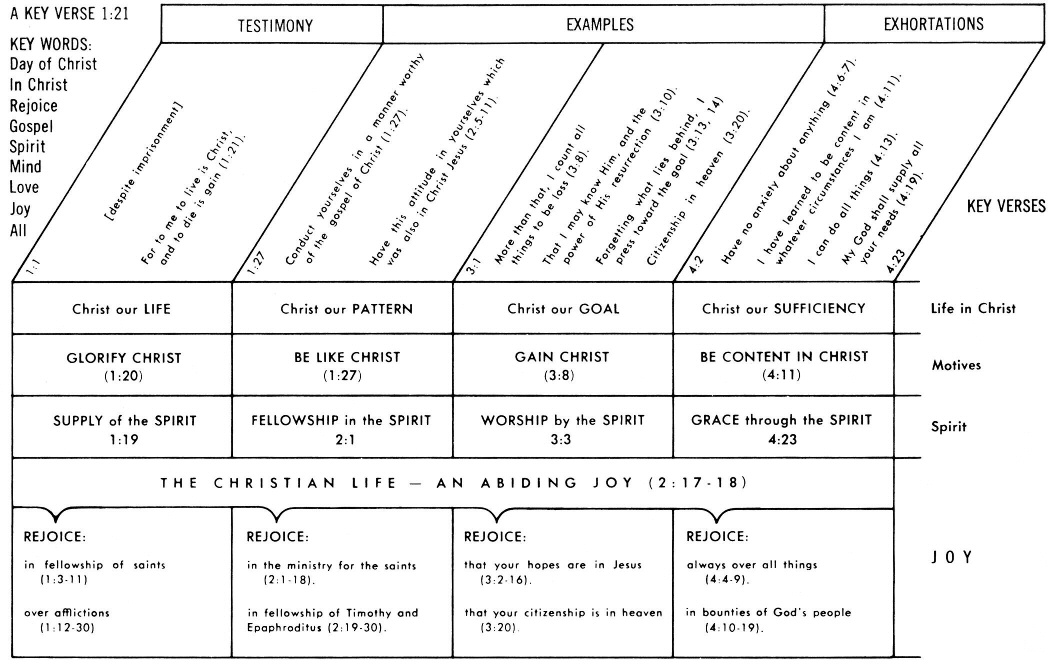
LIFE IN CHRIST
Click chart to enlarge
Charts from Jensen's Survey of the NT - used by permission
Philippians - Charles Swindoll = Chart on right side of page
| Account of Paul's Circumstances Php 1:1-30 |
Have the Mind of Christ Php 2:1-30 |
Have the Knowledge of Christ Php 3:1-21 |
Have |
| Partakers of Christ | People of Christ | Pursuit of Christ | Power of Christ |
| Suffering | Submission | Salvation | Sanctification |
| Experience | Examples | Exhortation | |

Philippi in the Time of Paul
The city plan above shows those features of the city of Philippi that archaeologists have so far identified as dating from the time of Paul. “Paul’s Prison” is not believed to be an authentic site, but was a cistern later associated with Christian worship. (ESV.org)
Philippians 1:18. What then? Only that in every way, whether in pretense or in truth, Christ is proclaimed and in this I rejoice . Yes, and I will rejoice (NASB: Lockman)
Greek: ti gar? plen hoti panti tropo, eite prophasei eite aletheia|, Christos kataggelletai, (3SPPI) kai en touto chairo (1SPAI) alla kai charesomai, (1SFPI)
Amplified: But what does it matter, so long as either way, whether in pretense [for personal ends] or in all honesty [for the furtherance of the Truth], Christ is being proclaimed? And in that I [now] rejoice, yes, and I shall rejoice [hereafter] also. (Amplified Bible - Lockman)
KJV: What then? notwithstanding, every way, whether in pretence, or in truth, Christ is preached; and I therein do rejoice, yea, and will rejoice.
NIV: But what does it matter? The important thing is that in every way, whether from false motives or true, Christ is preached. And because of this I rejoice. Yes, and I will continue to rejoice, (NIV - IBS)
NLT: But whether or not their motives are pure, the fact remains that the message about Christ is being preached, so I rejoice. And I will continue to rejoice. (NLT - Tyndale House)
Phillips: But what does it matter? However they may look at it, the fact remains that Christ is being preached, whether sincerely or not, and that fact makes me very happy. Yes, and I shall go on being very happy (Phillips: Touchstone)
Wuest: What is my feeling in view of these things? (Supposing they do purpose to make my chain gall me). The only thing that follows is that in every manner whether in pretense or in truth, whether insincerely or sincerely, Christ is being announced; and in this I am rejoicing, and certainly I will continue to rejoice." (Eerdmans Publishing - used by permission)
Young's Literal: what then? in every way, whether in pretence or in truth, Christ is proclaimed -- and in this I rejoice, yea, and shall rejoice.
What then? Only that in every way, whether in pretense or in truth, Christ is proclaimed: ti gar? hoti panti tropo, eite prophasei eite aletheia|, Christos kataggelletai, (3SPPI):
- Ro 3:9; 6:15; 1 Co 10:19; 14:15
- Phil 1:14, 15, 16, 17; Mt 23:14; Mk 12:40
- Mk 9:38, 39, 40; Lk 9:45, 9:50; 1Cor 15:11; 2Jn 1:9, 1:10, 1:11
THE SUMMUN BONUM:
CHRIST IS BEING PROCLAIMED
What then? - In chains and irritated by the annoying petty preachers, Paul could easily have said "Why me Lord?" Instead he says "What does it matter as long as Christ is preached." The NIV gives us a good sense of Paul's reaction - "But what does it matter? The important thing is that in every way, whether from false motives or true, Christ is preached." (Phi 1:18NIV)
Such being the case, how does it affect me? This essential thing Paul sees in spite of all their envy and selfishness is that Christ is openly publicly proclaimed. Paul's attitude towards his persecutors indicates he was more concerned with the salvation of the lost than with vindication for himself.
Paul is not concerned about vindicating himself or being vindictive to the petty preachers. In showing us this attitude he gives us a perfect example of Php 2:4-note "do not merely look out for your own personal interests, but also for the interests of others." The "others" he was looking out for were those lost souls who had never heard the Gospel preached and were at least hearing it from these men with sorry motives but a sound message! This is the same attitude we find in Jesus in Php 2:5-8 where He laid down His holy privileges that men might be redeemed.
Only that in every way whether - While some commentaries suggest the petty, exploitative preachers were preaching another Gospel, Paul says here that "Christ is proclaimed." He would hardly say that about preachers who were adding legalistic rituals, etc (e.g., like the Judaizers) to the Good News. No, it was not that their message was bad, but that their motive was bad!
- Php 1:18b-20 - Paul's conviction that whatever the future holds he will not be deprived of joy, because Christ would be exalted in him.
- Php 1:21-26 - Paul's reason for his perspective and what he believes the outcome of his circumstances
Gene Getz's outline of Phil 1:18b-26
A. Paul's Hope - Php 1:18b-20
1. His source of hope
a. The prayers of the Philippians
b. The Holy Spirit
c. God's faithfulness in the past
2. His hope explained
a. I will be delivered - Php 1:19
b. I will not be ashamed - Php 1:20
c. I will have sufficient courage - Php 1:20
d. I will exalt Christ in my body - Php 1:20b
B. Paul's Struggle - Php 1:21-23
1. To live is Christ
2. To die is gain
C. Paul's Decision - Php 1:24-26
1. I will remain
2. I will minister to you
Rod Mattoon
- Php 1:19 - Dependence on God
- Php 1:20 - Decision for God
- Php 1:20-26 Dedication of Paul
Application of Php 1:18b-26
Why does he rejoice? With eyes of faith Paul sees worldly obstacles as divine opportunities - seeing God’s purposes in his problems, (Ed: Fixing his eyes on Jesus), by making the Gospel his goal, by giving courage to other Christians and by making sure the message of Christ is all that matters.
Php 1:19a - Use the Power of Prayer - It gave Paul joy to know others were praying for him. He was not shy to ask for prayer (1 Th 5:25, 2 Th 3:1). Note that in 2 Th 3:1 Paul linked prayer with the spread of the Gospel as he did in Eph 6:19-20.
Php 1:19b - Rely on the Provision of the Holy Spirit -
In pretense or in truth - "Whether sincerely or insincerely." (Wuest).
Frank Thielman - God can use unscrupulous televangelists, money-grubbing radio preachers, and sophisticated but unbelieving clergy to communicate his truth. The work is God’s, and when we find ourselves surrounded by unfaithful people of the church who do not respond to our pleas that they mend their ways, our joy will remain intact if we remember that God is in control and that wherever Christ is preached, God can advance the gospel. (NIV Application Commentary)
HCSB Note - Paul accepted the message and work of both groups. Trusting God's sovereignty, he refused to condemn improper motivations as long as, in the end result, Christ was proclaimed.
Pretense (4392) (prophasis from prophaíno = to appear before, be apparent <> pró = before + phaíno = to appear, to shine before) (Click word study on prophasis) refers to an ostensible presentation with an ulterior (Ulterior = going beyond what is openly said or shown and especially what is proper) motive which is often untrue.
Pretense refers to that which is professed rather than that which is one's heart intention or purpose. the act of giving a false appearance. an artful or simulated semblance. A false display; affectation. Pretending or feigning; make-believe. A false show of something.
Prophasis is an outward show or appearance, a pretense or pretext designed to cover one's real intent. Pretext is defined as the purpose or motive alleged or an appearance assumed in order to cloak the real intention or state of affairs and suggests subterfuge and the offering of false reasons or motives in excuse or explanation.
The detractor's proclamation of Christ was from impure motives, but God would one day judge these motives
Therefore do not go on passing judgment before the time, but wait until the Lord comes who will both bring to light the things hidden in the darkness and disclose the motives of men’s hearts; and then each man’s praise will come to him from God. (1 Cor 4:5).
A selfishly motivated preacher can still be used of God, though not as much as he could be otherwise. What God uses is not so much the preacher as the message The power of the Gospel is more powerful than the package it comes in.
Note that the emphasis is on preaching Christ but if one deviates from that teaching John warns us that
"Anyone who goes too far and does not abide in the teaching of Christ, does not have God. The one who abides in the teaching, he has both the Father and the Son. If anyone comes to you and does not bring this teaching, do not receive him into your house, and do not give him a greeting." (2Jn 1:9, 1:10)
Petty messengers do not void a powerful message! The Gospel has intrinsic power. Romans 1:16 "I am not ashamed of the Gospel, for it is the POWER OF GOD (the dynamis of God) for salvation to everyone who believes to the Jew first and also to the Greek." The Gospel is dependent on God's power not our polished presentation! This should encourage you if you are timid or feel inadequate to speak the Gospel - you may not be the most eloquent speaker, but God is not looking for Gospel messengers with ability but with availability. We are to speak the simple, but powerful message that Jesus died for our sins, was buried, was raised on the third day. That's the Gospel in brief. If you speak that in your causal conversation, don't worry about how eloquent you were, but take heart that God's Word especially the Gospel does not return void without accomplishing what He intended. We are just a bunch of farmers, casting seed into the soil. Paul said "I sowed, Apollos watered, but it was God Who gives the growth." Be faithful to speak the Gospel and you will be fruitful.
Dwight Edwards - What Paul's attention was riveted upon is described in the rest of this verse:
(1) THE LAMP NOT BE PUT UNDER A BASKET (Mt 5:15) "that in nothing I shall be ashamed."
(2) THE LAMP BE PUT ON A LAMPSTAND THAT IT MAY GIVE LIGHT TO ALL WHO ARE IN THE HOUSE (Mt 5:15) "but that with all boldness (parreesia--'openness') as always, so now also Christ will be magnified in my body whether by life or by death."
Paul's passion in life can be well summed up from this verse: ALL OF CHRIST THROUGH ALL OF ME AT ALL TIMES IN ALL CIRCUMSTANCES. Note what the purpose of the lavish supply of Christ's Spirit is for--the magnifying (lit.- enlarging) of Himself. God only funds His own projects!
Christ (5547)(Christos from chrio = to rub or anoint, consecrate to an office) means one who has been anointed, symbolizing appointment to a task. The majority of the NT uses refer to Jesus (exceptions = "false Christs" - Mt 24:24, Mk 13:22).
Being proclaimed (present tense = continually) (2605) (kataggello from kata = an intensifier, down + aggelos = messenger and aggello = to declare, report) literally means to "declare down". It means to announce, to make known in public plainly, openly and loudly! It was used of religious messages and conveyed the sense of a solemn proclamation (Acts 4:2)
What does it mean Christ was being proclaimed? - Luke gives us a good answer in Acts 4:33 writing
And with great power (dunamis - enabled by the Spirit - Acts 1:8-note) the apostles were giving testimony to the resurrection of the Lord Jesus, and abundant grace was upon them all.
And in this I rejoice . Yes, and I will rejoice: kai en touto chairo (1SPAI) alla kai charesomai (1SFPI):
REJOICING OVER
THE PAST AND THE FUTURE
And in this I rejoice - In what? "In this" refers to Paul's rejoicing despite the fact that some preachers had mixed motives, Christ was being proclaimed! When the exaltation of Christ and His Gospel is your focus, the things of this world grow strangely dim in the light of His glory and grace!
Paul was able to minister so powerfully horizontally (manward), because he continually maintained his "vertical vision" (see discussion of Vertical Vision). Like any good teacher, Paul modeled what he commanded (see Col 3:1, 2-note). Where is your focus most of the week - on Christ or on your circumstances? Where your focus is will radically impact your response to trials and afflictions.
Corrie Ten Boom said it this way "Look around and be distressed. Look inside and be depressed. Look at Jesus (our Joy) and be at rest." Indeed the writer of Hebrews exhorts us to continually "fix (present tense and see word picture of this great verb aphorao) our eyes on Jesus" (Heb 12:2-note), for outside of Him, there is no true JOY (J.O.Y. - "Jesus Others Yourself)!
Paul did not rejoice because there was a faction among members of Christ’s body, for this brought him grief. He rejoiced because Christ was proclaimed.
Gordon Fee on rejoice - For Paul, as for the rest of the NT in general, the presence or absence of joy is quite unrelated to one’s circumstances, as Paul’s letter to the Philippians makes plain. It is related in its entirety to what God has done for us in Christ through the Spirit. The Pauline imperative, stemming from joy as the fruit of the Spirit, is not simply, “rejoice”—although it often comes in that basic form as well—but “rejoice in the Lord.” This focus is the key to our understanding the joy of the Spirit. A community that is “rejoicing in the Lord always” is not a community easily given to “eating and devouring one another” (Gal 5:15), in which people think much too highly of themselves (Gal 6:4). (The Empowering Presence of the Holy Spirit in the Letters of Paul).
Theilman - PAUL’S REPORT ON his own circumstances continues in Phil 1:18b–26 by turning to the future. He not only rejoices to see God at work in his present circumstances to advance the Gospel, but he “will continue to rejoice” as God’s faithfulness perseveres into whatever circumstances await him. (NIV Application Commentary)
Warren Wiersbe says "The secret of his joy is the single mind; he lives for Christ and the Gospel. (Christ is named eighteen times in Philippians 1, and the Gospel is mentioned six times.) “For to me to live is Christ, and to die is gain” (Phil. 1:21). But what really is “the single mind”? It is the attitude that says, “It makes no difference what happens to me, just as long as Christ is glorified and the Gospel shared with others.” Paul rejoiced in spite of his circumstances, because his circumstances strengthened the fellowship of the Gospel (Phil. 1:1–11), promoted the furtherance of the Gospel (Phil. 1:12–26), and guarded the faith of the Gospel (Phil. 1:27–30)." (Bible Exposition Commentary)
J Ligon Duncan - whether in pretense or in truth, Christ is proclaimed, in this I rejoice.’ Why? Because as far as Paul is concerned it's not about him, it's about Christ. It's not about Paul being first, Paul gaining fame. It's about Christ. (Ed: Think of the little neumonic for "joy" - J.O.Y. = Jesus Others Yourselves.)
John MacArthur writes that "One of the surest measures of a Christian’s spiritual maturity is what it takes to rob him of his Spirit-bestowed joy. (Ed: This begs the question brother or sister in Christ - how is your joy as you read this note?) Paul’s maturity is evident in the present text as he makes it clear that difficult, unpleasant, painful, even life-threatening circumstances did not rob him of joy but rather caused it to increase. Although it is a gift from God to every believer and administered by the Holy Spirit (Gal. 5:22), joy is not always constant and full (cf. 1 John 1:4). The only certain cause for loss of joy in a believer’s life is sin, which corrupts his fellowship with the Lord, who is the source of joy. Such sinful attitudes as dissatisfaction, bitterness, sullenness, doubt, fear, and negativism cause joy to be forfeited. Consequently, the only way to restore lost joy is to repent and return to proper worship of and obedience to God. Anything other than sin—no matter how difficult, painful, or disappointing—need not take away the believer’s joy. Yet even minor things can do so if believers react sinfully to them. A change for the worse in health, job, finances, personal relationships, or other important areas of life can easily cause believers to question the Lord, His sovereign wisdom, and His gracious provision. When that happens, joy is one of the first casualties. Believers are especially vulnerable when such things happen suddenly, taking them off guard. Their response is often one of anger, doubt, distrust, fear, self-pity, ingratitude, or complaining. In such cases, events that are not sinful in themselves lead to sinful responses that steal joy....Although he was not writing this epistle from a dungeon but a private residence (Acts 28:16, 30), Paul was chained night and day to a Roman soldier. He had no privacy when he ate, when he slept, when he wrote, when he prayed, or when he preached, taught, or visited with friends (Acts 28:17–31). Yet for a period of two years this very lack of privacy made it impossible for the Roman soldiers guarding him to avoid hearing the gospel and witnessing Paul’s remarkable Christlikeness.
Bob Deffinbaugh applies the truth in this section - How does Paul respond to this underhanded attack from those who know Christ, and who successfully preach Christ? Most of us would be greatly distressed, and perhaps even depressed by this kind of betrayal and opposition. We would probably spend a great deal of time and effort defending ourselves and exposing our opponents. Paul is not disposed to do this. He rejoices. He knows that God is in control. He knows that God will not allow the gospel to be defeated, whether that be by unbelievers who oppose it (for example, the unbelieving Jews who charged Paul with treason against Rome) or by those who profess and proclaim it (such as those who preached Christ with impure motives). He knew that while these folks “meant it for evil,” God “meant it for good” (see Genesis 50:20). Unbelievers were not deceived; they knew that the issue behind Paul’s imprisonment was really the gospel. And regardless of their motivation, the gospel of Jesus Christ was being vigorously proclaimed. Paul was resolved to rejoice in the success of the gospel, even if it was at his expense......let us learn from our text that Paul did not allow adversity to rob him of his joy in the Lord. There are times in my own life when I realize that I am “down in the dumps,” discouraged or depressed. And when I seek to discover the source of my lack of joy, I often find that it is caused by some rather trivial matter. In Paul’s case, it was no trivial matter that brought about his incarceration; he was falsely accused by his unbelieving Jewish opponents, and even by fellow-saints. One might think that Paul had good reason to be discouraged, but he was not! Paul was deeply joyful and resolutely determined to continue to be so. He would not allow his circumstances to rob him of his joy. How can this be? How can Paul remain joyful in such adversity? It all boils down to Paul’s priorities. What is it that Paul most desires, and in which he finds his delight? It is the advance of the gospel, even if that requires sacrifice and suffering on his part. Paul’s joy is not in being popular and being considered a great leader; it is in the proclamation of the gospel, the salvation of lost souls, and the growth of Christians. The secret to Paul’s joy was having the right goal. Let me illustrate. Suppose that a man plays a game of golf with his friends, and after 18 holes of golf learns that this round of golf resulted in the worst score of his life. If this man’s goal was “winning,” then he would go home discouraged and disappointed, because he failed to achieve his goal. But suppose that this man’s goal was to enjoy the companionship of his golfing partners or to share the gospel with them. If this man achieved his goal, then it would not matter to him whether he won or lost the game. In fact, if doing poorly provided an opening for him to share his faith, he would rejoice in his failure. This is the way it was with Paul. His goal was not to be admired by everyone or to achieve great fame. He goal was not to live a life of freedom and self-indulgence. His goal was to proclaim the gospel to as many lost sinners as possible. His goal, as indicated by God at the time of his conversion, was to preach the gospel to Gentile kings, as well as to the Jews (see Acts 9:15). That goal was being achieved at the expense of his ease and freedom and self-indulgence, but it was being achieved. Paul was filled with joy in our text because the gospel was being proclaimed, and lost sinners were being saved. Paul gladly sacrificed his “image” as well as his comfort for the cause of the gospel. Put differently, Paul would not be robbed of his joy because he looked at his life and ministry as his Savior did. In short, Paul had “the mind of Christ.” As we shall soon read in Philippians 2, our Lord was willing to set aside the pleasures of living in the presence of His Father in heaven, so that lost sinners might be saved. As our Lord was willing to suffer, that men might be saved, so was the Apostle Paul. And as the salvation of lost sinners brings joy to our Lord, even though it was at great personal sacrifice to the Savior, so it was with Paul. Thanks to a friend, I came across this quotation by Jean Nicolas Grou (1731-1803): “The chief pang of most trials is not so much the actual suffering itself as our own spirit of resistance to it.” I believe it would be proper to turn this excellent statement around, in a way that would explain the joy of the apostle Paul: “The Christian’s joy in the midst of trials is not to be found in the suffering itself (which would be mere masochism), but in the privilege of taking part in the good ends God has foreordained to come about through these trials.” (Paul's Perspective on Pain and Pettiness - Phil 1:12-18)
I rejoice looks backward at the circumstances (including the spread of the Gospel in the Roman elite troops, the increased courage of the saints in Rome and the petty preachers) and he is able to rejoice because Christ is continually being proclaimed.
I will rejoice looks to the future and proceeds to give the reason he will continue to rejoice - in sum, all that happened to him will result in his deliverance.
I rejoice...will rejoice (5463) (chairo a primary verb) (Click word study of related word chara = joy) means to to feel joy or great delight. Note that rejoice is in the present tense indicating Paul was continually rejoicing. Rejoicing is not a natural reaction to suffering circumstances (jail) or when one gets news of petty preachers even seeking to harm you, but is only possible supernaturally. So again we see that although not specifically mentioned in the text, Paul is clearly filled with the Holy Spirit (Eph 5:18-note) Who is continually empowering a joyful response in Paul spite of his negative circumstances and critical competition! And to support the conclusion that Paul is a Spirit filled prisoner, Gal 5:22 makes it clear that joy is the fruit of the Spirit. Note also that I rejoice is in the active voice indicating it is a choice of his will to rejoice. Paul was 100% responsible to rejoice, but he was 100% dependent on the Spirit to enable him to rejoice continually (cf 1 Th 5:16-note). 100% and 100% is not good math but it is good theology! Are you really confused now? Let me encourage you to take and moment and read the rationale in the section entitled the "Paradoxical Principle of 100% Dependent and 100% Responsible."
Rejoice gives us a great word picture for it was used to describe a little lamb skipping around with joy. Rejoice describes a physical change in your countenance as an expression of inner transformation. You can't fake a joyful face. Not really! It is a physical expression of joy and something that radiates to people around you. You can walk around and say that you are rejoicing but if it's not seen in your face, then you are not rejoicing.
Notice how Paul interweaves "joy" or "rejoice" through all 4 chapters (Click for all 12v)
Robertson adds that the second "rejoice" is "volitive (i.e., involves a choice of one's will) use of the future indicative. Paul is determined to rejoice in spite of the efforts of the (opponents) to prod him to anger.
Paul didn't allow his circumstances to steal his joy and this is a lesson we all need to learn. To Paul what mattered most was that the truth of Christ was proclaimed and thus he made the Spirit enabled, volitional choice to rejoice, all the while learning how to be content in whatever circumstances he was in (Phil 4:11-13-note). Here we see that Paul would rejoice even if what motivated their proclamation of Christ was a desire to attack him. Paul's detractors preached the true Gospel, and it had an impact not because of the petty messenger but because of the powerful message for the "Gospel is the power of God (not of wrongly motivated men) for salvation to everyone who believes. (Ro 1:16-note)
A good example to emulate but remember don't try this in your own strength but "allow yourself to be continually strengthened by the grace (sanctifying power to do supernaturally what I cannot do naturally) that is in Christ Jesus (2 Ti 2:1-note)
As Paul explained you will come to learn the secret that you "can do all things through Him who (present tense = continually) strengthens your heart and mind. (Philippians 4:13-note)
Paul wasn't concerned about himself because he knew he was expendable (cf Php 2:3-4-note). He also knew that God was his covenant defender and would vindicate him in due time for He Himself has said "VENGEANCE IS MINE, I WILL REPAY." (Ro 12:19-note). Paul was free to rejoice in the proclamation of the Gospel, however base the motives of those proclaiming Christ the Lord. At least, they weren't preaching Buddha or some false god, but Christ.
Joy in the Letter to the Philippians - "joy" or "rejoice" occurs all 4 chapters
- 7 uses of chairo = rejoice Phil. 1:18; Phil. 2:17; Phil. 2:18; Phil. 2:28; Phil. 3:1; Phil. 4:4; Phil. 4:10;
- 5 uses of chara = joy Phil. 1:4; Phil. 1:25; Phil. 2:2; Phil. 2:29; Phil. 4:1
- 2 uses of sugchairo = rejoice with Phil 2:17, 18
Paul lived to see the Gospel proclaimed--he didn't care who received the credit. That should be the attitude of every pastor, teacher, elder, deacon, leader, and layperson in the body of Christ. In all that he suffered Paul didn't quit, lash out, break down, or lose his joy. That's because the cause of Christ was being furthered and His name proclaimed. The truth about Lord Jesus was all he cared about. How could he manifest such an attitude? As alluded to above, it is only possible by reliance on the One Who said
My grace (transforming power, power to live a supernatural life) is sufficient (enough) for you, for (My) power (inherent ability) is perfected (made complete, brought to its intended goal) in (your) weakness (the way "up" in Christianity is "down"!) (2Co 12:9-note, 2 Co 12:10-note)
Trials (chains) and slander (people seeking to cause us distress) cannot be handled in our flesh (our flesh will respond defensively!), but only when we are filled with (controlled by) the Spirit Who Alone can bring forth the fruit of joy even in the most adverse conditions or awful people. Who are you relying on today to give you the strength to forbear and bear up under when treated unjustly especially if it's someone in your own church?
When faced with difficult circumstances remember Nehemiah's exhortation
"Do not be grieved, for the joy of the LORD is your strength." (Neh 8:10 and the result Neh 8:12) (Torrey's Topic "Joy")
Bad circumstances increase (or mature) the joy of those who respond biblically because these afflictions lead to a deeper trust in the sovereignty of Almighty God. Joy derived from circumstances is fleeting, but joy derived from the Spirit of Christ is lasting. Paul refused to be downcast by the wrong motives of some. Paul’s joy was not tied to his circumstances or his critics but was from the LORD (cf. Ps 4:7, 8; Ro 12:12 [note]; 2 Cor 6:10).
CHEERING THE ADVANCE OF THE CAUSE - Joe Stowell - One thing we have to get over if we are going to honor Christ in our work is our competitive spirit. The goal of serving Him is to advance His cause, not our reputation or ministry.
One Easter Sunday, a church across town decided to set a record attendance by having a “Friends Day” and throwing an Easter egg roll on their front lawn for all the kids who came. To be candid, I felt a sense of competition with this particular church and was quietly critical of its approach to ministry.
What really bothered me was the fact that many of the friends their people called to invite to their service were members of our church. My heart was reproved by Paul’s attitude in Philippians 1:18, where he spoke about others who were more successful than he, even though the motivation for their ministry was competitive and less than pure.
A woman in our church came to me one Sunday evening in great frustration as she blurted out, “Pastor, do you know how many they had at Temple Baptist Church this morning? They had more than fifteen hundred there, and many of them were our own people. I don’t think that’s right or fair, do you?” It was a test of my motives. I wish I could always be this on target, but thankfully the Word had done a remedial work on my carnal perspectives and I found myself saying, “Are you telling me that more than fifteen hundred people in our town heard the gospel of Jesus Christ this morning? Isn’t that the best news you’ve heard in a long time?” She was stunned and verbally backpedaled to “Well . . . well . . . yes, I guess it is.”
When our focus is on the glory of Christ and the gain of His kingdom, it doesn’t make a whole lot of difference who facilitates the goal. If Jesus is lifted up, our hearts should rejoice—unless we think our life and ministry are all about us.
Are you a competitor with other Christians or a colleague in the cause? Do you rejoice when they succeed? (Strength for the Journey)
ILLUSTRATION - A missionary in Africa writes: "I have dwelt four years alone in Africa, have been thirty times stricken with fever, have been attacked by rhinoceri and lions, have been ambushed by natives, have eaten everything from ants to rhinoceri, but I would gladly go through the same experience again for the joy of teaching these people to know the Saviour who gave His life a ransom for them."
What's Your Motive? (READ: 1 Corinthians 1:1-17) In every way, whether in pretense or in truth, Christ is preached. --Philippians 1:18
Burt Gutras is a communications technician who fine-tunes aviation electronic equipment. But his passion is volunteering for the Smith County Amateur Radio Emergency Service (SCARES). He provides indispensable communication when police are searching for missing persons. Burt's comments reflect his selflessness: "In the case of missing persons--and it happens more often than people realize--we go out hoping that we can find them before something bad happens. Whether you find them yourself is not important. The important thing is that they are found."
Is that our attitude toward lost sinners? Do we pray for other believers who use different methods than ours to rescue the lost? Are we free from feelings of rivalry or jealousy? Or are we so prejudiced in favor of our own rescue team that we would rather have people remain alienated from God than be brought to Him through the efforts of others?
Paul expressed his great concern over the competing factions he saw in the body of Christ (1Cor. 1:11, 12, 13). He wanted the Corinthians to be united so that the message of the cross of Christ could go out unhindered.
Let's ask the Holy Spirit to give us an unselfish attitude. Our motives should be as pure as our goal. — Vernon C. Grounds (Our Daily Bread, Copyright RBC Ministries, Grand Rapids, MI. Reprinted by permission. All rights reserved)
Like a mighty army moves the church of God;
Brothers, we are treading where the saints have trod.
We are not divided, all one body we--
One in hope and doctrine, one in charity.
-Baring-Gould
He who is not against us is on our side. - Jesus (Luke 9:50)
Church Competition: Three churches, located on different corners of the same intersection, didn't get along together. One Sunday each of them opened their meeting with a rousing song service. It was a warm day and all the doors and windows were wide open. One congregation began singing the old hymn, "Will There Be Any Stars in My Crown?" The strains had barely faded away when the congregation across the street started singing, "No, Not One, No, Not One!" They had scarcely finished when the third church began singing, "Oh, That Will Be Glory for Me."
Of course, this is just a humorous story, but it reminds us that a spirit of divisive competition does exist among some churches. Naturally, we will want to support our own church, pray for it, and rejoice in its growth. But we must never feel self-satisfied or be critical of churches that have problems or are not growing. If there is a place for "competition", let it be to oppose those who deny scriptural fundamentals and the Gospel. But if a church is true to God's Word and is winning people to Christ, regardless of its label, let's rejoice. That should be our attitude when faced with the competitive motives of envy and strife. Let's avoid church competition. - R De Haan (Our Daily Bread, Copyright RBC Ministries, Grand Rapids, MI. Reprinted by permission. All rights reserved)
Christ is made the sure Foundation,
Christ the Head and Cornerstone;
Chosen of the Lord and precious,
Binding all the church in one.
-- Neale
The fruit of Christian unity
grows out of our union with Christ
Philippians 1:19. for I know that this will turn out for my deliverance through your prayers and the provision of the Spirit of Jesus Christ (NASB: Lockman)
Greek: oida (1SRAI) gar hoti touto moi apobesetai (3SFMI) eis soterian dia tes humon deeseos kai epichoregias tou pneumatos Iesou Christou,
Amplified: For I am well assured and indeed know that through your prayers and a bountiful supply of the Spirit of Jesus Christ (the Messiah) this will turn out for my preservation (for the spiritual health and welfare of my own soul) and avail toward the saving work of the Gospel. (Amplified Bible - Lockman)
KJV: For I know that this shall turn to my salvation through your prayer, and the supply of the Spirit of Jesus Christ,
NIV: 1for I know that through your prayers and the help given by the Spirit of Jesus Christ, what has happened to me will turn out for my deliverance. (NIV - IBS)
NLT: For I know that as you pray for me and as the Spirit of Jesus Christ helps me, this will all turn out for my deliverance. (NLT - Tyndale House)
Phillips: for I know that what is happening will be for the good of my own soul, thanks to your prayers and the resources of the spirit of Jesus Christ. (Phillips: Touchstone)
Wuest: For I know positively that this [the fact that Christ is being proclaimed] shall result in deliverance and preservation for me [lest I become discouraged in and because of my imprisonment which restricts my opportunity to proclaim the good news] through your petition and through the full-proportioned support and aid of the Spirit of Jesus Christ. (Eerdmans Publishing - used by permission)
Young's Literal: For I have known that this shall fall out to me for salvation, through your supplication, and the supply of the Spirit of Christ Jesus,
For I know that this will turn out for my deliverance: oida (1SRAI) gar hoti touto moi apobesetai (3SFMI) eis soterian :
- Ro 8:28; 2Cor 4:17 18 1Pet 1:7-8
PAUL'S CONFIDENCE IN
FUTURE DELIVERANCE
For (1063) (gar) is a conjunction introducing an explanation and here explains why Paul can "doubly" rejoice in Phil 1:18. The ground for Paul's rejoicing is a sure knowledge (eido/oida) that he will be vindicated. Paul was absolutely certain that fetters would one day give way to freedom (one way or another) on earth and/or in heaven! See importance of pausing to ponder this strategic term of explanation. As an aside, Paul was not surprised by his imprisonment for the sake of the Gospel, for he knew that he had been "appointed for the defense of the Gospel." (Phil 1:16) and "For this reason I also suffer these things" (2Ti 1:12) adding that "according to my gospel...I suffer hardship even to imprisonment as a criminal; but the word of God is not imprisoned." (2ti 2:8-9)
THOUGHT - In simple terms for is a term of explanation and its occurrence should always prompt one to pause and ponder the text and context, always asking at least one 5W/H question "What is the text explaining?" which will force you to examine the preceding passages, which in turn will hone or refine your skill of observation and help you establish thte context, which will lead to a more accurate Interpretation, which is essential for valid Application of the text.
While not every "for" in the Bible is a term of explanation, most are and since there are over 7500 uses of for (NAS), you will have ample opportunity to observe and interrogate the text. Two clues that the for is a term of explanation - (1) It is at the beginning of the sentence or clause or (2) you can substitute the word "because" and it makes good sense. As you practice this discipline of pausing to ponder, you are establishing the context (which leads to more accurate interpretation and thus more apropos application) and you are in effect engaging in the blessed activity of Biblical Meditation (See Ps 1:2+, Ps 1:3+ and Joshua 1:8+ for the blessed benefits of meditation = I like to call it a "mini-meditation".).
Dwight Edwards - "For" connects back to the immediately proceeding statement--."yes, and I will rejoice. (18b) It seems that this statement is also what Paul is referring to by "this." Thus he is saying that his resolve to continue rejoicing regardless of circumstances ("I will rejoice" is not a prophetic prediction, but a personal resolve) will be one of the factors that will lead to his "salvation" or "deliverance."
Mattoon on know - Whatever good or evil came to Paul, his hope remained the same. The reasons for his steadfastness was God-given knowledge. This is the security of the Scriptures. The word "know" that Paul uses here means "to know with certainty." There are some things, however, we don't know. Matthew 24:42, Romans 8:26.
I Know (I know positively = he has no doubt!) (1492) (eido/oida) speaks of a knowledge which is beyond a doubt. Paul is asserting what to him is an absolute knowledge. “I know this. It is certain and unequivocal." One reason Paul knew this is he knew Ro 8:28 and that his present circumstances would "work together for good!"
It is in the perfect tense which refers to Paul's firmly settled conviction ("I am well assured and indeed know" = Amplified) and certainty that his present trials would turn out for his good because he knew the truths he himself had recorded such as....
"God causes all things to work together for good to those who love God, to those who are called according to His purpose" (Ro 8:28-note, cp the OT "version" = Ge 50:20) and that
"momentary, light affliction is producing for us an eternal weight of glory far beyond all comparison... for the things which are seen are temporal, but the things which are not seen are eternal." (2Cor 4:17-note; 2Cor 4:18-note)
"For this reason (2 Ti 1:11) I also suffer these things, but I am not ashamed; for I know (eido/oida) whom I have believed and I am convinced that He is able to guard what I have entrusted to Him until that day. (2 Ti 1:12)
Paul pondered present predicaments in light of his hope in the glory of God, for he knew
"that the sufferings of this present time are not worthy to be compared with the glory that is to be revealed to us." (Ro 8:18-note)
This - To what does this refer? This could refer to the things that had happened to Paul as described in Phil 1:12-18. "The present circumstance - the present trouble, the chains, the detractors, the imprisonment, all of the difficulties, adversities in his life and ministry, the whole scenario, the whole thing he's going through." (MacArthur)
Mattoon on this - The "this" in Philippians 1:19 is one of the "all things" in Romans 8:28. Paul knew that for him, everything would turn out for the best.
O'Brien says this (touto) "in our context, refers to what Paul has spoken of in the recent past (ta kat eme, "my circumstances" - Phil 1:12, rather than the immediately preceding touto Phil 1:18), especially those conditions of his imprisonment and trial which contributed to the proclamation of Christ. But more particularly the ominous future developments are implied, such as a court decision leading either to release or execution, during which he will still be responsible for honoring Christ (Phil 1:20)." (New International Greek Testament Commentary)
Wuest says "The word “this” refers to the fact that Christ is being more widely announced as a result of Paul’s imprisonment."(Wuest Word Studies - Eerdman Publishing Company Volume 1, Volume 2, Volume 3 - used by permission)
Vincent says this refers to "This preaching of Christ in every way."
New American Commentary - A significant question to answer in 1:19 is the reference to “this” (“this shall result in my salvation”). The NIV translates “what has happened to me.” The pronoun must look to the mixed preaching of the Christians at Rome (whether in pretense or the truth Php 1:18). In that way, many brought their accusations against Paul and his righteousness. Like Job, he would stand vindicated at last.
Will turn out (future tense)(apobaino from apó = from, out of, + baíno = to go, come) means literally to go away from (as to go away from a ship to the land, disembarking from a boat or ship when it comes to land) (Lk 5:2; Jn 21:9) and figuratively of a resultant state, meaning to turn out, to end up, to lead to (Lk 21:13; Phil 1:19; Ex. 2:4; Job 13:5, 16)
DELIVERANCE:
PHYSICAL OR SPIRITUAL?
The commentaries are divided. The ESV Study Note suggests Paul may be intentionally ambivalent - a term that could mean deliverance from prison (as some commentators understand it) or that could mean deliverance in the ultimate sense of eternal salvation (as others understand it). It seems likely that Paul intentionally left some ambiguity here, in light of the mention of his imprisonment in the preceding verses (see Php 1:12-14) and in light of the eternal focus in the verses that follow (e.g., Paul’s desire “to depart and be with Christ, which is far better”; Php 1:23). The tension between temporal deliverance and eternal salvation is, in fact, evident throughout this passage (Php 1:19-26), as evidenced by Paul’s words: “whether by life or by death” (in Php 1:20) and “I am hard pressed between the two” (in Php 1:23). Although Paul seems to have alluded to his temporal deliverance, clearly his longing for eternal salvation is “far better” (Php 1:23). In this regard, Paul alludes to Job 13:13-18 in this passage, where Job clearly speaks of his final destiny; and Paul speaks of his hope of not being ashamed, which is elsewhere related to the final judgment (cf. Ro 5:4-5). Either way, Paul wants the Philippians to know that even if his expected deliverance from prison fails to materialize, and he is executed, he will still be “saved” to eternal life by God.
Ryrie - Paul's trial had probably begun. He was confident that either release or death would advance the cause of Christ.
Brian Bill - The word “deliverance” can mean rescue from grave danger and can also refer to salvation. Whatever the precise meaning, Paul knew that what he was going through was just temporary. This is similar to what he wrote in 2 Corinthians 4:17-18: “For our light and momentary troubles are achieving for us an eternal glory that far outweighs them all. So we fix our eyes not on what is seen, but on what is unseen. For what is seen is temporary, but what is unseen is eternal.” Most commentators believe Paul was eventually released, traveled to Spain and then was arrested again before he was martyred (see 2 Timothy 4:16-17).
MacArthur summarizes Paul's possible meanings using soteria - Now what does he mean by “deliverance”? The word here is sōtēria, which is the word for salvation. And some of your Bibles may say "for my salvation." Well, what do you mean by that? Well, that word can be translated “salvation”; it can be translated “deliverance”; it can be translated “well-being”; it can be translated “escape.” What does it mean? Some say it means ultimate salvation. Some say he is simply saying, "I know that this present trouble is going to turn out for my eternal salvation, ultimately to be in the presence of the Lord, my soul salvation." He is confident that he will endure to the end and be fully, finally saved and glorified in the day of Christ, the day he sees Christ. Some say, “No, it means his health, his well- being, his welfare, his benefit - that I'm going to benefit from this, that my well-being will be secured.” Some say “vindication.” Some say it means “vindication.” Some commentators think he's saying that, “I'll be vindicated in court and that my trial, when it reaches its second phase” - the first phase had already been held when no one defended him, and he's waiting for the second phase, namely the sentence - that he's saying, “It’ll all work out for my vindication at my sentencing.” Others say it means his release from prison. Since the primary meaning is deliverance from death, that he's saying, “All of this that's going on is going to ultimately end up in my being released from prison.” Well, which of those is right? I would say that the truth is in all of those, and let me show you what I mean. It is in my judgment fair to include in one way or another the whole of all of those things which I mentioned to you in this sense. Paul believes - and here's the key thought; you need to get it - Paul believes that his current distress is only temporary. That's really what he's saying. It's temporary; that's the point. It isn't going to last. “I will be delivered from it. Maybe I'll be vindicated at my second phase of the trial. Maybe I will be released from prison. Maybe I will go to heaven to be with Jesus Christ, and therefore be delivered in the sense of ultimate salvation. Maybe my well-being will be at last the issue.” I don't think he knows. But what he is saying is, "I do know this that what I'm going through now is temporary, and the future holds my deliverance, whether it's vindication in court, release from prison, well-being, or eternal heaven - I'll be delivered out of this."(Sermon)
Steven Cole - The word “deliverance” is, literally, “salvation.” Some interpret this to mean that Paul was hopeful of being released from prison. But Phil 1:20 precludes this view, because Paul acknowledges that he may well be executed. Paul’s words in Php 1:19 are verbatim from the Greek Old Testament of Job 13:16. In that context, Job was on trial by his “friends,” and he wanted to be “saved” from being found to be a hypocrite, that is, he wanted to be vindicated. In the same way, Paul is saying that as the Philippians prayed for him and as God’s Spirit enabled him, he would be delivered from denying Christ and disgracing the gospel at his trial before Caesar. Thus he would be vindicated in the ultimate court, before God, by exalting Christ, even through martyrdom if need be. The only cause for shame to Paul would be not to hear “well done” from Christ when he stood before Him. (Philippians 1:19-26: What Are You Living For?)
Commentaries in favor of Spiritual (Eternal) Deliverance
O'Brien writes that in "Phil. 1:19 the apostle is not referring to his immediate acquittal and discharge from prison. Instead, his confident assertion (like Job’s) that his present state of affairs will work out for his salvation points to his vindication in the heavenly court (note the confidence of 2 Ti 4:8). This is certain whether ‘he receives a favorable or an unfavorable verdict before Caesar’s tribunal’. His soteria is his ultimate vindication, not some ‘deliverance’ from his present plight; consequently, he will not be ashamed whether he lives or dies (Phil 1:20–21)." (Ibid)
Kent Hughes - This is a notable assertion because Paul is not referring to physical deliverance. The word he uses here for “deliverance” is soterian, which is generally translated “salvation” and usually refers to the final deliverance of believers at the last judgment when they stand vindicated before God. Paul was confident of this ultimate deliverance, whatever Caesar decided to do with him. The same confidence was expressed from prison by Paul to Timothy at the end of his second letter to his young assistant: “The Lord will rescue me from every evil deed and bring me safely into his heavenly kingdom” (2 Timothy 4:18). Thus Paul was entirely confident in his ultimate deliverance. (Preaching the Word – Philippians, Colossians, and Philemon: The Fellowship of the Gospel and the Supremacy of Christ)
Commentaries in favor of Physical (Temporal) Deliverance
NET Note on deliverance - Or "salvation." Deliverance from prison (i.e., release) is probably what Paul has in view here, although some take this as a reference to his ultimate release from the body, i.e., dying and being with Christ (Php 1:23).
Criswell - "My deliverance" is used in the N.T. to refer not only to the spiritual salvation of the individual but also to self-preservation in a physical sense. Paul uses it here of his own temporal deliverance in which he visualizes something spiritual. "Deliverance" can either be his personal final salvation or his vindication in court and release from prison. The early church supplies information that would support the view that Paul was released soon after the writing of this letter.
In his last written communication Paul testified to the Lord's power to deliver (using a different word rhuomai, not soteria) writing that "the Lord stood with me, and strengthened me, in order that through me the proclamation might be fully accomplished, and that all the Gentiles might hear; and I was delivered (rhuomai) out of the lion's mouth. The Lord will deliver me (rhuomai - play the old Maranatha song He Will Deliver Me) from every evil deed, and will bring me safely to His heavenly kingdom; to Him be the glory forever and ever. Amen." (2Ti 4:17-18-note) Beloved, whatever prison, persecution, trial or affliction you are in today, rest assured that our Great Deliverer will deliver you in the final day -- so hold fast to Jesus our Deliverer (cf 1 Th 1:10-note).
Paul is quoting Job's reply to Zophar in the phrase "this will turn out for my deliverance" which is a word for word quote from the Septuagint (Greek translation of the Hebrew of Job 13:16 - Lxx = kai touto moi apobesetai eis soterian)
Job was a righteous man who suffered greatly, yet he was delivered because God always delivers the righteous. Job was convinced of his "deliverance" as he affirmed in (Job 19:26) declaring "Even after my skin is destroyed, yet from my flesh I shall see God". Job knew that either out of death or through death God would deliver him. Paul knew and trusted God's dealings with Job in the Old Testament and he knew he could trust Jehovah to deliver him even as He had Job. Like Job, Paul wasn't being chastened by God. He was confident his circumstances would work out for good whether he was released from prison, vindicated at his trial, delivered from execution, or passed into glory as a martyr for death to a believer is the ultimate most glorious deliverance. (meditate on these other OT verses on deliverance - Ps 22:4-5, 8; 31:1 33:18-19, 34:7 41:1).
Expositor's Bible Commentary adds "After Job had become a laughingstock because of his suffering and his friends turned into preachy pietists who turned away from him when he refused to accept their interpretation of his situation, Job remained confident that the heavenly court would reverse all human verdicts."
Peter O'Brien elaborates on Paul's quote from Job 13:16 - In words that correspond exactly to the LXX of Job 13:16 the apostle spells out the content (hoti means "because") of his firm conviction: ‘this will turn out for my salvation’. He has applied these words of Job to his own situation, not because they were vaguely or marginally parallel, but because he, like Job, is certain of his vindication. In the original context of this OT book Job 13:16 is part of Job’s response (Job 12:1–14:22) to his three friends, and this reply concludes the first round of speeches (Job 4:1–14:22). Job states that he is prepared to speak out no matter what the consequences (Job 13:13). Even though he was held in contempt for his misfortune (Job 12:4), Job looked confidently to his vindication by God. At Job 13:2 he bluntly stated to those who chastised him, ‘I am not inferior to you’, and declared that he would maintain his ways ‘even though he slays me’ (Job 13:15). Unlike the ‘godless man’ who would not dare come before God as he does, Job has prepared his case and asserts, ‘I know (oida ego) I will be vindicated’ (Job 13:18). This vindication is his ‘hope’ ("Though He slay me, I will hope in Him." = Job 13:15). (New International Greek Testament Commentary)
MacArthur - Paul was a scholar in Scripture. And obviously identified his own problems and his own struggle with that of Job. He knew the story of Job. All the Jews know the story of Job. And he knew that Job was a righteous man and that God put Job the righteous man in a situation of suffering, but Job knew because he knew God delivered the righteous that no matter what he went through God would deliver him out of it. Job knew that even to the point of death where he said, “Though worms destroy this body, yet in my flesh shall I” - What? – “see God.” He knew that one way or another, either temporally or eternally, God would deliver him. Why? Because God delivers the righteous. That's an Old Testament principle. Job knew it because it was the truth about God, even before the Old Testament was written. Paul knew it, and Paul is identifying with Job, who is a righteous man going through very difficult times who also said, "I know that this shall turn out for my deliverance." And Paul quotes Job because he takes security in the precepts of the Lord, the truth of the Word of God.
Paul and Job remind me of 3 Hebrew boys in the book of Daniel...
Shadrach, Meshach and Abed-nego answered and said to the king, "O Nebuchadnezzar, we do not need to give you an answer concerning this matter. 17 "If it be so, our God Whom we serve is able to deliver us from the furnace of blazing fire; and He will deliver (Lxx = rhuomai) us out of your hand, O king. 18 "But even if He does not, let it be known to you, O king, that we are not going to serve your gods or worship the golden image that you have set up." (Da 3:16-18-note)
Ryrie comments - They do not make any conditions with God; deliverance or martyrdom were equally possible in His plan. (ED: MARTYRDOM is the ultimate deliverance, for as Paul says "Absent absent from the body and...at home with the Lord.." 2 Cor 5:8-note).
Deliverance (4991) (soteria from sozo = rescue from grave danger, heal, protect and preserve) refers to one's rescue but can also be rendered “well-being” or “escape” and thus presents several possible interpretations including Paul’s ultimate salvation (as in Ro 5:9); his deliverance from threatened execution (see MacArthur's note); his vindication by the Roman emperor’s ruling or his eventual release from prison. Whatever Paul’s precise meaning, the key thought is that Paul knew his current distress was only temporary and that he would be delivered from it. He was absolutely sure that his present circumstances were temporary and that one way or another (“by life or by death”) he would be delivered.
The word "salvation" (soteria) means "deliverance, rescue, preservation, etc." and is always determined by its context. In other words, the word "save" means nothing apart from the question "from what?"
Through your prayers and the provision of the Spirit of Jesus Christ : dia tes humon deeseos kai epichoregias tou pneumatos Iesou Christou:
- 2 Co 1:11 Ep 6:18, 6:19
- Spirit of Jesus Christ - Ro 8:9; Gal 4:6; 1Pe 1:11
THE POWER OF INTERCESSORY PRAYER
AND THE PROVISION OF THE OMNIPOTENT SPIRIT
Through (dia) is a preposition which gives us a significant spiritual insight in this passage, for dia is a marker of instrumentality or circumstance whereby something is accomplished or effected and in the present context signifies by means of. In the mysterious workings of God, He graciously hears the cries of the saints for Paul and grants soteria (however that was to be manifest as discussed above). This begs the simple question -- Am I regularly interceding for others, not out of guilt or legalism but out of love and in the power of the Spirit? Paul makes it clearly that while we have the responsibility to do the actual intercession, it is the Spirit Who enables our supernatural communication with the Father. And so we read in Ephesians 6:18 (note) "With all prayer and petition pray at all times in the Spirit, and with this in view, be on the alert with all perseverance and petition for all the saints." Notice that phrase "in the Spirit" which means "in the sphere of the Spirit, that is, directed and empowered by the Spirit." (Wuest Word Studies - Eerdman Publishing Company Volume 1, Volume 2, Volume 3 - used by permission)
John MacArthur adds that "To be “filled with the Spirit” (Eph. 5:18-note) and to walk in His leading and power is to be made able to pray in the Spirit, because our prayer will then be in harmony with His. As we submit to the Holy Spirit, obeying His Word and relying on His leading and strength, we will be drawn into close and deep fellowship with the Father and the Son." (Commentary on Ephesians).
So the only way we can truly intercede is when we are filled with, controlled by and enabled by the Holy Spirit. If prayer is our wartime walkie talkie, the Spirit is the "battery power" and the enabler of the transmission of the "radio signal" so to speak. Beloved, begin each morning seeking His filled, by confessing sin and acknowledging your need for His supernatural power all through the day. When you fail and fall, depending on your strength when the test comes, then get back up, tell Him of your failure and repeat your cry of dependence upon Him and His power. He is faithful to forgive and to fill! (1Jn 1:9-note, Eph 5:18-note). How else could we possibly obey the command (present imperative) to "Pray without ceasing?" (1Thes 5:17-note)
Paul was confident he would be delivered (see below for what "deliverance" might mean) through the prayers of the saints (cf other examples of his dependence on and humility to seek prayer - Ro 15:30-note, Ep 6;18, 19-notes; 1Th 5:25- note) in concert with the Spirit of God. Paul knew the Word of God is effected through the sovereign will and purpose of God, and that God brings His purposes to pass in concert with the prayers of His children. He also knew that "the effective prayer of a righteous man can accomplish much" (James 5:16)
Paul knew his beloved Philippians were actively interceding for his needs and this encouraged him greatly. Do you pray for your spiritual leaders (and others) regularly? Do they know you are sincerely supplicating for them and not just giving "lip service"? Send your pastor, teacher, elder, missionary or fellow believer an email today to let them know you are interceding on their behalf before God's "throne of grace."
PAUL'S HUMAN
SUPPORTERS
Prayers (1162)(deesis) refers to urgent requests or supplications to meet a need and are exclusively addressed to God. Deesis prayers arise from one's sense of need (which reflects a humble heart) and in knowing what is lacking. This individual's plea is in turn made to God to supply for the need. Deesis in the New Testament always carries the idea of genuine entreaty and supplication before God. It implies a realization of need and a petition for its supply. In Classical Greek deesis (in contrast to the Biblical uses) was not restricted to sacred uses, but was employed of requests referred to men.
Jamieson on through your prayers....provision of the Spirit - The Greek intimately joins the two nouns together, by having but one preposition and one article: “Through your prayer and (the consequent) supply of the Spirit of Jesus Christ (obtained for me through your prayer).”
Spurgeon on Paul's request for prayer in 1Th 5:25 - This one morning in the year we reserved to refresh the reader's memory upon the subject of prayer for ministers, and we do most earnestly implore every Christian household to grant the fervent request of the text first uttered by an apostle and now repeated by us. Brethren, our work is solemnly momentous, involving weal or woe to thousands; we treat with souls for God on eternal business, and our word is either a savour of life unto life, or of death unto death. A very heavy responsibility rests upon us, and it will be no small mercy if at the last we be found clear of the blood of all men. As officers in Christ's army, we are the especial mark of the enmity of men and devils; they watch for our halting, and labour to take us by the heels. Our sacred calling involves us in temptations from which you are exempt, above all it too often draws us away from our personal enjoyment of truth into a ministerial and official consideration of it. We meet with many knotty cases, and our wits are at a non plus; we observe very sad backslidings, and our hearts are wounded; we see millions perishing, and our spirits sink. We wish to profit you by our preaching; we desire to be blest to your children; we long to be useful both to saints and sinners; therefore, dear friends, intercede for us with our God. Miserable men are we if we miss the aid of your prayers, but happy are we if we live in your supplications. You do not look to us but to our Master for spiritual blessings, and yet how many times has He given those blessings through His ministers; ask then, again and again, that we may be the earthen vessels into which the Lord may put the treasure of the gospel. We, the whole company of missionaries, ministers, city missionaries, and students, do in the name of Jesus beseech you "BRETHREN, PRAY FOR US."
Christ Centered Exposition - James reminds us that prayer is effectual (Jas 5:16). In the book of Acts we have numerous examples of the church praying for boldness and endurance in trial (e.g., Acts 12). Paul told the Corinthians that God was using their prayers to help them in his great trials (2 Cor 1:5,8-11). He also implored the Romans, the Ephesians, the Colossians, and the Thessalonians to pray for him (Ro15:30; Eph 6:18-19; Col 4:3-4; 1 Th 5:25; 2 Th 3:1). So this reference to the Philippians isn’t some passing comment. Paul really believed, like the other apostles and early saints, that God uses the prayers of His people to provide strength to His servants. So then, let’s ask others to pray for us. And let’s pray for others. What an encouragement it is to know that people are praying for you, and how important it is that you are praying for others. (Christ-Centered Exposition Commentary – Exalting Jesus in Philippians.)
APPLICATION:
- Don’t miss the connection between how prayer leads to provision to men and praise to God. Someone has well said, “Prayer ON earth leads to power IN heaven.”
- What does this passage teach us about the importance of intercessory prayer?
Here is a modern example of the power of prayer to encourage you to intercede (especially for Unreached People Groups):
Latin American Prayer for Pashtuns by KC - “If you are wondering whether prayer really makes a difference, in this particular case we have the proof,” says missionary David Taylor. A Christian radio ministry had been broadcasting for years to the unreached Pashtun people of Pakistan and Afghanistan (>30 million). They were receiving about 60 responses to their program each month. “As soon as thousands of churches in Latin America began praying for the Pashtuns, this radio program began receiving hundreds and then thousands of responses each month,” Taylor exclaims. “Like the Bible story of the disciples whose nets could not handle all the fish, this ministry is now asking for help from others to handle this unexpected interest in the gospel!” This miracle did not happen overnight. About five years ago, Guatemalan missionary Rigoberto Diguero began working with the Adopt-A-People movement to encourage Latin American believers to regularly pray for one unreached people group. That people group was the Pashtuns. He worked especially hard with his own denomination, Assembly of God. Five years later, we are hearing about the results. There are many other mission agencies and denominations in Latin America that can do the same. Just think what will happen when they begin to adopt the Tibetans, Brahmins, and Japanese! Pray for this prayer movement, which began in El Salvador, to spread to every mission agency and every country in Latin America. (Global Prayer Digest entry May, 19, 2017)
PAUL'S DIVINE
SUPPORTER
The provision of the Spirit of Jesus Christ - The provision given by the Spirit. I love the Amplified rendering "a bountiful supply of the Spirit of Jesus Christ." I
MacArthur writs that "it seems Paul was speaking here not so much about Christ’s provision of the Spirit to believers at salvation as of the Spirit’s provision of divine power and protection after salvation."
Mattoon - Paul knew he had two great supports. He had the support of the prayers of his friends. This was human support. He also had the support of the Holy Spirit which was divine support. Paul speaks of the "supply" of the Spirit. This word means "a provision of giving what is necessary for assistance or help; a full and bountiful supply." The Holy Spirit will supply and support us. He was sent to this world so that we might enjoy several things. A. His Companionship = John 14:16 B. His Counsel = John 14:26 C. His Courage for Witnessing = John 15:26-27 D. His Conviction in Ministry = John 16:7 E. His Calling or Prayers for Us = Romans 8:26 F. His Communication or Words = G. His Care or Provision of Power = Ephesians 3:20, Philippians 4:19 We need the security of the Scriptures, the supplication of the saints, and the supply of the Spirit. We need to depend upon the Word of God, prayer, and the Spirit's power.
Paul alluded to one aspect of the provision of the Spirit in Romans 8 writing "And in the same way the Spirit also helps our weakness; for we do not know how to pray as we should, but the Spirit Himself intercedes for us with groanings too deep for words; and He who searches the hearts knows what the mind of the Spirit is, because He intercedes for the saints according to the will of God." (Ro 8:26-27-note) And so here we see that the Spirit enables believers to pray when they are weak and not sure what to pray. The Spirit is also the source of the believer's power, a power that especially is made effective in our weakness (2Cor 12:9, cp Eph 3:20 where the power that works within is the Spirit). And of course the Spirit would enable the fruit of Galatians 5:22-23 even (especially) in adverse circumstances.
When the Holy Spirit came at Pentecost, it wasn't dynamite, it was a dynamo! Dynamite makes a loud noise, kicks up a lot of dust, and it's over. A dynamo is a continual source of power. It builds and builds and builds, and the power never stops flowing.
Provision (2024) (epichoregia from epi = upon + choregeo = supply, furnish) (Click study on verb epichoregeo) means literally to furnish or supply upon and refers to lavish or generous giving or furnishing abundantly not in a stingy manner. The picture is of a provision which is generous and lavish. As Wiersbe says Paul
The Bible Knowledge Commentary adds that provision ("help" in NIV) "carries the meaning of support, much as a ligament provides support in a physical body."
Wiersbe observes that "Paul was not depending on his own dwindling resources; he was depending on the generous resources of God, ministered by the Holy Spirit." (Bible Exposition Commentary) We need to adopt the same approach when we find ourselves in difficult circumstances! We need to renounce self-reliance and rely on the Spirit's sufficiency!
In the present context epichoregia refers to the gift of God's Holy Spirit, Who was "poured out upon us richly through Jesus Christ our Savior, that being justified by His grace we might be made heirs according to the hope of eternal life." (Titus 3:6-note, Titus 3:7-note)
The root of epichoregia is the Greek choregia. In the ancient Greece at the great festivals the great dramatists like Euripides and Sophocles presented their plays and all had a chorus. But to equip and train a chorus was expensive, and public-spirited Greeks generously offered to defray the entire expenses of the chorus. That gift is described by the word choregia. Later, in war time, patriotic citizens gave free contributions to the state and choregia was used for these gifts. In later Greek papyri the choregia was common in marriage contracts where it described the support that a husband, out of his love, undertook to give to his wife. Choregia in the present context underscores the generosity of God, a generosity which is born out of His love, even as the love of a citizen for his city or of a husband for his wife were but faint shadows by comparison.
The only other NT use of epichoregia is by Paul describing the building up of the body of Christ explaining that it is Christ "from Whom the whole body, being fitted and held together by that which every joint supplies (epichoregia), according to the proper working of each individual part, causes the growth of the body for the building up of itself in love. (Eph 4:16-note)
Barclay gives us his version of the historical background on this word group, writing that epichoregeo "is one of the many Greek words which have a pictorial background. The verb epichoregein comes from the noun choregos, which literally means the leader of a chorus. Perhaps the greatest gift that Greece, and especially Athens, gave to the world was the great works of men like Aeschylus, Sophocles and Euripides, which are still among its most cherished possessions. All these plays needed large choruses and were, therefore, very expensive to produce. In the great days of Athens there were public-spirited citizens who voluntarily took on the duty, at their own expense, of collecting, maintaining, training and equipping such choruses. It was at the great religious festivals that these plays were produced. For instance, at the city of Dionysia there were produced three tragedies, five comedies and five dithyrambs (a passionate choral hymn in honour of Dionysus). Men had to be found to provide the choruses for them all, a duty which could cost as much as 3,000 drachmae (Ed note: A drachma was a Greek coin made of silver, roughly equivalent to the Roman denarius, and one denarius was approximately one day's wage, which makes 3000 drachmae equate with a relatively large sum of money, so large that only a very wealthy person could provide...which is an interesting thought when we look at the use in Peter. Certainly all who are in Christ now have access to "all the treasures of wisdom and knowledge." Col 2:3, and have abundant spiritual riches accessible for the "production" of abundant life and godliness as Peter explained in 2Pe 1:3 [note]; 2Pe 1:4 [note]). The men who undertook these duties out of their own pocket and out of love for their city were called choregoi, and choregein was the verb used for undertaking such a duty. The word has a certain lavishness in it. It never means to equip in any cheese-paring and miserly way; it means lavishly to pour out everything that is necessary for a noble performance. Epichoregein (Ed note: note the prefix preposition epi which means "upon") went out into a larger world and it grew to mean not only to equip a chorus but to be responsible for any kind of equipment. It can mean to equip an army with all necessary provisions it can mean to equip the soul with all the necessary virtues for life. But always at the back of it there is this idea of a lavish generosity in the equipment. So Peter urges his people to equip their lives with every virtue; and that equipment must not be simply a necessary minimum, but lavish and generous. The very word is an incitement to be content with nothing less than the loveliest and the most splendid life." (Daily Study Bible) (Bolding added)
Vincent explains that the derivation of the verb (see note 2 Peter 1:5) epichoregeo is "from choron, a chorus, such as was employed in the representation of the Greek tragedies. The verb originally means to bear the expense of a chorus, which was done by a person selected by the state, who was obliged to defray all the expenses of training and maintenance. In the New Testament the word has lost this technical sense, and is used in the general sense of supplying or providing. (Cp Gal. 3:5, in 2Pet 1:11 epichoregeo is translated "abundantly supplied" referring to our entrance into God's eternal kingdom!)
The Spirit of Jesus Christ (the Spirit of Christ - Ro 8:9-note, the Spirit of Jesus - Acts 16:7) - The Holy Spirit is Jesus' "C.E.O." in the church age, His Administrative Agent and our Helper Whom Jesus sent (Jn 15:26, 16:7, Lk 24:49 as did the the Father - Jn 14:25, 16) to enable us to live this supernatural life and be our Comforter in times of affliction as Paul was currently experiencing.
Vincent on the provision of the Spirit - Either the supply furnished by the Spirit, or the supply which is the Spirit. It is better to take it as including both. The exact phrase, Spirit of Jesus Christ, is found only here. Spirit of Christ occurs Ro 8:9; 1Pet. 1:11. The Holy Spirit is meant; called the Spirit of Jesus Christ, because through the Spirit Christ communicates Himself to His people. “The Spirit is the living Principle and the Organ of the proper presence of Christ and of His life in them” (Meyer).
Philippians 1:20. according to my earnest expectation and hope, that I will not be put to shame in anything, but that with all boldness, Christ will even now, as always, be exalted in my body, whether by life or by death (NASB: Lockman)
Greek: kata ten apokaradokian kai elpida mou hoti en oudeni aischunthesomai, (1SFPI) all' en pase parresia os pantote kai nun megalunethesetai (3SFPI) Christos en to somati mou, eite dia zoes eite dia thanatou.
Amplified: This is in keeping with my own eager desire and persistent expectation and hope, that I shall not disgrace myself nor be put to shame in anything; but that with the utmost freedom of speech and unfailing courage, now as always heretofore, Christ (the Messiah) will be magnified and get glory and praise in this body of mine and be boldly exalted in my person, whether through (by) life or through (by) death. (Amplified Bible - Lockman)
KJV: According to my earnest expectation and my hope, that in nothing I shall be ashamed, but that with all boldness, as always, so now also Christ shall be magnified in my body, whether it be by life, or by death.
NIV: I eagerly expect and hope that I will in no way be ashamed, but will have sufficient courage so that now as always Christ will be exalted in my body, whether by life or by death. (NIV - IBS)
NLT: For I live in eager expectation and hope that I will never do anything that causes me shame, but that I will always be bold for Christ, as I have been in the past, and that my life will always honor Christ, whether I live or I die. (NLT - Tyndale House)
Phillips: It all accords with my own earnest wishes and hopes, which are that I should never be in any way ashamed, but that now, as always, I should honour Christ with the utmost boldness by the way I live, whether that means I am to face death or to go on living. (Phillips: Touchstone)
Wuest: And this is exactly in accordance with my undivided and intense expectancy and hope, namely, that with respect to not even one thing shall I be put to shame [defeated], but in every boldness, courage, and fearlessness of uninhibited freedom of speech as always so also now, Christ shall be conspicuously and gloriously manifested in my body, whether through [a continued] life [on earth] or through [a martyr’s] death, (Eerdmans Publishing - used by permission)
Young's Literal: according to my earnest expectation and hope, that in nothing I shall be ashamed, and in all freedom, as always, also now Christ shall be magnified in my body, whether through life or through death
According to my earnest expectation and hope: kata ten apokaradokian kai elpida mou:
- Ps 62:5; Pr 10:28; 23:18; Ro 8:19
- Click discussion of hope
OUR GOAL: TO GLORIFY CHRIST
IN ALL WE SAY AND DO
Rob Mattoon on earnest expectation - This word means "the eager, intense look which turns away from everything else to fix on the one object of desire; to watch with head outstretched." The word was used of watchmen looking into the darkness for a beacon of light. Paul fixed his eyes on Christ and was determined that in nothing he would be ashamed. He would be a witness for Jesus Christ. Paul knew he must appear before the Lord someday and did not want to be ashamed. (See 2 Cor 5:10, 1 John 2:28)
Earnest expectation (603) (apokaradokia from apo = from + kara = the head + dokeo = look, watch) is only used twice in the NT but is a picturesque Greek word which literally means to watch with one's head erect or outstretched so as to direct attention. It speaks of intense expectation and earnest watching. To strain forward, literally await with outstretched head. It denotes a state of keen anticipation of the future, the craning of the neck to catch a glimpse of what lies ahead.
Vincent - A watching with the head erect or outstretched. Hence a waiting in suspense. Apo, from, implies abstraction, the attention turned from other objects.
Denney - Apokaradokia "denotes absorbed, persistent expectation--waiting, as it were, with uplifted head."
Wuest says apokaradokia "describes a person with head erect and outstretched, whose attention is turned away from all other objects and riveted upon just one. The word is used in the Greek classics of the watchman who peered into the darkness, eagerly looking for the first gleam of the distant beacon which would announce the capture of Troy. (Wuest Word Studies - Eerdman Publishing Company Volume 1, Volume 2, Volume 3 - used by permission)
Ralph Martin says apokaradokia "denotes a state of keen anticipation of the future, the craning of the neck to catch a glimpse of what lies ahead, ‘the concentrated intense hope which ignores other interests (apo), and strains forward as with outstretched head (kara, dokein)’
Wuest translates it as "undivided and intense expectancy". The picture in this verse is that of Paul's concentrated intense hope which ignores other interests and strains forward. That which one looks forward to with eagerness and desire signifies “strained expectancy, eager longing,” the stretching forth of the head indicating an “expectation” of something from a certain place. It is that concentrated, intense hope which ignores other interests and strains forward as with outstretched head, that was Paul's attitude of heart.(Wuest Word Studies - Eerdman Publishing Company Volume 1, Volume 2, Volume 3 - used by permission)
The only other use of apokaradokia is by Paul who explains
that the sufferings of this present time are not worthy to be compared with the glory that is to be revealed to us, for the anxious longing of the creation waits eagerly for the revealing of the sons of God." (see notes Romans 8:18; 8:19)
Here in Philippians, Paul is saying that his head is erect and outstretched and his attention is turned away from his current adversities and is riveted upon just one objective, the exaltation of Christ.
Apokaradokia was used in Greek writings to describe the alert watchman who peered into the darkness, eagerly looking for the first gleam of the distant beacon which would announce the capture of Troy. Paul’s heart attitude here is that of a concentrated, intense, confident waiting or watching which is closely related to the concept of hope.
Paul maintained a keen anticipation of the future, as when someone stretches his neck to see what lies ahead. These are words of a confident faith. Paul trusts God mightily here as reflected by his attitude of concentrated intense hope. This bedrock attitude liberated him so that he had no fear of death.
IT IS MY...HOPE - Hope as used in the NT almost always means not a "hope so" but a "hope sure" and speaks of an absolute assurance of future good or an absolute certainty that God will do good to me in the future! So when Paul spoke of hope in this passage, he was not expressing uncertainty. When someone asks you if the Spurs can beat the Warriors, you might reply, "I hope so!" This is not what Paul meant. To him, a Christian's hope was a reality, a certainty! What was Paul's hope? (1) That he in no way would be ashamed and (2) that no matter what happened to him personally, he would "win!"
Hope (1680)(elpis) means a desire of some good with expectation of obtaining it. Hope in Scripture is the absolute certainty of future good. Hope is that which gives "full assurance" (Heb 6:11). Biblical hope will stabilize your soul and motivate a walk of holiness and steadfastness.
Another man after God's own heart had learned to "preach to his soul" exhorting "My soul, wait (rest) in silence for God only, for my hope (KJV = expectation) is from Him. (Ps 62:5)" (Spurgeon's Commentary)
Hope and expectation are closely linked together as illustrated by the NASB ("my hope is from Him") and KJV ("my expectation is from Him") translations of Ps 62:5. Remember that hope is not "I hope so" but instead is a certain expectation of future good.
Paul was not concerned about the verdict of his earthly trial, but only for his earthly testimony for Christ, his life. What a contrast Solomon paints
The hope of the righteous is gladness, but the expectation of the wicked perishes. (Pr 10:28)
Gene Getz has an excellent discussion of Paul's hope - In this passage Paul first spoke of the source of this hope and second explained more fully what his hope really was.
1. His Source of Hope
Paul's hope for deliverance from his present situation was based on three factors: the prayers of the Philippian Christians, the Holy Spirit, and his previous experience with Jesus Christ.
a. The Prayers of the Philippians
The Philippians had been his partners in the ministry from the very beginning of their association together as brothers and sisters in Jesus Christ (1:5). Part of that partnership very likely involved intercessory prayer. Paul was convinced that these Christians would continue to pray for him right up to the time when Christ came again (1:6.)
Paul also believed in the power of prayer. It was no mere religious ritual. "For I know," he said with assurance, "that through your prayers... what has happened to me will turn out for my deliverance" (1:19).
b. The Holy Spirit
Paul had a second source of hope—"the help given by the Spirit of Jesus Christ." He was one of those select New Testament saints who received direct communication from God. The very letter he was writing resulted from special revelation. Inspired by the Holy Spirit, he penned an epistle that was directly from God Himself (2 Ti 3:16, 17).
From his conversion onward (Acts 9:3-19), however, Paul had many direct experiences with God. The Holy Spirit spoke expressly to the Christians at Antioch when Paul was first commissioned to preach the Gospel (Acts 13:2). By direct revelation Paul was given power to "see right through" Elymas the sorcerer (Acts 13:8-12). Through direct communication from the Holy Spirit, Paul was stopped from preaching the gospel in Asia and was redirected to the country where the Philippians resided—Macedonia (Acts 16:6-10). In fact, by direct revelation from the Spirit—through the prophet Agabus—Paul was warned of the very imprisonment he was now experiencing (Acts 21:10, 11).
The Holy Spirit was not a stranger to Paul. Now bound in chains, as the Holy Spirit had predicted, Paul was confident that he would receive help from "the Spirit of Jesus Christ" to face whatever lay ahead (Php 1:19). This help probably came in the form of utterance and the ability to make a clearcut and courageous defense before those who would try him. Jesus Christ had made a marvelous promise to several of His apostles which was also applicable to Paul: "Whenever you are arrested and brought to trial, do not worry beforehand about what to say. Just say whatever is given you at the time, for it is not you speaking, but the Holy Spirit" (Mark 13:11).
c. God's Faithfulness in the Past
Paul's hope was also based on previous experience. God had not failed him before, and he knew God would not fail him now. Thus he wrote, "I eagerly expect and hope that I will... have sufficient courage so that now as always Christ will be exalted in my body" (Php 1:20).
Paul had escaped the jaws of death on numerous occasions. He wrote to the Corinthians that he had "been exposed to death again and again." Becoming more specific, he said, "Five times I received from the Jews the forty lashes minus one. Three times I was beaten with rods, once I was stoned, three times I was shipwrecked, I spent a night and a day in the open sea, I have been constantly on the move. I have been in danger from rivers, in danger from bandits, in danger from my own countrymen, in danger from Gentiles; in danger in the city, in danger in the country, in danger at sea; and in danger from false brothers. I have labored and toiled and have often gone without sleep; I have known hunger and thirst and have often gone without food; I have been cold and naked" (2 Cor. 11:23-27).
Through all this, Paul had never once been forsaken by the Lord. God's strength and power had accompanied Paul to endure and to be delivered. And now in a Roman prison, he was convinced that God would not forsake him (Ed: "now as always" before He had never forsaken). (The Measure of a Christian: Studies in Philippians)
That I will not be put to shame in anything, but that with all boldness: hoti en oudeni aischunthesomai (1SFPI) all' en pase parresia:
- Ps 25:2; 119:80, 119:116; Isa 45:17; 50:7; 54:4; Ro 5:5; 9:33; 2Co 7:14;10:8; Ep 6:19, 6:20; 1Pe 4:16; 1Jn 2:28)
- Isa 49:23, quoted in Ro 9:33, Ps 25:2,3
- Php 1:14; 2Cor 4:14, 4:15, 4:16
- see Torrey's Topic "Holy Boldness")
Gene Getz on not put to shame - Deliverance to Paul meant taking a stand for Jesus Christ. "I am not ashamed of the gospel," he had written to the Roman Christians on a previous occasion (Ro 1:16). Now that he was in Rome ready to face his trial, these words were doubtless ringing in his ears. In fact, his critics—who had probably read or at least heard about his Roman letter—may have gambled that he would fail to be bold and courageous in the face of the possibility of death. As Paul anticipated standing before the Roman magistrates, he was confident he would be able to practice what he had preached. In no way did he want to be intimidated and be afraid to speak clearly the message of the gospel. He wrote, "I eagerly expect and hope that I in no way will be ashamed..." (Php 1:20). (The Measure of a Christian: Studies in Philippians)
Paul was determined not to be dishonored in anything or by anyone. He vividly demonstrated that right actions are not determined by right environment but by right thinking. In fact, in light his circumstances, it is remarkable that his main focus was not on seeking release from prison, but upon exalting Christ in life and/or death! And to do it without any shame and with boldness.
David prayed
O my God, in Thee I trust, do not let me be ashamed. Do not let my enemies exult over me. (Ps 25:2)
The psalmist adds "May my heart be blameless in Thy statutes, that I may not be ashamed...Sustain me according to Thy word, that I may live; and do not let me be ashamed of my hope. (Ps 119:80, 116)
Peter encouraged his afflicted readers reminding them that "if anyone suffers as a Christian, let him not feel ashamed, but in that name let him glorify God. (1Pe 4:16-note)
Finally John gives us the "formula of the fellowship of the unashamed" exhorting us as "little children (to) abide in Him, so that when He appears, we may have confidence and not shrink away from Him in shame at His coming. (1 Jn 2:28)
But with all boldness - Notice but is a term of contrast. What's the contrast? In this context boldness contrasts with shame. You cannot be ashamed and bold at the same time! Notice also Paul did not just say boldness or "some degree" of boldness, but all (pas) boldness! Nothing held back. And just to reemphasize from where did Paul's boldness come? In this context, the praying saints at Philippi and the empowering Spirit! Holy boldness from the Holy Spirit! (cf Acts 4:31)
Boldness (3954)(parrhesia from pás = all + rhesis = speech) is a great word picture which literally all speech or speaking all things and thereby conveys the idea of freedom to say all. It is that attitude of openness that stems from freedom and lack of fear. Greeks used parrhesia of those with the right to speak openly in the assembly. Parrhesia is confidence that speaks up with bold, candid speech, ready to make one's convictions known in public without fear of repercussions (cp Acts 4:13, 29, 31, 9:31, 28:31)
Gene Getz - The opposite behavior from being ashamed is to have sufficient courage. Paul contrasts his previous statement with this one. The word courage literally means to be "forthright in public speaking." Again Paul probably thought of his words to the Roman Christians when he said, "I am obligated both to Greeks and non-Greeks, both to the wise and the foolish. That is why I am eager to preach the gospel also to you who are at Rome" (Rom. 1:14, 15). Paul, of course, had been demonstrating this courage the whole time he had been chained to a guard in Rome. But the real test still lay ahead. No matter what the verdict—life or death—Paul was ready to speak for his Lord. (The Measure of a Christian: Studies in Philippians)
Christ will even now, as always, be exalted in my body, whether by life or by death: os pantote kai nun megalunethesetai (3SFPI) Christos en to somati mou:
- Php 2:17; Ro 6:1,19; 12:1; 1Cor 6:20; 2Cor 5:15; 1Th 5:23
- Php 1:23, 24; Jn 12:27, 12:28; 21:19; Acts 20:24; 21:13; Ro 14:7, 14:8, 14:9; 1Cor 15:31; 2Cor 4:10; Col 1:24; 2Ti 4:6, 4:7; 2Pe 1:12, 1:13, 1:14, 1:15
WE EXALT CHRIST
IN OUR BODIES
Steven Cole calls us to "Note that the way we exalt Christ is through our bodies. This is a comprehensive and practical concept. It means that we may either exalt Christ or bring shame to His name by our attitudes, our words, and our behavior. How do you use your eyes? A lustful glance at a woman or even at a sexy picture does not exalt Christ. How do you use your ears? Do you listen to music that defiles you or music that exalts Christ? Do you listen to gossip or slander? How do you use your tongue? Your hands? Your feet? Your countenance? Do you use your body in purity or for sensuality? What about your personal appearance? Do you dress to be seductive or to attract attention to yourself? Or, do you exalt Christ? To “live Christ” means to exalt Him through everything we do.
Paul wanted to see Christ (as always = as he had always done in the past) be exalted in his body, through his life or his death. This is another way of stating the summun bonum, the greatest good and the highest goal of our Christian life is to glorify Christ in every thought, every word and every deed! To glorify Christ in common language means to make Christ look good, as of course He truly is. It means our life should give a proper impression to others of the One Who is in us! When others encounter us, it should be as if they are encountering Him! The believer is to live such a Spirit filled, supernatural life, that his or her life is like a telescope which magnifies the truth about Christ in the eyes of unbelievers (and believers for that matter!) Through us, especially through how we handle difficult trials, annoying interruptions, random accidents, etc, etc (and remember God is in sovereign control over all these things!), Christ is magnified to a skeptical, unbelieving world. Jesus commands believers to live as "spiritual telescopes" in Mt 5:16-note declaring "Let your light shine (aorist imperative - calling for reliance wholly on the Holy Spirit - see explanation) before men in such a way ("get out of the way") that they may see your good works, and glorify your Father Who is in heaven."
DOES CHRIST SHINE THROUGH US? - One Sunday on their way home from church, a little girl turned to her mother and said, "Mommy, the preacher's sermon this morning confused me." The mother said, "Oh? Why is that?" The little girl replied, "Well, he said that God is bigger than we are. Is that true?" The mother replied, "Yes, that's true honey." "And he also said that God lives in us? Is that true, Mommy?" Again the mother replied, "Yes." "Well," said the little girl, "if God is bigger than us and He lives in us, wouldn't He show through?" (Amen! or Oh my!)
The renowned American evangelist, D. L. Moody, once said "A Christian is the world's Bible — and some of them need revising… It is a great deal better to live a holy life than to talk about it. We are told to let our light shine, and if it does we won't need to tell anybody it does. The light will be its own witness. Lighthouses don't ring bells and fire cannons to call attention to their shining--they just shine.
Fanny Crosby
O let your light, tho’ little, shine out,
Our Lord’s command fulfilling,
To live for Him wherever we go,
And seek His will to do.
Refrain
Shine on, little light, shine on,
Shine on so bright and clear;
Shine on, little light, and bring
A smile for ev’ry tear.
O let your light shine steadily on,
That all the world, beholding,
May glorify your Father above,
And praise His boundless love.
Refrain
O let your light shine cheerfully on,
When cloud and storm are breaking,
Its beams may lead some sorrow-oppressed
To yonder Ark of Rest.
Refrain
O let your light shine peacefully on
Till earthly cares are ended,
And night and gloom shall vanish away
In joy’s eternal day.
Refrain
Rod Mattoon on Christ...exalted in my body - Paul was determined to "magnify" Jesus Christ in his body. This word "magnify" means "to exalt, glorify, to make great or enlarge." That brings us to this question, "How can I make Christ great in my life?" We can magnify Him in that sphere of the unbelieving world where He is minimized and mocked. We can glorify Him in the presence of those who are blind to His glory. We can display His grace to those who have never seen it or known it. The experience of Mary should be ours when she said, "My soul doth magnify the Lord." John the Baptist said in John 3:30, "He must increase, but I must decrease." Paul sets forth the vehicle for magnifying Christ, "my body." He addresses this issue several times in his epistles. (See 1 Corinthians 6:19-20, Ro 12:1) The four Hebrews dedicated their bodies to God in the book of Daniel for the purpose of glorifying Him. Have you ever dedicated your body to the Lord? Have you yielded it so completely to Christ that He is magnified and glorified in your life?
BE A RAY OF SUNSHINE
Be a ray of sunshine everywhere you go,
Shining for the Savior with a steady glow;
Bringing smiles to sad ones, wiping tears away,
Make yourself a blessing every passing day.
Refrain
Be a ray of sunshine everywhere you go,
Shining for the Savior with a steady glow;
Be a ray of sunshine filled with Heaven’s light,
Sending forth a message beautiful and bright.
ILLUSTRATION - George Atley, a young Englishman with the heart of a hero, was engaged in the Central African Mission. He was attacked by a party of natives. He had with him a Winchester repeating rifle with ten loaded chambers. The party was completely at his mercy. Calmly and quickly he summed up the situation. He concluded that if he killed them it would do the mission more harm than if he allowed them to take his life. So, as a lamb to the slaughter he was led; and when his body was found in the stream, his rifle was also found with its ten chambers still loaded. —Heart and Life Bulletin (Here is Rod Mattoon's version - George Atley was killed while serving with the Central African Mission. There were no witnesses, but the evidence indicates that Atley was confronted by a band of hostile tribesmen. He was carrying a fully loaded, 10-chamber Winchester rifle and had to choose either to shoot his attackers and run the risk of negating the work of the mission in that area, or not to defend himself and be killed. When his body was later found in a stream, it was evident that he had chosen the latter. Nearby lay his rifle—all 10 chambers still loaded. He had made the supreme sacrifice, motivated by his burden for lost souls and his unswerving devotion to his Savior. With the apostle Paul, he wanted Christ to be magnified in his body, "whether by life or by death.")
ILLUSTRATION - There are two kinds of magnification. One is microscopic, which makes the little seem big. Of course, there is nothing little about the Lord. There is telescopic magnification which makes that which is big look even bigger and closer. The Lord Jesus Christ is so distant from the world of our day. The body of each Christian must be as a mighty telescope, bringing to the sinner a sense of His real nearness. Paul was so desirous and so determined that Christ be magnified, that he dedicated his body to that end, whether it be by life or by death. This was not an emotional stir. This was the controlling principle in his life. Notice the words, "as always, so now." In good times or bad times, Paul purposed to magnify Jesus Christ.
ILLUSTRATION of Christ Exalted in One's Body - When the Empress of Ireland went down with one hundred and thirty Salvation Army officers on board, one hundred and nine officers were drowned, and not one body that was picked up had on a life belt. The few survivors told how the Salvationists, finding there were not enough life preservers for all, took off their own belts and strapped them even upon strong men, saying, "I can die better than you can;" and from the deck of that sinking ship flung their battle cry around the world
ILLUSTRATION - Already Dead - When James Calvert went out to cannibal Fiji with the message of the Gospel, the captain of the ship in which he traveled sought to dissuade him, "You will risk your life and all those with you if you go among such savages," he said. Calvert's magnificent reply was, "We died before we came here." And yet he would have been the last to talk about a sacrifice; it was not a life of sacrifice, but of real pleasure.
Lord Shaftesbury said "Perish all things, so that Christ be magnified."
Spurgeon once said "The sermons most needed today are sermons in shoes."
I’d rather see a sermon
than hear one any day.
I’d rather one would walk with me
than merely tell the way.
The eye’s a better pupil
and more willing than the ear.
Fine counsel is confusing
but example’s always clear.
The best of all the preachers
are the men who live their creeds.
For to see good put in action
is what everybody needs.
I soon can learn to do it,
if you’ll let me see it done.
I can watch your hands in action,
your tongue too fast may run.
The lectures you deliver
may be very wise and true.
But I’d rather get my lessons
by observing what you do.
For I might misunderstand you
And the high advice you give.
But there’s no misunderstanding
how you act and how you live!
ILLUSTRATION - When the late Bishop of Madras was visiting Travancore, there was introduced to him a little slave girl by the title of "The Child Apostle." She had won this title by the zeal with which she talked of Christ to others. Her quiet, steady persistence in this had won several converts to Christ. But she had suffered persecution too brutal to relate. When she was introduced to the Bishop, her face, neck, and arms were disfigured and scarred by stripes and blows. As he looked at her, the good man's eyes filled, and he said, "My child, how could you bear this?" She looked up at him in surprise and said, "Don't you like to suffer for Christ, sir?"
MAGNIFYING, GLORIFYING
JESUS CHRIST
Be exalted (3170) (megaluno from megas = great, strong) to make or declare great. To raise in status, to give dignity and honor. In the literal sense it means to physically enlarge (as the tassels of one's garment - Mt 23:5) It can mean to show great mercy to someone or to do him great kindness as later in Lk 1:58. Most commonly in the NT it means to magnify or praise (Luke 1:46; Acts 5:13; 10:46; 19:17; 2 Cor. 10:15; Phil. 1:20; Sept.: 2 Sa 7:26; Ps. 34:3; 69:31). In the passive voice (Acts 19:17, Php 1:20).
Wuest - In Paul's difficult position, a prisoner of the Roman empire, there was a danger of failure on his part to maintain that bold and fearless testimony which was his habit all through his missionary career. This testimony had to do here not only with his spoken words but also with his life. It was the intense desire of his heart that Christ be magnified in him, whether by a life lived in the fullness of the Spirit or in a martyr's death. The word "magnify" is the translation of a Greek word meaning, "to make great, to make conspicuous, to get glory and praise." Paul's desire was that the Lord Jesus might be seen in his life in all His beauty, that He might be conspicuous, that He might get glory and praise to Himself through Paul.(Wuest Word Studies - Eerdman Publishing Company Volume 1, Volume 2, Volume 3 - used by permission)
Paul did not rely on his own boldness, but rather on the help of the Holy Spirit (cf Jn 16:14 "He will glorify Me") to produce exaltation of Christ through Paul. Paul wanted his witness to heighten the effect of God’s power and plan. This attitude reminds one of that of Stephen, whose martyrdom Paul himself had witnessed (Acts 7:58) and through whose death Christ was exalted resulting in an incredible spread of the gospel (Acts 7, Acts 8:1, cp Jn 12:24, 25, 26).
Paul knew that he had been bought with a price and therefore strove to glorify God in (his) body (1 Cor 6:20-note) for Christ "died for all, that they who live should no longer live for themselves, but for Him who died and rose again on their behalf." (2 Cor 5:15-note)
In a parallel passage Paul reminded the Roman saints that "not one of us lives for himself, and not one dies for himself for if we live, we live for the Lord, or if we die, we die for the Lord; therefore whether we live or die, we are the Lord's." (Ro 14:7, 8-note)
Awaiting trial, Paul knew that he could either be released or executed; however, he trusted Christ to work it out for his deliverance and His glory. If the verdict were to go against him, Christ would be glorified in Paul’s martyrdom. If Paul was to be released, he would welcome the opportunity to continue serving the Lord (cf Shadrach Da 3:16, 17, 18)
Paul admits to the Philippians that he may not be released from this present imprisonment, but it may instead result in his martyrdom. There was however no difference between life and death as far as Paul was concerned, as long as that life or death magnified, glorified, and exalted his precious Lord. In Paul’s difficult position, as a prisoner of the Roman empire, there was a danger of failure on his part to maintain that bold and fearless testimony which was his habit all through his missionary career. This testimony had to do here not only with his spoken words but also with his life, for one's life testifies to the veracity of his lips. It was the intense desire of his heart that Christ be magnified in him, whether by a life lived in the fullness of the Spirit or in a martyr’s death. Paul’s desire was that the Lord Jesus might be seen in his life in all His beauty, that He might be conspicuous, that He might get glory and praise to Himself through Paul.
Paul's parting words to the Ephesian elders convey a similar thought regarding his estimation of his own life
I do not consider my life of any account as dear to myself, in order that I may finish my course, and the ministry which I received from the Lord Jesus, to testify solemnly of the gospel of the grace of God. (Acts 20:24)
And in another letter he writes
I die daily (1Cor 15:31).
And again he writes (New Living Translation)
Through suffering, these bodies of ours constantly share in the death of Jesus so that (expressing purpose) the life of Jesus may also be seen in our bodies. (2Cor 4:10)
Paul was a purpose driven man - his purpose being that his Lord would be exalted through his life and/or through his death.
Living for Christ makes life worth living.
ALL FOR JESUS—Philippians 1:20 - Scripture makes clear that our rescue from sin, death, and hell was about far more than our own gain. And while having hell canceled and heaven guaranteed is great gain, we must never lose sight of the fact that we have been saved for other reasons as well. Out of gratitude for all He has done for us, God asks that we live our lives here to proclaim His glory and advance His cause. God’s glory through us is the visible expression of His marvelous character in our lives (1 Corinthians 6:19–20; Ephesians 1:11–14). We display God’s glory when His mercy, grace, love, justice, and righteousness are actively evident. As we live to glorify Him, He becomes evident through us and His cause is advanced. In Philippians 1:20 Paul declared: “I eagerly expect and hope that I will in no way be ashamed, but will have sufficient courage so that now as always Christ will be exalted in my body, whether by life or by death.”
Sadly, given our tendency to be taken with ourselves, we are more prone to live for our own glory. The goal is to follow the example of Paul, who said, “For to me, to live is Christ . . .” (Philippians 1:21).
Michelangelo is said to have often painted with a brush in one hand and a shielded candle in the other to prevent his shadow from covering the masterpiece he was creating. As God works through us to craft His glory and gain, we must be careful that our shadows are not cast across the canvas of His work. In what ways does your life reflect His glory and advance His cause? Do you need to adjust? (Joe Stowell - Strength for the Journey)
- Read Joe Stowell's personal illustration of how he failed to exalt Christ when he experienced a "Crisis in Kokomo!"
SUBSTANTIALLY HEALED—Philippians 1:20
The late Francis Schaeffer called salvation a “substantial healing.” He was talking about the reality that though our redemption is fully accomplished in Christ, it will not be fully appropriated until we arrive in heaven. While redemption cancels the penalty of sin and restores us completely to God, it does not as yet free us from the residual effects of sin. We still get sick, struggle with temptation, and, on occasion, fail.
Cooperating with the Spirit’s work in our lives means that we consistently grow toward greater healing.
One of the marks of that healing is the desire to live for His glory and not our own. For the more substantially healed, personal significance is no longer something we search for—it has already been secured for us in Him. Those who have not yet embraced this liberating reality remain vulnerable to a whole litany of sins. Greed, lying, boasting, self-centeredness, sexual immorality, gossip, and a dozen other poisons from the pit can be directly laid at the feet of needing to feel more important.
If you are a child of the King, what more could you want in the way of significance? In Christ we have all the worth, identity, affirmation, prosperity, and power we need. As such, we are free to live to magnify Him instead of ourselves. As Paul declared, “I eagerly expect and hope that I will in no way be ashamed, but will have sufficient courage so that now as always Christ will be exalted in my body, whether by life or by death” (Philippians 1:20). He affirmed that since God has “rescued us from the dominion of darkness and brought us into the kingdom of the Son he loves, in whom we have redemption” (Colossians 1:13–14), we are free to serve and celebrate the truth that Christ is the One who deserves the preeminence.
No one can have it both ways. We either live to platform our own significance or live to exalt His.
Do something today that magnifies Christ through your life. Demonstrate the significance of an aspect of His character—love, justice, mercy, grace, truth—and then give Him the credit. (Joe Stowell - Strength for the Journey)
WHAT DO YOU EXPECT?—Philippians 1:20
On one occasion when our children were small they asked, “Dad, will you take us to the circus Tuesday night?” Not wanting to appear insensitive, I said, “Maybe,” which to their minds was “Yes.” Parents know that anything short of an absolute, white-knuckled “No!” is still a possibility.
I remember coming home that Tuesday night. The kids yelled, “Dad’s home! Tonight’s the night!” “What’s tonight?” I said. “The circus! Remember?” “Oh,” I said, “we’re not going to the circus.” Do you think they said, “OK, Dad. No problem,” and danced off merrily to do something else? No, of course not. They were crushed.
Unfulfilled expectations are a leading source of despair. We wake up each morning expecting that life will treat us well, that our “to do” list will be accomplished, that our spouse will run the promised errand . . . you know the drill. But as soon as our expectations are dashed, distress and irritation begin to rise. Paul’s report to the church in Philippi contains a most instructive passage about expectations. In chapter 1 he notes that he is in prison (v. 13), that some of the Roman believers were envious and spiteful toward him (v. 15), and that Nero at any moment might decree that his life be taken (vv. 20–24). Paul had every reason to be lost in despair. After all, he was the lead apostle. He hadn’t expected that his faithfulness to God would be rewarded like this!
But, in spite of this triple hit against him, he was not lost in despair. He was delighted. How did he get there? He tells us his secret in verse 20: “ [It is] my earnest expectation and hope, that I will not be put to shame in anything, but that with all boldness, Christ will even now, as always, be exalted in my body, whether by life or by death” (NASB).
He had one expectation—that Christ be exalted in his life. That is an expectation each of us can fulfill regardless of how badly life gets in our face. Expect to exalt Jesus in every circumstance, and enjoy your day.
Spend the day looking for ways to magnify Jesus regardless. (Joe Stowell - Strength for the Journey)
EXPECTATIONS - Expectations! We all have them. We expect that people will be nice to us, that we’ll have good health, great marriages, faithful friends, successful careers. But what do we do when life doesn’t live up to our expectations? In Philippians 1, Paul shows us the way. He faced broken expectations of place, people, and the future, yet he remained surprisingly upbeat.
Paul was stuck in prison—not a great place to be! When we get stuck in a tough marriage, an unrewarding job, or a challenging neighborhood, it’s easy to get discouraged. But Paul was wonderfully positive. He said that his suffering helped to advance the gospel (Phil. 1:12).
Maybe people haven’t lived up to our expectations. Paul likely expected other believers to encourage him. Instead, some were actually glad he was in jail and were preaching out of “envy and strife” (Phil. 1:15). Paul’s response? “Christ is preached; and in this I rejoice” (Phil. 1:18).
Maybe it’s an uncertain future—the loss of a spouse, a job transfer, or a health crisis. Paul knew that at any moment Nero might give the order for his execution, yet he declared, “For to me, to live is Christ, and to die is gain” (Phil. 1:21).
Adopt Paul’s only expectation—for Christ to be honored no matter what! (Joe Stowell)
In all I think and say and do,
I long, O God, to honor You;
But may my highest motive be
To love the Christ who died for me. —D. De Haan
You can expect to enjoy God’s presence when you honor Him with your life.
A. W. Tozer wrote, "In this day of universal apprehension when men's hearts are failing then for fear of those things that are coming upon the earth, we Christians are strategically placed to display a happiness that is not of this world and to exhibit a tranquility that will be a little bit of heaven here below"
Do those who know you see in your life a joy based in heaven or on earth?
"I'm A Present!" (Read: Romans 6:1-14) - Present yourselves to God...as instruments of righteousness. --Ro 6:13-note
A few days before Christmas, the 3-year-old daughter of Pastor Jeff Callender was caught up in the excitement of gifts and giving. He writes, "One morning she was picking up, examining, shaking, and guessing what was inside every package. Then, in a burst of inspiration, she picked up a big red bow that had fallen off one present and held it on the top of her head. She looked up at me with twinkling eyes and beamed a smile as she said, 'Look at me, Daddy! I'm a present!'"
Every child of God should say that to the heavenly Father. In view of all He has done for us, we are to offer ourselves to Him freely, including our bodies. Doing that, we will "put to death the deeds of the body" (Ro 8:13-note). And we will present ourselves to the Lord as a living sacrifice (Ro 12:1-note). Those who truly surrender their all to the Lord can say with Paul, "Christ will be magnified in my body, whether by life or by death" (Phil. 1:20).
Christmas is the time when we commemorate God's greatest gift to mankind--His Son Jesus Christ. As we contemplate the love that prompted such giving, may our response be one of yielding our lives to Him for His glory.
Let's echo the words of that little girl, "Look at me, Father! I'm a present!" --R W De Haan (Our Daily Bread, Copyright RBC Ministries, Grand Rapids, MI. Reprinted by permission. All rights reserved)
What shall I give to Christ today,
To Him who gave Himself for me?
I'll give to Him my life, my love--
For time and for eternity. --Anon.To make something of your life,
give your life to God
Magnifying Our Master (READ: 2 Corinthians 11:23-28) - I am already being poured out as a drink offering, and the time of my departure is at hand. —2Ti 4:6-note
As a man of unwavering steadfastness, the apostle Paul had a fixed ambition. He spelled it out in his letter to the Philippians: "Christ will be magnified in my body, whether by life or by death" (Phil 1:20).
No matter what Paul might be called upon to suffer, no matter what hardships he might undergo, he was determined that his life would be a means of magnifying Jesus. And without flinching, he held tight to that determination through peril, pain, and imprisonment, and even willingly offered his body as a sacrifice.
Some of us may not be able to see how Jesus could be magnified in our bodies. We may think that it can be done only during times of persecution for our faith. But that is not the case.
Our hands can magnify the Lord as we write letters of encouragement. Our feet can magnify Him as we go on simple errands of helpfulness. Our voices can magnify Him as we give our testimony and sing His praises. Our hearts can magnify Him as we express in prayer our love for the redeeming Christ. Our ears can magnify Him as we gratefully listen to sermons exalting His grace.
If we know Jesus, we can lift Him up to others in our daily lives. —Vernon C Grounds (Our Daily Bread, Copyright RBC Ministries, Grand Rapids, MI. Reprinted by permission. All rights reserved)
Take my will and make it Thine-
It shall be no longer mine;
Take my heart-it is Thine own,
It shall be Thy royal throne. -HavergalYou are one of a kind-designed to glorify God as only you can.
One Life is Enough - A mature Christian said longingly, "Oh, that I could turn back the clock 20 years and go on ministering for the Lord!" That's a commendable wish but impossible to fulfill. One life is all we're given. Within God's sovereign purposes, one life, whether long or short, is enough.
In Acts 20:22, 21, 23 and Acts 21:11, God revealed that tribulations and possible death awaited Paul in Jerusalem. But instead of avoiding Jerusalem, Paul declared, "None of these things move me; nor do I count my life dear to myself, so that I may finish my race with joy, and the ministry which I received from the Lord Jesus" (Acts 20:24). Paul's goal was not to extend his ministry but to complete it.
Our goal, like Paul's, should be to glorify Christ in our body, "whether by life or by death" (Phil. 1:20). Then, if necessary, we can afford to lose our liberty and our very lives. We can be sure God will use others to carry on His work and bring it to completion.
Paul's death did not bring his influence to an end. In Acts 20:28, he bequeathed his ministry to the church overseers, and we're still reaping the benefits of his life today.
Life is brief--"a vapor" (James 4:14). With Christ's help, let's invest our lives in something that will outlast us. —Joanie Yoder (Our Daily Bread, Copyright RBC Ministries, Grand Rapids, MI. Reprinted by permission. All rights reserved)
Only this hour is mine, Lord--
May it be used for Thee;
May every passing moment
Count for eternity. --Christiansen
© Renewal 1965 Singspiration, Inc.Living for Christ makes life worth living.
Worse Than Dying (Read: 1 Corinthians 9:11-23) - It would be better for me to die than that anyone should make my boasting void. —1Corinthians 9:15
The apostle Paul said he would rather die than give the impression that he was serving the Lord for money. That's why he supported himself while preaching in Corinth. To him, anything that marred his testimony for Christ was worse than dying.
Down through the centuries, many have held that same conviction and have proven it by dying as martyrs rather than denying their Lord. Most of us will not face a "deny Christ or die" ultimatum. But our lifestyle must reflect that we believe some things are worse than dying.
On New Year's Eve 1951, I was deeply impressed as I read Paul's declaration in Philippians 1:20. He said that his supreme expectation was that he would be ashamed "in nothing." His only hope was not that he be released from prison but that Christ would be magnified in his body, "whether by life or by death." I was also struck by his confident statement in Php 1:21, "For to me, to live is Christ, and to die is gain." Since that evening, I've told the Lord many times that I would rather die than do anything to dishonor His name, break the hearts of my wife and family, or disappoint those who respect me.
Yes, some things are worse than dying, and dishonoring Christ is one of them. —HVL (Our Daily Bread, Copyright RBC Ministries, Grand Rapids, MI. Reprinted by permission. All rights reserved)
I'd rather die than bring disgrace
Upon my Lord, His name debase;
So I will live my life each day
To honor Christ and walk His way. —HessTo keep your testimony alive,
you must die to sin.
Supreme Sacrifice
George Atley was killed while serving with the Central African Mission. There were no witnesses, but the evidence indicates that Atley was confronted by a band of hostile tribesmen. He was carrying a fully loaded, 10-chamber Winchester rifle and had to choose either to shoot his attackers and run the risk of negating the work of the mission in that area, or not to defend himself and be killed. When his body was later found in a stream, it was evident that he had chosen the latter. Nearby lay his rifle—all 10 chambers still loaded. He had made the supreme sacrifice, motivated by his burden for lost souls and his unswerving devotion to his Savior. With the apostle Paul, he wanted Christ to be magnified in his body, “whether by life or by death.” (Our Daily Bread, Copyright RBC Ministries, Grand Rapids, MI. Reprinted by permission. All rights reserved)
Robert P. Lightner said,
Paul’s concern was not what would happen to him but what testimony would be left for his Lord. Release would allow him to continue preaching Christ. But martyrdom would also advance the cause of Christ.
ILLUSTRATIONS OF BIBLE TRUTH by Harry A. Ironside - MAGNIFYING CHRIST
"Christ may be magnified in my body, whether by life or by death" (Phil. 1:20)
It is the business of a Christian to so manifest the spirit of CHRIST in his life that men and women will fall in love with our blessed LORD. People generally know little about CHRIST, but a devoted life magnifies and glorifies Him, thus leading them to trust Him for themselves. A striking instance of this came to my notice some years ago when I was engaged in a special evangelistic campaign among the mission stations of northern Arizona where devoted workers were seeking to present CHRIST to the Navajo and Hop Indians.
In company with Fred G. Mitchell, veteran Missionary to these neglected people, I sent one day to the mission hospital at Ganado. There my attention was drawn to a Navajo woman who occupied a bed in one of the small wards. She could not speak any English and my Navajo education was limited to about half a dozen words, so we could not carry on any animated conversation. Standing near her, Mr. Mitchell told me her story.
In the desert some ten weeks before, the missionary doctor had found her in a dying condition. The real circumstances were so horrible I shall not commit them to paper. Her cries of anguish had drawn the doctor to the place where she had lain helpless for four days and nights without foot or drink. By that time, her case seemed absolutely hopeless. She was paralyzed from the waist down, could not move about; gangrene had set in and she was in a most pitiable state. A cursory examination led the doctor to feel that her case was hopeless. But he wrapped a clean blanket about her filthy body, put her in his car and hurried her to the mission station. He learned afterwards that the Indian medicine man had pow-wowed over her for some forty-eight hours and then announced that she was possessed of an evil spirit that could not be driven out. It was best to get her as far away from the hogan as possible, as otherwise the demons would haunt the place where she died, making it unsafe for others to dwell there.
In the hospital, further examination convinced the doctor that an operation might possibly save her life, but it would be a most dangerous and delicate one, and with perhaps one chance in a hundred that she might recover. The little group of missionaries were called in for prayer and the doctor undertook the operation. Mr. Mitchell told me that for nine days and nights afterwards he kept the patient under almost constant observation. Finally her fever disappeared and it was evident that she was on the road to recovery. As consciousness returned and she found herself in the comfortable hospital bed, waited on by a kind, little Navajo Christian nurse and assiduously looked after by the doctor, she was filled with wonder and amazement. When able to speak, she inquired of the nurse,
"Why did he do this for me? My own people threw me out to die; nobody wanted me; and he came and brought me here and has brought me back to life. Why did he do it? He is no relative of mine. I am a Navajo, and he is a white man. I cannot understand why he should do all this for me."
The nurse replied, "It is because of the love of CHRIST."
"Love of CHRIST," she exclaimed. "I never heard of 'love of CHRIST.' What is the 'love of CHRIST?' What do you mean?" The nurse tried to explain, but felt she was not making it clear; so she called for one of the missionaries.
For some fifteen days after that, one missionary or another talked to the patient for a few hours each morning. In order to make her understand, it was necessary to go clear back to the creation and make plain why CHRIST came into the world. The young woman listened with deep interest, her large gazelle-like eyes searching the missionary's face constantly as if for confirmation of so wonderful a story.
Finally, when she seemed to be well on the road to life again and her mind was clear and bright, the missionaries thought the time had come to urge her to definite decision. So they held another little prayer meeting together and then once more Mr. Mitchell told the story of redeeming love and tenderly inquired, 'My dear younger sister, (which is the characteristic way of addressing a Navajo Indian younger than oneself) do you not take this blessed SAVIOUR for yourself? Will you not put your trust in Him, turning away from the idols of your people, and worship the one true and living GOD? He has come to earth in the person of His Son and now He asks you to trust Him for yourself."
In simple words he presented the claims of CHRIST for sometime, but there was no answer. The woman lay there perfectly quiet, but it was evident she was thinking everything over. After some little time the door at the other end of the ward was opened and the doctor looked in just to make sure that everything was all right with his patient.
She looked up and her bright eyes expressed the gratitude she felt as she softly replied in the liquid tongue of the Navajos, "If JESUS is anything like the doctor, I can trust Him forever." She had seen CHRIST magnified in a man and her heart was won.
The Two Parties.
As we have seen, there were two parties in Rome. The one was devoted to the Apostle, and were doing their best to help him in preaching of the Gospel of our Lord. These disciples were imbued with the spirit of their master, and were carried along in the current of his own devotion. "In his bonds, and in the defence and confirmation of the Gospel, they were all partakers with him of grace." The work they did was of good-will and of love, because they knew that he was set for the defence of the Gospel.
The other party refused to accept the Gospel in its simplicity. They belonged to the Judaising party, and held that it was necessary for a man to pass through the ceremonies of the old covenant, in order to participate in the benefits of the new. Throughout his life the Apostle was constantly troubled by the presence of these men, and his stay in Rome seems to have stirred them up to still greater activity. They preached Christ of envy and strife, not sincerely, but of faction, thinking to raise up affliction in his bonds.
But out of this aggravation of his anxieties he managed to extract a new-found joy, to quote his own inimitable words, "What then? only that in every way, whether in pretence or in truth, Christ is proclaimed; and therein I rejoice, yea, and will rejoice." When the heart is absolutely right with God, when God is the one great fact which underlies all facts, it is able to elicit joy for every circumstance in life, as musicians music from the roar of the torrent, and the rush of the storm.
It is a serious question which each should ask, Is God the underlying fact in my life? Do I detect His presence in every storm shower, and sunbeam, in the dark night as well as in the day, in my losses and sorrows as well as in halcyon hours of summer joy? To such an one every wind wafts argosies across the sea laden with blessing, dreaded evils pass him by without molestation, the very Judases of life bring cups which have been mixed by the Father's hand. When God is real to us, and we receive all things either by His permission or appointment, we can find occasions for joy where other men see unmitigated grief, chinks of blue in the dark sky, and songs in the night.
Why Paul Rejoiced. For Christ was Proclaimed.
Paul was glad, .first because Christ was proclaimed. So long as that name was being passed from lip to lip, and enquiry was excited into all that it stood for, and men were beginning to feel after Him, if haply they might find Him as the Saviour from their sins, and the solution of life's mysteries, he was satisfied. Better half a loaf than no bread, and better the preaching of Christ from wrong motives than not at all. Better Christ pilloried than not lifted up before the thought of time. A good man may be glad when the world's press deals with Christian truth, even though it be travestied and misrepresented, it is better thus than that men should lose interest in Christianity. Nothing is more fatal than apathy and neglect.
For All Would Turn Out Well.
Paul rejoiced because he saw that everything would turn out right for him. "I know that this shall turn to my salvation." There has been a good deal of controversy as to what he meant by "salvation". Of course he was already fully saved, except that his body bore the marks of humiliation and suffering. It has been thought by some that he referred to his hope that his life might be preserved, and that release from captivity was not far away. In the Epistle to Philemon, which was written from Rome at the time of the writing of this Epistle, he says, "Prepare me also lodging, for I hope that through your prayers I shall be granted unto you." But it seems better to think that he believed that the coming of our Lord depended upon the extension of the Gospel throughout the known world, and that, therefore, all the preaching of the Cross which disseminated the knowledge of the Gospel, brought nearer that day to which he so often refers as the day of Christ, when the top stone should be placed upon the edifice, and complete salvation would come, not to him only, but to all those who loved the appearing. This yields a good sense to the passage. He rejoiced in the preaching of this hostile faction, because it made Christ better known, and in so far as men knew and accepted Him, the coming of His Kingdom was hastened, which meant peace, joy, deliverance, and perfect life. When that long-expected day was inaugurated, the last remains of sin would be destroyed in his heart, and the body of his humiliation would be changed for a body in the likeness of Christ. In this sense the word "salvation" is employed elsewhere, "He shall appear the second time without sin unto salvation."
How often has God overruled the designs and deeds of evil men for the glory of His name, the success of His Kingdom, and the salvation of His saints. What they mean for evil He turns to good. The oppression of Pharaoh, as we have seen, secures the establishment of Israel in their own land. The persecution of the Sanhedrin forced the early Christians to become evangelists throughout the empire. The Pope's bull against Luther inaugurated modern Protestantism. The persecution of the Stuarts urged the Pilgrim Fathers to lay the foundations of the great commonwealth in the United States. Truth has again and again been brought to the scaffold, and wrong has swayed the sceptre, but God is ever standing within the shadow "keeping watch upon His own." Be of good cheer, lift up your heads, your redemption draweth nigh!
For Christ was being Magnified.
Paul rejoiced also because Christ was being magnified. The word "expectation" has in it the idea of the uplifted head (Luke 21:28), the outstretched neck (Rom. 8:19). It is as when one stands on tiptoe, anxiously looking for the advent of an anticipated prosperous issue out of affliction. The expectation of creation which waits for the revelation of the sons of God, had its counterpart in the Apostle's experience as he craned his neck in intense hope and anticipation that the great purpose of his life would be realised in the magnifying of the Lord. Each morning, as he arose, his soul was stirred with passionate thought and ambition that the hours should be as full as possible with whatever might promote the glory of his Master. Whatever event happened, he always questioned how far it would enhance men's estimation of the Lord. He thought comparatively little of what befell himself in the various incidents of his life, so long as each one furnished an increment of glory to the Master who filled the entire horizon of his affections.
In the original Greek, their prayer and the supply of the Holy Spirit are so classed together as to be practically one. It is as though the Apostle felt that if only his Philippian friends would unite in earnest intercession, there could be no doubt as to the response. For them to pray for the Holy Spirit would be equivalent to his reception of Him. There are some prayers, concerning the answer to which we cannot be sure, for they deal with matters which are outside the promises of God, but wherever we claim for ourselves or others, things which God has offered us in Christ, we may be sure that to ask is to have.
Prayer Besought.
Throughout the Epistles the Apostle is constantly asking for the prayers of his fellow disciples. "Brethren, pray for us," occurs more than once. He bids them "help together by prayer." In that touching exhortation at the close of the Epistle to the Romans, he entreats them to strive together in their prayers for him that he might be delivered from his enemies, and might come to them with joy by the will of God; and in the Epistle to Ephesus and, probably, to the other Asiatic churches, he bids the disciples to pray always with all prayer and supplication in the Spirit, watching thereunto with all perseverance and supplication for all saints, adding significantly, "and for me." It is hardly possible to over-estimate the value of prayer, when some kindred soul really unites itself with us, in our temptations, sorrows, and efforts in the service of Christ. Full often some special influx of faith, hope, and courage is due to the fact that God is moving someone who loves us to strong entreaty and intercession on our behalf. The angels visited Sodom, laid their hands on Lot, and led him forth because Abraham, yonder on the heights, was pleading with God that if there were ten righteous, He would not destroy the city, not knowing that God was more eager to save Sodom than he to pray for it.
"The Supply of the Spirit of Jesus Christ."
"The supply of the Spirit of Jesus Christ" is a most interesting phrase. The Apostle describes the Holy Spirit as pre-eminently "the Spirit of Jesus Christ." Elsewhere he speaks of Him "as the Spirit of the Son," "as the Spirit of life in Christ Jesus," "as the Spirit of Jesus." There is ample warrant for this. Our Lord was conceived of the Holy Ghost, anointed by the Spirit at the waters of Baptism, filled with the Spirit as He was led up to be tempted, wrought His miracles and spoke His words in the power of the Holy Spirit, yielded Himself to the Father in death by the power of the Eternal Spirit, and was raised from the dead on the third day by the Spirit of Holiness, who is pre-eminently the Author of Resurrection Life. During the forty days, it was "through the Holy Spirit that He gave commandment to the apostles whom He had chosen." In answer to His intercession, He received the Holy Spirit in Divine fullness into His risen and exalted nature, and throughout the Acts He is represented as communicating the Spirit to those who seek Him by faith. Throughout this dispensation our Lord is, so to speak, the depository or storehouse of the Holy Spirit. It need hardly be said that the Spirit is equally Eternal and Divine with the Father and the Son, but during the present age, in the Divine economy, He is specially communicated through the nature of the Risen Lord to all members of His mystical Body, the Church, and works through them upon the world. We may be thankful, indeed, that as the blood circulates between the heart and the most distant member of the body, so does the Spirit of God unite us with Christ our Master. We are one with Him; the very thoughts and emotions that occupy Him are conveyed to us; because He lives we live also, by the direct impartation of His life.
"Supply."
The word supply demands our attention. It occurs, with its kindred verb, several times in the New Testament. It contains a suggestion of the choir or singing entertainment, which was supplied on public occasions by some wealthy citizen to grace a triumphal entry, or celebrate some auspicious anniversary. It stands for the free and spontaneous furnishing of that which enriches and quickens the lives of others. It is as though the Apostle felt, that in answer to the prayer for which he pleaded, there would be a constant impartation into his nature of that Divine Spirit whose entrance brings joy and strength.
It is an important question to ask how far we know that same Spirit, who enables sufferers to discover reasons for thankfulness in their afflictions, lifts us out of our private tribulation into the great current of adoration and praise which is ever flowing towards the Throne of the Lamb, turns anxieties and privations into fountains of blessing and salvation, and inspires the one consuming purpose that Jesus should be glorified whether by life or death.
How to feel as St. Paul did.
As we read these wonderful paragraphs, and see how eager the Apostle was for the "greatening" of Jesus, we feel the infection of his spirit and long to be animated by the same passion. There is no way of catching its fire, except by studying and obeying the laws on which the Holy Spirit is supplied to saints still. Nor is it enough to be acquainted with the method of operation, we must assiduously obey them, being sure that the Holy Spirit is a Spirit of method and order, and that He will immediately respond to the feeblest appeal made for His succour.
Let the poor dweller beside the Nile make the smallest channel in the time of flood, and the responsive water will forthwith flow into his little garden plot; so if by obedience and faith the channel is open towards the Blessed Spirit, there can be no doubt that He will immediately fill the heart with His abundance; though the glad recipient of His bounty will not concentrate his thought upon the Spirit of Jesus Christ, but pass through Him to Jesus Christ Himself. Just as we do not specially dwell upon the light which is the medium between the sun and our earth, but through sunlight live in contact with the mighty sun and orb of day; so those that are fullest of the Holy Spirit are fullest of the glory of Christ, and are most eager that He should be magnified in their bodies, whether it be by life or by death. (F. B. Meyer. The Epistle to the Philippians)