Romans 14:2
Romans 14:3
Romans 14:4
Romans 14:5
Romans 14:6
Romans 14:7
Romans 14:8
Romans 14:9
Romans 14:10
Romans 14:11
Romans 14:12
Romans 14:13
Romans 14:14
Romans 14:15
Romans 14:16
Romans 14:17
Romans 14:18
Romans 14:19
Romans 14:20
Romans 14:21
Romans 14:22
Romans 14:23

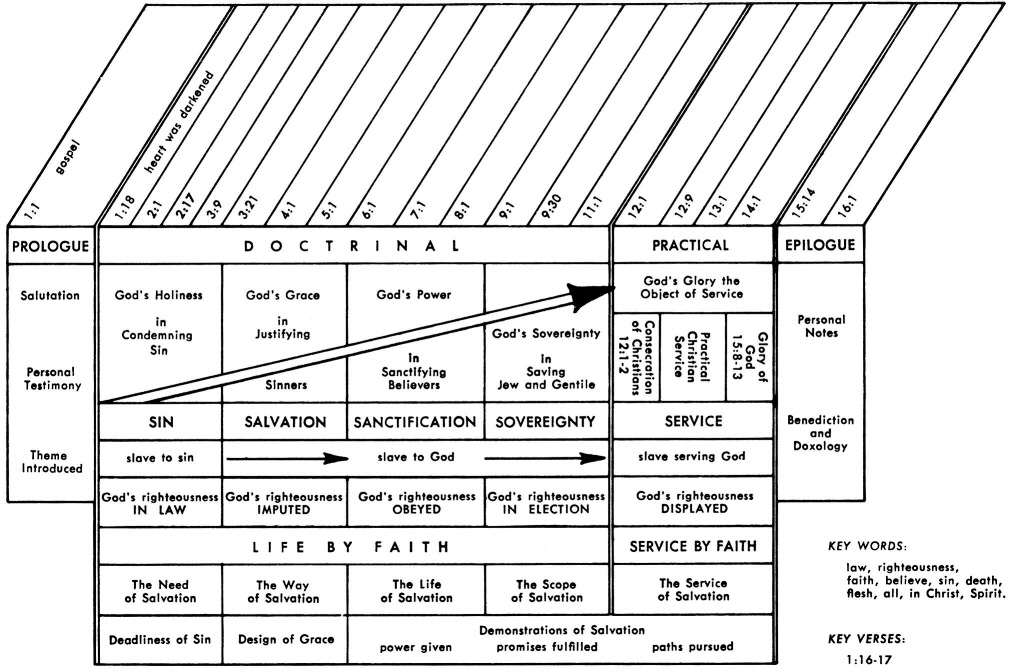
Click chart to enlarge
Chart from recommended resource Jensen's Survey of the NT - used by permission
Romans Overview Chart - Charles Swindoll
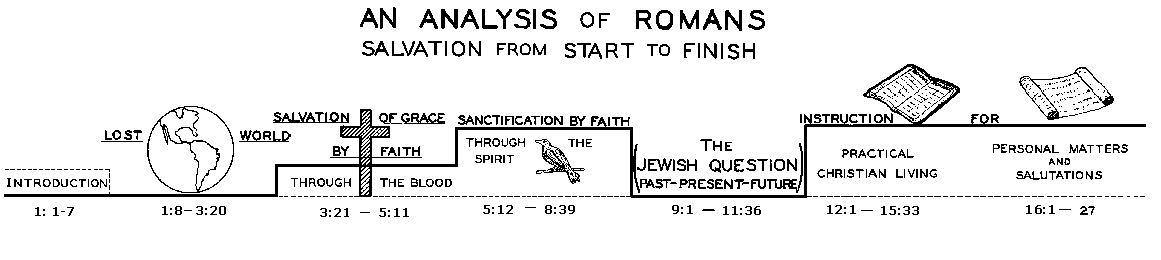
Source: Dr David Cooper
Click to Enlarge
R Ruin (Romans 1:17 – 3:20) – The utter sinfulness of humanity
O Offer (Romans 3:21-31) – God’s offer of justification by grace
M Model (Romans 4:1-25) – Abraham as a model for saving faith
A Access (Romans 5:1-11) – The benefits of justification
N New Adam (Romans 5:12-21) – We are children of two “Adams”
S Struggle w/ Sin (Romans 6-8) Struggle, sanctification, and victory
| ROMANS ROAD to RIGHTEOUSNESS |
||||
| Romans 1:18-3:20 | Romans 3:21-5:21 | Romans 6:1-8:39 | Romans 9:1-11:36 | Romans 12:1-16:27 |
| SIN | SALVATION | SANCTIFICATION | SOVEREIGNTY | SERVICE |
| NEED FOR SALVATION |
WAY OF SALVATION |
LIFE OF SALVATION |
SCOPE OF SALVATION |
SERVICE OF SALVATION |
| God's Holiness In Condemning Sin |
God's Grace In Justifying Sinners |
God's Power In Sanctifying Believers |
God's Sovereignty In Saving Jew and Gentile |
Gods Glory The Object of Service |
| Deadliness of Sin |
Design of Grace |
Demonstration of Salvation | ||
| Power Given | Promises Fulfilled | Paths Pursued | ||
| Righteousness Needed |
Righteousness Credited |
Righteousness Demonstrated |
Righteousness Restored to Israel |
Righteousness Applied |
| God's Righteousness IN LAW |
God's Righteousness IMPUTED |
God's Righteousness OBEYED |
God's Righteousness IN ELECTION |
God's Righteousness DISPLAYED |
| Slaves to Sin | Slaves to God | Slaves Serving God | ||
| Doctrine | Duty | |||
| Life by Faith | Service by Faith | |||
|
Modified from Irving L. Jensen's excellent work "Jensen's Survey of the NT" |
||||
Romans 14:1 Now accept the one who is weak in faith, but not for the purpose of passing judgment on his opinions (NASB: Lockman)
Greek: Ton de asthenounta (PAPMSA) te pistei proslambanesthe ( 2PPMM ) me eis diakriseis dialogismon.
Amplified: AS FOR the man who is a weak believer, welcome him [into your fellowship], but not to criticize his opinions or pass judgment on his scruples or perplex him with discussions. (Amplified Bible - Lockman)
KJV: Him that is weak in the faith receive ye, but not to doubtful disputations.
NLT: Accept Christians who are weak in faith, and don't argue with them about what they think is right or wrong. (NLT - Tyndale House)
Phillips: Welcome a man whose faith is weak, but not with the idea of arguing over his scruples. (Phillips: Touchstone)
Wuest: Now, to the one who is weak with respect to his faith, be giving a cordial welcome, not with a view to a critical analysis of his inward reasonings.
Young's Literal: And him who is weak in the faith receive ye -- not to determinations of reasonings;
NOW: de:
- Romans 14 Resources - Multiple Sermons and Commentaries
NOW AN EXAMPLE OF
ROMANS 13 LOVE
Alford - The de binds this on to the general exhortations to mutual charity in Romans 13. (Romans 14 Commentary)
J Vernon McGee explains that "Now connects this chapter to what has preceded it. The law of love will now go into action. Having condemned things (Ro 13:8, 9, 10, 11, 12, 13, 14) which are immoral and obviously wrong, like killing, committing adultery, stealing, and coveting, Paul now warns against the danger of condemning questionable matters which are not expressly forbidden in Scripture. (McGee, J V: Thru the Bible Commentary)
Hodge - This verse contains the general direction that weak and scrupulous brethren are to be kindly received, and not harshly condemned. Who these weak brethren were and what was the nature of their scruples, is matter of doubt. (Romans 14 Commentary)
John Stott summarizes this section - Our relationship to the weak: welcoming, and not despising, judging or offending them - Ro 14:1-15:13 Both previous chapters of Romans have laid emphasis on the primacy of love, whether loving our enemies (Ro 12:9, 14, 17ff.) or loving our neighbors (Ro 13:8ff.). Now Paul supplies a lengthy example of what it means in practice to ‘walk according to love’ (Ro 14:15, literally). It concerns the relations between two groups in the Christian community in Rome whom he names ‘the weak’ and ‘the strong’. (Romans- God's Good News for the World -Bible Speaks Today) (Bolding added)
Stott goes on to summarize who the weak in faith may have been - former idol worshipers (who would be hesitant to eat meat sacrificed to idols), ascetics, legalists (as advocated by C K Barrett - see also Barclay's comments below), and finally the "fourth and most satisfactory proposal is that the weak were for the most part Jewish Christians, whose weakness consisted in their continuing conscientious commitment to Jewish regulations regarding diet and days… Further, this understanding of the background to Ro 14:1–15:7, and of its purpose to enable conservative-minded Christians (mostly Jewish) and liberal-minded Christians (mostly Gentiles) to co-exist amicably in the Christian fellowship, also prepares the way for Paul’s eloquent conclusion (Ro 15:5-7). In it the weak and the strong disappear from view, Jewish and Gentile believers take their place, and this reconciled multi-ethnic community is heard ‘with one heart and mouth’, in glorious gospel harmony, worshipping ‘the God and Father of our Lord Jesus Christ’ (Ro 15:6ff.)." (Ibid)
W E Vine - There is a connection with what has preceded. In the preceding chapters the need of mutual love has been stressed (e.g., Ro 12:9, 10, 13:8, 9, 10). This is now made to govern the particular subject of the relations between the weak and the strong. At the end of the preceding chapter attention has been drawn to the imminence of the day of Christ (Ro 13:10, 11). Accordingly the strong and the weak are to remember that all have to appear before the Judgment Seat. The injunction to put on the Lord Jesus Christ (Ro 13:14) influences the new subject in a twofold way: firstly in the emphasis placed on the authority of Christ (Ro 14:6, 7, 8, 9), secondly, in the presentation of Christ as the pattern for believers.
Wiersbe introduces this next section of Romans noting that "Romans 14:1-15:7 deals with the problem of questionable things in the Christian life and what to do when sincere Christians disagree about personal practices. Paul recognizes that in each local church there are mature believers (“We that are strong,” Ro 15:1) as well as immature (“him that is weak in faith,” Ro 14:1), and that these two groups may disagree on how the Christian is to live. The Jewish Christians might want to cling to special holy days and OT dietary laws, while the Gentile believers might turn their Christian liberty into license and offend their Jewish brothers and sisters. Many Christians have the false notion that extreme legalism (observing days and diets) shows strong faith, but Paul states that just the opposite is true! It is the Christian that is mature in the faith who recognizes the truths found in Col. 2:18, 19, 20, 21, 22, 23-note. (Wiersbe's Expository Outlines on the New Testament)
E H Gifford - The great principle of Christian love commended in the preceding chapter is here applied to enforce the special duty of mutual forbearance in things indifferent. This general connection of thought between the two chapters is clear and unquestionable: the more immediate and formal connection being less obvious has been much disputed. (1.) The expectation of the Second Advent, introduced as a motive to mutual love (Ro 13:11), is naturally accompanied by an exhortation to watchfulness and purity (Ro 13:12-14); and from this incidental admonition St. Paul now returns to his main thought (Fritzsche). (2.) The warning against excessive indulgence of the flesh leads by a natural transition and contrast to the case of those who from weakness of faith observe an over scrupulous asceticism (Meyer). These views are both partially true, and both incomplete. The expectation of Christ's second coming to judge the world runs through the whole passage (Ro 13:11, Ro 14:4, Ro 14:10-12), as the constraining motive to mutual charity and forbearance. Before applying this motive in Romans 15, to appease dissensions which were occasioned chiefly by a superstitious observance of things morally indifferent, the Apostle, with admirable wisdom, draws first from the thought of coming judgment a note of warning, not unneeded, especially among his Gentile readers, against a licentious abuse of Christian liberty; and so passes over (Gk "de" = "Now" Ro 14:1) to the opposite and less dangerous error or infirmity, for which he claims a charitable forbearance from those whose consciences were more robust. (Romans 14 Commentary)
Middletown Bible - The Law of Love (Romans 14:1-15:3) - For further help in understanding how to live so as to not cause a brother to stumble, see our paper entitled, "Guidance: 67 Biblical Tests to Use in Deciding Upon a Course of Action."
Pastor Ray Stedman (all of his sermons are highly recommended - see Ray Stedman Library) in giving background for a message on Ro14 says "the favorite indoor sport of Christians… is trying to change each other. As this passage indicates, this has been a major problem in the church for centuries. All through the history of the church, the problem arises from the attitude that most of us share, I am sure, that God is clearly pleased with the way we live -- but there are those others around. They drink beer and play cards; they go to movies; they smoke cigars; they work on Sundays; they wear lipstick; they dance; they play musical instruments; they use zippers instead of buttons. There is an endless list of things that can be included, debatable matters that the church has never been able to settle because of a misunderstanding of the principles that are set forth here in this very passage. We are dealing, of course, with the problem of Christian taboos, all the no-no's of the Christian life that we encounter from place to place, and from time to time. We are facing the question of how much fellowship you can have with somebody who lives in a different way than you do, who does things that you do not approve of as a Christian." (On Trying to Change Others)
Stedman goes on to add "I think it is very important to note that this whole section dealing with this problem is part of an extended commentary of the Apostle Paul on the command of Jesus to love one another. This is part of how you love one another. First, love must be serving. That is its nature; love serves. That is why we are given spiritual gifts, so that we might serve one another. Paul emphasizes that in Ro 12. Second, he tells us that love must be genuine. It cannot be phony or sham; it cannot be "put-on" love. It has to be real. Then, in Ro 13, we learn that love must be submissive, especially to the authorities, to the state, and the powers that be, because they are put there by God. And in the latter part of Ro 13, Paul tells us that love must be universal; we owe love to everyone without exception. "Owe no man anything, but to love one another," {Ro 13:8a KJV}. That is a universal debt which we must continually be paying to everyone we meet. Now, in Ro 14, we learn that love must be patient and tolerant of other people's views. It begins with our actions towards someone whom we regard as less enlightened than ourselves. ["weaker brother"] Think about who that is for a moment and then listen to what Paul says to do about it Ro 14:6, 7, 8, 9. (On Trying to Change Others)
ACCEPT THE ONE WHO IS WEAK IN FAITH : Ton de asthenounta (PAPMSA) te pistei proslambanesthe (2PPMM):
- Ro 15:1 1Co 8:7, 8, 9, 10, 11, 12, 13
- weak - Ro 14:21; 4:19; 15:1,7; Job 4:3; Isaiah 35:3,4; 40:11; 42:3; Ezekiel 34:4,16; Zechariah 11:16; Matthew 12:20; 14:31; 18:6,10; Luke 17:2; 1Co 3:1,2; 1 Cor 8:7-13; 1 Cor 9:22
- accept - Ro 15:7; Matthew 10:40, 41, 42; 18:5; John 13:20; Philippians 2:29; 2 John 1:10; 3 John 1:8-10)
- Romans 14 Resources - Multiple Sermons and Commentaries
Related Passage:
1 Corinthians 8:7-13+ However not all men have this knowledge; but some, being accustomed to the idol until now, eat food as if it were sacrificed to an idol; and their conscience being weak is defiled. 8 But food will not commend us to God; we are neither the worse if we do not eat, nor the better if we do eat. 9 But take care that this liberty of yours does not somehow become a stumbling block to the weak. 10 For if someone sees you, who have knowledge, dining in an idol’s temple, will not his conscience, if he is weak, be strengthened to eat things sacrificed to idols? 11 For through your knowledge he who is weak is ruined, the brother for whose sake Christ died. 12 And so, by sinning against the brethren and wounding their conscience when it is weak, you sin against Christ. 13 Therefore, if food causes my brother to stumble, I will never eat meat again, so that I will not cause my brother to stumble.
Paul commands his readers who are stronger in the faith to make the weak brother feel welcome as a member of the Christian community.
Spurgeon - Receive the weak but sincere believer into fellowship, but do not at once commence discussing knotty points with him, or quarrel with him upon matters of no importance.
Concerning the weaker brother, the stronger brother is not to reject him, ignore him or treat him in a second-class way. Accept him, but not for the purpose of arguing with him. Do not accept him in order to debate with him, but "without passing judgment on disputable matters."
Wayne Barber introduces this section explaining that an understanding of the cultural context will help interpret Romans 14 through Romans 15:7. He explains that…
There were a lot of people, mostly Jews, who felt there were certain foods they could not eat as believers. This was a carry-over from the Mosaic Law. In the covenant that we are in with the Lord Jesus Christ there is no ceremonial or dietary restrictions (cp Col 2:16, 17-note). This was hard for a lot of the Jewish believers, particularly in Rome, to understand. They struggled deeply with this. In 1Ti 4:1, 2, 3 Paul warns that even in latter times this is going to be a problem for "the Spirit explicitly says that in later times some will fall away from the faith, paying attention to deceitful spirits and doctrines of demons, by means of the hypocrisy of liars seared in their own conscience as with a branding iron, men who forbid marriage and advocate abstaining from foods, which God has created to be gratefully shared in by those who believe and know the truth." You have to understand what Paul is dealing with here. The Apostle Peter had difficulty with this. On three different occasions God Himself had to declare to Simon Peter that the food that he would eat would be clean. There is no such thing as an unclean food anymore as far as it is affecting our relationship and our righteousness that we find in Christ Jesus. In Acts 10:15, 16, after God had lowered a sheet with all these foods on it and showed Peter, He says to him, "What God has cleansed, no longer consider unholy." Part of that teaching was to bring in the Gentiles who would eat many of these foods (which were "unclean" by Jewish standards). Paul says it is by grace you are saved, not by what you eat or don’t eat (cp Gal 5:4, 7).
The Gentiles also had a struggle, for before conversion they would offer meat to idols. Now that they were believers, they were afraid that all meat then was unclean. So have a group of Jewish Christians and Gentile Christians eating vegetables and "scared to death" to eat meat, thinking that if they ate meat somehow that would affect their standing with God through the Lord Jesus Christ. This is the practical issue Paul is addressing.
Ro 14:1 says, "Now accept the one who is weak in faith." The word "accept" means to receive, to take unto yourself. It is proslambano—pros, to or toward; lambano, to take or to receive. The idea is not that we scorn anyone, but that we continue to bring people alongside us, that we don’t look down on them, that we don’t talk down to them, but to bring them alongside, certainly to encourage, certainly to instruct, but never to scorn, never to judge, never to demean in any possible way.
It says "weak in faith," but it is "the" faith. When a definite article is present, it is not referring just in their ability to believe God, but is referring to the gospel of grace. Paul is saying there are going to be weaker brothers who don’t understand grace. I don’t know of a city in America where this message doesn’t need to be preached. There are people in our midst who do not understand grace. They don’t understand that you can eat anything you want to eat. Obviously whatever you eat or drink you do unto the glory of God (1Cor 10:31) and it is all by the Lordship of Christ whether we eat or drink. There is nothing that we can do which can affect our eternal standing in the Lord Jesus Christ. Sadly, there are believers who just don’t seem to understand this principle.
So the Apostle Paul says, "Just because you are a little more mature in the faith, just because you understand grace better than somebody else, your brother who is just as sincere as you are but in the context would be the weaker brother, you take them alongside yourself. Don’t scorn them. Don’t make them look like fools. Don’t demean them. Bring them alongside. Keep them in your company." (Romans 14:1-6)
- Strong and Weak - Baker's Evangelical Dictionary of Biblical Theology
- Food Offered to Idols - Holman Bible Dictionary
Accept (4355) (proslambano from prós = to, toward, interactively with intensifying + lambáno = to take, lay hold of with initiative) means literally to take to or toward, to aggressively receive with strong personal interest. To take in addition to (Acts 17:5). It can mean to take hold of or grasp ( Acts 27.36). It can mean to take aside or lead off to oneself (can imply for privacy) (Mt 16:22, 20:17, Mk 8:32). Proslambano can mean to accept the presence of a person with friendliness, to welcome, to receive hospitably, to receive into one’s home or circle of acquaintances, (Ro 14:1, 3, 15:7, Acts 28:2, Philemon 1:17). Proslambano is used idiomatically to mean to take food to oneself (Acts 27:33, 27:36).
In Ro 14:1 proslambano conveys the idea of to receive into fellowship.
Proslambano is used of God’s gracious acceptance of men, and also of men welcoming other men to their society. God and Christ are said to have received those whom, formerly estranged from them, having brought them to themselves by the gospel (Ro 14:3, 15:7b)
Barber - The idea (of proslambano) is not that we scorn anyone, but that we continue to bring people alongside us, that we don’t look down on them, that we don’t talk down to them, but to bring them alongside, certainly to encourage, certainly to instruct, but never to scorn, never to judge, never to demean in any possible way.
Proslambano in Romans 14:1 therefore means more than the KJV translation conveys with "receive" (Ro 14:1KJV). The idea is to receive as one would welcome one into one's home, with the additional idea of doing so with kindness. It's includes the idea of granting one access to one's heart, or to take to one's self. The Amplified Version renders Ro 14:1 as "welcome him [into your fellowship]" while Wuest has "be giving a cordial welcome".
Proslambano is in the present imperative (same verb and tense in Ro 15:7-note) which is a command to make this a characteristic of your life. Now don't try to do this relying on your "natural" strength for you will surely fail. The only way to obey this command is by yielding to and be filled by and empowered by the indwelling Holy Spirit. This command calls for supernatural spiritual strength! Proslambano is always in the middle voice in the NT which is notable because the middle voice conveys the idea that the subject not only initiates the action but also participates in the results of that action (receive or take to oneself is the idea).
Vine writes that "proslambano is always in the middle voice, signifying a special interest on the part of the receiver, suggesting a welcome."
Leon Morris - The verb (proslambano) means more than “allow to remain in the membership”; it has the notion of welcome, of taking to oneself and so taking into friendship. The weak are not to be made to feel that they are barely tolerated and seen as second-class members. They are to be received with warmth and true fellowship. Christian love demands no less. (The Epistle to the Romans- Leon Morris)
Moule - The Greek tense is the present, and perhaps indicates that Paul means not only the first welcome of a new believer but the continued welcome -- a full recognition ever after of his standing as a Christian. (The Epistle of Paul the Apostle to the Romans - Commentary)
One could translate it "accept to yourself" or "take to yourself". The middle voice conveys the idea of personal and willing acceptance of another person as shown in Acts 28:2, where Paul uses proslambano describe the hospitality of the Malta natives, who “kindled a fire and received (proslambano - willingly received is the idea) us”.
Proslambano - 12x in 11 v- translated (NAS) as accept(3), accepted(2), received(1), taken(1), taking along(1), took(1), took aside(3).
Matthew 16:22 And Peter took Him aside (took him apart to speak with him privately) and began to rebuke Him, saying, "God forbid it, Lord! This shall never happen to You."
A. T. Robertson, "Took" (Greek middle voice) "taking to himself, aside and apart, as if by a right of his own. He acted with greater familiarity after the token of acknowledgment had been given. Jesus, however, reduces him to his level' (Bengel). 'Peter here appears in a new character; a minute ago speaking under inspiration from heaven, now under inspiration from the opposite quarter' (Bruce)" (WP, 1, 135,36).
Mark 8:32 And He was stating the matter plainly. And Peter took Him aside and began to rebuke Him.
Acts 17:5 But the Jews, becoming jealous and taking along some wicked men from the market place, formed a mob and set the city in an uproar; and coming upon the house of Jason, they were seeking to bring them out to the people.
Acts 18:26 and he began to speak out boldly in the synagogue. But when Priscilla and Aquila heard him, they took him aside and explained to him the way of God more accurately.
Acts 27:33 And until the day was about to dawn, Paul was encouraging them all to take some food, saying, "Today is the fourteenth day that you have been constantly watching and going without eating, having taken nothing.
Acts 27:36 And all of them were encouraged, and they themselves also took food.
Acts 28:2 And the natives showed us extraordinary kindness; for because of the rain that had set in and because of the cold, they kindled a fire and received us all.
Romans 14:1-note Now accept the one who is weak in faith, but not for the purpose of passing judgment on his opinions.
Romans 14:3-note Let not him who eats regard with contempt him who does not eat, and let not him who does not eat judge him who eats, for God has accepted him.
Comment: Proslambano conveys that God receives people in a personal, intimate way (with the deepest interest).
Romans 15:7-note Wherefore, accept (present imperative) one another, just as (THE KEY PHRASE) Christ also accepted us to the glory of God.
Comment: Proslambano – properly, "welcome one another with enlightened self-interest" (a deep sense of self-advantage). This personal ("engaged") kind of receiving is emphasized by the prefix prós and the Greek middle voice.
Philemon 1:17 If then you regard me a partner, accept him as you would me.
Proslambano - 5v in the non-apocryphal Septuagint - 1Sa 12:22; Ps 18:16; 27:10; 65:4; 73:24;
Complete Biblical Library Greek-English Dictionary - The term appears eight times in the Septuagint. It is commonly used in the middle voice, i.e., reflexively, to mean “to take to oneself.” It frequently refers to the way God has drawn His people unto himself (1Sa 12:22), made them His elect (Psalm 65:4), and has brought them into fellowship to deliver them from affliction (Ps 18:16) and loneliness (Ps 27:10). His fellowship provides the people of God His blessings (Ps 65:4) and protection (Ps73:24]).
So in (Ro 15:7-note) Paul says draw one another to yourself (that's the idea of the middle voice). Grant them access to your heart. Take them to yourself. Treat them as the closest of friends with the most caring kindness. Believers are to receive one another in the closest of bonds.
Godet - The imperative accept or receive, addressed to the whole church, evidently assumes that those who are recommended to this favorable reception form only a very weak minority at Rome. The Greek expression signifies to take to oneself with tenderness; comp. Ro 15:7 and John 14:3 (uses "paralambano"), where it is applied to Christ’s conduct in relation to believers. (Romans 14:1-15:13 Directions Regarding a Difference of View)
Vincent: "Receive these weak brethren, but not for the purpose of passing judgment upon their scruples (Scruple [from Latin scrupus = source of uneasiness, literally a sharp stone] = an ethical consideration or principle that inhibits action. It implies doubt of the rightness of an act on grounds of principle.) (Romans 14 - Vincent's Word Studies)
How is the one "weak" in regard to faith? ["Faith" is pistis (4102)] He lacks the faith in the freedom that is ours in Christ, instead being bound up in rules and regulations and the need to keep do's and don'ts reasoning that the more rules & regulations are kept the more holy he will be. He is focused on the externals & does not understand that liberty is not license.
What is weak in the context of a "weak brother?" Ro 14:1-2 links "weak" with "faith" in eating. The person's "weak" faith clearly interacts with their conscience, which is not necessarily "weak" (in my opinion) but is "hyper-sensitive," so to speak. For example, in not eating meat sacrificed to idols their faith is weak in the sense that they do not fully understand that with Jesus' sacrifice all things (that are not overtly sinful) have been made clean. And thus eating meat sacrificed to idols was "clean," but the one weak in faith has not fully grasped their freedom in Christ, the freedom that we have because of His sacrifice, a sacrifice that opened the floodgates of God's grace to His children. Remember that faith comes by hearing and hearing by the word of Christ, so presumably the more they are taught and assimilate in their heart the teachings of the Gospel of grace, the more their faith grows and the more their faith grows, especially regarding God's grace, the more likely they are to come to understand that there is absolutely nothing inherently wrong or sinful about eating meat sacrificed to idols. Spiritual growth in grace is not necessarily quick and is certainly not automatic -- one needs to be in the Word, the Word in them and the Spirit using that internal word to transform us progressively in Christ-likeness. Peter alludes to this is his closing exhortation/prayer - "grow (present imperative - keep on growing) in the grace and knowledge of our Lord and Savior Jesus Christ. To Him be the glory, both now and to the day of eternity. Amen: (2 Peter 3:18+).
R Kent Hughes - The one “whose faith is weak” is not weak in basic Christian faith (ED: IN OTHER WORDS HIS FAITH IS ENOUGH TO MAKE HIM A TRUE BELIEVER), but is weak in assurance that his faith permits him to do certain things, such as eating meat. These “weak” are to be wholeheartedly accepted—they are not to be accepted with the ulterior motive of straightening them out. There is to be no phony condescension on the part of the “strong,” no hidden agenda, but rather simple, unqualified acceptance. (Romans: Righteousness from heaven. Preaching the Word)
David Guzik adroitly picks up on Paul's metaphor of "weakness" and suggests 4 spiritual parallels: "There are many reasons why someone may be weak: they may be a babe in Christ (babies are weak), they may be sick or diseased (by legalism), they may be malnourished (by lack of good teaching), or they may lack exercise (needing exhortation, "coaching"). (Romans 14 Commentary)
Ray Stedman - The NIV is misleading here by translating it as: "Accept him whose faith is weak." This command to the stronger brother has nothing to do with the strength or weakness of the other individual's faith. It is not talking about someone whose faith is weak. It is talking about someone who is weak in the faith. The problem is doctrinal here. The problem is that he does not understand truth. Remember, Jesus himself said "If you abide in My word, then you are truly disciples of Mine & you shall know the truth, and the truth shall make you free." {Jn 8:31, 32}. Therefore, the mark of understanding truth is freedom; it is liberty. That is why Paul calls the person who understands truth clearly one who is strong in the faith, while those who do not understand it clearly are weak in the faith. They do not understand the delivering character of truth. (On Trying to Change Others)
William Barclay feels that "a man is weak in the faith for two reasons (Ed: Compare Barclay with Wayne Barber's comments above regarding the weaker brethren having an immature understanding of grace): (1) He has not yet discovered the meaning of Christian freedom. He is at heart still a legalist (Ed: I think Barclay's assessment may be a bit harsh - some may have had a legalistic tendency, but some may simply have been former idol worshipers and for them to eat meat sacrificed to idols was more than they could "stomach", pun intended! See Thomas Schreiner's remarks below). He sees Christianity as a thing of rules and regulations. His whole aim is to govern his life by a series of laws and observances. He is indeed frightened of Christian freedom and Christian liberty. (2) He has not yet liberated himself from a belief in the efficacy of works. In his heart he believes that he can gain God's favor by doing certain things and abstaining from doing others. Basically he is still trying to earn a right relationship with God and has not yet accepted the way of grace. He is still thinking of what he can do for God more than of what God has done for him." (Romans 14 Commentary - Daily Study Bible)
Thomas Schreiner - The standpoint of the “weak” on foods and days signals a certain deficiency in their faith. It is not the case, though, that the “weak” believed that abstaining from meat and wine and observing certain days were necessary for salvation. There is no hint that they were attempting to impose these requirements on the “strong” for the latter’s salvation. It seems likely that they believed that one would be a stronger or better Christian if one observed their prescriptions. Similar debates exist today. Sabbatarian Christians do not usually argue that those who disagree with them are destined for eternal judgment. They merely contend that such observance is important for living the Christian life. Thus the weak in faith believed that God was pleased if believers ate vegetables only (v. 2)… Their faith is genuine, but it is weak, precisely because they still believe that the law should be observed in terms of its ritual obligations. Such ritual observance does not nullify the authenticity of their faith, but it does indicate a certain deficiency in it. (Baker Exegetical Commentary on the New Testament).
Ray Stedman - The problem (is that) of a Christian who is not yet understanding fully the freedom that Christ has brought him (Ed: The fact that he is no longer under law but under grace - Ro 6:14), who struggles with these kinds of things, and who feels limited in his ability to indulge or to use some of these things -- while others feel free to do so. One is strong in the faith; the other is called weak in the faith. Every church has these groups. We have them right here. Paul puts his finger precisely on the natural attitudes which each group would have toward each other that must be avoided if we are going to accept one another as he says. (On Trying to Change Others)
Is Weak (770) (astheneo) from asthenes = without strength, powerless, state of limited capacity to do or be something) means to be feeble (in any sense), to be impotent, to be weak or to lack strength. Astheneo is in the present tense suggesting that the trouble is not an inherent characteristic, but a condition into which a brother has been brought by outward influence.
The UBS Handbook notes that the phrase "The man who is weak in the faith is the emphatic element in the Greek sentence. From what follows we learn three things about this man: (1) he is a vegetarian (Ro 14:2, 21); (2) he considers certain days to have special importance (Ro 14:5, 6); and (3) he does not drink wine (Ro 14:21). In choosing a term for weak it is essential to avoid an expression which will indicate only “physical weakness.” (United Bible Society)
The weak Christian does not yet understand and practice freedom in Jesus Christ. For example, Jewish believers, raised under the law of Moses, had a difficult time adjusting to their new life. Paradoxically, one would think they would be the stronger brethren because of their godly heritage and religious practices, but in truth they were just the opposite. Conscience becomes strong (i.e., the Spirit renews our mind and transforms the way we think) as we accept (in faith) what God says about us in the Word and act on it by faith. However, it takes time for conscience to develop, and we must be patient with one another.
Thomas Schreiner - Ro 14:2 elaborates on and explains verse 1, so that we learn that the “weak” referred to in Ro 14:1 refuse to eat meat whereas the “strong” feel free to eat anything. (Baker Exegetical Commentary on the New Testament)
McGee - Weak in faith does not mean one who is weak in the great truths of the Gospel—the facts of faith (Ed: See "the faith")—but rather it refers to the abstract quality of faith. It means the faith of the weak falters and hesitates about matters of conduct. He does not know what he should do relative to certain things. This one is to be received into the fellowship of believers with open arms. You may not agree with him, but you are to receive him if he is a believer in Jesus Christ. Some things are not expressly condemned in Scripture, but some believers separate themselves from these things. And if they want to do this, that’s their business. These things are not to separate believers. Scofield has a very helpful note—“The church has no authority to decide questions of personal liberty in things not expressly forbidden in Scripture.”
Vine - he who is weak in faith is so through lack of an apprehension of the liberty into which one is brought who, trusting in Christ alone, is delivered from all bondage and finds freedom in serving the will of Christ as Lord of the life. The weakness is the effect of scruples about details that lie outside the scope of those things which the Christian faith demands. His danger lies in judging the brother who is strong, and in a liability to take offense. The “strong” is one who, while acting conscientiously toward God, is not fettered by scruples of that sort. His danger is twofold, namely, of despising the weak brother, and of setting a stumbling block before him. (Collected writings of W. E. Vine) (Bolding added)
Is in not true that our love (Ro 12:9,10, 13:8, 9, 10) is often tested more by Christians who disagree with us than by unbelievers who persecute you! We've all probably had the thought "I could live the Christian life if it weren't for other believers!" People may be difficult, but filled with the desire and power supplied by the indwelling Spirit, we are to accept them in love for the Lord's sake.
Faith (4102)(pistis) is synonymous with trust or belief and is the conviction of the truth of anything, but in Scripture usually speaks of belief respecting man's relationship to God and divine things, generally with the included idea of trust and holy fervor born of faith and joined with it.
John Stott - It is important to be clear at the outset that Paul is referring to a weakness neither of will nor of character, but of ‘faith’ (Ro 14:1). It is a ‘weakness in assurance that one’s faith permits one to do certain things’ (Cranfield). So if we are trying to picture a weaker brother or sister, we must not envisage a vulnerable Christian easily overcome by temptation, but a sensitive Christian full of indecision and scruples (ED: WHILE THE MAIN POINT IS CHRISTIAN LIBERTY I AM NOT IN COMPLETE AGREEMENT WITH STOTT HERE - I THINK THEY ARE "VULNERABLE TO "STUMBLE" AS EXPLAINED BELOW.") What the weak lack is not strength of self-control but liberty of conscience. (Ibid) (Bolding and italics added)
COMMENT ON STOTT'S COMMENT - Eating and drinking would be the most common situations in daily life in the first century, but in modern society there might be a number of things that are in themselves not sinful but which if practiced by another brother and their practice is seen by a weaker brother, it might cause that weaker brother to stumble. Note that one of the definitions in Friberg's Lexicon for stumble (proskopto) is "figuratively make a misstep (Jn 11.9); find occasion for doing wrong (Ro 14.21+). And so for example, without getting too specific, I think of a television show that my pastors love to watch, but which frankly I think is gross and therefore defiling. What might that do to me? How might that make be vulnerable to "stumble" or take a "misstep?" I might reason well if they watch those shows, I can watch _______ show, even though it is a show that I would not usually watch. My conscience would send up a "flare" saying "This is not a good show for you to watch!" But I now feel justified (so to speak) in watching it. So I watch it and all the while my conscience is telling me not to watch it because it has scenes that should not enter my "eye gate" and settle in my mind, because these scenes (and I am not talking R-rated or X-rated!) will defile me, incite my rotten fallen flesh and will cause me potentially to stumble into some sin.
MacDonald - A weak Christian is one who has unfounded scruples over matters of secondary importance. In this context, he was often a converted Jew who still had scruples about eating non-kosher foods or working on Saturday. The first principle is this: a weak Christian should be received into the local fellowship, but not with the idea of engaging him in disputes about his ultra scrupulousness. Christians can have happy fellowship without agreeing on nonessentials. (Believer's Bible Commentary)
John MacArthur - The strong = Liberated brothers and sisters in Christ fully understand what it means to be free in Christ‑‑ they don't cling to meaningless traditions and forms of religion. They understand fully that they are free from sin, death, hell, and Satan. They understand they are not obligated to follow holy days and ceremonies. They know they are free to make choices dependent on how the Spirit of God moves in their hearts. Such people are strong in the faith. The weak = These individuals continue to hang onto the rituals and ceremonies of their past, refusing to let go. They don't believe they have freedom in Christ to do otherwise. Such freedom threatens them, so they prefer remain as they are. The temptation: (a) The contempt of the strong - The strong are tempted to look down on the weak as legalistic, faithless people who get in the way of those who are trying to enjoy their liberty. They resent the weak for labeling their rightful freedoms in Christ as sin. (b) The condemnation of the weak - The weak tend to condemn the strong for what they see as an abuse of liberty. However they are not in the position to judge since they don't understand what Christian liberty is. (Receiving One Another with Understanding, Part 1)
BUT NOT FOR THE PURPOSE OF PASSING JUDGMENT ON HIS OPINIONS: me eis diakriseis dialogismon:
- Romans 14 Resources - Multiple Sermons and Commentaries
KJV = not to doubtful disputations.
Henry Morris explains this phrase "Doubtful disputations" refer to critical judgments on the inward reasonings of others. Unless some practice is specifically revealed in Scripture to be right or wrong, each believer should be free to formulate his own convictions about it. New Christians may still feel constrained by certain criteria they had followed earlier, and thus may be reluctant to change when they become saved. Unless these are specifically enjoined or prohibited in the Word of God, older believers should receive them into fellowship without argument or criticism. (Defender's Study Bible Notes)
Amplified Version - not to criticize his opinions or pass judgment on his scruples or perplex him with discussions.
But - Not in the Greek but added as it accentuates the change in direction = "receive him, do not criticize him". Let him with a welcome, not with a call to discussion!
Literally "not to criticisms of (his) scruples"
Accept him, but not for the purpose of getting into arguments about opinions. Wuest says "not with a view to a critical analysis of his inward reasonings." Do not accept him in order to debate with him or argue about your differences, but "without passing judgment on disputable matters" ("without attempting to settle doubtful points.") Don't pass judgment on the weaker brother in disputable matters where Scripture is not clear.
Don't argue with the weaker brother about what they think is right or wrong. The brother who is weak, is not to be received with the purpose of judging his reasonings. The reception of the weaker by the stronger is to be without qualifications, "asterisks", caveats or reservations!
Paul warns the Corinthians "Therefore do not go on passing judgment (krino - make a judgment) before the time, [but wait] until the Lord comes who will both bring to light the things hidden in the darkness and disclose the motives of [men’s] hearts; and then each man’s praise will come to him from God." (1Cor 4:5)
Passing judgment (1253) (diakrisis from diá = between + kríno = distinguish, decide, judge) is literally a deciding between (used only 2 other times in NT 1Co 12:10, Heb 5:14) The basic idea has to do with separating out for examination and judging in order to determine what is genuine and what is spurious. BDAG describes diakrisis as an "engagement in verbal conflict because of differing viewpoints, quarrel" and goes on to translate Paul's use here in Ro 14:1 as "welcome, but not for the purpose of getting into quarrels about opinions."
It is interesting that Liddell-Scott says diakrisis can mean "separation, dissolution, segregation, discrimination," all possible effects of not accepting one another! Other secular uses were to describe the parting of hair, separation of tumor from blood vessels.
NIDNTT adds that "The noun diakrisis (pre-Socratics onwards) means separation, division (Plato). It can also mean an interval, judgment (as in law, Plato), distinction, and quarrel, struggle."
Robertson - The “strong” brother is not called upon to settle all the scruples of the “weak” brother. But each takes it on himself to do it. (Word Pictures in the New Testament)
Usage: discern(1), distinguishing(1), passing judgment(1).
Romans 14:1 Now accept the one who is weak in faith, but not for the purpose of passing judgment on his opinions.
1Corinthians 12:10 and to another the effecting of miracles, and to another prophecy, and to another the distinguishing of spirits, to another various kinds of tongues, and to another the interpretation of tongues.
Hebrews 5:14 But solid food is for the mature, who because of practice have their senses trained to discern good and evil.
There is one use of diakrisis in the Septuagint - Job 37:16 "Do you know about the layers of the thick clouds, The wonders of one perfect in knowledge." (LXX English translation = And he knows the divisions of the clouds… ),
Guzik - we are not to receive them for the sake of carrying on a debate with them regarding doubtful things. These are words to take seriously. Paul warns us to not make spiritual maturity a requirement for fellowship. We should distinguish between someone who is weak and someone who is rebellious. There are many reasons why a Christian might be weak. They may be a babe in Christ (babies are weak). They may be sick or diseased (by legalism). They may be malnourished (by lack of good teaching). They may lack exercise (needing exhortation). (Romans 14 Commentary)
Opinions (1261) (dialogismos [word study] from dia = through, suggesting separation + logismos = a reasoning) (cf uses in Ro 1:21, Lk 24:38) describes the thinking of a man deliberating with himself and in context refers to his opinions. In his reasoning in his mind with himself, he vacillates between doubt and perplexity (Moule).
Ray Stedman - To accept him, of course, means that regardless of where you may struggle with someone and about what you may struggle, you must realize that they are brothers and sisters in the family of God, if they are Christians at all. You did not make them part of the family -- the Lord did. Therefore, you are to accept them because they are your brothers and sisters. And you are not to accept them with the idea of immediately straightening them out in the areas in which they are weak. I think that is a very necessary, practical admonition because many of us love to argue and sometimes the first thing we want to do is straighten somebody out. (On Trying to Change Others)
Stedman confesses to falling into this trap - "I remember years ago when, after preaching from this platform on a Sunday night, a man came up to me and started talking in a rather roundabout way. He said, "Let me ask you something. Do you believe that two Christians who love the Lord and are led by the Holy Spirit will read a passage of Scripture and both come out believing the same thing?" I said, "Yes, I think that sounds logical." "Well," he said, "can you explain why, when I read the passage you preached on tonight, I believe it teaches there will be no millennium, but when you read it, you believe there is going to be one. What do you think of that?" Being young and aggressive I said, "Well, I think it means that I believe the Bible and you do not." That immediately precipitated an argument and, with several other people gathered around, we went at it hammer and tongs for an hour or so. Afterwards, thinking it through, I realized how wrong I was. I had immediately started arguing. I had to write to that brother and tell him that I was sorry I had jumped on him like that. Of course, he had jumped on me, too, but that was his problem, not mine. I had to straighten out my problem, so I apologized to him and said, "I am sorry that I did not recognize the parts where we agree before we got on to those things over which we differ. (On Trying to Change Others)
McGee has some interesting comments: "There are two areas of Christian conduct. In one area the Bible is very clear, as we saw in the preceding chapter. The duty of the Christian to the state is submission. He is to obey the laws of the land, he is to pay his taxes, and he is to show respect to those in authority. Also Romans 13 was specific on a believer’s relationship to his neighbor. He is to pay his bills; he is not to commit adultery, kill, steal, bear false witness, or covet what another has. In fact, he is to love his neighbor as himself. The believer is to be honest, and he is to avoid reveling and drunkenness, strife, and jealousy. The Bible is very clear on these things. However, there is another area of Christian conduct on which the Bible has no clear word. Let me mention only two things: the use of tobacco and mixed bathing (that is, both sexes swimming together). If you don’t think these are questionable, let me give you an illustration out of my own experience. My wife was reared in Texas in a Southern Baptist church. She was brought up by a mother and father and pastor who believed that mixed bathing was sinful. Then when she came to California, you can’t imagine the shock she had the first time she went down to the beach with the young people from our church—even in those days they weren’t wearing much. My wife was in a state of shock for twenty-four hours after that! She had never seen anything like it. However, in the area from which she came the use of tobacco was not frowned upon. The officers of her church smoked; in fact, her pastor smoked. When she came to California, she found that using tobacco was taboo. If you were a Christian, you did not smoke. Is mixed bathing all right in one place and wrong in another place? Is smoking right in one place and wrong in another place? I am sure that the hair on the back of the necks of some of the saints is standing on end, and they are thinking, Dr. McGee, you ought to give a lecture against smoking, and you let this subject of mixed bathing alone. Let me assure you that I am not condemning either one, not am I condoning either one. I’m not going to stick out my neck on questionable things any farther than Paul stuck out his neck. (McGee, J V: Thru the Bible Commentary: Thomas Nelson )
Newell offers an excellent, very practical discussion on this topic which is of vital importance to the unity of a local body of believers…
PAUL, IN THIS Fourteenth Chapter, and the following one, directs his instruction chiefly "to the 'strong, 'who can bear it, while indirectly showing the state of the 'weak'! Those weak in faith, like babes, are not able to take much nourishment at once; while those who are strong are often not willing to receive what seems to reflect upon their vigor. To have faith before God, secretly, hiding it from the weaker brother, for his sake, until he becomes stronger, is not easy: it requires walking in low, which is always costly to the one loving!
As to receiving and welcoming into our fellowship believers less instructed or with weaker faith than ourselves, let us note what our attitude should be, (1) toward those less instructed or of weaker faith than ourselves; and (2) toward those with greater knowledge, and liberty of conscience, than ourselves.
There are those who are "weak" in faith. They have true faith, they have Christ; but, because of traditional or legal teaching; or perhaps through Satan's accusations on account of former sins; or through not grasping the fact of their death with Christ and their present and eternal union with Him (cp Ro 6:4); or possibly because of habits of introspection and self-accusation, or even through unsubdued sin-for some or all of these reasons, they are weak.
Such weak ones are to be received. Of course, in these days, when that sweet powerful fellowship of the early Christian assemblies, that consciousness of the presence in the assembly of the Holy Spirit, and so of the Risen Christ, is rare, there is difficulty in making clear the meaning of the word "receive. Ecclesiastical procedure has so usurped the place and prerogatives of the saints' acting by the conscious will of the Holy Spirit, as largely to obliterate the meaning of these words, "receive ye." People say, "Was not so and so received into the church by the pastor and officers?" "Official action" has supplanted the saints' blessed ministry of receiving, as described here.
Nevertheless, we must go directly to Scripture in this serious, practical matter. By "receiving" the weak brother, is not meant allowing him to "join the church"; but acknowledging him, by the discernment of the Spirit, to be a man of faith (even though his name be "Mr. Ready-to-halt"). Thus he and we are members one of another, being in Christ. And there is the same welcome in the assembly to this feebler member as to the most gifted teacher of the Word among us. It is not that he has been "officially recognized," but that he has been discerned generally and welcomed, in the Spirit.
He is to be received, -but not to decide for him his conscientious scruples. No one's conscience but his own can direct him. He may be taught the Word, however, and God will bring him along. He must not be forced. If he have faith, though it be but weak faith, he is among us not by our action, but by Christ's.
What a terrible contrast to the teaching of this Scripture is presented by the "close communion" people, and the "exclusivists, " of all sorts. Unless a man pronounces "Shibboleth" their way, there is not the thought of receiving him. This is the Pharisaic individual of the last days. And sad to say it is most found among those most enlightened in the truth, for "knowledge puffs up, but love builds up." (1Cor 8:1KJV) We are profoundly convinced that if those who now "exclude" so readily those differing from them were filled with love, filled with the Holy Ghost, not only would there be deliverance from the awful wickedness of "exclusiveness," but there would be hundreds, even thousands, of hungry believers flocking into fellowship, where they would be lovingly greeted just as they are!
Further teaching for them can wait:
but receive them!
Where faith in Christ in the least degree is found, we should be thankfully delighted, and should welcome such believers. All believers have not the same knowledge, nor the same freedom from tradition, nor the same strength of appropriating faith. We have no right to say to believers, "Sit back, until we are satisfied about you." This puts your will between believers and fellowship with God's saints. (Romans 14)
Resolve - I once decorated a notebook with definitions of the words idea, thought, opinion, preference, belief, and conviction to remind myself that they do not mean the same thing. The temptation to elevate an opinion to the level of a conviction can be strong, but doing so is wrong, as we learn from Romans 14.
In the first century, religious traditions based on the law were so important to religious leaders that they failed to recognize the One who personified the law, Jesus. They were so focused on minor matters that they neglected the important ones (Matt. 23:23).
Scripture says that we need to subjugate even our beliefs and convictions to the law of love (Rom. 13:8,10; Gal. 5:14; James 2:8), for love fulfills the law and leads to peace and mutual edification.
When opinions and preferences become more important to us than what God says is valuable to Him, we have made idols out of our own beliefs. Idolatry is a serious offense because it violates the first and most important command: “You shall have no other gods before Me” (Ex. 20:3).
Let’s resolve not to elevate our own opinions above God’s, lest they become a stumbling block and keep others from knowing the love of Jesus. (Our Daily Bread)
A Prayer
Lord, help me not to elevate my opinions and
make others follow. You are the convicter of hearts.
May others learn of Your love through me.
The greatest force on earth is
not the compulsion of law
but the compassion of love.
Steven Cole - H. A. Ironside (Illustrations of Bible Truth [Moody Press], p. 115) relates a story that the late Bishop Potter of New York used to tell on himself. The bishop was sailing for Europe and found that he was to share a cabin with another passenger whom he did not know. After he had met his cabin mate, he went to the ship’s purser and asked if he could leave his gold watch and other valuables in the ship’s safe. He explained that normally he would not do that, but he had been to his cabin and had met the man who was in the other berth. He said that judging from his appearance, he was afraid that he might not be trustworthy.
The purser took his valuables to store in the safe and said, “I’ll be glad to take care of them for you, bishop. The other man has already been up here and left his valuables for the same reason.”
We’re all prone to judge others, aren’t we! But Jesus’ words (Matt. 7:1), “Do not judge so that you will not be judged,” are frequently misapplied. I once sat on a jury where the defendant had twice the legal blood alcohol level. But one woman on the jury would not vote to convict the obviously guilty young woman. When I asked why she wouldn’t vote to convict, the woman replied, “Because the Bible says, ‘Judge not, lest ye be judged’”!
If people would keep reading Matthew 7, they would see that in verse 6 Jesus tells us not to give what is holy to dogs and not to cast our pearls before swine. He isn’t talking about animals, but about people who are dogs and swine. Obviously, we have to make some judgments to obey that command! And in verse 15 Jesus warns about false prophets, who come to us as wolves in sheep’s clothing. Again, to spot a wolf in sheep’s clothing, you have to make some careful judgments.
So Jesus was not telling us that we should not make any judgments. Rather, we should judge ourselves by taking the log out of our own eye before we help our brother with his speck. The Bible repeatedly teaches that we must be discerning in terms of judging other people’s character so that we can either avoid their company (1 Cor. 15:33; 2 Cor. 6:14-18; 2 Tim. 3:5; 4:14-15) or try to help them grow in the Lord (2 Tim. 2:24-26). And we must be discerning of true and false doctrine so that we are not deceived by it (Matt. 7:15; 2 Tim. 4:3; Titus 1:9).
But, having said that, there is still the danger that we wrongly judge one another, which can lead to all sorts of problems in the local church. A younger believer might come into the church and his appearance is very different than that of the older believers. If they judge him so that he feels unwelcome, he may never come back to the place where he should have felt loved and accepted, where he could grow in the things of God. Or, he may conclude that Christian maturity consists in conforming to certain standards of dress or appearance, and so be led astray from the heart of the faith, which is to love God and love one another.
So the apostle Paul was very concerned that the believers in Rome not judge one another on non-essential matters where the Bible does not give specific commands. He has just made it clear that Christians are never to be involved in carousing and drunkenness, sexual promiscuity and sensuality, or strife and jealousy (Ro 13:13). Those are clear moral commands that we all must follow. But there are many other areas that the Bible does not address or where it allows liberty of conscience. In these matters, Paul repeatedly says that we are not to judge one another or regard one another with contempt (Ro 14:1, 3, 4, 10). Rather, we are to accept one another, just as Christ has accepted us (Ro 14:1, 3; 15:7). He’s saying,
In the church, we are to accept and not judge one another when we differ on matters where the Bible does not give specific commandments.
You may wonder why in Romans Paul urges tolerance and acceptance of those who have scruples over food and drink and observing certain days, but in Galatians and Colossians, he denounces in no uncertain terms those who do such things. The difference is that in Galatians, those who urged observing certain days (Gal. 4:10) were saying that in addition to trusting in Christ as Savior, you must keep the Law of Moses to be saved. They were perverting the gospel of salvation by God’s grace through faith alone. In Colossians, the heresy seems to have been a form of Gnostic asceticism, where the false teachers said that by abstaining from certain foods or by keeping certain holy days, you could be more godly. But they were not holding fast to Christ and our position in Him. But in Romans, the weaker believers who did not eat meat and who observed certain days did not hold to these heretical views that undermined the gospel. And so Paul deals with them quite differently (see John Murray, The Epistle to the Romans [Eerdmans], 2:172-173).
Also, while there are some similarities between Romans 14 and 1 Corinthians 8, where Paul deals with the problem of eating meat sacrificed to idols, the two situations were different. Scholars are not sure exactly who these people in Rome were who were not eating meat or drinking wine (Ro 14:21) and observing certain holy days. Some argue that they may (as in Corinth) have been Gentile believers, but most contend that they were mostly Jewish believers who had not let go of their continuing loyalty to the Mosaic Law (Douglas Moo, The Epistle to the Romans [Eerdmans], p. 829; Thomas Schreiner, Romans [Baker], pp. 708-710). They were immature in their understanding and needed to grow. But they were not promoting heresy that undermined the gospel. So Paul’s main concern was the potential divisions among Christians because they were wrongly judging one another over secondary matters where the Bible does not give specific commandments. (Getting Along in Spite of Our Differences Romans 14:1-4)
Romans 14:2 One person has faith that he may eat all things, but he who is weak eats vegetables only.
Greek: osmen pisteuei (3SPAI) phagein (AAN) panta, o de asthenon (PAPMSN) lachana esthiei (3SPAI)
Amplified: One [man’s faith permits him to] believe he may eat anything, while a weaker one [limits his] eating to vegetables.
NLT: For instance, one person believes it is all right to eat anything. But another believer who has a sensitive conscience will eat only vegetables.
Phillips: One man believes that he may eat anything, another man, without this strong conviction, is a vegetarian.
Wuest: One, on the one hand, has confidence that he may eat all things; but the one, on the other hand, who is weak, constantly eats vegetables.
Young's Literal: one doth believe that he may eat all things -- and he who is weak doth eat herbs;
ONE MAN HAS FAITH THAT HE MAY EAT ALL THINGS: osmen pisteuei (3SPAI) phagein (AAN) panta:
- Ro 14:14; 1Corinthians 10:25; Galatians 2:12; 1Timothy 4:4; Titus 1:15; Hebrews 9:10; 13:9
- Romans 14 Resources - Multiple Sermons and Commentaries
1Cor 10:25 Eat anything that is sold in the meat market, without asking questions for conscience’ sake;
Gal 2:12 For prior to the coming of certain men from James, he used to eat with the Gentiles; but when they came, he [began] to withdraw and hold himself aloof, fearing the party of the circumcision.
1Tim 4:4 For everything created by God is good, and nothing is to be rejected, if it is received with gratitude;
Heb 13:9 Do not be carried away by varied and strange teachings; for it is good for the heart to be strengthened by grace, not by foods, through which those who were thus occupied were not benefited.
Paul calls the "liberal party" strong in the faith, while the "narrow party" is regarded as being weak in the faith. The strong member is completely uninhibited by relics of a pagan (or Jewish) past which expresses itself in religious "scruples". The strong brother believes he can eat whatever he wants because he knows that his standing with Christ has nothing to do with what he eats. He understands his freedom in Christ.
Wayne Barber asks "How many of us remember times in our lives when we did not understand what grace really meant and we were still hung up with certain things we had better do and if we don’t do them, somehow God is going to smite us or God is going to get us?… They are weak in the faith. They don’t understand grace. But you have no right to judge them. You have no right to act as if you are their lord. What we understand is only by His revelation anyway, it is only by His grace. So he says the weaker brother is the one who only eats vegetables in this context and the more mature brother realizes he can eat anything. What one eats does not matter. Nothing we eat or don't eat is going to affect our relationship with God. There are no dietary laws in the covenant of grace. (Romans 14:1-6)
Newell - In this verse Paul illustrates the strength and weakness of faith in a way that not only the Jewish believers of his day, but also people in our day, instantly understand. Faith to eat all things: "Faith" here means knowledge and heart- persuasion that Jewish distinctions of meats do not exist in this dispensation, which knowledge, one having, could eat any food with thankfulness, and with no scruples. Though certain flesh had been forbidden to an Israelite, and may be still regarded as an improper food by many, yet the strong believer remembers how our Lord Himself "made all meats clean" (Mk 7:19); and how Peter, insisting on regarding "all manner of four- footed beasts and creeping things and birds" as "common and unclean, " heard God say thrice over, "What God hath cleansed, make not thou common." Our Lord taught with sunlight clearness, "There is nothing from without a man, that entering into him can defile him" (Mk 7:15). The word "nothing" is decidedly emphatic and embraces what we drink as well as what we eat. And the weak in faith must remember this before they condemn the saints who use the liberty here given to them. On the other hand, Paul teaches that this liberty of the stronger believer will limit itself by love. There has not been a time since he wrote when it was more necessary to heed this than today. For now there is abundant teaching, in zeal without knowledge, that contradicts and nullifies the principle laid down by Christ. This false teaching binds, without enlightening, the conscience. (Romans 14)
Morris - One particular cause of disagreement in the early church was whether a Christian should purchase and eat meat that previously had been sacrificed to pagan gods. This particular problem is one not ordinarily faced by modern Christians, but the principle is the same for all manner of other questionable issues such as smoking, dancing, holidays, dress styles, music genres, etc (Defender's Study Bible)
R Kent Hughes - The “easy” solution to this problem would have been to form two churches: “The Church of the Carnivores” (perhaps not a bad name for some churches I have heard of!) and “The First Church of the Vegetarians. Paul, fortunately, was committed to the nobler, though far more difficult, solution. In the first twelve verses of Romans 14, Paul tells us what we need to know if we are to maintain unity amidst the diversity of the Church.” (Hughes, R. K. Romans: Righteousness from heaven. Preaching the Word. Crossway Books )
Leslie Flynn writes in his book Great Church Fights: "Wide disagreements exist today in our churches over certain practices. A Christian from the South may be repelled by a swimming party for both men and women, then offend his Northern brother by lighting up a cigarette. At an international conclave for missionaries, a woman from the Orient could not wear sandals with a clear conscience. A Christian from western Canada thought it worldly for a Christian acquaintance to wear a wedding ring, and a woman from Europe thought it almost immoral for a wife not to wear a ring that signaled her status. A man from Denmark was pained to even watch British Bible school students play football, while the British students shrank from his pipe smoking.
Eat all things - Newell says "At man's creation, God gave him the "green herb" and the fruits of "trees yielding seed." After the Flood, God gave man "every moving thing that liveth, " to be food for him (Ge 9:3). Today, all these foods are for us: herbs, fruits, flesh (and that of "all manner of four-footed beasts and creeping things of the earth and birds of the heaven" -Acts 10:12); and Paul also commands Timothy to "use a little wine for his stomach's sake, and his often infirmities." Christian freedom, then, takes no account of former restrictions of either food or drink, except for the weak brother's sake. "All things are clean" must be allowed to cover all things, whether of food or drink. The only restricting thought is of the "weak" brother who does not see this. (Ibid)
Steven Cole - Paul is talking here about matters between believers who are all seeking to please the Lord. The weak brother here is “weak in faith,” or “weak in the faith.” (The Greek text has the article.) This does not mean that he does not trust in Christ as his Savior or that he is confused about the gospel. Rather, Paul specifies that the one who is weak in faith eats vegetables only (Ro 14:2), apparently for religious reasons, not for health reasons. He thinks that eating meat somehow would damage his relationship to God. He has not yet understood the full ramifications of faith in Christ that frees us from the law (Rom. 7:1-6). The strong brother (Paul puts himself in that camp, 15:1) knows that eating or not eating meat has no effect on one’s relationship with God, so it doesn’t bother his conscience to eat a good steak or, for that matter, a slice of ham or bacon. Paul says that the weaker brother is not to judge the brother who eats meat, “for God has accepted him” (Ro 14:3). He assumes that both the weak and the strong are the Lord’s servants and that they are doing what they do out of a desire to please the Lord (Ro 14:4, 6). These non-essential matters do not determine whether a person is saved or not. A person is saved if God has accepted him. God accepts sinners when they turn from trusting in their own good works and trust in the blood of Christ to cover all their sins. Those who have been accepted by God inevitably then live to please God. They may need teaching regarding what pleases God, but pleasing Him is their motive and aim. So we need biblical discernment. We should not immediately jump to the conclusion that someone who does things that we do not approve of is not saved. He may be a weaker brother or he may be stronger than I am and his behavior shows me where I need to grow. But unless he is knowingly denying some cardinal doctrine of the faith or living in unrepentant sin, I should not accuse him of not being saved. He may need to grow, but so do I. He and I may never agree on the particular issue, but if it’s a secondary matter where Scripture is not specific, then we may need to agree to disagree. But we should not accuse each other of not being saved. (Getting Along in Spite of Our Differences Romans 14:1-4)
BUT HE WHO IS WEAK EATS VEGETABLES ONLY: o de asthenon (PAPMSN) lachana esthiei (3SPAI):
- Romans 14 Resources - Multiple Sermons and Commentaries
Paul is not saying this person is "weak" if he is a vegetarian for dietary reasons. The emphasis in Romans 14 is on those decisions & choices that are being made for religious purposes. So if one is eats vegetables only thinking that this will make them more holy, this would be an example of one who is weak. Alternatively, the weak one may chose not to eat meat, out of fear that it may have been sacrificed to an idol, and is therefore spiritually polluted, not recognizing his freedom in Christ. In Paul’s mind, the weaker brother is actually the more strict one but undoubtedly they would not see themselves as weaker, but stronger because of their keeping of all the "right" rules.
Newell - Mark this! The "vegetarian, " if so by conscience, is a "weak" brother. There even, are those today who esteem themselves particularly "strong, " in abstaining from eating flesh, although God says, meats were "created to be received with thanksgiving, by them that believe and also know the truth. For every creature of God is good, and nothing is to be rejected, if it be received with thanksgiving: for it is sanctified through the Word of God and prayer" (1Ti 4:3, 4, 5). To make distinctions of meats where God has set aside such distinctions, is sad weakness indeed, and sometimes presumption. However, presumptuous people are not in view in Ro 14:2, but simply those whose faith is not strong enough to enable them to eat the food they have been accustomed to regard as "forbidden." (Ibid)
Wiersbe - The weak Christian does not yet understand and practice freedom in Jesus Christ. Jewish believers, raised under the law of Moses, had a difficult time adjusting to their new life. Conscience becomes strong as we accept what God says about us in the Word and act on it by faith. However, it takes time for conscience to develop, and we must be patient with one another. (Wiersbe, W: With the Word: Chapter-by-Chapter Bible Handbook. Nelson )
Ray Stedman explains that the need for Paul's exhortation "arises out of the background of the early church in which there was a real moral question about eating meat. Not only were there the Jewish restrictions against certain forms of meat -- Jews did not eat pork, and even beef and lamb had to be kosher -- but it had to be slain in a certain way. So a Jew, or even one raised as a Jew, after he became a Christian, always had great emotional difficulty in eating meat. I still wonder what the Apostle Paul's reaction was when, as a Christian, he was first handed a ham sandwich. Then there was the problem in Rome and in other pagan Greek and Roman cities about the matter of eating meat that had been offered to idols. Some Christians said that if you did that it was tantamount to worshipping that idol. You were no different than the people who worshipped and believed in the idol, and therefore, it placed a stigma on your faith to eat meat that had been offered to idols. Other Christians said, "Oh, no. How can that be? Meat is meat. The fact that someone else thinks of it as offered to idols does not mean that I have to." In these pagan cities the best meat was sold in the butcher shop next to the temple because that is where the sacrifices were sold to the populace, who bought it without any question. So there was a real problem in the church… As in every area of this type, there were two viewpoints. There was a liberal, broad viewpoint that said it was perfectly all right to do this, and a stricter, narrower viewpoint that said it was wrong to do this. It really does not make any difference what you are arguing about if it is in this area that is debatable -- something about which the Scriptures themselves do not speak -- then you always get this two-fold division. You can put many of the modern problems that we have into this category. Should you drink wine and beer; should you go to the movies; should you dance; what about card-playing; what about work on Sunday? Some of the things I have already mentioned fall into this category… Let us be very clear that there are areas that Scripture speaks about that are not debatable at all. It is always wrong to be drunk. It is always wrong to commit adultery or fornicate. These things are clearly wrong. In both the Old and New Testaments, God has spoken, he has judged, in these areas. Christians are exhorted to rebuke and exhort and reprove one another, and, if necessary, even discipline one another according to patterns set out in the Scriptures. This is not judging each other in those areas. The Word of God has judged; it has already pronounced what is wrong… Paul will not give a "yes" or "no" answer about some of these things because God does not do so. There is an area, in other words, where God wants to leave it up to the individual as to what he or she does. And, as we see later on, he expects it to be based upon a deep conviction of that individual. But it is up to them. (On Trying to Change Others)
Someone has written this satirical poem which sadly is not too far from the truth in many churches:
Believe as I believe,
No more, no less;
That I am right,
And no one else, confess;
Feel as I feel,
Think only as I think;
Eat what I eat,
And drink but what I drink;
Look as I look,
Do always as I do;
Then, and only then,
Will I fellowship with you.
Romans 14:3 The one who eats is not to regard with contempt the one who does not eat, and the one who does not eat is not to judge the one who eats, for God has accepted him. (NASB: Lockman)
Greek: o esthion (PAPMSN) ton me esthionta (PAPMSA) me exoutheneito (3SPAM) o de me esthion (PAPMSN) ton esthionta (PAPMSA) me krineto (3SPAM), o theos gar auton proselabeto (3SAMI)
Amplified: Let not him who eats look down on or despise him who abstains, and let not him who abstains criticize and pass judgment on him who eats; for God has accepted and welcomed him. (Amplified Bible - Lockman)
NLT: Those who think it is all right to eat anything must not look down on those who won't. And those who won't eat certain foods must not condemn those who do, for God has accepted them. (NLT - Tyndale House)
Phillips: The meat-eater should not despise the vegetarian, nor should the vegetarian condemn the meat-eater - they should reflect that God has accepted them both. (Phillips: Touchstone)
Wuest: The one who eats, let him not be treating with contempt the one who does not eat; and the one who does not eat, let him not be criticising the one who eats, for God received him.
Young's Literal: let not him who is eating despise him who is not eating: and let not him who is not eating judge him who is eating, for God did receive him.
THE ONE WHO EATS IS NOT TO REGARD WITH CONTEMPT THE ONE WHO DOES NOT EAT: o esthion (PAPMSN) ton me esthionta (PAPMSA) me exoutheneito (3SPAM):
- Ro 15:10,15,21; Zechariah 4:10; Matthew 18:10; Luke 18:9; 1Corinthians 8:11, 12, 13
- Romans 14 Resources - Multiple Sermons and Commentaries
DANGER 1:
STRONGER CONDEMNS THE WEAKER
The one who eats - the "stronger" brother.
Regard with contempt (1848) (exoutheneo from ek = an intensifying prefix + outhenéo = bring to naught) means to regard as nothing, to despise utterly and here to despise someone on the basis that it is worthless or of no value. The idea is look down upon and even to treat with scorn or ridicule. Exoutheneo literally means to throw out as nothing. Stop treating the stronger brother as to treat as nothing and in so doing regarding him with contempt (Luke 23:11; 1Th 5:20-note).
The present imperative with a negative can mean something like "stop regarding (your believing brother) with contempt", implying that some were doing so. It also is a charge to not let this attitude sneak into the fellowship.
The "strong" must not think about the "weak" in a disdainful or contemptuous way (cp Ro12:3ff). He must not let himself look down on a brother who does not fully understand his freedom in Christ.
John MacArthur - Sad to say, the church is full of liberated brethren who want to condemn those who are more confined in their thinking (ED: I WOULD SUGGEST THEY ARE NOT A "LIBERATED" AS THEY SHOULD/COULD BE!). I see that tendency in the church, and I sense that tendency in myself. When we come across believers who want to subject us to a pile of unnecessary rules, we're tempted to view them with contempt. (Receiving One Another with Understanding, Part 2 "Unity in Action")
Newell - He that is strong in the liberty of faith is directed not to "set at nought" the weaker one. This applies not to eating only, but to the matter of regarding days, and to any other things people have "scruples" about. How a strong man loves to walk with a little child, holding his hand gently, and not ridiculing or scorning his weakness! Let us walk thus with weaker brethren! (Romans 14)
Robertson quips that "One side (the meat-eaters) despises the vegetarians, while the vegetarians criticize the meat-eaters! (Romans 14 Word Pictures in the New Testament)
It would be easy for the stronger brother who felt free to eat meat sacrificed to idols to look down on the weaker brother who did not feel free as one who was hopelessly bound in legalism. It would also be easy for the weaker brother who did not eat "temple meat" to judge the stronger brother who did -- but Paul says how can the weaker pass judgment on the stronger brethren when God had received them to Himself, despite their consumption of "Mac idol-burgers". Their eating meat from pagan temples did not put a barrier between them and God. So the weaker brother was not to pass judgment on them.
Wayne Barber writes that this command to not regard the other with contempt "goes on both sides. The weaker brother is denoted here in this context, but I guarantee you, if you are the weaker brother, you really think you are the stronger brother. That is the weakness of it. When you are not eating certain things, you are more spiritual than the other. Isn’t it funny? Spiritual pride doesn’t matter if you are strong or whether you are weak. It has exactly the same temperament. It judges, it tends to treat with contempt. That is what that word means, to scorn, to demean in any way. It means to despise or to treat with contempt. So if you’re the weaker, don’t you do that to the stronger. If you’re the stronger, don’t you do that to the weaker. Why? He says, "for God has accepted him." The word for "accepted" is the same word when it says accept the weaker brother. It means that God has brought that brother alongside. God has not demeaned him. God has accepted him. Of course, he is accepted in the beloved just like we are accepted in the beloved. You know, sometimes we forget that our faith does not come on the basis of what we eat or don’t eat or what we do or don’t do. Our faith is by the grace of God. Let me just read from Romans 3:21 to remind you of the context of what we have already studied. It says, "But now apart from the Law [apart from anything you can do to think that somehow that is going to give you a better standing with God], the righteousness of God has been manifested, being witnessed by the Law and the Prophets, even the righteousness of God through faith in Jesus Christ for all those who believe; for there is no distinction; for all have sinned and fall short of the glory of God, being justified as a gift by His grace through the redemption which is in Christ Jesus." We have no right to ever scorn or demean a brother who does not understand God’s grace. Now that is Paul’s principle. He lays it as solid as any foundation that could be laid. You may have come out of some situation where the people do not understand grace the way you do, and the first temptation is to make fun of the way they are. But remember it was by God’s grace that you came out. It is by God’s grace that you see it differently. Well, then Paul makes the point of that principle. What is his point? Why does he bring out this point so strong that we are never to judge or to treat with scorn a weaker brother in the faith? Well, he makes the point that Jesus is Lord of both the weak and the strong. And not only is He Lord of them, He will be their judge. We are not to be the lord and we are not to be the judge. We are brothers on equal ground with those people. Maybe we understand more than they do. Maybe they think they understand more that we do. It doesn’t matter. Join hands and as long as we remember it is Jesus who is Lord of both the strong and the weak that is what affects the way we celebrate Christ. This kind of relationship is where you see more than ever His life alive in you when you don’t put another brother down for what you by grace have come to understand. (Romans 141-6)
Ray Stedman - some of us have who feel that we are free in certain of these areas. We tend to regard those who are not yet free as weaklings, which in some sense they are. But we are not to regard them as deliberately so, as if it is their own fault that they are that way. Thus we get offended when they do not behave as freely as we think they should. This is wrong. Paul says, "The strong must not reject the weak." You must not think wrongly about him. You must not say wrong things about him. You must not ridicule him. Someone has defined a legalist as someone who lives in mortal terror that someone, somewhere, is enjoying himself. But we must not think of legalists that way… We must not form little cliques within the church that shut out people from social fellowship with people who have different viewpoints. We must not think of our group as being set free while this group over here is very narrow and we have nothing to do with them… Strength in the faith means more than understanding truth. It means living in a loving way with those who are weak: The truly strong in the faith will never put down those who are still struggling." (On Trying to Change Others)
AND ONE WHO DOES NOT EAT IS NOT TO JUDGE HIM WHO EATS: o de me esthion (PAPMSN) ton esthionta (PAPMSA) me krineto (3SPAM):
- Ro 15:13; Matthew 7:1,2; 9:14; 11:18,19; 1Corinthians 10:29,30; Colossians 2:16,17
- Romans 14 Resources - Multiple Sermons and Commentaries
DANGER 2:
WEAKER JUDGING THE STRONGER
One who does not eat - This section is addressed specifically to the "weaker" brother.
Simmons writes "The weak judge the freedom of the strong as impiety; the strong scoff at the convictions of the weak. Such tensions between believers threaten the very unity of the church." The words "strong" and "weak" are often found in conjunction in Paul's writings. The parallelism of the two terms is used to communicate two central principles. First, human weakness allows the power of God to be most preeminently manifested. As Paul says, "For when I am weak, then I am strong" (2 Corinthians 12:10 b). Second, the two words are used metaphorically to describe the degree of spiritual development in the life of the believer (Romans 14:1-23 ; 15:1-8 ; 1 Corinthians 8:7-13 ; 10:23,32 ). "Weak" and "strong" serve as operative terms that combine such concepts as the kingdom of God, knowledge, love, conscience, freedom, and judgment. Paul's special use of the terms provides a theological context that informs and clarifies them. Those who have an accurate understanding of God and his kingdom and are able to actualize their Christian freedom without a conflict in conscience are "strong." Those who lack clarity and are unsure of how they are supposed to use their freedom in Christ are "weak."...The weak judge the freedom of the strong as impiety; the strong scoff at the convictions of the weak. Such tensions between believers threaten the very unity of the church." (Strong and Weak)
Judge (2919) (krino) primarily signifies to distinguish, separate or discriminate and then, to distinguish between good and evil, right and wrong, without necessarily passing an adverse sentence, though this is usually involved. In this context krino means to judge something to be better than something else.
The meat offered on pagan altars was usually divided into three portions: one was burnt in honor of the god; one was given to the worshipper to take home and eat; one was given to the priest. If the priest didn’t want to eat his portion, he sold it at the temple restaurant or meat market, which was usually conveniently located near the pagan temple. So one can see how the weaker brother might be tempted to judge his stronger brother and be reticent to eat "Mac idolburgers", especially if he did not yet understand his liberty in Christ was not license but genuine freedom.
Robertson reminds us that "God took both sides into his fellowship without requiring that they be vegetarians or meat-eaters." (Word Pictures in the New Testament)
Vincent - Judgment is assigned to the weak brother, contempt to the stronger. Censoriousness is the peculiar error of the ascetic (the one who practices strict self-denial as a measure of personal and especially spiritual discipline), contemptuousness (manifesting, feeling, or expressing contempt) of the liberal. A distinguished minister once remarked: “The weak brother is the biggest bully in the universe!” Both extremes are allied to spiritual pride. (Romans 14 Word Studies in the New Testament)
John MacArthur - Weak believers have a tendency to condemn (Ed: to judge = krino) the strong because they don't understand the believer's freedom in Christ. Some are afraid to venture outside the bounds of legalism because they believe they will lose all control. I faced that kind of environment in college. The administrators were under the assumption that if they allowed the students any freedom, we'd all go completely off the deep end. They wanted to keep everyone safe. When they did see someone who lived out his liberty in Christ and wasn't confined by the rules, they assumed there was sin in his life. That's because they weren't abiding by the external and artificial standards they saw as indicators of true spirituality. Within the church of Jesus Christ are those who do not understand their freedom in Christ, and condemn those who do. Those who do understand their freedom tend to despise those who don't. The unity of the church was a vital issue to Paul. That's why he said, "Ye may with one mind and one mouth glorify God" (Ro 15:6). (Receiving One Another with Understanding, Part 2 "Unity in Action") (Bolding added)
Ray Stedman has some excellent comments writing that "Those who think it is morally wrong for a Christian to drink wine or beer must not look down on those who feel free to do so. They must not judge them. The word "judge" means "to sit in judgment" on them and it involves several things: It involves, first, no criticizing of such people or censoring of them. We are not to go up to them and tell them, "I do not see how you can be a Christian and do things like that." That has nothing to do with being a Christian. Their Christianity is established on grounds other than those. It means no categorizing of such people, no classifying them as carnal Christians or reproving or rebuking them. In these areas we have no rights to reprove or rebuke. The church has no authority in these areas. It means no legislating against them; no imposing of behavioral standards or codes without the agreement of all those who are affected by them. These are areas in which the Scriptures say we are to make up our own minds and we are to go along only with that with which we agree. Now, there are sometimes good reasons for limitations. But they must be reasons which the individual accepts and makes. They are not to be imposed upon him by others, that is the point. What has happened often in the church is that those who are weak in the faith, i.e., those who do not fully understand the freedom in Christ, are the majority party and they often make artificial standards for Christians and impose them on everybody who comes into the church, with the implication that you really cannot be a Christian unless you do these things or do not do these things. That has given rise to a tremendous distortion of Christianity in the eyes of the world. It has given rise to the idea that Christianity is a "do not do something" idea, a "don't" religion. This distorts the freedom that is the message of the Gospel. It propagates the feeling that Christianity is a set of rules to be obeyed, and the freedom of the sons of God is denied. The world therefore, gets a totally false idea of what the church is all about. This has happened widely in our day and for the most part, I think, the "narrow party" has triumphed in the evangelical churches. This is why many people will not touch the church with a 25-foot pole, even though they are fantastically interested in the Gospel. They see the church as having imposed standards and rules of conduct that have nothing to do with the Scriptures. These are artificial regulations that only the church has brought about." (On Trying to Change Others) (Bolding added)
FOR GOD HAS ACCEPTED HIM: o theos gar auton proselabeto (3SAMI ):
- Romans 14 Resources - Multiple Sermons and Commentaries
WHY WEAKER SHOULD
NOT JUDGE STRONGER
For (gar) explains why judgment of brethren should cease (see discussion regarding the importance of this strategic term of explanation). If God the perfect Judge has accepted the stronger brother, why can't the weaker brother accept him? Is there someone in your church you can't "accept" because you sense they are stronger in their faith, participating in some activity you feel is questionable (but before God is not)? If God can accept them, you can!
For God has accepted him - This truth should provide sufficient motivation to put a stop to every judgmental thought we have toward our brethren!
THOUGHT - On whom are you passing judgment? Who are we not willing to receive whom God has received? May this question convict you as much as it does me!
Accepted (4355) (proslambano from prós = to + lambáno = to take) as in the middle voice (reflexive = oneself) means God has taken the stronger brother to Himself, received Him and welcomed him into fellowship with Himself. And as we often hear in marriage ceremonies "Who God has joined together, let no man separate"! In other words the one who eats all foods (especially "Mac idol-burgers") is accepted by God independent of whether he does or does not eat meat. So the weaker brother has no right to judge him as wrong before God. God has accepted him, which should bring an end to human judgments.
The aorist tense points to this reception at a definite point in time, at the moment the stronger brother believed, he was accepted by God (cp Jn 1:11, 12, 13).
Newell - Doubtless God has received the weaker brother also. But do you know it is much more difficult for us really to believe in our hearts that God approves a man of wide Christian liberty, than to believe that God approves a man of many conscientious scruples? Yet the man of wide, strong faith, is honoring the work of Christ, as the man of trembling conscience has not yet come to do! (Romans 14)
Guzik - There is a lot of useless, harmful division among Christians over silly, bigoted things. Paul isn’t telling these Christians to erase their differences; he tells them to rise above them as Christian brothers and sisters. (Romans 14 - David Guzik Commentary on the Bible)
John MacArthur - Although the word "him" in Ro 14:3 is nearer to the phrase that discusses the weak's condemnation of the strong, we don't need to limit it to that. Neither are we to condemn or despise the other. If you understand your liberty in Christ, yet you have a tendency to condemn a brother for being legalistic, remember that God has received him through his faith in Christ. If you tend toward legalism, and you see a brother who doesn't adhere to the rules you do, don't condemn him because God has received him, too. Since the Lord receives the weak, we ought to receive the weak. Since the Lord receives the strong, we ought to receive the strong. We have to learn to work together. (Receiving One Another with Understanding, Part 2 "Unity in Action")
Steven Cole - Paul is very concerned that we believers get along with one another in spite of inevitable differences between us.
James Boice (Romans: The New Humanity [Baker], pp. 1723-1724) points out that the subject of how we get along with those who disagree with us on non-essential matters must have been of supreme importance to Paul, because he spends the longest part of the application portion of Romans on it. He only spends two verses (Ro 12:1-2) on developing a Christian mind. He spends six verses (Ro 12:3-8) on having a right estimate of ourselves and of others in the body of Christ. He spends 13 verses (Ro 12:9-21) on love and seven (Ro 13:1-7) on church and state. He gives three more verses on love (Ro 13:8-10) and four more on godly living in light of Christ’s return (Ro 13:11-14). But now he spends 35 verses (Ro 14:1-15:13) on how we are to accept and not judge one another on non-essential matters where we differ. It was very important to Paul!
There are probably several reasons that this was so important to Paul and should be important to us. For one thing, the unity of the body of Christ is at stake. If we separate from those who differ from us on minor matters, we will soon be left all alone. In fact, I don’t always even agree with myself! Again, we need discernment to determine whether a matter is crucial to the gospel and vital to a person’s spiritual health, or whether it’s relatively minor. It’s sad to say, but Christians divide far more often over relatively minor issues than over major doctrinal or moral reasons.
Also, the body of Christ is to be an earthly example and demonstration to the world of the love of Christ. Jesus said (John 13:35), “By this all men will know that you are My disciples, if you have love for one another.” If we quarrel and divide over minor issues, we damage the testimony of Christ and the gospel to a watching world. So it’s very important that we learn to work through relational differences and get along when we disagree over minor issues.
The word “accept” (Ro 14:1, 3, 15:7) does not mean that you just tolerate someone who differs with you, but you avoid being around him. It’s the word used of God’s acceptance of us in Christ (Ro 14:3; 15:7).
Leon Morris (The Epistle to the Romans [Eerdmans/Apollos], p. 478) writes, "The verb (proslambano) means more than “allow to remain in the membership”; it has the notion of welcome, of taking to oneself and so taking into friendship. The weak are not to be made to feel that they are barely tolerated and seen as second-class members. They are to be received with warmth and true fellowship. Christian love demands no less."
Pride is usually at the root of divisions over minor issues. We baptize our pride by claiming that we’re defending the truth of God’s Word. We’re protecting the church from heresy. But the truth is, we’re proud that we are right (so we think!) on some minor point on which other souls have not yet seen the light. Or we take pride in keeping some manmade rules that “less spiritual” believers do not keep. By judging others, we feel superior to them. But this is just pride.
So it’s very important that we get along with one another in spite of our differences. It always grieves me when I hear that someone is no longer coming to the fellowship here because they had a falling out with another believer over some difference between them. Yes, it is hard and often threatening to work through our differences and to learn to accept one another. But we need to do it. The testimony of Christ is at stake.
3. Paul acknowledges that there will always be differences among believers that we must learn to accept.
Some in Rome were weak; some were strong. The danger for the stronger believers was to look with contempt on the weaker believers (Ro 14:3): “If they only had the biblical knowledge that I have, they would see how silly their views are!” The danger for the weaker brothers was to judge the stronger brothers: “How could a born again Christian do what he is doing? He must not be saved!”
It’s important to recognize that in every church there will be inevitable differences between believers and that we’re careful to deal with these differences with humility and love. We have different temperaments. God does not change our basic personality when we get saved. Some by nature are more prone to worry and anxiety. They’re easily bothered by things that may just roll off you. While they need to grow and God may eventually use you to help them grow, you need to be kind and patient toward them so that the door might open for you to help them grow. Others may be more prone to depression than you are. Again, you need to come alongside and accept them or you’ll not be able to help them become more joyful. If you judge them because they aren’t like you are, you’re acting in pride. Depression may not be your weakness, but you’ve got other weaknesses.
Also, we’re different in our natural and spiritual gifts. Rather than being threatened by another person’s strengths or differences, we should rejoice in them and learn from them. As we saw in chapter 12, we’re the body of Christ, each having different gifts that we should use to build up one another.
We’ve all had different experiences along the way. Some have come to Christ out of very difficult backgrounds, whereas others grew up in loving homes. Some have gone through horrible trials, whereas others have had relatively few traumatic things happen to them. Before you judge the other person, get to know him. Find out his background. Listen to his testimony. Often you’ll be humbled and enriched to hear how God has worked in his life.
We’re also at different stages of growth in our Christian walks. Some are weaker, new believers, babes in Christ. You don’t expect babies to take on the responsibilities of an adult. Babies need time to grow and they need teaching and guidance. Of course, if a baby is doing something that could seriously injure him (about to pull an iron off on his head), you give a strong warning and do everything you can to protect him. If a spiritual baby is doing something that could damage his relationship with Christ, warn him! But if he’s just acting immaturely, as babies do, accept him and try to show him a better way so that he will grow.
We need discernment to know whether this is the right time to speak with the person about a matter where he may need to grow. Paul’s statement (Ro 14:1), that we should “accept the one who is weak in faith, but not for the purpose of passing judgment on his opinions,” does not mean that we should never bring up the weaker brother’s opinion so as to help him grow. Rather, he is dealing with the spirit or manner in which we go about it. I’ll not help him grow if my aim is to set him straight or to prove that I’m right and he’s wrong. The weaker brother will probably be more open to correction if I’ve established a relationship with him and he knows that I care about him. If I flaunt my liberty in Christ or if I show contempt for the weaker brother’s views or I insensitively try to prove that he’s wrong, I’m not acting in love and I’ll harm the weaker brother’s walk with God (Ro 14:15).
So the point is, we’re all different in many ways, so we need to learn how to accept one another, to encourage one another, and in the proper time and manner, if need be, correct one another. If we judge one another or show contempt for one another, we’ll only cause harm.
4. Paul is talking here about matters on which the Bible either does not directly speak or it gives room for different views.
I repeat this so that we’re all clear. Paul does not mean that we should not judge others on matters where the Bible speaks clearly. We should judge sin in others as sin. In 1 Corinthians 5, he rebuked the church because they accepted and did not judge a man who was involved immorally with his father’s wife. We should judge and not accept serious doctrinal error. In Galatians, Paul did not accept the Judaizers’ view that you must obey the Law of Moses in addition to faith in Christ to be saved. He said that they were damned if they taught such a false “gospel” (Gal. 1:6-9). So the Bible is clear that we are to hold to sound doctrine and condemn false doctrine on core issues. We are to make moral judgments on matters where Scripture gives commandments. We must speak out if a matter threatens the truth of the gospel or the spiritual health of a church or an individual.
But then there are many issues where the Bible either is silent or not clear about what to do. Often we can apply biblical principles to figure out what to do. On some issues, godly men differ. We might debate our case vigorously, but we need to be gracious toward those who differ with us.
In Paul’s day, eating or not eating meat and keeping certain holy days were big issues. What are some of the issues in our day? I’m sure that you could come up with many more, but here are a few that I thought of where Christians wrongly judge one another:
Either you home school your children or you are being negligent of your duties as a Christian parent.
The King James Bible is the only acceptable translation.
You should dress up for church as you would if you were going to meet the President.
Contemporary music accompanied by guitars and drums is from the devil! We should only sing hymns accompanied on the piano and organ.
It is sin for Christians to drink any alcoholic beverages or use tobacco!
Sunday is the Christian Sabbath. You should not read the newspaper, watch sports, or go to a restaurant or a store on Sunday.
Christians should have nothing to do with Christmas and Easter, which are pagan holidays.
The list could go on an on! (Getting Along in Spite of Our Differences Romans 14:1-4)