Romans 7:2
Romans 7:3
Romans 7:4
Romans 7:5
Romans 7:6
Romans 7:7
Romans 7:8
Romans 7:9
Romans 7:10
Romans 7:11
Romans 7:12
Romans 7:13
Romans 7:14
Romans 7:15
Romans 7:16
Romans 7:17
Romans 7:18
Romans 7:19
Romans 7:20
Romans 7:21
Romans 7:22
Romans 7:23
Romans 7:24
Romans 7:25

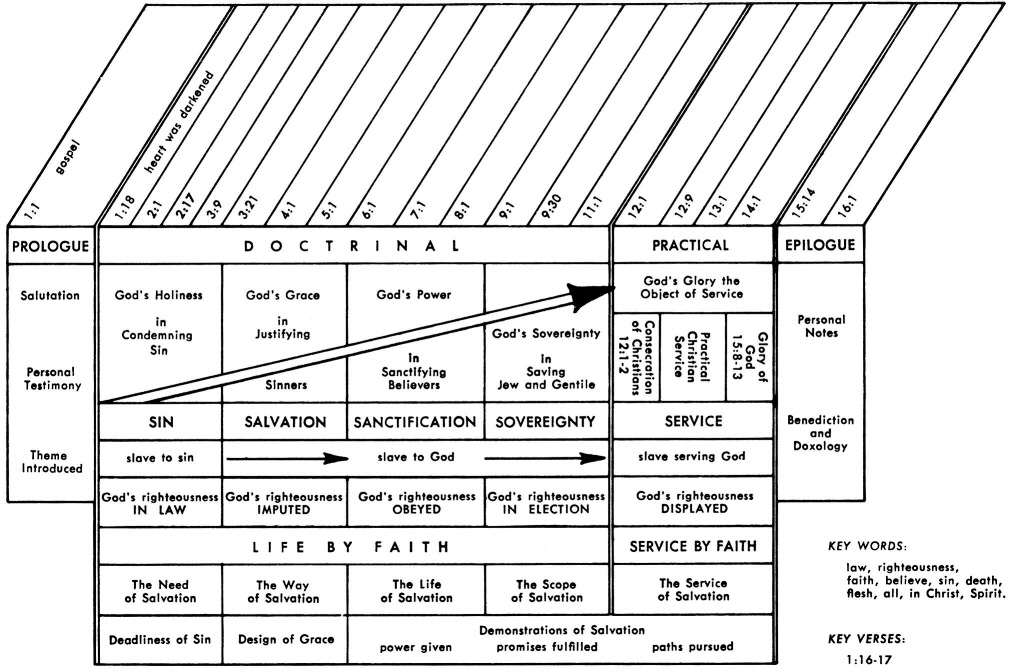
Click chart to enlarge
Chart from recommended resource Jensen's Survey of the NT - used by permission
Romans Overview Chart - Charles Swindoll
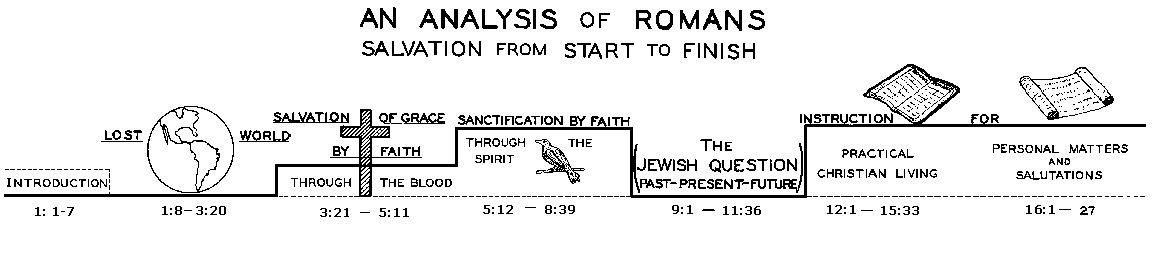
Source: Dr David Cooper
Click to Enlarge
| ROMANS ROAD to RIGHTEOUSNESS |
||||
| Romans 1:18-3:20 | Romans 3:21-5:21 | Romans 6:1-8:39 | Romans 9:1-11:36 | Romans 12:1-16:27 |
| SIN | SALVATION | SANCTIFICATION | SOVEREIGNTY | SERVICE |
| NEED FOR SALVATION |
WAY OF SALVATION |
LIFE OF SALVATION |
SCOPE OF SALVATION |
SERVICE OF SALVATION |
| God's Holiness In Condemning Sin |
God's Grace In Justifying Sinners |
God's Power In Sanctifying Believers |
God's Sovereignty In Saving Jew and Gentile |
Gods Glory The Object of Service |
| Deadliness of Sin |
Design of Grace |
Demonstration of Salvation | ||
| Power Given | Promises Fulfilled | Paths Pursued | ||
| Righteousness Needed |
Righteousness Credited |
Righteousness Demonstrated |
Righteousness Restored to Israel |
Righteousness Applied |
| God's Righteousness IN LAW |
God's Righteousness IMPUTED |
God's Righteousness OBEYED |
God's Righteousness IN ELECTION |
God's Righteousness DISPLAYED |
| Slaves to Sin | Slaves to God | Slaves Serving God | ||
| Doctrine | Duty | |||
| Life by Faith | Service by Faith | |||
|
Modified from Irving L. Jensen's chart above |
||||
R Ruin (Romans 1:17 – 3:20) – The utter sinfulness of humanity
O Offer (Romans 3:21-31) – God’s offer of justification by grace
M Model (Romans 4:1-25) – Abraham as a model for saving faith
A Access (Romans 5:1-11) – The benefits of justification
N New Adam (Romans 5:12-21) – We are children of two “Adams”
S Struggle w/ Sin (Romans 6:1-8:39) Struggle, sanctification, and victory
Romans 7:14 For we know that the Law is spiritual, but I am of flesh, sold into bondage to sin. (NASB: Lockman)
Greek: oidamen (1PRAI) gar hoti o nomos pneumatikos estin; (3SPAI) ego de sarkinos eimi, (1SPAI) pepramenos (RPPFSN) hupo ten hamartian.
Amplified: We know that the Law is spiritual; but I am a creature of the flesh [carnal, unspiritual], having been sold into slavery under [the control of] sin. (Amplified Bible - Lockman)
KJV: For we know that the law is spiritual: but I am carnal, sold under sin. (Textus Receptus has sarkikos instead of sarkinos - see below).
Moffatt: The Law is spiritual; we know that. But then I am a creature of the flesh, in the thraldom of sin.
NLT: The law is good, then. The trouble is not with the law but with me, because I am sold into slavery, with sin as my master. (NLT - Tyndale House)
Wuest: For we know that the law is spiritual. But as for myself, I am fleshly [being dominated by the sinful nature], permanently sold under the sinful nature.
Young's Literal: For we know that the Law is spiritual; but I am of flesh, sold into bondage to sin.
FOR (because) WE KNOW THAT THE LAW IS SPIRITUAL BUT I AM OF FLESH: Oidamen (1PRAI) gar hoti o nomos pneumatikos estin (3SPAI) ego de sarkinos eimi (1SPAI):
- Lev 19:18; Dt 6:5; Ps 51:6; Mt 5:22,28; 22:37, 38, 39, 40; Heb 4:12
- Ro 7:18,22,23; Job 42:6; Ps 119:25; Pr 30:2,5; Isa 6:5; 64:5,6; Lk 5:8; 7:6; 18:11, 12, 13, 14; Eph 3:8
- Mt 16:23; 1Cor 3:1, 2, 3
- Romans 7 Resources - Multiple Sermons and Commentaries
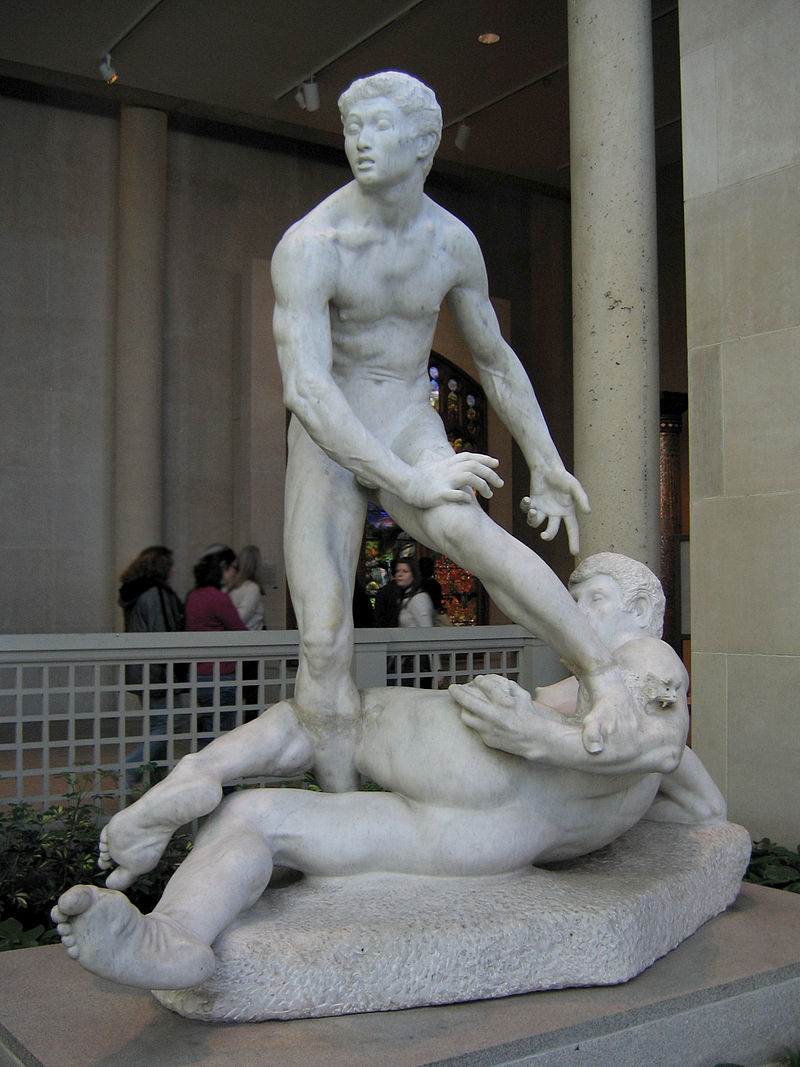
The Struggle of the Two Natures in Man
George Grey Barnard (carved 1892–94)
Beginning in Romans 7:14 Paul begins to discuss the conflict of two natures. This section has been one of the most controversial in the New Testament. The majority of commentators (e.g., John MacArthur, John Piper, Warren Wiersbe, S Lewis Johnson, Robert Mounce, Harry Ironside, Donald Barnhouse, Albert Barnes, William MacDonald, Martin Luther, John Calvin, Melanchthon, Beza, John Owen, Delitzsch, Hodge, Shedd, Kuyper, F F Bruce, and C E Cranfield, et al) favor this to be a description of a regenerate man (Paul) wrestling with the sinful propensities still present in his mortal body as it is in every saved person. Others feel Paul is discussing his unsaved state prior to conversion. Some feel the text addresses the experience of any man, whether saved or unsaved, who seeks to obey the law. See below for the Excursus on believer vs non-believer.
Vine divides Romans 7:14-25 into three sections…
(a) Romans 7:14-17 -- here he shows his inability to keep himself from doing what he disapproves of;
(b) Romans 7:18-20 -- here he shows his inability to carry out that which he approves of;
(c) Romans 7:21-25 -- finally, bringing his discussion to its appointed conclusion, he shows how deliverance from this condition is to be effected. (Vine, W. Collected writings of W. E. Vine. Nashville: Thomas Nelson)
One other point that should be made is that the spiritual conflict in Romans 7:14-25 although having some similarities to the conflict in Galatians 5:16-23, nevertheless does have differences as summarized below…
(1) The opponent of the sinful human nature in Romans 7 is the whole Christian individual, but in Galatians 5 it is the Holy Spirit.
(2) The condition of the believer in Romans is under the Law, but in Galatians it is under Law or grace.
(3) The result of the conflict in Romans is inevitable defeat, but in Galatians it is defeat or victory.
(4) The nature of the conflict in Romans is abnormal Christian experience, but in Galatians it is normal Christian experience. (See Stanley D. Toussaint's analysis “The Contrast Between the Spiritual Conflict in Romans 7 and Galatians 5, ” Bibliotheca Sacra 123:492, 1966)
Lewis Sperry Chafer adds that "In Romans 7:15-25 the conflict is between the regenerate man (hypothetically contemplated as acting independently, or apart from the indwelling Spirit) and his flesh. It is not between the Holy Spirit and the flesh. Probably there is no more subtle delusion common among believers than the supposition that the saved man, if he tries hard enough, can, on the basis of the fact that he is regenerate, overcome the flesh. The result of this struggle on the part of the Apostle was defeat to the extent that he became a wretched man.
Dr Charles Ryrie commenting on Romans 7:14-25 feels that "The intensely personal character of these verses and the use of present tenses indicate that this was Paul's own experience as a believer. This is his diagnosis of what happens when one tries to be sanctified by keeping the law. (The Ryrie Study Bible: New American Standard Translation: 1995. Moody Publishers)
Harry Ironside feels that Romans 7:14-25…
describes the exercises of a quickened soul under law who has not yet learned the way of deliverance. This once learned, one is free from the law forever. I have said earlier that primarily here we have a believing Jew struggling to obtain holiness by using the law as a rule of life and resolutely attempting to compel his old nature to be subject to it. In Christendom now the average Gentile believer goes through the same experience; for legality is commonly taught almost everywhere.
Therefore when one is converted it is but natural to reason that since he has been born of God it is only a matter of determination and persistent endeavor to subject himself to the law, and he will achieve a life of holiness. And God Himself permits the believer to be tested in order that His people may learn experientially that the flesh in the believer is no better than the flesh in an unbeliever. When he ceases from self-effort he finds deliverance through the Spirit by occupation with the risen Christ. (Ironside, H. Romans)
John MacArthur is confident that Romans 7 "describes a believer. However, of those who agree that this is a believer, there is still disagreement. Some see a carnal, fleshly Christian; others a legalistic Christian (Ed note: cf Ryrie above, Barber below), frustrated by his feeble attempts in his own power to please God by keeping the Mosaic law. But the personal pronoun “I” refers to the apostle Paul, a standard of spiritual health and maturity. So, in Romans 7:14-25 Paul must be describing all Christians—even the most spiritual and mature—who, when they honestly evaluate themselves against the righteous standard of God’s law, realize how far short they fall. He does so in a series of 4 laments (Romans 7:14-17, 18-20, 21-23, 24, 25). (MacArthur, J.: The MacArthur Study Bible Nashville: Word)
MacDonald agrees adding that "Up to this point the apostle has been describing a past experience in his life—namely, the traumatic crisis when he underwent deep conviction of sin through the law’s ministry. Now he changes to the present tense to describe an experience he had since he was born again—namely, the conflict between the two natures and the impossibility of finding deliverance from the power of indwelling sin through his own strength. (MacDonald, W & Farstad, A. Believer's Bible Commentary: Thomas Nelson)
Kent Hughes - This section of Romans 7 has known centuries of controversy: who is their subject? There are basically three views. The first is that this passage describes a non-Christian Pharisee under the Law (this was the view of the Greek Fathers). The second view is that it describes a normal Christian (the view of Augustine, Luther, and Calvin). The third position is that it describes a carnal Christian. I believe the second view is correct, mainly because Paul continues to write in the first-person singular but in the present tense. It seems most natural to understand this section as Paul talking about what he was then experiencing. (Hughes, R. K. Romans: Righteousness from heaven. Preaching the Word. Wheaton, Ill.: Crossway Books)
F. F. Bruce - In this section Paul continues to speak in the first person singular, but he leaves the past tense and uses the present. Not only so, but there is an inward tension here which was absent from Romans 7:7-13. There, sin assaulted him by stealth and struck him down; here, he puts up an agonizing resistance, even if he cannot beat down the enemy. There, he described what happened to him when he lived in 'this present age'; here, 'the age to come' has already arrived, although the old age has not yet passed away. He is a man living simultaneously on two planes, eagerly longing to live a life in keeping with the higher plane, but sadly aware of the strength of indwelling sin that keeps on pulling him down to the lower plane.
Wayne Barber has an interesting approach to this controversial section, as explained in his introductory comments on Romans 7:14-25…
When a person understands what it means to "live under grace," he understands the hymn "I Need Thee Every Hour." He is a person like the apostle Paul who has learned to never again put any confidence in his own flesh. He has learned that the only works the flesh can produce are unrighteous works. He understands that sin is when he has failed to put his trust into Christ and His Spirit to do in him what he failed to admit that he could not do. He realizes that just as his own self-effort to please God could not save himself, neither could his self-effort sanctify himself.
It is comforting to hear the reports of revival that is happening all over our country. I was listening to a tape of a pastor in Texas sharing what took place in his church. The thing that impressed me, was not what took place in his church, but what took place in him. He came to the realization that grace brings us all, that all of his training, all of his efforts were useless apart from the empowering grace of God. In short, he realized that "he could not, and God never said he could, but God could and always said He would."
In Ro 5:2 (note) Paul told us how the transforming power of grace is accessed. He says, "through whom also we have obtained our introduction by faith into this grace in which we stand; and we exult in hope of the glory of God."
When we cast all of our expectations upon Christ and upon His Word, trusting only in Him, then we have just accessed His grace, which is not only His undeserved favor, but His transforming power. If we choose to put ourselves back under law, instead of His grace, we are putting ourselves back under bondage to the very thing from which Christ has freed us.
In chapters 6 and 7, Paul is showing us the connection between the controlling power of sin and the law. Have you seen it yet? It is under the law that flesh is energized. It is dead apart from the law, but, when you take your focus off of Jesus, and begin to trust in your own efforts, then you are once again back up under the law, performing for God, and your flesh will frustrate you beyond measure.
How sad for a free person to foolishly put himself back under the bondage of sin. You see, under the Law, the flesh is commanded to perform, and then it is condemned in all that it does because it cannot measure up to the same law that commanded it.
Well, it is with these thoughts that we encounter Romans 7:14. Remember I told you that I’m preaching this as "I SEE IT!" For years I missed the point of what Paul is doing in Romans 7:14-25. A lot of folks spin their wheels trying to decide whether the use of the first person singular pronoun is Paul referring to a time when he was lost, etc. His use of the present tense when it comes to not being able to do what God requires also causes confusion. But, if you go back to the premise of being under the law and the flesh being commanded to perform but being unable to do so in a way that pleases God, then the problem with interpretation is not as great. (See his sermon Frustration… Under Law)
Any time you place yourself back up under the Law, and you depend upon your self efforts to please God, you will encounter frustration, and experience bondage to your flesh.
Wiersbe agrees with Barber writing "Having explained what the Law is supposed to do, Paul now explains what the Law cannot do… Our nature is carnal (fleshly); but the Law’s nature is spiritual. This explains why the old nature responds as it does to the Law. It has well been said, “The old nature knows no Law, the new nature needs no Law.” The Law cannot transform the old nature; it can only reveal how sinful that old nature is. The believer who tries to live under Law will only activate the old nature; he will not eradicate it. (Wiersbe, W: Bible Exposition Commentary. 1989. Victor)
John MacArthur writes "Some interpreters believe that chapter 7 describes the carnal, or fleshly, Christian, one who is living on a very low level of spirituality. Many suggest that this person is a frustrated, legalistic Christian who attempts in his own power to please God by trying to live up to the Mosaic law. But the attitude expressed in chapter 7 is not typical of legalists, who tend to be self-satisfied with their fulfillment of the law. Most people are attracted to legalism in the first place because it offers the prospect of living up to God’s standards by one’s own power. It seems rather that Paul is here describing the most spiritual and mature of Christians, who, the more they honestly measure themselves against God’s standards of righteousness the more they realize how much they fall short. The closer we get to God, the more we see our own sin. Thus it is immature, fleshly, and legalistic persons who tend to live under the illusion that they are spiritual and that they measure up well by God’s standards. The level of spiritual insight, brokenness, contrition, and humility that characterize the person depicted in Romans 7 are marks of a spiritual and mature believer, who before God has no trust in his own goodness and achievements. (MacArthur, J: Romans 1-8. Chicago: Moody Press)
S Lewis Johnson writes that…
Not only are there many human formulas for salvation, there are also many for sanctification. There are purveyors of sanctification by taboos, sanctification by such positively good things as witnessing, Bible study, and prayer done in our own strength. What results is a form of Christian legalism, a pride of righteousness done in the power of the flesh. It, too, discounts our state before God and the work of the Holy Spirit within us. The Apostle Paul makes it very plain that, even after our birth from above, we are in ourselves unable to overcome indwelling sin. We need something done in us (cf. note Romans 8:2), or the continual working of the Holy Spirit in sanctification. Just as a man cannot save himself, so a Christian cannot sanctify himself. We believers cannot of ourselves live the Christian life. We cannot of ourselves keep any law of God due to indwelling sin. That, in essence, is the point of the apostle in Romans 7:13-25…
Another question that has arisen is this: Is Paul drawing upon his own experiences, or is he using himself as representative of one in the throes of this spiritual condition? In answer to this one may say that it is not a question of an either/or, but of a both/and. He is using himself as an example based upon his own experiences. What we have is no abstract argument, but the personal struggle of an agonizing soul.
It has also been asked whether this is necessary Christian experience. I am inclined to think that it is necessary Christian experience, that is, that struggle characterizes us as long as we are in the flesh. On the other hand, it is not complete Christian experience. There are occasions of glorious victory in the believer's life, although complete victory awaits the future (cf. Romans 8:1-11).
What we have, then, in Romans 7:13-25 is the picture of a believer seeking to keep the Law (cf. Romans 7:22; 8:4) with the resources of the Law and his new life alone (cf. Romans 8:3). Sixteen times we find ego used (Greek for I) , thirty times the "I" is found in the AV, while the Holy Spirit is not used at all in the section, that is, Romans 7:13-25. The Law is mentioned in chapter seven twenty times, but only four times in chapter eight (nomos itself five times). In chapter eight there are at least twenty references to the Holy Spirit. These things, I believe, are the key to the section.(The Struggle )
We know (1492) (eido) (perfect tense) refers to intuitive knowledge. It indicates an absolute, positive, beyond a peradventure of a doubt, knowledge. We know beyond a shadow of a doubt that the Law is spiritual. The Law is not fleshly. Paul has just explained that the Law is holy and righteous and good. These facts are not in question. We admit. It is a conceded, well-understood point.
Spiritual (4152) (pneumatikos from pneuma = spirit) in the NT is usually used in relation to the work of the Holy Spirit. Some commentators (UBS Handbook) feel Paul is using pneumatikos to refer to the human spirit as opposed to human flesh (see comments below).
Pneumatikos - 26x in 21v in the NAS -
Ro 1:11; 7:14; 15:27; 1 Co. 2:13, 15; 3:1; 9:11; 10:3f; 12:1; 14:1, 37; 15:44, 46; Gal. 6:1; Eph. 1:3; 5:19; 6:12; Col. 1:9; 3:16; 1 Pet. 2:5
However, most commentators interpret pneumatikos as referring to the Law so that Paul is saying that the Law is spiritual, in the sense that the Law is divine, from God (cf phrases "Law of God" in Ro 7:22 [note], Ro 7:25 [note]). The fact that the law is spiritual means that the Law is a reflection of the character of God. Godly people recognize this fact (we know).
Vine - There are two ideas essentially connected with this word, pneumatikos, those of invisibility and power. It is said of that which owes its origin to God and is therefore in harmony with His character. Here the word spiritual sums up the three qualities, holy, righteous, and good, in verse 12. (Vine, W. Collected writings of W. E. Vine. Nashville: Thomas Nelson)
I am carnal - This is the KJV translation which reflects the original Greek manuscript (Textus Receptus) use of the Greek word sarkikos, which speaks of flesh in its ethical or moral sense.
I am of flesh - This is the NAS translation (also ESV, CSB) based on the Nestle-Aland Greek manuscript. Many scholars feel these modern Greek manuscripts are more accurate in their use of sarkinos in place of sarkikos. I personally side with the modern manuscripts, but I am NOT an expert in assessment of Greek manuscripts! And so I will have to confess that the study of sarkikos and sarkinos is confusing to me. For that reason I am giving several lexicon definitions of each word.
The verb "I am" is in the present tense. So in the KJV rendering Paul is saying "I am continually carnal" and in the NAS rendering his is saying "I am continually of flesh.' Either way it is translated it would support the fact that Paul is not talking of his past unsaved state but of his present state, saved but still prone to commit sins.
RENDERING OF RO 7:14
BASED ON KJV
KJV Romans 7:14 For we know that the law is spiritual: but I am carnal, sold under sin. (Rom 7:14 KJV)
Carnal (4559) (sarkikos from sarx) means of flesh and can refer to physical flesh or to the moral/ethical aspects of flesh. In the present context the KJV (and other translations) translates it carnal (Ro 7:14KJV) which suggests that one is dominated by the indwelling sinful tendencies, in contrast to the spiritual, which finds its origin and source in God, and is in affinity with God.
Here are the 10 uses of sarkikos in the King James Version - Translated carnal 9, fleshly 2; -
Rom. 7:14; Rom. 15:27; 1 Co. 3:1; 1 Co. 3:3; 1 Co. 3:4; 1 Co. 9:11; 2 Co. 1:12; 2 Co. 10:4; Heb. 7:16; 1 Pet. 2:11
Here are the 6 uses of sarkikos in the NAS - Translated flesh(1), fleshly(4), material things(2).
Rom. 15:27; 1 Co. 3:3; 1 Co. 9:11; 2 Co. 1:12; 2 Co. 10:4; 1 Pet. 2:11
Zodhiates on sarkikos - Fleshly, carnal, pertaining to the flesh or body. Found only in the epistles. (I) Generally, of things, tá sarkiká, things corporeal, external, temporal (Ro 15:27; 1 Cor. 9:11). (II) As implying weakness, frailty, imperfection; e.g., of persons as being carnal, worldly (1 Cor. 3:1, 3, 4); of things, carnal, human, frail, transient, temporary (2 Cor. 1:12; 10:4; Heb. 7:16). Some MSS read sárkinos in 1 Cor. 3:1; Heb. 7:16 meaning made of flesh. Sarkikós means with tendency to satisfy the flesh, implying sinfulness, sinful propensity, carnal (Ro. 7:14, under the influence of carnal desires); of things (1 Pe 2:11, carnal desires, having their seat in the carnal nature). (Complete Word Study Dictionary – New Testament)
Gingrich - fleshly, in the manner of the flesh.—1. belonging to the order of earthly things, material Ro 15:27; 1 Cor 9:11.—2. belonging to the realm of the flesh, i.e. weak, sinful, transitory 1 Cor 3:3; 2 Cor 1:12; 10:4; 1 Pt 2:11.
Friberg on sarkikos - fleshly, in the manner of the flesh, carnal, opposite pneumatiko,j (spiritual, pertaining to the spirit); (1) belonging to the earthly sphere of existence material, physical (2Co 10.4); neuter as a substantive ta. sarkika, material things (Ro 15.27 ); (2) of behavior, having the characteristics of sa,rx (flesh) in its sensual, sinful tendencies worldly, carnal (1Co 3.3); (3) as human in quality natural (2Co 1.12)
Vine on sarkikos - from sarx, "flesh," signifies (a) "having the nature of flesh," i.e., sensual, controlled by animal appetites, governed by human nature, instead of by the Spirit of God, 1 Cor. 3:3 (for ver. 1, see below; same mss. have it in ver. 4); having its seat in the animal nature, or excited by it, 1 Pet. 2:11, "fleshly," or as the equivalent of "human," with the added idea of weakness, figuratively of the weapons of spiritual warfare, "of the flesh" (AV, "carnal"), 2 Cor. 10:4; or with the idea of unspirituality, of human wisdom, "fleshly," 2 Cor. 1:12; (b) "pertaining to the flesh" (i.e., the body), Rom. 15:27; 1 Cor. 9:11.
Gilbrant on sarkikos - Known at least since the Fourth Century B.C. (e.g., Aristotle), sarkikos means “belonging to the flesh” (cf. sarkinos which means “composed of flesh, fleshly”; Bauer). Sarkikos has no inherently negative aspect in classical Greek. That changes to some extent in the New Testament. Sarkikos and sarkinos are used interchangeably in our literature (ibid.), but only sarkinos appears in the Septuagint. Essentially sarkikos has either a neutral or a negative connotation in the New Testament. When it is contrasted with pneumatikos (4012), “spiritual,” it should often be read in terms of “belonging to the sinful nature, the flesh” (cf. Romans 7:14). Otherwise it can simply represent the earthly, material realm, without prejudice. We have examples of the former understanding in the New Testament where, except for one use in 1 Peter 2:11 and one in Hebrews 7:16, sarkikos is a uniquely Pauline term. In reference to the Corinthians’ spiritual condition Paul said they were “worldly” (NIV). The implication is that they were immature, they were quarreling among themselves, and they were continuing to be ruled by their sinful nature rather than by Christ (1 Corinthians 3:3). Perhaps the same connotation is intended in 2 Corinthians 1:12. Paul’s conduct was governed by grace rather than by “worldly (sarkikos) wisdom (sophia)” (cf. 2 Corinthians 10:4). As well, Paul sought to fight the good fight of faith with weapons that are not carnal, i.e., human reasoning and power which are of no effect in the spiritual struggle (2 Corinthians 10:4). In a more neutral sense Paul spoke of receiving a “material” (NIV, i.e., “tangible”) harvest from spiritual sowing (1 Corinthians 9:11). This same neutral usage is attested in early Christian literature. Ignatius spoke of Jesus as sarkikos te kai pneumatikos (To the Ephesians 7:2). Here we have a clear indication that sarkikos does not necessarily imply the sinful nature. Such a thought would have appalled Ignatius (cf. Ignatius To the Smyrnaeans 3:3; cf. Bauer). Picking up on the link between sarkikos and the sinful nature, Peter warned the Gentiles to “abstain from sinful desires” (tōn sarkikōn epithumiōn; 1 Peter 2:11, NIV). Peter was not simply speaking of sexual desires here as the translation “fleshly lusts” implies. Rather, Peter was referring to every kind of expression of the sinful nature (see e.g., Romans 8, and see the article on sarx). As with Paul in Galatians 5:17, there is no indication here of a platonic dualism. Rather, the apostles were simply warning their readers against allowing themselves to become slaves to what are very often normal desires. (Complete Biblical Library Greek-English Dictionary)
RENDERING OF RO 7:14
BASED ON NAS
NAS Ro 7:14 For we know that the Law is spiritual, but I am of flesh, sold into bondage to sin.
Of flesh (4560) (sarkinos from sarx- flesh) is used in some contexts to refer to that which is made of or consists of flesh (physical flesh). However, sarkinos can also refer to the moral/ethical aspect of human nature in its base behavior (1 Cor 3:1).
Gilbrant on sarkinos - This adjective is related to sarx, “flesh,” and can have either the literal or metaphoric sense of that term. Sarkinos occurs only once in the Received text of the New Testament, 2 Corinthians 3:3. Here the tablets of stone inscribed with the Ten Commandments are contrasted with the hearts of flesh on which the new covenant is written. In this sense flesh is a positive symbol of something living and sensitive. In modern critical texts sarkinos is found instead of sarkikos (4416) in Romans 7:14, 1 Corinthians 3:1, and Hebrews 7:16.
Vine on sarkinos - (a) "consisting of flesh," 2 Cor. 3:3, "tables that are hearts of flesh" (AV, "fleshy tables of the heart"); (b) "pertaining to the natural, transient life of the body," Heb. 7:16, "a carnal commandment;" (c) given up to the flesh, i.e., with almost the same significance as sarkikos, Rom. 7:14, "I am carnal sold under sin;" 1 Cor. 3:1 (some texts have sarkikos, in both these places, and in those in (a) and (b), but textual evidence is against it). It is difficult to discriminate between sarkikos and sarkinos in some passages. In regard to 1 Pet. 2:11, Trench (Syn. lxxi, lxxii) says that sarkikos describes the lusts which have their source in man's corrupt and fallen nature, and the man is sarkikos who allows to the flesh a place which does not belong to it of right; in 1 Cor. 3:1 sarkinos is an accusation far less grave than sarkikos would have been. The Corinthians saints were making no progress, but they were not anti-spiritual in respect of the particular point with which the Apostle was there dealing. In 1 Cor 3:3, 4, they are charged with being sarkikos.
The KJV based on the Textus Receptus has only one use of sarkinos - 2 Cor 3:3
Sarkinos - 4x in 4v in the NAS - Translated flesh(1), human(1), men of flesh(1), physical(1). - Ro. 7:14; 1 Co. 3:1; 2 Co. 3:3; Heb. 7:16
(1 Co. 3:1) And I, brethren, could not speak to you as to spiritual men, but as to men of flesh, as to infants in Christ.
(2 Co. 3:3) being manifested that you are a letter of Christ, cared for by us, written not with ink but with the Spirit of the living God, not on tablets of stone but on tablets of human hearts.
(Heb. 7:16) who has become such not on the basis of a law of physical requirement, but according to the power of an indestructible life.
So Paul is either saying I am totally a fleshly being sold into bondage to the sin that is in my body if sarkinos (I FAVOR THE NAS/ESV TRANSLATIONS OF THE NESTLE-ALAND) is interpreted here to have a moral/ethical slant. In this case he is saying that there is something about my flesh that is wicked and devoted to sin. This wicked flesh lives in my mortal body (which is true of both the saved and unsaved) and I cannot divorce myself from it. A number of translations favor the moral/ethical sense over the physical sense -- "of the flesh [carnal, unspiritual]" (Amplified), "I am fleshly [being dominated by the sinful nature]" (Wuest), “carnal” (RSV, Phillips), “unspiritual” (NEB, NJB), or “weak flesh” (NAB).
Now if Paul is using sarkinos with the physical meaning, he could be implying that he is "earth bound and mortal" or still has to deal with the things that are of the flesh, but even then one of the things that the physical body of flesh has to deal with is the moral/ethical aspect of the flesh that indwells these mortal bodies.
John Piper's view on this passage - I think the second position is right (description of Paul's experience as a Christian). Paul is speaking about himself here as a Christian. Let me say immediately that I do not mean we should settle in and coast with worldly living and a defeatist mentality. We should not make peace with our sin; we should make war on our sin. Defeat is not the only, or the even the main, experience of the Christian life. But it is part of it. I agree with J. I. Packer who wrote an article on this passage two years ago to defend the view that I am taking here. (See sermon Who Is This Divided Man?).
Newell has an interesting thought commenting that "If Paul had been speaking of himself before being quickened, he would have used the word natural: "the natural man receiveth not the things of the Spirit of God" (1Co 2:14). Carnal is not used to describe an unregenerate person, but a Christian not delivered from the power of the flesh: "I, brethren could not speak unto you as unto spiritual, but as unto carnal, as unto babes in Christ" (1Cor 3:1)
SOLD INTO BONDAGE TO SIN: pepramenos (RPPFSN) hupo ten hamartian:
- Ro 7:24; Ge 37:27,36; 40:15; Ex 21:2, 3, 4, 5, 6; 22:3; 1Ki 21:20,25; 2Ki 17:17; Isa 50:1; 52:3; Amos 2:6; Mt 18:25
- Romans 7 Resources - Multiple Sermons and Commentaries
Sold into bondage to sin - There is no word in Greek for "bondage". The preposition hupo preceding sin means under and the implication then is to be "under the power of sin". The KJV/NKJV are more accurate than NASB or NIV in translating the phrase "sold under sin".
Sin is no longer a believer's master (Ro 6:12,14). It can become such but it is not the expected or desired state. And furthermore if it is the CONTINUOUS STATE (Ro 6:2-3) that individual has serious cause to examine the genuineness of their salvation (2Cor 13:5). So this translation might not be the best to study with, especially if one favors this man is a regenerate man.
Wuest also renders it more literally "For we know that the law is spiritual. But as for myself, I am fleshly [being dominated by the sinful nature], permanently sold under the sinful nature.
Sold (4097) (piprasko from perao = to cross, to transport to a distant land) means literally to sell, and is used figuratively in the passive voice in this verse to describe one "sold into bondage to Sin" picturing sin as "possessing" the individual, thus a "slave to sin!" (Woe!) The Perfect tense means they “had been sold and remained under the dominion of sin”. This tense pictures the permanence of their state.
TDNT on piprasko - In secular Greek piprasko means literally “to sell,” “to sell for a bribe,” or “to lease,” and figuratively “betrayed,” “sold out,” “led astry,” of “mined.” The NT also uses piprasko literally for “to sell” (Mt. 13:46; 18:25; Acts 2:45, etc.), and the figurative sense appears in Rom. 7:14 to describe the desperate plight of the person “sold under sin.” [H. PREISKER, VI, 160]
Piprasko - 9x in 9v - Matt. 13:46; Matt. 18:25; Matt. 26:9; Mk. 14:5; Jn. 12:5; Acts 2:45; Acts 4:34; Acts 5:4; Rom. 7:14
Piprasko - 32x in 31v in the Septuagint -
Ge 31:15; Ex. 22:3; Lev. 25:23; Lev. 25:34; Lev. 25:39; Lev. 25:42; Lev. 25:47; Lev. 25:48; Lev. 27:27; Deut. 15:12; Deut. 21:14; Deut. 28:68; 1 Sam. 23:7; 1 Ki. 21:20; 1 Ki. 21:25; 2 Ki. 17:17; Est. 7:4; Ps. 105:17; Isa. 48:10; Isa. 50:1; Isa. 52:3; Jer. 34:14; Ezek. 48:14;
A T Robertson paraphrases the perfect tense of sold picturing Sin as a banker who has foreclosed - Sin has closed the mortgage and owns its slave.
The question that naturally arises is how can a genuine believer be "permanently" under the power of sin? (See also Excursus on believer vs non-believer)
Middletown Bible - How it is possible for a Christian to be carnal, fleshly, a slave of sin. First of all we recognize that there is a sense in which a true believer is not carnal. Ro 8:9 (note) says "ye are not in the flesh (carnal), but in the Spirit." Paul referred to his unsaved life as the time when he was "in the flesh" (Ro 7:5-note). In other words, positionally speaking, a true believer (saved person) is no longer in the carnal realm, but he is in the Spirit realm (Ro 8:9-note). He is in Christ and Christ is in him. Also positionally the saved person is no longer a slave of sin as we have seen in Romans 6 (Ro 6:17, 18, 22- see notes Ro 6:17; 18; 22). However, in Romans 7:14 Paul is not referring to his glorious position but to his actual condition. He is referring to his actual experience of living the Christian life. And it is possible for a true Christian to have a carnal WALK (compare 1Cor 3:1, 2, 3, 4). This does not mean that Paul’s Christian life was marked by and characterized by carnality. This is contradicted by everything we know about the apostle. But we must say that Romans 7:15-24 was the apostle’s very real experience and every honest believer must confess that to one degree or another he too has experienced the very same thing and gone through the same struggle that is here depicted by the apostle. (See Romans 7)
Vine makes a distinction that "What is expressed (by the phrase sold under sin) is not the condemnation of the unregenerate state, but the evil of bondage to a corrupt nature, and the futility of making use of the Law as a means of deliverance. (Vine, W. Collected writings of W. E. Vine. Nashville: Thomas Nelson)
Stedman addresses this question explaining that Paul "is simply describing what happens when a Christian (or even an unbeliever) tries to live under the Law. When a believer (or an unbeliever) by his dedication and will power and determination, tries to do what is right in order to please God, he is living under the Law. And Paul is telling us what to expect when we live like that -- for we all try to live that way from time to time. sin, you see, deceives us. (For full sermon click The Continuing Struggle) (Bolding added)
Newell comments that the phrase sold under sin "describes all of us by nature. Instead of being spiritual and therefore able to hearken to, delight in and obey God's holy spiritual Law, we are turned back, since Adam sinned, to a fleshly condition, our spirits by nature dead to God, and our soul-faculties under the domination of the still unredeemed body. Now Paul, though his spirit was quickened (Saved, born again); and his inward desires, therefore, were toward God's Law; found to his horror his state by nature "carnal, " fleshly, "sold under sin." How little humanity realizes this awful, universal fact about man- sold under sin! Sold under sin is exactly what the new convert does not know! Forgiven, justified, he knows himself to be: and he has the joy of it! But now to find an evil nature, of which he had never become really conscious, and of which he thought himself fully rid, when he first believed, is a "second lesson" which is often more bitter than the first-of guilt! (Romans 7)
Cranfield has an interesting insight explaining that "When Christians fail to take account of the fact that they (and all their fellow Christians also) are still pepramenoi hupo ten hamartian (sold under the sin), they are specially dangerous both to others and to themselves because they are self-deceived. The more seriously a Christian strives to live from grace and to submit to the discipline of the gospel, the more sensitive he becomes to the fact of his continuing sinfulness, the fact that even his very best acts and activities are disfigured by the egotism which is still powerful within him—and no less evil because it is often more subtly disguised than formerly. At the same time it must be said with emphasis that the realistic recognition that we are still indeed pepramenoi hupo ten hamartian (sold under the sin) should be no encouragement to us to wallow complacently in our sins. (Cranfield, C. E. B. A Critical and Exegetical Commentary on the Epistle to the Romans. London; New York: T&T Clark International)
Johnson adds that "there is no question in Paul's mind that, while the believer is unable of himself to win the battle, he is nevertheless responsible for his failure. Inability is consistent with responsibility.
Ironside feels that in Romans 7:14-25 Paul is describing a believer living according to the flesh (carnal) explaining that "the carnal man who is sold under sin. That is, he is subject to the power of the evil nature to which he has died in Christ, a blessed truth indeed, but one which he has not yet apprehended in faith. Consequently he continually finds himself going contrary to the deepest desires of his divinely-implanted new nature. He practices things he does not want to do. He fails to carry out his determinations for good. The sins he commits he hates. The good he loves he has not the strength to perform. But this proves to him that there is something within him which is to be distinguished from his real self as a child of God. He has the fleshly nature still, though born of God. He knows the law is good. He wants to keep it, and slowly the consciousness dawns on him that it is not really himself as united to Christ who fails. It is sin, dwelling in him, which is exercising control. So he learns the weakness and unprofitableness of the flesh. (Ironside, H. Romans)
Constable explains that…
Sold under sin is exactly what the new convert does not know! Forgiven, justified, he knows himself to be: and he has the joy of it! But now to find an evil nature (Ed note: flesh), of which he had never become really conscious, and of which he thought himself fully rid, when he first believed, is a ‘second lesson’ which is often more bitter than the first—of guilt.!”
Paul’s statement that he was then as a Christian the slave of sin seems to contradict what he wrote earlier in chapter 6 about no longer being the slave of sin. However remember that in chapter 6 Paul did not say that being dead to sin means that sin has lost its appeal for the Christian. It still has a strong appeal to the Christian whose human nature is still sinful (Romans 6:15-23). He said that being dead to sin means that we no longer must follow sin’s dictates.
In one sense the Christian is not a slave of sin (Romans 6:1-14). We have died to it, and it no longer dominates us. Nevertheless in another sense sin still has a strong attraction for us since our basic human nature is still sinful and we retain that nature throughout our lifetime.
For example, a criminal released from prison no longer has to live within the sphere of existence prescribed by prison walls. However he still has to live within the confines of his human limitations. God has liberated Christians from the prison house of sin (6:1–14). Notwithstanding we still carry with us a sinful nature that will be a source of temptation for us as long as we live (7:14–25). (Expository Notes on the Bible)
Guzik writes that "Even though Paul says that he is carnal (KJV) it doesn’t mean that he is not a Christian. His awareness of his carnality is evidence that God has done a work in him. Luther (comments) on but I am carnal, sold under sin: That is the proof of the spiritual and wise man. He knows that he is carnal, and he is displeased with himself; indeed, he hates himself and praises the Law of God, which he recognizes because he is spiritual. But the proof of a foolish, carnal man is this, that he regards himself as spiritual and is pleased with himself.
So let's reiterate an important principle irregardless of whether Paul is describing an saved or lost man -- Law is a main subject in Romans 7 and Paul's description instructs us that the Law plays absolutely no role in sanctifying us (either non-believers which would be their initial sanctification [i.e., their salvation or regeneration] or believers in their daily sanctification). The point is that just as keeping the Law does not save anyone, keeping the law does not produce sanctification or Christlikeness in believers. Both the initial salvation and the subsequent sanctification are dependent on exercise of faith.
Hodge comments on sold into bondage to sin - To say that a man is sold as a slave to sin may mean, as in 1 Kings 21:20 and 2 Kings 17:17, that he is given up to its service. Sin is that which he has deliberately chosen for a master and to which he is devoted. In this sense it is equivalent to what is said of the unrenewed in the preceding chapter, that they are the slaves to sin. From this kind of slavery believers are redeemed (Ro 6:22-note). But there is another kind of slavery. A man may be subject to a power which, of himself, he cannot effectually resist, against which he may and does struggle, and from which he earnestly desires to be free, but which, notwithstanding all his efforts, still asserts its authority. This is precisely the bondage to sin of which every believer is conscious. He feels that there is a law in his body bringing him into subjection to the law of sin, that his distrust of God, his hardness of heart, his love of the world and of self, his pride — in short, his indwelling sin — is a real power from which he longs to be free, against which he struggles, but from which he cannot emancipate himself. This is the kind of slavery the apostle is speaking about here, as is clear from the following verses as well as from the whole context and from the analogy of Scripture. (Hodge, C. Commentary on the Epistle to the Romans, 1835)
Adam Clarke (see critique) - "It is difficult to conceive how the opinion could have crept into the Church, or prevailed there, that "the apostle speaks here of his regenerate state; and that what was, in such a state, true of himself, must be true of all others in the same state." This opinion has, most pitifully and most shamefully, not only lowered the standard of Christianity, but destroyed its influence and disgraced its character. It requires but little knowledge of the spirit of the Gospel, and of the scope of this epistle, to see that the apostle is, here, either personating a Jew under the law and without the Gospel, or showing what his own state was when he was deeply convinced that by the deeds of the law no man could be justified."
Fleshly, in Latin and French is the word "carna" which means "sensual." We get our word carnival from carne vale = "farewell flesh." Carnival was something they had before the season of Lent. During Lent they would practice farewell to the flesh with certain denials of pleasure to the flesh. But just before Lent they would gorge and gourmandize the flesh, get drunk, satisfy and satiate the flesh in every possible way (license, licentiousness). Then they would be able to do without such things during Lent! (Not really -- externally maybe so but not internally -- see remainder of explanation).
An example of this is the Mardi Gras in New Orleans which literally means "fat Tuesday", the Tuesday before the 40 day fast of Lent begins. But believers have died to the elementary principles of the world dictating "Do not handle, etc" (Col 2:20, 21-note) and are no longer "under law" (Ro 6:14-note) and don't (or shouldn't) try to curb or control their strong desires latent in their flesh by trying to obey a set of "'Do's" and "Don'ts" which have the effect of actually arousing the flesh (Ro 7:5-note) and are therefore of no value against fleshly indulgences (Col 2:23-note).
The Power Of Sin - I was having lunch with a pastor-friend when the discussion sadly turned to a mutual friend in ministry who had failed morally. As we grieved together over this fallen comrade, now out of ministry, I wondered aloud, “I know anyone can be tempted and anyone can stumble, but he’s a smart guy. How could he think he could get away with it?” Without blinking, my friend responded, “Sin makes us stupid.” It was an abrupt statement intended to get my attention, and it worked.
I have often thought of that statement in the ensuing years, and I continue to affirm the wisdom of those words. How else can you explain the actions of King David, the man after God’s own heart turned adulterer and murderer? Or the reckless choices of Samson? Or the public denials of Christ by Peter, the most public of Jesus’ disciples? We are flawed people who are vulnerable to temptation and to the foolishness of mind that can rationalize and justify almost any course of action if we try hard enough.
If we are to have a measure of victory over the power of sin, it will come only as we lean on the strength and wisdom of Christ (Ro 7:24, 25). As His grace strengthens our hearts and minds, we can overcome our own worst inclination to make foolish choices. — Bill Crowder
The price of sin is very high
Though now it may seem low;
And if we let it go unchecked,
Its crippling power will grow. —Fitzhugh
God’s Spirit is your power source—
don’t let sin break the connection.
Observations favoring a "Believer"
(1) Present tense used = suggests a habitual lifestyle of sin -- likes (Ro 7:15-note) hates (Ro 7:15-note) wish (Ro 7:16-note) wishing (Ro 7:18-note) wish (Ro 7:19-note) do not wish (Ro 7:20-note) wishes to do (Ro 7:21-note both verbs present) joyfully concur (Ro 7:22-note) waging war (Ro 7:23-note). In the preceding section Paul used the past tense (suggesting historical facts) almost exclusively, while in Romans 7:13-25 the verbs are predominantly present tense (suggesting present experience).
This person (continually) desires to obey God’s law and (continually) hates doing what is evil (Ro 7:15, 19, 21 -Ro 7:15; 19; 21).
MacArthur writes
The apostle has already established that none of those things characterize the unsaved. The unbeliever not only hates God’s truth and righteousness but suppresses them, he willfully rejects the natural evidence of God, he neither honors nor gives thanks to God, and he is totally dominated by sin so that he arrogantly disobeys God’s law and encourages others to do so (Ro 1:32).
S Lewis Johnson comments that…
it is difficult to imagine an unsaved man diagnosing his case so perfectly, or affirming such things of an unsaved person. He has a clear view of himself (Ro 7:18, 24). He has a noble view of the Law (Ro 7:16, 19). In three ways he is a saint. He hates sin (Ro 7:15, 16; can this agree with Ro 3:7?). He delights in the Law of God (Ro 7:22). He looks for deliverance to Christ alone (Ro 7:25). John Stott comments, "Now let me repeat that anyone who acknowledges the spirituality of God's law and his own natural carnality is a Christian of some maturity."
The OT supports this idea of an increased awareness of sin in believers…
Isaiah saw the Lord and said he was (LXX = Present tense = continually) a man of unclean lips (Isaiah 6:5).
Daniel a man of God held himself guilty of sinning against God (Da 9:5ff) although admittedly he is including himself as part of the entire nation which had sinned against God.
Job sees the Lord and then sees his condition and cries out…
Therefore I retract, And I repent in dust and ashes (Job 42:6)
Note that God's Word referred to Job as blameless (Job 1:1, 8).
James says
For WE ALL stumble (fail to keep the Law of God, err, sin = present tense = continually) in many ways. If anyone does not (continuously) stumble in what he says, he is a perfect man, able to bridle the whole body as well. (James 3:2)
2) SIN is still potentially able to be the master even in believers (Ro 6:12, 13- notes Ro 6:12; 6:13)
3) Flesh is still within believers (Ga 5:17-note 1Pe 2:11-note) but flesh has been crucified (Ga 5:24-note Ga 2:19, Ga 2:20-note Ga 6:14)
4) He is humble before God realizing that nothing good dwells in his flesh (Ro 7:18)
Good here it is agathos (the kind of good that is framed in a deed that you do for someone else… it is another way of saying a "righteous work"). So in me there is no GOOD thing… but he qualifies it -- "in my flesh". So whether he is lost or saved he is saying that in his flesh there is no potential to do righteous deeds. So you can still come at it from both sides.
5) He sees SIN as in him but not all there is in him (Ro 7;17, 20, 21, 22-notes Ro 7:17; 20 21 22).
6) "The inner man" (identical Greek phrase) elsewhere refers to a believer (Ep 3:16-note).
Also see 2Cor 4:16
Therefore we do not lose heart, but though our outer man is decaying, yet our inner man is being renewed day by day. (where "man" is added as implied by the context but there is no "anthropos" as in Ro 7:22 Eph 3:16)
7) He gives thanks to Jesus Christ as his Lord and serves Him with his mind (Ro 7:25-note).
8) With my mind used twice -- once clearly serving the law of God (Ro 7:25-note).
I see a different law in the members of my body, waging war against the law of my mind, and making me a prisoner of the law of sin which is in my members.
9) If this is indeed Paul note his self description near the end of his long walk with the Savior in 1Ti 1:15
It is a trustworthy statement, deserving full acceptance, that Christ Jesus came into the world to save sinners, among whom I am (present tense = continually) foremost of all.
10) The general flow of Romans supports the view for we have we have logically come through the doctrine of sin and justification into the doctrine of sanctification. While it is true that not every passage after the completion of the theme of condemnation refers to the believer (cf. Romans 8:5, 6, 7, 8), the majority of Romans 6-8 does describe a believer's sanctification.
Observations favoring "Unbeliever"
1). Present tense used = doing (Ro 7:15-note) am doing the very thing I hate (Ro 7:15-note) I do the very thing I do not wish (Ro 7:16-note) am I the one doing it (Ro 7:17-note) doing of the good is not (Ro 7:18-note) do not do (Ro 7:19-note) I practice the very evil that I do not wish (Ro 7:19-note) I am doing (Ro 7:20-note)
2) I am of flesh (sarkikos) sold (perfect tense = sold in past with present ongoing results) into bondage to sin (Ro 7:14-note) (sold under sin… similar phrase in Ro 3:9-note)
A believer has died to sin (Ro 6:2-note) & is freed from sin (Ro 6:7, 18, 22- notes Ro 6:7, 6:18, 6:22)
3) Making me a prisoner of the law of sin which is in my members (Romans 7:23)
4) Nothing good dwells in me BUT HE ADDS (in my flesh) (Flesh is still around in believers but they are not "in the flesh" - Ga 5:17-note)
5) The argument is used that some people (who may not even be truly regenerate) use this section to excuse the practice of living in sin and so we must be very careful ascribing this section to a believer's normal Christian life.
Undoubtedly this passage is abused by many individuals (? antinomians) but that "abuse" or misuse of this passage is not justified by the interpretation in the context of chapters on either side of Romans 7, as Romans 6 describes a new creature in Christ who cannot live habitually in sin and yet who still has to contend with indwelling SIN, albeit he has been crucified and it has been rendered inoperative (Ro 6:6-note Gal 5:24-note).
6) Numerous NT passages argue strongly that a believer cannot live habitually (in the present tense) in sin as is suggested by the use of the present tense numerous times in this section.
Romans 7:15 For what I am doing, I do not understand; for I am not practicing what I would like to do, but I am doing the very thing I hate (NASB: Lockman)
Greek: o gar katergazomai (1SPMI) ou ginosko; (1SPAI) ou gar o thelo (1SPAI) touto prasso, (1SPAI) all' o miso (1SPAI) touto poio. (1SPAI)
Amplified: For I do not understand my own actions [I am baffled, bewildered]. I do not practice or accomplish what I wish, but I do the very thing that I loathe [[2] which my moral instinct condemns]. (Amplified Bible - Lockman)
Moffatt: I cannot understand my own actions; I do not act as I desire to act; on the contrary, I do what I detest.
NLT: I don't understand myself at all, for I really want to do what is right, but I don't do it. Instead, I do the very thing I hate. (NLT - Tyndale House)
NKJV "For what I am doing, I do not understand. For what I will [to do], that I do not practice; but what I hate, that I do."
Wuest: For that which I do, I do not understand. For that which I desire, this I do not practice. But that which I hate, this I am doing.
Young's Literal: For that which I am doing, I do not understand; for I am not practicing what I would like to do, but I am doing the very thing I hate.
FOR THAT WHICH I AM DOING, I DO NOT UNDERSTAND: o gar katergazomai (1SPMI) ou ginosko (1SPAI):
- Ro 14:22; Lu 11:48
- Ps 1:6; Nahum 1:7; 2Ti 2:19
- Romans 7 Resources - Multiple Sermons and Commentaries
Doing (katergazomai)… practicing (prasso)… doing (poieo) - notice that all three verbs express conduct and while each is a distinct Greek verb, the differences in this context are not great.
Romans 7:14-17 -- Paul shows his inability to keep himself from doing what he disapproves of.
For (gar) (term of explanation) explains and confirms the preceding statement. Specifically Paul explains the result or effect of the state of being sold under sin (sold into bondage to sin).
As Hodge puts it "This is an explanation and confirmation of the preceding declaration. “I am sold under sin, for I do not understand what I do." (Ibid) The actions he now proceeds to describe are the proof that sin still indwelt him.
I like how William Newell explains this section commenting that "We must constantly remember throughout this struggle that it is not a description by the apostle Paul of an experience he was having when he wrote this Epistle! but an experience of a regenerate man before he knows either about indwelling sin or that he died to sin and to the Law which gives sin its power; and who also does not know the Holy Spirit, as an indwelling presence and power against sin. God let Paul have this experience. And he now writes about it that we may read and know all the facts of our salvation: not merely of the awful guilt of our sins, and our forgiveness through the blood of Christ; but also of the moral hideousness of our old selves; and our powerlessness, though regenerate, to deliver ourselves, from "the law of sin" in our members. Therefore Paul said that in that struggle he found himself "working out" a manner of life he refused to "own"- to admit as his real choice. For, he says, Not what I am wishing, that am I practicing. (Romans 7)
MacDonald comments that…
Now the apostle describes the struggle that goes on in a believer who does not know the truth of his identification with Christ in death and resurrection. It is the conflict between the two natures in the person who climbs Mount Sinai in search of holiness. Harry Foster explains:
Here was a man trying to achieve holiness by personal effort, struggling with all his might to fulfill God’s “holy and righteous and good” commandments (v.12), only to discover that the more he struggled, the worse his condition became. It was a losing battle, and no wonder, for it is not in the power of fallen human nature to conquer sin and live in holiness. (Harry Foster, article in Toward the Mark)
Notice the prominence of the first-person pronouns—I, me, my, myself; they occur over forty times in verses 9–25! People who go through this Romans 7 experience have taken an overdose of “Vitamin I.” They are introspective to the core, searching for victory in self, where it cannot be found.
Sadly, most modern Christian psychological counseling focuses the counselee’s attention on himself and thus adds to the problem instead of relieving it. People need to know that they have died with Christ and have risen with Him to walk in newness of life. Then, instead of trying to improve the flesh, they will relegate it to the grave of Jesus. (MacDonald, W & Farstad, A. Believer's Bible Commentary: Thomas Nelson)
I am doing (2716) (katergazomai from katá = intensifies meaning of verb + ergazomai = work or engage in an activity involving considerable expenditure of effort) means to work out fully and thoroughly, to accomplish or achieve an end, to finish or carry something to its conclusion and implies doing something with thoroughness.
Not (ou) means to absolutely not understand.
Understand (1097) (ginosko) has the basic meaning of taking in knowledge in regard to something or someone. The idea is to recognize as a result of experience.
A T Robertson writes that Paul is saying “I do not recognize” in its true nature. My spiritual perceptions are dulled, blinded by sin (2 Cor 4:4). The dual life pictured here by Paul finds an echo in us all, the struggle after the highest in us (“what I really wish,” ho thelō, to practice it steadily, prassō) and the slipping into doing (poiō) “what I really hate” (ho misō) and yet sometimes do.
Wuest who interprets this section as if a believer is speaking writes "He does not understand his experience as a Christian. He says, “For that which I desire, this I do not practice, but that which I hate, this I am doing.” That is, the very thing he desires to do, namely, good, this he does not do, and that which he hates, this is the thing he does do. It is clear that Paul is recounting his experience as a saved man. He desires to do good and hates sin. No unsaved man does that. (see notes Romans 3:11; 3:12) The failure to achieve his purpose is found in the fact that he is attempting in his own strength that which can only be accomplished in the supernatural power of the Holy Spirit.
First he emphasizes that he does not understand his continuous doing.
His problem isn’t desire - he wants to do what is right. His problem isn’t knowledge - he knows what the right thing is. His problem is lack of power - how to perform what is good I do not find. He lacks power because the law gives no power. Law says: "Here are the rules and you had better keep them," but it imparts no power to us for the keeping of the law.
Anyone who has tried to do good is aware of this struggle. We never know how hard it is to stop something until we try. This is the struggle of anyone who tries to obey God in their own strength, which is still something that Christian can do, and is the only thing that a non-Christian can do (because he has no indwelling Spirit).
Griffith Thomas agrees writing that "The one point of the passages is that it describes a man who is trying to be good and holy by his own efforts and is beaten back every time by the power of indwelling sin; it thus refers to anyone, regenerate or unregenerate.
FOR I AM NOT PRACTICING WHAT I WOULD LIKE (in the sense of full determination) TO DO: ou gar o thelo (1SPAI) touto prasso (1SPAI):
- Ro 7:16,19,20; 1Ki 8:46; Ps 19:12; 65:3; 119:1, 2, 3, 4, 5, 6,32,40; Eccl 7:20; Gal 5:17; Phil 3:12-14; Jas 3:2; 1Jn 1:7,8
- Romans 7 Resources - Multiple Sermons and Commentaries
Literally “For what I am continually wishing, that I am not continually doing.”
Practicing (4238) is in the present tense indicating that he is not habitually practicing what we would like to practice.
Like (2309) (thelo) means to desire or to take pleasure in. Thelo means that which one is totally given to see it take place. Paul says that he is continually (present tense) determined (thelo) to do good, but instead he is pursuing something that he hates.
Note that this is something he hates (continuously) and then in (Ro 7:16) he has a "wish" not to do these things and yet we know that no man seeks after God but that unregenerate men are hostile toward God, engaged in evil deeds.
BUT I AM DOING THE VERY THING I HATE: all o miso (1SPAI) touto poio (1SPAI):
- Ro 12:9; Ps 36:4; 97:10; 101:3; 119:104,113,128,163; Pr 8:13; 13:5; Amos 5:15; Heb 1:9; Jude 1:23
- Romans 7 Resources - Multiple Sermons and Commentaries
Literally “What I am continually hating that I am continually doing.”
Doing (4160) (poieo) means to do or accomplish. In the present tense doing suggests that he is referring to habitual sin which we know is an impossibility for a genuine believer (see notes Romans 6:1-2).
Hate (3404) (miseo) means to detest, abhor or have a strong aversion toward. Again the In the present tense defines this as his continual reaction.
Godet paraphrases it…
When I have acted I find myself face to face with a result which my moral instinct condemns (Godet, F L: Commentary on Romans. Kregel. 1998)
Middletown Bible explains the effect of being sold under sin asking…
What is a slave? A slave is a person under the domination of another, and because of this he cannot do what he wants to do and he must do what he does not want to do, even what he hates. An example of this would be the children of Israel who were suffering under Egyptian slavery. The Israelite slave was forced to make bricks. He did not want to do this but he had to. He wanted to do other things, but he could not do what he wanted. So also, the person who is a slave of sin is in a perplexing struggle ("I allow not" means, "I know not, I don’t understand, I am greatly perplexed"). What he wants to do he does not do. What he hates to do, that he does! I can’t do what I want to do and I must do what I hate to do! (Romans 7)
Robert Haldane writes that habitual hatred of sinful or evil acts…
is characteristic of the regenerate, and of such only: “Ye that love the Lord, hate evil,” Psalm 97:10 (Spurgeon's comment).
It is characteristic of the Redeemer Himself: “Thou hast loved righteousness and hated iniquity,” Hebrews 1:9 (note).
The following words are decisive on the subject:—”The fear of the Lord is to hate evil,” Proverbs 8:13.
Paul confesses that he does what is wrong, but declares that instead of loving the evil, he regards it with hatred and abhorrence. (Haldane, R. An Exposition of Romans)
Constable comments that "Paul’s sinful human nature influenced him to such an extent that he found himself volitionally doing (approving) the very things that he despised intellectually. This caused him to marvel. We all identify with him.
The Perfect Game - One of the most exciting major league baseball games I ever saw came excruciatingly close to being one for the record books. One mistake, however, turned it into just another game.
Matt Wilcox of the Detroit Tigers was pitching against the Chicago White Sox. He retired the first 26 batters. With two outs in the last inning, he was just one man away from a perfect game -- only the eleventh in more than 100 years of major league baseball. But White Sox batter Jerry Hairston got a hit, and Wilcox missed his place in history.
Perfection eludes all of us. We get up in the morning determined to get it right today, but before we know it we've sinned. The same thing happened to God's servants in the Bible. We can see from great biblical characters how tough it is to achieve perfection. God called David "a man after My own heart" (Acts 13:22), yet even he fell (Psalm 32:5 - Spurgeon's note). And Paul, the greatest missionary ever, admitted that he did what he didn't want to do (Romans 7:15).
Sadly, all of us fall short of perfection. When we do, it's our responsibility to confess our sins to God and accept His mercy. Even when the curse of imperfection hits, we can learn from it and keep on growing. - J D Brannon (Our Daily Bread, Copyright RBC Ministries, Grand Rapids, MI. Reprinted by permission. All rights reserved)
To be like Jesus -- that's our goal
Though it doesn't happen fast;
We trust the Spirit -- He's our Guide,
Till we're glorified at last.-- JDB
Conversion takes only a moment --
Christlikeness takes a lifetime.
Dead Ducks Don't Flutter - Many years ago, a wealthy man went duck hunting with a hired hand named Sam. They took a horse and carriage, and along the way a rim came off one of the wheels. As Sam hammered it back on, he accidentally hit his finger. Instantly he let go with some bad words. He quickly fell to his knees, asking God's forgiveness. "Lord, it's so difficult at times to live the Christian life," he prayed.
"Sam," said the man, "I know you're a Christian, but tell me why you struggle so. I'm an atheist, and I don't have problems like that."
Sam didn't know what to say. Just then two ducks flew overhead. The man raised his gun and two shots rang out. "Leave the dead one and go after that wounded bird!" he shouted. Sam pointed at the duck that was fluttering desperately to escape and said, "I've got an answer for you now, Boss. You said that my Christianity isn't any good because I have to struggle so. Well, I'm the wounded duck, and I struggle to get away from the devil. But Boss, you're the dead duck!"
That insight fits Paul's description of his Christian experience in Romans 7:14-25. Struggle is one evidence of God's work in our lives. Forgiveness of sin is available, so don't despair. Remember, dead ducks don't flutter.
— Dennis J. De Haan
Struggle, yes, it's part of living,
Nothing's gained on beds of ease;
But when our heart is set on Jesus,
Struggle drives us to our knees. —D. De Haan
If Jesus lives within us, sin need not overwhelm us.
Romans 7:16 But if I do the very thing I do not want to do, I agree with the Law, confessing that the Law is good. (NASB: Lockman)
Greek: ei de o ou thelo (1SPAI) touto poio, (1SPAI) sumphemi (1SPAI) to nomo hoti kalos.
Amplified: Now if I do [habitually] what is contrary to my desire, [that means that] I acknowledge and agree that the Law is good (morally excellent) and that I take sides with it. (Amplified Bible - Lockman)
Moffatt: Now, when I act against my wishes, this means I agree what the Law is right.
NLT: I know perfectly well that what I am doing is wrong, and my bad conscience shows that I agree that the law is good. (NLT - Tyndale House)
Wuest: In view of the fact then that what I do not desire, this I do, I am in agreement with the law that it is good.
Young's Literal: But if I do the very thing I do not wish to do, I agree with the Law, confessing that it is good.
BUT IF I (continually) DO THE VERY THING I DO NOT (continually) WISH TO DO I AGREE WITH HE LAW, CONFESSING THAT IT IS GOOD: ei de o ou thelo (1SPAI) touto poio (1SPAI) sumphemi (1SPAI) to nomo hoti kalos:
- Ro 7:12,14,22; Ps 119:127,128
- Romans 7 Resources - Multiple Sermons and Commentaries
If - implies that the condition has been fulfilled—“if, as is the case”.
If I do the very thing I do not wish to do -
Guzik explains that…
Paul’s problem isn’t desire - he wants to do what is right (what I will to do, that I do not practice). His problem isn’t knowledge - he knows what the right thing is. His problem is a lack of power: how to perform what is good I do not find. He lacks power because the law gives no power.
The law says: “Here are the rules and you had better keep them.” But it gives us no power for keeping the law.
Agree with (4852) (sumphemi from sún = together with + phemí = speak) means to agree with, express agreement with, to say yes and so to consent or concur. Paul concurs with the Law because it also does not desire to do what he is doing. This is in essence an affirmation of the previous assertion that "We know that the Law is spiritual".
Morris - The fact that he is doing what he does not want to do shows that he is not in theory opposing the law. He is for it. He agrees with it.
Vine writes that this pictures a believer who "finds himself in agreement with the Law by his disapproval of that which is forbidden by it. That he acts contrary to it is no evidence that he has a bad opinion of it. The conflict is not between the Law and the believer, it is between the believer and what the Law condemns.
Haldane agrees writing that "When a regenerate man does what he hates, his own mind testifies his approval of the law that prohibits the sin which he has practiced. (Haldane, R. An Exposition of Romans)
Good (2570)(kalos) that which is inherently excellent, morally excellent or intrinsically good. Kalos is good with emphasis on that which is beautiful, handsome, excellent, surpassing, admirable.
MacArthur - Every true Christian has in his heart a sense of the moral excellence of God’s Law. And the more mature he becomes in Christ, the more fully he perceives and lauds the law’s goodness, holiness, and glory. The more profoundly he is committed to the direction of the Holy Spirit in his life, the deeper his love for the Lord Jesus Christ becomes, the deeper his sense of God’s holiness and majesty becomes, and the greater will be his longing to fulfill God’s law. (MacArthur, J: Romans 1-8. Chicago: Moody Press)
A T Robertson - My wanting to do the opposite of what I do proves my acceptance of God’s law as good.
The Law reveals Sin and does not desire what I do. The Law will frustrate an unsaved person until they cry out for salvation. It will frustrate a saved person who is trying to live a holy life by keeping a list of "do's" and "don'ts". The Law will show a believer even though it is good, it can never make him good because the flesh can never sanctify. Sanctification comes only by the work of the Spirit, in the atmosphere of grace.
Newell explains that…
The wicked man does what he is wishing; and is willing to condemn God's Law if it interferes with him. But Paul cries in this struggle,
"I have just discovered that I am not at all in my heart opposing the Law; but am in my heart of hearts consenting that it is right."
And that is a very real step. In the matter of forgiveness, the thief on the cross took that step, in saying to his fellow,
"We receive the due reward of our deeds."
And Paul, forgiven but undelivered, cries,
The Law is right! My heart consents to God's Word and God's Way, -however far I am from following it! (Romans 7)
Cranfield sums up this section writing that "The fact that there is such a conflict in the Christian proves that there is within him that which acknowledges the goodness and rightness of the law. And this something within the Christian, this centre of commitment to God’s law, is the work of the Holy Spirit, who, coming from without, yet works within the human personality not as an alien force but in such a way that what He does may truly be spoken of as the action of the man (hence the first person singular - ou thelo and sumphemi) (Cranfield, C. E. B. A Critical and Exegetical Commentary on the Epistle to the Romans. London; New York: T&T Clark International)
OUR DAILY BREAD - This verse is illustrated by the story of a little lizard known as a skink - The smooth, shiny lizard known as a skink doesn't ordinarily draw crowds at the zoo. But the little critter discovered by a homeowner in Jacksonville, Florida, created quite a stir because it had two heads, one at each end of its body. What an unusual spectacle! And what an illustration of absolute frustration! When it tried to run, its legs actually moved in opposite directions.
As I studied its picture in a newspaper, I thought, How incredible! Yet how typical of many believers in Christ! We all have an innate tendency to sin; but when we are born again by faith in the Lord Jesus, we receive a wonderful new nature. This often creates an intense struggle. We experience a continual conflict between the mind of Christ and our old ways of thinking.
If we do not submit ourselves completely to the Savior but try to serve self as well, we resemble the two-headed skink who attempts to go in opposite directions at the same time. Jesus said, "No one can serve two masters; for either he will hate the one and love the other, or else he will be loyal to the one and despise the other" (Mt 6:24- note).
Let's yield completely to Christ. It's the only way to avoid the frustration of the double-minded skink. --M R De Haan II (Our Daily Bread, Copyright RBC Ministries, Grand Rapids, MI. Reprinted by permission. All rights reserved)
Two laws compete within my breast,
The one is bad, the other blest,
The new I love, the old I hate;
The one I serve will dominate. --HGB
Two heads may be better than one,
but a double-minded person is no good at all.