Ruth 4:2
Ruth 4:3
Ruth 4:4
Ruth 4:5
Ruth 4:6
Ruth 4:7
Ruth 4:8
Ruth 4:9
Ruth 4:10
Ruth 4:11
Ruth 4:12
Ruth 4:13
Ruth 4:14
Ruth 4:15
Ruth 4:16
Ruth 4:17
Ruth 4:18
Ruth 4:19
Ruth 4:20
Ruth 4:21
Ruth 4:22
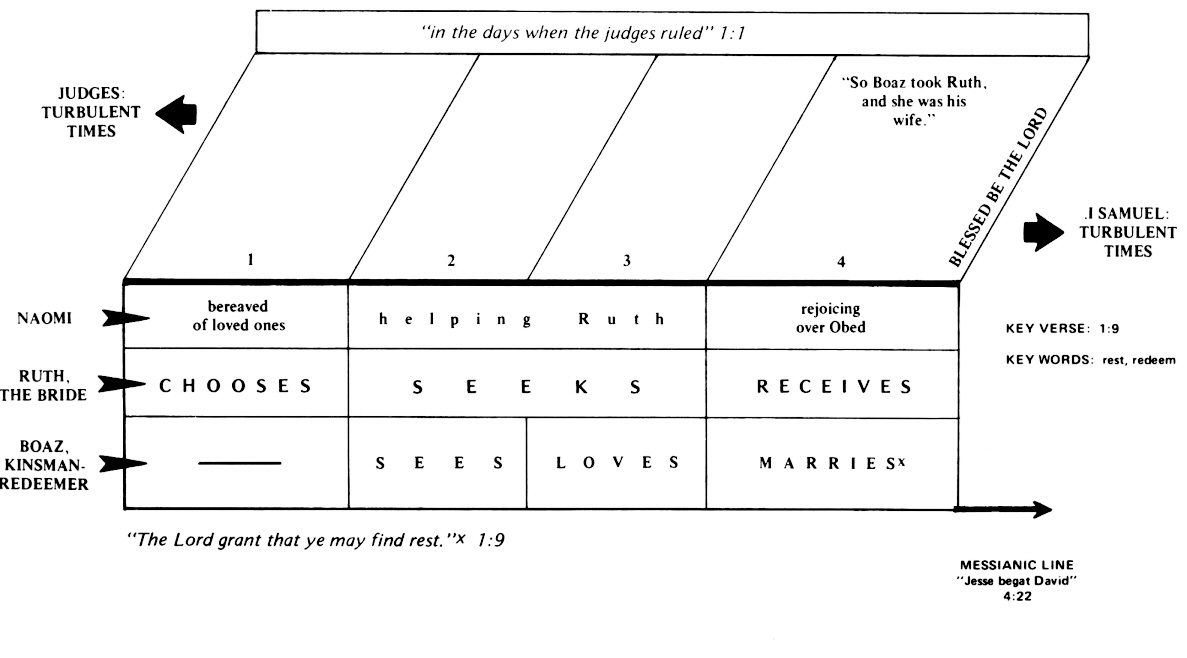
Irving Jensen's Survey of Bible (see his summary of Ruth online - page 392)
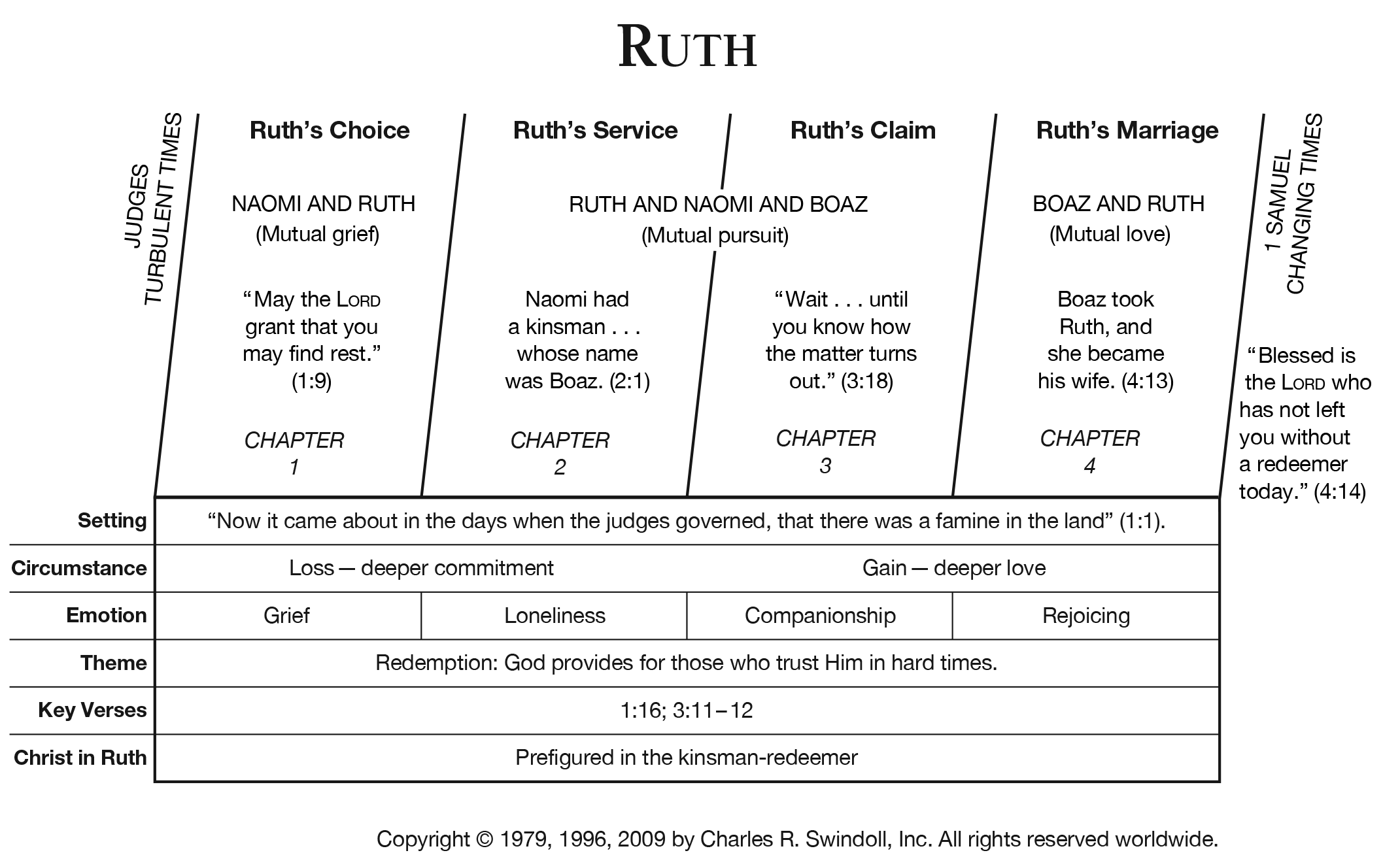
See Swindoll's summary chart of Ruth See Ruth Devotionals
|
RUTH: GOD PROVIDES |
|||
| Ruth 1 | Ruth 2 | Ruth 3 | Ruth 4 |
| Ruth's Choice | Ruth's Service | Ruth's Claim | Ruth's Marriage |
| Ruth's Resolve | Ruth's Rights | Ruth's Request | Ruth's Reward |
| Naomi and Ruth Mutual Grief |
Ruth and Naomi and Boaz Mutual Pursuit |
Boaz and Ruth Mutual Love |
|
| Ruth's Decision: Return with Naomi |
Ruth's Devotion: Provide for Naomi |
Ruth's Request: Redemption by Boaz |
Ruth's Reward: Relative of Messiah |
| Ruth and Naomi |
Ruth and Boaz |
||
| Death of Naomi's Family |
Ruth Cares for Naomi |
Boaz Cares for Ruth |
God Blesses with New Birth |
| Grief | Loneliness | Companionship | Rejoicing |
| Location: Plains of Moab |
Location: Fields of Bethlehem |
Location: Threshing floor of Bethlehem |
Location: Little town of Bethlehem |
| Time Lapsed: About 30 Years See Timeline |
|||
| Setting: Ru 1:1 Now it came about in the days when the judges governed Jdg 21:25+ In those days there was no king in Israel; everyone did what was right in his own eyes. |
|||

Ruth 4:1 Now Boaz went up to the gate and sat down there, and behold, the close relative of whom Boaz spoke was passing by, so he said, "Turn aside, friend, sit down here." And he turned aside and sat down.
BBE: And Boaz went up to the public place of the town, and took his seat there: and the near relation of whom he had been talking came by; and Boaz, crying out to him by name, said, Come and be seated here. And he came and was seated.
CEV: In the meanwhile, Boaz had gone to the meeting place at the town gate and was sitting there when the other close relative came by. So Boaz invited him to come over and sit down, and he did.
GWT: Boaz went to the city gate and sat there. Just then, the relative about whom he had spoken was passing by. Boaz said, "Please come over here and sit, my friend." So the man came over and sat down.
KJV: Then went Boaz up to the gate, and sat him down there: and, behold, the kinsman of whom Boaz spake came by; unto whom he said, Ho, such a one! turn aside, sit down here. And he turned aside, and sat down.
NET: Now Boaz went up to the village gate and sat there. Then along came the guardian whom Boaz had mentioned to Ruth! Boaz said, "Come here and sit down, 'John Doe'!" So he came and sat down.
NJB: Boaz, meanwhile, had gone up to the gate and sat down, and the relative of whom he had spoken then came by. Boaz said to him, 'Here, my friend, come and sit down'; the man came and sat down. (NJB)
Young's Literal: And Boaz hath gone up to the gate, and sitteth there, and lo, the redeemer is passing by of whom Boaz had spoken, and he saith, 'Turn aside, sit down here, such a one, such a one;' and he turneth aside and sitteth down.
Septuagint (LXX): kai Boos anebe (3SAAI) epi ten pulen kai ekathisen (3SAAI) ekei kai idou o agchisteutes pareporeueto (3SIMI) on eipen Boos kai eipen (3SAAI) pros auton Boos ekklinas kathison (2SAAM) ode kruphie kai exeklinen (3SAAI) kai ekathisen (3SAAI)
English of Septuagint: And Booz went up to the gate, and sat there; and behold, the relative passed by, of whom Booz spoke: and Booz said to him, Turn aside, sit down here, such a one: and he turned aside and sat down
Listen to:
- J Vernon McGee -- Ruth 4:1.mp3
- J Vernon McGee -- Ruth 4:2-5.mp3
- J Vernon McGee -- Ruth 4:6-7.mp3
- J Vernon McGee -- Ruth 4:8-22.mp3
- John Piper -- Ruth 4 - The Best is Yet to Come.mp3
Ruth's Reward, 4:1-22
- A Husband, 4:1-12
- A Son, 4:13-17
- A Lineage, 4:18-22
Ryrie Study Bible
NOW:
Ruth 3 concludes with Naomi saying to Ruth,
Sit still, my daughter until you know how the matter turns out; for the man will not rest until he has settled it today.
The theme of Ruth 4 is redemption and restoration.
In the heart & home of Boaz
Ruth & Naomi: Redeemed & Restored
RUTH 4:
"THE DENOUEMENT"
De·noue·ment also dé·noue·ment \da\-nu/-ma/ [French denouement, lit, untying, from Mid French desnouement, from desnouer to untie, from Old French desnoer, fr des- de- + noer to tie, fr Latin nodare, fr nodus knot] (1752) final outcome of the main dramatic complication in a literary work; outcome of a complex sequence of events. The final resolution of a plot in a play. The "untying" of the plot so to speak.
The context - The previous chapter left us with a "cliff-hanger" - Ruth and Boaz are obviously in love, and want to get married, with Boaz exercising the right of the Goel - the kinsman-redeemer. Yet, there is a kinsman closer to Ruth, and he has priority. Will he claim the right of kinsman-redeemer towards Ruth, and keep her and Boaz from coming together?
The NET Bible note says that…
The disjunctive clause structure… here signals the beginning of a new scene.
RUTH:
OPENS WITH 3 DEATHS
ENDS WITH ONE MARRIAGE & ONE BIRTH
The Book of Ruth opens with three funerals but closes with a wedding and a birth. There is a good deal of weeping recorded in the first chapter, but the last chapter records an overflowing of joy in the little town of Bethlehem.
Weeping may endure for a night,
but joy cometh in the morning
(Ps 30:5)
Spurgeon's Note: Weeping may endure for a night; but nights are not for ever. Even in the dreary winter the day star lights his lamp. It seems fit that in our nights the dews of grief should fall. When the Bridegroom's absence makes it dark within, it is meet that the widowed soul should pine for a renewed sight of the Well beloved.
But joy cometh in the morning. When the Sun of Righteousness comes, we wipe our eyes, and joy chases out intruding sorrow. Who would not be joyful that knows Jesus? (Ed: Our Greater Goel - the ultimate Kinsman Redeemer) The first beams of the morning brings us comfort when Jesus is the day dawn, and all believers know it to be so. Mourning only lasts to morning: when the night is gone the gloom shall vanish. This is adduced as a reason for saintly singing, and forcible reason it is; short nights and merry days call for the psaltery and harp.
Thomas Brooks: Weeping may endure for a night, but joy cometh in the morning. Their mourning shall last but till morning. God will turn their winter's night into a summer's day, their sighing into singing, their grief into gladness, their mourning into music, their bitter into sweet, their wilderness into a paradise. The life of a Christian is filled up with interchanges of sickness and health, weakness and strength, want and wealth, disgrace and honor, crosses, and comforts, miseries and mercies, joys and sorrows, mirth and mourning; all honey would harm us, all wormwood would undo us; a composition of both is the best way in the world to keep our souls in a healthy constitution. It is best and most for the health of the soul that the south wind of mercy, and the north wind of adversity, do both blow upon it; and though every wind that blows shall blow good to the saints, yet certainly their sins die most, and their graces thrive best, when they are under the drying, nipping north wind of calamity, as well as under the warm, cherishing south wind of mercy and prosperity. Thomas Brooks.
J Vernon McGee notes that
Boaz has had to stand aside with his arms folded, but now he is free to move because Ruth has claimed him as her kinsman-redeemer. And I say this reverently to you, my friend: Christ, like Boaz, is not free to move in your behalf until you claim Him as your Kinsman-Redeemer. Boaz is ready to act in the capacity of kinsman-redeemer. Ruth is to wait and let him be the one to make all the arrangements. He is the one now who will step out into the open and claim her, actually jeopardizing everything that he has and everything that he is. But he wants her; he loves her. This is the great message of this book: redemption is a romance; because God loves us He redeemed us. You will have to invite Him in. God offers the gift of eternal life in Christ Jesus, but you have to reach out your hand and take it by faith. By faith you receive Christ." (J Vernon McGee -- Ruth 4:1.mp3)
BOAZ WENT UP TO THE GATE AND SAT DOWN THERE:
- Dt 16:18; 17:5; 21:19; 25:7; Job 29:7; 31:21; Am 5:10, 11, 12,15
- Ruth 4 Resources - Multiple Sermons and Commentaries
SERIOUS BUSINESS
AT THE CITY GATE
Gate (08179) (sa'ar) indicates the main entrance to a city or building and can be used to stand for city or town itself. The gate of the city "was the place of rule, where all matters were settled, all transfers made" (Ridout). A number of places in the Scripture illustrate the fact of doing business at the city gate (see Ge 19:1; 23:10; 34:20; 2Sa 15:2 = [Absalom won converts by offering to settle their disputes in their favor in the city gate]; Neh 8:1; and Ps 69:12). Kings would sit at the city gate for legal business (2Sa 19:8; Jer 38:7). In Dt 15:7, 8 (Note: "towns" = "gates"), the city gate was where transaction and legal business was carried out. Boaz’s action was to seat himself down in this strategic location, signaling that he was ready to conduct business. These observations point out that this matter of redemption was a forensic or legal matter, indeed paralleling the truth that the believer's redemption in the NT is a forensic matter, whereby the guilty sinner as if standing in a court of law is declared in right standing with God on the basis of our Greater Goel's eternal work of redemption accomplished at Calvary.
Recent archaeological excavations at ancient Dan have uncovered a raised platform next to the gate at which court proceedings were carried out in the name of the king of Israel.
The writer of proverbs in describing the "Proverbs 31 Woman" (Pr 31:10, 29, 30) records that…
Her husband is known in the gates when he sits among the elders of the land. (Pr 31:23)
This is an apt description of Boaz "known in the gates"! He was not only a man of stellar reputation (what others think they know is true about us) but also a man of spotless character (what God alone knows is true about us).
In the ancient east, the main gate of the town was a short passageway through the thick city wall which provided the town an entrance and exit. A series of small alcoves lined the passage, and the whole gate area served as both bazaar and courthouse, functioning as the local law court. Furthermore, the ancient city gate was open to the public scrutiny which would allow others to observe whether justice was properly meted out.
The gate was the place where the esteemed men of the city sat. There the ancients gathered to buy and sell, to settle legal matters, and to gossip. The city gate was somewhat analogous to our modern city council chamber and courtroom rolled into one. Think of many of the small towns in the Midwest US which were established around a city square which was usually the site of the city or county courthouse.
As an example of the type of business conducted at the city gate Moses gives instructions that an Israelite who doubted the virginity of his bride was to make a formal accusation to the “elders of the city.” If her parents gave proof of virginity showing the accusation was false, the husband was to pay a penalty and was prohibited from divorcing the woman. However, if she was found not to be a virgin, then she was to be put to death. Moses writes that
the girl's father and her mother shall take and bring out the evidence of the girl's virginity to the elders of the city at the gate. (Dt 22:15, cf. 2Sa 15:2; Job 29:7; La 5:14).
So clearly the city gate was the site of serious judgments and Boaz had a serious issue to bring before the Goel and the elders.
AND BEHOLD! THE CLOSE RELATIVE (GOEL) OF WHOM BOAZ SPOKE WAS PASSING BY:
- Ru 3:12-note
- Ruth 4 Resources - Multiple Sermons and Commentaries
Don't miss once again the mysterious, sovereign, providential hand of God in this event for it just so “happened” (another "designed, divine coincidence") that the closest relative walked by at that very moment. I wonder how many times I have missed seeing such a "designed, divine coincidence" because at that very moment I was not walking in the Spirit but walking in Sin! I often wonder (and this is purely speculative of course) if this isn't why in the book of the Revelation, God will wipe away every tear from our eyes? (Re 7:17-note, Re 21:4-note)! Lord, give us 20/20 spiritual vision to see the "divine coincidences" not as annoyances but as opportunities, for the advancement of Thy Kingdom for the sake of Thy Name through our Great High Priest. Amen.
As Rob Morgan (Ref) says…
There are some words that just are not found in God’s dictionary, words like accident, chance, oops, and coincidence. He orders and ordains the events of our lives. I like the little poem by Anna Waring that says:
I love to think that God appoints
My portion day by day.
Events of life are in His hand,
And I can only say,
“Appoint them in Thine own good time,
and in Thine own best way.”
The Psalmist said, “Our times are in His hands.” The Bible teaches that the steps of God’s people are ordered of the Lord. Jesus said that the hairs of our heads are all numbered. Think of that! God is more concerned about us than we are concerned about ourselves, more concerned about us than a mother or father is about his or her child. Experts tell us that the average person has over 100,000 hairs growing on their head. But who among us has ever cared enough to try to count every hair? What mother in all history has ever loved her child enough to count the hairs on his or her head? But God is so concerned about the details of our lives that He counts the hairs on our head. He sees every sparrow that falls, and nothing is hidden from His sight. He orders and arranges and leads and guides and works all things for good.
And our lives become a daily series of small miracles, and His care is seen in the so-called coincidences that occur every day. God in His grace orchestrates apparently random incidents and events in our lives into a series of everyday miracles which, taken together, fulfill for us His preplanned and precious will.
If thou but suffer God to guide thee
And hope in Him through all thy ways,
He’ll give thee strength, whate’er betide thee,
And bear thee through the evil days.
Who trust in God’s unchanging love
Builds on the rock that naught can move.Be patient and await His leisure
In cheerful hope, with heart content
To take whatever thy Father’s pleasure
And His discerning love hath sent,
Nor doubt our inmost want are known
To Him who chose us for His own.
Behold (02009) (Lxx = Idou' = prompter of person's attention) is an exclamation used to point out an important fact or action which follows and functions as an interjection demanding attention. The idea is "look!" "see!" It serves to arouse the reader's attention and/or calls for special attention to what is getting ready to transpire.
Behold (02009) (hinneh) is an interjection meaning behold, look, now; if. "It is used often and expresses strong feelings, surprise, hope, expectation, certainty, thus giving vividness depending on its surrounding context." (Baker) Hinneh generally directs our mind to the text, imploring the reader to give it special attention. In short, the Spirit is trying to arrest our attention! And so hinneh is used as an exclamation of vivid immediacy (e.g., read Ge 6:13)! Hinneh is a marker used to enliven a narrative, to express a change a scene, to emphasize an idea, to call attention to a detail or an important fact or action that follows (Isa 65:17, Ge 17:20, 41:17). The first use of hinneh in Ge 1:29 and second in Ge 1:31 - "And God saw all that He had made, and behold, it was very good. And there was evening and there was morning, the sixth day."
W E Vine observes it is notable that when behold (hinneh) is used in Isaiah, it always introduces something relating to future circumstances and that is exactly the sense of hinneh in this passage in Jeremiah.
Spurgeon reminds us that "Behold is a word of wonder; it is intended to excite admiration. Wherever you see it hung out in Scripture, it is like an ancient sign-board, signifying that there are rich wares within, or like the hands which solid readers have observed in the margin of the older Puritanic books, drawing attention to something particularly worthy of observation." I would add, behold is like a divine highlighter, a divine underlining of an especially striking or important text. It says in effect "Listen up, all ye who would be wise in the ways of Jehovah!"
Butler writes that "The "behold" emphasizes the providential aspect of he "came by" of the nearer kinsman. And it reminds us that providence always comes to those who are prompt about pursuing their duties as Boaz was here. Those who complain that they never experience providential help will be found to be those who are dilatory in their duties. "I being in the way [doing his duty], the Lord led [providentially] me" (Ge 24:27) is the way Divine providence favors people. (Bible Biography Series: Ruth the Ancestress of Christ)
Close relative (01350) (goel/ga'al) is actually a verb in the Hebrew (accounting for is frequent translation as "redeem") which has active participle, Go'el, (which is translated kinsman, redeemer or avenger) and a passive participle, Geullah, this latter used in Ruth 4:6, 7-note.
As the TWOT states "The participial form of the Qal stem of the verb has practically become a noun in its own right though it may properly be considered as merely a form of the verb. (Harris, R. L., Harris, R. L., Archer, G. L., & Waltke, B. K. Theological Wordbook of the Old Testament Moody Press)
The basic idea of ga'al is to redeem or do the part of a kinsman and thus to redeem his kin from difficulty or danger.
Boaz was a man on a mission, immediately addressing the goel, the nearest kinsman-redeemer, and then gathering 10 elders. Naomi had been correct in her assessment of Boaz's determination to settle the matter as quickly as possible (Ru 3:18-note)
Matthew Henry - Providence favored Boaz in ordering it so that this kinsman should come by thus opportunely, just when the matter was ready to be proposed to him. Great affairs are sometimes much furthered by small circumstances, which facilitate and expedite them.
SO HE SAID TURN ASIDE "FRIEND SIT DOWN HERE" AND HE TURNED ASIDE AND SAT DOWN:
- Isa 55:1; Zech 2:6
- Ruth 4 Resources - Multiple Sermons and Commentaries
MR. NO NAME!
Friend (06423) is a Hebrew idiom (used two other times in OT = "such and such" = 2Ki 6:8YLT, 1Sa 21:2YLT) which translates the rhyming expression peloni almoni which means "a certain unnamed person or place". The words "my friend" became a catch phrase in Israel. Rabbinic writings used the designation for an unknown “John Doe.”
The idea in Hebrew is "Mr. So-and-so" or "Mr. No-Name" either whose name is not known (unlikely in this case) or who is not worth mentioning. How ironic that the very one who was so anxious for the preservation of his own inheritance, is now not even known by name!
Lawrenz notes that "The phrase “my friend” renders two words in Hebrew that are a figure of speech called farrago. The words, meaningless out of context, rhyme. The English hodge-podge or helter-skelter are two good examples of farrago (a confused mixture; a medley). The author of Ruth decided there was no need to reveal the name of the next of kin. For our sakes he is just “Mr. So-and-so.” (Lawrenz, J. C.. Judges, Ruth. The People's Bible. Milwaukee, Wis.: Northwestern Pub. House)
Commenting on the omission of the nearer relative’s name, Matthew Poole writes "Doubtless Boaz knew his name, and called him by it; but it is omitted by the holy writer, partly because it was unnecessary to know it; and principally in way of contempt, as is usual, and as a just punishment upon him, that he who would not preserve his brother’s name might lose his own.
Matthew Henry - Because he refused to raise up the name of the dead, he deserved not to have his name preserved to future ages in this [Book of Ruth] history.
The NET Bible notes record that "This close relative, who is a literary foil for Boaz, refuses to fulfill the role of family guardian. Because he does nothing memorable, he remains anonymous in a chapter otherwise filled with names. His anonymity contrasts sharply with Boaz's prominence in the story and the fame he attains through the child born to Ruth… In the present (NET) translation “John Doe” is used since it is a standard designation for someone who is a party to legal proceedings whose true name is unknown.
Expositor's Bible Commentary adds that "The idiom was used when the writer did not deem it essential to give the person's name (cf. 1Sa 21:2; 2Ki 6:8). It does not mean that Boaz did not know his name. The use of this idiom here has also been interpreted as deliberate on the part of the storyteller. As it was shameful not to fulfill the role of kinsman-redeemer, the kinsman was unworthy of mention by name. (Gaebelein, F, Editor: Expositor's Bible Commentary OT 7 Volume Set: Books: Zondervan Publishing)
J. Vernon McGee has an interesting note on friend writing that "The Septuagint threw some light upon this (meaning of "friend") by giving the word kruphie, which means "hidden one." The Hebrew conveyed the same idea by the use of two words, the first meaning "to point out" and the second meaning "to conceal." It was the clear intention of the writer to conceal this name. The American idiom "so and so" corresponds more closely than any other expression. Why should the name of this kinsman be concealed? The next verse has resulted in a rather ingenious explanation, which is certainly the most satisfactory one considered: "And he took ten men of the elders of the city, and said, Sit ye down here. And they sat down" (Ru 4:2). When this anonymous kinsman turned aside and sat down, Boaz already was prepared to have the matter settled at once. Ten elders of the city had been chosen to act as witnesses, perhaps as a sort of supreme court. The gate of the city of that day and place corresponded to the marketplace and forum of the cities of the West, and in some respects is equivalent to our present-day county courthouse. Certainly Boaz was proceeding in a way that was according to law, and the final decision in this case was sealed in the manner set forth in the Hebrew statute book. We will let another continue this explanation as to the omission of the name of the unknown kinsman: This powerless redeemer is the law. Ten witnesses are there confirming his inability to do it. These represent the Ten Commandments. The curse of the law rested upon the Moabitess for it is written, “An Ammonite or Moabite shall not enter into the congregation of the Lord, even to the tenth generation for ever” ((Deut. 23:3). Therefore the law could not bring in Ruth, but only keep her out. (A.C. Gaebelein, The Annotated Bible) This seems to be a satisfactory explanation for the concealment of the name of the nearer kinsman who bore the pseudonym “So and So.” The name was surely known, and it was withheld purposely. This thought will be developed further in a succeeding chapter. (Borrow Ruth, the romance of Redemption)
In any event, the goel responded to Boaz, for he was a man who commanded respect in Bethlehem. The goel knew he would be prepared for some serious business when he was invited to sit down.
He turned aside - Butler observes that
A good deal of the readiness of the nearer kinsman to stop and take care of some business at Boaz's request is complimentary of Boaz. It shows that the kinsman respected Boaz enough to change his plans immediately upon being summoned by Boaz to turn aside for awhile. Such respect does not come to everyone, but it is earned by faithful conduct over an extended period of time. Especially would unselfishness be a factor here. Boaz has already shown us in the Book of Ruth that he had an unselfish spirit and was concerned about the needs and problems of others. Hence, when he wanted others to give attention to his needs, they were more willing to oblige him. Likewise, if you want people to give you help in your time of need, you need to have a faithful record of giving help to others when they have need for it. (Ruth: The Ancestress of Christ )
Adam Clarke has an interesting thought on the conduct of business at the city gate…
Probably it required this number to constitute a court. How simple and how rational was this proceeding!
1. The man who had a suit went to the city gates.
2. Here he stopped till the person with whom he had the suit came to the gate on his way to his work.
3. He called him by name, and he stopped and sat down.
4. Then ten elders were called, and they came and sat down.
5. When all this was done, the appellant preferred his suit.
6. Then the appellee returned his answer.
7. When the elders heard the case, and the response of the appellee, they pronounced judgment, which judgment was always according to the custom of the place.
8. When this was done, the people who happened to be present witnessed the issue.
And thus the business was settled without lawyers or legal casuistry. A question of this kind, in one of our courts of justice, in these enlightened times, would require many days' previous preparation of the attorney, and several hours' arguing between counsellor Botherum and counsellor Borum, till even an enlightened and conscientious judge would find it extremely difficult to decide whether Naomi might sell her own land, and whether Boaz or Peloni might buy it! O, glorious uncertainty of modern law!
Ruth 4:2 He took ten men of the elders of the city and said, "Sit down here." So they sat down. (NASB: Lockman)
BBE: Then he got ten of the responsible men of the town, and said, "Be seated here". And they took their seats.
CEV: Then Boaz got ten of the town leaders and also asked them to sit down. After they had sat down,
GWT: Then Boaz chose ten men who were leaders of that city and said, "Sit here." So they also sat down.
KJV: And he took ten men of the elders of the city, and said, Sit ye down here. And they sat down.
NJB: Boaz then picked out ten of the town's elders and said, 'Sit down here'; they sat down. (NJB)
Young's Lit: And he taketh ten men of the elders of the city, and saith, 'Sit down here;' and they sit down.
Septuagint (LXX): kai elaben (AAI) Boos deka andras apo ton presbuteron tes poleos kai eipen kathisate (2PAAM) ode kai ekathisan (3PAAI)
English of Septuagint: And Booz took ten men of the elders of the city, and said, "Sit ye here"; and they sat down
AND HE TOOK TEN MEN OF THE ELDERS OF THE CITY AND SAID SIT DOWN HERE SO THEY SAT DOWN:
- Ex 18:21,22; 21:8; Dt 29:10; 31:28; 1Ki 21:8; Pr 31:23; La 5:14; Acts 6:12
- Ruth 4 Resources - Multiple Sermons and Commentaries

He took (03947) (laqach) conveys the primary meaning to grasp or take hold of. Boaz took hold of 10 men from the elders to serve as witnesses, although only two or three witnesses were needed for judicial proceedings (cf. Dt 17:6).
Centuries later 10 became the number necessary for a Jewish marriage benediction or a quorum for a synagogue meeting. For an official prayer meeting in modern Judaism 10 men are required. The point is that this was a time in history when few written records were kept, and attestation by a number of witnesses was the most efficient way to be certain that a transaction was made legally secure.
Elders (02205) is related to the Hebrew word (zaqan) for beard. The elders functioned in both a political and judicial role. They would hear disputes, weigh the evidence and render a decision. As alluded to earlier, in the case of Boaz, they were functioning primarily as witnesses rather than as jurors. Elders would serve as judges as elsewhere in the OT we see that they were to deal with criminal cases (Dt 21:18, 19, 20, 21), and with family matters, such as levirate marriage (Dt. 25:7, 8, 9).
The Hebrew word is translated with the Greek (Septuagint -LXX) noun presbuteros which was used to refer to men who were older or more senior and is transliterated into English as “presbyter”, a word that was used for leaders in the Jewish community and eventually becoming a term used to describe those who were members of the Jewish ruling council, the Sanhedrin. In regard to the Greek word presbuteros, the secular practice was for older men with seniority to serve as ambassadors to other states and as advisors within the Greek political community or in the management of public affairs. So these were men of "ripe age" and experience to whom was committed the direction and government of individual churches. It should be emphasized that in the context of its Biblical use the concept of elder had less to do with age per se than with the quality of one's spiritual character (reputation is what others think about you but character is what those most intimately associated know is really true about you) and possession of the ability to teach. Simply being older, including even being older in the faith, does not by itself qualify a man for leadership in the church.
Matthew Henry comments on the character of Boaz which was indicated by his willingness to call public witnesses writing that
Honest intentions dread not a public cognizance.
Sit down - A key phrase in Ru 4:1,2 (4x). Boaz commanded (Hebrew verb in form of a command) them to sit, and they responded to Boaz, a "pillar" (cp 1Ki 7:21) in the community, a man of excellence and one not given to jesting or wasting people's time.
So - Consequently. Undoubtedly the respect of the elders for Boaz's reputation prompted their response to the request of Boaz.
When I was a boy in the 1950's a handshake was good enough to seal a deal, and this action could be relied upon. Not so today. Society has become so litigious that if Boaz were carrying out his plan today, he would have needed to hire a lawyer to file legal papers and speak with the nearest goel's attorney as well as Naomi's attorney and real estate agent. In ancient times, a man’s spoken word was sufficient to consummate a transaction and was validated by the spoken testimony of witnesses (in legal matters it took two - Dt 19:15).
Ruth 4:3 Then he said to the closest relative, "Naomi, who has come back from the land of Moab, has to sell the piece of land which belonged to our brother Elimelech. (NASB: Lockman)
Amplified: And he said to the kinsman (Goel), Naomi, who has returned from the country of Moab, has sold the parcel of land which belonged to our brother Elimelech
BBE: Then he said to the near relation, Naomi, who has come back from the country of Moab, is offering for a price that bit of land which was our brother Elimelech's:
CEV: he said to the man: Naomi has come back from Moab and is selling the land that belonged to her husband Elimelech. (CEV)
ESV: Then he said to the redeemer, “Naomi, who has come back from the country of Moab, is selling the parcel of land that belonged to our relative Elimelech.
GWT: Boaz said to the man, "Naomi, who has come back from the country of Moab, is selling the field that belonged to our relative Elimelech. (GWT)
KJV: And he said unto the kinsman, Naomi, that is come again out of the country of Moab, selleth a parcel of land, which was our brother Elimelech's:
NET: Then Boaz said to the guardian,[8] “Naomi, who has returned from the region of Moab, is selling the portion of land that belongs to our relative Elimelech.
NJB: Boaz then said to the man who had the right of redemption, 'Naomi, who has come back from the Plains of Moab, is selling the piece of land that belonged to our brother, Elimelech. (NJB)
Young's Literal: And he saith to the redeemer, 'A portion of the field which is to our brother, to Elimelech, hath Naomi sold, who hath come back from the fields of Moab;
Septuagint (LXX): kai eipen (3SAAI) Boos to agchistei ten merida tou agrou e estin (3SPAI) tou adelphou hemon tou Abimelech e dedotai (3SRMI) Noemin te epistrephouse (PAPFSD) ex agrou Moab
English of Septuagint: And Booz said to the relative, The matter regards the portion of the field which was our brother Elimelech's which was given to Noemin, now returning out of the land of Moab
THEN HE SAID TO THE CLOSEST RELATIVE (GOEL) "NAOMI, WHO HAS COME BACK FROM THE LAND OF MOAB HAS TO SELL THE PIECE OF LAND WHICH BELONGED TO OUR BROTHER ELIMELECH":
- Ps 112:5; Pr 13:10
- Ruth 4 Resources - Multiple Sermons and Commentaries
Then - This little "time" sensitive word (see importance of expressions of time and specifically then) marks a progression in the discourse (next in order of time) and emphasizes the willingness and wisdom of Boaz to wait until all the "players were in place". It would not have been prudent to speak with the nearest kinsman redeemer in the absence of witnesses. The wise man is willing to wait. The writer of proverbs records that…
he who makes haste with his feet errs. (Pr 19:2b, see also Pr19:2NLT).
Do you see a man who is hasty in his words? There is more hope for a fool than for him. (Pr 29:20, see Pr 29:20NLT)
The plans of the diligent lead surely to advantage (Good description of Boaz's plan and actions - he took no shortcuts! Do I?), but everyone who is hasty comes surely to poverty. (Pr 21:5, see also Pr 21:5NLT).
To the closest relative - The Goel or Kinsman redeemer, the man who had the first right of redemption.
Naomi… has to sell the piece of land - As a destitute widow, Naomi undoubtedly needed the money for living expenses (and this even in spite of Boaz's gracious gifts of grain). No information is given as to how she came to possess it. This verse reveals for the first time in the story that Naomi owned the property.
Has to sell - The Hebrew is in a form of the verb (see note below) that indicates the sale was as good as done. The only thing that remained to be determined was the buyer. The property might be sold to anyone, but covenant law allowed Naomi the right to have her kinsman-redeemer buy the land back from a stranger at any time.
Fruchtenbaum - In the Hebrew text the tense ("sell") is perfect, which normally indicates completed action, and therefore it would mean that it had already been sold. But Ru 4:5 and Ru 4:9 indicate that she was in the process of selling the land, and so the perfect tense would then indicate her determination or resolve to sell the land, and thus, most translations use the present tense, which is correct… the land had not yet been sold; otherwise, it would have to be redeemed from its new owner and not from Naomi. (Fruchtenbaum, A. G. Ariel's Bible commentary: The books of Judges and Ruth. San Antonio, Tex.: Ariel Ministries)
The NET Bible notes that…
The perfect form of the verb here describes as a simple fact an action that is underway (cf. NIV, NRSV, CEV, NLT); NAB “is putting up for sale.”
The Amplified Version translates this verse as follows:
And he said to the kinsman, "Naomi, who has returned from the country of Moab, has sold the parcel of land which belonged to our brother Elimelech".
The well respected Old Testament commentary (Keil and Delitzsch) translates this verse like the Amplified…
The piece of field which belonged to our brother (i.e., our relative) Elimelech (as an hereditary family possession), Naomi has sold.
NKJV renders it as if Naomi had "sold the piece of land" which implies a transaction had taken been consummated.
Young's Literal has "a portion of the field… hath Naomi sold".
In context, Boaz tells the nearest kinsman to buy the land and so in effect to redeem it. Leviticus records that
If a fellow countryman of yours becomes so poor he has to sell part of his property, then his nearest kinsman (Goel - the kinsman redeemer) is to come and buy back what his relative has sold. (Lev 25:25)
The land would ultimately be returned at Jubilee (Lev 25:28). Since Jubilee came only every fifty years God had provided another way to redeem the land and that was through the provision of the kinsman redeemer.
Jubilee means a joyful shout or clang of trumpets, the name of the great semi-centennial festival of the Hebrews. It lasted for a year. During this year the land was to be fallow, and the Israelites were only permitted to gather the spontaneous produce of the fields (Lev 25:11, 12). All landed property during that year reverted to its original owner (Lv 25:13-34; 27:16-24), and all who were slaves were set free (Lev 25:39-54), and all debts were remitted.
The advantages of this institution were manifold. "
1. It would prevent the accumulation of land on the part of a few to the detriment of the community at large.
2. It would render it impossible for any one to be born to absolute poverty, since every one had his hereditary land.
3. It would preclude those inequalities which are produced by extremes of riches and poverty, and which make one man domineer over another.
4. It would utterly do away with slavery.
5. It would afford a fresh opportunity to those who were reduced by adverse circumstances to begin again their career of industry in the patrimony which they had temporarily forfeited.
6. It would periodically rectify the disorders which crept into the state in the course of time, preclude the division of the people into nobles and plebeians, and preserve the theocracy inviolate." (Easton's Bible Dictionary)
Mills - The English text emphasizes Naomi’s return, but the Hebrew literally reads, “The portion of the field which is our brother Elimelech’s, has been sold by Naomi who has returned from the fields of Moab.” By placing the field first in his sentence, Boaz emphasized the material aspect rather than the personal aspect of the transaction, and in so doing probably appealed to an avaricious streak in this relative. (Mills, M: Ruth : A study guide to the book of Ruth Dallas: 3E Ministries, 1999)
Our brother - Calling Elimelech our brother is the Hebrew word ('ah) that means simply "a relative" or "kinsman", in this case bringing out the fact both Boaz and the nearer goel were related to Elimelech.
Piece of land which belonged to Elimelech - Remember that Ruth was married to Mahlon, so at first this statement seems somewhat confusing.
Butler - The availability of this land is another illustration of the failure of Elimelech in moving to Moab. His move to Moab was to procure gain, but all it did was produce loss. Anytime we leave the place where God wants us in order to procure gain in the world, we will end up a big loser. (Ruth: The Ancestress of Christ )
Warren Wiersbe offers a reasonable explanation that "In the case of Ruth and Naomi, Elimelech’s property had either been sold or was under some kind of mortgage, and the rights to the land had passed to Ruth’s husband Mahlon when Elimelech died. This explains why Ruth was also involved in the transaction. She was too poor, however, to redeem the land. (Wiersbe, W: Be Committed: An Old Testament Study. Ruth and Esther. Victor. 1993)
The Bible Background Commentary - Since Yahweh has granted the land to the Israelites as tenants, they cannot sell it, and if they mortgage a portion of it to pay debts, it is the obligation of their kinsman to "redeem" the land by paying off the mortgage. This demonstrates both the sense of obligation and the solidarity that are the hallmarks of ancient Israel's communally based society. Evidence of this legislation's being put into practice is found in Jeremiah's redeeming of his kinsman's land during the siege of Jerusalem (Jer 32:6-15) and in the legal background to Ruth 4:1-12. In this way the land remained within the extended family as a sign of their membership in the covenantal community. The importance of this inalienable right to land can be seen in Naboth's refusal to relinquish the "inheritance of my fathers" when King Ahab offers to buy his vineyard (1Kings 21:2, 3).
Ruth 4:4 "So I thought to inform you, saying, 'Buy it before those who are sitting here, and before the elders of my people. If you will redeem it, redeem it; but if not, tell me that I may know; for there is no one but you to redeem it, and I am after you.' " And he said, "I will redeem it." (NASB: Lockman)
BBE: And it was in my mind to give you the chance of taking it, with the approval of those seated here and of the responsible men of my people. If you are ready to do what it is right for a relation to do, then do it: but if you will not do it, say so to me now; for there is no one who has the right to do it but you, and after you myself. And he said, I will do it.
CEV: I am telling you about this, since you are his closest relative and have the right to buy the property. If you want it, you can buy it now. These ten men and the others standing here can be witnesses. But if you don't want the property, let me know, because I am next in line. The man replied, "I will buy it!" (CEV)
GWT: So I said that I would inform you. Buy it in the presence of these men sitting here and in the presence of the leaders of our people. If you wish to buy back the property, you can buy back the property. But if you do not wish to buy back the property, tell me. Then I will know that I am next in line because there is no other relative except me." The man said, "I'll buy back the property." (GWT)
KJV: And I thought to advertise thee, saying, Buy it before the inhabitants, and before the elders of my people. If thou wilt redeem it, redeem it: but if thou wilt not redeem it, then tell me, that I may know: for there is none to redeem it beside thee; and I am after thee. And he said, I will redeem it.
NJB: I thought I should tell you about this and say, "Acquire it in the presence of the men who are sitting here and in the presence of the elders of my people. If you want to use your right of redemption, redeem it; if you do not, tell me so that I know, for I am the only person to redeem it besides yourself, and I myself come after you." ' The man said, 'I am willing to redeem it.' (NJB)
Young's Literal: and I said, I uncover thine ear, saying, Buy before the inhabitants, and before the elders of my people; if thou dost redeem -- redeem, and if none doth redeem -- declare to me, and I know, for there is none save thee to redeem, and I after thee.' And he saith, I redeem it.'
Septuagint (LXX): kago eipa (1SAAI) apokalupso (1SFAI) to ous sou legon ktesai (2SAMM) enantion ton kathemenon (PMPMPG) kai enantion ton presbuteron tou laou mou ei agchisteueis (2SPAI) agchisteue (2SPAM) ei de me agchisteueis (2SPAI) anaggeilon (2SAAM) moi kai gnosomai(1SFMI) oti ouk estin (3SPAI) parex sou tou agchisteusai (AAN) kago eimi (1SPAI) meta se o de eipen (3SAAI) ego eimi agchisteuso (1SFAI)
English of Septuagint: and I said, I will inform thee, saying, Buy it before those that sit, and before the elders of my people: if thou wilt redeem it, redeem it, but if thou wilt not redeem it, tell me, and I shall know; for there is no one beside thee to do the office of a kinsman, and I am after thee: and he said, I am here, I will redeem it
SO I THOUGHT TO INFORM YOU:
- Jer 32:7, 8, 9,25; Ro 12:17; 2Cor 8:21; Php 4:8
- Ruth 4 Resources - Multiple Sermons and Commentaries
Thought to inform you - This reads more literally "I will uncover your ear", a small but significant detail. Boaz could have just said "I was going to tell you… " but the point is that Boaz did not seek to hide anything from the nearest Goel. Boaz had promised that Ruth would be "covered" with someone's wings and his first objective was to remain true to his word.
Butler…
The word "advertise" in the KJV text is translated from two Hebrew words. The first Hebrew word means to reveal, disclose, publish, remove, and uncover. The second Hebrew word means ear. The combination of the words means literally to uncover the ear (push back the hair or head covering of another so you can speak in their ear). The first Hebrew word is translated "uncover" in Ruth 3:4,7 regarding Ruth uncovering Boaz's feet at night on the threshing floor…
Much character is revealed in acknowledging our place in line. The flesh always wants the preference. It always wants to be first in line. One can see this when shopping in some store or standing in line at a cafeteria or bank or some public event. People are always crowding ahead of others in line by pushing and shoving and cheating. Boaz would not do that, however. He had high character and would stay in his place in line. It is a humbling position, but it is also a very honorable one. (Ruth: The Ancestress of Christ)
The Greek translation (Septuagint) conveys this openness of Boaz by using the verb apokalupto (word study) (601) (from apo = from + kalupto = cover) which means to remove the veil or covering so as to expose to full view what had previously been hidden. Apparently the nearest relative did not know that he was in fact first in line to perform the role of kinsman redeemer. Boaz could have "gotten away with it" but he was open and honest. While Boaz was surely in love with Ruth, he was still willing to trust God with the outcome (Pr 3:5, 6).
Matthew Henry - Boaz might have said, “My money is as good as my kinsman's; if I have a mind to it, why may not I buy it privately, since I had the first proffer of it, and say nothing to my kinsman?” No, Boaz, though fond enough of the purchase, would not do so mean a thing as to take a bargain over another man's head that was nearer akin to it; and we are taught by his example to be not only just and honest, but fair and honorable, in all our dealings, and to do nothing which we are unwilling should see the light, but be above-board.
SAYING "BUY IT BEFORE THOSE WHO ARE SITTING HERE AND BEFORE THE ELDERS OF MY PEOPLE IF YOU WILL REDEEM IT REDEEM IT":
- Ge 23:18; Jer 32:10, 11, 12
- Ruth 4 Resources - Multiple Sermons and Commentaries
Before those who are sitting here - This phrase emphasizes the formal nature of this transaction and as we find out later reflects not only the elders' presence but the fact that there were other Bethlehemites in attendance.
If you will redeem it, redeem it - As alluded to earlier, the Mosaic Law provided for land to stay within a family, even if it had to be sold temporarily due to poverty. The Law allowed for the seller to redeem the land themselves later if they were able (if they somehow acquired the necessary funds) or for a close relative (the goel) to redeem it. If neither of these alternatives was possible (no money or no willing Kinsman-Redeemer, the land by divine decree must still be returned to the original owner (or their posterity) in the Year of Jubilee, which as noted above "cycled" every fiftieth year. The point is that the land was not to be sold permanently because the Jews were in a sense tenants and ultimately the land belonged to God, Moses recording that…
The land, moreover, shall not be sold permanently, for the land is Mine; for you are but aliens and sojourners with Me. (Lev 25:23)
Redeem means “to set free by paying a price.” In the case of Ruth and Naomi, Elimelech’s property had either been sold or was under some kind of mortgage, and the rights to the land had passed to Ruth’s husband Mahlon when Elimelech died. This explains why Ruth was also involved in the transaction. She was too poor, however, to redeem the land.
BUT IF NOT, TELL ME THAT I MAY KNOW FOR THERE IS NO ONE BUT YOU TO REDEEM IT AND I AM AFTER YOU AND HE SAID "I WILL REDEEM IT":
- Lev 25:25, 26, 27, 28, 29
I WILL REDEEM IT…
WELL LET ME THINK ABOUT THAT!
But - Always introduces a "change of direction" and cause us to stop and ask what is the change?
I will redeem it - Not, "I will think about it", but an immediate affirmative reply. Does not his swift answer and his subsequent response make us question his motive. Does he really want to aid a poor widow or does he want to take advantage of her plight?
Redeem (01350)(see goel/ga'al)
Redeem is found 4 times in one verse and all are translated in the Lxx with the verb agchisteuo which means to exercise the rights and responsibilities of next of kin, to redeem, to do a kinsman's office to a woman. Here are the 21 uses of agchisteuo in the OT (not in NT) - Lev 25:25f; Num 5:8; 35:12, 19, 21, 24f, 27; 36:8; Deut 19:6, 12; Josh 20:3, 9; Ruth 2:20; 3:13; 4:4, 6f; Ezra 2:62; Neh 7:64
I - In the Hebrew sentence the "I" is emphatic so that the sentence reads something like "I, I will redeem it". The nearer kinsman-redeemer was happy add this fine parcel of land to his financial portfolio, for in that day land was especially equated with one's wealth and social status. The fact that he answers affirmatively without asking any other questions indicates that he must have reasoned that at Naomi's age she would ever give birth to a son (who would carry on Elimelech's name and would thereby become the rightful heir to the land according to the Mosaic Law). His quick affirmation also indicates he did not know there were "strings attached" so to speak. And so few men who would be able to function as a kinsman redeemer would have passed up the opportunity that appeared to have presented itself. In other words he would look like the generous, altruistic Goel (with the esteem that surely must have come with the carrying out of such a "selfless" act) and eventually end with the parcel of land.
On the other hand, just imagine how Boaz must have felt upon hearing nearer kinsman's emphatic affirmation "I will redeem it"! Boaz's hopes must surely have sunk, and yet there is no record that he gave evidence of the disappointment he surely must have felt inside. Boaz is quite a man of character, irregardless of the circumstances!
Butler - If we cannot be above board in our dealings and if we are wanting to hide things when doing business, it indicates dishonesty and deceit. And we need to remember that though we can conceal things from men, we cannot conceal anything from God (Nu 32:23). And if God knows about it, He can and does reveal it whenever, wherever, and to whomever He chooses, and to our great shame. (Ibid)
Ruth 4:5 Then Boaz said, "On the day you buy the field from the hand of Naomi, you must also acquire Ruth the Moabitess, the widow of the deceased, in order to raise up the name of the deceased on his inheritance." (NASB: Lockman)
BBE: Then Boaz said, On the day when you take this field, you will have to take with it Ruth, the Moabitess, the wife of the dead, so that you may keep the name of the dead living in his heritage.
CEV: "If you do buy it from Naomi," Boaz told him, "you must also marry Ruth. Then if you have a son by her, the property will stay in the family of Ruth's first husband." (CEV)
GWT: Boaz continued, "When you buy the field from Naomi, you will also assume responsibility for the Moabite Ruth, the dead man's widow. This keeps the inheritance in the dead man's name." (GWT)
KJV: Then said Boaz, What day thou buyest the field of the hand of Naomi, thou must buy it also of Ruth the Moabitess, the wife of the dead, to raise up the name of the dead upon his inheritance.
NJB: Boaz then said, 'The day you acquire the field from Naomi, you also acquire Ruth the Moabitess, the wife of the man who has died, to perpetuate the dead man's name in his inheritance.' (NJB)
Young's Literal: And Boaz saith, 'In the day of thy buying the field from the hand of Naomi, then from Ruth the Moabitess, wife of the dead, thou hast bought it, to raise up the name of the dead over his inheritance.'
Septuagint (LXX): kai eipen (3SAAI) Boos en hemera tou ktesasthai (AMN) se ton agron ek cheiros Noemin kai para Routh tes Moabitidos gunaikos tou tethnekotos kai auten ktesasthai se dei hoste anastesai to onoma tou tethnekotos (RAPMSG) epi tes kleronomias autou
English of Septuagint: And Booz said, In the day of thy buying the field of the hand of Noemin and of Ruth the Moabitess the wife of the deceased, thou must also buy her, so as to raise up the name of the dead upon his inheritance
THEN BOAZ SAID ON THE DAY YOU BUY THE FIELD FROM THE HAND OF NAOMI YOU MUST ALSO ACQUIRE RUTH THE MOABITESS:
- Ruth 4 Resources - Multiple Sermons and Commentaries
Then - This time phrase marks a key transition point in this exchange, for now Boaz (still with integrity) "plays his trump card", informing the nearer kinsman of his duty to redeem the posterity of Elimelech, if he wishes redeem the property of Elimelech. The nearer kinsman isn’t just dealing with aged and childless Naomi, but is also dealing with Ruth who is young and fully capable of giving birth to a son who would inherit the land.
Henry Morris - The right of a kinsman-redeemer to redeem the property of a dead relative, thereby preventing it from passing outside the family, is set forth in Leviticus 25:25-34. These events described in the book of Ruth indicate that this right of property redemption was also directly linked to the responsibility of raising up children to preserve "the name of the dead upon his inheritance." (Defenders Study Bible. World Publishing)
THE WIDOW OF THE DECEASED IN ORDER TO RAISE UP THE NAME OF THE DECEASED ON HIS INHERITANCE:
- Ru 3:12,13; Ge 38:8; Dt 25:5,6; Mt 22:24; Lk 20:28
- Ruth 4 Resources - Multiple Sermons and Commentaries
Your purchase of the land from Naomi requires your marriage to Ruth so that she can have children to carry on her husband's name and to inherit the land. (TLB)
so that the field will stay in the dead man's family (TEV)
in order to maintain the name of the dead with his property (NIV)
What Boaz stipulates appears to be related to the so-called "law of levirate marriage" (but see the note below regarding this interpretation). Moses instructed the Israelites in Deuteronomy that "When brothers live together and one of them dies and has no son, the wife of the deceased shall not be married outside the family to a strange man. Her husband’s brother shall go in to her and take her to himself as wife and perform the duty of a husband’s brother to her. And it shall be that the first-born whom she bears shall assume the name of his dead brother, that his name may not be blotted out from Israel." (Dt 25:5,6)
When Elimelech died, the property went to Mahlon; and when Mahlon died, the property then included the widow Ruth. She was now part of the redemption responsibility, and the property would go to any son born to her to perpetuate the family line. In other words a goel was needed to buy the land and take Ruth as wife to carry on the name of Ruth's husband, Mahlon. In carrying on the name of Mahlon, the line of Elimelech would also continue.
The Bible Knowledge Commentary adds that "Apparently at the death of Elimelech the property had passed to Mahlon so Mahlon’s widow Ruth was included in the redemption responsibility. A son, to whom the property would belong, should be raised up to perpetuate the family name." (See context in The Bible Knowledge Commentary).
Boaz informs the nearer goel that he had to "buy (07069) (qanah) the field" and also "acquire" (same verb qanah = "buy") Ruth! Not only did this come as a surprise to the nearer goel, but Boaz also made known Ruth's nationality “Ruth the Moabitess.” The fact that Ruth was a Moabitess may also have been a problem to him. (Both Mahlon and Chilion had married Moabite women and died!) In any event what looked like a "windfall" suddenly seemed far less attractive since the man would be required to marry Ruth (acquire the dead man’s widow) and the income derived from the land would not go directly to the redeemer’s estate. Moreover, his own estate would possibly have to be divided with Ruth’s children. With an expectant intake of breath we await his reply. It’s worth noting that the nearer kinsman tried to protect his name and inheritance; but we don’t even know what his name was or what happened to his family!
The Wycliffe Bible Commentary - "Both the alienation of land and the extinction of a family were to be prevented by the law of the goel. The goel would not come into possession of the land himself, but would hold it in trust for his son by Ruth, who would inherit the name and patrimony of Mahlon (her first husband)." (Borrow Wycliffe Bible Commentary - Ruth)
The interpretation of this passage however does have some difficulties.
The Expositor's Bible Commentary comments that Boaz "reminded the kinsman of a condition he must satisfy to redeem the land. He must marry (qanah "buy," "acquire," "redeem") Ruth the Moabitess (Heb., "buy the field from the hand of Naomi and from Ruth") to bear children to restore the name of Elimelech to his inheritance in accordance with the levirate law (see Deut 25:5, 6). The firstborn son of their marriage would legally be Mahlon's son. It is difficult to know whether the kinsman must buy Ruth (NASB, RSV follow the Vulgate and Syr.) or buy from Ruth (with KJV, NIV, following the MT). Furthermore, this case differs from the levirate law on several counts: (1) here a more distant relative than a brother was expected to marry the widow (Ed note: “levirate” means “husband’s brother” ) (2) the kinsman removed his own shoe instead of the rejected widow doing it; and (3) apparently no disgrace was involved, as the significance of removing the shoe here was to seal a legal transaction. Boaz probably hoped to discourage the kinsman from buying the land by reminding him that the purchase of the land obligated the kinsman to marry Ruth, though he gave the kinsman every opportunity to do just that. (Gaebelein, F, Editor: Expositor's Bible Commentary OT 7 Volume Set: Books: Zondervan Publishing or see context in The Expositor's Bible Commentary)
John MacArthur - Both redeeming Ruth and the land would not have been required by the letter of the levirate law (Dt 25:5, 6). Perhaps this exemplified Boaz’s desire to obey the spirit of the law or maybe redemption of land and marriage had been combined by local tradition. (See context in The MacArthur Study Bible)
By James Smith in Handfuls of Purpose
“Then went Boaz up to the gate, and sat down there” (v. 1). What to do? To intercede for Ruth. And success is sure with such an intercessor, being “a mighty man of wealth.” He is a man of mighty influence, and must prevail. Are we not reminded here of Him who has ascended up on high, and is set down at the Father’s right hand to make intercession for us who have been found of Him? He that delighteth in mercy, and who is able to save to the uttermost (to the end) all that come unto God through Him, seeing He ever liveth to make intercession for them.
And Boaz said to his kinsman, “Redeem, for there is none to redeem beside thee; and I am after thee” (v. 4). This kinsman, like the law, had the first claim, but not the ability to redeem. The law is our kinsman condemner; but Jesus, like Boaz, is our Kinsman Redeemer. By the law is the knowledge of sin, not the forgiveness of sin. This we can have through the precious Blood alone, the great redemption price. By the deeds of the law shall no flesh be justified. The answer this kinsman gave was, “I cannot redeem.” But Boaz, the mighty man of wealth, is well able to redeem, therefore what the law could not do “in that it was weak” (Rom. 8:3), abounding grace hath accomplished, for “He hath redeemed” (Gal. 3:13).
Boaz said, “What day thou buyest the field, buy (it) also of Ruth” (v. 5). Ruth, as emblematic of the Church, is the real treasure in the field. The field is the world; the treasure is the Church, as in Matthew 13:44. And our heavenly Boaz, who was rich, for our sakes became poor, because He sold all that He had and bought the field, that He might secure the hidden treasure.
“And Boaz said unto the elders and all the people, Ye are my witnesses that Ruth, the Moabitess, have I purchased to be my wife” (v. 10). A few points are worthy of notice in connection with
This Redemption
I. He only could redeem. He had the right as kinsman; he had the power as a mighty man of wealth; he was also in the right condition to redeem, being alone; and now the redemption itself brings joy and satisfaction to his own soul. And shall not the redeemed Church be to the heart of her Redeemer a new source of eternal joy and satisfaction? He shall be satisfied. Christ only can redeem. His incarnation made Him our Kinsman, and gave Him the right to redeem. His divinity made Him mighty, and gave Him the power to redeem. We have redemption through His Blood (1 Peter 1:18, 19).
II. This was a Willing Redemption. Boaz did not grudge the redemption money. How could he when his heart was set on the purchase of Ruth? He willingly offered the full price, although that price included the gift of himself. So was it with Jesus, our princely Kinsman, who loved us and gave Himself for us, that He might give Himself to us. Nor did He hesitate to pay the awful price of sorrow, suffering, and blood, that He might redeem us from the curse of the law, being made a curse for us.
III. This was a Gracious Redemption. Boaz was not ashamed to redeem Ruth, the poor stranger. The prince of wealth stoops to lift the poor helpless one, who cannot redeem herself. He hath regarded the low estate of his handmaiden; he hath shown strength with his arm; he hath exalted them of low degree, he hath filled the hungry soul with good things, and now the soul of Ruth shall magnify her lord.
The wealthy Prince of Heaven is ashamed of none who look to Him for redemption. He says, “Look unto Me, and be ye saved.” He invites the wretched, the miserable, the poor, the blind, and the naked to look to Him and trust in Him. Yea; He stoops in His redemption work to lift the helpless from the horrible pit on to the Rock of Strength, to lift the poor and the polluted from the dunghill, to rank among princes, and to be co-heirs with Himself. He is not ashamed to call them brethren. So the gleaner, through grace, becomes an heir of His glory.
IV. This was a Public Redemption. There were many witnesses to the fact that the price was paid; this thing was not done in a corner, but in the presence of the elders of all the people. When Moses smote the rock, it was in the presence of the elders. The Rock Christ was also publicly smitten, they put Him to an open shame. He suffered without the gate. As Boaz went up to the gate to finish the work in behalf of Ruth, in the sight of many witnesses, so Jesus went up to Calvary and finished the work the Father gave Him to do in behalf of His people. Afterwards, when the price was paid, He rose from the dead; and as Boaz, when the bargain was settled, “plucked off his shoe,” Jesus plucked off the grave-clothes as a token that the covenant was sealed and the inheritance redeemed; and the apostles say, “We are witnesses.” He was seen of many.
V. The Purpose of this Redemption. “That the name of the dead be not cut off” (v. 10). In Adam all have died unto God; but in Christ, through His redemption, all that believe are made alive unto God. Thus spiritual seed is raised, according to the gracious purpose of God. “Boaz did not redeem Ruth to be his slave.” He says, “Ruth have I purchased to be my wife,” to be part of himself. What more could he do for her than that he had done? Communion has now culminated in union. Her service henceforth shall be that loving, ready service which is the glad outflow from unity of heart, and purpose, and interest, and in the self-sacrificing spirit of those who abide in the Master’s presence, and who know that He hates putting away. Ye are not your own, ye are bought with a price; therefore glorify God in your bodies and spirits, which are His. It was the grace alone of Boaz that transformed the life and relationship of Ruth, and by faith she got access into this grace wherein she now stands and rejoices in hope.
VI. This was a Perfect Redemption. “Boaz took Ruth, and she became his wife” (v. 13). The prophecy of Naomi has now been fulfilled. “The man will not be at rest until he hath finished the thing” (chap. 3:18). Our Kinsman Redeemer shall likewise come and finish the thing by taking His purchased Bride home to be with Himself, for where He is there shall we be also. The day that Boaz redeemed Ruth that same day he took her. The present dispensation is the day of salvation (redemption) to the Gentiles. At the close of this same day our Divine Kinsman shall appear, and take His redeemed Church to Himself. So shall she be for ever with her Lord and Saviour.
When Ruth knew that Boaz had purchased her to be his wife, would she not be anxiously looking for him every moment to come and take her to be with himself? Is not this the present position of the Church? Working, waiting, watching, till He come who hath redeemed us by His own Blood, for the Lord Himself shall descend, and when He shall appear we shall be like Him, we shall see Him as He is, and dwell in the house of the Lord for ever.
May the Lord direct your heart into the love of God, and into the patient waiting for Christ!