Ruth 4:2
Ruth 4:3
Ruth 4:4
Ruth 4:5
Ruth 4:6
Ruth 4:7
Ruth 4:8
Ruth 4:9
Ruth 4:10
Ruth 4:11
Ruth 4:12
Ruth 4:13
Ruth 4:14
Ruth 4:15
Ruth 4:16
Ruth 4:17
Ruth 4:18
Ruth 4:19
Ruth 4:20
Ruth 4:21
Ruth 4:22
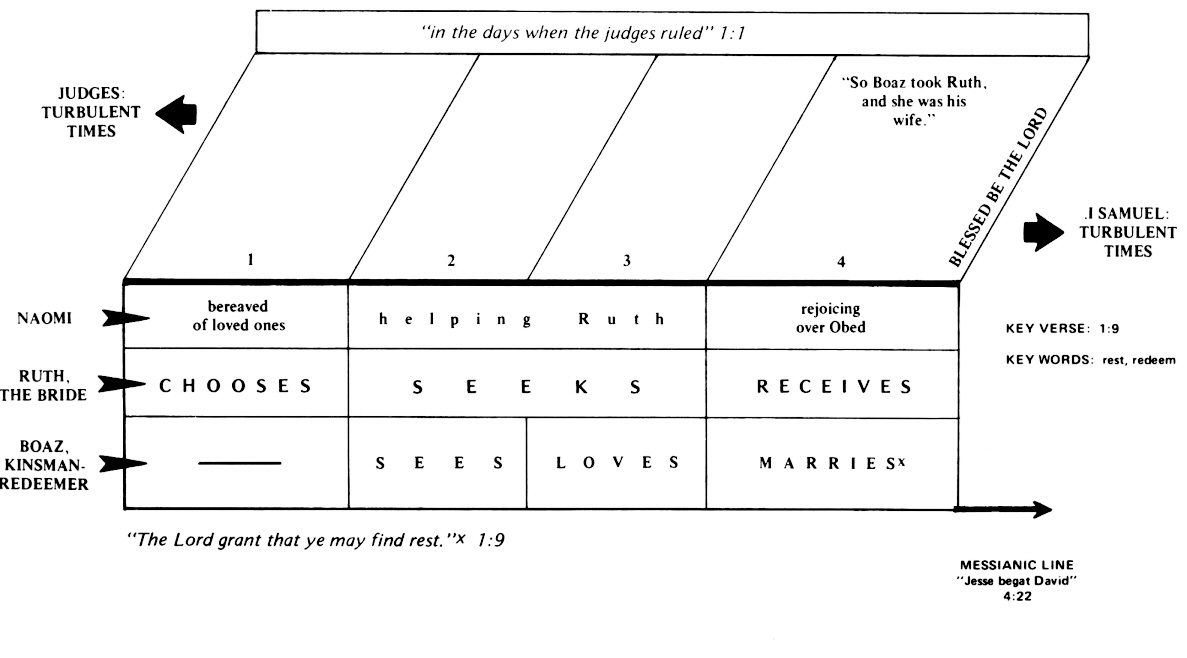
Irving Jensen's Survey of Bible (see his summary of Ruth online - page 392)
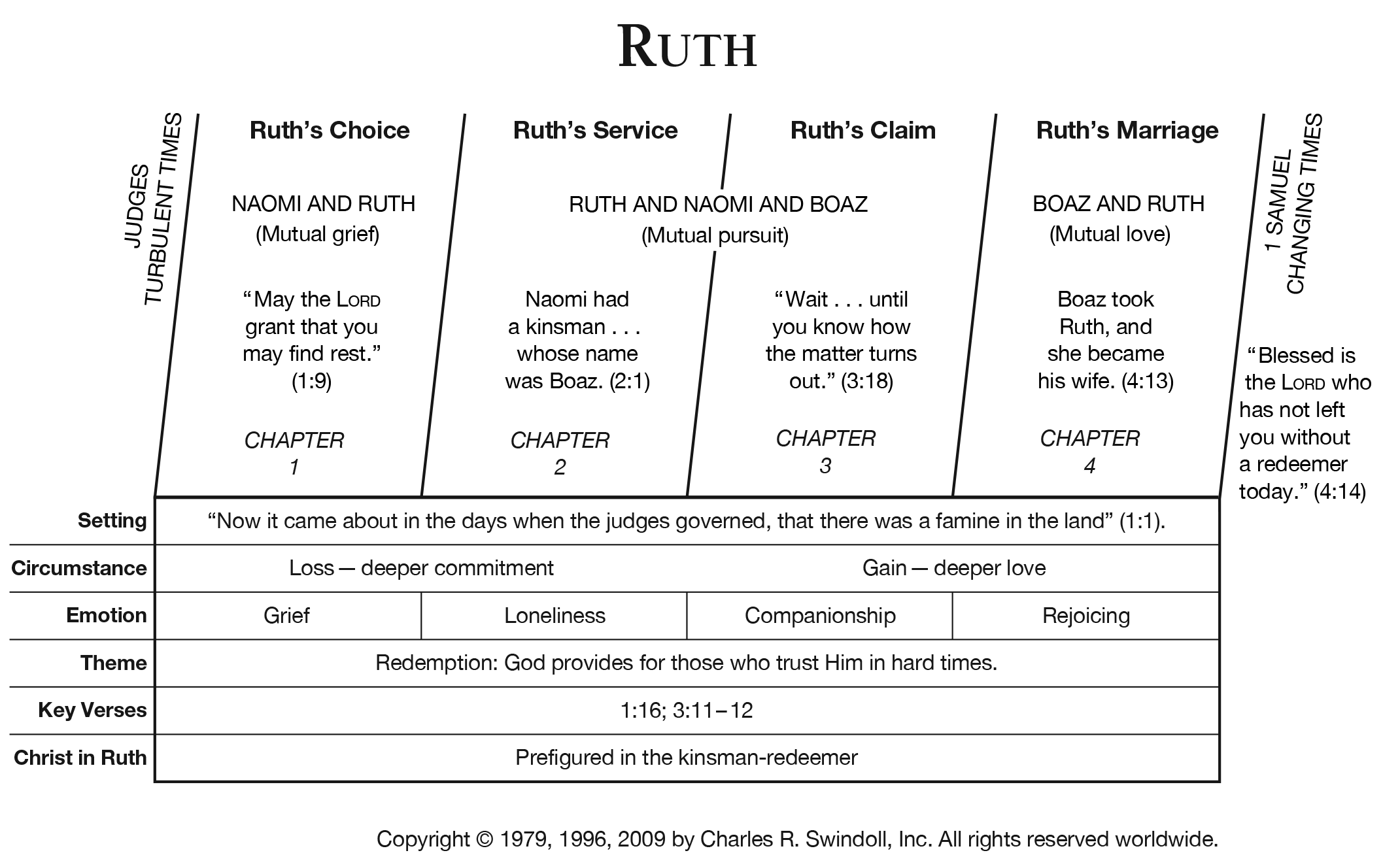
See Swindoll's summary chart of Ruth See Ruth Devotionals
|
RUTH: GOD PROVIDES |
|||
| Ruth 1 | Ruth 2 | Ruth 3 | Ruth 4 |
| Ruth's Choice | Ruth's Service | Ruth's Claim | Ruth's Marriage |
| Ruth's Resolve | Ruth's Rights | Ruth's Request | Ruth's Reward |
| Naomi and Ruth Mutual Grief |
Ruth and Naomi and Boaz Mutual Pursuit |
Boaz and Ruth Mutual Love |
|
| Ruth's Decision: Return with Naomi |
Ruth's Devotion: Provide for Naomi |
Ruth's Request: Redemption by Boaz |
Ruth's Reward: Relative of Messiah |
| Ruth and Naomi |
Ruth and Boaz |
||
| Death of Naomi's Family |
Ruth Cares for Naomi |
Boaz Cares for Ruth |
God Blesses with New Birth |
| Grief | Loneliness | Companionship | Rejoicing |
| Location: Plains of Moab |
Location: Fields of Bethlehem |
Location: Threshing floor of Bethlehem |
Location: Little town of Bethlehem |
| Time Lapsed: About 30 Years See Timeline |
|||
| Setting: Ru 1:1 Now it came about in the days when the judges governed Jdg 21:25+ In those days there was no king in Israel; everyone did what was right in his own eyes. |
|||

Ruth's Reward, 4:1-22
- A Husband, 4:1-12
- A Son, 4:13-17
- A Lineage, 4:18-22
Ryrie Study Bible
Ruth 4:6 The closest relative said, "I cannot * redeem it for myself, because I would jeopardize my own inheritance. Redeem it for yourself; you may have my right of redemption, for I cannot * redeem it." (NASB: Lockman)
BBE: And the near relation said, I am not able to do the relation's part, for fear of damaging the heritage I have: you may do it in my place, for I am not able to do it myself.
CEV: The man answered, "If that's the case, I don't want to buy it! That would make problems with the property I already own. You may buy it yourself, because I cannot." (CEV)
GWT: The man replied, "In that case I cannot assume responsibility for her. If I did, I would ruin my inheritance. Take all my rights to buy back the property for yourself, because I cannot assume that responsibility." (GWT)
KJV: And the kinsman said, I cannot redeem it for myself, lest I mar mine own inheritance: redeem thou my right to thyself; for I cannot redeem it.
NJB: The man with the right of redemption then said, 'I cannot use my right of redemption without jeopardizing my own inheritance. Since I cannot use my right of redemption, exercise the right yourself.' (NJB)
Young's Literal: And the redeemer saith, 'I am not able to redeem it for myself, lest I destroy mine inheritance; redeem for thyself -- thou -- my right of redemption, for I am not able to redeem.'
Septuagint (LXX): kai eipen (3SAAI) o agchisteus ou dunesomai (1SFMI) agchisteusai (AAN) emauto mepote diaphtheiro (1SPAI) ten kleronomian mou agchisteuson (2SAAM) seauto ten agchisteian mou hoti ou dunesomai (1SFMI) agchisteusai (AAN)
Click here for explanation of verb parsing abbreviations in parentheses after each verb
English of Septuagint: And the kinsman said, I shall not (note "ou" = absolute negation) be able to redeem it for myself, lest I mar my own inheritance; do thou redeem my right for thyself, for I shall not be able to redeem it
Listen to:
- J Vernon McGee -- Ruth 4:1.mp3
- J Vernon McGee -- Ruth 4:2-5.mp3
- J Vernon McGee -- Ruth 4:6-7.mp3
- J Vernon McGee -- Ruth 4:8-22.mp3
- John Piper -- Ruth 4 - The Best is Yet to Come.mp3
AND THE CLOSEST RELATIVE SAID I CANNOT REDEEM IT FOR MYSELF LEST I JEOPARDIZE MY OWN INHERITANCE:
- Ruth 4 Resources - Multiple Sermons and Commentaries
I cannot redeem it - "John Doe" quickly changes from I will to I cannot when the reality of his responsibility for Ruth the Moabitess entered the picture. He experiences a "sudden" change of heart. The nearest kinsman in not choosing to redeem Ruth passes off the pages of history anonymously!
Morrison - The moment that Ruth was referred to as the inseparable appurtenance of Elimelech's estate, a total change came over the feelings of the anonymous relative.
Note that the "go'el" uses a form of the Hebrew verb ga'al five times in one sentence for the words "closest relative" and "redeem" are identical (01350) (ga'al) (click word study of ga'al and go'el). The Hebrew word is actually a verb which as its active participle the word Go'el, (which is usually translated as a noun = kinsman, redeemer, avenger). The basic idea of the verb ga'al/go'el is to redeem or perform the role of a kinsman and redeem a kin from difficulty (especially financial encumbrance).
The first use of ga'al (01350) in the Hebrew OT is by Jacob as he was blessing Joseph's sons testifying that…
The angel (A "theophany" and more specifically a "Christophany" in the form of the Angel of the LORD) who has redeemed (ga'al) me from all evil, bless the lads; and may my name live on in them, and the names of my fathers Abraham and Isaac (this invokes the idea of the unconditional Abrahamic covenant); and may they grow into a multitude in the midst of the earth. (Ge 48:16)
In the next use of ga'al Jehovah Himself declares…
Say, therefore, to the sons of Israel, 'I am the LORD, and I will bring you out from under the burdens of the Egyptians, and I will deliver you from their bondage. I will also redeem (Literally Jehovah says "I will be a Kinsman-Redeemer" to) you with an outstretched arm and with great judgments. (Ex 6:6)
In the song of Moses celebrating Israel's redemption from Egyptian bondage…
In Thy lovingkindness (God's hesed = His loyal, covenant love) Thou hast led the people whom Thou hast redeemed (ga'al); In Thy strength Thou hast guided them to Thy holy habitation. (Ex 15:13)
In the fourth OT use of ga'al we see the direct application to the book of Ruth…
'If a fellow countryman of yours becomes so poor he has to sell part of his property, then his nearest kinsman (ga'al/go'el - his kinsman-redeemer) is to come and buy back what his relative has sold. 26 Or in case a man has no kinsman (ga'al), but so recovers his means as to find sufficient for its redemption, 27 then he shall calculate the years since its sale and refund the balance to the man to whom he sold it, and so return to his property. (Lev 25:25)
Jeopardize (spoil)(07843) (shachath/shahat) means to spoil, to ruin, to destroy, to pervert, to corrupt, to become corrupt, to wipe out. Shachath is used 3 times by Moses to describe the condition of the world in the days of Noah which was the reason God sent the worldwide flood…
Now the earth was corrupt (shachath/shahat) in the sight of God, and the earth was filled with violence. And God looked on the earth, and behold, it was corrupt (shachath/shahat); for all flesh had corrupted (shachath/shahat) their way upon the earth. (Genesis 6:11, 12)
This verb describes what God did to wicked Sodom and Gomorrah…
And Lot lifted up his eyes and saw all the valley of the Jordan, that it was well watered everywhere-- this was before the LORD destroyed (shachath/shahat) Sodom and Gomorrah-- like the garden of the LORD, like the land of Egypt as you go to Zoar. (Genesis 13:10)
Jeopardize is translated in the Septuagint using the Greek verb diaphtheiro, (1311) (from dia = intensives the meaning of verb + phtheiro = to shrivel, destroy, defile) which means to cause the complete destruction of something. It conveys the idea of something that is utterly corrupted and gives us our English word for the deadly disease known as "diphtheria"! The kinsman redeemer is concerned that to fulfill the role of the goel might "utterly corrupt" his estate, for he would have both Naomi and Ruth to support. Furthermore he did not want the field to be inherited by Ruth’s future son instead of members of his own family.
Vine - Anything that is good can be "corrupted" or "spoiled," such as Jeremiah's loincloth (Jer. 13:7), a vineyard (Jer. 12:10), cities (Gen. 13:10), and a temple (Lam. 2:6). Shāḥat has the meaning of "to waste" when used of words that are inappropriately spoken (Prov. 23:8). In its participial form, the word is used to describe a "ravening lion" (Jer. 2:30, rsv) and the "destroying angel" (1 Chron. 21:15). The word is used as a symbol for a trap in Jer. 5:26. Shāḥat is used frequently by the prophets in the sense of "to corrupt morally" (Isa. 1:4; Ezek. 23:11; Zeph. 3:7). (Vine's Expository Dictionary of Old Testament and New Testament Words)
Shachath/shahat Usage (NAS):
act corruptly(4), act… corruptly(1), acted corruptly(3), acted… corruptly(1), acting corruptly(1), blemished animal(1), corrupt(8), corrupted(4), depravity(1), destroy(69), destroyed(14), destroyer(4), destroyers(1), destroying(7), destroys(5), destruction(2), devastate(1), felled(2), go to ruin(1), harm(2), jeopardize(1), laid waste(1), polluted(1), raiders(2), ravage(1), ravaged(1), ruin(1), ruined(4), set(1), spoiled(1), stifled(1), waste(1), wasted(1), wreaking destruction(1).
Shachath/shahat - 138v -
Gen 6:11ff, 17; 9:11, 15; 13:10; 18:28, 31f; 19:13f, 29; 38:9; Exod 8:24; 12:13, 23; 21:26; 32:7; Lev 19:27; Num 32:15; Deut 4:16, 25, 31; 9:12, 26; 10:10; 20:19f; 31:29; 32:5; Josh 22:33; Judg 2:19; 6:4f; 20:21, 25, 35, 42; Ruth 4:6; 1 Sam 6:5; 13:17; 14:15; 23:10; 26:9, 15; 2 Sam 1:14; 11:1; 14:11; 20:15, 20; 24:16; 2 Kgs 8:19; 13:23; 18:25; 19:12; 1 Chr 20:1; 21:12, 15; 2 Chr 12:7, 12; 21:7; 24:23; 25:16; 26:16; 27:2; 34:11; 35:21; 36:19; Ps 14:1; 53:1; 78:38, 45; 106:23; Prov 6:32; 11:9; 18:9; 23:8; 25:26; 28:24; Isa 1:4; 11:9; 14:20; 36:10; 37:12; 51:13; 54:16; 65:8, 25; Jer 2:30; 4:7; 5:10, 26; 6:5, 28; 11:19; 12:10; 13:7, 9, 14; 15:3, 6; 18:4; 22:7; 36:29; 48:18; 49:9; 51:1, 11, 20, 25; Lam 2:5f, 8; Ezek 5:16; 9:8; 16:47; 20:17, 44; 22:30; 23:11; 26:4; 28:17; 30:11; 43:3; Dan 8:24f; 9:26; 11:17; Hos 9:9; 11:9; 13:9; Amos 1:11; Nah 2:2; Zeph 3:7; Mal 1:14; 2:8; 3:11
The Wycliffe Bible Commentary explains the Goel's quick change of heart, writing that "This would involve financial loss to the purchaser. The prospective goel would mar his own inheritance by spending money on land that would belong not to him but to a son of Ruth. The Targum suggests that the relative was already married, but this would not have relieved him of obligation. (Pfeiffer, C F: Wycliffe Bible Commentary. 1981. Moody)
If he had a son by Ruth, and that son were his only surviving heir, Mahlon’s property and part of his own estate would go to Elimelech’s family. The fact that Ruth was a Moabitess may also have been a problem to him. (Both Mahlon and Chilion had married Moabite women and died!) Boaz was undoubtedly relieved when his relative stepped aside and opened the way for Ruth to become his wife.
Jameison explains it this way - This consequence would follow, either, first, from his having a son by Ruth, who, though heir to the property, would not bear his name; his name would be extinguished in that of her former husband; or, secondly, from its having to be subdivided among his other children, which he had probably by a previous marriage. This right, therefore, was renounced and assigned in favor of Boaz, in the way of whose marriage with Ruth the only existing obstacle was now removed. (Ruth 4)
The Targum may give the proper sense of this passage (although it is still conjectural because there is no specific statement regarding his marital status):
"I cannot redeem it, because I have a wife already; and it is not fit for me to bring another into my house, lest brawling and contention arise in it; and lest I hurt my own inheritance. Do thou redeem it, for thou has no wife; which hinders me from redeeming it."
REDEEM IT FOR YOURSELF. YOU MAY HAVE MY RIGHT OF REDEMPTION FOR I CANNOT REDEEM:
- Ruth 4 Resources - Multiple Sermons and Commentaries
Redeem it for yourself (ga'al) - This verb is in the imperative mood (command) and in the Hebrew sentence is in the emphatic position, and so reads "redeem for you, you, my right of redemption".
The redeemer must not only be a kinsman, must be willing and must have the means to pay the redemption price.
Right of redemption (01353) (geullah) is given a Strong's number different than (ga'al) (01350) but both Strong's definition and the respected Theological Wordbook of the Old Testament state that geullah (or ge'ulla) is a feminine passive participle of ga'al and functions as a feminine noun in the Hebrew. Don't let this technical explanation sidetrack you from the essence of the meaning of this word geullah, which expresses the action of a relative in setting free a member of his family or buying back his property (geullah is found in Leviticus 25:24:26, 25:29, 25:31, 32, 25:48, 49, 25:51, 52). Geullah was also used in general of purchasing something for a price. A ransom-price is paid to secure the release of that which would otherwise be forfeited.
The nearest kinsman's refusal to assume the role of kinsman-redeemer serves to further highlight the kindness and generosity of Boaz toward the two widows, even as as the Moabitess Orpah’s return to her pagan family highlighted Ruth’s selfless devotion and loyalty to Naomi.
John MacArthur explains that "He was unwilling to have the family portfolio split between his existing children and the potential offspring of a union with Ruth. (MacArthur, J.: The MacArthur Study Bible Nashville: Word Pub)
When the go'el says "I cannot", he is for all practical purposes saying "I will not". Lest we be too hard on the nearest "John Doe" go'el, we need to be reminded that as believers we often take the same tact when confronted with a "pet sin" that we really don't want to be set free from -- we say "I cannot stop" when what we really mean to say is "I will not stop".
In fairness, it should also be mentioned that some commentators feel that the reason the nearest kinsman said "I cannot" is that if he paid the price for the land, and took on the added expense of caring for a wife, he would be overextended financially.
The Bible Knowledge Commentary explains that "Perhaps he was too poor to sustain the land and a wife. Or, as some have suggested, perhaps he feared to marry a Moabitess lest the fate of Mahlon, Ruth’s first husband (Ru 4:10), befall him. Perhaps the best view is that when he learned from Boaz that Ruth owned the property along with Naomi (Ru 4:5), he knew that if Ruth bore him a son, that son would eventually inherit not only the redeemed property but probably part of his own estate too. In that sense the nearer redeemer would “endanger” his estate. However, if only Naomi were the widow (not Naomi and Ruth), then no son from the levirate marriage would inherit part of the redeemer’s estate because Naomi was past childbearing. (Walvoord, J. F., Zuck, R. B., et al: The Bible Knowledge Commentary. 1985. Victor).
Believer's Study Bible - Boaz was bringing together two originally separate obligations: (1) buying the land of Naomi (Lev. 25:25, 26, 27, 28), and (2) marrying Ruth to perpetuate the inheritance of Mahlon (Dt. 25:5, 6, 7, 8, 9, 10; Nu 27:9, 10, 11). This was too difficult for the nearer kinsman, but Boaz was able. (Criswell, W A. Believer's Study Bible: New King James Version. 1991. Thomas Nelson)
A G Auld has a thought provoking common by way of application writing that "Service beckons—and we do not know whether it is an opportunity or an obligation. Our excuses are often expressed in terms of solemn undertakings already given such as our family commitments. “I cannot… lest I impair my own inheritance.” Those who seek to shape their lives by the gospel tradition must remember the several sayings which warn against giving the family an ultimate veto. Jesus talks of those who have left house or brothers or sisters or mother or father or children or land for his sake and for the gospel (Mark 10:29); and he also notes that “Whoever does the will of God is my brother, and sister, and mother” (Mark 3:35). Christians may not readily think of themselves as sharing in the responsibility of redemption. Yet solidarity with brother and neighbour is precisely our calling—with brothers who are not of our own family, and with neighbours who are far from our own doors." (Auld, A. G. Joshua, Judges, and Ruth. The Daily Study Bible Series page 276. Louisville: Westminster John Knox Press)
Warren Wiersbe applies this teaching on redemption to believers writing that "When it comes to spiritual redemption, all people are in bondage to sin and Satan (Ep 2:1, 2, 3; Jn 8:33, 34) and are unable to set themselves free. Jesus Christ gave His life as a ransom for sinners (Mk 10:45; Rev 5:9, 10), and faith in Him sets the captive free. Each time I visit a bookstore, I try to observe what subjects are getting prominent notice; and in recent years, it’s been the theme of deliverance. I see shelves of books about addiction and codependence and how to find freedom. In a world that’s enjoying more political freedom than ever before, millions of people are in bondage to food, sex, drugs, alcohol, gambling, work, and dozens of other “masters.” While we thank God for the help counselors and therapists can give, it is Jesus Christ Who alone can give freedom to those who are enslaved. “Therefore if the Son makes you free, you shall be free indeed” (John 8:36NKJV). (Wiersbe, W: Be Committed: An Old Testament Study. Ruth and Esther. Victor. 1993)
Ruth 4:7 Now this was the custom in former times in Israel concerning the redemption and the exchange of land to confirm any matter: a man removed his sandal and gave it to another; and this was the manner of attestation in Israel. (NASB: Lockman)
BBE: Now, in earlier times this was the way in Israel when property was taken over by a near relation, or when there was a change of owner. To make the exchange certain one man took off his shoe and gave it to the other; and this was a witness in Israel.
CEV: To make a sale legal in those days, one person would take off a sandal and give it to the other. (CEV)
GWT: (This is the way it used to be in Israel concerning buying back property and exchanging goods: In order to make every matter legal, a man would take off his sandal and give it to the other man. This was the way a contract was publicly approved in Israel.)
KJV: Now this was the manner in former time in Israel concerning redeeming and concerning changing, for to confirm all things; a man plucked off his shoe, and gave it to his neighbour: and this was a testimony in Israel.
NJB: Now, in former times, it was the custom in Israel to confirm a transaction in matters of redemption or inheritance by one of the parties taking off his sandal and giving it to the other. This was how agreements were ratified in Israel. (NJB)
Young's Literal: And this is formerly in Israel for redemption and for changing, to establish anything: a man hath drawn off his sandal, and given it to his neighbour, and this is the testimony in Israel.
Septuagint (LXX): kai touto to dikaioma emprosthen en to Israel epi ten agchisteian kai epi to antallagma tou stesai (AAN) pan logon kai hupelueto (3SIMI) o aner to hupodema autou kai edidou (3SIMI) to plesion autou to agchisteuonti (PAPMSD) ten agchisteian autou kai touto en (3SIAI) marturion en Israel
English of Septuagint: And this was in former time the ordinance in Israel for redemption, and for a bargain, to confirm every word: A man loosed his shoe, and gave it to his neighbour that redeemed his right; and this was a testimony in Israel
NOW THIS WAS THE CUSTOM IN FORMER TIMES IN ISRAEL CONCERNING THE REDEMPTION AND THE EXCHANGE OF LAND :
- Ruth 4 Resources - Multiple Sermons and Commentaries
"This is the way it used to be in Israel concerning buying back property and exchanging goods:" (GWT)
Note that "the custom" is not present in the original Hebrew text but is added by the translators, which is certainly reasonable in light of the fact that the Septuagint translation literally renders it "the ordinance (1345) (dikaioma [word study]) in Israel for redemption". The Greek word dikaioma is derived from dike = right and means primarily that which is deemed right, so as to have the force of law; hence an ordinance (an authoritative decree or direction, a law set forth by a governmental authority).
Redemption (01353) (geullah) is a feminine passive participle of ga'al and functions as a noun in the Hebrew expressing the action of a relative in setting free a member of his family or buying back his property that had been sold for debt. The law required that the "right of redemption" of land and of persons be protected (geullah is used with this meaning in Leviticus 25:24:26, 25:29, 25:31-32, 25:48-49, 25:51-52). A ransom-price is paid to secure the release of what would otherwise be under forfeit.
TO CONFIRM ANY MATTER A MAN REMOVED HIS SANDAL AND GAVE IT TO ANOTHER AND THIS WAS THE MANNER OF ATTESTATION IN ISRAEL:
- Ruth 4 Resources - Multiple Sermons and Commentaries
"In order to make every matter legal, a man would take off his sandal and give it to the other man. This was the way a contract was publicly approved in Israel." (GWT)
Attestation (08584) (te'uwdah/te'uda) was a method of legalizing transactions, and formally was a testimony, an act. of making a binding agreement.
Deut 25:7, 8, 9, 10 states that
if the man does not desire to take his brother’s wife, then his brother’s wife shall go up to the gate to the elders and say, ‘My husband’s brother refuses to establish a name for his brother in Israel; he is not willing to perform the duty of a husband’s brother to me. “Then the elders of his city shall summon him and speak to him. And if he persists and says, ‘I do not desire to take her,’ then his brother’s wife shall come to him in the sight of the elders, and pull his sandal off his foot and spit in his face; and she shall declare, ‘Thus it is done to the man who does not build up his brother’s house.’ “And in Israel his name shall be called, ‘The house of him whose sandal is removed.’
The explanation of the shoe removal in the overall transaction is not entirely clear and the following comments are somewhat conjectural in the absence of clear Scriptural guidelines. Clearly the exact practice described in (Deut 25:7-10) was not invoked in the current transaction between Boaz and the nearer goel. Instead of the woman taking off her shoe and spitting in the face of the man who refused to be her goel, here we see one of the two men pluck off his shoe, and give it to the other man. Presumably the man who took off his shoe renounced any legal rights he had in the matter, and thus symbolically transferred ownership. A similar custom is mentioned in the Nuzu tablets. This practice of taking off one's shoe may relate to the divine commandment to walk on the land and take possession (Ge 13:17; Dt. 11:24; Josh. 1:3). The the passing of the sandal may have symbolized Boaz’s right to walk on the land as his property. The closer relative legally transferred his right to the property as symbolized by the sandal, most likely that of the nearer relative, although the text does not state who took the sandal off!
Ridout writes that…
The shoe was that which trod upon the land, and to draw it off and pass it to another would seem to indicate that all claims upon the property had passed from the one to the other.
Warren Wiersbe comments that on the shoe removal that
In years to come, the ten witnesses would be able to testify that the transaction had been completed because they saw the kinsman hand his shoe to Boaz. It symbolized the kinsman’s forfeiture of his right to possess the land. Boaz now had the land—and Ruth! (Wiersbe, W: Be Committed: An Old Testament Study. Ruth and Esther. Victor. 1993)
Ruth 4:8 So the closest relative said to Boaz, "Buy it for yourself." And he removed his sandal. (NASB: Lockman)
BBE: So the near relation said to Boaz, Take it for yourself. And he took off his shoe.
CEV: So after the man had agreed to let Boaz buy the property, he took off one of his sandals and handed it to Boaz. (CEV)
GWT: So when the man said to Boaz, "Buy it for yourself," he took off his sandal. (GWT)
KJV: Therefore the kinsman said unto Boaz, Buy it for thee. So he drew off his shoe.
NJB: So, when the man with the right of redemption said to Boaz, 'Acquire it for yourself,' he took off his sandal. (NJB)
Young's Literal: And the redeemer saith to Boaz, 'Buy it for thyself,' and draweth off his sandal.
Septuagint (LXX): kai eipen (3SAAI) o agchisteus to Boos ktesai (2SAMM) seauto ten agchisteian mou kai hupelusato (3SAMI) to hupodema autou kai edoken (3SAAI) auto
English of Septuagint: And the kinsman said to Booz, Buy my right for thyself: and he took off his shoe and gave it to him
SO THE CLOSEST RELATIVE SAID TO BOAZ "BUY IT FOR YOURSELF" AND HE REMOVED HIS SANDAL:
- Ruth 4 Resources - Multiple Sermons and Commentaries
Closest relative is again the verb (01350) (ga'al). "Mr John Doe (“peloni almoni” Ru 4:1) now disappears from the scene and because he has relinquished his rights in the present context his name also disappears from history!
Baker's Evangelical Theological Dictionary summarizes this section observing that "Boaz went to the city gate and shrewdly began the process of acquiring Elimelech's inheritance and Ruth. The other near relative was happy to acquire more land, but not at the costs associated with Ruth. Apparently the inheritance rights also required the kinsman to raise up a child for the deceased if there were any possibility of doing so. Naomi was probably too old to bear a child for Elimelech, but not so Ruth. The near relative would need to spend assets from his own inheritance to gain Elimelech's land, but the child, when of age, could claim back the purchased land. Thus he determines it is not profitable for him to acquire the land; Boaz, whose circumstances are substantially different, willingly offers to redeem the land and raise up a child to Elimelech. Boaz and his near relative, in the presence of witnesses at the gate, sealed their transaction by the accepted custom of trading sandals. Once again, the sovereignty of God is seen to extend over all the practical details of everyday life, including strategic legal transactions. (Ruth, Theology of - Baker's Evangelical Dictionary of Biblical Theology)
Buy (07069) (qanah) (in the form of an imperative or a command) means to buy, to purchase, to acquire, to possess. This is the very word used to describe God Himself "buying back" His people…
"Terror and dread fall upon them; By the greatness of Thine arm they are motionless as stone; Until Thy people pass over, O LORD, Until the people pass over whom Thou hast purchased (qanah)." (Exodus 15:16)
"Remember Thy congregation, which Thou hast purchased (qanah) of old, which Thou hast redeemed (ga'al) to be the tribe of Thine inheritance; And this Mount Zion, where Thou hast dwelt." (Psalm 74:2)
Then it will happen on that day that the Lord will again recover (qanah) the second time with His hand The remnant of His people, who will remain, From Assyria, Egypt, Pathros, Cush, Elam, Shinar, Hamath, And from the islands of the sea.
Comment: Refers to a yet future regathering of the Jewish people at the second coming of Christ -- Mt 24:31-- the first being the regathering under Zerubbabel in 537 B.C.
God gave Boaz the honor to be part of the line of the Messiah, while the "John Doe" kinsman, who was afraid of lessening himself, and marring his inheritance, and as a result had his name, family, and inheritance forgotten.
Removed his sandal - The IVP Background Commentary has the following note of explanation regarding the sandal scene:
Sandals were the ordinary footwear in the ancient Near East, but they were also a symbolic item of clothing, especially in the relationship between the widow and her legal guardian. This may have been due to the fact that land was purchased based on whatever size triangle of land the buyer could walk off in an hour, a day, a week or a month (1Ki 21:16, 17). Land was surveyed in triangles, and a benchmark was constructed of fieldstones to serve as a boundary marker (Dt 19:14). Since they walked off the land in sandals, the sandals became the moveable title to that land. By removing the sandals of her guardian, a widow removed his authorization to administer the land of her household. Land transfers in the Nuzi texts also involved replacing the old owner’s foot on the land with that of the new owner. (Matthews, V. h., Chavalas, M. W., & Walton, J. H. The IVP Bible background commentary : Old Testament . Downers Grove, IL: InterVarsity Press)
Ruth 4:9 Then Boaz said to the elders and all the people, "You are witnesses today that I have bought from the hand of Naomi all that belonged to Elimelech and all that belonged to Chilion and Mahlon. (NASB: Lockman)
BBE: Then Boaz said to the responsible men and to all the people, You are witnesses today that I have taken at a price from Naomi all the property which was Elimelech's, and everything which was Chilion's and Mahlon's.
CEV: Boaz told the town leaders and everyone else: All of you are witnesses that today I have bought from Naomi the property that belonged to Elimelech and his two sons, Chilion and Mahlon. (CEV)
GWT: Then Boaz said to the leaders and to all the people, "Today you are witnesses that I have bought from Naomi all that belonged to Elimelech and all that belonged to Chilion and Mahlon. (GWT)
KJV: And Boaz said unto the elders, and unto all the people, Ye are witnesses this day, that I have bought all that was Elimelech's, and all that was Chilion's and Mahlon's, of the hand of Naomi.
NJB: Boaz then said to the elders and all the people there, 'Today you are witnesses that from Naomi I acquire everything that used to belong to Elimelech, and everything that used to belong to Mahlon and Chilion (NJB)
Young's Literal: And Boaz saith to the elders, and to all the people, 'Witnesses are ye to-day that I have bought all that is to Elimelech, and all that is to Chilion and Mahlon, from the hand of Naomi;
Septuagint (LXX): kai eipen (3SAAI) Boos tois presbuterois kai panti to lao martures humeis semeron hoti kektemai (1SRMI) panta ta tou Abimelech kai panta osa huparchei (3SPAI) to Chelaion kai to Maalon ek cheiros Noemin
English of Septuagint: And Booz said to the elders and to all the people, Ye are this day witnesses, that I have bought all that was Elimelech's, and all that belonged to Chelaion and Maalon, of the hand of Noemin
THEN BOAZ SAID TO THE ELDERS AND ALL THE PEOPLE YOU ARE WITNESSES TODAY THAT I HAVE BOUGHT FROM THE HAND OF NAOMI ALL THAT BELONGED TO ELIMELECH AND ALL THAT BELONGED TO CHILION AND MAHLON:
- Ge 23:16-18; Jer 32:10-12
- Ruth 4 Resources - Multiple Sermons and Commentaries
Witnesses (05707) ('ed) refers to someone who will be accepted to bear a true testimony in various situations for various reasons. Boaz as a wise businessman makes sure the deal is "ironclad" as we might say today.
Bought (07069) (qanah) means to buy, to purchase, to acquire, to possess.
Remember what is Boaz's motive for doing this? HE LOVES RUTH. Ruth's first son would rightly be known as the `son of Elimelech', thus perpetuating the name of the dead. This son would also be heir to the property, so ensuring continuation of the family's name and possessions.
In verses 9-10 all the family members were mentioned again except Orpah. She had also faded into anonymity with the nameless nearer kinsman.
Ruth 4:10 "Moreover, I have acquired Ruth the Moabitess, the widow of Mahlon, to be my wife in order to raise up the name of the deceased on his inheritance, so that the name of the deceased will not be cut off from his brothers or from the court of his birth place; you are witnesses today." (NASB: Lockman)
BBE: And, further, I have taken Ruth, the Moabitess, who was the wife of Mahlon, to be my wife, to keep the name of the dead man living in his heritage, so that his name may not be cut off from among his countrymen, and from the memory of his town: you are witnesses this day.
CEV: You are also witnesses that I have agreed to marry Mahlon's widow Ruth, the Moabite woman. This will keep the property in his family's name, and he will be remembered in this town. (CEV)
GWT: In addition, I have bought as my wife the Moabite Ruth, Mahlon's widow, to keep the inheritance in the dead man's name. In this way the dead man's name will not be cut off from his relatives or from the public records. Today you are witnesses." (GWT)
KJV: Moreover Ruth the Moabitess, the wife of Mahlon, have I purchased to be my wife, to raise up the name of the dead upon his inheritance, that the name of the dead be not cut off from among his brethren, and from the gate of his place: ye are witnesses this day.
NJB: and that I am also acquiring Ruth the Moabitess, Mahlon's widow, to be my wife, to perpetuate the dead man's name in his inheritance, so that the dead man's name will not be lost among his brothers and at the gate of his town. Today you are witnesses to this.' (NJB)
Young's Literal: and also Ruth the Moabitess, wife of Mahlon, I have bought to myself for a wife, to raise up the name of the dead over his inheritance; and the name of the dead is not cut off from among his brethren, and from the gate of his place; witnesses ye are to-day.'
Septuagint (LXX): kai ge Routh ten Moabitin ten gunaika Maalon kektemai (1SRMI) emauto eis gunaika tou anastesai (AAN) to onoma tou terhnekotos (RAPMSG) epi tes kleronomias autou kai ouk exolethreuthesetai (3SFPI) to onoma tou tethnekotos (RAPMSG) ek ton adelphon autou kai ek tes phules laou autou martures humeis semeron
English of Septuagint: Moreover I have bought for myself for a wife Ruth the Moabitess, the wife of Maalon, to raise up the name of the dead upon his inheritance; so the name of the dead shall not be destroyed from among his brethren, and from the tribe of his people: ye are this day witnesses
MOREOVER I HAVE ACQUIRED RUTH THE MOABITESS THE WIDOW OF MAHLON TO BE MY WIFE:
- Ge 29:18,19,27 29:19; 29:27 Pr 18:22; 19:14; 31:10 31:11; Hos 3:2; 12:12; Eph 5:25
- Ruth 4 Resources - Multiple Sermons and Commentaries
Acquired (07069) (qanah) means to purchase and here means to possess.
Boaz acted more nobly in that he acted as goel willingly, without compulsion, showing no reluctance to state openly that he had acquired Ruth the Moabitess. Boaz obviously is not ashamed of her past and he accepts her for who she is now (cp Ru 1:16, Ru 2:12), not where she came from (Moab, a land of idol worshippers). Jesus Christ, the greater Kinsman Redeemer is likewise not not ashamed to call us brothers even though we once hated Him! The writer of Hebrews says that since Jesus
Who sanctifies and those who are sanctified are all from one Father… He is not ashamed to call them brethren. (Heb 2:11-note)
Ruth the Moabitess - The author designates Ruth with this specific title 5x (Ru 1:22, 2:2, 2:21, 4:5, 4:10)
IN ORDER TO RAISE UP THE NAME OF THE DECEASED ON HIS INHERITANCE SO THAT THE NAME OF THE DECEASED MAY NOT BE CUT OFF FROM HIS BROTHERS OR FROM THE COURT OF HIS BIRTH PLACE YOU ARE WITNESSES TODAY:
- Dt 25:6; Josh 7:9; Ps 34:16; 109:15; Isa 48:19; Zech 13:2) (Isa 8:2 8:3; Mal 2:14; Heb13:4
- Ruth 4 Resources - Multiple Sermons and Commentaries
Raise up (06965) (qum) literally was used to describe the physical action of rising up but here is clearly is figurative conveying the idea of reviving the name of the deceased.
Perpetuation of the family name (1Sa 24:21) was an important feature that the levirate process provided (cf. Dt 25:6).
Cut off (03772) (karath) means literally to severe something from its source and implies a violent action. The most important use of the root is “to cut” a covenant. Here in Ruth 4:10 the meaning is of course figurative and conveys the idea of exclusion from an association. Karath is the same verb used in the great prophecy of Daniel 9:24-27 in which God foretold that His Son, "the Messiah will be cut off" after 7 weeks (49 years) and 62 weeks (434 years). See commentary on Daniel 9:26.
If Boaz a mere human being could love an outcast, redeem her, and bring her into fellowship with himself, God could love all the outcasts of the world, redeem them, and bring them into fellowship with himself.
Redeemed, How I Love to Proclaim It!
Redeemed, how I love to proclaim it!
Redeemed by the blood of the Lamb;
Redeemed through His infinite mercy,
His child and forever I am.
-- Fanny Crosby
Our Daily Bread applies Ruth's redemption by Boaz to the lives of believers in the following devotional…
During the American Revolution, the British Crown offered General Joseph Reed a bribe. He replied at an August 11, 1778, meeting of the Continental Congress by saying,
"I am not worth purchasing, but such as I am, the King of Great Britain is not rich enough to do it."
Boaz was rich enough to take Ruth as his wife. As a close relative of Naomi, Ruth's mother-in-law, Boaz paid the price out of duty, but apparently he also loved Ruth. The Old Testament redeemer had to be a near relative, be willing, and be able to pay the price. Although love for the redeemed was not a requirement, it sometimes motivated the redeemer. More important, God Himself redeemed Israel because He loved the people.
Roman law added an obligation to the rules of redemption: The redeemed had to repay the ransom price. Redeemed people were in debt to their redeemer until they cleared the liability. Like Joseph Reed, we were not worthy of being purchased, but God loved us so deeply that He bought us with His Son's life. And we can only repay the Redeemer by offering our own lives in return. (Our Daily Bread, Copyright RBC Ministries, Grand Rapids, MI. Reprinted by permission. All rights reserved)
F B Meyer writes…
So this exquisite idyll, which began with three deaths and famine, ends with marriage rejoicings. Shall not all God’s idylls end thus? Shall it be left to the dream of the novelist only to make happy for ever after? God has eternity at his disposal, as well as time. Only trust Him; “thy darkest night shall end in brightest day.”
It is impossible not to read between these lines and see the foreshadowing of another marriage, when the purchase of the Church shall issue in her everlasting union with the Son, in the presence of God the Father. Let us, however, apply these words to ourselves as individuals.
The Lord Jesus has purchased us to be his own, not with corruptible things, as silver and gold, but with his precious blood. He has also won back our patrimony; this earth is his; and shall be yet rid of all intruding evil, to shine as the brightest jewel in his crown.
He has received the shoe, the symbol of dominion and authority. He is not only our lover, but our Lord.
He waits to take us to Himself, in a love that shall not cease, and compared to which all the love we have ever known is as moonlight compared with sunshine. (Meyer, F. B. Our Daily Homily)