Titus 1:2
Titus 1:3
Titus 1:4
Titus 1:5
Titus 1:6
Titus 1:7
Titus 1:8
Titus 1:9
Titus 1:10
Titus 1:11
Titus 1:12
Titus 1:13
Titus 1:14
Titus 1:15
Titus 1:16
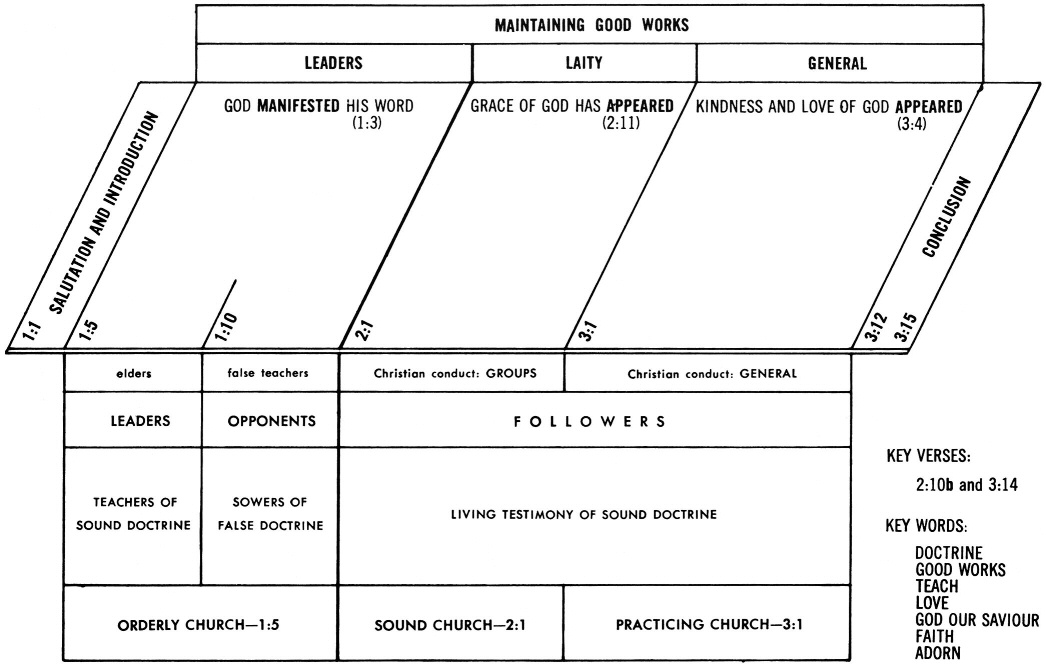
ADORNING THE DOCTRINE OF GOD
Click chart to enlarge
Charts from Jensen's Survey of the NT - used by permission
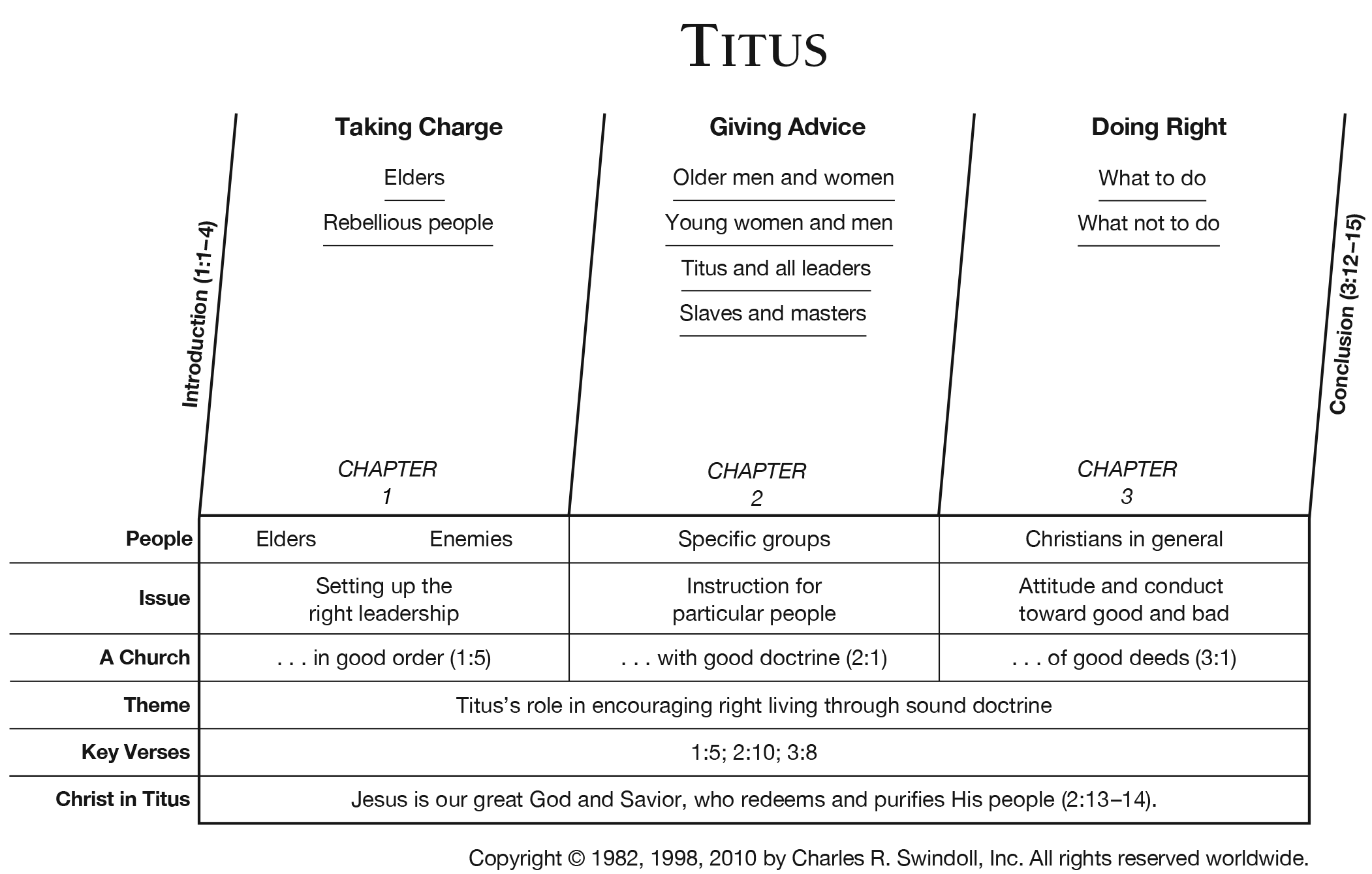
See Summary Chart by Charles Swindoll
Chart below from Michael J. Penfold
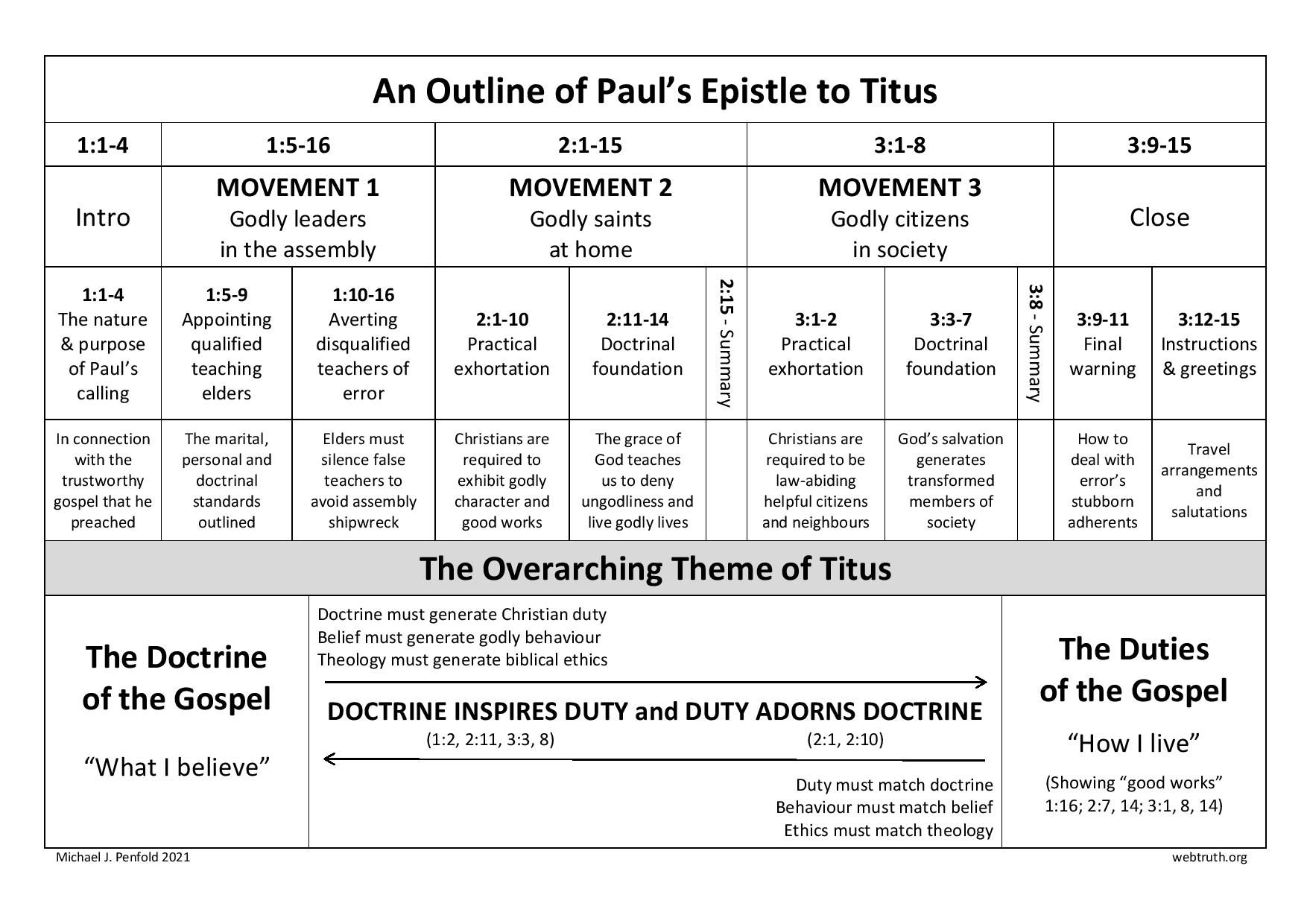
|
Focus |
Appoint Elders |
|||
|
Divisions |
Rebuke |
Maintain |
||
|
Topics |
||||
|
Topics |
Organization |
Offenders |
Operation |
|
|
Place |
Probably Written from either Corinth or Nicopolis (cf. Titus 3:12). |
|||
|
Time |
Circa 63 AD |
|||
|
Modified from Talk Thru the Bible |
||||
Titus 1:14 not paying attention (PAPMPN) to Jewish myths and commandments of men who turn away (PMPMPG) from the truth. (NASB: Lockman)
Greek: me prosechontes (PAPMPN) Ioudaikois muthois kai entolais anthropon apostrephomenon (PMPMPG) ten aletheian
Amplified: [And may show their soundness by] ceasing to give attention to Jewish myths and fables or to rules [laid down] by [mere] men who reject and turn their backs on the Truth.
Barclay: and not pay attention to Jewish fables and to rules and regulations made by men who persist in turning their backs on the truth. (Westminster Press)
BBE: Giving no attention to the fictions of the Jews and the rules of men who have no true knowledge.
KJV: Not giving heed to Jewish fables, and commandments of men, that turn from the truth.
Phillips: with a proper contempt for Jewish fairy tales and orders issued by men who have forsaken the path of truth. (Phillips: Touchstone)
Weymouth: and not give attention to Jewish legends and the maxims of men who turn their backs on the truth
Wuest: not giving consent to Jewish myths and the commandments of men who are turning themselves away from the truth. (Eerdmans)
Young's Literal: not giving heed to Jewish fables and commands of men, turning themselves away from the truth;
NOT PAYING ATTENTION TO JEWISH MYTHS: me prosechontes (PAPMPN) ioudaikois muthois:
- 1 Ti 1:4, 5, 6, 7; 2Ti 4:4
- Titus 1 Resources - Multiple Sermons and Commentaries
Giving no attention to the fictions of the Jews (BBE)
and not pay attention to Jewish fables (Barclay)
[And may show their soundness by] ceasing to give attention to Jewish myths (Amp)
so that they stop taking notice of Jewish myths (NJB)
not accepting Jewish false stories (NCV)
They must stop listening to Jewish myths (NLT)
not giving heed to Jewish fables (NKJV)
and no longer hold on to Jewish legends (TEV)
not giving consent to Jewish myths (Wuest)
Paying attention (4337) (prosecho from pros = toward + echo = hold) is literally to hold toward and conveys the sense of giving heed to or devoting oneself to something, in this case "Jewish myths". It means to be in a state of alert, to be concerned about, to care for or to take care
Prosecho always warns of danger and is not simply a call to notice something, but to be on guard against it because it is so harmful. The present tense calls for the Cretan believers to continually not be giving consent and attention to "Jewish myths".
Paul wrote to Timothy, telling him not “to pay attention to myths and endless genealogies, which give rise to mere speculation rather than furthering the administration of God which is by faith” (1Ti 1:4) and to "have nothing to do with worldly fables fit only for old women. On the other hand, discipline yourself for the purpose of godliness." (1Ti 4:7-note)
Jewish (2451) (Ioudaikos) is that which is related to the Jews and refers to Israel, Judah or the Hebrews in the OT.
Myths (3454) (muthos from mu- = to close, keep secret) refers to fictional tales or legendary accounts in contrast to true accounts. Myths are manufactured stories that have no basis in fact.
Webster defines "myth" as a usually traditional story of ostensibly (to all outward appearances) historical events that serves to unfold part of the world view of a people or explain a practice, belief, or natural phenomenon.
Trench traces the evolution of the meaning of muthos writing that "Although logos and muthos began their journey together, they gradually parted company. The antagonism between these words grew stronger and stronger until they finally stood in open opposition. This is true of words as well as of people, when one come to belong to the kingdom of light & truth and the other to the kingdom of darkness & lies." (Trench, R. C. Synonyms of the New Testament. Hendrickson Publishers. 2000)
Paul warned Timothy that the time would come in the church when professed Christians would not want to hear true doctrine, but would “turn away their ears from the truth, and (would) turn aside to myths” (2Ti 4:4-note).
The The attractiveness and subtle deception is that there may be much logic and reasoning in myths thus accounting for Paul's warning to stop listening to
What were "Jewish myths"? The Scripture is not clear but the implication is that even some of the Jews had abandoned their sacred Scriptures and accepted man-made substitutes. This may be a reference to the oral traditions. A century or so after the Babylonian Captivity, many rabbis began adapting gnostic Greek numerology—the practice of assigning mystical meanings to numbers—to the Hebrew language. Under one such scheme (and there were many), it was believed that the secret in the letter-numbers in Abram’s name meant that he had 318 servants. Hebrew numerology was applied not only to the Hebrew Scriptures but also to the Talmud, a collection of authorized rabbinical interpretations of Scripture, especially the Mosaic Law, that began during the time of Ezra (ca. 450 b.c.) and continued until about a.d. 500. By NT times, many rabbis and other learned Jews—especially those who lived in areas where Greek philosophy was still dominant (as it was on Crete)—mixed ideas from Hebrew and Greek numerology and added their own allegorical fancies, making the resulting interpretations more bizarre than ever.
As has been well said "When the plain sense of Scripture makes good sense, seek no other sense."
There is no need to find “deeper meanings” to the plain teachings of the Word of God. Such an approach to the Bible enables one to find anything they want to find, an art the cults "specialize" in!
COMMANDMENTS OF MEN: kai entolais anthropon:
- Isa 29:13; Mt 15:9; Mk 7:7; Col 2:22
- Titus 1 Resources - Multiple Sermons and Commentaries
the orders of people (NJB)
to rules [laid down] by [mere] men (Amp)
to rules and regulations made by men (Barclay)
and to human commandments (TEV)
Commandments (1785) (entole) refers to that which is commanded as officially binding. Entole is one of most common of the words meaning commandment and stresses the authority of the one commanding.
Paul warned the saints at Colossae of the danger of "commandments of men", reminding them that since they had "died with Christ to the elementary principles of the world, why, as if (they) were living in the world, (did they) submit yourself to decrees, such as "Do not handle, do not taste, do not touch!" (which all refer to things destined to perish with the using)-- in accordance with the commandments and teachings of men? These are matters which have, to be sure, the appearance of wisdom in self-made religion and self-abasement and severe treatment of the body, but are of no value against fleshly indulgence." (see notes Colossians 2:20; 2:21; 2:22; 2:23)
Paul had warned Timothy that "the Spirit explicitly says that in later times some will fall away from the faith" and because they would pay "attention to deceitful spirits and doctrines of demons", they would "forbid marriage and advocate abstaining from foods, which God has created to be gratefully shared in by those who believe and know the truth." (1Ti 4:1, 4:2, 4:3)
God spoke through the prophet Isaiah helping us understand the danger of this problem, pointing out that the Jews "draw near with their words and honor Me with their lip service, but they remove their hearts far from Me, and their reverence for Me consists of tradition learned by rote." (Isa 29:13)
The Lord Jesus reiterated this problem declaring that "They worship me in vain (groundlessly, in futility, purposelessly); their teachings are but rules (commandments) taught by men." (from NIV, Mt 15:9)
WHO TURN AWAY FROM THE TRUTH: apostrephomenon (PMPMPG) ten aletheian:
- Gal 4:9; 2Ti 4:4; Heb 12:25; 2Pe 2:22
- Titus 1 Resources - Multiple Sermons and Commentaries
people who are always rejecting the truth (GWT)
of people who have turned their backs on the truth (NLT)
of people who have repudiated the truth (NAB)
who persist in turning their backs on the truth (Barclay)
which come from people who have rejected the truth. (TEV)
who are turning themselves away from the truth (Wuest)
habitually turning themselves away from the truth embodied in the gospel (Expositors)
Turn away (654) (apostrepho from apo = from, dissociation + strepho = turn) is to turn away one's ear and so to stop listening.
These men made a willful choice, continually (present tense) turning themselves away from (middle voice = reflexive = subject initiates action and participates in effect or result) the truth, the only thing that sets men free.
Paul used this same verb apostrepho to remind Timothy
of the fact that all who are in Asia (had) turned away from him. (2Ti 1:15-note)
and that
the time (would) come when they (would) not endure sound doctrine; but wanting to have their ears tickled, they (would) accumulate for themselves teachers in accordance to their own desires and (would) turn away (apostrepho) their ears from the truth, and (would be continually turned) aside (apostrepho) to myths. (see note 2 Timothy 4:3; 4:4)
Truth ( 225) (aletheia) is the quality of being in accord with what is true and is therefore characterized by, truthfulness, dependability and uprightness in thought and deed.
The way to recognize these men is to know the truth because this is the one thing they continually want nothing to do with.
Titus 1:15 To the pure, all things are pure; but to those who are defiled (RPPMPD) and unbelieving, nothing is pure, but both their mind and their conscience are defiled (3SRPI) (NASB: Lockman)
Greek: panta kathara tois katharois; tois de memiammenois (RPPMPD) kai apistois ouden katharon, alla memiantai (3SRPI) auton kai o nous kai e suneidesis.
Amplified: [And may show their soundness by] ceasing to give attention to Jewish myths and fables or to rules [laid down] by [mere] men who reject and turn their backs on the Truth.
KJV: Unto the pure all things are pure: but unto them that are defiled and unbelieving is nothing pure; but even their mind and conscience is defiled.
Phillips: Everything is wholesome to those who are themselves wholesome. But nothing is wholesome to those who are themselves unwholesome and who have no faith in God - their very minds and consciences are diseased. (Phillips: Touchstone)
TLB: A person who is pure of heart sees goodness and purity in everything; but a person whose own heart is evil and untrusting finds evil in everything, for his dirty mind and rebellious heart color all he sees and hears.
Wuest: All things are pure to those who are pure. But to those who are defiled and unbelieving, not even one thing is pure. But both their mind and conscience are defiled. God they confess that they know but in their works they deny, being abominable and nonpersuasible, and with reference to every good work, disapproved.
Young's Literal: all things, indeed, are pure to the pure, and to the defiled and unstedfast is nothing pure, but of them defiled are even the mind and the conscience;
TO THE PURE ALL THINGS ARE PURE: panta men kathara tois katharois:
- Lk 11:39, 40, 41; Acts 10:15; Ro 14:14; 14:20 1Cor 6:12; 6:13, 10:23; 10:25 10:31 1Ti 4:3 4:4
- Titus 1 Resources - Multiple Sermons and Commentaries
- Everything is clean to those who are clean (GWT)
- Everything is pure to those whose hearts are pure (NLT)
- Everything is wholesome to those who are themselves wholesome (Phillips)
- A person who is pure of heart sees goodness and purity in everything (TLB)
- To the pure [in heart and conscience] all things are pure (Amp)
MacArthur sums up this passage noting that "Paul gives two divinely inspired evaluations of false teachers in the Cretan churches, evaluations that apply to false teachers in any age. First he assesses their inner lives and finds them to be corrupt. He then assesses their outer lives and finds them to be hypocritical and debauched. (MacArthur. Titus: Moody Press)
Spurgeon - The pure—where shall we find them? Where are they born? We answer: no men are born this way. “Who can bring a clean thing from an unclean thing? No one!” (Job 14:4) As our parents have sinned, we their children are born with tendencies to sin. We are impure even from birth. There are none pure but those who are made so by a second creation. The first time they are marred upon the wheel. They must go under the Creator’s hand a second time; they must feel the power of the purifying Spirit of God creating them anew before they can be called pure at all. And these are not absolutely pure. Even in those who are entitled to be called “pure in heart” (Matt 5:8), there remains impurity. If any man shall question that, let him remember 1 John 1:8—“If we say that we do not have sin, we deceive ourselves and the truth is not in us.” There is sin in the best of men. If they do not perceive it it must be because they are blinded with a foolish self-conceit, for in the purest heart there still remains connected with it the old nature and the impurity inherited from the first Adam. This makes life a perpetual conflict until life’s close. Still, we name men by their predominant characteristics. The partial impurity of a good man does not entitle him to be called impure. If the master principle within him, the reigning principle, is purity, he is a pure man. A man may once in his life have spoken an untruth; he may have been surprised into saying that is a thing which is not. But if the general tenor of his life is stern integrity, we do not therefore condemn him and brand him as a liar. Otherwise, where are the men living upon earth who would be worthy of a name implying praise? The godly have been made pure by regeneration, and they are pure, though not absolutely so.
MacDonald sounds a note of caution in the interpretation of this verse and gives a well reasoned exposition, declaring that
If we take the words to the pure all things are pure out of context as a statement of absolute truth in all areas of life, we are in trouble! All things are not pure, even to those whose minds are pure. Yet people have actually used this verse to justify vile magazines, suggestive movies, and even immorality itself. Let it be clearly understood that this verse has absolutely nothing to do with things that are sinful in themselves and condemned in the Bible… This proverbial saying must be understood in the light of the context. Paul has not been speaking about matters of clear-cut morality, of things that are inherently right or wrong. Rather, he has been discussing matters of moral indifference, things that were ceremonially defiling for a Jew living under the law but that are perfectly legitimate for a Christian living under grace. The obvious example is the eating of pork. It was forbidden to God’s people in the OT, but the Lord Jesus changed all that when He said that nothing entering into a man can defile him (Mk 7:15). In saying this He pronounced all foods clean (Mk 7:19). Paul echoed this truth when he said: “But food does not commend us to God; for neither if we eat are we the better, nor if we do not eat are we the worse” (1Cor 8:8). When he says: “To the pure all things are pure,” he means that to the born again believer all foods are clean, but to those who are defiled and unbelieving nothing is pure . It is not what a person eats that defiles him but what comes out of his heart (Mk 7:20 21 22 23). If a man’s inner life is impure, if he does not have faith in the Lord Jesus, then nothing is pure to him. The observance of dietary rules won’t do a thing for him. More than anything else he needs to be converted, to receive salvation as a free gift rather than trying to earn it through rituals and legalism. The very minds and consciences of defiled people are corrupted. Their mental processes and their moral powers are defiled. It is not a question of external ceremonial defilement, but of inward corruption and depravity. (Believer's Bible Commentary: Old and New Testaments. Nashville: Thomas Nelson)
Pure (2513) (katharos) literally describes that which is free of dirt and thus clean. It describes that which is free from admixture or adulteration and thus is pure. From a biblical standpoint the concept of cleansing is deeply rooted in both the Old and the New Testaments. As discussed more below under the Levitical laws heavy emphasis was placed on ceremonial cleansing and thus contact with any unclean animal, substance, person, or place was strictly forbidden. By the time Christ came this preoccupation with ceremonial cleanness had unfortunately displaced true worship with many of the Jews, most notably the Pharisees. It is not surprising then that the New Testament focuses mainly on an inward cleanness (heart, conscience), rather than on an external or ceremonial cleanness.
English words derived from katharos
- catharsis = purifying, cleansing, a term used in psychology and counseling for a cleansing of the mind or emotions - a "soul cleansing" if you will;
- cathartic = any substance used to induce purging especially the digestive tract or to cleanse a wound or infected are in order to make it pure or in psychiatry, the relieving of fears by bringing them to the surface of a person’s consciousness.
- Cathar = member of a medieval sect which sought the purging of all evil from its members)
It is also worth noting that katharos is related to the Latin castus, from which we get chaste. The related word chasten refers to discipline given in order to cleanse from wrong behavior.
John Blanchard writes that "katharos was a word used, for example, of soiled clothing which had been washed clean, grain from which all chaff had been removed, metal without any trace of alloy, or a man with all his bills and taxes paid." (The Beatitudes for Today)
Katharos is blameless, innocent, unstained with the guilt and is used to describe that which is ceremonially or ritually pure or clean (in a "Levitical sense"). For example Moses records…
Leviticus 6:11 'Then he shall take off his garments and put on other garments, and carry the ashes outside the camp to a clean (LXX = katharos) place.
Exodus 25:11 "And you shall overlay it (the Ark of the Covenant) with pure (LXX = katharos) gold, inside and out you shall overlay it, and you shall make a gold molding around it.
Katharos is an adjective that figuratively is used in both the OT and the NT to describe the state of one's heart. When a person is pure in heart and mind, his or her perspective on all things is pure, and that inner purity produces outer purity. As discussed above, true purity lies not in adherence to external commandments of men but in the inner purity of the redeemed, regenerated heart.
Katharos is used to modify conscience (clean, clear) and religion (pure).
Wuest writes that katharos means "clean, pure, free from the adhesion of anything that soils, adulterates, corrupts, and in an ethical sense, “free from corrupt desire, sin, and guilt. (Wuest, K. S. Wuest's Word Studies from the Greek New Testament: Eerdmans)
MacArthur writes that "katharos has two shades of meaning. Some suggest that it also means unmixed or unalloyed or unadulterated or sifted or cleansed of chaff. In other words, to be pure means you have no added mixture of any foreign element. Thus, what our Lord was really saying here is, “I desire a heart that is unmixed in its devotion and motivation. Pure motives from a pure heart.”Either way, it has to do with attitudes, integrity, and singleness of heart as opposed to duplicity and double mindedness (MacArthur, J. The Only Way to Happiness: The Beatitudes. Chicago: Moody Press)
NIDNTT writes that in classical Greek - The adjective katharos (derivation obscure, probably nothing to do with Latin castus) is common from Homer onwards, and means: (a) originally, clean, in a physical sense as opposed to rhuparos = dirty (e.g. pure, clean water, Eur. Hippolytus 209); (b) clean, in the sense of free, without things which come between, as opposed to pleres or mestos, full (e.g. en katharo, Homer Il. 23, 61); (c) ritually clean, as opposed to akathartos, unclean; (d) in a religious sense, morally pure (e.g. katharos adikias, Plato, Republic 6, 496d; katharos cheiras, Hdt., 1, 35)…In the LXX katharos renders 18 different Heb. equivalents, but by far the most frequent is tahôr, in the sense of ritual purity. Occasionally the LXX also translates the Heb. naqî, pure, innocent (Job 4:7), and zakak, to be bright, pure, innocent (Job 15:15) by katharos. (Brown, Colin, Editor. New International Dictionary of NT Theology. 1986. Zondervan)
Richards gives a good background summary of the general terms clean and unclean noting that…
The concept of cleanness and uncleanness has roots in the ritual worship of Israel. God chose to identify some things and actions as "unclean." Individuals in an unclean condition were not permitted to participate in Israel's worship. But such individuals could be cleansed and again take part in worship.
The ceremonial concepts of cleanness and uncleanness were also used to clarify the concepts of sin and atonement. It is this moral aspect of the terms that the prophets emphasized. Israel was spiritually and morally unclean and had to look to the future, hoping for God to act and bring supernatural inner cleansing.
The religious leaders of Jesus' day were blind to the emphasis of the prophets. They focused on the ritual minutia. Jesus announced that cleanness and uncleanness are matters of the heart. He did away with the old classification of clean and unclean foods. This lesson was reiterated to the young Hebrew-Christian church through Peter's vision. God now deals with the heart: the OT symbols have been supplanted by the realities they symbolized but could never accomplish. (Richards, L O: Expository Dictionary of Bible Words: Regency)
MacArthur (commenting on Mt 5:8 "pure in heart") explains that in secular Greek usage katharos "was often used of metals that had been refined until all impurities were removed, leaving only the pure metal. In that sense, purity means unmixed, unalloyed, unadulterated. Applied to the heart, the idea is that of pure motive-of single-mindedness, undivided devotion, spiritual integrity, and true righteousness. (MacArthur, J: Matthew 1-7 Chicago: Moody Press)
Barclay - In its positive form (katharos, an adjective meaning pure) it is commonly used in housing contracts to describe a house that is left clean and in good condition. But its most suggestive use is that katharos is used of that ceremonial cleanness which entitles a man to approach his gods. Impurity, then, is that which makes a man unfit to come before God, the soiling of life with the things which separate us from him. Katharos "originally simply meant clean as opposed to soiled or dirty. Later it came to have certain most suggestive uses. It was used of corn that has been winnowed and cleansed of all chaff. It was used of an army which had been purified of all cowardly and undisciplined soldiers until there was nothing left but first-class fighting men. It was used of something which was without any debasing admixture. So, then, a pure heart (as in 2Ti 2:22 [note]) is a heart whose motives are absolutely pure and absolutely unmixed. In the heart of the Christian thinker there is no desire to show how clever he is, no desire to win a purely debating victory, no desire to show up the ignorance of his opponent. His only desire is to help and to illumine and to lead nearer to God. The Christian thinker is moved only by love of truth and love for men. (Galatians 5 Commentary - William Barclay's Daily Study Bible)
Barclay in his comments on Mt 5:8 (note) explains…
The Greek word for pure is katharos, and it has a variety of usages, all of which have something to add to the meaning of this beatitude for the Christian life.
(i) Originally it simply meant clean, and could, for instance, be used of soiled clothes which have been washed clean.
(ii) It is regularly used for corn which has been winnowed or sifted and cleansed of all chaff. In the same way it is used of an army which has been purged of all discontented, cowardly, unwilling and inefficient soldiers, and which is a force composed solely of first-class fighting men.
(iii) It very commonly appears in company with another Greek adjective—akēratos. Akēratos can be used of milk or wine which is unadulterated with water, or of metal which has in it no tinge of alloy.
So, then, the basic meaning of katharos is unmixed, unadulterated, unalloyed. That is why this beatitude is so demanding a beatitude. It could be translated:
Blessed is the man whose motives are always entirely unmixed, for that man shall see God.
It is very seldom indeed that we do even our finest actions from absolutely unmixed motives. If we give generously and liberally to some good cause, it may be that there lingers in the depths of our hearts some contentment in basking in the sunshine of our own self-approval, some pleasure in the praise and thanks and credit which we will receive. If we do some fine thing, which demands some sacrifice from us, it may well be that we are not altogether free from the feeling that men will see something heroic in us and that we may regard ourselves as martyrs. Even a preacher at his most sincere is not altogether free from the danger of self-satisfaction in having preached a good sermon. Was it not John Bunyan who was once told by someone that he had preached well that day, and who answered sadly, “The devil already told me that as I was coming down the pulpit steps” (Matthew 5 Commentary - William Barclay's Daily Study Bible)
Here are the 27 uses of katharos in the NT translated clean(12), clear(3), innocent (1), pure(10 + 1x in KJV only)…
Matthew 5:8 (note) "Blessed are the pure in heart (see representative uses in the Septuagint below), for they shall see God. (Comment: Jesus is speaking not just of pure motives, but also of pure or holy deeds. As Puritan Thomas Watson once said "Morality can drown a man as fast as vice." and "A vessel may sink with gold or with dung". You can say, “I’m a very religious person and want to please God,” but if your deeds are not according to His Word and they do not reveal a real purity, it does not matter.)
Matthew 23:26 "You blind Pharisee, first clean the inside of the cup and of the dish, so that the outside of it may become clean also.
Matthew 27:59 And Joseph took the body and wrapped it in a clean linen cloth,
Luke 11:41 "But give that which is within as charity, and then all things are clean for you.
John 13:10 Jesus said to him, "He who has bathed needs only to wash his feet, but is completely clean; and you are clean, but not all of you."
John 13:11 For He knew the one who was betraying Him; for this reason He said, "Not all of you are clean." (Comment: Katharos is used figuratively in a moral or spiritual sense to describe that which is free of wrongdoing and is thus "pure", "clean" or "good" in God's sight.)
John 15:3 "You are already clean because of the word which I have spoken to you. (Comment: Thayer explains that here "the idea which Christ expresses figuratively is as follows: `he whose inmost nature has been renovated does not need radical renewal, but only to be cleansed from every several fault into which he may fall through contact with the unrenewed world")
Acts 18:6 And when they resisted and blasphemed, he shook out his garments and said to them, "Your blood be upon your own heads! I am clean. From now on I shall go to the Gentiles."
Acts 20:26 "Therefore I testify to you this day, that I am innocent of the blood of all men.
Romans 14:20 (note) Do not tear down the work of God for the sake of food. All things indeed are clean, but they are evil for the man who eats and gives offense. (Comment: In a Levitical sense katharos here speaks of a use of which is not forbidden or which imparts no uncleanness.)
1 Timothy 1:5 But the goal of our instruction is love from a pure heart and a good conscience and a sincere faith.
1 Timothy 3:9 but holding to the mystery of the faith with a clear conscience.
2 Timothy 1:3 (note) I thank God, whom I serve with a clear conscience the way my forefathers did, as I constantly remember you in my prayers night and day,
2 Timothy 2:22 (note) Now flee from youthful lusts, and pursue righteousness, faith, love and peace, with those who call on the Lord from a pure heart.
Titus 1:15 To the pure, all things are pure; but to those who are defiled and unbelieving, nothing is pure, but both their mind and their conscience are defiled.
Hebrews 10:22 (note) let us draw near with a sincere heart in full assurance of faith, having our hearts sprinkled clean from an evil conscience and our bodies washed with pure water.
James 1:27 This is pure and undefiled religion in the sight of our God and Father, to visit orphans and widows in their distress, and to keep oneself unstained by the world.
1 Peter 1:22 (note) Since you have in obedience to the truth purified your souls for a sincere love of the brethren, fervently love one another from the heart, (KJV - "see that ye love one another with a pure heart fervently" - NAS does not translate katharos).
Observe how katharos characterizes the Bride of Christ and the things of heaven. What a glorious future we have to look forward too, beloved!
Revelation 15:6 (note) and the seven angels who had the seven plagues came out of the temple, clothed in linen, clean and bright, and girded around their breasts with golden girdles.
Revelation 19:8 (note) And it was given to her to clothe herself in fine linen, bright and clean; for the fine linen is the righteous acts of the saints.
Revelation 19:14 (note) And the armies which are in heaven, clothed in fine linen, white and clean, were following Him on white horses.
Revelation 21:18 (note) And the material of the wall was jasper; and the city was pure (katharos) gold, like clear (katharos) glass.
Revelation 21:21 (note) And the twelve gates were twelve pearls; each one of the gates was a single pearl. And the street of the city was pure gold, like transparent glass.
There are 131 uses of katharos in the Septuagint (LXX) - note the concentration in books like Exodus and Leviticus:
Gen 7:2f, 8; 8:20; 20:5f; 24:8; 44:10; Exodus 25:11, 17, 23, 28f, 31, 36, 38f; 27:20; 28:13f, 22, 36; 30:3f, 35; 31:8; 37:2, 10, 29; 39:15, 30, 37; Leviticus 4:12; 6:11; 7:19; 10:10; 11:32, 36f, 47; 13:6, 13, 17, 34, 37, 39ff, 58; 14:4, 7ff, 49, 53; 15:8, 12f; 17:15; 20:25; 22:7; 24:2, 4, 6f; Num 5:17, 28; 8:7; 9:13; 18:11, 13; 19:3, 9, 12, 18f; Deut 12:15, 22; 14:11, 20; 15:22; 23:10; 1 Sam 20:26; 2 Chr 3:4f, 8; 4:16, 20f; 9:15; 13:11; Ezra 2:69; 6:20; Neh 2:20; Job 4:7, 17; 8:6; 9:30; 11:4, 13, 15; 14:4; 15:15; 16:17; 17:9; 22:25, 30; 25:5; 28:19; 33:3, 9, 26; Ps 24:4; 51:10; Prov 8:10; 12:27; 14:4; 20:9; 25:4; Eccl 9:2; Isa 1:16, 25; 14:19f; 35:8; 47:11; 65:5; Jer 4:11; Ezek 22:26; 36:25; 44:23; Dan 7:9; Hab 1:13; Zech 3:5; Mal 1:11). Here are some representative uses…
Genesis 7:2 And of the clean cattle take in to thee sevens, male and female, and of the unclean cattle pairs male and female.
Genesis 8:20 Then Noah built an altar to the LORD, and took of every clean animal and of every clean bird and offered burnt offerings on the altar.
Genesis 20:5 "Did he not himself say to me, 'She is my sister '? And she herself said, 'He is my brother.' In the integrity (Hebrew = tom = completeness, uprightness, Lxx = katharos) of my heart (Lxx = katharos kardia = "pure heart" - also in Genesis 20:6) and the innocence of my hands I have done this."
Psalm 24:4 He who has clean hands and a pure heart, Who has not lifted up his soul to falsehood, And has not sworn deceitfully.
Psalm 51:10 Create in me a clean heart, O God; and renew a right spirit in my inward parts.
Proverbs 20:9 Who can say, "I have cleansed my heart, I am pure from my sin "?
Isaiah 1:16 "Wash yourselves, make yourselves clean; Remove the evil of your deeds from My sight. Cease to do evil,
Malachi 1:11 "For from the rising of the sun, even to its setting, My name will be great among the nations, and in every place incense is going to be offered to My name, and a grain offering that is pure; for My name will be great among the nations," says the LORD of hosts.
In an interesting comparative study Barclay writes that…
A word is always known by the company it keeps. There are four Greek words with which katharos is often closely associated. (a) There is alethinos, which means 'real', 'genuine', as opposed to that which is unreal and, as we would say, a fake. (b) There is amiges, which means 'pure', 'unmixed'. This word is used, for instance, of pure, unalloyed pleasure. And it is used of a roll which has in it the work of only one author. (c) It is used with akratos. This is the word that describes pure wine or pure milk which has not been adulterated by water. It is pure in the sense of 'neat', completely unadulterated. (d) It is used with akeratos, which is the word that describes unalloyed gold, hair which has never been shorn, an unmown meadow, a virgin whose chastity has never been doubted. Now all these words basically describe something which is pure from every taint and admixture of evil. (Barclay, William: New Testament Words:. Westminster John Know Press, 1964)
John Donne (1500's) once wrote the following on the subject of spiritual cleansing
Sleep with clean hands, either kept clean all day by integrity or washed clean at night by repentance.
Roy Hession (author of The Calvary Road) who was a leader in the great East African revival during which a dominant theme was constant cleansing from sin said
We do not lose peace with God over another person's sin, but only over our own. Only when we are willing to be cleansed, will we have His peace.
Shakespeare's Macbeth contains a most powerful plea for moral cleansing as Macbeth says to a physician…
Canst thou not minister to a mind diseas'd, Pluck from the memory a rooted sorrow, Raze out the written troubles of the brain, And with some sweet oblivious antidote Cleanse the stuff'd bosom of that perilous stuff Which weighs upon the heart?
To which the doctor replied…
Therein the patient
Must minister to himself (Macbeth V, iii, 22).
All (3956) (pas) means everything.
The Jews by the time of Jesus and Paul, had thousands of rules and regulations, which branded things (food, activities, etc) as unclean. When Judaism and Gnosticism joined hands even the body became unclean and the natural instincts of the body were held to be evil. The inevitable result was that long lists of sins were constantly being created. It became a sin to touch certain things. It became a sin to eat certain foods as discussed above, etc. Things which were either good in themselves or quite natural became defiled. The thought was that, by doing or not doing certain things, a person was able, by his own power and merit, to please and reconcile himself to God, which is another name for "works righteousness".
Hiebert quoting the Scottish theologian Patrick Fairbairn says that those who trust in "works righteousness" "have a fountain of pollution which spreads itself over and infects everything about them. Their food and drink, their possessions, their employment, their comforts, their actions—all are in the reckoning of God tainted with impurity, because they are putting away from them that which alone has for the soul regenerating and cleansing efficacy."
To reiterate, it is a man's heart which makes the difference. If he is pure in heart, all things are pure to him. If he is unclean in heart, then he makes unclean everything he thinks about or speaks about or touches.
Spurgeon - This text has often been misused—made to mean what was never in the apostle’s mind. He does not mean that a wrong thing becomes right to a pure-minded man; that is the very opposite of what he does mean. He means that when men’s minds are pure, other matters become pure to them, but when their minds are impure then they use these things for impurity.
BUT TO THOSE WHO ARE DEFILED AND UNBELIEVING NOTHING IS PURE : tois de memiasmenoiskai apistois ouden katharon (RPPMPD):
- Pr 21:4; Hag 2:13; Zec 7:5; 7:6 Mt 15:18; Ro 14:20; 14:23 1Cor 11:27, 28, 29
- Titus 1 Resources - Multiple Sermons and Commentaries
nothing is wholesome to those who are themselves unwholesome and who have no faith in God (Phillips)
Nothing is pure to the tainted minds of disbelievers (NEB)
but a person whose own heart is evil and untrusting finds evil in everything (TLB)
But nothing is clean to corrupt unbelievers (GWT)
But to those who are full of sin and do not believe, nothing is pure (ICB)
but to those who are corrupted and do not believe, nothing is pure (NIV)
their very minds and consciences are defiled and polluted (Amp)
but to those who have been corrupted and lack faith, nothing can be pure (NJB)
Vincent comments that "Their moral pollution taints everything with its own quality. The purest things become suggestors and ministers of impurity.
Spurgeon - These two things (defiled and unbelieving) appear to go together. Now it was denied some time since that every unbeliever is unclean in his life, and I think there is some ground in the denial. I would not like to say that I believe every infidel, every rejecter of the religion of Christ is a man unfit for the social circle and a sinner against the laws of decency. I do not believe it. Honestly, I must say that there are some men who have denied God, and yet somehow they have been a vast deal better than their creed. They have managed to walk in a consistency of moral conduct toward man which has almost been worthy to be set up as an example to Christians. I believe such cases are not the rule, and that candor, when it has made the admission that I have made, is compelled to add that this is an extraordinary thing, and cannot have been produced by the creed, for the creed itself of the godless is necessarily logically and properly the creed of the unbelieving, producing sin. Why should they obey a law if they do not believe in a lawgiver, or if they only believe in a lawgiver who will not punish and who cannot reward? When men have denied God, they have surely given up the sanction that would lead them to anything like purity. If they live as most of them do live, it cannot be said that they are inconsistent with their creed. Yet, indeed, as a rule, and as a rule without exception—having said what I have said (and I do not contradict myself)—the unbelieving heart is a defiled heart for all that. The defilement of the unbeliever lies always God-ward, even when it is not apparent man-ward. When the unbeliever, somehow or other, keeps his garments clean before his fellow men, yet before his God what is he? He is one who has cast off all obligations to his Maker, who denies all responsibilities to his King. There is a defilement there, which, I venture to say, is even greater, if looked at in a right light, than any form of defilement that becomes perceptible by men as between themselves. But notice in this text that it seems to correct a good deal of the mental philosophy we have heard of. For instance, I have heard it asserted that conscience is God’s vicegerent among men. I have often heard expressions from the pulpit, and read them in books, that led me to infer that every fallen man had got not only something good in him, but some strong principle almost akin to the Divine. I believe in the fall of man, and I believe it to be total, and that conscience is a power that has fallen with all the rest, and that there does not exist in the world a pure conscience except so far as God has purified it by the work of His Spirit. Conscience itself is a defiled thing. So far from being a representative of God, I could not think for a moment of comparing it with that ever-blessed and pure being. The fact is that conscience, although it must practically be to man his guide, is not a safe one ever, for the true guide of every man is the Bible, the revealed will of God. That is true and pure and right, but my conscience may often be a dark conscience, an ignorant conscience, a perverted conscience. My business is not to follow my conscience as I find it, but to go to God and ask Him to enlighten my conscience and guide it.
Defiled (3392) (miaino cf miasmos = the state of being tainted, polluted, corrupted, defiled or stained by) means literally to dye with another color. Figuratively miaino describes a mind and conscience that is morally contaminated, corrupted, tainted, tinged and polluted. In a ceremonial or cultic sense it means to defile or make unclean or to be unacceptable.
Jude uses miaino in a physical and a moral sense of the one's flesh defiled by licentiousness and so to corrupt morally.
TDNT has this note on miaino writing that it is "a. Neutrally this word means “to paint in color.” b. Censoriously it means “to stain,” first literally, then in a cultic sense, i.e., with guilt or demonic processes. Washings are designed to remove such stains. In the OT defilement is with alien cults, dead bodies, etc., and unclean persons can stain others or holy objects. The LXX uses miaino for “to declare unclean.” Since the NT no longer thinks in cultic terms, the word is very rare… Miasmos. This is “defilement” as an action or state, first cultic, then moral. The one NT use is in 2Peter 2:10, in which it is licentious passion that defiles. (Kittel, G., Friedrich, G., & Bromiley, G. W. Theological Dictionary of the New Testament. Eerdmans)
BDAG notes that miaino in secular Greek is used with a "primary sense ‘to stain’ (as of dye [Il. 4, 141]) (which ) prepares the way for the transferred sense of causing defilement through socially or cultically unacceptable behavior. It is well to keep in mind in connection with the use of this term and cognates that in the Greco-Roman world harmonious relations with the transcendent realm were understood to be dependent on careful observance of certain moral and ritual proprieties. Individuals were subordinate to interests of the community and violations of standard moral and ceremonial expectations could jeopardize the delicate balance between an entire populace and its deities. In our literature only in transferred sense
The perfect tense pictures an abiding condition or lasting state -- their consciences became defiled at a point in time in the past and are still in that condition. And because of this moral pollution of their "mind and conscience", everything they see, say and do is potentially tainted.
NIDNTT notes that in Classic Greek…
The basic meaning of miaino is to colour something by painting or staining it. In this sense the word is morally and aesthetically neutral. But from Homer on it is also used metaphorically for causing oneself or other people or places to be “stained”, i.e. unclean, with defilement that needs deliberate ritual cleansing. And in a broader moral sense miaino is used for profaning religion and justice (Aeschylus), sullying one’s father’s fame (Euripides), and polluting one’s soul (Plato). miasma, meaning the defilement resulting, and miasmos, meaning the defiled state, have a corresponding range of physical, cultic and moral meaning, while amiantos signifies freedom from defilement in both the moral and the religious sense.
In the LXX, miaino frequently renders forms of tame', “defile”, especially in ritual contexts in Lev., Num. and Ezek. In Lev. 13:3 the meaning of miaino is declarative, “to pronounce unclean.” Since the OT does not contrast ritual and moral defilement, as modern scholarship tends to do, but rather assimilates the two, seeing both as contraventions of God’s revealed will, it is no surprise to find miaino used also of the defilement which moral and spiritual transgressions cause (e.g. Isa. 47:6; Ezek. 14:11; Hos. 6:11(10)). Disregard for God’s law in general and sexual license in particular are highlighted as sources of defilement in this latter group of passages. In the canonical LXX miasma occurs three times, in the apocryphal books miasma is found four times, miasmos twice, and amiantos five times; and each word denotes defilement in both its ritual and its moral aspects, just as miaino does.
Here are the five uses of miaino in the NT…
John 18:28 They led Jesus therefore from Caiaphas into the Praetorium, and it was early; and they themselves did not enter into the Praetorium in order that they might not be defiled, but might eat the Passover.
Titus 1:15 To the pure, all things are pure; but to those who are defiled and unbelieving, nothing is pure, but both their mind and their conscience are defiled.
Hebrews 12:15 (note) See to it that no one comes short of the grace of God; that no root of bitterness springing up causes trouble, and by it many be defiled; (Comment: How does bitterness defile? A bitter attitude has an impact on our relationship with other persons polluting not only their lives but also our own.)
Jude 1:8 Yet in the same manner these men, also by dreaming, defile the flesh, and reject authority, and revile angelic majesties.
Miaino is much more common in the Septuagint (LXX) where it is found about 103 times
Gen 34:5, 13, 27; 49:4; Ex 20:25; Lev 5:3; 11:24, 43f; 13:3, 8, 11, 14f, 20, 22, 25, 27, 30, 44, 59; 15:31f; 18:24f, 27f, 30; 20:3; 21:1, 3f, 11; 22:5, 8; Num 5:3, 13f, 19f, 27ff; 6:7, 9, 12; 19:13, 20; 35:34; Deut 21:23; 24:4; 2 Ki 23:8, 10, 13, 16; 2 Chr 29:19; 36:14; Job 31:11; Ps 79:1; 106:39; Isa 43:28; 47:6; Jer 2:7, 23, 33; 3:1f; 7:30; Ezek 4:14; 5:11; 7:22, 24; 9:7; 14:11; 18:6, 11, 15; 20:7, 18, 26, 30f, 43; 22:3f, 11; 23:7, 13, 17, 30, 38; 24:13; 36:17; 37:23; 44:25; Dan 7:26; 11:31f; Hos 5:3; 6:10; 9:4; Hag 2:13f)
Below are a few representative uses in the Septuagint (LXX). Note that in the LXX, miaino frequently renders forms of the Hebrew verb tame - 02930 which means to defile, especially in ritual contexts in the books of Leviticus, Numbers and Ezekiel. Miaino is also used of the defilement which moral and spiritual transgressions cause (e.g. Isa. 47:6; Ezek. 14:11; Hos. 6:10 - see below). Israel's blatant disregard for God’s law in general and unfaithfulness to Jehovah as manifest by sexual license in particular are highlighted as sources of defilement in these OT passages.
Genesis 34:5 Now Jacob heard that he had defiled (Hebrew = tame - 02930 = to become unclean; Lxx = miaino) Dinah his daughter; but his sons were with his livestock in the field, so Jacob kept silent until they came in.
Genesis 49:4 (Jacob on his death bed speaks of Reuben as) "Uncontrolled as water, you shall not have preeminence, Because you went up to your father's bed; Then you defiled it-- he went up to my couch.
Leviticus 11:24 'By these, moreover, you will be made unclean: (Hebrew = tame - 02930 = to become unclean; Lxx = miaino) whoever touches their carcasses becomes unclean until evening,
Leviticus 11:44 'For I am the LORD your God. Consecrate yourselves therefore, and be holy; for I am holy. And you shall not make yourselves unclean (Hebrew = tame - 02930 = to become unclean; Lxx = miaino) with any of the swarming things that swarm on the earth.
2 Chronicles 36:14 Furthermore, all the officials of the priests and the people were very unfaithful following all the abominations of the nations; and they defiled (Hebrew = tame - 02930 = to become unclean; Lxx = miaino) the house of the LORD which He had sanctified in Jerusalem.
Psalm 106:39 Thus they became unclean (Hebrew = tame 02490 = to become unclean; Lxx = miaino) in their practices, And played the harlot in their deeds.
Isaiah 47:6 "I was angry with My people, I profaned (Hebrew = chalal - 02490 = to become unclean; Lxx = miaino) My heritage, And gave them into your hand. You did not show mercy to them, On the aged you made your yoke very heavy.
Ezekiel 14:11 in order that the house of Israel may no longer stray from Me and no longer defile (Hebrew = tame - 02930 = to become unclean; Lxx = miaino) themselves with all their transgressions. Thus they will be My people, and I shall be their God,"' declares the Lord God."
Hosea 6:10 In the house of Israel I have seen a horrible thing; Ephraim's harlotry is there, Israel has defiled (Hebrew = tame - 02930 = to become unclean; Lxx = miaino) itself.
Unbelieving (571) (apistos from a = without + pistos = believing, faithful) in the active sense as used in this context refers to one who disbelieves the gospel of Christ, another way of saying he or she is an unbeliever or an infidel. They are faithless.
Nothing (3762) (oudeis from ou = absolute negation + dé = but + heis = one) means literally "but absolutely not one".
Spurgeon - To those who are pure all things are pure; to those who are impure and unbelieving, everything becomes impure. Only a few things by way of specimen. First, let us think of the attributes of God. To the believer in Christ, whose heart is pure, how glorious God is! And every time we think of Him, adore Him, and have fellowship with Him, we grow purer for it. The true believer cannot think of God and draw nearer to Him without becoming more like his God. But look at the unbeliever. Oftentimes his very thoughts of God have been themselves defiled by the defilement of his understanding—irritating him, filling him with wrath and abhorrence. He does not delight in the holiness of God; he says it is severity. “How can a man be happy with such laws to bind him?” He does not delight in the wisdom of God in providence. He thinks things are ordered very much amiss, seeing they do not all conduce to his pleasure in the ways of sin. Now take another. It is so with God, but it is equally so with the gospel. The doctrines of the gospel are to the believer very pure. There is not one of them that does not have a practical effect upon his life. I take the doctrine of election. If He has chosen us, He has chosen us to be a peculiar people zealous of good works, and the special love we feel binds us to special service. So with the doctrine of redemption—that He has redeemed us by his precious blood. The inference from it is, “You are not your own … you were bought at a price; therefore glorify God with your body” and in your spirits, which are His (1 Cor 6:20). Take the sweet doctrine of final perseverance: “The righteous holds on to his way” (Job 17:9). Now the godly man feels that he must live so as to prove that he is a godly man by persevering, and he looks for daily grace to hold him on and to keep him to the end. He blesses that infinite affection that does not turn aside from him, and he feels drawn to it by constant watchfulness. But take the effect of these truths upon the unbelieving and the impure. Why, you know how they will pervert election. How often men have made that a coverlet for the worst licentiousness! As for the redeeming blood, how many have made the cross, which is the tree of life, to be the tree of death to them! It has become “an odor from death to death” to them (2 Cor 2:16).
BUT BOTH THEIR MIND AND CONSCIENCE ARE DEFILED: alla memiantai (3SRPI) auton kai o nous kai e suneidesis:
- 1Co 8:7; Heb 9:14; 10:22
- Titus 1 Resources - Multiple Sermons and Commentaries
for his dirty mind and rebellious heart color all he sees and hears. (TLB)
Indeed, their minds and their consciences are corrupted (GWT)
In fact, both their minds and consciences are corrupted (NIV)
Their very minds and consciences are corrupted (NRSV)
The thinking of those people has become evil and their knowledge of what is right has been ruined (ICB)
their very minds and consciences are diseased (Phillips)
both their minds and their consciences are tainted (NAB)
the corruption is both in their minds and in their consciences (NJB)
but on the contrary their very minds and consciences are polluted (WNT)
But - See value of observing this term of contrast.
Mind and conscience are defiled - The world likes to make jokes that are filled with innuendos. There are all kinds of jokes where the plays on words are meant to put filthy pictures in your minds. But if a person is “pure” (literally, “cleansed”), then there are a lot of those kinds of jokes that are going to go right over their head because they’re not looking for the impure things. For a person who is “defiled” (literally, “stained”), just about everything in life can be turned into something filthy and dirty. When a person has exposed their mind to pornography, it begins to color how they look at everything in life. Everything becomes “impure”. There is no longer any way of looking at a person of the opposite sex without putting something perverse into the picture. When Jesus comes into your life, He gives you a new start, a new beginning. He is able to wash your mind and give you a chance to start looking at life in a pure, clean way.
Mind (3563) (nous) is the God given faculty of perceiving and understanding and is the channel through which truth reaches the heart. Paul says that believers "have the mind of Christ." (1Cor 2:16) Although present-day believers are typically not concerned with Jewish ritual observances, the principle is still applicable. We should be more concerned about renewing our mind and focusing it on Jesus than observing a list of rules that have no biblical support.
Conscience (4893) (suneidesis from sun = with and oida = to know) (click study of conscience) is literally "a knowing with" or a co-knowledge (with oneself) which is the witness borne to one's conduct by their conscience. Conscience is that instinctive sense of right and wrong that produces guilt when violated. Conscience is the "soul as distinguishing between what is morally good and bad, prompting to do the former and shun the latter".
Conscience is the inner judge that accuses and condemns us when we have done wrong and approves and commends us when we have done right (Ro 2:14, 15-note).
As Paul implies in this verse it is possible to sin against the conscience so that it becomes “defiled”.
A defiled conscience does not convict the way it should normally and is one step closer to that seared… conscience that Paul wrote about (1Ti 4:2). This man has no moral compass to navigate the treacherous sea named "Moral Relativism" and his boat being dangerously adrift in the sea of "No Absolutes".
Franklin P. Jones wrote that "Conscience is a small, still voice that makes minority reports.
Someone added "Conscience is also what makes a boy tell his mother before his sister does.
Christopher Morley said about conscience - Pop used to say about the Presbyterians, 'It don't prevent them committing all the sins there are, but it keeps them from getting any fun but of it.'
The late General Omar Bradley was more serious in commenting on conscience - The world has achieved brilliance without conscience, he conceded. "Ours is a world of nuclear giants and ethical infants."
On the subject of conscience Martin Luther declared before the court of the Roman Empire at Worms in 1521 - My conscience is captive to the Word of God… I am more afraid of my own heart than of the pope and all his cardinals. I have within me the great pope, Self.
When a person comes to faith in Christ, his conscience becomes acutely sensitive to sin. No longer as a Christian can he sin with impunity. The story is told about an old Indian chief who was converted. Later a missionary asked him:
Chief, how are you doing spiritually? Are you experiencing victory over the devil?"
"It's like this," the chief replied. "I have two dogs inside me: a good dog and a bad dog. They are constantly fighting with each other."
"Which dog wins?" asked the puzzled missionary.
"Whichever one I feed the most," retorted the wise old man. His conscience was being shaped by the Scriptures.
Billy Graham set out the importance of a clear conscience "To have a guilty conscience is a feeling. Psychologists may define it as a guilt complex, and may seek to rationalize away the sense of guilt, but once it has been awakened through the application of the law of God, no explanation will quiet the insistent voice of conscience.
Defiled (3392) (miaino) describes a mind and conscience that is morally contaminated, corrupted, tainted, tinged and polluted. The perfect tense pictures the lasting state -- their consciences became defiled at a point in time in the past and are still in that condition. And because of this moral pollution of their "mind and conscience", everything they see, say and do is potentially tainted. Even the purest things become as
Vincent phrases it "the purest things become suggestors and ministers of impurity.
Stated another way "The mind and conscience, being defiled, defile everything they do." So here is the point -- when you see men attributing impurity to non-moral things, this action reveals their inner character - defiled, unbelieving, with defiled minds and consciences. The only hope for these men is "the blood of Christ" which alone can cleanse their defiled consciences "from dead works to serve the living God" (Heb 9:14)
A man comes to his decisions and forms his conclusions by using two faculties. He uses intellect to think things out; he uses conscience to listen to the voice of God. But if his mind is warped in such a way that it can see the unclean thing anywhere, and if his conscience is darkened and numbed by his continual consent to evil, he loses his ability to make correct moral judgments, and is unable to make true distinctions between good and evil. If he lets impurity infect his mind, he sees all things through a mist of uncleanness. His mind soils every thought that enters into it. His imagination turns to lust every picture which it forms. His whole inner being is polluted and perverted.
Vine says that the "Conscience is the faculty which, unless defiled, hardened, and seared, enables men intuitively and without reflection to discern good and evil, commending the former and prompting to do it, condemning the latter and prompting to avoid it. Where these faculties are defiled there can be no purity."
Gill adds that that regarding these unbelieving men "there is nothing in them, or that belongs to them, that is pure; their mind or understanding, which conceives and judges of things, and forms notions of them; and the conscience, which draws conclusions from them, are both defiled with sin; and what then must the thoughts, the words and actions of such persons be? it matters not what they do, or abstain from, what they touch, taste, or handle, or if they do not, they sin in all they do."
Spurgeon - There are men in the world with defiled understandings and defiled consciences. They cannot judge rightly; their understanding is defiled. They “put bitter for sweet and sweet for bitter” (Isa 5:20). There are thousands in this world who deliberately judge amiss, and who, when they sit down even to think of a question (which we cannot often bring them to do), naturally come to a wrong conclusion because the scales in which they weigh are out of gear. The measure that they use is not the measure of the sanctuary. Their understanding is defiled. And even when they bring their moral sense to bear upon some question, they are inevitably mistaken because their conscience itself has become defiled also. A sad state for men to be in, but into this state each man, according to his degree, is brought until his will turns unto God and is rectified by the great Spirit. We are all impure—impure in every part. “The whole of the head is sick, and the whole of the heart is faint” (Isa 1:5). We are all fallen. In manhood’s vast temple there stands not a solitary pillar that is quite erect. Here and there, there are masses that seem as though they stood as once they were, to let us know how grand a thing human nature might have been. But there is enough upon the whole to let us see that it is all in ruin, and in such ruin that unless He who built it at first shall put forth His omnipotent power and use again the old fiat that created the world, it will still be a ruin and desolation—a den of all manner of unclean things.
Matthew Henry adds that "To good Christians that are sound in the faith and thereby purified all things are pure. Meats and drinks, and such things as were forbidden under the law (the observances of which some still maintain), in these there is now no such distinction, all are pure (lawful and free in their use), but to those that are defiled and unbelieving nothing is pure; things lawful and good they abuse and turn to sin; they suck poison out of that from which others draw sweetness; their mind and conscience, those leading faculties, being defiled, a taint is communicated to all they do."
In Our Daily Bread we read a devotional entitled "A Cleansed Conscience" - The much-loved children's story Pinocchio is about a wooden puppet whose nose grows long when he tells a lie. His friend Jiminy Cricket chirps, "Let your conscience be your guide." Pinocchio follows his advice, repents, and returns to Geppetto his creator, where he is given a heart of flesh and is freed from his strings. There's a principle in this story for God's children. If we don't listen to that voice deep down inside that tells us what we should and should not do, we live in bondage. But a cleansed conscience brings freedom.
Some people have no strong basis for making godly decisions. Their conscience is weak, and they can be easily swayed by the behavior of others. Then there are those whose conscience is defiled. The standard by which they measure good and evil is corrupted, polluted, and impure (Titus 1:15). But saddest of all are those who have a "seared" conscience (1 Timothy 4:2). They have resisted that inner voice for so long that they no longer hear what it has to say.
But you ask, "How can we have a cleansed conscience?" We must repent of our sin and return to our Creator. We must ask Him to conform our desires and behavior to His Word and then be careful to obey it.—David H. Roper
There is a treasure you can own
That's greater than a crown or throne;
This treasure is a conscience clear
That brings the sweetest peace and cheer.
—Isenhour
Conscience is a trustworthy compass when God's Word is your true north.