Titus 3:2
Titus 3:3
Titus 3:4
Titus 3:5
Titus 3:6
Titus 3:7
Titus 3:8
Titus 3:9
Titus 3:10
Titus 3:11
Titus 3:12
Titus 3:13
Titus 3:14
Titus 3:15
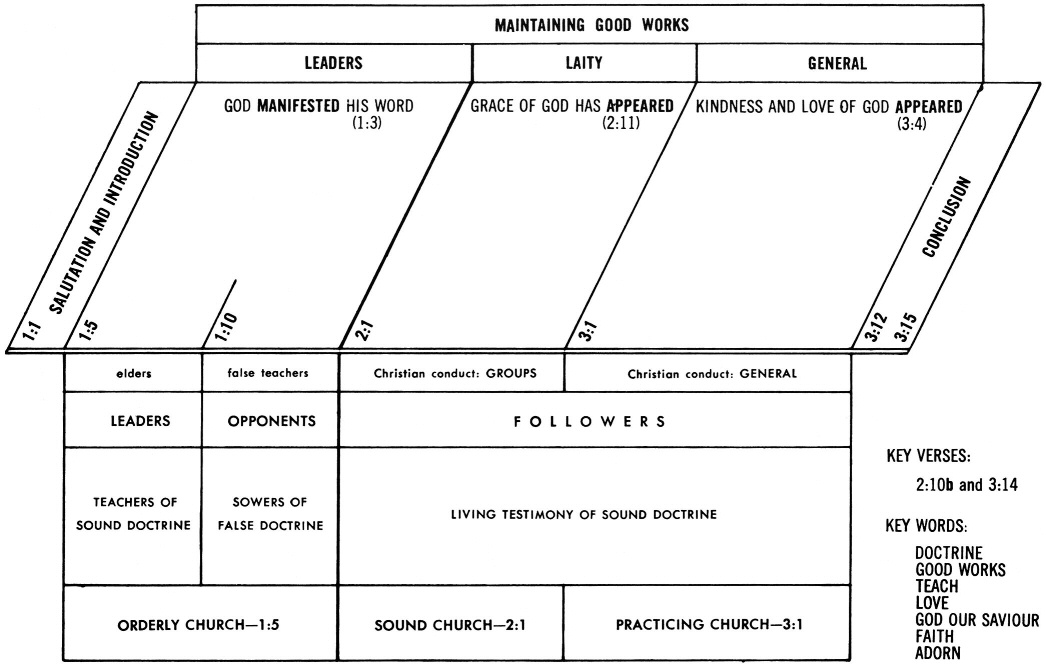
ADORNING THE DOCTRINE OF GOD
Click chart to enlarge
Charts from Jensen's Survey of the NT - used by permission
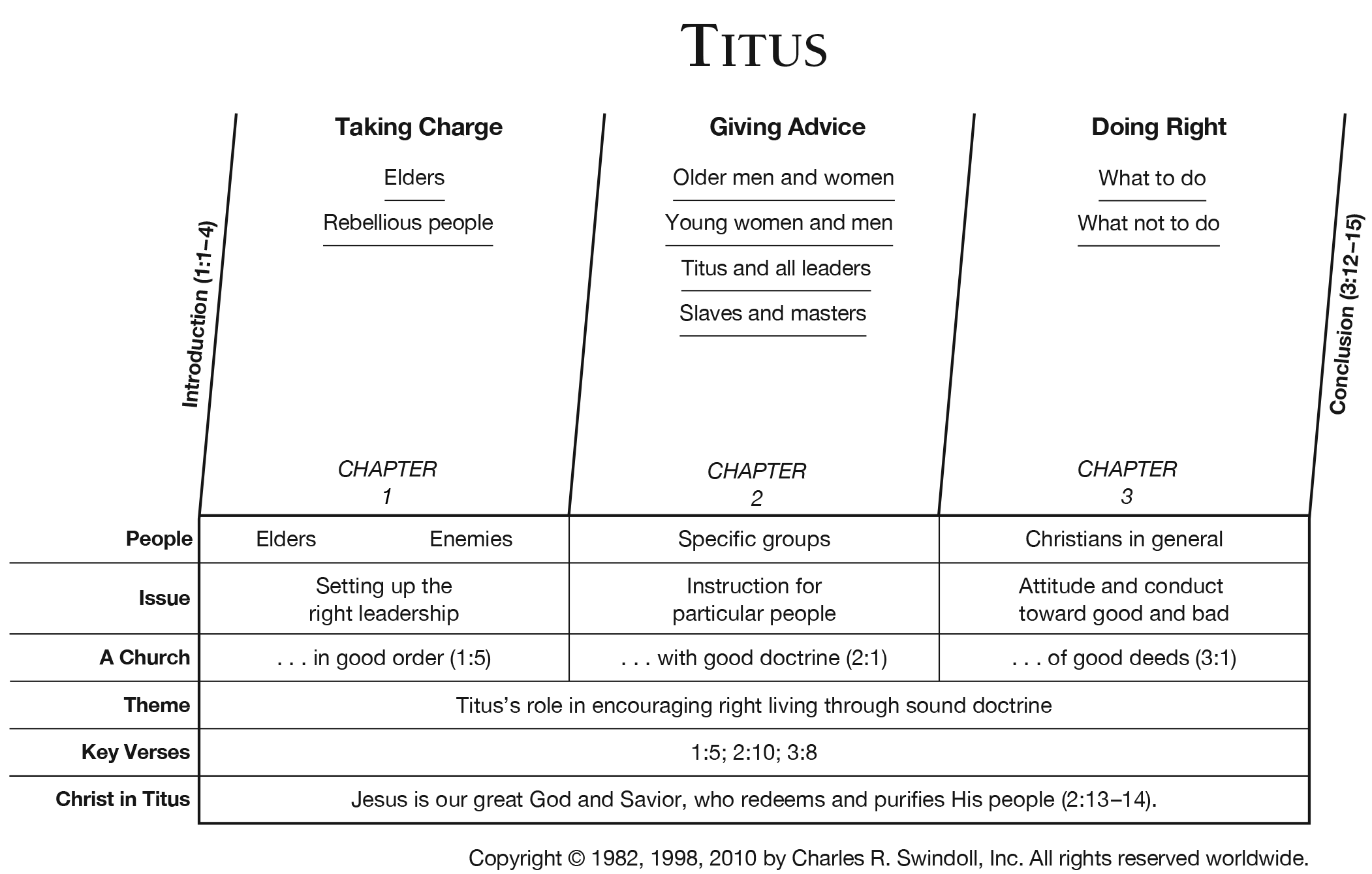
See Summary Chart by Charles Swindoll
Chart below from Michael J. Penfold
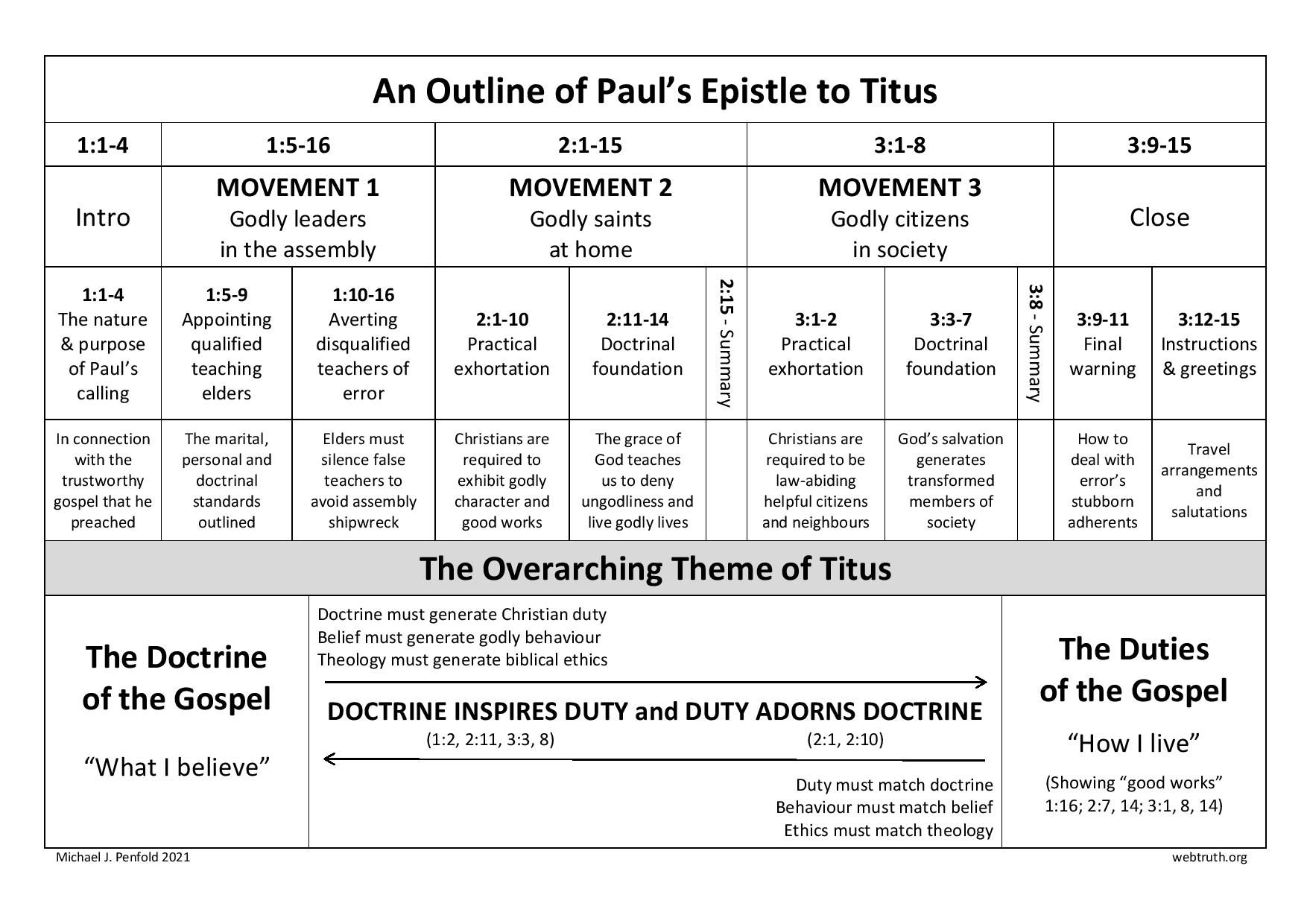
|
Focus |
Appoint Elders |
|||
|
Divisions |
Ordain |
Rebuke |
Maintain |
|
|
Topics |
||||
|
Topics |
Organization |
Offenders |
Operation |
|
|
Place |
Probably Written from either Corinth or Nicopolis (cf. Titus 3:12). |
|||
|
Time |
Circa 63 AD |
|||
|
Modified from Talk Thru the Bible |
||||
Titus 3:2 to malign (blaspheme) no one, to be peaceable (uncontentious), gentle, showing (demonstrating) every consideration for all men. (NASB: Lockman)
Greek: medena blasphemein, (PAN) amachous einai, (PAN) epieikeis, pasan endeiknumenous (PMPMPA) prauteta pros pantas anthropous
Amplified: To slander or abuse or speak evil of no one, to avoid being contentious, to be forbearing (yielding, gentle, and conciliatory), and to show unqualified courtesy toward everybody. (Amplified Bible - Lockman)
KJV: To speak evil of no man, to be no brawlers, but gentle, showing all meekness unto all men.
NLT: They must not speak evil of anyone, and they must avoid quarreling. Instead, they should be gentle and show true humility to everyone. (NLT - Tyndale House)
Phillips: They are not to speak evil of any man, they must not be argumentative but gentle, showing themselves agreeable to everybody. (Phillips: Touchstone)
Wuest : to be speaking evil of not even one person, to abstain from being contentious, to be sweetly reasonable, satisfied with less than that which is due one, exhibiting every meekness to all men. (Eerdmans Publishing - used by permission)
Young's Literal: of no one to speak evil, not to be quarrelsome -- gentle, showing all meekness to all men,
TO MALIGN NO ONE: medena blasphemein (PAN):
- Ps 140:11; Pr 6:19; Acts 23:5; 1Co 6:10; 2Co 12:20; 1Ti 3:11; Jas 4:11; 1Pe 2:1; 3:10; 4:4; 2Pe 2:10; Jude 1:8,10
- See Col 3:8; 2Ti 6:4
- Titus 3 Resources - Multiple Sermons and Commentaries
These characteristics in the Cretan Christians revealed their radically changed lives and were a dynamic witness to the transforming power of the gospel, making the gospel message attractive to unbelievers. Every Christian needs to ponder this list circumspectly, checking his or her conduct against these traits.
To malign no one (KJV = speak evil of no man) - To which Spurgeon remarks…
Oh, how necessary is this exhortation even to this day!
Malign (987) (blasphemeo derived from bláx = sluggish, slow, stupid + phémē = rumor, fame) OR MORE LIKELY (derived from bláptō = to hurt, injure, harm + phémē from phēmí = to speak) means literally to speak to harm and in general therefore means to bring into ill repute and so to slander, to defame (to harm the reputation of by libel or slander), speak evil of, to rail at (revile or scold in harsh, insolent, or abusive language and rail stresses an unrestrained berating), to speak calumny (noun form = a misrepresentation intended to blacken another’s reputation = the act of uttering false charges or misrepresentations maliciously calculated to damage another’s reputation), to calumniate (verb form = to utter maliciously false statements, charges, or imputations about - calumniate imputes malice to the speaker and falsity to the assertions)
Blasphemeo is used 34 times in the NT -- blaspheme(4), blasphemed(6), blasphemers(1), blasphemes(3), blaspheming(4), dishonored(1),hurling abuse(3), malign(2), maligned(1), revile(3), reviling(1), slandered(1), slanderously reported(1), spoken against(1), spoken of as evil(m)(1), utter(1).
Mt 9:3; 26:65; 27:39; Mk 2:7; 3:28, 29; 15:29; Lk 12:10; 22:65; 23:39; Jn 10:36; Acts 13:45; 18:6; 19:37; 26:11; Ro 2:24; Ro 3:8; Ro 14:16; 1Co 10:30; 1Ti 1:20; 6:1; Titus 2:5; Titus 3:2; James 2:7; 1Pe 4:4; 2Pe 2:2, 2Pe 2:10, 2Pe 2:12; Jude 1:8, 10; Re 13:6; Re 16:9, Re 16:11, Re 16:21
There are 5 uses of blasphemeo in the Septuagint (LXX)- 2Ki. 19:4, 6, 22; Is 52:5; Da 3:29
Note that Paul is not saying that we are never to talk of and expose the evils of men but just that we are not to do so with a malicious intent to injure their reputation.
Literally Titus 3:2 reads "no one continually malign". Clearly "no one" refers first to God but also includes men, whether believers are not, even those who contribute most to the assault on biblical standards! Our Lord Jesus has set the example for us to follow in His steps, for even
"while being reviled, He did not revile in return; while suffering, He uttered no threats, but kept entrusting Himself to Him who judges righteously." (see note 1 Peter 2:23).
In sum, even while contending against the worst of sins committed by the worst of sinners, we must never stoop to maligning those whose sin we detest.
J. Vernon McGee explains ""malign no one" by adding that "we are to malign no one, and we are not to repeat gossip. It has been said that you can’t believe everything you hear today, but you can repeat it! That is what he is talking about here—we are not to repeat what we hear. Many evil reports are passed from person to person without even a shred of evidence that the report is true. Another old saying is that some people will believe anything if it is whispered to them!" (McGee, J V: Thru the Bible Commentary: Thomas Nelson)
The Life Application Bible has an interesting note on this gossip, referring to it as ""passive slander" -- "We don’t often call it by its right name, but gossip is passive slander, and it is a massive problem in churches today. It may be even worse than slander due to its dishonesty. A slanderer actively wants to attack and hurt someone, so that person is easily identified. Gossipers don’t care whether or not a person is hurt as they pass along dishonest and harmful information. Churches can save a lot of headaches and heartaches by not allowing gossip (or gossipers) to gain a foothold." (Barton, B, et al: The NIV Life Application Commentary Series: Tyndale)
Matthew Henry comments that we are "to speak evil of none, unjustly and falsely, or unnecessarily, without call, and when it may do hurt but no good to the person himself or any other. If no good can be spoken, rather than speak evil unnecessarily, say nothing. We must never take pleasure in speaking ill of others, nor make the worst of any thing, but the best we can. We must not go up and down as tale-bearers, carrying ill-natured stories, to the prejudice of our neighbour’s good name and the destruction of brotherly love. Misrepresentations, or insinuations of bad intentions, or of hypocrisy in what is done, things out of our reach or cognizance, these come within the reach of this prohibition. As this evil is too common, so it is of great malignity." (Bolding added) (Matthew Henry's commentary on the whole Bible)
The idea of blasphemeo is that the words spoken hurt or smite the reputation of another. It means to destroy or discredit another's good name by speaking evil against them. In the context of the NT, the "reputation" or "good name" slandered or discredited is usually that of God or of His Truth.
Blasphemeo refers to a “malicious misrepresentation”. Note that in several of the New Testament uses of blasphemeo, we see that the actions of professed Christians can speak louder than their words and thus convey "malicious misrepresentation" of God and/or the Gospel to those who observe those actions. In such situations God and His Gospel have in effect been blasphemed. Thus Christians for their part must take care that they do not, by their own conduct, give cause for blasphemy against God or against his word.
Wiersbe explains that
Blasphemy involves much more than taking God’s name in vain, though that is at the heart of it. A person blasphemes God when he takes His Word lightly and even jests about it or when he deliberately defies God to judge Him. (Bolding added) (Wiersbe, W: Bible Exposition Commentary. 1989. Victor)
It is used specifically of those who by contemptuous speech intentionally come short of the reverence due to God or to sacred things. For example as the Lord of Glory hung on the Cross
those passing by were hurling abuse (blasphemeo - imperfect tense = pictures over and over they cried out) at Him, wagging their heads (Mt 27:39)
As MacDonald has written "If the cross reveals God’s love, it also reveals man’s depravity. Passers-by paused long enough to jeer at (and blaspheme) the Shepherd as He was dying for the sheep (MacDonald, W & Farstad, A. Believer's Bible Commentary: Thomas Nelson)
Luke records that even
one of the criminals who were hanged there was hurling abuse (blasphemeo - imperfect tense = pictures him doing this over and over) at Him, saying, “Are You not the Christ? Save Yourself and us! (Lk 23:39).
As incredible as the criminal's blasphemy of Jesus was, John records another instance almost as unbelievable, describing the final outpouring of the wrath of God during the seven bowl judgments, writing that even in the face of
huge hailstones, about one hundred pounds each coming down from heaven upon men, rather than repenting, they blasphemed God because of the plague of the hail, because its plague was extremely severe. (see note Revelation 16:21)
In Judaism blasphemeo referred to words or deeds that impugned God’s honor and injured His holiness, such as ascribing to oneself divine powers and the penalty for this sin in the OT was death by stoning!
In the Greek secular literature blasphemeo meant abusive speech, personal mockery or blasphemy.
It is tragic that many Christians speak contemptuously of politicians and other public figures, not realizing that in doing so they hinder the work of redemption. David's prayer is apropos when we are tempted to speak inappropriately and in a malicious, demeaning way of others
Set (imperative!) a guard, O LORD, over my mouth. Keep watch (imperative!) over the door of my lips. (Ps 141:3) (See Spurgeon's comment)
Regarding the so-called unpardonable sin, Luke records the words of Jesus declaring that
everyone who will speak a word against the Son of Man, it shall be forgiven him; but he who blasphemes (blasphemeo) against the Holy Spirit, it shall not be forgiven him. (Lk 12:10).
This was not a sin of ignorance, but a deliberate, willful, settled hostility toward Christ—exemplified by the Pharisees in Matthew 12:22, 23,24, 25, 26, 27, 28, 29, 30, 31, 32, who attributed to Satan the work of Christ (cf. Lk 11:15). When a man blasphemes with his mouth, that is not the thing that condemns him. It is the attitude of his heart, which is a permanent condition, unless of course he stops resisting. This "unpardonable sin" is to resist the convicting work of the Holy Spirit in the heart and life.
Let's look at an illustration of the meaning of blasphemy as it is used as a malicious misrepresentation which results in hurting or damaging another’s reputation. Paul in addressing the "religious Jew" writes that
the name of God is blasphemed among the Gentiles because of you" (Ro 2:24 quoting Is 52:5 which is one of the 5 OT verses to use blasphemeo in the Septuagint)
Paul's point is that the Gentiles judged the Lord, as men always do, by those who professed to be His followers, in this case the Jews. This is one reason Paul and the early missionaries did not go around preaching against the sinful institution of slavery. Such a practice would have misrepresented and discredited the gospel as a militant message which was trying to undermine the social order and the progress of the Gospel would have been greatly hindered. Applying this truth to all of us, remember that few things hinder the cause of Christ like the bad reputations of professing Christians who are members of orthodox churches! Are you "walking the talk" or is your lifestyle amounting to "blasphemy" of the Name of God?
Earlier in this letter Paul had used the verb blasphemeo in his instruction to older women to so conduct themselves
that the word of God may not be (present tense - continually) dishonored (blasphemed, spoken against, slandered). (Titus 2:5)
Wiersbe - That the Word of God be not blasphemed” is a good motive for cooperation and obedience in the home. Wiersbe adds that "It is sad to see the way family problems, and even divorces, among Christians cause unsaved people to sneer at the Bible." (Bible Exposition Commentary. 1989. Victor)
Paul writing instructions to Timothy declares "Let all who are under the yoke as slaves regard their own masters as worthy of all honor so that the name of God and our doctrine may not be spoken against. (blasphemeo)" (1 Ti 6:1)
Wuest writes that this "expression, “the name of God,” refers to all that God is in His matchless Person as deity. Rebellion on the part of these Christian slaves would bring reproach upon all that God is in Himself. (Wuest Word Studies - Eerdman Publishing Company Volume 1, Volume 2, Volume 3 - used by permission)
Paul's point is that they manner in which believers act while under the authority of another affects how people view the message of salvation Christians proclaim. If the pagans could say that Christian slaves were not as dependable as non-Christian slaves, the gospel would be in essence be blasphemed. It is interesting to note that in the early church, Christian slaves generally commanded a higher price on the slave market than unbelievers. If a master knew that a certain slave on the auction block was a Christian, he would generally be willing to pay more for that slave, since he knew that the slave would serve him faithfully and well. This is high tribute to the Christian faith and testimony to the fact that they had heed the warning not to conduct themselves in such a way as to blaspheme the Name or doctrine of God!
The fact that our "citizenship is in heaven" (see note Philippians 3:20) does not absolve us from our responsibilities in this present evil age and we must still conduct ourselves in a manner worthy of the Lord for all believers are "ambassadors of Christ" (2Co 5:20 with a "ministry of reconciliation" 2Co 5:17, 18, 19) who are "living epistles" the unsaved world is "reading".
Transformed lives are one of the most eloquent testimonies of the power of the Gospel. When we malign others we give a poor testimony of the saving power of the Gospel. Paul writing to the saints at Ephesus exhorted them to
Let all bitterness and wrath and anger and clamor and slander (blasphemia) be put away from you, along with all malice. (Eph 4:31).
You are writing a Gospel,
A chapter each day,
By the deeds that you do
And the words that you say.
Men read what you write,
Whether faithful or true:
Just what is the Gospel
According to you?
--- Author unknown
Paul dealt severely with blasphemy writing that
Hymenaeus and Alexander… (were) delivered over to Satan, so that they may be taught not to blaspheme. (1Ti 1:20)
Proverbs says that one of the six things God hates is
one who spreads strife among brothers. (Pr 6:19)
Barnes has a lengthy note commenting that
We are not to say anything to anyone, or of anyone, which will do him injury. We are never to utter anything which we know to be false about him or to give such a coloring to his words or conduct as to do him wrong in any way. We should always so speak to him and of him in such a way that he will have no reason to complain that he is an injured man. It may be necessary, when we are called to state what we know of his character, to say things which are not at all in his favor, or things which he has said or done that were wrong; but, (1) we should never do this for the purpose of doing him injury, or so as to find a pleasure in it; and,(2) where it is necessary to make the statement, it should be so as to do him no injustice. We should give no improper coloring. We should exaggerate no circumstances. We should never attempt to express ourselves about his motives, or charge on him bad motives - for we know not what his motives were (Ed note: We never do this do we? Clearly we all do this.). We should state every palliating circumstance of which we have knowledge, and do entire justice to it. We should not make the bad traits of his character prominent, and pass over all that is good. (Titus 3)
Luke records Paul's own testimony that he
punished (Christians) often in all the synagogues… tried to force them to blaspheme and being furiously enraged at them… kept pursuing them even to foreign cities. (Acts 26:11)
Paul himself tried to force Christians to blaspheme either by getting them to say that Jesus was not the Christ or by getting them to recant their belief in Him.
NOT BLASPHEMING GOD
POLYCARP'S PEERLESS EXAMPLE
Polycarp was the Bishop of Smyrna about the middle of the second century. He was arrested for his faith and threatened with death if he did not recant.
“Eighty and six years have I served Him,” the saintly Bishop replied, “and He never did me any injury. How can I blaspheme my King and my Saviour?”
“I have respect for your age,” said the Roman proconsul Statius Quadratus. “Simply say, ‘Away with the atheists,’ swear by the godhead of Caesar, and blaspheme Christ! and be set free.”
By “the atheists” he meant the Christians who would not acknowledge that Caesar was “lord.”
The old man pointed to the crowd of Roman pagans surrounding him, and cried,
“Away with the atheists!”
The proconsul threatened him with burning, and Polycarp replied:
“You threaten me with the fire that burns for a time, and is quickly quenched, for you do not know the fire which awaits the wicked in the judgment to come and in everlasting punishment. Why are you waiting? Come, do what you will.”
Polycarp was burned at the stake and in his martyrdom
instead of bringing blasphemy,
brought glory to the name of Jesus Christ.
TO BE UNCONTENTIOUS: amachous einai (PAN) :
- Titus 3 Resources - Multiple Sermons and Commentaries
Be (einai) is present tense calling for an uncontentious spirit to be the Cretan Christian's continual practice or habit of life (only possible for a believer who is filled with/controlled by the Holy Spirit).
Lenski remarks that
people who are ever fighting are wretched citizens and neighbors.
Such a disposition mars the influence of Christian people. Be continually refusing to engage in quarrels and conflicts.
Uncontentious (269) (amachos from a = without + mache = battle) according to Vine originally meant "invincible" (incapable of being conquered, overcome or subdued) but then came to mean a "non fighter", one who is reluctant to fight and who is not always looking for a fight (especially of a verbal nature).
Not quarrelsome (not apt or disposed to quarrel in an often petty manner = stresses an ill-natured readiness to fight without good cause). This person is not contentious and so does not exhibit an often perverse and wearisome tendency (even a fondness) for arguing, quarreling and disputing. You usually know who these folks are!
Wuest says that amachos "describes a person who does not go about with a chip on his shoulder. (Wuest Word Studies - Eerdman Publishing Company Volume 1, Volume 2, Volume 3 - used by permission)
The only other NT use of amachos is in the list of qualifications of an overseer, where Paul records that a candidate should
not addicted to wine or pugnacious, but gentle, uncontentious, free from the love of money. (1Ti 3:3)
Amachos refers not so much to physical violence as to a quarrelsome person. To have a contentious person in leadership will result in disunity and disharmony, seriously hindering the effectiveness of that leadership team.
Matthew Henry adds that Christians are to be "no fighters, either with hand or tongue, no quarrelsome contentious persons, apt to give or return ill and provoking language. A holy contending there is for matters good and important, and in a manner suitable and becoming, not with wrath nor injurious violence. Christian must follow the things that are conducive to peace, and that in a peaceful, not a rough and boisterous and hurtful way, but as becomes the servants of the God of peace and love (Ro 12:19). The glory of a man is to pass over a transgression; it is the duty of a reasonable, and therefore certainly of a Christian man, whose reason is improved and advanced by religion; such may not, and will not, presently fall foul on one who has offended him, but, like God, will be slow to anger, and ready to forgive. Contention and strife arise from men’s lusts, and exorbitant unruly passions, which must be curbed and moderated, not indulged; and Christians need to be reminded of these things, that they do not by a wrathful contentious spirit and behaviour displease and dishonour God and discredit religion, promoting feuds in the places where they live." (Matthew Henry's Commentary on the Whole Bible)
Barclay writes that uncontentious "does not mean that the good citizen will not stand for the principles which he believes to be right, but that he will never be so opinionated as to believe that no other way than his own is right. He will allow to others the same right to have their convictions as he claims for himself to have his own. (Titus 3 Commentary - William Barclay's Daily Study Bible)
We are to be men and women who are careful to avoid strife. Believers are to be friendly and peaceful toward the lost rather than quarrelsome and belligerent.
Christians should be conciliators
not agitators!
In an ungodly, immoral society it is easy to become angry with those who corrupt it, condemning them and writing them off as hopeless and beyond the pale of God’s grace. But we have no right to become hostile when unbelievers act like unbelievers!
Paul says we must avoid quarrels, in church as well as in the world. Such behavior validates our witness in a skeptical, sarcastic society.
Morris notes that
"The coarse behavior of the Cretans was difficult to correct, even among those who became Christians. Titus had a real challenge as he sought to plant sound and winsome churches with such people. But when a person becomes a Christian, "old things are passed away; behold, all things are become new" (2Co 5:17). Missionaries to pagan cultures have faced similar problems throughout the centuries since, but the gospel has time and again proved its power to transform lives. Notice that Paul does not say to try to accommodate Biblical teaching on the behavior of Christians to the customs and culture of their previous environment. The consistent, godly living of the converts may well, in time, transform the environment as well." (Morris, Henry: Defenders Study Bible. World Publishing)
Ryrie writes that
"Quarreling only arouses the hostility of non-Christians. Christian virtues are of an opposite sort." (The Ryrie Study Bible: New American Standard Translation: 1995. Moody Publishers)
GENTLE: epieikeis:
- 2Sa 22:36; Is 40:11; Mt 11:29; 2Co 10:1; Gal 5:22; 6:1; Ep 4:2; Php 4:5; Col 3:12,13; 1Th 2:7; 2Ti 2:24,25; James 1:19,20; 3:17; 1Pe 3:8
- Titus 3 Resources - Multiple Sermons and Commentaries
Gentle (1933) (epieikes from epí = upon, on [intensifies meaning] + eikós = fair, equitable - but see note by Vincent below) is a Greek word that is difficult to translate. This word includes the ideas of gentle (free from harshness, sternness, or violence), forbearing (holding oneself back from especially with an effort; controlling oneself when provoked), yielding, equity (freedom from bias or favoritism), lenient (mild and tolerant disposition, exerting a soothing or easing influence), unassertive, fair, fitting, appropriate, suitable, proper.
Epieikes is used 5x all translated gentle - Phil. 4:5; 1 Tim. 3:3; Tit. 3:2; Jas. 3:17; 1 Pet. 2:18
Christians who are epieikés do not insist on the letter of the law, but are willing to compromise where no moral issue is at stake.
The (epieikés) individual exhibits what Matthew Arnold referred to as "sweet reasonableness," reflected in an attitude that does not hold grudges but always gives others the benefit of any doubt.
Epieikés suggests the idea of giving way, of taking wrong rather than of revenging the injuries we receive.
Matthew Henry adds that epieikés means "not taking words or actions in the worst sense; and for peace sometimes yielding somewhat of strict right.
A common derivation of this word is from eiko, to yield. Hence the meaning, mild, yielding, indulgent. But the true derivation is from eikós, reasonable; and the word implies rather the not being unduly rigorous: “Wherein not strictness of legal right, but consideration for one another, is the rule of practice” (Alford). Compare Phil 4:5, where, for moderation (to epieikes) RSV gives forbearance, with gentleness in margin. According to Aristotle, the word stands in contrast with akribodikaios one who is exactingly just, as one who is epieikés is satisfied with less than his due. (Vincent, M. R. Word studies in the New Testament . Vol. 1, Page 3-647)
Epieikés conveys the idea that one is satisfied with less than what is due. Are you convicted? I am! And remember this "sweet reasonableness" is to be lived out in the midst of a society filled with "liars, evil beasts, lazy gluttons"! (see Titus 1:12 - note).
Epieikés describes the ability to extend to others kindly consideration we would wish to receive ourselves. This man or woman knows when it is actually wrong to apply the strict letter of the law, knows how to forgive when justice gives the right to condemn, knows how to make allowances, knows when not to stand upon their rights, knows how to temper justice with mercy and remembers there are greater things in world than rules and regulations.
In his second letter to the Corinthian church Paul using the related noun form (epieikeia) wrote
Now I, Paul, myself urge you by the meekness and gentleness (epieikeia) of Christ—I who am meek when face to face with you, but bold toward you when absent! (2Cor 10:1)
Clearly such Christ-like conduct Paul is calling the saints in Crete to exhibit is only possible in the man or woman who is controlled by the Holy Spirit, for only when we "walk by the Spirit… (we) will not carry out the desire of the flesh." (Galatians 5:16)
Epieikés is used by Paul in his letter to the church at Philippi, where he exhorts the saints
Let your forbearing (epieikes) spirit be know to all men. The Lord is near. (Php 4:5)
James uses epieikes to define godly wisdom recording that
the wisdom from above is first pure, then peaceable, gentle (epieikes), reasonable, full of mercy and good fruits, unwavering, without hypocrisy. (James 3:17)
Peter instructs servants to
be submissive (hupotasso) to your masters with all respect, not only to those who are good and gentle (epieikes), but also to those who are unreasonable. (1Pe 2:18)
Trench has a note on epieikes writing that
“The mere existence of such a word as epieikes, is itself a signal evidence of the highest development of ethics among the Greeks. It expresses exactly that moderation which recognizes the impossibility cleaving to all formal law, of anticipating and providing for all cases that will emerge and present themselves to it for decision; which with this, recognizes the danger that ever waits upon the assertion of legal rights, lest they should be pushed to moral wrongs … which, therefore urges not its own rights to the uttermost, but, going back in part or in the whole from these, rectifies and redresses the injustices of justice. It is thus more truly just than strict justice would have been.” (Trench, R. C. Synonyms of the New Testament)
Thayer defines epieikes as
mildness, gentleness, fairness, sweet reasonableness.
Marvin Vincent says epieikes means “not unduly rigorous, not making a determined stand for one’s just due.”
When applied to authorities (epieikes) denotes indulgence, equity, lenience. It also denotes a humble, patient steadfastness which is able to submit to injustice, disgrace, and maltreatment without hatred or malice, trusting God in spite of it all… it is reasonableness in judging." (Linguistic and Exegetical Key to the Greek NT)
Barclay says that epieikes "describes the man who does not stand upon the letter of the law. Aristotle said of this word that it denotes “indulgent consideration of human infirmities” and the ability “to consider not only the letter of the law, but also the mind and intention of the legislator.” The man who is epieikes is ever ready to avoid the injustice which often lies in being strictly just." (Titus 3 Commentary - William Barclay's Daily Study Bible)
Irregardless of which nuance of meaning you choose for this characteristic, it is abundantly clear that a quality like this is possible only in the man or woman in whose heart Christ reigns as Lord.
In the Septuagint (LXX) epieikés is used to describe of God's disposition as King, the psalmist recording that
Thou, O Lord, art kind, and gentle (epieikés); and plenteous in mercy to all that call upon thee." (this is the English translation of the LXX). The NASB reads
For Thou, Lord, art good, and ready to forgive (translated in LXX as "gentle"), and abundant in lovingkindness to all who call upon Thee." (Ps 86:5). (See Spurgeon's comment)
God is gentle and kind, although in reality He has every right to be stern and punitive toward men in their sin. God's people should also to be marked by this godlike quality.
Spurgeon - Gentleness was not reckoned a virtue among the Greeks; I do not suppose that the people in Crete had ever heard of it before Paul wrote this Epistle to Titus. Among the Romans and the Greeks, it seemed to be a virtue to stand up for your own, to be like a gamecock, who is always ready to fight, and will never miss a chance of fighting; but this Christian virtue of gentleness is a most amiable one, and greatly adorns the doctrine of Christ. The world has run away with this word gentle, and now calls many a person a gentleman who has no right to the name. I wish that every gentleman were indeed a gentleman. It is very significant that Moses, the type of the Lord Jesus under the law, was the meekest of men; should not Christians therefore excel in gentleness under this milder dispensation?
SHOWING EVERY CONSIDERATION: pasan endeiknumenous (PMPMPA) prauteta:
- Titus 3 Resources - Multiple Sermons and Commentaries
Other translations - showing all meekness (KJV), showing all humility (NKJV), to show true humility toward all men (NIV), to be… polite to all people (ICB), they should… show courtesy to everyone (GWT), show unqualified courtesy toward everybody (Amplified)
As Spurgeon reminds us "Meekness and gentleness are two of the ornaments of our faith. I would that some professed Christians would understand that unholy contentiousness is not after the mind of Christ, it is not according to that gracious command, “Take my yoke upon you, and learn of me; for I am meek and lowly in heart and ye shall find rest unto your souls.” No, the Christian must be willing to suffer wrongfully, and to bear it in patience; he is never to be one who renders evil for evil, or railing for railing.
Showing (1731) (endeíknumi from preposition en = in, to + deíknumi = to show) means to point out, to demonstrate, to put on display, to prove, to show proof, to show forth, to show oneself, to give visible proof, to show in anything and implies an appeal to facts. The preposition (in) in the compound suggests more than the simplest demonstration. It is like laying the index finger, as it were, on the object. It means to to show something in someone. It can mean to do something to someone, as Alexander the coppersmith did (endeíknumi) Paul much harm (see 2 Timothy 4:14- note). In the papyri it could have a quasi-legal sense of proving a petition or charge or of proving that a charge was wrong. Josephus used endeíknumi to describe Herod Agrippa’s display of generosity to those of other nations (Josephus, Antiquities, 19:330).
Endeíknumi -12x in the NT --demonstrate, 4; did, 1; show, 4; showing, 2; shown, 1 Ro 2:15; Ro 9:17, Ro 9:22; 2Co 8:24; Ep 2:7; 1Ti 1:16; 2Ti 4:14; Titus 2:10; Titus 3:2; Heb 6:10, Heb 6:11
Here are the uses in the Septuagint - Ge 50:15, 17; Ex 9:16; Joshua 7:15, 16, 17, 18
The verbs is in the present tense which calls for the Cretan saints to continually demonstrate gentleness or power under control (prautes) an essential trait of Christian character.
In Romans Paul writes that the Gentiles are guilty before God
in that they (present tense = continually) show (endeíknumi - demonstrate, prove) the work of the Law written in their hearts, their conscience (instinctive sense of right and wrong that produces guilt when violated) bearing witness, and their thoughts alternately accusing or else defending them. (Ro 2:15).
The work which the Law of Moses was designed to do in the lives of Israel is seen in some measure in the lives of Gentiles. They know that certain acts are basically right and basically wrong.
Paul concludes with a warm appeal asking the Corinthians for proof of their love writing that they
therefore openly before the churches show them the proof (endeíknumi - demonstrate, prove) of your love and of our reason for boasting about you. (2Cor 8:24)
Phillips translates the verse
“So do let them, and all the Churches, see how genuine is your love, and justify all the nice things we have said about you!”
In explaining salvation to the Ephesians Paul wrote that God
raised us up with Him (Christ), and seated us with Him in the heavenly places, in Christ Jesus, in order that in the ages to come (literally “in the ages that are coming one upon another”) He might show (endeíknumi - demonstrate, point out) the surpassing (extraordinary, outstanding) riches of His grace in kindness toward us in Christ Jesus. (see notes Ephesians 2:6; 7)
God’s ultimate purpose is to glorify Himself and through all eternity God will use the regeneration of believers to demonstrate the wealth and richness of His grace.
Wuest adds that endeíknumi is "in the middle voice, which voice indicates that the subject of the verb acts in his own interest. God will exhibit His kindness to the saints for His own glory, in order that He may be glorified. And the spectators will be the angels. We saints will be the objects of this kindness. We will be on display before the angelic world, basking in the sunshine of God’s smile, enjoying the riches of His blessings, all, in order that He might be glorified by the angelic hosts. (Bolding added) (Wuest Word Studies - Eerdman Publishing Company Volume 1, Volume 2, Volume 3 - used by permission)
In a very illustrative use of the verb endeíknumi, Paul in a self testimony writes that even in face of the fact that he was the foremost of sinners
yet… I found mercy, in order that in me as the foremost, Jesus Christ might demonstrate His perfect patience, as an example for those who would believe in Him for eternal life. (1Ti 1:16)
Paul who had been the chief of sinners, is now the chief display of the untiring mercy and grace of the Lord. It is as if the Lord Jesus demonstrated Paul as “Exhibit A,” so to speak, living proof as William Kelly puts it of
“divine love rising above the most active hostility, of divine longsuffering exhausting the most varied and persistent antagonism.
Paul gives another useful illustration of endeíknumi, urging Cretan Christians who were bondslaves to continually (voluntarily) submit themselves to their masters
in everything, to be well-pleasing, not argumentative (continually back talking), not pilfering (not constantly stealing by taking things of small value), but (continually) showing (proving they were entirely trustworthy and good) all good faith (that they can be fully trusted) so that they will adorn the doctrine of God our Savior in every respect. (see notes Titus 2:9; 10)
When the Christian slaves demonstrated such trustworthy behavior, their action were like "ornaments" testifying of the life changing truth of the gospel and brought credit and verification to the teaching concerning God the Savior of all men. How effective was their demonstration? Although, we cannot answer specifically in regard to the isle of Crete, it is known that many slaves had the privilege of leading their masters to the Lord Jesus their Savior in the early days of Christianity, largely because the difference between pagan slaves and themselves was so glaring. The supreme purpose of a virtuous life is to demonstrate and make attractive (adorn) the teaching that God saves sinners.
The writer of Hebrews uses endeíknumi twice in a short section writing that
God is not unjust so as to forget your work and the love which you have shown (endeíknumi - demonstrated, proved - the following effects reflecting salvation are true of them) toward His name, in having ministered (aorist tense - completed action in past) and in still (present tense - continually) ministering to the saints. (see note Hebrews 6:10)
Their coming to the assistance of their brethren was demonstration or proof of their willingness to identify themselves with the stigma associated with the Name of Jesus and their love for His people showed the genuineness of their love for Him. The writer goes on to say
And we (have a strong, earnest) desire that each one of you show (endeíknumi) the same diligence so as to realize the full assurance of hope until the end, so that you will not be sluggish, but imitators of those who through faith and patience inherit the promises. (see notes Hebrews 6:11; 12)
The writer wants his readers to go on steadfastly for Christ until the final hope of the Christian is realized in heaven. This is a proof of reality.
Endeíknumi is used 7 times in the Septuagint (LXX = Greek of the Hebrew OT), the following being a verse quoted by Paul in Romans 9:17(see note),
But, indeed, for this cause I have allowed you to remain, in order to show (LXX = endeíknumi) you My power and in order to proclaim My name through all the earth. (Ex 9:16)
MacDonald - There is no suggestion here that the Egyptian monarch was doomed from the time of his birth. What happened was this. In adult life he proved to be wicked, cruel, and extremely stubborn. In spite of the most solemn warnings he kept hardening his heart. God could have destroyed him instantly, but He didn’t. Instead, God preserved him alive in order that He might display (thus the verb endeíknumi) His power in him, and that through him God’s name might be known worldwide. (MacDonald, W & Farstad, A. Believer's Bible Commentary: Thomas Nelson)
Consideration (4240) (prautes) describes the quality of not being overly impressed by a sense of one’s self-importance. Prautes is a quality of gentle friendliness - gentleness, meekness (as strength that accommodates to another's weakness), consideration, restrained patience, patient trust in the midst of difficult circumstances.
Related Resources:
- Notes on Galatians 5:23 - Fruit of the Spirit - Gentleness
- Gentleness as exemplified by the Lord's bondservant
Prautes - 11x in NAS -- consideration, 1; gentleness, 8; humility, 1; meekness, 1.
1Co. 4:21; 2 Co. 10:1; Gal. 5:23; Gal 6:1; Eph. 4:2; Col. 3:12; 2Ti 2:25; Titus 3:2; James. 1:21; 3:13; 1Pe 3:15.
Prautes - 4x in the Septuagint -- Esther 5:1; Ps. 45:4; 90:10; 132:1;
Click for discussion of the closely related word praus (4239).
In Greek literature prautes was sometimes used of a feigned, hypocritical concern for others that is motivated by self-interest. But in the New Testament it is always used of genuine consideration for others.
Prautes denotes the humble and gentle attitude which expresses itself, in particular, in a patient submissiveness to offense, free from malice and desire for revenge… controlled strength, the ability to bear reproaches and slights without bitterness and resentment; the ability to provide a soothing influence on someone who is in a state of anger, bitterness and resentment against life… the word indicates an obedient submissiveness to God and His will, with unwavering faith and enduring patience displaying itself in a gentle attitude and kind acts toward others, and this often in the face of opposition. It is the restrained and obedient powers of the personality brought into subjection and submission to God’s will by the Holy Spirit (see note Gal 5:23)… the opposite of arrogance… the word stands in contrast to the term orge (wrath, anger as a state of mind)… It denotes the humble and gentle attitude which expresses itself, in particular, in a patient submissiveness to offense, a freedom from malice and desire for revenge… mildness, patient trust in the midst of difficult circumstances. (2Cor 10:1) (Compiled from the Linguistic and Exegetical Key to the Greek NT)
Prautes was used in secular Greek writings to describe a soothing wind, a healing medicine, and a colt that had been broken. In each instance, there is power for a wind can become a storm, too much medicine can kill and a horse can break loose. Thus prautes describes power under control.
Prautes is an interesting word. Aristotle defined it as the correct mean between being too angry and being never angry at all. It is the quality of the man whose anger is so controlled that he is always angry at the right time and never at the wrong time. It describes the man who is never angry at any personal wrong he may receive, but who is capable of righteous anger when he sees others wronged.
The meek person does not have to fly off the handle because he has everything under control. A perfect picture is found in our Lord Jesus Christ. Quoting from the Septuagint (LXX = Greek of the Hebrew Old Testament) rendering of Zechariah 9:9, which predicts the Lord’s triumphal entry into Jerusalem, Matthew uses the adjective form of prautes (praus) to describe Jesus as
“gentle (praus) and mounted on a donkey, even on a colt, the foal of a beast of burden” (Mt 21:5).
In a gracious appeal to His followers, Jesus used the same adjective of Himself, saying,
Take My yoke upon you, and learn from Me, for I am gentle (praus in NAS; praos in KJV) and humble in heart; and you shall find rest for your souls” (Mt 11:29).
James uses prautes in his discussion of a teachable spirit instructing his readers to
Therefore (to "achieve the righteousness of God" and manifest ourselves as "the firstfruits among His creatures") putting aside all filthiness and all that remains of wickedness, in humility (prautes) receive the word implanted, which is able to save your souls. (James. 1:21)
Barclay comments on James 1:21 writing that this man
will receive the word with gentleness. (humility = prautes). Gentleness is an attempt to translate the untranslatable word prautes. This is a great Greek word which has no precise English equivalent. Aristotle defined it as the mean between excessive anger and excessive angerlessness; it is the quality of the man whose feelings and emotions are under perfect control.
Andronicus Rhodius, commenting on Aristotle, writes,
“Prautes is moderation in regard to anger … You might define prautes as serenity and the power, not to be lead away by emotion, but to control emotion as right reason dictates.”
The Platonic definitions say that prautes is the regulation of the movement of the soul caused by anger. It is the temperament (krasis) of a soul in which everything is mixed in the right proportions. No one can ever find one English word to translate what is a one word summary of the truly teachable spirit. The teachable spirit is docile and tractable, and therefore humble enough to learn. The teachable spirit is without resentment and without anger and is, therefore, able to face the truth, even when it hurts and condemns. The teachable spirit is not blinded by its own overmastering prejudices but is clear-eyed to the truth. The teachable spirit is not seduced by laziness but is so self-controlled that it can willingly and faithfully accept the discipline of learning. Prautes describes the perfect conquest and control of everything in a man’s nature which would be a hindrance to his seeing, learning and obeying the truth. (Barclay, W: The Daily Study Bible Series, Rev. ed. Philadelphia: The Westminster Press) (Bolding added)
James in the context of discussion the control of one's tongue again uses prautes in his answer to the rhetorical question
Who among you is wise and understanding (mental perception and comprehension)? Let him show (expose to the eyes, giving evidence or proof of it) by his good behavior his deeds in the gentleness (prautes) of wisdom (the ability to view life from God’s perspective). (James 3:13)
We can perceive understanding in others quite easily, but wisdom is more difficult to identify. James said to look at a person’s behavior if you want to see if he or she is wise. In other words if a man or woman is wise and understanding, they will demonstrate it by their good conduct coupled with the gentle spirit that comes from godly wisdom. The wisdom James had in mind did not result so much in what one thinks or says but in what one does. One of the marks of godly wisdom is prautes -- gentleness, meekness or humility.
Knowledge is proud that she has learned so much. Wisdom is humble that she knows no more.”
Constable in his note on this verse adds that
The Greek word prautes (“gentleness”) occurs in non-biblical literature to describe a horse that someone had broken and had trained to submit to a bridle. It pictures strength under control, specifically the Holy Spirit’s control. The evidence of this attitude is a deliberate placing of oneself under divine authority. The only way to control the tongue is to place one’s mind deliberately under the authority of God and to let Him control it . (Expository Notes on the Bible)
A believer's attitude toward unbelievers should always reflect a spirit of gentleness, being indulgent toward the infirmities of the unsaved. Peter writes that even when unbelievers intimidate us we should still
“sanctify Christ as Lord in your hearts,“always being ready to make a defense to everyone who asks you to give an account for the hope that is in you, yet with gentleness (prautes) and reverence” (see note 1 Peter 3:15)
and “with gentleness (prautes) correcting those who are in opposition (could refer to unbelievers or rebellious unbelievers), if perhaps God may grant them repentance leading to the knowledge of the truth” (see note 2 Timothy 2:25).
Those "who are spiritual" are to deal with disobedient fellow believers “in a spirit of gentleness (prautes)” (Gal 6:1). How is this possible? Paul had just written that
the fruit of the Spirit is love, joy, peace, patience, kindness, goodness, faithfulness, gentleness (prautes), self-control; against such things there is no law. (see notes Galatians 5:22; 5:23) (Or as W. Graham Scroggie said "We need power for gentleness." Amen or Oh my!)
It follows that the Spirit filled/controlled believer is the one most suited to "restore (a man caught in trespass) in a spirit of gentleness."
Meekness is that unassuming inner spirit of mildness and gentleness which is the opposite of haughtiness, harshness and self-assertiveness.
Meekness is a willingness to waive one's rights for a good cause, just as Jesus waived His rights to His rule as King as he rode into Jerusalem mounted on a donkey (see above). Set aside your rights! Do not demand that you be satisfied, but for the sake of the gospel of Jesus Christ be willing to suffer loss. Meekness is the opposite of rudeness and abrasiveness.
Ray Stedman describes meekness as "strength under control" adding that
It is real strength, but it does not have to display itself or show off how strong it is. This is what our Lord beautifully displayed He described himself as "meek and lowly in heart." The first curriculum of the Holy Spirit is that we must do what Jesus said, "take my yoke upon you and learn of me, for I am meek and lowly of heart."
Meekness and weakness are not synonymous. Meekness says,
"God, in this situation, You have a purpose. You're in control, sovereign, and ruling over all."
Meekness is seeing everything as coming from God and accepting it without murmuring and without disputing, patiently submitting to any and every offense, without any desire for revenge or retribution!
Trench adds that prautes
“is closely linked with humility, and follows directly upon it (Eph 4:2; Col 3:12) because it is only the humble heart which is also the meek; and which, as such, does not fight against God, and more or less struggle and contend with Him. This meekness, however, being first of all meekness before God, is also such in the face of men, even of evil men, out of a sense that these, with the insults and injuries which they may inflict, are permitted and employed by Him for the chastening and purifying of His elect. This was the root of David’s (meekness) when Shimei cursed and flung stones at him—the consideration that the Lord had bidden him (2Sa 16:11), that it was just for him to suffer these things, however unjustly the other might inflict them; and out of like convictions all true Christian (meekness) must spring. He that is meek indeed will know himself a sinner among sinners… and this knowledge of his own sin will teach him to endure meekly the provocations with which they may provoke him, and not withdraw himself from the burdens which their sin may impose (Ibid)
Barclay adds that prautes
"describes the man whose temper is always under complete control. He knows when to be angry and when not to be angry. He patiently bears wrongs done to himself but is ever chivalrously ready to spring to the help of others who are wronged." (Ibid)
FOR ALL MEN: pros pantas anthropous:
- 1Cor 9:19; 1Th 5:14; 1Th 5:15; 1 Peter 2:17
- Titus 3 Resources - Multiple Sermons and Commentaries
Expositor's adds that this "consideration" is
"not to be exhibited only in dealing with fellow believers but must be shown "toward all men," including those who are hostile and morally perverse. It is a difficult test of Christian character but one that effectively proves the genuineness of Christian profession." (Gaebelein, F, Editor: Expositor's Bible Commentary)
The phrase all men is not hyperbole or exaggeration. Paul is speaking to believers to conduct themselves worthy of the gospel before all men, especially the unsaved. Earlier in this letter Paul rejoiced that
the grace of God has appeared, bringing salvation to all men (Titus 2:11).
"So then, while we have opportunity, let us do good to all men and especially to those who are of the household of the faith." (Gal 6:10)
John MacArthur summarizes this trait commenting that
Genuine, heartfelt consideration for all men is one of the most foundational spiritual virtues. As followers and imitators of Jesus Christ, our calling is not to fight for our rights or privileges against the ungodly. Rather, as we live in this corrupt world in subjection and obedience to human authority, doing good deeds, maligning no one, and being uncontentious, gentle, and meek, we will thereby demonstrate the gracious power of God to transform sinners and make them like Himself. (MacArthur. Titus: Moody Press)