Titus 3:2
Titus 3:3
Titus 3:4
Titus 3:5
Titus 3:6
Titus 3:7
Titus 3:8
Titus 3:9
Titus 3:10
Titus 3:11
Titus 3:12
Titus 3:13
Titus 3:14
Titus 3:15
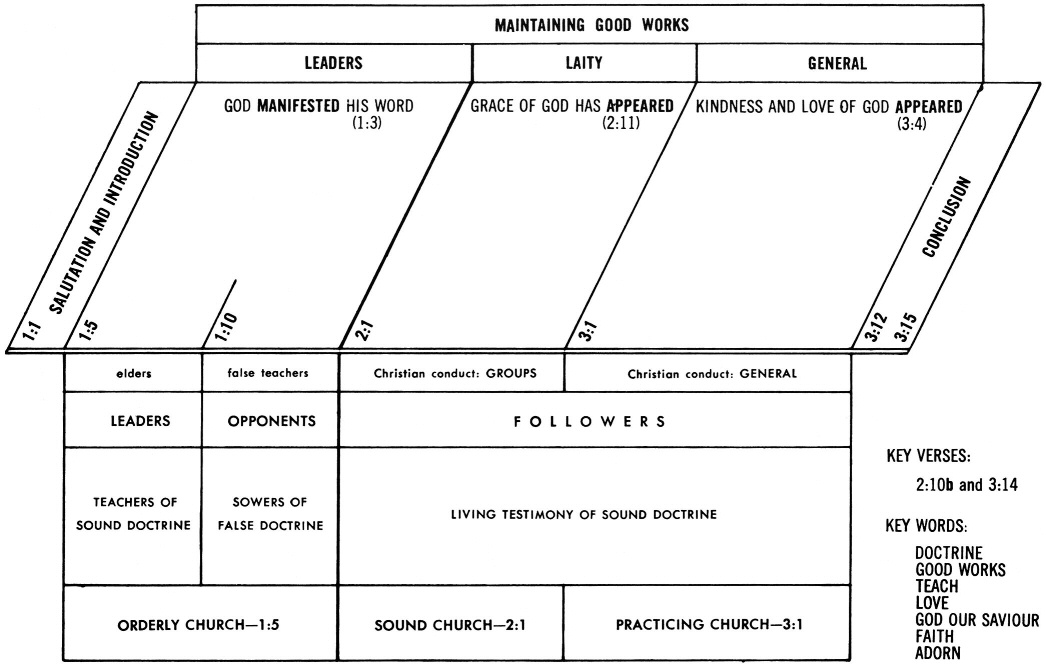
ADORNING THE DOCTRINE OF GOD
Click chart to enlarge
Charts from Jensen's Survey of the NT - used by permission
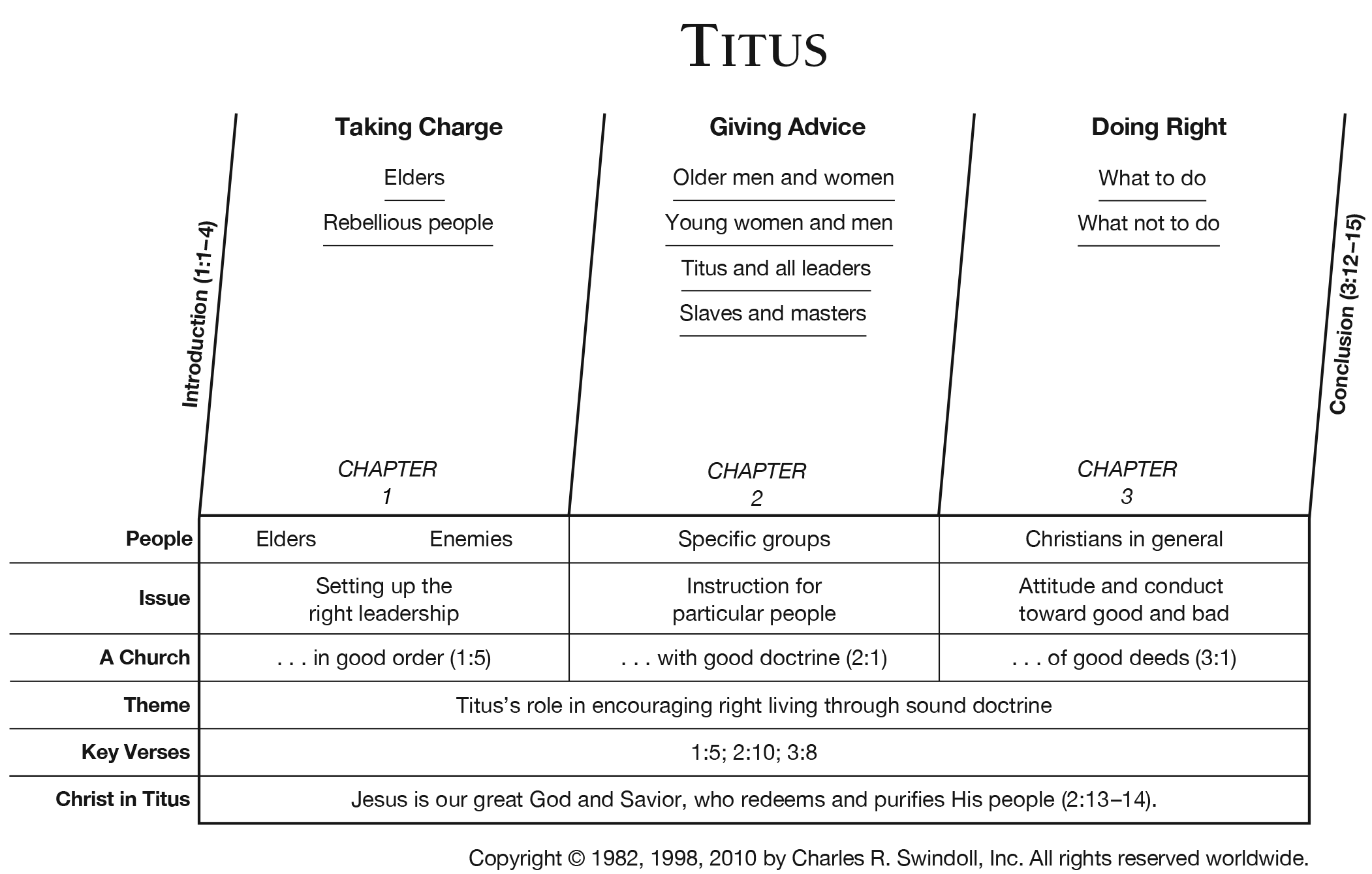
See Summary Chart by Charles Swindoll
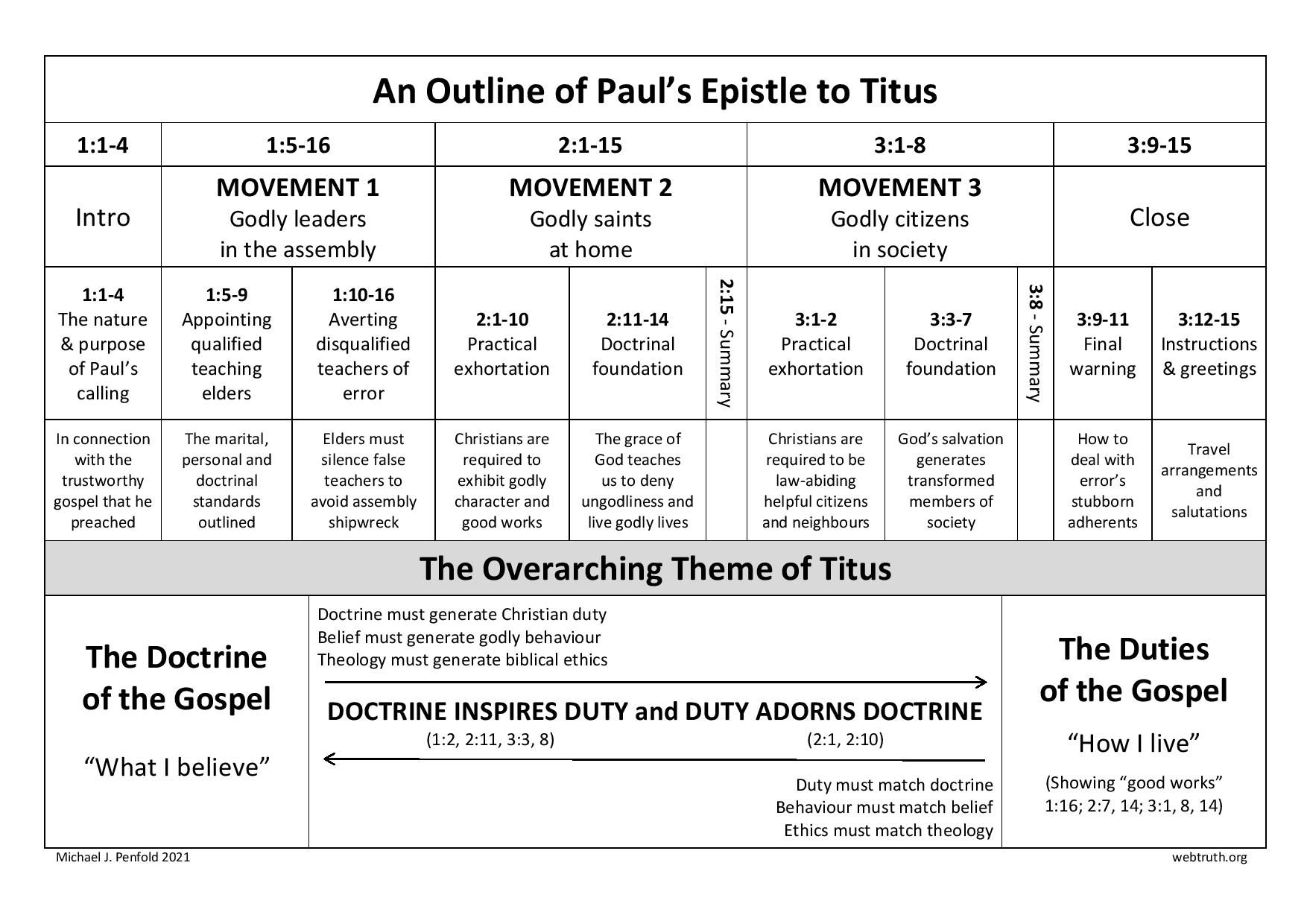
Chart below from Michael J. Penfold
|
Focus |
Appoint Elders |
|||
|
Divisions |
Rebuke |
Maintain |
||
|
Topics |
||||
|
Topics |
Organization |
Offenders |
Operation |
|
|
Place |
Probably Written from either Corinth or Nicopolis (cf. Titus 3:12). |
|||
|
Time |
Circa 63 AD |
|||
|
Modified from Talk Thru the Bible |
||||
Titus 3:12 When I send Artemas or Tychicus to you, make every effort to come to me at Nicopolis, for I have decided to spend the winter there. (NASB: Lockman)
Greek: hotan pempso (1SAAS ) Arteman pros se e Tychikon, spoudason ( 2SAAM) elthein (AAN) pros me eis Nikopolin, ekei gar kekrika (1SRAI) paracheimasai. (AAN)
Amplified: When I send Artemas or [perhaps] Tychicus to you, lose no time but make every effort to come to me at Nicopolis, for I have decided to spend the winter there. (Amplified Bible - Lockman)
KJV: When I shall send Artemas unto thee, or Tychicus, be diligent to come unto me to Nicopolis: for I have determined there to winter.
Phillips: As soon as I send Artemas to you (or perhaps it will be Tychicus), do your best to come to me at Nicopolis, for I have made up my mind to spend the winter there. (Phillips: Touchstone)
Wuest: When I shall send Artemas to you or Tychicus, do your best to come to me at Nicopolis, for there I have determined to spend the winter
Young's Literal: When I shall send Artemas unto thee, or Tychicus, be diligent to come unto me to Nicopolis, for there to winter I have determined.
WHEN I SEND ARTEMAS: hotan pempso (1SAAS) Arteman :
- Titus 3 Resources - Multiple Sermons and Commentaries
- Titus 3:12-15 Paul's Team - Steven Cole
- Titus 3:9-15: Last Word on Relationships - John MacArthur
The conclusion is devoted largely to personal matters. Paul indicates his plans for the future movements of Titus and lays upon him the immediate obligation to assist Zenas and Apollos. The thought of material assistance is next related more generally to the Cretan Christians.
Send (3992) (pempo) means to dispatch, send, thrust out, cause to go.
Artemas (734) the masculine form of the ancient Greek goddess, Artemis or Diana. contraction of Greek. Artemidoros, “gift of Artemis,” i.e., Diana.
Artemas and Tychicus evidently were available as replacements for Titus on Crete.
The context suggest Paul is sending either Artemas or Tychicus to Crete, presumably to take Titus’ place temporarily as the leader of the church there. Thus freed, Titus would be able to meet Paul at Nicopolis where he had decided to spend the winter. Of the several cities named Nicopolis, most commentators judge the reference in Titus 3:12 to be Nicopolis in Epirus on the west coast of Greece. Since there is a tradition preserved in 2Ti 3:10 (see note) that Titus went to Dalmatia, to the north of Nicopolis, it is probable that he visited Paul along the way in Nicopolis and that Artemas (or Tychicus), if Paul followed through with his plan, spent time in Crete serving the church while Titus was away.
OR TYCHICUS TO YOU: pros se e Tychikon
- Acts 20:4; 2Ti 4:12-note
- Titus 3 Resources - Multiple Sermons and Commentaries
- Titus 3:12-15 Paul's Team - Steven Cole
- Titus 3:9-15: Last Word on Relationships - John MacArthur
See Tychicus (5190) "fortuitous, fortunate".
We first meet Tychicus in (Acts 20:4). Paul was in Ephesus near the end of his third missionary journey. He planned to return to Jerusalem via Macedonia, where he intended to collect an offering. With the offerings from Galatia and Achaia, he would present it to the needy believers at Jerusalem (cf. 1Cor 16:1-9). By so doing, he hoped to cement the bond between the predominantly Gentile churches outside of Palestine, and the predominantly Jewish church at Jerusalem. He also planned to take some Gentile believers from Greece and Asia Minor as representatives of their churches to the Jerusalem church. Among them was Tychicus.
Tychicus’ willingness to travel with Paul to Jerusalem shows his servant’s heart. Such a journey was not to be undertaken lightly. Travel in the ancient world was far more difficult and dangerous than in our day. The trip to Jerusalem would be very arduous, and it would take Tychicus away from his family, friends, and church for a long time. Along the way, Paul was repeatedly warned that trouble awaited him in Jerusalem. Although Tychicus must certainly have heard those warnings, he remained with Paul.
As Paul wrote Colossians, it had been more than two years since his arrest at Jerusalem. Since then he had survived a plot by the Jewish leaders to murder him, trials before Felix, Festus, and Agrippa, and a harrowing voyage to Rome. Tychicus may have been with Paul through that entire time. He definitely was with him during his imprisonment at Rome. After Paul’s release, Tychicus remained with him. When Paul needed a temporary replacement for Titus as pastor of the church on Crete, Tychicus was one of the ones considered (note Titus 3:12). Tychicus, who had begun as a messenger, was now a candidate to fill in for as great a man as Titus.
At the very end of Paul’s life, during his second Roman imprisonment, Tychicus was still with him. Facing imminent execution, Paul desired to see Timothy one last time. Because Timothy could not leave his congregation at Ephesus without a replacement, Paul sent Tychicus (see note 2 Timothy 4:12). Once again, Tychicus’ name comes up as a replacement for one of Paul’s prominent associates. That speaks highly of his character.
The writing of Colossians (see note Colossians 4:7) finds Tychicus in Rome with Paul during his first imprisonment. By this time about four years have passed since Tychicus joined Paul in Ephesus. Because he is a man of proven loyalty, Paul has an important task for him: He is to deliver the letter to the Colossians. Not only does he carry Colossians, but Ephesians (cf. notes Ephesians 6:21) and probably Philemon as well (cf. 4:9). The trip from Rome to Colossae was a difficult one. Tychicus would first have to cross much of Italy on foot, then sail across the Adriatic Sea. After traversing Greece on foot, he would sail across the Aegean Sea to the coast of Asia Minor. After all that, he still faced a journey of nearly one hundred miles on foot to reach Colossae. That he was entrusted with delivering three inspired books of Scripture once again indicates Paul’s trust in him.}
Not only will Tychicus deliver the letter of Colossians, he will also bring the Colossians information about Paul’s affairs and update them on his circumstances. That would include bringing them information on Paul’s health, his hopes, and his future prospects. He would also encourage their hearts by adding a personal word of encouragement to what was written in the letter and answering their queries about Paul’s condition.
Paul next lists three credentials Tychicus possessed that qualified him to act as Paul’s personal envoy. First, he was a beloved brother in the Lord. That Paul calls him a brother shows he was one of the family of believers. His personal character had earned him the designation beloved from no less than the apostle Paul himself. Second, Paul describes him as a faithful servant. He never achieved prominence, but he served in an important capacity as Paul’s liaison to the churches. He was a faithful steward of his ministry—the highest commendation Paul could give (cf. 1Co 4:2). Finally, Paul calls him a fellow bond-servant in the Lord. He was a diakonos (servant) in relationship to Paul, but a sundoulos (fellow bond-servant) with Paul in relationship to the Lord.
Colossians 4:7 (note)- beloved brother and faithful servant (diakonos) and fellow bondservant (sundoulos) in the Lord
Ephesians 6:21 - the beloved brother and faithful minister (diakonos) in the Lord, will make everything known to you.
2 Timothy 4:12 (note) - I have sent to Ephesus.
MAKE EVERY EFFORT TO COME TO ME AT NICOPOLIS: spoudason (2SAAM) elthein (AAN) pros me eis Nikopolin:
- Titus 3 Resources - Multiple Sermons and Commentaries
- Titus 3:12-15 Paul's Team - Steven Cole
- Titus 3:9-15: Last Word on Relationships - John MacArthur
Make every every (4704) (spoudazo from spoude = earnestness, diligence)conveys the idea hastening to do something with the implication of associated energy or with intense effort and motivation. It means marked by careful unremitting attention or persistent application. The idea is give maximum effort, do your best, spare no effort, hurry on, be eager! Hasten to do a thing, exert yourself, endeavour to do it. It means not only to be willing to do with eagerness, but to follow through and make diligent effort. In other words spoudazo does not stop with affecting one's state of mind, but also affects one's activity. Spoudazo conveys the idea of exertion. It means to be conscientious, zealous and earnest in discharging a duty or obligation. The verb calls for intensity of purpose followed by intensity of effort toward the realization of that purpose.
Aorist imperative signifies a command to do this now even with a sense of urgency. Be diligent, conveying the idea of zealous persistence to accomplish an objective. "Do your utmost!"
To be diligent is to exert steady, earnest, and energetic effort and suggests earnest application to some specific object or pursuit. The idea is careful and persevering in carrying out tasks or duties. It means to be assiduous (marked by careful unremitting attention or persistent application).
Spoudazo basically means to make haste, and from that come the meanings of zeal and diligence. One commentator describes it as a holy zeal that demands full dedication.
Wuest says that spoudazo means "to make haste, do one’s best, take care, desire. The idea of making haste, being eager, giving diligence, and putting forth effort are in the word. The word speaks of intense effort and determination."
See Nicopolis
The most likely site for the meeting was the Nicopolis in Epirus; this same Nicopolis is also known as Nicopolis of Achaia. This variance has resulted because Tacitus (Ann. 2.53) described it as an Achaian town, whereas Ptolemy (Geog. 3.13) ascribed it to Epirus. The two terms are designations for large portions of what is today modern Greece. It was located on the W side of the Greek peninsula across the sea from the S end of the Italian peninsula (39°02´N; 20°44´E). The city was built on the isthmus of the Bay of Actium. Augustus founded the city in commemoration of the important naval victory over Mark Anthony in 31 b.c. which took place in the bay. The undisputed Princeps established the city as a Roman colony. The show piece of Nicopolis was a memorial dedicated in 29 b.c. to Neptune and Mars. The monument was decorated with a number of rams from the front of ships captured during the naval conflict. The city dominated the trade of the region and was the venue for a quadrennial festival which rivaled the Olympic games. Herod the Great, in his typical flair for promoting his own position with Augustus, made generous donations toward the construction of a temple there, as well as for numerous other public buildings (Josephus, Ant 16.5.3 § 147). The city became the home of the exiled philosopher Epictetus in a.d. 89 (Aulus Gellius Attic Nights 15.11.5). The site is occupied today by the modern village of Smyrtoula.
Paul’s intention to meet Titus in Nicopolis sometime after being released from prison in Rome would have been a continuation of his evangelistic endeavor. It is widely held that after traveling through Miletus and Corinth, Paul made his way to Nicopolis, where he was arrested and returned to Rome in a second Roman imprisonment.
FOR I HAVE DECIDED TO SPEND THE WINTER THERE: ekei gar kekrika (1SRAI) paracheimasai. (AAN)
- Acts 27:12; 1Cor 16:6
- Titus 3 Resources - Multiple Sermons and Commentaries
- Titus 3:12-15 Paul's Team - Steven Cole
- Titus 3:9-15: Last Word on Relationships - John MacArthur
Decided (2919) (krino) primarily signifies to distinguish and in this context means to come to a conclusion in the process of thinking. Paul had come to the settled conclusion that it was best to winter in Nicopolis. Although he does not state it plainly, there is little doubt that he had come to this conclusion after consultation with His Father in heaven, for he always sought to do His will on earth as it was done in heaven.
Decided is in the perfect tense which speaks of an action completed in past time having present results. The use of this tense by Paul is indicative of a person who thinks a matter through and finally comes to a conclusion where he is so sure of himself that he is settled in his determination to follow a certain course of action. Paul thought the matter through carefully as to the advisability of spending the winter season in which travel by land was difficult, and by sea impossible, at Nicopolis, and came to the settled conclusion that that city was the best place at which he could stay.
Spend the winter (3914) (paracheimazo from para = alongside, beside + + cheimázo = to be tossed with tempest)
Related Resource: See the famous sermon entitled Come Before Winter based on 2Ti 4:21
Winter is a season. Seasons pass. And when they pass, the opportunities (Click for an in depth word study on kairos, the Greek Word which means "opportunity") that were present during that season will also pass. God gives us all opportunities, but He won't force us to respond. We are responsible to choose to respond to the fleeting opportunities.
Little wonder that Paul instructed saints to continually (present tense) "Redeem the time (kairos)" (Eph 5:16KJV-note) and continually (present tense) "Make the most of the opportunity (kairos)" (Col 4:5-note). As Isaiah said...
All flesh is grass, and all its loveliness is like the flower of the field. 7 The grass withers, the flower fades, When the breath of the LORD blows upon it; Surely the people are grass. 8 The grass withers, the flower fades, But the word of our God stands forever. (Isa 40:6-8)
So teach us to number our days, That we may present to Thee a heart of wisdom. (Ps 90:12)
Titus 3:13 Diligently help Zenas the lawyer and Apollos on their way so that nothing is lacking for them (NASB: Lockman)
Greek: Zenan ton nomikon kai Apollon spoudaios propempson, (2SAAM) hina meden autois leipe. (3SPAS)
Amplified: Do your utmost to speed Zenas the lawyer and Apollos on their way; see that they want for (lack) nothing. (Amplified Bible - Lockman)
KJV: Bring Zenas the lawyer and Apollos on their journey diligently, that nothing be wanting unto them.
Phillips: See that Zenas the lawyer and Apollos have what they require and give them a good send-off. (Phillips: Touchstone)
Wuest: Zenas the lawyer, and Apollos, diligently set forward on their journey in order that not even one thing be lacking to them.
Young's Literal: Zenas the lawyer and Apollos bring diligently on their way, that nothing to them may be lacking,
DILIGENTLY HELP...ON THEIR WAY: spoudaios propempson, (2SAAM):
- Acts 21:5; 28:10; Ro 15:24; 1Corinthians 16:11; 3John 1:6-8
- Titus 3 Resources - Multiple Sermons and Commentaries
- Titus 3:12-15 Paul's Team - Steven Cole
- Titus 3:9-15: Last Word on Relationships - John MacArthur
Diligently help - Spurgeon comments "Paul had already told Titus to bid the saints in Crete to abound in good works; now he is commanded to take care of certain travelling Christians, and to speed them on their way. It was the custom in olden times, when travelling was very different from what it is now, when the Christians passed from one town to another, to find out the church, and to be entertained and speeded on their journey by their fellow-believers. Thus they kept up a practical fellowship of love to all the saints.
In this verse we get a glimpse of Paul as a great spiritual general moving his workers into strategic positions.
Diligently (4709) (spoudaios from speudo = hasten, make haste) means to do this task earnestly, eagerly and promptly. Spoudaios describes the attitude and actions of the godly Onesiphorus who came to the aid of Paul in a Roman prison when all who were in Asia had turned away from him. Paul testified that Onesiphorus...
often refreshed me, and was not ashamed of my chains but when he was in Rome, he eagerly searched for me, and found me (see notes 2Ti 1:16; 1:17)
Help on their way (4311) (propempo from pró = before + pémpo = to send) means literally to send on before and is used in the NT, meaning to send forward on one’s journey, to accompany someone on his way for some distance as a token of respect and honor. Hence, propempo means in general to help one forward on their journey.
Titus had been divinely given a similar earnestness in his heart for the Corinthian church, Paul recording...
thanks be to God, Who puts the same earnestness (spoude - speaks of an attitude which births an action) on your behalf (the Corinthians) in the heart of Titus. For he not only accepted our appeal, but being himself very earnest, he has gone to you of his own accord. (2Cor 8:16,17)
Have you ever ask God specifically to place an earnestness in your heart for your brethren, another church, a missionary, etc.? What would happen to our churches in America if the pastors with a spirit of love suggested that the local body ask God for this perfect gift? This is an interesting spiritual dynamic to consider.
ZENAS THE LAWYER: Zenan ton nomikon
- Matthew 22:35; Luke 7:30; 10:25; 11:45,52; 14:3
- Titus 3 Resources - Multiple Sermons and Commentaries
- Titus 3:12-15 Paul's Team - Steven Cole
- Titus 3:9-15: Last Word on Relationships - John MacArthur
See Zenas
In the absence of any example of this word being used as referring to the legal profession, it seems best to assume that Zenas was a lawyer in the usual NT sense, an expert in the Mosaic law.
AND APOLLOS: kai Apollon:
- Titus 3 Resources - Multiple Sermons and Commentaries
- Titus 3:12-15 Paul's Team - Steven Cole
- Titus 3:9-15: Last Word on Relationships - John MacArthur
See Apollos
A charismatic young convert in the early Christian community, described as “a man of learning, powerful in the scriptures” (Acts 18:24) who eventually had some impact on the churches of Achaia, notably Corinth (Acts 18:24-28;1Cor 1:12; 3:4-6).
SO THAT NOTHING IS LACKING FOR THEM: hina meden autois leipe. (3SPAS) :
- Titus 3 Resources - Multiple Sermons and Commentaries
- Titus 3:12-15 Paul's Team - Steven Cole
- Titus 3:9-15: Last Word on Relationships - John MacArthur
Lacking (3007) (leipo) means to fall short, be destitute or be in need. It pictures one not possessing something which is necessary. It means to be deficient in something that ought to be present for whatever reason. It can also mean to leave, fail or forsake.
Leipo is used 6 times in the NAS...
Luke 18:22 And when Jesus heard this, He said to him, "One thing you still lack; sell all that you possess, and distribute it to the poor, and you shall have treasure in heaven; and come, follow Me." (Comment: Jesus defines the one thing that hindered the rich man from a life of discipleship. The things he had were the reason he lacked!)
Titus 1:5 (note) For this reason I left you in Crete, that you might set in order what remains, and appoint elders in every city as I directed you, (see note) (Comment: Titus was to correct and set straight certain doctrines. Presumably Paul or others had accomplished some of the correcting, but the correcting still fell short or was lacking)
James 1:4-5-note let endurance have its perfect result, that you may be perfect and complete, lacking (leipo) in nothing. But if any of you lacks (leipo) wisdom, let him ask of God, who gives to all men generously and without reproach, and it will be given to him. (Comment: The ultimate goal of the trials was maturity, completeness, not lacking or being deficient in anything of spiritual value.)
James 2:15-note If a brother or sister is without clothing and in need of daily food,
Leipo is found 3 times in the Septuagint (LXX) (Job 4:11; Pr 11:3; 19:4)
This matter of assisting Christian workers on their journey is mentioned in different places by Paul (Ro 15:24 [note]; 1Cor. 16:6, 11; 2 Cor. 1:16).
Titus 3:14 Our people must also learn to engage in good deeds to meet pressing needs, so that they will not be unfruitful. (NASB: Lockman)
Greek: manthanetosan (3PPAM) de kai hoi hemeteroi kalon ergon proistasthai (PMN) eis tas anagkaias chreias, hina me osin (3SPAS) akarpoi.
Amplified: And let our own [people really] learn to apply themselves to good deeds (to honest labor and honorable employment), so that they may be able to meet necessary demands whenever the occasion may require and not be living idle and uncultivated and unfruitful lives. (Amplified Bible - Lockman)
KJV: And let ours also learn to maintain good works for necessary uses, that they be not unfruitful.
Phillips: And our people should learn to earn what they require by leading an honest life and so be self-supporting. (Phillips: Touchstone)
Wuest: And let those also who are ours, learn to give attention to good works for necessary needs in order that they may not be unfruitful.
Young's Literal: and let them learn -- ours also -- to be leading in good works to the necessary uses, that they may not be unfruitful.
AND LET OUR PEOPLE ALSO LEARN: manthanetosan (3PPAM) de kai hoi hemeteroi:
- Titus 3 Resources - Multiple Sermons and Commentaries
- Titus 3:12-15 Paul's Team - Steven Cole
- Titus 3:9-15: Last Word on Relationships - John MacArthur
Our people (3588) in context refers to the Christian brethren who lived in Crete. They were the Cretan converts, not just Paul’s friends.
Learn (3129) (manthano compare similar word mathetes = disciple) refers to intentional learning by inquiry and observation (cf inductive Bible study!). Manthano means to genuinely understand and accept a teaching as true and to apply it in one’s life.
Paul uses the present imperative which indicates that this instruction is mandatory and needs to be the church's lifestyle. Paul desires (and commands) for the believers on Crete to continually keep learning how to do the following actions.
This particular opportunity to help Zenas and Apollos would be a concrete example of at least one kind of good work.
McGee - We must “learn” to maintain good works. It’s something that must be worked at. A great many people think it is easy; we need to know what God considers good works, and we need to learn how to do them. (McGee, J V: Thru the Bible Commentary: Nashville: Thomas Nelson)
TO ENGAGE (give attention to) IN GOOD DEEDS: kalon ergon proistasthai (PMN)
- Acts 18:3; 20:35; Ephesians 4:28; 1Thessalonians 2:9; 2Thessalonians 3:8
- Titus 3 Resources - Multiple Sermons and Commentaries
- Titus 3:12-15 Paul's Team - Steven Cole
- Titus 3:9-15: Last Word on Relationships - John MacArthur
Engage (4291) (proistemi from pró = before, over + hístemi = place, stand) means literally to stand before and figuratively as in the present context conveys the idea to give attention to. Paul use the present tense which calls for this to be their habitual practice with the middle voice calling for their personal (reflexive) involvement.
Good (2570) (kalos) is used to describe whatever is inherently or intrinsically good, that which is genuinely beautiful, of those things that fully conform to their basic nature and purpose. Their "beautiful" deeds should shine forth in a Cretan society that had a widespread reputation for "evil" deeds.
The basic meaning of kalos is good with emphasis on that which is beautiful, handsome, excellent, surpassing, precious, commendable, admirable. Inherently excellent or intrinsically good: providing some special or superior benefit. In classical usage, originally as descriptive of outward form, beautiful; of usefulness, as a fair haven, a fair wind. Auspicious, as sacrifices. Morally beautiful, noble; hence virtue is called to kalon . The New Testament usage is similar. Outwardly fair, as the stones of the temple (Lu 21:5); well adapted to its purpose, as salt (Mk 9:50); competent for an office, as deacons (1Ti 4:6); a steward (note 1 Peter 4:10); a soldier (note 2 Timothy 2:3); expedient, wholesome (Mk 9:43, 45, 47); morally good, noble, as works (see note Matthew 5:16); conscience (note Hebrews 13:18). The phrase it is good, i.e., a good or proper thing (note Romans 14:21). In the Septuagint kalos is the most commonly used word for good as opposed to evil (Ge 2:17; 24:50; Isa 5:20).
Illustration - Jean Louis Agassiz, the Swiss naturalist, was invited to deliver a lecture to a prestigious organization. When he turned down the engagement, saying that it would distract him from research and writing, the organization said that it would pay a large honorarium. “That’s no inducement to me,” Agassiz said. “I can’t afford to waste my time making money.” Certainly, there is more to work than making money. But for most of us, earning a living is a major reason we work. Today’s passage indicates that this is a legitimate motivation. In verse 14 Paul reminds Titus of the need to teach others to “provide for daily necessities.” (Today in the Word)
TO MEET PRESSING NEEDS: eis tas anagkaias chreias :
- Titus 3 Resources - Multiple Sermons and Commentaries
- Titus 3:12-15 Paul's Team - Steven Cole
- Titus 3:9-15: Last Word on Relationships - John MacArthur
The Cretan Christians are not only to conduct themselves properly, but are to engage only in honorable occupations and to make themselves practically useful to all the other believers.
Pressing (316) (anagkaios from anágke = necessity, compelling force) refers to what one cannot do without because it is indispensable. It refers to what ought to be done according to the law of duty (in this context the law of Christian love not legalism). Anagkaios refers to what is required by the circumstances.
Needs (5532) (chreia from chréos = debt) in this case refers to that which is lacking and particularly needed.
Guthrie writes that
“The practical side of Christianity is here brought into vivid focus. The words for necessary uses can be understood either as necessitous cases or as wants. The more probable interpretation is the former, as RSV ”so as to help cases of urgent need.“ All who engage in such works of mercy need never fear that they will be unfruitful” (Guthrie, Donald: The Pastoral Epistles. Tyndale).
In short, Paul does not want anyone to be idle. In a similar exhortation to the church at Thessalonica Paul wrote
Now as to the love of the brethren, you have no need for anyone to write to you, for you yourselves are taught by God to love one another; for indeed you do practice it toward all the brethren who are in all Macedonia. But we urge you, brethren, to excel still more, and to make it your ambition to lead a quiet life and attend to your own business and work with your hands, just as we commanded you; so that you may behave properly toward outsiders and not be in any need. (see notes 1Thessalonians 4:9; 4:10; 4:11; 4:12)
For even when we were with you, we used to give you this order: if anyone will not work, neither let him eat. For we hear that some among you are leading an undisciplined life, doing no work at all, but acting like busybodies. Now such persons we command and exhort in the Lord Jesus Christ to work in quiet fashion and eat their own bread. (2Th 3:10-12)
THAT THEY MAY NOT BE UNFRUITFUL: hina me osin (3SPAS) akarpoi:
- Isaiah 61:3; Matthew 7:19; 21:19; Luke 13:6-9; John 15:8,16; Romans 15:28; Philippians 1:11; Philippians 4:17; Colossians 1:10; Hebrews 6:6-12; 2Peter 1:8
- Titus 3 Resources - Multiple Sermons and Commentaries
- Titus 3:12-15 Paul's Team - Steven Cole
- Titus 3:9-15: Last Word on Relationships - John MacArthur
Good Works
1. Love what is Good (Titus 1:8 - note)
2. Teach what is Good (Titus 2:3 - note)
3. Do what is Good (Titus 2:7, 14, 3:8 see notes Titus 2:7, 2:14; 3:8)
Source unknown
Good Watches -Some people are like good watches. They’re pure gold, open-faced, always on time, dependable, quietly busy, and full of good works. Source unknown
That (2443) (Hina) is a term of purpose or result (so that, in order that, that, as a result). In this context the phrase "hina me" is used with the subjunctive mood to express the purpose or goal of their "learning".
Learning is to take in Biblical truth that causes transformation in our lives so that we in turn might be vessels useful to the Master for every good deed which bear fruit that lasts for eternity.
This exhortation recalls Jesus' promise to His disciples...
"You did not choose Me, but I chose you, and appointed you, that you should go and bear fruit, and that your fruit should remain, that whatever you ask of the Father in My name, He may give to you." (John 15:16)
Unfruitful (175) (akarpos from a = negative + karpos = fruit, literal but in Scripture most often figurative) means literally without fruit and thus barren. It can include the ideas of unprofitable.
Paul does not want their learning and their endeavors to be unprofitable or productive of bad fruit as in the case following examples...
1Co 14:14 "For if I pray in a tongue, my spirit prays, but my mind is unfruitful."
Ephesians 5:11 (note) "And do not participate in the unfruitful deeds of darkness, but instead even expose them;"
It can mean to bear no fruit at all as the following uses of akarpos...
Jude 1:12 "These men are those who are hidden reefs in your love feasts when they feast with you without fear, caring for themselves; clouds without water, carried along by winds; autumn trees without fruit, doubly dead, uprooted;"
Mt 13:22 "And the one on whom seed was sown among the thorns, this is the man who hears the word, and the worry of the world, and the deceitfulness of riches choke the word, and it becomes unfruitful."
Mk 4:19 "and the worries of the world, and the deceitfulness of riches, and the desires for other things enter in and choke the word, and it becomes unfruitful"
2 Peter 1:8 (note) "For if these qualities are yours and are increasing, they render you neither useless nor unfruitful in the true knowledge of our Lord Jesus Christ.").
Vincent says
“Not only in supplying the needs, but in cultivating Christian graces in themselves by acts of kindness.”
Illustration - Benjamin Franklin learned that plaster sown in the fields would make things grow. He told his neighbors, but they did not believe him and they argued with him trying to prove that plaster could be of no use at all to grass or grain. After a little while he allowed the matter to drop and said no more about it. But he went into the field early the next spring and sowed some grain. Close by the path, where men would walk, he traced some letters with his finger and put plaster into them and then sowed his seed in the field. After a week or two the seed sprang up. His neighbors, as they passed that way, were very much surprised to see, in brighter green than all the rest of the field, the writing in large letters, “This has been plastered.” Benjamin Franklin did not need to argue with his neighbors any more about the benefit of plaster for the fields. For as the season went on and the grain grew, these bright green letters just rose up above all the rest until they were a kind of relief-plate in the field—“This has been plastered.” Can people see the “fruit” in your life? Can they see the results of what Jesus has done for you?
Everyday Disciples (1Th 4:9-12 Titus 3:14) - When I am asked how I'm doing as a man in his eighties, I reply, "My life moves along contentedly in well-worn grooves." As I observe my friends and neighbors around me, I realize that most of them are also following a basic routine. Although not trapped on a treadmill, they are working at their jobs, raising families, and serving in their churches. There's nothing necessarily heroic or exciting about their lives, nor is there about mine.
This reminds me of the response of the astute American statesman Bernard Baruch when asked who he thought was the greatest personality of our age. With great wisdom at age 94 he said: "The fellow who does his job every day. The mother who has children and gets up to get them breakfast, keep them clean, and send them off to school. The fellow who keeps the streets clean. . . . The unknown soldiers—millions of them."
The apostle Paul also emphasized the importance of faithfulness in everyday life. He urged his fellow believers to settle down, lead a quiet life, and provide for their own families (1Th 4:11; 1Ti 5:8).
Most of us are ordinary Christians who live routine lives. Yet, our extraordinary God wants all of us to be everyday disciples who are faithful and fruitful. May it be so! —Vernon C Grounds
Lord, help me to follow Jesus,
To obey Him day by day,
To be His faithful disciple
And please Him in every way.
—Fitzhugh
The world crowns success;
God crowns faithfulness
Exercise Your Right (Luke 10:30-37) Let our people also learn to maintain good works, to meet urgent needs. --Titus 3:14
Thomas Jefferson, who in 1776 wrote the first draft of the US Declaration of Independence, took it for granted that all of us possess certain God-given, "unalienable rights." Yet, even in a democracy, there is fierce discussion about who is entitled to what rights.
Christians can look at rights from another perspective. Instead of being concerned about ourselves, we can think about what others need. In that sense, we have the "right" to help others, just as the Good Samaritan did (Luke 10:30-37). This parable is an illustration of our Savior's own example, for we read in Acts 10:38 that He "went about doing good."
Believers ought to follow Jesus' example and be "do-gooders." Even though that term is often used negatively, we who are grateful for God's redemptive grace want to share with others the good things He gives to us.
We know that the gospel is far more than a humanitarian message of doing good and being good. It's the message that God has provided forgiveness of sins through the death and resurrection of His Son. As we exercise our "right" to help people around us, let's also prayerfully share with them that good news. —Vernon C Grounds
To weary souls along life's road,
Help me, O Lord, to share their load;
To fallen souls enslaved in sin,
Help me, O Lord, their souls to win.
—Jarvis
A heart that is open to Christ
will be open to those He loves.
Titus 3:15 All who are with me greet you. Greet those who love us in the faith. Grace be with you all. (NASB: Lockman)
Greek: Aspazontai (3PPMI) se hoi met' emou pantes. Aspasai (2SAMM) tous philountas (PAPMPA) hemas en pistei. te charis meta panton humon
Amplified: All who are with me wish to be remembered to you. Greet those who love us in the faith. Grace (God’s favor and blessing) be with you all. Amen (so be it). (Amplified Bible - Lockman)
KJV: All that are with me salute thee. Greet them that love us in the faith. Grace be with you all. Amen.
Phillips: All those here with me send you greetings, Please give our greetings to all who love us in the faith. Grace be with you all. (Phillips: Touchstone)
Wuest: All those with me send greetings to you. Greet those who are fond of us in the Faith. The grace be with you all.
Young's Literal: Salute thee do all those with me; salute those loving us in faith; the grace is with you all!
ALL WHO ARE WITH ME GREET YOU: Aspazontai (3PPMI) se hoi met' emou pantes:
- Titus 3 Resources - Multiple Sermons and Commentaries
- Titus 3:12-15 Paul's Team - Steven Cole
- Titus 3:9-15: Last Word on Relationships - John MacArthur
Greet (782) (aspazomai) means to enfold in the arms, salute, welcome, embrace. The KJV is somewhat misleading translating the verb as they "salute" you. The verb does not picture salute in a military sense. The present imperative is a charge to do this continually.
THOSE WHO LOVE US: tous philountas (PAPMPA) hemas:
- Galatians 5:6; Ephesians 6:23; 1Timothy 1:5; Philemon 1:5; 2John 1:1,2; 3John 1:1
- Titus 3 Resources - Multiple Sermons and Commentaries
- Titus 3:12-15 Paul's Team - Steven Cole
- Titus 3:9-15: Last Word on Relationships - John MacArthur
Love (5368) (phileo from phílos = loved, dear, friend) means to be a friend to another, to be fond of (have a liking for) an individual or an object, to have or show affection for. In some contexts it means to kiss another as a mark of tenderness for that person. Phileo denotes personal attachment and is more a matter of sentiment or feeling. It is devotion based in the emotions distinguished from agapao which represents devotion based in the will. Stated another way phileo is chiefly of the heart whereas agape is chiefly of the head. Phileo is a love which is the response of the human spirit to what appeals to it as pleasurable. Phileo is a love which consists of the glow of the heart kindled by the perception of that in the object which affords us pleasure.
Phileo is used 25 times in the NT and is translated love 13x, loves 6x, loved 3x and kiss 3x in the NAS. = Matt 6:5; 10:37; 23:6; 26:48; Mark 14:44; Luke 20:46; 22:47; John 5:20; 11:3, 36; 12:25; 15:19; 16:27; 20:2; 21:15ff; 1 Cor 16:22; Titus 3:15; Rev 3:19; 22:15
Phileo is the response of the human spirit to what appeals to it as pleasurable. The Greeks made much of friendship. Phileo was used to speak of a friendly affection. Phileo is a love called out of one in response to a feeling of pleasure or delight which one experiences from an apprehension of qualities in another that furnish such pleasure or delight.
Phileo is friendship love, this "friendship factor" sadly often missing in marriages. In Scripture phileo is used to describe the love of God the Father and the Son, of Jesus and Peter, and of Jonathan and David.
Phileo love is basically emotional.
Phileo cannot be commanded but it can be developed in relationships.
Phileo is based on the qualities in another person that you find admirable or attractive.
Phileo is a fellowship type love manifested in a living and growing relationship between two friends.
Phileo love does feed on response, and it cannot survive long without response from the other. Friendship love requires attention.
Phileo describes a warm affection which exists between those who are near and dear. It describes a fondness, a responsive type love. One might picture phileo by the declarations "I love you because you love me" or "I love you because you are a joy", both of these showing the reciprocal nature of phileo love.
Phileo love gives as long as it receives and thus is a conditional love.
S Lewis Johnson adds that...
Phileo refers to the love of affection, the love that arises between individuals who have mutual interests. The world loves those who are its kindred spirits (cf. John 15:19). This love is not a less genuine love than agapao„; it is simply a different kind of love. The Lord has such love for His own (cf. of our Lord's friendship with Lazarus in John 11:3, cf John 11:36; 20:2; Rev 3:19 [note]), and expects the same kind of love for Himself (cf. John 20:15-17; 16:27 ; 1 Cor 16:22). The Father loves the Son with this type of love (John 5:20), and the sons also (John 16:27 ). And Paul uses the word to refer to the love of disciples for him in the faith (Titus 3:15). (Studies in the Epistle to the Colossians: Part XI: The New Man in the Old Relationships. Bibliotheca Sacra)
In sum, phileo is the love that has tender affections for another, but it always expects a response. It is the “friendship” type love. In a marriage, eros love makes us lovers, and phileo love makes us dear friends. In phileo love we share thoughts and feelings and attitudes and plans and dreams.
This type of "love" for another emanates chiefly from one's heart (emotions, will) whereas agapao self less love originates from the "head" as a choice one makes independent of the loveliness or unloveliness of the recipient. Agapao is used predominantly for man’s love toward God while phileo is rarely used in this manner.
Phileo describes the love of the disciples for Jesus ("for the Father Himself loves [phileo] you, because you have loved [phileo] Me, and have believed that I came forth from the Father." Jn 16:27). The saints have a love for the Lord Jesus which springs from their joy in Him, a love of delight. The Father has a love of delight in the saints, for He finds in each saint the One in whom He takes delight, the Lord Jesus, and because the saints find their delight in Him also.
Believers are never told to love their enemies with a phileo love because that would imply one has to have the same interests as the enemy.
When Scripture speaks of the divine love which God is, and which He produces in the heart of the yielded believer, phileo is never used.
Agapao is a love springing from a sense of the preciousness of the object loved. Phileo arises from a sense of pleasure found in the object loved.
John's use of agapao helps emphasize the difference in agapao and phileo. In his second epistle John opens by writing...
The elder to the chosen lady and her children, whom I love in truth; and not only I, but also all who know the truth (2 John 1:1)
Phileo speaks of finding pleasure in something but not that "something" is not always another person, as indicated by the following uses...
"And when you pray, you are not to be as the hypocrites; for they love (phileo - present tense) to stand and pray in the synagogues and on the street corners, in order to be seen by men. Truly I say to you, they have their reward in full." (see note Matthew 6:5) Hypocrites find pleasure in ostentatious prayer and thus love it.
"Beware of the scribes, who like to walk around in long robes, and love (phileo - present tense) respectful greetings in the market places, and chief seats in the synagogues, and places of honor at banquets" (Lu 20:46)
"Outside are the dogs and the sorcerers and the immoral persons and the murderers and the idolaters, and everyone who loves (phileo - present tense) and practices lying." (see note Revelation 22:15) Those who find pleasure in a lie and thus love it, will go to a lost eternity.
Wuest helps us understand the distinction writing that if John had used phileo instead of agapao "he would have been expressing a human fondness for her, which would have been a grave mistake in a man of John’s position in the Church. He tells her that he loves her and her children with a Christian love, a love produced in his heart by the Holy Spirit, a pure, self-sacrificial, heavenly, non-human love devoid of any sex relation. It is as if he said, “I love you in the Lord.” But he is not satisfied with thus carefully delineating his love for her by the use of agapao. He adds the qualifying phrase, “in the truth.” It is locative of sphere. That is, the love with which he loved this well-known woman of position in the Church was circumscribed by the truth as it is in Christ Jesus. It was in connection with the Word of God that he loved her. His love for her had to do with Christian relationships in the Church life and work. The example of John in all this could well be emulated in these days. He uses the pronoun in an intensive way, “whom, as for myself, I love in the sphere of the truth.” But not only does John especially love her, but all those who have come to know experientially the truth and as a result have it in their knowledge, also love her." There is another distinction we must be careful to note, and that is that agapao is love that has ethical qualities about it, obligations, responsibilities, where phileo is a non-ethical love, making no ethical demands upon the person loving. As a rule, these distinctions are rigidly adhered to in the use of these words in the New Testament. (Wuest, K. S. Wuest's Word Studies from the Greek New Testament: Eerdmans)
Related Resource:
- See study on meaning and significance of locative of sphere
Paul writes...
If anyone does not love (phileo) the Lord, let him be accursed. Maranatha. (1Cor 16:22)
(the) GRACE BE WITH YOU ALL: te charis meta panton humon:
- 1Corinthians 16:23; Ephesians 6:24; 2Timothy 4:22; Hebrews 13:25
- Titus 3 Resources - Multiple Sermons and Commentaries
- Titus 3:12-15 Paul's Team - Steven Cole
- Titus 3:9-15: Last Word on Relationships - John MacArthur
- 1Cor 16:23 The grace of the Lord Jesus be with you.
- Eph 6:24 Grace be with all those who love our Lord Jesus Christ with a love incorruptible.
- 2Tim 4:22 The Lord be with your spirit. Grace be with you.
- Heb 13:25 Grace be with you all.
Grace be with you all - Paul often used grace as the spiritual "bookends" of his letters (Titus 1:4). There is no verb "be" but that has been added. Literally it is "Grace with you" where the word with is "meta" which has the basic sense of "in the midst of" (Friberg). Grace, God's marvelous grace, in your midst, always available when you need it (which is all the time). Jesus used "meta" to encourage His disciples to finish the task (Mt 28:18-19) reminding them "lo, I am with (meta) you always, even to the end of the age." The idea He was conveying was that He would always be with them to help them. And how is He with us today? While in one sense He is in us, He has sent us His Spirit (Spirit of Christ) who indwells us as our ever ready "Enabler." This is good news for all subsequent disciples (us)!
Spurgeon - May that final benediction drop like the dew upon this whole company! “Grace be with you all. Amen
Grace (5485) (charis) is God's unmerited favor, His supernatural power for living and for spiritual transformation (2Cor 3:18-note, Ro 12:2-note).
This is the same grace that appeared in Titus 2:11 (note). The same grace that saved us the first time, enables us daily to live out our new life in Christ. Supernatural grace for a supernatural life. There is simply no other way beloved. His life lived through the yielded, surrendered saint empowered by the grace that is in Christ Jesus (2Ti 2:1-note)
The closing benediction, Paul prays for God’s grace to be realized in each believer’s life using the plural “you” suggesting that although this letter was designated for Titus (Titus 1:4-note), Paul expected it to be shared with the entire Cretan church. Note that "all" means without exception, for Paul did not show partiality.
Matthew Henry agrees writing....
This is the closing benediction, not to Titus alone, but to all the faithful with him, which shows that though the epistle bears the single name of Titus in the inscription, yet it was for the use of the churches there, and they were in the eye, and upon the heart, of the apostle, in the writing of it.
"Grace be with you all, the love and favour of God, with the fruits and effects thereof, according to need, spiritual ones especially, and the increase and feeling of them more and more in your souls.’’ This is the apostle’s wish and prayer, showing his affection to them, his desire of their good, and a means of obtaining for them, and bringing down upon them, the thing requested.
Observe, Grace is the chief thing to be wished and begged for, with respect to ourselves or others; it is, summarily, all good. Amen shuts up the prayer, expressing desire and hope, that so it may, and so it shall be.
The good deeds in the previous verse call for exercise of God's grace in this verse. We can't produce good deeds without amazing grace! They go together! Paul made this very clear in his ministry (which overflowed with good deeds)...
1Cor 15:10-note But (contrast - see 1Cor 15:9-note) by the grace of God I am what I am, and His grace toward me did not prove vain; but I labored even more than all of them, yet not I, but the grace of God with me.