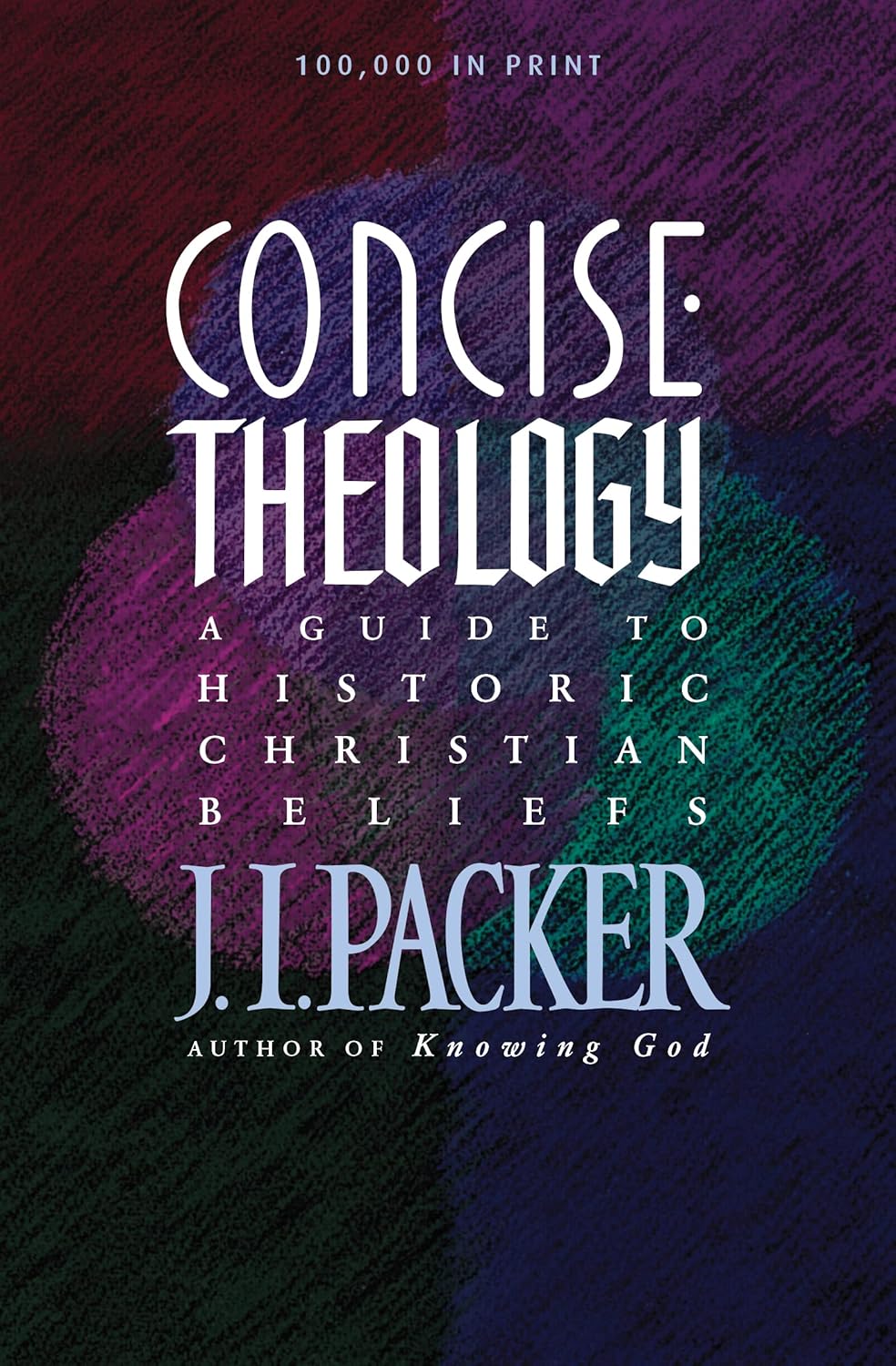
NOTE: This page provides links to the classic work by J. I. Packer, an excellent resource for systematic theology presented in a concise and accurate form.
PREFACE
This book sets out in short compass what seem to me to be the permanent essentials of Christianity, viewed as both a belief system and a way of life. Others have other ideas of how Christianity should be profiled but this is mine. It is Reformational and evangelical, and as such, so I maintain, historic and classic mainstream.
These briefings, which were first planned for a study Bible and have now been revised, have an intentionally scriptural cast and, like other of my writings, are peppered with texts to look up. I submit that this is how it should be, for it is basic to Christianity to receive biblical teaching as God’s own instruction, proceeding, as Calvin put it, via human agency from God’s holy mouth. If Scripture is indeed God himself preaching and teaching, as the great body of the church has always held, then the first mark of good theology is that it seeks to echo the divine Word as faithfully as it can.
Theology is first the activity of thinking and speaking about God (theologizing), and second the product of that activity (Luther’s theology, or Wesley’s, or Finney’s, or Wimber’s, or Packer’s, or whoever’s). As an activity, theology is a cat’s cradle of interrelated though distinct disciplines: elucidating texts (exegesis), synthesizing what they say on the things they deal with (biblical theology), seeing how the faith was stated in the past (historical theology), formulating it for today (systematic theology), finding its implications for conduct (ethics), commending and defending it as truth and wisdom (apologetics), defining the Christian task in the world (missiology), stockpiling resources for life in Christ (spirituality) and corporate worship (liturgy), and exploring ministry (practical theology). The following chapters, sketchy as they are, range into all these areas.
Remembering that the Lord Jesus Christ called those he wanted fed sheep rather than giraffes, I have aimed to keep things as simple as possible. Archbishop William Temple was once told that he had made a complex issue very simple; he was hugely delighted, and said at once: “Lord, who made me simple, make me simpler yet.” My heart goes with Temple’s, and I have tried to keep my head in line with it.As I often tell my students, theology is for doxology and devotion—that is, the praise of God and the practice of godliness. It should therefore be presented in a way that brings awareness of the divine presence. Theology is at its healthiest when it is consciously under the eye of the God of whom it speaks, and when it is singing to his glory. This, too, I have tried to bear in mind.
These short studies of great subjects feel to me, now that I have done them, rather like the lightning tours of England that enterprising bus companies run for American visitors (fifteen minutes at Stonehenge, two hours in Oxford, theatre and overnight in Stratford, an hour and a half in York, an afternoon in the Lake District—phew!). Each chapter is a mere sketchy note. Yet I dare to hope that my compressed material, Packer-packed as it is, might expand in readers’ minds to lift their hearts Godward, in the way that a different form of hot air lifts balloons and their passengers skyward. We shall see.
My frequent quoting of the Westminster Confession may raise some eyebrows, since I am an Anglican and not a Presbyterian. But since the Confession was intended to amplify the Thirty-nine Articles, and most of its framers were Anglican clergy, and since it is something of a masterpiece, “the ripest fruit of Reformation creed-making” as B. B. Warfield called it, I think I am entitled to value it as part of my Reformed Anglican heritage, and to use it as a major resource.
I gratefully acknowledge the hidden hand of my much-admired friend R. C. Sproul, from whom came the germ idea for several of these outlines. Though our styles differ, we think very much alike, and have cooperated happily in a number of projects. I find that we are sometimes referred to as the Reformed Mafia, but hard words break no bones, and on we go.
Thanks are also due to Wendell Hawley, my publisher, and LaVonne Neff, my editor, for helpfulness and patience in many forms. To work with them has been a privilege and a pleasure.
J. I. PACKER
- Revelation - Scripture is the Word of God
- Interpretation - Christians can understand the Word of God
- General Revelation - God's reality is known to all
- Guilt - The effect of general revelation
- Inward Witness - Scripture is authenticated by the Holy Spirit
- Authority - God governs His people through Scripture
- Knowledge - True knowledge of God comes through faith
- Creation - God is the Creator
- Self-disclosure - This is My Name
- Self-existence - God has always been
- Transcendence - God's nature is spiritual
- Omniscience - God sees and knows
- Sovereignty - God reigns
- Almightiness - God is omnipresent and omnipotent
- Predestination - God has a purpose
- Trinity - God is one and three
- Holiness - God is light
- Goodness - God is love
- Wisdom - God's twofold will is one
- Mystery - God is surpassingly great
- Providence - God governs this world
- Miracles - God shows His presence and power
- Glory - God's glory-showing requires glory-giving
- Idolatry - God demands total allegiance
- Angels - God employs supernatural agents
- Demons - God has supernatural opponents
- Satan - Fallen angels have a leader
- Humanness - God made human beings in His image
- Humankind - Humans are body and soul, in two genders
- The Fall - The first human couple sinned
- Original Sin - depravity infects everyone
- Inability - Fallen human beings are both free and enslaved
- Covenant - God takes sinful humans into a covenent of grace
- Law - God legislates, and demands obedience
- Law in Action - God's moral law has three purposes
- Conscience - God teaches and cleanses the heart
- Worship - God gives a liturgical pattern
- Prophets - God sent messengers to declare His will
- Incarnation - God sent His Son, to save us
- Two Natures - Jesus Christ is fully human
- Virgin Birth - Jesus Christ was born by miracle
- Teacher - Jesus Christ proclaimed God's kingdom and family
- Sinlessness - Jesus Christ was entirely free from sin
- Obedience - Jesus Christ fulfilled His Father's redemptive will
- Vocation - Jesus Christ's mission revealed at His baptism
- Transfiguration - How Jesus Christ's glory was revealed
- Resurrection - Jesus Christ was raised from the dead
- Ascension - Jesus Christ was taken up into heaven
- Session - Jesus Christ reigns in heaven
- Mediation - Jesus Christ is the mediator between God and man
- Sacrifice - Jesus Christ made atonement for sin
- Definite Redemption - Jesus Christ died for God's elect
- Paraclete - The Holy Spirit ministers to believers
- Salvation - Jesus rescues His people from sin
- Election - God chooses His own
- Effectual Calling - God draws His people to Himself
- Illumination - The Holy Spirit gives spiritual understanding
- Regeneration - The Christian is born again
- Works - Good works are an expression of faith
- Repentance - A Christian changes radically
- Justification - Salvation is by grace through faith
- Adoption - God makes His people His children
- Sanctification - The Christian grows in grace
- Liberty - Salvation brings freedom
- Legalism - Working for God's favour forfeits it
- Antinomianism - We are not set free to sin
- Love - Loving is basic to Christian behaviour
- Hope - Hoping is basic to the Christian outlook
- Enterprise - A Christian lives to please God
- Prayer - Christians practice fellowship with God
- Oaths and Vows - Christians must be truthful
- The Kingdom of God - Christians must manifest kingdom life
- Apostles - Jesus' representatives exercised His authority
- Church - God plants His people in a new community
- Word and Sacrament - How a genuine church is identified
- Elders - Pastors must care for the church
- Sacraments - Christ instituted two seals of God's covenant
- Baptism - This rite exhibits union with Christ
- The Lord's Supper - This rite exhibits communion with Christ
- Discipline - The church must uphold Christian standards
- Mission - Christ sends the church into the world
- Spiritual Gifts - The Holy Spirit equips the church
- Marriage - Matrimony is meant to be a permanent covenant relationship
- The Family - The Christian household is a spiritual unit
- The World - Christians are in society to serve and transform it
- The State - Christians must respect civil government
- Perseverance - God keeps His people safe
- Unpardonable Sin - Only impenitence cannot be forgiven
- Mortality - Christians need not fear death
- Second Coming - Jesus Christ will return to earth in glory
- General Resurrection - Dead in Christ will rise in glory
- Judgment Seat - God will judge all mankind
- Hell - The wicked will be banished into endless misery
- Heaven - God will welcome His people into everlasting joy