2 Chronicles 35:2
2 Chronicles 35:3
2 Chronicles 35:4
2 Chronicles 35:5
2 Chronicles 35:6
2 Chronicles 35:7
2 Chronicles 35:8
2 Chronicles 35:9
2 Chronicles 35:10
2 Chronicles 35:11
2 Chronicles 35:12
2 Chronicles 35:13
2 Chronicles 35:14
2 Chronicles 35:15
2 Chronicles 35:16
2 Chronicles 35:17
2 Chronicles 35:18
2 Chronicles 35:19
2 Chronicles 35:20
2 Chronicles 35:21
2 Chronicles 35:22
2 Chronicles 35:23
2 Chronicles 35:24
2 Chronicles 35:25
2 Chronicles 35:26
2 Chronicles 35:27
| SECOND CHRONICLES The Kingdom of Israel From Splendor to Disaster |
|||||
| Splendor | Disaster | ||||
| King Solomon of Judah 2 Chronicles 1-9 |
Successive Kings of Judah 2Chr 10-36 |
||||
| Kingdom United |
Kingdom Divided 2Chr 10:1-19 |
Rulers of the Southern Kingdom of Judah After the Split |
The Exile of Judah 2Chr 36:17-23 |
||
| Inaugural
2Chr 1:1-17 |
Solomon's Temple 2Chr 2:1-7:22 |
Solomon's Glory 2Chr 8:1-9:31 |
|||
| Building of the Temple |
Decline & Destruction of the Temple |
Temple Destroyed |
|||
| ~40 Years | ~393 Years | ||||

Click chart to enlarge
Chart from Jensen's Survey of the OT - used by permission
Click Chart from Charles Swindoll
|
1107 |
1011 |
971 |
931 |
853 |
722 |
586 |
||||
| 1Samuel | 2 Samuel | 1Kings | 1Kings | 2 Kings | ||||||
|
31 |
1-4 | 5-10 | 11-20 | 21-24 | 1-11 | 12-22 | 1-17 | 18-25 | ||
|
1 Chronicles 10
|
1Chr 11-19 |
1Chr 20-29 |
2 Chronicles |
2 Chronicles |
2 Chronicles |
|||||
|
Legend: B.C. dates at top of timeline are approximate. Note that 931BC marks the division of the Kingdom into Southern Tribes (Judah and Benjamin) and Ten Northern Tribes. To avoid confusion be aware that after the division of the Kingdom in 931BC, the Southern Kingdom is most often designated in Scripture as "Judah" and the Northern Kingdom as "Israel." Finally, note that 1 Chronicles 1-9 is not identified on the timeline because these chapters are records of genealogy. |
||||||||||
SEE ALSO:
ESV chart - kings of Israel - more information
ESV chart - kings of Judah - more information
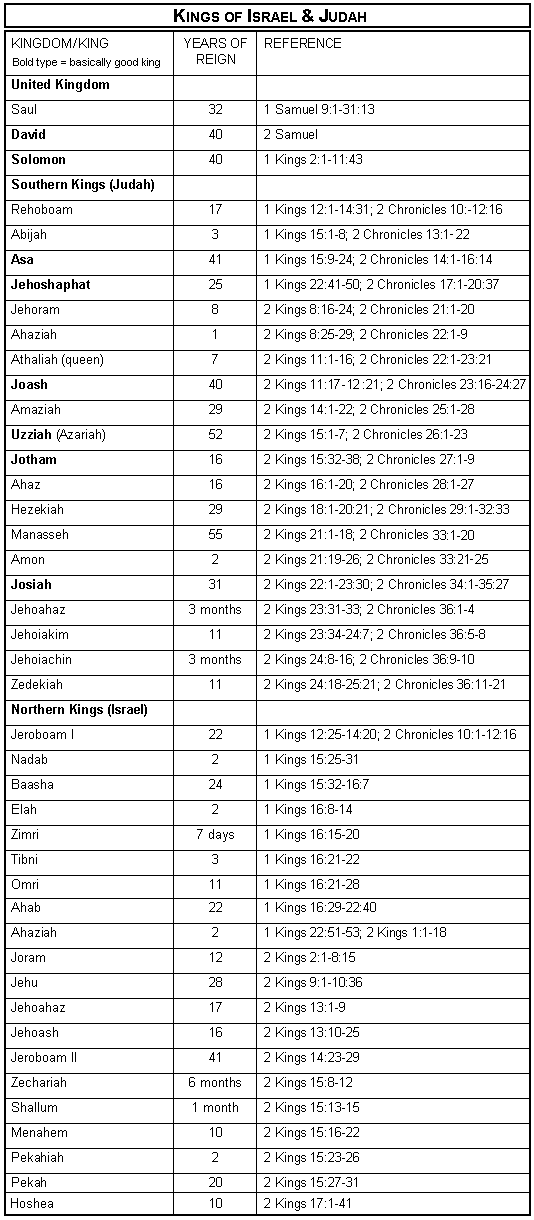
Another Chart with Variable Dates for Reigns of Kings
2 Chronicles 35:1 Then Josiah celebrated the Passover to the LORD in Jerusalem, and they slaughtered the Passover animals on the fourteenth day of the first month.
- Josiah: 2Ch 30:1-27 2Ki 23:21-23
- the fourteenth: Ex 12:6 Nu 9:3 De 16:1-8 Ezr 6:19 Eze 45:21
- CLICK 2 CHRONICLES COMMENTARIES FOR MULTIPLE SERMONS AND COMMENTARIES
- See BELOW FOR BIBLIOGRAPHY FOR 1-2 CHRONICLES - adapted from Paul Apple's Bible Outlines
Related Passages:
Deuteronomy 16:1-2+ 1“Observe the month of Abib and celebrate the Passover to the LORD your God, for in the month of Abib the LORD your God brought you out of Egypt by night. 2“You shall sacrifice the Passover to the LORD your God from the flock and the herd, in the place where the LORD chooses to establish His name.
Leviticus 23:5+ ‘In the first month, on the fourteenth day of the month at twilight is the LORD’S Passover.
JOSIAH'S PASSOVER
CELEBRATION
2 Chronicles 35 records two major events: Josiah’s great Passover (2Ch 35:1–19) and his death at the battle of Megiddo, where he confronted Pharaoh Neco of Egypt on his way to Carchemish by the Euphrates (2Ch 35:20–27). The account runs parallel to the shorter narrative in 2 Kings 23:21–30+, which summarizes the same events in only ten verses (with only 3 verses to the Passover compared to 19 in Chronicles).
Then - This account follows immediately on the renewing of the covenant. Note the progression - Josiah seeks God (age 16). Begins reforms (age 20). Temple repaired (18th year). Book of the Law found. National repentance and covenant renewal THEN: Passover is celebrated (2 Chron 35:1) Then marks the moment immediately after Josiah’s reforms and covenant renewal in his 18th year, when restored obedience naturally led to a properly observed Passover.
The book of Kings records Josiah’s Passover in only three brief verses (2 Kings 23:21–23), whereas the Chronicler devotes an extended nineteen-verse account to the same event (2 Chronicles 35:1–19). This striking difference reflects a shift in emphasis: Kings presents the Passover as part of a broader historical summary of Josiah’s reforms, while Chronicles slows down to highlight the details of worship—its careful organization, adherence to the Law, the roles of priests and Levites, and the king’s personal involvement and generosity. By expanding the account, the Chronicler underscores that this Passover was not merely an event, but a model of restored, Scripture-centered worship, demonstrating that true reformation is seen most clearly in how God’s people return to His ordained patterns of worship.
The Chronicler’s concern is rather to encourage
the right use of the temple..., its service..., and its offerings....Martin Selman: Since this account follows immediately on the renewing of the covenant, it appears to be part of Josiah’s movement of covenant renewal (2Ch 34:29-32). The Passover in fact gives the reform a much more positive image than in Kings, which concentrates on a crusade against idolatry (2 Kgs 23:4-27). The Chronicler’s concern is rather to encourage the right use of the temple (2Ch 35:2, 3, 8, 20), its service (2Ch 35:2, 10, 15, 16), and its offerings (2Ch 35:7, 8, 9, 12-14, 16). The Passover represents the zenith of temple worship in Chronicles (cf. 2 Chr. 30). This prominence is due partly to historical associations with the exodus (Ex 12:1- 13) and Israel’s entry into the Promised Land (Josh. 5:10-11), and partly to its place in the worship of the second temple (Ezra 6:19-22; cf. also Ezek. 45:21). The Passover in post-exilic times particularly expressed many of the Chronicler’s own emphases, such as the priority of temple worship, the reunification of the exiles, Israel’s separation form the impurities of their neighbours, and a desire to seek the Lord (cf. Ezra 6:19-22). (SEE 2 Chronicles: An Introduction and Commentary - Page 557)
Josiah celebrated the Passover to the LORD in Jerusalem, and they slaughtered the Passover animals on the fourteenth day of the first month - Note this was a God-centered celebration for it was TO the LORD. In other words, it was not merely a national tradition. Ultimately it was a reflection of obedience to the covenant. In Jerusalem signifies that this was the place God had chosen for this celebration. Clearly King Josiah was restoring worship according to the Scripture, ordering things "by the book" so to speak.
The Passover animals refers to the Passover lambs which were sacrificed as a memorial of Yahweh's deliverance of Israel from Egypt and was a reminder that judgment passed over Israel because of substitutionary blood of the lamb. Spiritually, the Passover pointed forward to Christ for as Paul explained “Christ our Passover also has been sacrificed” (1 Cor 5:7+)
On the fourteenth day of the first month - Josiah followed exactly the command given in Exodus 12:6+ "‘You shall keep it until the fourteenth day of the same month, then the whole assembly of the congregation of Israel is to kill it at twilight." In short, Josiah’s celebration of the Passover demonstrates a return to God-centered, Scripture-ordered worship, carried out with precise obedience and pointing back to redemption through sacrifice.
David Guzik: The previous Passover of note was in the days of Hezekiah (2 Chronicles 30:1-3). That Passover had to be celebrated in the second month, but Josiah was able to keep this great Passover at the appointed time in the first month (Numbers 9:1-5).
Believer's Study Bible - Josiah's Passover observance was held in accordance with the newly discovered "Book of the Law" (2Ch 34:14-21) and at the "primary" time set forth in the Mosaic Law, instead of its alternate time as observed by Hezekiah (cf. 2Ch 30:1-4).
Geoffrey Kirkland: Looking Back – Prioritize the Lamb – 1. Preparation (1-6) 2. Provision (7-9) 3. Procedure (10-15) 4. Praise & Preeminence of the Passover (16-19)
TSK - The whole solemnity was performed with great exactness according to the law, and upon that account there was none like it since Samuel's time; for even in Hezekiah's passover there were several irregularities. Bp. Patrick observes, that in this also it exceeded the other passovers which preceding things had kept, that though Josiah was by no means so rich as David, or Solomon, or Jehoshaphat, yet he furnished the congregation with beasts for sacrifice, both paschal and eucharistical, at his own proper cost and charge, which was more than any king ever did before.
Warren Wiersbe - In many respects, King Josiah was following the example of King Hezekiah in cleansing the nation of idolatry, repairing the temple and restoring the worship, and celebrating a great nationwide Passover in Jerusalem. While all the appointed feasts in Leviticus 23 were meaningful and important, the feast of Passover was especially significant. For one thing, Passover reminded the Jewish people of their national origin at the exodus when the Lord delivered them from Egyptian bondage. This was a manifestation of the grace and power of God. He took them to Himself as His own people and entered into a covenant relationship with them at Mount Sinai. They were God’s chosen people, God’s covenant people, a people to bring glory to His name
Sara Japhet: Hezekiah's Passover is portrayed as a spontaneous initiative, the main purpose of which was to provide a cultic-religious framework for the integration of the people of the North into the Jerusalem cult; the approach to these Israelites, and the effort to bring them to Jerusalem, consume the major part of ch. 30. … Josiah's Passover is a different matter altogether. Josiah works to establish a permanent institution, built on solid administrational and organizational foundations, with a clear division of roles and an undisputed legal basis. (See I & II Chronicles: A Commentary - Page 1044)
Raymond Dillard: Josiah’s Passover was a pilgrimage feast: just as Israel had received its identity as a nation in the great assembly before Yahweh at Sinai, the law provided that during the pilgrimage feasts the nation would assemble before his sanctuary at least in part as a visible reminder of a corporate national existence. In this way the individual Israelite learned afresh what it meant to be Israel: that Yahweh had chosen them as his own and that he dwelled in their midst. Centuries later Jesus’ parents annually made this same pilgrimage; they discovered that though he was still a child, Jesus knew more about the meaning of Passover than they (Luke 2:41–51; G. McConville, 260–61).
Walter Gustafson - There are five points of special interest in this Passover account:
(1) The necessity of returning the ark to its rightful place (2Ch 35:3).
(2) The diligence of Josiah to have everything done according to the Word of God in the writings of David and Solomon (2Ch 35:4, 15) and Moses (2Ch 35:6, 12-13). "Just as Josiah acted on what he found written in God's Word, so the Biblical record of Jesus' Passover sacrifice at Calvary still offers a fresh dynamic for life and worship" (Selman). The Levites fervently served all the people first (2Ch 35:11-13). Afterwards, they prepared for themselves and the priests (v. 14) and then for the singers and the porters (2Ch 35:15). Their prominence is of special interest to the Chronicler.
(3) Everyone was in his place. The king stood in his place (2Ch 34:31). The priests and the Levites were in their place (2Ch 35:10). The singers and the porters were in their place (2Ch 35:15). How good it is when everyone in assembly fellowship is in the place that God wants him or her to be. No one is seeking a place for which God has not fitted him or her. No one is shirking a place of responsibility for which God has fitted him or her and where he or she is needed.
(4) No wonder then that there was no Passover like this one since the days of Samuel, about 500 years earlier ( (2Ch 35:10).18). As noted previously there was no Passover like the one kept by Hezekiah since the days of Solomon (2Ch 30:26), but it was necessary to go further back in history to find one like Josiah's because his was closer to the Word of God.
(5) God wanted His people of old to keep the Passover in order to remind them of what He had done for them in delivering them. He had delivered them by the blood of the lamb from bondage and from the judgment that fell on the Egyptians. The Passover lamb is typical of Christ as 1 Corinthians 5:7 makes clear, "For even Christ our passover is sacrificed for us". "The Lord's Supper differs somewhat from the Passover in that it is not a mere memorial of a great deliverance, but a remembrance of the Person who wrought the deliverance for us. 'This do in remembrance of me', are our Lord's words in Luke 22:19" (Fereday). In Luke 22:15 the Lord expressed intense desire, "With desire I have desired to eat this passover with you before I suffer". He knew with perfect divine knowledge the intensity of the suffering He would endure (Jn 18:4). We can thank God that this did not override the intensity of His desire to do His Father's will. (What the Bible teaches – 1 Chronicles and 2 Chronicles)
INTRODUCTION:
Andrew Hill: The Passover is the preeminent religious festival for postexilic Judah and the apex of temple worship for the Chronicler. The reason for the prominence of this feast in the Jewish restoration community stems from the Passover observed after the completion of the second temple in 516 B.C. and the understanding that the return from Babylonian captivity is a “second exodus” for God’s people (cf. Ezra 6:19-22). The Passover, more than any other Hebrew religious festival, drew the nation of Israel back to her roots since it was at Mount Sinai that the former Hebrew slaves were constituted as the people of God.
Iain Duguid: In Chronicles the climax of reforms initiated by both Hezekiah and Josiah is national celebration of Passover (cf. ch. 30). The account of Hezekiah’s Passover focused on the people, recounting the invitation to participate sent throughout Judah and Israel and thus the welcoming of those from the newly terminated northern kingdom. The celebration prompted questions and ad hoc decisions regarding date and purification, and wide joyous participation ensued. In contrast, the focus in the account of Josiah’s Passover is on the organization and performance of the celebration itself (the “people of Israel” are the active subject of a verb only in 35:17). Attention in Chronicles centers on two areas: (1) the celebration was solidly grounded in the Lord’s past instructions, through Moses (vv. 6b, 12–13) and David and Solomon (vv. 3, 4, 15), and (2) further innovation was formalized by Josiah, as the Levites were prominent, with increased duties (vv. 3–5, 10–15) “according to the king’s command” (vv. 10, 16; cf. imperatives in vv. 3–6). The changes brought by David and Solomon flowed from the building of a temple and related to temple ministry as a whole, while Josiah’s instructions flowed from centralization “in Jerusalem” (v. 1).
Adam Clarke: Josiah celebrates a Passover, regulates the courses of the priests; assigns them, the Levites, and the people, their portions; and completes the greatest Passover ever celebrated since the days of Solomon, 2-19.
McGee: We have seen in this book that although there was a general decline of the nation, there were five periods of revival, renewal, and reformation [under kings Asa, Jehoshaphat, Joash, Hezekiah, and Josiah] … In each instance, return to the Word of God led to the repentance of the people and the temporary reformation of the nation.
Matthew Henry Notes: 2Ch 35:
SUMMARY - 2 Chronicles 35 presents the final scenes of Josiah’s life in three movements: first, in the temple, where his deep devotion is seen in restoring and carefully observing the Passover according to God’s Word, even providing generously so all the people could participate and ensuring the priests and Levites fulfilled their duties properly; second, on the battlefield, where his otherwise godly life is marred by a moment of rashness in confronting Egypt, leading to his death; and third, at his grave, where he is deeply mourned by the nation. The Passover itself stands out as the central highlight—a meticulously ordered, Scripture-centered celebration unmatched since Samuel, though marked more by obedience to the king than heartfelt zeal among the people—demonstrating that true reform begins with returning to God’s ordinances, even if the full spiritual response of the people lags behind.
We are here to attend Josiah,
I. To the temple, where we see his religious care for the due observance of the ordinance of the passover, according to the law (v. 1-19).
II. To the field of battle, where we see his rashness in engaging with the king of Egypt, and how dearly it cost him (v. 20-23).
III. To the grave, where we see him bitterly lamented (v. 24-27). And so we must take our leave of Josiah.
2Ch 35:1-19
The destruction which Josiah made of idols and idolatry was more largely related in the Kings, but just mentioned here in the foregoing chapter (v. 33); but his solemnizing the passover, which was touched upon there (2 Ki. 23:21), is very particularly related here. Many were the feasts of the Lord, appointed by the ceremonial law, but the passover was the chief. It began them all in the night wherein Israel came out of Egypt; it concluded them all in the night wherein Christ was betrayed; and in the celebration of it Hezekiah and Josiah, those two great reformers, revived religion in their day. The ordinance of the Lord's supper resembles the passover more than it does any of the Jewish festivals; and the due observance of that ordinance, according to the rule, is an instance and means both of the growing purity and beauty of churches and of the growing piety and devotion of particular Christians. Religion cannot flourish where that passover is either wholly neglected or not duly observed; return to that, revive that, make a solemn business of that affecting binding ordinance, and then, it is to be hoped, there will be a reformation in other instances also.
In the account we had of Hezekiah's passover the great zeal of the people was observable, and the transport of devout affection that they were in; but little of the same spirit appears here. It was more in compliance with the king that they all kept the passover (v. 17, 18) than from any great inclination they had to it themselves. Some pride they took in this form of godliness, but little pleasure in the power of it. But, whatever defect there was among the people in the spirit of the duty, both the magistrates and the ministers did their part and took care that the external part of the service should be performed with due solemnity.
I. The king exhorted and directed, quickened and encouraged, the priests and Levites to do their office in this solemnity. Perhaps he saw them remiss and indifferent, unwilling to go out of their road or mend their pace. If ministers are so, it is not amiss for any, but most proper for magistrates, to stir them up to their business. Say to Archippus, Take heed to thy ministry, Col. 4:17. Let us see how this good king managed his clergy upon this occasion. 1. He reduced them to the office they were appointed to by the law of Moses (v. 6) and the order they were put into by David and Solomon, v. 4. He set them in their charge, v. 2. He did not cut them out new work, nor put them into any new method, but called them back to their institution. Their courses were settled in writing; let them have recourse to that writing, and marshal themselves according to the divisions of their families, v. 5. Our rule is settled in the written word; let magistrates take care that ministers walk according to that rule and they do their duty. 2. He ordered the ark to be put in its place. It should seem, it had of late been displaced, either by the wicked kings, to make room for their idols in the most holy place, or by Hezekiah, to make room for the workmen that repaired the temple. However it was, Josiah bids the Levites put the ark in the house (v. 3), and not carry it about from place to place, as perhaps of late they had done, justifying themselves therein by the practice before the temple was built. Now that the priests were discharged from this burden of the ark they must be careful in other services about it. 3. He charged them to serve God and his people Israel, v. 3. Ministers must look upon themselves as servants both to Christ and to his church for his sake, 2 Co. 4:5. They must take care, and take pains, and lay out themselves to the utmost, (1.) For the glory and honour of God, and to advance the interests of his kingdom among men. Paul, a servant of God, Tit. 1:1. (2.) For the welfare and benefit of his people, not as having dominion over their faith, but as helpers of their holiness and joy; and there will be no difficulty, in the strength of God, in honestly serving these two masters. 4. He charged them to sanctify themselves, and prepare their brethren, v. 6. Ministers' work must begin at home, and they must sanctify themselves in the first place, purify themselves from sin, sequester themselves from the world, and devote themselves to God. But it must not end there; they must do what they can to prepare their brethren by admonishing, instructing, exhorting, quickening, and comforting, them. The preparation of the heart is indeed from the Lord; but ministers must be instruments in his hand. 5. He encouraged them to the service, v. 2. He spoke comfortably to them, as Hezekiah did, ch. 30:22. He promised them his countenance. Note, Those whom we charge we should encourage. Most people love to be commended, and will be wrought upon by encouragements more than by threats.
II. The king and the princes, influenced by his example, gave liberally for the bearing of the charges of this passover. The ceremonial services were expensive, which perhaps was one reason why they had been neglected. People had not zeal enough to be at the charge of them; nor were they now very fond of them, for that reason, and therefore, 1. Josiah, at his own proper cost, furnished the congregation with paschal lambs, and other sacrifices, to be offered during the seven days of the feast. He allowed out of his own estate 30,000 lambs for passover offerings, which the offerers were to feast upon, and 3000 bullocks (v. 7) to be offered during the following seven days. Note, Those who are serious in religion should, when they persuade others to do that which is good, make it as cheap and easy to them as may be. And where God sows plentifully he expects to reap accordingly. It is to be feared that the congregation generally had not come provided; so that, if Josiah had not furnished them, the work of God must have stood still. 2. The chief of the priests, who were men of great estates, contributed towards the priests' charges, as Josiah did towards the people's. The princes (v. 8), that is, the chief of the priests, the princes of the holy tribe, rulers of the house of God, bore the priests' charges. And some of the rich and great men of the Levites furnished them also with cattle, both great and small, for offerings, v. 9. For, as to those that sincerely desire to be found in the way of their duty, Providence sometimes raises up friends to bear them out in it, beyond what they could have expected.
III. The priests and Levites performed their office very readily, v. 10. They killed the paschal lambs in the court of the temple, the priests sprinkled the blood upon the altar, the Levites flayed them, and then gave the flesh to the people according to their families (v. 11, 12), not fewer than ten, nor more than twenty, to a lamb. They took it to their several apartments, roasted it, and ate it according to the ordinance, v. 13. As for the other sacrifices that were eucharistical, the flesh of them was boiled according to the law of the peace-offerings and was divided speedily among the people, that they might feast upon it as a token of their joy in the atonement made and their reconciliation to God thereby. And, lastly, The priests and Levites took care to honour God by eating of the passover themselves, v. 14. Let not ministers think that the care they take for the souls of others will excuse their neglect of their own, or that being employed so much in public worship will supersede the religious exercises of their closets and families. The Levites here mace ready for themselves and for the priests, because the priests were wholly taken up all day in the service of the altar; therefore, that they might not have their lamb to dress when they should eat it, the Levites got it ready for them against supper time. Let ministers learn hence to help one another, and to forward one another's work, as brethren, and fellow-servants of the same Master.
IV. The singers and porters attended in their places, and did their office, v. 15. The singers with their sacred songs and music expressed and excited the joy of the congregation, and made the service very pleasant to them; and the porters at the gates took care that there should be no breaking in of any thing to defile or disquiet the assembly, nor going out of any from it, that none should steal away till the service was done. While they were thus employed their brethren the Levites prepared paschal lambs for them.V. The whole solemnity was performed with great exactness, according to the law (v. 16, 17), and, upon that account, there was none like it since Samuel's time (v. 18), for in Hezekiah's passover there were several irregularities. And bishop Patrick observes that in this also it exceeded the other passovers which the preceding kings had kept, that though Josiah was by no means so rich as David, and Solomon, and Jehoshaphat, yet he furnished the whole congregation with beasts for sacrifice, both paschal and eucharistical, at his own proper cost and charge, which was more than any king ever did before him.
2 Chronicles 35:2 He set the priests in their offices and encouraged them in the service of the house of the LORD.
- offices: 2Ch 23:8,18 31:2 Nu 18:5-7 1Ch 24:1-31 Ezr 6:18
- encouraged: 2Ch 29:5-11 31:2 1Ch 22:19
SETTING WORSHIP IN ORDER
AND ENCOURAGING THE PRIESTS
He set the priests in their offices - Josiah reorganized and reinstated the priesthood according to God’s ordained structure. Set implies intentional appointment and proper ordering. Their offices refers to the divinely assigned roles given in the Law of Moses (cf. Nu 3–4; 1Ch 23–24). Josiah was not inventing something new, but as part of his overall reformation was restoring what God had already prescribed. Why? Because after years of apostasy under Manasseh and Amon the priesthood had likely become corrupt, neglected, or disorganized and ome priests may have even been involved in idolatrous practices (cf. 2 Kings 23)! So Josiah tooks steps to set the right men in the right roles, reestablishing order, structure, and biblical fidelity.
And encouraged (chazaq; LXX -katischuo) them - Encouraged (chazaq) carries the sense of strengthening, emboldening, or making firm. This implies that the priests needed moral encouragement, spiritual renewal and confidence to serve rightly again after so long a period of dysfunctional worship. This is similar to how leaders strengthened as when Hezekiah encouraged the Levites (2Ch 29:5) and David encouraged Solomon (1Ch 28:20). In short, King Josiah did not just issue commands but he "pastored," motivated, and strengthened.
This reminds me of Paul's five commands in 1Co 16:13-14+ "Be on the alert, stand firm in the faith, act like men, be strong. 14 Let all that you do be done in love."
In the service of the house of the LORD (The Temple) - The service refers to things like the sacrifices, maintenence of the Temple, the teaching the Law and the leading of worship.
Josiah’s reform was not merely external cleansing by destroying idols but included positive restoration with revival of true worship of the LORD.
C. H. Spurgeon: Cheer up, my comrades The first thing is to get every man into his proper place; the next thing is for every man to have a good spirit in his present place so as to occupy it worthily. At this time it shall not be my business to arrange you, but assuming that it is well for you to keep where you are, my object shall be to encourage you to do your work for the Lord without being cast down. I will speak--
I. To those who think they can do nothing.
II. To workers who are laid aside.
III. To those who are much discouraged because they have but small talent.
IV. To workers who are under great difficulties.
V. To those who are not appreciated.
VI. To those who are discouraged because they have had so little success.
C H Spurgeon - Cheer up, my comrades
‘And Josiah set the priests in their charges, and encouraged them to the service of the house of the LORD.’ 2 Chronicles 35:2
The smallest slight chafes those who are over-sensitive. They murmur, ‘I do my best, and nobody thanks me.’ You think yourself a martyr and complain that you are misrepresented. Be it so; that was your Master’s lot and it is the lot of all his servants. This is a cross we must all carry, or we shall never wear the crown. Do you fancy that this is a new experience? Look at Joseph. His brethren could not bear him, and yet it was he that saved the family and fed them in time of famine. Look at David. His brothers asked why he had left the charge of the sheep to come down to the battle, suspecting that the pride of his heart had brought him among the soldiers and standards. Yet nobody could bring back Goliath’s head but that young David. Take a lesson from the ruddy hero; take no notice of what your brethren say about you. Go and bring back the giant’s head. A good adventure is the best answer to evil accusations. If you are serving the Master let their scandal stir you up to more self-consecration. If they cry out against you as too forward, serve the Lord with more vigour, and you will antidote the venom of their tongues. Did you enter into Christ’s work in order to be honoured among men? Then retire from it, for you came with a bad motive. But if you enlisted purely to bring honour to him and to win his smile, what more do you want? Be not disheartened because you are not applauded; to be kept in the rear rank is often necessary to future eminence. If you take a man, put him in front, pat him on the back and say, ‘What a great man he is’, he will make a false step before long, and there will be an end of your hero; but when a man is brought forward by God, he is often one whom everybody criticises, finds fault with and declaims as an impostor, but the banter he is exposed to serves as ballast for his mind. When he has success he will not be spoiled with conceit, for the grace of God will make him bow with gratitude.
2 Chronicles 35:3 He also said to the Levites who taught all Israel and who were holy to the LORD, “Put the holy ark in the house which Solomon the son of David king of Israel built; it will be a burden on your shoulders no longer. Now serve the LORD your God and His people Israel.
- the Levites: 2Ch 17:8,9 30:22 De 33:10 Ne 8:7,8 Mal 2:7
- Put: 2Ch 8:11 34:14
- in the house: 2Ch 5:7
- not be: Nu 4:15-49 1Ch 23:26
- serve: Nu 8:19 16:9,10 2Co 4:5
Related Passages:
1 Chronicles 23:26 “Also, the Levites will no longer need to carry the tabernacle and all its utensils for its service.”
HOLY LEVITE TEACHERS
AND ARK IN THE TEMPLE
This is the first of 7 commands Josiah gives to the Levites in order to prepare for the Passover.
He also said to the Levites who taught all Israel - This identifies a specific group within the Levites who were not just Temple workers, but teachers of the Law. Their role was to instruct the people in God’s Word, preserve doctrinal truth and guide spiritual life of the nation.
And who were holy (qāḏôšh; LXX - hagios) to the LORD - In addition these Levites were holy meaning they were set apart and consecrated to Yahwe and for His service. Their separation from defilement was especially important after the period of idolatrous priests.
🙏 THOUGHT - One practical point (that applies to all us teachers) is that you cannot rightly teach others unless you are set apart yourself. I think of a recent famous national teacher who was having an adulterous affair for 3+ years and yet was speaking nationally and on the internet during that time. His sin was eventualy exposed. If you are a pastor/teacher and at the same time trying to hide your sin, "you may be sure that your sin will find you out." (Nu 32:23+).
Put the holy ark in the house which Solomon the son of David king of Israel built What does this imply? The Ark of the Covenant had been removed or displaced. While we cannot be sure, this might have occurred during Manasseh’s idolatrous reign (2Ch 33) or simply be due to either desecration or neglect of the Temple. Therefore Josiah commanded that the Ark be returned to its rightful place in the Holy of holies.
McConville suggests another possible reason - "The likeliest interpretation, therefore, is that Josiah deliberately re-enacted the placing of the ark in the temple as a symbolic gesture ... as a declaration that Judah was ready to start again". (I and II Chronicles)
As an aside, this is the last historical reference to the ark in Scripture.
Fereday writes "But the ark spoke to God of Christ, and Josiah very properly spoke of it as 'the holy ark'. It was the most expressive of all the types of the Levitical economy: our Lord's incorruptible humanity is set forth in the shittim wood; His deity in the gold which covered it, and His accomplished sacrifice is suggested in the blood on the Mercy Seat (or propitiatory) upon which the golden cherubim looked down ... Christ is God's true centre, and this must be made clear (at least in type) before the Passover could be acceptable to Jehovah"
it will be a burden on your shoulders no longer. This explanaton refers back to the wilderness system where the Levites (Kohathites) were to carry the Ark on poles (Nu 7:9) in order to keep the Ark mobile. But now the Temple is permanent and the Ark has a fixed resting place
Moody Bible Commentary (p635) on a burden on your shoulders no longer - may suggest that, for some undisclosed reason, the ark was being carried in and out of the temple (according to the law, cf. Ex 25:14, 15) but would once again find a permanent home in the restored temple. Another possibility is that this was a symbolic act of removing the ark and returning it as a symbol of the temple’s reconsecration
Now serve the LORD your God and His people Israel - Notice the order to the LORD (worship Him, offer sacrifices, obey Him) and then to the people (teaching, leading worship). It is difficult to serve the people with integrity if one is not serving the LORD first.
2 Chronicles 35:4 “Prepare yourselves by your fathers’ households in your divisions, according to the writing of David king of Israel and according to the writing of his son Solomon.
- households: 1Ch 9:10-34 Ne 11:10-20
- in your divisions: 1Ch 23:1-26:32
- and according: 2Ch 8:14
Related Passages:
2 Chronicles 8:14+ Now according to the ordinance of his father David, he appointed the divisions of the priests for their service, and the Levites for their duties of praise and ministering before the priests according to the daily rule, and the gatekeepers by their divisions at every gate; for David the man of God had so commanded.
1 Corinthians 14:33; 40+ for God is not a God of confusion but of peace, as in all the churches of the saints....40 But all things must be done properly and in an orderly manner.
ORDER IN THE
PASSOVER WORSHIP
Josiah’s continues his detailed instructions to the Levites as he prepares the nation for the Passover. In so doing Josiah shows that true spiritual reformaton is not random but is carefully ordered according to God’s revealed pattern.
Prepare yourselves - Josiah issues a command to the Levites to intentional readiness, not casual participation. He wants them spiritually prepared (cleansed, consecrated). Worship that honors God requires deliberate preparation, not spontaneity alone or a "hurry up or we will be late for church" approach! (Convicted?)
By your fathers’ households - Fathers’ households refers to family/clan groupings within the tribe of Levi. The Levites were organized by ancestral divisions (houses of their fathers), this structure having been recorded in Numbers 3–4 (Levite families: Kohathites, Gershonites, Merarites) and 1 Chronicles 23–24 (David’s later organization).
In your divisions - Divisions refers to ordered courses or rotations of service by the Levites and reflects a well-structured system of ministry. Josiah's approach is in keep with the truth that God values order, structure, and clarity in worship (cf. 1Co 14:40).
According to the writing of David king of Israel and according to the writing of his son Solomon - The regulations formed by David (1 Chronicles 23 = Levites Organized; 1 Chronicles 24 = Priestly Divisions; 1 Chronicles 25 = Musicians - organized worship leaders Asaph, Heman, Jeduthun; 1 Chronicles 26 = Gatekeepers & Treasurers)
1 Chronicles 28:19 records “All this,” said David, “the LORD made me understand in writing by His hand upon me, all the details of this pattern.” So this was not merely David’s idea but was God-directed order.
F B Meyer - Chronicles 35:4, 6, 10, 14, 15, 16 Prepare.
No great court function can be carried through successfully, without careful preparation. And Josiah’s passover was so vast and rare a success because of the large amount of previous preparation, as is described in this chapter. The priests and Levites were prepared by careful washings and ceremonial rites. The course of the sacrifices was ordered according to the law of Moses. The routine of sacred song and praise was also provided for. Nothing was left to haphazard or chance.
We are taught to rely on the promptings and inspirations of the Holy Spirit; and it is certain that He would use us more on special errands, if we were to trust and obey Him better. But these extraordinary ministries should not lead us to a life of haphazard. We should prepare ourselves for service so far as we may, laying our plans, anticipating the calls and exigencies of coming days, and preparing for the demand which almost certainly will be made on us. We may have to give our special words and addresses and arrangements to the winds; but we shall always need that preparedness of heart which is necessary for those who are to be used of God.
Remember what is said of the vessels that were purged from uncleanness, sanctified, meet for the Master’s use, and prepared unto every good work. Be always in your own place, clean so far as you can be, filled with the Holy Ghost, with the handle of your life turned toward the Master’s hand, that at any moment He may take hold of you, and use you for His holy service. By the diligent study of His Word, as well as by earnest prayer and waiting upon God, you will be prepared to do His will.
2 Chronicles 35:5 “Moreover, stand in the holy place according to the sections of the fathers’ households of your brethren the lay people, and according to the Levites, by division of a father’s household.
- stand: Ps 134:1 135:2
LEVITES CENTRAL ROLE
IN THE PASSOVER
Moreover, stand in the holy place Stand is a command to the Levites to take their assigned position and be ready to serve. Holy place refers broadly to the sanctified areas of temple service (not just the inner sanctuary)
and according to the Levites, by division of a father’s household. The Levites were divided into family units, creating a two-level structure of people (Israel) by households and Levites by divisions of households
of your brethren the lay people, Distinguishes the Levites (ministers) from the pPeople of Israel (worshipers). The idea is that the Levites were to position themselves in relation to the people so that each group of Israelites would be served by assigned Levites
Payne - “Josiah’s goal was to prevent the sort of confusion that had arisen during the more precipitous reform and Passover of his godly great-grandfather, some 103 years earlier (cf. 30:16-18)” (See The Expositor's Bible Commentary - Abridged Edition: Page 50)
2 Chronicles 35:6 “Now slaughter the Passover animals, sanctify yourselves and prepare for your brethren to do according to the word of the LORD by Moses.”
- slaughter: 2Ch 30:15-17 Ex 12:6,21,22 Ezr 6:20,21
- sanctify: 2Ch 29:5,15,34 30:3,15-19 Ge 35:2 Ex 19:10,15 Nu 19:11-20 Job 1:5 Ps 51:7 Joe 2:16 Heb 9:13,14
PRIESTS TO SLAUGHT,
SANCTIFY & PREPARE
Now slaughter the Passover animals This refers to the Passover lambs prescribed in Exodus 12. Normally each household brought a lamb. The Levites assisted in the slaughter, especially for those who were ceremonially unclean (cf. 2Ch 30:17) This is the central act of Passover—the sacrifice that commemorated deliverance from Egypt. Spiritually the lamb represents substitutionary sacrifice and ultimately pointed to Christ (1 Corinthians 5:7)
Sanctify yourselves - Josiah commands the Levites to set themselves apart, cleanse yourselves, including ritual purification, roral readiness and spiritual focus.
Prepare for your brethren to do according to the word of the LORD by Moses - The Levites were not just preparing sacrifices but were preparing on behalf of others, assisting families and ensuring everyone could participate. The lesson to remember is that genuine ministry is other-centered, not self-centered. Do according to the word of the LORD by Moses indicates that Josiah was doing all thing according to God's instructions.
Walter Gustafson Their service was to kill the Passover lamb and prepare it for the people while the priests took care of the blood. Although the heads of family households ordinarily killed the Passover animals (Ex 12:3-6, 21), yet the practice of killing by the Levites begun at Hezekiah's Passover is now continued. In 2Ch 30:17 the Levites killed the Passover lambs because some of the people were ritually unclean. The practice seems to have been normalized by the time of Josiah. (What the Bible teaches – 1 Chronicles and 2 Chronicles)
Raymond Dillard adds that "Though the Passover animal was ordinarily slaughtered by the lay offerer (Dt 16:5–6; Exod 12:3–6, 21), the Chronicler understands that Josiah continued the practice of slaughter by the Levites as begun under Hezekiah (see 2Ch 30:13–20). Under Hezekiah this practice was explained as exigency due to the ritual impurity of some participants; the practice has either become normalized by the time of Josiah (Rudolph, 325; C-M, 513; Myers, 212), or we are invited to infer a further exigency, perhaps the sheer number of participants (35:14, 18). (See 2 Chronicles, Volume 15 - Page 290)
2 Chronicles 35:7 Josiah contributed to the lay people, to all who were present, flocks of lambs and young goats, all for the Passover offerings, numbering 30,000 plus 3,000 bulls; these were from the king’s possessions.
- Josiah: 2Ch 7:8-10 30:24 Isa 32:8 Eze 45:17
- gave: 1Ki 8:63
- the king's possessions: 1Ki 8:63 1Ch 29:3
Related Passages:
2 Chronicles 30:24 For Hezekiah king of Judah had contributed to the assembly 1,000 bulls and 7,000 sheep, and the princes had contributed to the assembly 1,000 bulls and 10,000 sheep; and a large number of priests consecrated themselves.
2 Chronicles 31:3 He (Hezekiah) also appointed the king’s portion of his goods for the burnt offerings, namely, for the morning and evening burnt offerings, and the burnt offerings for the sabbaths and for the new moons and for the fixed festivals, as it is written in the law of the LORD.
JOSIAH'S EXAMPLE OF
GENEROUS GIVING
Josiah contributed to the lay people, to all who were present, flocks of lambs and young goats, all for the Passover offerings - Josiah personally gave from his own resources to the lay people, the common people of Israel. The point is that Josiah did not merely command worship, but actively enabled the people to participate by removing financial and practical barriers so that everyone can worship.
Numbering 30,000 plus 3,000 bulls; these were from the king’s possessions - According to the calculation, that not fewer than ten, nor more than twenty persons, were to join for one kid or lamb, the numbers given on this occasion would suffice for above 400,000 persons. When God's Word got Josiah's heart, it also got his "wallet" for this is a staggering number of sacrificial animals. Josiah's offering was not from taxes, not from temple treasury and not from forced contributions but from his personal wealth. This is surely an example of sacrificial giving and reminds us of the Corinthians whose giving was "not as we had expected, but they first gave themselves to the Lord (LIKE JOSIAH) and to us by the will of God." (2Co 8:5+) O, who how we need to remember the words of Asaph quoting Jehovah "For every beast of the forest is Mine, The cattle on a thousand hills." (Ps 50:10) Josiah understand this principle!
Frederick Mabie: The “voluntary’ contributions of Passover offerings and more made by the king, royal officials, the high priest, temple administrators, and Levitical leaders reflect both the imagery of generosity as well as that of unity and fellowship enjoyed through the sharing of sacrificial meals and communion offerings. The massive amount of offerings and the efforts to account for a large number of those in Judah as well as Israel no doubt play into the summary remark that the Passover had not been celebrated like this before (v. 18). These numbers are about double the offerings noted in conjunction with Hezekiah’s Passover celebration (cf. 30:24), but they pale in comparison to Solomon’s temple-dedication offerings (cf. 7:5). (SEE 1 and 2 Chronicles)
2 Chronicles 35:8 His officers also contributed a freewill offering to the people, the priests and the Levites. Hilkiah and Zechariah and Jehiel, the officials of the house of God, gave to the priests for the Passover offerings 2,600 from the flocks and 300 bulls.
- his princes: 2Ch 29:31-33 1Ch 29:6-9,17 Ezr 1:6 2:68,69 7:16 8:25-35 Ne 7:70-72 Ps 45:12 Ac 2:44,45 4:34,35
- freewill offering: 2Co 8:12 9:7
- Hilkiah: 2Ch 34:14-20
- rulers: 1Ch 9:20 24:4,5 Jer 29:25,26 Ac 4:1 5:26
His officers also contributed a freewill offering (nedabah) to the people, the priests and the Levites - Officers refers to leaders, officials, princes under Josiah. Freewill offering was a voluntary gift, given willingly, not by command or compulsionThis was not forced giving but was overflowing generosity from the heart but Josiah's officers.
Hilkiah and Zechariah and Jehiel, the officials of the house of God, gave to the priests for the Passover offerings 2,600 from the flocks and 300 bulls - These were high-ranking temple leaders. Hilkiah was the high priest who found the Book of the Law (2Ch 34:14). Zechariah and Jehiel were administrators of temple operations. These are not minor figures but represent spiritual leadership at the highest level.
🙏THOUGHT- Here is an important takeaway. When spiritual leaders give generously, it sets a powerful example. Dear pastor/teacher/church leader what does your checkbook look like? Remember the two most important books for worship (other than the Bible of course) are the hymn book and the check book!
Raymond Dillard: The same names occur in 2Ch 31:12–13 for Levites who were active during Hezekiah’s reign; these individuals having those names during Josiah’s reign (2Ch 35:9) were probably the grandsons of those mentioned earlier, a fact providing evidence for the practice of papponymy in monarchic Israel. (SEE 2 Chronicles, Volume 15 - Page 290)
Andrew Hill: The royal “officials” are probably members of Josiah’s “cabinet,” including princes and appointees to posts such as the recorder, secretary, chief of staff over the army, and advisers (cf. the list of David’s officials, 2 Sam. 8:15-18). The temple administrators are senior priests in charge of the Levitical divisions and the musical and service guilds. (See First and Second Chronicles - Page 215)
Peter Wallace: In the Law, it appears that each family was supposed to bring its own lamb, but by Josiah’s day, it is clear that the king and his officials are providing the sacrifices. The bulls would be for burnt offerings and peace offerings The lambs, of course, would be for the Passover itself – one lamb per household (although small households could share). If Josiah contributed 30,000 lambs and young goats, and the officers and chiefs contributed 7,600, that would suggest that around 37,600 households were present for the Passover. Since “best guess” estimates for the whole population of Judah at this time would be around 300,000 – these numbers may well be exactly on target, since not everyone from the whole country would be there – and they would have some extras from around Israel.
Freewill offering (05071) nedabah from verb nadab = to incite willingly = the free, voluntary desire of the heart to give of oneself or of one’s resources to the service of the Lord - Ex 25:2, 35:21, 1Chr 29:6, Ezra 1:6) is a feminine noun meaning willingness, a freewill offering, a voluntary gift and is from the root ndb which describes "an uncompelled and free movement of the will unto divine service or sacrifice." (TWOT) A freewill offering is one that is voluntary and not compulsory, prompted only by the impulse of the donor. The psalmist uses nedabah figuratively praying "O accept the freewill offerings (Lxx = ekousia = voluntary, done without compulsion, of one's own free will) of my mouth." (Ps119:108) In Ps 68:9 nedabah describes a "plentiful (Lxx = ekousia - voluntary, spontaneous) rain."
EXCURSUS ON FREEWILL OFFERING - The freewill offering was a voluntary gift given to the LORD from a willing and stirred heart, not out of obligation, vow, or compulsion, though still regulated by God’s law. Its defining feature was inner motivation—“everyone whose heart stirred him and everyone whose spirit moved him came and brought the LORD’s contribution” (Exodus 35:21; cf. 35:29). It could take several forms. Most commonly it was a sacrifice—a burnt or peace offering (Leviticus 22:18, 21; Ezekiel 46:12)—offered from the herd or flock, generally without blemish (Leviticus 22:21), often accompanied by grain and drink offerings (Numbers 15:1–10). As part of the peace offering system, the freewill offering could be eaten on the day of sacrifice or the next (Leviticus 7:16–18). In addition to animal sacrifices, it also included material gifts and resources for God’s work, such as the offerings for the tabernacle (Exodus 35:21–29; 36:3–7), the temple in David’s day (1 Chronicles 29:5–9, 14), support for temple service under Hezekiah (2 Chronicles 31:14), and contributions for the rebuilt temple after the exile (Ezra 1:4; 3:5; 7:16; 8:28).
Although it could be given at any time, freewill offerings were often associated with major feasts, such as the Feast of Weeks (Deuteronomy 16:10) and other appointed times (Leviticus 23:37–38; Ezra 3:4–5). Like all sacrifices, they were to be offered in the place God chose (Deuteronomy 12), not according to personal preference or pagan practice. Unlike vows (Deuteronomy 23:21–23), the freewill offering arose purely from spontaneous devotion, and was not to be used for self-display or empty religion (Amos 4:5). Thus, throughout Scripture, it represents worship that flows freely from gratitude and love for God, a principle that continues under the New Covenant, where giving is likewise to be voluntary and joyful—“each one must do just as he has purposed in his heart… for God loves a cheerful giver” (2 Corinthians 9:7).
2 Chronicles 35:9 Conaniah also, and Shemaiah and Nethanel, his brothers, and Hashabiah and Jeiel and Jozabad, the officers of the Levites, contributed to the Levites for the Passover offerings 5,000 from the flocks and 500 bulls.
- gave: Heb. offered, Isa 1:10-15 Jer 3:10 7:21-28 Mic 6:6-8
MORE GENEROUS
GIVING
Conaniah also, and Shemaiah and Nethanel, his brothers, and Hashabiah and Jeiel and Jozabad, the officers of the Levites, contributed to the Levites for the Passover offerings 5,000 from the flocks and 500 bulls. - A cascading wave of generosity—from king, to leaders, to servants—resulting in one of the greatest acts of unified worship in Israel’s history.
2 Chronicles 35:10 So the service was prepared, and the priests stood at their stations and the Levites by their divisions according to the king’s command.
- the priests: 2Ch 35:4,5 30:16 Ezr 6:18
THE PASSOVER WAS
NOW PREPARED
So the service was prepared, and the priests stood at their stations and the Levites by their divisions according to the king’s command - Everything Josiah commanded has now come together. It marks the transition from preparation to execution, and it highlights order, readiness, and obedience in worship.
Raymond Dillard: For a time the temple would have become a slaughterhouse, a stream of celebrants coming to receive animals for use in their observances. After the animals were slain and skinned, the Levites removed those portions used as burnt offerings and gave them to the family representatives who would present them to the priests for the burning. Details of this ritual are not prescribed in legislation pertaining to Passover; rather, the appeal to what was “written in the book of Moses” (35:12) probably pertains to provisions for fellowship offerings, the fat portions of which were burned on the altar (Lev 3:6–16); the burnt offerings and fat offerings (35:14) may refer to the same thing (Keil, 502; Williamson, 407). (SEE 2 Chronicles, Volume 15 - Page 291)
2 Chronicles 35:11 They slaughtered the Passover animals, and while the priests sprinkled the blood received from their hand, the Levites skinned them.
- the priests: 2Ch 29:22-24 30:16 Lev 1:5,6 Nu 18:3,7 Heb 9:21,22
- skinned them: 2Ch 29:34
Related Passages
2 Chronicles 29:34 But the priests were too few, so that they were unable to skin all the burnt offerings; therefore their brothers the Levites helped them until the work was completed and until the other priests had consecrated themselves. For the Levites were more conscientious to consecrate themselves than the priests.
READY, SET, SLAUGHTER
AND SPRINKLE
They slaughtered the Passover animals, and while the priests sprinkled the blood received from their hand, the Levites skinned them - The priests were responsible for handling the blood of the sacrifices, as commanded in the Law of Moses (Lev 1:5). The sprinkling of the blood symbolized atonement, for as Leviticus 17:11+ teaches, “For the life of the flesh is in the blood, and I have given it for you on the altar to make atonement for your souls.” The Levites, meanwhile, assisted by skinning the animals and preparing them for the meal, ensuring that the Passover was carried out in accordance with the Law. This verse also highlights the spirit of order and cooperation that characterized Josiah’s Passover. The priests and Levites worked together in obedience to God’s Word, and the people participated in worship that was both reverent and joyful. In short 2 Chronicles 35:11 is not just a record of ritual detail it is a picture of atonement (cf Day of Atonement), obedience, and unity in worship.
2 Chronicles 35:12 Then they removed the burnt offerings that they might give them to the sections of the fathers’ households of the lay people to present to the LORD, as it is written in the book of Moses. They did this also with the bulls.
- as it is written: Lev 3:3,5,9-11,14-16
Then they removed the burnt offerings that they might give them to the sections of the fathers’ households of the lay people to present to the LORD, as it is written in the book of Moses. They did this also with the bulls. - The Levites and priests carefully organized the sacrifices so that each family group among the people could offer their portion to the Lord in the proper way. The phrase “removed the burnt offerings” refers to setting aside or distributing the animals that had been consecrated for sacrifice. These were then given to the “sections of the fathers’ households”—that is, to the family divisions of the lay people—so that each group could personally participate in offering their sacrifices to God, just as the Law of Moses prescribed. The same procedure was followed for the bulls, which were also part of the sacrificial offerings. The priests and Levites were not acting according to their own ideas but “as it is written in the book of Moses.”
Spiritually, this verse also illustrates the unity and participation of God’s people in worship. Each family had a role in presenting offerings to the Lord, symbolizing that all Israel was renewing its covenant relationship with Him.
2 Chronicles 35:13 So they roasted the Passover animals on the fire according to the ordinance, and they boiled the holy things in pots, in kettles, in pans, and carried them speedily to all the lay people.
- roasted: Ex 12:8,9 De 16:7 Ps 22:14 La 1:12,13
- sod: Lev 6:28 Nu 6:19 1Sa 2:13-15
- divided them speedily: Heb. made them run, Ro 12:11
So they roasted the Passover animals on the fire according to the ordinance, and they boiled the holy things in pots, in kettles, in pans, and carried them speedily to all the lay people.
Iain Duguid: most detail relates to the Levites, who acted on behalf of the people in the flaying, cooking, and distributing (vv. 11c, 12–14a, 14c–15). The two aspects of the ceremony can be seen in the sacrificing on the altar (vv. 11–12, 16) and the meal (vv. 13–15).
Andrew Hill: The term “roasted” (bsl, 35:13a) is a general word for cooking food either by boiling or by roasting. The original Passover meal was cooked by roasting (Ex. 12:8; Deut. 16:7). Certain other types of offerings included in fellowship meals were boiled in clay pots (e.g., Ex. 29:31; Lev. 6:28). It seems the Passover celebration combined both types of cooked food offerings.
J.A. Thompson: There is a note of selflessness here. After all the people had been attended to, the Levites could provide for themselves and for the priests. The enormity of the task for the priests is demonstrated by the fact that they were sacrificing the burnt offerings and the fat portions till nightfall.
2 Chronicles 35:14 Afterwards they prepared for themselves and for the priests, because the priests, the sons of Aaron, were offering the burnt offerings and the fat until night; therefore the Levites prepared for themselves and for the priests, the sons of Aaron.
- because the priests: Ac 6:2-4
LEVITES PREPARE A PLATE
FOR THE PRIESTS
Afterwards they prepared for themselves and for the priests, because the priests, the sons of Aaron, were offering the burnt offerings and the fat until night; therefore the Levites prepared for themselves and for the priests, the sons of Aaron - this verse describes how the Levites, who were assisting in the Passover sacrifices, took care to ensure that both they and the priests were provided for after the people’s offerings had been completed. The priests, descendants of Aaron, were so busy offering the burnt offerings and the fat portions on the altar that they had no time to prepare their own Passover meals. The Levites, therefore, took responsibility to prepare the Passover portions for the priests as well as for themselves. This act of service ensured that everyone—priests, Levites, and laypeople—could participate in the feast according to God’s command.
2 Chronicles 35:15 The singers, the sons of Asaph, were also at their stations according to the command of David, Asaph, Heman, and Jeduthun the king’s seer; and the gatekeepers at each gate did not have to depart from their service, because the Levites their brethren prepared for them.
- according: 2Ch 29:25,26 1Ch 16:41,42 23:5 25:1-7 Ps 77:1 78:1 79:1 *titles
- gatekeepers: 1Ch 9:17-19 26:14-19
EACH FULFILLED HIS
ROLE IN THE CELEBRATION
The singers, the sons of Asaph, were also at their stations according to the command of David, Asaph, Heman, and Jeduthun the king’s seer; and the gatekeepers at each gate did not have to depart from their service, because the Levites their brethren prepared for them - This verse highlights how every group within the temple service, singers, gatekeepers, and Levites, fulfilled their assigned roles exactly as God had ordained through David and his appointed leaders. The “sons of Asaph” were the temple musicians, descendants of Asaph, who had been appointed by King David to lead worship through song and music (see 1Ch 25:1–2). Alongside Asaph, David had also appointed Heman and Jeduthun (also called Ethan) as prophetic musicians who led Israel in praise and thanksgiving. Their ministry was not entertainment but sacred service, meant to glorify God and lead the people in worship.
2 Chronicles 35:16 So all the service of the LORD was prepared on that day to celebrate the Passover, and to offer burnt offerings on the altar of the LORD according to the command of King Josiah.
SUMMARY STATEMENT OF
THE PASSOVER
So all the service of the LORD was prepared on that day to celebrate the Passover, and to offer burnt offerings on the altar of the LORD according to the command of King Josiah - This verse emphasizes that everything was done in proper order and in full obedience to both the Law of Moses and the leadership of Josiah, who sought to restore true worship in Judah.
2 Chronicles 35:17 Thus the sons of Israel who were present celebrated the Passover at that time, and the Feast of Unleavened Bread seven days.
- the feast: 2Ch 30:21-23 Ex 12:15-20 13:6,7 23:15 34:18 Lev 23:5-8 Nu 28:16-25 De 16:3,4,8 1Co 5:7,8
OBEDIENCE TO OBSERVE
PASSOVER AND FEAST OF UNLEAVENED BREAD
Thus the sons of Israel who were present celebrated the Passover at that time, and the Feast of Unleavened Bread seven days - emphasizes that all those Israelites who were present—those who had gathered in Jerusalem from Judah and from the remnants of the northern tribes—faithfully observed both the Passover and the seven-day Feast of Unleavened Bread, just as God had commanded through Moses. See also Feast of Unleavened Bread
David Guzik: This Passover was remarkable for several reasons.
- It was remarkable in the magnitude of its celebration, including even the remnant of the north who came to celebrate it in Jerusalem. “‘All Judah and Israel’ includes people from north and south, implying a larger attendance than at Hezekiah’s Passover (cf. 2 Chronicles 30:25).” (Selman)
- It was remarkable in its strict obedience to the Law of Moses
- It was remarkable in the way it shined amidst these dark years in Judah’s history.
2 Chronicles 35:18 There had not been celebrated a Passover like it in Israel since the days of Samuel the prophet; nor had any of the kings of Israel celebrated such a Passover as Josiah did with the priests, the Levites, all Judah and Israel who were present, and the inhabitants of Jerusalem.
- there was no passover: Not one on purer principles, more heartily joined in by the people present, more literally or exactly consecrated, according to the law, or more religiously observed. The words do not refer to the number present, but to the manner and spirit. 2Ch 30:5 2Ki 23:21-23
- neither did: 2Ch 30:26,27
Related Passages:
Kings 23:21-23 Then the king commanded all the people saying, “Celebrate the Passover to the LORD your God as it is written in this book of the covenant.” 22 Surely such a Passover had not been celebrated from the days of the judges who judged Israel, nor in all the days of the kings of Israel and of the kings of Judah. 23But in the eighteenth year of King Josiah, this Passover was observed to the LORD in Jerusalem.
A PASSOVER UNIQUE
IN ALL THE MONARCHIES
There had not been celebrated a Passover like it in Israel since the days of Samuel the prophet Not since the early united spiritual leadership era (Samuel) had there been such nationwide participation (all Judah and Israel who were present, and the inhabitants of Jerusalem) Samuel represents a time when the Word of God was central (1 Samuel 3:21) and national worship was being restored after spiritual decline. It was the first fully Biblical Passover in centuries. I Samuel's Passover was circa 1050 BC and Josiah's Passover was in the 18th year of his reign (2 Chronicles 35:19), circa 622 BC, that mean it had been almost 425 years or at least 4 centuries!
nor had any of the kings of Israel celebrated such a Passover as Josiah did with the priests, the Levites, all Judah and Israel who were present, and the inhabitants of Jerusalem - NLT - "None of the kings of Israel had ever kept a Passover as Josiah did, involving all the priests and Levites, all the people of Jerusalem, and people from all over Judah and Israel." This verse could be a bit confusing for one might think the "kings of Israel" refers to the Northern Kingdom. This designation surely refers to all of the nation of Israel. For one thing there is no record of any king of the Northern Kingdom even celebrating a single Passover. This means that even the “golden age” of David and Solomon did not produce a Passover like this!
New Bible Commentary: Hezekiah may have been seen by the Chronicler as a greater king, but Josiah's provision of animals for sacrifice was even more lavish than his (vs 6-9), and the ceremonies went right back to Moses (v 12), not simply to David (v 15); it was an occasion unique in the whole history of the monarchy (v 18).
2 Chronicles 35:19 In the eighteenth year of Josiah’s reign this Passover was celebrated.
A YEAR FOR
THE AGES!
In the eighteenth year of Josiah’s reign this Passover was celebrated - Josiah was still relatively young (26 yo), but he was mature beyond his age. This was the year the Book of the Law was discovered, Huldah prophesied God's judgment would come after Josiah died, the Temple was cleansed of additional defilement, the covenant was renewed and the Passover celebrated. (cf 2 Ki 22:3, 2 Ki 23:23, 2 Chr 34:8, 2 Chr 35:19).
Henry Morris - This uniquely great Passover, plus the repairs of the temple, the rediscovery and reading of the Scriptures, and the purging of the pagan practices of the land were apparently all accomplished during Josiah's eighteenth year as king, when he was only twenty-six years old (2 Chronicles 34:8). That was truly a momentous year, but it could not prevent the coming judgment of God (2 Chronicles 34:24-25) on the land and its people. Although the reforms were extensive and Josiah's efforts sincere, they seem to have been only superficial and did not take root. With Josiah's death thirteen years later, the people soon returned to their pagan ways.
2 Chronicles 35:20 After all this, when Josiah had set the temple in order, Neco king of Egypt came up to make war at Carchemish on the Euphrates, and Josiah went out to engage him.
- Necho: 2Ki 23:29,30, Pharaoh-necho, Jer 46:2-12
- Charchemish: Isa 10:9
A SOLEMN TURNING POINT
IN THE LIFE OF JOSIAH
After all this, when Josiah had set the temple in order, Neco king of Egypt came up to make war at Carchemish on the Euphrates, and Josiah went out to engage him - Notice that Neco had no beef with Josiah, but for some reason that is not explained Josiah decided to confront Neco at Megiddo.
Believer's Study Bible - Carchemish by the (upper) Euphrates was an extremely strategic and important city at that time. It was located about 50 miles due west of Haran. Sargon II (722-705 B.C.) captured Carchemish for Assyria in 717 B.C. During the declining years of the Assyrian Empire, following the fall of Nineveh (612 B.C.) to the combined forces of the Neo-Babylonian and Median Empires, Ashur-uballit II (612-609 B.C.) of Assyria and Necho II (609-594 B.C.) of Egypt joined in an attempt to reconquer Haran, which had been abandoned in 610 B.C. Although Necho's expedition to rescue Haran was unsuccessful, he was able to conquer all of Syria and Palestine and to hold the important city of Carchemish on the Euphrates. During this campaign, Josiah's attempt to intercept the forces at Megiddo led to his death. Four years later, in May or June of 605 B.C., the epoch-making second battle of Carchemish resulted in Nebuchadnezzar's (605-562 B.C.) defeat of the combined armies of Assyria and Egypt (cf. Jer. 46:1-12). Necho had removed Jehoahaz, Josiah's son, from the throne and placed his brother Eliakim (Jehoiakim) on the throne of Judah when he took Jehoahaz captive into Egypt. In this period, Jehoiakim shifted his alliance from Necho II of Egypt to Nebuchadnezzar of Babylon. Following a fierce battle at the Egyptian border in which the Babylonians suffered a temporary defeat (601 B.C.), Jehoiakim made a strategic blunder when he rebelled against Babylon during the last years of his reign over Judah (609-597 B.C.). In March of 597 B.C., Jerusalem made its first capitulation to Nebuchadnezzar, when Jehoiachin was taken captive and some of the temple treasures were removed to Babylon (cf. 36:6, 7; 2 Kin. 24:1-4; Jer. 22:13-19; 25:1-9; Dan. 1:1; Hab. 1:6). In July, 586 B.C., Jerusalem fell to the Neo-Babylonian Empire (cf. 36:15-21).
G. Campbell Morgan: Josiah was in sin because his attack against Egypt was in support of the Assyrian Empire, and he had no business supporting the Assyrian Empire. The only reason for doing so must have been some supposed political advantage. Against that kind of action the prophets were constantly warning the kings. A word claiming to be from God, forbidding what was already forbidden, had a weight of moral appeal almost amounting to certainty.
Matthew Henry Notes: Verses: 20-27
SUMMARY After Josiah’s great Passover, thirteen unrecorded years passed in which his kingdom likely prospered and outward religion flourished, yet the people remained unchanged in heart and God’s judgment was not averted; thus the narrative resumes abruptly with Josiah’s premature death before age forty. Though a godly king, Josiah is faulted for rashly engaging Egypt without seeking the Lord, ignoring even a warning that ultimately came from God—a failure to inquire as David would have done, leading to his fatal end at Megiddo. In contrast, the people, though spiritually stubborn, are commended for deeply mourning his death, revealing both their respect for his godliness and their belated recognition of the loss of their protector; yet their sorrow exposed a tragic pattern—they wept over consequences rather than repenting of the sins that caused them.
It was thirteen years from Josiah's famous passover to his death. During this time, we may hope, thing went well in his kingdom, that he prospered, and religion flourished; yet we are not entertained with the pleasing account of those years, but they are passed over in silence, because the people, for all this, were not turned from the love of their sins nor God from the fierceness of his anger. The next news therefore we hear of Josiah is that he is cut off in the midst of his days and usefulness, before he is full forty years old. We had this sad story, 2 Ki. 23:29, 30. Here it is somewhat more largely related. That appears here, more than did there, which reflects such blame on Josiah and such praise on the people as one would not have expected.
I. Josiah was a very good prince, yet he was much to be blamed for his rashness and presumption in going out to war against the king of Egypt without cause or call. It was bad enough, as it appeared in the Kings, that he meddled with strife which belonged not to him. But here it looks worse; for, it seems, the king of Egypt sent ambassadors to him, to warn him against this enterprise, v. 21.
1. The king of Egypt argued with Josiah, (1.) From principles of justice. He professed that he had no desire to do him any hurt, and therefore it was unfair, against common equity and the law of nations, for Josiah to take up arms against him. If even a righteous man engage in an unrighteous cause, let him not expect to prosper. God is no respecter of persons. See Prov. 3:30; 25:8. (2.) From principles of religion: "God is with me; nay, He commanded me to make haste, and therefore, if thou retard my motions, thou meddlest with God.'' It cannot be that the king of Egypt only pretended this (as Sennacherib did in a like case, 2 Ki. 18:25), hoping thereby to make Josiah desist, because he knew he had a veneration for the word of God; for it is said here (v. 22) that the words of Necho were from the mouth of God. We must therefore suppose that either by a dream, or by a strong impulse upon his spirit which he had reason to think was from God, or by Jeremiah or some other prophet, he had ordered him to make war upon the king of Assyria. (3.) From principles of policy: "That he destroy thee not; it is at thy peril if thou engage against one that has not only a better army and a better cause, but God on his side.''
2. It was not in wrath to Josiah, whose heart was upright with the Lord his God, but in wrath to a hypocritical nation, who were unworthy of so good a king, that he was so far infatuated as not to hearken to these fair reasonings and desist from his enterprise. He would not turn his face from him, but went in person and fought the Egyptian army in the valley of Megiddo, v. 22. If perhaps he could not believe that the king of Egypt had a command from God to do what he did, yet, upon his pleading such a command, he ought to have consulted the oracles of God before he went out against him. His not doing that was his great fault, and of fatal consequence. In this matter he walked not in the ways of David his father; for, had it been his case, he would have enquired of the Lord, Shall I go up? Wilt thou deliver them into my hands? How can we think to prosper in our ways if we do not acknowledge God in them?
II. The people were a very wicked people, yet they were much to be commended for lamenting the death of Josiah as they did. That Jeremiah lamented him I do not wonder; he was the weeping prophet, and plainly foresaw the utter ruin of his country following upon the death of this good king. But it is strange to find that all Judah and Jerusalem, that stupid senseless people, mourned for him (v. 24), contrived how to have their mourning excited by singing men and singing women, how to have it spread through the kingdom (they made an ordinance in Israel that the mournful ditties penned on this sad occasion should be learned and sung by all sorts of people), and also how to have the remembrance of it perpetuated: these elegies were inserted in the collections of state poems; they are written in the Lamentations. Hereby it appeared, 1. That they had some respect to their good prince, and that, though they did not cordially comply with him in all his good designs, they could not but greatly honour him. Pious useful men will be manifested in the consciences even of those that will not be influenced by their example; and many that will not submit to the rules of serious godliness themselves yet cannot but give it their good word and esteem it in others. Perhaps those lamented Josiah when he was dead that were not thankful to God for him while he lived. The Israelites murmured at Moses and Aaron while they were with them and spoke sometimes of stoning them, and yet, when they died, they mourned for them many days. We are often taught to value mercies by the loss of them which, when we enjoyed them, we did not prize as we ought. 2. That they had some sense of their own danger now that he was gone. Jeremiah told them, it is likely, of the evil they might now expect to come upon them, from which he was taken away; and so far they credited what he said that they lamented the death of him that was their defence. Note, Many will more easily be persuaded to lament the miseries that are coming upon them than to take the proper way by universal reformation to prevent them, will shed tears for their troubles, but will not be prevailed upon to part with their sins. But godly sorrow worketh repentance and that repentance will be to salvation.
2 Chronicles 35:21 But Neco sent messengers to him, saying, “What have we to do with each other, O King of Judah? I am not coming against you today but against the house with which I am at war, and God has ordered me to hurry. Stop for your own sake from interfering with God who is with me, so that He will not destroy you.”
- What: 2Sa 16:10 Mt 8:29 Joh 2:4
- God: 2Ki 18:25 Isa 36:10
- forbear thee: 2Ch 25:19
NECO'S WARNING TO JOSIAH
COMES FROM GOD!
But Neco sent messengers to him, saying, “What have we to do with each other, O King of Judah? - In other words, Neco was not attacking Israel, but going to the aid of Assyria against Babylon.
I am not coming against you today but against the house with which I am at war - Neco is basically saying that Josiah was inserting himself into a conflict that did not involve him.
and God has ordered me to hurry - Some might say Neco was a pagan and this could not truly be from God, but there is no reason God could not speak through Neco. Yahweh was giving a warning to Josiah through Neco whe served as His "mouthpiece."
Stop for your own sake from interfering with God Who is with me, so that He will not destroy you - That is an interesting phase "from interfering with God Who is with me." Neco has perceived he has been called by God to go to Carchemish (see Pr 21:1). He speaks essentially like a "prophet" to Josiah and his warning could not have been much clearer. Note Neco does not say that he would destroy Josiah but that God would destroy Josiah!
Josiah's failure was not just in going to war, but in refusing to seek or heed God’s guidance, unlike David who consistently inquired of the Lord. The lesson is clear that even a godly and zealous leader can fall into error by entering battles God has not assigned, and ignoring His warnings can lead to serious consequences.
Andrew Hill: Pharaoh Neco indicates he has no quarrel with Josiah or Judah; he simply wants a right of way through Judah so he can show loyalty to his Assyrian ally (35:21). The Megiddo pass lies on the international coastal highway, an ancient trade route connecting Egypt with Syria, northern Mesopotamia, and Anatolia. The site of Megiddo guards this bottleneck on the route through the Mount Carmel foothills. To meet up with the Assyrians at Carchemish, Neco must move his army through the Megiddo pass. It is at this strategic location that Josiah (foolishly) chooses to intercept Pharaoh Neco and the Egyptian army. (SEE First and Second Chronicles - Page 217)
Mark Boda: Neco’s speech signals a key shift in the Chronicler’s account. After this point, foreign emperors would control the political agenda of Judah, and various foreign emperors (the Egyptian Neco, the Babylonian Nebuchadnezzar, and the Persian Cyrus) will be identified as agents of Yahweh, either performing actions for Yahweh or speaking in his name. Josiah’s death signals the death of the independent kingdom and the beginning of exile among the nations (Johnstone 1997:2.260). (See 1-2 Chronicles - Page 421)
2 Chronicles 35:22 However, Josiah would not turn away from him, but disguised himself in order to make war with him; nor did he listen to the words of Neco from the mouth of God, but came to make war on the plain of Megiddo.
- disguised: 2Ch 18:29 1Ki 14:2 22:30,34
- the mouth: 2Ch 35:21 18:4-6 Jos 9:14
- the mouth of God: Judges 5:19 2Ki 9:27 23:30 Zec 12:11, Megiddon, Rev 16:16
JOSIAH'S FATAL
MISSTEP
However, Josiah would not turn away from him - Pharaoh Necho II had clearly stated he was not attacking Judah. The sad irony is that in 2Ch 34:27 God (through Huldah) had commended Josiah for being responsive to God's Word read by Shaphan but here Josiah rejects God's Word spoken by a pagan Neco. Clearly his discernment was on low ebb at this time and/or he saw Neco's statement as a deceptive ruse to keep Josiah from attacking.
but disguised himself in order to make war with him - No record of prayer as with so many of the kings. And the fact that he disguised himself hardly speaks that this was of faith.
God’s voice must be heeded—
no matter the source
nor did he listen to the words of Neco from the mouth of God - Were these really God's words? Some think not. I think they were God's words through Neco because as with all God's words, these words proved to be true! And of course if God could speak through Balaam's donkey (Nu 22-24) and a pagan king Cyrus (Isa 45:1), clearly He could have spoken through the pagan Neco. Notice that the inspired text says these words were from the mouth of God, which should seal this as a definitive, divine warning. Also the results of Josiah's determined endeavor would support that it was a warning to him from Yahweh. Recall that listen usually conveys the sense of not just to hear but to obey. It was as if God was speaking, but Josiah was not willing to obey. Spiritual maturity does not eliminate the need for discernment. Even the godliest leaders can err if they fail to seek God in the moment.
but came to make war on the plain of Megiddo - But contrast what Josiah did instead of listening! Sometimes failure to listen to God can cost you your life, even if you are one of the greatest kings in the history of Israel. Recall 2Ki 23:25 declared there was "no king like him."
🙏 THOUGHT - Sadly this great king fell through one act of disobedience! This reminds me of Paul's warning to all of us who are followers of Christ - "Therefore let him who thinks he stands (continually, all our life) take heed (present imperative see our need to depend on the Holy Spirit to obey) that he does not fall." (1Cor 10:12+).
Compare Josiah with Ahab - Both disguised themselves (1Ki 22:30, 2Ch 18:29), both ignored warning not to go into battle, both were fatally wounded by archers in battle, both told their servants to take them away out of the battle (1Ki 22:34, 2Ch 25:23) and both died when they got to the city. This is a sad comparision for a king who was in every other way the ultimate antithesis of evil King Ahab!
Iain Duguid: Neco claimed that his advance was because “God has commanded me,” and so Josiah’s action would be “opposing God.” We are not told how, but we must assume that in some way through God’s Spirit Josiah recognized that these words were “from the mouth of God”—but “he did not listen” (2 Chron. 35:22b). Ironically, his attempt to foil Neco (and God’s word) by “disguise” and the manner of his resulting death match those of syncretistic Ahab of Israel (18:29–34). Nevertheless, he was buried with “his fathers” in Jerusalem, which was still at peace (cf. Huldah’s word; 34:28). (See ESV Expository Commentary: 1 Samuel–2 Chronicles)
John MacArthur: The details of Josiah’s tragic death are given. When compared with the account in 2Ki 23:28-30, the events become clearer. Toward the end of Josiah’s reign, the Egyptian Pharaoh Neco (ca. 609-594 B.C.) set out on a military expedition to aid the king of Assyria in a war at Carchemish, Assyria’s latest capital, 250 mi. NE of Damascus on the bank of the Euphrates River. Fearing such an alliance would present future danger to Israel, Josiah decided to intercept Pharaoh Neco’s army and fight to protect his nation. Coming from Egypt, likely by ship to Acco, a northern seaport in Israel, and by land up the coastal plain of Israel, the Egyptian army had landed and proceeded E to the plain of Megiddo (v. 22) i.e., Jezreel on the plain of Esdraelon. This was the most direct way to Carchemish. There Josiah met him for battle and was wounded by an arrow. He made it back to Jerusalem (60 mi. S), where he died. (See MacArthur Study Bible)
G Campbell Morgan - -2 Chr 35.22.
This is one of those arresting illustrations which we find in the Old Testament Scriptures, of the fact that the nations and kings outside the people of the Theocracy were under the government of God, and in some sense at times conscious of the fact. These words of the chronicler constitute a simple statement, which admits the accuracy of what Neco had himself claimed in the message he sent to Josiah by ambassadors, when he said: "God hath commanded me to make haste; forbear then from meddling with God, Who is with me, that He destroy thee not." The fact that Josiah did not hearken to this message, cost him his life. Such a story must, to say the least, give us pause, and make us enquire as to how far we are ever justified in refusing to consider a word which is claimed as a Divine message, even when it comes from sources from which we should least expect to receive it. It may with reason be asked: How are we to know whether that which claims Divine authority has any right to make the claim? So far as this story is concerned, the answer is plain. Josiah had no right of any sort to be helping the king of Assyria. The only reason for doing so must have been some supposed political advantage. Against that kind of action the prophets were constantly warning the kings. A word claiming to be from God, forbidding what was already forbidden, had a weight of moral appeal almost amounting to certainty. Thus may we, too, test such messages. If they contradict Divine revelation, we may rest assured the claim is false. If they agree, we do well to heed to them, for God may speak in many and unexpected ways.
Walter Kaiser - Hard Sayings of the Bible - 35:22 Pharaoh Neco Spoke at God’s Command?
SUMMARY - Josiah stands as one of Judah’s most godly kings—zealous for reform, deeply responsive to God’s Word, and instrumental in restoring true worship—yet his life ends in tragic irony when, at age thirty-nine, he is killed in a battle he had no divine calling to fight. Despite his wholehearted devotion, God’s judgment on Judah remained because of the people’s persistent sin, and in a surprising turn, God even used Pharaoh Neco to warn Josiah not to engage—yet he refused to listen. His death marked both a personal failure and a national turning point, as Judah quickly moved toward destruction, though God graciously remembered Josiah not for his final misstep but for his lifelong faithfulness, even sparing him from witnessing the coming catastrophe.
Few incidents in the life of Israel and Judah are as sad as this episode. Rarely had one of the nation’s monarchs so genuinely desired to serve God. Even as Josiah began his reign at the tender age of eight, he had purposed to walk in the ways of David and not in the ways of his evil father, Amon, and grandfather, Manasseh.
It was Josiah who had started the great reforms in Judah. These were followed by the discovery of the Book of the Law when the temple was cleaned in the eighteenth year of his reign, 621 B.C. When at age twenty-six Josiah first had the law of God read to him, he tore his robes in grief and true repentance before God. Here was one of history’s great men. His heart was responsive to God, and he did not hesitate to humble himself before God (2 Chron 34:27).
But in 609 B.C., when this king with all his potential for furthering the kingdom of God was only thirty-nine, he was struck down by one giant act of foolish disobedience.
In 2 Kings 23:25–37 the catastrophe is partially explained: Even though Josiah had followed the Lord with all his heart, soul and strength and had obeyed the law of Moses so that there was no king like him, yet God did not turn from his great wrath against Judah. God would still destroy Judah because of King Manasseh’s sins and the superficial repentance of the people. Such an explanation softens the blow of the pending tragedy.
In the Chronicles account, however, no such didactic connection was included. Instead, Josiah’s godly obedience alone introduces the tragic episode: “After all this, when Josiah had set the temple in order” (2 Chron 35:20). This would seem to stress that Josiah was devoted to the temple right up to the end of his life.
The scene for Josiah’s end was now set. The Assyrian king Asshur-uballit had established a new capital at Carchemish in 610 B.C. The Egyptians were interested in helping the Assyrians, for they feared that the emerging fortunes of the Babylonians would upset the balance of power in the Near East. Thus in the summer of 609 B.C. a great Egyptian army moved up the Palestinian coast to join the Assyrians in a great counteroffensive.
A phrase in 2 Kings 23:29 sometimes translated “Neco went up against the king of Assyria” is better translated as “Neco went up on behalf of the king of Assyria, to the river Euphrates.” When translated accurately, this verse illuminates Josiah’s reason for fighting Neco.
Josiah viewed Neco’s advance as a menace to his own designs for a reunited Hebrew state. Josiah thought that any friend of the hated Assyrians must be his enemy. Therefore he boldly disregarded all prophetic warnings to the contrary and directly intervened, trying to block the Egyptian army from joining the Assyrians.
Amazingly enough, in this case the prophetic warnings do not come from one of Israel’s traditional prophets but from a pagan Pharaoh who warns Josiah to halt his attempt to meddle with his mission. Neco claimed that “God has told me to hurry; so stop opposing God, who is with me, or he will destroy you” (2 Chron 35:21).
Then follow the mournful yet amazing words of the inspired writer: “Josiah, however, would not turn away from him, but disguised himself to engage him in battle. He would not listen to what Neco had said at God’s command, but went to fight him on the plain of Megiddo. Archers shot King Josiah, and … he died” (2 Chron 35:22–24).
This is indeed one of the strangest statements in Scripture, which we would dismiss as Egyptian propaganda had not the inspired writer confirmed that God did use a pagan monarch to warn Josiah and assist the Assyrians.
God had spoken to pagan kings previously without implying that they had become prophets of Israel or converted to worshiping the one true God (see Gen 12:17–20; 20:3–7; and Dan 4:1–3). The instrument was not the focal point of the prophecy; its content was. God had also previously spoken through the mouth of an ass (Num 22:28–31) and would later speak through a profane high priest (Jn 11:51). But King Josiah did not perceive that God could use such an instrument as a Pharaoh.
In an act reminiscent of King Ahab, Josiah disguised himself and went into a battle he was not supposed to be in. The archer’s arrow found its mark, and Josiah was carried away to die.
But the plan of God was still operating. Josiah, it had been prophesied by Huldah, would be gathered to his fathers and “buried in peace” (2 Chron 34:28). His “eyes [would] not see all the disaster [God was] going to bring on [that] place and on those who live[d] [there].”
The event was so tragic that Jeremiah the prophet composed lamentations for Josiah. But in spite of these laments, the people marched relentlessly toward the destruction that would take place within twenty-three years of Josiah’s death. In fact, not more than three years after his death, in 606 B.C., the Babylonians, whom Josiah seemed to favor, took the first Hebrew captives, including the prophet Daniel and his three friends. In 597 B.C. Ezekiel was taken into exile. Finally the city fell and was burned down, temple included, in 586 B.C.
For one major blunder, a leader’s whole career ended. Yet graciously the record did not dwell on this one sin. Instead it attributed most of the cause to his grandfather Manasseh. Furthermore, the account of Josiah’s life magnanimously ends not by underscoring the king’s final weakness and disobedience, but by recalling Josiah’s “acts of devotion” or “his goodness” (2 Chron 35:26). God’s commendation was “Well done, good and faithful servant.” Thus out of tragedy, God was still working his purposes. What seemed a horrible end for God’s faithful servant-king was in fact a reward. He was spared the horror of viewing the demise of everything the nation and God had built in Judah during the preceding millennium and a half.
2 Chronicles 35:23 The archers shot King Josiah, and the king said to his servants, “Take me away, for I am badly wounded.”
- the archers: 2Ch 18:33 Ge 49:23 2Ki 9:24 La 3:13
- wounded: Heb. made sick, 1Ki 22:34 2Ki 8:29
Related Passages:
2 Chronicles 18:33 (AHAB ALSO SHOT BY AN ARCHER) A certain man drew his bow at random and struck the king of Israel in a joint of the armor. So he said to the driver of the chariot, (AHAB'S REQUEST ALMOST IDENTICAL TO JOSIAH'S REQUEST) “Turn around and take me out of the fight, for I am severely wounded.”
A TRAGIC END TO
A GODLY KING
The archers shot King Josiah - Yes it was an arrow shot by an archer but recall Neco's words in 2Ch 25:21 "so that He (God) will not destroy you." The sovereign God guided this particular arrow and assured His prophetic word through Neco would be perfectly fulfilled.
And the king said to his servants, “Take me away, for I am badly wounded.” - Josiah knew he was at death's door and wanted to die in Jerusalem, the "city of peace."
The lesson is that one bad decision can have massive consequences. Josiah’s death removed Judah’s last godly leader and set the stage accelerating national collapse. This verse is a sobering reminder that one act of disobedience can have irreversible consequences, even in an otherwise faithful life.
2 Chronicles 35:24 So his servants took him out of the chariot and carried him in the second chariot which he had, and brought him to Jerusalem where he died and was buried in the tombs of his fathers. All Judah and Jerusalem mourned for Josiah.
- the second: Ge 41:43
- they: 2Ki 23:30
- died: Ps 36:6 Ec 8:14 9:1,2
- in one of the: or, among the, 2Ch 34:28
- Judah: Zec 12:11
JOSIAH DIES "IN PEACE"
IN THE CITY OF PEACE
So his servants took him out of the chariot and carried him in the second chariot which he had, and brought him to Jerusalem where he died and was buried in the tombs of his fathers - After being struck by archers at Megiddo, Josiah—mortally wounded—was removed from his war chariot and placed in a second chariot, likely a reserve or transport chariot used to carry the injured. His servants urgently brought him back to Jerusalem, but despite their efforts, he died there. This detail underscores both the suddenness of his fall and the futility of human effort once God’s decree had been set in motion.
He was then “buried in the tombs of his fathers,” indicating that, despite his final failure, he was still honored as a legitimate and faithful king in the Davidic line. God’s evaluation of his life was not defined by one act of disobedience, but by a pattern of devotion.
All Judah and Jerusalem mourned for Josiah. - This reveals the magnitude of the loss, for this was not routine mourning for a king. ALL indicates the mourning was widespread and heartfelt, showing that the people recognized his godliness and sorely felt the loss of a righteous leader, especially at such a young age of 39.
Raymond Dillard: For the Chronicler the death of Josiah presented a challenge to his theology of retribution; defeat in battle for him represented divine disfavor, whereas victory was a token of blessing. If Josiah was such a pious king, how is it that he suffered defeat and died in battle? The Chronicler demonstrates the validity of his retribution theology by modifying the Kings account to show that Josiah’s death resulted from his disobedience to a divine oracle. (SEE 2 Chronicles, Volume 15 - Page 292)
Adam Clarke: Perhaps this means no more than that they took Josiah out of his own chariot and put him into another, either for secrecy, or because his own had been disabled. The chariot into which he was put might have been that of the officer or aid-de-camp who attended his master to the war. 2 Kings 22:20.
Mark Boda: The Chronicler is careful to protect the veracity of Huldah’s prophetic word in 2Ch 34:28, where she promised that Josiah would be “buried in peace,” by clarifying that Josiah remained alive until he was safe in Jerusalem (the city of peace) where he died (cf. 2 Kgs 23:29-30). (See 1-2 Chronicles - Page 421)
J.S. Wilkins: [Sermon points on the death of Josiah]
1. That the best of men may err in judgment and in act.
2. The danger of undertaking any work without asking counsel of the Lord.
3. How universal is the reign of death.
4. That we should be cautious how we attribute sudden and violent death to the vengeance of the Most High.
5. That it is not wrong to mourn for the dead.
2 Chronicles 35:25 Then Jeremiah chanted a lament for Josiah. And all the male and female singers speak about Josiah in their lamentations to this day. And they made them an ordinance in Israel; behold, they are also written in the Lamentations.
- Jeremiah: Jer 22:10 La 4:20
- all the singing: Job 3:8 Ec 12:5 Jer 9:17-21 Mt 9:23
- and made them: Jer 22:20
LAMENTATIONS FOR JOSIAH BY
BY JEREMIAH & SINGERS
Then Jeremiah chanted a lament for Josiah. And all the male and female singers speak about Josiah in their lamentations to this day. And they made them an ordinance in Israel; behold, they are also written in the Lamentations - “The Laments” appears to have been a separate, now-lost collection of elegies composed in response to Josiah’s death. These writings should not be confused with the canonical Book of Lamentations, though they likely shared a similar purpose—expressing deep grief over national tragedy. What makes this especially significant is that the mourning was not limited to the prophet Jeremiah; rather, “all the men and women singers” participated, indicating an organized, widespread expression of sorrow. This suggests that Josiah’s death was felt as a profound national loss—a turning point marking the end of hope for reform and the beginning of Judah’s irreversible decline.
2 Chronicles 35:26 Now the rest of the acts of Josiah and his deeds of devotion as written in the law of the LORD, 2
- deeds of devotion, 2Ch 31:20 32:32
JOSIAH'S LIFE ENDS
WITH FOCUS ON GOOD DEEDS
Now the rest of the acts of Josiah and his deeds of devotion as written in the law of the LORD - Devotion is the great Hebrew word hesed which speaks of kindness or loyalty that goes beyond what duty requires, an enduring, covenantal love that reflects God’s own character. It describes not just a feeling but a faithful, active devotion that expresses itself in mercy and steadfastness. It is variously translated as “mercy,” “lovingkindness,” “goodness,” “steadfast love,” or “faithful love.” When the chronicler uses ḥesed to describe Josiah’s “good deeds,” he is not merely saying that Josiah did kind things or performed good works. He is saying that Josiah’s life was marked by faithful devotion to the Lord—a covenant loyalty that mirrored God’s own steadfast love toward His people. Josiah’s ḥesed was seen in his wholehearted obedience to God’s Word, his cleansing of the land from idolatry, his restoration of the temple, and his leadership in renewing the covenant and celebrating the Passover. His actions were not motivated by political ambition or personal gain but by a deep, enduring commitment to honor the Lord.
The same word hesed is used of King Hezekiah in 2 Chronicles 32:32 - Now the rest of the acts of Hezekiah and his deeds of devotion, behold, they are written in the vision of Isaiah the prophet, the son of Amoz, in the Book of the Kings of Judah and Israel.
Hesed in 2 Chronicles 35:26 tells us that Josiah’s legacy was not merely one of reform but of relationship—a heart bound to God in loyal love. His ḥesed was a human reflection of the divine ḥesed that “endures forever” (Psalm 136:26). Spiritually, this reminds us that God desires not just outward obedience but inward devotion. Micah 6:8 captures this beautifully: “He has told you, O man, what is good; and what does the LORD require of you but to do justice, and to love kindness (ḥesed), and to walk humbly with your God?” Josiah’s life embodied that verse—he pursued justice, loved ḥesed, and walked humbly before the Lord.
So, when 2 Chronicles 35:26 says that Josiah’s ḥesed was recorded, it means that his faithful love and covenant loyalty to God were so genuine and enduring that they became part of his eternal testimony. His ḥesed was not perfect—his final act at Megiddo showed human frailty—but his heart was steadfastly devoted to the Lord. In that, Josiah’s life points us to the greater King, Jesus Christ, whose ḥesed—God’s steadfast love in human form—never fails and endures forever.
Despite Josiah’s fatal act of disobedience at the end of his life, the biblical record graciously concludes his reign by emphasizing “his good deeds,” specifically described as being “according to what is written in the Law of the Lord” (2 Chron. 35:26). This summary highlights the defining characteristic of his life, a deep reverence for God’s revealed Word and a consistent commitment to do what was pleasing in His sight, as seen throughout the various stages of his reform. Indeed, this stands as one of the most commendable evaluations of any king in Judah, and significantly, no subsequent king would receive such a testimony until the coming of the greater Son of David, Jesus Christ, who was perfectly “obedient to the point of death” (Phil. 2:8).
2 Chronicles 35:27 and his acts, first to last, behold, they are written in the Book of the Kings of Israel and Judah.
- and his acts: 2Ch 20:34 24:27 25:26 26:22 32:32 33:19 2Ki 10:34 16:19 20:20 2Ki 21:25
JOSIAH'S FINAL
RECORD
and his acts, first to last, behold (hinneh) they are written in the Book of the Kings of Israel and Judah - This closing statement serves as a formal summary and historical reference to the full record of Josiah’s life. The phrase “his acts, first to last” means the entirety of his reign—from beginning to end—encompassing both his godly reforms and his final failure. The writer then directs the reader to “the Book of the Kings of Israel and Judah,” an official historical source (now lost) that contained more detailed accounts of the kings’ reigns.
Josiah’s life was thoroughly recorded, carefully evaluated, and remembered, but the biblical focus remains on what mattered most—his devotion to God’s Word and the spiritual lessons drawn from his life.
PAUL APPLE - DEVOTIONAL QUESTIONS:
1) Why must our worship conform to the Word of God?
2) How does worship combine both sober reflection and joyful celebration?
3) How messy was this bloody Passover ceremony?
4) What motivated King Josiah to engage in battle with Neco of Egypt?
Andrew Hill: This section of Chronicles highlights certain character traits of God, especially his compassion and mercy in responding to those who humble themselves and offer prayer seeking God’s forgiveness (i.e., Manasseh, 33:12-19; Josiah, 34:27). God is portrayed as one who listens and is moved to benevolent action on behalf of the penitent (33:13). Conversely, God’s righteousness in not acquitting the guilty is demonstrated in his response to Amon, who “increased his guilt” before God by refusing to humble himself (33:23).
Ron Daniel: The ark of the covenant had been through quite the adventure since the days of Samuel the prophet. The Jews, who were losing the war with the Philistines, decided to take the ark into battle with them, believing that they would win (1Sam 4:3). But the Jews were defeated and the ark was captured by the Philistines (1Sam. 4:11). After God brought many curses upon the Philistine cities in which the ark was being kept, they returned it to Israel. The people of Beth-shemesh were the first to get the ark, but after more than 50,000 of them were killed for looking into the ark (1Sam. 6:19), the city of Kiriath-jearim was contacted and asked, "Would you like to have the ark?" (1Sam. 6:21). The ark was almost taken into battle again by King Saul (1Sam. 14:18) but he changed his mind and it ended up back at Kiriath-jearim (1Chr. 13:5). Once King David had established Jerusalem as Israel's capitol, he decided that the ark should be in Jerusalem. But when he tried to have it moved, he didn't do it in accordance with the Law of God, and a man died (2Sam. 6:7). So the ark remained at the house of Obed-edom for three months (2Sam. 6:11) while David read the Scriptures and figured out how it should be moved. King David was successful at bringing the ark to Jerusalem, where it remained in a tent (2Sam. 6:17). It was a short time later that David had the idea to build a permanent temple for the Lord, but God didn't allow it. When David's son Absalom rebelled and took over the kingdom, the priests took the ark of the covenant with them as they left the city with David (2Sam. 15:24). But David told them to go put it back (2Sam. 15:25). Years later, David's son, King Solomon, built the temple and the ark was placed in its permanent home (1Kings 8:6). But now, King Josiah is having to tell the Levites to put the ark BACK into the temple. When was it removed? At this, we can only speculate that in the same way the priests had removed the ark when Absalom took power in the days of David, that during the reign of either Manasseh or his son Amon, they must have removed it again. After all, it was King Manasseh's who built altars in the house of the Lord (2Chr. 33:4). Now, Manasseh did repent, and remove these altars (2Chr. 33:15), but his son Amon, King Josiah's father, never repented of the idolatry with which he caused the nation to be permeated. Apparently, the priests had been carrying it from place to place, probably to keep it in hiding. Now, it would not be a burden on their shoulders anymore. It would be returned to the Holy of Holies in the temple.
Frederick Mabie: The ramifications of Josiah’s decision to involve Judah in this conflict were enormous. After a long period of Assyrian vassalage, Judah had begun to experience independence (or at least pseudo-independence) during the reign of Josiah in light of the contraction of the Assyrian Empire. However, in the aftermath of Judah’s battle with Neco at Megiddo, Josiah was killed in battle (vv. 23-24) and Judah became an Egyptian vassal. Only a few years later (ca. 605 BC) Judah would become a Babylonian vassal. Thus in the span of about two decades Judah shifted form Assyrian vassalage to (pseudo-) independence to Egyptian vassalage to Babylonian vassalage. Moreover, the final three kings of Judah after Jehoahaz (Eliakim/Jehoiakim, Jehoiachin, and Mattaniah/Zedekiah) were placed on the throne by Egypt or Babylonia. Judah’s subsequent rebellions against vassalage would ultimately lead to the destruction and deportation of Judah.
Peter Wallace: Neco was allied with the Assyrians, and was on his way to join Ashur-uballit II against an upstart Babylonian general, the crown prince of Babylon, Nebuchadnezzar. Carchemish is a city on the Euphrates River (on the border between modern Syria and modern Turkey). Nebuchadnezzar was pushing the Assyrians back up the Euphrates, and Neco was in a hurry trying to rescue the Assyrians (the Egyptians had frequently quarreled with the Assyrians, but they feared the Babylonians more). Neco’s expedition would fail, and Nebuchadnezzar would shortly rise to the throne of Babylon. But while on the way up the coast of Philistia and Lebanon, Neco had to pass through the valley of Jezreel – and the plain of Megiddo. This is the bottle neck of northern Israel. The heights of Mt Carmel rise up to the west, blocking the coastal route and forcing the army to march inland. The hill country of Ephraim gives way to an opening leading eastward from the coastal plain into the valley of Jezreel, which turns north up towards Syria, (OR southeast towards the Jordan River and Jerusalem!) If you control the plain of Megiddo and the valley of Jezreel, then you control the military and economic destiny of the region. The city of Megiddo rises out of the plain at this point, perhaps providing a place for Josiah to ambush the Egyptians, as they approached the valley of Jezreel. Josiah plainly thinks that his liturgical reforms have guaranteed his military success. He looks back at David and Solomon – Jehoshaphat and Hezekiah – and says, hey, good kings who worshiped the LORD and restored the temple wound up winning great battles. What is more, Huldah the prophetess had said, “you shall be gathered to your grave in peace, and your eyes shall not see all the disaster that I will bring upon this place and its inhabitants.” (34:28) Josiah may have taken Huldah’s prophecy as a blank check. “You shall be gathered to your grave in peace” needs to be understood in context. - First – the reason: “because you have humbled yourself before me” if you cease to be humble, then you will bring some other judgment upon yourself! - Second – the promise itself is of narrow scope: Josiah will be spared the “disaster” – the exile and catastrophic judgment that God has planned for Jerusalem. There is nothing in Huldah’s prophecy that gives Josiah a blank check to do whatever he wants. And Neco warns him: “I am not coming against you this day… And God has commanded me to hurry. Cease opposing God, who is with me, lest he destroy you.” Of course, Hezekiah had heard similar words from the Assyrians – so why should Josiah have listened to Pharaoh? Well, how does going to battle against Egypt demonstrate love for God? Sure, it’s true that from a political standpoint, Josiah thinks that a Babylonian empire would be more desirable than an Assyrian empire. But the problem is that the Son of David in Jerusalem should not be throwing his weight behind the empires of the world. Josiah is forgetting that in the end it doesn’t matter whether Assyria or Babylon is in control – he needs to worship and serve the LORD, and trust that God will exalt him. Habakkuk prophesied during these days– the last days of the Assyrian empire and the rise of the neo-Babylonian empire. Perhaps he was thinking of the death of Josiah when he said, So the law is paralyzed, and justice never goes forth. For the wicked surround the righteous; so justice goes forth perverted. (1:4) Josiah goes forth in a perverted attempt to wield the authority of the Son of God. https://media-cloud.sermonaudio.com/text/122212930251.pdf
Jamieson, Fausset, and Brown: Josiah most probably calculated that the restoration of the divine worship, with the revival of vital religion in the land, would lead, according to God’s promise, and the uniform experience of the Hebrew people, to a period of settled peace and increased prosperity. His hopes were disappointed. The bright interval of tranquility that followed his re-establishment of the rue religion was brief. But it must be observed that this interruption did not proceed from any unfaithfulness in the divine promise, but from the state into which the kingdom of Judah had brought itself by the national apostasy, which was drawing down upon it the long-threatened, but long-deferred judgments of God.
STEVEN COLE - A Teenager Starts A Revival (2 Chronicles 34 and 35)
Former Secretary of Education William Bennett writes about how teachers in the 1940’s were asked to identify the major problems they faced in the schools. They listed talking out of turn; chewing gum; making noise; running in halls; cutting in line; dress code infractions; and littering. When asked the same question in 1990, teachers listed drug and alcohol abuse; pregnancy; suicide; rape; robbery; and assault (cited in Liberty [Nov./Dec., 1994, p. 5).
Do you remember the story of the little Dutch boy who saved his city from destruction by sticking his finger in the hole in the dike? Do you ever feel like that little boy, except that you’re trying to plug holes with all your fingers and thumbs, but more leaks are breaking out every minute? I sometimes feel overwhelmed as I see our godless culture hurtling toward destruction.
King Josiah must have felt that way. He lived in an evil day; his culture was on the brink of God’s judgment. His grandfather, Manasseh, had been the most wicked king in Judah’s history, plunging the nation into worse sins than the Canaanites Israel had conquered centuries before. Even though Manasseh repented, he could not undo the damage he had done. It’s much easier to lead people into sin than it is to lead them out again. It’s like emptying a box of BB’s on a hardwood floor. It’s easy to scatter them, but it’s not so easy to get them all back in the box. Josiah’s father, the wicked Amon, reigned only two years before he was assassinated. He reestablished the pagan practices of his father’s earlier years. Into this wicked culture, plunging headlong toward destruction, little eight-year-old Josiah was thrust as king.
What could this boy-king do? He stuck all his fingers in the holes in the dike! He didn’t finally avert God’s judgment, but he did manage to hold it off for over 30 years. At age 16, Josiah began to seek the Lord (34:3). As a young man of 20, he started a series of reforms in an attempt to turn the nation back from destruction. But even though Josiah himself “did right in the sight of the Lord” (34:2), if we read the contemporary prophets, Jeremiah and Zephaniah, we learn that his reforms weren’t able to go deeply enough. But he did manage to keep one generation from judgment. As such, Josiah should be an example to us as we seek to make a difference in our evil culture. Like Josiah,
Though we live in an evil day, we can see God work through us if we will seek Him and obey His Word.
1. Josiah lived in an evil day; so do we.
When you read 2 Chronicles 34:3-7 and the parallel passage (2 Kings 23:4-15, 19-20) you begin to see what Josiah was up against. Although the people in his kingdom would claim to be followers of the one true God, they had incorporated all sorts of worldly practices into their worship: idolatry, sexual immorality, and even child sacrifice, all under the guise of religion! It’s amazing how people can delve into anything and everything other than God’s Word in the name of religion! These people claimed to be God’s covenant people, but they were totally corrupt in their lifestyle.
In Josiah’s day, as in ours, there was a widespread lack of understanding of God’s Word. When we read of a copy of the Law being discovered in the Temple and read to the King, we get the distinct impression that even the godly Josiah had never heard it read before (34:15-19)! We don’t know whether Manasseh and Amon had destroyed the copies used by the priests and Levites during Hezekiah’s reign. But apparently God’s Word was scarce. Whenever people do not read and understand the Bible, they have no basis for evaluating or confronting their behavior. And so they drift into the worst of sins without even knowing that they are thoroughly pagan.
I wish you all would read David Wells’ two excellent books, No Place for Truth and God in the Wasteland [both, Eerdmans], which show how worldly the American church has become because we have abandoned God’s truth and God-centered living and have replaced it with a human-centered, therapeutic approach in which human needs become sovereign. Wells argues that the church is in the business of truth, not of marketing its “feel-good” product to religious consumers. He states,
A business is in the market simply to sell its products; it doesn’t ask consumers to surrender themselves to the product. The church, on the other hand, does call for such a surrender. It is not merely marketing a product; it is declaring Christ’s sovereignty over all of life and declaring the necessity of obedient submission to him and to the truth of his Word (God in the Wasteland [Eerdmans], p. 76).
The evening before Thanksgiving I had an interesting conversation with Jim Owen, author of the excellent book, Christian Psychology’s War on God’s Word [EastGate]. He thinks that a major part of the problem in American Christianity is that we do not want to submit to authority, including the authority of Scripture that confronts our self-centered, fulfill-my-needs mentality. Thus we are abandoning the historical-grammatical-contextual approach to biblical interpretation and are accepting books in which popular authors subjectively read into the Bible the latest psychological “insights” and then claim that they are biblical. I think his analysis is correct.
The point was clearly illustrated earlier this year when Christianity Today ([5/16/94], pp. 38-40) ran a news article summarizing some of the far-out views set forth by the popular Christian writer, Karen Burton Mains, in her book, Lonely No More [Word)]. She holds to a number of Jungian psychological concepts about “the male-within-the-female and the female-within-the-male,” which she says “have always seemed exceptionally scriptural to me.” She describes a seven-year-old, emaciated “idiot child” in her mind’s eye, who turns out to be “the Christ child that is within me.” She explained to CT that this was metaphorical language representing “the repressed, malformed” part of herself with which Christ identifies.
In spite of these and many other weird things she says, which are at best a mixture of worldliness with Christianity, the article was slanted in favor of Mains and against the “self-appointed heresy hunters” who dare to criticize her! And, the subsequent letters to the editor were largely defensive of her! David Wells is correct: American Christianity has abandoned the idea that we must submit to God’s revealed, absolute truth and has moved into a subjective, therapeutic hodgepodge of worldly ideas.
But even though, like Josiah, we live in an evil day when even those claiming to be God’s people are marked by worldliness, there is a way out of the darkness. It involves seeking the Lord and obeying His Word.
2. Josiah sought the Lord and obeyed His Word; so can we.
A. JOSIAH SOUGHT THE LORD (34:3A).
There are two lessons to note here:
1) Seek the Lord early in life if you can. Josiah was 16 when he began seeking the Lord. He was not from a godly home. He lived in an evil day. And yet he began seeking the Lord during his teen years and never turned away.
Many Christians have the erroneous notion that teenagers must go through a phase of rebellion. It becomes a self-fulfilling prophecy, where Christian parents expect their teens to rebel! Some kids feel like they’ll never be well-adjusted if they don’t sow some wild oats. That’s baloney!
I want every young person to hear this: Even if you come from a bad home and even though we live in an evil world, you can seek the Lord. You’ll never regret avoiding drugs or drinking or sexual immorality, because sin always leaves scars. I thank God that He graciously preserved me from rebelling against Him or against my parents. I think I’m fairly well-adjusted in spite of it!
2) Keep on seeking the Lord. “He began to seek God.” Seeking the Lord is a lifelong process. You don’t just try it halfheartedly for a few months and then say that it didn’t work. Walking with the infinite God and learning His ways is a lifetime process.
You’ll go through dry times and difficult times. You’ll be tempted to turn to the world for the latest wisdom on how to deal with your problems. You’ll be tempted to give up on the Bible because “it doesn’t seem to work.” But always remember, what you need is the Lord! Let your problems drive you to depend on Him alone. Seek Him through His Word! Trust in Him and don’t lean on any other source. The renewing of our minds through Scripture isn’t a quick fix. We’ve got to run with endurance the race set before us. With Josiah we must keep seeking the Lord.
B. JOSIAH OBEYED GOD’S WORD (34:2).
Verse 2 summarizes Josiah’s life: “And he did right in the sight of the Lord, and walked in the ways of his father David and did not turn aside to the right or to the left.” There’s a difference between doing right in the sight of people and doing right in the sight of the Lord, isn’t there? We can only do right in the sight of the Lord when we obey His Word. Josiah had, as you will have, many opportunities to turn aside to the right or to the left, but he didn’t do that (except at the end of his life). He obeyed God’s Word.
The story of the discovery of this copy of the Law of Moses (at least Deuteronomy, but probably the first five books of the Old Testament) is a marvelous example of how God has preserved His Word down through the centuries. Tyrants have tried to eradicate it. Even clergymen have tried to keep it from the common people. During the middle ages church authorities opposed the translation of the Bible into the vernacular because they feared that if lay people read the Bible, heresy would result. William Tyndale, one of the early translators of the Bible into English, was condemned for heresy, strangled, and burned at the stake in 1536 on account of his efforts. A letter he wrote from his prison cell requests a Hebrew Bible, grammar and dictionary so that he could continue translating. We take it for granted that we have several translations of the Bible lying around the house. But it has not always been so.
But whenever God’s Word is read and obeyed, great changes begin to take place in individuals and in society. But owning several copies of the Bible or keeping one on your coffee table won’t do you any good.
1) We must read the Word. We can’t obey it if we don’t know what it says. And we must not just read our favorite sections which reinforce our prejudices. We must read it all. Read the sections that step on your toes. We don’t know for sure which portions for the Law Hilkiah read (maybe all of it). But I would guess that he read Deuteronomy 28 which spells out the grave consequences of disobedience for the nation.
2) We must respond to the Word. Josiah’s response was to tear his clothes in horror. You don’t need to tear your clothes, but sometimes the Word ought to rend your heart. When Josiah heard what God’s Word said, he said, “We’re in a heap of trouble” (paraphrase of 34:21). He had deep convictions about the truthfulness of God’s book. He knew that when God says something, He means it. He knew that sin has consequences. So Josiah responded with a tender heart and humbled himself before God (34:27).
Even though Josiah’s reforms to purge the land of idolatry (34:3-7) preceded the discovery of the Law, what he did illustrates what ought to take place when a person gets into God’s Word. It exposes things in our lives that are displeasing to God. You’ve got to take strong action against such things: chop them down, break them in pieces, grind them to powder, burn it and scatter the ashes, etc. (see 34:4-5). Jesus said that if your eye causes you to lust, tear it out; or your right hand tempts you to adultery, cut it off (Matt. 5:29-30). He meant that we need to respond to God’s Word by dealing radically with our sin.
3) We must learn the Word from mature believers. The king wanted to find out exactly what these words meant as applied to him and his kingdom. So he sent a delegation to Huldah the prophetess (34:22-28). Apparently Jeremiah and Zephaniah weren’t nearby. While God prefers to use men in positions of spiritual leadership, when obedient men are not available, He will use women (Judges 5). Clearly, a woman like Huldah is an exception in Scripture, not the rule. Those who use such exceptional cases to build a feminist theology are grasping at straws. But even so, God does use godly, faithful women.
Huldah shoots straight by telling the messengers what the Lord says (34:23). The job of a person teaching or preaching God’s Word of truth is to make plain what God says, even if it steps on some toes. The Word doesn’t always make you feel warm and fuzzy. It confronts sin and speaks of God’s judgment, as well as His love and mercy. But the Word always brings healing if we submit to and obey it.
As a hearer of the Word, Scripture warns you against shopping for teachers who tickle your ears and tell you what you want to hear rather than what you need to hear (2 Tim. 3:3). I’ve read church growth books that tell pastors if we want to build the church, we shouldn’t preach with authority or confront sin, because baby boomers don’t like that sort of thing. You can find many pastors who fall for that marketing approach. But they will turn away your ears from the truth (2 Tim. 4:4).
So, we must read the Word; respond to the Word; learn it from others.
4) We must seek to influence others with the Word. Once we have read the Word and responded to it with personal obedience and have been taught it by others, we have an obligation to influence others with the Word. Josiah didn’t keep it to himself. He got everybody together and read the Word to them and sought to help them obey it too (34:29-33). If God’s work in your life is real, you will want to bring others under its influence.
Some may say, “I wouldn’t want to offend somebody by telling them what the Bible says.” If you see someone with an illness and you’ve been cured of the same thing by taking a certain remedy, won’t you tell him what you’ve found? God’s Word gives us all that we need for life and godliness (2 Pet. 1:3-4). People with problems don’t need human wisdom; they need God’s Word. Every Christian should grow in being equipped with the Word so that you can help others discover its riches.
Thus even though Josiah lived in an evil day, he sought the Lord and obeyed His Word. So can we. The result?
3. God worked through Josiah; He can work through us.
Josiah purged the land of idolatry and immorality. He restored the Temple and reestablished worship in its proper place. He led the people in the greatest Passover in hundreds of years. Josiah’s Passover was greater than the one led by Hezekiah because all Israel participated and because it was observed in more accordance with the Mosaic law. He saved a generation from God’s judgment.
In our evil day God can do great things through us if we will seek Him and obey His Word. Although it seems impossible to see our nation restored to the place where school teachers complain about the kids chewing gum instead of carrying guns, God can do the impossible! We need spiritual revival!
Conclusion
Josiah’s story ends on a sad note. Pharaoh Neco passed through Judah on his way north to Carchemish where he intended to join with Assyria against Babylon (35:20). He did not intend to fight Josiah, but Josiah insisted on fighting him. It probably seemed like the sensible thing to do. But no where do we read of Josiah seeking the Lord about this battle. In fact, he disguises himself before going into battle (35:22), which reminds us of the ploy used by the wicked Ahab. Why disguise yourself if you’re in the will of God? But Josiah goes against Egypt, gets shot in battle and dies at 39. The revival stops. And in a few short years, Judah falls to Babylon.
What that says to me is, “Don’t get sidetracked from what God has called you to do.” The good is often the worst enemy of the best. We’ve got to be careful or the devil will entice us into the wrong arenas and it can nullify the eternal impact of what God has called us to do. Josiah got sidetracked from the spiritual work into political solutions. Didn’t the land need to be defended? Wasn’t that a king’s job? Yes, but he should have sought the Lord. In this case, God really was speaking through this pagan pharaoh (35:22)! Josiah should have stuck to his spiritual reforms.
Just before the 1984 election, I heard a well-known pastor speak on “The Second Most Important Day of Your Life.” He said that the most important day of your life is when you trust Christ as Savior. But the second most important day would be when you went to vote for Ronald Reagan! In my opinion, he was putting far more faith in the political system than is warranted! While I’m pleased with the recent election, I’m not optimistic that the Republican Party can solve America’s problems. Only God can solve our problems and He will do it as His people turn from sin, seek Him and obey His Word. The world’s problems are essentially spiritual, not political. The church’s primary task is to proclaim the gospel and bring people under Christ’s lordship. Let’s not get sidetracked from our main mission!
At age 12 Robert Louis Stevenson was looking out into the dark from his upstairs window, watching a man light the street lanterns. His governess came into the room and asked what he was doing. He replied, “I am watching a man cut holes in the darkness.” Though we live in a dark day, we can be used of God to cut holes in the darkness, if we will seek Him and obey His Word.
Discussion Questions
- How can we effectively proclaim God’s absolute truth to a relativistic world?
- What is worldliness? How has it affected the church?
- Some would argue that the church needs to experience God, not learn doctrine or theology. Why is this a false dichotomy?
- Should Christians be involved in politics? How much time should God’s people commit to the political process?
NOTE: SOME CAN BE BORROWED FROM ARCHIVE.ORG
Archer, Gleason L. Jr. A survey of Old Testament introduction (BORROW). Chicago, IL: Moody Press, 1964.
Baxter, J. Sidlow. Explore the Book Vol. 2 Judges to Esther . Grand Rapids, MI: Zondervan, 1960.
Boda, Mark J. Cornerstone Biblical Commentary – 1-2 Chronicles. (Digital version) Carol Stream, IL: Tyndale House Publishers, 2010.
Braun, Roddy. Word Biblical Commentary – Volume 14 –1 Chronicles (BORROW). Grand Rapids, MI: Zondervan, 2018.
Cooper, Derek. Reformation Commentary on Scripture – Old Testament V – 1-2 Samuel, 1-2 Kings, 1-2 Chronicles. (Digital version) Downers Grove, IL: IVP Academic, 2016.
Constable, Thomas - 1&2 Chronicles (ONLINE)
Daniel, Ron - Teaching Notes - 1 Chronicles; 2 Chronicles (ONLINE)
Dillard, Raymond B. Word Biblical Commentary – Volume 15 – 2 Chronicles (BORROW) Grand Rapids, MI: Zondervan, 2018.
Ellison, H. L. The New Bible commentary, revised – 1 & 2 Chronicles (BORROW). Grand Rapids, MI: Wm. B. Eerdmans Publishing Co., 1970.
Guzik, David. Enduring Word Bible Commentary 1 Chronicles; 2 Chronicles (ONLINE)
Hill, Andrew E. The NIV Application Commentary – 1 & 2 Chronicles. (Digital version) Grand Rapids, MI: Zondervan, 2003.
Keil, C. F. and Delitzsch, F. Commentary on the Old Testament – 1 Chronicles & 2 Chronicles. Grand Rapids, MI: William B. Eerdmans Publishing Company, 1975.
Konkel, August H. Believers Church Bible Commentary – 1 & 2 Chronicles. (Multipart video series also available) Harrisonburg, VA: Herald Press, 2016.
Mabie, Frederick J. The Expositor’s Bible Commentary Revised Edition – 1 & 2 Chronicles. (Digital Version) Grand Rapids, MI: Zondervan, 2010.
MacArthur, John. The MacArthur Study Bible (BORROW). Nelson Bibles, 2006.
Olley, John W. (ED: IAIN DUGUID) ESV Expository Commentary, Vol. III – 1 Samuel – 2 Chronicles. (Digital Version) Wheaton, IL: Crossway, 2019.
Payne, J. Barton. The Expositor’s Bible Commentary – 1 & 2 Chronicles. Grand Rapids, MI: Zondervan Publishing House, 1988.
Schultz, John. - 1 Chronicles (177 pages), 2 Chronicles (239 pages) (ONLINE)
Selman, Martin J. Tyndale Old Testament Commentaries – 1 Chronicles. (BORROW)Downers Grove, IL: InterVarsity Press, 1994.
Selman, Martin J. Tyndale Old Testament Commentaries – 2 Chronicles. (BORROW) Downers Grove, IL: InterVarsity Press, 1994.
Sherwin, Simon & Mabie, Frederick J. Zondervan Illustrated Bible Backgrounds Commentary -- 1 & 2 Chronicles. (Digital Version) Grand Rapids, MI: Zondervan, 2009.
Thompson, J.A. The New American Commentary – Volume 9 – 1, 2 Chronicles. (Digital Version) Nashville, TN: B&H Publishing Group, 1994.
Utley, Bob. 1 Chronicles Table of Contents; 2 Chronicles Table of Contents
http://www.freebiblecommentary.org/old_testament_studies/VOL07BOT/VOL07BOT.html
Walton, John, et al - The IVP Bible Background Commentary Old Testament IVP - InterVarsity Press 2000.
Wiersbe, Warren W. Be Restored – Trusting God to See Us Through – OT Commentary – 2 Samuel & 1 Chronicles. (BORROW) Colorado Springs, CO: David C. Cook, 2010.
Wiersbe, Warren W. Be Distinct – Standing Firmly Against the World’s Tides – OT Commentary – 2 Kings & 2 Chronicles. (BORROW) Colorado Springs, CO: David C. Cook, 2010.
Williamson, H.G.M. New Century Bible Commentary – 1 and 2 Chronicles. Eugene, OR: Wipf and Stock Publishers 1982.
Wood, Leon. A Survey of Israel’s History. (BORROW) Grand Rapids: MI: Zondervan Publishing House, 1970.
Cyril Barber - 2 Chronicles: God’s Blessing of His Faithful People
Leslie Allen - 1, 2 Chronicles (BORROW)
Believer's Study Bible (Digital Version)
Ryrie Study Bible - BORROW
Defender's Study Bible - BORROW
NIV Study Bible - (BORROW)
ESV Study Bible - (BORROW)
Believer's Bible Commentary - (BORROW)