Jonah 1:2
Jonah 1:3
Jonah 1:4
Jonah 1:5
Jonah 1:6
Jonah 1:7
Jonah 1:8
Jonah 1:9
Jonah 1:10
Jonah 1:11
Jonah 1:12
Jonah 1:13
Jonah 1:14
Jonah 1:15
Jonah 1:16
Jonah 1:17
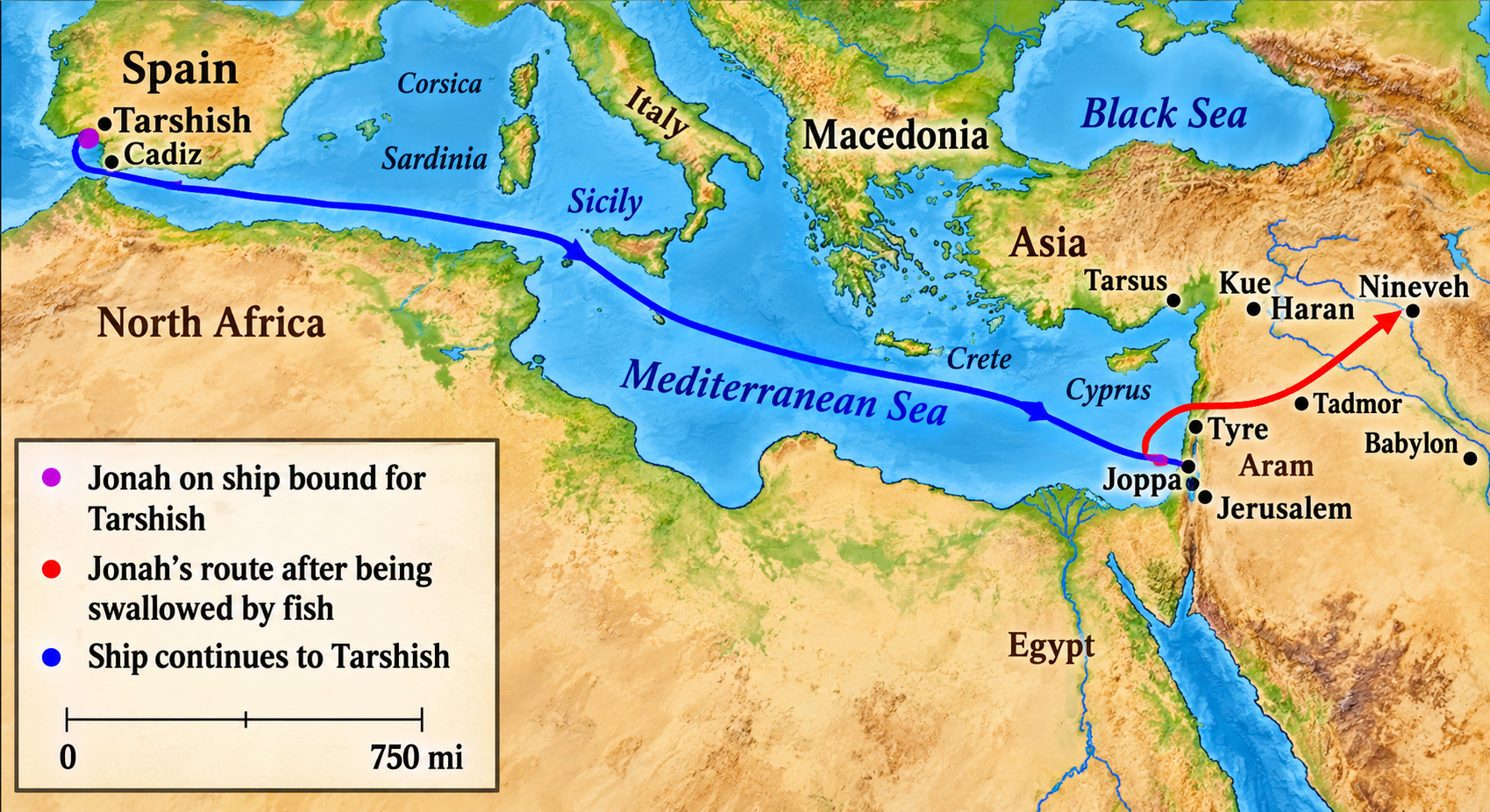
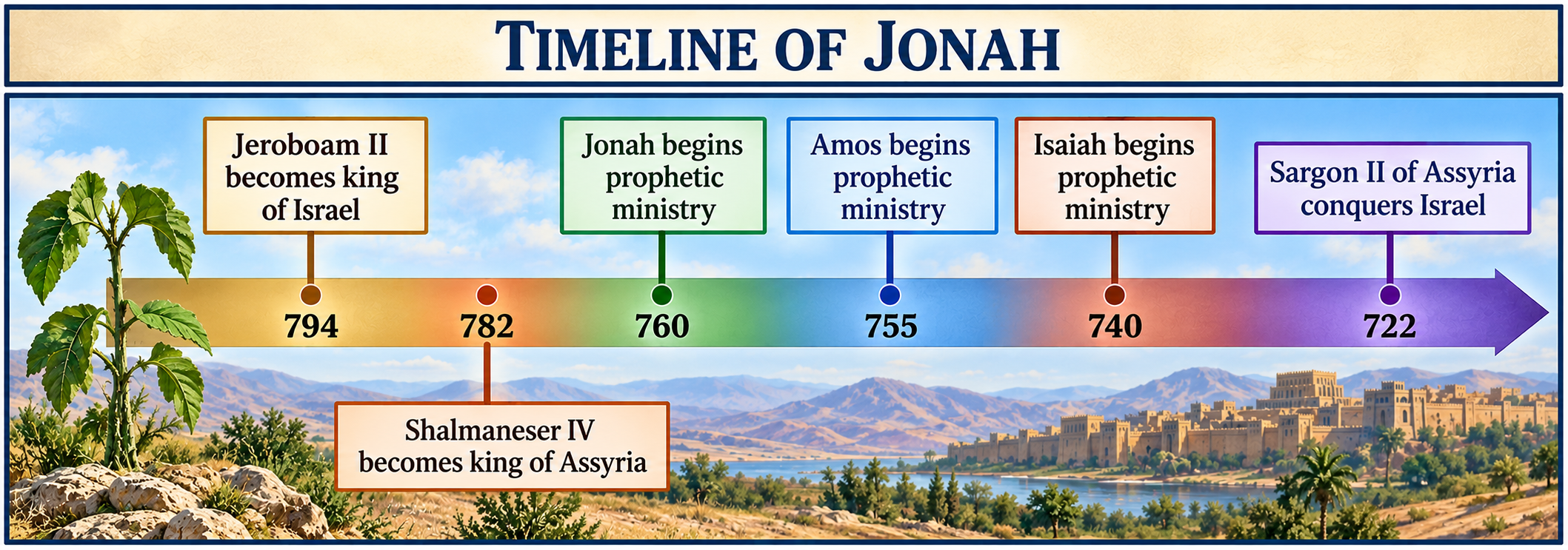
Jonah 1:1 The word of the LORD came to Jonah the son of Amittai saying,
- Jonah (KJV): 2Ki 14:25 Mt 12:39 Mt 16:4 Lu 11:29,30,32, Jonas
Related Passages:
2 Kings 14:25 He (Jeroboam II, king of Israel 2Ki 14:23–24 - AN EVIL KING - JONAH WAS NOT AFRAID TO TALK TO AN EVIL KING) restored the border of Israel from the entrance of Hamath as far as the Sea of the Arabah, according to the word of the LORD, the God of Israel, which He spoke through His servant Jonah the son of Amittai, the prophet, who was of Gath-hepher.
Matthew 12:39; 1But He answered and said to them, “An evil and adulterous generation craves for a sign; and yet no sign will be given to it but the sign of Jonah the prophet.
Matthew 16:4 “An evil and adulterous generation seeks after a sign; and a sign will not be given it, except the sign of Jonah.” And He left them and went away.
Luke 11:29; 30; 32 As the crowds were increasing, He began to say, “This generation is a wicked generation; it seeks for a sign, and yet no sign will be given to it but the sign of Jonah. 30 “For just as Jonah became a sign to the Ninevites, so will the Son of Man be to this generation.....11:32 “The men of Nineveh will stand up with this generation at the judgment and condemn it, because they repented at the preaching of Jonah; and behold, something greater than Jonah is here.

GOD SPEAKS CLEARLY
TO HIS PROPHET JONAH
The word of the LORD came to Jonah the son of Amittai saying - Notice the book of Jonah begins not with Jonah but where it should begin with the LORD! As noted below the word of the LORD is a familiar prophetic formula declaring that what follows in Jonah is divine revelation and divine commission, not Jonah's personal opinion or initiative (cf Jer 1:2, 4; Ezek 1:3; Hos 1:1; Joel 1:1; Mic 1:1; Zeph 1:1; Hag 1:1; Zech 1:1). It follows that the authority of the messenger and his message rests entirely upon the authority of the One Who sends him. God speaks, and His Word accomplishes His purpose despite the resistance of His servant. Jonah may run from God's command, but he cannot frustrate God's Word and neither can we beloved!!! The prophet may resist, the sea may rage, the sailors may fear, the great fish may swallow, and Nineveh may repent, but through it all the Word of the LORD that begins the book continues relentlessly toward its appointed goal as affirmed by another prophet Isaiah who recorded the words of the LORD...
For as the rain and the snow come down from heaven, And do not return there without watering the earth And making it bear and sprout, And furnishing seed to the sower and bread to the eater; So will My word be which goes forth from My mouth; It will not return to Me empty, Without accomplishing what I desire, And without succeeding in the matter for which I sent it. (Isaiah 55:10,11)
The word of the LORD came - This phrase occurs 102 times in the NASB obviously most often in the books of the prophets - Gen. 15:1; Gen. 15:4; 1 Sam. 15:10; 2 Sam. 7:4; 2 Sam. 24:11; 1 Ki. 6:11; 1 Ki. 13:20; 1 Ki. 16:1; 1 Ki. 17:2; 1 Ki. 17:8; 1 Ki. 18:1; 1 Ki. 19:9; 1 Ki. 21:17; 1 Ki. 21:28; 2 Ki. 20:4; 1 Chr. 22:8; 2 Chr. 11:2; 2 Chr. 12:7; Isa. 38:4; Jer. 1:2; Jer. 1:4; Jer. 1:11; Jer. 1:13; Jer. 2:1; Jer. 13:3; Jer. 13:8; Jer. 18:5; Jer. 24:4; Jer. 28:12; Jer. 32:6; Jer. 32:26; Jer. 33:1; Jer. 33:19; Jer. 33:23; Jer. 34:12; Jer. 35:12; Jer. 36:27; Jer. 37:6; Jer. 42:7; Jer. 43:8; Ezek. 1:3; Ezek. 3:16; Ezek. 6:1; Ezek. 7:1; Ezek. 11:14; Ezek. 12:1; Ezek. 12:8; Ezek. 12:17; Ezek. 12:21; Ezek. 12:26; Ezek. 13:1; Ezek. 14:2; Ezek. 14:12; Ezek. 15:1; Ezek. 16:1; Ezek. 17:1; Ezek. 17:11; Ezek. 18:1; Ezek. 20:2; Ezek. 20:45; Ezek. 21:1; Ezek. 21:8; Ezek. 21:18; Ezek. 22:1; Ezek. 22:17; Ezek. 22:23; Ezek. 23:1; Ezek. 24:1; Ezek. 24:15; Ezek. 24:20; Ezek. 25:1; Ezek. 26:1; Ezek. 27:1; Ezek. 28:1; Ezek. 28:11; Ezek. 28:20; Ezek. 29:1; Ezek. 29:17; Ezek. 30:1; Ezek. 30:20; Ezek. 31:1; Ezek. 32:1; Ezek. 32:17; Ezek. 33:1; Ezek. 33:23; Ezek. 34:1; Ezek. 35:1; Ezek. 36:16; Ezek. 37:15; Ezek. 38:1; Jon. 1:1; Jon. 3:1; Hag. 1:1; Hag. 1:3; Hag. 2:1; Hag. 2:10; Hag. 2:20; Zech. 1:1; Zech. 1:7; Zech. 4:8; Zech. 7:1; Zech. 7:8
Came to Jonah - Jonah was to function as a conduit or mouthpiece of God's Word. In other words, God's Word came to Jonah because God's Word was intended to go through him to others. As an aside God's Word did not come in cryptic form as if God was stuttering, but communicated clearly his commission, making his subsequent flight all the more striking. In other words, Jonah's flight from God was not a problem of lack of revelation but a problem of his heart and reluctance to obey revelation.
🙏 THOUGHT - If you are reading the Biblical text, not just these comments, then in a very real sense the Word of the LORD has come to you. Wherever you read in Scripture, God is speaking to you personally through His living and active Word. Therefore, every time you open the Bible, ask the Spirit to open your heart to the truth you are about to read and to give you both “the desire and the power” (Php 2:13NLT) to obey what you hear from the LORD. The question is not simply, “What does this passage mean?” (Interpretation) but also, “How will I respond to what God has just said?” (Application) Remember, knowledge of God's Word is no substitute for obedience to God's Word (Jas 1:22). When God speaks through His Word, our responsibility is not to edit it, negotiate with it, or run from it (like Jonah), but to obey it (cf 1Sa 15:22, Jn 14:15, Jn 14:21). And remember, we may run from what God says, but we can never outrun the God Who said it! (Play this old Christian song The Long Arm of the LORD. Jonah tried, but he soon discovered that you can run from the LORD, but you cannot run beyond His reach!)
The son of Amittai saying - This description identifies Jonah as the historical prophet mentioned in 2 Kings 14:25, where Jonah son of Amittai prophesied during the reign of Jeroboam II (ruled from ~786-746 BC - see Jeroboam II and Jonah on Timeline above). Jonah does not suddenly appear in Scripture as an otherwise unidentified figure but was already functioning as a prophet in Israel. Significantly, his name Jonah (Yonah) means “dove,” while Amittai is related to the Hebrew word for truth or faithfulness. Yet the “dove” is about to "fly the coup" in precisely the wrong direction!
NET NOTE - The Targum (Aramaic translation) of Jonah 1:1 interprets the Hebrew as, “There was a word of prophecy from the Lord” (cf. Tg. Hos 1:1).
Lowell Johnson - More jokes have been made about Jonah than any other book or character in the Bible - Jonah has been called "The Chicken of the Sea, we could call him one whale of a preacher, he went a little overboard in ministry, if he wrote his autobiography, it might be called, Jaws' The Inside Story. If this is getting too deep for you, just raise a fin! I do wonder if Jonah ever ate fish again after his experience. Actually, the great fish is not the central theme of the book of Jonah at all. G. Campbell Morgan correctly said, "Men have been looking so hard at the great fish that they have failed to see the great God." There are 48 verses in the book of Jonah - four chapters - the great fish is mentioned only four times. God is mentioned 38 times. The book of Jonah is about God! It's about the will of God and how we respond to it. It's also about the love of God and how we share it with others.
You may remember the movie that James Dean played in entitled "Rebel Without A Cause." Jonah may be called "The Rebel With A Cause." The word of the Lord came to him and gave him a special task to do, but instead of obeying God, he rebelled. He blatantly disobeyed the Divine command given to him. Two things I want you to see in these three verses: The Bible gives us very little background on Jonah. In fact there is only one other verse in the O. T. that says anything about Jonah - 2 Kings 14:25 (Let's get a running start and move back up to 2Ki 14:23-25, because these verses describe the reign of Jeroboam II). Jonah was a well known and well liked prophet in his day. He was an eighth century B.C. prophet who was a contemporary of Amos and Hosea. He ministered during the reign of Jeroboam II who "did that which was evil in the sight of the Lord" (2 Kings 14:24). In spite of that Jonah predicted that Jeroboam II would restore the border of Israel that had been taken from them, and it came to pass just as he said. We are told that he was from Gath-hepher which was about five miles northeast of Nazareth in Galilee where Jesus spent much of His first thirty years on earth. The name Jonah means "dove." The dove, of course, is the symbol of peace.• His father's name, Amittai, means "truth" or "truth of God." From Jonah's background we learn that Jonah had great knowledge of the grace of God, for even though it was undeserved, God graciously restored the border to Israel in spite of their sin. Believe it or not, it was the very grace of God that caused Jonah to be reluctant in going to Nineveh (Jonah 4:2). Jonah liked it when God showed grace to Israel, but Nineveh was Israel's enemy and a threat to Israel's very existence as a nation. Jonah didn't want them to experience grace. He wanted them to be destroyed. Now, before we throw stones at Jonah, we all like grace when it benefits us, but to see our enemies or our competitors experience grace is another story.
A. His call was Personal - "The word of the Lord came to Jonah." You would think that Jonah would have been honored to be chosen by God to speak for Him. God could have chosen anyone of a hundred prophets, but He chose Him ... He trusted him with the responsibility - and a great responsibility it was!
B. His call was Pointed - "Arise, go to Nineveh" (Get up and go) Nineveh is north of Baghdad in Iraq. The boundaries of today's Iraq include ancient Nineveh. When God said "Nineveh," it was like waving a red flag before a raging bull for Jonah. He hated the people of Nineveh. the cruelty we have seen in Iraq is the same kind of cruelty Jonah saw. They would kill children and make pyramids of human heads from the boys and girls. They would pull the tongues out of people and then impale them alive on poles. They would skin the people alive and stake them to the ground in the hot sun near ant beds. They would cut off the ears, hands, and feet of people to torture them and then filet them while alive. Nahum 3:1-4 gives a summation of Nineveh' s evils. They were despised enemies of God's people. On many occasions they had poured out their wrath on the Jewish people. But - knowing all that didn't excuse Jonah for disobeying God. God was able to protect him from all of that - and did, as we shall see.
C. His call was Purposeful - There were two good reasons Jonah should have been faithful and obedient to God's call. (1) The character of Nineveh - "Their wickedness has come up before Me." Their wickedness had reached a high degree. It was full to the brim. - It was a case of immediate repentance on the part of Nineveh or the coming judgment of God against them. (2) The character of God. Why would God send Jonah to Nineveh? Read 2 Peter 3:9; 1Ti 2:4, John 3:16. Jonah wasted no time in heading for Tarshish once the orders were received to go to Nineveh. No sooner had God given orders to Jonah, than Jonah began quickly to disobey. He was not an immoral man who had lowered himself to live in the gutter of the world; he was not a profane blasphemer whose mouth was an opening for sewage. He was not that kind of sinner. What was his great sin? It was the sin of omission. He refused to do what God called him to do. He ran from the responsibilities of God's call on his life.
So many people are complacent about their sin. Some folks don't even recognize sin in their lives when it's there. There was a cowboy who was converted in a revival meeting. He had the reputation of being a profane and blasphemous man. He was leaving church one Sunday morning about two weeks after his conversion and he said to his pastor, "Preacher, I want you to know that I have gotten rid of all my sins except one." The preacher responded, "Which one is that?" The cowboy answered, "I still curse a little bit when I get drunk." There are a lot of us who have things wrong in our lives and refuse to recognize these as sins, but they are. If there was one obstacle standing between Nineveh and God, it was Jonah. The people's sin was no hindrance to God. They are going to repent in chapter 3 and believe as soon as they hear God's warning. They were ripe for salvation. Often we are the problem. We want to blame Hollywood or the music kids listen to or planned parenthood. The truth is we often don't care enough if people perish without Christ. Twice in Jonah 1:3 it says that Jonah tried to "flee from the presence of the Lord. He wants to put as much distance as possible between himself and God. That's a perplexing idea. Can anyone leave the presence of the Lord? It In one sense it is impossible to get away from the presence of the Lord; for God is omnipresent. (Ps. 139:7-8) But that phrase, "out from the presence of the Lord," can refer to something else (Ge 3:8,9; Ge 4:16 "went out from the presence of the LORD" cf 2Th 1:9). Cain was not leaving the omnipresence of the Lord, but the place where he worshipped God, the place where God's Word is declared, the place where Cain spoke to God. Jer. 23:39 God says to disobedient Israel, "I will cast you out of My presence." God meant that they would be separated from the place of spiritual privileges.
When folks stay away from the house of God, they are trying to hide themselves from the presence of God. Sin doesn't like the presence of God. It's reflected in church attendance ... in our own devotional life. Disobedience is not free. It cost Jonah plenty. He was not exempt from the cost - "he paid the fare."
A lot of us are on boats sailing for Tarshish
while God is saying "Go to Nineveh."
It seems at first that providence smiled on Jonah - the Devil had a boat waiting for him, going where he wanted to go which was the opposite from where God told him to go. But later, Jonah will not be so pleased over the price he must pay for his disobedience. Listen to Jonah 1:3 - "So Jonah paid the fare" in more ways than he realized. • He is going to pay and pay and pay - The prodigal son learned that lesson as did Samson and so does everyone who disobeys God. Notice: He went down to Joppa (3) and down to the ship (v.S) and down to the bottom of the sea (Jonah 2:6). Sin and disobedience never bring you up; it always brings you down! A lot of us are on boats sailing for Tarshish while God is saying "Go to Nineveh." Where are you headed? There are only two roads in the Christian life - one leads to Nineveh and the other to Tarshish. One road leads in obedience to His Word and will and the other to disobedience. Let's be honest. There's a bit of Jonah in all of us. Many of us have heard God's call and gone the other way only to find the fall has been continuous and costly. How wonderful it is to know that Jesus paid our fare for us on Calvary. "Jesus paid it all, all to Him lowe; Sin had left a crimson stain, He washed it white as snow."
Some of our most serious sins
are sins of omission.
SERMON SUMMARY - The great fish is not the great subject of Jonah; the great God is. Don't become so fascinated with the great fish that you miss the great God. Jonah is ultimately a book about our response to the will and heart of God. God's will was clear: “Arise, go to Nineveh” (Jon 1:2). Jonah's problem was not understanding God's will but was accepting God's will. We may love God's grace when it is directed toward us while resenting that same grace when it is extended to others. Jonah had witnessed God's undeserved goodness toward sinful Israel during Jeroboam II's reign (2Ki 14:23–27), yet he did not want Israel's enemies to experience that same compassion (Jon 4:2). Grace is easiest to appreciate when we are its recipients. The wickedness of Nineveh did not excuse Jonah's disobedience. Nineveh's cruelty was real, but God's command was still clear. The difficulty of an assignment never cancels the authority of the One Who gives it. Some of our most serious sins are sins of omission. Jonah's initial rebellion consisted in refusing to do what God commanded. James later states the principle: “To one who knows the right thing to do and does not do it, to him it is sin” (Jas 4:17). Sometimes the greatest obstacle to God's work is not the hardness of the people but the reluctance of God's servant. The mission field was ready before the missionary was willing. Providential circumstances do not necessarily indicate divine approval. Jonah found a ship sailing exactly where he wanted to go (Jon 1:3), but the conveniently available ship did not mean God approved his journey. Never interpret an open door as God's will when it contradicts God's Word. Disobedience always has a fare attached. Jonah “paid the fare” (Jon 1:3), but the monetary fare was only the beginning. His rebellion cost him peace, fellowship, safety, and nearly his life. Sin always costs more than the price advertised. Sin may sell you the ticket cheaply, but the journey becomes terribly expensive. Jonah's downward movement vividly pictures the direction of disobedience. He went down to Joppa (Jon 1:3), down into the ship (Jon 1:5), and ultimately “descended to the roots of the mountains” beneath the sea (Jon 2:6). While we should not make too much of geography, the narrative creates a memorable picture: Jonah was traveling geographically and spiritually away from his commission. God loved Jonah too much simply to let him sail away. The storm was not evidence that God had abandoned Jonah. It demonstrated that God was pursuing him (Jon 1:4). Sometimes God's severe providence is actually an expression of His persistent grace and love. And one of the most poignant, painful takeaways from Jonah is that there is a little Jonah in all of us. We can know God's Word, experience God's grace, and even serve God while resisting something He wants from us. Jonah warns us that biblical knowledge is no substitute for a surrendered heart.
The fundamental issue is not geographical but spiritual. Am I moving toward obedience or away from it? When God's Word clearly says “Nineveh,” no amount of favorable circumstances can make Tarshish the will of God. Jonah wanted grace for Israel but judgment for Nineveh. Yet grace ceases to be grace if we believe it should be restricted to people we consider deserving. The person who understands how much mercy he himself has received should increasingly desire that mercy for others. The great question of Jonah is not “Can God control a fish?” but “Will God's servant share God's heart?”
Lowell Johnson - (Another Sermon on Jonah) Jonah 1:1-6 When Sin Upsets God
Sin has a domino effect.
Once put in motion, it disturbs everything.
Transgression does not bring Tranquility; rather it brings Turbulence! Sin disturbs minds, marriages, schools, businesses, cities, nations, and churches. The sin of man has so upset things that Paul said, "The whole creation groans and travails in pain" (Rom. 8:22) as a result. Man tries to play down the seriousness of man's disobedience to God, but the consequences of even so called small sins, mock every attempt of man to belittle sin's evil effects. One stone of sin thrown into the sea of humanity sends its waves to the furthest shores. Romans 14:7 "No man lives unto himself" The guilt of one man endangers the lives of many. The misconduct of a nation's high official causes the whole nation to suffer. The drinking driver can leave a cruel scar on many families. The greed of Achan can cost the lives of many and bring defeat to an army. Therefore, we are not surprised when Jonah's disobedience brought disturbance on every hand. Sin has a domino effect. Once put in motion, it disturbs everything. God is ever watching over us. Our conduct either pleases Him or it upsets Him! Obedience brings God's approval and blessing, but disobedience upsets God and invites His judgment.
In v. 2 God gave Jonah a command; v.3 says, "but Jonah." Jonah is about to lock horns with God, and locking horns with God is a good way to get dehorned. If you upset God, God will upset you.
ILLUSTRATION - In writing about the Battle of Waterloo, Victor Hugo said it was impossible for Napoleon to win at Waterloo. He said that the reason Napoleon could not win at Waterloo was not because of Wellington, the great British general or because of the rain and fog, but because of God. Hugo said that Napoleon upset God and that is what made it impossible for Napoleon to win the battle.
Jonah has upset God and that made it impossible for Jonah to keep the peace. It would help a great deal if man were more concerned about the fact that sin really disturbs God! When God does deal with sin, some see God as a mean, cruel, hateful and vindictive God who, with a blood-thirsty glee, delights to smash His enemies and hurt them. No, God was upset with Jonah, but God's strong reaction to Jonah was not without love, mercy and grace. In His wrath, God was endeavoring in love and mercy to bring Jonah back to the path of obedience.
ILLUSTRATION -I heard about a little boy who got a new sailboat. He put his little boat into the water and then got distracted by something else. When he finally looked up, the boat had floated far beyond his reach. His dad saw what had happened and grabbed a handful of large rocks. He began to throw the rocks beyond the boat and the ripples brought the boat back to him. I think that's what God is doing in the life of America. Some think God is just throwing rocks at us, but He is throwing beyond us so that the ripples will bring us back to Him.
QUESTION - Who was Jonah in the Bible? | GotQuestions.org
ANSWER - Proud, stubborn, disobedient, unfaithful, a grumbler, and altogether a bad-tempered, cantankerous old curmudgeon—this was Jonah, whose name means “dove”! Jonah was the son of Amittai, who came from Gath-hepher in Zebulun (called Gittah-hepher in Joshua 19:10-13). He was the earliest of the prophets and close behind Elisha in his place in the Old Testament. Jonah’s story is told in the short (just 48 verses) but powerful book of Jonah.
When God called Jonah to go and warn the violent and godless Ninevites of their impending doom, all his pride in being a Hebrew—and therefore uniquely favored by the Almighty (so he thought, no doubt along with many others of his nation)—rose up in rebellion. Pagans, to him, were the worst kind of human garbage, not even fit to pollute the good earth by living on it. They were the “untouchables,” and that God should take an interest in them was unthinkable. Therefore, not being one to put up with that which was not to his mind, he fled to Joppa and got himself a passage on a ship bound for Tarshish, which was in the opposite direction from Nineveh.
A human father would probably have shrugged Jonah off in disgust and found someone else more willing to take his message to Nineveh, but not so our Heavenly Father. If God has a purpose for someone, then, the gifts and calling of God being irrevocable, he will either fulfill His purpose, or He will simply roll over him to accomplish what He has foreordained (Isaiah 46:9-10). God rolled over Jonah with a vengeance, causing a violent storm to threaten the safety of his ship and its crew, so that their indignation at his contented snoring through their danger soon put an end to his satisfaction. This unceremonious awakening also awakened Jonah to the fact that, far from being an “artful dodger,” he was being followed by the Almighty. There was nothing for it but to confess what he had been up to and tell the sailors that only by dumping him overboard could they be saved. This they did, and the huge fish sent by God (not a whale as commonly supposed, but some sea creature common to that time) promptly swallowed him up (Jonah 1:17). This, and the immediate stilling of the storm, brought the ship’s crew to faith and salvation as a result (Jonah 1:16). The Lord is not one to miss out on His opportunities!
At this point Jonah has now found himself in a situation worse than anything he could have imagined, but like Jacob, he has by now awakened to the fact that God is with him wherever he ends up, in obedience or disobedience. The result is a beautiful prayer of faith rising up from the belly of the great fish, but still with a hint of spiritual pride: “Those who cling to worthless idols forfeit the grace that could be theirs. But I, with a song of thanksgiving, will sacrifice to you. What I have vowed I will make good. Salvation comes from the LORD” (Jonah 2:8-9).
In response to this prayer of contrition and faith, on his Creator’s orders, the fish then vomits up Jonah on what was probably the shores of Israel. Researchers tell us that it must in all probability have been there because it was a three-day journey on foot from that point to the great city of Nineveh, which is in line with the statement in Jonah 3:3. Ancient cave drawings from this time indicate that Ninevite fishermen lived on the shores of the Mediterranean. This fact is important in illustrating the wonderful way in which God paves the way for His servants to fulfill His commands. The principal goddess worshiped by the Ninevites at that time was Ashtoreth, but they also deferred to the god Dagon who had a man’s upper body and a fish’s tail. Jonah, so the researchers say, would have been bleached completely white from his head to his toes by the acids present in the belly of the fish, and on the sudden appearance of this ghostly figure from the waves the fishermen may have been convinced that this was Dagon’s messenger and fallen flat in worship. These men would have fed and housed Jonah until he was recovered enough from his experience and then, as he was a stranger in those parts, given him directions on how to find their city. Of course, the biblical narrative doesn’t give us these details, but it is fascinating to theorize.
In any case, the biblical text is a masterful expression of understatement: “Then the word of the LORD came to Jonah a second time: ‘Go to the great city of Nineveh and proclaim to it the message I give you’" (Jonah 3:1-2). This time, there is no arguing from Jonah, who, although he may be complying on the outside, is still stubbornly disobeying on the inside. He finally arrives at Nineveh and strides vengefully through the city announcing doom and destruction on the people in forty days because of their wickedness and their ignorance of the Lord and His ways. He then retires to a flimsy shelter he builds for himself, probably on a hill overlooking the city, and waits for the fireworks to start (Jonah 4:5). Result? Utterly and absolutely nothing! To his utter chagrin, he finds not just the people from the king down, but their animals as well, clothed in sackcloth and sprinkled with ashes as an indication of their absolute acceptance of the prophetic word sent to them by God, their deep repentance, and their fervent anxiety to get right with the Lord (Jonah 3:5-10). This does not suit our friend Jonah at all and he flies into a fury at God and lets Him have no small piece of his mind (Jonah 4:1-3). God’s answer is to cause a leafy gourd to grow up to help protect Jonah from the blazing sun, for which Jonah is somewhat sullenly grateful, and then to promptly remove it the next day! His reply to Jonah’s bitter complaints about this is that if Jonah can have so much compassion on himself for his loss of comfort in spite of being aware of what a faulty child of God he is, then how much more compassion will Almighty God have on a people who are utterly ignorant of right from wrong (Jonah 4:9-11).
So that is Jonah—a very great comfort to all who fall flat at times when it comes to obedience and who run away from what they know God wants them to do. Jonah’s story is also an object lesson to those who are possessed of a short fuse and those who are at times guilty of a superior attitude to the spiritually ignorant or immature. Like the Ninevites, many around us are in darkness, and but for the grace of God, so would we be. May we all by that grace read, mark, learn, and inwardly digest the Word!
Norman Geisler - JONAH 1:1—Is the Book of Jonah fact or fiction? - When Critics Ask
PROBLEM: Traditional Bible scholarship has held that the Book of Jonah records events that actually took place in history. However, because of the literary style of the book and the amazing adventures that are said to have befallen the prophet Jonah, many modern scholars propose that it is not a book of actual historical events, but a fictional story designed to communicate a message. Did the events of Jonah actually happen or not?
SOLUTION: There is good evidence that the events recorded in the Book of Jonah are literal historical events that took place in the life of the prophet Jonah.
First, the tendency to deny the historicity of Jonah stems from an antisupernatural bias. If miracles are possible, there is no real reason to deny that Jonah is historical.
Second, Jonah and his prophetic ministry is mentioned in the historical book of 2 Kings (14:25). If his supernatural prediction is mentioned in a historical book, why should the historical nature of his prophetical book be rejected?
Third, the most devastating argument against the denial of the historical accuracy of Jonah is found in Matthew 12:40. In this passage Jesus predicts His own burial and resurrection, and provides the doubting scribes and Pharisees the sign that they demanded. The sign is the experience of Jonah. Jesus says, “For as Jonah was three days and three nights in the belly of the great fish, so will the Son of Man be three days and three nights in the heart of the earth.” If the tale of Jonah’s experience in the belly of the great fish was only fiction, then this provided no prophetic support for Jesus’ claim. The point of making reference to Jonah is that if they did not believe the story of Jonah being in the belly of the fish, then they would not believe the death, burial, and resurrection of Jesus. As far as Jesus was concerned, the historical fact of His own death, burial, and resurrection was on the same historical ground as Jonah in the belly of the fish. To reject one was to cast doubt on the other (cf. John 3:12). Likewise, if they believed one, they should believe the other.
Fourth, Jesus went on to mention the significant historical detail. His own death, burial, and resurrection was the supreme sign that verified His claims. When Jonah preached to the unbelieving Gentiles, they repented. But, here was Jesus in the presence of His own people, the very people of God, and yet they refused to believe. Therefore, the men of Nineveh would stand up in judgment against them, “because they [the men of Nineveh] repented at the preaching of Jonah” (Matt. 12:41). If the events of the Book of Jonah were merely parable or fiction, and not literal history, then the men of Nineveh did not really repent, and any judgment upon the unrepentant Pharisees would be unjust and unfair. Because of the testimony of Jesus, we can be sure that Jonah records literal history.
Finally, there is archaeological confirmation of a prophet named Jonah whose grave is found in northern Israel. In addition, some ancient coins have been unearthed with an inscription of a man coming out of a fish’s mouth.
Jack Arnold - The Book of Jonah is not a fish story. The fish is not the hero or the villain. The fish is merely an incidental but the essentials of the book are the dealings of Jehovah with Jonah and the dealings of Jehovah with men. The Book of Jonah is practical, and, while written by a prophet, has no prophecy in it because it deals with a believer's struggle to be obedient to his God. The Book of Jonah deals with foreign missions and the call of God to His servant for missions.
Martin Luther said "This narrative seems almost unbelievable, yea, sounds like a greater falsehood and folly than any fable of the poets. If it were not recorded in Scripture, I would regard it as ridiculous lie....I myself would not believe it, were it not written in Holy Scripture."
Jonah 1:2-3 Sign-Seekers
Read: Luke 11:29-32
This is an evil generation. It seeks a sign, and no sign will be given to it except the sign of Jonah the prophet. —Luke 11:29
A skeptic once said to me, “I’ll believe in Jesus if He comes down and appears visibly above my house.” Not necessarily!
The Christ-rejecting religious leaders who requested a sign from Jesus had plenty of evidence for believing. They had undoubtedly heard of, if not seen, His miracles of healing, casting out demons, and even raising the dead. What more did they need?
Jesus therefore called them an “evil generation” (Luke 11:29). The only sign they would be given was the sign of Jonah the prophet, who had been thrown into a stormy sea (Jonah 1:2-3). When the Ninevites heard Jonah’s message of repentance after he had spent 3 days in the belly of a fish, they believed God had sent him and they repented.
Likewise, the religious leaders who already knew of Jesus’ words and works would soon see Him crucified and securely entombed. And in the following weeks they would hear personal testimonies from those who had seen Him alive, and had even touched Him, but they still wouldn’t believe.
Today we have in the Gospels a record of what Jesus said and did, written by people who knew Him. If we are open to the truth, we have all the evidence we need to believe. We don’t need to be sign-seekers. Herbert VanderLugt (Reprinted by permission from Our Daily Bread Ministries. Please do not repost the full devotional without their permission.)
If we desire to honor God,
We take Him at His Word
And ask Him not for special signs,
But trust, "Thus saith the Lord."
—D. De Haan
The sign of genuine faith is faith that needs no sign.
"Rebellion never escapes God’s notice, and it is foolish for men to think they can resist God’s will with impunity.” — William L. Banks
“The Lord may let a man go to a certain point before He steps in, but when He does move, He moves with no uncertainty.” — William L. Banks
Robert Neighbour - Jonah Commissioned
"Now the Word of the Lord came unto Jonah, the son of Amittai, saying, "Arise and go to Nineveh, that great city, and cry against it, for their wickedness is come up before Me" (Jon. 1:1, 2).
1. Let us get before us the city of Nineveh. The key verse says, "That great city." Nineveh was a city of some six hundred thousand souls. The beginning of the city goes back to the times of Nimrod the mighty hunter. See Genesis 10:8-11. It was a city given over to sin and vile practices.
2. The wickedness of Nineveh was not hidden unto God. The text says, It had "come up before" God. So it was, in the case of the cities of Sodom and Gomorrah; so it was in the case of the whole world in the days of Noah. May we not safely say: so it is today? Surely the sins of our great cities must rise like a stench in the nostrils of our God.
3. Jonah's commission was, "Go and cry against Nineveh." This little word "go," heads the great commission of the Church, "Go ye into all the world, and preach the Gospel to every creature."
The one word that sums up the call of God to the world, is the word "come." The one word that sums up God's command to the Church is the word "go."
"How shall they hear without a preacher?" (Ro 10:14,15) No wonder that Christ said, "I must needs go through Samaria." No wonder we read: "The Gospel must be preached." When the call is made; "Who will go?" shall we not respond? "Here am I; send me!" 4. Back of the word "go" is the heart of a compassionate God. Our God is not willing that any should perish. The angel of mercy gives the call for repentance and faith before the angel of wrath goes forth. Every call of the Gospel heralder is a plea from God to "flee the wrath to come." We cry against a sinner, we preach coming judgment, in order that the sinner may turn to God and be saved.
James Smith - JONAH THE RUNAWAY JONAH 1:1–3
This is one of the most romantic of all the books of the Bible. To those who can read between the lines, it is more fascinating than the most popular novel.
I. Who was Jonah? From 2 Kings 14:25, we learn that he was the servant and prophet of the Lord—no mean title. His name means “Dove.” If it was an expression of his nature, then perhaps this is one reason why he fled from great and wicked Nineveh. He was the son of Amittai, but his father’s name is shrouded in obscurity. All great men don’t spring from great parents. Although the world has never missed your father, that is no reason why it should not miss you when you are gone. A tinker may die without much ado, but the name of Bunyan will be held in everlasting remembrance. Don’t trifle with the days of your youth. Jonah was the author of this book which bears his name. Oh, what a revelation he himself gives us of his own faults and follies. Don’t condemn him too severely for being a runaway prophet, for we never would have known about it had he himself not told us. Write down your own faults as Jonah did, and see if your record is not infinitely blacker than his. Would you dare to do it? At anyrate the recording angel is doing it for you. It is clear that in writing this book, Jonah does not seek his own glory. No man can be a prophet of God who does. Self-seeking is the spirit of Antichrist, and with him must be cast into the bottomless pit.
II. His Commission. The Lord said to Jonah: “Arise, go to Nineveh, that great city, and cry against it.” This was a sudden and startling call, but all God’s calls are sudden. Look at the city to which he was sent. It had been founded by Nimrod shortly after the confusion of tongues at Babel, and was therefore one thousand years old. It was the greatest city in the mightiest monarchy in the world. It was sixty miles in circumference, and contained streets and avenues twenty miles long; its walls were a hundred feet high, and so wide that three chariots could be drawn abreast on the top. Its population must have been over 600,000. But, moreover, it was great in wickedness, and that wickedness had climbed up to the very throne of God. Little did those wealthy and voluptuous Ninevites think that their secret sins were committed in the face of Jehovah. But so it was, and so it is now. The secret sins of our modern cities cry louder in the ears of God than the roar and rattle of the traffic in the streets. If we had the ears of God, nothing would strike us more, I think, than the longsuffering patience of our God. Friend, think of it, every sin unforgiven is a voice crying to Heaven for vengeance. Nothing can silence that cry but the precious Blood of Jesus. Now look at the purpose for which Jonah was sent to Nineveh. He was to “cry against” it. What a task. One little pebble in the bed of a mighty madly rushing river crying against it. But the prophet was not to be concerned about success, he was simply to obey the call, and leave the consequences in the hands of Him who called him. Ye are my witnesses, saith the Lord. Every witness for God must “cry against” the wickedness of their day and generation. The present generation is cursed with dumb dogs which cannot bark. Think of the murderous drink traffic, licensed and protected by law, to make and to bury 100,000 drunkards every year, and men professing to be witnesses for God, refusing to cry against it. Think of the gambling fever that’s flushing the faces of so many of our young men, and hurrying them headlong to eternal ruin. Think of the infidelity and indifference that’s settling down among the people, like a deadly malaria. Oh, that all God’s prophets would “cry against it.” But, say you, they only mock. Well, better be mocked for your faithfulness than your cowardliness.
III. His Disobedience. Instead of going to Nineveh, Jonah fled to Tarshish, at least he tried to. He arose like a pigeon let loose in a strange place, performed the circle of indecision, then darted off in the wrong direction. Perhaps you have treated the call of God in the same way. You have heard His Word, and knew that you ought to believe it, and be saved, but you turned away from it, and fled from the Lord. Jonah was displeased, and, as it were, sent in his resignation as a prophet. It is much easier to resign than to face a stern difficulty. Any craven-hearted fool can refuse to obey. Yes, it is easy to flee from the will of God, when the heart is not in sympathy with Him and His work. It is easy to refuse hearing the Word of God on a Sunday, when the heart and mind are occupied only with worldly things. Jonah was on the “down grade” to shame and confusion when he went down to Joppa, then down into the ship. If we are seeking to shake ourselves clear of God’s call to repentance and faith, we are as surely on the down grade to spiritual desolation. Think of the sin of it, “fleeing from the presence of the Lord.” Why? Because the presence of the Lord is intolerable to a rebellious will. It is because of this that men will one day cry on the rocks to fall on them and hide them from His presence. Just now God is calling men to arise and flee to Christ, but instead of doing that, they are fleeing to Nineveh, seeking to drown conviction in the pleasures of the world. Jonah having fled, the next thing he had to do was to “pay the fare.” So he “paid the fare and went down.” Ah, but Jonah had more to pay than he expected. The fare is not all paid in advance. Young man, have you ever considered what the fare is, from the presence of the Lord to the land of godlessness? Look at that shattered frame, that bloached face, that blasted character, that man fled to strong drink, and he is now paying the fare. See that miserable miser with greed stamped on his face, and a heart as cold and callous as the gold he hoards; he fled to money, and had to pay the fare of becoming its slave. That young woman who once thought of becoming a Christian, but was hindered through the fear of man, and who has fled from the presence of Christ, is now paying the fare, in a seared conscience and a hopeless life. Truly the way of transgressors is hard. The prodigal in the far country, in rags and wretchedness, staring with hungry eyes at the swine troughs, was just paying the fare to get away from his father. What is the meaning of that weeping and wailing in eternity? It is this: The souls who have fled from the presence of the Lord Jesus Christ paying the fare. What a price. Are you prepared to pay your own fare, or will you trust the price Jesus has paid on your behalf? (1 Peter 1:18, 19).
Croft Pence - GOD’S CALL REJECTED Jonah 1:1–17
A. THE CALL—Jonah 1:1–2
1. God’s call—Jonah 1:1. As God called Jonah, so He calls all Christians—John 15:16.
2. God’s challenge—Jonah 1:2. God wanted Jonah to go and preach to Nineveh, a city of people who had no concern about God.
God calls everyone. However, those who are spiritually deaf don’t hear this call, and those who are hardhearted ignore it.
B. THE CALLOUSNESS—Jonah 1:3
1. Disobedience—“went to Tarshish.” This was in the opposite direction of Nineveh.
2. Downward—“Went down.” When one runs from God, he goes downward in many phases of his life.
3. Departure—“From the presence of the Lord.” Jonah tried to escape God’s presence, which is impossible—see Ps. 139:7–12.
C. THE CONFUSION—Jonah 1:4–8
1. Storm—Jonah 1:4. Storms always come when one disobeys God.
2. Sleeping—Jonah 1:5. During the storm, Jonah was asleep. He felt no concern for what was happening about him.
3. Safety—Jonah 1:6. The sailors begged Jonah to call upon his God. Jonah was ashamed to call upon God, since he was running from Him.
4. Sorrow—Jonah 1:7–8. Running from God causes others to suffer. God sent a storm because of Jonah’s disobedience, but the whole crew on the ship was affected.
D. THE CONFESSION—Jonah 1:9–14
1. Problem—Jonah 1:9. Running from God made Jonah fearful.
2. Price—Jonah 1:10. There is a price to pay when one rejects God.
3. Plan—Jonah 1:11–12. Jonah asked to be thrown into the raging sea.
4. Patience—Jonah 1:13–14. The sailors didn’t want to throw Jonah into the water, since they didn’t know that God would protect him.
E. THE COMPASSION—Jonah 1:15–17
1. Casting—Jonah 1:15. The sea stopped raging. In the same way, confession and cleansing brings inner peace.
2. Confession—Jonah 1:16. The sailors vowed to serve Jehovah. They were more godly than Jonah at that point.
3. Compassion—Jonah 1:17. God had prepared a great fish. God could have let Jonah die, but God had a mission for him.
Melvin Worthington - The Rebellious Prophet
The Word Heard (Jonah 1:1, 2). God spoke to Jonah and instructed him to go to the wicked city of Nineveh and cry against it because of its wickedness. This word from God was a definite word, a disturbing word, a distinct word, and a disobeyed word.
The Will Hardened Jonah 1: 3). Jonah understood God’s Word and yet he was uncomfortable with God’s Word and unwilling to obey God’s Word. He acted as people often do who don’t like God’s commands—he rebelled and ran away, thus removing himself as far as possible from being under the influence of God.
The Wrath Hurled (Jonah 1:4–16). The truths embedded in these verses include the directed storm (Jonah 1:4), the discovered sin (Jonah 1:5–13), and the devoted sailors (Jonah 1:14–16).
The Whale Handy (Jonah 1:7). The sailors cast Jonah into the sea and a huge fish swallowed him. Jonah was in the belly of the fish three days and three nights. Truths found in this verse include the prepared fish, the providential fact, the prophetic figure, and the prophet’s fate.
MISSIONARY DROPOUTS - How about those notable missionary dropouts, Jonah and John Mark? Jonah never really dropped in, you know; he was a refugee from the will of God from Day One. After he made that curious amphibious landing there on the shores, he hurried to Nineveh and preached in the greatest revival of all time. An entire city—the capital of a mighty empire—repented. Every human being in that vast municipality fasted and prayed. Even the animals were required to fast. Think of it! Every man, woman, and child in that great metropolis donned sackcloth, including the animals. After he had fled from God, rebelling against God’s clearly-stated will, that old prophet had all kinds of broken piñions (and wet ones, too). Yet God said, “Jonah, I still want to use you. Let’s get back on track.” And Jonah went on to lead a spiritual awakening that shook the ancient world. (Charles Swindoll - Great Lives: Moses)
Tim LaHaye - OUR STORY Embracing Eternity: Living Each Day with a Heart Toward Heaven
The Lord gave this message to Jonah. Jonah 1:1
“If the Bible teaches one thing about God, it is that he is for us. He is not against us.” The Remnant, 230
WE ALL (ED: BELIEVERS) have a divine calling before God (1Pe 2:9, Eph 2:10). Even those who don’t understand their role in the Creator’s greater plan know instinctively that they have certain gifts and strengths and that these qualities play a role in defining who they are and what they do (1Co 12:7). Like Jonah, we are called to a purpose. Jonah was a prophet of God. I am a writer. My wife is a teacher and a homemaker. You have a job before God as well (ED: IF YOU ARE A FOLLOWER OF CHRIST!)
Regardless of these differing gifts and vocations, we can all see ourselves in the story of Jonah. You don’t have to be a prophet to ignore God’s calling and run from him. Jonah’s story is our story.
The book of Jonah is broken into four chapters, like four separate acts of the same drama. It’s almost as if the translators outlined the lesson for us. In chapter one Jonah runs away from God. In chapter two he runs back to God. In chapter three Jonah runs with God. And in four he runs ahead of God. The reason we can so readily relate to his story is because we’ve all been at these four stages at one time or another. In fact, you’re at one of these stages now, depending upon where you are in your relationship with God.
We’ve all run away from God. We’ve all felt his hand on our shoulder and his voice in our ear, only to turn away and pretend not to hear. Later, God. I’m busy right now.
We’ve all run back to God. In a moment of trial or desperation, we’ve all fallen to our knees and cried out for help. We’ve asked for deliverance, provision, justice, mercy, forgiveness, or protection. I know I haven’t been faithful, Lord, but please help me!
We’ve all run with God (Gal 5:7). We see him moving and we follow, step for step, working alongside him to fulfill a need. Use me, Lord!
And we’ve all run ahead of God. Sometimes God moves slower than we’d like, so we take things into our own hands. We decide what’s best and then work to drag God into our plans. I’m doing this for you, Lord, but I need you to cooperate.
Jonah’s story is our story.
REFLECTION When is the last time you felt the Lord calling you? What was your response?
Adrian Rogers quotes from his sermon on Jonah entitled Miracle of Missions (click for full sermon)...
“It’s not news when a man catches a fish, but it’s news when a fish catches a man.”
“God always uses the threat of judgment to bring men to repentance.”
“God had much rather forgive and save than to judge.”
“To say ‘Christian’ is to say ‘missionary.’”
“My life is not my own to do with as I please.”
“Never be afraid of the will of God.”
“When Jonah was out of the will of God, others suffered.”
“Any man of God, any woman of God, any father, any mother, anybody that gets out of the will of God, not only do they pay the fare for themselves; but... those around them are going to suffer.”
“When it falls, that great and mighty tree, it just pulls down all the little saplings that are all around it.”
COMMENT - Our disobedience is never entirely our own; when we fall, others may fall with us.
“The whole Bible is full of Jesus. The whole Bible is a gospel message.”
“Jonah here becomes a picture—a type—of the Lord.”
“Jonah died that the others might live.”
“You can’t lighten the ship.” “All of their toil, their sweat, their tears, was not enough.” “Lightening the ship did no good. Rowing hard did no good.” “In one moment, more was accomplished than with all of their toiling and all of their lightening of the ship.”
“God did it—and it’s a miracle, pure and simple.” “I don’t have any difficulty with miracles.” “Once you get past Genesis 1:1... you’ll have no difficulty with miracles.”
“The miracle in this story is not Jonah and the great fish...; the great missionary miracle is the grace of God.”
“God is the God of the second chance.”
“‘The word of the LORD came unto Jonah the second time.’... it shows the miracle of God’s grace.”
“God is not a God that holds grudges.”
“Though you’ve been running from God in the past, though you say, ‘I’ve missed the will of God,’ it’s not too late for you.”
“Jonah, you’ve got your values all upside down.” (Jonah 4:1)
“What is it that is your little gourd vine? What is it that means more to you than lost souls?”
“We’re like Jonah: interested in gourd vines rather than souls.”
“We need to have the heartbeat that God Almighty has.”
Jonah 1:2 “Arise, go to Nineveh the great city and cry against it, for their wickedness has come up before Me.”
KJV Arise, go to Nineveh, that great city, and cry against it; for their wickedness is come up before me.
NET "Go immediately to Nineveh, that large capital city, and announce judgment against its people because their wickedness has come to my attention."
NLT "Get up and go to the great city of Nineveh. Announce my judgment against it because I have seen how wicked its people are."
ESV "Arise, go to Nineveh, that great city, and call out against it, for their evil has come up before me."
NJB 'Up!' he said, 'Go to Nineveh, the great city, and proclaim to them that their wickedness has forced itself upon me.'
NRS "Go at once to Nineveh, that great city, and cry out against it; for their wickedness has come up before me."
- Nineveh (KJV): Jon 3:2, 4:11 Ge 10:11 2Ki 19:36 Na 1:1 2:1-3:19 Zep 2:13-15
- cry (KJV): Jon 3:2 Isa 58:1 Jer 1:7-10 Eze 2:7 3:5-9 Mic 3:8 Mt 10:18
- for (KJV): Ge 18:20,21 Ezr 9:6 Jas 5:4 Rev 18:5
Related Passages:
Jonah 3:2 “Arise, go to Nineveh the great city and proclaim to it the proclamation which I am going to tell you.”
Jonah 4:11 “Should I not have compassion on Nineveh, the great city in which there are more than 120,000 persons who do not know the difference between their right and left hand, as well as many animals?”
Genesis 10:11 From that land he went forth into Assyria, and built Nineveh and Rehoboth-Ir and Calah,
2 Kings 19:36 So Sennacherib king of Assyria departed and returned home, and lived at Nineveh.
Nahum 1:1 The oracle of Nineveh. The book of the vision of Nahum the Elkoshite.
Isaiah 58:1 “Cry loudly, do not hold back; Raise your voice like a trumpet, And declare to My people their transgression And to the house of Jacob their sins.
Genesis 6:5-7,13 Then the LORD saw that the wickedness of man was great on the earth, and that every intent of the thoughts of his heart was only evil continually. 6 The LORD was sorry that He had made man on the earth, and He was grieved in His heart. 7 The LORD said, “I will blot out man whom I have created from the face of the land, from man to animals to creeping things and to birds of the sky; for I am sorry that I have made them.”....13 Then God said to Noah, “The end of all flesh has come before Me; for the earth is filled with violence because of them; and behold, I am about to destroy them with the earth.

The Response that Jonah Should have had would have been to Arise, go...cry!
YAHWEH'S CLEAR
COMMANDS TO JONAH
Arise, go...cry - God's command to Jonah is direct and urgent. Three imperatives leave Jonah little room for misunderstanding. He is to get up, travel to Nineveh, and publicly proclaim God's message against it. The problem in Jonah is never that God's will was unclear. Jonah knew exactly what God wanted him to do; he simply did not want to do it.
🙏 THOUGHT - What is the Lord's commission today? Mt 28:19-20 "Go therefore and make disciples of all the nations, baptizing them in the name of the Father and the Son and the Holy Spirit, teaching them to observe all that I commanded you; and lo, I am with you always, even to the end of the age.” First Christ says, “Come unto me,” (Mt 11:28-30) and after we are saved the command is “Go...and make disciples of all the nations.” We are saved not simply to sit, but to serve (see Eph 2:10). What is our Nineveh? Not every place of service God appoints will be easy. Like Jonah, we have been entrusted with a message that the perishing desperately need to hear. The Lord has left us on earth with a mission to “Go and cry!” As ambassadors for Christ, “we beg you on behalf of Christ, be reconciled to God” (2Co 5:20). Dear disciple of Christ, if you shy in sharing the Gospel, take a moment to listen and watch Rescue the Perishing (modified from the original hymn by Fanny Crosby). May the Spirit use this song to stir your heart to desire to testify solemnly of the gospel of the grace of God to the lost in your sphere of influence. (Acts 20:24). For the glory of the Father and the Lamb of God. Amen.
To Nineveh the great city (same title in Jonah 3:2-3; 4:11) - The imperatives did not shock Jonah for he was a prophet and had heard other imperatives to speak the Word of the LORD (2 Kings 14:25). What was shocking in this commission to an Israelite prophet was the destination outside of Israel. Nineveh was a major Assyrian city which some have estimated spread out over a 12-mile radius and probably had over a million inhabitants. It was the capital of the nation that would crush Israel within about 70 years (722 BC). Not to mention that the godless Assyrians were notorious for their "over the top" violence and wickedness. Jonah would learn that God's concern extended far beyond the borders of Israel, teaching him one of the great lessons of the book: God's compassion was far greater than Jonah's compassion.
Bob Utley - Assyria was possibly the cruelest (cf. Nah. 3:1,10,19) and most arrogant (cf. Isa. 10:12-14) nation Israel ever had to deal with. We learn of their treatment of prisoners from the Assyrian cuneiform texts and wall pictographs. This may represent one part of the irony of the book. Nineveh, like Israel, was wicked (cf. Nahum), yet God would freely forgive if they repented (a spiritual condition). Repentance, not national origin, is crucial with YHWH (cf. Amos 9:7).
The name Nineveh is probably derived from Nina, one of the names/epithets of the fertility goddess Ishtar, though the precise etymology remains debated among scholars. What is certain is that Nineveh was one of Ishtar's principal cult centers in the ancient Near East.
And cry (LXX - kerusso - denotes official activity of a herald, publicy proclaim, make known extensively) against it - Yahweh is calling for Jonah to make a bold, forceful public proclamation. Jonah was not commissioned ameliorate or accommodate his message to Nineveh. He was to announce God's judgment against the sin of the people of Nineveh. Note that even in giving a warning of judgment there is an element of mercy, because God could simply have judged Nineveh without warning. The very fact that God sends a prophet reveals that He is providing sinners in Nineveh an opportunity to repent (cf. Jonah 3:4-10). Before God sent destruction, He sent His Word. Nineveh deserved judgment, but God sent Jonah.
For (term of explanation) their wickedness (raʿ; LXX - kakia - moral depravity, vice, wickedness) has come up before Me - Compare same word for wickedness in Ge 6:5 "Then the LORD saw that the wickedness (raʿ; LXX - poneros - active evil) of man was great on the earth, and that every intent of the thoughts of his heart was only evil continually." Notice "their" implies Nineveh's wickedness was not just a few people but all the city. Always pause to ponder "for" (or "because") when used as a term of explanation. This will force you to reread the preceding text and to ask the question "What is the writer explaining?" In this context the answer is straightforward, explaining why Jonah must go to Nineveh. The language recalls the wicked days before the global flood (Ge 6:13) and the sins of Sodom and Gomorrah, whose grievous sin had “come” before the LORD (Ge 18:20-21; cf. Ge 4:10; 6:5-7). Nineveh may have been hundreds of miles from Israel, but it was never outside God's sight. The Ninevites might have thought their brutality was hidden or inconsequential, but heaven had taken notice.
Jack Arnold - Jonah was to preach against this Gentile city and call it to repentance, for it was a wicked city. He was to declare a threatening message, for they were to repent or be destroyed. The Ninevites were rank idolaters, filled with pride (Isaiah 10:5-19), cruel oppressors of those they conquered, often transporting a whole population of the vanquished to places near Nineveh where they could be used as slaves (2Ki 15:29; 17:6; Isa 36:16-17) and inhumane in warfare, for the Assyrian army was brutal and cruel. J. Finegan says,
The merciless cruelty of his campaigns is the constant boast of Ashur-nasirp al II. “I stormed the mountain peaks and took them. In the midst of the mighty mountains I slaughtered them; with their blood I dyed the mountain red like wool. With the rest of them I darkened the gullies and precipices of the mountains. I carried off their spoil and their possessions. The heads of their warriors I cut off, and I formed them into a pillar over against their city; their young men and their maidens I burned in the fire! . . . I built a pillar over against the city gates, and I flayed all the chief men who had revolted, and I covered the pillar with their skins; some I walled up with the pillar, some I impaled upon the pillar on stakes, and others I bound to stakes round about the pillar!” (Light from the Ancient Past).
Bob Utley - "has come up before Me" This is the theological concept of God in heaven knowing fully the actions on earth (cf. Gen. 11:5; 18:21; Exod. 3:8; Hosea 7:2). God is not only the God of Israel, but of all the earth (cf. Amos 9:7). Sin always elicits divine response!
🙏 THOUGHT - Sin committed on earth does not escape the attention of heaven. What Nineveh did in secret was done before the eyes of God. The same truth should both warn and comfort us. It warns us because no sin is hidden from Him (Heb 4:13), but it comforts us because neither is any injustice, suffering, or wrong committed against His people overlooked by Him.
NET NOTE - Heb “Arise, go.” The two imperatives without an intervening vav (קוּם לֵךְ, qum lekh; “Arise, go!”), form a verbal hendiadys in which the first verb functions adverbially and the second retains its full verbal force: “Go immediately.” This construction emphasizes the urgency of the command. The translations “Go at once” (NRSV, NJPS) or simply “Go!” (NIV) are better than the traditional “Arise, go” (KJV, NKJV, ASV, RSV, NASB) or “Get up and go” (NLT). For similar constructions with קוּם, see Gen 19:14-15; Judg 4:14; 8:20-21; 1 Sam 9:3.
NET NOTE - Nineveh was the last capital city of ancient Assyria. Occupying about 1800 acres, it was located on the east bank of the Tigris River across from the modern city of Mosul, Iraq. The site includes two tels, Nebi Yunus and Kouyunjik, which have been excavated on several occasions. See A. H. Layard, Nineveh and Its Remains; R. C. Thompson and R. W. Hutchinson, A Century of Exploration at Nineveh; G. Waterfield, Layard of Nineveh. Preliminary reports of limited excavations in 1987 and 1989 appear in Mar Šipri 1:2 (1988): 1-2; 2:2 (1989): 1-2; 4:1 (1991): 1-3. Also see D. J. Wiseman, “Jonah’s Nineveh,” TynBul 30 (1979): 29-51.
NET NOTE - THE GREAT CITY - Heb “the.” The article draws attention to a well-known fact and may function as a demonstrative pronoun: “that great city” (see IBHS 242 §13.5.1e). Heb “great city.” The adjective גָּדוֹל (gadol, “great”) can refer to a wide variety of qualities: (1) size: “large,” (2) height: “tall,” (3) magnitude: “great,” (4) number: “populous,” (5) power: “mighty,” (6) influence: “powerful,” (8) significance: “important,” (7) finance: “wealthy,” (8) intensity: “fierce,” (9) sound: “loud,” (10) age: “oldest,” (11) importance: “distinguished,” and (12) position: “chief, leading, head” (HALOT 177-78 s.v. גָּדוֹל; BDB 152-53 s.v. גָּדוֹל). The phrase עִיר־גְּדוֹלָה (’ir gdolah, “city”) may designate a city that is (1) large in size (Josh 10:2; Neh 4:7) or (2) great in power: (a) important city-state (Gen 10:12) or (b) prominent capital city (Jer 22:8). The phrase עִיר־גְּדוֹלָה (both with and without the article) is used four times in Jonah (1:2; 3:2, 3; 4:11). This phrase is twice qualified by a statement about its immense dimensions (3:3) or large population (4:11), so גָּדוֹל might denote size. However, size is not the issue in 1:2. At this time in history, Nineveh was the most powerful city in the ancient Near East as the capital of the mighty Neo-Assyrian Empire. It is likely that עִיר־גְּדוֹלָה here is the Hebrew equivalent of the Assyrian ālu rabu (“the important city” = capital city of the empire), just as מַלְכִּי רַב (malki rav, “great king”; Hos 5:13; 10:6) is the equivalent of the Assyrian malku rabu (“great king” = ruler of the empire; D. Stuart, Hosea-Jonah [WBC], 448). Perhaps the closest West Semitic parallel to הָעִיר הָגְּדוֹלָה (haʿir haggdolah) is in an Amarna letter from King Abimilki of Tyre to Amenhotep IV: “Behold, I protect Tyre, the capital city (Surri uru rabitu) for the king my lord” (EA 147:61-63). Hebrew constructions in which a determined noun is modified by the determined adjective הָגְּדוֹלָה (“the great…”) often denote singular, unique greatness, e.g., הַנָּהָר הָגָּדֹל (hannahar haggadol, “the great river”) = the Euphrates (Deut 1:7); הַיָּם הַגָּדוֹל (hayyam haggadol, “the great sea”) = the Mediterranean (Josh 1:4); הַכֹּהֵן הַגָּדוֹל (hakkohen haggadol, “the great priest”) = the chief priest (Lev 21:10); and לָעִיר הַגְּדוֹלָה הַזֹּאת (laʿir haggdolah hazzo’t, “[to] this great city”) = this capital city (Jer 22:8). So הָעִיר הָגְּדוֹלָה may well connote “the capital city” here.
NET NOTE - Heb “cry out against it.” The basic meaning of קָרָא (qaraʾ) is “to call out; to cry out; to shout out,” but here it is a technical term referring to what a prophet has to say: “to announce” (e.g., 1 Kgs 13:32; Isa 40:2, 6; Jer 3:12; see HALOT 1129 s.v. קרא 8). When used with the preposition עַל (ʿal, “against” [in a hostile sense]; 826 s.v. עַל 5.a), it refers to an oracle announcing or threatening judgment (e.g., 1 Kgs 13:2, 4, 32; BDB 895 s.v. עַל 3.a). This nuance is reflected in several English versions: “Announce my judgment against it” (NLT) and “proclaim judgment upon it” (JPS, NJPS). Other translations are less precise: “cry out against it” (KJV, NKJV, ASV, NASB, RSV, NRSV) and “denounce it” (NEB, REB). Some are even misleading: “preach against it” (NAB, NIV) and “preach in it” (Douay). Tg. Jonah 1:2 nuances this interpretively as “prophesy against.”
NET NOTE - The term wickedness is personified here; it is pictured as ascending heavenward into the very presence of God. This figuratively depicts how God became aware of their evil—it had ascended into heaven right into his presence. Heb “has come up before me.” The term לְפָנָי (lfanay, “before me”) often connotes “in the full cognitive knowledge of” or “in the full mental view” of someone (BDB 817 s.v. פָּנֶה II.4.a.[c]; e.g., Gen 6:13; Isa 65:6; Jer 2:22; Lam 1:22). The use of the verb עָלָה (ʿalah, “to ascend”) complements this idea; it is sometimes used to describe actions or situations on earth that have “come up” into heaven to God’s attention, so to speak (e.g., Exod 2:23; 1 Sam 5:12; 2 Kgs 19:28; Ps 74:23; Isa 37:29; Jer 14:2; see BDB 749 s.v. עָלָה 8). The point is that God was fully aware of the evil of the Ninevites.
Lowell Johnson - Jonah 1:1-4 Four things I want you to see in this passage: A Deliberate Choice Jonah 1:1-4 God said, "Jonah, go (v.2) ... "But Jonah" (v.3) ... "But the Lord" (v.4) When we rebel against God, God becomes a boxer; He begins to counter-punch - But Jonah; counter-punch - But the Lord! When Jonah entered the ship, he may have thought he had it made. He thought he was home free. But he was in for the ride of his life. God was about to discipline His prophet. Romans 14:7 No man is an island. When we get out of the will of God, it always affects others. Because of Jonah's sin, God disturbed the lives of all around him.
Wickedness (calamity) (07451) raʿ/ raʿah (רַע / רָעָה) is a broad Hebrew word meaning bad, evil, wicked, harmful, undesirable, painful, or disastrous, with its precise sense determined by the context. In the moral and spiritual sense, it describes wickedness, sin, and conduct that is contrary to God's holy character and standard (Ge 6:5; Dt 9:18; Pr 8:13). But raʿ does not always refer to moral evil. It can also describe harm, adversity, distress, misery, affliction, or calamity that comes upon a person (Ge 44:34; Ps 23:4). Thus, raʿ may describe either the evil people do or the painful consequences and calamities people experience. Ultimately, Scripture presents the LORD as the final standard by which what is morally good or evil is determined. In short: Raʿ ranges from moral wickedness that is contrary to God's character to adversity, harm, distress, or calamity, and the context determines which sense is intended.
Raʿ / Raʿah (רַע / רָעָה) in Jonah - Jonah 1:2, 7, 8, Jonah 3:8, 10, Jonah 4:1, 2, 6
Jonah 1:2 – God sees Nineveh's wickedness (raʿah).
Jonah 3:8 – They turn from their wicked (raʿah) way.
Jonah 3:10 – God does not bring the threatened calamity (raʿah) upon them.
Jonah 4:2 – Jonah knew God was One Who “relents concerning calamity (raʿah).”So the theological movement is striking: Nineveh turned from its raʿah of SIN, so God withheld the raʿah of JUDGMENT. More literally, Nineveh turned from the raʿah it was doing, and God withheld the raʿah it deserved.
RESULTS OF A BARNA SURVEY:
Among Christians:
- 61% knew that Jonah is a book of the Bible
- 27% said it is not,
- 12% had no idea.
Among non-Christians in the survey:
- 29% knew that the Book of Jonah could be found in the Bible
- 27% said it could not,
- 34% were not sure.
Tim Keller on Jonah - “Sin is running away from God and grace is God’s effort to pursue and to intercept self-destructive behavior.”....“If you want to run away from God, there will always be a ship to take you.”....“Grace is pursuing and intercepting self-destructive behavior.”
JONAH ROSE UP TO FLEE - Now, I very commonly meet with persons who say, ‘I felt that I must do so and so. It came upon me that I must do so and so.’ I am afraid of these impulses—very greatly afraid of them. People may do right under their power, but they will spoil what they do by doing it out of mere impulse, and not because the action was right in itself. - Spurgeon
QUESTION - What is the significance of the city of Nineveh in the Bible?
ANSWER - Nineveh is notable in the Bible as the capital city of Assyria, a longtime enemy of Israel. Located in what is now modern Iraq, Nineveh is mentioned in Scripture as a place that turned away from sin through a warning by God, but which was later destroyed.
The first mention of Nineveh is in the Table of Nations, which describes the many cities Nimrod built in Assyria including “Nineveh, Rehoboth Ir, Calah and Resen, which is between Nineveh and Calah—which is the great city” (Genesis 10:11–12). Nineveh was known for its great wealth, power, and prestige. The Assyrians were notorious for their cruelty and idolatry (Nahum 3:19). Their capital, Nineveh, contained many temples, including one to Ishtar, the Assyrian goddess that some scholars believe was the namesake of Nineveh.
In 2 Kings 19:36 and Isaiah 37:37, Nineveh is depicted as the center of the Assyrian Empire and home to King Sennacherib. Sennacherib led a successful campaign against many nations, but he failed to take Jerusalem due to the Lord’s intervention. He returned to Nineveh and was later killed in the temple of the Assyrian god Nisrok (2 Kings 19:35–37).
Nineveh is well-known as the place where the prophet Jonah was sent by God to preach (Jonah 1:2). Jonah was reluctant to go, probably because of the Assyrians’ great wickedness, and he tried to run from the Lord’s command. God intercepted Jonah and sent him to the Ninevites by making a great fish swallow him (Jonah 1:3, 17). In Nineveh, Jonah proclaimed the coming judgment on that city (Jonah 2:10; 3:1–4). Instead of rejecting the Lord’s warning, the Ninevites humbled themselves and repented of their sin, from the king on down. The whole city fasted, put on sackcloth, and sat in ashes—they even dressed their animals in sackcloth (Jonah 3:5–9). Seeing that the city of Nineveh repented of their wickedness, “God relented concerning the judgment he had threatened them with and he did not destroy them” (Jonah 3:10, NET).
Jesus mentioned the Ninevites and their repentance, contrasting that response to the unbelief of the Pharisees and teachers of the law (Matthew 12:39–41). Rejecting Christ has no excuse: “The people of Nineveh will also stand up against this generation on judgment day and condemn it, for they repented of their sins at the preaching of Jonah. Now someone greater than Jonah is here—but you refuse to repent” (Luke 11:32, NLT). Being far greater than the prophet Jonah, Jesus had shown Himself to be the Messiah, but the Jewish people still refused to believe in Him or repent of their sin (Matthew 12:22–24). The Ninevites had responded to God’s message delivered by a lesser man (Jonah 3:5), and here was God’s message delivered by the Son of God Himself.
Although Nineveh escaped destruction during the time of Jonah, a later generation still had to face a reckoning. The prophet Nahum prophesied of the destruction of the city because of the people’s evilness. Nahum’s predictions for Nineveh’s destruction came to pass when the Babylonians, Medes, and Scythians sacked the city in 612 BC. Nineveh’s walls had been breached by flood waters, allowing their attackers to enter the city. The city’s ruin was ultimately a product of God’s divine wrath (Nahum 1:8–10). The Lord declared judgment on the city because of Nineveh’s wickedness: “Woe to the city of blood, full of lies, full of plunder, never without victims!” (Nahum 3:1).
God’s judgment on Nineveh and the nation of Assyria as a whole was holy and just, given their cruelty, bloodshed, and idolatry (Nahum 1:2–3). The Ninevites during Jonah’s time, who believed God’s message and repented, will forever be remembered as a people who turned their hearts toward the Lord and believed despite their overall lack of knowledge about Him (Jonah 4:10–11). The Ninevites who were spared judgment should be a motivation for all people to seek God’s mercy and choose the path of humility and repentance.
Spurgeon - JONAH 1:2, 3. Arise, go to Nineveh.… But Jonah rose up to flee unto Tarshish.
Ruminating upon trouble is bitter work. Children fill their mouths with bitterness when they rebelliously chew the pill which they ought obediently to have taken at once.
Jonah’s Call - John Butler
“Arise, go to Nineveh, that great city, and cry against it; for their wickedness is come up before me.” (Jonah 1:2)
HERE is Jonah’s commission and call to duty. Our verse tells of the waking, walk, ward, and warfare of his duty.
Waking. “Arise.” This is a rousing call to action. It said to Jonah, “Get going.” This “arise” is too strong for most church members, however. They want to sit and do nothing. Try enlisting them to service in the church and they are full of excuses. Furthermore, they will vote against any program in church that is moving forward the work of the Gospel.
Walk. “Go to Nineveh.” This meant a walk of five to six hundred miles for Jonah. Fulfilling our calling will not be easy, but it will require much effort just to get to the place of service. You may have to spend months of laborious study and training for your task. It will require much dedication and discipline to adequately prepare for your calling. But every duty in life has its walking part.
Ward. “Go to Nineveh, that great city.” Nineveh was the capital of Assyria, the nation which eventually took the northern kingdom of Israel into captivity. Thus there was no prestige in going to Nineveh even though it was a great city, for Nineveh was a hostile city to God’s people. Jonah was called to go to a place which was very wicked. No one likes to serve in a difficult place. Folk want to serve where they will be accepted and treated with high respect. But if you are going to do the will of God, you can expect assignments which will take you into hostile areas that will require much courage to minister and fulfill your duty.
Warfare. “Cry against it, for their wickedness is come up before me.” Jonah was to preach against sin. This is definitely not a popular message to preach. However, Nineveh needed the message for they were very wicked. Our society also needs this message, for it is a very wicked society. But few are the preachers who have the spiritual boldness and integrity to preach against sin. This failure has only encouraged the increase of sin in our land, for a pulpit that will not denounce sin will bring no revival to the land.
Jonah 1:3 But Jonah rose up to flee to Tarshish from the presence of the LORD. So he went down to Joppa, found a ship which was going to Tarshish, paid the fare and went down into it to go with them to Tarshish from the presence of the LORD.
- to flee (KJV): Jon 4:2 Ex 4:13,14 1Ki 19:3,9 Jer 20:7-9 Eze 3:14 Lu 9:62 Ac 15:38 Jon 26:19 1Co 9:16
- from (KJV): Ge 3:8 Ge 4:16 Job 1:12 2:7 Ps 139:7-12 2Th 1:9
- Joppa (KJV): Jos 19:46 2Ch 2:16 Ac 9:36
- Tarshish (KJV): When we reflect how such a message would be received in the streets of London at this day, we shall not wonder at the prophet's reluctance to announce the destruction of the proud and idolatrous Nineveh. Isa 2:16 23:1,6,10 60:9 Eze 27:12
Related Passages:
Jonah 4:2 He prayed to the LORD and said, “Please LORD, was not this what I said while I was still in my own country? Therefore in order to forestall this I fled to Tarshish, for I knew that You are a gracious and compassionate God, slow to anger and abundant in lovingkindness, and one who relents concerning calamity.
Genesis 3:8 They heard the sound of the LORD God walking in the garden in the cool of the day, and the man and his wife hid themselves from the presence of the LORD God among the trees of the garden.
Genesis 4:16 (CAIN AFTER HIS SIN) Then Cain went out from the presence of the LORD, and settled in the land of Nod, east of Eden.
2 Thessalonian 1:7-9 and to give relief to you who are afflicted and to us as well when the Lord Jesus will be revealed from heaven with His mighty angels in flaming fire, 8 dealing out retribution to those who do not know God and to those who do not obey the gospel of our Lord Jesus. 9 These will pay the penalty of eternal destruction, away from the presence of the Lord and from the glory of His power,
Psalm 139:7-10 (DID JONAH KNOW THIS PSALM WHEN HE TRIED TO FLEE FROM THE PRESENCE OF THE LORD?) Where can I go from Your Spirit? Or where can I flee from Your presence? 8 If I ascend to heaven, You are there; If I make my bed in Sheol, behold, You are there. 9 If I take the wings of the dawn, If I dwell in the remotest part of the sea, 10 Even there Your hand will lead me, And Your right hand will lay hold of me.
Hebrews 12:5-11 (THIS WOULD PROVE TRUE IN JONAH'S LIFE) and you have forgotten the exhortation which is addressed to you as sons, “MY SON, DO NOT REGARD LIGHTLY THE DISCIPLINE OF THE LORD, NOR FAINT WHEN YOU ARE REPROVED BY HIM; 6FOR THOSE WHOM THE LORD LOVES HE DISCIPLINES, AND HE SCOURGES EVERY SON WHOM HE RECEIVES.” It is for discipline that you endure; God deals with you as with sons; for what son is there whom his father does not discipline? 8But if you are without discipline, of which all have become partakers, then you are illegitimate children and not sons. 9Furthermore, we had earthly fathers to discipline us, and we respected them; shall we not much rather be subject to the Father of spirits, and live? 10For they disciplined us for a short time as seemed best to them, but He disciplines us for our good, so that we may share His holiness. 11All discipline for the moment seems not to be joyful, but sorrowful; yet to those who have been trained by it, afterwards it yields the peaceful fruit of righteousness.

WRONG WAY JONAH!
JONAH FLED GOD
GOING DOWN, DOWN, DOWN
But (term of contrast) Jonah - There are over 4300 "buts" in the Bible (NASB77) and this has to be one of the saddest and most tragic "about face" turns in all of Scripture! He rose up, not as other prophets to obey, but to disobey. He was running from the clearly revealed will of the LORD. Have you ever done that beloved? One might also subtitle this verse "The Calm Before the Storm"!
It's just a short step
from dislike to disobedience.
Rose up to flee to Tarshish - Don't miss the phrase "to Tarshish" repeated three times for emphasis! God had commanded, “Arise, go to Nineveh” (Jonah 1:2). God had in effect said "Go east young man," but Jonah went west! So he did arise, but instead of going where God commanded, he deliberately headed in the opposite direction, the antithesis of the will of God! The issue was not confusion about God's will but rejection of God's will. Jonah later admits that he fled precisely because he knew God's gracious character and feared that Nineveh might repent and be spared (Jonah 4:2). To flee to Tarshish emphasizes the deliberate nature of Jonah's disobedience because Nineveh lay eastward, while Tarshish lay westward. Wherever the precise location of Tarshish, the point of the narrative is unmistakable, that Jonah was attempting to put as much distance as possible between himself and God's assignment. God said, “Nineveh,” and Jonah chose Tarshish.
🙏 THOUGHT - Has God ever clearly instructed you to go to "Nineveh" (figuratively speaking) and yet you deliberately headed to "Tarshish," in the opposite direction? Perhaps God called you to forgive someone, reconcile a broken relationship, confess a sin, speak a needed word, abandon a sinful habit, or take some difficult step of obedience, but you resisted because His way was not the way you wanted to go. Jonah reminds us that knowing God's will and doing God's will are two entirely different things. The issue was not that Jonah needed more light. He needed to obey the light God had already given him. Beloved, beware of looking for a “ship to Tarshish” when God has already said, “Go to Nineveh.” And be careful! Do not fall into the trap of mistaking a conveniently available "ship" for God's providential approval! When God's Word has clearly shown us the right direction, every step in the opposite direction is a step of disobedience. Providential circumstances may help confirm a decision or direction, but they can never validate a course of action that contradicts the clear Word and will of the LORD! Jonah found a ship going exactly where he wanted to go, but a convenient open door is not necessarily a divinely opened door.
From the presence of the LORD - NET - "from the commission of the LORD." Note that this phrase is repeated at the end of the verse for emphasis. Yes, he fled to a geographical location, but far worse, he fled for a spiritual location! Surely, Jonah knew could leave the land, leave his assignment, and board a ship, but he could never leave the presence of the omnipresent God.
So he went down (yarad) to Joppa - Notice the repeated word “down.” Jonah went down to Joppa, then went down into the ship (Jonah 1:3), later went down into the hold (Jonah 1:5), and eventually descended into the depths of the sea (Jonah 2:6). While down first describes geographical movement, the repetition creates a striking literary picture of the direction in which disobedience was taking Jonah. Jonah's journey away from God's will was a journey downward (see ESV Study note below). Joppa was a Mediterranean seaport, the logical place to find passage westward. Interestingly, centuries later Peter would also be at Joppa when God taught him about His concern for the Gentiles (Acts 10:5-23). Jonah went to Joppa seeking to avoid taking God's message to Gentiles, while Peter received a revelation at Joppa preparing him to take the Gospel to Gentiles.
Down to Joppa, down into the ship, down into the sea, and down into the great fish. Disobedience always leads downward. But note that often things seem to “work out” even for a backslidden believer, for the ship was waiting for him and he had the money to pay the fare. He was so at peace that he was even able to go to sleep in the storm!
ESV Study Bible - Page 359 has an excellent note on went down - Went down (see also Jonah 1:5; 2:6; the same verb is used for went on board) is also a euphemism for death (e.g., Gen. 37:35). The suggestion is that each step away from the presence of the Lord is one step closer to “going down” to death (see notes on Jonah 1:4-5; 2:6).
Jon Courson - Jonah fled from the presence of the Lord out of fear. However, it was not the cruelty of the Ninevites Jonah feared—but the mercy of God toward them (Jonah 3:2). You see, Jonah knew that if the Ninevites turned to God, He would forgive them—and the last thing Jonah wanted was to see the Ninevites blessed. He wanted to see them blasted. (SEE Jon Courson's Application Commentary)
Found a ship which was going to Tarshish - He may have thought "What wonderful providence!" Certain seasons (like winter) would not even allow a long Mediterranean voyage. Jonah's circumstances seemed to cooperate perfectly with his disobedience. He arrived at Joppa and found exactly the ship he wanted. But as he would soon discover, an open door is not necessarily evidence of God's approval. Circumstances can make disobedience remarkably convenient.
C H Spurgeon - When Jonah went down to flee unto Tarshish, he found a ship going there. Was not that a remarkable providence? Perhaps he said to himself, “I felt some doubt about whether I was right in going there, but when I got down to the seashore, there was a ship, and there was just room for me to go as a passenger, and the fare was just the amount that I possessed, and so I felt that it must be of the Lord.” Nonsense, Jonah! It is of the Lord for you to do what is right.....Jonah might have wondered: “I can go to Tarshish if I want to. I paid the fare. I’m not a stowaway.” Yet, “Apologies for disobedience are mere refuges of lies. If you do a wrong thing in the rightest way in which it can be done, it does not make it right. If you go contrary to the Lord’s will, even though you do it in the most decent, and, perhaps, in the most devout manner, it is, nevertheless, sinful, and it will bring you under condemnation.”
Never interpret favorable circumstances
as God's guidance when they contradict God's Word.
Paid the fare and went down (yarad) into it - Jonah's rebellion immediately cost him something. He had to pay to travel away from God's will! And the fare would ultimately be far greater than the price of passage. His disobedience would bring a violent storm, endanger innocent sailors, cost merchants their cargo, and nearly cost Jonah his life. Note the contrast between God's command to "rise" and Jonah's choice to go "down!" He was headed the wrong direction in more ways than one!
🙏 THOUGHT - Oh, the high (unexpected) cost of willfully choosing to walk out of the good and acceptable and perfect will of the LORD (Ro 12:2b)! Beloved, disobedience always has a fare, and eventually the bill comes due!
Sin will take you further than you ever intended to stray.
It will keep you longer than you ever intended to stay.
And it will cost you more than you ever dreamed you would pay.
Jon Courson adds that "If you feel "down" today, could it be because, like Jonah, you're ignoring or rebelling against something the Lord has told you to do?" (See Jon Courson's Application Commentary)
To go with them to Tarshish from the presence of the LORD - The repetition of “Tarshish” three times and “from the presence of the LORD” twice emphasizes Jonah's determination. This was not a momentary lapse or accidental wrong turn. Jonah had a destination, bought a ticket, boarded a ship, and deliberately pursued his escape. Jonah is about to discover that while he has plans for the sea, the LORD has plans for Jonah. The prophet can choose his ship, but he cannot command the wind, the waves, the lot, or the great fish. God's sovereignty will pursue His runaway prophet every step of the way.
Providential-looking circumstances
never override the clear teaching of God's Word.
I love what Gotquestions writes "We are not to run from God but to Him. As Proverbs 18:10 says, “The name of the LORD is a strong tower; the righteous man runs into it and is safe.” (AMEN!)
Tarshish - The exact location of Tarshish remains uncertain, but it is commonly identified with Tartessus in southern Spain near Gibraltar, approximately 2,500 miles (4,000 km) west of Palestine, in virtually the opposite direction from Nineveh. It was regarded as a distant maritime destination, associated with lengthy voyages and exotic cargo (1Ki 10:22; 2Chr 9:21). Other locations have been proposed because of the length of the voyages and the nature of the goods brought from Tarshish, so its precise identification cannot be considered certain. For Jonah, however, the geographical point is clear: Tarshish represented a distant destination in the opposite direction from God's command. Jonah was trying to get as far as possible from his divine assignment, but he would soon discover the truth expressed in Ps 139:7-12: no one can flee from the presence of the LORD.
NET NOTE - Heb “he arose to flee.” The phrase וַיָּקָם לִבְרֹחַ (vayyaqam livroakh, “he arose to flee”) is a wordplay on the Lord’s command (קוּם לֵךְ, qum lekh; “Arise! Go!”) in v. 2. By repeating the first verb קוּם the narrator sets up the reader to expect that Jonah was intending to obey God. But Jonah did not “arise to go” to Nineveh; he “arose to flee” to Tarshish. Jonah looks as though he was about to obey, but he does not. This unexpected turn of events creates strong irony. The narrator does not reveal Jonah’s motivation to the reader at this point. He delays this revelation for rhetorical effect until 4:2-3. The place name תַּרְשִׁישׁ (tarshish, “Tarshish”) refers to a distant port city or region (Isa 23:6; Jer 10:9; Ezek 27:12; 38:13; 2 Chr 9:21; 20:36, 37) located on the coastlands in the Mediterranean west of Palestine (Ps 72:10; Isa 23:6, 10; 66:19; Jonah 1:3; see BDB 1076 s.v. תַּרְשִׁישׁ; HALOT 1798 s.v. תַּרְשִׁישׁ E.a). Scholars have not established its actual location (HALOT 1797 s.v. B). It has been variously identified with Tartessos in southwest Spain (Herodotus, Histories 1.163; 4.152; cf. Gen 10:4), Carthage (LXX of Isa 23:1, 14 and Ezek 27:25), and Sardinia (F. M. Cross, “An Interpretation of the Nora Stone,” BASOR 208 [1972]: 13-19). The ancient versions handle it variously. The LXX identifies תַּרְשִׁישׁ with Carthage/Καρχηδών (karchēdōn; Isa 23:1, 6, 10, 14; Ezek 27:12; 38:13). The place name תַּרְשִׁישׁ is rendered “Africa” in the Targums in some passages (Tg. 1 Kgs 10:22; 22:49; Tg. Jer 10:9) and elsewhere as “sea” (Isa 2:16; 23:1, 14; 50:9; 66:19; Ezek 27:12, 25; 38:13; Jonah 4:2). The Jewish Midrash Canticles Rabbah 5:14.2 cites Jonah 1:3 as support for the view that Tarshish = “the Great Sea” (the Mediterranean). It is possible that תַּרְשִׁישׁ does not refer to one specific port but is a general term for the distant Mediterranean coastlands (Ps 72:10; Isa 23:6, 10; 66:19). In some cases it seems to mean simply “the open sea”: (1) the Tg. Jonah 1:3 translates תַּרְשִׁישׁ as “[he arose to flee] to the sea”; (2) Jerome’s commentary on Isa 2:16 states that Hebrew scholars in his age defined תַּרְשִׁישׁ as “sea”; and (3) the gem called II תַּרְשִׁישׁ, “topaz” (BDB 1076 s.v.; HALOT 1798 s.v.), in Exod 28:20 and 39:13 is rendered “the color of the sea” in Tg. Onq. (see D. Stuart, Hosea-Jonah [WBC], 451). The designation אֳנִיּוֹת תַּרְשִׁישׁ (ʾoniyyot tarshish, “Tarshish-ships”) referred to large oceangoing vessels equipped for the high seas (2 Chr 9:21; Ps 48:8; Isa 2:16; 23:1, 14; 60:9; Ezek 27:25) or large merchant ships designed for international trade (1 Kgs 10:22; 22:49; 2 Chr 9:21; 20:36; Isa 23:10; HALOT 1798 s.v. E.b). The term תַּרְשִׁישׁ is derived from the Iberian tart[uli] with the Anatolian suffix —issos/essos, resulting in Tartessos (BRL2 332a); however, the etymological meaning of תַּרְשִׁישׁ is uncertain (see W. F. Albright, “New Light on the Early History of Phoenician Colonization,” BASOR 83 [1941]: 21-22 and note 29; HALOT 1797 s.v. I תַּרְשִׁישׁ A). The name תַּרְשִׁישׁ appears in sources outside the Hebrew Bible in Neo-Assyrian Tar-si-si (R. Borger, Die Inschriften Asarhaddons [AfO], 86, §57 line 10) and Greek Ταρτησσος (tartēssos; HALOT 1797 s.v. C). Most English versions render תַּרְשִׁישׁ as “Tarshish” (KJV, NKJV, ASV, NASB, RSV, NRSV, NIV, NEB, NJB, JPS, NJPS), but TEV and CEV render it more generally as “to Spain.” NLT emphasizes the rhetorical point: “in the opposite direction,” though “Tarshish” is mentioned later in the verse.
NET NOTE - FROM THE PRESENCE OF THE LORD - Three times in chap. 1 (in Jon 1:3, 10) Jonah’s voyage is described as an attempt to escape away from the Lord—from the Lord’s presence (and therefore his active awareness; compare v. 2). On one level, Jonah was attempting to avoid a disagreeable task, but the narrator’s description personalizes Jonah’s rejection of the task. Jonah’s issue is with the Lord himself, not just his commission. The narrator’s description is also highly ironic, as the rest of the book shows. Jonah tries to sail to Tarshish, in the opposite direction from Nineveh, as if by doing that he could escape from the Lord, when the Lord is the one who knows all about Nineveh’s wickedness and is involved in all that happens to Jonah throughout the book. Compare Jonah’s explanation when talking with the Lord (see 4:2).
NET NOTE - Heb “away from the presence of the Lord.” The term מִלִּפְנֵי (millifne, “away from the presence of”) is composed of the preposition לְפָנָי (lfanay, “in front of, before the presence of”) and מִן (min, “away from”). The term מִלִּפְנֵי is used with בָּרַח (barakh, “to flee”) only here in biblical Hebrew, so it is difficult to determine its exact meaning (HALOT 942 s.v. פָּנֶה 4.h.ii; see E. Jenni, “‘Fliehen’ im akkadischen und im hebräischen Sprachgebrauch,” Or 47 [1978]: 357). There are four most likely options. First, Jonah simply fled from the Lord’s presence manifested in the temple (for mention of the temple elsewhere in Jonah, see Jonah 2:5, 8). This is reflected in Jerome’s rendering fugeret in Tharsis a facie Domini (“he fled to Tarshish away from the face/presence of the Lord”). The term מִלִּפְנֵי is used in this sense with יָצָא (yatsaʾ, “to go out”) to depict someone or something physically leaving the manifested presence of the Lord (Lev 9:24; Num 17:11 HT [16:46 ET]; 17:24 [17:9 ET]; cf. Gen 4:16). This is reflected in several English versions: “from the presence of the Lord” (KJV, NKJV, RSV, NRSV, ASV, NASB) and “out of the reach of the Lord” (REB). Second, Jonah was fleeing to a distant place outside the land of Israel (D. Stuart, Hosea-Jonah [WBC], 450). The term לְפָנָי is used in various constructions with מִן to describe locations outside the land of Israel where Yahweh was not worshiped (1 Sam 26:19-20; 2 Kgs 13:23; 17:20, 23; Jer 23:39). This would be the equivalent of a self-imposed exile. Third, the term מִלִּפְנֵי can mean “out of sight” (Gen 23:4, 8), so perhaps Jonah was trying to escape from the Lord’s active awareness—out of the Lord’s sight. The idea would either be an anthropomorphism (standing for a distance out of the sight of God), or it would reflect an inadequate theology of the limited omniscience and presence of God. This is reflected in some English versions: “ran away from the Lord” (NIV), “running away from Yahweh” (NJB), “to get away from the Lord” (NLT), “to escape from the Lord” (NEB) and “to escape” (CEV). Fourth, the term לְפָנָי can mean “in front of someone in power” (Gen 43:33; HALOT 942 s.v. c.i) and “at the disposal of” a king (Gen 13:9; 24:51; 34:10; 2 Chr 14:6; Jer 40:4; HALOT 942 s.v. 4.f). The expression would be a metonymy: Jonah was trying to escape from his commission (effect) ordered by God (cause). This is reflected in several English versions: “to flee from the Lord’s service” (JPS, NJPS). Jonah confesses in Jonah 4:2-3 that he fled to avoid carrying out his commission—lest God relent from judging Nineveh if its populace might repent. But it is also clear in chs. 1-2 that Jonah could not escape from the Lord himself.
NET NOTE - Heb “he went down.” The verb יָרַד (yarad, “to go down”) can refer to a journey that is physically downhill. This suggests that Jonah had started out from Jerusalem, which is at a higher elevation. He probably received his commission in the temple (see Jonah 2:4, 7 for mention of the temple). The verb יָרַד (yarad, “to go down”) is repeated four times in chs. 1-2 for rhetorical effect (Jonah 1:3a, 3b, 5; 2:7). Jonah’s “downward” journey from Jerusalem down to Joppa (1:3a) down into the ship (Jonah 1:3b) down into the cargo hold (Jonah 1:5) and ultimately down into the bottom of the sea, pictured as down to the very gates of the netherworld (Jonah 2:7), does not end until he turns back to God who brings him “up” from the brink of death (Jonah 2:6-7).
NET NOTE - Joppa was a small harbor town on the Palestinian coast known as Yepu in the Amarna Letters (14 century b.c.) and Yapu in Neo-Assyrian inscriptions (9th-8th centuries b.c.). It was a port through which imported goods could flow into the Levant (Josh 19:46; 2 Chr 2:15 [16]; Ezra 3:7). It was never annexed by Israel until the Maccabean period (ca. 148 b.c.; 1 Macc 10:76). Jonah chose a port where the people he would meet and the ships he could take were not likely to be Israelite. Once in Joppa he was already partly “away from the Lord” as he conceived it.
NET NOTE - paid the fare - Heb “its fare.” The third person feminine singular suffix on the noun probably functions as a genitive of worth or value: “the fare due it.” However, it is translated here simply as “the fare” for the sake of readability. On the other hand, “bought a ticket” (CEV, NLT) is somewhat overtranslated, since the expression “paid the fare” is still understandable to most English readers. Heb “he went down into it.” The verb יָרַד (yarad, “to go down”) is repeated for rhetorical effect in Jonah 1:3a, 3b, 5. See note on the word “traveled” in Jonah 1:3a.
Went down (03381) yarad is a common Hebrew verb occurring nearly 400 times in the Old Testament, with the basic meaning “to go down, descend, come down, be brought down, or move from a higher place to a lower one.” It is widely attested throughout the Semitic languages. Although its fundamental idea is downward movement, its usage extends from ordinary geographical movement to humiliation, defeat, death, divine judgment, and even the descent of Yahweh from heaven to intervene in human affairs.
Literal and geographical descent - At its most basic level, yārad describes physical movement from a higher elevation to a lower one. Moses came down from Mount Sinai (Ex 19:14), objects could be lowered to the ground (Ge 44:11), a body could be taken down from a tree (Josh 10:27), and a person could descend from a throne or other elevated position (Ezek 26:16). Natural phenomena also “come down”: rain and snow (Isa 55:10), dew (Nu 11:9), and liquids such as the oil flowing down Aaron's beard (Ps 133:2). Because the geography of Israel is dominated by hills, valleys, and the deep Jordan Rift, yārad frequently functions as a geographical term of travel. One “goes down” to Egypt (Ge 12:10; 42:2-3; 46:3-4) and descends from the central hill country toward lower regions. Conversely, Jerusalem's elevation and theological prominence explain the biblical pattern of “going up” to Jerusalem and “going down” from it (cf. 1Ki 22:2). The name Jordan (Yardēn) is related to this verbal root and appropriately describes the river that “descends” dramatically from its northern sources toward the Dead Sea.
Going down to Egypt - The expression “go down to Egypt” acquired significance beyond simple geography. During famine, Abraham went down to Egypt (Ge 12:10), and Jacob's sons later went down to obtain grain (Ge 42:2-3). When Jacob himself was called to relocate there, God specifically reassured him, “Do not be afraid to go down to Egypt” (Ge 46:3). Later in Israel's history, however, going down to Egypt could symbolize misplaced dependence upon human power rather than upon Yahweh. Isaiah condemned those who “go down to Egypt for help” and trust in horses and military strength rather than looking to the Holy One of Israel (Isa 30:2; 31:1). Thus geographical descent could carry a profound spiritual implication.
Descent as humiliation and loss of position - From physical descent develops the figurative sense of being brought low, humbled, or stripped of prominence. Babylon is commanded, “Come down and sit in the dust” (Isa 47:1). Moab is told to “come down from glory” (Jer 48:18). A crown may come down as royal power and dignity disappear (Jer 13:18). Thus yārad can portray a dramatic reversal: high to low, honor to humiliation, strength to weakness, power to defeat. The person or nation that exalts itself may ultimately be brought down by God.
Descent in military defeat and destruction - Closely related is the use of yārad for military collapse and judgment. Fortified walls “come down” (Dt 28:52), warriors fall in battle, and the proud strength of nations is brought low (Ezek 30:6; cf. Hag 2:22). Ezekiel especially employs the imagery of mighty nations descending from their former glory into destruction (Ezek 26:20; 31:14-18). Thus “going down” can become a vivid metaphor for the collapse of everything human beings considered secure.
Going down to Sheol - One of the most solemn uses of yārad describes death as a descent into Sheol, the realm of the dead. Jacob, believing Joseph dead, declared that he would “go down to Sheol” mourning for his son (Ge 37:35). Job similarly speaks of one who “goes down to Sheol” and does not return to his former earthly life (Job 7:9). Korah and his followers provide an especially dramatic example. In divine judgment they “went down alive to Sheol” when the earth opened and swallowed them (Nu 16:30-33). Proverbs transforms this physical imagery into a moral warning. The adulterous woman's feet “go down to death” and her steps lead toward Sheol (Pr 5:5); her house contains “ways to Sheol, descending to the chambers of death” (Pr 7:27). Sin therefore has a direction: what initially appears attractive may actually be a road leading downward toward destruction.
Yahweh “comes down” - Remarkably, yārad is also used anthropomorphically of God descending from heaven to become actively involved in human affairs. This does not imply that God is spatially confined to heaven. Rather, the language pictures the transcendent God manifesting His presence and intervening within history. His descent may be for investigation and judgment. At Babel, “the LORD came down to see the city and the tower” (Ge 11:5; cf. Ge 11:7). A similar judicial investigation appears in connection with Sodom and Gomorrah (Ge 18:20-21). Micah depicts Yahweh coming forth from His dwelling place and descending to tread upon the high places of the earth in judgment (Mic 1:3). But God's descent may equally be for revelation, fellowship, empowerment, or deliverance. He came down upon Mount Sinai to meet Israel (Ex 19:11, 18, 20); He promised Moses, “I will come down and speak with you” and place His Spirit upon the elders (Nu 11:17); and concerning Israel's suffering in Egypt He declared, “I have come down to deliver them” (Ex 3:8). Thus when Yahweh “comes down,” heaven is intervening in earth's affairs, whether to reveal, rescue, empower, investigate, or judge.
The theological imagery of yārad - Because yārad so naturally moves from literal geography to spiritual imagery, descent frequently becomes a biblical picture of decline, humiliation, judgment, and death. What is proud is brought down; what is powerful can be defeated; the living descend to the grave; and sinful paths ultimately lead downward. Yet there is an important contrast. Man's descent often reflects weakness, sin, defeat, or death; God's descent reflects sovereign intervention. Man goes down because he is brought low; God comes down because He chooses to act.
Disobedience always
leads downward.
Down (yarad) in Jonah - There is a striking spiritual lesson in Jonah's repeated descent. Disobedience always leads downward. Jonah probably thought he was simply traveling west to Tarshish, but spiritually he was moving farther and farther from the place of God's appointed service. One step of disobedience led naturally to another until the runaway prophet found himself at the bottom of the sea. Yet Jonah's descent was not beyond God's reach. The God Who commanded Jonah on the land was still sovereign over him in the depths of the sea (Jonah 2:6-7).
YARAD - 347 VERSES - alighted(1), bowed(1), bring(1), bring him down(2), bring his down(1), bring it down(1), bring me down(2), bring my down(3), bring the down(1), bring them down(10), bring you down(5), bring your down(1), brings(1), brings down(3), brought him down(4), brought it down(1), brought the down(3), brought them down(1), brought down(5), came(1), came down(35), carry down(1), come(1), come down(48), comes down(3), coming down(10), departed(1), descend(7), descended(4), descending(2), descends(1), dismounted(1), dissolved(1), do so(1), down(5), down*(2), fall(2), fallen(1), falls(1), fell(1), flow down(2), flowing down(4), go(1), go down(81), go*(2), goes down(2), going down(3), gone below(1), gone down(9), indeed came down(1), let them down(1), let us down(1), let...down(1), lowered(3), once(1), poured(1), poured down(1), pull down(1), put down(1), put off(1), run down(5), sank down(1), shed(2), stepped down(1), take it down(1), take down(1), taken him down(1), taken down(2), thrust down(1), took his down(1), took them down(1), took down(2), tread(1), went(2), went down(70). Gen. 11:5; Gen. 11:7; Gen. 12:10; Gen. 15:11; Gen. 18:21; Gen. 24:16; Gen. 24:18; Gen. 24:45; Gen. 24:46; Gen. 26:2; Gen. 28:12; Gen. 37:25; Gen. 37:35; Gen. 38:1; Gen. 39:1; Gen. 42:2; Gen. 42:3; Gen. 42:38; Gen. 43:4; Gen. 43:5; Gen. 43:7; Gen. 43:11; Gen. 43:15; Gen. 43:20; Gen. 43:22; Gen. 44:11; Gen. 44:21; Gen. 44:23; Gen. 44:26; Gen. 44:29; Gen. 44:31; Gen. 45:9; Gen. 45:13; Gen. 46:3; Gen. 46:4; Exod. 2:5; Exod. 3:8; Exod. 9:19; Exod. 11:8; Exod. 15:5; Exod. 19:11; Exod. 19:14; Exod. 19:18; Exod. 19:20; Exod. 19:21; Exod. 19:24; Exod. 19:25; Exod. 32:1; Exod. 32:7; Exod. 32:15; Exod. 33:5; Exod. 33:9; Exod. 34:5; Exod. 34:29; Lev. 9:22; Num. 1:51; Num. 4:5; Num. 10:17; Num. 11:9; Num. 11:17; Num. 11:25; Num. 12:5; Num. 14:45; Num. 16:30; Num. 16:33; Num. 20:15; Num. 20:28; Num. 34:11; Num. 34:12; Deut. 1:25; Deut. 9:12; Deut. 9:15; Deut. 9:21; Deut. 10:5; Deut. 10:22; Deut. 20:20; Deut. 21:4; Deut. 26:5; Deut. 28:24; Deut. 28:43; Deut. 28:52; Jos. 2:15; Jos. 2:18; Jos. 2:23; Jos. 3:13; Jos. 3:16; Jos. 8:29; Jos. 10:27; Jos. 15:10; Jos. 16:3; Jos. 16:7; Jos. 17:9; Jos. 18:13; Jos. 18:16; Jos. 18:17; Jos. 18:18; Jos. 24:4; Jdg. 1:9; Jdg. 1:34; Jdg. 3:27; Jdg. 3:28; Jdg. 4:14; Jdg. 4:15; Jdg. 5:11; Jdg. 5:13; Jdg. 5:14; Jdg. 7:4; Jdg. 7:5; Jdg. 7:9; Jdg. 7:10; Jdg. 7:11; Jdg. 7:24; Jdg. 9:36; Jdg. 9:37; Jdg. 11:37; Jdg. 14:1; Jdg. 14:5; Jdg. 14:7; Jdg. 14:10; Jdg. 14:19; Jdg. 15:8; Jdg. 15:11; Jdg. 15:12; Jdg. 16:21; Jdg. 16:31; Ruth 3:3; Ruth 3:6; 1 Sam. 2:6; 1 Sam. 6:15; 1 Sam. 6:21; 1 Sam. 9:25; 1 Sam. 9:27; 1 Sam. 10:5; 1 Sam. 10:8; 1 Sam. 13:12; 1 Sam. 13:20; 1 Sam. 14:36; 1 Sam. 14:37; 1 Sam. 15:6; 1 Sam. 15:12; 1 Sam. 17:8; 1 Sam. 17:28; 1 Sam. 19:12; 1 Sam. 20:19; 1 Sam. 21:13; 1 Sam. 22:1; 1 Sam. 23:4; 1 Sam. 23:6; 1 Sam. 23:8; 1 Sam. 23:11; 1 Sam. 23:20; 1 Sam. 23:25; 1 Sam. 25:1; 1 Sam. 25:20; 1 Sam. 25:23; 1 Sam. 26:2; 1 Sam. 26:6; 1 Sam. 26:10; 1 Sam. 29:4; 1 Sam. 30:15; 1 Sam. 30:16; 1 Sam. 30:24; 2 Sam. 5:17; 2 Sam. 11:8; 2 Sam. 11:9; 2 Sam. 11:10; 2 Sam. 11:13; 2 Sam. 17:18; 2 Sam. 19:16; 2 Sam. 19:20; 2 Sam. 19:24; 2 Sam. 19:31; 2 Sam. 21:15; 2 Sam. 22:10; 2 Sam. 22:48; 2 Sam. 22:49; 2 Sam. 23:13; 2 Sam. 23:20; 2 Sam. 23:21; 1 Ki. 1:25; 1 Ki. 1:33; 1 Ki. 1:38; 1 Ki. 1:53; 1 Ki. 2:6; 1 Ki. 2:8; 1 Ki. 2:9; 1 Ki. 5:9; 1 Ki. 17:23; 1 Ki. 18:40; 1 Ki. 18:44; 1 Ki. 21:16; 1 Ki. 21:18; 1 Ki. 22:2; 2 Ki. 1:4; 2 Ki. 1:6; 2 Ki. 1:9; 2 Ki. 1:10; 2 Ki. 1:11; 2 Ki. 1:12; 2 Ki. 1:14; 2 Ki. 1:15; 2 Ki. 1:16; 2 Ki. 2:2; 2 Ki. 3:12; 2 Ki. 5:14; 2 Ki. 6:18; 2 Ki. 6:33; 2 Ki. 7:17; 2 Ki. 8:29; 2 Ki. 9:16; 2 Ki. 10:13; 2 Ki. 11:19; 2 Ki. 12:20; 2 Ki. 13:14; 2 Ki. 16:17; 2 Ki. 20:11; 1 Chr. 7:21; 1 Chr. 11:15; 1 Chr. 11:22; 1 Chr. 11:23; 2 Chr. 7:1; 2 Chr. 7:3; 2 Chr. 18:2; 2 Chr. 20:16; 2 Chr. 22:6; 2 Chr. 23:20; Neh. 3:15; Neh. 6:3; Neh. 9:13; Job 7:9; Job 17:16; Job 33:24; Ps. 7:16; Ps. 18:9; Ps. 22:29; Ps. 28:1; Ps. 30:3; Ps. 30:9; Ps. 49:17; Ps. 55:15; Ps. 55:23; Ps. 56:7; Ps. 59:11; Ps. 72:6; Ps. 78:16; Ps. 88:4; Ps. 104:8; Ps. 107:23; Ps. 107:26; Ps. 115:17; Ps. 119:136; Ps. 133:2; Ps. 133:3; Ps. 143:7; Ps. 144:5; Prov. 1:12; Prov. 5:5; Prov. 7:27; Prov. 18:8; Prov. 21:22; Prov. 26:22; Prov. 30:4; Eccl. 3:21; Cant. 6:2; Cant. 6:11; Isa. 5:14; Isa. 10:13; Isa. 14:11; Isa. 14:15; Isa. 14:19; Isa. 15:3; Isa. 30:2; Isa. 31:1; Isa. 31:4; Isa. 32:19; Isa. 34:5; Isa. 34:7; Isa. 38:8; Isa. 38:18; Isa. 42:10; Isa. 43:14; Isa. 47:1; Isa. 52:4; Isa. 55:10; Isa. 63:6; Isa. 63:14; Isa. 64:1; Isa. 64:3; Jer. 9:18; Jer. 13:17; Jer. 13:18; Jer. 14:17; Jer. 18:2; Jer. 18:3; Jer. 22:1; Jer. 36:12; Jer. 48:15; Jer. 48:18; Jer. 49:16; Jer. 50:27; Jer. 51:40; Lam. 1:9; Lam. 1:16; Lam. 2:10; Lam. 2:18; Lam. 3:48; Ezek. 26:11; Ezek. 26:16; Ezek. 26:20; Ezek. 27:29; Ezek. 28:8; Ezek. 30:6; Ezek. 31:12; Ezek. 31:14; Ezek. 31:15; Ezek. 31:16; Ezek. 31:17; Ezek. 31:18; Ezek. 32:18; Ezek. 32:19; Ezek. 32:21; Ezek. 32:24; Ezek. 32:25; Ezek. 32:27; Ezek. 32:29; Ezek. 32:30; Ezek. 34:26; Ezek. 36:20; Ezek. 47:1; Ezek. 47:8; Hos. 7:12; Joel 2:23; Joel 3:2; Joel 3:13; Amos 3:11; Amos 6:2; Amos 9:2; Obad. 1:3; Obad. 1:4; Jon. 1:3; Jon. 1:5; Jon. 2:6; Mic. 1:3; Mic. 1:12; Hag. 2:22; Zech. 10:11; Zech. 11:2
Tim Keller - “Sin has always got a storm cloud attached to it.”
Tim LaHaye - RUNNING AWAY FROM GOD Embracing Eternity: Living Each Day with a Heart Toward Heaven
Jonah [ran] … away from the Lord. Jonah 1:3
WHEN GOD commanded Jonah to travel to Nineveh and warn the people of his wrath, Jonah drew a line in the sand. It was the one thing he refused to do. It wasn’t as if he didn’t know God’s power. Jonah was a prophet—a man who had seen God’s glory and God’s wrath. He feared the Lord, but he hated the Ninevites more. Nineveh was a key city of Assyria, and Jonah was from Gath—a Jew. He’d lost count of the number of times Assyria had ravaged his homeland, terrorizing his people. Jonah not only feared the Ninevites, he hated them. And so when God asked him to warn them of his coming judgment, he refused and ran.
What is the one thing in your life that you couldn’t imagine God asking you to do? Surely he wouldn’t ask you to give up a career that you’ve worked so hard to develop or a business that you’ve sweated blood and tears to build. You can’t imagine that he would ask you to do mission work in Africa—not with your aversion to heat and mosquitoes. Do you think he’d ever take you away from your family? Or worse yet, take your family away from you? Be careful how you answer, because if we learn anything from the story of Jonah, we learn that God is interested in our devotion, not our comfort. The one thing that you most despise may be the very thing that God calls you toward. Not because he enjoys making us miserable, but because he sees the bigger picture. As we read through the story of Jonah we have to ask ourselves, Who received the greatest degree of deliverance—Nineveh, or Jonah?
While running from God, Jonah hitched a ride with some Gentile sailors. God sent a storm that threatened to capsize the ship, so the sailors began to wonder about their Jewish stowaway. “ ‘What have you done to bring this awful storm down on us?’ they demanded” (Jonah 1:8). When they discovered that Jonah was running away from God, their eyes lit up with fear. “ ‘Oh, why did you do it?’ they groaned” (Jonah 1:10). Even Gentiles knew about the Hebrew God, and these guys had no interest in finding themselves on the business end of his wrath. They knew the risks of harboring a fugitive from the God of Israel. They fell to their knees and pleaded for mercy, then threw Jonah overboard.
Before running from God, ask yourself, How much is my sin going to cost those around me? Because it is usually those near us that suffer the greatest harm for our mistakes.
REFLECTION What is the one thing you most fear God may ask you to do or to give up? How do you think you would respond if he did?
Jarrid Wilson - All throughout Scripture, we see Jesus using broken people to spread hope to a broken world. He didn’t use the popular, rich, or successful, but rather the poor, broken, and faithful.
It doesn’t matter where you’ve been, what you’ve done, or who you used to be. God can use all people for the good of his will. Just look at our heroes from the Bible:
• Abraham was prone to lying out of fear (Gen 12:11–13; 20:2).
• Moses had a speech problem that left him insecure (Exod 4:10).
• Gideon was afraid and skeptical (Judg 6:11–27).
• Rahab was a prostitute (Josh 2:1).
• Noah got drunk (Gen 9:20–21).
• Jacob was a liar (Gen 27:1–29).
• David was a murderer (2 Sam 11:1–26).
• Jonah ran from God (Jonah 1:3).
• Peter denied Christ—three times (Matt 26:69–75).
• Zacchaeus was hungry for money (Luke 19:1–10).
• The disciples couldn’t stay awake while praying (Matt 26:36–46).
• Paul was once a persecutor of Christians (Acts 8:1–3).
If ever you feel like you aren’t good enough, remember that Jesus used broken people to spread hope to a broken people. Remember the old adage: Jesus didn’t call the equipped; he equipped the called.
But Jonah arose to flee to Tarshish from the presence of the LORD Jonah 1:3NKJV
Well now, here is a man who didn’t need to be taught prejudice. For Jonah, it was only natural to hate the wicked city-state called Nineveh.
Ironically, the name Nineveh means “agreeable dwelling.” The city itself is believed to have been a marvel. Scripture refers to it as “that great city” (Jonah 1:2 NKJV). It was surrounded by high walls and numerous watchtowers. In Jonah’s day, Nineveh’s earthly defenses were unparalleled. Inside the city, there was an array of buildings and palaces, the decor of which would rival that of any other great city of its time. Nineveh’s commerce and industry were thriving and without comparison.
Yet for all its splendor and magnificence, Nineveh was an abomination in the eyes of God. He told Jonah, “Arise, go to Nineveh, that great city, and cry out against it; for their wickedness has come up before Me” (Jonah 1:2 NKJV). Wait a minute! A Hebrew prophet being sent to preach to a heathen city, and the archenemy of Israel to boot? Unheard of!
What sort of wickedness could have aroused God’s wrath? For one thing, Nineveh was a center of excess where common, ordinary, everyday folks didn’t matter. Drunkenness and sexual immorality of the vilest sort were rampant. Most any sort of crime or vice prospered within its walls. Sound familiar?
If this weren’t enough, the Assyrians weren’t known for their compassion toward conquered people. If anything, they were ruthless and barbaric in their treatment, as evidenced by the mounds of skulls that served as “monuments” to their conquests. Aside from all this, they didn’t care much for either Judah or Israel. In fact, they would have much preferred to make both kingdoms a vast tract of rubble.
No wonder Jonah wasn’t too keen on going to Nineveh. It’s quite likely that Jonah himself could have been a victim of Assyrian cruelty as a result of one of their military ventures into Israel. That would have only reinforced his hatred for Nineveh and cemented his decision to disobey God.
When God finally did get the prophet’s attention, after turning him into fish bait, Jonah resolutely set out for Nineveh. Getting the Ninevites’ attention wasn’t any great trouble for Jonah, for he was a sight—and smell—to behold! He drew crowds in Nineveh, but they no doubt kept him at arm’s length, holding their noses. Word reached the king about this conversation piece who was proclaiming a dire message of unalterable doom. Then to Jonah’s amazement and disgust, all the people of Nineveh, as well as all their animals, donned sackcloth and ashes, and the people prayed for God to relent.
Jonah knew God’s mercy. He said, “For I know that You are a gracious and merciful God, slow to anger and abundant in lovingkindness, One who relents from doing harm” (Jonah 4:2 NKJV). Even so, Jonah wished that Nineveh had perished in perdition.
Where or what are the Ninevehs in our lives? Are they cities or places we can’t stand, the very mention of whose names makes us bristle? Are they perhaps sports teams we just love to hate? Who might the Ninevites be in our lives? Are they folks with a particular philosophy or bent that is diametrically opposed to ours? Are they folks whose language or skin color is different from ours? We all have our prejudices, don’t we? And though we don’t like to admit it, deep down, we all have our hatreds, too. With most of the world consisting of unbelievers, it’s quite likely that those we dislike or hate do not even know Jesus, and in many cases couldn’t care less about Him. Are we content to let ’em all literally go to hell? That’s pretty much the way Jonah felt until God got through his hard crust. What will it take for God to break through our hard-heartedness where the lost are concerned?
RUNNING THE WRONG WAY - Greg Laurie - Because... - Page 240
ButJonah got up and went in the opposite direction in order to get away from the Lord. … (Jonah 1:3 NLT)
It is interesting that, with the passing of thousands of years, it always has been the same old antics with humanity. When we human beings don’t want to do something that is the will of God, we try to run from Him, just like Jonah did. When God told Jonah to go and preach to the city of Nineveh, Jonah went, all right—in the opposite direction. He was trying to escape from God and from his own conscience.
It may seem easy to criticize Jonah, but in reality, haven’t we as Christians been given our own marching orders from the Lord himself? He said, “ ‘Therefore, go and make disciples of all the nations, baptizing them in the name of the Father and the Son and the Holy Spirit …’ ” (Matthew 28:19). Have we done that? In many ways, some of us may be just like Jonah.
The real message in the book of Jonah is that of God’s long-suffering, patience, and willingness to forgive those who are willing to stop running from Him and instead run to Him.
Maybe, like Jonah, you have been trying to run away from God. Maybe you know the will of God for your life, but you have said, “I know what God wants me to do. I know I shouldn’t be doing what I’m doing, but I want to do it anyway. It’s what I choose to do.” Even if you have turned your back on God, I want you to know that God has not turned His back on you. No matter what you have done, God stands ready to forgive. But you must return to Him.
QUOTES FROM SPURGEON'S SERMON Travelling Expenses on the Two Great Roads
“The sinner pays dearly for the sin which proves his ruin.”
“Ungodly men will find that a war with heaven is the dearest of all.”
“He is the worst of prodigals who wastes that most precious of all treasures, his time.”
“The way to hell may be down-hill, but it is not all smooth.”
“Though men call sin pleasure, who does not know that it often jades and fags the man worse than the hardest toil!”
“How heavy is the yoke of Satan!”
“He who sins must pay the fare thereof.”
Jonah and Disobedience
“It is a very expensive thing to try to fly to Tarshish when you ought to go to Nineveh.”
“A man cannot avoid duty without expense.”
“In the long run you will find it far more expensive to shun the work and will of God than at once to give yourself to it.”
“You will be a loser by your prudence.”
“If you are willing to be a loser for Christ you shall be a gainer.”
“Sin soon destroys a believer’s comfort.”
“If the draught be bitter, you mixed it; if the fruit be sharp, you planted the tree; if this harvest be terrible, you sowed the seed.”
“He had to go to Nineveh after all: and so will you.”
“You might as well go at first—you will go with better grace; you will go with your Master’s comfortable presence.”
“If you know your duty, do it.”
Quotes on Grace
“The true fare of godliness is already paid; not by us, but by our Lord Jesus.”
“Jonah paid his fare from Joppa to Tarshish, but I never find that he paid any fare back.”
“We must pay much and do much in order to be cast away; but the way of eternal life and salvation is perfectly free.”
“When our extremity comes, and there is none to help, then God prepares the way of deliverance for us.”
“He does not save us because we are righteous, but because he is gracious.”
“He will not deliver us because there is something good in us; but because there is everything good in himself.”
Robert Neighbour - Jonah Fleeing From God
"But Jonah rose up to flee unto Tarshish from the presence of the Lord" (Jon. 1:3).
1. We have before us the picture of a deserter. A child of God fleeing from a definite call to service. Is not the Church filled with many such men and women? Nice folk, to be sure, but folk with no passion, and with no compassion for the lost. Folk who are wholly neglecting God's command to go out into the byways and the hedges and bring them in. He who "knows his Master's will and doeth it not to him it is sin." There are many Christians who are living good and clean but self-centered lives. They are doing nothing toward winning souls. Such saints are backsliders, running away from God.
2. We might try to fathom the reason for Jonah's disobedience. Why did he flee?
Perhaps he had no love in his heart for the Ninevites. Perhaps he counted them as the enemies of Israel. Perhaps he feared that his preaching against them, might lead them to repent and that God would hear their cry and spare them, when he, Jonah, did not want them spared.
Perhaps he feared the long trip, or felt he could be of better service nearer home; perhaps he felt the trip a dangerous one, too full of risk to himself. Whatever he thought or feared or felt, he held a controversy with God.
How unlike this controversy, was the prompt obedience of Philip. When the call came to Philip to go toward Gaza, in the road that was desert, immediately he arose and went.
How different was the obedience of Paul. When Paul was called to go far hence to the Gentiles, he obeyed the Heavenly vision.
3. Jonah went down to Joppa. The word means "beautiful." From Joppa he found a ship going to Tarshish, and he paid his fare and went down into the hold of the ship.
This presents to us a pitiful sight, but a sight not at all uncommon in our own day. Jonah lies asleep in the boat, while Nineveh is neglected and left unwarned of her approaching curse.
Many saints today are living in comfort and peace, oblivious to the conditions of the lost. The wicked are rushing on to hell, and the saved are doing nothing to rescue them. God has commissioned them as His ambassadors, to preach salvation, but they are running away, and refusing to lift a helping hand.
Jonah 1:1-10 Running From God
READ: Jonah 1:1-10
Jonah arose to flee to Tarshish from the presence of the Lord. —Jonah 1:3
Why do people run away from God? Is it because of anger, disappointment, despair, disobedience, or a web of rebellion woven from our own desires?
The book of Jonah looks at a prophet who rejected God’s call to deliver His word to the people of Nineveh. In the first chapter (Jonah 1:3,10), we read that Jonah deliberately headed for Tarshish to run away from the Lord. He knew exactly where he was going and why. After being given a second chance (Jon 3:1-2), Jonah delivered God’s message but reacted angrily when the Lord spared the repentant city (Jon 3:10–4:2).
The book ends with the Lord speaking to Jonah about His compassion: “Should I not pity Nineveh?” (Jon 4:11). But there’s no indication that the disgruntled prophet changed his attitude. The people of Nineveh repented; Jonah did not.
The story of Jonah should cause each of us to be honest about our feelings toward the Lord. Do we harbor resentment for His leniency toward people we feel deserve judgment? Have we forgotten that God has forgiven us? Are we ready to obey His call and leave the outcome to Him?
The story of Jonah illuminates our reactions to God and measures our willingness to trust Him when we can’t understand His ways. —David C. McCasland (Reprinted by permission from Our Daily Bread Ministries. Please do not repost the full devotional without their permission.)
Sometimes it’s hard to trust the Lord
When you don’t understand;
But fight the urge to run from Him—
Reach out and take His hand.
—Sper
He pleases God best who trusts Him most
Jonah 1:3 A Ticket To Tarshish
READ: Jonah 1:1-11
Jonah arose to flee to Tarshish from the presence of the Lord. --Jonah 1:3
An elderly follower of Christ was talking to me about her personal journey with the Lord. At one point in her life, after a couple of terms of missionary work, she lost her enthusiasm for serving God. Although she continued to fulfill her responsibilities, she tried to flee from God. She bought a "ticket to Tarshish," to use her own words, by burying herself in reading.
Our loving and persistent God did not let this missionary just sail away from Him. As He did with Jonah, the Lord caught her attention and drew her back to Himself. She now serves Him with a willing, compassionate, and joyful heart.
Any person who serves the Lord--leader or layman--can face the temptation to "walk out" on God. Whether we feel like running away from His will, as Jonah did, or if we slowly and quietly try to escape as this reluctant missionary tried to do, we let our hearts grow cold and we silence our ears to the voice of the Holy Spirit.
The Lord will not let you "sail away to Tarshish." Right now He may be calling you back to Himself. If so, fall on your knees and cry out to God. Let Him know that you've torn up your ticket to Tarshish, and that you're returning to Him. —David C. Egner (Reprinted by permission from Our Daily Bread Ministries. Please do not repost the full devotional without their permission.)
I've strayed, O Lord, and turned aside,
I've disobeyed Your voice;
But now contrite of heart I turn
And make Your will my choice.
--D J De Haan
It's never too soon to turn back to God.
Matthew Henry Daily Reading
But Jonah rose to flee to Tarshish from the presence of the Lord. Jonah 1:3
There was much dishonor that Jonah did to God in refusing to obey his orders and to go on the errand on which he was sent. Instead of rising to go to Nineveh, Jonah rose up to flee to Tarshish, to the sea, not bound for any port, but desirous to get away from the presence of the Lord; and, if he might but do that, he did not care where he went, not as if he thought he could go anywhere from under the eye of God’s inspection, but from his special presence, from the spirit of prophecy, which, when it put him upon this work, he thought himself haunted with, and coveted to get out of the hearing of. Some think Jonah went upon the opinion of some of the Jews that the spirit of prophecy was confined to the land of Israel (which in Ezekiel and Daniel was effectually proved to be a mistake), and therefore he hoped he should get clear of it if he could but get out of the borders of that land … Providence seemed to favor his design, and give him an opportunity to escape. We may be out of the way of duty and yet may meet with a favorable gale. The ready way is not always the right way. He found the ship just ready to weigh anchor perhaps, and to set sail for Tarshish, and so he lost no time. Or, perhaps, he went to Tarshish because he found the ship going there; otherwise all places were alike to him. He did not think himself out of his way, the way he would go, provided he was not in his way, the way he should go.
Hanging Up on God - James Scudder
But Jonah rose up to flee unto Tarshish from the presence of the Lord, and went down to Joppa; and he found a ship going to Tarshish: so he paid the fare thereof, and went down into it, to go with them unto Tarshish from the presence of the Lord. Jonah 1:3
Undoubtedly one of the rudest gestures in our modern culture is to abruptly hang up the telephone on someone. We have all had that happen to us at one point or another, and we have all been guilty of slamming the receiver down on someone we didn't feel like talking to.
At times, we hang up on God. He doesn't audibly call us like He did the Old Testament patriarchs and prophets, but He still calls us. And many times, we are not in the mood to listen to what He has to say.
Jonah hung up on God. God called the prophet to take the message of salvation to the terribly wicked country of Ninevah. Cowardly Jonah refused and went the other direction, jumping on a ship headed for Tarshish. Quite simply, he ignored God's call.
God uses different means to call us today, yet we typically have the same reaction as Jonah. We hang up. Our calling may be from our pastor asking us to engage in a ministry we've never done before. It may be an opportunity to share our faith with the pesky neighbor down the street. The call may be a Christian brother alerting us of a weakness in our character that needs to be changed.
Is your spiritual phone ringing today? Pick it up and listen carefully. God may be on the line and you don't want to hang up on Him.
It is a fearful thing to ignore the call of an Almighty God.
Loving the Unlovely - James Scudder
But Jonah rose up to flee unto Tarshish from the presence of the Lord, and went down to Joppa; and he found a ship going to Tarshish: so he paid the fare thereof, and went down into it, to go with them unto Tarshish from the presence of the Lord. Jonah 1:3
When you read the story of Jonah, it is very easy to point an accusatory finger at the prophet and wonder why he so clearly disobeyed God. But, I doubt that any of us would do differently if we were similarly called by God.
Imagine God calling you to travel to a city like Baghdad, Iraq and preach the gospel. That is what Jonah faced. Ninevah was a Syrian stronghold and a chief enemy of Israel. It wasn't that Jonah feared for his life, nor was it that he was too lazy to fulfill the mission. Jonah, quite simply, didn't want to see this country repent. They had always been the antagonists.
God was trying to teach Jonah a lesson: He loves all people, even those we find difficult to love. God hates their sin, but He loves their soul. The Assyrian people, as wicked and ungodly as they seemed, needed salvation as much as the Jews. God doesn't favor any race over the other.
There are plenty of people in our society who are hard to love. Gang members, drug dealers, punk rockers, homosexuals, corrupt politicians, criminals... the list goes on. Yet, these are all people that Jesus died for. We're not to condone their sinful lifestyle, but we should still hope that they hear the Gospel message and find salvation.
Is there someone in your life that you find hard to love? Perhaps God is calling you to reach out to that person. When God calls, you are wise to answer.
God doesn't just love the wise, the good-looking, or the affluent. God loves everybody.
Headed The Wrong Way?
Jonah arose to flee to Tarshish from the presence of the Lord. --Jonah 1:3
Jonah did not want to go to Nineveh. So, instead of obeying God's command to go there and "cry out against it" (Jonah 1:2), he headed for the docks. A ship was about to depart, so he paid the fare and left.
A classmate of mine in seminary had a good mind and was a gifted teacher. When he was finishing seminary, some wonderful opportunities were open to him. But he wasn't sure he wanted what he thought would be "the humdrum" of a pastorate, even though he felt God wanted him to be a pastor. He was looking for something more exciting. About that time he was offered a position in a brokerage firm. There he became a successful investor.
I had coffee with him a while ago, and he expressed regret that he had not followed God's leading into the ministry. "I still think about taking a church someday," he sighed. It seems to me that when he was running from God, the ship of financial opportunity was there. He "went down into it" and, to use his words, "wasted my life."
If you believe that God is calling you to a specific task, answer yes immediately and go as quickly as you can. Don't run from God and board a ship that's going in the wrong direction. —David C. Egner (Reprinted by permission from Our Daily Bread Ministries. Please do not repost the full devotional without their permission.)
Here is my heart, Lord Jesus,
I have but one for Thee;
Oh, let my heart be Thine alone,
Thy will be done in me.
--Mick
You can never go wrong when you choose to follow Christ.
QUESTION - Why did Jonah try to go to Tarshish instead of Nineveh? GOTQUESTIONS.ORG
ANSWER - The word of the Lord came to Jonah with the command to preach against the wickedness of Nineveh, the capital of the Assyrian Kingdom (Jonah 1:1-2). However, Jonah chose to flee from the presence of the Lord instead (Jonah 1:10). In his flight, Jonah left his home of Gath-hepher, near Nazareth in Israel (2 Kings 14:25), and traveled to Joppa (Jonah 1:3), a coastal city. There he boarded a ship bound for Tarshish, a city near Gibraltar in the southern part of Spain.
The contrast between Nineveh and Tarshish was vast. Nineveh was located east of the Tigris River in modern-day Iraq. It was more than 500 miles east of Jonah’s hometown. Tarshish, in contrast, was west of Gath-hepher. In fact, Tarshish stood more than 2,500 miles from Israel in the opposite direction of Nineveh. It was the most remote destination available to Jonah. Jonah was trying to put as much distance as he could between himself and the Assyrians. Whatever happened to Nineveh, Jonah would not be there to see it.
Jonah’s reason for running was that, quite simply, he did not like the Assyrians. Assyria was an idolatrous, proud, and ruthless nation bent on world conquest and had long been a threat to Israel. When God sent Jonah as a missionary to the capital, Nineveh, the prophet balked. At the end of his story, Jonah specifies his reason for resistance: “That is why I was so quick to flee to Tarshish. I knew that you are a gracious and compassionate God, slow to anger and abounding in love, a God who relents from sending calamity” (Jonah 4:2). In other words, Jonah wanted Nineveh to be destroyed. He felt they deserved God’s judgment. Jonah didn’t want to see God’s mercy extended to his enemies, and he knew in his heart that God’s intention was to show mercy. Jonah discovered that God’s salvation is available to all who repent, not just to the people of Jonah’s choosing.
Jonah also discovered that no one can run from God. “‘Can a man hide himself in secret places so that I cannot see him?’ declares the LORD. ‘Do I not fill heaven and earth?’ declares the LORD” (Jeremiah 23:24). Jonah’s ill-advised attempt to escape from God was doomed to fail. He soon realized God was with him everywhere he went. Even in the stomach of the great fish, God knew where Jonah was and could hear his prayer (Jonah 2:2).
We are not to run from God but to Him. As Proverbs 18:10 says, “The name of the LORD is a strong tower; the righteous man runs into it and is safe.”
C H Spurgeon - Travelling expenses on the two great roads
‘So he paid the fare thereof.’ Jonah 1:3
With all your kicking and rebelling, you will have to go where you were originally ordered to go; you might as well go at first—you will go with better grace; you will go with your master’s comfortable presence; but you will have to go one way or another. Many men have found this true. They have struggled against duty, and perhaps, year after year they have drawn back from it, finding miserable excuses for their consciences; but they never prospered in business, they could not get on in the world, they had trouble on trouble, and at last it came to this, they had to go back to the very place where they were ten or twenty years ago, and there they discharged the duty which they had been so long seeking to avoid, which had proved a burdensome stone unto them until they were rid of it by yielding to its demands. Now, my dear brother, do not play the Jonah, for you will have to pay the fare of it. If you know your duty, do it. I may be speaking very pointedly to some of you. ‘I should have to sever the bonds of many a fond connection.’ Do it for Christ’s sake. ‘I should have to leave the camp and go outside of it, take up a very heavy cross, and bear Christ’s reproach.’ You may as well do it now as by and by, for you will have to do it. ‘But,’ says one, ‘this business of mine—I have nothing left to live upon; I feel it is a bad business, but I do not like to give it up just yet.’ You will have to do so sooner or later, you may as well do it now, before, like Jonah, you have had to pay for your wit; remember that ‘The fear of the Lord is the beginning of wisdom, and a good understanding have all they that keep his commandments.’
Summary of Sermon - Travelling expenses on the two great roads
Main Idea:
Every path in life—whether the broad road of sin or the narrow road of righteousness—requires a cost or "fare" that must be paid.
The Two Roads:
Spurgeon contrasts the way of rebellion with the way of obedience, urging listeners to "count the cost" before choosing a direction.
Key Takeaways from the Sermon
The Cost of Sin:
Pursuing a sinful or rebellious course is not free; sinners spend their labor and money on things that do not profit, ultimately paying with a heavy spiritual bill.
The Fallacy of Easy Choices:
A wrong path can look convenient or easy (like Jonah finding a ship ready to sail to Tarshish), but ease does not make an action right.
Providence vs. Obedience:
Spurgeon warns believers not to misinterpret favorable circumstances or "providential arrangements" as an excuse to disobey God's explicit commands.
Counting the Cost:
Just as a builder must count the cost before finishing a tower, a Christian must weigh the sacrifices and supreme rewards of following Christ.
MEMORABLE QUOTES FROM THIS SERMON:
“The sinner pays dearly for the sin which proves his ruin.”
“War of any sort is costly; but a war with heaven is the dearest of all.”
“Time is the stuff which life is made of.”
“He is the worst of prodigals who wastes that most precious of all treasures, his time.”
“Though men call sin pleasure, who does not know that it often jades and fags the man worse than the hardest toil!”
“How heavy is the yoke of Satan!”
“He who sins must pay the fare thereof.”
“The fare, the full fare of sin’s voyage, must be paid.”
“You cannot have peace till you have Christ.”
“Ye may talk of joy, but ye know it not if ye know not Jesus.”
“It is a very expensive thing to try to fly to Tarshish when you ought to go to Nineveh.”
“A man cannot avoid duty without expense.”
“In the long run you will find it far more expensive to shun the work and will of God than at once to give yourself to it.”
“If you are willing to be a loser for Christ you shall be a gainer.”
“Sin soon destroys a believer’s comfort.”
“If the draught be bitter, you mixed it; if the fruit be sharp, you planted the tree; if this harvest be terrible, you sowed the seed.”
“You are reaping your own deeds, you are being filled with your own ways.”
“He had to go to Nineveh after all: and so will you.”
“If you know your duty, do it.”
“He does not save us because we are righteous, but because he is gracious. He will not deliver us because there is something good in us; but because there is everything good in himself.”
“THE TRUE FARE OF GODLINESS IS ALREADY PAID; NOT BY US, BUT BY OUR LORD JESUS.”
TAKEAWAYS FROM THIS SERMON (these are not direct quotes)...
You can run from God's will, but you cannot escape the fare.
The road away from God always has a toll.
Disobedience promises escape but sends us the bill later.
Jonah bought a ticket to Tarshish, but he could not buy freedom from God.
Running from duty does not remove the duty; it only makes the journey back more costly.
The cheapest path is always obedience to God.
Sin takes us farther than we intended and charges us more than we expected.
Jonah paid the fare to flee from God; Christ paid the fare to bring sinners back to God.
We pay dearly to run from God; Christ paid infinitely more to bring us home.
Tarshish had a fare. Salvation has a price too, but Jesus paid it in full.
C H Spurgeon - Runaway Jonah, and the convenient ship
‘But Jonah rose up to flee unto Tarshish from the presence of the LORD, and went down to Joppa; and he found a ship going to Tarshish.’ Jonah 1:3
The three holy children would have escaped the fire and Daniel would never have been in the lion’s den, if they had been guided by what men call providences. But note other plain instances, such as Joseph. Joseph’s mistress is so kind to him and he is in such a splendid position as head of the household; it is hard for him to deny her desire and lose his place. Had not providence put him into his fortunate position? Shall he throw it away? When his mistress tempts him, shall he risk all? Would it not be better to think that providence plainly hinted that he should comply? Joseph was not so base as to reason in that fashion. He knows that adultery cannot be tolerated and so he flees from his mistress and leaves his garment in her hands, rather than remain near her seductions. Look at David, too. He is brought out by Abishai upon the field at night. There lies king Saul, sound asleep and Abishai says to David, ‘God hath delivered thine enemy into thine hand this day: now therefore let me smite him, I pray thee, with the spear even to the earth at once, and I will not smite him the second time.’ What a providence, was it not? The cruel foe was altogether in David’s hands and the executioner was eager to settle all further conflict by one fatal stroke! What could be clearer or simpler? Wonderful providence! Yet David never said a word as to providence, but replied, ‘Destroy him not: for who can stretch forth his hand against the LORD’s anointed, and be guiltless?’ He therefore came away and left the king sleeping as he was. He would not follow opportunities, but would keep to the law of his God. I pray you, do the same, and if ever everything seems to lead up to wrong-doing and many circumstances unite to steer you in that direction, do not yield to them. Your guide in life is not a so-called providence, but an unquestionable precept of the Lord. Do as God bids you and do it at once.
Takeaways from the Sermon
Do not follow impulses to do wrong:
Jonah suddenly felt an urge to flee to Tarshish instead of Nineveh, proving that strong internal feelings are not always a guide from God.
An easy path is not a safe path:
Jonah reached Joppa and immediately found a ship ready to sail to Tarshish; a smooth or convenient opportunity does not mean an action is right.
Never mistake providence for approval:
People often use a lucky coincidence or open door as an excuse for disobedience, thinking "it must be meant to be".
Lawfulness does not excuse rebellion:
Traveling on a ship is not a sin in itself, yet taking a lawful means to run away from God's explicit command becomes a serious transgression.
SPURGEON QUOTES FROM THIS SERMON:
“The highest reputation in the world is to be faithful—faithful to God and your own conscience.”
“Many a man is more a slave to his admirers than he dreams of.”
“The love of approbation is more a bondage than an inner dungeon would be.”
“If you are a servant of God, obey him at once without question.”
“With more prayer we shall have more power.”
“Men are bold enough when bent on going wrong.”
“Men may fast from bread that they may gorge their souls on pride.”
“What do you want beyond the command of God?”
“The Lord has given you liberty; not liberty to sin, but liberty to obey.”
“Whatever you do, never trifle with conscience.”
“A gash in the conscience may disfigure a soul for ever.”
“The Word of the Lord is to be our leading star in all things.”
“We may not take a wrong course because it seems easy.”
“How easy a thing it often is to carry out an evil purpose!”
“Remember that the way of destruction is always easy.”
“When a man wishes to sin, it is always easy to sin.”
“Sin is soon made popular.”
“It is generally easy to go wrong: it is swimming with the stream, flying with the wind.”
“To glory and immortality we climb up-hill.”
“We may never plead providential arrangement as an excuse for doing wrong.”
“Nothing can make it right to do wrong.”
“Providence or no providence, the Word of the Lord is to be our guide.”
“It is very easy to make up a providence when you want to do so.”
“They have erred through looking at circumstances rather than at commands.”
“He would not follow opportunities, but would keep to the law of his God.”
“Your guide in life is not a so-called providence, but an unquestionable precept of the Lord.”
“Do as God bids you, and do it at once.”
“Excuses are soon fabricated.”
“Apologies for disobedience are mere refuges of lies.”
“If you do a wrong thing in the rightest way in which it can be done, it does not make it right.”
“We have no right to do wrong.”
“Obedience is liberty, holiness is freedom.”
“If you go to Tarshish, you will have to pay the fare. There is no fare to pay in coming to Jesus.”
“Seek not Tarshish, but Calvary.”
“O man of God, run not away from your work!”
“Child of God, come back to him from whom your heart has wandered.”
Spurgeon - Morning and Evening -
“But Jonah rose up to flee unto Tarshish from the presence of the Lord, and went down to Joppa.”
—Jonah 1:3
Instead of going to Nineveh to preach the Word, as God bade him, Jonah disliked the work, and went down to Joppa to escape from it. There are occasions when God’s servants shrink from duty. But what is the consequence? What did Jonah lose by his conduct? He lost the presence and comfortable enjoyment of God’s love. When we serve our Lord Jesus as believers should do, our God is with us; and though we have the whole world against us, if we have God with us, what does it matter? But the moment we start back, and seek our own inventions, we are at sea without a pilot. Then may we bitterly lament and groan out, “O my God, where hast thou gone? How could I have been so foolish as to shun thy service, and in this way to lose all the bright shinings of thy face? This is a price too high. Let me return to my allegiance, that I may rejoice in thy presence.” In the next place, Jonah lost all peace of mind. Sin soon destroys a believer’s comfort. It is the poisonous upas tree, from whose leaves distil deadly drops which destroy the life of joy and peace. Jonah lost everything upon which he might have drawn for comfort in any other case. He could not plead the promise of divine protection, for he was not in God’s ways; he could not say, “Lord, I meet with these difficulties in the discharge of my duty, therefore help me through them.” He was reaping his own deeds; he was filled with his own ways. Christian, do not play the Jonah, unless you wish to have all the waves and the billows rolling over your head. You will find in the long run that it is far harder to shun the work and will of God than to at once yield yourself to it. Jonah lost his time, for he had to go to Nineveh after all. It is hard to contend with God; let us yield ourselves at once.
Chris Tiegreen - Mission Impossible The One Year Heaven on Earth Devotional - Page 226
Jonah got up and went in the opposite direction to get away from the LORD. Jonah 1:3
IN WORD
Three prophets, one era. Jonah, Hosea, and Amos were contemporaries, each ministering the word of the Lord in the northern kingdom of Israel. Hosea had sacrificed a pure marriage for the sake of his message. Amos had left his shepherding and gotten in trouble with the king. And Jonah . . . well, Jonah bailed out. To him, the prophetic sacrifice would be too great. The last thing he wanted to do was to preach judgment in a very hostile city.
To get an idea of Jonah’s task, imagine being told by God during the height of the Cold War to stand in Moscow’s Red Square and shout judgment on communism. Or imagine an assignment to march through the streets of Mecca denouncing Islam. In either case, it would be understood as a suicide mission. Jonah wasn’t in the mood to die just yet, so he fled.
Nearly three thousand years later, we may find it easy to criticize Jonah’s disobedience —after all, plenty of other prophets willingly sacrificed their lives —but we should be able to appreciate his dilemma. Nineveh was the center of Assyria, the dreaded enemy of Israel. Just a few decades later, it would be used by God to destroy the northern kingdom according to the words of the prophets. Just because God wanted to give Assyrians a chance to repent didn’t imply that an Israelite prophet would see their repentance as even a remote possibility.
IN DEED
But God doesn’t call us to do the possible, does He? He searches the hearts of people who are willing to embrace the impossible for the sake of His name. Such heroic risks are defined in His Kingdom as “great faith,” and they inspire His people for generations to come. Hebrews 11 lists people of faith who accomplished great things for God and who often died in the process. But in the eternal Kingdom, they are honored above all.
When God asks the impossible of you, how do you respond? Let faith —great, risky faith —guide your life.
F B Meyer - Jonah 1:3 Jonah rose up to flee unto Tarshish from the presence of the Lord.
He went down to Joppa. — Sin is always a going down. Down from the heights of fellowship with God; down from the life of high and noble purpose; down from self-restraint and high endeavor. Yes, and we know we are going down; that our self-discipline is relaxed; that our holy separation from the world is slacker.
Opportunity does not necessarily
indicate either expediency or duty.
He found a ship. — Opportunity does not necessarily indicate either expediency or duty. Because the ship happened at that moment to be weighing anchor and the sails to be filled with a favoring breeze, Jonah might have argued that his resolution was a right one. Whether he did or not, there are many times in our lives when we are disposed to argue that favoring circumstances indicate the right course. But it must be remembered that they never can belie God’s summons to the soul to do his will. The court of conscience is the supreme court of appeal; and to run away from known duty cannot be right, though circumstances seem at first to smile.
He paid the fare thereof. — Yea, if we go opposite to God’s will, we always have to pay for it. The loss of self-respect, the broken piece of conscience, the deprivation of God’s blessed presence, are part of the fare. And even when we have paid and lost it all, we fail to get what we purchased; we are dropped out of our chosen vessel in mid-ocean; and God brings us back to land at his own expense, and in a ship of his own construction. The morning may be fine, but it is soon overcast: the sky may be clear at starting, but God sends a great storm after the runaways to bring them back to Himself: the ship may seem to be opportunely leaving the wharf, but disaster will over-take it.
G Campbell Morgan - But Jonah rose up to flee unto Tarshish from the presence of the Lord. —Jonah. 1.3
That is to say, in modern speech, that he resigned his office as a prophet of Jehovah. He had exercised that office with good effect in dark and difficult times in the history of Israel (see 2 Kings 14. 25). Now he determined not to continue longer in that office. A command had come to him to go to Nineveh, which lay overland to the north-east. He left his country by water, setting his face west, to a port at the far end of the Great Sea. Why did he do this? The answer is found in his own words later in the story: " .. I hasted to flee unto Tarshish, for I knew that Thou art a gracious God, and merciful, slow to anger, and abundant in lovingkindness, and repentest Thee of the evil." Let these words be most care-fully pondered. Jonah fled because he knew God well. His resignation was not due to ignorance of God, but rather to accurate understanding. He was commissioned to proceed to Nineveh, and cry against it on account of its wickedness. He knew that if he did this, and .Nineveh should repent, God would spare it. This was what he did not want God to do. The cruelties of Nineveh had been brutal, and in the heart of Jonah there was no pity for her. He was in complete sympathy with the righteousness of God proceeding to punish the wicked; but he had no sympathy with the Divine compassions. Therefore he fled. This is the story of breakdown on a high level, but it is breakdown. A passion for righteousness, which makes us vindictive and incapable of forgiveness, even in the case of those as cruel as Nineveh, puts us out of fellow-ship with God. Let us not forget that Jonah had the courage of his convictions, and the decency to pay his fare when he ran away!
John Butler - REBELLION - Sermon Starters
Jonah 1:3 “But Jonah rose up to flee unto Tarshish from the presence of the LORD, and went down to Joppa; and he found a ship going to Tarshish; so he paid the fare thereof, and went down into it to go with them unto Tarshish from the presence of the LORD” (Jonah 1:3).
Jonah’s rebellion to the call of God is a good picture of our rebellion to God’s will.
FIRST—THE DISOBEDIENCE IN THE REBELLION
“But Jonah rose up to flee.” Rebellion is disobedience. Jonah’s actions were in plain disobedience to God. He “rose up” to “flee” not to follow. God told him to “arise” (Jonah 1:2). Jonah could console himself that he obeyed partially (“rose”) but partial obedience is still rebellion. If you do not obey all, you are in rebellion.
SECOND—THE DIRECTION IN THE REBELLION
“Tarshish.” To this day there is still many Jews in Spain. My son-in-law, who has been a pilot for over twenty years with Delta, goes to Spain periodically with my daughter (his wife) on mission trips. He informed me that Spain has many Jewish people in the country in spite of the persecution upon the Jews. In fact, one of his co-pilots had a strange name which was a Jewish name made Spanish in Cuba where his parents had fled from Jewish persecution in Spain.
THIRD—THE DEITY IN THE REBELLION
“From the presence of the LORD.” The omniscience of God means there is no way Jonah could flee from God. But the term “presence of the LORD” refers to more than the omniscience of God but also to the blessing of God (cp Genesis 39:2, 3, 23)
FOURTH—THE DOWNWARDNESS IN THE REBELLION
“Went down.” This phrase is found twice in our verse. While it refers to Jonah’s physical situation, it also in principle speaks of the fact that you always go “down” when you rebel against the Lord. Satan may cause you to think you are going up because you “rose” but “went down” cancels out that fact.
FIFTH—THE DECEPTION IN THE REBELLION
“Went down to Joppa and he found a ship going to Tarshish.” It was very convenient for Jonah to rebel against God. Sin disguises itself with providential circumstances. Providence can help confirm the will of God but the main confirmation of the will of God is the Word of God and Jonah had no confirmation for his rebellion in spite of the fact that he had providential help which often deceives people.
SIXTH—THE DEBT IN THE REBELLION
“Paid the fare thereof.” Jonah paid more than the monetary fare for the trip. He paid dearly for his rebellion to God. He did not make it to Tarshish, but he did drown and made it to sheol (“hell”). This makes him a great type of the resurrection of Jesus Christ which explains why the book of Jonah is so despised. Jonah paid much for his sin. Sin has a high price tag.
J Dean Cameron - A PASSENGER FOR TARSHISH
Text: Jonah 1:3
Read: chap. 1
“But Jonah rose up to flee … from … the Lord.”
INTRODUCTION: What foolish things people will do in an attempt to escape God!
1. Some would presume that God is dead.
2. Adam tried to hide in the garden, Gen. 3:10.
3. Some try hiding behind unbelief, 2 Peter 2:3–4.
4. Others try to hide behind ignorance, Acts 17:30.
5. Many try to hide behind shabby church members.
6. There shall be no successful escape! Rom. 14:12.
“THE WORD OF THE LORD CAME TO JONAH,” 1:1.
1. Every child of God has his commission, Matt. 25:15.
2. God’s Word makes our duty very plain, Ps. 119:105.
3. The path of duty demands our attention, Matt. 9:37.
JONAH’S BIGOTRY MADE HIS IDEA OF GOD “TOO SMALL.”
1. A Jew preach to heathens? God must be mistaken!
2. Jonah would flee Israel (the church) and hence his duty.
3. Jonah’s bigotry blinded him to Psalm 139:7–10.
4. Jonah questioned God, but trusted his own will!
EMBARKING FOR TARSHISH, JONAH “PAID HIS FARE.”
1. With his money he paid for his sin and folly.
2. Then he “paid” with humiliation and shame, vv. 6–17.
3. He paid with agony—“cried out of hell,” 2:2.
4. Selfish whims ignore time, effort, and expense!
5. For his own selfish adventure, Jonah had plenty of time, energy, and money; but none for God’s will!
LET US PONDER JONAH’S CRY OF REPENTANCE.
1. He cried for the privilege of public worship, 2:4.
2. He learned that disobedience brings its own punishment, 2:8.
3. He promises to behave as becomes God’s man, 2:9.
4. He learned that disobedience does not cancel duty, 3:1–2.
5. He ran head-on into the God from whom he fled! 1:17.
6. He confesses: “Salvation is of the Lord,” 2:9.
“THESE THINGS … HAPPENED … FOR OUR ADMONITION” (1 Cor. 10:11).
QUESTION - What is the significance of Joppa in the Bible? | GotQuestions.org
ANSWER - Joppa, one of the oldest cities in the world, is mentioned several times in both Old and New Testaments. Joppa is known today as Jaffa and was most likely part of the land allotment given to the tribe of Dan, although it doesn’t seem the Danites ever took possession of it (Joshua 19:40–48). Located between 30 and 40 miles northwest of Jerusalem, Joppa perches on a high cliff overlooking the Mediterranean Sea and served as the primary port city for Jerusalem. Its low ledge of rocks hangs out over the sea and forms a small harbor.
It was through Joppa that the timber for Solomon’s temple arrived from the forests of Lebanon (2 Chronicles 2:8–9, 16). Joppa was also the port through which timber came for the rebuilding of God’s temple, authorized by King Cyrus of Persia and overseen by Ezra and Zerubbabel (see Ezra 3:7). The cedar trees were harvested in Lebanon and the trunks lashed together in large rafts that were then floated south to the port of Joppa.
Joppa is the city to which Jonah fled after the Lord told him to go to Nineveh (Jonah 1:1–3). He went to Joppa, a harbor city, where he knew he could find a ship sailing in the opposite direction. In Joppa, Jonah boarded a ship to Tarshish, but the Lord had other plans for him and eventually got him to Nineveh where he belonged.
In the New Testament, Joppa is notable as the home of Simon the tanner. Simon the tanner housed Peter while Peter ministered to believers in Joppa (Acts 9:32–43). Most likely, Simon the tanner chose to work in the seaport of Joppa to more easily receive the pelts coming in and to ship the finished product out. His house was “by the sea” (Acts 10:6), probably at some distance from the rest of the community, to allow the offensive smells related to his work to dissipate. It was on Simon’s rooftop that Peter had his vision of unclean animals being lowered from the sky in something like a sheet. Joppa was also the home of Tabitha, also called Dorcas, whom Peter raised from the dead (Acts 9:36–43). When the Roman centurion Cornelius sent a delegation to find Peter, they found him in Joppa.
H A Ironside - Jonah 1:3.
The course of the backslider (Quotes) is always downward. When Jonah, in a spirit of disobedience, rose up to flee from the presence of the Lord, he went down to Joppa; then down into the ship. Jonah 1:5 says he went “down into the sides of the ship;” in Jonah 2:6 we read, “I went down to the bottoms of the mountains.” It is only as we walk in fellowship with God that our way is upward. Then indeed we shall prove that the path of the just is as a shining light which shineth brighter and brighter unto the perfect day, ever leading us upward and onward to that city which hath foundations, whose Builder and Maker is God.
“Now have I seen Thee and found Thee,
For Thou hast found Thy sheep;
I fled, but Thy love would follow—
I strayed, but Thy grace would keep.
Thou hast granted my heart’s desire—
Most blest of the blessed is he
Who findeth no rest and no sweetness
Till he rests, O Lord, in Thee.
O Lord, Thou seest, Thou knowest,
That to none my heart can tell
The joy and the love and the sorrow,
The tale that my heart knows well.
But to Thee, O my God, I can tell it—
To Thee, and to Thee, Lord, alone;
For Thy heart my heart hath a language
For other hearts it hath none. —H. Suso.
It is Impossible to Hide - Notes from D L Moody's Bible
God’s first question—“Where art thou?” (Ge 3:9)
Man asked the first question in the New Testament—“Where is he?” See Mt 2:2.
God’s second question was—“Where is Abel thy brother?” Ge 4:9.—Human responsibility.
“Where art thou?” Hiding from God. Why? From fear. Reasons for fear:
a. God’s holiness. Ex. 3:6; Isa. 6; Rev. 1:17.
b. Man’s sinfulness. Job. 42:5, 6.
Behind what to hide?
It is impossible—Prov. 28:13; Amos 9:2–4; Ps. 139:7–12; Jonah 1:3.
Only one safe hiding-place—Jesus. Rev. 6:12–17.
Jonah 1:3 - PICKING UP THE TAB
Whenever you run from the will of God, you get to pick up the tab. Whenever you rebel against God and go the other way, you pay the freight.
Jonah, as you’ll recall, was the rebellious prophet who took off toward Tarshish when God told him to go to Nineveh, which was in the opposite direction. Jonah “paid the fare” himself to go to Tarshish (Jonah 1:3). But the beautiful thing about going to Nineveh is that God would have paid the fare. The horrible thing about going to Tarshish is, you pick up the tab.
You know what? Many of us are paying a high price for our “Tarshish trip” when, if we had done things God’s way, He would have picked up the tab. Many of us are paying high emotional, psychological, and physical tabs because we rebel against the will of God for our lives.
This is the part of church people don’t want, but doctors are supposed to help you stay well. You have to follow their advice, however. If there’s a problem, hospitals are designed to fix what’s wrong. But you have to submit to the treatment.
That’s why a part of every church service should be judging your sin. (Tony Evans)
Jonah 1:4 The LORD hurled a great wind on the sea and there was a great storm on the sea so that the ship was about to break up.
KJV Jonah 1:4 But the LORD sent out a great wind into the sea, and there was a mighty tempest in the sea, so that the ship was like to be broken.
NET Jonah 1:4 But the LORD hurled a powerful wind on the sea. Such a violent tempest arose on the sea that the ship threatened to break up!
NLT Jonah 1:4 But the LORD hurled a powerful wind over the sea, causing a violent storm that threatened to break the ship apart.
ESV Jonah 1:4 But the LORD hurled a great wind upon the sea, and there was a mighty tempest on the sea, so that the ship threatened to break up.
- The LORD: Ex 10:13,19, Ex 14:21, Ex 15:10 Nu 11:31 Ps 107:24-31 Ps 135:7 Am 4:13 Mt 8:24-27 Ac 27:13-20
Related Passages:
Exodus 10:13; 19 So Moses stretched out his staff over the land of Egypt, and the LORD directed an east wind on the land all that day and all that night; and when it was morning, the east wind brought the locusts....10:19 So the LORD shifted the wind to a very strong west wind which took up the locusts and drove them into the Red Sea; not one locust was left in all the territory of Egypt.
Exodus 14:21 Then Moses stretched out his hand over the sea; and the LORD swept the sea back by a strong east wind all night and turned the sea into dry land, so the waters were divided.
Exodus 15:10 “You blew with Your wind, the sea covered them; They sank like lead in the mighty waters.
Matthew 8:24-27 And behold, there arose a great storm on the sea, so that the boat was being covered with the waves; but Jesus Himself was asleep. 25 And they came to Him and woke Him, saying, “Save us, Lord; we are perishing!” 26 He *said to them, “Why are you afraid, you men of little faith?” Then He got up and rebuked the winds and the sea, and it became perfectly calm. 27 The men were amazed, and said, “What kind of a man is this, that even the winds and the sea obey Him?”
Psalms 107:25-28 For He spoke and raised up a stormy wind, Which lifted up the waves of the sea. 26 They rose up to the heavens, they went down to the depths; Their soul melted away in their misery. 27 They reeled and staggered like a drunken man, And were at their wits’ end. 28 Then they cried to the LORD in their trouble, And He brought them out of their distresses.
Proverbs 19:21 Many plans are in a man’s heart, But the counsel of the LORD will stand (IN THIS CASE HIS COMMISSION TO NINEVEH!).
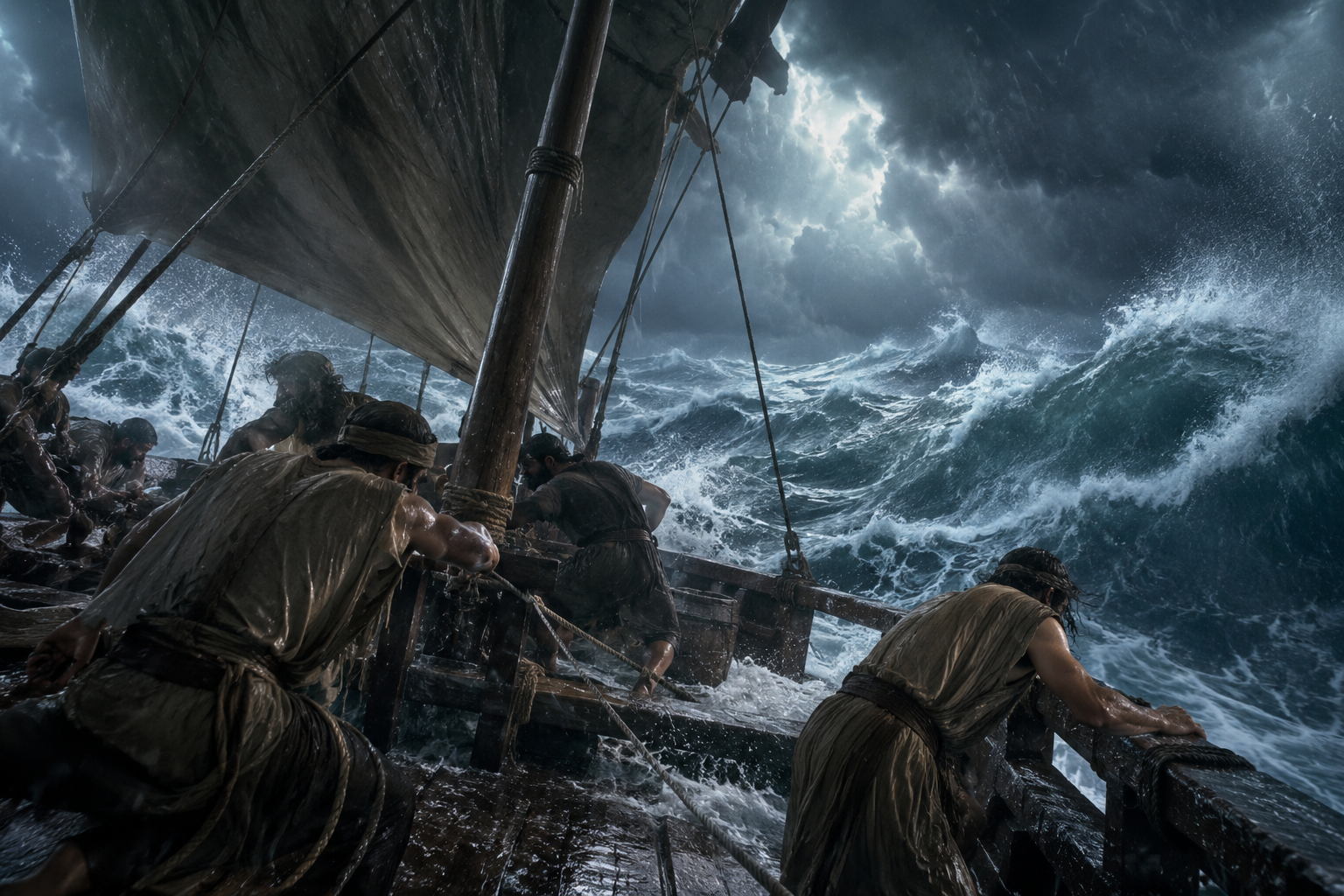
YAHWEH USES WIND TO
WAYLAY WAYWARD PROPHET
The LORD hurled (tur; LXX - exegeiro - cause to appear in history, call into being) - NET, NLT, ESV all have - "but the LORD hurled" - NASB leaves out the "but" which is important because it introduces a dramatic contrast. Jonah fled, BUT the LORD hurled. Jonah had made his plans, chosen his destination, paid his fare, and boarded his ship. BUT Jonah had not taken into account the sovereign LORD Who controls the sea and the wind. Jonah could choose the ship, BUT he could not choose the weather. Hurled is the Hebrew ṭûl (טוּל), a forceful word meaning to cast, throw, or hurl. This was no accidental change in weather. The text specifically identifies the LORD as the cause of the storm. The same verb tur becomes an important thread through the chapter. The LORD “hurled” the wind onto the sea (Jonah 1:4); the sailors “threw” the cargo into the sea (Jonah 1:5); Jonah tells them to “throw me into the sea” (Jonah 1:12); and finally they “threw him into the sea” (Jonah 1:15). Note the irony. God hurls the wind; the sailors hurl the cargo; and finally they hurl God's runaway prophet into the sea. The irony is that while Jonah tried to change his destination, Yahweh changed the weather! And guess who wins!
🙏 THOUGHT - While God does send storms to discipline and train His rebellious children (Heb 12:5-11), not every storm is the result of sin. Jon Courson explains why God allows other storms "Some of the most beautiful trees I've ever seen are the cypress trees of the Monterey Peninsula. The longer the wind blows these trees, the more shapely and beautiful they become. The stronger the wind blows, the deeper their roots go. Thus, the cypress become incredibly sturdy and very lovely because of the constant wind upon them.The same is true of us. God's stormy winds upon our lives are meant not to destroy us, but to develop us. If you feel in the midst of a storm even now, take hope, dear saint. God is either using it to bring you back to His safe port or He's using it to make your life into a beautiful trophy of His grace."
Disobedience always leads us
into troubled waters.
A great wind on the sea and there was a great storm on the sea - Note the repetition of great. Nineveh was a “great city” (Jonah 1:2); now God sends a “great wind,” producing a “great storm.” Later the sailors will become “extremely frightened” or literally fear with a “great fear” (Jonah 1:10, 16), and God will appoint a “great fish” (Jonah 1:17). Jonah is surrounded by “great” things because he serves a great God. The size of Nineveh, the violence of the storm, and the size of the fish are all subordinate to the sovereignty of Yahweh.
Sometimes God sends a storm not to destroy
His servant but to turn His servant around.
Psalm 107:23-29 provides a striking parallel. Sailors go down to the sea in ships, encounter a storm at God's command, cry to the LORD, and He stills the waves. The sea is never beyond His sovereignty (cf. Ps 89:9; 107:25; 135:7).
Warren Wiersbe - “Great” is one of the key words in the book of Jonah. Besides a “great city,” the book mentions a great wind and tempest (Jonah 1:4, 12); great fear (Jonah 1:10, 16); a great fish (Jonah 1:17); great people, probably nobles (Jonah 3:5, 7); and Jonah’s great displeasure and great gladness (Jonah 4:1–6).
So that (term of purpose/result) the ship was about to break up - So that introduces the result of the great wind and great storm the LORD had hurled upon the sea.The vessel was apparently being battered so violently that destruction seemed imminent. Experienced sailors will shortly be terrified (Jonah 1:5). That fact underscores the extraordinary severity of the storm. These were men accustomed to the dangers of the Mediterranean, yet this storm frightened the professionals.
This storm was clearly an act of divine discipline, but it was not merely punitive. God was pursuing Jonah in order to turn His runaway prophet around. Jonah regarded the storm as a disaster, but from God's perspective the storm was part of His rescue operation. When we recall the principle of divine discipline in Heb 12:5-11, we remember that God's discipline of His children is not evidence that He has abandoned them but that He refuses to abandon them to a path that will ultimately harm them.
God loved Jonah too much to give him
smooth sailing in the wrong direction.
Jonah had chosen the ship as his means of escape, but God was now making that means incapable of accomplishing Jonah's purpose. There is a sobering principle that God can frustrate the very circumstances upon which we depend when those circumstances are carrying us contrary to His will (cf. Pr 19:21). Jonah's ship was headed toward Tarshish, but God's purpose was still headed toward Nineveh. And only one of those destinations would ultimately prevail!
ESV Study Bible - Page 359 has an interesting comment on Jonah 1:4-16 - Jonah and the Pagan Sailors. This episode highlights Jonah’s encounter with pagan sailors and raises the question, Who fears the Lord—Jonah or the pagans? The key repeated word is “fear”: at the beginning and end the sailors “fear” (Jonah 1:5, 16); in the middle Jonah claims to “fear” the Lord (Jonah 1:9) while the sailors actually fear (Jonah 1:10a).
NET NOTE - HURLED - The Hiphil of טוּל (tul, “to hurl”) is used here and several times in this episode for rhetorical emphasis (see Jonah 1:5, 15). ABOUT TO BREAK UP - The Hiphil of טוּל (tul, “to hurl”) is used here and several times in this episode for rhetorical emphasis (see Jonah 1:5, 15). Heb “the ship considered breaking apart.” The use of חָשַׁב (khashav, “think”) in the Piel (“to think about; to seriously consider”) personifies the ship to emphasize the ferocity of the storm. The lexicons render the clause idiomatically: “the ship was about to be broken up” (BDB 363 s.v. חָשַׁב 2; HALOT 360 s.v. חשׁב).
Hurled (02904) tul is a Hebrew verb meaning to throw, hurl, cast, or fling, usually conveying the idea of forceful movement from one place to another. It is stronger and more vivid than simply placing or moving something. The object may be physically thrown, as when Saul hurled his spear at David in an attempt to kill him (1Sa 18:11; 20:33), or the verb may describe someone or something being forcibly removed, cast down, or overwhelmed. The central picture is that of something being forcefully propelled, displaced, or brought down.
TUL - 14V - cast(2), hurl(3), hurled(4), hurled headlong(1), laid low(1), threw(2), throw(1). 1 Sam. 18:11; 1 Sam. 20:33; Job 41:9; Ps. 37:24; Prov. 16:33; Isa. 22:17; Jer. 16:13; Jer. 22:26; Jer. 22:28; Ezek. 32:4; Jon. 1:4; Jon. 1:5; Jon. 1:12; Jon. 1:15
Tûl is particularly significant when God is the One doing the hurling. God warned rebellious Judah, “I will hurl you out of this land” into exile (Jer 16:13), and He declared that Coniah and his mother would be hurled into another country (Jer 22:26, 28). Isaiah uses similar imagery for Shebna, who would be forcibly removed from his prestigious position and hurled away (Isa 22:17-18). Ezekiel portrays God's judgment of Pharaoh with the declaration, “I will hurl you on the open field” (Ezek 32:4). In such passages, tûl emphasizes decisive divine judgment and irresistible displacement. When God determines to cast someone down, human position, power, and prestige cannot prevent it.
In the passive Hophal stem, tûl means “to be hurled” or “to be cast down.” Psalm 37:23-24 promises that although the righteous man may fall, “he will not be hurled headlong, because the LORD is the One who holds his hand.” Thus falling is not necessarily final destruction. The believer may stumble, but the sustaining hand of God prevents his fall from becoming his ultimate ruin. In Job 41:9 the word develops the figurative sense of being overwhelmed or laid low at the terrifying sight of Leviathan. The physical concept of being thrown down thus becomes a vivid description of emotional consternation.
Tûl can also describe casting a lot. Proverbs 16:33 declares, “The lot is cast into the lap, but its every decision is from the LORD.” Although the casting is performed by human hands, its outcome remains under divine sovereignty. This provides an interesting theological parallel with Jonah 1:7, where the sailors cast lots and the lot identifies Jonah. A different Hebrew verb is used there, but the principle of Pr 16:33 applies perfectly: what appeared random to the sailors was not random to the sovereign LORD.
The verb tûl is especially important in Jonah 1, where it occurs repeatedly and becomes a literary thread binding the narrative together. First, “the LORD hurled a great wind on the sea” (Jonah 1:4). The language is deliberately forceful. God did not merely “allow” unfavorable weather to develop; the text pictures Yahweh as hurling the wind against the sea. The storm therefore was neither accidental nor merely natural. It was a divinely directed intervention designed to confront His runaway prophet. The action then progresses through the chapter. Because God hurled the wind, the terrified sailors hurled the cargo into the sea in an attempt to lighten the ship (Jonah 1:5). Jonah eventually recognizes that he is the cause of their predicament and tells them, “Pick me up and throw me into the sea” (Jonah 1:12). Finally, after unsuccessfully attempting to row back to land, the sailors picked Jonah up and hurled him into the sea (Jonah 1:15). Thus the repetition forms a dramatic progression: God hurls the wind, the sailors hurl the cargo, Jonah says “hurl me,” and finally the sailors hurl Jonah.
There is considerable irony in this sequence. Jonah had carefully attempted to control his circumstances. He chose Tarshish, went down to Joppa, found a ship, paid the fare, and boarded it (Jonah 1:3). Then suddenly the narrative declares, “But the LORD hurled...” Jonah's carefully constructed plan collides with the sovereign intervention of God. Jonah could choose his destination, but he could not command the wind. He could board a ship, but he could not control the sea. He could attempt to flee his commission, but he could not escape the sovereign reach of the God Who had commissioned him. Thus tûl is much more than a colorful verb for “throw.” In contexts of divine action it vividly portrays God's forceful, sovereign, and decisive intervention in human affairs. Jonah had hurled himself, figuratively speaking, into a course of rebellion, but Yahweh hurled a wind that stopped him. The runaway prophet was about to discover that when man's plans collide with God's sovereign purposes, it is never God's purposes that are thrown off course.
Lowell Johnson - A Divine Calamity Jonah 1:4-5
The storm was extremely significant because
it represented the anger of God toward sin.
The storm was caused by God, continued by God, and ordained by God. The words "Sent out" mean "to prepare, to assign, to ordain." It also means "to pitch, hurl." It would be like a pitcher throwing a ball. We could say that God threw a fast ball at Jonah. He threw a "great wind" in his direction - and God has a good fast ball! God kept throwing roadblocks before Jonah - Jonah 1:4, 17; 2: 10; 4:6, 7 See the pattern. God prepared every step in Jonah's path to repentance. Each step was harder, but God's motivation toward Jonah was love. All the way through the book, Jonah was God's greatest challenge. God controlled the weather, the heathen sailors, the fish, the gourd, and the worm much more easily than His stubborn prophet. Through sending the wind, God wanted to teach that it's easier for us to obey God - even when He gives us a tough assignment - than to resist Him. The one person for whom the storm was sent was the last person to listen. The storm was extremely significant because it represented the anger of God toward sin. The pagan sailors understood that truth right away, but it took Jonah a while.
Jonah was not just asleep physically, but also spiritually.
Nothing puts us to sleep spiritually quite like sin.
The sailors were fighting for their lives against the storm - casting their cargo into the sea to lighten the ship, rowing as hard as they could against the wind and waves, praying to their gods - little "g." Where was Jonah? In deep sleep as far back in the ship as he could get. He was asleep in the storm! Aren't we told in the gospels that Jesus once slept in the bottom of a boat during a storm? Yes, but Jesus slept in the storm, trusting His Father. Jonah slept in the storm in a stupor of sin. Jesus slept in Faith; Jonah in Faithlessness. Jonah was not just asleep physically, but also spiritually. Nothing puts us to sleep spiritually quite like sin. Nothing causes us to disregard cries for spiritual help and deliverance like rebellion. It makes us deaf to the needs of those around us. The Bible warns us about sleeping spiritually - Ro 13:11; 1 Cor. 15:34; 1Th 5:5-6 The interesting thing about sleeping is that we really don't know we are sleeping when we are asleep! Another thing about sleeping is this: When we are asleep, we don't like the sound of the alarm. We want to sleep on because we're comfortable and content. But men were perishing while Jonah slept! Like Jonah, as we sleep spiritually, we hang a sign around our neck that says, "Do not disturb." We as Christians are sleeping through the storm that America is in. One of these days, if we don't wake up, we are going to be like Rip Van Winkle who slept for 20 years and woke up and didn't recognize his own land! While we sleep, we are losing our land of freedom. One by one privileges are being taken from us. Christian principles and moral righteousness is being replaced by gay rights and liberal judges. We slept while the Ten Commandments, Bible reading and prayer were stripped from our school walls. As the sailors said to Jonah, "What meanest thou O sleeper" - Arise - Wake up!
Those who believe in the Lord Christ need to cry out,
"Stranger, are you lost?"
ILLUSTRATION - Edwin Dahlburg tells the story of a family who was camping out in the California desert. It was night and they built a campfire and had their tents arranged around the fire. Sitting around the fire, they heard a sound in the distance and recognized that the sound was getting louder, indicative of the fact that whatever it was, it was coming closer to them. Presently they recognized the sound as the coughing engine of an old truck. In a few minutes that truck topped the sand dune overlooking the camp site, and a voice in the darkness cried out, "Stranger, are you lost!" The man in the family answered back, "No, we're not." The man in the truck came down to have a cup of coffee with them. As he sat there around the campfire he said, "I've lived in this desert all my life, and I know how bad it can be, especially for a stranger. So I never meet a man out here but what I ask him if he is lost; ifI can help him find his way." This world is like a desert - a desert in which men stagger and stumble looking for some oasis of like; for some oasis of hope. Those who believe in the Lord Christ need to cry out, "Stranger, are you lost?"
We condemn non-church going people
when we need to condemn the non-going church.
ILLUSTRATION - A boy was playing in his father's country store when a man walked in, went to the counter and ordered some ammunition. The father asked, "Are you going hunting?" The man answered, "No! I am fixing to go kill a man. He is my enemy and I am going to kill him." The father knew who the intended victim was and as soon as the man walked out of the store, the storekeeper turned to his son and said, "Son, run as fast as you can; take the short cut through the woods! Get to the house first and warn that man that this fellow is coming to kill him." The boy left the store, heading through the woods toward the distant farmhouse. But along the way he stopped to play. He chose some stones and began to throw them at the birds. Presently he hit one. The bird fell to the ground, dead. The boy walked over and picked up the dead bird, looking at it. Then he cast the bird aside and casually continued on his way to the farmhouse. When he emerged from the woods he noticed a great crowd around the farmhouse, and his daddy was in the crowd. He ran up to his father, and the father asked, "Where have you been?" The boy answered, "I stopped to play in the woods." The father said, "You are too late. The one I sent you to warn has been killed." And then the father saw something on the boy's hand. He asked, 'What's that on your hand?" The boy looked at it and saw that it was blood from the bird he had killed. He told his dad about it. The father, looking at the hand, thought, "There is more than blood of a bird on you hand." Ezekiel 33:7-9 We condemn non-church going people when we need to condemn the non-going church.
Lowell Johnson - another sermon on Jonah 1 -The Sea Was Disturbed Jonah 1:4, 13, 15
This was no small storm. Everything around them was disturbed, and the Bible says that God sent the wind out to them. When the waters we're in all around us are disturbed, we need to ask, "Why?" When there are floods or tsunamis, or earthquakes or winds around us, we need to ask "Why?" Isn't God the God of nature? Isn't He in control? We hear a lot of so-called explanations as to why these things happen, but we listen almost in vain for someone to say that God is upset with mankind!
The Ship Was Disturbed Jonah 1:4
The Titanics of Tarshish can be sent to the bottom by icebergs of rebellion. Holiness can make the weak strong; but unholiness can make the strongest the weakest. So many ships are disturbed by sin: Fellowship with God - Adam; Companionship with one's spouse; Stewardship of time, talents, tithe, temple, testimony; Lordship of Christ in one's life; Worship of God are all like to be broken into splinters of uselessness.
James Smith - JONAH FOUND OUT JONAH 1:4–7
The disobedient prophet fled with all speed to Joppa, Disobedient feet are sure to run quickly. It is always easy running down hill. But God’s messengers are swifter than the feet of any runaway. He sent out the storm as His detective to apprehend His guilty servant. The seamen are dreadfully alarmed, and take to lighting the ship; the wares are cast into the sea. It is the old story. “All that a man hath will he give for his life.” Many who have led godless lives take to lighting the ship when death is staring them in the face. But wares cannot appease the storm of God’s wrath against sin. Let us look at—
I. The Sleeping Prophet. He had a journey of about three days, but being in such a hurry to get away from the presence of God he may have done it in less than two. Being weary with his flight, and having paid the fare, he is soon fast asleep in the ship. How sad. Weary fleeing from God. Truly the way of the transgressor is hard. If the way to Hell is paved with good intentions, it is also sprinkled with many tears. It is full of sighs and heartaches. Sleep is what runaway souls are seeking. They long for complete insensibility to their sins. How many convictions have been drowned in drink, and smothered in the haunts of sinful pleasure. Remember, insensibility is not security. A man may never be more in danger than when he is dreaming of ease. Jonah slept, while his companions on board were in desperation about their lives. I am afraid a good many professing Christians are playing the Jonah here, enjoying selfish ease, instead of seeking to help perishing souls. A sleeping Christian is not only helpless and useless, but is a positive hindrance to others. What was the cause of this great tempest that so oppressed the ship that it was “like to be broken.” It was the disobedience of the servant of God. Think of the solemn responsibility resting upon us as the servants of Christ. It is possible to endanger the souls of others by our uncharitable behaviour towards God. Gospel hardened saints make Gospel hardened sinners.
II. The Arousing Call. “What meanest thou, O sleeper; arise, call upon thy God.” This is the language of the skipper, heathen as he was, he believed in prayer. Our country is crammed with such heathen; men who believe in prayer when the waves of death are wildly dashing about them. Those who think prayer best becomes foul weather. An infidel who scoffed at a minister of Christ on board ship when the wind was fair, prayed: “O God, if there be a God, have mercy on me,” when the storm came. Such fair-weather sailors are common. The drowsy prophet awakened to find that the God he sought to flee from is on his track, and has blocked his way. The seamen thinking the storm has come because some one of them is guilty, cast lots, that he may be found out, and the lot “fell upon Jonah.”
III. Found Out. The runaway is found out. What a great awakening this must have been to him. Be sure your sins will find you out. We see here the proof of an overruling Providence. The lot fell on Jonah. God always puts the cap on the right head. When God comes to dispose of the lot that has been cast into the lap of time, every one will receive their due. “I’ll take my chance,” said a reckless sinner, when urged to accept Christ and be saved. What chance? The chance of escaping detection at the judgment? Remember, the lot “fell on Jonah.” Let us remember that one transgressor may be a great stumbling block to others. One Christian, whose life is not in harmony with the will of God may hinder the cause of Christ. Achan’s sin hindered the whole army of Israel (Josh. 7:8–18). Learn also the folly of attempting to flee from God. As a sinner, you may be permitted to flee into the wilderness of eternal ruin, but as a servant, God is sure to pull you up as it were, with bit and bridle. Judas sold our Lord, committed suicide, and went to his own place. Peter denied our Lord, but through the prayer of his Master, he wept, and was restored. In hiding from God we are tempting Him to shut us out from His presence—which is life for evermore.
IV. Disobedience Leads to Confusion. What a weakling Jonah was in presence of these heathen sailors. Instead of being a lighthouse and a tower of strength to help them, he was a source of sorrow and perplexity. It is sad to see the prophet of God confused and confounded in the presence of the ungodly. A powerless Christian is a very pitiable object. Salt without savour is a worthless thing. Samson in the power of the Spirit of God is more mighty than a host of Philistines, but as a runaway from his God, he becomes a miserable laughing-stock. A Christian ought to be a man of fearless courage and irresistible power. He would be so if he were not like Jonah, cowardly and disobedient. In the lap of Delilah, Samson was smuggled of his strength. In the lap of the pleasures and gaiety of the world the Church herself is being shorn of her power. The inconsistency of a Christian will not hide any more than Jonah’s. It is impossible to be out of fellowship with God and yet have the influence and authority of an obedient servant. Our strength lies in our nearness to God. The nearer the fire we keep the more will its warmth possess us. Moses knew this when he prayed: “If Thy presence go not with us, carry us not up hence.” If we have His presence, nothing shall be impossible; if we have not His presence, we have nothing worth having. Jonah fled from God. David fled to God. Whither fleest thou?
Walter Kaiser - Hard Sayings of the Bible
Jonah 1:4–5, 7 Casting Lots Encouraged?
The use of “lots,” or the throwing of dice, in order to discover what is unknown seems more at home in the world of divination and enchantment than in the biblical world of the will of God. It is not surprising, I suppose, that these sailors would have resorted to this means of discovery in such terrifying circumstances. But it is surprising to learn that this method did uncover the real culprit—that it worked. How can this fact be explained and reconciled with the rest of Scripture?
The sailors’ use of divination in order to learn the source of their problem was altogether fitting to the culture of those times. As far as they were concerned, a storm of this intensity and ferocity must have represented some sort of divine punishment. Someone on their ship must have angered his god in some way, they reasoned. If they were to come out of the experience alive, they had to find out who the offender was and what he had done.
As best we can tell, lots were very similar to our dice, usually with alternating light and dark sides. Some think the mysterious Urim (possibly “lights”) and Thummim (possibly “darks”) may have been lots used by the high priest and kept in his ephod for discerning the will of God (Ex 28:30).
The casting of lots was probably interpreted along these lines: two dark sides up meant no, while two light sides up meant yes. A combination of a light and a dark side might have meant that one should throw again. On this system, the sailors probably asked the lots “yes” or “no,” taking each sailor in turn until it came Jonah’s turn and the lots both came up light.
The use of lots was not altogether foreign among the people of God. At several key points in the history of Israel, lots had been used with the apparent approval and blessing of God. This may be one more case where it was not the use but the abuse of a cultural tool that made it objectionable. Lots were used to determine which of the two goats would be sacrificed on the Day of Atonement (Lev 16). Joshua used lots to ferret out Achan as the guilty party after the defeat at Ai (Josh 7:14). Lots were used in the allocation of land (Josh 18–19; Ps 16:6) and in the assignment of temple duties (1 Chron 24:5). In the New Testament, our Lord’s clothes were gambled for by the casting of the dice (Mt 27:35). In fact, the whole church decided between two men to fill the position left by Judas’s death by the use of lots (Acts 1:15–26). True, here the casting of lots was accompanied with prayer, but my point is that lots were used. Some are fond of pointing out that all these examples were prior to Pentecost, but there seems to be no scriptural significance to such an observation.
The best way to explain the use of lots is by noting the mild endorsement expressed in Proverbs 16:33: “The lot is cast into the lap, but its every decision is from the LORD.” Though this proverb is quite brief, its point seems to be that the Lord, not fate, is the reason for success, if there is any. It also seems to warn that the casting of lots does not carry with it an automatic validity, for in every case the freedom to answer lies with God, who is not at the beck and call of the thrower.
It may please God to use this means to give further confidence that one’s decision, when it does not conflict with Scripture or with one’s best discernment, is indeed his will. But in no sense should the casting of lots be used or viewed as a means of bypassing what can be known of God and his will through Scripture, prayer and the inner testimony of the Holy Spirit.
Accordingly, what might appear to be no more than raw superstition to a twentieth-century Westerner was an evidence of divine intervention and providence. Even the casting of lots came under the controlling eye of God.
THREE STORMS From D L Moody's Bible
1. The storm of Jonah 1, which was sent as a punishment against Jonah for his sin, ceasing only when he was cast into the sea. Type of Jesus who could say, “All thy waves and thy billows are gone over me.” Ps. 42:7.
2. The storm in Acts 27, which did not cease, but a message from the Lord was sent to comfort His people in the midst of it. Picture of believers who in the midst of fierce tossings are encouraged by His word, knowing that they are “drawing near to some country” (Acts 27:27), “that is, an heavenly.” Heb. 11:16.
3. The storm in Mark 4, which was stilled at once by the word of Jesus. Picture of the great calm He commands within the believer’s heart.
Jonah 1 - When God Cleans House Julie Ackerman Link
Read: Jonah 1
Let all bitterness, wrath, anger, clamor, and evil speaking be put away from you, with all malice. —Ephesians 4:31
God did some fall housecleaning this week. He sent a mighty wind through our neighborhood that made the trees tremble and shake loose their dead branches. When it finished, I had a mess to clean up.
In my own life, God sometimes works in a similar way. He will send or allow stormy circumstances that shake loose the “lifeless branches” I’ve been refusing to release. Sometimes it’s something that once was good, like an area of ministry, but is no longer bearing fruit. More often it’s something that’s not good, like a bad habit I’ve slid into or a stubborn attitude that prevents new growth.
The Old Testament prophet Jonah discovered what can happen when one refuses to get rid of a stubborn attitude. His hatred for the Ninevites was stronger than his love for God, so God sent a great storm that landed Jonah in a giant fish (Jonah 1:4,17). God preserved the reluctant prophet in that unlikely place and gave him a second chance to obey (2:10; 3:1-3).
The lifeless limbs in my yard caused me to think of attitudes that God expects me to dispose of. Paul’s letter to the Ephesians lists some of them: bitterness, anger, and evil speech (4:31). When God shakes things up, we need to get rid of what He shakes loose.
Lord, give me a listening heart and help me to cooperate with You when You point out changes that need to be made in my life. I want to honor You and please You. Amen. (Reprinted by permission from Our Daily Bread Ministries. Please do not repost the full devotional without their permission.)
Christ’s cleansing power can remove the most stubborn stain of sin.
Robert Neighbour - Jonah Pursued by a Storm
"But the Lord sent out a great wind upon the sea, * * so that the ship was like to be broken" (Jon. 1:4).
1. The first thing we have before us is the faithfulness of God toward a faithless Prophet. Why did not God let Jonah go his way, just as Jonah was letting Nineveh go its way? Because the God Who watches over His saints never slumbers nor sleeps. "Great is His faithfulness." He says: "I will never leave thee, nor forsake thee." Jonah is running away from God, and God is going right after him, to bring him back to obedience.
2. And how does God pursue His runaway Prophet? He sends after him a great wind, a veritable Euroclydon, until the ship was about to be broken.
It is still true, "Whom the Lord loveth, He chasteneth." The only way to get some people back to God, is by winds and waves of trouble and distress.
Illustration: An artist, painting the dome of a great cathedral, stood on his high scaffold admiring the beauty of his work, forgetting, withal, that he was stepping back, dangerously near the edge of his scaffold. His assistant saw his peril and quick as thought, he leaped forward and struck his brush across the picture. The artist caught his hand in amazement, and cried: "Why did you spoil my picture?" "I did it to save your life," was the reply. How many times is it necessary for God to spoil some pretty picture of ours in order that He may call us back to His loving favor.
3. Another lesson is seen in this, that the disobedience of the Prophet caused the whole ship, and doubtless many other ships, to be in danger. It is written: "No man liveth unto himself."
If the backslider could only sin without bringing some disaster upon some one else it would be bad enough, but when he endangers the welfare of others then let him stop, and look, and listen.
In the Gospels we read: "And there were other little boats." The storm on Galilee affected them as well as the boat in which the disciples sat. Let us remember the "other little boats."
4. Let us look a moment at this "sleeper." Asleep to his responsibility; asleep to the cries of the Ninevites; asleep to the dangers of the mariners. What a picture of a prayerless believer we have here! The others, the heathen aboard ship are praying, but Jonah is sleeping. What a God-dishonoring sleeper! "What meanest thou, O sleeper? arise and call upon thy God."
Greg Laurie - THE LAST WORD
But the Lord sent out a great wind on the sea, and there was a mighty tempest on the sea, so that the ship was about to be broken up. (Jonah 1:4)
Jonah was God’s child—a wayward one who ran from the Lord, but he was His child nonetheless. The Bible says that when it comes to dealing with His children, God chastens those whom He loves (see Hebrews 12:6). Because God loves us, He will seek to get our attention when we are going the wrong way.
I think we all know what this is like. When we are about to do something we know we shouldn’t do, there will be that internal red flag, that sense of conviction from the Holy Spirit, which says, “Don’t do this. You are going the wrong direction.” Sometimes God will even put blockades in our path in the form of other believers. Maybe you are about to do something you know you shouldn’t do, when all of the sudden, you run into that Christian friend from church. You think, “Lord, you are making this hard.” But God loves you. He doesn’t want you to make a mistake and go in the wrong direction.
David said, “Before I was afflicted I went astray, but now I keep Your word” (Psalm 119:67). In other words, before he tasted the sting of discipline, David was doing what he wanted to do. But the Lord got his attention.
Jonah 1: 4 tells us, “But the Lord sent out a great wind on the sea. …” I love those three words: “But the Lord. …” Know this: God will always have the last word. No matter what you do, there will always be, “But the Lord. …” He will always do what He wants to do.
Jonah 1:5 Then the sailors became afraid and every man cried to his god, and they threw the cargo which was in the ship into the sea to lighten it for them. But Jonah had gone below into the hold of the ship, lain down and fallen sound asleep.
- cried (KJV): Jon 1:6,14,16 1Ki 18:26 Isa 44:17-20 Isa 45:20 Jer 2:28 Ho 7:14
- and cast (KJV): Job 2:4 Ac 27:18,19,38 Php 3:7,8
- the sides (KJV): 1Sa 24:3
- and was (KJV): Jud 16:19 Mt 25:5 26:40,41,43,45 Lu 22:45,46
Related Passages:
Jonah 1:14 Then they called on the LORD and said, “We earnestly pray, O LORD, do not let us perish on account of this man’s life and do not put innocent blood on us; for You, O LORD, have done as You have pleased.”
1 Kings 18:26 Then they took the ox which was given them and they prepared it and called on the name of Baal from morning until noon saying, “O Baal, answer us.” But there was no voice and no one answered. And they leaped about the altar which they made.
Isaiah 44:17-20 But the rest of it he makes into a god, his graven image. He falls down before it and worships; he also prays to it and says, “Deliver me, for you are my god.” 18They do not know, nor do they understand, for He has smeared over their eyes so that they cannot see and their hearts so that they cannot comprehend. 19No one recalls, nor is there knowledge or understanding to say, “I have burned half of it in the fire and also have baked bread over its coals. I roast meat and eat it. Then I make the rest of it into an abomination, I fall down before a block of wood!” 20He feeds on ashes; a deceived heart has turned him aside. And he cannot deliver himself, nor say, “Is there not a lie in my right hand?”
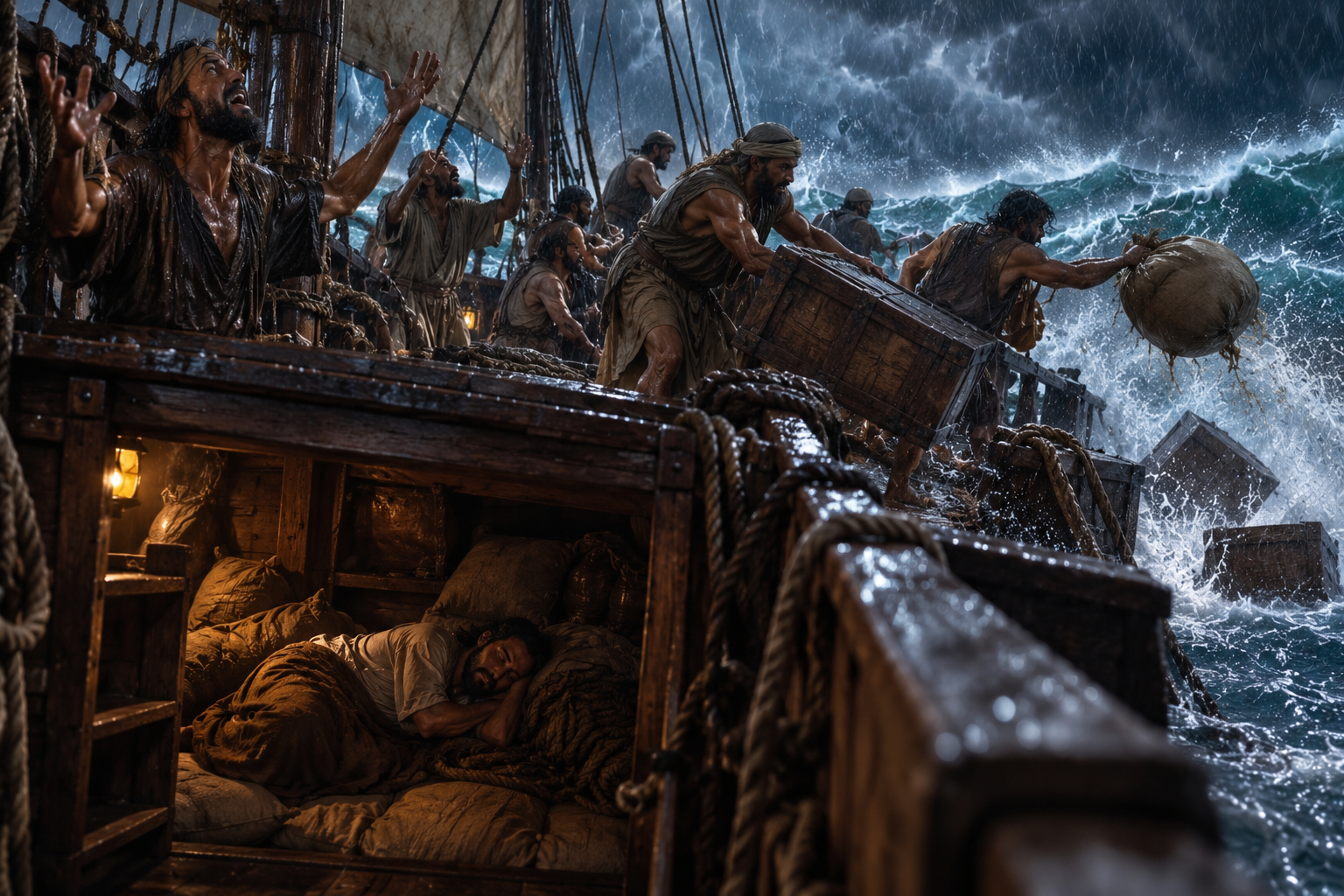
Sailors Tossing, Jonah Sleeping!
FEAR PROMPTS PAGANS'
POLYTHEISTIC PRAYERS
Then the sailors became afraid - These were experienced seamen, accustomed to the dangers of Mediterranean travel which makes the point that if seasoned sailors were terrified, the storm must have been extraordinary. The Hebrew word for sailors (mallach) is related to the word for salt, (melach) literally suggesting “salt-men,” men whose occupation kept them on the salty sea. The professionals knew when a storm was beyond their ability to manage, and this one frightened them.
Jack Arnold - The ancient world was not basically atheistic but was pagan, for they had many gods but these gods were the products of natural man's imagination. All men are basically religious but they do not know the true God of heaven and earth as He is revealed in scripture. (ED: Throw an atheist on a ship about to be battered to pieces and watch them cry out to their god!)
John MacArthur - Sailors, accustomed to storms, were afraid of this one (v. 5), a fear which served God's purpose (cf. Ps 104:4). (SEE MacArthur Study Bible)
And every man cried to his god - Fear immediately drove these pagan sailors to prayer. Being polytheists, each man cried out to his own deity, apparently hoping that one of their gods might be able to rescue them. Their prayers reveal both their religious sincerity and their spiritual ignorance. They knew they needed supernatural help, but they did not know the God Who actually controlled the storm. There is striking irony here. The pagan sailors are praying while the prophet of Yahweh is sleeping! Those who do not know the true God are crying out for divine help, while the man who does know Him is silent.
Jon Courson - Every man—even the most seasoned sailor—has someone or something he cries to when the storm gets brutal. (See )
And they threw (tur; LXX - ekbole - nautical term for throwing overboard of ship's cargo because of stormy sea, jettisoning) the cargo which was in the ship into the sea to lighten it for them. Jonah's rebellion did not just affect Jonah. Personal sin seldom affects only the sinner! The sailors were now terrified, their cargo would be thrown overboard, their livelihood threatened, and their lives placed in danger. Here's the point to remember and it is that private disobedience can have public consequences.
“The Lord does not want their cargo;
He wants the obedience of His child!”
-- Eric C Redmond
Jack Arnold - These sailors probably owned some or all of the merchandise on this ship and they were willing to throw away a small fortune to save their own lives. Man has a natural love of life and is willing to sacrifice all to keep it. NOTE: Throwing over the cargo was futile for the problem was not the weight of the cargo but the weight of sin that burdened down Jonah.
But (term of contrast) Jonah had gone below into the hold of the ship, lain down and fallen sound asleep - But Jonah introduces a striking and unexpected contrast. While the terrified pagan sailors were desperately crying out to their gods and throwing the cargo overboard in an attempt to save the ship, Jonah was doing neither. He was sleeping! The very man who knew the true God was silent while men who worshiped false gods were praying! The contrast is almost shocking: the pagans are awake and praying; the prophet is asleep and silent.
Spurgeon - “Jonah was asleep amid all that confusion and noise; and, O Christian man, for you to be indifferent to all that is going on in such a world as this, for you to be negligent of God’s work in such a time as this is just as strange. The devil alone is making noise enough to wake all the Jonahs if they only want to awake … All around us there is tumult and storm, yet some professing Christians are able, like Jonah, to go to sleep in the sides of the ship.”
And notice Jonah's continuing downward movement. He “went down to Joppa” (Jon 1:3), then “went down into” the ship (Jon 1:3), and now he “had gone below into the hold of the ship” (Jon 1:5). Soon he will go down even farther, into the sea and ultimately to “the roots of the mountains” (Jon 2:6). The repeated descent provides a vivid geographical picture of Jonah's spiritual direction as he attempts to flee from the presence of the LORD. Every step away from God's will takes Jonah farther down.
The path of one who
runs from God is always down.
Even more remarkable is that the ship is being violently battered by the storm, yet Jonah is able to fall into a deep sleep. The Hebrew description is strong: he “lay down and fell sound asleep.” His sleep should not necessarily be interpreted as evidence of peace with God. There is a vast difference between the sleep of faith and the sleep of spiritual insensitivity. Jesus slept in a storm because He was perfectly within His Father's will (Mk 4:38); Jonah slept in a storm while deliberately running from God's will. Two men could sleep through a storm, but for entirely different reasons. We can only conjecture why Jonah was sound asleep, but this could be in part from his physical and emotional exhaustion. In any event the irony is that everyone aboard is alarmed except the one man who knows why the storm has come! Another sad irony is that God had commanded Jonah to “cry against” Nineveh (Jon 1:2), but Jonah refused. Now pagan sailors are “crying” to their gods while God's prophet sleeps! To say it another way, the sailors were awake physically but blind spiritually. Jonah knew the truth spiritually but was asleep physically.
Spurgeon - Of all the men in the ship, Jonah was the person who ought most to have been awake; but nevertheless, he was not only asleep, but fast asleep; all the creaking of the cordage, the dashing of the waves, the howling of the winds, the straining of the timbers, and the shouting of the mariners, did not arouse him; he was fast locked in the arms of sleep. See here, in Jonah's heavy slumber, the effect of sin. No noxious drug can give such deadly sleep as sin. The body never knows so dread a sleep when under the influence of opiates, as the soul does when sin hath cast it into a slumber. If men could be awake to the evils, to the danger, to the desperate punishment of sin, sin were not half so deadly as it is; but when it puts its sweet
NET NOTE - Heb “they cried out, each one.” The shift from the plural verb וַיִּזְעֲקוּ (vayyizʿaqu, “they cried out to”) to the singular subject אִישׁ (ʾish, “each one”) is a rhetorical device used to emphasize that each one of the sailors individually cried out. In contrast, Jonah slept. TO HIS GOD - Or “gods” (CEV, NLT). The plural noun אֱלֹהִים (ʾelohim) might be functioning either as a plural of number (“gods”) or a plural of majesty (“god”) – the form would allow for either. As members of a polytheistic culture, each sailor might appeal to several gods. However, individuals could also look to a particular god for help in trouble. TARGUM Jonah 1:5 interpretively renders the line, “Each man prayed to his idols, but they saw that they were useless.”
NET NOTE - the cargo - The plural word rendered “cargo” (כֵּלִים, kelim) is variously translated “articles, vessels, objects, baggage, instruments” (see 1 Sam 17:22; 1 Kgs 10:21; 1 Chr 15:16; Isa 18:2; Jer 22:7). As a general term, it fits here to describe the sailors throwing overboard whatever they could. The English word “cargo” should be taken generally to include the ship’s payload and whatever else could be dispensed with.
NET NOTE - into the hold - Or “stern.” There is some question whether the term יַרְכָה (yarkhah) refers to the ship’s hold below deck (R. S. Hess, NIDOTTE 3:282) or to the stern in the back of the ship (HALOT 439 s.v. *יְרֵכָה 2.b). This is the only use of this term in reference to a ship in biblical Hebrew. When used elsewhere, this term has a twofold range of meanings: (1) “rear,” such as rear of a building (Exod 26:22, 27; 36:27, 32; Ezek 46:19), back room of a house (1 Kgs 6:16; Ps 128:3; Amos 6:10), flank of a person’s body (figurative for rear border; Gen 49:13); and (2) “far part” that is remote, such as the back of a cave (1 Sam 24:4), the bottom of a cistern (Isa 14:15), the lower recesses of Sheol (Ezek 32:23), the remotest part of a mountain range (Judg 19:1, 18; 2 Kgs 19:23; Isa 37:24), the highest summit of a mountain (Ps 48:3), and the north – viewed as the remotest part of the earth (Isa 14:13; Ezek 38:6, 15; 39:2). So the term could refer to the “back” (stern) or “remote part” (lower cargo hold) of the ship. The related Akkadian expression arkat eleppi, “stern of a ship” (HALOT 439 s.v. 2.b) seems to suggest that יַרְכָה means “stern” (HALOT 439 s.v. 2.b). However, the preceding יָרַד אֶל (yarad ʾel, “he went down into”) suggests a location below deck. Also the genitive noun סְפִינָה (sfinah) refers to a “ship” with a deck (BDB 706 s.v. סְפִינָה; HALOT 764 s.v. סְפִינָה; R. S. Hess, NIDOTTE 3:282). OF THE SHIP - Or “of the ship.” The noun סְפִינָה (sfinah) refers to a “ship” with a deck (HALOT 764 s.v. סְפִינָה). The term is a hapax legomenon in Hebrew and is probably an Aramaic loanword. The term is used frequently in the related Semitic languages to refer to ships with multiple decks. Here the term probably functions as a synecdoche of whole for the part, referring to the “lower deck” rather than to the ship as a whole (R. S. Hess, NIDOTTE 3:282). An outdated approach related the noun to the verb סָפַן (safan, “to cover”) and suggested that סְפִינָה describes a ship covered with sheathing (BDB 706 s.v. סְפִינָה).
Warren Wiersbe - You would think that the combination of his guilty conscience plus the storm would have kept Jonah awake, but he slept soundly. Often when we disobey God, we enjoy a period of quiet confidence that lulls us into a false peace. This is one of Satan’s tricks.
Lowell Johnson - another sermon on Jonah 1 The Sailors Were Disturbed Jonah 1:5
Sailors are called "old salts" in the Navy. The term comes from the fact that the ocean, where the sailors spend much of their time, is salty. These men were used to storms but none like this one and they were afraid. They called upon their god - but it wasn't Jehovah. In Jonah 1:14, because of what they experienced in the storm, they turned to the true God - Jehovah. A lot of us as God's people need to hear the message of this shipmaster - "Arise old sleeper. How can you sleep at a time like this?" Get interested in what's going on around you. Stop sleeping and start praying! Jonah's disobedience had caught up with him. Nu 32:23 "Be sure your sin will find you out ... " And they will not go unpunished! While this disturbing of the sleeper speaks strongly of the work of sin finally catching up to the sinner, it also speaks of God's love and grace in awaking the sinner to his condition. Jonah needed to be disturbed. He needed to be awaken from his sinful stupor to realize the peril he was in. Sadly, Jonah was the last to be awakened to the peril he was in. He had been asleep a long time. Thank God for those who woke him up. He needed someone to shake him awake before it was too late. And so do we! Jonah had a choice. He could have said, "Don't bother me," and gone back to sleep. That's what some do. Or, he could arise and take responsibility for his disobedience and make it right. That's what he did and that's what we need to do.
C H Spurgeon - What meanest thou, O sleeper?
‘But Jonah was gone down into the sides of the ship; and he lay, and was fast asleep. So the shipmaster came to him, and said unto him, What meanest thou, O sleeper? arise, call upon thy God, if so be that God will think upon us, that we perish not.’ Jonah 1:5–6
Men can be so careless about the ruin of men’s souls. Let us hear the cry of ‘Fire! fire!’ in the streets, and our heart is all in trepidation lest some poor creature should be burned alive; but we read of hell, and of the wrath to come, and seldom do our hearts palpitate with any compassionate trembling and fear. If we are on board a vessel, and the shrill cry is heard, ‘Man overboard!’ whoever hears of a passenger wrapping his overcoat around him, and lying down upon a seat to contemplate the exertions of others? But in the church, when we hear of thousands of sinners sinking in the floods of ruin, we behold professed Christians wrapping themselves up in their own security, and calmly looking upon the labours of others, but not even lifting a finger to do any part of the work themselves. If we heard tomorrow in our streets the awful cry, more terrible than fire, the cry of ‘Bread! bread! bread!’ and saw starving women lifting up their perishing children, would we not empty out our stores? Who among us would not spend our substance to let the poor ravenous creatures satisfy the pangs of hunger? And yet, here is the world perishing for lack of knowledge. Here we have them at our doors crying for the bread of heaven, and how many there are that hoard their substance for avarice, give their time to vanity, devote their talents to self-aggrandisement, and centre their thoughts only on the world or the flesh! Oh! could you once see with your eyes a soul sinking into hell, it would be such a spectacle that you would work night and day, and count your life too short and your hours too few for the plucking of brands from the burning.
SUMMARY OF SERMON What meanest thou, O sleeper?
Scripture Text: Based on Jonah 1:5–6, where the prophet Jonah is fast asleep in the hold of a ship during a violent storm while pagan sailors panic and pray.
Two Main Groups Addressed
Spurgeon splits his message into two urgent applications, targeting both believers and non-believers who are spiritually inactive:
Sleeping Saints
: Believers who grow cold, careless, or worldly. Spurgeon argues that a true Christian sleeping while the world around them perishes is acting like Jonah—contradicting their calling and shaming their faith.
Sleeping Sinners
: Unbelievers who remain dead in sin, ignoring the looming danger of divine judgment and the mercy of the Gospel.
Key Takeaways
The Irony of Apathy
: Spurgeon highlights the deep shame of a situation where a heathen shipmaster has to wake up a prophet of God.
The Call to Action
: The core command echoes the shipmaster's words: "Arise, and call upon thy God!"
—urging immediate repentance, wakefulness, and earnest prayer before it is too late
QUOTES FROM SPURGEON'S SERMON What meanest thou, O sleeper?
“No noxious drug can give such deadly sleep as sin.”
“The world is an enchanted ground.”
“What downy pillows doth the world sew to all armholes! What beds of ease she spreads for those whom she entraps.”
“Pleasures and comforts, if sought as ends, are desperate drains upon the vigour of the spirit.”
“When the body is indulged, then the soul lies cleaving to the dust.”
“It is not possible for us to pamper the flesh without, at the same time starving the soul.”
On Satan's Desire to Put Christians to Sleep
“The wakeful watchman he always fears.”
“He thinketh it almost as well to have a Christian asleep as to have him dead.”
On Sleeping While the Ship Is Sinking
“It was ill for Jonah to sleep when all hands were at the pumps.”
“The peril of human life demanded of every generous spirit prompt and earnest action.”
“Every groaning timber would upraid the lazy, sleepy prophet.”
“What meanest thou, O sleeper? Arise, and call upon thy God.”
On Christian Service
“What, shall we sleep now? What, shall we be idle now?”
“The Lord will work, not by committees, but by his Churches.”
“The Church must do her own work.”
“If the battle is to be won, it must not be fought by soldiers lying in the shade.”
“Either be what you profess to be, or drop your profession.”
“It is mean to the very last degree to share the benefits without uniting in the toil.”
Spurgeon imagines people insisting that they cannot be spiritually asleep because they talk, walk, weep, rejoice, and think about religion. His answers are memorable:
“Many people talk in their sleep.”
“I have heard people cry in their sleep.”
“Some folks will laugh in their sleep.”
“You may have some straying thoughts of God and of right, and yet after all you may be fast asleep.”
What Does It Mean to Be Spiritually Awake?
“No Christian is awake unless he stedfastly determines to serve his God, come fair, come foul.”
“I do not think you are awake... unless you are moved by a passionate earnestness to win souls for Christ.”
“A huge dormitory wherein we snored out God's praises in our sleep, instead of an armoury where we sharpen our swords on the Sabbath.”
On Evangelism
“Better that you should get into discredit for being impertinent with your friends than let their souls perish through your politeness.”
“Tell it, tell it till the skies shall echo it.”
QUOTES FROM SPURGEON'S SERMON "SLEEPERS AROUSED"
“While God was awake, Jonah was asleep.”
“Everything around you is awake for your good, yet you yourself are slumbering.”
“He is a seer, yet he sees not, for he is sound asleep.”
“He is a watchman, but he is not watching.”
“He was asleep instead of witnessing.” (ED: HOW ABOUT US BELOVED?)
“You are the wrong person to be asleep!”
“When prophets sleep, it should be when their errand has been done, and their message has been delivered.”
“There is no opiate like the commission of an evil deed.”
“Sin is the mother of this shameful indifference.”
Jonah 1:6 So the captain approached him and said, “How is it that you are sleeping? Get up, call on your god. Perhaps your god will be concerned about us so that we will not perish.”
KJV So the shipmaster came to him, and said unto him, What meanest thou, O sleeper? arise, call upon thy God, if so be that God will think upon us, that we perish not.
NET The ship's captain approached him and said, "What are you doing asleep? Get up! Cry out to your god! Perhaps your god might take notice of us so that we might not die!"
NLT So the captain went down after him. "How can you sleep at a time like this?" he shouted. "Get up and pray to your god! Maybe he will pay attention to us and spare our lives."
ESV So the captain came and said to him, "What do you mean, you sleeper? Arise, call out to your god! Perhaps the god will give a thought to us, that we may not perish."
- What (KJV): Isa 3:15 Eze 18:2 Ac 21:13 Ro 13:11 Eph 5:14
- arise (KJV): Ps 78:34 pS 107:6,12,13,18-20,28,29 Jer 2:27,28 Mk 4:37-41
- if (KJV): Jon 3:9 2Sa 12:22 Es 4:16 Joe 2:11 Am 5:15
Related Passages:
Romans 13:11 Do this, knowing the time, that it is already the hour for you to awaken from sleep; for now salvation is nearer to us than when we believed.
Ephesians 5:14 For this reason it says, “Awake, sleeper, And arise from the dead, And Christ will shine on you.”
Mark 4:37-41 And there *arose a fierce gale of wind, and the waves were breaking over the boat so much that the boat was already filling up. 38 Jesus Himself was in the stern, asleep on the cushion; and they *woke Him and *said to Him, “Teacher, do You not care that we are perishing?” 39 And He got up and rebuked the wind and said to the sea, “Hush, be still.” And the wind died down and it became perfectly calm. 40 And He said to them, “Why are you afraid? Do you still have no faith?” 41 They became very much afraid and said to one another, “Who then is this, that even the wind and the sea obey Him?”
Esther 4:16 “Go, assemble all the Jews who are found in Susa, and fast for me; do not eat or drink for three days, night or day. I and my maidens also will fast in the same way. And thus I will go in to the king, which is not according to the law; and if I perish, I perish.”
2 Samuel 22:7 “In my distress I called upon the LORD, Yes, I cried to my God; And from His temple He heard my voice, And my cry for help came into His ears.
FEARFUL PAGAN SEEKS
PROPHET"S INTERCESSION
So (also in KJV, NLT, ESV) functions as a term of conclusion. So functions as a term of conclusion, introducing the next logical response of the pagans. Since their prayers and practical measures had brought no relief they would try Jonah's God as a last resort.
The captain approached him and said, “How is it that you are sleeping? - With the ship threatening to break apart, sailors crying to their gods, and cargo being hurled into the sea, how could Jonah possibly be sleeping? The very prophet who should have been spiritually awake to the peril of pagans was physically asleep while pagans were desperately seeking deliverance. The pagan sailors are awake and praying while the prophet of Yahweh is asleep and silent. The men who do not know the true God are desperately seeking divine help, while the one man who knows Him has nothing to say.
We can be surrounded by spiritually needy people
while remaining comfortably asleep.
Jack Arnold - Jonah was rebuked because he was not calling on his God when even the pagans were calling on their gods. There is no record that Jonah ever prayed. How could he approach God in prayer when he was out of His will? NOTE: God may use all kinds of circumstances to rebuke a believer and get him back on the road of obedience. We should thank God for any instrument He uses to bring us back into fellowship with Him.
Jon Courson - If you've ever been so weighed down by sin that you just wanted to pull the blankets over your head and fall asleep, hoping everything would somehow be okay when you woke up, you know how Jonah felt. (See Jon Courson's Application Commentary)
Eric C. Redmond - “All around him are people who want a solution to escape death, but Jonah is trying to flee from the presence of the Solution!” (See Exalting Jesus in Jonah, Micah, Nahum, Habakkuk - Page 11)
Get up, call on your god. Perhaps your god will be concerned about us so that we will not perish - It is interesting how the captain's commands were similar to God's to arise, go and proclaim. There is striking irony in the captain's command because his words echo God's original command to Jonah. God had said, “Arise, go to Nineveh the great city and cry against it” (Jon 1:2). Now the pagan captain says, “Arise...call on your god.” Jonah refused God's command to arise and cry out to pagans in Nineveh, and now God uses a pagan sailor to command Jonah to arise and cry out to God! Jonah had run from his divine commission, but God's command in effect followed him right into the hold of the ship. The irony becomes even sharper when we compare Jonah with the sailors. The sailors “cried to his god” (Jon 1:5), while Jonah, the only man aboard who knew the true God, apparently was not praying at all. The pagans were spiritually ignorant but desperately religious. Jonah possessed spiritual truth but was spiritually unresponsive. The prophet who should have been calling pagans to God now has a pagan calling him to God. "Ironically, a pagan, not Jonah, is concerned that people not perish." (ESV Study Bible)
The pagans were crying to gods who could not hear
while the prophet who knew the God Who could hear was sleeping.
Call on your god - Call often depicts a loud, audible cry of prayer to God for help in the midst of trouble. The captain naturally assumed that Jonah, like every other man aboard, had his own deity. The ancient world was thoroughly polytheistic, and these sailors apparently represented different peoples and therefore called upon different gods. Their reasoning was essentially, “We have tried our gods and nothing has happened. Perhaps Jonah's god can help.” To the captain, Jonah's God was simply another possibility in the pantheon. He did not yet understand that Jonah's God was “the LORD God of heaven who made the sea and the dry land” (Jon 1:9). But does Jonah pray? There is no evidence that he prayed in Jonah 1. He had fled the "presence of the LORD" so he was out of fellowship. I know that when I am out of fellowship with the LORD, prayer is the last thing I want to do!
NET NOTE - Get up, call The imperatives “arise!” and “cry out!” are repeated from Jonah 1:2 for ironic effect. The captain’s words would have rung in Jonah’s ears as a stinging reminder that the Lord had uttered them once before. Jonah was hearing them again because he had disobeyed them before....often depicts a loud, audible cry of prayer to God for help in the midst of trouble
Perhaps your god will be concerned about us - The captain has no assurance that Jonah's God will respond. Perhaps expresses uncertainty. While the captain's theology is faulty, his desperation is genuine. He is searching everywhere for physical deliverance. Sadly the desperate captain is picture of most of mankind who, when in a "storm," seek physical deliverance, but not spiritual deliverance. What the captain does not realize is that Jonah's God is indeed concerned about the pagans, "not wishing for any to perish but for all to come to repentance." (2Pe 3:9) And he would use His disobedient, reluctant prophet to get their attention.
NET NOTE - Heb “What to you sleeping?” The Niphal participle נִרְדָּם (nirdam) from רָדַם (radam, “to sleep”) functions here not as a vocative use of the noun (so KJV, NKJV, ASV “O sleeper”; RSV “you sleeper”) but as a verbal use to depict uninterrupted sleep up to this point. The expression מַה־לְּךָ (mah lkha, “what to you?”) can express surprise (BDB 552 s.v. מָה 1.a; e.g., Job 9:12; 22:12; Eccl 8:4; Isa 45:9, 10) or indignation and contempt (BDB 552 s.v. מָה 1.c; e.g., 1 Kgs 19:9, 13). Accordingly, the captain is either surprised that Jonah is able to sleep so soundly through the storm (NIV “How can you sleep?”; JPS, NJPS: “How can you be sleeping so soundly?”; NEB, REB “What, sound asleep?”), or he is indignant that Jonah would sleep in a life-threatening situation when he should be praying (CEV “How can you sleep at a time like this?”; NAB “What are you doing [+ sound NRSV] asleep?”; NJB “What do you mean by sleeping?”).....Heb “cry out” or “call upon.” The verb קָרָא (qaraʾ, “to call out, to cry out”) + the preposition אֶל (ʾel, “to”) often depicts a loud, audible cry of prayer to God for help in the midst of trouble: “to call on, to shout to” (HALOT 1129 s.v. קרא 9.b; BDB 895 s.v. קָרָא 2.a; e.g., Jdg 15:18; 1Sa 12:17, 18; 2Sa 22:7; Hos 7:7; Ps 3:4 [5 HT]; Ps 4:3 [4 HT]). Jonker notes, “The basic meaning of qrʾ is to draw attention to oneself by the audible use of one’s voice in order to establish contact with someone else. The reaction of the called person is normally expressed by the verbs…‘answer’ and…‘hear’” (L. Jonker, NIDOTTE 3:971). YOUR GOD - Heb “the god.” The article on הָאֱלֹהִים (haʾelohim) denotes previous reference to אֱלֹהֶיךָ (ʾelohekha, “your god”; see IBHS 242-43 §13.5.1d). The captain refers here to the “god” just mentioned, that is, whatever god Jonah might pray to (“your god”). WILL BE CONCERNED - Or “give thought to us.” The verb is found only here in the OT. Related nouns are in Job 12:5 and Ps 146:4. The captain hopes for some favorable attention from a god who might act on behalf of his endangered crewmen.
Daily Light on the Daily Path - “What do you mean, you sleeper? Arise.”
This is no place to rest, because of uncleanness that destroys.—Set your minds on things that are above, not on things that are on earth.—If riches increase, set not your heart on them.—“Now set your mind and heart to seek the Lord your God. Arise.”
“Why are you sleeping? Rise and pray that you may not enter into temptation.”—“But watch yourselves lest your hearts be weighed down with dissipation and drunkenness and cares of this life, and that day come upon you suddenly like a trap.”—“As the bridegroom was delayed, they all became drowsy and slept.”—“Yet a little while, and the coming one will come and will not delay.”—The hour has come for you to wake from sleep. For salvation is nearer to us now than when we first believed.—“Therefore stay awake—for you do not know when the master of the house will come, in the evening, or at midnight, or when the rooster crows, or in the morning—lest he come suddenly and find you asleep.”
Jonah 1:6; Mic. 2:10; Col. 3:2; Ps. 62:10; 1 Chron. 22:19; Luke 22:46; Luke 21:34; Matt. 25:5; Heb. 10:37; Rom. 13:11; Mark 13:35–36
Jonah 1:7 Each man said to his mate, “Come, let us cast lots so we may learn on whose account this calamity has struck us.” So they cast lots and the lot fell on Jonah.
- every (KJV): Judges 7:13,14 Isa 41:6,7
- and let (KJV): Jos 7:14-18 Jud 20:9,10 1Sa 10:20,21 14:41,42 Es 3:7 Ps 22:18 Pr 16:33 Mt 27:35 Ac 1:23-26 13:19
- for (KJV): Jos 7:10,13 22:16-20 1Sa 14:38,39 Job 10:2
- and the (KJV): Nu 32:23 Jos 7:18 1Co 4:5
Related Passages:
Numbers 32:23 “But if you will not do so, behold, you have sinned against the LORD, and be sure your sin will find you out.
Proverbs 16:33 The lot is cast into the lap, But its every decision is from the LORD.
Psalm 139:7-10 Where can I go from Your Spirit? Or where can I flee from Your presence? 8 If I ascend to heaven, You are there; If I make my bed in Sheol, behold, You are there. 9 If I take the wings of the dawn, If I dwell in the remotest part of the sea, 10 Even there Your hand will lead me, And Your right hand will lay hold of me.
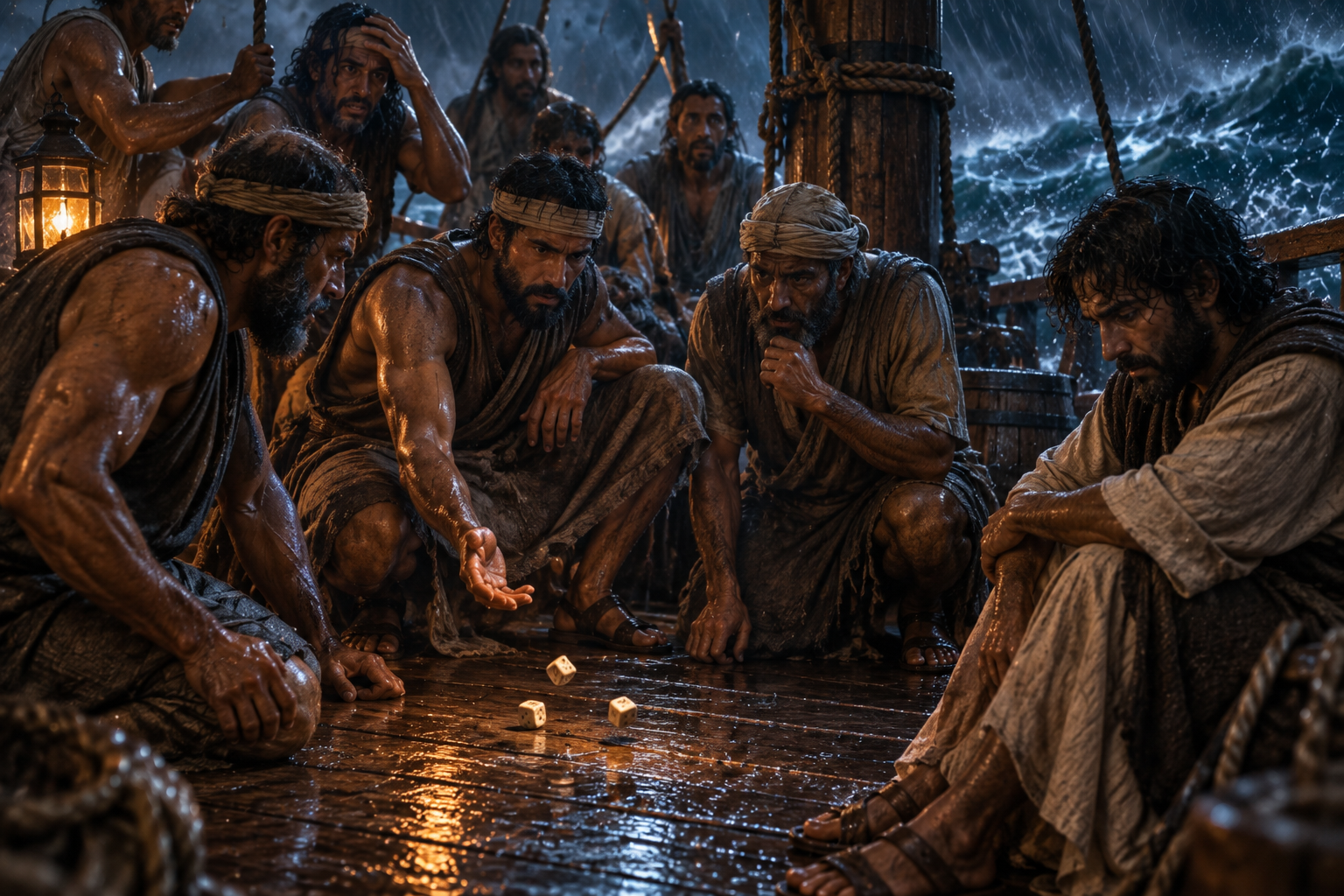
THE PAGAN WAY OF
RECEIVING "REVELATION"
Each man said to his mate - The sailors apparently concluded that this extraordinary storm was not merely a natural occurrence but the result of divine displeasure against someone aboard the ship. Their theology was certainly incomplete, and Scripture does not teach that every calamity is caused by a particular individual's sin (cf. Job 1–2; Jn 9:1–3). But in this particular instance their conclusion was correct.
Come, let us cast lots so we may learn on whose account this calamity has struck us - Casting lots was an ancient method of making decisions or determining an unknown matter. The precise method used here is not stated. It may have involved marked stones, pieces of wood, or some similar objects. The important point is not how the lot was cast but Who controlled its outcome. The sailors believed they were conducting an investigation; behind their actions stood the sovereign providence of God.
Notice their expression on whose account shows that they were looking for a responsible individual. Jonah had attempted to disappear into the bowels of the ship, but God's providence was about to expose him. Jonah could go down into the ship, lie down in its innermost recesses, and fall sound asleep, but he could not hide from the omniscient God (cf. Ps 139:7–10). And neither can we beloved!
So they cast lots and the lot fell on Jonah - The sailors cast the lots, but God determined the result. What appeared to be chance was under the sovereign control of Yahweh. The sailors thought this was a random result, but the same God Who had hurled the storm now controlled the lots! Beloved, their is no such thing as luck or chance for God is in full control at all times. Whatever happens He either allows or orchestrates, but whatever happens is not by chance!
What looked like chance to the sailors
was providence in the hands of God.
It is worth noting that there was also grace in Jonah's exposure. God was not merely exposing Jonah in order to punish him. He was pursuing (and pruning) Jonah in order ultimately to restore and recommission him. The storm and the lot were painful pruning instruments of God's hand of discipline (cf "scourges" in Heb 12:6), but they were also manifestations of God's boundless grace. God could have abandoned Jonah to his rebellion, but in grace He pursued him.
NET NOTE - LET US CAST LOTS - The English word lots is a generic term. In some cultures the procedure for “casting lots” is to “draw straws” so that the person who receives the short straw is chosen. In other situations a colored stone or a designated playing card might be picked at random. In Jonah’s case, small stones were probably used. In the ancient Near East, casting lots was a custom used to try to receive a revelation from the gods about a particular situation. The Phoenician sailors here cried out to their gods and cast lots in the hope that one of their gods might reveal the identity of the person with whom he was angry. The CEV has well captured the sentiment of Jon 1:7b: “‘Let’s ask our gods to show us who caused all this trouble.’ It turned out to be Jonah.” LOT FELL ON JONAH - Heb “the lot fell on Jonah.” From their questions posed to Jonah, it does not appear that the sailors immediately realize that Jonah was the one responsible for the storm. Instead, they seem to think that he is the one chosen by their gods to reveal to them the one responsible for their plight. It is only after he admits in Jon 1:9-10 that he was fleeing from the God whom he served that they realize that Jonah was in fact the cause of their trouble.
Lowell Johnson - A Direct Confrontation Jonah 1:7
Jonah had forgotten God, but God hadn't forgotten Jonah. They cast lots and Jonah was the unhappy winner! Every eye was on Jonah. Sin always catches up with you (Nu 32:23)Seven questions they wanted Jonah to answer: "Tell us for whose cause this evil is upon us?" "What evil did you do, Jonah, to get God so upset?" What is your occupation? They shouldn't have had to ask him that. What is your country and people? The Jewish people were to be a blessing to the other nations by showing them the way to God. In Jonah 1:9 Jonah gives his testimony. I don't think his testimony meant much (Mt 15:8) They wanted to know, "Who are you?" What a shameful indictment. Jonah belonged to Christian's Anonymous. Notice Jonah 1:10,11 I'm convinced if Jonah had said, "Tum the ship around. I confess and repent before God," that God would have caused the storm to cease. Why is it that we force God to bring added chastisement upon us?
Robert Neighbour - Jonah Discovered
"And they said every one to his fellow, Come, and let us cast lots, that we may see for whose cause this evil has come upon us. So they cast lots, and the lot fell upon Jonah" (Jon. 1:7).
1. Jonah may have thought himself secure in the hold of the ship, but he learned that God could drag him forth; he may have felt that he had averted the eye of God; but God had found him out.
David sinned, but God sought him out and broke his heart concerning his sin. "Be sure your sin will find you out." This is quite as true of saints as it is of sinners.
2. God's dealings with Jonah did not cause him to relinquish his faith. Quite the opposite is true. Jonah was running away from God, and God came hot upon his track and discovered him. Then, Jonah confessed before the heathen sailors, saying, "I am an Hebrew; and I fear the God of Heaven, Who hath made the sea and the dry land."
A man who is saved may get out of God's plan and purpose, but will not disown his faith. Peter cursed and swore, and, in a moment of thoughtless haste and anger, said: "I know not the Man;" but Peter never failed in his faith. The fact is that Peter would, at any moment, have been ready to die for his faith. Instead of the storm making Jonah defame his Lord, the storm brought Jonah back to his senses, and to a clear and clean-cut confession of his Lord.
3. Jonah quickly acknowledged his sin before those sailors, and he said: "For my sake this great tempest is upon you."
Then Jonah said, "Take me up and cast me forth into the sea, so shall the sea be calm unto you."The men aboard ship fully realized that their lives were in jeopardy because of Jonah's disobedience, "nevertheless they rowed hard to bring the ship to land, but they could not."
So, finally with a prayer that God would not lay the blood of an innocent life upon them, they cast him overboard, "and the sea ceased her raging."
It might be well to stop just long enough to remind our hearts that just here we have a wonderful picture of the substitutionary suffering of Christ. Jonah suffered guiltily, for his own sins, and the sea was thus calmed to the mariners. Christ suffered the guiltless, for the guilty, and the sea was made calm for us.
Jonah 1:1-17 He Is In Control
The lot is cast into the lap, but its every decision is from the Lord. --Proverbs 16:33
Flipping a coin, drawing straws, or taking a number out of a hat have long been ways of resolving disputes. I once read of an election in an Oklahoma town where the two leading candidates each received 140 votes. Rather than go through the expense of another election, city officials used a chance method to decide the winner, and everyone accepted the outcome. What the writer of Proverbs said proved to be true: "Casting lots causes contentions to cease, and keeps the mighty apart" (Pr. 18:18).
Many people view all of this as nothing more than a matter of chance. But the amazing thing about what the Word of God calls "casting lots" is that the Lord is ultimately the One who controls the outcome. This was true in the story of Jonah, where God showed Himself to be Lord even through the actions of superstitious, unbelieving sailors.
So, what does all of this say to us as believers? From the Christian's perspective, there is no such thing as chance. God is either directly or indirectly involved in everything that happens to us. He can therefore be trusted and obeyed in any circumstance, because even the smallest details are under His control. —Mart De Haan (Reprinted by permission from Our Daily Bread Ministries. Please do not repost the full devotional without their permission.)
Things don't just happen to those who love God,
They're planned by His own dear hand,
Then molded and shaped, and timed by His clock;
Things don't just happen--they're planned.
-Fields
God is behind the scenes and controls the scenes He is behind.
Jonah chose the ship, but God controlled the sea.
Jonah ran from God, but he never ran beyond God's providence.
Jonah went his own way, but God was already waiting for him on the way.
The storm was not an interruption of God's plan; it was an instrument of God's plan.
Jonah fled from God's presence only to discover that God's providence was already there.
Jonah could flee God's command, but he could not escape God's control.
When Jonah went off course, God did not lose control of the course.
Jonah's disobedience changed his circumstances, but it did not dethrone God's sovereignty.
Jonah 1:8 Then they said to him, “Tell us, now! On whose account has this calamity struck us? What is your occupation? And where do you come from? What is your country? From what people are you?”
KJV Then said they unto him, Tell us, we pray thee, for whose cause this evil is upon us; What is thine occupation? and whence comest thou? what is thy country? and of what people art thou?
NET They said to him, "Tell us, whose fault is it that this disaster has overtaken us? What's your occupation? Where do you come from? What's your country? And who are your people?"
NLT "Why has this awful storm come down on us?" they demanded. "Who are you? What is your line of work? What country are you from? What is your nationality?"
ESV Jonah 1:8 Then they said to him, "Tell us on whose account this evil has come upon us. What is your occupation? And where do you come from? What is your country? And of what people are you?"
- Tell (KJV): Jos 7:19 1Sa 14:43 Jas 5:16
- What is thine (KJV): Ge 47:3 1Sa 30:13
Related Passages:
Joshua 7:19 (SOMEONE ELSE HIDING HIS SIN) Then Joshua said to Achan, “My son, I implore you, give glory to the LORD, the God of Israel, and give praise to Him; and tell me now what you have done. Do not hide it from me.”
James 5:16 Therefore, confess your sins to one another, and pray for one another so that you may be healed. The effective prayer of a righteous man can accomplish much.
PROBLEM PROMPTS PLETHORS
OF PROBING QUESTIONS
Then (then always marks progression in a narrative) they said to him, “Tell us, now! - The waves were crashing and the ship was creaking, calling for the urgency of their request. Jonah had attempted to disappear anonymously aboard the ship, but God had brought His runaway prophet out of the darkness of the ship's hold and into the spotlight.
On whose account has this calamity struck us? - "Tell us, whose fault is it that this disaster has overtaken us?" Although the lot fell on Jonah, they do not immediately blame him, but they do feel he has the answer to why the storm had come on them.
What is your occupation? - Think about this question from a group of polytheistic pagans! You can imagine Jonah beginning to feel uncomforable. He was a prophet of Yahweh! (2Ki 14:25). His calling was to receive God's Word and proclaim it to others, yet he was presently running away because he refused to proclaim God's Word to Nineveh. If Jonah answered truthfully, his occupation would expose the contradiction between who he was and what he was doing. He was a prophet refusing to prophesy, a servant refusing to serve, and a messenger running away from his message.
🙏 THOUGHT - Jonah's conduct did not correspond to his calling. His profession said prophet of God, but his direction said fugitive from God. Our conduct should be consistent with the identity we profess (see Mt 5:13, 14-16, Php 2:15) The sailors did not know Jonah was a prophet of the Most High God! Do people know you are a follower of Christ?
And where do you come from? What is your country? From what people are you?” - The sailors continue probing Jonah's background with a series of rapid fire questions. In the ancient world, nationality, homeland, and religion were closely connected. And note the irony for Jonah refused to go to Gentiles and proclaim God's message, but now God has placed him in the middle of a group of Gentiles who are now virtually begging him to explain himself and his God! Jonah would not voluntarily become a missionary to Nineveh, so in God's providence he finds himself with a captive audience of pagan sailors. Their questions would force Jonah to give a personal testimony of his faith in the Living God!
NET NOTE - ON WHOSE ACCOUNT - Heb “on whose account.” Jonah and the sailors appear to show dialectical sensitivity to each other in how they say this. To each other, the Phoenician sailors say בְּשֶׁלְּמִי (bshellmi) in vs 7. To Jonah, they say בַּאֲשֶׁר לְמִי (baʾasher lmi) in Jon 1:8. But Jonah says בְּשֶׁלִּי (beshelli) to the sailors in Jon 1:12. The two forms, including שֶׁ (she) vs. אֲשֶׁר (ʾasher) mean the same thing, but the form with שֶׁ is expected for the Phoenicians. אֲשֶׁר is far more common in Hebrew, while the more rare שֶׁ is often considered a northern or late feature when it occurs. Whose fault…What’s…Where…What’s… The questions delivered in rapid succession in this verse indicate the sailors’ urgency to learn quickly the reason for the unusual storm.
James Smith - JONAH OVERBOARD JONAH 1:8–15
Now that the skipper has got Jonah thoroughly awake, he is besieged with questions of the seamen. There is something very sad in a prophet of the Lord being asked: “What is thine occupation?” Like a soldier, the proof of his calling should be always manifest. Men did not need to say to Elijah, “What is thine occupation?” or to Peter or Paul? His connection with God was stamped upon his every action. If men have to ask us if we are Christians, after being in our company for a time, it is surely proof enough that we are backsliders.
I. Jonah Makes Confession. “I am an Hebrew and fear the Lord God of Heaven.” If he fears Jehovah, why does he not call upon Him? Others have been calling upon their Gods, why is he silent? Perhaps the reason is here, Jonah had sinned, and had not yet confessed his sin to God. Unconfessed sin shuts the mouth of prayer. This is why many give up praying. Sin is in their conscience, they will not confess it, so they cannot pray. “He that covereth his sin shall not prosper.” Prayers, once uttered at a mother’s knee, are now choked by a guilty conscience. Another heart-searching question is put to Jonah: “Why hast thou done this?”
To this he was speechless. We can always give good reasons for fleeing to God, but who can give a reasonable answer for fleeing from God? Are you a backslider? Have you turned aside from following Christ? Why hast thou done this? What answer can you give to this question? Alas, that the lives of so many should bare the mark of Cain, the mark of those who have gone out from the presence of the Lord, those who once professed to be Christians, but who now deny Him by their wicked works. What wilt thou say when God Himself shall put this question to thee: “Why has thou done this?” Another question is put to Jonah that must have been like a dagger to his soul. “What shall we do unto thee that the sea may be calm unto us?” These men believed in the doctrine of substitution. Why do the heathen practice it? Where did they learn it? It was the first lesson that God taught fallen man in clothing him with coats of skins. But now, in these days, this Divine truth is despised, because of the pride of intellect. We are not now to speak about “the fall of man,” it is “the ascent of man.” We are not now to teach that God made man in His own image, but that he sprung up from a drop of dirty water, called protoplasm. The apostasy of the last days is among us. Jonah’s answer implies—
II. A Noble Surrender. “Take me up, and cast me forth into the sea; so shall it be calm unto you.” He feels his guilt, and sees in the storm the hand of Divine vengeance. Every child of God can read Providence as none other can. He is willing to offer himself a sacrifice to the God of the tempest that his companions in trial might be saved. It seems that self-sacrifice is the way to true service. Are we willing to be cast out for God that we might be a blessing to others? Jonah confessed that for his sake the tempest was upon them. If we are guilty of bringing others into trouble by our lack of faithfulness to God, don’t let us add sin to sin by denying it. But the sailors were, as yet, unwilling to fling the culprit overboard, they were a crew of noble-hearted men, and displayed a magnanimous reluctance.
“Nevertheless the men rowed hard to bring it to the land.” Yes, but their hard rowing will not suffice, where sacrifice is demanded. All the strivings of men will not avert the tempest of God’s wrath against sin, there must be a sacrifice. We would rather give to God the work of our hands than the sacrifice of a broken heart. “They rowed hard to bring it to land, but they could not.” It is an utter impossibility for us to succeed in the teeth of God’s purpose. You, who are seeking by dint of effort to pull your soul to Heaven, will need to give up in despair. If you wish to work out your own salvation you must see that it is God who worketh in you. Finding their efforts useless, they cry unto the Lord that this man’s life may not be laid to their charge
III. Divinely Thwarted. “Then they took up Jonah and cast him into the sea, and the sea ceased from her raging.” It must have been with heavy hearts they heaved him overboard. As a passenger he had paid the fare from Joppa to Tarshish, and now he is thrown out of the ship. See how God can thwart our self-made plans. It is sad to bury the dead at sea, but much more sad to bury the living. The terrible plunge would scarcely be heard amidst the rush and roar of the tempest. The sacrifice was made. God accepted the offering, and immediately “the sea ceased from her raging.” The key to all this is found in Christ’s own words. “The Jews require a sign, there shall be no sign given, but the sign of Jonah, the prophet.” Jonah then is a sign. A sign of what? Of death and resurrection. What a picture we have here of a greater than Jonah, who willingly offered Himself a sacrifice that others through Him might be saved. In the storm and the tempest we see the judgment of God, because of sin. The sin was that of disobedience, by one man’s disobedience many were made sinners. The remedy was the sacrifice of a prophet. What a striking illustration of Christ, the great Prophet, who took the place of the disobedient, and allowed Himself to be cast out that the storm of judgment may be averted, and many precious souls saved. “Then the men feared the Lord and made vows.” They made their vows after the storm was over. Many vow to God in the time of affliction, but deny Him when deliverance comes. The vows of the unconverted are usually vows that need to be converted. If you have been saved through Christ plunging into the sea of God’s wrath on your behalf, then make your covenant vows to God, and keep them.
Jonah 1:9 He said to them, “I am a Hebrew, and I fear the LORD God of heaven who made the sea and the dry land.”
KJV And he said unto them, I am an Hebrew; and I fear the LORD, the God of heaven, which hath made the sea and the dry land.
NET He said to them, "I am a Hebrew! And I worship the LORD, the God of heaven, who made the sea and the dry land."
NLT Jonah answered, "I am a Hebrew, and I worship the LORD, the God of heaven, who made the sea and the land."
ESV And he said to them, "I am a Hebrew, and I fear the LORD, the God of heaven, who made the sea and the dry land."
- I am (KJV): Ge 14:13 Ge 39:14 Php 3:5
- and I (KJV): 2Ki 17:25,28,32-35 Job 1:9 Ho 3:5 Ac 27:23 Rev 15:4
- the Lord (KJV): or, Jehovah
- the God (KJV): Ezr 1:2 5:11 7:12,13 Ne 1:4 2:4 Ps 136:26 Da 2:18-19,44 Rev 11:13 16:11
- which (KJV): Ne 9:6 Ps 95:5,6 146:5,6 Ac 14:15 17:23-25
Related Passages:
Genesis 14:13 Then a fugitive came and told Abram the Hebrew. Now he was living by the oaks of Mamre the Amorite, brother of Eshcol and brother of Aner, and these were allies with Abram.
Genesis 39:14 she called to the men of her household and said to them, “See, he has brought in a Hebrew to us to make sport of us; he came in to me to lie with me, and I screamed.
Philippians 3:5 circumcised the eighth day, of the nation of Israel, of the tribe of Benjamin, a Hebrew of Hebrews; as to the Law, a Pharisee;
Numbers 32:23 “But if you will not do so, behold, you have sinned against the LORD, and be sure your sin will find you out.
2 Kings 17:25; 28 At the beginning of their living there (SAMARIA AFTER ASSYRIAN EXILE), they did not fear the LORD; therefore the LORD sent lions among them which killed some of them. (17:28) So one of the priests whom they had carried away into exile from Samaria came and lived at Bethel, and taught them how they should fear the LORD.
Ezra 1:2 “Thus says Cyrus king of Persia, ‘The LORD, the God of heaven, has given me all the kingdoms of the earth and He has appointed me to build Him a house in Jerusalem, which is in Judah.
Nehemiah 1:4 When I heard these words, I sat down and wept and mourned for days; and I was fasting and praying before the God of heaven.
Daniel 2:18-19so that they might request compassion from the God of heaven concerning this mystery, so that Daniel and his friends would not be destroyed with the rest of the wise men of Babylon. 19 Then the mystery was revealed to Daniel in a night vision. Then Daniel blessed the God of heaven;
Daniel 2:44 “In the days of those kings the God of heaven will set up a kingdom which will never be destroyed, and that kingdom will not be left for another people; it will crush and put an end to all these kingdoms, but it will itself endure forever.
JONAH CONFESSES
HIS FAITH
He said to them, “I am a Hebrew - “Hebrew” was a designation Israelites frequently used when speaking to foreigners (Ge 40:15; Ex 1:19; 3:18; 1Sa 4:6). His answer would immediately distinguish him from the polytheistic sailors and associate him with Israel and Israel's God. Notice Jonah does not answer their question, “What is your occupation?”
and I fear the LORD God of heaven Who made the sea and the dry land - The pagans feared for their lives while Jonah feared Yahweh. He is in effect testifying to his belief in Jehovah, even though there was nothing in his conduct to support that claim. The problem is that his conduct contradicts his confession. Jonah's theology is orthodox, but his obedience is defective. This begs the question of all of us -- does my conduct validate/authenticate my confession that Jesus is my Lord? The title LORD God of heaven removes Yahweh from the profane little g gods of the sailors and proclaim him to be the transcendent God Who rules over all creation. At least Jonah's theology is sound and instructive and would prove convicting to the pagan polytheists. In effect Jonah said that his God was not simply another local deity to add to their collection. He is Yahweh, the God of heaven.
Who made the sea and the dry land - Here the irony reaches a climax, for Jonah was fleeing from the Creator by means of the very sea He had created! And God was using the storm in that very sea to get everyone's full attention, including His runaway prophet.
🙏 THOUGHT - What we say we believe about God should determine how we live before God (Coram Deo). Sound doctrine should result in obedient lives (Titus 2:1, 10–12). The question we all need to answer (I am looking in the mirror as I write this) is does our creed match our conduct? If our "right theology" does not produce "right" (righteous) living, the problem is not with God's Word, but with our heart (cf Pr 4:23)!
NET NOTE - WORSHIP - Or “fear.” The verb יָרֵא (yareʾ) has a broad range of meanings, including “to fear, to worship, to revere, to respect” (BDB 431 s.v.). When God is the object, it normally means “to fear” (leading to obedience; BDB 431 s.v. 1) or “to worship” (= to stand in awe of; BDB 431 s.v. 2). Because the fear of God leads to wisdom and obedience, that is probably not the sense here. Instead Jonah professes to be a loyal Yahwist—in contrast to the pagan Phoenician sailors who worshiped false gods, he worshiped the one true God. Unfortunately, his worship of the Lord lacked the necessary moral prerequisite. I FEAR - The word fear appears in Jon 1:5, here in Jon 1:9, and later in Jon 1:10 and Jon 1:16. Except for this use in Jon 1:9, every other use describes the sailors’ response (emotional fear prompting physical actions) to the storm or to the Lord. By contrast, Jonah claims to fear God, but his attitude and actions do not reflect this. It is clear that Jonah does not “fear” in the same way that they do. THE LORD GOD OF HEAVEN - Heb “The Lord, the God of heaven, I fear.” The Hebrew word order is unusual. Normally the verb appears first, but here the direct object, “the Lord, the God of heaven,” precedes the verb. Jonah emphasizes the object of his worship. In contrast to the Phoenician sailors who worship pagan polytheistic gods, Jonah took pride in his theological orthodoxy. Ironically, his “fear” of the Lord in this case was limited to this profession of theological orthodoxy because his actions betrayed his refusal to truly “fear” God by obeying him. GOD OF HEAVEN - Heb “the God of the heavens.” The noun שָׁמַיִם (shamayim, “heavens”) always appears in the dual form. Although the dual form sometimes refers to things that exist in pairs, the dual is often used to refer to geographical locations, e.g., יְרוּשָׁלַיִם (yrushalayim, “Jerusalem”), אֶפְרַיִם (ʾefrayim, “Ephraim”), and מִצְרַיִם (mitsrayim, “Egypt,” but see IBHS 118 §7.3d). The dual form of שָׁמַיִם does not refer to two different kinds of heavens or to two levels of heaven; it simply refers to “heaven” as a location—the dwelling place of God. Jonah’s point is that he worships the High God of heaven—the one enthroned over all creation.
Jon Courson - Crew members of an English ship sailing around Cape Horn in the 1870s mutinied against their captain and shot him in the head before throwing him overboard, where his body landed on an ice shelf. Forty years later, off the coast of central Chile, an iceberg was spotted. To keep it from impeding the passage of sailing vessels in the area, a couple of men sailed out to blow it up, only to discover the frozen body of a man encased within. After chipping away the top layer of ice, the body was identified as that of Frank Shaw, a sea captain who had disappeared. Thus, the mutineers, who, for forty years thought they had gotten away with their crime, were hung on the gallows in London. Be sure your sin will find you out (Numbers 32:23). You never know what iceberg's going to float in!
C H Spurgeon - “He answered them, ‘I’m a Hebrew. I worship the LORD, the God of the heavens, who made the sea and the dry land.’ ” What a blessed occupation it is to fear the Lord! Though Jonah was not properly following his occupation while he was on board that ship, he did not hesitate to assert, “I worship the LORD.” If you test the child of God, even when he gets where he ought not to be, he will stand by his colors. He will confess that he is, after all, a servant of the living God.
A W Tozer - And he said unto them, I am an Hebrew; and I fear the Lord, the God of heaven, which hath made the sea and the dry land. JONAH 1:9
Jonah refused to obey God, broke away and alienated his heart from God, thinking he could get away from God.
Jonah put as much distance between him and God as he supposed he could possibly do. I am sure he probably felt he was escaping God. It is the heart that puts distance between God and us. Yet, God is nearer than you are to yourself, nearer than your thoughts; while the sinner is far from God.
God is not far away like a Roman god upon the holy mountain. No, God is not away like that, but God is far away in his holy unlikeness to everything simple.
Jonah ran as fast as he could and as far as he could, and he never put any distance between him and God.
The natural man can seek as much as his heart desires and never come near God.
There is a place of quiet rest,
Near to the heart of God;
A place where sin cannot molest,
Near to the heart of God.
CLELAND MCAFEE (1866–1944)
Jonah 1:10 Then the men became extremely frightened and they said to him, “How could you do this?” For the men knew that he was fleeing from the presence of the LORD, because he had told them.
KJV Then were the men exceedingly afraid, and said unto him, Why hast thou done this? For the men knew that he fled from the presence of the LORD, because he had told them.
NET Hearing this, the men became even more afraid and said to him, "What have you done?" (The men said this because they knew that he was trying to escape from the LORD, because he had previously told them.)
NLT The sailors were terrified when they heard this, for he had already told them he was running away from the LORD. "Oh, why did you do it?" they groaned.
ESV Then the men were exceedingly afraid and said to him, "What is this that you have done!" For the men knew that he was fleeing from the presence of the LORD, because he had told them.
- were (KJV): Joh 19:8
- extremely frightened, Da 5:6-9
- Why (KJV): Jos 7:25 2Sa 24:3
- he fled (KJV): Jon 1:3 Job 27:22
Related Passages:
John 19:8 Therefore when Pilate heard this statement, he was even more afraid;
FEAR OF RIGHTEOUS
WRATH OF THE LORD
Then the men became extremely frightened (afraid, with great fear,) - The sailors were already afraid of the storm (Jon 1:5), but Jonah’s confession gives them an even greater reason to fear. They now realize that this is no ordinary storm, because Jonah’s God is no ordinary god. They may well have heard something about the God of the Hebrews, much as Rahab had heard of Yahweh and His mighty acts before the Israelites entered Canaan (Josh 2:9-11). Now the sailors are beginning to understand that the God Who made the sea is the very One Who has sent the storm upon the sea! Significantly, they make no attempt to challenge Jonah’s claim. The raging sea itself seems to confirm his testimony. Yahweh is progressively revealing Himself to these pagan sailors, moving them from fear of the storm (Jon 1:5), to fear of what they have learned about Yahweh (Jon 1:10), and ultimately to the fear and worship of Yahweh Himself (Jon 1:16). The storm that threatened to destroy them becomes the very means God uses to reveal Himself to them. God did not merely send a storm to discipline a disobedient prophet, but also used that storm to introduce pagan sailors to the living God.
And they said to him, “How could you do this?” - Their question is more than a request for information, but is saying essentially, “What have you done!” They immediately recognize the contradiction Jonah apparently failed to appreciate. Jonah has just told them that Yahweh is the God of heaven and Creator of sea and land, and then tells them that he is attempting to flee from this very God! Pagans recognize the absurdity of the prophet's behavior before the prophet does. Their question amounts to a rebuke! How could someone who knows such a God deliberately disobey Him? Jonah knew too much about God to have any excuse for running from God.
Mark it down - Sometimes unbelievers can see the
inconsistency in our conduct more clearly than we do.
For the men knew that he was fleeing from the presence of the LORD, because he had told them - There are two terms of explanation in this verse. The first for explains why they are so astonished, which is because he was fleeing from God. The because explains how they knew he was fleeing from God! At some point in the exchange he had specifically told them about his running from God and using the ship to accomplish that end.
🙏 THOUGHT - There is an important spiritual lesson here and it is that sin is fundamentally irrational. It is momentary insanity! Jonah knew perfectly well that Yahweh was sovereign over creation and that He was “the God of heaven.” Yet he behaved temporarily as though geographical distance could place him beyond God's reach. Sins make no sense! Fleshly disobedience causes us to act contrary to the truths we would otherwise readily affirm with our lips! This principle is affirmed by the writer of Hebrews who describes "the deceitfulness of sin" and the danger of developing a spiritually hard heart if we continue to practice it! (Heb 3:13).
NET NOTE - THEN THE MEN BECAME EXTREMELY FRIGHTENED - Heb “Then the men feared…” The vav-consecutive describes the consequence of Jonah’s statement. The phrase “Hearing this” does not appear in the Hebrew text but is supplied in the translation for the sake of clarity. EXTREMELY FRIGHTENED Heb “The men feared a great fear.” The cognate accusative construction using the verb יָרֵא (yareʾ, “to fear”) and the noun יִרְאָה (yirʾah, “fear”) from the same root (ירא, yrʾ) emphasizes the sailors’ escalating fright: “they became very afraid” (see IBHS 167 §10.2.1g).
NET NOTE - FLEEING FROM - The first two times that Jonah is said to be running away from the Lord (Jonah 1:3), Hebrew word order puts this phrase last. Now in the third occurrence (Jonah 1:10), it comes emphatically before the verb that describes Jonah’s action. The sailors were even more afraid once they had heard who it was that Jonah had offended. BECAUSE HE HAD TOLD THEM - Heb “because he had told them.” The verb הִגִּיד (higgid, “he had told”) functions as a past perfect, referring to a previous event.
Hurrying Away from God
It is said that Dr. Mortimer Adler suddenly left a discussion group at a tea quite disgusted, slamming the door after him. One person trying to relieve the tension, remarked, "Well, he's gone." To this the hostess replied, "No, he isn't. That's a closet!" We share the same plight when we attempt to rush from God's presence. We are confined to ourselves. —Myron S. Augsburger, When Reason Fails
Jon Courson - Acts 27:42–44 Jon Courson's Application Commentary
Just as the Lord promised, everyone on board survived the storm. Following are four reasons why storms come into our lives...
1. Storms of correction. Ask brother Jonah about these. When a storm arose and he was tossed overboard and swallowed by a great fish, it was because he was rebelling against the Lord (Jonah 1:10). So too, sometimes when I’m in a place of disobedience or rebellion, the Lord will allow a storm to get me on track again.
2. Storms of perfection. After Jesus fed the five thousand, He sent His disciples across the Sea of Galilee (Matthew 14). Midway through their journey, a storm arose around them. Why? For their perfection. You see, Jesus knew it wouldn’t be too many months before these same disciples would see another multitude of five thousand—not fed, but saved (Acts 4:4)—followed by another storm—not on the sea, but of persecution within the Church (Acts 8:1). Thus, Jesus was training His boys to endure the storms of persecution which inevitably follow the seasons of blessing.
Faith is not a pill we take, folks. It’s a muscle we work. Therefore, the Lord will send me into a storm from time to time not for correction, but for perfection, because the way I react to storms internally will tell me where I’m at spiritually. Storms provide a unique opportunity for me to see where I’m at and to grow in my understanding that the Lord will come through at the right time, saying, ‘Be of good cheer. We’re going to make it.’
3. Storms of protection. Because ‘Noah found grace in the eyes of the Lord’ (Genesis 6:8), God sent a storm to drown out all of the carnality, sin, and iniquity which surrounded him. The storm raged for forty days and nights, but Noah and his family were not only protected in the storm—they were protected by the storm.
‘Oh, no!’ we cry. ‘My TV blew up,’ or ‘My stereo doesn’t work. What a storm I’m in.’ But, as in Noah’s case, it might be a storm of protection—protecting us from the carnality and iniquity which surround us continually.
4. Storms of direction. Knowing there was a group of people on the island of Malta in need of ministry, the Lord said, ‘Before you go to Rome, Paul, I’m going to allow you to be blown off course because of something I want you to do for Me—something you never would have thought of on your own, something that wasn’t part of your agenda. I have some people to whom I want to minister, so I’ll allow a storm to arise, which, although it looks like it’s blowing you off course, will put you in the very place I want to use you.’
‘How come I got canned?’
‘Why did she dump me?’
‘How come it’s not working out?’ we ask.
Don’t be blown away. Realize that the Lord is changing your direction because there’s something He wants to do that will ultimately be a blessing.
Storms of correction and perfection, storms of protection and direction—how can you know which one you might be in? Talk to the Father. Say, ‘Why am I in this storm, Lord? Is it correction—or are You perfecting me for what You see is coming my way? Is there a new direction for my life—or are You protecting me from something which would be very damaging?’
How long has it been since you got away to spend time with the Lord? Clear your schedule and seek Him—and you’ll be blown away by His goodness rather than by the storm.
Jonah 1:11 So they said to him, “What should we do to you that the sea may become calm for us?”–for the sea was becoming increasingly stormy.
KJV Then said they unto him, What shall we do unto thee, that the sea may be calm unto us? for the sea wrought, and was tempestuous.
NET Because the storm was growing worse and worse, they said to him, "What should we do to you to make the sea calm down for us?"
NLT And since the storm was getting worse all the time, they asked him, "What should we do to you to stop this storm?"
ESV Then they said to him, "What shall we do to you, that the sea may quiet down for us?" For the sea grew more and more tempestuous.
- What (KJV): 1Sa 6:2-3 2Sa 21:1-6 2Sa 24:11-13 Mic 6:6-7
- calm unto us (KJV): Heb. silent from us. wrought, and was tempestuous. or, grew more and more tempestuous. Heb. went and was, etc.
Related Passages:
2 Samuel 24:11-13 When David arose in the morning, the word of the LORD came to the prophet Gad, David’s seer, saying, 12“Go and speak to David, ‘Thus the LORD says, “I am offering you three things; choose for yourself one of them, which I will do to you.”’” 13So Gad came to David and told him, and said to him, “Shall seven years of famine come to you in your land? Or will you flee three months before your foes while they pursue you? Or shall there be three days’ pestilence in your land? Now consider and see what answer I shall return to Him who sent me.”
Micah 6:6-7 With what shall I come to the LORD And bow myself before the God on high? Shall I come to Him with burnt offerings, With yearling calves? 7Does the LORD take delight in thousands of rams, In ten thousand rivers of oil? Shall I present my firstborn for my rebellious acts, The fruit of my body for the sin of my soul?
SAILORS SEEK
PROPHET'S WORD
So they said to him - Clearly the sailors know Jonah fleeing from his God is the cause of their present calamity.
“What should we do to you that (term of purpose/result) the sea may become calm for us?” - This is a remarkable question. The sailors do not immediately throw Jonah overboard. Despite their fear and despite knowing that Jonah is responsible for endangering their lives, they ask him what should be done. Even after discovering that he is responsible for their danger, they hesitate to harm him. Their question about how to calm the sea shows that they have some understanding of the connection between Jonah, his God, and the storm. It follows that God is using even Jonah's disobedience to reveal Himself to pagan sailors.
–for the sea was becoming increasingly stormy - For explains the urgency of their question. Waves are becoming higher and more dangerous. Note that in this case Jonah's confession did not calm the sea. The worsening storm also demonstrates to the pagans the inability of their little g gods to provide any help.
Sin in the soul is like Jonah in the ship.
It turns the smoothest water into a tempestuous sea.
Once again we see the irony in the fact that the prophet who refused to tell Nineveh what it needed to do to be saved is now being asked by the idol worshipping Gentiles what they need to do to be saved from destruction.
🙏 THOUGHT - As followers of Christ, many times we think of our “mission field” as somewhere else, perhaps another city or even another exotic country. But this passage demonstrates that God's providence is able to place lost souls directly in our path. Our mission field may be sitting across the table, living next door, working beside us, or sitting next to us in the classroom. Father, open our eyes by Your Spirit and Word that we might see the lost souls You have placed in our path and give us the Spirit energized supernatural boldness to speak the Gospel of Christ, all for your glory. In Jesus' saving Name. Amen.
NET NOTE - SEA WAS BECOMING INCREASINGLY STORMY - Heb “the sea was going and storming.” The two participles הוֹלֵךְ וְסֹעֵר (holekh vsoʿer, “going and storming”) form an idiom that means “the storm was growing worse and worse.” When the participle הוֹלֵךְ precedes another participle with vav, it often denotes the idea of “growing, increasing” (BDB 233 s.v. הָלַךְ 4.d; e.g., Exod 19:19; 1 Sam 2:26; 2 Sam 3:1; 15:12; 2 Chr 17:12; Esth 9:4; Prov 4:18; Eccl 1:6). For example, “the power of David grew stronger and stronger (הֹלֵךְ וְחָזֵק, holekh vkhazeq; “was going and becoming strong”), while the dynasty of Saul grew weaker and weaker (הֹלְכִים וְדַלִּים, holkhim vdallim; “was going and becoming weak”)” (2 Sam 3:1; see IBHS 625-26 §37.6d). THAT THE SEA MAY BECOME CALM - The vav plus the imperfect conjugation verb וְיִשְׁתֹּק (vyishtoq, “to be quiet”) here denotes purpose/result (see IBHS 638-40 §38.3).
Lowell Johnson - Jonah 1: 11-17 Calming the Storm
In the O.T. Enoch never died. Then there's the widow whose cruse of oil and barrel of meal never ran out so she could make cakes for herself, her son, and the prophet of God. On another occasion an ax head swam. In the N.T. the blind were made to see, the lame made to walk, lepers were cleansed, and the dead were raised to life. But no miracle has been so scorned and mocked as the miracle we are about to look at in the Book of Jonah.
ILLUSTRATION - A religious woman on a flight was reading her Bible. When the fellow sitting next to her saw her Bible he asked, "You really don't believe all that stuff in there do you?" The lady replied, "Of course I do. It is the Bible." The man said, "Well, what about that guy that was swallowed by the whale?" She replied, "Oh, you are talking about Jonah. Yes, I believe that, it is in the Bible." He asked, "How do you suppose he survived all that time inside the whale?" The lady said, "Well, I don't really know. I guess when I get to heaven, I will ask him." The man then asked, "What if he isn't in heaven?" The lady replied, "Then you can ask him." Preacher, do you really believe that God prepared a fish to swallow Jonah and three days later it vomited him out on dry land - Alive? I do.
God not only created nature. He controls nature!
ILLUSTRATION - I think of a story that has come out of the war in Iraq. The story has been told that more than 50,000 American troops were caught out in the Iraq desert during a three day sandstorm. The Muslim media said it was the worst sandstorm in 100 years. Many Muslims proclaimed the storm was sent by Allah to bog down the American troops and prevent them from getting to Baghdad. Many of the news "experts" spoke of the troops as being in a quagmire and only saw gloom and doom. However, after the weather cleared, the Marine unit that was mired looked out at the plain they were just about to cross and saw scores of anti-tank and mines that had been uncovered by the wind. If they had proceeded as they had planned and had not been stopped by the sandstorm, it would have meant death to many American soldiers.
The reason there has been so much attack on the Book of Jonah is that what happened to Jonah in that fish for three days and nights makes him a type of the death, burial and resurrection of the Lord Jesus, and Satan will go to any length to destroy the Person and work of Christ. (Mt 12:39-41)
Jonah 1:4 says that God sent out a great wind. When God sends a great wind and the Bible describes it as a great wind, you better believe there was a powerful force in that wind. It was so strong a wind and the waves from the wind were so high and powerful that the ship was about to be broken into pieces. You can almost see it in your mind's eye: Huge waves spilling into the boat, most likely heavy rains, fear is on the face of every sailor; they are throwing cargo off the ship - And praying to their gods. Then the ship master said, "Someone is missing. Where's Jonah?" They find him asleep and wake him up. They tell him to pay to his God. If there was anybody Jonah didn't want to talk to, it was God! If there was anyone Jonah didn't want to hear from, it was God! If there was anyone Jonah didn't want to seek or do business with, it was God! Yet, something had to be done. The storm was getting worse, and with every passing minute, the risk of death was greater.
Sometimes storms come in life because we are Out of the will of God - That's why the storm came in Jonah's life. Sometimes storms come because we are In the will of God. Jesus was never more in the will of God than He was during His trial and crucifixion. Sometimes storms come that we may be examples and inspiration to others, as they did in the life of Job. Sometimes storms come to indicate that God is not through with us yet. Have you ever thought that sending the storm to Jonah was an act of God's grace? God didn't have to send the storm. He could have let Jonah go on in his rebellion. He could have just cut Jonah out of His plan and purpose. The reason storms come sometimes is because God still wants to use us. Sometimes we get out of God's will and we think, "I've failed. God can never use me again." That's an encouragement to me. Jonah willfully disobeyed God, left the will of God. But God is still going to use Jonah to bring a great revival to Nineveh. The storm was there to teach Jonah a valuable lesson. If we are His children, we should not be surprised when storm clouds gather. The Lord chastens those He loves! Sometimes storms come and Christians think, "God must be angry at me. I did so-and-so twenty years ago and this is just God's way of getting even." (Ps. 103:3-4,9-14) God doesn't get even with us by sending storms. God's justice was satisfied at Calvary. For Jonah the storm was the voice of a loving heavenly Father trying to get the attention of his runaway prophet.
II. The Reaction to the Storm Jonah 1:12-14
The real issue is how we deal with the storms of our lives. (1) Some just Fuss about them, as the Israelites did when they asked God, "Why have You brought us out of Egypt just to die in the wilderness?" (2) Some Fear them. When Job lost his family and possessions and health, he said, "What I feared has come upon me." (Job 3:25) (3) Others Flee - like Jonah.
The sailors asked Jonah (Jonah 1:11) "What must we do To You that the sea may be calm for us." Jonah said, "Throw me into the sea and it will be calm." Look what they did: (Jonah 1:13) These men tried in their own strength to find a solution, "but they could not." Many people react to storms in their life like that - they dig in deeper; they try harder; they work more diligently. But they never make it.
III. The Result of the Storm Jonah 1: 15-17
Jonah knew that he was the cause of the storm and he said, "I'm willing to submit to God, and let God deal with me in my rebellion; pick me up and throw me into the sea. Look what happened: The sea was calm - in a moment! Just as Jesus stood in the boat and said, "Peace, be still" and all was calm, when the men threw Jonah overboard, there was calm. And the sailors became the first converts of Jonah. They called - not on their gods - but upon the True Lord God (Jonah 1:14). They feared the Lord exceedingly (Jonah 1:16) They offered sacrifices to the Lord (Jonah 1:16). They made vows to the Lord (Jonah 1:16).
Notice Jonah 1:17 Here is another indication of the grace of God in the life of Jonah. "Now the Lord HAD prepared a great fish to swallow Jonah." The word "had" means that before Jonah was ever exposed as the one who caused the storm or before they threw him overboard, God had already sent this fish on a mission. God was in control every moment and in every event. As I have already said, no miracle in the Bible has been so criticized, mocked, and attacked as this miracle. Skeptics have cleverly tried to disguise their disbelief in the name of scholarship, intellectualism, science and the like. There are two reasons liberals and skeptics attack this miracle: (1) As I have already said, it is a type of our Lord's death, burial, being in the grave three days and three nights, and the resurrection of Christ. (2) Second, so-called scholarship tried to do away with the miraculous. They try to prove that all miracles could have occurred normally APART FROM any Divine miracle, making every miracle "humanly possible." One theory that has been proposed is that as Jonah was floundering in the water another ship came by and rescued him. The name of the ship was "The Whale." Another explanation is that as Jonah was struggling in the sea, the carcass of a dead whale came floating by, so Jonah crawled inside and was later found alive. I must tell you, I prefer the miraculous to the ridiculous! Someone said that it appears that the whale swallowed up the commentators as well as the prophet. Others try to help God and the Bible out by giving a natural explanation or an historic event to show that something could happen. Several commentaries gave documented, historical accounts where men were actually swallowed by a whale, the whale was later killed, and the men were rescued from the fish. Others spend their time trying to prove that the esophagus of a whale is wide enough to get a man down.
When we try to find a natural explanation for such a thing happening, we are leaving God out of the event. When you bring God into the picture, anything can happen. Nothing is impossible. If God had wanted a tadpole to swallow Jonah, it would not have been a problem. When you bring God into the picture, Jonah could have swallowed the whale instead of the whale swallowing Jonah. Folks say, "Well, explain it!" It's a Miracle! We don't have to try to explain it. In fact, we can't, except for the fact that God intervened in human history.
Look again at Jonah 1:17 The emphasis is not on the fish - it's on God. He rules over His creation. He's in control. It's just another evidence of the Greatness of God! God often used His creatures to provide for man. He used ravens to bring Elijah food; He used a fish to bring a coin to Peter to pay his taxes; He used a dumb donkey to speak important truths to Balaam. There are several reasons why God prepared this fish for Jonah, but let me just give you two: (1) God prepared the fish to reach Jonah's heart. That fish became God's classroom to get Jonah's attention and it did. His classroom was totally dark, burning with digestive acids, slimy, filled with decomposed sealife, constantly in motion for three days. I'll bet he learned a lot! (2) God's discipline of Jonah inside that fish proved God's love for him. When I say that God loved Jonah, you say, "Well, He had a funny way of showing it." No, God loved Jonah. If He hadn't, He would have just let him drown and the Book would have ended. Here is a picture of God's faithfulness and patience.
God wants to do something for you in the midst of your storm.
In the dark of the midnight Have I oft hid my face,
While the storms howl above me And there's no hiding place,
'Mid the crash of the thunder, Precious Lord, hear my cry,
Keep me safe 'til the storm passes by.
Many times Satan whispered, "There is no use to try,
For there's no end of sorrow, There's no hope by and by,"
But I know Thou art with me, And tomorrow I'll rise
Where the storms never darken the skies.
When the long night has ended
And the storms come no more,
Let me stand in Thy presence
On that bright, peaceful shore
In the land where the tempest
Never comes, Lord, may I
Dwell with Thee when the storm passes by.
'Til the storm passes over,
'Til the thunder sounds no more,
'Til the clouds roll forever from the sky,
Hold me fast, let me stand
In the hollow of Thy hand,
Keep me safe 'til the storm passes by.
Jonah 1:12 He said to them, “Pick me up and throw me into the sea. Then the sea will become calm for you, for I know that on account of me this great storm has come upon you.”
KJV And he said unto them, Take me up, and cast me forth into the sea; so shall the sea be calm unto you: for I know that for my sake this great tempest is upon you.
NET He said to them, "Pick me up and throw me into the sea to make the sea quiet down, because I know it's my fault you are in this severe storm."
NLT "Throw me into the sea," Jonah said, "and it will become calm again. I know that this terrible storm is all my fault."
ESV He said to them, "Pick me up and hurl me into the sea; then the sea will quiet down for you, for I know it is because of me that this great tempest has come upon you."
- Take (KJV): 2Sa 24:17 Joh 11:50
- for (KJV): Jos 7:12,20,21 1Ch 21:17 Ec 9:18 Ac 27:24
Related Passages:
2 Samuel 24:17Then David spoke to the LORD when he saw the angel who was striking down the people, and said, “Behold, it is I who have sinned, and it is I who have done wrong; but these sheep, what have they done? Please let Your hand be against me and against my father’s house.”
PROPHET CONFESSES
HE IS THE PROBLEM
He said to them, “Pick me up and throw (tur; LXX -emballo - throw into) me into the sea. Jonah now gives the sailors a startling solution to their predicament. He does not tell them to turn the ship around and take him back to Joppa, nor does he suggest that they continue toward Tarshish. He knows that he is the object of God's disciplinary pursuit, and that removing him from the ship will bring the storm to an end. Jonah had willingly “gone down” into the ship (Jon 1:3, 5); now he must be unwillingly cast down into the sea. His downward journey continues.
Why did Jonah not simply jump overboard himself? The text does not tell us, so we should avoid being dogmatic. Whatever his spiritual failures, Jonah is not indifferent to the immediate danger of the sailors. And to his credit, he accepts culpability for he knows that his rebellion has placed innocent men in jeopardy, and he is willing to bear the consequences himself. In this we see a foreshadowing of the greatest Prophet was was willing to give His life so that others might live! Yet there remains a striking irony: Jonah shows concern that these Gentile sailors should not perish, while he had fled precisely because he did not want to participate in God's mercy toward the Gentiles of Nineveh. God is already working on the heart of His reluctant prophet. And so while...
Jonah refused to go to the Gentiles,
God brought Gentiles to Jonah.
Then the sea will become calm for you Jonah speaks with remarkable certainty. Jonah recognizes the storm as an act of divine discipline rather than ordinary weather.
for I know that on account of me this great storm has come upon you - For is a term of explanation, explaining why they are to throw him into the sea. This is Jonah's clearest confession of personal responsibility. Earlier the sailors had asked, “On whose account has this calamity struck us?” (Jon 1:7). The lot pointed to Jonah, but now Jonah himself confirms the verdict. Jonah's words “on account of me” also reveal an important principle: our disobedience rarely affects only ourselves. Jonah made the decision to flee, but the sailors found themselves in the storm. They lost their cargo, feared for their lives, and struggled desperately against the sea because of a decision they had not made.
Our sins may be personal,
but their consequences are seldom entirely private.
Lowell Johnson - A Daring Correction Jonah 1:12-17
The only way for the storm to cease was for them to deal with the sin that caused the storm. How many folks have a storm going on in the inside of them and because they won't deal with their sin, the storm just gets worse. Are you running from God? You say, "Preacher, I'm in church every week!" That makes no difference. You can run from God inside a church just as fast as you can outside the church, because running is a matter of the heart. Notice Jonah 1:17 God prepared a storm to stop Jonah; now He prepares a fish to save Jonah. Both the storm and the fish came as a result of God's love for Jonah.
C H Spurgeon - Labour in vain
‘Jonah said unto them, Take me up, and cast me forth into the sea; so shall the sea be calm unto you: for I know that for my sake this great tempest is upon you. Nevertheless the men rowed hard to bring it to the land; but they could not.’ Jonah 1:12–13
Jesus came down into this ship of our common humanity to deliver it from tempest. The vessel had been tossed about on all sides by the waves of divine wrath. Men had been tugging and toiling at the oar; year after year philosopher and teacher had been seeking to establish peace with God; victims had been offered and rivers of blood had flowed, and even the first-born of man’s body had been offered up; but the deep was still tempestuous. But Jesus came, and they took him and cast him overboard. Out of the city they dragged him; ‘Away with him, away with him, it is not fit that he should live.’ As he, Jesus dies, there is a calm. Deep was the peace which fell upon the earth that dreadful day; and joyous is that calm which yet shall come as the result of the casting out of that representative man who ‘suffered for sins, the just for the unjust, that he might bring us to God.’ Brethren I wish I had suitable words with which I could fitly describe the peace which comes to a human heart when we learn to see Jesus cast into the sea of divine wrath on our account. Conscience accuses no longer. Judgment now decides for the sinner instead of against him. Memory can look back upon past sins, with sorrow for the sin it is true, but yet with no dread of any penalty to come. It is a blessed thing for a man to know that he cannot be punished, that heaven and earth may shake, but he cannot be punished for his sin.
SUMMARY OF SERMON Labour in vain
Key Themes of the Sermon
Fleshy Energy
: Spurgeon describes how people try to save themselves through outward fixes, like moral reformation, giving up bad habits, or adopting strict rules, while their hearts remain unchanged.
The Uselessness of Works
: Human efforts, religious ceremonies, and intense struggles cannot wash away sin or secure a right standing before God.
Faith in Christ Alone
: True salvation, peace, and spiritual fruit come exclusively from trusting in the finished work and sovereign grace of Jesus Christ, rather than personal strength.
MEMORABLE QUOTES FROM THIS SERMON:
“Moral reforms are excellent in themselves, but they are dangerous if we rest in them.”
“Let even a corpse be washed, but let no man dream that the most careful washing will restore it to life.”
“‘Ye must be born again’ rings out the death-knell of all salvation by human effort.”
“Man’s awful necessities crave something more than the husks of superstition.”
“Orthodox sinners will find that hell is hot.”
“To have these blessed doctrines in the head while neglecting them in the heart is anything but a gracious sign.”
“There must be faith in Jesus, or else you will row hard with your prayers, and you will never bring the ship to land.”
“Your business is not with self, but with Jesus; with Jesus, just as you are.”
“Your business is with Christ; he can soften, cleanse, and sanctify, but you can do none of these, try as you will.”
“While you row with your own oars, the sea will only work and be the more tempestuous.”
“There are a thousand objections to the salvation of any man, which can only be met by one argument, and that is the blood of Jesus.”
“With all man’s rowing after mercy and salvation, he can never find it by his own efforts.”
“Behold the picture of the self-righteous man’s undertaking. He may labour, he may toil, but he is filling a bottomless tub with leaky buckets.”
“If thou couldst save thyself, why was it necessary that Christ should die for thee?”
“Thou dost in fact say by thy fleshly attempts, I want no Saviour, I can save myself.”
“There is no living happily, but by depending wholly upon Christ.”
“A sinner resting upon his Saviour as his only hope, is blest.”
“All human work which does not begin and end in the Lord Jesus must be a non-success.”
“It is best of all when creature efforts produce a clear discovery of creature weakness.”
“To be clean divorced from all legal hope is a blessed preparation for gospel marriage with Christ.”
“Substitution saves the mariners: substitution saves sinners. This is the essential oil of gospel truth.”
“The drowning of one becomes the safety of all.”
“Jesus came down into this ship of our common humanity to deliver it from tempest.”
“Christ has paid the debt of his people to the last jot and tittle.”
“My hope is not because I am not a sinner, but because I am a sinner for whom Christ died.”
“My trust is not that I am holy, but that being unholy Christ died for me.”
“My rest is here, not in what I am or shall be, or feel, or know, but in what Christ is.”
“Put both feet on the rock, beloved, stand altogether on Christ.”
“There is nothing for me to do to complete my salvation. It is all done.”
“From its foundation to its top-stone it is all of grace, and all perfect.”
“My garment of salvation has been woven from the top throughout, there is not a rag of thread or stitch of mine wanted to complete it.”
Jonah is a type of Christ.
- He was sent by God (Jonah 1:1–2; 1 John 4:10),
- Given up that others might be saved from perishing (Jonah 1:6, 11–15; John 3:16),
- Swallowed and, as it were, buried (Jonah 1:17; 1 Cor 15:4a),
- Brought forth again (Jonah 2:10; 1 Cor 15:4b), and
- His preaching resulted in repentance and deliverance (Jonah 3:5, 10; Luke 24:46–47).
Yet at every point Jonah was only a shadow pointing to the infinitely greater reality in Christ. As Jesus Himself declared, “something greater than Jonah is here” (Mt 12:41).
Christ is our Jonah! (William Dyer, "Christ's Famous Titles")
"Then they picked up Jonah and threw him into the sea--and the sea stopped its raging!" Jonah 1:15
Christ is our Jonah, who threw Himself into the sea of His Father's wrath--to save us from everlasting perdition!
Jonah 1:13 However, the men rowed desperately to return to land but they could not, for the sea was becoming even stormier against them.
KJV Nevertheless the men rowed hard to bring it to the land; but they could not: for the sea wrought, and was tempestuous against them.
NET Instead, they tried to row back to land, but they were not able to do so because the storm kept growing worse and worse.
NLT Instead, the sailors rowed even harder to get the ship to the land. But the stormy sea was too violent for them, and they couldn't make it.
ESV Nevertheless, the men rowed hard to get back to dry land, but they could not, for the sea grew more and more tempestuous against them.
- Nevertheless the (KJV): There was great humanity and tender feeling in these men. They were probably affected deeply with the candid confession, the disinterested, submissive conduct of the disobedient prophet, and were unwilling to cast him into the deep, until they found that every effort to save themselves was in vain.
- but (KJV): Job 34:29 Pr 21:30
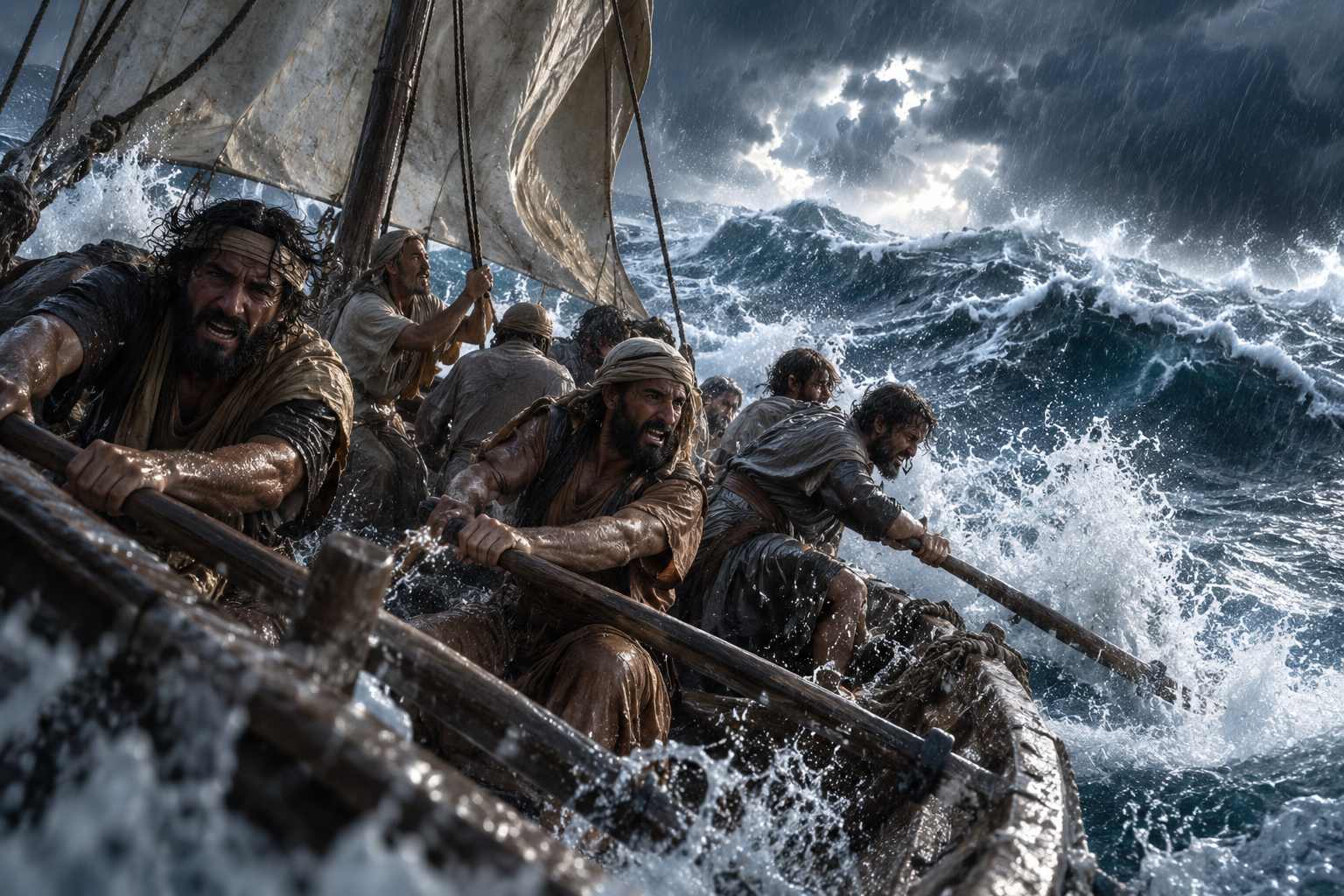
FUTILITY OF ROWING AGAINST
THE WILL OF THE LORD
However - This serves to mark a contrast between Jonah's request and the sailor's disobedience to his command because of their reticence to toss him in the sea.
The men rowed desperately to return to land but they could not - They attempted to save Jonah and themselves by their own strenuous efforts. Rowed desperately is a vivid translation. The Hebrew verb chathar (חָתַר) literally has the idea of digging or breaking through. Applied to rowing, it pictures the sailors digging their oars into the water, straining with all their strength to force the ship through the waves toward shore. The picture is not of ordinary rowing. These experienced sailors are fighting for every foot of progress. Jonah had said the solution was into the sea, but they attempted to get him onto the land. Their intentions were compassionate, but their efforts were contrary to what God was accomplishing. The reason they could not is because they were were struggling against a storm sovereignly directed by God. The takeaway is that Some storms cannot be outrowed. Sometimes God allows us to reach the end of our resources so that we recognize the limits of human strength.
For the sea was becoming even stormier against them - For is a term of explanation, explaining why they were unable to row to land was because the sea continuing to rage and grow increasingly violent.
NET NOTE - ROWED - The word translated row is used in Ezekiel to describe digging through a wall (Ezek 8:8; 12:5, 7, 12). Its use in Jonah pictures the sailors digging into the water with their oars as hard as they could. RETURN TO LAND - The word for land here is associated with a Hebrew verb meaning “to be dry” and is the same noun used in v. 9 of dry ground in contrast with the sea, both made by the Lord (see also Gen 1:9-10; Exod 4:9; 14:16, 22, 29; Jonah 2:10). THEY COULD NOT - Heb “but they were not able.” The phrase “to do so” does not appear in the Hebrew text but is supplied in the translation for stylistic reasons
Spurgeon preached a sermon with four wonderful points based on the actions of the crew in this chapter.
- Sinners, when they are tossed upon the sea of conviction, make desperate efforts to save themselves
- The fleshly efforts of awakened sinners must inevitably fail
- The soul’s sorrow will continue to increase as long as it relies on its own efforts
- The way of safety for sinners is to be found in the sacrifice of another on their behalf
D L Moody - The unavailing efforts of the Mediterranean oarsman have their counterpart,—
- In our efforts to convert others.
- In our efforts to convert our families.
- In our efforts to convert ourselves.
The cure is—Cry to God.
Jonah 1:14 Then they called on the LORD and said, “We earnestly pray, O LORD, do not let us perish on account of this man’s life and do not put innocent blood on us; for You, O LORD, have done as You have pleased.”
KJV Wherefore they cried unto the LORD, and said, We beseech thee, O LORD, we beseech thee, let us not perish for this man's life, and lay not upon us innocent blood: for thou, O LORD, hast done as it pleased thee.
NET So they cried out to the LORD, "Oh, please, LORD, don't let us die on account of this man! Don't hold us guilty of shedding innocent blood. After all, you, LORD, have done just as you pleased."
NLT Then they cried out to the LORD, Jonah's God. "O LORD," they pleaded, "don't make us die for this man's sin. And don't hold us responsible for his death. O LORD, you have sent this storm upon him for your own good reasons."
ESV Therefore they called out to the LORD, "O LORD, let us not perish for this man's life, and lay not on us innocent blood, for you, O LORD, have done as it pleased you."
- they (KJV): Jon 1:5,16 Ps 107:28 Isa 26:16
- let (KJV): Ge 9:6 De 21:8 Ac 28:4
- for (KJV): Ps 115:3 135:6 Da 4:34,35 Mt 11:26 Eph 1:9,11
Related Passages:
Deuteronomy 21:8 ‘Forgive Your people Israel whom You have redeemed, O LORD, and do not place the guilt of innocent blood in the midst of Your people Israel.’ And the bloodguiltiness shall be forgiven them.
CALLING ON LORD
FOR MERCY
Then they called on the LORD This marks a remarkable change from Jon 1:5, where “each man cried to his god.” They are no longer crying out to their various pagan deities. They now address Yahweh by His covenant Name. Jonah's testimony concerning “the LORD God of heaven who made the sea and the dry land” (Jon 1:9), together with the supernatural storm raging around them, has convinced them that Yahweh is the God with Whom they must deal.
and said, “We earnestly pray, O LORD, do not let us perish on account of this man’s life The repetition intensifies their plea. Their prayer is directed specifically and urgently to Yahweh. The God Jonah was fleeing is becoming the God to Whom these sailors are appealing. The sailors still fear that throwing Jonah into the sea may make them guilty of causing his death.
and do not put innocent blood on us; for You, O LORD, have done as You have pleased Their prayer is a bit ironic! Jonah's "blood" was not innocent but guilty! “Innocent blood” refers to bloodguilt incurred by wrongfully causing another person's death (cf. Dt 19:10; 21:8–9; Jer 26:15). The sailors are not necessarily declaring Jonah morally innocent. They already know that his disobedience caused the storm. Rather, they are pleading that they not be held guilty for his death if they obey what Jonah has told them to do.
Have done as You have pleased - NLT "you have sent this storm upon him for your own good reasons" The sailors understood that the storm was not an accident. The lot falling on Jonah was not an accident. Their inability to row back to shore was not an accident. They recognize the sovereign hand of Jonah's God behind everything that has happened.
The storm that disciplined Jonah became
the means by which pagans learned about Jonah's God.
NET NOTE -DO NOT PUT INNOCENT BLOOD - Heb “Do not put against us innocent blood,” that is, “Do not assign innocent blood to our account.” It seems that the sailors were afraid that they would die if they kept Jonah in the ship and also that they might be punished with death if they threw him overboard. YOU HAVE PLEASED - Ps 115:3 and Ps 135:6 likewise use these verbs (חָפֵץ and עָשָׂה, khafets and ʿasah; “to delight” and “to do, make”) in speaking of the Lord as characteristically doing what he wishes to do.
Jonah 1:15 So they picked up Jonah, threw him into the sea, and the sea stopped its raging.
KJV So they took up Jonah, and cast him forth into the sea: and the sea ceased from her raging.
NET So they picked Jonah up and threw him into the sea, and the sea stopped raging.
NLT Then the sailors picked Jonah up and threw him into the raging sea, and the storm stopped at once!
ESV So they picked up Jonah and hurled him into the sea, and the sea ceased from its raging.
- they (KJV): Jos 7:24-26 2Sa 21:8-9
- and the (KJV): Ps 89:9 Ps 93:3,4 Ps 107:29 Mt 8:26 Lu 8:24
Related Passages:
Joshua 7:24-26 Then Joshua and all Israel with him, took Achan the son of Zerah, the silver, the mantle, the bar of gold, his sons, his daughters, his oxen, his donkeys, his sheep, his tent and all that belonged to him; and they brought them up to the valley of Achor. 25 Joshua said, “Why have you troubled us? The LORD will trouble you this day.” And all Israel stoned them with stones; and they burned them with fire after they had stoned them with stones. 26 They raised over him a great heap of stones that stands to this day, and the LORD turned from the fierceness of His anger. Therefore the name of that place has been called the valley of Achor to this day.
Psalm 107:29 He caused the storm to be still, So that the waves of the sea were hushed.
Matthew 8:26 He *said to them, “Why are you afraid, you men of little faith?” Then He got up and rebuked the winds and the sea, and it became perfectly calm.
Luke 8:24 They came to Jesus and woke Him up, saying, “Master, Master, we are perishing!” And He got up and rebuked the wind and the surging waves, and they stopped, and it became calm.

JONAH JETTISONED
OVERBOARD
So So functions as a term of conclusion, marking the sailors' response to Jonah's instructions (Jon 1:12) and their prayer to Yahweh (Jon 1:14). In obedience to God's will, the sailors threw Jonah into the sea.
They picked up Jonah, threw (tur; LXX - ekbállō - ejection by force, throw out) him into the sea, and the sea stopped its raging - Earlier the sailors had “thrown the cargo which was in the ship into the sea” (Jon 1:5), but throwing the cargo accomplished nothing. Now they throw Jonah into the sea, and immediately the storm ceases. They surely have come to realize that the problem was never the weight on the ship but the rebel in the ship. The sea “stood still” or “ceased” from its raging. The effect apparently was immediate. This was not a gradual improvement in the weather. Jonah enters the water, and the raging sea becomes calm. This instantaneous cessation confirms everything Jonah had told the sailors in Jonah 1:12.
The storm that exposed Jonah's disobedience
became the means of revealing Jonah's God to the sailors.
Warren Wiersbe - The circumstances of life will be stormy. God called the Jewish people to be a blessing to the world (Gen. 12:1–3), but every time they disobeyed God, they brought trouble instead of blessing. The name Jonah means dove, but Jonah brought to the ship anything but peace. One child of God out of the will of God can cause more trouble than a troop of unconverted people. Once Jonah was on his rebellious way, the Lord could no longer speak to him but had to use the storm to get his attention. He also lost his prayer power (Jonah 1:6) and his testimony before the Gentile sailors (Jonah 1:7–9), and by seeking to run away from the Lord, he almost lost his life and endangered the lives of the crew. But once Jonah was off the ship, the storm ceased! (Jonah 1:15) I have seen families go from storms to blessed quietness once the sin in the home was confessed and forsaken—and it happens in churches too. (See Old Testament Words for Today: 100 Devotional Reflections - Page 89)
Jonah 1:16 Then the men feared the LORD greatly, and they offered a sacrifice to the LORD and made vows.
KJV Jonah 1:16 Then the men feared the LORD exceedingly, and offered a sacrifice unto the LORD, and made vows.
NET Jonah 1:16 The men feared the LORD greatly, and earnestly vowed to offer lavish sacrifices to the Lord.
NLT Jonah 1:16 The sailors were awestruck by the LORD's great power, and they offered him a sacrifice and vowed to serve him.
ESV Jonah 1:16 Then the men feared the LORD exceedingly, and they offered a sacrifice to the LORD and made vows.
- feared (KJV): Jon 1:10 Isa 26:9 Da 4:34-37 6:26 Mk 4:31 Ac 5:11
- offered (KJV): etc. Heb. sacrificed a sacrifice unto the Lord, and vowed vows, Ge 8:20 Jud 13:16 2Ki 5:17 Ps 107:22 Isa 60:5-7
- made (KJV): Ge 28:20 Ps 50:14 66:13-16 116:14 Ec 5:4
Related Passages:
Jonah 1:10 Then the men became extremely frightened and they said to him, “How could you do this?” For the men knew that he was fleeing from the presence of the LORD, because he had told them.
Psalm 50:14 “Offer to God a sacrifice of thanksgiving And pay your vows to the Most High;
Psalm 66:13-14 I shall come into Your house with burnt offerings; I shall pay You my vows, 14 Which my lips uttered And my mouth spoke when I was in distress.
Psalm 116:17-18 To You I shall offer a sacrifice of thanksgiving, And call upon the name of the LORD. 18 I shall pay my vows to the LORD, Oh may it be in the presence of all His people,
FEAR OF THE LORD
STIMULATED
Then the men feared the LORD greatly - Literally, “the men feared Yahweh with a great fear.” This is the third and climactic reference to the sailors' fear (Jonah 1:5, Jonah 1:10) After they witnessed the instantaneous calming of the sea, the object of their fear changes decisively: “they feared the LORD greatly.” They have moved from fear of the storm to fear of the LORD Who controls the storm.
Jonah says: “I fear the LORD.” (Jon 1:9) A few verses later: “Then the men feared the LORD greatly.” (Jon 1:16) The same chapter that begins with pagan sailors fearing the storm ends with them fearing Yahweh. And remarkably, God uses a disobedient missionary to bring it about.
How ironic that while Jonah was running from his missionary calling to Gentiles in Nineveh, God was turning the ship filled with Gentiles into a mission field!
The storm changed their fear of the sea
into fear of the LORD.
And they offered a sacrifice to the LORD and made vows - Their fear now produces worship. The sailors do not merely acknowledge that Jonah's God is powerful. They respond by offering sacrifice specifically to Yahweh. A vow was a solemn promise made to God, often in response to deliverance (cf. Ps 50:14; 66:13–14; 116:17–18). The text does not tell us what these sailors vowed, so speculation is unnecessary. Did these pagan polytheists become pagan monotheists? While the text certainly suggest we might see them in Heaven, we simply do not have enough information to be dogmatic.
The sailors began the storm crying to their gods
and ended it worshiping Jonah's God.
NET NOTE - FEARED THE LORD GREATLY - The editors of BHS suggest that the direct object אֶת־יְהוָה (ʾet-yhvah, “the Lord”) might be a scribal addition, and that the original text simply read, “The men became greatly afraid…” However, there is no shred of external evidence to support this conjectural emendation. Admittedly, the apparent “conversion” of these Phoenician sailors to Yahwism is a surprising development. But two literary features support the Hebrew text as it stands. First, it is not altogether clear whether or not the sailors actually converted to faith in the Lord. They might have simply incorporated him into their polytheistic religion. Second, the narrator has taken pains to portray the pagan sailors as a literary foil to Jonah by contrasting Jonah’s hypocritical profession to fear the Lord (Jon 1:9) with the sailors’ actions that reveal an authentic fear of God (Jon 1:10, 14, 16). FEARED THE LORD GREATLY - Heb “The men feared the Lord [with] a great fear, they sacrificed sacrifices, and they vowed vows” (cf. v. 10). By pairing verbs with related nouns as direct objects, the account draws attention to the sailors’ response and its thoroughness. MADE VOWS - Heb “they vowed vows.” The root נדר (ndr, “vow”) is repeated in the verb and accusative noun, forming an emphatic effected accusative construction in which the verbal action produces the object specified by the accusative (see IBHS 166-67 §10.2.1f). Their act of vowing produced the vows. This construction is used to emphasize their earnestness and zeal in making vows to worship the God who had just spared their lives from certain death.
Before the storm they feared death;
after the storm they feared the LORD.
NET NOTE - OFFERED A SACRIFICE - Heb “they sacrificed sacrifices.” The root זבח (zbkh, “sacrifice”) is repeated in the verb and accusative noun, forming an emphatic effected accusative construction in which the verbal action produces the object (see IBHS 166-67 §10.2.1f). Their act of sacrificing would produce the sacrifices. It is likely that the two sets of effected accusative constructions here (“they vowed vows and sacrificed sacrifices”) form a hendiadys; the two phrases connote one idea: “they earnestly vowed to sacrifice lavishly.” It is unlikely that they offered animal sacrifices at this exact moment on the boat—they had already thrown their cargo overboard, presumably leaving no animals to sacrifice. Instead, they probably vowed that they would sacrifice to the Lord when—and if—they reached dry ground. Targum Jonah 1:16 also takes this as a vow to sacrifice but for a different reason. According to Jewish tradition, the heathen are not allowed to make sacrifice to the God of Israel outside Jerusalem, so the Targum modified the text by making it a promise to sacrifice: “they promised to offer a sacrifice before the Lord and they made vows” (see B. Levine, The Aramaic Version of Jonah, 70; K. Cathcart and R. Gordon, The Targum of the Minor Prophets [ArBib], 14:106, n. 29).
William Barrick - The Examples of Conversion in the OT Individuals who were converted from an idolatrous Gentile background include such major figures as Abram (Genesis 12), Naaman (2 Kings 5), Rahab (Joshua 2), Ruth (Ruth 1:16-18), and the sailors on board the ship from Joppa to Tarshish (Jonah 1:16). Examples of national or corporate conversion include Judah in the time of Asa (2 Chr 14:2-4; 15:12-15)29 and the city of Nineveh (Jonah 3:5-10)
|
JONAH |
MARINERS |
|
A Hebrew, son of the covenant |
Gentiles, outside the covenant |
|
Monotheists |
Polytheists |
|
Relationship with God |
No relationship with God |
|
Spiritually insensitive |
Spiritually sensistive |
|
Moving away from God |
Moving toward God |
|
Indifferent to God's will |
Concerned to please God |
|
The conclusion of this comparison is that Jonah was upstaged spiritually by a group of heathens. The sailors were in the same class as the Assyrians whom Jonah refused to go preach to for fear they would get saved—and he didn’t think they deserved to be saved - David Jeremiah - The Runaway Prophet |
|
Quotes from David Jeremiah - The Runaway Prophet
“A fearful assignment from God is not as fearful as God Himself.”
“Whatever you think is going to be better in your Tarshish, you’re wrong!”
“There is nothing better than being in the center of God’s will.”
“It doesn’t make any difference what the circumstances may say. If we have a clear word from God about a subject, that’s it. It’s settled.”
“Whenever God calls us or commands us to do something, he enables us to do it.”
“It is wisest to obey Him immediately, not later.”
“When a believer chooses deliberately to disobey God, he should prepare for God to track him down and discipline him for his disobedience.”
“The coins he handed over were actually the cheapest part of the fare.”
COMMENT - Jonah paid the fare to Tarshish, but he had no idea what the journey would ultimately cost him.
“Jonah was about to pay a huge price for his disobedience!”
“Sin pays, all right, and its wages are not what the sinner would want.”
“Jonah was headed down, down, down, but the Lord was following him every step of the way.”
COMMENT - Down to Joppa > down into the ship > down into the sea > down into the fish > down to the depths. Sin always promises an easier road, but the road away from God always leads downward.
“You can run from God inside church as fast as you can on the outside, because running from God is a matter of the heart.”
“Jonah would have been ten times safer and better in the city of Nineveh... in the will of God, than he was in that boat running away from God.”
“Jonah never got a single step ahead of the Lord.”
“God prepared every step in Jonah’s path to repentance.”
“A significant part of the deception of disobedience is thinking that we can sin and keep our private world together.”
“We cannot sin without affecting other people.”
“Jonah’s confession was theologically on target. His problem wasn’t his theology; it was his failure to do what he knew was God’s will.”
“Jonah’s sleep in the bottom of the ship was more than physical.”
“God could control the weather, heathen sailors, giant fish, pagan populations, and gourds and worms more easily than a stubborn prophet!”
‘But the LORD.…’ These are the words of saving grace not only in Jonah’s life, but in ours as well.”
“He loves us so much that he will not allow us to walk down a road toward destruction.”
Jonah 1:17 And the LORD appointed a great fish to swallow Jonah, and Jonah was in the stomach of the fish three days and three nights.
KJV Now the LORD had prepared a great fish to swallow up Jonah. And Jonah was in the belly of the fish three days and three nights.
NET The LORD sent a huge fish to swallow Jonah, and Jonah was in the stomach of the fish three days and three nights.
NLT Now the LORD had arranged for a great fish to swallow Jonah. And Jonah was inside the fish for three days and three nights.
ESV And the LORD appointed a great fish to swallow up Jonah. And Jonah was in the belly of the fish three days and three nights.
- the Lord (KJV): Jon 4:6 Ge 1:21 Ps 104:25,26 Hab 3:2
- in (KJV): Mt 12:40 16:4 Lu 11:30
- belly (KJV): Heb. bowels
Related Passages:
Matthew 12:40-41 for just as JONAH WAS THREE DAYS AND THREE NIGHTS IN THE BELLY OF THE SEA MONSTER, so will the Son of Man be three days and three nights in the heart of the earth. 41 “The men of Nineveh will stand up with this generation at the judgment, and will condemn it because they repented at the preaching of Jonah; and behold, something greater than Jonah is here.

A FISHY
APPOINTMENT
And the LORD appointed (mānāh; LXX - prostasso - to issue an official directive, to command, order) a great fish to swallow Jonah - The Creator had no problem giving Jonah a fishy appointment! This is not a chance "catch" and not a small "catch". It is notable that the same verb appointed here is used repeatedly later in Jonah. God appointed a plant (Jon 4:6), appointed a worm (Jon 4:7), and appointed a scorching east wind (Jon 4:8).
A great fish to swallow Jonah - The Hebrew is dag gadol, literally “a great fish.” The text does not identify the species and does not specifically say “whale.” The Septuagint uses kētos, a broad term for a large sea creature, and the same term appears when Jesus refers to Jonah in Mt 12:40. Attempts to identify a particular species are therefore unnecessary. From Jonah's perspective, being swallowed by an enormous sea creature must initially have appeared to be the final catastrophe. In reality, the fish was not God's instrument of destruction but God's instrument of preservation. Had God not appointed the fish, Jonah presumably would have drowned. Note that the fish was more obedient than Jonah. An interesting takeaway is to remember that God's deliverance does not always arrive in the form we would expect! In effect Jesus Himself made Jonah a prophetic sign!
Sometimes God’s mercy comes
disguised as a great fish.God providentially had this great fish near or beneath the ship, ready to swallow Jonah when he was cast overboard. The fish was not merely an instrument of discipline but also an instrument of divine mercy. Jonah deserved judgment for his rebellion, yet God did not allow him to drown. The very creature that must have seemed like another calamity became God’s appointed means of preserving Jonah’s life. In the depths of the sea, God’s discipline and mercy met. The LORD was correcting His wayward prophet, but He was also saving him. The great fish was not evidence that God had abandoned Jonah but was evidence that God had not given up on Jonah.
C H Spurgeon - Just let me know that God says something is true, and that is enough for me. I do not quite join with the poor old woman in her words, but I agree with her spirit, who put her implicit faith in Scripture. When someone ridiculed her for believing that the whale swallowed Jonah, “Dear,” said she, “if the Word of God had said that Jonah swallowed the whale, I would have believed it.”
and Jonah was in the stomach of the fish three days and three nights - This expression describes the period of Jonah's extraordinary confinement and preservation. In Semitic usage, “three days and three nights” need not necessarily mean exactly seventy-two hours, since ancient Jewish inclusive reckoning could count portions of days as days (cf. Est 4:16 with Est 5:1; 1Sa 30:12–13). But the theological importance of the expression becomes much greater in the New Testament because Jesus Himself specifically selects Jonah's experience as a sign pointing to His own death and resurrection (Mt 12:40-41)
The “three days and three nights” need not be understood as a full 72 hours but should be interpreted according to Hebrew usage. The Jews commonly reckoned any part of a day as a whole day. Therefore, the expression can refer to a period of less than 72 hours.
The greatest proof for the historicity of Jonah and the fish is the fact that Jesus Christ unequivocally spoke of Jonah as being in the great fish's belly three days and three nights. Jesus would actually die, be buried, and rise again. Thus Jonah becomes a remarkable type or sign of Christ, although we should preserve the enormous difference between them. Jonah descended because of his own disobedience. Christ descended in perfect obedience and because of our sins (Php 2:8; 1Pe 2:24). Jonah deserved judgment but received deliverance. Christ deserved no judgment but willingly bore judgment for sinners.
God's discipline put Jonah into the sea,
while God's mercy provided the fish.
NET NOTE - Beginning with 1:17, the verse numbers through 2:10 in the English Bible differ from the verse numbers in the Hebrew text (BHS), with 1:17 ET = 2:1 HT, 2:1 ET = 2:2 HT, etc., through 2:10 ET = 2:11 HT. APPOINTED - Or “appointed” (NASB); cf. NLT “had arranged for.” The Piel verb מִנָּה (minnah) means “to send, to appoint” (Ps 61:8; Jonah 2:1; 4:6-8; Dan 1:5, 10-11; HALOT 599 s.v. מנה 2; BDB 584 s.v. מָנָה). Joyce Baldwin notes, “Here, with YHWH as the subject, the verb stresses God’s sovereign rule over events for the accomplishment of his purpose (as in Jonah 4:6-8, where the verb recurs in each verse). The ‘great fish’ is in exactly the right place at the right time by God’s command, in order to swallow Jonah and enclose him safely” (SEE The Minor Prophets: An Exegetical and Expository Commentary).
Jack Arnold on Unbeliever's Explanations of This Event. "Various approaches to this story have been taken by the scoffers. Critics, unable to credit the account as actual fact, have dreamed up explanations even more fantastic. Some say Jonah had a wild dream in the ship while he was asleep during the storm, and that later he recorded the extravagant fairy tale. Some relate the book to the Phoenician myth of Hercules and a sea monster. Others claim that Jonah was picked up after the storm by a boat which had a fish for a figure-head and that this gave him the idea for a "good story." And some would even resort to the ridiculous claim that a dead fish was floating around and that Jonah took refuge in it during the storm."
QUESTION - Was Jonah truly swallowed by a whale? | GotQuestions.org
ANSWER - The book of Jonah recounts the story of a disobedient prophet who, upon being swallowed by a whale (or a “great fish”) and vomited upon the shore, reluctantly led the reprobate city of Nineveh to repentance. The Bible’s plain teaching is that, yes, Jonah was truly swallowed by a whale (or a great fish).
The biblical account of Jonah is often criticized by skeptics because of its miraculous content. These miracles include the following events:
• A storm is summoned and dissipated by God (Jonah 1:4–16).
• A massive fish swallows the prophet after he is thrown into the sea by his ship’s crew (Jonah 1:17).
• Jonah survives in the belly of the fish for three days and three nights—or he dies and is resurrected, depending on how you interpret the text (Jonah 1:17).
• The fish vomits Jonah upon the shore at God’s command (Jonah 2:10).
• A gourd is appointed by God to grow rapidly in order to provide Jonah with shade (Jonah 4:6).
• A worm is appointed by God to attack and wither the gourd (Jonah 4:7).
• A scorching wind is summoned by God to discomfort Jonah (Jonah 4:8).
God’s use of a whale or great fish as Jonah’s mode of transportation was sure to capture Nineveh’s attention, given the prominence of Dagon worship in that particular area of the ancient world. Dagon was a fish-god who enjoyed popularity among the pantheons of Mesopotamia and the eastern Mediterranean coast. He is mentioned several times in the Bible in relation to the Philistines (Judges 16:23–24; 1 Samuel 5:1–7; 1 Chronicles 10:8–12). Images of Dagon have been found in palaces and temples in Nineveh and throughout the region. In some cases he was represented as a man wearing a fish. In others he was part man, part fish—a merman, of sorts.
Orientalist Henry Clay Trumbull observes:
“What better heralding, as a divinely sent messenger to Nineveh, could Jonah have had, than to be thrown up out of the mouth of a great fish, in the presence of witnesses, say on the coast of Phoenicia, where the fish-god was a favorite object of worship? Such an incident would have inevitably aroused the mercurial nature of Oriental observers, so that a multitude would be ready to follow the seemingly new avatar of the fish-god, proclaiming the story of his uprising from the sea, as he went on his mission to the city where the fish-god had its very centre of worship” (“Jonah in Nineveh,” Journal of Biblical Literature, Vol. 2, No.1, 1892, p. 56).
Some scholars have speculated that Jonah’s appearance, bleached white from the action of the fish’s digestive acids, would have been of great help to his cause. It could be that the Ninevites would have been greeted by a man whose skin, hair, and clothes were bleached ghostly white—a man accompanied by a crowd of frenetic followers, many who had witnessed him being vomited upon the shore by a great fish. Given the piscine nature of Jonah’s arrival, Nineveh’s repentance follows from a logical progression.
Apart from the Bible, there is no conclusive historical proof that Jonah was ever swallowed by a fish and lived to tell about it; however, there is some provocative corroboratory evidence. In the third century BC, a Babylonian priest/historian named Berosus wrote of a mythical creature named Oannes who, according to Berosus, emerged from the sea to give divine wisdom to men. Scholars generally identify this mysterious fish-man as an avatar of the Babylonian water-god Ea (also known as Enki). The curious thing about Berosus’ account is the name he used: Oannes.
Berosus wrote in Greek during the Hellenistic Period. Oannes is just a single letter removed from the Greek name Ioannes, which happens to be used in the Greek New Testament for Jonah. As for the I being dropped from Ioannes, Professor Trumbull writes, “In the Assyrian inscriptions the J of foreign words becomes I, or disappears altogether; hence Joannes, as the Greek representative of Jona, would appear in Assyrian either as Ioannes or as Oannes” (ibid., p. 58).
Nineveh was an Assyrian city. What this essentially means is that Berosus wrote of a fish-man named Jonah who emerged from the sea to give divine wisdom to man—a remarkable corroboration of the Hebrew account.
Berosus claimed to have relied upon official Babylonian sources for his information. Nineveh was conquered by the Babylonians under King Nabopolassar in 612 BC, more than 300 years before Berosus. It is quite conceivable that record of Jonah’s success in Nineveh was preserved in the writings available to Berosus. If so, it appears that Jonah was deified and mythologized over a period of three centuries, first by the Assyrians, who no doubt associated him with their fish-god, Dagon, and then by the Babylonians, who appear to have hybridized him with their own water-god, Ea.
Jonah was not an imaginary figure invented to play the part of a disobedient prophet, swallowed by a fish. He was part of Israel’s prophetic history. Jonah appears in the chronicles of Israel as the prophet who predicted Jeroboam II’s military successes against Syria (2 Kings 14:25). He is said to be the son of Amittai (cf. Jonah 1:1) from the town of Gath-hepher in lower Galilee. Flavius Josephus reiterates these details in his Antiquities of the Jews (chapter 10, paragraph 2).
Prior to its rediscovery, skeptics scoffed at the possibility
that so large a city could have existed in the ancient world.
The city of Nineveh was rediscovered after more than 2,500 years of obscurity. It is now believed to have been the largest city in the world at the time of its demise (see Tertius Chandler’s Four Thousand Years of Urban Growth: An Historical Census). According to Sir Austen Henry Layard, who chronicled the rediscovery of Nineveh, the circumference of Greater Nineveh was “exactly three days’ journey,” as recorded in Jonah 3:3 (BORROW A Popular Account of Discoveries at Nineveh, New York: J. C. Derby, 1854, p. 314). Prior to its rediscovery, skeptics scoffed at the possibility that so large a city could have existed in the ancient world. In fact, some skeptics denied the existence of Nineveh altogether. Its rediscovery in the mid-1800s proved to be a remarkable vindication for the Bible, which mentions Nineveh by name eighteen times and dedicates two entire books (Jonah and Nahum) to its fate.
It is interesting to note where the lost city of Nineveh was rediscovered. It was found buried beneath a pair of tells in the vicinity of Mosul in modern-day Iraq. These mounds are known by their local names, Kuyunjik and Nabi Yunus. Nabi Yunus happens to be Arabic for “the prophet Jonah.”
As for the whale or great fish that swallowed Jonah, the Bible doesn’t specify what sort of marine animal it was. The Hebrew phrase used in the Old Testament, gadowl dag, literally means “great fish.” The Greek used in the New Testament is këtos, which simply means “sea creature.” There are at least two species of Mediterranean marine life that are able to swallow a man whole. These are the cachalot (also known as the sperm whale) and the white shark. Both creatures are known to prowl the Mediterranean and have been known to sailors since antiquity. Aristotle described both species in his fourth-century-BC Historia Animalium.
Skeptics scoff at the miracles described in the book of Jonah as if there were no mechanism by which such events could occur. That is their bias. We are inclined, however, to believe that there is One who is capable of manipulating natural phenomena in such supernatural ways. We believe that He is the Creator of the natural realm and is not, therefore, circumscribed by it. We believe God sent Jonah to Nineveh to bring about their repentance and that, in the process, Jonah was swallowed by a whale or great fish.
Jesus spoke of Jonah’s ordeal as a real historical event. He used it as a typological metaphor for His own crucifixion and resurrection: “As Jonah was three days and three nights in the belly of a huge fish, so the Son of Man will be three days and three nights in the heart of the earth. The men of Nineveh will stand up at the judgment with this generation and condemn it; for they repented at the preaching of Jonah, and now something greater than Jonah is here” (Matthew 12:40–41).
The evidence is such that any Christian should have confidence to believe that Jonah was truly swallowed by a whale, and any skeptic should think twice before dismissing the story of Jonah as a fairy tale.
Once Upon A Time
Read:Matthew 24:32-44
The Lord had prepared a great fish to swallow Jonah. And Jonah was in the belly of the fish three days and three nights. — Jonah 1:17
Some people say that the Bible is just a collection of fairy tales. A boy slaying a giant. A man swallowed by a big fish. Noah’s boat-building experience. Even some religious people think that these events are just nice stories with a good moral.
Jesus Himself, however, spoke of Jonah and the giant fish, and Noah and the flood, as actual events: “As the days of Noah were, so also will the coming of the Son of Man be. For as in the days before the flood, they were eating and drinking, marrying and giving in marriage, until the day that Noah entered the ark, and did not know until the flood came and took them all away, so also will the coming of the Son of Man be” (Matt. 24:37-39). His return will happen when we’re not expecting it.
Jesus compared Jonah’s 3 days inside the big fish to the 3 days He would experience in the grave before His resurrection (Matt. 12:40). And Peter talked about Noah and the flood when he equated it to a future day when Jesus comes back (2 Peter 2:4-9).
God gave us His Word; it’s a book that is filled with truth—not fairy tales. And one day, we will live happily ever after with Him when Jesus comes again and receives His children to Himself. — Cindy Hess Kasper (Reprinted by permission from Our Daily Bread Ministries. Please do not repost the full devotional without their permission.)
We’re waiting for You, Lord, to come
And take us home to be with You;
Your promise to return for us
Gives hope because we know it’s true.
— Sper
We have reason for optimism if we’re looking for Christ’s return.
Appointed (04487) mānāh (מָנָה) is a Hebrew verb whose basic meaning is “to count, number, reckon, calculate, or tally,” but its significance extends beyond simple arithmetic. At its heart, mānāh describes the deliberate act of reckoning something, determining its extent, assigning it a place or portion, and therefore exercising purposeful control over it. This underlying concept explains how the verb develops naturally from “to count” in the Qal and Niphal stems to “to appoint, assign, ordain, or designate for a particular purpose” in the intensive stems. The various meanings are therefore related: what is counted is reckoned; what is reckoned may be assigned; and what is assigned is placed within an ordered purpose.
The Basic Idea – To Count or Number
In the Qal, mānāh most commonly means to count or number. It can describe counting people (2Sa 24:1; 1Chr 21:1), money (2Ki 12:10–11), sheep (Jer 33:13), days (Ps 90:12), stars (Ps 147:4), or even the dust of the earth (Ge 13:16). It sometimes occurs alongside sāphar, another verb meaning “to count” or “number,” as when Solomon describes Israel as “a great people who cannot be numbered or counted for multitude” (1Ki 3:8; cf. 1Ki 8:5).
But mānāh frequently conveys more than merely determining a numerical total. It suggests counting with purpose. A shepherd numbers his sheep because they belong to his care (Jer 33:13); money is counted out because it is being distributed for a particular purpose (2Ki 12:10–11); military forces are numbered because their strength and availability are being assessed (1Ki 20:25; 1Chr 21:1).
Thus mānāh may be pictured as counting with intentionality.
Counting, Reckoning, and Determining
From the idea of counting comes the related sense of reckoning, calculating, determining, or assigning.
This can be seen dramatically in Isaiah's prophecy concerning Messiah:
“He Himself bore the sin of many, and interceded for the transgressors.” He was “numbered with the transgressors” (Isa 53:12).
The Servant was not simply included in a numerical calculation. He was reckoned, classified, or assigned a place among transgressors.
Likewise, in Isaiah 65:12 God declares that He will “destine” rebellious people for the sword. Here mānāh carries the idea of allotting or assigning a destiny.
Thus the semantic progression is understandable: COUNT → RECKON → ASSIGN → APPOINT.
Numbering Can Imply Authority and Control
A particularly important nuance of mānāh is that the one who numbers something demonstrates knowledge of it and, in some contexts, authority over it. This is beautifully illustrated in Psalm 147:4: “He counts the number of the stars; He gives names to all of them.” Human beings cannot possibly count all the stars, but God not only numbers them, He names them. The point is far greater than God's mathematical ability. The innumerable universe is completely known, ordered, and governed by its Creator. Nothing is outside His knowledge or sovereign control.
This may also help illuminate David's sinful numbering of Israel (2Sa 24:1; 1Chr 21:1). The problem was not necessarily arithmetic itself. The narrative suggests that David's numbering reflected an improper confidence in military strength and human resources rather than dependence upon God. Whatever precise aspects constituted David's sin, Scripture clearly presents his census as an act that incurred divine displeasure.
To number our days is to reckon carefully with their limited quantity
and therefore order our lives wisely in light of eternity.“Teach Us to Number Our Days” The same verb occurs in the familiar prayer: “So teach us to number our days, that we may present to You a heart of wisdom.” (Ps 90:12) Here mānāh obviously means more than keeping a calendar. To number our days is to reckon carefully with their limited quantity and therefore order our lives wisely in light of eternity. We cannot control how many days God gives us, but we can recognize that they are numbered and seek wisdom concerning how we use them.
The Intensive Meaning – To Appoint or Ordain
The significance of mānāh becomes especially important in the intensive stems, where the verb commonly means “to appoint, assign, designate, prepare, or ordain.” Something or someone is deliberately assigned to a particular role, responsibility, experience, or purpose. Thus the king appointed Daniel's daily food ration (Da 1:5, 10), and an official was appointed over Daniel and his companions (Da 1:11). Job similarly laments that “wearisome nights have been appointed to me” (Job 7:3). The emphasis is therefore not merely that something exists or happens, but that it has been assigned or designated.
Mānāh in Jonah – God's Sovereign Appointments
The theological significance of mānāh becomes especially vivid in Jonah, where it is used repeatedly to emphasize God's sovereign control over His creation. God “appointed a great fish” to swallow Jonah (Jon 1:17). God “appointed a plant” to grow over Jonah and provide shade (Jon 4:6). God “appointed a worm” to attack the plant (Jon 4:7). God “appointed a scorching east wind” (Jon 4:8). These are not presented as random events. Each is mānāh. Each is specifically appointed by God to accomplish His purpose. And notice the extraordinary diversity of God's instruments: A great fish. A rapidly growing plant. A tiny worm. A scorching wind. The Creator commands the great and the small, the pleasant and the painful, the animate and the inanimate.
The Fish, Plant, Worm, and Wind Were All God's Servants This is perhaps the most important theological implication of mānāh in Jonah. The fish was appointed to preserve Jonah. The plant was appointed to comfort Jonah. The worm was appointed to remove Jonah's comfort. The wind was appointed to intensify Jonah's discomfort. Yet all four served the same sovereign God. God used one instrument to rescue His prophet and another to rebuke His prophet. He used one to provide comfort and another to remove comfort. The appointment changed, but the Appointer did not. Behind every mānāh stands the sovereign LORD accomplishing His purposes.
A Helpful Theological Balance - Mānāh strongly emphasizes God's sovereignty, but we should be cautious about concluding that we can identify every difficult circumstance in our own lives as a specific divine appointment with a particular explanation that we know. Jonah had inspired revelation telling him that God appointed the fish, plant, worm, and wind. We normally do not receive such an explanation for individual circumstances. What we can affirm is the broader biblical truth that nothing lies outside God's sovereign rule and that He is able to work through every circumstance for His purposes and for the ultimate good of His people (Ps 115:3; Ro 8:28–29; Eph 1:11).
MANAH - 27X/27V - appoint(1), appointed(9), count(3), counted(2), counts(1), destine(1), muster(1), number(4), numbered(5), numbers(1). Gen. 13:16; Num. 23:10; 2 Sam. 24:1; 1 Ki. 3:8; 1 Ki. 8:5; 1 Ki. 20:25; 2 Ki. 12:10; 1 Chr. 9:29; 1 Chr. 21:1; 1 Chr. 21:17; 1 Chr. 27:24; 2 Chr. 5:6; Job 7:3; Ps. 61:7; Ps. 90:12; Ps. 147:4; Eccl. 1:15; Isa. 53:12; Isa. 65:12; Jer. 33:13; Dan. 1:5; Dan. 1:10; Dan. 1:11; Jon. 1:17; Jon. 4:6; Jon. 4:7; Jon. 4:8
Summary Definition
Mānāh (מָנָה) means fundamentally to count, number, reckon, or calculate, but because deliberate numbering involves determining, identifying, and assigning, the word naturally develops the further meanings to allot, designate, appoint, or ordain. In its ordinary Qal and Niphal uses, it frequently refers to counting people, objects, money, animals, stars, or days (Ge 13:16; 2Ki 12:10; Ps 90:12; 147:4). In other contexts it means to reckon or assign someone to a particular category or destiny, as when the Servant is “numbered with the transgressors” (Isa 53:12). In the intensive stems, mānāh especially emphasizes purposeful appointment, whereby someone or something is designated to fulfill a particular function. This meaning is especially prominent in Jonah, where Yahweh appoints the great fish (Jon 1:17), the plant (Jon 4:6), the worm (Jon 4:7), and the scorching east wind (Jon 4:8). Thus mānāh moves conceptually from counting to reckoning, from reckoning to assigning, and from assigning to sovereign appointment. In Jonah it becomes a powerful expression of divine providence: God knows His creatures, numbers them, commands them, assigns them their place, and employs both the great and the small, the comforting and the painful, to accomplish His sovereign purposes.
QUESTION - What is the sign of Jonah? | GotQuestions.org (WATCH VIDEO)
ANSWER - The phrase “sign of Jonah” was used by Jesus as a typological metaphor for His future crucifixion, burial, and resurrection. Jesus answered with this expression when asked by the Pharisees for miraculous proof that He was indeed the Messiah. The Pharisees remained unconvinced of Jesus’ claims about Himself, despite His having just cured a demon-possessed man who was both blind and mute. Shortly after the Pharisees accused Jesus of driving out demons by the power of Satan, they said to Him, “Teacher, we want to see a sign from you.” He answered, “A wicked and adulterous generation asks for a sign! But none will be given it except the sign of the prophet Jonah. For as Jonah was three days and three nights in the belly of a huge fish, so the Son of Man will be three days and three nights in the heart of the earth. The men of Nineveh will stand up at the judgment with this generation and condemn it; for they repented at the preaching of Jonah, and now something greater than Jonah is here” (Matthew 12:38–41).
To fully appreciate the answer that Jesus gave, we must go to the Old Testament book of Jonah. In its first chapter, we read that God commanded the prophet Jonah to go to the city of Nineveh and warn its people that He was going to destroy it for its wickedness. Jonah disobediently ran from the Lord and headed for the city of Tarshish by boat. The Lord then sent a severe storm that caused the crew of the ship to fear for their lives. Jonah was soon thrown overboard and swallowed by a great fish where he remained for “three days and three nights” (Jonah 1:15–17). After the three-day period, the Lord caused the great fish to vomit Jonah out onto dry land (Jonah 2:10).
It is this three days that Jesus was referring to when He spoke of the sign of Jonah. Jesus had already been producing miracles that were witnessed by many. Jesus had just performed a great sign in the Pharisees’ presence by healing a deaf man who was possessed of a demon. Rather than believe, they accused Jesus of doing this by the power of Satan. Jesus recognized their hardness of heart and refused to give them further proof of His identity. However, He did say that there would be one further sign forthcoming, His resurrection from the dead. This would be their final opportunity to be convinced.
Jesus’ paralleling of the Pharisees with the people of Nineveh is telling. The people of Nineveh repented of their evil ways (Jonah 3:4–10) after hearing Jonah’s call for repentance, while the Pharisees continued in their unbelief despite being eyewitnesses to the miracles of Jesus. Jesus was telling the Pharisees that they were culpable for their unbelief, given the conversion of the people of Nineveh, sinners who had received far less evidence than the Pharisees themselves had witnessed. Interestingly, from the time of Jonah’s preaching, the people of Nineveh had 40 days to repent, and they did, sparing their city from destruction. From the time of Jesus’ preaching, the people of Jerusalem had 40 years, but they did not repent, and Jerusalem was destroyed.
But what are we to make of the phrase “three days and three nights”? Was Jesus saying that He would be dead for three full 24-hour periods before He would rise from the dead? It does not appear so. The phrase “three days and three nights” need not refer to a literal 72-hour period. Rather, according to the Hebrew reckoning of time, the days could refer to three days in part or in whole. Jesus was probably crucified on a Friday (Mark 15:42). According to the standard reckoning, Jesus died at about 3:00 PM (Matthew 27:46) on Friday (day 1). He remained dead for all of Saturday (day 2) and rose from the dead early on Sunday morning (day 3). Attempts to place Jesus’ death on Wednesday to accommodate a literal 72-hour period are probably unnecessary once we take into account the Hebrew method of reckoning of each day as beginning at sundown. So it seems that the expression “three days and three nights” was used as a figure of speech meant to signify any part of three days.
God would often use signs (or miracles) in the Bible to authenticate His chosen messenger. The Lord provided Moses with several miraculous signs in order to prove to others that he was appointed by God (Exodus 4:5–9; 7:8–10;19-20). God sent down fire on Elijah’s altar during Elijah’s contest with the prophets of Baal (1 Kings 18:36–39). He performed this miracle to prove that the God of Israel was the one true God. Jesus Himself would perform many miracles (or “signs”) to demonstrate His power over nature (Matthew 4:23; Mark 6:30–44; Luke 8:22–24; John 6:16–24). The “sign of Jonah” would turn out to be Jesus’ greatest miracle of all. Jesus’ resurrection from the dead would be God’s chief sign that Jesus was Israel’s long-awaited Messiah (Acts 2:23–32) and establish Christ’s claims to deity (Romans 1:3–4).
WHEN A FISH "CAUGHT" A MAN!
Now the Lord had prepared a great fish to swallow up Jonah . . . . Jonah 1:17
Some people say there isn't a creature in the sea that is capable of performing such a feat. Scientists know better. For instance, in 1912 Captain Charles Thompson harpooned a huge mammal off the coast of Florida which, when it was brought to land, was found to contain another 1500-pound fish that had been devoured whole. Those who examined Thompson's catch said it could have swallowed twenty average-size men! A Baptist minister who came upon the scene stood in the creature's mouth — holding his hands above his head — and still found he was too short to reach the top of the fish's palate. We must not forget, too, that the creature referred to in Jonah 1:17 was especially "prepared" for its unique assignment by the Lord Himself!
One day a young man traveling on a train began to discuss the Bible with a Chrisitian seated next to him. "If you can prove to me that Jonah was swallowed by a whale, I'll believe all the rest of the Bible," he said. "What do you think of Christ?" asked his companion. Surprised by the strange rejoinder, the first man ex-claimed, "That's beside the point." "Oh no, it's not," replied the other. "Tell me, do you think that Christ was wise?" "Yes," he said, "I think He was the wisest Man who ever lived." "Well, He believed what you call 'a fish story,' for see what He said in Matthew 12:40." The unbeliever was amazed to find that the passage read, "For as Jonah was three days and three nights in the belly of the great fish, so shall the Son of man be three days and three nights in the heart of the earth." "You see," said the Christian, "Jesus believed the account of Jonah!" "Thanks, Mister," was the reply. "That's proof enough for me!"
To avoid Jonah's difficulties, stay in the will of God. And al-ways remember that when God has something important He wants done, He can even make a fish catch a man! (Reprinted by permission from Our Daily Bread Ministries. Please do not repost the full devotional without their permission.)
God stopped the man Jonah upon his wrong path,
Bringing forth a great storm in displeasure and wrath.
The prophet confessed it was due to his sin,
So the crew threw him out, but a fish took him in.
—Anon.
Out of the will of God there can be no success;
in the will of God there can be no failure!
Before You Quit
Now the LORD had appointed a huge fish to swallow Jonah, and Jonah was in the fish three days and three nights. (Jon. 1:17)
The Predicament
Have you ever thought, It can’t get any worse than this—and then it does? Just when you’ve given your last ounce of strength to stay afloat in the midst of insurmountable problems, you’re swallowed by a giant catastrophe.
Such was Jonah. Having disobeyed God by sailing away from responsibility, a storm was unleashed because of his rebellion. He was thrown overboard by the ship’s sailors, abandoned in the sea, thinking death was imminent. It can’t get any worse than this, he thought. But it did.
The Reality
Consequently Jonah went down. Down to Tarshish, down into the bottom of a ship, down into the water, and now he was down inside the fish. Jonah had hit bottom. The sea was a place of great fear, a place of chaos and death. Jonah thought he was down and done for, but God was up to something.
When human beings are going down, God is often up to something great. From God’s perspective, big fish (like the poor economy, job loss, and illness) are not a problem at all. Even stiff-necked, rebellious, stubborn humans are not a problem. God laughs at insurmountable problems. He is working even when we don’t realize it. This is good news. He is far more faithful than we imagine.
Bottom Line
Jonah’s story reminds us that God meets us at our lowest place. Just when you think it can’t get any worse, God is up to something great. So don’t quit.
CAN WE TRUST THE STORY OF JONAH?
Now the LORD provided a huge fish to swallow Jonah, and Jonah was in the belly of the fish three days and three nights. JONAH 1:17
MANY OF US GREW UP HEARING THE STORY OF JONAH, THE prodigal prophet who, after God told him to preach repentance to the people of Nineveh, decided to run from God by boarding a boat for Tarshish—about as far away from Nineveh as he could go.
But then, through a series of events, Jonah ended up being thrown overboard and, as the verse above indicates, was provided free underwater transportation back to Nineveh in the belly of a huge fish. After he finally preached in that city, the people turned from their wicked ways to follow the true God.
It’s a great story, but is it true? Certainly this is a favorite target for skeptics. They scoff at the seemingly impossible odds of such a thing happening.
Even some theologians have relegated this event to a metaphor. But there’s a real problem: this is presented as a factual account in the Old Testament, Jewish people accept it as such, and the New Testament treats it as literal as well.
Specifically, Jesus presented the account of Jonah as a parallel to his coming death and resurrection. He said, “For as Jonah was three days and three nights in the belly of a huge fish, so the Son of Man will be three days and three nights in the heart of the earth” (Matthew 12:40). But if Jonah’s story is fictional, why would Jesus appeal to it as a precedent for what he was soon to suffer? He was correlating one historical event (from the past) to another historical event (in the near future).1
Some have tried to defend this story by pointing to more recent events in which people have been swallowed by whales and survived. These stories would be fascinating—if they were true. But careful research has shown these accounts not to be credible.2 As a result, some people conclude that the story of Jonah shouldn’t be trusted either.
But their logic isn’t sound. Just as with the creation of the universe or the resurrection of Jesus, we don’t need similar examples to prove such things can happen. These are miracles, after all—we wouldn’t expect them just to randomly recur at various points throughout history! And if God can create the heavens and the earth ex nihilo, then transporting a wayward prophet via a great fish would be, for him, child’s play!
Truth for Today
“I am the LORD, the God of all mankind. Is anything too hard for me?” (Jeremiah 32:27). If God can do miracles, including supernaturally submarining Jonah to a desired location, then he can handle whatever worries you today.
Jonah 1:1-17 Once Upon A Time By Cindy Hess Kasper
Read: Matthew 24:32-44
The Lord had prepared a great fish to swallow Jonah. And Jonah was in the belly of the fish three days and three nights. —Jonah 1:17
Some people say that the Bible is just a collection of fairy tales. A boy slaying a giant. A man swallowed by a big fish. Noah’s boat-building experience. Even some religious people think that these events are just nice stories with a good moral.
Jesus Himself, however, spoke of Jonah and the giant fish, and Noah and the flood, as actual events: “As the days of Noah were, so also will the coming of the Son of Man be. For as in the days before the flood, they were eating and drinking, marrying and giving in marriage, until the day that Noah entered the ark, and did not know until the flood came and took them all away, so also will the coming of the Son of Man be” (Matt. 24:37-39). His return will happen when we’re not expecting it.
Jesus compared Jonah’s 3 days inside the big fish to the 3 days He would experience in the grave before His resurrection (Matt. 12:40). And Peter talked about Noah and the flood when he equated it to a future day when Jesus comes back (2 Peter 2:4-9).
God gave us His Word; it’s a book that is filled with truth—not fairy tales. And one day, we will live happily ever after with Him when Jesus comes again and receives His children to Himself. (Reprinted by permission from Our Daily Bread Ministries. Please do not repost the full devotional without their permission.)
We’re waiting for You, Lord, to come
And take us home to be with You;
Your promise to return for us
Gives hope because we know it’s true. |
—Sper
We have reason for optimism if we’re looking for Christ’s return.
Insight - In His teaching, Christ often used examples from nature, as He did here with the fig tree (Matt. 24:32). He communicated to His listeners with word-pictures that would be familiar to them. They were part of an agricultural society that mostly lived outdoors, so nature became the perfect vehicle for His presentation of spiritual truths.
MIRACLES - Gary Richmond said, “If they were happening every day, they wouldn’t be called miracles, they’d be called regulars.” I think that’s a great statement. Miracles aren’t regulars. They’re every once in a while, maybe once in a lifetime, maybe twice. A parking place at Christmas time in Nordstroms’ parking lot isn’t a miracle. (I know it seems like a minor miracle, but it isn’t a miracle, you know.) The fact that your toothache stops hurting isn’t a miracle … or that your appendectomy scar isn’t large. That isn’t a miracle; that’s a very good surgeon. Jonah swallowed by a fish? I’d believe it if Scripture said Jonah swallowed the fish! It’s not difficult to believe if you believe in a God of miracles.—Billy Graham
Robert Neighbour - Jonah Swallowed but Undigested
"Now the Lord prepared a great fish, and it swallowed up Jonah. And Jonah was in the belly of the fish, three days and three nights" (Jon. 1:17).
1. Here is where many part company with the historicity of Jonah. They call it a legendary parable, or a fanciful fabrication, but wholly deny the possibility of a literal Jonah and a literally prepared fish; and of Jonah surviving a three days' conscious existence in the belly of the fish.
Why do men cavil at the Word of God? In our day men prepare under-sea crafts, submarines, and they fit them up with every modern convenience, so that groups of men may live in comparative comfort, under the sea surface. Of course, we believe in the possibility of the submarine, because we see it with our very eyes; we have great faith in the prowess of man.
Why not, then, believe in the greatness of God? Could not He Who made the worlds, and Who holds them in their orbits, by the word of His power, prepare a fish? Certainly, He could. The fact is, when the first word of the Bible is accepted, "In the beginning God," the stories of Jonah and the fish, and of the sun standing still in the valley of Adjalon, and of Daniel in the lions' den; and of Christ walking on the water, are all within the reach of simple faith.
2. Jonah was shut up to God, at last. He could hardly run away from God now. Sometimes God puts us where we will have to think. He lays us flat on our back where we can hardly see our toes, in order that He may make us stop and consider.
3. Jonah found no desire for prayer while he was safely housed in the ship, running away from God; it is quite different now. "Then Jonah prayed unto the Lord his God out of the fish's belly. He cried by reason of his affliction.
It is well worth the experience of any suffering, if it teaches prayerless lips to pray. Certainly no chastening is enjoyed, but "afterward it bringeth forth fruit unto holiness."
In the Storms of Life, God Gives Mercy By Rev. Mark Hollis
Scripture: Jonah 1:1–3:4, especially 2:9
But I will sacrifice to You with the voice of thanksgiving; I will pay what I have vowed. Salvation is of the LORD. (NKJV)
Introduction: Tornados rip through towns, uprooting trees and destroying buildings. Hurricanes devastate seaports and surrounding cities. The storms of life can be like that. We may not have weathered a tornado, hurricane, or earthquake; but most of us have faced life’s storms. Sometimes we make those storms worse by our reaction. Sometimes we even bring such storms upon ourselves. The prophet Jonah did.
1. A Disobedient Prophet (Jon. 1:1–16). Thunder raged and lightening flashed as waves battered the ship. On deck was a crew of veteran seamen. Curses turned to pleadings as they called on their gods for deliverance from the fury of the storm. In the hold of the ship was a sleeping Hebrew. Thunder, lightening, and the rolling of the sea did not wake him until the captain of the ship urged him to call on his God for mercy.
Jonah was running from the Lord. He was in the middle of a storm of his own making. His ministry came after the time that Israel had split into two kingdoms and before the Babylonian captivity. Jonah was a patriotic, God-fearing Israelite. He shared with his countrymen a love for Israel and a hatred for her enemies, the worst of whom was Assyria. God spoke to Jonah telling him to go directly to the capital city of the hated Assyrians and warn them of God’s coming judgment. The Assyrians were a feared and hated people. They loved to torture their enemies. Sometimes they blinded their captives and made sport of them. Sometimes they tortured an enemy by pulling chunks of his skin off until he died. Sometimes a hook was pulled through the nose and the victim made the slave of a merciless master. Jonah had every reason to fear the Assyrians. Why should he care if God judged these wicked enemies? They deserved it anyway. Perhaps some of his kin had suffered at their hands. Jonah said what many of us have said at some point in our lives: “No way, Lord!” And he got in a boat headed in the opposite direction. As the sea grew rougher and all appeared lost, Jonah said, “Throw me in!” He knew he was running from the very God who made the sea and the heaven. The sailors did their best to make it to land, but the sea grew wilder and rougher. Devoid of options, they took Jonah at his word and threw him overboard. Immediately, the sea grew calm. The sailors turned to God and worshiped. The story of Jonah is about more than a disobedient prophet and a big fish. It is a story of mercy. In the storm, God gave mercy. The first act of mercy is the mercy God gave these pagan sailors. In the storms of life, God gives mercy.
2. A Drowning Prophet (Jon. 1:17–2:9). Thrown into the depths of the Mediterranean Sea, Jonah was swept away. Engulfed by the waters, he thought he would drown. Yet, in mercy, God sent along a living submarine to carry him to safety. Jonah sat in the steaming belly of that whale for three days and three nights. He had plenty of time to reconsider the hardness of his heart. He recognized the mercy of God who allowed him to be carried along by the whale. The entire second chapter of Jonah’s Book is a psalm of praise to God for His mercy. In the storms of life, God gives mercy.
3. A Delivered Prophet (Jon. 2:10–3:4). God prompted the whale and it vomited Jonah onto dry land. Seasick, bleached white from the gases in the whale’s stomach, and smelling of whale vomit, Jonah heard the voice of the Lord a second time (Jon. 3:2). This time he decided to obey. He preached the prescribed message. Nineveh repented and God again demonstrated His mercy by sparing the city. In the storms of life, God gives mercy.
Conclusion: Are you in the middle of one of life’s storms? Do you feel you’ve made it worse by your own action? Do you worry because you brought the storm upon yourself? Jonah brought his storm upon himself. What did he find? Mercy! What do we find when we are in the middle of a storm of our own making? Mercy! In the storms of life, even the storms of our own making, God gives mercy.
C H Spurgeon - “The LORD appointed a great fish to swallow Jonah, and Jonah was in the belly of the fish three days and three nights.” God prepared a storm, he prepared a fish, and we afterwards read that he prepared a gourd, and he prepared a worm. In the great things of life and in the little things, God is always present. The swimming of a great fish in the sea is surely not a thing that is subject to law. If there is ever free agency in this world, it must certainly be in the wanderings of such a huge creature that follows its own instincts and plows its way through the great wastes of the wide and open sea. Yet there is a divine predestination concerning all its movements. Over every motion of the fin of every minnow, predestination presides. There is no distinction of little or great in God’s sight. He that wings an angel guides a sparrow.
Michael Green - BORROW 1500 Illustrations for Biblical Preaching
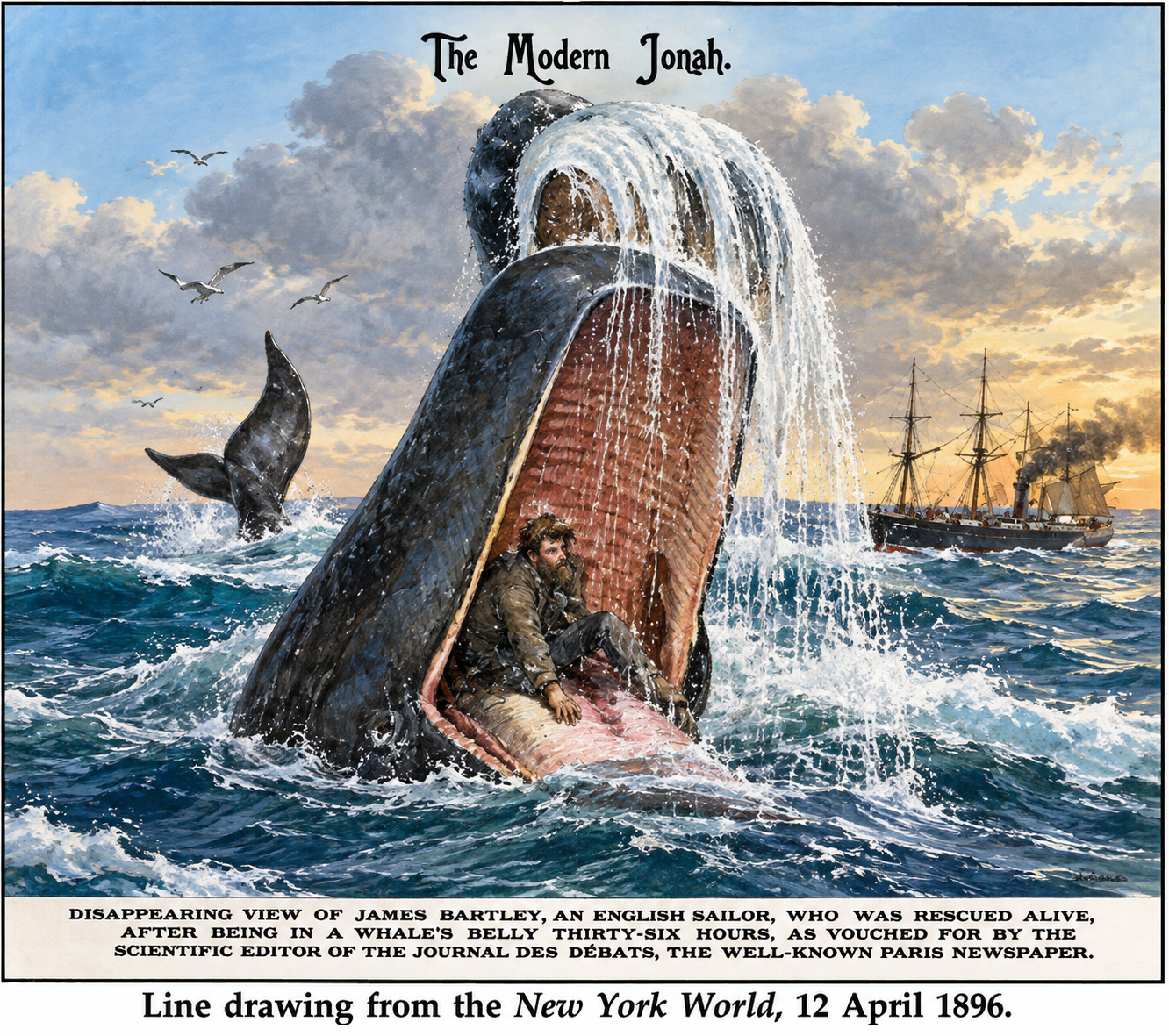
Many people find it difficult to take the Book of Jonah seriously because they find it hard to believe that a man could be swallowed by a whale and live to tell the story. The following account of a modern-day man who underwent a similar experience and did live to tell his story may be of help. The following account is taken from the Princeton Theological Review, Vol. 25, 1927, p. 636:
In February 1891, the whaling ship Star of the East was in the vicinity of the Falkland Islands and the lookout sighted a large sperm whale three miles away. Two boats were launched and in a short time one of the harpooners was enabled to spear the fish. The second boat attacked the whale, but was upset by a lash of its tail and the men thrown into the sea, one man being drowned, and another, James Bartley, having disappeared, could not be found. The whale was killed and in a few hours was lying by the ship’s side and the crew were busy with axes and spades removing the blubber. They worked all day and part of the night. Next morning, they attached some tackle to the stomach which was hoisted on the deck. The sailors were startled by something in it which gave spasmodic signs of life, and inside was found the missing sailor doubled up and unconscious. He was laid on the deck and treated to a bath of sea water which soon revived him.… He remained two weeks a raving lunatic.… At the end of the third week he had entirely recovered from the shock and resumed his duties.
Bartley affirms that he would probably have lived inside his house of flesh until he starved, for he lost his senses through fright and not from lack of air. He remembers the sensation of being thrown out of the boat into the sea.… He was then encompassed by a great darkness and he felt he was slipping along a smooth passage of some sort that seemed to move and carry him forward. The sensation lasted but a short time and then he realized he had more room. He felt about him and his hands came in contact with a yielding, slimy substance that seemed to shrink from his touch. It finally dawned upon him that he had been swallowed by the whale.… He could easily breathe, but the heat was terrible. It was not a scorching, stifling nature, but it seemed to open the pores of his skin and draw out his vitality.… His skin was exposed to the action of the gastric juice … face, neck and hands were bleached to a deadly whiteness and took on the appearance of parchment … (and) never recovered its natural appearance … (though otherwise) his health did not seem affected by his terrible experience.
Related Resource:
- A Whale of a Tale: Fundamentalist Fish Stories - Edward B. Davis - According to a persistent story, exactly one hundred years ago a sailor named James Bartley was swallowed by a sperm whale off the Falkland Islands. About thirty-six hours later his fellow sailors found him, unconscious but alive, inside the belly of the animal. What follows is the result of my attempt to uncover the real story, as well as the story of the story--how this whale of a tale found its way into the fundamentalist apologetic tradition, as well as a sizeable number of conservative biblical commentaries. (click link to read full article)
- Play children's song Who Did Swallow Jonah?
- The Story of Jonah and the Whale | Bible Stories for Kids - youtube video
Walter Kaiser - Hard Sayings of the Bible
Jonah 1:17 Myth or History?
Could Jonah really have been swallowed by a great fish, survive for three days inside that creature and live to tell about it? Is this a myth, a parable, an allegory or real history?
The Bible, of course, does not speak of Jonah being swallowed by a “whale”; it specifically mentions a “great fish” (Jon 1:17). Some English versions of Matthew 12:40 use the word “whale,” but the Greek original is kētos, a general word meaning a huge sea-monster. Taken as such, there are several sea-monsters that would be able to swallow a full-grown man easily enough, but the true whale, which has its home in the Arctic seas and is not found in the Mediterranean Sea, has a narrow throat that would generally prevent such a swallowing. There is another species of the same order in the Mediterranean Sea, however, which could swallow a man.
Ambrose John Wilson in the Princeton Theological Review for 1927 mentions a case of a sailor on a whaling ship near the Falkland Islands who was swallowed by a large sperm whale. The whale was later harpooned, and when it was opened up on deck the surprised crew found their lost shipmate unconscious inside its belly. Though bleached from the whale’s gastric juices, he recovered, even though he never lost the deadly whiteness left on his face, neck and hands.1
The problem with claiming that this text is a parable, allegory or myth is that each “solution” presents its own problems of literary genre. For example, parables are simple; they treat one subject. But the book of Jonah has at least two distinct parts: his flight and his preaching. Neither does Jonah fit the category of allegory, for there is no agreement on what the values are for each of the characters and events. The very diversity of answers is enough to state that allegory is not the solution. The same judgment would hold for suggesting that Jonah is a myth.
The book of Jonah, up until modern times, was everywhere treated as an historical record of the repentance of the city of Nineveh under the preaching of a man named Jonah. The apocryphal book Tobit has Tobit commanding his son Tobias to go to Media, for Tobit believes the word of God spoken about Nineveh. The Greek Septuagint text says that the preacher who predicted judgment on Nineveh was Jonah. In New Testament times, Jesus and the early believers took Jonah to be a real character. Thus, the objections to the book come down to this: it has too many miracles! But that is hardly an adequate basis on which to reject the internal claims of the book itself. Jonah is a believable account of a harrowing sea experience and of an unprecedented Gentile response to an ever-so-brief exposure to preaching about the need for repentance. But it happened!
Jonah 1:1-17 Swallowed Up By David C. Egner
Read: Jonah 1:1-17
When my soul fainted within me, I remembered the Lord. —Jonah 2:7
You’ve probably heard the story of Jonah and the great fish. But did you know that the disobedient prophet was “swallowed up” not once but three times? Let me explain.
First, Jonah was swallowed up by prejudice. The Ninevites were a wicked and idolatrous people (Jonah 1:2), and God wanted Jonah to preach repentance to them. But Jonah wanted them to feel God’s wrath (4:2), so he boarded a ship and headed in the opposite direction (1:3).
Second, Jonah was swallowed up by the sea. A wild storm was battering the boat, so the superstitious sailors cast lots to find out who was to blame, and “the lot fell on Jonah” (v.7). He said, “Throw me into the sea” (v.12). As the swirling waters engulfed him, he sank toward certain death.
Third, Jonah was swallowed up by a large fish that God had prepared to rescue him (1:17). Inside the fish 3 days, he confessed his sin and promised to obey God (2:1-9). After he was delivered, he followed God’s directive and preached judgment to Nineveh, and all the people repented (3:1-5).
God sometimes allows us to face frightening circumstances so that we will learn to trust and obey Him. It’s always best to obey the Lord right away—then we won’t be “swallowed up.” (Reprinted by permission from Our Daily Bread Ministries. Please do not repost the full devotional without their permission.)
When we walk with the Lord in the light of His Word,
What a glory He sheds on our way!
While we do His good will, He abides with us still,
And with all who will trust and obey.
—Sammis
The way of obedience is the way of blessing.
Once Upon A Time By Cindy Hess Kasper
Read: Matthew 24:32-44
The Lord had prepared a great fish to swallow Jonah. And Jonah was in the belly of the fish three days and three nights. —Jonah 1:17
Some people say that the Bible is just a collection of fairy tales. A boy slaying a giant. A man swallowed by a big fish. Noah’s boat-building experience. Even some religious people think that these events are just nice stories with a good moral.
Jesus Himself, however, spoke of Jonah and the giant fish, and Noah and the flood, as actual events: “As the days of Noah were, so also will the coming of the Son of Man be. For as in the days before the flood, they were eating and drinking, marrying and giving in marriage, until the day that Noah entered the ark, and did not know until the flood came and took them all away, so also will the coming of the Son of Man be” (Matt. 24:37-39). His return will happen when we’re not expecting it.
Jesus compared Jonah’s 3 days inside the big fish to the 3 days He would experience in the grave before His resurrection (Matt. 12:40). And Peter talked about Noah and the flood when he equated it to a future day when Jesus comes back (2 Peter 2:4-9).
God gave us His Word; it’s a book that is filled with truth—not fairy tales. And one day, we will live happily ever after with Him when Jesus comes again and receives His children to Himself. (Reprinted by permission from Our Daily Bread Ministries. Please do not repost the full devotional without their permission.)
We’re waiting for You, Lord, to come
And take us home to be with You;
Your promise to return for us
Gives hope because we know it’s true.
—Sper
We have reason for optimism if we’re looking for Christ’s return.
Insight - In His teaching, Christ often used examples from nature, as He did here with the fig tree (Matt. 24:32). He communicated to His listeners with word-pictures that would be familiar to them. They were part of an agricultural society that mostly lived outdoors, so nature became the perfect vehicle for His presentation of spiritual truths.
DOWN, DOWN, DOWN - Lessons from Jonah - Ray Pritchard
1. Every step out of the will of God is a downward step.
No one ever disobeyed God and went up. You only go down.
“Down” to Joppa.
“Down” into the ship.
“Down” into the sea.
“Down” in the belly of the great fish.
2. We get away quickly, we recover slowly.
It’s easy to go down, easy to get off the right path, easy to fall into sin. But the road back is difficult and often very painful.
3. Satan can work through circumstances just like God can.
Satan has his ships, and he always has room on his ships. His ships always go where we want to go when we’re running from God. He can make disobedience look good by means of favorable circumstances.
As he gets ready to take a nap, Jonah may have thought, “Things are going so well for me. This must be God’s will.” But if he thought that, he was wrong. The Lord had already made his will clear. No set of favorable circumstances can override what God has clearly said. Down deep he knew God’s will. He just didn’t want to do it.
No set of favorable circumstances can override what God has clearly said.
I began by saying that I am calling this series on Jonah “Outrageous Grace.” You may wonder, “Where is the grace of God in this story?” The answer is simple. He let Jonah disobey. He didn’t kill him on the spot. He gave him the freedom to mess up his own life. That didn’t seem like grace at the time, but it was. God works even in the midst of our disobedience to bring us to himself. Sometimes God lets us go way off course so that when we finally see our sin for what it is, we are ready to return to the Lord.
Meanwhile Jonah’s disobedience looks pretty good so far. “Happy sailing, Jonah. Watch out for that big fish.”
This is how life really works. Sin looks good for awhile. Jonah experienced the “pleasures of sin for a season.” If sin always brought immediate misery, it would be a lot less attractive to us. Stolen water may be sweet, but it leads you to the gates of hell.
The bitterness comes later.
The sadness comes later.
Sin is fun for a while (Heb 11:25). Be not deceived. God is not mocked (Gal 6:7). Jonah is about to find that out the hard way.
Jack Arnold - Can A Fish Swallow A Man? Yes, and there is historical evidence to prove it. The following quotes were taken from the book Jonah – Dead or Alive? By J. Vernon McGee, who took his quotes from the book The Bible Today by Grace W. Kellogg.
There are at least two known monsters of the deep who could easily have swallowed Jonah. They are the Balaenoptera Musculus or sulphur-bottom whale, and the Shinodon Typicus or whale shark. Neither of these monsters of the deep have any teeth. They feed in an interesting way by opening their enormous mouths, submerging their lower jaw, and rushing through the water at terrific speed. After straining out the water, they swallow whatever is left. A sulphur-bottom whale, one hundred feet long, was captured off Cape Cod in 1933. His mouth was ten or twelve feet wide —so big he could easily have swallowed a horse. These whales have four to six compartments in their stomachs, in any one of which a colony of men could find free lodging. They might even have a choice of rooms, for in the head of this whale is a wonderful air storage chamber, an enlargement of the nasal sinus, often measuring seven feet high, seven feet wide, by fourteen feet long. If he has an unwelcome guest on board who gives him a headache, the whale swims to the nearest land and gets rid of the offender as he did Jonah.
The Cleveland Plain Dealer recently quoted an article by Dr. Ransome Harvey who said that a dog was lost overboard from a ship. It was found in the head of a whale six days later, alive and barking.
Frank Bullen, F.R.G.S., who wrote, "The Cruise of the Cathalot," tells of a shark fifteen feet in length which was found in the stomach of a whale. He says that when dying the whale ejects the contents of its stomach.
The late Dr. Dixon stated that in a museum at Beirut, Syria, there was a head of a whale shark big enough to swallow the largest man that history records! He also tells of a white shark of the Mediterranean which swallowed a whole horse; another swallowed a reindeer minus only its horns. In still another Mediterranean white shark was found a whole sea cow, about the size of an ox.
The famous French scientist, M. De Parville, writes of James Bartley, who in the region of the Falkland Islands near South America, was supposed to have been drowned at sea. Two days after his disappearance, the sailors made a catch of a whale. When it was cut up, much to their surprise they found their missing friend alive but unconscious inside the whale. He revived and has been enjoying the best of health ever since his adventure.
Dr. Harry Rimmer, President of the Research Science Bureau of Los Angeles, writes of another case. "In the Literary Digest we noticed an account of an English sailor who was swallowed by a gigantic Rhinodon in the English Channel. Briefly, the account stated that in the attempt to harpoon one of these monstrous sharks, this sailor fell overboard, and before he could be picked up again, the shark turned and engulfed him. Forty-eight hours after the accident occurred, the fish was sighted and slain. When the shark was opened by the sailors, they were amazed to find the man unconscious but alive! He was rushed to the hospital where he was found to be suffering from shock alone, and a few hours later was discharged as being physically fit. The account concluded by saying that the man was on exhibit in a London Museum at a shilling admittance fee; being advertised as ‘The Jonah of the Twentieth Century.’ ”
In 1926, Dr. Rimmer met this man, and writes that his physical appearance was odd; his body was devoid of hair and patches of yellowish-brown color covered his entire skin.
Far further corroboration that a fish can swallow a man the Research Service of Encyclopedia Britannica released a positive statement:
Further, the Research Service goes on to cite two instances of men in modern times being swallowed alive and living to tell the story. One of these cases was subjected to careful scientific investigation by a British and two French scientists. A whaler disappeared after his small boat was upset by a harpooned whale; two days later he was found in the dissected whale's stomach. Except for a two-week period of shock and a permanent bleaching of his skin from the gastric juices, the man lived a normal life thereafter. (Teacher's Manual — Campus Crusade for Christ's Ten Basic Steps Toward Christian Maturity.)
ILLUSTRATION - “Above anything else,” Jackie Robinson said, “I hate to lose.”
On April 15, 1947, Robinson made it to the “show.” He became the first black man to wear a Major League uniform, destroying the color barrier in professional sports.
In his first season with the Brooklyn Dodgers, he hit.297, sent 12 over the fence, and lead the league with 29 steals. He was also the National League Rookie of the year. Two years later they named him the National League’s Most Valuable Player and he won the batting title with a.342 average. 1949 was his first of six appearances in the All-Star game.
During his ten years with the Dodgers, he helped them reach the World Series six times. Robinson had a career batting average of.311 and was inducted into the Hall of Fame in 1962, his first year of eligibility.
Did you also know that Jackie Robinson was court-martialed from the Army and that he dropped out of college? (From Fresh Illustrations)
Failure doesn’t have to be fatal, a lesson Jonah learned
while he was surrounded by a fish’s digestive juices.
Swallowed Up By David C. Egner
Read: Jonah 1:1-17
When my soul fainted within me, I remembered the Lord. —Jonah 2:7
You’ve probably heard the story of Jonah and the great fish. But did you know that the disobedient prophet was “swallowed up” not once but three times? Let me explain.
First, Jonah was swallowed up by prejudice. The Ninevites were a wicked and idolatrous people (Jonah 1:2), and God wanted Jonah to preach repentance to them. But Jonah wanted them to feel God’s wrath (4:2), so he boarded a ship and headed in the opposite direction (1:3).
Second, Jonah was swallowed up by the sea. A wild storm was battering the boat, so the superstitious sailors cast lots to find out who was to blame, and “the lot fell on Jonah” (v.7). He said, “Throw me into the sea” (v.12). As the swirling waters engulfed him, he sank toward certain death.
Third, Jonah was swallowed up by a large fish that God had prepared to rescue him (1:17). Inside the fish 3 days, he confessed his sin and promised to obey God (2:1-9). After he was delivered, he followed God’s directive and preached judgment to Nineveh, and all the people repented (3:1-5).
God sometimes allows us to face frightening circumstances so that we will learn to trust and obey Him. It’s always best to obey the Lord right away—then we won’t be “swallowed up.” (Reprinted by permission from Our Daily Bread Ministries. Please do not repost the full devotional without their permission.)
When we walk with the Lord in the light of His Word,
What a glory He sheds on our way!
While we do His good will, He abides with us still,
And with all who will trust and obey.
—Sammis
The way of obedience is the way of blessing.