Jonah 2:2
Jonah 2:3
Jonah 2:4
Jonah 2:5
Jonah 2:6
Jonah 2:7
Jonah 2:8
Jonah 2:9
Jonah 2:10
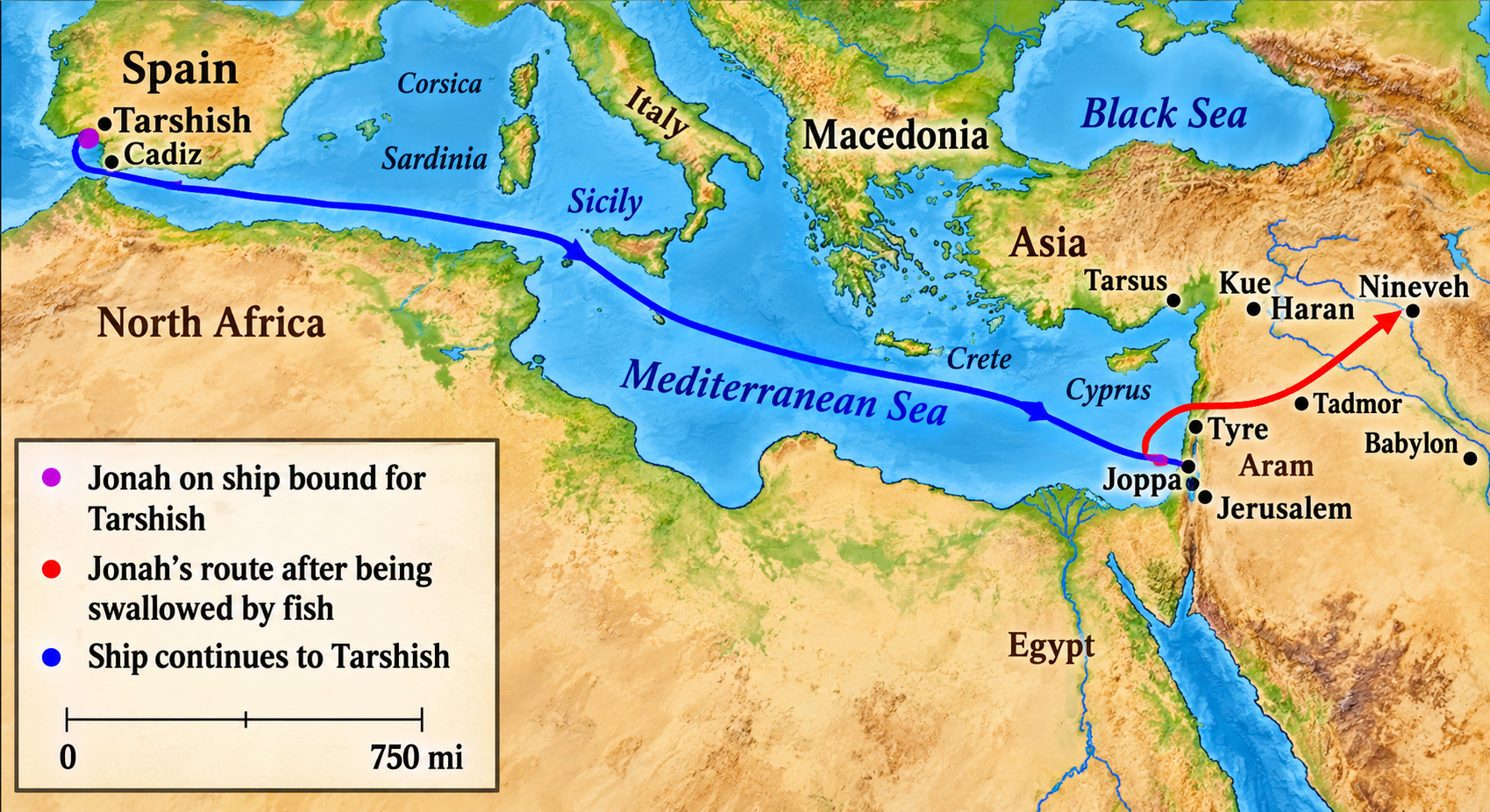
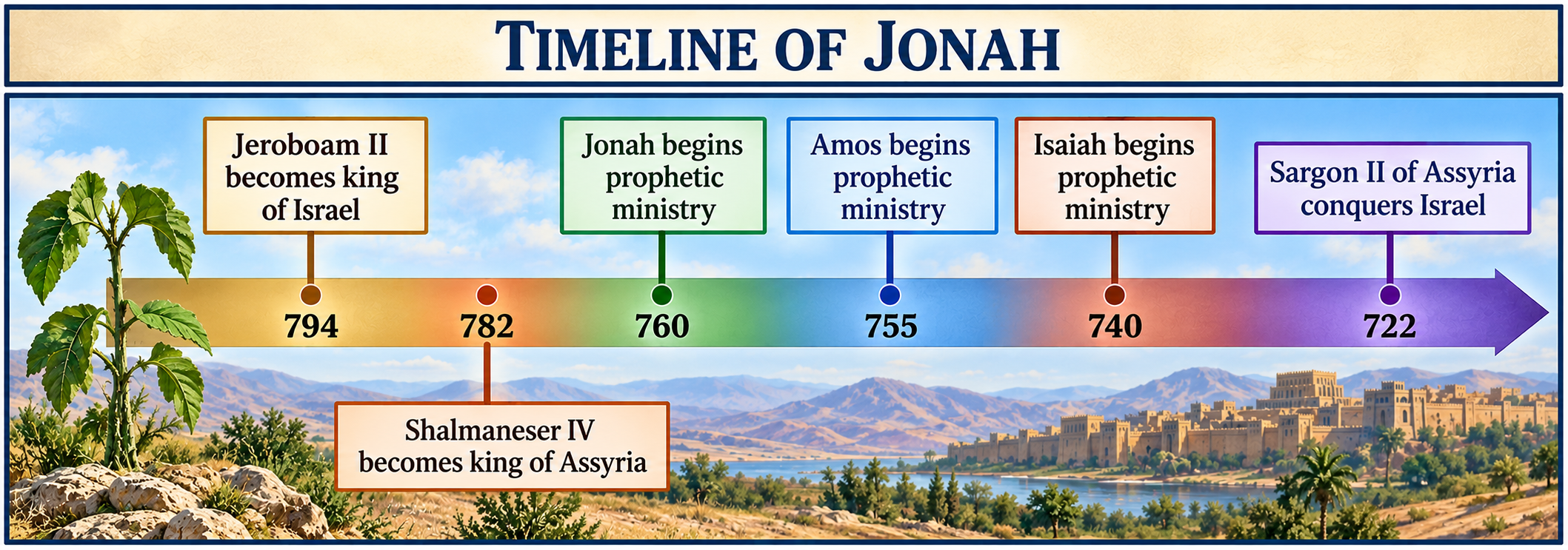
Jonah 2:1 Then Jonah prayed to the LORD his God from the stomach of the fish,
KJV Then Jonah prayed unto the LORD his God out of the fish's belly,
NET Jonah prayed to the LORD his God from the stomach of the fish
NLT hen Jonah prayed to the LORD his God from inside the fish.
ESV Then Jonah prayed to the LORD his God from the belly of the fish,
BGT καὶ προσηύξατο Ιωνας πρὸς κύριον τὸν θεὸν αὐτοῦ ἐκ τῆς κοιλίας τοῦ κήτους
LXE And Jonas prayed to the Lord his God out of the belly of the whale,
- prayed (KJV): 2Ch 33:11-13 Ps 50:15 91:15 Isa 26:16 Ho 5:15 6:1-3 Jas 5:13
- out (KJV): Job 13:15 Ps 130:1,2 La 3:53-56 Ac 16:24,25
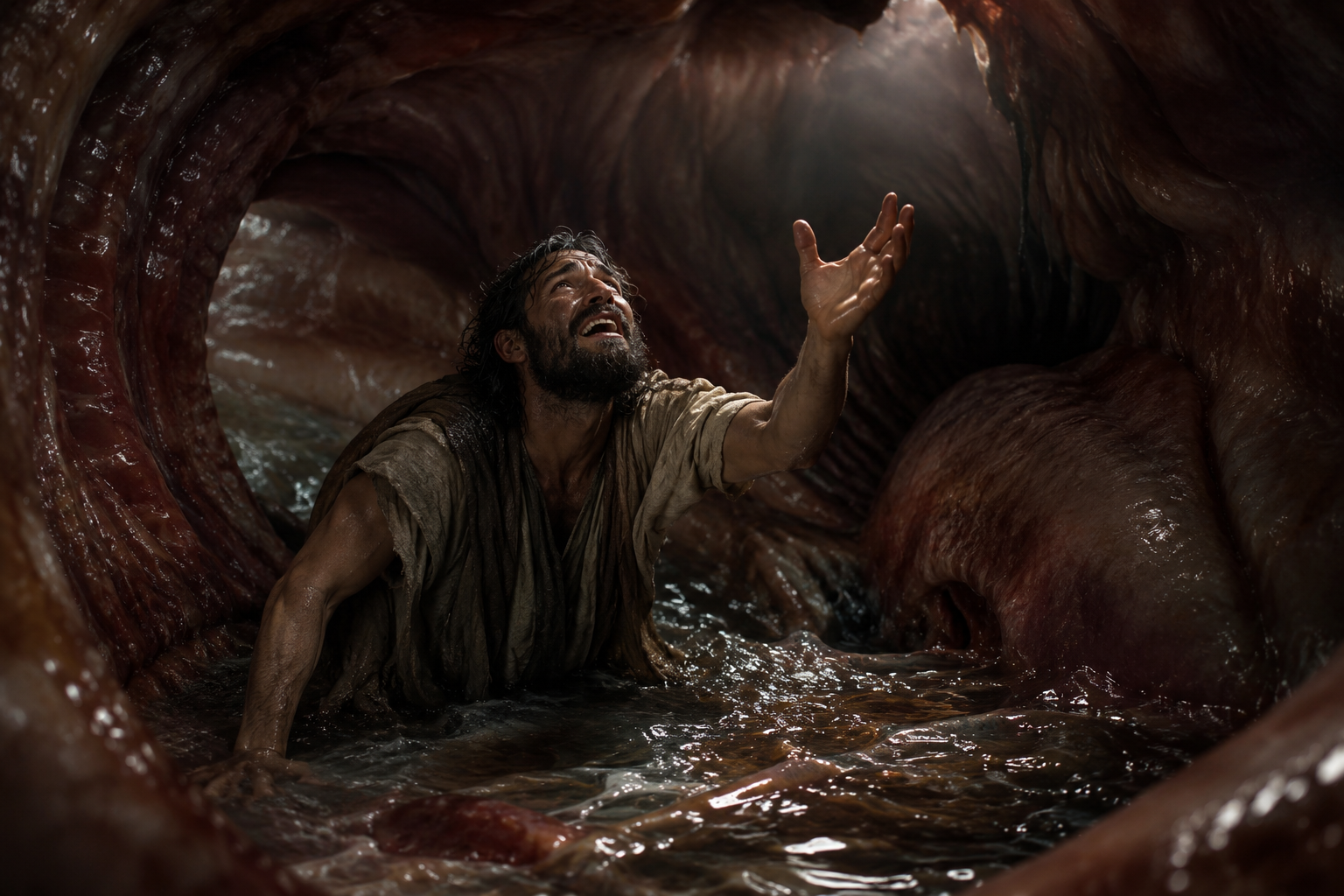
JONAH'S EXTRAORDINARY
"PRAYER CLOSET"
Then - THEN marks the next key moment—whether in time, logic, or climax—moving the narrative or argument forward. Begin to practice this simple interrogative/questioning mindset as you read the Scriptures. You will be surprised at how much your understanding of the text will increase over time! When then is used (as determined by the context) as an expression of time or "time phrase", it usually indicates sequence and thus marks that which is next in order of time, soon after that, following next after in order of position, narration or enumeration, being next in a series. In context, clearly Jonah is not has a "belly full" of trouble! Jonah has been going down, down, down and finally comes to his senses and begins to move upward!
Jonah would not speak to God from the relative safety of the ship, but he speaks to God from inside the fish. Sometimes God must bring His servant to the end of his own resources before that servant looks wholly to Him.
Jonah prayed to the LORD his God from the stomach of the fish - This action by Jonah marks a major turning point. As far as we can discern from the preceding narrative, this is the first time Jonah has "hit his knees." When the storm began, “each man cried to his god” (Jon 1:5), but Jonah was sleeping. The captain awakened him and specifically commanded, “Get up, call on your god” (Jon 1:6), but remarkably the text never says Jonah did so. Later the sailors themselves “called on the LORD” (Jon 1:14). Thus the pagan sailors are recorded praying before God's prophet is recorded praying! Sometimes we talk about saints needing to go into their prayer closet to pray. Jonah need to go into the stomach of a large fish to be stimulated to pray! His God is an encouraging phrase. After all of Jonah's rebellion and disobedience, Yahweh is still his God! Jonah's fellowship had been disrupted by disobedience (sin always kills fellowship with our Father), but his covenant relationship with Yahweh had not ceased. Undoubtedly Jonah is in the Abrahamic Covenant which unlike the Mosaic Covenant is an unconditional covenant. Yes, those in the Abrahamic Covenant still sin (and break fellowship) but they do not lose relationship with the Father because the Abrahamic Covenant rested ultimately upon God's unconditional promise and faithfulness (Ge 15:12–18; 17:7; cf. Heb 6:13–18).
Every place may serve as an oratory.
No place is amiss for prayer.
-- Jamieson
Jamieson on his God - Faith enables Jonah now to feel this; just as the returning prodigal says of the Father, from whom he had wandered, "I will arise and go to my Father" (Lk 15:18).
Had Jonah remained in the sea, he would have drowned. The creature that looked like his grave became, by God's providence, his lifeboat. In short, the fish was his rescue, not his ruin! Jonah's greatest problem was not the fish. The fish was God's solution to Jonah's rebellion! What appeared to be the worst thing that had happened to Jonah was actually the means God used to preserve his life and bring him back toward obedience.
🙏 THOUGHT - Dearly beloved, are you a a "tight" situation? Sometimes that the best thing that can happen to us! Jonah was finally looking upward because he had nowhere else to look. This illustrates a principle repeatedly seen in Scripture. Affliction often drives God's people to prayer (Ps 50:15; 107:6, 13, 19, 28; 119:67, 71). What is your “fish's stomach” today? Have circumstances brought you to a place where your own wisdom, strength, money, influence, or ingenuity cannot deliver you? That place may feel like confinement, but it can become a sanctuary of prayer if it turns your heart back toward God. Jonah teaches us that we never need to find the right place before we pray. We simply need to turn to the right Person.
Prayer does not require favorable circumstances.
It requires a heart that turns toward God.Your sin is never too great,
your predicament never too difficult, for God.
William MacDonald - His prayer is remarkable in that it contains fragments from the Book of Psalms. J. Sidlow Baxter analyzes the prayer as follows: There is not one word of petition in Jonah's prayer. It consists of thanksgiving (verses 2-6), contrition (verses 7, 8) and rededication (verse 9). It is really a psalm of praise, a "Te Deum," a "doxology." I know of a man who once sang the Doxology with his head in his empty flour barrel, as an expression of faith that God would send a further supply of flour! But the novelty of singing a doxology with your head—and all the rest of you—inside a great fish in mid-ocean, is absolutely without rival. (See Believer's Bible Commentary - Page 1033)
David Jeremiah - Everyone knows there are no atheists in foxholes. Jonah, chapter two, shows us that the bellies of whales seem to have the same effect. All it takes for the average atheist or disobedient believer to get serious with God is to have the walls of the foxhole—or the whale’s belly, as the case may be—to close in on them....All of us experience trouble in our lives. In fact, a lot of the trouble we experience is not because we have been bad or we have done wrong. Philippians 1:29 says it this way: “For to you it has been granted on behalf of Christ, not only to believe in Him, but also to suffer for His sake.” Suffering is just as sure as salvation. We are going to have some because of who we are in Christ. But sometimes trouble comes to us not because of who we are in Christ, but because we have denied who we are in Christ. Sometimes our trouble comes as God’s remedial action to bring us back into fellowship with Himself. This was the case with Jonah.....
There is a person whom most Christians think didn’t suffer to learn obedience who really did. In fact, this person cried out in tears to the Father just like you might do. He was never in the belly of a whale, but He was alone one night in a garden with all the forces of hell encouraging him to disobey the Father. So the next time you think God is tired of hearing you call for help, remember He’s not. His son has been there, too. (See Hebrews 5:7–8.)
Jonah 2:1 Unusual Places
READ: Psalm 40:1-8
Walking past my barn one day, I heard a frantic chirping inside. When I investigated, I found a poor blue jay beating its wings against the window. Had it not cried and chirped, I would not have heard, but its cry for help prompted me to come, open the door wide, and allow it to fly out to freedom.
God's children get themselves into some unusual places and unhappy circumstances. Consider the following incidents:
- Jonah in a fish's belly, running from God (Jonah 2:1)
- David in enemy territory, acting insane (1Sa 21:10-15)
- Abram in Egypt, lying about his wife (Gen. 12:10-13)
- Lot in Sodom, living with the wicked (Ge 13:12,13)
- Elijah in the desert, wallowing in self-pity (1Ki. 19:4)
- Peter in a courtyard, denying his Lord (Lk 22:55-62)
God's children should not be found in such circumstances, but all too often they are.
Are you in a place you shouldn't be today? Are you far from God, feeling defeated, trapped, and unhappy? Then cry out to the Lord, confess your sin, and be restored by His abundant mercy (1Jn. 1:9). He is waiting to hear your cry of repentance. — M. R. De Haan (Reprinted by permission from Our Daily Bread Ministries. Please do not repost the full devotional without their permission.)
There is only One who knows
All the answers to my woes;
He will all my needs supply
When in faith to Him I cry.
--Morgan
No place is beyond the reach of God's grace.
THE BOTTOM OF THE SEA WAS NOT THE BOTTOM OF GOD'S GRACE.
JONAH REACHED THE DEPTHS OF THE SEA, BUT NOT THE LIMITS OF GOD'S GRACE.
WE MAY LOSE SIGHT OF GOD, BUT GOD NEVER LOSES SIGHT OF US.
There is no place so dark that God's grace cannot reach it.
You can run from God, but you cannot run beyond His grace.
No depth is deeper than the reach of God's grace.
Wherever sin takes us, God's grace can still find us.
No distance from God is beyond the reach of God.
God's grace reaches us even in the depths.
No pit is so deep that God's grace cannot reach deeper.
Grace can find us where rebellion has taken us.
There is no wilderness where God's grace cannot find us.
Our wandering may take us far from God, but never beyond His reach.
God's grace reaches into the places our disobedience takes us.
No circumstance can put us outside the reach of God's mercy.
The runaway prophet discovered that God's grace travels farther than he could run.
The depths that exposed Jonah's helplessness also displayed God's grace.
Jonah went down, down, down, but God's grace followed him all the way.
Even in the belly of the fish, Jonah was still within reach of the hand of God.
Where Jonah's resources ended, God's grace was still at work.
Jonah 2:1-2 In The Belly Of A Fish
Jonah must have been very uncomfortable in the belly of the fish. Yet there are many people in this dark and suffocating world who seem to think that the place they find themselves is a pretty good place to be. They believe that the world needs only a few social and political improvements. And they also hold that people themselves possess the ability to make all the needed changes.
But this is not the testimony of the Word of God, for it says that "the whole world lies under the sway of the wicked one" (1Jn. 5:19). It certainly is not the testimony of the Spirit of truth, for He has come to "convict the world of sin, and of righteousness, and of judgment" (Jn 16:8). The primary mission of the church is not to introduce social and political changes into the world, but to proclaim salvation as the way out.
Jonah was not so foolish as to suppose that God would make him a little more comfortable in the fish's belly, but he looked for deliverance out of it. He cried to the Lord, and the Lord heard him.
We are not to look for perfection in this world but to look forward to the time when Christ will recreate the world and bring in everlasting righteousness. — M. R. De Haan (Reprinted by permission from Our Daily Bread Ministries. Please do not repost the full devotional without their permission.)
I am a stranger here within a foreign land,
My home is far away upon the golden strand;
Ambassador to be of realms beyond the sea;
I'm here on business for my King.
--Cassel
Our main business in this world
is to lay up treasure in heaven.
LIVE HERE, INVEST THERE.
EARTHLY OPPORTUNITIES, ETERNAL TREASURES.
LIVE WITH HEAVEN'S BALANCE SHEET IN VIEW.
SEND YOUR TREASURE AHEAD.
INVEST IN WHAT OUTLIVES YOU.
Our greatest business on earth is preparing for eternity.
Live on earth with your treasure stored in heaven.
Invest your life where moth, rust, and thieves cannot reach.
Spend your earthly days building heavenly treasure.
What we keep on earth we eventually lose; what we lay up in heaven we keep forever.
Earth is temporary; invest in what is eternal.
Use temporal treasures to gain eternal treasure.
Do not spend your life accumulating what you cannot keep.
The wisest investments are those that pay dividends in eternity. (an eternal "R.O.I."!)
Live today with eternity in view. (Jonathan Edwards America's greatest theologian prayed "O Lord, please stamp eternity on my eyeballs!”)
Measure earthly gain by its eternal value.
Turn earthly opportunities into heavenly treasure.
What matters most is not what we leave behind, but what we send ahead.
Heaven's treasures should govern earth's priorities.
Hold earthly possessions loosely and heavenly treasures tightly.
Don't let temporary riches rob you of eternal riches.
A life spent only for this world is a life invested in what must perish.
Make your earthly life count for heavenly gain.
The best use of earthly wealth is to invest it in eternal purposes.
We are not here merely to make a living, but to prepare for eternity.
Live for what will still matter when this world has passed away.
The treasures worth pursuing are the treasures we never have to leave behind.
Our earthly possessions have an expiration date; heavenly treasure does not.
Do not make your greatest investment in a world you are going to leave.
The wise believer turns temporary resources into eternal rewards.
QUESTION - Was Jonah truly swallowed by a whale? GOTQUESTIONS.ORG
ANSWER - The book of Jonah recounts the story of a disobedient prophet who, upon being swallowed by a whale (or a “great fish”) and vomited upon the shore, reluctantly led the reprobate city of Nineveh to repentance. The Bible’s plain teaching is that, yes, Jonah was truly swallowed by a whale (or a great fish).
The biblical account of Jonah is often criticized by skeptics because of its miraculous content. These miracles include the following events:
• A storm is summoned and dissipated by God (Jonah 1:4–16).
• A massive fish swallows the prophet after he is thrown into the sea by his ship’s crew (Jonah 1:17).
• Jonah survives in the belly of the fish for three days and three nights—or he dies and is resurrected, depending on how you interpret the text (Jonah 1:17).
• The fish vomits Jonah upon the shore at God’s command (Jonah 2:10).
• A gourd is appointed by God to grow rapidly in order to provide Jonah with shade (Jonah 4:6).
• A worm is appointed by God to attack and wither the gourd (Jonah 4:7).
• A scorching wind is summoned by God to discomfort Jonah (Jonah 4:8).
God’s use of a whale or great fish as Jonah’s mode of transportation was sure to capture Nineveh’s attention, given the prominence of Dagon worship in that particular area of the ancient world. Dagon was a fish-god who enjoyed popularity among the pantheons of Mesopotamia and the eastern Mediterranean coast. He is mentioned several times in the Bible in relation to the Philistines (Judges 16:23–24; 1 Samuel 5:1–7; 1 Chronicles 10:8–12). Images of Dagon have been found in palaces and temples in Nineveh and throughout the region. In some cases he was represented as a man wearing a fish. In others he was part man, part fish—a merman, of sorts.
Orientalist Henry Clay Trumbull observes: “What better heralding, as a divinely sent messenger to Nineveh, could Jonah have had, than to be thrown up out of the mouth of a great fish, in the presence of witnesses, say on the coast of Phoenicia, where the fish-god was a favorite object of worship? Such an incident would have inevitably aroused the mercurial nature of Oriental observers, so that a multitude would be ready to follow the seemingly new avatar of the fish-god, proclaiming the story of his uprising from the sea, as he went on his mission to the city where the fish-god had its very centre of worship” (“Jonah in Nineveh,” Journal of Biblical Literature, Vol. 2, No.1, 1892, p. 56).
Some scholars have speculated that Jonah’s appearance, bleached white from the action of the fish’s digestive acids, would have been of great help to his cause. It could be that the Ninevites would have been greeted by a man whose skin, hair, and clothes were bleached ghostly white—a man accompanied by a crowd of frenetic followers, many who had witnessed him being vomited upon the shore by a great fish. Given the piscine nature of Jonah’s arrival, Nineveh’s repentance follows from a logical progression.
Apart from the Bible, there is no conclusive historical proof that Jonah was ever swallowed by a fish and lived to tell about it; however, there is some provocative corroboratory evidence. In the third century BC, a Babylonian priest/historian named Berosus wrote of a mythical creature named Oannes who, according to Berosus, emerged from the sea to give divine wisdom to men. Scholars generally identify this mysterious fish-man as an avatar of the Babylonian water-god Ea (also known as Enki). The curious thing about Berosus’ account is the name he used: Oannes.
Berosus wrote in Greek during the Hellenistic Period. Oannes is just a single letter removed from the Greek name Ioannes, which happens to be used in the Greek New Testament for Jonah. As for the I being dropped from Ioannes, Professor Trumbull writes, “In the Assyrian inscriptions the J of foreign words becomes I, or disappears altogether; hence Joannes, as the Greek representative of Jona, would appear in Assyrian either as Ioannes or as Oannes” (ibid., p. 58).
Nineveh was an Assyrian city. What this essentially means is that Berosus wrote of a fish-man named Jonah who emerged from the sea to give divine wisdom to man—a remarkable corroboration of the Hebrew account.
Berosus claimed to have relied upon official Babylonian sources for his information. Nineveh was conquered by the Babylonians under King Nabopolassar in 612 BC, more than 300 years before Berosus. It is quite conceivable that record of Jonah’s success in Nineveh was preserved in the writings available to Berosus. If so, it appears that Jonah was deified and mythologized over a period of three centuries, first by the Assyrians, who no doubt associated him with their fish-god, Dagon, and then by the Babylonians, who appear to have hybridized him with their own water-god, Ea.
Jonah was not an imaginary figure invented to play the part of a disobedient prophet, swallowed by a fish. He was part of Israel’s prophetic history. Jonah appears in the chronicles of Israel as the prophet who predicted Jeroboam II’s military successes against Syria (2 Kings 14:25). He is said to be the son of Amittai (cf. Jonah 1:1) from the town of Gath-hepher in lower Galilee. Flavius Josephus reiterates these details in his Antiquities of the Jews (chapter 10, paragraph 2).
The city of Nineveh was rediscovered after more than 2,500 years of obscurity. It is now believed to have been the largest city in the world at the time of its demise (see Tertius Chandler’s Four Thousand Years of Urban Growth: An Historical Census). According to Sir Austen Henry Layard, who chronicled the rediscovery of Nineveh, the circumference of Greater Nineveh was “exactly three days’ journey,” as recorded in Jonah 3:3 (A Popular Account of Discoveries at Nineveh, New York: J. C. Derby, 1854, p. 314). Prior to its rediscovery, skeptics scoffed at the possibility that so large a city could have existed in the ancient world. In fact, some skeptics denied the existence of Nineveh altogether. Its rediscovery in the mid-1800s proved to be a remarkable vindication for the Bible, which mentions Nineveh by name eighteen times and dedicates two entire books (Jonah and Nahum) to its fate.
It is interesting to note where the lost city of Nineveh was rediscovered. It was found buried beneath a pair of tells in the vicinity of Mosul in modern-day Iraq. These mounds are known by their local names, Kuyunjik and Nabi Yunus. Nabi Yunus happens to be Arabic for “the prophet Jonah.”
As for the whale or great fish that swallowed Jonah, the Bible doesn’t specify what sort of marine animal it was. The Hebrew phrase used in the Old Testament, gadowl dag, literally means “great fish.” The Greek used in the New Testament is këtos, which simply means “sea creature.” There are at least two species of Mediterranean marine life that are able to swallow a man whole. These are the cachalot (also known as the sperm whale) and the white shark. Both creatures are known to prowl the Mediterranean and have been known to sailors since antiquity. Aristotle described both species in his fourth-century-BC Historia Animalium.
Skeptics scoff at the miracles described in the book of Jonah as if there were no mechanism by which such events could occur. That is their bias. We are inclined, however, to believe that there is One who is capable of manipulating natural phenomena in such supernatural ways. We believe that He is the Creator of the natural realm and is not, therefore, circumscribed by it. We believe God sent Jonah to Nineveh to bring about their repentance and that, in the process, Jonah was swallowed by a whale or great fish.
Jesus spoke of Jonah’s ordeal as a real historical event. He used it as a typological metaphor for His own crucifixion and resurrection: “As Jonah was three days and three nights in the belly of a huge fish, so the Son of Man will be three days and three nights in the heart of the earth. The men of Nineveh will stand up at the judgment with this generation and condemn it; for they repented at the preaching of Jonah, and now something greater than Jonah is here” (Matthew 12:40–41).
The evidence is such that any Christian should have confidence to believe that Jonah was truly swallowed by a whale, and any skeptic should think twice before dismissing the story of Jonah as a fairy tale.
When You’ve Made a Mess of Things SCRIPTURE: Jonah 2
INTRODUCTION: Many of our problems arise through disobedience. In Jonah 2, the waterlogged prophet, reeling from God’s discipline, prayed about his predicament. A study of his prayer of recovery teaches us:
1. We Must Confront Our Situation (vv. 1–6a). The phrase “I cried” occurs twice, but two Hebrew verbs are used. The first is a general term, but the second implies a specific cry for help, a scream to God. Jonah honestly admitted to God the mess he had made for himself.
2. We Must Come to Our Senses (vv. 6b–7). The key word is remembered. “When my soul fainted . . . I remembered the Lord”—like the Prodigal Son in Luke 15, who “came to himself.”
3. We Must Compose Our Sermon (v. 8). “What have I learned from this?” is an important recovery question. Here Jonah articulates the lesson God had taught him: “Those who cling to worthless idols forfeit the grace that could be theirs” (NIV).
4. We Must Complete Our Sacrifice (v. 9). Follow through on your vows.
CONCLUSION: Maybe you’ve made a mess of things and are in the belly of the whale, so to speak. What a place to take the first steps toward reclamation!
C H Spurgeon - What a strange place for prayer! Surely then is the only prayer that ever went up to God out of a fish’s belly. Jonah found himself alive;-that was the surprising thing, that he was alive in the belly of a fish;-and because he was alive, he began to pray. It is such a wonder that some people here should continue to live that they ought to begin to pray. If you live with death so near, and in so great peril, and yet you do not pray, what is to become of you? This prayer of Jonah is very remarkable because it is not a prayer at all in the sense in which we usually apply the word to petition and supplication. If you read the prayer through, you will see that it is almost all thanksgiving; and the best prayer in all the world is a prayer that is full of thankfulness. We praise the Lord for what he has done for us, and thus we do, in effect, ask him to perfect the work which he has begun. He has delivered us, so we bless his holy name, and by implication we beseech him still to deliver us. Notice that it says here, “Then Jonah prayed unto the Lord his God.” He was a runaway; he had tried to escape from the presence of God; yet the Lord was still his God. God will not lose any of his people, even if, like Jonah, they are in the belly of a fish, Jehovah is still their God: “Then Jonah prayed unto the Lord his God out of the fish’s belly,” —
Mercy and Our Mess - Karen Pimpo
From inside the fish Jonah prayed to the Lord his God. Jonah 2:1
During Sunday school, my patience with three-year-old Peter was wearing thin. He was unhappy, unkind to the other kids, and absolutely refused to be content, even when we offered him the most coveted toys. My pity turned to annoyance. If he stubbornly persisted in being difficult, then fine, I’d send him back to his parents and he would miss out on all the fun.
Too often I find my compassion has conditions. If someone ignores my advice or refuses my help, then they don’t deserve it anymore. Fortunately, God doesn’t act that way toward us. The prophet Jonah experienced His great mercy after a time of stubborn disobedience when God commanded him to travel and preach to Nineveh (Jonah 1:2). Defiantly choosing the opposite direction, Jonah was caught in a terrible storm, set adrift at sea, and then swallowed by a great fish—a self-made disaster (vv. 4, 15-17). When Jonah finally “prayed to the Lord his God” (2:1), God was still listening to him, ready to forgive His reluctant prophet. Jonah was delivered from the fish and graciously given a second chance to go to Nineveh (3:1).
In little Peter’s case, a trip to the playground consoled him—a brilliant idea by a helper with more patience than I had shown. How beautiful is mercy that continually seeks us out, even in the middle of our own mess.
Reflect & Pray
Why do you sometimes struggle to offer mercy to others? When have you seen God’s love seek out even the most difficult recipients?
Dear Jesus, thank You for loving me with such long-suffering love. Teach me, please, to do the same.
God loves us, even when we tend to rebel. Find out more by reading To the Spiritual Rebels.
Today's Insights - The prophet Jonah behaves the opposite of how we’d expect a prophet to act. He runs away from God’s call (Jonah 1:3) and resents and sulks at God’s mercy (Jonah 4:2-3). Even Jonah’s prayer to God from a fish’s belly reveals a lack of self-awareness. He criticizes gentiles who cling to their idols (Jonah 2:8) while describing himself as offering God praise and sacrifices (Jonah 2:9). Yet in the previous chapter, gentile seamen swiftly repented and offered God sacrifices (Jonah 1:14-16), but it took Jonah longer to turn to God! Through highlighting Jonah’s flaws, the book emphasizes both the danger of spiritual pride and the wideness of God’s mercy. God hears and responds to anyone who sincerely cries out to Him, whether that’s someone others see as a pagan or a self-righteous, rebellious prophet. (Reprinted by permission from Our Daily Bread Ministries. Please do not repost the full devotional without their permission.)
G Campbell Morgan - Then Jonah prayed unto the Lord his God out of the fish's belly.—Jonah 2.1
The "then" reminds us of the events following the flight of the prophet. Jonah was a true prophet, a real servant of Jehovah, and one who knew Him well, as we have said. Jehovah does not allow such a man to escape Him easily. Circumstances were in his favour; he "found a ship going to Tarshish;" he paid his fare and embarked. Then God began to act. He "sent out a great wind upon the sea." Jonah understood the storm. He said to the mariners, "I know that for my sake this great tempest is upon you." At his own request, they cast him into the sea. "And Jehovah prepared a great fish to swallow up Jonah." Out of that grave in the deep the prophet prayed. Let that prayer be considered, and it will be seen how fitting it was. It was made up of quotations from the psalmody of Israel, just such quotations as would occur to one familiar with that literature, in such an hour of mystery and darkness. It referred to circumstances of darkness and affliction, but persistently celebrated the delivering power of God. But carefully observe that there was not a line in it which suggested any yielding on the part of this man to the compassion of God as it might move out towards Nineveh. It was personal from first to last. Twenty-four occurrences of the personal pronoun in the first person singular! The prayer does reveal, however, that the sense of his relation to Jehovah had become more acute. At least he had discovered that he could not easily sever relationship with Him
Spurgeon - “Jonah prayed to the LORD his God from the belly of the fish.” What a strange place for prayer! Surely this is the only prayer that ever went up to God out of a fish’s belly. Jonah found himself alive—that was the surprising thing—and because he was alive, he began to pray. If we live with death so near and in so great peril, and yet do not pray, what is to become of us? This prayer of Jonah is remarkable because it is not a prayer at all in the sense in which we usually apply the word to petition and supplication. It is almost all thanksgiving, and the best prayer in all the world is a prayer that is full of thankfulness. We praise the Lord for what he has done for us, and thus we do, in effect, ask him to perfect the work he has begun. He has delivered us, so we bless his holy name, and by implication we request him to deliver us. Notice that it says here, “Jonah prayed to the LORD his God.” He was a runaway. He had tried to escape from the presence of God, yet the Lord was still his God. God will not lose any of his people—even if, like Jonah, they are in the belly of a fish, Jehovah is still their God.
Running to God in Prayer - Nancy Gavilanes
From inside the fish Jonah prayed to the Lord his God. Jonah 2:1
One moment Adrián Simancas was kayaking in the Strait of Magellan in Chile with his father. The next, the twenty-four-year-old was engulfed in the mouth of a humpback whale. “I thought I was dead,” Adrián told a news outlet. After a few seconds, the whale released Adrián into the frigid waters. His life vest caused him to float to the water’s surface, and his father helped him to safety.
The Old Testament prophet Jonah also had an encounter with a large sea creature. Jonah refused to follow God’s directive to preach a message of repentance to the Israelites’ enemies, the Ninevites, so he boarded a ship in the opposite direction of Nineveh. When the ship got caught in a storm, Jonah convinced the crew to throw him overboard (Jonah 1:11-12, 15). “Now the Lord provided a huge fish to swallow Jonah, and Jonah was in the belly of the fish three days and three nights” (Jonah 1:17). Jonah went from fleeing from God to crying out to Him: “From inside the fish Jonah prayed to the Lord his God” (Jonah 2:1).
God heard Jonah and rescued him (Jonah 2:10). Then Jonah preached to the Ninevites, and they repented (Jonah 3:8-10).
If God could hear Jonah’s plea from inside a big fish, He can hear us and rescue us from wherever we are. Instead of running from God, let’s run to Him in prayer, knowing that He will answer us when we cry out to Him.
Reflect & Pray - Why do you sometimes run from God? How can you run to Him today? Dear God, thank You for the rescue You alone provide.
Today's Insights - The Bible records various places where people cried out to God. Samson prayed while chained in a pagan temple (Judges 16:28), Jesus prayed from a cross (Luke 23:46), and Paul frequently prayed while in prison (Philippians 1). One of the most unusual places of prayer was in the belly of “a huge fish” (Jonah 1:17; 2:1-9). Imagine how different his story might have been had Jonah prayed while still at home, rather than after God had pursued him to the depths of the sea. When Jonah cried out to God in prayer, He delivered him and gave him a second chance to fulfill his mission (3:1-2). Running from God only makes our problems worse. But when we walk in obedience to Him and cry out to Him in prayer, He’ll hear us and do what’s best within His perfect plans. (Reprinted by permission from Our Daily Bread Ministries. Please do not repost the full devotional without their permission.)
RUNNING BACK TO GOD Embracing Eternity: Living Each Day with a Heart Toward Heaven
Jonah prayed to the Lord his God from inside the fish. Jonah 2:1
“Dear God, I know I am a sinner. Forgive me and pardon me for waiting so long.” Apollyon, 68
HAVE YOU EVER found yourself so steeped in sin and disobedience that you can’t imagine God wanting to see your face? Have you ever been so far from God that you wonder if you should even bother trying to talk to him? He would never hear my prayers, you think, so you bury your head in your pillow and cry.
Jonah found himself farther from God than he ever imagined possible. Lying in the stench-filled belly of a great fish, he must have wondered if God had given up on him. His only hope was to cry out in desperation and pray that somehow God might hear. “I cried out to the Lord in my great trouble,” he says (Jonah 2:2). “O Lord, you have driven me from your presence. How will I ever again see your holy Temple?” (Jonah 2:4).
“I know you probably can’t even hear me Lord,” Jonah was saying. “But if you can, please forgive me.” It was a cry from the depths of a man who had hit rock bottom, from the very pit of desperation. Jonah was at the end of himself, barely alive and spiritually dead, and with his last breath he called out to God for help. God heard his prayers and answered them. “Then the Lord ordered the fish to spit up Jonah on the beach, and it did” (2:10).
Are you longing to come back to God? Have you found yourself so far from the Lord that you don’t even bother to pray to him? How could he love me after all I’ve done? you ask yourself. If so, then maybe it’s time to come home.
Not only does God hear your prayers, but just look at the lengths he’s willing to go to bring you back. He’ll not only accept you, but he’ll provide the means for you to travel. When Jonah found himself in the middle of a storm in the ocean, God sent a fish to get him. Don’t you think he’d do as much for you?
Just look what God is telling us through the story of Jonah. He’s saying, “I don’t care how far you’ve run. I don’t care what you’ve done. Wherever you are, all you have to do is call my name, and I’ll send a limousine to your doorstep to bring you home. You may be able to run from me, but you can never run from my love.” If there was ever a message that prodigals needed to hear, it’s this one. If you are a person who thinks God won’t take you back, then take comfort in the story of Jonah. Don’t run from God any longer. Just call on him today, and see his faithfulness for yourself.
REFLECTION
When is the last time you cried out in desperation to the Lord? Did he hear your prayers? Do you need to come home today?
The Repentant Prophet (ch. 2). Melvin Worthington
A. The Servant Speaks (vv. 1–9). These verses record Jonah’s supplication (v. 1), suffering (v. 2), statement (vv. 3–6), submission (vv. 7–8), and singing (v. 9). Jonah’s prayer reveals a note of triumph. He prayed out of the belly of the fish but with an absolute confidence in God and in His deliverance. He had disobeyed God and God had disciplined him and now he abandoned his disobedience and vowed to be obedient—obey God’s Word.
B. The Sovereign Speaks (v. 10). This verse reminds us of the faithfulness of Jehovah, the freedom of Jonah, and the focus on Jehovah and Jonah. God caused the fish to vomit Jonah up on dry land. God hears and heeds the prayers of His people.
James Smith - JONAH PRAYING IN HIS GRAVE JONAH 2:1–10
God has many ways of working. The truant prophet was caught by a storm, swallowed by a fish, and landed safely on shore. What encouragement to those who may be praying for disobedient sons and daughters. You have had no letter for a long time, but trust the God of Jonah. With the rod of affliction He may hook them out of their disobedience and sin, and yet cheer your heart with unexpected tidings of gladness. But did a whale swallow Jonah? Scientific men say that the throat of a whale is too small to swallow a man, and loud mouthed infidelity has been quick to magnify the difficulty. Jonah does not say it was a whale, he says: “The Lord prepared a great fish.” Where the word is used, in Matthew 12:40, it simply means “monster.”
In the year 1758, a man went about exhibiting a shark that had swallowed himself. The story is that he left the ship to bathe, and was swallowed by the shark. The captain shot it, the man was vomited up and rescued little the worse of his double dip. The shark was taken and presented to the man who had been swallowed by it. If a shark could swallow and vomit a sailor, what is to hinder it from doing the same with a prophet?
Jonah is—
I. A Sign of Christ. The Jews require a sign. Jesus said: “There shall be no sign given but the sign of the prophet Jonah.” They had had many signs. One yet remained to be given—the sign of His resurrection. Jonah is a sign of Christ—
1. IN HIS BURIAL. He was cast forth; so was Christ cast out by His brethren. They led Him outside the gate and then put Him to death. Jonah was buried in the heart of the sea; Christ in the heart of the earth. Notice that the purpose for which they both were cast forth was the same—to make peace. “Cast me forth,” said Jonah, “and it shall be calm for you.” Christ hath made peace through the Blood of His Cross. The sin was in Jonah; the sin was on Jesus. Jonah was also a type of Jesus—
2. IN HIS CONSCIOUS ACTIVITY in the place of death. The seamen buried Jonah in the sea, and doubtless mourned over him as one dead, but he was—
II. Alive After he was Buried. A living, conscious, active soul in the deep. We are not to suppose, as commonly believed, that the great fish devoured the man the moment he was flung overboard. He himself tells us that “the depths closed him round about, that the weeds were wrapped about his head, and that he went down to the bottom of the mountains.” When Christ was buried, His friends mourned Him as dead; but while they were preparing the spices for His body, He was preaching to the spirits in prison, those—we believe—who had died in the faith of His Coming, and who waited His resurrection. When Samuel was brought back from the other world, he was disquieted, because he was in a place of happiness. If the rich man, mentioned in Luke 16, had been raised, he would not have talked about being troubled at the change, he would have been more than thankful. If we could see now the joys or sorrows of our departed dead, it would unfit us for this present life. Jonah was also a type of Jesus—
1. IN HIS RESURRECTION. “The Lord spake unto the fish and it vomited Jonah out upon the dry land. He came out of the depths with the same individuality with which he was cast in. It was the same Jesus that rose from the dead, that was buried in the tomb. Neither of them saw corruption. The casting of Jonah upon the dry land is but the earnest of that time when both earth and sea shall vomit out the dead that are in them; some to the sunshine of eternal life, some to the darkness of eternal shame and contempt. Here we might see also—
III. The History of a Soul. The inner experience of Jonah has to some extent been the experience of all who have passed from death unto life, all who have been brought from the bondage of sin into the liberty of the sons of God. Will you notice seven steps in the experience of Jonah.
1. DISOBEDIENCE. He deliberately refused to obey what he knew to be the will of God. Who among us has not taken that step?
2. CONVICTION. His soul is now encompassed with the horrors of Hell. The weeds are wrapped about the heart as well as his head. Disobedience to God is the straight way into the abyss of despair.
3. CONFESSION. He acknowledges the hand of God in arresting him. “Thou hast cast me into the deep.” A man is not in a state to be saved until he is prepared to acknowledge the justice of God in punishing transgressors. We must confess our sins if we would hope for His mercy to forgive.
4. CONTRITION. “When his soul fainted within him he remembered the Lord.” At the remembrance of His goodness the heart is melted. Truth lodged in the mind in early years often proves effectual in later life. If men would only remember the Lord Jesus Christ, how soon would they be delivered from the bitterness of their lives.
5. PRAYER. “He cried unto the Lord.” Where there is true sorrow for sin it must gush out in prayer to God. A prayerless soul is like a sealed vessel. It took great faith to cry to God from the belly of a sea-monster. There is nothing like the jaws of death for opening the mouth of prayer. Many tempt God by their rebellion to plunge them into the belly of Hell, that they might learn to pray. Better pray in the sunshine than wait till you sink into the depths of despair, and death comes like Jonah’s fish to swallow you up.
6. DELIVERANCE. Jonah was vomited out upon the dry land. It was to him as it is to every one saved by the Lord—a resurrection from the dead. “A passing from death into life.” Some think that nobody can know when they are saved. Did Jonah not know? He shouted: “Salvation is of the Lord.” Yes, Jonah had to pay the fare to get away from the presence of the Lord, but he got a free passage back. The Lord was at all the expense of his home coming It is always so, if you run from God, you must pay your own fare; if you come to God there is nothing to pay. “Him that cometh unto Me I will in no wise cast out.”
7. THANKSGIVING. He said when he got out of the belly of death into the light of Heaven: “I will sacrifice unto Thee with the voice of thanksgiving,” and so well he may. Thanksgiving becomes a reality when salvation is enjoyed. If there were more saved souls in our churches there would be less need for musical instruments. There are three states that may include us all.
(a) Those who are indifferent about salvation.
(b) Those who are praying to be saved.
(c) Those who thank God because they are saved. Which is yours? “Thanks be unto God for His unspeakable Gift” (Psa. 40:1–5).
The movie Apollo 13 tells the story of the real-life experience of Jim Lovell and his NASA space crew. The purpose of their mission was to land on and explore the moon, but a life-threatening in-flight explosion crippled the spacecraft. Suddenly, the goal changed. Mission Control in Houston spent the next several days trying to direct the repair of the dying spacecraft and save the lives of the three astronauts on board. In the end, the mission was seen as a success because the crew returned safely. Yet it was also a failure because Apollo 13 never achieved the original goal of landing on the moon. It was a “successful” failure.
The same could be said of the prophet Jonah. (from RBC Booklet "A Successful Failure")
QUOTES FROM ADRIAN ROGERS ON JONAH - A Man on the Run,” preached June 10, 1979, on Jonah 1–4,
“Every one of us have a Ninevah in our lives... And every one of us have a Tarshish in our lives.”
“There’s always a cost of disobedience.”
“When a man of God disobeys God, not only does he hurt himself, he hurts those around him.”
“He was prayerless until he ended up in the fish’s belly.”
“God, I can’t do it... if you don’t do it, it won’t be done.”
“God’s will is what we’d choose for ourselves if we had enough sense to choose it.”
“God is the God of a second chance.”
“A man may be down, but he doesn’t have to be out.”
“Don’t mistake the moment for the man.”
“Some of the greatest defeat you will ever know... will come after some of your greatest spiritual victory.”
“When God opens the windows of heaven to bless us, the devil opens the doors of hell to blast us.”
“The devil always counterattacks.”
Matthew Henry Quotes on Jonah 2:1
“God and his servant Jonah had parted in anger, and the quarrel began on Jonah's side.”
“The reconciliation begins on God's side.”
“In this chapter we find Jonah returning to God in a way of duty.”
“When we are in affliction we must pray; then we have occasion to pray, then we have errands at the throne of grace and business there.”
“Though we bring our afflictions upon ourselves by our sins, yet, if we pray in humility and godly sincerity, we shall be welcome to the throne of grace, as Jonah was.”
“No place is amiss for prayer.”
“Wherever God casts us we may find a way open to heaven-ward.”
“The heavens are equally accessible from every part of the earth.”
“Men may shut us out from communion with one another, but not from communion with God.”
“He had been fleeing from God, but now he sees the folly of it, and returns to him.”
“Every transgression in the covenant does not throw us out of covenant.”
“This encourages even backsliding children to return.”
The fish could imprison Jonah's body,
but it could not imprison Jonah's prayer.
Jonah 2:2 and he said, “I called out of my distress to the LORD, And He answered me. I cried for help from the depth of Sheol; You heard my voice.
KJV And said, I cried by reason of mine affliction unto the LORD, and he heard me; out of the belly of hell cried I, and thou heardest my voice.
NET and said, "I called out to the LORD from my distress, and he answered me; from the belly of Sheol I cried out for help, and you heard my prayer.
NLT He said, "I cried out to the LORD in my great trouble, and he answered me. I called to you from the land of the dead, and LORD, you heard me!
ESV saying, "I called out to the LORD, out of my distress, and he answered me; out of the belly of Sheol I cried, and you heard my voice.
BGT καὶ εἶπεν ἐβόησα ἐν θλίψει μου πρὸς κύριον τὸν θεόν μου καὶ εἰσήκουσέν μου ἐκ κοιλίας ᾅδου κραυγῆς μου ἤκουσας φωνῆς μου
LXE and said, I cried in my affliction to the Lord my God, and he hearkened to me, even to my cry out of the belly of hell: thou heardest my voice.
- I called: Ge 32:7-12,24-28 1Sa 30:6 Ps 4:1 18:4-6 22:24 34:6 65:2 Ps 120:1 142:1-3 Lu 22:44 Heb 5:7
- out of my , 1Sa 1:16
- distress to the LORD: Ps 18:5,6 61:2 86:13 88:1-7 116:3
- from the depth of Sheol, Ps 16:10 Isa 14:9 Mt 12:40 Ac 2:27
- You heard my voice: Ps 34:6 Ps 65:2
Related Passages:
Psalm 18:6 In my distress I called upon the LORD, And cried to my God for help; He heard my voice out of His temple, And my cry for help before Him came into His ears.
Psalm 22:24 For He has not despised nor abhorred the affliction of the afflicted; Nor has He hidden His face from him; But when he cried to Him for help, He heard.
Psalm 81:7 “You called in trouble and I rescued you; I answered you in the hiding place of thunder; I proved you at the waters of Meribah. Selah.
Psalm 116:1-4 I love the LORD, because He hears My voice and my supplications. 2 Because He has inclined His ear to me, Therefore I shall call upon Him as long as I live. 3 The cords of death encompassed me And the terrors of Sheol came upon me; I found distress and sorrow. 4 Then I called upon the name of the LORD: “O LORD, I beseech You, save my life!”
Psalm 120:1 A Song of Ascents. In my trouble I cried to the LORD, And He answered me.
Psalm 130:1-2 A Song of Ascents. Out of the depths I have cried to You, O LORD. 2 Lord, hear my voice! Let Your ears be attentive To the voice of my supplications.
Lamentations 3:55-56 I called on Your name, O LORD, Out of the lowest pit. 56 You have heard my voice, “Do not hide Your ear from my prayer for relief, From my cry for help.”
Job 7:9-10 “When a cloud vanishes, it is gone, So he who goes down to Sheol does not come up. 10“He will not return again to his house, Nor will his place know him anymore.
Psalm 139:9-10 If I take the wings of the dawn, If I dwell in the remotest part of the sea, 10Even there Your hand will lead me, And Your right hand will lay hold of me.
Psalm 16:10 For You will not abandon my soul to Sheol; Nor will You allow Your Holy One to undergo decay.
Isaiah 14:9 “Sheol from beneath is excited over you to meet you when you come; It arouses for you the spirits of the dead, all the leaders of the earth; It raises all the kings of the nations from their thrones.
Matthew 12:40 for just as JONAH WAS THREE DAYS AND THREE NIGHTS IN THE BELLY OF THE SEA MONSTER, so will the Son of Man be three days and three nights in the heart of the earth.
Psalm 34:6 This poor man cried, and the LORD heard him And saved him out of all his troubles.
Psalm 65:2 O You who hear prayer, To You all men come.
PRAYER BORN OUT
OF SEVERE AFFLICTION
and he said, “I called out of my distress (tsarah; LXX - thlipsis) to the LORD - Notice that he called out not in his success but in his distress. Distress has a way of driving us to our knees! The Hebrew idea behind distress (tsarah) is trouble, anguish, adversity, or a situation in which one feels pressed or hemmed in. How appropriate for Jonah! How much more hemmed in could he be then being in the stomach of a great fish! He had literally reached a place where there was no human avenue of escape. There was no "elbow room"! His sailors were gone, his ship was gone, and his own strength could accomplish nothing. Jonah had reached the end of himself, but he had not reached the end of God's mercy.
Jonah did something in the fish’s belly that he
refused to do when he was in the boat—he cried out to God.
Bob Utley on called out - "I called out" This VERB Qal PERFECT) is used often in Jonah (8 times) and in two senses: to proclaim, Jonah 1:2; 3:2,4,5 and to pray, Jonah 1:6,14; 2:2; 3:8. It is parallel to "I cried" (Piel PERFECT) for help (e.g., Ps. 30:2-3; 119:146; Isa. 58:9).
Note the phrase to the LORD indicates Jonah just not cry "Help!" but specifically he cried to Yahweh. Jonah knew Who to go to in time of need (Do you? cf Heb 4:16). The object of our faith matters. The sailors had cried to gods who could neither command nor calm the sea (Jonah 1:5), but Jonah called upon “the LORD God of heaven who made the sea and the dry land” (Jonah 1:9).
Life Application Study Bible - Page 1340 When life is going well, we tend to take God for granted; but when we lose hope, we cry out to him. This kind of relationship with God can result only in an inconsistent, up-and-down spiritual life. A consistent, daily commitment to God promotes a solid relationship with him. Look to God during both the good and bad times, and you will have a stronger spiritual life.
Wycliffe Bible Commentary (borrow) on I called... - Obviously the prayer was not written down while Jonah was inside the fish praying. It is in the past tense throughout, in keeping with the fact that it was composed after the experience.
Prayer is the soul’s sincere desire,
unuttered or expressed,
the motion of a hidden fire
that trembles in the breast
And He answered me - Is this not typical of the God of all grace, as He shows Jonah unmerited favor in light of his presumptive sin?
I cried for help from the depth of Sheol (she'ol; LXX - hades) - KJV = "out of the belly of hell" Sheol in the Old Testament refers to the realm of the dead or the grave. Jonah was not necessarily claiming that he had literally died and entered Sheol. Rather, surrounded by the sea and enclosed within the fish, he describes his experience in the language of imminent death. He had descended so far that it seemed as though he had reached the very gates of the grave (cf. Ps 18:4-5; 30:3; 88:3-6). Jonah had gone about as far down as a man could go. And there, he prayed.
Sheol, the unseen world,
which the belly of the fish resembled.
-- Jamieson
William MacDonald - The mention of the belly of Sheol (KJV) in verse 2 has led some to believe that Jonah actually died in the fish and was resurrected. However, the Hebrew word Sheol can mean grave, afterlife, and other things. Here it is probably a poetic usage for "the depths," or as modern idiom might put it, "the pits." Even though it is most unlikely that Jonah literally died and was raised again, our Lord Himself used the prophet as a picture of His own death, burial for three days and nights, and His glorious resurrection (Matt. 12:40). Incidentally, this shows that Christ accepted Jonah as a historical character, and not merely as a "parable," as some modern preachers claim. (See Believer's Bible Commentary - Page 1033)
Wycliffe Bible Commentary (borrow) on depth of Sheol - Nothing more is meant here by the Hebrew than that the inside of the fish was a kind of grave.
Our failure may explain how we reached the pit,
but it need not keep us from crying to the God Who can lift us out.
You heard my voice - Note the pronoun shift from third person to second person, from "He" ("He answered me") to "You" indicating his prayer is becoming more personal, as if fellowship was restored or being restored. There was no place on earth from which a prayer seemed less likely to be heard.
Wycliffe Bible Commentary (borrow) on Heard my voice... - According to the Hebrew way of thinking, genuine hearing involved response. For man, hearing God involved obeying Him. For God, hearing man involved delivering him.
🙏 THOUGHT - Perhaps the most encouraging words in this verse are simply, “You heard my voice.” Jonah was where he was because of his own deliberate disobedience. He could not blame the sailors, circumstances, or even the storm. Yet when this chastened prophet finally cried out, God listened. We sometimes imagine that because we created our own predicament, we have forfeited the privilege of crying out to God. Jonah teaches otherwise. Sin should drive us to repentance, not away from the God Who alone can restore us (cf. Ps 32:3-5; 51:1-4; 1Jn 1:9). There is no pit so deep that a prayer cannot rise from it to the throne of God.
Never allow the depth of your failure
make you doubt the depth of God's mercy.
NET NOTE - The eight verses of Jonah’s prayer in Hebrew contain twenty-seven first person pronominal references to himself. There are fifteen second- or third person references to the Lord. The first verse of the prayer summarizes the whole—“I was in trouble; I called to the Lord for help; he rescued me; I will give him thanks”—before elaborating on the nature and extent of the trouble (verses 3-7a), mentioning the cry for help and the subsequent rescue (6b-7), and promising to give thanks (8-9). These elements, as well as much vocabulary and imagery found in Jonah’s prayer, appear also in other Hebrew psalms. With Jonah 2:1 compare, for example, Ps 18:6; 22:24; 81:7; Ps 116:1-4; 120:1; 130:1-2; Lam 3:55-56. These references and others indicate that Jonah was familiar with prayers used in worship at the temple in Jerusalem; he knew “all the right words.” Cf. also Ps 107 with Jonah as a whole.
Bob Utley on depth of Sheol - The term Sheol refers to the holding place of the conscious dead (parallel to "pit," cf. Ps. 30:3). (1) as the grave is the resting place of our physical body at death (2) so Sheol is the place of our personhood. The OT does not provide much information about life after death. From what little is provided we learn (1) there is a conscious life after physical death (2) the dead are with family (3) there is no fellowship or joy (4) both good and evil people are there. For more discussion see WHERE ARE THE DEAD?
Jamieson has an insightful comment - Jonah incorporates with his own language inspired utterances familiar to the Church long before
- in Jon 2:2, Ps 120:1;
- in Jon 2:3, Ps 42:7;
- in Jon 2:4, Ps 31:22;
- in Jon 2:5, Ps 69:1;
- in Jon 2:7, Ps 142:3; Ps 18:6;
- in Jon 2:8, Ps 31:6;
- in Jon 2:9, Ps 116:17, 18, (cf also Ps 3:8)
Jonah, an inspired man, thus attests both the antiquity and inspiration of the Psalms. It marks the spirit of faith, that Jonah identifies himself with the saints of old, appropriating their experiences as recorded in the Word of God (Ps 119:50). Affliction opens up the mine of Scripture, before seen only on the surface.
🙏 THOUGHT - It appears that Jonah’s prayer was filled with words from the Psalms, which he no doubt had stored away in his heart for such a time as this. Have you stored any words from the Psalms that you might call to mind when you are in the "belly of a great fish" (figuratively speaking)? Why don't you at least memorize Psalm 23? It will bless your soul to repeat it to yourself from time to time, in both good times and bad! See Memorizing His Word and Memory Verses by Topic
Distress (trouble) (06869) tsarah from tsar = literally a narrow, confining space, figuratively dire straits from which escape is difficult) is a noun which depicts tightness (figuratively trouble) and implies great strain or stress psychologically and spiritually (as in Ge 42:21). The root word deals with harassment and torment engendered by an enemy and thus speaks of adversity, affliction, tribulation, trouble. Tsarah is used to describe the cursing to Israel for disobedience (Dt 31:17, 21 = troubles). See also study on related verb tsarar.
The LXX translates tsarah with thlipsis which literally means a pressing together and figuratively speaks of suffering brought on by outside circumstances. Thlipsis is a strong term which does not refer to minor inconveniences, but to real hardships. Medically thlipsis was used of the pulse (pressure). Thlipsis described the pressing together of grapes. It conveyed the idea of being squeezed or placed under pressure or crushed beneath a weight. When, according to the ancient law of England, those who willfully refused to plead guilty, had heavy weights placed on their breasts, and were pressed and crushed to death, this was literally thlipsis. Thlipsis thus refers not to mild discomfort but to great difficulty.
TSARAH - 70V - affliction(1), anguish(2), distress(34), distresses(1), trouble(22), troubles(11). Gen. 35:3; Gen. 42:21; Deut. 31:17; Deut. 31:21; Jdg. 10:14; 1 Sam. 10:19; 1 Sam. 26:24; 2 Sam. 4:9; 1 Ki. 1:29; 2 Ki. 19:3; 2 Chr. 15:6; 2 Chr. 20:9; Neh. 9:27; Neh. 9:37; Job 5:19; Job 27:9; Ps. 9:9; Ps. 10:1; Ps. 20:1; Ps. 22:11; Ps. 25:17; Ps. 25:22; Ps. 31:7; Ps. 34:6; Ps. 34:17; Ps. 37:39; Ps. 46:1; Ps. 50:15; Ps. 54:7; Ps. 71:20; Ps. 77:2; Ps. 78:49; Ps. 81:7; Ps. 86:7; Ps. 91:15; Ps. 116:3; Ps. 120:1; Ps. 138:7; Ps. 142:2; Ps. 143:11; Prov. 1:27; Prov. 11:8; Prov. 12:13; Prov. 21:23; Prov. 24:10; Prov. 25:19; Isa. 8:22; Isa. 30:6; Isa. 33:2; Isa. 37:3; Isa. 46:7; Isa. 63:9; Isa. 65:16; Jer. 4:31; Jer. 6:24; Jer. 14:8; Jer. 15:11; Jer. 16:19; Jer. 30:7; Jer. 49:24; Jer. 50:43; Dan. 12:1; Obad. 1:12; Obad. 1:14; Jon. 2:2; Nah. 1:7; Nah. 1:9; Hab. 3:16; Zeph. 1:15; Zech. 10:11
Sheol (07585) she'ol is the underworld or the place to which people descend at death. The grave, death, the depths, the nether world, the underworld. Sheol was viewed as the place where departed spirits went after death. Sheol was envisioned as a dark region within the earth, the entrance to which was the grave with its steep slopes (cf. Ps 88:4-6). In Job 14:13-22, Job expressed the common view of life beyond death, namely, that in Sheol there is no contact with the living, only separation, but in Sheol there is a conscious awareness of the dreary existence. In Jonah 2:3 Jonah pictures himself in the belly of Sheol, its very center - in other words he is as good as dead. In Ps 22:6 Sheol, the underworld, the place of the dead, is personified as David’s enemy. Abaddon is used as a name for Sheol in Ps 88:11. In Ps 143:3 "dark places" is a synonym for Sheol, pictured as a dark place located deep in the ground. In the ancient Israelite view he joined his deceased ancestors in Sheol. In Isaiah 7:11, the phrase “Make it as deep as Sheol or make it high upwards” words suggest that Ahaz can feel free to go beyond the bounds of ordinary human experience. The phrase “path of life” stands in contrast to death/Sheol in Pr 2:18-19; 5:5-6; 15:24. Sheol, the place of death, is sometimes depicted as a raging sea (see Ps 18:4, 15-16). Sheol is the land of the dead localized in Hebrew thought in the earth’s core or the grave. “Sheol” in the Bible can be used four different ways: the grave, the realm of the departed [wicked] spirits or Hell, death in general, or a place of extreme danger (one that will lead to the grave if God does not intervene. (Note: Many of these comments on Sheol are summarized from over 100 comments on "Sheol" in the very helpful resource, NET Note).
In Hebrew thought, Sheol is the proper name of the subterranean world which was regarded as the land of the dead. In ancient Canaanite thought Death was a powerful god whose appetite was never satisfied. In the OT Sheol/Death, though not deified, is personified as greedy and as having a voracious appetite. See Pr 30:15-16; Isa 5:14. According to the OT, those who descend into the realm of death/Sheol are cut off from God’s mighty deeds and from the worshiping covenant community that experiences divine intervention (Ps 30:9; 88:10-12; Isa 38:18). The Hebrew term שָׁחַת (shakhat, “pit” = not same Hebrew word used in Pr 1:12-see below) is often used as a title for Sheol (see Ps 16:10, 49:9 - decay = pit; Ps 55:24; 103:4 = pit of destruction, where our physical body decays).
In Dt 32:22, Sheol refers here not to hell and hell-fire - a much later concept - but to the innermost parts of the earth, as low down as one could get. The parallel with “the foundations of the mountains” makes this clear (cf. Ps 9:17; 16:10; 139:8; Isa 14:9, 15; Amos 9:2).
SHEOL - 64V - Gen. 37:35; Gen. 42:38; Gen. 44:29; Gen. 44:31; Num. 16:30; Num. 16:33; Deut. 32:22; 1 Sam. 2:6; 2 Sam. 22:6; 1 Ki. 2:6; 1 Ki. 2:9; Job 7:9; Job 11:8; Job 14:13; Job 17:13; Job 17:16; Job 21:13; Job 24:19; Job 26:6; Ps. 6:5; Ps. 9:17; Ps. 16:10; Ps. 18:5; Ps. 30:3; Ps. 31:17; Ps. 49:14; Ps. 49:15; Ps. 55:15; Ps. 86:13; Ps. 88:3; Ps. 89:48; Ps. 116:3; Ps. 139:8; Ps. 141:7; Prov. 1:12; Prov. 5:5; Prov. 7:27; Prov. 9:18; Prov. 15:11; Prov. 15:24; Prov. 23:14; Prov. 27:20; Prov. 30:16; Eccl. 9:10; Cant. 8:6; Isa. 5:14; Isa. 7:11; Isa. 14:9; Isa. 14:11; Isa. 14:15; Isa. 28:15; Isa. 28:18; Isa. 38:10; Isa. 38:18; Isa. 57:9; Ezek. 31:15; Ezek. 31:16; Ezek. 31:17; Ezek. 32:21; Ezek. 32:27; Hos. 13:14; Amos 9:2; Jon. 2:2; Hab. 2:5
QUESTION - What is the difference between Sheol, Hades, Hell, the lake of fire, Paradise, and Abraham’s bosom? GOTQUESTIONS.ORG. WATCH VIDEO
ANSWER - The different terms used in the Bible for heaven and hell—Sheol, Hades, Gehenna, the lake of fire, paradise, and Abraham’s bosom—are the subject of some debate and can be hard to keep straight.
The word paradise is used as a synonym for heaven (2 Corinthians 12:3–4; Revelation 2:7). When Jesus was dying on the cross and one of the thieves being crucified with Him asked Him for mercy, Jesus replied, “Truly I tell you, today you will be with me in paradise” (Luke 23:43). Jesus knew that His death was imminent and that He would soon be in heaven with His Father. In His words of comfort to the penitent thief, Jesus used paradise as a synonym for heaven, and the word has come to be associated with any place of ideal loveliness and delight.
Abraham’s bosom is referred to only once in the Bible—in the story of Lazarus and the rich man (Luke 16:19–31). Abraham’s lap was used in the Talmud as a synonym for heaven (Seder Nashim, Kiddushin 72b). The image in Jesus’ story is of Lazarus reclining at a table leaning on Abraham’s breast at the heavenly banquet—as John leaned on Jesus’ breast at the Last Supper. The point of the story is that wicked men will see the righteous in a happy state, while they themselves are in torment, and that a “great gulf” that can never be spanned exists between them (Luke 16:26, NKJV). Abraham’s bosom is obviously a place of peace, rest, and joy after death—in other words, paradise.
In the Hebrew Scriptures, the word used to denote the realm of the dead is Sheol. It simply means “the place of the dead” or “the place of departed souls/spirits.” The New Testament Greek equivalent to Sheol is Hades, which is also a general reference to “the place of the dead.” Before Christ's resurrection, Sheol was a temporary place where the souls of the dead waited for the resurrection. Today, believers go directly into the presence of Jesus, while the unrighteous remain in Hades awaiting judgment (2 Corinthians 5:8; Philippians 1:23). Therefore, the souls of the righteous, at death, go directly into the presence of God in heaven, also called paradise. Before Christ's resurrection, this place of blessing was known as Abraham's bosom (Luke 16:22).
The Greek word Gehenna is used in the New Testament for “hell” (see Matthew 5:29; 23:33). The word is derived from the Hebrew word Ge-hinnom, which designated a valley south of Jerusalem—a cursed place that had been the site of human sacrifice (2 Chronicles 28:3; 33:6). Jesus referenced Gehenna as a symbol of the place of judgment after death, alluding to prophecies in Jeremiah 19:6 and Isaiah 30:33.
The lake of fire, mentioned only in Revelation 19:20 and 20:10, 14-15, is the final hell, the place of eternal punishment for all unrepentant rebels, both angelic and human (Matthew 25:41). It is described as a place of burning sulfur, and those in it experience eternal, unspeakable agony of an unrelenting nature (Luke 16:24; Mark 9:45-46). Those in Hades/Sheol who have rejected Christ will have the lake of fire as their final destination.
But those whose names are written in the Lamb’s book of life should have no fear of this terrible fate. By faith in Christ and His blood shed on the cross for our sins, we are destined to live eternally in the blessed presence of God.
Up a Tree - Elisa Morgan
In my distress I called to the Lord, and he answered me. Jonah 2:2
My mother discovered my kitten Velvet atop the kitchen counter, devouring homemade bread. With a huff of frustration, she scooted her out the door. Hours later, we searched our yard for the missing cat without success. A faint meow whistled on the wind, and I looked up to the peak of a poplar tree where a black smudge tilted a branch.
In her haste to flee my mother’s frustration over her behavior, Velvet chose a more precarious predicament. Is it possible that we sometimes do something similar—running from our errors and putting ourselves in danger? And even then God comes to our rescue.
The prophet Jonah fled in disobedience from God’s call to preach to Nineveh, and was swallowed up by a great fish. “From inside the fish Jonah prayed to the Lord his God. He said: ‘In my distress I called to the Lord, and he answered me’ ” (Jonah 2:1–2). God heard Jonah’s plea and, “commanded the fish, and it vomited Jonah onto dry land” (v. 10). Then God gave Jonah another chance (3:1).
After exhausting our efforts to woo Velvet down, we summoned the local fire department. With the longest ladder fully extended, a kind man climbed high, plucked my kitten from her perch, and returned to place her safely in my arms.
Oh the heights—and the depths—God goes to in rescuing us from our disobedience with His redeeming love!
Reflect & Pray - Dear God, how we need Your rescue today! Jesus’s death on the cross rescued us from our sins.
Today's Insights - The story of Jonah is a story of the unexpected. The only character in the story who doesn’t obey God is the one the reader would expect to be obedient, the one who told the sailors, “I worship the Lord, the God of heaven, who made the sea and the dry land” (Jonah 1:9). In contrast to the fugitive prophet, the pagan sailors turn to God (v. 16); the fish did as the Lord commanded (2:10); the Ninevites (a blood-thirsty and pagan people) repented (3:5–10). But the unexpected doesn’t stop there. God goes to great lengths to teach Jonah who He is. Rather than punish the disobedient prophet who is angry at God’s mercy, God invites Jonah (and us) to contemplate the depths of His love and mercy. When have you experienced the love and mercy of God? (Reprinted by permission from Our Daily Bread Ministries. Please do not repost the full devotional without their permission.)
Matthew Henry Quotes on Jonah 2:2
“Many that prayed not at all, or did but whisper prayer, when they were in prosperity, are brought to pray, nay, are brought to cry, by reason of their affliction.”
Modern English: “Many people who hardly prayed at all, or offered only weak prayers when life was going well, are driven by affliction to pray earnestly and even to cry out to God.”
“It is for this end that afflictions are sent, and they are in vain if this end be not answered.”
Modern English: “One purpose for which God sends afflictions is to drive us to seek Him in prayer, and our troubles have failed to accomplish that purpose if they do not turn us toward Him.”
“Whatever hell we may be in the belly of in this world, we may thence cry to God.”
Modern English - Whatever depths God's people may experience in this life, no earthly depth places them beyond the hearing of God.
The chapter moves beautifully:
Jonah went DOWN in rebellion.
Jonah cried OUT in distress.
Jonah looked UP in faith.
God brought Jonah OUT in mercy.
C H Spurgeon - Jonah 2:2. And said, I cried by reason of mine affliction unto the LORD, and he heard me;-
You see that this is not praying, it is telling the Lord what he had done for his disobedient servant. Jonah had prayed, and the Lord had heard him, yet he was still in the fish’s belly. Unbelief would have said, “You have lived so long; Jonah; but you cannot expect to live to get out of this dreary, damp, fetid prison.” Ah, but faith is out of prison even while she is in it. Faith begins to tell what God has done before the great work is actually accomplished; so Jonah said, “I cried by reason of mine affliction unto the Lord, and he heard me;” —
Jonah 2:2. Out of the belly of hell cried I, and thou heardest my voice.
He was like a man in the unseen world among the dead. He felt that he was condemned and cast away; yet God had heard him, and now he sings about it in the belly of the fish. No other fish that ever lived had a live man inside him singing praises unto God.
Right Where You Are By Kevin Riggs
INTRODUCTION: Posted throughout most amusement parks are maps, and on each map there is usually some type of icon indicating, “You are here.” One thing the Bible teaches is that wherever we are, that is where God will meet us. A quick survey of eight individuals in the Bible underline this truth.
1. Moses (Ex. 3:1–4). God met Moses while Moses was on the job.
2. Elijah (1 Kings 19:3–9). God met Elijah while Elijah was depressed.
3. Jonah (Jonah 2:1). God met Jonah while Jonah was running from Him.
4. The Demon-Possessed Man (Mark 5:15). God met the demon-possessed man in the middle of all his problems.
5. A Centurion (Mark 9:24). God met the Centurion in the middle of his doubts.
6. Zacchaeus (Luke 19:3). God met Zacchaeus while Zacchaeus was only mildly curious in Jesus.
7. The Criminal (Luke 23:43). God met the criminal while he was dying.
8. Saul (Acts 9:24). God met Saul in the middle of Saul’s religion.
CONCLUSION: Wherever you are, Jesus will meet you there.
Robert Neighbour - Jonah's Prayer
"Out of the belly of hell I cried, and Thou heardest my voice" (Jon. 2:2).
It is our purpose to note some of the steps set forth before us in Jonah's prayer.
1. "Out of the belly of hell I cried." This verse expresses the misery of the Prophet. The man who runs away from God will surely be given a cup of bitterness to drink. It is no light thing when one forsakes the "fountain of Living Waters" and begins to hew out for himself cisterns, broken cisterns, which can hold no water.
Sooner or later the backslider will come to know that it is "an evil thing and bitter" to forsake the Lord his God, and to scatter his ways under every green tree.
2. "Thy floods compassed me about, all Thy billows and Thy waves passed over me."
These words express the enormity of Jonah's judgment. So also did David feel when God's judgments fell upon him, and his young child died.
Floods and billows carry with them the thought of judgments — judgments which overwhelm the soul.
3. "Then said I, I am cast out of Thy sight." Jonah feels that there is no help for him in God. He fears that he has gone beyond the hope of restoring grace. He fears the worst has come; he is in abject despair.
David too cried, "Hide not Thy face from me."
Can there be a sadder experience for a human soul than to feel that he has gone beyond the pale of grace; that there remains no more sacrifice for sin? Oh, how lonely, forlorn and forsaken must that soul feel who fails to get one approving look, one ray of light from the countenance of God.
And yet when the believer sins, God must break fellowship with him. Poor Peter felt that there was not one ray of light left, when he had "cursed and swore" and said, "I know not the Man." From the Cross a few hours later, Christ spoke to John and to Mary, and to the repentant thief, and to the multitudes; but, to broken-hearted Peter, not one word.
For three days the "billows" and the "waves" passed over Peter, and he felt that he was cast out of God's sight forever. No matter how much the Father loves the saint, He must hide His face when the saint runs away from His presence.
4. "When my soul fainted within me, I remembered the Lord." Just so. Jonah's tears and cry proved a telescope through which he looked and saw, magnified, the grace of God. He began to consider his ways. In the storm, and in the casting of the lot, and in his being thrown overboard, and in his being swallowed of the great fish, he now saw the hand of a loving God.
He remembered the Lord. His sorrows drove him back to God. Thus, in the 3d Psalm, does David record his own experience. His soul had "fainted within him," then he "cried unto the Lord," and "He heard me out of His holy hill."
5. "My prayer came up unto Thee." Bless God that there is never a time when the repentant child of God cannot get through the mists and reach the Lord. "If we confess our sins, He is faithful and just to forgive us our sins, and to cleanse us from all unrighteousness."
6. "Thou broughtest up my life from corruption." "Salvation is of the Lord!" What a note of joy and of faith is here! Before Jonah is delivered he counts the work as done. He cries: "I am delivered;" he affirms: "Salvation is of the Lord."
No wonder that, immediately, the fish vomited up Jonah onto the land. No darkness of despair can last, no casting from God's presence can continue, when once the soul prays through to God.
Jonah restored to victorious prayer and Jonah filled with renewed faith, must be vomited up onto the land.
It is prayer that changes things. It is prayer, the prayer of confession, followed by the prayer of faith in the Living God, that brings deliverance from chastisement
The Cry From the Depths
“I cried by reason of mine affliction unto the LORD, and He heard me; out of the belly of hell cried I, and Thou heardest my voice”—Jonah 2:2
“You want nothing more than this cry. If you cry to God out of the depths, you will cry yourself out of them. Here is a man at the foot of a cliff that rises beetling like a black wall behind him, the sea in front, the clear upright rock at his back, not a foothold for a mouse between the tide at the foot and the grass at the top there. There is only one thing he can do. Shout! Perchance somebody will hear him, and a rope may come dangling down in front, and, if he has nerve, he may shut his eyes and make a jump and catch it. There is no way for you up out of the depths but to cry; and that will bring the rope down.”
Charles Stanley - Sin and Suffering Into His Presence: an in Touch Devotional - Page 232
SCRIPTURE READING: Jonah 1:1–17
KEY VERSE: Jonah 2:2
One of Satan’s most deceptive lies is that sin impacts only the person committing the sin. It is a large part of today’s philosophy of moral relativism, which says that whatever a person believes is right for him is indeed right. People believe in fewer and fewer absolutes.
“I’m not hurting anyone but myself” has been uttered under more than one rebellious breath. People should take time to examine that self-absorbed statement and consider why they would ever choose to hurt themselves anyway.
Sin’s roots are those of wild weeds. They grow uncontrollably until they engulf not only the offender but also many others surrounding him. Sin can choke the life out of anyone, including a believer.
Jonah was the only prophet called of God who is on record as having rebelled against Him. The result was that his circumstances grew so bad that he twice preferred death over life. In addition, those innocent and unwitting people around him suffered. The sailors on the storm-tossed ship that carried Jonah had no idea about the baggage he was bringing onboard or he never would have made it through customs!
Although the temptation to sin sometimes seems irresistible, there are few occurrences in life as sobering as seeing an innocent person, especially a loved one, suffer for your rebellion.
Dear heavenly Father, I don’t want to suffer for my rebellion or cause a loved one to suffer. When temptation seems irresistible, keep me from yielding to it.
GOD’S R & R - David Jeremiah Turning Points with God: 365 Daily Devotions - Page 23
Remember old Jonah? He had his personal plans made the day God approached him and asked him to go to Nineveh to preach to the Assyrians. Jonah thought better of that idea and jumped on a ship heading to Spain. Because this was not acceptable behavior for a prophet, the Lord allowed Jonah a few days of “R & R” (rest and regurgitation) to reconsider. After that, Jonah saw the light and also saw things God’s way.
The very fact that God would set Jonah aside in an uncomfortable place in order to get his attention ought to be a warning for us. That doesn’t mean that every time we disobey God, He’s going to do the same to us. But it apparently is an option. The psalmist David, after spending a number of months incapacitated because of sin, says, “Do not be like the horse or like the mule . . . which must be harnessed with bit and bridle” (Psalm 32:9). Instead, just do what you know you should. Is there anything God has asked you to do to which you still haven’t said yes?
Going where God wants you to go might not be nearly as unpleasant as the alternative.
It hurts when God has to PRY things out of our hand! CORRIE TEN BOOM
No More Running - Adam R. Holz
In my distress I called to the Lord, and he answered me. From deep in the realm of the dead I called for help, and you listened to my cry. Jonah 2:2
On July 18, 1983, a US Air Force captain disappeared from Albuquerque, New Mexico, without a trace. Thirty-five years later, authorities found him in California. The New York Times reports that, “depressed about his job,” he’d simply run away.
Thirty-five years on the run! Half a lifetime spent looking over his shoulder! I have to imagine that anxiety and paranoia were this man’s constant companions.
But I have to admit, I also know a bit about being “on the run.” No, I’ve never abruptly fled something in my life . . . physically. But at times I know there’s something God wants me to do, something I need to face or confess. I don’t want to do it. And so, in my own way, I run too.
The prophet Jonah is infamous for literally running from God’s assignment to preach to the city of Nineveh (see Jonah 1:1–3). But, of course, he couldn’t outrun God. You’ve probably heard what happened (Jonah 1:4,17): A storm. A fish. A swallowing. And, in the belly of the beast, a reckoning, in which Jonah faced what he’d done and cried to God for help (Jonah 2:2).
Jonah wasn’t a perfect prophet. But I take comfort in his remarkable story, because, even despite Jonah’s stubbornness, God never let go of him. The Lord still answered the man’s desperate prayer, graciously restoring His reluctant servant (v. 2)—just as He does with us.
Reflect & Pray - What, if anything, have you tried to run away from in your life? How can you grow in bringing to God the pressures that overwhelm you?
Today's Insights - Jonah initially ministered to the northern kingdom of Israel during the reign of Jeroboam II (2 Kings 14:23–28). God reassigned him to minister to the Assyrian city of Nineveh and to warn them to repent or face God’s judgment (Jonah 1:1). After Jonah refused this new mission and instead fled in the opposite direction (Jonah 1:3), God disciplined him by causing him to be swallowed up by a big fish (Jonah 1:4, 17). Jonah 2 records the prophet’s prayer of repentance when he was inside the fish. Jesus used this event to foreshadow His own burial and resurrection: “For as Jonah was three days and three nights in the belly of a huge fish, so the Son of Man will be three days and three nights in the heart of the earth” (Matthew 12:40; Jonah 1:17). (Reprinted by permission from Our Daily Bread Ministries. Please do not repost the full devotional without their permission.)
Martin Luther - CRYING OUT TO GOD
[Jonah] said: “In my distress I called to the LORD, and he answered me. From the depths of the grave I called for help, and you listened to my cry.”Jonah 2:2
We should cry out to God in such a way that we’re convinced in our hearts that he will answer. It should be a cry that allows us to boast, as Jonah did, that God answers when we cry out in our need. This is simply crying out with the heart’s true voice of faith. Unless we first lift up our hearts to God, we are unable to lift up our heads or hold up our hands.
With the help and support of the Spirit, we run to an angry God, looking for his undeserved kindness in the middle of his anger. When we lift our hearts in this way, we willingly endure punishment from God and we continue to look for his mercy. Notice what strong character such a heart must have. Though surrounded by God’s anger and punishment, it doesn’t seem to be aware of them. Instead, it sees and feels only God’s kindness and grace. Though the heart is clearly aware of God’s anger and punishment, it simply doesn’t want to see or feel them. Rather, it’s determined to look for God’s kindness and grace—no matter how hidden they might be.
Turning to God is difficult. Breaking through his anger, punishment, and displeasure is like running through a row of thorns or even through a line of spears and swords. It’s only with a sincere cry of faith that we can break through. When we cry out in this way, we know in our hearts that God hears us.
I cried out to the LORD because of my affliction, and He answered me. Jonah 2:2
When was the last time you heard anything good about the prophet Jonah? He disobeyed God when He told him to go to the wicked city of Nineveh to preach His message of judgment. The Lord called him to go northeast, but Jonah boarded a ship heading west. God had to send a storm and a fish to help him change his mind—and his direction! When Jonah finally did go to Nineveh, he didn't fare very well there either. He had hoped God would destroy the cruel Ninevites. But when he preached God's message of judgment, the people repented and God spared them. So Jonah pouted.
In spite of all this, one good thing can be said for Jonah: He did the right thing when he got into trouble. When he was swallowed by the fish and found himself in the worst mess he had ever been in, he turned to God and prayed.
Have you been running away from God? Are you in a mess of trouble? Cry out to God. The One who delivered Jonah can also deliver you.—D. C. E. (Reprinted by permission from Our Daily Bread Ministries. Please do not repost the full devotional without their permission.)
GOD'S HELP IS ONLY A PRAYER AWAY.
Jonah 1:1–2:2 From Peeker To Seeker By Randy Kilgore
I cried out to the Lord because of my affliction, and He answered me. —Jonah 2:2
When our daughter was too young to walk or crawl, she created a way to hide from people when she wanted to be left alone or wanted her own way. She simply closed her eyes. Kathryn reasoned that anyone she couldn’t see also couldn’t see her. She used this tactic in her car seat when someone new tried to say hello; she used it in her highchair when she didn’t like the food; she even used it when we announced it was bedtime.
Jonah had a more grown-up strategy of hiding, but it wasn’t any more effective than our daughter’s. When God asked him to do something he didn’t want to do, he ran in the opposite direction. But he found out pretty quickly there is no place God couldn’t find him. In fact, Scripture is full of stories of God finding people when they didn’t necessarily want to be found (Ex. 2:11–3:6; 1 Kings 19:1-7; Acts 9:1-19).
Maybe you have tried to hide from God, or maybe you think even God can’t see you. Please know this: If God sees and hears the prayer of a rebellious prophet in the belly of a big fish, then He sees and hears you wherever you are, whatever you’ve done. But that’s nothing to be afraid of. It’s actually a great comfort. He’s always there, and He cares! (Reprinted by permission from Our Daily Bread Ministries. Please do not repost the full devotional without their permission.)
Thank You, God, that You are there for us.
We hear Your words: “You will seek Me
and find Me, when you search for Me
with all your heart” (Jer. 29:13).
We need not fear the troubles around us as long as the eye of the Lord is on us.
John Bennett - I WENT DOWN … THE EARTH WITH HER BARS WAS ABOUT ME FOR EVER
Perhaps no book in scripture has attracted the attention of sceptics more than the little book of Jonah. On a natural level, and without the faith which assures the believer of its truth, the brief narrative appears no more than a fable, or at best an allegory to convey some moral teaching.
However, there is no doubt that the Lord Jesus accepted without question the historical accuracy of the Old Testament record as on two separate occasions He referred the arch-cynics of His day to the experience of Jonah, Matt. 12:39–41; 16:4. On both occasions, the reference was not simply to illustrate a point, but to establish the events of Jonah’s life as a clear sign to the nation of His own pathway through death and resurrection.
The moral lessons associated with Jonah’s actions are clear to see, as on three occasions in chapter 1 we read, ‘he went down’. In chapter 2, however, in acknowledgement of the folly which had brought him into such dire circumstances, he confessed, ‘I went down’, v. 6; but he was able to add, ‘yet hast thou brought up my life from corruption’.
The prayer of Jonah in chapter 2 is the tortured cry of a man in utter extremity, despairing of life, resigned to death. At such a time, as the water floods into his soul, the scriptures flood into his mind! The words from at least seven Psalms pour out of his heart as he sinks into the cold depths of the sea. Jonah does not question the dealings of God with him; he does not need to ask ‘why?’ as he is only too aware. Yet, strange as it may seem, he later does question the ways of God in bringing mercy and salvation to others, 4:1.
In our consideration today we enter into the experience of Jonah as he approaches a point as near to physical death as it is possible to be. He is quite literally at the bottom of the sea! The seaweed has ensnared him, he is where the mountains rise from the sea bed; he feels trapped as if behind unyielding bars, ‘the gates of the grave’, Isa. 38:10. But at that moment of extremity, deliverance comes and the prophet is set free. Well may Jonah cry, ‘Salvation is of the Lord’, v. 9.
Jonah 2:2 Lessons From Jonah
The story of Jonah is one of the most discussed and fascinating accounts in the Bible. But for all the debate, one thing is sure: Jonah did a lot of soul-searching in that smelly underwater hotel.
All of us can identify. Sometimes life just goes badly. When it does, like Jonah we need to ask ourselves some hard questions.
Is there sin in my life? In light of Jonah’s blatant disobedience, God had to do something drastic to catch his attention and lead him to repentance.
What can I learn from this situation? The wicked people of Nineveh were enemies of God’s people. Jonah thought they should be judged and not given a second chance. He obviously needed a lesson in sharing God’s compassion for the lost. “God saw their works, that they turned from their evil way; and God relented from the disaster” (Jonah 3:10).
Can I display God’s glory in this? Often our suffering is not about us but about people seeing the power of God working through our weakness. Jonah found himself in a helpless situation, yet God used him to lead a pagan nation to repentance.
Next time you find yourself in a “belly-of-a-whale” problem, don’t forget to ask the hard questions. It could mean the difference between despair and deliverance. — Joe Stowell (Reprinted by permission from Our Daily Bread Ministries. Please do not repost the full devotional without their permission.)
For Further Study
For an in-depth study of the fascinating account of Jonah,
read The Failure Of Success: The Story Of Jonah
We learn lessons in the school of suffering that we can learn in no other way.
God teaches us in the valley what we could never learn on the mountaintop.
There are lessons learned in the storm that cannot be learned in the calm.
Jonah learned in the depths what he failed to learn on dry land.
Suffering teaches lessons prosperity never can.
Trials can become God's classroom for spiritual growth.
Jonah 2:3 “For You had cast me into the deep, Into the heart of the seas, And the current engulfed me. All Your breakers and billows passed over me.
KJV For thou hadst cast me into the deep, in the midst of the seas; and the floods compassed me about: all thy billows and thy waves passed over me.
NET You threw me into the deep waters, into the middle of the sea; the ocean current engulfed me; all the mighty waves you sent swept over me.
NLT You threw me into the ocean depths, and I sank down to the heart of the sea. The mighty waters engulfed me; I was buried beneath your wild and stormy waves.
ESV For you cast me into the deep, into the heart of the seas, and the flood surrounded me; all your waves and your billows passed over me.
BGT ἀπέρριψάς με εἰς βάθη καρδίας θαλάσσης καὶ ποταμοί με ἐκύκλωσαν πάντες οἱ μετεωρισμοί σου καὶ τὰ κύματά σου ἐπ᾽ ἐμὲ διῆλθον
LXE Thou didst cast me into the depths of the heart of the sea, and the floods compassed me: all thy billows and thy waves have passed upon me.
- thou (KJV): Jon 1:12-16 Ps 69:1,2,14,15 88:5-8 La 3:54
- all (KJV): Ps 42:7
Related Passages:
Jonah 1:15 So they picked up Jonah, threw him into the sea, and the sea stopped its raging.
Psalm 42:7 Deep calls to deep at the sound of Your waterfalls; All Your breakers and Your waves have rolled over me.
Hebrews 12:6 (Jonah was experiencing divine discipline) FOR THOSE WHOM THE LORD LOVES HE DISCIPLINES, AND HE SCOURGES EVERY SON WHOM HE RECEIVES.”
JONAH DESCRIBES HIS
TERRIFYING DESCENT
For - Term of explanation. For explains the desperate circumstances from which Jonah had cried to the LORD (Jonah 2:2)
You had cast me into the deep, Into the heart of the seas - Jonah recognizes it was the LORD Who was punishing him. However recall it was the sailors who physically threw Jonah into the sea (Jonah 1:15) but here Jonah says it is Yahweh who cast him into the deep. Which is correct? Both are correct. Many times in the Bible we encounter situations where man carries out the action but the sovereign God is behind the scenes, controlling the scenes (cf similar idea in "Paradoxical Principle of 100% Dependent and 100% Responsible). In other words Jonah recognized divine sovereignty working through human agency. This principle appears elsewhere in Scripture. Joseph could say to his brothers, “It was not you who sent me here, but God” (Ge 45:8), while later acknowledging, “You meant evil against me, but God meant it for good” (Ge 50:20). Peter similarly declares that Jesus was delivered up according to God's predetermined plan while wicked men remained responsible for crucifying Him (Acts 2:23). Jonah does not accuse God of injustice. He knew why he was there. Clearly Jonah is coming to his "spiritual senses" for here he is beginning to see his circumstances through the lens of God's sovereignty rather than merely through the lens of human actions.
Once again we see the irony for Jonah had wanted distance from God, but now he had distance from practically everything but God!
Wycliffe Bible Commentary (borrow) - In the OT a typical feature of a prayer of supplication is the declaration of the cause and nature of the affliction that gives rise to the prayer. Jonah knew why he had been punished, and recognized the justice of God's dealing with him
Jamieson - Jonah recognizes the source whence his sufferings came. It was no mere chance, but the hand of God which sent them. Compare Job's similar recognition of God's hand in calamities, Job 1:21; Job 2:10; and David's, 2Sam 16:5-11.
And the current engulfed (surrounded, encompassed, encircled)(sabab; LXX - kukloo) me - Jonah is no longer aboard a ship fighting a storm. He is in the stormy sea itself. He was beyond human rescue in a current, breakers and billows, which became the place where divine rescue alone could reach him.
All Your breakers and billows passed over me - Notice the repeated possessive pronoun Your, Jonah giving God full credit for his predicament. This is Jonah's theology of the storm. The wind was God's wind in the sense that He hurled it (Jonah 1:4). The sea belonged to God because He made it (Jonah 1:9). Now the waves are “Your breakers and Your billows.” This description is similar to Psalm 42:7. It is notable that Jonah's prayer is saturated with the language of Scripture. When his circumstances overwhelmed him, the Word of God stored within him gave expression to his prayer. If you have even been knocked off your feet by a huge wave and the breakers and billows passed over you, you have some feel for the terror Jonah must have experienced. The important takeaway is to remember that while Jonah was completely out of control, God was completely in control. In other words, the waves were over Jonah, but God was over His waves.
🙏 THOUGHT - Beloved, there are times when you may feel overwhelmed by your circumstances. When you are recall Jonah's plight and take comfort. Jonah was beneath the waves, but he was never beyond God's reach and neither are you! God's discipline may bring us low, but His mercy never lets us go. Sometimes God removes every human foothold so that we learn how completely we depend upon Him.
NET NOTE - “your…your…” The second person masculine singular suffixes on מִשְׁבָּרֶיךָ וְגַלֶּיךָ (mishbarekha vgallekha, “your breakers and your waves”) function as genitives of source. Just as God had hurled a violent wind upon the sea (1:4) and had sovereignly sent the large fish to swallow him (1:17 [2:1 HT]), Jonah viewed God as sovereignly responsible for afflicting him with sea waves that were crashing upon his head, threatening to drown him. Verses 3 and 5 multiply terms describing Jonah’s watery plight. The images used in v. 3 appear also in 2 Sam 22:5-6; Pss 42:7; 51:11; 69:1-2, 14-15; 88:6-7; 102:10.
Evidence of God’s powerful presence in life’s circumstances
can be seen throughout Scripture.
It is interesting how Jonah's new circumstances changed his spiritual perspective, for there he was in the grip of death in darkness, and yet he clearly began to see God’s hand behind all that had happened to him (“You cast me,” “Your billows,” “Your waves,” “Your sight”). God was the One Who caused the storm to erupt and He was the One Who used the sailors to execute His judgment by casting Jonah into the sea. Evidence of God’s powerful presence in life’s circumstances can be seen throughout Scripture. Paul, for example, saw himself as a prisoner of Christ not Rome (Eph 3:1, 4:1, Philemon 1:1,9, Php 1:12-14). Joseph saw God’s hand behind his slavery (Ge 45:5-8, 50:20, Ps 105:17). Job saw the work of God in his trials (Job 1:21, 2:10, 42:5,6). And the Son of God recognized the Father’s hand in His suffering (Jn 18:11, Mt 26:39, 42; Jn 10:17-18; Acts 2:23; Acts 4:27-28). The sailors “threw [Jonah] into the sea” (Jon 1:15), but Jonah later prayed to God, “You had cast me into the deep” (Jon 2:3). Jonah looked beyond the hands of the sailors and saw the hand of God.
Joseph looked beyond his brothers, Job beyond the immediate causes of his losses, Paul beyond his Roman chains, Jesus beyond the hands of His executioners, and Jonah beyond the sailors. Faith recognizes human instruments while seeing the sovereign hand of God behind the circumstances.
Engulfed (05437) sabab (סָבַב) is a common Hebrew verb whose fundamental idea is movement in a circular, surrounding, or turning direction. Its basic meanings are “to turn,” “to turn around,” “to go around,” “to encircle,” “to surround,” and, by natural extension, “to change direction, turn something over, or transform a situation.” The verb occurs more than 150 times in the Old Testament and can describe literal physical movement, geographical movement, encirclement, a change of direction, a transfer of possession or authority, and figuratively even the turning of a person's heart or mind. Thus, behind its many translations lies the simple spatial picture of something turning or moving around something else.
Sabab - about(2), all around(1), around(2), around*(1), away*(1), bring back(1), bring...over(1), brought(2), brought around(2), brought about(1), change(1), changed(5), circle around(2), circled(2), circled around(1), circling(1), circuit(1), circumference*(3), come around(1), completely*(1), directed(1), driven(1), encircled(2), encircling(1), encompass(2), engulfed(2), escaped(1), faced*(2), flows around(2), form(1), gathered around(2), go about(3), go around(4), led around(2), made a circuit(1), make the rounds(2), march around(3), marched around(3), measured the circumference(1), opened(1), removed(2), returned(1), set(3), set*(1), sit(1), surround(7), surrounded(18), surrounding(2), surrounds(2), swinging(1), swirling(1), taken around(1), transferred(2), turn(13), turn around(2), turn aside(1), turn away(2), turn back(1), turned(12), turned about(4), turned around(2), turned aside(2), turned away(3), turned over(1), turned round(1), turning(5), turns(1), walk about(2), went about(1), went throughout(2). Gen. 2:11; Gen. 2:13; Gen. 19:4; Gen. 37:7; Gen. 42:24; Exod. 13:18; Exod. 28:11; Exod. 39:6; Exod. 39:13; Num. 21:4; Num. 32:38; Num. 34:4; Num. 34:5; Num. 36:7; Num. 36:9; Deut. 2:1; Deut. 2:3; Deut. 32:10; Jos. 6:3; Jos. 6:4; Jos. 6:7; Jos. 6:11; Jos. 6:14; Jos. 6:15; Jos. 7:9; Jos. 15:3; Jos. 15:10; Jos. 16:6; Jos. 18:14; Jos. 19:14; Jdg. 11:18; Jdg. 16:2; Jdg. 18:23; Jdg. 19:22; Jdg. 20:5; 1 Sam. 5:8; 1 Sam. 5:9; 1 Sam. 5:10; 1 Sam. 7:16; 1 Sam. 15:12; 1 Sam. 15:27; 1 Sam. 16:11; 1 Sam. 17:30; 1 Sam. 18:11; 1 Sam. 22:17; 1 Sam. 22:18; 1 Sam. 22:22; 2 Sam. 3:12; 2 Sam. 5:23; 2 Sam. 14:20; 2 Sam. 14:24; 2 Sam. 18:15; 2 Sam. 18:30; 2 Sam. 20:12; 2 Sam. 22:6; 1 Ki. 2:15; 1 Ki. 5:3; 1 Ki. 7:15; 1 Ki. 7:23; 1 Ki. 7:24; 1 Ki. 8:14; 1 Ki. 18:37; 1 Ki. 21:4; 2 Ki. 3:9; 2 Ki. 3:25; 2 Ki. 6:15; 2 Ki. 8:21; 2 Ki. 9:18; 2 Ki. 9:19; 2 Ki. 16:18; 2 Ki. 20:2; 2 Ki. 23:34; 2 Ki. 24:17; 1 Chr. 10:14; 1 Chr. 12:23; 1 Chr. 13:3; 1 Chr. 14:14; 1 Chr. 16:43; 2 Chr. 4:2; 2 Chr. 4:3; 2 Chr. 6:3; 2 Chr. 13:13; 2 Chr. 14:7; 2 Chr. 17:9; 2 Chr. 18:31; 2 Chr. 21:9; 2 Chr. 23:2; 2 Chr. 29:6; 2 Chr. 33:14; 2 Chr. 35:22; 2 Chr. 36:4; Ezr. 6:22; Job 16:13; Job 40:22; Ps. 7:7; Ps. 17:11; Ps. 18:5; Ps. 22:12; Ps. 22:16; Ps. 26:6; Ps. 32:7; Ps. 32:10; Ps. 48:12; Ps. 49:5; Ps. 55:10; Ps. 59:6; Ps. 59:14; Ps. 71:21; Ps. 88:17; Ps. 109:3; Ps. 114:3; Ps. 114:5; Ps. 118:10; Ps. 118:11; Ps. 118:12; Ps. 140:9; Prov. 26:14; Eccl. 1:6; Eccl. 2:20; Eccl. 7:25; Eccl. 9:14; Eccl. 12:5; Cant. 2:17; Cant. 3:2; Cant. 3:3; Cant. 5:7; Cant. 6:5; Isa. 23:16; Isa. 28:27; Isa. 38:2; Jer. 6:12; Jer. 21:4; Jer. 31:22; Jer. 31:39; Jer. 41:14; Jer. 52:21; Ezek. 1:9; Ezek. 1:12; Ezek. 1:17; Ezek. 7:22; Ezek. 10:11; Ezek. 10:16; Ezek. 26:2; Ezek. 41:7; Ezek. 41:24; Ezek. 42:19; Ezek. 47:2; Hos. 7:2; Hos. 11:12; Jon. 2:3; Jon. 2:5; Hab. 2:16; Zech. 14:10
In its most literal sense, sābab describes turning oneself or changing one's direction. Joseph turned away from his brothers to weep (Ge 42:24); Ahab turned his face away (1Ki 21:4); and Jehu ordered a messenger to turn around and follow behind him (2Ki 9:18). It can similarly describe beginning movement in another direction, as when Saul “turned” and went toward Gilgal (1Sa 15:12). Thus the word can picture the simple action of turning from one orientation toward another.
From the idea of turning comes the closely related sense “to go around, make a circuit, or travel by a roundabout route.” Samuel annually made a circuit through Bethel, Gilgal, and Mizpah (1Sa 7:16). Israel was led by a circuitous route through the wilderness rather than directly through Philistine territory (Ex 13:18). Israel also went around the territory of Edom (Nu 21:4). The word can describe the course of a river, as the Pishon “flows around” the land of Havilah (Ge 2:11), or even the wind continually circling around on its circuits (Ec 1:6).
A particularly important use is “to surround, encircle, encompass.” The men of Sodom surrounded Lot's house (Ge 19:4); Israel went around Jericho (Jos 6:3, 11); and the Syrian army surrounded Dothan (2Ki 6:15). Depending on the context, such surrounding may be threatening, protective, or even associated with honor. Joseph dreamed that his brothers' sheaves gathered around his sheaf (Ge 37:7). David described the cords of Sheol surrounding him (2Sa 22:6), while in a wonderfully opposite use God surrounds His people with His care (Dt 32:10) and with songs of deliverance (Ps 32:7).
The idea can be intensified to indicate complete envelopment. Hosea says Israel's evil deeds “surround them” (Hos 7:2), presenting their sins almost as though they had closed in around them. Similarly, Ephraim surrounded God with lies (Hos 11:12). Thus sābab can move easily from a literal circle around a person or place to the figurative picture of someone being completely encompassed by circumstances, enemies, sins, or troubles.
Sābab can also describe turning the heart, mind, or allegiance. Elijah prayed that Israel would know that Yahweh had “turned their heart back again” (1Ki 18:37). Here physical turning becomes a powerful metaphor for spiritual reorientation, a heart that had been directed away from God being turned back toward Him. In Ezra 6:22, God turned the heart of the king of Assyria toward Israel, causing the king's disposition to become favorable toward God's people. Ecclesiastes 7:25 similarly uses the verb of the writer turning or directing his mind toward the investigation of wisdom. Thus sābab can describe a decisive redirection of thought, attitude, affection, or allegiance.
This figurative sense is especially significant in 1Ki 18:37. Elijah prays, “Answer me, O LORD...that this people may know that You, O LORD, are God, and that You have turned their heart back again.” The point is not merely that Israel independently decided to reconsider its behavior. Yahweh is portrayed as the One Who turns their hearts back to Himself. The physical image underlying sābab is vivid: hearts facing away from Yahweh are turned around so that they face Him again. This makes the verb particularly appropriate in a context of repentance and restoration.
The word may also describe a change in circumstances or status. A kingdom can be turned over to another ruler. Abner promised to turn Israel over to David (2Sa 3:12), while Adonijah complained that the kingdom had turned about and become Solomon's (1Ki 2:15). Houses can similarly be turned over to new owners in judgment (Jer 6:12). From the physical idea of something being turned comes the figurative idea of a situation being reversed, transferred, or redirected.
The same semantic development explains its use for changing names and transforming conditions. A person's name may be changed (2Ki 23:34), the names of places may be changed (Nu 32:38), and the physical features of the land may be transformed (Zec 14:10). It can also describe Joab's attempt to “turn around” a situation involving David and Absalom (2Sa 14:20). In all these uses, the underlying idea remains recognizable: something is turned from its former state, direction, ownership, or condition into another.
Sābab is also used in descriptions of boundaries and geographical features. A boundary can turn as it follows the contour of the land (Nu 34:4–5; Jos 18:14), while a person can travel around a region or approach something from another direction. The vocabulary is therefore particularly useful in geographical descriptions because it conveys the idea of a line, traveler, river, or boundary curving, turning, or circling around a particular point.
Matthew Henry Quotes on Jonah 2:3
“If we would get good by our troubles, we must take notice of our troubles, and of the hand of God in them.”
Modern English: “If we are to benefit from our troubles, we must pay attention to what we are going through and recognize the hand of God at work in it.”
“The mariners cast him there; but he looked above them, and saw the hand of God casting him there.”
Modern English: “The sailors were the ones who threw Jonah into the sea, but Jonah looked beyond them and recognized that ultimately God's hand had placed him there.”
“He calls them God's billows and his waves, not only because he made them...and because he rules them...but because he had now commissioned them against Jonah, and limited them, and ordered them to afflict and terrify him, but not to destroy him.”
Modern English: “Jonah calls them God's billows and God's waves, not only because God created and rules them, but because God had now sent them against Jonah and set their limits. God allowed them to afflict and terrify Jonah, but not to destroy him.”
“See how good it is to be ready in the scriptures.” (Henry says Jonah remembered Psalm 42:7)
Modern English: “This shows how valuable it is to have Scripture readily available in our minds.” (Henry notes that Jonah's words recall Ps 42:7.)
“Jonah, when he could make no use of his Bible, by the help of his memory furnished himself from the scripture with a very proper representation of his case.”
Modern English: “Jonah had no Bible available to read, but because he had stored Scripture in his memory, he was able to recall a passage that perfectly described his situation.”
“Even our path of trouble is no untrodden path.”
Modern English: “Even when we walk through trouble, we are not walking a path that no believer has ever walked before.”
“Thus are the people of God sometimes perplexed and entangled, that they may learn not to trust in themselves, but in God that raises the dead.”
Modern English: “God sometimes allows His people to become perplexed and helpless so that they will learn not to depend on themselves, but on the God Who raises the dead.”
C H Spurgeon - Jonah 2:3. For thou hadst cast me into the deep, in the midst of the seas;
The word Jonah used implies that God had violently cast him away into the deep. “Cast me not off,” prayed David, but here is a man who says that God did cast him out like a thing flung overboard into the vast deep: “Thou hadst cast me into the deep, in the midst of the seas;” —
Jonah 2:3. And the floods compassed me about:
“They rolled all over me, beneath me, above me, around me; ‘The floods compassed me about:’” —
Jonah 2:3. All thy billows and thy waves passed over me.
Jonah had evidently read his Bible; at least, he had read the 42nd Psalm, for he quotes it here. It is a blessed thing to have the Bible in your mind and heart so that, wherever you may be, you do not need to turn to the Book because you have the Book inside you. Here is a man inside a fish with a Book inside of him; and it was the Book inside of him that brought him out from the fish again.
Robert Morgan - My All in All: Daily Assurance of God's Grace - Page 8
All Your breakers and Your billows swept over me. Jonah 2:3
The book of Jonah is given to show us that even the greatest saints have emotional struggles, and God knows how to counsel us through them.
Jonah, the "Billy Graham" of his day, is introduced in 2 Kings 14:25, where he's pictured as a powerful preacher of God's truth.
The book of Jonah, however, is the prophet's memoir of two personal problems he encountered in ministry. The first, in Jonah 1-2, is a rebellious spirit, and the Lord used a great fish to bring Jonah to his senses.
The prophet's second problem, in Jonah 3-4, was lack of compassion; and the Lord used a tiny worm to teach Jonah a lesson about that. When the worm destroyed Jonah's shady vine, the prophet was more upset than he'd been about the lost souls of Nineveh. The Lord said, in effect, "You're more disturbed about your comfort than you are about the people of this great city. Something's wrong with your compassion and priorities." The fact that Jonah wrote his book is proof that he learned God's lessons and wanted to pass them on to us.
I find great comfort in the book of Jonah at just this point. Sometimes I, too, have emotional and spiritual struggles in ministry. My faith goes wobbly. I become upset and angry with people. Sometimes I just want to quit. But our Lord knows how to help us, even if He has to send whales or worms to do it.
Jonah 2:4 “So I said, ‘I have been expelled from Your sight. Nevertheless I will look again toward Your holy temple.’
KJV Then I said, I am cast out of thy sight; yet I will look again toward thy holy temple.
NET I thought I had been banished from your sight, that I would never again see your holy temple!
NLT Then I said, 'O LORD, you have driven me from your presence. Yet I will look once more toward your holy Temple.'
ESV Then I said, 'I am driven away from your sight; yet I shall again look upon your holy temple.'
LXE And I said, I am cast out of thy presence: shall I indeed look again toward thy holy temple?
CSB But I said: I have been banished from Your sight, yet I will look once more toward Your holy temple.
- I said (KJV): Ps 31:22 77:1-7 Isa 38:10-14,17 49:14 Eze 37:11
- out (KJV): 1Ki 9:7 Jer 7:15 15:1
- toward (KJV): 1Ki 8:38,39,42,48 2Ch 6:38 Ps 5:7 Da 6:10
Related Passages:
Habakkuk 3:17-18 (HABAKKUK'S REACTION IS SIMILAR TO JONAH'S "NEVERTHELESS") Though the fig tree should not blossom And there be no fruit on the vines, Though the yield of the olive should fail And the fields produce no food, Though the flock should be cut off from the fold And there be no cattle in the stalls, 18 Yet I will exult in the LORD, I will rejoice in the God of my salvation.
WHAT HAPPENS WHEN JONAH
SINKS DEEPER AND DEEPER
So - Term of conclusion. This connects Jonah's conclusion with the terrifying experience described in the preceding verse. Jonah's adverse circumstance are causing a dramatic change in his heart. God had cast him into the deep, the current surrounded him, and God's “breakers and billows” passed over him (Jonah 2:3). From Jonah's perspective, everything seemed to indicate that God had rejected him.
I said, ‘I have been expelled (garas; LXX - apotheo - literally pushed aside, driven away, rejected) from Your sight (Hebrew “from in front of your eyes") - As he sinks deeper and deeper in the ocean and struggles to hold his breath, his hope of living is also sinking. Expelled is a strong Hebrew verb meaning to drive out, thrust out, cast out, or banish. It is used when Adam and Eve were driven out of Eden (Ge 3:24), of Pharaoh driving Israel from Egypt (Ex 6:1), and of driving Israel's enemies from the land (Ex 23:28-31). In effect Jonah is beginning to feel that he had been banished from God's presence. Recall that in Jonah 1:3 he had been heading "to Tarshish from the presence of the LORD." In other words he wanted to flee God's presence.
🙏 THOUGHT - Note the irony here as Jonah senses he is being expelled from God's presence! He is getting what he wanted (Jonah 1:3)! It reminds me of the thought that sometimes God gives you what you want when you don't want Him above everything else! WOE! Beware of fleeing from the LORD (a good descriptive definition of "sin")! He may give you enough rope to "hang yourself" figuratively speaking! Sin promises freedom from God's authority but leads only to death and destruction. (cf Ro 6:23, Jas 1:15) To say it another way, sin promises freedom but delivers slavery (Jn 8:34, Pr 5:22, 2Pe 2:19, Ro 6:16)
Walter Kaiser - Jonah’s attempt to flee from the presence of God led to his realization of how awful it is to be without the presence of God. “I am with you” is a tremendous promise! (See I Will Lift My Eyes Unto the Hills: Learning from the Great Prophets) (ED: INDEED SURELY ONE OF THE MOST HORRIBLE EXPERIENCE OF ETERNAL HELL IS TO BE COMPLETELY REMOVED FROM THE "PRESENCE OF THE LORD!" "These will pay the penalty of eternal destruction, away from the presence of the Lord and from the glory of His power." -- 2Th 1:9)
Jamieson - Now that he has got his desire, he feels it to be his bitterest sorrow to be deprived of God's presence, which once he regarded as a burden, and from which he desired to escape. He had turned his back on God; so God turned His back on him, making his sin his punishment.
David Jeremiah - “Then I said, ‘I have been cast out of Your sight.’ ” Remember, this was what Jonah had been trying to do. It suddenly dawns on him that he has accomplished his goal! Jonah now felt he had sinned so much, he had gone so far, he was in such dire circumstances, that even God didn’t see him. He was out of the sight of God. Jonah’s predicament is just like the trouble we often experience. We get stressed physically when we violate God’s principles. We get consumed mentally when everything is caving in on top of us. And before we know it, we feel like God has forgotten us. (Runaway Prophet)
Spurgeon - “I am cast out of thy sight.” That was not true. Poor Jonah! The mariners cast him out, but God did not. He was cast out of the ship, but not out of the sight of God. “Him that cometh to me I will in no wise cast out” (John 6:37)
Nevertheless I will look again toward Your holy temple - NET = "that I would never again see your holy temple!" Nevertheless introduces a "life changing" contrast. In that sense, nevertheless marks a radical change in Jonah's heart. Humanly speaking, everything appeared hopeless. Jonah chooses to not allow what he sees and feels to have the final word. On one hand his dire straits said, “You are finished.” But in what is surely an act of faith he says "nevertheless.” Jonah is not just practicing positive thinking nor is he denying reality. Jonah's circumstances are real and are desperate. Biblical faith does not deny the depth of the sea, but it now chooses to remember the God Who controls the sea. Jonah had made the wrong choice to look toward Tarshish. Now with eyes of faith, he makes the right choice to look to Yahweh. I am reminded of the thought that when you have nothing left but God, you discover He is all you need!
His physical circumstances have not yet changed. He is still in the depths. He has not been returned to dry land. Yet his spiritual direction has changed before his geographical direction changes. Jonah had turned his back on God. Before Jonah had fled God's presence, but now he longs for God's presence. Jonah had gone down (down, down), but now his faith looks up.
Toward Your holy temple - One might ask why the temple? The Temple in Jerusalem represented the place where Yahweh had chosen to manifest His Shekinah glory, His presence among His people. And at the inauguration of the Temple, Solomon had prayed that when God's people found themselves far away because of sin and judgment, if they repented and prayed toward the place God had chosen, God would hear from heaven and forgive (1Ki 8:28-30, 46-50). The prophet Daniel also followed this pattern when, although living in exile in Babylon, he prayed with his windows “open toward Jerusalem” (Da 6:10). Jonah is not expressing superstition about a building. Looking toward the temple represented turning his heart toward Yahweh and appealing to His mercy. The Temple was also the place of sacrifice, reminding the sinner that approach to a holy God required atonement. Jonah had nothing to offer from the depths except his desperate prayer. His hope rested entirely upon God's mercy. Note the remarkable reversal, the spiritual movement from Jonah 1:3 to Jonah 2:4, “FROM the presence of the LORD” and “TOWARD Your holy temple.” Jonah's entire problem began when he turned away from God. Restoration began when he turned toward God. Is not this essentially the movement of a man expressing repentance. Repentance is not merely feeling badly about where our choices have taken us. It involves a change of mind that results in a change of direction toward God (cf. Isa 55:6-7; Joel 2:12-13).
Jonah's physical location had not changed but his spiritual direction had changed and that is where his restoration began!
🙏 THOUGHT Perhaps you have had your own “Tarshish” and have deliberately traveled in a direction you knew was contrary to God's will. Jonah 2:4 contains a wonderfully hopeful word: “Again.” You may have looked away, but you can look again. You may have wandered, but you can return (see Backsliding and quotes). You may have failed, but failure does not have to be final. The enemy of our sould would have us believe that because we have failed God, there is no road back. Jonah's prayer says otherwise. The God Who disciplines His wandering children is also the God Who hears them when they turn back to Him (cf. Ps 32:3-5; Isa 55:7; 1Jn 1:9). And notice that Jonah did not wait for his circumstances to improve before looking toward God. He looked toward God while he was still in the deep. Don't wait until the storm passes to look to the LORD. Look to Him in the storm.
Expelled (driven) (01644) garas is a verb that means to cast out, drive out. Garash depicts God driving Adam and Eve from Eden (Ge 3:24), God driving Cain from His presence (Ge 4:14), Jonah expelled from God's sight (Jonah 2:4), Pharaoh driving out the Israelites (Ex 6:1; 12:39), Pharaoh driving Moses and Aaron from his presence (Ex. 10:11), repeatedly used of God driving out Israel's enemies (Ex 23:28-31, 33:2, 34:11, Dt 33:27, Jos. 24:12, Ps. 78:55, Ps. 80:8 contrast result because of Israel's disobedience - Jdg 2:3, Hos. 9:15) . It is used in the general sense of banishing outcasts from society (Job 30:5). In its figurative usage, it indicates divorcing one’s wife (Lev. 21:7). It describes the sea or a river as driven and tossed (Isa. 57:20; Amos 8:8). The word is also used of a divorced woman in Lev. 21:7, a woman that is “put away from her husband.”
Daily Light on the Daily Path - “I am driven away from your sight; yet I shall again look upon your holy temple.”
Zion said, “The Lord has forsaken me; my Lord has forgotten me.” “Can a woman forget her nursing child, that she should have no compassion on the son of her womb? Even these may forget, yet I will not forget you.”—I have forgotten what happiness is; so I say, “My endurance has perished; so has my hope from the Lord.”—Awake! Why are you sleeping, O Lord? Rouse yourself! Do not reject us forever!—Why do you say, O Jacob, and speak, O Israel, “My way is hidden from the Lord, and my right is disregarded by my God”?—“In overflowing anger for a moment I hid my face from you, but with everlasting love I will have compassion on you,” says the Lord, your Redeemer.
Why are you cast down, O my soul, and why are you in turmoil within me? Hope in God; for I shall again praise him, my salvation and my God.—We are afflicted in every way, but not crushed; perplexed, but not driven to despair; persecuted, but not forsaken; struck down, but not destroyed.
Jonah 2:4; Isa. 49:14–15; Lam. 3:17–18; Ps. 44:23; Isa. 40:27; Isa. 54:8; Ps. 43:5; 2 Cor. 4:8–9
David Jeremiah- I have been cast out of Your sight; yet I will look again toward Your holy temple.
Zion said, “The Lord has forsaken me, and my Lord has forgotten me.” Can a woman forget her nursing child, and not have compassion on the son of her womb? Surely they may forget, yet You, Lord God, will not forget me.
I have forgotten prosperity. So I said, “My strength and my hope have perished from You, Lord.” Awake! Why do You sleep, O Lord? Arise! Do not cast me off forever. Why do you say, O Jacob, and speak, O Israel: “My way is hidden from the Lord, and my just claim is passed over by my God”? With a little wrath, for a moment, You hid Your face, but with everlasting kindness You have mercy on me.
When my soul is cast down and my soul is disquieted within me, I will hope in You, Lord God; for I shall yet praise You, the help of my countenance. I am hard-pressed on every side, yet not crushed; I am perplexed, but not in despair; persecuted, but not forsaken; struck down, but not destroyed.
I trust You will redeem me and bring beauty out of ashes.
JONAH 2:4; ISAIAH 49:14–15; LAMENTATIONS 3:17–18; PSALM 44:23; ISAIAH 40:27; ISAIAH 54:8; PSALM 43:5; 2 CORINTHIANS 4:8–9
C H Spurgeon - Jonah’s resolve, or ‘Look again!’
‘Then I said, I am cast out of thy sight; yet I will look again toward thy holy temple.’ Jonah 2:4
There is a text that Jonah could never have heard, which I commend to you against the time when you get to be where Jonah was. I do not suppose you ever will be buried alive in a fish literally, but you may spiritually sink as deep as the prophet did. What is that text? ‘Him that cometh to me I will in no wise cast out.’ Jonah said, ‘I am cast out’, but that was not true. Poor Jonah! The mariners ‘cast him’ out, but God did not; he was cast out of the ship, but not out of the sight of God. The Lord of old was faithful, and it was his rule never to cast away his people, even as Jeremiah says, ‘For the Lord will not cast off for ever: but though he cause grief, yet will he have compassion according to the multitude of his mercies.’ Mark the text I quoted from our Lord’s own lips: ‘him that cometh to me I will in no wise cast out.’ Never question this sacred word. He will never, never cast out a single one that trusts him. So that if ever you should be in a condition which seems to you quite as forlorn as that of this prophet in the midst of the sea, you may yet be sure that you are not cast off, nor cast out. He who says he is cast out, says more than can possibly be true, since the infallible promise is, ‘him that cometh to me I will in no wise cast out.’ It is not for us to forge a lie against the God of the whole earth. He does not speak that which is false, but out of his mouth proceeds truth. Even if all things in earth and hell should swear that the Lord has cast away one of his own believing people, it will be our duty to disbelieve them all, for it is impossible that he should cast out any believer, in any wise, for any reason or motive whatsoever.
Summary of Sermon Jonah’s Resolve, or ‘Look Again!’”
(Sermon #1813) on
December 14, 1884, at the Metropolitan Tabernacle
in London
. [1]
Key Points of the Sermon
The Verdict of Sense:
Spurgeon describes how human feelings and outward circumstances often lie to us, making us cry out like Jonah that we are completely cut off and abandoned by God.
The Resolve of Faith:
True faith refuses to surrender to mere feelings. Even when the eyes see only darkness or distress (like Jonah inside the fish), faith pivots and looks back toward God’s mercy and presence.
Looking to Christ:
Spurgeon connects Jonah's dark plight in the deep sea to the believer looking past their own failures straight to Christ, finding hope when all human logic fails.
MEMORABLE QUOTES FROM THIS SERMON:
“Everything seems lost, and yet as long as a man can look to God nothing is lost.”
“I do not know of a more hopeful resolution that the human heart can determine upon than this, ‘Yet I will look again toward thy holy temple.’”
“Faith triumphs in every place notwithstanding that her life is one of continued trial.”
“Sense is broken like a potter’s vessel, and reason is frail as a spider’s web; but faith abideth.”
“You cannot banish faith, her home is everywhere.”
“Faith in weakness makes us strong, in poverty makes us rich, and in death makes us live.”
“If faith does not fail, nothing fails.”
Faith Versus Feelings
“Unbelief is always first to speak.”
“Unbelief cannot wait, it must have its say.”
“Speak to thy God and not against him.”
“Speak, for silence slays; but speak to God, for he is full of compassion.”
“Thank God, you will be wrong if you despair.”
“It is much better for you to show your faith by relying on your God than to display your folly by saying, ‘I am cast out.’”
God Has Not Cast You Out
“The mariners cast him out, but God did not; he was cast out of the ship, but not out of the sight of God.”
“No spirit is wholly cast off from God if it longs after God.”
“If thou canst be content without God thou art indeed a lost one.”
“If thou art not happy in thy God thou art doomed to be happy nowhere.”
“As the needle rests not save as it points to the pole, so can thy heart never be quiet except in Jesus.”
On Prayer
“One would think it hard to make the belly of hell the gate of heaven, but Jonah did so.”
“One of the surest evidences of a living faith is prayer.”
“Prayer is thy vital breath, thy native air.”
On Scripture in Times of Trouble
“A deep experience is bound to resort to Scripture for its expression.”
“When all God’s waves and billows have gone over us, we quote a Psalm.”
“When a true child of God is in trouble, it is wonderful how dear the Bible becomes to him.”
“My soul doth know what it is to hang her hope upon a single word of God.”
“Tried saints are the most biblical saints.”
“In summer weather we delight in hymns, but in winter’s storms we fly to psalms.”
The Great “YET” of Faith
“Faith dares come to God with a ‘yet.’”
“Faith in her worst circumstances trusts to God.”
“This is the perseverance and determination of faith. She overleaps all walls, and dashes through all hedges with her ‘yet.’”
“Faith looks to God only.”
“Jesus only is our hope, and only will we look to him.”
“It is a blessed thing to get clear of all secondary hopes, and to live by faith alone.”
LOOK AGAIN!
“If you cannot grasp, yet look.”
“There is life in a look. There is heaven in a look.”
“If thou canst not go forth to fight by faith, stand still and look by faith.”
“If thou canst not tell what God hath done for thee, yet keep thou still looking by faith to see what God will do for thee.”
“Look again!”
When your circumstances say “Give up,” let faith answer, “YET I will look again.”
F B Meyer - Jonah 2:4 I am cast out from before thine eyes; yet I will look again toward thy holy temple. (R.V.)
That is well, O truant soul. Look again from where thou art! Thou art in the heart of the seas; the flood of sorrow enwraps thee; storms of trouble are sweeping over thee—but look again toward his holy temple. All that sorrow has been sent to bring thee back from thy wanderings, and cause thee to look again. Thou couldest not look so long as thy back was towards the will of God, and thy face towards Tarshish; but now thou art turned again, and art on thy way back, thou mayest look again in the direction of the altar and its sacrifice, the High Priest and his mediation. Look again. Look off unto Jesus, the Author and Finisher of Faith. Do not wait till thou hast come into a better vantage-point for vision, but look again from thy position in the lowest depths.
Look again! God invites thee, too. Though thou hast turned thy back on Him these many years, He waits to be gracious; his face is wreathed in tenderest, yearning love. One look the least, the most abashed, from the greatest distance, will be eagerly noticed and instantly reciprocated. “They looked unto Him and were lightened” — so wilt thou be. And He will bring up thy life from the pit. Does thy soul faint within thee? — then remember the Lord. Let there be but one yearning desire for Him, and it will come in unto Him as a prayer to his holy temple.
Look again! in spite of as remonstrances of thine heart. “I said.” The heart is always saying: I am too vile; I have sinned too deeply; I have gone too far; I have so often fallen and returned, I am ashamed to come again: besides, are there not texts about never forgiveness, and impossible to renew to repentance? I said: Yet, look again!
J C Philpot - When poor Jonah spoke these words he uttered them in the very bitterness of his heart; he felt that he was cast out of God’s gracious presence. But he must have known something experimentally of the sweetness of God’s manifested presence; he must have tasted that heaven was in it, and that all his happiness centered there. He must have enjoyed this in order to know if God’s presence were not felt in the soul, there was but one barren scene of gloom and death; and that to be “cast out of His sight” was the commencement of hell upon earth. Now here a living soul differs from all others, whether dead in sin, or dead in profession. The persuasion that in God alone is true happiness; the feeling of misery and dissatisfaction with everything else but the Lord, and everything short of His manifested presence, is that which stamps the reality of the life of God in a man’s soul. Mere professors of religion feel no misery, dissatisfaction, or wretchedness, if God shine not upon them. So long as the world smiles, and they have all that heart can wish, so long as they are bouyed up by the soft breezes of flattery, they are well satisfied to sail down the stream of a dead profession. But it is not so with the living soul; he is at times panting after the smiles of God; he is thirsting after His manifested presence; he feels dissatisfied with the world, and all that it presents, if he cannot find the Lord, and does not enjoy the light of His countenance. Where this is experienced, it stamps a man as having the grace of God in his heart.
Matthew Henry Quotes on Jonah 2:4
“Faith corrected and controlled the surmises of fear and distrust.”
Modern English - “Faith corrected and brought under control the fearful doubts that arose in his mind.”
“Here was a fierce struggle between sense and faith, but faith had the last word and came off a conqueror.”
Modern English - “There was a fierce battle between sight and faith, but faith ultimately prevailed.”
“In trying times, the issue will be good at last, providing our faith do not fail.”
Modern English - “In difficult times, we can trust that God will bring a good outcome, if we continue to trust Him.”
“David would have fainted if he had not believed.”
Modern English - David would have lost heart if he had not continued to trust God.
“Thus, though he was perplexed, yet not in despair; in the depth of the sea he had this hope in him, as an anchor of the soul, sure and stedfast.”
Modern English - Although Jonah was perplexed, he did not despair. Even in the depths of the sea, he still had hope in God, a hope that served as a sure and steadfast anchor for his soul.
“His sin for which God pursued him was fleeing from the presence of the Lord, the folly of which he is now convinced of, and promises not only that he will never again look towards Tarshish, but that he will again look towards the temple.”
Modern English - Jonah had turned his face toward Tarshish in rebellion; now, having learned the folly of running from God, he turns his face back toward the temple in faith.
C H Spurgeon - Jonah 2:4. Then I said, I am cast out of thy sight; yet I will look again toward thy holy temple.What grand faith Job displayed when he said, “Though he slay me, yet will I trust in him;” and here is another splendid manifestation of faith, “’I said, I am cast out of thy sight; yet I will look again toward thy holy temple.’ If God does not look at me, I will still look towards the place where he dwells. As I am being flung away from him, I will give one more look towards his holy temple.”
Jonah 2:5 “Water encompassed me to the point of death. The great deep engulfed me, Weeds were wrapped around my head.
KJV The waters compassed me about, even to the soul: the depth closed me round about, the weeds were wrapped about my head.
NET Water engulfed me up to my neck; the deep ocean surrounded me; seaweed was wrapped around my head.
NLT "I sank beneath the waves, and the waters closed over me. Seaweed wrapped itself around my head.
ESV The waters closed in over me to take my life; the deep surrounded me; weeds were wrapped about my head
BGT περιεχύθη ὕδωρ μοι ἕως ψυχῆς ἄβυσσος ἐκύκλωσέν με ἐσχάτη ἔδυ ἡ κεφαλή μου εἰς σχισμὰς ὀρέων
LXE Water was poured around me to the soul: the lowest deep compassed me, my head went down
- Ps 40:2 Ps 69:1,2 La 3:54
Related Passages:
Psalm 40:2 He brought me up out of the pit of destruction, out of the miry clay, And He set my feet upon a rock making my footsteps firm.
Psalm 69:1; 2 For the choir director; according to >Shoshannim. A Psalm of David. Save me, O God, For the waters have threatened my life. 2 I have sunk in deep mire, and there is no foothold; I have come into deep waters, and a flood overflows me.
Lamentations 3:54 Waters flowed over my head; I said, “I am cut off!”
JONAH IS
DROWNING
Water encompassed (sabab; LXX - pericheuo - pour around or over) me to the point of death - Encompassed gives the picture of water completely surrounding Jonah. There was no direction he could turn to escape it. Above him, below him, and on every side was water. Water, water everywhere, but not a drop to drink! In short Jonah is in the process of drowning! To the point of death is literally “unto the soul/life” (nephesh), which emphasize that the waters had closed around him to the point that he was at death's door. He was almost out of life giving oxygen, facing certain death.
The irony is that the very sea Jonah chose as his avenue of escape became the instrument God used to stop his escape! Yet as we shall soon see, that while Jonah was surrounded by the sea, the sea remained under the sovereign control of “the LORD God of heaven who made the sea and the dry land” (Jon 1:9).
The great deep (tehom ; LXX - abussos - unfathomable depth, abyss, bottomless pit, underworld, abode of the dead) engulfed me - The great deep” (tehom) refers to the deep, surging waters of the sea (cf. Ge 1:2; Ps 42:7; 104:6). “Engulfed” again communicates the idea of being completely surrounded or enclosed. Jonah is no longer describing a man simply struggling on the surface. He is beneath the surface and descending into the depths.
Weeds were wrapped around my head - This is an extraordinarily graphic eyewitness detail. The Hebrew word sûph can refer to reeds, rushes, or seaweed-like vegetation. As Jonah sank beneath the surface, vegetation became wrapped or bound around his head. The picture is claustrophobic for now only water surrounds him and the deep engulfs him, but now even the vegetation entangles his head. The picture of utter helplessness is complete, for now Jonah cannot even swim his way out, because he is unable to free himself from what is wrapping around his head. Talk about reaching the end of one's own resources! And in the mercy and grace of God this is precisely where Jonah begins to discover the resources of his God.
Deep (08415) tehom is a masculine noun meaning "the deep" or "the depths" — referring to a vast body of water, whether the primeval ocean, subterranean waters, or the deep sea. The word occurs 36 times, almost exclusively in poetic passages, but spanning all historical periods of the Hebrew canon. Cognates appear in Ugaritic, Akkadian, and Arabic, confirming it as an ancient Semitic term rather than a late theological coinage.
TEHOM - 35V - deep(22), deeps(8), depths(4), ocean depths(1), springs(1). Gen. 1:2; Gen. 7:11; Gen. 8:2; Gen. 49:25; Exod. 15:5; Exod. 15:8; Deut. 8:7; Deut. 33:13; Job 28:14; Job 38:16; Job 38:30; Job 41:32; Ps. 33:7; Ps. 36:6; Ps. 42:7; Ps. 71:20; Ps. 77:16; Ps. 78:15; Ps. 104:6; Ps. 106:9; Ps. 107:26; Ps. 135:6; Ps. 148:7; Prov. 3:20; Prov. 8:24; Prov. 8:27; Prov. 8:28; Isa. 51:10; Isa. 63:13; Ezek. 26:19; Ezek. 31:4; Ezek. 31:15; Amos 7:4; Jon. 2:5; Hab. 3:10
Primary uses in Scripture:
The primeval, pre-creation deep — Tehôm's first and most theologically weighted occurrence is Genesis 1:2, where "darkness was upon the face of the deep" describes the chaotic, unformed waters covering the earth's surface before God's ordering work of creation (cf. Prov 3:20, 8:24, 27-28). Importantly, tehôm is a passive, created element — not a co-eternal force God contended with. God did not shape the earth from the deep as a raw material; He created from nothing, and the deep is simply part of what He made.
The subterranean deep / underground waters — tehôm refers to the "fountains of the great deep" that burst forth to help produce Noah's flood (Gen 7:11), and which were later "stopped" to end it (Gen 8:2). This same subterranean sense underlies its use for the water table tapped by wells and springs (Deut 8:7; Ps 78:15), and for the source of blessing "that lieth under" in Jacob's blessing of Joseph (Gen 49:25; cf. Deut 33:13).
The depths of the sea/ocean — Tehôm frequently denotes the deep waters of the sea, especially the Red Sea crossed by Israel (Exod 15:5; Ps 77:16, 106:9; Isa 51:10, 63:13) and the Mediterranean (Jonah 2:5; Ps 107:26). Ezekiel 26:19 uses it of the ocean depths that would overwhelm Tyre in judgment.
Figurative depths of distress or judgment — The psalmist draws on tehôm's association with overwhelming, perilous waters to describe being engulfed in crisis: "deep calls to deep" (Ps 42:7), and God's power to rescue "from the depths of the earth" (Ps 71:20). Exodus 15:5 and Habakkuk 3:10 likewise use the term's inherent sense of peril — a dangerous, engulfing force in which "they sank into the bottom as a stone."
Opposite/complement of the heavens — In several passages tehôm functions as the cosmic counterpart to the heavens above, framing the full vertical scope of creation "from the heights of heaven to the depths of the earth" (Gen 8:2; Ps 107:26, 135:6, 148:7).
On the alleged mythological connection: Older critical scholarship sought to connect tehôm to Tiamat, the chaos-goddess of the Babylonian Enuma Elish, suggesting Genesis 1 echoes a divine combat myth. This connection is linguistically untenable — the middle radical (a laryngeal) present in tehôm is lost in Akkadian's Tiamat and would not have been artificially reintroduced in a borrowed word. Both terms derive from a common Semitic root referring simply to deep waters; Akkadian's animistic culture divinized this root into a goddess, while Hebrew retained it as an ordinary (if theologically significant) noun for deep water — with no trace of personification or combat myth in its biblical usage. Tehôm is entirely under God's sovereign command throughout Scripture (cf. Ps 33:7), never His rival.
Matthew Henry Quotes on Jonah 2:5
“He has no way left him to help himself, nor hope that any one else can help him.”
Modern English - “He had no way to save himself and no hope that anyone else could save him.”
“The earth was so shut and locked, so barred and bolted, against him, that he was quite cut off from any hope of ever returning to it.”
Modern English - “It was as though the earth were completely shut, locked, and barred against him, cutting off every hope that he would ever return to it.”
“Thus helpless, thus hopeless, did Jonah's case seem to be.”
Modern English - “Jonah's situation seemed completely helpless and hopeless.”
C H Spurgeon - Jonah 2:5. The waters compassed me about, even to the soul:-
They seemed to get right into his spirit; his heart became waterlogged: “The waters compassed me about, even to the soul:” —
Jonah 2:5. The depth closed me round about, the weeds were wrapped about my head.
Like his winding-sheet,-as if the cerements of the grave were wrapped about his mouth, and ears, and eyes, and he was consigned to a living tomb. This narrative is a graphic description of the natural motion of the great fish which had swallowed Jonah. When the fish found this strange being inside him, the first thing that he did was to plunge as deep as ever he could into the waters. You will see that Jonah did go down very deep indeed. The next thing was for the fish to make for the weeds; as certain creatures eat weeds to cure them when they feel very ill, this fish went of to the weedy places to see if he could get a cure for this new complaint of a man inside him.
Jonah 2:6 “I descended to the roots of the mountains. The earth with its bars was around me forever, But You have brought up my life from the pit, O LORD my God.
KJV I went down to the bottoms of the mountains; the earth with her bars was about me for ever: yet hast thou brought up my life from corruption, O LORD my God.
NET I went down to the very bottoms of the mountains; the gates of the netherworld barred me in forever; but you brought me up from the Pit, O LORD, my God.
NLT I sank down to the very roots of the mountains. I was imprisoned in the earth, whose gates lock shut forever. But you, O LORD my God, snatched me from the jaws of death!
ESV at the roots of the mountains. I went down to the land whose bars closed upon me forever; yet you brought up my life from the pit, O LORD my God.
BGT κατέβην εἰς γῆν ἧς οἱ μοχλοὶ αὐτῆς κάτοχοι αἰώνιοι καὶ ἀναβήτω φθορὰ ζωῆς μου κύριε ὁ θεός μου
LXE to the clefts of the mountains; I went down into the earth, whose bars are the everlasting barriers: yet, O Lord my God, let my ruined life be restored.
- mountains (KJV): De 32:22 Ps 65:6 104:6,8 Isa 40:12 Hab 3:6,10
- the earth (KJV): Job 38:4-11 Pr 8:25-29
- yet (KJV): Ps 16:10 Isa 38:17 Ac 13:33-37
- the pit, Job 33:24,28 Ps 30:3,9 55:23 143:7
Related Passages:
Psalm 30:3; 9 O LORD, You have brought up my soul from Sheol; You have kept me alive, that I would not go down to the pit.... 30:9 “What profit is there in my blood, if I go down to the pit? Will the dust praise You? Will it declare Your faithfulness?
RESCUED IN THE
NICK OF TIME
I descended to the roots of the mountains - Jonah continues describing his descent in increasingly graphic terms. He had gone down to Joppa (Jonah 1:3), down into the ship (Jonah 1:5), down into the sea, and now, poetically, to the very “roots” or “bases” of the mountains. He pictures himself at the foundations of the mountains beneath the sea. This is the lowest point imaginable. Jonah could go no farther down. His descent has become a vivid picture of helplessness and impending death. (See related discussion - What is the heart of the earth Mt 12:40?)
The earth with its bars was around me forever, The imagery shifts from depth to imprisonment, for the Hebrew word for “bars” (beriach) commonly describes the heavy bars used to secure city gates (Ex 26:26; Jdg 16:3; Neh 3:3). Jonah pictures the realm of death as a prison whose gates have closed and whose bars have been fastened behind him. Humanly speaking, there was no escape. Forever expresses how final his situation appeared in his mind. As far as Jonah could see, his life was over.
NET NOTE on earth...bars - Heb “the earth.” The noun אֶרֶץ (ʾerets) usually refers to the “earth” but here refers to the “netherworld” (e.g., Job 10:21, 22; Ps 139:15; Isa 26:19; 44:23; BDB 76 s.v. אֶרֶץ 2.g). This is parallel to the related Akkadian term irsitu used in the phrase, “the land of no return,” that is, the netherworld. This refers to the place of the dead (along with “belly of Sheol” [Jon 2:2] and “the grave” [Jon 2:6]), which is sometimes described as having “gates” (Job 38:17; Ps 107:18)....The word translated “bars” appears elsewhere to speak of bars used in constructing the sides of the tabernacle and often of crossbars (made of wood or metal) associated with the gates of fortified cities (cf. Ex 36:31-34; Jdg 16:3; 1 Kgs 4:13; Neh 3:3; Pss 107:16; 147:13; Isa 45:1-2).... Jonah pictures himself as closed in and so unable to escape death. Having described how far he had come (totally under water and “to the bases of mountains”), Jonah describes the way back as permanently closed against him. Just as it was impossible for a lone individual to walk through the barred gates of a walled city, so Jonah expected it was impossible for him to escape death.
But (term of contrast) You - What a contrast! Jonah descended, BUT God brought him up. Jonah could not rescue himself, swim himself to safety, or reverse his downward course. The change in direction came entirely from God. This "life and death" contrast reminds me of Paul's words describing God's great "rescue mission" of BUT GOD in Ephesians 2:1-5
And you were dead in your trespasses and sins, 2in which you formerly walked according to the course of this world, according to the prince of the power of the air, of the spirit that is now working in the sons of disobedience. 3Among them we too all formerly lived in the lusts of our flesh, indulging the desires of the flesh and of the mind, and were by nature children of wrath, even as the rest. 4 BUT GOD, being rich in mercy, because of His great love with which He loved us, 5even when we were dead in our transgressions, made us alive together with Christ (by grace you have been saved),
Have brought up my life from the pit, O LORD my God - NLT = "snatched me from the jaws of death" Jonah's “pit” (shachath) can refer literally to a pit but frequently carries the idea of the grave, destruction, or the place where life comes to an end (Job 33:18, 22, 24, 28, 30; Ps 30:9; 103:4). Jonah was as good as dead, yet Yahweh rescued his life from destruction. Compare David's testimony “He brought me up out of the pit of destruction, out of the miry clay” (Ps 40:2; cf. Ps 30:3; 103:4). Jonah acknowledged God’s loving correction as necessary for his restoration, not his destruction.
Jamieson - As in the previous clauses he expresses the hopelessness of his state, so in this, his sure hope of deliverance through Jehovah's infinite resources. "Against hope he believes in hope," and speaks as if the deliverance were actually being accomplished. Hezekiah seems to have incorporated Jonah's very words in his prayer (Isa 38:17), just as Jonah appropriated the language of the Psalms.
Wycliffe Bible Commentary (borrow) - Salvation is an act of God in the face of the impossible, and Jonah, in his words, recognized the concern of God for him personally—my life.
NET NOTE on pit - Jonah pictures himself as being at the very gates of the netherworld (v. 6b) and now within the Pit itself (v. 6c). He is speaking rhetorically, for he had not actually died. His point is that he was as good as dead if God did not intervene immediately. See Ps 7:15; 30:3; 103:4; Ezek 19:3-4, 8.
O LORD my God - These final words make the deliverance intensely personal and remind me of the opening words in the great hymn How Great Thou Art "O Lord my God, when I in awesome wonder." The God from Whom Jonah had attempted to flee (Jonah 1:3) is now the God to Whom he clings, calling Him “my God.” Discipline had not destroyed the covenant relationship Jonah had with Yahweh. Indeed, God's severe discipline became the means by which the runaway prophet was brought back to dependence upon Him.
THOUGHT - Sometimes (probably many times) God allows us to reach the end of our own resources so that we come to learn where our true Resource has been all along. Jonah could do nothing about the waters, the depths, the mountains, or the bars. What Jonah could not undo, God could overturn. When every human avenue of escape had disappeared, the LORD had not run out of options.
Jonah's extremity became God's opportunity
to display His sovereignty and mercy.
Pit (destruction)(07845) shachath is a feminine noun occurring over 20 times in the Hebrew Bible, with cognates in Moabite, Akkadian, Jewish Aramaic, Middle Hebrew, and the Dead Sea Scrolls. Its etymology is debated: most treat it as a primary noun, while others derive it either from shûach ("to sink down") or shāchach ("to bow down") — and some scholars suspect two originally distinct homonymous roots have merged into one word. Whatever its precise origin, the noun carries two closely related semantic ranges in biblical usage.
SHACHATH - 23V - destruction(1), dungeon(1), hole(1), pit(18), undergo decay(2). Job 9:31; Job 17:14; Job 33:18; Job 33:22; Job 33:24; Job 33:28; Job 33:30; Ps. 7:15; Ps. 9:15; Ps. 16:10; Ps. 30:9; Ps. 35:7; Ps. 49:9; Ps. 55:23; Ps. 94:13; Ps. 103:4; Prov. 26:27; Isa. 38:17; Isa. 51:14; Ezek. 19:4; Ezek. 19:8; Ezek. 28:8; Jon. 2:6
1. A literal pit or trap. In its most concrete sense, shachath denotes a pit dug in the ground, most often as a hunting trap for animals or an ambush for enemies. It appears three times explicitly connected to the verb "dig" (Ps 7:15, 94:13; Prov 26:27) and several more times in contexts where a pit functions as a snare (Isa 51:14; Ezek 19:4, 8; Job 9:31; Ps 9:15). The image regularly pairs with "net," another common trapping device (cf. Ps 9:15). A recurring irony in these passages is that the wicked, who dig pits to ensnare others, fall into their own traps instead (Ps 7:15). Ezekiel 19:4 applies this image metaphorically to Judah's king Jehoahaz, who is "taken in their pit" — a poetic depiction of his capture by Egypt as he attempted to flee, cast in the imagery of a young lion trapped by hunters.
2. The grave, Sheol, or the realm of the dead. By natural extension — since graves in the ancient Near East were frequently cave-like pits hewn into rock — shachath comes to denote the grave and its corruption, and by further extension, Sheol, the abode of the dead itself. In this sense the word appears fourteen times in close connection with death or dying (e.g., Job 17:14, 33:18-30; Ps 16:10, 30:9, 49:9, 55:23, 103:4; Isa 38:17; Ezek 28:8; Jonah 2:6), and is frequently used in poetic parallel with the noun Sheol. Some of the richest theological uses of the word fall here:
- Hezekiah's song of deliverance (Isa 38:17) speaks of God casting his sins "behind Your back" and rescuing him "from the pit of corruption" — the phrase shachath belî ("pit of nothingness/total decay," from a root meaning "worn out") functioning almost as a definition of the word itself: utter, irreversible dissolution.
- The psalmist's confidence of resurrection (Ps 16:10) — "You will not... allow Your Holy One to undergo decay [see the pit]" — a text the NT applies messianically to Christ's bodily resurrection (Acts 2:27, 31; 13:35).
- Job's despair (Job 17:14) — in the depths of his suffering, Job declares he has called the pit his father, and the worm his mother and sister, framing total hopelessness as intimacy with decay and death rather than with the living.
- Elihu's testimony to divine ransom (Job 33:24, 28, 30) — God graciously provides a ransom so that a person's soul is kept "from going down to the pit," a theme the psalmist echoes in praising God who "redeems your life from the pit" (Ps 103:4).
- Jonah's prayer (Jonah 2:6) — the pit is pictured as the deepest possible place, "at the roots of the mountains," from which the earth's bars closed forever over him — yet from which the LORD still brought his life up.
Theological summary: Shachath moves along a single conceptual line — from a literal hole dug as a trap, to the grave as humanity's common destination, to Sheol as the realm of death and corruption itself. Yet its dominant use throughout the Psalms, Job, and Isaiah is not despairing but doxological: the recurring testimony of Scripture is that while the pit is real and every man's natural destination, the LORD delivers, redeems, and ransoms His people from the pit — climactically fulfilled in the resurrection of God's Holy One, who did not undergo decay (Ps 16:10; Acts 2:31).
Matthew Henry Quotes on Jonah 2:6
“He speaks of it with as much assurance as if it were done already: Thou hast brought up my life.”
Modern English: “He speaks with such confidence that he describes it as though it had already happened: ‘You have brought up my life.’”
“Thou art the Lord, and therefore canst do it for me, my God, and therefore wilt do it.”
Modern English: “You are the LORD, and therefore You are able to do this for me; You are my God, and therefore I trust that You will do it.”
C H Spurgeon - Jonah 2:6. I went down to the bottoms of the mountains;-
To the very roots and foundations of the mountains, where the big jagged rocks made huge buttresses for the hills above: “I went down to the bottom of the mountains;” —
Jonah 2:6. The earth with her bars was about me for ever:
Down went the fish, as deep as he could go: and, of course, down went Jonah too, and he might well imagine that he was in a vast prison from which there was no way of escape,
Jonah 2:6. Yet hast thou brought up my life from corruption, O LORD my God.
And, dear friend, God can bring you up, however low you may have gone. Though, in your own feelings, you feel as if you had gone so low that you could not go any lower, God can, in answer to prayer, bring you up again. O despairing one, take heart, and be comforted by this story of Jonah! God is dealing with you as he was with him. There may be a great fish, but there is a great God as well. There may be a deep seas, but there is an almighty God to bring you up out of it.
You brought my life up from the pit, O Lord my God. - Jonah 2:6
In Francis Thompson’s poem, “The Hound of Heaven,” the speaker flees from God. He hides, seeks fulfillment in other things, and runs in fear from God’s overwhelming love. But as the title implies, God pursues him through the years, relentlessly and patiently.
Why? Not because the speaker in the poem is lovable or worthy or deserves God’s favor, but because God knows that he will find fulfillment and joy only in Him:
All which thy child’s mistake
Fancies as lost, I have stored for thee at home
Rise, clasp My hand, and come!”
Yesterday, we saw that God welcomes back the prodigal. But that’s only part of the truth. In fact, God is more aggressive–He’s always working to pursue us and woo us and discipline us back to His side. We often call people who are considering the claims of Christ “seekers,” but the truth is that God is the great Seeker. Jesus said, “The Son of Man came to seek and to save what was lost” (Luke 19:10; cf. Rom. 5:10).
Jonah is a classic case study in regard to this principle. There he was, a man in full-time ministry with clear directions from God about where to go and what to do, rebelliously heading in the exact opposite direction. Why did he disobey? He let his human perspective–the fact that Nineveh was the capital of Assyria, the enemy of Israel–overrule God’s command. Did he really think he could run from God? When we sin, our own stubbornness and rebelliousness blind us to the truth.
How did God pursue Jonah? By means of a storm,
lots (or dice) thrown by pagan sailors, and a great fish. Notice that the prophet had the correct beliefs about God (v. 9), but this was not enough to keep him on the path of obedience. Given a second chance, Jonah took it, but his attitude still wasn’t right. At the book’s close, God was still working to teach His servant more about His love.
TODAY ALONG THE WAY - Now is a good time to review the “Today Along the Way” applications from earlier in the month. Is there one you skipped before, but feel like returning to now? There may even be one that you did already but feel led to do again! (Today in the Word. Moody Bible Institute. Used by Permission. All rights reserved)
Jonah 2:7 “While I was fainting away, I remembered the LORD, And my prayer came to You, Into Your holy temple.
KJV When my soul fainted within me I remembered the LORD: and my prayer came in unto thee, into thine holy temple.
NET When my life was ebbing away, I called out to the LORD, and my prayer came to your holy temple.
NLT As my life was slipping away, I remembered the LORD. And my earnest prayer went out to you in your holy Temple.
ESV When my life was fainting away, I remembered the LORD, and my prayer came to you, into your holy temple.
BGT ἐν τῷ ἐκλείπειν ἀπ᾽ ἐμοῦ τὴν ψυχήν μου τοῦ κυρίου ἐμνήσθην καὶ ἔλθοι πρὸς σὲ ἡ προσευχή μου εἰς ναὸν ἅγιόν σου
LXE When my soul was failing me, I remembered the Lord; and may my prayer come to thee into thy holy temple.
- my soul (KJV): Ps 22:14 27:13 119:81-83 Heb 12:3
- I remembered (KJV): 1Sa 30:6 Ps 20:7 42:5,11 43:5 77:10,11 143:5 Isa 50:10 La 3:21-26 2Co 1:9,10
- my prayer (KJV): 2Ch 30:27 Ps 18:6
- holy (KJV): Jon 2:4 Ps 11:4 65:4 Mic 1:2 Hab 2:20
Related Passages:
Psalm 107:5 They were hungry and thirsty; Their soul fainted within them.
Psalm 107:26 They rose up to the heavens, they went down to the depths; Their soul melted away in their misery.
Psalm 142:3 When my spirit was overwhelmed within me, You knew my path. In the way where I walk They have hidden a trap for me.
Lamentations 2:12 They say to their mothers, “Where is grain and wine?” As they faint like a wounded man In the streets of the city, As their life is poured out On their mothers’ bosom.
Psalm 42:6 O my God, my soul is in despair within me; Therefore I remember You from the land of the Jordan And the peaks of Hermon, from Mount Mizar.
Psalm 73:26 My flesh and my heart may fail, But God is the strength of my heart and my portion forever.
Psalm 119:55 O LORD, I remember Your name in the night, And keep Your law.
Psalm 142:3 (When my spirit was overwhelmed within me, You knew my path. In the way where I walk They have hidden a trap for me.
Psalm 143:5 I remember the days of old; I meditate on all Your doings; I muse on the work of Your hands.
Psalm 18:6 In my distress I called upon the LORD, And cried to my God for help; He heard my voice out of His temple, And my cry for help before Him came into His ears.
Psalms 11:4 The LORD is in His holy temple; the LORD’S throne is in heaven; His eyes behold, His eyelids test the sons of men.
Habakkuk 2:20 “But the LORD is in His holy temple. Let all the earth be silent before Him.”
WHAT TO DO WHEN
ALL HOPE IS LOST
While I was fainting away (ataph; LXX - ekleipo - cease, come to an end, give out) - KJV "When my soul (nephesh; LXX - psuche - soul, life) fainted within me" NRSV - "my life was ebbing away" TEV -"I felt my life slipping away" NJB -"my soul was growing ever weaker" This describes Jonah approaching the very edge of death. Nephesh (“soul,” “life”) combined with the idea of “fainting” or “failing” pictures his life slowly but surely ebbing away. Jonah has exhausted every human resource. He cannot swim to safety, climb out of the depths, or rescue himself. Compare Ps 107:5, 26; 142:3; Lam 2:12. His physical helplessness becomes the setting for spiritual awakening.
I remembered (zakar) the LORD does not mean Jonah had intellectually forgotten Who Yahweh was. In the Old Testament, remembering God often means turning one's mind and heart back to Him in faith and dependence. Jonah had attempted to flee “from the presence of the LORD” (Jon 1:3), but now, when everything else has been stripped away, his thoughts return to the very One from Whom he had fled.
There is a fascinating parallel between Jonah and the church at Ephesus for the key in both situations was remembering!
Rev 2:4-5 ‘But I have this against you, that you have left your first love (HADN'T JONAH LEFT HIS FIRST LOVE?). 5 ‘Therefore remember (THE FIRST STEP BACK TO FIRST LOVE IS TO REMEMBER! WHERE DID YOU GET OFF THE PATH?) from where you have fallen, and repent a (JONAH REPENTED - HE MADE A 180 DEGREE TURN FROM HEADING TO TARSHISH AND NOW TOWARD NINEVEH) and do the deeds you did at first (FOR JONAH HE WOULD DO THE DEED HE SHOULD HAVE DONE AT FIRST! AND HE VOWS TO DO THEM IN verse 9); or else I am coming to you and will remove your lampstand out of its place–unless you repent. (THE NEXT TIME YOU ARE IN THE "BELLY OF A GREAT FISH" USE THIS THREE FOLD PATTERN - REMEMBER, REPENT AND DO - AS A GUIDE TO YOUR PRAYING YOUR WAY OUT OF THE "BELLY OF THE GREAT FISH.").
Jamieson - I remembered the Lord—beautifully exemplifying the triumph of spirit over flesh, of faith over sense (Ps 73:26; Ps 42:6). For a time troubles shut out hope; but faith revived when Jonah "remembered the Lord," what a gracious God He is, and how now He still preserves his life and consciousness in his dark prison-house.
Bob Utley on I remembered the Lord - In the OT, humans are reminded again and again to remember (BDB 269, KB 269, Qal PERFECT) the Lord and His goodness (e.g., Deut. 8:11-20; Ps. 77:11-12). God, on the other hand, is called on to forget mankind's sin and rebellion (notice all the images for forgetfulness, cf. Ps. 103:3,11-13; Isa. 1:18; 38:17; 43:25; 44:22; Micah 7:19). When God forgives, God forgets! See notes at Hosea 7:2 and 8:13.
Wycliffe Bible Commentary - When the prophet had all but given up hope, he turned to the Lord for help. This theme is repeated several times in the prayer, because the physical impossibility of deliverance stood in stark contrast to the fact of the divine intervention. This was a source of constant amazement to Jonah.
Let's review the striking progression in Jonah's experience: Jonah fled from the LORD then Jonah was disciplined by the LORD then Jonah cried to the LORD and finally Jonah remembered the LORD. God used the depths of the sea to turn Jonah's heart heavenward.
And my prayer (tepillah; LXX - proseuche - request for help made by speaking, usually in the form of a petition, vow, or wish) came to You emphasizes that neither the sea, the depths, nor the belly of the fish could prevent Jonah's prayer from reaching God. Jonah could not reach God's Temple physically, but his prayer could. This echoes Solomon's prayer that when God's people were far away and turned toward Him in repentance, God would “hear in heaven” (1Ki 8:38-39, 46-49). This reminds me of Paul's words in 2 Ti 2:9 "for which I suffer hardship even to imprisonment as a criminal; but the word of God is not imprisoned." Nor is a word to God imprisoned!
Into Your holy temple (hekal) most likely looks ultimately to God's heavenly dwelling, for that reality was represented by the earthly temple (cf. Ps 11:4; Hab 2:20). Earlier Jonah had said, “Nevertheless I will look again toward Your holy temple” (Jon 2:4). Now he knows that his prayer has arrived there. Jonah is physically farther from Jerusalem than ever, yet spiritually he is turning back toward his God.
Jamieson on into Your holy temple - the temple at Jerusalem (Jon 2:4). As there he looks in believing prayer towards it, so here he regards his prayer as already heard.
THOUGHT Sometimes God allows our earthly supports to disappear so that we rediscover where our true Help has always been. Recall Ps 121:1-2 (Play MY HELP). Jonah remembered the LORD when his life was slipping away. We would be wise not to wait until we are sinking to remember the One Who Alone can save us. Yet Jonah 2:7 also gives wonderful encouragement: even when we have wandered far from God, we are never so far away that a repentant cry cannot reach His ear (Ps 34:17; 50:15; 130:1-2).
We need to imitate Jonah and lift up our eyes to the Temple Mount
from whence shall our help come.
Bob Utley on Your holy temple" The temple in Jerusalem housed the Ark of the Covenant. The Jews believed that God dwelt between the wings of the Cherubim over the Ark (e.g., Ex 25:22; Nu 7:89; 1Sa4:4; 2Sa 6:2; Ps. 80:1; 99:1). This was the place where heaven and earth, the spiritual and physical met! Jonah believed he would worship God again in Jerusalem (cf. Jonah 2:9)....
Fainting (05848) ataph occurring more than a dozen times across nearly every verb stem in the Hebrew Scriptures, carrying a semantic range that moves between two related but distinct senses: "to wrap/cover" and "to be feeble, faint, or grow weak." Though these may seem like separate meanings, they likely share a common underlying image — something wrapped, enveloped, or overwhelmed (whether by a covering or by exhaustion) loses its distinct strength or visibility.
1. To wrap, cover, envelop. In this more literal, concrete sense, 'ataph describes something being covered over or enveloped:
Job 23:9 — Job, reflecting on the unfathomable, hidden nature of God's dealings, laments that God "turns aside" (or "wraps/conceals himself") on the right hand so that he cannot be seen. This is the only occurrence in the OT rendered "turns aside," capturing the sense of God enveloping Himself from human sight even while sovereignly at work.
Psalm 65:13 — used poetically of valleys "covered over" (wrapped, blanketed) with grain — a picture of abundant divine blessing on the land.
Psalm 73:6 — used metaphorically of the wicked, of whom the psalmist says "violence covers them as a garment" — arrogance and cruelty wrapped around them as visibly and completely as clothing.
2. To be feeble, faint, grow weak. This is the more extensive and theologically significant use of the word, appearing throughout the Hebrew Bible in contexts of physical, emotional, or spiritual exhaustion:
Genesis 30:42 — used literally of weak, feeble livestock — the unhealthy animals of the flock that Jacob left for Laban while keeping the stronger ones for himself.
Psalm 107:5 — describes the Israelites wandering in the wilderness: "Hungry and thirsty, their soul fainted [grew feeble] within them" — physical deprivation producing inner collapse.
Isaiah 57:16 — describes persons growing weary and worn out in spirit under the weight of God's own dealings with them, a picture of human frailty under divine discipline.
Psalms 61:2, 77:3, 142:3; Jonah 2:7 — in each of these, the verb describes a person's spirit growing faint or overwhelmed to the point of crying out to God — the psalmists and Jonah alike use 'ataph to describe the very moment of collapse that becomes the occasion for prayer. Notably, Psalm 102's superscription identifies the entire psalm as "A Prayer of the Afflicted, when he is faint ('ataph) and pours out his complaint before the LORD" — making this verb the OT's own designation for the genre of prayer prayed from weakness.
Lamentations 2:11-12, 19 — three times in Lamentations, 'ataph voices the utter devastation of Jerusalem's fall to Babylon. Twice it specifically describes the weakness and fainting of young children and infants, compared to wounded men collapsing in the streets — among the most wrenching uses of the word in Scripture, capturing the total exhaustion of a city under siege.
Theological Significance:
The two senses of 'ataph — covering/wrapping and growing faint — converge meaningfully in Scripture's larger pattern: human weakness, whether from hunger, grief, divine discipline, or siege, is regularly the very condition under which the sufferer turns to God in prayer (Ps 61:2, 77:3, 102 title, 142:3; Jonah 2:7). What overwhelms and "wraps" a person in weakness becomes, paradoxically, the occasion for calling out to the God who Himself remains hidden (wrapped, 'ataph, Job 23:9) yet who hears the faint cry of the afflicted.
ATAPH - faint(4), fainted(1), fainting away(1), feeble(1), feebler(1), grow faint(1), grows faint(1), overwhelmed(2). Gen. 30:42; Ps. 61:2; Ps. 77:3; Ps. 107:5; Ps. 142:3; Ps. 143:4; Isa. 57:16; Lam. 2:11; Lam. 2:12; Lam. 2:19; Jon. 2:7
Prayer (08605) tepillah from palal = to intervene, to interpose, to pray) describes the act of speaking to God, of making requests of Him. Request, petition. Often in the form of a plea "Hear my prayer" (Ps 4:1 - cp Ps 6:9, 39:12, 54:2, 55:1, 61:1, Da 9:17 - all of these uses are translated in LXX with proseuche the general word for prayer and is used only of prayer to God). The root verb palal conveys the idea of to cause another to intervene or arbitrate in one's case. And indeed this is exactly what we are often doing in prayer asking Him to intervene?
C H Spurgeon - The Fainting Soul Revived - Jonah 2:7 - Memorable Quotes:
Man is worldly; he forgets the kingdom of God and the world to come. Man is wilful; he follows his own vain imaginations, and, with head-strong rebellion, opposes himself to his God, that he may pursue his own wayward course, and gratify his wanton passions.
To convince a man of his error, to arrest him in his evil pursuits, to reclaim him to the paths of righteousness—this is seldom accomplished without dire trouble and deep affliction.
“Some hearts can never be captured for God and for truth except by storm.”
“All the while the ship sailed smoothly over the sea, Jonah forgot his God.”
“He was stirred up to his danger and his duty, even by a heathen!”
“Then, oh! then Jonah thinks upon his God.”
“When you get into the regions of despair, do as Jonah did — think upon your God.”
“Jonah felt that God knew where he was, because he had sent the fish.”
“May there come...such a storm that you will be driven to take to Christ.”
“When you can do nothing, God will do everything.”
C H Spurgeon's sermon Plain Talk Upon an Encouraging Topic - Jonah 2:7 - Memorable quotes
“The experience of the saints is the treasure of the Church.”
“The best of men may be brought into the worst of positions.”
“His state was helpless, and, apart from God, it was hopeless.”
“What is there for a faint heart to remember in the Lord? Is there not everything?”
“There are no emergencies and times of severe pressure with God.”
“All the attributes of God sparkle with consolation to the eye of faith.”
“Has your God been true for seventy years, and cannot you trust him a few more days?”
“Nothing can destroy or detain a real prayer.”
“God will not fail you though you fail yourself.”
“Go to your knees, you are strongest there.”
The Valley of Vision - Jennifer Benson Schuldt
I remembered you, Lord, and my prayer rose to you. Jonah 2:7
The Puritan prayer “The Valley of Vision” speaks of the distance between a sinful man and his holy God. The man says to God, “Thou hast brought me to the valley of vision . . . ; hemmed in by mountains of sin I behold Thy glory.” Aware of his wrongs, the man still has hope. He continues, “Stars can be seen from the deepest wells, and the deeper the wells the brighter Thy stars shine.” Finally, the poem ends with a request: “Let me find Thy light in my darkness, . . . Thy glory in my valley.”
Jonah found God’s glory during his time in the ocean’s depths. He rebelled against God and ended up in a fish’s stomach, overcome by his sin. There, Jonah cried to God: “You cast me into the deep . . . . The waters surrounded me, even to my soul” (Jonah 2:3,5 nkjv). Despite his situation, Jonah said, “I remembered you, Lord, and my prayer rose to you” (v. 7). God heard his prayer and caused the fish to free him.
Although sin creates distance between God and us, we can look up from the lowest points in our lives and see Him—His holiness, goodness, and grace. If we turn away from our sin and confess it to God, He will forgive us. God answers prayers from the valley.
Reflect & Pray - Lord, in the daytime stars can be seen from deepest wells, and the deeper the wells the brighter Your stars shine; let me find Your light in my darkness. The darkness of sin only makes the light of God’s grace shine brighter.
Today's Insights - Jonah initially ministered to the northern kingdom of Israel during the powerful reign of Jeroboam II (2 Kings 14:23-28). God reassigned him to minister to the Assyrian city of Nineveh and to warn them to repent or face God’s judgment (Jonah 1:1). After Jonah refused this new mission and instead fled in the opposite direction (v. 3), God disciplined him by causing him to be swallowed up by a big fish during a violent storm (vv. 4,17). Jonah 2 records Jonah’s prayer of repentance when he was inside the fish. Jesus used this event to foreshadow His own burial and resurrection when He said, “For as Jonah was three days and three nights in the belly of a huge fish, so the Son of Man will be three days and three nights in the heart of the earth” (Matt. 12:40; Jonah 1:17). Sim Kay Tee (Reprinted by permission from Our Daily Bread Ministries. Please do not repost the full devotional without their permission.)
Matthew Henry Quotes Jonah 2:7
“When my soul fainted within me, then I remembered the Lord, I betook myself to that cordial.”
Modern English: “When my strength was failing and I felt I could go on no longer, I remembered the LORD, and remembering Him revived and strengthened my soul.”
“He remembered what he is, how nigh to those that seem to be thrown at the greatest distance by trouble, how merciful to those that seem to have thrown themselves at a distance from him by sin.”
Modern English: “He remembered who God is, how near He is to those who feel far away from Him because of their troubles, and how merciful He is even to those who have distanced themselves from Him by their own sin.”
“He remembered what he had done for him, what he had done for others, what he could do, what he had promised to do; and this kept him from fainting.”
Modern English: “He remembered what God had done for him, what He had done for others, what He was able to do, and what He had promised to do. Remembering these truths kept Jonah from losing heart.”
“Our afflictions should put us in mind of God, and thereby put us upon prayer to him.”
Modern English: “Our afflictions should cause us to remember God, and remembering God should move us to pray to Him.”
“When our souls faint we must remember God; and, when we remember God, we must send up a prayer to him.”
Modern English: “When our souls begin to faint, we must remember God; and when we remember God, we should turn that remembrance into prayer.”
“It was heard in the highest heavens, though it was prayed in the lowest deeps.”
Modern English: “Jonah's prayer was heard in the highest heaven, even though he prayed it from the lowest depths.”
C H Spurgeon - Jonah 2:7. When my soul fainted within me I remembered the LORD:
It is a blessed memory that serves us faithfully in a fainting fit. Mostly, when the heart faints, the memory fails; but Jonah remembered the Lord when his soul fainted within him.
Jonah 2:7. And my prayer came in unto thee, into thine holy temple.
Think of Jonah’s prayer going right within the vail, and reaching the ear and heart of God in his holy temple. He said that he was cast out of God’s sight, yet his prayer went into God’s temple. Oh, the prevalence of a bold believing prayer! “My prayer came in unto thee, into thine holy temple.”
Henry Blackaby - I REMEMBERED -Jonah 2:7 Discovering God's Daily Agenda: 365 Devotions- Page 24
Bittersweet is a word that aptly describes the hard times when we turn to God and find Him to be all that we need.
Think about those times when you’ve had nowhere else to turn but the LORD—and you weren’t even sure He was listening or if He even cared. That was a bitter starting point, but the sweetness came in time. Oh, the circumstances may not have changed—the marriage may not have been rehabilitated, the child may not yet be walking with the LORD again, the chemo may not have done what you’d hoped and prayed for—but everything was different because of the sweet presence of your heavenly Father.
It’s all too easy to forget that we need Him, isn’t it? It’s generally during the crises more than in the peaceful times that we remember our dependence on God and prayerfully turn to Him. When it feels as if our soul faints within us—as Jonah’s did—we remember our all-powerful, ever-faithful God and lift our prayers to Him.
Whether your current circumstances are sweet or bitter or somewhere in between, lift up your voice to God today.
WHEN ALL HOPE IS LOST NIV, Once-A-Day: Worship and Praise Devotional
When my life was ebbing away, I remembered you, LORD, and my prayer rose to you, to your holy temple. Jonah 2:7
Helen Keller was a famous example of a “hopeless case” who proved to be not so hopeless after all. But lesser known is the fact that Anne Sullivan, the woman who drew Helen Keller out of her dark and silent world, was once considered a hopeless case too.
Anne was born in Massachusetts in April 1866 to poor Irish immigrants. Her father worked little and drank much, and her mother suffered from tuberculosis. Anne herself contracted trachoma, which went untreated and resulted in near-blindness. When her mother died, Anne and her brother, Jimmy, wound up in the state poorhouse in Tewksbury, where they boarded with prostitutes, mental patients and other troubled people. Before long, Jimmy died and Anne was left with no caring relative, little eyesight and no prospects for a future.
The turning point came when a team from the Board of Charities arrived at the poorhouse. Anne literally threw herself at the head of the team and begged to be given an education at a school for the blind. Her plea was heard, and at age 14 she was enrolled in the Perkins Institute for the Blind, where in six years she went from elementary school classes to graduation as valedictorian. During that time, a brilliant operation restored her sight, and Anne thereafter devoted herself to the care of the blind.
When we’re out of hope, that’s the time to turn our thoughts to God and hope again. Remember Jonah’s prayer today when you feel overwhelmed or without hope. Turn your thoughts once again to God.
PRAYER Lord, I need hope today …
Daily Light on the Daily Path - But in love you have delivered my life from the pit of destruction.
God sent his only Son into the world, so that we might live through him. In this is love, not that we have loved God but that he loved us and sent his Son to be the propitiation for our sins.
Who is a God like you, pardoning iniquity and passing over transgression for the remnant of his inheritance? He does not retain his anger forever, because he delights in steadfast love. He will again have compassion on us; he will tread our iniquities underfoot. You will cast all our sins into the depths of the sea.—O Lord my God, I cried to you for help, and you have healed me. O Lord, you have brought up my soul from Sheol; you restored me to life from among those who go down to the pit.—“When my life was fainting away, I remembered the Lord, and my prayer came to you, into your holy temple.”—I waited patiently for the Lord; he inclined to me and heard my cry. He drew me up from the pit of destruction, out of the miry bog, and set my feet upon a rock.
Isa. 38:17; 1 John 4:9–10; Mic. 7:18–19; Ps. 30:2–3; Jonah 2:7; Ps. 40:1–2
Vance Havner - God's Cure For Fainting
FAINTING is a common experience in our spiritual lives. The Word has much to say about it and provides a remedy for it.
The wise man said, "If thou faint in the day of adversity, thy strength is small" (Prov. 24:10), but most of us do. Like Job, we comfort others in trouble, but when it comes upon us, we faint (Job 4:5). Like Jeremiah we must say, "When I would comfort myself against sorrow, my heart is faint in me" (Jer. 8:18).
God does not want us to be faint-hearted. Directing Israel as to their conduct in war, He advised through the priest, "Let not your hearts faint" (Deut. 20:3), for He knew such a soldier could not fight. There is another reason: in the same chapter the officers were bidden to say before the battle, "What man is there that is fearful and faint-hearted? Let him go and return unto his house, lest his brethren's heart faint as well as his heart." The ideal soldier is like Gideon and his three hundred who, in Judges 8:4, "came to Jordan and passed over, faint, yet pursuing them." "Faint, yet pursuing!" What sermons in that! The church at Ephesus was commended because it had laboured and had not fainted (Rev. 2:3).
The Lord Jesus Christ would have us "pray and faint not" (Luke 18:1). We have a Gospel to proclaim, and must not faint (2 Cor. 4:1). We should not faint at the hardships of Christians (Eph. 3:13), but "consider Him that endured such contradiction of sinners against Himself, lest ye be wearied and faint in your minds" (Heb. 12:3). We are not to despise God's chastening nor faint when rebuked of Him (Heb. 12:5). And "let us not be weary in well doing: for in due season we shall reap (a reward) if we faint not" (Gal. 6:9).
The Lord Jesus Christ is compassionate on us when we are faint (Matt. 9:36). What are we to do when we faint? Like Jonah: "When my soul fainted within me I remembered the Lord" (Jonah 2:7). Like the Israelites: "Hungry and thirsty, their soul fainted in them. Then they cried unto the Lord in their trouble, and He delivered them out of their distresses" (Psa. 107:5, 6). Like the Psalmist: "My soul fainteth for Thy salvation: but I hope in Thy Word" (Psa. 119:81).
But the richest passage for the faint is Isaiah 40:28-31. There is something about fainting in every verse. Let us look first at verse 28: "Hast thou not known? hast thou not heard, that the everlasting God, the Lord, the Creator of the ends of the earth, fainteth not, neither is weary?" God does not faint. How precious to know there is One Who wearies not! One Who, as the everlasting Creator, upholds all His own in His everlasting strength.
Now verse 29: "He giveth power to the faint." That is what we want; there is our Resource. Verse 30: "Even the youths shall faint." Alas, that has been our sad experience: there is our plight. But victory awaits in verse 31: "They that wait upon the Lord... shall walk and not faint!" And our part is only to wait upon the Lord!
But we do not like to wait nowadays. We want to rush ahead and take matters in our own hands, and so we soon play out, we are out of breath, we faint. And nothing better could possibly happen to us, if it will bring us to the end of ourselves and to wait upon Him. It is either faith or failure: if we do not trust Him we shall assuredly collapse. How perfectly the Psalmist summed it all: "I had fainted unless I had believed to see the goodness of the Lord in the land of the living. Wait on the Lord: be of good courage, and He shall strengthen thine heart: wait, I say, on the Lord" (Psa. 27:13, 14).
Swallowed Up By David C. Egner
Read: Jonah 1:1-17
When my soul fainted within me, I remembered the Lord. —Jonah 2:7
You’ve probably heard the story of Jonah and the great fish. But did you know that the disobedient prophet was “swallowed up” not once but three times? Let me explain.
First, Jonah was swallowed up by prejudice. The Ninevites were a wicked and idolatrous people (Jonah 1:2), and God wanted Jonah to preach repentance to them. But Jonah wanted them to feel God’s wrath (4:2), so he boarded a ship and headed in the opposite direction (1:3).
Second, Jonah was swallowed up by the sea. A wild storm was battering the boat, so the superstitious sailors cast lots to find out who was to blame, and “the lot fell on Jonah” (v.7). He said, “Throw me into the sea” (v.12). As the swirling waters engulfed him, he sank toward certain death.
Third, Jonah was swallowed up by a large fish that God had prepared to rescue him (1:17). Inside the fish 3 days, he confessed his sin and promised to obey God (2:1-9). After he was delivered, he followed God’s directive and preached judgment to Nineveh, and all the people repented (3:1-5).
God sometimes allows us to face frightening circumstances so that we will learn to trust and obey Him. It’s always best to obey the Lord right away—then we won’t be “swallowed up.” (Reprinted by permission from Our Daily Bread Ministries. Please do not repost the full devotional without their permission.)
When we walk with the Lord in the light of His Word,
What a glory He sheds on our way!
While we do His good will, He abides with us still,
And with all who will trust and obey.
—Sammis
The way of obedience is the way of blessing.
Jonah 2:8 “Those who regard vain idols Forsake their faithfulness,
KJV They that observe lying vanities forsake their own mercy.
NET Those who worship worthless idols forfeit the mercy that could be theirs.
NLT Those who worship false gods turn their backs on all God's mercies.
ESV Those who pay regard to vain idols forsake their hope of steadfast love.
BGT φυλασσόμενοι μάταια καὶ ψευδῆ ἔλεος αὐτῶν ἐγκατέλιπον
LXE They that observe vanities and lies have forsaken their own mercy.
CSB Those who cling to worthless idols forsake faithful love,
NIV "Those who cling to worthless idols forfeit the grace that could be theirs.
YLT Those observing lying vanities their own mercy forsake.
NKJ "Those who regard worthless idols Forsake their own Mercy.
NJB Some abandon their faithful love by worshipping false gods,
NRS Those who worship vain idols forsake their true loyalty.
RSV Those who pay regard to vain idols forsake their true loyalty.
NAB Those who worship vain idols forsake their source of mercy.
GWN Those who hold on to worthless idols abandon their loyalty to you.
BBE The worshippers of false gods have given up their only hope.
ASV They that regard lying vanities Forsake their own mercy.
DBY They that observe lying vanities forsake their own mercy.
NIRV "Some people worship the worthless statues of their gods. They turn away from the grace you want to give them.
RWB They that observe lying vanities forsake their own mercy.
- 1Sa 12:21 2Ki 17:15 Ps 31:6 Jer 2:13 Jer 10:8,14,15 Jer 16:19 Hab 2:18-20
Related Passages:
1 Samuel 12:21 “You must not turn aside, for then you would go after futile things which can not profit or deliver, because they are futile.
2 Kings 17:15 They rejected His statutes and His covenant which He made with their fathers and His warnings with which He warned them. And they followed vanity and became vain, and went after the nations which surrounded them, concerning which the LORD had commanded them not to do like them.
Psalm 31:6 I hate those who regard vain idols, But I trust in the LORD.
Jeremiah 2:13 “For My people have committed two evils: They have forsaken Me, The fountain of living waters, To hew for themselves cisterns, Broken cisterns That can hold no water.
Habakkuk 2:18-20 “What profit is the idol when its maker has carved it, Or an image, a teacher of falsehood? For its maker trusts in his own handiwork When he fashions speechless idols. 19“Woe to him who says to a piece of wood, ‘Awake!’ To a mute stone, ‘Arise!’ And that is your teacher? Behold, it is overlaid with gold and silver, And there is no breath at all inside it. 20“But the LORD is in His holy temple. Let all the earth be silent before Him.”
THE PERIL OF
WORTHLESS IDOLS
Those who regard (shamar; LXX - phulasso - guard, protect, take care of) vain (shav; LXX - mataios - idle, empty, worthless) idols (hebel; LXX - pseudes - false, contrary to the truth) Forsake ('azab; LXX - kataleipo - leave behind, abandon, desert) their faithfulness (hesed; LXX - eleos - mercy, compassion, attitude and emotion roused by the affliction of another) - Regard means more than the idea of casually noticing but conveys the sense of watching, keeping, observing, guarding or clinging to something. Thus Jonah is describing people who persistently attach themselves to worthless substitutes for God. Vain idols is literally reads something like “vanities of emptiness” or “worthless vanities”. The idea is not merely a carved image. It describes anything empty, futile, deceptive, and powerless that a person trusts in place of the living God.Idols promise what they cannot provide, and sin promises what it can never deliver. Both deceive by promising satisfaction but ultimately leave the heart empty.They appear to offer security, deliverance, satisfaction, or control, but in the hour of greatest need they prove to be nothing (cf. Ps 31:6; 115:4–8; Isa 44:9–20; Jer 10:5).
Life Application Study Bible - Page 1340 - Those who worship worthless idols (false gods) forfeit God's grace and abandon any hope for mercy from the Lord. Any object of our devotion that replaces God is a lying vanity. We deceive ourselves with something that is ultimately empty and foolish. Make sure that nothing takes God's rightful place in your life.
Wycliffe Bible Commentary - KJV = "lying vanities" - A descriptive name for the idols and gods of paganism (cf. Ps 31:6; Dt 32:21). In this context, vanity does not have the sense of "superficiality" but of "worthlessness."
Forsake ('azab; LXX - kataleipo - leave behind, abandon, desert) their faithfulness (hesed; LXX - eleos - mercy, compassion, attitude and emotion roused by the affliction of another) - NET = "forfeit the mercy that could be theirs" Those who cling to idols turn away from the mercy that could have been theirs from God. The NIV captures this well “Those who cling to worthless idols turn away from God’s love for them.” Idolaters are not simply failing at faithfulness. They are exchanging the God Who offers mercy for something that offers nothing at all. This is the tragedy Paul later describes in Romans 1:23, exchanging "the glory of the incorruptible God for an image" and again in Romans 1:25, exchanging "the truth of God for a lie."
The Failure Of Success - Jonah was confessing his sin of trusting in an idol that could do nothing to save or rescue him, which was a complete waste of time and energy. And what was Jonah’s idol? It was his self-will, the ultimate idol. Bowing at the idol of his own will, Jonah had committed himself to a path of rebellion—the ultimate spiritual failure. Only when he turned to God in repentance would he discover what spiritual success was truly all about.
There is also a powerful irony in Jonah's words. Jonah himself had been acting like the idolaters he condemns. He had fled from the LORD (and His hesed), abandoned his calling, and attempted to escape God's presence. Yet from the depths of the sea he discovered that the God from Whom he fled was the only One who could save him. The sailors' gods could not calm the storm, and Jonah could not save himself. Salvation had to come from Yahweh (Jonah 2:9).
Jonah had lost everything: the ship, his freedom, his security, and nearly his life. But at the bottom of the sea he discovered something infinitely more valuable: when every earthly refuge disappears, God's mercy remains.
🙏 THOUGHT - An idol is anything we trust to do for us what only God can do. We may never bow before a carved image, yet we can cling to money, possessions, health, reputation, relationships, intelligence, success, or our own ability to control circumstances. The tragedy is that whenever we cling to a substitute for God, we exchange something real for something empty (Jer 2:13).
Idols promise much, deliver little,
and ultimately leave us empty.
Vain (worthless, deceitful, empty, false) (07723) shav is a "masculine noun meaning emptiness, vanity, evil, ruin, uselessness, deception, worthless, without result, fraud, deceit. The primary meaning of the word is deceit, lie, or falsehood. God used the word to indicate that He punished Judah in vain. Shav is used by the psalmist to state that all activities such as laboring, guarding, rising early, staying up late, and toiling for food were useless without God's assistance (Ps 127:1, 2). In the Ten Commandments, the word is used to describe what is prohibited (Dt. 5:20). The word is used in Proverbs to indicate that which the author desires to be kept away from him: in this case, falsehood and lies (Pr 30:8). Idols were declared worthless with the usage of the noun in Jeremiah (Jer. 18:15). These idols were those that led the people of God to forget Him." Ps 119:37 Turn away my eyes from looking at vanity, And revive me in Your ways. The most familiar use of shāv is in the third commandment, "You shall not take the name of the Lord your God in vain" (Ex 20:7; Dt. 5:11).
Idols (vanity, futility, breath, delusion, worthless, emptiness)(01892) hebel means to vanity, emptiness, meaninglessness; idols. The first OT use refers to idols (Dt 32:21, cf 1 Ki 16:13, 26, Jer 8:19; Jeremiah 10:8, 15; Jer 14:22 Jer 51:18; Jonah 2:9; Ps 31:6), a fitting word picture for the worthlessness of idols! In Jer 2:5 Judah "walked after emptiness (hebel) and became empty" refers to Judah's pursuit of idols (cf similar use Jer 10:15, 2 Ki 17:15 "the followed vanity [hebel] and became vain [worthless]) Hebel refers to breath because of its transitory fleeting character, as in Job's figurative use "my days are but a breath." (Job 7:16, cf similar idea Ps 39:5, 6, 11; Ps 62:9; Ps 78:33 where hebel parallels behālâ from root bāhal "to hasten": Ps 94:11; Ps144:4) Hebel "generally appears in contexts where it is used as a simile emphasizing the transitory state of an object, never as descriptive of the biological function. A prime example would be "Humanity is like a breath (Ps. 144:4). Not only is breath ethereal and of short duration, but all things which breathe will die." (Gilbrant)
Matthew Henry Quotes Jonah 2:8
“Those that worship other gods...and expect relief and comfort from them, forsake their own mercy.”
Modern English: “Those who worship other gods and look to them for help and comfort turn away from the mercy that could truly be theirs.”
“They stand in their own light; they turn their back upon their own happiness, and go quite out of the way of all good.”
Modern English: “They work against their own best interests, turn their backs on their own happiness, and walk away from the only path that can truly bring them good.”
“Those that follow their own inventions, as Jonah himself had done when he fled from the presence of the Lord to go to Tarshish, forsake their own mercy.”
Modern English: “Those who follow their own ideas instead of God's will, as Jonah did when he fled from the presence of the LORD toward Tarshish, turn away from the mercy God has provided for them.”
“Those that forsake their own duty forsake their own mercy.”
Modern English: “Those who turn away from their God-given duty also turn away from the mercy and blessing found in obeying Him.”
“Those that run away from the work of their place and day run away from the comfort of it.”
Modern English: “Those who run away from the work God has given them to do also run away from the comfort and blessing that come from doing it.”
C H Spurgeon - Jonah 2:8. They that observe lying vanities forsake their own mercy.
If you trust anywhere but in God, you will run away from your own mercy. God is the only really merciful One who can always help you; but if you trust in your own righteousness, if you trust in priest craft, if you trust in any superstition, you are observing lying vanities, and forsaking your own mercy. God is the source of your mercy; do not run away from him to anyone or anything else.
Spurgeon - “Those who cherish worthless idols abandon their faithful love, but as for me, I will sacrifice to you with a voice of thanksgiving. I will fulfill what I have vowed. Salvation belongs to the LORD.’ ” Jonah learned this sentence of good theology in a strange college. He learned it in the whale’s belly, at the bottom of the mountains, with the weeds wrapped about his head. Most of the grand truths of God have to be learned by trouble. They must be burned into us with the hot iron of affliction; otherwise we will not truly receive them. No man is competent to judge in matters of the kingdom of God until he first has been tried—since there are many things to be learned in the depths that we can never know in the heights. We discover many secrets in the caverns of the ocean, which, though we had soared to heaven, we could never have known. He will best meet the needs of God’s people as a preacher who has had those needs himself. He will best comfort God’s Israel who has needed comfort. And he will best preach salvation who has felt his own need of it. When Jonah was delivered from his great danger, he was then capable of judging. And this was the result of his experience under his trouble: “Salvation belongs to the LORD.”
FORFEITING GRACE Embracing Eternity: Living Each Day with a Heart Toward Heaven
Those who worship false gods turn their backs on all God’s mercies. Jonah 2:8
IT’S AMAZING how you can read a passage of Scripture a thousand times in your life and then suddenly find something in it that you’ve never seen before. That happened last night as my wife shared something she noticed in the story of the rich young man.
In this story the young man comes to Jesus and asks, “Teacher, what good things must I do to have eternal life?” Jesus answers him, “You can receive eternal life if you keep the commandments.” Then he qualifies the statement by outlining several of the key laws in Scripture. “ ‘I’ve obeyed all these commandments,’ the young man replies. ‘What else must I do?’ ”
Then comes Jesus’ most sobering answer: “If you want to be perfect, go and sell all you have and give the money to the poor, and you will have treasure in heaven. Then come, follow me.” The man walks sadly away because of his many possessions (see Matthew 19:16–22).
We’ve all heard the application. The man wanted to get to heaven on his own merit, but Jesus teaches that only God’s grace can save us. “I am the way, the truth, and the life,” says Jesus. “No one can come to the Father except through me” (John 14:6). The young man is convinced that keeping the law is the road to salvation, and Jesus simply dispells this pharisaical belief.
So what did we see in the passage that we’d never noticed before? Look at Jesus’ final four words to the young man after asking him to sell all he had: “Then come, follow me” (Matthew 19:21). I’ve seen it a thousand times but never caught it. They are the same words Jesus uses when he calls each of his disciples. He doesn’t utter those words to everyone. To the woman caught in the act of adultery he says, “Go and sin no more” (John 8:11). After healing the crippled man he says, “Pick up your sleeping mat, and walk” (John 5:8). When Jesus ministers to people he usually sends them home with a blessing, but this time his words are different. This time he says, “Follow me.”
The question begs: Just what did the young ruler give up? We know he passed on salvation, but did he also pass on the offer to be a disciple of Jesus? We can’t know for sure, but the text suggests it. “Those who worship false gods turn their backs on all God’s mercies,” records Jonah 2:8). We will never know what good things we give up by turning our backs on Jesus.
REFLECTION
Was Jesus singling out wealthy people with his words to his disciples in this reading? If not, what is the application? What worthless idols do you struggle with clinging to?
Jonah 2:9 But I will sacrifice to You With the voice of thanksgiving. That which I have vowed I will pay. Salvation is from the LORD.”
KJV But I will sacrifice unto thee with the voice of thanksgiving; I will pay that that I have vowed. Salvation is of the LORD.
NET But as for me, I promise to offer a sacrifice to you with a public declaration of praise; I will surely do what I have promised. Salvation belongs to the LORD!"
NLT But I will offer sacrifices to you with songs of praise, and I will fulfill all my vows. For my salvation comes from the LORD alone."
ESV But I with the voice of thanksgiving will sacrifice to you; what I have vowed I will pay. Salvation belongs to the LORD!"
BGT ἐγὼ δὲ μετὰ φωνῆς αἰνέσεως καὶ ἐξομολογήσεως θύσω σοι ὅσα ηὐξάμην ἀποδώσω σοι σωτηρίου τῷ κυρίῳ
LXE But I will sacrifice to thee with the voice of praise and thanksgiving: all that I have vowed I will pay to thee, the Lord of my salvation.
- I will sacrifice (KJV): Ge 35:3 Ps 50:14,23 66:13-15 107:22 116:17,18 Jer 33:11 Ho 14:2 Ro 12:1 Heb 13:15
- I will pay (KJV): De 23:18 2Sa 15:7 Job 22:27 Ec 5:4,5
- Salvation (KJV): Ps 3:8 37:39,40 68:20 Isa 45:17 Joh 4:22 Ac 4:12 Rev 7:10
- in Jon 2:8, Ps 31:6;
- in Jon 2:9, Ps 116:17, 18, 3:8.
Related Passages:
Psalm 50:14 “Offer to God a sacrifice of thanksgiving And pay your vows to the Most High;
Psalm 50:23 “He who offers a sacrifice of thanksgiving honors Me; And to him who orders his way aright I shall show the salvation of God.”
Psalm 69:30-31 I will praise the name of God with song And magnify Him with thanksgiving. 31And it will please the LORD better than an ox Or a young bull with horns and hoofs.
Hebrews 13:15 Through Him then, let us continually offer up a sacrifice of praise to God, that is, the fruit of lips that give thanks to His name.
Psalm 116:17 To You I shall offer a sacrifice of thanksgiving, And call upon the name of the LORD. 18 I shall pay my vows to the LORD, Oh may it be in the presence of all His people,
THANKSGIVING EVEN
BEFORE DELIVERANCE
But I will sacrifice to You with the voice of thanksgiving - The “but” marks a striking contrast with the preceding verse (Jon 2:8). Others may cling to worthless idols, but Jonah will turn to Yahweh. What is amazing is that Jonah speaks of thanksgiving while he is still inside the fish! He has not yet been delivered onto dry land. His thanksgiving therefore anticipates deliverance. He is praising God before he sees the outcome.
Jamieson - In the believing anticipation of sure deliverance, he offers thanksgivings already. So Jehoshaphat (2Chr 20:21) appointed singers to praise the Lord in front of the army before the battle with Moab and Ammon, as if the victory was already gained. God honors such confidence in Him. There is also herein a mark of sanctified affliction, that he vows amendment and thankful obedience (Ps 119:67).
The Failure Of Success - This prayer meant two things. He was ready to stop worshiping himself at the altar of his own will. And he was ready to make the turn. Like a broken fugitive with nowhere to hide, he gave himself up. So he declared, “I will sacrifice” and “I will pay what I have vowed.” With these words he declared his long-overdue surrender and said, in effect, “Lord, take me to Nineveh!”
Wycliffe Bible Commentary - In contrast to pagan concepts, the true act of sacrifice is an expression of gratitude to God, rather than an effort to appease his wrath. With the sacrifice, a complete committal to God's will was made. In the words, I will pay that I have vowed, the prophet indicated that he was yielding to God's desires for him.
That which I have vowed I will pay - Jonah had learned something the pagan sailors had already demonstrated and that is when God delivers, the proper response is worship and obedience. Recall that after the storm ceased, the sailors “offered a sacrifice to the LORD and made vows” (Jon 1:16). Now Jonah himself promises sacrifice and fulfillment of his vows. Biblical vows were not casual promises for once they were made to God, they were binding and were to be fulfilled (see Nu 30:2; Dt 23:21-23; Ec 5:4-5; Ps 66:13-14).
NET NOTES - Heb “what I have vowed I will pay.” Jonah promises to offer a sacrifice and publicly announce why he is thankful. For similar pledges, see Ps 22:25-26; 50:14-15; 56:12; 69:29-33; 71:14-16, 22-24; 86:12-13; 116:12-19.
Salvation (yeshua ; LXX - soterios - rescuing, delivering) is from the LORD - This is the spiritual "mountain top," the theological summit of Jonah’s prayer. The Hebrew idea of salvation is that of deliverance. Jonah was in desperate need of physical deliverance! Jonah could not save himself from the sea, the deep, the weeds, or the belly of the fish. If he was going to live, God alone had to rescue him. As noted the statement applies first to Jonah’s physical deliverance, but it expresses a much larger biblical truth and this is that salvation, from beginning to end, belongs to God (Ps 3:8; Ps 68:20; Isa 43:11; Rev 7:10).
It is interesting that Jonah here correctly confesses that “salvation is from the LORD,” but he has not yet fully learned the implications of his own theology. Why do I say that? Well, if salvation belongs to Yahweh, then Yahweh has the sovereign right to give it to whomever He chooses, including the people of Nineveh. Jonah rejoices when God's mercy rescues him, but as we will see in Jonah 4 he struggles when that same mercy is extended to others. Jonah understood the doctrine before he fully embraced its application.
God had to discipline Jonah and took him to the depths of distress to teach him that He (God) is the Deliverer and that He desires to deliver those who call out. He does not want not "for any to perish but for all to come to repentance." 2Pe 3:9.
NET NOTES on salvation is from the LORD - Or “comes from the Lord.” For similar uses of the preposition lamed (לְ, l) to convey a sort of ownership in which the owner does, or may by right do, something, see Lev 25:48; Deut 1:17; 1 Sam 17:47; Jer 32:7-8.
If salvation is of the Lord,
then damnation is of man.
Spurgeon - “Salvation is of the LORD.” There is an obverse to this truth. If salvation is of the Lord, then damnation is of man. If you are damned, you will have no one to blame but yourself. If you perish, the blame will not lie at God’s door. If you are lost and cast away, you will forever lie in hell and reflect, “I made a suicide of my soul. I can lay no blame on God.”
Life Application Study Bible - Page 1340 - It took a miracle of deliverance to get Jonah to do as God had commanded. As a prophet, Jonah was obligated to obey God's word, but he had tried to escape his responsibilities. At this time, he pledged to fulfill his vows. Jonah's story began with a tragedy, but a greater tragedy would have happened if God had allowed him to keep running. When you know God wants you to do something, don't run. God may not stop you as he did Jonah.
Spurgeon - Jonah learned this sentence of good theology in a strange college. He learned it in the whale’s belly, at the bottom of the mountains, with the weeds wrapped about his head, when he supposed that the earth with her bars was about him for ever. Most of the grand truths of God have to be learned by trouble; they must be burned into us with the hot iron of affliction, otherwise we shall not truly receive them. No man is competent to judge in matters of the kingdom, until first he has been tried; since there are many things to be learned in the depths which we can never know in the heights. We discover many secrets in the caverns of the ocean, which, though we had soared to heaven, we never could have known. He shall best meet the wants of God’s people as a preacher who has had those wants himself; he shall best comfort God’s Israel who has needed comfort; and he shall best preach salvation who has felt his own need of it. Jonah, when he was delivered from his great danger, when by the command of God the fish had obediently left its great deeps and delivered its cargo upon dry land, was then capable of judging; and this was the result of his experience under his trouble — ”Salvation is of the Lord.”
C H Spurgeon - Salvation of the Lord
“Salvation is of the Lord.” Jonah 2:9
“Salvation is of the Lord,” in the application of it. “No,” says the Arminian, “it is not; salvation is of the Lord, inasmuch as he does all for man that he can do; but there is something that man must do, which if he does not do, he must perish.” That is the Arminian way of salvation. I thought of this very theory of salvation when I stood by the side of that window of Carisbrooke Castle, out of which King Charles, of unhappy and unrighteous memory, attempted to escape. I read in the guide book that everything was provided for his escape; his followers had means at the bottom of the wall to enable him to fly across the country, and on the coast they had their boats lying ready to take him to another land; in fact, everything was ready for his escape. But here was the important circumstance; his friends had done all they could; he was to do the rest; but that doing the rest was just the point and brunt of the battle. It was to get out of the window, out of which he was not able to escape by any means, so that all his friends did for him went for nothing, so far as he was concerned. So with the sinner. If God had provided every means of escape, and only required him to get out of his dungeon, he would have remained there to all eternity. Why, is not the sinner by nature dead in sin? And if God requires him to make himself alive, and then afterwards he will do the rest for him, then verily, my friends, we are not so much obliged to God as we had thought; for if he requires so much as that of us, and we can do it, we can do the rest without his assistance.
Quotes from Spurgeon's sermon Salvation of the Lord...
“Jonah learned this sentence of good theology in a strange college.”
“Most of the grand truths of God have to be learned by trouble.”
“There are many things to be learned in the depths which we can never know in the heights.”
“He shall best comfort God’s Israel who has needed comfort.”
“He shall best preach salvation who has felt his own need of it.”
“Salvation is older than creation; it is ‘of the Lord.’”
“We must have fresh grace.”
“Stand in the narrow pass of to-day, and fight thy troubles one by one.”
“What any man can do another man can undo; it is only what God does that is abiding.”
“The glory must be where the salvation is.”
MEMORABLE QUOTES FROM THIS SERMON:
“Most of the grand truths of God have to be learned by trouble.” (WOE!!!)
“They must be burned into us with the hot iron of affliction.”
“There are many things to be learned in the depths which we can never know in the heights.”
“He shall best comfort God’s Israel who has needed comfort.”
“He shall best preach salvation who has felt his own need of it.”
Salvation Is All of God
“‘Salvation’ is older than creation; it is ‘of the Lord.’”
“Atonement is the unaided work of Jesus.”
“On yonder cross I see the man who ‘trod the winepress alone.’”
“The royal bath of mercy, wherein black souls are washed, was filled from the veins of Jesus.”
“The Lord has to apply it, to make the unwilling willing, to make the ungodly godly.”
DAILY GRACE
“We must have fresh grace.”
“So look day by day for fresh grace.”
“You will have grace enough for your troubles, as they come one by one.”
“Give us this day our daily grace.”
“Do not begin now to forestall your woes.”
“Stand in the narrow pass of to-day, and fight thy troubles one by one.”
“Do not rush into the plains of tomorrow.”
“As the evil is sufficient so will the grace be.”
Grace From Beginning to End
“As was the foundation such must the top-stone be.”
“Salvation of the Lord alone; Grace is a shoreless sea.”
“In heaven, when grace shall have done its work, this truth shall stand out in blazing letters of gold, ‘Salvation is of the Lord.’”
God, Not the Preacher
“What any man can do another man can undo; it is only what God does that is abiding.”
“He hath but his treasure in earthen vessels, that the excellency of the power may be of God, and not of man.”
Salvation Destroys Pride AND Despair
“This sword, you see, cuts two ways; it cut pride down, and then it cleaves the skull of despair.”
His point is that “Salvation is of the LORD” destroys both errors. We cannot boast, because salvation is God's work. But neither should we despair, because salvation does not ultimately depend upon our ability.
For the Believer
“The glory must be where the salvation is.”
“My keeping does not depend on myself, but on God who keepeth me.” (AMEN!)
“My being brought to heaven rests not now in my own hands, but in the hands of God.”
“I trust in Jesus, sink or swim.”
“Salvation resteth not on this poor arm... but on the arm of yon Omnipotent.”
Salvation (help, deliverance) (03444) yeshua is from a root in Arabic = "make wide" or "make sufficient' sarar = "narrow," = "be restricted" or "cause distress." The idea of wide connotes freedom from distress and ability to pursue one's objectives. It means to move from distress (enemies, natural catastrophies, plague or famine, sickness) to safety which requires deliverance. Generally deliverance comes from some an outside source. The one who brings deliverance is known as the "savior." Yeshua may be used in everyday life free of theological overtones at a well Moses saved daughters of Reuel (Ex 2:17) but generally has strong religious meaning. And so we read Yahweh wrought deliverance - God of our salvation Ps 68:19-20. Yeshua can also describe salvation through human agents empowered by God. While the NT idea of salvation is primarily forgiveness of sin, deliverance from sin's power and defeat of Satan, the OT only begins to point in this direction. And so in the OT the majority of references to salvation speak of Yahweh granting deliverance from real enemies and out of real catastrophies.
The LXX translates Yeshua in Jonah 2:9 with the Greek adjective soterios/soterion (from soter = savior) an adjective which refers to that which is pertains to the means of salvation = bringing salvation, delivering, rescuing and is used 5x (Lk. 2:30; 3:6 = Luke's uses clearly refer to the salvation wrought by the Savior Christ Jesus as does the use in Acts 28:28; Eph. 6:17; Titus 2:11). Soterios describes the act of delivering or saving from great danger or peril and of healing, protecting and preserving. In the original Greek text here in Titus 2:11 "soterios" is an adjective meaning "saving, bringing salvation" and describes the effect of this grace as being beneficent and redemptive.
Matthew Henry's Quotes from Jonah 2:9
“If God work deliverance for him, the God of his mercies shall be the God of his praises.”
Modern English: “If God delivers him, then the God Who showed him mercy will also be the God Whom he praises.”
“The love and thankfulness of the heart to God are the life and soul of this duty.”
Modern English: “True thanksgiving is more than words. Its very heart and soul are genuine love for God and heartfelt gratitude to Him.”
“More probably his vow was that if God would deliver him he would readily go wherever he should please to send him, though it were to Nineveh.”
Modern English: “Most likely Jonah's vow was that, if God delivered him, he would willingly go wherever God sent him, even if that meant going to Nineveh.”
“When we smart for deserting our duty it is time to promise that we will adhere to it, and abound in it.”
Modern English: “When we suffer because we have abandoned our duty, it is time to resolve that we will return to it, remain faithful to it, and carry it out wholeheartedly.”
“He only can work salvation, and he can do it be the danger and distress ever so great.”
Modern English: “God alone can bring salvation, and He is able to save no matter how great the danger or how desperate the situation.”
“Salvation is still of him, as it has always been; from him alone it is to be expected, and on him we are to depend for it.”
Modern English: “Salvation comes from the LORD, just as it always has. We must look to Him alone for deliverance and depend entirely upon Him.”
“Jonah's experience shall encourage others, in all ages, to trust in God as the God of their salvation.”
Modern English: “Jonah's experience should encourage people in every generation to trust in God as the God of their salvation.”
C H Spurgeon - Jonah 2:9. But I will sacrifice unto thee-“
I long to do so. I cannot do it just now, but I would if I could; and I will do it when thou shalt grant me deliverance from my present peril.”
Jonah 2:9. With the voice of thanksgiving; I will pay that that I have vowed. Salvation is of the LORD.
That is one of the grandest utterances that any man ever made: “SALVATION!” Write it in capital letters. It is a very emphatic word in the Hebrew, and I might read it, “Mighty salvation is of Jehovah.” This is real, old-fashioned Calvinistic doctrine spoken centuries before John Calvin was born. The whale could not endure it, and he turned Jonah out directly he said, “Salvation is of the Lord.” The world does not like that doctrine, and there are many professing Christians who do not like it. They say, “Salvation is of man’s free will; salvation is of the works of the law; salvation is of rites and ceremonies;” and so on. But we say, with Jonah, “Salvation is of the Lord.” He works it from beginning to end, and therefore he must have all the praise for it for ever and ever.
Pursued by Love - Lisa M. Samra
I will say, “Salvation comes from the Lord.” Jonah 2:9
“I fled Him, down the nights and down the days,” opens the famous poem “The Hound of Heaven” by English poet Francis Thompson. Thompson describes Jesus’ unceasing pursuit—despite his efforts to hide, or even run away, from God. The poet imagines God speaking to him and saying, “I am He whom thou seekest!”
The pursuing love of God is a central theme of the book of Jonah. The prophet received an assignment to tell the people of Nineveh (notorious enemies of Israel) about their need to turn to God, but instead “Jonah ran away from the Lord” (Jonah 1:3). He secured passage on a ship sailing in the opposite direction of Nineveh, but the vessel was soon overcome by a violent storm. To save the ship’s crew, Jonah was thrown overboard before being swallowed by a large fish (1:15–17).
In his own beautiful poem, Jonah recounted that despite his best efforts to run away from God, God pursued him. When Jonah was overcome by his situation and needed to be saved, he cried out to God in prayer and turned toward His love (2:2, 8). God answered and provided rescue not only for Jonah, but for his Assyrian enemies as well (3:10).
As described in both poems, there may be seasons of our lives when we try to run from God. Even then Jesus loves us and is at work guiding us back into restored relationship with Him (1 John 1:9).
Reflect & Pray - When have you tried to run from God? How did He provide rescue? Jesus, thank You for lovingly pursuing me to offer rescue.
Today's Insights - Prophets Jonah, Hosea, and Amos ministered to the Northern Kingdom of Israel when Jeroboam II was king (782–753 bc). Although Jeroboam was unfaithful, God still helped him to successfully push the Assyrians out of Israel (2 Kings 14:23–28). When God called Jonah to minister to Nineveh, a city in Assyria, Jewish nationalistic zeal was running high. Jonah initially refused to proclaim a message of salvation to an enemy nation (Jonah 1:1–3). When he finally obeyed, the Assyrians repented (Jonah 3:6–10), and God relented from punishing them (4:1–2). But the repentance of the Assyrians was short-lived. Soon a resurgent Assyria attacked Israel (2 Kings 15:19–20, 29). Within three decades of Jonah, Assyria destroyed the Northern Kingdom of Israel (722 bc) and advanced menacingly towards Judah (2 Kings 17:1–6; 18:9–12). God then raised up Nahum who prophesied against Nineveh, proclaiming her inevitable downfall (Nahum 1:1; 2:3–10; 3:1–7). (Reprinted by permission from Our Daily Bread Ministries. Please do not repost the full devotional without their permission.)
Spurgeon - Morning and Evening - “Salvation is of the Lord.” —Jonah 2:9
Salvation is the work of God. It is he alone who quickens the soul “dead in trespasses and sins,” and it is he also who maintains the soul in its spiritual life. He is both “Alpha and Omega.” “Salvation is of the Lord.” If I am prayerful, God makes me prayerful; if I have graces, they are God’s gifts to me; if I hold on in a consistent life, it is because he upholds me with his hand. I do nothing whatever towards my own preservation, except what God himself first does in me. Whatever I have, all my goodness is of the Lord alone. Wherein I sin, that is my own; but wherein I act rightly, that is of God, wholly and completely. If I have repulsed a spiritual enemy, the Lord’s strength nerved my arm. Do I live before men a consecrated life? It is not I, but Christ who liveth in me. Am I sanctified? I did not cleanse myself: God’s Holy Spirit sanctifies me. Am I weaned from the world? I am weaned by God’s chastisements sanctified to my good. Do I grow in knowledge? The great Instructor teaches me. All my jewels were fashioned by heavenly art. I find in God all that I want; but I find in myself nothing but sin and misery. “He only is my rock and my salvation.” Do I feed on the Word? That Word would be no food for me unless the Lord made it food for my soul, and helped me to feed upon it. Do I live on the manna which comes down from heaven? What is that manna but Jesus Christ himself incarnate, whose body and whose blood I eat and drink? Am I continually receiving fresh increase of strength? Where do I gather my might? My help cometh from heaven’s hills: without Jesus I can do nothing. As a branch cannot bring forth fruit except it abide in the vine, no more can I, except I abide in him. What Jonah learned in the great deep, let me learn this morning in my closet: “Salvation is of the Lord.”
Don Fortner - ‘Salvation is of the Lord!’
Read Genesis 3:1–21
To say that salvation is of the Lord is to say that salvation is in no way dependent upon or determined by man’s works and man’s will.
Salvation is not the work of man, nor is it a co-operative effort between God and God doing his part and man doing his part. Salvation is the work of God alone. It is altogether the work of his grace. Human works and human merit do not even enter into the picture. It is all of grace—not grace plus baptism, not grace plus church membership, not grace plus works. Grace alone accomplishes salvation. Grace plus anything ceases to be grace. ‘If by grace, then it is no more of works: otherwise grace is no more grace. But if it be of works, then is it no more grace: otherwise work is no more work’ (Rom. 11:6). Man’s works can never merit salvation.
And it is not man’s will that determines who will be saved. Your salvation is not dependent upon your sinful will; it is dependent upon God’s sovereign will. God alone determines whom he will save. He does not even consult, or ask the opinion of man. You are subject to God’s will. God is not subject to your will. He says, ‘I will have mercy on whom I will have mercy, and I will have compassion on whom I will have compassion. So then it is not of him that willeth, nor of him that runneth, but of God that showeth mercy’ (Rom. 9:15–16). If God has determined to save you by his matchless grace in Christ, you will be saved. He will give you a new heart, a new nature and a new will. You will delightfully come to Christ in true faith in the day of his gracious, saving power. If God has not determined to save you, if he does not send his Spirit to quicken you, give you truth and bring you to Christ, you will never come to Christ, because you will never desire him. My friend, ‘salvation is of the Lord.’ He can be gracious to you, or he can pass you by. He can save you, or he can damn you. It is entirely up to him. You have no claim upon God and you have no control over him.
John MacArthur - JONAH’S THANKSGIVING Truth for Today: A Daily Touch of God's Grace - Page 349
I will sacrifice to you with the voice of thanksgiving; I will pay what I have vowed. Salvation is of the Lord. JONAH 2:9
Amazingly, the prophet Jonah gave thanks to God while he was in the great fish’s belly (Jon. 2:1). How would you respond if you were Jonah? Maybe you would cry out, “What are You doing, God? Where are You? Why is this happening?” But Jonah reacted differently: “I cried out to the Lord because of my affliction, and He answered me. Out of the belly of Sheol I cried, and You heard My voice” (v. 2). He then described his sinking into the sea and the severity of his dilemma (vv. 3–5)
Nevertheless, in the midst of such great trauma, Jonah prayed, “You have brought up my life from the pit, O Lord, my God. When my soul fainted within me, I remembered the Lord; and my prayer went up to You, into Your holy temple” (vv. 6–7). Although he had his weaknesses, Jonah reflected great spiritual stability in his prayer. He was confident of God’s ability to deliver him if He so chose. In the same way, the peace of God will help you if you react to circumstances with thankful prayer.
William MacDonald - “Salvation is of the Lord.” (Jonah 2:9)
We are all familiar with the zealous “soul winner” who dashes around, buttonholing unsuspecting prospects, leading them through a salvation formula, and badgering them until they finally make a profession in order to get rid of him. He chalks up another convert and then looks around for more heads to count. Is this evangelism?
We would have to admit that it is not. It is a form of religious harassment. Like any service performed in the energy of the flesh, it does more harm than good.
John Stott was right when he wrote: “Christ has the keys. He opens the doors. Then let us not barge our way unceremoniously through doors which are still closed. We must wait for Him to make openings for us. Damage is continually being done to the cause of Christ by rude or blatant testimony. It is indeed right to seek to win for Christ our friends and relatives at home and at work. But we are sometimes in a greater hurry than God. Be patient! Pray hard and love much, and wait expectantly for the opportunity of witness.”
We may not agree with much of Dietrich Bonhoeffer’s doctrine, but we might well take to heart the following words of his: “The word of salvation has its limits. He has neither power nor right to force it on other men… Every attempt to impose the Gospel by force, to run after people and proselytize them, to use our own resources to arrange the salvation of other people, is both futile and dangerous… We shall only meet with the blind rage of hardened and darkened hearts, and that will be useless and harmful. Our easy trafficking with the word of cheap grace simply bores the world to disgust, so that in the end it turns against those who try to force on it what it does not want.”
Real conversion is a work of the Holy Spirit. It is “not of the will of man” in the sense that a man cannot produce it by his own efforts, however well intended. People who are pressured into a profession of Christ without the full consent of their will become disillusioned, disaffected and often become enemies of the Cross of Christ.
It is one of the great experiences of life when the Holy Spirit uses us in the salvation of another person. But it is bizarre and grotesque when we try to do it in our own strength.
H A Ironside - ‘But I will sacrifice unto Thee with the voice of thanksgiving; I will pay that that I have vowed. Salvation is of the Lord”—Jonah 2:9.
It took Jonah some time to learn that salvation is of the Lord. If we read this chapter carefully we find him quoting Scripture, but that did not avail to deliver him from the belly of the great sea-monster. He looked in spirit toward Jehovah’s temple, made vows, and offered prayers, but still he remained a prisoner in that dark dungeon; but the moment he turned from self altogether and cried, “Salvation is of the Lord,” Jehovah spoke unto the fish and it vomited out Jonah upon the dry land. We too have to learn the same lesson. Self-effort avails nothing: the Lord alone saves the trusting soul.
“Saviour, I look to Thee,
Let me Thy fullness see,
Save me from fear;
While at Thy cross I kneel,
All my backslidings heal,
And a free pardon seal,
My soul to cheer.
Saviour, I look to Thee,
Thine shall the glory be,
Hearer of prayer:
Thou art my only aid,
On Thee my soul is stayed,
Naught can my heart invade,
While Thou art near.
—Hastings.
Salvation Is of the Lord (Jonah 2:9)
I. Salvation is wholly of God in its origin with the Father.
II. Salvation is wholly of God in its execution by Christ.
III. Salvation is wholly of God in its application by the Spirit.—JAMES STEWART
Jonah 2:10 Then the LORD commanded the fish, and it vomited Jonah up onto the dry land.
KJV And the LORD spake unto the fish, and it vomited out Jonah upon the dry land.
NET Then the LORD commanded the fish and it disgorged Jonah on dry land.
NLT Then the LORD ordered the fish to spit Jonah out onto the beach.
ESV And the LORD spoke to the fish, and it vomited Jonah out upon the dry land.
BGT καὶ προσετάγη τῷ κήτει καὶ ἐξέβαλεν τὸν Ιωναν ἐπὶ τὴν ξηράν
LXE And the whale was commanded by the Lord, and it cast up Jonas on the dry land.
- Jon 1:17 Ge 1:3,7,9,11,14 Ps 33:9 105:31,34 Isa 50:2 Mt 8:8,9,26,27
Related Passages:
Jonah 1:17 And the LORD appointed a great fish to swallow Jonah, and Jonah was in the stomach of the fish three days and three nights.

DELIVERANCE
FOR DUTY
Then - Then marks progression in a narrative and what a progression it marks here! Deliverance from death by drowning!
The LORD commanded the fish - Commanded (ʾāmar, “said, spoke”) emphasizes the sovereignty of God over His creation. In contrast to Jonah, who immediately fled when God commanded him, the fish immediately obeyed. The same LORD Who “appointed a great fish” (Jonah 1:17) now speaks to that fish, and it responds! God had commanded the wind and sea through His providence (Jonah 1:4, 15), appointed the fish (1:17), and later would appoint a plant, a worm, and an east wind (Jonah 4:6–8). Creation consistently obeys its Creator. Ironically, the prophet is the one creature who initially resists God's command!
The Failure Of Success - Again we see the control of God. The winds obeyed. The seas obeyed. Now the fish obeys. The only one who disobeyed was Jonah, the man of God. The sailors couldn’t get Jonah to shore, but God used the fish to get him there rather easily. Jonah’s return to dry land was unceremonial and unconventional. The fish vomited him up. This is not a pleasant thought, but it is the only “positive” use of the word vomit in the Bible. Elsewhere vomit is used of Israel (Lev. 18), the rich (Job 20), Laodicea (Rev. 3), a dog and a fool (Prov. 26:11), and mostly of drunks. Jonah’s story began with him “succeeding at failure” as he rejected God’s call, disobeyed God’s command, and ignored God’s will.
Because God wants to use us even more than we want to be used, his deliverance is immediate. Jonah received a ride back home in a “salt-water taxi” and came out preaching. God disciplines and trains for His work those He would use (and He desires to use all of us beloved).
And it vomited Jonah up - Vomited (qôʾ; קִיא) is a vivid and unpleasant word meaning to vomit or spew out (cf. Lev. 18:28; 20:22). Jonah's deliverance was miraculous, but hardly glamorous! God did not deliver Jonah in a manner which would preserve his dignity. The prophet who had been swallowed alive was now expelled alive. Pause a moment and just imagine what Jonah must have felt like (and probably smelled like and maybe a little "sea sick")! Yet what mattered was not the manner of his deliverance but the fact that God had answered his prayer and preserved his life (Jonah 2:2, 6–7).
Onto the dry land - Note the contrast with “the heart of the seas” (Jonah 2:3)! Jonah had descended into the ship (Jonah1:3), into its hold (Jonah 1:5), into the sea (Jonah 1:15), and finally into the fish (Jonah 1:17). Now God reverses Jonah's downward journey and places his feet once again on terra firm. Jonah had prayed, “You have brought up my life from the pit, O LORD my God” (Jonah 2:6), and now he records the fulfillment of that confession.
There is also a striking connection between Jonah's declaration in Jonah 2:9, “Salvation is from the LORD,” and God's action in verse 10. Jonah could not swim his way out, escape from the fish, or deliver himself from his circumstances. The LORD Alone initiated, controlled, and completed his deliverance via expulsion from the mouth of the great fish! Jonah contributed nothing related to his rescue except his desperate need. Salvation truly was “from the LORD.” Can we not see the clear teaching that our salvation has nothing to do with us and everything to do with God? Of course, this does not negate "free will."
And yet Jonah's rescue was not merely deliverance from something, but was deliverance for something. God brought Jonah back to dry land because He had some unfinished business for His prophet. And thus we see that immediately afterward, “Now the word of the LORD came to Jonah the second time” (Jonah 3:1). Grace rescued the disobedient prophet, restored him, and returned him to the mission from which he had fled.
🙏 THOUGHT - God sometimes brings us back to the very place where our obedience broke down. His discipline is not designed merely to get us out of trouble, but to get us back on the right path, to "the peaceful fruit of righteousness." (Heb. 12:10, 11). Jonah emerged from the fish alive, but he emerged with unfinished business. God's deliverance gave Jonah another opportunity to obey God's Word. In the same way God saved us from the pit of destruction, delivering us on "dry land" (so to speak) that we might finish the work He prepared for each of us in eternity past! (See Eph 2:8-9 = deliverance and Eph 2:10 = prepared works!) This begs the question beloved, are you carrying out the works which God created for you in Christ Jesus, preparing these works from eternity past? If not, why not? If not, then get busy enabled by the Spirit Who will give you the desire and the power (Php 2:13NLT) to complete those good works (cf Jn 15:5) so that you might be pleasing to God (cf Mt 25:21). Beloved, begin to store up for yourself treasure in heaven and throughout eternity you will never regret your decision today (Mt 6:19-21)!
Grace does not merely rescue us from where we have been.
It redirects us toward where God wants us to go.
Henry Morris on the fish. This statement reminds us again that this experience of Jonah's was altogether miraculous. It cannot be supported by referring to supposedly similar occurrences in the lore of the whaling trade. God "prepared the fish" (Jonah 1:17) to swallow Jonah, then later "spake unto the fish" to deposit him on the shore.
Lowell Johnson - Jonah 2:10-3:3 The God of A Second Chance
God had called and commanded Jonah to go to Nineveh and cry out against the city because of their great sins. But Jonah hated the Ninevites. He wanted nothing to do with them and he surely didn't want them to repent of their sins and be forgiven by God. So Jonah decided to run from God and from His command. He fled for Tarshish, but God sent out a great wind, and Jonah was thrown overboard when it was found out that he was the cause of the storm and was swallowed by a great fish. By all rights that should have been it for Jonah - but our God is the God of a second chance. So often a single event or an unfortunate failure in a person's life defines his life from that point on. We often evaluate a person's life, not by his victories, but by his defeats. Fortunately for us, God is the God of a second chance. What God did for Jonah in giving him a second chance, He has done for others and He has done for us. Sometimes folks have made the mistake of believing it is all over when they fail God and think that God can never use them again.
But God specializes in reaching out to us in the midst of our failure, for He remembers our frame and knows that we are dust and frail, and He gives us a second chance.
Jonah's Reprieve Jonah 2:10-3:1
There is no mention of Jonah's past failure from God. The Bible just says that "the word of the Lord came to Jonah the second time." Our God doesn't hold grudges. When He buries the hatchet, He doesn't leave the handle sticking out for future use. While God never condones our disobedience and rebellion, throughout the Bible we see Him giving His saints a second chance. I think of the song that says:
Empty and broken, I came back to Him
A vessel unworthy, so scarred from sin.
But He did not despair, He started over again
And I bless the day, He didn't throw the clay away.
He is the Potter, I am the clay
And molded in His image, He wants me to stay.
Oh, but when I stumble
When my vessel breaks,
He just picks up those pieces,
He does not throw the clay away.
Over and over, He molds me and makes me,
Into His likeness; He fashions the clay.
A vessel of honor, I am today,
All because Jesus didn't throw the clay away.
Moses - Moses' world was destroyed when he was forty years old because he murdered an Egyptian official. He had to flee to the back side ofthe desert where he spent the next forty years of his life - wondering if his life was finished. During those forty years in the desert, God was preparing His man. God restored Moses to service, making him a leader, liberator and lawgiver.
David was one of God's greatest men, but he committed open and grievous sins. Adultery, uncleanness, murder. Yet, we see David's repentance and cleansing in Psalm 32 and Psalm 51 and God gave David a second chance.
The Prodigal Son - This wayward boy took his inheritance and took off for a far country, wasted his inheritance in wicked living. Yet, when he came to himself, he returned to his father and his father restored him and gave him a second chance.
Peter - Went to sleep when Jesus needed him the most, warmed his hands by the fire of our Lord's enemies, and denied with a cursing lip that he ever knew the Lord, and, yet, Jesus restored him and gave him a second chance.
John Mark - He went with Paul and Barnabas on Paul's missionary journey and left halfway through the journey and went back home. But he was later restored and wrote one of the four gospels. You and I can add our names to that list, for God has given us a second chance thousands of times.
Remember that Jonah 2 is Jonah's prayer of repentance and his vow that if God would restore him, he would obey God and do whatever He wanted him to do.
II. Jonah's Reinstatement Jonah 2:10-3:1
What ecstasy Jonah must have felt when he stood again upon dry land! Freedom was his! He could behold the glorious light of day! The trauma of the last three days was over! I wish we had more details about the fish spewing out Jonah on dry land. To vomit up Jonah was one thing, but to have done it on dry ground is another. The fish was a water creature, not a land creature; so he would have some difficulty getting on dry ground and then getting back to the deep water. If the fish had been like most humans, it would have complained that God had just given him a nice meal, but then told him to give it up. Then the fish might have argued that Jonah would wade into the shore from a ways out so he wouldn't have to get out of the water just to vomit the rebellious prophet up on dry land. We would also like to know where the shore was located. Many feel like it was near Nineveh, but I tend to think it was at Joppa where he started from. The reason I say that is that I think God wanted to show Jonah that everything he did to get away from Him didn't work. He ended up right back where he started from - poorer and weaker, but much wiser. I'd also like to know if there were witnesses to the event and if so, how did they react when the fish opened its big mouth and spat Jonah out! I wonder if Jonah didn't shout a few hallelujahs as he watched the fish make its way back into the water? Here's the point I want you to see: Instead of Releasing us when we fail, God Restores us! God is so Patient with us. Sometimes we get irritated and frustrated with our children when they mess up, but God is so patient as He works with us and restores us. God is so Persistent with us. Jonah's metal was tested in God's "fishy furnace." God doesn't give up on us. He keeps working on us like the potter does the clay - remolding us time and again.
III. Jonah's Reassignment Jonah 3: 1-3
God had chastened Jonah in the fish, corrected Jonah in the fish, now He will commission him again now that he is out of the fish. Jonah is taught two great lessons that God wants us to learn also when He gives us a second chance:
Seize Our Opportunities - It's one thing to be delivered from the fish, but merely being ejected from the fish will not solve all our problems. God doesn't just deliver us; He gives us a second chance. How regrettable when God gives us a second chance and we never seize our opportunities by correcting our ways.
Between Jonah 2 and 3, Jonah must have been wondering: Is God through with me, am I going to meet God knowing that the last thing I did was rebel and disobey Him? God was under no obligation to give Jonah a second chance, but he must have thought, "God, if you'll give me a second chance, I'll take full advantage of the opportunity." Some say sadly, "I've missed God's best for me." Before we take off on a guilt trip like that, we ought to remember that we have all missed God's best for us. God's best was in the garden. Every since the fall of man, God has been the God of the Second Chance. We have all sinned, gone our way and need a Second Chance - And our God gives it!
Sense Our Obligation - How do we correct our ways? We can seize our opportunities and we can sense our obligations. After Jonah's experience in the fish, he could never be the same again. From now on in the book we see that Jonah is:
A Stronger Man
His faith in God was now giant size. After being swallowed by the fish, he had no problem of walking into the heart of heathenism and proclaiming judgment.He had no fear of those who could destroy the body because he feared Him who can "destroy both soul and body in hell."
(2) A Submissive Man
This time he obeyed and he obeyed promptly. He learned the hard way that it's best if we trust and obey.
(3) A Sinful Man
Although he went to Nineveh, his attitude toward the Ninevites didn't change. He preached with no love toward those he preached to. He pouts when God spares his converts.
(4) A Seasoned Man
He was ripe and ready for the Master's use. He had sinned and been forgiven; he had suffered and been delivered; he had prayed and been answered.
But to Jonah's shame, he asked for and desired God's mercy and grace for himself; yet, he did not want God's mercy and grace to be extended to those "he" did not like. It is possible to do God's work, to obey Him, without doing it with God's heart of love, mercy and grace. May it never be that way with us. It is possible to obey God and do what He has called us to do, but to receive no reward of "well done, thou good and faithful servant," because our heart is not really in it and we do what we do with the wrong spirit.
QUESTION - Did Jonah die while he was in the belly of the fish (Jonah 2)?
ANSWER - Those who accept the literal account of Jonah take one of two main views regarding what happened to Jonah during his time in the belly of the great fish (Jonah 2). One view holds that Jonah died and later returned to life. The second view holds that Jonah remained alive for three days in the belly of the great fish. Both views agree on a literal reading of the book of Jonah and affirm God’s supernatural ability to rescue His prophet. The difference is whether to see Jonah 2:10 as a description of a weak and bedraggled Jonah or as a truly resurrected Jonah.
Those who argue that Jonah died and later rose again appeal to Jonah’s prayer in Jonah 2:2: “From the depths of the grave I called for help.” The use of Sheol, the Hebrew term for “the grave,” could mean that Jonah actually died. Yet the words “the depths of the grave,” seen as a poetic turn of phrase, could easily refer to an agonizing or horrifying experience.
There’s another reason that some argue for Jonah’s death and resurrection: Jesus said, “For just as Jonah was three days and three nights in the belly of the great fish, so will the Son of Man be three days and three nights in the heart of the earth” (Matthew 12:40). The reasoning is that, since Jesus’ death and resurrection were actual, then Jonah must have also actually died and later returned to life. However, Jesus’ comparison does not mandate perfect congruency between the two events. Jonah’s hopeless situation was illustrative of Jesus’ death; Jonah’s sudden appearance at Nineveh was illustrative of Jesus’ resurrection. The three days was an additional similarity. Jonah returned from the edge of death; Jesus, who is greater than Jonah, returned from actual death. Analogies do not require absolute agreement in every detail.
The Bible does not explicitly state that Jonah died in the belly of the great fish. Those who theorize that he did die rely on inference and speculation. What is the evidence that Jonah stayed alive for the three days he spent in the belly of the great fish?
First, it is clear that Jonah prayed from inside the fish: “Then Jonah prayed to the LORD his God from the belly of the fish” (Jonah 2:1). At the very least, Jonah lived long enough to offer his prayer.
Second, the language of Jonah’s prayer is poetic in nature. Terms such as Sheol and the reference to “the pit” (Jonah 2:6) do not have to be interpreted so literally as to require physical death.
Did Jonah die in the fish, or was he alive the whole time? Either interpretation is possible, but the traditional understanding, that Jonah was alive for three days in the belly of a great fish, is more likely. Jonah, who everyone thought was a “goner,” emerged from the murky depths to bring God’s message of salvation to a lost and dying people. In so doing, he became a wonderful representation of Jesus’ death, resurrection, and life-giving message.
Matthew Henry Quotes on Jonah 2:10
“We have here Jonah's discharge from his imprisonment.”
Modern English: “Here we see Jonah being released from his imprisonment.”
“His resurrection, though not from death, yet from the grave, for surely never man was so buried alive as Jonah was in the fish's belly.”
Modern English: “It was like a resurrection, not literally from death, but certainly from what seemed like a grave, for surely few people have ever been so completely buried alive as Jonah was in the stomach of the fish.”
“God spoke to the fish, gave him orders to return him, as before he had given him orders to receive him.”
Modern English: “God spoke to the fish and commanded it to release Jonah, just as He had previously commanded it to swallow him.”
“God speaks to other creatures, and it is done; they are all his ready obedient servants.”
Modern English: “God speaks to the creatures He has made, and they immediately obey. They are all His willing and obedient servants.”
“But to man he speaks once, yea, twice, and he perceives it not.”
Modern English: “But God may speak to people again and again, and still they fail to listen or understand what He is saying.”
“God has all creatures at his command, makes what use he pleases of them, and serves his own purposes by them.”
Modern English: “God has every creature under His sovereign control. He uses them however He chooses and accomplishes His purposes through them.”
C H Spurgeon - Jonah 2:10. And the LORD spake unto the fish, and it vomited out Jonah upon the dry land.
God has only to speak, and even sea-monsters obey him. I know not how he spoke to the fish; I do not know how to talk to a fish, but God does; and as the Lord could speak to that fish, he can speak to any sinner here. However far you may have gone from all that is good, he who spoke to that great fish, and made it disgorge the prophet Jonah, can speak to you, and then you will give up your sins as the whale gave up Jonah. God grant that it may be so this very hour! That is the prayer of an ancient mariner, may it be ours, as far as it is suited to our circumstances, and may we be brought by God’s grace to cry, with Jonah, “Salvation is of the Lord”!
Restored to the Land - Robert Neighbour
"Then the Lord spake unto the fish, and it vomited out Jonah onto the dry land" (Jon. 2:10).
"I will take you from among the nations, and gather you out of all countries, and will bring you into your own land" (Ezek. 36:24).
When Jonah cried, "Salvation is of the Lord," the fish could no longer hold him, and it vomited him out onto the land; when Israel cries and acknowledges Christ Jesus, as Saviour, and Lord and King, the nations must give back their captives to their own land.
When the Lord opens the graves of His people, and when He says to the nations "give forth;" when He puts "His Spirit within them;" when He brings them "into their own land," then will Israel receive her Lord.
This restoration of Israel to her land, is the one voice of the Prophetic Word. "The sum of Thy Word is truth," and the "sum of prophecy" is that Israel shall be brought forth from all countries whither God has driven them. God will surely "bring again the captivity of Jacob."
The day shall come when God's chosen people shall again inhabit their land, and "They shall no more be pulled up out of their land."
Israel shall yet "build her waste cities and inhabit them." Israel shall "plant vineyards and drink the wine of them;" Israel shall "make gardens, and eat the fruit of them."
The nations will render every assistance in bringing back the chosen people to the land of her inheritance. "The ships of Tarshish" shall "bring thy sons from afar."
What Jonah Says About Christ As King - Robert Neighbour
"And the Lord spake unto the fish, and it vomited out Jonah upon the dry land" (Jon. 2:10)
Now we come to Jonah, and you at once will say there is nothing in this Book concerning Israel. However, we will find out. It is not written out plainly as in the other Books. But, as Hosea was a type and picture of Israel, so also does Jonah appear to be. Follow me in the symbolism of this history of the runaway Prophet.
1. There was the call of Jonah, to go unto Nineveh; so was the call to the children of Israel to go to the nations. In Israel, all the nations were to be blessed.
2. Jonah was disobedient; Israel was disobedient, and failed her God.
3. Jonah was in dire distress — a storm was sent after Jonah. A storm was sent after Israel — she was punished and rebuked time and again.
4. Jonah, in his distress held to his "one God" and his nationality; so has Israel clung to her "one God" and to her nationality.
5. Jonah was thrown overboard, into the sea; Israel has been cast out among the nations.
6. Jonah being overboard, the people aboard ship, feared God; the casting off of Israel brought salvation to the Gentiles.
7. A great fish swallowed Jonah, but Jonah lived; Israel swallowed up of the nations has never lost her identity: she is swallowed but undigested — this is the miracle of the ages.
8. Jonah cried to God from the whale's belly; Israel will cry out for mercy, and repentance shall come to her nationally.
9. Jonah is vomited forth upon the land; Israel will be restored to her own land, and possess it.
10. Jonah was re-commissioned and sent to Nineveh; Israel will be sent to the world as a preacher of righteousness.
11. Nineveh repents; the earth will become full of the knowledge of the Lord, as the waters cover the sea.
Now, some one reading this may say, "God never meant to teach all this through Jonah's experiences." Well, you will grant us, at least, that what we have said of Jonah is true, and the parallelisms told of Israel are true. Then, to say the least, the symbolism is striking, and God must have made it so. Things like this do not "just happen." Surely the Spirit was speaking to us in more than one way when Jonah wrote his Book. Jonah teaches us that Israel will be restored — and the other Prophets teach that Christ will then be their King.
Whale of a Story - Mike Wittmer
The Lord commanded the fish, and it vomited Jonah onto dry land. Jonah 2:10
Michael was diving for lobster when a humpback whale caught him in its mouth. He pushed back in the darkness as the whale’s muscles squeezed against him. He thought he was done. But whales don’t prefer lobstermen, and thirty seconds later the whale spit Michael into the air. Amazingly, Michael had no broken bones—only extensive bruises and one whale of a story.
He wasn’t the first. Jonah was swallowed by “a huge fish” (Jonah 1:17), and he stayed in its belly for three days before being vomited onto land (1:17; 2:10). Unlike Michael, who was caught by accident, Jonah was swallowed because he hated Israel’s enemies and didn’t want them to repent. When God told Jonah to preach in Nineveh, he caught a boat going the other way. So God sent a whale-sized fish to get his attention.
I appreciate why Jonah hated the Assyrians. They’d harassed Israel in the past, and within fifty years they’d carry the northern tribes into captivity where they’d vanish forever. Jonah was understandably offended that Assyria might be forgiven.
But Jonah was more loyal to the people of God than to the God of all people. God loved Israel’s enemies and wanted to save them. He loves our enemies and wants to save them. With the wind of the Spirit at our backs, let’s sail toward them with the good news of Jesus.
Reflect & Pray
Who do you know that needs to follow Jesus? How might you increase your love for them?
Today's Insights - That “salvation comes from the Lord” (Jonah 2:9) is a major theme which can be traced throughout Scripture. The word translated “salvation” (or “deliverance”) comes from the root yasha’ meaning “to save,” “to deliver.” In the Old Testament, God rescued His people from dangers posed by individuals, nations, or other unfavorable circumstances that threatened their well-being or existence. Exodus 14:30 highlights God’s deliverance from Egypt: “That day the Lord saved Israel from the hands of the Egyptians.”
The salvation theme of Jonah 2:9 is similarly stated in Psalm 3:8: “Salvation comes from the Lord.” The name “Joshua” (which means “the Lord saves”) is the Hebrew form of the Greek word that’s translated “Jesus” (see Matthew 1:21). Indeed, the testimony of all Scripture is that “Salvation belongs to our God, who sits on the throne, and to the Lamb” (Revelation 7:10).