Jonah 3:2
Jonah 3:3
Jonah 3:4
Jonah 3:5
Jonah 3:6
Jonah 3:7
Jonah 3:8
Jonah 3:9
Jonah 3:10
Jonah 3:1 Now the word of the LORD came to Jonah the second time, saying,
- the word (KJV): Jon 1:1
- the second (KJV): Joh 21:15-17
SECOND CHANCE
JONAH
Now the word of the LORD came to Jonah the second time, saying, The verse is one of tremendous encouragement, for it reveals our God to be a God of the "second chance." The God Who rescued Jonah from the sea recommissioned him for service. That Jonah obeyed this time stands in stark contrast to his response in Jonah 1:3.
Oh, the grace of God,
both to Jonah and to Nineveh!
-- Bob Utley
Jonah had received the word of the LORD before (Jonah 1:1–2), but instead of obeying, he fled toward Tarshish. His disobedience brought the storm, the sea, and the great fish. Yet after Jonah's discipline, repentance, and deliverance, God spoke to him again. Jonah's failure had consequences, but it did not mean that God was finished with Jonah. Notice that Jonah's restoration to usefulness begins exactly where his original calling began: with the Word of the LORD (Jonah 1:1; 3:1)
God's purpose had not changed.
Jonah had changed.
There is also a beautiful indication of grace here. God could have delivered Jonah from the fish and then set him aside. Instead, the God Who saved Jonah's life recommissioned Jonah's ministry.
Scripture repeatedly shows God restoring servants who failed. Abraham failed in fear and deception, yet God continued to use him (Ge 12:10–20; 20:1–18). Moses initially resisted God's call repeatedly, yet God used him mightily (Ex 3–4). David sinned grievously and was disciplined severely, yet experienced God's forgiveness (Ps 32; 51). Peter denied Jesus three times, but the risen Christ restored and recommissioned him: “Tend My sheep” (Jn 21:15–17).
David Jeremiah - Not only was Jonah restored to fellowship with God, but he went on to preach perhaps the greatest revival that the world has ever known. God specializes in reaching out to us in the midst of our failure, for He knows that we are dust, and He knows that we are frail. And while He never condones our disobedience and rebellion, throughout the Bible we see God giving His saints a second chance....Do you need a second chance from God? He offers it to you, as He did to Jonah and the others. His grace—whether in restoring or restraining—is sufficient for you (2 Corinthians 12:9).....Jonah, the Old Testament prophet, seemed to have a spiritual descendant in Simon Bar-Jonah, Jesus’ chief disciple (Simon Peter, the son of Jonah; Matthew 16:17). Both men fled from their assigned posts, received forgiveness and restoration, and preached a great revival after their failure: Jonah at Nineveh (Jonah 3) and Simon Bar-Jonah at Jerusalem (Acts 2). Is there something about that name? (Runaway Prophet)
Spurgeon Exposition - There is no preaching like that which Gods bids us. The preaching that comes out of our own heads will never go into other men’s hearts. If we will keep to the preaching that the Lord bids us, we shall not fail in our ministry.
Lowell Johnson - Jonah 3: 1-10 When Revival Comes
If you ask most folks what the book of Jonah is about, they will say something like, "It's about a whale swallowing Jonah, him being in the whale three days and three nights, and then the whale vomiting Jonah out on dry land." We've got Jonah in the whale and out of the whale and that's it. We've missed the real miracle of the book. The real miracle of the book of Jonah is not the great fish, but the great revival that broke out in Nineveh. Between 600,000 and a million people were brought to their knees in repentance. Notice Jonah 4:11. Those who did not know their left hand from their right hand were children five to six years of age. Those 120,000 plus parents, grandparents, older brothers and sisters would easily total 600,000 to a million people. This was not just a revival meeting. This was Revival! God was about to destroy Nineveh. The revival gave them another 150 years before they turned back to their old ways as is explained in the book of Nahum and God finally had to destroy them. The real miracle in the book of Jonah is the great revival that came. In fact, it is the greatest revival recorded in scripture. The whole nation, from the least to the greatest, turned to God. We think the Day of Pentecost was a great day for souls saved, and it was, but there is a big difference in 3,000 and 600,000. There were probably over two million in Jerusalem on that day, but only 3,000 were saved. Everyone in Nineveh was saved before the 40 day deadline. I have been preaching for over 35 years and I've never seen a real genuine revival- a revival from God. I've seen some great meetings. I've seen God move in powerful ways. But I've never seen real, biblical revival, and I dare say that most of you haven't either.
Four things I want to point out as we look at the Nineveh revival: Ask ten people and you'll get ten answers. Well, it's when we set aside a week and get a good preacher in to preach and have good singing and take up a love offering for the preacher. No! Well, it's when everyone goes around hugging necks and telling them how much you love them. Revival Is Essentially The Work Of God! Revival comes as God does His work in the hearts and lives of people. The revival in Nineveh didn't have many of the things that we say we must have if we are going to have revival.
A. God brought revival to Nineveh - not because of, but in spite of, God's man and messenger. Jonah didn't love the people of Nineveh nor did he want to see them saved. And Nineveh didn't love God, but God loved Nineveh. What if I told you that we were going to have a revival preacher here who didn't love you and didn't want any of you to be saved? That was Jonah! When Jonah preached to the people of Nineveh, there was no love in his voice. In fact, he was harsh to the people. He showed no concern for them; he didn't plead for them to tum to God. He didn't even mention repentance. It was not Jonah's hope that the people would repent. In fact, he was afraid they would repent; that's the reason he didn't tell them to repent. He didn't want them to repent. He wanted them to perish! He said nothing to them except that destruction was coming in 40 days. The truth is that they knew that Jonah hated them and wanted them to perish, but they knew his message was from God. Jonah's coming to Nineveh was a sign of God's judgment, but it was also a sign of God's grace. You can imagine how the experience of Jonah in the fish made its rounds, especially in Nineveh. When Jonah got to Nineveh tremendous crowds must have followed him - not just to hear what he had to say, but to see his appearance. His very appearance was a sign to the people that God was visiting them. The gastric juices from being in the fish for three days would have changed completely the outward appearance of a person's skin and removed all of their hair. Jonah must have been a sight to behold. Most Jews and Ninevites were dark-skinned people. Baldness was almost unheard of The gastric juices would have turned the skin a blotchy yellow and white.
B. The message Jonah brought was short, simple and one of harsh judgment - It was very straight forward. Only five words in the Hebrew and he repeated them over and over everywhere he went as though, in his mind, the city had already been overthrown. His message was that God was going to judge their sin. God told Jonah that he had to preach God's message and not his own - 3:2 God's message and God's Word did its work - Jer. 23:29; Isa. 55:11
Real faith results in repentance,
and real repentance results in faith.
II. The Elements of Revival - Faith Jonah 3:5 - Romans 10:17 - "Faith comes by hearing and hearing by the Word of God." Notice: The text says that "they believed God" - not Jonah. "They believed God." What does that mean? They responded to the Word and the claims of God. They trusted God. They submitted their will and life to God. They proved their faith by their repentance. Repentance and faith are twin keys to salvation (Acts 20:21). Real faith results in repentance, and real repentance results in faith. Which one is first; who can say? Where there is Godly faith, there is repentance and where there is Godly repentance, there is faith. Well, what is repentance? Repentance is a change of MIND which results in a change of HEART which results in a change of ATTITUDE which results in a change in ACTION! 2 Cor. 7: 10 "Godly sorrow leads to repentance." That means that the people grieved over their sins.
B. Fast Jonah 3:5 - Fasting is not only going without food for a time, but fasting involved three elements - Fasting - which means to go without food in order to tend or care to spiritual matters which consume their interest as their heart cries out to God. The second element in fasting is prayer. Prayer and fasting go together just as repentance and faith go together. They threw themselves upon the mercy of God in prayer. Prayer is the last resort of the sinner and the first command of the Lord - Rom. 10:13/ They didn't simply stop eating. They stopped eating because they were far more concerned about their survival than their food. Our Lord said that some things happen only as a result of prayer and fasting.
Then there is a third element: There is fasting and prayer and confession. Note Jonah 3:8. Sackcloth (burlap) and ashes expressed sorrow. True repentance doesn't take sin lightly. Notice Jonah 3:7-8. What was the point of depriving animals offood and water? They didn't need to repent. No, but their owners did. As the animals got hungry, the bleating of the sheep and the crying of the other animals would be a reminder to them and to the ears of God that this nation is turning itself in humility and repentance toward God.
C. Forsaking Jonah 3:8 - Notice that they were specific - they named their sins - evil way and violence. They grieved over their sins. How sorry do you have to be for your sins to be saved? Enough to shed tears for your sins? We have to be sorry enough to TURN from our sins. AND to FORSAKE our sins - to quit them! Repentance is leaving the sins we loved before and show that we earnestly grieve over them by doing them no more.
III. The Extent of the Revival Jonah 3:5-7 - Everyone, from the least to the greatest, turned to God! The king gave up his throne and his royal robe to sit in ashes, robed in sackcloth, asking God to forgive and to tum from His fierce anger and to spare them. Nothing benefits a nation like getting right with God. They only had 40 days and then their hour of doom would come. They didn't delay, for delay invited doom. The results: The nation was spared for 150 years.
IV. The Effects of the Revival Jonah 3:10 - Everyone in Nineveh made a decision for God AND THEN God made a decision. God turned from judging them to showing them mercy. I would love to have seen the people of Nineveh when their countdown was complete. I'm sure they didn't sleep well on that fortieth night, but as dawn broke they would look outside and see only clear skies. There were no clouds threatening fire and brimstone. Instead of thunder from heaven, all they heard was the singing of the birds. They soon realized that their hope had come true. God had spared them! All was forgiven! What a holy celebration of praise must have ascended from Nineveh into heaven that day. God honored Nineveh's repentance with compassionate forgiveness, and He still honors our repentance today.
Jonah 3:10 creates a problem for some folks. Does God repent? Does God change His mind? The answer is "no" and the answer is "yes." In His character, the answer is "no," for He is holy and just and unchangeable. In His mercy, the answer is "yes," for He turns His face to any seeking sinner saying, "Draw nigh to Me and I will draw nigh to you." God repented of the punishment He said He would bring to Nineveh when they repented of the evil they had done. God didn't change His mind; the people changed their ways.
F. B. Meyer explained what happened by using an illustration of the wind. He said that if you are walking against a strong wind, the wind opposes you and holds you back. But if you reversed your direction, the same wind would help you. The wind didn't change. You changed your relation to the wind. Likewise, God doesn't change, but ifwe reverse our direction in regard to Him, He is no longer against us, but He is with us and for us.
It was just like God to forgive Nineveh. God could have sent judgment on all of us, but He sent Jesus and Jesus took our judgment and all who will trust Him will be saved. God turned from showing judgment to Nineveh to showing them mercy. When I see the revival in Nineveh, it gives me hope that God can send revival to our town and nation. If Nineveh can experience revival, so can we!
F B Meyer - We must not presume on this, but we may take it to our hearts for their very great comfort. God’s word may come to us “the second time.” Jonah evaded it the first time; but he was permitted to have a second opportunity of obeying it. Thus it was with Peter; he failed to realize the Lord’s ideal in the first great trial of his apostolic career, but the Lord met him on the shores of the lake, and his word came to him a second time.
God is not waiting to notice our first failure and thrust us from his service. He waits, with eager desire, to give us the joy and honor of being fellow-laborers with Himself. He waits to be gracious. Therefore, when in our madness we refuse to do his bidding, and rush off in another direction, He brings us back, amid bitter experiences, and says, “Go again to Nineveh with the message that I gave thee originally.”
How many times He will do this I do not dare to say. He forgives indefinitely, unto seventy times seven; but how often He will re-entrust the sacred message and mission, it is not for me to say. But there is, without doubt, a limit beyond which He cannot go, lest our own character suffer, and the interests of other souls, who may be dissuaded from obedience by our example, should be imperiled.
How wonderful it is that God should employ us at all! Yet it is like his work in nature. He is ever calling men to co-operate with Himself. He lays the coal up in mines, but man must excavate: He puts the flowers in the wilds, but man cultivates them: He gives the water, but man irrigates the fields. So He longs over Nineveh, but summons sinful men to carry his word.
G Campbell Morgan - That is a word of pure grace. It is in many ways the central light of this wonderful prophetic story. Judging by human standards, the highest and best of them, we are inclined to say that when a messenger of Jehovah had so broken down as to withdraw from his work and decline to deliver a Divine message because he did not desire results to be produced by it which might conflict with his own conception of what was due to righteousness, by such act he had for ever disqualified himself for service. But it was not so in the thought of God. He did not cast away His servant because of this failure. He gave him his second chance. "The word of Jehovah came unto Jonah the second time." There is nothing to be said except to utter words of wonder and amazement and thanksgiving that it was so, and that it is so yet. How many of us who have been called to deliver the word of Jehovah, would still be doing it, if it were not for this patient and perfecting grace of God? Surely not many! How have we failed Him, and broken down in our ministry; and often not on ground so high as that of Jonah's failure. It is all of His mercy that we have not been completely cast away from our holy work. In hours of our failure and deflection, He has led us through dark and dismal experiences, in which we have found Him anew, and out of the very "belly of Sheol" have cried to Him. Then has He delivered us. That in itself has been a wonder of grace. But to this He has added the yet greater wonder, that He has entrusted us again with His Word, and sent us forth to deliver it. Such grace keeps the soul in the dust of self-distrust; but lifts it to the height of confidence and loyalty.
Joseph Stowell - NETS THAT ENTANGLE—Jonah 3:1
Scripture tells us that early followers of Jesus “at once . . . left their nets and followed him” (Matthew 4:20). Followers are netless believers. What are the nets? A net is anything that inhibits or prohibits our nonnegotiated commitment to follow Christ. None of us is exempt from getting ensnared in our nets. It is surprising to note how many nets entangle our lives and thwart our followership. These can be nets of relationships, plans, a willful heart, greed, immorality, bitterness, fear, impure habits, and more. Nets come in all colors and sizes.
Here’s a defining story about nets and following.
He was God’s best man. God had groomed and appointed him for spiritual leadership. If you were looking for a follower in that day, you would have known that Jonah qualified for the honor—until God said, “Follow Me . . . to Nineveh.” The net of his compassionless prejudice (Jonah 4:1–3) gave him second thoughts. At the crossroads of decision, he concluded that he would do just about anything as a follower except go to Ninevah. So he boarded a boat for Tarshish, the exact opposite direction from Nineveh (Jonah 1:3). Interestingly, he felt at peace about the whole deal, so much so that he was found down in the hold of the ship fast asleep in the midst of a life-threatening storm.
Feeling at peace about a net in our lives is not a gauge of the correctness of the course we are on—at least not always. Our capacity to rationalize and excuse ourselves is too powerful to trust anything except our surrender to the call of God. Regardless of the cost.
Followership is not just something for which we volunteer. It is why He saved us. It’s what He expects. His work and glory depend on our responsiveness. Therefore, He doesn’t blink and look the other way when we balk at following; He relentlessly pursues us until we drop the net and get back on the road with Him.
What’s that net in your hands? Can you drop it for Jesus?
Henry Blackaby - A Second Time Experiencing God Day by Day: Daily Devotional - Page 310
Then the word of the LORD came to Jonah a second time:—Jonah 3:1
Jonah didn't like the assignment God gave him. God directed him to leave his homeland and go to the enemy city of Nineveh, a hostile and evil center of idol worship. There Jonah was to warn the people of God's impending judgment and urge them to repent. The Hebrews hated the people of Nineveh, so the rebellious prophet fled in the opposite direction, hoping for a different word from God that was more to his liking. Instead, God was determined that his word to Jonah would be obeyed (Isa. 55:11). He spoke to Jonah again. His second message was the same as the first. However, during the interval, Jonah had been buffeted by storms and had traveled in the stomach of a fish for three days. This time, he was prepared to hear God again and do His bidding.
God also spoke to the prophet Jeremiah two times (Jer. 33:1–3). But Jeremiah accepted God's word to him the first time. The second time God spoke to him was to give him a fuller revelation of what He had first told him.
What God says to us next will depend on how we responded to His previous word to us. If, like Jonah, we disobeyed His earlier instructions, God will give them a second time. If we obeyed His first directive, as Jeremiah did, He will give us a fresh and deeper expression of His will (Matt. 25:23).
If you have not received a fresh word from God, return to the last thing God told you and examine your obedience. Is the Lord still waiting for your obedience? Seek to be like Jeremiah, and properly respond to your Lord's instructions the first time.
Though I forget Him, and wander away,
Still He doth love me wherever I stray.
-- PHILIP BLISS
Donald Cantrell - The God of Second Chances
Jon 3:1—And the word of the LORD came unto Jonah the second time, saying,
Jon 3:2—Arise, go unto Nineveh, that great city, and preach unto it the preaching that I bid thee.
I suppose that all of us have heard of the story of Jonah & the Whale, a real fish story. The Lord appeared unto Jonah and commissioned him to go to Nineveh; he was to preach a divine message unto these wicked people. The prophet immediately got up and headed the wrong way. He fully intended to go as far away from Nineveh as possible. He caught the first ship that was going to Tarshish and this prophet was out of town.
Of course things got rough in the prophets life, the storm, the interrogation, he was cast overboard, got a 3 day submarine ride in the belly of a great fish. After he had spent 3 days in the belly of this fish, the prophet finally prayed. He repented, probably felt like a failure, felt as if God was done with him, the prophet headed back home, beaten, battered, and bruised.
As the prophet got back home, sit back down, something very strange happened, the Lord appeared unto him the second time. He received the same commission, the same message, only this time he got up and went. Often we think because we have disobeyed, because we failed God, that God is finished with us. Dear friend this is not true, God is a God of second chances, failure is not final with the Father, we must understand:
1. Jonah Found That God Was Bigger Than He Ever Thought
2. Jonah Found That God Was Better Than He Ever Thought
3. Jonah Found That God Was Bolder Than He Ever Thought
Second Chances - Stand Firm Day by Day
The word of the LORD came to Jonah a second time. (Jon. 3:1)
The First Mistake
We don’t always get second chances in life. Ask the kid who didn’t make the Little League team or the divorced person who got dumped or the employee who embezzled company funds or the golfer who left his putt short on the eighteenth hole. But Jonah got a second chance.
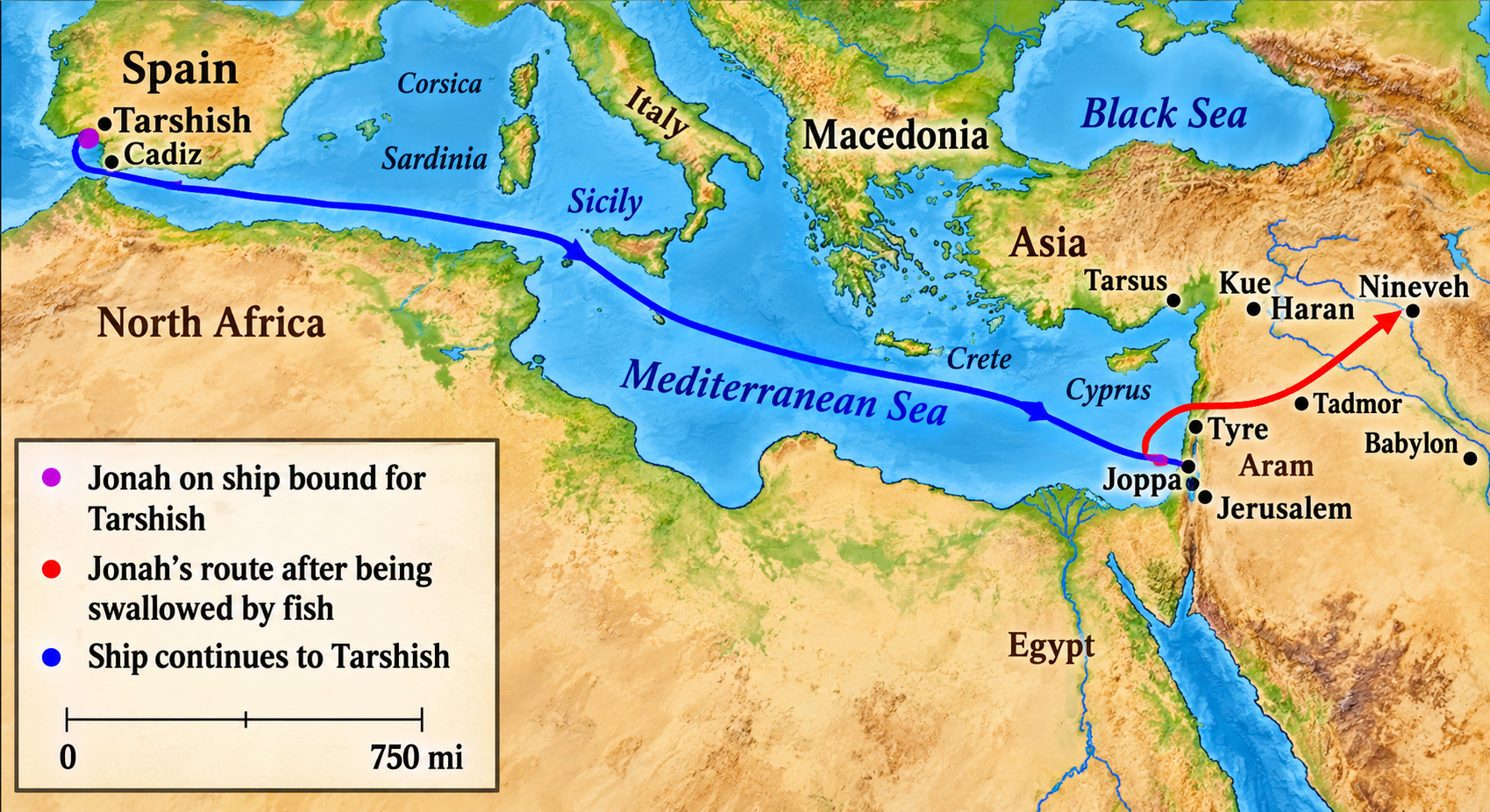
God had directed Jonah to travel east over land to Nineveh. But Jonah booked passage on a ship headed west toward Spain. During that journey a tremendous storm arose, and Jonah ended up in the Mediterranean Sea. That’s when the fish swallowed him. Within a short time of gulping down the prophet, the fish suffered an attack of indigestion. Jonah was vomited onto shore. Why?
The Second Chance
In the middle of the book of Jonah a most interesting phrase appears—“a second time.” Deliberately, consciously, stubbornly, Jonah had run away from God. Yet God came to the prophet a second time and allowed him to carry on his ministry. Jonah’s story is more about God than a man and a fish.
God is the God of the second chance, the fresh start, the new beginning, and the rebirth. If you miss this discovery, you miss the message of the book of Jonah, not to mention the entire Bible. God doesn’t turn a deaf ear or a cold shoulder to the repentant, no matter how blatant the rebellion or which border the runaway crosses. God gives second chances. Sometimes even in the exact place where we failed!
Bottom Line
If you are running from God, turn to Him. He will grant you a second chance.
J R Miller - "The Word of the Lord came unto Jonah the second time." Jonah 3:1
Jonah had failed the first time—but God gave him a second chance. This shows the divine patience. Strict justice would have left Jonah at the bottom of the sea, or in the jaws of the great fish; but God was merciful to him. He had now gone through a discipline which left him ready to obey.
That is the way God often deals with people. When they rebel or disobey him—he does not cast them off—but puts them under some discipline, sometimes sore and painful, to teach them obedience, and then tries them again. Many of us have to be whipped to duty; but what a blessed thing it is that God is so patient with us! Most of us owe all we are, to God's disciplines. "For the Lord disciplines the one He loves, and punishes every son whom He receives." Hebrews 12:6. Thus even our sins may becomeblessings to us.
We should be very thankful to God for these second chances that God gives us, when we have failed to improve the first chance. Very few people make of their life, what God first wanted them to make. Then he sets them another lesson, that they may try again. Perhaps the second is not so beautiful nor so noble as the first; still it is good, and if they are faithful and diligent, they can make something worthy even yet of their life. Most of us have to be sent more than once, on our errands for God. Happy are we if we obey even at the second bidding, although it is far better that we go at first.
William MacDonald - The word of the Lord came to Jonah the second time.” (Jonah 3:1)
Here is a message that glows with hope and promise. Just because a man has failed does not mean that God has put him on the shelf.
David’s failures are recorded with stark realism. As we read them, we sit in the dust with him and burn with shame. But David knew how to break before the Lord, how to repent with bloodearnestness. And God was not through with him. God forgave him and restored him to a life of fruitfulness.
Jonah failed to answer God’s missionary call and wound up in the belly of a great fish. In that animate submarine, he learned to obey. When God called him the second time, he went to Nineveh, preached imminent judgment, and saw the whole city plunged into deepest repentance.
John Mark made a brilliant start with Paul and Barnabas, but then he copped out and went home. God did not abandon him, however. Mark returned to the battle, regained the confidence of Paul, and was commissioned to write the Gospel of the Unfailing Servant.
Peter failed the Lord in spite of his protestations of undying loyalty. Men would write him off by saying that the bird with the broken wing could never fly as high again. But God did not write him off and Peter flew higher than ever. He opened the doors of the kingdom to 3000 at Pentecost. He labored tirelessly and suffered repeatedly at the hands of persecutors. He wrote the two epistles which bear his name, then crowned a glorious life of service with a martyr’s death.
So when it comes to service, God is the God of the second chance. He is not through with a man just because that man has failed. Whenever He finds a broken and a contrite heart, he bows to lift up the head of his fallen soldier.
This must not be taken to condone sin or failure, however. The bitterness and remorse of having failed the Lord should serve as sufficient deterrent.
Neither does it mean that God gives the unrepentant sinner a second chance after this life. There is a terrible finality about death. For the man who dies in his sins, the awful sentence is, “Wherever the tree falls, there it lies.” (Eccl. 11:3 NASB).
James Smith - JONAH OBEDIENT JONAH 3:1–10
There are many questions one would like to ask here, but who can answer them? What did the sailors do after the storm, when their cargo had been pitched overboard? Did they return to Joppa to get it renewed? If so, the story of the storm being hushed by casting a prophet into the sea would doubtless be rapidly circulated, and perhaps reached Nineveh before Jonah did.
I. The Repeated Call. “The Word of the Lord came unto Jonah a second time.” How gracious God is, to give a man a second chance of serving Him. He might have left him in his disobedience to perish. What hope there is in the Second Man, the Lord from Heaven. Is there one of us who have not had a second call? Yea, a sixth, a seventh, and a seventieth, and perhaps as yet there has been no response. God’s right to take vengeance is often denied, but dare you deny His patience and longsuffering? The Law was given, that failed through our disobedience; now humanity’s second chance is in His call of grace. Note the changed commission: “Go and preach unto it, the preaching that I bid thee.” At the first Jonah was to “Cry against it,” now he is just to speak what he is told. The call is repeated, but the commission is altered. Do you notice that the Word of the Lord came to Jonah before he was asked to preach it? Preachers must have a revelation from God. If they have seen no vision, then they have no message. Paul could say: “I have received of the Lord that which I have delivered unto you.” We testify of what we have seen, else we are not witnesses. In these days a bold attempt is being made to discredit everything that savours of the miraculous. If there be no miracle, then there can be no mercy.
II. The Ready Obedience. “Jonah arose and went.” What a task is before him; a journey of over 800 miles, and then to preach in the streets of the mightiest, the gayest, and the guiltiest of cities. But his forty days’ journey is much easier than his three days’ run to Joppa, because his heart is now right with God. It is easier doing great things for God than little things for the Devil. It was easier for Daniel to go to the lions’ den than deny his God. It was easier for our faithful Scottish martyrs to go to the fires than to deny the faith. But where did Jonah learn this obedience? He learned it where most of us have had to learn it—in the depths, when the floods compassed him about, when the waves and billows passed over him, and the weeds were wrapped about his head. We would not always pity the afflicted if we understood the purpose of God. May God plunge many more into the belly of Hell, if so be that it will bring them to repentance. When God by the hand of death snatched your bright-eyed child from the home, did you understand that He was seeking to bring you into the faith that saves?
III. The Startling Proclamation. “Yet forty days, and Nineveh shall be overthrown.” A strange message from a strange man. Jonah, footsore and weary, enters the great and mighty city, probably clad in a coat of camel’s hair, girded with a leathern girdle. He may seem very small and insignificant in the presence of those haughty gentry, clothed in their gaudy robes, and those high flying chariots, rushing along on the top of the wall, but he has a dignity superior to the King of Assyria. He has a message from God that will bring the guilty and conceited Ninevites to their knees. The mightiest men in the world are those who know God’s will, and are courageous as lions in declaring it. Sometimes sermons are characterised as being as destitute of grace as Jonah’s. “Yet forty days and Nineveh shall be overthrown.” Jonah’s message was one of mercy and judgment. Yet forty days—forty days’ grace to be followed with judgment if these days were neglected. Grace has been reigning now these 1928 years, and will assuredly be followed with judgment in the case of those who despise the mercy offered.
IV. The Confirming Sign. From the Lord Jesus Christ Himself we learn that Jonah was a sign to the Ninevites (Luke 11:30). How could he be a sign to them if they did not know his character and history? This is indeed significant. The Ninevites not only heard the Divine message at his lips, but they saw in himself a proof of God’s mighty saving power. Jonah wrought no miracle, but he himself was a miracle. He was as one raised from the dead. Three things the subtle infidelity of to-day seek to deny. Incarnation, Regeneration, Inspiration. But every regenerated soul is in itself a sign, and an evidence of the Divine and the supernatural. What we are will tell more powerfully than what we say. Signs are needed. Men and women who have themselves been saved and taught by God. Is there no such sign beside you or in your own home? To see a true Christian is to see a sign from Heaven.
V. The Grand Result. “Nineveh repented at the preaching of Jonah.” If he had gone with the Gospel of the “higher critics,” and hobnobbed with the gentry, he might have got on for chaplain to the king, but Nineveh would never have repented. “By their fruits ye shall know them.” The preaching that does not bring sinners face to face with their sins and with God will never produce repentance. There were no sleepers under Jonah’s preaching. There are scores who go to our churches for no other purpose than to see and to be seen, and to get a nap. It is interesting to observe the process of their repentance.
1. THEY BELIEVED GOD. It is not said that they believed Jonah, but that they believed God. This ought to be the aim and end of all preaching, to lift the hearts of the people right up to the Lord Himself. What will it avail you although you believe in the kirk and in the minister, if you have no faith in God? I would rather die a heathen Hottentot than an unconverted Church member. Then they humbled themselves, “and put on sackcloth.” This is always the result of believing God; faith is accompanied with the sackcloth of confession. Sackcloth is never very fashionable, sealskin is more in vogue. There is nothing like a deep conviction of sin for stripping one of their gaudy garments of pride. Oh, man, if you saw yourself in the light of God’s judgment, you would as quickly as Ninevites, put on the sackcloth of a broken spirit. A haughty sinner is the imp of Hell. Never say that you believe in God if you have never been on your face before Him. Then—
2. THEY CRIED TO GOD. Every one was to “cry mightily to God.” There is no use telling an awakened soul that God has so bound Himself with fixed laws that he cannot answer prayer. It is as natural for such to cry as the new-born babe. Only those encased in their own conceit can talk so lightly about prayer. No prayer book will suffice when the soul is alive to its true need. Such are like dead men’s grave clothes. But they did more than pray, they “Turned every one from his evil ways.” No prayer is in earnest as long as sin is indulged. If we are not prepared to forsake our sins, then all our prayers are a mockery (Psa. 66:18). A man once told me that he always said his prayers except when he was drunk. Poor man, he was afflicted with two devils. A drinking one and a self-righteous one. Both are alike unclean. Their prayer was sincere. The result was—
3. THEY FOUND MERCY. “God saw their works and repented, and did it not. What! Does God repent? Yes, I am thankful that He does. In His Character as holy, just, and good, He is unchangeable, and without shadow of turning; but in mercy He turns His face to every penitent seeking sinner. “Draw nigh unto Me,” God says, “and I will draw nigh unto you.” “Seek, and ye shall find.”
Phillips Brooks - Come, take that task of yours which you have been hesitating before, and shirking, and walking around, and on this very day lift it up and do it.
Our God Of Second Chances - Anne Le Tissier
Then the word of the Lord came to Jonah a second time: “Go to the great city of Nineveh and proclaim to it the message I give you.” Jonah 3:1–2
“I felt a slimy texture brush my face,” the kayaker recalled. Next he spied some blue and white teeth!
While paddling with his father, the kayaker had been engulfed from behind by a humpback whale. Fleetingly, he wondered how he’d survive inside its stomach, like the fictional character, Pinocchio.
I shuddered at the mere thought of it, but my own thoughts were on Jonah.
God called this prophet to warn wicked Nineveh of impending judgement. “But Jonah ran away”, fleeing on a ship (Jonah 1:1–3). Then, when a “violent storm arose”, he acknowledged the “God of heaven” whom he had disobeyed (Jonah 1:4, 7–10). “Throw me into the sea,” he said, “and it will become calm” (Jonah 1:12). And as the raging sea subsided, God provided a “great fish” to swallow him up, and there he prayerfully sought mercy (Jonah 1:17; 2:1–9). Three days later the fish spewed him onto dry land, and again God commissioned him to preach to Nineveh. This time he did obey (Jonah 3:1-3).
The kayaker spent just moments in the whale’s mouth before being spat out, but like Jonah, he felt he had received a “second chance” to live better than before. When problems hit or we disobey God, we can reflect on what lessons we might learn. And like Jonah, as we ask for forgiveness, we are released from condemnation, for God graciously gives us a second chance too.
Reflect & Pray What can you learn from a problem, mistake or bad choice? How does our God of second chances encourage you to draw close to Him today? God of heaven, thank You for Your loving care and mercy, and that there’s no place on earth where You do not watch over me.
Today's Insights - The story of Jonah is a story of the unexpected. The only character in the story who doesn’t obey God is the one the reader would expect to be obedient, the one who told the sailors, “I worship the Lord, the God of heaven, who made the sea and the dry land” (Jonah 1:9). In contrast to the fugitive prophet, the pagan sailors turn to God (v. 16); the fish did as the Lord commanded (2:10); the Ninevites (a blood-thirsty and pagan people) repented (3:5–10). But the unexpected doesn’t stop there. God goes to great lengths to teach Jonah who He is. Rather than punish the disobedient prophet who is angry at God’s mercy, God invites Jonah (and us) to contemplate the depths of His love and mercy. (Reprinted by permission from Our Daily Bread Ministries. Please do not repost the full devotional without their permission.)
When have you experienced the love and mercy of God?
Forwarding the Gospel
The gospel must be preached afresh and told in new ways to every generation, since every generation has its own unique questions. The gospel must constantly be forwarded to a new address, because the recipient is repeatedly changing his place of residence. —Helmut Thielicke, Leadership, Vol. 9, no. 3. See: Jonah 3:1; Luke 5:37; Acts 13:46.
Robert Neighbour - Recommissioned to the Gentiles
"And the Word of the Lord came unto Jonah the second time, saying, Arise, go to Nineveh" (Jon. 3:1, 2).
"For I will make you a name and a praise among all the people of the earth, when I turn back your captivity before your eyes, saith the Lord" (Zeph. 3:20).
After Jonah was vomited onto the land, he was recommissioned to go to Nineveh, a Gentile city. When Israel is restored to her land, she is recommissioned to "be a blessing" and in her "shall all the nations of the earth be blessed."
The conversion of Saul of Tarsus is a type of the conversion of Israel. Saul was filled with bitterness toward the Christians, he was en route to Damascus, with letters of authority in his pocket. He was stricken down by the forth-shining of a great light from Heaven, a light above the brightness of the noonday sun. He heard a voice and cried, "Who art Thou, Lord?" The answer was, "I am Jesus, Whom thou persecutest." Then Saul trembling and astonished said, "Lord, what wilt Thou have me to do?" The answer was soon given: "I have chosen him to go far hence to the Gentiles;" and again: "He is a chosen vessel unto Me to bear My name before the Gentiles and kings and sons of Israel."
Israel filled with bitterness against the Christians, rejecting the Christians' Christ, shall yet be stricken down by the forth-shining of the glory of the Lord's Second Coming. Israel will cry, "Who is this that cometh from Edom (red), with dyed garment from Bozrah (the vintage)?" Christ will respond, "I that speak in righteousness, mighty to save." Israel will at once receive Him, the One with the wound marks in His arms. Immediately she will be commissioned to carry Christ's name and glory to the Gentiles.
Adrian Rogers - We Need to Remember the Missionary Miracle (from his sermon Miracle of Missions - Jonah 1-4)
Now here’s the third thing: We need to remember the missionary miracle. What is the miracle in this story? Friend, the miracle in this story is not Jonah and the great fish, sea monster, whale, or whatever it was; the great missionary miracle is the grace of God. Oh, how God’s grace is so rich! Think of God’s grace to Jonah. Look, if you will, in chapter 3 and verse 1: “And the word of the LORD came unto Jonah the second time.” (Jonah 3:1) You would think that God would say, “I’ll get somebody else.” But, you know, God is the God of the second chance.
Now, let me just pull over here for just a moment. There are some of you in your fifties and your sixties, maybe seventies, and you’re saying, “You know, when I was young, God called me to the ministry, and I didn’t answer,” or “God told me to do this thing or that thing,”—it may not have been the ministry—“but I didn’t obey.” Let me tell you something, friend. God is the God of second chances. For some people, this is their favorite verse in the Bible: “The word of the LORD came unto Jonah the second time.” If you’ll go through the Bible, you’ll find the doctrine of the second chance all the way through the Bible, and it shows the miracle of God’s grace. God is not a God that holds grudges. I don’t care what you’ve done: God’s grace is sufficient for you. Though you’ve been running from God in the past, though you say, “I’ve missed the will of God,” it’s not too late for you.
You think about it: Jeremiah was in the potter’s shop, and Jeremiah saw the potter make a pot. And the pot was reluctant and stiff, and it was misformed. And the potter took that clay and made another pot the second time. It’s the doctrine of the second chance.
I read in the Bible about a man named John Mark, who set out to be a missionary, and he messed up so much that Paul wouldn’t even take him back on the missionary journey. But his Uncle Barnabas took him back again. Later on, Paul had to say about Mark, “Bring him with you; he’s profitable unto me.” (2 Timothy 4:11) That is, God took this boy and gave him a second chance. As a matter of fact, I’m glad He did, because we have the Gospel of Mark in the Bible.
I read in the Bible about Simon Peter. Simon Peter cursed and swore and denied the Lord Jesus Christ three times even before the rooster crowed. And many of us would have said, “Well, I’m finished with Peter—cursing in front of a teenage girl, denying the Lord Jesus. That old hypocrite, talking about going with Jesus to prison and to death!” But, friend, he became the mighty apostle of Pentecost.
I’m so grateful that God has given me so many second chances. Friend, listen. He is the God of the second chance: “The word of the LORD came unto Jonah the second time.” (Jonah 3:1) But I’m also grateful that not only did God give Jonah a second chance; God gave Nineveh a second chance. Listen. Nineveh was ripe for judgment. America is ripe for judgment. And I believe that God had much rather forgive than to judge.
Let me give you a great verse here—Jeremiah 18 and verse 7. God said, “At what instant I speak concerning a nation, and concerning a kingdom, to pluck up, and to pull down, and destroy it; if that nation [will repent],”—God says—“I will repent of the evil that I thought to do unto them.” (Jeremiah 18:7–8) You see, they repented. Listen to Matthew chapter 12, verse 41. Jesus said, “The men of Nineveh shall rise in judgment with this generation, and shall condemn it: because they repented at the preaching of Jonas.” (Matthew 12:41) God forgave Nineveh.
Nineveh was one of the wickedest cities on the face of the earth. As a matter of fact, that was part of Jonah’s problem. Jonah hated the Ninevites like some hate Al Qaeda in this generation. They thought they were unspeakably immoral. When the army of the Ninevites would march, a little town would be in the path of that marching army, and the people in that town would sometimes, historians tell us, commit suicide rather than to fall into the hands of the brutal Ninevites. And they had been especially worrisome and hurtful to Israel. And that’s the reason that Jonah didn’t want to preach to them. He didn’t want them to have revival. We’re going to see more about that in just a moment. But God forgave.
In all of the history of revivals, I don’t believe there’s been another revival like the revival that was at Nineveh. The king proclaimed a fast, everybody turned to God, and the whole city—a city about the size of Memphis, Tennessee—turned to God in repentance and faith. And it was great in iniquity; it was great in antiquity—it was founded by old Nimrod himself, who’s a type of the Antichrist; yet this city came to a mighty revival.
Now Jonah had preached, “In forty days, Nineveh will be destroyed,” and yet it wasn’t destroyed. Was he a false prophet? No, no. Had they not repented, they would have been destroyed.
Somebody asked Dr. G. Campbell Morgan this question. He said, “Is God capricious? Does God just operate according to whim? I mean, God said He was going to do one thing, and He did another. Does God change?” Dr. Morgan said, “No, God doesn’t change. God’s laws are immutable. But God is like a weather vane. When the wind blows, that weather vane invariably, by fixed laws, points in the direction of the wind.”
Now, friend, the wind can change. The weather vane only registers what the wind is doing. But the weather vane never changes. Who changed in this story? Not God. The Ninevites changed in this story. And God will show Himself merciful to those who repent. Always, that’s a fixed law. God will show Himself in judgment to those who do not repent. Always, that is a fixed law. And I’m so grateful for the mercy of God, the grace of God. And I believe with all of my heart anybody here today, you think that it’s too late for you to be saved, or that you’ve done too much, or that God is finished with you—friend, I want to tell you, He is not. There is a God of grace. If you’re a missionary, and you’ve failed; God called you, and you failed; preacher, and you failed; or a layman, and you failed; there’s a God of the second chance. If you’re a sinner and you think that it’s too late for you to be saved, no, it is not too late for you to be saved. If God saved Nineveh, He’ll save you.
Our God Of Second Chances - Anne Le Tissier
Then the word of the Lord came to Jonah a second time: “Go to the great city of Nineveh and proclaim to it the message I give you.” Jonah 3:1–2
“I felt a slimy texture brush my face,” the kayaker recalled. Next he spied some blue and white teeth!
While paddling with his father, the kayaker had been engulfed from behind by a humpback whale. Fleetingly, he wondered how he’d survive inside its stomach, like the fictional character, Pinocchio.
I shuddered at the mere thought of it, but my own thoughts were on Jonah.
God called this prophet to warn wicked Nineveh of impending judgement. “But Jonah ran away”, fleeing on a ship (Jonah 1:1–3). Then, when a “violent storm arose”, he acknowledged the “God of heaven” whom he had disobeyed (vv. 4, 7–10). “Throw me into the sea,” he said, “and it will become calm” (v. 12). And as the raging sea subsided, God provided a “great fish” to swallow him up, and there he prayerfully sought mercy (1:17; 2:1–9). Three days later the fish spewed him onto dry land, and again God commissioned him to preach to Nineveh. This time he did obey (3:1-3).
The kayaker spent just moments in the whale’s mouth before being spat out, but like Jonah, he felt he had received a “second chance” to live better than before. When problems hit or we disobey God, we can reflect on what lessons we might learn. And like Jonah, as we ask for forgiveness, we are released from condemnation, for God graciously gives us a second chance too. (Reprinted by permission from Our Daily Bread Ministries. Please do not repost the full devotional without their permission.)
Reflect & Pray
What can you learn from a problem, mistake or bad choice? How does our God of second chances encourage you to draw close to Him today?
God of heaven, thank You for Your loving care and mercy, and that there’s no place on earth where You do not watch over me.
Today's Insights - The story of Jonah is a story of the unexpected. The only character in the story who doesn’t obey God is the one the reader would expect to be obedient, the one who told the sailors, “I worship the Lord, the God of heaven, who made the sea and the dry land” (Jonah 1:9). In contrast to the fugitive prophet, the pagan sailors turn to God (v. 16); the fish did as the Lord commanded (2:10); the Ninevites (a blood-thirsty and pagan people) repented (3:5–10). But the unexpected doesn’t stop there. God goes to great lengths to teach Jonah who He is. Rather than punish the disobedient prophet who is angry at God’s mercy, God invites Jonah (and us) to contemplate the depths of His love and mercy.
When have you experienced the love and mercy of God?
The Persistence of Grace By Rev. Larry Kirk
Introduction: In the closing minutes of class at the seminary, we discussed whether one could ever say that God was judging a nation or a city when catastrophe strikes. The previous Sunday, Hurricane Katrina had hit New Orleans; the following Sunday was the anniversary of September 11. Some students seemed confident these things are God’s judgments; others were just as convinced that we cannot know that. We ran out of time before we ended the discussion. Well, anyone can indulge in speculation. For Christians, the only trustworthy foundation for our faith is revelation. What Jonah learned about judgment and grace is useful for us in all of life.
1. God’s Grace Is Persistent (vv. 1–2). Notice how Jonah 3 begins: “The word of the LORD came to Jonah the second time …” Why did God send Jonah to Nineveh? The answer is because of His grace and compassion. Part of the message of Jonah is how out of touch we can be with the heart of God. Jonah wanted to wipe Nineveh off the map, but God wanted Nineveh to experience His grace. The last words in the book are a question from God: “Should I not pity that great city” (4:11)?
A. God’s Persistent Grace Is Available to the Sinful. The prophet Nahum describes the sins of Nineveh. “Woe to the bloody city! It is all full of lies and robbery. Its victim never departs” (Nah. 3:1). Nahum 3:4 indicts the people of Nineveh for violence, lust, prostitution, and witchcraft. The book of Jonah tells us that He had concern, compassion, grace, and abounding love for Nineveh.
B. The Persistence of God’s Grace Is Not Speculation; It Is Revelation. God does judge sin, but not all suffering is judgment. God’s people are not exempt from the natural calamities that affect all people in a fallen world (cf. Rom. 8). God’s people are called to show kindness to those who suffer, without regard to what they deserve.
C. The Grace of a Holy God Is Central to the Bible’s Story. Not just one or two cities deserve judgment but the whole world, the city of mankind, and everyone in it (Rom. 3:1–20). What is God’s response? Ultimately what He does is that He sends not just a reluctant prophet but His own Son. In John 3:17 the Scripture says, “For God did not send His Son into the world to condemn the world, but that the world through Him might be saved.” Christ came not just with a call to repentance but with an act of redemption. In our place on the Cross, Christ actually suffered the judgment we deserve. The same grace and abounding love that sent Jonah to Nineveh sent Jesus to die and rise again for you and me.
2. God’s Grace Calls Us to Repentance (vv. 4–5). “So the people of Nineveh believed God, proclaimed a fast, and put on sackcloth, from the greatest to the least of them.”
A. Repentance Involves Both Faith and Humility Toward God (v. 5). Notice verse 5. “So the people of Nineveh believed God.” They declared a fast, an act of humility, and they put on sackcloth. In putting on sackcloth, you were humbling yourself before God and submitting yourself to Him. That’s the response we all need to bring to God. It doesn’t matter what you have suffered, or lost, or done, or failed to do.
B. Repentance Is Not Just for Sinful Unbelievers, But for Self-Righteous Saints. That’s part of the story. Against the backdrop of the sinful city stands the self-righteous prophet. He also needs repentance. Jonah 3 begins: “… the word of the LORD came to Jonah the second time …” (v. 1). These almost exactly parallel the opening words of the book. God is telling Jonah he needs to start over again. He was self-righteous and self-centered. There is persistent grace for Jonah.
Conclusion: Maybe you’ve got forty days, forty weeks, months, years? I don’t know. But there comes a time when your heart is hardened or the season of grace is gone or the kids are grown up or the marriage is over. Or you’ve died. It is too late one way or another. Maybe these were your forty minutes. I don’t know. We all need to pray, “Lord, search me and know me and show me anywhere and everywhere I need to repent. Give me the grace to respond in glad obedience to Your Word to me today.
Nineveh was a wild riverside city of the ancient world. It was the “Big Easy” of Assyria. It was built on a great river, the Tigris. Like New Orleans, it had a bad reputation, but God was concerned for the well being of that city, and God wanted to show compassion to its people. Hurricane Katrina week was supposed to have been a special week. Every Labor Day weekend for the last 33 years has been special to New Orleans. They even had a special Web site with a letter of welcome from the mayor. It was going to be Southern Decadence XXXIV, also known as Gay Mardi Gras. The official Web site calls it a celebration of gay life, music, and culture. But Southern Decadence XXXIV has been postponed. Was New Orleans a sinful city? Yes. No one should deny that. Does that mean that God lost all grace and compassion for that city? No. You may be sure that God has concern, compassion, grace, and abounding love for New Orleans. And that’s good news, because that means He has concern, compassion, grace, and abounding love for people like us and cities like ours. —Pastor Larry Kirk
Eric Hayden - Reluctant Resolution
“And the word of the Lord came to Jonah the second time, saying, Arise, go to Nineveh, that great city, and preach to it the preaching that I bid thee” (Jonah 3:1–2).
Dr. Graham Scroggie used to point out, “Whenever we turn to the book of Jonah, we should think not of a whale but of foreign missions.” The repentance of an entire city was a mightier miracle than that of Jonah being swallowed by a great fish. That explains why this book was the first portion of the Bible to be translated into Chinese many years ago.
The prophet Jonah had a divine commission to preach in Nineveh, but he was a reluctant prophet and ran in the opposite direction. He suffered divine punishment, but God graciously gave him a second chance. This time he resolved to fulfill his commission and go to Nineveh.
All true prophets and preachers of the Word show similar reluctance. Jeremiah thought himself too immature; Amos, too illiterate. Nevertheless, when we cry, “Who is sufficient for these things,” God reminds us of the power and presence of the Holy Spirit for our task. Then we are able to say, “I can do all things through Christ who strengthens me.”
There is a distinct parallel between Jonah and Paul (they both experienced a storm at sea; they were both missionaries to the Gentiles; they both testified before godless sailors), and there should be a parallel between Jonah and all Christian servants who have received a call of God to preach, whether lay or ordained pastors.
1 A commission is given
“Arise” in the Hebrew implies a previous state of settlement or lethargy. God’s servants sometimes become settled in their ways, in the means and methods they use to present the old, old gospel to a twentieth-century congregation.
“Go”—the first two letters of Gospel! Jonah’s commission was to go places with the gospel. “Who will go for us?” is God’s challenging question. “Go into all the world” is our Saviour’s commission to his church.
2 A field is indicated
What a field of service! Nineveh occupied, it is estimated, 216 square miles, with a population of 600,000. Today we would want a team to hold a city-wide crusade in Nineveh. One man did it then—Jonah the reluctant; Jonah, the recently reclaimed backslider. But one with God is always a majority.
Nineveh is described as “an exceeding great city.” It was great in size and it had a great place in the heart of God. God loved Nineveh just as he loves the towns, cities, and villages where we live and have his divine commission to preach the gospel.
3 A message is authorized
Jonah’s preaching is our pattern for today.
A. It was expository. Jonah preached God’s news, not his own views. His text was: “Yet forty days and Nineveh shall be overthrown.” This was a message of judgment.
How easy it is to become topical rather than textual preachers, preaching on some current political thought or news item, without reference to the Word of God.B. It was evangelistic. Jonah preached to Nineveh; literally, against Nineveh. After the timely warning came a loving invitation. He told of God’s grace, forty days in which to decide on God’s ultimatum. He preached for a verdict. His was not the now popular method of audience participation. Jonah preached for decision, not discussion.
Civil servants in Britain have two trays on their desks, an “in” and an “out” tray; one for information and one for action. Jonah supplied the information and then called for action to be taken by the people of Nineveh.C. It was eschatological. Jonah’s preaching was concerned with the doctrines of the last things. Judgment implies punishment and reward. In the light of passing centuries and the culmination of world events in various clashes between world powers, the eschatological content of the New Testament needs preaching.
D. It was ecumenical. Jonah was concerned that Nineveh as a whole should respond to God’s message and repent.
Like Jonah we must come when God calls, go where he directs, and do what he commands. Instead of reluctance, there must be dedicated resolution.
Jonah 3:1-10 TODAY IN THE WORD
Go to the great city of Nineveh, and preach against it. . . . Should I not be concerned about that great city? - Jonah 1:2; 4:11
In 430, Patrick, a young Roman Briton, was carried off by Irish raiders to be a slave. At the time he was a nominal Christian, but he turned to God in earnest in the midst of his suffering. “I would pray constantly during the daylight hours,” he later said. “The love of God and the fear of Him surrounded me more and more.” After six years, he escaped.
Years later, Patrick had a dream in which he received a call to evangelize Ireland, the country in which he’d been enslaved. At that time, Ireland was pagan and idolatrous, a difficult place to serve. Patrick faced fierce opposition from druids and wrote, “Daily I expect murder, fraud, or captivity, but I fear none of these things because of the promises of heaven.”
Called to witness to his enemies, Patrick obeyed. But when Jonah was called to do the same, he ran.
Where was Nineveh (see notes)? This ancient city, with a population of 120,000 (Jonah 4:11) and an area of about sixty square miles, was the capital of Assyria, a world power and chief enemy of Israel. Jonah ran away not because he was afraid to take a message of judgment there, but because he was afraid the people would repent and God would relent and forgive them (Jonah 4:1, 2, 3). He understood God’s character well (Jonah 4:10; cf. Jer 18:7, 8, 9, 10)!
The Ninevites did indeed respond to Jonah’s preaching. They fasted and wore sackcloth to demonstrate humility and repentance before God (v. 5). The essence of repentance is a changed heart and life, as the king’s proclamation recognizes: “Let everyone call urgently on God. Let them give up their evil ways and their violence” (v. 8).
God gave both the Ninevites and Jonah a second chance; His love is infinite, reaching out even to those who oppose Him (Matt. 5:44–45; Rom. 5:10). Later, in an example which must have galled the Pharisees, Jesus used the Ninevites as an example of repentance in response to God’s love (Matt. 12:41).
TODAY ALONG THE WAY - Here’s a question for reflection: Would you share the gospel with your enemies? You may not think that you have actual “enemies.” To identify the people in your life who may be your “Ninevites,” think of people whom you dislike or at least those you tend to avoid. Are you willing to share God’s love with them? Do you desire to spend eternity with them? Can you think of specific ways, in word or in action, to communicate the love of Christ to them? What you do with your answers to these questions is between you and God
Jonah 3:2 “Arise, go to Nineveh the great city and proclaim to it the proclamation which I am going to tell you.”
- Nineveh (KJV): Nineveh, the capital of Assyria, was situated on the eastern bank of the river Tigris, opposite the present Mosul, about 280 miles north of Babylon, 400 N. E. of Damascus, in latitude 36 degrees 20' N. longitude 73 degrees 10' E. It was not only a very ancient, (Ge 10:11,) but also a very great city. Strabo says that it was much larger than Babylon, the circuit of which he estimates at 385 furlongs; and, according to Diodorus Siculus, it was an oblong parallelogram, extending 150 furlongs in length, 90 in breadth, and 480 in circumference, i.e., about 20 miles long, 12 broad, and 60 in compass. This agrees with the account given here of its being "an exceeding great city of three days' journey," i.e., in circuit; for 20 miles a day was the common computation for a pedestrian. It was surrounded by large walls 100 feet high, so broad that three chariots could drive abreast on them, and defended by 1,500 towers 200 feet in height. See notes on Nahum. Jon 3:3 1:2 Zep 2:13-15
- preach (KJV): Jer 1:17 15:19-21 Eze 2:7 3:17 Mt 3:8 Joh 5:14
Related Passages:
Jonah 1:2 “Arise, go to Nineveh the great city and cry against it, for their wickedness has come up before Me.”
Jonah 4:11 “Should I not have compassion on Nineveh, the great city in which there are more than 120,000 persons who do not know the difference between their right and left hand, as well as many animals?”
SAME NINEVEH & SAME MISSION
BUT DIFFERENT JONAH
Arise, go to Nineveh the great city and proclaim to it the proclamation which I am going to tell you.” This passage echoes Jonah's original commission. After the storm, the sea, the great fish, Jonah's prayer, and his deliverance, God's assignment remains essentially unchanged. Jonah had taken a long detour, but God's will had not "detoured!" Arise, Go are commands demanding action. Jonah was not merely to agree with God's will; he was to get up and go. gOD did not offer Jonah an easier city because Jonah had found the first assignment objectionable. The greatness of Nineveh emphasizes the magnitude of Jonah's assignment. This was not an obscure village but the center of the powerful Assyrian empire. Nineveh was “great” for another reason in the narrative and that was because it contained people who mattered to God. Jonah 4:11 reveals God's concern for its enormous population.
This is one of the great lessons of Jonah's recommissioning. Sometimes when we have resisted God's will, we imagine that enough time, difficulty, or failure will somehow change what God has clearly required. Jonah discovered that after his long journey through the storm and the fish, Nineveh was still Nineveh. You can take a detour around God's will, but the road of restoration often brings you back to the point where you left the road of obedience.
Bob Utley - "to" There is a slight, but theologically significant, change from Jonah 1:2. The PREPOSITION has changed from "against" (BDB 752) in Jonah 3:2 to "to" (BDB 39) here. God is opening the door to the possibility that the Ninevites might respond appropriately to His word of judgment.
proclaim to it the proclamation which I am going to tell you - The content of the proclamation is not stated but the point is it was Yahweh's message. Jonah was God's messenger, not the author of the message. His responsibility was proclamation. He was not commissioned to make the message acceptable to Nineveh, modify it to avoid offense, or substitute his own opinions. The message belonged to God. The authority behind the message belonged to God. Jonah's responsibility was simply to hear it faithfully, proclaim it accurately, and leave the results with God.
The storm changed Jonah,
but it did not change God's commission.
🙏THOUGHT - Has not the same commission been given to us beloved? The Gospel is God's message and we are called to proclaim just as He gave it to us in the Scripture. This principle runs throughout Scripture. God told Jeremiah, “all that I command you, you shall speak” (Jer 1:7). Ezekiel was commanded, “You shall speak My words to them, whether they listen or not” (Ezek 2:7). Paul later declared, “I did not shrink from declaring to you the whole purpose of God” (Acts 20:27; cf. 2Ti 4:2). Dear Father, grant each of us the supernatural power by Your Spirit to boldly proclaim the Gospel to the lost around us. In Jesus' Saving Name. Amen. As an aside, I regularly pray for Hidden People Groups using the Joshua Project and today (9/17/2026), the group was the Khalpa in the state of Gujarat, a group with 126,000 souls having not a single known believer in their midst! I suppose that was my "Nineveh" to go to today as I had become a bit lax in my daily prayers using the Joshua Project. Let me encourage you to use this wonderful tool as your "Nineveh" to store up for yourself treasure in Heaven, so that one day in eternity you will meet some of the souls you were praying for during your short window of opportunity on earth!
J J Knapp - The Second Time -- Jonah 3:1–2
Jonah was not called for the first time, but had been called earlier already by the Lord, to prepare and go to that great city of Nineveh, to preach against her because her iniquity had reached up before God’s countenance. At that time the prophet had been disobedient. He had wilfully put aside the task that had been placed upon him; but when he had been swallowed by a great fish like a living grave, and had been brought up from the depth after three days, the word of God came to him a second time; it put upon him the same task as at the first occasion, pointed to the same city, to which he had to go, and entrusted him with the same message against the great Nineveh,—the Lord God made a completely new beginning with Jonah.
To do and to redo,—behold the lesson of the second time.
We know from everyday life what this means. When our children at school have messed up their arithmetic exercises, the hand of the teacher wipes with a sponge over the slate, and makes the work to be done a second time; or if the girls have bungled their knitting, they can expect that mother will undo it and have them redo it all again. And it is no different in the workshops of the carpenter and the blacksmith, at the offices and in bookkeeping,—when mistakes have been made, the work has to be set up again and redone. Is it not a sign of patience that the Lord deals with us in the same manner, and that He does not reject us as disciples of Christ at the first failing in our calling, yes, that He does not even reject us when this failure can be attributed to an obstinate unwillingness?
We were called from our earliest spiritual youth to take upon us Christ’s yoke and to serve our God with our whole heart, our whole mind, and all our might; to judge all things evil for the excellency of the knowledge of Christ; to keep our heart pure and to flee from all temptations,—but who of us shall try to claim that he has not failed often in all respects, and who does not feel that he deserves the Lord’s rejection most justly?
Our life with its calling to be disciples of Christ often gives the impression of a sad failure,—it is a crying shame! Let us thank our God that He in this also applies the lesson of doing and redoing. He is willing to turn over a clean leaf with us and try us for a second time. What was bungled sinfully, He is willing to cover with the blood of Christ, to start all over with us;—therefore, let us be ready and redo in God’s power what we have spoiled, so that it may prove, that a bad beginning may yet, like with Jonah, lead to a blessed fulfilment.
Jonah 3:3 So Jonah arose and went to Nineveh according to the word of the LORD. Now Nineveh was an exceedingly great city, a three days’ walk.
- So (KJV): Ge 30:8 *marg: Ps 36:6 *marg: Ps 80:10 *marg:
- arose (KJV): Ge 22:3 Mt 21:28,29 2Ti 4:11
- an exceeding great city (KJV): Heb. a city great of God
Related Passages:
Jonah 1:3 But Jonah rose up to flee to Tarshish from the presence of the LORD. So he went down to Joppa, found a ship which was going to Tarshish, paid the fare and went down into it to go with them to Tarshish from the presence of the LORD.
1 Samuel 15:22 Samuel said, “Has the LORD as much delight in burnt offerings and sacrifices As in obeying the voice of the LORD? Behold, to obey is better than sacrifice, And to heed than the fat of rams.
Psalm 119:59-60 I considered my ways And turned my feet to Your testimonies. 60 I hastened and did not delay To keep Your commandments.
James 1:22 But prove yourselves doers of the word, and not merely hearers who delude themselves.
THE SAME COMMISSION BUT NOW
RUNNING BECOMES OBEYING
So - This conjunction functions like a term of conclusion. Now God has recommissioned him with essentially the same command (Jonah 3:2), and this time “Jonah arose and went to Nineveh.” The runaway prophet has become the obedient prophet. God did not change the commission. God changed the prophet.
Bob Utley - This opening sentence is quite a contrast with Jonah's actions in Jonah 1:3. What a difference a room in the fish hotel can make!
Jonah arose and went to Nineveh according to the word of the LORD - The difference in response to the first and second commission is simple but profound. In chapter 1 Jonah heard God's Word and ran from it. In chapter 3 he hears God's Word and responds to it. Jonah had learned the hard way that God's commands are not invitations to negotiation. It is worth noting that activity is not necessarily obedience, because Jonah was very active and very disobedient when he was running toward Tarshish.
according to the word of the LORD - True obedience is not merely going but is going “according to the word of the LORD.” Jonah did not go because Nineveh had suddenly become attractive to him. His obedience was measured by God's Word, not by his feelings. This is an important distinction. We sometimes think obedience requires that our emotions first agree with God's command. Jonah shows otherwise. We can obey God's Word even while God is still working on our heart. We often hear the saying "Delayed obedience is disobedience," but in Jonah's case his delayed obedience (which of course was disobedience) finally becomes obedience. God's discipline accomplished its purpose. Jonah is now moving toward Nineveh rather than Tarshish. Amazing grace indeed!
The God of the second commission gave
His disobedient prophet another opportunity to obey.
Now Nineveh was an exceedingly great city, a three days’ walk - Literally, the Hebrew expression can be rendered “a great city to God” (ʿîr gedôlâ lēʾlōhîm). This is an unusual construction. It most naturally functions as an idiom emphasizing Nineveh's extraordinary greatness, hence NASB's “exceedingly great city.” The expression may also subtly remind the reader that this enormous pagan city was not beyond God's notice or concern. God had already said that Nineveh's wickedness had “come up before Me” (Jonah 1:2), and at the end of the book He will remind Jonah of the vast number of people living there (Jonah 4:11).
A three days’ walk - This expression has generated considerable discussion. It need not mean that it required three full days simply to walk from one side of the walled city to the other. Various explanations have been proposed, including the time required to traverse the city and its surrounding urban area or the time necessary to make a preaching circuit through it. The emphasis is probably not intended to provide us with a precise modern measurement of Nineveh's diameter. The point is the immense scale and importance of Jonah's mission field.
Norman Geisler - JONAH 3:3—Is Jonah’s testimony to the size of Nineveh accurate? When Critics Ask
PROBLEM: When Jonah arrived at the city of Nineveh, he observed that the city was so large, that it took a three-day journey to pass through it. However, such a statement must be an exaggeration, since it is argued that the average man could walk only from 50 to 70 miles in three days. A city of 50 to 70 miles in diameter is not recorded in all of history until modern times. Is this an error?
SOLUTION: There have been several proposals to explain this observation by Jonah. Some commentators propose that Jonah is commenting on the circumference of the city. A city 50 miles in circumference would be about 16 miles in diameter. This size more nearly fits the estimated population of about 600,000 people in this major ancient city.
Other commentators propose that Jonah is not claiming that it would take three days to walk straight through the city. Rather, Jonah observed that it would take three days to go through all the various areas in the entire city. Those who hold this position point out that Jonah went to Nineveh in order to proclaim the message of judgment to the people. This would require him to go to every part of the city, not simply to walk through the middle from one side to the other. This also fits the statement of verse 4 in which Jonah enters the city and, in the first day’s walk, proclaimed the message as he went along.
Tim LaHaye - RUNNING WITH GOD - Embracing Eternity: Living Each Day with a Heart Toward Heaven
Jonah obeyed the Lord’s command and went to Nineveh. Jonah 3:3
FOLLOWING GOD’S WILL can often feel as dangerous as running away from him. Jonah came back to God, but now he faced the wrath of Nineveh. In many ways it was like sending a wounded chicken into the foxes’ den to convince them to become vegetarians. Jonah was delivered from the belly of one beast, only to be thrown into the belly of another.
But he was faithful, and so was God. “When the king of Nineveh heard what Jonah was saying, he stepped down from his throne and took off his royal robes. He dressed himself in sackcloth and sat on a heap of ashes” (Jonah 3:6). Not only did the king repent, but he issued a proclamation commanding that every living being in Nineveh be covered in sackcloth and bow down to Jonah’s God. No one, not even the animals, were to eat or drink. This was more than a twinge of remorse; this was a wholesale commitment to God on the part of the Ninevites.
But something in the story doesn’t quite fit. According to my seminary training, Jonah did it all wrong. Wasn’t he supposed to give them a three-point sermon on the dangers of sinful living? What happened to his box of Sunday school tracts? Didn’t he know he should have gone over the Four Spiritual Laws or the six steps to salvation? He should have passed out copies of the Ten Commandments with notes in the margin. Somehow Jonah made it to Nineveh without his Manual of Evangelism, yet still the Ninevites dropped to their knees in repentance.
And what did Jonah say that convinced them? He told them to repent. That’s it. That was the whole of his sermon. And in the end, that’s all it took to bring an entire city under conviction. As complicated as we like to make it, God’s message is a simple one: Repent, and God will forgive you. Jonah simply relayed the message that God gave him, and God did the rest.
It doesn’t take an eloquent sermon or an anointed speaker to bring people to their knees before the Lord. The power of God’s Word lies in the fact that it originated with God himself. The Bible is more than God’s Word; it is the very manifestation of his glory and wisdom and authority. It has power far beyond what you and I can imagine.
REFLECTION
Has God given you a mandate to reach out to someone in your sphere of influence? What’s keeping you from doing so today?
Jonah 3:4 Then Jonah began to go through the city one day’s walk; and he cried out and said, “Yet forty days and Nineveh will be overthrown.”
- Yet forty days: Jon 3:10 De 18:22 2Ki 20:1,6 Jer 18:7-10
Related Passages:
Genesis 19:21,25, 29 He said to him, “Behold, I grant you this request also, not to overthrow the town of which you have spoken. (19:25) and He overthrew those cities, and all the valley, and all the inhabitants of the cities, and what grew on the ground. (19:29) Thus it came about, when God destroyed the cities of the valley, that God remembered Abraham, and sent Lot out of the midst of the overthrow, when He overthrew the cities in which Lot lived.
Deuteronomy 29:23 ‘All its land is brimstone and salt, a burning waste, unsown and unproductive, and no grass grows in it, like the overthrow of Sodom and Gomorrah, Admah and Zeboiim, which the LORD overthrew in His anger and in His wrath.’
FORTY DAYS UNTIL
JUDGMENT
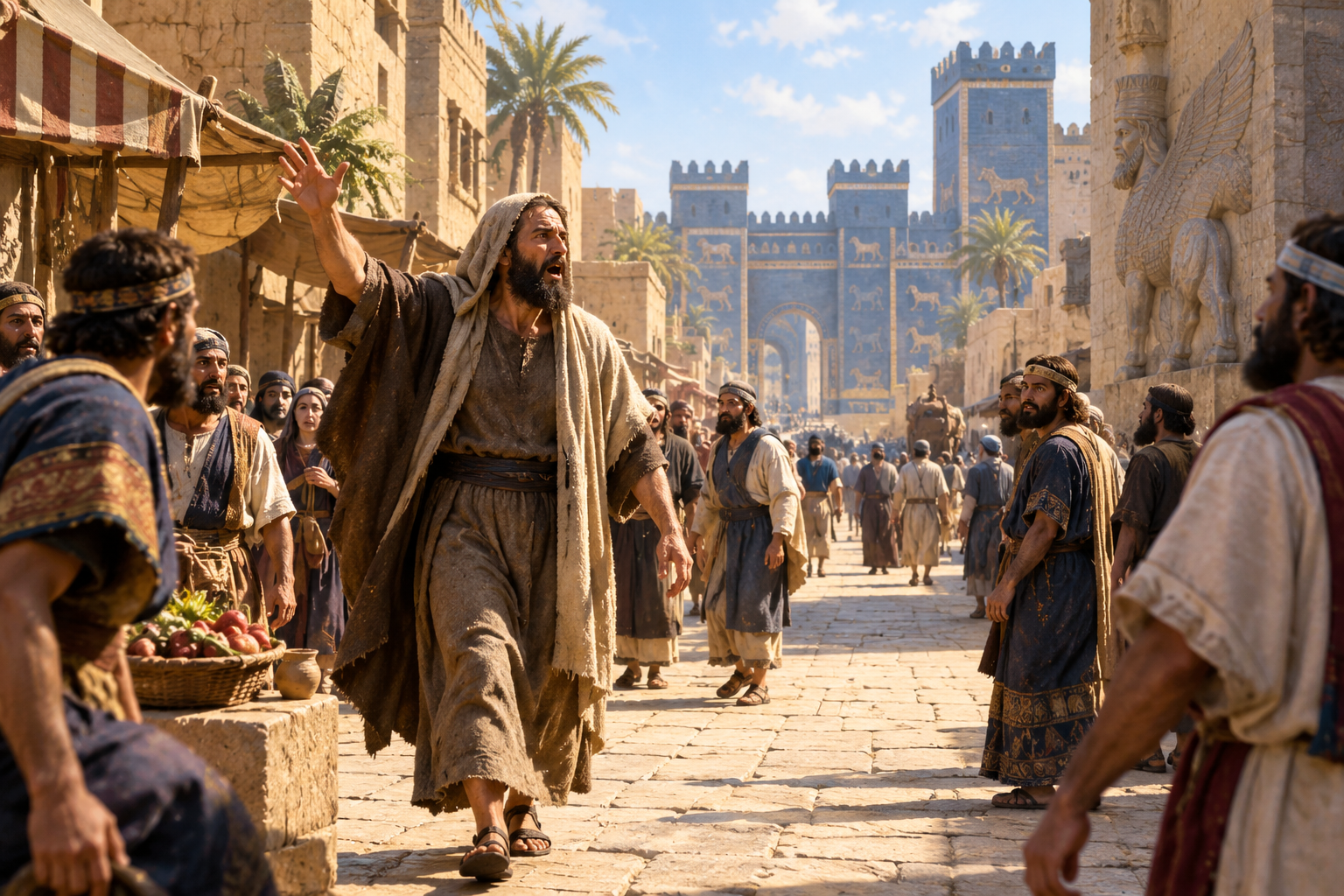
Then Jonah began to go through the city one day’s walk - The expression “one day’s walk” most naturally describes the first day's progress of Jonah's preaching mission through Nineveh rather than necessarily defining the city's physical diameter. Jonah 3:3 has already described Nineveh as “a great city, a three days’ walk.” Whatever precisely that expression denotes, the emphasis is upon the magnitude of Jonah's assignment. He entered the city and began publicly delivering God's warning.
and he cried out - The Hebrew verb qara (קָרָא) means to call, cry out, proclaim, announce. It is the same basic verb used in God's original commission: “Arise, go to Nineveh the great city and cry against it” (Jonah 1:2). Jonah was not conducting a quiet philosophical discussion. He was acting as God's herald, publicly announcing the message entrusted to him. The authority was not in the eloquence of the messenger but in the divine origin of the message.
Bob Utley - "he cried out" This VERB is a Qal IMPERFECT with waw. One assumes he spoke in Aramaic. He only spoke five words. This was not a "turn or burn" sermon. This was just a "burn" proclamation.
and said, “Yet forty days" - In this phrase we see both God's judgment and mercy. God could have overthrown Nineveh immediately. Instead, He announced judgment forty days in advance. The very fact that God warned them before judging them provided an opportunity to respond and was reflective of God's mercy.
We see this pattern elsewhere. Noah was warned before the Flood (Ge 6–7; cf. 2Pe 2:5). Lot was warned before Sodom's destruction (Ge 19:12–17). Pharaoh received repeated warnings before successive plagues. Jerusalem repeatedly received prophetic warnings before its destruction (2Ch 36:15–16). Of course, God's warnings should therefore never be mistaken for indifference or empty threats. A warning is mercy speaking before judgment falls.
God's warnings are mercy
speaking before judgment falls.
Why forty days? Scripture frequently associates forty with periods of testing, preparation, judgment, or significant transition: forty days of rain in the Flood (Ge 7:12), Moses' forty days on Sinai (Ex 24:18), Israel's forty years in the wilderness (Nu 14:33–34), Elijah's forty-day journey (1Ki 19:8), and Jesus' forty days in the wilderness (Mt 4:2). We should be cautious, however, about imposing a symbolic meaning on every occurrence of forty. Here the simplest point is that Nineveh had a definite, divinely established period in which to respond before the announced judgment.
Bob Utley - "forty days" This is a very common number in the Bible to denote a long period of indefinite time (longer than a lunar cycle, but shorter than a season, e.g., Exod. 24:18; 34:28; Num. 13:25; Deut. 9:9,11; 1 Sam. 17:16; 1 Kgs. 19:8). It often is associated with a period of testing or judgment:
- Noah's flood, Gen. 7:4
- wilderness wanderings of Israel, Exod. 16:35; Ps. 95:10
- Moses' fasting, Exod. 24:8; Deut. 9:9,11
- Philistine domination of Israel, Jdg. 13:1
- Elijah's fasting, 1 Kgs. 19:8
- Ezekiel' symbolic actions, Ezek. 4:6
- God's judgment on Nineveh, Jonah 3:4
- Jesus' fast, Matt. 4:2
- Surprisingly, the Septuagint has "yet three days."
Yet forty days and Nineveh will be overthrown (haphak; LXX - katastrepho - destroyed, overturned) may be a summary of Jonah's fuller preaching rather than every word he spoke during his ministry in Nineveh. The text does not explicitly tell us. But the brevity serves the narrative powerfully: God's Word does not require human eloquence to accomplish God's purpose. It is interesting that Jonah did not say repent in light of the coming judgment.
Overthrown is the Hebrew verb is haphak (הָפַךְ), meaning to turn, overturn, overthrow, transform, or change depending upon context. The same verb was used to describe the destruction of Sodom and Gomorrah (Ge 19:21, 25, 29; Dt 29:23), so Jonah's hearers would have been confronted with a terrifying announcement of impending catastrophe.
Note the irony in that in chapter 1, God sent a storm and Jonah needed to repent. In chapter 3, God sent Jonah and Nineveh needed to repent. Before Jonah could become God's instrument for awakening Nineveh, God first had to awaken Jonah.
Nineveh would indeed be overthrown in the future (about 612 BC) (Read Nahum 1:1-3:19), about 150 years after Jonah, but before the city was overturned physically, its people were turned spiritually. The threatened destruction did not occur at that time because Nineveh repented and God relented concerning the calamity (Jonah 3:5–10).
Jonah shows that repentance can postpone judgment; Nahum shows that postponed judgment should never be mistaken for canceled judgment when a people return to their sin. Nahum 1:3 says "The LORD is slow to anger and great in power, And the LORD will by no means leave the guilty unpunished. In whirlwind and storm is His way, And clouds are the dust beneath His feet."
We may sometimes say too much in a single sermon,
and give our hearers a field of wheat instead of a loaf of bread.
Spurgeon's Exposition - His message was short and sharp, there was not a word of mercy in it. There was nothing to distract the attention of the hearers from the one point and the one subject; and there is a great deal in that. We may sometimes say too much in a single sermon, and give our hearers a field of wheat instead of a loaf of bread. · But Jonah said what he was bidden to say, no more and no less: “Yet forty days, and Nineveh shall be overthrown.”
Overthrown (changed) (02015) haphak "The root hāpak figures prominently in connection with three themes of Scripture. First, it is found in association with the expression of God's anger and wrath upon unrepentant Sodom and Gomorrah: Genesis 19:21, 25, 29; Deut. 29:23 [H 22]; Isaiah 13:19; Jeremiah 20:16; Jeremiah 49:18; Jeremiah 50:40; Amos 4:11; Lam 4:6. Perhaps the use of this verb will shed light on the exact nature of the catastrophe. That it was a volcanic eruption seems unlikely. On the other hand, to translate hāpak in these instances as "annihilate" would suggest the disastrous effects of an earthquake, accompanied by lightning which ignited the natural gases of the Jordan Valley area, producing the terrible inferno (and cf. Job 28:5). By extension, God promises the same treatment to Jerusalem (2 Kings 21:13); Nineveh (Jonah 3:4); the unbelieving nations (Haggai 2:22, parallel with shāmad) and generally "the wicked" (Proverbs 12:7). Man is also capable of "overthrowing" (i.e. reducing to vassalage) another city (1 Chron. 19:3; 2 Samuel 10:3) or even mountains (Job 28:9, something God does too, Job 9:5).
Katastrepho (2690)(3x in NT - Mt 21:12, Mk 11:15, Acts 15:16) means to cause to be overturned, turn upside down, upset, overturn something like the money-changers’ tables (Mt 21:12; Mk 11:15). It means to cause something to be in total disarray and so to destroy or ruin (Acts 15:16). To turn over, turn under: the soil with a plow. Used in Septuagint of Sodom and Gomorrah - Ge 13:10, Ge 19:21, Ge 25:29, Ge 29:22.
Vance Havner - Forty Days
Throughout the Bible some very important things happened within periods of forty days. The Flood began with forty days and nights of rain (Genesis 7:12). Moses was on Mount Sinai forty days and nights (Exodus 24:18). When Israel rebelled, Moses fell down before the Lord forty days and nights (Deuteronomy 9:25). Elijah went in the strength of angel food forty days and nights. (1 Kings 19:8). Ezekiel bore in symbolism the iniquity of Israel forty days (Ezekiel 4:6). Jonah declared that Nineveh would be overthrown in forty days (Jonah 3:4). Jesus fasted forty days and nights before His temptation (Matthew 4:2) and was in the wilderness forty days (Mark 1:13).
But most important of all was the forty-day period between His resurrection and His ascension when our Lord was seen by His disciples in His new body with infallible proofs that He had conquered death. We have heard it so long that familiarity with the account has dulled our senses, and what ought to make us shout for joy in church aisles, puts us to sleep in the pews.
Think of it, the Son of God fresh from the grave appearing here and there to a few followers for forty days! And here is a mystery of all mysteries that boggles the minds of us sophisticates nowadays. Why did He not appear before His enemies? What a dramatic scene, if He had stood again before Herod and Pilate! Why did He stay in an obscure Roman province with a whole world dying for salvation? Why not a showing in Rome, Athens, Alexandria? What sort of program is this, just letting the secret out to a few ordinary run-of-the-mill people? It is enough to give the news media a nervous breakdown! Wouldn't it have proven in days what we have tried for centuries to get across? The facts were all firsthand and visible. Those who crucified Him and those who witnessed Calvary were living, and He could easily have been identified. Today a preacher back from the grave would run every other news item off the front pages. And why not? Millions are dying, and we must get the word around. Think of what television could do with that! But had He chosen to show the whole world, our Lord would not have needed all our gadgets. Here were the most amazing forty days of all the centuries, on which all Christianity hangs and the Gospel depends. And when these witnesses started out to tell it, this was the heart of their message. He came back from the grave!
Somehow we have buried the story in all the pagan trappings of Easter, and we have had no small assist from the world, the flesh, and the devil. We have tried to capture it in art, music, and literature. You will search in vain our history books for much about it. Pages record trifling happenings that made no difference but, somehow, these forty days didn't make it. It is the way of the world and part of "the foolishness of God" whose ways are not our ways. God keeps a different calendar. With Him, in whose sight one day is as a thousand years and one year as a day, these forty days may have passed unnoticed in a world oblivious to what God was about. But to us who claim to know there had better be a reshuffling of our scale of values and a rediscovery of those few weeks that spelled the difference in everything for time and eternity.
Robert Morgan - Brother Jonah
We remember Jonah mainly as whale bait, forgetting he became one of the greatest itinerant preachers in history, converting a huge city with an eight-word sermon.
Today his example inspires another Jonah, a man in China, who risks life and liberty traveling around with a knapsack of Bibles. As Jonah preaches, he often takes his text from Jonah 3:4, telling audiences they are like the Ninevites: “You live in defiance of the true God who will judge you if you don’t repent.”
On a recent weekend, Jonah found himself wedged in a crowded third-class railway carriage. By and by, a soldier leaned over and said, “Old man, tell us why you seem so happy.”
Jonah replied, “What do you think? What would be the happiest thing that could ever happen to you?”
The man next to Jonah replied, “I want to be loved by a beautiful woman.” A lady said, “A big house would make me the happiest person in the world.” Another said, “A passport to America.” The soldier said, “If I had the power to command the People’s Liberation Army, I’d be happy.”
“Let me see, now,” said Jonah. “I have a mansion so large an emperor would envy; I am loved by the most beautiful person in the world; I have freedom to go wherever I wish; and I happen to be a close friend of the most powerful man on earth. In fact, I have received all this from one person; His name is Jesus Christ.”
As the train jostled across Communist China, Jonah pulled out an old Bible and spent the next 20 hours giving his listeners an all-night seminar about the Christian faith.
Disembarking the train, he bicycled another five hours, dodging authorities who had been tipped off by an informant on the train. All in all that weekend, Jonah traveled 40 hours on trains, 9 hours on buses, 9 hours peddling a bicycle; he led 50 people to Christ—all at age 73.*
Jonah 3:5 Then the people of Nineveh believed in God; and they called a fast and put on sackcloth from the greatest to the least of them.
KJV So the people of Nineveh believed God, and proclaimed a fast, and put on sackcloth, from the greatest of them even to the least of them.
NET The people of Nineveh believed in God, and they declared a fast and put on sackcloth, from the greatest to the least of them.
NLT The people of Nineveh believed God's message, and from the greatest to the least, they declared a fast and put on burlap to show their sorrow.
ESV And the people of Nineveh believed God. They called for a fast and put on sackcloth, from the greatest of them to the least of them.
BGT καὶ ἐνεπίστευσαν οἱ ἄνδρες Νινευη τῷ θεῷ καὶ ἐκήρυξαν νηστείαν καὶ ἐνεδύσαντο σάκκους ἀπὸ μεγάλου αὐτῶν ἕως μικροῦ αὐτῶν
LXE And the men of Nineve believed God, and proclaimed a fast, and put on sackcloths, from the greatest of them to the least of them.
CSB The men of Nineveh believed in God. They proclaimed a fast and dressed in sackcloth-- from the greatest of them to the least.
NIV The Ninevites believed God. They declared a fast, and all of them, from the greatest to the least, put on sackcloth.
- believed (KJV): Ex 9:18-21 Mt 12:41 Lu 11:32 Ac 27:25 Heb 11:1,7
- and proclaimed (KJV): 2Ch 20:3 Ezr 8:21 Jer 36:9 Joe 1:14 2:12-17
- from (KJV): Jer 31:34 42:1,8 Ac 8:10
Related Passages:
Matthew 12:41 “The men of Nineveh will stand up with this generation at the judgment, and will condemn it because they repented at the preaching of Jonah; and behold, something greater than Jonah is here.
Luke 11:32 “The men of Nineveh will stand up with this generation at the judgment and condemn it, because they repented at the preaching of Jonah; and behold, something greater than Jonah is here.
1 Thessalonians 1:9 For they themselves report about us what kind of a reception we had with you, and how you turned to God from idols to serve a living and true God,
Joel 2:12-13 “Yet even now,” declares the LORD, “Return to Me with all your heart, And with fasting, weeping and mourning; 13 And rend your heart and not your garments.” Now return to the LORD your God, For He is gracious and compassionate, Slow to anger, abounding in lovingkindness And relenting of evil.
Jeremiah 18:7-8 “At one moment I might speak concerning a nation or concerning a kingdom to uproot, to pull down, or to destroy it; 8if that nation against which I have spoken turns from its evil, I will relent concerning the calamity I planned to bring on it.
Hebrews 11:7 By faith Noah, being warned by God about things not yet seen, in reverence prepared an ark for the salvation of his household, by which he condemned the world, and became an heir of the righteousness which is according to faith.
James 2:17-18 Even so faith, if it has no works, is dead, being by itself. 18 But someone may well say, “You have faith and I have works; show me your faith without the works, and I will show you my faith by my works.”
THE MIRACLE IN
NINEVEH
Then - This expression of time usually marks progression in a narrative.
Never assume that a hard heart
is beyond the reach of God's Word.
The people of Nineveh believed (aman) in God - This is one of the most remarkable responses to preaching recorded in Scripture. Jonah had entered this notoriously wicked pagan city with a message of impending judgment, and the response was extraordinary. This is nothing short of a miracle! Pagan idolaters turned from their idols to the living God (1Th 1:9). They believed the warning message of God through the runaway prophet Jonah. The messenger delivers the Word, but the hearer must encounter the God Who has spoken.
Nineveh repented with very little light.
We have been given far greater light.
Note that they believed before they saw! Jonah 3:4 announced “Yet forty days and Nineveh will be overthrown” and yet nothing had happened. The walls were still standing. The city was functioning normally. There was no visible evidence that destruction was forty days away. In short, the people of Nineveh they believed God before they saw His judgment. This is true faith for Hebrews 11:1 says faith "is the conviction of things not seen!" Faith takes God at His Word before circumstances prove that His Word is true. Recall the instructions given to Noah who “By faith...being warned by God about things not yet seen, in reverence prepared an ark.” (Heb 11:7)
Bob Utley - "the people of Nineveh believed God" This is a shocking verse. The people of Nineveh had such little information about God. They had less information about YHWH than the sailors of chapter 1, who also called on God's name. Yet, God accepted their repentant faith and turned away His judgment (see 4:11)!
What does this VERB (BDB 52, KB 63), "believe," mean? Originally it referred to something firm, stable, sturdy. It developed a metaphorical extension of that thing or person who is faithful, loyal, dependable, trustworthy.
And they called a fast and put on sackcloth from the greatest to the least of them - Their belief immediately affected their behavior. The fast and sackcloth would be evidence of their bringing forth fruit in keeping with repentance. Their sackcloth did not produce repentance but expressed repentance. What began inwardly as faith produced outward expressions of humiliation and repentance.
Sackcloth was coarse, uncomfortable material worn as an outward expression of mourning, grief, humiliation, or repentance. The outward garment represented an inward attitude. But Scripture repeatedly warns that the outward symbol is worthless without inward reality. Joel says “Rend your heart and not your garments.” (Joel 2:13) The sackcloth itself did not save Nineveh. The significance lay in the humility and repentance it represented.
What we truly believe
eventually affects how we behave.
🙏 THOUGHT - As an aside, if someone says "I believe in Jesus" and there is subsequently absolutely no effect on their behavior or conduct, then that belief is almost certainly non-saving intellectual belief (cf 2Co 13:5). There is a dangerous teaching among some teachers in evangelical circles that says one can believe in Jesus and be truly saved even though there is never a change in their conduct. See the Unusual Teachings of Zane Hodges, one of the leading proponents of this doctrine.
Bob Utley - "fast. . .sackcloth" These were signs of mourning (e.g., 2 Sam. 3:31; 1 Kgs. 21:27; 2 Kgs. 6:30; Neh. 9:1) and a public sign of repentance (e.g., Deut. 9:9,18,25; 1 Sam. 6:7; Ezra 10:6; Neh. 9:1; Jer. 36:6-9; Joel 2:12). See The Zondervan Pictorial Encyclopedia of the Bible, pp. 302-307.
From the greatest to the least of them - This emphasizes the remarkable breadth of the response. Everyone stood on the same ground before God. No rank was too high to repent, and no person was too insignificant to participate. Jonah 3:6 will make this especially vivid when the news reaches the king himself. He comes down from his throne, removes his royal robe, covers himself with sackcloth, and sits in ashes.
There is a fascinating irony in this book. The pagan king hears God's warning and humbles himself. Jonah, God's prophet, had previously heard God's command and ran away. The pagan sailors in chapter 1 responded to God. Now the pagan Ninevites respond to God. The book repeatedly forces us to ask whether those possessing greater spiritual privilege are necessarily responding to God with greater obedience.
David Jeremiah - Interestingly, Jonah’s was the fourth and final warning to the city of Nineveh. A serious plague had swept through the city of Nineveh in 765 B.C. That was followed by a total eclipse of the sun on June 15, 763 B.C., and another plague in 759 B.C. People in ancient cultures reacted differently to disasters and heavenly happenings than Western cultures do today. They were not secular in their worldview. They believed that the “gods” were intimately involved in their daily lives. If there was a disaster, they thought they were being punished. If there was an eclipse in the heavens, the sun and moon gods were at odds with one another. Whether they were right or wrong, they took signs seriously. So when a bald, bleached prophet appeared in their city (following two epidemics and an eclipse), they were ready to listen.(Runaway Prophet)
Believed (0539) aman conveys the basic idea of providing stability and confidence. To be steady, firm and thus trustworthy. Aman speaks of certainty and thus can mean to confirm or to affirm. Some sources consider the primary root meaning of aman to be "to prop" or "to support", a meaning which is literally portrayed in the use in 2Ki 18:16 where aman is used to depict the doorposts, clearly emphasizing the ideas stability or support. Another picture of the meaning of 'aman is seen in the related (derivative) noun 'emunah in Ex 17:12 "But Moses' hands were heavy. Then they took a stone and put it under him, and he sat on it; and Aaron and Hur supported his hands, one on one side and one on the other. Thus his hands were steady (emunah derived from 'aman) until the sun set."
Recall that the "first use" of a word in Scripture is often very significant as it establishes the primary or most significant meaning, and this general principle is true in the Spirit's inspired use of 'aman in Genesis 15:6 where "Abram believed in Jehovah" = Hebrew verb 'aman = Greek verb (Septuagint - Lxx) pisteuo) Genesis 15:6 Then he believed (Aman in the Hiphil stem) in the LORD; and He reckoned it to him as righteousness."
Allen Ross - The hiphil of ’aman is also used to express confidence in God. In this group of verses the individuals are said to believe in God with or without immediate signs. The people of Nineveh believed (wayya’aminu) in God when they heard Jonah preach (Jon. 3:5). The Israelites believed (wayya’aminu) when they saw the victory at the Sea. This must mean that their confidence was strengthened. At other times their lack of faith was evident; Numbers 14:11 says, “How long will this people spurn me? And how long will they not believe in me (lo’ ya’aminu bi), despite all the signs that I performed in their midst.”
Individuals such as Abraham also believed. Genesis 15:6 reports that he “believed in the LORD (w he’emin ba’adonay), and He reckoned it to him, namely, righteousness.” Abraham knew that God’s promises were reliable and so he acted by faith in leaving for the promised land. But even among such true believers there might be lapses of faith that prompted disobedience. To Moses God said, “Because you have not believed me, to treat me as holy in the sight of the Israelites, you shall not bring this congregation into the land that I have given to them” (Num. 20:12).
The use of ’aman in the hiphil then describes someone’s confidence in or reliance on someone’s words. This is obviously not just a simple causative use of the hiphil stem. Rather, it is either an inner causative or a declarative use. Some uses look like they might be inner causative, i.e., cause oneself to be firm. But the majority of the cases would fit the declarative use better. The individual makes a decision about what is reliable or what deserves confidence, and then acts accordingly. To believe means to consider something reliable and act on it.
There are a couple of passages that require further explanation. First, this verb lends itself to effective word plays. Isaiah 7:9 says, “if you do not believe (ta’aminu [hiphil]) you will not be confirmed (te’amenu [niphal]).” The word play reinforces the actual connection between belief and security, whether the lexical connection between the two was known or not. The same play comes in 2 Chronicles 20:20, which advises, “Put your trust (ha’aminu) in the LORD and you will be established (w te’amenu).” The verb used in Job 39:24 more closely approximates the simple causative idea in relation to the niphal. It says of the horse: “with shaking and rage over the ground, he does not stand still (w lo’ ya’amin) at the sound of the trumpet.” The meaning is that of showing stability.
QUESTION - What is the meaning of sackcloth and ashes? | GotQuestions.org
ANSWER - Sackcloth and ashes were used in Old Testament times as a symbol of debasement, mourning, and/or repentance. Someone wanting to show his repentant heart would often wear sackcloth, sit in ashes, and put ashes on top of his head. Sackcloth was a coarse material usually made of black goat’s hair, making it quite uncomfortable to wear. The ashes signified desolation and ruin.
When someone died, the act of putting on sackcloth showed heartfelt sorrow for the loss of that person. We see an example of this when David mourned the death of Abner, the commander of Saul’s army (2 Samuel 3:31). Jacob also demonstrated his grief by wearing sackcloth when he thought his son Joseph had been killed (Genesis 37:34). These instances of mourning for the dead mention sackcloth but not ashes.
Ashes accompanied sackcloth in times of national disaster or repenting from sin. Esther 4:1, for instance, describes Mordecai tearing his clothes, putting on sackcloth and ashes, and walking out into the city “wailing loudly and bitterly.” This was Mordecai’s reaction to King Xerxes’ declaration giving the wicked Haman authority to destroy the Jews (see Esther 3:8–15). Mordecai was not the only one who grieved. “In every province to which the edict and order of the king came, there was great mourning among the Jews, with fasting, weeping, and wailing. Many lay in sackcloth and ashes” (Esther 4:3). The Jews responded to the devastating news concerning their race with sackcloth and ashes, showing their intense grief and distress.
Sackcloth and ashes were also used as a public sign of repentance and humility before God. When Jonah declared to the people of Nineveh that God was going to destroy them for their wickedness, everyone from the king on down responded with repentance, fasting, and sackcloth and ashes (Jonah 3:5–7). They even put sackcloth on their animals (verse 8). Their reasoning was, “Who knows? God may yet relent and with compassion turn from his fierce anger so that we will not perish” (verse 9). This is interesting because the Bible never says that Jonah’s message included any mention of God’s mercy; but mercy is what they received. It’s clear that the Ninevites’ donning of sackcloth and ashes was not a meaningless show. God saw genuine change—a humble change of heart represented by the sackcloth and ashes—and it caused Him to “relent” and not bring about His plan to destroy them (Jonah 3:10).
Other people the Bible mentions wearing sackcloth include King Hezekiah (Isaiah 37:1), Eliakim (2 Kings 19:2), King Ahab (1 Kings 21:27), the elders of Jerusalem (Lamentations 2:10), Daniel (Daniel 9:3), and the two witness in Revelation 11:3.
Very simply, sackcloth and ashes were used as an outward sign of one’s inward condition. Such a symbol made one’s change of heart visible and demonstrated the sincerity of one’s grief and/or repentance. It was not the act of putting on sackcloth and ashes itself that moved God to intervene, but the humility that such an action demonstrated (see 1 Samuel 16:7). God’s forgiveness in response to genuine repentance is celebrated by David’s words: “You removed my sackcloth and clothed me with joy” (Psalm 30:11).
Robert Neighbour - The Gentiles Turn to God
"So the people of Nineveh believed God" (Jon. 3:5).
"Lo, I come, and I will dwell in the midst of thee, saith the Lord. And many nations shall be joined to the Lord in that day, and shall be My people" (Zech. 2:10, 11).
When Jonah was cast into the sea, the Gentiles aboard the ship, believed God; but when Jonah was cast onto the land and recommissioned, he went to Nineveh and the whole city repented and turned to God.
When Israel was disobedient and was, as the natural branches of the Olive Tree, broken off, her breaking off, proved the riches of the Gentiles (The men aboard the ship feared God); but, when Israel is grafted in again, restored to her land and given back her testimony; what fullness will her restoration bring!
It is unto Israel, restored to her own land, and saved from her filthiness, that the Lord cries: "Arise and shine, for thy light has come, and the glory of the Lord has risen upon thee. * * And the Gentiles shall come to thy light, and kings to the brightness of thy rising."
As Israel once profaned the name of the Lord among the Gentiles so shall she glorify His name. "And the nations shall know that I am the Lord, saith the Lord God, when I shall be sanctified in you before their eyes."
James, the brother of our Lord, testified in Jerusalem, quoting Peter, and corroborating Peter's statements by proof texts from the Prophet Amos. The purport of James' contention was this. (1) The Church should take out of the nations a people for Christ's name. (2) After this was accomplished, Christ would return to earth again. (3) David's torn down tabernacle should be restored. (4) The residue of men would seek the Lord, and all the Gentiles, upon whom His name was called.
When Jonah was restored he was recommissioned, and Nineveh, a great Gentile city, believed God and repented. When Israel is restored and recommissioned, the Gentiles will hear and heed their testimony.
"And many people and strong nations shall come to seek the Lord of Hosts in Jerusalem, and to pray before the Lord."
Thus will God blessedly fulfil His promise to Abram: "I will bless thee and make thee a blessing, and in thee shall all the nations of the earth be blessed."
God Can Reach Anyone - Stand Firm Day by Day
The men of Nineveh believed in God. (Jon. 3:5)
The Impossible
The man’s father was a highly functional alcoholic—bright, energetic, and engaging. The son prayed for his father for more than thirty years, but nothing changed. No breakthroughs, no conversion, no surprise outcomes. He started to think, “I’ve had it. Prayer is no use. My father won’t change.”
Maybe you have a story or know someone like that, something that makes you stop expecting, believing, hoping, praying.
The Possible
But whenever we think things are heading down, God is always up to something great. After Jonah delivered his seven-word sermon, the Bible says, “the men of Nineveh believed in God.” The people farthest away from God came to God. God didn’t look at Nineveh and say, “No way, not possible.” He said, “I am the Lord, the One who rescues people from their sins, and I’m going to do something in your days that you would not believe even if you were told.” He makes the impossible possible.
The man who had been praying for his father said that a few months before his dad passed away, he heard him tell his family he had finally turned his life over to God. The son said, “I still think of it and laugh.” Isn’t that so true? Because the joke is on those of us who stop believing that all things are possible with God. The book of Jonah reminds us that God can reach the unreachable.
Bottom Line
Don’t stop believing. God can reach those you may be tempted to think are unreachable.
Jonah 3:6 When the word reached the king of Nineveh, he arose from his throne, laid aside his robe from him, covered himself with sackcloth and sat on the ashes.
KJV For word came unto the king of Nineveh, and he arose from his throne, and he laid his robe from him, and covered him with sackcloth, and sat in ashes.
NET When the news reached the king of Nineveh, he got up from his throne, took off his royal robe, put on sackcloth, and sat on ashes.
NLT When the king of Nineveh heard what Jonah was saying, he stepped down from his throne and took off his royal robes. He dressed himself in burlap and sat on a heap of ashes.
ESV The word reached the king of Nineveh, and he arose from his throne, removed his robe, covered himself with sackcloth, and sat in ashes.
BGT καὶ ἤγγισεν ὁ λόγος πρὸς τὸν βασιλέα τῆς Νινευη καὶ ἐξανέστη ἀπὸ τοῦ θρόνου αὐτοῦ καὶ περιείλατο τὴν στολὴν αὐτοῦ ἀφ᾽ ἑαυτοῦ καὶ περιεβάλετο σάκκον καὶ ἐκάθισεν ἐπὶ σποδοῦ
LXE And the word reached the king of Nineve, and he arose from off his throne, and took off his raiment from him, and put on sackcloth, and sat on ashes.
CSB When word reached the king of Nineveh, he got up from his throne, took off his royal robe, put on sackcloth, and sat in ashes.
NIV When the news reached the king of Nineveh, he rose from his throne, took off his royal robes, covered himself with sackcloth and sat down in the dust.
- word (KJV): Jer 13:18
- and he arose (KJV): Ps 2:10-12 Jas 1:9,10 4:6-10
- and covered (KJV): Es 4:1-4 Job 2:8 42:6 Jer 6:26 La 3:29 Da 9:3 Mic 1:10 Mt 11:21 Lu 10:13
Related Passages:
Job 42:6 Therefore I retract, And I repent in dust and ashes.”
Joel 2:12-13 “Yet even now,” declares the LORD, “Return to Me with all your heart, And with fasting, weeping and mourning; 13 And rend your heart and not your garments.” Now return to the LORD your God, For He is gracious and compassionate, Slow to anger, abounding in lovingkindness And relenting of evil.
Daniel 4:30-37 (RESPONSE OF ANOTHER PAGAN KING --WHO MAY HAVE BELIEVED) “The king reflected and said, ‘Is this not Babylon the great, which I myself have built as a royal residence by the might of my power and for the glory of my majesty?’ 31 “While the word was in the king’s mouth, a voice came from heaven, saying, ‘King Nebuchadnezzar, to you it is declared: sovereignty has been removed from you, 32 and you will be driven away from mankind, and your dwelling place will be with the beasts of the field. You will be given grass to eat like cattle, and seven periods of time will pass over you until you recognize that the Most High is ruler over the realm of mankind and bestows it on whomever He wishes.’ 33 “Immediately the word concerning Nebuchadnezzar was fulfilled; and he was driven away from mankind and began eating grass like cattle, and his body was drenched with the dew of heaven until his hair had grown like eagles’ feathers and his nails like birds’ claws. 34 “But at the end of that period, I, Nebuchadnezzar, raised my eyes toward heaven and my reason returned to me, and I blessed the Most High and praised and honored Him who lives forever; For His dominion is an everlasting dominion, And His kingdom endures from generation to generation. 35 “All the inhabitants of the earth are accounted as nothing, But He does according to His will in the host of heaven And among the inhabitants of earth; And no one can ward off His hand Or say to Him, ‘What have You done?’ 36 “At that time my reason returned to me. And my majesty and splendor were restored to me for the glory of my kingdom, and my counselors and my nobles began seeking me out; so I was reestablished in my sovereignty, and surpassing greatness was added to me. 37 “Now I, Nebuchadnezzar, praise, exalt and honor the King of heaven, for all His works are true and His ways just, and He is able to humble those who walk in pride.”
James 4:6; 10 But He gives a greater grace. Therefore it says, “GOD IS OPPOSED TO THE PROUD, BUT GIVES GRACE TO THE HUMBLE.”....10 Humble yourselves in the presence of the Lord, and He will exalt you.
1 Peter 5:6 Therefore humble yourselves under the mighty hand of God, that He may exalt you at the proper time,
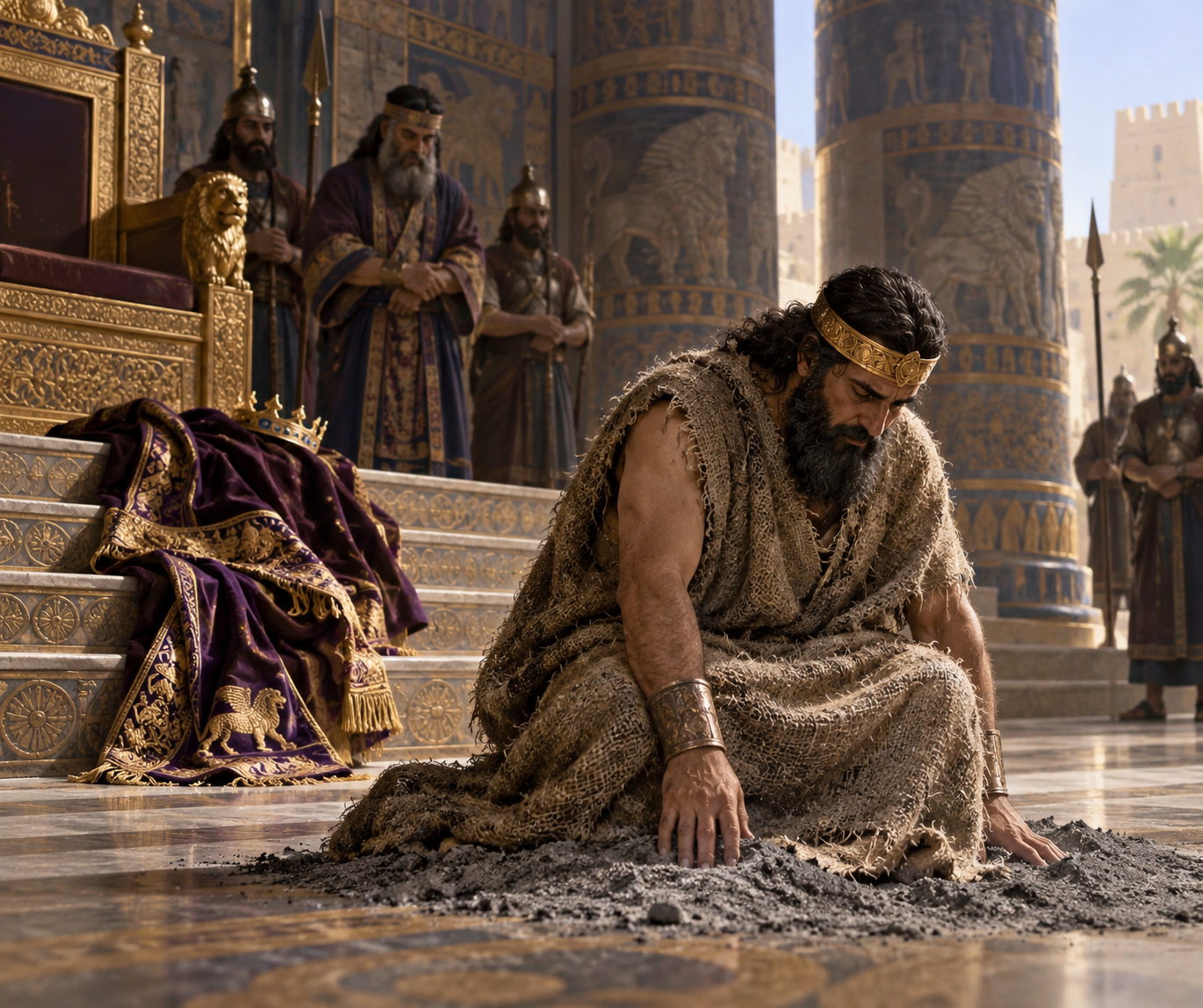
THE MIRACULOUS RESPONSE
FROM THE THRONE TO ASHES
When the word reached the king of Nineveh, he arose from his throne - Jonah 3:5 said the greatest which is now identified as the king of Nineveh. The king left his throne because he had heard from the King of heaven.
The highest man in Nineveh humbled
himself before the Most High God.
laid aside his robe from him, covered himself with sackcloth and sat on the ashes - The king's actions form a dramatic picture of humbling himself. His self-humiliation was shown by the fact that the king did not consider himself exempt because of his position. Ashes were another outward expression of deep humiliation, mourning, and repentance. The king went from a throne and royal robe to ashes! Compare Job's words after he came to realize more about Who God was and declared “Therefore I retract, and I repent in dust and ashes.” (Job 42:6)
Repentance brought the king down from his throne
before judgment brought the city down.
The physical movements of the king beautifully illustrate the spiritual direction of repentance. He arose from his throne. He laid aside his robe. He put on sackcloth. He sat in ashes. Everything moves downward. The king's downward movement recalls the principle that “God is opposed to the proud, but gives grace to the humble.” (James 4:6)
Spurgeon's Expositon - Note that the only message they had heard was a prophecy of impending judgment. God had sent his servant to warn them of the coming destruction; and, since he had warned them that he meant to destroy them, they could infer that he might possibly intend pity towards them should they repent, but there was as yet no verbal declaration of mercy or hope. these people went to God with nothing better to sustain them than this, “Who can tell?” How much more guilty than these Ninevites are they who refuse to humble themselves before God, even when they have distinct injunctions from God, and explicit promises that whosoever shall confess and forsake his sins shall find mercy! these men of Nineveh will rise up in judgment against the men of London, and the men of this generation, and condemn them, for they repented at the preaching of Jonah, and now men do not repent even at the testimony of Jesus Christ the Son of God. To despise the prophet Jonah, would have involved these people in certain destruction; of how much sorer punishment shall they be thought worthy who despise the Christ of God, and do despite unto the Spirit of grace (Heb 10:29b).
Norman Geisler - JONAH 3:6—Why does Jonah refer to the king of Assyria simply as the king of Nineveh? When Critics Ask
PROBLEM: Conservative scholars maintain that the Book of Jonah was written by the prophet Jonah who actually experienced the events recorded in the book. However, if the Book of Jonah was written by a Hebrew prophet who lived in the time of the Assyrian empire, why would he refer to the king of the Assyrian empire simply as the king of Nineveh?
SOLUTION: All of the ancient records regarding the history of Assyria testify to the fact that it was common knowledge that Nineveh was the capital city of Assyria. Simply because Jonah identifies this king as the king of Nineveh does not mean that Jonah did not also realize that this man was the king of the Assyrian empire of which Nineveh was the capital. The king of Assyria would certainly be the king of its capital city. To identify the king of a nation as the king of its capital city was not uncommon. In 1 Kings 21:1 Ahab, king of Israel, is referred to as the king of Samaria. So, Jonah’s use of this title is not anachronistic, and does not provide evidence for a late date.
Jonah 3:7 He issued a proclamation and it said, “In Nineveh by the decree of the king and his nobles: Do not let man, beast, herd, or flock taste a thing. Do not let them eat or drink water.
KJV And he caused it to be proclaimed and published through Nineveh by the decree of the king and his nobles, saying, Let neither man nor beast, herd nor flock, taste any thing: let them not feed, nor drink water:
NET He issued a proclamation and said, "In Nineveh, by the decree of the king and his nobles: No human or animal, cattle or sheep, is to taste anything; they must not eat and they must not drink water.
NLT Then the king and his nobles sent this decree throughout the city: "No one, not even the animals from your herds and flocks, may eat or drink anything at all.
ESV And he issued a proclamation and published through Nineveh, "By the decree of the king and his nobles: Let neither man nor beast, herd nor flock, taste anything. Let them not feed or drink water,
BGT καὶ ἐκηρύχθη καὶ ἐρρέθη ἐν τῇ Νινευη παρὰ τοῦ βασιλέως καὶ παρὰ τῶν μεγιστάνων αὐτοῦ λέγων οἱ ἄνθρωποι καὶ τὰ κτήνη καὶ οἱ βόες καὶ τὰ πρόβατα μὴ γευσάσθωσαν μηδὲν μηδὲ νεμέσθωσαν μηδὲ ὕδωρ πιέτωσαν
LXE And proclamation was made, and it was commanded in Nineve by the king an by his great men, saying, Let not men, or cattle, or oxen, or sheep, taste any thing, nor feed, nor drink water.
CSB Then he issued a decree in Nineveh: By order of the king and his nobles: No man or beast, herd or flock, is to taste anything at all. They must not eat or drink water.
NIV Then he issued a proclamation in Nineveh: "By the decree of the king and his nobles: Do not let any man or beast, herd or flock, taste anything; do not let them eat or drink.
- caused (KJV): Jon 3:5 2Ch 20:3 Ezra 8:21 Joe 2:15,16
- herd (KJV): Joe 1:18 Ro 8:20-22
Related Passages:
Joel 1:18 How the beasts groan! The herds of cattle wander aimlessly Because there is no pasture for them; Even the flocks of sheep suffer.
Romans 8:20-22 For the creation was subjected to futility, not willingly, but because of Him who subjected it, in hope 21 that the creation itself also will be set free from its slavery to corruption into the freedom of the glory of the children of God. 22 For we know that the whole creation groans and suffers the pains of childbirth together until now.
THE KING DECREES
CITYWIDE FAST
He issued a proclamation - Jonah proclaimed judgment; the king proclaimed a fast. One proclamation from God produced another proclamation from the king. The king does not keep his concern private. What began as personal humiliation now becomes a call for corporate humiliation. When Jonah proclaimed judgment, the king proclaimed humiliation and repentance.
and it said, “In Nineveh by the decree of the king and his nobles - The inclusion of his nobles suggests that the city's leadership joined the king in issuing the decree.
Do not let man, beast, herd, or flock taste a thing. Do not let them eat or drink water - The king proclaimed an exceptionally severe fast as the people were to abstain completely from food and, apparently for the duration intended, even from water. No time limit was given, but life could not be sustained without fluids much past three or four days. There is no evidence the king proclaimed fasting to obtain mercy, but to refect the outward expression of the inward change in the people. An empty stomach means little if the heart remains full of sin. The most striking aspect of the king's proclamation is the inclusion of the animals. The animals had not sinned and were not repenting. Rather, their participation intensified the city's corporate mourning and humiliation. Surely, the resulting hunger and cries of the animals would have added to the atmosphere of distress throughout Nineveh.
Jonah 3:8 “But both man and beast must be covered with sackcloth; and let men call on God earnestly that each may turn from his wicked way and from the violence which is in his hands.
KJV But let man and beast be covered with sackcloth, and cry mightily unto God: yea, let them turn every one from his evil way, and from the violence that is in their hands.
NET Every person and animal must put on sackcloth and must cry earnestly to God, and everyone must turn from their evil way of living and from the violence that they do.
NLT People and animals alike must wear garments of mourning, and everyone must pray earnestly to God. They must turn from their evil ways and stop all their violence.
ESV but let man and beast be covered with sackcloth, and let them call out mightily to God. Let everyone turn from his evil way and from the violence that is in his hands.
BGT καὶ περιεβάλοντο σάκκους οἱ ἄνθρωποι καὶ τὰ κτήνη καὶ ἀνεβόησαν πρὸς τὸν θεὸν ἐκτενῶς καὶ ἀπέστρεψαν ἕκαστος ἀπὸ τῆς ὁδοῦ αὐτοῦ τῆς πονηρᾶς καὶ ἀπὸ τῆς ἀδικίας τῆς ἐν χερσὶν αὐτῶν λέγοντες
LXE So men and cattle were clothed with sackcloths, and cried earnestly to God; and they turned every one from their evil way, and from the iniquity that was in their hands, saying,
CSB Furthermore, both man and beast must be covered with sackcloth, and everyone must call out earnestly to God. Each must turn from his evil ways and from the violence he is doing.
NIV But let man and beast be covered with sackcloth. Let everyone call urgently on God. Let them give up their evil ways and their violence.
- cry (KJV): Jon 1:6,14 Ps 130:1,2
- let (KJV): Isa 1:16-19 55:6,7 58:6 Eze 18:21-24,27,28,30-32 33:11 Da 4:27 Mt 3:8 Ac 3:19 26:20
- the violence (KJV): Isa 59:6
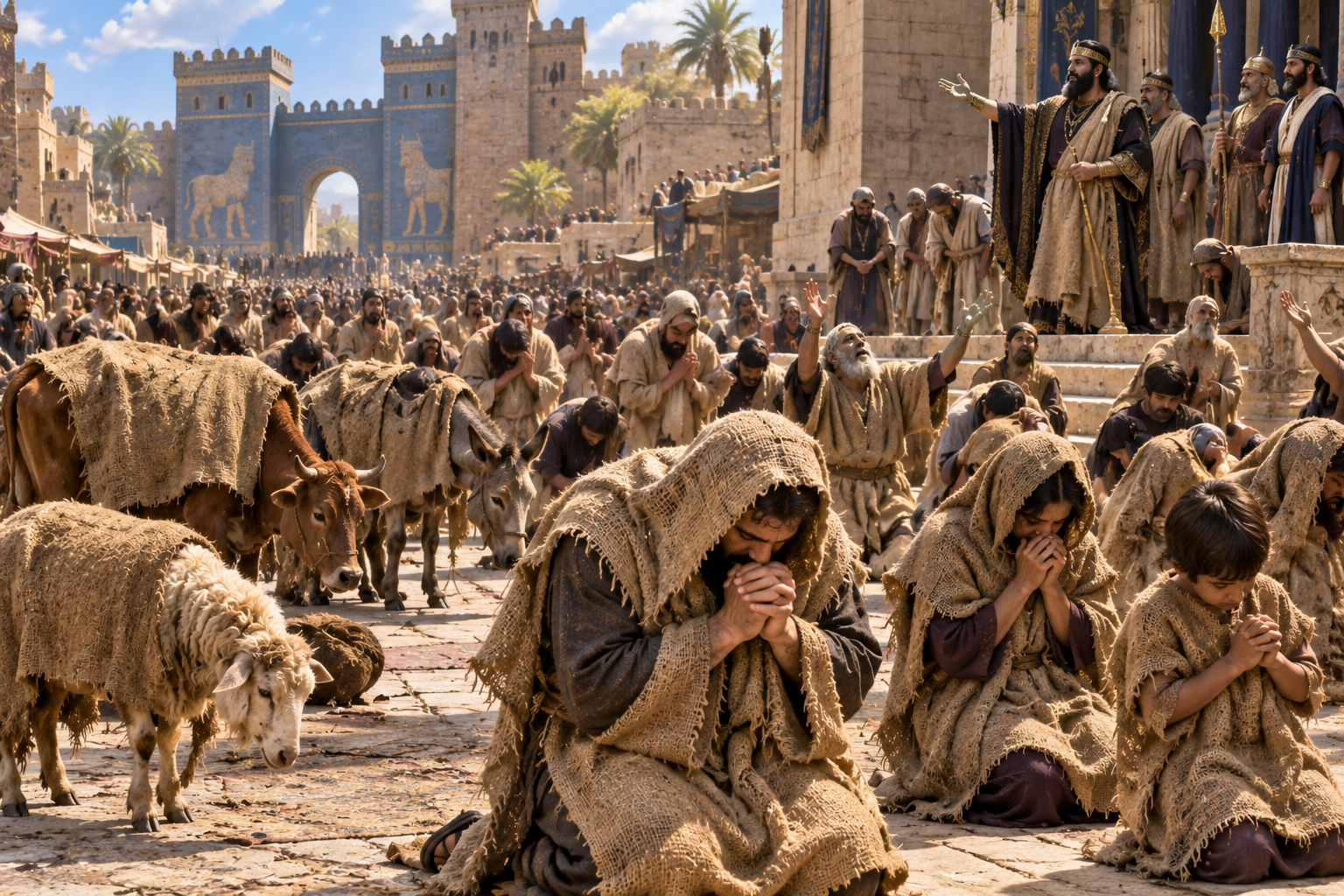
THE CRUCIAL CALL
TO REPENT FROM SIN
But both man and beast must be covered with sackcloth - The citywide mourning continue and even the animals were covered with sackcloth. The covering of the animals with sackcloth intensified the outward expression of the city's grief and humiliation.
and let men call on God earnestly - Now we get to the heart of the response, which was a call to God. The idea is to cry mightily or urgently to God. This was not casual prayer. Nineveh had been told “Yet forty days and Nineveh will be overthrown.” (Jon 3:4) They believed the warning, so they prayed with urgency. There is a great difference between merely saying prayers and crying to God. The Ninevites realized that their only hope was not in their walls, military power, king, wealth, or gods. Their only hope was the mercy of the God Who had pronounced judgment against them.
that each may turn - Repentance is more than feeling sorry; it is turning around. Turn translates the Hebrew shub, one of the great Old Testament words associated with repentance. Its basic idea is to turn, return, turn back, or change direction. Repentance therefore involves more than regret. It is not merely “I am sorry about what I have done.” It is “By God's grace, I am turning away from what I have been doing.” Nineveh's repentance was evidenced by a definite change of direction.
Sackcloth changed their appearance
Repentance changed their direction.
Note the word each which means every single person in the city, considered separately and one by one. In other words, the king did not merely call upon Nineveh to repent collectively. He called upon each person to turn from his wicked way. A city repents when individuals repent. A church experiences renewal when individuals experience renewal. A family changes when individuals change. We cannot repent for someone else. The point is that repentance is intensely personal. The question was no longer merely “What has Nineveh done?” It became “What have I done, and from what must I turn?”
It is possible to wear sackcloth
while still holding sin in our hands.
from his wicked (raʿ; LXX - poneros - active evil with intent to harm) way and from the violence which is in his hands - The Hebrew derek, “way,” describes a road or path and frequently becomes a metaphor for one's manner or course of life. Their problem was not merely isolated wicked acts. They were traveling a wicked way. Repentance therefore meant changing direction. Sin says, “Continue this way.” Repentance says, “Turn around.” Violence is the Hebrew chamas, meaning violence, cruelty, wrongdoing, injustice, or malicious oppression. Nineveh was an Assyrian city, and violence would become notorious in Assyrian history.
Violence was “in their hands.” Their hands had become instruments of their wickedness. The same hands that had harmed others now needed to become empty of violence. This is repentance made visible. Their mouths were to “call on God earnestly.” Their feet were to turn from their wicked way. And finally their hands were to release their violence. In short their repentance involved their whole person, their mouth, feet, and hands.
Their mouths cried to God, their feet turned from wickedness,
and their hands released violence.
In short, the king's proclamation essentially says put on sackcloth, yes. Cry to God, yes. But also take the sin out of your hands. In a parallel passage, Isaiah later condemned people who engaged in religious observances while their “hands are covered with blood” and called them instead to “Cease to do evil, learn to do good.” (Isa 1:15–17)
David Jeremiah on Assyrian's violence - The Assyrians skinned their captives alive. They pulled out tongues. They gouged out eyes. They mutilated entire cities by driving over their population with chariots fixed with scythes on the wheels. They burned children alive and resorted to other atrocities designed to create fear and submission among their subjects. They engaged in every sort of unspeakable physical cruelty and terror imaginable against those they conquered. (Runaway Prophet)
Wicked (calamity) (07451) raʿ/ raʿah (רַע / רָעָה) is a broad Hebrew word meaning bad, evil, wicked, harmful, undesirable, painful, or disastrous, with its precise sense determined by the context. In the moral and spiritual sense, it describes wickedness, sin, and conduct that is contrary to God's holy character and standard (Ge 6:5; Dt 9:18; Pr 8:13). But raʿ does not always refer to moral evil. It can also describe harm, adversity, distress, misery, affliction, or calamity that comes upon a person (Ge 44:34; Ps 23:4). Thus, raʿ may describe either the evil people do or the painful consequences and calamities people experience. Ultimately, Scripture presents the LORD as the final standard by which what is morally good or evil is determined. In short: Raʿ ranges from moral wickedness that is contrary to God's character to adversity, harm, distress, or calamity, and the context determines which sense is intended.
Raʿ / Raʿah (רַע / רָעָה) in Jonah - Jonah 1:2, 7, 8, Jonah 3:8, 10, Jonah 4:1, 2, 6
Jonah 1:2 – God sees Nineveh's wickedness (raʿah).
Jonah 3:8 – They turn from their wicked (raʿah) way.
Jonah 3:10 – God does not bring the threatened calamity (raʿah) upon them.
Jonah 4:2 – Jonah knew God was One Who “relents concerning calamity (raʿah).”So the theological movement is striking: Nineveh turned from its raʿah of SIN, so God withheld the raʿah of JUDGMENT. More literally, Nineveh turned from the raʿah it was doing, and God withheld the raʿah it deserved.
Jonah 3:9 “Who knows, God may turn and relent and withdraw His burning anger so that we will not perish.”
KJV Who can tell if God will turn and repent, and turn away from his fierce anger, that we perish not?
NET Who knows? Perhaps God might be willing to change his mind and relent and turn from his fierce anger so that we might not die."
NLT Who can tell? Perhaps even yet God will change his mind and hold back his fierce anger from destroying us."
ESV Who knows? God may turn and relent and turn from his fierce anger, so that we may not perish."
BGT τίς οἶδεν εἰ μετανοήσει ὁ θεὸς καὶ ἀποστρέψει ἐξ ὀργῆς θυμοῦ αὐτοῦ καὶ οὐ μὴ ἀπολώμεθα
LXE Who knows if God will repent, and turn from his fierce anger, and so we shall not perish?
CSB Who knows? God may turn and relent; He may turn from His burning anger so that we will not perish.
NIV Who knows? God may yet relent and with compassion turn from his fierce anger so that we will not perish."
- Jon 1:6 2Sa 12:22 Ps 106:45 Joe 2:13,14 Am 5:15 Lu 15:18-20
THE HOPE OF
REPENTANCE
Who knows - This is an idiom expressing a possibility ( Esther 4:14).The king has no recorded promise that Nineveh will be spared. Jonah's message contained a warning, but no explicit offer of mercy. Yet the king reasons that perhaps the God Who warns sinners may also show mercy when sinners turn from their wickedness. His “Who knows?” expresses neither unbelief nor presumption, but humble hope. This same expression appears in Joel 2:14 “Who knows whether He will not turn and relent, and leave a blessing behind Him?” And David expressed similar uncertainty concerning his sick child “Who knows, the LORD may be gracious to me.” (2Sa 12:22) The language expresses hope without presumption.
🙏 THOUGHT - The fact that God warned Nineveh gave them reason to hope. The warning indeed contained a glimmer of mercy. Indeed, Nineveh had no explicit promise of mercy, yet they sought mercy. Their hope rested on two words: “Who knows?” We have something far stronger: God's explicit promises to those who repent and believe. Nineveh acted on a possibility. We are called to act on a promise! Nineveh had “Who knows?” We have “God says!” The gospel says, “The one who comes to Me I will certainly not cast out” (Jn 6:37). They humbled themselves on the possibility of mercy. We are invited to come on the basis of the promise of mercy. Nineveh acted on a glimmer of "hope so."The Gospel gives us a blazing certainty of "hope sure!" But remember that greater light brings greater responsibility. Their “Who knows?” moved them to repentance. Our “God has promised” should move us all the more.
Repentance does not demand mercy
It casts itself upon mercy.
God may turn and relent - Relent does not mean that God discovered He had made a mistake or that His moral character changed. Scripture explicitly teaches “God is not a man, that He should lie, nor a son of man, that He should repent.” (Nu 23:19) And “I, the LORD, do not change.” (Mal 3:6) So how can God “relent”? The language describes a change in God's announced dealings with people when their relationship to Him changes. Jeremiah 18:7–8 provides an important theological explanation “At one moment I might speak concerning a nation... to uproot, to pull down, or to destroy it; if that nation against which I have spoken turns from its evil, I will relent concerning the calamity I planned to bring on it.” In other words, God's character does not change. The people changed, and therefore God's dealings with them changed in perfect consistency with His unchanging character.
and withdraw His burning anger - “Burning anger” vividly portrays God's righteous wrath against Nineveh's wickedness. This was not arbitrary anger. Jonah 1:2 had already explained “their wickedness has come up before Me.” God's anger was His holy response to real evil.
so that we will not perish - This echoes an important theme running through Jonah. The pagan sailors cried “Do not let us perish.” (Jon 1:14) Now Nineveh's king says “so that we will not perish.” The book repeatedly places pagans in situations where they recognize their helplessness and cry out in the face of death.
The pagan king does not know with certainty whether God will show mercy “Who knows?” But Jonah knows. Jonah later admits “I knew that You are a gracious and compassionate God, slow to anger and abundant in lovingkindness, and one who relents concerning calamity.” (Jon 4:2) The king hopes God might be merciful. Jonah knows God is merciful. And astonishingly, Jonah is unhappy when God proves to be exactly as merciful as Jonah knew Him to be. That is one of the great tensions of the book.
C H Spurgeon - Who can tell?
“Who can tell if God will turn and repent, and turn away from his fierce anger, that we perish not?” Jonah 3:9
I remember many who have passed from the land of the living and have gone to another world—and some how suddenly, how rapidly! I have been startled at it often myself. I have seen some here on the Sabbath, and by the Tuesday or by the Thursday the message has come, “On what day can you bury such and such a one?” “Bury her!” “Yes, sir, bury her, she is gone;” and I have said, “How strange it seems that she should be dead who so lately was living in our midst!” Forty days is a long lease compared with that which you have any reason to conclude that God has bestowed on you. But what if it were forty years, how short a time even then. If you will but look with the eye of wisdom, how rapidly our years revolve. Are you not startled even now to see the withered leaf in your path? It was but yesterday that the fresh green buds were seen. It seems but a month ago since first we saw the wheat starting up from the ground, and now the harvest is over and gone and many of the birds have disappeared and the tints of autumn are succeeding the verdure of summer. Years seem but months now and months but days, and days pass so rapidly that they flit like shadows before us. O! men and women, if we could but measure life it is but a span, and in a time how short, how brief, every one of us must appear before his God. The shortness of time should help to arouse us.
Jonah 3:10 When God saw their deeds, that they turned from their wicked way, then God relented concerning the calamity which He had declared He would bring upon them. And He did not do it.
KJV And God saw their works, that they turned from their evil way; and God repented of the evil, that he had said that he would do unto them; and he did it not.
NET When God saw their actions– they turned from their evil way of living!– God relented concerning the judgment he had threatened them with and he did not destroy them.
NLT When God saw what they had done and how they had put a stop to their evil ways, he changed his mind and did not carry out the destruction he had threatened.
ESV When God saw what they did, how they turned from their evil way, God relented of the disaster that he had said he would do to them, and he did not do it.
BGT καὶ εἶδεν ὁ θεὸς τὰ ἔργα αὐτῶν ὅτι ἀπέστρεψαν ἀπὸ τῶν ὁδῶν αὐτῶν τῶν πονηρῶν καὶ μετενόησεν ὁ θεὸς ἐπὶ τῇ κακίᾳ ᾗ ἐλάλησεν τοῦ ποιῆσαι αὐτοῖς καὶ οὐκ ἐποίησεν
LXE And God saw their works, that they turned from their evil ways; and God repented of the evil which he had said he would do to them; and he did it not.
CSB Then God saw their actions-- that they had turned from their evil ways-- so God relented from the disaster He had threatened to do to them. And He did not do it.
NIV When God saw what they did and how they turned from their evil ways, he had compassion and did not bring upon them the destruction he had threatened.
YLT And God seeth their works, that they have turned back from their evil way, and God repenteth of the evil that He spake of doing to them, and he hath not done it.
- God saw (KJV): 1Ki 21:27-29 Job 33:27,28 Jer 31:18-20 Lu 11:32 15:20
- and God repented (KJV): Jon 4:2 Jer 18:8 Joe 2:13 Am 7:3,6
Related Passages:
Jonah 1:2 “Arise, go to Nineveh the great city and cry against it, for their wickedness has come up before Me.”
Jeremiah 18:7-8 “At one moment I might speak concerning a nation or concerning a kingdom to uproot, to pull down, or to destroy it; 8 if that nation against which I have spoken turns from its evil, I will relent concerning the calamity I planned to bring on it.
Matthew 12:41 “The men of Nineveh will stand up with this generation at the judgment, and will condemn it because they repented at the preaching of Jonah; and behold, something greater than Jonah is here.
Luke 15:7; 10 “I tell you that in the same way, there will be more joy in heaven over one sinner who repents than over ninety-nine righteous persons who need no repentance....10 “In the same way, I tell you, there is joy in the presence of the angels of God over one sinner who repents.”
Exodus 32:14 So the LORD changed His mind about the harm which He said He would do to His people.
Psalms 106:45 And He remembered His covenant for their sake, And relented according to the greatness of His lovingkindness.
Jeremiah 18:8 if that nation against which I have spoken turns from its evil, I will relent concerning the calamity I planned to bring on it.
Amos 7:3; 6 The LORD changed His mind about this. “It shall not be,” said the LORD. (7:6) The LORD changed His mind about this. “This too shall not be,” said the Lord
WHEN GOD SAW
THAT THEY TURNED
When God saw their deeds, that they turned (shub/sub; LXX - apostrepho - turn away from, stop) from their wicked way - Nineveh heard God's warning, believed God, humbled itself, cried earnestly to Him, and turned from its wicked way. Significantly, the text does not say that God saw their sackcloth or their fasting, but that He saw “their deeds, that they turned from their wicked way.” Their outward actions demonstrated the reality of their repentance.
Note carefully that seeing their deeds does not mean the Ninevites earned God's mercy through good works. To reiterate the important Biblical principle their deeds were the evidence of their repentance. As John the Baptist later declared “Therefore bear fruit in keeping with repentance.” (Mt 3:8) True repentance occurs in the heart, but it does not remain invisible indefinitely. A changed heart begins producing a changed life.
Sackcloth was the symbol. Turning was the substance.
Fasting expressed repentance. Forsaking wickedness demonstrated repentance.
Then (see then) God relented (nacham) concerning the calamity which He had declared He would bring upon them. And He did not do it - God's character did not change. Nineveh's conduct changed. Nineveh turned from sin and God turned from judgment. The same God Who saw Nineveh's wickedness also saw Nineveh's repentance. The warning itself became God's instrument for producing the response that resulted in the judgment being withheld. Jonah 3 ends with God withholding judgment! God did not change. Nineveh changed. God remained exactly what He had always been: holy toward sin and merciful toward the repentant.
God did not change His character.
Nineveh changed its conduct.
A change in God's dealings does not require a change in God's character. While Nineveh persisted in wickedness, judgment was appropriate. When Nineveh turned from wickedness, mercy was consistent with God's unchanging nature. God's threats of judgment and His offers of mercy arise from the same unchanging character. His holiness explains His judgment of sin. His compassion explains His mercy toward those who turn from sin. Repentance changes our relationship to an unchanging God. The sun has not changed when a person moves from shadow into its light. In a similar way, God remains the same while the sinner's position toward Him changes.
God changed what He did because Nineveh changed
what they were doing, but God never changed Who He is.
Before Nineveh repented, God's holiness required that its wickedness be confronted. When Nineveh turned from its wickedness, God's compassion was displayed in withholding the announced calamity. Thus God's relenting does not contradict His immutability. It demonstrates the perfect consistency of His character. Jeremiah 18:7–8 explains this principle clearly: when God announces judgment against a nation and that nation “turns from its evil,” He may “relent concerning the calamity” He had announced.
Note that in regard to God relenting, a helpful distinction is between a divine decree and a divine announcement. A decree or oath is an unconditional declaration of what God has determined to do. Once God has decreed something, He will accomplish it. An announcement, however, may express God's intention in response to existing circumstances and may contain an explicit or implicit condition. The response of those receiving the warning may therefore affect whether the announced judgment is carried out.
Calamity is the Hebrew word raʿah can mean evil in a moral sense or calamity/disaster in the sense of judgment. God was certainly not planning moral evil. In this context, God had announced a judicial calamity against Nineveh because of its wickedness.
Spurgeon's Exposition - There is no change in God, absolutely considered, but there is often an apparent change, that which he threatens, while men remain in sin, is not executed upon them when they repent and turn to him. He is always the same God. from the beginning, he has been “the Lord God, merciful and gracious, long-suffering, and abundant in goodness and truth, keeping mercy for thousands, forgiving iniquity and transgression and sin.” If he did not pardon sin, when men turn from it with sincere repentance, he would have changed his method of dealing with the penitent; but when he does forgive, it is according to his way from the beginning, for he has ever been a tender, and compassionate, and gracious God.
David Jeremiah on revival - One of the reasons why revival will have a hard time coming to America the way it is now is because no one will preach repentance and judgment. We tell people to be better, but we never tell them that before you can get better, you must deal with sin through repentance. In every revival in history there has always been the message of repentance.(Runaway Prophet)
QUESTION - Does God change His mind? | GotQuestions.org
ANSWER - Malachi 3:6 declares, “I the LORD do not change. So you, O descendants of Jacob, are not destroyed.” Similarly, James 1:17 tells us, “Every good and perfect gift is from above, coming down from the Father of the heavenly lights, who does not change like shifting shadows.” Numbers 23:19 is clear: “God is not a man, that He should lie, nor a son of man, that He should change His mind. Does He speak and then not act? Does He promise and not fulfill?” Based on these verses, no, God does not change. God is unchanging and unchangeable. He is also all-wise. So He cannot “change His mind” in the sense of realizing a mistake, backtracking, and trying a new tack.
How then do we explain verses that seem to say that God does change His mind? Verses such as Genesis 6:6, “The LORD was grieved that He had made man on the earth, and His heart was filled with pain.” Also, Exodus 32:14 proclaims, “Then the LORD relented and did not bring on His people the disaster He had threatened.” These verses speak of the Lord “repenting” or “relenting” of something and seem to contradict the doctrine of God’s immutability.
Another passage that is often used to show that God changes His mind is the story of Jonah. Through His prophet, God had told Nineveh He would destroy the city in forty days (Jonah 3:4). However, Nineveh repented of their sin (verses 5–9). In response to the Assyrians’ repentance, God relented: “He had compassion and did not bring upon them the destruction He had threatened” (verse 10).
There are two important considerations involving the passages that say God changed His mind. First, we can say statements such as “the LORD was grieved that He had made man on the earth” (Genesis 6:6) are examples of anthropopathism (or anthropopatheia). Anthropopathism is a figure of speech in which the feelings or thought processes of finite humanity are ascribed to the infinite God. It’s a way to help us understand God’s work from a human perspective. In Genesis 6:6 specifically, we understand God’s sorrow over man’s sin. God obviously did not reverse His decision to create man. The fact that we are alive today is proof that God did not “change His mind” about the creation.
Second, we must make a distinction between conditional declarations of God and unconditional determinations of God. In other words, when God said, “I will destroy Nineveh in forty days,” He was speaking conditionally upon the Assyrians’ response. We know this because the Assyrians repented and God did not, in fact, mete out the judgment. God did not change His mind; rather, His message to Nineveh was a warning meant to provoke repentance, and His warning was successful.
An example of an unconditional declaration of God is the Lord’s promise to David, “Your house and your kingdom will endure forever before me; your throne will be established forever” (2 Samuel 7:16). There is no qualification expressed or implied in this declaration. No matter what David did or did not do, the word of the Lord would come to pass.
God tells us of the cautionary nature of some of His declarations and the fact that He will act in accordance with our choices: “If at any time I announce that a nation or kingdom is to be uprooted, torn down and destroyed, and if that nation I warned repents of its evil, then I will relent and not inflict on it the disaster I had planned. And if at another time I announce that a nation or kingdom is to be built up and planted, and if it does evil in my sight and does not obey me, then I will reconsider the good I had intended to do for it. Now therefore say to the people of Judah and those living in Jerusalem, ‘This is what the Lord says: Look! I am preparing a disaster for you and devising a plan against you. So turn from your evil ways, each one of you, and reform your ways and your actions’” (Jeremiah 18:7–11). Note the conditional word if: “If that nation I warned repents [like Assyria in Jonah 3] . . . then I will relent.” Conversely, God may tell a nation they will be blessed, but “if it does evil in my sight [like Israel in Micah 1] . . . then I will reconsider the good I had intended to do.”
The bottom line is that God is entirely consistent. In His holiness, God was going to judge Nineveh. However, Nineveh repented and changed its ways. As a result, God, in His holiness, had mercy on Nineveh and spared them. This “change of mind” is entirely consistent with His character. His holiness did not waver one iota.
The fact that God changes His treatment of us in response to our choices has nothing to do with His character. In fact, because God does not change, He must treat the righteous differently from the unrighteous. If someone repents, God consistently forgives; if someone refuses to repent, God consistently judges. He is unchanging in His nature, His plan, and His being. He cannot one day be pleased with the contrite and the next day be angry with the contrite. That would show Him to be mutable and untrustworthy. For God to tell Nineveh, “I’m going to judge you,” and then (after they repent) refuse to judge them may look like God changed His mind. In reality, God was simply staying true to His character. He loves mercy and forgives the penitent. “Has God forgotten to be merciful?” (Psalm 77:9). The answer is, no.
At one time we were all enemies of God due to our sin (Romans 8:7). God warned us of the wages of sin (Romans 6:23) in order to cause us to repent. When we repented and trusted Christ for salvation, God “changed His mind” about us, and now we are no longer enemies but His beloved children (John 1:12). As it would be contrary to God’s character to not punish us had we continued in sin, so it would be contrary to His character to punish us after we repent. Does our change of heart mean that God changes? No, if anything, our salvation points to the fact that God does not change, because had He not saved us for the sake of Christ, He would have acted contrary to His character.
ROBERT CHISHOLM - DOES GOD CHANGE HIS MIND? - the following is a summary - click link for original 13 page article
DOES GOD “CHANGE HIS MIND”?
At first glance, Scripture appears to present a tension concerning whether God “changes His mind.” Numbers 23:19, 1 Samuel 15:29, and Psalm 110:4 declare that God does not change His mind, while passages such as Exodus 32:14, Amos 7:3, 6, and Jonah 3:10 describe God as relenting from an announced course of action. The same Hebrew verb, nacham (נָחַם), is used in these contexts. The solution is not that Scripture contradicts itself, but that not every divine statement about the future functions in the same way.
The Hebrew verb nacham has a range of meanings depending on context. It can describe experiencing sorrow or emotional pain, being comforted, relenting from an action already underway, or retracting or relenting concerning an announced course of action. Thus the meaning must be determined by its particular context rather than assigning exactly the same sense to every occurrence.
DIVINE DECREES VERSUS DIVINE ANNOUNCEMENTS
A helpful distinction is between a divine decree and a divine announcement. A decree or oath is an unconditional declaration of what God has determined to do. Once God has decreed something, He will accomplish it. An announcement, however, may express God's intention in response to existing circumstances and may contain an explicit or implicit condition. The response of those receiving the warning may therefore affect whether the announced judgment is carried out.
This distinction helps explain passages such as Numbers 23:19 and 1 Samuel 15:29. In Numbers 23, God had determined to bless Israel, and Balaam could not reverse that blessing. In 1 Samuel 15, God's rejection of Saul had become a settled decree. Thus when Scripture says in these contexts that God does not “change His mind,” the point is that God does not retract what He has unconditionally decreed.
By contrast, God sometimes announces judgment precisely in order to produce repentance. Jeremiah 18:7-10 gives the principle clearly: if God announces judgment against a nation and that nation turns from its evil, God may relent concerning the calamity He announced. Conversely, if God announces blessing and the nation turns to evil, He may withhold the announced blessing.
JONAH AND NINEVEH
This distinction is especially important for understanding Jonah 3. Jonah's proclamation sounded absolute:
“Yet forty days and Nineveh will be overthrown.” (Jonah 3:4)
Yet the announcement was not accompanied by the formal features of an unconditional decree. The Ninevites therefore responded appropriately by repenting in the hope that God might withhold the threatened judgment. The king expressed this hope when he said:
“Who knows, God may turn and relent and withdraw His burning anger so that we will not perish.” (Jonah 3:9)
And that is exactly what occurred. When God saw that the Ninevites had turned from their wicked ways, He did not bring upon them the calamity He had announced.
Thus Jonah's prophecy was not a failed prophecy. The warning accomplished the very purpose for which God sent it. The announced judgment produced repentance, and repentance resulted in the withholding of judgment.
Jeremiah 18 provides the theological principle behind Jonah 3: announced judgment may be implicitly conditional upon the response of those being warned.
GOD'S RELENTING DOES NOT MEAN GOD IS CHANGEABLE
When Scripture says that God “relented,” it does not mean that God discovered He had made a mistake, acquired information He previously lacked, or underwent a change in His holy character. Rather, there was a genuine change in God's dealings with people because there had been a genuine change in the people themselves.
Nineveh changed from wickedness to repentance, and God's response changed from announced judgment to mercy.
God's character remained perfectly consistent throughout.
The God Who opposes unrepentant wickedness is the same God Who shows mercy when sinners repent.
Indeed, Jonah himself knew this about God's character. He later confessed:
“I knew that You are a gracious and compassionate God, slow to anger and abundant in lovingkindness, and one who relents concerning calamity.” (Jonah 4:2)
God's willingness to relent from announced judgment is therefore not evidence of instability in His character. It is an expression of His grace, compassion, patience, and lovingkindness. The article connects this truth with the great revelation of God's character in Exodus 34:6-7.
THOUGHT
God's warnings of judgment are themselves expressions of mercy because they give sinners opportunity to repent before judgment falls.
Nineveh beautifully illustrates this truth. God could have destroyed the city without warning, but instead He sent Jonah with forty days of warning. The warning produced repentance, and repentance was met with mercy.
Therefore, when Jonah declared, “Yet forty days and Nineveh will be overthrown,” the announcement of judgment contained within it an opportunity for mercy.
The threatened judgment was real, the repentance was real, and the mercy was real.
God did not change His holy character. The Ninevites changed their conduct, and the unchanging God responded consistently with His character.
Harry Ironside - Jonah 3:10
The book of Jonah has a unique place in the Old Testament. It is primarily the book of the divine sovereignty. The confession of the pagan mariners, “You, O Lord, have done as it pleased You” (1:14), is emphasized throughout. We are told that “the Lord sent out a great wind on the sea” (verse 4); “the Lord had prepared a great fish” (verse 17); “the Lord spoke to the fish” (2:10); “the Lord God prepared a plant” (4:6); “God prepared a worm” (verse 7), and “God prepared a vehement east wind” (verse 8). It is the Sovereign of the universe who works all things according to His own will (Ephesians 1:11). This answers every question that foolish, unbelieving skeptics might raise regarding the strange experiences recorded.
God’s love and grace transcend all national boundaries. His heart goes out to all the world. He would have all men repent and come to the knowledge of the truth, that judgment may be averted. He has no pleasure in the death of the wicked (Ezekiel 18:23). He delights in mercy (Micah 7:18). Judgment is His awesome work (Isaiah 28:21). It is a great pity when His servants fail to recognize this and are more concerned about their own ease and reputation than about the needs of men to whom they are commissioned to go as God’s messengers.
Sovereign grace, o’er sin abounding,
Ransomed souls the tidings tell;
’Tis a deep that knows no sounding;
Who its length and breadth can tell?
On its glories
Let my soul forever dwell.
It’s Not About the Fish - Tim Gustafson
When God saw what they did and how they turned from their evil ways, he relented. Jonah 3:10
Sighted numerous times off the coast of Australia’s South Queensland, Migaloo is the first albino humpback whale ever documented. The splendid creature, estimated at more than forty feet long, is so rare that Australia passed a law specifically to protect him.
The Bible tells us about a “huge fish” so rare that God had provided it especially to swallow a runaway prophet (Jonah 1:17). Most know the story. God told Jonah to take a message of judgment to Nineveh. But Jonah wanted nothing to do with the Ninevites, who had a reputation for cruelty to just about everyone—including the Hebrews. So he fled. Things went badly. From inside the fish, Jonah repented. Eventually he preached to the Ninevites, and they repented too (3:5–10).
Great story, right? Except it doesn’t end there. While Nineveh repented, Jonah pouted. “Isn’t this what I said, Lord?” he prayed. “I knew that you are a gracious and compassionate God, slow to anger and abounding in love” (4:2). Having been rescued from certain death, Jonah’s sinful anger grew until even his prayer became suicidal (v. 3).
The story of Jonah isn’t about the fish. It’s about our human nature and the nature of the God who pursues us. “The Lord is patient with you,” wrote the apostle Peter, “not wanting anyone to perish, but everyone to come to repentance” (2 Peter 3:9). God offers His love to brutal Ninevites, pouting prophets, and you and me.
Reflect & Pray
Father, we tend to look at what others “deserve” and forget we need Your love just as much. Help us live in Your love and tell others about it.
Our love has limits; God’s love is limitless.
Today's Insights - What a difference a couple of chapters can make in the tone of Jonah’s prayers! In Jonah 2:2, the desperate prophet prayed, “In my distress I called to the Lord, and he answered me.” But in Jonah 4:3, he asks God to kill him. God answered the first prayer miraculously, delivering Jonah from death. But with the second prayer, God simply asked, “Is it right for you to be angry?” (4:4). Then Jonah actually repeats his death wish. “I’m so angry I wish I were dead” (v. 9). Even then, God appealed to Jonah by sharing His heart for all of humanity. “Should I not have concern for the great city of Nineveh?” God even extends His concern to the animals that would have been destroyed in Nineveh (v. 11). The book of Jonah provides a fascinating contrast between human nature, which is self-serving, and the profoundly loving and patient character of God. How do we respond to God’s grace to us? Do we resent it when He extends that grace to others we may perceive as “worse” than we are? Do we resemble Jonah when things don’t go the way we’d like them to? (Reprinted by permission from Our Daily Bread Ministries. Please do not repost the full devotional without their permission.)
Joni Eareckson Tada - Just Desserts More Precious Than Silver: 366 Daily Devotional Readings - Page 2
When God saw what they did and how they turned from their evil ways, he had compassion and did not bring upon them the destruction he had threatened.—Jonah 3:10
God has this thing about showing compassion on whomever he wants. Sometimes we don’t like that. The nerve of God to save that child abuser, to reach out to that rapist on death row, to show compassion to that drug pusher!
If you’ve ever felt the stab of resentment when God wipes the slate clean for somebody whom you would rather he wiped off the face of the earth, guess what? Jonah felt the same way. God wanted Jonah to go to Nineveh to preach the gospel, so Jonah packed his suitcase—and took the train in the opposite direction. He despised those drug-pushing, idol-worshiping, fornicating Ninevites.
After ships, storms, seas, and whales, God gave Jonah another chance to rid himself of the resentment. So Jonah climbed up on his soapbox in the middle of the town square and preached that the Ninevites were about to get their just desserts: “Forty more days and Nineveh will be destroyed.” Never had Jonah had such joy in preaching fire and brimstone.
But what happens? The Ninevites repent—and God forgives them. That really makes Jonah mad. He says to the Lord, “Isn’t that just like you?” God responds, “Have you any right to be angry, Jonah?” Those words stung.
And they sting today when we hear of a serial killer who comes to Christ, or the deathbed conversion of a tyrant. But God will have compassion on whomever he wishes. We’re all too like the laborers in Matthew 20:12 who complained, “These men who were hired last worked only one hour…and you have made them equal to us who have borne the burden of the work and the heat of the day.” If God wants to give a full day’s wages to the worker hired at the eleventh hour, what of it?
God wants to make a difference in someone’s life, including yours. Don’t let your resentment stand in your way.
Lord, please keep me from anger and resentment when I see you blessing someone else. Help me to realize that when I feel this way, I’m hindering your work in my life.
Larry Richards - “He had compassion and did not bring upon them the destruction He had threatened” Jonah 3:10.
One of the most clearly established principles in Old Testament prophecy is that most prophetic warnings of doom are contingent. They invariably come true—unless the people to whom they are addressed repent. We see this principle in earlier incidents, such as those recorded in 2 Samuel 12:14–23; 1 Kings 21:27–29; and 2 Kings 20:1–6. Repentance can cause God to relent.
This should not be misunderstood as a change of the divine mind. It’s more like the red flashing lights and ringing bells that warn of a train’s approach. Anyone on the tracks will be crushed. But a person who gets off the tracks will be safe.
When Jonah preached, he said in effect, “You people of Nineveh are about to be run over!” When the people of Nineveh repented, they in effect got off the tracks! The juggernaut of divine judgment rushed on—and passed them by!
What an object lesson for Israel. The prophets of God, not strangers but fellow countrymen, had shouted out warnings of impending doom for decades. Here, in the experience of Nineveh, a pagan nation, was an object lesson for God’s own people. If only Israel would listen to the prophets and repent, God would relent in their case too.
The tragedy is that the people of Israel did not repent. The object lesson was wasted on them. The irony is that the very people that Jonah’s preaching saved, the Assyrians, were the agents God used to bring judgment on an Israel too hardened to heed.
Henry Blackaby - TALK IS CHEAP
Then God saw their works, that they turned from their evil way; and God relented from the disaster that He had said he would bring upon them, and He did not do it. Jonah 3:10
Apologize to your sister.”
“Tell your brother you’re sorry.”
What parent hasn’t used these words to urge a child to do what is right? After all, when we blow it—when we sin—we need to apologize to the person we’ve hurt or offended. The important thing—for adults as well as toddlers—is meaning it when we say, “I’m sorry.”
We also need to do what we can to make amends. It’s one thing to say you’re sorry; it’s another to live out your repentance. The truest sign of genuine repentance is a changed life.
Jonah told God he was sorry he hadn’t obeyed, but the prophet did more than just say the words. Once he was freed from the fish, he made his way to Nineveh. By his actions he validated his repentance.
What new direction do you need to head to show that you meant it, too, when you said to God, “I’m sorry for that sin”?
Walter Kaiser - 3:10; 4:1–2 A God Who Relents? - Hard Sayings of the Bible
So sharp is the contrast between what God had said would happen to Nineveh and what actually took place that we are left to wonder whether divine words are always fulfilled or whether God is presented in the Old Testament as a rather fickle person. Even though from the start Jonah had suspected, because of God’s gracious character, that he would not carry out his threats against Nineveh, we are still left in doubt over God’s ability to predict the future or his constancy of character.
Some have attempted to rescue the situation by distinguishing between God’s secret will and his declared will. The former, so this line of argumentation goes, is his real intention, which remains fixed and unchangeable, while the latter varies depending on conditions. But this representation of God’s will does not accord with Scripture elsewhere, for it still conveys the appearance of insincerity on the part of God—as if God were deceptive, representing his thoughts differently from what they really were, and representing future events differently from what he knew would eventually happen!
The language of this verse, which represents our Lord as “relent[ing]” or “repent[ing],” is undoubtedly an anthropomorphism—a depiction of God in human terms. Certainly the infinite, eternal God can be known to us only through human imagery, and thus he is represented as thinking and acting in a human manner. Without anthropomorphisms, we could never speak positively of God; to try would be to entangle ourselves in deism, which makes God so transcendent that he is never identified with us in our world. When we rush to get rid of the human forms in our talk about God, we sink into meaningless blandness.
Nevertheless, when it comes to the eternal principles of righteousness, Scripture is just as insistent about the impossibility of change in God. Consider, for example, the declaration made to Balaam: “God is not a man, that he should lie, nor a son of man, that he should change his mind” (Num 23:19). Similarly in 1 Samuel 15:29 Samuel informs Saul, “He who is the Glory of Israel does not lie or change his mind; for he is not a man, that he should change his mind.”
The descriptions of God that have to do with his inherent and immutable righteousness allow no room for change in the character of deity or in his external administrations. His righteousness calls for consistency and unchangeableness.
But such representations argue nothing against the possibility, or even the moral necessity, of a change in God’s carrying out of his declarations in cases where the people against whom the judgment was issued have changed, so that the grounds for the threatened judgment have disappeared. For God not to change in such cases would go against his essential quality of justice and his responsiveness to any change that he had planned to bring about.
If this is the case, some wonder why the announcement made by Jonah took such an absolute form: “Forty more days and Nineveh will be overturned” (Jon 3:4). Why not plainly include “if the people do not repent”?
This objection assumes that the form given to the message was not the best suited to elicit the desired result. Actually, as the record shows, this message indeed awakened the proper response, and so the people were spared. As delivered, it was a proper account of how God felt and the danger to which Nineveh was exposed.
Of course God’s warnings always carried with them the reverse side of the coin, the promises. This element of alternatives within one prophecy can be seen best in Jeremiah 18:9–11 and Ezekiel 18:24 (see, too, Rom 11:22). The good things promised in these prophecies cannot be attributed to any works righteousness or to any merited favor, but are always found in connection with the principles of holiness and obedience to God’s Word.
Does this imply that all the predictions from the prophets’ lips were operating under this same rule, that nothing was absolute or certain in the revealed predictive realm? Far from it! There are portions that may be regarded in the strictest sense as absolute, because their fulfillment depended on nothing but the faithfulness and power of God. Such were the declarations of Daniel about the four successive world empires. All the statements about the appearance of Christ, in his first and second advents, are included here, along with predictions about the progress of the kingdom of God and promises connected with our salvation.
But when the prophecy depicts judgment or promises good things to come, the prophetic word is not the first and determining element; it is secondary and dependent on the spiritual response of those to whom the words are delivered.
God changed, but his character and nature as the altogether true and righteous One has never changed. As a living person, he changed only in response to a required change in the Ninevites to whom Jonah’s word was delivered. Thus he exhibits no fickleness or instability. He remains the unchanging God who will withdraw his threatened judgment as soon as the human responses justify his doing so.
Wayne Grudem - Does God Sometimes Change His Mind? - See page 229 Systematic Theology
Yet when we talk about God being unchanging in his purposes, we may wonder about places in Scripture where God said he would judge his people and then because of prayer or the people’s repentance (or both) God relented and did not bring judgment as he had said he would. Examples of such withdrawing from threatened judgment include the successful intervention of Moses in prayer to prevent the destruction of the people of Israel (Ex. 32:9–14), the adding of another fifteen years to the life of Hezekiah (Isa. 38:1–6), or the failure to bring promised judgment upon Nineveh when the people repented (Jonah 3:4, 10). Are these not cases where God’s purposes in fact did change? Then there are other passages where God is said to be sorry that he had carried out some previous action. One thinks of the time before the flood, where “the LORD regretted that he had made man on the earth, and it grieved him to his heart” (Gen. 6:6), or the time when God told Samuel, “I regret that I have made Saul king, for he has turned back from following me” (1 Sam. 15:11). Did not God’s purposes change in these cases?
These instances should all be understood as true expressions of God’s present attitude or intention with respect to the situation as it exists at that moment. If the situation changes, then of course God’s attitude or expression of intention will also change. This is just saying that God responds differently to different situations. The example of Jonah preaching to Nineveh is helpful here. God sees the wickedness of Nineveh and sends Jonah to proclaim, “Yet forty days, and Nineveh shall be overthrown!” (Jonah 3:4). The possibility that God would withhold judgment if the people repented is not explicitly mentioned in Jonah’s proclamation as recorded in Scripture, but it is of course implicit in that warning: the purpose for proclaiming a warning is to bring about repentance. Once the people repented, the situation was different, and God responded differently to that changed situation: “When God saw what they did, how they turned from their evil way, God relented of the disaster that he had said he would do to them, and he did not do it” (Jonah 3:10).
The situations with Hezekiah and with the intercession of Moses are similar, but in these cases the important change was that someone prayed. God had said that he would send judgment, and that was a true declaration, provided that the situation remained the same. But then the situation changed. Someone started to pray earnestly (Moses in one case and Hezekiah in the other). Here prayer itself was part of the new situation and was in fact what changed in the situation. God responded to that changed situation by answering the prayer and withholding judgment.
In the cases of God regretting that he had made man or that he had made Saul king, these should be understood to mean that (a) God felt sorrow when considering the sinful results that had come after his earlier actions, but this is still consistent with the idea that (b) God knew that these events that caused him grief would still fulfill his long-term purpose of showing his justice and holiness when he brought judgment on sinful behavior. These verses should not be understood to mean that God thought he had made a mistake or that if he could start again and act differently, he would in fact not create man or not make Saul king. The verses should be understood as expressions of God’s present displeasure toward the sinfulness of man. God’s previous actions led to events that, in the short term, caused him sorrow but that nonetheless, in the long term, would achieve his good purposes. This is somewhat analogous to a human father who allows his child to embark on a course he knows will bring much sorrow, both to the parent and to the child, but who allows it nonetheless because he knows that greater long-term good will come from it.
Does God then change his mind? It depends on what we mean by that. When a situation changes (such as when people repent or pray or both) God often in Scripture changes his present attitude toward the specific situation. But God’s long-term purposes never change.
Personal revival is a new uprise of power from God that can only happen to the individual, and it requires setting your face like a flint, setting your heart on Jesus Christ, exposing your life to Jesus Christ's examination, and taking holy vows.
In this sermon, the preacher emphasizes the importance of having a personal revival. He encourages listeners to set their faces like flint, meaning to have a determined and unwavering commitment to living a godly life. The preacher also emphasizes the need to set one's heart on Jesus Christ and to go to Him in all circumstances. He shares a powerful story of a man who spent his last day with God in prayer and was ready to go to heaven. The preacher urges listeners to expose their lives to Jesus' examination, being open and honest in prayer, scripture study, obedience, confession, and restitution. Finally, he encourages the congregation to make holy vows before God as a commitment to living a revived and dedicated life.
Now, I want to do, and relax because we'll not be late, what I promised I would do. I've been speaking on Revival, though I hesitate to use the word. It's fallen into bad use and has been wounded in the house of its friends.
But I wanted to have a personal revival. You know, I have already said that revival can occur on one of three levels. It can occur on a personal level, when the individual is revived.
It can occur on a church level, where a whole church comes under the new spiritual impulse. It can occur in a community, where the church overflows and the impulse within the church goes out to the community. A solitary person can enter in and have a revivification of his spiritual life, a surge of power and a down-coming of grace, and can enter into an experience that's as wonderful, so wonderful his words won't be able to describe it, and yet not affect the church very much where he is.
That has happened. Individuals within pretty cold churches have been greatly revived, and yet that did not extend to the church because the church opposed or neglected or considered this person a fanatic or an extremist, and rather froze him out. A church may experience an awakening.
On the other hand, other members of the church may experience individual or increasing numbers of individuals, and the whole church is lifted up and refreshed and out of the streams and the ice breaks and the waters begin to flow. And yet that can fail to reach the community. Often it does fail to extend beyond the local church.
Many, many local churches have awakenings and refreshings, and time does not get beyond the church to the community. But then there's such as a community revival where it does get to the community and goes from one church to another and the whole city, the whole neighborhood is revived. Now it can occur in that order, extending to the church and the church extending out to the community.
But it can never reverse itself. It can never come to a community unless there has been a church that has been revived, and no church has ever been revived until individual churches have been revived. By personal revival, what do I mean? Well, it's best, I suppose, it's like a sick man returning to abounding health.
It is like a man whose blood counts low, who is hardly able to get out of bed, can sit up only an hour at a time, getting to a place where he is now able to play on the team and do a hard day's work and do anything he has to do, abounding in health. It is like a low battery that will barely turn the engine over, being taken in for recharge, and get to a place where it is simple with power and where a flash of power will fly out from it on the least occasion. Now that's what it is to be a Christian that has had a new uprise of power from God.
We have some around here, and I run into them again, and you know what I mean. Now this can only happen to the individual. This can't happen to a church.
It can't happen to a mass. It can only happen to the individual. My brethren, there are some things that can only happen to an individual.
A person's birth can only happen alone to each single individual as if there had been no other individual in the world. You may say, well, 150 babies were born in this town, this little town, last year. But remember, you cannot and dare not fall victim to statistics and think of 150 babies being born en masse as one act.
No. Though there were 150 of them, each birth was as unique and single and peculiar as if there never had been anybody born before or ever would be again. And even though there are multiple births, twins or triplets, it is still the same.
Each individual comes into the world himself alone, an individual cut out from all alone. And so it is with death. You can only die by yourself.
Now it crashes, but I'll change my figure, brother. A train wreck comes and 50 people are killed in a train wreck. They're killed in a train wreck.
And all happens at once. And yet while they die at once, they die alone. While they're all written off on the newspapers as having occurred within one minute's time, they did not die together.
They died separately. Each individual went out alone to meet his God. And so at Pentecost, there were 120 in the audience, and suddenly the place was shaken and they were all filled with the Holy Ghost.
That sounds as if it was a fire. But the scripture says that there appeared unto them cloven tongues as a fire, and it sat upon each of them. It can only be filled with the Holy Ghost separately.
Ten men can't be filled with the Holy Ghost as one act of God. They can be filled simultaneously. There might be ten babies born while I've been talking here, but each birth was alone.
There might have been 100 people die while I'm talking, but each death was alone. And so the Holy Spirit falls upon 75 people as it did in Dusseldorf in 1727 for the Moravians, yet each one received the Holy Spirit. I want to make this very clear, because it's important we think right about this, that there is no abstract church.
I pray, O Lord, fall on thy church. We imagine there is an abstract church somewhere, the kind of a rosy-eyed church, and the Spirit can come on that without individuals being helped. No, no, my brother, the Holy Spirit can only fall on individuals.
There is no such thing as a mystic church that can be blessed with the members of the church not touched. No, no. We pray, O Lord, bless thy mystic church.
When we project a church out among the individuals, an ideal church for which Christ died, and he gets help around us, we say, well, God's pouring his Spirit out on his church. God can't pour his Spirit out on his church except as he pours it on within the church. The Holy Ghost sat upon each of them, and so he'll sit upon each of us when he comes to the church.
This church is only what the individual members are, not one bit better. If God had some IQ test whereby he could test us, or he had some way of taking our spiritual pulse, then we might add up all by our membership and get the average. But the church would be what the average is.
Always remember, the average of the men will make what the church is, for the church is composed of the individual. The lone soul can be revived. I'm so glad to be able to tell you that.
God can send waves of glory and new quickening to the lone individual, that solitary individual, as one man wrote. Whether anyone else receives or not, don't you wait around and say, I'd like to see our church blessed, and then hope that when the church is blessed, you'll be blessed. Man can never be blessed until you or other individuals are blessed.
And whether the church ever gets any further on or not, out and back, slide and turn liberal, you can be blessed as an individual, and not all the rest of us put together can be blessed. And you can be blessed whether or not a man can be blessed alone, whether or not his pastor or his church personally know that. When I was a young fellow, about 18 years of age, God came on me in a wonderful way and did wonderful things for me and approved it.
It was not an Alliance Church, but another, and they did not approve it. In fact, they as good as told me that they thought I was a bit extreme and that their room was better than my company. I wasn't thrown out, but I was invited not to be.
And I left and went into the Alliance, and I've never been thrown out of the Alliance yet, though that could happen. But the point is, my brethren, that no matter if the church believes or not, you can have all that God has for you as an individual. And whether your wife believes or not, or whether your husband or father or mother or friend, whether they will agree or not, doesn't make a bit of difference.
God always helped the lone individual. The story of the Old Testament was the story of lone individuals meeting God. Lone men, lone women meeting God.
The story of revival down the years has been the story of lone men meeting God, going out and finding God all alone. Sometimes they went to the church basement, sometimes to the caves, sometimes out under trees, and sometimes in haystacks. But three or one alone met God.
Then it went on from there. I say you can be blessed and yet not have a revival in your church, but you can be blessed nevertheless. Don't you ever give up to the general dead level of spirituality in any church, this one or any other church.
You say, by the grace of God, I'm going to be what I should be regardless. Now how? That's the big question to have, a personal revival. Well, do you want to take some notes on this, any of you? Let me give you, I'll try to make it brief, but I'll give you as little as I must.
First of all, set your face like a flint, that you might have a tranquil life. Weak experimenters are already tagged with defeat. They already have the label of defeat upon them.
The weak fellow that tries it out, like Mr. Pliable, and says, I'll go, and then the first trouble he runs into says, you set your face like a flint. A plow sheriff is going to cut the sod, has to have a sharp nose. And a Christian against all the streams and drifts of the world, he has to have a hard nose too.
He's got to set his face like a flint and say, by the grace of God, I want all the New Testament has for me. Then second, set your heart on Jesus Christ. Wherever it takes you, go to Jesus wherever it takes you.
Wherever it takes you, go to Jesus. Whoever it takes you away from, go straight, go to him. Not up in heaven, but down here on earth.
Go to Jesus. And whoever you must ignore, and the worst may be, set your face like a flint, to be all God wants you to, and then go straight to Jesus. And whoever gets intention of them, I'll always thank God that he put that passage in the Bible where the blind man said, Jesus, son of David, have mercy on me.
Disciples in their long-tailed deacon's coats, they went and said, hush, this is not done in churches. Keep still, hush, be quiet. As he cried all the more because of this.
Instead of it discouraging him, it fired him up to yell. The Lord heard him and turned around and said, what do you want? He said, I want to be healed. And he said, okay, here you get it.
And he went out a healed man with his eyesight, because he paid no attention to the timekeepers and referees that kept people away from Jesus. I opened again and read a page or two, just more or less for the style than anything else. But you can't read Bunyan Law just for the style.
It was a story of Christian and how he read that book that got him in trouble. He said, oh, I find by this book that I am living in the city of destruction and all on us and that there's a heavenly home. And he started out.
And he was in such terrible distress before he started that he finally broke the children. And he said, oh, my dear wife and thou the children of my bowels. The old-fashioned English way of putting it.
He said, I've got an awful condition, awful. Well, they said, Papa, we know what's wrong with you. You're just tired out.
So they put him there, there in Bunyan. They put him to bed. And the next morning he got up and they said, how are you feeling, Papa? Oh, he never slept a wink.
He said, I couldn't forget that we live in a city of destruction. Well, then Bunyan says that when they found they could quiet and console him, you know, and pat his back and say, now go to bed and sleep it off. Why, they started being harsh toward him and surly.
They started to deride him. Then when he wouldn't give up to their scorn, they ignored him. I thought as I read it, I wrote this down.
I said, they sued you, pat your back until you're excited. And then after that, they, they use harsh words to you until you think you're better than other people. When that won't work, they deride you and start making fun of when that won't work, they ignore you.
That's exactly how it happens, brother. And if you decide you're going to go through with God and meet him yourself alone and have a new and refreshing from God and get rid of the old barnacles and the old weights and hindrances and get back new spirit before, you'll find some people that'll say, well, you're excited. You've allowed that man toaster to stir you up.
Then when you will start being harsh toward you, then when that won't do, they'll make funny and when that won't do, they'll ignore you. Bunyan said when they treated the Christian like that, he went off by himself and had a long season of prayer. Well, third now, take this third, expose your life to his examination.
The trouble with us is we keep ourselves all covered, cover our hearts. He that covereth his sin shall not prosper. He that covereth his leprosy shall not have it healed.
He that covereth his disease shall never recover. But we habitually cover ourselves. I say expose your whole life to Jesus Christ.
Expose it in prayer. Expose yourself in scriptures. Expose your heart in obedience.
Expose it by confession. Expose it by restitution. Restitution, a forgotten word, a word that nobody uses anymore.
It's gone the way of all the art of another, but it's in the Bible still. Restitution. Get straightened out with people, brothers and sisters, and it'll be amazing how it'll work out with you.
And fourth, take some holy vows. Let me give them, I preached some sermons on this some years ago, but let me just sketch them. Some holy vows before God today.
Vow never to own anything. That is, vow to get rid of that infernal bunch of trash. That infernal bunch of trash.
Why, there are pack rats, I learned, and they gather everything. They go out and bring in everything, little shiny bits. Now you read in English literature about the same thing.
They find a magpie's nest, they'll find a mirror and a coat hanger and a shoe buttoner in the days when they used them, and a piece of glass and a dime. They can't use them, just collect them. It's just trash they've collected.
And the key thing, it's the covetous spirit. So they collect around them all of this, like the magpie, all of this use. I don't mean here to get rid of it, if you can use it.
Wouldn't be useless if you could use it, would it? But smogger, the self-contradictor, Emerson would say, why, remember this, that if you feel you own it, it's dragging you down from the ownership of it, and then God'll let you have it. Get cut loose from it inside, and God'll let you have it outside. I've said it's all in your automobile, and the Lord will bless you.
But if the automobiles get in you, you're ruined. And so with your property, and so with everything you have. Take up anything, see that God has it.
Not only a skinny tent, don't you imagine for a minute, if you keep books with God that way, ninety percent God got ten, God's got a hundred percent, and he leaves, he lets you keep a certain percent to look after your family. But the thought has a right to command it the moment he wants it. And if there's anything you own that God can't have, you never can have a revival.
If there's anything that you own that God can't have, you can't have got. But the moment you, God knows that you can, he can have what you want, that you have, and you, anytime he wants it, then the Lord will let you keep it. Probably, but it'll be blessed now instead of curse.
They help lift you instead of an anchor to weigh you down. Then, take a vow never to defend yourself. That's a tough one for us Americans.
Don't do it, oh I've taken more people to the 23rd chapter of Exodus, and taught them how to trust God, and never worry about your enemies, the opposers, nor the enemies. If you try to fight people, you'll be bloody, and bruised, and miserable, and you'll stay little, and you'll never have a revival. If you will let God do your fighting for you, you pray, you'll be all right.
And then, never defame a fellow Christian. Defame, I mean, a fellow Christian. Never defame a fellow Christian.
Never defame him by believing evil. Never defame him by spreading an evil report about you. And never defame him remembering your own past, and remembering your own proneness to temptation.
Defame our fellow Christians. I think that sometimes the Spirit of God shuts himself up tight, and cannot upon us, because we've defamed our brother. We've defamed some Christian.
Now, as a pastor, as a member of an executive committee, I am forced under God, to find serious charges against his life. I am forced to protect the Church of God from that man, and not to defame that man, or any other man, by believing gossip or spreading it. And then, never to seek or accept any glory.
Oh, how we love the glory. We take just a little of it for ourselves. May God bless you.
He shall have all the glory, we sing. Thou shalt have all the glory. And when that comes to us, that all the glory is God's, there'll be a new life.
And then, thou that wilt not wait for tragedy to drive us to God. You know, tragedy may never. There are some, may be listening to me now, that started to get cold in your heart, and then some tragedy struck you, or your family.
And out of that terror, in the stony grief, you raised your Bethel, and said, forgive me God, and started over. But must it always be like that? Always wait for God to chastise us? Must we always come to God with bleeding backs? Vow that you won't for tragedy to drive you to God, if indeed it ever comes. Take your cross voluntarily.
Let me give you this simple little story. Many years ago, when I was a very young preacher, I preached in a town named Despard, West Virginia. Despard, West Virginia was commonly called Tinplate, because the great tinplate factories were there.
It was also a coal mining area. We went into the structure and had our meetings. And it was quite a meeting, although it wasn't what some people thought it should have been, so some people got burdened.
At that meeting, there was a coal miner. A great, tall, handsome, blond, good-looking, smiley. I call him now after these 30 years.
He was. And after it was all over, I learned what had happened. He was in a meeting one night and said to his wife, he said, you know, our people need God, they need God.
This thing isn't going well, and they need God. He said, honey, if it's all right with you, I'm going to take tomorrow off and wait on God and pray all day long. I think fast, though I would put that down.
But he said, I want to pray all day long and wait on God for revival for this town. Oh, it's all right. So he, instead of going to work, fell down on his knees and waited on God with his open Bible all the day long.
He went to his work. He worked on the tipple. Now, the tipple is a word not many know.
You know the light empties out, you know. And he was working on that tipple, and suddenly something went wrong, and the car jumped the track and crashed and splintered. They were wooden cars, old-fashioned wooden cars, and they splintered.
And a great big chunk of splinter, sharp as a dagger on the end, ripped through his thigh. One of the great veins there. And there he lay on the slag and coal and dirt, this great big gorgeous fellow, 57 years old and bled to death.
The day before, he had spent all day with God. That struck me as a message from heaven above. And I thought ever since, dear God, how wonderful it would be to spend your last day with thee alone in prayer.
Now he couldn't continue. He had to work and support his family. But wasn't it wonderful that he was near enough to God that he could carry a burden? And the night before he died, the next day or the day after, he spent all day with God.
You can't spend all day with God, brother, and not be ready to go to heaven the next day. He was all ready to go. Now don't ask me why God took this dear man away.
I don't know that. God never has let me murder at his secret plans. I only know that in the course of things easily he could have died anyway.
But let that day say Wednesday. Suppose when the Spirit of God urged him to spend a day in prayer for his own soul and for his church, suppose he'd been too greedy for money to listen. Suppose he'd been too cold to hear or too far away.
Suppose he'd been like some running on routine and couldn't hear from God. He'd have died on the temple the next day, all right. But oh, what a difference.
Maybe God's calling some of you to do something extraordinary, something that's usual, something that doesn't appear on a calendar or a clock, something to revive your own soul. God may be calling you to do something radical and extreme for your own soul. I hope you're not so far away you don't hear him.
I hope that the world and pleasures are not so great that you don't hear him. Oh, brother, the biggest thing in the world isn't whether you've died a hundred years. The biggest thing in the world is can I hear God speaking to me now.
That's what counts. God saying anything to you, my friends, you can have a revival. Whether the rest of us ever get it or not, accept it or not, in this or any other church, there's no reason why you can't set your face like a flint and start paste, wherever it takes you.
When you find him, you'll find floodgates of mercy, you'll find oil in the boat, you'll find a wonderfully new revived life for yourself, just yourself. And to God in you, what you shall do with what you have, but wonderfully it can be yours now. I hope he speaks to us.
Oh God, oh God, I know the world is spinning on. Time is getting, running out. Children are becoming youth, and youth becoming middle-aged, and middle-aged are getting older and older.
Now has said redeem the time for the days are evil. Lord, let's fail here. Lord, thou dost want us to be revived again.
Revive thy people, Lord, individual people. And if numbers of individual people can band together, revive thy people. Grant, Lord, to help.
Now as we have here, people, just for a minute more of prayer, I would say, Mr. Tozer, please pray for me, that I might have in my soul, alone, apart from my relation to others, that I might have a new inflow of power and purity and grace, that I might be a revived soul. Pray for me, would you raise your hand? God bless you, God bless you, yes. Brother Thomas, would you pray now for these maybe a dozen? Lord, thou dost see my hand with these others.
Lord, together with them, I desire, I desire with great desire, the fullness of the Holy Spirit, and that revival that would please thee. Lord, all of us get so in detail of our lives, until we don't wait long enough to hear from thee. Lord, we would hear thy voice this morning.
We would feel the divine presence. We would tarry, we would wait, we would open before thee, our inner being. Come to those of us who desire thee.
In these tremendous days, when there is a coldness in the church, come to those of us who desire thee today. Meet us in Jesus' name.
Jonah 3:10-4:11 Anger Or Applause?
How do we react when God shows mercy to people we think deserve punishment? If we are resentful, it may indicate that we have forgotten how much the Lord has forgiven us.
After Jonah followed God's second call to preach His coming judgment on Nineveh (Jonah 3:1, 2, 3, 4), the people of the city turned from their evil lifestyle, so the Lord did not destroy them (Jonah 3:10). God's mercy made Jonah angry. He told God he had been afraid this would happen, and that's why he fled to Tarshish in the first place. "I know that You are a gracious and merciful God, . . . One who relents from doing harm" (Jonah 4:2).
But the Lord said to Jonah, "Should I not pity Nineveh, that great city, in which are more than one hundred and twenty thousand persons?" (Jonah 4:11).
God's marvelous grace is greater than all our sin. "For by grace you have been saved through faith, and that not of yourselves; it is the gift of God" (Ep 2:8). Because of His grace to us, we should "be kind to one another, tenderhearted, forgiving one another, even as God in Christ forgave [us]" (Jonah 4:32).
Instead of being angry when God is merciful, we should applaud. — David C. McCasland (Reprinted by permission from Our Daily Bread Ministries. Please do not repost the full devotional without their permission.)
What love the Father has bestowed on me!
For this I cannot help but thankful be;
I read His Word, His promises embrace,
And daily praise Him for His matchless grace.
—Hess
We can stop showing mercy to others
when Christ stops showing mercy to us.
It’s Not About the Fish - Tim Gustafson
When God saw what they did and how they turned from their evil ways, he relented. Jonah 3:10
Sighted numerous times off the coast of Australia’s South Queensland, Migaloo is the first albino humpback whale ever documented. The splendid creature, estimated at more than forty feet long, is so rare that Australia passed a law specifically to protect him.
The Bible tells us about a “huge fish” so rare that God had provided it especially to swallow a runaway prophet (Jonah 1:17). Most know the story. God told Jonah to take a message of judgment to Nineveh. But Jonah wanted nothing to do with the Ninevites, who had a reputation for cruelty to just about everyone—including the Hebrews. So he fled. Things went badly. From inside the fish, Jonah repented. Eventually he preached to the Ninevites, and they repented too (3:5–10).
Great story, right? Except it doesn’t end there. While Nineveh repented, Jonah pouted. “Isn’t this what I said, Lord?” he prayed. “I knew that you are a gracious and compassionate God, slow to anger and abounding in love” (4:2). Having been rescued from certain death, Jonah’s sinful anger grew until even his prayer became suicidal (v. 3).
The story of Jonah isn’t about the fish. It’s about our human nature and the nature of the God who pursues us. “The Lord is patient with you,” wrote the apostle Peter, “not wanting anyone to perish, but everyone to come to repentance” (2 Peter 3:9). God offers His love to brutal Ninevites, pouting prophets, and you and me.
Reflect & Pray - Father, we tend to look at what others “deserve” and forget we need Your love just as much. Help us live in Your love and tell others about it. Our love has limits; God’s love is limitless.
Today's Insights - What a difference a couple of chapters can make in the tone of Jonah’s prayers! In Jonah 2:2, the desperate prophet prayed, “In my distress I called to the Lord, and he answered me.” But in Jonah 4:3, he asks God to kill him. God answered the first prayer miraculously, delivering Jonah from death. But with the second prayer, God simply asked, “Is it right for you to be angry?” (4:4). Then Jonah actually repeats his death wish. “I’m so angry I wish I were dead” (v. 9). Even then, God appealed to Jonah by sharing His heart for all of humanity. “Should I not have concern for the great city of Nineveh?” God even extends His concern to the animals that would have been destroyed in Nineveh (v. 11). The book of Jonah provides a fascinating contrast between human nature, which is self-serving, and the profoundly loving and patient character of God. How do we respond to God’s grace to us? Do we resent it when He extends that grace to others we may perceive as “worse” than we are? Do we resemble Jonah when things don’t go the way we’d like them to? (Reprinted by permission from Our Daily Bread Ministries. Please do not repost the full devotional without their permission.)