Ezra 5:2
Ezra 5:3
Ezra 5:4
Ezra 5:5
Ezra 5:6
Ezra 5:7
Ezra 5:8
Ezra 5:9
Ezra 5:10
Ezra 5:11
Ezra 5:12
Ezra 5:13
Ezra 5:14
Ezra 5:15
Ezra 5:16
Ezra 5:17
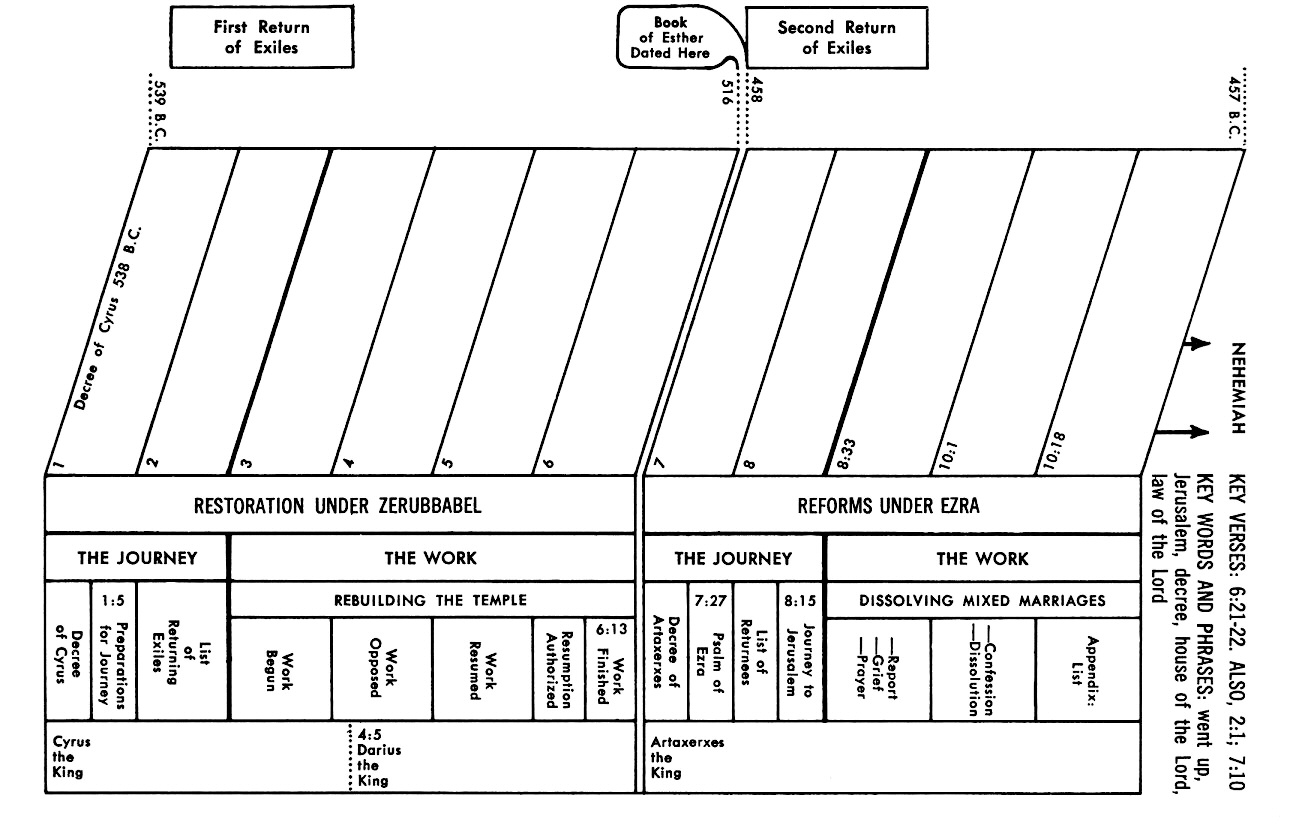
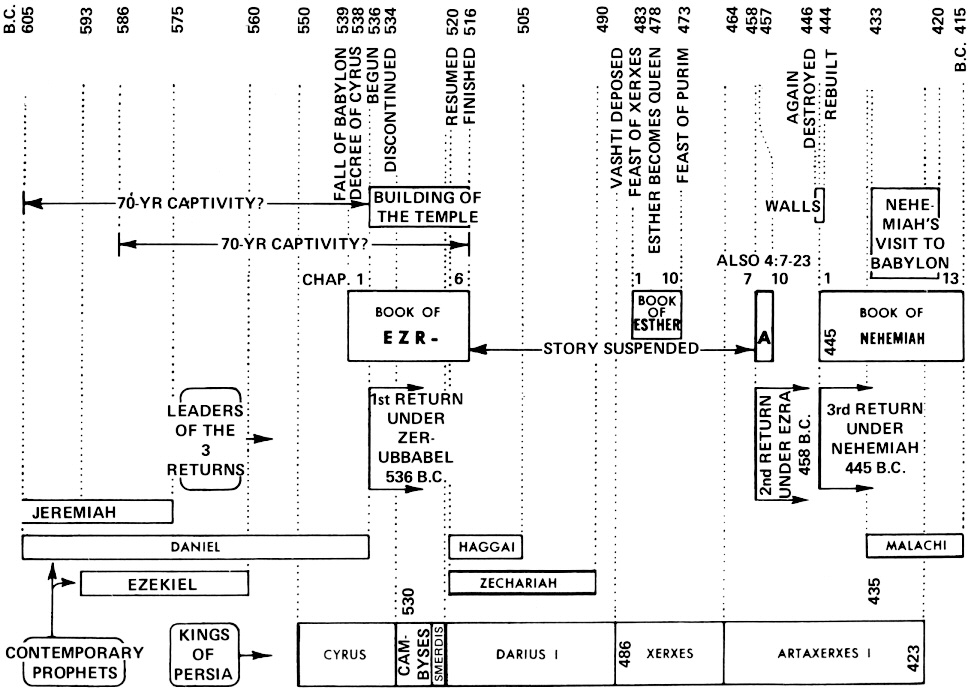
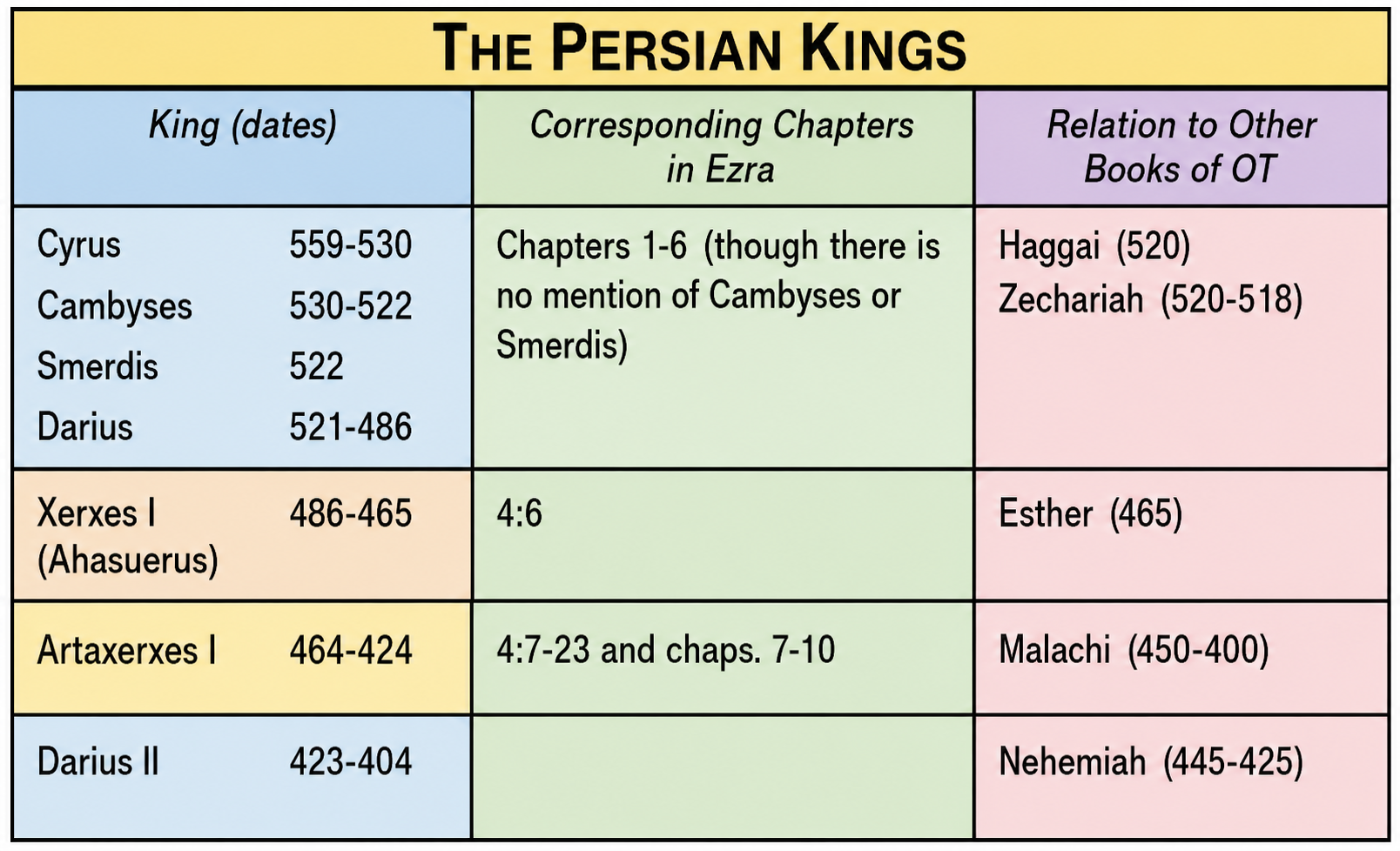
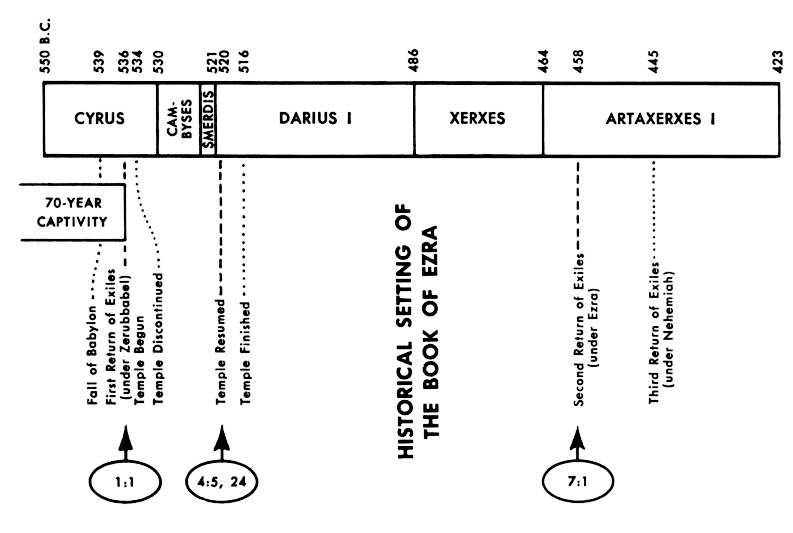
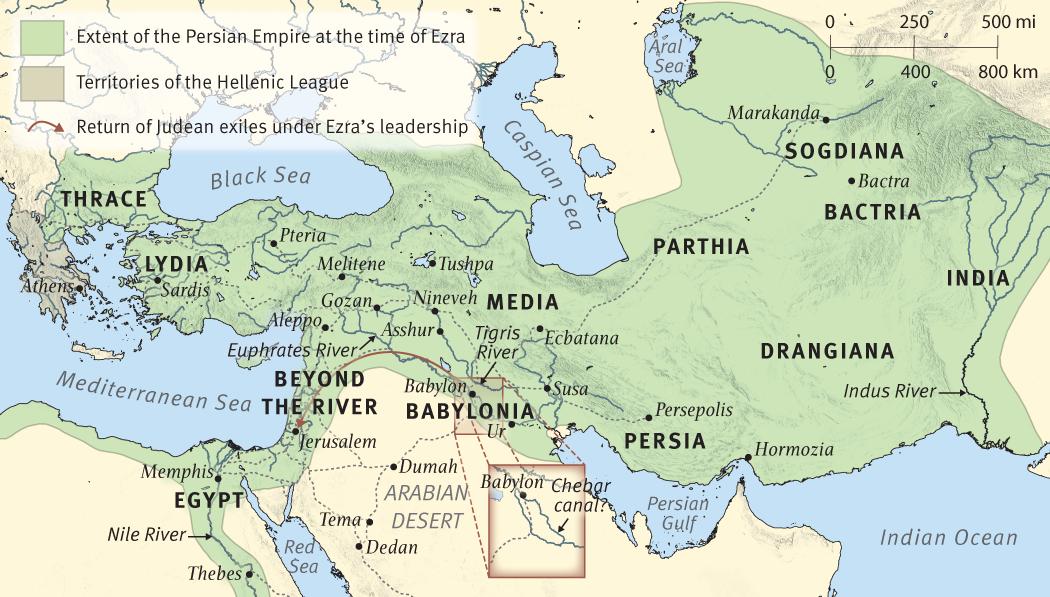
Source: ESV Maps
EZRA UNDER CONSTRUCTION
JUST A FEW NOTES NOW
WILL FINISH IF THE LORD WILLS
Ezra 5:1 When the prophets, Haggai the prophet and Zechariah the son of Iddo, prophesied to the Jews who were in Judah and Jerusalem in the name of the God of Israel, who was over them,
- Haggai (KJV): These are the same Haggai and Zechariah, whose writings we have among the twelve minor prophets; and, as a great part of them refer to the events here recorded, the reader will find it very profitable to compare them with the history. Hag 1:1-15
- Zechariah (KJV): Zec 1:1-21
- the son of Iddo (KJV): That is, "the grandson of Iddo;" for Zechariah was the son of Berechiah, the son of Iddo.
- in the name (KJV): Mic 5:4 Hag 1:2-8 Zec 1:3,4 Zec 4:6-10
When the prophets, Haggai the prophet and Zechariah the son of Iddo, prophesied to the Jews who were in Judah and Jerusalem in the name of the God of Israel, who was over them,
Walter Adeney - The two prophets who now proclaimed their message in Jerusalem appeared at a time of deep depression. They were not borne on the crest of a wave or a religious revival, as its spokesmen to give it utterance. (See The Expositor's Bible: Ezra, Nehemiah, and Esther)
David Guzik - In Haggai 1:2-10 we see that the prophet rebuked the people for their attitude towards the building of the temple. They said, “The time has not come, the time that the LORD’s house should be built” (Haggai 1:2). In saying this, the people made their excuse sound spiritual. They couldn’t speak against the idea of building the temple, so they spoke against its timing. “It isn’t God’s timing to rebuild the temple.”. Therefore, the prophet rebuked them with pointed words: “Is it time for you yourselves to dwell in your paneled houses, and this temple to lie in ruins?” (Haggai 1:4). The problem was simply wrongly ordered priorities. They were content to let the cause of the LORD suffer at the expense of their comfort. Instead, they should have felt no rest until the work of God was as prosperous as their personal lives, and been as willing to sacrifice for the work of God as they were for their personal comfort and luxury. Then God spoke to the people through the prophet: “Consider your ways! Go up to the mountains and bring wood and build the temple, that I may take pleasure in it and be glorified” (Haggai 1:7-8). God called them to work. Sometimes God’s cause needs work, work that is supported by prayer, not work that is neglected because of pretended “spiritual” service. The people had allowed a delay beyond their control to become a delay of their own choosing.
Bob Utley - "Haggai" See Haggai ▣ "Zechariah the son of Iddo" See Special Topic: Zechariah. ▣ "prophesied" This VERB (BDB 612, Hithpael PERFECT). implies the supernatural presence and power of the Spirit of God (cf. Num. 11:25-27; 1 Sam. 10; 19). See OT Prophecy ▣ "in the name of the God of Israel who was over them" The purpose of this phrase is to verify a renewed covenant relationship between the returning Israelites and the God of Israel.
Henry Morris - Then. "Then" seems to refer back to Ezra 4:5, since both verses 5 and 24 of Ezra 4 describe events terminating with the reign of Darius. Ezra 4:6-24 give a quick preview of the opposition to the temple project by the people of the land, from the time of Cyrus through the time of Darius and including the reigns of both Ahasuerus (Ezra 4:6) and Artaxerxes (Ezra 4:7). Ezra 4:24 repeats the statements of verse 5--"until the reign of Darius"--the narrative of chapter 5 then reverting back to the time of Zerubbabel (Ezra 4:3; Ezra 5:2). The reign of Cyrus ended about 530 B.C., with Darius' reign beginning about 521 B.C. Ahasuerus came to power about 485 B.C. and Artaxerxes about 465 B.C. Zechariah. Both Haggai and Zechariah prophesied during the time of Darius (Haggai 1:1; Zechariah 1:1) while Joshua and Zerubbabel were in Jerusalem (Ezra 5:2; Haggai 1:1).
Matthew Henry - The leaders forward the building of the temple Ezra 5:1-2. The building of the temple was stopped about fifteen years. Then they had two good ministers, who urged them to go on with the work. It is a sign that God has mercy in store for a people, when he raises up prophets to be helpers in the way and work of God, as guides, overseers, and rulers. In Haggai, we see what great things God does by his word, which he magnifies above all his name, and by his Spirit working with it.
Steven Cole - Overcoming Discouragement (Ezra 5:1-17)
Have you ever been discouraged? That’s like asking, “Are you human?” Rare, if not non-existent, is the person who has never been discouraged. Many well known, successful pastors have struggled with discouragement: Martin Luther, Charles Spurgeon, Alexander Whyte, John Henry Jowett, Andrew Bonar, and G. Campbell Morgan all admitted to times of serious discouragement (Warren, Wiersbe, BORROW Walking With the Giants [Baker], pp.263-269).
Why do we become discouraged? Sometimes discouragement stems from a physical cause. We are simply tired and worn out from working too long and too hard without a break. Or perhaps a bodily illness inclines us toward depression and discouragement.
Another cause of discouragement is that we can be too idealistic. This is a special hazard of pastors. Warren Wiersbe observes,
“The pastor, if he is dedicated at all, is a man of ideals; he wants to achieve for the glory of God. Yet, no matter how hard he prays and works, it seems that his goals forever elude him” (ibid., p. 265).
He goes on to tell how G. Campbell Morgan astounded his congregation at London’s Westminster Chapel on the tenth anniversary of his ministry there by telling them that he considered himself a failure! “Yet,” Wiersbe says,
“he had rescued his church from almost certain failure and had made it the focal point for evangelical Bible study in the entire English-speaking world!” (ibid.)
Coupled with idealism, discouragement often comes when people disappoint us. We were counting on someone who let us down. We had high hopes for a person who turned against us or failed spiritually and morally. Pastors especially are subject to disappointment when someone who made a good beginning in Christ turns back to the world. It’s not hard to hear the discouragement in Paul’s lonely voice from prison, “Demas, having loved this present world, has deserted me and gone to Thessalonica” (2 Tim. 4:10).
Pastors also are often the objects of criticism and slander. If you don’t keep your focus on the Lord, laboring for His “well done,” you can get discouraged. When Charles Spurgeon began his ministry in London at age 20, he was barraged with criticism in the press, much of it from other ministers who were jealous of his success (over 5,000 flocked to hear him each week). Several pastors wrote that they doubted his conversion. Others predicted that he would be like a rocket that would climb high and then drop out of sight. Another asked for proof that Spurgeon was the Lord’s servant and that his ministry was heart-searching, Christ-exalting, truth-unfolding, sinner-converting, church-feeding, and soul-saving (C. H. Spurgeon Autobiography [Banner of Truth], 1:305)! Reading that in light of history makes you laugh!
Disappointment with God is another cause of discouragement. You prayed and worked for something, but it did not happen. As far as you could tell, it would have been for God’s glory if it had come about, but it fell apart. You even had claimed a promise from the Bible as you prayed and worked, but from your perspective, God didn’t keep His promise. You begin to wonder whether you should ever try again to do anything for the Lord.
People try to deal with spiritual discouragement in many wrong ways. Many plunge themselves into other things that they think will bring them fulfillment: entertainment, sports, travel, or their careers. Tragically, some turn to drugs or alcohol or adultery. All these things only dig them deeper in discouragement. A few become so discouraged that they take their own lives.
In Ezra 4:4, we read, “Then the people of the land discouraged the people of Judah, and frightened them from building.” The work on rebuilding the temple in Jerusalem stopped for about 16 years. According to Haggai 1:4-9, the people’s focus shifted to building their own houses, and they neglected building God’s house. If the subject came up, they responded, “We tried that. It didn’t work!”
How could this dismal situation be reversed? How could the Lord’s people put their discouragement behind them so that they could finish the task of rebuilding the temple? To turn things around, the Lord raised up two prophets, Haggai and Zechariah, who spoke to the people in the name of the God of Israel (Ezra 5:1). Under the renewed leadership of Zerubbabel and Jeshua, the people began to rebuild and in spite of further opposition, the work was finished in a little over four years. So our chapter gives us some clues on how to overcome discouragement in our work for the Lord:
To overcome discouragement, we need a fresh encounter with God’s Word, we need to get back to work for Him and to persevere, trusting Him to accomplish His will through us.
1. To overcome discouragement, we need a fresh encounter with God’s Word.
Derek Kidner writes, “Like every spiritual advance, from Abraham’s to the missionary expansion in Acts, this venture began with a word from the Lord. And in common with the rest, it was quickly tested and threatened” (Ezra & Nehemiah, Tyndale Old Testament Commentaries [IVP], p. 53). The Old Testament prophets did not so much expound on God’s already-written word; rather, they received new revelation directly from God for His people. When these prophets spoke, the Jewish people realized that God was speaking through them.
We no longer have prophets to give direct revelation from God. But in this case, we have the heart of the prophets’ messages preserved for us in the Old Testament canon. When we are discouraged, the thing that will most refresh us is to hear God speaking to us in our particular circumstances through His Word. Although some will testify that the “open the Bible at random” method has worked, I would not recommend it. I recommend reading the Word consecutively or systematically. I have often found that the passage of that day has particular relevance to the very circumstances I am going through at the time.
There are a number of ways that you can have a fresh encounter with God’s Word, but in every case, you must have exposure to that Word. In other words, it won’t happen if you never open your Bible or sit under the preaching of the Word. When you are discouraged, you may not feel like getting into the Word, but you must go against your feelings, if need be, and expose yourself to the Word. You can listen to the Bible on tape or CD. I often find great help reading the sermons of men of God from the past, like Spurgeon, Jonathan Edwards, or John Bunyan. You may need to schedule a special time on a day off to take your Bible and get alone with God. But God speaks to us through His Word, and so you must take the time and effort to expose yourself to it.
When you do, God’s Word will do at least four things:
A. GOD’S WORD CONFRONTS OUR SIN.
That is the main thrust of Haggai. He directly confronted the people with their sin of building their own houses while neglecting God’s house. God used him to stir up Zerubbabel, Jeshua, and the people so that “they came and worked on the house of the Lord of hosts, their God” (Hag. 1:14).
You may be thinking, “When I’m discouraged, why would I want to be confronted with my sin? That doesn’t sound very encouraging!” It may not be pleasant at the moment, but it’s the medicine we all need. Sin destroys us and damages those who are close to us. To neglect the Bible because it confronts our sin is like avoiding the doctor when we know that we have cancer. It may not be pleasant to go through the treatment, but without it we will die. Scripture is profitable for reproof and correction (2 Tim. 3:16).
B. GOD’S WORD CONFIRMS HIS GRACE IF WE WILL REPENT.
While Haggai confronted the people’s sin, Zechariah gave them hope that God would remember them and keep His covenant promises to send the Messiah. Zechariah’s name means “whom the Lord remembers.” His father was Berechiah, which means “the Lord blesses.” His grandfather (mentioned in Ezra 5:1) was Iddo, which means “at the appointed time.” Those three names sum up the message of Zechariah: “Whom the Lord remembers, He blesses at the appointed time.”
Although Zechariah was the prophet of hope and encouragement, he began his message by talking about God’s fierce wrath because of His people’s sin (Zech. 1:2). But immediately he follows it with the Lord’s gracious invitation, “‘Return to Me,’ declares the Lord of hosts, ‘that I may return to you,’ says the Lord of hosts” (Zech. 1:3). If we will repent, God will be gracious to us.
This is illustrated in our text: Ezra 5:1 is a new, new beginning. The first new beginning was in chapter 3, when the returned exiles gathered in Jerusalem, set up the altar, celebrated the Feast of Booths, and laid the foundation of the temple. Then the opposition discouraged and frightened them, resulting in 16 years of doing nothing about the temple. But now, we have a second new beginning. Thank God that He allows for new, new beginnings, and new, new, new beginnings!
C. GOD’S WORD REORIENTS OUR PRIORITIES UNDER HIS LORDSHIP.
These two prophets spoke “in the name of the God of Israel, who was over them” (Ezra 5:1). “Them” is grammatically ambiguous. It could and certainly does refer to the prophets, who were under God’s lordship. But it also refers to the people who were God’s chosen nation. Haggai exhorted them to get their priorities in order by putting God’s house first. Wherever we turn in God’s Word, it confronts our skewed priorities. We’re all prone to let the things of this world crowd the things of God out of first place in our lives. The Word keeps calling us back to the basic priority: “Seek first His kingdom and His righteousness” (Matt. 6:33).
D. GOD’S WORD SHOWS US HOW TO LIVE IN A MANNER PLEASING TO HIM.
Without the word from these two prophets, most of the Jews back in the land probably thought that they were doing okay. They may have congratulated themselves for giving up their comfortable lives in Babylon and making the long and dangerous journey across the desert. Perhaps they thought, “Sure, we don’t have a temple yet, but these things take time. The Jews back in Babylon don’t have a temple, either. We’re better off than they are. At least we came back to the land!” But then the prophets spoke and the people realized that to please God, they needed to commit themselves to rebuild His temple.
It’s easy to think that you’re doing okay in the Lord if you compare yourself to other Christians. We always seem to compare ourselves to those who aren’t quite as committed as we see ourselves! But then you come to God’s Word, and it exposes the thoughts and intentions of your heart! You realize that God wants purity in your thought life. He calls you to love Him with all your heart, soul, mind, and strength. You learn that Christ loves the church and gave Himself for her. But you don’t love His church like that! So the Word shows how we need to adjust our thinking, our priorities, and our behavior to please God. To overcome discouragement, we need a fresh encounter with God’s Word.
2. To overcome discouragement, we need to get back to work for the Lord.
Discouragement had led the people to abandon work on the temple for 16 years. These prophets called them back to work. There is something encouraging about serving the Lord, especially if you’ve been on the sidelines for a while. There is the encouragement that He can even use me, in spite of my previous failures. Whether it’s physical labor or being used spiritually in someone’s life, there is joy in knowing that you are laboring for God’s eternal kingdom, and that someday you will hear Him say, “Well done, good and faithful servant.”
One cause of discouragement is that we become self-focused. Often that self-focus generates self-pity and self-justification for why we quit serving the Lord. With Elijah, we begin to say, “I have been very zealous for the Lord,” but everyone else has “forsaken Your covenant, torn down Your altars and killed Your prophets …. I alone am left; and they seek my life, to take it away” (1 Kings 19:10). That kind of self-focus prevents us from seeing the needs of others and ministering to those needs.
A woman who was very depressed once came to me for counsel. After listening for a long time to her problems, I asked, “What is your ministry?” She said, “What did you say?” She had heard me, but she was dumbfounded by the question. After I repeated it, she said that she did not have any ministry and that she had never even thought about the question. I told her that I would be depressed, too, if I just sat around thinking about my problems. Go over to the Sunshine Rescue Mission and offer to sweep floors or do dishes. It will do wonders for your discouragement. Get back to work for the Lord!
3. To overcome discouragement, we must persevere in the face of opposition.
As we saw last week, the enemy will not be idle when we make a new beginning with the Lord. No sooner had the people begun to build than Tattenai, the governor over Israel, and his sidekick and their colleagues came and challenged them (Ezra 5:3). In their defense, they were only doing their job. They reported to King Darius, who began his reign with a number of challenges to his rule. These men were making sure that the Jews were not plotting rebellion against the king. But even so, the enemy was using them to threaten the people to abandon the work again.
But in this case, they did not demand that the work stop until a word came from the king. Rather, they permitted the people to continue building until such a word came back, which would have taken four or five months. The reason given is, “The eye of their God was on the elders of the Jews” (Ezra 5:5). Joseph Parker observes, “The eye of the enemy and the eye of God are continually upon us in all the work of life” (Preaching Through the Bible [Baker reprint], 10:174). Knowing that the eye of God is upon us, we can persevere even when the enemy is watching and trying to get us to quit.
Tattenai sent a letter to Darius, which our text quotes. It reveals several interesting things. For one, it is surprisingly accurate. Unlike the letter of Ezra 4:11-16, which distorted the truth to make the Jews look worse than they were, this letter just states the facts, asking for verification. I don’t know whether the governor assumed that the Jews’ story was so far from the truth that the king would easily disprove it, or whether he was a man of integrity who was just doing his job. But he states the Jews’ claims accurately and asks the king to confirm or deny those claims.
Also, the letter shows that the Jews gave a strong testimony to Tattenai and his colleagues of God and His ways. They let them know that they were servants of the God of heaven and earth (Ezra 5:11). They give a brief history of Israel, that formerly they had worshiped at a temple which a great king of Israel [Solomon] had built. But because of their sin, God had given the nation into the hand of Nebuchadnezzar, who destroyed the temple and deported the people to Babylon. But King Cyrus had issued a decree to the Jews to return and rebuild the temple. He had even restored the gold and silver utensils and entrusted them to Sheshbazzar (who was either a co-leader with Zerubbabel or another name for Zerubbabel). Perhaps the Jews even showed these utensils to Tattenai as proof. But the point is, the Jews had given Tattenai and his colleagues a strong witness about God and His covenant faithfulness to His people.
There is an application for us in overcoming discouragement. One way to persevere in the face of opposition is to give a strong witness of our faith in Jesus Christ. That commits us so that we know others will be watching us. If we will be bold for the Lord, we can know that His eye is upon us in whatever response our enemies come back with.
Thus the first thing we need to overcome discouragement is a fresh encounter with God’s Word. If our discouragement has caused us to quit, we need to get back to work for Him. And, we need to persevere when opposition hits, as it will, knowing that His eye is upon us. Finally,
4. To overcome discouragement, we need to trust the sovereign God to accomplish His will through us.
Behind these events of the renewal of God’s people, God was sovereignly at work. Mervin Breneman writes, “Ezra-Nehemiah constantly reiterates God’s providence in the life of his people. The reestablishment of the covenant community was the result of a continuing series of God’s providential acts” (SEE Ezra, Nehemiah, Esther: An Exegetical and Theological Commentary). The fact that this governor allowed the work on the temple to continue while inquiry was sent to Darius was due to God’s eye on His people. Breneman continues, “In order to fulfill his purpose, God used and coordinated the preaching of the prophets, the work of the leaders, the determination of the whole community, and the decisions of ‘pagan’ government officials” (ibid., p. 109).
It’s also obvious that the Jews saw God’s sovereign dealings with them in history, and this knowledge enabled them to put the current opposition in proper perspective. As Joseph Parker observes, “They went back to the beginning with certainty, and traced the whole providential line most distinctly and vividly, thus always keeping memory and imagination abreast with the facts on which they relied as proofs of the divine election and rule” (p. 175).
Along the same lines, Breneman applies the Jews’ history to us by saying, “The Christian faith is tied to the fact that God made promises and fulfilled them in history, exemplified by Jesus, who actually came, died, and rose again. Although God is sovereign, decisions we make do affect history” (p. 111). As Paul exhorted, “Work out your salvation with fear and trembling; for it is God who is at work in you, both to will and to work for His good pleasure” (Phil. 2:12-13). We can know that as we work for the Lord, we are working in harmony with the sovereign God who is working out His purposes in history through His people.
Conclusion
As we’ll see next week, the temple was completed on March 12, 515 B.C., a little over 70 years after its destruction. There was great joy as the returned exiles gathered there to celebrate the Passover. We read the source of that joy (Ezra 6:22): “for the Lord had caused them to rejoice, and had turned the heart of the king of Assyria toward them to encourage them in the work of the house of God, the God of Israel.” When our discouragement is turned to encouragement, it is because of God. He gets all the glory.
To modernize a familiar legend, the devil had a garage sale. He marked all his tools with their appropriate price: hatred, envy, lust, deceit, lying, and pride. Laid apart from all of these was a rather harmless looking but well-worn tool marked much higher than the rest. A buyer pointed to it and asked, “What is that tool?” The devil replied, “That is discouragement.”
“Why is it priced so high?” the man asked.
“Because it is more useful to me than the others. I can pry open a man’s heart with that when I can’t get near to him with the other tools. Once inside, I can make him do whatever I choose. It’s badly worn because I use it on almost everyone. But few know that it belongs to me.”
The devil’s price was so high that the tool of discouragement was never sold. He still uses it on God’s people. By God’s grace, through His Word, we can overcome discouragement. “Therefore, my beloved brethren, be steadfast, immovable, always abounding in the work of the Lord, knowing that your toil is not in vain in the Lord” (1 Cor. 15:58).
Discussion Questions
- Discouragement is a feeling. Are feelings neutral, or can they be sinful? Give biblical support.
- If God’s Word seems stale to us, how can we break out of the doldrums and have it be fresh again?
- How can we know what we should be doing in our work for the Lord? How do we figure out what our spiritual gifts are?
- How can we know when to persevere in our labors for the Lord, or when it’s time to move on to something new?
Brian Bell - Nehemiah 5:1-17
- RESTORATION RESUMED (Ezra 5)
- Read Ezra 5:1-5 - It seems they really didn’t have any right to stop the work to begin with.
- With this prophetic message, Zerubbabel & Joshua commenced the work again.
- But typical, no sooner then when they get back to the work, opposition was raised again.
- This time they give no heed.
- Why? Because...the eye of their God was upon the elders of the Jews. Ezra 5:5
- The enemy had a short-lived triumph.
- About 15 years lapse from the end of ch.4 to 5:1.
- During that time God prepares 2 prophets to renew & strengthen the work.
- F.B.Meyer, If God has clearly set us to do a work for him, let us go through w/it in spite of all human opposition. (F.B.Meyer; pg.200)
- Storms are the methods by which he reveals our weakness & His all-sufficiency.
- God’s plan shall stand, though earth be in arms to resist it.
- (5:6-17) The letter Tattenai sent to Darius. I’ll Read Ezra 5:17
Dale Ralph Davis - God is the Ruler Yet (Ezra 6)
Strictly speaking, chapters 4-6 may belong together. There is a kind of idiom that occurs in 4:4 and in 6:22; in the former it is "making the hands of the people of Judah drop," and in the latter "to strengthen their hands." It is an idiom for discouragement/encouragement. It may have been placed deliberately near the beginning of this section and at the close of it in order to contrast in bookend style the state of the people of God. Here, however, we are treating chapters 5 and 6. The bulk of these two chapters consists of the inquiry of Tattenai (Ezra 5:3-17) and the favorable response of the Persian court (Ezra 6:1-13). (New Bible Commentary) Remember the situation from the end of chapter 4: the worked on the temple had ceased/stopped.
I. The Word that Stirs Us - Ezra 5:1-5
We meet here…
A. A demanding word
Note how Ezra 5:1 speaks of Haggai and Zechariah prophesying "in the name of the God of Israel, who was over them." As Kidner notes, this clause is a "gentle reminder of man's accountability and heaven's help" (p. 53). Ultimately, neither the king of Persia nor any other ruler is our master. Only the God of Israel is "over" us; we are under his sway and his word.
B. An energizing word
The prophets Haggai and Zechariah "prophesied" (Ezra 5:1) and then Zerubbabel and Jeshua "arose and began to rebuild" (Ezra 5:2) the temple. That is what the word of God does. It enables God's servants to do God's will. The word packs power that moves and sustains obedience. This is especially necessary in light of the fear and intimidation that the community had endured (Ezra 4:24). We see the same theology in 1 Thessalonians 2:13, where Paul alluded to "the word of God, which also is at work in/among you who believe." The word of God is not only a demanding force (see above), but also a driving one.
C. A tested word
No sooner do Judah's leaders obey God's word than they run into renewed opposition (Ezra 5:3-5). Tattenai and Shethar-bozenai are asking Judah for authorization for this project, but apparently theirs is not the blatant opposition related in chapter 4. One can understand their inquiry, I suppose. After all, no work had been taking place for something like fifteen years.
II. The Providence that Surrounds Us - Ezra 5:6[5:5]-6:15
A. Background items
Tattenai (Ezra 5:6):
In 1944 A. T. Olmstead cited a document dated to June 5, 502 B.C., which refers to Ta-at-tan-ni as the governor who was subordinate to the satrap over Ebir-nari. (Yamuchi - see The Expositor's Bible Commentary: 1 Chronicles-Job - Page 419)
The dimensions of the temple in Ezra 6:3
60 cubits high and broad, possibly indicating the limits of what the Persians would underwrite.
Time required to make an inquiry like that of Tattenai:
"Darius the Great introduced several changes in the way the empire was administered, and the highway system was one of his high priorities. The Persian Royal Road stretched some seventeen hundred miles from Susa through Arbela (near Nineveh) to Sardis… The road was carefully maintained, and rough stretches were paved. It was the Persians who invented horseshoes to facilitate mail moving over this Royal Road. Post stations were positioned on average every fifteen miles so Persian couriers could mount fresh horses. This communication network functioned so well that a letter written in Susa would reach Sardis in one week." (See page 393 Archaeology and the Old Testament : Hoerth, Alfred J)"
Hoerth indicates that a courier could average 240 miles a day, while a caravan would average 19 miles/day. If Darius' road system was fully operational early in his reign, the correspondence noted in chapters 5-6 could have been completed in a month or two at most.(See page 394 Archaeology and the Old Testament : Hoerth, Alfred J)"
B. Negative providence - Ezra 5:5
Note the use of the Aramaic verb betel ("stop" NASB; as in Ezra 4:21, 23, 24). By negative providence here I mean what God does not allow to happen (compare Pss 124 and 129). Judah may have been under investigation, and there was another potential frustration pending, but "they did not stop them." Judah was allowed to keep building in the meantime.
C. Disciplinary providence - Ezra 5:12
Note that in Ezra 5:11-16 Tattenai and Shethar-bozenai quote the response that the people of Judah gave them when they challenged them about their authority for rebuilding. In one sense these words are a response of praise. And yet they are also words of confession, as verse 12 makes clear. Judah admits that they are a people who have been under Yahweh's wrath, that he had taken temple and land from them.
Ezra 5:2 then Zerubbabel the son of Shealtiel and Jeshua the son of Jozadak arose and began to rebuild the house of God which is in Jerusalem; and the prophets of God were with them supporting them.
- rose up (KJV): Ezr 3:2 Hag 1:12-15
- Jeshua (KJV): Zec 6:11, Joshua, Josedech
- the prophets (KJV): Ezr 6:14 Hag 2:4-9,20-23 Zec 3:1-4:14 2Co 1:24
then Zerubbabel the son of Shealtiel and Jeshua the son of Jozadak arose and began to rebuild the house of God which is in Jerusalem; and the prophets of God were with them supporting them.
Bob Utley - "Zerubbabel" For a good discussion of the theories about the relationship of Sheshbazzar to Zerubbabbel see Encyclopedia of Bible Difficulties by Gleason L. Archer, pp. 216-219. ▣ "Jeshua" See notes at Ezra 2:2. ▣ "arose" This Aramaic VERB (BDB 1110; KB 1086, Peal PERFECT) is used in the sense of "arise out of inactivity."
Ryrie - Zerubbabel. Designated as the son of both Shealtiel and Shealtiel's brother Pedaiah (1 Chron. 3:17-19), suggesting a case of levirate marriage. See note on Deut. 25:5-10. An ancestor of Christ (Matt. 1:12-13), he was the last of the descendants of David to exercise political authority (until Christ returns to rule the world in the Millennium). Also see note on Hag. 2:23.
G Campbell Morgan - With them were the prophets of God, helping them. Ezra 5.2.
This page of Old Testament history is interesting in itself, and valuable in the light it sheds on the true relationship between prophetic ministry and national life. A study of the prophecies of Haggai and Zechariah make it perfectly clear that the cessation of the work of building was unworthy of the men who had commenced that work. Judged by human standards, they could fairly urge the difficulties of the situation, and the necessity for obedience to the edict of the reigning king. Judged by the Divine standard, which was the true gauge of national prosperity, there was no reason for cessation, and they had no right to cease. It was to this end—the discovery of the true standard—that the burning words of these prophets were addressed. This is ever the contribution which the prophets of God are called upon to make to national life. They introduce into human thinking the quantities which are all too easily forgotten: those of the Divine government, and of the fact that national strength consists in recognition of that government, and right relation thereto. Statecraft which forgets God is powerless to realize the highest conditions for any people. When all the other quantities are considered in the light of His will and wisdom, they assume their proper proportions. Under the inspiration of the prophetic teaching, Zerubbabel, Jeshua, and the people, commenced their work again, and carried it through to completion. Opposition did not cease, but under the influence of the prophets their consciousness of relation to God had been renewed, and they went forward in spite of the challenge of their foes. The moral of national life is ever lifted to the highest de pee of strength when there is a sense of right relationship with God.
Ezra 5:3 At that time Tattenai, the governor of the province beyond the River, and Shethar-bozenai and their colleagues came to them and spoke to them thus, “Who issued you a decree to rebuild this temple and to finish this structure?”
- Tatnai (KJV): Tatnai was governor of the provinces which belonged to the Persian empire west of the Euphrates, comprehending Syria, Arabia Deserta, Phoenicia, and Samaria. He seems to have been a mild and judicious man, and to have acted with great prudence and caution, and without any passion or prejudice. Ezr 5:6 Ezr 6:6,13 Ezr 7:21 Ne 2:7-9
- Who hath commanded you (KJV): Ezr 5:9 Ezr 1:3 Mt 21:23 Ac 4:7
At that time Tattenai, the governor of the province beyond the River, and Shethar-bozenai and their colleagues came to them and spoke to them thus, “Who issued you a decree to rebuild this temple and to finish this structure?”
Bob Utley -"Tattenai, the governor" This seems to be a technical name (BDB 1108, KB 1955) for the governor of the Persian province west of the Euphrates River (cf. TEV). It is uncertain if he was the satrap of this province (cf. Ezra 8:36) or a lesser official appointed by the king (cf. 2 Kgs. 18:24; Dan. 3:2; Neh. 2:7,9). The reason for the ambiguity of the term for governmental officials is that during Darius I's reign he reorganized the Persian Empire from 522 regions into 20 (Herodotus 3:89). This reorganization and simplification was based on race and geography. Both Zerubbabel (cf. Hag. 1:1,14; Hag 2:2,21) and Nehemiah (cf. Neh. 12:26) are also called by this term (i.e., "governor of Judah"). ▣ "'Who issued you a decree to rebuild this temple'" Either our text leaves out some of the dialogue (cf. TEV) or the Jews purposefully did not answer this question but instead gave the name of the builders (the LXX and Peshitta have "they said," rather than the MT's "we said'). This is surprising since the book of Ezra records the decree of Cyrus to rebuild the temple in Jerusalem twice, once in Hebrew (Ezra 1:1-4) and once in Aramaic (Ezra 6:1-5).
Verse 10 shows the purpose of the Persian leader's second question. It was for the purpose of intimidation and fear directed towards the Jewish leadership (i.e., "head," BDB 1112).
Believer's Study Bible - The title "governor" assigned to Tattenai and Zerubbabel does not indicate rank or office at this point but locality of jurisdiction. Tattenai was "governor of the region beyond the River," i.e., all the land west of the Euphrates. Zerubbabel, on the other hand, was governor of Judah only. Shethar-Boznai was undoubtedly a Persian noble, who together with Tattenai, questioned the authority of the people to restore the temple.
Ryrie - Tattenai. The Persian governor for the territory W of the Euphrates. Shethar-bozenai. Apparently his executive aide.
Matthew Henry - Letter against the Jews - Ezra 5:3-17. While employed in God's work, we are under his special protection; his eye is upon us for good. This should keep us to our duty, and encourage us therein, when difficulties are ever so discouraging. The elders of the Jews gave the Samaritans an account of their proceedings. Let us learn hence, with meekness and fear, to give a reason of the hope that is in us; let us rightly understand, and then readily declare, what we do in God's service, and why we do it. And while in this world, we always shall have to confess, that our sins have provoked the wrath of God. All our sufferings spring from thence, and all our comforts from his unmerited mercy. However the work may seem to be hindered, yet the Lord Jesus Christ is carrying it on, his people are growing unto a holy temple in the Lord, for a habitation of God through the Spirit.
Ezra 5:4 Then we told them accordingly what the names of the men were who were reconstructing this building.
- What are (KJV): Ezr 5:10
- make this building (KJV): Chal, build this building
Then we told them accordingly what the names of the men were who were reconstructing this building.
Ezra 5:5 But the eye of their God was on the elders of the Jews, and they did not stop them until a report could come to Darius, and then a written reply be returned concerning it.
- But the eye (KJV): Ezr 7:6,28 Ezr 8:22 2Ch 16:9 Ps 32:8 Ps 33:18 Ps 34:15 Ps 76:10 Php 1:28 1Pe 3:12
- that they (KJV): Ps 129:2-5
- then they returned (KJV): Ezr 6:6-12
But the eye of their God was on the elders of the Jews, and they did not stop them
G Campbell Morgan - We are not to suppose for a moment that this was something new. That eye had always been upon them, but through the teaching of the prophets, and their rousing call, their consciousness of relationship to God had again been renewed.
Derek Kidner - “The eye of their God upon them was better than fortune, and the integrity of the leaders evidently showed through well enough to make any immediate action other than a report seem called for.” (Ezra and Nehemiah)
Until a report could come to Darius, and then a written reply be returned concerning it.
G Campbell Morgan - That he should accede to such a request rather than exercise his immediate authority one way or the other, was in itself somewhat remarkable.
Bob Utley -"the eye of their God was on the elders of the Jews" This is an anthropomorphic idiom for God's attentive presence and care (cf. Ps. 32:8; Ps 33:18; Ps 34:15; Job 36:7; 1 Pet. 3:12). A similar idiom is used in Ezra 7:6,28 (i.e., "the hand of the Lord"). God does not have a human body, but mankind's only vocabulary is related to the physical aspects of creation. ▣ "elders" The Septuagint has "captivity," which reflects a different way to interpret the Hebrew consonantal text. Elders were central in the leadership structure of Moses' day (e.g., Exod. 18:13-27) as well as the pre-monarchial period. During the Monarchy their leadership was on a tribal and local level, not national. The post-exilic period restored their place of central leadership. See Elder
F B Meyer - Ezra 5:5 The eye of their God was upon the elders of the Jews.
It was a delightful thought amid obloquy and opposition, like that which the Jews were at this moment encountering, to know that God was watching them with jealous care. We are reminded of the words of the Psalmist, quoted and authenticated by the Apostle Peter, “The eyes of the Lord are upon the righteous, and His ears open to their cry; but the face of the Lord is against them that do evil.” And he goes on to argue, “Who is he that will harm you, if ye be followers of that which is good?” The Jews certainly found it so; for the efforts of their enemies to induce them to desist from their work of temple-building were rendered nugatory and ineffectual by the special care exercised over them by their Almighty Friend.
It may be that you will have to encounter hatred and opposition in doing God’s work; but be sure not to look at these things, but steadfastly to Jesus. Must you not watch the foe? No; you could not make a greater mistake. You must look away to the face of Jesus, and you will find that He, like a good shepherd, is looking carefully and lovingly down on you, and watching the stealthy movements of your foe. Even when we are not directly conscious of that watchful eye, it still follows us. He knoweth the way that you take; and He is acquainted with the varied circumstances of your life. He has pledged Himself to be with you forever; as Wordsworth once said of his beloved daughter Dora:—
“Dear child, fair child, that walkest with me here, Though thou appear untouched by solemn thought, Thy nature is not therefore less divine; Thou liest in Abraham’s bosom all the year, Thou worshippest at the temple’s inner shrine, God being with thee when thou knowest not.”
The eye of their God was watching over [them] . . . and they were not stopped. Ezra 5:5
When an opportunity came to take on a new role at work, Simon believed it was a godsend. After praying over the decision and seeking counsel, he felt that God was giving him this opportunity to take on bigger responsibilities. Everything fell into place, and his boss supported his move. Then things began to go wrong. Some colleagues resented his promotion and refused to cooperate. He began to wonder if he should give up.
When the Israelites returned to Jerusalem to build the house of God, enemies sought to frighten and discourage them (Ezra 4:4). The Israelites stopped at first, but continued after God encouraged them through the prophets Haggai and Zechariah (4:24–5:2).
Once again, enemies came to hassle them. But this time they persevered, knowing “the eye of their God was watching over [them]” (5:5). They held on firmly to God’s instructions and trusted Him to carry them through whatever opposition they’d face. Sure enough, God moved the Persian king to support the temple’s completion (vv. 13–14).
Similarly, Simon sought God’s wisdom to discern whether he should stay or find a new position. Sensing God calling him to remain, he relied on God’s strength to persevere. Over time, he slowly gained his colleagues’ acceptance.
As we seek to follow God, wherever He places us, we may face opposition along the way. That’s when we need to keep following Him. He will guide us and carry us through. -- Leslie Koh (Reprinted by permission from Our Daily Bread Ministries. Please do not repost the full devotional without their permission.)
Reflect & Pray
Remain strong, for God’s eye is on you.
Today's Insights
It was a Persian king by the name of Cyrus who ordered the release and return of Israel from Babylonian exile (Ezra 1:1–7). Israel had been waiting for a national deliverer who would be a descendant of King David. Yet according to Isaiah, God had called Cyrus to be his servant and shepherd (Isaiah 44:21–45:6). Is it possible that long before Jesus, God was giving us reason to never give up on His ability to come to our rescue in the most unexpected ways?
Ezra 5:6 This is the copy of the letter which Tattenai, the governor of the province beyond the River, and Shethar-bozenai and his colleagues the officials, who were beyond the River, sent to Darius the king.
- copy (KJV): Ezr 4:11,23
- Apharsachites (KJV): Ezr 4:9, Apharsathchites, Ezr 6:6
This is the copy of the letter which Tattenai, the governor of the province beyond the River, and Shethar-bozenai and his colleagues the officials, who were beyond the River, sent to Darius the king
Derek Kidner - There is a mention of Tattenai’s name (probably) and office (certainly) in a Babylonian record dated 502 B.C. which speaks of ‘Ta-at[-tan-ni] governor of Ebernari’ (i.e., of Beyond the River).”....“Like every spiritual advance, from Abraham’s to the missionary expansion in Acts, this venture began with a word from the Lord. And, in common with the rest, it was quickly tested and threatened. (Ezra and Nehemiah)
Bob Utley - Shethar-bozenai" This word (BDB 1117, KB 2003) can be a proper name (most English translations) or a title ("empire-delivering," cf. The Jewish Study Bible, p. 1677). It always appears in conjunction with Tattenai, the governor (cf. Ezra 5:3,6; Ezra 6:6,13).
Believer's Study Bible - The "Persians" mentioned here were probably inspectors assigned to Tattenai and Shethar-Boznai (cf. 5:3; also 4:23).
Ryrie - the officials. Lit., Apharsachites. Possibly settlers or officials who were especially devoted to the king (cf. 4:9).
Ezra 5:7 They sent a report to him in which it was written thus: “To Darius the king, all peace.
- wherein (KJV): Chal, in the midst whereof
- all peace (KJV): Ezr 4:17 Da 3:9 Da 4:1 Da 6:21 Joh 14:27 2Th 3:16
They sent a report to him in which it was written thus: “To Darius the king, all peace.
Bob Utley -"all peace" This must be a Persian idiom (cf. Dan. 4:1). The word "peace" (BDB 1116) means "prosperity" or "welfare" (cf. Dan. 6:26).
Ezra 5:7-17 Keep Calm And Carry On
Read: Ezra 5:7-17 | Bible in a Year: Ezra 3-5; John 20
We are the servants of the God of heaven and earth. —Ezra 5:11
“Keep calm and call mom.” “Keep calm and eat bacon.” “Keep calm and put the kettle on.” These sayings originate from the phrase: “Keep Calm and Carry On.” This message first appeared in Great Britain as World War II began in 1939. British officials printed it on posters designed to offset panic and discouragement during the war.
Having returned to the land of Israel after a time of captivity, the Israelites had to overcome their own fear and enemy interference as they began to rebuild the temple (Ezra 3:3). Once they finished the foundation, their opponents “hired counselors against them to frustrate their purpose” (Ezra 4:5). Israel’s enemies also wrote accusing letters to government officials and successfully delayed the project (Ezra 4:6,24). Despite this, King Darius eventually issued a decree that allowed them to complete the temple (Ezra 6:12-14).
When we are engaged in God’s work and we encounter setbacks, we can calmly carry on because, like the Israelites, “We are the servants of the God of heaven and earth” (Ezra 5:11). Obstacles and delays may discourage us, but we can rest in Jesus’ promise: “I will build my church, and all the powers of hell will not conquer it” (Mt. 16:18NLT). It is God’s power that enables His work, not our own. (Reprinted by permission from Our Daily Bread Ministries. Please do not repost the full devotional without their permission.)
Thou art our life, by which alone we live,
And all our substance and our strength receive.
Sustain us by Thy faith and by Thy power,
And give us strength in every trying hour.
—Psalter
God’s Spirit gives the power to our witness.
Ezra 5:8 “Let it be known to the king that we have gone to the province of Judah, to the house of the great God, which is being built with huge stones, and beams are being laid in the walls; and this work is going on with great care and is succeeding in their hands.
- the province (KJV): Ezr 2:1 Ne 7:6 Ne 11:3 Es 1:1,22
- the great God (KJV): Ezr 1:2,3 Ezr 6:10 Ezr 7:23 De 10:17 De 32:31 Ps 145:3 Da 2:47 Da 3:26 Da 4:2,34-37 Da 6:26
- great stones (KJV): Chal, stones of rolling, Mk 13:1,2
Let it be known to the king that we have gone to the province of Judah, to the house of the great God, which is being built with huge stones, and beams are being laid in the walls; and this work is going on with great care and is succeeding in their hands
Derek Kidner - “Courses of timber at intervals, between those of stone or brick, were quite a common constructional feature over a long period in the ancient Near East, and may have originated as a means of strengthening buildings against earthquakes.” (Ezra and Nehemiah or read on Perlego for $15/month)
Bob Utley - "the house of the great God" Even though the purpose of this report is negative, these Persian leaders know that the administration is tolerant to national gods. Therefore, they use the ADJECTIVE "great" in connection to YHWH. This is political correctness, not devotion or faith! ▣ "and beams" This was a common construction technique of the ancient Near East, which was also used in constructing Solomon's temple (e.g., 1 Kgs. 6:36). Some speculate that it was a way to guard against earthquake damage (cf. Derek Kidner, Tyndale Commentary Series, p. 55)
Ryrie - huge stones. Lit., stones of rolling; i.e., stones so large they had to be moved on rollers.
Ezra 5:9 “Then we asked those elders and said to them thus, ‘Who issued you a decree to rebuild this temple and to finish this structure?’
- Who commanded (KJV): Ezr 5:3,4
Then we asked those elders and said to them thus, ‘Who issued you a decree to rebuild this temple and to finish this structure?’
Ezra 5:10 “We also asked them their names so as to inform you, and that we might write down the names of the men who were at their head.
- asked (KJV): Ezr 5:4
We also asked them their names so as to inform you, and that we might write down the names of the men who were at their head
Ezra 5:11 “Thus they answered us, saying, ‘We are the servants of the God of heaven and earth and are rebuilding the temple that was built many years ago, which a great king of Israel built and finished.
- We are (KJV): Jos 24:15 Ps 119:46 Da 3:26 Jon 1:9 Mt 10:32 Lu 12:8 Ac 27:23 Ro 1:16 Ro 6:16 Ga 6:14
- which a great (KJV): 1Ki 6:1-7:51 2Ch 3:1-5:14
Thus they answered us, saying, ‘We are the servants of the God of heaven and earth and are rebuilding the temple that was built many years ago, which a great king of Israel built and finished
Bob Utley - "the God of heaven and earth" This is a Persian title for deity (as is "God of heaven"). The Jews borrowed the titles used by the Persian Zoroastrians for their high god (Ahura Mazda) and applied them to YHWH. ▣ "a great king of Israel" This refers to Solomon (cf. 1 Kgs. 6).
Ryrie - 5:11-15 Quoting the Jews' answer to Tattenai, the letter relates the history of the Temple from the time of its completion under Solomon (v. 11), through its destruction in 586 (v. 12), and to the decree to rebuild it in 538 B.C. (vv. 13-15).
We are the servants of the God of heaven and earth. —Ezra 5:11
“Keep calm and call mom.” “Keep calm and eat bacon.” “Keep calm and put the kettle on.” These sayings originate from the phrase: “Keep Calm and Carry On.” This message first appeared in Great Britain as World War II began in 1939. British officials printed it on posters designed to offset panic and discouragement during the war.
Having returned to the land of Israel after a time of captivity, the Israelites had to overcome their own fear and enemy interference as they began to rebuild the temple (Ezra 3:3). Once they finished the foundation, their opponents “hired counselors against them to frustrate their purpose” (4:5). Israel’s enemies also wrote accusing letters to government officials and successfully delayed the project (vv.6,24). Despite this, King Darius eventually issued a decree that allowed them to complete the temple (6:12-14).
When we are engaged in God’s work and we encounter setbacks, we can calmly carry on because, like the Israelites, “We are the servants of the God of heaven and earth” (5:11). Obstacles and delays may discourage us, but we can rest in Jesus’ promise: “I will build my church, and all the powers of hell will not conquer it” (Matt. 16:18 nlt). It is God’s power that enables His work, not our own.-- Jennifer Benson Schuldt (Reprinted by permission from Our Daily Bread Ministries. Please do not repost the full devotional without their permission.)
Reflect & Pray
Thou art our life, by which alone we live,
And all our substance and our strength receive.
Sustain us by Thy faith and by Thy power,
And give us strength in every trying hour.
—Psalter
God’s Spirit gives the power to our witness.
Ezra 5:12 ‘But because our fathers had provoked the God of heaven to wrath, He gave them into the hand of Nebuchadnezzar king of Babylon, the Chaldean, who destroyed this temple and deported the people to Babylon.
- But after (KJV): 2Ki 21:12-15 2Ch 34:24,25 2Ch 36:16,17 Ne 9:26,27 Isa 59:1,2 Jer 5:29 Da 9:5
- he gave (KJV): De 28:15-68 De 29:24-28 De 31:17 De 32:30 Jud 2:14 Jud 4:2 Jud 6:1 1Ki 9:6-9 2Ch 7:19-22 Ps 106:40
- into the hand (KJV): 2Ki 24:2,10-17 2Ki 25:1,8-11,12-30 2Ch 36:6-10 Jer 39:1-14 Da 1:1,2
But because our fathers had provoked the God of heaven to wrath, He gave them into the hand of Nebuchadnezzar king of Babylon, the Chaldean, who destroyed this temple and deported the people to Babylon
Bob Utley - This is the theological understanding of why YHWH allowed Israel and Judah to be defeated and exiled. In the ancient world nations warred on behalf of their god, under his/her protection and power, therefore, a military defeat reflected on the potency of the deities involved. However, in the case of the Israelites, it was their sin and rebellion which allowed their defeat!
Ezra 5:13 ‘However, in the first year of Cyrus king of Babylon, King Cyrus issued a decree to rebuild this house of God.
- Ezr 1:1-8 Ezr 6:3-5 Isa 44:28 Isa 45:1
However, in the first year of Cyrus king of Babylon, King Cyrus issued a decree to rebuild this house of God.
Bob Utley - 5:13-16 This is a review of Ezra 1. ▣ "King Cyrus issued a decree" Cyrus changed the policy of both the Assyrians and Babylonians by allowing all the exiled peoples to return to their homeland and rebuild their national temples. This was both for political and religious reasons. He assumed that the people groups of the ancient Near East would be grateful and pray for him and his successors.
Ezra 5:14 Also the gold and silver utensils of the house of God which Nebuchadnezzar had taken from the temple in Jerusalem, and brought them to the temple of Babylon, these King Cyrus took from the temple of Babylon and they were given to one whose name was Sheshbazzar, whom he had appointed governor.
- the vessels (KJV): Ezr 1:7-10 Ezr 6:5 2Ch 36:7,18 Jer 52:19 Da 5:2,3
- the king (KJV): Ezr 7:27 Pr 21:1
- Sheshbazzar (KJV): Ezr 5:16 Ezr 1:11
- whom (KJV): Hag 1:1,14 Hag 2:2,21
- governor (KJV): or, deputy, Ac 13:7,8,12
Also the gold and silver utensils of the house of God which Nebuchadnezzar had taken from the temple in Jerusalem, and brought them to the temple of Babylon, these King Cyrus took from the temple of Babylon and they were given to one whose name was Sheshbazzar, whom he had appointed governor.
Edwin Yamauchi - Sheshbazzar may have been viewed as the official Persian ‘governor’ whereas Zerubbabel served as the popular leader. This may be why the Jews mentioned Sheshbazzar here when speaking to the Persian authorities. (See The Expositor's Bible Commentary: 1 Chronicles-Job - Page 423 or The Expositor's Bible Commentary - Abridged Edition - Page 50; Ezra, Nehemiah, Esther - Page 175)
Bob Utley - "the temple of Babylon" Originally each city of Babylon had their own deity. As Babylon (the city) became the capital, its deity (Marduk), became the national deity. ▣ "Sheshbazzar" This refers to the Judean leader of the first return in chapter 1, while Zerubbabel is not mentioned until chapter 2. Both are of the royal line of Judah.
Ezra 5:15 ‘He said to him, “Take these utensils, go and deposit them in the temple in Jerusalem and let the house of God be rebuilt in its place.”
- let the house (KJV): Ezr 1:2 Ezr 3:3 Ezr 6:3
He said to him, “Take these utensils, go and deposit them in the temple in Jerusalem and let the house of God be rebuilt in its place.”
Bob Utley - This verse has a series of commands. (1) "take" (BDB 1103), Peal IMPERATIVE (2) "go" (BDB 1079), Peal IMPERATIVE (3) "deposit" (BDB 1102), Aphel IMPERATIVE (4) "let the house of God be rebuilt" (BDB 1084), Hithpael IMPERFECT used in JUSSIVE sense ▣ "in its place" The site of the temple was crucial in establishing continuity between the Patriarchs and the new covenant community (cf. Gen. 22:2,4,14; 2 Sam. 24:15-25; 2 Chr. 3:1; 2 Chr 7:1ff).
Ezra 5:16 Then that Sheshbazzar came and laid the foundations of the house of God in Jerusalem; and from then until now it has been under construction and it is not yet completed.’
- Sheshbazzar (KJV): Ezr 5:14
- laid (KJV): Ezr 5:2 Ezr 3:8,10 Hag 1:12-14 Hag 2:18 Zec 4:10, A.M. 3468-3485, B.C. 536-519
- it is not finished (KJV): Ezr 6:15
Then that Sheshbazzar came and laid the foundations of the house of God in Jerusalem; and from then until now it has been under construction and it is not yet completed
Believer's Study Bible - vv16,17) The prophet Haggai used a common saying, "from before stone was laid upon stone in the temple of the Lord-" (Hag. 2:15), which some construe to be in conflict with Ezra's statement that the rebuilding had been in progress since the time of Sheshbazzar. But Haggai did not maintain or imply that there had not been any previous work on the temple. Rather he said that while the people lived in comfortable, i.e., "paneled," houses, God's house was still lying "in ruins" (Hag. 1:4).
Bob Utley - "Sheshbazzar came and laid the foundations of the house of God in Jerusalem" It seems that this early leader cleared off the rubble and found the original foundations, but the temple itself was not rebuilt until the second return under Zerubbabel and Jeshua (cf. Haggai and Zechariah). ▣ "and from then until now it has been under construction and it is not yet completed" This may be a comment by Tattenai or a summary statement provided by the Jews themselves. The temple was started soon after 538 B.C. (Cyrus' decree) by Sheshbazzar (cf. Ezra 5:16), but lapsed the project into inactivity until the time of Zerubabbel and Haggai/Zechariah about 519-520 B.C. (cf. Ezra 4:24-6:22). See Roland deVaux, Ancient Israel, vol. 2, pp. 323-324).
Ezra 5:17 “Now if it pleases the king, let a search be conducted in the king’s treasure house, which is there in Babylon, if it be that a decree was issued by King Cyrus to rebuild this house of God at Jerusalem; and let the king send to us his decision concerning this matter.”
- let there be (KJV): Ezr 4:15,19 Ezr 6:1,2 Pr 25:2
- a decree (KJV): Ezr 6:3-5
Now if it pleases the king, let a search be conducted in the king’s treasure house, which is there in Babylon, if it be that a decree was issued by King Cyrus to rebuild this house of God at Jerusalem; and let the king send to us his decision concerning this matter.”
G Campbell Morgan - “Tattenai, who was now opposing them as they resumed the work, either did not believe that such a decree had ever been promulgated, or considered that it could not be found.”
Bob Utley - "let a search be conducted" The VERB (BDB 1085) is a Hithpael IMPERFECT used in a JUSSIVE sense.
Ezra 5
Let a search be made in the royal archives … to see if King Cyrus did in fact issue a decree to rebuild this house of God. - Ezra 5:17
TODAY IN THE WORD
On March 6 we shared the story of Christ Liberty Family Life Center in Avondale Estates, Georgia, a church forced from its building because of zoning ordinances. Here’s more of the story. In response to the city’s action, the church filed suit in federal court alleging that the zoning ordinance, which applied only to religious groups, infringed on religious freedom. In August 2010, a federal judge ruled that the city must permit the church to have access to their facilities while the case is heard.
The Samarian people thought that they could use political and legal action to halt the building of the temple and the resurgence of Jewish faith and presence. As we’ll see today and tomorrow, God can work through government to protect His people and preserve His work.
The chapter begins by recognizing the prophetic work of Zechariah and Haggai, which we examined in more detail yesterday. No sooner had rebuilding begun, however, when government officials appeared, demanding to know who had authorized this construction project (v. 3). They send a report to the Persian king Darius about the matter.
Several things were different on this occasion than fourteen years earlier. First, the Jewish leaders seemed to understand that they had God’s protection, and they did not respond out of fear (v. 5). They tell the government officials the truth about Cyrus’s decree and their authorization to rebuild (vv. 11-16). Second, the rebuilding work does not cease while they wait to hear back from Darius. In fact, the description given by Tattenai and the other officials indicated that Zerubbabel and the people had taken the message of Haggai to heart. Not only did they continue to work with diligence, but they were also “making rapid progress” (v. 8).
The report from the hostile Samarians referenced the rebellious nature of Jerusalem before its destruction by Nebuchadnezzar in 586 B.C., which the royal archives confirmed. But this report referenced the more recent decree by Cyrus in 538 B.C, which according to Persian law must be honored.
APPLY THE WORD
We’ve seen how God can work through political leaders and how the government and legal system can affect the people of God. Take time to pray specifically and by name for each of your elected officials. Pray that they will be instruments of God’s will in their city, state, and nation. Pray that their hearts will be open to the direction of God, even if—like Cyrus—they aren’t believers. Pray, too, that you will demonstrate a Christian attitude and response toward leaders.
Ezra 5:1-17
No weapon forged against you will prevail, and you will refute every tongue that accuses you. - Isaiah 54:17
TODAY IN THE WORD
When Dr. C. Everett Koop was appointed U.S. surgeon general by President Ronald Reagan, the public health department was in disarray, with employees suffering from discouragement and low morale. Dr. Koop set about putting things in order, and to boost morale he began wearing the uniform of his office, which was his right because the surgeon general is in a rank equivalent to a vice-admiral in the U.S. Navy. Dr. Koop’s capable leadership and deep Christian commitment soon made a tremendous difference in the public health service.
The Jews who had returned to Jerusalem to rebuild the temple and re-establish Israel’s obedience to the Mosaic covenant also became demoralized and needed someone to get them back on track. External opposition and internal complacency had combined to stop work on the temple from about 535 to 520 B.C. It’s amazing to think of this crucial project sitting idle for that long, which indicates how much the people’s commitment had lagged.
Finally, God sent the prophets Haggai and Zechariah to challenge His people to turn from complacency and self-absorption and to get back to work on the temple (vv. 1–2, cf. Hag. 1:1–8).
Ezra did not mention the people’s spiritual problems because his emphasis was on the external opposition they faced. This opposition certainly did make tough times even more difficult, because the exiles had to watch out for the people around them while trying to rebuild their ruined temple and nation.
TODAY ALONG THE WAY
If we are to follow God faithfully in tough times, we have to be honest and transparent before Him. The exiles of Judah were candid in telling Tattenai that Israel’s destruction came about because their forefathers “angered” God (v. 12) by their disobedience. The Holy Spirit is faithful to convict us when we are off track spiritually. Ask God to search your heart and point out any area of sin or disobedience to be confessed and cleansed, which God has promised to do (1 John 1:9).
If it pleases the king, let a search be made in the royal archives of Babylon to see if King Cyrus . . . issue[d] a decree. Ezra 5:17
The citizens of Israel were having some trouble with the government. It was the late 500s bc, and the Jewish people were eager to complete their temple that had been destroyed in 586 bc by Babylon. However, the governor of their region was not sure they should be doing that, so he sent a note to King Darius (Ezra 5:6-17).
In the letter, the governor says he found the Jews working on the temple and asks the king if they had permission to do so. The letter also records the Jews’ respectful response that they had indeed been given permission by an earlier king (Cyrus) to rebuild. When the king checked out their story, he found it to be true: King Cyrus had said they could build the temple. So Darius not only gave them permission to rebuild, but he also paid for it! (see 6:1-12). After the Jews finished building the temple, they “celebrated with joy” because they knew God had “[changed] the attitude of the king” (6:22).
When we see a situation that needs to be addressed, we honor God when we plead our case in a respectful way, trust that He is in control of every situation, and express gratitude for the outcome. -- Dave Branon (Reprinted by permission from Our Daily Bread Ministries. Please do not repost the full devotional without their permission.)
Reflect & Pray
Lord, help us to respond respectfully to situations around us. We need Your wisdom for this. May we always honor, trust, and praise You.
Respect for authority brings glory to God.