Ezra 6:2
Ezra 6:3
Ezra 6:4
Ezra 6:5
Ezra 6:6
Ezra 6:7
Ezra 6:8
Ezra 6:9
Ezra 6:10
Ezra 6:11
Ezra 6:12
Ezra 6:13
Ezra 6:14
Ezra 6:15
Ezra 6:16
Ezra 6:17
Ezra 6:18
Ezra 6:19
Ezra 6:20
Ezra 6:21
Ezra 6:22
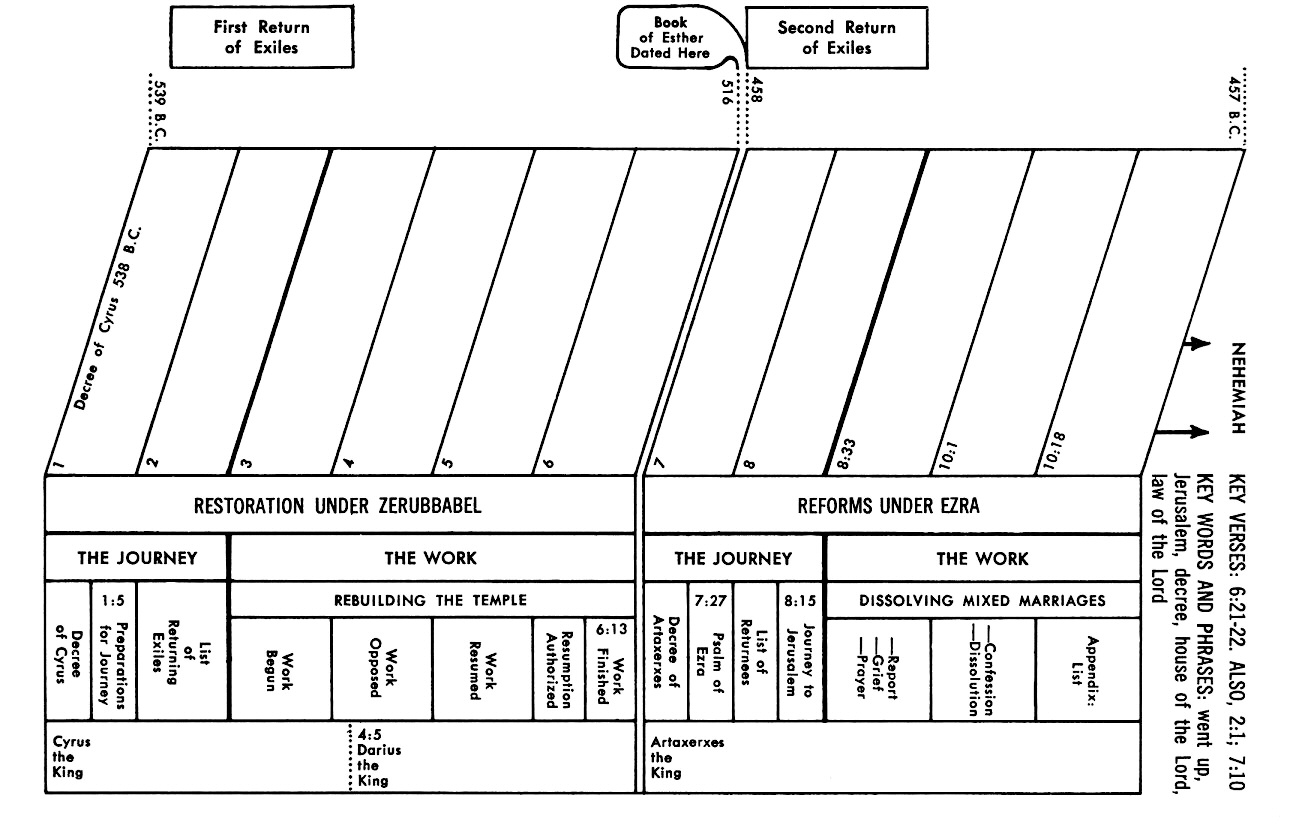
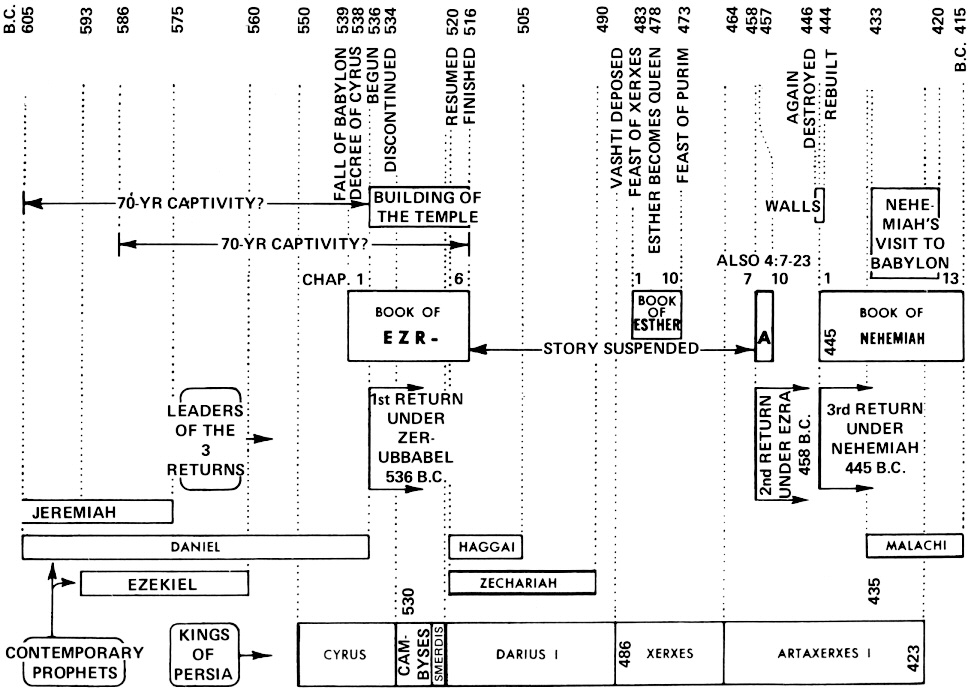
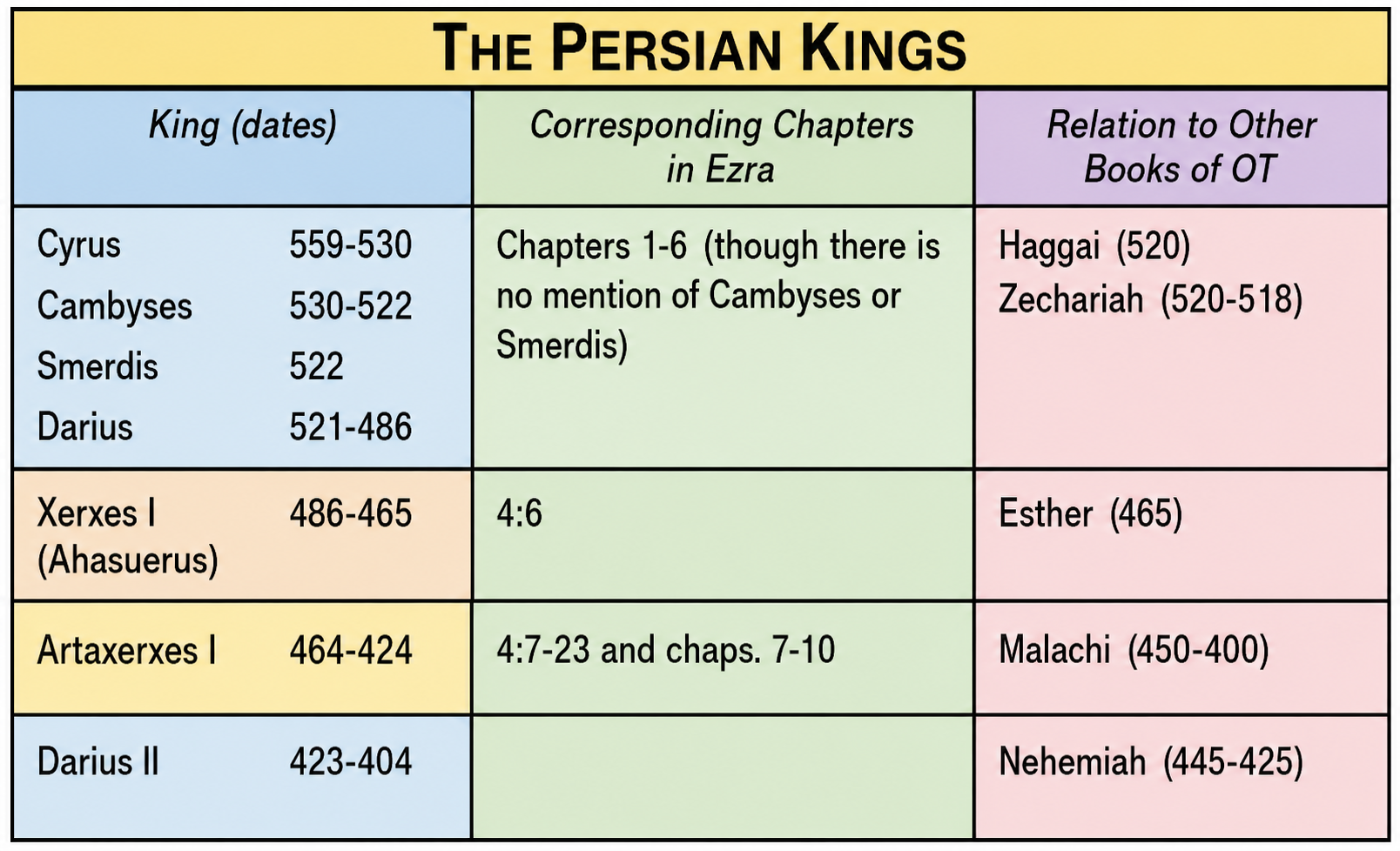
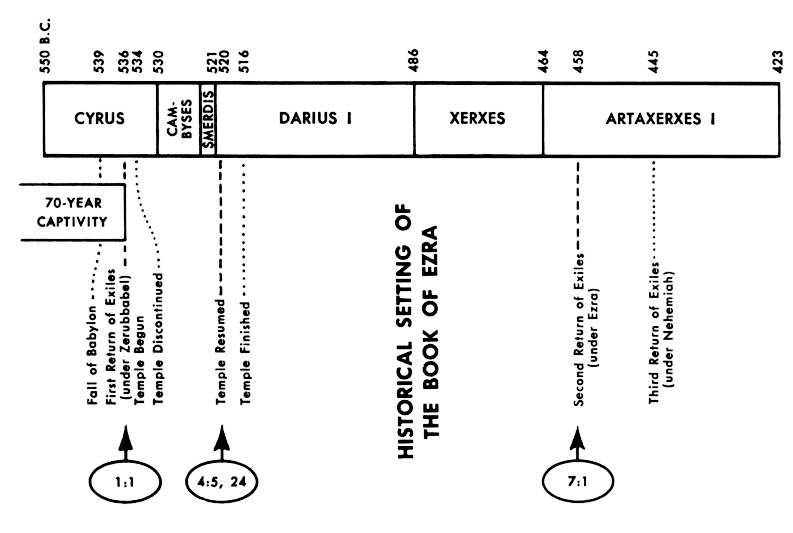
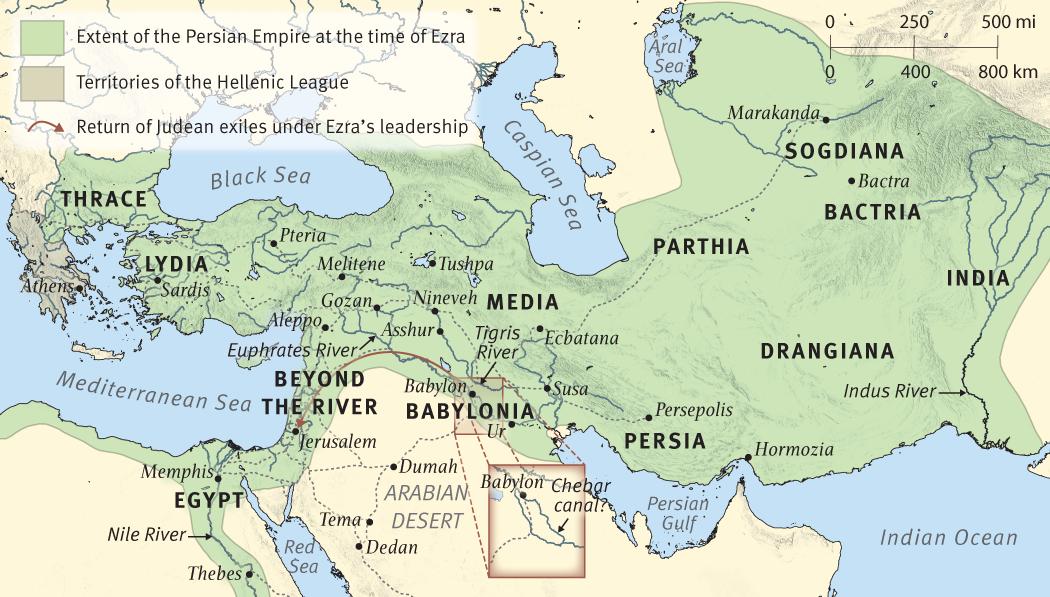
Source: ESV Maps
EZRA UNDER CONSTRUCTION
JUST A FEW NOTES NOW
WILL FINISH IF THE LORD WILLS
Ezra 6:1 Then King Darius issued a decree, and search was made in the archives, where the treasures were stored in Babylon.
- and search (KJV): Ezr 4:15,19 Ezr 5:17 Job 29:16 Pr 25:2
- rolls (KJV): Chal, books, Ps 40:7 Jer 36:2-4,20-23,29,32 Eze 2:9 Eze 3:1 Rev 5:1
- laid up (KJV): Chal, made to descend
Then King Darius issued a decree, and search was made in the archives, where the treasures were stored in Babylon.
Bob Utley - King Darius" This Persian ruler reigned from 522 to 486 B.C. He was a very strong and effective ruler. Kings of Persia ▣ "archives" This is literally "house of texts." At this point in time, they would include cuneiforms, tablets, and papyrus and/or leather scrolls (cf Ezra 6:2). These special buildings (temples) were usually the storage places of treasures as well as official documents.
Believer's Study Bible - (vv. 1,2) The "archives" is the royal library or record building, in which valuable documents and treasures were stored. Achmetha is probably Ecbatana, the capital of Media. The decree of Cyrus was there, no doubt written primarily in the Persian language, though a Chaldean transcript may have accompanied the document (v. 2). The contents of the discovered document follow (vv. 3-5).
Matthew Henry - The decree for completing the temple - Ezra 6:1-12. When God's time is come for fulfilling his gracious purposes concerning his church, he will raise up instruments to do it, from whom such good service was not expected. While our thoughts are directed to this event, we are led by Zechariah to fix our regard on a nobler, a spiritual building. The Lord Jesus Christ continues to lay one stone upon another: let us assist the great design. Difficulties delay the progress of this sacred edifice. Yet let not opposition discourage us, for in due season it will be completed to his abundant praise. He shall bring forth the head-stone thereof with shoutings, crying, Grace, grace unto it.
Steven Cole - God, the Cause of Our Joy (Ezra 6:1-22)
How high is the pursuit of joy on your priority list? Do you view it as something that is not only nice to pursue, but absolutely necessary? Many Christians view the Christian life primarily in terms of duty and obedience, and those are not minor themes in the Bible. But how many Christians view the pursuit of joy, gladness, and delight in God as a prime duty?
All too often, we view God as a stern, cosmic killjoy, who doesn’t want anyone to get too carried away with having a good time in life. The Puritans are often falsely caricaturized as being against joy and pleasure. Someone lampooned a Puritan as a person who suffers from an overwhelming dread that somewhere, sometime, somehow, someone may be enjoying himself. That’s a false view. It was the Puritans who said, “The chief end of man is to glorify God and enjoy Him forever.”
John Piper has helpfully modified that classic sentence: “The chief end of man is to glorify God by enjoying Him forever” (SEE Desiring God [Multnomah Books], 10th Anniversary Edition, p. 15). He also rightly says, “God is most glorified in me when I am most satisfied in him” (ibid., p. 9, italics his). Thus if glorifying God is our highest aim, then finding joy and satisfaction in God must be our deliberate, lifelong, consuming pursuit. To the degree that we fall short of fullness of joy in God, we fail to glorify Him as He deserves.
The joy that God imparts to His people is the theme of Ezra 6. The chapter begins with the outcome in question. The work on rebuilding the temple had stopped for 16 years due to opposition from the people in the land. Then, under the ministries of the prophets Haggai and Zechariah, the work resumed. But they barely got started again when Tattenai, the governor of the province that included Israel, confronted the Jews with whether they had proper permission to rebuild the temple. They told him about Cyrus’ decree. Because God’s eye was upon them, Tattenai permitted them to continue construction until word got back from the current king, Darius, as to what to do (Ezra 5:3-5).
In Ezra 6, Darius makes a search and eventually finds the decree of Cyrus in the government archives. He respects that decree and sends back a ruling that not only should the work go on, but also it ought to be supported by government funds. Thus the temple was completed on March 12, 515 B.C. The Lord’s people gathered to celebrate the dedication of this temple with joy (Ezra 6:16). This was followed by a celebration of the Passover and Feast of Unleavened Bread “with joy.” Ezra explains the source of that joy: “for the Lord had caused them to rejoice, and had turned the heart of the king of Assyria toward them to encourage them in the work of the house of God, the God of Israel” (Ezra 6:22). We learn:
God’s aim is to give us great joy in Him and His sovereign ways.
Joy and gladness in the Lord are not minor themes in the Bible. Moses told Israel that they should seek the Lord at the place He would choose, and that there they shall “rejoice in all [their] undertakings in which the Lord [their] God has blessed [them]” (Deut. 12:5, 7). Later he warned them, “Because you did not serve the Lord your God with joy and a glad heart, … therefore you shall serve your enemies whom the Lord will send against you” (Deut. 28:47-48).
The Psalms are full of joy and gladness. God is the psalmist’s “exceeding joy” (Ps. 43:4). We are commanded, “Shout joyfully to the Lord, all the earth. Serve the Lord with gladness; come before Him with joyful singing” (Ps. 100:1-2). “Be glad in the Lord and rejoice, you righteous ones; and shout for joy, all you who are upright in heart” (Ps. 32:11). “But let all who take refuge in You be glad, let them ever sing for joy; and may You shelter them, that those who love Your name may exult in You” (Ps. 5:11). “In Your presence is fullness of joy; in Your right hand there are pleasures forever” (Ps. 16:11).
Jesus told the disciples to “rejoice that [their] names are recorded in heaven.” Then He “rejoiced greatly in the Holy Spirit” at the thought of God’s sovereign ways in salvation (Luke 10:20-21). “For the joy set before Him,” He endured the cross (Heb. 12:2). He told the disciples that He had spoken to them so that His joy may be in them, and that their joy may be made full (John 15:11). The reason that they were to ask in His name and receive was that their joy may be made full (John 16:24). He promised that on judgment day, those who serve Him faithfully will be told, “Enter into the joy of your master” (Matt. 25:21).
The apostle Paul commands us, “Rejoice in the Lord always; again, I will say, Rejoice!” (Phil. 4:4). He told the Corinthians (2 Cor. 1:24) and the Philippians 1:25 that he was working with them for their joy. He listed joy as the second fruit that the Spirit produces in believers (Gal. 5:22).
The apostle Peter reported how those who believe in Jesus “greatly rejoice with joy inexpressible and full of glory” (1 Pet. 1:8). To a suffering church he wrote, “But to the degree that you share the sufferings of Christ, keep on rejoicing, so that also at the revelation of His glory you may rejoice with exultation” (1 Pet. 4:13). John’s Revelation 19:6-7 pictures the saints rejoicing throughout eternity: “Hallelujah! For the Lord our God, the Almighty, reigns. Let us rejoice and be glad and give glory to Him, for the marriage of the Lamb has come and His bride has made herself ready.”
I’ve only skimmed the surface of this theme in Scripture. But this should suffice to prove that joy in the Lord is not an optional or secondary matter for the believer. Rather, it is the very essence of the Christian faith, as Jonathan Edwards argues so convincingly in his “Treatise on Religious Affections” (BORROW The Works of Jonathan Edwards [Banner of Truth], 1:237).Or, as Alexander Maclaren comments on our text, “It is, in one aspect, the end of God’s dealings, that we should be glad in Him” (Expositions of Holy Scripture [Baker reprint], 3:301).
Our text unfolds five strands of the joy that God wants us to have as His people:
1. God wants us to know the joy of His providential care for us.
God’s remarkable providential care for His people underlies this entire account. Tattenai had sent his letter to Darius, expecting the king to send back orders to shut down this work at once. God’s providence is seen in the very fact of the king finding the decree of Cyrus from some 18 years before. They did not find it at Babylon, but rather in the fortress in Ecbatana, Cyrus’ summer residence.
God’s providential care is further seen in that Darius did not say, “I don’t care what my predecessor said. I command you to stop this rebellious work at once!” Rather, he not only told Tattenai to keep away from the project (Ezra 6:6), but also to fund the project out of his tax revenues (6:8-9)! And, to add some motivation, he decreed that anyone who violated his edict should be impaled on a timber drawn from his house, and the house should be made a heap of rubble! He added the wish that the God who has caused His name to dwell there would overthrow any king or people who attempted to destroy this house of God (Ezra 6:11-12).
God’s providential care is further alluded to in the mention that the building was completed according to God’s command, and also “the decree of Cyrus, Darius, and Artaxerxes” (Ezra 6:14). Why does Ezra mention Artaxerxes, who reigned about 50 years after the completion of the temple? Probably he did it for political protocol, in that Artaxerxes was the reigning king when Ezra wrote. Since he had been kind enough to issue a decree for the rebuilding of Jerusalem’s walls, Ezra wanted to give him credit in case he read this account.
God’s providential working is directly stated in Ezra 6:22, where it is stated that the Lord “had turned the heart of the king of Assyria toward” the Jews. It is unusual to refer to the Persian king as the king of Assyria. Perhaps Ezra did this to remind Israel that Assyria, Israel’s former enemy, had been conquered by the Persians whose king was friendly toward Israel (Stan Evers, Doing a Great Work [Evangelical Press], p. 64). Behind all these remarkable events was God’s mighty hand, turning the king’s heart like channels of water wherever He wishes (Prov. 21:1).
Do you see and rejoice in God’s providential care for you in every little as well as major thing that happens to you? Jesus told us that not one sparrow falls to the ground apart from the Father, and that He even knows the number of the hairs on our heads. Therefore, we should not fear, but should trust in God (Matt. 10:29-31). Since we are the living stones with which Jesus is now building His temple, the church, we can rest assured that He orders all things for our ultimate good. He will not discard or forget about His chosen people.
2. God wants us to know the joy of His provision for us.
Tattenai and his colleagues did not diligently carry out the king’s decree to fund the rebuilding of the temple out of his tax revenues (Ezra 6:13) because they thought it was a great idea! They did it with all diligence because they didn’t care for the alternative of being impaled on a timber from their houses. God used the decree of a pagan king to provide the materials for the temple and even the animals and other items for the sacrifices (Ezra 6:9). King Darius was trying to cover all his bases by having the local people pray to their gods on behalf of him and his sons (Ezra 6:10). But God used the king’s religious superstitions to provide for His people.
The Lord does not usually use pagan governments as the main source of material support for His church. But however He provides, whether through the tax breaks we receive from our government as a charitable, non-profit organization, or through the generous giving of the Lord’s people, God is the one who provides for His church as we wait upon Him through faith and prayer. And when we see God’s provision, we should be filled with joy. In 2 Corinthians 8 & 9 we see Paul brimming over with joy in the Lord at the generous gift of the Macedonians for the poor Christians in Jerusalem. He points out how our generous giving not only meets the needs of others, it also overflows through many thanksgivings to God, resulting in God being glorified (2 Cor. 9:12-13).
We should rejoice daily not only in how God provides for the work of His church, but also in how He provides for our personal needs. Songwriter Wendell Loveless told of a 64-year-old woman who had been confined to her bed for more than 16 years. She was in constant pain and unable to move her limbs. Yet she was one of the most thankful people Loveless had ever met.
She rejoiced that God had left her a great blessing—the use of her right thumb. Her other hand was stiff and completely useless. But with a two-pronged fork fastened to a stick, she could put on her glasses, feed herself, sip her tea through a tube, and turn the pages of a large Bible. Although it took great effort, everything she did was with the use of just one thumb.
She once told a visitor, “I have so much to be thankful for.” When asked why, she replied, “Now that my sins are forgiven, I can lie back and daily drink in the great love of Jesus my Savior.” Asked if at times she became despondent, she replied, “I’m perfectly content to lie here as long as the Lord keeps me in this world, and I’m also ready to leave whenever He calls me.” (“Our Daily Bread,” May, 1993.) She knew the joy of God’s provision!
3. God wants us to know the joy of productivity in our service for Him.
The temple was finally finished, about 20 years after the foundation was laid, and just over four years after the rebuilding began again under the ministries of Haggai and Zechariah. There are differing views about the dimensions given in Ezra 6:3. These dimensions seem to exceed those of Solomon’s temple, which was 20 cubits wide, 60 cubits long, and 30 cubits high. But if this temple was bigger, it is hard to explain the disappointment of the old-timers when the foundation was laid (Ezra 3:12). Since the length is not stated here, some think that the original text has been corrupted. Others suggest that these greater dimensions were the outside limits that Cyrus would support, but the actual building was much smaller, leading to the disappointment of some of the older Jews. But, whatever the solution, the temple was finished and the people rejoiced at its dedication (Ezra 6:15-16).
While we can and should rejoice at the completion of a building project, we should find much greater joy when we see the Lord using us in the building of His spiritual temple, the church. There is great joy in heaven when one sinner repents (Luke 15:7, 10). As the father of the prodigal explains to the grumbling brother, “We had to celebrate and rejoice, for this brother of yours was dead and has begun to live, and was lost and has been found” Luke 15:32). Paul calls the Philippian church his joy and crown (Phil. 4:1). He says the same thing to the Thessalonians, that they are his joy and crown of exultation, his glory and joy (1 Thess. 2:19-20).
I admit that there can be a sense of frustration in ministry to people, in that the “project” is never completed, and there are many setbacks. You can’t step back and say, “Ah, look at that person: Complete in Christ!” Or, “Look at this church: Harmonious, mature, fruitful—the work is done!” But while that is so, we can rejoice in the progress in godliness that we see in others’ lives as God uses us in ministry to them. We can rejoice in that our work in the Lord is never in vain (1 Cor. 15:58). When we glorify God by bearing much fruit, our joy will be full (John 15:8, 11).
Thus God wants us to know the joy of His providential care for us; the joy of His provision for us; the joy of productivity in our service for Him.
4. God wants us to know the joy of praising Him corporately.
When the temple was completed, the people gathered and “celebrated the dedication of this house of God with joy” (6:16). Their offerings were not nearly on the grandiose scale of Solomon’s dedication (1 Kings 8:63), but it was a sincere offering of what they had. Concerning the sin offering, Derek Kidner observes, “It was a confession of failure but also of faith. There was still atonement and still the covenant with the whole people—for this was the implication of the twelve sacrifices” (Ezra & Nehemiah, Tyndale Old Testament Commentaries [IVP], p. 60, italics his). The appointment of the priests and Levites to their divisions and orders (Ezra 6:18) shows their ongoing commitment to worship God.
Their observation of the Passover was a celebration of God’s gracious salvation, remembering how He delivered them from slavery in Egypt. The Feast of Unleavened Bread that immediately followed symbolized the holy fellowship of a redeemed people with their God. For us, these feasts are consolidated in the Lord’s Supper, where we remember that Christ our Passover has been sacrificed for us. “Therefore let us celebrate the feast, not with old leaven, nor with the leaven of malice and wickedness, but with the unleavened bread of sincerity and truth” (1 Cor. 5:8).
Sincere and heartfelt joy must accompany our praise in order for the praise to be genuine. C. S. Lewis said that as he was beginning to believe in God, he could not understand the demands in the Psalms that we praise God. He didn’t see the point in this; besides, it seemed to him to picture God as craving “for our worship like a vain woman who wants compliments.” He goes on to show why he was wrong.
But the most obvious fact about praise—whether of God or anything—strangely escaped me. … I had never noticed that all enjoyment spontaneously overflows into praise…. The world rings with praise—lovers praising their mistresses, readers their favorite poet, walkers praising the countryside, players praising their favorite game….
My whole, more general difficulty about the praise of God depended on my absurdly denying to us, as regards the supremely Valuable, what we delight to do, what indeed we can’t help doing, about everything else we value.
I think we delight to praise what we enjoy because the praise not merely expresses but completes the enjoyment; it is its appointed consummation. (Reflections on the Psalms pp. 94-95, cited by Piper, Desiring God p. 18.)
John Piper, who cites Lewis and credits him with helping Piper get clear on this, adds,
Pursuing joy in God and praising God are not separate acts. “Praise not merely expresses but completes the enjoyment.” Worship is not added to joy, and joy is not the by-product of worship. Worship is the valuing of God. And when this valuing is intense, it is joy in God. Therefore the essence of worship is delight in God, which displays His all-satisfying value (The Dangerous Duty of Delight [Multnomah Books], p. 24).
Spontaneous praise is good when you’re alone, but it’s better when you share the experience with others. Last Monday, Daniel Liba, our guest from Slovakia, Marla, and I sat on the South Rim of the Grand Canyon and watched a spectacular sunset. I would have enjoyed it if I had been there alone, but it’s better to share it with others you know and love. It’s the same with worship. It’s great to enjoy the beauty of the Lord in your private devotions, but it’s better to join with others and praise Him corporately. Finally,
5. God wants us to know the joy of purity and obedience to Him.
It is stated that Israel rebuilt the temple “according to the command of God” (Ezra 6:14). They organized their worship “as it is written in the book of Moses” (Ezra 6:18). Further, it is stated that “the priests and the Levites had purified themselves together; all of them were pure” (Ezra 6:20). Not only the returned exiles, but also “all those who had separated themselves from the impurity of the nations of the land” joined together “to seek the Lord God of Israel” by celebrating the Passover (Ezra 6:21).
For there to be true joy in our worship, there must be holiness in our lives. We must separate ourselves from the impurity of the nations. It is hypocrisy that the Lord hates if we live “like the nations” all week and then put on a pious front to worship Him on Sundays. Contrary to popular opinion, purity of life and obedience to God do not rob us of joy. Purity and obedience are at the heart of true joy. Sin gives brief pleasure but lasting scars and pain. Obedience may be difficult at the moment, but it yields “the peaceful fruit of righteousness” (Heb. 12:11).
Conclusion
C. S. Lewis said, “The ultimate purpose of God in all his work is to increase joy” (source unknown). He makes the radical suggestion that the thought that it is bad to desire our own good and enjoy it, is not a part of the Christian faith. He explains,
Indeed, if we consider the unblushing promises of reward and the staggering nature of the rewards promised in the Gospels, it would seem that Our Lord finds our desires not too strong, but too weak. We are half-hearted creatures, fooling about with drink and sex and ambition when infinite joy is offered us, like an ignorant child who wants to go on making mud pies in a slum because he cannot imagine what is meant by the offer of a holiday at the sea. We are far too easily pleased (in Piper, Desiring God, p. 17).
Lewis was saying what John Piper preaches so clearly, that God Himself is the source of infinite joy, and that we should pursue joy in Him with all our hearts.
So I ask you as I ask myself, “How high is the pursuit of joy on your priority list?” God’s aim is to give us great joy in Him and His sovereign ways. Only when we have true joy in God will we glorify Him as we should.
Discussion Questions
- What does biblical joy look like? Does it mean always being bubbly? If not, how would you describe it?
- How can we have joy in God’s providential care when we go through trials that make it seem that He does not care? See James 1:2-5.
- If a Christian is not involved in ministry of some kind, he is too self-focused. Agree or disagree? Give biblical support.
- Why are pursuing God and pursuing our own joy not at odds? What would you say to a young person who said, “I want to have fun in life now; I’ll follow God later”?
Brian Bell - Nehemiah 6
- ROADBLOCK RESOLVED (Ezra 6)
- Darius’ response. I’ll Read Ezra 6:1,2. They found it.
- Map – They went looking where? (Babylon). They found it where? (Achmetha, probably Ecbatana, the ancient capital of Media)
- Show how far were they apart. 265 miles as the crow flies.
- If we were only dealing with natural means then they wouldn’t have found this…but the eye of their God was upon them.
- (Ezra 6:8-12) Don’t miss this…the difficulty raised by their foes really became their benefit
- For the king decreed that their needs be supplied & expenses met.
- The man who would have hindered the progress is now used to help with great gifts.
- This reminds us of whom in Esther? (Moredcai/all the attacks, then backfired on Haman)
- When you obey God, you at once ensure His cooperation for the accomplishment of the task at hand.
- (Ezra 6:13-18) Ezra 6:14-16
- The work began with mingled joy & tears (Ezra 3:11-13) but it ended with all the people rejoicing (Ezra 6:16)
- It is highly probable that this is when Psalm 146-148 were composed.
- In the Septuagint they are entitled: The Psalms of: Haggai & Zechariah.
- See Ps.146:4,9; Ps.147:2,3
- The joy of worshipping & serving God, is always accompanied by Satan’s attempts to spoil it.
- He doesn’t know how not to do that. It is the heart, passion & core of his very nature
- However, Satan cannot thwart the plans of God.
- Dan 4:35 All the inhabitants of the earth are reputed as nothing; He does according to His will in the army of heaven And among the inhabitants of the earth. No one can restrain His hand Or say to Him, What have You done?
- (Ezra 6:19-22) Passover & The Feast of Unleavened Bread.
- This is the 1st Passover since King Josiah’s, more than 100 years earlier.
- They were made clean (Ezra 6:20) – They purified themselves.
- They were unified (Ezra 6:21a) - They ate together.
- Who partook? (Ezra 6:21b) – All who had separated themselves from the filth/uncleanness of the nations of the land.
- Why? (Ezra 6:22b) – In order to seek the Lord God of Israel.
- Communion: point out where communion is set up. Come & pick up, back up, wait to be lead by 1 of the designated communion leaders.
Ezra 6:2 In Ecbatana in the fortress, which is in the province of Media, a scroll was found and there was written in it as follows: “Memorandum–
- at Achmetha (KJV): or, at Ecbatana, or, in a coffer, [achmta <Strong's H712>,] probably from the Persian [chm,] {kham,} "a house for a summer residence," with a prefix, [a,] {aleph,} and the Chaldee termination [ta,] {tha,} most likely denotes Ecbatana, as the Vulgate and Josephus read, the summer residence of the Persian monarchs. It was situated in a mountainous region at the foot of mount Orontes, or Jasonius, according to Ammianus, on the southern confines of Media and Persia, and according to Pliny, 750 miles from Seleucia the Great, 20 miles from the Caspian passes, 450 miles from Susa, and the same from Gaze Atropatene, and in lat. 37 degrees 45 min., long. 88 degrees, according to Ptolemy. The building of the city is ascribed to Semiramis by Diodorus, but to Deioces by Eusebius, (in Chron. 1.1,) and Herodotus, who states that it was surrounded by seven walls, strong and ample, built in circles one within another, rising each above each by the height of their respective battlements; each being distinguished by a different colour, the first white, the second black, the third purple, the fourth blue, the fifth orange, the sixth plated with silver, and the seventh with gold. The largest of these was nearly the extent of Athens, i.e., 200 furlongs, according to Dion Chrysostom; but Diodorus Siculus states the circumference of Ecbatana to be 250 furlongs. Within the inner circle stood the king's palace and the royal treasury, so much celebrated for its splendour and riches by Polybius. It is highly probable, as D'Anville and Major Rennel suppose, that the present Hamadan, whose ruins attest its former splendour, occupies the site of Ecbatana. It is situated in Al Gebal, at the foot of the lofty mountain Alwend, about 80 leagues from Ispahan, and also from Bagdad.

In Ecbatana in the fortress, which is in the province of Media, a scroll was found and there was written in it as follows: “Memorandum
Bob Utley - "Ecbatana in the fortress" This name means "place of gathering" (BDB 1079). Xenophon, in his Cyropaedia, 8.6.22, says that Cyrus lived in the city of Babylon (capital of Babylon) in the winter, in the city of Susa (also called Sushan, capital of Elam) in the spring, and the city of Ecbatana (capital of Media) in the summer. We learn from other historical evidence that Cyrus II stayed in Ecbatana during his first year of reign and this is where the documents concerning the Jews and other peoples' repatriations were found. This is archaeological confirmation of the historicity of these historical records. The word "fortress" (BDB 1084) can mean (1) a castle; (2) a temple (cf. 1 Chr. 29:1,19; Neh. 2:8); or (3) a fort (Akkadian) ▣ Memorandum - Davidson, Analytical Hebrew and Chaldee Lexicon of the Old Testament, p. CL, says it is from a Chaldean (Babylonian) root "to record" or "to remember," therefore, a memorandum (BDB 1088, KB 1853).
Henry Morris - Achmetha. Archaeologists say that the Persian emperors of this period used four capitals--Babylon, Persepolis, Susa, and Achmetha (or Ecbatana). Accordingly, the "search" (Ezra 6:1) began in Babylon, but the scroll was finally found in the palace at Achmetha. This is the only reference in the Bible to this city.
Ryrie - The efficient Persian government kept its records on scrolls of papyrus or leather at Ecbatana (modern Hamadan on the road from Baghdad to Teheran). It was a city at 6,000 ft (1,829 m) elevation, with a climate conducive to the preservation of scrolls.
Yamauchi - Diodorus (2.32.4) declared that the Persians had ‘royal parchments’ recording their history. Persian officials wrote on scrolls of papyrus and leather, as discoveries made in Egypt show."......“In ‘The Decrees of Cyrus’ (page 89), de Vaux observes that ‘now we know that it was the custom of the Persian sovereigns to winter in Babylon and depart in the summer to Susa or Ecbatana [Achmetha],..and we also know that Cyrus left Babylon in the spring of 538 B.C…. A forger operating in Palestine without the information which we possess could hardly have been so accurate.” (See The Expositor's Bible Commentary: 1 Chronicles-Job - Page 424)
Ezra 6:3 “In the first year of King Cyrus, Cyrus the king issued a decree: ‘Concerning the house of God at Jerusalem, let the temple, the place where sacrifices are offered, be rebuilt and let its foundations be retained, its height being 60 cubits and its width 60 cubits;
- the first year (KJV): Ezr 1:1-4 Ezr 5:13-15 2Ch 36:22,23
- the place (KJV): De 12:5,6,11-14 2Ch 2:6 Ps 122:4
- the height (KJV): 1Ki 6:2,3 2Ch 3:3,4 Eze 41:13-15 Rev 21:16
In the first year of King Cyrus, Cyrus the king issued a decree: ‘Concerning the house of God at Jerusalem, let the temple, the place where sacrifices are offered, be rebuilt and let its foundations be retained, its height being 60 cubits and its width 60 cubits
Bob Utley - "Cyrus the king issued a decree" This occurred in 538 b.c. It is recorded in Hebrew in chapter 1, in Aramaic here in chapter 6. Some scholars think that chapter 1 was the verbal decree and chapter 6 was the written decree for the Archives. This seems possible because the Jews did not have written documentation for their claims concerning the decree of Cyrus. The historicity of this decree is confirmed by a similarly written Persian decree addressing the request for the rebuilding of an Elephantine Jewish worship center in Egypt. ▣ "be rebuilt" This VERB (BDB 1084) is a Hithpael IMPERFECT used in a JUSSIVE sense. ▣ "its height being 60 cubits and its width 60 cubits" The size was specific to keep the cost of construction within limits. Cyrus let all the people groups exiled by Assyria and Babylon return home and rebuild their national temples, therefore, cost was a factor (cf. Ezra 6:4). It is just possible that the 60 cubits was meant to parallel Solomon's temple ("its foundations be retained," Ezra 6:3, cf. 1 Kgs. 6:2). Several aspects of the rebuilding effort mimic Solomon's temple (i.e., length ‒ 60 cubits, width ‒ 20 cubits, and height ‒ 30 cubits). If this is true then the "20 cubit width" found in the Peshitta may be accurate. The MT also has a variant as to the height of the temple, "60 cubits seems inappropriate (unless one assumes the 120 cubits of 2 Chr. 3:4 to refer to the temple itself). Also notice the MT does not record the length at all. Some textual confusion has occurred. ▣ "cubits" The ancients used parts of the human body for measurement. People of the ANE used the following (1) width between the outstretched arms (2) length from elbow to middle finger (cubit) (3) width from outstretched thumb to little finger (span) (4) length between all four fingers of a closed hand (handbreadth)
The cubit (BDB 52, KB 61) was not completely standardized, but there were two basic lengths: (a) normal male's elbow to middle finger (about 18 inches, cf. Deut. 3:11) (b) royal cubit was a bit longer (about 20 inches, cf. 2 Chr. 3:3; Ezek. 40:5; Ezek 43:13)
Ryrie - Vs. 6:3-5 These added details, appropriate to the official memorandum, were not included in the public proclamation of 1:2-4. For the dimensions, see note on 1 Kings 6:2.
What are you, mighty mountain? Before Zerubbabel you will become level ground. Zechariah 4:7
What do you do when there is a mountain in your way? The story of Dashrath Manjhi can inspire us. When his wife died because he was unable to get her to the hospital to receive urgent medical care, Manjhi did what seemed impossible. He spent twenty-two years chiseling a massive gap in a mountain so other villagers could get to the local hospital to receive the medical care they needed. Before he died, the government of India celebrated him for his achievement.
Rebuilding the temple must have looked impossible to Zerubbabel, one of the leaders of Israel who returned from exile. The people were discouraged, faced opposition from their enemies, and lacked resources or a big army. But God sent Zechariah to remind Zerubbabel that the task would take something more powerful than military strength, individual power, or man-made resources. It would take the Spirit’s power (Zechariah 4:6). With the assurance of divine aid, Zerubbabel trusted that God would level any mountain of difficulty that stood in the way of rebuilding the temple and restoring the community (v. 7).
What do we do when there is a “mountain” before us? We have two options: rely on our own strength or trust the Spirit’s power. When we trust His power, He will either level the mountain or give us the strength and endurance to climb over it. - Marvin Williams
Reflect & Pray
What challenges stand in your way? How will you trust the power of God's Spirit in your life? Share it on Facebook.com/ourdailybread.
Human power is inadequate to accomplish God’s purposes.
Today's Insights
What keeps us from finishing the work entrusted to us? Eighteen years had passed since Cyrus, king of Persia, told Jewish captives of Babylon to return to Jerusalem and rebuild the temple of their God (Ezra 6:3,14). Now the prophet Zechariah urged completion. This temple, like the Messiah who would someday enter its courts, represented the heart of God for the world. Anything done for His honor—and for the good of others—is done in His Spirit.
Summary - Like Zerubbabel facing the daunting task of rebuilding the temple, believers often encounter "mountains" of difficulty that seem impossible to overcome. God's message through Zechariah was that His work would not be accomplished by human strength or resources, but by the power of the Holy Spirit (Zech. 4:6). Trusting God's enabling power, Zerubbabel could confidently expect the mountain to become level ground (Zech. 4:7). Likewise, when we rely on the Spirit rather than ourselves, God either removes the obstacle or supplies the strength and perseverance to overcome it. Human ability is insufficient for accomplishing God's purposes; His Spirit alone provides the power needed to finish the work He has entrusted to us.
Ezra 6:4 with three layers of huge stones and one layer of timbers. And let the cost be paid from the royal treasury.
- three rows (KJV): 1Ki 6:36
- the expenses (KJV): Ezr 7:20-23 Ps 68:29 Ps 72:10 Isa 49:23 Isa 60:6-10 Rev 12:16
with three layers of huge stones and one layer of timbers. And let the cost be paid from the royal treasury
Derek Kidner - “The great stones which had excited suspicion were now found to be expressly authorised – for the term is the same as for the ‘huge stones’ of Ezra 5:8 – literally, stones for rolling, too massive to be transported by other means.” (Ezra and Nehemiah)
Edwin Yamauchi - Heavy stones and one row of new timber: This construction technique seems to have been a precaution against earthquakes. “Kenyon has identified as the only visible remains of Zerubbabel’s building a straight joint of stones with heavy bosses [reinforced connections] about 108 feet north of the southeast corner of the temple platform, which Dunand confirmed as similar to Persian masonry found in Phoenicia.” (See Ezra, Nehemiah, Esther - Page 180 or The Expositor's Bible Commentary: 1 Chronicles-Job - Page 425)
Bob Utley - "huge stones" This does not refer to the huge stones of Solomon's Temple, but to stones so large that they had to be rolled. See note at Ezra 5:8. ▣ "one layer of timbers" The Aramaic term "new" (hdt, BDB 1092) is probably a scribal variant for "one" (hd, BDB 1079, cf. NIDOTTE, vol. 2, p. 30). This involves the change of one Hebrew letter and seems to fit the archaeological evidence of the architecture involved in the temples of this period and this locality (e.g., Ezra 5:8; 1 Kgs. 6:36; 7:12). This design may have been to help prevent earthquake damage or collapse. However, the Septuagint and many scholars believe this refers to "stories" (vertical), not sections of walls (horizontal). The term "layer" is uncertain (BDB 1102). If it does refer to "stories" then another affinity to Solomon's temple is mimicked (Solomon's temple had several stories). This would then denote three of stone and one of wood, which would make it taller and longer (cf. Ezra 6:3, i.e., 60 cubits vs. 30 cubits) than Solomon's temple! But this does not fit Ezra 3:12-13; Haggai 2:1; and Zech. 4:10. It is better to relate it to the cultural period of architectural design of earthquake resistant walls. ▣ "let the cost be paid from the royal treasury" The VERB (BDB 1095, Hithpael IMPERFECT) is used in a JUSSIVE sense.
Ezra 6:5 ‘Also let the gold and silver utensils of the house of God, which Nebuchadnezzar took from the temple in Jerusalem and brought to Babylon, be returned and brought to their places in the temple in Jerusalem; and you shall put them in the house of God.’
- the golden (KJV): Ezr 1:7,8 Ezr 5:14 Jer 27:16,18-22 Da 1:2 Da 5:2
- which Nebuchadnezzar (KJV): 2Ki 24:13 2Ki 25:14,15 2Ch 36:6,7,10,18 Jer 52:19
- brought (KJV): Chal, go
Also let the gold and silver utensils of the house of God, which Nebuchadnezzar took from the temple in Jerusalem and brought to Babylon, be returned and brought to their places in the temple in Jerusalem; and you shall put them in the house of God
Bob Utley - There is another series of commands. (1) "be returned" (BDB 1117, Haphel IMPERFECT) used in a JUSSIVE sense (2) "brought" (BDB 1090, "go," Peal IMPERFECT) used in a JUSSIVE sense (3) "put" (BDB 1102, "deposit," Aphel IMPERFECT) possibly also used in a JUSSIVE sense ▣ These utensils are described in Exod. 25:29 (cf. 1 Kgs. 7:50); Num. 7; and 2 Kgs. 25:13-16. They are discussed in Ezra 1 as being returned by the Persian government to Sheshbazzar to take back to the temple in Jerusalem.
Ezra 6:6 “Now therefore, Tattenai, governor of the province beyond the River, Shethar-bozenai and your colleagues, the officials of the provinces beyond the River, keep away from there.
- Tatnai (KJV): Ezr 5:3
- your companions (KJV): Chal, their societies, Ezr 5:6
- be ye far (KJV): Ge 32:28 Ge 43:14 Ne 1:11 Ps 76:10 Pr 21:1,30 Isa 27:8 Ac 4:26-28 Ro 8:31
Now therefore, Tattenai, governor of the province beyond the River, Shethar-bozenai and your colleagues, the officials of the provinces beyond the River, keep away from there
Bob Utley - keep away from there - This phrase is literally "far be from there." It is an Aramaic legal idiom also found in Egyptian papyri of this period (cf. The Expositor's Bible Commentary, vol. 4, p. 643). The VERB (BB 1089, KB 1858) is a Peal IMPERATIVE PLURAL. The command is both physical and mental (BDB 113, "keep aloof"). It may be an Aramaic legal idiom (Anchor Bible, vol. 14, p. 50). Notice that the Persian leaders who officially initiated the inquiry are now commanded to (1) stop hindering the work and stay away (Ezra 6:7) (2) pay for the work (without delay, Ezra 6:8) (3) provide the necessary sacrificial animals and other items the priests needed for annual as well as aily offerings (cf. Ezra 6:9)
Dale Ralph Davis - God is the Ruler Yet (Ezra 6)
D. Extravagant providence - Ezra 6:6-12(13) (Click here for previous sections of Davis' outline)
Not only did they find a copy of Cyrus' original decree in the archives (Ezra 6:1-5), confirming what the people of Judah had said, and not only was Judah granted freedom from interference from Tattenai and company (Ezra 6:6-7), but the elders of Judah received provision for the maintenance of the temple worship as well. Darius would underwrite the functioning of the temple with state funds (Ezra 6:8-10)!
This is what we have come to call "vintage Yahweh." God usually does not exercise a bare providence. There is so often a richness, a "who would have guessed?" aspect to his ways (cf. the argument in Isa 49:5-6 around the phrase "too light a thing"). This occasion in Ezra 6 is very much like that in Exodus 2:1-10 where Moses' mother not only got her own baby back, but raised him under state protection, and with a salary for taking care of her own kid to boot! God's ways seem to be marked with such generosity, such promiscuity. He delights to go far beyond all that we ask or think (Eph 3:20). So too here: they received far more than mere permission to build. Providence strikes again!
E. Encouraging providence - Ezra 6:14
The last of this verse reads: "And they finished building according to the command of the God of Israel and the decree of Cyrus, Darius, and Artaxerxes king of Persia." The very next verse brings everything back to Darius. Yet, verse 14 momentarily lets the timeline run down to Artaxerxes, omitting mention of Xerxes (Ahasuerus). Artaxerxes was king in Ezra's time (see Ezra 7:1). If Ezra is the one writing the historical account in chapters 5-6 (including 6:14), then he may have included Artaxerxes' name in his summary note because in his own time Artaxerxes had also supported the worship and life of the people of God (indeed, he did: Ezra 7:11-26). It may well be Ezra's little hint acknowledging that God was showing the same providence in Ezra's own time as he had shown to the previous generation about whom Ezra was writing. God's providence is not locked up in some past generation, but continues among his believing people in every age. In Ezra 4:6-23 Ezra extended the account of Judah's troubles beyond the time he was describing. Why couldn't he have done it here as well to indicate the favor they were shown?
F. Hidden providence - Ezra 6:14
Look at Ezra 6:14b again. The word te'em ("decree") is used twice, though English versions do not translate it the same way. They finished building "according to the decree of the God of Israel" and "according to the decree of Cyrus" et al. There is God's decree, and there is the decree of Persian kings. The ultimate decree is God's, but he brings it to pass indirectly by clothing it in the decrees of men in order to hide or cover his way. Nevertheless it is clear that in their decrees and pronouncements even kings are only the servant-boys of the Most High God.
G. On the date in Ezra 6:15
Adar, the last Babylonian month, is equivalent to our February-March. The temple was finished on March 12, 515 B.C., a little over 70 years after its destruction. Renewed work had begun on 21 September 520 B.C. (see Hag 1:4-15, so a sustained effort continued for over four years in order to complete it. (Yamauchi, EBC, 4:645)
III. The Joy that Seizes Us - Ezra 6:16-22
We have kept verses 16-18 and 19-22 together (in the latter the language switches back to Hebrew). This whole section recounts their celebrating the temple dedication, the Passover, and the Feast of Unleavened Bread. Note the emphasis on joy at the beginning and end of the section (Ezra 6:16, 22). Here they express or experience joy by:
A. Renewing scriptural worship - Ezra 6:16-18
The number of sacrifices on this occasion is paltry compared to what Solomon had offered (see 1 Kings 8:63). Note that the sin offering is "for all Israel," the 12-tribe nation, even though most of those present were from Judah, Benjamin, and Levi. Also, the ordering of the worship via priests and Levites was "as it is written in the book of Moses" (Ezra 6:18), i.e., it was orthodox worship.
B. Celebrating a mighty redemption - Ezra 6:19-20
This is the Passover celebration (cf. Exod 12-13). There is a diligence and eagerness about the ceremonial preparation of the priests and Levites; they were not slovenly or indifferent about it. Would this post-exilic community have looked upon this Passover as commemorating a "second Exodus," i.e., from Babylon?
C. Embracing converted people - Ezra 6:21
This verse shows that the attitude of Ezra 4:3 was not some narrow-minded nationalism. Here is a community open to others. Yet there is a price to pay: they must "separate themselves" from the impurity of the nations. The church does not win the world by becoming like the world; it must insist that the world leave the world when it enters the church. But this text shows the post-exilic "church" was not some closed-door group of bigoted, gentile-despising Jews. However, the way into this body was not through some loose-as-a-goose pagan ecumenism (Ezra 4:1-3), but through costly and decisive conversion.
D. Marveling at sovereign providence - Ezra 6:22
The last half of the verse explains the joy of their celebration: "for Yahweh had made them joyful and had turned the heart of the king of Assyria toward them to strengthen their hands in the work of the house of God."
The king intended is Darius - but he was king of Persia. Why is he called the "king of Assyria" here? Is this a glitch? Probably not. Note F.C. Fensham's comment:
On the other hand, the title "king of Assyria" might not be so farfetched as some scholars believe. We have evidence from the ancient Near East that new rulers or foreign rulers were incorporated into the king lists of a particular country. This is the case with a king list of Babylon, which starts with the Assyrian Kandalanu, mentions the Chaldeans Nabopolassar and Nebuchadnezzar, refers to Cyrus, Cambyses, and Darius, and ends with the names of Seleucid kings. Because Darius was also the sovereign of Assyria, he could easily have been called the king of Assyria. The choice of this title might seem awkward. It is possible that the author wanted to refer here to a title which had for a long time in history inspired fear in the hearts of the Jews. The Assyrian kings were used by the Lord to chastise his people (cf. Neh 9:32). But now the Lord has used the Assyrian king (Darius) to grant favor to the Jews. (See The Books of Ezra and Nehemiah - Page 102)
But don't allow the perplexity over terminology to obscure the clear claim of the text: Yahweh had turned the heart of the king of Assyria toward them. Kings are the big honkers of this age, but the King of kings is the one who turns their hearts! Here in verse 22 is the praise that never thinks of the instrument without lauding the Craftsman (see Prov 21:1).
As noted at the first of this section, the keynote is joy. Verse 22 makes clear the secret of that joy; they celebrated with joy because Yahweh had made them joyful. This reminds one of Franz Josef Haydn's response when his exuberant music was criticized by some more somber members of the church: "Since God has given me a cheerful heart, He will forgive me for serving him cheerfully." When Haydn was setting to music the words of the Mass (in English: "Lamb of God, who takes away the sins of the world"), he said that he was seized by an "uncontrollable gladness." He even had to apologize to the Empress Marie Therese on the matter, explaining that the certainty of God's grace had made him so happy that he wrote a joyful melody for the sober words. (Borrow The Spiritual Lives of Great Composers)
Ezra 6:7 “Leave this work on the house of God alone; let the governor of the Jews and the elders of the Jews rebuild this house of God on its site.
- Let the work (KJV): Ac 5:38,39
Leave this work on the house of God alone; let the governor of the Jews and the elders of the Jews rebuild this house of God on its site
Bob Utley - "Leave this work. . .alone" This is another Peal IMPERATIVE (BDB 1114). ▣ "rebuild" This VERB (BDB 1084, Peal IMPERFECT) is used in a JUSSIVE sense. ▣ "on its site" See note at Ezra 5:15. Apparently the use of ancient foundations was a Near Eastern way of showing continuity with previous generations.
Ezra 6:8 “Moreover, I issue a decree concerning what you are to do for these elders of Judah in the rebuilding of this house of God: the full cost is to be paid to these people from the royal treasury out of the taxes of the provinces beyond the River, and that without delay.
- I make a decree (KJV): Chal, by me a decree is made
- the king's (KJV): Ezr 6:4 Ezr 4:16,20 Ezr 7:15-22 Ps 68:29-31 Hag 2:8
- hindered (KJV): Chal, made to cease, Ezr 4:21,23 Ezr 5:5
Moreover, I issue a decree concerning what you are to do for these elders of Judah in the rebuilding of this house of God: the full cost is to be paid to these people from the royal treasury out of the taxes of the provinces beyond the River, and that without delay.
Bob Utley - Darius is following Cyrus' decree by funding the project from the Persian royal treasury.
Ryrie - Vs. 6:8-10 Darius not only confirmed Cyrus's previous decree, but added one of his own, which provided for some of the taxes to be given to the Jews--a provision that must have shocked Tattenai, since it cut into his share. Animals and foods for the sacrifices in the Temple were also to be supplied.
Ezra 6:9 “Whatever is needed, both young bulls, rams, and lambs for a burnt offering to the God of heaven, and wheat, salt, wine and anointing oil, as the priests in Jerusalem request, it is to be given to them daily without fail,
- young bullocks (KJV): Lev 1:3-5,10 Lev 9:2 Ps 50:9-13
- lambs (KJV): Ex 29:38-42 Nu 28:1-29:40
- wheat (KJV): Lev 2:1-16 Nu 15:4-31 1Ch 9:29
- salt (KJV): Lev 2:13 Mk 9:49
- let it be given (KJV): Isa 49:23
Whatever is needed, both young bulls, rams, and lambs for a burnt offering to the God of heaven, and wheat, salt, wine and anointing oil, as the priests in Jerusalem request, it is to be given to them daily without fail
Bob Utley - "Whatever is needed, both young bulls, rams, and lambs for a burnt offering" Obviously the Persian Archives received information from the Jews because they knew exactly the type of sacrifices which needed to be offered (cf. Exod. 29:38ff; Lev. 2:1; Num. 28:llff). From other archaeological finds it is clear that the Persians made the effort to know the regulations and cultus of the religions of their empire. ▣ "salt" Salt was to be a part of every sacrifice (cf. Lev. 2:13; Num. 18:19; Ezek. 43:24). Salt was a cultural sign and symbol of a covenant (cf. 2 Chr. 13:5). It was an idiom of fellowship and loyalty (cf. Ezra 4:14).
David Guzik - without fail - In this, we see the wonderful hand of God at work against the objections raised by Tattenai and Shethar-Bozenai as recorded in Ezra 5:3. The end result of these objections was to further the work of God instead of hindering it. This is an example of God working all things together for good for His people (Romans 8:28). On this point, Kidner quotes a line from a William Cowper poem: The clouds which ye so much dread, Are big with mercy.
Ezra 6:10 that they may offer acceptable sacrifices to the God of heaven and pray for the life of the king and his sons.
- sweet savours (KJV): Chal, rest, Ge 8:21 Lev 1:9,13 Eph 5:2
- pray (KJV): Ezr 7:23 Jer 29:7 1Ti 2:1,2
that they may offer acceptable sacrifices to the God of heaven and pray for the life of the king and his sons
Bob Utley - 6:10 "may offer acceptable sacrifices to the God of heaven and pray for the life of the king and his sons" This "acceptable sacrifices" (BDB 1102, cf. Dan. 2:46) is a Hebrew (BDB 629) idiom, "soothing aroma" (e.g., Gen. 8:21; Exod. 29:18,25,41; Lev. 1:9,13,17; Lev 26:31), which denoted an acceptable offering that corresponded to YHWH's specifications, directions, as well as the proper motive. This fits in perfectly with the Persian religious world-view as we understand it from Cyrus, Cambyses, Darius, and later, Artaxerxes. Although they were Zoroastrians they sought the good will of the national gods of the ancient Near East by repatriating their peoples, rebuilding their temples, and by making sure the regular sacrifices were done appropriately. Their actions had more to do with self-interest and superstition than religious zeal.
Ezra 6:11 “And I issued a decree that any man who violates this edict, a timber shall be drawn from his house and he shall be impaled on it and his house shall be made a refuse heap on account of this.
- whosoever (KJV): Ezr 7:26
- timber (KJV): Es 5:4 Es 7:10
- hanged (KJV): Chal, destroyed
- his house (KJV): 2Ki 9:37 2Ki 10:27 Da 2:5 Da 3:29
And I issued a decree that any man who violates this edict, a timber shall be drawn from his house and he shall be impaled on it and his house shall be made a refuse heap on account of this
Yamauchi - According to Herodotus (3.159) Darius I impaled three thousand Babylonians when he took Babylon, an act that Darius himself recorded in the Beshitun Inscription. (See The Expositor's Bible Commentary: 1 Chronicles-Job - Page 428 or Ezra, Nehemiah, Esther - Page 184)
Bob Utley - This verse has three IMPERFECTs used in a JUSSIVE (command) sense (Ezra 6:12; Ezra 7:21 also have two IMPERFECTs used in the same way). This royal threat was serious! ▣ impaled - This VERB (BDB 1099, Hithpael IMPERFECT) is used in a JUSSIVE sense. Whatever the exact meaning, it was a public display of capital punishment used as a deterrent (cf. Gen. 40:22; Gen 41:13; Deut. 21:23; Dan. 2:5; Dan 3:29). Verse 11 is typical of the curse formulas used to insure compliance to royal edicts. ▣ "his house shall be made a refuse heap on account of this" The Septuagint, I Esdras 6:32, and JPSOA have "forfeit." However, the rabbinical understanding is reflected in the Aramaic Targums, which translate this as "dung-hill" (cf. 2 Kgs. 10:27; Dan. 2:5). Reducing criminals' homes and possessions to rubbish was a common practice in the ancient Near East to humiliate both the offender and his family. The ultimate cultural insult would be to turn the site of the home into a public latrine.
Believer's Study Bible - "Alters" apparently means either changing or violating the edict. The punishment described may be impalement, crucifixion, or hanging. The Persians used both impalement and crucifixion frequently. The Romans continued crucifixion by nailing the victim to a cross.
Ezra 6:12 “May the God who has caused His Name to dwell there overthrow any king or people who attempts to change it, so as to destroy this house of God in Jerusalem. I, Darius, have issued this decree, let it be carried out with all diligence!”
- caused (KJV): Ex 20:24 De 12:5,11 De 16:2 1Ki 9:3 2Ch 7:16 Ps 132:13,14
- destroy (KJV): Ps 5:10 Ps 21:8-10 Ps 137:8,9 Isa 60:12 Ob 1:10 Zec 12:2-4 Ac 5:38,39 Ac 9:5 Rev 19:14-21
- I Darius (KJV): Es 3:14,15 Es 8:14
- speed (KJV): Ezr 6:13 Ec 9:10
May the God who has caused His name to dwell there overthrow any king or people who attempts to change it, so as to destroy this house of God in Jerusalem. I, Darius, have issued this decree, let it be carried out with all diligence
Bob Utley - "the God who has caused His name to dwell there" This follows the covenant phrasing of Deuteronomy (cf. Deut. 12:5,11,13-14,18; Deut 26:2; and Exod. 20:24). This became a reference to Mount Moriah in Jerusalem (cf. Gen. 22:2; 1 Chr. 21:18-27; 2 Chr. 3:1) where, later, Solomon's Temple was built.
Ezra 6:1-12
May God, who has caused his Name to dwell there, overthrow any king or people who lifts a hand to change this decree. - Ezra 6:12
TODAY IN THE WORD
Part of the delight in reading the book of Esther comes from the wonderful use of irony. Haman thought he would manipulate the king into bestowing great honor upon him—but the honor went instead to his archrival, Mordecai (Esther 6). Then Haman’s plot to destroy Mordecai and all the Jewish people resulted in his destruction on his own gallows, the promotion of Mordecai, and the protection of the Jews (Esther 7-8).
Our passage contains another account of irony in Scripture, and it’s notable that this isn’t merely a reversal of fortune or expectation. It’s an example of God going above and beyond for His people.
In response to the request from the local governors, King Darius ordered a search for the alleged decree from Cyrus that granted permission for the temple to be rebuilt. As Zerubbabel had said, the scroll was indeed found, and it matched their account of events (vv. 1-5).
At this point, Darius could have sent a notice to Tattenai and the local governors that, in fact, the Jews were correct about the decree of Cyrus. He could have simply instructed the officials to leave Zerubbabel alone to continue the construction of the temple, as he stressed in verses 6 and 7. But the decree continued on. Not only did the Lord halt the opposition, He went above and beyond to ensure that His people were provided for.
Darius commanded that the governors pay for the temple construction expenses out of their own treasuries (v. 8). They also had to provide the materials for the sacrifices, from the animals to the drink and grain offerings, directly facilitating the ability of the Jews to worship God (v. 9). Of course this was motivated by Darius’s own self-interest—he welcomed prayers on his behalf to any and every deity his subjects might worship (v. 10). But despite Darius’s motives, God was divinely superintending every step.
Tattenai might have thought his appeal to Darius would be the end of temple construction. But God used this to reverse the situation from oppression to protection, and then even beyond, to provision.
APPLY THE WORD
In the middle of struggles and heartaches, it’s comforting to know that the Lord knows the whole story: beginning, middle, and end. He understands your sorrow, and He also prepares your joy. You see the past and the present, but He also knows the plans He has for your future (Jer. 29:11). Just as He was faithful to His people to protect and provide for them, He will be faithful for you.
Ezra 6:1-12
When a man’s ways are pleasing to the Lord, he makes even his enemies live at peace with him. - Proverbs 16:7
TODAY IN THE WORD
Dwight L. Moody faced more than his share of opponents and critics during his incredible ministry in Chicago and around the world. In the early days of Moody’s work someone nicknamed him “Crazy Moody,” and Moody himself said that some people probably considered him a fanatic. Others complained that he was in ministry for the money and was using his work to gain favor with the wealthy. But instead of driving people away from Moody, his critics’ attacks increased Moody’s popularity, helping to expand his work. God used all these attacks against Moody to further spread the gospel.
Anyone who doubts that God can turn a negative situation around needs to spend some time in the book of Ezra. We can’t say for sure that Tattenai, the Persian-appointed governor of the area that included Palestine, was a bitter opponent of the Jews. But his challenge of their right to rebuild was a major obstacle to the completion of the temple. These events became the biggest boost the Jews had for their project since King Cyrus’s original decree.
Tattenai’s letter was received at the Persian court and the requested search for the historical decree was made. Interestingly, the scroll was found not in the city of Babylon but in Ecbatana, a provincial capital three hundred miles to the northeast. This was the summer residence of the Persian kings and the place from which Cyrus issued his decree. The search revealed details of the decree that were not in the public announcement (see Ezra 1:1–4). These included the fact that the costs for the temple’s construction were to be paid from the royal treasury, and that the gold and silver articles originally taken by the Babylonian king Nebuchadnezzar were to be given back.
TODAY ALONG THE WAY
It’s exciting to see how God turned tough circumstances around for His people in days past. It’s not always easy to stay faithful to God and wait patiently for Him when we are going through trials, when our present circumstances aren’t so wonderful. God may want to change the situation, or your response to the situation, by showing you His power to sustain you. Are you willing to wait for God to accomplish His will and bring about His glory through your tough times? Tell Him so today.
Ezra 6:13-22
Then the people of Israel … celebrated the dedication of the house of God with joy. - Ezra 6:16
TODAY IN THE WORD
When the Hyatt Regency McCormick Place hotel opened in 1998, lavish celebrations commemorated the event. Invitation-only parties and a ribbon-cutting ceremony with Chicago dignitaries signaled that construction had been completed and the hotel was open for business.
In today’s passage, we have the description of the completion of another construction project—the temple of God in Jerusalem was finally finished. A great celebration was held, but instead of parties and celebrities, the event featured worship and an acknowledgment of God’s goodness.
The governors of the area obeyed the decree of Darius, and the next four years offered great physical and spiritual blessing to the exiles in Judah. They were continuing to obey God’s command to build His house, and they were blessed by the spiritual leadership of Haggai and Zechariah (v. 14). After the many descriptions of disobedience and turmoil, these verses hearten and encourage us that seasons of obedience and blessing do happen for God’s people!
Notice three related themes in the account of their celebration: joy, obedience, and worship. The dedication of the temple was an occasion for joy (v. 16). But the people didn’t assume that they deserved the credit for this construction project. They were careful to follow “what is written in the Book of Moses” and order their worship through offerings and the installation of their religious leaders (vv. 17-18).
The people observed Passover, and they coupled their ceremonial practice with obedient lifestyles—separating themselves from the “unclean practices of their Gentile neighbors” (v. 21). The word joy appears two more times, and again we see the relationship between joy, obedience, and worship. They were obeying the Lord’s instructions for their relationship with Him, they were committed to His worship, and they were filled with joy (v. 22).
Finally, notice how God received the glory. He had changed the heart of the king. He had assisted them with building. The recognition of who God is and what He has done will result in joy, obedience, and worship.
APPLY THE WORD
Has God done something wonderful in your life? Rejoice and praise Him! Has God been faithful to you? Obey His commands and follow Him! Has God proved Himself full of love, mercy, provision, and protection? Worship Him and give Him the glory! Our lack of joy, obedience, and worship always stems from a failure to focus on who God is and what He has done. When we think of the goodness of Jesus and what He’s done for us, we will respond with a life of praise.
Ezra 6:13-22
If you fully obey the Lord your God … [he] will set you high above all the nations on earth. - Deuteronomy 28:1
TODAY IN THE WORD
Sometimes God’s people are very slow to learn the lessons He teaches. Israel’s centuries-long infatuation with idolatry is Exhibit A of this fact. It took the destruction of the temple and seventy years of Babylonian captivity before God’s chosen people finally put away the false gods of the pagan nations. Idolatry was never again the problem for Israel the way it had been before the exile.
The returning leaders of Israel learned this lesson so well that one of the recurring themes in Ezra and Nehemiah is their determination to worship and live in accordance with God’s commands (vv. 18, 20–21). It was this commitment, and God’s promise to restore and bless His people following their captivity, that brought the Jerusalem temple to completion in 515 B.C. This was more than four years after the work was resumed at the urging of the prophets Haggai and Zechariah, and about twenty-three years after the first exiles arrived in Jerusalem.
The joy at the temple’s dedication is easy to understand. The people had seen God turn a potential threat, Tattenai and his officials, into their “bank account” for the needs of the work. When the foundation had been laid, the older men cried because the new temple was so much smaller and less glorious than Solomon’s. One indication of this is the smaller number of animals offered in sacrifice at this dedication as compared to Solomon’s offerings (v. 17, cf. 1 Kings 8:62–63).
TODAY ALONG THE WAY
Reflect for a few minutes on some of the lessons God has taught you recently. Write them down if it will help you recall the circumstances, people, and Scripture that God used to show you an important truth about your work, finances, family, or some other issue. Then consider some questions about your list. For instance, were you quick to learn the lesson, or did it come to you with difficulty? Have these experiences made you more sensitive to and aware of God’s leading? Finish your time of reflection with a prayer for wisdom to “fully obey the Lord” at all times and to discern God’s direction.
Ezra 6:13 Then Tattenai, the governor of the province beyond the River, Shethar-bozenai and their colleagues carried out the decree with all diligence, just as King Darius had sent.
- Tatnai (KJV): Ezr 4:9,23 Ezr 5:6
- so they did (KJV): Es 6:11 Job 5:12,13 Pr 29:26
Related Passages:
Proverbs 21:1 The king’s heart is like channels of water in the hand of the LORD; He turns it wherever He wishes.
Proverbs 29:26 Many seek the ruler’s favor, But justice for man comes from the LORD.
Then Tattenai, the governor of the province beyond the River, Shethar-bozenai and their colleagues carried out the decree with all diligence, just as King Darius had sent
Yamauchi - “In 1973 French archaeologists discovered at Xanthos in Lycia in southwestern Turkey a cult foundation charter – written in Greek, Lycian, and Aramaic – dated to 358 B.C., a period when the area was controlled by a Persian satrap, that provided some striking parallels with the decree of Cyrus.” (See The Expositor's Bible Commentary: 1 Chronicles-Job - Page 426 or Ezra, Nehemiah, Esther - Page 180)
Morgan - One can easily imagine with what surprise Tattenai received the answer of Darius, characterized by clearness and determination. The man who would have hindered and stayed the progress of the building, was compelled not only to not hinder, but to help with great gifts.
F B Meyer -If certain matters can only be settled by reference to great men, kings or men of affairs, make the application;’ and then betake yourself to prayer, believing that as He inclined the heart of Darius, in the instance before us, so He can do as He will among the armies of heaven, and the inhabitants of earth.”
Derek Kidner - The political motives for this forthrightness may have been many, including a desire to show respect for the policies of Cyrus and to promote stability in a part of the empire which was important for communications with Egypt, at a time when widespread unrest had only recently been quelled.” (See Ezra and Nehemiah - Page 2)
Bob Utley - As Darius commanded "with all diligence" (BDB 1082, cf. Ezra 6:12), these officials responded "with all diligence" (Ezra 6:13).
Matthew Henry - The temple is finished - Ezra 6:13-22. The gospel church, that spiritual temple, is long in the building, but it will be finished at last, when the mystical body is completed. Every believer is a living temple, building up himself in his most holy faith: much opposition is given to this work by Satan and our own corruptions. We trifle, and proceed in it with many stops and pauses; but He that has begun the good work, will see it performed. Then spirits of just men will be made perfect. By getting their sins taken away, the Jews would free themselves from the sting of their late troubles. Their service was with joy. Let us welcome holy ordinances with joy, and serve the Lord with gladness.
Ezra 6:14 And the elders of the Jews were successful in building through the prophesying of Haggai the prophet and Zechariah the son of Iddo. And they finished building according to the command of the God of Israel and the decree of Cyrus, Darius, and Artaxerxes king of Persia.
- And the elders (KJV): Ezr 3:8 Ezr 4:3
- through (KJV): Ezr 5:1,2 Hag 1:12-14 Hag 2:2-15 Zec 2:1-4:14 6:1-15
- finished it (KJV): Zec 4:9
- according (KJV): Isa 44:28 Hag 1:8
- commandment (KJV): Chal, decree
- Cyrus (KJV): Ezr 6:13 Ezr 1:1-4 Ezr 4:24 Ezr 5:13
- Artaxerxes (KJV): This was Artaxerxes, the third son and successor of Xerxes, surnamed [Makrocheir,] or Longimanus, or in Persian, {Ardsheer deeraz dest,} "Ardsheer the long-handed;" so called, according to the Greeks, from the extra-ordinary length of his hands, but according to the Easterners, from the extent of his dominions. He ascended the Persian throne, A.M. 3540, B.C. 464, and reigned forty-one years. He is said to have been the most handsome person of his age, and to have been a prince of a very mild and generous disposition. Ezr 7:1
And the elders of the Jews were successful in building through the prophesying of Haggai the prophet and Zechariah the son of Iddo. And they finished building according to the command of the God of Israel and the decree of Cyrus, Darius, and Artaxerxes king of Persia
Bob Utley - "the elders of the Jews were successful in building" This same VERB (BDB 1109) was used to describe their work in Ezra 5:8 before these Persian leaders started their accusations and litigation. ▣ "according to the command of the God of Israel and the decree of Cyrus, Darius, and Artaxerxes" This is the mystery of divine sovereignty (i.e., Prophets' message and God's command) and human free will (decrees of Cyrus, Darius, and Artaxerxes, as well as the actions of the Jewish leaders). Both God's will and human will combined to accomplish the task. This is true in every area of life. ▣ "Cyrus, Darius, and Artaxerxes king of Persia" The decrees of Cyrus and Darius dealt with the rebuilding of the temple, while Artaxerxes' decree dealt with the rebuilding of the walls of Jerusalem. There is a 57-year gap between Ezra 6 (temple) and Ezra 7 (walls).
Ezra 6:14 G Campbell Morgan
According to the commandment of the God of Israel, and according to the decree of Cyrus, and Darius, and Artaxerxes king of Persia.—Ezra 6.14.
The right of these men to build had been created by the decree of Cyrus. Tattenai, who was now opposing them as they resumed the work, either did not believe that such a decree had ever been promulgated, or considered that it could not be found. The elders of the Jews, the eye of their God being upon them, persisted in the work, and Tattenai appealed to Darius that search should be made. That he should accede to such a request rather than exercise his immediate authority one way or the other, was in itself somewhat remarkable. He was as certainly the instrument of God as Cyrus had been in issuing the decree originally. That the search was a thorough one is indicated in the statement as to where the roll was found. The search naturally commenced in the house of the archives at Babylon, but it was not there. It was found at Achmetha in the royal palace. It is easy to realize how easily this might not have been found. If such a document was not in the proper libraries, what more natural than to abandon the search? But under Divine compulsion that search was prosecuted until the decree was found, and the elders were vindicated. Later, another royal decree, that of Artaxerxes, made possible the coming of Ezra, and the beginning of a new spiritual movement.
Ezra 6:14. James Smith - THE SECRET OF SUCCESS IN THE LORD'S WORK.
"First, seek thy Saviour out, and dwell Beneath the shadow of His roof, Till thou have scanned His features well, And known Him for the Christ by proof."—-Keble.
"They prospered through the prophesying of Haggai and Zechariah." Those words may be taken as the key to the whole situation, as described in Ezra 3:1-13 to Ezra 6:1-22. Including servants and maids, who had gone with their masters and mistresses, over forty-nine thousand accepted the offer of Cyrus, to leave their captivity and go up from Babylon to Jerusalem. They counted themselves blessed, on hearing such a "joyful sound" (Ps 89:15). (See Luke 4:18). Now, look at—
I. The Work to be Done. "To build the house of the Lord God of Israel" (Ezra 1:3). This house was for the honour of God: it was to be a testimony to His holy Name. We may learn from this that it is the prime duty of those who have been delivered from bondage to seek that the name of God might be magnified among the heathen. Every redeemed one should build for Him an house of testimony.
II. The Start Made. The first thing they did was to set the altar upon his bases (Ezra 3:3). They began with the altar. This is the sure basis of all acceptable work for God. The atoning sacrifice must have its true place if the great house of God's Church is to be built up and established. The altar of the Cross is not upon its proper basis when it stands on the wisdom of men instead of the wisdom of God. The true basis of the Cross of Christ is to put it where God has put it, between sin and salvation. Then they laid the foundation (Ezra 3:10). After the burnt-offerings came the laying of the foundation. Those who lay the foundation, and go on with the building before the altar of the Cross is placed upon its right basis, are vainly working outside the gracious purposes of God. The foundation of God's house is laid on the rock of Christ's atoning sacrifice. God's order is, first, reconciliation, then stability and progress. After this they praised the Lord (Ezra 3:11). This was not formal Psalm-singing, it was the spontaneous outburst of hearts filled to overflowing with joy and thanksgiving. "They shouted with a great shout" (Josh. 6:5). Such a result surely proves that this is the right method and spirit in which to do the work of God.
III. The Adversaries. When the people of God begin to shout and praise, then the enemy will be stirred up to envy and opposition. "The adversaries of Judah came… and said, Let us build with you" (Ezra 4:1, 2). They professed to be seeking also the honour of the God of Israel. These may have been the "fathers" referred to by the woman of Samaria in John 4:20. The work so far has been a success, and now they wish to become partners in the business. But the answer of those divinely commissioned ones was fearless and unequivocal. "Ye have nothing to do with us to build an house unto our God; but we ourselves will build" (Ezra 4:3). Those sent ones were not going to be unequally yoked with unbelievers. What part hath he that believeth with an infidel? (2Cor 6:14-16). When they saw that they were to have neither part nor lot in the matter, then they sought to "weaken their hands… and trouble them;" they also "hired counselors to frustrate their purpose" (Ezra 4:4,5). But one thing they forgot, or refused to believe, and that was, that "their purpose" was God's purpose. The cause of God cannot be properly advanced but by those who know that they have been called of God.
IV. The Temporary Interruption. "Then ceased the work of the house of God which is at Jerusalem" (Ezra 4:24). The wicked may have their day of triumph, but their time is short. How was the work stopped? Those "hired counselors" wrote a letter to the new king of Persia, representing Jerusalem as a "rebellious and bad city," and that these Jews who had lately come from Babylon were rebuilding it for the purpose of fortifying themselves against the power and authority of Babylon. The king on receiving the letter made search, and found "that the city of old time hath made insurrection against kings" (Ezra 4:19), and because of the city's past glory and power he "gave commandment to cause these men to cease." This must have been a staggering blow to those enthusiastic men. What could it mean? Does the providence of God contradict His Word? In the time of perplexity, wait.
V. The Renewed Effort. "Then the prophets Haggai and Zechariah prophesied unto the Jews that were in Jerusalem,… then they began to build the house of God" (Ezra 5:1, 2). This revival came through the word spoken "in the Name of the God of Israel." There is need for a prophet to ring out the message of God when His work has come to a standstill. These discouraged workers needed to be reminded that they were saved out of Babylon to serve the Lord in Jerusalem, and that "the eye of their God was upon them" (Ezra 5:5). The prophets doubtless made it clear to them that this was God's work, and that they had been called of Him to do it, so in His Name the work is resumed with more determination than before, for "with them were the prophets of God helping them" (Ezra 5:2). Nor was it in vain, for Darius the king discovered in "the house of the rolls" the decree of Cyrus concerning the Jews and the house of God, and straightway sent a letter to the "adversaries" saying, "Let the work of the house of God alone" (Ezra 6:7). So "they prospered through the prophesying of Haggai and Zechariah" (Ezra 6:14). And the house was finished (Ezra 6:15). The remedy for our helpless hands and feeble knees is a clearer apprehension of God's purposes of grace in par individual lives, and a fearless, whole-hearted devotion to the fulfilment of the same. He gives power to the weak, and to them that have no might he increases strength.
Ezra 6:15 This temple was completed on the third day of the month Adar; it was the sixth year of the reign of King Darius.
- Adar (KJV): Es 3:7,13 Es 8:12 Es 9:1,15,17,19,21
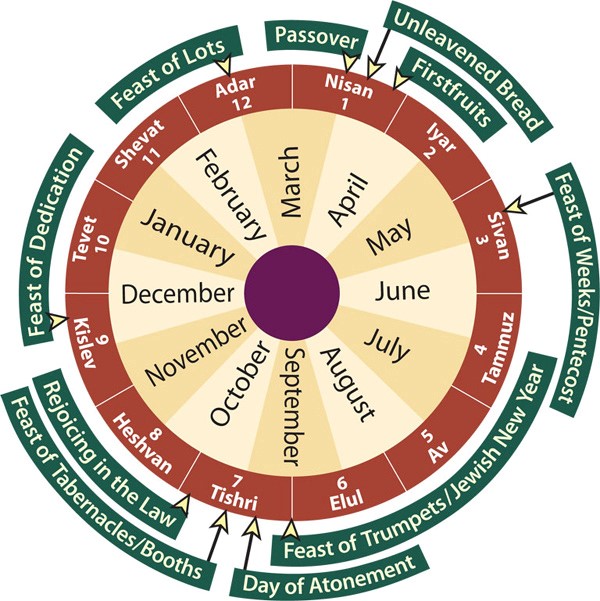
Calendar of Jewish Feasts
(Source: Rose Guide to the Tabernacle
Excellent Teaching Resource)
This temple was completed on the third day of the month Adar; it was the sixth year of the reign of King Darius.
Edwin Yamauchi - Work on the temple made little progress because of opposition and the preoccupation of returnees with their own homes (Haggai 1:2-3). Because they had placed their own interests first, God sent them famine as a judgment (Haggai 1:5-6, Haggai 1:10-11). Spurred by the preaching of Haggai and Zechariah, and under the leadership of Zerubbabel and Joshua, a new effort was begun (Haggai 1:12-15).” (See The Expositor's Bible Commentary - Abridged Edition - Page 50 or Ezra, Nehemiah, Esther - Page 185)
Derek Kidner - The mention of Artaxerxes, who belongs to the next century, takes us forward to the restoration of the city walls by Nehemiah, which this king authorised. His name, as the third royal patron of Israel’s rehabilitation, is added here to complete the picture, whether by the author or by an early scribe.” (See Ezra and Nehemiah - Page 2)
Bob Utley - "This temple was completed on the third day of the month Adar; it was the sixth year of the reign of King Darius" This date is mentioned in I Esdras 7:5 and Josephus' Antiq. 11.4.7. It would be 516 B.C., exactly seventy years from the destruction of the temple under Nebuchadnezzar II (cf. Jer. 25:9-13).
Henry Morris - house was finished. The building of the temple began under Cyrus (Ezra 3:8), but the local opposition caused it to cease until the second year of Darius (4:24), at least fifteen years later.
Believer's Study Bible - "Adar" was the twelfth month (see depiction above). According to Haggai's date of the resumption of building (Hag. 1:15) and Ezra's date of the completion here, the time required for reconstruction was four years, five months, and ten days.
Ryrie - The Temple was completed on March 12, 515 B.C.
Ezra 6:16 And the sons of Israel, the priests, the Levites and the rest of the exiles, celebrated the dedication of this house of God with joy.
- the children (KJV): 1Ch 9:2 Ne 7:73
- children of the captivity (KJV): Chal, sons of the transportation, Ezr 4:1
- the dedication (KJV): 1Ki 8:63 2Ch 7:5,9 Joh 10:22
- with joy (KJV): Ezr 6:22 Ezr 3:11,12 De 12:7 1Ch 15:28 2Ch 7:10 2Ch 30:23,26 Ne 8:10 Ne 12:43 Ps 122:1 Php 4:4
And the sons of Israel, the priests, the Levites and the rest of the exiles, celebrated the dedication of this house of God with joy.
Derek Kidner - The word for dedication (hanukka) was later to become the name of a festival in memory of the Temple’s re-consecration in 165 B.C. after its profanation by Antiochus Epiphanes (cf. John 10:22f.). (See Ezra and Nehemiah - Page 2)
Bob Utley - "and the rest of the exiles" Who could this refer to? Possibly (1) converts to Judaism who were converted while they were also in exile (cf. Ezra 6:21). Or (2) it could refer to those Jews who remained in Palestine, but did not participate in pagan or synergistic worship (cf. Ezra 6:21).
Ezra 6:17 They offered for the dedication of this temple of God 100 bulls, 200 rams, 400 lambs, and as a sin offering for all Israel 12 male goats, corresponding to the number of the tribes of Israel.
- offered (KJV): Ezr 8:35 Nu 7:2-89 1Ki 8:63,64 1Ch 16:1-3 2Ch 7:5 2Ch 29:31-35
- a sin offering (KJV): Lev 4:3,13,14,22,23,28 2Ch 29:21-23
- according to (KJV): Though the tribes of Benjamin and Judah, with the priests and Levites, formed the bulk of the people, yet many from the other tribes had returned with them from captivity. 1Ki 18:31 Lu 22:30 Rev 7:4-8 Rev 21:12
They offered for the dedication of this temple of God 100 bulls, 200 rams, 400 lambs, and as a sin offering for all Israel 12 male goats, corresponding to the number of the tribes of Israel.
Derek Kidner - It was a confession of failure but also faith. There was still atonement and still the covenant with the whole people – for this was the implication of the twelve sacrifices.” (See Ezra and Nehemiah - Page 2)
Bob Utley - "as a sin offering for all Israel 12 male goats" Although a detailed description of the sacrifices for the dedication is listed (much smaller than Solomon's dedication, cf. 1 Kgs. 8:63), the Day of Atonement (cf. Lev. 16) is never mentioned in Ezra or Nehemiah. See The Number Twelve ▣ "for all Israel 12 male goats, corresponding to the number of tribes of Israel" It was important for the returning Jews (mostly from the southern tribes called Judah) to affirm they represented all the family of Abraham, Isaac, and Jacob. Most of the northern ten tribes taken into captivity by Assyria (722 B.C., fall of Samaria) never returned to Palestine. Nevertheless these were the covenant people of God. The promises and covenants of YHWH also belonged to them!
Ezra 6:18 Then they appointed the priests to their divisions and the Levites in their orders for the service of God in Jerusalem, as it is written in the book of Moses.
- the priests (KJV): 1Ch 23:1-26:32 2Ch 35:4,5
- as it is written (KJV): Chal, according to the writing, Nu 3:6 Nu 8:9-26
Then they appointed the priests to their divisions and the Levites in their orders for the service of God in Jerusalem, as it is written in the book of Moses.
Edwin Yamauchi - “The general plan of the second temple resembled the first. But the [Most Holy Place] was left empty as the ark of the covenant had been lost through the Babylonian conquest…. [The Holy Place] was furnished with a table for showbread, the incense altar, and one menorah instead of Solomon’s ten.” (See The Expositor's Bible Commentary - Abridged Edition: Old ... - Page 695 or The Expositor's Bible Commentary: 1 Chronicles-Job - Page 429 or Ezra, Nehemiah, Esther - Page 186)
Bob Utley - "the priests of their divisions" The law of Moses stipulated the special tribe of temple servants (i.e., Levi, cf. Num. 3:6; Num 8:6-22; Num 18:1-7; 1 Chr. 6), but it was David who organized them into 24 orders who took turns serving in the temple (cf. 1 Chr. 23-24; 2 Chr. 35:4-5). Only four orders returned under Zerubbabel (cf. chapter 2). ▣ "the book of Moses" This would have been a way to show the validity of the returning exiles as the people of God! See Moses' Authorship of the Pentateuch
Ryrie - their divisions. 24 of them. See note on 1 Chron. 24:4.
Ezra 6:19 The exiles observed the Passover on the fourteenth of the first month.
- the children (KJV): Ezr 6:16
- kept (KJV): Ex 12:6-36 Jos 5:10 2Ch 30:1-35:27
The exiles observed the Passover on the fourteenth of the first month - Concerning Passover, see notes on Ex 12:11.
Bob Utley - The Aramaic section concludes at Ezra 6:18 and the Hebrew resumes until Ezra 7:12-26, which again is Aramaic.
Ezra 6:20 For the priests and the Levites had purified themselves together; all of them were pure. Then they slaughtered the Passover lamb for all the exiles, both for their brothers the priests and for themselves.
- purified together (KJV): 2Ch 29:34 2Ch 30:15-17
- killed (KJV): Ex 12:21 2Ch 35:11 Heb 7:27
For the priests and the Levites had purified themselves together; all of them were pure. Then they slaughtered the Passover lamb for all the exiles, both for their brothers the priests and for themselves
Bob Utley - "all of them were pure" This phrase is similar in purpose to Ezra 3:1 (i.e., "gathered as one man"), which denotes the unity of the Jews during this difficult but victorious period.
Ezra 6:21 The sons of Israel who returned from exile and all those who had separated themselves from the impurity of the nations of the land to join them, to seek the LORD God of Israel, ate the Passover.
- all such (KJV): Ezr 9:11 Nu 9:6,7,10-14 Isa 52:11 Eze 36:25 2Co 6:17 2Co 7:1
- did eat (KJV): Ex 12:47-49 Ps 93:5
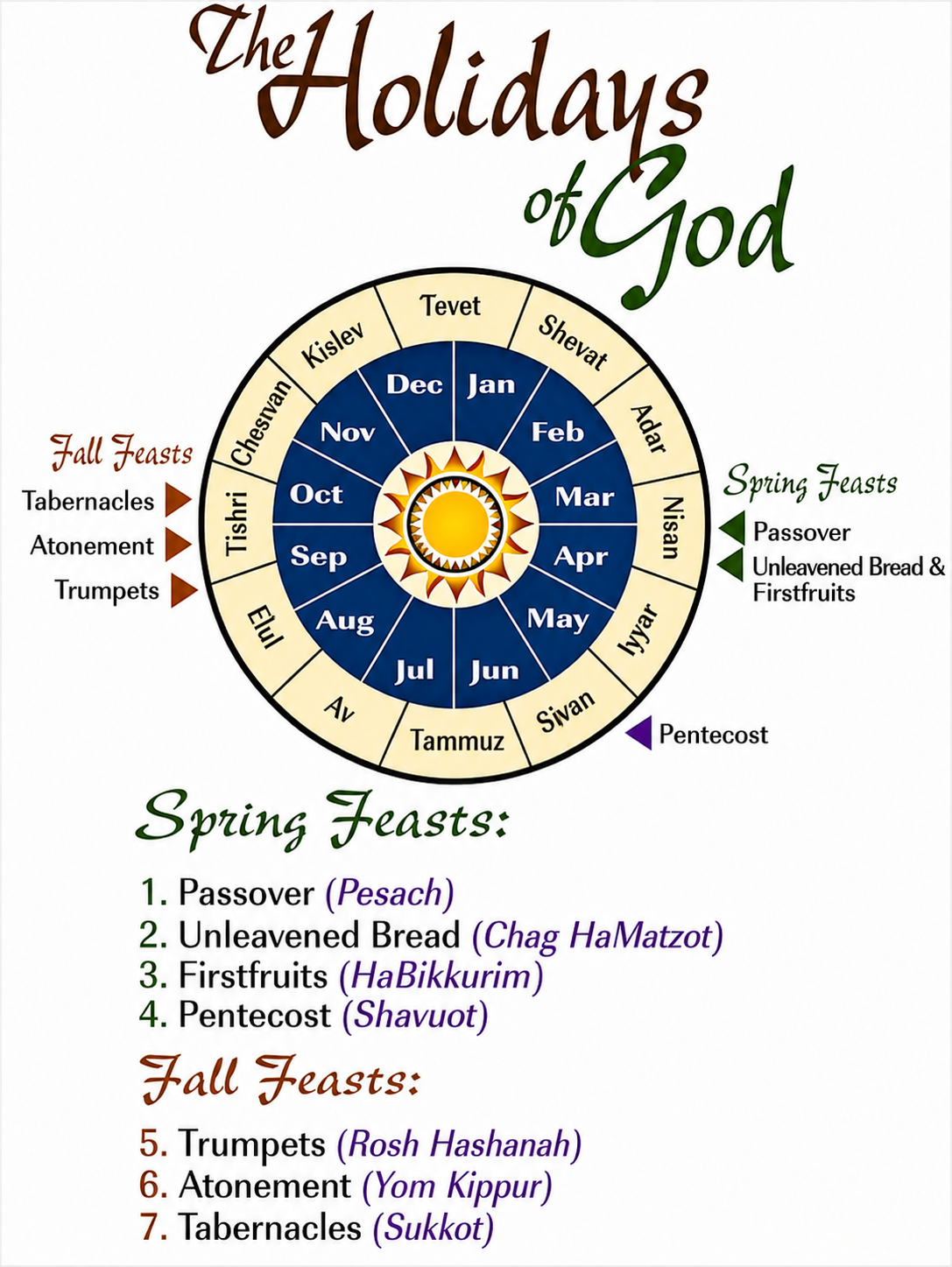
The sons of Israel who returned from exile and all those who had separated themselves from the impurity of the nations of the land to join them, to seek the LORD God of Israel, ate the Passover.
Derek Kidner - This is a crucial verse for correcting the impression one might gain from Ezra 4:1-3 of a bitterly exclusive party…. in reality we find that only the self-excluded were unwelcome. The convert found an open door, as Rahab and Ruth had done.” (See Ezra and Nehemiah - Page 3)
Walter Adeney on impurity of the nations - But it was only too true that both the Canaanite and the Babylonian habits of life were disgustingly immoral.” (See The Expositor's Bible: Ezra, Nehemiah, and Esther)
Bob Utley - "all those who had separated themselves" God demanded that His people be different from "the nations" (cf. Deuteronomy 7). They were to love and obey the covenant God of Israel. This "separation" involved those who never compromised with pagan cultures and those who repented and turned from their involvement with pagan culture. Either of these could eat the Passover. God is the compassionate, slow to anger, abounding in covenant loyalty (cf. Neh. 9:17) One! Israel was meant to disclose YHWH to the world, but she failed (cf. Ezek. 36:22-38). Covenant obedience is crucial! ▣ "to seek the Lord God of Israel" The opposite of "separate from" (Ezra 6:21) is "to seek" (BDB 205, KB233, Qal INFINITIVE CONSTRUCT). Good parallels of the necessity of seeking and the promise of finding are 1 Chr. 28:9 and 2 Chr. 7:14. Humans seek and YHWH reveals Himself. He satisfies the human longing and searching for fellowship and intimacy with the God in whose image we were created (cf. Deut. 4:29). However, there are covenant conditions (cf. 1 Chr. 15:2).
Henry Morris - separated themselves. In addition to the returning exiles, at least some Israelites, descendants of those left in the land by Nebuchadnezzar (Jeremiah 52:16), joined with them in the reestablished worship of the true God.
Ryrie - Two groups are indicated here: the returnees, and the residents of the land who had remained separate from heathen practices.
Ezra 6:22 And they observed the Feast of Unleavened Bread seven days with joy, for the LORD had caused them to rejoice, and had turned the heart of the king of Assyria toward them to encourage them in the work of the house of God, the God of Israel.
- the feast (KJV): Ex 12:15-20 Ex 13:6,7 2Ch 30:21 2Ch 35:17 Mt 26:17 1Co 5:7,8
- turned (KJV): Ezr 7:27 Pr 16:7 Pr 21:1 Joh 19:11
- the king (KJV): Darius, as reigning over the country of Assyria, is here called "the king of Assyria." Ezr 6:6-12 Ezr 1:1 2Ki 23:29 2Ch 33:11 Zec 10:10,11
And they observed the Feast of Unleavened Bread seven days with joy - Concerning unleavened bread, see notes on Ex. 12:15-20.
F B Meyer - Do not be afraid of joy; when God makes you joyful, do not think it necessary to restrain your songs or smiles (ED: "the joy of the LORD is your strength" Neh 8:10!).
for the LORD had caused them to rejoice, and had turned the heart of the king of Assyria toward them to encourage them in the work of the house of God, the God of Israel.
Derek Kidner - So ends the first stage, a generation long, of Israel’s rehabilitation. It had opened when the Lord ‘stirred up the spirit of Cyrus’ (Ezra 1:1), and it concluded with His turning the heart of one of that king’s most powerful successors. (See Ezra and Nehemiah - Page 3)
Walter Adeney - He had ‘turned the heart of the king of Assyria’ – a title for Darius that speaks for the authenticity of the narrative, for it represents an old form of speech for the ruler of the districts that had once belonged to the king of Assyria.” (See The Expositor's Bible: Ezra, Nehemiah, and Esther)
Bob Utley - "the king of Assyria" If literal, this seems to be out of place and unexplainable! This may refer to Cyrus or Darius (cf. Josephus', Antiq. 11.4.8). The Persian king used several titles (i.e., Ezra 5:13, Cyrus is called "King of Babylon"). Nehemiah uses this title as a collective term for all the kings of the eighth through fifth centuries in Neh. 9:32.
Henry Morris - Although Darius was emperor of Persia, he was also king of Assyria and king of Babylon, for the Persians had conquered both of these earlier empires that had previously conquered Israel and Judah.
Believer's Study Bible - The reference is undoubtedly to the Persian king Darius, who is designated "king of Assyria" because he ruled the former realm of Assyria.
F B Meyer - Ezra 6:22 The Lord had made them joyful, and turned the heart of the King unto them.
Yes, the hearts of men are in the hands of God, and He can turn them whither He will. There are many instances of this in Scripture. God gave Joseph favor with Pharaoh; Moses with the Princess; and Daniel with the King of Babylon. If certain matters can only be settled by reference to great men, kings or men of affairs, make the application; and then betake yourself to prayer, believing that as He inclined the heart of Darius, in the instance before us, so He can do as He will among the armies of heaven, and the inhabitants of earth.
That unkind overseer, that vexatious member of your home-circle, that great man whose help you so greatly need— these are accessible to God’s Spirit, if only you are intent on seeking His glory, and doing His will. But you must be able to show, as these Jews could, that your cause is identical with the cause of God, before you can claim, with unwavering faith, His interference on your behalf.
Then when the answer comes, let us thank Him, separating ourselves still further from the filthiness around us, so as to keep the feast with joy. Do not be afraid of joy; when God makes you joyful, do not think it necessary to restrain your songs or smiles, for fear that an equivalent of sorrow will presently be meted out as a make weight. Our blessed Lord was desirous that His joy might be in His disciples; it was for the joy that was set before Him that He endured the cross, despising the shame, and is set down at the right hand of the throne of God; it is with exceeding joy that He will present us faultless before the presence of His glory. “Thou shalt rejoice in every good thing which the Lord thy God giveth thee.”