Ezra 8:2
Ezra 8:3
Ezra 8:4
Ezra 8:5
Ezra 8:6
Ezra 8:7
Ezra 8:8
Ezra 8:9
Ezra 8:10
Ezra 8:11
Ezra 8:12
Ezra 8:13
Ezra 8:14
Ezra 8:15
Ezra 8:16
Ezra 8:17
Ezra 8:18
Ezra 8:19
Ezra 8:20
Ezra 8:21
Ezra 8:22
Ezra 8:23
Ezra 8:24
Ezra 8:25
Ezra 8:26
Ezra 8:27
Ezra 8:28
Ezra 8:29
Ezra 8:30
Ezra 8:31
Ezra 8:32
Ezra 8:33
Ezra 8:34
Ezra 8:35
Ezra 8:36
Source: ESV Maps
EZRA UNDER CONSTRUCTION
JUST A FEW NOTES NOW
WILL FINISH IF THE LORD WILLS
Ezra 8:1 Now these are the heads of their fathers’ households and the genealogical enrollment of those who went up with me from Babylon in the reign of King Artaxerxes:
- the chief (KJV): Ezr 1:5 1Ch 9:34 1Ch 24:31 1Ch 26:32 2Ch 26:12 Ne 7:70,71
- genealogy (KJV): Ezr 2:62 1Ch 4:33 1Ch 9:1
- them that went up (KJV): Ezr 7:7,13
Now these are the heads of their fathers’ households and the genealogical enrollment of those who went up with me from Babylon in the reign of King Artaxerxes - This verse marks the transition from Ezra's own commissioning (ch. 7) to the actual company of returnees (ch. 8) — the narrative shifts from Ezra's authority to who actually risked the journey with him.
The genealogical enrollment - The insistence on genealogical enrollment is not bureaucratic filler but is the proof of legitimacy. In the post-exilic period, being able to trace your household back to a recognized Israelite line was what qualified you to serve as priest, inherit land, or even count as part of the covenant people at all (compare the men in Ezra 2:59-62 who couldn't prove their descent and were excluded from the priesthood as a result). Listing "heads of fathers' households" by name here is Ezra's way of certifying that these are not stragglers, but true Israelites moving from exile back to the land under a pagan king's authorization.
Walter Adeney There was little at Jerusalem to attract a new expedition; for the glamour which had surrounded the first return, with a son of David at its head, had faded in grievous disappointments; and the second series of pilgrims had to carry with them the torch with which to rekindle the flames of devotion. (see The Expositor's Bible: Ezra, Nehemiah, and Esther).
Matthew Henry - The companions of Ezra - Ezra 8:1-20 Ezra assembles the outcasts of Israel, and the dispersed of Judah. God raised up the spirits of a small remnant to accompany him. What a pity that good men should omit a good work, for want of being spoken to!
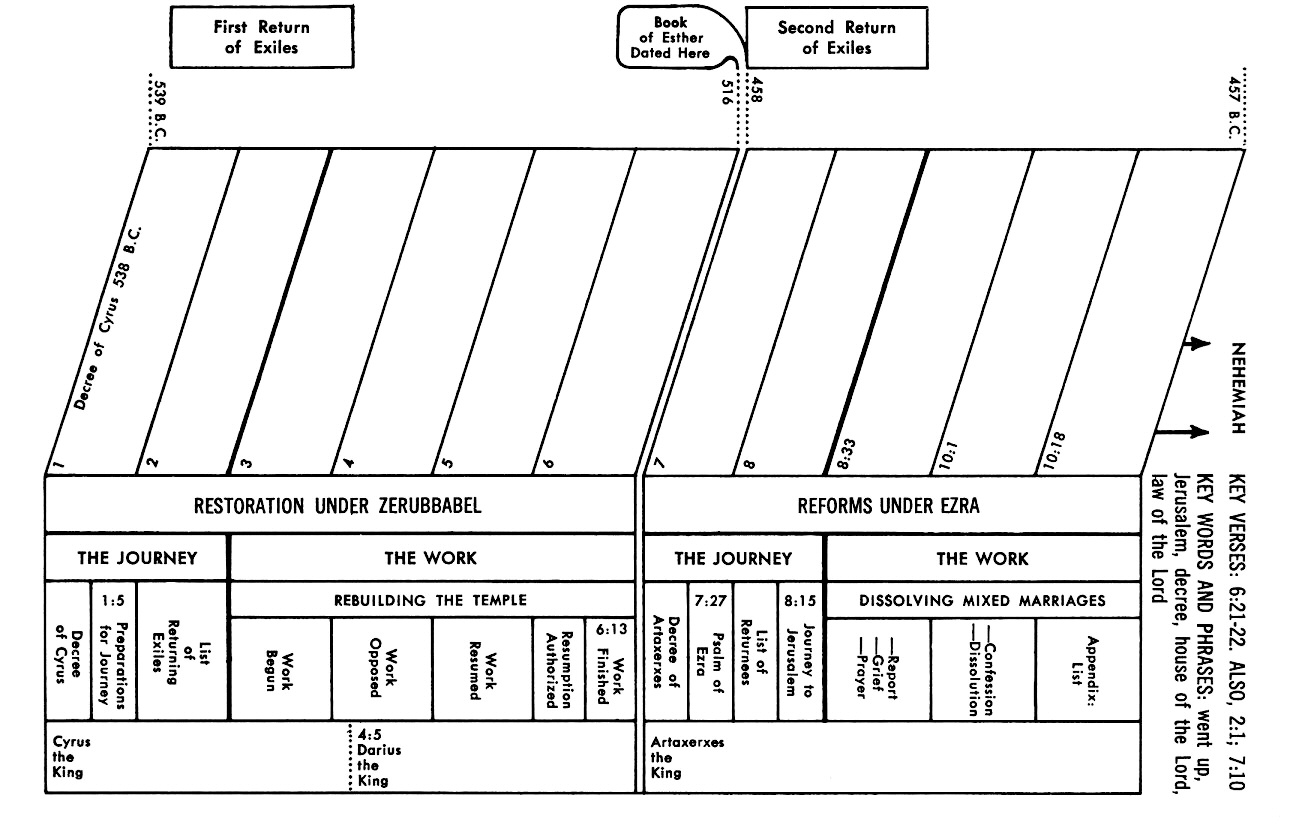
Bob Utley - 8:l-14 This is a list of those Jewish people who returned from exile in Babylon with Ezra. They are, for the most part, members of the same families who returned under Zerubbabel.
This list begins with two priests and one descendant of the royal line of David. In a sense this parallels Zerubbabel (royal line) and Jeshua (family of Aaronic High Priest). The author is trying to show that both groups of leaders (royal and priestly) were also involved in the third return
- Sheshbazzar, cf. Ezra 1, under Cyrus
- Zerubbabel/Jeshua, cf. Ezra 2-6, under Darius
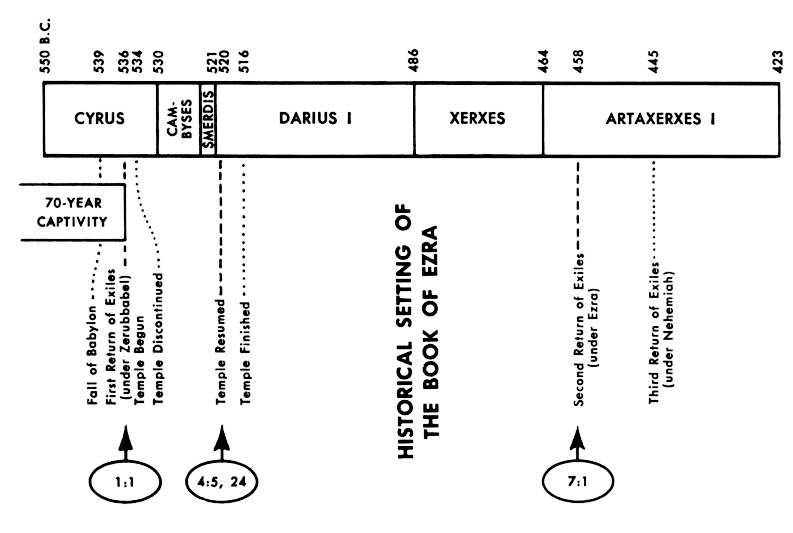
- Ezra, some 57-58 years later, under Artaxerxes I)
8:1 "with me" This shows that Ezra himself is writing or dictating his own experience. Ezra's actions continue in Neh. 7:72-8:18. "I" sections are present in both Ezra and Nehemiah, which show they are two separate books even though they are combined in Hebrew tradition.
Steven Cole - The Work that God Blesses (Ezra 8:1-36)
You might be surprised to learn that the first article that I had published, back in the late 1960’s, was titled, “Why I Do Not Go to Church.” I grew up in the church. I attended church every Sunday as a kid. I have in a drawer at home a pin that I received for perfect Sunday School attendance for seven years, and my record actually went longer than that. But during my college years I got frustrated with the church to the point of dropping out.
My frustrations did not stem from a lack of commitment to Jesus Christ or enticement into the world. To the contrary, I dropped out when my commitment and zeal for the Lord increased, not when it decreased. The college pastor of our church saw my zeal, latched onto me and put me in a group whose task was to brainstorm and come up with creative programs that would attract other college students to attend. I later sardonically referred to this as coming up with “Creative Programs for Carnal Christians.” If we succeeded in luring 50 otherwise disinterested students to our interesting program, the college pastor raved about how successful it was. But if our program wasn’t quite as enticing, the attendance would drop and we would rack our brains for something different.
Meanwhile, at Long Beach State College, our Campus Crusade group regularly saw 125 students come out on Friday nights to study the Bible without any creative programs to entice them to come. No doubt some of the students came for the purpose of meeting attractive specimens of the opposite sex. But most of the students were there primarily because we wanted to grow in our relationship with Jesus Christ. The gap was glaring: at church, a bunch of worldly kids had to be enticed to attend the creative program or they wouldn’t come. At college, the simple reality of knowing Christ and fellowshipping with others who wanted to know Christ drew the students. So I dropped out of the church with its superficiality and wrote my article for a friend who had started a Christian newspaper.
But even though I was frustrated with what I saw as the superficial games at the local church, I couldn’t shake the fact that Jesus said, “I will build My church” (Matt. 16:18); and, “Christ loved the church and gave Himself up for her” (Eph. 5:25). God gave me a deep desire to help make the church all that He wanted it to be. That’s why I have been a pastor for these past 25 years.
I want this church to be a work that God truly blesses. I refuse to be a program manager of the latest Creative Programs that will attract Carnal Christians. I’m not here to entertain. I want to shepherd a flock that hungers and thirsts after reality with God. I want the living Savior to be at work in our midst in unmistakable ways. I want to remove every hindrance that would block God’s hand of blessing and I want to add every quality that would bring His blessing on His church. As Ezra testified to King Artaxerxes (Ezra 8:22), “The hand of our God is favorably disposed to all those who seek Him….” I want us to be a people that seek God.
Last week we looked at the life that God blesses. This week we are looking at the work that God blesses. This chapter gives the account of the journey of about 5,000 exiles (including women and children) from Babylon to Jerusalem. The phrase, “the hand of our God,” which we saw in Ezra 7:6, 9, 28, occurs three more times: Ezra 8:18, 22, & 31. We learn three ingredients in the work that God blesses:
God blesses the work that seeks to honor Him by humble faith, scrupulous integrity, and Christ-centered worship.
Honoring God is the major thrust of the chapter. Ezra refused to accept an armed escort from the king because he had told the king how God would protect His people (Ezra 8:22). So these people put their faith on the line by venturing out into a robber-infested desert with no human protection. Also, Ezra wanted to honor God by a strict accounting of the silver, gold, and other resources that they were transporting to Jerusalem. And, the reason that these people were making this difficult and dangerous journey was to honor God by worshiping at His house.
1. God blesses the work that seeks to honor Him by humble faith.
Ezra’s humble faith in the Lord shines through in two ways: in the roster of people who were willing to commit themselves to this difficult enterprise; and, in making the journey without armed protection. We learn:
A. WE HONOR GOD BY TRUSTING HIM TO RAISE UP GODLY, QUALIFIED LEADERS AND PEOPLE FOR THE WORK.
It is one thing to go and ask the king’s permission to lead a delegation of exiles back to Jerusalem. But it is another thing actually to get volunteers to commit to the difficult task of giving up their comfortable situations in Babylon and to make the move back to an uncertain future in Israel.
The list of names (8:1-14) begins with priestly families (Ezra 8:2), then those from the royal line of David (8:2b-3a), followed by 12 “lay” families (Ezra 8:3b-14), which may be representative of all Israel. The number of men listed is 1,496, plus the 18 heads of families, totaling 1,514. Adding in the 258 Levites and temple servants assembled later (Ezra 8:15-20) brings the total to 1,772. The women and children would bring the group to around 5,000, compared to almost 50,000 on the first return.
One significant fact about the list is that everyone, except for Joab (Ezra 8:9) is connected to the pioneers who had first returned 80 years before (Derek Kidner, Ezra & Nehemiah, Tyndale Old Testament Commentaries [IVP], p. 65). This implies that “the original challenge to return, in the days of Cyrus, had had a very mixed response, dividing individual clans down the middle” (ibid.). The phrase “the last ones” (Ezra 8:13) may indicate that these descendants represented the final members of that clan residing in Babylon. But that fact that clans were split up points both to the comfortable lifestyle in Babylon that contributed to the spiritual indifference of returning; and to the faith and commitment of those who did return.
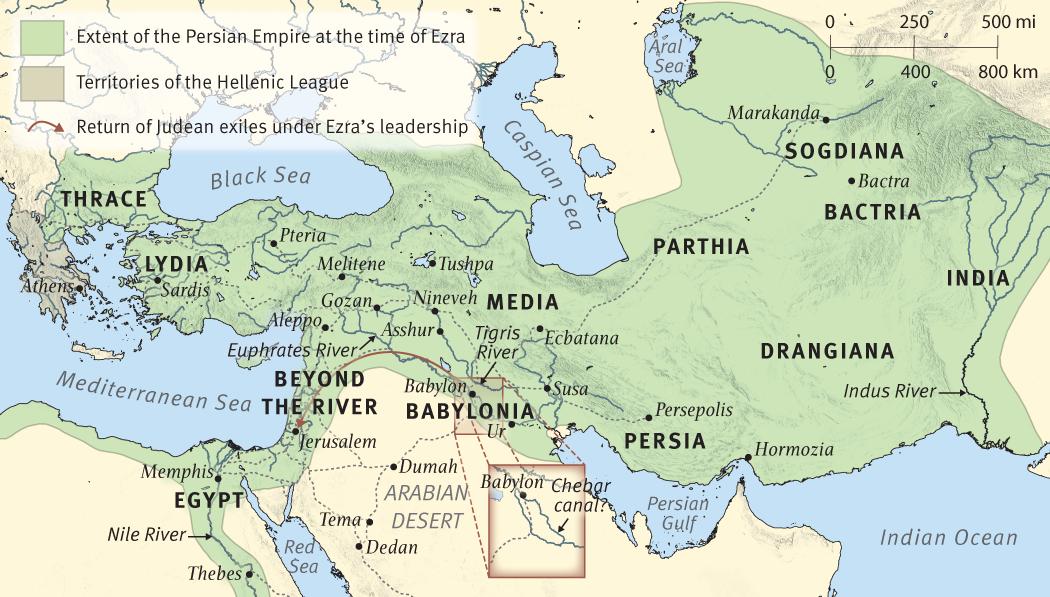
It was no small task to organize a pilgrimage of 5,000 people, including children, across 900 miles of hostile desert. The group began on the first of the first month (Ezra 7:9), but they paused for three days at a canal that runs to Ahava (Ezra 8:15). As Ezra took stock of things, he discovered that there were no Levites present. There were three groups of priests, all descended from Levi: (1) the high priest; (2) ordinary priests; and, (3) the Levites, the lowest order, who cared for the service of the sanctuary (C. L. Feinberg - BORROW The Zondervan Pictorial Encyclopedia of the Bible Volume 4). The temple servants (Ezra 8:20, “Nethinim”) assisted the Levites in their tasks.
It may be that none from these two groups had joined the returning exiles because of both the hardship of returning and also the bottom of the ladder status of their tasks at the temple. But, even though their jobs were not as glamorous as that of the priests, they were essential if the priests were to be freed up to do their work. So Ezra selected nine leaders, along with two men called teachers (Ezra 8:16) and sent them to Iddo, the leading man at what was apparently a conclave of Levites. He briefed this delegation on what they should say (Ezra 8:17). “And according to the good hand of our God upon us they brought” back “a man of insight” along with some other Levites, totaling 38 men (Ezra 8:18-19). Also, 220 temple servants were persuaded to accompany the returning exiles. These 258 men and their families had very short notice to make the decision to return, to pack up and join the waiting group, which started out across the desert on the twelfth day of the first month (Ezra 8:31).
We see Ezra’s humble trust in God in his thankful acknowledgement that these men joined the group because of “the good hand of our God upon us.” He recognized that God had to put it on the hearts of His people to be willing to serve, even in the tasks that were not so flashy. Three observations:
(1) God’s work requires workers as well as leaders. If you have leaders without adequate numbers of workers, the leaders will have too much to do, and thus will be hindered from giving proper leadership. If you have workers but inadequate numbers of leaders, the workers will not have the direction and understanding of the work that is needed. In other words, all the parts of the body of Christ are necessary for the proper functioning of the whole. If you are a believer in Christ, you’re a part of His body, the church, and you have a ministry where He wants you to serve. Workers are just as vital to the Lord’s work as leaders. Which part of your body would you like to do without? Every part of the body of Christ is crucial!
That point was easy. Now for a more controversial point:
(2) Leaders in the Lord’s work should be male. This list numbers the men, omitting the women and children. They are called “the heads of their fathers’ households” (Ezra 8:1). Derek Kidner observes, “Ezra knew the structure of his society well enough to direct his appeal to the heads of families (Ezra 7:28; Ezra 8:1), knowing that in most cases if they came they would bring their groups with them” (p. 64, italics his). He also notes that modern church strategy often tends to reverse this, going after the children first, to the neglect of husbands and fathers.
The New Testament is clear that the role of elder is limited to men (1 Tim. 3:1-7; Titus 1:5-9), and that women are not to function as teachers over men (1 Tim. 2:11-15). In the home, husbands are the heads of their families (Eph. 5:22-6:4). This does not mean that elders lord it over the church or husbands bark orders to their families. Rather, we should be examples of the self-sacrificing servant love of our Lord Jesus Christ (1 Pet. 5:1-5; Eph. 5:25). Being the leaders means that elders are accountable to the Lord for the direction of His church and husbands will answer to Him for the spiritual direction of our families. We should not capitulate to our culture by adopting egalitarian roles in the church or home.
(3) Leaders must be both godly in character and qualified by gift and training. The men whom Ezra sent are called “leading men” and “teachers” (Ezra 8:16). One of the men they recruited is called “a man of insight” (Ezra 8:16). Also, when Ezra entrusts these men with the gold and silver that they are to safely transport to Jerusalem, he reminds them, “You are holy to the Lord” (Ezra 8:28). Ezra was not threatened, but rather was thankful (Ezra 8:18) that the Lord raised up godly, qualified men to serve in leadership positions along with him.
Likewise, local churches need godly leaders, qualified for the office of elder both by gift and training. The qualifications for elder (1 Tim. 3:1-7; Titus 1:5-9) are primarily character qualities, except for “able to teach,” which requires both gift and training. While no man perfectly matches the high standards for elders, we should not put men into that office who glaringly lack any of these qualities. God will bless the work that honors Him by trusting Him to raise up godly, qualified leaders and workers.
B. WE HONOR GOD BY TRUSTING HIM TO PROTECT OUR WORK AND OUR FAMILIES FROM THE ENEMY.
Our text does not reveal what must have been quite interesting, namely, the details of how and when Ezra told the returning exiles that there would not be any armed guards accompanying them on the return trip! It is amazing that there is no indication that people began bailing out when they heard the news. It is equally amazing that there was not a group of dissidents crying out, “This is insane! It’s suicide to venture out into that hostile, robber-infested desert, loaded with gold and silver, with no military protection!” But apparently, none protested.
Ezra reports, “I proclaimed a fast … that we might humble ourselves before our God to seek from Him a safe journey for us, our little ones, and all our possessions” (Ezra 8:21). He then explains that this was necessary because he had told the king, “The hand of our God is favorably disposed to all those who seek Him” (Ezra 8:22). Because of this, Ezra was ashamed to ask for a military escort. “So we fasted and sought our God concerning this matter, and He listened to our entreaty” (Ezra 8:23). “The hand of our God was over us, and He delivered us from the hand of the enemy and the ambushes along the way” (Ezra 8:31). Thus the group safely arrived in Jerusalem.
It’s interesting that later Nehemiah, who was also a man of faith, accepted the king’s protection for his trip (Neh. 2:9). There is no indication that he was sinning or lacking in faith for so doing. This raises a thorny question, which I can only touch on: When is it wrong to use human means in addition to trusting the Lord?
I think that the normal pattern is to trust God while thankfully using the means that He provides. You pray for protection on the highways, but you fasten your seat belt and drive carefully. You pray for healing, but you go to the doctor and take the prescribed medicine. You pray for a job, but you prepare a resume, dress appropriately, and go for job interviews. God normally expects us to use the means He provides, along with faith in Him.
But sometimes using human means will lead us away from trust in the Lord, or it would be a poor witness to unbelievers. Often, this is an individual matter before the Lord. For example, George Muller believed that it would not demonstrate faith in the Lord and thus not honor Him to advertise the financial needs of his orphanages. I’m sure that he was obeying God in the way he operated, making his needs known only to God in prayer. Yet others have revealed the needs of their ministries to God’s people, while trusting God and asking Him to provide. We just need to be sure that we’re seeking to honor God and that we are consciously trusting Him.
Our text shows that as God’s people seeking to do God’s work, we need to recognize that there are enemies and ambushes along the way (Ezra 8:31), and thus we desperately need “God’s hand over us” to protect us. The enemy is seeking to destroy us and our little ones (Ezra 8:21) by tearing apart families and by bringing down church leaders. I know of many men, formerly in the ministry, who have brought dishonor to God and His church through divorce or moral failure. Satan is especially targeting leaders. Knowing that there are enemies and ambushes along the way, we must humble ourselves and seek God’s protection through prayer, and in special times of need, through fasting. God will bless His work through us when we seek to honor Him by humble faith.
2. God blesses the work that seeks to honor Him by scrupulous integrity.
Some scholars have questioned the amount of gold and silver mentioned here, which amounts to many tons and represents millions of dollars in today’s currency. But if the king thought that Ezra’s God really existed, he would have wanted to give a gift fitting for a king. When you add in the gifts from the king’s counselors, princes, and the Jews who did not return (8:25), it added up to a sizeable amount. Ezra was concerned to give a report back to the king that the entire amount was delivered to Jerusalem without any of it being skimmed off through greed and corruption.
Thus he parceled the items out by weight and let them know that they were accountable to deliver that amount to God’s house in Jerusalem. When they got there, everything was numbered and weighed, recording the numbers (8:34). Perhaps some of the leaders grumbled, “Doesn’t he trust us? Why does he have to weigh everything on both ends and write it all down? After all, God is watching all that we do.”
But as Paul put it with regard to his careful handling of the gift for the poor in Jerusalem, “We have regard for what is honorable, not only in the sight of the Lord, but also in the sight of men” (2 Cor. 8:21). If we do not follow proper accounting procedures, it exposes workers to temptation and to accusations. I knew of a church near us in California where the members made out their checks to “Jim Smith Ministries” and Pastor Jim (not his real name) was the only person who handled the funds. He made all deposits and he dispersed all checks. That is simply an open invitation for corruption and scandal!
We need to be scrupulous in matters of financial integrity, even on small matters. We have each staff member pay for personal long distance calls on church phones and for personal copies on the church copy machine. None of the pastoral staff have access to our giving records. Those who do are charged with maintaining confidentiality. Other accounting procedures insure that the work here is honorable, not only in the Lord’s sight, but also in the sight of men. When Jesus said, “He who is faithful in a very little thing is faithful also in much” (Luke 16:10, the “very little thing” in the context is money. He went on to promise that if we are faithful in money matters, then the Lord would entrust true riches to us (Lk 16:11), which in the context are the souls of people.
The matter of integrity extends beyond financial integrity to the whole of a man’s character. Ezra was a man of moral integrity. That is one reason that God’s hand of blessing was upon him.
Thus God blesses the work that seeks to honor Him by humble faith and by scrupulous integrity. Finally,
3. God blesses the work that seeks to honor Him by Christ-centered worship.
The whole aim of this arduous undertaking of moving 5,000 people across 900 miles of desert was to worship God by offering sacrifices at His temple in Jerusalem (Ezra 8:35). Our chapter repeats the phrase, “the house of [our] God” six times in reference to the temple (Ezra 8:17, 25, 29, 30, 33, 36). Worshiping God at His house was so important to these exiles that they were willing to suffer hardship, danger, and great inconvenience to move back to Israel.
As soon as they got back to Jerusalem, rested, and accounted for the items for the temple, they offered sacrifices to the Lord. “The sin-offerings availed as an atonement for the sins of all Israel, and the burnt-offerings typified the surrender of the entire nation to the service of the Lord” (C. F. Keil, Keil & Delitzsch Commentary on the Old Testament [Eerdmans], Ezra, p. 113).
The entire Old Testament sacrificial system pointed forward to the Lord Jesus Christ, who offered Himself on the cross as the atonement for our sins. Thus our worship must always focus on Jesus Christ and Him crucified. As Paul put it, “But may it never be that I would boast, except in the cross of our Lord Jesus Christ, through which the world has been crucified to me, and I to the world” (Gal. 6:14). If we exalt Jesus Christ and His sacrificial death on the cross, God will honor His work in this church.
Conclusion
God’s people in Ezra’s day were far from perfect. In the next chapter, we will see how Ezra was appalled to learn that both the people and the priests had corrupted themselves by intermarrying with the peoples of the land. Nehemiah had to deal with further problems just a few years later (Nehemiah 13).
There will never be a perfect church on this earth before Christ returns. We all are prone to the influence of the world, the flesh, and the devil. Corruption forms on us as easily as rust on a nail left out in the rain.
But just because the church cannot be perfect does not mean that it cannot be good. We can be a holy people before the Lord. We can seek Him. We can experience His blessing on His work here if we will seek to honor Him by humble faith, scrupulous integrity, and Christ-centered worship. I encourage you to join me in laboring to make this church a work that God truly blesses!
Discussion Questions
- Every Christian should have a ministry. Agree/disagree? Give biblical support.
- Men should be the leaders in the church and at home. Agree/ disagree? Give biblical support.
- How can we know when it is proper or when it is wrong to use human means in addition to trusting God?
- In light of Luke 16:10-13, why is financial integrity a big deal?
- What does it mean to glory (boast) in the cross of Christ (Gal. 6:14)? How can we do this as individuals and as a church?
Brian Bell - Nehemiah 8:1-36 -
- COMRADES & COMPANIONS (Neh 8:1-14)
- (Neh 8:1) This was simply the list of those who returned w/him.
- LOOKIN FOR LEVITES (Neh 8:15-20)
- (Neh 8:15) Ahava – Exact location unknown, most likely a tributary off the Euphrates River. Here Ezra assembled the returning exiles before their journey to Jerusalem.
- So now there only about 100-200 miles into their 400 mile journey.
- (Neh 8:15-20) No Levitical priests were coming???
- Ezra had to draft some because they didn’t volunteer.
- Again, this shows the state of the people. It also shows they would have…
- To Uproot Everything: Kids were in school, have to sell the house.
- Heavy Hardships: they’d have to load up the covered wagons & move west.
- Radical Job change: They’d move from ordinary pursuits to the strict routine of Temple service.
- FASTING FOR FORTIFICATION (Neh 8:21-23)
- (Neh 8:22) What a great leader. He cared more for God’s reputation then his own safety. What integrity.
- To Ezra their nations testimony was at stake.
- He told the king we don’t need a military escort…God will be our escort! He would care for them. [no visible protection needed...we have invisible protection]
- Casting all your care upon Him, for He cares for you.
- When do we take the escort & when don’t we?
- Once in Russia in the city of Lipetsk (S/E of Moscow) we received a police escort lights-a-flashin & sirens a blarin all the way through the city.
- But they were trying to honor us…& probably wanted us out of their city.
- Once in Russia in the city of Lipetsk (S/E of Moscow) we received a police escort lights-a-flashin & sirens a blarin all the way through the city.
- When do we except the help of Caesar or the unbeliever & when don’t we? ASK?
- In this case it is when Gods name, testimony, & his people are at stake.
- This is a healthy, holy shame-facedness.
- The king would think that Ezra’s profession of faith in God was just hypocrisy…i.e. The God of Israel couldn’t take care of His own worshippers?
- He couldn’t bring his mind to lean on an arm of flesh. F.B.Meyer
- Here’s what helped him: (a) He knew this was of the Lord (b) He knew since it was of Him, he would be guarded by Him who is his sword & shield.
- Deut.33:29 Happy are you, O Israel! Who is like you, a people saved by the LORD, The shield of your help And the sword of your majesty.
- (Neh 8:23) This verse ought to encourage us also to have this similar behavior.
- Mt.6:15,16 says twice, when you fast…inferring you will,…it doesn’t say, if you fast.
- Has the Lord shown you to fast for anything lately? Were you obedient to it? How about this week? Is there anything you are not getting answers to in prayer? Fast.
- What do we learn about our God here?
- (Neh 8:22) What a great leader. He cared more for God’s reputation then his own safety. What integrity.
- GIFTS FOR GOD (Neh 8:24-27)
- 22 men were entrusted w/the goods.
- GUARDING GODS GIFTS (Neh 8:28-30)
- 22 were held accountable to the delivery of their task.
- The Lord does the same with us. Entrusting us as His stewards & one day to stand before his Bema seat for accountability.
- 22 were held accountable to the delivery of their task.
- XI. Slide16 JOURNEY TO JERUSALEM (Neh 8:31-36)
- Do you ever pray the prayer for Traveling Mercies?
- Like when you hop in your cars with your family before trips.
- Here is a place in scripture where they prayed for Traveling Mercies.
- Neh 8:21-23’s prayer & fasting…answered!
- Like when you hop in your cars with your family before trips.
- (Neh 8:33-35) Everything…all was delivered & weighed in…all watched & kept (Neh 8:29).
- The left in April 458bc & arrived in July. They averaged 7 miles a day.
- They all deposited their treasures…each man found faithful.
- A great reminder to us to Watch & Keep all that He bestows into our care.
- (Neh 8:36) Prov.16:11 When a man's ways please the LORD, He makes even his enemies to be at peace with him.
- Do you ever pray the prayer for Traveling Mercies?
- EZRA’S SECRET TO SUCCESS
- God’s Hand was with him: It’s a Providing hand (Neh 7:6). It’s a Guiding hand (Neh 7:9). It’s a Encouraging hand (Neh 7:28). It’s a Protecting hand (Neh 8:31)
- We also see Ezra’s Hand: The word of God was in his hand (Neh 7:14).
- The word of God is in your hand also, whatcha doing with it?
- We also see God using the people’s Hands: Their hands carried & faithfully delivered all the treasures in their hands (Neh 8:26,33). So, watch & keep (Neh 8:29).
- Here’s how it works: God’s strong but tender hands are laid upon our frail hands, as a father does his son in the turning of a wrench.
- With joy the little boy says, Look what I’VE done, when really the credit should go to the Father.
- Here’s how it works: God’s strong but tender hands are laid upon our frail hands, as a father does his son in the turning of a wrench.
Dale Ralph DavisThe Strong Hand (Ezra 8)
IV People: The Congregation of Israel - Ezra 8:1-20
A. The flicker of hope (Ezra 8:2)
Note Hattush of the sons of David (see the listing of Davidic/royal descendants in 1 Chron 3:17-24). If you scrutinize that list carefully, it seems, as Fensham says,4 that the main thread of the list is: Jehoiachin, Pedaiah, Zerubbabel, Hananiah, Shecaniah, Shemaiah, Hattush. Hattush is then the fourth generation after Zerubbabel. If Zerubbabel was born ca. 560 B.C., and if one allots approximately 25 years per generation, then Hattush appears here about 458 B.C., which fits the traditional date of Ezra's arrival in Jerusalem.
Note that the writer does not go ballistic over the presence of a Davidic descendant here - the emphasis is muted (McConville); but he does mention it/him. "Of the sons of David, Hattush." Does this not somewhat parallel Matthew 1:12-16, where, during the exilic and post-exilic years, when the sky is often grey and the prospect drab, it is nevertheless clear that the Davidic covenant line keeps going and going? None of them reigns, yet the line continues until it surfaces in Jesus, the son of Mary. So here in Ezra 8; does not the mere mention of Hattush, a son of David, hint that the Davidic covenant, though presently eclipsed, is not dead and buried?
B. The power of genetics (Ezra 8:1-14)
Those who came back under Ezra tended to be from those families that had come back in 538 B.C. Note the following listing as it compares the list in Ezra 8 to that in Ezra 2:
8:3Parosh 2:3
8:4Pahath-moab2:6
8:5Zattu2:8
8:6Adin2:15
8:7Elam2:7
8:8Shephatiah2:4
8:9Joab____
8:10Bani2:10
8:11Bebai2:11
8:12Azgad2:12
8:13Adonikam2:13
8:14Bigvai2:14
The message here seems to be: don't trust in genetics (Matt 3:9 is true), but don't despise genetics either. After all, covenant fidelity tends to run in families.
As McConville says:
Even over the generations, it was particular families that were to the fore in making the journey back to the land. Reading between the lines, we may discern here an example of that faith-in-action … transmitted from generation to generation by those families which took seriously their religious and educative duties. (See Ezra, Nehemiah, and Esther - Page 53)
Is there not a word of hope and encouragement here to godly fathers and mothers? Doesn't this help answer the question: What can I do for the kingdom of God? Answer: Indoctrinate your kids and lead a godly life among them.
C. The challenge of work (Ezra 8:15-20)
Ezra faces a lack of Levites. So he sends ambassadors (v 16) to Casiphia (17). Who knows where that was. Apparently, it was a site near Babylon, perhaps a Judean study center? Note the acknowledgement of Yahweh's goodness in v 18a. The appeal nets a total of 38 Levites (vv 18-19) and 220 temple servants (v 20).
There was likely a level of comfort - even prosperity - for the exiles in Babylon. But if they (e.g., the Levites) were to go with Ezra back to Judea, they would leave a life where they may have had a good bit of autonomy from the "strict routines of the Temple" (Kidner) in Judea where life was not all fulfillment and fun. It's about as attractive perhaps as 2 Timothy 2:3: "Suffer hardship with me, as a good soldier of Christ Jesus."
Once a Chicago bank asked for a letter of recommendation for a young Bostonian being considered for employment. The Boston investment house exuded over the young man. His father was a Cabot, his mother a Lowell. Further back there was a marvelous blend of Saltonstalls, Peabodys, and others of Boston's elite. He was recommended heartily. Several days later, the Chicago bank sent a note notifying the investment operation that the information given was completely inadequate. It stated: "We are not contemplating using the young man for breeding purposes. Just for work."6
That was the situation here. The prospect was not glamorous. It was just work. Does this passage, by implication, not address the western church today? Is not the attitude in the church all to frequently: Don't upset my usual comfort by making any demands of me? Stan Evers lowers his guns on this attitude: "Why is it that they feel that it is expecting too much for them after a day's work to get involved in serving the Saviour who poured out his blood to redeem them from the torments of hell?"7
V. Protection: The Adventure of Faith -- Ezra 8:21-23, 31-32
A. The occasion of faith (Ezra 8:21b)
They were undertaking a 900-mile journey. That was quite a peril to face. How fragile they seemed. One can imagine the "interest" they might had kindled when word got out that a caravan was about to leave with x-amount of goods (see Ezra 8:25-30). Could they afford to go without state-provided protection?
B. The profession of faith (Ezra 8:22b)
Read the text! Here was the testimony of Ezra and company to the greatness and power of God.
C. The risk of faith (Ezra 8:22a)
There are times when faith must take on flesh, when what is professed must be expressed in concrete situations. There are those times when we must reject all visible human help and risk all on God alone. When could we possibly be safer? But we often don't view it that way. We are like the terrified lady onboard ship in a terrific storm. She happened to pass the captain and asked, "Is there any hope, Captain?" to which he responded, "Our only hope is in God." She turned more pale and gasped, "Are things really that bad?" (H. L. Ellison).
D. The expression of faith (Ezra 8:21a,23)
They engaged in fasting and prayer seeking a safe journey. Ezra says their purpose also was to "humble ourselves" (see Lev 16:29, 31). This pleading and confession does not contradict their professed confidence, but is the expression of it.
As stated above, there are those times when faith gets pushed beyond the theoretical, times when faith must be tested. But if we have any choice in the matter - as apparently Ezra had here - how do we discern the difference between faith and folly? Am I believing God by not taking a military escort or am I simply being stupid? How do I know? Am I tempting God or trusting God? And how can I tell the difference? Or, to look at it from the other angle, am I acting in prudence or in unbelief?
E. The vindication of faith (Ezra 8:31-32)
Sounds like small potatoes - a safe journey. But for a defenseless group of Jews exposed to daily danger, it was proof of the strong protection of God. "Thus we came to Jerusalem" is for them one of the outstanding miracle stories of life.
VI. Propriety: The Urgency of Honesty - Ezra 8:24-30, 33-34
The inventory of verses 26-27 will come out a bit differently depending on the commentator. But the amounts on any scheme are substantial: 650 Talents of silver equals 49,000 lbs., or about 25 tons of silver (EBC); Clines says19 tons. 100 Gold talents equals 7500 lbs., or 3 ¾ tons (per Clines, 3 tons). In any case, it's time for a Wells Fargo or Brinks armored truck to come rolling in.
The twelve leading priests Ezra entrusted with oversight of this wealth (Ezra 8:24) are called holy in verse 28, as were the utensils they guarded. In the latter case, "holy" means, in part, "off limits." Note the vigilance that Ezra requires of these priests in verse 29.
The journey itself, as many have noted, is passed over in silence as to detail (cf. v. 32: "Thus we came to Jerusalem"). But the weighing out is clearly and carefully recorded (Ezra 8:33-34). Are we not right to see here Ezra's concern to make their honesty transparent? Is this not Paul's argument in 2 Corinthians 8:19-21 (cf. also Gal 2:10; Rom 15:25-27) when he rallies the Corinthians to contribute to the relief of Hebrew Christians in Judea? Is this not a broad-ranging principle of ministry: "always be scrupulous to give no one any reason to suspect you of improper conduct or procedures"?
Ezra 8:1-20
May your hand be ready to help me, for I have chosen your precepts. - Psalm 119:173
TODAY IN THE WORD
Imagine arriving at your church today, or any given Sunday, and finding no one on duty: no Sunday school teachers or children’s workers; no ushers; no volunteers to help in the parking lot or welcome visitors; and no custodial staff to unlock the doors, turn on the lights, clean the classrooms, and arrange furniture or whatever is needed for each class. If that happened, it would be a very frustrating and chaotic day at your place of worship. Even in smaller churches, it takes the dedicated service of many people to fulfill the church’s ministry.
The analogy isn’t perfect, but the problem described above is similar to the problem Ezra faced as he and the Jewish exiles with him prepared to leave Persia for Jerusalem. The problem was that Ezra didn’t find any Levites among the families who had chosen to return with him. The group probably numbered several thousand including women and children, but apparently no Levites volunteered to go. This meant there would be a shortage of leaders to teach God’s law to the people, which Ezra knew was absolutely vital to Israel’s well-being. In fact, he refused to leave for Jerusalem until some Levites could be found to go.
Most of the families who left Babylon with Ezra were related to the families that returned with Zerubbabel many years earlier. The group camped for three days before leaving Persia for good, and it was during this time that Ezra discovered the absence of Levites.
God had designated the tribe of Levi to serve in the temple, and Ezra was determined to do things according to God’s Law. He appointed a delegation of leading men to go to a place called Casiphia and ask for Levites and temple servants who would be willing to serve at the temple in Jerusalem.
TODAY ALONG THE WAY
We can say for sure that there may be people among the pastors, Sunday school teachers, and other committed people, who serve at your church, who could use a note or call of appreciation. Ask God to bring a name to mind, or you may already know of someone at church who is facing a tough time and needs your encouragement. Jot down the name or names of the people you plan to contact, and make it a point to write notes or make phone calls this week.
Ezra 8:2 of the sons of Phinehas, Gershom; of the sons of Ithamar, Daniel; of the sons of David, Hattush;
- Phinehas (KJV): 1Ch 6:3,4-15 1Ch 24:1-6
- David (KJV): 1Ch 3:1,22
of the sons of Phinehas, Gershom; of the sons of Ithamar, Daniel; of the sons of David, Hattush;
Derek Kidner - “The interest of this forbidding list of names and numbers lies in the fact that in every case but one these groups are joining, at long last, the descendants of the pioneers from Babylon eighty years before.” (See more discussion Ezra and Nehemiah - Page 6)
Bob Utley - "the sons of Phinehas, Gershom" Phinehas was a son of Eleazar and grandson of Aaron (cf. Exod. 6:25; 1 Chr. 6:4,50; 1 Chr 9:20; I Esdras 8:2). In this context, we learn that he was the father of Gershom, a priest who returned with Ezra. He was a relative of Ezra (cf. Ezra 7:5). ▣ "the sons of Ithamar, Daniel" Ithamar was one of the four sons of Aaron (cf. Exod. 6:23). Daniel, one of his descendants, returned with Ezra. Daniel is also listed as a priest in Neh. 10:6. Nothing else is known about him. Ithamar's descendants', Eli's (cf. 1 Sam. 2:12-16) and Abiathar's (cf. 1 Kgs. 2:27) actions caused this family of priests to be depreciated in importance and service. Jeremiah was of this family. ▣ "the sons of David, Hattush" After the list of priests, there is a mention of the royal line of Judah, Hattush. He is mentioned in the Davidic genealogy of 1 Chr. 3 (cf. Ezra 8:22) and in the extra-canonical book I Esdras 8:29.
Ezra 8:3 of the sons of Shecaniah who was of the sons of Parosh, Zechariah and with him 150 males who were in the genealogical list;
- Pharosh (KJV): This variation is attributable to the translators; the original being uniformly Parosh. Ezr 2:3 Ne 7:8 Ne 10:14, Parosh
of the sons of Shecaniah who was of the sons of Parosh, Zechariah and with him 150 males who were in the genealogical list;
Ryrie - These are names of families, not individuals. See note on 2:3-19. The total (vv. 3-14) is 1,496.
Bob Utley - "sons of Shecaniah" This man was a relative of Zerubbabel (also of the royal line of Judah) listed in 1 Chr. 3:21-22. Because of the recurrent pattern in this context, he may be related to Hattush and not Parosh (cf. Rotherham's Emphasized Bible, p. 475 and The NET Bible, p. 720). ▣ "Parosh" This name appears several times in Ezra and Nehemiah as an Israelite family that returned with Zerubbabel. A descendant by the same name was active in rebuilding the walls of Jerusalem (cf. Ezra 2:3; Ezra 8:3; Ezra 10:25; Neh. 3:25; Neh 7:8; Neh 10:14; and I Esdras 8:30). ▣ "Zechariah" Several persons by this name are listed in the returnees with Ezra (cf. Ezra 8:3,4,11,16; Ezra 10:26). This one was a descendant of Parosh. The NASB is translated in such a way that it implies he is related to Shecaniah, which would make him of the tribe of Judah, but the Hebrew seems to separate this man into another group, not necessarily from any specific tribe.
Ezra 8:4 of the sons of Pahath-moab, Eliehoenai the son of Zerahiah and 200 males with him;
- Pahathmoab (KJV): Ezr 2:6 Ne 7:11 Ne 10:14
of the sons of Pahath-moab, Eliehoenai the son of Zerahiah and 200 males with him;
Bob Utley - "Pahath-moab" This is a leader of the returning Jews who is mentioned several times (cf. Ezra 2:6;Ezra 8:4; Neh. 3:11; Neh 7:11; Neh 10:14). The name implies that this large clan was from the area of Moab or they served David there (cf. 1 Sam. 22:3-4). Two thousand eight hundred and twelve of his descendants returned under Zerubbabel and 200 more under Ezra.
John Trapp - The whole company consisted of one thousand four hundred ninety and six males: a good addition to those that went up before with Zerubbabel; yet nothing so many as might have been, but that they wanted hearts.
Ezra 8:5 of the sons of Zattu, Shecaniah, the son of Jahaziel and 300 males with him;
of the sons of Zattu, Shecaniah, the son of Jahaziel and 300 males with him
Bob Utley - "Zattu" This name is omitted in the Hebrew text, but is included in the Septuagint and I Esdras 8:32. It is also missing in the Peshitta. He is the head of a large family that returned with Zerubbabel (cf. Ezra 2:8; Ezra 8:5; Neh. 7:13; I Esdras 8:32). A large number returned with Zerubbabel (i.e., 945 males) and possibly 300 more males with Ezra (cf. I Esdras 8:32). The UBS Text Project, p. 508, gives its inclusion a "B" rating (some doubt). ▣ "Shecaniah" I Esdras 8:32 makes him a descendant of Zattu and son of Jahaziel.
Ezra 8:6 and of the sons of Adin, Ebed the son of Jonathan and 50 males with him;
- Adin (KJV): Ezr 2:15 Ne 7:20 Ne 10:16
and of the sons of Adin, Ebed the son of Jonathan and 50 males with him
Bob Utley - "Adin" This man's descendants (i.e., Jonathan, Ebed) returned to Jerusalem under Zerubbabel in 454 (cf. Ezra 2:15) and under Ezra 50 more males made the long trip from Babylon to Judah.
Ezra 8:7 and of the sons of Elam, Jeshaiah the son of Athaliah and 70 males with him;
- Elam (KJV): Ezr 2:7,31 Ne 7:12,34
and of the sons of Elam, Jeshaiah the son of Athaliah and 70 males with him
Bob Utley - "Elam" This name, like Pahath-moab, may reflect the area to which these Jewish men were exiled (cf. Ezra 2:7). There is another group from this area mentioned in Ezra 2:31. The first group had 1,254 who returned under Zerubbabel (cf. Ezra 2:7; Neh. 7:12; I Esdras 5:12). In this text a second group returns under Ezra with Athaliah, Jeshaiah, and 70 males.
Ezra 8:8 and of the sons of Shephatiah, Zebadiah the son of Michael and 80 males with him;
- Shephatiah (KJV): Ezr 2:4 Ne 7:9 Ne 11:4
and of the sons of Shephatiah, Zebadiah the son of Michael and 80 males with him
Bob Utley - "Shephatiah" This is another family who returned under Zerubbabel with 372 males (cf. Ezra 2:4), and later, under Ezra (8:8; I Esdras 8:34) another 81 or 82 (which included Michael and Zebadiah). The parallel non-canonical account in I Esdras puts their numbers as 472 and 71 (cf. I Esd. 5:9).
Ezra 8:9 of the sons of Joab, Obadiah the son of Jehiel and 218 males with him;
- Joab (KJV): Ezr 2:6 Ne 7:11
of the sons of Joab, Obadiah the son of Jehiel and 218 males with him
Bob Utley - "Joab" This family is related to Pahath-moab (cf. Ezra 2:6; Neh. 7:11). They returned with 2,812 males under Zerubbabel and 218 plus (Jehiel and Obadiah) with Ezra (8:9).
Ezra 8:10 and of the sons of Bani, Shelomith, the son of Josiphiah and 160 males with him;
and of the sons of Bani, Shelomith, the son of Josiphiah and 160 males with him
Bob Utley - "Bani" This family is listed in Ezra 2:10 as bringing 642 males back with Zerubbabel (cf. I Esd. 5:12). Nehemiah 7:15, which is a parallel genealogy, has "Binnui" and lists the returning males as 648. Many scholars believe this refers to the same person, which is surely possibly, but the mentioning of both "Bani" and "Binnui" in Ezra 10:38 makes one wonder. The name is omitted in the Hebrew text and the Peshitta, but is present in the several manuscripts of the Septuagint, as well as I Esdras 8:36. The UBS Text Project, p. 508, gives its inclusion a "B" rating (some doubt).
Ezra 8:11 and of the sons of Bebai, Zechariah the son of Bebai and 28 males with him;
- Bebai (KJV): Ezr 2:11 Ezr 10:28 Ne 7:16
and of the sons of Bebai, Zechariah the son of Bebai and 28 males with him;
Bob Utley - "Bebai" This is another family who returned under Zerubbabel with 623 males (cf. Ezra 2:11; Neh. 7:16 has 628). Then later under Ezra another 28-29 (cf. Ezra 8:11, which includes Zechariah).
Ezra 8:12 and of the sons of Azgad, Johanan the son of Hakkatan and 110 males with him;
- Azgad (KJV): Ezr 2:12 Ne 7:17
- the son of Hakkatan (KJV): or, the youngest son
and of the sons of Azgad, Johanan the son of Hakkatan and 110 males with him
Bob Utley - "Azgad" This name means "Gad is strong" (BDB 739) and may reflect a tribal origin. This family returned initially under Zerubbabel with 1,222 males (cf. Ezra 2:12; Neh. 7:17; I Esd. 5:13) and then later under Ezra another 110 plus (including Hakkatan and Johanan, cf. Ezra 8:12).
Ezra 8:13 and of the sons of Adonikam, the last ones, these being their names, Eliphelet, Jeuel and Shemaiah, and 60 males with them;
- Adonikam (KJV): Ezr 2:13 Ne 7:18
and of the sons of Adonikam, the last ones, these being their names, Eliphelet, Jeuel and Shemaiah, and 60 males with them;
Bob Utley - "Adonikam" The name (BDB 12) means "the Lord has arisen." This family returned under Zerubbabel with 666 or 667 males (Neh. 7:18). They are mentioned again here by three proper names and 60 males as returning under Ezra (cf. I Esd. 5:14; 8:39).
Ezra 8:14 and of the sons of Bigvai, Uthai and Zabbud, and 70 males with them.
- Bigvai (KJV): Ezr 2:14 Ne 7:19
- Zabbud (KJV): or, Zaccur, as some read, Ne 10:12
and of the sons of Bigvai, Uthai and Zabbud, and 70 males with them
Bob Utley - "Bigvai" This is a significant family that returned with Zerubbabel (cf. Ezra 2:2; Neh. 7:7). He is listed in Ezra 2:2 and then the number of males who returned is given in Ezra 8:14 as 2,056. Two of his sons and 70 males returned with Ezra (8:14; I Esd. 5:14; 8:14, which says they came from Persia).
Ezra 8:15 Now I assembled them at the river that runs to Ahava, where we camped for three days; and when I observed the people and the priests, I did not find any Levites there.
- the river that runneth (KJV): Ahava is supposed to be the river Adiava, which, with the Diava, is said by Ammianus to have given name to Adiabene, a province of Assyria, through which they flowed into the Tigris. These rivers were also called respectively, Anzabas and Zabas, the Caprus and Lycus of Ptolemy; the former of which he places, at its source, in long. 79 degrees, lat. 39+ degrees, and at its junction with the Tigris, in long. 79+ degrees, lat. 36 degrees 6'; and the latter, at its source, in long 78 degrees, lat. 39 degrees; and where it falls into the Tigris, in long. 79 degrees, lat. 36+ degrees. They are now called the Great and Little Zab, or the Zabein, i.e., the two Zabs, which, says Ibn Haukal, "are considerable streams, each about half as large as the Dejleh (or Tigris). They rise among the mountains of Azerbaijan: of these, the larger is that which runs towards Haditheh. These streams form part of the Tigris, and water the district of Semerah." Ps 137:1 Eze 1:1 Eze 3:15 Ac 16:13
- Ahava (KJV): Ezr 8:21,31
- abode (KJV): Heb. pitched
- and found (KJV): Ezr 8:2 Ezr 7:7,24
Now I assembled them at the river that runs to Ahava, where we camped for three days; and when I observed the people and the priests, I did not find any Levites there.
Bob Utley - "Ahava" This is apparently the name of a district, a river, or a city in Babylon where Ezra camped and prepared for his journey to Jerusalem. The location has never been found and the meaning of the name is uncertain (BDB 13). The non-canonical book of I Esdras calls the river "Thares" (cf. I Esd. 8:41,61). ▣ "I did not find any Levites there" There was a good number of priests but they needed more Levites to help them in their temple work. The Levites did the more manual and mundane work of the temple routine. Therefore, they encouraged Ezra to find and recruit more of them. See Levitical Priests
Ryrie - Ahava. Possibly a tributary of the Euphrates River, though the location is uncertain. I did not find any Levites. See note on 2:40 for a possible reason.
Yamauchi - A rabbinic midrash on Psalm 137 relates the legend that there were Levites in the caravan but that they were not qualified to officiate because when Nebuchadnezzar had ordered them to sing for him the songs of Zion, ‘they refused and bit off the ends of their fingers, so that they could not play on the harps. (See Ezra, Nehemiah, Esther - Page 2)
Ripple Effect - Tim Gustafson Ezra 8:15–21
Because the hand of the Lord my God was on me, I took courage and gathered leaders from Israel to go up with me. Ezra 7:28
The little Bible college in northern Ghana didn’t look impressive—just a tin-roofed cinder-block building and a handful of students. Yet Bob Hayes poured his life into those students. He gave them leadership roles and encouraged them to preach and teach, despite their occasional reluctance. Bob passed away years ago, but dozens of thriving churches, schools, and two additional Bible institutes have sprung up across Ghana—all started by graduates of that humble school.
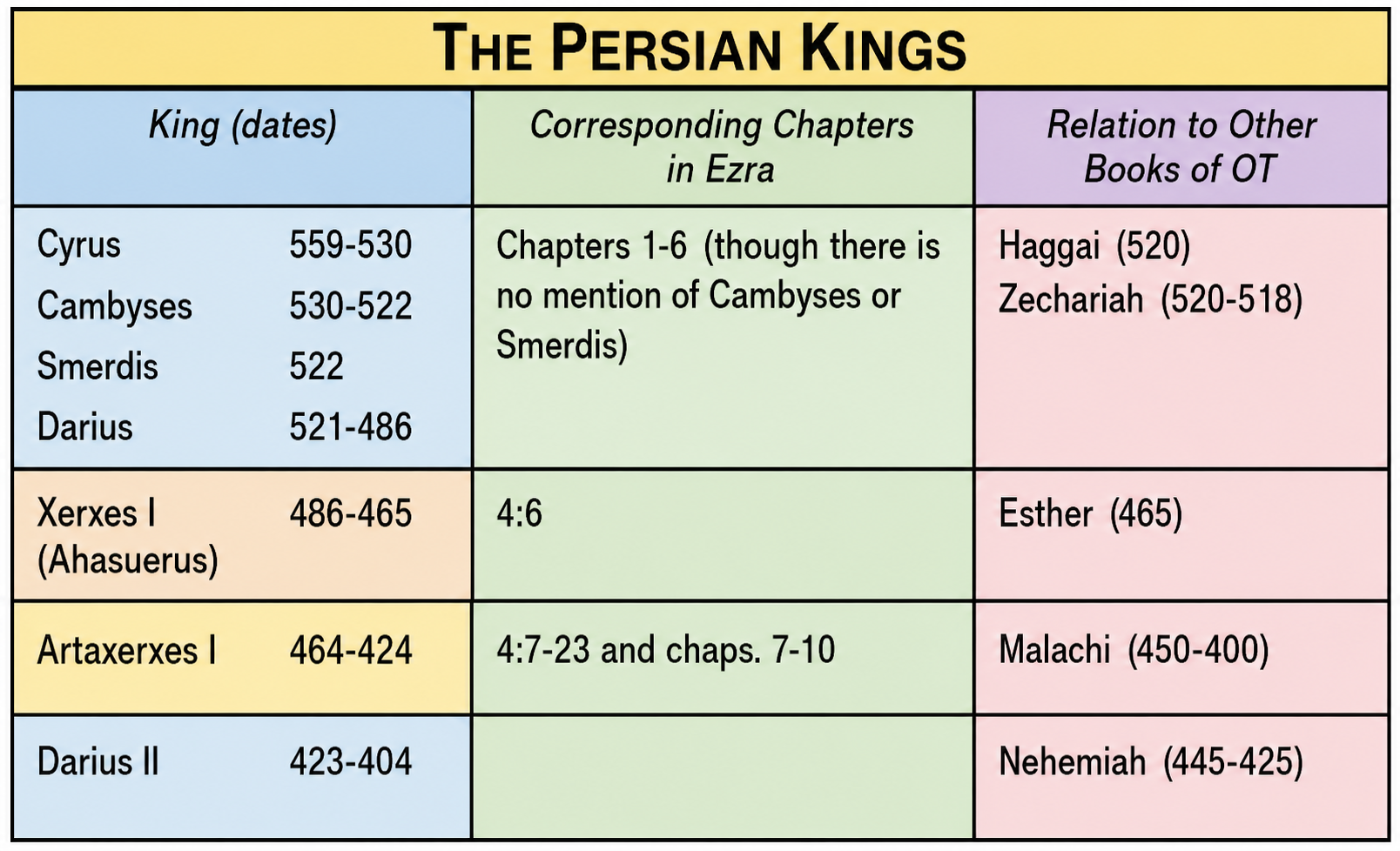
During the reign of King Artaxerxes (465–424 bc), Ezra the scribe assembled a band of Jewish exiles to return to Jerusalem. But Ezra found no Levites among them (Ezra 8:15). He needed Levites to serve as priests. So he commissioned leaders to “bring attendants to us for the house of our God” (v. 17). They did so (vv. 18–20), and Ezra led them all in fasting and prayer (v. 21).
Ezra’s name means “helper,” a characteristic that resides at the heart of good leadership. Under Ezra’s prayerful guidance, he and his protégés would lead a spiritual awakening in Jerusalem (see chapters 9–10). All they had needed was a little encouragement and wise direction.
That’s how God’s church works too. As good mentors encourage and build us up, we learn to do the same for others. Such an influence will reach far beyond our lifetime. Work done faithfully for God stretches into eternity.
Reflect & Pray
Who is your primary spiritual mentor? (If you don’t have one, who might you ask to mentor you?) Why is mentoring in Christ something vital for you to receive and extend to others?
Father, show me someone I can mentor.
Today's Insights - King Artaxerxes decreed that any exiled Israelites who wanted to return to their homeland could do so. Included in the king’s proclamation were priests and Levites (Ezra 7:13). So Ezra began leading a group back to Jerusalem. While traveling, however, he discovered that no Levites were part of the group (Ezra 8:15). Why did Ezra need Levites? Because Artaxerxes had given Ezra permission to “appoint magistrates and judges to administer justice to all the people of Trans-Euphrates—all who know the laws of your God” (Ezra 7:25). And Ezra was to teach those who didn’t know the laws. This required that Levites be part of the group that returned. They served as officers and judges (1 Chronicles 26:29) and were the ones who taught the law (2 Chronicles 35:3). After Ezra sent for Levites to join them, God’s “gracious hand” brought them home to Jerusalem (Ezra 8:18, 31–32).
Ezra 8:16 So I sent for Eliezer, Ariel, Shemaiah, Elnathan, Jarib, Elnathan, Nathan, Zechariah and Meshullam, leading men, and for Joiarib and Elnathan, teachers.
- Shemaiah (KJV): Ezr 8:13 Ezr 10:21
- Nathan (KJV): Ezr 10:39
- Zechariah (KJV): Ezr 8:11
- chief men (KJV): Ezr 8:1
- men of understanding (KJV): Ezr 8:18 1Ki 3:11 1Ch 12:32 1Ch 26:14 2Ch 2:12 Pr 2:6 Pr 20:5 Pr 28:2 Da 2:21 2Ti 2:7 1Jn 5:20
So I sent for Eliezer, Ariel, Shemaiah, Elnathan, Jarib, Elnathan, Nathan, Zechariah and Meshullam, leading men, and for Joiarib and Elnathan, teachers
Bob Utley - "Ariel" This name (BDB 72) means "lion" or "lioness" of God (El). It is a cryptic way of referring to Jerusalem (cf. Isa. 29:1,2,7), but here it appears as a proper name, so too, of a man of Moab (cf. 2 Sam. 23:20; 1 Chr. 11:22). ▣ "leading men" This is the Hebrew term for "head" (BDB 910) PLURAL. It is uncertain if they are priests, tribal leaders, or heads of clans (families). Names like Zechariah were very common and it is uncertain if the same name in Ezra 8:3 refers to the same person as Ezra 8:11 or 16. Probably there are three different persons by this name who returned with Ezra.
Ezra 8:17 I sent them to Iddo the leading man at the place Casiphia; and I told them what to say to Iddo and his brothers, the temple servants at the place Casiphia, that is, to bring ministers to us for the house of our God.
- Casiphia (KJV): Casiphia is supposed to denote the Caspian mountains, between Media and Hyrcania, near the Caspian Sea. It is evident, from a comparison of ch. 7:9 with ver. 31, that Casiphia could not be far from Ahava.
- I told them (KJV): Heb. I put words in their mouth, Ex 4:15 De 18:18 2Sa 14:3,19 Jer 1:9 Jer 15:19
- the Nethinims (KJV): Ezr 2:43,58 Ezr 7:7
- ministers (KJV): Nu 8:22-26 Nu 18:6 1Ch 23:3-6,26-32 Tit 1:5
I sent them to Iddo the leading man at the place Casiphia; and I told them what to say to Iddo and his brothers, the temple servants at the place Casiphia, that is, to bring ministers to us for the house of our God.
Bob Utley - "Casiphia" This word (BDB 494) seems to be a place location in Babylon (but unidentified), either of a large Jewish settlement or a well-known Jewish school. Some scholars even think it could possibly be a Jewish sanctuary similar to the one in Egypt mentioned in the Elephantine papyri. ▣ "Iddo and his brothers, the temple servants" Does this verse imply that (1) Iddo was related to the Nethinim (cf. NIDOTTE, vol. 3, pp. 203-204), (2) Nethinim refers to non-Jews who were captured foreigners in Israel's past and now had become temple slaves (cf. Ezra 8:20), (3) Nethinim here simply means temple servants (i.e., Levites, cf. Ezra 8:18-19)
Ryrie - Casiphia. Unidentifiable, though a colony of Levites and Nethinim (Temple servants) must have been there. Thirty-eight Levites and 220 servants responded to Ezra's call to enlist (vv. 18-20).
Ezra 8:18 According to the good hand of our God upon us they brought us a man of insight of the sons of Mahli, the son of Levi, the son of Israel, namely Sherebiah, and his sons and brothers, 18 men;
- by the good hand (KJV): Ezr 8:22 Ezr 7:28 Ne 2:8 Pr 3:6
- a man of understanding (KJV): Ezr 8:16 Pr 24:3 Jer 3:15 Da 1:20 1Co 14:20
- Mahli (KJV): Nu 3:20 1Ch 6:19
- Sherebiah (KJV): Ezr 8:24 Ne 8:7 Ne 9:4,5 Ne 10:12 Ne 12:24
According to the good hand of our God upon us they brought us a man of insight of the sons of Mahli, the son of Levi, the son of Israel, namely Sherebiah, and his sons and brothers, 18 men;
Bob Utley - "Mahli" He was a descendant of one of the three sons of Levi (Gershon, Kohath, and Merari, cf. Num. 3:17). Merari's sons were assigned the task of helping to move the tabernacle (cf. Num. 4:29-33). Mahli was a descendant of Merari (cf. 1 Chr. 6:47).
Ezra 8:19 and Hashabiah and Jeshaiah of the sons of Merari, with his brothers and their sons, 20 men;
- Hashabiah (KJV): Ne 3:17 Ne 10:11
- Merari (KJV): 1Ch 6:1,16,19
and Hashabiah and Jeshaiah of the sons of Merari, with his brothers and their sons, 20 men
Ezra 8:20 and 220 of the temple servants (Nethinims), whom David and the princes had given for the service of the Levites, all of them designated by name.
- Nethinims (KJV): Ezr 8:17 Ezr 2:43 Ezr 7:7 1Ch 9:2
- all of them (KJV): Php 4:3
and 220 of the temple servants, whom David and the princes had given for the service of the Levites, all of them designated by name.
Ezra 8:21 Then I proclaimed a fast there at the river of Ahava, that we might humble ourselves before our God to seek from Him a safe journey for us, our little ones, and all our possessions.
- I proclaimed (KJV): Judges 20:26 1Sa 7:6 2Ch 20:3 Joe 1:14 Joe 2:12-18 Jon 3:5
- afflict ourselves (KJV): Lev 16:29,31 Lev 23:29 Isa 58:3,5 Jer 31:8,9 Jer 50:4,5
- to seek (KJV): Ps 5:8 Ps 107:2-8 Ps 143:8-10 Pr 3:6 Isa 30:21 Isa 35:8 Isa 42:16 Isa 49:10 Jer 10:23
- for our little ones (KJV): Nu 14:3,31 Ps 8:2 Mk 10:13-16 Ac 2:39
Then I proclaimed a fast there at the river of Ahava, that we might humble ourselves before our God to seek from Him a safe journey for us, our little ones, and all our possessions - "to seek from Him a right way for us" (Ezr 8:21YLT) or a straight way unimpeded by obstacles and dangers.
David Guzik - As with any spiritual discipline or duty, it is possible to fast without the right heart and to trust it as an empty ritual, apart from its true spiritual reality. Real fasting – fasting that is partnered with real repentance and isn’t only about image – has great power before God (Matthew 17:21).
Bob Utley - 8:21-23 This is a very personal note which reveals the heart of Ezra. Nehemiah did exactly the opposite (i.e., request troops), but also from a stance of faith (cf. Neh. 2:7-9). It must be remembered that Ezra had a religious purpose and Nehemiah had a political purpose. Ezra's faith was expressed in (1) words to Artaxerxes and (2) prayers and fasting to God. Witness and action! It must be remembered that Ezra will take a large amount of precious metal from the king and other Jews (cf. Ezra 8:25). The amount was staggering, yet he asked for no protection! ▣ a safe journey The literal Hebrew construct is "a straight way" (BDB 202 plus 449). God's will and teachings are often characterized as a way or path (cf. Ps. 1:1; Ps 119:105; Pro. 4:10-19). The early church was first called "the Way" (cf. Acts 9:2; Acts 19:9,23; Acts 22:4; Acts 24:14,22 and possibly 18:25,26). Biblical faith is a lifestyle response to God. The term "straight" is a crucial theological term often used to describe God's character, but here it is used in its non-theological connotation of a safe or successful trip.
Believer's Study Bible - vv. 21-23) The occasion for this fasting was the return of the people to Israel. Ezra had argued for the right of the people to return to Israel based upon the will and providence of God (v. 22). Consequently, he was ashamed to ask any protection from the king for the journey to Jerusalem. Realizing that protection ultimately must come from God alone and being sensitive to the appearance of God's people before the nations, Ezra made his appeal solely to God.
Matthew Henry - Ezra implores God's blessing - Ezra 8:21-23. Ezra procured Levites to go with him; but what will that avail, unless he have God with him? Those who seek God, are safe under the shadow of his wings, even in their greatest dangers; but those who forsake him, are always exposed. When entering upon any new state of life, our care should be, to bring none of the guilt of the sins of our former condition into it. When we are in any peril, let us be at peace with God, and then nothing can do us any real hurt. All our concerns about ourselves, our families, and our estates, it is our wisdom and duty, by prayer to commit to God, and to leave the care of them with him. And, on some occasions, we should decline advantages which are within our reach, lest we should cause others to stumble, and so our God be dishonoured. Let us ask wisdom of God, that we may know how to use or to refuse lawful things. We shall be no losers by venturing, suffering, or giving up for the Lord's sake. Their prayers were answered, and the event declared it. Never have any that sought God in earnest, found that they sought him in vain. In times of difficulty and danger, to set a season apart for secret or for social prayer, is the best method for relief we can take.
Devotional - Total Dependence
Ezra 8:22 For I was ashamed to request from the king troops and horsemen to protect us from the enemy on the way, because we had said to the king, “The hand of our God is favorably disposed to all those who seek Him, but His power and His anger are against all those who forsake Him.”
- I was ashamed (KJV): 1Co 9:15 2Co 7:14
- The hand (KJV): Ezr 7:6,9,28 1Ch 28:9 2Ch 16:9 Ps 33:18,19 Ps 34:15,22 Isa 3:10,11 La 3:25 Ro 8:28 1Pe 3:12
- his power and his wrath (KJV): Jos 23:16 2Ch 15:2 Ps 21:8,9 Ps 34:16 Ps 90:11 Zep 1:2-6 Heb 10:38 1Pe 3:12
For I was ashamed to request from the king troops and horsemen to protect us from the enemy on the way, because we had said to the king, “The hand of our God is favorably disposed to all those who seek Him, but His power and His anger are against all those who forsake Him
Morgan - The voluntary gifts of the king were welcome. They were expressions of the king’s sense of the greatness of his God. These Ezra accepted with gratitude. It would have been quite another matter if he had asked the king to help him do what he had declared God was able to do for him.”
Bob Utley - Ezra's words to the king are a good example of a proverbial statement structured in poetic antithetical, parallel lines.
Ryrie - Ezra showed complete trust in the Lord by not asking for a military escort (though this would not necessarily have been wrong; cf. Neh. 2:9).
C H Spurgeon - Morning and Evening — Ezra 8:22
A convoy on many accounts would have been desirable for the pilgrim band, but a holy shame-facedness would not allow Ezra to seek one. He feared lest the heathen king should think his professions of faith in God to be mere hypocrisy, or imagine that the God of Israel was not able to preserve his own worshippers. He could not bring his mind to lean on an arm of flesh in a matter so evidently of the Lord, and therefore the caravan set out with no visible protection, guarded by him who is the sword and shield of his people. It is to be feared that few believers feel this holy jealousy for God; even those who in a measure walk by faith, occasionally mar the lustre of their life by craving aid from man. It is a most blessed thing to have no props and no buttresses, but to stand upright on the Rock of Ages, upheld by the Lord alone. Would any believers seek state endowments for their Church, if they remembered that the Lord is dishonoured by their asking Caesar’s aid? as if the Lord could not supply the needs of his own cause! Should we run so hastily to friends and relations for assistance, if we remembered that the Lord is magnified by our implicit reliance upon his solitary arm? My soul, wait thou only upon God. “But,” says one, “are not means to be used?” Assuredly they are; but our fault seldom lies in their neglect: far more frequently it springs out of foolishly believing in them instead of believing in God. Few run too far in neglecting the creature’s arm; but very many sin greatly in making too much of it. Learn, dear reader, to glorify the Lord by leaving means untried, if by using them thou wouldst dishonour the name of the Lord.
Ezra 8
The gracious hand of our God is on everyone who looks to him. - Ezra 8:22
TODAY IN THE WORD
The three young men had every advantage—they were from elite families, handsome, smart, well-educated, cultured, and well-liked. No wonder they were fast-tracked into leadership positions, where they seemed destined for success. Hananiah, Mishael, and Azariah were also hard-working, but they drew the line at one order: they would not bow down and worship the statue of the king. They placed their trust in God above loyalty to the king, and God rewarded the three—better known by their Babylonian names Shadrach, Meshach, and Abednego—with a dramatic rescue from Nebuchadnezzar’s fiery furnace (see Daniel 1; 3).
It’s likely that Ezra knew the story of his Jewish ancestors and their choice to trust the power of God over the power of the king. In our passage, we see that Ezra was also cultured, educated, and respected by the monarch. He had been given a royal commission to journey to Jerusalem. But Ezra knew that his ultimate protection came from God, and he put more faith in prayer to a gracious God than confidence in the power of a fickle king.
Ezra left Persia with a group of over one thousand people (vv. 1-14), but he soon realized that he didn’t have any Levites in his company, required for conducting appropriate worship according to the Law (vv. 15-20). Once he had demonstrated fidelity to God’s instructions, Ezra told the people to fast and pray for safety on their journey.
Notice that Ezra had the option of requesting protection from the king. But he understood that the request would undermine his testimony of faith in God’s character and work (v. 22). Darius most likely would have provided the necessary troops to accompany the large group of Jews. But the bottom line came down to faith: did Ezra have the faith to back up his claims about God? Or would he put his trust in the soldiers and horses of the Persian Empire?
The decision to trust the Lord and commit their protection to Him led to a further testimony about His goodness: “He answered our prayer … and he protected us from enemies and bandits along the way” (vv. 23, 31). Yet again, God proved Himself faithful.
APPLY THE WORD
Ezra was not being foolhardy here, taking an unnecessary risk and claiming that God would protect him (see Matt. 4:5-7). Instead, he was refusing to put himself in the king’s debt in a way that would compromise his testimony about God. Whom do we trust? Do we put more faith in politicians, doctors, or bankers than we do the Lord? Are we more willing to fret about our health or investments than we are to fast and pray? We can trust in God, because He alone is always faithful.
Ezra 8:21-36
The good hand of our God is on everyone who looks to him. - Ezra 8:22
TODAY IN THE WORD
The story of missionary Gladys Aylward and her trek over mountainous terrain in China with one hundred children was so incredible that it became the subject of the classic film, The Inn of the Sixth Happiness.Gladys was a British woman who overcame huge obstacles and paid her own way to China to serve the Lord after being turned down by several missionary societies. When the Japanese army invaded China in 1940, Gladys led the group of Chinese children to safety in a journey filled with hardships and danger.
We can only guess at the dangers involved in the four-month, nine hundred-mile trip that Ezra and his fellow Jews made from Babylon to Jerusalem. He recorded nothing about the trip except the all-important fact that “the hand of our God was on us” (v. 31). Ezra certainly knew the danger involved, especially considering that the exiles would be carrying gold and silver worth millions by today’s standards. Ezra may have felt he had been premature in telling King Artaxerxes that God would protect the travelers, since he was “embarrassed” to ask for a military escort. But whatever the case, Ezra can’t be faulted for his strong faith in God’s ability to see His people through a very tough trip.
It’s interesting to see the way Ezra prepared himself and the people spiritually for the return to Israel. He proclaimed a fast to seek God’s favor, which revealed Ezra’s humility. Fasting is a powerful ministry; when God’s people fast, we are telling Him that He is more important to us than the food we need to sustain our bodies.
TODAY ALONG THE WAY
Has God brought you through some tough times and rough “trips” of your own? If so, the story of His grace in your life is worth telling. Consider writing out your testimony--whether to share with family and friends, to keep for your children to read someday, or to use for your own blessing and benefit in reminding yourself of God’s goodness to you when times weren’t so easy. When you’re finished, spend some time offering God a “sacrifice of praise” (Heb. 13:15). Thank Him for being with you always, in all the seasons of life.
G Campbell Morgan I was ashamed to ask of the king.—Ezra 8.22.
These words constitute a fine revelation of the quiet strength and true greatness of this man, Ezra. The journey before him and those who were about to accompany him was full of peril. He was keenly conscious of these perils, and yet would not ask help of an earthly king, however well-disposed that king might be. He said he was ashamed to do so, because he had boasted to that king of the strength of his God That boast was by no means an empty one; and to this man, the matter of supreme importance was the honour of the name of his God in the mind of the king. The voluntary gifts of the king were welcome. They were expressions of the king's sense of the greatness of his God. These Ezra accepted with gratitude. It would have been quite another matter if he had asked the king to help him to do what he had declared God was able to do for him. To ask for soldiers would have been to make a tacit confession of some doubt in his own heart as to the ability or willingness of God to protect his enterprise. He had no such doubt, and therefore he made no such request. This is a fine illustration of the dependence and independence of those who put their confidence in God. God never fails those who act in full de ndence on Himself, and so in complete independence of all others.
Ezra 8:21-35 PRAYER, WORK, AND PRAISE
"We fasted and entreated our God for this, and He answered our prayer." - Ezra 8:23
A 12-year-old Haitian girl's feet were so deformed that she was actually walking on her ankles. She asked some missionaries if they could help her, but the girl's father, who looked to a voodoo priest for advice, refused to let the doctors operate.
So the missionaries began to pray fervently that God would intervene. After 2 days, the father returned with his daughter and gave them permission for the surgery. Just before the operation, the youngster pointed to her heart and said, "I'm not afraid, because I put Jesus right here." The operation was successful, and all who knew about this situation are praising the Lord for His answer to prayer.
We see a similar order of events in Ezra 8. The Israelites had to transport a large quantity of gold and silver to Jerusalem. This made them vulnerable to raids by outlaw gangs along the way. So the people fasted and prayed until they received assurance of God's protection. Then, after taking every precaution, they set out on their journey. Arriving safely in Jerusalem, they offered sacrifices of thanksgiving to the Lord.
Prayer, work, and praise -- it's a God-honoring combination. -- H V Lugt (Our Daily Bread, Copyright RBC Ministries, Grand Rapids, MI. Reprinted by permission. All rights reserved)
Don't surrender faith and courage,
Neither quit the place of prayer;
For the God of earth and heaven
Always meets His children there. -- Anon.
Pray as if everything depends on God;
Work as if everything depends on you.
Ezra 8:23 So we fasted and sought our God concerning this matter, and He listened to our entreaty.
- we fasted (KJV): Ne 9:1 Es 4:16 Da 9:3 Lu 2:37 Ac 10:30
- besought (KJV): Jer 29:12,13 Jer 33:3 Jer 50:4,5
- and he was entreated (KJV): Ezr 8:31 De 4:29 1Ch 5:20 2Ch 33:12,13 Ps 66:18-20 Isa 19:22 Jer 29:12,13 Mt 7:7,8
So we fasted and sought our God concerning this matter, and He listened to our entreaty.
Believer's Study Bible - Fasting often appears in Scripture in relation to prayer (2 Chr. 20:3; Joel 1:14). Among the occasions which prompted fasting in Scripture were: (1) the Day of Atonement, in which "affliction" equals fasting (cf. v. 21; Lev. 16:29ff.; 23:27-32; Num. 29:7; Jer. 36:6); (2) times of distress, such as war (Judg. 20:26; 1 Sam. 7:6), sickness (2 Sam. 12:16ff.), mourning (1 Sam. 31:13; 1 Chr. 10:12), repentance (Neh. 9:1), and danger (8:21; 2 Chr. 20:3; Neh. 1:4, Esth. 4:3, 16); and (3) preparation for ministry (Ex. 34:28; Deut. 9:9-18; Dan. 9:3). Fasting is often the natural human expression of grief or distress (1 Sam. 1:7), and developed as a means of showing one's innermost emotions (2 Sam. 3:35). The Bible warns that the external show associated with fasting could make it a ritual paraded before man and God. The proud and ostentatious display of self-righteous fasting was decried by the prophets and by Jesus (cf. Isa. 58:1-14; Jer. 14:12; Matt. 6:16-18); whereas the rending of hearts in genuine fasting was enjoined (Ps. 35:13; Joel 2:12, 13). There are natural accompaniments to fasting: prayer (1 Cor. 7:5), sorrow (Joel 2:12), humility (Neh. 9:1), and confession (Neh. 9:1, 2). God will always honor one's turning aside from ordinary pleasures and pursuits in order to humble himself before the Lord.
L. M. Samra - Whatever type of fast we explore as part of our spiritual journeys, the opportunity is to use the time for a spiritual purpose such as concentrated prayer (ezra 8:23), listening for guidance or direction (acts 13:2), asking for protection (esther 4:16), confessing sin (1 samuel 7:6), or worshiping (luke 2:37). I have also discovered when I seek God through the spiritual disciplines, He affirms and provides the spiritual blessing of rest (matthew 11:28–30). - Going the Distance: Practices to Strengthen Your Faith
Ezra 8:24 Then I set apart twelve of the leading priests, Sherebiah, Hashabiah, and with them ten of their brothers;
- Sherebiah (KJV): Ezr 8:18,19
Then I set apart twelve of the leading priests, Sherebiah, Hashabiah, and with them ten of their brothers
Bob Utley - set apart - The Hebrew VERB (BDB 95, KB 110, "to divide," Hiphil IMPERFECT) means to make special note of someone or some thing to serve God. It was used of (1) God selecting Israel, Lev. 20:24; Num. 16:9, (2) Moses selecting the Levites, Num. 8:14, (3) God selecting the tribe of Levi, Deut. 10:8, (4) David selecting the sons of Asaph, Herman, and Jeduthun to be temple musicians, 1 Chr. 25:1, (5) Ezra's selection to care for the special offerings for the temple (in this text). It has the connotation of a divinely-led selection of persons for an assigned task. ▣ "the leading priests" The NASB (1995 Update) translation uses the English word "leader/leading" several times in this chapter. (1) "leading men," Ezra 8:16 (BDB 106, i.e., "Men of understanding, e.g., Neh. 10:28) (2) "the leading man," Ezra 8:17 (BDB 910, "head" e.g., 8:29) (3) "leading priests," Ezra 8:24,29 (BDB 987, "officials," "rulers," e.g., Ezra 7:28; Ezra 8:20,25; Ezra 10:8,14). Also note that Sherebiah seems to be called a priest when Neh. 12:24 calls him a Levite. I Esdras 8:54 shows the distinction by adding "and" before his name in Ezra 8:24 (cf. Derek Kidner, Tyndale Commentary Series, "Ezra and Nehemiah," p. 66 and The Anchor Bible, vol. 14, p. 67).
Matthew Henry - Treasures committed to the priests - Ezra 8:24-30. Do we expect that God should, by his providence, keep that which belongs to us, let us, by his grace, keep that which belongs to him. Let God's honour and interest be our care; and then we may expect that our lives and comforts will be his.
Ezra 8:25 and I weighed out to them the silver, the gold and the utensils, the offering for the house of our God which the king and his counselors and his princes and all Israel present there had offered.
- weighed (KJV): Ezr 8:33 Ezr 1:8 2Co 8:20,21 Php 4:8
- the silver (KJV): Ezr 7:15,16
and I weighed out to them the silver, the gold and the utensils, the offering for the house of our God which the king and his counselors and his princes and all Israel present there had offered
Ezra 8:26 Thus I weighed into their hands 650 talents of silver, and silver utensils worth 100 talents, and 100 gold talents,
Thus I weighed into their hands 650 talents of silver, and silver utensils worth 100 talents, and 100 gold talents,
Ezra 8:27 and 20 gold bowls worth 1,000 darics, and two utensils of fine shiny bronze, precious as gold.
- fine copper (KJV): Heb. yellow, or shining brass, The Syriac renders, {nechosho korinthyo tovo,} "good Corinthian brass;" so called from the brass found after the burning of Corinth by Lucius Mummius, which was, as is generally supposed, brass, copper, silver, and gold, melted together. Sir J. Chardin, however, in a MS. note, cited by Harmer, mentioned a factitious metal used in the East, and highly esteemed there, which might probably be of an origin as ancient as Ezra. He says, "I have heard some Dutch gentlemen speak of a metal in the island of Sumatra, and among the Macassars, much more esteemed than gold, which royal personages alone are privileged to wear. It is a mixture, if I remember right, of gold and steel, or copper and steel." He afterwards added, "calmbac is the name of this metal, which is composed of gold and copper."
- precious (KJV): Heb. desirable, La 4:2
and 20 gold bowls worth 1,000 darics, and two utensils of fine shiny bronze, precious as gold
Ezra 8:28 Then I said to them, “You are holy to the LORD, and the utensils are holy; and the silver and the gold are a freewill offering to the LORD God of your fathers.
- Ye are holy (KJV): Lev 21:6-8 De 33:8 Isa 52:11
- the vessels (KJV): Ezr 1:7-11 Lev 22:2,3 Nu 4:4-15,19,20 Nu 7:13,84-88 1Ki 7:48-51 1Ch 23:28 2Ch 24:14
Then I said to them, “You are holy to the LORD, and the utensils are holy; and the silver and the gold are a freewill offering to the LORD God of your fathers
Bob Utley - "You are holy to the Lord" "Holy" is the Hebrew term kadosh (BDB 871, KB 1076, VERB 1072). It has a similar connotation to "set apart" of Ezra 8:24 (i.e., set apart for God's service). See Holy
Ezra 8:29 “Watch and keep them until you weigh them before the leading priests, the Levites and the heads of the fathers’ households of Israel at Jerusalem, in the chambers of the house of the LORD.”
- Watch ye (KJV): 1Ch 26:20-26 Mk 13:34,35 Ac 20:31 2Ti 4:5
- until ye weigh them before (KJV): Ezr 8:33,34
Watch and keep them until you weigh them before the leading priests, the Levites and the heads of the fathers’ households of Israel at Jerusalem, in the chambers of the house of the LORD
Bob Utley - "Watch and keep" These VERBS (BDB 1052, KB 1638 and BDB 1036, KB 1581) are both Qal IMPERATIVES. They have similar meanings and are used for emphasis.
Ryrie - Ezra expected the 24 men (v. 24) among whom the treasure was divided to give an accounting when they reached Jerusalem.
Ezra 8:30 So the priests and the Levites accepted the weighed out silver and gold and the utensils, to bring them to Jerusalem to the house of our God.
- the house of our God (KJV): Ezr 8:22 1Ch 29:2,3 Ps 122:9 Isa 60:13
So the priests and the Levites accepted the weighed out silver and gold and the utensils, to bring them to Jerusalem to the house of our God
Ezra 8:31 Then we journeyed from the river Ahava on the twelfth of the first month to go to Jerusalem; and the hand of our God was over us, and He delivered us from the hand of the enemy and the ambushes by the way.
- the river of Ahava (KJV): Ezr 8:15,21
- the hand (KJV): Ezr 8:22 Ezr 7:9,28 Job 5:19-24 Ps 91:9-14 Isa 41:10-14 Ac 25:3 Ac 26:22
- and he delivered (KJV): Ezra and his company had now entered upon a journey of several hundred miles through the desert, which they were nearly four months in completing, encumbered with families and possessions, and carrying large treasures with them, which would invite the attempts of the Arabian hordes, and others, that infested that neighbourhood; yet, having declared to the king, "that the hand of God was upon all them for good that seek him, and that his power and wrath were against all them that forsook him," (ver. 22,) he determined to travel without a guard, except that of the Almighty, being ashamed to ask any other, after his former avowed confidence in Him! Having, therefore, humbled themselves before the Lord, and besought his guidance and protection, he was intreated by them, their enemies were restrained or disabled, and they arrived unmolested at Jerusalem.
Then we journeyed from the river Ahava on the twelfth of the first month to go to Jerusalem; and the hand of our God was over us, and He delivered us from the hand of the enemy and the ambushes by the way - See the hand of the Lord Ezra 8:31 completes what began in Ezra 8:21–23. Ezra had refused a royal military escort because he had publicly testified that God's gracious hand protects those who seek Him. Verse 31 shows that his confidence was justified. After fasting and praying at the Ahava canal, God safely brought the company through a 900-mile, four-month journey, delivering them from enemies. Thus, the successful journey vindicated Ezra's faith and demonstrated that God's protecting hand was sufficient.
Delivered (rescued) (וַיַּצִּילֵנוּ (vayyatsilenu, Hiphil of נָצַל, natsal, 5337), "to snatch away, pluck out of danger" is the same verb used of God's rescues in Exodus (e.g., Exod. 3:8) and the Psalms (see Ps. 7:1, Ps. 7:2, Ps. 18:17, Ps. 18:48, Ps. 22:8, Ps. 22:20, Ps. 25:20, Ps. 31:2, Ps. 31:15, Ps. 33:16, Ps. 33:19, Ps. 34:4, Ps. 34:17, Ps. 34:19, Ps. 35:10, Ps. 39:8, Ps. 40:13, Ps. 50:22, Ps. 51:14, Ps. 54:7, Ps. 56:13, Ps. 59:1, Ps. 59:2, Ps. 69:14, Ps. 70:1, Ps. 71:2, Ps. 71:11, Ps. 72:12, Ps. 79:9, Ps. 82:4, Ps. 86:13, Ps. 91:3, Ps. 97:10, Ps. 106:43, Ps. 107:6, Ps. 109:21, Ps. 119:170, Ps. 120:2, Ps. 142:6, Ps. 143:9, Ps. 144:7, Ps. 144:11); it implies deliverance that was active and specific, not merely an absence of trouble.
Bob Utley - "the hand of our God was over us" See notes at Ezra 7:6,9,28; Ezra 8:18,22. "the hand of our God" — יַד־אֱלֹהֵינוּ (yad-Eloheinu). "Hand" (יָד, yad, 3027) is Ezra's signature idiom for divine providence for it recurs in Ezra 7:6, Ezra 7:9, Ezra 7:28, Ezra 8:18, Ezra 8:22, almost as a refrain tying the whole journey narrative together. Its repetition here at the journey's end deliberately echoes its use at the journey's outset.
THOUGHT - O, to be able to have this daily experience in our lives! That God's hand would be on us from dawn to dusk. Let it be so Lord God, all for Your glory through Christ Jesus our Sufficiency. Amen
Morgan on the hand of God - God never fails those who act in full dependence on Himself, and so in complete independence of all others.
Nehemiah 2:9 gives a deliberate contrast because Nehemiah does accept "officers of the army and horsemen" from Artaxerxes for his own journey, showing Scripture doesn't moralize one approach as universally required.
Henry Morris - he delivered us. As a testimony to his confidence that God would protect them Ezra deliberately declined to request a military escort for the journey (Ezra 8:22). They would be carrying a great amount of material wealth with them (Ezra 7:15-23; Ezra 8:25-30), and there was real danger of robbery along the way. Ezra, therefore, proclaimed a time of fasting and prayer before beginning the long journey (Ezra 8:21-23), and God did indeed protect them all the way.
Matthew Henry - Ezra arrives at Jerusalem - Ezra 8:31-36. Enemies laid wait for the Jews, but God protected them. Even the common perils of journeys, call us to go out with prayer, and to return with praise and thanksgiving. But what shall we render when the Lord has led us safely through the pilgrimage of life, through the gloomy vale of death, out of the reach of all our enemies, into everlasting happiness! Among their sacrifices they had a sin-offering. The atonement sweetens and secures every mercy to us, which will not be truly comfortable, unless sin be taken away, and our peace made with God. Then had the church rest. The expressions here used, direct us to the deliverance of sinners from spiritual bondage, and their pilgrimage to the heavenly Jerusalem, under the care and protection of their God and Saviour.
Ezra 8:32 Thus we came to Jerusalem and remained there three days.
- Ezr 7:8,9 Ne 2:11
Thus we came to Jerusalem and remained there three days.
Ezra 8:33 On the fourth day the silver and the gold and the utensils were weighed out in the house of our God into the hand of Meremoth the son of Uriah the priest, and with him was Eleazar the son of Phinehas; and with them were the Levites, Jozabad the son of Jeshua and Noadiah the son of Binnui.
- weighed (KJV): Ezr 8:26,30 1Ch 28:14-18 2Co 8:20,21
- Meremoth (KJV): Ne 10:5
- Uriah (KJV): Ne 3:4, Urijah
- Jozabad (KJV): Ne 8:7
- Binnui (KJV): Ne 10:9
On the fourth day the silver and the gold and the utensils were weighed out in the house of our God into the hand of Meremoth the son of Uriah the priest, and with him was Eleazar the son of Phinehas; and with them were the Levites, Jozabad the son of Jeshua and Noadiah the son of Binnui - The formal, four-witness weighing (a priest, another priest's son, and two Levites all confirming the count together) shows Ezra building in deliberate financial accountability so that no single hand, not even his own, could be suspected of skimming treasures meant for the temple. A good practice for churches!
Ryrie - 8:33-34 Notice how carefully the accounting was done (cf. 2 Cor. 8:21).
Ezra 8:34 Everything was numbered and weighed, and all the weight was recorded at that time.
Everything was numbered and weighed, and all the weight was recorded at that time. Ezra doesn't just report the delivery was safe — he documents that it was audited item-by-item and the totals were written down on the spot, making the record itself the proof that nothing sacred was lost or diverted along the way.
Yamauchi - According to Babylonian tradition, almost every transaction, including sales and marriages, had to be recorded in writing. Ezra may have had to send back a signed certification of the delivery of the treasures. (See Ezra, Nehemiah, Esther - Page 8 or The Expositor's Bible Commentary - Abridged Edition - Page 50)
Ezra 8:35 The exiles who had come from the captivity offered burnt offerings to the God of Israel: 12 bulls for all Israel, 96 rams, 77 lambs, 12 male goats for a sin offering, all as a burnt offering to the LORD.
- offered burnt (KJV): Lev 1:1-7:38 2Ch 29:31,32 Ps 66:10-15 Ps 116:12-19 Lu 1:74,75
- twelve bullocks (KJV): Ezr 6:17 Nu 7:27
The exiles who had come from the captivity offered burnt offerings to the God of Israel: 12 bulls for all Israel, 96 rams, 77 lambs, 12 male goats for a sin offering, all as a burnt offering to the LORD - The offering's precision of 12 bulls and 12 goats matching the number of Israel's tribes, with 96 (12x8) rams and 77 lambs turns the sacrifice into a symbolic statement that the whole twelve-tribe nation, not just the returning remnant, has been brought safely home to worship. Their offerings expressed thanksgiving, consecration, atonement, and a renewed covenant relationship with the Lord, demonstrating that restoration from exile ultimately pointed to restored fellowship with God.
Bob Utley - 12 bulls, 96 rams, 77 lambs, 12 male goats" Each of these is divisible by 12 except for the lambs. However, in I Esdras 8:56 (which may be the correct list of names and numbers) it has 72 instead of 77, which may be the correct number. The Jews were very fond of the number 12 and although Ezra does not try to assert that all twelve tribes return, the Jews use this number often. SeeThe Number Twelve. See Sacrifices in Mesopotamia and Israel and their Significance
Ezra 8:36 Then they delivered the king’s edicts to the king’s satraps and to the governors in the provinces beyond the River, and they supported the people and the house of God.
- the king's commissions (KJV): Ezr 7:21-24
- lieutenants (KJV): Ezr 4:7-23 Ezr 5:6-17
- they furthered (KJV): Ezr 6:13 Isa 56:6,7 Ac 18:27 Rev 12:16
Then they delivered the king’s edicts to the king’s satraps and to the governors in the provinces beyond the River, and they supported the people and the house of God The journey concludes with more than a safe arrival. Ezra faithfully delivered the king's decrees to the Persian officials, who in turn cooperated with the royal authorization by providing support for the Jewish people and the temple. The good hand of the Lord not only protected the exiles on the journey (Ezra 8:31) but also moved pagan authorities to advance His purposes, demonstrating His sovereign control over both His people and the nations.
Bob Utley - This verse shows that the political problems documented in Ezra 6 have been overcome. -- In Ezra 4–6, hostile officials repeatedly opposed the rebuilding of the temple, even obtaining a royal decree that temporarily halted the work (Ezra 4:23-24). But God's sovereign providence reversed the situation through the decree of Darius (Ezra 6:1-12), and now, decades later, the Persian administration not only recognizes the Jews' right to worship but actively supports them. The king's satraps and governors receive Artaxerxes' edicts and comply with them, providing official backing for both the people and the house of God. What had once been a source of opposition had become an instrument of God's blessing. This dramatic reversal demonstrates that God is able to turn political resistance into governmental support when it serves His redemptive purposes (Pr 21:1).