|
1107 |
1011 |
971 |
931 |
853 |
722 |
586 |
||||
| 1Samuel | 2Samuel | 1Kings | 1Kings | 2Kings | ||||||
|
31 |
1-4 | 5-10 | 11-20 | 21-24 | 1-11 | 12-22 | 1-17 | 18-25 | ||
|
1Chr 10 |
1Chr 11-19 |
1Chr 20-29 |
2Chronicles |
2Chronicles |
2Chronicles |
|||||
|
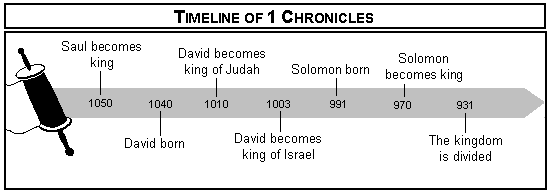
Legend: B.C. dates at top of timeline are approximate. Note that 931BC marks the division of the Kingdom into Southern Tribes (Judah and Benjamin) and Ten Northern Tribes. To avoid confusion be aware that after the division of the Kingdom in 931BC, the Southern Kingdom is most often designated in Scripture as "Judah" and the Northern Kingdom as "Israel." Finally, note that 1Chronicles 1-9 is not identified on the timeline because these chapters are records of genealogy. |
||||||||||
From Ryrie Study Bible Expanded Edition (borrow)
Summary of First and Second Chronicles…
I. Selected Genealogical History of Israel (1 Chronicles 1–9)
II. Israel’s United Kingdom Under Saul (1 Chronicles 10), David (1 Chr 11–29), Solomon (2 Chr 1–9)
III. Judah’s Monarchy in the Divided Kingdom (2 Chronicles 10–36:21)
IV. Judah’s Release From Seventy Years of Captivity (2 Chronicles 36:22, 23)
(Adapted from The MacArthur Study Bible - borrow)
1 Chronicles covers the same period of time as 2 Samuel and both describe the reign of David (See the Timeline above) whereas 2 Chronicles covers the same period of time as 1 Kings and 2 Kings and both describe the time from Solomon to the Babylonian Captivity. In Chronicles the kings of Israel (See table below where Jeroboam I identifies first of the kings of the 10 Northern tribes) are not mentioned unless they do something that relates to the kings of Judah. Note that the word "chronicle" means "a continuous and detailed account of historical events arranged in order of time." In First and Second Chronicles God has given us a very accurate history so that we can know all that He wants us to know about the period of the kings.
W A Criswell writes that Chronicles was…
Originally entitled "the words of the days" (divre hayyamim, Heb.), meaning "journals" (cf. 27:24), and compiled as a single book. 1 and 2 Chronicles were separated by the translators of the Septuagint circa 180 B.C. and named "things omitted" (paraleipomena, Gk.), to indicate that they contain things omitted from the Books of Samuel and Kings. Although the author and date are not stated, the Talmudic tradition that the Chronicles were penned by Ezra may be correct. Nevertheless, it is customary to speak of the author simply as "the chronicler." Written from a priestly perspective, the main emphasis centers on the temple in Jerusalem, the Levitical priesthood, and the theocratic lineage of David. The genealogies and narrative of 1 Chronicles span the period from Adam to the end of the life of David. Second Chronicles recounts the downfall of the Davidic dynasty from Solomon to the Exile. Chronicles mentions the northern kingdom (Israel) only incidentally and contains the most complete statistical lists found in the entire Bible. The final verses of Chronicles (2Chr. 36:22, 23) are repeated in Ezra 1:1-3. The style, substance, and thrust of the Chronicles are carried on through Ezra and Nehemiah. Many believe Chronicles, Ezra and Nehemiah had the same author. If not, the latter two still serve as a fitting sequel. Chronicles follows the people of God into Exile; Ezra and Nehemiah follow them out of Exile and prepare Israel for the coming of the Messiah.
The Chronicles were written to the returned remnant who were rebuilding Jerusalem following their seventy-year Babylonian captivity. The history of the Southern Kingdom (Judah) is presented in such a way as to help restore its religious and national heritage by showing its unbroken connection with the patriarchal beginnings. The primary historical theme centers about the priestly worship of Judah, from the time of Saul until the return of the Jewish nation to the land following the decree of Cyrus (538 B.C.). This religious history depicts the faithfulness and promises of God to His people, the power of the Word of God, and the central role of worship in the lives of God's people. In order to underscore these elements, the genealogies point to the forthcoming Messiah and are completed by those recorded in the New Testament (cf. Matt. 1:1-16; Luke 3:23-38). (From The Believer's Study Bible)
Myer Pearlman writes "Though "Kings" and "Chronicles" show great similarity in the matter of their contents, they are written from different viewpoints, the former being written from the human viewpoint, the latter, from the Divine. To illustrate:
1 Kings 14:20 recording the death of Jeroboam, tells us that he "slept with his fathers." That is the human viewpoint.
2 Chronicles 13:20, recording the same event, tells us that "the Lord struck him and he died." That is the divine viewpoint.
Dr. A. T. Pierson: While much contained in the Books of Kings is repeated or restated in the Chronicles, much is omitted because foreign to the author's purpose. But whatever bears on the temple, its preservation and restoration, the purity of its worship, the regularity and orderliness of its services; whatever makes idolatrous rites or relics hateful, or lifts God to His true throne in the hearts of the people, is here emphasized. (Quoted from Paul Apple's 724 page commentary on 1-2 Chronicles - click for introductory statements from multiple authors.)
J Sidlow Baxter writes about those genealogies - Nine chapters of genealogical table I hate waste of space! Nay, rather, what blindness to think part of the Chronicles is more important. Such lines of descent were of sacred importance to all godly Jews, and rightly so, for they knew that their nation, besides being the repository of a special Divine revelation, was the possessor of wonderful Divine promises reaching on to unborn generations. The chronicler himself knew well enough that these genealogies reveal the selective process of Divine election right from Adam downwards, and that the covenant line of redemptive purpose was to culminate in the Messiah. Especially did the preservation of the trunk and main branches of Israel's family tree become vital after the Babylonian exile (when the Chronicles were written). Families had been uprooted by the thousand. Connections had been broken. Many records had been lost (see for instance Ezra 2:59), and Judah's archives must have become largely disintegrated even where not actually destroyed. Our chronicler's lists link the pre-Exile with the post-Exile period; for (as should be clearly grasped) 1Chr 9:2-34 concerns the resettlement in Judaea after the Exile. The break is marked by the first verse of that chapter, which should really be the last verse of the preceding chapter. The Angus Bible Handbook remarks: "These tables give the sacred line through which the promise was transmitted for nearly 3,500 years, a fact unexampled in the history of the human race." (Click pdf of J.Sidlow Baxter's Explore The Book)
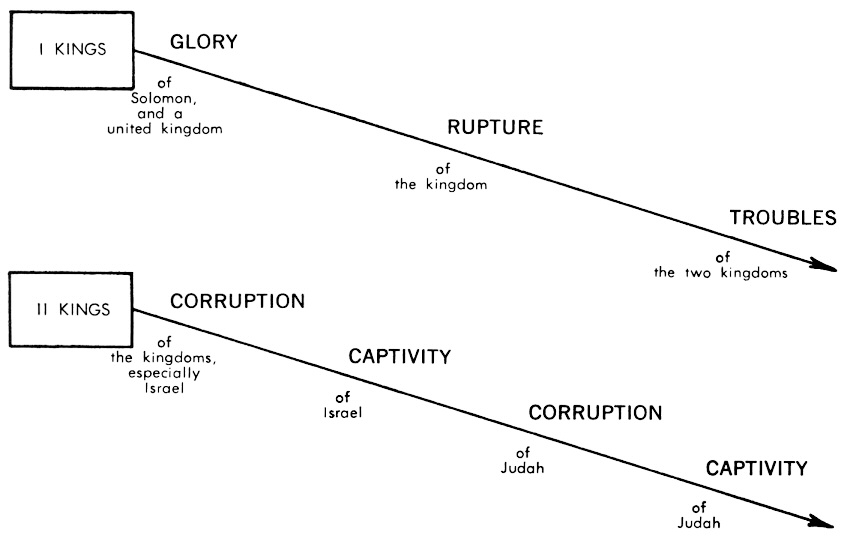
THE DOWNWARD SPIRAL
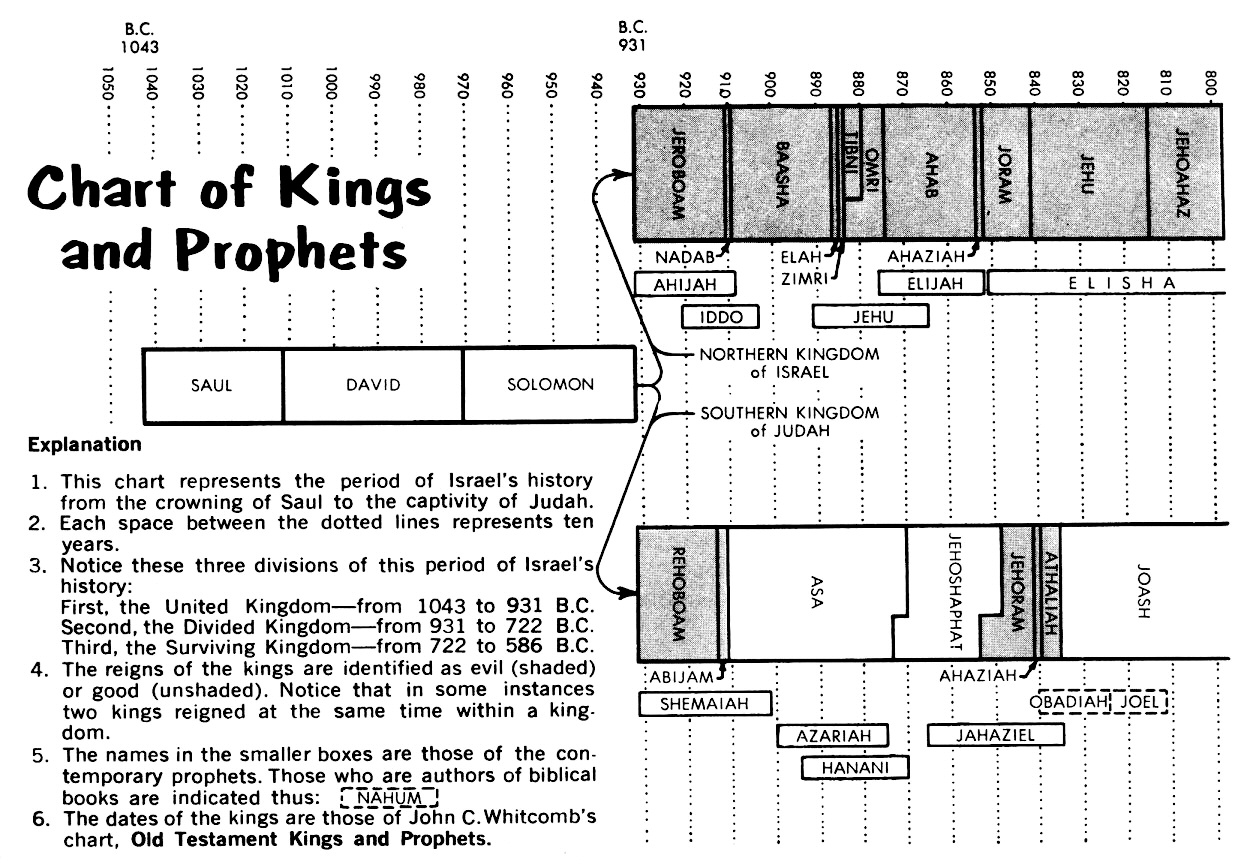
Click to Enlarge
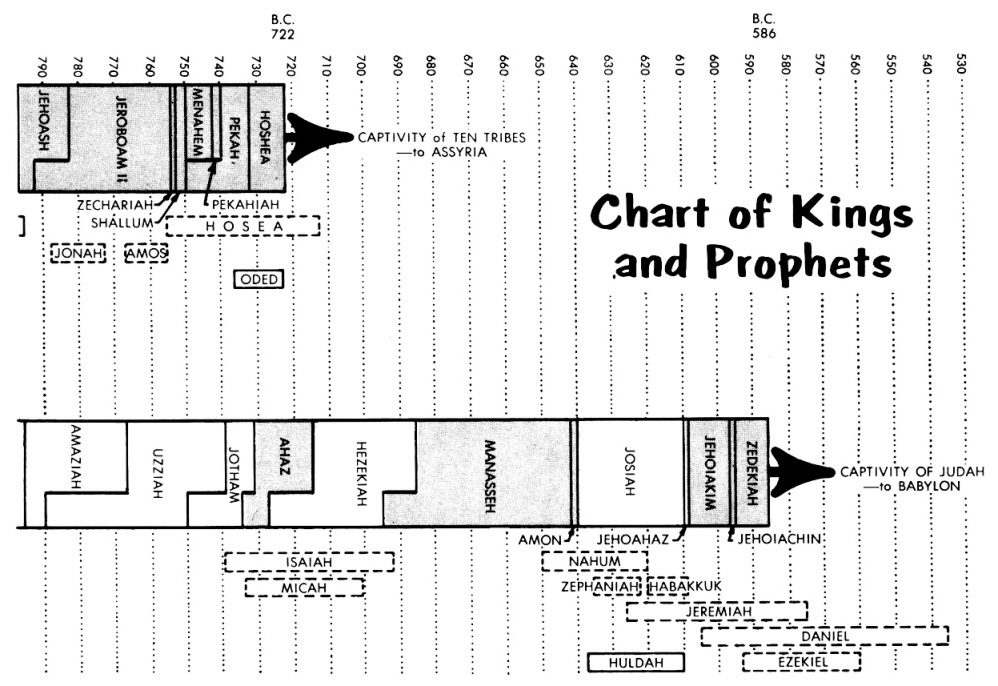
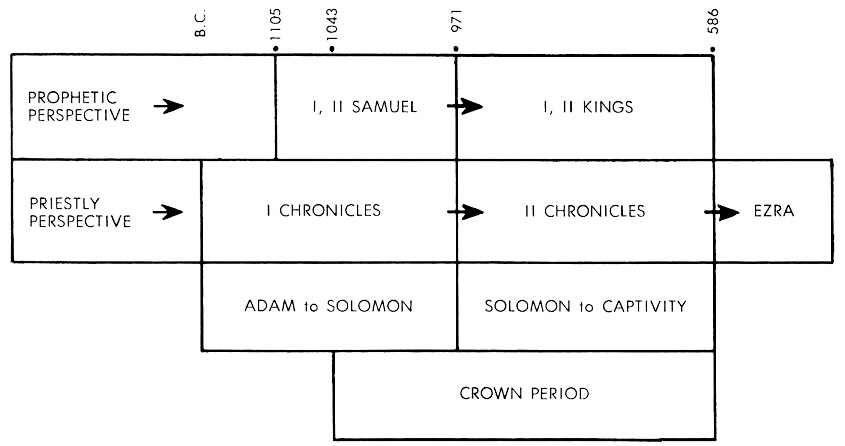
Comparison of 1 Samuel thru 2 Chronicles

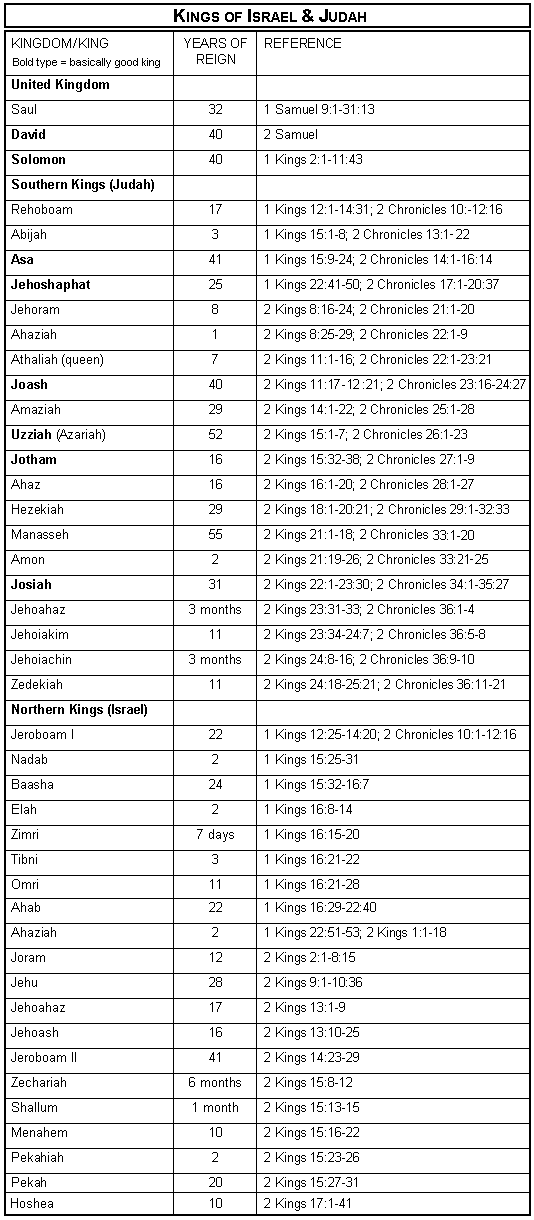
Kings of Israel
Click to enlarge
| DIFFERENCES BETWEEN KINGS & CHRONICLES |
|
| SAMUEL & KINGS |
FIRST & SECOND CHRONICLES |
| Prophetic Perspective: Message of Judgment |
Priestly Perspective: Message of hope |
| Prophetic authorship: Emphasizes the prophetic ministry and moral concerns |
Priestly authorship: Emphasizes the priestly ministry and spiritual concerns |
| The Fortunes of the Thrones |
Continuity of the Davidic line |
| More Negative: Rebellion & Tragedy |
More Positive: Apostasy, but hope in face of tragedy |
| Record of both Israel and Judah |
Record primarily of Judah |
| Man's Failings | God's Faithfulness |
| Morality | Redemption |
| Emphasizes the throne of earthly kings |
Earthly throne (temple) of the heavenly King |
| Emphasizes Kings and Prophets |
Emphasizes the Temple and the Priests |
| Political and kingly |
Religious and priestly |
| Compiled by authors soon after the events |
Compiled by by a priest: Ezra many years after the events |
| Written shortly after the beginning of the captivity in Babylon |
Written shortly after the return from the captivity |
|
Adapted Wilkinson's Talk thru the Bible & Jensen's Survey of the OT |
|
J Sidlow Baxter observes that "beginning with 1Chr 11 (Ed: See following table), the whole of the remaining nineteen chapters of 1 Chronicles are occupied with the reign of David. In these chapters there is no repeating the familiar tale of David's romantic adventures, or of his reign at Hebron, or of his grief over Saul and Jonathan, or of his sin against Bathsheba and Uriah, or of the revolt of Absalom (these, not to mention others, are some of the significant major omissions); but, on the other hand, we are given with great fulness the following matters which are not mentioned in Samuel and Kings - David's abundant preparation of material in advance for the temple (1Chr 22), his preparatory numbering and distributing of the Levites and the priests (1Chr 23-24), his appointment and arrangement of singers and players and porters (1Chr 25:1-26) - all in anticipation of the temple (these, not to mention others, are some of the significant major additions). (Ibid)
John MacArthur observes that "Two basic principles enumerated in these two books prevail throughout the OT, namely, obedience brings blessing, disobedience brings judgment. In the Chronicles, when the king obeyed and trusted the Lord, God blessed and protected. But when the king disobeyed and/or put his trust in something or someone other than the Lord, God withdrew His blessing and protection. Three basic failures by the kings of Judah brought God’s wrath: 1) personal sin; 2) false worship/idolatry; and/or 3) trust in man rather than God. (The MacArthur Study Bible)
| FIRST CHRONICLES SUMMARY CHART |
|
| 1 Chronicles 1-9:44 | 1 Chronicles 10:1-39:30 |
| Royal Line of David |
Reign of David |
| 12 Tribes of David's Reign |
Highlights of David's Reign |
| Genealogies | History |
| Ancestry | Activity |
| 1000's of Years | Circa 33 Years |
1Chronicles --
These books cover the same period as 1 & 2 Kings, but they deal exclusively with the Kingdom of Judah [the southern kingdom] and with the House of David. They impress the importance of the worship of God upon the people. [Their interest is centered] around the Temple.
Genealogies. [1Chronicles 1-9]
The first nine chapters of the book are taken up with genealogies. Unpromising as these chapters appear, much may be learned from them. Perhaps the chief lesson is that of God's selection.
Chapter 10 gives an account of Saul's miserable end, and chapter 11 opens with the anointing of David [as] king over Judah in Hebron.
Bringing the Ark to Zion.
One of the first acts of David was to fetch the Ark of the Lord from the house of Abinadab, at Jebesh Gilead, to bring it to Zion [1Chronicles 13]. For twenty years the Ark with its mercy-seat, God's appointed meeting-place with His people, was neglected and almost forgotten-- a true picture of a heart out of communion with God. God ordained that the Ark should always be carried on the shoulders of the Levites, but they seem to have thought they could improve on God's plan, and the result of disobedience was death. God blessed the house of Obed-edom during the three months the Ark remained there, and David was encouraged to bring it to Mount Zion, to the tent he had prepared for it [1Chronicles 15].
David had now learned the lesson of obedience, for he says: ''None ought to carry the Ark of God but the Levites, for them hath the Lord chosen to carry the Ark of God and to minister unto Him for ever. And David gathered all Israel together to Jerusalem, to bring up the Ark of the Lord unto his place.'' For he desired to impress the whole nation with the importance of the event. The priests and Levites and singers, with their instruments of music, were each appointed to their several places. And David was clothed with a robe of fine linen and ''danced before the Lord with all his might'' (2Sam 6:14). It is a common sight today, in ''the changeless East,'' in any procession, to see a man dancing with strange attitudes to do honor to the bridegroom, or other hero of the day, and the more grotesque his attitudes the more honor is done. The man dances backwards, and with his dress girded to give free play to his limbs, as the common peasants gird themselves for active work. Thus, no doubt, David danced to do honor to God's Ark. Michal, the daughter of Saul, looked out at a window and saw him dancing and playing, and she despised him in her heart. The enthusiasm of God's people is still a matter of ridicule with the world, but would there were a little more of it in these days when people are more readily enthusiastic about anything else than His service! The Son of David showed such enthusiasm in the cleansing of the Temple that His disciples applied to Him the words, ''The zeal of Thine House hath eaten Me up'' [John 2:13-17].
Sacrifices were offered as the Ark left the house of Obed-edom; and, again, when it was set in the tent on Mount Zion, they offered burnt sacrifices and peace offerings [ch. 16]. The bringing of the Ark to Zion was typical of restored communion. In the presence of the Ark, with its blood-stained mercy-seat, the peace offerings could be offered. The peace offering included a meal of which the offerer partook before God. Reconciled and accepted, he was now God's guest and was privileged to eat bread in His presence. The joy which accompanied the bringing back of the Ark, and the feeding of the people with bread and meat and wine, are symbolic of the joy of restored communion and feeding upon Christ. (Ed: See caveats regarding Typology - Study of Biblical types)
God's Promise to David. [1Chronicles 17:1-27]
The great desire of David's heart was to build a temple for the Lord. God set this on one side because David had ''shed much blood upon the earth,'' but He promised that a son should be born unto him, who should be ''a man of rest,'' and should build Him a house, and God would establish his throne for ever.
David accepted God's decision without a murmur, and poured forth a song of praise for the condescension of His promise. In the promised Son we see ''a Greater than Solomon.'' ''Thou shalt call His name Jesus. He shall be great, and shall be called the Son of the Highest; and the Lord God shall give unto Him the throne of His father David: and He shall reign over the house of Jacob for ever; and of His kingdom there shall be no end'' (Luke 1:31-33).
The preservation of Israel as a nation is guaranteed till the end of time, ''as long as the sun and the moon endure'' (Jer 31:35-37). David's throne is secured as permanently, with the added sign, ''and as the faithful witness in the sky'' the rainbow (Psa 89:3,4,27-37). David's Son shall sit upon David's throne in Jerusalem. Christ Jesus ''is the only Person alive now as known to be of David's seed, and as possessing a right to David's throne.'' [Israel, My Glory, p.82, Rev. John Wilkinson]
Mount Moriah. [Chapter 21]
The next event in the history of the Temple was brought about through David's sin in numbering the people. His sin in this was no doubt twofold.
- - First, pride at the greatness of his kingdom;
- - second, no mention is made of the tribute money having been paid, as commanded by the Law of Moses, at the time of the census. ''When thou takest the sum of the Children of Israel after their number, then shall they give every man a ransom for his soul unto the Lord, when thou numberest them'' (Ex 30:12). The half shekel of silver, given by every man when he was numbered, was the token that the people belonged to the Lord: it was an acknowledgment of His right to their lives. This was evidently omitted in David's reign, and the plague came upon the people.
The plague was stayed at the threshing-floor of Ornan the Jebusite, on Mount Moriah, and David bought the threshing-floor from Ornan for fifty shekels of silver ''and built there an altar unto the Lord, and offered burnt offerings and peace offerings, and called upon the Lord; and He answered him from heaven by fire upon the altar of burnt offering'' (1Chr 21:26). Thus, the Temple, as well as the Tabernacle, rested upon the foundation of the silver redemption money. Mount Moriah was also the place of Abraham's sacrifice. All these circumstances are more than coincidences; they fall into their place in God's great plan of redemption.
David also bought the makoam (translated ''place'' [in vs. 22 and 25] ) of the threshing-floor from Ornan for six hundred shekels of gold. These makoams were sacred places, the ''places'' of the Canaanites (Deu 12:2,3), similar to the bamoth or ''high places'' so frequently mentioned in Scripture. They abound in Palestine today, and are called by the same word in the Arabic, mukam, ''place,'' and are very valuable, often bringing in great gain to their owners through those who come to worship there. This might account for David having to pay such a high price for the makaom as recorded in Chronicles, though he only paid fifty shekels of silver for the threshing-floor [Heb. goren] as recorded in [2Samuel 24:24]. They appear to have been two separate transactions. Ornan the Jebusite was one of the Canaanitish inhabitants of the land. The place was evidently a makoam as long back as the time when Abraham was told to offer Isaac on what was probably the same spot, for the word occurs four times in the brief narrative, applied to the summit of Moriah [Gen 22:3,4,9,14], afterwards to be Jehoavah's great makoam, where He would ''record His Name'' and place His temple. For Jehovah also would have His makoam. ''Offer not thy burnt offering in every makoam thou seest: but in the makoam that Jehovah shall choose in one of thy tribes, there thou shalt offer thy burnt offerings'' (Deu 12:13,14).
''In 2Sa 24:24, we read that David bought the oxen and threshing-floor of Araunah [another spelling of 'Ornan'] for fifty shekels of silver. From 1Chron 21:25, we learn that David gave six hundred shekels of gold for the place. It is extraordinary that any honest and intelligent mind could find a difficulty here. Fifty shekels of silver were presumably a fair price, though to us it seems very little, for the oxen and for the temporary use of the threshing-floor, for the purpose of the sacrifice. And this was all that the king had in view at the moment. The English reader must not base anything on the force of the English words 'buy' and 'bought' in 2Sam 24:24. The narrative in Chronicles suggests that it was the Lord's 'answering by fire' that led the king to go on to the purchase of the 'place'. But does any one imagine that the fee simple of 'the place'-- the entire site of the Temple-- was worth only fifty shekels? David went on to purchase the entire homestead out and out; and the price he paid for it was six hundred shekels of gold. And this is what the 'Chronicler' records.'' [The Bible and Modern Criticism, p. 161, Sir. Robt. Anderson]
David's Preparation. [1 Chronicles 22:1-19 and 1 Chronicles 28:1-21,1 Chronicles 29:1-30]
''Solomon my son is young and tender,'' said David, ''and the house that is to be builded for the Lord must be exceeding magnifical, of fame and of glory throughout all countries.''
''So David prepared abundantly before his death,'' and the princes and the people brought their offerings. ''Then the people rejoiced, for that they offered willingly, because with perfect heart they offered willingly to the Lord: and David the king also rejoiced with great joy.'' It is a marvelous thought that it brings joy to the heart of our King when we offer willingly to His service, whether it be ourselves or our dear ones, or our substance that we give. David's thanksgiving shows the right attitude of heart, the recognition that all indeed belongs to God. ''Who am I, and what is my people, that we should be able to offer so willingly after this sort? for all things come of Thee, and of Thine own have we given Thee'' (1Chr 29:14)
1 CHRONICLES
The books of Chronicles repeat much of the history recorded in Kings. The events of 1Chronicles parallel those of 2Samuel, but they are seen through the eyes of the priest rather than the prophet. The book concentrates upon the history of Judah, speaking of Israel [ie., the Northern Kingdom] only when it comes in contact with the people and events of the Southern Kingdom.
Chronicles has been called by some ''the chosen book of the theocracy.'' It tells the story of a great king and points forward to an even greater King and kingdom. First Chronicles 17:24 sets the theme, ''Let the house of David, Thy servant, be established before Thee.''
OUTLINE OF THE BOOK--
The Royal Genealogy (1Chronicles 1-9)
The Parenthesis of Saul's Rule (1Chronicles 10)
The Reign of David (1Chronicles 11-29)
We will discuss three of the key questions that arise when one studies 1Chronicles.
THE REASON FOR THE GENEALOGIES--
We read in 2Timothy 3:16,17 that ''All Scripture is given by inspiration of God, and is profitable for doctrine, for reproof, for correction, for instruction in righteousness, that the man of God may be perfect, thoroughly furnished unto all good words.'' The genealogies of 1Chronicles 1-9 fall within the scope of this passage. They are profitable for at least three reasons.
First, they were of great benefit to the Jews who returned from captivity in Babylon. During this time of confusion, the Israelites were in danger of losing their family and tribal identities. The lists helped them maintain their distinctives.
Second, the genealogies impressed the Jews with the unity of God. As they returned from captivity, the Israelites saw in the genealogies that the God who had restored them was the ''one true God'' of their fathers.
Third, the genealogies were a demonstration of the divine purpose being worked out until Christ's coming. They helped complete the Bible story of our Savior, who was the son of David, the son of Judah, the son of Abraham, and the son of Adam. He took their humanity, ''yet without sin.''
THE ARK BROUGHT TO JERUSALEM--
As [the narrative of] 1Chronicles opens [in chapter 11], David has been anointed king over Israel, and he is making preparation to bring the ark back to Jerusalem. The events that preceded this are recorded in 1Samuel 4-6. Why did David want the ark in Jerusalem? Because it symbolized God's presence in the midst of His people. In fact, it was the very place where God dwelt with His own. The most dishonoring thing that could have happened to Israel was for the ark to be captured by heathen enemies.
You may ask, ''What does this have to do with our subject? How does it speak of Christ in the Old Testament Scriptures?'' Just as the ark of the covenant in the Holy of holies was the dwelling place of God among Israel, so the church is the dwelling place of God with His people in this age. Oh, I'm not speaking of a building, an edifice, but rather the church, which is the body of Christ. Paul wrote,
Now, therefore, ye are no more strangers and sojourners, but fellow citizens with the saints, and of the household of God; And are built upon the foundation of the apostles and prophets, Jesus Christ Himself being the chief cornerstone, In whom all the building fitly framed together groweth unto an holy temple in the Lord; In whom ye also are built together for an habitation of God through the Spirit. (Eph 2:19-22)
As you read the first few chapters of Acts, you see a risen, glorified, immortal Savior communing with mortals. For 40 days, He was with them, then He led His disciples out to Bethany and told them,
But ye shall receive power, after the Holy Spirit is come upon you; and ye shall be witnesses unto Me, both in Jerusalem, and in all Judea, and in Samaria, and unto the uttermost part of the earth (Acts 1:8).
No instruction like this can be found in all the Old Testament! Pentecost followed Christ's ascension, and the changes were noted immediately. On that day they were all Jews, and they witnessed first to the Jews, with 3,000 being converted. Persecution followed. Peter was sent to the Gentiles. Converted Jews began to fraternize with previously hated Gentiles. These new believers, Jew and Gentile, forsook the temple and met in houses. They discarded the elaborate rituals, replacing them with the simple ordinances. They set aside the sabbath day in favor of Sunday, the Lord's Day. Why? Because the ascended Lord Jesus had sent the Holy Spirit to dwell with them, and they were carrying out His word.
DAVID'S FAILURE--
What has happened to the church in the intervening centuries? David's failure to handle the ark correctly, as recorded in 1Chronicles 13, is a picture of the church's failure today. Consider these points:
David consulted men rather than God's Word (1Chronicles 13:1).
The New Testament commands that we are not to be menpleasers, but ''the servants of Christ, doing the will of God from the heart'' (Eph 6:6).
David was popular with the people.
''All the congregation said that they would do so; for the thing was right in the eyes of all the people'' (13:4). Popularity often wrecks both men and churches. The works of the flesh never get a single convert. The church of the Lord Jesus Christ will never impress the world by becoming worldly (Jam 4:4).
David used human methods instead of God's plans.
The Lord had given plain instruction for transporting the ark. The tribe of Levi was set aside for the tabernacle service, and they were to bear the ark by means of staves that fit through rings fastened to its side [Ex 25:10-15; Num 4:15]. There was no place for wheels. Yet David used an ox cart, like [the one] used by the Philistines [1Sam 6:1,2,7,8]. Likewise, the church cannot be driven by artificial means or worldly methods. All sorts of gimmicks are used in the Lord's work today. But God has ordained that men are to be saved through ''the foolishness of preaching.'' ''Faith cometh by hearing, and hearing by the word of God'' (Rom 10:17). Substituting human efforts for God's way will always bring disaster.
The tragedy of the affair.
Everything seemed to be going right. There was music and dancing, a new cart, and oxen. The cart got as far as the threshing floor, and then the animals stumbled. Uzza, a man not appointed of God to carry the ark, reached out to steady it. God smote him dead! Poor fellow, he actually thought he was doing a service to God. Evidently, no one had instructed him. He was doing what he was told, and now he was dead. How sad-- yet it's happening today! The church is filled with men and women who think they are doing God a service, while indeed they are ''dead in trespasses and sins.'' It's a travesty upon divine grace and order to get people to serve the Lord when they are either unconverted or carnal Christians working in their own strength.
For three months, the ark was stored in the residence of Obed-edom. The glory of God was hidden in a house! No sign of God's presence could be found in Israel. Everything was dead and cold, just like the Philistines. But the house of Obed-edom was greatly blessed. When the presence of God is experienced in the life of an individual, His rich blessings always abound.
The sequel to this story is found in 1 Chronicles 15, when David finally did things God's way. The priests and the Levites ''sanctified themselves to bring up the ark of the Lord God of Israel'' (1 Chronicles 15:14). When the ark was safely inside, communion with God was restored.
The secret of an effective, powerful, growing church is to acknowledge the presence of God's Spirit and to obey His leading in every aspect of church life and ministry. God's work must be done God's way.
Note: Only selected chapters are available as of Feb, 2023
1 Chronicles 10:2
1 Chronicles 10:3
1 Chronicles 10:4
1 Chronicles 10:5
1 Chronicles 10:6
1 Chronicles 10:7
1 Chronicles 10:8
1 Chronicles 10:9
1 Chronicles 10:10
1 Chronicles 10:11
1 Chronicles 10:12
1 Chronicles 10:13
1 Chronicles 10:13
1 Chronicles 11:2
1 Chronicles 11:3
1 Chronicles 11:4
1 Chronicles 11:5
1 Chronicles 11:6
1 Chronicles 11:7
1 Chronicles 11:8
1 Chronicles 11:9
1 Chronicles 11:10
1 Chronicles 11:11
1 Chronicles 11:12
1 Chronicles 11:13
1 Chronicles 11:14
1 Chronicles 11:15
1 Chronicles 11:16
1 Chronicles 11:17
1 Chronicles 11:18
1 Chronicles 11:19
1 Chronicles 11:20
1 Chronicles 11:21
1 Chronicles 11:22
1 Chronicles 11:23
1 Chronicles 11:24
1 Chronicles 11:25
1 Chronicles 11:26
1 Chronicles 11:27
1 Chronicles 11:28
1 Chronicles 11:29
1 Chronicles 11:30
1 Chronicles 11:31
1 Chronicles 11:32
1 Chronicles 11:33
1 Chronicles 11:34
1 Chronicles 11:35
1 Chronicles 11:36
1 Chronicles 11:37
1 Chronicles 11:38
1 Chronicles 11:39
1 Chronicles 11:40
1 Chronicles 11:41
1 Chronicles 11:42
1 Chronicles 11:43
1 Chronicles 11:44
1 Chronicles 11:45
1 Chronicles 11:46
1 Chronicles 11:47
1 Chronicles 12:2
1 Chronicles 12:3
1 Chronicles 12:4
1 Chronicles 12:5
1 Chronicles 12:6
1 Chronicles 12:7
1 Chronicles 12:8
1 Chronicles 12:9
1 Chronicles 12:10
1 Chronicles 12:11
1 Chronicles 12:12
1 Chronicles 12:13
1 Chronicles 12:14
1 Chronicles 12:15
1 Chronicles 12:16
1 Chronicles 12:17
1 Chronicles 12:18
1 Chronicles 12:19
1 Chronicles 12:20
1 Chronicles 12:21
1 Chronicles 12:22
1 Chronicles 12:23
1 Chronicles 12:24
1 Chronicles 12:25
1 Chronicles 12:26
1 Chronicles 12:27
1 Chronicles 12:28
1 Chronicles 12:29
1 Chronicles 12:30
1 Chronicles 12:31
1 Chronicles 12:32
1 Chronicles 12:33
1 Chronicles 12:34
1 Chronicles 12:35
1 Chronicles 12:36
1 Chronicles 12:37
1 Chronicles 12:38
1 Chronicles 12:39
1 Chronicles 12:40
1 Chronicles 13:2
1 Chronicles 13:3
1 Chronicles 13:4
1 Chronicles 13:5
1 Chronicles 13:6
1 Chronicles 13:7
1 Chronicles 13:8
1 Chronicles 13:9
1 Chronicles 13:10
1 Chronicles 13:11
1 Chronicles 13:12
1 Chronicles 13:13
1 Chronicles 13:14
1 Chronicles 14:2
1 Chronicles 14:3
1 Chronicles 14:4
1 Chronicles 14:5
1 Chronicles 14:6
1 Chronicles 14:7
1 Chronicles 14:8
1 Chronicles 14:9
1 Chronicles 14:10
1 Chronicles 14:11
1 Chronicles 14:12
1 Chronicles 14:13
1 Chronicles 14:14
1 Chronicles 14:15
1 Chronicles 14:16
1 Chronicles 14:17
1 Chronicles 15:2
1 Chronicles 15:3
1 Chronicles 15:4
1 Chronicles 15:5
1 Chronicles 15:6
1 Chronicles 15:7
1 Chronicles 15:8
1 Chronicles 15:9
1 Chronicles 15:10
1 Chronicles 15:11
1 Chronicles 15:12
1 Chronicles 15:13
1 Chronicles 15:14
1 Chronicles 15:15
1 Chronicles 15:16
1 Chronicles 15:17
1 Chronicles 15:18
1 Chronicles 15:19
1 Chronicles 15:20
1 Chronicles 15:21
1 Chronicles 15:22
1 Chronicles 15:23
1 Chronicles 15:24
1 Chronicles 15:25
1 Chronicles 15:26
1 Chronicles 15:27
1 Chronicles 15:28
1 Chronicles 15:29
1 Chronicles 16:2
1 Chronicles 16:3
1 Chronicles 16:4
1 Chronicles 16:5
1 Chronicles 16:6
1 Chronicles 16:7
1 Chronicles 16:8
1 Chronicles 16:9
1 Chronicles 16:10
1 Chronicles 16:11
1 Chronicles 16:12
1 Chronicles 16:13
1 Chronicles 16:14
1 Chronicles 16:15
1 Chronicles 16:16
1 Chronicles 16:17
1 Chronicles 16:18
1 Chronicles 16:19
1 Chronicles 16:20
1 Chronicles 16:21
1 Chronicles 16:22
1 Chronicles 16:23
1 Chronicles 16:24
1 Chronicles 16:25
1 Chronicles 16:26
1 Chronicles 16:27
1 Chronicles 16:28
1 Chronicles 16:29
1 Chronicles 16:30
1 Chronicles 16:31
1 Chronicles 16:32
1 Chronicles 16:33
1 Chronicles 16:34
1 Chronicles 16:35
1 Chronicles 16:36
1 Chronicles 16:37
1 Chronicles 16:38
1 Chronicles 16:39
1 Chronicles 16:40
1 Chronicles 16:41
1 Chronicles 16:42
1 Chronicles 16:43
1 Chronicles 17:2
1 Chronicles 17:3
1 Chronicles 17:4
1 Chronicles 17:5
1 Chronicles 17:6
1 Chronicles 17:7
1 Chronicles 17:8
1 Chronicles 17:9
1 Chronicles 17:10
1 Chronicles 17:11
1 Chronicles 17:12
1 Chronicles 17:13
1 Chronicles 17:14
1 Chronicles 17:15
1 Chronicles 17:16
1 Chronicles 17:17
1 Chronicles 17:18
1 Chronicles 17:19
1 Chronicles 17:20
1 Chronicles 17:21
1 Chronicles 17:22
1 Chronicles 17:23
1 Chronicles 17:24
1 Chronicles 17:25
1 Chronicles 17:26
1 Chronicles 17:27
1 Chronicles 18:2
1 Chronicles 18:3
1 Chronicles 18:4
1 Chronicles 18:5
1 Chronicles 18:6
1 Chronicles 18:7
1 Chronicles 18:8
1 Chronicles 18:9
1 Chronicles 18:10
1 Chronicles 18:11
1 Chronicles 18:12
1 Chronicles 18:13
1 Chronicles 18:14
1 Chronicles 18:15
1 Chronicles 18:16
1 Chronicles 18:17
1 Chronicles 19:2
1 Chronicles 19:3
1 Chronicles 19:4
1 Chronicles 19:5
1 Chronicles 19:6
1 Chronicles 19:7
1 Chronicles 19:8
1 Chronicles 19:9
1 Chronicles 19:10
1 Chronicles 19:11
1 Chronicles 19:12
1 Chronicles 19:13
1 Chronicles 19:14
1 Chronicles 19:15
1 Chronicles 19:16
1 Chronicles 19:17
1 Chronicles 19:8
1 Chronicles 19:9
1 Chronicles 20:2
1 Chronicles 20:3
1 Chronicles 20:4
1 Chronicles 20:5
1 Chronicles 20:6
1 Chronicles 20:7
1 Chronicles 20:8
1 Chronicles 21:2
1 Chronicles 21:3
1 Chronicles 21:4
1 Chronicles 21:5
1 Chronicles 21:6
1 Chronicles 21:7
1 Chronicles 21:8
1 Chronicles 21:9
1 Chronicles 21:10
1 Chronicles 21:11
1 Chronicles 21:12
1 Chronicles 21:13
1 Chronicles 21:14
1 Chronicles 21:15
1 Chronicles 21:16
1 Chronicles 21:17
1 Chronicles 21:18
1 Chronicles 21:19
1 Chronicles 21:20
1 Chronicles 21:21
1 Chronicles 21:22
1 Chronicles 21:23
1 Chronicles 21:24
1 Chronicles 21:25
1 Chronicles 21:26
1 Chronicles 21:27
1 Chronicles 21:28
1 Chronicles 21:29
1 Chronicles 21:30
1 Chronicles 21:31
1 Chronicles 22:2
1 Chronicles 22:3
1 Chronicles 22:4
1 Chronicles 22:5
1 Chronicles 22:6
1 Chronicles 22:7
1 Chronicles 22:8
1 Chronicles 22:9
1 Chronicles 22:10
1 Chronicles 22:11
1 Chronicles 22:12
1 Chronicles 22:13
1 Chronicles 22:14
1 Chronicles 22:15
1 Chronicles 22:16
1 Chronicles 22:17
1 Chronicles 22:18
1 Chronicles 22:19
1 Chronicles 23:2
1 Chronicles 23:3
1 Chronicles 23:4
1 Chronicles 23:5
1 Chronicles 23:6
1 Chronicles 23:7
1 Chronicles 23:8
1 Chronicles 23:9
1 Chronicles 23:10
1 Chronicles 23:11
1 Chronicles 23:12
1 Chronicles 23:13
1 Chronicles 23:14
1 Chronicles 23:15
1 Chronicles 23:16
1 Chronicles 23:17
1 Chronicles 23:18
1 Chronicles 23:19
1 Chronicles 23:20
1 Chronicles 23:21
1 Chronicles 23:22
1 Chronicles 23:23
1 Chronicles 23:24
1 Chronicles 23:25
1 Chronicles 23:26
1 Chronicles 23:27
1 Chronicles 23:28
1 Chronicles 23:29
1 Chronicles 23:30
1 Chronicles 23:31
1 Chronicles 24:2
1 Chronicles 24:3
1 Chronicles 24:4
1 Chronicles 24:5
1 Chronicles 24:6
1 Chronicles 24:7
1 Chronicles 24:8
1 Chronicles 24:9
1 Chronicles 24:10
1 Chronicles 24:11
1 Chronicles 24:12
1 Chronicles 24:13
1 Chronicles 24:14
1 Chronicles 24:15
1 Chronicles 24:16
1 Chronicles 24:17
1 Chronicles 24:18
1 Chronicles 24:19
1 Chronicles 24:20
1 Chronicles 24:21
1 Chronicles 24:22
1 Chronicles 24:23
1 Chronicles 24:24
1 Chronicles 24:25
1 Chronicles 24:26
1 Chronicles 24:27
1 Chronicles 24:28
1 Chronicles 24:29
1 Chronicles 24:30
1 Chronicles 24:31
1 Chronicles 25:2
1 Chronicles 25:3
1 Chronicles 25:4
1 Chronicles 25:5
1 Chronicles 25:6
1 Chronicles 25:7
1 Chronicles 25:8
1 Chronicles 25:9
1 Chronicles 25:10
1 Chronicles 25:11
1 Chronicles 25:12
1 Chronicles 25:13
1 Chronicles 25:14
1 Chronicles 25:15
1 Chronicles 25:16
1 Chronicles 25:17
1 Chronicles 25:18
1 Chronicles 25:19
1 Chronicles 25:20
1 Chronicles 25:21
1 Chronicles 25:22
1 Chronicles 25:23
1 Chronicles 25:24
1 Chronicles 25:25
1 Chronicles 25:26
1 Chronicles 25:27
1 Chronicles 25:28
1 Chronicles 25:29
1 Chronicles 25:30
1 Chronicles 25:31
1 Chronicles 26:2
1 Chronicles 26:3
1 Chronicles 26:4
1 Chronicles 26:5
1 Chronicles 26:6
1 Chronicles 26:7
1 Chronicles 26:8
1 Chronicles 26:9
1 Chronicles 26:10
1 Chronicles 26:11
1 Chronicles 26:12
1 Chronicles 26:13
1 Chronicles 26:14
1 Chronicles 26:15
1 Chronicles 26:16
1 Chronicles 26:17
1 Chronicles 26:18
1 Chronicles 26:19
1 Chronicles 26:20
1 Chronicles 26:21
1 Chronicles 26:22
1 Chronicles 26:23
1 Chronicles 26:24
1 Chronicles 26:25
1 Chronicles 26:26
1 Chronicles 26:27
1 Chronicles 26:28
1 Chronicles 26:29
1 Chronicles 26:30
1 Chronicles 26:31
1 Chronicles 26:32
1 Chronicles 27:2
1 Chronicles 27:3
1 Chronicles 27:4
1 Chronicles 27:5
1 Chronicles 27:6
1 Chronicles 27:7
1 Chronicles 27:8
1 Chronicles 27:9
1 Chronicles 27:10
1 Chronicles 27:11
1 Chronicles 27:12
1 Chronicles 27:13
1 Chronicles 27:14
1 Chronicles 27:15
1 Chronicles 27:16
1 Chronicles 27:17
1 Chronicles 27:18
1 Chronicles 27:19
1 Chronicles 27:20
1 Chronicles 27:21
1 Chronicles 27:22
1 Chronicles 27:23
1 Chronicles 27:24
1 Chronicles 27:25
1 Chronicles 27:26
1 Chronicles 27:27
1 Chronicles 27:28
1 Chronicles 27:29
1 Chronicles 27:30
1 Chronicles 27:31
1 Chronicles 27:32
1 Chronicles 27:33
1 Chronicles 27:34
1 Chronicles 28:2
1 Chronicles 28:3
1 Chronicles 28:4
1 Chronicles 28:5
1 Chronicles 28:6
1 Chronicles 28:7
1 Chronicles 28:8
1 Chronicles 28:9
1 Chronicles 28:10
1 Chronicles 28:11
1 Chronicles 28:12
1 Chronicles 28:13
1 Chronicles 28:14
1 Chronicles 28:15
1 Chronicles 28:16
1 Chronicles 28:17
1 Chronicles 28:18
1 Chronicles 28:19
1 Chronicles 28:20
1 Chronicles 28:21
1 Chronicles 29:2
1 Chronicles 29:3
1 Chronicles 29:4
1 Chronicles 29:5
1 Chronicles 29:6
1 Chronicles 29:7
1 Chronicles 29:8
1 Chronicles 29:9
1 Chronicles 29:10
1 Chronicles 29:11
1 Chronicles 29:12
1 Chronicles 29:13
1 Chronicles 29:14
1 Chronicles 29:15
1 Chronicles 29:16
1 Chronicles 29:17
1 Chronicles 29:18
1 Chronicles 29:19
1 Chronicles 29:20
1 Chronicles 29:21
1 Chronicles 29:22
1 Chronicles 29:23
1 Chronicles 29:24
1 Chronicles 29:25
1 Chronicles 29:26
1 Chronicles 29:27
1 Chronicles 29:28
1 Chronicles 29:29
1 Chronicles 29:30
Explanation - The following list includes not only commentaries but other Christian works by well known evangelical writers. Most of the resources below are newer works (written after 1970) which previously were available only for purchase in book form or in a Bible computer program. The resources are made freely available by archive.org but have several caveats - (1) they do not allow copy and paste, (2) they can only be checked out for one hour (but can be checked out immediately when your hour expires giving you time to read or take notes on a lengthy section) and (3) they require creating an account which allows you to check out the books free of charge. To set up an account click archive.org and then click the picture of the person in right upper corner and enter email and a password. That's all you have to do. Then you can read these more modern resources free of charge! I have read or used many of these resources but not all of them so ultimately you will need to be a Berean (Acts 17:11+) as you use them. I have also selected works that are conservative and Biblically sound. If you find one that you think does not meet those criteria please send an email at https://www.preceptaustin.org/
COMMENTARIES
TO BORROW
Bible Knowledge Commentary - Old Testament - Dallas Theological Seminary Faculty
James Rosscup - Merrill, Eugene. “I and II Chronicles,” in Bible Knowledge Commentary, ed. John F. Walvoord and Roy B. Zuck. Volume I. Wheaton: Victor Books, 1983. Conservative scholar from Dallas Theological Seminary deals with the passages knowledgeably, showing good awareness of relevant literature and handling many of the problems at least with some help.
Bible Exposition Commentary - Old Testament - Warren Wiersbe - always worth checking
Wiersbe's Expository Outlines on the Old Testament by Warren W Wiersbe - can be very helpful for sermon prep.
"Even the most difficult Scriptures come alive as Warren Wiersbe leads you book-by-book through the Old Testament and helps you to see the "big picture" of God's revelation. In this unique volume, you will find: • Introductions and/or outlines for every Old Testament book • Practical expositions of strategic chapters • Special studies on key topics, relating the Old Testament to the New Testament • Easy-to-understand expositions that are practical, preachable, and teachable If you have used Dr. Wiersbe's popular BE series, you know how simple and practical his Bible studies are, with outlines that almost teach themselves. If not, you can now discover a wonderful new resource. This work is a unique commentary on every book of the Old Testament. It contains new material not to be found in the BE series.
With the Word - Devotional Commentary - Warren Wiersbe
The Message of Chronicles : One Church, One Faith, One Lord By: Wilcock, Michael
James Rosscup - An evangelical approach that defends conservative views on a number of the problems, feeling there are no errors. Wilcock sometimes delightfully applies the meaning to life today, and writes with clarity. He assists readers to see why material is used where it is, how it fits a need there, etc. Wilcock is vicar of St. Nicholas Church, Durham, England. For principles and for the movement in Chronicles this is a worthwhile book.
Cyril Barber - While evangelical in tone and content, this work is hermeneutically weak. It succeeds, however, in following David's line and highlights the principle lessons to be learned from the lives of the kings.
Solomon to the Exile; studies in Kings and Chronicles: John Whitcomb
Cyril Barber - An ideal book for discussion groups. Recreates the OT setting, graphically depicts the cause of decline in Israel and Judah, and draws valid lessons from these incidents that are applied to the needs of the present
I & II Chronicles By: McConville, J. G.
James Rosscup - Generally conservative in outlook, this displays a firm grip on the data, aiming at looking at things in their setting during the kings period and applying principles to life now. He does not sidestep problems, such as a million dead (2 Chr. 14:9ff.). The RSV is printed in space that, for those with Bibles, would be better used for even more comment.
Cyril Barber - Succinct, pointed comments on each facet of these long-neglected books. Readers will find these pages replete with perceptive hints that can be fleshed out with further study.
1, 2 Chronicles: Allen, Leslie C
Cyril Barber - Allen believes that "the heartbeat of Chronicles is a concern for spirituality. In this respect its key word is to 'seek' God." And because the Chronicler was essentially a preacher of practical theology, Allen sees in these biblical books essential teaching for those in the ministry today. While much of this commentary is taken up with Allen's translation of the biblical text (and no one should minimize the labor involved!), his comments or exposition is therefore brief. What is found between these covers, however, is insightful and helpful. This is one of the most important volumes in this series
The Books of Chronicles: W. H. Bennett
Cyril Barber - Commentaries on Chronicles are few and far between. This work meets a need. It is to be regretted, however, that the writer allowed critical presuppositions to enter into his handling of the biblical text. In spite of this weakness, what is presented to the reader is worthy of serious reflection.
1 Chronicles : an Introduction and Commentary Martin Selman
2 Chronicles: a Commentary Martin Selman
James Rosscup - The vol. on 1 Chronicles gives the introduction for both vols. His evangelical works deal with sections compactly, being well-informed on words, grammar, and background both biblically and from ancient sources (cf. for example on Sennacherib’s death in 32:20–23). He follows a clear outline, and his comments usually get to the point judiciously. Selman is Director of Postgraduate Studies and lecturer in OT at Spurgeon’s College, London. One will find considerable assistance here. To return to the introduction, Selman if read carefully covers much on the chronicler’s focus, one more of interpreting history while not casting doubt on historical details, and giving features that characterize these two books. Among the latter are prophecies and prayers. He discusses main emphases, e.g. covenant, Israel as the covenant people, the temple as the covenant worship center, and the Covenant as a basis for restoration despite great Israelite unfaithfulness; the covenant guarantees God’s restoration some day by repentance and prayer as well as by divine promises (cf. 2 Chr. 7:12–16), in Selman’s statement. He does not spell out when and how, or tie it in with other biblical passages, as a unified prophetic program for Israel.
Cyril Barber - Tyndale Old Testament Commentaries. Leicester, UK: InterVarsity Press, 1994. Interprets the books of Chronicles as one man’s approach to and interpretation of the teaching of specific OT texts. The exposition is based upon the NIV. The style is clear and direct. Footnotes are judicious and place readers in touch with relevant scholarly literature. While not intended to be an erudite discussion of the contents of these two historical books, Selman’s treatment does reveal his extensive reading and vast learning. Moderately conservative.
1 Chronicles Word Biblical Commentary. - Braun, Roddy
Cyril Barber - An exacting and enlightening study which demonstrates thorough research, and must rank among the finest treatments ever produced on this portion of Scripture.
James Rosscup - As one becomes accustomed to this series, he knows he will find much usable detail on the text, aspects of exegesis, customs, geography, and theological focus. He also comes to realize the contrast, at some points, with conservative convictions about the historicity of matters, and wisely gleans out what is worthwhile.
2 Chronicles Word Biblical Commentary. - Dillard, Raymond Bryan
Cyril Barber - More conservative that some of the others volumes in this series. Presents the literary structure of this canonical book and ably correlates the teaching of other portions of God's Word with the purpose of the chronicler. The result is a work of distinction. While not necessarily the kind of commentary a pastor will pick up and use, this study does lay a foundation for a new understanding of the dynamics of restoration and renewal. Recommended.
James Rosscup - Cf. Braun for I Chronicles. Much the same comment is fitting here. One can feel he has a gold mine on many details of verse meaning and on bibliography, yet be aware of a less than conservative way of handling many things.
Ellison, H. L. “1 and 2 Chronicles,” in New Bible Commentary Revised, ed. D. Guthrie et al. Grand Rapids: Eerdmans, 1970.
James Rosscup - Ellison is limited to pp. 369–94. Like Cundall on Ezra and Nehemiah, he argues unity with Ezra and Nehemiah and a date around 400–340 B. C. (p. 369). He assumes that many problems in numbers arose from textual corruption, poor transmission of the text of Chronicles, and other explanations. Overall his commentary is a fair, concise work that often provides some help of an evangelical nature.
The Books of Chronicles by James Gracey Murphy
Cyril Barber - An important reprint that treats briefly, yet fairly, these neglected books.
1 Chronicles : a Commentary By: Klein, Ralph W - Hermeneia Series.
I & II Chronicles, Ezra, Nehemiah : introduction and commentary By: Ackroyd, Peter R
James Rosscup - Liberal, using redaction criticism quite a lot. Perceptive and advanced students can sift out much that is of worth on the meaning of verses or pericopes.
Cyril Barber - Fully abreast of the latest scholarship, these brief studies survey the content of the post-exilic writings and provide occasional helpful insights into problems in the text
STUDY BIBLES, ETC
Note: The first 3 resources have no time restriction and allow copy and paste function:
(1) KJV Bible Commentary - Hindson, Edward E; Kroll, Woodrow Michael. Over 3000 pages of the entire OT/NT. Well done conservative commentary that interprets Scripture from a literal perspective. Pre-millennial. User reviews - it generally gets 4/5 stars from users.
Very well done conservative commentary that interprets Scripture from a literal perspective user reviews
The King James Version Bible Commentary is a complete verse-by-verse commentary. It is comprehensive in scope, reliable in scholarship, and easy to use. Its authors are leading evangelical theologians who provide practical truths and biblical principles. Any Bible student will gain new insights through this one-volume commentary based on the timeless King James Version of the Bible.
(2) The King James Study Bible Second Edition 2240 pages (2013) (Thomas Nelson) General Editor - Edward Hindson with multiple contributing editors. Pre-millennial. See introduction on How to Use this Study Bible.
(3) NKJV Study Bible: New King James Version Study Bible (formerly "The Nelson Study Bible - NKJV") by Earl D Radmacher; Ronald Barclay Allen; Wayne H House. 2345 pages. (1997, 2007). Very helpful notes. Conservative. Pre-millennial.
The MacArthur study Bible : new King James version - John MacArthur
ESV study Bible - Excellent resource but not always literal in eschatology and the nation of Israel
NIV Study Bible - (2011) 2570 pages - Use this one if available as it has more notes than edition below. This resource has been fully revised in 2020.
HCSB Study Bible : Holman Christian Standard Bible - General Editor Jeremy Royal Howard (2010) 2360 pages. Conservative. Good notes. Include Holmans excellent maps. One hour limit
Life Application Study Bible : New Living Translation. Has some very helpful notes
NLT Study Bible (Illustration Version)
The Living Insights Study Bible : New International Version - Charles Swindoll. Notes are good but somewhat sparse and not verse by verse.
The David Jeremiah study bible - (2013) 2208 pages. Logos.com - "Drawing on more than 40 years of study, Dr. David Jeremiah has compiled a legacy resource that will make an eternal impact on generations to come. 8,000 study notes. Hundreds of enriching word studies"50+ Essentials of the Christian Faith" articles."
The Experiencing God Study Bible: the Bible for knowing and doing the will of God - Blackaby, Henry (1996) 1968 pages - CHECK THIS ONE! Each chapter begins with several questions under the title "PREPARE TO MEET GOD." Then you will interesting symbols before many of the passages. The chapter ends with a "DID YOU NOTICE?" question. This might make a "dry chapter" jump off the page!
NIV archaeological Study Bible (2005) 2360 pages
The Ryrie study Bible - Charles Ryrie (1978) 2142 pages. Conservative.
The Defender's Study Bible : King James Version by Morris, Henry M.
Wycliffe Bible Commentary - Charles Pfeiffer - 1560 pages (1962). Less detailed than the KJV Bible Commentary. Conservative. Notes are generally verse by verse but brief.
Rosscup - Conservative and premillennial scholars here have been experts in their fields. The work contains brief introductions and attempts to give a verse-by-verse exposition, though it does skip over some verses. The treatments vary with the authors, but as a whole it is a fine one-volume commentary for pastors and students to use or give to a layman. Outstanding sections include, for example: Whitcomb on Ezra-Nehemiah-Esther; Culver on Daniel; Ladd on Acts; Harrison on Galatians; Johnson on I Corinthians; and Ryrie on the Johannine Epistles.
Believer's Bible Commentary - OT and NT - MacDonald, William (1995) 2480 pages. Conservative. Literal. Often has very insightful comments. John MacArthur, says "Concise yet comprehensive - the most complete single-volume commentary I have seen." Warren Wiersbe adds "For the student who is serious about seeing Christ in the Word." One hour limit.
James Rosscup - This work, originally issued in 1983, is conservative and premillennial, written to help teachers, preachers and people in every walk of life with different views, explanation and application.
MISCELLANEOUS RESOURCES
IVP Background Commentary - OT - John Walton
Zondervan Atlas of The Bible By: Umair Mirza
Dictionary of Biblical Imagery - free for use online with no restrictions (i.e., you do not need to borrow this book). Editors Leland Ryken, J C Wilhoit, Tremper Longman III - This is a potential treasure chest to aid your preaching and teaching as it analyzes the meaning of a host of Biblical figures of speech. Clue - use the "One-page view" which then allows you to copy and paste text. One downside is there is no index, so you need to search 3291 pages for entries which are alphabetical.
Dictionary of deities and demons in the Bible (DDD) - 950 pages (1995) Read some of the 65 ratings (4.8/5 Stars). A definitive in depth resource on this subject. Very expensive to purchase.
Unger's bible handbook : a best-selling guide to understanding the bible by Unger, Merrill F
Halley's Bible Handbook Henry H. Halley - (2000) 2720 pages (much larger than original edition in 1965 and no time limit on use). (Halley's Bible handbook : an abbreviated Bible commentary - one hour limit 1965 872 pages)
Rosscup - A much-used older evangelical handbook bringing together a brief commentary on Bible books, some key archaeological findings, historical background, maps, quotes, etc. It is helpful to a lay Bible teacher, Sunday School leader, or pastor looking for quick, pertinent information on a Bible book. This is the 72nd printing somewhat revised. Halley packed in much information. Unger’s is better overall, but that is not to say that Halley’s will not provide much help on basic information.
The Shaw Pocket Bible Handbook - Editor - Walter Elwell (1984) 408 pages.
"This hardback is small in size but packed full of content: Brief summaries of every book of the bible, cultural, archaeological and historical info, word definitions, pictures, maps and charts." Worth checking!
Eerdmans' Handbook to the Bible (1983) 688 pages
The New Unger's Bible Dictionary by Unger, Merrill Frederick, 1909-
Every prophecy of the Bible: Walvoord, John F
APOLOGETICS
The Apologetics Study Bible Understand Why You Believe - Comments from over 90 leading apologists, including: Ted Cabal, Lee Strobel, Chuck Colson, Norm Geisler, Josh McDowell, Albert Mohler, J.P. Moreland, see reviews. Here is a review from The Christian Reviewer.
Baker Encyclopedia of Christian Apologetics by Geisler, Norman
Cyril Barber - This is a goldmine of valuable information! Well-indexed. Covers everything from “Absolute Truth” to “Zen Buddhism.” Extensive articles on such topics as “Agnosticism,” “Annihilationism,” “Bible, Alleged Errors in,” “Gnosticism,” “Miracles in the Bible,” “New Testament Manuscripts,” and “Objections to Resurrection,” “Big Bang Theory,” “Edward John Carnell,” “Christ, Death of,” are only a few of the insightful essays in this masterful work. Each article has been written in an understandable way, and a 28 page bibliography forms a valuable source for further research. An excellent resource.
Evidence That Demands A Verdict - Josh McDowell
The New Evidence that Demands a Verdict - Josh McDowell
More Than A Carpenter - A modern classic by Josh McDowell - Great resource for those who are skeptical that Jesus is fully God, fully Man.
Encyclopedia of Bible difficulties by Archer, Gleason L - or here with no restrictions
Hard Sayings of the Bible - Walter Kaiser
When Critics Ask - Norman Geisler
MANNERS AND CUSTOMS IN THE BIBLE
Today's Handbook of Bible Times & Customs by Coleman, William L
Nelson's New Illustrated Bible Manners & Customs : How the People of the Bible Really Lived by Vos, Howard Frederic
Manners & Customs of the Bible (The New Manners and Customs) Freeman, James M., 1827-1900 Published 1998
The New Manners and Customs of Bible Times: Gower, Ralph, 1933- Published 1987
Manners and Customs of Bible lands By: Wight, Fred Published 1983
Manners and Customs in the Bible By: Matthews, Victor Harold Published 1991
Handbook of life in Bible times By: Thompson, J. A. (John Arthur), 1913-2002 Published 1986
Illustrated dictionary of Bible manners and customs By: Deursen, A. van (Arie), 1891-1963 Published 1982
The Illustrated Guide to Bible Customs & Curiosities by Knight, George W.
Orientalisms in Bible lands, giving light from customs, habits, manners, imagery, thought and life in the East for Bible students By: Rice, Edwin Wilbur, 1831-1929 Published 1910
Bible manners and customs By: Mackie, G. M. 1854-1922 Published 1898
Teach it to your children : how kids lived in Bible days By: Vamosh, Miriam Feinberg, author
Everyday life in Bible times : work, worship, and war By: Embry, Margaret Published 1994
Everyday living : Bible life and times : fascinating, everyday customs and traditions from the people of the Bible Published 2006
The Land and the Book; or, Biblical illustrations drawn from the manners and customs, the scenes and scenery, of the Holy land By: Thomson, William M. (William McClure), 1806-1894 Published 1880
Eastern manners illustrative of the Old Testament history By: Jamieson, Robert, 1802-1880 Published 1838
Scripture manners and customs : being an account of the domestic habits, arts, etc., of Eastern nations mentioned in Holy Scripture Published 1895
HEBREW WORD STUDY
RESOURCES
Theological Wordbook of the Old Testament by Harris, R. Laird - (5/5 Stars) One of the best OT lexicons for studying Hebrew words.
Here is another link to the TWOT which has no time limit on use and does allow copy and paste. Can be downloaded as PDF.
Vine's Expository Dictionary of Old Testament and New Testament Words - Online pdf
Hebrew Honey: a simple and deep word study of the Old Testament - 330 pages. The definitions have more of a devotional flavor. For example, see the descriptive definition for "Abide" (Hebrew - gur).
Expository Dictionary of Bible Words by Richards, Larry, It does not go into great depth on the Greek or Hebrew words but does have some excellent insights.
So That's What it Means (Theological Wordbook) - Formerly titled "Theological Wordbook" edited by Charles Swindoll. It is now under this new title So That's What it Means and can be borrowed - it is more like a dictionary than a lexicon but the comments are superb! The contributors include Donald Campbell, Wendell Johnston, John Witmer, John Walvoord
Nelson's Expository Dictionary of the Old Testament by Unger, Merrill. Indexed by English word and then any related Hebrew nouns or verbs. Definitions are solid and geared to the lay person.
Synonyms of the Old Testament-Robert Girdlestone
- Inductive Bible Study Precept Ministry International 1-800-763-8280 To Order Studies
- Click discussion of the value of Inductive Study
Download Lesson 1 of Precept Inductive Course on…
- 1 Samuel 1-31 God's Search For a Man After His Own Heart
- 2 Samuel; 1 Chronicles - Life of David, A Man After God's Own Heart
- 1 Kings 1-15:8 - Divided Heart - A Divided Nation
- 1 Kings 15-2 Kings 1; 2 Chronicles 14-20 - God Searches For A Heart Fully His
- 1 Kings 2-14; 2 Chronicles 21-25 Passing the Mantle
- 2 Kings 15-20; 2 Chronicles 26-32 Revival Or Captivity?
- 2 Kings 21-25, 2Chr 33-36, Zephaniah - The Good, the Bad, and the Ugly
- Transcripts and Study Helps for God Searches For a Heart Fully His
- Transcripts and Study Helps for Passing the Mantle
- Transcripts and Study Helps for Spare Your People, Lord
- Transcripts and Study Helps for Revival or Captivity
- Transcripts and Study Helps for The Good, The Bad, and the Ugly
Links below to lectures by Kay Arthur related to 2 Samuel/1 Chronicles study
- Lesson 1: Destined for the Throne… Just as God
- Lesson 2: What Does the Davidic Covenant Mean to You?
- Lesson 3: Sin - Why Did I Go There?
- Lesson 4: What Do You Do When Life Gets Messed Up?
- Lesson 5: A Friend for the Day of Adversity
- Lesson 6: The Legacy of a Song
- Lesson 7: Walking in the Integrity of God's Heart
- Lesson 8: There's Hope Because of God's Priceless Grace
Solomon Chart Scans (studies 1-24)
- 1– 2 Sam. 12:24-25, 1 Chronicles 22:2-19, 28:1-21
- 2 – 1 Kings 1:1-53
- 3 – 1 Kings 2:1-12
- 4 – 1 Kings 2:13-46
- 5 - 2 Chronicles 1:1-12
- 6 - Proverbs 2:1-15
- 7 – Song Of Solomon 3:1-11
- 8 – 1 Kings 4:20-34
- 9 – 1 Kings 5:1-18, 2 Chronicles 2:1-18
- 10 – 1 Kings 6:1-38
- 11 – 1 Kings 7:1-12
- 12 – 1 Kings 8:1-21, 2 Chronicles 5:1-14
- 13 – 1 Kings 8:22-61
- 14 – 1 Kings 9:1-9, 2 Chronicles 7:11-22
- 15 – 1 Kings 9:10-28, 2 Chronicles 8:1-18
- 16 – 1 Kings 10:1-13, 2 Chronicles 9:1-12
- 17 – 1 Kings 10:14-29
- 18 – Ecclesiastes 1:1-18
- 19 – Ecclesiastes 2:1-11
- 20 – Ecclesiastes 2:12-26
- 21 – 1 Kings 11:1-13
- 22 – Proverbs 5:1-23
- 23 – 1 Kings 11:14-43
- 24 – Proverbs 3:1-26
Lectures - Click here for list of all lectures. Note that each study corresponds to Scriptures listed above for the respective study
Solomon Teacher Notes - Notes that used for the lectures listed above
- Solomon study 1
- Solomon study 2
- Solomon study 3
- Solomon study 4
- Solomon study 5
- Solomon study 6
- Solomon study 7
- Solomon study 8
- Solomon study 9
- Solomon study 10
- Solomon study 11
- Solomon study 12
- Solomon study 13
- Solomon study 14
- Solomon study 15
- Solomon study 16
- Solomon study 17
- Solomon study 18
- Solomon study 19
- Solomon study 20
- Solomon study 21
- Solomon study 22
- Solomon study 23
- Solomon study 24
Solomon Study Notes - Includes over 1400 pages of notes (commentaries, Scriptures cross references, illustrations)
- Solomon study 1
- Solomon study 2
- Solomon study 3
- Solomon study 4
- Solomon study 5
- Solomon study 6
- Solomon study 7
- Solomon study 8
- Solomon study 9
- Solomon study 10
- Solomon study 11
- Solomon study 12
- Solomon study 13
- Solomon study 14
- Solomon study 15
- Solomon study 16
- Solomon study 17
- Solomon study 18
- Solomon study 19
- Solomon study 20
- Solomon study 21
- Solomon study 22
- Solomon study 23
- Solomon study 24
- Introduction
- 1 Chronicles 1
- 1 Chronicles 2
- 1 Chronicles 3
- 1 Chronicles 4
- 1 Chronicles 5
- 1 Chronicles 6
- 1 Chronicles 7
- 1 Chronicles 8
- 1 Chronicles 9
- 1 Chronicles 10
- 1 Chronicles 11
- 1 Chronicles 12
- 1 Chronicles 13
- 1 Chronicles 14
- 1 Chronicles 15
- 1 Chronicles 16
- 1 Chronicles 17
- 1 Chronicles 18
- 1 Chronicles 19
- 1 Chronicles 20
- 1 Chronicles 21
- 1 Chronicles 22
- 1 Chronicles 23
- 1 Chronicles 24
- 1 Chronicles 25
- 1 Chronicles 26
- 1 Chronicles 27
- 1 Chronicles 28
- 1 Chronicles 29
Some additional hints: For best results, be as specific as possible.
<> You can search by book by typing in the book only (like: John or Gen. standard abbreviations are accepted).
<> You can also search by 1 Chronicles like: John 1 or Gen. 2
<> You can also search by simple or complex references like: James 1:2 or Hebrews 1:1-3,6; 5:4
- Introduction
- 1 Chronicles 1
- 1 Chronicles 2
- 1 Chronicles 3
- 1 Chronicles 4
- 1 Chronicles 5
- 1 Chronicles 6
- 1 Chronicles 7
- 1 Chronicles 8
- 1 Chronicles 9
- 1 Chronicles 10
- 1 Chronicles 11
- 1 Chronicles 12
- 1 Chronicles 13
- 1 Chronicles 14
- 1 Chronicles 15
- 1 Chronicles 16
- 1 Chronicles 17
- 1 Chronicles 18
- 1 Chronicles 19
- 1 Chronicles 20
- 1 Chronicles 21
- 1 Chronicles 22
- 1 Chronicles 23
- 1 Chronicles 24
- 1 Chronicles 25
- 1 Chronicles 26
- 1 Chronicles 27
- 1 Chronicles 28
- 1 Chronicles 29
- 1 Chronicles 1
- 1 Chronicles 2
- 1 Chronicles 3
- 1 Chronicles 4
- 1 Chronicles 5
- 1 Chronicles 6
- 1 Chronicles 7
- 1 Chronicles 8
- 1 Chronicles 9
- 1 Chronicles 10
- 1 Chronicles 11
- 1 Chronicles 12
- 1 Chronicles 13
- 1 Chronicles 14
- 1 Chronicles 15
- 1 Chronicles 16
- 1 Chronicles 17
- 1 Chronicles 18
- 1 Chronicles 19
- 1 Chronicles 20
- 1 Chronicles 21
- 1 Chronicles 22
- 1 Chronicles 23
- 1 Chronicles 24
- 1 Chronicles 25
- 1 Chronicles 26
- 1 Chronicles 27
- 1 Chronicles 28
- 1 Chronicles 29
- 1 Chronicles 4:9-1 Moving Out Of Your Comfort Zone
- 1 Chronicles 7:1-3 The House God Blesses
- 1 Chronicles 27:25-34 The Keeper Of The Oil
- 1 Chronicles 29:26-30 A Dignified Ending
- 1 Chronicles 1
- 1 Chronicles 2
- 1 Chronicles 3
- 1 Chronicles 4
- 1 Chronicles 5
- 1 Chronicles 6
- 1 Chronicles 7
- 1 Chronicles 8
- 1 Chronicles 9
- 1 Chronicles 10
- 1 Chronicles 11
- 1 Chronicles 12
- 1 Chronicles 13
- 1 Chronicles 14
- 1 Chronicles 15
- 1 Chronicles 16
- 1 Chronicles 17
- 1 Chronicles 18
- 1 Chronicles 19
- 1 Chronicles 20
- 1 Chronicles 21
- 1 Chronicles 22
- 1 Chronicles 23
- 1 Chronicles 24
- 1 Chronicles 25
- 1 Chronicles 26
- 1 Chronicles 27
- 1 Chronicles 28
- 1 Chronicles 29
Click for brief critique of Clarke
- 1 Chronicles 1
- 1 Chronicles 2
- 1 Chronicles 3
- 1 Chronicles 4
- 1 Chronicles 5
- 1 Chronicles 6
- 1 Chronicles 7
- 1 Chronicles 8
- 1 Chronicles 9
- 1 Chronicles 10
- 1 Chronicles 11
- 1 Chronicles 12
- 1 Chronicles 13
- 1 Chronicles 14
- 1 Chronicles 15
- 1 Chronicles 16
- 1 Chronicles 17
- 1 Chronicles 18
- 1 Chronicles 19
- 1 Chronicles 20
- 1 Chronicles 21
- 1 Chronicles 22
- 1 Chronicles 23
- 1 Chronicles 24
- 1 Chronicles 25
- 1 Chronicles 26
- 1 Chronicles 27
- 1 Chronicles 28
- 1 Chronicles 29
- Be a Berean with these older works - Acts 17:11+
The Books of Chronicles by James G. Murphy Publication Date: 1880 Pages: 164
Expositionally examining the books of Chronicles as a prelude to the New Testament, James G. Murphy provides comprehensive studies on the scope of the text and its relationship to the Pentateuch under the law. Murphy offers thorough analysis of the literary composition and distinguishing characteristics of the text—while relying on extra-biblical sources for clarification on events.
Far beyond anything indicated by the small price of this work is its exceeding value for thoroughness of verbal exposition, exegetical criticism, and homiletic suggestiveness.—Baptist magazine
. . . it contains a vast amount of information, which ministers, Sunday-school teachers, and Bible classes may turn to good account.—Christian World
James G. Murphy was professor of Hebrew and Old Testament at Assembly’s College and the author of numerous books, including The Elements of Hebrew Grammar, The Human Mind, A Critical and Exegetical Commentary on the Book of Genesis, A Critical and Exegetical Commentary on the Book of Exodus, with a New Translation, and A Critical and Exegetical Commentary on the Book of Leviticus.
The Books of Chronicles in Relation to the Pentateuch and the “Higher Criticism” by A. C. Hervey Publication Date: 1892 Pages: 184
Originally delivered as a series of five lectures before the Society for Promoting Higher Education, A. C. Hervey provides concise commentary covering authenticity, scope, and application of the text. Hervey seeks to relay the inherent connection between Chronicles and the Pentateuch with regard for the law and redemption. The author emphasizes the reoccurring themes of apostasy and reconciliation throughout the text.
A. C. Hervey (1808–1894) was educated at Eton College and Trinity College, Cambridge before being ordained. Hervey went on to become bishop of Bath and Wells during his life of clerical work.
The Chronicles by Richard G. Moulton Publication Date: 1901 Pages: 300
Covering in detail the genealogy and history covered in the books of Chronicles, Ezra, and Nehemiah, Richard G. Moulton’s exposition emphasizes on the restoration of Israel. Moulton expresses the importance of the Chronicles in understanding Israel’s historical relationship with Yahweh under the law.
In view of the significance and possible results of Professor Moulton’s undertaking, it is not too much to pronounce it one of the most important spiritual and literary events of the times.—The Outlook
Unquestionable here is a task worth carrying out: and it is to be said at once that Dr. Moulton has carried it out with great skill and helpfulness. Both the introduction and the notes are distinct contributions to the better understanding and higher appreciation of the literary character, features, and beauties of the Biblical books treated. —The Presbyterians and Reformed Review
Richard G. Moulton (1849–1924) was professor of English literature at the University of Chicago. Moulton was born in England and educated as a lawyer before immigrating to America.
An Apparatus Criticus to Chronicles in the Peshitta Version with a Discussion of the Value of the Codex Ambrosianus by W. E. Barnes Publication Date: 1897 Pages: 104
Concisely examining the Peshitta (Syriac Vulgate) with regard for semantic variation and omission, W. E. Barnes provides verse-by-verse elucidation of the text. Barnes seeks to convey the inherent purpose of the text—while noting several instances of textual substitution and mistranslation. The author draws upon the Jacobite MS, Florentine MS, Peshitta, Septuagint, and Biblia Hebraica Stuttgartensia for semantic comparison.
W. E. Barnes (1859–1939) was fellow and chaplain of Peterhouse, Hulsean Professor of divinity, and examining chaplain to the bishop of London. His other works include The Cambridge Bible for Schools and Colleges: The Two Books of the Kings.
The Books of the Chronicles by R. Kittel Publication Date: 1895 Pages: 90
Examining the composition of the English translation based on the reconstruction of the original Hebrew, R. Kittel provides critical examination of the text with regard for semantic interpretation and historical context. Kittel draws upon the Masoretic Text, LXX, Targum manuscripts, Peshita, and Latin Vulgate in order to draw conclusions on semantic variation and omission. He incorporates views from the early Church Fathers in order to provide further clarification on key topics.
. . . it is not only valuable, but indispensable.—The London Quarterly Review
R. Kittel (1853–1929) was educated at Tübingen University before becoming professor of Old Testament at the University of Leipzeig.
The First and Second Books of Chronicles by A. Hughes-Games Publication Date: 1902 Pages: 240
Viewing the books of 1 and 2 Chronicles as an aggregate of compiled history, A. Hughes-Games offers in-depth exposition of the text from historical context—while looking at the original compilation of the books in the Septuagint. Following an extensive introduction to the text covering literary composition, canonical positioning, semantic variations, and questions of authenticity, A. Hughes-Games moves verse-by-verse while offering clarification of critical points.
A. Hughes-Games was venerable archdeacon of Holy Trinity Church, Hull.
The Chronicle of Man, or, The Genealogies in the Book of Chronicles Viewed as Foreshadowing the Purpose of the Ages by F. M. Fearnley Publication Date: 1875 Pages: 288
F. M. Fearnley’s The Chronicle of Man, or The Genealogies in the Book of Chronicles Viewed as Foreshadowing the Purpose of the Ages provides exegesis on the genealogies found in 1 Chronicles within historical context. Fearnley critically examines the lineage as a key part of understanding biblical history.
F. M. Fearnley is also the author of The Bread of God, This Life and the Life to Come, and Elijah and Elisha.
The Parallel Histories of Judah and Israel, vol. 1 & 2 Author: Maximilian Geneste Publication Date: 1843 (654 pages)
Volume 1 - Examining the intimated relationship and history between Israel and Judah, Maximilian Geneste provides extensive commentary on the composition and arrangement of the text, historical context, and elucidation of reiterated motifs. Offering direct interpretation through semantics, Geneste seeks to convey the spiritual state of Israel and Judah during this period of time. Volume one covers the text from the reign of Rehoboam until the fall of Jerusalem.
Volume 2 - Examining the intimated relationship and history between Israel and Judah, Maximilian Geneste provides extensive commentary on the composition and arrangement of the text, historical context, and elucidation of reiterated motifs. Offering direct interpretation through semantics, Geneste seeks to convey the spiritual state of Israel and Judah during this period of time. Volume two covers the fall of Jerusalem until the Lamentations of Jeremiah.
Maximilian Geneste was the minister of the Church of the Holy Trinity, Isle of Wight. Geneste is the author of several titles including A Glance into the Kingdom of Grace and Christ in the Wilderness. Geneste died on July 27, 1860. (All notes from Logos.com)
Notes on the Hebrew Text of the Books of Kings by C. F. Burney Publication Date: 1903 (444 pages)
Focusing on providing exegetical commentary on the books of Kings, C. F. Burney's Notes on the Hebrew Test of the Books of Kings offers textual criticism, hermeneutic and presuppositional interpretation, and semantic analysis of the text. Looking at the Old Testament parallels throughout the text, Burney delineates the importance of idiomatic and colloquial use of language throughout the books.
C. F. Burney (1868–1925) was educated at Merchant Taylors' School and at St. John's College, Oxford. Burney went on to become Oriel Professor of the Interpretation of Holy Scripture at Oxford. He was also Canon of Rochester and Fellow of St. John Baptist's College in Oxford. He was the author of several titles including Outlines of Old Testament Theology, Israel's Settlement in Canaan, The Aramaic Origin of the Fourth Gospel, and The Poetry of Our Lord.
Expository Readings on the Books of Kings by John Cumming Publication Date: 1859
Fully illustrating the books of Kings, John Cumming's Expository Readings on the Books of Kings offers easy to understand commentary within an exegetical framework. Cumming provides textual criticism, hermeneutics, and exposition of the text, while focusing on practical application of key themes.
Comment - Interesting - seems to have a devotional quality.
John Cumming (1807–1881) was an influential and renowned preacher of the National Scottish Church in Covent Garden. He published approximately 180 books in his lifetime. In 1832, Cumming was appointed to the Crown Court Church in Covent Garden, London, a Church of Scotland congregation that catered for Scots living in London. At the time, the congregation had approximately 80 members, but Cumming was able to grow his congregation to around 900, and he regularly preached to congregations of 500-600 on Sundays. Some of his views on eschatology are questionable at best.
The Mystery of the Kingdom: Traced Through the Four Books of Kings by Andrew J. Jukes Publication Date: 1884
Originally delivered as a series of lectures on the books of Samuel and Kings, Andrew J. Jukes offers valuable exegesis, while focusing on the difficult transition from theocracy to monarchy. Jukes distinguishes between use of literal and figurative language within the text, and seeks to elucidate the inherent meaning within the passages.
The book is remarkable as an effort to substantiate the fact of a developmental process in prophecy and revelation, the principle laid down being that God invariably adapts Himself to the condition of those whom He addresses; and the point is aptly and ingeniously illustrated in many ways . . . we have found it to be effective and interesting.—The British Quarterly Review
This classic on 1 Kings is organized as follows:
Introduction. On the Existence and Principle of a Mystic Sense.
I. The General Character of the Books of Kings
II. The Steps Which Led to a King
III. The Steps Which Led to a King (continued)
IV. The Respective Characters of the First Two Kings
V. The Causes of God’s Rejection of the First King
VI. The Relative Position of the First Two Kings, From the Rejection Until the Death of Saul
VII. Various Estimates of David, During the Reign of SaulAndrew J. Jukes (1815–1901) was a prolific author and clergyman educated at Trinity College, Cambridge. He was an English minister and theologian, who left the Anglican church to join the Plymouth Brethren, and finally to found an independent chapel in Hull.His other major works include The Law of the Offerings, The Restitution of All Things, Four Views of Christ, and The Differences of the Four Gospels. Among those influenced by Jukes was Hudson Taylor
The Kings by Richard G. Moulton Publication Date: 1896 (308 pages)
The Kings contains succinct explanation and clarification on textual arrangement, parallel motifs and figurative language, chronological sequence, and the scope of the text. Intended as an aid for historical interpretation, Richard G. Moulton's commentary provides useful clarity for clergy and laymen alike.
The volume contains a valuable introduction to the book as a piece of literature, and notes are added when necessary. Professor Moulton brings to this work unusual gifts and experience as scholar, teacher, and writer; genuine literary feeling which has been cultivated by close study. Here is not only a "well of English undefiled," but books written in such strong and simple language that a child can understand them. A copy of this edition should be in every family, and we are persuaded it would not remain unread.—The Protestant Episcopal Review
Richard G. Moulton (1849–1924) was Professor of English Literature at the University of Chicago. Moulton was born in England and educated at Cambridge as a lawyer before immigrating to America—later receiving a PhD from the University of Pennsylvania. He is the author of over 30 titles including Shakespeare as a Dramatic Artist, The Literary Study of the Bible, World Literature and Its Place in General Culture, and The Ancient Classical Drama.
Notes on 1 Kings: James Davies Publication Date: 1872
Stating that the books of First and Second Kings were originally compiled together and should be viewed as a single narrative, James Davies' Notes on 1 Kings provides explication of the purpose, composition, authorship, and the reiteration of theocratic themes throughout the text. Davies utilizes the Septuagint, Latin Vulgate, and Biblia Hebraica Stuttgartensia for clarification on textual arrangement, semantic variation, and historical context.
James Davies is also author of St. Matthew's Gospel, Acts of the Apostles, Book of Common Prayer, and History and Literature of the Tudor and Stuart Periods. Davies was educated at the University of London.
Notes on 2 Kings James Davies Publication Date: 1873 Pages: 209 Pages: 161
Stating that the books of First and Second Kings were originally compiled together and should be viewed as a single narrative, James Davies' Notes on 2 Kings provides explication of the purpose, composition, authorship, and the reiteration of theocratic themes throughout the text. Davies utilizes the Septuagint, Latin Vulgate, and Biblia Hebraica Stuttgartensia for clarification on textual arrangement, semantic variation, and historical context.
James Davies is also author of St. Matthew's Gospel, Acts of the Apostles, Book of Common Prayer, and History and Literature of the Tudor and Stuart Periods. Davies was educated at the University of London.
The First and Second Books of Kings: James Robertson Publication Date: 1902 Pages: 273
Looking at purpose, authorship, date of composition, and chronology of the text, James Robertson offers practical explication of the text, while giving special regard to the didactic themes. Robertson provides extensive notes for clarification of key parts of the text, as well as further reading.
Dr. Robertson is the editor of the volume which contains The First and Second Books of Kings, and his name is a guarantee for thorough and judicious work. We have not been a better introduction . . . [its] framework is clearly brought out.—The London Quarterly Review
James Robertson (1839–1902) was educated at the parish school of Drull, the University of Toronto, Princeton Theological Seminary, and Union Theological Seminary. Robertson went on to become the minister of Knox Church in Winnipeg and a missionary in New York. He played a large part in founding the University of Manitoba, as well as hundreds of churches. The Toronto Globe noted at the time of Robertson's death: “No man living knows more about the Canadian Northwest, its resources, its development, its social, moral and religious conditions and necessities.”
The Books of the Kings of Judah and Israel: A Harmony of the Books of Samuel, Kings, and Chronicles by William Day Crockett Publication Date: 1897 Pages: 364
Chronologically moving through the Books of Samuel, Kings, and Chronicles, William Day Crockett provides thorough exegesis that is systematically divided between the reigns of Saul, David, and Solomon. Discoursing on Israel's want for a monarchy, Crockett inculcates the reoccurring sin and redemption cycles that Israel initiates—regardless of admonition and warning.
His work is in line with the revival of interest in the Bible as literature. There is an analytical outline, and a full appendix and index. Mr. Crockett has shown skill and judgment that will commend his work to the great mass of students.—Public Opinion
Mr. Crockett's work is an honest, laborious and successful piece of this study of the Old Testament as it is, that is to be so highly commended both a piece of work and as an aid to others in the study of the central section of the history of the Old Testament as it lies in the documents. It ought to have a 'wide acceptance and usefulness.'—The Presbyterian and Reformed Review
William Day Crockett (1869–1930) was Pastor of the First Presbyterian Church in Canton, Pennsylvania. Crockett is the author of several titles including A Harmony of the books of Samuel, Kings, and Chronicles and A Satchel Guide to Europe
Saul, the First King of Israel: A Scripture Study - Joseph Augustus Miller Publication Date: 1853 Pages: 318
Eminently thoughtful, useful, practical sermons. We do not see how Saul’s life-failure could be more profitably set forth.’ – Spurgeon
Covering in detail the text of First and Second Samuel, Joseph August Miller explicates the text with the purpose of practical application of critical themes—exempli gratia: exemplification of faith, humility, repentance, and obedience. Drawing attention to the intent of the heart rather than the profession of religion and mores, Miller offers insightful and exegetical commentary on the moral state of Israel in the time of Saul.
This is the most interesting and instructive volume. The character and the history of Saul form a striking and affecting study; although, as our author remarks, 'in comparison with the other scripture memoirs, but little has been written on this piece of biography.' With great minuteness, and force, and beauty, he brings out the chief points in the career of the first monarch of Israel; and at the same time makes the narrative of outward events serve as a key to unlock the chambers of his inner being. —The Eclectic Review
Joseph Augustus Miller was educated at Highbury College before being ordained minister of Queen-Street Chapel in Sheffield.
Samuel the Prophet - F. B. Meyer Pages: 280
In Samuel the Prophet, F. B. Meyer discusses the critical themes embedded in the text of First Samuel—in context of Israel's transition to a central government. Meyer's commentary conveys the ramifications of Israel's partiality to obedience of the Lord, and explicitly views this as a period of dispensation for Israel.
He left a big witness as a Christian, husband and expositor on the spiritual life. Here he is clear, simple, to the point, and practical in application. The book is especially suited for pastors, Sunday School teachers and laypersons. Sometimes he overdoes things, as in seeing Hittites and confederates as depicting “The evil habits of the old past” (p. 12). Yet in many cases he is apt, as using Gideon to show the need to look to God for adequacy. He sees Saul as unsaved, having the Spirit on him but not in him (103).- Rosscup
F. B. Meyer (1847—1929) was educated at Brighton College, University of London, and Regent's Park College. Meyer was well known for his friendship with Dwight L. Moody, as well as authoring over forty titles.
David: Shepherd, Psalmist, King - F. B. Meyer Pages: 200
Life and Reign of David by W G Blaikie, 1880 (Only 32 pages)
Cyril J. Barber - One of the finest devotional commentaries ever produced. (This comment is related to Blaikie's Expositor's Bible Commentary entry of 1 Samuel)
Spurgeon - ‘Dr. Blaikie is a good writer. This Life of David has supplied a great lack.’ – Spurgeon
Samuel and Saul: Their Lives and Times - William Deane Publication Date: 1889 230 pp.
“A pleasing exposition of the Biblical text.” – Cyril J. Barber
Examining the roles of Samuel and Saul in Israel, William J. Deane offers comprehensive exposition of the text with regard for key themes and events. Moving chapter-by-chapter the author provides historical context of key events, analysis of Israel's propensity to fall away from the law, and the transition into monarchical rule.
The whole style of treatment is careful and suggestive. The writer avails himself of the labors of English and Continental commentators, so that the reader of this book will have the fullest lights that modern research has thrown on the subject. Such a book will be a distinct acquisition . . .—The London Quarterly and Holborn Review
William J. Deane was Rector of Ashan, Essex.
David: his Life and Times William J. Deane 240 pp.
“A rewarding devotional work.” – Cyril J. Barber
Promise and Deliverance, Volume 2 The failure of Israel's Theocracy by S G De Graaf - 1905
Scroll to Page 67-399 for The History of Israel under a Theocracy - goes from Saul to the Captivity to Babylon (1 Samuel - 2 Chronicles)
It can be difficult to find a quality narrative Bible curriculum for teens and adults. The four volume Promise and Deliverance series by S.G. De Graaf, first published years ago, is still among the best. Many years ago Christianity Today called it “A landmark in interpreting the simple stories of the Bible” and that assessment is as valid as ever.
For years the author, Reverend De Graaf, led a weekly class for those who taught Bible to children, both at Sunday schools and at day schools. This book is the fruit of repeatedly answering the question, “How do we tell this Bible story?” and is helpful for teachers of little ones, for teens to study on their own, and also for anyone else who wishes to study the Bible.
So what is so special about the Promise and Deliverance series? It focuses on the meaning of each story and on how to understand and share it. In the introduction to the first volume, the author reminds us that the purpose of telling a story is to make it come alive for the hearer, but also warns us about letting the main point get lost in details. Since God wrote the Bible in order that we might believe, not merely to entertain us, this should never be forgotten.
In each story God reveals himself in a particular way, and the important thing is to try to understand what God intends to reveal to us in that specific story. And, no, it is usually not a moral lesson. Instead, it is usually something about who God is and about how he makes and keeps his covenant with us. He is the main character, says De Graaf, and we must not make the mistake of focusing on human actions instead of on God.
These concepts are fundamental to each of the more than 200 Bible narratives. Each narrative, based on a specific Bible passage, is prefaced with a short section that outlines the main goals of the story. The main thought is summarized in a single sentence, and the actual story follows. Each narrative not only describes the Bible events but also interprets them, applying them to our lives today. Thus Promise and Deliverance can also serve as a devotional. (Description by Annie Kate at The Curriculum Choice)
All 4 Volumes of De Graaf's in Promise and Deliverance:
Lights and Shadows in the Life of King David by Charles Vince 1871 250 pp.
Spurgeon - ‘Baptist minister of Birmingham [England]’ ‘Sermons of the highest order upon a few incidents in David’s life. They are models of chaste, subdued, but powerful preaching.’
A Critical History of the Life of David by Samuel Chandler, 1853
Spurgeon - This is a masterpiece as a critical history, and the best of Chandler’s productions. Many of the Psalms are explained with commendable learning, but the spiritual element is absent.
The Life and Reign of David by George Smith, 1867
Spurgeon - David’s life is here concisely written, with such of the Psalms interwoven as can be referred to special periods. It cannot be read without ministering instruction.
Hannah the Matron and David the Afflicted Man in Studies of Character from the Old Testament by Thomas Guthrie, 1872 Free Church of Scotland
King Saul the man after the flesh - Samuel Ridout - also available as free download in Esword an excellent free Bible program (history of Esword)
First published in 1900, this practical work is still a blessing to many.
- Prefatory Note and Introductory
- Chapter 1. — The State of the People
- Chapter 2. — The Captivity in the Philistines' Land
- Chapter 3. — God's Care for His own Honor
- Chapter 4. — God's Mercy to His Humbled People
- Chapter 5. — The People's Desire for a King
- Chapter 6. — The Call of the King
- Chapter 7. — The New King
- Chapter 8. — Tested and Found Wanting
- Chapter 9. — Saul and Jonathan Contrasted
- Chapter 10. — Saul's Foolish Oath
- Chapter 11. — Saul's Kingdom Established
- Chapter 12. — Amalek Spared
- Chapter 13. — The Man after God's own Heart
- Chapter 14. — The Breach between Saul and David
- Chapter 15. — David and Jonathan
- Chapter 16. — The Priesthood in Connection with David and with Saul
- Chapter 17. — Saul's Pursuit of David
- Chapter 18. — The Triumph of Magnanimity
- Chapter 19. — David and Abigail
- Chapter 20. — Contrasts of Faith and Failure
- Chapter 21. — Saul and the Witch of Endor
- Chapter 22. — David with the Philistines
- Chapter 23. — David's Chastening and Recovery
- Chapter 24. — The Death of Saul and Jonathan
- Chapter 25. — David's Lament over Saul and Jonathan
The First Book of Samuel W. O. E. Oesterley Publication Date: 1913 Pages: 192
Concisely examining the authorship, composition, canonization, and original text of First Samuel, W. O. E. Oesterly provides thorough exposition of the text. Systematically conveying the spiritual and moral state of Israel in the text, Oesterley utilizes the Septuagint, Peshitta, Latin Vulgate, and Biblia Hebraica Stuttgartensia for semantic and philological comparison. The author provides extensive notes for critical explanation and analysis of key topics.
W. O. E. Oesterley (1866–1950) was educated at Brighton College, Jesus College, and West Theological College. Oesterley went on to become Professor of Hebrew and Old Testament Studies at King's College, London. He is the author of many titles including: The Wisdom of Jesus the Son of Sirach or Ecclesiasticus, The Epistle to Philemon, and The Doctrine of the Last Things: Jewish and Christian.
Saul: the First King of Israel by Thomas Kirk 1896
“Postmortem of a dead king. Devotional and perceptive.” – Cyril J. Barber
Samuel the Prophet, and the Lessons of His Life and Times by Robert Steel, 1860
In this study of the character of Samuel, Robert Steel examines how the narratives and characters of the Old Testament, as opposed to the New, present an opportunity to learn from the lives of “men like ourselves,” with “peculiar temptations as well as privileges, and revealed infirmities and well as virtues.” Steel works through the books of Samuel in 24 lessons, from his intriguing calling and the labor of his old age. Drawing out lessons for every-day Christian living, Steel examines the life of Solomon, which touches on “all classes and conditions,” as “one of the brightest examples of holy living and useful labor.”
Samuel, Saul and David and Samuel the Ruler in Daily Bible Illustrations by John Kitto
Spurgeon - ‘Should always be consulted’ ‘They are not exactly a commentary, but what marvelous expositions you have there! You have reading more interesting than any novel that was ever written, and as instructive as the heaviest theology. The matter is quite attractive and fascinating, and yet so weighty, that the man who shall study those eight volumes thoroughly, will not fail to read his Bible intelligently and with growing interest.’
David, King of Israel His Life and Lessons - William Taylor
“Devotional expositions manifesting a depth seldom attained by preachers today.” – Cyril J. Barber
‘A grand work which should be in every library.’
The gentle but compelling style adopted by the author takes each event in David’s life, together with the psalms thought to be written at the time, and makes applications helpful to all Christians. Delightful to read devotionally but will also furnish the preacher with much to help in sermon preparation. Taylor is unafraid to make gospel applications when appropriate and this aspect will be appreciated too.
A biography told through a Christian lens. Taylor moves through the chronology of David's life, conveying the events and also giving an objective Christian commentary.
William Taylor (1829-1895), originally from Scotland, was pastor of Broadway Tabernacle, New York for twenty years. This work on the life of David began life as evening messages delivered to his congregation.
Samuel and his Age: a Study in the Constitutional History of Israel - George Douglas 1901 330 pp.
Douglas (1826-1904) was a Hebraist in the Free Church of Scotland, having studied under Thomas Chalmers and came to be a Principle of the Free Church College. “He was a scholarly conservative, skeptical of higher critical views.” – DoSCH&T
The Books of the Kings of Judah and Israel: A Harmony of the Books of Samuel, Kings, and Chronicles by William Day Crockett Publication Date: 1897 Pages: 364
Chronologically moving through the Books of Samuel, Kings, and Chronicles, William Day Crockett provides thorough exegesis that is systematically divided between the reigns of Saul, David, and Solomon. Discoursing on Israel's want for a monarchy, Crockett inculcates the reoccurring sin and redemption cycles that Israel initiates—regardless of admonition and warning.
His work is in line with the revival of interest in the Bible as literature. There is an analytical outline, and a full appendix and index. Mr. Crockett has shown skill and judgment that will commend his work to the great mass of students.—Public Opinion
‘An attempt to reconcile and correlate the history of the Books of Samuel, Kings, and Chronicles into chronological sequence.’ – Cyril J. Barber
Mr. Crockett's work is an honest, laborious and successful piece of this study of the Old Testament as it is, that is to be so highly commended both a piece of work and as an aid to others in the study of the central section of the history of the Old Testament as it lies in the documents. It ought to have a 'wide acceptance and usefulness.'—The Presbyterian and Reformed Review
William Day Crockett (1869–1930) was Pastor of the First Presbyterian Church in Canton, Pennsylvania. Crockett is the author of several titles including A Harmony of the books of Samuel, Kings, and Chronicles and A Satchel Guide to Europe
Israel’s Golden Age: The Story of the United Kingdom - John D Fleming - 1907
Fleming has some liberal tendencies and his exposition is not spiritual.
Scripture Questions Designed Principally for Adult Bible Classes - 1 Samuel - George Bush
Bush was a Biblical scholar, a professor of oriental literature in New York City University, and initially a presbyterian minister.
A Commentary upon the Two Books of Samuel by Patrick Simon, 1703
Combining a pious voice with the objective tone of the Age of Reason, this volume presents the critical commentary of Anglican minister Patrick Simon on the books of Samuel. Recognized as some of the most enduring English Bible commentary, Simon’s critical work addresses challenges the church faced during the beginning of the Enlightenment.
Discourses on the History of David; and On the Introduction of Christianity into Britain by George Lawson, 1833
This volume from Presbyterian minister George Lawson includes two works. In the first, he works through the biblical portrait of King David, addressing his obedience and disobedience, faith and fears, and triumph and trials. He provides exegesis from Chronicles, the Psalms, and Samuel. The second work presents a history of Christianity in Britain from pre-Christian times to the beginning of the Reformation.
A Commentary on the First Book of Samuel by Loring W. Batten Publication Date: 1919 Pages: 236
Loring W. Batten's A Commentary on the First Book of Samuel provides critical exegesis on the book of First Samuel that combines thorough exposition, semantic evaluation and pragmatics, and explanatory notes. Batten covers the scope and composition of the text within historical context.
This is a worthy addition to the Bible for Home and School. The notes are always to the point . . . and the composite character of the book is clearly brought out both in the commentary proper and in the brief but well-written Introduction. —The Homiletic Review
Loring W. Batten (1859—1946) was Professor of the Literature and Interpretation of the Old Testament, General Theological Seminary in New York and a former chairman of the Society for Biblical Scholarship (1928).
Analysis of the First Book of Samuel by Lewis Hughes Publication Date: 1885 Pages: 160
Expositionally moving through the book of First Samuel, Lewis Hughes provides comprehensive commentary that elucidates semantic meaning, colloquial language, textual composition, and the scope of biblical history covered. Hughes conveys the text in such a way as to combine succinct clarification and a forbearance of pedantic language.
Unlike many 'Manuals,' the present book will prove a good help . . . it is conceived in a teacher's spirit. —The Schoolmaster
Lewis Hughes was Professor at Corpus Christi College in Cambridge.
Studies in the First Book of Samuel by Herbert Lockwood Willett Publication Date: 1909 Pages: 356
Originally intended as a textbook for the study of First Samuel, Hebert Lockwood Willett offers sound exegesis coupled with end-of-chapter questions for critical application and reflection. Willett's commentary is structured to provide exhortation of the text, familiarization with the original language, and an overview of key events found in First Samuel.
A double purpose is however served by Dr. Willett's book on Samuel; the pupil not only has a fascinating introduction to this book and to its many exciting events, but he is brought face to face with many of his own ethical and religious problems . . .—Book Review Digest
Herbert Lockwood Willett (1864—1944) was educated at Bethany College, Yale University, University of Berlin, and the University of Chicago. Willett went on to become Professor of Semitic Languages and Literature at the University of Chicago and Minister of Memorial Church of Christ, Chicago.
Analysis of the Second Book of Samuel by T. Boston Johnstone Publication Date: 1885 Pages: 220
Focused on connecting the narrative portions of Second Samuel together—chronologically and historically—T. Boston Johnstone provides exposition of the text. Johnstone also includes relevant map sets and examination questions for further clarification and study.
T. Boston Johnstone was Professor at St. Andrews in Scotland. He is also the author of a number of commentaries on Old Testament books.
A Key to the Books of Samuel by R. O. Thomas Publication Date: 1881 Pages: 96
Originally compiled as a study-guide for University examinations, A Key to the Books of Samuel provides concise exposition that explicates authorship, historical context, semantic meaning, and parallel structure across books. R. O. Thomas draws upon extra-biblical sources such as Jospehus to further clarify key events.
Invaluable to students . . .—Educational Guide
The style is clear, and the explanations full and judicious.—Schoolmaster
R. O. Thomas is the author of many titles including A Synopsis of [J.] Butler's Analogy of Religion, An Outline of Paley's Evidences of Christianity, England under the Normans, and England Under the Tudors.
Sabbath Morning Readings on the Old Testament: The First and Second Books of Samuel by John Cumming Publication Date: 1859 Pages: 465
Written as a collection of studies to be read on Sunday mornings, John Cumming offers extensive commentary on books of Samuel with regard for Israel's covenant. Moving chapter-to-chapter, Cumming seeks to elucidate the key principles, truths, and lessons found in the books of Samuel.
The expositions are clear, vigorous, and strongly evangelical. There is little to which the critic can take exceptional there is much, very much, to edify and instruct the candid reader. We are very glad to give these expositions very sincere commendation and to wish for them an extended circulation.—The Baptist Magazine
On his work on Deuteronomy: “And to show that the Old Testament can be preached and is relevant to our lives today, John Cumming (1807-1881), Scottish born preacher and, for many years minister of the National Scottish Church, London, expounds Moses’ last treatises with an unction that was characteristic of all that was best in the era in which he lived.” – Cyril J. Barber
John Cumming was Minister of the Scottish National Church at Crown Court.
From Samuel to Solomon by Charles S. Robinson, 1889
The narratives of 1 and 2 Samuel are some of the most exciting and personal narratives of the Old Testament. In this volume, Presbyterian minister Charles S. Robinson draws out 29 lessons from the two books that follow the lives of Samuel, Saul, David, and Solomon–four leaders “whose lives were so individual and yet in many respects so alike.” According to Robinson, “whoever understands those men will have attained a knowledge of human nature which will prove valuable to him as a citizen and a Christian.”
Lectures on the Life of Samuel: Preached in the Parish of Warminster, Wilts, during Lent, A.D. 1834 by William Dalby
In these eight lectures, William Dalby examines the biblical account of Samuel, aiming to “exhibit its truths practically,” believing that teaching practical application to be both the most difficult and most important labor of a preacher. Dalby’s applications of Scripture to everyday life are eminently readable and enduringly valuable for those seeking to live under the authority of Scripture.
Samuel and His Age: A Study in the Constitutional History of Israel by George C. M. Douglas, 1901
This fascinating volume examines the governmental structure of Israel as it developed in 1 and 2 Samuel. Throughout his analysis of these books, George C. M. Douglas pays particular attention to Samuel, as Israel’s second grandest leader after Moses, analyzing how he stewarded and passed off the three offices of prophet, priest, and supreme ruler through his life and the reigns of Saul and David.
Caveat - Noted Biblical apologist Norman Geisler writes that
Higher Criticism is the art of seeing literature exactly as it is and of estimating it accordingly. It becomes negative criticism, often described as "the historical-critical method," when it assumes the right to pass rationalistic judgment on Scripture's own claims about its composition and historicity. Such a method necessarily presupposes that the Bible's claims are not inerrant. It thus disqualifies itself as truly scientific criticism, since it refuses to view the object being analyzed according to its proper (divine) character. (There are) present-day attempts by negative critics to infiltrate evangelicalism with views that subordinate the authority of Christ and of Scripture to the judgments of men." (From "Higher Criticism" edited by Norman Geisler - Some Pages Missing but still worth reading) (Related articles - What are redaction criticism and higher criticism?, What is form criticism?; What is source criticism?; What is historical criticism?)
- Introduction
- 1 Chronicles 1
- 1 Chronicles 2
- 1 Chronicles 3
- 1 Chronicles 4
- 1 Chronicles 5
- 1 Chronicles 6
- 1 Chronicles 7
- 1 Chronicles 8
- 1 Chronicles 9
- 1 Chronicles 10
- 1 Chronicles 11
- 1 Chronicles 12
- 1 Chronicles 13
- 1 Chronicles 14
- 1 Chronicles 15
- 1 Chronicles 16
- 1 Chronicles 17
- 1 Chronicles 18
- 1 Chronicles 19
- 1 Chronicles 20
- 1 Chronicles 21
- 1 Chronicles 22
- 1 Chronicles 23
- 1 Chronicles 24
- 1 Chronicles 25
- 1 Chronicles 26
- 1 Chronicles 27
- 1 Chronicles 28
- 1 Chronicles 29
- Invitation to 1 Chronicles
- Why and by Whom Were 1–2 Chronicles Written?
- How Did Ezra Recount Events before His Lifetime?
- What Are the Events and Dates Covered in 1–2 Chronicles?
- Purpose
- Key Verse
- Outline
- Beginnings: From Adam to Benjamin (1:1–9:44)
- From Adam to the Edomites (1:1–54)
- Judah (2:1–4:23)
- Simeon (4:24–43)
- The Tribes of the East Bank (5:1–26)
- Levi (6:1–81)
- Seven More Tribes (7:1–40)
- Ancestors and Descendants of Saul (8:1–40)
- Return from the Exile (9:1–44)
- Failure: Saul’s Death (10:1–14)
- David’s Empire (11:1–29:30)
- The Kingdom Reunified (11:1–12:40)
- The Kingdom Fortified (13:1–18:17)
- David’s Kingdom Preserved (19:1–22:1)
- Future Plans for the Kingdom (22:2–29:30)
- Bibliography
- Week 1: Overview
- Week 2: Family Roots (1 Chronicles 1–9)
- Week 3: David and the Ark (1 Chronicles 10–16)
- Week 4: David and the Temple (1 Chronicles 17–22)
- Week 5: Preparations for the Temple (1 Chronicles 23–29)
- Week 6: Building the Temple (2 Chronicles 1–5)
- Week 7: Temple Dedication and the Greatness of Solomon (2 Chronicles 6–9)
- Week 8: Rehoboam, Abijah, and Asa (2 Chronicles 10–16)
- Week 9: Jehoshaphat (2 Chronicles 17–20)
- Week 10: Jehoram to Jotham (2 Chronicles 21–27)
- Week 11: Ahaz and Hezekiah (2 Chronicles 28–32)
- Week 12: Manasseh, Josiah, and the End (2 Chronicles 33–36)
One of the Better Older Commentary. It does not analyze the text based on so-called "higher criticism," but is thoroughly conservative and evangelical. Tends to be more conservative and literal. Avoids spiritualizing.
Spurgeon's Comment: "Of this I have a very high opinion. It is the joint work of Mr. Jamieson, A. R. Fausset, and Dr. David Brown. It is to some extent a compilation and condensation of other men’s thoughts, but it is sufficiently original to claim a place in every minister’s library; indeed it contains so great a variety of information that if a man had no other exposition he would find himself at no great loss if he possessed this and used it diligently."
- Introduction
- 1 Chronicles 1
- 1 Chronicles 2
- 1 Chronicles 3
- 1 Chronicles 4
- 1 Chronicles 5
- 1 Chronicles 6
- 1 Chronicles 7
- 1 Chronicles 8
- 1 Chronicles 9
- 1 Chronicles 10
- 1 Chronicles 11
- 1 Chronicles 12
- 1 Chronicles 13
- 1 Chronicles 14
- 1 Chronicles 15
- 1 Chronicles 16
- 1 Chronicles 17
- 1 Chronicles 18
- 1 Chronicles 19
- 1 Chronicles 20
- 1 Chronicles 21
- 1 Chronicles 22
- 1 Chronicles 23
- 1 Chronicles 24
- 1 Chronicles 25
- 1 Chronicles 26
- 1 Chronicles 27
- 1 Chronicles 28
- 1 Chronicles 29
Below is the index to the Unabridged Version of this well done commentary
- 1 Chronicles 1
- 1 Chronicles 2
- 1 Chronicles 3
- 1 Chronicles 4
- 1 Chronicles 5
- 1 Chronicles 6
- 1 Chronicles 7
- 1 Chronicles 8
- 1 Chronicles 10
- 1 Chronicles 11
- 1 Chronicles 13
- 1 Chronicles 14
- 1 Chronicles 15
- 1 Chronicles 16
- 1 Chronicles 17
- 1 Chronicles 18
- 1 Chronicles 21
- 1 Chronicles 22
- 1 Chronicles 23
- 1 Chronicles 27
- 1 Chronicles 28
- 1 Chronicles 29
- Introduction
- 1 Chronicles 1
- 1 Chronicles 2
- 1 Chronicles 3
- 1 Chronicles 4
- 1 Chronicles 5
- 1 Chronicles 6
- 1 Chronicles 7
- 1 Chronicles 8
- 1 Chronicles 9
- 1 Chronicles 10
- 1 Chronicles 11
- 1 Chronicles 12
- 1 Chronicles 13
- 1 Chronicles 14
- 1 Chronicles 15
- 1 Chronicles 16
- 1 Chronicles 17
- 1 Chronicles 18
- 1 Chronicles 19
- 1 Chronicles 20
- 1 Chronicles 21
- 1 Chronicles 22
- 1 Chronicles 23
- 1 Chronicles 24
- 1 Chronicles 25
- 1 Chronicles 26
- 1 Chronicles 27
- 1 Chronicles 28
- 1 Chronicles 29
These appear to be fairly good notes and need no knowledge of Hebrew to use.
Written for the LifeWay Explore the Bible Sunday School curriculum
1 Chronicles; 2 Samuel DAVID- LESSONS ON FAITH & FRAILTY
1 Chronicles 20:1-3; 2 Samuel 11:1-20:26, TROUBLE IN THE FAMILY
1 Chronicles 11:10-41; 20:4-8 2 Sa 21:1-24:25 - TRUST IN THE LORD
Warren W. Wiersbe - If you can locate the six-volume edition of the Expositor’s Bible, buy it immediately! It takes up less space than the original fifty-volume set, and not everything in the original set is worth owning. Samuel H. Kellogg on Leviticus is a classic; so is Alexander Maclaren on the Psalms and on Colossians. (A Basic Library for Bible Students)
Cyril J. Barber - This set, originally published in 1903, contains expositions by both conservative and liberal theologians. The most important works are by Dod (Genesis), Chadwick (Exodus and Mark), Kellogg (Leviticus), Blaikie (Joshua, I and II Samuel), Adeney (Ezra, Nehemiah and Esther), Maclaren (Psalms), Moule (Romans), Findlay (Galatians and Ephesians), Plummer (Pastoral Epistles and the Epistles of James and Jude), and Milligan (Revelation.) (The Minister’s Library)
- Introduction
- 1 Chronicles 1
- 1 Chronicles 2
- 1 Chronicles 3
- 1 Chronicles 4
- 1 Chronicles 6
- 1 Chronicles 7
- 1 Chronicles 8
- 1 Chronicles 9
- 1 Chronicles 10
- 1 Chronicles 11
- 1 Chronicles 12
- 1 Chronicles 13
- 1 Chronicles 14
- 1 Chronicles 15
- 1 Chronicles 16
- 1 Chronicles 17
- 1 Chronicles 18
- 1 Chronicles 19
- 1 Chronicles 20
- 1 Chronicles 21
- 1 Chronicles 22
- 1 Chronicles 23
- 1 Chronicles 24
- 1 Chronicles 25
- 1 Chronicles 26
- 1 Chronicles 27
- 1 Chronicles 28
- 1 Chronicles 29
- 1 Chronicles; Principle #1; 1 Ch. 1:1-2:17; p. 512 God's Redemptive Plan: When we get alarmed and discouraged because of world events, we should refocus our thoughts on God's great redemptive plan. Video
- 1 Chronicles; Principle #2; 1 Ch. 4:9-10; p. 515 Encouraging Dedicated Christians: When certain individuals distinguish themselves as dedicated Christians within the church, we should recognize and encourage them to continue to serve God faithfully. Video
- 1 Chronicles; Principle #3; 1 Ch. 5:1-2; p. 516 Sin's Consequences: Though God cleanses us from all sins through the blood of Jesus Christ, we must understand that we may still suffer some consequences from sins we have committed. Video
- 1 Chronicles; Principle #4; 1 Ch. 5:18-22; p. 517 Spiritual Warfare: To be successful in our spiritual battles with Satan, we must put on the full armor of God, which includes prayer. Video
- 1 Chronicles; Principle #5; 1 Ch. 9:1-44; p. 522 The Book of Life: If we have sincerely received the Lord Jesus Christ as Savior, we can be assured that our names will never be erased from God's Book of Life. Video
- 1 Chronicles; Principle #6; 1 Ch. 10:1-14; p. 523 Abusing God's Grace: God's grace is immeasurable, but we are not to abuse that grace by engaging in deliberate sin. Video
- 1 Chronicles; Principle #7; 1 Ch. 11:15-19; p. 524 An Unselfish Heart: In our relationships with fellow Christians, we must be cautious never to take advantage of others in order to meet our own needs. Video
- 1 Chronicles; Principle #8; 1 Ch. 13:1-14; p. 527 A God-Fearing Heart: Though God wants us to have a sense of freedom in our worship, we are always to maintain a sense of awe. Video
- 1 Chronicles; Principle #9; 1 Ch. 15:1-15; p. 528 An Obedient Heart: When we fail to walk in God's will, we should learn from our mistakes by consulting His Word and responding in obedience. Video
- 1 Chronicles; Principle #10; 1 Ch. 16:7-36; p. 529 A Thankful Heart: We should always honor God by thanking Him for His blessings and goodness. Video
- 1 Chronicles; Principle #11; 1 Ch. 17:1-27; p. 531 A Humble Heart: God wants us to serve Him humbly and faithfully, regardless of our position in the body of Christ. Video
- 1 Chronicles; Principle #12; 1 Ch. 21:1-8; p. 533 A Repentant Heart: When we are confronted with our sins, we are to respond with repentant and broken hearts. Video
- 1 Chronicles; Principle #13; 1 Ch. 21:9-17; p. 534 A Compassionate Heart: When we have sinned against God and caused others to suffer, we should not only take full responsibility for our actions, but do so with compassion for those we've hurt. Video
- 1 Chronicles; Principle #14; 1 Ch. 21:18-30; p. 534 A Sacrificial Heart: To worship God as He desires, we are to offer our bodies as living sacrifices. Video
- 1 Chronicles; Principle #15; 1 Ch. 22:1-19; p. 535 A Non-Threatened Heart: Godly leaders should put others first, even if it means giving up the desires of their own hearts. Video
- 1 Chronicles; Principle #16; 1 Ch. 23:1-29:2; p. 541 A Supportive Heart: When leaders step aside so others can assume their roles, they should do all they can to help those who replace them succeed. Video
- 1 Chronicles; Principle #17; 1 Ch. 29:3-9; p. 542 A Generous Heart: When planning special financial projects, spiritual leaders should model generosity. Video
- 1 Chronicles; Principle #18; 1 Ch. 29:10-19; p. 543 An Upright Heart: When we give material possessions to further God's work, we are to do so with pure motives and upright hearts. Video
- 1 Chronicles; Principle #19; 1 Ch. 29:26-30; p. 543 Building God's Eternal Kingdom: As we live our lives, we should have as a primary goal to build God's eternal kingdom, not our own. Video
- 1 Chronicles 1
- 1 Chronicles 2
- 1 Chronicles 3
- 1 Chronicles 4
- 1 Chronicles 5
- 1 Chronicles 6
- 1 Chronicles 7
- 1 Chronicles 8
- 1 Chronicles 9
- 1 Chronicles 10
- 1 Chronicles 11
- 1 Chronicles 12
- 1 Chronicles 13
- 1 Chronicles 14
- 1 Chronicles 15
- 1 Chronicles 16
- 1 Chronicles 17
- 1 Chronicles 18
- 1 Chronicles 19
- 1 Chronicles 20
- 1 Chronicles 21
- 1 Chronicles 22
- 1 Chronicles 23
- 1 Chronicles 24
- 1 Chronicles 25
- 1 Chronicles 26
- 1 Chronicles 27
- 1 Chronicles 28
- 1 Chronicles 29
- Book of 1 Chronicles - Bible Survey
- What is the purpose of First and Second Chronicles?
- Why were genealogies so important to Israel?
- Who were the kings of Israel and Judah?
- In what way was the earth divided in Peleg’s time?
- What should we learn from the life of David?
- Why didn’t God allow David to build the temple?
- Who are the sons of David mentioned in the Bible?
- What should we learn from the life of Solomon?
- Who were the mighty men of David?
- What is the Davidic covenant?
This is one of the more modern commentaries.
- 1 Chronicles 1
- 1 Chronicles 2
- 1 Chronicles 3
- 1 Chronicles 4-8
- 1 Chronicles 9
- 1 Chronicles 10
- 1 Chronicles 11
- 1 Chronicles 12
- 1 Chronicles 13
- 1 Chronicles 14
- 1 Chronicles 15
- 1 Chronicles 16
- 1 Chronicles 17
- 1 Chronicles 18
- 1 Chronicles 19
- 1 Chronicles 20
- 1 Chronicles 21
- 1 Chronicles 22
- 1 Chronicles 23
- 1 Chronicles 24
- 1 Chronicles 25
- 1 Chronicles 26
- 1 Chronicles 27
- 1 Chronicles 28
- 1 Chronicles 29
- Introduction
- 1 Chronicles 1
- 1 Chronicles 2
- 1 Chronicles 3
- 1 Chronicles 4
- 1 Chronicles 5
- 1 Chronicles 6
- 1 Chronicles 7
- 1 Chronicles 8
- 1 Chronicles 9
- 1 Chronicles 10
- 1 Chronicles 11
- 1 Chronicles 12
- 1 Chronicles 13
- 1 Chronicles 14
- 1 Chronicles 15
- 1 Chronicles 16
- 1 Chronicles 17
- 1 Chronicles 18
- 1 Chronicles 19
- 1 Chronicles 20
- 1 Chronicles 21
- 1 Chronicles 22
- 1 Chronicles 23
- 1 Chronicles 24
- 1 Chronicles 25
- 1 Chronicles 26
- 1 Chronicles 27
- 1 Chronicles 28
- 1 Chronicles 29
- Introduction
- 1 Chronicles 1
- 1 Chronicles 2
- 1 Chronicles 3
- 1 Chronicles 4
- 1 Chronicles 5
- 1 Chronicles 6
- 1 Chronicles 7
- 1 Chronicles 8
- 1 Chronicles
- 1 Chronicles 10
- 1 Chronicles 11
- 1 Chronicles 12
- 1 Chronicles 13
- 1 Chronicles 14
- 1 Chronicles 15
- 1 Chronicles 16
- 1 Chronicles 17
- 1 Chronicles 18
- 1 Chronicles 19
- 1 Chronicles 20
- 1 Chronicles 21
- 1 Chronicles 22
- 1 Chronicles 23
- 1 Chronicles 24
- 1 Chronicles 25
- 1 Chronicles 26
- 1 Chronicles 27
- 1 Chronicles 28
- 1 Chronicles 29
- Rehoboam
- Abijah
- Asa
- Jehoshaphat
- Jehoram
- Ahaziah
- Jehoash (Or Joash)
- Amaziah
- Uzziah
- Jotham
- Ahaz
- Hezekiah
- Manasseh
- Amon
- Josiah
- Jehoahaz
- Jehoiakim
- Jehoiachin
- Zedekiah
- Jeroboam
- Nadab
- Baasha
- Elah
- Zimri
- Omri
- Ahab
- Ahaziah
- Joram (Or Jehoram)
- Jehu
- Jehoahaz
- Joash (Or, Jehoash)
- Jeroboam II
- Zachariah
- Shallum
- Menahem
- Pekahiah
- Pekah
- Hoshea
"It is not only valuable, but indispensable." —The London Quarterly Review
"Examining the composition of the English translation based on the reconstruction of the original Hebrew, R. Kittel provides critical examination of the text with regard for semantic interpretation and historical context. Kittel draws upon the Masoretic Text, LXX, Targum manuscripts, Peshita, and Latin Vulgate in order to draw conclusions on semantic variation and omission. He incorporates views from the early Church fathers in order to provide further clarification on key topics." - Logos.com
- 1 Chronicles 1
- 1 Chronicles 2
- 1 Chronicles 3
- 1 Chronicles 4
- 1 Chronicles 5
- 1 Chronicles 6
- 1 Chronicles 7
- 1 Chronicles 8
- 1 Chronicles 9
- 1 Chronicles 10
- 1 Chronicles 11
- 1 Chronicles 12
- 1 Chronicles 13
- 1 Chronicles 14
- 1 Chronicles 15
- 1 Chronicles 16
- 1 Chronicles 17
- 1 Chronicles 18
- 1 Chronicles 19
- 1 Chronicles 20
- 1 Chronicles 21
- 1 Chronicles 22
- 1 Chronicles 23
- 1 Chronicles 24
- 1 Chronicles 25
- 1 Chronicles 26
- 1 Chronicles 27
- 1 Chronicles 28
- 1 Chronicles 29
Spurgeon's Comments on Kitto: "Then, of course, gentlemen, you will economize rigidly until you have accumulated funds to purchase Kitto’s Pictorial Bible. You mean to take that goodly freight on board before you launch upon the sea of married life. As you cannot visit the Holy Land, it is well for you that there is a work like the Pictorial Bible, in which the notes of the most observant travellers are arranged under the texts which they illustrate. For the geography, zoology, botany, and manners and customs of Palestine, this will be your counselor and guide… A work of art as well as learning."
- 1 Chronicles Intro
- 1 Chronicles 1
- 1 Chronicles 2
- 1 Chronicles 3
- 1 Chronicles 4
- 1 Chronicles 5
- 1 Chronicles 6
- 1 Chronicles 7
- 1 Chronicles 8
- 1 Chronicles 9
- 1 Chronicles 10
- 1 Chronicles 11
- 1 Chronicles 12
- 1 Chronicles 13
- 1 Chronicles 14
- 1 Chronicles 15
- 1 Chronicles 16
- 1 Chronicles 17
- 1 Chronicles 18
- 1 Chronicles 19
- 1 Chronicles 20
- 1 Chronicles 21
- 1 Chronicles 22
- 1 Chronicles 23
- 1 Chronicles 24
- 1 Chronicles 25
- 1 Chronicles 26
- 1 Chronicles 27
- 1 Chronicles 28
- 1 Chronicles 29
James Rosscup - "Keil, C. F. and Franz Delitzsch. Commentary on the Old Testament. 25 volumes. Grand Rapids: Eerdmans, 1950. This is the best older, overall treatment of a critical nature on the Old Testament Hebrew text verse by verse and is a good standard work to buy. The student can buy parts or the whole of this series. Sometimes it is evangelical, at other times liberal ideas enter." (Commentaries for Biblical Expositors: An Annotated Bibliography of Selected Works)
- Introduction
- 1 Chronicles 1
- 1 Chronicles 2
- 1 Chronicles 3
- 1 Chronicles 4
- 1 Chronicles 5
- 1 Chronicles 6
- 1 Chronicles 7
- 1 Chronicles 8
- 1 Chronicles 9
- 1 Chronicles 10
- 1 Chronicles 11
- 1 Chronicles 12
- 1 Chronicles 13
- 1 Chronicles 14
- 1 Chronicles 15
- 1 Chronicles 16
- 1 Chronicles 17
- 1 Chronicles 18
- 1 Chronicles 19
- 1 Chronicles 20
- 1 Chronicles 21
- 1 Chronicles 22
- 1 Chronicles 23
- 1 Chronicles 24
- 1 Chronicles 25
- 1 Chronicles 26
- 1 Chronicles 27
- 1 Chronicles 28
- 1 Chronicles 29
- Introduction
- 1 Chronicles 1
- 1 Chronicles 2
- 1 Chronicles 3
- 1 Chronicles 4
- 1 Chronicles 5
- 1 Chronicles 6
- 1 Chronicles 7
- 1 Chronicles 8
- 1 Chronicles 9
- 1 Chronicles 10
- 1 Chronicles 11
- 1 Chronicles 12
- 1 Chronicles 13
- 1 Chronicles 14
- 1 Chronicles 15
- 1 Chronicles 16
- 1 Chronicles 17
- 1 Chronicles 18
- 1 Chronicles 19
- 1 Chronicles 20
- 1 Chronicles 21
- 1 Chronicles 22
- 1 Chronicles 23
- 1 Chronicles 24
- 1 Chronicles 25
- 1 Chronicles 26
- 1 Chronicles 27
- 1 Chronicles 28
- 1 Chronicles 29
Spurgeon's Comments on Lange's Series: "These volumes are not all of equal value, but as a whole, they are a grand addition to our stores. The American translators have added considerably to the German work, and in some cases these additions are more valuable than the original matter. For homiletical purposes these volumes are so many hills of gold, but, alas, there is dross also, for Baptismal Regeneration and other grave errors occur… We are very far from endorsing all Zöckler’s remarks." (Caveat: Be a Berean - Acts 17:11)
- Introduction
- 1 Chronicles 1
- 1 Chronicles 2
- 1 Chronicles 3
- 1 Chronicles 4
- 1 Chronicles 5
- 1 Chronicles 6
- 1 Chronicles 7
- 1 Chronicles 8
- 1 Chronicles 9
- 1 Chronicles 10
- 1 Chronicles 11
- 1 Chronicles 12
- 1 Chronicles 13
- 1 Chronicles 14
- 1 Chronicles 15
- 1 Chronicles 17
- 1 Chronicles 18
- 1 Chronicles 21
- 1 Chronicles 22
- 1 Chronicles 23
- 1 Chronicles 24
- 1 Chronicles 25
- 1 Chronicles 26
- 1 Chronicles 27
- 1 Chronicles 28
1 Chronicles Thru the Bible Commentary, Individual Mp3's
Right click and select "Save Target As" (to Desktop, Ipod, etc)
- Introduction
- 1 Chronicles 1
- 1 Chronicles 2
- 1 Chronicles 3
- 1 Chronicles 8
- 1 Chronicles 9
- 1 Chronicles 10
- 1 Chronicles 11
- 1 Chronicles 12
- 1 Chronicles 13
- 1 Chronicles 14
- 1 Chronicles 15
- 1 Chronicles 16
- 1 Chronicles 17
- 1 Chronicles 18
- 1 Chronicles 19
- 1 Chronicles 20
- 1 Chronicles 21
- 1 Chronicles 22
- 1 Chronicles 23
- 1 Chronicles 24
- 1 Chronicles 25
- 1 Chronicles 26
- 1 Chronicles 27
- 1 Chronicles 28
- 1 Chronicles 29
- 1 Chronicles 1:1
- 1 Chronicles 2:1
- 1 Chronicles 3:1
- 1 Chronicles 4:9
- 1 Chronicles 5:20
- 1 Chronicles 6:33
- 1 Chronicles 7:23
- 1 Chronicles 8:33-34
- 1 Chronicles 9:22,29, 31
- 1 Chronicles 10:13
- 1 Chronicles 11:17
- 1 Chronicles 12:38
- 1 Chronicles 13:12
- 1 Chronicles 14:15
- 1 Chronicles 15:22
- 1 Chronicles 16:9
- 1 Chronicles 17:23–24
- 1 Chronicles 18:13
- 1 Chronicles 19:13
- 1 Chronicles 20:1
- 1 Chronicles 21:8
- 1 Chronicles 22:9–10
- 1 Chronicles 23:13
- 1 Chronicles 24:5
- 1 Chronicles 25:5-6
- 1 Chronicles 26:1
- 1 Chronicles 27:31
- 1 Chronicles 28:20
- 1 Chronicles 29:15
An annual $50 or monthly $5 subscription (click here) is required to view the entire article but will give you access to literally thousands of conservative articles. You can search by topic, author, or bible reference
Examples of articles you can access:
- Part I- The Validity of the Numbers in Chronicles -- By- J. Barton Payne
- Part II- The Validity of the Numbers in Chronicles Part II -- By- J. Barton Payne
- The Purpose of 1 and 2 Chronicles -- By- Jeffrey L. Townsend
- Eschatology In Chronicles -- By- H. G. M. Williamson
- The Chronicler- What Kind of Historian Was He Anyway- -- By- Eugene H. Merrill
- Archaeology and the Reign of David -- By- Merrill F. Unger
- King And Cultus- A Suggested Framework for a Theology of Chronicles -- Kenneth R. Cooper
- The Prayer of Jabez- The Bible and the Book -- By- William E. Arp
- A Critique of The Prayer of Jabez -- By- Mal Couch
- A Newly Discovered Key To Biblical Chronology -- By- J. Schwartz
- The Chronicler’s Jehoshaphat -- Raymond B. Dillard
- The Chronicler’s Solomon -- Raymond B. Dillard
- Reward and Punishment in Chronicles- The Theology of Immediate Retribution -- R B. Dillard
- 1 Chronicles 21-1 A Study In Inter-Biblical Interpretation -- John H. Sailhamer
- Empowered by the Spirit of God- Holy Spirit in the Histographic Writings of the OT -- D. Block
- The Case For Kingship In The Old Testament Narrative Books And The Psalms -- D M. Howard
- Israelite Kings In Assyrian Inscriptions -- Bryant G. Wood
- The Content And Significance Of The Books Of Samuel… -- William J. Dumbrell
- David’s Rise And Saul’s Demise- Narrative Analogy In 1 Samuel 24-26 -- Robert P. Gordon
- The Davidic Covenant -- Michael A. Grisanti
- The Everlasting Covenant -- D. F. Payne
- How Are the Mighty Fallen! A Study of 2 Samuel 1-17-27 -- David L. Zapf
- David’s Transfer of the Ark according to Josephus -- Christopher T. Begg
- Priest And King Or Priest-King In 1 Samuel 2-35 -- Karl Deenick
- ‘Play it again, Sam’ The Poetics of Narrative Repetition in 1 Samuel 1–7 -- David G. Firth
- The Chronology Of Saul And David -- Leslie McFall - 60 PAGE PAPER
- Taking God At His Word (2 Samuel 7-1-29) -- F. W. Tyler.
- The Amalekite’s Report Of Saul’s Death- Political Intrigue Or Incompatible Sources-- Bill T. Arnold
- Structure, Context And Meaning In The Samuel Conclusion (2 Sa. 21-24) -- Herbert H. Klement.
- Theology and Art in the Narrative of the Ammonite War (2 Samuel 10-12) -- John I. Lawlor .
- An Everlasting House- An Exegesis Of 2 Samuel 7 -- Maarten Kuivenhoven
- Josephus’ Portrait Of Asa -- By- Louis H. Feldman
- 1 Kings 22:19-23 False Prophets and the Deceiving Spirit -- Richard Mayhue
- Why Barzillai Of Gilead (1Ki 2-7) Narrative Art- Hermeneutics Of Suspicion In 1Ki 1-2 -- I W. Provan
- Josephus’ Retelling Of 1 Kings 1 For A Graeco-Roman Audience -- Christopher Begg
- 2 Kings 20:1-11 The Openness of God: Does Prayer Change God? (Hezekiah's Prayer) - scroll down
- Empowered by the Spirit of God- Holy Spirit in the Histographic Writings of the OT -- D. Block
- The Case For Kingship In The Old Testament Narrative Books And The Psalms -- D M. Howard
- Counterfeit Davids Davidic Restoration and the Architecture of 1–2 Kings -- Peter J. Leithart
- Israelite Kings In Assyrian Inscriptions -- Bryant G. Wood
- The Content And Significance Of The Books Of Samuel… -- William J. Dumbrell
- David’s Rise And Saul’s Demise- Narrative Analogy In 1 Samuel 24-26 -- Robert P. Gordon
- The Davidic Covenant -- Michael A. Grisanti
- The Everlasting Covenant -- D. F. Payne
- How Are the Mighty Fallen! A Study of 2 Samuel 1-17-27 -- David L. Zapf
- David’s Transfer of the Ark according to Josephus -- Christopher T. Begg
- Priest And King Or Priest-King In 1 Samuel 2-35 -- Karl Deenick
- ‘Play it again, Sam’ The Poetics of Narrative Repetition in 1 Samuel 1–7 -- David G. Firth
- The Chronology Of Saul And David -- Leslie McFall
- Taking God At His Word (2 Samuel 7-1-29) -- F. W. Tyler.
- The Amalekite’s Report Of Saul’s Death- Political Intrigue Or Incompatible Sources-- Bill T. Arnold
- Structure, Context And Meaning In The Samuel Conclusion (2 Sa. 21-24) -- Herbert H. Klement.
- Theology and Art in the Narrative of the Ammonite War (2 Samuel 10-12) -- John I. Lawlor .
- An Everlasting House- An Exegesis Of 2 Samuel 7 -- Maarten Kuivenhoven
- Josephus’ Portrait Of Asa -- By- Louis H. Feldman
- 1 Kings 22:19-23 False Prophets and the Deceiving Spirit -- Richard Mayhue
- Why Barzillai Of Gilead (1Ki 2-7) Narrative Art- Hermeneutics Of Suspicion In 1Ki 1-2 -- I W. Provan
- Josephus’ Retelling Of 1 Kings 1 For A Graeco-Roman Audience -- Christopher Begg
- A Translation Guide to the Chronological Data in Kings and Chronicles -- Leslie McFall
- The Message of the Book of Kings in Relation to Deuteronomy and Jeremiah -- Gershon Galil
- Elisha and the Bears- A Critical Monograph on 2Ki 2-23–25 --Richard G. Messner
- The Invasion Of Sennacherib -- Kemper Fullerton
- When Was Samaria Captured- The Need for Precision In Biblical Chronologies -- R C. Young
- 2 Kings 3- History or Historical Fiction- -- Joe M. Sprinkle
- The Purpose Of The Books Of Chronicles -- By- William J. Dumbrell
- Jabez- A Man Named Pain- An Integrative Hermeneutical Exercise -- Elaine A. Heath
- Peculiarities Problems Of Genealogical Method Of Text In The Book Of Chronicles --R D. Culver
- >When Did Jerusalem Fall- -- Rodger C. Young
- Best Commentaries on 1 & 2 Chronicles - Ligonier Ministries
- Best Commentaries on 1 & 2 Chronicles
- Best Commentary on 1-2 Chronicles - Best Commentaries Reviews
- Baker's Evangelical Dictionary of Biblical Theology David Chronicles, Theology of
- Bridgeway Bible Dictionary Chronicles, books of
- Easton's Bible Dictionary Chronicles, Books of
- Fausset Bible Dictionary Chronicles, the Books of
- Holman Bible Dictionary Chronicles, Books of
- Morrish Bible Dictionary Chronicles, Books of the
- International Standard Bible Encyclopedia Chronicles, Books of
- The Jewish Encyclopedia Chronicles, Books of
- Hastings' Dictionary of the Bible Chronicles
- McClintock and Strong's Bible Encyclopedia Chronicles,
- Nave Topical Bible Solomon
- American Tract Society Solomon
- Bridgeway Bible Dictionary Solomon
- Easton's Bible Dictionary Solomon
- Fausset Bible Dictionary Solomon
- Holman Bible Dictionary Solomon
- Hitchcock Bible Names Solomon
- Hastings' Dictionary of the Bible Solomon
- Hastings' Dictionary of the NT Solomon Solomon
- Hawker's Poor Man's Dictionary Solomon
- People's Dictionary of the Bible Solomon
- Whyte's Bible Characters Solomon
- Watson's Theological Dictionary Solomon
- International Standard Bible Encyclopedia Solomon
- Kitto Biblical Cyclopedia Solomon
- McClintock and Strong's Bible Encyclopedia Solomon
- Defender's Study Bible - Excellent, conservative, literal study Bible notes from a leading creationist commentator, Dr Henry Morris. See links to notes in right margin.
1 2 3 4 5 6 7 8 9 10 11 12 13 14 15 16 17 18 19 20 21 22 23 24 2526 27 28 29
- NET Study Bible - Excellent resource, includes NETBible notes and Thomas Constable's notes that synchronize with the Scriptures.
A Chronological Daily Bible Study of the Old Testament- 7-Day Sections with a Summary-Commentary, Discussion Questions, and a Practical Daily Application
- 1 Kings, 2 Chronicles, Psalms (Solomon Rises to Power)
- 1 Kings, 2 Chronicles, Psalms, Proverbs (Solomon Builds Temple and Palace and Gathers Great Wealth)
- Ecclesiastes, 1 Kings, 2 Chronicles, Proverbs (Solomon Reflects)
- 1 Kings, 2 Chronicles (Various Kings Rise and Fall)
- 1 Kings, 2 Kings, 2 Chronicles, Obadiah, Psalms (Jehoshaphat, Ahab, and the Prophet Elijah)
- 2 Kings, 2 Chronicles, Jonah, Isaiah, Amos, (Elisha, Jonah, Isaiah, Amos)
- 2 Kings, 2 Chronicles, Isaiah, Micah, Psalm, Hosea (Isaiah Prophesies Judgment and the Messiah, also, Micah and Hosea Prophesy and Hezekiah is Faithful)
- 2 Kings, 2 Chronicles, Psalms, Isaiah (Isaiah Prophesies Hope)
- Nahum, 2 Kings, 2 Chronicles, Zephaniah, Jeremiah, Psalms (Josiah Repents, Other Kings Choose Poorly)
- 2 Kings, 2 Chronicles, Habakkuk, Jeremiah, Lamentations (Consequences of Rebellion)
- Chronicles, Books of - Holman Bible Dictionary
- Chronicles, books of - Bridgeway Bible Dictionary
- Chronicles, Books of - Easton's Bible Dictionary
- Chronicles, the Books of - Fausset's Bible Dictionary
- Chronicles, Books of the - Morrish Bible Dictionary
- Chronicles, Books of - International Standard Bible Encyclopedia
- Chronicles, Books of - The 1901 Jewish Encyclopedia
- 1 Chronicles - Sermons - Mostly Mp3's (I especially recommend sermons by Gary Inrig - click)
- 1 Chronicles 4:9-10 The Prayer of Jabez
- 1 Chronicles 16:7-12 Remember the Wonders
- 1 Chronicles 28:9-20 Do It!
Outline of 1 Chronicles
I. Selective Genealogy (1 Chronicles 1:1–9:34)
A. Adam to Before David (1 Chronicles 1:1–2:55)
B. David to the Captivity (1 Chronicles 3:1–24)
C. Twelve Tribes (1 Chronicles 4:1–9:2)
D. Jerusalem Dwellers (1 Chronicles 9:3–34)
II. David’s Ascent (1 Chronicles 9:35–12:40)
A. Saul’s Heritage and Death (1 Chronicles 9:35–10:14)
B. David’s Anointing (1 Chronicles 11:1–3)
C. Jerusalem’s Conquest (1 Chronicles 11:4–9)
D. David’s Men (1 Chronicles 11:10–12:40)
III. David’s Reign (1 Chronicles 13:1–29:30)
A. The Ark of the Covenant (1 Chronicles 13:1–16:43)
B. The Davidic Covenant (1 Chronicles 17:1–17:27)
C. Selected Military History (1 Chronicles 18:1–21:30)
D. Temple-Building Preparations (1 Chronicles 22:1–29:20)
E. Transition to Solomon (1 Chronicles 29:21–29:30)
| The Kings of Israel and Judah | |
| United Kingdom | |
| Saul | 1 Samuel 9:1–31:13; 1 Chronicles 10:1–14 |
| David | 2 Sa; 1 Kings 1:1–2:9; 1 Chronicles 11:1–29:30 |
| Solomon | 1 Kings 2:10–11:43; 2 Chronicles 1:1–9:31 |
| Northern Kingdom (Israel) | |
| Jeroboam I | 1 Kings 12:25–14:20 |
| Nadab | 1 Kings 15:25–31 |
| Baasha | 1 Kings 15:32–16:7 |
| Elah | 1 Kings 16:8–14 |
| Zimri | 1 Kings 16:15–20 |
| Tibni | 1 Kings 16:21, 22 |
| Omri | 1 Kings 16:21–28 |
| Ahab | 1 Kings 16:29–22:40 |
|
1 Kings 22:51–53; 2 Kings 1:1–18 |
|
| Jehoram; Joram | 2 Kings 2:1–8:15 |
| Jehu | 2 Kings 9:1–10:36 |
| Jehoahaz | 2 Kings 13:1–9 |
| Jehoash; Joash | 2 Kings 13:10–25 |
| Jeroboam II | 2 Kings 14:23–29 |
| Zechariah | 2 Kings 15:8–12 |
| Shallum | 2 Kings 15:13–15 |
| Menahem | 2 Kings 15:16–22 |
| Pekahiah | 2 Kings 15:23–26 |
| Pekah | 2 Kings 15:27–31 |
| Hoshea | 2 Kings 17:1–41 |
| Southern Kingdom (Judah) | |
|
1 Kings 12:1–14:31; 2 Chronicles 10:1–12:16 |
|
| Abijam (Abijah) | 1 Kings 15:1–8; 2 Chronicles 13:1–22 |
| Asa | 1 Kings 15:9–24; 2 Chronicles 14:1–16:14 |
| Jehoshaphat | 1 Kings 22:41–50; 2 Chronicles 17:1–20:37 |
| Jehoram; Joram | 2 Kings 8:16–24; 2 Chronicles 21:1–20 |
| Ahaziah | 2 Kings 8:25–29; 2 Chronicles 22:1–9 |
| Athaliah (Queen) | 2 Kings 11:1–16; 2 Chronicles 22:1–23:21 |
| Jehoash; Joash | 2 Kings 11:17–12:21; 2 Chronicles 23:16–24:27 |
| Amaziah | 2 Kings 14:1–22; 2 Chronicles 25:1–28 |
| Uzziah (Azariah) | 2 Kings 15:1–7; 2 Chronicles 26:1–23 |
|
2 Kings 15:32–38; 2 Chronicles 27:1–9 |
|
| Ahaz | 2 Kings 16:1–20; 2 Chronicles 28:1–27 |
| Hezekiah | 2 Kings 18:1–20:21; 2 Chronicles 29:1–32:33 |
| Manasseh | 2 Kings 21:1–18; 2 Chronicles 33:1–20 |
| Amon |
2 Kings 21:19–26; 2 Chronicles 33:21–25 |
| Josiah | 2 Kings 22:1–23:30; 2 Chronicles 34:1–35:27 |
| Jehoahaz | 2 Kings 23:31–33; 2 Chronicles 36:1–4 |
| Jehoiakim | 2 Kings 23:34–24:7; 2 Chronicles 36:5–8 |
| Jehoiachin | 2 Kings 24:8–16; 2 Chronicles 36:9, 10 |
| Zedekiah | 2 Kings 24:18–25:21; 2 Chronicles 36:11–21 |
- 1 Chronicles 21:26 note in sermon on 2 Chr 7:11-14 Conditions for Restoration
- 1 Chronicles 1:1–9:34
- 1 Chronicles 1:4–27
- 1 Chronicles 1:5
- 1 Chronicles 1:8
- 1 Chronicles 1:17
- 1 Chronicles 1:28
- 1 Chronicles 1:31
- 1 Chronicles 1:32
- 1 Chronicles 1:34
- 1 Chronicles 1:35
- 1 Chronicles 2:1
- 1 Chronicles 2:3–9:1
- 1 Chronicles 2:3–4:23
- 1 Chronicles 2:3–9
- 1 Chronicles 2:6
- 1 Chronicles 2:7
- 1 Chronicles 2:10
- 1 Chronicles 2:15
- 1 Chronicles 2:18–24
- 1 Chronicles 2:20
- 1 Chronicles 2:25
- 1 Chronicles 2:34
- 1 Chronicles 2:42
- 1 Chronicles 2:55
- 1 Chronicles 3:1
- 1 Chronicles 3:10
- 1 Chronicles 3:15
- 1 Chronicles 3:17
- 1 Chronicles 3:19
- 1 Chronicles 3:21
- 1 Chronicles 3:22
- 1 Chronicles 4:1–23
- 1 Chronicles 4:1
- 1 Chronicles 4:9
- 1 Chronicles 4:13
- 1 Chronicles 4:17
- 1 Chronicles 4:21–23
- 1 Chronicles 4:24
- 1 Chronicles 4:28
- 1 Chronicles 4:34
- 1 Chronicles 4:41
- 1 Chronicles 5
- 1 Chronicles 5:1
- 1 Chronicles 5:2
- 1 Chronicles 5:6
- 1 Chronicles 5:8
- 1 Chronicles 5:18–22
- 1 Chronicles 5:21
- 1 Chronicles 5:22
- 1 Chronicles 5:23–26
- 1 Chronicles 5:25
- 1 Chronicles 5:26
- 1 Chronicles 6:1
- 1 Chronicles 6:8
- 1 Chronicles 6:10
- 1 Chronicles 6:14–15
- 1 Chronicles 6:16–19
- 1 Chronicles 6:22
- 1 Chronicles 6:22–23
- 1 Chronicles 6:26–27
- 1 Chronicles 6:27–28
- 1 Chronicles 6:31
- 1 Chronicles 6:49
- 1 Chronicles 6:53
- 1 Chronicles 6:60
- 1 Chronicles 6:64
- 1 Chronicles 7:1
- 1 Chronicles 7:6–12
- 1 Chronicles 7:13
- 1 Chronicles 7:14
- 1 Chronicles 7:20
- 1 Chronicles 7:30
- 1 Chronicles 8:1
- 1 Chronicles 8:1–7
- 1 Chronicles 8:8–13
- 1 Chronicles 8:29–40
- 1 Chronicles 8:33
- 1 Chronicles 8:34
- 1 Chronicles 9:1–34
- 1 Chronicles 9:1
- 1 Chronicles 9:2
- 1 Chronicles 9:3
- 1 Chronicles 9:4–6
- 1 Chronicles 9:15, 16, 33
- 1 Chronicles 9:16
- 1 Chronicles 9:17
- 1 Chronicles 9:28–34
- 1 Chronicles 9:39
- 1 Chronicles 10:1
- 1 Chronicles 10:6
- 1 Chronicles 10:9
- 1 Chronicles 10:13
- 1 Chronicles 10:14
- 1 Chronicles 11:1
- 1 Chronicles 11:2
- 1 Chronicles 11:5
- 1 Chronicles 11:10–47
- 1 Chronicles 11:10
- 1 Chronicles 11:15–19
- 1 Chronicles 11:41–47
- 1 Chronicles 12:8–19
- 1 Chronicles 12:8
- 1 Chronicles 12:15
- 1 Chronicles 12:18
- 1 Chronicles 12:19
- 1 Chronicles 12:20
- 1 Chronicles 12:22
- 1 Chronicles 12:23
- 1 Chronicles 12:38–40
- 1 Chronicles 12:38
- 1 Chronicles 13–29
- 1 Chronicles 13:1–4
- 1 Chronicles 13:2
- 1 Chronicles 13:3
- 1 Chronicles 13:6
- 1 Chronicles 13:7
- 1 Chronicles 13:8
- 1 Chronicles 13:10
- 1 Chronicles 13:11
- 1 Chronicles 13:13
- 1 Chronicles 14:1
- 1 Chronicles 14:2
- 1 Chronicles 14:8–12
- 1 Chronicles 14:8
- 1 Chronicles 14:12
- 1 Chronicles 14:17
- 1 Chronicles 15–16
- 1 Chronicles 15:1
- 1 Chronicles 15:2
- 1 Chronicles 15:4–10
- 1 Chronicles 15:11
- 1 Chronicles 15:15
- 1 Chronicles 15:16
- 1 Chronicles 15:27
- 1 Chronicles 15:28
- 1 Chronicles 15:29
- 1 Chronicles 16:4
- 1 Chronicles 16:5
- 1 Chronicles 16:7–36
- 1 Chronicles 16:11
- 1 Chronicles 16:29
- 1 Chronicles 16:40
- 1 Chronicles 17–29
- 1 Chronicles 17
- 1 Chronicles 17:1–15
- 1 Chronicles 17:1, 10
- 1 Chronicles 17:7–14
- 1 Chronicles 17:13
- 1 Chronicles 17:14
- 1 Chronicles 17:16
- 1 Chronicles 17:24
- 1 Chronicles 18–20
- 1 Chronicles 18:1–13
- 1 Chronicles 18:4
- 1 Chronicles 18:8, 11
- 1 Chronicles 18:11
- 1 Chronicles 18:13
- 1 Chronicles 18:14
- 1 Chronicles 18:16
- 1 Chronicles 18:17
- 1 Chronicles 19:1–20:3
- 1 Chronicles 19:1
- 1 Chronicles 19:6
- 1 Chronicles 19:7
- 1 Chronicles 19:17
- 1 Chronicles 19:18
- 1 Chronicles 20:1
- 1 Chronicles 20:2
- 1 Chronicles 20:4
- 1 Chronicles 21:1–22:1
- 1 Chronicles 21:1
- 1 Chronicles 21:3
- 1 Chronicles 21:5
- 1 Chronicles 21:6
- 1 Chronicles 21:13
- 1 Chronicles 21:16
- 1 Chronicles 21:20–21
- 1 Chronicles 21:22
- 1 Chronicles 21:25
- 1 Chronicles 21:26
- 1 Chronicles 21:28–22:1
- 1 Chronicles 22:2–29:20
- 1 Chronicles 22:2–19
- 1 Chronicles 22:2
- 1 Chronicles 22:3
- 1 Chronicles 22:5
- 1 Chronicles 22:6–10
- 1 Chronicles 22:7, 8, 10, 19
- 1 Chronicles 22:9
- 1 Chronicles 22:12–13
- 1 Chronicles 22:13
- 1 Chronicles 22:17–19
- 1 Chronicles 22:18
- 1 Chronicles 22:19
- 1 Chronicles 23:1
- 1 Chronicles 23:2–27:34
- 1 Chronicles 23:2–32
- 1 Chronicles 23:3
- 1 Chronicles 23:5
- 1 Chronicles 23:6–23
- 1 Chronicles 23:24, 27
- 1 Chronicles 23:28
- 1 Chronicles 24:1–2
- 1 Chronicles 24:3
- 1 Chronicles 24:5
- 1 Chronicles 24:6
- 1 Chronicles 24:7–18
- 1 Chronicles 24:7
- 1 Chronicles 24:10
- 1 Chronicles 24:31
- 1 Chronicles 25
- 1 Chronicles 25:1
- 1 Chronicles 25:8
- 1 Chronicles 25:9–31
- 1 Chronicles 26:1–19
- 1 Chronicles 26:4
- 1 Chronicles 26:5
- 1 Chronicles 26:13–16
- 1 Chronicles 26:14
- 1 Chronicles 26:15
- 1 Chronicles 26:20
- 1 Chronicles 26:26–28
- 1 Chronicles 26:29–32
- 1 Chronicles 27
- 1 Chronicles 27:1
- 1 Chronicles 27:2
- 1 Chronicles 27:16–22
- 1 Chronicles 27:23–24
- 1 Chronicles 27:25–31
- 1 Chronicles 27:32–34
- 1 Chronicles 28:1–29:20
- 1 Chronicles 28:1
- 1 Chronicles 28:3
- 1 Chronicles 28:4, 8
- 1 Chronicles 28:5
- 1 Chronicles 28:6
- 1 Chronicles 28:7
- 1 Chronicles 28:9
- 1 Chronicles 28:12
- 1 Chronicles 28:20
- 1 Chronicles 28:21
- 1 Chronicles 29:1–9
- 1 Chronicles 29:1
- 1 Chronicles 29:2–5
- 1 Chronicles 29:3
- 1 Chronicles 29:7
- 1 Chronicles 29:10–19
- 1 Chronicles 29:11
- 1 Chronicles 29:14–16
- 1 Chronicles 29:14
- 1 Chronicles 29:16
- 1 Chronicles 29:18
- 1 Chronicles 29:19
- 1 Chronicles 29:21–25
- 1 Chronicles 29:22
- 1 Chronicles 29:24
- 1 Chronicles 29:25
- 1 Chronicles 29:29–30
- 1 Chronicles 12:16-18 YOURS ARE WE.
- 1 Chronicles 16:7-36 A SONG OF THANKSGIVING, AND WHAT IT TEACHES.
- 1 Chronicles 21:22-28 THE KING'S REQUEST; Or, CONSECRATED TO SAVE.
- 1 Chronicles 29:1-9 A CALL FOR CONSECRATED SERVICE.
Excerpt - What's the big idea? Why do we need the books of 1–2 Chronicles when we already have the history of 2 Samuel and 1–2 Kings? Just as the gospels of Matthew, Mark, Luke, and John each offer a different perspective on the life of Jesus, so the books of Chronicles present Israel’s history with a purpose different than the other historical books. The books of 2 Samuel and 1–2 Kings reveal the monarchies of Israel and Judah—in particular the sins of the nations that resulted in the exile. But the books of Chronicles, written after the time of the exile, focus on those elements of history that God wanted the returning Jews to meditate upon: obedience that results in God’s blessing, the priority of the temple and priesthood, and the unconditional promises to the house of David. David’s prayer in 1 Chronicles 29:10–19 summarizes the themes the chronicler wished to communicate: glory to God, gratitude for gifting David’s family with leadership of the nation, and the desire that David’s descendants continue to devote themselves to God. Remaining faithful to God would reap blessing. When the book was written, David’s descendants no longer ruled as monarchs over Israel. But the chronicler desired the people to remember the royal Davidic lineage, for God had promised a future ruler would rise from that line. After the seventy-year exile in Babylon, Jewish political and social power resided more with the religious rather than political rulers. Telling Israel’s history through a priestly and kingly lens was intended to prepare the people for a future Messiah.
How do I apply this? Read David’s magnificent prayer in 1 Chronicles 29. Consider your own spiritual heritage. Would you like to model such godly strength and character as his to your own children? What steps do you need to take in order to echo truthfully David’s attitude in verse 11, “Yours, O LORD, is the greatness and the power and the glory and the majesty and the splendor, for everything in heaven and earth is yours” (NIV)? Knowing that He tests the heart and is pleased with integrity (1 Chronicles 29:17), ask the Spirit to fill you daily and guide your steps that future generations might be blessed.
ALEXANDER WHYTE'S Dictionary of Bible Characters in 1 Chronicles
These are excellent full color, modern maps with events marked on many of the maps
The Kingdom of David and Solomon
- David's Rise to Power
- David in Conquest of Canaan
- David's Wars of Conquest
- Kingdom of David and Solomon
- The United Monarchy under Solomon (1)
- The United Monarchy under Solomon (2)
- Solomon's Economic Enterprises
- Solomon's Building Activities
- Solomon's Temple
- Jerusalem in the Time of David and Solomon
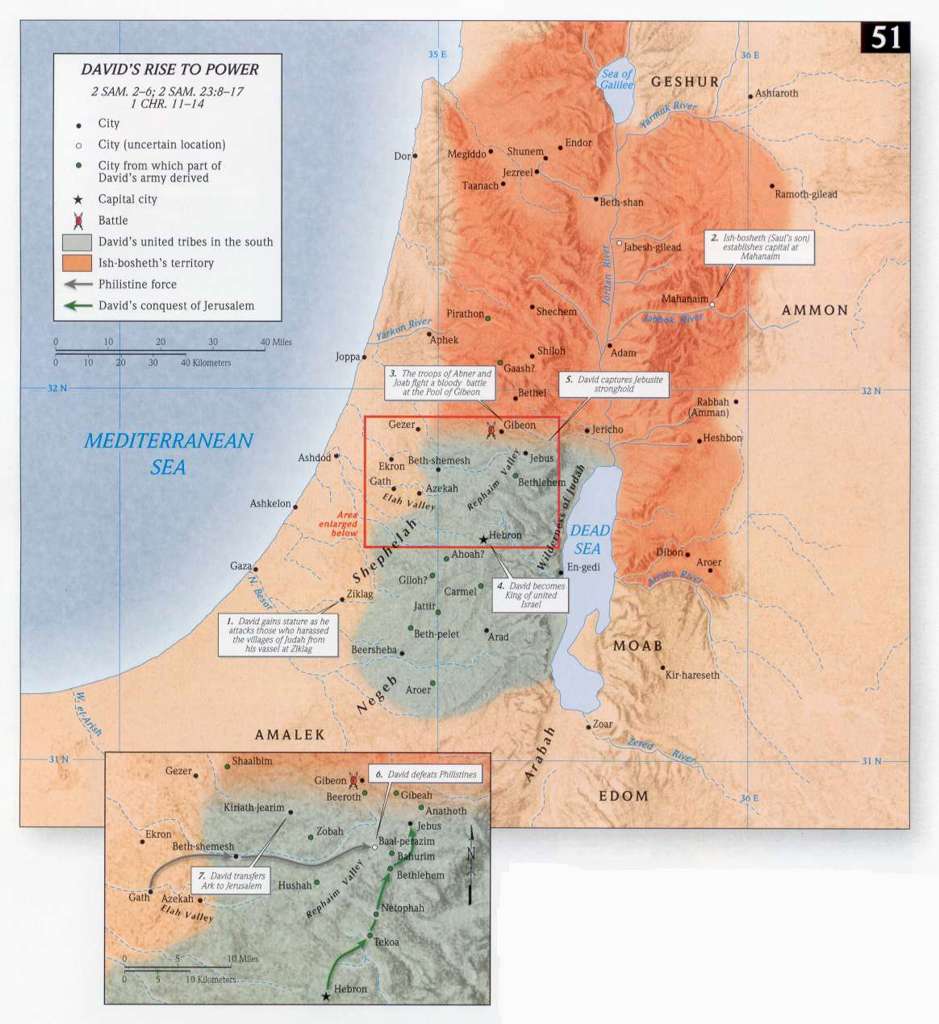
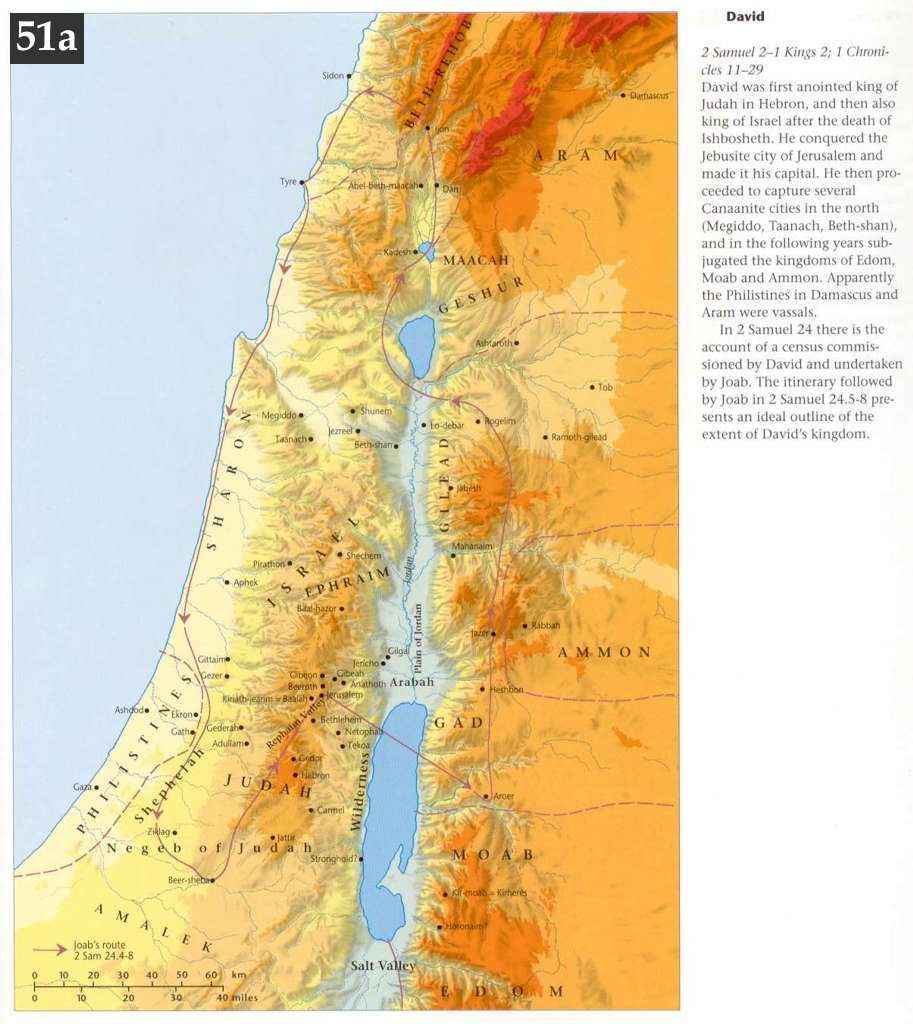
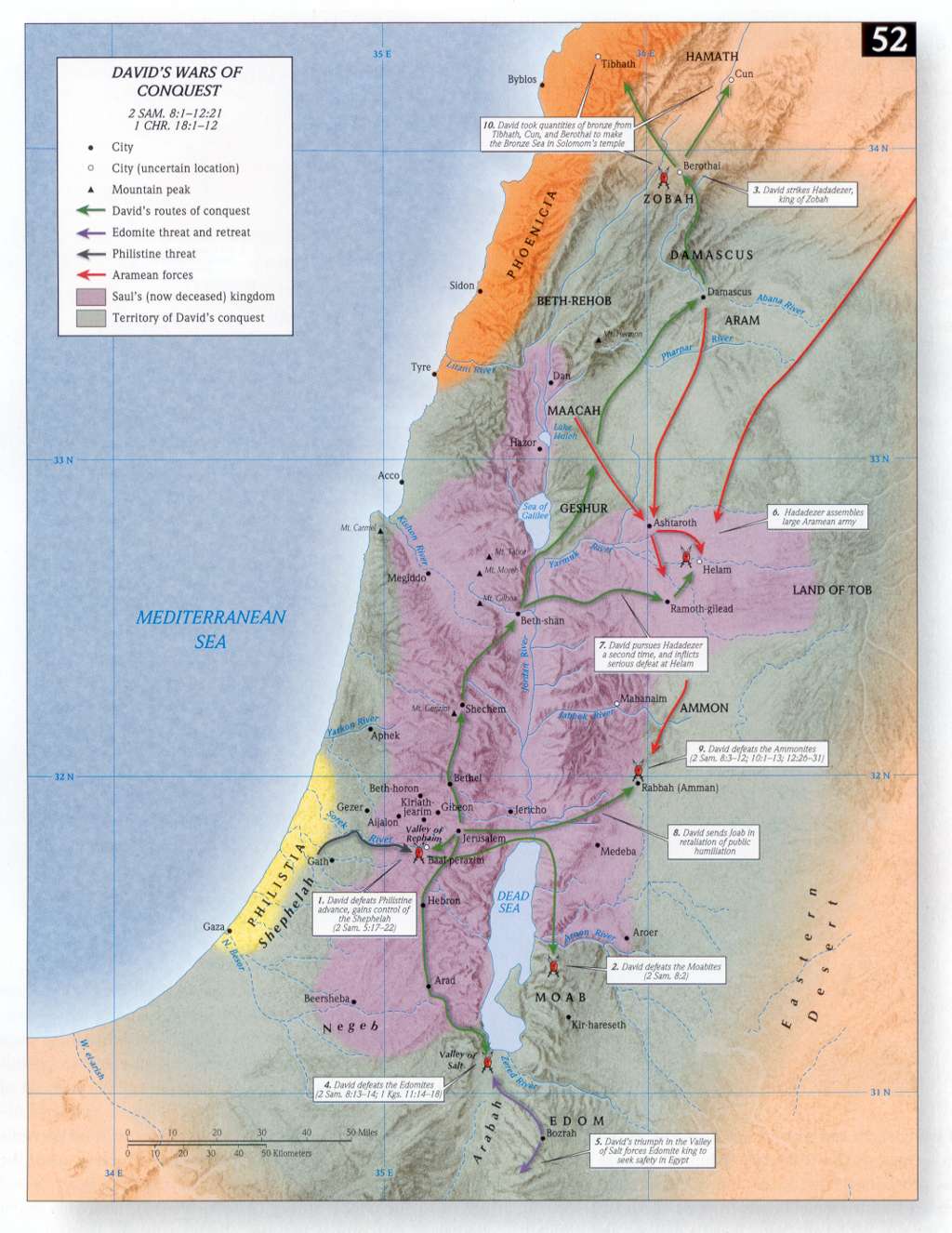
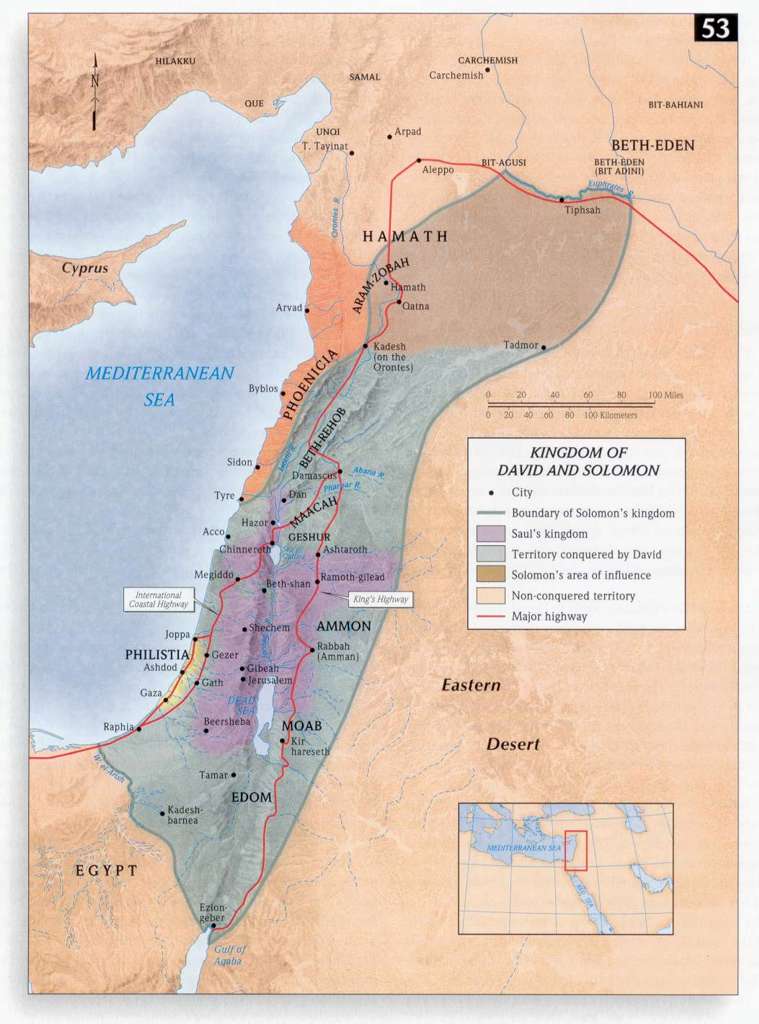
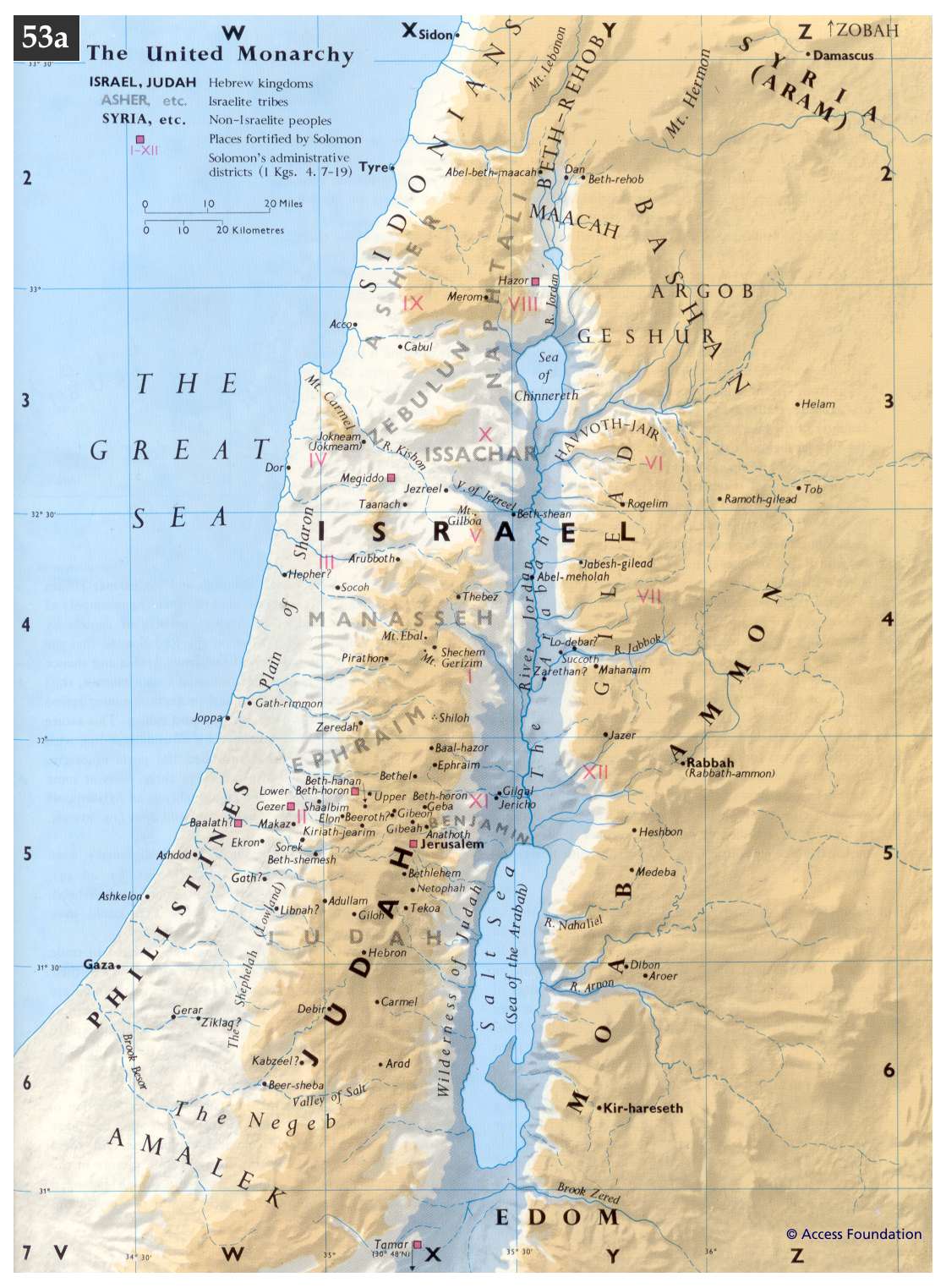
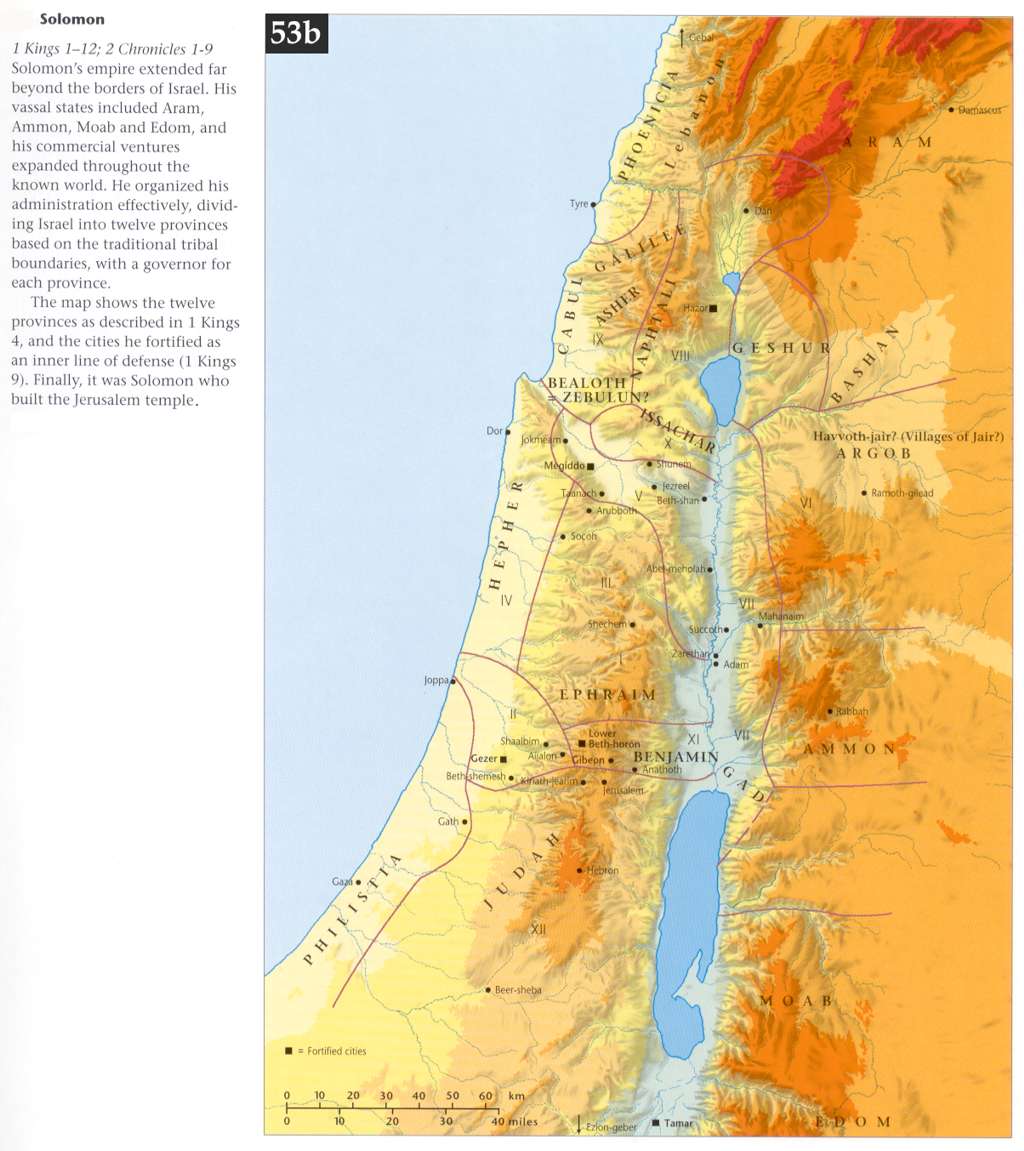
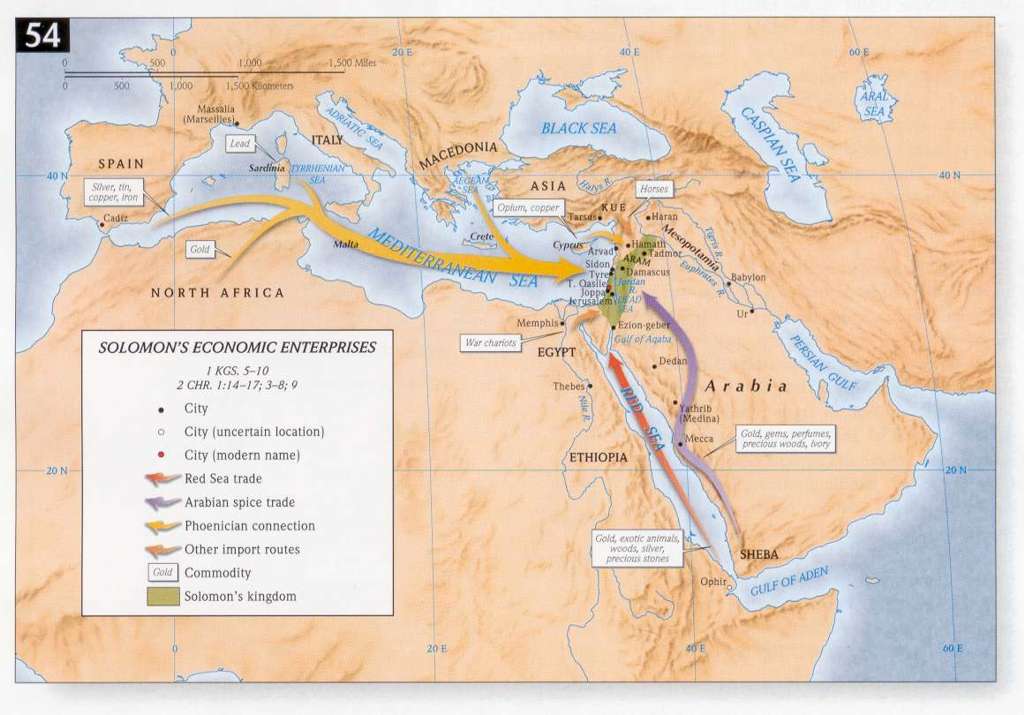
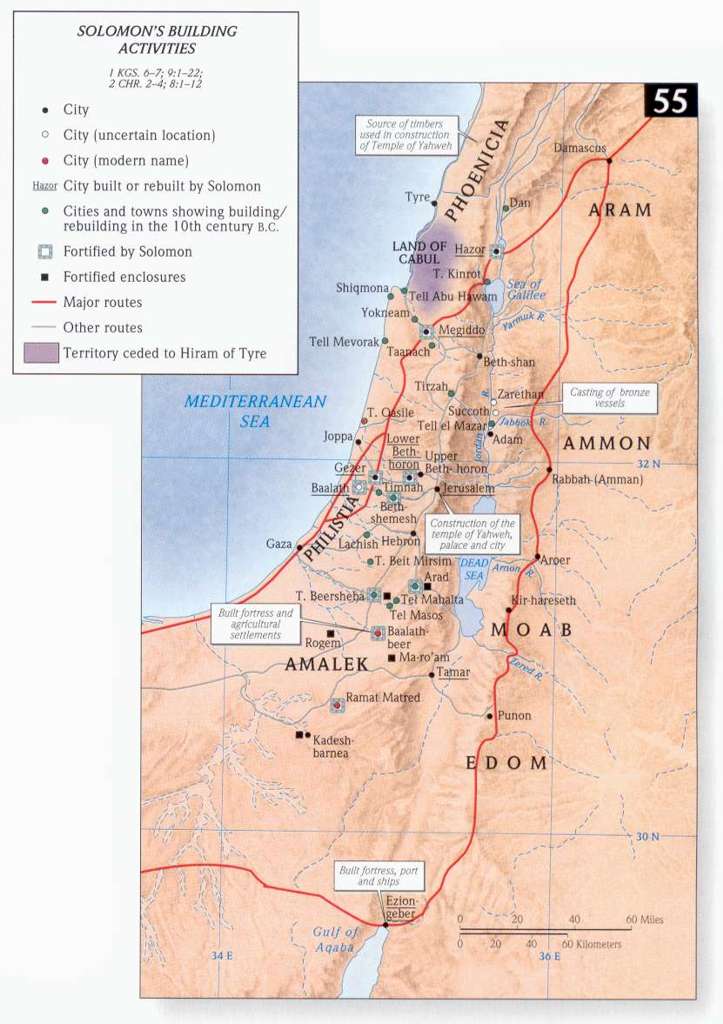
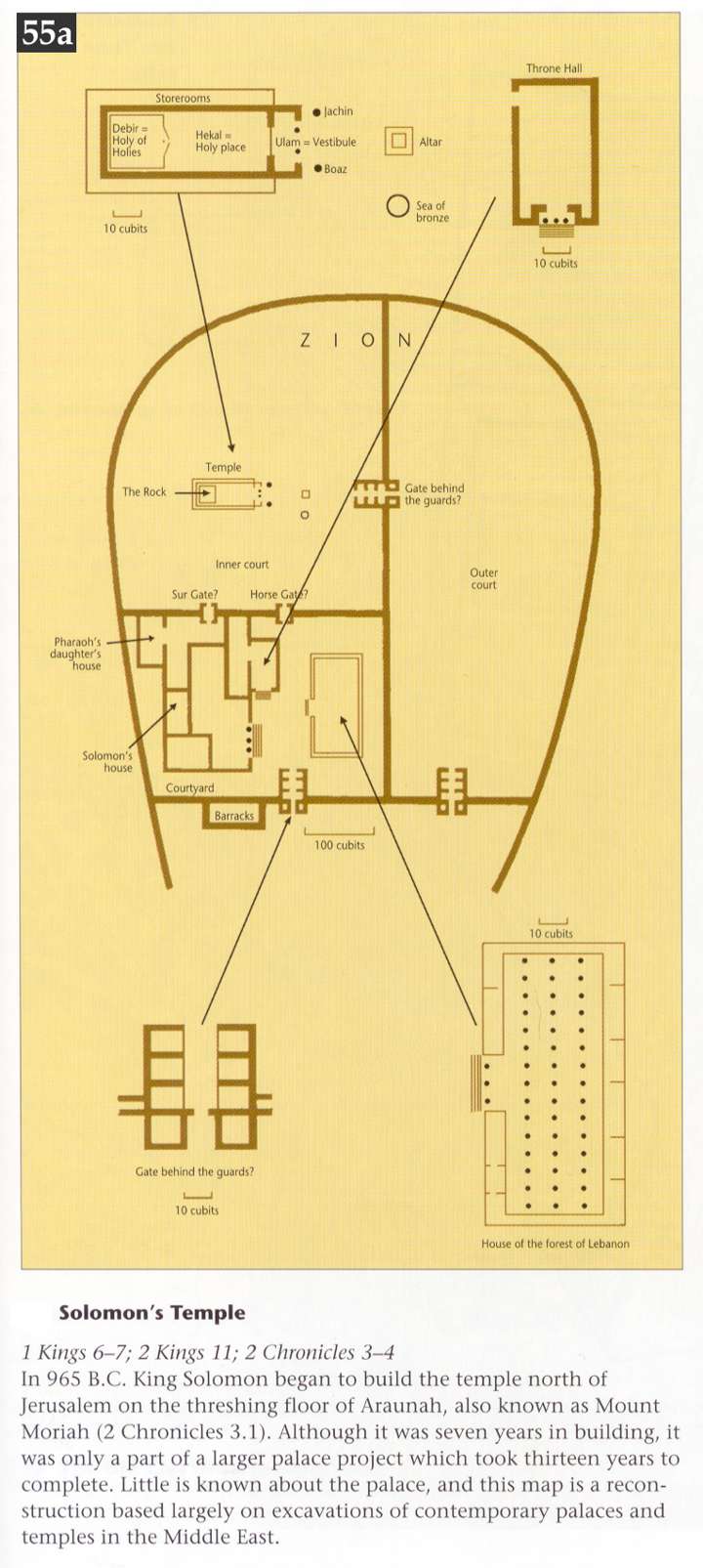
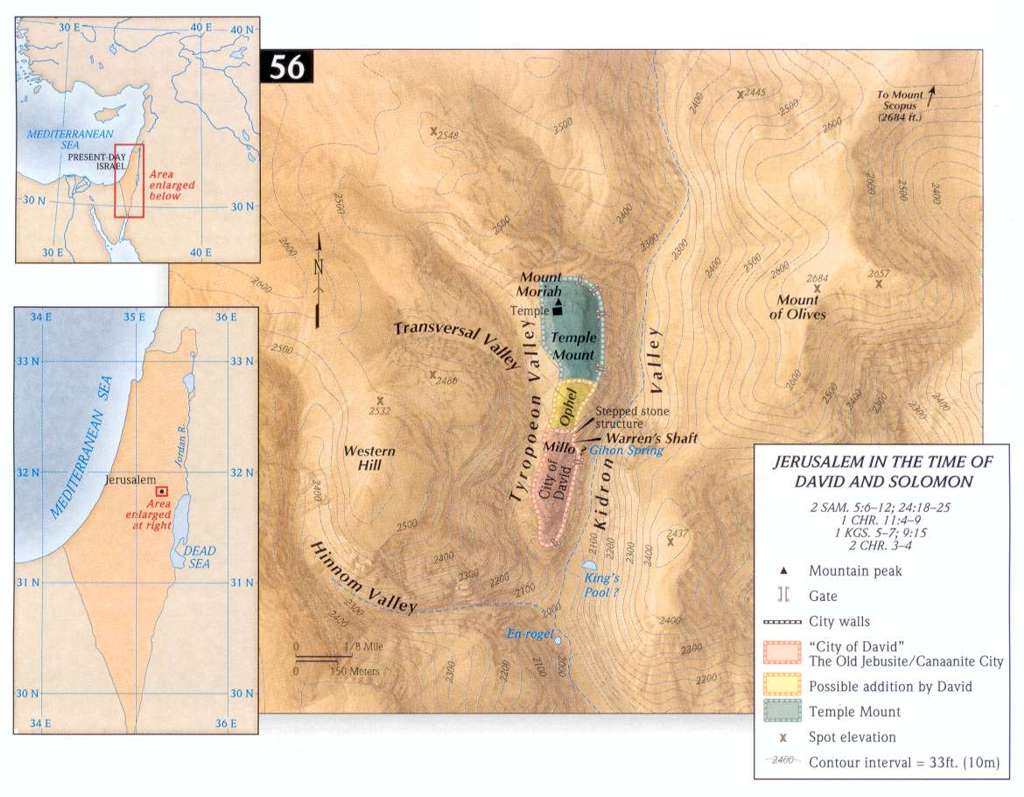
The Kingdoms of Israel and Judah
- The Kingdoms of Israel and Judah (1)
- The Kingdoms of Israel and Judah (2)
- The Kingdoms of Israel and Judah (3)
- The Campaign of Shishak
- Conflicts between Israel and Aram-Damascus
- The Omride Dynasty
- The Golden Ages of the 9th & 8th centuries BCE
- Phoenician Trade and Civilization
- Trade Routes throughout the Middle East
- Travel Routes throughout Palestine
- Elijah and Elisha
- The Revolt of Jehu
- The Rise of Assyria
- Israel & Judah in the days of Jeroboam II and Uzziah
- The Assyrian Empire under Tiglath-Pileser III
- The Syro-Ephraimite War
- Tiglath-Pileser III's Campaigns
- Fall of Samaria and Deportation of Israelites
- The Fall of the Kingdom of Israel
- Assyrian Districts after the Fall of Samaria
- Prophets of the 8th Century BCE
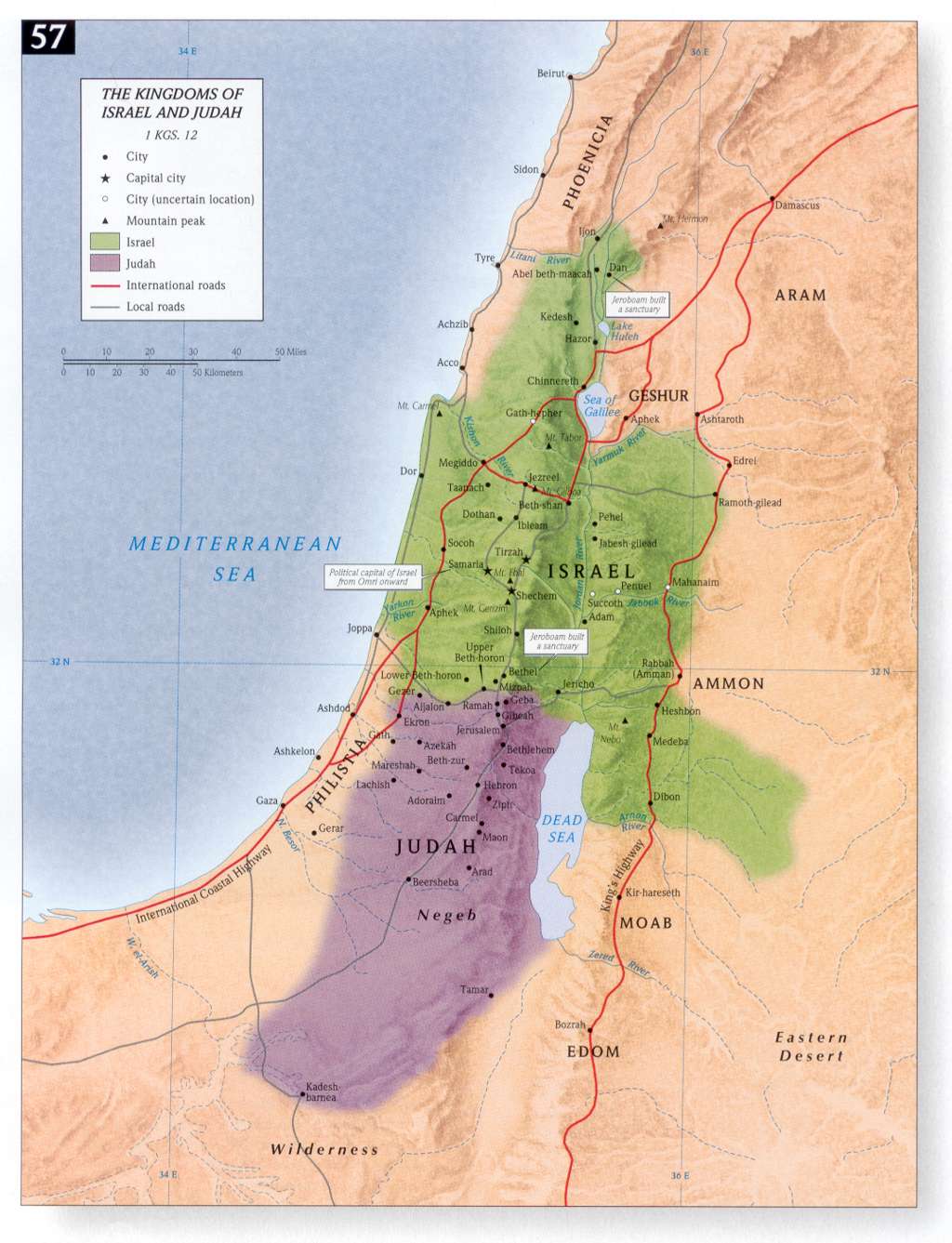

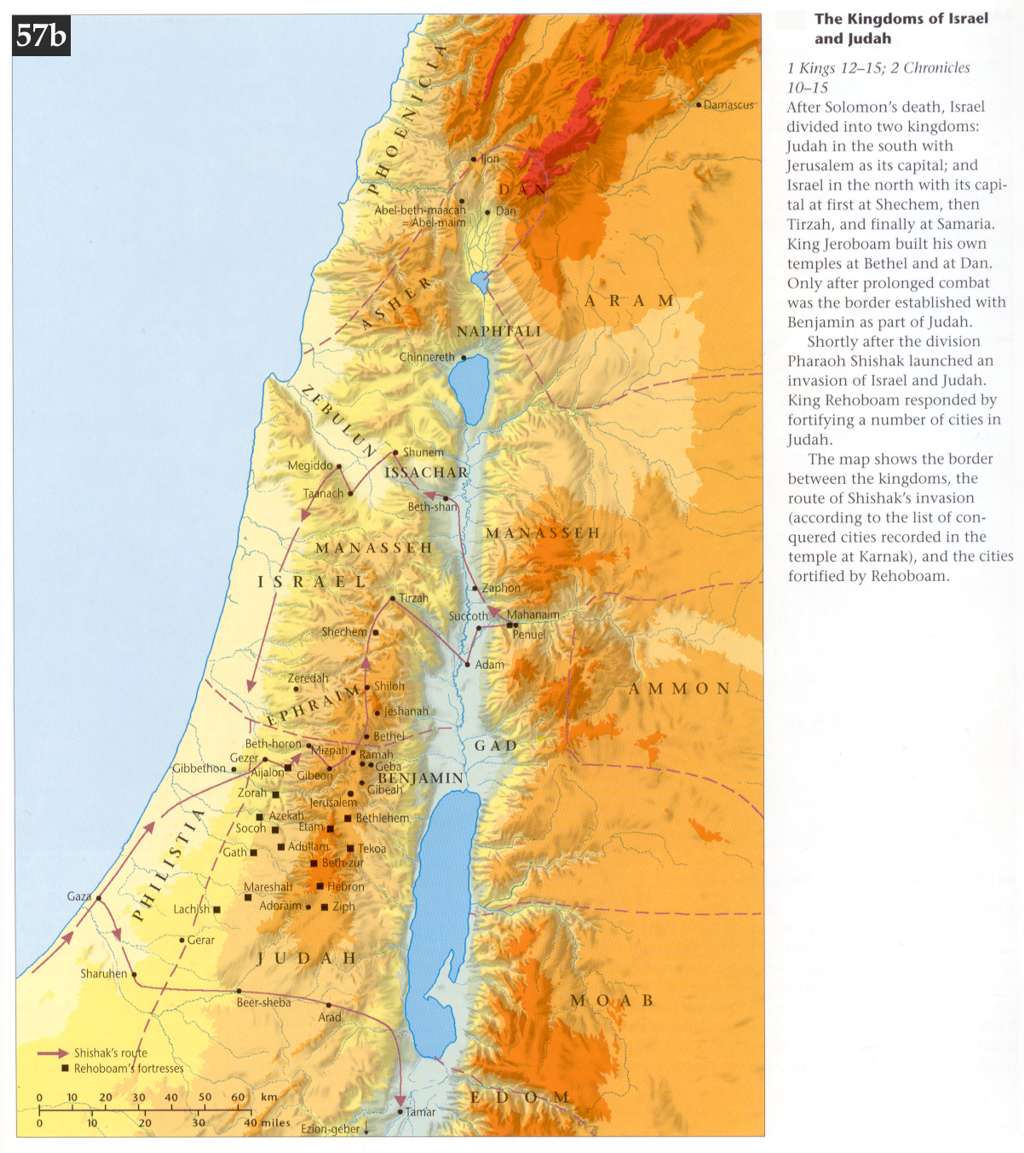
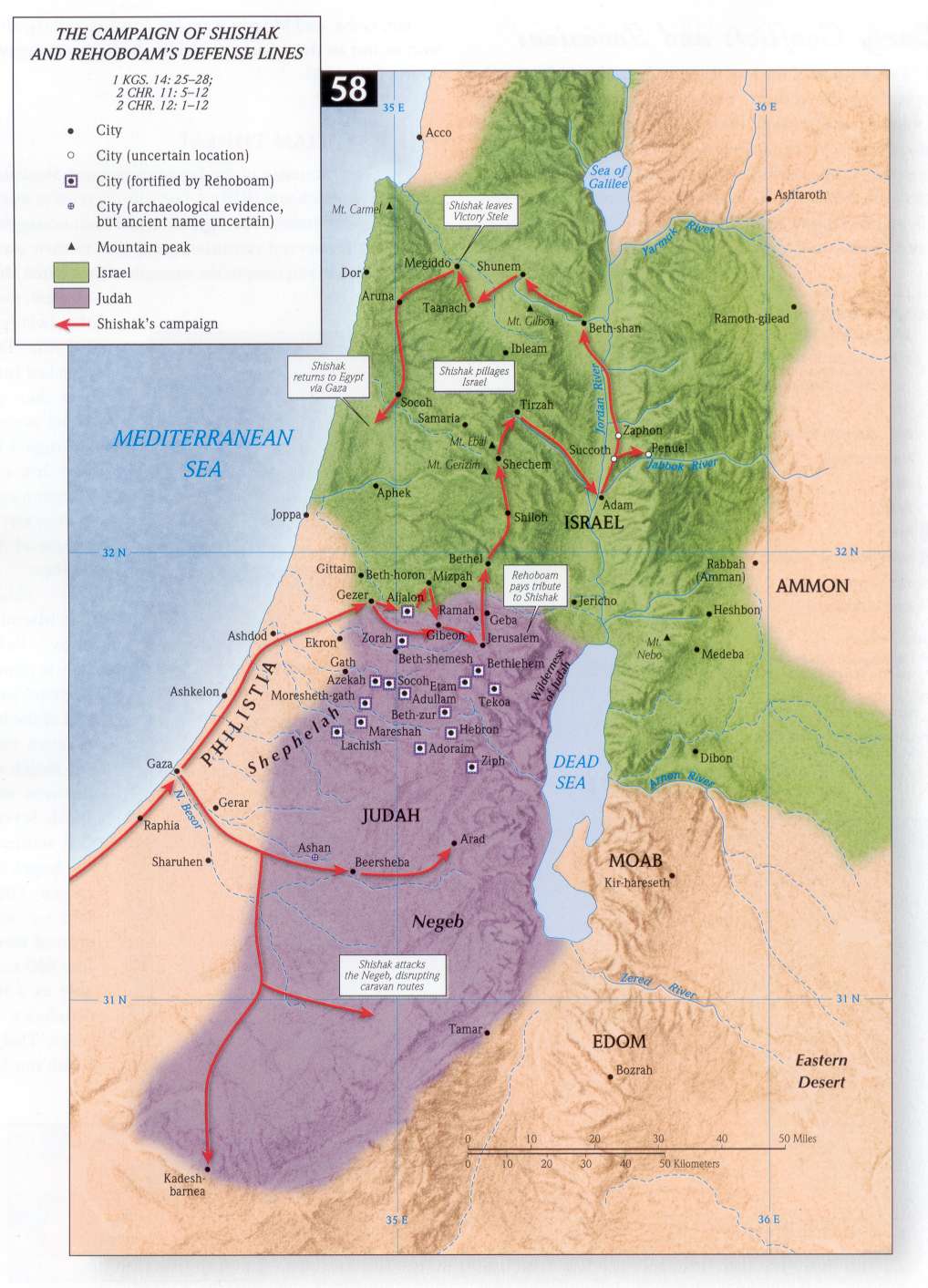
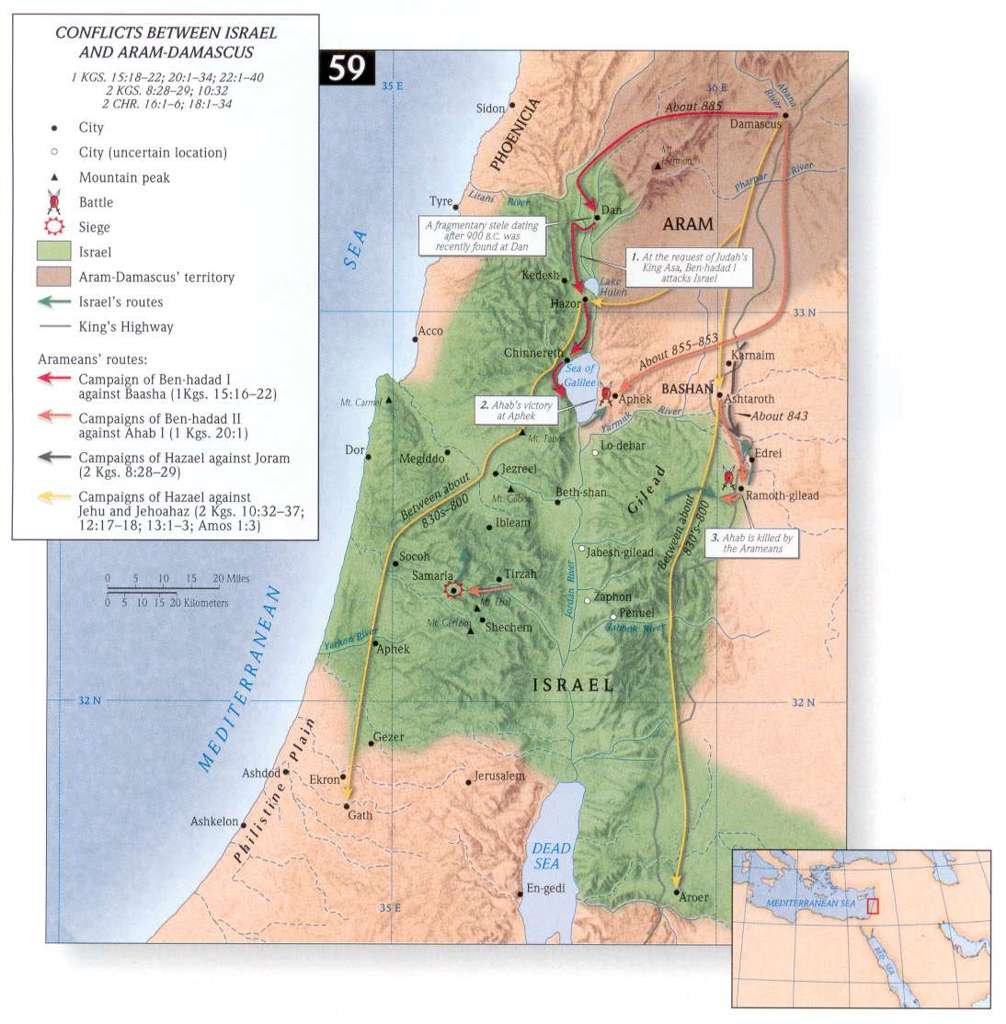
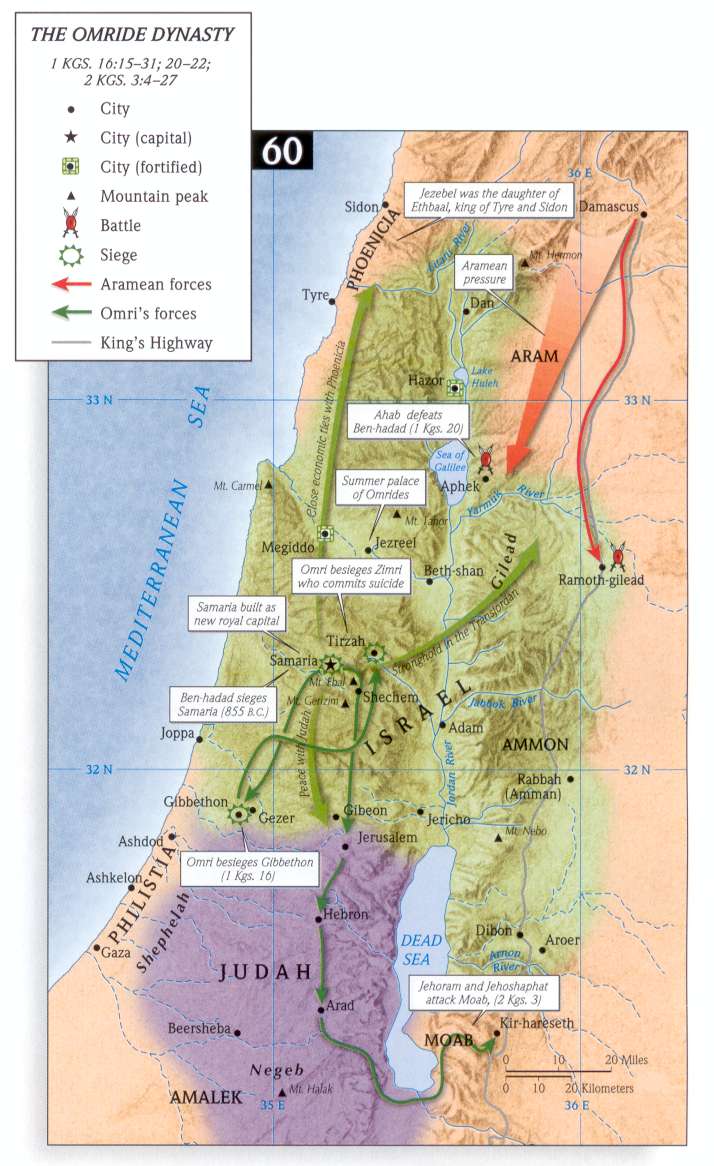
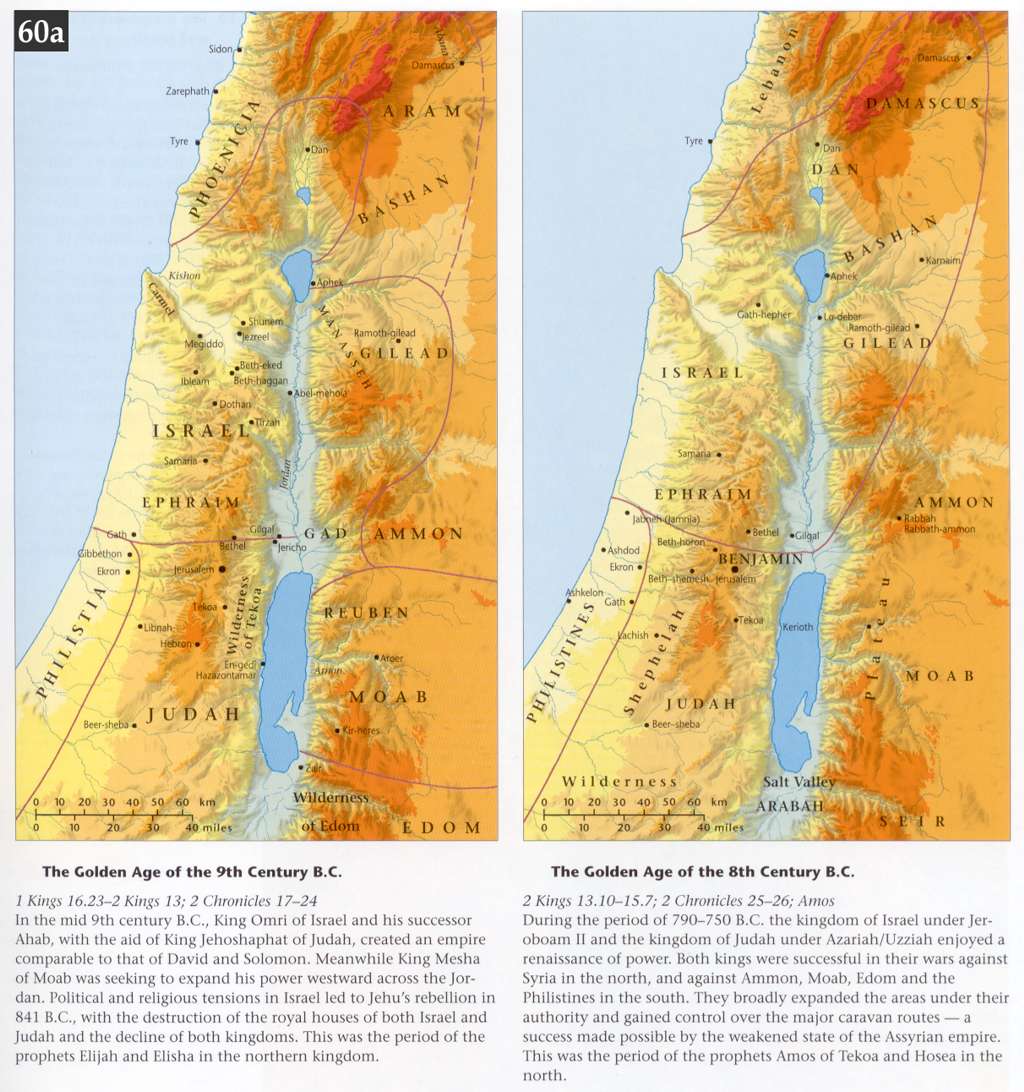
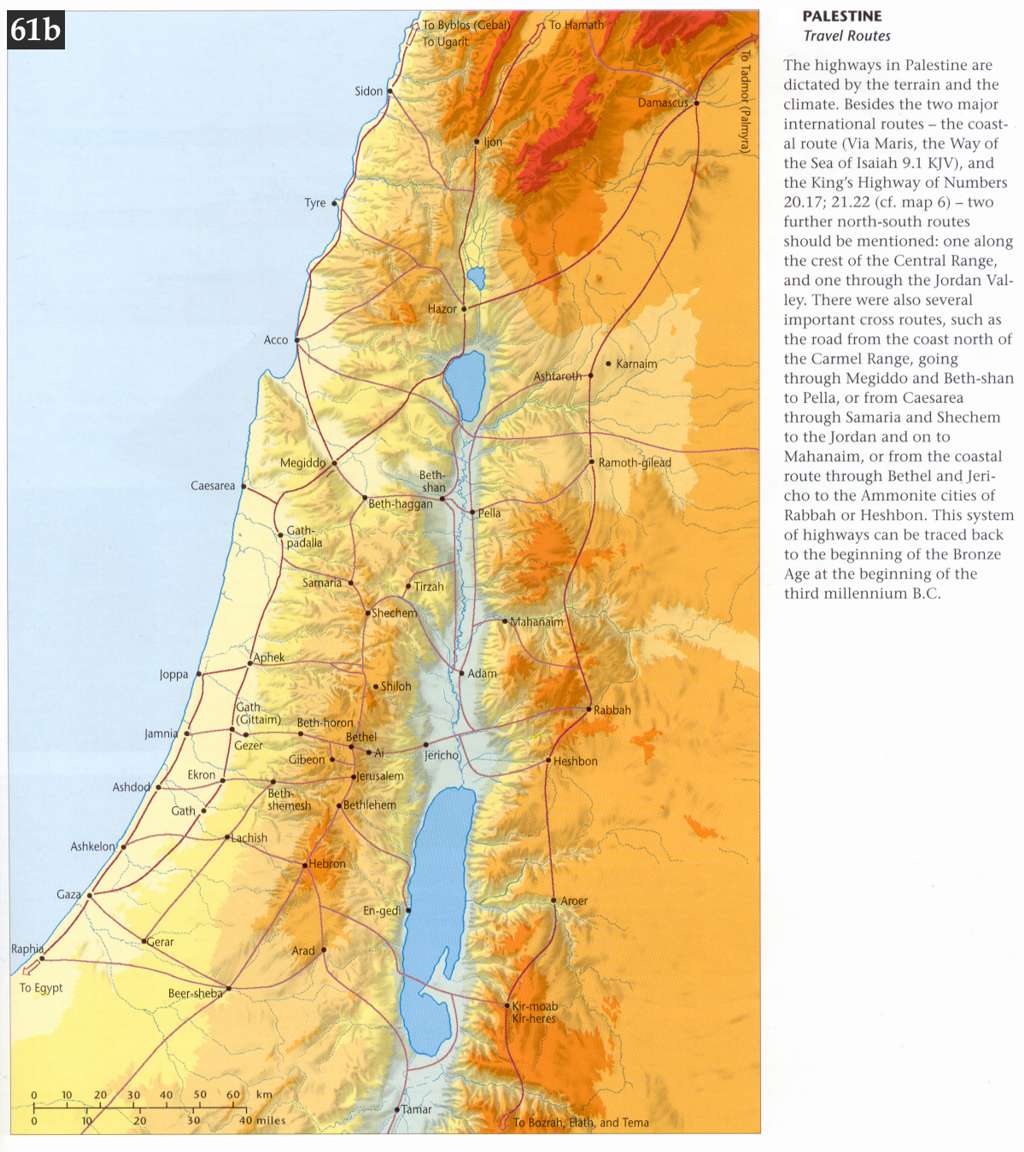
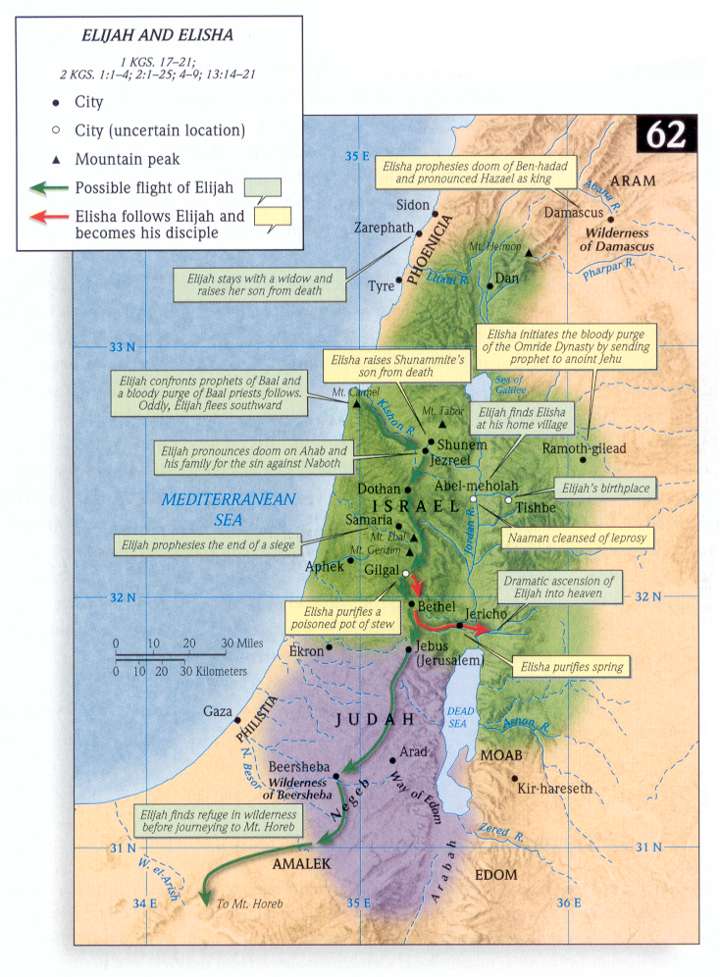
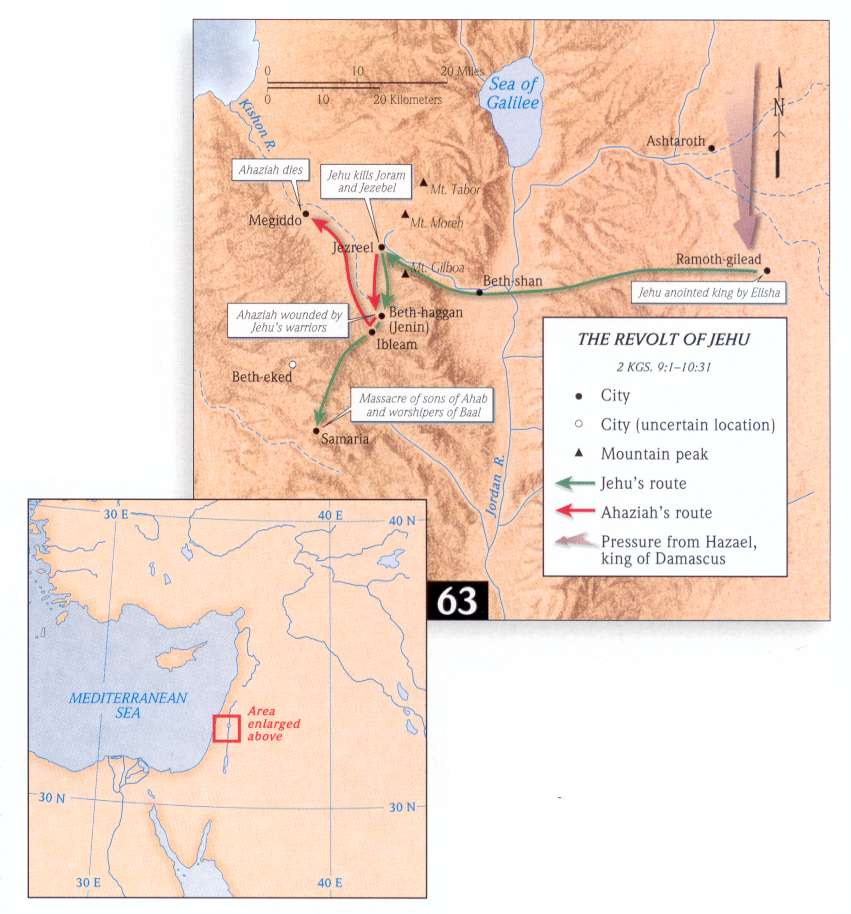
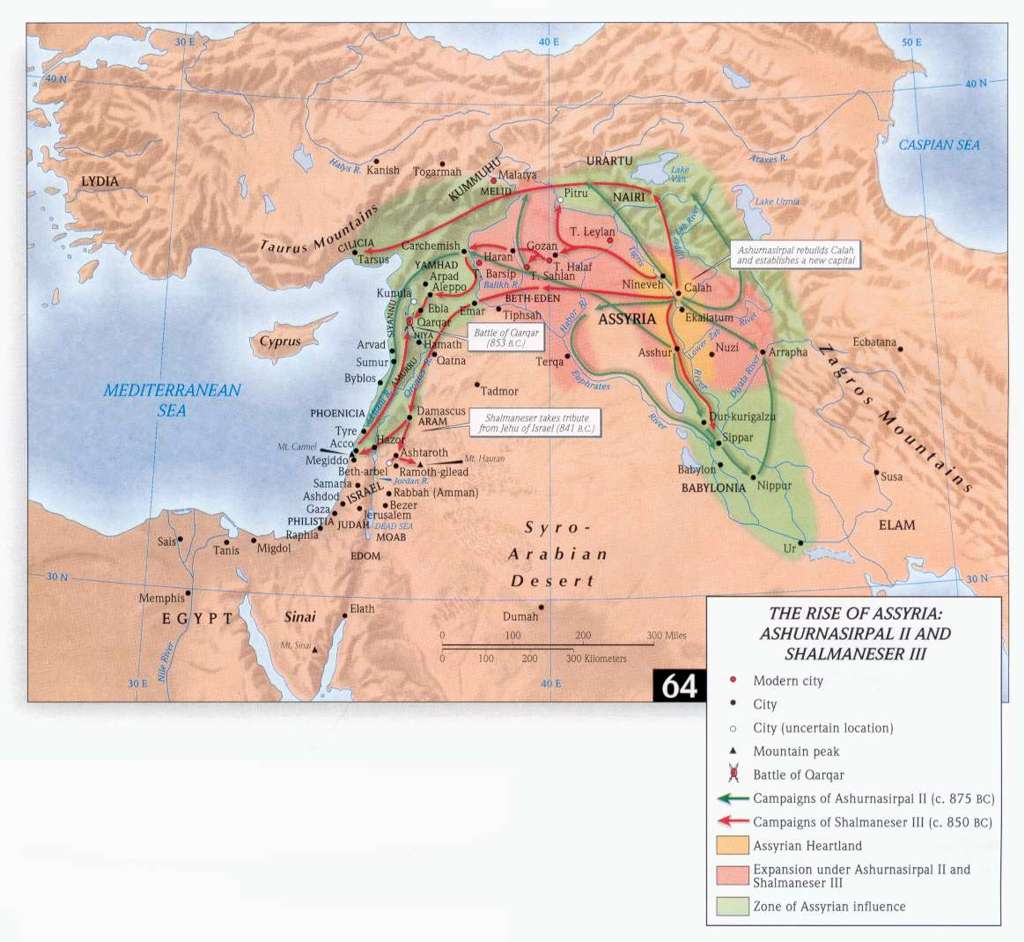
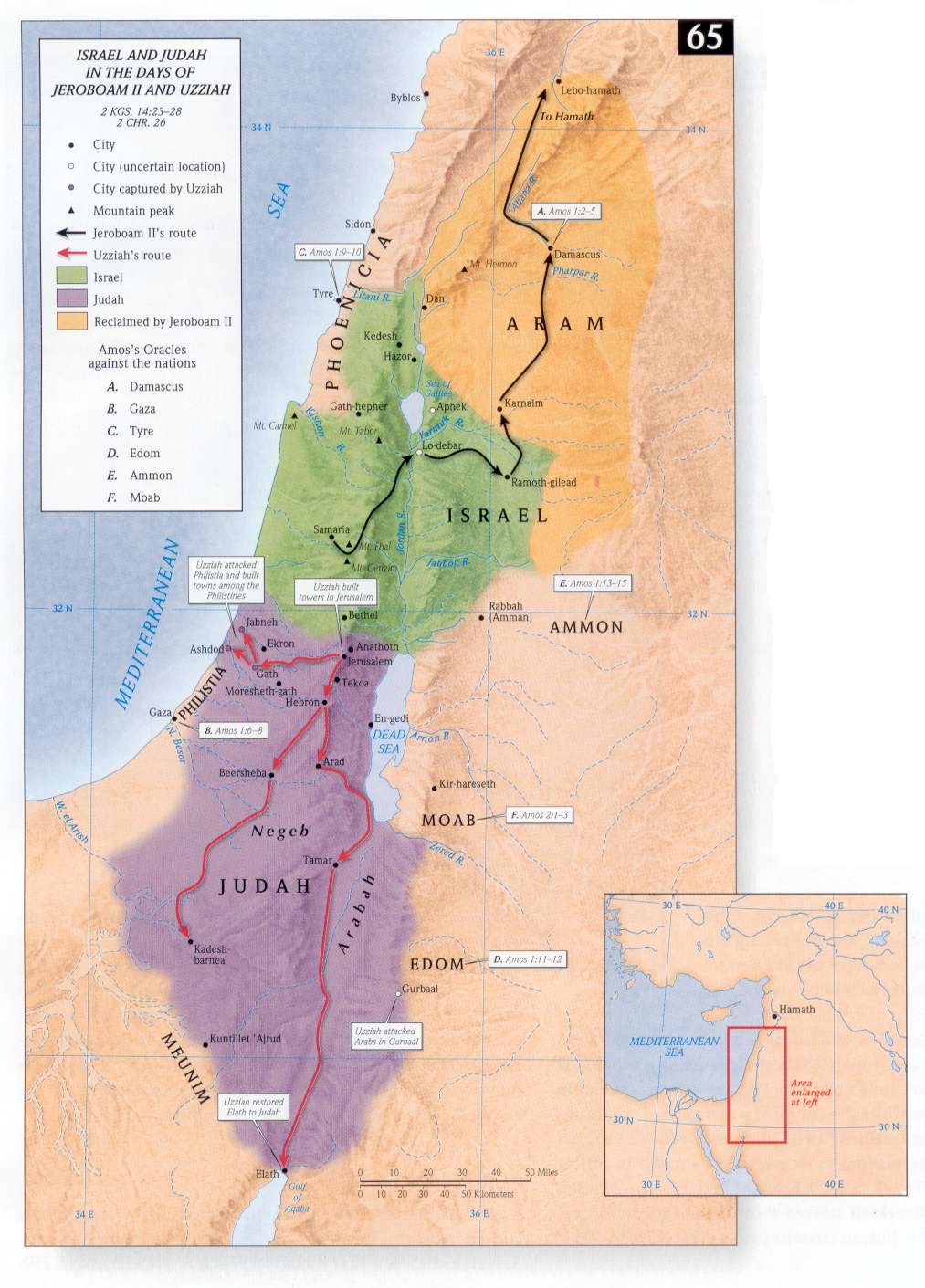
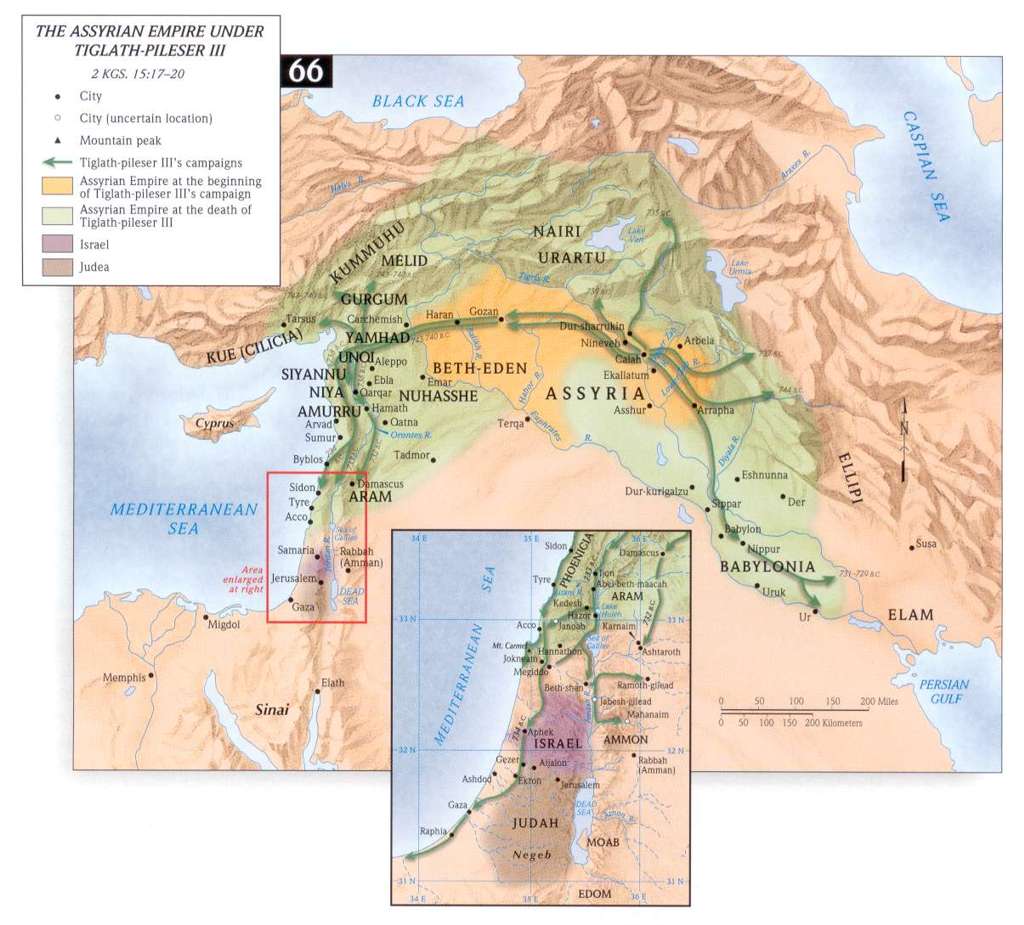
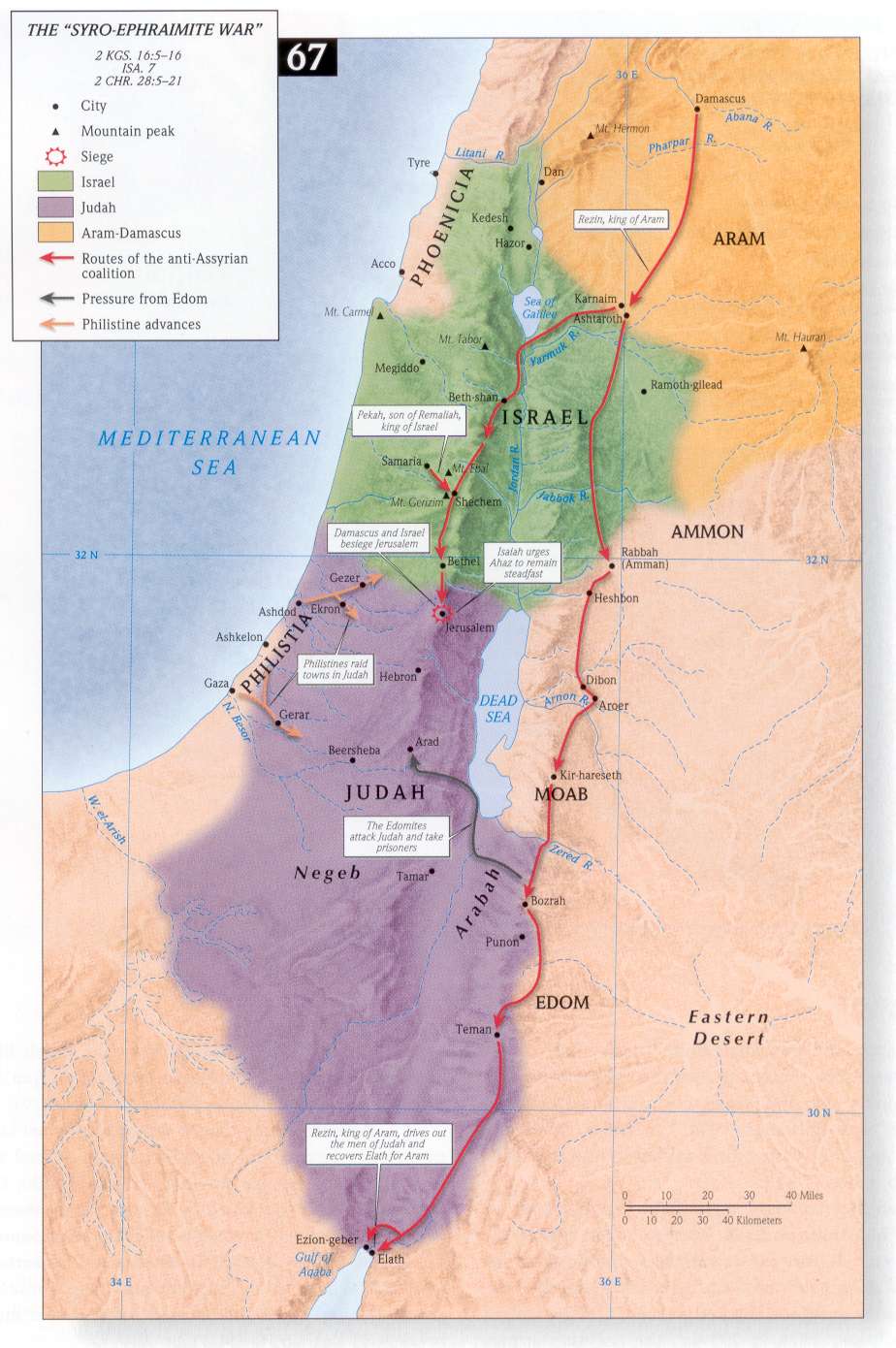
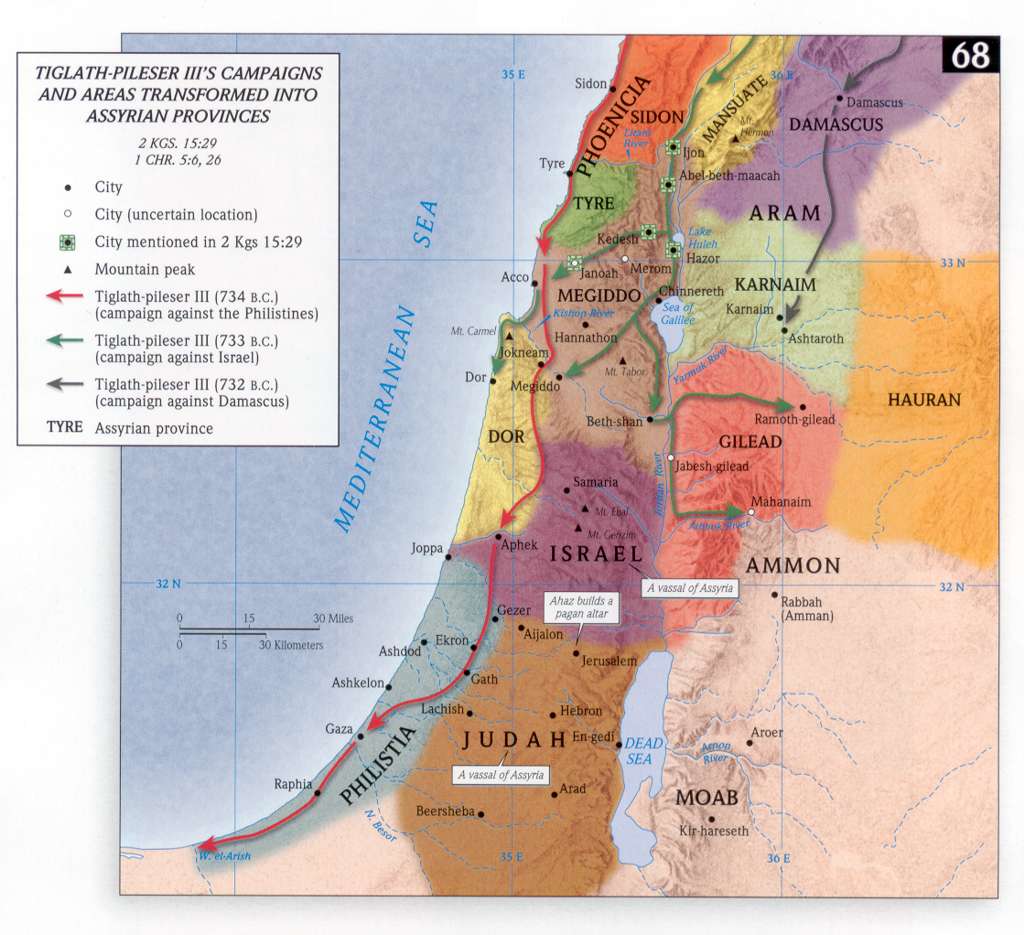
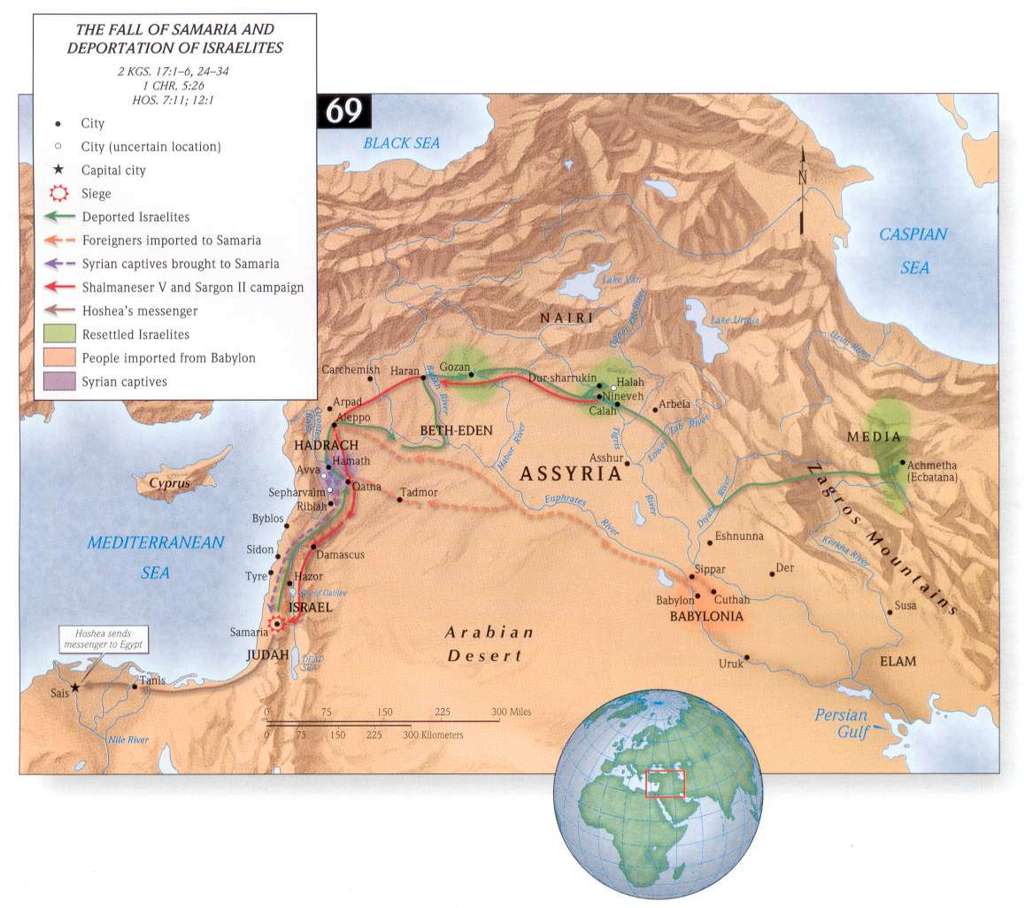
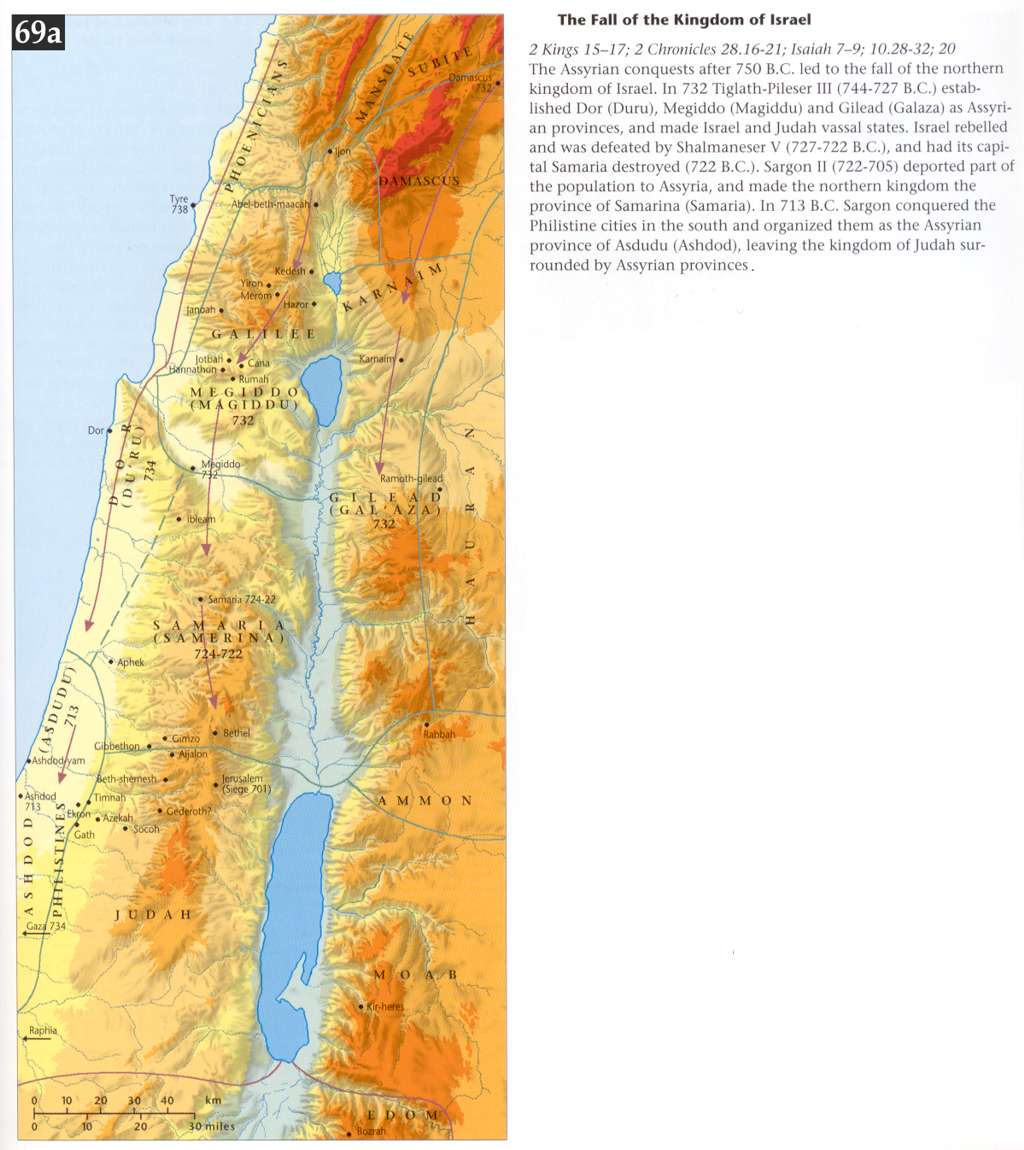
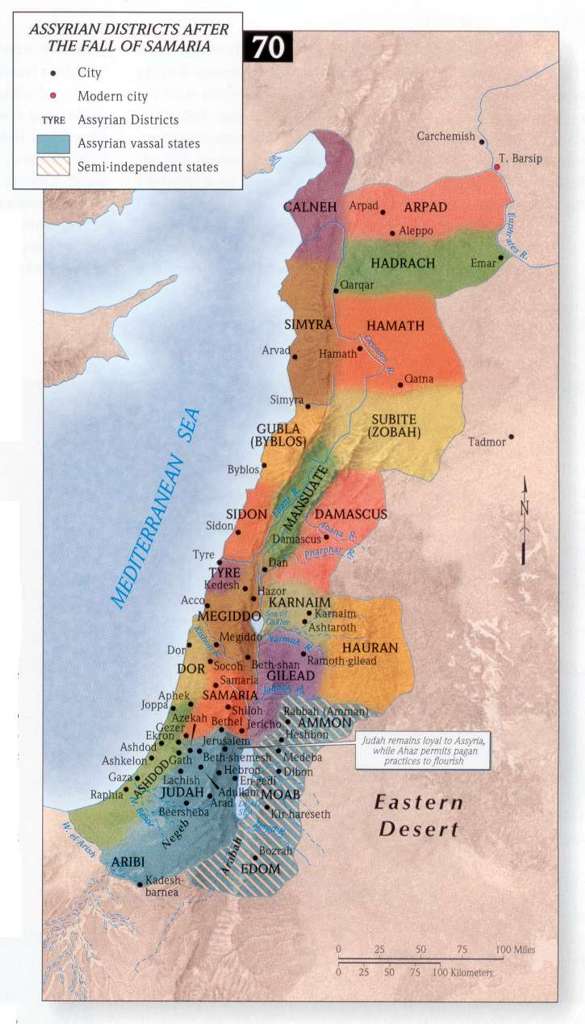
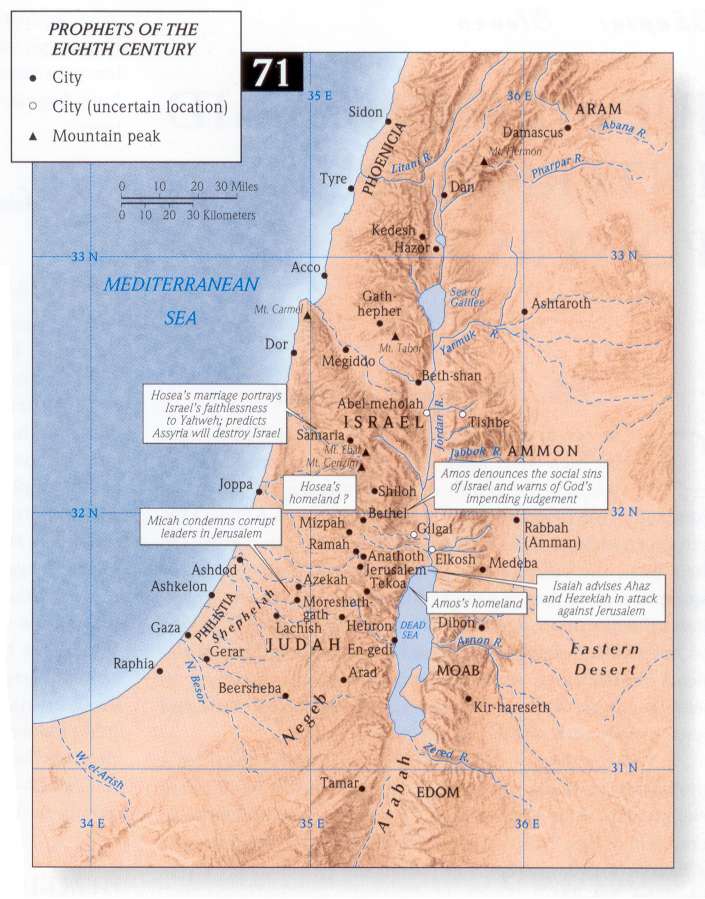
Judah Alone amid International Powers
- Hezekiah's Preparation for Revolt
- Judah under King Hezekiah
- Hezekiah's Jerusalem
- Sennacherib's Campaign against Judah
- Assyria in the 7th century BCE
- The Rise of the Neo-Babylonian Empire
- The Reign of Josiah
- The Districts of Judah under King Josiah
- The Golden Age of King Josiah
- Nebuchadnezzar's Campaigns against Judah
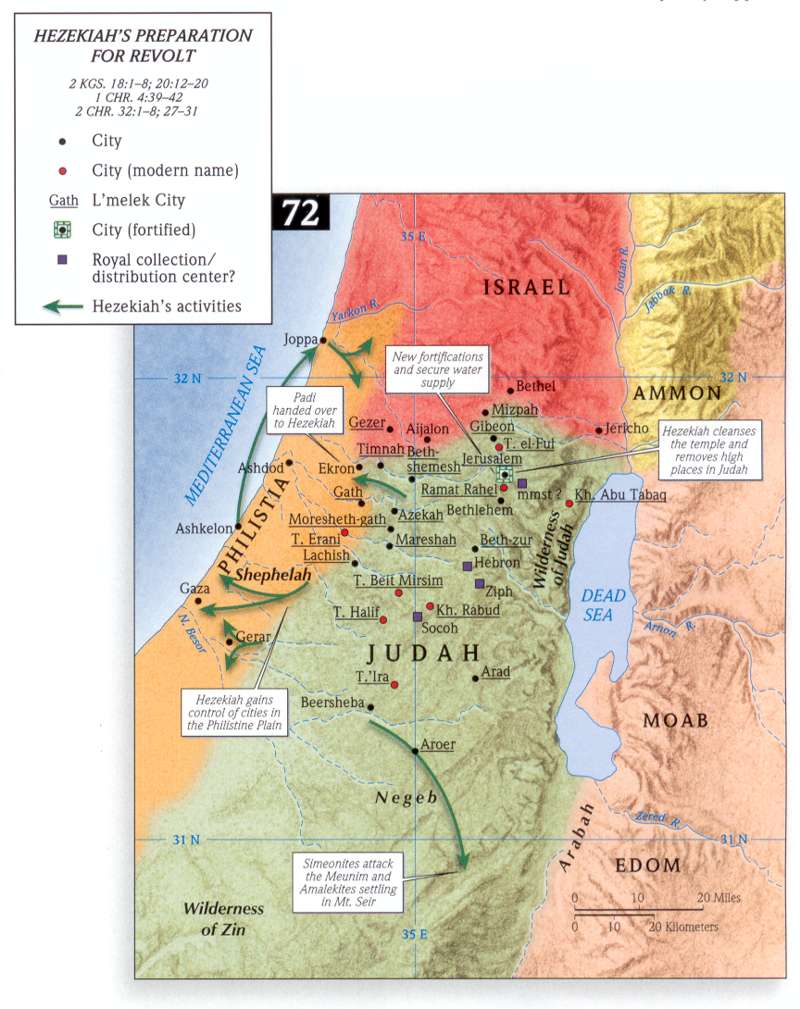
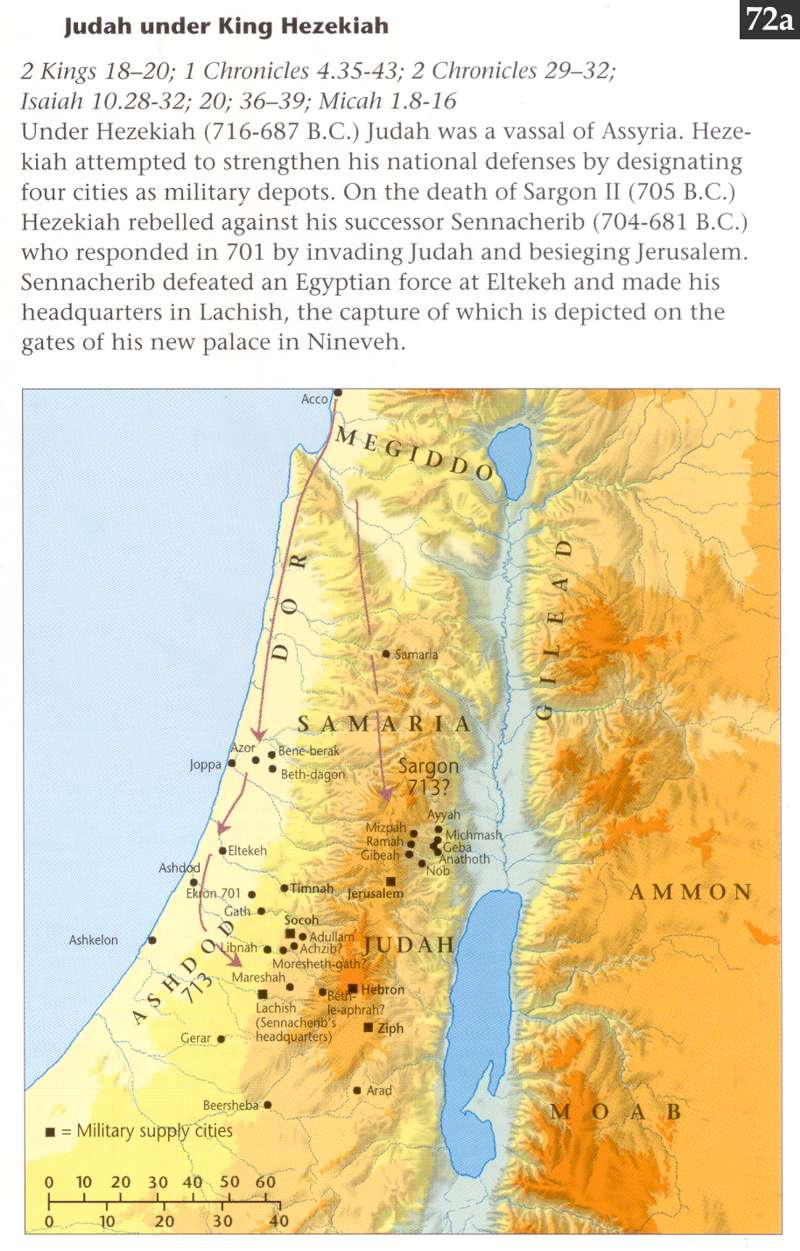
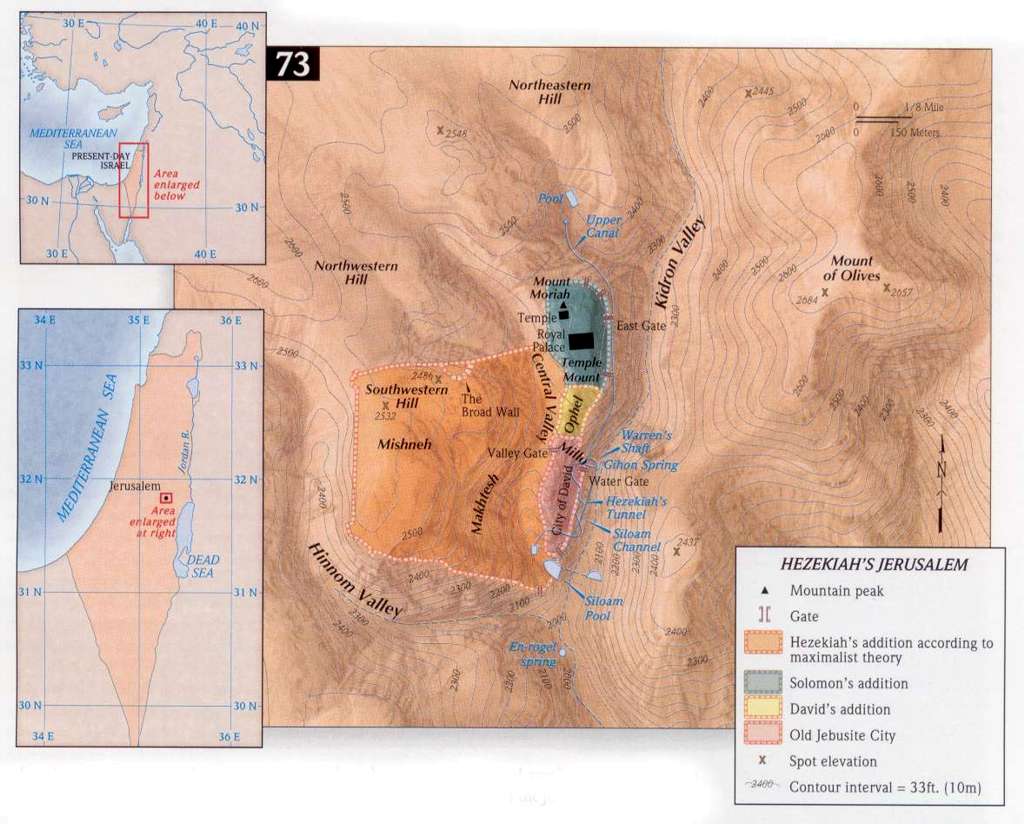
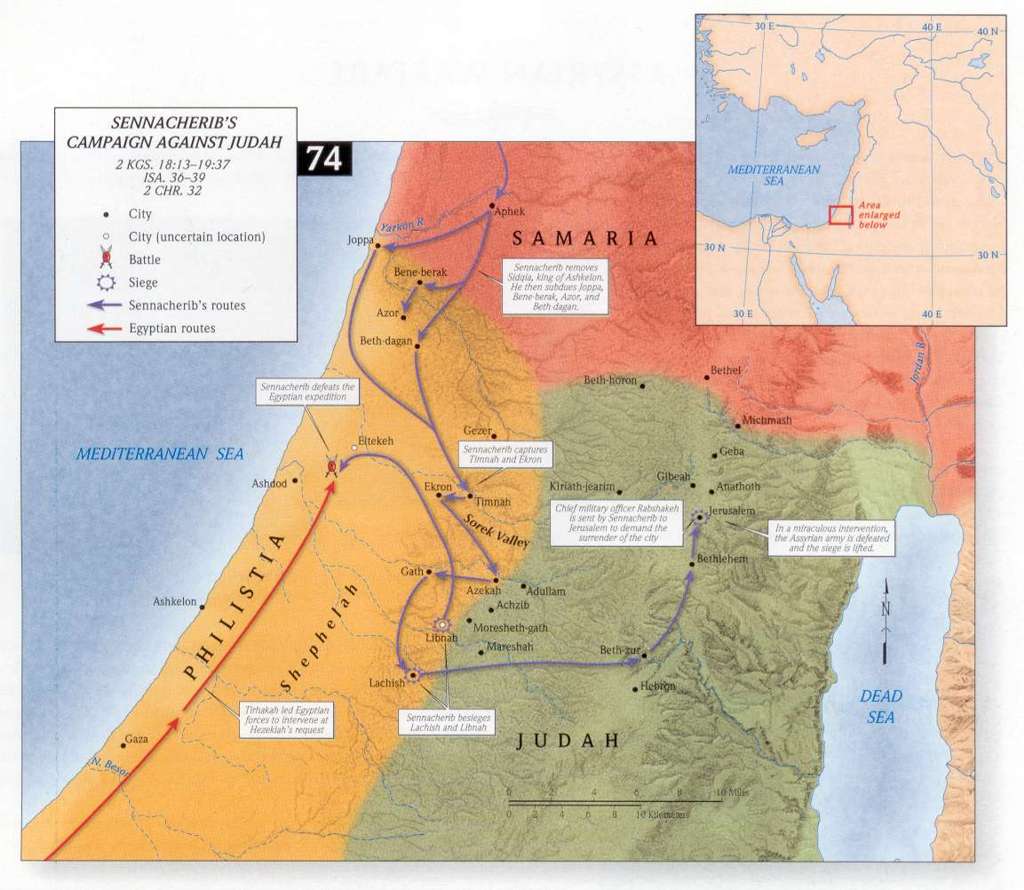
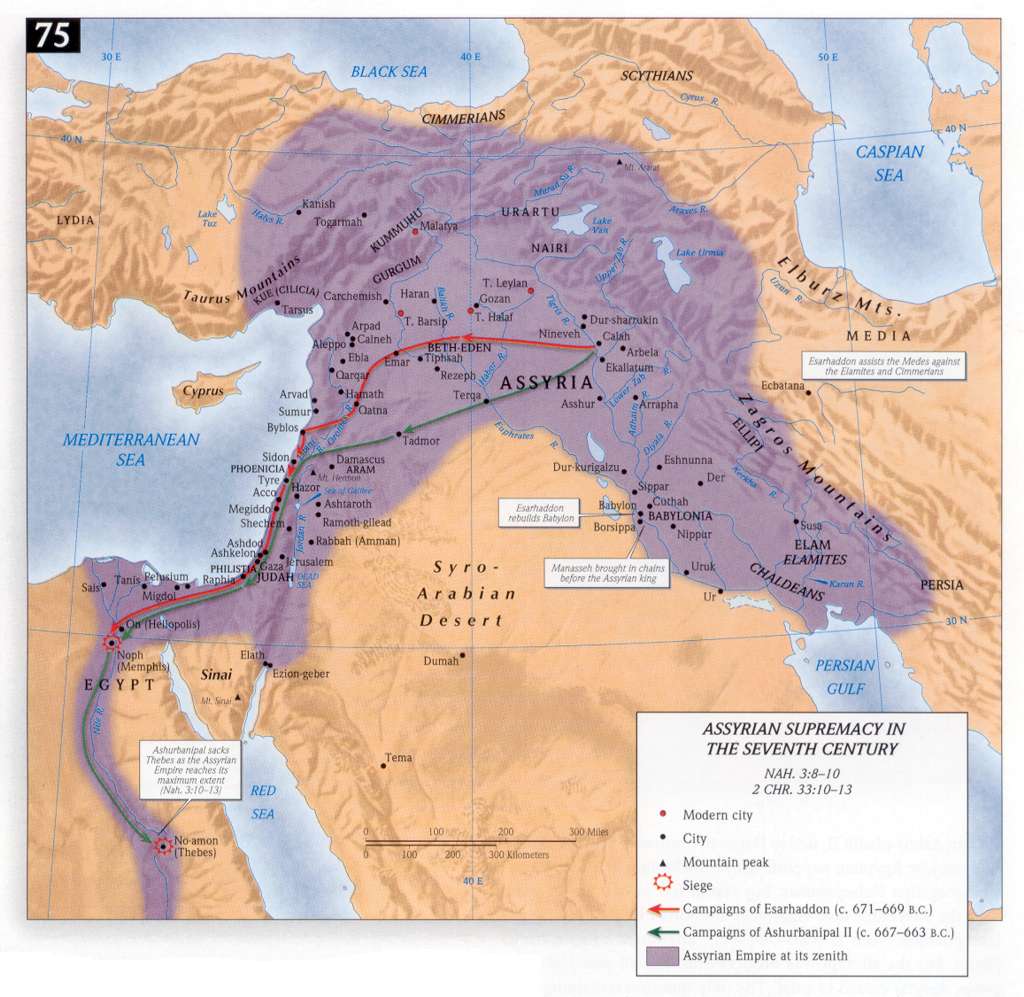
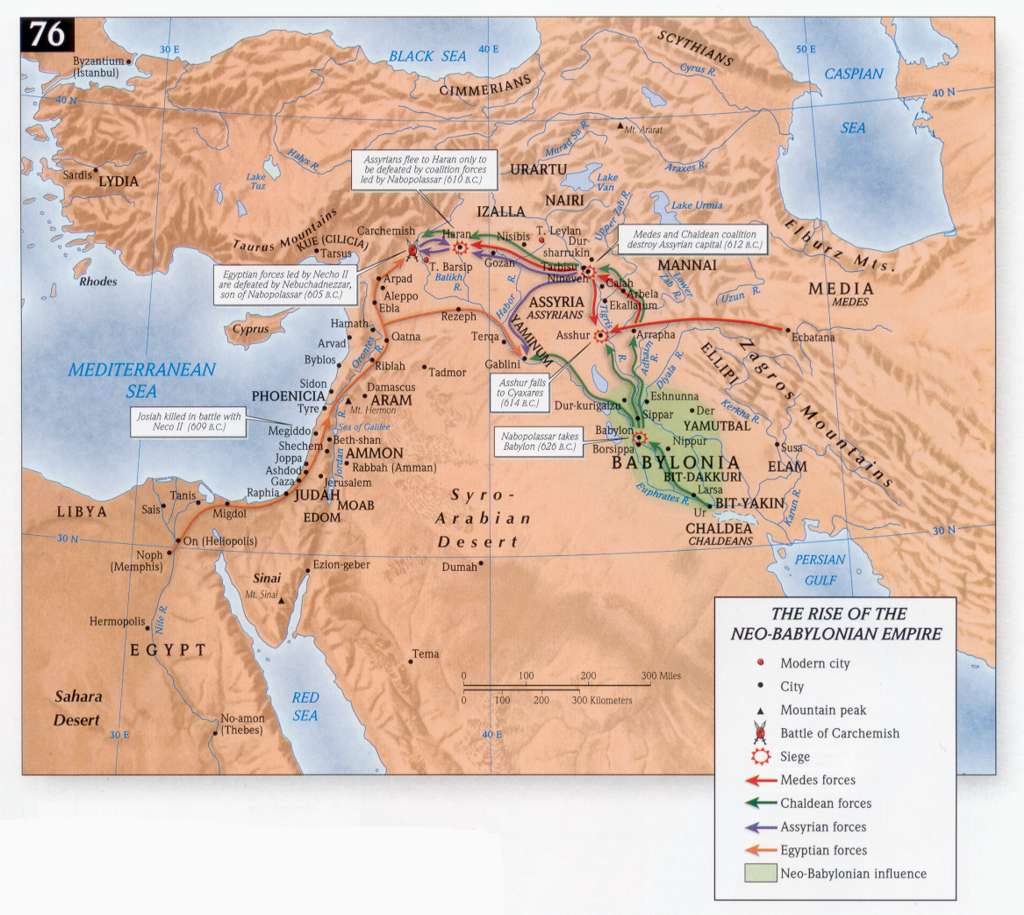
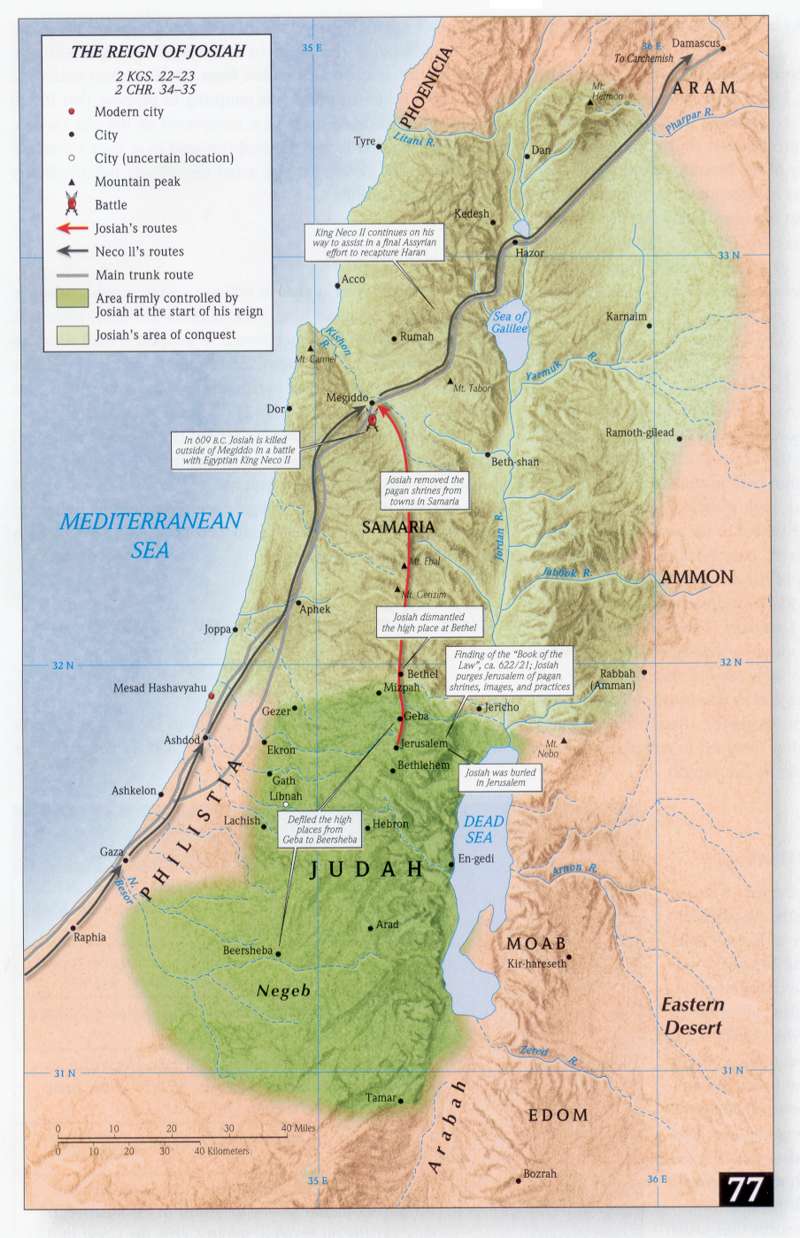
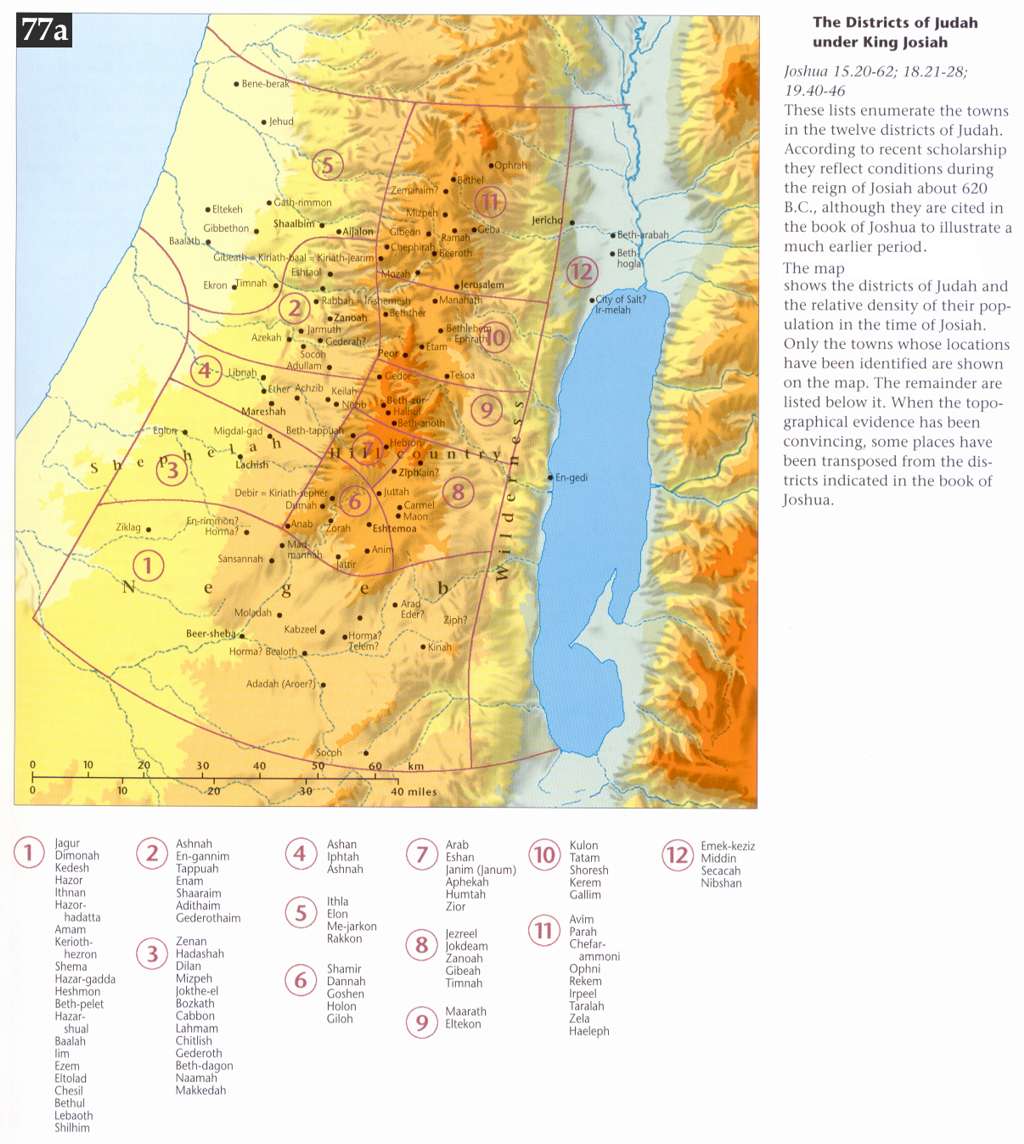
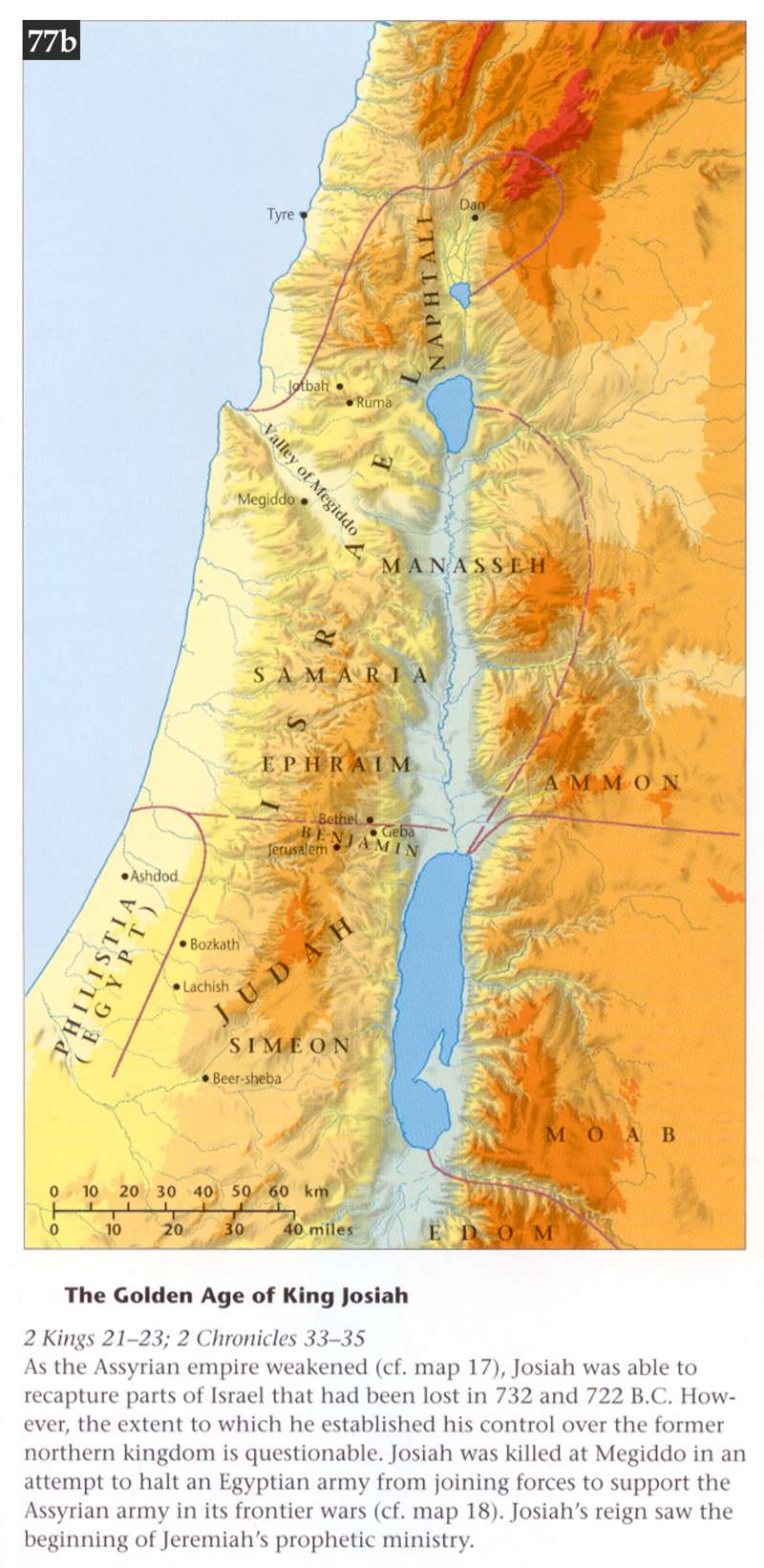
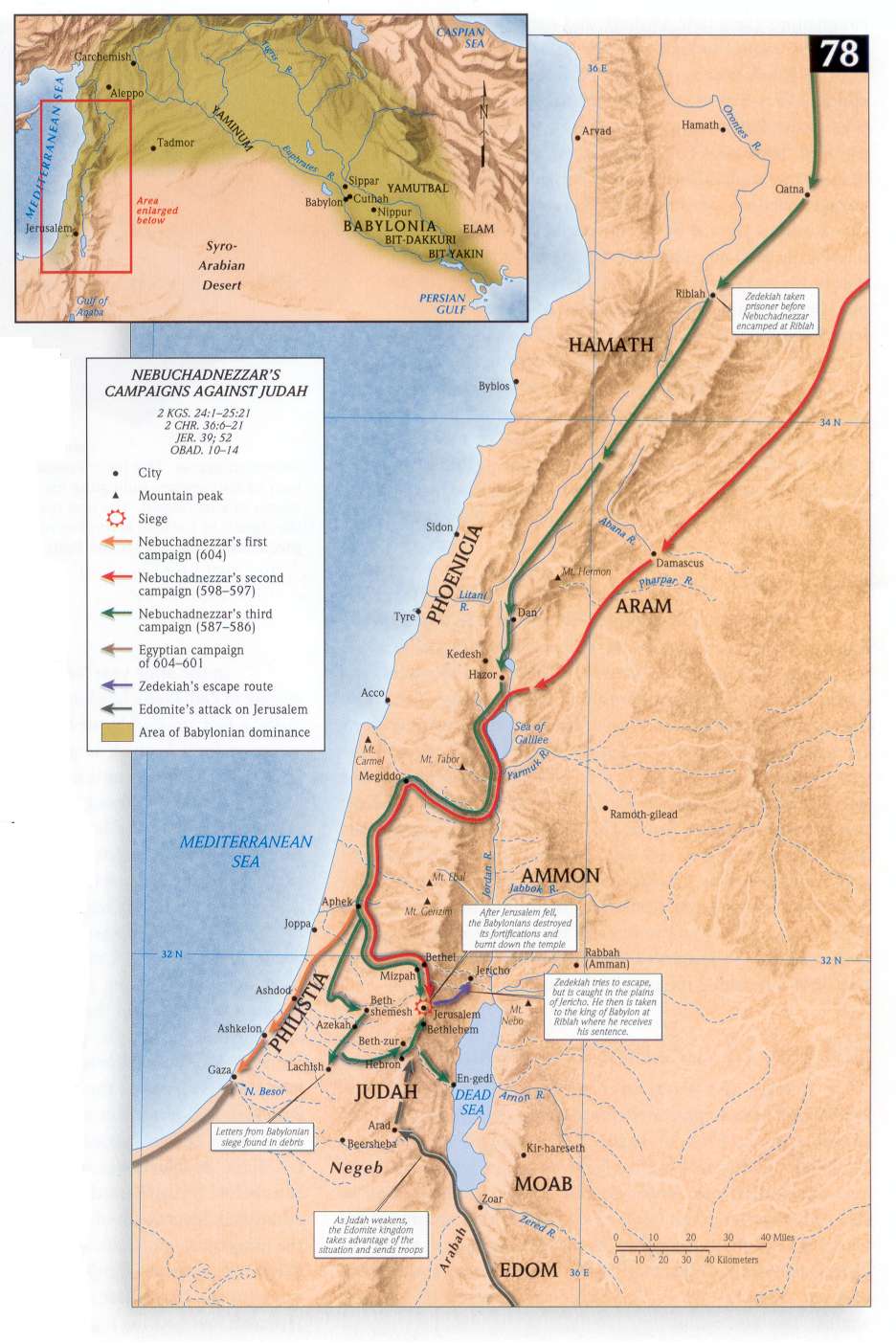
The Babylonian Exile up to the early Rome
- Judah during the Exile
- The Kingdom of Judah
- Exile; Palestine in the Post-Exilic Period
- Jewish Exiles in Babylon
- World Powers of the 6th century BCE
- The Conquests of Cyrus the Great
- The Persian Empire
- The Return of the Jewish Exiles to Judah
- Judah in the 5th century BCE
- Palestine after the Exile
- Alexander the Great's Empire
- The Division of Alexander's Empire ca. 275 BCE
- Palestine under the Ptolemies
- The Seleucid Empire and Antiochus III
- Campaigns of Antiochus IV against Egypt
- The Maccabees in 168 BCE
- Selected Events in the Maccabean Revolt
- Jewish Expansion under the Hasmonean Dynasty
- Pompey's Campaign against Jerusalem
- Early Rome
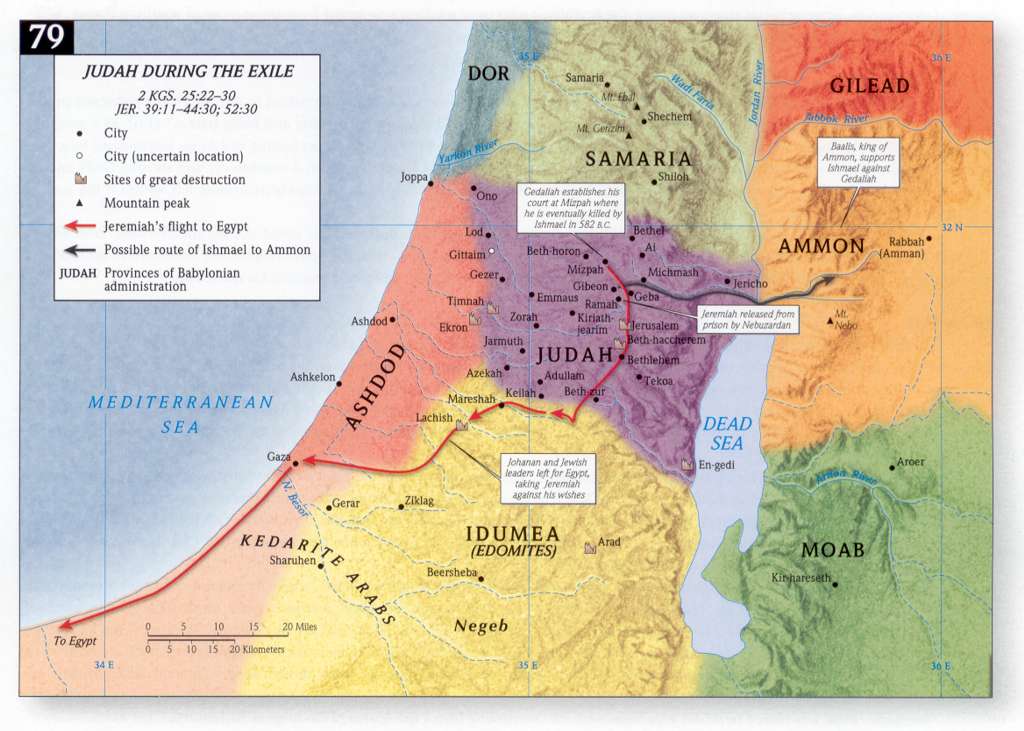
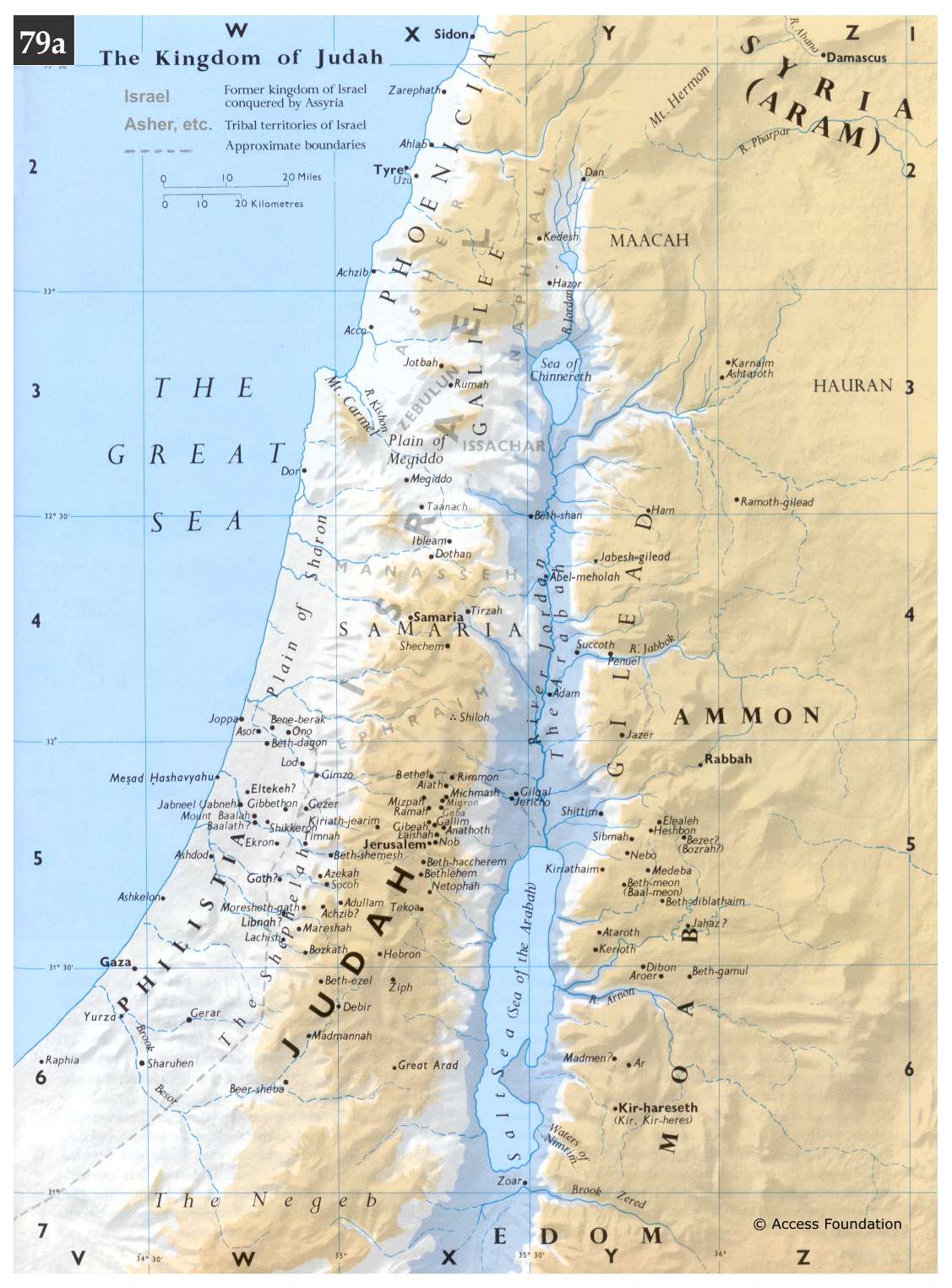
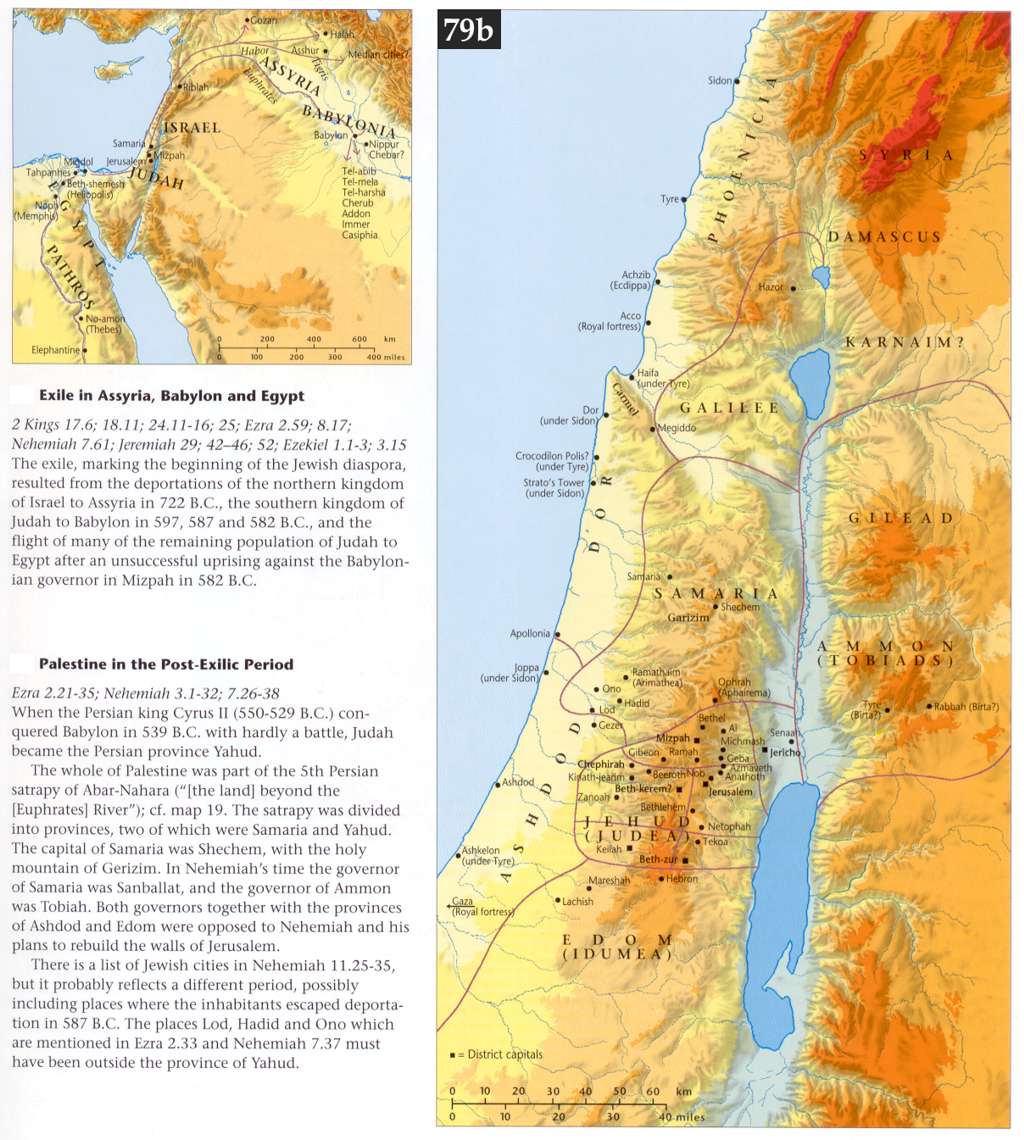
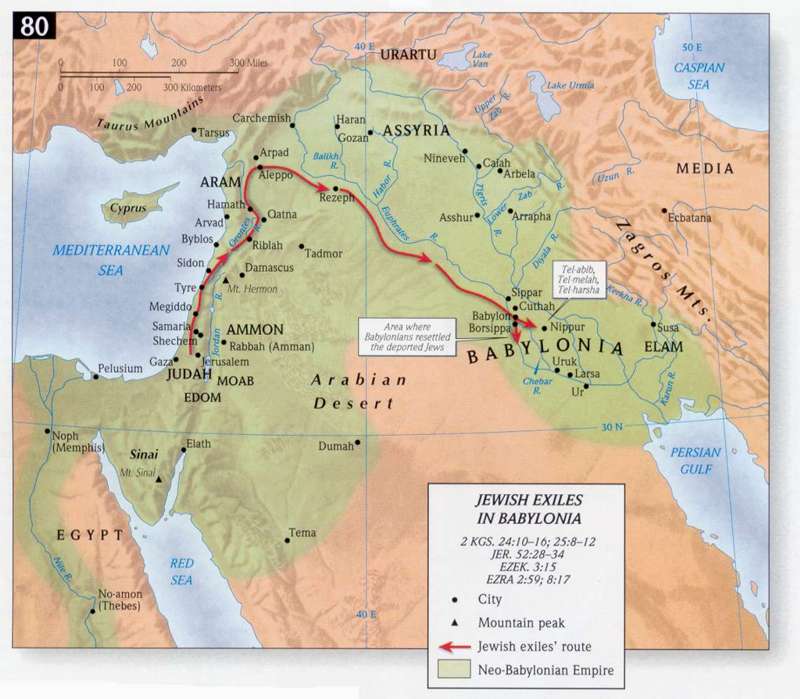
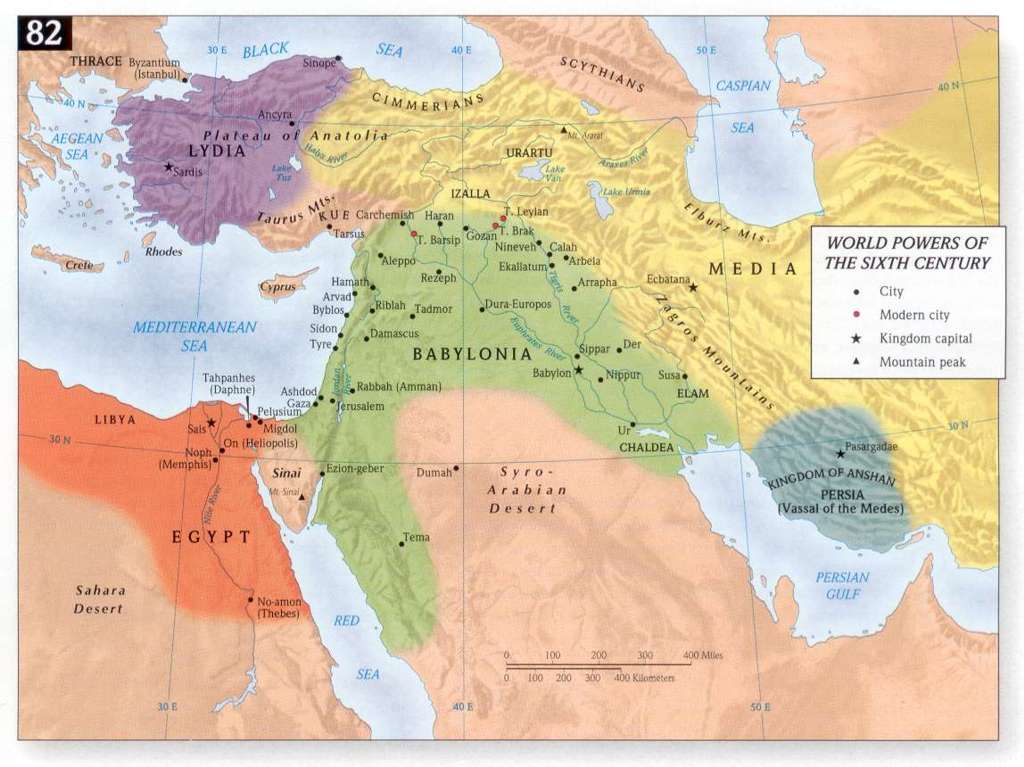
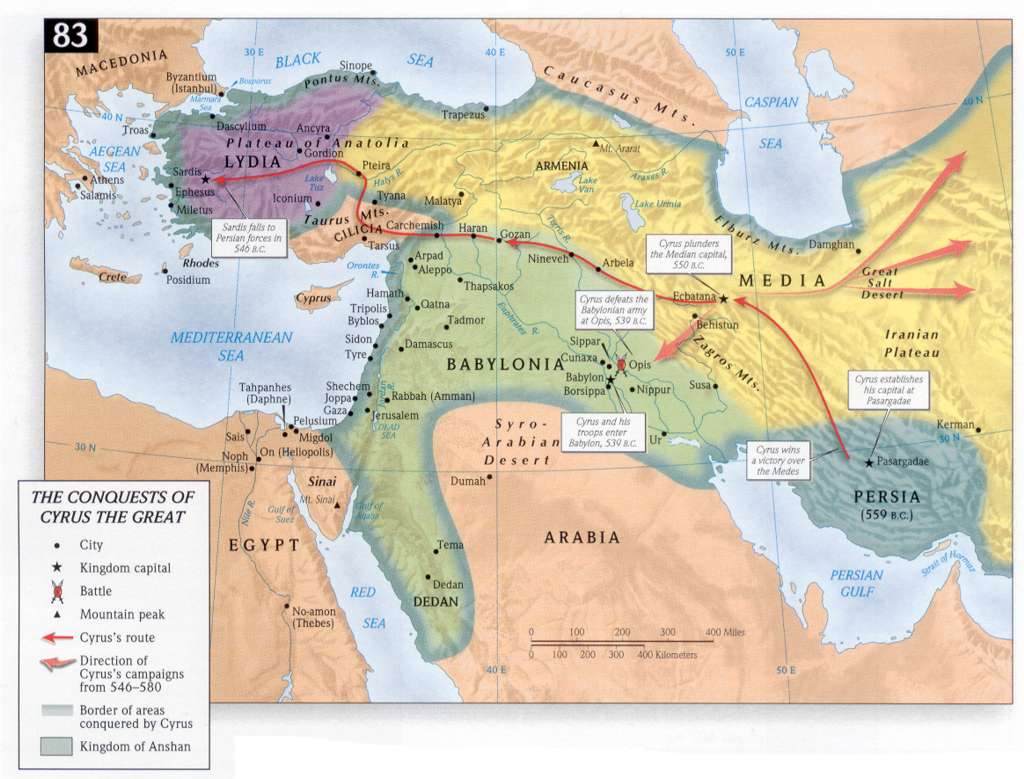
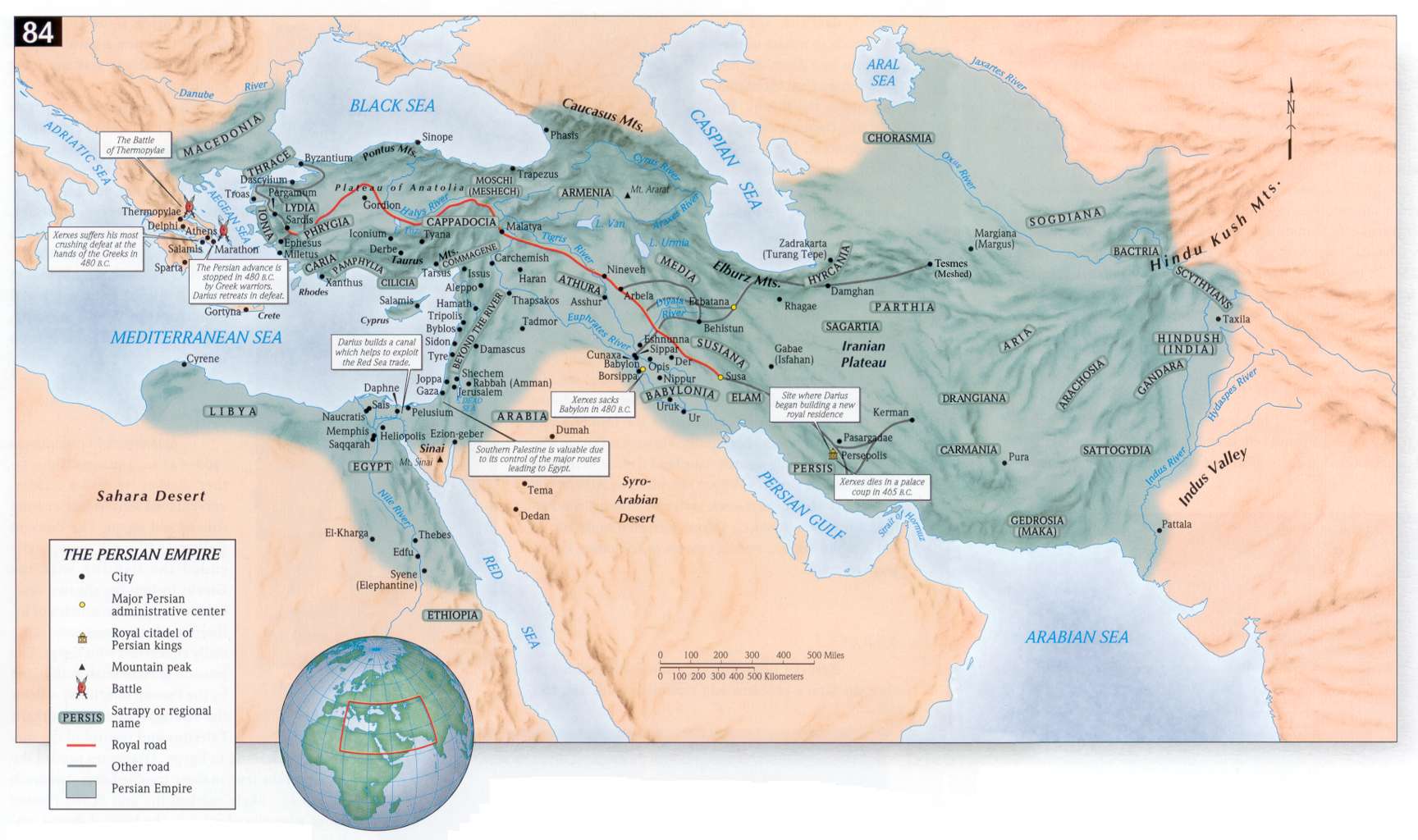
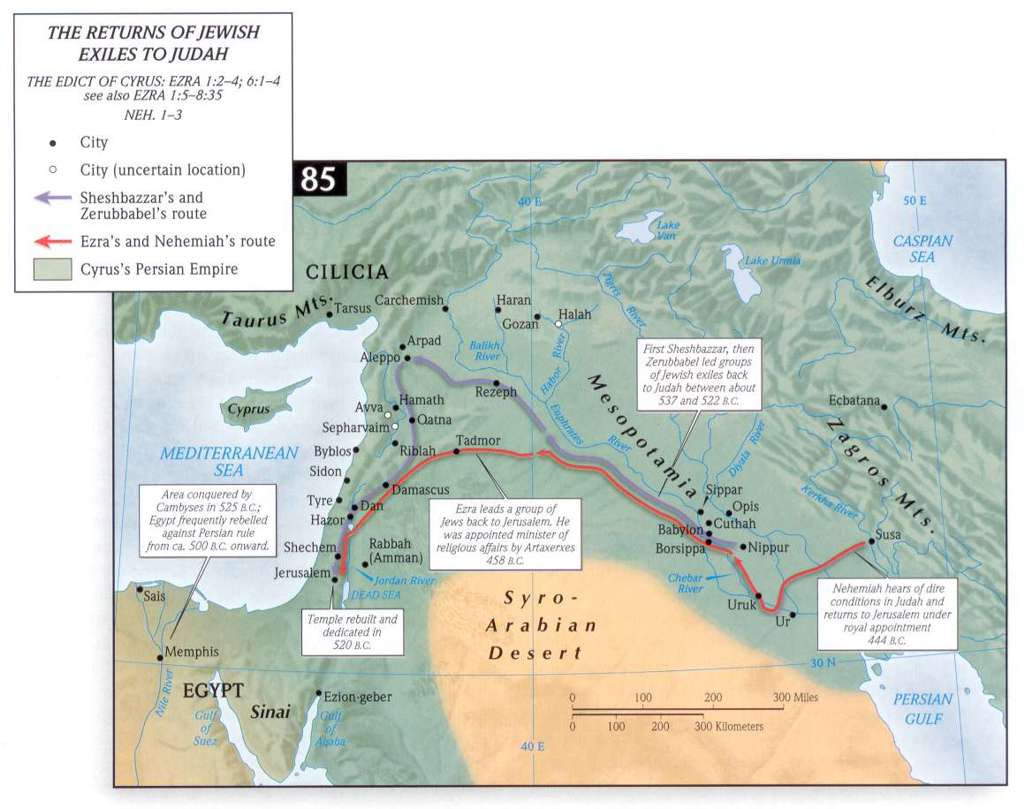
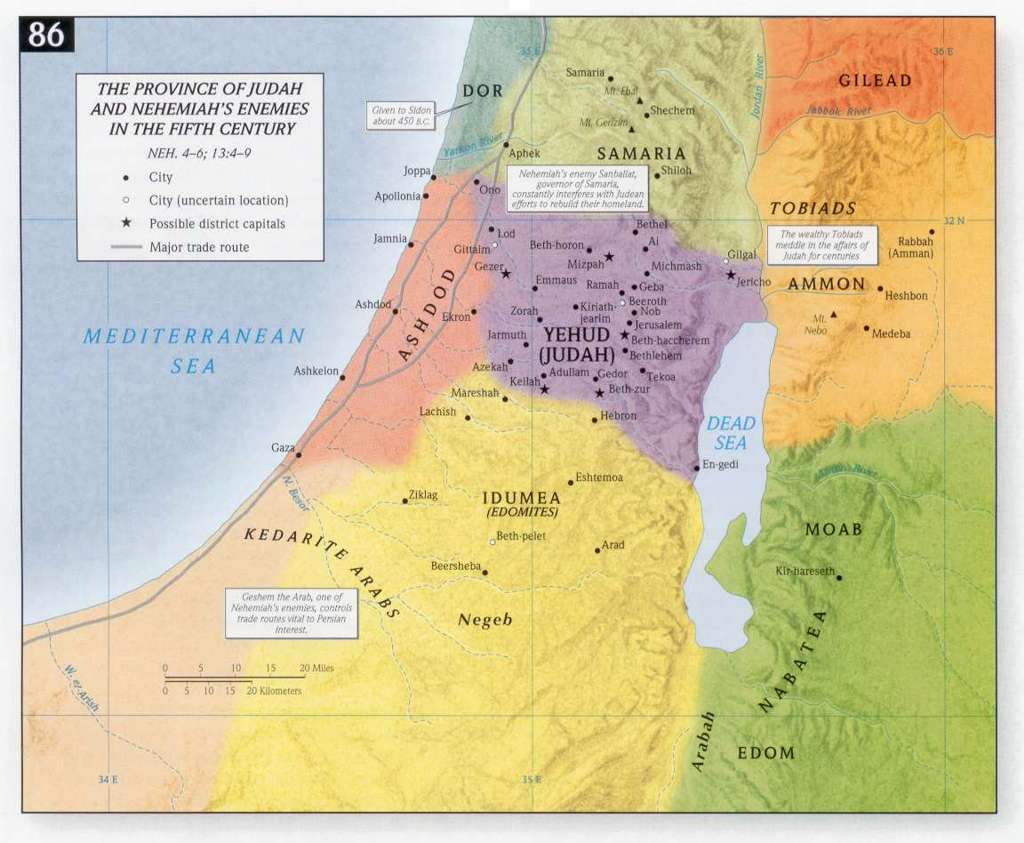
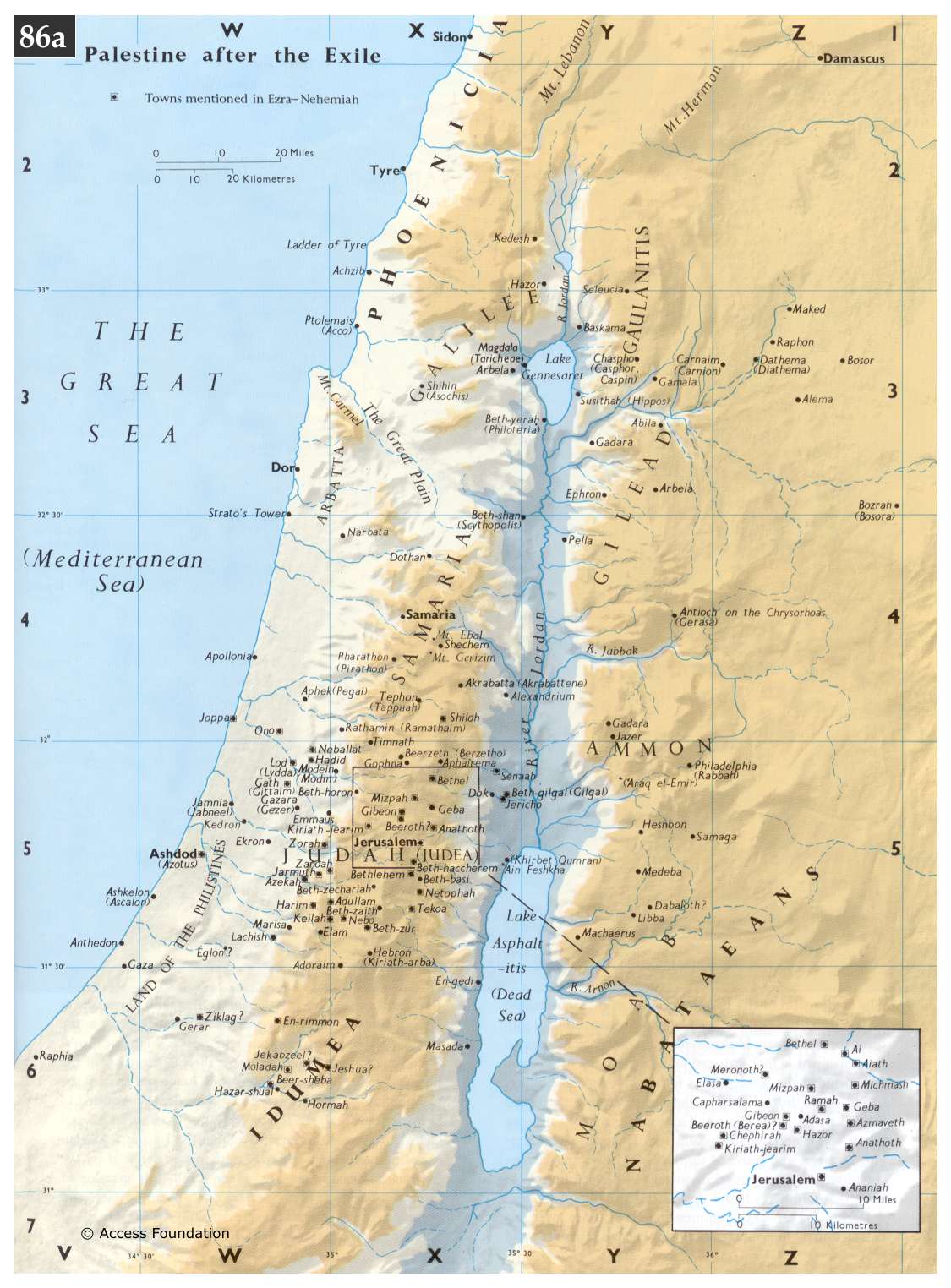
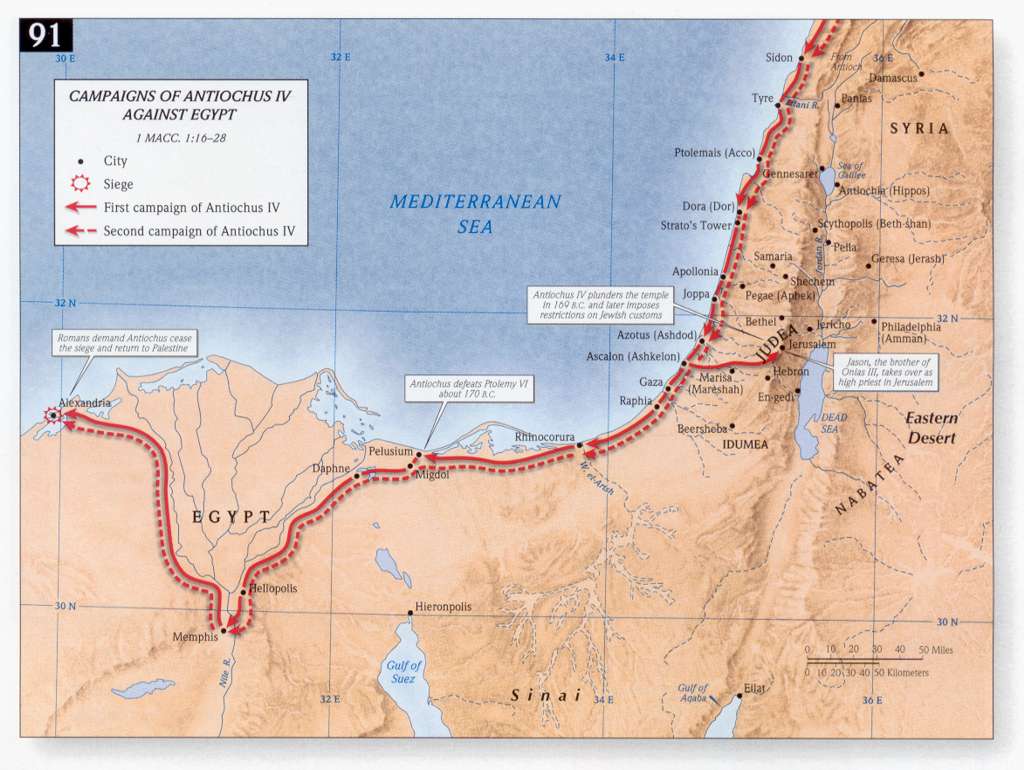
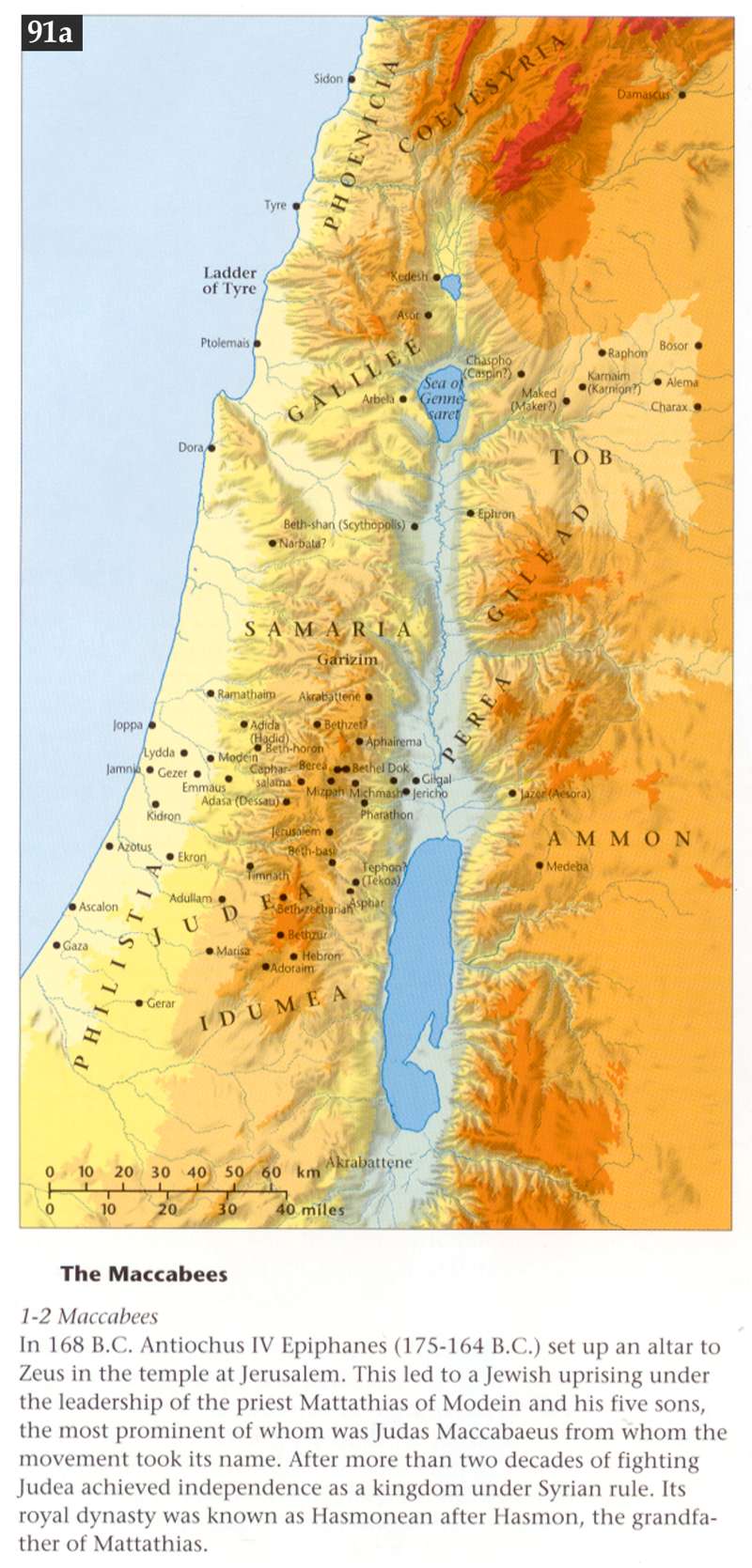
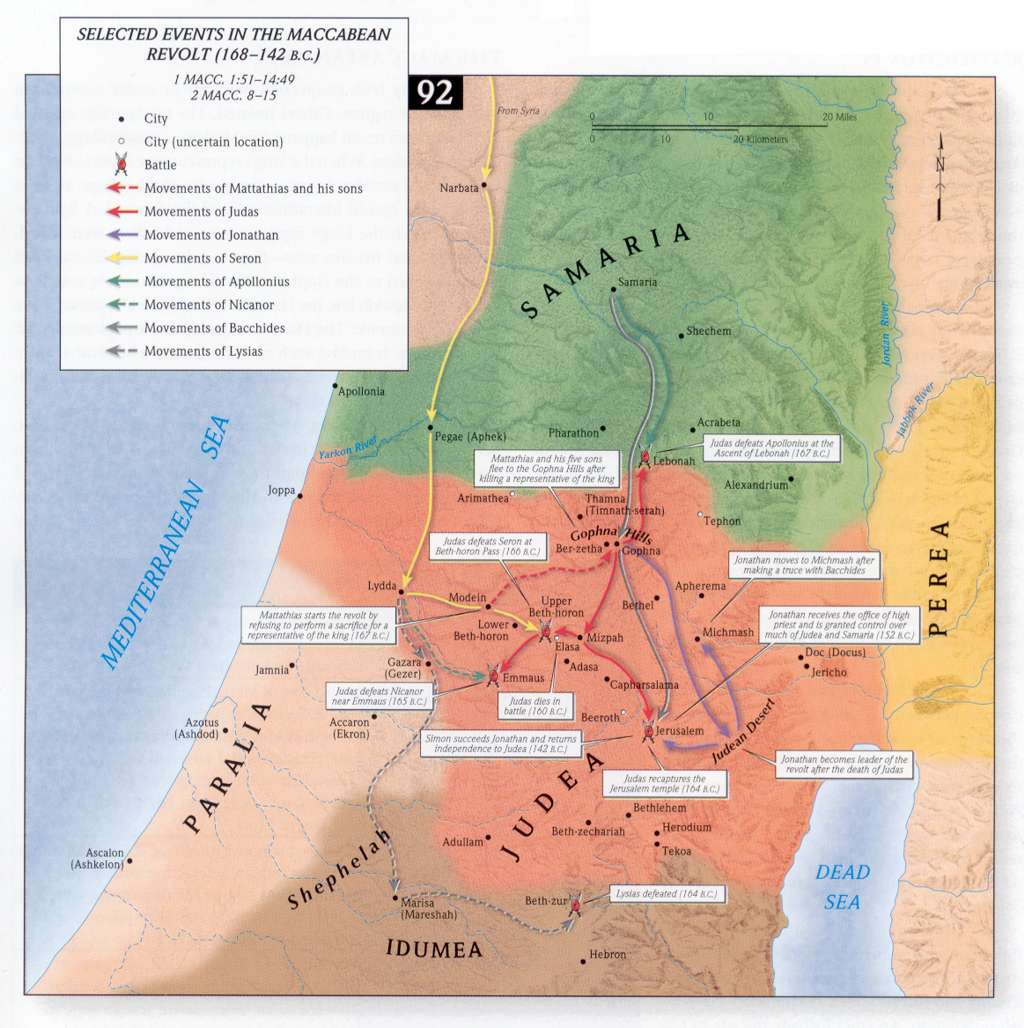
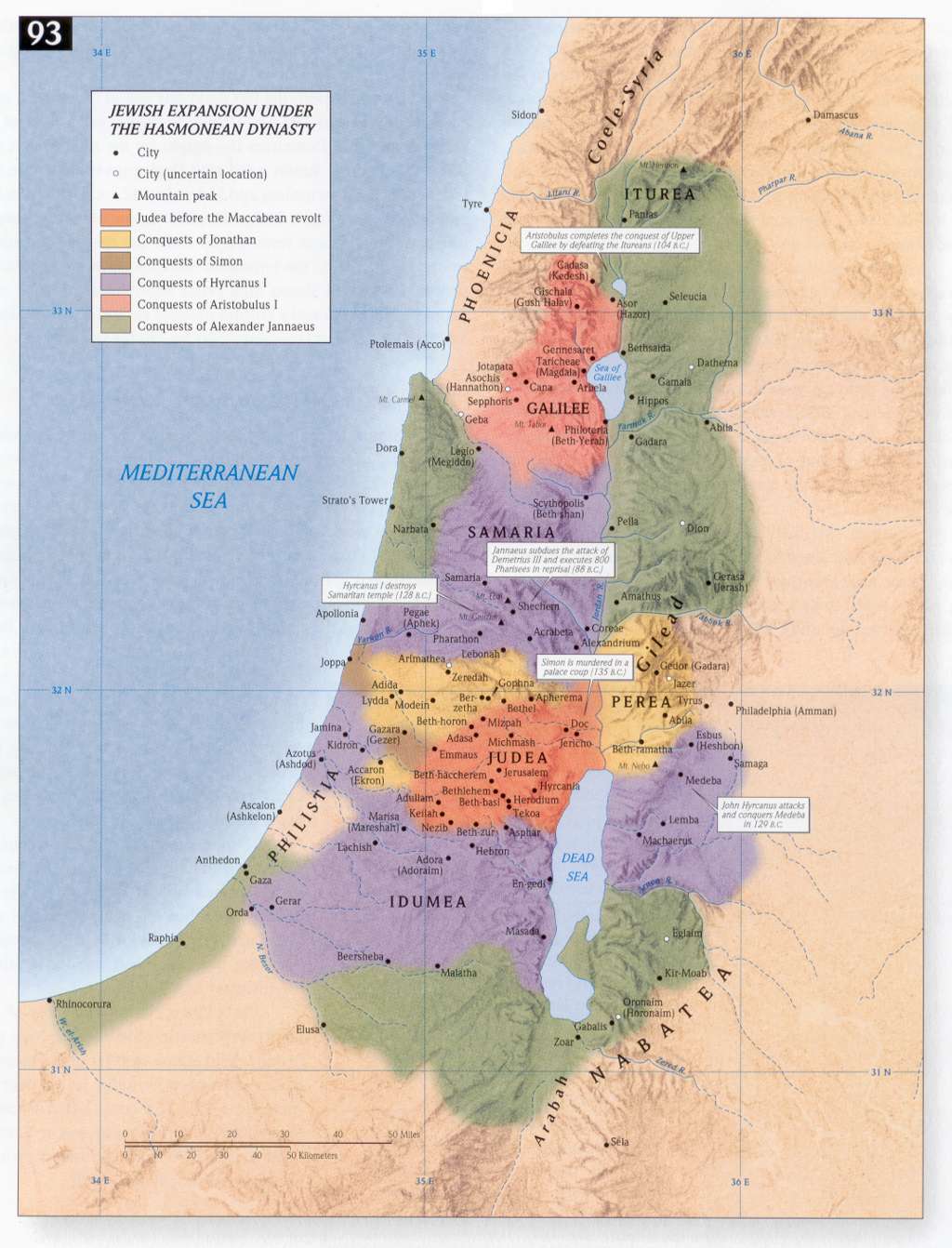
MAPS FROM ESV
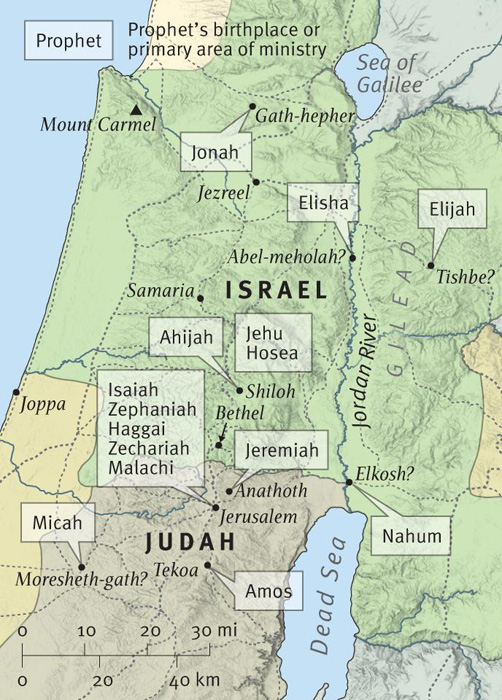
Prophets of Israel and Judah
c. 875–430 B.C.
- Extent of Solomon’s Kingdom
- Israel and Judah in 2 Kings
- Solomon’s Administrative Districts
- The Kingdom Divides
- Syria Captures Gilead
- Resurgence during Azariah, Jeroboam II
- Prophets of Israel and Judah
- Resurgence of Assyrian Influence
- Fall of Samaria, Deportation of Israelites
- Exile to Babylon
- Extent of David’s Kingdom
- Solomon’s International Ventures
- Syria and Israel Attack Judah
- Judah after the Fall of Israel
- Persian Empire at the Time of Ezra
- Persian Empire at the Time of Nehemiah
- Judea under Persian Rule
- Persian Empire at the Time of Esther
- Near East at the Time of Isaiah
- Israel and Judah at the Time of Jeremiah
- Babylonian Empire
- Babylon Attacks Judah
- Jeremiah Prophesies against Egypt
- Near East at the Time of Ezekiel
- Ezekiel’s Vision of Israel’s New Boundaries
- Introduction to Daniel: Babylonian Empire
- Empires of Daniel’s Visions: Persians
- Empires of Daniel’s Visions: Greeks
- Empires of Daniel’s Visions: Ptolemies and Seleucids (Early)
- Empires of Daniel’s Visions: Ptolemies and Seleucids (Late)
- Maccabean Kingdom
- 1 Chronicles 13:1-14 David Brings the Ark to Jerusalem
- 1 Chronicles 14:1-17 David’s Distinguishing Blessings
- 1 Chronicles 15:1-16:43 Success in Bringing the Ark to Jerusalem
ADRIAN ROGERS - CLICK FOR PDF OF FOLLOWING SERMONS
- God’s Formula for Greatness—1 Chronicles 4:9–10
- Let’s Just Praise the Lord—1 Chronicles 16
- What to Do When Your Dreams Are Put on Hold—1 Chronicles 17
- 1 Chronicles 16:7-15 David's Thanksgiving at the Carrying Up of the Ark
- 1 Chronicles 16:43 David's Attention to His Household
- 1 Chronicles 18:1-17 David Secures the Nation and Collects Temple Material
- 1 Chronicles 20:1-8 David’s Commission of Temple Construction
- 1 Chronicles 21:1-22:1 David Discovers the Temple Site
- 1 Chronicles 22:2-19 David Conquers King of Ammon
- 1 Chronicles 28:9 David's Advice to Solomon
- 1 Chronicles 29:5 Missionary Services Consecrated to God - 24 pages!
- 1 Chronicles 29:17, 18 Liberality in God's Service Commended
- 1 Chronicles 29:11-12 Everything is Yours, Lord|
- 1 Chronicles 29:11-12 A Kingdom Perspective on Stewardship
"Far beyond anything indicated by the small price of this work is its exceeding value for thoroughness of verbal exposition, exegetical criticism, and homiletic suggestiveness."—Baptist magazine
"It contains a vast amount of information, which ministers, Sunday-school teachers, and Bible classes may turn to good account." —Christian World
Note: An interesting feature is a set of usually 10-11 questions at the end of each chapter.
- 1 Chronicles 1 Commentary
- 1 Chronicles 2 Commentary
- 1 Chronicles 3 Commentary
- 1 Chronicles 4 Commentary
- 1 Chronicles 5 Commentary
- 1 Chronicles 6 Commentary
- 1 Chronicles 7 Commentary
- 1 Chronicles 8 Commentary
- 1 Chronicles 9 Commentary
- 1 Chronicles 10 Commentary
- 1 Chronicles 11 Commentary
- 1 Chronicles 12 Commentary
- 1 Chronicles 13 Commentary
- 1 Chronicles 14 Commentary
- 1 Chronicles 15 Commentary
- 1 Chronicles 16 Commentary
- 1 Chronicles 17 Commentary
- 1 Chronicles 18 Commentary
- 1 Chronicles 19 Commentary
- 1 Chronicles 20 Commentary
- 1 Chronicles 21 Commentary
- 1 Chronicles 22 Commentary
- 1 Chronicles 23 Commentary
- 1 Chronicles 24 Commentary
- 1 Chronicles 25 Commentary
- 1 Chronicles 26 Commentary
- 1 Chronicles 27 Commentary
- 1 Chronicles 28 Commentary
- 1 Chronicles 29 Commentary
NETBible notes are in the right panel. You can also select the tab for "Constable's Notes." As you scroll the Bible text in the left panel, the notes are synchronized and will scroll to the same passage. This is a very helpful feature.
- 1 Chronicles 1 Commentary
- 1 Chronicles 2 Commentary
- 1 Chronicles 3 Commentary
- 1 Chronicles 4 Commentary
- 1 Chronicles 5 Commentary
- 1 Chronicles 6 Commentary
- 1 Chronicles 7 Commentary
- 1 Chronicles 8 Commentary
- 1 Chronicles 9 Commentary
- 1 Chronicles 10 Commentary
- 1 Chronicles 11 Commentary
- 1 Chronicles 12 Commentary
- 1 Chronicles 13 Commentary
- 1 Chronicles 14 Commentary
- 1 Chronicles 15 Commentary
- 1 Chronicles 16 Commentary
- 1 Chronicles 17 Commentary
- 1 Chronicles 18 Commentary
- 1 Chronicles 19 Commentary
- 1 Chronicles 20 Commentary
- 1 Chronicles 21 Commentary
- 1 Chronicles 22 Commentary
- 1 Chronicles 23 Commentary
- 1 Chronicles 24 Commentary
- 1 Chronicles 25 Commentary
- 1 Chronicles 26 Commentary
- 1 Chronicles 27 Commentary
- 1 Chronicles 28 Commentary
- 1 Chronicles 29 Commentary
- 1 Chronicles 4:9-10 Who Is Jabez?
- 1 Chronicles 4:10 A Name of Honor
- 1 Chronicles 13 Showing Respect
- 1 Chronicles 13:5-10 Watch Out For Pebbles
- 1 Chronicles 16:8-12, 23-34 Thanksgiving All Year
- 1 Chronicles 16:7-10,23-36 Gracias!
- 1 Chronicles 16:23-33 Dancing Birds
- 1 Chronicles 16:23-36 See You Next Time?
- 1 Chronicles 16:23-27 Sing!
- 1 Chronicles 16:34 Not Enough Stars!
- 1 Chronicles 16:7-14 For Our Health
- 1 Chronicles 16:7-13 Love To Tell His Story
- 1 Chronicles 16:8–27 His Wonderful Face
- 1 Chronicles 16:34 Food In The Cupboard
- 1 Chronicles 17:1–4, 16–25 Not the One
- 1 Chronicles 17:1-20 His Plans or Ours?
- 1 Chronicles 17:16-24 Who’s Behind It
- 1 Chronicles 21:1-13 The Last Sins To Go
- 1 Chronicles 22 Giving God Our Best
- 1 Chronicles 25:1-8 To God Be The Glory
- 1 Chronicles 28:5-10 First Things First
- 1 Chronicles 28:9-20 Whitewater Experiences
- 1 Chronicles 28:9 Whose Side Is God On?
- 1 Chronicles 28:9 Can I Trust You?
- 1 Chronicles 28:9–2 Navigating Rough Waters
- 1 Chronicles 28:1-10 Finding God
- 1 Chronicles 28:20 To Work or To Wait?
- 1 Chronicles 29:6-15 A Gift For God
- 1 Chronicles 29:14–19 Everything Comes from God
- 1 Chronicles 29:14 Caretakers, Not Owners
- 1 Chronicles 29:17 An Honest Heart
- 1 Chronicles 29:10-15 Who Owns Your Home?
- 1 Chronicles 29:10-13 Recession Proof
- 1 Chronicles 29:1 The True Owner
- 1 Chronicles 29:1-14 Birthday Giveaway
- 1 Chronicles 29:1-20 Bad and Good Wealth
- 1 Chronicles 29:1-20 Who Gets The Thanks?
| Secrets of Discernment | 1 Chronicles 12:32 | Discernment | Alan Stewart |
| Thanking God For His Presence | 1 Chronicles 16 | Thanksgiving; Praise; Gratitude; God, Presence of | David E. Owen |
| Seek The Lord | 1 Chronicles 16:10-11 | God, Presence of; God, Seeking; Desire of the Heart; New Year | Franklin L. Kirksey |
| A Magnificent Obsession | 1 Chronicles 16:23-29 | Glory; God's Glory | J. Gerald Harris |
| When God Says No | 1 Chronicles 28 | Will, God's; Purpose; Submission | Franklin L. Kirksey |
| What's In Your Wallet? | 1 Chronicles 29:1-13 | Money; Materialism | James Merritt |
- Introduction
- 1 Chronicles 1
- 1 Chronicles 2
- 1 Chronicles 3
- 1 Chronicles 4
- 1 Chronicles 5
- 1 Chronicles 6
- 1 Chronicles 7
- 1 Chronicles 8
- 1 Chronicles 9
- 1 Chronicles 10
- 1 Chronicles 11
- 1 Chronicles 12
- 1 Chronicles 13
- 1 Chronicles 14
- 1 Chronicles 15
- 1 Chronicles 16
- 1 Chronicles 17
- 1 Chronicles 18
- 1 Chronicles 19
- 1 Chronicles 20
- 1 Chronicles 21
- 1 Chronicles 22
- 1 Chronicles 23
- 1 Chronicles 24
- 1 Chronicles 25
- 1 Chronicles 26
- 1 Chronicles 27
- 1 Chronicles 28
- 1 Chronicles 29
- Introduction
- 1 Chronicles 1
- 1 Chronicles 2
- 1 Chronicles 3
- 1 Chronicles 4
- 1 Chronicles 5
- 1 Chronicles 6
- 1 Chronicles 7
- 1 Chronicles 8
- 1 Chronicles 9
- 1 Chronicles 10
- 1 Chronicles 11
- 1 Chronicles 12
- 1 Chronicles 13
- 1 Chronicles 14
- 1 Chronicles 15
- 1 Chronicles 16
- 1 Chronicles 17
- 1 Chronicles 18
- 1 Chronicles 19
- 1 Chronicles 20
- 1 Chronicles 21
- 1 Chronicles 22
- 1 Chronicles 23
- 1 Chronicles 24
- 1 Chronicles 25
- 1 Chronicles 26
- 1 Chronicles 27
- 1 Chronicles 28
- 1 Chronicles 29
- Introduction
- 1 Chronicles 1
- 1 Chronicles 2
- 1 Chronicles 3
- 1 Chronicles 4
- 1 Chronicles 5
- 1 Chronicles 6
- 1 Chronicles 7
- 1 Chronicles 8
- 1 Chronicles 9
- 1 Chronicles 10
- 1 Chronicles 11
- 1 Chronicles 12
- 1 Chronicles 13
- 1 Chronicles 14
- 1 Chronicles 15
- 1 Chronicles 16
- 1 Chronicles 17
- 1 Chronicles 18
- 1 Chronicles 19
- 1 Chronicles 20
- 1 Chronicles 21
- 1 Chronicles 22
- 1 Chronicles 23
- 1 Chronicles 24
- 1 Chronicles 25
- 1 Chronicles 26
- 1 Chronicles 27
- 1 Chronicles 28
- 1 Chronicles 29
- 1 Chronicles 1-9 The Family Tree
- 1 Chronicles 10-11 David Becomes King
- 1 Chronicles 12:1-40 God's Faithfulness To David
- 1 Chronicles 13-15 Doing the Right Thing the Wrong Way
- 1 Chronicles 16-18 It is All About God
- 1 Chronicles 19-21 Wednesday Night Bible Study
- 1 Chronicles 22:1-19 Wednesday Night Bible Study
- 1 Chronicles 23-27 Wednesday Night Bible Study
- 1 Chronicles 28:1-21 David's Public Charge To Solomon
- 1 Chronicles 29:1-30 Passionate Preparation
- 1 Chronicles 2-7 -- Sermon Notes for 1 Chronicles 2:7
- 1 Chronicles 4:9,10 The Prayer of Jabez -- Sermon Notes for 1 Chronicles 4:9
- 1 Chronicles 4:9, 10 Jabez -- Sermon Notes for 1 Chronicles 4:9,10
- 1 Chronicles 4:9, 10b The Prayer of Jabez -- Sermon Notes for 1 Chronicles 4:9, 10
- 1 Chronicles 4:9d -- Sermon Notes for 1 Chronicles 4:9, 10
- 1 Chronicles 12:8 David's Men -- Sermon Notes for 1 Chronicles 12:8
- 1 Chronicles 16:7 -- Sermon Notes for 1 Chronicles 16:7
- 1 Chronicles 16:31 The Lord Reigneth -- Sermon Notes for 1 Chronicles 16:31
- 1 Chronicles 16:31b The Lord Reigneth -- Sermon Notes for 1 Chronicles 16:31
- 1 Chronicles 17 Too Much -- Sermon Notes for 1 Chronicles 17
- 1 Chronicles 19:10-13 -- Sermon Notes for 1 Chronicles 19:10-13
- 1 Chronicles 28:9 Serving God -- Sermon Notes for 1 Chronicles 28:9
- 1 Chronicles 28:9-11 Be Strong -- And Do It -- Sermon Notes for 1 Chronicles 28:9-11
- 1 Chronicles 29:9-14 Giving to God -- Sermon Notes for 1 Chronicles 29:9-14
- 1 Chronicles 29:14 -- Sermon Notes for 1 Chronicles 29:14
- C2000 Series on 1 Chronicles 1-11
- C2000 Series on 1 Chronicles 12-17
- C2000 Series on 1 Chronicles 20-29
Notes below similar to C2000 Series
- 1 Chronicles 1
- 1 Chronicles 2
- 1 Chronicles 3
- 1 Chronicles 4
- 1 Chronicles 5
- 1 Chronicles 6
- 1 Chronicles 7
- 1 Chronicles 8
- 1 Chronicles 9
- 1 Chronicles 10
- 1 Chronicles 11
- 1 Chronicles 12
- 1 Chronicles 13
- 1 Chronicles 14
- 1 Chronicles 15
- 1 Chronicles 16
- 1 Chronicles 17
- 1 Chronicles 20
- 1 Chronicles 21
- 1 Chronicles 22
- 1 Chronicles 23
- 1 Chronicles 24
- 1 Chronicles 25
- 1 Chronicles 26
- 1 Chronicles 27
- 1 Chronicles 28
- 1 Chronicles 29
Spurgeon's Comment: The Speaker’s Commentary is issued (August, 1875) as far as the Lamentations. It is costly, too costly for your pockets, and I am therefore somewhat the less sorry to add that it is not what I hoped it would be. Of course it is a great work, and contains much which tends to illustrate the text; but if you had it you would not turn to it for spiritual food, or for fruitful suggestion, or if you did so, you would be disappointed. The object of the work is to help the general reader to know what the Scriptures really say and mean, and to remove some of the difficulties. It keeps to its design and in a measure accomplishes it."
- Introduction
- 1 Chronicles 1
- 1 Chronicles 2
- 1 Chronicles 3
- 1 Chronicles 4
- 1 Chronicles 5
- 1 Chronicles 6
- 1 Chronicles 7
- 1 Chronicles 8
- 1 Chronicles 9
- 1 Chronicles 10
- 1 Chronicles 11
- 1 Chronicles 12
- 1 Chronicles 13
- 1 Chronicles 14
- 1 Chronicles 15
- 1 Chronicles 16
- 1 Chronicles 17
- 1 Chronicles 18
- 1 Chronicles 19
- 1 Chronicles 20
- 1 Chronicles 21
- 1 Chronicles 22
- 1 Chronicles 23
- 1 Chronicles 24
- 1 Chronicles 25
- 1 Chronicles 26
- 1 Chronicles 27
- 1 Chronicles 28
- 1 Chronicles 29
- 1 Chronicles 4:10 The Prayer of Jabez
- 1 Chronicles 4:23 With the King for His Work!
- 1 Chronicles 12:8-15 David and His Volunteers
- 1 Chronicles 12:16-18 Recruits for King Jesus
- 1 Chronicles 13 Exposition
- 1 Chronicles 13:8, 12, 15:25 The Lesson of Uzza
- 1 Chronicles 13:8, 12, 15:25 The Lesson of Uzza - Sermon Notes
- 1 Chronicles 15 Exposition
- 1 Chronicles 15:13 Importance of Small Things in Religion
- 1 Chronicles 16:4 The Recorders
- 1 Chronicles 21:25-30 Exposition
- 1 Chronicles 22 Exposition
- 1 Chronicles 21:28, 22:1 The Threshing-floor of Ornan
- 1 Chronicles 22:1 Araunah's Threshing Floor
- 1 Chronicles 22:14 One Worker Preparing for Another
- 1 Chronicles 22:18 The Best of All, God is with Us
- 1 Chronicles 22:19 Exhortation - Set Your Heart
- 1 Chronicles 28 Exposition
- 1 Chronicles 28:8 Intelligent Obedience
- 1 Chronicles 28:9 Sincere Seekers Assured Finders
- 1 Chronicles 28:19 God's Handwriting Upon David
STRUCTURAL OUTLINE
- I. The Genealogies of God's People (1 Chron. 1:1-9:34)
-
- A. Israel's Roots (1 Chron. 1:1-2:2)
- B. The Breadth and Order of God's People (1 Chron. 2:3-9:1)
-
- 1. Judah in First Place (1 Chron. 2:3-4:23)
-
- a. The Judahite Families (1 Chron 2:3-9)
- b. Descendants of Ram (1 Chron 2:10-17)
- c. Descendants of Caleb (1 Chron 2:18-24)
- d. Descendants of Jerahmeel (1 Chron 2:25-33)
- e. Additional Information on Jerahmeel's Descendants (1 Chron 2:34-41)
- f. Additional Information on Caleb's Descendants (1 Chron 2:42-55)
- g. Additional Information on Ram's Descendants after David (1 Chron 3:1-24)
-
- (1) David's Progeny Born in Hebron and Jerusalem (1 Chron 3:1-9)
- (2) Solomon's Descendants (1 Chron 3:10-16)
- (3) Descendants of Jehoiachin (1 Chron 3:17-24)
- h. Additional Information on the Judahite Families (1 Chron 4:1-23)
- 2. Tribes Easily Forgotten (1 Chron. 4:24-5:26)
-
- a. Simeon (1 Chron 4:24-43)
- b. The Reubenites, the Gadites, the Transjordanian Tribes, and the Half-Tribe of Manasseh - 1 Chronicles 5:1-26
-
- (1) Reuben (1 Chron 5:1-10)
- (2) Gad (1 Chron 5:11-17)
- (3). The Transjordanian Tribes (1 Chron 5:18-22)
- (4). The Half-Tribe of Manasseh (1 Chron 5:23-26)
- 3. Levi in the Center (1 Chron. 6:1-81)
-
- a. The Tribe of Levi (1 Chron 6:1-53)
-
- (1) The Priests Descended from Aaron (1 Chron 6:1-15)
- (2) A Survey of All Three Clans of Levi (1 Chron 6:16-30)
- (3) The Temple Musicians Appointed by David (1 Chron 6:31-47)
- (4) Distinguishing the Duties of the Sons of Aaron (1 Chron 6:48-53)
- b. The Territories of Levi (1 Chron 6:54-81)
- 4. Other Tribes Easily Forgotten (1 Chron. 7:1-40)
-
- a. Issachar (1 Chron 7:1-5)
- b. Benjamin (1 Chron 7:6-12)
- c. Naphtali (1 Chron 7:13)
- d. Manasseh (1 Chron 7:14-19)
- e. Ephraim and Manasseh (1 Chron 7:20-29)
- f. Asher (1 Chron 7:30-40)
- 5. Benjamin in Honor (1 Chron. 8:1-9:1)
-
- a. Geba (1 Chron 8:1-7)
- b. Moab (1 Chron 8:8-13)
- c. Jerusalem (1 Chron 8:14-28)
- d. Gibeon (1 Chron 8:29-40)
- e. All Israel (1 Chron 9:1)
- C. The Continuation of Israel (1 Chron. 9:2-34)
-
- 1. An Introduction (1 Chron 9:2-3)
- 2. The Judahites (1 Chron 9:4-6)
- 3. The Benjamites (1 Chron 9:7-9)
- 4. The Priests (1 Chron 9:10-13)
- 5. The Levites (1 Chron 9:14-34)
- II. The United Kingdom (1 Chron. 9:35-2 Chron. 9:31)
-
- A. The Reign of David (1 Chron. 9:35-29:30)
-
- 1. David Becomes King (1 Chron. 9:35-10:14)
-
- a. Divine Blessing on Saul (1 Chron 9:35-44)
- b. Divine Judgment Against Saul (1 Chron 10:1-14)
- 2. David's Widespread Support (1 Chron. 11:1-12:40)
-
- a. Anointing at Hebron (1 Chron. 11:1-9)
- b. Military Support at Hebron (1 Chron. 11:10-47)
- c. Military Support at Ziklag (1 Chron. 12:1-7)
- d. Military Support at the Desert Stronghold (1 Chron. 12:8-19)
- e. More Military Support at Ziklag (1 Chron. 12:20-22)
- f. More Military Support at Hebron (1 Chron. 12:23-37)
- g. More on the Anointing at Hebron (1 Chron. 12:38-40)
- 3. Preparations for the Temple (1 Chron. 13:1-29:25)
-
- a. David Brings the Ark to Jerusalem (1 Chron. 13:1-16:43)
-
- (1) David's Failed Transfer of the Ark (1 Chron. 13:1-14)
- (2) David's Distinguishing Blessings (1 Chron. 14:1-17)
- (3) David's Successful Transfer of the Ark (1 Chron. 15:1-16:43)
-
- (a) David Forms a New Plan (1 Chron. 15:1-2)
- (b) David Instructs Levites and Priests (1 Chron. 15:3-24)
- (c) David Moves the Ark (1 Chron. 15:25-16:3)
- (d) David Appoints Levites in Jerusalem (1 Chron. 16:4-6)
- (e) David's Psalm (1 Chron. 16:7-36)
- (f) David Appoints Levites and Priests in Jerusalem and Gibeon (1 Chron. 16:37-42)
- (g) David Accomplishes His Plan (1 Chron. 16:43)
- b. David Prepares for the Temple (1 Chron. 17:1-29:25)
-
- (1) David Accepts Commission to Prepare for Solomon (1 Chron. 17:1-27)
- (2) David Secures the Nation and Collects Temple Materials (1 Chron. 18:1-20:8)
-
- (a) David's Victories and Domestic Security (1 Chron. 18:1-17)
- (b) David's Victories Against Ammon and Aram (1 Chron. 19:1-20:3)
- (c) David's Victories Over the Philistines (1 Chron. 20:4-8)
- (3) David Discovers the Temple Site (1 Chron. 21:1-22:1)
- (4) David Commissions Temple Construction (1 Chron. 22:2-19)
- (5) David Transfers Power and Responsibility to Solomon (1 Chron. 23:1-29:25)
-
- (a) Those Whom David Gathered (1 Chron. 23:1-27:34)
-
- (i) David Makes Solomon King (1 Chron 23:1)
- (ii) Gathering Priests and Levites (1 Chron. 23:2-26:32)
- (iii) Military and Civilian Leaders (1 Chron. 27:1-34)
- (b) David's Final Assembly (1 Chron. 28:1-29:25)
-
- (i) Introduction (1 Chron. 28:1)
- (ii) David's First Set of Speeches and Actions (1 Chron. 28:2-19)
- (iii) David's Second Set of Speeches and Actions (1 Chron. 28:20-29:9)
- (iv) David's Third Set of Speeches and Actions (1 Chron. 29:10-25)
- 4. Closure of David's Reign (1 Chron. 29:26-30)
- B. The Reign of Solomon (2 Chron. 1:1-9:31)
-
- 1. Solomon's Great Wisdom and Wealth (2 Chron. 1:1-17)
-
- a. Solomon Receives Divine Promises (2 Chron. 1:1-13)
- b. Solomon Experiences Divine Promises (2 Chron. 1:14-17)
- 2. Solomon's International Assistance (2 Chron. 2:1-18)
- 3. Solomon's Temple-Building Project (2 Chron. 3:1-5:1)
-
- a. Solomon Begins Construction (2 Chron. 3:1-2)
- b. Solomon's Temple Building (2 Chron. 3:3-17)
- c. Solomon's Temple Furnishings (2 Chron. 4:1-10)
- d. Reiteration and Elaboration (2 Chron. 4:11-22)
- e. Solomon Completes Construction (2 Chron. 5:1)
- 4. Solomon's Assembly to Dedicate the Temple (2 Chron. 5:2-7:10)
-
- a. Solomon's Assembly Gathers (2 Chron. 5:2-3)
- b. Solomon's Initial Celebration of the Temple (2 Chron. 5:4-6:2)
- c. Solomon's Praise for the Past (2 Chron. 6:3-11)
- d. Solomon's Prayer for the Future (2 Chron. 6:12-42)
- e. Solomon's Concluding Sacrifices and Celebration (2 Chron. 7:1-7)
- f. Solomon's Assembly Dismisses (2 Chron. 7:8-10)
- 5. Solomon's Response From God (2 Chron. 7:11-22)
- 6. More on Solomon's Building Projects (2 Chron. 8:1-16)
- 7. More on Solomon's International Relations (2 Chron. 8:17-9:21)
- 8. More on Solomon's Great Wisdom and Wealth (2 Chron. 9:22-28)
- 9. Closure of Solomon's Reign (2 Chron. 9:29-31)
- III. The Divided Kingdom (2 Chron. 10:1-28:27)
-
- A. Judgments and Increasing Blessings in Judah (2 Chron. 10:1-21:3)
-
- 1. Rehoboam's Reign (2 Chron. 10:1-12:16)
-
- a. Rehoboam's Early Sin, Prophetic Encounter and Blessing (2 Chron. 10:1-11:23)
-
- (1) Rehoboam's Sin and Israel's Rebellion (2 Chron. 10:1-19)
- (2) Rehoboam's Compliance and Blessing (2 Chron. 11:1-23)
-
- (a) Rehoboam's Compliance With the Prophetic Word (2 Chron. 11:1-4)
- (b) Rehoboam's Blessings for Compliance (2 Chron. 11:5-23)
- b. Rehoboam's Later Sin, Prophetic Encounter and Blessing (2 Chron. 12:1-12)
- c. Closure of Rehoboam's Reign (2 Chron. 12:13-16)
- 2. Abijah's Reign (2 Chron. 13:1-14:1)
-
- a. Opening of Abijah's Reign (2 Chron. 13:1-2)
- b. Abijah's Victory Over Jeroboam (2 Chron. 13:2-21)
- c. Closure of Abijah's Reign (2 Chron. 13:22-14:1)
- 3. Asa's Reign (2 Chron. 14:1-16:14)
-
- a. Opening of Asa's Reign (2 Chron. 14:1b)
- b. Asa Under Divine Blessing (2 Chron. 14:2-15:19)
-
- (1) Asa's Early Years of Reform and Blessings (2 Chron. 14:2-7)
- (2) Asa's Victory, Prophetic Approval and Obedience (2 Chron. 14:8-15:19)
-
- (a) Asa's Victory in Conflict (2 Chron. 14:8-15)
- (b) Asa's Prophetic Approval and Obedience (2 Chron. 15:1-19)
- c. Asa Under Divine Judgment (2 Chron. 16:1-12)
-
- (1) Asa's Failure, Prophetic Disapproval and Disobedience (2 Chron. 16:1-10)
- (2) Asa's Final Years of Judgment (2 Chron. 16:11-12)
- d. Closure of Asa's Reign (2 Chron. 16:13-14)
- 4. Jehoshaphat's Reign (2 Chron. 17:1-21:3)
-
- a. Opening of Jehoshaphat's Reign (2 Chron. 17:1-2)
- b. Jehoshaphat's Earlier Years (2 Chron. 17:3-19:3)
-
- (1) Jehoshaphat's Earlier Fidelity (2 Chron. 17:3-19)
- (2) Jehoshaphat's Earlier Battle (2 Chron. 18:1-19:3)
- c. Jehoshaphat's Later Years (2 Chron. 19:4-20:30)
-
- (1) Jehoshaphat's Reforms (2 Chron. 19:4-11)
- (2) Jehoshaphat's Later Battle (2 Chron. 20:1-30)
- d. Closure of Jehoshaphat's Reign (2 Chron. 20:31-21:3)
- B. Northern Corruption in Judah (2 Chron. 21:4-24:27)
-
- 1. Jehoram's Reign (2 Chron. 21:4-20)
-
- a. Opening of Jehoram's Reign (2 Chron. 21:4-7)
- b. Rebellion Against Jehoram (2 Chron. 21:8-11)
- c. Elijah's Condemnation of Jehoram (2 Chron. 21:12-15)
- d. More Rebellions Against Jehoram (2 Chron. 21:16-17)
- e. Closure of Jehoram's Reign (2 Chron. 21:18-20)
- 2. Ahaziah's Reign (2 Chron. 22:1-9) 3. Joash's Reign (2 Chron. 22:10-24:27)
-
- a. Joash's Rise Over Athaliah (2 Chron. 22:10-23:21)
- b. Joash's Kingship (2 Chron. 24:1-27)
-
- (1) Opening of Joash's Reign (2 Chron. 24:1-3)
- (2) Joash's Early Years of Fidelity (2 Chron. 24:4-14)
- (3) Jehoiada's Death (2 Chron. 24:15-16)
- (4) Joash's Later Years of Infidelity (2 Chron. 24:17-26)
- (5) Closure of Joash's Reign (2 Chron. 24:27)
- C. Deterioration Through Halfhearted Obedience (2 Chron. 25:1-28:27)
-
- 1. Amaziah's Reign (2 Chron. 25:1-28)
-
- a. Opening of Amaziah's Reign (2 Chron. 25:1-2)
- b. Amaziah's Halfhearted Fidelity (2 Chron. 25:3-12)
- c. Amaziah's Trouble From Israel (2 Chron. 25:13)
- d. Amaziah's Infidelity (2 Chron. 25:14-24)
- e. Closure of Amaziah's Reign (2 Chron. 25:25-28)
- 2. Uzziah's Reign (2 Chron. 26:1-23)
-
- a. Opening of Uzziah's Reign (2 Chron. 26:1-5)
- b. Uzziah's Fidelity and Blessing (2 Chron. 26:6-15)
- c. Uzziah's Infidelity and Curse (2 Chron. 26:16-21)
- d. Closure of Uzziah's Reign (2 Chron. 26:22-23)
- 3. Jotham's Reign (2 Chron. 27:1-9)
- 4. Ahaz's Reign (2 Chron. 28:1-27)
-
- a. Opening of Ahaz's Reign (2 Chron. 28:1-5)
- b. Northern Israel's Fidelity to God (2 Chron. 28:6-15)
- c. Ahaz's Infidelity to God (2 Chron. 28:16-25)
- d. Closure of Ahaz's Reign (2 Chron. 28:26-27)
- IV. The Reunited Kingdom (2 Chron. 29:1-36:23)
-
- A. Hezekiah's Reign (2 Chron. 29:1-32:33)
-
- 1. Opening of Hezekiah's Reign (2 Chron. 29:1-2)
- 2. Hezekiah Reestablishes Temple Worship (2 Chron. 29:3-31:21)
-
- a. Hezekiah Initiates Temple Service (2 Chron. 29:3-36)
- b. Hezekiah Unites Israel in Passover Celebration (2 Chron. 30:1-31:1)
- c. Hezekiah's Enduring Provisions (2 Chron. 31:2-21)
- 3. Hezekiah's Inconsistencies During the Assyrian Invasion (2 Chron. 32:1-31)
-
- a. Hezekiah's Inconsistent Military Strategy (2 Chron. 32:1-23)
- b. Hezekiah's Inconsistent Pride (2 Chron. 32:24-26)
- c. Hezekiah's Inconsistent Alliance (2 Chron. 32:27-31)
- 4. Closure of Hezekiah's Reign (2 Chron. 32:32-33)
- B. Manasseh's Reign (2 Chron. 33:1-20)
-
- 1. Opening of Manasseh's Reign (2 Chron. 33:1)
- 2. Manasseh's Heinous Sins (2 Chron. 33:2-9)
- 3. Manasseh's Repentance and Return (2 Chron. 33:10-13)
- 4. Mansseh's Extensive Restorations (2 Chron. 33:14-17)
- 5. Closure of Manasseh's Reign (2 Chron. 33:18-20)
- C. Amon's Reign (2 Chron. 33:21-25)
- D. Josiah's Reign (2 Chron. 34:1-35:27)
-
- 1. Opening of Josiah's Reign (2 Chron. 34:1-3)
- 2. Josiah's Fidelity in Worship Reforms (2 Chron. 34:3-35:19)
-
- a. Josiah's Earlier Reforms (2 Chron. 34:3-7)
- b. Josiah's Later Reforms (2 Chron. 34:8-35:19)
-
- (1) Josiah Repairs the Temple (2 Chron. 34:8-13)
- (2) Josiah Renews Covenant (2 Chron. 34:14-33)
- (3) Josiah Observes Passover (2 Chron. 35:1-19)
- 3. Josiah's Infidelity in Deadly Battle (2 Chron. 35:20-25)
- 4. Closure of Josiah's Reign (2 Chron. 35:26-27)
- E. The Final Years (2 Chron. 36:1-14)
- F. Trouble, Exile and Hope (2 Chron. 36:15-23)
FOLLOWING NOTES ARE BEING REVISED
1 Chronicles 1
- 1 Chronicles: List of Major Bible Charts, Maps, & Pictures
- Comparison: Chronicles to Samuel and Kings
- The Genealogies of God's People - 1 Chronicles 1:1-9:34
- Israel's Roots - 1 Chronicles 1:1-2:2
- Adam to Noah - 1 Chronicles 1:1-3
- Shem to Abram - 1 Chronicles 1:4-27
- Abraham - 1 Chronicles 1:28-2:2
1 Chronicles 2
- The Breadth and Order of God's People - 1 Chronicles 2:3-9:1a
- Judah in First Place -1 Chronicles 2:3-4:23
- The Judith Families - 1 Chronicles 2:3-9
- Descendants of Ram - 1 Chronicles 2:10-17
- Descendants of Caleb - 1 Chronicles 2:18-24
- Descendants of Jerahmeel - 1 Chronicles 2:25-33
- Additional Information on Jerahmeel's Descendants - 1 Chronicles 2:34-41
- Additional Information on Caleb's Descendants - 1 Chronicles 2:42-55
1 Chronicles 3
- Additional Information on Ram's Descendants after David - 1 Chronicles 3:1-24
- David's Progeny Born in Hebron and Jerusalem - 1 Chronicles 3:1-9
- Solomon's Descendants - 1 Chronicles 3:10-16
- Descendants of Jehoiachin - 1 Chronicles 3:17-24
1 Chronicles 4
- Additional Information on the Judahite Families - 1 Chronicles 4:1-23
- Tribes Easily Forgotten - 1 Chronicles 4:24-5:26
- Simeon - 1 Chronicles 4:24-43
1 Chronicles 5
- The Reubenites, the Gadites, Transjordanian Tribes, and the Half-Tribe of Manasseh - 1 Chronicles 5:1-26
- Reuben - 1 Chronicles 5:1-10
- Gad - 1 Chronicles 5:11-17
- The Transjordanian Tribes - 1 Chronicles 5:18-22
- The Half-Tribe of Manasseh - 1 Chronicles 5:23-26
1 Chronicles 6
- Levi in the Center - 1 Chronicles 6:1-81
- The Tribe of Levi - 1 Chronicles 6:1-53
- The Priests Descended from Aaron - 1 Chronicles 6:1-15
- A Survey of All Three Clans of Levi - 1 Chronicles 6:16-30
- The Temple Musicians Appointed by David - 1 Chronicles 6:31-47
- Distinguishing the Duties of the Sons of Aaron - 1 Chronicles 6:48-53
- The Territories of Levi - 1 Chronicles 6:54-81
1 Chronicles 7
- Other Tribes Easily Forgotten - 1 Chronicles 7:1-40
- Issachar - 1 Chronicles 7:1-5
- Benjamin - 1 Chronicles 7:6-12
- Naphtali - 1 Chronicles 7:13
- Manasseh - 1 Chronicles 7:14-19
- Ephraim and Manasseh - 1 Chronicles 7:20-29
- Asher - 1 Chronicles 7:30-40
1 Chronicles 8
- Benjamin in Honor - 1 Chronicles 8:1-9:1a
- Geba - 1 Chronicles 8:1-7
- Moab - 1 Chronicles 8:8-13
- Jerusalem - 1 Chronicles 8:14-28
- Gibeon - 1 Chronicles 8:29-40
1 Chronicles 9
- All Israel - 1 Chronicles 9:1
- The Continuation of Israel: Early Postexilic Community - 1 Chronicles 9:2-34
- Early Postexilic Community: An Introduction - 1 Chronicles 9:2-3
- Early Postexilic Community: The Judahites - 1 Chronicles 9:4-6
- Early Postexilic Community: The Benjamites - 1 Chronicles 9:7-9
- Early Postexilic Community: The Priests - 1 Chronicles 9:10-13
- Early Postexilic Community: The Levites - 1 Chronicles 9:14-34
- The United Kingdom - 1 Chronicles 9:35-2 Chronicles 9:31
- The Reign of David - 1 Chronicles 9:35-29:30
- David Becomes King - 1 Chronicles 9:35-10:14
- Divine Blessing on Saul - 1 Chronicles 9:35-44
1 Chronicles 10
- Divine Judgment Against Saul - 1 Chronicles 10:1-14
1 Chronicles 11
- David's Widespread Support - 1 Chronicles 11:1-12:40
- Anointing at Hebron - 1 Chronicles 11:1-9
- Military Support at Hebron - 1 Chronicles 11:10-47
1 Chronicles 12
- Military Support at Ziklag - 1 Chronicles 12:1-7
- Military Support at the Desert Stronghold - 1 Chronicles 12:8-18
- More Military Support at Ziklag - 1 Chronicles 12:19-22
- More Military Support at Hebron - 1 Chronicles 12:23-37
- More on the Anointing at Hebron - 1 Chronicles 12:38-40
1 Chronicles 13
- Preparations for the Temple - 1 Chronicles 13:1-29:25
- David Brings the Ark to Jerusalem - 1 Chronicles 13:1-16:43
- David's Failed Transfer of the Ark - 1 Chronicles 13:1-14
1 Chronicles 14
- David's Distinguishing Blessings - 1 Chronicles 14:1-17
1 Chronicles 15
- David's Successful Transfer of the Ark - 1 Chronicles 15:1-16:43
- David Forms a New Plan - 1 Chronicles 15:1-2
- David Instructs Levites and Priests - 1 Chronicles 15:3-24
- David Moves the Ark - 1 Chronicles 15:25-16:3
1 Chronicles 16
- David Appoints Levites in Jerusalem - 1 Chronicles 16:4-6
- David's Psalm - 1 Chronicles 16:7-36
- David Appoints Levites and Priests in Jerusalem and Gibeon - 1 Chronicles 16:37-42
- David Accomplishes His Plan - 1 Chronicles 16:43
1 Chronicles 17
- David Prepares for the Temple - 1 Chronicles 17:1-29:25
- David Accepts Commission to Prepare for Solomon - 1 Chronicles 17:1-27
1 Chronicles 18
- David Secures the Nation and Collects Temple Materials - 1 Chronicles 18:1-20:8
- David's Victories and Domestic Security - 1 Chronicles 18:1-17
1 Chronicles 19
- David's Victories Against Ammon and Aram - 1 Chronicles 19:1-20:3
1 Chronicles 20
- David's Victories Over the Philistines - 1 Chronicles 20:4-8
1 Chronicles 21
- David Discovers the Temple Site - 1 Chronicles 21:1-22:1
1 Chronicles 22
- David Commissions Temple Construction - 1 Chronicles 22:2-19
1 Chronicles 23
- David Transfers Power and Responsibility to Solomon - 1 Chronicles 23:1-29:25
- David Makes Solomon King - 1 Chronicles 23:1
- Those Whom David Gathered - 1 Chronicles 23:2-27:34
- Gathering of Priests and Levites - 1 Chronicles 23:2-26:32
- Introduction to Priests and Levites - 1 Chronicles 23:2
- Registries and Divisions of Levites - 1 Chronicles 23:3-5
- Priests and Levites Together - 1 Chronicles 23:6-24:31
- Levites Divided by Families - 1 Chronicles 23:6-27
- Levitical Duties Alongside Priests - 1 Chronicles 23:28-32
1 Chronicles 24
- Priests Divided - 1 Chronicles 24:1-19
- Levites Remaining - 1 Chronicles 24:20-31
1 Chronicles 25
- Singers - 1 Chronicles 25:1-31
1 Chronicles 26
- Gatekeepers - 1 Chronicles 26:1-19
- Officers and Judges - 1 Chronicles 26:20-32
1 Chronicles 27
- Military and Civilian Leaders - 1 Chronicles 27:1-34
- Military Leaders - 1 Chronicles 27:1-24
- Civilian Leaders - 1 Chronicles 27:25-34
1 Chronicles 28
- David's Final Assembly - Chronicles 28:1-29:25
- Introduction - 1 Chronicles 28:1
- David's First Set of Speeches and Actions - 1 Chronicles 28:2-19
- David's Speech to the Assembly - 1 Chronicles 28:2-7
- David Addresses Solomon - 1 Chronicles 28:8-10
- Actions Following First Speeches - 1 Chronicles 28:11-19
- David's Second Speeches and Actions - 1 Chronicles 28:20-29:9
- David Addresses Solomon - 1 Chronicles 28:20-21
1 Chronicles 29
- David Addresses the Assembly - 1 Chronicles 29:1-5
- Actions Following Second Speeches - 1 Chronicles 29:6-9
- David's Third Set of Speeches and Actions - 1 Chronicles 29:10-25
- David Addresses God - 1 Chronicles 29:10-19
- David Addresses the Assembly - 1 Chronicles 29:20
- Actions Following Speeches - 1 Chronicles 29:20-25
- Closure of David's Reign - 1 Chronicles 29:26-30
- 1 Chronicles 1:1-3, 2:1-9 Devotional
- 1 Chronicles 4:9-10 Devotional
- 1 Chronicles 5:23-26 Devotional
- 1 Chronicles 9:22-33 Devotional
- 1 Chronicles 10:1-14 Devotional
- 1 Chronicles 11:1-3 Devotional
- 1 Chronicles 11:10-25 Devotional
- 1 Chronicles 12:16-22 Devotional
- 1 Chronicles 13:1-8 Devotional
- 1 Chronicles 13:9-14 Devotional
- 1 Chronicles 14:1-17 Devotional
- 1 Chronicles 15:1-16 Devotional
- 1 Chronicles 15:25-16:6 Devotional
- 1 Chronicles 16:1-12, 23-29 Devotional
- 1 Chronicles 16:7-36 Devotional
- 1 Chronicles 16:7-36 Devotional
- 1 Chronicles 16:23-36 Devotional
- 1 Chronicles 16:37-43 Devotional
- 1 Chronicles 17:1-15 Devotional
- 1 Chronicles 21:8-19 Devotional
- 1 Chronicles 21:20-22:1 Devotional
- 1 Chronicles 22:2-19 Devotional
- 1 Chronicles 24:4-5; 25:6-8 Devotional
- 1 Chronicles 28:1-10 Devotional
- 1 Chronicles 29:1-9 Devotional
- 1 Chronicles 28:11-21 Devotional
- 1 Chronicles 29:20 Devotional
- 1 Chronicles 29:10-19 Devotional
- 1 Chronicles 29:10-20 Devotional
- 1 Chronicles 29:21-25 Devotional
- 1 Chronicles 29:26-30 Devotional
- 1 Chronicles 1
- 1 Chronicles 2
- 1 Chronicles 3
- 1 Chronicles 4
- 1 Chronicles 5
- 1 Chronicles 6
- 1 Chronicles 7
- 1 Chronicles 8
- 1 Chronicles 9
- 1 Chronicles 10
- 1 Chronicles 11
- 1 Chronicles 12
- 1 Chronicles 13
- 1 Chronicles 14
- 1 Chronicles 15
- 1 Chronicles 16
- 1 Chronicles 17
- 1 Chronicles 18
- 1 Chronicles 19
- 1 Chronicles 20
- 1 Chronicles 21
- 1 Chronicles 22
- 1 Chronicles 23
- 1 Chronicles 24
- 1 Chronicles 25
- 1 Chronicles 26
- 1 Chronicles 27
- 1 Chronicles 28
- 1 Chronicles 29