
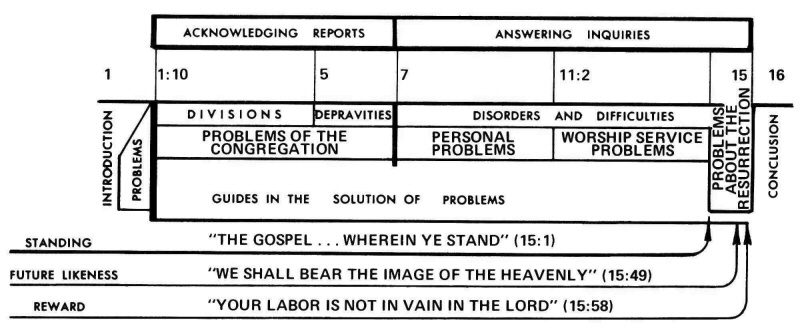
1 CORINTHIANS - PROBLEMS OF A LOCAL CHURCH
Click chart to enlarge
Charts from Jensen's Survey of the NT - used by permission
- 1 Corinthians 15:1 Commentary
- 1 Corinthians 15:2 Commentary
- 1 Corinthians 15:3 Commentary
- 1 Corinthians 15:4 Commentary
- 1 Corinthians 15:5 Commentary
- 1 Corinthians 15:6 Commentary
- 1 Corinthians 15:7 Commentary
- 1 Corinthians 15:8 Commentary
- 1 Corinthians 15:9 Commentary
- 1 Corinthians 15:10 Commentary
- 1 Corinthians 15:11 Commentary
- 1 Corinthians 15:12 Commentary
- 1 Corinthians 15:13 Commentary
- 1 Corinthians 15:14 Commentary
- 1 Corinthians 15:15 Commentary
- 1 Corinthians 15:16 Commentary
- 1 Corinthians 15:17 Commentary
- 1 Corinthians 15:18 Commentary
- 1 Corinthians 15:19 Commentary
- 1 Corinthians 15:20 Commentary
- 1 Corinthians 15:21 Commentary
- 1 Corinthians 15:22 Commentary
- 1 Corinthians 15:23 Commentary
- 1 Corinthians 15:24 Commentary
- 1 Corinthians 15:25 Commentary
- 1 Corinthians 15:26 Commentary
- 1 Corinthians 15:27 Commentary
- 1 Corinthians 15:28 Commentary
- 1 Corinthians 15:29 Commentary
- 1 Corinthians 15:30 Commentary
- 1 Corinthians 15:31 Commentary
- 1 Corinthians 15:32 Commentary
- 1 Corinthians 15:33 Commentary
- 1 Corinthians 15:34 Commentary
- 1 Corinthians 15:35 Commentary
- 1 Corinthians 15:36 Commentary
- 1 Corinthians 15:37 Commentary
- 1 Corinthians 15:38 Commentary
- 1 Corinthians 15:39 Commentary
- 1 Corinthians 15:40 Commentary
- 1 Corinthians 15:41 Commentary
- 1 Corinthians 15:42 Commentary
- 1 Corinthians 15:43 Commentary
- 1 Corinthians 15:44 Commentary
- 1 Corinthians 15:45 Commentary
- 1 Corinthians 15:46 Commentary
- 1 Corinthians 15:47 Commentary
- 1 Corinthians 15:48 Commentary
- 1 Corinthians 15:49 Commentary
- 1 Corinthians 15:50 Commentary
- 1 Corinthians 15:51 Commentary
- 1 Corinthians 15:52 Commentary
- 1 Corinthians 15:53 Commentary
- 1 Corinthians 15:54 Commentary
- 1 Corinthians 15:55 Commentary
- 1 Corinthians 15:56 Commentary
- 1 Corinthians 15:57 Commentary
- 1 Corinthians 15:58 Commentary
1 Corinthians 15:9 For I am the least of the apostles, and not fit to be called an apostle, because I persecuted the church of God. (NASB: Lockman)
Greek: Ego gar eimi (1SPAI) o elachistos ton apostolon, os ouk eimi (1SPAI) hikanos kaleisthai (PPN) apostolos, dioti edioxa (1SAAI) ten ekklesian tou theou;
Amplified: For I am the least [worthy] of the apostles, who am not fit or deserving to be called an apostle, because I once wronged and pursued and molested the church of God [oppressing it with cruelty and violence]. (Amplified Bible - Lockman)
Barclay: It is by the grace of God that I am what I am, and his grace to me has not proved ineffective, but I have toiled more exceedingly than all of them; but it was not I who achieved anything but God’s grace working with me.
ESV: But by the grace of God I am what I am, and his grace toward me was not in vain. On the contrary, I worked harder than any of them, though it was not I, but the grace of God that is with me. (ESV)
KJV: For I am the least of the apostles, that am not meet to be called an apostle, because I persecuted the church of God.
NET: But by the grace of God I am what I am, and his grace to me has not been in vain. In fact, I worked harder than all of them– yet not I, but the grace of God with me. (NET Bible)
NIV: But by the grace of God I am what I am, and his grace to me was not without effect. No, I worked harder than all of them-- yet not I, but the grace of God that was with me. (NIV - IBS)
NLT: But whatever I am now, it is all because God poured out his special favor on me-- and not without results. For I have worked harder than any of the other apostles; yet it was not I but God who was working through me by his grace. (NLT - Tyndale House)
Phillips: But what I am now I am by the grace of God. The grace he gave me has not proved a barren gift. I have worked harder than any of the others - and yet it was not I but this same grace of God within me.
Wuest: For, as for myself, I am the least of the apostles. I am not fit to be called an apostle because I persecuted the Church of God
Young's Literal: for I am the least of the apostles, who am not worthy to be called an apostle, because I did persecute the assembly of God,
FOR I AM THE LEAST OF THE APOSTLES AND NOT FIT TO BE CALLED AN APOSTLE BECAUSE I PERSECUTED THE CHURCH OF GOD:
- I am the least of the apostle: 2Co 11:5 12:11 Eph 3:7,8
- because I persecuted the church of God: Ac 8:3 9:1-19 22:4,5 26:9-11 Ga 1:13,23 Php 3:6 1Ti 1:13,14)
- 1 Corinthians 15 Resources - Multiple Sermons and Commentaries
- See 1 Corinthians 15 Commentary verse by verse

Click Chronological Diagram to enlarge
See Also Map of Events of Paul's Conversion and Early Ministry
CONTEXT
1Corinthians 15:1-7 (Notes -v1; v2; vv4-5; vv 6-8) is the best summary of the Gospel in the Bible. At the end of his summary Paul explains how he became an apostle writing "and last of all, as to one untimely born (literally = a "miscarriage", a life unable to sustain itself), He appeared to me also. (1Cor 15:8-notes)
Comment: "Paul further evidences his sense of unworthiness to be an apostle by the use of the word kamoí (2504), meaning "and to me" or "to me also," in 1Co 15:8: "And last of all he appeared to me also." He places himself in a class of his own. He was agonizingly conscious of his past record of persecution of the church of God, and recognized that it was only by the grace of God that he was what he was (1Co 15:10). That is why he never ceased to wonder at the marvel of his salvation, and only second to that at the fact of his apostleship. Paul was lost in wonder, love, and praise when he thought of his apostleship, for of all men he seemed the least worthy of this high honor and dignity." (Zodhiates – Conquering the Fear of Death: An Exegetical Commentary on First Corinthians Fifteen)
Oswald Chambers: “To me also”—the most unlikely! It is easy to pretend to be “less than the least” without being it, easy to be false in emotion before God, but Paul is not a pretentious humbug, he is not simply speaking out of the deep modesty of his soul, he is speaking what he believes. (He shall glorify me : Talks on the Holy Spirit and other themes)
MacArthur explains that Paul was untimely born "in the sense of an ill–timed birth, too early or too late, seems to fit Paul’s thought best. He came too late to have been one of the twelve. In carrying the idea of unformed, dead, and useless, the term was also used as a term of derision. Before his conversion, which coincided with his vision of the resurrected Lord, Paul was spiritually unformed, dead, and useless, a person to be scorned by God. Even when he was born it was wrong timing. Christ was gone. How could he be an apostle? (MNTC-1 Corinthians)
The appearance of the resurrected, ascended, glorified ("brighter than the sun" Acts 26:13) Jesus was the punctuation mark on the summary of the Gospel. In other words not only was Jesus crucified, buried and resurrected, but He was ascended and glorified as implied by Luke's record of our Lord's glorified appearance to Paul
And it came about that as he journeyed, he was approaching Damascus, and suddenly a light from heaven flashed around him (Acts 22:6, 26:13); and he fell to the ground, and heard a voice saying to him, "Saul, Saul (Jesus used his Jewish name), why are you persecuting Me?" (Ed: Because of the oneness of covenant when Christians are persecuted Jesus their covenant partner is persecuted! See Oneness of Covenant) And he said, "Who art Thou, Lord?" And He said," I am Jesus whom you are persecuting, but rise, and enter the city, and it shall be told you what you must do." (Acts 9:3-6)
Comment: Paul repeatedly emphasizes that he saw the gloried Jesus (Acts 9:17, 27; 22:14; Acts 26:16; 1Co 9:1; 15:8) which indicates how important he held this requirement of apostleship. This fact alone signifies that there can be no modern day apostles (in the mold of Paul, etc), for they could never fulfill this singularly important requirement of having seen the Lord Jesus Christ.
Thomas Edwards writes that 1Cor 15:9,10 represent "A digression referring to his apostleship and apostolical labours (1Cor 9:1, 2, 3). But the verses prove also the truth of the description which the Apostle has given of himself as the "abortion" (ektroma), and connect the success of his ministry with the doctrine the preached, viz., the resurrection of Christ." (Ed: And I would add "the grace infused".)
For - As Thomas Edwards explains Paul "calls himself an abortion (1Co 15:8) because he persecuted the Church of God; and the consequence of his having been a persecutor when Christ appeared to him is that he is still the least of the apostles."
I (ego) - This is emphatic ("ego" is the first word in the Greek sentence) and could be read "Who is the least of the apostles? It is I."
|
PAUL'S PROGRESS IN HUMILITY: |
|
| Approximate Date of Writing |
Paul's Self Assessment |
| 55AD |
1Cor 15:9 For I am the least of the apostles, who am not fit to be called an apostle, because I persecuted the church of God. 10 But by the grace of God I am what I am, and His grace toward me did not prove vain; but I labored even more than all of them, yet not I, but the grace of God with me. |
| 61AD |
Eph 3:8 To me, the very least of all saints (literally = "less than the least of all saints"), this grace was given (Why was it given? What was Paul to do?), to preach (= The purpose of God's gift of grace) to the Gentiles the unfathomable riches of Christ, |
| 63-66AD |
1Ti 1:15 It is a trustworthy statement, deserving full acceptance, that Christ Jesus came into the world to save sinners, among whom I am (Note: not "was" but "am" foremost!) foremost of all. |
As you examine this chart, you see that we come face to face with the phenomenon which is frequently seen in the great leaders and saints of the past. It is that the older they grow, the more acute is their own sense of sin and of weakness in themselves. Or as Spurgeon put it "He whose garments are the whitest will best perceive the spots upon them!" They see that what they once thought to be natural strengths are really weaknesses that emanate from the unredeemed (and unredeemable) fallen flesh. So if this (an increasing sense of the corruption of your old flesh nature) is beginning to happen to you, you are growing as a Christian. It has been well said that "He who knows himself best esteems himself least."
Thomas Guthrie perfectly pictured Paul's progression when he wrote "The Christian is like the ripening corn; the riper he grows, the more lowly bends his head."
Paul never forgot the wonder of being chosen to be a servant (huperetes ) "of Christ and (steward - oikonomos) of the mysteries of God" (1Cor 4:1, 2) (As an aside dear saint - while our stewardship is not identical to Paul's, we do have the privilege of preserving and passing on the truth of the Gospel to a lost world with our lives and our "lips"! Will you be found a faithful steward? cp Lk 12:37, 42, 43, 44, Note: Every believer is a steward and will give an account for how they used their privileges and gifts - 1Pe 4:10, 11. The question for each of us to personally ponder is "Will we hear "Well done"? Read Jesus' words of encouragement and warning in Mt 25:20, 21, 22, 23, 24, 25, 26, 27, 28, 29)
ARE YOU
RIPE FRUIT?
Spurgeon in his sermon on "Ripe Fruit" looks first at the "marks of ripeness in grace" and lists marks of spiritual maturity (this sermon is recommended reading)...
Another mark is never absent in a mature Believer—namely, the weight which is evidenced in humility. Look at the corn in the field, it holds its head erect while it is green, but when the ear is filled and matured, it hangs its head in graceful humbleness. Look at your fruit trees, how their blossoming branches shoot up towards the sky, but when they begin to be loaded with fruit, since the riper the fruit the greater its weight, the branch begins to bow, until it needs oftentimes to be propped up and to be supported, lest it break away from the stem. Weight comes with maturity, lowliness of mind is the inevitable consequence.
Growing Christians think themselves nothing.
Full-grown Christians know that they are less than nothing.
The nearer we are to Heaven in point of sanctification,
the more we mourn our infirmities, and
the humbler is our estimate of ourselves.Lightly laden vessels float high in the water, heavy cargo sinks the boat to the water’s edge.
The more Grace,
the more the need of Grace is felt.He may boast of his Grace who has none. He may talk much of his Grace who has little, but he who is rich in Grace cries out for more, and forgets that which is behind (Php 3:13).
When a man’s inward life flows like a river (Jn 7:38, 39), he thinks only of the Source, and cries before his God, “All my fresh springs are in You.”
He who abounds in holiness feels more than ever that in him, that is in his flesh, there dwells no good thing (Ro 7:18).
You are not ripened, my Brothers and Sisters, while you have a high esteem of yourself. (Php 2:3, 4, Php 2:5, 6, 7) He who glories in himself is but a babe in Christ, if indeed he is in Christ at all. When you shall see death written on the creature, and see all your life in Christ (1Cor 15:31, 2Co 4:10, 11, 12). When you shall perceive even your holy things to have iniquity in them, and see all your perfectness in Him who is altogether lovely. When you shall lie prostrate at the foot of the Throne, and only rise to sit and reign in Him Who is your All, then are you ripening, but not till then (Jn 3:30). (C H Spurgeon "Ripe Fruit" - sermon on Micah 7:1)
As Bishop J C Ryle said "The true secret of spiritual strength is self-distrust and deep humility (cp 2Cor 12:9, 2Cor 12:10)...We have nothing we can call our own--but sin and weakness. Surely there is no garment that befits us so well, as humility."
William Plumer - The deeper one's sense of sin is, the livelier is his gratitude for pardon and saving mercy. So taught our Lord: "Her sins, which are many, are forgiven, for she loved much: but to whom little is forgiven, the same loves little" (Luke 7:47). In like manner the deeper one's sense of sin, the profounder will be his humility; and humility is the King's highway to holiness and happiness and heaven. (THE CHRISTIAN)
The most godly men in the Bible were deeply aware of their own depravity when they found themselves in the presence of the Holy God (A wise man or woman would take time to study the attitudes, words, posture and prayers of men who have had a personal encounter with God = Ge 18:27; Job 42:6; Isa 6:5; Da 9:4, 5, 6, 7, 8, 9, 10, 11,12, 13, 14, 15, 16, 17, 18, 19; Ezek 1:28, Luke 5:8, 9, Re 1:17).
Andrew Murray has an interesting thought in his book entitled Humility, explaining that it is Paul's continual awareness of God's grace that makes his continually so conscious of his sinfulness...
The more Paul rejoiced in God's salvation, and the more his experience of God's grace filled him with joy unspeakable, the clearer was his consciousness that he was a saved sinner, and that salvation had no meaning or sweetness except as the sense of his being a sinner made it precious and real to him. Never for a moment could he forget that it was a sinner God had taken up in His arms and crowned with His love...The three passages above quoted (Ed: see table) all show that it was the wonderful grace bestowed upon Paul, and of which he felt the need every moment, that humbled him so deeply. The grace of God that was with him, and enabled him to labor more abundantly than they all (1Cor 15:9, 10); the grace to preach to the heathen the unsearchable riches of Christ (Ep 3:8); the grace that was exceeding abundant with faith and love which is in Christ Jesus (1Ti 1:12, 13, 14, 15, 16), it was this grace of which it is the very nature and glory that it is for sinners, that kept the consciousness of his having once sinned, and being liable to sin, so intensely alive. "Where sin abounded, grace did abound more exceedingly." (Ro 5:20)
This reveals how the very essence of grace is to deal with and take away sin, and how it must ever be the more abundant the experience of grace, the more intense the consciousness of being a sinner.
It is not sin, but God's grace showing a man and ever reminding him what a sinner he was, that, will keep him truly humble. It is not sin, but grace, that will make me indeed know myself a sinner, and make the sinner's place of deepest self-abasement the place I never leave. (Andrew Murray. Humility - The Beauty of Holiness)
I am the least of the apostles - In one sense Paul was the least because he was the last and not even one of the original 12, but that is not why he claims to be the least. It is because he persecuted Christ, something none of the other apostles did.
O'Brien commenting on Eph 3:8 but relevant to 1Co 15:9 that "As he reflects on his commission to be Christs missionary to the Gentiles Paul is filled with amazement at the extraordinary privilege that has been given to him. Using a very striking expression in which he neither indulges in hypocrisy nor grovels in self-deprecation, he indicates how deeply conscious he is of his own unworthiness and of Christs overflowing grace to him. (O'Brien, P. T. The letter to the Ephesians. The Pillar New Testament commentary. Grand Rapids, Mich.: W. B. Eerdmans Publishing Co)
Paul (Paulus) means “little” in Latin, and perhaps Paul bore this name because he realized how insignificant he really was. There is a powerful lesson in this truth for all believers, all "priests" of the Most High God - God uses the "little" that He might be the "big", that He alone might receive the glory (Ps 115:1). As someone has well said "Great men never think they are great—small men never think they are small." You may feel "little" but rejoice for that is exactly the one God can use. It may not be a ministry like Paul's but in God's economy every saint is valuable for His kingdom work and every saint, no matter how "little" they perceive themselves, has the potential to be a "vessel of honor, set apart, prepared for every good (God) work." (2Ti 2:21) John the Baptist understood this basic Biblical principle when he declared
He must increase,
but I must decrease.
(Jn 3:30)
There are several observations you should make on John 3:30. Before you read any further, go back and meditate on this verse and ask God to show you some of the treasures in this short declarative sentence. Then read the thoughts below ( but it is unlikely that these 3 points exhaust the depths of this verse) --
(1) The order - Jesus first, "I" afterwards. Focus on Jesus and as He increases, you will decrease. Don't try to make yourself decrease, so that He might increase, for this is the "works" way and not the grace way.
(2) The verb "must" (dei [word study]) signifies that Jesus increasing is not optional but mandatory. He "must"! it is a necessity and ultimately an inevitability, for God has greatly exalted Him and one day (soon) He will reign as King of kings in His Millennial Kingdom on earth.
(3) Both the verbs increase (auxano [word study]) and decrease (elattoo [word study]) are in the present tense which indicate that both "actions" describe a process, not a completed event, at least not in this lifetime.
Indeed, when our bodies are resurrected (1Co 15:51, 52, 53, 54, 1Th 4:15, 16, 1Th 4:17, 18) and we are glorified, "we shall be like Him, because we shall see Him just as He is" (1Jn 3:2). But until our faith becomes sight and that Blessed Hope becomes our fulfilled expectation, He is to continually be increasing. How does He increase? The most obvious answer is through our Spirit taught, illuminated reading of His Word, for as Hebrews 1:2 says "in these last days (God) has spoken to us in His Son", the written revelation.
This truth begs the question - are you spending time with Jesus in His Word? Are you allowing the Spirit to teach you about and point to the greatness of Jesus (Jn 15:26 = the Spirit bears witness of Jesus. He points to Jesus, NEVER to Himself!)? Or are you reading devotionals about Jesus and not reading the "living and active word"? The devotionals may be good (but some are not even that if they wander too far from the Scripture or become too "mystical" or too profane), but the Word is the best. To the point, devotionals, Christian books, etc are NOT a substitute for the "pure milk of the Word" for ONLY by the Word does one grow in respect to their salvation (progressive sanctification - growth in holiness - increasing conformity to Christ) (1Pe 2:2). As Luke says (in a literal rendering of the Greek text) "No word of God can fail." (Lk 1:37) The 1901 Authorized Standard Version reads "no word from God shall be void of power." (Lk 1:37ASV) Do you believe that statement?
Let me ask again - Are you in the non-failing (Josh 21:45, 23:14), all powerful Word of God on a regular basis (more to the point, even daily - because that is what Jesus advised - Mt 4:4, Lk 4:4, cp Dt 8:3)? The corollary question is this - Is that all powerful, fully sufficient Word IN you (cp Col 3:16), coursing through your heart and mind? Are you surrendered to and filled with (Ep 5:18, cp Gal 5:16) and fully allowing the Spirit to teach you (are you confessed up, repented up, not quenching the Spirit-1Th 5:19, not grieving Him - Ep 4:30)? If the "living and active Word" (He 4:12) is flowing through you and renewing your mind, Jesus will be increasing and you will be steadily and surely decreasing. And this "position" is a good place to be in God's economy, for James teaches that ""GOD IS OPPOSED TO THE PROUD, BUT GIVES GRACE TO THE HUMBLE." (Jas 4:6). As Charles Spurgeon once said "Let us be humble that we may not need to be humbled, but may be exalted by the grace of God." Thomas Watson adds that "Till we are poor in spirit we are not capable of receiving grace."
Thomas Watson...
Another means to fruitfulness is humility. The low grounds are most fruitful. "The valleys are covered with grain." (Psalm 65:13). The humble heart is the fruitful heart. The largest and sweetest fruits of the Spirit, grow in a humble Christian. 1Peter 5:5: "God gives grace to the humble." Paul called himself the least of saints—yet he was the chief of the apostles.
Until a man is nothing
God can make nothing of him.
--Martin Luther
W E Vine comments that "This self-condemnatory recollection of a sinful past is set as an example to all in whom the grace of God has so wrought."
Henry Law writes that...Paul calls upon His followers to be clothed with humility.
He here (in comments on Ep 3:8 but relevant to 1Co 15:9) shows that this was the clothing in which he was clad. He appears as the follower of Jesus, who was meek and lowly in heart.
Humility is indeed a precious grace. It thrives not in nature's rank soil. The heathen had no term to depict it. How could they speak of that which to them was utterly unknown!
It is a grace which the Spirit deeply implants, when He reveals the misery and filth of indwelling sin. It grows with the growth of faith, and ripens as the celestial home is approached.
Paul is a notable example. With what shame he viewed himself when writing to the Corinthians! He says,
"I am not meet to be called an Apostle, because I persecuted the Church of God."
When writing to the Romans (Romans 7) he humbles himself as the very bond-slave of iniquity. He states that when he would do good evil was present with him. He finds a law in his members bringing him into captivity to the law of sin which was in his members.
In the passage before us he gives precedence to all the people of God, and by invention of a new word in language, he calls himself "less than the least of all saints." (Ep 3:8)
Can he sink lower in self-estimation? When his long career of service had reached its close he casts his eye along his life of labor, and humbly bewails that of sinners he is the chief (1Ti 1:15).
Far be from us the thought that he did not recognize God's gracious work within. He truly felt, by the grace of God he was what he was, and with ascending step he pressed toward the mark for the prize of his high calling in Christ Jesus (Php 3:14).
His was no mock humility. He did not disparage self that he might win applause. But the more the light of heaven shone inwardly, the more it revealed the continuance and the vileness of inbred corruption. The more he knew God the more he loathed himself. The branch laden with abundance of fruit bends beneath the load. The barren twigs shoot upwards.
Thus Paul deeply felt and humbly avowed that he was less than the least of all saints. (MEDITATIONS ON EPHESIANS)
Law adds that "As he grew in grace he deepened in knowledge of unworthiness. He declared that he was less than the least of all saints. Just before he receives the crown of martyrdom we hear his bewailing voice; Sinners, of whom I am chief. If we had like grace, we should similarly despise self. He who is deeply instructed in the treachery and corruption of his own heart, will always esteem others better than himself. His soul will be deeply conscious of its utter need. Like a helpless babe it will look for support from a parent's care.
J Packer has an interesting commentary on Paul's downward progression noting that "Humility and a passion for praise are a pair of characteristics which together indicate growth in grace. The Bible is full of self-humbling (man bowing down before God) and doxology (man giving praise to God). The healthy heart is one that bows down in humility and rises in praise and adoration. The Psalms strike both these notes again and again. So too, Paul in his letters both articulates humility and breaks into doxology. Look at his three descriptions of himself quoted above, dating respectively from around A.D. 59, 63, and 64. As the years pass he goes lower; he grows downward! And as his self-esteem sinks, so his rapture of praise and adoration for the God who so wonderfully saved him rises.Undoubtedly, learning to praise God at all times for all that is good is a mark that we are growing in grace. One of my predecessors in my first parochial appointment died exceedingly painfully of cancer. But between fearful bouts of agony, in which he had to stuff his mouth with bedclothes to avoid biting his tongue, he would say aloud over and over again: “I will bless the Lord at all times; his praise shall continually be in my mouth” (Ps. 34:1). That was a passion for praise asserting itself in the most poignant extremity imaginable. Cultivate humility and a passion for praise if you want to grow in grace. (from Your Father Loves You by J Packer)...Take a moment from your busy day and worship Him in song with Chris Tomlin's Play "Indescribable"...note especially the last stanza
Indescribable, Uncontainable
You place the stars in the sky
And know them by name
You are amazing GodIncomparable, unchangeable
You see the depths of my heart
And you love me the same!
You are amazing God!
Puritan Thomas Brooks - Paul was the least of all saints in his own eyes; yes, he was less than the least of all saints, Ep 3:8. This is a double diminutive, and signifies "lesser than the least," if lesser might be. Here you have the greatest apostle descending down to the lowest step of humility, 1Co 15:8, 4:9; 1Ti 1:15. Great Paul is least of saints, least of the apostles, and greatest of sinners in his own eyes, and never had any mortal more of the gracious presence of God with him in all his services and in all his sufferings, in all his afflictions and in all his temptations, in all his trials and in all his troubles, which were many and great. See Acts 16:23, 24, 25, Acts 23:10, 11, Acts 27:23-25; 2Co 1:8-10, 4:8-11, 7:4,-7, 11:21, 12:7-10. (A Word in Season for Suffering Saints)
Least (1646) (elachistos = superlative of mikrós = small) means...
(1) the lowest in status (not so in Mt 2:6, 1Co 15:9 ~ Ep 3:8, Mt 5:19, Mt 25:40, 45, Lxx = Ge 25:23, 2Ki 18:24 = "least of my master's servants", Da 2:39 = "another kingdom inferior to you"),
(2) the smallest in a class (eg, bodily "organs" - one of the smallest very fittingly compared to a rudder of a large vessel = Jas 3:4, Ge 1:16 = the moon, "lesser light", Lxx = Josh 6:26 = "youngest", Job 30:1 = "younger than I"),
(3) and finally as a description of something deemed trivial or of little significance (1Co 6:2, Lk 12:26, 16:10, 19:17, 1Co 4:3).
(4) smallest in amount or size (Lxx = Ex 16:17, 18, Nu 26:54, 33:54, 35:8, 1Sa 9:21 = "smallest of Israel's tribes", Pr 30:24 - see the "smallest" in Pr 30:25, 26 27, 28, Job 16:6 = "pain...not lessened", Job 18:7 = "stride is shortened", Isa 60:22 = "the least one a mighty nation", Jer 30:14 = "little ones of the flock")
Paul is saying he is "more least than all the saints". In fact, elachistos means "less than the least" and expresses Paul's honest, deep self-abasement. In other words, Paul is not exhibiting a sense of false humility but a true self-estimate from a man filled with the Holy Spirit and one who knew his true unworthiness in face of "gift of God's grace" and the perfect righteousness of God. Paul wrote a similar self-estimate in other letters in which there seems to be a spiritual progression characterized by a heightened sense of one's own moral shortcoming when compared with Christ's perfect righteousness (see preceding table). Anyone who sees Christ in His glory sees in stark contrast his own sinfulness. As Christ increased in Paul, Paul decreased.
Stated another way, a growing understanding the deep truths of God’s Word does not give a man a big head; it gives him a broken and contrite heart.
Paul (Paulus) means “little” in Latin, and perhaps Paul bore this name because he realized how insignificant he really was.
Thomas Watson writes of Paul 'This illustrious Apostle, a star of the first magnitude, shrank into nothing in his own eyes!
William Secker (1660) wrote "Pride is a sinner's torment—but humility is a saint's ornament. The garment of humility—should always be worn on the back of Christianity.
Hughes comments on very least writing that "Again Paul bends the language. He takes the Greek word for “least” or “smallest” and adds an ending which is impossible linguistically, so that he comes out with the word “leaster.” Some think he was playing off his Latin name Paulus, which meant “little” or “small,” so that the idea is, “I am little by name, little in stature, and morally and spiritually littler than the least of all Christians.” I am Small Paul. (Ephesians: The Mystery of the Body of Christ. Crossway Books)
Johnson explains "the very least" this way "By the way, Paul’s Latin name, “Paul,” means “little.” And what he has done here is to take the word least in the Greek text and make it a comparative. Now least is a superlative. But he has said, “I who am leaster”; that’s what he’s done in Greek. So he’s taken a superlative and made it a comparative. It’s as if he’s to say, “I’m not simply the littlest, but the littlester of all the saints.” He really feels that way because he persecuted the church of God. (Ephesians 3:1-13 Dispensation of Grace Audio/Pdf )
Elachistos - 14x in 12v in the NAS = least(6), smallest(1), very least(1), very little thing(4), very small(1), very small thing(1).
Matthew 2:6 'AND YOU, BETHLEHEM, LAND OF JUDAH, ARE BY NO MEANS LEAST AMONG THE LEADERS OF JUDAH; FOR OUT OF YOU SHALL COME FORTH A RULER WHO WILL SHEPHERD MY PEOPLE ISRAEL.'"
Comment: Notice that NAS capitalizes direct OT quotations for easy recognition.
Matthew 5:19 "Whoever then annuls one of the least of these commandments, and teaches others to do the same, shall be called least in the kingdom of heaven; but whoever keeps and teaches them, he shall be called great in the kingdom of heaven.
Matthew 25:40 "The King will answer and say to them, 'Truly I say to you, to the extent that you did it to one of these brothers of Mine, even the least of them, you did it to Me.'
Matthew 25:45 "Then He will answer them, 'Truly I say to you, to the extent that you did not do it to one of the least of these, you did not do it to Me.'
Luke 12:26 "If then you cannot do even a very little thing, why do you worry about other matters?
Luke 16:10 "He who is faithful in a very little thing is faithful also in much; and he who is unrighteous in a very little thing is unrighteous also in much.
Luke 19:17 "And he said to him, 'Well done, good slave, because you have been faithful in a very little thing, you are to be in authority over ten cities.'
1 Corinthians 4:3 But to me it is a very small thing that I may be examined by you, or by any human court; in fact, I do not even examine myself.
1 Corinthians 6:2 Or do you not know that the saints will judge the world? If the world is judged by you, are you not competent to constitute the smallest law courts?
1 Corinthians 15:9 For I am the least of the apostles, and not fit to be called an apostle, because I persecuted the church of God.
Ephesians 3:8 To me, the very least of all saints, this grace was given, to preach to the Gentiles the unfathomable riches of Christ,
James 3:4 Look at the ships also, though they are so great and are driven by strong winds, are still directed by a very small rudder wherever the inclination of the pilot desires.
Elachistos - 27x in 25v in the non-apocryphal Septuagint (LXX) -Ge 1:16; 25:23; 27:6; Ex 16:17f; Lev 25:16; Nu 26:54; 33:54; 35:8; Josh 6:26; 1 Sa 9:21; 2 Kgs 18:24; Pr 13:11; 22:16; 30:24; Job 16:6; 18:7; 30:1; Isa 60:22; Jer 30:14; Da 2:39
Of the apostles - This is interesting in that earlier Paul had defended his apostleship writing...
Am I not free? Am I not an apostle? Have I not seen Jesus our Lord? Are you not my work in the Lord? If to others I am not an apostle, at least I am to you; for you are the seal of my apostleship in the Lord. My defense to those who examine me is this... (1Co 9:1, 2,3)
John Flavel had it right declaring "They that know God, will be humble, and they that know themselves cannot be proud. (Woe, that hurts!)
F B Meyer expands that thought writing "I used to think that God's gifts were on shelves one above the other, and that the taller we grew in Christian character the easier we could reach them. I now find that God's gifts are on shelves one beneath the other. It is not a question of growing taller, but of stooping down, to get His best gifts.
J C Ryle (1816 - 1900) wrote that "Humility is the rarest and most beautiful of graces. Humility is the very first letter in the alphabet of Christianity."
William Law (1686-1761) - "Living Christianity is making one’s life an exercise of humility, repentance and heavenly affection."
As this point it would be wise for us to recall that Paul did not allow himself to be discouraged by looking back, focusing on past failures which is what the mortal enemy of our soul would love for us to do (Our enemy Satan continually accuses the brethren before God = Re 12:10). While Paul is teaching that it is important to maintain a consciousness of the depths of sin from which we have been saved so that the wonder of grace might abound all the more (cp Ro 5:20), it is another thing to seek to self-indulgently "wallow" in past sins (which we have confessed - see below), even piling up guilt on one's self. To the contrary, we must continually be mindful that the same grace which has taken our feet out of the "miry clay" (Ps 40:2), is the same grace which will forever hold us firm in the eternal truth of "No condemnation" and "No separation" in Christ (Ro 8:1. Ro 8:39) Compare King David's example after he had sinned with Bathsheba, confessed his sin and experienced the consequences when his son died (2Sa 12:13, 14, 15, 16, 17, 18, 19, 20). As John states "If we confess our sins, He is faithful and righteous to forgive (aphiemi - see the picture implied by this great Greek word) us our sins and to cleanse (katharizo) us from all (How much?) unrighteousness." (1Jn 1:9) While confession of our sins does not necessarily remove the consequences of those sins nor the memory of those sins, we need to accept that the God of all grace has forgiven us completely (see pictures of the breadth of God's forgiveness = Ps 32:1, Ps 103:12, Isa 6:7, Isa 38:17, Isa 44:11, Mic 7:18,19 Acts 3:19,20, 21, 22, 23, 24) and has purified us wholly from the sins and the guilty conscience. This truth will make us grateful debtors to grace.
Puritan writer Thomas Watson echoes this need for a fine balance between awareness of past sins but not abjectly groveling in them "The mixing of wisdom and innocence is seen in this: to be humble—but not base. Humility is part of the dove's innocence. 1Peter 5:5, "Be clothed with humility." Paul, though the chief of the Apostles, calls himself the least of saints. A gracious soul has low thoughts of himself, and carries himself lowly toward others; but, though he is humble—he is not base. Though he will not saucily resist his superiors—he will not sinfully humor them. Though he will not do such proud actions as to make his enemies hate him—yet he will not do such sordid actions as to make them despise him. Here is the serpent and the dove united. (Wise as Serpents)
Apostles (652)(apostolos from apo = from + stello = send forth) (Click discussion of apostle) means one sent forth from by another, often with a special commission to represent another and to accomplish his work. It can be a delegate, commissioner, ambassador sent out on a mission or orders or commission and with the authority of the one who sent him.
Apostolos referred to someone who was officially commissioned to a position or task, such as an envoy. Secular Greek writer Demosthenes gives a word picture of "apostolos" noting that it was used to describe a cargo ship (sometimes called "apostolic") sent out with a specific shipment to accomplish a mission. In secular Greek apostolos was used of an admiral of a fleet sent out by the king on special assignment.
In the ancient world a apostle was the personal representatives of the king, functioning as an ambassador with the king’s authority and provided with credentials to prove he was the king's envoy. Apostolos was a technical word designating an individual sent from someone else with the sender's commission, the necessary credentials, the sender's authority and the implicit responsibility to accomplish a mission or assignment.
The English word "ambassador" is a good translation of apostolos because an ambassador is "an official envoy of high rank appointed by one of higher rank and authority in the government to represent and transact its business at the seat of government of some other power."
Paul thought of himself as an ambassador of the King of kings, sent by Him to the Gentiles with credentials (miracles he performed) and the commission,
to open their eyes so that they may turn from darkness to light and from the dominion of Satan to God, in order that they may receive forgiveness of sins and an inheritance among those who have been sanctified by faith in Me (Acts 26:17, 18)
To reemphasize the word apostle as Paul uses it here does not merely refer to one who has a message to announce, but to an appointed representative with an official status who is provided with the credentials of his office.
In its broadest sense, apostle can refer to all believers, because every believer is sent into the world as a witness for Christ. But the term is primarily used as a specific and unique title for the thirteen men (the Twelve, with Matthias replacing Judas, and Paul) whom Christ personally chose and commissioned to authoritatively proclaim the gospel and lead the early church. The thirteen apostles not only were all called directly by Jesus but all were witnesses of His resurrection, Paul having encountered Him on the Damascus Road after His ascension. Those thirteen apostles were given direct revelation of God’s Word to proclaim authoritatively, the gift of healing, and the power to cast out demons (Mt 10:1). By these signs their teaching authority was verified (cf. 2Co 12:12). Their teachings became the foundation of the church (Ep 2:20), and their authority extended beyond local bodies of believers to the entire believing world. In the present context Paul clearly uses apostle in its more common specialized or restricted meaning.
Octavius Winslow writes. "The apostle Paul felt it a great privilege to be allowed to preach the gospel. He did not look upon his calling as a drudgery—but he entered upon it with intense delight. Yet while Paul was thus thankful for his office, his success in it greatly humbled him. The fuller a vessel becomes—the deeper it sinks in the water. Idlers may indulge a fond conceit of their abilities, because they are untried; but the earnest worker soon learns his own weakness. If you seek humility—try hard work; if you would know your nothingness, attempt some great thing for Jesus. If you would feel how utterly powerless you are apart from the living God—attempt especially the great work of proclaiming the unsearchable riches of Christ—and you will know, as you never knew before, what a weak unworthy thing you are. (Morning and Evening - March 2 Evening)
Apostolos - 80x in 79v = apostle(19), apostles(52), apostles'(5), messenger(1), messengers(1), is sent(1).Mt 10:2; Mk 3:14; 6:30; Lk 6:13; 9:10; 11:49; 17:5; 22:14; 24:10; John 13:16; Acts 1:2, 26; 2:37, 42f; 4:33, 35ff; 5:2, 12, 18, 29, 40; 6:6; 8:1, 14, 18; 9:27; 11:1; 14:4, 14; 15:2, 4, 6, 22f; 16:4; Rom 1:1; 11:13; 16:7; 1 Cor 1:1; 4:9; 9:1f, 5; 12:28f; 15:7, 9; 2 Cor 1:1; 8:23; 11:5, 13; 12:11f; Gal 1:1, 17, 19; Eph 1:1; 2:20; 3:5; 4:11; Phil 2:25; Col 1:1; 1Th 2:7; 1Ti 1:1; 2:7; 2 Tim 1:1, 11; Titus 1:1; Heb 3:1; 1 Pet 1:1; 2 Pet 1:1; 3:2; Jude 1:17; Rev 2:2; 18:20; 21:14.
Spurgeon commenting on 1Cor 15:9 wrote "When he looked upon the mercies that God gave to him he always recollected how little he deserved; and when be found himself preaching, oh! with what pathos did he preach to the ungodly, for he could always close up: — “But I obtained mercy, that in me first Christ might show forth all long-suffering as a pattern to them that believe.” Have I a persecutor here? Let him know that his sin is a most damnable sin that will sink him lower into hell than any other; but even for him there is mercy, and abundant pardon; for Paul says he obtained mercy even though he persecuted the church of God.
In his book "Conformed to His Image" Oswald Chambers writes about the "Memory of Sin in the Saint"- No aspect of Christian life and service is in more need of revision than our attitude to the memory of sin in the saint. When the Apostle Paul said “forgetting those things which are behind,” he was talking not about sin, but about his spiritual attainment. Paul never forgot what he had been; it comes out repeatedly in the Epistles—“For I am the least of the apostles, that am not meet to be called an apostle” (1Corinthians 15:9); “unto me who am less than the least of all saints, is this grace given” (Ephesians 3:8); “. . . sinners, of whom I am chief” (1Timothy 1:15). And these are the utterances of a ripe, glorious servant of God. If one wants a touchstone for the depth of true spiritual Christianity, one will surely find it in this matter of the memory of sin. There are those who exhibit a Pharisaic holiness, they thank God with an arrogant offensiveness that they are “not as other men are”; they have forgotten the horrible pit and miry clay from whence they were taken, and their feet set upon a rock through the might of the Atonement. (Chambers, O. Conformed to His image. London: Marshall, Morgan & Scott)
Not (ou) signifies absolute negation and emphasizes how strong Paul feels about not deserving to be an apostle.
Fit (2425) (hikanos from the root hik- = “to reach [with the hand],” “to attain”, `reaching to', `attaining to'; hence, `adequate') refers to that which reaches or arrives at a certain standard. The primary meaning of hikanos is sufficient, and hence comes to be applied to number and quantity and so means many or enough.
Hikanos has been variously used from the time of the Greek tragic dramatists in the basic sense of adequate (sufficient for a specific requirement), sufficient (enough to meet the needs of a situation or a proposed end), enough (in or to a degree or quantity that satisfies or that is sufficient or necessary for satisfaction), qualified (fitted as by training or experience for a given purpose), competent (having the capacity to function or develop in a particular way) to do a thing or large enough. As illustrated in selections below, the NT usage corresponds to these secular uses.
In the present context Paul uses hikanos to emphasize that he does not meet the standard and therefore in his eyes is in one sense not even qualified to be an apostle. This not an exclamation of false humility, but a confession of true humility which surely gives us a clue as to why this man was so greatly used of the Lord.
Jon Courson -
I find it interesting that the longer Paul walked with the Lord, the more he realized how far he was from Him. That’s always the way it is. The Pharisee, praying on the street corner, said, ‘God, I thank Thee, I am not as other men,’ while the true convert beat his breast and said, ‘God, be merciful to me a sinner’ (see Lk 18:11, 12, 13).
If you feel less than adequate
for the challenge before you,
for the day facing you, rejoice.You’re in good company and in the perfect position for the Lord to do something wonderful in and through you. (Courson, J. A Day's Journey: 365 Daily Meditations from the Word)
In a sense every saint could (should) echo Paul's confession of inadequacy for holy, divine tasks, for as he explains in his second epistle to the Corinthians...
Not that we are adequate ("fit", hikanos) in ourselves to consider anything as coming from ourselves, but our adequacy (related noun hikanotes = Sufficiency, competency, ability, adequacy, capacity, fitness - state of being qualified for something) is from God, Who also made us adequate (hikanoo - made us sufficient, fit, qualified, competent by placing us in Christ) as servants of a new covenant, not of the letter, but of the Spirit; for the letter kills, but the Spirit gives life. (2Cor 3:5,6)
John the Baptist used hikanos declaring...
As for me, I baptize you with water for repentance, but He who is coming after me is mightier than I, and I am not fit (hikanos) to remove His sandals (cp "the least of the apostles"); He will baptize you with the Holy Spirit and fire. (Mt 3:11)
Comment: And what did Jesus say of this man who had such a "lowly" opinion of himself? Notice Jesus' "formula" for greatness in the kingdom! Not the world's "formula" to be sure!
Truly, I say to you, among those born of women there has not arisen anyone greater than John the Baptist; yet he who is least (mikros - English "microscopic" {Not easily visible! How different from how we often want to be -- which is "seen"! Convicted? I am!}) in the kingdom of heaven is greater than he. (Mt 11:11, Lk 7:28)
David Brainerd a man greatly used of the Lord once wrote...
Much more of true religion consists in deep humility, brokenness of heart and an abasing sense of barrenness and want of grace and holiness than most who are called Christians imagine.
Matthew Henry chimes in remarking that "Those whom God will employ are first struck with a sense of their unworthiness to be employed.
I like the way John Flavel said it "They that know God will be humble; they that know themselves cannot be proud.
Thomas Fuller adds that "There is no true holiness without humility.
God grant us the beatitude of the background,
That only He may be seen!
--Vance Havner
Called (2564)(kaleo from root kal-, whence English “call” and “clamour”) literally means to speak to another in order to attract their attention or to them bring nearer, either physically or in a personal relationship. Kaleo is a major verb in the NT and its specific meaning depends on the the context in which it is used.
Thomas Edwards paraphrases it as "to be known in the capacity of an apostle."
Charles Hodge comments "Do not even deserve to be called an apostle. See Matthew 3:11 and Luke 3:16. This deep humility of the apostle, which led him to regard himself as the least of the apostles, was perfectly consistent with the strenuous assertion of his official authority and of his claim to respect and obedience. In 2Corinthians 11:5 and 2Cor 12:11 he says he was “not in the least inferior to the ‘super-apostles,’” and in Galatians 2:6, 7, 8, 9 he claims full equality with James, Peter, and John. God commonly prepares those of his children whom he intends to exalt to posts of honor and power by leading them to such a knowledge of their sinfulness as to keep them constantly abased." (1 Corinthians 15 Commentary)
APPLYING THIS SECTION
TO SPIRITUAL WARFARE
Ray Stedman applies the truths of 1Co 15:9, 10 to spiritual warfare noting that...
Paul's background was anti-Christian, and he could never get completely away from that. He had been the most hostile, brutal persecutor the church had ever known. After his conversion to Christ, he doubtless encountered families whose loved ones he had put to death. He was often reminded by people that he was not one of the original twelve apostles, and they continually called his apostleship into question. Writing to the Corinthians about these very matters, he says of himself, "For I am the least of the apostles, and do not even deserve to be called an apostle, because I persecuted the church of God" (1 Corinthians 15:9).
What grounds for discouragement! How easy it would have been for him to say to himself, "What's the use? Here I am working my fingers to the bone, making tents and trying to preach the gospel to these people, and look at the blessing God has brought them but they don't care! They hurl recriminations back in my face! What's the use? Why even try anymore?"
But that is not what he does. The very next verse says, "But by the grace of God I am what I am, and his grace toward me was not without effect" (1Corinthians 15:10). Here we see Paul using the breastplate of righteousness. He says, in effect, "I don't care what I have been. I don't defend what I am. I simply say that, by the grace of God, I am what I am. What I am is what Christ has made me. I'm not standing on my own righteousness I'm standing on His. I am accepted by grace, and my personal situation does not make any difference at all."
So Paul's heart was kept from discouragement. He reminded himself that when he became a Christian he had put on the breastplate of righteousness. He never allowed himself to be discouraged by looking back. He always looked forward, to Christ. (Defense against defeat)
PAULINE
PERSECUTION
Persecuted (1377)(dioko [word study] from dío = pursue, prosecute, persecute) means to follow or press hard after, literally to pursue as one does a fleeing enemy. It means to chase, harass, vex and pressure and was used for chasing down criminals. Dioko speaks of an intensity of effort leading to a pursue with earnestness and diligence in order to obtain. To go after with the desire of obtaining. It gives us the picture of going on the track of something like the hounds on the hunt and pursuing after the fox and implying a continuing effort to overtake, reach, or attain the goal.
The secular Greek usage of dioko to describe a hunter eagerly pursuing his prey is an especially poignant picture of Saul's passionate pursuit of the church (see examples below from the Book of Acts)!
In 30 of the 45 NT instances, dioko is used to convey the sense of the intention of doing harm. To hunt down like an animal. To run swiftly after something. To in any way whatever harass, trouble, molest. To carry out physical persecution, to harass, to abuse, to treat unjustly. The following passages convey this meaning - Mt 5:10, 11, 12, Mt 5:44, Mt 10:23, Lk 21:12, Jn 5:16; 15:20; Acts 7:52; 9:4, 5; 22:4,7, 8; 26:14, 15; Ro 12:14; 1Co 4:12; 15:9; 2Co 4:9; Gal 1:13,23; Gal 4:29; Gal 5:11; Php 3:6; 2Ti 3:12; Passive sense - to be maltreated, suffer persecution on account of something -Gal 6:12 Dioko conveys a sense of urgency and a sense of of intensity of purpose.
Comment: How do we respond to persecution? We remember that suffering persecution is part of what it means---in certain situations at least---to live as a Christian (1Th 3:4; 2Ti 3:12). Like Paul, "when we are persecuted, we endure it" (1Co 4:12). We respond by loving and blessing our persecutors and praying for them (Mt 5:44; Ro 12:14). And through it all, we remember that we are surrounded by the love of Jesus. For no "hardship or persecution (diogmos derived from dioko) or famine or nakedness or danger" will ever be able to separate us "from the love of God that is in Christ Jesus our Lord" (Ro 8:35, 39). (Richards, L O: Expository Dictionary of Bible Words: Regency)
One example of "persecution" that probably looms as the most significant in Paul's life was his presence and tacit approval of the martyrdom of Stephen, which is somewhat ironic because Stephen was the last person until Paul's Damascus Road vision of Jesus, to have seen the glorified, risen Son (Acts 7:55, 56, 57, 58). John MacArthur makes the point that this fact is "a testimony to the power of God’s grace that the man involved in Stephen’s death would be the next to see Jesus Christ."
In the book of Acts Luke records this pivotal instance (and several other examples) of Pauline persecution writing...
And they went on stoning Stephen as he called upon the Lord and said, "Lord Jesus, receive my spirit!" And falling on his knees, he cried out with a loud voice, "Lord, do not hold this sin against them!" And having said this, he fell asleep. And Saul was in hearty agreement with putting him to death. And on that day a great persecution arose against the church in Jerusalem; and they were all scattered throughout the regions of Judea and Samaria, except the apostles. (Acts 7:59, 60, 8:1)
Comment: Notice Stephen's prayer -- is not Paul's miraculous, grace driven, mercy filled conversion in Acts 9 at least in part an answer to Stephen's Spirit empowered prayer in Acts 7:60!
And all those hearing him continued to be amazed, and were saying, "Is this not he who in Jerusalem destroyed those who called on this name, and who had come here for the purpose of bringing them bound before the chief priests?" (Acts 9:21)
"I am a Jew, born in Tarsus of Cilicia, but brought up in this city, educated under Gamaliel, strictly according to the law of our fathers, being zealous for God, just as you all are today. 4 "And I persecuted this Way to the death, binding and putting both men and women into prisons, 5 as also the high priest and all the Council of the elders can testify. From them I also received letters to the brethren, and started off for Damascus in order to bring even those who were there to Jerusalem as prisoners to be punished. (Acts 22:3, 4, 5 = followed by the Damascus Road encounter = Acts 22:6, 7-8, 9-10, 11, 12-13, 14,15)
(Paul recounting some of the details of his Damascus Road encounter with Jesus) And I said, 'Lord, they themselves understand that in one synagogue after another I used to imprison and beat those who believed in Thee. And when the blood of Thy witness Stephen was being shed, I also was standing by approving (consenting, giving hearty approval), and watching out for the cloaks of those who were slaying (murdering) him.' "And He said to me, 'Go! For I will send you far away to the Gentiles.'" (Acts 22:19, 20, 21)
Paul alludes to his persecution of the church in his letter to the Galatians...
For you have heard of my former manner of life in Judaism, how I used to persecute the church of God beyond measure (Gk = hyperbole = an extraordinary or extreme degree), and tried to destroy (Gk = portheo = ravage) it; 14 and I was advancing in Judaism beyond many of my contemporaries among my countrymen, being more extremely zealous for my ancestral traditions. 15 But when He who had set me apart, even from my mother's womb, and called me through His grace, was pleased 16 to reveal His Son in me, that I might preach Him among the Gentiles, I did not immediately consult with flesh and blood...23 but only, they kept hearing, "He who once persecuted us is now preaching the faith which he once tried to destroy." (Gal 1:13, 14, 15, 16, 23)
(Paul explaining why he might put confidence in the flesh explained that in the past he had been) as to zeal (zelos from zeo = to seethe, boil, to be fiery hot = this helps picture the intensity of Paul against Christians and Christ), a persecutor of the church; as to the righteousness which is in the Law, found blameless. (Philippians 3:6)
I thank Christ Jesus our Lord, who has strengthened (endunamoo) me, because He considered me faithful, putting me into service, even though I was formerly a blasphemer and a persecutor and a violent aggressor (hubristes - see comment below). Yet (What a dramatic contrast) I was shown mercy because I acted ignorantly in unbelief; and the grace (truly undeserved favor in this context) of our Lord was more than abundant (superabound, be exceedingly abundant), with the faith and love which are found in Christ Jesus. (1Ti 1:12-14)
Comment: The Greek for "violent aggressor" helps paint a "pre-Christ" picture of Paul. Hubristes was used by the ancient Greeks (Homer) to describe "an insolent man, `one who, uplifted with pride, either heaps insulting language upon others or does them some shameful act of wrong'" Friberg adds that hubristes means a "violent aggressor, especially of one who takes a superior attitude and mistreats others out of his own revolt against God's revelation of truth". Moulton and Milligan say this word "emphasizes the element of outrageous disregard of other men’s rights". Wiersbe comments on hubristes noting that "A modern equivalent might be "bully." It conveys the idea of a haughty man "throwing his weight around" in violence."
Charles Hodge writes that "The forgiveness of sin does not obliterate the memory of it; nor does it remove the sense of unworthiness and ill-desert. (1 Corinthians 15 Commentary)
Ed comment: While this may be true we do well to continually sing the old hymn to remind ourselves of the breadth and length and height and depth of God's forever forgiveness to us because of the blood of His Son shed on our behalf...
Nothing but the Blood
by Robert LowryWhat can wash away my sin?
Nothing—but the blood of Jesus.
What can make me whole again?
Nothing but the blood of Jesus.Oh! precious is the flow
That makes me white as snow;
No other fount I know,
Nothing but the blood of Jesus.
Church (1577)(ekklesia/ecclesia from ek = out + klesis = a calling, verb = kaleo = to call) literally means called out (but see note by Louw-Nida below) and as commonly used in the Greco-Roman vernacular referred to citizens who were called out from their homes to be publicly assembled or gathered to discuss or carry out affairs of state. Wuest writes that "The word assembly is a good one-word translation of ekklesia."
Church - English word - derived from Middle English chirche, from Old English cirice, ultimately from Late Greek kyriakon (doma - house) = a temple of God, from Greek neuter of kyriakos = of the Lord or pertaining to the Lord from kyrios lord, master.
John Walvoord has a helpful summary of ekklesia/ecclesia - This word translated church or assembly is found in at least four important meanings in the New Testament. It is used (1) to mean an assembly of people. In this sense it has no special theological meaning. It can refer to Israel as a gathered people in the wilderness (Acts 7:38) or a regular assembly of citizens (Acts 19:39) or a group of people gathered for religious worship (Heb. 2:12). (2) The same word is used for an assembly of Christians in a local church (Acts 8:1, 8:3; 11:22, 26) and in the plural for a group of such churches (1Cor. 16:19; Gal. 1:2). Each assembly or church has a local gathering composed of professed Christians. That all in the assembly are not necessarily true believers is clear from the messages to the seven churches of Asia (Rev 2:1-29; Rev 3:1-22). (3) Ecclesia is also used of the total of professing Christians without reference to locality and is practically parallel in this sense to Christendom (Acts 12:1; Ro 16:16; 1Cor. 15:9; Gal. 1:13; Rev. 2:1-29, Rev 3:1-22; etc.). The same word is used (4) of the body of Christ, composed of those baptized by the Holy Spirit into the church (1Cor. 12:13). Ecclesia used in this connection becomes a technical word referring to the saints of this age. (Borrow The Millennial Kingdom on page 224)
Related Resources on "Church"
- Multiple Bible Dictionary Discussions
- Baker's Evangelical Dictionary of Biblical Theology
- Ecclesiology: The Church - Greg Herrick
- Questions about the Church (e.g., What is the church?)
- What was the first / original church? Is the original / first church the true church?
Smith's Bible Dictionary notes that "The day of Pentecost is the birthday of the Christian church. Before they had been individual followers Jesus; now they became his mystical body, animated by his spirit."
As with all Greek word studies, the meaning of the word in a specific passage is critically dependent upon examination of the context. This basic principle is applied in this discussion and accounts for several different nuances of ekklesia in the summary below (note). As Easton's Bible Dictionary says "In the New Testament it is the translation of the Greek word ecclesia, which is synonymous with the Hebrew qahal of the Old Testament, both words meaning simply an assembly, the character of which can only be known from the connection in which the word is found (Ed: In other words, context is critical in order to understand the meaning/nuance of each specific use of ekklesia).
Louw and Nida - Though some persons have tried to see in the term ekklesia a more or less literal meaning of ‘called-out ones,’ this type of etymologizing is not warranted either by the meaning of ekklesia in NT times or even by its earlier usage. The term ekklesia was in common usage for several hundred years before the Christian era and was used to refer to an assembly of persons constituted by well-defined membership. In general Greek usage it was normally a socio-political entity based upon citizenship in a city-state and in this sense is parallel to demos (a group of citizens assembled for socio-political activities). For the NT, however, it is important to understand the meaning of ekklesia as ‘an assembly of God’s people.’ (Greek-English Lexicon of the New Testament: Based on Semantic Domains. United Bible societies)
In summary, Louw and Nida says that strictly speaking the etymology of "ekklesia" is not "called out ones" but was used of an assembly (composed not necessarily of "called out ones"). That said, when we come to the usual NT meaning of ekklesia, the church, it cannot be a "coincidence" that the body of Christ, the church, is composed solely of men and women "called out" by God. To be sure local assemblies of believers ("local churches") seldom if ever are 100% believers and thus "called out ones" is strictly speaking not be an accurate designation. So while etymologically inaccurate, "called out ones" is theologically accurate for the true church which is the body of Christ.
A BETTER TERM:
BODY OF CHRIST
A key identifying characteristic of the Church is Holy Spirit baptism (1 Cor. 12:13) which is the event that forms the Body of Christ which is actually a better designation for the world-wide body of believers than the term 'church.' To reiterate, the Greek ekklesia (most often translated 'church') merely means a gathering or group of people. Ekklesia can even describe nonbelievers and thus is not a precise technical term. In short, ekklesia can appear in contexts which have nothing to do with the baptizing work of the Spirit which defines the Body of Christ, an entity which did not exist prior to Pentecost.
Here are some other indicators that the Body of Christ, the Church did not exist in the Old Testament: (1) Jesus Himself indicated that 'on this rock I will build my Church' (future tense, Mt. 16:18). (2.) Peter referred to the arrival of the Holy Spirit as the 'the beginning' (Acts 11:15). (3) James referred to the giving of the Holy Spirit to the Gentiles (Acts 10:45) as 'at the first' (Acts 15:14). (4) The joining of Gentiles and Jews into the same body is described as a 'mystery' which was not made know previously to the sons of men (Eph. 3:4-7; Col. 1:26-27). (5) In the OT when Gentiles joined Israel they became Jewish proselytes, whereas in the NT, the barrier between Jews and Gentiles (the Law of Moses) was removed 'in Christ' and God created a new spiritual organism, the 'one new man' (Eph. 2:15), which has no counterpart in the the Old Testament.
The New Unger Bible Dictionary lists seven metaphors that set forth the relationship between Christ and His Church...Relation Between Christ and the Church. Seven NT figures set forth this relation: (1) the Shepherd and the Sheep (John 10); (2) the Vine and the Branches (John 15); (3) the Cornerstone and the Stones of the Building (1 Cor. 3:9; Eph. 2:19–22; 1 Pet. 2:5); (4) High Priest and the Kingdom of Priests (Heb. 5:1–10; 6:13–8:6; 1 Pet. 2:5–9; Rev. 1:6); (5) the Head and the Many-Membered Body (1 Cor. 12:12–13, 27; Eph. 4:4); (6) the Last Adam and the New Creation (1 Cor. 15:22, 45; 2 Cor. 5:17); (7) the Bridegroom and the Bride (John 3:29; 2 Cor. 11:2; Eph. 5:25–33; Rev. 19:7–8).
Here are the definitions of ekklesia...
(1) In Secular Greek usage ekklesia = a body of citizens “gathered” to discuss the affairs of state
Zodhiates: (Ekklesia) was a common (secular) term for a congregation of the ekklētoí (n.f.), the called people, or those called out or assembled in the public affairs of a free state, the body of free citizens called together by a herald (kerux]) which constituted the ekklēsia.
NIDNTT = Ekklesia, centuries before the translation of the OT and the time of the NT, was clearly characterized as a political phenomenon, repeated according to certain rules and within a certain framework. It was the assembly of full citizens, functionally rooted in the constitution of the democracy, an assembly in which fundamental political and judicial decisions were taken. The scope of its competence varied in the different states....
What is noteworthy, however, is that the word ekklēsia, throughout the Greek and Hellenistic areas, always retained its reference to the assembly of the polis (city). In only three exceptional cases was it used for the business meeting of a cultic guild....Otherwise it was never used for guilds or religious fellowships. These were referred to by such expressions as thiasos, cultic assembly to worship a god; eranos, literally a contract of partnership....however, none of these words found its way into the NT. (Brown, Colin, Editor. New International Dictionary of NT Theology. 1986. Zondervan)
(2) In the Septuagint (LXX) - Ekklesia occurs in the Septuagint (Lxx) (Greek translation of the OT) about 77 times and is used most often to translate the Hebrew noun qāhāl (06951) (from qāhal = to gather or assemble) which conveys the idea of assembling without regard to purpose and depending on the context can refer to an assembly, company, congregation, multitude. Qāhāl describes various gatherings and assemblies called together - for evil purposes (Ps 26:5,- Lxx = ekklesia), for worship (Ps 22:22 - Lxx = ekklesia), for war (Jdg 20:2 - Lxx = ekklesia; David before Israel's army before he slew Goliath - 1Sa 17:46 - Lxx = ekklesia), description of an assembly of exiles (Ezra 2:64, Neh 7:66 - Lxx = ekklesia), assembly of Israel gathered at Mt Sinai to hear the LORD's commandments (Dt 9:10 - Lxx = ekklesia), assembly called for worship (2Chr 30:25 - Lxx = ekklesia used twice), description of Israel gathered at Solomon's dedication of God's Temple (1Ki 8:14 - Lxx = ekklesia)
The other Hebrew word for assembly or congregation is 'edah (05712) which Septuagint never translates with ekklesia. Instead 'edah is is translated with the Greek noun synagoge 127/145 occurrences. Note that some of the the Scriptural uses of qāhāl are also translated with synagoge (E.g., Ge 35:11, 28:3, Nu 20:4, assembly on the Day of Atonement in Lev 16:17)
Ekklesia - 77 uses in the non-apocryphal LXX -
Dt 4:10; 9:10; 18:16; 23:2, 3, 4, 9; 31:30; Josh 9:2; Jdg 20:2; 21:5, 8; 1Sa 17:47; 19:20; 1Kgs 8:14, 22, 55, 65; 1Chr 13:2, 4; 28:2, 8; 29:1, 10, 20; 2Chr 1:3, 5; 6:3, 12f; 7:8; 10:3; 20:5, 14; 23:3; 28:14; 29:23, 28, 31f; 30:2, 4, 13, 17, 23, 24, 25; Ezra 2:64; 10:1, 8, 12, 14; Neh 5:7, 13; 7:66; 8:2, 17; 13:1; Ps 21:23, 26; 25:5, 12; 34:18; 39:10; 67:27; 88:6; 106:32; 149:1; Pr 5:14; Job 30:28; Mic 2:5; Joel 2:16; Lam 1:10
(3) In the NT ekklesia has at least 4 nuances of meaning depending on the context...
(a) A body of citizens “gathered” to discuss the affairs of state - Acts 19:39
(b) A tumultuous gathering, i.e., a riotous mob - Acts 19:32, 41
(c) Used by Luke in Acts 7:38 where the intended meaning is not "church" but an assembly of Israel. It is therefore not surprising, that most Bible translations (other than the Acts 7:38KJV) avoid translating ekklesia here as "church".
Comment: Note that the gathering of the Jews in the NT is most often termed "Sunagoge/synagoge" (G4864) from sun = together or with + ago = to bring - literally "a bringing together". Luke's use of ekklesia to describe the OT assembly of Israel does not support the teaching by some that the "church" was mentioned in the OT. It was not! In fact it was a mystery only revealed in the NT. One should be wary of commentaries and systematic theology books that take the liberty of seeing the "church" in OT passages that specifically (clearly from the context) refer to the nation or people of Israel. This is not saying that ekklesia was not used in the Greek translation of the Hebrew word for "assembly," because it was used many times (See Definition #2 Above). However, the uses of ekklesia in the Lxx are not evidence that the "church" as it is defined by the NT writings of Luke and Paul was present in the OT.
Mounce comments that: "the prototype of the NT ekklēsia lies not in Greco-Roman history but in the assembly of God’s people in the OT (cf. Acts 7:38), which developed into the Jewish synagogue as the gathering of the community of God. In these gatherings the great stories of salvation history were regularly rehearsed and the wonderful promises of God to Israel recounted (cf. Nu 14:7, 8, 9). But while the ekklēsia may find its roots in the synagogue, it is not a subset of it but becomes the new term used for the gathering of various groups of Christian believers...The apostle sees the church as a new race, which he lists it alongside Jews and Greeks in 1Co 10:32; it is sufficiently equipped with leadership and gifts to fulfill God’s purposes on earth (1Co 12:28); and it is the avenue through which the wisdom of God is made known (Ep 1:22). (Mounce's Complete Expository Dictionary of Old & New Testament Words. Grand Rapids, MI: Zondervan)
(d) A specific congregation of believers in Christ (1Co 1:2, Ro 16:16, Acts 20:28; 1Co 1:2; Gal. 1:13; 1Th 1:1; 2Th 1:1; 1Ti 3:5) Note that at least 92 uses of ekklesia refer to a local congregation.
Specific phrase "church of God" - 8x - Acts 20:28; 1Cor 1:2; 10:32; 11:22; 15:9; 2Cor 1:1; Gal 1:13; 1Ti 3:5. This phrase signifies that the church belongs to God and comes from God. "Church of the living God" - 1Ti 3:15
Specific locations - "Church of the Laodiceans" - Col 4:16, "Church of the Thessalonians" - 1Th 1:1, 2Th 1:1; In Jerusalem
Hebrews 12:23 "church of the firstborn who are enrolled in heaven" -
Christ is Head of church = Eph 1:22,23 Eph 4:14 Eph 5:23 Col 1:18
Church = Christ's body - Col 1:24
(e) All congregations of believers, the whole Body of Christ, "the whole company of the redeemed throughout the present era" (Vine) (Mt 16:18, Christ's "body" = Ep 1:22; Ep 5:23)
Norman Geisler: In the New Testament, ekklesia came to refer to an assembly of believers, namely, followers of Jesus. The term church as used in this volume refers to the New Testament church founded by Jesus Christ; that is, an assembly of believers joined to Christ’s spiritual body by the Holy Spirit (1Cor. 12:13) at the moment of regeneration (Titus 3:3–6), when they individually place their faith in the Lord Jesus as their Savior (Acts 16:31). If still on earth, they should be part of a local body of believers meeting regularly (Heb. 10:25) for edification (Eph. 4:12), worship (John 4:24), and participation in the ordinances. To this group Paul addressed most of his epistles, such as, for example, “the church of God which is at Corinth” (1Cor 1:2NKJV) (Systematic Theology, Volume four: Church, Last Things)
Barclay: In essence...the Church, the ekklesia, is a body of people, not so much assembling because they have chosen to come together but assembling because God has called them to Himself; not so much assembling to share their own thoughts and opinions, but assembling to listen to the voice of God. (Ibid)
Wayne Grudem's definition of the church: "The church is the community of all true believers for all time. This definition understands the church to be made of all those who are truly saved." (Grudem, W: Systematic Theology: An Introduction to Biblical Doctrine. IVP; Zondervan, 1994)
Ed comment: I personally strongly disagree with this "definition" which ignores the fact that the "church" came into being at Pentecost when the Jewish believers were baptized and filled with the Holy Spirit's permanent presence. The Spirit did not indwell OT believers permanently. Grudem's definition does not take this significant difference into account but rather seems to minimize the importance of the vital need of the Holy Spirit in the supernatural work of the New Testament Church. However if Grudem intends the meaning of ekklesia to indicate an "assembly," I would agree with him, for indeed all believers will one day be present together in a glorious assembly around the Throne of God! For example, John describes an assembly of believers singing Hallelujah choruses...
After these things I heard, as it were, a loud voice of a great multitude in heaven, saying, "Hallelujah! Salvation and glory and power belong to our God...And I heard, as it were, the voice of a great multitude and as the sound of many waters and as the sound of mighty peals of thunder, saying, "Hallelujah! For the Lord our God, the Almighty, reigns." (Revelation 19:1, 19:6)
Grudem says "there are several indications in the Old Testament (Italics his for emphasis) that God thought of His people as a 'church." (Page 853) Grudem then goes on to defend this clearly suppositional statement with the fact that the Lxx uses "ekklesiazo" in Dt 4:10 (Ekklesiazo is the verb form of ekklesia and is a verb not even found in the NT! Furthermore, ekklesiazo is used in Dt 31:28 in a different context, meaning "to assemble" all the elders, not all of Israel!) to translate the Hebrew verb (qahal) meaning to gather. To say that by using ekklesiazo God was implying that Israel was (or is) the church is taking the Hebrew and Greek words both out of context, because clearly even in the NT ekklesia is not always used in a context which would allow it to be translated "church." This is highly questionable hermeneutics in my opinion and blurs the distinctions between an Old Testament assembly of Israel composed solely of Jews (many of whom were unregenerate!) and the New Testament assembly composed of regenerate Jews (and later regenerate Gentiles).
As an aside, I think Dr Grudem's Systematic Theology is one of the better works of its genre available, but as with all "resources" [including the one you are reading] the wise reader is encouraged to read with a Berean-like mindset (Acts 17:11)
It is worth noting that the New Testament never uses ekklesia to describe a building but describes a Body of men and women who have given their hearts to Jesus the Head of the Body. We often hear it said that the church is not an organization but an organism.
J D Grear gives us an interesting perspective on the "church" - An Assembly, Not a Place - The word “church” in our English Bibles is the Greek term ekklesia. The term literally means “an assembly” or “a gathering” of people, called out for something (ek- means “out of;” -klesia comes from kaleo which means “to call out.”) The first believers were an assembly called out to engage in mission. Over the years, however, a terrible thing happened to Christians’ concept of “church.” In the Middle Ages, believers began to think of a “church” as a place that people went to for religious services, rather than a movement built around a mission. Interestingly, our English word “church” comes from the German kirche, which means literally “a sacred place,” rather than ekklesia. By the time we English speakers conceptualized “church,” we were already thinking of it as a place, not a movement. People began to go to church rather than be the church. But then God did something awesome. He raised up a group of people we now call the Reformers, who reasserted the centrality of the gospel mission in the church. The church exists, they said, to preach — to spread the gospel. One of those Reformers, a young theological student named William Tyndale, devoted much of his life to translating the Bible into English. Every time Tyndale came to the word ekklesia in the Greek New Testament he translated it “congregation” instead of “church” because he wanted to reclaim the idea that the church was not a place to go but a movement to join. This infuriated the authorities, because in so doing Tyndale had undercut their power. Controlling the “places” of worship meant controlling the people, and so when Tyndale downplayed the “place,” he diminished their control. Places you could control; movements you cannot. They tried Tyndale as a heretic. During his trial, Tyndale said to one church leader, “If God spares my life, ere many years, I will cause the boy that drives the plow to know more of the Scriptures than you do.” As he was burning at the stake, Tyndale’s last words were, “Lord, open the king of England’s eyes.” (If you have a copy of the King James Bible, you can see that God answered that prayer!) In every age, the church faces the danger of degrading itself from a movement to a place, from a conduit of God’s mighty, rushing wind to a sacred place where we seek serene, spiritual moments; from a rescue station to a spiritual country club. This is certainly true in our day. I’ve heard the average church in our day described like a football game: twenty-two people in desperate need of rest surrounded by 22,000 in desperate need of exercise. The Spirit is a mighty, rushing wind, however, and those filled with the Spirit move. They move to those within their community in need of the gospel, to those outside of their communities who are broken and in need of hope, and to the ends of the earth in places that do not share their language or culture. Movements (by definition) move, and that means if you’re not moving, then you’re not really part of the movement. Where there is no movement, there is no Spirit. (Jesus Continued....Why the Spirit Inside You is Better than Jesus Beside You)
Morton H Smith has an interesting note on the etymology of the English word "church"...
The English word “church”, the Saxon word “circe”, the Scottish “kirk”, and the German “kirche” are all probably derived from the Greek kuriakos as used in some such phrase as kuriake oikia or kuriakon doma , meaning “the Lord’s house”. This derivation is believed to have come through the Goths, who used Greek names for Christian terms. This English word “church” is used to translate the Greek ekklesia in the New Testament. Thus we have the interesting phenomenon of an English word that has been derived from one Greek word to translate an entirely different Greek term. (Systematic Theology, Volume One : Prolegomena, Theology, Anthropology, Christology)
MacArthur...
The church is the bride of Christ; the branches of the Vine; the flock of the Good Shepherd; the kingdom of God’s dear Son; God’s household, consisting of His adopted children; a spiritual temple, of which Jesus Christ is the cornerstone; but, uniquely, the body of Christ.
William Barclay emphasizes that ekklesia (as used by Jesus in Mt 16:18)
It was not a Church in the human sense, still less a Church in a denominational sense, that began with Peter. What began with Peter was the fellowship of all believers in Jesus Christ, not identified with any Church and not limited to any Church, but embracing all who love the Lord....
In Athens the ekklesia was the governing body of the city; and its membership consisted of all the citizens met in assembly. But, very naturally, at no time did all attend. The summons went out to come to the Assembly (ekklesia) of the City, but only some citizens answered it and came. God’s call has gone out to every man; but only some have accepted it; and they are the ekklesia, the Church. It is not that God has been selective. The invitation comes to all; but to an invitation there must be a response (Ed Comment: See related studies on Calling = klesis and Called = kletos). (Barclay, W: The Daily Study Bible Series. The Westminster Press)
William Barclay has an interesting note that...
In NT times the Church had no buildings. Christians met in any house which had a room large enough to accommodate them. These gatherings were called `house-churches' (Ro 16.5; 1Co 16.19; Col 4.15; Philemon 1:2). Every home ought to be in a real sense a Church. Jesus is Lord of the dinner table as he is Lord of the Communion table. And it will always be true that they pray best together who first pray alone. (Barclay, William: New Testament Words:. Westminster John Know Press, 1964)
Ekklesia - 114x in 111v in NAS -
Matthew 16:18; 18:17 (The only 2 uses in the Gospels);
Acts 5:11; Acts 7:38; 8:1, 3; 9:31; 11:22, 26; 12:1, 5; 13:1; 14:23, 27; 15:3, 4, 22, 41; 16:5; 18:22; 19:32, 39, 40; 20:17, 28;
Romans 16:1, 4, Ro 16:5, Ro 16:16, Ro 16:23;
1Corinthians 1:2; 1Cor 4:17; 6:4; 7:17; 10:32; 11:16, 18, 22; 12:28; 14:4, 5, 12, 19, 23, 28, 33, 34, 35; 15:9; 16:1, 19; 2Co 1:1; 8:1, 18, 19, 23, 24; 11:8, 28; 12:13;
Galatians 1:2, 13, 22; Ep 1:22; Ep 3:10, Ep 3:21; Ep 5:23, 24, Ep 5:25, 27, Ep 5:29, Ep 5:32; Php 3:6; Php 4:15; Col 1:18, Col 1:24; Col 4:15, 16; 1Th 1:1; 1Th 2:14; 2Th 1:1, 4; 1Ti 3:5, 15; 5:16; Philemon 1:2;
Hebrews 2:12; He 12:23;
James 5:14;
3Jn 1:6, 9, 10;
Revelation 1:4, Re 1:11, Re 1:20; Re 2:1, Re 2:7, Re 2:8, Re 2:11, Re 2:12, Re 2:17, Re 2:18, Re 2:23, Re 2:29; Re 3:1, Re 3:6, Re 3:7, Re 3:13, Re 3:14, Re 3:22; Re 22:16
Below are the 114 uses of ekklesia in the NT. NAS translates ekklesia = assembly(3), church(74), churches(35), congregation(2).
Matthew 16:18 "I also say to you that you are Peter, and upon this rock I will build My church; and the gates of Hades will not overpower it.
Nelson's New Illustrated Bible Dictionary: In the four gospels of the New Testament, the term “church” is found only in Matthew 16:18 and 18:17. This scarcity of usage in those books that report on the life and ministry of Jesus is perhaps best explained by the fact that the church as the body of Christ did not begin until the day of Pentecost after the Ascension of Jesus (Acts 2:1–4). That the church began on the day of Pentecost may be demonstrated in various ways: (1) Christ Himself declared the church to be yet future (Matt. 16:18) (Ed: Co Jesus prophetic promise to the Apostles in Acts 1:5); (2) it was founded upon the death, resurrection, and ascension of Christ, and such an accomplished fact was not possible until Pentecost (Eph. 1:15–23); (3) there could be no church until it was fully purchased with Christ’s blood (Eph. 2:13).
Matthew 18:17 "If he refuses to listen to them, tell it to the church; and if he refuses to listen even to the church, let him be to you as a Gentile and a tax collector.
Acts 5:11 And great fear came over the whole church, and over all who heard of these things.
Acts 7:38 "This is the one who was in the congregation in the wilderness together with the angel who was speaking to him on Mount Sinai, and who was with our fathers; and he received living oracles to pass on to you.
Acts 8:1 Saul was in hearty agreement with putting him to death. And on that day a great persecution began against the church in Jerusalem, and they were all scattered throughout the regions of Judea and Samaria, except the apostles...3 But Saul began ravaging the church (not a specific house church but the "church" of Jesus Christ in general), entering house after house, and dragging off men and women, he would put them in prison.
Acts 9:31 So the church throughout all Judea and Galilee and Samaria enjoyed peace, being built up; and going on in the fear of the Lord and in the comfort of the Holy Spirit, it continued to increase.
Acts 11:22 The news about them reached the ears of the church at Jerusalem, and they sent Barnabas off to Antioch.
Acts 11:26 and when he had found him, he brought him to Antioch. And for an entire year they met with the church and taught considerable numbers; and the disciples were first called Christians in Antioch.
Acts 12:1 Now about that time Herod the king laid hands on some who belonged to the church in order to mistreat them.
Acts 12:5 So Peter was kept in the prison, but prayer for him was being made fervently by the church to God.
Acts 13:1 Now there were at Antioch, in the church that was there, prophets and teachers: Barnabas, and Simeon who was called Niger, and Lucius of Cyrene, and Manaen who had been brought up with Herod the tetrarch, and Saul.
Acts 14:23 When they had appointed elders for them in every church, having prayed with fasting, they commended them to the Lord in whom they had believed.
Acts 14:27 When they had arrived and gathered the church together, they began to report all things that God had done with them and how He had opened a door of faith to the Gentiles.
Acts 15:3 Therefore, being sent on their way by the church, they were passing through both Phoenicia and Samaria, describing in detail the conversion of the Gentiles, and were bringing great joy to all the brethren.
Acts 15:4 When they arrived at Jerusalem, they were received by the church and the apostles and the elders, and they reported all that God had done with them.
Acts 15:22 Then it seemed good to the apostles and the elders, with the whole church, to choose men from among them to send to Antioch with Paul and Barnabas-- Judas called Barsabbas, and Silas, leading men among the brethren,
Acts 15:41 And he was traveling through Syria and Cilicia, strengthening the churches.
Acts 16:5 So the churches were being strengthened in the faith, and were increasing in number daily.
Acts 18:22 When he had landed at Caesarea, he went up and greeted the church, and went down to Antioch.
Acts 19:32 So then, some were shouting one thing and some another, for the assembly was in confusion and the majority did not know for what reason they had come together.
Acts 19:39 "But if you want anything beyond this, it shall be settled in the lawful assembly.
Acts 19:40 "For indeed we are in danger of being accused of a riot in connection with today's events, since there is no real cause for it, and in this connection we will be unable to account for this disorderly gathering."
Acts 20:17 From Miletus he sent to Ephesus and called to him the elders of the church.
Acts 20:28 "Be on guard for yourselves and for all the flock, among which the Holy Spirit has made you overseers, to shepherd the church of God which He purchased with His own blood.
Romans 16:1 I commend to you our sister Phoebe, who is a servant of the church which is at Cenchrea.
Romans 16:4 who for my life risked their own necks, to whom not only do I give thanks, but also all the churches of the Gentiles; 5 also greet the church that is in their house. Greet Epaenetus, my beloved, who is the first convert to Christ from Asia.
Romans 16:16 Greet one another with a holy kiss. All the churches of Christ greet you.
Romans 16:23 Gaius, host to me and to the whole church, greets you. Erastus, the city treasurer greets you, and Quartus, the brother.
1 Corinthians 1:2 To the church of God which is at Corinth, to those who have been sanctified in Christ Jesus, saints by calling, with all who in every place call on the name of our Lord Jesus Christ, their Lord and ours:
1 Corinthians 4:17 For this reason I have sent to you Timothy, who is my beloved and faithful child in the Lord, and he will remind you of my ways which are in Christ, just as I teach everywhere in every church.
1 Corinthians 6:4 So if you have law courts dealing with matters of this life, do you appoint them as judges who are of no account in the church?
1 Corinthians 7:17 Only, as the Lord has assigned to each one, as God has called each, in this manner let him walk. And so I direct in all the churches.
1 Corinthians 10:32 Give no offense either to Jews or to Greeks or to the church of God;
1 Corinthians 11:16 But if one is inclined to be contentious, we have no other practice, nor have the churches of God....18 For, in the first place, when you come together as a church, I hear that divisions exist among you; and in part I believe it....22 What! Do you not have houses in which to eat and drink? Or do you despise the church of God and shame those who have nothing? What shall I say to you? Shall I praise you? In this I will not praise you.
1 Corinthians 12:28 And God has appointed in the church, first apostles, second prophets, third teachers, then miracles, then gifts of healings, helps, administrations, various kinds of tongues.
1 Corinthians 14:4 One who speaks in a tongue edifies himself; but one who prophesies edifies the church. 5 Now I wish that you all spoke in tongues, but even more that you would prophesy; and greater is one who prophesies than one who speaks in tongues, unless he interprets, so that the church may receive edifying.
1 Corinthians 14:12 So also you, since you are zealous of spiritual gifts, seek to abound for the edification of the church.
1 Corinthians 14:19 however, in the church I desire to speak five words with my mind so that I may instruct others also, rather than ten thousand words in a tongue.
1 Corinthians 14:23 Therefore if the whole church assembles together and all speak in tongues, and ungifted men or unbelievers enter, will they not say that you are mad?
1 Corinthians 14:28 but if there is no interpreter, he must keep silent in the church; and let him speak to himself and to God.
1 Corinthians 14:33 for God is not a God of confusion but of peace, as in all the churches of the saints.
1 Corinthians 14:34 The women are to keep silent in the churches; for they are not permitted to speak, but are to subject themselves, just as the Law also says. 35 If they desire to learn anything, let them ask their own husbands at home; for it is improper for a woman to speak in church.
1 Corinthians 15:9 For I am the least of the apostles, and not fit to be called an apostle, because I persecuted the church of God.
1 Corinthians 16:1 Now concerning the collection for the saints, as I directed the churches of Galatia, so do you also.
1 Corinthians 16:19 The churches of Asia greet you. Aquila and Prisca greet you heartily in the Lord, with the church that is in their house.
2 Corinthians 1:1 Paul, an apostle of Christ Jesus by the will of God, and Timothy our brother, To the church of God which is at Corinth with all the saints who are throughout Achaia:
2 Corinthians 8:1 Now, brethren, we wish to make known to you the grace of God which has been given in the churches of Macedonia,
2 Corinthians 8:18 We have sent along with him the brother whose fame in the things of the gospel has spread through all the churches; 19 and not only this, but he has also been appointed by the churches to travel with us in this gracious work, which is being administered by us for the glory of the Lord Himself, and to show our readiness,
2 Corinthians 8:23 As for Titus, he is my partner and fellow worker among you; as for our brethren, they are messengers of the churches, a glory to Christ. 24 Therefore openly before the churches, show them the proof of your love and of our reason for boasting about you.
2 Corinthians 11:8 I robbed other churches by taking wages from them to serve you;
2 Corinthians 8:28 Apart from such external things, there is the daily pressure on me of concern for all the churches.
2 Corinthians 12:13 For in what respect were you treated as inferior to the rest of the churches, except that I myself did not become a burden to you? Forgive me this wrong!
Galatians 1:2 and all the brethren who are with me, To the churches of Galatia:
2 Corinthians 12:13 For you have heard of my former manner of life in Judaism, how I used to persecute the church of God beyond measure and tried to destroy it;
2 Corinthians 12:22 I was still unknown by sight to the churches of Judea which were in Christ;
Ephesians 1:22 And He put all things in subjection under His feet, and gave Him as head over all things to the church,
Vance Havner: What the world needs is neither a Christless churchianity nor a churchless Christianity, but Christ the Head living afresh in his body, the church.
R B Kuiper: The church was originated not only by Christ, but also from Him, and cannot continue to exist for even a moment apart from Him.
The church's one foundation Is Jesus Christ her Lord;
She is his new creation By water and the Word;
From heaven he came and sought her
>To be his holy bride; With his own blood he bought her,
And for her life he died.
-Samuel John StoneEphesians 3:10 so that the manifold wisdom of God might now be made known through the church to the rulers and the authorities in the heavenly places.
Ephesians 3:21 to Him be the glory in the church and in Christ Jesus to all generations forever and ever. Amen.
Ephesians 5:23 For the husband is the head of the wife, as Christ also is the head of the church, He Himself being the Savior of the body.
Ephesians 5:24 But as the church is subject to Christ, so also the wives ought to be to their husbands in everything.
Ephesians 5:25 Husbands, love your wives, just as Christ also loved the church and gave Himself up for her,
Ephesians 5:27 that He might present to Himself the church in all her glory, having no spot or wrinkle or any such thing; but that she would be holy and blameless.
Ephesians 5:29 for no one ever hated his own flesh, but nourishes and cherishes it, just as Christ also does the church,
Ephesians 5:32 This mystery is great; but I am speaking with reference to Christ and the church.
Philippians 3:6 as to zeal, a persecutor of the church; as to the righteousness which is in the Law, found blameless.
Philippians 4:15 You yourselves also know, Philippians, that at the first preaching of the gospel, after I left Macedonia, no church shared with me in the matter of giving and receiving but you alone;
Colossians 1:18 He is also head of the body, the church; and He is the beginning, the firstborn from the dead, so that He Himself will come to have first place in everything.
Colossians 1:24 Now I rejoice in my sufferings for your sake, and in my flesh I do my share on behalf of His body, which is the church, in filling up what is lacking in Christ's afflictions.
Colossians 4:15 Greet the brethren who are in Laodicea and also Nympha and the church that is in her house.
Colossians 4:16 When this letter is read among you, have it also read in the church of the Laodiceans; and you, for your part read my letter that is coming from Laodicea.
1 Thessalonians 1:1 Paul and Silvanus and Timothy, To the church of the Thessalonians in God the Father and the Lord Jesus Christ: Grace to you and peace.
1 Thessalonians 2:14 For you, brethren, became imitators of the churches of God in Christ Jesus that are in Judea, for you also endured the same sufferings at the hands of your own countrymen, even as they did from the Jews,
2 Thessalonians 1:1 Paul and Silvanus and Timothy, To the church of the Thessalonians in God our Father and the Lord Jesus Christ:
2Thessalonians 1:4 therefore, we ourselves speak proudly of you among the churches of God for your perseverance and faith in the midst of all your persecutions and afflictions which you endure.
1 Timothy 3:5 (but if a man does not know how to manage his own household, how will he take care of the church of God?),
1 Timothy 3:15 but in case I am delayed, I write so that you will know how one ought to conduct himself in the household of God, which is the church of the living God, the pillar and support of the truth.
1 Timothy 5:16 If any woman who is a believer has dependent widows, she must assist them and the church must not be burdened, so that it may assist those who are widows indeed.
Philemon 1:2 and to Apphia our sister, and to Archippus our fellow soldier, and to the church in your house:
Hebrews 2:12 saying, "I WILL PROCLAIM YOUR NAME TO MY BRETHREN, IN THE MIDST OF THE CONGREGATION I WILL SING YOUR PRAISE."
Hebrews 12:23 to the general assembly and church of the firstborn who are enrolled in heaven, and to God, the Judge of all, and to the spirits of the righteous made perfect,
James 5:14 Is anyone among you sick? Then he must call for the elders of the church and they are to pray over him, anointing him with oil in the name of the Lord;
3 John 1:6 and they have testified to your love before the church. You will do well to send them on their way in a manner worthy of God.
3 John 1:9 I wrote something to the church; but Diotrephes, who loves to be first among them, does not accept what we say. 10 For this reason, if I come, I will call attention to his deeds which he does, unjustly accusing us with wicked words; and not satisfied with this, he himself does not receive the brethren, either, and he forbids those who desire to do so and puts them out of the church.
Revelation 1:4 John to the seven churches that are in Asia: Grace to you and peace, from Him who is and who was and who is to come, and from the seven Spirits who are before His throne,
Revelation 1:11 saying, "Write in a book what you see, and send it to the seven churches: to Ephesus and to Smyrna and to Pergamum and to Thyatira and to Sardis and to Philadelphia and to Laodicea."
Revelation 1:20 "As for the mystery of the seven stars which you saw in My right hand, and the seven golden lampstands: the seven stars are the angels of the seven churches, and the seven lampstands are the seven churches.
Revelation 2:1 "To the angel of the church in Ephesus write: The One who holds the seven stars in His right hand, the One who walks among the seven golden lampstands, says this:
Revelation 2:7 'He who has an ear, let him hear what the Spirit says to the churches. To him who overcomes, I will grant to eat of the tree of life which is in the Paradise of God.'
Revelation 2:8 "And to the angel of the church in Smyrna write: The first and the last, who was dead, and has come to life, says this:
Revelation 2:11 'He who has an ear, let him hear what the Spirit says to the churches. He who overcomes will not be hurt by the second death.'
Revelation 2:12 "And to the angel of the church in Pergamum write: The One who has the sharp two-edged sword says this:
Revelation 2:17 'He who has an ear, let him hear what the Spirit says to the churches. To him who overcomes, to him I will give some of the hidden manna, and I will give him a white stone, and a new name written on the stone which no one knows but he who receives it.'
Revelation 2:18 "And to the angel of the church in Thyatira write: The Son of God, who has eyes like a flame of fire, and His feet are like burnished bronze, says this:
Revelation 2:23 'And I will kill her children with pestilence, and all the churches will know that I am He who searches the minds and hearts; and I will give to each one of you according to your deeds.
Revelation 2:29 'He who has an ear, let him hear what the Spirit says to the churches.'
Revelation 3:1 "To the angel of the church in Sardis write: He who has the seven Spirits of God and the seven stars, says this: 'I know your deeds, that you have a name that you are alive, but you are dead.
Revelation 3:6 'He who has an ear, let him hear what the Spirit says to the churches.'
Revelation 3:7 "And to the angel of the church in Philadelphia write: He who is holy, who is true, who has the key of David, who opens and no one will shut, and who shuts and no one opens, says this:
Revelation 3:13 'He who has an ear, let him hear what the Spirit says to the churches.'
Revelation 3:14 "To the angel of the church in Laodicea write: The Amen, the faithful and true Witness, the Beginning of the creation of God, says this:
Revelation 3:22 'He who has an ear, let him hear what the Spirit says to the churches.'"
Revelation 22:16 "I, Jesus, have sent My angel to testify to you these things for the churches. I am the root and the descendant of David, the bright morning star."
Four observations related to the 114 uses of ekklesia - [1] Only in Matthew, [2] Book of Acts lays foundation for the ekklesia - birth, structure, early practices [3] Ekklesia then become primarily a "Pauline" word [4] No mention of church in Revelation from chapter 4-19 where "Bride" of Christ is mentioned in heaven [Re 19:7]. Why is the church not mentioned even one time during the greatest outpouring of God's wrath the world will ever experience - the time of God's Seal, Trumpet and Bowl judgments?
Some teach Gal 6:16 refers to the "church" - See discussion of the Israel of God and the question Is God "Finished" with Israel in His prophetic plan?
Kenneth Wuest summarizes ekklesia...
The word ekklesia appears in the Greek text where this word (church) is found in the translations. Ekklesia comes from kaleō “to call,” and ek “out from.” The compound verb means “to call out from.”
In classical Greek ekklesia referred to an assembly of the citizens summoned by the town crier. It is used in Acts 19:32-41 in its purely classical meaning. The town clerk dismissed the citizens who had been gathered together by the craftsmen of Ephesus.
In its every other occurrence, it is translated “church,” the church being looked upon as a called-out body of people, called out of the world of unsaved humanity to become the people of God. The word refers either to the Mystical Body of Christ made up of saved individuals only (Ephesians), or to the local churches, as for instance Ro 16:5; Gal. 1:2. It refers to the invisible Church...not to the visible, organized Church on earth.
The genius of the word points to the fact that in the mind of God, the Church of Jesus Christ is a called-out group of people, separated out from the world to be a people that should maintain their separation from the world out of which they have been called. (Wuest's Word Studies from the Greek New Testament: Eerdmans)
William Barclay gives some historical background on ekklesia...
Ekklesia is the NT word for 'church', and is, therefore, one of the most important of all NT words. Like so many NT words it has a double background.
(i) Ekklesia has a Greek background. In the great classical days in Athens the ekklesia was the convened assembly of the people. It consisted of all the citizens of the city who had not lost their civic rights. Apart from the fact that its decisions must conform to the laws of the State, its powers were to all intents and purposes unlimited. It elected and dismissed magistrates and directed the policy of the city. It declared war, made peace, contracted treaties and arranged alliances. It elected generals and other military officers. It assigned troops to different campaigns and dispatched them from the city. It was ultimately responsible for the conduct of all military operations. It raised and allocated funds. Two things are interesting to note. First, all its meetings began with prayer and sacrifice. Second, it was a true democracy. Its two great watchwords were 'equality' (isonomia) and 'freedom' (eleutheria). It was an assembly where everyone had an equal right and an equal duty to take part. When a case involving the right of any private citizen was before it—as in the case of ostracism or banishment—at least 6,000 citizens must be present.
In the wider Greek world ekklesia came to mean any duly convened assembly of citizens. It is interesting to note that the Roman world did not even try to translate the word ekklesia; it simply transliterated it into ecclesia (English - "ecclesiology", "ecclesiastical") and used it in the same way. There is an interesting bilingual inscription found in Athens (dated A.D. 103-4). It can be read against the background of Acts 18. A certain Caius Vibius Salutaris had presented to the city an image of Diana and other images. The inscription lays it down that they are to be set up on their pedestals at every ekklesia of the city in the theatre. To Greek and Roman alike the word was familiar in the sense of a convened assembly. So, then, when we look at it against this background, as Deissmann puts it, the Church was God's assembly, God's muster, and the convener is God.
(ii) Ekklesia has a Hebrew background. In the Septuagint it translates the Hebrew word gahal, which again comes from a root which means 'to summon'. It is regularly used for the 'assembly' or the 'congregation' of the people of Israel. In Dt. 18.16; Jdg. 20.2, it is translated 'assembly'; and in 1Ki 8.14; Lev 10.17; Nu 1.16. it is translated 'congregation'. It is very common in the Septuagint, occurring over 70 times. In the Hebrew sense it, therefore, means God's people called together by God, in order to listen to or to act for God. (Barclay, William: New Testament Words:. Westminster John Know Press, 1964)
Marvin Vincent summarizes "church" in his notes on Mt 16:18...
Church (ekklesia), ek, out, kaleo, to call or summon. This (Mt 16:18) is the first occurrence of this word in the New Testament. Originally an assembly of citizens, regularly summoned. So in New Testament, Acts 19:39. The Septuagint uses the word for the congregation of Israel, either as summoned for a definite purpose (1Ki 8:65), or for the community of Israel collectively, regarded as a congregation (Ge 28:3), where assembly is given for multitude in margin. In New Testament, of the congregation of Israel (Acts 7:38); but for this there is more commonly employed sunagoge, of which synagogue is a transcription; sun, together, ago, to bring (Acts 13:43). In Christ’s words to Peter the word ekklesia acquires special emphasis from the opposition implied in it to the synagogue. The Christian community in the midst of Israel would be designated as ekklesia, without being confounded with the sunagoge, the Jewish community. See Acts 5:11; 8:1; 12:1; 14:23, 27, etc. Nevertheless sunagoge is applied to a Christian assembly in James 2:2, while episunagoge (gathering or assembling together) is found in 2Th 2:1; He 10:25.
Both in Hebrew and in New Testament usage ekklesia implies more than a collective or national unity; rather a community based on a special religious idea and established in a special way. In the New Testament the term is used also in the narrower sense of a single church, or a church confined to a particular place. So of the church in the house of Aquila and Priscilla (Ro 16:5); the church at Corinth, the churches in Judea, the church at Jerusalem, etc.
A Few Devotionals on "Church"
- The Boat - Our Daily Bread
- A Well Church - Our Daily Bread
- The Church Indestructible - Our Daily Bread
- What's A Church For - Our Daily Bread
- Smiling In Church - Our Daily Bread
Paul's Estimate
of Himself
James Smith on Paul's estimate of himself (James Smith, "The Pastor's Morning Visit") - "I am nothing!" 2 Corinthians 12:11 - This was Paul's estimate of himself: "less than the least of all saints," and "the chief of sinners."
The more we know of ourselves and of Jesus—
the more shall we be humbled in the dust before Him;
and the lower we lie before Him,
and the happier and holier we shall be.
Sinful MAN will, MUST be something—
this is both his pride and his misery.
The Christian is willing to be nothing—
that Christ may be all in all.
If we daily felt that we are nothing—how many mortifications we would be spared; what admiring views of the grace of God would fill and sanctify our souls!
Apart from Christ—we are less than nothing; but in Christ—we are something!
We are empty—but He fills us!
We are naked—but He clothes us!
We are helpless—but He strengthens us!
We are lost—but He finds us!
We are ruined—but He saves us!
We are poor—but He supplies us!
All that we are—is by Christ!
All that we have—is from Christ!
All that all we shall be—is through Christ!
Christian, you are nothing! Therefore beware of thinking too highly of yourself; or imagining that you deserve more than you receive—either from God or men.
Humble souls are soon satisfied.
O could I lose myself in Thee,
Your depth of mercy prove,
O vast unfathomable sea
Of unexhausted love!
I loathe myself when God I see,
Content if Christ exalted be!
Have you lost the amazement
over the fact that God has forgiven you?
Tozer writes...
For I am the least of the apostles… But by the grace of God I am what I am.… 1 Corinthians 15:9, 10
Every humble and devoted believer in Jesus Christ must have his own periods of wonder and amazement at this mystery of godliness—the willingness of the Son of Man to take our place in judgment so that the people of God could be a cleansed and spiritual people! If the amazement has all gone out of it, something is wrong, and you need to have the stony ground broken up again!
The Apostle Paul, one of the holiest men who ever lived, was not ashamed of his times of remembrance and wonder over the grace and kindness of God. He knew that God did not hold his old sins against him forever!
Knowing the old account was all settled, Paul’s happy heart assured him again and again that all was well. He could only shake his head in amazement and confess: “I am unworthy to be called, but by His grace, I am a new creation in Jesus Christ!”
I make this point about the faith and assurance and rejoicing of Paul in order to say that
if that humble sense of perpetual penance
ever leaves our justified being,
we are on the way to backsliding!(Tozer, A. W., & Smith, G. B.. Renewed day by day : A daily devotional)
Responsibility - When God confronted Adam for eating from the forbidden tree, Adam blamed Eve (Gen. 3:12). Ever since then, people have tried to avoid taking responsibility for their actions by shifting the blame to others or to circumstances beyond their control.
Today the art of blaming others has reached new levels. In a television interview a high-ranking government official said that pro-life advocates are ultimately responsible for the 1.6 million abortions that occur annually in the United States. He argued that if those who oppose abortion would simply volunteer to take the babies into their homes, mothers wouldn’t have to abort them.
If you follow this line of reasoning, the woman who chooses to have an abortion because a baby would inconvenience her life is not responsible for the death of her child. The unwritten rule seems to be: “Never blame offenders for their wrongs. Those responsible are the people who want to punish them for their crimes.” How contrary to the Scriptures, which teach that God holds each of us accountable for what we do!
The apostle Paul showed us how we should respond. He admitted the awfulness of his sin, and he recognized how gracious God had been to him (1 Cor. 15:9-10). --Herbert Vander Lugt
Thank You, Lord, for giving us a mind and the ability to choose between right and wrong, truth and falsehood. Help us to accept responsibility and seek Your forgiveness when we make the wrong choices.
If you make an excuse for sin, your sin will not be excused.
A W Tozer...
Man’s very human habit of trusting in himself is generally the last great obstacle blocking his pathway to victory in Christian experience.
Even the Apostle Paul, writing in his New Testament letters, confessed that his confidence in God was in completely opposite ratio to his confidence in himself. Paul made it very plain that it was only after giving up the last inclination to trust in himself that he became immersed in the sufficiency of Christ.
We can learn much from the experiences of Paul and the humility of his testimony, “For I know that in me … dwelleth no good thing” (Ro 7:18a). He had discovered that to be fully surrendered to God and the will of God meant that first he must come to an entire and radical distrust of himself.
After he became willing to look within his own being, Paul had no further confidence in himself and couldn’t say enough against himself. But when he went forth before men in the compulsion of ministry for Christ, he seemed to stand sure with a great cosmic confidence because he had met God and could honestly declare that “we have this treasure in earthen vessels, that the excellency of the power may be of God, and not of us” (2Co 4:7).
Paul was being continually thrown into spiritual combat as he moved forward in his declaration of Jesus as Christ and Lord. He knew the blessing and the power of operating from a position of strength—the fact that he held no illusions about himself and depended completely upon the Spirit of God.
“By the grace of God I am what I am” (1 Corinthians 15:10a), he said. “I am the least of the apostles, that am not meet to be called an apostle” (1 Corinthians 15:9a), he wrote. “Christ Jesus came into the world to save sinners; of whom I am chief” (1 Timothy 1:15), he acknowledged.
This all adds up to a startling statement of truth held not only by Paul but by all of the great saints who have done exploits for God. They would all remind us that those who insist on trusting human self will never obtain the desired victory in spiritual combat, for they will presume vainly in their own strength!
To become effective men of God, then, we must know and acknowledge that every grace and every virtue proceeds from God alone, and that not even a good thought can come from us except it be of Him.
(Tozer, A. W. I talk back to the devil: Straightforward appeals for Christlike living)
Gracegems on the path that leads us to learn of our own nothingness...
And what a lesson is this to acquire! For a child of God, not to confess merely- for nothing is easier than confession-
but to feel his nothingness;
to be conscious that he is the "least of all saints;"
to be willing to be thought so;
to feel no repining at being over-looked-
cast in the shade yes, trampled under foot-
O what an attainment is this!And yet, how few reach it! how few aspire after it! It is to be learned only in the path of sanctified affliction. Other discipline may mortify, but not humble the pride of the heart- it may wound, but not crucify it. Affliction sanctified by the Spirit of God lays the soul in the dust; gives it low thoughts of itself. Gifts, attainments, successful labors, the applause of men, all conspire the ruin of a child of God; and, but for the prompt, and often severe, discipline of an ever-watchful, ever-faithful God, would accomplish their end. But the affliction comes- the needed cross- the required medicine- and in this way are brought out "the peaceable fruits of righteousness"- the most beautiful and precious of which is, a humble, lowly view of self. (The Tried Believer Comforted)
J C Philpot on Paul's highest attainment..."Though I am nothing." 2 Corinthians 12:11
This was Paul's highest attainment in the knowledge of self. To be a daily pauper living on alms is humbling to proud nature, which is always seeking to be something, and to do something. If this self-nothingness was wrought in us, we would be spared much pain, in wounded pride. People are building up religion all over the country, but there is not one of a thousand who has yet learned the first lesson—to be nothing. Of all this noisy crowd, how few lie at Jesus' feet, helpless and hopeless, and find help and hope in Him! If you can venture to be nothing, it will save you a world of anxiety and trouble! But proud, vain, conceited flesh wants to be something—to preach well, to make a name for one's self, and be admired as a preacher.
"Christ Jesus came into the world to save sinners; of whom I am chief."
"[I am] less than the least of all the saints."
(RICHES OF PHILPOT)
Puritan Thomas Brooks in answer to the question "what is that sorrow or mourning for sin, which is a part of true repentance?" has several points one of which relates to Paul's declaration in 1Cor 15:9...
Godly sorrow is a LASTING sorrow,
it is a durable sorrow.As long as a Christian continues sinning, he cannot but continue mourning. David's sins were always before him, Psalm 51:3, though his Absalom nor his Bathsheba were not ever before him. Godly sorrow will every day follow sin hard at heels. Look! as a wicked man, in respect of his desire and will to sin—would sin forever, if he should live forever; so I may say, if a godly man should live forever—he would sorrow forever. After Paul had been converted many years, some think fourteen, you shall find him a-mourning and lamenting over his sins, Romans 7. An sincere child will never cease mourning, until he ceases from offending an indulgent father. Though sin and godly sorrow were never born together—yet while a believer lives in this world, they must live together. And indeed holy joy and godly sorrow are in no way inconsistent, Psalm 2:11; yes, a godly man's eyes are always fullest of tears, when his heart is fullest of holy joy, etc. A man may go joying and mourning to his grave, yes, to heaven, at the same time.
But now the sorrow, the grief of wicked men for sin, it is like a morning cloud, or the early dew, or the crackling of thorns under a pot, or a runner who quickly passes by, or a dream which soon vanishes, or like a tale which is told, etc., their sorrowful hearts and mournful eyes soon dry up together, as you may see in Esau, Ahab, Pharaoh, and Judas. But the streams of godly sorrow will last and run as long as sin hangs upon us, and dwells in us: 1Co 15:9, "I am the least of the apostles, that am not fit to be called an apostle, because I persecuted the church of God." Psalm 25:7, "Remember not the sins of my youth, nor my transgressions." David prays to the Lord, not only to forgive—but also to forget, both the sins of his youth and the sins of his age. David remembered all his faults, both of former and of later times. David was well in years when he defiled himself with Bathsheba; and this he remembers and mourns over, Psalm 51.
And it is very observable, that God charged his people to remember old sins: Dt. 9:7, "Remember, and forget not, how you provoked the Lord your God to wrath in the wilderness." Repentance is a grace, and must have its daily operation as well as other graces. witness the very covenant of grace itself: Ezek. 16:62, 63, "I will establish my covenant with you; and you shall know that I am the Lord: that you may remember, and be confounded, and never open your mouth any more because of your shame, when I am pacified towards you for all that you have done."
Certainly a true penitent can no more satisfy himself with one act of repentance, than he can satisfy himself with one act of faith, or with one act of hope, or with one act of love, or with one act of humility, or with one act of patience, or with one act of self-denial. Godly sorrow is a gospel grace which will live and last as well and as long as other graces; it is a spring which in this life can never be drawn dry. (Evangelical Repentance by Thomas Brooks, 1669)
Billions of people around the world have been absorbed for the last two weeks in the Games of the 28th Olympiad, which end tonight in Athens, Greece. The Apostle Paul was familiar with the Olympics, for we know that he spent a good deal of time in southern Greece as he ministered in the city of Corinth which is not far from the fabled city of Delphi, Greece, the home of the original Olympics.
My wife and I once visited Delphi, and I had the joy of racing across the original stadium where the races were held. I came in second. It was a two-man race, and the other fellow got the crown of leaves put on his head. I just counted it a privilege that I got to run the course of the original race that made a portion of the ancient original Olympics. I was never much of an athlete. I was always picked last on school teams, and whatever team I was on inevitably lost, and for some reason I was almost always blamed. My one claim to fame in athletics was when I was manager of the high school football team. I took the trash out to burn it on afternoon and accidentally set the football field on fire. There never was a hotter game than we had that Friday night.
The Apostle Paul must have had some interest in athletics, because he frequently used the games as illustrations for his messages. He was familiar, not only with the Olympics of his day, but with all the other ancient games. Every major city had its sports coliseum, its hippodrome for horse racing, and its local athletes and teams. And just like a good preacher today, the apostle Paul sometimes used sports allusions to illustrate his sermons and writings.
For example:
· Do you not know that those who run in a race all run, but only one receives the prize? Run in such a way that you may obtain it. And everyone who competes for the prize is temperate in all things. Now they do it to obtain a perishable crown, but we for an imperishable crown. Therefore I run thus: not with uncertainty. Thus I fight: not as one who beats the air. But I discipline my body and bring it into subjection, lest when I have preached to others, I myself should become disqualified—1 Corinthians 9:24-27.
· For we do not wrestle against flesh and blood, but against principalities, against powers, against the rulers of the darkness of this age, against spiritual hosts of wickedness in the heavenly places—Ephesians 6:12
· And also if anyone competes in athletics, he is not crowned unless he competes according to the rules—2 Timothy 2:5
· I have fought the good fight. I have finished the race, I have kept the faith. Finally, there is laid up for me the crown of righteousness, which the Lord, the righteous Judge, will give to me on that Day, and not to me only but also to all who have loved His appearing—2 Timothy 4:7-8.
We therefore have biblical warrant for drawing spiritual lessons from the world of athletics, and perhaps even from the Olympic Games themselves. So today I’d like to do something quite different. We’ve spent the last eight weeks in an intense study of the most difficult book of the Bible—Leviticus. Today I think we need a little mental break from a steady diet of deep theology and systematic study, so I’d like to share with you some lessons we can learn from stories we read from the history of the modern Olympic Games.
Earlier this year, I was asked to do some research into this subject for an article I was writing for a magazine. I happened to be in Roan Mountain at the time, so I spent a good deal of the week in the Elizabethton Public Library, in the sports section. And there I read the stores of five Olympians and from them we can glean some great truths.
Eric Liddell: Meet with the Coach Each Morning
It almost goes without saying that when we think of the modern Olympics and Christians in the same sentence, we think of Eric Liddell, the Flying Scotsman. Eric was born in 1902 in China where his parents were missionaries for the London Mission Society. He attended Edinburgh University where he was hailed as one of their best track and field runners ever. He ran the 100 yards and the 220 yards for the university.
Liddell represented England in the 1924 Paris Olympics. When he learned the heats were to be run on Sunday, he declared that he could not run on Sundays as it would violate his convictions regarding the Sabbath. He switched to the 400 meter competition where he won a gold medal. His story has been made famous in the movie Chariots of Fire.
What many people don’t know is that after the Olympics, he followed in his parents’ footsteps as a missionary to China. It was there during World War II that he was interned in the Weishien Concentration Camp where he died while serving Christ Jesus.
Sally Magnusson, in her biography of Liddell, explained the secret of his radiant life: “Every morning about 6 a.m., with curtains tightly drawn to keep in the shining of our peanut-oil lamp… he used to climb out of his top bunk, past the sleeping forms of his dormitory mates. Then, at the small Chinese table, (he would sit) with the light just enough to illumine (his) Bibles and notebooks. Silently (he) read, prayed, and thought about the day’s duties, noted what should be done. Eric was a man of prayer...”
That was his great secret. He knew how to devote his mornings to meeting with his divine Coach. There are many lessons that can be drawn from Eric Liddell’s life, but chief among them is this: Champions for God often devote their morning hours to spending time with Him. As Eric Liddell knew, when we begin the morning with God, we can enjoy His presence all day long. As Henry Ward Beecher said, “The first hour of the morning is the rudder of the day.”
James Connolly: Persevere Through Difficulties
Here’s another story, and one that was totally unfamiliar to me, although I think it’s well known by anyone who studies the history of the modern Olympics. The very first Olympic champion in the history of the modern games is an American named James Connolly, the first person to win a gold medal after the resumption of the games in 1896.
James Connolly, who was born in south Boston, dreamed of attending Harvard University, but he couldn’t afford it. He worked multiple jobs for many years to save enough for tuition; and at age 27, he finally enrolled. The year was 1896, and soon rumors spread that the ancient Olympics would be reborn in Athens. At Princeton University, runner Robert Garrett had already decided to go, taking three teammates with him. Princeton gave them six weeks off for the trip.
Back at Harvard, Arthur Blake, another runner, was granted permission to attend the Olympics. But when James asked for the same privilege, the school refused. ‘You’re only an undergraduate,” said the dean. “If you leave now, you will have to quit—and you may not be allowed back in.”
“I’m a good enough jumper to beat anybody in the world,” James replied. “I’m going to Athens to prove it. And if that means quitting Harvard, then I quit right now.” Storming from the school, James withdrew his college funds and, shortly afterward, left for Europe aboard a German steamer. The other athletes were on board, too, but they had lots of funding and could travel first class. James found himself far below deck in a cramped, musty, dank cabin with little food. He suffered terribly from seasickness.
James was no sooner off the boat in Naples then someone bumped into him on the crowded streets; and when he later reached for his billfold, it was gone. He’d been robbed of every cent by a pickpocket. He arrived in Athens exhausted, penniless, frazzled, and traveling at the mercy of wealthier teammates. He was weak and out of shape. But at least he had two weeks to recover from the trip. That’s when he suffered his next shock. The Greeks used a different calendar than the Americans, and Olympic competition was set to begin the very next day!
When morning came, James dragged himself out of bed for the opening ceremonies and stood for hours in the blazing sun awaiting the arrival of the King of Greece. When the games began, James’ event, the triple jump, was first on the schedule. “I don’t know if I can manage even one jump,” James said. “I’m exhausted.”
But his teammate pulled him aside. “I’ve seen you make it this far despite all the problems you’ve had getting here,” said his friend. “And I’ve seen you jump. There’s no one here who can beat you. Just remember. You’re representing Americans now.”
As the competition proceeded, James watched his opponents. The French jumper had the best marks, a triple jump of 41 feet, 8 inches. Walking to the edge of the runway, James’ threw his cap a yard beyond his opponent’s distance. A rush of adrenaline came, along with a fresh surge of confidence. Racing down the runway, James leaped into the air and to everyone’s amazement, his triple jump measured nearly 45 feet—beyond even where he had thrown his cap.
Leaping to their feet, the thousands of spectators began roaring, “Nike! Nike!”
“What does that mean?” asked James. The judge said, “That means victory.” That afternoon, James Connolly stood on the victor’s stand and was awarded the silver medal, at that time signifying first place. Not only did he become America’s first Olympic hero, he was the first Olympic champion of modern times.
As I read that story, I was reminded that we must all persevere through difficulties if we’re going to win the crown. The Bible says that we must run with perseverance the race that is set before us. We mustn’t give up. I recently listened to tape recordings of the speeches Franklin Roosevelt gave to America during World War II, including his famous fireside chats. In one of those speeches, he said something like this: “These are difficult days, but they are not dark ones.” The Christian has many difficult days, but they aren’t dark ones. We must keep on going until the prize is one.
Jesse Owens: Nurture the Right Friends
Another famous Olympian was Jesse Owns, who humiliated Adolf Hitler at the 1936 Olympics in Berlin. Hitler disliked black athletes and felt they were inferior to Arians. Hitler was hoping that the 1936 Olympics would prove him right.
Jesse Owens was an African-American track star whose main event was the Long Jump. But Owens was having trouble with that event in Berlin. In the qualifying rounds, he missed two times. The first time, he thought he was just taking a practice jump, but the official counted it as one of his three actual attempts to qualify. On his second attempt, he misjudged the takeoff spot and fouled again. One more miss, and he would be eliminated from competition. His main competitor was a German named Lutz Long, the only jumper there with a reasonable shot at beating Owens.
It was just then that Lutz Long walked over to Jesse Owens and chatted with him for a few moments. “Something must be bothering you,” Long said. “You should be able to qualify with your eyes closed. Owens explained that he hadn’t realized that his first jump counted as a qualifying attempt. That had so rattled him that he overcompensating in his second jump.
Long said, “Since the distance you need to qualify isn’t that difficult, make a mark about a foot before you reach the foul line. Use that as your jump-off point. That way you won’t foul.”
Jesse did just that. He used his foot to dig a mark in the grass next about a foot short of the foul line, and he used that as his jump-off spot. He qualified that time with a couple of feet to spare.
Later that afternoon, Jesse Owens and Lutz Long went head-to-head in competition. It was nip-and-tuck to the end, but when Jesse Owens won the gold metal, Hitler reportedly scowled, but Lutz Long ran over and threw his arms around him in congratulations. Years later, Jesse Owens talked about that moment, and he said, “You could melt down all the medals and cups I have and they wouldn’t match the 24-carot friendship I felt for Lutz Long at that moment.”
The two men became good friends and stayed in touch, even during World War II when the two nations were locked in a terrible war with each other. Lutz was a lieutenant in the German Army, but he wrote to Owens and said, “I hope we can always remain best of friends despite the differences between our countries.”
It was the last communication the two of the ever shared, for just a few days later, Lutz was killed in battle. But the story doesn’t end there. Years later, Owens received a letter from Lutz Long’s son, who was then 22-years old and getting married. The letter said, “Even though my father can’t be here to be my best man, I know who he would want in his place. He would want someone that he and his entire family admired and respected. He would want you to take his place. And I do, too.”
And Jesse Owens flew to Germany to be the best man at the wedding of the son of his former arch competitor and rival. What does that tell us? It tells us that friends are important, and that we must carefully guard and nourish our friendships. The Bible says that love never fails.
Lawrence Lemieux: Rescue the Perishing
One of the most incredible stories coming from the Olympics occurred during the 1988 games in Seoul, South Korea. There was a young competitor there whose whole life had been in pursuit of an Olympic medal. The 1988 games represented his best chance. He was a Canadian named Lawrence Lemieux, and his event was in sailing. Off the coast of Korea, he was racing for the Gold. The sea was stormy and rough, but Lemieux was in second place with an excellent shot at first. Suddenly his attention was drawn aside by an overturned boat, and he saw a sailor draped over the hull, desperately trying to hold on. Another sailor was bobbing in the water. The tides and winds were pushing both men further out to sea. They were Olympians, too, and were competing in another event. The man who was draped over the overturned hull of the boat had cut his hand in the accident and was rapidly losing strength. The crewman in the water was drifting away from the boat and going down. Lemieux had a heart-rending decision to make. If he didn’t stop to help the men, they would likely drown; but if he did stop and help them he would lose his lifelong dream of winning an Olympic Gold Medal. Well, it might have been a heart-rending decision, but it didn’t take the young champion long to make it. He turned his boat toward into the screaming wind and paddled toward the desperate men. As he approached the man who was thrashing in the water, the man gasped, “Please help me! I can’t last much longer.”
“Grab onto my boat when I come past you,” said Lemieux.
“I can’t,” said the man. “I hurt my back and I can’t pull myself up into your boat.” Lawrence leaned over and grabbed the man’s vest and tried to haul him aboard, but the effort almost capsized the little craft. “Just try to hold on until we get to your boat,” shouted Lemieux. Somehow he managed to navigate his boat through the crashing waves and he managed to rescue the other man as well. He held them both until a patrol boat arrived.
But the delay cost him any chance he had of winning an Olympic medal. He resumed the race, but finished in 21st place. In its place, the International Olympic Committee awarded him The Fair Play Award of the 1988 games in Seoul. And when he returned home, the members of Northwood Presbyterian Church in Spokane, Washington, had a special medal cast for him and draped it around his neck while the Canadian National Anthem was played. He told the congregation, “You spend your whole lifetime trying to achieve a goal, and my goal was winning a gold medal. I didn’t win a gold medal, but I won something more valuable—the love you’ve shown me here today.”
While everyone else in the world is trying to win medals, accomplish goals, accumulate prizes, and achieve status, we have only one mission, don’t we—to rescue the perishing and care for the dying.
This one life will soon be past,
Only what’s done for Christ will last.
Felix Carvajal: Finish Well
My favorite Olympic story is an odd one, and a wonderful story that brings us back to one of our original texts from the Apostle Paul. When the Olympic Games were held in St. Louis in 1904, there was an unusual entry in the Marathon. A small Cuban mail carrier named Felix Carvajal announced one day to his fellow postal workers that he was going to travel to the United States and win the Marathon for Cuba. He was without money or backing, yet he quit his job and began begging on the streets of Havana, seeking traveling funds. “Help me go to the United States,” he appealed, “and win a race for Cuba.”
No one took him seriously, but somehow he collected enough money for the trip. He took a boat to New Orleans where he promptly lost all his money in a dice game. From New Orleans, he hitched rides to St. Louis where he arrived hungry and in rags. Members of the American team befriended him and gave him some food and a place to sleep.
He had no running clothes and no running shoes, only heavy street shoes. He knew nothing about running and had no experience in track and field. Nevertheless, he cut off his pants above the knees and there he was at the starting line, street shoes and all.
It was a sweltering day; the heat and humidity were oppressive. One by one, many of the other runners collapsed. One American runner nearly died. Felix, however, being from Cuba, thought nothing of the blistering conditions. He fairly skipped along, laughing and sometimes even pausing to joke with spectators along the way.
With only two miles to go, Felix had a huge lead. He was running alongside an orchard and he spotted some apples. They fairly beckoned to him, and he stopped to eat some of them. They were green, and soon he was stricken with severe stomach cramps. He lost the lead, though he did come in fourth, doubled-over with pain. Of the thirty-one starters that day, only fourteen finished, and Felix was fourth among them.
The Apostle Paul said: Do you not know that those who run in a race all run, but only one receives the prize? Run in such a way that you may obtain it. And everyone who competes for the prize is temperate in all things. Now they do it to obtain a perishable crown, but we for an imperishable crown. Therefore I run thus: not with uncertainty. Thus I fight: not as one who beats the air. But I discipline my body and bring it into subjection, lest when I have preached to others, I myself should become disqualified.
He kept his eyes on the prize to the end, writing to Timothy near the end of his life, saying, “I have finished the race, I have kept the faith.”
Let’s rededicate ourselves to meeting with the coach each morning, persevering through difficulties, nurturing the right friends, rescuing the perishing, and finishing well. Let us run with patience the race that is set before us, looking unto Jesus, the author and finisher of our faith.
When I was a boy growing up in the First Free Will Baptist Church in Elizabethton, I frequently heard there the reading of John 13, the story of Jesus washing his disciples’ feet, followed by our Lord’s exhortation to "love one another."
As a school child, I memorized the first verses of the next chapter, John 14: "Let not your heart be troubled: ye believe in God, believe also in me. In my Father’s house are many mansions: if it were not so, I would have told you..."
It was in college that I discovered the following chapter, John 15, the passage in which Jesus spoke of "abiding in the vine."
We call these chapters, John 13-16, the Upper Room Discourse, because they contain the beautiful, comforting, and instructive words that Jesus spoke to his disciples around the supper table in the upper room on the eve of his crucifixion.
But a closer reading of these chapters reveals an ominous tone. Yes, in these chapters Jesus did promise us peace in our hearts, a Comforter by our side, and eternal mansions in heaven. But he also warned of impending persecution and certain suffering. Break into the middle of chapter 15 with me and look at these words:
/If the world hates you, keep in mind that it hated me first. If you belonged to the world, it would love you as its own. As it is, you do not belong to the world, but I have chosen you out of the world. That is why the world hates you. Remember the words I spoke to you: "No servant is greater than his master." If they persecuted me, they will persecute you also. If they obeyed my teaching they will obey yours also. They will treat you this way because of my name, for they do not know the One who sent me (John 15:18-21).
And as predicted, from the very beginning of its history the church of Jesus Christ has been hated by the world, unwelcome on this planet. From the beginning, Christians have been beaten, tortured, imprisoned, and slain. Just read the book of Acts.
Persecution in the World Today
But here in America we sometimes think persecution is a thing of the past, an ancient ingredient of Roman days when Christians were thrown to lions in the Coliseum. It may surprise you to know that more Christians have been martyred for their faith in the 20th century than in the previous 19 centuries of church history combined. The United States State Department currently lists more than 70 countries where persecution of Christians is either promoted or permitted. Over 200 million Christians now face intense persecution for their faith, and over 250 million undergo some form of discrimination. The problem is extremely severe and is spreading rapidly. In fact, some experts are saying that Christians will be the Jews of the 21st Century. In other words, just as the 20th century Holocaust sought to annihilate all the Jews in the world, so similar systematic attempts will be directed in the coming century against us in an effort to exterminate Christians.
Recently I’ve torn several articles out of newspapers and off the wire services and here is a sampling of what we know:
• Every single known Christian in the country of the Maldives (an island nation off the southern tip of India) has been rounded up and imprisoned.
• The nation of Saudi Arabia which American troops are protecting today has no constitution and can accurately be described as the most repressive Muslim country in the world. It is rabidly anti-Christian. Church leaders in Saudi Arabia are being hunted down, fired from their jobs, imprisoned, and sometimes deported. In Saudi Arabia, even private Christian worship in private homes is forbidden. It is illegal to be overheard praying to Jesus Christ. It is illegal to display any Christian symbol. It is illegal for nationals or foreigners to distribute any form of Christian literature. Last year, 2 Filipinos were beheaded because they refused to stop witnessing to fellow inmates in prison.
• In the Sudan, Christians are being seized and sold as slaves for as little as $15 each.
• In southern Egypt more than 1200 Christians have reportedly been arrested in groups of 50 to 100. Some have been tortured. Witnesses report beatings, rapes, torture by electric shock, and some reports say that Christians are being nailed to crosses for short periods of time. Children and infants have been beaten and girls raped in front of their families, according to London’s Electronic Telegraph.
• A Sri Lankan pastor serving among Hindus has been murdered just a few days ago.
• On January 30th of this year, Laotian police raided a Bible study being attended by 40 people. 13 of these Bible students are still in jail, with 2 of them being held in solitary confinement under harsh conditions. The government charges that the Bible study was in violation of Article 66 of the criminal code of the government of Laos.
• In Vietnam, 300 churches remain closed and at least 9 church leaders are currently imprisoned. The government of Vietnam just refused the request of Pope John Paul to visit the country.
I could go on all day and all night, listing the nations and incidents of which we are aware. But I also want to say that we are not without a sort of persecution here, in our own country, in the United States of America.
Persecution in America
And here I would like to speak of academic persecution. What would you say if I asked you to name the foundational philosophical framework for modern society? In Muslim countries, it is Islam. In communist countries, it is Marxism? What is it in America? We could rightly say that it is Darwinism. In a recent book, John Ankerberg wrote, "Darwin’s theory of evolution is arguably the single most profound theory emphasized by science in the twentieth century. In terms of its impact and implications, nothing else even comes close."
Aldous Huxley once declared, "Evolution has resulted in the world as we know it today."
Phillip Johnson, law professor at Berkeley, wrote that evolution is "the key philosophical concept that has allowed the atheists and agnostics to dominate the whole intellectual world and government world," leading to "the complete marginalization of theism" in these realms.
Philosopher J. Collins was quoted in a recent biology textbook as saying, "There are no living sciences, human attitudes, or institutional powers that remain unaffected by the ideas released by Darwin’s work."
"Evolution is the most powerful and most comprehensive idea that has ever arisen on earth," wrote Sir Julian Huxley.
Physicist H. S. Lipson wrote that Darwin’s book, On the Origin of the Species, is "perhaps the most influential book that has ever been published."
The magazine Scientific American observes that, "Man’s worldview today is dominated by (evolution)."
The problem of course is that the whole hypothesis of evolution is breaking down and falling apart, for a lie cannot be sustained indefinitely. More and more scientists are speaking out against it. I read just the other day these words by Dr. Isaac Manly of Harvard Medical School: What I have learned in the past ten years of review of recent scientific knowledge of cellular morphology and physiology, the code of life (DNA), and the lack of supporting evidence for evolution in the light of recent scientific evidence is a shocking rebuttal to the theory of evolution. There is no evidence of any kind for this theory.
More and more scientists are daring to make such statements. And yet there is nothing like the pressure and academic persecution being directed toward them by the scientific community and by the media. Consider these examples:
• Sir Fred Hoyle, a famous astronomer, was well on his way to being nominated for the Nobel Prize. But in his books he began expressing mathematically-based doubts as to Darwinism. He was rapidly eliminated from consideration for the Nobel Prize, his books were negatively reviewed, and he was marginalized by the scientific community.
• Dr. A. E. Wilder-Smith delivered the Huxley Memorial Lecture at Oxford University in February 14, 1986. He spoke of creationism. Not one reputable scientific journal would publish his manuscript, and all records to his speech were deleted from the files at Oxford. There is not even a footnote today at Oxford indicating that such a speech was ever given.
• Professor Dean Kenyon received his Ph.D. in biophysics from Stanford University and taught biology and evolution at San Francisco State University. One of evolution’s brightest voices, he co-authored a leading evolutionary textbook, Biochemical Predestination. But the more he studied the evidence, the greater became his doubts as to the viability of evolution. He added some lectures to his courses in which he spoke of intelligent design. The head of the biology department at San Francisco State University forbade his repeating the lectures, and soon Dean Kenyon was removed from his teaching position altogether and reassigned to overseeing lab work. Kenyon’s case came to the attention of San Francisco State University’s Academic Freedom Committee, and they ruled in his favor. But he was still denied his classroom. Even the Wall Street Journal and the American Association of University Professors came out in his favor. But he was still refused his classroom.
• Robert V. Gentry is a research physicist and one of the world’s leading authorities on polonium haloes. When it was discovered that his work did not support evolution, all funding was cut off.
• Dr. David A. Warriner received his bachelor’s degree from Tulane and his Ph.D. from Cornell University. He was invited to join the Natural Science Department at Michigan State University. But because he was a creationist he was later denied tenure and fired, and since then he has been unable to find a teaching position at any other university.
• Byron Nelson was denied his Master degree at Rutgers University because he was a creationist, despite an almost perfect grade point average.
• Erville Clark was denied his Ph.D. in biology at Stanford merely because he was a creationist.
• George Mulfinger, professor of physics in Greenville, South Carolina, was refused his Ph.D. despite graduating summa com laude with straight As. Why? He was a creationist.
• Paul Oles, an astronomer and program director with the prestigious Buhl Planetarium in Pittsburgh was writing a column for the magazine Popular Science. As soon as he went public with his views on creationism, his column was canceled by the magazine.
In his book, Darwin’s Dangerous Idea, philosopher Daniel Dennett compares religious believers to wild animals who may have to be caged. He says that parents should be prevented from misinforming their children about the truth of evolution.
In February of 1984, an article appeared in the magazine American Atheist written by Charles Edelman in which he stated that Christians are either mentally retarded or insane and should be prevented from having children. He wrote, "There are laws in most states which prevent the insane and the feeble minded from having or raising children. Since no one but a moron or a lunatic can believe the Christian religion, one wonders why believers are excluded from such prudent legal restrictions. I am for keeping religion out of the schools; I am for keeping religion out of the churches and the homes; in fact, I am for abolishing religion all together."
So both in the world at large and in the United States of America, Jesus words prove true.
If the world hates you, keep in mind that it hated me first. If you belonged to the world, it would love you as its own. As it is, you do not belong to the world, but I have chosen you out of the world. That is why the world hates you.
How Should We Respond?
How should we then respond? First, we must be more and more aware of the status of our brothers and sisters in the world. When Paul wrote to the Philippians, he said: I want you to know the things that have happened to me, referring to his persecution and imprisonment. When he wrote to the Corinthians, he said, I would not have you ignorant about the things I have suffered.
If you have access to the internet, check out these websites: www.persecution.org and www.persection.com. Both sites can give you updated information about persecution taking place in the world. And as you get this information, pass it on to any elected officials you know.
Second, pray. Paul told the Philippians that his imprisonment would turn out to the furtherance of the Gospel through their prayers and the help given him by the Spirit of God. We know that Christianity is spreading most rapidly in lands where it is persecuted.
Third, don’t be personally intimidated. Don’t be afraid to speak up for Jesus Christ. Be so sensitive to the Holy Spirit, so close to the Lord, so near his in prayer, that you will feel him prompting you to witness.
A couple of weeks ago I was speaking at a church in Fort Lauderdale. My hotel was exactly one mile from the ocean, so in the afternoon I jogged to the beach and there I sat down beside a teenage boy. He was feeding the pigeons. He had given them names, and he seemed to be a lonely—a tender young man. I talked to him awhile, then realized it was getting late. I had to be back at my hotel in time for my ride. Later that evening, I felt very uneasy for I sensed that I had lost a great opportunity to share with that young man the Lord Jesus Christ.
In his recently published autobiography, Billy Graham tells of a conversation with President John F. Kennedy. Mr. Graham was speaking at the 1963 National Prayer Breakfast, but he had the flu and felt terrible. He said, "After I gave my short talk, and he (Kennedy) gave his, we walked out of the hotel to his car together, as was always our custom. At the curb he turned to me. ‘Billy, could you ride back to the White House with me? I’d like to see you for a minute.’" But Mr. Graham begged off, saying, "Mr. President, I’ve got a fever. Not only am I weak, but I don’t want to give you this thing. Couldn’t we wait and talk some other time?" It was a cold, snowy day, and Graham was freezing without his topcoat. But the two men never met again, for only a little later Kennedy was assassinated in Dallas. Graham admits he is still haunted by having lost an irrecoverable moment to talk to the president about his soul.
In her wonderful book just published by Randall House, Mabel Willey tells of an experience her mother had. She was sitting in church at the 11 o’clock Sunday morning service when she felt impressed to get up and leave the church. She felt she should go to the office of a lawyer friend in the building across the street. The Holy Spirit spoke to her very firmly, indicating that she should talk to the lawyer about the Lord. But she shrugged it off. "How ridiculous it would seem for me to go there at this time of day," she thought to herself, and she decided she just couldn’t possibly do it.
Later in the day as she prepared lunch, her husband came in, very disturbed. "What’s wrong?" she asked. "It’s my lawyer friend," said Mrs. Willey’s father. "He just committed suicide." Mabel Willey said that her mother never got over having missed that opportunity.
We are living in a dangerous, hostile, anti-Christian world, and the Bible warns us that all who live godly lives on this globe will suffer persecution. What should we then do? We should be aware of what is happening to our brothers and sisters, both here and abroad. We should speak up for them, and we should pray. And we should be alert to every prompting of the Holy Spirit, willing to be a witness regardless of the cost, the price, or the consequences. Willing to say:
Though none go with me, still I will follow. No turning back. No turning back.
The subject of today’s message is: “I need help with my self-control.” Self-control is the ability to live our lives with proper restraint and discipline. The self-controlled person rejects the notion that if it feels right it is right. The self-controlled person accepts that fact that we can’t live just the way we feel like living, we have to say learn to say “No” to some things and “Yes” to others. We often have to say “No” to things we want to do, and “Yes” to things we don’t particularly want to do. We have to deny our flesh and walk in the Spirit. We have to put a governor on our own urges, desires, lusts, and passions. Paul said in 2 Timothy 2 that the Christian is like an athlete who is always training for the Olympics. He is like a soldier training in the army. He is like a hard-working farmer tending his crops. It requires discipline, hard work, and self-control.
As I prepared this message, I made a little list of areas in which we need to exercise personal restraint, wisdom, discipline, and self-control as Christians:
Credit card usage, impulsive spending, and money management
Anger management
Tobacco and alcohol usage
Drug addictions
Gambling habits
Our thought lives
Our emotions and moods
Our diets and in issues of nutrition
Exercise
Profanity and other sins of the tongue
Pornography
Sexual immorality in all its various forms
Laziness
Television, entertainment, and diversions
This was a major topic in the ministry of the Apostle Paul. In Acts 24, the apostle Paul was imprisoned in Caesarea by the Sea. The governor of Judea, a Roman official named Antonius Felix and his wife Drusilla were interested in what Paul had to say, and they would often send for him. I’m sure the guards would come and say, “Paul, get cleaned up. Get shaved. Let’s find some better clothes for you. The governor’s calling for you. He and the Missus want to see you.” And Paul would be escorted from the prison to the palace to meet with Felix and Drusilla. What do you think Paul talked about? What were his talking points with them? Acts 24 says he discoursed on three things: righteousness, self-control, and the judgment to come. I think that’s a very interesting summary of Christianity: righteousness, self-control, and the judgment to come.
Later, when Paul wrote to Timothy, he warned that in the last days, the world would become increasingly undisciplined, and men and women would be increasingly characterized by a lack of self-control.
Now today I’d like to show you how this topic set the theme for Paul’s letter to his other young colleague, Titus. The book of Titus comes immediately after 1 and 2 Timothy, and it is the third of Paul’s “Pastoral Letters.” Here’s the background: Sometime in the year AD 63 or 64, leaving Timothy in Ephesus, Paul and Titus had traveled together to the island of Crete to do evangelistic work. After a short time there, Paul went on, but he left Titus to continue the work. Some time later, Paul wrote back to Titus, giving him some instructions on how to form and develop churches and church leadership on the island. One of his great concerns was the fact that the people of Crete were much undisciplined in their behavior. It’s summed up in Titus 1:12: Even one of their own prophets has said, “Cretans are always liars, evil brutes, lazy gluttons.” This testimony is true. Therefore, rebuke them sharply, so that they will be sound in the faith.
The subject of discipline and self-control, therefore, is paramount in the book of Titus, and it runs all the way through it. Let’s take a moment to trace it.
In chapter 1, Paul gives Titus the qualifications necessary for appointing elders in the churches. Look at verse 6: He must be hospitable, one who loves what is good, who is self-controlled, upright, holy, and disciplined.
In Titus 2:1: You must teach what is in accord with sound doctrine. Teach the older men to be temperate, worthy of respect, self-controlled.
Continuing in verse 3 we read: Likewise, teach the older women to be reverent in the way they live, not to be slanderers or addicted to much wine, but to teach what is good. Then they can train the younger women to love their husbands and children, to be self-controlled…
Titus 2:6: Similarly, encourage the young men to be self-controlled.
And now we come to one of the greatest passages on this subject in the Bible, and this is where I’d like for us to spend the rest of our time this morning, Titus 2:11-14:
For the grace of God that brings salvation has appeared to all men. It teaches us to say “No” to ungodliness and worldly passions, and to live self-controlled, upright and godly lives in this present age, while we wait for the blessed hope—the glorious appearing of our great God and Savior, Jesus Christ, who gave Himself for us to redeem us from all wickedness and to purify for Himself a people that are His very own, eager to do what is good.
The subject of this paragraph is stated at the opening—the grace of God. Now, grace is just about the biggest word in the Bible, and it’s impossible to get your arms around it. It’s like the Giant Sequoia trees that Katrina and I visited last year in California. You can’t imagine how ancient and massive they are, and it’s impossible to get your arms around them. I don’t think fifty people lined up side-by-side could get their arms around those gigantic trees, and that’s the way it is with the grace of God. Grace, as we see it in the Bible, is a forest of Sequoia trees. So let me reduce it to its simplest common denominator. I’ll give you a little acrostic that we’ll use today as our working definition. Grace – GRACE – is:
God’s
Riches
Available to
Christians
Every day
I developed this definition this week one morning during my quiet time when I read John 1:16: From the fullness of His grace we have all received one blessing after another. Grace is God’s riches available to Christians every day. Now in our passage today, three of those riches are listed for us.
God’s Grace Brings Us Salvation
First, God’s grace brings us salvation. That’s the way the paragraph begins: For the grace of God that brings salvation has appeared to all people. Our English word salvation is transliterated from the Greek term sōtērion, and it simply means to be saved or to be delivered. When the Bible uses this term, it means to be saved and delivered from sin, guilt, shame, death, and everlasting destruction. This is the very heart of the message of the Bible. Jesus died for our sins according to the Scriptures. He was buried, and He rose on the third day according to the Scriptures. And if we confess with our mouth Jesus as Lord and believe in our hearts that God has raised Him from the dead, we will be saved.
Earlier this year, I was invited to participate on a radio program with Dawson McAllister. A young man called in from East Texas. His name was Gavan, and he described to us his struggles. He had battled drugs and alcohol for several years, and then he went into a three month rehab program. Afterward, however, a friend pulled him back into that world of addiction and pain. Recently that friend, Aaron, had overdosed in Galveston, and since then Gavan had been praying and seeking answers to the problems in his life. I had the opportunity of sharing the Gospel with Gavin, and there on nationwide radio I had the privilege of leading him in prayer to receive Jesus Christ as his Lord and Savior.
There are so many Gavan’s out there, and I just want to tell them all about the grace of God that brings salvation to all men, to all women, to all young people, and to all the world. God’s grace brings salvation.
God’s Grace Brings Self-Control
Second, God’s grace brings self-control. Look at the passage again: For the grace of God that brings salvation has appeared to all men. It teaches us to say “No” to ungodliness and worldly passions, and to live self-controlled, upright, and godly lives in this present age.
A very important word here is the verb teaches. The grace of God teaches us to say “No” to the bad habits, and to say “Yes” to the upright and godly habits. That means that being self-controlled and disciplined is a learned activity. It is acquired. It must be taught to the new Christian by the grace of God. It’s not necessarily something that comes to us all at once the moment we’re saved. It is something we must learn, and it’s an education that never stops as long as we’re on this sod. How does the grace of God teach us to live lives of self-control and discipline? Let me suggest three ways.
The grace of God gives us a new set of motivations. We read in the Old Testament about the young man Daniel that he made up his mind—he purposed in his heart—that he would be not defiled. The young man Joseph in the book of Genesis made up his mind (in advance and before the temptation ever came) that he would not commit sexual immorality; so when Potiphar’s wife tried to seduce him, he knew where he had drawn the line and he said no.
Where do those godly and holy impulses come from? They are God-given. They come by the grace of God. It is God’s work in our lives first to last that enables us to live a holy and self-disciplined life. These new impulses toward godliness constitute the work of the Holy Spirit within us.
Look down the page at Titus 3:3ff. Here Paul describes what happens to us before, during, and after salvation: At one time we too were foolish, disobedient, deceived and enslaved by all kinds of passion and pleasures. We lived in malice and envy, being hated and hating one another. But when the kindness and love of God our Savior appeared, He saved us, not because of righteous things we had done, but because of his mercy. He saved us through the washing of rebirth and renewal by the Holy Spirit, whom he poured out on us generously through Jesus Christ our Savior, so that, having been justified by His grace, we might become heirs having the hope of eternal life. This is a trustworthy saying. And I want you to stress these things, so that those who have trusted God may be careful to devote themselves to doing what is good. These things are excellent and profitable for everyone.
In other words, at one time we were undisciplined people, enslaved by our own passions and pleasures. But when the kindness of God our Savior appeared He saved us and gave us a new set of passions and impulses. He gave us a new lifestyle. He gave us new desires through the Holy Spirit whom God has generously poured out on us through our Lord Jesus Christ.
Philippians 2 says, “Let your salvation work its way out in your life, for it is God who gives us both the will and the ability to do His good pleasure” (my paraphrase). So the grace of God gives us a new set of motivations.
In the second place, the grace of God gives us a new set of models. Look at chapter 2:2: Likewise, teach the older women to be reverent in the way they live, not to be slanderers or addicted to much wine, but to teach what is good. Then they can train the younger women to love their husbands and children, to be self-controlled and pure, to be busy at home, to be kind, and to be subject to their husbands so that no one will malign the Word of God. Similarly, encourage the young men to be self-controlled. In everything set them an example….
We learn self-discipline and self-control best by being around people who possess those qualities. Today is October 31, Reformation Sunday. It was on this day in 1517 that a German monk and university professor named Martin Luther nailed a list of his beliefs and convictions to the door of the Cathedral at the lower end of the main street of the little village of Wittenberg, Germany, and that began the greatest reform movement in the history of the church. But as a young man, Luther was subject to great extremes, and he badly needed a model and a mentor. And the Lord gave him an older man, a friend, named Johann von Staupitz. And this man had such a profound effect on young Martin, that Luther later said, “If it had not been for Dr. Staupitz, I should have sunk in hell.”
Looking back over my life, I realize that most of the disciplines that I have, to the extent that I have any, were picked up by watching people that I admired and respected. I attribute it to the grace of God, and I thank God for His having brought them into my life. So if you need help in a particular area of your life, find someone to watch. Find someone to be your friend in that area. Learn from them. Absorb their example and emulate them.
In the third place, the grace of God gives us a new set of memory verses. The most powerful tool we have in establishing new habits and shoring up our disciplines is in the Word of God. Look at the way we see this emphasized here in Titus:
Chapter 2: You must teach what is in accord with sound doctrine. In other words, if you want disciplined habits, you have to start with sound doctrine. Sound doctrine and biblical truth is the soil that produces godly living.
Teach the older men to be temperate, worthy of respect, self-controlled…
Verse 3: Teach…
Verse 6: Encourage…
Verse 9: Teach…
Verse 15: These, then, are the things you should teach…
Chapter 3, verse 8: This is a trustworthy saying. And I want you to stress these things, so that those who have trusted in God may be careful to devote themselves to doing what is good. These things are excellent and profitable for everyone. It is the teaching of Scripture that gives us the power to overcome our foibles and vices.
I think the middle section of Ephesians provides us with a lot of examples here.
If you need to become more self-controlled in your anger and emotional reactions, memorize Ephesians 4:26: In your anger do not sin. Do not let the sun go down while you are still angry, and do not give the devil a foothold.
If you need to become more disciplined in your tongue, memorize verse 29: Do not let any unwholesome talk come out of your mouths, but only what is helpful for building others up.
If you need to bring to become self-disciplined in areas of sexuality and your thought life, memorize Ephesians 5:3: But among you there should not even be a hint of sexual immorality.
If you need to become more disciplined in your use of alcohol, memorize verse 18: Do not get drunk on wine, which leads to debauchery. Instead be filled with the Spirit.
The book of Proverbs is also very good, and the book of James. In fact, the whole Bible becomes our resource and an armory full of offensive weapons systems in our fight against temptation. There has no temptation taken us but such as is common to man, but God is faithful who will not allow us to be tempted above that we are able, but will with the temptation also make a way of escape. The Psalmist said, “Thy Word have I hid in my heart that I might not sin against Thee.”
We have to learn the secret of resorting to the power of God’s Word to help us resist temptation. I remember how, as a young man in college, I was struggling with my thought life and I took a concordance and looked up every time that the word “mind” occurred in the Bible and then I choose some of those verses and memorized them. And it gave me ammunition against the temptation.
God’s Grace Brings the Second Coming
So the grace of God gives us salvation. The grace of God gives us self-control by providing a new set of motivations, of mentors, and of memory verses. And finally the grace of God gives us the Second Coming of Christ. Look at the way the passage in Titus 2 ends:
For the grace of God that brings salvation has appeared to all men. It teaches us to say “No” to ungodliness and worldly passions, and to live self-controlled, upright and godly lives in this present age, while we wait for the blessed hope—the glorious appearing of our great God and Savior, Jesus Christ, who gave Himself for us to redeem us from all wickedness and to purify for Himself a people that are His very own, eager to do what is good.
I learned something a week or so ago that I’d never before thought about. In the older translations of the Bible, the final prayer of Scripture in the last paragraph of Revelation says, “Even so, come, Lord Jesus.” I’ve sometimes prayed that myself. But I had never thought about the words “…even so….” What does that mean? “Even so, come Lord Jesus.” Well, it refers to the words immediately preceding it which are the last red letter words of Jesus in the Bible and constitute the last promise of Scripture. Jesus said, “Behold, I come quickly.”
“Even so” is a phrase referring back to the adverb “quickly.” We’re not just taught for Jesus to come again, but for Him to come again quickly. “Yes, Lord, even so—just as You have said, come quickly.” And one day soon, by the grace of God, He is going to do just that. But until then, we are to live holy, righteous, self-controlled lives in this present world.
GRACE, then, is God’s riches available to Christians every day. It is grace extended in three tenses—past, present, and future His grace has brought us salvation. His grace is bringing us self-control. His grace will bring the Second Coming at just the pre-ordained moment.
For the grace of God that brings salvation has appeared to all men. It teaches us to say “No” to ungodliness and worldly passions, and to live self-controlled, upright and godly lives in this present age, while we wait for the blessed hope—the glorious appearing of our great God and Savior, Jesus Christ, who gave Himself for us to redeem us from all wickedness and to purify for Himself a people that are His very own, eager to do what is good
Our fathers were all under the cloud, and all passed through the sea…. Now these things happened as examples for us…. —1 Corinthians 10:1, 6 (NAS)
The Lord has never spoken audibly to me, but He almost has—twice. Once when I was a teenager, seeking guidance regarding my schooling. The other occasion occurred years later while flying from Athens to New York. I didn’t want to go home. Ahead of me lay an impossible situation, and I was a bundle of nerves. A certain, sensitive area of my life had unraveled, and I inwardly throbbed. Gazing down on the choppy Atlantic, I asked God for His help then opened my Bible. The day’s reading, at it happened, concerned another sea—the story of the parting of the waters in Exodus 14. The seat beside me was vacant, but as I read the biblical account, I suddenly felt as though the Lord Himself had taken that seat and was personally tutoring me through the chapter. My fingers reached for a pen, and I started scribbling as fast as I could write.
Ten propositions emerged—ten ways of handling impossible situations, a divine protocol for coping when we find ourselves caught "between the devil and the deep Red Sea." Like any wide-eyed Bible student, I thought I was the first to discover the real power of the Red Sea story, but I later learned I wasn’t.
There was a forlorn man in ancient Jerusalem who beat me to the punch…
The Middle Eastern sun had fallen hours ago, and the cold envelope of night had closed around Jerusalem. The streets of the old, stone city were emptying as stragglers stumbled home. All over town, oil lamps yielded the last of their flickering lights and pungent odors, and embers lay dying in the hearths. Under cover of darkness couples embraced, children slept, dogs barked, and young Israeli soldiers joked quietly on the ramparts, unalarmed and unafraid.
The world was at peace. But in a tiny room near the temple, Asaph was awake, shivering and scared, sitting blanket-enfolded on the edge of his small bed. His world was in ruins, and, though exhausted, he couldn’t sleep. He would have preferred physical torture to such psychological pain. He battled to believe, fought to remain calm, to quell the rising fear, but it was a lost cause. Worries swelled and broke over him like restless, relentless breakers. He paced and prayed, but God seemed further than the distant moon. He knelt, but his knees hurt. He tried to lay down, but panic pushed him from bed. His imagination saw nothing in the darkness but trouble and terror.
He wanted to cry, but couldn’t. Wanted to scream, but wouldn’t. Finally he sat at his small table, lit his lamp, picked up his quill, and began pouring his soul onto paper.
Three thousand years have since passed, but we can re-live this episode and learn from it as needed—just by peering over Asaph’s shoulder and reading his anguished, angry words, for what he wrote long ago found its way into our Bibles under the heading of Psalm 77.
This 20-verse hymn falls naturally into two parts, with the division occurring between verses 10 and 11. In the first stanza, verses 1-10, Asaph ventilates his feelings and asks six furious questions of God. But in the last half of the psalm, verses 11-20, he works his way from fear back to faith, and, surprisingly, he ends up, like I did, at the banks of the Red Sea. The first half of Psalm 77, then, we might call "Night," and the last half, "Light."
Night
Asaph’s first words are: I cried out to God for help; I cried out to God to hear me. When I was in distress, I sought the Lord; at night I stretched out untiring hands and my soul refused to be comforted.
Peterson, in his paraphrase of Psalm 77, puts verse two like this: I found myself in trouble and went looking for my Lord; my life was an open wound that wouldn’t heal. When friends said, "Everything will turn out all right," I didn’t believe a word they said….
He made an effort to pray, but his prayer seemed to die on his lips. I remembered you, O God, and I groaned; I mused, and my spirit grew faint. You kept my eyes from closing; I was too troubled to speak.
The Living Bible puts it, You don’t let me sleep. I am too distressed even to pray.
I hate those nights when I’m too tired to pray and too worried to sleep. For me, they often come when I’ve made the mistake of trying to pay the bills at bedtime, or when a loved one is ill or hospitalized, or when a child is out with the car past curfew. Especially then.
The devil often chooses to attack under cloak of darkness. It’s no accident that Satan filled Judas’ heart at suppertime, and that our Lord was subsequently arrested at the midnight hour when both He and His disciples were exhausted. Daniel was thrown into the lion’s during the night watches. The disciple’s never seemed to sail into storms during the daytime, but only at night when their terror was magnified by darkness. Paul and Silas were whipped just as the sun was setting, then encased in the stocks of a blackened prison to suffer through the night. It was during the evening that a terrified Jacob confronted the divine wrestler, and that David huddled with his men, pursued by his rebellious son Absalom.
During the daylight hours we tend to be a little more rested and busy. Our routines take over, giving us focus and stability. Friends come alongside to cheer us, and the sunshine lifts our spirits. But at night when the rest of the world sleeps, when exhaustion sets in, when darkness pervades, when shadows fall…. At night the devil prowls and growls and pounces on his prey.
"You can have some mighty strange experiences at midnight," Dr. Martin Luther King, Jr., once said, following a middle-of-the-night phone call threatening the lives of his wife and daughter.
And so it was that Asaph’s emotions reeled and rolled through the night like a sinking ship on a stormy sea, causing him at length to spit out a series of six angry questions. We find them in verses 7-9, and they are addressed to God. Their intensity is felt not only by their sharp words but by their rapid-fire, staccato-like delivery:
· Will the Lord reject forever?
· Will he never show his favor again?
· Has his unfailing love vanished forever?
· Has his promise failed for all time?
· Has God forgotten to be merciful?
· Has he in anger withheld his compassion?
Ever felt like asking those same questions? Ever said such things yourself? These questions are not coming from an atheist, agnostic, or bitter cynic, but from a godly man whose life has thus far been wholly given over to the Lord’s work. Asaph was Israel’s chief worship leader, a musician, a hymnist who had spent years studying God’s Word, practicing its principles, and teaching them to others through song.
But now he was reduced by sorrow to wondering if God’s love had worn itself threadbare, if His grace had evaporated, if His promises had expired. As Peterson translates it: "Just my luck," I said. "The High God goes out of business just the moment I need him."
One of my favorite preachers was the North Carolina evangelist Vance Havner. Once as a college student, I spent the afternoon with him and was impressed with his childlike humility, his keen grasp of Scripture, and his deep love and dependence on his beloved wife Sarah.
Later after her death Havner was inconsolable. In one of his last books, he described his feelings like this: I think of a year that started out so pleasantly for my beloved and me. We had made plans for delightful months ahead together. Instead, I sat by her bedside and watched her die of an unusual disease. She expected to be healed but she died. Now, all hopes of a happy old age together are dashed to the ground. I plod alone with the other half of my life on the other side of death. My hand reaches for another hand now vanished and I listen at night for the sound of a voice that is still. And I am tempted a thousand times to ask, "My God, why…?"
It is a question well-known to the heroes of Scripture.
· Rebekah asked in Genesis 25:22: If all is well, why am I like this? So she went to inquire of the Lord.
· Moses asked in Exodus 5:22: Lord, why have you brought trouble on this people? Why is it You have sent me?
· In Numbers 11:20, the Israelites asked: Why did we ever come up out of Egypt?
· Gideon wanted to know, Why then has all this happened to us? (Judges 6:13).
· Naomi groaned, I went out full, and the Lord has brought me home again empty. Why…? (Ruth 1:21).
· Nehemiah asked, Why is the house of God forsaken? (Nehemiah 13:11).
· Job said, Why did I not die at birth? Why did I not perish when I came from the womb? (Job 3:11).
· Why do You stand afar off, O Lord? Why do You hide in times of trouble? asked David in Psalm 10:1.
· Isaiah prayed, O Lord, why have You made us stray from Your ways? (Isaiah 63:17).
· Jeremiah wanted to know, Why is my pain perpetual and my wound incurable? (Jeremiah 15:18).
· Habakkuk asked, Why do You show me iniquity, and cause me to see trouble? (Habakkuk 1:3).
· Even our Lord cried, My God, My God, why have You forsaken Me? in Matthew 27:46.
The human soul cannot long live with this much pain, nor does God intend for us to. He wants us to move from night to light, and that is exactly what slowly happened to Asaph in Psalm 77.
Light
In verse 11, Asaph begins to reason his way, logically and by faith, out of anguish. He wrote: Then I thought, "To this I will appeal: the years of the right hand of the Most High." I will remember the deeds of the Lord; yes, I will remember your miracles of long ago.
There is only one way of coping with unbearable pain—you must learn to focus your thoughts on something unmovable and sure. I have a friend who endured torture-training in an elite, top-secret military unit. He was deprived of sleep, twisted into painful position, and submerged into vats of ice water. His instructors told that he could survive only by forcing his mind away from the pain and onto something fixed, solid, and sure. He could endure only by the intense focus of his mental energy on something genuinely enduring.
Christians can cope with torturous levels of emotional pain by only focusing on one of three things:
· God’s Power in the Past
· His Presence in the Now
· His Promises for the Future
In Psalm 77, Asaph emphasized the first of those. I will remember your great deeds, Lord; I will recall the wonders you did in the past. I will think about all that you have done; I will meditate on all your mighty acts.
Here, then, is a seminal lesson from God’s Word: Remembering God’s past faithfulness provides powerful reassurance in present crises. If God has been our help in ages past, He’ll be our hope for years to come. If He has begun a good work in us, He’ll carry it on to completion until the day of Christ Jesus. He hasn’t led us this far just to let us drown in bottomless seas of sorrow. The Lord will make a way, for He has a history of doing just that.
Last year, I received a terrible blow that left me wandering around in a sort of spiritual daze which eventually gave way to depression. A friend of mine, seeing my funk, asked to see me. "In all your life," he asked, "has the Lord ever failed you? Has he ever abandoned or forsaken you?"
I was brought up short, for the only possible answer was: "No, He hasn’t."
"Then why do you think he has forsaken you now?"
When the present is dark, switch on the flashlight of past blessings. God’s faithfulness in past crises is a token of His availability in current adversities. As the hymn says: Praise Him for His grace and favor To our fathers in distress; Praise Him, still the same as ever, slow to chide and swift to bless. Alleluia! Alleluia! Glorious is His faithfulness.
What example of God’s faithfulness most enlivened Asaph during his "dark night of the soul?"
The splitting of the sea in Exodus 14. His mind went back to that dramatic moment when, with powerful gusts from heaven, God delivered His people from a hopeless predicament.
Continuing in verse 14, Asaph wrote: You are the God who performs miracles; you display your power among the peoples. With a mighty arm you redeemed your people, the descendants of Jacob and Joseph. The waters saw you, O God, the waters saw you and writhed; the very depths were convulsed.
He then described the wind and thunder and storm that swept over the Red Sea in full view of the huddled masses of trapped and terrified Israelites. Your thunder was heard in the whirlwind, your lightning lit up the world; the earth trembled and quaked.
And then Asaph said simply: Your path led through the sea.
The Lord often leads us around the waters, and sometimes he walks on the water. But occasionally he takes us through the water. Isaiah once wrote: When you pass through the waters, I will be with you; and when you pass through the rivers, they will not sweep over you…. This is what the Lord says—he who made a way through the sea, a path through the mighty waters.
Asaph’s mind then found relief from its present distress by remembering God’s power displayed to those in similar straits who discovered in spectacular fashion, that God can make a way even through the sea.
Psalm 77 ends: Your path led through the sea, your way through the mighty waters, though your footprints were not seen. You led your people like a flock by the hand of Moses and Aaron.
The point of it all is this: God put the Israelites in an impossible situation just to show them there are no impossible situations where He is concerned. And he recorded the story in Exodus 14 for our benefit. He wants us to know that His people are never trapped. When we seem caught betwixt sword and sea, He will make a way.
The God of Israel designed one of the most spectacular miracles in the Bible just to teach us that lesson. It’s a divine model, giving us a biblical protocol—ten propositions—for dealing with acute anxiety.
Just think of it: The winds blew, the sea split, the waters congealed into towering walls, and the Israelites passed through dry shod, not for the entertainment value of the experience, but to prove to us in earth-shaking, history-making fashion, that, even when we are most anxious and distressed, that…
God will make a way
Where there seems to be no way,
He works in ways
We cannot see.He will make a way for me.
He will be my Guide,
Hold me closely to His side,
With love and strength
For each new day.He will make a way.
He will make a way.
Today we are continuing our series of messages entitled "Trade Secrets of Successful People: 54 Helps, Hints, and Habits for Strengthening Your Life." Our topic today is "Seven Ways to Break Bad Habits," and our Scripture reading is from Proverbs 5:21-23:
For a man’s ways are in full view of the Lord, and he examines all his paths. The evil deeds of a wicked man ensnare him; the cords of his sin hold him fast. He will die for lack of discipline, led astray by his own great folly.
Here is a man who has developed some sinful habits; he has some flaws in his character and behavior. Those flaws and faults are habitual, and they are described as "cords." The cords of his sin hold him fast. The New Living Translation says: They are ropes that catch and hold him.
That description reminds us of what Horace Mann, the great educator, once said: "Habits are like a cable. We weave a strand of it every day and soon it cannot be broken."
I recently read an article in ParentLife Magazine which told of a teacher who wanted to show her pupils the power of habits, and how they are formed through repeated actions or thoughts. Taking a roll of thread, she wrapped it one time around a student’s wrists when placed together. "That," she said, "represents your doing something one time. Can you break the thread?" The student easily did so.
Then she wrapped the thread around his wrists, two, three, four, five or more times. The effort to break the thread became more and more difficult until finally the child was unable to free his hands at all. "That," she said, "is what happens when acts are repeated until they become habits."
The famous American psychologist William James said that by allowing separate acts to reoccur until they become habits we are spinning our own fates, good or evil, and never to be undone….
Samuel Johnson put it this way: The chains of habit are generally too small to be felt until they are too strong to be broken.
I wonder what bad habits are represented by the hundreds of us gathered here this morning? Some of you may be struggling with:
• Smoking
• Drinking
• Oversleeping
• Nail-biting
• Cussing
• Impulsive spending
• Complaining and nagging
• Pornography
• Losing your temper
We could go on making an increasingly lengthy list, but perhaps you already know what your bad habit is, and you want to be able to break it. Well, today I’d like to give you seven ways to break that bad habit.
1. Call That Bad Habit a Sin, and Put It Under The Blood of Christ
Erwin Lutzer, pastor of Moody Memorial Church in Chicago, wrote: The Christian must see that bad habits are ultimately spiritual issues. In his book How To Say No To A Stubborn Habit, he continues: "We are responsible for our own sin--including those sins ’which so easily beset us.’ The fact that we do something wrong habitually does not relieve us of responsibility. On the contrary, it may make the sin all the worse. So we must take personal responsibility for our own habits and not shrink from calling them sin."
I think it helps us to realize that we aren’t just trying to break a bad habit, we are endeavoring to root out and overcome a sinful tendency in our lives.
Listen to these verses from Colossians 4 and 5: You were taught, with regard to your former way of life, to put off your old self, which is being corrupted by its deceitful desires; to be made new in the attitude of your minds; and to put on the new self, created to be like God in true righteousness and holiness. Therefore each of you must put off falsehood (in other words, get out of the habit of telling little white lies!) and speak truthfully to his neighbor (get into the habit of telling the truth)….
In your anger do not sin. Do not let the sun go down while you are still angry (get out of the habit of losing your temper!)… He who has been stealing must steal no longer (break the habit of stealing), but must work, doing something useful with his own hands that he may have something to share with those in need (get into the habit of working hard and of giving generously).
Do not let any unwholesome talk come out of your mouths (get out of the habit of being foul-mouthed), but only what is helpful for building others up….
/But among you there must not be even a hint of sexual immorality or of any kind of impurity, or of greed, for these are improper for God’s holy people. Nor should there be obscenity, foolish talk, or course joking, which are out of place….
/But among you there must not be even a hint of sexual immorality or of any kind of impurity, or of greed, for these are improper for God’s holy people. Nor should there be obscenity, foolish talk, or course joking, which are out of place….
All these items are sinful habit patterns that God wants to deal with in our lives--sins committed so habitually that they become life-patterns for us; but the Lord wants to overturn them in our lives and to replace them with a new set of behaviors.
I think it helps to realize that. The other day I was mowing around my house, and, turning over a board, I saw a little snake. Well, I didn’t think much about it, because it was a harmless little blacksnake that eats bugs and mice, and it was some distance from my house. But suppose I had recognized it as a rattlesnake or a copperhead. I would have taken it much more seriously, and would have done everything in my power to kill it before it bit one of my children.
It may be that there’s something in your life or in mine that we view as a little harmless habit, a little weakness to which we frequently succumb. But God views is as sin with a capital "S" and it needs to be confessed as such and put under the blood of Christ.
2. Walk in the Spirit
Second, memorize and obey Galatians 5:16: Walk in the Spirit and you shall not fulfill the lust of the flesh". I had a professor once, Otis Braswell, who talked about this verse one day in class, and he made an interesting comment. He said that many Christians read this verse backward. They think that if they are not fulfilling the lust of the flesh, they can walk in the Spirit. And so they try with all their might to overcome their addictions and lusts, and they try to do it in their own energy. They turn over a new leaf. They make a new resolution. But we can never overcome our besetting sins by ourselves. We must come in full surrender to Jesus Christ, confessing our sins, and yielding ourselves to him so that by his grace we can walk in the Spirit. And as we walk in the Spirit, the indwelling Jesus Christ, by the power of his Spirit, begins to live his own life--the Christ-life--through us. And when that happens we find that we are more than conquerors through Him who loved us.
3. Make No Provision For the Flesh
Now, we certainly need to cooperate in the process, because the same Bible that tells us to walk in the Spirit also tell us in Romans 13:14 to make no provision for the flesh. In other words, with the help our indwelling Christ, we need to make strategic changes in our lives that will starve the bad habits and encourage the new ones.
Some time ago while we were on an extended vacation, I asked a friend to water and spray my rose bushes. When I returned, I couldn’t see the rose bushes for the weeds that had sprung up. I told my wife Katrina, "I don’t know where those weeds came from. They’re taller than the rose bushes." Well, come to find out, my friend saw the weeds starting to come up, and thinking I they were bedding plants of some sort that I had planted among the roses, she sprayed and fertilized and watered them!
Our lives are very much like a flower garden. The weeds--the bad habits--grow very quickly, and they can take over. The good habits--the disciplines of life--the roses--have to be carefully cultivated. Too many of us water and spray and fertilize the weeds.
I’ll give you an example. I have a friend who works in an office in Chattanooga, and who has struggled in the past with a habit of watching pornography. He came to Christ, but so far he has refused to clean out the little locked drawer in his entertainment console where his pornographic videos are kept. He says, "Well, I just don’t know what to do with them. I paid a lot of money for them, and I hate to throw them away, but I don’t feel that I should give them to anyone else, so I just have them locked up there in that drawer that I never open."
Well, I know exactly what he should do with them. He should do with them what the Ephesians did in Acts 19 with their sinful books and occultish materials, and that is to burn them, to destroy them.
Or, to use another example, suppose you want to break the smoking habit. In her advice column, Ann Landers recently suggested if you seriously want to stop smoking, you make a little ceremony out of smoking your last cigarette, you say goodbye to it, and hen you dispose of all tobacco products and paraphernalia. Throw away the ashtrays, lighters, and everything else.
4. Launch A New Habit As Strongly As Possible--Then Stay With It
William James, philosopher and pioneer American psychologist, wrote this about habits in his classic book Psychology: Briefer Course. "In the acquisition of a new habit, or the leaving off of an old one, there are four great maxims to remember: First, we must take care to launch ourselves with as strong an initiative as possible…"
In his book The Seven Habits of Highly Effective People, Stephen Covey describes the breaking and making of habits to the launch of a spacecraft like Apollo 11. To get to the moon, writes Covey, those astronauts "literally had to break out of the tremendous gravity pull of the earth. More energy was spent in the first few minutes of lift-off, in the first few miles of travel, than was used over the next several days to travel half a million miles.
"Habits, too, have tremendous gravity pull--more than most people realize or would admit. Breaking deeply imbedded habitual tendencies such as procrastination, impatience, criticalness, or selfishness that violate basic principles of human effectiveness involves more than a little willpower and a few minor changes in our lives. ’Lift off’ takes a tremendous effort, but once we break out of the gravity pull, our freedom takes on a whole new dimension."
One expert suggests making a list of the reasons you want to change, and carrying it around with you. Some people say that you should commit to your decision publicly. At least, gather some friends and tell them and ask for their assistance. Then stay with it. Make up your mind you’re going to have victory over that bad habit, and never give in. Never give up. How long does it take to establish a new habit? There’s a little couplet that says: A bad habit takes 21 days to break; a good habit takes 21 days to make. But in preparation for this message, I read another expert who asserts that it takes 90 days for an old habit to be broken and a new habit formed. But stay with it, and don’t let yourself grow discouraged. The Bible says to put your hand to the plough and don’t look back.
5. Develop A Support Group
It is also important to have a support group to encourage you and with whom to be accountable. I know a man who wanted to begin a new habit of running every morning at the track. He wanted to get up early and build up to three miles, arriving at the track each day at 6 am. But morning after morning he slept in. Finally he made a agreement with a friend that the two of them do it together. After that, when the alarm went off and he was tempted to sleep in, he thought of his friend waiting there for him at the track, and it got him out of bed. He was able to establish his habit.
I remember when I was in college, my roommate in the dormitory was a military brat, and his father had spent a lifetime in the armed forces. He had taught Bill to clean off his desk after every project. Well, Bill’s desk was always clean and tidy, every pencil and paper in its place. Mine was a mess, and I couldn’t find anything.
One day Bill gave me a military style lecture about the efficiency of keeping one’s desk clean. "After every project," he said, "put everything back in its place, file things carefully, and clean your desk for the next project." I made a decision to do just that, but I can you that my motivation for the longest time was knowing that Bill would pass my desk several times a day in the room. So launch your new habit as strongly as possible, and get a support group going.
I read this in the newspaper recently: Dear Abby: I am engaged to be married to a wonderful young lady. Although I am usually well behaved, I have a terrible temper and sometimes swear and use bad language -- a habit I want very much to break.
"Cheryl" and I consulted a psychologist about this problem, and she suggested that I wear an elastic band around my wrist, and every time I start to lose my temper, I should snap it. I tried it a few times, but Cheryl said I wasn’t snapping it hard enough, so at our next session, the therapist suggested that Cheryl snap it whenever I started to get nasty. And snap it hard enough to make it sting.
I know this may sound funny or even childish, but the rubber band treatment worked for me! The therapist said that this technique is used to stop smoking, drinking, and obsessive thoughts.
Pass this on to your readers if you think it will help. It helped me.--John M. in Bridgeport, Connecticut
Having a friend willing to do something as simple as snap a rubber band was all it took to help that man overcome his problem.
6. Memorize 1 Corinthians 10:13
I don’t know of a better verse for people who are trying to break free from a besetting sin than 1 Corinthians 10:13: No temptation has seized you except what is common to man. And God is faithful who will not let you be tempted beyond what you can bear, but will with the temptation also make a way of escape that you may be able to bear it.
Lynette Morgan’s father, Dr. LaVerne Miley, was a missionary physician in the Ivory Coast for many years. One day he was greatly disturbed to learn that four of his prime converts had fallen into sexual sin. One of them, Benjamin, spoke for them all when Miley confronted them. "Monsieur," Benjamin said, "I believe the Bible, but some parts of it only work for you white folks. Black men have a stronger sex drive than you."
Dr. Miley turned in the Bible to 1 Corinthians 10:13 and asked Benjamin to read it. Then he asked, "Benjamin, does that promise specify skin color?" The young men were silent, then they began to weep. They confessed their sins as the doctor prayed with tears in his own eyes.
That verse will work for us any time day or night, regardless of our background, regardless of our circumstances, regardless of our skin color or the land or our origin.
7. If You Fall, Don’t Give Up, Get Up
Proverbs 24.16 is a verse I frequently give out to people who are trying to overcome deeply entrenched negative patterns in their lives: Though a righteous man falls seven times, he rises again.
Someone else put it this way: First we form habits, then they form us. Conquer your bad habits, or they’ll eventually conquer you.
Well, we can’t conquer them by ourselves, but in Christ Jesus our Lord, we are more than conquerors. For…
He breaks the power of cancelled sin
And sets the captive free.
His blood can make the foulest clean
His blood availed for me.
Seeing, then, that we are encompassed by so great a cloud of witnesses, let us lay aside every weight and the sin which doth so easily beset us, and let us run with patience the race that is set before us, looking unto Jesus, the author and finisher of our faith.
It’s wonderful to be back at the Grand Ole Opry House for the second year at Easter and I want to welcome all of you who are visiting us here at today. Where we meet doesn’t matter. We’re a family and we’re a church. We can meet anywhere and we love each other and Christ is among us. If you’re visiting with us today, we’re glad to include you in our church family and as a gift of appreciation, we’d like to send you a copy of the book that has already been mentioned—The Case for Easter. We’ll send it to you free and postage paid. The author, Lee Strobel, was an atheist and a skeptic, a graduate of Yale School of Law and a journalist for the Chicago Tribune. He scoffed at Christianity and regarded the resurrection of Jesus Christ as a fairy tale. But when his wife became a Christian, he decided to dig into the truth-claims of Christianity. He took two years and interviewed some of the greatest scholars and authorities on earth. He read and studied, and used his credentials as a legal affairs journalist to investigate the claims of Christ and the reliability of the historical evidence of the resurrection. The result? Today Lee Strobel is one of the leading Christian scholars in the nation and a powerful evangelist whose books are winning multitudes of people to the faith that he once tried to discredit.
This has happened over and over again. When I was in college, I went through a period in which I questioned my faith and wanted to know for sure that Christianity was really true. One of the books that helped me was Evidence that Demands a Verdict (free online) by Josh McDowell. McDowell was cynical, a non-believer who scoffed at Christian truth until he met a group of students who had a peace and joy and contentment that he couldn’t explain. When he asked one of the girls what made her different, she replied, “Jesus Christ.” McDowell had a keen mind, and he knew that everything about Christianity hinged on the actual, physical resurrection of Jesus Christ from the grave. So he mounted in intense and prolonged investigation into the historical reliability of the resurrection. He wanted to discredit Christianity. To his utter amazement, he discovered that he could not explain away the resurrection of Jesus Christ. As a result, he became a Christian himself and one of the chief proponents of the faith he had once tried to destroy.
If I had time, I would tell you about Lew Wallace, who sought to discredit the resurrection and ended up becoming a Christian through his investigation, writing one of the greatest novels about the time of Christ, Ben Hur.
Albert L. Roper was a prominent Virginia attorney, a graduate of the University of Virginia and its law school, who eventually became mayor of the city of Norfolk. He once began a thorough legal investigation into the evidence for the resurrection of Christ, asking himself the question: “Can any intelligent person accept the Resurrection story?” After examining the evidence at length, he came away asking a different question: “Can any intelligent person deny the weight of this evidence?” He wrote a book entitled Did Jesus Rise from the Dead?
One of the most interesting books in my library was written by a man who set out to disprove the resurrection of Jesus Christ. He was an English journalist named Frank Morison. He viewed Christianity with disfavor, deciding that if he could prove that Christ’s resurrection was a mere myth, he could debunk all of Christianity. He poured over the evidence, absorbing all the information he could and marshaling all his arguments. Not only was he unable to disprove the resurrection, but he was compelled by the weight of the evidence to become a Christian himself. And his book became a powerful argument in favor of the Resurrection, entitled Who Moved the Stone? Morison said that his book was “essentially a confession, the inner story of a man who originally set out to write one kind of book and found himself compelled by the sheer force of circumstances to write quite another.”
What is this proof that is so convincing? Well, there is one passage in the Bible that summarizes and systematizes the evidence for the resurrection of Jesus Christ. It is the first part of the chapter that we call the Resurrection Chapter in the Bible—1 Corinthians 15:
Now, brothers, I want to remind you of the gospel I preached to you, which you received and on which you have taken your stand. By this gospel you are saved, if you hold firmly to the word I preached to you. Otherwise, you have believed in vain.
For what I received, I passed on to you as of first importance: that Christ died for our sins according to the Scriptures, that He was buried, that He was raised on the third day according to the Scriptures, and that He appeared to Peter, and then to the Twelve. After that, He appeared to more than five hundred of the brothers at the same time, most of whom are still living, though some have fallen asleep. Then He appeared to James, then to all the apostles, and last of all He appeared to me also, as to one abnormally born. For I am the least of the apostles and do not even deserve to be called an apostle, because I persecuted the church of God. But by the grace of God I am what I am, and His grace to me was not without effect. No, I worked harder than all of them—yet not I, but the grace of God that was with me. Whether, then, it was I or they, this is what we preach, and this is what you believed.
But if it is preached that Christ has been raised from the dead, how can some of you say that there is no resurrection of the dead? If there is no resurrection of the dead, then not even Christ has been raised. And if Christ has not been raised, our preaching is useless and so is your faith. More than that, we are then found to be false witnesses about God, for we have testified about God that He raised Christ from the dead. But He did not raise Him if in fact the dead are not raised. For if the dead are not raised, then Christ has not been raised either. And if Christ has not been raised, your faith is futile; you are still in your sins. Then those also who have fallen asleep in Christ are lost. If only for this life we have hope in Christ, we are to be pitied more than all men. But Christ has indeed been raised from the dead, the first fruits of those who have fallen asleep.
In this passage, the apostle Paul provides five pieces of evidence for the veracity of the literal resurrection of Christ from the Scripture.
The Theological Fit (vv. 1-3)
Paul begins here by showing us how the resurrection fits naturally and essentially into the overall message of the Gospel. It completes the Gospel and fits into the entire structure of biblical theology.
Now, brothers, I want to remind you of the gospel I preached to you, which you received and on which you have taken your stand. By this gospel you are saved, if you hold firmly to the word I preached to you. Otherwise, you have believed in vain.
For what I received, I passed on to you as of first importance: that Christ died for our sins according to the Scriptures, that He was buried, that He was raised on the third day….
The resurrection is so woven into the warp and woof of the biblical plan of salvation that the entire Bible is held together by it, and the entire plan of salvation depends on it. Without the resurrection of Jesus Christ nothing in the Bible makes sense. Without the resurrection of Christ, the Gospel is a giant puzzle with the central piece missing. It is unresolved. It is incomplete. Frankly, it is worthless. It’s like a frame that is missing the masterpiece. It’s like a ring that is missing the diamond. But add the resurrection to the Gospel and we have the most cohesive and brilliant and logical system of philosophy and faith that the world has ever seen, one that satisfies both the mind and the heart.
Advance Predictions (vv. 3-4)
Second, the resurrection of Christ was predicted in advance. Look at the way the chapter begins: For what I received, I passed on to you as of first importance: that Christ died for our sins according to the Scriptures, that He was buried, that He was raised on the third day according to the Scriptures… The word “Scriptures” here indicates the Old Testament. I would like to read you a passage of Scripture written 700 years before Christ was born. It’s from the prophet Isaiah and I’m reading it from Peterson’s new paraphrase of the Bible:
He was beaten, He was tortured, but He didn’t say a word.
Like a lamb taken to be slaughtered and like a sheep being sheared,
He took it all in silence. Justice miscarried, and He was led off…
He died without a thought for His own welfare,
beaten bloody for the sins of my people.
They buried Him with the wicked,
threw Him in a grave with a rich man,
Even though He’d never hurt a soul
or said one word that wasn’t true.
Still, it’s what God had in mind all along,
to crush Him with pain.
The plan was that He give Himself as an offering for sin
so that He’d see life come from it—life, life, and more life….
Out of that terrible travail of soul, He’ll see that it’s worth it and be glad He did it.
Through what He experienced, my Righteous One, my Servant,
will make many “righteous ones,” as he himself carries the burden of their sins.
Therefore I’ll reward him extravagantly—
the best of everything, the highest honors…
If we had time I could show you other passages in the Old Testament, some of them pre-dating Isaiah. But I’d also like to point out that Jesus Himself predicted His death and resurrection. Now, none of us can even predict our death. I don’t know if I’m going to die an hour from now, a week from now, a year from now, or fifty years from now. I don’t have a single idea. But from the very beginning of His ministry, Jesus predicted His own death and resurrection with great specificity. He told His enemies, “Destroy this temple and I will raise it up in three days.” He said, “As Jonah was in the belly of the whale for three days and nights, so the Son of Man will be in the earth for three days.” He told the disciples as they left Galilee the last time, “We’re going up to Jerusalem, and I’m going to be crucified and three days later rise again.”
Everything that happened was predicted in advance, according to the Scriptures.
The Eyewitnesses (vv. 5-8)
Third, we have eyewitness testimony. Look at verse 5-8. …and that He appeared to Peter, and then to the Twelve. After that, He appeared to more than five hundred of the brothers at the same time, most of whom are still living, though some have fallen asleep. Then He appeared to James, then to all the apostles, and last of all He appeared to me also,…
Following his resurrection, Jesus remained on earth for 40 days, appearing at least 10 times to various individuals and groups. The genuineness and history reliability of these accounts are well attested. Some people assume that Christ only appeared to His hardcore believers. That isn’t true. First, all the disciples were skeptics; none imagined that He would rise from the dead. Second, Thomas was a vocal and determined doubter. Third, James, the Lord’s half-brother, had ridiculed and rejected Christ (John 7:1-5). And fourth, Saul of Tarsus was the greatest enemy to His movement. All of these saw and were convinced and changed.
The Power of the Resurrection to Change Lives (vv. 8-11)
That leads to the fourth evidence presented in this passage—the power of the resurrection to change lives. Look at verses 8-11: Last of all He appeared to me also, as to one abnormally born. For I am the least of the apostles and do not even deserve to be called an apostle, because I persecuted the church of God. But by the grace of God I am what I am, and His grace to me was not without effect. No, I worked harder than all of them—yet not I, but the grace of God that was with me. Whether, then, it was I or they, this is what we preach, and this is what you believed.
No one has ever been able to explain how a bumbling, frightened, traumatized, scattered, divided group of broken men overnight became the most powerful, outspoken, united advocates for a selfless cause that the world has ever seen. No one has ever been able to explain how the most zealous opponent of Christianity was instantly transformed into the greatest missionary the world has ever known.
John Stott wrote: “Perhaps the transformation of the disciples of Jesus is the greatest evidence of all for the resurrection. It was the resurrection which transformed Peter’s fear into courage, and James’ doubt into faith. It was the resurrection which changed the Sabbath into Sunday and the Jewish remnant into the Christian Church. It was the resurrection which changed Saul the Pharisee into Paul the apostle, and turned his persecuting into preaching.”
The Absence of Alternatives (vv. 12-20)
There is a final item mentioned in this passage—the absence of alternatives. Nothing else in all the world can provide the kind of hope that we have in the resurrection of Jesus Christ. Notice these words in verse 13: If there is no resurrection of the dead, then…. And he goes on to present the dire consequences of living in a world that has no hope.
Paul says that if the resurrection isn’t true, all we have left is despair. We are of all men most miserable. Our preaching is useless, our faith is in vain, and those who have died in Christ are lost. There is no other truth ever discovered by humanity by which we can be both logically consistent in our thinking and spiritually happy in our souls. Francis Schaeffer wrote in He is There and He is Not Silent: “There is no other sufficient philosophical answer. You can search through university philosophy, underground philosophy, filling station philosophy—it doesn’t matter which—there is no other sufficient philosophical answer to existence.” Only Christianity provides a comprehensive explanation for the reality of death and a satisfying answer for the problem of death; and only Christianity has authenticated its message by providing a leader who actually arose from the tomb.
The Bible says that Jesus Christ showed Himself alive by many infallible proofs. Paul said, “Why should it seem incredible to you that God can raise the dead?” If He is the source and center of all reality, if He is the God for whom nothing is impossible, if He created us from scratch to begin with—why should it seem incredible that God would raise the dead. Jesus is the Rock of our salvation, and on that Rock I stand.
Recently, I’ve been missing my father and mother a great deal. I’ve been homesick for them. I remember how my dad would sometimes set aside a whole day and spend it with me. I remember when he brought home an old, used bicycle for me and taught me to ride it. I remember the notes he’d send me when I was in college. I remember the wise advice he always gave me. And sometimes I still need that advice, but I can’t call him anymore. I think of my mom and her housekeeping and her homemaking and her prayers and her Bible reading.
But I haven’t seen the last of them, and they haven’t seen the last of me. Christ rose from the dead and became the firstfruits of those who have fallen asleep. His resurrection and life is the prototype and prophecy for me and you, if we know Christ as our Savior. Jesus said, “Because I live, you will live also.” He said, “I am the resurrection and the life. He who believes in me shall live, even if he dies.” And the Bible says, “So shall we ever be with the Lord.”
Do you know Him as your Lord? How do you receive Him as Savior? Well, you do it in prayer. You say, “Lord, I believe that Jesus Christ died and rose again for me. I am willing here and now to turn my life over to you. I’m willing to follow Christ. I repent of my sins, and with Your help I will turn from my sins. I am going to follow Christ, starting today.”
Will you pray that prayer? Will you receive Him as your Savior? Will you let this Easter Sunday be your day of new beginning and of new life?
But Christ has indeed been raised from the dead, the firstfruits of those who have fallen asleep. For since death came through a man, the resurrection of the dead comes also through a man. For as in Adam all die, so in Christ will all be made alive. But each in his own turn: Christ, the firstfruits; then, when He comes, those who belong to Him. Then the end will come, when He hands over the kingdom to God the Father after He has destroyed all dominion, authority, and power. For He must reign until He has put all his enemies under His feet. The last enemy to be destroyed is death (1 Corinthians 15:20-26, NIV).
Today I’d like to begin a new series of sermons entitled “Night Vision,” about an evil axis of enemies that are lining up in formation to threaten our nation, our families, our values, and the very Christian faith itself.
The Bible says that in the last days perilous times will come, and we’re living in those last days right now. There seems to be an all-out assault being waged right now against the Christian faith. It’s coming from all directions. We’re living in a time in which Christian values and the very essence of the Christian faith is under attack in a way that rivals the anti-Christian fanaticism of the Roman Empire.
For the next several weeks, I’d like to enroll you in a combat school of sorts as we look at the various foes seeking to destroy you and your family and your faith.
Ø Next week, we’ll look at militant Islam. Is this the mystery religion of the last days and of the antichrist?
Ø Then we’ll look at the increasingly discredited hypothesis of evolution, which undermines all legitimate sense of divine purpose and robs our children of a healthy basis for self-image.
Ø Then we’ll look at Moral Relativism. Is there an absolute morality that undergirds the universe, or are all our values based on nothing more than shifting societal consensus?
Ø And finally, we’ll look at the hysteria created by the popular novel and movie, The Da Vinci Code. Is there something to the assertions being raised by this book, or is it nothing more than a flimsy patchwork of historical myths and lies?
So I hope you’ll join us every week between now and mid-May for this series of messages entitled Night Vision.
But today, on this Easter Sunday, I’d like to begin with the ultimate enemy, the last enemy, the enemy we call death. This is Easter Sunday. It should be a day of great joy and celebration; but if you’ll turn to the right page in today’s newspaper, you’ll find an entire section devoted to obituaries. Many people have died in our city this weekend, and more people will die today, and more will die tomorrow—and there’s never a day in which people are not dying. One day, each of our own names will be listed in that column, and in only a few years none of us who have gathered in this room will be alive.
Every member of every generation has a terminal illness, and death is the universal experience. That’s enough to drive us all to utter and irretrievable despair except for one thing—and that’s why we have gathered here today. We have Easter! We have someone who broke the bonds of death and returned from the grave with a sure and certain promise of eternal life. We have a risen Savior!
Ø Jesus said, “Because I live, you will live also.”
Ø He said: “Do not be amazed at this, for a time is coming when all who are in the graves will hear his voice and come out.”
Ø He said: “I am the resurrection and the life. He who believes in me will live, even though he dies; and whoever lives and believes in me will never die.”
The Bible says, “For God so loved the world that He gave His one and only Son, that whoever believes in Him shall not perish but have eternal life” (John 3:16, NIV).
And 1 Thessalonians 4 says, “Brothers, we do not want you to be ignorant about those who fall asleep, or to grieve like the rest of men, who have no hope. We believe that Jesus died and rose again, and so we believe that God will bring with Jesus those who have fallen asleep in Him (1 Thessalonians 4:13-14, NIV).
1 Corinthians 15 says: “Listen, I tell you a mystery: We will not all sleep, but we will all be changed—in a flash, in the twinkling of an eye, at the last trumpet. For the trumpet will sound, the dead will be raised imperishable, and we will be changed” (vv. 51-52, NIV).
That’s the message we need to hear and to claim as our own. Let me give you a little example. My daughter has a little Chihuahua named Sherman who is deathly afraid of thunder or any kind of thunder-like noise. Of course, all of us are jolted when a thunderclap explodes right over our heads and none of us want to be caught outside during an electrical storm. But poor Sherman is so afraid of thunder that the slightest rumbling from miles away will send him under the bed where he curls up into a tight little ball and trembles like an outhouse during an earthquake. The other day we found him hiding his head under the edge of the sofa. He evidently believed his whole body was hidden away safe and sound, but everything from his neck to his tail was exposed. The other day the highway department did some blasting on Briley Parkway about a mile from our house and Sherman turned up missing. We finally found him late in the day literally in the pantry where he had squeezed behind a sack of potatoes in the corner. Sherman is starting to turn prematurely gray over this.
Well, if only our little dog could only understand human English. I could explain to him that he’s wasting a lot of emotional energy on this, because his fear is unwarranted. He’s perfectly safe and sound, in a solid house, inside, and no matter how loud the thunder is, it can’t touch him, can’t harm him, can’t hurt him, and he is absolutely safe and secure, among people who love him—more or less.
Well, we’re all like Sherman when it comes to dying. Jesus Christ took the lightening bolt on the cross. He was electrocuted, as it were, by sin and the wrath of God’s holy judgment struck Him dead like a bolt of supercharged destruction. Now all that is left for you and me to face, if we know Christ as our Savior, is the rumbling of a little distant thunder; but, oh, how we worry about it, so much more than we should.
Our Scripture reading today, however, was written by a man with a different attitude. His name was Paul, and we often call him St. Paul the Apostle. He spoke on this subject many times. For example:
Ø “For me, living is Christ and dying is gain. Now if I live on in the flesh, this means fruitful work for me; and I don’t know which one I should choose. I am pressured by both. I have a desire to depart and be with Christ—which is far better—but to remain in the flesh is more necessary for you” (Philippians 1:21-24, HCSB).
Ø And writing to the Corinthians, he said: “Therefore we are always confident and know that as long as we are at home in the body we are away from the Lord. We live by faith, not by sight. We are confident, I say, and would prefer to be away from the body and at home with the Lord” (2 Corinthians 5:6-8, NIV).
Ø And then, when the apostle Paul finally did come to the end of his earthly life, as he sat in a Roman prison facing imminent execution, he wrote to his friend, Timothy, saying, “The time of my departure is at hand” (2 Timothy 4:6, NKJV).
Kenneth Wuest, in his word studies of the New Testament, wrote, “The word translated “departure” (analuō (ἀναλυω)) is interesting. The simple meaning of the word is ‘to unloose, undo again, break up.’ It meant ‘to depart.’ It was a common expression for death. It was used in military circles of the taking down of a tent and the departure of an army, and in nautical language, of the hoisting of an anchor and the sailing of a ship.” [1]
The apostle Paul was a tentmaker by trade, and he knew how to set up tents and how to take them down. Even I know that, and I’m not much of a camper. When my children were younger, we’d sometimes go camping, and we had a big tent from L.L. Bean and I finally figured out how to put it up and take it down. You simply loosed the cords, collapsed the poles, pulled up the stakes, and folded up the tent. It didn’t mean we were all dying. It just meant that we were tired of camping and ready to go home.
That’s the word Paul used for dying. He didn’t say, “The time has come for my execution. The time has come for my death.” He said, “I’m tired of camping down here and I’m ready to go home.” He was ready to fold up his tent. “The time of my departure is at hand.”
When I travel overseas, I often hear two expressions over the loudspeaker. If I’m getting ready to board my flight, I’m told to proceed on to the departures lounge. And if I’m arriving, I’m told to proceed to the arrivals lounge. There are two sides to any trip. There is the departure and there is the arrival.
For the Christians, there are two sides to death when a Christian passes from this life. There is this side and that side. From this side, we are going. From that side, we are coming. If there is a departure, there must also be an arrival. Over the years, I have officiated at many funerals, and I’ve often thought of how strange funerals are. At funerals, we’ve all gathered in the departures lounge. We gather and see our loved one off, and there are tears and a sense of separation. But if only we could see things from the perspective of the arrivals lounge—what a difference it would make!
We look at the scene from the leaving side; but if we could only see our loved one as he or she arrives on the other side, we’d have a hard time grieving. Recently as I studied the Bible, it dawned on me that the Scripture gives us considerable information about this, and on the authority of God’s Word, I can describe to you three different welcomes that we receive in the arrivals lounge.
The Angels Will Welcome Us
When Christians arrive, we are welcomed by angels. In fact, the Bible teaches that angels are an advance welcoming party who come to meet us as we begin the journey and escort us to heaven. They are the conductors that transport us to our heavenly home.
Let me show you this in the Bible. In Luke 16:22, Jesus said something very interesting about the death of the beggar Lazarus. In this life, Lazarus was disdained as riffraff. The dogs licked his sores, and he ate the garbage tossed away by others. But Lazarus loved the Lord, and when he died Jesus said he was “carried by the angels” to heaven (Luke 16:22). Let me read this to you from Luke 16:19-22:
There was a rich man who was dressed in purple and fine linen and lived in luxury every day. At his gate was laid a beggar named Lazarus, covered with sores and longing to eat what fell from the rich man’s table. Even the dogs came and licked his sores.
The time came when the beggar died and the angels carried him to Abraham’s side. The rich man also died and was buried.
This is one of the most comforting passages in the Bible about the process of dying if you are a follower of Jesus Christ, and one of the most distressing if you don’t know Christ as your Savior. Those who know Christ as Savior never die alone. It’s not a frightening leap into the unknown darkness. There are angels in the world. God created them, and the Bible has much to say about them. Hebrews 1 says that angels are ministering spirits who are sent to serve those who inherit salvation. They were made for our benefit, and one of their jobs is to serve as the ushers and transporters who will carry us to heaven.
I believe angels gather around the bedside of dying saints to guard and transport their souls as they slip the bonds of earth and wing their flight to healthier climes.
Many times in my sermons on these sorts of topics, I’ve told about one of our dear older members, Mrs. Agnes Frazier, who at the time was the oldest member of our church. She was a woman of deep piety and enthusiastic spirituality. At age 95, her health failed, and I received a call. “Mrs. Agnes is asking for you,” said her nurse. When I entered her bedroom, she was almost too weak to look up at me. Her words were indistinct at times, but it soon became clear that she had wanted to see me because she was curious about “these men.”
"What men?" I asked.
"I keep seeing these two men," she said. "Two men, dressed in white from head to foot are standing at the foot of my bed. I don’t know what to tell them. What should I say if they ask me something?"
“Tell them,” I said at length, “that you belong to Jesus.” That seemed to satisfy her. “Yes,” she said, “I’ll tell them I belong to Jesus.” And shortly afterward, she fell asleep in Christ and those two angels, I believe, ushered her to heaven.
Once after I had related that story, one of our members, Laura Whiteaker, told me of a similar story regarding her grandmother. She was 88-years old and living in a nursing home, battling the effects of a stroke. One day Laura’s mother, Carol Prichard, went by to visit, and when she entered the room she knew instantly that something wasn’t right. She later told me, “Grandma was in bed and we could see that she was not well. I walked over to her bed and said, ‘Grandma this is Carol. How are you today?’” The bedridden woman recognized her, called her name, but said, “I feel so bad today, but there are angels all around me and they are taking such good care of me.” The old woman’s voice emphasized the words such good care of me. Shortly afterward, she went home to be with the Lord, escorted there by the angels.
I’m sure that many of you in this room have similar testimonies about a dying loved one. This is one of the assignments given to angels on our behalf, even as Hebrews 1:13: “Are not all angels ministering spirits sent to serve those who will inherit salvation?”
Here’s another way to think about it. When our souls slip out of our bodies to go to heaven, they have to travel over an expanse of either dimension or distance or both. The Bible says that Satan is the prince of the power of the air. We know from the book of Daniel that the devil and the demons tried to interfere with prayer requests and with answers to prayer that were traveling through this same zone. The angels are sent by God with His backing and with His power to personally escort us through this enemy territory and to insure a safe arrival on the other side.
So the angels are at the head of the line in welcoming believers to their eternal home.
Our Friends Will Welcome Us
Second, when Christians die we leave some of our friends down here below, but we are instantly reunited with those who have preceded us into heaven. In the passage I referred to earlier, the Luke 16 story about Lazarus, we read that the angels carried him to… the old translations say “Abraham’s bosom.” That’s an old expression that means that he found himself walking down the golden street right beside the most important and famous figure in Old Testament Jewish history—Abraham.
People sometimes ask, “Will we know each other in heaven?” Absolutely. We’ll not be more stupid in heaven than we are on earth. I think we’ll know each other instinctively and intuitively.
In the story of the Transfiguration of Jesus, our Lord enjoyed spending some time with Elijah and Moses, and the three disciples who were there knew instantly who there were. Fellowship with the redeemed of all the ages is a heavenly reality.
When King David’s little boy died in the Old Testament, David consoled himself by saying, “He will not return to me, but I will go and be with him.” He was looking forward to seeing his little boy in eternity.
After Jesus rose from the dead on Easter Sunday, He appeared to His disciples and to many other people and they recognized Him. He retained His identity and was recognizable.
Paul said in 1 Corinthians 13: “For now we see in a mirror, dimly, but then face to face. Now I know in part, but then I shall know just as I also am known” (NKJV).
In the book of 1 Thessalonians, the Christians in the city of Thessalonica were concerned about losing touch with those who had passed away; but Paul told them not to worry:
Brothers, we do not want you to be ignorant about those who fall asleep, or to grieve like the rest of men, who have no hope. We believe that Jesus died and rose again and so we believe that God will bring with Jesus those who have fallen asleep in Him…. For the Lord Himself shall come down from heaven with a shout, with the voice of the archangel and with the trumpet call of God, and the dead in Christ will rise first. Then we who are still alive and are left shall be caught up together with themin the clouds to meet the Lord in the air. And so shall we be with the Lord forever.
Sometimes I grow very homesick for heaven. I miss my dad and mom a great deal, and my aunts and uncles. I used to have a houseful of aunts and uncles, and now only one is left; and I miss them. We were a very close family, and I’ve never gotten over my dad and my mom leaving me here alone—but I’m not grieving over it. I’m not wringing my hands and crying my days away and feeling sorry for myself. I’m just looking forward to the moment I see them again. Vance Havner said, “Heavenly homesickness is normal to a Christian.” An old Gospel song says:
Friends will be there I have loved long ago;
Joy like a river around me will flow;
But just one look from my Savior I know,
Will through the ages be glory for me.
Jesus Will Welcome Us
And that leads me to my last point, which you’ve perhaps already anticipated. When Christians slip from earth to heaven, we’re greeted by the angels, by our friends, and most of all by the Lord Jesus Himself. Thus shall we be with the Lord, wrote Paul.
In the book of Acts, chapter 7, when godly Stephen was being stoned to death for his faith, we read in Acts 7:56 that he “gazed into heaven and saw the glory of God, and Jesus standing at the right hand of God.” Elsewhere in the New Testament, we read of Jesus being seated at the right hand of God. But as Stephen prepares to make the journey across the vale, Jesus stands to welcome Him.
Right now we enjoy the Lord’s spiritual presence through the Holy Spirit. Every day He walks with me and talks with me and tells me I am His own. But there’s coming a day when I shall “see Him face to face and tell the story saved by grace.” I know He will be mobbed in heaven, but I also know He will see me and search me out and personally come and welcome me. And I shall behold Him, physically and literally and eternally.
Do you have that same sure and certain hope? The Bible says in the passage that I read earlier that the beggar, Lazarus, died and was carried by the angels to Abraham’s side; but the rich man died and was buried and in hell he lifted up his eyes.
The entire teaching of the Bible is consistent on this point. God loves us, but we have sinned and disobeyed Him. There is sin, disobedience, and moral failure in your life and in mine. That sin separates us from God and alienates us from His presence and from heaven. But God entered human history by becoming a sinless man who sacrificed Himself in death on the cross to provide forgiveness and eternal life to those who trust in Him.
And we all have to make that decision. You may ask, “How do I do it?” I can tell you using three “Rs”.
Ø Repent. You can’t live for Christ and live any way that you want to, in disobedience and rebelliousness. You have to be willing to turn away from your sins as the Lord helps you and enables you to do so.
Ø Rely. We are saved by faith. The Bible says that if we confess with our mouths Jesus as Lord and believe in our hearts that God has raised Him from the dead, we shall be saved. The Bible says, “Believe on the Lord Jesus Christ and you shall be saved.” John 3:16 tells us that God so loved the world that He gave His only begotten Son that whoever believes in Him shall not perish but have everlasting life.
Ø Receive. You must then receive Him in prayer, confessing Him the Lord and Savior of your life.
Today I invite you to do that very thing by repeating this prayer and making it your own:
Dear Lord, I confess my sins to you and acknowledge that I’m a sinner. As much as I know how, I repent of my sins. I believe that Jesus Christ died and rose again to save me from sin and to give me everlasting life. I here and now receive Him as my Savior and Lord. Help me to live for Christ from this day. In Jesus’ Name, Amen