1 Peter 1:2
1 Peter 1:3
1 Peter 1:4
1 Peter 1:5
1 Peter 1:6
1 Peter 1:7
1 Peter 1:8
1 Peter 1:9
1 Peter 1:10
1 Peter 1:11
1 Peter 1:12
1 Peter 1:13
1 Peter 1:14
1 Peter 1:15
1 Peter 1:16
1 Peter 1:17
1 Peter 1:18
1 Peter 1:19
1 Peter 1:20
1 Peter 1:21
1 Peter 1:22
1 Peter 1:23
1 Peter 1:24
1 Peter 1:25
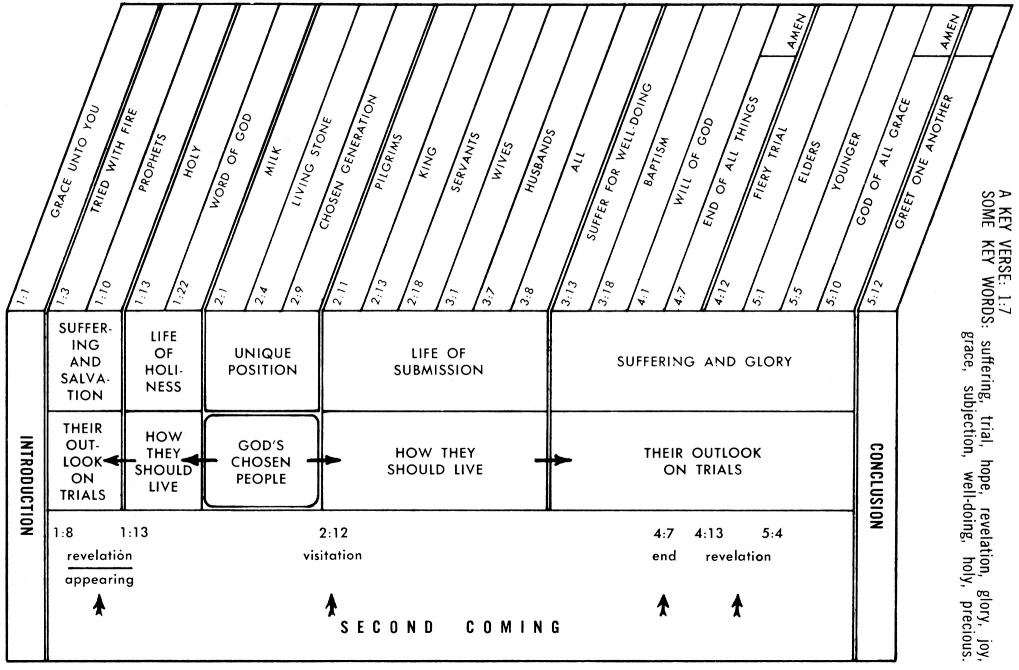
1 Peter: Trials, Holy Living & The Lord's Coming
Click chart to enlarge
Chart from Jensen's Survey of the NT - used by permission
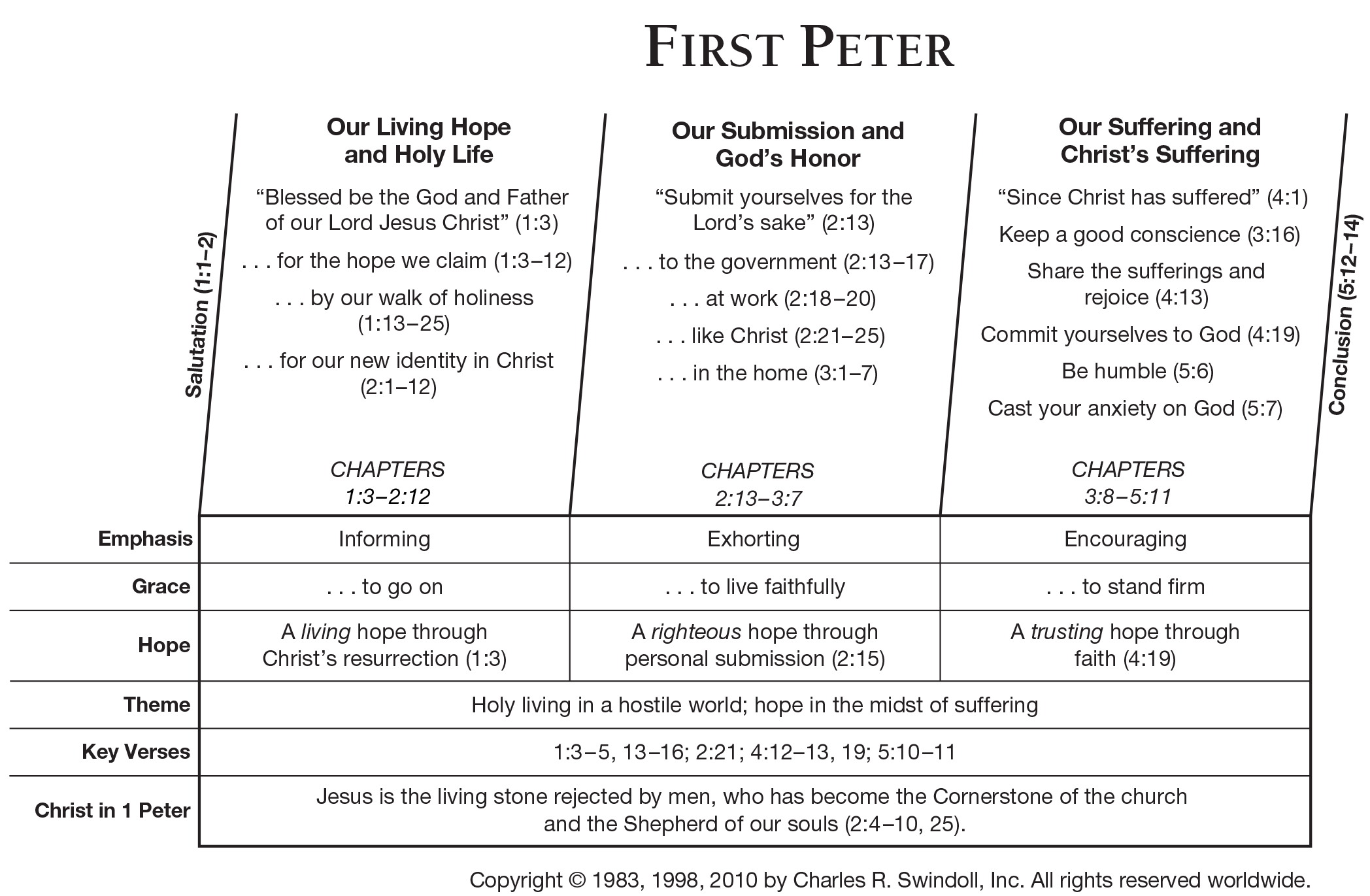
See Another Chart from Charles Swindoll
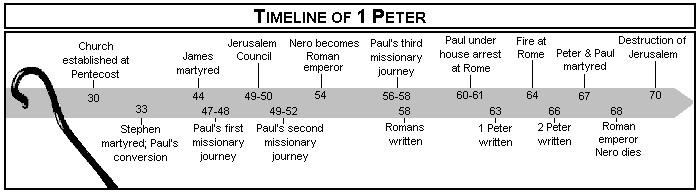
Source: Borrow Ryrie Study Bible
Click to enlarge
PART I: DOCTRINAL FOUNDATION
I. The Opening Salutation (1Pe 1:1-2)
A. The Writer (1Pe 1:1a)
B. The Readers (1Pe 1:1b-2a)
1. True character of the readers (1Pe 1:1b)
2. Geographical location of the readers (1Pe 1:1c)
3. Spiritual supports for the readers (1Pe 1:2a)
C. The Greeting (1Pe 1:2b)
II. The Thanksgiving for Our Salvation (1Pe 1:3-12)
A. The Description of Salvation (1Pe 1:3-5)
1. The author of salvation (1Pe 1:3a-b)
a. His relation to the Savior (1Pe 1:3a)
b. His act of mercy to the saved (1Pe 1:3b)
2. The nature of salvation (1Pe 1:3c-4a)
a. The living hope grounded in Christ's resurrection (1Pe 1:3c)
b. The glorious inheritance awaiting believers (1Pe 1:4a)
3. The certainty of salvation (1Pe 1:4b-5)
a. The safekeeping of the inheritance (1Pe 1:4b)
b. The preservation of the heirs (1Pe 1:5)
B. The Experiences Relating to Salvation (1Pe 1:6-9)
1. The paradoxical nature of the experiences (1Pe 1:6-7)
a. The experience of exultation (1Pe 1:6a)
b. The experience of distress (1Pe 1:66-7)
1. The nature of the distress (1Pe 1:6b)
2. The purpose behind the trials (1Pe 1:7)
a. The testing of faith (1Pe 1:7a)
b. The outcome of the testing (1Pe 1:7b)
2. The sustaining relations of believers (1Pe 1:8-9)
a. Their dual relation to Jesus Christ (1Pe 1:8)
b. Their experiential relation to their salvation (1Pe 1:9)
C. The Magnification of Salvation (1Pe 1:10-12)
1. The magnification through prophetic research (1Pe 1:10-12a)
a. Their intensive search (1Pe 1:10a)
b. Their prophetic function (1Pe 1:10b)
c. Their personal perplexity (1Pe 1:11)
1. The time and circumstances (1Pe 1:11a)
2. The sufferings and the glories (1Pe 1:11b)
d. Their restricted ministry (1Pe 1:12a)
2. The magnification through Christian proclamation (1Pe 1:12b)
3. The magnification through angelic inquiry (1Pe 1:12c)
PART 2: PRACTICAL EXHORTATION
I. Exhortations in View of Our Salvation (1Pe 1:13-2:10)
A. The Life Arising from Salvation (1Pe 1:13-2:3)
1. The Christian life in relation to God (1Pe 1:13-21)
a. A life of steadfast hope (1Pe 1:13)
1. The supports of hope (1Pe 1:13a)
2. The call to hope (1Pe 1:13b)
b. A life of personal holiness (1Pe 1:14-16)
1. The foundation for personal holiness (1Pe 1:14a)
2. The call to personal holiness (1Pe 1:14b-15)
a. The negative demand of holiness (1Pe 1:14b)
b. The positive call to holiness (1Pe 1:15)
3. The justification of the call to holiness (1Pe 1:16)
c. A life of motivated reverence (1Pe 1:17-21)
1. The basis for reverent living (1Pe 1:17a)
2. The call for reverent living (1Pe 1:17b)
3. The knowledge that motivates reverence (1Pe 1:18-21)
a. The means of our redemption (1Pe 1:18-19)
b. The nature of the Redeemer (1Pe 1:20)
c. The characteristics of the redeemed (1Pe 1:21)
2. The Christian life in relation to the brethren (1Pe 1:22-25)
a. The experience of inner purification (1Pe 1:22a)
b. The duty of mutual love (1Pe 1:22b)
c. The foundation in personal regeneration (1Pe 1:23-25)
1. The fact of their regeneration (1Pe 1:23a)
2. The nature of their regeneration (1Pe 1:23b-25a)
3. The evangelization leading to their regeneration (1Pe 1:25b) (D Edmond Hiebert)
1 Peter 1:17 (and) If you address (PMI) as Father the One who impartially judges (PAP) according to each one's work, conduct (APM) yourselves in fear during the time of your stay on earth; (NASB: Lockman)
Greek: Kai ei patera epikaleisthe (2PPMI) ton aprosopolemptos krinonta (PAPMSA) kata to hekastou ergon, en phobo ton tes paroikias humon chronon anastraphete, (2PAPM)
Amplified: And if you call upon Him as [your] Father Who judges each one impartially according to what he does, [then] you should conduct yourselves with true reverence throughout the time of your temporary residence [on the earth, whether long or short]. (Amplified Bible - Lockman)
NLT: And remember that the heavenly Father to whom you pray has no favorites when he judges. He will judge or reward you according to what you do. So you must live in reverent fear of him during your time as foreigners here on earth. (NLT - Tyndale House)
Phillips: If you pray to a Father Who judges men by their actions without the slightest favoritism, then you should spend the time of your stay here on earth with reverent fear. (Phillips: Touchstone)
Wuest: And in view of the fact that you call on as Father Him Who judges, not with a partiality based upon mere outward appearance, but with impartiality in accordance with each individual’s work, in fear order your behavior during the time of your residence as a foreigner (Eerdmans Publishing - used by permission)
Young's Literal: and if on the Father ye do call, who without acceptance of persons is judging according to the work of each, in fear the time of your sojourn pass ye
AND IF YOU ADDRESS AS FATHER THE ONE: kai ei patera epikaleisthe (2PPMI):
- Zeph 3:9; Mt 6:9; 7:7, 8, 9, 10, 11; 2Co 1:2; Eph 1:17; 3:14
- 1 Peter 1 Resources - Multiple Sermons and Commentaries
A LIFE MOTIVATED
BY REVERENCE
And - Marks continuance of a thought. Here Peter continues the idea that believers have a new family relationship to God. His goal is to give us motivation for conducting ourselves as obedient children during our short stay on earth. Holiness shows our family likeness!
In 2 Cor 6:18 we read "And I will be a father to you, And you shall be sons and daughters to Me,” Says the Lord Almighty." There is a close connection between a life of holiness and personal reverence toward God that is prompted by the precious redemption He has bestowed, and are now part of His family and Paul's conclusion is....
Therefore (2 Cor 6:14-18), having these promises, beloved, let us cleanse ourselves (YES WE ARE CLEAN POSITIONALLY, BUT THIS IS PROGRESSIVE SANCTIFICATION) from all defilement of flesh and spirit, perfecting (present tense - ongoing activity) holiness in the fear of God. (2 Cor. 7:1, cf 1 Jn 2:28).
Spurgeon - Be not presumptuous. Ever remember that, as there is a God who is to judge every man, you ate to be judged; and oh, that you might, through his grace, be in such a condition of heart that you shall stand the last test, and be found to be full weight when you are put into the balances of the sanctuary which God shall hold with steadfast hand!
In the Greek text, this verse begins with kai ("and"), which links it with the preceding section (especially 1Pe 1:13-note, 1Pe 1:14-note, 1Pe 1:15-note, 1Pe 1:16-note) and continues the call to a lifestyle that is different from that of non-Christians.
If introduces what is referred to in Greek as a First Class Condition which means the statement is not a hypothesis but a fulfilled condition. One can often translate the first class condition by inserting the words Since or in view of the fact. In the present context if assumes that Peter's readers (who are believers) will call God their Father and will call upon Him because He is their Father. In other words, the if alludes to the reality of the the child of God's prayer life and worship of the Almighty One. The Greek does not suggest a hypothetical prayer life but assumes that they do in fact pray.
THOUGHT - How is this facet of your Christian life? Is the "if" somewhat "iffy" when it comes to your prayer life?
Even though He is our Father, believers must still approach His throne of grace (Hebrews 4:16) through the Son, in the power of the Spirit (Ephesians 6:18) as explained in Scripture. As Jesus declared...
I am the way, and the truth, and the life; no one comes to the Father, but through Me. (John 14:6)
And whatever you ask in My name, that will I do, that the Father may be glorified in the Son. If you ask Me anything in My name, I will do it. (John 14:13, 14)
Not only do children have continual access but the Son, our "Brother", is continuously interceding for us even now with the Father for
we have an Advocate with the Father, Jesus Christ the Righteous (1John 2:1)
For there is one God, and one mediator also between God and men, the man Christ Jesus (1Ti 2:5)
Hence, also, He is able to save forever those who draw near to God through Him, since He always lives to make intercession for them. (see note Hebrews 7:25)
Christ Jesus is He who died, yes, rather Who was raised, Who is at the right hand of God, Who also intercedes for us. (see note Romans 8:34)
As an aside, remember that if your prayers are not being answered, you might want to scan the verses in this checklist.
Address (1941) (epikaleomai = middle voice of epikaleo from epí = upon + kaléo = call) literally means to call upon and was often used in secular Greek to refer to calling upon deity for any purpose, especially for aid. It also means to invoke (to petition for help or support, make earnest request) a deity for something (Acts 7:59).
Epikaleo is used 30 times in NAS is translated: address, 1; appeal, 2; appealed, 4; call, 7; called, 14; calling, 1; calls, 1.
Mt 10:25; Acts 1:23; 2:21; 4:36; 7:59; 9:14, 21; 10:5, 18, 32; 11:13; 12:12, 25; 15:17; 22:16; 25:11,12, 21, 25; 26:32; 28:19; Ro 10:12-note, Ro 10:13-note, Ro 10:14-note; 1Co 1:2; 2Co 1:23; 2Ti 2:22-note; Heb 11:16-note; James 2:7; 1Pe 1:17-note) a
Vine explains that epikaleo "has the meaning appeal in the middle voice, which carries with it the suggestion of a special interest on the part of the doer of an action in that in which he is engaged." (Vine's Expository dictionary of Old and New Testament words)
Epikaleomai was used as in this verse to call upon deity for some purpose, as in Peter's quotation from Joel 2:32...
AND IT SHALL BE, THAT EVERYONE WHO CALLS ON THE NAME OF THE LORD SHALL BE SAVED. (Acts 2:21, used in this same sense in Ro 10:12, 13)
Stephen with his dying words called upon the Lord...
And they went on stoning Stephen as he called upon the Lord and said, "Lord Jesus, receive my spirit!" (Acts 7:59, similar sense in Acts 22:16)
Ananias addressing Paul after his conversion declared
why do you delay? Arise, and be baptized, and wash away your sins, calling on (epikaleomai) His name. (Acts 22:16)
The idea of calling on God includes includes calling upon Him in the sense of prayer...
and here he (Saul before conversion) has authority from the chief priests to bind all who call upon Thy name (descriptive of believers)." (Acts 9:14, cp Acts 9:21)
Comment: This is a fascinating "description" of a believer - those who "call upon Thy Name", which undoubtedly includes the initial calling upon His Name for salvation, but does not exclude calling upon Him in prayer. Would it be true of us all that we were well known as those who "call upon Thy Name"!
In Acts 15 James addressed the Jerusalem counsel in which the Jewish leaders were discussing the fate of the Gentiles who were coming to faith in Christ...
'AFTER THESE THINGS I will return, AND I WILL REBUILD THE TABERNACLE OF DAVID WHICH HAS FALLEN, AND I WILL REBUILD ITS RUINS, AND I WILL RESTORE IT, IN ORDER THAT THE REST OF MANKIND MAY SEEK THE LORD, AND ALL THE GENTILES WHO ARE CALLED BY MY NAME,' (Acts 15:17)
Comment: Here "called by My Name" is synonymous with the description of those Gentiles (non-Jews) who had been chosen by God unto salvation. The original version of the NLT paraphrases it as those "called to be Mine"!
Epikaleo - 134 times in the Septuagint (LXX) =
Ge 4:26; 12:8; 13:4; 21:33; 26:25; 33:20; 48:16; Ex 29:45, 46; Nu 21:3; Deut 4:7; 12:5, 11, 21, 26; 14:23, 24; 15:2; 16:2, 6, 11; 17:8, 10; 26:2; 28:10; 33:19; Jos. 21:9; Jdg 6:24; 15:19; 1Sa 12:17, 18; 23:28; 2Sa 6:2; 20:1; 22:4, 7; 1Ki. 7:21; 8:43, 52; 13:2, 4; 16:24; 17:21; 18:24, 25,26; 2 Ki. 5:11; 23:17; 1 Chr. 4:10; 13:6; 16:8; 2 Chr. 6:20, 33; 7:14; 28:15; Esther 4:8; 5:1; 9:26; Job 5:1, 8; 17:14; 27:10; Ps. 4:1; 14:4; 18:3, 6; 20:9; 31:17; 42:7; 49:11; 50:15; 53:4; 56:9; 75:1; 79:6; 80:18; 81:7; 86:5; 89:26; 91:15; 99:6; 102:2; 104:35; 116:2, 4, 13; 118:5; 138:3; 145:18; 147:9; Pr 1:28; 2:3; 8:12; 18:6; 21:13; Is 18:7; 43:7; 55:5, 6; 63:19; 64:7; Je 4:20; 7:10, 11, 14, 30; 10:25; 11:14; 14:9; 15:16; 20:8; 32:34; 34:15; Lam 3:55, 57; Ezek 10:13; 20:29; Da 2:26; 9:18, 19; 10:1; Ho 7:7, 11; Joel 2:32; Amos 4:5, 12; 9:12; Jon. 1:6; Mic. 6:9; Zeph. 3:9; Zech. 13:9; Mal. 1:4.
The first 5 uses of epikaleomai are fascinating (What is the focus?)...
Genesis 4:26 To Seth, to him also a son was born; and he called his name Enosh. Then men began to call upon (Lxx = epikaleomai) the name of the Lord.
Genesis 12:8 Then he proceeded from there to the mountain on the east of Bethel, and pitched his tent, with Bethel on the west and Ai on the east; and there he built an altar to the Lord and called upon (Lxx = epikaleomai) the name of the Lord.
Genesis 13:4 o the place of the altar which he had made there formerly; and there Abram called on (Lxx = epikaleomai) the name of the Lord
Genesis 21:33 Abraham planted a tamarisk tree at Beersheba, and there he called on (Lxx = epikaleomai) the name of the Lord, the Everlasting God.
Genesis 26:25 So he built an altar there and called upon (Lxx = epikaleomai) the name of the Lord, and pitched his tent there; and there Isaac’s servants dug a well.
These uses of epikaleo in Genesis "speaks volumes" about the priority of worship in the life of this great man of God (used with a similar meaning in Ge 13:4). In fact epikaleomai is used in the LXX to describe all three great patriarchs (Abraham, Isaac in Ge 26:25 and Jacob in Ge 33:20 where Lxx into English is not "called it" but "called on the God of Israel") calling on God.
And so we see that addressing God as Father includes the idea of worship.
In a famous encounter with the prophets of Baal hopping around and calling out to their "god" Elijah
"mocked them and said,' Call out (Lxx = epikaleomai) with a loud voice, for he is a god; either he is occupied or gone aside, or is on a journey, or perhaps he is asleep and needs to be awakened." (1Ki 18:27)
Asaph sings "Oh give thanks to the LORD, call upon (Lxx = epikaleomai) His name. Make known His deeds among the peoples." (1Chr 16:8) (Comment: As an aside, have you obeyed this injunction beloved? If you have given thanks from the heart, the natural outflow of such a life is to let others know His great and mighty works in your life and the life of your family.)
Epikaleomai also means to to address or characterize someone by a special term, to call or to give a surname (see Mt 10:25)
Epikaleomai is used most often in the NT in the sense of calling someone by name (Lk 22:3, Ac 4:36, 10:5, 18, 32, 11:13, 12:12, 25, 15:22).
Epikaleomai was a technical legal term which referred to putting a request before a higher judicial authority for review of a decision of a lower court and so to make an appeal. Paul was cognizant of the fact that an appeal to the Roman emperor was the right of a Roman citizen and so he ended his defense in Jerusalem before Festus with the words "I appeal to (epikaleomai) Caesar." (Acts 25:11), to which Festus answered "You have appealed to (epikaleomai) Caesar, to Caesar you shall go." (Acts 25:12, cp Acts 25:21, 25, 26:32, 29:19)
Epikaleomai was also used as a legal term to invoke an oath or to call on someone as a witness. Paul in explaining to the Corinthians why he said he was coming but did not (he wanted them to have time to repent and correct their sinful behavior) declared "I call (epikaleomai) God as witness to my soul, that to spare you I came no more to Corinth." (2Cor 1:23)
Here in first Peter, epikaleomai describes praying saints whose habitual practice was to call upon their Father (address is present tense indicating continual action). They appealed to God as one would appeal to an earthly father for help. Peter alluded to this blessed truth of God as their Father in (1Peter 1:14 [note]) when he referred to his recipients as "obedient children". In (1Pe 1:15 ([note]) God called them to be His own so that now they have the privilege of calling upon Him as their Father. Peter's acknowledgement of God as their Father is even more notable in view of the fact that in Judaism (and the OT) God is rarely referred to as "Father".
The noun "Father" stands emphatically forward—"And if as Father ye are invoking him who..." (Rotherham).
Address as Father - All who are by faith in Christ are sons of God the Father. The call is not so much an appeal, but a claim of kindred and an acknowledgment of close, tender relationship (cp Abba - Mark 14:36, Ro 8:15, Gal 4:6). The fact that the readers acknowledge God as their Father clearly indicates that Peter is writing primarily to believers "See how great a love the Father has bestowed upon us, that we should be called children of God; and such we are. For this reason the world does not know us, because it did not know Him. (1John 3:1-note).
See Related study on Abba-Father or summary version Abba-Father
Cambridge on Father - if you worship not an arbitrary Judge, but one of whom Fatherhood is the essential character. The sequel shows that this attribute of Fatherhood is not thought of as excluding the idea of judgment, but gives assurance that the judgment will be one of perfect equity. (Cambridge Bible for Schools and Colleges)
John writes that "as many as received (and welcomed) Him, to them He gave the right (authority, power, privilege - see word study of exousia) to become children of God (in the full spiritual sense, not as mere offspring of God which is true of all men as in Acts 17:28), even to those who believe (see word study on pisteuo) in His name, who were born not of blood, nor of the will of the flesh, nor of the will of man, but of God." (Jn 1:12, 13)
Jesus taught His disciples "When you pray, say: ‘Father, hallowed be Thy name. Thy kingdom come. (Lk 11:2)
One of the most beautiful passages in the Bible records God's declaration that "I will be a Father to you, and you shall be sons and daughters to Me" says the Lord Almighty. (2Cor 6:18)
As Wuest says "What a blessed thought to give us encouragement in our praying, faith that the answer is sure, and a sweet feeling of nearness to God. To think that He is our Father and we are His children. To think that He regards us as His children, and thus the objects of His special care and love. (Wuest Word Studies - Eerdman Publishing Company Volume 1, Volume 2, Volume 3 - used by permission)
F B Meyer in his exposition of 1Peter entitled "Tried by Fire" has the following section on 1Pe 1:17 (see note) which relates to the Bema Seat of Christ...
God's children are to be judged, not at the great white throne, but at the judgment seat of Christ (2Co 5:10). That judgment will not decide our eternal destiny, because that has been settled before; but it will settle the rewards of our faithfulness or otherwise (Mt 25:19; 1Co 3:14).
There is a sense in which that judgment is already in process, and we are ever standing before the judgment bar. "The Father who judges." The Divine verdict is being pronounced perpetually on our actions, and hourly is manifesting itself in light or shadow.
But it is a Father's judgment.
We call on Him as Father. (1Pe 1:17) Notice this reciprocity of calling. He called us; we call Him; His address to us as children begets our address to Him as Father. We need not dread his scrutiny--it is tender. He pities us as a father pities his children, knowing our frame, allowing for our weaknesses, and bearing with us with an infinite patience.
But for all that it is impartial.
"Without respect of persons." (1Pe 1:17) Many years before, this had been revealed to the Apostle from heaven in a memorable vision, which affected his whole after-ministry (Ac 10:35). Not according to profession, or appearance, or any self-constituted importance, but according to what we do, are we being judged.
The holy soul realizes this; and a great awe falls upon it and overshadows it--an awe not born of the fear which hath torment, but of love. It passes the time of its sojourning in fear (1Pe 1:17). Not the fear of evil consequences to itself, but the fear of grieving the Father; of bringing a shadow over his face; of missing any manifestation of his love and nearness to Himself, which may be granted to the obedient child. Love casts out fear; but it also begets it. There is nothing craven, or fretful, or depressing; but a tenderness of conscience which dreads the tiniest cloud on the inner sky, such as might overshadow for a single moment the clear shining of the Father's face. So the brief days of sojourning pass quickly on, and the vision of the Homeland beckons to us, and bids us mend our pace. (F. B. Meyer. Tried By Fire) (Bolding added)
Now Peter makes the point that if believers have such a special relationship with God by virtue of His effectual call and gift of new birth, it is all the more urgent that they not become complacent in their conduct but that they remember their Father is also the Judge of both believers and non-believers.
PRACTICE
YOUR POSITION!
Edwards adds that "Because of our position in Christ, we should live according to our family heritage, i.e., in holiness. "'For you were once darkness, but now are you light in the Lord, walk as Children of light" (Eph 5:8). It has been well said that the goal of the Christian life is "to practice your position."
Alexander Maclaren sermon on 1Peter 1:17 The Father and Judge...
The injunction here and the reason for it are equally strange. Both seem opposed no less to the confidence, hope, and joy which have been glowing in the former part of this chapter than to the general tone of the New Testament.
“Live in habitual fear, for God is a strict Judge,” strikes a note which at first hearing sounds a discord. Is not Christianity the religion of perfect love which casts out fear? Is not its very promise that he who believes shall not come into judgment? Is not its central revelation that of a Father who hath not dealt with us according to our sins, nor rewarded us according to our transgressions? Yes; God be thanked that it is! We cannot too earnestly assert that, nor too jealously guard these truths from all tampering or weakening. But these solemn words are none the less true.
I. THE TWOFOLD REVELATION OF GOD AS FATHER AND JUDGE.
If we adopt the translation, “call on him as Father,” we shall catch here an echo of the Lord’s Prayer (Mt 6:9), and recognize a testimony to its early and general use, independent and confirmatory of the Gospels. We need not dwell upon the thought that God is our Father. There is little fear of its being lost sight of in the Christian teaching of this day. But there is much danger of its being so held as to obscure the other relation here associated with it. Men have often been so penetrated with the conviction that God is Judge as to forget that he is Father.
The danger now is that they should be so occupied with the thought that he is Father as to forget that he is Judge. What do we mean by “judgment”? We mean, first, an accurate knowledge and estimate of the moral quality of an action; next, a solemn approval or condemnation; and next, the pronouncing of sentence which entails punishment or reward.
Now, can it be that he who loves righteousness and hates evil should ever fail to discern, to estimate, to condemn, and to chastise evil, whoever does it? The eternal necessity of his own great holiness, and not less of his own almighty love, binds him to this.
Our text distinctly speaks of a present judgment. It is God who judgeth, not who will judge; and that judgment is of each man’s work as a whole, not of his works, but of his work. There is a perpetual present judgment going on. God has an estimate of each man’s course, solemnly approves or disapproves, and shapes his dealings with each accordingly.
The very fact of this Fatherhood, so far from being inconsistent with this continual judgment, makes it the more certain. He is not so indifferent to his children as to let their deeds pass unnoticed, and, if need be, unchastised. “We have had fathers of our flesh which corrected us, and we gave them reverence.” (Heb 12:9) They would have deserved little of it while we were children, and would have almost deserved our malediction when we became men, if they had not. Our Father in heaven knows and loves us better than they. Therefore he judges from a loftier point of view. Standing higher, he looks deeper, and corrects for a nobler purpose — “that we should be partakers of his holiness.” (Heb 12:10)
To the Christian God’s judgments are a sign of his love. So we should rejoice in and long for them. Do we wish to be separated from our sin, to be drawn nearer to him? Then let us be glad that “the Lord will judge his people,” and while in penitent consciousness of our sins we pray with the psalmist, “Enter not into judgment with thy servant, O Lord!” (Ps 143:2) let us also cry with him, “Judge me, O Lord; try my reins and my heart!” (Ps 26:2) Abundance of Scripture teaching insists on the fact that there is a future judgment for Christians as for others. “We must all appear before the judgment-seat of Christ.” (2Co 5:10) True, “in the course of justice none of us should see salvation.” But though we are saved, not according to works of righteousness which we have done, it is also true that our place in heaven, though not our entrance into heaven, is determined by the law of recompense, and that, in a very real sense, “whatsoever a man soweth, that shall he also reap.” (Gal 6:7) A saved man’s whole position will be affected by his past. His place will be in proportion to his Christian character, though not deserved nor won by it. Let us ponder, then, the solemn words, almost the last which come to us from the enthroned Christ, “Behold, I come quickly; and my reward is with me, to give every man according as his work shall be.” (Re 22:12)
II. THE FEAR WHICH CONSEQUENTLY IS AN ELEMENT IN THE CHILD’S LOVE.
Perfect love casts out the fear (1Jn 4:18) which has torment, but it deepens a fear which is blessed. By fear we oftenest mean an apprehension of and a shrinking from dangers or evils, or a painful recoil from a person who may inflict them. Such fear is wholly inconsistent with the filial relation and the child’s heart. But the fear of God, which the Old Testament so exalts, and which is here enjoined as a necessary part of Christian experience, is not dread. It has no trembling apprehension of evil disturbing its serenity. To fear God is not to be afraid of God. It is full of reverential awe and joy, and, so far from being inconsistent with love, is impossible without it, increases it and is increased by it. It is a reverent, awe-stricken prostration before the majesty of holy love. Its opposite is irreverence. It is, further, a lowly consciousness of the heinousness of sin, and consequently a dread of offending that Divine holiness. He who thus fears, fears to sin more than anything else, and fears God so much that he fears nothing besides. The opposite of that is presumptuous self confidence, like Peter’s own earlier disposition, which led him into so many painful and humbling situations. “A wise man feareth and departeth from evil.” (Pr 14:16)
The fear enjoined here is, primarily, then, a reverential regard to the holy Father who is our Judge, and, secondarily and consequently, a quick sensitiveness of conscience, which knows our own weakness, and, above all else, dreads falling into sin. Such sensitive scrupulousness may seem to be over-anxiety, but it is wisdom; and, though it brings some pains, it is blessedness. This is no world for unwary walking. There are too many enemies seeking admission to the citadel for it to be safe to dispense with rigid watchfulness at the gates. Our Father is our Judge, therefore let us fear to sin, and fear our own weakness. Our Judge is our Father, therefore let us not be afraid of him, but court his pure eyes and perfect judgment. Such fear which has in it no torment, and is the ally of love, is not the ultimate form of our emotions towards God. It is appropriate only to “the time of our sojourning here.”
The Christian soul in this world is as a foreigner in a strange land. Its true affinities are in heaven; and its present surroundings are ever seeking to make it “forget the imperial palace” which is its home. So constant vigilance is needed. But when we reach our own land we can dwell safely, having neither locks nor bars. The walls may be pulled down, and flower-gardens laid out where they stood. Here and now is the place for loins girt and lamps burning. There and then we can walk with flowing robes, for no stain will come on them from the golden pavements, and need not carefully tend a flickering light, for eternal day is there.
ILLUSTRATION - Some years ago a young boy, whose father was a pastor, was put in jail for stealing some merchandise from a department store. His father happened to be playing golf with some of the church leaders at the time and received a call while on the golf course to come down to the jail to get his son. Thinking it was a mistake, the pastor took the other men with him to the police station, where embarrassment abounded. The deepest impression of the incident left on the boy’s mind was made by the repeated reminders he received from those men, and from many others afterward, about who his father was. “Having a father like yours,” they would ask, “how could you have done what you did?” Yet as humiliating and painful as the experience was, the boy knew he was still his father’s son. He had not acted like a son of his father should have acted, but he was still a son. As Christians one of the strongest rebukes we can have when we sin is to be reminded of who our Father is. And reminding ourselves of whose we are should be one of our strongest deterrents to sin. Remembering our HOLY position can compel us (ENABLED BY THE HOLY SPIRIT) to improve our HOLY practice.
WHO IMPARTIALLY JUDGES: ton aprosopolemptos krinonta (PAPMSA):
- 1 Peter 2:23, 4:5, Dt 10:17; 2Chr 19:7; Job 34:11, 19; Ps 62:12, Je 17:10, Mt 22:16; Acts 10:34,35; Ro 2:10,11; Gal 2:6; Eph 6:9; Col 3:25
- 1 Peter 1 Resources - Multiple Sermons and Commentaries
Moses in his exhortation to Israel to circumcise their hearts (referring to spiritual circumcision = not relying on works or sacrifices to attain righteousness, but personally expressing faith in God's promised, prophesied Messiah - see discussion of meaning of circumcision related to Covenant) spoke the following words to motivate them to seek the LORD while He could be found...
For the LORD your God is the God of gods and the Lord of lords, the great, the mighty, and the awesome God who does not show partiality, nor take a bribe. (Dt 10:17) (for God..."does not delight in sacrifice, [nor] with burnt offering [but] the sacrifices of God are a broken spirit. A broken and a contrite heart [God] will not despise) (See Spurgeon's notes on Ps 51:16 and Ps 51:17)
In a similar passage Jehoshaphat the king of Judah warned the judges he appointed throughout Judah to think carefully before pronouncing judgment and to "let the fear of the LORD be upon you; be very careful what you do, for the LORD our God will have no part in unrighteousness, or partiality, or the taking of a bribe." (2Chr 19:7)
God is a righteous Judge, as Peter declares in explaining how Jesus did not seek to revenge evil for "while being reviled, He did not revile in return; while suffering, He uttered no threats, but kept entrusting Himself to Him who judges righteously." (1Pe 2:23)
And again Peter alludes to God as Judge writing that "they (those who are surprised you as a new creation in Christ no longer desire to join them in their unrighteous activities) shall give account to Him who is ready to judge the living (believers) and the dead (spiritually dead [Eph 2:1], born into Adam [Romans 5:12], but never born again, John 3:3).(1Pe 4:5)
The fact that God is going to judge all of us ought to cause us to become very sober minded and to give a little more attention to the life that we are living. (cp 2Ti 4:1)
As J Vernon McGee says "My friends, we need to make sure that we are not superficial. The Gospel does not sprinkle rosewater on a bunch of dead weeds. The Gospel transforms lives and brings us into a living hope which rests upon the resurrection of Christ. (McGee, J V: Thru the Bible Commentary: Thomas Nelson)
Cambridge on impartiality - We note the prominence of this thought, derived originally from the impression by our Lord’s words and acts (Matthew 22:16), as presenting a coincidence (1) with the Apostle’s own words in Acts 10:34; and (2) as in other instances, with the teaching of James (James 2:1-4). (Cambridge Bible for Schools and Colleges)
Impartially (678) (aprosopoleptos from a = not, without + prósopon = face + lambáno = receive) (this verse is only Scriptural occurrence) literally means "not receiving face" which then came to mean “without respect of persons”.
Hiebert notes that aprosopoleptos "indicates that God's judgment is not determined by outward appearance or outward pretensions. The face or mask that people put on is uniformly transparent to Him....God's total impartiality is the striking difference between Him and the ordinary human judge. God had to remind Samuel, "Man looks at the outward appearance [face], but the Lord looks at the heart" (1 Sam. 16:7). (1 Peter Commentary)
Aprosopoleptos is derived from a Hebrew idiom "to receive the face" of someone which meant to show partiality or favoritism. This word reflects the respectful oriental greeting in which one humbly turns one’s face to the ground upon meeting another person. If the person greeted raised the face of the man, this was a sign of recognition and esteem. Here the word is the opposite or negative aspect of this well known practice and thus means “does not receive face.” That is, God does not receive anybody’s face. He is impartial. Outward appearance, wealth, culture, social position, family background, education, beauty, intellect, all things that more or less sway the opinions of man, do not count with God when it comes to appraising a person’s character or worthiness.
Paul has a similar thought in Romans 2 - There will be tribulation and distress for every soul of man who does evil, of the Jew first and also of the Greek, but glory and honor and peace to everyone who does good, to the Jew first and also to the Greek. (Ro 2:9-10) Then Paul explains that "there is no (absolute negation) partiality (prosopolepsía = literally "to receive a face") with God. (Ro 2:11)
Click brief Scriptural survey of God's attribute of impartiality.
Deuteronomy 10:17 For the Lord your God is the God of gods and the Lord of lords, the great, the mighty, and the awesome God who does not show partiality nor take a bribe.
2Chronicles 19:7 “Now then let the fear of the Lord be upon you; be very careful what you do, for the Lord our God will have no part in unrighteousness or partiality or the taking of a bribe.”
Jeremiah conveys a similar thought asking "O LORD, do not Thine eyes look for truth? (Jer 5:3)
In first Samuel the author reminds us that "The Lord sees not as man sees; for man looks on the outward appearance, but the Lord looks on the heart (1Sa 16:7).
Peter came to understand that God's favor was not limited to the nation of Israel but that He desired an honest and contrite heart, whether Jew or Gentile. And so He prefaced his message to the Gentile Cornelius with the declaration that "I most certainly understand now that God is not one to show partiality, but in every nation the man who fears Him and does what is right, is welcome to Him." (Acts 10:34, 35)
God does not receive a face or give consideration to someone simply because of his position, wealth, influence, popularity, or appearance. Because it is God’s nature to be just, it is impossible for Him to be anything but impartial. God judges everyone by the same standard. He does not play favorites! God deals with obedience and disobedience impartially.
God judges each man’s work with impartiality. We should however not misinterpret this statement as implying that God is a critical judge trying always to find a defect or flaw in our conduct or service (a common misconception of our benevolent and just Judge). We would all stand accused countless times each day if this were true. The Greek word is found more often in a good than in a bad sense. That is, God’s impartiality is an honest appraisal of things, while His heart is always with His child and goes out to him in a spirit of love. That truth is beautifully brought out in the use of the Greek verb (dokimazo) in 1Cor 3:13, which in context refers to the judgment of the believer’s works at the Judgment Seat of Christ.
There are two Greek words which mean “to put to the test,” one (peirazo [note]) meaning “to put to the test in order to discover what evil or good there may be in a person” and the other, (dokimazo [note]) meaning “to put to the test in order to sanction or approve the good one finds in that person.”
The latter (dokimazo) is used in (1Cor 3:13 and also in 1 Peter 1:7 [note]). God expects to find in the life of each saint "works" upon which He can put His approval, for the Holy Spirit produces good ("holy") works in every saint (see study on good deeds), albeit in greater number in those saints who are fully subjected to His control.
Judges (2919) (krino) primarily means to separate, distinguish, discriminate between good and evil, select, choose out the good. Krino is present tense indicating the Father is continually judging the conduct of His children and this ongoing, "present tense" judging should serve as a strong motivation to goad us on to holiness (see 1Pe 1:14; 1Pe 1:15; 1Pe 1:16)
Lincoln comments on the continual aspect of God's impartial judgment that "He is looking on, taking notice of all, whether there is integrity of purpose, intelligence of mind, and desire of heart to please Him."
There is thus a sense in which believers are now being "judged", even as they are disciplined and chastened by their Father they sin (I have found this is not a popular topic to teach on! Don't be surprised it these important truths are not graciously received!).
The writer of Hebrews reminds his readers that "you have forgotten the exhortation which is addressed to you as sons, "MY SON, DO NOT REGARD LIGHTLY THE DISCIPLINE OF THE LORD, NOR FAINT WHEN YOU ARE REPROVED BY HIM; 6 FOR THOSE WHOM THE LORD LOVES HE DISCIPLINES, AND HE SCOURGES EVERY SON WHOM HE RECEIVES." 7 It is for discipline that you endure; God deals with you as with sons; for what son is there whom his father does not discipline? 8 But if you are without discipline, of which all have become partakers, then you are illegitimate children and not sons. 9 Furthermore, we had earthly fathers to discipline us, and we respected them; shall we not much rather be subject to the Father of spirits, and live? 10 For they disciplined us for a short time as seemed best to them, but He disciplines us for our good, that we may share His holiness. 11 All discipline for the moment seems not to be joyful, but sorrowful; yet to those who have been trained by it, afterwards it yields the peaceful fruit of righteousness. (Heb 12:5-11-See notes Hebrews 12:5; 12:6; 12:7; 12:8; 12:9; 12:10; 12:11).
Someone has wisely written that years of obedience cannot purchase an hour of disobedience. We will all be judged impartially.
ACCORDING TO EACH MAN'S WORK: kata to hekastou ergon:
- Job 34:11, Ps 62:12-notes, Pr 24:12, Is 40:10, 11, Jer 17:10, 32:19, Da 12:3, Mt 16:27, Lk 14:12,13, 14, Jn 4:36, Ro 2:6, 1Co 3:13, 14, 15, 2Co 5:10, Col 3:22,23, 24, 25; 1Jn 2:28 Rev 2:23, Rev 22:12
- 1 Peter 1 Resources - Multiple Sermons and Commentaries
Psalm 62:12 And lovingkindness is Yours, O Lord, for You recompense a man according to his work.
Jeremiah 17:10 I, the Lord, search the heart, I test the mind, even to give to each man according to his ways, according to the results of his deeds.
Each man's (1538) (hekastos) means each one of an aggregate. The idea is every single person! All judgment will be according to works and each man means there will be no exceptions. No one will get a pass in regard to God's perfect judgment.
Hiebert - "Each man's work" reminded the readers that they would not be exempt from God's impartial scrutiny "God does not abrogate equity and justice in His dealing with any man, regenerate or unregenerate." "Each" individualizes that solemn reality. The Christians' filial relation will not preclude their heavenly Father from discerning in their lives that which is inconsistent with His yearning for their holiness....Peter's primary reference is to God's present dealings with His saints in the development of holiness in their lives. But God's judgment of the believer will find final application at the judgment seat of Christ (1 Cor. 3:11-15; 2 Cor. 5:10). That j udgment will not be to determine their salvation but their future reward. "The faithful or unfaithful work of saints will make a difference both here and hereafter." (Ibid)
Topics Related to "Each Man's Work" especially as it relates to believers...
- Good Deeds - on site study
- Another discussion on good works
- Spurgeon's sermon - Good Works
- Torrey's Topic - Good Works
- Greek Word Study on Poiema
- Believers Are God's Masterpiece, His Poiema
- Ephesians 2:10 Commentary - Created for good works
- Incredible example of good deed in life of William Borden (of "Borden's milk" family)
- Nine Messages on "Good Works" - Spurgeon, Pink, Bunyan, Manton, Bonar
- Charles Buck Dictionary Works, Good
- Easton's Bible Dictionary Works, Good
- Thompson Chain Reference Works, Good
- Nave Topical Bible Works
- International Standard Bible Encyclopedia Work; Works
- McClintock and Strong's Bible Encyclopedia Works Faith and Works
- Bridgeway Bible Dictionary Good works
- Baker Evangelical Dictionary Works of the Law
- Charles Buck Dictionary Works of God- excellent summary
- Holman Bible Dictionary Works
- What does it mean that good works are the result of salvation?
- What is the relationship of faith, works, and security in salvation?
- Is salvation by faith alone, or by faith plus works?
- How can salvation be not of works when faith is required? Isn't believing a work?
- Why is faith without works dead?
Scripture clearly distinguishes between the judgment of believers and the judgment of unbelievers.
Unbelievers will be judged impartially by God at the Great White Throne (after the 1000 year reign of Christ) as described by John...
And I saw a great white throne and Him who sat upon it, from whose presence earth and heaven fled away, and no place was found for them. 12 And I saw the dead, the great and the small, standing before the throne, and books were opened; and another book was opened, which is the book of life; and the dead were judged from the things which were written in the books, according to their deeds. 13 And the sea gave up the dead which were in it, and death and Hades gave up the dead which were in them; and they were judged, every one of them according to their deeds. 14 And death and Hades were thrown into the lake of fire. This is the second death, the lake of fire. 15 And if anyone's name was not found written in the book of life, he was thrown into the lake of fire. (Rev 20:11, 12, 13, 14, 15, See notes Re 20:11; 12; 13; 14; 15)
This judgment of unbelievers was also seen in Psalm 1...
Therefore the wicked will not stand in the judgment, Nor sinners in the assembly of the righteous. For the LORD knows the way of the righteous, But the way of the wicked will perish. (Ps 1:5- note, Ps 1:6- note)
Obviously in the present context Peter is referring primarily to the future judgment of believers and specifically to the Bema or Judgment Seat of Christ (see note)
But you, why do you judge your brother? Or you again, why do you regard your brother with contempt? For we shall all stand before the Judgment Seat of God. 11 For it is written, "AS I LIVE, SAYS THE LORD, EVERY KNEE SHALL BOW TO ME, AND EVERY TONGUE SHALL GIVE PRAISE TO GOD." 12 So then each one of us shall give account of himself to God. (see notes Ro 14:10; 11; 12)
Therefore (since the moment we are absent from the body we will come face to face with the Lord Jesus Christ... because this is true..) also we have as our ambition, whether at home or absent, to be pleasing to Him. 10 For we must all appear before the Judgment Seat of Christ, that each one may be recompensed for his deeds in the body, according to what he has done, whether good or bad (phaulos - click to study what "bad" actually means as this is often misunderstood and sometimes is incorrectly taught). (2Cor 5:9, 10)
The Bema Seat (See synopsis of end time judgments) has nothing to do with salvation, except that salvation ought to produce good works (see Ephesians 2:10, Titus 2:12) and if one does not bring forth fruit in keeping with repentance (Mt 3:8), it may well be that one's repentance is not genuine for as Jesus said we are to know the tree by its fruit (see Matthew 7:20) (See related study on good deeds)
At the Bema Seat of Christ, believers sins will not judged, for Christ has once and for all borne every sin we have committed or will commit, having paid the price in full (Is 53:4, 5, Jn 3:18, Jn 19:30, Romans 8:1, 1Peter 2:24).
So what will Christ judge in regard to believers? Scripture teaches that Christ will judge...
each man's work (which) will become evident; for the day will show it, because it is to be revealed with fire; and the fire itself will test (dokimazo) the quality of each man's work. (1Cor 3:13)
In other words He will judge us in order to find something good for the purpose of determining each believer's rewards rewards. At that time God will search even every motives of our heart
Therefore do not go on passing judgment before the time, but wait until the Lord comes who will both bring to light the things hidden in the darkness and disclose the motives of men's hearts; and then each man's praise will come to him from God. (Although 1 Cor 3 teaches rewards can and will be lost by believers, this text makes it clear that EACH believer will receive praise from our Lord!) (1Co 4:5).
Jesus has a good word on good works...
“Behold (Greek = Idou is second person aorist imperative and middle voice - The idea is "Do this now!" Do what? "See! Perceive! Look at!" - Jesus uses this exclamatory word in an attempt to get our "undivided attention!" Are you listening dear child of God?), I am coming quickly (Translated that means "Soon! At any time!" - it speaks of the important, but seldom taught doctrine of Imminency), and My reward is with Me, to render to every man according to what he has done. (Rev 22:12-note)
Comment: Remember that the only works that will stand the scrutiny of our Righteous Judge will be those works initiated by and enabled by His Spirit, which emphasizes the importance of abiding in the Vine (Jn 15:5), which is tantamount to continually be filled with the Spirit (Eph 5:18-note) and walking by the Spirit (Gal 5:16-note), for "“It is the Spirit who gives life; the flesh profits nothing." (Jn 6:63).
Related Resource - Listen or read the classic sermon by R G Lee - PayDay Someday (audio); PayDay Someday (transcript)
Edward Veal (Morning Exercises) has these pithy words on according to each man's works - Learn to admire the grace of God in rewarding your works. It is much that he accepts them; and what is it, then, that he rewards them? It is much that he doth not damn you for them, seeing they are all defiled, and have something of sin cleaving to them; and what is it, then, that he crowns them? You would admire the bounty and munificence of a man that should give you a kingdom for taking up a straw at his foot, or give you a hundred thousand pounds for paying him a penny rent you owed him: how, then, should you adore the rich grace and transcendent bounty of God in so largely recompensing such mean services, in setting a crown of glory upon your heads, as the reward of those works which you can scarcely find in your hearts to call good ones! You will even blush one day to see yourselves so much honoured for what you are ashamed of, and are conscious to yourselves that you have deserved nothing by. You will wonder then to see God recompensing you for doing what was your duty to do, and what was his work in you; giving you grace, and crowning that grace; enabling you to do things acceptable to him, and then rewarding you as having done them.-- Edward Veal in "The Morning Exercises."
Look Who's Reading You - I heard about a judge who used bumper stickers to encourage better driving. He gave two options to people guilty of driving while intoxicated.
The first option was to attach this message to their bumper: "This car owned by a convicted drunk driver." Almost all offenders preferred the judge's second option: Enroll in an alcohol treatment program. The majority of people cared about what others thought of them and wanted to maintain a good image.
The fear of embarrassment applies to other kinds of unacceptable behavior as well. For example, not many of us would be willing to walk around with a sign on our backs that read something like this: "Danger: I'm a Christian who doesn't spend time in prayer or Bible study." Nor would we want to wear a sign that read: "Warning: I'm a child of God who gossips too much," or "Be careful: I am controlled by lust rather than love."
If God required us to display such a sign, would our desire for the respect of others keep us from revealing our true spiritual condition? The way we answer that question says a lot about our sense of shame before the Lord, who always judges us accurately (1Pe 1:17). Is it possible that we fear His opinion less than we fear the opinion of others? — Mart De Haan (Our Daily Bread, Copyright RBC Ministries, Grand Rapids, MI. Reprinted by permission. All rights reserved)
It matters not what others say
In ridicule or fun;
I want to live that I may hear
Him say to me, "Well done." --BeersLive for God's approval rather than man's approval.
- Is from God - Ro 2:7; Col 3:24; Heb 11:6
- Is of grace, through faith alone - Ro 4:4,5,16; 11:6
- Is of God’s good pleasure - Mt 20:14,15; Lk 12:32
- Prepared by God - Heb 11:16
- Prepared by Christ - Jn 14:2
- As servants of Christ - Cols 3:24
- Not on account of their merits - Ro 4:4,5
DESCRIBED AS
- Being with Christ - Jn 12:26; 14:3; Php 1:23; 1Th 4:17
- Beholding the face of God - Ps 17:15; Mt 5:8; Re 22:4
- Beholding the glory of Christ - Jn 17:24
- Being glorified with Christ - Ro 8:17,18; Col 3:4; Php 3:21; 1Jn 3:2
- Sitting in judgment with Christ - Da 7:22; Mt 19:28; Lk 22:30; 1Co 6:2
- Reigning with Christ - 2Ti 2:12; Re 3:21; 5:10; 20:4
- Reigning for ever and ever - Re 22:5
- A crown of righteousness - 2Ti 4:8
- A crown of glory - 1Pe 5:4
- A crown of life - James 1:12; Re 2:10
- An incorruptible crown - 1Co 9:25
- Joint heirship with Christ - Ro 8:17
- Inheritance of all things - Revelation 21:7
- Inheritance with saints in light - Acts 20:32; 26:18; Col 1:12
- Inheritance eternal -Hebrews 9:15
- Inheritance incorruptible - 1 Peter 1:4
- A kingdom - Matthew 25:34; Luke 22:29
- A kingdom immovable - Hebrews 12:28
- Shining as the stars - Daniel 12:3
- Everlasting light - Isaiah 60:19
- Everlasting life - Lk 18:30; Jn 6:40; 17:2,3; Ro 2:7; 6:23; 1Jn 5:11
- An enduring substance - Heb 10:34
- A house eternal in the heavens - 2Co 5:1
- A city which had foundation - Heb 11:10
- Entering into the joy of the Lord - Mt 25:21; Hebrews 12:2
- Rest - Hebrews 4:9; Revelation 14:13
- Fulness of joy - Psalms 16:11
- The prize of the high calling of God in Christ - Php 3:14
- Treasure in heaven - Mt 19:21; Luke 12:33
- An eternal weight of glory - 2 Co 4:17
- Is great - Matthew 5:12; Luke 6:35; Hebrews 10:35
- Is full - 2 John 1:8
- Is sure - Proverbs 11:18
- Is satisfying - Psalms 17:15
- Is inestimable - Isaiah 64:4; 1 Corinthians 2:9
- Saints may feel confident of - Ps 73:24; Is 25:8,9; 2Co 5:1; 2Ti 4:8
- Hope of, a cause of rejoicing - Romans 5:2
- Be careful not to lose - 2 John 1:8
THE PROSPECT OF, SHOULD LEAD TO
- Diligence - 2 John 1:8
- Pressing forward - Philippians 3:14
- Enduring suffering for Christ -2Co 4:16, 17, 18; Heb 11:26
- Faithfulness to death - Revelation 2:10
- Present afflictions not to be compared with - Ro 8:18; 2Co 5:17
- Shall be given at the second coming of Christ - Mt 16:27; Re 22:12
CONDUCT YOURSELVES IN FEAR: en phobo...anastraphete (2PAPM):
- James 5:9, Lk 12:4, 5; Hebrews 12:2 ; Romans 3:18
- See Torrey's Topic Godly Fear
- 1 Peter 1 Resources - Multiple Sermons and Commentaries
A RINGING
IMPERATIVE!
Conduct yourselves in fear - As discussed below, not in a shaking trembling fear (for Ro 8:1, Ro 8:38, 39 apply to believers), but a reverential awe, a dread of displeasing God my Father, the One I can now (because of Christ's sacrificial blood) called "Abby, Daddy"! This type of "fear" motivates a holy love, out of which flows a heart felt obedience, a sincere Spirit enabled desire and power to obey which is in stark contrast to a legalistic burden to obey.
Conduct (390) (anastrepho from aná = again, back + strepho = turn) literally means to turn down or back, to wheel about and hence, to move about in a place or to sojourn. Another meaning of anastrepho is to turn back or to return to a place (Acts 5:22, 15:16-return here alludes to Second Coming). Anastrepho conveys the idea of "turning" back and forth in a place and so to spend time there (Mt 17:22). In secular Greek anastrophe meant turning back and forth in a place or dawdling around and lingering.
Finally, the figurative meaning of anastrepho describes one's whole manner of life, behavior, conduct or deportment (Ep 2:3 = "lived", 2Cor 1:12, Heb 13:18, 1Ti 3:15 = "behave" speaking of moral/ethical behavior in the household of God; 2Pe 2:18). And so anastrepho describes the general ordering of one’s conduct in relation to others.
In the present context anastrepho specifically refers to their conduct in the sphere ("atmosphere") of godly fear. The aorist imperative means to do it now and do it with a sense of urgency but also comprehends the remainder of the Christian life is to be lived in light of this command. Obedience will necessitate daily dependence on the Holy Spirit, not daily reliance on our natural "power."
Wuest writes that the verb means " In classical Greek, the verb meant among other things “to turn one’s self about, to turn back, round, or about, to dwell in a place,” the noun, “a turning back or about, occupation in a thing, a mode of life, behaviour.” One can see that the ideas of “a mode of life” and “one’s behaviour” are derived from the fact of one’s activity. (Anastrepho means) to conduct or behave one’s self, to walk,” the latter meaning not referring here to the physical act of walking but to the act of determining our course of conduct and the carrying out of that determined course of action. The noun (anastrophe) means “one’s walk, manner of life, conduct.” In the biblical use of the word, the moral and spiritual aspect of one’s manner of life is in view. (Wuest Word Studies - Eerdman Publishing Company Volume 1, Volume 2, Volume 3 - used by permission)
NIDNTT writes...
anastrepho, to upset, overturn, turn back, turn round; fig. act, behave, conduct oneself, live; anastrophe, turning back; fig. way of life, conduct, behaviour.
Classic Use -- anastrophe is the noun derived from the compound anastrepho, from strepho, to turn, turn round. From Homer onwards, it has a great range of meaning in Gk. The vb. has the transitive meaning of to upset, to turn upside down, and the intransitive of to turn back, to turn round. In the middle and passive forms, too, the meaning of turning round, return, is to the fore (Homer, Il. 23, 436); thence follows the meaning of turning back and forth (in a place) or dawdling around, and lingering (Homer, Od. 13, 326), and finally the figurative meaning of human behaviour, to walk, to conduct oneself, to live in a particular way (Aristotle, Eth. Nic. 2, 1p, 1103b, 20; Epictetus, Dissertationes 3, 15, 5). The noun, found from Aeschylus and the Pre-Socratics onwards with several meanings, denotes intransitively a turning round or a turning movement, a resting-place in later poetic speech only, and then also the figurative sense of way of life, conduct (Polybius, 4, 82, 1).
From there anastrophe and anastrephomai have an ethical sense, which is found throughout the whole ancient world, and in no way needs to be explained simply from the Hebrew halak (Denotes movement in general and so to walk). The kind of behaviour is more precisely described by adv., adj., or prepositional expressions, followed by en, in.
Anastrepho - 9x in the NT - translated as conduct(3), conducted(1), live(1), lived(1), return(1), returned(1), treated(1).
Acts 5:22 But the officers who came did not find them in the prison; and they returned, and reported back,
Acts 15:16 'After these things I will return, (cp promise in Jn 14:3- alludes to Second Coming) and I will rebuild the tabernacle of David which has fallen, and I will rebuild its ruins, And I will restore it,
2 Corinthians 1:12 For our proud confidence is this, the testimony of our conscience, that in holiness and godly sincerity, not in fleshly wisdom but in the grace of God, we have conducted ourselves in the world, and especially toward you.
Ephesians 2:3 Among them we too all formerly lived in the lusts of our flesh, indulging the desires of the flesh and of the mind, and were by nature children of wrath, even as the rest.
1 Timothy 3:15 but in case I am delayed, I write so that you may know how one ought to conduct himself in the household of God, which is the church of the living God, the pillar and support of the truth.
Hebrews 10:33 partly, by being made a public spectacle through reproaches and tribulations, and partly by becoming sharers with those who were so treated.
Hebrews 13:18 Pray for us, for we are sure that we have a good conscience, desiring to conduct ourselves honorably in all things.
1 Peter 1:17 And if you address as Father the One who impartially judges according to each man's work, conduct yourselves in fear during the time of your stay upon earth;
2 Peter 2:18 For speaking out arrogant words of vanity they entice by fleshly desires, by sensuality, those who barely escape from the ones who live in error,
There are 80 uses of anastrepho in the non-apocryphal Septuagint - Ge 8:11; 14:7, 17; 18:14; 22:5; 32:6; 37:29, 30; 49:22; Ex. 24:14; Jos. 5:6; 7:3; 19:12, 29; Jdg. 7:13; Ru 1:15; 1Sa 3:5, 6, 9; 6:16; 9:5; 15:25, 26, 30, 31; 17:53; 23:28; 24:1; 25:12; 26:25; 27:9; 29:7; 2Sa 1:1; 2:26, 30; 3:16, 26; 10:14; 12:23; 17:20; 22:38; 1Ki. 11:22; 12:5, 12, 24; 13:10; 15:21; 19:15, 20, 21; 20:5; 22:17; 2Ki 2:18; 9:18, 20; 1Chr 20:3; 2Chr 18:16; Job 10:21; Pr 2:19; 8:20; 20:7; 26:11; Je 3:7; 15:19; 22:11; 37:8; 40:4; 41:14; 46:5, 16, 27; Ezek 3:15; 19:6; 22:7, 29, 30; 46:9; Da 11:9; Zec 3:7; 7:14
Paul's uses the related verb anastrepho to contrast what believers were before they were regenerated by Christ as he reminds his born again audience that...
Among them we too all formerly lived (anastrepho) in the lusts of our flesh, indulging the desires of the flesh and of the mind, and were by nature children of wrath, even as the rest. (Eph 2:3)
In Fear - Note that in the Greek sentence Peter places in fear before conduct which is the Greek way of adding emphasis. In this context Peter is emphasizing the importance of the atmosphere in which one conducts his or her daily life (See below for Torrey's list of Scriptures on this too often neglected topic of godly fear)
A life dominated by a wholesome, healthy, reverential awe of a holy God Who does not "wink" at sin, even in His saints, will (or at least should) motivate a life of God honoring choices and Spirit empowered denial of fleshly indulgences (cp parallel thought in 2Cor 7:1).
Barclay - The Christ-filled life is the life of reverence (Ed: Holy Fear) (1 Peter 1:17-21). Reverence is the attitude of mind of the man who is always aware that he is in the presence of God. In these five verses Peter picks out three reasons for this Christian reverence. (a) The Christian is a sojourner in this world. Life for him is lived in the shadow of eternity; he thinks all the time, not only of where he is but also of where he is going. (b) He is going to God; true, he can call God Father, but that very God whom he calls Father is also he who judges every man with strict impartiality. The Christian is a man for whom there is a day of reckoning. He is a man with a destiny to win or to lose. Life in this world becomes of tremendous importance because it is leading to the life beyond. (c) The Christian must live life in reverence, because it cost so much, nothing less than the life and death of Jesus Christ. Since, then, life is of such surpassing value, it cannot be wasted or thrown away. No honorable man squanders what is of infinite human worth. (Daily Study Bible)
Expositor's Bible Commentary notes that "Justified persons are persons changed by grace and they must walk in good works as the evidence of grace (Ephesians 2:10). (Expositor's Bible Commentary)
Spurgeon - In holy fear; — not in servile, slavish fear, but in a blessed state of sacred timidity and awe lest you should offend your God and Savior.
The Pulpit Commentary writes that "In fear does not mean in dread or in terror; that meaning is contradicted by the whole tenor of this Epistle, and by the very name of God in this verse, Father. Fear is synonymous with “piety” in Old Testament language, and might be rendered “reverence,” or better still by the less frequently used, but fine Saxon word “awe.” You are in the midst of great things, of stupendous realities; cherish awe. This is not to be a passing paroxysm, but an abiding, settled habit of soul. U.R.T. (The Pulpit Commentary – Volume 22)
The words "in fear" stand emphatically at the beginning—"in fear the time of your sojourn pass ye"
Hiebert on in fear - The attitude advocated is not the craven, cringing dread of a slave before an offended master, but the reverential awe of a son toward a beloved and esteemed father, the awe that shrinks from whatever would displease and grieve him. The NIV correctly interprets by adding the qualifying adjective, "reverent." It is the mark of a tender conscience and is the safeguard against carelessness toward danger. Its growth is stimulated in part by the consciousness that our Father is an impartial judge from whom no favoritism can be expected. Even more, it is a reverence formed by our experiences of our Father's merciful dealings with us as His failing children. It is the "safeguard of holiness, and it prompts obedience in things which we do not as yet understand." Cranfield notes, '"Fear is another key word in 1 Peter (cf. 1Pe 2.17, 18; 3.2, 15, of the fear of God; in 3-6, 14 the fear referred to is a false fear)."...the exhortation to have been given as a needed safeguard amid trying circumstances, not in a spirit of condemnation." (Ibid)
Fear (5401) (phobos) in the present context is not a shaking fear or dread (if you are experiencing this type of fear click study on How to Handle Fear), but a reverential (not slavish), filial fear of our God and Father Who is also our Righteous Judge.
Jesus explained Whom we should rightly fear - And I say to you, My friends, do not be afraid (aorist passive subjunctive functioning like an aorist passive imperative) of those who kill the body, and after that have no more that they can do. But I will warn you whom to fear: fear (aorist imperative) the One who after He has killed has authority to cast into hell; yes, I tell you, fear (aorist imperative) Him! (Lk 12:4, 5)
James reminded his readers - Do not complain (present imperative + negative = stop an action already in progress!), brethren, against one another, that you yourselves may not be judged; (When we are tempted to judge others, what should continually be our motivation?) behold, the Judge is standing right at the door. (James 5:9).
The writer of Hebrews used this truth about reverential fear to exhort and motivate his readers reminding them that "since we receive a kingdom which cannot be shaken, let us show gratitude, by which we may offer to God an acceptable service with reverence (holy or godly fear = eulabeia = idea of being devoutly submissive. An internal attitude of reverence toward God. A careful reverence which pays regard to every circumstance - this person something spiritually dangerous and proceeds with caution) and awe (He 12:28)
In sum, godly fear is a good thing and strongly commended in Scripture. An absence of godly fear is a bad thing and ultimately describes all unregenerate mankind for as Paul declared...
THERE IS NO FEAR OF GOD BEFORE THEIR EYES. (Ro 3:18)
Practically speaking, this fear the unregenerate lack and the regenerate should seek to live in is a godly carefulness which includes a distrust of self, a tender conscience, a vigilance against temptation, a constant avoidance of things which would displease God, a continual apprehension of the deceitfulness of our old nature (flesh) which still indwells us (albeit now by the Cross of Christ having been rendered ineffective - see Romans 6:6) and has the insidious power of inward corruption.
A wholesome reverence and respect for God is the basis for all godly living...
The fear of the LORD is the beginning of knowledge; Fools despise wisdom and instruction. (Proverbs 1:7).
The fear of the LORD is to hate evil; Pride and arrogance and the evil way, And the perverted mouth, I hate. (Proverbs 8:13).
By lovingkindness and truth iniquity is atoned for, and by the fear of the LORD one keeps away from evil. (Proverbs 16:6).
Comment: Godly fear is like a "tutor" or a "guardian" as it were, and thus serves to keep one from the evil way.
How blessed (happy = KJV) is the man who fears always, but (could this contrast be more dramatic!) he who hardens his heart will fall into calamity. (Proverbs 28:14)
Lange's Commentary note on fear...
This does by no means militate, as Weiss maintains, against the Petrine and Johannean fundamental conceptions of the Christian life, as expressed Ro 8:15; 2Ti 1:7; 1Jn 4:18. These passages speak of a slavish fear which in believers makes room to filial love; filial fear and dread remains also in the children of God, while they continue in a state of imperfection; it flows from the contrast between themselves and God, from their dependence on Him and their remembrance of His holiness and justice, from the possibility of a relapse, cf. Phil. 2:12, and mostly exhibits itself as a holy fear to grieve his love, to displease Him and to provoke His disfavour.
Calvin: “Fear is here opposed to security,”
Compare Ro 11:20; 2Co 7:1; 2Pe 3:17; Ps 34:10; 19:10,11.
A reason of fear is also contained in the additional clause: “the time of your sojourning,” while you tarry here below among strangers. You are not yet at home, but only on the way; like seafaring men you may possibly be cast on a strange coast. At all events you must fight your way through the world’s hatred. Jn 15:19.
Wordsworth: Here is a connected series of arguments and motives to holiness, derived from a consideration...
1. Of the holy nature of Him whom we invoke as Father, whose children we are, whom therefore we are bound to imitate and to obey.
2. Of His office as Judge, rewarding every man according to his work, whom therefore we ought to fear.
3. Of Christ’s office as Redeemer, and of His nature as an all-holy Redeemer, paying the costly price of His own blood to ransom us from a state of unholiness, and purchasing us to Himself, with His blood. Therefore we are not our own, but His; and being His, bought by His blood, we owe Him, who is the Holy One, the service of love and holiness. Cf. 1Cor. 6:19, 20; Ep 1:7, 14; and Clem. Ro 1:7. cf. S. Aug. Serm. 36.
4. Of our transitory condition in this life. On the special allusion in παροικία, sojourning see ch. 2:11.
5. Of the gift of the spirit of holiness.
6. Of our new birth by the living Word of God.—M.
Spurgeon commenting on Proverb 28:14 writes that...
THE fear of the Lord is the beginning and the foundation of all true religion. Without a solemn awe and reverence of God, there is no foothold for the more brilliant virtues.
He whose soul does not worship will never live in holiness.
He is happy (blessed) who feels a jealous fear of doing wrong.
Holy fear looks not only before it leaps, but even before it moves.
It is afraid of error, afraid of neglecting duty, afraid of committing sin.
It fears ill company, loose talk, and questionable policy.
This does not make a man wretched, but it brings him happiness.
The watchful sentinel is happier than the soldier who sleeps at his post.
He who foreseeth evil and escapes it is happier than he who walks carelessly on and is destroyed.
Fear of God is a quiet grace which leads a man along a choice road, of which it is written, No lion shall be there, neither shall any ravenous beast go up thereon.
Fear of the very appearance of evil is a purifying principle which enables a man, through the power of the Holy Spirit, to keep his garments unspotted from the world. In both senses he that feareth always is made happy. Solomon had tried both worldliness and holy fear: in the one he found vanity, in the other happiness. Let us not repeat his trial, but abide by his verdict. (Faith's Checkbook)
Godly fear is reflected in a circumspection which timidly shrinks from whatever would offend and dishonor God (cf Ge 39:9) This is not the cringing fear of a slave before a master, but the loving reverence of a child before his father. It is not fear of judgment (1Jn 4:18), but a fear of disappointing Him or sinning against His love. It's the mindset that Joseph had when he was tempted by Potiphar's wife and declared
How then could I do this great evil, and sin against God? (Ge 39:9)
If one truly acknowledges God as the Omnipresent, Omniscient, Omnipotent Judge, such a mindset will be reflected in the choices we make in daily life.
One aspect of holy fear includes an awareness of the truth that the eyes of the Lord move to and fro throughout the earth (cp 2Chr 16:9), so that all we think, say or do is as if He were present (because He is!). Such a truth should motivate to some degree our choices to turn from evil and toward good. It's like the story of the town that placed fake police cars along the side of the road with the result (to no one's surprise) that speeders slowed down (and even those going the speed limit slowed down!?)
Sir Thomas Browne (1605-1682) put "godly fear" in proper perspective when he stated "I fear God, yet am not afraid of Him."
Bishop Trench adds "In that mingled fear and love which, combined, constitute the piety of man toward God, the OT placed its emphasis on the fear, the NT places it on the love (though there was love in the fear of God's saints then, as there must be fear in their love now).
The godly preacher F. B. Meyer said it well - There is no fear like that which love begets. We do not fear God with the fear of the slave or felon, but with the fear of the love that cannot endure the thought of giving pain to the one loving and loved.
Eugene Asa Carr - The only sure way to take fear out of living is to keep a respectful fear of God in our lives, which means to maintain a reverent attitude toward his place and influence. This brand of fear is a healthy ingredient, a deterrent to want, a spur to courage and confidence, an insurance against loss, and source of comfort and understanding.
A W Tozer - Nothing twists and deforms the soul more than a low or unworthy conception of God." (implying that such a one has no reverential fear of God)
For a profitable study run through the Scriptures first by yourself without looking at Torrey's "interpretation" - make a simple list of what the fear of the Lord is associated with - what advantages, what commands, etc (eg, how should we serve the Lord? see Ps 2:11).
- God is the object of - Isaiah 8:13
- God is the author of - Jeremiah 32:39,40
- Searching the Scriptures gives the understanding of - Pr 2:3, 4, 5
DESCRIBED AS
- Hatred of evil - Proverbs 8:13
- Wisdom - Job 28:28; Psalms 111:10
- A treasure to saints - Proverbs 15:16; Isaiah 33:6
- A fountain of life - Proverbs 14:27
- Sanctifying - Psalms 19:9
- Filial and reverential - Hebrews 12:9,28
- Commanded - Deut 13:4; Ps 22:23; Eccl 12:13; 1Pe 2:17
MOTIVES TO
- The holiness of God - Revelation 15:4
- The greatness of God - Deuteronomy 10:12,17
- The goodness of God - 1 Samuel 12:24
- The forgiveness of God - Psalms 130:4
- Wondrous works of God - Joshua 4:23,24
- Judgments of God - Revelation 14:7
- A characteristic of saints - Malachi 3:16
- Should accompany the joy of saints - Psalms 2:11
NECESSARY TO
- The worship of God - Psalms 5:7; 89:7
- The service of God - Psalms 2:11; Hebrews 12:28
- Avoiding of sin - Exodus 20:20
- Righteous government - 2 Samuel 23:3
- Impartial administration of justice - 2 Chronicles 19:6, 8, 9
- Perfecting holiness - 2 Corinthians 7:1
THOSE WHO HAVE
- Afford pleasure to God - Psalms 147:11
- Are pitied by God - Psalms 103:13
- Are accepted of God - Acts 10:35
- Receive mercy from God - Psalms 103:11,17; Luke 1:50
- Are blessed - Psalms 112:1; 115:13
- Confide in God - Psalms 115:11; Proverbs 14:26
- Depart from evil - Proverbs 16:6
- Converse together of holy things - Malachi 3:16
- Should not fear man - Isaiah 8:12,13; Matthew 10:28
- Desires of, fulfilled by God - Psalms 145:19
- Days of, prolonged - Proverbs 10:27
SHOULD BE
- Prayed for - Psalm 86:11
- Exhibited in our callings - Col 3:22
- Exhibited in giving a reason for our hope - 1 Peter 3:15
- Constantly maintained - Deut 14:23; Josh 4:24; Pr 23:17
- Taught to others - Ps 34:11
- Advantages of - Pr 15:16; 19:23; Eccl 8:12,13
- The wicked destitute of - Ps 36:1; Pr 1:29; Je 2:19; Ro 3:18
Exemplified
- Abraham - Genesis 22:12
- Joseph - Genesis 39:9; 42:18
- Obadiah - 1 Kings 18:12
- Nehemiah - Nehemiah 5:15
- Job - Job 1:1,8
- Christians - Acts 9:31
- Cornelius - Acts 10:2
- Noah - Hebrews 11:7
DURING THE TIME OF YOUR STAY (sojourn) UPON EARTH: ton tes paroikias humon chronon:
- See Torrey's Topic below -- Pilgrims & Strangers
- 1 Peter 1 Resources - Multiple Sermons and Commentaries
LIFE AS STRANGERS
ON EARTH
Don't become too attached to this earth for it is passing away and even its lusts (1 Jn 2:17).
Hiebert comments on the Greek word for stay - The compound noun paroikias basically means "alongside the house," having the position of an outsider and not a member of the household. It is used in Acts 13:17 of the sojourn of the Israelites in Egypt. The present earthly life of the believer has that character because Christ's call has taken him "out of the world" (John 15:19). The term takes up the thought already expressed in 1 Peter 1:1 (where a different word is used) and prepares for the renewed exhortation in 1 Peter 2:11. When we have safely reached our heavenly homeland, the exhortation to live "in fear" will no longer be needed. (Ibid)
Upon earth - This is not in the original Greek but has been added by the translators)
KJV = pass the time of your sojourning
NIV = live your lives as strangers here
NRSV = live in reverent fear during the time of your exile
Spurgeon - You are only here for a while, you are sojourners, foreigners, pilgrims passing through a country where you have no abiding place; be therefore careful and even fearful lest you should become like the people among whom you dwell, have a holy dread of the contaminations of sin: “Pass the time of your sojourning here in fear:” Not in unbelieving fear, but in that holy carefulness which watches against sin of every kind lest in any way you should spoil your holy work for God.
The time of your stay - Time is chronos not kairos.
Only one life
Twill soon be past
Only what's done for (in) Christ
Will last!
Time (5550)(chronos) perceives time quantitatively as a period measured by the succession of objects and events and denotes the passing of moments. Kairos in contrast refers to a season within time and is viewed as a space during which something happens or can potentially be accomplished. Chronos embraces all possible kairos "times", and is often used as the more inclusive term as in the present passage. Now that you've digested all that, what is the practical application? If we think of our birth to our death in terms of chronos, the time is all the time in our life. However within that all encompassing time period, there are (for the believer) many kairos times or opportune times, times we can redeem and which will pay dividends throughout eternity.
Paul spoke about kairos time this way "Therefore (term of conclusion - see Eph 5:14) be careful (blepo in the present imperative = command to make this your lifestyle! Your habitual practice should be to be careful, something only possible as you are filled with the Spirit and His enabling power - it must be supernatural, not natural) how you walk (live, conduct yourself - similar to 1Pe 1:17 "conduct" but a different verb = peripateo), not as unwise men but as wise, making the most of ("redeeming" - exagorazo = in the present tense = also necessitates Spirit reliance, not self reliance!) your time (opportunity = kairos), because (explanation of why we need to be diligent to redeem every opportunity God gives us! Are you on alert for those "God moments?") the days are evil. (Eph 5:15-16)
Related Resources:
Stay upon the earth (3940) (paroikia = pará = near, at + oíkos = dwell) means literally to dwell near and thus to have a home alongside of. It refers to a person living in a foreign land alongside of people who are not of his kind or to a period spent in a foreign land without taking out or being granted rights of citizenship. In short it refers to dwelling at a place only for a short time. The idea is that of a sojourn which describes one's stay in a foreign place as a temporary resident. Today we say something like believers are "short timers", dwelling temporarily and not being tethered to this terra firma on which we currently reside.
It is interesting that while believers are referred to as sojourners on earth, the very opposite description is applied to unbelievers (especially in the Revelation) who are categorized as Earth Dwellers (see note) (katoikeo = take up permanent above + ge = earth)!
Dear saint, would your choices this past week (month, year, etc) give evidence that your are living more like a a "short timer" or an "earth dweller"?
BDAG writes that paroikia describes "the state of being in a strange locality without citizenship, sojourn, stay, also in transferred sense of the foreign country itself."
The related verb paroikeo is used to describe Abraham who "By faith he lived as an alien in the land of promise, as in a foreign land, dwelling in tents with Isaac and Jacob, fellow heirs of the same promise."
Peter pictures our Christian life as a brief pilgrimage life on earth, an concept that occurs throughout Scripture...
So Jacob said to Pharaoh, "The years of my sojourning are one hundred and thirty; few and unpleasant have been the years of my life, nor have they attained the years that my fathers lived during the days of their sojourning." (Genesis 47:9)
(King David before Israel prayed) For we are sojourners (Hebrew = temporary resident, alien living in an area not one's normal country; Lxx = paroikeo = reside near, inhabit a place as a stranger) before Thee, and tenants, as all our fathers were; our days on the earth are like a shadow, and there is no hope. (1 Chr 29:15)
(The psalmist declares) Your laws have become like psalms to me in this place where I am only a foreigner. (Ps 119:54, GWT) (Spurgeon writes that... Like others of God's servants, David [Ed note: the author of Ps 119 is not definitely stated but could be David] knew that he was not at home in this world, but a pilgrim through it, seeking a better country. He did not, however, sigh over this fact, but he sang about it. He tells us nothing about his pilgrim sighs, but speaks of his pilgrim songs. Even the palace in which he dwelt was but "the house of his pilgrimage," the inn at which he rested, the station at which he halted for a little while. Men are wont to sing when they come to their inn, and so did this godly sojourner; he sang the songs of Zion, the statutes of the great King. The commands of God were as well known to him as the ballads of his country, and they were pleasant to his taste and musical to his ear. Happy is the heart which finds its joy in the commands of God, and makes obedience its recreation. When religion is set to music it goes well. When we sing in the ways of the Lord it shows that our hearts are in them. Ours are pilgrim psalms, songs of degrees; but they are such as we may sing throughout eternity; for the statutes of the Lord are the psalmody of heaven itself.)
David declared...
Behold, Thou hast made my days as handbreadths, and my lifetime as nothing in Thy sight. Surely every man at his best is a mere breath. Selah...Hear my prayer, O LORD, and give ear to my cry. Do not be silent at my tears; For I am a stranger with Thee, a sojourner like all my fathers. (Psalm 39:5, 12) (Spurgeon on v5, Verse 12)
The writer of Hebrews sums up the lives of the men and women of faith declaring that...
All these died in faith, without receiving the promises, but having seen them and having welcomed them from a distance, and having confessed that they were strangers and exiles (parepidemois) on the earth. (Heb 11:13)
Isaiah reminds us of the brevity of our life on earth writing that...
The grass withers, the flower fades, When the breath of the LORD blows upon it; Surely the people are grass. (Isaiah 40:6 quoted by Peter in 1 Peter 1:24 [note])
James reminds us of the evanescent nature of our life declaring...
let the rich man glory in his humiliation, because like flowering grass he will pass away. (James 1:10)
Yet you do not know what your life will be like tomorrow. You are just a vapor that appears for a little while and then vanishes away. (James 4:14)
Job records...
My days are swifter than a weaver's shuttle (The "weaver's shuttle" moves with a rapidity almost impossible for the eye to follow.), and come to an end without hope. Remember that my life is but breath (a breadth), my eye will not again see good. (Job 7:6-7)
Now my days are swifter than a runner. They flee away, they see no good. They slip by like reed boats, Like an eagle that swoops on its prey. (Job 9:25-26)
Man, who is born of woman, Is short-lived and full of turmoil. Like a flower he comes forth and withers. He also flees like a shadow and does not remain. (Job 14:1-2)
In another Psalm, the author speaks of the brevity of life...
Remember how short my life is, how empty and futile this human existence! (Psalm 89:47, NLT) (Spurgeon's Comment)
In the opening verse of this epistle Peter used a similar word parepidemois (see study) (see 1 Peter 1:1, 1Pe 2:11, Hebrews 11:13 - Abraham in Heb 11:9-note, Heb 11:13-note. Believers are "short timers" on planet earth and are not to become attached to the passing pleasures of this world (Heb 11:25-note), the lusts of which are even passing away (1Jn 2:17).
Paroikia is found 2 times in the NT and 8 times in the Septuagint (LXX) (Ezra 8:35; Ps 34:4; 55:15; 65:1; 119:54; 120:5; Lam 2:22; Hab. 3:16)
Acts 13:17 The God of this people Israel chose our fathers, and made the people great during their stay in the land of Egypt, and with an uplifted arm He led them out from it.
Psalm 119:54 Thy statutes are my songs In the house of my pilgrimage (Lxx = the place of my sojourning). (Spurgeon's comment)
Psalm 120:5 Woe is me, for I sojourn (Lxx = my sojourning) in Meshech, For I dwell among the tents of Kedar! (Spurgeon's comment)
Believers are not at home yet and this world is not our home. It is as if we were living in a foreign country, exiled from our eternal home heaven. Having these truths in mind we should not settle down as if this world were our permanent dwelling and likewise neither should we imitate the behavior of earth-dwellers. It will do all believers great good to frequently ponder thoughts of our heavenly destiny and then behave as citizens of heaven while on earth.
Sojourning refers to believers living far from their heavenly home, in foreign territory, on a planet that has a usurper, Satan, as reigning monarch, the people of which are his subjects. The Christian must always live in the consciousness of the fact that he is being watched by the unsaved and that his responsibility is to bear a clear testimony of the gospel, of His heavenly Father and of His glorious Savior by the manner in which he spends his time during his short time on earth. It was when Lot stopped being a sojourner, and became a resident in Sodom, that he lost his consecration and his testimony. Everything he lived for went up in smoke! And he even lost his wife! We must each continually remind ourselves that we are “strangers and pilgrims” in this world.
Richards adds this interesting note "In the Roman Empire ALIENS were subject to the state and paid heavy taxes, but were viewed as subject to their own national laws. We cannot expect concern for our “rights” from pagan society. But we can live as citizens of heaven, subject to its laws and protected by God."
Jewish communities throughout the Roman empire generally enjoyed a resident alien status, and although some Jews could achieve citizen status, in other places like Alexandria the Greeks met their attempt to do so with hostility.
Edwards astutely notes that believers "tend to back off of these sharp warning passages in scripture, yet we ought to take even "more earnest heed" to them. We know that the day will come in which we must all give account of our lives since we became Christians (Ro 14:12; 1Cor 3:13; 2Cor 5:10). On that day no amount of remorse or regret will recover the time lost for eternity. Jeremy Taylor once wrote, "God has given man but a short time here on earth, but upon this time, eternity depends." The Russian scholar, Berdyeaw wrote, "Life in time remains without meaning if it does not find its meaning in eternity." Just as Eve forfeited the entire garden for a piece of fruit, we likewise will forfeit the eternal significance of our lives by reaching out for various frivolous fruits of this world. One can only lay up treasures on heaven or else on earth; there is no happy medium though many Christians would have us believe. And we need to seriously consider the awesome significance of the day of the Lord. "Woe unto you that desire the day of the Lord! To what end is it for you? The day of the Lord is darkness and not light" (Amos 5:18). No wonder Peter exhorts us to "pass the time of our sojourning in fear."
Illustration - During the depression of the early 1930's, many men became tramps. They hopped freight trains to travel from place to place, slept in empty boxcars, and obtained a little money by working at seasonal jobs. When they could find no employment, they resorted to begging. My mother was a "soft touch" for any such drifters who came to our door for food. These men wandered about aimlessly, depriving themselves of family blessings. They had lost the comfortable security of a home.
A pilgrim, like the tramp, may be without the comfort and protection of a home, but he knows where he is going. His hopes and aspirations are set upon a goal. The Christian is that kind of wayfarer! Therefore, in today's Scripture reading Peter gives the exhortation, "Pass the time of your sojourning here in fear" (1 Pet. 1:17). Why should a believer live in reverential awe? The answer is clear: he is a pilgrim on his way to Heaven, not an aimless wanderer!
Christian friend, God has purchased you at tremendous cost, and your life is a sacred trust. The Lord is preparing you and me for eternity, and everything we do is full of significance. Therefore, though this earth is not our permanent place of habitation, we do not look upon ourselves as vagabonds, but as sojourners who live responsibly as we travel to our prepared destination. We have a Heavenly Father who loves us and will soon welcome us into that Home made ready by our Savior. We are part of a great spiritual family—a multitude of brothers and sisters in Christ — who are journeying to the "promised land." Indeed, we are not tramps but pilgrims! (Our Daily Bread, Copyright RBC Ministries, Grand Rapids, MI. Reprinted by permission. All rights reserved)
A few more watches keeping,
A few more foes to down,
As pilgrims brave we journey
To win the victor's crown! — Bosch
Pilgrims, don't drive your stakes too deep; we're moving in the morning!
- Described - John 17:16
- Saints are called to be - Ge 12:1; Acts 7:3; Lk 14:26,27,33
- All saints are - Ps 39:12; 1Pe 1:1
- Saints confess themselves - 1Chr 29:15; Ps 39:12; 119:19; Heb 11:13
AS SAINTS THEY
- Have the example of Christ - Luke 9:58
- Are strengthened by God - Deuteronomy 33:25; Ps 84:6,7
- Are actuated by faith - Hebrews 11:9
- Have their faces toward Zion - Jeremiah 50:5
- Keep the promised in view - Hebrews 11:13
- Forsake all for Christ - Matthew 19:27
- Look for a heavenly country - Hebrews 11:16
- Look for a heavenly city - Hebrews 11:10
- Pass their sojourning in fear - 1 Peter 1:17
- Rejoice in the statutes of God - Psalms 119:54
- Pray for direction - Psalms 43:3; Jeremiah 50:5
- Have a heavenly conversation - Philippians 3:20
- Hate worldly fellowship - Psalms 120:5,6
- Are not mindful of this world - Hebrews 11:15
- Are not at home in this world - Hebrews 11:9
- Shine as lights in the world - Philippians 2:15
- Invite others to go with them - Numbers 10:29
- Are exposed to persecution - Psalms 120:5-7; John 17:14
- Should abstain from fleshly lusts - 1 Peter 2:11
- Should have their treasure in heaven - Mt 6:19; Lk 12:33; Col 3:1,2
- Should not be over anxious about worldly things - Matthew 6:25
- Long for their pilgrimage to end - Ps 55:6; 2Co 5:1, 2, 3, 4, 5, 6, 7, 8
- Die in faith - Hebrews 11:13
- The world is not worthy of - Hebrews 11:38
- God is not ashamed to be called their God Hebrews 11:16
- Israel - Exodus 6:4; 12:11
Exemplified
- Abraham - Genesis 23:4; Acts 7:4,5
- Jacob - Genesis 47:9
- Saints of old - 1 Chronicles 29:15; Hebrews 11:13,38
- David - Psalms 39:12
- The Apostles - Matthew 19:27