1 Peter 1:2
1 Peter 1:3
1 Peter 1:4
1 Peter 1:5
1 Peter 1:6
1 Peter 1:7
1 Peter 1:8
1 Peter 1:9
1 Peter 1:10
1 Peter 1:11
1 Peter 1:12
1 Peter 1:13
1 Peter 1:14
1 Peter 1:15
1 Peter 1:16
1 Peter 1:17
1 Peter 1:18
1 Peter 1:19
1 Peter 1:20
1 Peter 1:21
1 Peter 1:22
1 Peter 1:23
1 Peter 1:24
1 Peter 1:25
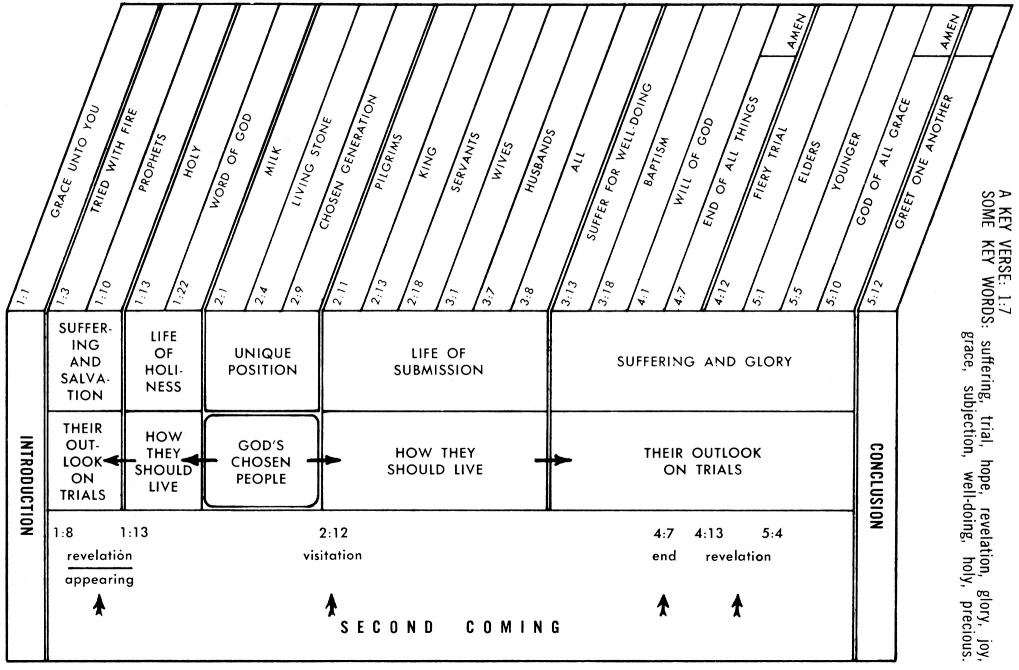
1 Peter: Trials, Holy Living & The Lord's Coming
Click chart to enlarge
Chart from Jensen's Survey of the NT - used by permission
See Another Chart from Charles Swindoll
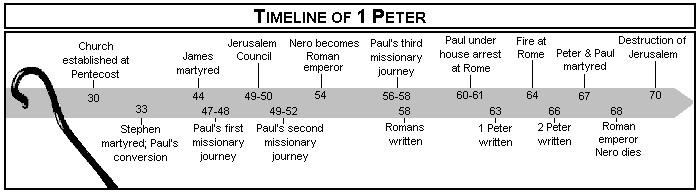
Source: Borrow Ryrie Study Bible
Click to enlarge
PART I: DOCTRINAL FOUNDATION
I. The Opening Salutation (1Pe 1:1-2)
A. The Writer (1Pe 1:1a)
B. The Readers (1Pe 1:1b-2a)
1. True character of the readers (1Pe 1:1b)
2. Geographical location of the readers (1Pe 1:1c)
3. Spiritual supports for the readers (1Pe 1:2a)
C. The Greeting (1Pe 1:2b)
II. The Thanksgiving for Our Salvation (1Pe 1:3-12)
A. The Description of Salvation (1Pe 1:3-5)
1. The author of salvation (1Pe 1:3a-b)
a. His relation to the Savior (1Pe 1:3a)
b. His act of mercy to the saved (1Pe 1:3b)
2. The nature of salvation (1Pe 1:3c-4a)
a. The living hope grounded in Christ's resurrection (1Pe 1:3c)
b. The glorious inheritance awaiting believers (1Pe 1:4a)
3. The certainty of salvation (1Pe 1:4b-5)
a. The safekeeping of the inheritance (1Pe 1:4b)
b. The preservation of the heirs (1Pe 1:5)
B. The Experiences Relating to Salvation (1Pe 1:6-9)
1. The paradoxical nature of the experiences (1Pe 1:6-7)
a. The experience of exultation (1Pe 1:6a)
b. The experience of distress (1Pe 1:66-7)
1. The nature of the distress (1Pe 1:6b)
2. The purpose behind the trials (1Pe 1:7)
a. The testing of faith (1Pe 1:7a)
b. The outcome of the testing (1Pe 1:7b)
2. The sustaining relations of believers (1Pe 1:8-9)
a. Their dual relation to Jesus Christ (1Pe 1:8)
b. Their experiential relation to their salvation (1Pe 1:9)
C. The Magnification of Salvation (1Pe 1:10-12)
1. The magnification through prophetic research (1Pe 1:10-12a)
a. Their intensive search (1Pe 1:10a)
b. Their prophetic function (1Pe 1:10b)
c. Their personal perplexity (1Pe 1:11)
1. The time and circumstances (1Pe 1:11a)
2. The sufferings and the glories (1Pe 1:11b)
d. Their restricted ministry (1Pe 1:12a)
2. The magnification through Christian proclamation (1Pe 1:12b)
3. The magnification through angelic inquiry (1Pe 1:12c)
PART 2: PRACTICAL EXHORTATION
I. Exhortations in View of Our Salvation (1Pe 1:13-2:10)
A. The Life Arising from Salvation (1Pe 1:13-2:3)
1. The Christian life in relation to God (1Pe 1:13-21)
a. A life of steadfast hope (1Pe 1:13)
1. The supports of hope (1Pe 1:13a)
2. The call to hope (1Pe 1:13b)
b. A life of personal holiness (1Pe 1:14-16)
1. The foundation for personal holiness (1Pe 1:14a)
2. The call to personal holiness (1Pe 1:14b-15)
a. The negative demand of holiness (1Pe 1:14b)
b. The positive call to holiness (1Pe 1:15)
3. The justification of the call to holiness (1Pe 1:16)
c. A life of motivated reverence (1Pe 1:17-21)
1. The basis for reverent living (1Pe 1:17a)
2. The call for reverent living (1Pe 1:17b)
3. The knowledge that motivates reverence (1Pe 1:18-21)
a. The means of our redemption (1Pe 1:18-19)
b. The nature of the Redeemer (1Pe 1:20)
c. The characteristics of the redeemed (1Pe 1:21)
2. The Christian life in relation to the brethren (1Pe 1:22-25)
a. The experience of inner purification (1Pe 1:22a)
b. The duty of mutual love (1Pe 1:22b)
c. The foundation in personal regeneration (1Pe 1:23-25)
1. The fact of their regeneration (1Pe 1:23a)
2. The nature of their regeneration (1Pe 1:23b-25a)
3. The evangelization leading to their regeneration (1Pe 1:25b) (D Edmond Hiebert)
1 Peter 1:18 knowing (RAP) that you were not redeemed (API) with perishable things like silver or gold from your futile way of life inherited from your forefathers, (NASB: Lockman)
Greek: eidotes (RAPMPN) hoti ou phtartois argurio e chrusio elutrothete (2PAPI) ek tes mataias humon anastrophes patroparadotou,
Phillips: For you must realize all the time that you have been "ransomed" from the futile way of living passed on to you by your fathers' traditions, not with some money payment of transient value, (Phillips: Touchstone)
Wuest: knowing as you do, that not by means of corruptible things, little coins of silver and gold, were you set free once for all by the payment of ransom money, out of and away from your futile manner of life handed down from generation to generation
Young's Literal: having known that, not with corruptible things -- silver or gold -- were ye redeemed from your foolish behaviour delivered by fathers,
KNOWING THAT YOU WERE NOT REDEEMED: eidotes (RAPMPN) hoti ou phtartois argurio e chrusio elutrothete (2PAPI):
- Ps 49:7,8; 1Co 6:20; 7:23 cf. "Passover" Ex 6:1, 2, 3, 4, 5, 6 = the need for redemption, Ex 12:1, 2, 3, 4, 5, 6, 7, 8, 9, 10, 11, 12, 13, Dt 7:8, Ex 15:13 Ps 78:35 Acts 20:28 Ro 3:24 Gal 4:4, 5 Eph 1:7 Col 1:14 Titus 2:14 Heb 9:11, 12, 13, 14, 15, 16, 17
- 1 Peter 1 Resources - Multiple Sermons and Commentaries
REDEEMED WITH
JESUS' BLOOD!
HALLELUJAH!
Knowing (1492) (eido) is the Greek word for self evident or intuitive knowing. This is not something we learned but truth that God's Spirit has placed in the heart and mind of believers (the redeemed). In a sense, this is "heavenly knowledge," for we could never had known it had not heaven come into our hearts in the form of Jesus our precious Redeemer.
THOUGHT - Let us meditate deeply and frequently on the Cross and the truth about our redemption from the penalty and power of sin that we might grow in our appreciation of the transaction that has been accomplished for us and that thereby we might be motivated to conduct ourselves in reverential fear as "holy ones" during our short stay on earth.
Vincent writes that "The appeal is to an elementary Christian belief (Hort), the holiness and justice of God with the added thought of the high cost of redemption."
Lange's Commentary - The consideration of the inestimable benefit of salvation supplies a new argument for aspiration to holiness of mind and conversation (Lange's Commentary)
Spurgeon - As your redemption cost so much, prize it highly, and do not go back to the sin from which you have been so dearly redeemed. Fear lest you should do so (cp 1Pe 1:17). Remember that heredity has a great power over you; the traditions of your fathers will imperceptibly draw you back unless you watch against them. But you have been so gloriously redeemed with the very blood of Christ’s heart that you must not draw back.
Redeemed (3084) (lutroo) is derived from lutron/lytron (which is derived from luo = to loosen that which is bound, especially freeing those in prison). The noun lutron is the ransom price paid for loosing captives from their bonds and setting them at liberty. The verb lutroo refers to the releasing of someone held captive (e.g., a prisoner or a slave) on receipt of the ransom payment.
The Roman Empire had (by some estimates) as many 6 million slaves and the buying and selling of them was a major business. If a person wanted to free a loved one or friend who was enslaved, he would pay the redemption price, purchasing or redeeming that slave for himself and then granting him freedom, testifying to the deliverance by a written certificate.
THOUGHT - Take a moment to ponder your eternal redemption (Heb 9:12, 15) by Jesus' precious blood as you listen to the words of a modern rendition of this great old hymn by Joseph Hart (1712-1768)…
DEARLY WE'RE BOUGHT
Listen to this one! from Red Mt Music
Come, raise your thankful voice,
Ye souls redeemed with blood;
Leave earth and all its toys,
And mix no more with mud.
Dearly we’re bought, highly esteemed;
Redeemed, with Jesus’ blood redeemed.
With heart, and soul, and mind,
Exalt redeeming love;
Leave worldly cares behind,
And set your minds above.
Dearly we’re bought, highly esteemed;
Redeemed, with Jesus’ blood redeemed.
Lift up your ravished eyes,
And view the glory given;
All lower things despise,
Ye citizens of heaven.
Dearly we’re bought, highly esteemed;
Redeemed, with Jesus’ blood redeemed.
Be to this world as dead,
Alive to that to come;
Our life in Christ is hid,
Who soon shall call us home.
Dearly we’re bought, highly esteemed;
Redeemed, with Jesus’ blood redeemed.
Related word studies translated redeem, redemption, purchased:
Lutroo is used only 3 times in the NT = Lk. 24:21; Titus 2:14; 1Pet. 1:18.
Luke records the words of Cleopas, one of the men on the road to Emmaus, to the risen Jesus (Whom God did not allow them to recognize and who had just accomplished redemption by His death and resurrection!)…
"But we were hoping that it was He who was going to redeem Israel. Indeed, besides all this, it is the third day since these things happened." (Luke 24:21)
Cleopas uses lutron to refer to the redemption of Israel from bondage to Rome for he did not understand that it was Jesus' death which would pay the price of redemption from bondage to sin. Cleopas, as well as many of the Jews, had been looking for Jesus to usher in an immediate earthly kingdom and thus when Jesus died, their hopes were dashed.
As A W Tozer said "The gospel is light but only the Spirit can give sight."
The other NT use of lutroo is found Paul's epistle to Titus, where we read that "our great God and Savior, Christ Jesus" (Titus 2:13) "gave Himself for us, that He might redeem us from every lawless deed and purify for Himself a people for His own possession, zealous for good deeds." (Titus 2:14)
Here Paul uses lutroo to explain a dual effect of this redemption - On one side what we were redeemed from - every lawless deed (the enslavement to the power of sin all men have inherited from Adam) - and then what we were redeemed for - to be His own possession and to live a life that demonstrates not just who we are (those who have been redeemed) but whose we are (Christ's possession).
Redemption was an important truth throughout the entire the Old Testament Scriptures. It is not surprising then that in the Septuagint (LXX) lutroo is used 88 times
Ex. 6:6; 13:13, 15; 15:13; 34:20; Lev. 19:20; 25:25, 30, 33, 48-49, 54; 27:13, 15, 19-20, 27-29, 31, 33; Num. 18:15, 17; Deut. 7:8; 9:26; 13:5; 15:15; 21:8; 24:18; 2 Sam. 4:9; 7:23; 1 Ki. 1:29; 1 Chr. 17:21; Neh. 1:10; Esther 4:17; Ps. 7:2; 25:22; 26:11; 31:5; 32:7; 34:22; 44:26; 49:7, 15; 55:18; 59:1; 69:18; 71:23; 72:14; 74:2; 77:15; 78:42; 103:4; 106:10; 107:2; 119:134, 154; 130:8; 136:24; 144:10; Prov. 23:11; Isa. 35:9; 41:14; 43:1, 14; 44:22ff; 51:11; 52:3; 62:12; 63:9; Jer. 15:21; 31:11; 50:34; Lam. 3:58; 5:8; Dan. 4:27; 6:27; Hos. 7:13; 13:14; Mic. 4:10; 6:4; Zeph. 3:15; Zech. 10:8)
To the Jews reading Peter's epistle the mention of "redeemed" would bring to mind the picture of God's deliverance from Egyptian bondage. In fact the first use of lutroo in the OT is found in Exodus 6:6 where Moses records God's response to Israel's cries for deliverance from Egyptian slavery…
Say, therefore, to the sons of Israel, 'I am the LORD, and I will bring you out from under the burdens (forced heavy labor that Israel was subjected to in Egypt) of the Egyptians, and I will deliver (drawing out, pulling out, deliver or rescue, pluck, preserve, recover, snatch away, save, take out) you from their bondage. I will also redeem (Hebrew = goel/ga'al; LXX = lutroo - What was the "redemption price?" Ex 12:5, 13) you with an outstretched arm and with great judgments. (Exodus 6:6 cp Dt 7:8 = What was Jehovah's motive for carrying out redemption?)
In a similar passage Moses records that…
In Thy lovingkindness Thou hast led the people whom Thou hast redeemed (Hebrew = goel/ga'al; LXX = lutroo); In Thy strength Thou hast guided them to Thy holy habitation." (Exodus 15:13)
In another instructive Septuagint use of lutroo, we read about the Kinsman-Redeemer in Leviticus that…
If a fellow countryman of yours becomes so poor he has to sell part of his property, then his nearest kinsman is to come and buy back (Hebrew = goel/ga'al = reclaim, to vindicate the rights; LXX = lutroo) what his relative has sold." (Leviticus 25:25) (Goel/ga'al is used 17 times in Leviticus)
Redemption was a technical term for money paid to buy back and set free prisoners of war or to emancipate slaves from their masters. Believers have been ransomed or bought back, like the redemption of a bondservant by a kinsman-redeemer (Lev 25:49). (Click Part 1 Part 2 for an overview of Kinsman-Redeemer and the relationship to Christ)
Before redemption we were held captive by Satan to do his will and were enslaved to our old sin nature inherited from Adam. In Christ we have been ransomed by His blood (1Cor 6:20; Rev 5:9), are no longer under the curse of the law (Gal 3:13; 4:5) and have been released from the bondage of sin into the freedom of grace.
Redemption is through the blood of Christ (Col 1:14, Ep 1:7) so the central truth of REDEMPTION is a costly payment, the infinitely priceless blood of the Son of God.
The truth about redemption is also practical. In this section of the letter, Peter is exhorting believers to remember the “price” paid for their redemption as a motivation to personal holiness.
Peter had just written that as obedient children we should not continually
be conformed to the former lusts (that governed us prior to salvation)… but like the Holy One Who called us" we are to be holy in all our behavior (see notes 1 Peter 1:13; 1:14; 1:15; 1:16) adding that…
if you address as Father the One who impartially judges according to each man's work, conduct yourselves in fear during the time of your stay upon earth knowing that you were not redeemed (lutroo) with perishable things like silver or gold from your futile way of life (Christ saved us from a life of emptiness) inherited from your forefathers, but with precious blood, as of a lamb unblemished and spotless, the blood of Christ." (see notes 1 Peter 1:17; 1:18; 1:19)
So Peter exhorts us to live holy lives motivated by a reverential awe (fear) of the fact that we will be impartially judged and also motivated by the costliness of the redemption price, the blood of Christ.
The writer of Hebrews reminds us of the incalculable value of Christ's redemptive work, writing that it was effected
not through the blood of goats and calves, but through His own blood, He entered the holy place once for all, having obtained eternal redemption." (He 9:12) so that…
those who have been called may receive the promise of the eternal inheritance." (He 9:15)
Our redemption in Christ is final and permanent.
Nor Silver Nor Gold
by James Gray
Click to play
Nor silver nor gold hath obtained my redemption,
Nor riches of earth could have saved my poor soul;
The blood of the cross is my only foundation,
The death of my Savior now maketh me whole.
Refrain
I am redeemed, but not with silver,
I am bought, but not with gold;
Bought with a price, the blood of Jesus,
Precious price of love untold.
Nor silver nor gold hath obtained my redemption,
The guilt on my conscience too heavy had grown;
The blood of the cross is my only foundation,
The death of my Savior could only atone.
- Defined -1 Corinthians 6:20; 7:23
- Is of God -Isaiah 44:21-23; 43:1; Luke 1:68
- Is by Christ Matthew 20:28; Galatians 3:13
- Is by the blood of Christ -Acts 20:28; Hebrews 9:12; 1 Peter 1:19; Revelation 5:9
- Christ sent to effect -Galatians 4:4,5
- Christ is made, to us -1 Corinthians 1:30
IS FROM
- The bondage of the law -Galatians 4:5
- The curse of the law -Galatians 3:13
- The power of sin -Romans 6:18,22
- The power of the grave -Psalms 49:15
- All troubles -Psalms 25:22
- All iniquity -Psalms 130:8; Titus 2:14
- All evil -Genesis 48:16
- The present evil world -Galatians 1:4
- Vain conversation -1 Peter 1:18
- Enemies -Psalms 106:10,11; Jeremiah 15:21
- Death -Hosea 13:14
- Destruction -Psalms 103:4
- Man cannot effect -Psalms 49:7
- Corruptible things cannot purchase -1 Peter 1:18
PROCURES FOR US
- Justification -Romans 3:24
- Forgiveness of sin -Ephesians 1:7; Colossians 1:14
- Adoption -Galatians 4:4,5
- Purification -Titus 2:14
- The present life, the only season for -Job 36:18,19
DESCRIBED AS
- Precious -Psalms 49:8
- Plenteous -Psalms 130:7
- Eternal -Hebrews 9:12
SUBJECTS OF
- The soul -Psalms 49:8
- The body -Romans 8:23
- The life -Psalms 103:4; Lamentations 3:58
- The inheritance -Ephesians 1:14
MANIFESTS THE
- Power of God -Isaiah 50:2
- Grace of God -Isaiah 52:3
- Love and pity of God -Isaiah 63:9; John 3:16; Romans 6:8; 1 John 4:10
- A subject for praise -Isaiah 44:22,23; 51:11
- Old Testament saints partakers of -Hebrews 9:15
THEY WHO PARTAKE OF
- Are the property of God -Isaiah 43:1; 1 Corinthians 6:20
- Are first-fruits to God Revelation 14:4
- Are a peculiar people -2 Samuel 7:23; Titus 2:14; 1 Peter 2:9
- Are assured of -Job 19:25; Psalms 31:5
- Are sealed to the day of -Ephesians 4:30
- Are Zealous of good works Ephesians 2:10; Titus 2:14; 1 Peter 2:9
- Walk safely in holiness -Isaiah 35:8,9
- Shall return to Zion with joy -Isaiah 35:10
- Alone can learn the songs of heaven -Revelation 14:3,4
- Commit themselves to God Psalms 31:5
- Have an earnest of the completion of
- Ephesians 1:14; 2 Corinthians 1:22
- Wait for the completion of -Romans 8:23; Philippians 3:20,21; Titus 2:11-13
- Pray for the completion of -Psalms 26:11; 44:26
- Praise God for -Psalms 71:23; 103:4; Revelation 5:9
- Should glorify God for -1 Corinthians 6:20
- Should be without fear -Isaiah 43:1
TYPIFIED
- Israel -Exodus 6:6
- First-born -Exodus 13:11-15; Numbers 18:15
- Atonement-money -Exodus 30:12-15
- Bond-servant -Leviticus 25:47-54
Related Resources on Redemption -
- Redeem, Redemption - Baker's Evangelical Dictionary of Biblical Theology
- Redeem, Redemption - Vine's Expository Dictionary of NT Words
- Redeemer, Redemption - Hastings' Dictionary of the Bible
- Redemption - Hastings' Dictionary of the New Testament
- Easton's Bible Dictionary Redemption
- Hastings' Dictionary of the Bible Redeemer, Redemption
- Hastings' Dictionary of the NT Redemption Redemption (2)
- International Standard Bible Encyclopedia Redeemer; Redemption
- The Jewish Encyclopedia Redemption
WITH PERISHABLE THINGS LIKE SILVER & GOLD: phtartois argurio e chrusio:
- 1 Peter 1 Resources - Multiple Sermons and Commentaries
SILVER AND GOLD
ARE PERISHABLE!
Perishable (5349) (phthartos from phtheiro = to destroy from phthino = waste) is that which is subject to corruption, rot, withering, decay or decomposition. The basic idea is that which is short lived, or that which has a brief life or significance.
In Romans 1:23 phthartos means mortal or degenerating man. In the passages (below) from Corinthians we see that which is perishable belongs to this life and to the unresurrected, whereas the imperishable is equated with a new life and immortality.
Phthartos - 6x in NT translated: corruptible, 1; perishable, 3; perishable things, 1; which is perishable, 1. Phthartos is used only once in the Lxx = Isaiah 54:17.
Romans 1:23 (note) and exchanged the glory of the incorruptible God for an image in the form of corruptible man and of birds and four-footed animals and crawling creatures.
1 Corinthians 9:25 And everyone who competes in the games exercises self-control in all things. They then do it to receive a perishable wreath, but we an imperishable.
1 Corinthians 15:53 For this perishable must put on the imperishable, and this mortal must put on immortality.
1 Corinthians 15:54 But when this perishable will have put on the imperishable, and this mortal will have put on immortality, then will come about the saying that is written, "Death is swallowed up in victory.
1 Peter 1:18 knowing that you were not redeemed with perishable things like silver or gold from your futile way of life inherited from your forefathers,
1 Peter 1:23 (note) for you have been born again not of seed which is perishable but imperishable, that is, through the living and abiding word of God.
The words “silver” and “gold” are in a diminutive form, referring to little silver and gold coins. Both silver and gold were commonly used to purchase slaves. The price of a slave in the Roman Empire varied from 700,000 to 200 sesertii (a worker in Rome could earn about 3 sesertii per day)
Related Resources
- Slave, Slavery - Hastings' Dictionary of the Bible
- Slave, Slavery - Hastings' Dictionary of the New Testament
- Slave, Slavery - Baker's Evangelical Dictionary of Biblical Theology
- Slave; Slavery - International Standard Bible Encyclopedia
FROM YOUR FUTILE WAY OF LIFE: ek tes mataias humon anastrophes:
- Ps 39:6; 62:10; 1Co 3:20 Jer 2:5; Acts 14:15 cp Eph 4:17
- See Torrey's Topic of "Vanity" & Naves Topic of "Vanity" for what God considers "futile"
- 1 Peter 1 Resources - Multiple Sermons and Commentaries
LIFE WITHOUT CHRIST:
AN EMPTY, WORTHLESS LIFE!
From - This is the preposition ek which means out of. I see a picture of God's Spirit "reaching down" into the slave pit we were in, "grabbing us" and transferring us to the Kingdom of light! (Col 1:13-14). Hallelujah!
Futile way of life - The way we lived as spiritually dead unbelievers was mataios. Here ae synonyms from the Greek Lexicon entries of mataios. Substitute them in the sentence to get a sense of where we once lived before we were redeemed - Ours was a "_____ way of life." It was (fill in the blank) foolish, useless, worthless, fruitless, idle, empty, powerless, lacking truth, vain, profane, irreverent, thoughtless, rash, impious, deceptive, meaningless! Now if this list does not grip us with gratefulness to our Great Redeemer, I'm not sure what would! Titus 3:3 (Titus 3:3) says "we also once were foolish ourselves, disobedient, deceived, enslaved to various lusts and pleasures, spending our life in malice and envy, hateful, hating one another." Quite a picture of our depraved state!
Futile (3152) (mataios from maten = groundless, invalid) means vain, empty, devoid of force, lacking in content, nonproductive, useless, dead, fruitless, aimless, of no real or lasting value. This adjective describes an ineffectual attempt to do something or an unsuccessful effort to attain something. Mataios emphasizes aimlessness or the leading to no object or end and thus is used to describe false gods or idols in contrast to the true God (see below).
NIDNTT - The word mataios and its derivatives have an essentially more personal application. It is used in the sense of empty, useless, worthless, and futile. It denotes a person who falls short of God’s standard and human norms. His life is illusory, motiveless, aimless, scandalous and foolish (Brown, Colin, Editor. New International Dictionary of NT Theology. 1986. Zondervan)
TDNT - The word mataios carries the senses of “vain,” “deceptive,” “pointless,” “futile.” While kenós (2756) means “worthless,” mataios means “worthless because deceptive or ineffectual.” mataios implies antithesis to the norm, which may at times be liberating but is more often harmful. Tragedy raises the ultimate question whether everything is not mataios. Religion offers a partial answer by pointing to the divine world, but the plurality and mutability of the gods undermine this answer. Later Greek thought makes little use of the group, perhaps because it raises so unsettling a question, and involves such practical self-contradiction. (Kittel, G., Friedrich, G., & Bromiley, G. W. Theological Dictionary of the New Testament. Eerdmans)
The idea behind mataios brings to mind pictures like building a house on sand (see note on Jesus' warning in Mt 7:24, 25, 26, 27- see notes Mt 7:24; 25; 26; 27), chasing the wind, shooting at stars, pursuing one’s own shadow. The spiritual plight of many denominations and Christian institutions that once were solidly biblical is abundant proof of the pernicious and pervasive destructiveness of false and therefore worthless doctrine.
Mataios especially describes unbelievers, whose lives sadly are futile because they lack divine insight and are thus are unable to live a life filled with eternal purpose and everlasting effect (see contrast of the eternal impact of the life of a believer disciplining himself or herself for godliness ). Unbelievers lead a futile life, in that it does not measure up to that for which human life was created, that ultimate purpose being to glorify God. How grateful the redeemed should be (Ps 107:2) that we have been ransomed from a futile existence by such a tremendous transaction… delivered from slavery to the world, flesh and devil by the blood of the Lamb.
Modern descriptions for "futile" might include "chasing the wind, shooting at stars, pursuing one’s shadow." How grateful the redeemed should be (Ps 107:2) that we have been ransomed from a futile existence by such a tremendous transaction… delivered from slavery to the world, flesh & devil by the blood of the Lamb.
Luke quoting Paul used the adjective mataios as a synonym for idolatry…
and saying, "Men, why are you doing these things? We are also men of the same nature as you, and preach the gospel to you in order that you should turn from these vain things (mataios - in this context referring to idols) to a living God, WHO MADE THE HEAVEN AND THE EARTH AND THE SEA, AND ALL THAT IS IN THEM. (Acts 14:15)
Not only did we once have a life of slavery, but it was also a life which was empty, aimless and of no real lasting value. Although unregenerate men and women may consider their lives “full” and “happy,” they are really empty and even Solomon who "had it all" lamented
"Vanity of vanities," says the Preacher, "Vanity of vanities ! All is vanity." (Ecclesiastes 1:2)
Jesus used the related word maten to describe the worship of God based upon the precepts of men declaring…
'BUT IN VAIN DO THEY WORSHIP ME, TEACHING AS DOCTRINES THE PRECEPTS OF MEN. (Matthew 15:9)
Paul using the verb form mataioo to describe how those who had suppressed the truth about God
For even though they knew God, they did not honor Him as God, or give thanks; but they became futile in their speculations, and their foolish heart was darkened (Ro 1:21-see note Romans 1:21)
Paul also used the related noun mataiotes to describe the existence of an unregenerate person's life exhorting the Ephesian believers…
This I say therefore, and affirm together with the Lord, that you walk no longer just as the Gentiles also walk, in the futility (mataiotes = Inability to reach a goal or achieve a purpose, having the quality of being empty, profitless) of their mind, (then Paul explains what the futility of one's mind looks like) 18 being darkened in their understanding, excluded from the life of God, because of the ignorance that is in them, because of the hardness of their heart (Eph 4:17-18-see note Ephesians 4:17; Ephesians 4:18).
With this enhanced understanding of a "futile way of life" can you see how we the redeemed should be powerfully motivated out of a sense of profound gratitude to conduct ourselves in fear during the time of our stay on earth? Jesus gave His all for me. How can I give Him less? (see illustration v19)
Holwick's Illustrations - The testimony of the Bible is that a life without Jesus is a life that is empty. That doesn't mean people don't try to fill their lives with tons of activities. One famous American who filled life with gusto was Ernest Hemingway. Hemingway grew up in a staunch Christian home - his father had even thought of being a missionary. However, Ernest had other goals for his life and left his childhood faith far behind him. He became a writer and a thrill seeker. He hunted big game, fought in several wars, married four women and became an alcoholic. Toward the end of his life Hemingway said, "I live in a vacuum that is as lonely as a radio tube when the batteries are dead and there is no current to plug into." A few years later he committed suicide. Biblical morality begins with our depravity, not innate goodness. Something is wrong with us. But God can do something about it.
INHERITED FROM YOUR FOREFATHERS: patroparadotou:
- 1 Peter 4:3; Jer 9:14; 16:19; 44:17; Ezek 20:18; Am 2:4; Zech 1:4, 5, 6; Mt 15:2,3; Acts 7:51,52; 19:34,35; Gal 1:4
- 1 Peter 1 Resources - Multiple Sermons and Commentaries
AN INHERITANCE
OF FUTILITY
Inherited from your forefathers (3970) (patroparadotos from pater = father, ancestor + paradidomi = deliver) literally means that which is handed or delivered down from one's father or ancestors. Used only in 1Peter 1:18.
The KJV picks up the sense of this word "received by tradition from your fathers."
Our first father Adam bestowed upon us the inheritance of a sin nature (see note Romans 5:12) that seeks to gratify self and which leads to an empty, worthless, futile life that is in turn is passed down to the next generation along with teaching, example, and environment. Every beautiful baby is tragically, indubitably born in sin, coming into being with a totally depraved nature and if the parents are unsaved, comes into a home where evil customs and practices are observed. What the child inherits, Peter calls a futile manner of life. From this futile manner of life the recipients of this letter were delivered.
Lange's Commentary - This describes the being of this world as untrue, as having its root in appearances, and as devoid of all foundation, strength and vitality, cf. Ro 1:21; Ep 4:17; 1Cor. 3:20; 2Pe 2:18; Ro 8:20. Its main stay and support lies in the force of habits, ideas, views, principles and maxims transmitted from father to child through successive generations. Men justify their ways, saying, ‘Such was the practice of our fathers and our forefathers,’ and continue in the bonds of error and sinful lusts. Calov. explains "your forefathers" of original sin and of imitating paternal examples. The deep-rootedness of this vain conversation notwithstanding, deliverance and redemption from it is found in the death and blood of Jesus Christ. The Apostle does not specify how the atonement of Christ effects redemption from the power of sin; we may doubtless supply this solution (cf. 1Pe 2:24) thus: having been redeemed from the curse of the law by the blood of Jesus, we are enabled to be cleansed from sin, to be united to God and to approach Him with joy and courage. The Holy Spirit’s power is present to deliver us from the dominion of sin. (Lange's Commentary)
Redemption Illustrated - A missionary in West Africa was trying to convey the meaning of the word redeem in the Bambara language. So he asked his African assistant to express it in his native tongue. "We say," the assistant replied, "that God took our heads out." "But how does that explain redemption?" the perplexed missionary asked. The man told him that many years ago some of his ancestors had been captured by slave-traders, chained together, and driven to the seacoast. Each of the prisoners had a heavy iron collar around his neck. As the slaves passed through a village, a chief might notice a friend of his among the captives and offer to pay the slave-traders in gold, ivory, silver, or brass. The prisoner would be redeemed by the payment. His head then would be taken out of his iron collar. What an unusual and graphic illustration of the word redeem! Let Him take your head out of the enslaving collar of sin and set you free.
Redeemed-how I love to proclaim it!
Redeemed by the blood of the Lamb;
Redeemed through His infinite mercy-
His child, and forever I am. -Crosby
Christ was lifted up on the cross
that we might be lifted out of our sin.
Make a toll-free call and "Jesus can be yours." That's the guarantee in an advertisement for a 2-foot tall, machine-washable "Jesus doll." The doll wears a scarlet robe over a white tunic with a red heart emblazoned on it. The ad says that children will love to hug the doll, and the elderly and emotionally distressed will find it a source of comfort. So for only $29.95, "Jesus can be yours."
Would you want one? Or do you feel, as I do, that this would be a violation of the Second Commandment, which forbids the making of any idol? (Ex. 20:4-5). Certainly the Redeemer of the world and the comfort He offers cannot be purchased at the bargain-basement price of 5 cents less than $30! To me, this contradicts the message of the gospel.
"Jesus can be yours"--yes, indeed. But you can't buy Him. Actually, He purchased us! Jesus becomes ours not with the payment of "corruptible things, like silver or gold" (1 Pet. 1:18), but by simply trusting the forgiveness and grace He gives to us through His precious blood (v.19). With His blood He paid the penalty for sin. And through our faith in Him we gain access to all of heaven's riches. You can't buy Jesus. But He can be yours for free. --V C Grounds (Our Daily Bread, Copyright RBC Ministries, Grand Rapids, MI. Reprinted by permission. All rights reserved)
Nor silver nor gold has obtained my redemption,
The way into heaven could not thus be bought;
The blood of the cross is my only foundation,
The death of my Savior redemption has wrought. --Gray
Salvation is not for sale--it's free!
The Rescuer - The price Jesus paid for our redemption was terrible indeed. When we think of the extreme suffering He endured to purchase our freedom from sin’s penalty, our hearts should overflow with love for Him.
Leslie B. Flynn told a story that illustrates this truth. An orphaned boy was living with his grandmother when their house caught fire. The grandmother, trying to get upstairs to rescue the boy, perished in the flames. The boy’s cries for help were finally answered by a man who climbed an iron drainpipe and came back down with the boy hanging tightly to his neck.
Several weeks later, a public hearing was held to determine who would receive custody of the child. A farmer, a teacher, and the town’s wealthiest citizen all gave the reasons they felt they should be chosen to give the boy a home. But as they talked, the lad’s eyes remained focused on the floor. Then a stranger walked to the front and slowly took his hands from his pockets, revealing severe scars on them. As the crowd gasped, the boy cried out in recognition. This was the man who had saved his life. His hands had been burned when he climbed the hot pipe. With a leap the boy threw his arms around the man’s neck and held on for dear life. The other men silently walked away, leaving the boy and his rescuer alone. Those marred hands had settled the issue.
Many voices are calling for our attention. Among them is the One whose nail-pierced hands remind us that He has rescued us from sin and its deadly consequences. To Him belongs our love and devotion. -D. C. Egner (Our Daily Bread, Copyright RBC Ministries, Grand Rapids, MI. Reprinted by permission. All rights reserved)
Redeemed! A story told by Paul Lee Tan illustrates the meaning of redemption. He said that when A. J. Gordon was pastor of a church in Boston, he met a young boy in front of the sanctuary carrying a rusty cage in which several birds fluttered nervously. Gordon inquired, “Son, where did you get those birds?” The boy replied, “I trapped them out in the field.” “What are you going to do with them?” “I’m going to play with them, and then I guess I’ll just feed them to an old cat we have at home.”
When Gordon offered to buy them, the lad exclaimed, “Mister, you don’t want them, they’re just little old wild birds and can’t sing very well.” Gordon replied, “I’ll give you $2 for the cage and the birds.” “Okay, it’s a deal, but you’re making a bad bargain.”
The exchange was made and the boy went away whistling, happy with his shiny coins. Gordon walked around to the back of the church property, opened the door of the small wire coop, and let the struggling creatures soar into the blue. The next Sunday he took the empty cage into the pulpit and used it to illustrate his sermon about Christ’s coming to seek and to save the lost—paying for them with His own precious blood. “That boy told me the birds were not songsters,” said Gordon, “but when I released them and they winged their way heavenward, it seemed to me they were singing, ‘Redeemed, redeemed, redeemed!”
You and I have been held captive to sin, but Christ has purchased our pardon and set us at liberty. When a person has this life-changing experience, he will want to sing, “Redeemed, redeemed, redeemed!” (Our Daily Bread, Copyright RBC Ministries, Grand Rapids, MI. Reprinted by permission. All rights reserved)
1 Peter 1:19 but with precious blood, as of a lamb unblemished and spotless, the blood of Christ. (NASB: Lockman)
Greek: alla timio haimati os amnou amomou kai aspilou Christou,
KJV: But with the precious blood of Christ, as of a lamb without blemish and without spot:
ESV: but with the precious blood of Christ, like that of a lamb without blemish or spot.
NET: but by precious blood like that of an unblemished and spotless lamb, namely Christ.
Wuest: but with costly blood highly honored, blood as of a lamb that is without blemish and spotless, the blood of Christ,
Young's Literal: but with precious blood, as of a lamb unblemished and unspotted -- Christ's
BUT WITH PRECIOUS BLOOD: alla timio haimati:
- 1Pet 2:22, 23, 24; 3:18; Da 9:24; Zec 13:7; Mt 20:28; 26:28; Acts 20:28; Eph 1:7; Col 1:14; Heb 9:12, 13, 14; 1Jn 1:7; 2:2; Rev 1:5; 5:9
- 1 Peter 1 Resources - Multiple Sermons and Commentaries
But - Pause to ponder this great contrast (always study the terms of contrast).
As one sage has encouraged every saint - Reason back from the greatness of the sacrifice to the greatness of the sin. Then determine to be done forever with that which cost God’s Son His life.
Precious (5093) (timios from time = to value or honor) describes that which is valuable, highly prized, desirable, costly, as a precious stone, an apt adjective to modify the infinite worth of the blood of Christ, the Lamb of God. His blood is precious because it has a value is which is beyond calculation or our finite human understanding. If He had not been willing to shed His precious blood thus paying the redemption price, there would be no hope for mankind to live forever with God.
Timios means costly in the sense of value and highly esteemed or held in honor. The blood of Christ is costly because it is "divine" blood (Acts 20:28), for Deity became incarnate in humanity (Heb 2:14). For that reason the blood of Christ is highly esteemed and honored by God the Father.
In the original Greek sentence, Peter placed timios or precious before blood, which is a Greek way of placing even greater emphasis on the indescribable worth of Christ's blood.
What a contrast with the pagan world, where little silver and gold coins would buy the freedom of slaves in Rome. Only the precious blood of Christ was of sufficient worth in the Father's eyes to purchase once for all time the freedom of men and women fast bound in the chains of their own sin nature inherited from Adam. For all eternity those redeemed by His precious blood will cry out
Worthy is the Lamb that was slain to receive power and riches and wisdom and might and honor and glory and blessing. (Ro 5:12)
Blood (129) (haima) refers to blood as the basis of life or what constitutes the life of an individual. (Lev 17:11). Blood is the basic component of a living organism. The shedding of Christ's blood (death) was the penalty price for sin. What was foreshadowed in the Levitical system was realized at the Cross when the Son of God laid down His life in death and ransomed men from sin. His precious blood paid the ransom price for our redemption (Cf Re 5:9, Ro 3:24, 25- see notes Ro 3:24; 25)
Why is Christ's Blood so precious? To summarize Spurgeon (see sermon following this list for elaboration on each point)…
1) Redeeming Power
2) Atoning Efficacy
3) Cleansing Power
4) Preserving Power
5) Pleading Prevalence
6) Melting Influence on the human heart
7) Gracious Power to Pacify
8) Sanctifying Influence
9) Power to Give Entrance
10) Confirming power in Covenant
11) Invigorating Power
12) Overcoming Power
Take a Moment to worship Jesus
as you ponder the preciousness of blood
Play Red Mountain Music's beautiful rendition of
There is a Fountain Filled with Blood — Red Mt Music (their works are wonderfully God Glorifying)
Spurgeon (The Precious Blood of Christ) elaborates on the significance of the blood observing that …
Blood has from the beginning been regarded by God as a most precious thing. He has hedged about this fountain of vitality with the most solemn sanctions.
The Lord thus commanded Noah and his descendants, Flesh with the life thereof, which is the blood thereof, shall ye not eat. Man had every moving thing that liveth given him for meat, but they were by no means to eat the blood with the flesh. Things strangled were to be considered unfit for food, since God would not have man became too familiar with blood by eating or drinking it in any shape or form. Even the blood of bulls and goats thus had a sacredness put upon it by Gods decrees.
As for the blood of man, you remember how Gods threatening ran, And surely your blood of your lives will I require; at the hand of every beast will I require it, and at the hand of man; at the hand of every mans brother will I require the life of man. Whoso sheddeth mans blood, by man shall his blood be shed: for in the image of God made he man. It is true that the first murderer had not his blood shed by man, but then the crime was new and the penalty had not then been settled and proclaimed, and therefore the case was clearly exceptional, and one by itself; and, moreover, Cain's doom was probably far more terrible than if be had been slain upon the spot: he was permitted to fill up his measure of wickedness, to be a wanderer and a vagabond upon the face of the earth, and then to enter into the dreadful heritage of wrath, which his life of sin had doubtless greatly increased.
Under the theocratic dispensation, in which God was the King and governed Israel, murder was always punished in the most exemplary manner, and there was never any toleration or excuse for it. Eye for eye, tooth for tooth, life for life, was the stern inexorable law. It is expressly written, Ye shall take no satisfaction for the life of a murderer which is guilty of death: but he shall surely be put to death. Even in cases where life was taken in chance-medley or misadvunture, the matter was not overlooked. The slayer fled at once to tile city of refuge, where, after having his case properly tried, he was allowed to reside; but there was no safety for him elsewhere until the death or the high priest. The general law in all cases was, So ye shall not pollute the land wherein ye are: for blood it defileth the land: and the land cannot be cleansed of the blood that is shed therein, but by the blood of him that shed it. Defile not therefore the land which ye shall inhabit, wherein I dwell: for I the Lord dwell among the children of Israel. Strange is it that that very thing which defileth, should turn out to be that which alone can cleanse.
It is clear, then, that blood was ever precious in Gods sight, and he would have it so in ours. He first forbids the blood of beasts as food of man, then avenges the blood of man shed in anger; and, furthermore, takes care that even accident shall not pour it out unheeded. Nor is this all, for we hear within us the echo of that law. We feel that God has made blood a sacred thing, for though some can, through use and habit, read the story of war with patience, if not with pleasure; though the sound of the trumpet and the drum, and the tramp of soldiery will stir our heart, and make us for the moment sympathize with the martial spirit; yet, if we could see war as it really is, if we could only walk but half across a battle-field, or see but one wounded man, a cold shiver would shoot through the very marrow of our bones, and we should have experimental proof that blood is indeed a sacred thing. The other night, when I listened to one who professed to have come from battlefields of the American war, I felt a faintness and clammy sweat steal over me, as he shocked and horrified us with the details of mutilated bodies, and spoke of standing up to the tops of his boots in pools of human gore. The shudder which ran through us all was a sure confirmation of the sanctity with which God has for ever guarded the symbol and nutriment of life.
We cannot even contemplate the probability of the shedding of blood without fear and trembling; and comforts which entail high risks in their production or procuring will lose all sweetness to men of humane dispositions.
Who does not sympathize with David in his action with regard to the water procured by his three mighties! The three heroes broke through the hosts of the Philistines to bring David water from the well of Bethlehem, and as soon as he received that water, though very thirsty, and much longing for it, yet he felt he could not touch it because these men had run such dreadful risks in breaking thrice through the Philistine hosts to bring it to him, and therefore he took the water and poured it out before the Lord, as if it was not meet that men should run risk of life for any but God who gave life. His words were very touching,
"My God forbid it me, that I should do this thing: shall I drink the blood of these men that have put their lives in jeopardy for with the jeopardy or their lives they brought it?"
I wonder at the cruelty of the great crowds who delight to see men and women running such fearful risks of life in rope-dancing. How is it that they can feed their morbid curiosity on such dreadful food, and greet the man who is foolish enough to run such hazards with acclamations because of his
foolhardiness? How much more Christ-like the regret of David that he should have led any man to risk his life for his comfort! How much more laudable was his belief that nothing short of the highest benevolence to man, or the highest devotion to God, can justify such jeopardy of life!
Further permit me to observe, that the seal of the sanctity of blood is usually set upon the conscience even of the most depraved of men, not merely upon gentle souls and sanctified spirits, but even upon the most hardened; for you will notice that men, bad as they are, shrink from the disgrace of taking blood-money. Even those high priests who could sit down and gloat their eyes with the sufferings of the Savior, would not receive the price of blood into the treasury; and even Judas, that son of perdition, who could contemplate without horror the treachery by which he betrayed his master, yet, when he had the thirty pieces of silver in his palm, found the money too hot to hold; he threw it down in the temple, for he could not bear or abide the sight of the price of blood.
Another proof that even when virtue has become extinct, and vice reigns, yet God has put the broad arrow or his own sovereignty so manifestly upon the very thought of blood that even these worst of spirits are compelled to shrink from tampering therewith.
Now, if in ordinary cases the shedding of life be thus precious, can you guess how fully God utters his hearts meaning when he says,
Precious in the sight of the Lord is the death of his saints?
If the death of a rebel be precious, what must be the death of a child? If he will not contemplate the shedding of the blood of his own enemies and of them that curse him without proclaiming vengeance, what think you concerning his own elect, of whom he says, Precious shall their blood be in his sight? Will he not avenge them, though he bear long with them? Shall the cup which the harlot of Rome filled with the blood of the saints, long remain unavenged? Shall not the martyrs from Piedmont and the Alps, and from our Smithfield, and from the hills of covenanting Scotland, yet obtain from God the vengeance due for all that they suffered, and all the blood which they poured forth in the defense of his cause?
I have taken you up, you see, from the beast to man, from man to God's chosen men, the martyrs.
I have another step to indicate to you: it is a far longer one it is to the blood OF JESUS CHRIST.
Here, powers of speech would fail to convey to you an idea of the preciousness! Behold here, a person innocent, without taint within, or flaw without; a person meritorious, who magnified the law and made it honorable a person who served both God and man even unto death. Nay, here you have a divine person' so divine, that in the Acts of the Apostles Paul calls his blood the blood of God.
Place innocence, and merit, and dignity, and position, and Godhead itself, in the scale, and then conceive what must be the inestimable value of the blood which Jesus Christ poured forth.
Angels must have seen that matchless blood-shedding with wonder and amazement, and even God himself saw what never before was seen in creation or in providence; he saw himself more gloriously displayed than in the whole universe beside. Let us come nearer to the text and try to shew forth the preciousness of the of the blood of Christ. We shall confine ourselves to an enumeration of some of the many properties possessed by this precious blood. I felt as I was studying, that I should have so many divisions this morning that some of you would compare my sermon to the bones in Ezekiel’s vision, — they were very many and they were very dry; but I am in hopes that God’s Holy Spirit may so descend upon the bones in my sermon, which would be but dry of themselves, that they being quickened and full of life, you may admire the exceeding great army of God’s thoughts of loving-kindness towards his people, in the sacrifice of his own dear Son.
The precious blood of Christ is useful to God’s people in a thousand ways: we intend to speak of twelve of them. After all, the real preciousness of a thing in the time of pinch and trial, must depend upon its usefulness. A bag of pearls would be to us, this morning, far more precious than a bag of bread; but you have all heard the story of the man in the desert, who stumbled, when near to die, upon a bag, and opened it, hoping that it might be the wallet of some passer-by, and he found in it nothing but pearls! If they had been crusts of bread, how much more precious would they have been! I say, in the hour of necessity and peril, the use of a thing really constitutes the preciousness of it. This may not be according to political economy, but it is according to common sense.
1. The precious blood of Christ has a Redeeming Power.
It redeems from the law (Ga 3:13). We were all under the law which says, “This do, and live.” We were slaves to it: Christ has paid the ransom price, and the law is no longer our tyrant master. We are entirely free from it Ro 7:4, 5, 6, see where Law is now under the New Covenant - He 8:10). The law had a dreadful curse; it threatened that whosoever should violate one of its precepts, should die: “Christ hath redeemed us from the curse of the law, being made a curse for us.” (Ga 3:13) By the fear of this curse, the law inflicted a continual dread on those who were under it; they knew they had disobeyed it, and they were all their lifetime subject to bondage, fearful lest death and destruction should come upon them at any moment: but we are not under the law, but under grace (Ro 6:14), and consequently “We have not received the spirit of bondage again to fear, but we have received the spirit of adoption, whereby we cry, “Abba, Father.” (Ro 8:15) We are not afraid of the law now; its worst thunders cannot affect us, for they are not hurled at us! Its most tremendous lightnings cannot touch us, for we are sheltered beneath the cross of Christ, where the thunder loses its terror and the lightning its fury. We read the law of God with pleasure now; we look upon it as in the ark covered with the mercy seat, and not thundering in tempests from Sinai’s fiery brow (Ex 19:16, He 12:21).
Happy is that man who knows his full redemption from the law, its curse, its penalty, its present dread (cp Ps 32:1, 2). My brethren, the life of a Jew, happy as it was compared with that of a heathen, was perfect drudgery compared to yours and mine. He was hedged in with a thousand commands and prohibitions, his forms and ceremonies were abundant, and their details minutely arranged (cp Ro 3:19, Gal 3:23, 24). He was always in danger of making himself unclean. If he sat upon a bed or upon a stool, he might be defiled; if he drank out of an earthen pitcher, or even touched the wall of a house, a leprous man might have put his hand there before him, and he would thus become defiled. A thousand sins of ignorance were like so many hidden pits in his way; he must be perpetually in fear lest be should be cut off from the people of God. When he had done his best any one day, he knew he had not finished; no Jew could ever talk of a finished work (Ed: Except One! see Jn 19:30!). The bullock was offered, but he must bring another; the lamb was offered this morning, but another must be offered this evening, another to-morrow, and another the next day (cp He 7:27). The Passover is celebrated with holy rites; it must be kept in the same manner next year. The high priest has gone within the veil once, but be must go there again; the thing is never finished, it is always beginning (cp Lev 16:6, 11 = Day of Atonement, Yom Kippur). He never comes any nearer to the end. “The law could not make the comer thereunto perfect.” (cp He 7:19, He 10:1) But see our position: we are redeemed from this. Our law is fulfilled, for Christ is the end of the law for righteousness (Ro 10:4); our Passover is slain, for Jesus died; our righteousness is finished, for we are complete in him; our victim is slain (1Co 5:7), our priest has gone within the veil (He 10:19, He 10:20, Mt 27:50, 51), the blood is sprinkled (cp He 10:22, He 12:24); we are clean, and clean beyond any fear of defilement, “For he hath perfected for ever those that were set apart.” (He 10:14 = practical, progressive, daily sanctification = a process, not an arrival in this lifetime contrast the "twin truth" in He 10:10 = positional sanctification, a one time event) Value this precious blood, my beloved, because thus it has redeemed you from the thraldom and bondage which the law imposed upon its votaries.
2. The value of the blood lies much in its Atoning Efficacy.
We are told in Leviticus, that “it is the blood which maketh an atonement for the soul.” God never forgave sin apart from blood under the law. This stood as a constant text — “Without shedding of blood there is no remission.” Meal and honey, sweet spices and incense, would not avail without shedding of blood. There was no remission promised to future diligence or deep repentance; without shedding of blood pardon never came. The blood, and the blood alone put away sin, and permitted that man to come to God’s courts to worship, because it made him one with God. The blood is the great at-one-ment. There is no hope of pardon for the sin of any man, except through its punishment being fully endured. God must punish sin. It is not an arbitrary arrangement that sin shall be punished, but it is a part of the very constitution of moral government that sin must be punished. Never did God swerve from that, and never will he. “He will by no means clear the guilty.” Christ, therefore, came and was punished in the place and stead of all his people. Ten thousand times ten thousand are the souls for whom Jesus shed his blood. He, for the sins of all the elect, hath a complete atonement made. For every man of Adam born, who has believed or shall believe on that, or who is taken to glory before being capable of believing Christ has made a complete atonement; and there is none other plan by which sinners can be made at one with God, except by Jesus’ precious blood. I may make sacrifices; I may mortify my body; I may be baptized; I may receive sacraments; I may pray until my knees grow hard with kneeling; I may read devout words until I know them by heart; I may celebrate masses; I may worship in one language or in fifty languages; but I can never be at one with God, except by blood; and that blood, the precious blood of Christ.”
My dear friends, many of you have felt the power of Christ’s redeeming blood; you are not under the law now, but under grace: you have also felt the power of the atoning blood; you know that you are reconciled unto God by the death of his Son; you feel that he is no angry God to you, that he loves you with a love unchangeable; but this is not the case with you all. O that it were! I do pray that you may know this very day the atoning power of the blood of Jesus. Creature, wouldst thou not be at one with thy Creator? Puny man, wouldst thou not have Almighty God to be thy friend? Thou canst not be at one with God except through the at-one-ment. God hath set forth Christ to be a propitiation for our sins. Oh, take the propitiation through faith in his blood, and be thou at one with God.
3. Thirdly, the precious blood of Jesus Christ has A Cleansing Power.
John tells us in his first Epistle, first chapter, seventh verse, “The blood of Jesus Christ his Son, cleanseth us from all sin.” Sin has a directly defiling effect upon the sinner, hence the need of cleansing. Suppose that God the Holy One were perfectly willing to be at one with an unholy sinner, which is supposing a case that cannot be, yet even should the pure eyes of the Most High wink at sin, still as long as we are unclean we never could feel in our own hearts anything like joy, and rest, and peace. Sin is a plague to the man who has it, as well as a hateful thing to the God who abhors it. I must be made clean, I must have mine iniquities washed away, or I never can be happy. The first mercy that is sung of in the one hundred and third Psalm is, “Who forgiveth all thine iniquities.” Now we know it is by the precious blood that sin is cleansed. Murder, adultery, theft, whatever the sin may be, there is power in the veins of Christ to take it away at once and for ever. No matter how many, nor how deeply-seated our offenses may be, the blood cries, “Though your sins be as scarlet, they shall be as white as snow; though they be red like crimson, they shall be as wool.” It is the song of heaven, — “We have washed our robes and made them white in the blood of the Lamb.” This is the experience of earth, for none was ever cleansed except in this fountain, opened for the house or David for sin and for uncleanness.
You have heard this so often that perhaps if an angel told it to you, you would not take much interest in it, except you have known experimentally the horror of uncleanness and the blessedness of being made clean. Beloved, it is a thought which ought to make our hearts leap within us, that through Jesus’ blood there is not a spot left upon any believer, not a wrinkle nor any such thing.
“Though in myself defiled I am,
And black as Kedar’s tent, appear,
Yet when I put thy garment on,
Fair as the courts of Solomon.”
You have no spiritual beauty, beloved, apart from Christ; but, having Christ, he himself saith, “Thou art all fair my love, there is no spot in thee.” Oh, precious blood, which makes the blackamoor white as snow and takes out the leopard’s spots! Oh precious blood, removing the hell-stains of abundant iniquity, and permitting me to stand accepted in the beloved, notwithstanding all the many ways in which I have rebelled against my God!
4. A fourth property of the blood of Christ is Its Preserving Power.
You will rightly comprehend this when you remember the dreadful night of Egypt, when the destroying angel was abroad to slay God’s enemies. A bitter cry went up from house to house as the firstborn of all Egypt, from Pharaoh on the throne to the firstborn of the woman behind the mill and the slave in the dungeon, fell dead in a moment. The angel sped with noiseless wing through every street of Egypt’s many cities; but there were some houses which he could not enter: he sheathed his sword and breathed no malediction there. What was it which preserved the houses? The inhabitants were not better than others, their habitations were not more elegantly built, there was nothing except the bloodstain on the lintel and on the two side posts, and it is written, “When I see the blood I will pass over you.” There was nothing whatever which gained the passover for Israel but just the sprinkling of blood. The father of the house had taken a lamb and killed it, had caught the blood in a bason, and while the lamb was roasted that it might be eaten by every inhabitant of the house, he took a bunch of hyssop, stirred the bason of blood and went outside with his children and began to strike the posts, and to strike the door, and as soon as this was done, they were all safe, all safe: no angel could touch them, the fiends of hell themselves could not venture there. Beloved, see, we are preserved in Christ Jesus. Did not God see the blood before you and I saw it, and was not that the reason why he spared our forfeited lives when like barren fig trees, we brought forth no fruit for him? When we saw the blood, let us remember it was not our seeing it, which really saved us; one sight of it gave us peace, but it was God’s seeing it that saved us. “When I see the blood I will pass over you.” And to-day, if my eye of faith be dim, and I see the precious blood, so as to rejoice that I am washed and I can scarce see the precious blood in it, yet God can see the blood, and as long as the undimmed eye of Jehovah looks upon the atoning sacrifice of the Lord Jesus, he cannot smite one soul that is covered with its scarlet mantle. Oh, how precious is this blood-red shield! My soul, cower thou down under it when the darts of hell are flying: this is the chariot, the covering whereof is of purple; let the storm come, and the deluge rise, let even the fiery hail descend beneath that crimson pavilion my soul must rest secure, for what can touch me, when I am covered with his precious blood? The preserving power of that blood should make us feel how precious it is. Beloved, let me beg you to try and realize these points. You know, I told you before, I cannot say anything new upon the subject, neither can I embody these old thoughts in new words. I should only spoil them, and be making a fool of myself, by trying to make a display of myself and my own powers, instead of the precious blood. Let me ask you to get here, right under the shelter of the cross. Sit down now beneath the shadow of the cross and feel, “I am safe, I am safe, O ye devils of hell; or ye angels of God — I could challenge you all, and say, ’Who shall separate me from the love of God in Christ Jesus, or who shall lay anything to my charge, seeing that Christ hath died for me.’” When heaven is on a blaze, when earth begins to shake, when the mountains rock, when God divides the righteous from the wicked, happy will they be who can find a shelter beneath the blood. But where will you be who have never trusted in its cleansing power? You will call to the rocks to hide you, and to the mountains to cover you, but all in vain. God help you now, or even the blood will not help you then.
5. Fifthly, the blood of Christ is precious because of its Pleading Prevalence.
Paul says in the twelfth chapter of his epistle to the Hebrews, at the twenty-fourth verse, “It speaketh better things than that of Abel.” Abel’s blood pleaded and prevailed; its cry was “Vengeance” and Cain was punished. Jesus’ blood pleads and prevails; its cry is “Father, forgive them!” and sinners are forgiven through it. When I cannot pray as I would, how sweet to remember that the blood prays! There is no voice in my tongue, but there is always a voice in the blood. If I cannot, when I bow before my God, get farther than to say “God be merciful to me, a sinner,” yet my advocate before the throne is not dumb because I am, and his plea has not lost its power because my faith in it may happen to be diminished. The blood is always alike prevalent with God. The wounds of Jesus are so many mouths to plead with God for sinners — what if I say they are so many chains with which love is lead captive, and sovereign mercy bound to bless every favored child? What if I say that the wounds if Jesus have become doors of grace through which divine love comes forth to the vilest of the vile, and doors through which our wants go up to God and plead with him that he would be pleased to supply them? Next time you cannot pray, next time you are crying and striving and groaning up in that upper room, praise the value of the precious blood which maketh intercession before the eternal throne.
6. Sixthly, the blood is precious where perhaps we little expect it to operate. It is precious, because of its Melting Influence on the human heart.
“They shall look upon me whom they have pierced, and they shall mourn for him, as one that mourneth for his only son, and shall be in bitterness for him, as one that is in bitterness for his firstborn.” There is a great complaint among sinners, when they are a little awakened, that they feel their hearts so hard. The blood is a mighty melter. Alchemists of old sought after a universal solvent: the blood of Jesus is that. There is no nature so stubborn that a sight of the love of God in Christ Jesus cannot melt it, if grace shall open the blind eye to see Christ. The stone in the human heart shall melt away, when it is plunged into a bath of blood divine. Cannot you say, dear friends, that Toplady was right in his hymn —
“Law and terrors do but harden
All the while they work alone,
But a sense of blood-bought pardon,
Soon dissolves a heart of stone.”
Sinner, if God shall lead thee to believe this morning in Christ to save thee; if then wilt trust thy soul in his hands to have it saved, that hard heart of thine will melt at once. You would think differently of sin, my friends, if you knew that Christ smarted for it. Oh! if you knew that out of those dear languid eyes, there looked the loving heart of Jesus upon you, I know you would say, “I hate the sin that made him mourn, and fastened him to the accursed tree.” I do not think that preaching the law generally softens men’s hearts. Hitting men with a hard hammer may often drive the particles or a hard heart more closely together, and make the iron yet more hard; but oh, to preach Christ’s love — his great love wherewith he loved its even when we were dead in sins, and to tell to sinners that there is life in a look at the crucified One — surely this will prove that Christ was exalted on high to give repentance and remission of sins. Come for repentance, if you cannot come repenting. Come for a broken heart, if you cannot come with a broken heart. Come to be melted, if you are not melted. Come to be wounded, if you are not wounded.
7. But then comes in a seventh property of the precious blood.
The same blood that melts has A Gracious Power To Pacify. John Bunyan speaks of the law as coming to sweep a chamber like a maid with a broom; and when she began to sweep there was a great dust which almost choked people, and got into their eyes; but then came the gospel with its drops of water, and laid the dust, and then the broom might be used far better. Now it sometimes happens that the law of God makes such a dust in the sinner’s soul, that nothing but the precious blood of Jesus Christ can make that dust lie still. The sinner is so disquieted that nothing can ever give him my relief except to know that Jesus died for him. When I felt the burden of my sin, I do confess all the preaching I ever heard never gave me one single atom of comfort. I was told to do this and to do that, and when I had done it all, I had not advanced one inch the farther. I thought, I must feel something, or pray a certain quantity; and when I had done that, the burden was quite as heavy. But the moment I saw that there was nothing whatever for me to do, that Jesus did it long, long ago, that all my sins were put on his back and that he suffered all I ought to have suffered, why then my heart had peace with God, peace by believing peace through the precious blood. Two soldiers were on duty in the citadel of Gibraltar, one of them had obtained peace through the precious blood of Christ, the other was in very great distress of mind. It happened to be their turn to stand, both of them, sentinel the same night; and there are many long passages in the rock, which passages are adapted to convey sounds a very great distance. The soldier in distress of mind was ready to beat his breast for grief: he felt he had rebelled against God, and could not find how he could be reconciled; when, suddenly, there came through the air what seemed to him to be a mysterious voice from heaven saying these words, “The precious blood of Christ.” In a moment he saw it all: it was that which reconciled us to God; and he rejoiced with joy unspeakable and full of glory. Now did those words come directly from God? No. They did as far as the effect was concerned — they did come from the Holy Spirit. Who was it that had spoken those words? Curiously enough, the other sentinel at the far end of the passage was standing still and meditating, when an officer came by and it was his duty of course to give the word for the night, and with soldier-like promptitude he did give it, but not accurately, for instead of giving the proper word, he was so taken up by his meditations that he said to the officer, “The precious blood of Christ.” He corrected himself in a moment, but however, he had said it, and it had passed along the passage and reached the ear for which God meant it, and the man found peace and spent his life, in the fear of God, being in after years the means of completing one of our excellent translations of the Word of God into the Hindoo language. Who can tell, dear friends, how much peace you may give by only telling the story of our Savior. If I only had about a dozen words to speak and knew I must die, I would say, “This is a faithful saying and worthy of all acceptation, that Christ Jesus came into the world to save sinners.” The doctrine of substitution is the pith and marrow of the gospel, and if you can hold that forth, you will prove the value of the precious blood by its peace-giving power.
8. We can only spare a minute now upon Its Sanctifying Influence.
The apostle tells us in the ninth chapter and the fourteenth verse that Christ sanctified the people by his own blood. Certain it is, that the same blood which justifies by taking away sin, does in its after-action act upon the new nature and lead it onward to subdue sin and to follow out the commands of God. There is no motive for holiness so great as that which streams from the veins of Jesus. If you want to know why you should be obedient to God’s will, my brethren, go and look upon him who sweat, as it were, great drops of blood, and the love of Christ will constrain you, because you will thus judge, “That if one died for all, then were all dead: and that he died for all, that we which live might not henceforth live unto ourselves, but unto him that died for us and rose again.”
9. In the ninth place, another blessed property of the blood of Jesus, is Its Power To Give Entrance.
We are told that the high priest never went within the veil without blood; and surely we can never get into God’s heart, nor into the secret of the Lord, which is with them that fear him, nor into any familiar intercourse with our great Father and Friend, except by the sprinkling of the precious blood of Jesus. “We have access with boldness into this grace wherein we stand,” but we never dare go a step towards God, except as we are sprinkled with this precious blood. I am persuaded some of us do not come near to God, because we forget the blood. If you try to have fellowship with God in your graces, your experiences, your believings, you will fail; but if you try to come near to God as you stand in Christ Jesus, you will have courage to come; and on the other hand, God will run to meet you when he sees you in the face of his anointed. Oh, for power to get near to God! but there is no getting near to God, except as we got near to the cross. Praise the blood, then, for its power of giving you nearness to God.
10. Tenthly — a hint only. The blood is very precious, in the tenth place, for Its Confirming Power.
No covenant, we are told, was ever valid, unless victims were slain and blood sprinkled; and it is the blood of Jesus which has ratified the new covenant, and made its promises sure to all the seed. Hence it is called “the blood of the everlasting covenant.” The apostle changes the figure, and he says that a testament is not of force, except the testator be dead. The blood is a proof that the testator died, and now the law holds good to every legatee, because Jesus Christ has signed it with his own gore. Beloved, let us rejoice that the promises are yea and amen, for no other reason than this, because Christ Jesus died and rose again. Had there been no bowing of the head upon the tree, no slumbering in the sepulcher, no rising from the tomb, then the promises had been uncertain fickle things, not “immutable things wherein it is impossible for God to lie,” and consequently they could never have afforded strong consolation to those who have fled for refuge to Christ Jesus. See then the confirming nature of the blood of Jesus and count it very precious.
11. I have almost done; but there remains another, it is the eleventh one, and that is The Invigorating Power Of the precious blood.
If you want to know that you must see it set forth as we often do when we cover the table with the white cloth and put thereon the bread and wine. What mean we by this ordinance? We mean by it, that Christ suffered for us, and that we being already washed in his precious blood and so made clean, do come to the table to drink wine as an emblem of the way in which we live and feed upon his body and upon his blood. He tells us “Except a man shall eat my flesh and drink my blood, there is no life in him.” We do therefore, after a spiritual sort, drink his blood, and he says “My blood is drink indeed.” Superior drink! Transcendent drink! Strengthening drink — such drink as angels never taste though they drink before the eternal throne. Oh beloved, whenever your spirit faints, this wine shall comfort you; when your griefs are many, drink and forget your misery, and remember your sufferings no more. When you are very weak and faint, take not a little of this for your soul’s sake, but drink a full draught of the wine on the lees, well refined, which was set abroad by the soldier’s spike, and flowed from Christ’s own heart. “Drink to the full; yea, drink abundantly O beloved,” saith Christ to the spouse; and do not thou linger when he invites. You see the blood has power without to cleanse, and then it has power within to strengthen. O precious blood, how many are thy uses! May I prove them all!
12. Lastly, and twelfthly — twelve is the number of perfection.
We have brought out a perfect number of its uses — the blood has An Overcoming Power. It is written in the Revelation, “They overcame through the blood of the Lamb.” How could they do otherwise? He that fights with the precious blood of Jesus, fights with a weapon that will cut through soul and spirit, joints and marrow, a weapon that makes hell tremble, and makes heaven subservient, and earth obedient to the will of the men who can wield it. The blood of Jesus! sin dies at its presence, death ceases to be death: hell itself would be dried up if that blood could operate there. The blood of Jesus! heaven’s gates are opened; bars of iron are pushed back. The blood of Jesus! my doubts and fears flee, my troubles and disasters disappear. The blood of Jesus! shall I not go on conquering and to conquer so long as I can plead that! In heaven this shall be the choice jewel which shall glitter upon the head of Jesus — that he gives to his people
“Victory, victory, through the blood of the Lamb.”
And now, is this blood to be had? Can it be got at? Yes, it is free, as well as full of virtue, — free to every soul that believeth. Whosoever careth to come and trust in Jesus shall find the virtue of this blood in his case this very morning. Away from your own works and doings. Turn those eyes of yours to the full atonement made, to the utmost ransom paid; and if God enables thee, poor soul, this morning to say, “I take that precious blood to be my only hope,” you are saved, and you may sing with the rest of us,
“Now, freed from sin, I walk at large;
The Savior’s blood’s my full discharge,
At his dear feet my soul I’ll lay,
A sinner saved, and homage pay.”
God grant it may be so, for his name’s sake. Amen.
(The Precious Blood of Christ)
Spurgeon also wrote the following description regarding "The precious blood" of Christ -
Standing at the foot of the cross, we see hands, and feet, and side, all distilling crimson streams of precious blood. It is "precious" because of its redeeming and atoning efficacy. By it the sins of Christ's people are atoned for; they are redeemed from under the law; they are reconciled to God, made one with him.
Christ's blood is also "precious" in its cleansing power; it "cleanseth from all sin." (1Jn 1:7)
"Though your sins be as scarlet, they shall be as white as snow." (Is 1:18)
Through Jesus' blood there is not a spot left upon any believer, no wrinkle nor any such thing remains (Ep 5:27).
O precious blood, which makes us clean, removing the stains of abundant iniquity, and permitting us to stand accepted in the Beloved (cf Ep 1:6), notwithstanding the many ways in which we have rebelled against our God.
The blood of Christ is likewise "precious" in its preserving power. We are safe from the destroying angel under the sprinkled blood (cf Exodus 12:13, 14). Remember it is God's seeing the blood which is the true reason for our being spared. Here is comfort for us when the eye of faith is dim, for God's eye is still the same.
The blood of Christ is "precious" also in its sanctifying influence. The same blood which justifies by taking away sin, does in its after-action, quicken the new nature and lead it onward to subdue sin and to follow out the commands of God. There is no motive for holiness so great as that which streams from the veins of Jesus. (1Pe 1:2)
And precious, unspeakably precious, is this blood, because it has an overcoming power. It is written, "They overcame through the blood of the Lamb." (Re 12:11) How could they do otherwise? He who fights with the precious blood of Jesus, fights with a weapon which cannot know defeat. The blood of Jesus! Sin dies at its presence (Ro 6:10, 11-see notes Ro 6:10; 11), death ceases to be death (He 2:14, 15- notes cf 1Cor 15:54, 55, 56): heaven's gates are opened. The blood of Jesus! We shall march on, conquering and to conquer, so long as we can trust its power! (Spurgeon, C H: Morning and Evening)
Price of Redemption (Our Daily Bread) - All America waited anxiously. Many of us prayed. Captain Scott O'Grady's F-16 had been shot down as he was flying over Serbia. Had he been killed or captured? Was he seriously injured? The hours ticked by. Five days passed. On the sixth day another pilot picked up a faint message from O'Grady's radio. He was alive, managing somehow to hide from hostile soldiers. Immediately all the resources needed for a daring rescue operation were set in motion. O'Grady was snatched up to safety by a helicopter--and the US rejoiced. Newsweek magazine reported that the weapons and machinery used for the rescue of that one pilot were valued at $6 billion. We can't estimate the value of one human soul--because we could never calculate the price God paid to rescue us. In grace, motivated by His love, He sent His Son to become our Savior. Jesus Christ died on the cross and shed His precious blood to rescue us from the kingdom of darkness (1 Peter 1:18-19). If all the stars in all the galaxies were changed into platinum, that incalculable sum could not begin to purchase our salvation! Let us, therefore, give our lives in full surrender and obedience to the One who gave His all for us. --V C Grounds (Our Daily Bread, Copyright RBC Ministries, Grand Rapids, MI. Reprinted by permission. All rights reserved)
Jesus sought me when a stranger,
Wandering from the fold of God;
He to rescue me from danger
Interposed His precious blood
--Robinson
Jesus gave his all for me--
how can I give Him less?
Holwick's Illustrations - In a missionary hospital in Vellore, India, Reeve Betts and Paul Brand encountered difficulty in trying to set up a blood bank. The Indian people themselves offered the biggest challenge. To them, blood is life, and who can tolerate the thought of giving up lifeblood, even to save someone else? In one case, a 12 year old girl had a very bad lung. Dr. Betts told the family it had to be removed if her life was going to be saved. The family members nodded with appropriate gravity. The surgery required at least three pints of blood, and they had only one, so the family must donate two more. At that news, the family elders huddled together, then announced a willingness to pay for the additional pints. Reeve flushed red at their response. The veins in his neck began to build. Working to control his voice, he explained that they had no other source of blood - it could not be purchased. They might as well take the girl home and let her die. The family went back into conference. After more lively discussion the elders emerged with a great concession. They pushed forward a frail old woman weighing perhaps 95 pounds, the smallest and weakest of their extended family. The family had decided to offer her as a transfusion donor, they reported. The doctors could bleed her. Dr. Betts fixed a stare on the sleek, well-fed men who had made the decision and then his anger took over. In halting but more-than-expressive Tamil he blasted the dozen or so cowering family members, jabbing his finger back and forth from the husky men to the frail woman. Finally, with a melodramatic flourish, Reeve rolled up his own sleeves and called over to Dr. Brand, "Come on, Paul - I can't stand this! I won't let that poor girl die just because of these cowardly fellows. Bring the needle and bottle and take my blood." The family fell silent and watch in awe as Brand dutifully fastened a cuff around Reeve's upper arm, swabbed the skin and plunged the needle into this vein. A rich red fountain spurted into the bottle and a great "Ahhh!" rustled through the family and spectators. At once there was a great babel of voices. "Look, the sahib doctor is giving his own life!" Onlookers called out shame on the family for allowing the great doctor to give himself in the presence of so many kin. The family got the message. Before the bottle was half-full, two or three came forward and put out trembling, outstretched arms. The reputation spread: if the family refused blood, the great doctor himself would give his own. (Holwick's Illustrations)
AS OF A LAMB: os amnou:
- Ex 12:5; Isa 53:7; Jn 1:29; Acts 8:32, 33, 34, 35; 1Cor 5:7,8; Rev 5:6; 7:14; Rev 14:1
- 1 Peter 1 Resources - Multiple Sermons and Commentaries
- Special Study - Lamb of God-Past, Present and Future or Same study on site
- See Chart – Redemption by the Lamb
JESUS, THE FULFILLMENT
OF THE OT
PASSOVER LAMB
Lamb (amnos) pictures a lamb as was used for sacrifice in the OT (and until 70AD and the destruction of the Temple, for Jewish sacrifices in the NT, especially at the time of Passover each year - after 70AD there was no Temple and so for some 2000 years orthodox Jews have had no appropriate place to sacrifice! Why? Because the ultimate sacrifice of the Lamb was made once for all on the Cross! All the OT sacrifices were like a giant "divine" signpost or finger pointing to Jesus (Yeshua) the Messiah (Hebrew = Mashiach; Greek = Christos), the Passover lamb who was pre-figured in the Exodus by Moses (see study of Typology) and then explained by Paul…
Speak to all the congregation of Israel, saying, 'On the tenth of this month they are each one to take a lamb for themselves, according to their fathers' households, a lamb for each household. 4 'Now if the household is too small for a lamb, then he and his neighbor nearest to his house are to take one according to the number of persons in them; according to what each man should eat, you are to divide the lamb. 5 Your lamb shall be an unblemished male a year old; you may take it from the sheep or from the goats. (Ex 12:3, 12:4, 12:5)
Clean out (aorist imperative = command to do this now, do it effectively! This speaks of our practice which is based upon our new position of "unleavened") the old leaven, that you may be a new lump, just as you are in fact unleavened (Descriptive of our position in Christ = new creations = new creatures now have new practice = clean out the old leaven). For Christ our Passover also has been sacrificed. Let us therefore celebrate the feast, not with old leaven, nor with the leaven of malice and wickedness, but with the unleavened bread of sincerity and truth. (1Cor 5:7, 8)
Messiah's precious blood which provides for the deliverance of sinners (who are credited by faith the payment He made with His substitutionary, atoning sacrifice) is likened to the deliverance of Israel out of Egypt. The lamb during the Exodus was the means of sparing the people, delivering them from the destroying who passed over them (Passover). Similarly, Jesus is now the means of delivering those who are willing to apply His blood in order that the eternal judgment of God may "pass over" them. Paul spoke of the Messiah…
Whom God displayed publicly as a propitiation (satisfaction of God’s righteous anger) in His blood through faith. This was to demonstrate His righteousness, because in the forbearance of God He passed over the sins previously committed. (Ro 3:25)
NLT helps understand what Paul is saying "For God sent Jesus to take the punishment for our sins and to satisfy God's anger against us. We are made right with God when we believe that Jesus shed his blood, sacrificing his life for us. God was being entirely fair and just when he did not punish those who sinned in former times."
Under the Mosaic system, a temporary atonement (or covering) could be obtained for forgiveness of sins by offering the blood of an unblemished and unspotted lamb (Ex 12:5; Nu 28:3). But this merely served as a type of the future offering of the blood of Christ, without contamination by either inherent sin (inherited from Adam) or practiced sin.
The Messiah (Greek = Christos = "the Christ") was recognized by John the Baptist as the sacrificial Lamb Who God had provided for sinful mankind to make possible individual redemption from the penalty, power and ultimately even the presence of sin…
The next day he (John the Baptist) saw Jesus coming to him, and said, "Behold, the Lamb (amnos) of God Who takes away (literally to lift up which pictures the way in which He was able to lift up and carry away) the sin of the world!… and he (John the Baptist) looked upon Jesus as He walked, and said, "Behold, the Lamb of God!" (Jn 1:29,36)
Elsewhere in the NT arnion which is the diminutive of aren (Luke 10:3) and which means "little pet lamb" is used of Christ (Re 5:6)
The Lord Jesus is called the Amnós of God because He sacrificed Himself at the time of the Passover (John 2:13, cp Ex 12:5, 1Co 5:7,8).
Peter was a witness of Christ’s sufferings (1Pe 5:1) and mentioned His sacrificial death often in this letter (1Pe 2:21; 1Pe 3:18; 1Pe 4:1, 1Pe 4:13; 1Pe 5:1). In calling Christ a Lamb Peter was reminding his readers of an Old Testament teaching concerning the doctrine of substitution: an innocent victim giving his life for the guilty. The doctrine of sacrifice permeates God's Word, beginning in Ge 3:21, when God (by implication) killed animals in order that He might provide covering or clothing for Adam and Eve. A ram died for (in the place of, as a substitute for) Isaac (Ge 22:13) and the unblemished Passover lamb was slain for (instead of, as a substitute for) each Jewish household (Ex 12:1-51, 5, 6, 7,13). Messiah was presented as an innocent Lamb in Isaiah 53:7 (our Substitute - Isa 53:4, 5, 6). The price of redemption was pre-figured as the blood of a lamb (ram in Ge 22:13) and fulfilled in the precious blood of the Lamb of God who takes away the sin of the world (Jn 1:29, 36), purchasing men off the slave block of sin (Ro 6:17, 18, Jn 8:36, Re 5:9), out of the dominion of Satan (Col 1:13, Acts 26:18), from the curse of the Law (Ga 3:13) and from the fear of death (He 2:15).
Lamb (286)(amnos) refers to a lamb as for sacrifice. In classical Greek amnos was not specifically identified as a sacrificial animal as it was in the Bible. The 4 NT uses are all figurative descriptions of Jesus depicted as a sacrificial Lamb (Jn. 1:29; Jn. 1:36; Acts 8:32; 1 Pet. 1:19). Amnos is used 96 times in the Septuagint and while the offering of sheep is alluded to in Ge 4:4 (flock which would probably include sheep), the sacrificial use of the amnos is not specified until the exodus of Israel from Egypt (Ex 12:5-7 but Lxx is not amnos but probaton - sheep). Nevertheless from this time onward in the Septuagint the amnos assumed a specific sacrificial role as in Ex 29:40,41, Lev 9:3, Lev 12:6, 8, etc). Of the 96 uses of amnos in the Septuagint, 75 are in context of a sacrificial offering. The amnos was to be without blemish (Lev 9:3) and sacrificed twice daily (Ex 29:38-41). The most significant use of amnos in the OT is found in Isaiah 53:7 which is quoted in Acts 8:32. The New Testament’s usage of amnos provides a clear picture of Christ as the “lamb of God.” 1 Peter 1:19 says we were redeemed "with precious blood, as of a lamb unblemished and spotless, the blood of Christ." So like the OT sacrifices of the lambs, Jesus was free of any defects as was His precious blood. He patiently endured His vicarious suffering (Acts 8:32, cf. Isaiah 53:7), so that He might take away the sins of the world (John 1:29).
It is interesting that the New Testament has three words for a “lamb” - amnos, arēn and arnion and all are always used metaphorically, arnion being by far the most frequent. Amnos is not used in the descriptions of Jesus in the Revelation where the term arnion is used instead. John uses arnion once at the end of his Gospel referring to believers (John 21:15) and then 27 times in the Revelation all describing Jesus (Rev 5:6, 8, 12, 13; 6:1, 16; 7:9, 10, 14, 17; 12:11; 13:8; 14:1, 4, 10; 15:3; 17:14; 19:7, 9; 21:9, 14, 22, 23, 27; 22:1, 3.).
Amnos in the Septuagint -
Gen. 30:40; Gen. 31:7; Gen. 33:19; Exod. 29:38; Exod. 29:39; Exod. 29:40; Exod. 29:41; Lev. 9:3; Lev. 12:6; Lev. 12:8; Lev. 14:10; Lev. 14:12; Lev. 14:13; Lev. 14:21; Lev. 14:24; Lev. 14:25; Lev. 23:18; Lev. 23:19; Lev. 23:20; Num. 6:12; Num. 6:14; Num. 7:15; Num. 7:21; Num. 7:27; Num. 7:33; Num. 7:39; Num. 7:45; Num. 7:51; Num. 7:57; Num. 7:63; Num. 7:69; Num. 7:75; Num. 7:81; Num. 7:87; Num. 15:5; Num. 15:11; Num. 28:3; Num. 28:4; Num. 28:7; Num. 28:8; Num. 28:9; Num. 28:11; Num. 28:13; Num. 28:14; Num. 28:19; Num. 28:21; Num. 28:27; Num. 28:29; Num. 29:2; Num. 29:4; Num. 29:8; Num. 29:10; Num. 29:13; Num. 29:15; Num. 29:17; Num. 29:18; Num. 29:20; Num. 29:21; Num. 29:23; Num. 29:24; Num. 29:26; Num. 29:27; Num. 29:29; Num. 29:30; Num. 29:32; Num. 29:33; Num. 29:36; Num. 29:37; Deut. 14:4; 2 Chr. 29:21; 2 Chr. 29:22; 2 Chr. 29:32; 2 Chr. 35:7; 2 Chr. 35:8; Ezr. 6:9; Ezr. 6:17; Ezr. 7:17; Ezr. 8:35; Job 31:20; Isa. 53:7; Ezek. 27:21; Ezek. 46:4; Ezek. 46:5; Ezek. 46:6; Ezek. 46:7; Ezek. 46:11; Ezek. 46:13; Ezek. 46:15; Hos. 4:16; Zech. 10:3
Slaughter (496)(sphage from sphazo = to slay) literally means to slaughter) by cutting or slashing the throat. Three uses - Acts 8:32, Ro 8:36, James 5:5. In Ro 8:36 where "we were considered as sheep to be slaughtered.” Sphage is used idiomatically here in James 5:5 in the phrase "in a day of slaughter." Gilbrant says "Sphagē is used in classical Greek for the “slaughter” of animals, particularly for sacrifices. The term is used literally to identify the throat, “the place between the collar-bones where sacrifices are usually slain."" (Complete Biblical Library Greek-English Dictionary)
Related Resources:
- The Lamb Of God - devotional
- What does it mean that Jesus is the Lamb of God?
- Torrey's Topic - Paschal Lamb Typical Nature of
- Lamb, Lamb of God - Baker's Evangelical Dictionary of Biblical Theology
- Holman Bible Dictionary Lamb of God
- Hastings' Dictionary of the Bible Lamb of God
- International Standard Bible Encyclopedia Lamb of God
- McClintock and Strong's Bible Encyclopedia Lamb of God
THE LORD JESUS CHRIST:
THE ETERNAL LAMB OF GOD
In eternity past Messiah was…
the Lamb slain FROM (before) the foundation of the world. (KJV, Re 13:8)
Abraham's son of promise, Isaac, asked…
WHERE is the lamb? (Ge 22:7, cf notes Jehovah Jireh - God our Provider)
John the Baptist answered…
BEHOLD the Lamb of God, Who takes away the sin of the world (John 1:29)
John in heaven…
saw between the throne (with the four living creatures) and the elders a Lamb standing as if slain (Re 5:6)
Throughout eternity, the redeemed and the angels cry…
WORTHY is the Lamb! (Re 5:11, 12, 13, 14)
Redemption by
|
||||
|
The Question in Where is |
The Answer in Behold |
The Cry throughout eternity is... Worthy |
||
|
The ram in |
The Passover |
The Lamb |
Christ our Passover |
The Lamb |
|
Ge 22:1, 2, 7, 8, 13, 14 |
Ex 12:5, 6, 7, 13, 14 |
Jn 1:29, 36 |
1Cor 5:7 |
Jn 20:20, 27 |
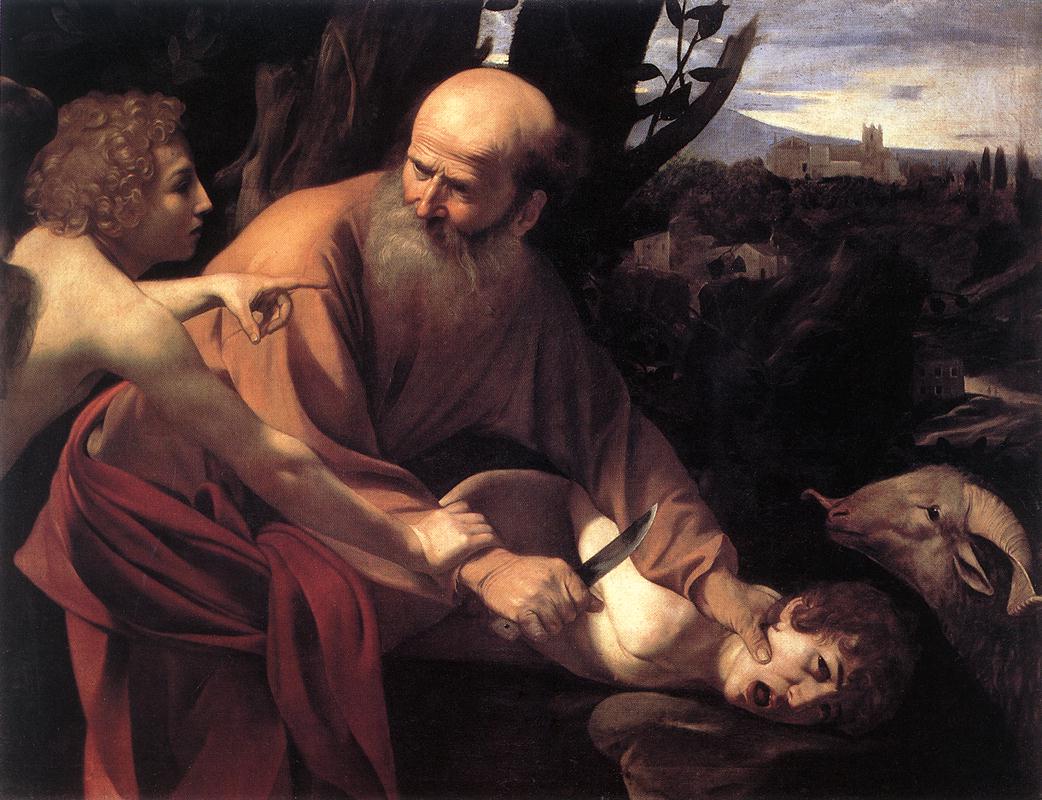 |
|
|
||

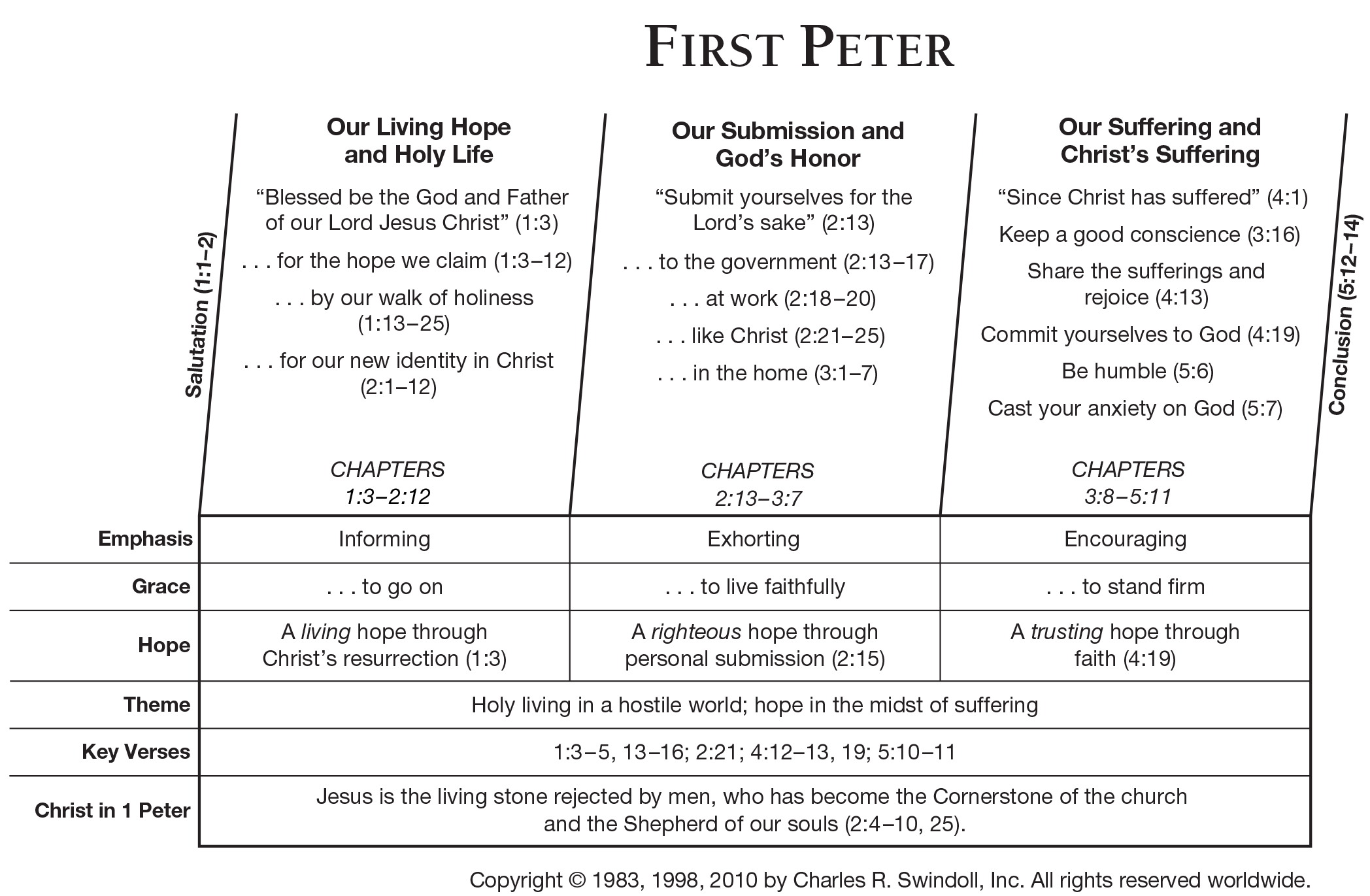
- A type of Christ -Exodus 12:3; 1Corinthians 5:7
- A male of the first year -Exodus 12:5; Isaiah 9:6
- Without blemish -Exodus 12:5; 1Peter 1:19
- Taken out of the flock -Exodus 12:5; Hebrews 2:14,17
- Chosen before-hand -Exodus 12:3; 1Peter 2:4
- Shut up four days that it might be closely examined -Ex 12:6; Jn 8:46; 18:38
- Killed by the people -Exodus 12:6; Acts 2:23
- Killed at the place where the Lord put his name -Dt 16:2,5-7; 2Chr 35:1; Lk 13:33
- Killed in the evening -Exodus 12:6; Mark 15:34,37
- Its blood to be shed -Exodus 12:7; Luke 22:20
- Blood of, sprinkled on lintel and door-posts -Ex 12:22; Heb 9:13,14; 10:22; 1Peter 1:2
- Blood of, not sprinkled on threshold -Exodus 12:7; Hebrews 10:29
- Not a bone of, broken -Exodus 12:46; John 19:36
- Not eaten raw -Exodus 12:9; 1Corinthians 11:28,29
- Roasted with fire -Exodus 12:8; Psalms 22:14,15
- Eaten with bitter herbs -Exodus 12:8; Zechariah 12:10
- Eaten with unleavened bread -Exodus 12:39; 1Corinthians 5:7,8; 2Corinthians 1:12
- Eaten in haste -Exodus 12:11; Hebrews 6:18
- Eaten with the loins girt -Exodus 12:11; Luke 12:35; Ephesians 6:14; 1Peter 1:13
- Eaten with staff in hand -Exodus 12:11; Psalms 23:4
- Eaten with shoes on -Exodus 12:11; Ephesians 6:15
- Not taken out of the house -Exodus 12:46; Ephesians 3:17
- What remained of it till morning to be burned -Exodus 12:10; Matthew 7:6; Luke 11:3
UNBLEMISHED AND SPOTLESS: amomou kai aspilou:
- Jn 7:18; 8:46, 2Cor 5:21; Heb 4:15, 7:26, 9:14
- 1 Peter 1 Resources - Multiple Sermons and Commentaries
Unblemished (amomos from a = without + momos = spot, blemish, blot, flaw) is literally without spot or blemish and so is free from faultiness.
This picture reminds one of the Old Testament sacrificial animal which was required to be free of defects (Ex 12:5 = Passover Lamb foreshadowing Christ = 1Cor 5:7; cp Lev 1:3, et al). Under Jewish law before an animal could be offered as a sacrifice it must be inspected and if any blemish was found it must be rejected as unfit for an offering to God. Only the best was fit to offer to God.
Amomos - 8x in 8v - Study the uses of amomos. NAS Usage: above reproach(1), blameless(5), unblemished(1), without blemish(1).
Eph 1:4 just as He chose us in Him before the foundation of the world, that we would be holy and blameless before Him. In love
Ep 5:27 that He might present to Himself the church in all her glory, having no spot or wrinkle or any such thing; but that she would be holy and blameless.
Php 2:15 so that you will prove yourselves to be blameless and innocent, children of God above reproach in the midst of a crooked and perverse generation, among whom you appear as lights in the world,
Col 1:22 yet He has now reconciled you in His fleshly body through death, in order to present you before Him holy and blameless and beyond reproach--
He 9:14 how much more will the blood of Christ, who through the eternal Spirit offered Himself without blemish to God, cleanse your conscience from dead works to serve the living God?
1 Peter 1:19 but with precious blood, as of a lamb unblemished and spotless, the blood of Christ.
Jude 1:24 Now to Him who is able to keep you from stumbling, and to make you stand in the presence of His glory blameless with great joy,
Rev 14:5 And no lie was found in their mouth; they are blameless.
Take a moment to worship the worthy Lamb and meditate on our position as blameless in Christ the Blameless One Who emptied Himself to take All the Blame on Himself (1Pe 2:24, 2Cor 5:21)! Then read Spurgeon's devotional where on faultless the KJV translation of blameless. Then motivated by this truth and enabled by the Spirit walk in a manner worthy of your call to be blameless and
Do ( = Command to make this your daily, habitual practice! Only possible as we rely on the Spirit rather than relying on self! See Phil 2:13 where you see the "Power Source" that in context enables you to obey this impossible command - yes, impossible, but praise God, HIMpossible!) all things without grumbling or disputing; so that you will prove yourselves to be blameless and innocent, children of God above reproach (amomos = blameless) in the midst of a crooked and perverse generation, among whom you appear as lights in the world" (Php 2:14, 15-notes)
In its secular use amomos was a technical word to designate the absence of something amiss in a sacrifice or something which would render it unworthy to be offered.
In the Septuagint (LXX) amomos is used three times in one verse noting that the Nazarite (notes)
shall present his offering to the LORD: one male lamb a year old without defect (amomos) for a burnt offering and one ewe-lamb a year old without defect (amomos) for a sin offering and one ram without defect (amomos) for a peace offering" (Nu 6:14)
Barclay adds that amomos "thinks of the whole man as an offering to God. It thinks of taking every part of our life, work, pleasure, sport, home life, personal relationships, and making them all such that they can be offered to God. This word does not mean that the Christian must be respectable; it means that he must be perfect. To say that the Christian must be amomos is to banish contentment with second bests; it means that the Christian standard is nothing less than perfection.: (Daily Study Bible Commentary on Ephesians)
Amomos in classical Greek was a technical word signifying the absence of something amiss in a (pagan) sacrifice or something which would render it unworthy to be offered.
In reference to Jesus the Lamb of God, "unblemished" clearly alludes to the sinlessness of Christ which is often affirmed in Scripture (2Co 5:21; 1 Peter 1:22 1Jn 3:5; Jn 8:29).
In Adam all men are blemished, but in Christ all are now blameless having been "covered" by His precious "blameless" blood
Spotless (784) (aspilos [word study] from a = without + spílos = spot) means without blemish or defect (outward condition) and figuratively in a moral sense, pure (inward character). Peter is describing the flawless integrity and uncompromising holiness of the God-Man Christ Jesus. He Alone is as our ideal of personal purity, a vision believers should ever hold before their gaze in anticipation of Christ's return, the "example for (us) to follow in His steps" (1Pe 2:21). Don't follow the example of the false teachers who are spots and blemishes (2Pe 2:13) but follow the spotless One.
Aspilos - 4x in 4v - 1Ti 6:14; Jas 1:27; 1Pe 1:19; 2Pe 3:14
Thayer writes that metaphorically aspilos meant…
free from censure, irreproachable (as in 1Ti 6:14), free from vice, unsullied (2Pe 3:14).
THE BLOOD OF CHRIST: Christou:
- "His BLOOD" - 1Pet 1:2, Mt 26:28, Mt 27:4, Mt 27:24, Mt 27:25, Jn 6:53, 54, 55, 56,Jn 19:34, Ro 3:25, Ro 5:9, 1Cor 11:25, Eph 1:7, Eph 2:13, Col 1:20, Heb 9:12, Heb 9:14, Heb 9:22, Heb 9, 1Jn1:7, Rev 1:5, Rev 5:9, Rev 7:14, Rev 12:11
- 1 Peter 1 Resources - Multiple Sermons and Commentaries
THE BLOOD
OF
CHRIST
The blood - The words "the blood" are not in the Greek here but are clearly warranted by the context.
Blood - The blood of anyone is "precious" far above gold or silver for the blood makes the person's life possible, but the blood of Jesus is immeasurably, infinitely more precious. Think of the solemn day of atonement when the blood was sprinkled seven times on the east side of the mercy seat (kipporeth = place of propitiation) by the high priest and contrast this blood of bulls and goats with the precious blood of the Lamb of God Who ministered as our High Priest with one sacrifice for all time. Why? because He sacrificed "precious blood". If a believer is tempted to return to worldly pleasures and amusements, to adopt worldly modes and patterns, to become like the world in its false ways, he should remember that Christ shed His blood to deliver him from that kind of life. To go back to the world is to re-cross the great gulf that was bridged for us at staggering cost. But even more it is boldfaced disloyalty to the Savior Who bought us and owns us (cp Titus 2:14, Rev 5:9, Acts 20:28, 1Cor 6:19, 20).
Tony Garland has the following insights of "the blood of Christ"…
A bloodless gospel is no gospel. Without the shedding of blood there is no remission of sin. The redeemed of this age are “the church of God which He purchased with His own blood” [emphasis added] (Acts 20:28). Redemption provides for the forgiveness of sin—that which separates man from God—and was made possible “through His blood” [emphasis added] (Col. 1:14). This is the reason why Christ’s blood is said to be “precious” (1Pe. 1:19) (A Testimony of Jesus Christ - Revelation 5:9)
A bloodless gospel is an ineffectual gospel. For it is by the spilling of blood that God has chosen to atone for sin (Lev. 17:11; Heb. 9:22).
Why did God choose blood for this purpose? Ultimately, we may never know, for the “secret things belong to the LORD our God” (Dt 29:29). Scripture reveals that the use of blood for atonement is related to its life-giving qualities (Ge. 9:4). The “life of the flesh is in the blood” (Lv 17:11). “Life” in this verse is Hebrew word nephesh and is the same me term which is translated “soul” where Scripture records the once-for-all atonement made by Isaiah’s Suffering Servant: “Yet it pleased the LORD to bruise Him; He has put Him to grief. When You make His soul (nephesh) an offering for sin” (Isa. 53:10). By His blood atonement, Jesus was prophesied to “sprinkle many nations” (Is 52:15), thus fulfilling the many OT types pointing to Him.
It was by blood sacrifice that the first man and woman were covered in response to their sin (Ge 3:21). It was by blood sacrifice that the first men were to approach God (Ge 4:4). It was by a blood sacrifice that God established His covenant with Abraham (Ge 15:9-21). It was by blood placed on the door posts and lintel that the Jews were “covered” from the destroyer Who passed over Egypt taking the firstborn of each family (Ex. 12:23). It was by the sprinkling of blood that the Mosaic Law was ratified between God and the Israelites (Ex 24:8). Ever since the bloodless offering of Cain (Ge. 4:3, 4, 5), man has attempted to approach God by some other means than that which God Himself has established. These would try to circumvent the single path which God requires: “Jesus said to him, ‘I am the way, the truth, and the life. No one comes to the Father except through Me.’ ” (Jn 14:6)
This necessity of blood offering is offensive to man, and we believe intentionally so. For it is a messy business and continual reminder of man’s lack of righteousness (Ro 3:23) and his desperate need of the “righteousness of God,” a righteousness which is freely given rather than earned (Ro 3:21, 22, 23, 24, 25, 26; 2Co 5:21; Php 3:9). Yet many prefer to continue in the way of religion rather than relationship, offering up their own puny works in a vain attempt to justify themselves before a perfect and Holy God (Ro 10:3).
Religion preserves our pride,
whereas
relationship requires us to cast it aside.
The following verses may be studied for further insight into the atoning characteristics of Christ’s blood: Ge 9:4; Ex. 12:23; 24:8; Lv. 17:11; Isa 52:15; Zec 9:11; Mt. 26:28; 27:4; Lk 22:20; Jn 19:30; Acts 20:28; Ro 5:9; 1Co 10:16; Ep 1:7; 2:13; Col 1:14, 20; 2:14, 15; He 9:12, 14, 22; 10:19, 29; 11:28; 12:24; 13:12, 20; 1Pe 1:18, 19; 1Jn. 1:7; 5:8; Re 1:5; 5:9; 7:14; 12:11. (A Testimony of Jesus Christ - Revelation 1:5)
Vance Havner in a sermon entitled Playing Marbles with Diamonds said "This is a day of depreciation and devaluation. Financiers have been worried about the French franc, the British pound, and the American dollar. But economics is not the only area that has been cheapened these days. We live in an age of sham and make‑believe, superficiality and ballyhoo, lowered values, and marked‑down prices… We have cheap salvation. Salvation is free but not cheap. We are not redeemed with silver and gold but with the blood of Jesus Who gave Himself a ransom for many. The writer of Hebrews speaks of those who count the blood of the covenant an unholy thing. One translation puts it, "who treats as a cheap thing"; another, "treated like dirt."
When you and I meditate on the sacrifice of Christ for us, certainly we should want to obey God and live holy lives for His glory. When only a young lady, Frances Ridley Havergal saw a picture of the crucified Christ with this caption under it: “I did this for thee. What hast thou done for Me?” Quickly, she wrote a poem, but was dissatisfied with it and threw it into the fireplace. The paper came out unharmed! Later, at her father’s suggestion, she published the poem, and today we sing it.
I gave My life for thee,
My precious blood I shed;
That thou might ransomed be,
And quickened from the dead.
I gave, I gave, My life for thee,
What hast thou given for Me?
A good question, indeed!
C H Spurgeon - Two soldiers were on duty in the citadel of Gibraltar. One of them had obtained peace through the precious blood of Christ; the other was in very great distress of mind. It happened to be their turn to stand, both of them, sentinel the same night. There are many long passages in the rock, which are adapted to convey sounds a very great distance.
The soldier in distress of mind was ready to beat his breast for grief. He felt he had rebelled against God, and he could not find how he could be reconciled. Suddenly there came through the air what seemed to him to be a mysterious voice from heaven saying, "The precious blood of Christ." In a moment he saw it all. It was that which reconciled us to God, and he rejoiced with joy unspeakable and full of glory.
Who was it that had spoken these words? The other sentinel at the far end of the passage was meditating, when an officer came by. It was his duty to give a word for the night, and with soldier-like promptitude he did give it. But instead of giving the proper word, he was so taken up with his meditations that he said to the officer, "The precious blood of Christ." He corrected himself in a moment, but he had said it, and it passed along the passage and reached the ear for which God meant it. The man found peace and spent his life in the fear of God, being in later years the means of completing one of our excellent translations of the word of God into the Hindu language.
Spurgeon's Morning and Evening - "Faultless (amomos) before the presence of his glory." Jude 1:24 - Revolve in your mind that wondrous word, "faultless!" We are far off from it now; but as our Lord never stops short of perfection in his work of love, we shall reach it one day. The Saviour who will keep his people to the end, will also present them at last to himself, as "a glorious church, not having spot, or wrinkle, or any such thing, but holy and without blemish." All the jewels in the Saviour's crown are of the first water and without a single flaw. All the maids of honour who attend the Lamb's wife are pure virgins without spot or stain. But how will Jesus make us faultless? He will wash us from our sins in his own blood until we are white and fair as God's purest angel; and we shall be clothed in his righteousness, that righteousness which makes the saint who wears it positively faultless; yea, perfect in the sight of God. We shall be unblameable and unreproveable even in his eyes. His law will not only have no charge against us, but it will be magnified in us. Moreover, the work of the Holy Spirit within us will be altogether complete. He will make us so perfectly holy, that we shall have no lingering tendency to sin. Judgment, memory, will-every power and passion shall be emancipated from the thraldom of evil. We shall be holy even as God is holy, and in his presence we shall dwell for ever. Saints will not be out of place in heaven, their beauty will be as great as that of the place prepared for them. Oh the rapture of that hour when the everlasting doors shall be lifted up, and we, being made meet for the inheritance, shall dwell with the saints in light. Sin gone, Satan shut out, temptation past for ever, and ourselves "faultless" before God, this will be heaven indeed! Let us be joyful now as we rehearse the song of eternal praise so soon to roll forth in full chorus from all the blood-washed host; let us copy David's exultings before the ark as a prelude to our ecstasies before the throne.
Related Resource:
- John 1:29 What does it mean that Jesus is the Lamb of God?
- See Chart of Kinsman-Redeemer and Old Testament Shadows fulfilled in the New Testament
GENESIS: In the Old Testament, the question is “WHERE IS THE LAMB?” In Genesis 22 God commanded Abraham "Take now your son, your only son, whom you love, Isaac, and go to the land of Moriah; and offer him there as a burnt offering on one of the mountains of which I will tell you." (Ge 22:2) On the way to the mountain, Isaac asked his father “Where is the LAMB for the burnt offering?” (Ge 22:7) to which Abraham replied "God will provide for Himself the LAMB for the burnt offering, my son." (Ge 22:8). As Abraham prepared to sacrifice Isaac whom he loved, he “raised his eyes and looked and behold, behind him a ram caught in the thicket by his horns; and Abraham went and took the ram and offered him up for a burnt offering in the place of (as a "substitute" for) his son." (Ge 22:13) "Abraham called the name of that place the LORD WILL PROVIDE, (JEHOVAH JIREH) as it is said to this day, "In the mount of the LORD it will be provided." (Ge 22:14) JEHOVAH JIREH is more literally "Jehovah will see,” which conveys the idea that Jehovah sees the need before it arises and provides for the need! The Omniscient One sees your need beloved. The amazing God of all grace (1Pe 5:10) not only foresaw Abraham's need for ”A” lamb, but even more amazing, foresaw our need for “THE” LAMB OF GOD to be our Substitute. And so Paul could testify that “God saved us and called us with a holy calling, not according to our works (not because of any “merit” or because we deserved it), but according to His own purpose and grace, which was given us in Christ Jesus from all eternity (Jehovah saw our need for the LAMB OF GOD, even before time began!)” (2Ti 1:9) Spurgeon writes that we "admire Abraham's giving up his son to God. Much more admire Jehovah's giving up His Son for sinners. Jehovah is the great Provider, and He provides the offering, not only for us, but for Himself, for the sacrifice was necessary to God as well as to man. And it is a burnt offering, not only a sin-offering but an offering of a sweet savor unto Himself."
EXODUS: In Exodus Israel was groaning because of enslavement by Egypt and in great need, a need which Jehovah saw, declaring “I will DELIVER you from bondage. I will REDEEM you with an outstretched arm (In light of the Cross, ponder God's redemption by His “outstretched arm!”) and with great judgments.” (Ex 6:6) God redeemed Israel from slavery in Egypt with the blood of a LAMB, instructing Moses “your LAMB shall be an unblemished male a year old…You shall keep it until the 14th day of (Nisan), then the whole assembly of the congregation of Israel is to kill it at twilight. Take some of the blood and put it on the two doorposts (vertical motion) and on the lintel (horizontal part of the doorframe) (ponder the application of blood vertically and horizontally – could this foreshadow the Cross?) of the houses in which they eat it. And they shall eat the flesh that same night….it is the LORD'S Passover… For the LORD will pass through to smite the Egyptians; and when He sees the blood on the lintel and on the two doorposts, the LORD will pass over the door and will not allow the destroyer to come in to your houses to smite you." (Exodus 12:5-8,11, 23) Clearly Christ's death on the Cross was foreshadowed in Exodus 12 by the sacrifice of an unblemished lamb whose blood was applied to the entry door, for centuries later Paul recorded the inspired words that “Christ our PASSOVER [LAMB] has been sacrificed.” (1Cor 5:7Amplified) Paul adds that "now in Christ Jesus you who formerly were far off have been brought near by the blood of Christ." (Eph 2:13 Beloved, may God grant each of us the Spirit's power to “conduct ourselves in (reverent) fear during the time of our (relatively short) stay upon earth, knowing that we were not redeemed with perishable things like silver or gold from your futile (useless in light of eternity) way of life inherited from your forefathers, but with PRECIOUS BLOOD, AS OF A LAMB unblemished and spotless, the blood of Christ” (1Peter 1:17-19-note)
Spurgeon comments on the precious blood of the Lamb of God: "Standing at the foot of the Cross, we see hands, and feet, and side, all distilling crimson streams of precious blood. It is “PRECIOUS” because of its redeeming and atoning efficacy. By it the sins of Christ’s people are atoned for; they are redeemed from under the law; they are reconciled to God, made one with Him. Christ’s blood is also “PRECIOUS” in its cleansing power; it “cleanses us from all sin.” (1 Jn 1:7) “Though your sins are as scarlet, they shall be as white as snow.” (Isa 1:18) Through Jesus’ blood there is not a spot left upon any believer, no wrinkle nor any such thing remains. O precious blood, which makes us clean, removing the stains of abundant iniquity, and permitting us to stand "accepted in the Beloved" (Eph 1:6KJV), notwithstanding the many ways in which we have rebelled against our God. The blood of Christ is likewise “PRECIOUS” in its preserving power. We are safe from the destroying angel under the sprinkled blood. Remember it is God’s seeing the blood which is the true reason for our being spared. Here is comfort for us when the eye of faith is dim, for God’s eye is still the same. The blood of Christ is “PRECIOUS” also in its sanctifying influence. The same blood which justifies by taking away sin, does in its after-action, quicken the new nature and lead it onward to subdue sin and to follow out the commands of God. There is no motive for holiness so great as that which streams from the veins of Jesus. And “PRECIOUS,” unspeakably precious, is this blood, because it has an overcoming power. It is written, “They overcame through the BLOOD OF THE LAMB.” (Rev 12:11KJV, cf 1Jn 5:4-5) How could they do otherwise? He who fights with the precious blood of Jesus, fights with a weapon which cannot know defeat. The blood of Jesus! sin dies at its presence, death ceases to be death: heaven’s gates are opened. The blood of Jesus! we shall march on, conquering and to conquer, so long as we can trust its power!"
ISAIAH: "All of us like sheep have gone astray, each of us has turned to his own way, but the LORD has caused the iniquity of us all to fall on Him (literally "laid on Him with a death-dealing blow"). He was oppressed and He was afflicted, yet He did not open His mouth. Like a LAMB that is led to slaughter, and like a sheep that is silent before its shearers, so He did not open His mouth.” (Isaiah 53:6-7) Centuries later when the Ethiopian Eunuch ask Phillip “of Whom does the prophet Isaiah speak?” “Philip opened his mouth and beginning from (Isaiah 53:7) he preached Jesus to him.” (Acts 8:32-35)
THE GOSPEL OF JOHN: John the Baptist answers the Old Testament question, declaring “Behold the LAMB OF GOD Who takes away the sin of the world.” (Jn 1:29). The renowned preacher C H Spurgeon once tested an auditorium in which he was to speak that evening. Stepping into the pulpit, Spurgeon loudly proclaimed, "Behold the lamb of God, Who takes away the sin of the world." Satisfied with the acoustics, he left and went his way. Unknown to him, there were two men working in the rafters of that large auditorium, neither one a Christian. One of the men was pricked in his conscience by the verse Spurgeon quoted and became a believer later that day! May Spurgeon's experience encourage all of us to boldly, unashamedly proclaim the Gospel of the Lamb, which is the power of God for salvation to everyone who believes (Ro 1:16).
THE REVELATION OF JESUS CHRIST: Keep in mind that the most common Name for Jesus in the Revelation is "THE LAMB." (Lamb -29x, Jesus-14x!) After our Lord Jesus Christ had been raised from the dead on the third day according to the Scriptures (1Cor 15:4), He came into the room in the presence of the 11 disciples, and encouraged Thomas (who was doubting the truth of His resurrection) to “Reach here your finger and see My hands and reach here your hand, and put it into My side and be not unbelieving, but believing.” Thomas answered and said to Him, "My Lord and my God!" (Jn 20:27-28) Those same nail-scarred hands John saw in that room on earth, were the very scars he saw in his glorified Lord's hands in heaven when he testified “I saw between the throne and the elders a LAMB standing, as if SLAIN (The same Greek verb [sphazo] was used to describe the slaughter of the Passover lamb in Ex 12:6!)” (Revelation 5:6). Spurgeon asks "Why should our exalted Lord appear in His wounds in glory? The wounds of Jesus are His glories, His jewels, His sacred ornaments. Jesus wears the appearance of a SLAIN LAMB as His court dress in which He wooed our souls, and redeemed them by His complete atonement. Nor are these only the ornaments of Christ: they are the trophies of His love and of His victory. He has divided the spoil with the strong. He has redeemed for Himself a great multitude whom no man can number, and these SCARS are the memorials of the fight. Ah! if Christ thus loves to retain the thought of His sufferings for His people, how precious should His wounds be to us!"
In Isaiah Jehovah declared “Behold, I have inscribed (engraved) you on the palms of My hands.” (Isa 49:16) Spurgeon asks "What are these wounds in Thy hands, these sacred stigmata, these ensigns of suffering? The graver’s tool was the nail, backed by the hammer. He must be fastened to the Cross, that His people might be truly graven on the palms of His hands. There is much consolation here. We know that what a man has won with great pain he will keep with great tenacity. Child of God, you cost Christ too much for Him to forget you." Spurgeon goes on to add "It does not say, “Thy name.” Yes, the name is there, but that is not all: “I have graven THEE.” See the fulness of this! I have graven thy person, thine image, thy case, thy circumstances, thy sins, thy temptations, thy weaknesses, thy wants, thy works; I have graven thee, everything about thee, all that concerns thee; I have put thee altogether there. Wilt thou ever say again that thy God hath forsaken thee when he has graven thee upon His own palms?" See also onsite devotional Inscribed on His Hands).
In the face of such amazing love, how could God ever forget His people? Do you ever feel like He has forgotten you or your difficult circumstances? Then take heart, for He Himself has declared “I will never desert you, nor will I ever forsake you.” (Heb 13:5) and the scars on the Lamb that was slain seal His promise forever! Augustus Toplady spoke of this great truth writing "My name from the palms of His hands eternity will not erase; Impressed on His heart it remains, in marks of indelible grace. Yes, I to the end shall endure, as sure as the earnest is giv’n; More happy, but not more secure, then even the glorified spirits in Heav’n." (Hymn: A Debtor to Mercy Alone) As Spurgeon remarks "How loving, then, how full of superlative, super-excellent affection is God toward you and toward me in so recording our names." In view of so great a sacrifice procured by the meek and gentle Lamb of God, let us join now with that heavenly throng singing with a loud voice “Worthy is the LAMB that was SLAIN to receive power and riches and wisdom and might and honor and glory and blessing… To Him who sits on the throne, and to the LAMB, be blessing and honor and glory and dominion forever and ever." (Revelation 5:12-13)
TO SUMMARIZE: The question in the OT was “WHERE IS THE LAMB?” The answer in the NT is “BEHOLD THE LAMB!” Our cry throughout eternity will be “ WORTHY IS THE LAMB!” And all God’s children said “Hallelujah! Amen!”
In the mysterious working of God, the LAMB Who died to redeem us and give us new life in Himself is now our SHEPHERD (cf Rev 7:17) Who ever lives to make us, His SHEEP, lie down in green pastures, to lead us beside still waters, to restore our soul, to guide us in the paths of righteousness for His name’s sake, to walk with us through the valley of the shadow of death, to prepare a table before us in the presence of our enemies, to anoint our head with oil, to cause our cup to overflow. “Surely goodness and lovingkindness will follow (us) all the days of (our) life, and (we) will dwell in the house of the LORD forever.” (Ps 23:1-6)
Father, as we BEHOLD THE LAMB "slain from the foundation of the world" (Rev 13:8KJV) and ponder with wonder and awe the REDEMPTION wrought by our REDEEMER’S precious blood, may Your Spirit use this eternal Word of Truth to enable us to daily die to self and lovingly follow the Good Shepherd all the days of our life. Amen
Worship the Lamb singing MY REDEEMER LIVES - NICOLE C MULLEN
Redemption by
|
||||
|
The Question in Where is |
The Answer in Behold |
The Cry throughout eternity is... Worthy |
||
|
The ram in |
The Passover |
The Lamb |
Christ our Passover |
The Lamb |
|
Ge 22:1, 2, 7, 8, 13, 14 |
Ex 12:5, 6, 7, 13, 14 |
Jn 1:29, 36 |
1Cor 5:7 |
Jn 20:20, 27 |
|
|
|
||