1 Peter 1:2
1 Peter 1:3
1 Peter 1:4
1 Peter 1:5
1 Peter 1:6
1 Peter 1:7
1 Peter 1:8
1 Peter 1:9
1 Peter 1:10
1 Peter 1:11
1 Peter 1:12
1 Peter 1:13
1 Peter 1:14
1 Peter 1:15
1 Peter 1:16
1 Peter 1:17
1 Peter 1:18
1 Peter 1:19
1 Peter 1:20
1 Peter 1:21
1 Peter 1:22
1 Peter 1:23
1 Peter 1:24
1 Peter 1:25
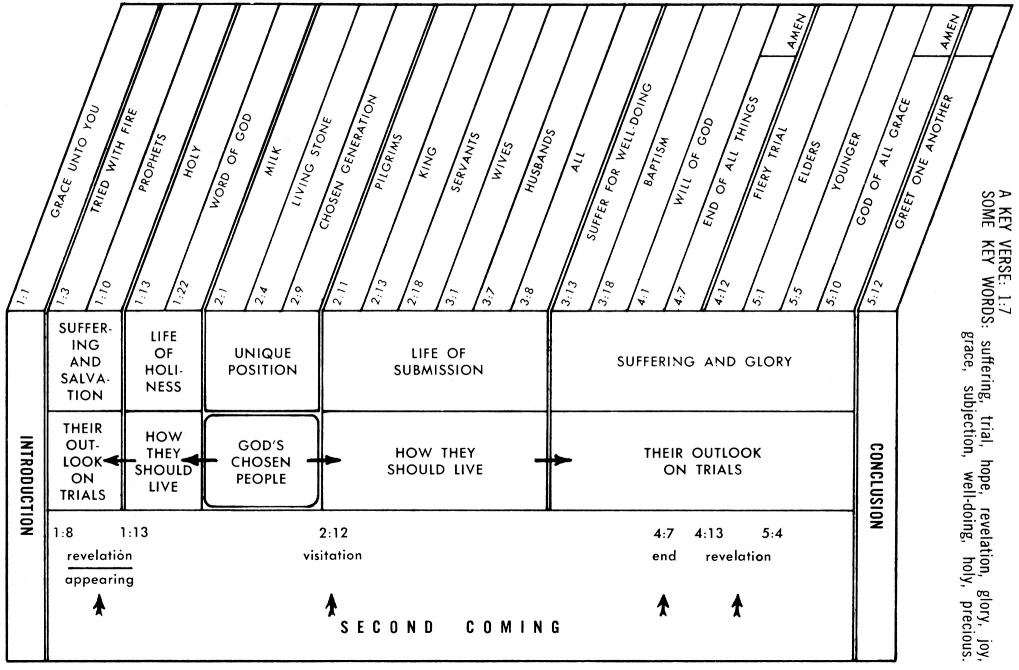
1 Peter: Trials, Holy Living & The Lord's Coming
Click chart to enlarge
Chart from Jensen's Survey of the NT - used by permission
See Another Chart from Charles Swindoll
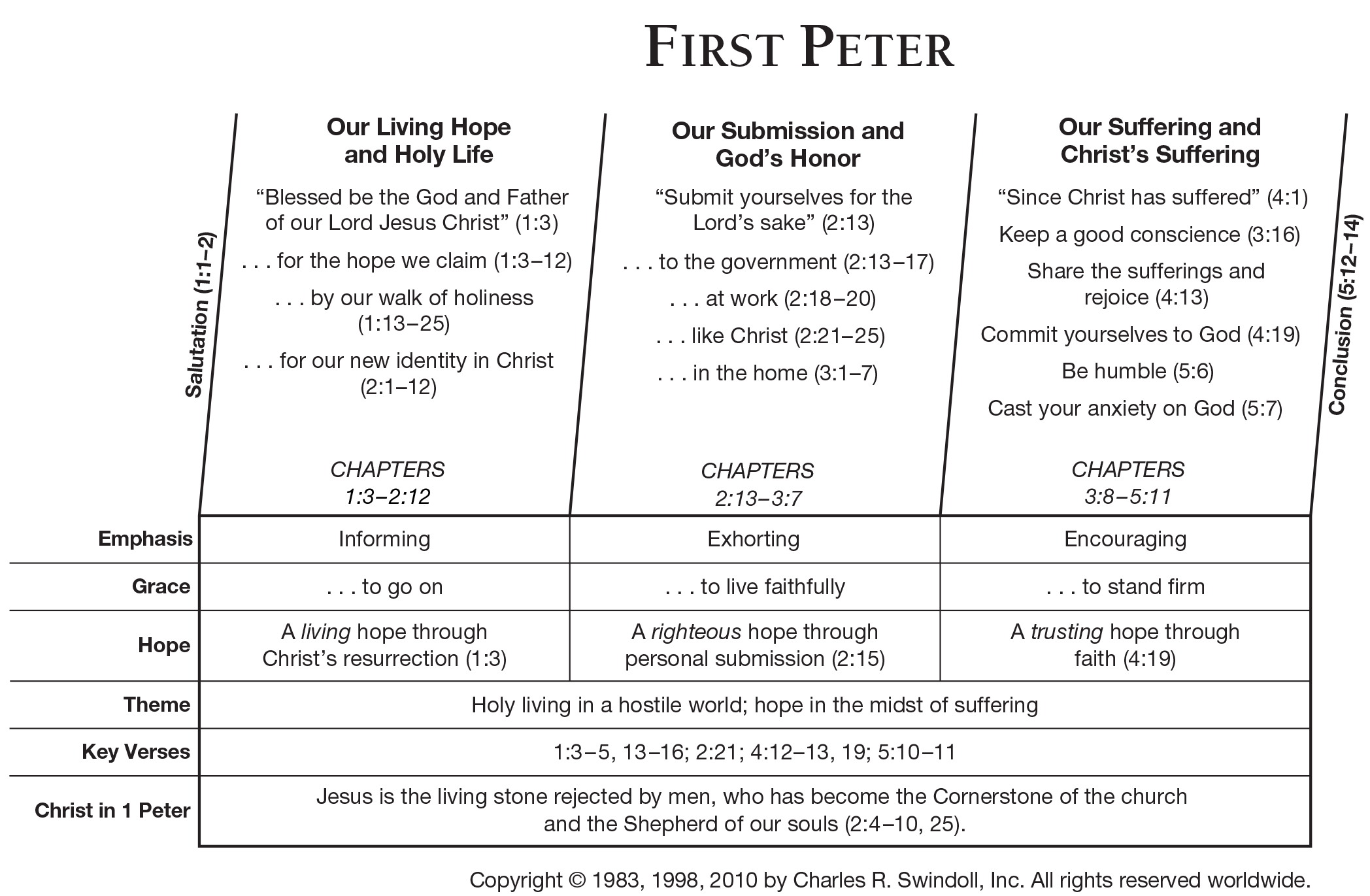
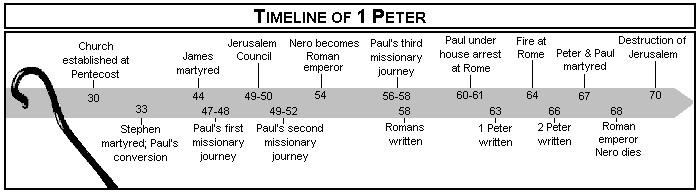
Source: Borrow Ryrie Study Bible
Click to enlarge
PART I: DOCTRINAL FOUNDATION
I. The Opening Salutation (1Pe 1:1-2)
A. The Writer (1Pe 1:1a)
B. The Readers (1Pe 1:1b-2a)
1. True character of the readers (1Pe 1:1b)
2. Geographical location of the readers (1Pe 1:1c)
3. Spiritual supports for the readers (1Pe 1:2a)
C. The Greeting (1Pe 1:2b)
II. The Thanksgiving for Our Salvation (1Pe 1:3-12)
A. The Description of Salvation (1Pe 1:3-5)
1. The author of salvation (1Pe 1:3a-b)
a. His relation to the Savior (1Pe 1:3a)
b. His act of mercy to the saved (1Pe 1:3b)
2. The nature of salvation (1Pe 1:3c-4a)
a. The living hope grounded in Christ's resurrection (1Pe 1:3c)
b. The glorious inheritance awaiting believers (1Pe 1:4a)
3. The certainty of salvation (1Pe 1:4b-5)
a. The safekeeping of the inheritance (1Pe 1:4b)
b. The preservation of the heirs (1Pe 1:5)
B. The Experiences Relating to Salvation (1Pe 1:6-9)
1. The paradoxical nature of the experiences (1Pe 1:6-7)
a. The experience of exultation (1Pe 1:6a)
b. The experience of distress (1Pe 1:66-7)
1. The nature of the distress (1Pe 1:6b)
2. The purpose behind the trials (1Pe 1:7)
a. The testing of faith (1Pe 1:7a)
b. The outcome of the testing (1Pe 1:7b)
2. The sustaining relations of believers (1Pe 1:8-9)
a. Their dual relation to Jesus Christ (1Pe 1:8)
b. Their experiential relation to their salvation (1Pe 1:9)
C. The Magnification of Salvation (1Pe 1:10-12)
1. The magnification through prophetic research (1Pe 1:10-12a)
a. Their intensive search (1Pe 1:10a)
b. Their prophetic function (1Pe 1:10b)
c. Their personal perplexity (1Pe 1:11)
1. The time and circumstances (1Pe 1:11a)
2. The sufferings and the glories (1Pe 1:11b)
d. Their restricted ministry (1Pe 1:12a)
2. The magnification through Christian proclamation (1Pe 1:12b)
3. The magnification through angelic inquiry (1Pe 1:12c)
PART 2: PRACTICAL EXHORTATION
I. Exhortations in View of Our Salvation (1Pe 1:13-2:10)
A. The Life Arising from Salvation (1Pe 1:13-2:3)
1. The Christian life in relation to God (1Pe 1:13-21)
a. A life of steadfast hope (1Pe 1:13)
1. The supports of hope (1Pe 1:13a)
2. The call to hope (1Pe 1:13b)
b. A life of personal holiness (1Pe 1:14-16)
1. The foundation for personal holiness (1Pe 1:14a)
2. The call to personal holiness (1Pe 1:14b-15)
a. The negative demand of holiness (1Pe 1:14b)
b. The positive call to holiness (1Pe 1:15)
3. The justification of the call to holiness (1Pe 1:16)
c. A life of motivated reverence (1Pe 1:17-21)
1. The basis for reverent living (1Pe 1:17a)
2. The call for reverent living (1Pe 1:17b)
3. The knowledge that motivates reverence (1Pe 1:18-21)
a. The means of our redemption (1Pe 1:18-19)
b. The nature of the Redeemer (1Pe 1:20)
c. The characteristics of the redeemed (1Pe 1:21)
2. The Christian life in relation to the brethren (1Pe 1:22-25)
a. The experience of inner purification (1Pe 1:22a)
b. The duty of mutual love (1Pe 1:22b)
c. The foundation in personal regeneration (1Pe 1:23-25)
1. The fact of their regeneration (1Pe 1:23a)
2. The nature of their regeneration (1Pe 1:23b-25a)
3. The evangelization leading to their regeneration (1Pe 1:25b) (D Edmond Hiebert)
1 Peter 1:20 For He was foreknown (RPP) before the foundation of the world, but has appeared (APP) in these last times for the sake of you (NASB: Lockman)
Greek: proegnosmenou (RPPMSG) men pro kataboles kosmou, phanerothentos (APPMSG) de ep' eschatou ton chronon di' humas
Amplified: It is true that He was chosen and foreordained (destined and foreknown for it) before the foundation of the world, but He was brought out to public view (made manifest) in these last days (at the end of the times) for the sake of you. (Amplified Bible - Lockman)
MLB: foreknown, to be sure, before the foundation of the world, but disclosed at the end of the times for your sakes,
Moffat: He was predestined before the foundation of the world and has appeared at the end of the ages for your sake;
NLT: God chose him for this purpose long before the world began, but now in these final days, he was sent to the earth for all to see. And he did this for you. (NLT - Tyndale House)
Weymouth: He was pre-destined indeed to this work, even before the creation of the world, but has been plainly manifested in these last days for the sake of you who, through Him,
Wuest: Who indeed was foreordained before the foundation of the universe was laid, but was visibly manifested at the closing years of the times for your sake,
Young's Literal: foreknown, indeed, before the foundation of the world, and manifested in the last times because of you,
FOR HE WAS FOREKNOWN: proegnosmenou (RPPMSG):
- Ge 3:15 (See the protoevangelium) Pr 8:23; Mic 5:2; Acts 2:23; 4:27, 4:28 Ro 3:25; 16:25,26; Ep 1:4; 3:9,11; Col 1:26; 2Ti 1:9,10; Titus 1:2,3; Rev 13:8
- 1 Peter 1 Resources - Multiple Sermons and Commentaries
MESSIAH WAS
PROPHESIED
For - This word is usually a term of explanation at the beginning of a sentence but is misleading in the NAS, because the preposition is not actually present in the Greek text.
He - The Messiah. The redemptive plan based on the sacrifice of Christ was planned in eternity past, even before Adam sinned. In other words, the fall of Adam and all men (for all were in Adam's line) did not catch God off guard.
Was foreknown - Literally "he having been foreknown".
Peter Davids - It was not an accident that this price was paid (1Pe 1:18-19): God paid it deliberately; that is, it was a plan "chosen in advance, before the foundation of the world." (NICNT)
Wayne Grudem observes that proginosko is translated in most versions "with some word implying predestination: ‘foreordained’ (AV); ‘predestined’ (NEB); ‘chosen’ (NIV). This is because of (1) a sense that when God knows something beforehand it is certain that that event will occur, and assuming the event to be therefore ordained by God seems to be the only alternative to the non-Christian idea of a certainty of events brought about by impersonal, mechanistic fate; (2) the fact that the use of the word when applied to God is found in contexts that suggest predestination (Acts 2:23; Ro 8:29; 11:2); (3) a realization that in this context it would make little sense for Peter merely to say that God the Father knew Christ before the foundation of the world. Rather, the immediately preceding context with its emphasis on Christ’s redeeming death suggests that it is as a suffering Saviour that God ‘foreknew’ or thought of the Son before the foundation of the world. These considerations combine to indicate that the ‘foreknowledge’ was really an act of God in eternity past whereby He determined that His Son would come as the Saviour of mankind." (1Peter: An Introduction and Commentary, InterVarsity Press, Tyndale New Testament Commentaries).
Foreknown (4267) (proginosko from pró = before + ginosko = know; see more detail on foreknowledge in study of prognosis) literally means to know about something prior to some temporal reference point or to know about an event before it happens or prior to some temporal reference point. The perfect tense speaks of a past completed action with continuing impact. As Hiebert says this "designates the central place that Christ had, and continues to hold, in God's redemptive plan."
Related Resources:
- Messianic Prophecy
- The Meaning of Proginosko - 38 page pager by Thomas Edgar
- Foreknowledge as God's Attribute
- Foreknowledge in the International Standard Bible Encyclopedia
- Foreknowledge - Cyclopedia of Biblical, Theological and Ecclesiastical Literature
- Bridgeway Bible Dictionary Foreknowledge
- Baker Evangelical Dictionary Foreknowledge
- Charles Buck Dictionary Foreknowledge of God
- CARM Theological Dictionary Foreknow, foreknowledge
- Easton's Bible Dictionary Foreknowledge of God
- Holman Bible Dictionary Foreknowledge
- Hastings' Dictionary of the Bible Foreknowledge
- Hastings' Dictionary of the NT Foreknowledge
- Vines' Expository Dictionary Foreknow, Foreknowledge
- International Standard Bible Encyclopedia Foreknow; Foreknowledge
- McClintock and Strong's Bible Encyclopedia Foreknowledge
- What is foreknowledge in the Bible?
- How are predestination and election connected with foreknowledge?
- Who are the elect of God?
The related Greek noun prognosis (used in 1Pe 1:2-note) gives us our English word which is the medical term describing the act or art of foretelling the course of a disease. Prognosis has only 2 NT uses, both referring to God…
Acts 2:23 this Man, delivered up by the predetermined (horizo = setting limits) plan and foreknowledge (prognosis - a more detailed discussion of foreknowledge) of God, you nailed to a cross by the hands of godless men and put Him to death.
Barnes commenting on Acts 2:23 writes: Foreknowledge. This word denotes the seeing beforehand of an event yet to take place. It implies, (1.) omniscience; and, (2.) that the event is fixed and certain. To foresee a contingent event, that is, to foresee that an event will take place, when it may or may not take place, is an absurdity. Foreknowledge, therefore, implies that for some reason the event will certainly take place. What that reason is, the word itself does not determine. As, however, God is represented in the Scriptures as purposing or determining future events; as they could not be foreseen by him unless he had so determined, so the word sometimes is used in the sense of determining beforehand, or as synonymous with decreeing, Romans 8:29, 11:2. In this place the word is used to denote that the delivering up of Jesus was something more than a bare or naked decree. It implies that God did it according to his foresight of what would be the best time, and place, and manner of its being done. It was not the result merely of will; it was will directed by a wise foreknowledge of what would be best. And this is the case with all the decrees of God. It follows from this, that the conduct of the Jews was foreknown. God was not disappointed in anything respecting their treatment of his Son. Nor will he be disappointed in any of the doings of men. Notwithstanding the wickedness of the world, his counsel shall stand, and he will do all his pleasure, Isaiah 46:10. (Barnes' Notes on the New Testament)
J Vernon McGee on Acts 2:23… Peter is saying that what has happened was not contrary to God's program. This is not something that took God by surprise. However, he makes it clear that this does not release men from their responsibility. Who is responsible for the crucifixion of Christ? The religious rulers were the ones who began the movement. I would say that they were largely to blame. They moved upon the multitude so that they produced mob action. They also maneuvered the Roman government to execute Him. Remember, friend, He was crucified on a Roman cross. Peter is pointing his finger at his fellow Israelites. But there is no use in our arguing about who was responsible for His death back at that time. I'll tell you who is responsible for His death. You are responsible, and I am responsible. It was for my sins and for your sins that He died. Listen to the words of Jesus: "Therefore doth my Father love me, because I lay down my life, that I might take it again. No man taketh it from me, but I lay it down of myself. I have power to lay it down, and I have power to take it again. This commandment have I received of my Father" (John 10:17-18). (J. Vernon McGee's Thru The Bible)
1 Peter 1:2 (note) according to the foreknowledge (prognosis) of God the Father, by the sanctifying work of the Spirit, that you may obey Jesus Christ and be sprinkled with His blood: May grace and peace be yours in fullest measure.
Proginosko is a word that can be very misleading if one places too much emphasis on the secular use, for in classical Greek proginosko meant to know, perceive, learn, or understand beforehand and thus implied a previous knowledge of a thing. As you can observe from the NT passages below, this purely classic sense is seen in Acts 26:5 and 2 Peter 3:17. However when one studies proginosko in reference to God, it acquires a different sense. In other words, Peter is not saying in this verse that God simply knew ahead of time that He would send His Son to redeem sinners. As discussed below, the idea is that God foreknows in the sense that He willed it to happen.
J I Packer said it this way, that God "knows, and foreknows, all things, and His foreknowledge is foreordination; He, therefore, will have the last word, both in world history and in the destiny of every man.
D. Edmond Hiebert explains that God's foreknowing "does not imply mere intellectual apprehension; it also indicates an active and affectionate desire to bless.
Here are the 5 NT uses of proginosko…
Acts 26:5 since they have known about me for a long time previously, if they are willing to testify, that I lived as a Pharisee according to the strictest sect of our religion.
Romans 8:29 (note) For whom He foreknew, He also predestined to become conformed to the image of His Son, that He might be the first-born among many brethren;
Romans 11:2 (note) God has not rejected His people whom He foreknew. Or do you not know what the Scripture says in the passage about Elijah, how he pleads with God against Israel?
Comment: Because God foreknew and predetermined before the foundation of the earth to set His special love upon Israel forever, He can never totally reject them.
1 Peter 1:20 (note) For He was foreknown before the foundation of the world, but has appeared in these last times for the sake of you
2 Peter 3:17 (note) You therefore, beloved, knowing this beforehand, be on your guard lest, being carried away by the error of unprincipled men, you fall from your own steadfastness,
Proginosko and prognosis describe not just that God knew what would occur (which has to be true because He is omniscient) but includes all that God considered and purposed to do prior to human history. Stated another way, something foreknown by God is not simply that which He was aware of prior to a certain time, but also includes the idea of that which God gave prior consent to or which received His favorable or special recognition. Hence, proginosko and prognosis are terms that refer to those matters which God favorably, deliberately and freely chose and ordained. (see more detailed discussion)
Note carefully that God's works were not planned merely by His foreknowledge of what they would be, for that would place the power in the hands of man. Some try to explain foreknowledge this way because it seems "logical" from our finite human perspective. They reason that God looked into the future, saw what men would do and then He predestined to send His Son. Beloved, that is not a doctrine which Scripture teaches, but a "doctrine" of man and one which is aberrant and misleading. How can we fully understand this deep truth? There are some truths that defy explanation and in my opinion this is one of those areas. We humbly submit to what the Scripture teaches and rest in whatever God says for His ways are higher than our ways. By the way no where in Scripture does it say that God foreknew or predestined anyone to hell.
Spurgeon writes that "With God there are no contingencies. The mighty charioteer of Providence has gathered up all the reins of all the horses, and He guides them all according to His infallible wisdom. There is a foreknowledge and predestination which concerneth all things, from the motion of a grain of dust on the threshing-floor to that of the flaming comet which blazes athwart the sky. Nothing can happen but what God ordains; and therefore, why should we fear? (Barbed Arrows from the Quiver of C. H. Spurgeon)
God foreknew that Israel would be His people (Ro 11:2 ), yet He later chose them by His own will. His foreknowing suggests planning ahead of time, not just knowing ahead of time. Nothing takes God by surprise and His decisions are not determined by our decisions. Yet in every case where God's planning and predestinating are involved (Acts 2:23), it is also true that those who acted according to His foreknowledge carried out those acts of their own volition or choice.
We see this same tension in God's promise that "Whoever will call upon the name of the Lord will be saved" (Ro 10:13) and His choosing us, for as Paul writes God "chose us in Him before the foundation of the world" (Ep 1:4). Our finite minds (mine for sure) cannot fully apprehend both truths concurrently, yet we can rejoice in both with our hearts. God understands, because His understanding is infinite, and we rest in that.
Before I loved Him, He loved me
Before I found Him, He found me
Before I sought Him, He sought for me
Yes, Jesus cares for me
-- Ron Hamilton
In summary, in the present passage, Peter is teaching that God foreknew the Messiah would become the Savior of the world because the triune God had so ordained it.
Or as Barnes says "the plan was formed, and the arrangements made for the atonement, before the world was created (Barnes' Notes on the New Testament)
Wayne Grudem - When God knows something beforehand it is certain that the event will occur, and assuming the event to be therefore ordained by God seems to be the only alternative to the non-Christian idea of a certainty of events brought about by impersonal, mechanistic fate.
Steven Cole - The cross wasn’t God’s last-minute plan put into place after man fell into sin. He ordained it well in advance of the creation of the human race. “Foreknowledge” doesn’t just refer to God’s knowing in advance. It implies His purpose. But just because God predetermined it doesn’t absolve sinful man of responsibility. (See his excellent sermon)
John Piper warns of "An increasingly popular movement afoot today is called "open theism," which denies that God has exhaustive, definite foreknowledge of the. entire future. (Desiring God) (See Piper's book - Beyond the Bounds - Open Theism and the Undermining of Biblical Christianity) (See Piper's Resources on The Foreknowledge of God)
Ryrie explains God's foreknowledge explaining that "God's prior knowledge of all things, based on His relation to them, is the basis of our election. More than passive foresight, foreknowledge involves God's active consciousness of all that is to come to pass… "foreknowledge" in 1 Peter 1:3, obviously (does not mean)… "passive foresight" but "active involvement." (The Ryrie Study Bible)
J Vernon McGee has a practical note writing that "When we begin to deal with words like foreordination, election, predestination, foreknowledge, etc., I feel that we, with our finite minds, treat God as if He were a great big computer. He isn't that at all. He has a heart bigger than the whole universe. When I was in seminary studying theology, it seemed pretty important to know whether or not foreknowledge comes before foreordination; but, frankly, since that time I have not been concerned with which comes first. I realize now that the important thing is that Christ was "foreknown before the foundation of the world, but was manifest in these last times for you." To put it very simply, the Cross of Christ was not an ambulance sent to a wreck. Christ was the Lamb who was slain before the foundation of the world because God knew all the time that Vernon McGee would need a Savior, and He loved him enough to provide that Savior. I don't need a computer to go over this. I only need a God with a great big heart of love who provided redemption by His grace. (J. Vernon McGee's Thru The Bible)
The Puritan writer Thomas Manton has this note on "Foreknowledge and preordination (predestination). God intended and appointed that it should be. Many people who allow prescience deny preordination, for fear of making God the author of sin; but these people fear where no fear is. The Scripture ascribes both to God: "This man was handed over to you by God's set purpose and foreknowledge" (Acts 2:23). Note that Peter says not only "foreknowledge" but "God's set purpose," which implies a positive decree. Now, that cannot infer any guilt or evil in God, for God appointed it, as he intended to bring good out of it. Wicked people have quite contrary intentions. Thus Joseph asked his brothers, when they feared his revenge, "Am I in the place of God?" (Genesis 50:19); that is, was it my design to bring these things to pass, or God's decree? Who am I that I should resist the will of God? And again in verse 20, "You intended to harm me, but God intended it for good to accomplish what is now being done, the saving of many lives." That is, God decreed it otherwise than you intended; your aim was wholly evil, but God's was good. (An Exposition of the Epistle of James)
BEFORE THE FOUNDATION OF THE WORLD: men pro kataboles kosmou:
- 1 Peter 1 Resources - Multiple Sermons and Commentaries
IN ETERNITY
PAST
Jesus in His high priestly prayer prayed "Father, I desire that they (His disciples) also, whom Thou hast given Me, be with Me where I am, in order that they may behold My glory, which Thou hast given Me; for Thou didst love Me before the foundation of the world. (John 17:24)
Comment: This is another of the numerous passages which prove that the Lord Jesus existed before the creation of the world. It is not possible to explain it on any other supposition. As an aside it is worth noting that this is one of the clearest passages in the NT demonstrating the eternal subordination of the Son to the Father.
Before the foundation of the world - Before the creation of the world (cp Mt 25:34; Lk 11:50; Jn 17:24; Eph 1:4; Heb 4:3; 9:26; Rev 13:8; 17:8). In eternity past God planned to send His Son to redeem the world.
Before (4253) (pro) in a spatial sense means in front of or as used in this verse in a temporal sense to refer to a time prior to the time the world was created.
Hiebert - God foreknew the whole program of redemption, and His foreknowledge rested with affectionate favor upon the Christ who had already been chosen as man's Redeemer "before the creation of the world." "Before" (pro) "carries the thought back to a state anterior to the Creation, i.e., to the transcendent sphere, cf. Jn 17:24, Eph 1:4." Before the establishment of the material universe, before there were human sinners to be redeemed, Christ, in the eternal counsel of God (cf. Acts 2:23), had already been chosen as man's Redeemer. Christ's work as Redeemer was no remedial afterthought. Planned before creation, God's prophets were inspired to foretell the Redeemer's coming, His life, death, and glorious resurrection (1Pe 1:11). The foreknowledge of believers in 1Pe 1:2 does not imply their preexistence, but, as Moffatt conceded, "here the conception of a personal preexistence is extended to the personality of Christ." (1 Peter Commentary)
Henry Morris - Before God ever created the world, in the mind of God, Christ had been sacrificed, and the names of the redeemed were known (Ephesians 1:4; Revelation 13:8; 17:8; 2 Timothy 1:9).
Foundation (2602) (katabole from kata = down + ballo = throw, cast) literally refers to that which has been thrown or cast down and thus to that which forms the foundation. The original idea was the laying down of the foundation of a house.
Katabole - 11x in NT - Matt. 13:35; 25:34; Lk. 11:50; Jn. 17:24; Eph. 1:4; Heb. 4:3; 9:26; 11:11; 1 Pet. 1:20; Rev. 13:8; 17:8
Katabole was a technical term for putting seed into the ground, it is also used of the role of the male in impregnating the female and there is one such use in Hebrews 11:11, referring to the casting in or sowing of seed, conveying the idea of begetting.
TDNT adds that katabole meant "laying down,” is used for, e.g., the casting of seed, human begetting, the sowing of war, and the establishment of government."
World (2889) (kosmos) means the world with its primary meaning being order, regular disposition and arrangement, here referring in essence to God's creation of the heavens and earth that we know today.
Christ’s sacrifice for the sins of the world was not an afterthought, not something God decided to do when the world spun out of control because sin had entered it. Before God ever created the foundation of the world, in the mind of God, Christ had been sacrificed, and the names of the redeemed were known. Paul writes that the Father…
chose (elected) us in Him (in Christ) before the foundation (katabole) of the world (kosmos), (Why did God do it? What was His purpose?) that we should be holy and blameless before Him. (Eph 1:4)
Spurgeon offers these interesting thoughts…
Predestination did not merely mark the house, but it mapped the road in which Salvation should travel to that house; Predestination ordained every step of the great army of Salvation; it ordained the time when the sinner should be brought to Christ, the manner how he should be saved, the means that should be employed; it marked the exact hour and moment when God the Spirit should quicken the dead in sin, and when peace and pardon should be spoken through the blood of Jesus.
Predestination marked the way so completely, that Salvation doth never overstep the bounds, and it is never at a loss for the road. In the everlasting decree of the Sovereign God, the footsteps of Mercy were every one of them ordained. As nothing in this world revolves by chance,—as even the foreknown station of a rush by the river is as fixed as the throne of a king,—it was not meet that Salvation should be left to chance; and therefore God has mapped the place where it should pitch its tent, the number of its footsteps to that tent, and the time when it should arrive there. (Lectures to My Students: A Selection from Addresses Delivered to the Students of the Pastors' College, Metropolitan Tabernacle)
><>><>><>
I believe, my brethren, that it is quite as easy to see how God's predestination and man's free agency are perfectly compatible, as it is to see how divine foreknowledge and human free agency are consistent with one another. Doth not the very fact of foreknowledge imply a certainty? Is not that which is foreknown certain? Is not the fact sure to be when God foreknows that it will be? How could it be foreknown conditionally? How could it be foretold conditionally? In this instance there was no stipulation or contingency whatever. It was absolutely foretold that Hazael should be king of Syria. The prophet knew the fact right well, and right clearly he descried the means, or else why should he look into his face and weep? God foreknew the mischief that he would do afterwards, when he came to the throne; and yet that foreknowledge did not in the least degree interfere with his free agency. (Storm Signals)
BUT HAS APPEARED: phanerothentos (APPMSG) de:
- Acts 3:25,26; Col 1:26; 1Jn 1:2; 3:5,8; 4:9,10
- 1 Peter 1 Resources - Multiple Sermons and Commentaries
JESUS COMES FROM ETERNITY
TO "INVADE" TIME
But (de) is a term of contrast which describes Christ's present appearing in contrast to His eternal past existence.
Paul writes to Timothy of this appearing in what seems to take the form of a hymn
"And by common confession great is the mystery of godliness:
He who was revealed (phaneroo) in the flesh,
Was vindicated in the Spirit,
Beheld by angels,
Proclaimed among the nations,
Believed on in the world,
Taken up in glory. (1Ti 3:16)
Comment: Observe that the verb revealed includes both Jesus' birth and life on earth for all His days as the God-Man are included in His Incarnation. Notice the same verb phaneroo is used here and is similarly in the passive voice, which implies the preexistence of Jesus.)
We see this same event described by John and Paul…
John 1:14-note And the Word became flesh, and dwelt among us, and we beheld His glory, glory as of the only begotten from the Father, full of grace and truth.
2Ti 1:9-10-note Who has saved us and called us with a holy calling, not according to our works, but according to His own purpose and grace which was granted us in Christ Jesus from all eternity ("before the beginning of time", NIV or "before the world began", NKJV) (10) but now has been revealed by the appearing of our Savior Christ Jesus, who abolished death and brought life and immortality to light through the gospel
Has appeared (5319) (phaneroo from phanerós = manifest, visible, conspicuous in turn from phaino = give light; become visible in turn from phos = light) is literally "to bring to light" and primarily means "to make visible" or to cause to become visible. The basic meaning of phaneroo is to make known, to clearly reveal, to manifest (see Vine's below), to cause to be seen or to make something clear. BDAG (borrow) summarized - 1, to cause to become visible, reveal, expose publicly (w. relatively more focus on the sensory aspect than on the cognitive 2. to cause to become known, disclose, show, make known Liddell-Scott - to make manifest, N.T. II. to make known or famous:-Pass. to become so, Hdt.
Friberg - reveal, make known, show (1) of a thing; (a) active, as a causative make known, cause to be seen, show, often as synonymous with apokalupto to indicate God's revelation of something (Ro 1.19; 2Co 2.14); (b) passive become visible, be revealed, become known (Mk 4.22; Jn 3.21); (2) of a person; (a) active make oneself known, show or reveal oneself (Jn 7.4 ); (b) passive become known, be shown, be in true character (2Co 5.11); appear, become visible, be revealed (Jn 21.14; 1Ti 3.16) (Borrow Analytical Lexicon of the Greek New Testament)
Wuest - It was the invisible God Who in the Person of His Son was made visible to human eyesight by assuming a human body and human limitations. (Wuest Word Studies - Eerdman Publishing Company Volume 1, Volume 2, Volume 3 - used by permission)
Peter uses the aorist tense to point to a definite (an actual historical event!) at a given time in the past, , specifically in context referring to Christ's incarnation, when He became visible (was revealed), having been made "in the likeness of men… found in appearance as a man" (Php 2:7-8-note). He appeared as the God-Man among men (Jn 1:1, Jn 1:14-note; Heb 9:26-note, 1Jn 1:2-note). In the passive voice, phaneroo means Jesus became visible or known or was revealed. As an aside the fact that Christ was revealed clearly implies that He preexisted.
Hiebert explains that "The aorist tense summarizes the entire first advent, reaching from Christ's birth to the enthronement in glory. John the Baptist had the unique privilege of declaring the identity of the earthly Jesus as the "Lamb of God" (John 1:29, 31). The knowledge of that manifestation became known to the readers through the preaching of the Gospel."
Vine summarizes phaneroo "in the active voice, “to manifest”; in the passive voice (as here in 1Peter 1:20), “to be manifested”… To be manifested, in the Scriptural sense of the word, is more than to “appear.” A person may “appear” in a false guise or without a disclosure of what he truly is; to be manifested is to be revealed in one’s true character; this is especially the meaning of phaneroo, see, e.g., John 3:21; 1Co 4:5; 2Cor. 5:10, 11; Ep 5:13. (Vine's Expository Dictionary of Old Testament and New Testament Words) (Bolding added)
As you study the 49 NT uses below, you will observe that phaneroo is often used of God's revelation of Himself in the Person of His Son, Jesus, as exemplified in 1 Timothy 3:16 where Jesus was revealed in the flesh or was made visible in His human body.
The idea of phaneroo is that there has been an external manifestation to the senses which is open to all primarily referring to what is visible to sensory perception.
For example, in Romans 1 (see below) God made it known to all men through His creation that He exists. In a passive sense phaneroo means to become visible or known (see John 3:21 below).
When used of people, phaneroo means to make oneself known (e.g., see John 1:31) or to cause to become known
Thayer says phaneroo means "to make manifest or visible or known what has been hidden or unknown, to manifest, whether by words, or deeds, or in any other way.
In secular Greek phaneroo and other words in this group (cognates = phanerosis - a disclosure, epiphaneia - an appearance, epiphaino - to show or appear) had their ordinary meaning but in some contexts conveyed a religious meaning describing the intervention by or the personal appearance of a deity. The NT uses reflect a similar usage. And so we see that approximately 50% of the NT uses of phaneroo refer in some way to a manifestation of Jesus Christ, most referring to His first coming, at least 4 uses referring to His second appearing and several uses referring to His manifestation to others in and through the lives of believers.
Phaneroo is used 49 times in the NT, 17 uses in the writings of the apostle John and 18 by the apostle Paul.
Mark 4:22 "For nothing is hidden, except to be revealed (phaneroo) ; nor has anything been secret, but that it should come to light (phaneros - visible).
Mark 16:12 And after that, He appeared in a different form to two of them, while they were walking along on their way to the country.
Mark 16:14 And afterward He appeared to the eleven themselves as they were reclining at the table; and He reproached them for their unbelief and hardness of heart, because they had not believed those who had seen Him after He had risen.
John 1:31 "And I did not recognize Him, but in order that He might be manifested to Israel, I came baptizing in water."
John 2:11 This beginning of His signs Jesus did in Cana of Galilee, and manifested His glory, and His disciples believed in Him.
John 3:21 "But he who practices the truth comes to the light, that his deeds may be manifested as having been wrought in God."
John 7:4 "For no one does anything in secret, when he himself seeks to be known publicly. If You do these things, show (aorist imperative) Yourself (Expose Yourself to view, make Yourself manifest, show Yourself) to the world."
John 9:3 Jesus answered, "It was neither that this man sinned, nor his parents; but it was in order that the works of God might be displayed in him.
John 17:6 "I manifested Thy name to the men whom Thou gavest Me out of the world; Thine they were, and Thou gavest them to Me, and they have kept Thy word.
John 21:1 After these things Jesus manifested Himself again to the disciples at the Sea of Tiberias, and He manifested Himself in this way.
John 21:14 This is now the third time that Jesus was manifested to the disciples, after He was raised from the dead.
Romans 1:19 (note) because that which is known about God is evident within them; for God made it evident to them. (Comment: God through the light of the created universe revealed Himself or made Himself manifest {Theologians refer to it as "natural revelation" in contrast to His written Word which is referred to as "special revelation"} as Creator and God to the entire human race, which is why all men are without excuse and cannot say "God was not fair and did not give me a chance". Paul goes on to explain how God made it evident in the following verse - see notes Romans 1:20)
Romans 3:21 (note) But now apart from the Law the righteousness of God has been manifested, being witnessed by the Law and the Prophets,
Romans 16:26 (note) (the mystery - God's gospel of redemption which could never have been made known except through divine revelation) but now is manifested, (make visible, made known what was hidden and/or unknown. How? Through the prophetic writings) and by the Scriptures of the prophets, according to the commandment of the eternal God, has been made known to all the nations, leading to obedience of faith;
1 Corinthians 4:5 Therefore do not go on passing judgment before the time, but wait until the Lord comes who will both bring to light (photizo) the things hidden in the darkness and disclose (phaneroo) the motives of men's hearts; and then each man's praise will come to him from God.
2 Corinthians 2:14 But thanks be to God, who always leads us in His triumph in Christ, and manifests through us the sweet aroma of the knowledge of Him in every place.
2 Corinthians 3:3 being manifested that you are a letter of Christ, cared for by us, written not with ink, but with the Spirit of the living God, not on tablets of stone, but on tablets of human hearts.
2 Corinthians 4:10 always carrying about in the body the dying of Jesus, that the life of Jesus also may be manifested in our body.
2 Corinthians 4:11 For we who live are constantly being delivered over to death for Jesus' sake, that the life of Jesus also may be manifested in our mortal flesh.
2 Corinthians 5:10 For we must all appear before the judgment seat of Christ, that each one may be recompensed for his deeds in the body, according to what he has done, whether good or bad.
2 Corinthians 5:11 Therefore knowing the fear of the Lord, we persuade men, but we are made manifest to God; and I hope that we are made manifest also in your consciences.
2 Corinthians 7:12 So although I wrote to you it was not for the sake of the offender, nor for the sake of the one offended, but that your earnestness on our behalf might be made known to you in the sight of God.
2 Corinthians 11:6 But even if I am unskilled in speech, yet I am not so in knowledge; in fact, in every way we have made this evident to you in all things.
Ephesians 5:13 (note) But all things become visible when they are exposed by the light, for everything that becomes visible is light.
Colossians 1:26 (note) that is, the mystery which has been hidden from the past ages and generations; but has now been manifested to His saints,
Colossians 3:4 (note) When Christ, Who is our life, is revealed (made manifest or visible - referring to the Second Coming), then you also will be revealed with Him in glory.
Colossians 4:4 (note) in order that I may make it clear in the way I ought to speak.
1 Timothy 3:16 And by common confession great is the mystery of godliness: He who was revealed in the flesh, Was vindicated in the Spirit, Beheld by angels, Proclaimed among the nations, Believed on in the world, Taken up in glory. (Comment: God is spirit and is invisible but in the incarnation, the invisible Son of God became visible or manifest as He took upon Himself a physical body.)
2 Timothy 1:10 (note) but now has been revealed (phaneroo) by the appearing (epiphaneia - used by the pagan Greeks of a glorious appearance of a Greek god, and by NT writers of Christ's Second Coming) of our Savior Christ Jesus, who abolished death, and brought life and immortality to light through the gospel,
Titus 1:3 (note) but at the proper time manifested, even His word, in the proclamation with which I was entrusted according to the commandment of God our Savior (Comment: Here the idea is that of making visible that which was previously hidden)
Hebrews 9:8 (note) The Holy Spirit is signifying this, that the way into the holy place has not yet been disclosed, while the outer tabernacle is still standing,
Hebrews 9:26 (note) Otherwise, He would have needed to suffer often since the foundation of the world; but now once at the consummation of the ages He has been manifested (perfect tense - speaks of the permanent effect of this manifestation, which in context refers to Christ crucified. This was foreshadowed in the OT by the appearance of the high priest at the Brazen Altar on the Day of Atonement where the animal for sacrifice was slain) to put away sin by the sacrifice of Himself.
1 Peter 1:20 For He was foreknown before the foundation of the world, but has appeared in these last times for the sake of you
1 Peter 5:4 (note) And when the Chief Shepherd appears, you will receive the unfading crown of glory.
1 John 1:2 and the life was manifested, and we have seen and bear witness and proclaim to you the eternal life, which was with the Father and was manifested to us--
Comment: Wuest has a beautiful comment on this manifestation of Christ writing that "This life which is invisible was made visible to the human race through the humanity of our Lord. We put light which is invisible through a prism, break it up into its component parts, and it becomes visible. The beauty of the life that God is, broken up into its various parts such as love, grace, humility, kindness, etc., is seen through the prism of the human life of our Lord.
Vincent explains was manifested: "Corresponding with the Word was made flesh (John 1:14). The two phrases, however, present different aspects of the same truth. The Word became flesh, contemplates simply the historic fact of incarnation. The life was manifested, sets forth the unfolding of that fact in the various operations of life. The one denotes the objective process of the incarnation as such, the other the result of that process as related to human capacity of receiving and understanding it. “The reality of the incarnation would be undeclared if it were said, ‘The Word was manifested;’ the manifoldness of the operations of life would be circumscribed if it were said, ‘The Life became flesh.’ The manifestation of the Life was a consequence of the incarnation of the Word, but it is not coextensive with it” [Westcott].)
1 John 2:19 They went out from us, but they were not really of us; for if they had been of us, they would have remained with us; but they went out, in order that it might be shown that they all are not of us.
1 John 2:28 And now, little children, abide in Him, so that when He appears, we may have confidence and not shrink away from Him in shame at His coming. (Comment: The invisible Lord Jesus will some day be made visible as He comes from heaven into the atmosphere of this earth to catch out His Bride, the Church)
1 John 3:2 Beloved, now we are children of God, and it has not appeared as yet what we shall be. We know that, when He appears, we shall be like Him, because we shall see Him just as He is.
1 John 3:5 And you know that He appeared in order to take away sins; and in Him there is no sin.
1 John 3:8 the one who practices sin is of the devil; for the devil has sinned from the beginning. The Son of God appeared for this purpose, that He might destroy the works of the devil.
1 John 4:9 By this the love of God was manifested in us, that God has sent His only begotten Son into the world so that we might live through Him.
Revelation 3:18 (note) I advise you to buy from Me gold refined by fire, that you may become rich, and white garments, that you may clothe yourself, and that the shame of your nakedness may not be revealed; and eye salve to anoint your eyes, that you may see.
Revelation 15:4 (note) "Who will not fear, O Lord, and glorify Thy name? For Thou alone art holy; For all the nations will come and worship before Thee, For Thy righteous acts have been revealed."
IN THESE LAST TIMES FOR THE SAKE OF YOU: ep eschatou ton chronon di humas:
- Gal 4:4; Eph 1:10; Heb 1:2; 9:26
- 1 Peter 1 Resources - Multiple Sermons and Commentaries
Last times (Amplified = at the end of the times) - Last in a series of events. The last times in this context refers to the time beginning with Christ’s First Coming and incarnation and extending to the time of His Second coming (cp synonymous phrases in 2Ti 3:1; Heb 1:2; Jas 5:3; 2Pe 3:3. Acts 2:17; 1Ti 4:1; 1Jn 2:18).
To state it another way, the last times (last days) began with Jesus' incarnation
See discussion of "What/When Are These Last Days?" in commentary notes on Heb 1:2-note).
The last times in this context signify that God executed His plan of redemption at the proper time.
Davids - The period begun by His first appearance and closed by His final appearance is the end of the ages or, as Peter puts it, "the end of the times." (last times) (Acts 2:16-21; 1Cor 10:11; Heb 9:26). Christians stand, as it were, on the brink: the last age of the world has already dawned and God's chosen ones expect, as we have frequently observed in 1 Peter already, its close in the imminent future with the final manifestation of their King and Christ." (Ed: I would argue that when the King returns that is the dawn of another age, the Messianic Age, where Christ will reign on earth for 1000 years - Millennium). (Ibid)
Peter used a similar expression when quoting from Joes in his description of the Day of Pentecost and the coming of the Holy Spirit declaring "This is what was spoken of through the prophet Joel: ‘And it shall be in the last days,’ God says, ‘that I will pour forth of My Spirit on all mankind” (Acts 2:16, 17)
The writer of Hebrews uses a parallel phrase in declaring that God "in these last days (click all NT uses of "last days") has spoken to us in His Son, Whom He appointed heir of all things, through Whom also He made the world. (He 1:2) (Comment: the last days were inaugurated at Christ's incarnation.)
Paul uses a more general expression writing that "when the fulness of the time came, God sent forth His Son, born of a woman, born under the Law." (Gal 4:4) This was the moment by which the whole pre-messianic period was completed. God sent forth His eternally preexisting Son when the time for His purpose had come.
Kenneth Wuest explains why Paul referred to the "time" as "full" in Galatians 4:4…
This point of time marked some outstanding events in the history of the human race.
First, it was the moment which God had ordained for Messiah’s coming. To Daniel was given the date of His coming, 483 years after the edict of the Medo-Persian government to rebuild Jerusalem.
Second, the Mosaic law had done its educational work, showing to the world that the most highly-favored nation on earth, the Jewish nation, was, despite all of God’s blessings and mercy, totally depraved, giving the Gentile portion of the race a picture of its own totally depraved heart.
Third, the Mosaic law in its three sections, the ten commandments, the laws governing social relationships, and the Levitical system of sacrifices, was done away with as a legal system, to be superseded by the gospel of grace centering faith in an historic Saviour.
Fourth, the Roman empire maintained world peace. Roman roads made travel for missionaries easy. The universal use of the Greek language made the speedy propagation of the gospel possible. The earth-stage was all set for the greatest event in the history of the human race, the incarnation, sacrificial death, and bodily resurrection of God the Son.
Last (Acts 1:8, Acts 13:47). It refers to that which is at the end, the final item in a series. Eschatos gives us the term eschatology, the study of last things (doctrine of last things, particularly those dealing with the second coming of Christ and the events preceding and following this great event)
Last times stands in antithesis to before the foundation of the world. As Hiebert says "In the Person of the Redeemer, God embodied the beginning and end of His redemptive program."
Times (5550) (chronos) means a space of time or time as conceived of as a succession of moments.
Chronos is a period of measured time (quantity of, that is, lapse, span), and thus describes a “period of time” in general, especially in phrases like a long time (Mt 25:19) or a little while (Jn 7:33).
Chronos can also be used with certain verbs to denote the period of time when something is to occur (Mt 2:7; Lk 1:57; Acts 7:17) or when something is complete (Gal 4:4).
The plural of chronos appears in expressions to specify a rather long period of time, even an eternal period before earthly time (2Ti 1:9; Titus 1:2).
Chronos is sometimes used as an specific eschatological term as in the present verse (See also use of "times" [chronos] and "epochs" [kairos] in Da 2:21, Acts 1:7; 1Th 5:1).
Wycliffe Bible Commentary notes "Christ’s suffering was no emergency. It was God’s best plan in view of man’s sin. This would have been a comforting thought for saints now hard-pressed themselves."
FOR YOUR
SAKE
Davids - Peter appends the stupendous words "for your sake." Others waited and longed for this revelation of Christ (1Pet. 1:10-12); the church (indicated by the collective "you") has received it and benefits from it. This sense of their place in God's plan, their privileged status, along with their sense of the impending end, should strengthen these believers in the face of their concomitant trials. (NICNT)
Fronmuller - Believers are the end and aim in the manifestation of the Redeemer: you may therefore view it, as if Christ had come for you only. , cf. 1 Cor. 2:7. The design of His manifestation was to make you also believers. You owe it to Him that you are able to believe (di autou = through Him). (Lange Commentary on 1 Peter)
For you - Matthew Poole has an interesting note commenting that…
“For you;” that you, with other believers, might partake of salvation by Him. The fruit of Christ’s redemption reaches all ages, but much more abundantly the times after His coming in the flesh. The sum of the argument is, Christ was ordained from eternity, promised to the fathers, but manifested to you: your privilege therefore being greater than theirs, Mt 13:17 He 11:39, 40 (see passages below), you should be the more holy. (Matthew Poole's Commentary)
Note the privilege we possess as NT believers and as described by Jesus and the writer of Hebrews…
For truly I say to you, that many prophets and righteous men desired to see what you see, and did not see it; and to hear what you hear, and did not hear it. (Mt 13:17).
And all these, having gained approval through their faith, did not receive what was promised,40 because God had provided something better for us, so that apart from us they should not be made perfect. (Heb 11:39, 40)
1 Peter 1:21 who through Him are believers in God, Who raised (AAP) Him from the dead and gave (AAP) Him glory, so that your faith and hope are (PAN) in God
Greek: tous di' autou pistous eis theon ton egeiranta (AAPMSA) auton ek nekron kai doxan auto donta, (AAPMSA) hoste ten pistin humon kai elpida einai (PAN) eis theon.
Amplified: Through Him you believe in (adhere to, rely on) God, Who raised Him up from the dead and gave Him honor and glory, so that your faith and hope are [centered and rest] in God (Amplified Bible - Lockman)
MLB: who through Him are believers in God, who raised Him from the dead and gave Him glory. So your faith and hope rest in God.
Moffat: it is by him that you believe in God who raised him from the dead and gave him glory; and thus your faith means hope in God.
NLT: Through Christ you have come to trust in God. And because God raised Christ from the dead and gave him great glory, your faith and hope can be placed confidently in God. (NLT - Tyndale House)
Weymouth: are faithful to God, who raised Him from among the dead and gave Him glory, so that your faith and hope are resting upon God.
Wuest: who through Him are believers in God, the One Who raised Him out from among those who are dead and gave Him glory, so that your faith and hope might be in God
Young's Literal: who through him do believe in God, who did raise out of the dead, and glory to him did give, so that your faith and hope may be in God.
WHO THROUGH HIM ARE BELIEVERS IN GOD: tous di autou pistous eis theo:
- 1 Peter 1 Resources - Multiple Sermons and Commentaries
Through (1223) (dia) is a preposition of intermediate agency. The idea is by means of. "It denotes the means or instrument in the hands of an individual by which an act is performed." (Wuest) Stated another way through refers to the means by which something is accomplished. So whenever you encounter a "through" (or "by") used to express agency, pause and ponder what is the agent or instrument and what is accomplished? In the present context, the "intermediate agency" is Christ (His death, burial and resurrection) and the act or accomplishment is that we have been born again.
Hiebert - "Through Him" emphasizes that Christians are what they are only because of their personal experience of Christ. As they came to believe in Christ, they also believed in God. "No man can actually believe in God without believing in Christ; otherwise the God in whom he believes is not the God of revelation." True knowledge of God is mediated to us only through Christ, the Mediator (John 14:6; 1Jn 2:22-23). His redemptive work has once for all opened up man's approach to God (3:18; Rom. 5:1). "Without Christ we should only dread God; whereas through Him we believe, and hope, and love" (Wesley). (Ibid)
Who through Him are believers - "Both as revealing God to you, Mt 11:27 Jn 1:14; and making way for you to God, who, out of Christ, is a consuming fire, so that there is no coming to him but by Christ, John 14:6 Eph 2:18, 3:12 Heb 7:25." (see passages below). (Matthew Poole's Commentary)
“All things have been handed over to Me by My Father; and no one knows the Son, except the Father; nor does anyone know the Father, except the Son, and anyone to whom the Son wills to reveal Him. (Mt 11:27).
Jesus said to him, “I am the way, and the truth, and the life; no one comes to the Father, but through Me. (Jn 14:6)
for through Him we both have our access in one Spirit to the Father. (see note Ephesians 2:18)
in whom we have boldness and confident access through faith in Him. (see note Ephesians 3:12).
Hence, also, He is able to save forever those who draw near to God through Him, since He always lives to make intercession for them. (see note Hebrews 7:25).
Consider the following simple study - observe and record the wonderful truths that accrue through Him - this would make an edifying, easy to prepare Sunday School lesson - then take some time to give thanks for these great truths by offering up a sacrifice of praise… through Him.
Jn 1:3 [NIV reads "through Him"], Jn 1:7, John 1:10, Jn 3:17, Jn 14:6, Acts 2:22, 3:16, Acts 7:25, Acts 10:43, Acts 13:38, 39, Ro 5:9 [note], Ro 8:37 [note], Ro 11:36 [note]; 1Co 8:6, Ep 2:18 [note], Php 4:13 [note], Col 1:20 [note], Col 2:15 [note], Col 3:17 [note], Heb 7:25 [note], Heb 13:15 [note], 1Pe 1:21[note], 1John 4:9
Would you like more study on the wonderful topic of through Him? Study also the NT uses of the parallel phrase through Jesus (or similar phrases - "through Whom", "through our Lord", etc) - John 1:17, Acts 10:36, Ro 1:4, 5; Ro 1:8, Ro 2:16, Ro 5:1; Ro 5:2 Ro 5:11, Ro 5:21, Ro 7:25, Ro 16:27, 1Cor 15:57, 2Cor 1:5, 3:4, 5:18, Gal 1:1, Eph 1:5, Php 1:11, 1Th 5:9; Titus 3:6, He 1:2; He 2:10, Heb 13:21, 1Pe 2:5, 1Pe 4:11, Jude 1:25)
All things are from Him, through Him and to Him. To Him be the glory forever. Amen.
Believers (4103) (pistos from peítho = to persuade - induce one by words to believe, have confidence) refers to those have placed their trust without reservation in Christ their Hope (1Ti 1:1). I like the picture of leaning one's entire weight upon One Who is trustworthy, a picture which is inherent in the Hebrew word amen.
And so in Genesis 15:6 Moses records that Abram (Abraham) "believed (Hebrew = aman; Lxx = pisteuo) in the LORD and He reckoned it to him as righteousness."
Comment: Abram "leaned on the LORD". He placed all his weight upon the LORD so to speak. "Believed" is the Hebrew verb "aman" (related to "amen") which has the root meaning of certainty. It's a "leaning" on the promises of the One Who is eternally, immutably trustworthy. Faith is not a blind leap but is a confident commitment to One about Who abundant evidence bears ample testimony. Do you believer this statement beloved? Then declare His fame to those He has given you an audience. Abram was born again by faith in the "Good News" which God had spoken to him, that news of a seed ultimately speaking of the Messiah (see Galatians 3:8 "the Scripture [personified] foreseeing that God would justify [declare righteous, and in right standing before His throne of justice] the Gentiles by faith preached the gospel beforehand to Abraham… ", Gal 3:16 "the promises were spoken to Abraham and to his seed… to your seed, that is Christ").
Vincent gives a nice summary of the meaning of pistos, faithful, writing that it is used "(1), of one who shows Himself faithful in the discharge of a duty or the administration of a trust (Mt 24:45). Hence, trustworthy (see 2Ti 2:2-note). Of things that can be relied upon (2Ti 2:11). (2), Confiding; trusting; a believer (Gal 3:9; Acts 16:1; 2Cor 6:15; 1Ti 5:16)" (Word Studies in the New Testament)
Hiebert on the phrase in God - The One in whom his addressees believed is explicitly identified as the God "who raised him from the dead and glorified him." He is specifically the God of the Christian gospel, not merely the Creator, or the God of the Jews. Two participles governed by one article identify God in His relationship to the Redeemer. He is the God who acted in Christ Jesus. (Ibid)
Grudem on in God - it is through Him (i.e. through Christ) that you have confidence in God, here referring to God the Father (as is most common with the term theos, ‘God’, in the New Testament). The God Who planned their redemption is now the object of their trust. (Ibid)
WHO RAISED HIM FROM THE DEAD AND GAVE HIM GLORY: ton egeiranta (AAPMSA) auton ek nekron kai doxan auto donta (AAPMSA):
- Ac 2:24,32; 3:15; 4:10
- 1Pe 1:11; 3:22; Mt 28:18; Jn 3:34; 5:22-23; 13:31-32; 17:1; Acts 2:33; 3:13; Eph 1:20-23; Php 2:9, 10, 11; Heb 2:9
- 1 Peter 1 Resources - Multiple Sermons and Commentaries
THE FATHER'S "AMEN"
TO HIS SON'S CRY "IT IS FINISHED"
In other words, the Father's resurrection of Jesus is His "AMEN" to Jesus' declaration "IT IS FINISHED!" (tetelestai)
Spurgeon - Jesus Christ, from the dead, and this is our joy to-day. This is one of the facts, which are proved beyond all question, that Jesus Christ, who died upon the cross, and was buried in Joseph’s tomb, did actually rise again. This is the corner-stone of the Christian faith; one of the great facts upon which we found our confidence as to salvation by Jesus Christ.
Raised (1453) (egeiro) means literally to waken, rouse from sleep, and so to raise up from death. Notice that raised is aorist tense and active voice, indicating that the resurrection is a historic fact which the Father actively brought about.
From (ek) is more literally "out of" (or out from) the dead! Out from among others who had died.
Dead (3498) (nekros; English = necropsy, necrotic - cell death, etc) describes that which lacks the vital principles of life. Christ's resurrection from the dead is unmistakable, irrefutable proof that He was the satisfactory sacrifice for sin and that He fulfilled God’s work of redemption.
Wuest explains that “Dead refers not to the state of death, but to individuals who are dead. It is a plural noun in the Greek. Our Lord was raised out from among those who were dead. They stayed in that condition called death, whereas He was given life."
Hiebert emphasizes the importance of the resurrection - He entered the realm of the dead when He gave His life as a ransom. Without His resurrection, we would have no assurance that His ransom had been accepted. His resurrection eloquently proved that the God of the Christian gospel is truly the Living God. The resurrection held a prominent place in the preaching of Peter as recorded in Acts (Acts 2:32-36; 3:15; 4:10, 33; 10:40). Kenyon aptly remarks, "There is no such thing as 'faith' in New Testament thinking apart from resurrection because everything meaningful that God promised the Christian finds fulfillment in the living Christ… a crucified Christ is not enough. The cross is only a part of the plan. The 'empty tomb' is the basic symbol of Christianity." (Ibid)
In Romans Paul writes that Jesus "was declared the Son of God with power by the resurrection from the dead, according to the Spirit of holiness, Jesus Christ our Lord” (Ro 1:4)
Paul emphasized the importance of the resurrection declaring…
that if you confess with your mouth Jesus as Lord, and believe in your heart that God raised Him from the dead, you will be saved; for with the heart a person believes, resulting in righteousness, and with the mouth he confesses, resulting in salvation. (Ro 10:9-10)
Martin Luther wrote "Our Lord has written the promise of the resurrection not in books alone, but in every leaf in springtime."
Related Resources:
- Resurrection of Christ, the - Torrey's Topical Textbook
- Resurrection of Jesus Christ- Holman Bible Dictionary (see also Resurrection)
- American Tract Society Resurrection of Christ Resurrection of the Dead
- Bridgeway Bible Dictionary Resurrection
- Baker Evangelical Dictionary Resurrection
- Charles Buck Dictionary Resurrection Resurrection of Christ
- CARM Theological Dictionary Resurrection, resurrection bodies
- Easton's Bible Dictionary Resurrection of Christ Resurrection of the Dead
- Fausset Bible Dictionary Resurrection
- Hastings' Dictionary of the Bible Resurrection
- Hastings' Dictionary of the NT Resurrection Resurrection of Christ Resurrection of Christ (2)
- International Standard Bible Encyclopedia Resurrection of Jesus Christ, the Resurrection
- Kitto Biblical Cyclopedia Resurrection of the body Resurrection of christ
- McClintock and Strong's Bible Encyclopedia Cross of the Resurrection of Christ Resurrection Resurrection of Christ.
- The Jewish Encyclopedia Resurrection
- Why is the truth of the bodily resurrection of Jesus Christ so important?
- Why is the resurrection of Jesus Christ important?
- Why should I believe in Christ's resurrection?
- When will the Resurrection take place?
- What is the first resurrection? What is the second resurrection?
- Is the resurrection of Jesus Christ true?
- What is more important, the death of Christ or His resurrection?
- Can the various resurrection accounts from the four Gospels be harmonized?
- What did Jesus mean when He said, “I am the Resurrection and the Life” (John 11:25)?
- Where was Jesus for the three days between His death and resurrection?
- Where do the Hebrew Scriptures prophesy the death and resurrection of the Messiah?
- Did Jesus go to hell between His death and resurrection?
- Where was Jesus between His death and resurrection?
- How will our resurrection body be different from our current body?
And gave Him glory (doxa) - This glory was bestowed on Christ in His resurrection and then finally and fully in His ascension and exaltation to the right hand of God the Father (cp Stephen's incredible sight in Acts 7:55-56! Cp Mark 16:19, Ro 8:34, Eph 1:20, Col 3:1, Heb 1:3, 13, 8:1, 10:12, 12:2, 1Pe 3:22)
Hiebert notes that "His resurrection and glorification illuminate the true work of the Redeemer. "They throw back a halo of Divine glory upon the awful cross; they bring out the beauty and the dignity of the atoning sacrifice; they show that it is accepted, that the work of our redemption is complete."
Paul wrote to the Philippians about this post-resurrection glory explaining that on the basis of Christ's satisfactory sacrifice "God highly exalted Him, and bestowed on Him the name which is above every name, so that at the name of Jesus every knee will bow, of those who are in heaven and on earth and under the earth, and that every tongue will confess that Jesus Christ is Lord, to the glory of God the Father. (Phil 2:9-11)
The writer of Hebrews alludes to this bestowal of glory writing "But we do see Him who was made for a little while lower than the angels, namely, Jesus, because of the suffering of death crowned with glory and honor. For it was fitting for Him, for whom are all things, and through whom are all things, in bringing many sons to glory, to perfect the author of their salvation through sufferings." (Heb 2:9-10).
Steven Cole rightly says that "Christ’s resurrection proves that God is able to raise the dead. Thus even if we suffer as Christians, even to the point of martyrdom, we can know that He will raise us and fulfill His promises to us. Peter adds the phrase, “gave Him glory,” to remind his readers that though, like Jesus, they suffer now, there is glory ahead. (See his excellent sermon)
Spurgeon exhorts believers now "Whenever you think of the glory of your risen Lord, remember what your redemption cost him, and quit all dead works, lay aside the grave-clothes of care and anxiety, and live in newness of life as those who have been redeemed by the risen Savior.
SO THAT YOUR FAITH AND HOPE ARE (continually) IN GOD: hoste ten pistin humon kai elpida einai (PAN) eis theon:
- Ps 42:5; 146:3, 4, 5; Jer 17:7; Jn 14:1; Ep 1:12,13; Ep 1:15; Col 1:27; 1Ti 1:1
- 1 Peter 1 Resources - Multiple Sermons and Commentaries
HOPE IS SEEING WITH
EYES OF FAITH
So that - This is a terms of purpose or result (so that, in order that, that, as a result). It is interesting that the sense could be either purpose or result. And thus the NIV translates it as a result = "and so your faith and hope are in God." The result of Christ being raise results in your faith and hope in God. The NAS (as does ESV, NET, CSB, KJV) translates the text to convey the idea of a purpose. And so you might ask "What is the purpose of Christ's being raised out from among the dead?" Peter says this truth forms the basis for our belief and our hope. In other words, the foundation for a Christian's faith and hope is the resurrection and glorification of our Lord Jesus Christ.
Hiebert explains faith and hope - Their experience of God's great salvation brought faith and hope into their lives; both are directed Godward. The faith that they had in Jesus Christ (1Pe 1:8) was equally faith in God (eis theon). It brought them into living union with the true God. That salvation also involved hope in Him. Both are features of the new life that the Gospel brought to Peter's readers. Bengel noted that "these two are most closely joined, and yet they differ with respect to the present and the future." (Bengel's Gnomon) Here is Peter's third reference to hope in the epistle (1Pe 1:3, 13). The readers' hope for the future also rested in God. The words "in God" bring Peter's picture of the life of the saved in relation to God to a fitting conclusion. (Ibid)
John MacArthur explains the combination of faith and hope - Faith enables believers to trust God for necessary grace in the midst of life’s present circumstances, struggles, and anxieties (1Pe 5:7; Ps 5:11; Ps 31:1; Ps 37:5; Ps 56:11; Pr. 29:25; Isa. 26:3; Nah 1:7; Php 4:6), and hope enables belief in future grace, to be revealed for them in heavenly glory (1Pe 1:4, 1Pe 1:5, 1Pe 1:13 ; cf. Ps 146:5; Acts 23:6; 24:15; Ro 5:2; Ro 8:18, Ro 8:25; Gal. 5:5; Titus 2:13; Heb 6:11, Heb 6:19).
Henry Alford - Your faith rests on Christ’s resurrection—it was God who raised Him: your hope, on Christ’s glorification: it is God who has given Him that glory. Closely accordant with this is St. Peter’s first public speech in the Acts 2:22 ff., where all that has happened to Christ is referred to God as the doer of it) on (resting on and in) God. (Greek Testament Critical Exegetical Commentary)
Jamieson - Remember God's having raised and glorified Jesus as the anchor of your faith and hope in God, and so keep alive these graces. Apart from Christ we could have only feared, not believed and hoped in God. (JFB Commentary)
Pulpit Commentary - The resurrection and the glory of Christ not only inspire the Christian with confidence in God, but they also give his faith the character of hope; they fill it with hope. Christ had promised that where he is there should his servant be; he had prayed that those whom the Father had given him should be with him where he is, to behold his glory. He is in heaven, on the right hand of God. Thus the Christian's faith assumes the attitude of hope; he hopes to be where Christ is, to see him as he is, to be made like unto him. This is "the hope of glory" for which we offer our thanksgivings. St. Peter is the apostle of hope. (1 Peter 1 Pulpit Commentary)
In God - On this phrase Spurgeon rightly says that "It is no use to place them anywhere else. All other vessels are too frail to bear such a heavy burden; but, if your faith and hope are in God, then you have a security which none can destroy."
Faith (4102) (pistis) as it relates to God, it is the conviction that God exists and is the Creator and Ruler of all things well as the Provider and Bestower of eternal salvation through Christ. As faith relates to Christ it represents a strong and welcome conviction or belief that Jesus is the Messiah, through Whom we obtain eternal salvation and entrance into the Kingdom of Heaven. Stated another way, eternal salvation comes only through belief in Jesus Christ and no other way.
Wuest explains faith this way - This belief in God of which Peter speaks is not a mental acceptance of the fact of His existence, but a heart faith in the God who saves sinners in answer to their faith in the resurrected Lord Jesus who died for them. (Ibid)
Hope (1680) (elpis) in Scripture is not the world's definition of "I hope so", with a few rare exceptions (e.g., Acts 27:20.) Hope is defined as a desire for some future good with the expectation of obtaining it. Hope is confident expectancy.
Hope is the looking forward to something with some reason for confidence respecting fulfillment. And so in this same chapter Peter encouraged the suffering saints writing "Therefore (on the basis of the salvation and the "living hope" they now possessed) (to) gird your minds for action, keep sober in spirit, fix your hope (elpizo - verb form of elpis) completely on the grace to be brought to you at the revelation of Jesus Christ." (1Pe 1:13)
Hope in Scripture is the absolute certainty of future good and believers are to be continually, actively, expectantly "looking for the blessed hope and the appearing of the glory of our great God and Savior, Christ Jesus." (Titus 2:13).
Hope as the world typically defines it is a desire for some future occurrence of which one is not assured of attaining. The ancient world did not generally regard hope as a virtue, but merely as a temporary illusion. Historians tell us that a great cloud of hopelessness covered the ancient world. Philosophies were empty; traditions were disappearing; religions were powerless to help men face either life or death. People longed to pierce the veil and get some message of hope from the other side, but there is none outside of Christ.
The book of Hebrews defines hope as that which gives "full assurance" (He 6:11). Thus we can have strong confidence that God is going to do good to us in future. The opposite of hope is despair, (hopelessness; a hopeless state; a destitution of hope or expectation) which is all that those without Christ as Savior can know, for Paul defines hope as "Christ Jesus, Who is our Hope" (1Ti 1:1). Thus genuine Biblical hope is not a concept but a Person, Christ Jesus!
G K Chesterton said that "Hope means hoping when things are hopeless or it is no virtue at all… As long as matters are really hopeful, hope is mere flattery or platitude. It is only when everything is hopeless that hope begins to be a strength."
Related Resource:
Steven Cole concludes his sermon with the following story - A seminary student told of how, when he was a boy, he fell in love with golf. His parents gave him a club and a harmless whiffle-type golf ball which he could hit around the back yard. But one day, thinking his parents weren’t home, he was overcome with the temptation to feel the click of a real golf ball against the club. He teed up and gave it a hard whack. But the ball was not hit properly. It hooked from its intended flight and went directly through one of the windows on the house with a loud crash. Even worse, the crash was followed by a piercing scream. The boy ran for the house, burst into the living room and, to his horror, saw his mother standing in front of the broken window with blood streaming down her face. He cried out, “Mother, I could have killed you!” His mother hugged him and said reassuringly, “It’s all right. I’m okay!” The seminary student concluded the story by saying, “When I saw my mother bleeding, there were some things I could never do again in the back yard. I could never so much as carry a golf club across the lawn of our back yard. The sight of her standing there with blood flowing down--blood that I had caused--changed my behavior forever.” Peter wants us who are the children of God to see the great price He paid to redeem us from our sins. Seeing the Savior’s blood should motivate us to be holy. As C. T. Studd put it, “If Christ be God and died for me, there is nothing too great that I can do for Him.” (1 Peter 1:17-21 Why Be Holy?)