1 John 1:2
1 John 1:3
1 John 1:4
1 John 1:5
1 John 1:6
1 John 1:7
1 John 1:8
1 John 1:9
1 John 1:10
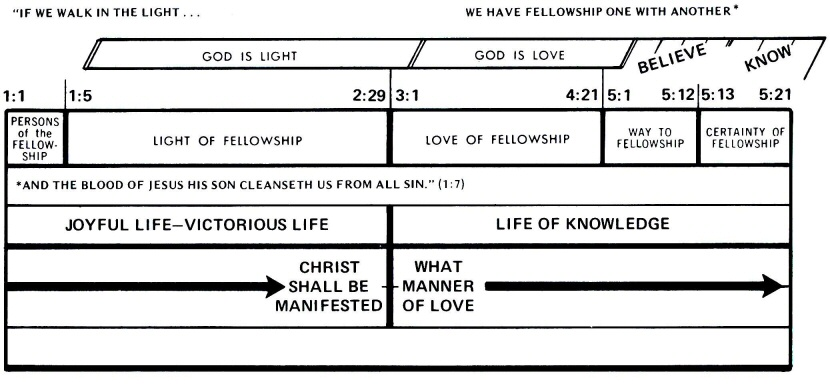
FELLOWSHIP WITH GOD AND HIS CHILDREN
Click chart to enlarge
Charts from Jensen's Survey of the NT - used by permission
Another Overview Chart - 1 John - Charles Swindoll
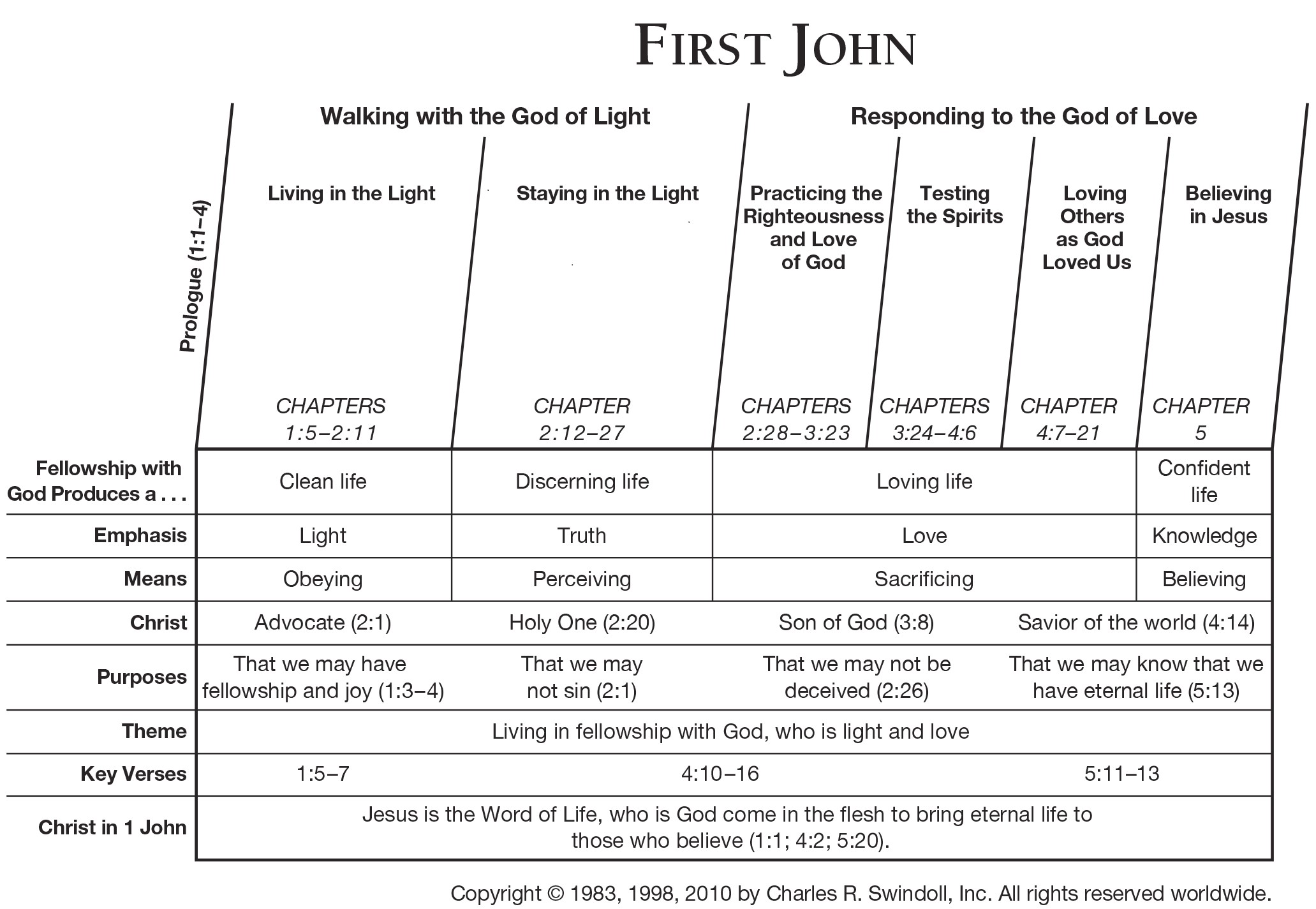
| BASIS OF FELLOWSHIP | BEHAVIOR OF FELLOWSHIP | ||||
| Conditions of Fellowship |
Cautions of Fellowship |
Fellowship Characteristics |
Fellowship Consequences |
||
| Meaning of Fellowship 1 Jn 1:1-2:27 |
Manifestations of Fellowship 1 Jn 2:28-5:21 |
||||
| Abiding in God's Light |
Abiding in God's Love |
||||
| Written in Ephesus | |||||
| circa 90 AD | |||||
| From Talk Thru the Bible | |||||
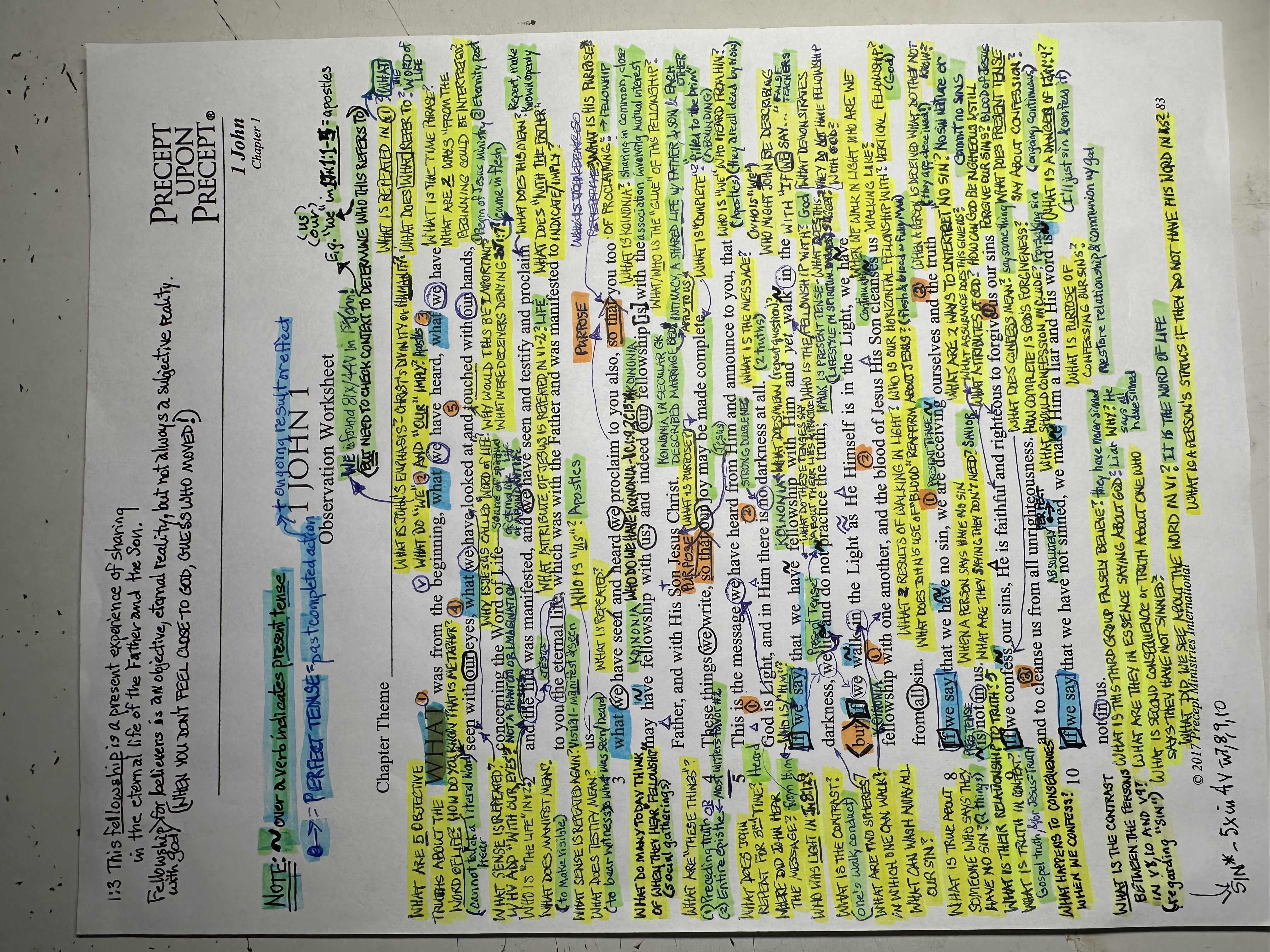
What is this? On the photograph of the Observation Worksheet for this chapter you will find handwritten 5W/H questions (Who? What? Where? When? Why? How?) on each verse to help you either personally study or lead a discussion on this chapter. The questions are generally very simple and are stated in such a way as to stimulate you to observe the text to discern the answer. As a reminder, given the truth that your ultimate Teacher is the Holy Spirit, begin your time with God with prayer such as Psalm 119:12+ "Blessed are You, O LORD; Teach me Your statutes." (you can vary it with similar prayers - Ps 119:18, 26, 33, 64, 66, 68, 108, 124, 135, 171, etc) The questions are generally highlighted in yellow and the answers in green. Some questions have no answers and are left to your observations and the illuminating/teaching ministry of the Holy Spirit. Some qualifying thoughts - (1) Use "As is" - these are handwritten and will include mistakes I made, etc. (2) They may not be the best question for a given verse and my guess is that on some verses you will think of a far superior 5W/H question and/or many other questions.
Dr Howard Hendricks once gave an assignment to his seminary students to list as many observations as they could from Acts 1:8. He said "So far they’ve come up with more than 600 different ones! Imagine what fun you could have with 600 observations on this passage. Would you like to see Scripture with eyes like that?" (P. 63 Living by the Book - borrow) With practice you can! And needless to say, you will likely make many more observations and related questions than I recorded on the pages below and in fact I pray that the Spirit would indeed lead you to discover a veritable treasure chest of observations and questions! In Jesus' Name. Amen
Why am I doing this? Mortimer Adler among others helped me develop a questioning mindset as I read, seeking to read actively rather than passively. Over the years I have discovered that as I have practiced reading with a 5W/H questioning mindset, it has yielded more accurate interpretation and the good fruit of meditation. In other words, consciously interacting with the inspired Holy Word of God and the illuminating Holy Spirit has honed my ability to meditate on the Scripture, and my prayer is that this tool will have the same impact in your spiritual life. The benefits of meditation are literally priceless in regard to their value in this life and in the life to come (cf discipline yourself for godliness in 1Ti 4:8+.) For some of the benefits - see Joshua 1:8+ and Psalm 1:2-3+. It will take diligence and mental effort to develop an "inductive" (especially an "observational"), interrogative mindset as you read God's Word, but it bears repeating that the benefits in this life and the rewards in the next will make it more than worth the effort you invest! Dear Christian reader let me encourage you to strongly consider learning the skills of inductive Bible study and spending the rest of your life practicing them on the Scriptures and living them out in your daily walk with Christ.
Although Mortimer Adler's advice is from a secular perspective, his words are worth pondering...
Strictly, all reading is active. What we call passive is simply less active. Reading is better or worse according as it is more or less active. And one reader is better than another in proportion as he is capable of a greater range of activity in reading. (Adler's classic book How to Read a Book is free online)
John Piper adds that "Insight or understanding is the product of intensive, headache-producing meditation on two or three verses and how they fit together. This kind of reflection and rumination is provoked by asking questions of the text. And you cannot do it if you hurry. Therefore, we must resist the deceptive urge to carve notches in our bibliographic gun. Take two hours to ask ten questions of Galatians 2:20+ and you will gain one hundred times the insight you would have attained by reading thirty pages of the New Testament or any other book. Slow down. Query. Ponder. Chew.... (John Dewey rightly said) "People only truly think when they are confronted with a problem. Without some kind of dilemma to stimulate thought, behavior becomes habitual rather than thoughtful.”
“Asking questions is the key to understanding.”
--Jonathan Edwards
That said, below are the 5W/H questions for each verse in this chapter (click page to enlarge). This is not neatly typed but is handwritten and was used for leading a class discussion on this chapter, so you are welcome to use it in this "as is" condition...
1 John 1:7 but if we walk in the Light as He Himself is in the Light, we have fellowship with one another, and the blood of Jesus His Son cleanses us from all sin. (NASB: Lockman)
NOTE: CLICK HERE FOR THIS PASSAGE IN MORE THAN 60 ENGLISH VERSIONS IN BIBLEGATEWAY
Greek: ean de en to photi peripatomen (1PPAS) os autos estin (3SPAI) en to photi, koinonian echomen (1PPAI) met' allelon kai to haima Iesou tou huiou autou katharizei (3SPAI) hemas apo pases hamartias.
Amplified: But if we [really] are living and walking in the Light, as He [Himself] is in the Light, we have [true, unbroken] fellowship with one another, and the blood of Jesus Christ His Son cleanses (removes) us from all sin and guilt [keeps us cleansed from sin in all its forms and manifestations]. (Amplified Bible - Lockman)
Amplified (2015) but if we [really] walk in the Light [that is, live each and every day in conformity with the precepts of God - ED: AND THE POWER OF THE SPIRIT], as He Himself is in the Light, we have [true, unbroken] fellowship with one another [He with us, and we with Him], and the blood of Jesus His Son cleanses us from all sin [by erasing the stain of sin, keeping us cleansed from sin in all its forms and manifestations]
ESV: But if we walk in the light, as he is in the light, we have fellowship with one another, and the blood of Jesus his Son cleanses us from all sin. (ESVBible.org)
KJV: But if we walk in the light, as he is in the light, we have fellowship one with another, and the blood of Jesus Christ his Son cleanseth us from all sin.
MSG If we claim that we experience a shared life with him and continue to stumble around in the dark, we’re obviously lying through our teeth—we’re not living what we claim. But if we walk in the light, God himself being the light, we also experience a shared life with one another, as the sacrificed blood of Jesus, God’s Son, purges all our sin.
NLT: But if we are living in the light, as God is in the light, then we have fellowship with each other, and the blood of Jesus, his Son, cleanses us from all sin. (NLT - Tyndale House)
Phillips: But if we really are living in the same light in which he eternally exists, then we have true fellowship with each other, and the blood which his Son shed for us keeps us clean from all sin. (Phillips: Touchstone)
Wuest: But if within the sphere (ED: SEE LOCATIVE OF SPHERE) of the light we are habitually ordering our behavior as He himself is in the light, things in common and thus fellowship we [the believer and God] are having with one another, and the blood of Jesus His Son keeps continually cleansing us from every sin.
Young's Literal: and if in the light we may walk, as He is in the light -- we have fellowship one with another, and the blood of Jesus Christ His Son doth cleanse us from every sin
BUT IF WE WALK IN THE LIGHT AS HE HIMSELF IS IN THE LIGHT: ean de en to photi peripatomen (1PPAS) os autos estin (3SPAI) en to photi:
NOTE: CLICK HERE FOR THIS PASSAGE IN MORE THAN 60 ENGLISH VERSIONS IN BIBLEGATEWAY
- If we: 1Jn 2:9-10 Ps 56:13 Ps 89:15 Ps 97:11 Isa 2:5 Jn 12:35 Ro 13:12 Eph 5:8 2Jn 1:4 3Jn 1:4
- as: 1Jn 1:5 Ps 104:2 1Ti 6:16 Jas 1:17
- See Dictionary of Biblical Imagery for >12 pages on imagery associated with light.
- See Westminster CF 6.5; 11.5; WLC 77, 149; WSC 82; Belgic Confession 34; Heidelberg Confession 1, 5, 30, 56, 72, 114
- 1 John 1 Resources
Related Passages:
1 John 2:9-10 The one who says he is in the Light and yet hates his brother is in the darkness until now. 10 The one who loves his brother abides in the Light and there is no cause for stumbling in him.
Psalm 56:13 ( For You have delivered my soul from death, Indeed my feet from stumbling, So that I may walk before God In the light of the living.
Psalm 89:15 How blessed are the people who know the joyful sound! O LORD, they walk in the light of Your countenance.
Isaiah 2:5 Come, house of Jacob, and let us walk in the light of the LORD.
John 12:35+ So Jesus said to them, “For a little while longer the Light is among you. Walk while you have the Light, so that darkness will not overtake you; he who walks in the darkness does not know where he goes.
Romans 13:12-13+ The night is almost gone, and the day is near. Therefore let us lay aside the deeds of darkness and put on the armor of light. Let us behave properly as in the day, not in carousing and drunkenness, not in sexual promiscuity and sensuality, not in strife and jealousy.
2 John 1:4 (WALKING IN LIGHT ~ WALKING IN TRUTH) I was very glad to find some of your children walking in truth, just as we have received commandment to do from the Father.
3 John 1:4 (WALKING IN LIGHT ~ WALKING IN TRUTH) I have no greater joy than this, to hear of my children walking in the truth.1 John 1:5+ This is the message we have heard from Him and announce to you, that God is Light, and in Him there is no darkness at all.
WALKING
IN THE LIGHT
But - (term of contrast) John does an "about face", a 180 degree turn at this juncture, as he does in many of his contrasting statements (e.g., love/hate, truth/lie, etc) in this great epistle (E.g., "but" occurs 21x in 20v). It behooves the student (that's all of us in God's classroom of life) who desires to learn the rewarding practice of Biblical Meditation, (e.g., see God's promises in Joshua 1:8+, Ps 1:2+, Ps 1:3+) to use these contrasting conjunctions to pause and assess (Cp interrogate) what is being contrasted (See Observation of Contrasts). And remember that contrasts are not always identified with a "but" (yet, on the other hand, etc), but may occur as clearly contrasting words, thoughts or ideas. Don't miss them, as they are very useful "clues" as to what the writer is trying to say. So what is the contrast in this verse?
John is obviously contrasting two walks, two lifestyles and ultimately two eternal destinies! The walk in the darkness versus the walk in the light. In 1 John 1:6 one merely claims to have fellowship with God, but in 1 John 1:7 one demonstrates the reality of his profession by the righteousness of his practice.
John Stott notes that "The error having been refuted (Ed: in 1Jn 1:6), John now affirms a complementary truth. He has shown the consequence of walking in darkness; he now describes what happens if we walk in the light. (BORROW The Letters of John : an introduction and commentary)
John Phillips alliterates 1 John 1:6-7 as…
- The Darkness Exposed - 1 John 1:6
- The Darkness Expelled - 1 John 1:7
If (1437) (ean) is a preposition which serves to identify what is referred to in Greek as a third class conditional clause. It means "(If)… and it may be true or may not be true." There is a supposition (something that is supposed) where the reality of the issue is uncertain. A conditional clause in Greek is formed by combining a preposition with a certain verb mood. In this case ean is combined with the subjunctive mood of walk (peripateo) which is the mood of probability which implies uncertainty.
W Hall Harris sees this "if" statement as…"a “counter-claim” of the author, followed by a positive apodosis which reflects the implications of the author’s (apostolic) teaching in contrast to the teaching of the opponents. If we understand these statements to refer to initial justification, the force of the conditional construction in the apodosis (“if we walk in the light”) would make one’s justification contingent upon one’s deeds or behavior, and this comes perilously close to making one’s salvation depend (at least in part) upon one’s good works. This would, of course, contradict the Pauline emphasis (Rom 5:1, Gal 2:16, Eph 2:8–10, etc.) on justification by faith alone, apart from works… It seems almost certain that “walk in the light” refers here to what one does after one has “come to the light,” that is, to the process of sanctification.
As Wuest says "Now John supposes another case, that of a person walking in the sphere of the light which God is and in which He dwells.
John Stott points out that…"The symmetry of these seven verses (1Jn 1:6-2:2) is evident. John repeats the same pattern three times. First, he introduces the false teaching with the words if we claim. Next, he contradicts it with an unequivocal we lie or a similar expression. Finally, he makes a positive and true statement corresponding to the error he has refuted, but if we …, although in the last of the three examples the ending is different (cf. 1Jn 1:7, 9 with 1Jn 2:1–2). (BORROW The Letters of John : an introduction and commentary)
WHAT IS A
WALK IN THE LIGHT?
We walk (4043)(peripateo from peri = about, around + pateo = walk, tread) means literally to walk around, to go here and there in walking, to tread all around. The 39 uses in the Gospels refer to literal walking. Seven of the 8 uses in Acts are also in the literal sense (except Acts 21:21). Paul uses peripateo only in the metaphorical sense referring to the conduct of one's life, the ordering of one's moral/ethical behavior (cf. Eph 4:1+, Eph 4:17+; Eph 5:2+, Eph 5:15+).
Clearly John is using peripateo in the figurative sense (See similar uses by John = 1Jn 2:6, 11; 2 John 4, 6; 3 John 3, 4; Rev 21:24+; John 8:12). Peripateo in 1Jn 1:7 is in the present tense which pictures these individuals as continually, habitually living in the light, where light in context is not physical light (like light of day) but the moral, ethical aspect of light as signified by He Himself is in the light (cp "God is light" 1Jn 1:5+)
Wuest emphasizes that…It is the habitual actions of a person that are an index to his character. This is a Christian, for only Christians are able to walk in the light that God is and in which He dwells. (Wuest Word Studies - Eerdman Publishing Company Volume 1, Volume 2, Volume 3 - used by permission)
This passage reminds me of the wonderful line in Trust and Obey...
When we walk with the Lord in the light of His word
What a glory He sheds on our way
While we do His good will, He abides with us still
And with all who will trust and obey
Spurgeon explaining the Biblical concept of walking… - The Christian life is described as walking, which implies activity. Christian life feeds upon contemplation, but it displays itself in action. Fellowship with God necessitates action, since to be with God, we must “walk with God.” The living God is not inactive, motionless, aimless. “My Father,” says Jesus, “works hitherto, and I work.” Chiefly in the character of active workers or in that of willing sufferers we must maintain fellowship with God. Walking implies activity, but it must be of a continuous kind. Neither this step, nor that, nor the next, can make a walk. We must be moving onward and onward and remain in that exercise, or we cease from walking. Holy walking includes perseverance in obedience and continuance in service. Not he that begins, but he that continues is the true Christian. Final perseverance enters into the very essence of the Believer’s life—the true pilgrims of Zion go from strength to strength…
I fear I have scarcely brought out the fullness of the meaning. They that are in the Light will know what I mean. Those who are in darkness cannot imagine what life in the Light of God must be. (The Child of Light Walking in the Light)
Alfred Plummer adds that John gives us…A further inference from the first principle laid down in 1Jn 5 (+): walking in the light involves not only fellowship with God but fellowship with the brethren. This verse takes the opposite hypothesis to that just considered and expands it. We often find (comp. 1Jn 1:9+) that John while seeming to go back or repeat, really progresses and gives us something fresh. It would have enforced 1Jn 1:6 (+), but it would have told us nothing fresh, to say ‘if we walk in the light, and say that we have fellowship with Him, we speak the truth, and do not lie’. And it is interesting to find that the craving to make this verse the exact antithesis of the preceding one has generated another reading, ‘we have fellowship with Him’, instead of ‘with one another’.(1 John Commentary)
Warren Wiersbe - WALK ON - Every form of life has its enemies. Insects have to watch out for hungry birds, and birds must keep an eye on hungry cats and dogs. Even human beings have to dodge automobiles and fight off germs. The life that is real also has an enemy, and we read about it in this section. This enemy is sin. John illustrates his theme by using the contrast between light and darkness: God is light; sin is darkness. The New Testament calls the Christian life a "walk." This walk begins with a step of faith when we trust Christ as our Savior. But salvation is not the end—it's only the beginning—of spiritual life. "Walking" involves progress, and Christians are supposed to advance in the spiritual life. Just as a child must learn to walk and must overcome many difficulties in doing so, a Christian must learn to "walk in the light." And the fundamental difficulty involved here is this matter of sin. (See Bible Commentary - Page 1140)
Writing to the saints in Ephesus Paul tells them to not be partakers with the sons of disobedience (Eph 5:6, 7+) explaining…
for you were formerly darkness (the essence of darkness), but now you are light (the essence of light) in the Lord; walk (present imperative = command calling for this to be the believer's lifestyle) as children of light (for the fruit of the light consists in all goodness and righteousness and truth) (Eph 5:8see in depth discussion of this great passage, Eph 5:9+)
Comment: Believers are light, partakers of the divine nature (2Peter 1:4+). This is an incomprehensible (to me) passage. God is light and Paul says we are light. But we are not light by ourselves as God is light, but light only because of our covenant union with Christ the Light of the world. Christ the hope of glory (Col 1:27+) now indwells us (the Spirit of Christ, Ro 8:9+). We are new creatures in Christ. Something of His light in a way I cannot (nor dare not try to) explain is in us! That is the truth of the Scriptures. In light of that amazing truth, Paul issues a command to put this truth in practice and walk as children of light. When we walk as children of light (in the enabling power of the indwelling Spirit of Christ), we are surely walking in the light!
In the Light - "Ensphered" by light (see locative of sphere). John is saying if we live in the "atmosphere" of light. Recall that God Himself is light! Marvin Vincent writes of "In the light, having our life in God, who is light."
THOUGHT - It is interesting that the NASB 1995, 2020 version capitalizes LIGHT twice in this verse which would imply the translators considered "LIGHT" in this context to be a metaphorical description of Jesus (cf Jn 8:12+). While I think they are correct, it is notable that other than the Amplified Version, no other version (SEE >60 VERSIONS) capitalizes LIGHT. The point I would make from this observation is you need to keep in mind that EVERY translation has some element of interpretation. That is why it can be helpful to read passages in multiple versions.
What "clue" do the following Psalms give that might facilitate a believer's walk in the light?
Thy word is a lamp to my feet, and a light to my path. (Ps 119:105+, cp Pr 6:23)
The unfolding of Thy words gives light; It gives understanding to the simple. (Ps 119:130+)
The precepts of the LORD are right, rejoicing the heart; The commandment of the LORD is pure, enlightening the eyes. (Ps 19:8+)
When we walk with the Lord in the light of His Word,
What a glory He sheds on our way!
While we do His good will, He abides with us still,
And with all who will trust and obey.
-John H Sammis
(Vocal Version)
Although John does not specifically define in this text what it means to walk in darkness or light, he does use the same verb "walk" (peripateo) two other times in this letter which give us a sense of the meaning. In chapter 2 we read that…
the one who says he abides in Him (in Christ) ought himself to walk in the same manner as He (Jesus) walked. (1Jn 2:6, cp 1Pe 2:21+)
Clearly walking in the same manner as Jesus (the Light of the world) walked is walking in the light. It follows that we must study the life of Jesus in the Gospels and that will give us an excellent pattern for walking in the light.
John also writes that
The one who loves his brother abides in the light and there is no cause for stumbling in him. But the one who hates his brother is in the darkness and walks in the darkness, and does not know where he is going because the darkness has blinded his eyes. (1Jn 2:10, 11)
Here we see John contrast love and hate as markers of one's walk, the one who hates his brother being described as one who walks in the darkness. The one who abides in the light is the one who loves his brother and who walks in the light.
Walk in the light: so shalt thou know
That fellowship of love
His Spirit only can bestow
Who reigns in light above.
--Bernard Barton
John Piper explains what it means practically to walk in the light…Walking in the light is the opposite of walking in darkness. It means seeing reality for what it is and being controlled by desires that accord with God's light. If God is light, and in him is no darkness at all, then he is the bright pathway to the fulfillment of all our deepest longings. He is the deliverer from all dark dangers and obstacles to joy. He is the infinitely desirable One. If in His own light He shines forth as a Being of infinite worth, then He is the star of glory that we were made to admire and cherish. If God opens the eyes of our hearts to see all that, then our desires are captured by the surpassing glory of God over every thing that the world has to offer, and we walk in the light as He is in the light. There is a walk, there is a lifestyle, that necessarily results from the miracle of new birth when we are given eyes to see the surpassing worth of the light of God. First John is written to describe what that lifestyle looks like and how it results from God's light and our new birth. (1 John 1:5-10: Let Us Walk in the Light of God) (Bolding added)
Truth is not only that which we believe intellectually,
it is also that which we believe practically.
R C Sproul - Truth is not only that which we believe intellectually, it is also that which we believe practically. That is to say, we are to act truthfully. We do not believe God is light if we do not walk in the light of His holiness. But when we endeavor to live holy lives we are assured that the blood of Christ cleanses us from all sin (1 John 1:7). Our efforts do not merit this cleansing; rather, they assure us that this cleansing has already taken place and that we belong to the One whose blood cleanses us from all sin.
John MacArthur explains that "Those who walk in the Light do so because the power of God has regenerated them. As “new creature[s]” for whom “new things have come” (2Co 5:17+), they will behave in a way that reflects the power of God’s righteous life in them, just as God Himself is in the Light… The general pattern of their day-to-day actions and attitudes will be godlike. (See The MacArthur New Testament Commentary )
John Stott notes that "John now affirms a complementary truth. He has shown the consequence of walking in darkness; he now describes what happens if we walk in the light. We must walk in the light of His holy self-revelation, and in His presence, without deceit or dishonesty in our mind or consciously tolerated sin in our conduct. ‘Walking in the light’ describes ‘absolute sincerity … to be, so to speak, all of a piece, to have nothing to conceal, and to make no attempt to conceal anything’.(BORROW The Letters of John : an introduction and commentary)
Bruce Barton writes that "To “live (walk) in the light” requires constant contact with God and (BORROW The Letters of John : an introduction and commentary) for dishonesty, hypocrisy, or sin. Living in the light pictures a life of complete transparency, with no attempts to conceal anything from “the Light.” To “walk in the light” (as it is translated in NIV and NKJV) cannot come from imitating other Christians; instead, it comes from continuous effort to take on Christ’s qualities (ED: AND CONTINUALLY RELYING ON HIS SPIRIT'S ENABLING POWER). (BORROW Life Application Bible Commentary)
Sam Storms says to walk in the light "At minimum, it refers to a desire or a yearning for truth and righteousness in one's life. This is not sinlessness, but it does mean that we will sin less. It is a life characterized by "a conscious sustained endeavor to live a life in conformity with the revelation of God, who is light" (Brooke, 15). It means living with an open heart before God, honest and vulnerable, quick to confess and repent. (1 John 1 Sermon Notes)(1 John Sermon Comments)
Imitation of God
is the test of fellowship with Him.
-- Johann Bengel
Alexander Maclaren on walking in the light…
In all languages, light is the natural symbol for three things: knowledge, joy, purity. The one ray is broken into its three constituent parts. But just as there are some surfaces which are sensitive to the violet rays, say, of the spectrum, and not to the others, so John’s intense moral earnestness makes him mainly sensitive to the symbolism which makes light the expression, not so much of knowledge or of joy, as of moral purity. And although that is not exclusively his use of the emblem, it is predominately so, and it is so here. To ‘walk in the light’ then; is, speaking generally, to have purity, righteousness, goodness, as the very element and atmosphere in which our progressive and changeful life is carried on…
So, then, the essential of a Christian character is that the light of purity and moral goodness shall be as the very orb, in the midst of which it stands and advances. That implies effort, and it implies activity, and it implies progress. And we are only Christians in the measure in which the conscious activities of our daily lives, and the deepest energies of our inward being, are bathed and saturated with this love of, and effort after, righteousness. It is vain, says John, to talk about fellowship with God, unless the fellowship is rooted in sympathy with Him in that which is the very heart of His Being, the perfect light of perfect holiness. Test your Christianity by that. (1 John 1:7 Walking in the Light)
Spurgeon on what it means to walk in the light…
There is a very strong description given here-”If we walk in the light as He is in the light.” Beloved, the thought of that dazzles me. I have tried to look it in the face, but I cannot endure it. If we walk in the light as God is in the light. Can we ever attain to this? Shall poor flesh and blood ever be able to walk as clearly in the light as He is Whom we call “Our Father,” of Whom it is written “God is light, and in him is no darkness at all.” Let us say this much, and then commend this wonderful expression to your meditations. Certainly, this is the model which is set before us, for the Savior Himself said, “Be ye perfect, even as your Father who is in heaven is perfect;” (Mt 5:48+) and if we take anything short of absolute perfection as our model of life, we shall certainly, even if we should attain to our ideal, fall short of the glory of God.
Beloved, when a schoolmaster writes the copy at the head of the page, he does not expect that the boy will come up to the copy; but then if the copy be not a perfect one, it is not fit to be imitated by a child; and so our God gives us himself as the pattern and copy, “Be ye imitators of God as dear children,” (Eph 5:1+) for nothing short of Himself would be a worthy model. Though we as life-sculptors may feel that we can never rival the perfection of God, yet we are to seek after it, and never to be satisfied until we attain to it. The youthful artist, as he grasps his early pencil, can hardly hope to equal Raphael or Michelangelo, but still, if he did not have a noble beau (French for "beautiful") ideal before his mind, he would only attain to something very mean and ordinary. Heavenly fingers point us to the Lord Jesus as the Great Exemplar of His people, and the Holy Spirit works in us a likeness to Him.
LIKENESS BUT
NOT DEGREE
But what does it mean, that the Christian is to walk in light as God is in the light? We conceive it to signify likeness, but not degree. We are as truly in the light, we are as heartily in the light, we are as sincerely in the light, as honestly in the light, though we cannot be there in the same degree. I cannot dwell in the sun, it is too bright a place for my residence, unless I shall be transformed, like Uriel, Milton’s angel (in Paradise Lost, Book III), who could dwell in the midst of the blaze of its excessive glory, but I can walk in the light of the sun though I cannot dwell in it; and so God is the light, He is Himself the sun, and I can walk in the light as He is in the light, though I cannot attain to the same degree of perfection, and excellence, and purity, and truth, in which the Lord himself resides. Trapp is always for giving us truth in a way in which we can remember it, so he says we are to be in the light as God is in the light for quality, but not for equality; we are to have the same light and as truly to have it and walk in it as God does, though as for equality with God in His holiness and perfection-that must be left until we cross the Jordan and enter into the perfection of the Most High. (1 John 1:7 Walking in the Light and Washed in the Blood)
THE PATTERN FOR
OUR WALK IN THE LIGHT
As He Himself is in the light - Referring to God. "As" is a term of comparison (specifically a simile) which tells us what is to be the standard and pattern of the believer's walk. In 1Jn 1:5 John stated that God is light but here he writes that God is (estin) in the light. The verb is (estin) is present tense indicating God is continually in the light. That is our lofty pattern in this life. See also discussion of The Holy Spirit-Walking Like Jesus Walked!
Pulpit Commentary adds that John's "change of verbs is significant: we walk, God is, in the light. We move through time; He is in eternity. Our activity involves change; His does not. Like the sun, He both is Light and dwells in the light. (1 John Commentary)
Vincent agrees adding that "God is forever and unchangeably in perfect light." (cp 1Ti 6:16). (Vincent - Word Studies)
The Psalmist gives us a transcendent sense of God "in the light"…
Covering Thyself with light as with a cloak, stretching out heaven like a tent curtain. (Ps 104:2)
Spurgeon: (God is described as) wrapping the light about Himself as a monarch puts on his robe. The concept is sublime, but it makes us feel how altogether inconceivable the personal glory of the LORD must be if light itself is but His garment and veil! What must be the blazing splendor of His own essential being! We are lost in astonishment, and dare not pry into the mystery lest we be blinded by its insufferable glory.
In light of such an awesome picture of God in the light Spurgeon (see Spurgeon's related discussion above) is quick to ask…
Can we ever attain to this? Shall we ever be able to walk as clearly in the light as He is Whom we call “Our Father,” of Whom it is written, “God is light, and in Him is no darkness at all?” Certainly, this is the model which is set before us, for the Saviour Himself said, “Be ye therefore perfect, even as your Father Who is in heaven is perfect;” (Mt 5:48) and although we may feel that we can never rival the perfection of God, yet we are to seek after it, and never be satisfied until we attain to it (Ed: Read Paul's ambition regarding his daily walk in the light - Php 3:8+, Php 3:9, 10, 11+, Php 3:12, 13+, Php 3:14+ - May God grant us His grace and Spirit's enabling power to seek to walk in the light by imitating Paul, even as He imitated Christ - Read 1Cor 4:16+, 1Cor 11:1+, John 13:15+). (Daily Help)
(Spurgeon adds that "as He is in the light" does not mean) to the same degree, but in the same manner-So you see that when we walk the best, when we walk in the light, as He is in the light, when our fellowship is of the highest order, yet still we need daily cleansing. It does not say -- mark this O my soul -- it does not say “The blood of Jesus Christ cleansed“ but “cleanses” If guilt return, His power may be proved again and again, there is no fear that all my daily slips and shortcomings shall be graciously removed by this precious blood.
Alexander Maclaren on walking As He Himself is in the light…Then, still further, there is implied in this great requirement of walking in the light, not only activity and effort, and progress in purity, but also that the whole of the life shall be brought into relation with, and shall be molded after, the pattern of the God in whom we pro-less to believe. Religion, in its deepest meaning, is the aspiration after likeness to the god. You see it in heathenism. Men make their gods after their own image, and then the god makes the worshippers after his image. Mars is the god of the soldier, and Venus goddess of the profligate, and Apollo god of the musical and the wise, etc., and in Christianity the deepest thing in it is aspiration and effort after likeness to God. Love is imitation; admiration, especially when it is raised to the highest degree and becomes adoration, is imitation. And the man that lies before God, like a mirror in the sunshine, receives on the still surface of his soul—but not, like the mirror, on the surface only, but down into its deepest depths—the reflected image of Him on Whom he gazes. ‘We all with unveiled face, mirroring glory, are changed into the same image.’ So to walk in the light is only possible when we are drawn into it, and our feeble feet made fit to tread upon the radiant glory, by the thought that He is in the light. To imitate Him is to be righteous. So do not let us forget that a correct creed, and devout emotions, ay! and a morality which has no connection with Him, are all imperfect, and that the end of all our religion, our orthodox creed and our sweet emotions and inward feelings of acceptance and favor and fellowship, are meant to converge on, and to produce this—a life and a character which lives and moves and has its being in a great orb of light and purity. (1 John 1:7 Walking in the Light)
CULTIVATING THE RIGHT
"SPIRITUAL ATMOSPHERE"
Alfred Plummer suggests that if we are to walk as He Himself is in the light then we must "make our spiritual atmosphere similar to His, that our thoughts and conduct may reflect Him." (1 John Commentary)
THOUGHT - Clearly we can enter "His spiritual atmosphere" best by spending time in His Word, not simply by rote reading, but by prayerful, meditatively reading with a sense that His Word is His love letter to us, His beloved children, while we are yet away from His immediate presence which is our promised, sure hope. And as we read of His love and provisions and promises to us, we engage in conversation with Him in prayer, not stiff and formal, but simple and intimate. Let me ask you a very practical question -- If such as has just been described were to become your daily pleasure (not duty, not a legalistic constraint, but your heart's desire prompted by His Spirit and His amazing grace) and you walked away from His presence with His thoughts coursing through your mind, how would that time of fellowship with Him impact your daily walk in the light and your fellowship with fellow believers? Would that morning memory of intimate moments spent with the infinite, almighty God Who is light enhance or empower or motivate your desire to walk in the light? Would you have a sense of His continual presence with you (cf fellowship, communion) even in the midst of the hectic hustle and bustle the rest of the day? If you are unsure of the answers to these questions, let me challenge you to just "experiment" for a few days and see if cultivating the right spiritual atmosphere has any effect on your daily walk in the light! And send me an email for I love to hear about supernatural occurrences!
Warren Wiersbe…If we are the children of God, then we ought to imitate our Father. This is the basis for the three admonitions… God is love (1John 4:8); therefore, “walk in love” (Eph 5:1-2). God is light (1 John 1:5); therefore, walk as children of light (Eph. 5:3-14). God is truth (1John 5:6); therefore, walk in wisdom (Eph 5:15-17). (Bible Exposition Commentary - New Testament )
Hiebert explains it this way…The expression marks the contrast between God who is “in the light” as the natural sphere of His being, and those seeking fellowship with Him who must persistently endeavor to walk “in the light.” God is eternal and abiding; believers are temporal, moving through time and space. (1 John 1:5-2-6 Exposition)
Hastings writes "There is no greater blessing than light. It is the indispensable condition of our existence. Bereft of light, all life would languish. Every living creature would lose its brightness and activity ; every plant would wither ; all the material world would lose its charm. How natural was it for men to identify with light the good they felt at work in their hearts, and to mark by darkness the evil with which it had to strive!"
John Phillips on walking in the light…To walk in the light means that our lives will be transparent and above reproach. We will harbor nothing shady, nothing we would not want to be seen and known, for light exposes the hidden works of darkness. How can two walk together in fellowship when one has ulterior motives and the other something to hide? (Exploring the Epistles of John)
Alexander Maclaren on the effect of light which…
bids us shroud no part of our conduct or our character either from ourselves or from Him.
Bring it all out into the light.
And although with a penitent heart, and a face suffused with blushes, we have sometimes to say, ‘See, Father, what I have done!’ it is far better that the revealing light should shine down upon us, and like the sunshine on wet linen, melt away the foulness which it touches, than that we should huddle the ugly thing up in a corner, to be one day revealed and transfixed by the flash of the light turned into lightning. ‘He that does the truth comes to the light, that his deeds may be made manifest.’ (John 3:21) (1 John 1:7 Walking in the Light)
THOUGHT - Practical application of walking in the light: Remember that you may be the only Bible many people will ever read. Are you walking in the light that others might see His light (Jn 8:12+) in you (Mt 5:14-16+, Php 2:14-15+)?
Light (5457)(phos from pháo = to shine) is defined by many lexicons as that which contrasts with darkness. Light is the medium of illumination that makes sight possible or makes things visible. In Scripture phos can refer to literal, physical light (Ge 1:3), but often is used metaphorically or symbolically, the greatest metaphorical use being used to symbolize Jesus as "the Light of the world." (Jn 8:12). Jesus characterized those who would be His followers, His disciples as "light of the world" (Mt 5:14). Then He commanded them to be "light bearers" for the glory of the Father (Mt 5:16).
PHOS IN JOHN'S WRITINGS - Jn. 1:4; Jn. 1:5; Jn. 1:7; Jn. 1:8; Jn. 1:9; Jn. 3:19; Jn. 3:20; Jn. 3:21; Jn. 5:35; Jn. 8:12; Jn. 9:5; Jn. 11:9; Jn. 11:10; Jn. 12:35; Jn. 12:36; Jn. 12:46; 1 Jn. 1:5; 1 Jn. 1:7; 1 Jn. 2:8; 1 Jn. 2:9; 1 Jn. 2:10; Rev. 18:23; Rev. 21:24; Rev. 22:5
Related Resource:
QUESTION - What does it mean to walk in the light?
ANSWER - To “walk in the light” is a common metaphor within Christian culture. It is often taken to mean “acting correctly” or even “living openly.” Biblically, however, the phrase has the idea of relinquishing sin by following Jesus.
The only Old Testament occurrence of this precise phrase is in Isaiah 2:5, “O house of Jacob, come and let us walk in the light of the Lord.” The Psalms contain similar phrases (56:13; 89:15), as does Isaiah (9:2; 50:10-11; 59:9).
In the New Testament, “walking in the light” is directly related to following Jesus, who said, “I am the light of the world. He who follows me shall not walk in darkness, but have the light of life” (John 8:12). While this verse does not directly say, “Walk in the light, i.e., Jesus,” it does pointedly warn of doing the opposite; therefore, those who follow Jesus are “walking in the light.”
To “walk” is, in short, to live one’s life. One’s lifestyle or way of life can be considered a “walk.” The word also indicates progress. Walking is related to growth; it is taking steps toward maturity. “Light” in the Bible can be a metaphor for life, happiness, righteousness, or understanding. The Bible is clear that light comes from the Lord God, the “Father of the heavenly lights” (James 1:17). He is the opposite of evil. Putting it all together, “walking in the light” means “growing in holiness and maturing in the faith as we follow Jesus.”
The apostle John repeatedly used the “light” metaphor in relation to the Messiah. For example, he writes that Jesus is “the true light that gives light to every man” (John 1:9). In 1 John 1:7 he says, “If we walk in the light as He [God] is in the light, we have fellowship with one another, and the blood of Jesus Christ His Son cleanses us from all sin.” In verse 5, John says that God’s very nature is light. Jesus, then, is the conduit or provider of light to the world.
Our Christian duty is to live in the light God gives: “Now you are light in the Lord. Walk as children of light” (Ephesians 5:8). When we walk in the light, we cannot walk in darkness. Sin is left in the shadows as we let our light “shine before men” (Matthew 5:16). It is God’s plan for us to become more like Christ (1 Thessalonians 4:3).
“Walking in the light” means we consider Jesus as “the light” in this world, and we “walk” in that light by following His precepts, living in His power, and growing in His grace.GotQuestions.org
QUESTION - What are some of the signs of genuine saving faith?
ANSWER - This is one of the most important questions in the Christian life. Many believers doubt their salvation because they don’t see signs of genuine faith in their lives. There are those who say we should never doubt our decision to follow Christ, but the Bible encourages us to examine ourselves to see if we are truly “in the faith” (2 Corinthians 13:5). Thankfully, God has given us ample instruction for how we can know for sure that we have eternal life. The first epistle of John was actually written for that purpose, as it states in 1 John 5:13, "I write these things to you who believe in the name of the Son of God so that you may know that you have eternal life."
There is a series of tests in 1 John that we can use to examine ourselves and our faith. As we look at them, remember that no one will perfectly fulfill all of them all the time, but they should reveal a consistent trend that characterizes our lives as we grow in grace.
1. Do you enjoy having fellowship with Christ and His redeemed people? (1 John 1:3)
2. Would people say you walk in the light, or walk in the darkness? (1 John 1:6-7)
3. Do you admit and confess your sin? (1 John 1:8)
4. Are you obedient to God’s Word? (1 John 2:3-5)
5. Does your life indicate you love God rather than the world? (1 John 2:15)
6. Is your life characterized by "doing what is right"? (1 John 2:29)
7. Do you seek to maintain a pure life? (1 John 3:3)
8. Do you see a decreasing pattern of sin in your life? (1 John 3:5-6) [Note: this refers to not continuing in sin as a way of life, not a total absence of sin.]
9. Do you demonstrate love for other Christians? (1 John 3:14)
10. Do you "walk the walk," versus just "talking the talk"? (1 John 3:18-19)
11. Do you maintain a clear conscience? (1 John 3:21)
12. Do you experience victory in your Christian walk? (1 John 5:4)
If you are able to truthfully answer "Yes" to these questions (or a majority of them, and are working on the others), then your life is bearing the fruit of true salvation. Jesus said that it is by our fruits that we are known as His disciples (Matthew 7:20). Fruitless branches—professing believers who do not display the fruit of the Spirit (Galatians 5:22-23) are cut off and thrown into the fire (John 15:6). A genuine faith is one that not only believes in God (the demons themselves do that - James 2:19), but leads to open confession of sin and obedience to Christ’s commands. Remember, we are saved by grace through faith, not by our works (Ephesians 2:8-9), but our works should display the reality of our salvation (James 2:17-18). Genuine saving faith will always produce works; a faith that is perpetually without works is no faith at all and saves no one.
In addition to these confirmations, we need to remember God’s promises and the reality of the war we are in. Satan is just as real as Jesus Christ, and he is a formidable enemy of our souls. When we turn to Christ, Satan will look for every opportunity to deceive and defeat us. He will try to convince us that we are unworthy failures or that God has given up on us. When we are in Christ, we have the assurance that we are kept by Him. Jesus Himself prayed for us in John 17:11 that the Father would "protect them by the power of your name—the name you gave me—so that they may be one as we are one." Again in verse 15, He prayed, "keep them from the evil one."
In John 10:27-29, Jesus said, "My sheep listen to my voice; I know them, and they follow me. I give them eternal life, and they shall never perish; no one can snatch them out of my hand. My Father, who has given them to me, is greater than all; no one can snatch them out of my Father’s hand." If you hear and obey the voice of Jesus, then you are one of His sheep, and He will never let you go. Jesus gave a wonderful word picture here of Christians securely held within His loving hands and the Father’s almighty hands wrapping themselves around His, giving us a double assurance of eternal security.
Related Resources:
- How can I have assurance of my salvation?
- If you doubt your salvation, does that mean you are not truly saved?
- What if I don’t feel saved?
- How can I detect a false conversion?
WE HAVE FELLOWSHIP WITH ONE ANOTHER: koinonian echomen (1PPAI) met' allelon:
NOTE: CLICK HERE FOR THIS PASSAGE IN MORE THAN 60 ENGLISH VERSIONS IN BIBLEGATEWAY
- we have: 1Jn 1:3 Am 3:3
- 1 John 1 Resources
HORIZONTAL RESULT OF
WALKING IN THE LIGHT
We have (2192) (echo) has the basic meaning of have or hold with a variety of nuances (determined by the context and accompanying terms) and in this context speaks of a close relationship (all believers are brethren, in the same family, with the same Father Jn 1:12+, 1Jn 3:1+). The present tense speaks of this as the believer's continual "possession" (we will never be kicked out of the Father's house!)
Fellowship (koinonia) with one another (allelon) - Think of fellowship as shared life (and not just "two fellows in a ship"). Some commentaries feel John is referring to fellowship between the believer and God. It is more natural to understand the reciprocal pronoun one another as indicating fellow believers. John uses allelon seven times in his epistles (1Jn 1:7; 3:11, 23; 4:7, 11, 12; 2Jn 5, the last six uses all = "love one another"!) and each use refers the relationship between men which supports that interpretation in the present passage.
While one another (allelon) most likely refers to other believers, the fellowship clearly includes God because genuine fellowship with other believers is not possible unless both parties have first experienced fellowship with God (See Vincent's comment below).
Toon writes says "the basic meaning of fellowship is a real and practical sharing in eternal life with the Father and the Son." (Ref)
When believers share in the eternal life with the Father and the Son, they are able to share life with one another.
Kruse adds that "there is no real fellowship with God which is not expressed in fellowship with other believers." (Ibid)
Marvin Vincent agrees with the majority of interpreters that fellowship with one another signifies… Not, we with God and God with us, but with our brethren. Fellowship with God exhibits and proves itself by fellowship with Christians. See 1John 4:7, 12; 3:11, 23. (Vincent - Word Studies) (Bolding added)
Pulpit Commentary…Having fellowship with one another (HORIZONTAL) is a sure result of that fellowship with God (VERTICAL) which is involved in walking in the light. (1 John Commentary)
Daniel Wallace makes an interesting statement about the meaning of fellowship with God…
To have fellowship with God, to be in the light, don't we have to live a sinless life? That would seem to be the case if light meant holiness.
The implications about this are vast: if "light" means holiness, then to walk in the light would seem to mean absolute holiness. It is precisely because some folks have understood light this way that they view fellowship with God as something we can be in one moment and out of the next. I think this approach produces a schizophrenic Christian who ends up thinking he's spiritual one moment and carnal the next. Worse, he begins to focus on his performance more than on his relationship to God. Never does habit or character enter into this picture of spirituality.
And, quite frankly, such a view of spirituality actually promotes sin. Because this view allows me to take fleshly detours all I want: as long as I just confess my sins afterward, I'm spiritual again.
Further, you really can't base this view of spirituality on 1 John 1. Notice what John says in 1Jn 1:7: "but if we walk in the light as he himself is in the light, we have fellowship with each other, and the blood of Jesus his Son cleanses us from all sin."
To walk in the light is not to live without sin: otherwise, the blood of Jesus would not be needed to cleanse us while we are walking in the light. All the verbs in this verse are present tense. The force seems to be that while we are walking in the light the blood of Jesus is cleansing us from our sins.
This text is not, therefore, speaking of being "in fellowship" and "out of fellowship" on a moment-by-moment basis. If "light" means "exposure," this would mean that one second we're admitting that we're sinners, and denying it the next. Such a view is neither true to life nor to the scriptures.
But if "light" means honesty and integrity and transparency, then to walk in the light is not absolute holiness. But it is the necessary prerequisite to holiness. (Honest to God! Or, God is not a Pit Stop 1 John 15-10)
J Ligon Duncan says…that the way we manifest true fellowship with the living God is: we walk in the light--that is, we pursue holiness. We fellowship with one another. That is, we are mutually accountable to one another; we recognize the importance of the means of grace and fellowship with the body of Christ, and we don’t take lightly separating ourselves from the church of the Lord Jesus Christ.
Hiebert emphasizes that this fellowship with one another (allelon)…is the result of believers’ mutual walk in the light, and is “a gauge and a sign of the divine fellowship.” He who consistently has trouble maintaining fellowship with others walking in the light should examine his own claim of fellowship with God. (1 John 1:5-2-6 Exposition) (Bolding added for emphasis).
Plummer… also agrees that the fellowship being described is primarily horizontal fellowship - believer to believer - writing that fellowship one with another… certainly refers to the mutual fellowship of Christians among themselves, as is clear from 1Jn 3:23, 4:7, 12; 2 John 5. It does not refer to fellowship between God and man, as Augustine and others, desiring to make this verse parallel to 1Jn 1:6, have interpreted…In that ‘thick darkness’, which prevailed ‘in all the land of Egypt three days, they saw not one another, neither rose any from his place for three days’ (Ex. 10:22, 23): i.e. there was an absolute cessation of fellowship. Society could not continue in the dark: but when the light returned, society was restored. So also in the spiritual world: when the light comes, individuals have that communion one with another which in darkness is impossible. In a similar spirit Cicero declares that real friendship is impossible without virtue (De Amic. vi. 20). (1 John Commentary)
Fellowship (2842) (koinonia from koinos = that which is in common, belonging to several or of which several are partakers) describes the experience of having something in common and/or of sharing things in common with others. It describes a close association involving mutual interests and sharing or to have communion (Which Webster defines communion as "intimate fellowship") It denotes the active, joint participation, cooperation and/or sharing in a common interest or activity.
KOINONIA - 17V - contribution(2), fellowship(12), participation(2), sharing(3). Acts 2:42; Rom. 15:26; 1 Co. 1:9; 1 Co. 10:16; 2 Co. 6:14; 2 Co. 8:4; 2 Co. 9:13; 2 Co. 13:14; Gal. 2:9; Phil. 1:5; Phil. 2:1; Phil. 3:10; Phlm. 1:6; Heb. 13:16; 1 Jn. 1:3; 1 Jn. 1:6; 1 Jn. 1:7
One another (240)(allelon) is a reciprocal (= shared, felt, done by each to the other) pronoun which means each other, reciprocally or mutually (Negative sense Mt 24:10). Root meaning: reciprocal interaction — “one another,” “each other,” “mutually.” Allelon is a reciprocal pronoun, expressing mutual relationship and shared responsibility within the body of Christ. It always points both directions — I toward you and you toward me. It assumes connection, not independence; interdependence, not isolation. Prominent especially in Paul’s epistles, 1 John, and Hebrews. Commonly used with verbs commanding mutual love, service, encouragement, forgiveness, humility, and unity. “One another” is the pulse of Christian life. It is where doctrine becomes devotion and belief becomes belonging. The church is not a collection of isolated saints but a communion of interwoven souls. Christianity is a ‘we-faith,’ not a ‘me-faith.’ “Allēlōn transforms Christianity from a solo climb into a shared ascent. No believer is meant to walk alone; our strength is found shoulder to shoulder, heart to heart, and grace to grace.
ALLELON -
- Reflects the Triune God God Himself Who exists in eternal “one-anotherness” — Father, Son, and Spirit in perfect love and fellowship. The church, made in His image, mirrors this divine reciprocity.
- Defines the Church’s Nature = Christianity is not an individual achievement but a corporate identity (Ro 12:5)
- Counters the Spirit of Individualism - Allēlōn dismantles the myth of the self-sufficient believer. A “lone-ranger Christian” is as unnatural as a severed hand claiming to function apart from the body (1 Cor 12:14–27).
- Demands Intentional Investment - “Consider one another” implies attention and action — noticing others’ spiritual needs and creatively meeting them.
SOME GENERAL PRINCIPLES RELATED TO ALLELON
- Faith falters in isolation but flourishes in interaction.
- Grace grows best in the greenhouse of ‘one another.’
- Believers belong before they behave; community precedes conformity.
- Christianity is not a solo act but a symphony of surrendered hearts.
- We were never meant to go it alone, but to grow it together.
- The church thrives when “one another” is more than words—it’s a way of life.
- The strength of the saints is found in their togetherness.
Vine writes that allelon is "a reciprocal pronoun in the genitive plural, signifying of, or from, one another (akin to allos, another [of the same kind in contrast to heteros]) e.g., Mt. 25:32; Jn 13:22; Acts 15:39; 19:38; 1Co 7:5; Gal 5:17; the accusative allēlous (Same root pronoun allelon - the "-ous" identifies it as in the accusative case) denotes “one another,” e.g., Acts 7:26, lit., ‘why do you wrong one another?’; 2Th 1:3; in Ep 4:32 Col. 3:13, e.g., “each other;” in 1Th. 5:15, “one (toward) another”; the dative allēlois denotes “one to another,” e.g., Lk 7:32 (Vine's Expository Dictionary)
Balz and Schneider add that…The understanding of allelon in the NT is unproblematic; the translation each other or mutually is sufficient for every instance. Rarely are two individual persons meant (Lk 23:12; 24:14, 17, 32; Acts 15:39; 1Cor 7:5). Mt 25:32 speaks of the separation of all people from each other into two groups. A personalization is present in Ro 2:15 (literally: the thoughts accuse or defend among themselves), as in Gal 5:17 (flesh and Spirit “are opposed to each other”).
Otherwise allelon is used in connection with groups of persons who are in some way peers and with reference to relationships within a homogeneous group in order to express communication with or, sometimes, negative conduct toward, each other. (It never refers to the relationship of Jesus to His disciples or of Christ to His people; on the other hand, and significantly, it is used with reference to Paul and the Church in Ro 1:12.)
Of theological relevance here is the use of allelon primarily in the description of the (obligatory) conduct of Christians in the community toward each other, with emphasis on mutuality and culminating in the love commandment… (1Th 3:12; 2Th 1:3) or… (John 13:35). The addition of kai eis pantas (1Th 3:12; cf. 5:15) shows that by his use of allelon Paul makes the love which members of the Church are to have among themselves the top priority (cf. also Gal 6:10). But neither there nor in the Johannine texts (esp. Jn 13:34, 35.; 15:12, 17; 1Jn 3:23; 4:7, 11, 12) is the comprehensive commandment to love one’s neighbor made more narrow by the qualifying allelon. (Exegetical Dictionary of the New Testament)
“One another (allelon)” distills the essence of the Christian life — mutual love flowing from shared grace, turning isolated believers into an interdependent body that grows together toward Christlikeness.
Related Study - Study the "one anothers" - most positive, some negative (As an aside, note that many of these "one another's" are issued as commands, not suggestions! But remember that our obedience to divine commands is based on enablement by the Spirit, not effort by self! You are under grace not law. Law says "love one another", and under the New Covenant we are enabled by the Spirit to truly, supernaturally "love one another"! To repeat - Do not try to obey this command in your own strength or supposed adequacy! cp 2Cor 3:5, 6+)
Allelon - 100x in 94v in NT - translated (NAS95) - another(1), each(1), each other(1), one another(90), one another's(2), other's(1), themselves(1), together*(2), yourselves(1). Mt 24:10; 25:32; Mark 4:41; 8:16; 9:34, 50; 15:31; Luke 2:15; 4:36; 6:11; 7:32; 8:25; 12:1; 20:14; 23:12; 24:14, 17, 32; John 4:33; 5:44; 6:43, 52; 11:56; 13:14, 22, 34, 35; 15:12, 17; 16:17, 19; 19:24; Acts 4:15; 7:26; 15:39; 19:38; 21:6; 26:31; 28:4, 25; Ro 1:12+, Ro 1:27+; Ro 2:15+; Ro 12:5+, Ro 12:10+, Ro 12:16+; Ro 13:8+; Ro 14:13+, Ro 14:19+; Ro 15:5, 7+, Ro 15:14+; Ro 16:16+; 1Co 7:5; 11:33; 12:25; 16:20; 2Cor 13:12; Gal 5:13, 15, 17+, Gal 5:26+; Gal 6:2; Eph 4:2+, Ep 4:25+, Eph 4:32+; Eph 5:21+; Phil 2:3+; Col 3:9+, Col 3:13+; 1Th 3:12+; 1Th 4:9+, 1Th 4:18+; 1Th 5:11+, 1Th 5:15+; 2Th 1:3; Titus 3:3+; Heb 10:24+; Jas 4:11; 5:9, 16; 1Pe 1:22+; 1Pe 4:9+; 1Pe 5:5+, 1Pe 5:14+; 1Jn 1:7; 1Jn 3:11, 23; 4:7, 11, 12; 2 John 1:5; Rev 6:4+; Rev 11:10+
“One another” (allelon) captures the core of Christian fellowship, reminding us that faith flourishes in community, not in solitary religion.
“One another” (allelon) exposes the folly of self-sufficient spirituality and calls believers to shared life, mutual care, and humble interdependence.
“One another” (allelon) is the vocabulary of belonging—the grammar of grace that binds believers together in love.
“One another” (allelon) dismantles the myth of the independent Christian and builds the reality of the interdependent body.
“One another” (allelon) turns Christianity from a private pursuit into a shared pilgrimage.
“One another” (allelon) reveals that isolation weakens faith, but fellowship strengthens it.
“One another” (allelon) is the pulse of the church’s life—the rhythm of reciprocal love that keeps the body healthy and whole.
“One another” (allelon) reminds us that Christianity is not a solo performance but a symphony of surrendered hearts.
ILLUSTRATIONS:
The Redwoods of Faith - The mighty California redwoods soar hundreds of feet high, yet their roots run shallow. What keeps them standing through storms is not depth but interconnection—their roots intertwine underground, each tree holding the others upright. ➡ So it is with believers. “One another” (allelon) is the root system of the church: unseen, intertwined, and indispensable.
The Chain Link - A chain is only as strong as its links are connected. Each link bears the pull of the others. ➡ Christ designed His church as a living chain—linked by love, strengthened by service, sustained by shared grace.
The Flock and the Shepherd - A single sheep that wanders off is easy prey. But the flock, gathered under the Shepherd’s eye, moves safely together.➡ We need “one another” not just for comfort but for survival. Isolation invites attack; community ensures protection.
The Fabric of Fellowship - The church is like a tapestry—each thread alone is weak, but woven together they create strength and beauty.➡ The “one anothers” are the stitches that bind the fabric of faith.
The Candle Circle - One candle may flicker in the wind, but when candles are placed close together, their combined flame burns brighter and steadier. ➡ So love strengthens love, and faith steadies faith—one believer’s light rekindles another’s.
The Blacksmith’s Sparks - When iron strikes iron, sparks fly—and both blades grow sharper.➡ “As iron sharpens iron, so one man sharpens another” (Prov 27:17). Holy friction refines holiness; the fellowship of allelon forges spiritual steel.
The Gears in a Clock - Each gear in a clock turns another; none moves alone.➡ When one part fails, the whole mechanism loses rhythm. The “one anothers” are God’s gears of grace—each life moving others toward divine purpose.
The Body Analogy (1 Cor 12) - Paul’s image of the body captures allelon perfectly: the eye needs the hand, the head needs the feet. ➡ Every part depends on the others; independence is an illusion in the Body of Christ.
The Greenhouse Effect - Plants grow faster and healthier in a greenhouse, where warmth and humidity are shared. ➡ So spiritual growth thrives in the warmth of Christian community—where encouragement and accountability create the right climate for grace.
The Mason’s Wall - Each stone depends on those beside it for stability.➡ The mortar of “one another” love binds believers into a temple fit for the Master Builder (Eph 2:21). Remove one stone, and the wall weakens.
The Pilgrims on the Path 🚶♂️🚶♀️ - Two travelers help each other along the road — sharing water, bearing burdens, watching for danger. ➡ The Christian journey is a shared pilgrimage. “One another” turns the lonely road into a living fellowship.
One of the better known uses of allelon (used twice) is by James in his charge…
Therefore (= "term of conclusion" > See context = Jas 5:14, 15), confess (present imperative = command to make this your practice - keep the context in mind and see our need to depend on the Holy Spirit to obey) your sins to one another (allelon), and pray (Also present imperative see our need to depend on the Holy Spirit to obey) for one another (allelon) so that (term of conclusion) you may be healed. The effective (energeo in present tense = continually working) prayer (deesis) of a righteous (dikaios) man can accomplish much (More literally "very strong is a working supplication of a righteous man" or "is very powerful in its working"). (James 5:16+)
“The Bond of One Another”
We are not meant to walk alone,
But heart to heart and stone by stone;
Grace builds its house where lives entwine,
And love makes fellowship divine.“The Music of We”
No solo saint can sing the score—
The choir of grace requires more;
Each voice completes what one begins,
Till heaven’s harmony resounds within.Tied by Tender Cords
One heart may falter, two may stand,
When knit by Christ’s commanding hand;
Faith finds its strength, hope burns much brighter,
When love’s cords bind believer to believer tighter.Where One Another Dwells
In “one another” life is found—
The place where self gives sacred ground;
The cross unites, the Spirit blends,
And stranger souls become close friends.Faith breathes best in fellowship.
Grace grows where hearts gather.
Love lingers longer when shared.
Isolation starves; interaction strengthens.
ILLUSTRATION OF WALKING IN THE LIGHT AND FELLOWSHIP - A group of church members were discussing their new pastor.
"For some reason," said one man, "I really don't feel at ease with him. I believe he's a good man, all right—but something seems to stand between us."
Another member replied, "Yes, I think I know what you mean. I used to have that same problem with him, but now I don't have it anymore. The pastor and I have great fellowship."
"What did he do to make things better?"
"He didn't do anything," said the friend. "I did the changing."
"You did the changing?"
"Yes, I decided to be open and honest about things, the way our pastor is. You see, there isn't one stain of hypocrisy in his life, and there was so much pretending in my life that we just didn't make it together. He and I both knew I was a phony. Since I've started to live an honest Christian life, everything is better." (BORROW Pause for power : a 365-day journey through the Scriptures)
AND THE BLOOD OF JESUS HIS SON CLEANSES US FROM ALL SIN: kai to aima Iesou tou huiou autou katharizei (3SPAI) hemas apo pases hamartias:
NOTE: CLICK HERE FOR THIS PASSAGE IN MORE THAN 60 ENGLISH VERSIONS IN BIBLEGATEWAY
- and the: 1Jn 2:1,2 5:6,8 Zec 13:1 Jn 1:29 1Co 6:11 Eph 1:7 Heb 9:14 1Pe 1:19 Rev 1:5 7:14
- 1 John 1 Resources
CAUSE/EFFECT OF
WALKING IN THE LIGHT
And - Introduces the added effect or result that is associated with believers who are walking in the light. In a sense this is really a "cause/effect" because the cause (continual cleansing with the blood of Jesus) enables the effect (walking in the light, in fellowship with other saints).
The blood of Jesus His Son cleanses us - What does walking in the light have to do with this great truth? What happens to our sensitivity to sin when we walk in the light? Clearly, light exposes or reveals sin. It follows that while our walk does not produce cleansing per se, it does make us continually aware of our need for divine cleansing. Light exposes sin (John 3:19, 20, 21) and the believer continually walking in the light will have an enhanced consciousness of how far they miss the mark of God's good and acceptable and perfect will and how continually great is their need for the cleansing power of the blood of Jesus God's Son.
Spurgeon explains it this way - The Gospel does not consist in making a man's sin appear little. The way Christians get their peace is not by seeing their sins shriveled and shrinking until they seem small to them. But on the contrary; they, first of all, see their sins expanding, and then, after that, they obtain their peace by seeing those sins entirely swept away,—far as the east is from the west. (The Evil and Its Remedy)
If one reads the biographies of great men and women of the faith who were passionate Christ followers, it is notable how their progressive sanctification (their growth in godliness and holiness and Christlikeness - all these descriptions are essentially synonyms) is associated with an increased awareness of their sinfulness, and a growing sensitivity to sins which heretofore were not even recognized as sinful (or which were thought to be only "small" sins). We see this pattern in the Bible with the Apostle Paul by comparing his personal testimony at different stages of his growth in Christlikeness…
Blood (129) (haima) literally is the fluid substance in the circulatory system of human beings which is the basis for life primarily because of its oxygen carrying capacity. Moses writes that "the life of the flesh is in the blood, and I have given it to you on the altar to make atonement for your souls; for it is the blood by reason of the life that makes atonement." (Lev 17:11+)
Peter writes that we…
were not redeemed with perishable things like silver or gold from (our) futile way of life inherited from (our) forefathers, but with precious blood, as of a lamb unblemished and spotless, the blood of Christ. (1Peter 1:18, 19+)
Wayne Grudem: The blood of Christ is the clear outward evidence that His lifeblood was poured out when He died a sacrificial death as the price of our redemption—‘the blood of Christ’ means His death in its saving aspects. Although we might think that Christ’s blood as evidence that His life had been given would have exclusive reference to the removal of our judicial guilt before God (Ed: Justification)—for this is its primary reference—the New Testament authors also attribute to it (to His blood) several other effects. By the blood of Christ our consciences are cleansed (Heb 9:14), we gain bold access to God in worship and prayer (Heb 10:19), we are progressively cleansed from more and more sin (1 John 1:7; cf. Rev 1:5b), are able to conquer the accuser of the brethren (Rev 12:11), and are rescued out of a sinful way of life (1Pet 1:19). We would do well to recover this New Testament emphasis in our preaching today. (BORROW 1 Peter: An Introduction and Commentary)
What Can Wash Away my Sin
Nothing but the blood of Jesus
(Vocal by Matt Redman)
Christ's perfect, precious blood shed once for all time on the Cross almost 2000 years ago, provided perfect propitiation to the Father (He is eternally satisfied with Christ's sacrifice for sin) and complete, eternal redemption (Heb 9:12+) through the New Covenant in His blood (Mt 26:28, Lk 22:20), also referred to as "the blood of the eternal covenant." (Heb 13:20+). In other words, the blood of Jesus His Son shed at Calvary is efficacious for eternity, not only for our one time justification (the declaration that we are righteous in Christ) but also sufficient for our daily or progressive sanctification (a continual process in this life until we are glorified).
Henry Alford comments that the blood of Jesus must be clearly defined…The expression is an objective one, not a subjective (and) is spoken of that which is the objective cause from without, of our being cleansed from all sin. And this is the material Blood of Jesus the personal Redeemer, shed on the Cross as a propitiatory sacrifice for the sin of the world. So we have the same Blood said in Col. 1:20 to be the great medium of pacification between God and the world: so in Eph. 1:7, to be the means of ou of our redemption; so in Heb. 9:14, which approaches very nearly to our passage, to cleanse (as here) our conscience from dead works to serve the living God. In all these places, and similar ones, whatever application to ourselves by faith or otherwise may lie in the background, it is not that which is spoken of, but the Blood of Christ itself, as the actual objective cause, once for all, of our reconciliation and sanctification.
C H Spurgeon emphasizes the continual efficacy of the blood of Christ to cleanse sin…Christ does no work as a superfluity. But what a mercy it is for us to feel the continual cleansing of the precious blood of Jesus, so that, if we sin through ignorance, or if we sin by omission or by commission, that precious blood constantly keeps us so pure, that we can still walk with God!
John Phillips writes John's teaching on the cleansing power of the blood of Christ …has to be one of the most comforting verses in the whole Bible. It is a truth taught from Genesis to Revelation—blood cleanses sin. A skeptic challenged a believer: "How does blood cleanse sin?" he demanded. The believer replied with a counter question: "How does water quench thirst?" he asked. The skeptic replied, "I don't know, but I know that it does." "Just so," said the believer, "I don't know how blood cleanses sin, but I know that it does—God says so." (Exploring the Epistles of John)
Not All the Blood of Beasts
--Isaac Watts
Not all the blood of beasts,
On Jewish altars slain,
Could give the guilty conscience peace,
Nor wash away one stain.
But Christ, the heavenly Lamb,
Took all our sins away;
A sacrifice of nobler name
And richer blood than they.
H A Ironside (Illustrations of Bible Truth) - The Blood Counts for Something
A friend of mine, himself an evangelist, lay for many weary months in a Roman Catholic hospital in the city of Oakland, California, because of injuries received in an automobile accident. On a nearby bed lay a young priest, evidently a sincere and earnest man, but he was greatly troubled in view of possible death. An aged priest came from time to time to hear his confessions, and to grant him absolution. My friend longed to speak to him, but found him very difficult to approach.
One day, however, as the older priest was about to leave, he overheard the young one say to him, something like this, "Father, it is very strange: I have done everything I know to do. I have sought to carry out all that the church has asked, and yet I have no peace. How can I be sure that God has put away my sins?"
The other looked at him compassionately, and then exclaimed, "Surely the blood of Christ ought to count for something!"
As though a flash of divine light had entered his soul, the young priest's countenance changed. He looked up eagerly to exclaim, "Ah, yes, it counts for everything. I can trust that."
And it was evident afterwards that his soul had entered into peace. Can you trust the precious blood shed by that Holy Son, who drank the cup of judgment for your sins upon the cross? If so, God declares that your sins which are many are all forgiven.
Thus, redeemed to God and justified, you will enter, as never before, into the inner meaning of the garden and the Cross.
"Gethsemane, can I forget,
Or there Thy conflict see,
Thine agony and blood-like sweat,
And not remember Thee?
When to the Cross I turn mine eyes,
And rest on Calvary,
O Lamb of God, my sacrifice,
I must remember Thee."
Jesus His Son - Notice John's purposeful designation of Jesus, His human name and Son His divine origin. So even in this short phrase we see John's refutation of the false teaching that Jesus is not really God (See Docetism for example or What is Docetism? | GotQuestions.org).
Marvin Vincent remarks that "The human name, Jesus, shows that His blood is available for man. The divine name, His Son, shows that it is efficacious. (Vincent - Word Studies) (See Vincent's Excursus on the Significance of the Names of Jesus used by John)
Plummer agrees writing that "(1) it is (Jesus His Son) a passing contradiction of Cerinthus, who taught that Jesus was a mere man when His blood was shed, for the Divine element in His nature left Him when He was arrested in the garden; and of the Ebionites, who taught that He was a mere man from His birth to His death; (2) it explains how this blood can have such virtue: it is the blood of One Who is the Son of God. For this is the virtue of the Lord’s blood, that such as it has already purified from sin, and thenceforward has set in the light, it renders thenceforward pure, if they continue steadfastly walking in the light” (Tertullian [Early Church Father] De Mod. XIX). One who walks in spiritual darkness cannot appropriate that cleansing from sin, which is wrought by the blood of Jesus, shed on the cross as a propitiation for sin. (1 John Commentary)
Hiebert adds that "Jesus points to His life and death here on earth as a real man, while His Son underlines the fact of His deity as the incarnate Son of God. This assertion of His dual nature repudiates the Gnostic denials of the reality of the Incarnation. (1 John 1:5-2-6 Exposition)
CLEANSING BY JESUS' BLOOD:
COMPETENT, CONTINUAL
COMPREHENSIVE!
Cleanses us of all sin - Cleanses indicates the competence of Jesus' blood shed on Calvary to do what nothing else can do. The tense of cleanses is present indicating the continual (yea, even eternal) cleansing effect on sin - Jesus' blood "keeps on cleansing!" The word "All" is pas which in Greek means all without exception. Thus "all sin" indicates the comprehensive nature of the cleansing. (See also Comment by O. Chambers in My Utmost for His Highest)
Cleanses (2511) (katharizo from katharos = pure, clean, without stain or spot; English words - catharsis = emotional or physical purging, cathartic = substance used to induce a purging, Cathar = member of a medieval sect which sought the purging of evil from its members) means to make clean by taking away an undesirable part. Webster says that to purify means to clear from material defilement or imperfection, to free from guilt or moral or ceremonial blemish or to free from undesirable elements. This verb katharizo suggests that God does more than forgive, but also that He erases the stain of sin (Ponder the words of William Cowper's hymn - see below). To reiterate cleanses is in the present tense which means Jesus' blood continually cleanses. Thus as we continually walk in the light with God and fellowship with other believers, the blood of Jesus shed almost 2000 years ago on Calvary continues to have an ongoing cleansing effect. (See also previous discussion of the "blood")
Octavius Winslow writes about the cleansing power of the blood of Jesus…
It "cleanses us." Oh, this is what you do so deeply need, my soul! Sin-forgiving, guilt-removing, heart-cleansing, conscience-purifying blood. All this is the blood of Jesus to you. Wash in it, and you shall be whiter than snow. "He that is washed is clean, every whit." And mark the tense of the wonderful words on which this meditation is based--it is the present tense. The blood "cleanses." It has cleansed, it will cleanse, but, as touching our daily walk as believers in Jesus, we have to do with its present cleansing. In our Christian travel through a sinful world the feet are apt to slide, prone to wander, and are constantly contracting fresh defilement, needing the daily washing in the blood (Jn 13:10). What a sweet thought, O my soul! that the fountain is open, and the blood cleanses, even now cleanses us, from all sin. (Excerpt from a Devotional on the Blood of Jesus)
There is a fountain filled with blood
Drawn from Immanuel’s veins;
And sinners, plunged beneath that flood,
Lose all their guilty stains.
—William Cowper (Bio)
There Is a Fountain Filled with Blood
Ponder All Six Stanzas!
Another version by Red Mt - you will like this!
See related study (and here) for Biblical concept of clean/cleansing.
Alfred Plummer elaborates on the continual, competent, comprehensive cleansing effect of the blood of Jesus, God's only-begotten Son, not made (Nicene Creed), One substance with the Father (The Son of God, Begotten, Not Made)…
Note the present tense of what goes on continually; that constant cleansing which even the holiest Christians need (See John 13:10 - Jesus taught our daily need for cleansing. How? By confessing our sins, cp 1Jn 1:9). One who lives in the light knows his own frailty and is continually availing himself of the purifying power of Christ’s sacrificial death. (Ed: Plummer is in essence describing progressive sanctification -- see discussion of the Three Tenses of Salvation)
This passage shows that the gratuitous pardon of sins is given us not once only, but that it is a benefit perpetually residing in the Church, and daily offered to the faithful (Calvin).
Note also the all (Ed: See also the following note by C H Spurgeon); there is no limit to its cleansing power: even grievous sinners can be restored to the likeness of God, in Whom is no darkness at all. This refutes by anticipation the error of the Novatians who denied pardon to mortal sins after baptism. Compare ‘How much more shall the blood of Christ… cleanse your conscience’ (Heb. 9:14+), and ‘These are they which come out of the Great Tribulation, and they washed their robes and made them white in the blood of the Lamb’ (Rev 7:14+). (1 John Commentary)
C H Spurgeon adds…
There be some of you here who are saying, "Ah! that shall be my hope when I come to die, that in the last hour of my extremity the blood of Christ will take my sins away; it is now my comfort to think that the blood of Christ shall wash, and purge, and purify the transgressions of life." But, mark! my text says not so; it does not say the blood of Christ shall cleanse—that were a truth—but it says something greater than that—it says, "The blood of Jesus Christ his Son cleanses"—cleanses now. And is it possible that now a man may be forgiven? Can a harlot now have all her sins blotted out of the book of God? And can she know it? Can the thief this day have all his transgressions cast into the sea; and can he know it? Can I, the chief of sinners, this day be cleansed from all my sins, and know it? Can I know that I stand accepted before the throne of God, a holy creature because washed from every sin? Yes, tell it the wide world over, that the blood of Christ can not only wash you in the last dying article, but can wash you now. And let it be known, moreover, that to this there are a thousand witnesses, who, rising in this very place from their seats, could sing—
Oh, how sweet to view the flowing
Of my Saviour's precious blood,
With divine assurance knowing,
He has made my peace with God
Martin Luther tells about the dream he once had in which Satan set before him on a great scroll all of his sins and manifold iniquities. Luther didn’t argue with the devil, he just admitted each one without denying any of them. In his dream, he simply scrawled 1 John 1:7 across the list: “The blood of Jesus, His Son, purifies us from all sin.”
Findlay writes that…Through continued fellowship with God and men (as we continually walk in the light), the Cross of Christ gains increasing mastery within us. On the one hand, fellowship in the Divine light brings a deepening sense of sin, demanding a renewed confession and an ampler pardon; the old repentance and faith are convicted of shallowness, in the clearer knowledge of God. At the same time, we find that the atonement is not the means only, it is the end of our righteousness in Christ; it supplies the ideal of our service to God and man (comp 1Jn 3.16, and Eph 4.32-5.2), while it is the instrument by which we are recovered for that service. The cross of Jesus is the alpha and omega of salvation. We do not pass by it, as we enter the way of life; we have to lift it up and bear it with us to the end. "The blood of Jesus" is sprinkled on the conscience to rest there; it melts the heart, and melts into the heart. His death-blood, if we may so say, becomes the life-blood of our spirits. It sinks-into the nature, wounding and healing, burning its way to the quick of our being, to the dark springs of evil, until it reaches and "slays the dire root and seed of sin." The sacrifice of Christ is the principle of our sanctification, equally with our justification. (An Exposition of the Epistles of St John)
Jackman rightly observes that…Frequently we Christians are deprived of the enjoyment of walking in the light because we feel we have failed so often, perhaps in a recurring or besetting sin, that we dare not come back to God to ask for fresh forgiveness. We cannot say, as it were, ‘Lord, it’s me again and it’s that again.’ This is to fall for the devil’s lie. There is a glorious inclusiveness about this present tense and its application to all sin. We can never come too often to God when we come in humble penitence and active faith. It is because this blood (1Jn 1:7) is that of God’s Son that it has such virtue. Its purifying properties extend to each and every sin. To walk in the light means to become increasingly conscious of sin that would hinder our fellowship with God and our fellow Christians (Ed: See preceding discussion of walking in the light increasing our sense of sinfulness and need for cleansing), and as that sin is revealed, not to run away into the darkness again. Rather we bring it, by faith, to the God Whose Son gave His life that all our sins might be forgiven and removed. As we do so, the barriers to fellowship are removed and we continue in that relationship with God. (Borrow The Message of John's Letters - Bible Speaks Today - David Jackman)
While I highly respect Dr John MacArthur, he "threw me a curve ball" today when I was riding my bike and heard him make a dogmatic statement about fellowship with God declaring....
Sin never alters the fellowship because it is continually being cleansed. The blood of Christ is simply a vivid, gory way to describe His death. He loves us, according to Revelation 1:5. He released us from our sins by His blood, by His sacrificial death. And if I have come to Christ, truly embraced Him, I will be being continually cleansed and, therefore, I will be being continually in fellowship with God because nothing can really come between. I will enjoy that partnership with God in an unbroken fashion.....Confession doesn’t change our fellowship. Our fellowship is with the Lord Jesus Christ and with the Father. Our fellowship began at the time of our new birth when we entered into the family and into the fellowship. Our fellowship is forever - nothing can break the fellowship. Listen to this: You can never be out of the fellowship. That never changes, it can’t be broken. The fellowship is koinōnia or koinōnos, partnership, union, common sharing of that light, which is eternal life.
"And if I have come to Christ, truly embraced Him, I will be being continually cleansed, therefore I will be being continually in fellowship with God because nothing can really come between. I will enjoy that partnership with God in an unbroken fashion." (Sermon - The Certainty of Sin, Part 3 - 1 John 1:5–2:1 - May, 2002) (Bolding mine).
In MacArthur's book "Keys to Spiritual Growth" he answer the question...
CAN A CHRISTIAN BE OUT OF FELLOWSHIP WITH GOD?
We have been led astray
by the usual understanding of the word fellowship.Some people say that confession is important because it restores fellowship with God, which they believe is broken by sin. We sin, fellowship is broken; we confess, fellowship is restored. But that is not what Scripture teaches. Our fellowship with God never changes, regardless of how we fail. Genuine fellowship cannot be broken by sin and therefore cannot be restored by confession. We have been led astray by the usual understanding of the word fellowship. We use it to mean “friendship, intimacy, relationship between persons.” But the Greek word is koinonia, meaning “partnership.” Our partnership with God can never be broken by sin, Satan, or anything else in the universe (see Romans 8:32–39). Something does happen when we sin, but it is not broken fellowship. It is forfeiture of joy. “These things we write unto you, that your joy may be full” (1 John 1:4, KJV). Although our fellowship cannot be broken, we can foul up our lives so that we lose our joy. Many, many Christians have done that very thing. I don’t deny that in sinning, a believer loses a certain intimacy, a warm-hearted experience, a sense of nearness to God. Something does go away, but Scripture speaks of it as lost joy rather than lost fellowship. What is the fastest way to regain the joy of your salvation? Do what David did—confess. He prayed, “Restore to me the joy of Your salvation” (Psalm 51:12). God then returns His joy to you. (See The Keys to Spiritual Growth: Unlocking the Riches of God - Page 103 - 1991, revised from 1976 edition) (Bolding added)
In another book The Body Dynamic, MacArthur writes that..
It does mean that a sinning Christian
can lose the joy of communion with God.
"a believer’s fellowship with God is never broken because it is an eternal partnership (John 10:28–29). But because God is holy, sin destroys the joy of the believer’s fellowship.If we sin willfully and continually, we have purposely broken trust with God and have willfully spurned His love. Sin doesn’t change God’s love, nor does it mean the one who sins doesn’t love Him. It does mean that a sinning Christian can lose the joy of communion with God. Usually our prayer life goes, our Bible reading goes, and we drift away from relating to other Christians—all because we don’t want to be confronted with God.....Sin also breaks the joy of a Christian’s fellowship with other believers. It shatters the unity of the Body. Your sin affects me because it limits my fellowship, and it limits the use of your gifts on my behalf. A Christian can’t say, “I can do what I want; it won’t affect anyone else.” Pride, lust, materialism, failure to minister one’s gift, ceasing to pray, spiritual laziness, not yielding to the Holy Spirit—all these sins and others destroy fellowship within the Body. When a believer acknowledges his or her sin and confesses it to God, that sin will not become a pattern. Therefore, it will not affect the fellowship of the Body the way continual, prolonged sin does. When I sin and immediately confess it and repent of it, I find the joy of my fellowship is unbroken. But when sin persists, the joy of fellowship is destroyed. The danger to fellowship, then, is sin without repentance.
As an aside I did find a place where even Dr MacArthur used the term "fellowship with God" the way I have used it for years, commenting on Ps 51:7 in his book 2 Samuel: David's Heart Revealed"
PURGE ME WITH HYSSOP: Hyssop was an aromatic plant used by priests to sprinkle blood or water on a person during ceremonial cleansing (see Leviticus 14:6). David was yearning for a complete cleansing from the defilement of his sin. A PRAYER FOR RESTORATION: David’s concern is not that he will suffer punishment but that he is out of fellowship with God. His desire is to be restored.
In his commentary on 2 Corinthians Dr MacArthur wrote "No pastor, of course, realistically expects his people to be sinless. Yet when they do sin, his heart yearns for them to repent and be restored to fellowship with God and other believers (cf. Gal. 6:1)"
In his commentary on 1 Corinthians (published in 1984) Dr MacArthur wrote "In a believer sin is evidence of disobedience and broken fellowship with God."
And again in his commentary on Matthew 5:9 he wrote...
Because peace is always corrupted by sin, the peacemaking believer must be a holy believer, a believer whose life is continually cleansed by the Holy Spirit. Sin breaks our fellowship with God, and when fellowship with Him is broken, peace is broken. The disobedient, self-indulgent Christian is not suited to be an ambassador of peace. (See Matthew 1-7 MacArthur New Testament Commentary - Page 215)
Comment - This was published in 1985-1989 whereas Body Dynamic was published in 1996. It seems that Dr MacArthur reversed his interpretation of fellowship with God after later studies. Interesting! I had this misconception for 40 years but he seems to have had it for 30 years or so as estimated from the publishing dates of his books. I am not trying to demean him but to the contrary, commend him for seeing this truth in a new light which I think is Biblically sound. None of us are too old to learn are we?)
From the preceding explanation, Dr MacArthur focuses on the Greek word koinonia and makes the point that although we translate that word as "fellowship," we are misled in thinking it relates to experiential intimacy and sense of nearness to God. In other words koinonia represents a supernatural sharing of lives and as such can never be broken. I can accept that Biblical rationale.
In conclusion, it seems I have misused the phrases "fellowship with God" and "being out of fellowship with God" for the last 40 years, thinking that koinonia or "fellowship" could be used to describe my sense of loss of intimacy and communion with God in those times when I sinned against Him (all sin is against God) and did not quickly confess and repent.
Clearly I have been influenced by men I greatly respect such as pastor Adrian Rogers who wrote the following ...
What do the following men have in common: Jacob, David, Samson, Simon Peter, John Mark, and Adrian Rogers? Well, I'll tell you what they all have in common: they're all men of God who love God, who have gotten out of fellowship with God, and who've been brought back into fellowship with God. And, you could add your name to that list, too. It is the nature of a sheep to wander and to stray; it is the nature of a sheep sometimes to get away from the Shepherd.....But, it is the nature of the shepherd to restore his sheep. No wonder David exalted—that David who got so far away from God. No wonder he gloried to write Psalm 23: "The LORD is my shepherd; I shall not want... He restoreth my soul" (Psalm 23:1-3). I want to talk to you today about how to get right with God and how to stay right with God—how to get right with God, if you're not right with God; how to get right with God; and if you are right with God and when you do get right with God, how to stay right with God.
Now, many of us become what the Bible calls backsliders. Now, a backslider is not lost. A backslider is a saved person who is out of fellowship with God—a somebody who's already been saved. You have to go somewhere before you can slide back. But, he's not lost. The Bible says God speaks of Himself as being married to the backslider; there is a bond there that cannot be broken (ED: AND THIS STATEMENT WOULD SUPPORT MACARTHUR'S STATEMENT). But, while that relationship with God cannot be broken, that fellowship with God can be broken (ED: SO IT IS AN ISSUE OF SEMANTICS) and the joy can be lost; and therefore, David prayed in Psalm 51: "Restore unto me the joy of thy salvation" (Psalm 51:12). He didn't say, "Lord, restore Thy salvation." He never lost his salvation. He lost the joy of his salvation, and he wanted to be restored' and God did restore him, and David could say, "He restoreth my soul" (Psalm 23:3).
So Dr Rogers is saying essentially what Dr MacArthur is saying, except that Dr Rogers used the term "out of fellowship with God."
THOUGHT - Henceforth, I will speak more descriptively of my loss of an experiential sense of intimacy and communion with My Father when I knowingly sin against Him. And I pray that I will be quick to confess that sin or sins so that my joy might be restored. I think the old saying is not far from the truth which says when we don't feel close to God, guess who moved (me, not Him)!
I have strayed like a lost sheep. Seek your servant. Psalm 119:176
Today's Scripture & Insight : 1 John 1:1-10
My friend Norm Cook sometimes had a surprise for his family when he arrived home from work. He would walk through the front door, and shout, “You’re forgiven!” It wasn’t that family members had wronged him and needed his forgiveness. He was reminding them that though they doubtless had sinned throughout the day, they were by God’s grace fully forgiven.
The apostle John supplies this note about grace: “If we walk in the light, as he is in the light, we have fellowship with one another, and the blood of Jesus, his Son, purifies us from all sin. If we claim to be without sin [no inclination to sin], we deceive ourselves and the truth is not in us. If we confess our sins, he is faithful and just and will forgive us our sins and purify us from all unrighteousness” (1 John 1:7–9).
To “walk in the light” is a metaphor for following Jesus. Imitating Jesus with the Spirit’s help, John insists, is the sign that we have joined with the apostles in the fellowship of faith. We are authentic Christians. But, he continues, let’s not be deceived: We will make wrong choices at times. Nevertheless, grace is given in full measure: We can take what forgiveness we need.
Not perfect; just forgiven by Jesus! That’s the good word for today. By: David H. Roper (Reprinted by permission from Our Daily Bread Ministries. Please do not repost the full devotional without their permission.)
Lord, I know I’m not even close to being perfect. That’s why I need You and Your cleansing in my life. I’m lost without You.
Monitor your heart daily to avoid wandering from God’s wisdom.
1 John 1:7 If we walk in the light, as he is in the light, we have fellowship one with another, and the blood of Jesus Christ his Son cleanseth us from all sin.
SPENCER
When a man walketh in the sun, if his face be toward it, he hath nothing before him but bright shining light, and comfortable heat; but, let him once turn his back to the sun, what hath he before him but a shadow? And what is a shadow but the privation of light, and heat of the sun? Yea: it is but to behold his own shadow, defrauding himself of the other. Thus there is no true wisdom, no true happiness, no real comfort, but in beholding the countenance of God: look from that, and we lose these blessings. And what shall we gain? a shadow, an empty image,—instead of a substantial, to gain an empty image of ourselves, and lose the solid image of God.
TALMAGE.
You have seen two thunderclouds meet. One cloud from this mountain, and another cloud from that mountain, coming nearer and nearer together, and responding to each other, crash to crash, thunder to thunder, boom! boom! And then the clouds break and the torrents pour, and they are emptied perhaps into the very same stream that comes down so red at your feet, that it seems as if all the carnage of the storm-battle has been emptied into it. So in this Bible I see two storms gather, one above Sinai, the other above Calvary, and they respond one to the other—flash to flash, thunder to thunder, boom! boom! Sinai thunders, “The soul that sinneth, it shall die;” Calvary responds, “Save them from going down to the pit, for I have found a ransom.” Sinai says, “Woe! woe!” Calvary answers, “Mercy! mercy!” And then the clouds burst, and empty their treasures into one torrent, and it comes flowing to our feet, red with the carnage of our Lord—in which, if thy soul be plunged, it shall go forth free—free!
Hymns Related to 1 John 1:7
- Blood Is All My Plea (Baker), The
- Blood Is All My Plea (Eisenbeis), The
- Blood of Jesus, The
- Blood of the Crucified One, The
- Blood Will Never Lose Its Power, The
- Christian’s Pentecost, The
- Cleansed in Our Savior’s Precious Blood
- Cleansing Blood (Aultman), The
- Cleansing Blood (Miller), The
- Cleansing for Me
- Cleansing in the Blood
- Deeper Yet
- Don’t You Want to Go?
- Glad Welcome We Sing
- Half Has Never Been Told, The
- He Saves Me Through and Through
- He Who Once in Righteous Vengeance
- His Blood Has Made Me Whole
- I Cannot Walk in Darkness Long
- It Cleanseth Me
- It Is the Blood That Washes White
- Jesus Saves Me
- Jesus, Thy Blood and Name
- Jesus Will Walk with Me
- Marching Song, A
- O That My Load of Sin Were Gone!
- Penitent’s Plea (Booth), The
- Saved by the Blood (Crosby)
- Step Out on the Promise (Potter)
- Sunlight All the Way
- Sweeping Through the Gates
- Thank God for the Blood
- There Is Cleansing in the Blood
- There’s Cleansing in the Precious Blood
- There’s Power in Jesus’ Blood
- To Be Lost in the Night
- Under the Blood (Guirey)
- Under the Blood (Hewitt)
- Under the Blood (Hoffman)
- Walk in the Light
- Walking in the Good Old Way
- Walking with Jesus
- Washed in the Blood
- We Will Walk in the Light
- Yes, I Know!
John Butler - QUALIFICATIONS 1 John 1:7
The qualification or requirements for Christian fellowship and the qualification or requirements for cleansing from sin are stated plainly in this text.
FIRST—THE MESSAGE ABOUT COMPANIONSHIP
“If we walk in the light as he is in the light we have fellowship one with another.” This message has to do with fellowship with the godly not the carnal.
• The consecration required. “If we walk in the light.” To walk in the light means here to walk a holy life in conduct. An unholy walk will unfit you for fellowship with God’s people. When in the Navy, I noticed that the ungodly fellowshipped with the ungodly but those who lived a more nobler life would find their friends among a more nobler group of sailors. If you wanted to have companionship with the godly group, you had to live a godly life. Some sailors unfortunately drifted into the world and unholy conduct, and in so doing they no longer were in fellowship with the godly group of sailors. The key to good fellowship was one’s conduct.
• The comparison required. “As he is in the light.” In case you do not know what walking in the light means here, John say we are to walk as Jesus walked. That is a pretty tall order, but He is the great standard by which all things are measured. It is not the rules of the church or other organization or even the rules of the home that we are to compare our conduct to, but it is the walk of Christ that is the criteria for our behavior.
SECOND—THE MESSAGE ABOUT CLEANSING
“The blood of Jesus Christ cleanses us from all sin.” We note three things about this cleanser.
• Its cost. “Blood of Jesus Christ.” There are many cleansers on the market. Many of us buy the cleanser that is the cheapest. But the blood of Jesus Christ is not cheap. It is the most costly cleanser known to man. It cost our Lord reproach, abuse and His life. If you are looking for a cheap cleaners, this is not the one. It is the most expensive of all the cleansers. But it is by far the best of all cleansers.
• Its character. “Cleanses us from all sin.” We read the small print on the cleanser package to see what the cleanser will do. First, this cleanser is inclusive. “All sin.” There is not a sin that this cleanser cannot remove. Second, this cleanser is imperative. “Without the shedding of blood there is no remission” (Hebrews 9:22). If you want your sins washed away, you must have the blood of Jesus Christ to wash them away. No other cleanser will do the job.
• Its condemnation. This cleanser says sin dirties and dirties really bad. Nothing dirties and stains like sin.
(Butler's Sermon Starters)
John MacArthur - CHILDREN OF LIGHT (Borrow Strength for today)
“If we walk in the light as He Himself is in the light, we have fellowship with one another, and the blood of Jesus His Son cleanses us from all sin.”
1 JOHN 1:7
God is light, and His children
share His nature.
First John 1:5 aptly describes God’s nature as “light” (truth and holiness). Because they partake of His nature (2 Peter 1:4), His children also walk in the light. It must be understood that we don’t become God’s children by walking in the light, but rather we walk in the light because we are His children. The Greek verb describes continuous action and could be translated, “If we habitually or continuously walk in the light….” It’s an indicator of character; a definition of a true Christian, just as walking in the darkness characterizes unbelievers.
Two significant benefits come to believers because they walk in the light. These are privileges granted only to Christians; unbelievers who think they possess them deceive themselves.
First, believers experience fellowship with God. “One another” in 1 John 1:7 does not refer to other Christians. Although it is certainly true that believers enjoy fellowship with each other, that is not what this verse is teaching. The use of the pronoun “his” later in the verse makes it clear that the fellowship in view here is with God. That fellowship is mutual, “with one another.” Believers share a common life with God, experience His presence through the indwelling Holy Spirit, and commune with Him through prayer and the reading of His Word.
Second, believers experience cleansing from sin. “The blood of Jesus His Son” is the agency of that cleansing. Christ’s blood is symbolic of His sacrificial death on the cross, where full payment was made for believers’ sins. Once again it must be noted that walking in the light does not earn forgiveness; rather, forgiveness is freely granted to those who walk in the light (who are Christians).
In view of those glorious truths, I would leave you today with the challenge of the apostle Paul: “Now you are light in the Lord; walk as children of light” (Eph. 5:8).
Suggestions for Prayer: Ask God to help you “let your light shine before men in such a way that they may see your good works, and glorify your Father who is in heaven” (Matt. 5:16).
For Further Study: Look up the following passages, noting what each teaches about forgiveness of sin: Ephesians 1:7 Hebrews 9:14; 10:14; 1 Peter 1:18–19; Revelation 1:5–6.
F B Meyer - 1 John 1:6–7
If we say ... but if we walk.
In three marked passages, the beloved apostle guards against what men are apt to say, and indicates to them what it would be better for them to substitute in thought and speech.
Men are apt to say that they have fellowship with Christ, and yet continue to walk in darkness. — It arises sometimes from their desire to stand well with their fellows, or because they do not realize how much darkness is still in their lives. But whichever be the cause, they lie and do not the truth. It is better to walk quietly in the light, so far as we have it; and thus we shall secure his blessed fellowship, and his blood will be continually cleansing us from sin, removing all hindrance on Christ’s side to the free communication of his choicest gifts.
Again, men are apt to say that they have no sin (1 John 1:8). — It is a profound mistake on their part, arising from defective ideas of what sin is, or from self-ignorance. If they realized what God’s standard of holiness and sinlessness is; if they understood that sin consists in coming short of his glory as much as in distinct violation of his will; if they knew that there may be sin in motive as much as in act, and even in want of love — they would not speak thus. As it is, they deceive themselves, though no one else. It is better to confess our sins and seek cleansing, even for those of ignorance, in the precious blood of Jesus.
Again, men are apt to say that they have not sinned. — Though they have fallen below their own standard, they do not like to admit it, and cling tenaciously to their position of having got beyond the range of sinning. Much better to admit it, and obtain forgiveness through the one Advocate with the Father, Jesus Christ the Righteous.
C H Spurgeon - The child of light walking in light (Full sermon The Child of Light Walking in Light)
‘If we say that we have fellowship with him, and walk in darkness, we lie, and do not the truth: but if we walk in the light, as he is in the light, we have fellowship one with another, and the blood of Jesus Christ his Son cleanseth us from all sin.’ 1 John 1:6–7
Remember how David pronounces him blessed ‘in whose spirit there is no guile.’ He knew painfully what it was to be full of guile. See him! He has gone astray most grievously. His mind is in the dark. What does David do? There is a foul sin committed: he tries to make himself believe that it is not so very horrible; he labours to hoodwink his conscience. His sin is likely to be seen and he tries to cover it. He brings back Bathsheba’s husband. When he declines to go to his house he must be made drunken. The design has failed. David is afraid, but not penitent; on the contrary, he hastens to still greater crime. Uriah is in the wars; there he is wantonly exposed to death and slain in battle. His death is ascribed to the fortune of war. David did not see that it was murder, for he was not walking in the light. He was still in darkness and therefore continued acting a deceitful part with his God and his own conscience. His conduct would not bear the light and so his one idea was to keep out of the light. How changed was all this after Nathan had said to him, ‘Thou art the man’! When the light of heavenly conviction had penetrated the night of his soul, he made no more excuses and practiced no more subterfuges. He stood in the light, ashamed and confounded. Amazed at the sight of his sin, he abandoned all idea of covering it and fled at once to the mercy of God crying, ‘Have mercy upon me, O God, according to thy lovingkindness’. In the sobbing and sighing of the fifty-first Psalm he lays bare his heart and in plainest terms cries, ‘Deliver me from bloodguiltiness, O God, thou God of my salvation’. He is in the light now, for deceit has gone; now God can speak comfortably to him, wash him and make him ‘whiter than snow.’
The blood of Jesus Christ [God’s] Son cleanses us from all sin. —1 John 1:7
Today's Scripture : 1 John 1:1-10
Each year at the end of November, the President of the United States issues an official pardon for the National Thanksgiving Turkey. During this lighthearted ceremony, one president remarked: “Our guest of honor looks a little nervous. Nobody’s told him yet that I’m going to give him a pardon.” The poor turkey had a good reason to be uneasy—without an acquittal, he was doomed to be Thanksgiving dinner.
We are in a similar situation when it comes to our sin. Without God’s pardon, we’re on our way to certain demise. This condition is a direct result of our own wrongdoing. The Bible says, “The wages of sin is death” (Rom. 6:23). However, we can be set free from this death sentence because God’s Son bore our sin in His body on the cross, “that we, having died to sins, might live for righteousness—by whose stripes you were healed” (1 Peter 2:24). First John 1:7 tells us that Jesus’ blood “cleanses us from all sin.”
We can accept God’s pardon for our sin and receive eternal life when we confess that Jesus Christ is Lord and believe that God raised Him from the dead (Rom. 10:9). Today, consider how you will respond to God’s offer of forgiveness. By: Jennifer Benson Schuldt (Reprinted by permission from Our Daily Bread Ministries. Please do not repost the full devotional without their permission.)
Oswald Chambers - Placed in the light
If we walk in the light, as He is in the light, … the blood of Jesus Christ His Son cleanseth us from all sin. 1 John 1:7.
To mistake conscious freedom from sin for deliverance from sin by the Atonement is a great error. No man knows what sin is until he is born again. Sin is what Jesus Christ faced on Calvary. The evidence that I am delivered from sin is that I know the real nature of sin in me. It takes the last reach of the Atonement of Jesus Christ, that is, the impartation of His absolute perfection, to make a man know what sin is.
The Holy Spirit applies the Atonement to us in the unconscious realm as well as in the realm of which we are conscious, and it is only when we get a grasp of the unrivalled power of the Spirit in us that we understand the meaning of 1 John 1:7, “the blood of Jesus Christ cleanseth us from all sin.” This does not refer to conscious sin only, but to the tremendously profound understanding of sin which only the Holy Ghost in me realizes.
If I walk in the light as God is in the light, not in the light of my conscience, but in the light of God—if I walk there, with nothing folded up, then there comes the amazing revelation—the blood of Jesus Christ cleanses me from all sin so that God Almighty can see nothing to censure in me. In my consciousness it works with a keen poignant knowledge of what sin is. The love of God at work in me makes me hate with the hatred of the Holy Ghost all that is not in keeping with God’s holiness. To walk in the light means that everything that is of the darkness drives me closer into the centre of the light. (See My Utmost for His Highest)
D L Moody - YOU may pile up your sins till they rise like a dark mountain, and then multiply them by ten thousand for those you cannot think of: and after you have tried to enumerate all the sins you have ever committed, just let me bring this one verse in, and that mountain will melt away.
F B Meyer - Learn a lesson from the eye of the miner, who all day long is working amid the flying coal dust. When he emerges in the light of day his face may be grimy enough; but his eyes are clear and lustrous, because the fountain of tears in the lachrymal gland is ever pouring its gentle tides over the eye, cleansing away each speck of dust as soon as it alights. Is not this the miracle of cleansing which our spirits need in such a world as this? And this is what our blessed Lord is prepared to do for us by His cleansing blood, if only we will trust Him.
James Smith - FELLOWSHIP WITH ONE ANOTHER 1 John 1:7
Here are several powerful reasons why believers ought to keep in fellowship with one another:—
1. All are born of the same Father (John 1:13).
2. All are bought with the same Price (1 Cor. 6:20).
3. All are members of the same Body (Col. 1:18).
4. All are taught by the same Spirit (John 16:13).
5. All are walking in the same Path (2 Cor. 5:7).
6. All are serving the same Master (Matt. 23:8).
7. All are heirs of the same Inheritance (Rom. 8:17).
James Smith - DIVINE CLEANSING 1 John 1:7
- The Disease, “Sin.”
- The Remedy, “The Blood of Jesus.”
- The Result, “Cleansing.”
Kenneth Osbeck - WALK IN THE LIGHT Bernard Barton, 1784–1849 (borrow Amazing grace)
But if we walk in the light, as He is in the light, we have fellowship with one another, and the blood of Jesus, His Son, purifies us from every sin. (1 John 1:7)
How beautiful to walk in the steps of the Savior
Led in paths of light.
—E. Hewitt
Walking in the light means walking as Christ walked while here on earth—seeking to imitate His life style in all that we do. When we walk in the light, our paths become illuminated and purposeful, and there is a glow of warmth and love in our lives that makes us want to care for the needs of others. This life of love is not merely a soft sentimental feeling—but rather a life of action.
Sometimes we as Christians seem to minimize this basic quality in our lives. We spend our time seeking the unusual and “deep” truths of the Scriptures or arguing with those with whom we may differ. A life devoid of Christ’s tender love for others, both fellow-believers and non-believers, can negate much of our Christian witness. The Bible teaches that a life without love, counts for nothing (1 Corinthians 13:1–3).
Walking in the light is in the present tense. It is a new experience with God each day. It is always helpful to recall God’s faithfulness and leading in the past. But our past blessings must always be blended into the present wonder of walking this day with the Lord.
The author of “Walk in the Light,” Bernard Barton, was known as England’s “Quaker Poet.” Although he never rose above the position of a bank clerk, his reputation as a man of letters was recognized by many literary leaders of his day. In all, Barton had 10 books of verse published, from which about 20 hymns came into usage.
“Walk in the Light” first appeared in Barton’s Devotional Verses, published in 1926. Make walking in the light your experience today.
Walk in the light! So shalt thou know that fellowship of love His Spirit only can bestow, who reigns in light above.
Walk in the light! And thou shalt find thy heart made truly His, who dwells in cloudless light enshrined, in Whom no darkness is.
Walk in the light! And thou shalt own thy darkness passed away, because that light hath on thee shone in which is perfect day.
Walk in the light! And thine shall be a path, though thorny, bright: For God, by grace, shall dwell in thee, and God Himself is light.
For Today: Psalm 36:9; John 8:12; Romans 12:10; 2 Corinthians 4:6
Consciously leave time in your schedule to be responsive to the needs of another. Share Christ and His love with them.
Robert Hawker -
The blood of Jesus Christ his Son cleanseth us from all sin.—1 John 1:7.
MY Soul, sit down for a while by this crimson fountain, and duly ponder over this glorious property of thy Redeemer’s blood. Oh, the sovereign efficacy of it! For it not only cleanseth sin, but all sin: not only others’ sins, but our sins: not only the present evil of sin, but the everlasting evil of it: not only now, but for ever. It cleanseth from all sin. Pause, my soul! Is there any other laver to wash away sin? Can prayers, or tears, or repentance, or ordinances, or communions, or duties, or alms? Oh no. We must say of every thing, and of all things, out of Christ, and void of Christ, as Job did concerning his friends, Miserable comforters are ye all; physicians of no value. Here then, my soul, seek thy cleansing, and here only. And while to this fountain thou art daily brought by the Holy Ghost, look up and behold the whole assembly of the redeemed above, who are now standing around the throne, owing their bliss and their cleansing to the same source. Listen to their songs of joy, and catch the notes, to sing even now the same song of rejoicing. They have washed their robes, and made them white in the blood of the Lamb. And therefore it is, and for no other cause, that they are now before the throne, and serve the Lord in his temple day and night. (Poor Man's Morning Portion)
Spurgeon's Devotional on the Cleansing Power of the Blood of Jesus (from Morning and Evening - 1John 1:7) - "Cleanses," says the text-not "shall cleanse." There are multitudes who think that as a dying hope they may look forward to pardon. Oh! how infinitely better to have cleansing now than to depend on the bare possibility of forgiveness when I come to die. Some imagine that a sense of pardon is an attainment only obtainable after many years of Christian experience. But forgiveness of sin is a present thing-a privilege for this day, a joy for this very hour. The moment a sinner trusts Jesus he is fully forgiven. The text, being written in the present tense, also indicates continuance; it was "cleanses" yesterday, it is "cleanses" to-day, it will be "cleanses" tomorrow: it will be always so with you, Christian, until you cross the river; every hour you may come to this fountain, for it cleanses still. Notice, likewise, the completeness of the cleansing, "The blood of Jesus Christ his Son cleanses us from all sin"-not only from sin, but "from all sin." Reader, I cannot tell you the exceeding sweetness of this word, but I pray God the Holy Ghost to give you a taste of it. Manifold are our sins against God. Whether the bill be little or great, the same receipt can discharge one as the other. The blood of Jesus Christ is as blessed and divine a payment for the transgressions of blaspheming Peter as for the shortcomings of loving John; our iniquity is gone, all gone at once, and all gone for ever. Blessed completeness! What a sweet theme to dwell upon as one gives himself to sleep.
Sins against a holy God;
Sins against His righteous laws;
Sins against His love, His blood;
Sins against His name and cause;
Sins immense as is the sea-
From them all He cleanses me.
ALL SIN
All sin - This is a glorious phrase.
THOUGHT - Beloved of God, what sin are you dealing with that you think is too great for God to forgive? The blood of Jesus is continually (as noted above cleanses is present tense) effective for all sin for all time, past, present and future.
C H Spurgeon gives us an encouraging reminder of the thoroughness of the cleansing power of the blood of Christ by first reminding us that…
Our sins are great; every sin is great; but there are some that in our apprehension seem to be greater than others. There are crimes that the lip of modesty could not mention. I might go far in this pulpit this morning in describing the degradation of human nature in the sins which it has invented. It is amazing how the ingenuity of man seems to have exhausted itself in inventing fresh crimes. Surely there is not the possibility of the invention of a new sin. But if there be, ere long man will invent it, for man seems to be exceedingly cunning, and full of wisdom in the discovery of means of destroying himself and the endeavour to injure his Maker. But there are some sins that show a diabolical extent of degraded ingenuity—some sins of which it were a shame to speak, of which it were disgraceful to think. But note here: "The blood of Jesus Christ cleanses from all sin." There may be some sins of which a man cannot speak, but there is no sin which the blood of Christ cannot wash away. Blasphemy, however profane, lust, however bestial; covetousness, however far it may have gone into theft and rapine; breach of the commandments of God, however much of riot it may have run, all this may be pardoned and washed away through the blood of Jesus Christ. In all the long list of human sins, though that be long as time, there stands but one sin that is unpardonable, and that one no sinner has committed if he feels within himself a longing for mercy, for that sin once committed, the soul becomes hardened, dead, and seared, and never desires afterwards to find peace with God. I therefore declare to thee, O trembling sinner, that however great your iniquity may be, whatever sin you may have committed in all the list of guilt, however far you may have exceeded all your fellow-creatures, though you may have distanced the Pauls and Magdalenes and every one of the most heinous culprits in the black race of sin, yet the blood of Christ is able now to wash your sin away. Mark!
I speak not lightly of your sin, it is exceeding great;
but I speak still more loftily of the blood of Christ.
Great as are thy sins, the blood of Christ is greater still. Thy sins are like great mountains, but the blood of Christ is like Noah's flood; twenty cubits upwards shall this blood prevail, and the top of the mountains of thy sin shall be covered.
Just take the word "all" in another sense, not only as taking in all sorts of sin, but as comprehending the great aggregate mass of sin. Come here sinner, you with the grey head. What are we to understand in your case by this word all? Bring hither the tremendous load of the sins of your youth. Those sins are still in your bones, and your tottering knees sometimes testify against the iniquities of your early youth; but all these sins Christ can remove. Now bring hither the sins of your riper manhood, your transgressions in the family, your failures in business, all the mistakes and all the errors you have committed in the thoughts of your heart. Bring them all here; and then add the iniquities of your frail and trembling age. What a mass is there here! What a mass of sin! Stir up that putrid mass, but put your finger to your nostrils first, for you cannot bear the stench of it if you are a man with a living and quickened conscience. Could your bear to read your own diary if you had written there all your acts? No; for though your were the purest of mankind, your thoughts if they could have been recorded, would now if you could read them, make you startle and wonder that you are demon enough to have had such imaginations within your soul. But put them all there, and all these sins the blood of Christ can wash away.
… Remember, the blood of Jesus Christ his Son cleanses from all sin. Let but the blood be applied to our consciences and all our guilt is removed, and cast away for ever—all—none left, not one solitary stain remaining—all gone, like Israel's enemies—all drowned in the Red Sea, so that there was not one of them left, all swept away, not so much as the remembrance of them remaining. "The blood of Jesus Christ cleanses from all sin." (The Evil and its Remedy)
There is power, power, wonder–working power
In the precious blood of the Lamb.
His blood can make the foulest clean,
His blood availed for me.
—Charles Wesley
Sin (noun) (266)(hamartia) literally conveys the idea of missing the mark as when hunting with a bow and arrow (in Homer some hundred times of a warrior hurling his spear but missing his foe). Later hamartia came to mean missing or falling short of any goal, standard, or purpose. Hamartia in simple terms in the context of the Bible signifies a departure from God's holy, perfect standard of what is right in word or deed (righteous).
Hamartia is a key word in First John occurring 17 times -- 11x = "sin" singular; 6x = "sins" plural - 1Jn 1:7, 8, 9 (twice), 1Jn 2:2, 12; 3:4, 5, 8, 9; 4:10; 5:16 (2x), 1Jn 5:17 (2x).
Light produces life and growth and beauty, but sin is darkness and produces death and corruption (Ro 6:23+, Gal 6:8+). Clearly, darkness and light cannot exist in the same place. It follows that if we are walking in the light, darkness has to disappear. If we are holding on to sin, then the light goes. There is no middle ground, no vague “gray” area, where sin is concerned.
O God of Light
--Arthur S Booth-Clibborn
O God of light, O God of love,
Shine on my soul from Heaven above!
Let sin appear in Thy pure ray
As black as on the judgment day;
Let perfect love apply the test,
And all that’s wrong make manifest.
WALKING IN THE LIGHT
NOT OPTIONAL
John Piper clearly sees this section as describing genuine salvation…
Some people think that the only way to make the Gospel really good news is to deny that changes are necessary in our lives. They say that takes away the possibility of assurance of salvation. They say the way we live after putting our faith in Christ has nothing to do with our salvation. I answer that a powerless "Gospel" is not good news. A "Gospel" that only wins lip service is not different than all the other philosophies of the world. Such a "Gospel'' produces a Christianity that is a game of words. It encourages lukewarm church-goers that they are safe from God's wrath because of some inherited mental assent to the love of God. Such a "Gospel'' accounts for how 40 million people can claim to be born again in America at the same time that our moral condition is an all time low of corruption inside and outside the church.
The message of 1 John—that walking in the light is not optional, but necessary for salvation—is good news because it creates the moral atmosphere of urgency in which serious business is done with God. It gives the flavor of eternity to all we say and do. It militates against religious gamesmanship. It honors the purpose of God in Christ to destroy the works of the devil. It takes seriously the necessity of glorifying God in our bodies. It leads people to real faith instead of encouraging them to be content with a lip service that cannot change and cannot save.
But in the end it simply is not up to us to decide whether the gospel is the kind of good news we would like it to be. Ours is simply to listen and submit to the Word of God. And the Word of God says that "if we walk in the light as he is in the light … the blood of Jesus his Son cleanses us from all sin." If we walk in darkness, we cut ourselves off from the cleansing effects of Christ's blood. And if we cut ourselves off from Christ's blood, where will hope be found. (1 John 1:5-10: Let Us Walk in the Light of God) (Bolding added)
J Ligon Duncan minces no words in his exposition of 1John 1:6-7 writing that…
John is saying, “What I want to see in the life of the professing believer is testimony that there is a life that is bent towards God.” God’s promises are the desires of our hearts. God’s commands we love; we long to do the duty that He has given to us; we long to be like Him; we want to be like the Lord Jesus Christ; we don’t want to simply conform in the way we dress or the way we think or the way we act to the prevailing attitudes of the world around us. We want to march to the beat of a different drum. We want to march to the beat of God’s drum. We want to be like Him. We want to think after His thoughts. We want to behave as He has called us to in this word. And so John is pressing home the point that if your profession of faith points one way and your life points the other way, it is an infallible proof that you’re a hypocrite.
Now John, I want to say very quickly, is not saying that if you are not sinlessly perfected, you’re not a Christian. He makes that point very clear in the very next verse. The Christian life is not a life of sinless perfection. It is a life of struggle within and without, with temptation and sin. It is a life in which we continue to need the forgiveness of God. He speaks about it in verse 7, doesn’t he. But is your life bent in that direction? Is your desire to grow in grace? Do you long to be godly? Are you unhappy in your sin because you know that that sin is displeasing to God, and it fractures your fellowship with Him and with others? Is sin something that you cannot rest in, you cannot be satisfied in, but you long to please Him in the way you live? If so, your life is bent towards God.
But if being like God, if being Holy, if being separated out and committed to Him and to His people, even if it costs you in this life--if that’s not your concern, then John says, You’re contradicting your profession. John is asking us to search our lives and see whether our lives measure up to our profession. His catch phrase--if we wanted to give him a catch phrase here in verse 6--would be, “Do the truth.” He’d say, don’t tell me that you believe the truth; do the truth! Now John’s not playing down the importance of believing the truth. What’s his gospel about but believing the truth? All through the gospel of John, what does he say to you? “Believe the truth, believe the gospel, believe in the Lord Jesus Christ, and you shall be saved.” But here he says, don’t just tell me that you believe the truth; do the truth-- practice the truth. John is saying, you are what you do. Your lives, he’s saying, your lives will reveal whether you really believe the truth that you claim to believe. Your lives will show if you really have fellowship with God. Your lives will show if you have real fellowship as brothers and sisters with fellow believers. (1 John 1:5-7 Being Like God)
ASSURANCE OF SALVATION
IN FIRST JOHN
Willard Aldrich's in his study entitled "Assurance" makes the important declaration that…
The profession of faith in Jesus Christ and the claim to belong in the family on the ground of the promises should be corroborated by the emergence of the family resemblance…
The Apostle John presents several family traits in his First Epistle by which we should test our conformity to the divine likeness. If we find these traits in us, even in incipient form, then in the words of the apostle we can “assure our hearts before him” (1Jn 3:19). The child of God enjoys the fellowship of the family life (1Jn 1:3, 4). It is fellowship with the Father, and with the Son, and with one another. A true test of belonging in the family is whether we enjoy life in the family. The man of the world loves darkness rather than light, and to walk in the light and to have fellowship in God’s family is utterly foreign to his nature and desire (John 3:19; 1Jn 1:7). The child of God confesses that he possesses a sin nature (1Jn 1:8), and that he sins (1Jn 1:10), but his life is not characterized by sin (1 John 3:9). To walk in the light is to walk in the full-orbed revelation of God and His saving grace. And absolutely basic to such a walk is the confession of sin. “If we say that we have no sin, we deceive ourselves, and the truth is not in us.” That is, we are not walking in the light. To walk in the light is to have our sin revealed to us by the light, confess it and claim the perpetual cleansing of the blood of Christ. The confession involved in 1 John 1:7 is that of our sinfulness by nature, and the cleansing that judicial cleansing which guarantees that we shall not come into judgment. The confession of 1John 1:9 is of specific sins, as indicated by 1John 1:10, and it vouchsafes to us forgiveness and practical cleansing in the sphere of the divine family. But the life of the child of God is not characterized by sin (1John 3:9). The life that is still dominated by sin is still controlled by the devil and has never been born again (1 John 3:8). John recognizes a continuing sin nature, and the possibility of isolated acts of sin. He does not teach sinless perfection, but he does insist that the child of God will live a life of practical righteousness: “If ye know that he is righteous, ye know that every one that doeth righteousness is born of him” (1John 2:29). And again, “Little children, let no man deceive you: he that doeth righteousness is righteous, even as he is righteous” (1John 3:7). (Assurance - Willard Aldrich Bib Sacra 114:456. Oct, 57)
MARKS OF AUTHENTICITY Jim Bomkamp lists the following indicators or marks of a genuine believer from John's first chapter…
1. Walks in the light - 1Jn 1:6
2. Has fellowship with other Christians who walk in the light - 1Jn 1:7
3. Believes he has a sin nature - 1Jn 1:8
4. Occasionally sins - 1Jn 1:10
Let Us Walk in the Light
--Fanny Crosby
There is a Light, a blessèd Light,
That comes from God above;
And in the face of Christ the Lord,
Reflects the Father’s love.Refrain
Let us walk in the Light,
Ever walk in the Light of God;
Let us walk in the Light,
Ever walk in the Light of God.There is a Light, a glorious Light,
That falls upon our way;
And brighter shineth as we go,
Till lost in perfect day.
RefrainThere is a Light, a Holy Light,
By which we now behold
The jasper walls, the pearly gates
And streets of shining gold.
RefrainO blessèd, blessèd, Holy Light,
To all so freely giv’n;
Shine forth, shine forth, O Light of Life,
And guide us safe to Heav’n.
Refrain
F B Meyer's Our Daily Walk devotional "Walking in the Light" (Reference passages Ge 1:3, Ep 5:8):
PAUL makes use of this passage in Genesis, when He says, that "God who commanded the fight to shine out of darkness, hath shined in our hearts, to give the light of the knowledge of the glory of God in the face of Jesus Christ." He seems to go back in his experience to that remarkable vision on the road to Damascus, when the light shone, and he saw the face of the Lord Jesus. It was as though he had passed through the experience of chaos, while kicking against the goad of conviction, and at that moment, which he could never forget, God said: "Let there be light." Looking up, he saw the light of the glory of God reflected in that dear Face that looked down on him with ineffable love. It was life out of death; light replaced darkness, and peace chased away the last vestige of storm.
This is ever the result and climax of the work in our hearts wrought by the Holy Spirit. He leads us out of darkness; He takes of the things of Christ and shows them unto us. His one aim is to glorify our Saviour, and to make Him the Alpha and Omega of our faith, as we walk in the light.
When I was in Tasmania, I was shown a great mountain range on which was a vast lake, fifty-two miles in circumference. The overflow yielded a perennial waterfall of a thousand feet, the force of which was translated into electricity which made light and power cheap for great factories and for domestic needs. It seemed to me, as I thought about it, that the great sheet of water resembled the Love of God, in its longing to help mankind; that the descending waterfall might be taken to illustrate the Incarnation of our Saviour, who was the Sent-One of the Eternal Trinity; and that the electric current, invisible but mighty, was typical of the Holy Spirit, who brings to our hearts the Light and Power of the Divine Nature. The lesson is obvious, that as the manufacturer or the scientist invents machinery to meet the conditions on which alone the electric current can do its work, so must we learn to adapt ourselves to receive and transmit the power and light of God, which comes to us through our union with Jesus.
PRAYER - May the Holy Spirit keep us ever walking in the light of Thy countenance. May He fill our hearts with the sense of Thy nearness and loving fellowship. Order our steps in Thy way, and then walk with us, for in Thee is no darkness at all. AMEN.
Saved by the Blood
--Fanny Crosby, 1875
We’re saved by the blood
That was drawn from the side
Of Jesus our Lord,
When He languished and died.Refrain
Hallelujah to God,
For redemption so free;
Hallelujah, hallelujah,
Dear Savior, to Thee.O yes, ’tis the blood
Of the Lamb that was slain;
He conquered the grave,
And He liveth again.
RefrainWe’re saved by the blood;
We are sealed by its power;
’Tis life to the soul,
And is hope every hour.
RefrainThat blood is a fount
Where the vilest may go
And wash till their souls
Shall be whiter than snow.
RefrainWe’re saved by the blood,
Hallelujah again;
We’re saved by the blood,
Hallelujah, Amen.
Refrain
QUESTION - How can I have assurance of my salvation? Watch associated video
ANSWER - The assurance of salvation is, simply put, knowing for sure that you are saved. Many Christians throughout history have written about their struggles in being assured of their salvation. The problem is that many followers of Jesus Christ look for the assurance of salvation in the wrong places.
We tend to seek assurance of salvation in the things God is doing in our lives, in our spiritual growth, in the good works and obedience to God’s Word that is evident in our Christian walk. While these things can be evidence of salvation, they are not what we should base the assurance of our salvation on. Rather, we should find the assurance of our salvation in the objective truth of God’s Word. We should have confident trust that we are saved based on the promises God has declared, not because of our subjective experiences.
How can you have assurance of salvation? Consider 1 John 5:11–13: “And this is the testimony: God has given us eternal life, and this life is in his Son. He who has the Son has life; he who does not have the Son of God does not have life. I write these things to you who believe in the name of the Son of God so that you may know that you have eternal life” (emphasis added). Who is it that has the Son? It is those who have believed in Him (John 1:12). If you have Jesus, you have life. Not temporary life, but eternal. And, according to 1 John 5:13, you can know that you have this eternal life.
God wants us to have assurance of our salvation. We should not live our Christian lives wondering and worrying each day whether we are truly saved. That is why the Bible makes the plan of salvation so clear. Believe in Jesus Christ (John 3:16; Acts 16:31). Do you believe that Jesus died to pay the penalty for your sins and rose again from the dead (John 3:16; Romans 5:8; 2 Corinthians 5:21)? Do you trust Him alone for salvation? If your answer to these questions is “yes,” you are saved! Assurance means freedom from doubt. By taking God’s Word to heart, you can have no doubt about the reality of your eternal salvation.
Jesus Himself assures those who believe in Him: “I give them eternal life, and they shall never perish; no one can snatch them out of my hand. My Father, who has given them to me, is greater than all; no one can snatch them out of my Father’s hand” (John 10:28–29). Eternal life is just that—eternal. There is no one, not even yourself, who can take Christ’s God-given gift of salvation away from you.
Take joy in what God’s Word is saying to you: instead of doubting, we can live with confidence! We can have the assurance from Christ’s own Word that our salvation will never be in question. Our assurance of salvation is based on the perfect and complete salvation God has provided for us through Jesus Christ. Are you trusting in the Lord Jesus Christ as your Savior? If the answer is “yes,” rest assured, you are saved. GotQuestions.org
QUESTION - What are some of the signs of genuine saving faith?
ANSWER- This is one of the most important questions in the Christian life. Many believers doubt their salvation because they don’t see signs of genuine faith in their lives. There are those who say we should never doubt our decision to follow Christ, but the Bible encourages us to examine ourselves to see if we are truly “in the faith” (2 Corinthians 13:5). Thankfully, God has given us ample instruction for how we can know for sure that we have eternal life. The first epistle of John was actually written for that purpose, as it states in 1 John 5:13,
"I write these things to you who believe in the name of the Son of God
so that you may know that you have eternal life."
There is a series of tests in 1 John that we can use to examine ourselves and our faith. As we look at them, remember that no one will perfectly fulfill all of them all the time, but they should reveal a consistent trend that characterizes our lives as we grow in grace.
1. Do you enjoy having fellowship with Christ and His redeemed people? (1 John 1:3)
2. Would people say you walk in the light, or walk in the darkness? (1 John 1:6-7)
3. Do you admit and confess your sin? (1 John 1:8)
4. Are you obedient to God’s Word? (1 John 2:3-5)
5. Does your life indicate you love God rather than the world? (1 John 2:15)
6. Is your life characterized by "doing what is right"? (1 John 2:29)
7. Do you seek to maintain a pure life? (1 John 3:3)
8. Do you see a decreasing pattern of sin in your life? (1 John 3:5-6) [Note: this refers to not continuing in sin as a way of life, not a total absence of sin.]
9. Do you demonstrate love for other Christians? (1 John 3:14)
10. Do you "walk the walk," versus just "talking the talk"? (1 John 3:18-19)
11. Do you maintain a clear conscience? (1 John 3:21)
12. Do you experience victory in your Christian walk? (1 John 5:4)
If you are able to truthfully answer "Yes" to these questions (or a majority of them, and are working on the others), then your life is bearing the fruit of true salvation. Jesus said that it is by our fruits that we are known as His disciples (Matthew 7:20). Fruitless branches—professing believers who do not display the fruit of the Spirit (Galatians 5:22-23) are cut off and thrown into the fire (John 15:6). A genuine faith is one that not only believes in God (the demons themselves do that - James 2:19), but leads to open confession of sin and obedience to Christ’s commands. Remember, we are saved by grace through faith, not by our works (Ephesians 2:8-9), but our works should display the reality of our salvation (James 2:17-18). Genuine saving faith will always produce works; a faith that is perpetually without works is no faith at all and saves no one.
In addition to these confirmations, we need to remember God’s promises and the reality of the war we are in. Satan is just as real as Jesus Christ, and he is a formidable enemy of our souls. When we turn to Christ, Satan will look for every opportunity to deceive and defeat us. He will try to convince us that we are unworthy failures or that God has given up on us. When we are in Christ, we have the assurance that we are kept by Him. Jesus Himself prayed for us in John 17:11 that the Father would "protect them by the power of your name—the name you gave me—so that they may be one as we are one." Again in verse 15, He prayed, "keep them from the evil one."
In John 10:27-29, Jesus said, "My sheep listen to my voice; I know them, and they follow me. I give them eternal life, and they shall never perish; no one can snatch them out of my hand. My Father, who has given them to me, is greater than all; no one can snatch them out of my Father’s hand." If you hear and obey the voice of Jesus, then you are one of His sheep, and He will never let you go. Jesus gave a wonderful word picture here of Christians securely held within His loving hands and the Father’s almighty hands wrapping themselves around His, giving us a double assurance of eternal security. GotQuestions.org
Other Resources from Gotquestions.org:
- If you doubt your salvation, does that mean you are not truly saved?
- What if I don’t feel saved?
- How can I detect a false conversion?
Walk For Your Health -
Physical exercise may help us fight off colds and infection. The theory is that a good workout puts our body in a condition similar to what happens at the onset of a fever. That’s not all bad. A fever is the body’s way of fighting back when micro-intruders get into our system. Increased body temperature aids our white blood-cell defense system while slowing down the action of bacteria and viruses. Exercise does the same thing. It releases chemicals into the blood that stimulate the brain to make our temperature rise.
The first two chapters of First John indicate that a regular practice of good spiritual exercise is beneficial to the health of our soul. To ward off sin, we must “walk in the light as He is in the light” (1 John 1:7) and obey Jesus each day.
Disobedience, however, cools our spiritual temperature. Fellowship with God and other believers is neglected. Sin is neither confessed nor forsaken. If we have a lukewarm faith (Rev. 3:16+), we are not taking advantage of the defense mechanisms necessary to fight spiritual infection.
The right exercise program is one of faith and obedience. It is essential to spiritual health. Walk with Jesus every day, and you’ll truly be walking for your health.— by Mart De Haan (Our Daily Bread, Copyright RBC Ministries, Grand Rapids, MI. Reprinted by permission. All rights reserved)
God's Exercise Program
* Confess your sins to God (1John 1:9).
* Follow His instructions (1John 2:3).
* Walk as Christ walked (1John 2:6).
For a healthy heart,
give your faith a workout.
In 1907 King Oscar of Sweden lay on his death-bed. When the end seemed very near, the Queen bent down over her husband and repeated this verse (1 John 1:7) in his ear. The dying King replied, "Thanks be to Jesus." These were his last words (from a newspaper report). We can understand what the sorrowing wife meant by quoting the verse. The outward parting was approaching, yet the fellowship would abide.
O blest communion, fellowship Divine !
We feebly struggle, they in glory shine ;
Yet all are one in Thee, for all are Thine.
The blood of Jesus cleanseth comes last in the verse. We might have thought that it should come first. First the cleansing, and then the walking. But no, just as we walk in the light shall we realize the need of cleansing all the more, up to the very close of life. And so the King's last words were " Thanks be to Jesus."
Vance Havner - "If Any Man Sin"
If any man sin... 1 John 2:1.
If we confess our sins... 1 John 1:9.
If we walk in the light... 1 John 1:7.
We should not sin, but if we do sin we have an Advocate with the Father. We have a prosecutor, and an accuser, the devil; but we also have a lawyer to plead our case, Jesus Christ the righteous.
If we confess our sins the Father will forgive and cleanse. There must be genuine repentance and confession, but we need not wallow in remorse. God is our Father, if we believe and we are His children. And like as a father pitieth his children, so the Lord pitieth them that fear Him.
"It is not that we are not able to sin
but that we are able not to sin.
"If we walk in the light as he is in the light, we have fellowship one with another; and the blood of Jesus Christ his Son cleanseth us from all sin." Provision has been made for victory over sin. God's plan is to keep us from sin, not to keep us in sin. There is no ground for complacent living in iniquity just because we are "under the blood." "It is not that we are not able to sin but that we are able not to sin." But He also has made provision if we do sin, forgiveness and cleansing if we confess.
Vance Havner - "We Have Fellowship" Precious indeed is the fellowship of those whose citizenship is in heaven.
- We have fellowship with the Saviour: "God is faithful by whom ye were called unto the fellowship (koinonia) of his Son Jesus Christ" (1Co 1:9).
- We have the fellowship (koinonia) of the Spirit (Php 2:1, 2Co 13:14).
- There is the fellowship of His sufferings (Phil. 3:10).
- We enjoy the fellowship (koinonia) of the Saints (1 John 1:7; Acts 2:42).
- There is the fellowship (koinonia) of service: "the fellowship of ministering to the saints" (2 Cor. 8:4).
But there is also a fellowship of Satan:
- "Have no fellowship with (sugkoinoneo) the unfruitful works of darkness, but rather reprove them" (Eph. 5:11).
- "If we say we have fellowship (koinonia) with him, and walk in darkness, we lie and do not the truth" (1 John 1:6).
- "What fellowship (koinonia) hath righteousness with unrighteousness?" (2 Cor. 6:14).
We cannot have a heavenly fellowship if we allow a hindering fellowship. "Little children, keep yourselves from idols" (1 John 5:21).
Something More to Give (1John 1:7) -
When evangelist John Wesley (1703–1791) was returning home from a service one night, he was robbed. The thief, however, found his victim to have only a little money and some Christian literature.
As the bandit was leaving, Wesley called out, “Stop! I have something more to give you.” The surprised robber paused. “My friend,” said Wesley, “you may live to regret this sort of life. If you ever do, here’s something to remember: ‘The blood of Jesus Christ cleanses us from all sin!’” The thief hurried away, and Wesley prayed that his words might bear fruit.
Years later, Wesley was greeting people after a Sunday service when he was approached by a stranger. What a surprise to learn that this visitor, now a believer in Christ and a successful businessman, was the one who had robbed him years before! “I owe it all to you,” said the transformed man. “Oh no, my friend,” Wesley exclaimed, “not to me, but to the precious blood of Christ that cleanses us from all sin!”
John Wesley really did have something more to give the thief that night—the good news of salvation. And we have the same responsibility to share the gospel with those who cross our paths.— by Henry G. Bosch (Reprinted by permission from Our Daily Bread Ministries. Please do not repost the full devotional without their permission.)
The Gospel is a priceless gift
to be freely given to others.
There Is Power in the Blood
--Lewis E Jones, 1899
Would you be free from the burden of sin?
There’s power in the blood, power in the blood;
Would you o’er evil a victory win?
There’s wonderful power in the blood.
Refrain
There is power, power, wonder working power
In the blood of the Lamb;
There is power, power, wonder working power
In the precious blood of the Lamb.
Would you be free from your passion and pride?
There’s power in the blood, power in the blood;
Come for a cleansing to Calvary’s tide;
There’s wonderful power in the blood.
Refrain
Would you be whiter, much whiter than snow?
There’s power in the blood, power in the blood;
Sin stains are lost in its life giving flow.
There’s wonderful power in the blood.
Refrain
Would you do service for Jesus your King?
There’s power in the blood, power in the blood;
Would you live daily His praises to sing?
There’s wonderful power in the blood.
Refrain
The blood of Jesus Christ His Son cleanses us from all sin. — 1 John 1:7
Today's Scripture : 1 John 1:5-10
Consumer Reports published a booklet with the intriguing title How To Clean Practically Anything. It offers advice on what solvent to use to remove a wide assortment of stains. Living as I do with drips and drops, that is my kind of book.
Did you know that glycerin will remove stains made by a ball-point pen? Boiling water can remove berry stains. Parents of small children should keep a gallon of vinegar handy to get rid of crayon marks. Bleach works well for mildew. Lemon juice performs minor miracles on rust stains.
I haven’t tried them all, but I assume that scientists have put these common cleansing agents to the test.
What you will not find in this little book is how to deal with the most serious stain of all—the stain made on your life by sin. Deep, ugly stains made by hostile words and shame-filled actions. Tears won’t touch them. Zeal can’t erase them. At times we are convinced that we have gotten on with our lives and the sins are gone, but in an unguarded moment we notice the stain seeping through.
The Bible tells us just what we need: “The blood of Jesus Christ His Son cleanses us from all sin” (1 John 1:7). That’s the only remedy that works. By: Haddon W. Robinson (Reprinted by permission from Our Daily Bread Ministries. Please do not repost the full devotional without their permission.)
Jesus paid it all,
All to Him I owe;
Sin had left a crimson stain—
He washed it white as snow.
—Hall
We may whitewash sin, but only Jesus' blood can truly wash it white.
Today’s Bible Reading: Jeremiah 2:13, 20–22
The blood of Jesus, [God’s] Son, cleanses us from all sin. 1 John 1:7
I couldn’t believe it. A blue gel pen had hidden itself in the folds of my white towels and survived the washing machine, only to explode in the dryer. Ugly blue stains were everywhere. My white towels were ruined. No amount of bleach would be able to remove the dark stains.
As I reluctantly consigned the towels to the rag pile, I was reminded of the Old Testament prophet Jeremiah’s lament describing the damaging effects of sin. By rejecting God and turning to idols (Jeremiah 2:13), Jeremiah declared that the people of Israel had caused a permanent stain in their relationship with God: “No amount of soap or lye can make you clean. I still see the stain of your guilt. I, the Sovereign Lord, have spoken!” (v. 22). They were powerless to undo the damage they’d done.
On our own, it is impossible to remove the stain of our sin. But Jesus has done what we could not. Through the power of His death and resurrection, He “cleanses [believers] from all sin” (1 John 1:7).
Even when it’s hard to believe, cling to this beautiful truth: there’s no damage from sin that Jesus can’t totally remove. God is willing and ready to wash away the effects of sin for anyone willing to return to Him (v. 9). Through Christ, we can live each day in freedom and hope. —Lisa Samra (Reprinted by permission from Our Daily Bread Ministries. Please do not repost the full devotional without their permission.)
Where do you go with your guilt? How might you live differently today knowing that Jesus’ death has the power to completely remove the guilt and “stain” of your sin?
Loving Father, thank You for removing the stain of my sin through the saving work of Your Son! Help me to move forward in freedom.
Secrets - "God is light,” the apostle reminded us, “and in Him is no darkness at all” (1 Jn. 1:5). But if that is true, how can a holy God have anything to do with the likes of us?
Fyodor Dostoevsky, in Notes from the Underground, writes what we all know: “There are certain things in a man’s past which he does not divulge to everybody but, perhaps, only to friends. Again, there are certain things he will not divulge even to his friends; he will divulge them perhaps only to himself, and that too as a secret. But, finally there are things which he is afraid to divulge even to himself, and every decent man has quite an accumulation of such things in his mind.”
If we have so many deep dark secrets, how can we hope to have fellowship with God? An illustration from Martin Luther’s life shows us. Luther had a dream in which he stood before God. Satan was there to accuse Luther, and when the books were opened the accuser pointed to sin after sin in his life. Luther despaired. Then he remembered the cross and, turning to the devil, he quoted 1 John 1:7, “The blood of Jesus Christ His Son cleanses us from all sin.”
Because of Jesus, sinners can be forgiven and stand before a holy God. How do you stand today?— by Haddon W. Robinson (Our Daily Bread, Copyright RBC Ministries, Grand Rapids, MI. Reprinted by permission. All rights reserved)
Thinking It Over
"God is light" (1Jn. 1:5). What does that mean?
What creates distance between us and God? (1Jn. 1:6,8,10).
What is the solution to the problem? (1Jn. 1:9).
No sin is so secret
that it is beyond God's forgiveness.
There When You Need It -
When I donated blood some time ago, a nurse gave me a card to read while a pint of the vital red fluid was flowing out of my vein. The card showed the percentages of people who have the different blood types. Here are some of them:
O Positive 37.4%
A Positive 35.7%
A Negative 6.3%
B Negative 1.5%
The rarest, AB Negative, is found in only 1 in 167 people, or 0.6% of the population. Then the card made this eye-catching statement: “The rarest blood type is the one that’s not there when you need it.”
That reminded me of a supply of blood that is one of a kind and always available to those who ask for it. 1John 1:7 states
The blood of Jesus Christ His Son
cleanses us from all sin.
It was the death of Christ, the shedding of His blood, that satisfied the demand of a holy God as payment for our sins (Heb 9:12+, Heb 9:22+). So now, whenever a person cries out in faith to God, repenting of his sin and pleading for forgiveness, his prayer for salvation is answered.
I am deeply grateful that Jesus was willing to die on the cross, giving His blood for me, so that forgiveness was available when I needed it. Aren’t you?— by David C. Egner (Reprinted by permission from Our Daily Bread Ministries. Please do not repost the full devotional without their permission.)
Lord, I believe Your precious blood,
Which at the mercy seat of God
Forever does for sinners plead,
For me, e'en for my soul was shed.
—Nikolaus von Zinzendorf (Biography)
Jesus takes our sin
and gives us His salvation.
Thanksgiving Pardon -
Each year at the end of November, the President of the United States issues an official pardon for the National Thanksgiving Turkey. During this lighthearted ceremony, one president remarked: “Our guest of honor looks a little nervous. Nobody’s told him yet that I’m going to give him a pardon.” The poor turkey had a good reason to be uneasy—without an acquittal, he was doomed to be Thanksgiving dinner.
We are in a similar situation when it comes to our sin. Without God’s pardon, we’re on our way to certain demise. This condition is a direct result of our own wrongdoing. The Bible says, “The wages of sin is death” (Ro 6:23+). However, we can be set free from this death sentence because God’s Son bore our sin in His body on the cross, “that we, having died to sins, might live for righteousness—by whose stripes you were healed” (1Peter 2:24+). First John 1:7 tells us that Jesus’ blood “cleanses us from all sin.”
We can accept God’s pardon for our sin and receive eternal life when we confess that Jesus Christ is Lord and believe that God raised Him from the dead (Ro 10:9+). Today, consider how you will respond to God’s offer of forgiveness.— by Jennifer Benson Schuldt (Ibid)
Pardon for sin and a peace that endureth,
Thine own dear presence to cheer and to guide.
Strength for today and bright hope for tomorrow—
Blessings all mine, with ten thousand beside!
—Chisholm
Through faith in Christ,
we receive God’s pardon and escape sin’s penalty.
Marvin Vincent includes a brief review of the names of our Lord and their uses in John's epistles…
The name in John, as in the Bible elsewhere, has two distinct, but closely connected meanings.
1. The Revelation of the Divine Being by a special title.
2. The whole sum of the manifold revelations gathered up so as to form one supreme revelation.
The latter sense is illustrated in 3 John 7, where “the name” absolutely includes the essential elements of the Christian creed, the complete revelation of Christ’s work in relation to God and man. Compare John 20:31; Acts 5:41.
In 1John 2:12, the term is more limited, referring to Christ as He lived on earth and gave Himself for “the brethren.” In 1Jn 3:23; 5:13, the exact sense is defined by what follows.
ACTUAL NAMES USED
(I.) His Son Jesus Christ. 1John 1:3; 3:23; 5:20. The divine antecedent is differently described in each case, and the difference colors the phrase. In 1John 1:3, the Father (compare John 3). In 1Jn 3:23, God. In 1Jn 5:20, He that is true. Thus the sonship of Christ is regarded in relation to God as Father, as God, and as satisfying the divine ideal which man is able to form. The whole phrase; His Son Jesus Christ, includes the two elements of the confessions which John makes prominent.
1. Jesus is the Son of God (1Jn 4:15; 5:5).
2. Jesus is the Christ (1Jn 2:22; 5:1).
The constituents of the compressed phrase are all used separately by John.
(1.) Jesus. 1Jn 2:22; 5:1; 4:3 (where the correct reading omits Christ). The thought is that of the Lord in His perfect historic humanity.
(2.) Christ. 2 John 9. Pointing to the preparation made under the old covenant.
(3). Jesus Christ. 2:1; 5:6; 2 John 7. Combining the ideas of true humanity and messianic position.
(4.) The Son. 1Jn 2:22, 23, 24; 4:14; 5:12. The absolute relation of Sonship to Fatherhood.
(5.) The Son of God. 1Jn 3:8; 5:10, 12, 13, 20. Compare His Son (1Jn 4:10; 5:9), where the immediate antecedent is Theos God; and 1Jn 5:18, He that was begotten of God. Combination of the ideas of Christ’s divine dignity and divine sonship.
(6.) Jesus His (God’s) Son. 1Jn 1:7. Two truths. The blood of Christ is available and efficacious.
(7). His (God’s) Son, His only Son. 1Jn 4:9. The uniqueness of the gift is the manifestation of love.
The Son in various forms is eminently characteristic of the First and Second Epistles, in which it occurs more times than in all Paul’s Epistles.
Kurios, Lord, is not found in the Epistles, but occurs in the Gospel, and often in the Revelation.
- Related Resource: See the Dictionary of Biblical Imagery for over 12 pages of discussion of the imagery associated with light.
Norman Harrison has this excellent "treatise" on the Source of Light, the impact of Light in us and the impact of Light through us…
1 John 1:7 "If we walk in the light, as He is in the light, we have fellowship one with another"
Every privileged relationship of life carries with it a correspondent responsibility of opportunity.
Yet our Christian privilege is such as to minister an abounding grace of power for the discharge of every Christian duty. As no warrior wars at his own charges, neither does the Christian walk in reliance upon his own resources. He is but putting the Abiding Life into practice. He is bringing to expression the secret resources of a redeemed soul. He is demonstrating what it means to be brought out of darkness into His marvelous light. He is qualified for being and doing what is incumbent upon all believers. "For," says Paul, "ye were sometimes darkness, but now are ye light in the Lord: walk as children of light" (Ephesians 5:8).
I. LIGHT AT ITS SOURCE
To know light, and therefore what it means to be in fellowship with light, we must trace it back to its source. As the swift-winged sunbeam that kisses our cheek, when passed through the spectrum, yields up the qualities of the energizing sun from which it emanated, just so is all spiritual light. "God is Light." And again, "In Thy light shall we see light." In GOD is light in the absolute, such light as, coming from GOD, makes known to men His being and nature.
1. LIGHT IS PURE. It suffers no admixture of anything foreign to it. It is incapable of adulteration or contamination. Nothing extraneous can by any possibility attach itself to it. What a picture of our Lord JESUS CHRIST manifesting the purity of Deity in His walk among men. Touching the unclean, He was not defiled. Passing through the haunts of sin and iniquity, in sympathetic contact with the shame and sorrow of human life, He emerged sinless and stainless. What a portrayal, as well, of the purity that must ever attach to and characterize the life that partakes of the divine nature.
2. LIGHT IS PERVASIVE. It enters the least opening accessible to it. It searches out the recesses that otherwise would remain dark, dank and dismal. It penetrates the gloom, leaving it no alternative but to flee before its presence. Science long since disclosed the value of this pervasive quality of light in laying hold of every lurking germ of disease, whether in the homes of men or in the human system. Such is the ministry of Him who came as the world's Light. So far from sin fastening upon Him, it could not even stand in His presence. How often men found themselves confronted with the penetration of His searching insight, only to yield up the sinful unworthiness of their thoughts and actions.
3. LIGHT IS POWERFUL, with a power that is peculiarly its own. No agency known to man travels so swiftly or so far, yet does its work so silently and unobtrusively. From the farthest stellar spaces it reaches to us, revealing yonder worlds upon worlds. From our sun it bears upon its beams a multiform ministry for the sustaining of life and the maintaining of industry. The power put forth in a single day is wholly beyond compute. Yet all is done noiselessly - there is no sound; and gently - there is no jar, but a quiet persistent putting forth of its powers to heal and help.
All of this, and so much more, is our wonderful Light, in whom is "no darkness at all," and with whom He has brought us into fellowship, to a privileged sharing of these qualities with Himself.
II. LIGHT IN US
He who said, "I am the Light of the world," turned to His followers with a declaration startling in its directness: "Ye are the light of the world." For this inescapable commission to lighten a benighted world we shall qualify only as we "walk in the light," that is, in abiding union with the Light, permitting Him to impart His qualities to us. Doing its wonted work in us:
1. LIGHT REVEALS. It is the Psalmist who says, "In Thy light shall we see light." Our darkness is doubly caused: absence of light and loss of sight. This latter lack is made up to us, restored in the New Birth. The former is remedied by the Abiding Life, the continual communicating presence of the Spirit, linking us with the source of all light, even with Him in whom is no darkness. Is it strange that such an association should bring to light a foul brood, hiding in the heart, whose presence we had failed to suspect hitherto? It required the Light to reveal them. But a continued disavowal of their presence, in a claiming of sinlessness in either nature or action (I John 1:8, 10) belies the reality of the relationship we profess. On the other hand, sensitiveness to sin is the sign of His illuminating, self-revealing presence. Hence it is that some of the most godly saints, walking daily in a closeness of fellowship with Him, have been characterized by a confessed consciousness of sin beyond their fellows. They were living in the Light that made evident the contrast between themselves and Himself.
This experience finds divine interpretation in the spiritual autobiography of the prophet Isaiah. It was when he "saw the Lord" in the pure, white light of His holiness that he discovered, and at once decried, a personal uncleanness: "Woe is me; I am undone; I am unclean." And that confession brought the full relief of a further revelation of the Lord as the GOD of cleansing.
2. LIGHT CLEANSES. Twice the Apostle uses this word (I John 1:7, 9) to assure us that our so great salvation not only reveals sin to us but relieves us from it. Calvary's cross that gave us "the blood of God" as the full and sufficient ground for sin's pardon also provided just as fully for sin's pollution. And as the need is continuous, so also the cleansing: "The blood of Jesus Christ His Son keeps cleansing us from all sin." That the blood should prove continuously efficacious as sin's double cure, cleansing from both its guilt and power, two conditions are to be met.
Note the double "if" of cleansing: "If we walk in the light" (vs. 7), that is, "keep ourselves clear to the light" (a word Paul uses in writing to the Philippians), harboring nothing that savors of darkness, concealing nothing that Light longs to search out and put away; and again, "If we confess our sins" (vs. 9), the times and ways in which we have defiled ourselves by failure to walk in Light's perfect day.
As we meet this latter condition He is "faithful and righteous" to "forgive and cleanse" - these benefits, claimed on the ground of Calvary's blood, are not a matter of mercy but rather of righteousness on GOD's part in carrying out the principles and provisions of the cross. Why walk in darkness, child of GOD's grace, when such a Heaven-lit path is your privilege all the way to glory!
3. LIGHT TRANSFORMS. Cleansing is in itself a negative process. It takes from rather than adds to. It prepares for something better. The Abiding Life is far more than a house swept and freed from dirt, yet empty and unbeautified. The Heavenly Guest, the indwelling Presence, having revealed the uncleanness of the heart, having responded to our cry of confession with His cleansing work, now proceeds to make over the home of our hearts in conformity to His holy tastes and desires. Is there hatred there in hiding? It is His delight to displace it with love - His love.
- Does He find a fondness for the world? He will turn our eyes to our blessed Lord and His loveliness.
- Does He sense in us a growing carelessness toward His commandments? He will foster in us a new faithfulness.
- Are we in danger of being deceived by the doubts and denials, the cults and the isms of the "last time"?
He is within to set us right with a divine insight and understanding. (All these are listed in chapter two of our Epistle - THE GOSPEL OF LOVE)
III. LIGHT THROUGH US
We must ever remember that the ministry of Light does not terminate in us. Light bestows its blessing upon us and works its work in us that it may accomplish its mission in the world through us.
1. LIGHT REFLECTS ITS SOURCE. Every sunbeam calls attention to that mighty source of exhaustless energy from whose bosom it springs. In each moment of its shining the sun is
magnified. In every place that it penetrates the glories of the sun are celebrated. So our Lord, calling Himself "the Light of the world," calls us to a life in Him that we in turn may minister light to others. These are His words, defining our responsibility: "Ye are the light of the world … Let your light so shine before men, that they may see your good works, and glorify your Father which is in heaven" (Matthew 5:14, 16).
In electricity we are familiar with the function of the transformer. By it the voltage of the high tension wire - too high for man's use - is transformed, stepped down and passed on at a voltage that is safe and serviceable. Every Christian is called to be a transformer The human eye cannot look with safety upon the sun; even at so great a distance its glory is forbidding. So also is GOD. But His glory was manifested, stepped down to us, in human flesh. And when we beheld that glory He "shined in our hearts, to give the light of the knowledge of God in the face of Jesus Christ" - this, that we in turn might pass on the light, translated into terms of daily living.
Since GOD is love, one simple, practical test of our walking in the light is our reflecting of love in the daily relationship of life: "He that saith he is in the light, and hateth his brother, is in darkness even until now. He that loveth his brother abideth in the light, and there is none occasion of stumbling in him. But he that hateth his brother is in darkness, and walketh in darkness, and knoweth not whither he goeth, because that darkness hath blinded his eyes" (1John 2:9-11).
2. LIGHT OPPOSES DARKNESS. It cannot do otherwise. It does so by its very nature. Light and darkness can never make a truce. When we are called "light in the Lord" and bidden to "walk as children of light," the further exhortation is inescapable: "For ye were sometime darkness, but now are ye light in the Lord: walk as children of light; … and have no fellowship with the unfruitful works of darkness, but rather reprove them" (Ephesians 5:8, 11).
John, with our Lord JESUS, sees the world as a system essentially opposed to GOD, out of which we were bought, from which we were dissociated that we might be united to Him. He views the world as darkness, dominated by "the wicked one." To walk in the light we must not bring ourselves under its sway, but rather reprove it. Therefore: "Love not the world, neither the things that are in the world. If any man love the world, the love of the Father is not in him. For all that is in the world, the lust of the flesh, and the lust of the eyes, and the pride of life, is not of the Father, but is of the world. And the world passeth away, and the lust thereof: but he that doeth the will of God abideth forever" (1John 2:15-17).
3. LIGHT RADIATES BOUNDLESS BLESSINGS. Actuated by limitless energy, with ceaseless activity the ray of light performs a ministry of blessing and benefaction beyond compute. Enfolded in its bosom are the essential qualities of its source, borne afar for the quickening and restoring of life. As we write, the latest discovered use of the light beam is to carry the mind of men in music or spoken word, much as he has formerly depended upon the electrified wire or the wireless radio. Surely the child of GOD has yet to realize the manifold ministry our blessed Lord waits to perform through His light in the soul of His people.
LIVING THE RADIANT LIFE
It should be evident that to walk in the light, as the Apostle portrays it, must result in a radiant life; a life that is marked not so much by effort to bless as by the instinctive outgoing of blessing. Such a life results from being continually energized at the Source. It is a life lived in the light of His countenance, only to let that light leap to our countenance.
Two instances grace the pages of the Old Testament, the one illustrative of the other. They occur in Psalm 34 and Exodus 34.
The Psalmist tells the experience of certain of GOD's people: "They looked unto Him, and were lightened." Yes, they were - lightened with His light. But more is the meaning of the word! which is, "and were radiant." The light leaped to their faces, to be reflected back with a divine radiancy. It was an experience of GOD, plus its expression in blessing to others. Then Moses. He went up into the mount and let GOD talk to him. When he came down everyone knew where he had been. His face showed it. It shone. Separated from the world unto GOD he walked in the light until the light talked through him.
Thank GOD for radiant Christians, bespeaking the quiet and contentment of a divinely satisfied soul, seeing whom the world believes anew in GOD and hungers afresh after Him!
Recently a dear friend, well up in the business world, told the writer of the remark of a mutual acquaintance. Having watched, through the years, the consistent yet joyous life of this friend, he was constrained to remark: "If -- were to go wrong I would lose my faith in GOD and all the Christianity I possess." To him our business friend speaks of GOD. And why? That life, as the writer learns, is fed at the Source. Our friend loves to steal away for hours of quiet fellowship with Him. He is walking in the Light; and the life is radiant. (WALKING IN THE LIGHT)