1 John 1:2
1 John 1:3
1 John 1:4
1 John 1:5
1 John 1:6
1 John 1:7
1 John 1:8
1 John 1:9
1 John 1:10
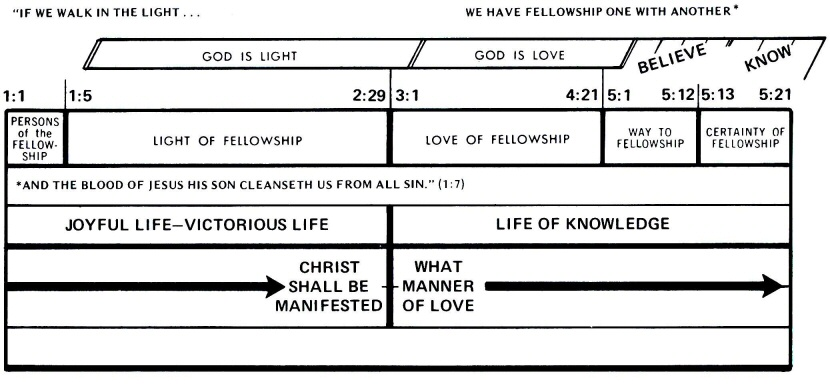
FELLOWSHIP WITH GOD AND HIS CHILDREN
Click chart to enlarge
Charts from Jensen's Survey of the NT - used by permission
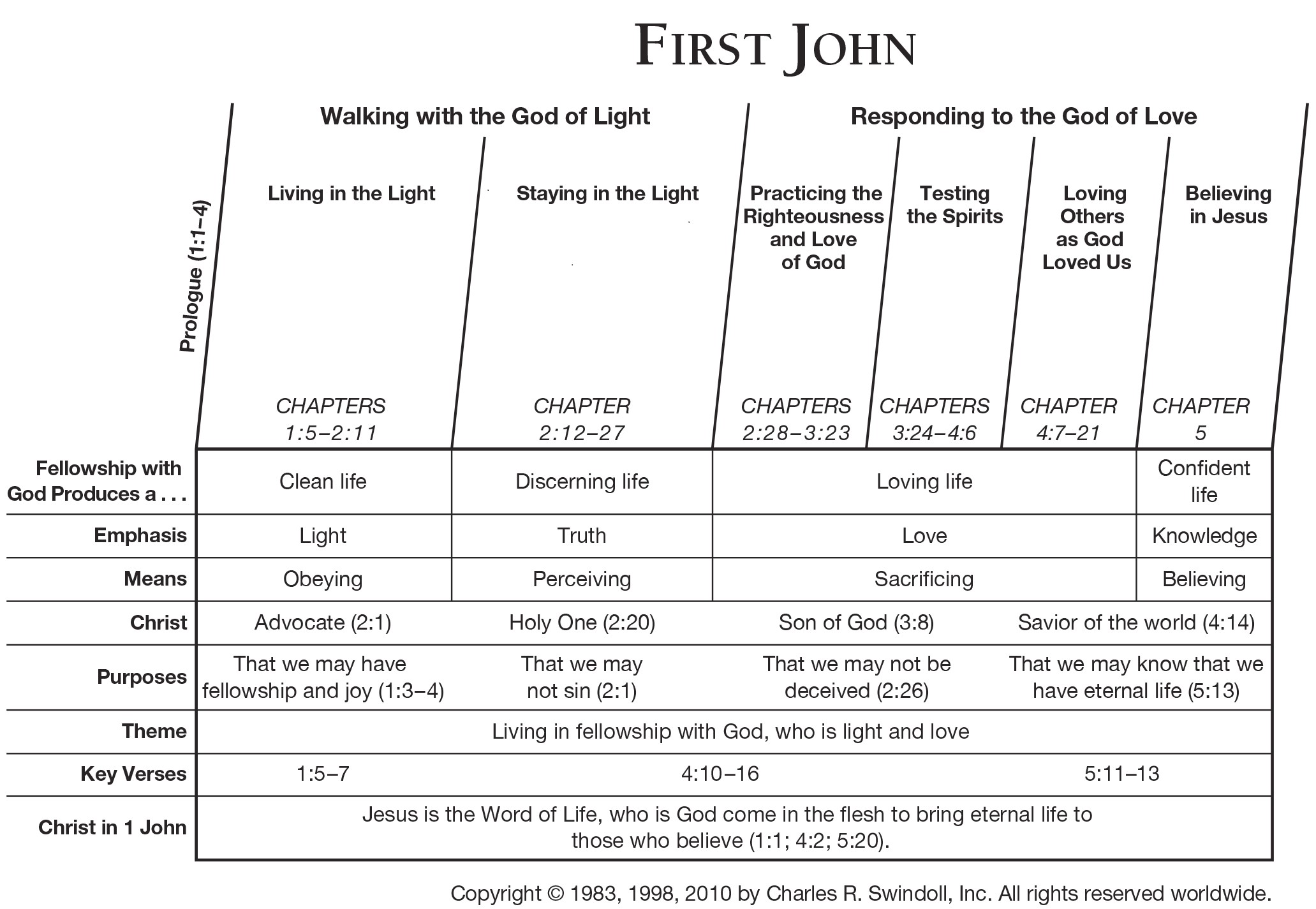
Another Overview Chart - 1 John - Charles Swindoll
| BASIS OF FELLOWSHIP | BEHAVIOR OF FELLOWSHIP | ||||
| Conditions of Fellowship |
Cautions of Fellowship |
Fellowship Characteristics |
Fellowship Consequences |
||
| Meaning of Fellowship 1 Jn 1:1-2:27 |
Manifestations of Fellowship 1 Jn 2:28-5:21 |
||||
| Abiding in God's Light |
Abiding in God's Love |
||||
| Written in Ephesus | |||||
| circa 90 AD | |||||
| From Talk Thru the Bible | |||||
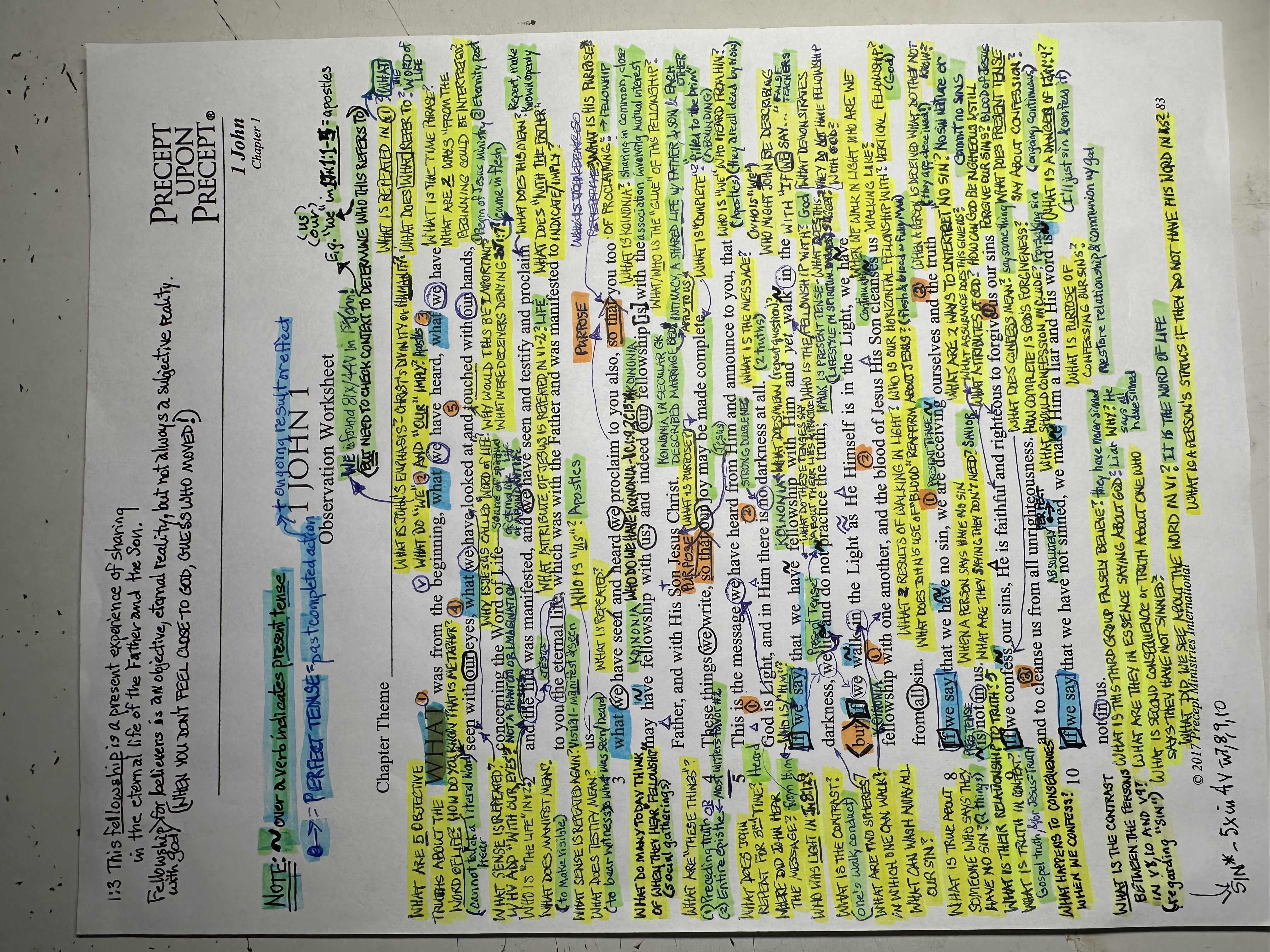
What is this? On the photograph of the Observation Worksheet for this chapter you will find handwritten 5W/H questions (Who? What? Where? When? Why? How?) on each verse to help you either personally study or lead a discussion on this chapter. The questions are generally very simple and are stated in such a way as to stimulate you to observe the text to discern the answer. As a reminder, given the truth that your ultimate Teacher is the Holy Spirit, begin your time with God with prayer such as Psalm 119:12+ "Blessed are You, O LORD; Teach me Your statutes." (you can vary it with similar prayers - Ps 119:18, 26, 33, 64, 66, 68, 108, 124, 135, 171, etc) The questions are generally highlighted in yellow and the answers in green. Some questions have no answers and are left to your observations and the illuminating/teaching ministry of the Holy Spirit. Some qualifying thoughts - (1) Use "As is" - these are handwritten and will include mistakes I made, etc. (2) They may not be the best question for a given verse and my guess is that on some verses you will think of a far superior 5W/H question and/or many other questions.
Dr Howard Hendricks once gave an assignment to his seminary students to list as many observations as they could from Acts 1:8. He said "So far they’ve come up with more than 600 different ones! Imagine what fun you could have with 600 observations on this passage. Would you like to see Scripture with eyes like that?" (P. 63 Living by the Book - borrow) With practice you can! And needless to say, you will likely make many more observations and related questions than I recorded on the pages below and in fact I pray that the Spirit would indeed lead you to discover a veritable treasure chest of observations and questions! In Jesus' Name. Amen
Why am I doing this? Mortimer Adler among others helped me develop a questioning mindset as I read, seeking to read actively rather than passively. Over the years I have discovered that as I have practiced reading with a 5W/H questioning mindset, it has yielded more accurate interpretation and the good fruit of meditation. In other words, consciously interacting with the inspired Holy Word of God and the illuminating Holy Spirit has honed my ability to meditate on the Scripture, and my prayer is that this tool will have the same impact in your spiritual life. The benefits of meditation are literally priceless in regard to their value in this life and in the life to come (cf discipline yourself for godliness in 1Ti 4:8+.) For some of the benefits - see Joshua 1:8+ and Psalm 1:2-3+. It will take diligence and mental effort to develop an "inductive" (especially an "observational"), interrogative mindset as you read God's Word, but it bears repeating that the benefits in this life and the rewards in the next will make it more than worth the effort you invest! Dear Christian reader let me encourage you to strongly consider learning the skills of inductive Bible study and spending the rest of your life practicing them on the Scriptures and living them out in your daily walk with Christ.
Although Mortimer Adler's advice is from a secular perspective, his words are worth pondering...
Strictly, all reading is active. What we call passive is simply less active. Reading is better or worse according as it is more or less active. And one reader is better than another in proportion as he is capable of a greater range of activity in reading. (Adler's classic book How to Read a Book is free online)
John Piper adds that "Insight or understanding is the product of intensive, headache-producing meditation on two or three verses and how they fit together. This kind of reflection and rumination is provoked by asking questions of the text. And you cannot do it if you hurry. Therefore, we must resist the deceptive urge to carve notches in our bibliographic gun. Take two hours to ask ten questions of Galatians 2:20+ and you will gain one hundred times the insight you would have attained by reading thirty pages of the New Testament or any other book. Slow down. Query. Ponder. Chew.... (John Dewey rightly said) "People only truly think when they are confronted with a problem. Without some kind of dilemma to stimulate thought, behavior becomes habitual rather than thoughtful.”
“Asking questions is the key to understanding.”
--Jonathan Edwards
That said, below are the 5W/H questions for each verse in this chapter (click page to enlarge). This is not neatly typed but is handwritten and was used for leading a class discussion on this chapter, so you are welcome to use it in this "as is" condition...
1 John 1:9 If we confess our sins, He is faithful and righteous to forgive us our sins and to cleanse us from all unrighteousness. (NASB: Lockman)
Greek: ean homologomen (1PPAS) tas hamartias hemon, pistos estin (3SPAI) kai dikaios hina aphe (3SAAS) hemin tas hamartias kai katharise (3SAAS) hemas apo pases adikias.
Amplified: What we have seen and [ourselves] heard, we are also telling you, so that you too may realize and enjoy fellowship as partners and partakers with us. And [this] fellowship that we have [which is a distinguishing mark of Christians] is with the Father and with His Son Jesus Christ (the Messiah). (Amplified Bible - Lockman)
ESV: If we confess our sins, he is faithful and just to forgive us our sins and to cleanse us from all unrighteousness. (ESVBible.org)
KJV: If we confess our sins, he is faithful and just to forgive us our sins, and to cleanse us from all unrighteousness.
NLT: But if we confess our sins to him, he is faithful and just to forgive us our sins and to cleanse us from all wickedness. (NLT - Tyndale House)
Phillips: But if we freely admit that we have sinned, we find God utterly reliable and straightforward - he forgives our sins and makes us thoroughly clean from all that is evil. (Phillips: Touchstone)
WBC: But if we acknowledge our sins, he is faithful and righteous, so that he will forgive our sins and purify usb from every kind of unrighteousness. (Word Biblical Commentary)
Wuest: If we continue to confess our sins, faithful is He and just to forgive us our sins and to cleanse us from every unrighteousness.
Young's Literal: if we may confess our sins, stedfast He is and righteous that He may forgive us the sins, and may cleanse us from every unrighteousness;
- confess: Lev 26:40-42 1Ki 8:47 2Ch 6:37-38 Ne 1:6 Neh 9:2-37 Job 33:27,28 Ps 32:1-2, 5 51:2-5 Pr 28:13 Da 9:4-20 Mt 3:6 Mk 1:5 Ac 19:18
- 1 John 1 Resources
Related Passages:
Daniel 9:20+ (DANIEL A MAN OF INTEGRITY!) Now while I was speaking and praying, and confessing my sin and the sin of my people Israel, and presenting my supplication before the LORD my God in behalf of the holy mountain of my God,
Psalms 19:12-13+ Who can discern his errors? Acquit me of hidden faults. 13 Also keep back Your servant from presumptuous sins; Let them not rule over me; Then I will be blameless, And I shall be acquitted of great transgression.
Psalms 32:1-2; 5+ A Psalm of David. A >Maskil. How blessed is he whose transgression is forgiven, Whose sin is covered! 2 How blessed is the man to whom the LORD does not impute iniquity, And in whose spirit there is no deceit!.....5 I acknowledged my sin to You, And my iniquity I did not hide; I said, “I will confess my transgressions to the LORD”; And You forgave the guilt of my sin. Selah.
Nehemiah 1:6 let Your ear now be attentive and Your eyes open to hear the prayer of Your servant which I am praying before You now, day and night, on behalf of the sons of Israel Your servants, confessing the sins of the sons of Israel which we have sinned against You; I and my father’s house have sinned.
Leviticus 26:40-42+ ‘If they confess their iniquity and the iniquity of their forefathers, in their unfaithfulness which they committed against Me, and also in their acting with hostility against Me– 41 I also was acting with hostility against them, to bring them into the land of their enemies–or if their uncircumcised heart becomes humbled so that they then make amends for their iniquity, 42 then I will remember My covenant with Jacob, and I will remember also My covenant with Isaac, and My covenant with Abraham as well, and I will remember the land.
1 Kings 8:47 if they take thought in the land where they have been taken captive, and repent and make supplication to You in the land of those who have taken them captive, saying, ‘We have sinned and have committed iniquity, we have acted wickedly’;
2 Chronicles 6:37-38 if they take thought in the land where they are taken captive, and repent and make supplication to You in the land of their captivity, saying, ‘We have sinned, we have committed iniquity and have acted wickedly’; 38 if they return to You with all their heart and with all their soul in the land of their captivity, where they have been taken captive, and pray toward their land which You have given to their fathers and the city which You have chosen, and toward the house which I have built for Your name,
THE HERESY: DENIAL OF SIN
THE ANTIDOTE: CONFESSION OF SIN
If we confess (homologeo) our (hamartia) - IF introduces a third class conditional sentence which speaks of potential action. Confess (homologeo) in the present tense calls for continual confession and as such is a mark of a genuine believer. John is not speaking of going into a booth and confessing to a man (such confession is not Biblical) who is also a sinner, but going to the throne of grace (Heb 4:16) and confessing to God. Failure to regularly confess one's sins should cause one to exam the authenticity of their salvation (2Co 13:5+)!
Our sins (hamartia) speaks of personal possession - We must each "Own up" to our sins. It's not my brother, it's not my sister, etc, it's me to whom God is speaking. Personal possession - We must each "Own up" to our sins. It's not our brother, it's not our sister, etc, it's us to whom God is speaking.
John counters the false teaching (someone may have been teaching this heresy) and/or false belief (some may have begun to believe this heresy) of the denial of sin in 1Jn 1:8 and 1Jn 1:10 with the truth, always the best "apologetic!" The truth is that instead of denying our sin, we are to confess our sins. We are not to be "sin deniers" but "sin confessors!" By grace through faith (Eph 2:8, 9+) we confess sin (and our belief in the Sin Bearer, the Lamb of God, Christ Jesus, Jn 1:29, Isaiah 53:5,6, 2Cor 5:21+) the first time and receive salvation (Ro 10:9, 10+ see "past tense salvation" - justification = Three Tenses of Salvation) and then as new creatures in Christ (2Cor 5:17+), motivated and enabled by the Spirit and grace (cf His work in Jn 16:7-8+), we confess sin prn (which means "as needed" - I am a physician and God's prescription to us is "confess as needed") as a manifestation of our sanctification process ("present tense salvation"). The more you grow in Christlikeness, the quicker will be your confess of sin. In summary, confession of sins is one of the evidences or proofs that one is indeed a new creation in Christ. The individuals in verse 8 and verse 10 would see no need for confession of their sin, for they have deceived themselves into believing the lie that they have no sin or commit no sins!
Charles Spurgeon explains why quick confession should be every saint's practice - It is not the nature of sin to remain in a fixed state. Like decaying fruit, it grows more rotten. The man who is bad today will be worse tomorrow.
F B Meyer adds "Do not wait for the hour of evening prayer, nor even for the opportunity of being alone, but in the busy street, in the midst of daily toil, lift up your heart to Christ if you have done wrong, and say: "I have gone astray"
Abraham Lincoln on how to deal with sin - It is the duty of nations as well as of men to confess their sins and transgressions in humble sorrow, yet with assured hope that genuine repentance will lead to mercy and pardon.
Jeremy Taylor on the danger of sin and why it needs to be confessed and repented thereof - A man is first startled by sin; then it becomes pleasing, then easy, then delightful, then frequent, then habitual, then confirmed. The man is impenitent, then obstinate, and then he is damned. (WOE!)
As Oswald Chambers writes in his book "Conformed to His Image" - When the Holy Spirit begins to unearth the works of the flesh in you, don’t temporize, don’t whitewash them; don’t call suspicion, "discernment of the spirit", or ill-temper, "righteous indignation"; bring it to the light, come face to face with it, confess it and get it cleansed away.
John Trapp makes a great point stating that "No man was ever kept out of God's kingdom for his confessed badness; many are for their supposed goodness; as those justitiaries in the former verse (1Jn 1:8), whose hearts are big-swollen with high conceit of themselves; and whose lips are held close by the devil; who knows well there is no way to purge the sick soul but upwards.
🙏 THOUGHT - Beloved, without seeing ourselves as rank, rebellious sinners, we have little need for a Righteous Redeemer and Savior! The true and full Gospel presents the picture of all men lost in their sin (Ro 3:10+, Ro 3:23+), before the Holy God, guilty, condemned and deserving of death (Ro 6:23+, James 2:10+). As M R DeHaan said "Before an individual can be saved, he must first learn that he cannot save himself." It is when one sees themselves as a sinner in great need of the great Savior, that they confess their sin to God and confess Christ as their Lord (Ro 10:9, 10+), receiving His forever forgiveness and His perfect cleansing as they are by His grace taken out of Adam and placed into Christ (1Cor 15:22+). However as they conduct themselves in this world which is not their home, walking as children of God (Eph 4:1+), their feet become "dirty", so to speak (i.e., they become defiled by sins of thought, word and deed, sins of omission and commission, cp Ps 19:12+, Ps 40:12+). In other words, although they are new creatures in Christ (2Co 5:17+), they still commit sins because they possess an indwelling sin nature, albeit one that has been conquered by Calvary's love (Ro 6:11+, et al)! This truth that believers still have the potential to commit sins, prompted Jesus to explain to Peter "He who has bathed needs only to wash his feet, but is completely clean; and you are clean, but not all of you." (John 13:10+) Jesus was speaking figuratively giving us a beautiful picture of Peter's need "only to wash his feet", which describes the need of every believer for daily confession of sins which make us "dirty."
HAVE YOUR SINS
BEEN FORGIVEN OF GOD?
George Truett in an excellent series of evangelistic sermons in the early 1900's said the following related to 1John 1:9…
Its primary application is manifestly for Christians, as the context indicates, but its gracious truth may be applied to all who sin, and are therefore in need of God's forgiving mercy.
Somebody has well said that the three hardest words-to say like they ought to be said are these: "I have sinned." You will grant the truth of that saying upon a brief moment's reflection. The three most difficult words to say like they ought to be said are these three: "I have sinned." And yet confession of sin lies right at the foundation of our coming to Christ.
If one be not a sinner,
then for him there is no Savior.
For him, Christ's Gospel does not have any appeal, if one be not a sinner. Jesus tells us: "They that are whole (or well) do not need a physician, but they that are sick." (Mt 9:12) And again Jesus tells us: "I did not come to call the righteous, but sinners to repentance." (Lk 5:32, cp Mt 9:13, Mk 2:17) And again He tells us: "The Son of man is come to seek and to save that which was lost." (Lk 19:10)
Oh, are you a sinner? Then I preach to you a Savior, for Jesus came to seek and to save sinners. Forgiveness of sins is a real experience. Sin is as real as your hand or eye. Sin obtains with every rational soul. The forgiveness of sins is as real as the sin itself. The Lord Jesus Christ came to grant forgiveness of sins. Forgiveness of sins is a personal experience—a real personal experience. There can be no forgiveness except between persons. That chair could not forgive you. That tree could not forgive you. That beast of the field could not forgive you. Forgiveness is always between persons. Now God, the Great Person, comes to you and me, the little, finite, human, mortal, dependent, sinning persons, and says to us : "If you will turn to Me with right attitude, I will forgive your sins." Oh, I ask you, one by one, as my eye sweeps the audience: "Have your sins been forgiven of God ?" Could you lay your hand upon your heart and say : "I have the consciousness within me, that God has forgiven my sins?" I would press that upon you, one by one—have your sins been forgiven of God? And I would pray you, do not stop until you can give a complete, satisfactory answer to that great question—have your sins been forgiven of God?
Our text tells us, "If we confess our sins, He is faithful and just to forgive us our sins." Be not deceived, I pray you, my men and women, on this crucial point, the reality of sin, and the inescapable fact that sin must be confessed in the right way, if we are ever to get forgiveness for our sins. Be not deceived at such crucial point, the fact of sin in your life and mine—the awful fact of sin. There are two chief causes that conspire to deceive us at this point… (Read the rest of Truett's sermon to discover the "two chief causes… " = 1 John 1:9 The Confession of Sin - CLICK PAGE FOR THE SERMON)
ANOTHER "IFFY"
STATEMENT
If we confess - This conditional statement with the subjunctive mood of probability implies that the "we" may not confess their sins. In context John describes individuals who in fact deny their sin (1John 1:8, 10). Deceived sinners excuse sin, deny sin, whitewash sin or play sin down. They say their sins are "No big deal", but they are wrong! Sins are a "big deal" because one unforgiven sin is enough to eternally damn a soul according to James 2:10. Indeed, it is a great sin to love a small sin. (We all need to ask "Are we harboring/protecting any 'pet sins' we need to confess?") While believers cannot lose their salvation, they certainly can lose the joy of their salvation. (cp David's repeated plea for restoration of joy Ps 51:8-note, Ps 51:12-note, Ps 51:14-note) Indeed as someone has said "Nothing will stop our song quicker than our sin!" specifically our "unconfessed sin. We can lose our sense of walking in communion with God, our experience of empowerment by the Spirit (Who is grieved Eph 4:30, quenched 1Th 5:19), etc.
Sin causes the cup of joy
to spring a leak.
Confession seals the leak!
Is your cup full?
While there is no question that 1 John 1:9 is a verse believers can and should "run to" when they sin against God, let us not neglect the immediate context (especially the verses before and after). On one hand some say "we have no sin" while others say "we have not sinned." Think about what they were saying. Notice also that they did not just make an occasional slip of their tongue, but they were continually making these claims of "no sin." Can you see how "sin denier's" might not see their need for a Savior, One to save them from the penalty of death for their sins against a Holy God? Why would a person who claims they do not sin need a Redeemer to set them free from the guilt, penalty and bondage of sin? To counter this dangerous damning deception, John presents the antidote - confession of sins. Confess your sins and find forgiveness and cleansing.
THE OLD ADAMIC NATURE
HAS NO DESIRE TO CONFESS SINS
J C Philpot makes an important point in regard to confession of sins…
It is not your confessing them, but it is thus--your confessing them is a mark of divine light; your confessing them springs from the work of grace upon your heart.
Comment: Do you understand what Philpot is saying? He is saying that our old (flesh) nature (before we believed and Christ became our life, before we were granted a new heart, before He sent His Spirit to dwell in our heart), in and of itself has no inherent propensity or desire to confess sins. Genuine confession of sins is a work of divine grace, a clear mark of genuine conversion, of implantation of His divine nature within a born again one, giving a supernatural nature which enables a supernatural response when we sin -- a Spirit enabled desire and power to confess our sin. As Paul explained to the saints at Philippi, "God is working in you, giving you the desire to obey him and the power to do what pleases Him." (Php 2:13NLT). Indeed, confession of our sins is pleasing to the Lord!
Alexander Maclaren reminds us that in the preceding passages (1Jn 1:5-8)…
the underlying thought is that fellowship with God necessarily involves moral likeness to Him. Worship is always aspiration after, and conformity to, the character of the "god" worshipped, and there can be no true communion with a God Who is light unless the worshipper walks in light. In plain language, all high-flying pretensions to communion with God must verify themselves by practical righteousness. That cuts deep into an emotional religion, which has much to say about raptures and the like, but produces little purifying effect on the humble details of daily life.
There are always professing Christians who talk of their blessed experiences, and woefully fail in prosaic virtues. It is a pity that a man should hold his head so high that he does not look to keep his feet out of the mud. Such a profession is for the most part tainted with more or less conscious falsehood, and is always a proof that the truth — the sum of God’s revelation — is not operative in the man; that he is not turning his belief into act, as all belief should be. On the other hand, the true relation resulting from the message is that we should walk in the light, as He is in it.
Peter Barnes writes that "we begin the Christian journey by confessing our sins and believing in Christ for the first time, and (make confession our daily practice) as we continue to battle with ongoing sin in our lives. (The Message of John's Epistles - recommended)
Barnes adds that "During the tragedy of Nazi Germany, Dietrich Bonhoeffer headed up a seminary of the German 'Confessing Church' at Finkenwalde. Here Bonhoeffer proclaimed, 'In confession occurs the breakthrough to the Cross.' (Ed: And need we remind ourselves of the fetid fruit of the failure of most professing Christians in Nazi Germany [it was known as a "Christian nation" just as it "post-Christian" America today!] to be genuine confessing Christians!)
Steven Cole agrees that life of a true follower of Christ "is marked by continual confession of sins. It begins at salvation, when he acknowledges his sin to God and (receives initial) forgiveness and cleansing. He experiences ongoing forgiveness and cleansing as he continues confessing his sins. (How to Have Fellowship With God 1 John 1:5-10)
Forgiveness is not incomplete or dependent
in the saving sense on believers’ confessing.
John MacArthur - Confession of sin is absolutely crucial to entering the Light (justification) (cf. Mark 1:15; Luke 18:13–14) and walking in it (sanctification). 1 John 1:9 fits this pattern with perfect consistency, when rightly interpreted. Because John is writing to believers (“my little children,” 2:1), to those who are antinomian it appears to make forgiveness conditional (i.e., if believers confess, God will forgive; if they do not confess, He will not forgive). This confusion is easily cleared away, first of all by noting that the verse is actually a reiteration of God’s faithfulness to His New Covenant promise of salvation in the Old Covenant: “I will forgive their iniquity, and their sin I will remember no more” (Jer. 31:34; cf. Luke 1:77–78; Heb. 9:13–14). The reminder that He is faithful and righteous to forgive us our sins and to cleanse us from all unrighteousness reemphasizes the truth John had just stated in 1Jn 1:7, that God will, because of His character, secure their eternal glory by continuing to cleanse believers from all future sin. He is faithful to His promise and always does what is righteous. (The aorist tense of the verb aphiemi [forgive] carries a past connotation and further demonstrates that God’s forgiveness derives from a historical event, the atonement, which has lasting benefits for all who believe.) In chapter 2 John writes, “your sins have been forgiven you for His name’s sake” (1Jn 2:12). Forgiveness is consistent with Who Jesus Christ is and with what the Father promised, according to His perfectly faithful (Isa. 49:7; 1 Cor. 1:9; Heb. 2:17; Rev. 19:11), righteous (Ps. 7:11; Isa. 53:11), just (Ge 18:25; Col. 3:25), holy (Ex. 15:11; Rev. 4:8), and loving (Jer. 31:3; 1 John 4:8) nature. Forgiveness is not incomplete or dependent in the saving sense on believers’ confessing. With that established, it is possible to understand the place of ongoing confession. The word translated confess (homologeo) means “to say the same thing.” Thus believers are those who confess their sins, agreeing with God about their sin—they acknowledge its reality and affirm that it is a transgression of His law and a violation of His will, the presence of which the truly penitent seek to eliminate from their lives (1Jn 3:4; James 2:10–11; 4:17; cf. Rom. 7:24). What John is actually saying here about confession is that since believers are forgiven, they will regularly confess their sins. Stated another way, their forgiveness is not because of their ongoing confession, but their ongoing pattern of penitence and confession is because of their forgiveness and transformation. As the Holy Spirit sanctifies believers, He continually produces within them a hatred for sin (Ps. 97:10; Pr 8:13; Ro 7:15–25; Phil. 3:8–9; cf. Ps. 1:1–2), which results in penitent hearts and a sincere acknowledgment of their sins. The more believers grow in Christ, the greater their hatred of sin becomes and the deeper is their penitence. Paul, the most devout and dedicated Christian, at the end of his earthly sanctification, saw himself as the foremost of sinners (1 Tim. 1:15).
The time lag between the moment of sinning and the moment of forsaking and
confessing is a sure indication of the true nature of a man's walk with God.
-- Alan Redpath
🙏 THOUGHT: Practically speaking beloved, how long does it take you to recognize your sin and agree with God that it is sin and that you have willfully rebelled against His grace and light and holiness and you now desire to repent of it?
"COVER" YOUR SINS BY
"UNCOVERING" THEM WITH CONFESSION
Robert Candlish writes "As to the confession, it is the confession of men “walking in the light, as God is in the light”; having the same medium of vision that God has; it is the continual confession (present tense) of men continually so walking and so seeing."
Comment: Candlish makes an excellent point - as we walk in the light of God's Word, continually yielding to His Spirit, the Spirit of Truth will make us aware of sins of which we were otherwise not aware. And the same Spirit Who expose our sins, will give us the grace to confess those sins. Amazing grace indeed!
To reiterate, it is important to understand that when we confess sins the confession includes an appropriate action - in other words it is saying and doing -- it is saying the same thing about our sins and it includes a forsaking of our sin. Why? Because that is God's attitude concerning sin (cp Pr 28:13).
Guzik recalls an illustrative passage - When we confess our sin, we are willing to say (and believe) the same thing about our sin that God says about it. Jesus’ story about the religious man and the sinner who prayed before God illustrated this; the Pharisee bragged about how righteous he was, while the sinner just said God be merciful to me a sinner. (Luke 18:10-14) The one who confessed his sin was the one who agreed with God about how bad he was.
Homologeo is present tense denoting continuous action. In other words confession of our sins is to be a marker of our new life in Christ. This clearly refutes the position that a Christian can obtain sinless perfection in this present life. Remember that John's epistle is addressed to genuine believers and his point is that genuine believers will willingly confess their sins as their "lifestyle."
Wuest agrees writing that the present tense "teaches that the constant attitude of the saint toward sin should be one of a contrite heart, ever eager to have any sin in the life discovered for him by the Holy Spirit, and ever eager to confess it and put it out of the life by the power of that same Holy Spirit. David wrote concerning that kind of heart when he penned the words: "The sacrifices of God are a broken spirit: a broken and a contrite heart, O God, thou wilt not despise" (Psalm 51:17)."
Paul Apple - Look at the Present tense of the verb - coordinate with the Present tense of "walking in the light" -- if we are characterized by taking sin seriously in terms of confessing sin on an ongoing basis as the Holy Spirit convicts us in our Christian walk, that practice of confession marks us as a true believer and God is faithful (He keeps His Word) and righteous (He honors the atonement) to forgive us our sins (not just in a legal sense in terms of justification but in a practical sense in terms of not letting anything come between and interrupt our relationship) and to cleanse us from all unrighteousness. This confession of sins (like John Bunyan in Pilgrim's Progress as he walks along the path towards heaven and needs to be recovered from the pitfalls of life) is a fruit of initial repentance and a proof of our fellowship with God whose standard of holiness provides the basis for our confession. David in the Psalms spoke often about the opposite of confession of sin -- describing his spiritual torment when he tried to hide his sins or rationalize or explain away his behavior. (1 John - Tests of Eternal Life)
🙏 THOUGHT - How seriously are we taking sin in our life? Do we remember that it it our sin that caused Christ to have to shed His blood on the cross to suffer in our place in order to provide us with forgiveness and cleansing?
Hiebert states that "The corrective for such self-deception (confession of sin) is stated without a connective particle. The hypothetical form, “If we confess our sins”, implies that believers must be willing to meet the stipulated condition. More is involved than a general acknowledgment of one’s sinfulness; it is the confession of sinful deeds to God. To “confess” means literally “to say the same thing, to agree with.” A believer must frankly be willing to say the same thing about his sins (the sins he is conscious of having committed) that God says about them. Christians must acknowledge their sins for what they are, rather than using some flowery designation that conceals their true character. The present tense calls for such confession as their standing practice. The confession should be as wide as the actual guilt.
Charles Simeon - The “confession” which characterizes a true penitent, of course is not to be understood of a mere acknowledgment, but an acknowledgment accompanied with suitable contrition, and with a humble faith in the Lord Jesus.
David’s prayer in Psalm 51 is one of the clearest pictures of confession in the Bible. According to Psalm 51:1–3, David takes personal responsibility for his sins (as deduced from his repeated use of the first-person pronoun). In Ps 51:4, David agrees that God has the ultimate authority in our lives and that He is right to judge, and we deserve His judgment. In Ps 51:5 David confesses that he is a sinner by nature, from the womb. In Ps 51:7–10, David expresses his need to God to cleanse him and change his heart.
THOUGHT - Have you ever personalized Psalm 51? It would be a good exercise for all of us to place ourselves in David's position, as if all that he is saying is true of us as well (because it is!)
Adam Clarke - If, from a deep sense of our guilt, impurity, and helplessness, we humble ourselves before God, acknowledging our iniquity, his holiness, and our own utter helplessness, and implore mercy for his sake who has died for us; he is faithful, because to such he has promised mercy, Psalm 32:5; Proverbs 28:13; and just, for Christ has died for us, and thus made an atonement to the Divine justice; so that God can now be just, and yet the justifier of him who believeth in Jesus.
Spurgeon commenting on If we confess our sins writes "That is the point; and he, who says that he has no sins, will not confess them. He, who believes himself to be perfect, cannot enjoy the blessing described in this 9th verse. To deny that we have any sin, is to walk in darkness, and to show we are without the light which would reveal our sin to us, kind if we are walking in darkness we cannot be in fellowship with God. But to see sin in ourselves from day to day, humbly to confess it, and mourn over it, is to walk in the light; and walking in the light, we shall have fellowship with God who is light. “If we confess our sins,” — The text means just this - Treat God truthfully, and he will treat you truthfully. Make no pretensions before God, but lay bare your soul, let him see it as it is, and then he will be faithful and just to forgive you your sins and to cleanse you from all unrighteousness.
CONFESSION…
EVIDENCE THAT I AM FORGIVEN
Oswald Chambers - Watch the difference between confessing and admitting ; the majority of us are quite ready to admit, it is the rarest thing to get to the place where we will confess—confess to God, not to man. It is much more difficult to confess to God than we are apt to think. It is not confessing in order to be forgiven; confession is the evidence that I am forgiven. God does not forgive me because I confess; I realize by my confession that I am forgiven. Am I willing to be brought to the place where God draws out my confession? When the Spirit of God convicts of sin it is not like a detective convicting a criminal, it is sin finding out a man’s own nature and making him say, “Yes, I recognize it.” When once your sin does find you out, the exquisite pain of confessing acts like the sweetest medicine—“a broken and a contrite heart, O God, Thou wilt not despise.” Beware of having anything that makes your mind accept an excuse for yourself. I can step out of darkness into the light—when God is willing? No, when I am willing. “I do want to be in living communion with God”; I don’t, if I did, I could be there in one second; the reason I am not there is that I won’t confess, I won’t submit to God’s condemnation of the thing. Immediately confession is made the Atonement of Our Lord steps in with its supernatural efficacy. (He Shall Glorify Me : Talks on the Holy Spirit and Other Themes)
Ray Stedman agrees with Chambers, noting that "the word confess… does not mean to ask for forgiveness… Christ's work for us upon the Cross has already done all that is necessary to forgive us. What God wants us to do is to look at the sin before us and call it what He calls it. That means to agree with God about it, and that is what the word confess means: Fess comes from a root which means "to say," and con means "with." "To say with" God what He says about this thing, that is confessing sin. There is a popular song which you sometimes hear in Christian circles,
If I have wounded any soul today,
If I have caused one foot to go astray,
If I have lived in my own selfish way,
Dear Lord, forgive.
That is not a confession at all. The "if's" take it out of the realm of confession. Do not say "if," say, "Lord, I have caused some foot to go astray, I have lived in my own selfish way." That is confession, that is agreeing with God. (Ray Stedman - The Man who Denies Sin - 1 John 1:8-9) (Bolding added)
THOUGHT: As an aside, we always need to be discerning regarding Christian music, asking asking the simple question, "Is it Biblical?" If not we need to discard it, because music is a powerful vehicle for reaching deep into our soul and influencing our feelings and our behavior!
It is notable that this verse (contrary to what many commentaries suggest) does not specifically state to whom our sins should be confessed - to God, to one another, in private or in public. That said, since sin is first and foremost always against God (Ge 39:9, Lev 6:2, Nu 32:23, 2Sa 12:13, 24:10, Ps 51:4), we should always confess our sins to Him. In the Old Testament David sinned against God and against man (Uriah, Bathsheba, his people) and in Psalm 51 and yet we note that he confesses his sins to God…
Against Thee, Thee only, I have sinned, and done what is evil in Thy sight, So that Thou art justified when Thou dost speak, And blameless when Thou dost judge. (Ps 51:4)
CONFESSION:
AN ACT OF MORTIFICATION
The great Puritan writer Thomas Manton has a pithy description of confession writing that it "is the best way to bring the soul into a dislike of sin. Confession is an act of mortification; it is as it were the vomit of the soul; it breeds a dislike of the sweetest morsels, when they are cast up in loathsome ejections (Ed: This ought to give us something to ponder the next time we contemplate willful sin!) Sin is sweet in commission, but bitter in the remembrance. God’s children find that their hatred is never more keen and exasperated against sin than in confessing. (A Practical Commentary, or An Exposition with Notes on the Epistle of James)
John Gill writes that we are to confess our sins "Not to one other; for though it is our duty to confess our faults to our fellow creatures and fellow Christians which are committed against them, yet are under no obligation to confess such as are more immediately against God, and which lie between him and ourselves; or at least it is sufficient to confess and acknowledge in general what sinful creatures we are, without entering into particulars; for confession of sin is to be made to God, against whom it is committed, and who only can pardon: and a man that truly confesses his sin is one that the Spirit of God has convinced of it, and has shown him its exceeding sinfulness, and filled him with a godly sorrow for it, and given him repentance unto salvation, that needeth not to be repented of; and who, under such a sight and sense of sin, and concern for it, comes and acknowledges it before the Lord, humbly imploring, for Christ's sake, his pardoning grace and mercy; and such obtain it (1 John 1:9 Commentary)
Kress explains the present tense aspect of confess nothing that "a true Christian is continually acknowledging and dealing with sin—not in a saving sense but in a communal sense. From a human standpoint, our fellowship can be marred by sin. The promise of confession is forgiveness and cleansing. (Notes for the Study and Exposition of 1st John)
Comment: Note Kress says "a true Christian" as opposed to one who simply professes to be a believer. It is interesting and somewhat surprising that Jim Bomkamp does not include "confession of sins" as one of the marks of a believer (34 Marks of a True Christian in 1 John). While confession is not an absolute marker of a genuine Christ follower (because some men confess to other men thinking that is sufficient penitence), but is certainly one indicator. Who but a genuine believer recognizes that His sin is against the Holy God?
As Harrison says "sensitiveness to sin is the sign of His illuminating, self-revealing presence. Hence it is that some of the most godly saints, walking daily in a closeness of fellowship with Him, have been characterized by a confessed consciousness of sin beyond their fellows. They were living in the Light that made evident the contrast between themselves and Himself. his experience finds divine interpretation in the spiritual autobiography of the prophet Isaiah. It was when he "saw the LORD" (Isa 6:1-note) in the pure, white light of His holiness that he discovered, and at once decried, a personal uncleanness: "Woe is me; I am undone; I am unclean." (Isa 6:5-note) And that confession brought the full relief of a further revelation of the Lord as the GOD of cleansing." (Isa 6:6,7-note)
Guzik makes the point that "Our sins are not forgiven because we confess; if this were the case - if forgiveness for a sin could only come where there was confession - then we would all be damned, because it would be impossible for us to confess every sin we ever commit. We are forgiven because our punishment was put upon Jesus, we are cleansed by His blood.
John Trapp - No man was ever kept out of God's kingdom for his confessed badness; many are for their supposed goodness.
A word of caution dear believer…
Confessing your sins is no substitute
for forsaking your sins!
Or as someone else well said "Confession must be salted with contrition." (cp God's delight in a "broken spirit, a broken and contrite heart" - Ps 51:17+, cp Isa 57:15)
Steven Cole in his discussion of walking in the light reminds us that…
“To walk” points to the general tenor of one’s life. Since to walk in the light involves confessing our sins (1Jn 1:9), to walk in the darkness means ignoring or denying our sins. It is to block out the light of God’s holiness, as revealed in His Word, and to live as the world lives, making up your own ideas about right and wrong apart from God (see Eph 4:17, 18, 19; Eph 5:7-12). It is to justify your own behavior either by redefining sin, by blaming it on other factors, or by doing away with the entire concept of sin. To walk in darkness is to try to hide from God, rather than to expose your life to Him…
But we need to apply this personally. If as a way of life, I am not allowing God’s Word to confront my sinful thoughts, attitudes, motives, words, and deeds, I am walking in darkness. If I dodge my sin by blaming others or making up excuses for why I sin, I am walking in darkness. And for John, to walk in darkness is not describing a “carnal” Christian. It is describing an unbeliever, no matter how much he may claim to have fellowship with God. To have fellowship with God, we must recognize that He is absolutely holy. And, we must not walk in the darkness. (Sermon)
Spurgeon's gives us a striking example of an insincere confession - Pastor R., of Elberfeld, was once sent for to see a dying man. He found the patient really very ill, and entered at once into an earnest conversation about the state of his soul. The patient began, in the strongest terms, to describe himself as the very chief of sinners, and declared that his past life filled him with abhorrence. He continued so long in this strain that the pastor could scarcely find an opportunity to speak. At last, taking advantage of a pause, he remarked gently, “It was then really true what I heard of you?” The patient raised himself in the bed, stared in astonishment at the pastor, and demanded, “What, then, have you heard? No one, in truth, can say anything against me;” and continued, in a strain of unbounded self-satisfaction, to tell of his virtues, and recount all his good deeds, pouring out at the same time a torrent of execrations against the slanderers who had tried to injure his character. “It was not from foes or slanderers,” said the pastor, “that I heard it, but from yourself; and now it grieves me to hear that you do not believe what you said.” (Biblical Illustrator)
Robert Rayburn gives us striking illustrations of sincere confession in the lives of Thomas Boston and Alexander Whyte…
Whyte was a Scottish Presbyterian pastor who died in 1921. Whyte was a Christian who impressed all who knew him with the depth of his humility and with the many virtues which are simply the public expression of humility in one way or another: kindliness, modesty, reverence and so on. But you will not have to do much reading in Whyte to discover where that humility came from. Here is a man--as much as any man I know about, who refused to ignore the truth about himself and about his sin. His sin was always before him, his secret sins as well as his public sins--and he was always confessing those sins… And all of that confessing of sin had its perfect fruit in his so humble life. (The First of the Tests of Life)
There is a piece of history that I have shared with some of you some years ago, and will no doubt, if God gives me years to come as your minister, will share with you again from time to time. I want you to remember it, and so I must repeat it. It is for me, it is so far in my life, at any rate, the Lord's great illustration to me of the truth of the necessity and the importance and the virtue and the benefit of a sense of one's own great sin and the constant confession of that sin.
It strikes me so powerfully, because the man in question, Thomas Boston, is a man whose life and writings have made a deep and lasting and wonderful impression upon my own heart. He is a man I admire as much as any man I know about; he is a man such as I long to become. His autobiographical Memoirs, the story of his life, I consider to be one of the greatest books ever written, and one of the most profound textbooks in the Christian life and in true godliness that I know. It was Rabbi Duncan who said, you may remember, that he wished that he could sit at the feet of Jonathan Edwards to learn what true holiness is, and then at the feet of Thomas Boston, to learn how to obtain it. Boston was a man whose life, both in his own day and since, became renown for his fierce and passionate love for Christ, his fearless defense and service of the gospel, his humble affection for his brethren and his congregation, and his patience under intense hardship and suffering. So it may come as a surprise to some to read the end of his life story as he himself relates it.
Near the end of his life, as he relates in his Memoirs, Boston, knowing that his end was near, conducted a thorough self-examination, to make sure that he was ready to leave this life and to meet the Lord. During the several days he spent at this solemn task, he recollected his long life as a Christian and the experiences he had had with God. He went over the gospel of Christ in every part examining his agreement with it and his commitment to and trust in Christ. But, then he attends at some length to his sins. Let me quote briefly from the Memoirs:
I [Boston] read over … "the larger catechism on what is required and forbidden in the Ten Commands; then thought on my ways in the several periods of my life, and in the order of the Ten Commands; by all which means I got a humbling sight of myself. Then bowing my knees before the Lord, I did silently read over the two confessions before him; which done, I prayed, and made confession of my sins as fully and particularly as I could; and there I got a view of my whole life as one heap of vanity, sin, and foolishness. It appeared a loathsome life in my eyes, so that my very heart said, "I loath it; I would not live always;" and I loathed myself on account of it. It cut to the heart to think of it, and cut off desire of returning to it, if that had been possible. But such as I was, I behoved to look again towards his temple."
And when he was through with all of that, he turned his attention to a particular sin, a besetting sin, which had bedeviled him all of his life and over which he had still not gained the mastery. This sin required a special attention and a special confession, a special prayer for pardon and for purification. Here is the lesson I draw from all that, beloved!
If such a man as Thomas Boston, beside whose Christian life yours and mine pale to virtually nothing, finishes his life in a paroxysm of confession of sin, then who are we to say that we do not need much more of that same acknowledgement and confession of sin than now we practice. Thomas Boston was giving himself the tests of life and he passed with flying colors, and in no test did he achieve a higher score than in this most important test of genuine faith and life in Christ:
'If we claim to be without sin we deceive ourselves… If we confess our sins, he is faithful and just to forgive us our sins and purify us from all unrighteousness.'
Is it negative to be so mindful of our sin and always confessing it? The Devil wants you to think so. But it is only negative, if it is negative to love Christ passionately and be always turning to him in trust and hope as your Savior, only negative if it is negative to be meek and lowly of heart before God and others; only negative if it is negative to live in this world with one's heart full of heaven and desire for the life to come.
There is but one way to Thomas Boston's kind of Christian life--and that is the way of the Apostle John--the way of confessing our sins and turning from them to Christ for forgiveness and for deliverance--every single day of our Christian lives. (1John)
Our sins (hamartia) - Personal possession - We must each "Own up" to our sins. It's not our brother, it's not our sister, etc, it's us to whom God is speaking.
And although sins clearly refers to our conscious sins, it is not restricted to those, for as David asked and prayed in Psalm 19…
Who can discern his errors? Acquit (cleanse - KJV) me of hidden faults (those of which I am not conscious). (Psalm 19:12)
Spurgeon comments: Who can understand his errors? A question which is its own answer. It rather requires a note of exclamation than of interrogation. By the law is the knowledge of sin, and in the presence of divine truth, the psalmist marvels at the number and heinousness of his sins. He best knows himself who best knows the Word, but even such an one will be in a maze of wonder as to what he does not know, rather than on the mount of congratulation as to what he does know. We have heard of a comedy of errors, but to a good man this is more like a tragedy. Many books have a few lines of errata at the end, but our errata might well be as large as the volume if we could but have sense enough to see them. Augustine wrote in his older days a series of Retractations; ours might make a library if we had enough grace (Ed: Note our need for grace to even recognize and admit our mistakes!) to be convinced of our mistakes and to confess them.
Acquit me of hidden faults. Thou canst mark in my faults entirely hidden from myself. It would be hopeless to expect to see all my spots; therefore, O Lord, wash away in the atoning blood even those sins which my conscience has been unable to detect. Secret sins, like private conspirators, must be hunted out, or they may do deadly mischief; it is well to be much in prayer concerning them. In the Lateran Council of the Church of Rome, a decree was passed that every true believer must confess his sins, all of them, once a year to the priest, and they affixed to it this declaration, that there is no hope of pardon but in complying with that decree. What can equal the absurdity of such a decree as that? Do they suppose that they can tell their sins as easily as they can count their fingers? Why, if we could receive pardon for all our sins by telling every sin we have committed in one hour, there is not one of us who would be able to enter heaven, since, besides the sins that are known to us and that we may be able to confess, there are a vast mass of sins, which are as truly sins as those which we lament, but which are secret, and come not beneath our eye. If we had eyes like those of God, we should think very differently of ourselves. The transgressions which we see and confess are but like the farmer's small samples which he brings to market, when he has left his granary full at home. We have but a very few sins which we can observe and detect, compared with those which are hidden from ourselves and unseen by our fellow creatures.
F B Meyer describes our sins this way - TO SIN is to miss the mark! Such is the meaning of the original word. When the prodigal returned, his first words were; "Father, I have missed the mark." Are we not always missing the mark, coming short? Sin is negative as well as positive. The Confession of the Church of England and the Shorter Catechism both agree in this: "We have done the things that we ought not; we have left undone the things that we ought to have done." Sin consists, not only in the positive transgression of the law of God, but in the want of conformity to His Will. It is needful to use this two-pronged fork. If a number of men are on their way to the recruiting-station and the standard is to be exactly six foot. They are all under that height, but the tallest of them glories in the fact that he is a clear two inches above the rest of his fellows. It may be so, but he will be as certainly rejected as the shortest, because even he comes below the standard. You may be better than scores of people in your circle, but you will need Christ's forgiveness and salvation equally with the worst! (Source)
Sin (noun) (266)(hamartia) is the idea of missing the mark. Later hamartia came to mean missing or falling short of any goal, standard, or purpose. Hamartia in simple terms in the context of the Bible signifies a departure from God's holy, perfect standard of what is right in word or deed (righteous), of missing His appointed goal (His will), a deviation from what is pleasing to Him. In short, sin is conceived as a missing the true end and scope of our lives, which is God. It is interesting to note that in Romans the word dikaiosune which means "conformity to the standard" appears as the opposite of hamartia, a missing of the standard set by God (Ro 6:16, 17, 18).
W. S. Plummer addressed the subtle and deceitful nature of sins, especially "little sins" and so called "acceptable sins" "We never see sin aright until we see it as against God… All sin is against God in this sense: that it is His law that is broken, His authority that is despised, His government that is set at naught."(1 John 1 Commentary)
The related verb hamartano, means to miss a mark, as when a warrior throws his spear and fails to strike his adversary or when a traveler misses his way or a poet who selects a subject which it is impossible to treat poetically or who seeks to attain results which lie beyond the limits of his art. In the moral/ethical realm, hamartia conveys the idea of missing the right, of going wrong. In the classic literature, hamartia mainly conveys the idea of failing to attain in any field of endeavor.
Remember that John is serious about sin and therefore it is not surprising that hamartia is one of his key words, occurring 17 times.
Hamartia: 11x translated as sin singular; 6x translated as sins plural. 1Jn 1:7, 8, 9 (twice), 1Jn 2:2, 12; 3:4, 5, 8, 9; 4:10; 5:16 (2x), 1Jn 5:17 (2x).
The same moment which brings the consciousness of sin
ought to bring also the confession of it and the consciousness of forgiveness.
-- Thoughts for the Quiet Hour
Confess (3670) (homologeo from homos = one and the same or together with+ lego = to say; confess from con = together, fateor = to say.) literally means to say the same thing as another and so to agree in one's statements with, to acknowledge, to admit the truth of (an accusation). Homologeo is found 6 times in John's epistles - 1Jn. 1:9; 1Jn. 2:23; 1Jn. 4:2; 1Jn. 4:3; 1Jn. 4:15; 2Jn. 1:7 (acknowledge) Homologeo is a Key verb for John who has 12 of the 26 NT uses - John 1:20 (twice); John 9:22; 12:42; 1 John 1:9; 2:23; 4:2, 3, 15; 2 John 1:7; Rev 3:5.
HOMOLOGEO - 26X/23V - acknowledge(2), admit(1), assured(1), confess(6), confessed(4), confesses(6), confessing(1), declare(1), give thanks(1), made(1), profess(1), promised(1). Matt. 7:23; Matt. 10:32; Matt. 14:7; Lk. 12:8; Jn. 1:20; Jn. 9:22; Jn. 12:42; Acts 7:17; Acts 23:8; Acts 24:14; Rom. 10:9; Rom. 10:10; 1 Tim. 6:12; Tit. 1:16; Heb. 11:13; Heb. 13:15; 1 Jn. 1:9; 1 Jn. 2:23; 1 Jn. 4:2; 1 Jn. 4:3; 1 Jn. 4:15; 2 Jn. 1:7; Rev. 3:5 Uses of homologeo in the non-apocryphal Lxx are rare - Job 40:14, Jer 44:25 (here in sense of making a vow).
Vincent writes that "The fundamental idea of confess is that of saying the same thing as another; while profess (pro = forth, fateor = to say) is to declare openly. Hence, to profess Christ is to declare Him publicly as our Lord: to confess Christ is to declare agreement with all that He says. When Christ confesses His followers before the world, He makes a declaration in agreement with what is in His heart concerning them. Similarly, when He declares to the wicked “I never knew you” (“then will I profess”), a similar agreement between His thought and His declaration is implied. The two ideas run into each other, and the Rev. is right in the few cases in which it retains profess, since confess would be ambiguous. See, for example, Titus 1:16. (Vincent - Word Studies)
Here is a synopsis of the nuances of homologeo…
(1) To commit oneself to do something for someone, to make a promise. The nuance here is as if the speaker binds himself to his word and gives a solemn promise. (Acts 7:17, Mt 14:7) The more intensive form of homologeo, exomologeo, is used of Judas' promise (consent) to betray Jesus (Lk 22:6).
(2) To share a common view or be of common mind about a matter, to agree (Acts 23:8)
(3) To confess or concede that something is factual or true, to admit. The opposite is to deny something is true. (Jn 1:20, 1Jn 1:9, Heb 11:13. Homologeo conveys a judicial meaning in the admitting to one's guilt in Acts 24:14 [see notes below regarding this common secular meaning]). The more intensive form of homologeo, exomologeo, is used in Acts 19:18 of confessing their sins.
(4) To acknowledge or profess something, usually publicly. (Mt 7:23, Titus 1:16 = confession can be false and must be tested by one's lifestyle! Ro 10:9 = in a religious sense of making a statement of what one believes. Although there is some overlap with the previous passage, homologeo can also reflect a public acknowledgment of one's allegiance - Jn 9:22, Mt 10:32, Lk 12:8, 1Ti 6:12)
(5) To praise, to celebrate - a sense unknown in Greek secular writings and used with this meaning only in Heb 13:15.
NIDNTT notes that in the secular use of homologeo - The legal connotation is dominant. A man agrees with another’s statement, concedes or confesses something (e.g. his guilt before a judge), agrees to something (e.g. another’s wish) and so promises. This agreement expresses itself in an act of commitment, promise, or confession in a court or legal contract. The religious use of the words is probably derived primarily from their use in the language of treaties and the law-courts. The man who binds himself by an oath (homologeo) enters into a treaty relationship with the deity. This concept was then transferred from the solemn confession of wrong-doing before a court of law to the confession of sin to the deity. These concepts were used especially in the oriental cults, as may be seen from Lydian and Phrygian expiatory inscriptions. In modern Gk. the concept has come to mean sacramental confession to a priest: exomologeomai, I make my confession; ōexomologe, I hear a confession. (Online - Brown, Colin, Editor. New International Dictionary of NT Theology )
In secular documents from New Testament times homologeo was commonly used to denote agreements between two parties. In legal formulas it meant to "give consent" to something. Another use of homologeo was to "acknowledge" or "publicly declare." One papyrus from the first century reads, "He acknowledges [having found] the box, but alleges that it was empty" (Moulton and Milligan).
Larry Richards adds that homologeo "has a range of meanings, but the root idea is “to acknowledge.” Used of confession of sins, homologeo drew on a meaning given to it in the contemporary legal system. To confess meant that one agreed with a charge brought against him; it was to acknowledge guilt before the court. To “confess our sins” is to admit to God that our actions were indeed sin. We agree with Him in His evaluation of our wrong actions. Homologeo does not mean to feel sorry or to promise never to do something again. (Expository Dictionary of Bible Words: Regency)
Expressing allegiance to Jesus is related to salvation in several NT uses of homologeo (Mt 10:32, Lk 12:8, Jn 9:22, Jn 12:42, Ro 10:9, 10, 1Ti 6:12) where the phrases "before men" or "in the presence of many witnesses" implies open, unreserved acknowledgment or confession of Jesus Christ.
The opposite of confess is to deny as dramatically illustrated by the use of homologeo ("They profess… ") in Titus 1:16, where some individuals "confess" Christ with their lips, but deny Him with their lives! John gives a similar description of the spirit of "antichrist" in 1Jn 2:22,23 as those who deny (present tense = continually deny) the Son (cp Jude's description in Jude 1:4). Jesus gave a stern warning about the danger of denying Him (not confessing Him) before me in Mt 10:33 (cp Lk 12:9).
The English word confess is defined as "to tell or make known, to acknowledge, to admit the truth of an accusation, to own up to the fact that one is guilty of the accusation", but the Greek word means far more than that, as Wuest explains "Confession of sin on the part of the saint means to say the same thing that God does about that sin, to agree with God as to all the implications of that sin as it relates to the Christian who commits it and to a holy God against whom it is committed. That includes the saint's hatred of that sin, his sense of guilt because of it, his contrition because of it, the determination to put it out of his life and never to do that thing again (Ed: cp repentance). This is what confession of sin means (in 1Jn 1:9)." (Eerdmans Publishing - used by permission)
The related word exomologeo is an intensive form of homologeo and refers to an open, public declaration. It is used of that great universal confession described by Paul in which every tongue will "confess (exomologeo) that Jesus Christ is Lord, to the glory of God the Father." (Php 2:11-note). However, in contrast to the confession of Christ during this life (eg, Ro 10:9,10) which is associated with salvation, this future confession will not bring salvation because that supreme blessing will already have been either received or forever forfeited! O my, what a day that will be!
Kenneth Wuest writes that "Homologeo is made up of the words homos (same), and lego (to speak). Thus, the word means "to say the same thing" as another, hence, "to agree with, to assent to a thing." It had various uses in classical Greek; "to speak or say together, to speak one language, to agree with, to make an agreement, to come to terms, the latter meaning used especially of persons surrendering in war, to agree to a thing, to allow, admit, confess, grant," the latter found in the sentence I grant you; the noun means "an agreement, a compact; in war, terms of surrender; an assent, an admission, a confession." The papyri give examples of the Koine use of the word. There is an agreement between two individuals, a person gives his consent, another one acknowledges having found something. The noun is used of a contract, an agreement. With these usages in mind, we will study a few representative places where the word is found. In 1 John 1:9, confession of sin on the part of the Christian is not a mere admission of the same to God. The act of confession includes the act of the Christian in coming to terms with God in regard to his sin, of agreeing with God as to what He says about that sin and what the Christian ought to do about it, the entering into a contract or agreement with Him that if He will cleanse that Christian from the defilement of that sin, the latter will not be repeated…In the word (homologeo), there is the idea of a person agreeing with someone or something, of entering into a contract with someone, of assenting to the statement of another, of coming to terms with another. When interpreting the word in its occurrences in the New Testament, search for the particular shade of meaning demanded by the context. (Eerdmans Publishing - used by permission)
Paul Apple notes that confession is "Much more than merely admitting that we did the wrong action -- we could do that boastfully -- cf. a terrorist setting off a bomb and then calling the local media to claim responsibility -- he is not really confessing to the crime -- there is no submission there -- no agreeing that what was done was wrong and despicable -- no desire to be cleansed and changed. (1 John - Tests of Eternal Life)
Here are the 26 uses of homologeo to study…
Matthew 7:23+ "And then I will declare to them, 'I never (ever, at any point in time) knew (ginosko = intimately, experientially) you; DEPART (present imperative = command calling for their departure to "endure"!) FROM ME, YOU WHO PRACTICE (ergazomai in the present tense = they continually "work at" doing) LAWLESSNESS.'
Comment: Homologeo in this context means to make a statement and in the legal sense means to bear witness. This proclamation regarding lost men's relation to Jesus is expressed in a binding and valid form. It means to say openly and not to keep silent! Oh, what a tragic day of declaration for so many (see "many" in Mt 7:21-note) who have deceived themselves into thinking they are genuinely regenerate, when in fact they had never been born again. To me these words of Jesus are the most sadly sobering and poignantly painful in all of the Bible! May no reader of Jesus' words be among this dread number on that final day! Let us all take to heart Paul's words in 2Cor 13:5-note as well as those of David in Ps 139:23-note, Ps 139:24-note.
Matthew 10:32+ "Therefore everyone who confesses Me before men, I will also confess him before My Father who is in heaven.
Comment: Homologeo Homologeo in this context means to acknowledge, avow or admit that Jesus is Who the Bible says He is and that He did what the Bible says He did to secure our salvation. To confess Jesus in this sense is to affirm solidarity with Him even unto death. Remember that homologeo has strong legal connotations so that one may agree with a court order and thus make a legally binding commitment to abide by it. To confess Jesus publicly is to express a binding commitment to Him and thus to acknowledge one's relationship to Him as their Lord. John puts the importance of this issue succinctly: “Whoever denies the Son does not have the Father; the one who confesses the Son has the Father also.” (1 Jn 2:23). Commitment to Jesus brings us into full relationship with God.
Vincent notes that "confess Me" is: A peculiar but very significant expression. Lit., “Confess in me.” The idea is that of confessing Christ out of a state of oneness with him. “Abide in me, and being in me, confess me.” It implies identification of the confessor with the confessed, and thus takes confession out of the category of mere formal or verbal acknowledgment. “Not every one that saith unto me, ‘Lord! Lord!’ shall enter into the kingdom of heaven.” The true confessor of Christ is one whose faith rests in Him. Observe that this gives great force to the corresponding clause, in which Christ places Himself in a similar relation with those whom He confesses. “I will confess in him.” It shall be as if I spoke abiding in him. “I in them and thou in Me, that they may be perfected into one, and that the world may know that Thou hast sent Me, and hast loved them as Thou hast loved Me” (John 17:23). (Vincent - Word Studies)
Matthew 14:7+ so much that he promised with an oath to give her whatever she asked.
Comment: To confess on oath. to concede, to engage, to promise.
Luke 12:8+ "And I say to you, everyone who confesses Me before men, the Son of Man will confess him also before the angels of God;
Comment: “To state about a person what one knows to be true” (Arndt)
Wuest: Confession of Christ means the public acknowledgment of Him and all that He is and stands for. The act of confession implies that the one confessing the Lord Jesus, has come to agree with the Bible's estimate of Him. (Eerdmans Publishing - used by permission)
John 1:20+ And he confessed and did not deny, but confessed, "I am not the Christ."
Comment: Here the nuance of homologeo is to admit openly, without reservation.
John 9:22+ His parents said this because they were afraid of the Jews; for the Jews had already agreed that if anyone confessed Him to be Christ, he was to be put out of the synagogue.
John 12:42+ Nevertheless many even of the rulers believed in Him, but because of the Pharisees they were not confessing (imperfect tense = marks their continued [over and over] shrinking from the act of faith) Him, for fear that they would be put out of the synagogue;
Comment: Here homologeo conveys the sense of speaking out openly before others.
Acts 7:17+ "But as the time of the promise was approaching which God had assured to Abraham, the people increased and multiplied in Egypt,
Comment: Here homologeo conveys the sense of assurance, of giving one confidence.
Acts 23:8+ For the Sadducees say that there is no resurrection, nor an angel, nor a spirit, but the Pharisees acknowledge them all.
Acts 24:14+ "But this I admit to you, that according to the Way which they call a sect I do serve the God of our fathers, believing everything that is in accordance with the Law and that is written in the Prophets;
Romans 10:9+ that if you confess with your mouth Jesus as Lord, and believe in your heart that God raised Him from the dead, you will be saved; 10 for with the heart a person believes, resulting in righteousness, and with the mouth he confesses, resulting in salvation.
Comment: As a judicial term, homologeo indicates the binding and public declaration which settles a relationship with legal force. In other words, out of the mouth comes that which truly reflects the saving faith in Jesus that exists in one's heart. As Lawrence Richards says "To confess with one’s mouth is homologeo, here used in a technical sense to mean a public declaration that establishes a relationship in a legally binding way."
Martin Luther said that such confession is "the principal work of faith." John Calvin added that no one can believe with the heart without confessing with the mouth. It is a natural consequence of faith.
Gerald Cowen comments that: Confessing that Jesus is Lord means not only that persons acknowledge that He is God, but that they intend to receive Him, however imperfectly, as Master. The answer to the question—Can individuals be saved without ever receiving Jesus as the Lord of their lives?—is no! (Salvation Word Studies - a very good little book)
1 Timothy 6:12+ Fight (present imperative = to make this your lifestyle, enabled by the Spirit and God's transforming grace) the good fight of faith; take hold (aorist imperative = Do this without hesitation!) of the eternal life to which you were called, and you made (homologeo - see comment) the good confession in the presence of many witnesses (implying the confession is open, unreserved, wholehearted).
Comment: "Made the good confession" is more literally "confess (homologeo) the good confession (homologia)," which is the only Scriptural combination of the verb and the noun.
NET Bible Note: At some point in Timothy's life, he publicly acknowledged Jesus as the resurrected Lord, perhaps either at his baptism or his ordination as a minister of the Gospel. With this reminder of the historical moment of his good confession, Timothy is encouraged to remain steadfast in his faith and to finish his life as a minister in the same way it began. (Comment: This is a good word for all saints to lay hold of -- if you have been baptized publicly, you undoubtedly confessed Christ as you Savior and Lord. Now we need to live in a manner that is in accord with our confession!)
Titus 1:16+ They profess (present tense = continually) to know God, but by their deeds they deny (present tense = continually) Him, being detestable (bdekluktos = they "stink"!) and disobedient (apeithes) and worthless (adokimos = rejected after trial, disqualified) for any good deed.
Comment: Paul presents the same descriptive pattern as we see in First John - profession without practice, lips that lie, declaration not validated by deeds. In short the fact that these men continually deny God (by their deeds not their words), they give clear proof that their profession ("confession") is spurious (a lie) and that they are not true believers!
Hebrews 11:13+ All these died in faith, without receiving the promises, but having seen them and having welcomed them from a distance, and having confessed that they were strangers and exiles on the earth.
Hebrews 13:15+ Through Him then, let us continually offer up a sacrifice of praise to God, that is, the fruit of lips that give thanks to His name.
Vine: Homologeo, to make confession, involves a wholehearted acknowledgment. His Name stands for all that He is in person, character and work.
1 John 1:9+ If we confess our sins, He is faithful and righteous to forgive us our sins and to cleanse us from all unrighteousness.
1 John 2:23+ Whoever denies (present tense = continually) the Son does not have the Father; the one who confesses (present tense = continually) the Son has the Father also.
1 John 4:2+ By this you know the Spirit of God: every spirit that confesses (present tense = continually) that Jesus Christ has come in the flesh is from God;3 and every spirit that does not confess (present tense = continually) Jesus is not from God; this is the spirit of the antichrist, of which you have heard that it is coming, and now it is already in the world.
Wuest says in this passage homologeo: refers to a public acknowledgment of the fact that one has come to the place where he is in agreement with the facts revealed in Scripture concerning Jesus Christ. (Eerdmans Publishing - used by permission)
1 John 4:15+ Whoever confesses (present tense = continually) that Jesus is the Son of God, God abides in him, and he in God.
2 John 1:7+ For many deceivers have gone out into the world, those who do not acknowledge Jesus Christ as coming in the flesh. This is the deceiver and the antichrist.
Revelation 3:5+ 'He who overcomes will thus be clothed in white garments; and I will not erase his name from the book of life, and I will confess his name before My Father and before His angels.
Garland comments: Christ taught the same in the Gospels—that whoever would confess Him before men, in turn, He would confess before His Father and the angels (Mt 10:32; Lk 12:8). What powerful incentive this is for our witness of Him in the face of skeptics and mockers! (Ed: I agree and add what a powerful motivator this should be for us to continually rely on the Spirit's power to bear witness in those times when our flesh would cause us to shy away or back down! cp Acts 1:8) When standing before such men, let us consider ourselves to be standing before the very throne of the Father in our confession of the Son. “Coming immediately after the promise of not erasing the overcomer’s name from the book of life, this promise implies that on that future day of reckoning the judge will acknowledge the names written in the book as those who belong to Him.” (quoting Robert Thomas)
Warren Wiersbe astutely observes that "There are three ways we may deal with our sins.
Cover them. We cover our sins with our words. This is lying-- deceiving others and ourselves and lying to God. Lies are darkness, whereas God's truth is light. When we lie, our character erodes (Pr. 28:13+). When we cover sin, we lose God's light, fellowship and character.
Confess them. (Ps 51:1-4+) Admit and judge them--agree with God about your sin. This involves the heart and the will. Some people have died because they repeatedly, willfully, proudly and arrogantly defied the will of God. Admit you are a sinner, say what is wrong and then come to Him and name it. Confess your sin only in the circle of those influenced by it--individuals or family. (Don't become an exhibitionist with the public.) Confession brings release, freedom, forgiveness and a new beginning.
Conquer them. Jesus is in heaven today as our Advocate--as a Lawyer before the Father. Abide in Him, love Him, walk with Him in the light of His Word. Keep His commandments. Fellowship is a by-product of our walk with God. To love Him is to serve Him and obey His commandments. (Ed: Dear believer, confession and conquering are our potential because of the finished work of Calvary and our receipt of the gift of the Spirit, in Whom we can now choose daily to walk and we will not carry out the desires of the flesh. Gal 5:16+. That is how we conquer and kill them as followers of Christ. Beware of trying to conquer them without the power of the Spirit! Ro 8:13+).
Are you covering sin or conquering sin in your life? Confess any known sin and ask God to clean your heart. He wants to forgive you so He can restore fellowship with you. (Prayer, Praises and Promises)
Jerry Bridges gives us a caution noting that in regard to "1 Jn. 1:9, as needful and precious as it is, is probably one of the most abused verses in all the Bible. We abuse it in two ways: first, by an almost flippant use of it when we regard our sin too lightly, and second, by a sense of despair that we have sinned so often or so grievously that we have exhausted God’s forgiveness. These two abuses are at opposite extremes, but both result from a failure to view our sin as God views it. On the one hand, we fail to see the seriousness of our sin, and on the other hand, we fail to see the completeness of God’s forgiveness. To help us get the most value from the great promise of 1 Jn. 1:9, let us consider God’s view of sin. To see sin as God sees it, we must first consider the seriousness of all sin. For too long we have tended to categorize sin into that which is unacceptable and that which may be tolerated. We have reached a state of peaceful coexistence with sins of the thought life, sins where "nobody gets hurt," and little habits or personality traits that are dismissed as "that’s just the way I am."…If we want to avoid the first abuse of 1Jn. 1:9 wherein we regard our sin too lightly and claim God’s forgiveness too casually and perhaps even presumptuously, we must begin to view sin as God views it—as rebellion against His authority, as despising His Person, and as defiance of His law. If you have been guilty of treating 1 Jn. 1:9 too casually (and who of us hasn’t?), try substituting rebellion or defiance or despising God’s Word for the word "sin" as you plead that verse before God. "Lord, I confess my rebellion and despising of Your Word and I plead your promise of forgiveness and cleansing." As we do this, we will begin to view our sin as God views it and will be less likely to abuse the gracious promise of God by treating it too casually. (Discipleship Journal, Issue 26, March/April 1985)
The power in our Christian life
Will be diminished by our sin;
Confession will restore our strength—
When we’re forgiven, cleansed within.
—Sper
Sin drains our spiritual power;
confession restores it.
Confession of sins is not only a New Testament truth but is amply attested to in the Old Testament…
Leviticus 16:21 (Context = The Day of Atonement) "Then Aaron shall lay both of his hands on the head of the live goat, and confess over it all the iniquities (wickedness) of the sons of Israel and all their transgressions (rebellion) in regard to all their sins; and he shall lay them on the head of the goat and send it away into the wilderness by the hand of a man who stands in readiness.
Comment: Here we see a beautiful foreshadowing of the truth in 1John 1:9, where the confession is followed by the result of sending the goat into the wilderness, which is picture of God forgiving or sending away (see discussion of aphiemi below) our sins that have already been once and for all "laid upon" the Lamb of God at Calvary. Note the use of all three OT words commonly used for sin - iniquities (wickedness), transgressions (rebellion), sins. As an aside, Perhaps you have never thought of your own sins (the "acceptable ones" such as gossip, resentment, covetousness, lustful thoughts) as rebellion against God, but that is how God views them (e.g., Ps 119:4)! Have you ever considered that your hasty, unkind and critical words are not just carelessness; they are acts of rank rebellion, of "shaking your fist in God's face"? The truth is that even our "little sins" constitute willful rejection of the Most High God's sovereign authority! Beloved, a right view of the depths of sin, will give us a high view of God's forgiveness of sin. In 2Sa 12:9, 10-note we see that David's sin of adultery and murder (no greater than our private sins of lustful and hateful thoughts! Mt 5:21-22-note, Mt 5:27-28-note) was tantamount to despising both the Word of God and the God of the Word!
🙏 THOUGHT - God, grant us eyes to see our sins, our wickedness and our rebellions the way You see them, so that we might convicted, humble and habitual confessors. Amen
Genesis 4:9 Then (Hint: Always stop and ask "When is Then?" "Then" = an expression of time-see note = after Cain had killed Abel) the LORD said to Cain, "Where is Abel your brother?" And he said, "I do not know (A clear lie. Note how sin becomes self perpetuating!). Am I my brother's keeper?"
Comment: In Cain we see a foreshadowing of those who would deny their sin as described by John in 1John 1:8, 10. Cain never confessed his sin nor accepted his guilt (Ge 4:13, 14).
Leviticus 26:40+ If they confess their iniquity and the iniquity of their forefathers, in their unfaithfulness which they committed against Me, and also in their acting with hostility against Me-- 41 I also was acting with hostility against them, to bring them into the land of their enemies-- or if their uncircumcised heart (cp Dt 10:16, 30:6, Jer 4:4, 9:26, Ezek 44:7, 9) becomes humbled (Prophetic allusion to "heart circumcision" associated with entrance by grace through faith into the New Covenant - Ro 2:28, 29-note, cp Col 2:11-note) so that they then make amends for their iniquity, 42 then I will remember My covenant with Jacob, and I will remember also My covenant with Isaac, and My covenant with Abraham as well, and I will remember the land.
Comment: Here God is referring to remembering the unconditional Abrahamic Covenant. Israel's sins would not and could not "negate" this covenant, but would impede their enjoyment of the blessings of that covenant, especially the promise of the land. In fact because of their unconfessed sins, they were eventually cast out of the land of promise and taken into Babylonian exile as a measure of divine discipline.
See other examples of OT confession - Nu 5:7, 1Ki 8:35, 36, Neh 9:2 (an example of corporate or national confession - oh for this to occur in the church in America!).
Proverbs 28:13 (see in depth comments) He who conceals his transgressions will not prosper, but he who confesses and forsakes (speaks of repentance) them will find compassion.
Sin forsaken is one of the
best evidences of sin forgiven.
—John Charles Ryle,
Comment: Confession results in experiencing divine compassion here, divine forgiveness in 1John 1:9. Secret sin without open confession lead to personal anguish (cp Ps 32:3, 4). Before sin entered the world, the only description given of Adam and Eve is in Genesis 2:25 where we read that "the man and his wife were both naked and not ashamed." No sin. Nothing to hide. No shame. Genuine confession cannot totally recapitulate the sinless state the Garden, but can come as close as is possible on this side of heaven. Confession of sins instead of seen as a "bad" thing, is in fact the best thing for a sinner to practice. Don't miss your opportunity to experience the blessed state of no shame that comes from confessing your sins to God, Who faithfully forgives and cleanses!
Hosea 5:15 I will go away and return to My place until (note this important time phrase) they acknowledge their guilt and seek My face; In their affliction they will earnestly seek Me.
Comment: God is predicting that one day in the future, Israel as a nation will acknowledge their guilt before Him and return to Him. He will receive them not based on their confession per se but based on His immutable, unconditional covenant with Abraham. The New Covenant which was given first to Israel and Judah in Jeremiah (Jer 31:31-34+) is the final fulfillment if you will of the Abrahamic Covenant, the fulfillment which is based on the once for all payment of the blood of Christ (Heb 13:20+) (See related resources: Abrahamic versus Mosaic; Covenant: Why the New is Better; Abrahamic vs Old vs New).
Psalm 32:5+ I (David probably speaking of his sin with Bathsheba) acknowledged my sin to You, and my iniquity I did not hide; I said, "I will confess my transgressions to the LORD"; and You forgave the guilt of my sin. Selah.
Comment: David "confesses" his sins in essence three ways - acknowledging them, not hiding them, confessing them, each time with a different OT word for "sin" - sin, iniquity, transgression! Note the result is forgiveness of David's guilt. He deserved death, but God forgave him and allowed him to live. There cannot be a much clearer picture of the totality and completeness of God's forgiveness! The application for believers is to receive His total forgiveness when we confess our sins and to move on and not have a "pity party" and not "play the tapes" over and over.
Thomas Watson: The hypocrite doth vail and smother his sin; he doth not abscindere peccatum (~cut away the sin), but abscondere (~conceals it); like a patient that hath some loathsome disease in his body, he will rather die than confess his disease; but a godly man's sincerity is seen in this -- he will confess and shame himself for sin. "Lo, I have sinned, and I have done wickedly." 2Sa 24:17. Nay, a child of God will confess sin in particular; an unsound Christian will confess sin by wholesale; he will acknowledge he is a sinner in general, whereas David doth, as it were, point with his finger to the sore: "I have done this evil" Psalms 51:4; he doth not say I have done evil, but this evil. He points at his blood guiltiness.
Spurgeon adds: The lancet must be let into the gathering ulcer before relief can be afforded. The least thing we can do, if we would be pardoned, is to acknowledge our fault; if we are too proud for this we double deserve punishment. And mine iniquity have I not hid. We must confess the guilt as well as the fact of sin. It is useless to conceal it, for it is well known to God; it is beneficial to us to own it, for a full confession softens and humbles the heart. We must as far as possible unveil the secrets of the soul, dig up the hidden treasure of Achan, and by weight and measure bring out our sins. I said. This was his fixed resolution. I will confess my transgressions unto the Lord. Not to my fellow men or to the high priest, but unto Jehovah; even in those days of symbol the faithful looked to God alone for deliverance from sin's intolerable load, much more now, when types and shadows have vanished at the appearance of the dawn. When the soul determines to lay low and plead guilty, absolution is near at hand; hence we read, And thou forgavest the iniquity of my sin. Not only was the sin itself pardoned, but the iniquity of it; the virus of its guilt was put away, and that at once, so soon as the acknowledgment was made. God's pardons are deep and thorough: the knife of mercy cuts at the roots of the ill weed of sin. Selah. Another pause is needed, for the matter is not such as may be hurried over.
Pause, my soul, adore and wonder,
Ask, O why such love to me?
Grace has put me in the number
Of the Saviour's family.
Hallelujah!
Thanks, eternal thanks, to thee.
Listen to this prayer of an old Puritan saint…
I CONFESS MY SIN
I confess my sin, my frequent sin, my willful sin;
all my powers of body and soul are defiled:
a fountain of pollution is deep within my nature.
There are chambers of foul images within my being;
I have gone from one odious room to another,
walked in a no-man's-land of dangerous imaginations,
pried into the secrets of my fallen nature.
I am utterly ashamed that I am what I am in myself;
I have no green shoot in me nor fruit,
but thorns and thistles;
I am a fading leaf that the wind drives away;
I live bare and barren as a winter tree,
unprofitable, fit to be hewn down and burnt.
Lord, dost Thou have mercy on me? (Ed: Answer? YES!)
QUESTION - Why do we need to confess our sins if they have already been forgiven? WATCH VIDEO
ANSWER - The apostle Paul wrote, “To the praise of his glorious grace, which he has freely given us in the One he loves. In him we have redemption through his blood, the forgiveness of sins, in accordance with the riches of God’s grace that he lavished on us with all wisdom and understanding” (Ephesians 1:6-8). This forgiveness is referring to salvation, in which God has taken our sins and removed them from us “as far as the east is from the west” (Psalm 103:12). This is the judicial forgiveness that God gives us upon receiving Jesus Christ as Savior. All our past, present, and future sins are forgiven on a judicial basis, meaning that we will not suffer eternal judgment for our sins. We still often suffer consequences of sin while we are here on earth, however, which brings us to the question at hand.
The difference between Ephesians 1:6-8 and 1 John 1:9 is that John is dealing with what we call “relational,” or “familial,” forgiveness—like that of a father and a son. For example, if a son does something wrong to his father—falling short of his expectations or rules—the son has hindered his fellowship with his father. He remains the son of his father, but the relationship suffers. Their fellowship will be hindered until the son admits to his father that he has done wrong. It works the same way with God; our fellowship with Him is hindered until we confess our sin. When we confess our sin to God, the fellowship is restored. This is relational forgiveness.
“Positional” forgiveness, or judicial forgiveness, is that which is obtained by every believer in Christ. In our position as members of the body of Christ, we have been forgiven of every sin we have ever committed or ever will commit. The price paid by Christ on the cross has satisfied God’s wrath against sin, and no further sacrifice or payment is necessary. When Jesus said, “It is finished,” He meant it. Our positional forgiveness was obtained then and there.
Confession of sin will help to keep us from the discipline of the Lord. If we fail to confess sin, the discipline of the Lord is sure to come until we do confess it. As stated previously, our sins are forgiven at salvation (positional forgiveness), but our daily fellowship with God needs to stay in good standing (relational forgiveness). Proper fellowship with God cannot happen with unconfessed sin in our lives. Therefore, we need to confess our sins to God as soon as we are aware that we have sinned in order to maintain close fellowship with God.
QUESTION - What does it mean that, if we confess our sins, He is faithful and just (1 John 1:9)?
ANSWER - In 1 John 1:5–10, the apostle John describes genuine fellowship with Jesus Christ as walking in the light. One way believers walk in the light is by honestly admitting their human tendency to sin: “If we claim to be without sin, we deceive ourselves and the truth is not in us. If we confess our sins, he is faithful and just and will forgive us our sins and purify us from all unrighteousness” (1 John 1:8–9).
John portrays God and Jesus as light (1 John 1:5; John 1:4–9). Often, Jesus referred to Himself as light (John 9:5; John 12:35–36). God’s absolute holiness shines light into the utter darkness of a sinful world. Those who desire to have an authentic relationship with God must obey His Word and live in His light. But, to do this, the problem of sin must be dealt with openly before the Lord. John explains, “If we claim we have not sinned, we make him out to be a liar and his word is not in us” (1 John 1:10).
The way to deal with sin is to repent and confess it as soon as we recognize it. Otherwise, guilt will weigh heavily on us, as it did on David (Psalm 32:3–4). “Finally,” David said, “I confessed all my sins to you and stopped trying to hide my guilt. I said to myself, ‘I will confess my rebellion to the LORD.’ And you forgave me! All my guilt is gone” (Psalm 32:5, NLT).
The word confess refers to admitting a sin. When we confess our sins to God, we agree with Him that we have broken His law and therefore deserve punishment. Confession recognizes that we are wrong—we are personally guilty. Confession confronts our denial of sin head-on. We are humble enough to say, “Lord, I have sinned against you.” And believers who want to walk in God’s light must be willing to let Him deal radically with their lives.
It’s important to note that, at the point of salvation, all of our sins are forgiven. On the cross, Jesus paid the penalty for our sins, once and for all time (Ephesians 1:7; Romans 5:6–11; Hebrews 10:1–18). After we are sealed with the blood of Christ’s covenant, there is nothing we can do that will keep us from heaven (Matthew 26:28). All of our sins—past, present, and future—are forgiven through the blood of Jesus Christ.
Yet, Jesus taught that believers must continue to seek God’s forgiveness daily (Matthew 6:11–12). After salvation, Christians frequently miss the mark (Philippians 3:12; James 3:2, 8; 4:17). For this reason, John stated, “If we confess our sins, he is faithful and just and will forgive us our sins and purify us from all unrighteousness.” Sins that are out in the open and confessed to God won’t hinder us from walking in the pure light of genuine fellowship with Jesus Christ.
So, first, we must be willing to admit our sins to ourselves. “For I know my transgressions, and my sin is always before me,” said David in Psalm 51:3. We injure ourselves and hamper our relationship with God if we try to hide or deny our sins: “Whoever conceals their sins does not prosper, but the one who confesses and renounces them finds mercy” (Proverbs 28:13). But if we are honest with ourselves, we can repent and confess our sins to God and experience His forgiveness and cleansing (Acts 3:19).
Sometimes we may need to admit that we’ve wronged a family member, a co-worker, or a brother in Christ. Scripture teaches us to confess our sins to other believers and seek forgiveness from those we have hurt (James 5:13–16; Matthew 5:23–25; Ephesians 4:32; Colossians 3:13).
Maintaining any healthy, loving, intimate relationship will require the giving and receiving of forgiveness, for this is how relationships work. In our fellowship with God and other people, if we offend the other party, we mend the relationship by confessing our failures and asking for forgiveness.
Thankfully, God is “faithful” and “just.” These terms in 1 John 1:9 describe the nature of God. The word faithful means “characterized by steadfast affection or allegiance.” God will never give up on us. We can always count on His steadfast love and forgiveness (Isaiah 43:25; Romans 8:38). When we turn to the Lord, He will have mercy on us and freely pardon our sin (Isaiah 55:7).
Just refers to being “legally or ethically right, righteous, and especially free from bias, favoritism, or deception.” God is morally honorable. He has promised in His Word that, “if we confess our sins, he is faithful and just.” Therefore, we can trust Him to “forgive us our sins and purify us from all unrighteousness.” Paul affirms, “He himself is fair and just, and he makes sinners right in his sight when they believe in Jesus” (Romans 3:26, NLT).
QUESTION - What is confession of sin?
ANSWER - Confession of sin is the admission of what we did and the agreement with God that our actions or words were wrong. In a court of law, a person who confesses to a crime is agreeing that he or she did in fact violate a societal standard. When we confess our sins, we are admitting that we violated God’s law. We admit that we chose to do, say, or think something opposed to God’s will, and we stand guilty before Him.
Related to confession is repentance. Whereas confession involves admitting what we did was wrong, repentance involves a desire to change course. We not only acknowledge our sin but take steps to overcome and forsake it. Confession without repentance is only words. Most people will confess to a sin when caught red-handed, but they may have no intention of changing. Their show of remorse is due to the consequences of their actions, not the sin of the actions. John the Baptist preached repentance in preparing the way for the Messiah: “Bear fruit in keeping with repentance” (Matthew 3:8). In other words, John counselled his hearers to not merely confess their sins but demonstrate by their actions that they had truly repented of them.
The Bible presents two avenues for the confession of sins. First, we are to confess our sins to God. First John 1:9 says that “if we confess our sins, he is faithful and just to forgive our sins and to cleanse us from all unrighteousness.” Second, we are to confess our sins to other believers. James 5:16 says, “Therefore confess your sins to each other and pray for each other so that you may be healed.” When we have wronged someone, it is appropriate to confess our wrongdoing to that person and seek forgiveness.
Several factors can hinder or prevent our confession of sins. One is pride. We don’t like to admit we were wrong. Pride rushes in to justify, explain, or blame-shift instead of confessing and being forgiven (Proverbs 16:18). God resists a prideful person (James 4:6; 1 Peter 5:5). Confession of sin does little good when it is coerced or insincere because it is not true agreement with God but a temporary effort to appease a guilty conscience or pacify someone else.
Another factor that hinders the confession of sin is ignorance. In our modern age, people are growing more biblically illiterate, and hearts are growing cold toward the things of God. The neglect of Scripture means that many, including professing Christians, are woefully ignorant of God’s moral standards. Some indulge their sinful desires with little remorse, preferring to remain in the dark rather than have to confess and forsake their sin. Their attitude is “ignorance is bliss,” and they may even resist learning more about God’s Word for fear it will make them feel guilty about their lifestyles. God holds us accountable for all He has entrusted to us, so ignorance is no excuse for not confessing our sin to God and being forgiven.
When we confess our sins to someone we have wronged, that confession should be accompanied by an appeal for forgiveness. While we cannot force someone to forgive us, we should always make that option available to them so that they can live free of bitterness toward us. The Bible is filled with commands to forgive each other (Ephesians 4:32; Colossians 3:13; Matthew 6:14). Jesus even gave us a step-by-step tutorial in confession and restoration within the church (Matthew 18:15–17). There are other times when our sin was not against a specific person, but we can confess it anyway to Christian brothers and sisters as a way of becoming accountable for change (James 5:16).
An old adage says, “Confession is good for the soul.” This is true. God wants us to live with a clear conscience and a pure heart (Matthew 5:8; Psalm 24:4). This is only possible when we regularly confess and forsake our sins, keeping the model of Jesus ever before us (1 Corinthians 4:16; 11:1). He never had to confess His sins because He never committed any (Hebrews 4:15). But no one else can truthfully say that, so we need to learn how to confess our sins regularly both to God and to other people so that we can live free of guilt and shame (Colossians 2:14).
QUESTION - How does God cleanse us from all unrighteousness (1 John 1:9)?
ANSWER - 1 John 1:9 states, “If we confess our sins, he is faithful and just to forgive us our sins and to cleanse us from all unrighteousness” (ESV). John’s letter, sometimes referred to as a “catholic epistle,” was written to the universal church. John was instructing all Christians everywhere with the “if” statement in 1 John 1:9. If we confess our sins, God will cleanse us from all unrighteousness. He is faithful and just to do so.
For the unbeliever, God’s cleansing from unrighteousness begins from the point of justification. Christ’s sacrifice for sin is accessible to everyone but comes into effect when unbelievers, under the conviction of the Holy Spirit, put their faith in Christ as the redeeming Savior. At that point, God declares sinners as righteous and holy, separating them from the rule of darkness and placing them into the kingdom of light (Romans 3:21–24; Colossians 1:13). The power of sin is broken in their lives (Romans 6:6, 14; 1 Corinthians 6:11). Additionally, those who are justified are sealed by the Holy Spirit and experience regeneration (Ephesians 1:13–14; 2 Corinthians 1:21–22).
Even after justification, there is a need to be cleansed from all unrighteousness. The Christian’s sin nature still desires to perform acts of unrighteousness. No believer can claim to achieve sinless perfection in this earthly journey. Consequently, the Christian life is a tug-of-war between our flesh and the Spirit (Galatians 5:16–17; Romans 8:5–6), often resulting in moments when we yield to the flesh and disrupt our fellowship with the Father. 1John 1:9 emphasizes the importance of recognizing our faults, confessing them as wrong before God, and getting back into alignment with His ways. Christians do not confess their sins to maintain salvation; rather, they do so because they aspire to become more like Christ.
So, 1 John 1:9 does not imply that we must constantly maintain salvation through our asking for forgiveness. Salvation is based on Christ’s perfect sacrifice, not our demand for forgiveness. Nevertheless, all sins grieve the Spirit and offend God and should be confessed to God. When a Christian sins, his or her fellowship with God suffers, necessitating forgiveness (Ephesians 4:30; Psalm 51:4; Genesis 6:5–6).
Consider a healthy marriage as an analogy: a husband and wife have the constant assurance that their marriage is legally valid, but, when one spouse sins against the other, the relationship suffers. Apologies and forgiveness play a vital role in restoring the intimacy. The sin did not dissolve the marriage, but it did break the fellowship for a time. Similarly, those who are in Christ possess a secure legal standing before God—we are justified; we are adopted as His children. However, when we sin, the relationship suffers, and our confession, followed by God’s forgiveness, helps us stay aligned with the relational aspect of our Christian walk.
When Jesus washed His disciples’ feet, He came to Peter, who objected to Jesus serving him in such menial fashion. Jesus told Peter, “Unless I wash you, you have no part with me” (John 13:8). At this, Peter asked for a whole-body cleansing (verse 9). But Jesus said that wasn’t necessary: “Those who have had a bath need only to wash their feet; their whole body is clean” (verse 10). In other words, Peter had already had his “bath” (he was justified), but he still needed the smaller cleansing (forgiveness of the day-to-day sins he had committed). A bathed person walking through this world will pick up dirt and grime and thus need a foot-washing. Likewise, a saved person living in this sinful world will need periodic times of confession. And God promises to forgive His child.
When we confess our sin—that is, when we acknowledge that our actions were wrong—God is willing to cleanse us of all unrighteousness and restore our communion with Him.
Related Resources:
- Do Christians have to keep asking for forgiveness for their sins?
- Why should we confess our sins to one another (James 5:16)?
- How should a Christian deal with feelings of guilt regarding past sins, whether pre- or post-salvation?
- When we confess our sins to God, how detailed do we need to be?
- What happens if we die before confessing our sins?
- How can I know that my future sins are forgiven?
- If I struggle with a habitual sin, does that mean I am not saved?
- Why can't I stop sinning? Please help!
- Will God continue to forgive you if you commit the same sin?
- Is there any sin that God will not forgive?
- Do we need to confess our sins to those we have sinned against?
- What does the Bible say about confession of sin to a priest?
- How can I know that my future sins are forgiven?
James Smith - THE FIRM FOUNDATION UPON WHICH RESTS THE DIVINE FORGIVENESS 1 John 1:9
Introduction
One of Wesley’s preachers, who had seven children dependent upon him, was thrust into prison. One of his persecutors said in Court: “The man is well enough in other things, but the gentlemen cannot stand his impudence. Why, sirs, he says he knows that his sins are forgiven him!” What was considered impertinence in this case is our great privilege and birthright. It is our joy not only to ask for His forgiveness, but to enjoy the consciousness of His pardoning grace. With the Psalmist we may look up into His face and say, “With Thee there is forgiveness” (Psa. 130:4), and “Thou forgavest the iniquity of my sin” (Ps 32:5).
This is a word for all—the old saint as well as the young believer, because forgiveness is the grace to which more than all others, we have continually to appeal. Day by day we need to pray, “Forgive us our trespasses.”
IS THERE ANY DANGER OF ITS WITHDRAWL? That God forgives is recognised. But is there any conceivable reason for its withdrawal? A woman had a long and bitter quarrel with a sister Christian. For months they had not spoken to each other. The injured woman was laid low by serious illness. She thought she was dying, and the thought of the estrangement through the quarrel made her afraid to die. She sent for her friend, and they sought each other’s forgiveness, following which they had a pleasant time together.
Just as she was passing out of the room, the sick woman called her friend back, saying, “I have truly forgiven you, because I feel it is my duty to do so, and I could not die in peace otherwise. I do not expect to get well; but in case I should, I want it distinctly understood that this old matter remains just as it was before I sent for you.”
When God forgives, is there any danger of its withdrawal? We feel for our peace we need the constant assurance of God’s loving mercy to us all through our lives, and indeed right through Eternity.
Blessed be His Name, there is no fickleness or changeableness in Him. He has left on record in His blessed Book abundant assurance of His lasting forgiveness.
His forgiveness rests upon a threefold, impregnable, immovable basis.
I. Divine Justice. His forgiveness rests on a foundation of Divine justice.
A very young girl came one day, and throwing herself at the feet of Napoleon, exclaimed: “Mercy, sire; have mercy on my father!” “Who is your father, my child?” the Emperor asked, graciously. “He is in prison,” she replied; “he has been condemned to death.” When Napoleon got from her an account of the crime, he said, “Poor child, this is the third time your father has conspired against the State. I must do justice!” “Ah, sir, O know it! But it is not justice I demand, but mercy!” The lips of Napoleon trembled, and grasping the hands of the young girl, he said: “Rise up; I pardon your father for your sake!”
This story has often been quoted as an ideal one for us to copy in our approaches to God, and we have been asked and urged to ask Him for mercy, and not for justice. Yet the amazing and marvellous fact about the Divine forgiveness of sin is this, whilst it is granted for the sake of Another, the Lord Jesus, and in compassion, too, for it is written, “He being full of compassion forgave their iniquity” (Psa. 78:38), yet it is also granted on the solid foundation of Divine Justice! Observe, “He is faithful and just to forgive us our sins.”
There is such a thing as a forgiveness arising out of mere paternal love or a good natured indifference to sin. If God’s forgiveness was of this nature, what would happen? Suppose that He should, without requisite satisfaction, pass over my offences, and forgive me for what my own conscience condemns me, what would be the consequences of this clemency? I could no longer reverence or esteem Him. Ceasing to be just (for remember the poet Cowper’s phrase, “A God all mercy were a God unjust”), He would cease to be God in my eyes. The only kind of forgiveness that satisfies is one that proceeds not from love alone, but from law, not from pity alone, but from holiness and justice.
The Cross has made this seemingly impossible benefit gloriously simple. Because the penalty of sins had already been borne, to punish the penitent would be to punish a second time; to do that would be a breach of faith with the vicarious Sufferer, and an injustice to the sinner himself, who, in the person of his Substitute has met the penalty of the broken law—death. That God will never do, for He is just. “Faithful and JUST to forgive us our sins.” Glory be to His Name!
II. Divine Faithfulness. His forgiveness rests also on a foundation of Divine faithfulness.
“Faithful and just to forgive us our sins.” In the annals of warfare we have heard of a promise of pardon offered only to catch the offenders in hiding. Not so with the Lord. He means what He says. God is faithful to His promises, and to His covenant engagements.
III. Divine Supervision. His forgiveness rests also upon the foundation of Divine supervision.
What we mean by this sentence can best be explained by an incident from the life of Richard I, the favourite king of our childhood days. Coeur-de-Lion was not only a brave man, but was generous and able to forgive wrongs.
When he had reigned ten years, one of his French vassals rebelled. Richard at once marched his army and besieged the rebel in his castle. During the last and successful attack, a young man, Bertrand de Gurden, shot an arrow, which mortally wounded the king! The castle fell, and Bertrand was brought before the dying monarch. To the chagrin of his men, Richard said, “Youth, I forgive you my death,” and turning to his officers commanded, “Let him go free, and give him a hundred shillings.” Richard died, and Bertrand, having been recaptured, was executed. Richard was unable to see that his commands were carried out. The Lord Jesus died to set us free, and to enrich us. But He lives to see that His wishes and commands and covenant agreements are carried out. If He forgives, it is for ever.
The proof of forgiveness is seen in a cleansed life: “And to cleanse us.” Forgiveness and cleansing are inseparable. Sin is in the soul in two forms—in guilt, which requires forgiveness; and in pollution, which requires cleansing.
“If.” The whole verse turns on this first word. There can be no forgiveness without confession. And confession implies forsaking (Prov. 28:13).
Robert Morgan -Paralyzed - (Borrow From this verse : 365 inspiring stories)
He heard his neck snap just as he made the tackle. When the players unstacked, he was unable to move; and Van Johnson, 15, found himself permanently paralyzed. Van embraced Christ as Savior while flat on his back, and he began growing as a Christian. His spiritual progress was marked by several critical junctures. One of them occurred one day while Van, lying in bed, was struck by a hell-launched missile of depression and self-pity.
Anger raged within me in mighty waves. I felt I was drowning. I wanted to kick, to flail my arms, to scream. Tears of anger and pity began to pour from my eyes. “You can’t even wipe your tears away,” I told myself. I beat my head against the mattress. “Maybe this will cause me to fall out of bed,” I reasoned. “Then I’ll be on the floor where I want to be.”
Mom heard the commotion and came into my room to comfort me. “Van, what’s wrong?” I refused to look at her, listen or answer her. Completely exhausted, I just lay there.
Van’s rage faded into anguished guilt as he realized his pent-up anger and violent tantrum had been unwise, unhealthy, and dishonoring to God. The words of 1 John 1:9 came to my mind: “If we confess our sins, He is faithful and just to forgive us our sins. … ” My prayer was this: “God, please forgive me for my stupidity. I have sinned against You through my anger and self-pity. I confess my sins to You.”
His sweet presence came to me, and I felt a renewed sense of peace. I felt clean, because I knew as far as Jesus was concerned, it was all over—He would remember the episode no more.
That experience taught me so much about life. I realized that the Christian never needs to stay discouraged or depressed, no matter the circumstances. From that day on, I determined within my heart that I would look away from my problems to see Jesus. This would be my choice. *
J J Knap - If We Confess Our Sins 1 John 1:9 (With Loins Girded)
A believing child of God is by far not a saint, not even half a saint, but he knows how to speak of daily stumblings, that painfully disrupt the peace of his soul; and the more tender his conscience is, the more grievous is his sorrow over the manifold trespasses of which he knows himself to be guilty before God. Inwardly it becomes an anxious question whether the grace of God has departed from us, and we would bear hell within our heart if by renewal no heavenly peace would come to us from the apostolic word: “If we confess our sins, he is faithful and just to forgive us our sins, and to cleanse us from all unrighteousness.”
Let us take note of this word, as often as we stand before God’s countenance with a wincing conscience that brings accusation against us. If we deny our sins, we shall wait in vain for relief. If we gloss over or disguise our sins, the peace of God shall still flee far from us. If we justify our sins, and we put them on account of the weakness of our flesh or of the seducing power of the Evil One, our heart shall never be able to return to the spaciousness and freedom of the children of God. However, if we confess our sins, confess them with a broken heart and a contrite spirit, confess them into the listening ear of the Lord, which He graciously turns towards us in Christ, confess them in all their wickedness and perverseness,—behold, then the way is paved to experience that the Lord is faithful and just, that He shall forgive us all our sins, and cleanse us from all our unrighteousness.
He is faithful and just, He does not take back the redemption that He once gave us, when we placed for the first time the hand of faith upon that holy Lamb of God, He makes His promises to stand and He does not allow one tittle or jot to fall to the earth, He cannot deny Himself. This is a blessed truth. However, the comfort of it does not reach the man who argues her with a cold heart and who leans upon her in the midst of his sins with a cold soul,—it only reaches the man, who bows down before God’s countenance with a broken soul and who confesses his sins with a heartfelt sorrow; where this sorrow, joined with a hatred of and fleeing from sin, is found, an abundant forgiveness becomes our share.
Let us so confess our daily transgressions. Let us place our leprous heart before the divine eye, and place ourselves uprightly before the countenance of the Lord, to experience that He does not only forgive us our sins, but that He also cleanses us from our unrighteousness, and reforms us in principle to the image of His Son from glory to glory, by the Lord’s Spirit.
A MARK OF THE CHRISTIAN - John MacArthur - 1Jn 1:9 (borrow Truth for today)
The apostle John wrote his first epistle to define the difference between a Christian and an unbeliever. Our verse for today indicates that confession characterizes the former. The next verse says, “If we say that we have not sinned, we make Him a liar” (v. 10). Unregenerate men deny their sin, but Christians take responsibility for it and confess it.
Confession of sin doesn’t take place only at salvation. It continues, as faith does, throughout the life of a believer. A willingness to confess sin is part of the pattern of life that characterizes every believer. That pattern also includes love (1 John 3:14), separation from the world (1Jn 2:15), and instruction by the Holy Spirit (1Jn 2:27). Of course there are varying degrees of confession—sometimes we don’t make as full a confession as we should—but a true believer eventually acknowledges his sin.
THE PREREQUISITE FOR CLEANSING - John MacArthur - (Borrow Strength for today)
Continuous confession characterizes Christians.
Yesterday we learned that the only condition for receiving God’s gracious forgiveness is to “walk in the light”—in other words, to be a true Christian (1 John 1:7). At first glance, today’s verse appears to contradict that truth by adding a condition—namely, confession of sin. Such is not the case, however. First John 1:9 could be translated, “If we are the ones confessing our sins, He is forgiving us.” This verse looks at salvation from man’s perspective and defines Christians as those who are continually confessing their sins. Confession, like saving faith, is not a one–time act but a continuous pattern throughout our lives.
What is confession? The Greek word means “to say the same thing.” Confession, then, is agreeing with God about our sin. Confession affirms that God is just when He chastens us for our sins. It also restores us to the place of His blessing—something He is always “faithful” to do. Proverbs 28:13 reinforces that truth, promising that “he who conceals his transgressions will not prosper, but he who confesses and forsakes them will find compassion.”
Some may question how a holy God can be “righteous” and still forgive sins. John has already answered that by noting in verse 7 that forgiveness comes through the sacrificial death of the Lord Jesus Christ. Paul declares that “God displayed [Christ] publicly as a propitiation in His blood through faith … for the demonstration, I say, of His righteousness at the present time, that He might be just and the justifier of the one who has faith in Jesus” (Rom. 3:25–26).
True confession involves sorrow because sin has offended God (2 Cor. 7:10)—not mere remorse because of its negative consequences in one’s life (as was the case with Saul [1 Sam. 15:24] and Judas [Matt. 27:3]). It also involves repentance—turning away from sin and no longer embracing it (cf.Acts 19:18–19; 1 Thess. 1:9).
Is there a sin you’ve been clinging to? If so, confess and forsake it today, and experience God’s blessed forgiveness.
Suggestions for Prayer: Praise God for being “good, and ready to forgive, and abundant in lovingkindness to all who call upon [Him]” (Ps. 86:5).
For Further Study: Memorize Psalm 139:23–24 to remind you of the need for God’s help in confessing your sins.
J.C. Philpot, Ears from Harvested Sheaves. 1Jn 1:9
Has the Lord made sin your burden? Has He ever made you feel guilty before Him? Has He ever pressed down your conscience with a sight and sense of your iniquities, your sins, your backslidings? And does the Lord draw, from time to time, honest, sincere, unreserved confession of those sins out of your lips? What does the Holy Ghost say to you? What has the blessed Spirit recorded for your instruction, and for your consolation? “If we confess our sins, he is faithful and just to forgive us our sins.” Not merely on a footing of mercy; still less because you confess them. It is not your confessing them, but it is thus—your confessing them is a mark of divine light; your confessing them springs from the work of grace upon your heart. If, then, you possess divine life, if you have grace in your soul, you are a child of God, Jesus obeyed for you—Jesus suffered for you—Jesus died for you—Jesus has put away your sin. And, therefore, you being a child of God, and Jesus having done all things for you, God is now “faithful” to His promise that He will receive a confessing sinner; and “just” to His own immutable and veracious character. And thus, from justice as well as mercy, from faithfulness as well as compassion, He can, He will, and He does pardon, forgive, and sweetly blot out every iniquity and every transgression of a confessing penitent.
A W Tozer - GOD HAS A REMEDY (See Mornings with Tozer: Daily Devotional Readings - Page 2)
If we confess our sins, he is faithful and just to forgive us our sins. 1 John 1:9
Seekers and inquirers have often voiced this deep question of concern: “Why does God forgive? And how does God forgive sin?”
There is plain teaching throughout the Old and New Testaments concerning God’s willingness to forgive and forget. Yet there are segments of the Christian church which appear to be poorly taught concerning God’s clear remedy, through the atonement of Christ, for the believer who has yielded to temptation and failed his Lord.
God knows that sin is the dark shadow standing between Him and His highest creation, man. God is more willing to remove that shadow than we are to have it removed!
He wants to forgive us—and that desire is a part of God’s character. In the sacrificial death of a lamb in the Old Testament, God was telling us that one day a perfect Lamb would come to actually take away sin.
That is how and why God forgives sin now. In John’s words: “We have an advocate with the Father, Jesus Christ the righteous: And he is the propitiation for our sins” (1 John 2:1–2).
CLEANSE ME
J. Edwin Orr, 1912–1988
If we confess our sins, He is faithful and just and will forgive us our sins and purify us from all unrighteousness. (1 John 1:9)
The inspiration of a thrilling revival in New Zealand prompted the late J. Edwin Orr to blend the 23rd and 24th verses of Psalm 139 with a lovely Polynesian melody that has since become one of our most challenging hymns of revival. Dr. Orr’s text opens with the prayer that the revival begin in him. Then he reminds us that revival begins only after God’s people recognize their sin, receive cleansing from it and surrender their “will, passion, self and pride.” The hymn ends appropriately with the assurance of knowing that God will hear and supply our needs.
J. Edwin Orr has been widely known as a challenging evangelist and a noted scholar of historical revival movements. He has written many textbooks and was a professor of world missions. He also lectured and held workshops throughout the world while visiting 150 countries.
“Cleanse Me” was written in 1936 after a stirring Easter convention in Ngaruawahia, New Zealand. Fervent meetings sprang up throughout the city. Inspired by this intense movement of the Holy Spirit, Dr. Orr took time as he left New Zealand to write the verses of “Cleanse Me” on the back of an envelope in the post office. The tune he used was the lovely Maori Song of Farewell, sung to him by four Aborigine girls as he was leaving. In following campaigns in Australia and other parts of the world, Dr. Orr often used this hymn to encourage new spiritual awakenings. His ceaseless prayer was that the people of God would be stirred to pray for yet another world-wide awakening.
Search me, O God, and know my heart today; try me, O Savior, know my thoughts, I pray. See if there be some wicked way in me; cleanse me from ev’ry sin and set me free.
I praise Thee, Lord, for cleansing me from sin; fulfill Thy Word and make me pure within. Fill me with fire where once I burned with shame; grant my desire to magnify Thy name.
Lord, take my life and make it wholly Thine; fill my poor heart with Thy great love divine. Take all my will, my passion, self and pride; I now surrender, Lord—in me abide.
O Holy Ghost, revival comes from Thee; send a revival—start the work in me. Thy Word declares Thou wilt supply our need; for blessings now, O Lord, I humbly plead.
For Today: Leviticus 19:2; Psalm 51:7, 10; 85:6; 139:23, 24; Ephesians 1:4
Ask God to reveal any attitudes or actions that may be displeasing to Him. Confess each specific one, then claim His cleansing forgiveness and go forth with His joy and power. Use the words of this hymn to guide you—(BORROW Amazing grace : Kenneth W. Osbeck)
ILLUSTRATION - There are two ways to keep a diesel truck running. The first is called “trouble-shoot and repair” and involves waiting for a breakdown and then trying to fix the problem. It involves so much down-time, however, that most truckers now use the “preventive maintenance” approach, in which problems are anticipated and thus solved before they occur.
It is good to be reminded by 1 John 1:9 that forgiveness is there when we sin. But how much better to maintain such a life of faith and discipline that the breakdown never occurs!
DEALING WITH SIN BY THEODORE EPP In Strength for the Journey Joshua 7:13-26
Several steps were involved in this account that are a guide with regard to the handling of sin and the cure of it in the believer's life.
First of all, the stolen goods were brought out from hiding. Sin, whatever its nature, has to be brought into the open. The person who attempts to hide his sin cannot prosper.
In the second place, they brought Achan to Joshua, who in this case stands in the position of Christ. Our Lord is both the Saviour from sin and the Judge of sin.
In the third place, this sin of Achan's was laid before the Lord, for all sin is directed against Him. If in the process of our sin we have affected others, then they, too, should hear our confession.
Public sin should be publicly confessed. It was only after this that Achan and his family were taken and stoned to death; then their bodies and possessions were burned. It is clear from this that the family was party to the father's sin, not innocent victims of it.
God's way of curing sin among believers in our day is given in 1 John 1:9. There we read, "If we confess our sins, he is faithful and just to forgive us our sins, and to cleanse us from all unrighteousness."
The word "confess" means to "bring out into the open." We lay our sins out before the Lord and agree with Him concerning them. So we lay our sin out before the Lord completely and judge it. Thus the word "confess" also means "I agree with the Lord in this matter."
"Purge out therefore the old leaven, that ye may be a new lump, as ye are unleavened. For even Christ our Passover is sacrificed for us" (1 Cor. 5:7).
The Valley of Vision has a Puritan prayer we would all do well to ponder (and even to pray) that we might have a godlike view of our sin…
HEART
CORRUPTIONS
O God,
May thy Spirit speak in me that I may speak to thee.
I have no merit, let the merit of Jesus stand for me.
I am undeserving, but I look to thy tender mercy.
I am full of infirmities, wants, sin;
Thou art full of grace.
I confess my sin, my frequent sin, my willful sin;
All my powers of body and soul are defiled:
A fountain of pollution is deep within my nature.
There are chambers of foul images within my being;
I have gone from one odious room to another,
walked in a no-man’s-land of dangerous imaginations,
pried into the secrets of my fallen nature.
I am utterly ashamed that I am what I am in myself;
I have no green shoot in me nor fruit, but thorns and thistles;
I am a fading leaf that the wind drives away;
I live bare and barren as a winter tree,
unprofitable, fit to be hewn down and burnt.
Lord, dost thou have mercy on me?
Thou hast struck a heavy blow at my pride,
at the false god of self,
and I lie in pieces before thee.
But thou hast given me another Master and Lord,
thy Son, Jesus,
and now my heart is turned towards holiness,
my life speeds as an arrow from a bow
towards complete obedience to thee.
Help me in all my doings to put down sin
and to humble pride.
Save me from the love of the world and the pride of life,
from everything that is natural to fallen man,
and let Christ’s nature be seen in me day by day.
Grant me grace to bear thy will without repining,
and delight to be
not only chiseled, squared, or fashioned,
but separated from the old rock where I have
been embedded so long,
and lifted from the quarry to the upper air,
where I may be built in Christ for ever.
Andrew Murray has an excellent discussion of the confession of sins writing…
The one thing that God hates, that grieves Him, that He is provoked by, and that He will destroy, is sin. The one thing that makes man unhappy, is sin. (Ge 6:5, 6; Ezek. 33:6; Rev. 6:16, 17) The one thing for which Jesus had to give His blood was sin. In all the relationship betwixt the sinner and God, this is thus the first thing that the sinner must bring to his God, sin. (Jdg. 10:10, 15, 16; Ezra 9:6; 9:2, 33; Jer 3:21, 25; Da 9:4, 5, 20)
When you came to Jesus at first, you perceived this in some measure. But you should learn to understand this lesson more deeply. The one counsel concerning sin is, to bring it daily to the only One who can take it away, God Himself. You should learn that one of the greatest privileges of a child of God is, the confession of sin. It is only the holiness of God that can consume sin; through confession I must hand over my sin to God, lay it down in God, get quit of it to God, cast it into the fiery oven of God’s holy love which burns against sin like a fire. God, yes, God Himself, and He alone, takes away sin. (Lev. 4:21; Nu 5:7; 2Sa 12:13: Ps. 32:5, 38:19; 51:5, 19)
This the Christian does not always understand. (Ed: Most believers know that they should confess sins, but far fewer know this is to be as their very lifestyle. Even as they under grace practice let's say the spiritual discipline of meditation or fasting, so too they should make confession of sins one of their daily disciplines! Our confession in no way is meritorious but is the way of unhindered, unbroken fellowship with the Almighty. Unconfessed sins impede that holy communion with Him.) (Even those who have been born again have) an inborn tendency to desire to cover sin, or to make it less, or to root it out only when he purposes drawing near to God (Ed: This tendency is a clear indication of the persistence of the old flesh nature still active in all believers until we reach our glorified state). He thinks to cover sin with his repentance and self-blame, with scorn of the temptation that came to him, or otherwise with what he has done or still hopes to do. (Ge 3:12; Ex. 32:22, 24; Isa. 1:11, 15; Luke 13:26) Young Christian (Ed: And I would add "old Christian" do not be deceived!) if you would enjoy the gladness of a complete forgiveness and a divine cleansing of sin, see to it that you use aright the confession of sin. (Ed: While some accuse Andrew Murray of at times being a bit too mystical, I think he is spot on regarding the following statement which is highlighted because of it's importance to a vital, dynamic, Spirit filled Christian life)
In the true confession of sin you have one of the most blessed privileges of a child of God,
one of the deepest roots of a powerful spiritual life.
For this end, let your confession be a definite one. (Num 12:11, 21:7; 2 Sam. 24:10, 17; Isa. 59:12, 13; Luke 23:41; Acts 1:18, 19; 22:19, 20; 1 Tim. 1:13, 15) The continued indeterminate confession of sin does more harm than good. It is much better to say to God that you have nothing to confess, than to confess you know not what. Begin with one sin. Let it come to a complete harmony betwixt God and you concerning this one sin. Let it be fixed with you that this sin is through confession placed in God’s hands. you shall experience that in such confession there are both power and blessing.
Let the confession be an upright one. (Prov. 28:13; Lev. 26:40, 41; Jer. 31:18, 19) By it deliver up the sinful deed to be laid aside. By it deliver up the sinful feeling with a view to trusting in God. Confession implies renunciation, the putting off of sin. Give up sin to God, to forgive it to you, and to cleanse you from it. Do not confess, if you are not prepared, if you do not heartily desire to be freed from it. Confession has value only as it is a giving up of sin to God.
Let the confession be trustful (2 Sam. 12:13; Ps. 32:5; Isa. 4:7) Reckon firmly upon God actually to forgive you, and also to cleanse you from sin. Continue in confession, in casting the sin of which you desire to be rid into the fire of God’s holiness until your soul has the firm confidence that God takes it on His own account to forgive and to cleanse away. It is this faith that really overcomes the world and sin: the faith that God in Jesus really emancipates from sin. (1 John 5:5; 2:12)
Brother, do you understand it now? What must you do with sin, with every sin? To bring it in confession to God, to give it to God; God alone takes away sin.
Lord God, what thanks shall I express for this unspeakable blessing, that I may come to Thee with sin. It is known to Thee, Lord, how sin before Thy holiness causes terror and flight. It is known to Thee how it is our deepest thought, first to have sin covered, and then to come to Thee with our desire and endeavour for good. Lord, teach me to come to Thee with sin, every sin, and in confession to lay it down before Thee and give it up to Thee. Amen. - Andrew Murray. The New Life
Octavius Winslow similarly emphasizes the supernatural and grace filled aspects of confession of sins…
Deal much and closely with the fullness of grace that is in Jesus. All this grace in Christ is for the sanctification of the believer. "It pleased the Father that in Him should all fullness dwell," for the necessities of His people; and what necessities so great and urgent as those which spring from indwelling sin? Take the corruption, whatever be its nature, directly and simply to Jesus: the very act of taking it to Him weakens its power; yes, it is half the victory. The blessed state of mind, the holy impulse that leads you to your closet, there to fall prostrate before the Lord in lowliness of spirit and brokenness of heart—the humble confession of sin, with the hand of faith on the head of Jesus, the atoning sacrifice—is a mighty achievement of the indwelling Spirit over the power of indwelling sin.
Learn to take the guilt as it comes, and the corruption as it rises, directly and simply to Jesus. Suffer not the guilt of sin to remain long upon the conscience. The moment there is the slightest consciousness of a wound received, take it to the blood of Christ. The moment a mist dims the eye of faith, so that you can not see clearly the smile of your Father's countenance, take it that instant to the blood of atonement. Let there be no distance between God and your soul. Sin separates. But sin immediately confessed, mourned over, and forsaken, brings God and the soul together in sweet, close, and holy fellowship. Oh the oneness of God and the believer, in a sin-pardoning Christ! Who can know it?—He only who has experienced it. To cherish, then, the abiding sense of this holy, loving oneness, the believer must live near the fountain. He must wash daily in the brazen laver that is without; then, entering within the veil, he may "draw near" the mercy-seat, and ask what he will of Him that dwells between the cherubim.
Thank God for the smallest victory gained. Praise Him for any evidence that sin has not entire dominion. Every fresh triumph achieved over some strong and easy-besetting infirmity is a glorious battle won. No victory that ever flushed the cheek of an Alexander or a Caesar may once be compared with his, who, in the grace that is in Christ Jesus, overcomes a single corruption. If "he that rules his spirit is better than he that takes a city," then, he who masters one corruption of his nature has more real glory than the greatest earthly conqueror that ever lived. Oh, how God is glorified—how Jesus is honored—how the Spirit is magnified, in the slaying of one spiritual enemy at the foot of the cross! Cheer up, precious soul! You have every encouragement to persevere in the great business of sanctification. True, it is a hard fight—true, it is a severe and painful contest—but the victory is yours! The "Captain of your salvation" has fought and conquered for you, and now sits upon His throne of glory, cheering you on, and supplying you with all needed strength for the warfare in which you are engaged. Then, "Fight the good fight of faith, be men of courage,"—"be strong in the grace that is in Christ Jesus,"—for you shall at length "overcome through the blood of the Lamb," and be "more than conquerors [triumphant] through Him that has loved us." Here, beneath the cross, would I breathe for you the desire and the prayer once offered by the apostle of the Gentiles, in behalf of the church of the Thessalonians: "And the very God of peace sanctify you wholly; and I pray God your whole spirit and soul and body be preserved blameless unto the coming of our Lord Jesus. Christ." Amen and amen. - Daily Walking with God.
Stephen Olford - The glorious language of this ninth verse undergirds the promise of divine recovery and fellowship with God. There Is a Sure Foundation for Forgiveness - "If we confess our sins, He is faithful and just to forgive us our sins and to cleanse us from all unrighteousness" (1:9). There are two truths in this foundation: first of all, the faithfulness of God's Word—"He is faithful" (1:9). If God says He can forgive you, He will forgive you. He cannot lie. But more than that, there is the work of God's righteousness—"He is… just" (1:9). Paul tells us that He is "just and the justifier of the one who has faith in Jesus" (Rom. 3:26). When the Savior hung on Calvary's cross, He cried, "My God, My God, why have You forsaken Me?" (Matt. 27:46). Why was He forsaken? Because He faced the greatest paradox of the ages: "He who knew no sin was made sin; that we might be made the righteousness of God in him" (2Cor. 5:21). So we can rest on the promise of divine forgiveness. But more than that: There Is a Sure Provision for Forgiveness - "He is faithful and just to forgive us our sins and to cleanse us from all unrighteousness" (1Jn 1:9). In that statement John tells us that God remits the guilt of sin. "He is faithful and just to forgive us our sins" (1:9). Taken from an Old Testament ritual, that word forgive means to send away. You will remember that on the Day of Atonement, after the high priest had confessed the sins of the people over the head of a live goat, he sent that animal away by the hand of a suitable man into the wilderness (Lev. 16:21). This is a vivid picture of the way God puts away our sins. 1. He Sends Our Sins to the Place of No Remembrance. Isaiah 38:17 tells us that He has cast all our sins behind His back. And Jeremiah 31:34 reminds us that He will forgive our iniquity, and our sin He will remember no more. 2. He Sends Our Sins to the Place of No Recovery. The prophet Micah tells us that He "will cast all our sins into the depths of the sea" (Micah 7:19). (ILLUSTRATION) Two or three miles off the south coast of England there is a place so deep that all the dissolved sewage of London is released there. Each day of the week, except Sunday, a ship loaded with garbage goes to that spot, and at the press of a button all the filth of the city is pumped into the depths of the sea. The remarkable thing is that minutes later you can fill a glass with that seawater and drink from it without contamination or harm. The sea is so deep that the poison cannot surface. Similarly, God puts our sins into the place of no recovery. 3. He Sends Our Sins to the Place of No Return. "As far as the east is from the west, so far has He removed our transgressions from us" (Ps. 103:12). The point of this great promise is that East and West can never meet! The farther east you go, the more distant you are from the west, and vice versa.
But God not only remits the guilt of sin, He removes the grip of sin. "He is faithful… to cleanse us from all unrighteousness" (1:9). If sin has anything to do with our lives as believers, we become not only defiled, but also defeated. Sin has its stains, and it also has its chains. Thank God, He replaces unrighteousness with the righteousness of our risen Savior. "He breaks the power of cancelled sin." (The Way Of Holiness)
A W Tozer - If a Man Falls —1 John 1:9
Are you allowing Satan to magnify the memories of your spiritual failures? He will always keep them before you unless you take your stand and move up in faith.
The devil will whisper, “You didn’t get very far along toward the deeper life, did you?”
He will say, “You made a big ‘to-do’ about wanting to be filled with the Spirit and you really flopped, didn’t you?”
He will taunt you with the fact that you may have stumbled in the faith—and perhaps more than once! The devil wants you to live in a state of discouraged chagrin and remorse.
Remember, the Bible does not teach that if a man falls down, he can never rise again. The fact that he falls is not the most important thing—but rather that he is forgiven and allows God to lift him up!
CLEANSING OF REGENERATION AND CLEANSING OF SANCTIFICATION - Lehman Strauss - God meets His children’s honest confession with a twofold blessing. First, He forgives the confessed sin or sins. Then, He restores His forgiven child to his former position of uprightness and the joy of renewed fellowship.
There is no contradiction between 1 John 1:9 and 1 John 2:12. The latter verse teaches that initial act of judicial forgiveness which is necessary before the sinner can be justified and declared a child of God. This is the cleansing of regeneration. The former verse teaches the repeated acts of forgiveness necessary for the maintaining of harmony and happiness in the family. This is the cleansing of sanctification.
The word rendered forgive (Greek, aphiemi) means “to send away.” The idea is taught clearly in Leviticus 16:7–22 where the live scapegoat is sent to an uninhabited wilderness bearing away the confessed sins of the children of Israel. The people were forgiven because the sacrifice was made and God was faithful. In 1 John 1:9 God is said to be “faithful.” His faithfulness is essential to His being, and because of Christ’s sacrifice, God’s faithfulness is exercised toward His children when they confess their sins.
If our confession be personal and particular, offered sincerely from the heart to God, He will completely and graciously pardon and purify us. “He that covereth his sins shall not prosper: but whoso confesseth and forsaketh them shall have mercy” (Proverbs 28:13).
A W Tozer - Faithful to Forgive—1 John 1:9
Frances Havergal said that she came to a spot where she believed that the Lord meant exactly what He said. When He said, “If we confess our sins, he is faithful and just to forgive us our sins, and to cleanse us from all unrighteousness” (1 John 1:9), she found out that the Lord meant exactly what He said.
Why don’t you start reading your Bible with the thought that God meant exactly what He said there?…
When you read your Bible, instead of wondering about it, say to yourself, “God wrote this and God is faithful; God cannot lie.” For example, read First John 1:7: But if we walk in the light, as he is in the light, we have fellowship one with another, and the blood of Jesus Christ his Son cleanseth us from all sin.
That’s a heartening and wonderful truth, if you are a Christian who may have sinned.
FAITHFUL AND JUST - John Bennett (Day by Day: Bible Promises)
Verses 6 through to 10 of 1 John chapter 1 give five ‘if statements. Each describes possible situations in which a believer may find himself. Scenarios 1, 3, and 5 are negative; 2 and 4 are positive. This interplay of light and darkness is unfortunately all too familiar in daily life.
The first, middle, and last scenes portray believers whose talk and walk do not match. These verses (6, 8, and 10) each begin with the phrase, ‘If we say’.
‘If we say that we have fellowship with him, and walk in darkness, we lie, and do not the truth’, v. 6. Here, we give others the impression that we are in fellowship with God but speak, think, feel and behave in ways unevaluated by the light of God’s presence. John does not write that we ‘say not the truth’ but that we ‘do not the truth’. We are living a lie, giving the grievous impression to the world that our God doesn’t take sin seriously.
‘If we say that we have no sin, we deceive ourselves, and the truth is not in us’, v. 8. In this case we are not only fooling the world into thinking God is careless about sin, we are fooling ourselves into redefining sin out of existence. Sin becomes what others do wrong; and in so doing, John says, we banish the truth from our own hearts. Could anything be worse?
‘If we say that we have not sinned, we make him a liar, and his word is not in us’, v. 10. How bad can it get? Arguing with the God who knows our every thought, motive, and intent? Here the charge concerns refusing to confess it. The word ‘confess’ in verse 9 means to call it what God calls it. A tactic of the world is using mild-sounding euphemisms for deadly sins. By doing this, we reject the diagnosis of the Great Physician.
With great relief we turn to the gracious work of One whose ministrations are ‘faithful and just’, v. 9. In order to be just in relation to God’s demands, He need not withhold His faithfulness from us. In order to forgive and cleanse us, He in no way lowers the divine standard to do it. We can pray with David, ‘Hear my prayer, O Lord, give ear to my supplications: in thy faithfulness answer me, and in thy righteousness’, Ps. 143:1.
J. C. Philpot. Daily Portions
"If we confess our sins, he is faithful and just to forgive us our sins, and to cleanse us from all unrighteousness." –1 John 1:9
Has the Lord made sin your burden? Has he ever made you feel guilty before him? Has he ever pressed down your conscience with a sight and sense of your iniquities, your sins, your backslidings? And does the Lord draw, from time to time, honest, sincere, unreserved confession of those sins out of your lips? What does the Holy Spirit say to you? What has the blessed Spirit recorded for your instruction, and for your consolation? "If we confess our sins, he is faithful and just to forgive us our sins."
Not merely on a footing of mercy; still less because you confess them. It is not your confessing them, but it is thus--your confessing them is a mark of divine light; your confessing them springs from the work of grace upon your heart. If, then, you possess divine life, if you have grace in your soul, you are a child of God, Jesus obeyed for you--Jesus suffered for you--Jesus died for you--Jesus has put away your sin. And, therefore, you being a child of God, and Jesus having done all these things for you, God is now "faithful" to his promise that he will receive a confessing sinner; and "just" to his own immutable and truthful character. And thus, from justice as well as mercy, from faithfulness as well as compassion, he can, he will, and he does--pardon, forgive, and sweetly blot out every iniquity and every transgression of a confessing penitent.
><>><>><>
"If we confess our sins, he is faithful and just to forgive us our sins, and to cleanse us from all unrighteousness." 1 John 1:9
"He is faithful and JUST." Oh, what a word is that! There is scarcely to my mind such a word in the Bible as that; so great, so glorious, so comforting--"He is faithful and just." "Just?" say you, "why I know that God's mercy and God's grace can pardon sinners; but how can God be just, and pardon transgressors? Does not God's justice demand the punishment of sin? Does not God's justice blaze forth in eternal lightnings against the soul that transgresses his holy law? How, then, can it be true, that God can be just, and yet forgive a confessing sinner?"
But it is true, divinely True, blessedly, eternally true. And in it is locked up that grand mystery of redemption by the blood and obedience of God's co-equal Son. It is locked up in this one word--"just." "But how?" it may be asked. In this way. The Lord of life and glory became a security and substitute for those whom his Father gave to him. He entered into their place and stead. He endured the punishment that was due to them. For them he fulfilled the whole law by his doings and by his sufferings. For them he bled, and for them he died. For them he rose again, and for them ascended up to the right hand of the Father. And now justice demands the sinner's pardon, and puts in its righteous plea. And see the difference. Mercy begs, justice demands--mercy says, "I ask it as a boon;" mercy, as a part of God's character, looks down with pity and compassion on the mourning criminal; but justice says, "It is his due; it is his right; it belongs to him; it is his because the Redeemer has discharged his debt, because the Surety has stood in his place, because the Savior has obeyed that law for him which he could not obey in his own person." So that when we can receive this blessed and glorious truth, that to those who confess their sins, "God is faithful," and not merely "faithful," but also "just to forgive them their sins," how it draws out of the bosom of Jehovah a full, free, and irrevocable pardon of all transgressions, and especially of those transgressions that the sinner confesses at his footstool! (Philpot 1 John1:9
HE IS FAITHFUL AND RIGHTEOUS: pistos estin (3SPAI) kai dikaios:
- Faithful: Dt 7:9 La 3:23 1Co 1:9 1Ti 1:15 Heb 10:23 11:11
- righteous: Isa 45:21 Zec 9:9 Ro 3:26 Heb 6:10 Rev 15:3
- 1 John 1 Resources
Related Passages:
Deuteronomy 7:9 “Know therefore that the LORD your God, He is God, the faithful God, who keeps His covenant and His lovingkindness to a thousandth generation with those who love Him and keep His commandments;
Lamentations 3:21-23 This I recall to my mind, Therefore I have hope. 22 The LORD’S lovingkindnesses indeed never cease, For His compassions never fail. They are new every morning; Great is Your faithfulness.
Revelation 15:3+ And they *sang the song of Moses, the bond-servant of God, and the song of the Lamb, saying, “Great and marvelous are Your works, O Lord God, the Almighty; Righteous and true are Your ways, King of the nations!
FAITHFUL TO HIS WORD
JUST IN HIS JUSTICE
He is faithful (pistos) and righteous (dikaios) - Faithful to forgive. Righteous or just in His punishment of sin. For believers, those who are forever in Christ, their sins have been eternally forgiven by virtue of Christ's death on the cross and their identification with Him. Therefore John can state that God is righteous in His forgiveness of sins of believers, because those sins have been fully punished in His Son. In other words, when we confess our sins, God does not "wink" at our sins but looks to the Cross where Christ paid in full the debt we owed (cf Jn 19:30+).
As Augustine said "The confession of evil works is the first beginning of good works… When man uncovers his sin, God covers it. When man cloaks, God strips bare. When man confesses, God pardons.
God is trustworthy because
He is true to His Word and His Promises.
God is just because
Jesus paid the full price for our sins.
Hiebert speaks to the practical implications of "faithful and righteous" writing that "The assertion “He is faithful and righteous” assures God’s response whenever a believer’s sins have been confessed. God is “faithful” (pistos) to fulfill His promises of mercy to the penitent sinner; He is also “righteous” (diakaios) in the way He deals with the confessing sinner. The two terms indicate that in dealing with a Christian’s sins God is true to His word and acts consistently with His holy nature. His attributes of mercy and justice find their perfect reconciliation in the cross of Christ (cf. 1Jn 2:1–2).
Utley notes that in this context faithfulness "refers to God the Father (cf. Dt. 7:9; 32:4; Ps 36:5; 40:10; 89:1, 2, 5, 8; 92:2; 119:90; Isa. 49:7; Ro 3:3; 1Cor 1:9; 10:13; 2Cor 1:18; 1Th 5:24; 2Ti 2:13). This truth is our surest hope!
John Trapp - that this very text is a most heavenly promise of mercy to those that confess heartily, and not hollowly. The word faithful also refers to God's promises, as just doth to the blood of Christ (the ransom received) whereby the saints are cleansed, and it stands not with God's justice to demand the same debt twice, viz. of the surety and of the debtor.
John Phillips - God does not cleanse us because He is indulgent and easygoing but because He is faithful and righteous, that is, He is faithful to His promises, and He does what is right. It is right that He should cleanse us because God is just and because Jesus has paid the full price of our sin and of all our sins at Calvary. God has accepted the blood of Christ as full payment for both our sinful condition and our sinful conduct.
Faithful (4103)(pistos from peitho = to persuade - induce one by words to believe, have confidence) is something or someone who is worthy of faith or keeps promises.
As the Greek wordsmith Marvin Vincent says God is "True to His own nature and promises; keeping faith with Himself and with man. The word (faithful) is applied to God as fulfilling His own promises (Heb 10:23; 11:11); as fulfilling the purpose for which He has called men (1Th 5:24; 1Cor. 1:9); as responding with guardianship to the trust reposed in Him by men (1Cor 10:13; 1Pe 4:19). “He remains faithful for He cannot deny Himself” (2Ti 2:13). The same term is applied to Christ (2Th. 3:3; Heb 3:2; Heb 2:17). (Vincent - Word Studies)
Donald Burdick explains the relationship between confession of God's attributes noting that "The foundation upon which the assurance of forgiveness rests is indicated in these two attributes of God. His faithfulness and righteousness are not dependent on confession. Instead, upon confession He is found to be faithful and righteous.
Kress emphasizes how God's Word is associated with His faithfulness - "Notice the comforting promise God gives to Israel concerning His eternal, unchangeable character—Isaiah 40:8—“The grass withers, the flower fades, but the word of our God stands forever.” Remember the words of Joshua to Israel near the end of his life: “Now behold, today I am going the way of all the earth, and you know in all your hearts and in all your souls that not one word of all the good words which the LORD your God spoke concerning you has failed; all have been fulfilled for you, not one of them has failed” (Josh. 23:14). It’s the same for us today. Jesus said in His high priestly prayer to the Father, “Thy Word is truth” (John 17:17). Be encouraged. The God whose Word is truth, Who cannot lie, Who is light and in Him there is no darkness at all—this One has promised to forgive us and cleanse us. And God’s Word never fails.
Kress adds that "If you want a picture of God’s faithfulness and righteousness to forgive sins, look no further than the Cross. At the Cross He was faithful to His very first promise of redemption in Genesis 3:15. At the Cross He was righteous to carry out the just wages of sin, death. The ultimate picture is of the Creator, Jesus Christ the God-man, suffering for His own creatures’ sins—then risen triumphant from the grave, where death could no longer hold Him. (Notes for the Study and Exposition of 1st John)
Vine on God's attributes - Righteous is the state of being right; in His faithfulness He is consistent with His character, in acting righteously He is faithful to His own nature. His righteousness stands in contrast with “all unrighteousness” (end of the verse) and is in line with “Jesus Christ the righteous” (2:1). Cp. Revelation 3:14, and Jeremiah 42:5, where the Septuagint has “righteous and faithful.”
He is… just (righteous) - This term is applied to God the Father in Rev 16:5; John 17:25; Ro. 3:26. and God the Son in 1Jn 2:1, 3:7; 1Pe 3:18
God is a God of justice God's justice and His justice demands the punishment of sin! God's justice blazes forth like great bolts of lightning against the soul that transgresses His holy law. God can remain perfectly just in forgiving believers who sin because of the grand mystery of the redemption by the blood of His Son Who was perfectly obedient to His Father's will. The Lord Jesus Christ, left His glory and became a security and substitute for those whom His Father gave to Him. He suffered in their place, enduring the punishment that was due to them. And thus on the Cross, Jesus the Lamb of God took away their sins (forever) when He fulfilled the whole law by His suffering and death. In short, for those who are in the blessed company of the redeemed, Jesus bled, died, rose and ascended to the right hand of the Father for them. Because of Christ's finished work, now justice demands the sinner's pardon, and in a sense enters its righteous plea. Do you see the difference between mercy and justice? While mercy begs, justice demands--mercy says, "I ask it as a benefit." God's attribute of mercy looks down with pity and compassion on the mourning criminal. But it is God's attribute of justice (justice fulfilled and now freely available to followers of Christ) which says, "It is the sinner's due (to forgive him) because the Redeemer has once and for all time discharged all of his debts, having stood as Surety in his place. As J C Philpot says believers now "receive this blessed and glorious truth (of God's perfect justice available to imperfect sinners)… (and) it draws out of the bosom of Jehovah a full, free, and irrevocable pardon of all transgressions, and especially of those transgressions that the sinner confesses at his footstool!"
Righteous (just)(1342)(dikaios from dike = right, just) defines that which is in accordance with high standards of rectitude. It is that which is in right relation to another and so in reference to persons defines the one who is morally and ethically righteous, upright or just. Dikaios means being proper or right in the sense of being fully justified (Php1:7). Vine: "first used of persons observant of dike, custom, rule, right, especially in the fulfilment of duties towards gods and men, and of things that were in accordance with right. The Eng. word “righteous” was formerly spelt ‘rightwise’, i.e., (in a) straight way. In the N.T. it denotes righteous, a state of being right, or right conduct, judged whether by the Divine standard, or according to human standards, of what is right. Said of God, it designates the perfect agreement between His nature and His acts (in which He is the standard for all men)."
DIKAIOS IN 1JOHN - 1 Jn. 1:9; 1 Jn. 2:1; 1 Jn. 2:29; 1 Jn. 3:7; 1 Jn. 3:12
As Lenski is correct to emphasize, the point of God as just or righteous in this context is that "God who is light acts as a faithful and righteous Judge when he acquits us and remits our sins for the sake of Christ. Our acquittal is not an act of partiality and favoritism for which God can be charged with injustice. He is as righteous and just when He is acquitting the confessing believer for the sake of Christ's blood as when He is damning the nonconfessing rejector of Christ's blood… The charge of injustice is frequently raised when God damns some sinners and acquits other sinners. The blood of Jesus Christ, his Son, (Ro 3:24, 25, the ransoming of Christ and our faith in Christ's blood) nullifies this charge and makes it recoil upon the heads of those who bring it. When they at last face this Judge they and the entire universe will be compelled to glorify all his acquittals as being absolutely righteous and just. (BORROW The Interpretation of the Epistles of St. Peter, St. John)
Westcott notes that "The essence of righteousness lies in the recognition and fulfilment of what is due from one to another. Truth passing into action is righteousness. He is said to be righteous who decides rightly, and he also who passes successfully through a trial. Righteousness is completely fulfilled in God both in respect of what He does and of what He is.
David Smith in The Expositor's Greek Testament writes that God "would be unrighteous if He broke His promise ratified by the blood of Jesus. Peace is not got by denying our sinfulness and our sins, but by frankly confessing them and availing ourselves, continually and repeatedly, of the gracious remedy. “Woe to that soul which presumes to think that he can approach God in any other way than as a sinner asking mercy. Know yourself to be wicked, and God will wrap you up warm in the mantle of His goodness” (Juan de Avila). “Remission of sins cannot be sundered from penitence, nor can the peace of God belong to consciences where the (reverential, sense of awe type) fear of God does not reign” (Calvin). (The Expositor's Greek Testament)
GOD: BOTH
JUST AND JUSTIFIER
Boice explains how a holy God can remain just or righteous and still forgive sins "The answer to the question of the justice of God in forgiving sins is found in Romans 3:20-28, where Paul explains how it is that God is both 'just, and the justifier of him who believeth in Jesus' (Ro 3:26KJV+). It is possible, he says, through Christ, Who, being God and therefore having no sin of His own, was able and did die for us. God punished our sin in Christ. Jesus became the 'propitiation' for our sins, meaning that by Him God's just wrath against our sin was satisfied. (The Epistles of John or BORROW)
Vine comments that "dikaios was first used of persons observant of dikē, custom, rule, right, especially in the fulfillment of duties towards gods and men, and of things that were in accordance with right. The English word “righteous” was formerly spelt ‘rightwise’, i.e., (in a) straight way. In the N.T. it denotes righteous, a state of being right, or right conduct, judged whether by the Divine standard, or according to human standards, of what is right. Said of God, it designates the perfect agreement between His nature and His acts (in which He is the standard for all men).(ONLINE Vine's Expository Dictionary of Old Testament and New Testament Words)
Vincent comments that "The two words, faithful and righteous, imply each other. They unite in a true conception of God’s character. God, who is absolute rightness, must be faithful to His own nature, and His righteous dealing with men who partake of that nature and walk in fellowship with Him, is simply fidelity to Himself. “Righteousness is truth passing into action” (Westcott). (Vincent - Word Studies)
Brooke - God’s faithfulness is shown in the fulfilment of His promises. He is just, in that, in spite of men’s failures to fulfill their obligations, He remains true to the covenant which He made with them; and this includes forgiveness on certain conditions. (A Critical and Exegetical Commentary on the Johannine Epistles)
QUESTION - What does it mean that God is faithful (1 Corinthians 1:9)?
ANSWER - Paul often includes a note of thanksgiving in his letters, and 1 Corinthians 1:9 concludes his thanksgiving in his letter to Corinth with these words: “God is faithful, who has called you into fellowship with his Son, Jesus Christ our Lord.” Here, Paul glorifies God for the spiritual blessings and gifts bestowed upon the church of Corinth (verse 7) and affirms his trust in God to uphold them steadfastly until the end (verse 8). In this context, Paul’s trust stems from God’s faithfulness, the solid foundation for all believers.
The Greek word translated as “faithful” is pistos, which also conveys the concept of being trustworthy. Therefore, when Scripture declares that God is faithful, it signifies His trustworthiness. When God makes a promise, it is unwavering. God’s trustworthiness hinges on His attributes, specifically His love, justice, and holiness. He will not break His promise.
The fact that God is faithful is readily seen in the Old Testament. For instance, God promised Abraham, who was initially childless, that “all people on earth will be blessed through you” (Genesis 12:3). Despite seemingly impossible challenges, God fulfilled His promise by giving Abraham Isaac (Genesis 21:12). Through Isaac came Jacob, the forefather of Israelites, through whom the Messiah came, bringing the blessing of salvation to all nations, both Jews and Gentiles (see Galatians 3:6–9).
Another example of God’s faithfulness is His covenant with King David: “Your house and your kingdom will endure forever before me; your throne will be established forever” (2 Samuel 7:16). The Davidic Covenant appeared endangered by Solomon’s unfaithfulness (1 Kings 11:1–13), by Athaliah’s murderous rampage (2 Kings 11:1–3), and the Babylonian exile (2 Kings 24:8–17), but God was faithful. The promise to David is fulfilled in Christ, the Messiah (Luke 1:32–33). These examples prove God’s trustworthiness even when things seem unlikely.
We understand God’s faithfulness more when we know His character, revealed in His Word. Paul boldly proclaimed God’s faithfulness, especially in regards to our salvation. It is due to God’s faithfulness that Paul is assured that “he will also keep you firm to the end, so that you will be blameless on the day of our Lord Jesus Christ” (1 Corinthians 1:8). The church at Corinth faced numerous issues, including sexual immorality (1 Corinthians 5:1–2), factions (1 Corinthians 1:10–13), misunderstandings concerning the resurrection (1 Corinthians 15:12), possible misuse of spiritual gifts (chapter 14), and spiritual immaturity (1 Corinthians 3:1–3). Paul handled these issues, sometimes with stern rebuke, but he never questioned the salvation of the church, and he believed God would sustain them till the end. In the epistle to Rome, Paul expressed a similar sentiment: “For I am convinced that neither death nor life, neither angels nor demons, neither the present nor the future, nor any powers, neither height nor depth, nor anything else in all creation, will be able to separate us from the love of God that is in Christ Jesus our Lord” (Romans 8:38–39).
God’s faithfulness in accomplishing His promises gives us confidence in Him and allows us to join in Jude’s doxology: “To him who is able to keep you from stumbling and to present you before his glorious presence without fault and with great joy—to the only God our Savior be glory, majesty, power and authority, through Jesus Christ our Lord, before all ages, now and forevermore! Amen” (Jude 1:24– 25).
Related Resources:
- Faithfulness - short discussion of God's Attribute
- Righteous - short discussion of God's Attribute
- What does it mean that He who promised is faithful (Hebrews 10:23)?
- How could Jeremiah say, “Great is your faithfulness” (Lam 3:23)?
- How can I learn to trust in the faithfulness of God? | GotQuestions.org
TO FORGIVE US OUR SINS AND TO CLEANSE US FROM ALL UNRIGHTEOUSNESS: hina aphe (3SAAS) hemin tas hamartias kai katharise (3SAAS) hemas apo pases adikias:
- To forgive - Lev 5:6, 2Chr 7:14. Ps 130:4. Hos 14:4. Mt 6:14, 15. Col 2:13
- Our sins - Is 59:2. Lk 15:18. Ro 3:23-26
- Cleanse: 1Jn 1:7 Ps 19:12 Ps 51:2 Jer 33:8 Ezek 36:25, 37:23 1Co 6:11 Eph 5:26 Titus 2:14
- Unrighteousness: 1Jn 5:17
- 1 John 1 Resources
Related Passages:
1 John 1:7 but if we walk in the Light as He Himself is in the Light, we have fellowship with one another, and the blood of Jesus His Son cleanses (katharizo in present tense) us from all sin.
Psalm 19:12 Who can discern his errors? Acquit me of hidden faults.
Psalm 51:2 Wash me thoroughly from my iniquity And cleanse (Lxx = katharizo) me from my sin.
1 John 5:17 All unrighteousness is sin, and there is a sin not leading to death.
Titus 2:14 who gave Himself for us to redeem us from every lawless deed, and to purify (katharizo) for Himself a people for His own possession, zealous for good deeds.
ONE CONFESSION
TWO BENEFITS!
To forgive (aphiemi) us our sins (hamartia) and to cleanse (katharizo) us from (apo) all unrighteousness (adikia) - This truth should provide powerful motivation to confess our sins for confession brings forgiveness and cleansing. Forgiveness is remission of sin's guilt and punishment, and cleansing is remission of sin's defiling pollution. The English translation does not pick up the Greek conjunction hina which normally introduces a result (or purpose clause). In this case the cause is confession of sins which is associated with a "double result" regarding the sins. Note the repetition of the pronoun (us…us) which implies personal forgiveness and personal cleansing.
I like the way G Campbell Morgan described it in his excellent little book Discipleship writing "Sin as actual transgression in the past, must be pardoned, and sin as a principle of revolution within must be cleansed."
Vine notes that "while remission (forgiveness) has reference to sinful acts, cleansing from unrighteousness has to do with the personal character of the sinner. There is thus a double result of confession, deliverance from the guilt of sin, and purification from its pollution.
Hiebert explains the "double result" of confession - Sins not only break fellowship with God but they also leave a person guilty and subject to punishment. But when a person confesses sins to God, He graciously acts to “forgive” (literally, to “send away" or "dismiss”) them as a definite act. God removes the guilt and restores the fellowship. The clause “and to cleanse us from all unrighteousness” states God’s further act of cleansing or purifying believers from the pollution of their sins. Sins make believers "spiritually dirty" as well as guilty before God (Ed: Can't we all identify with this picture? When I have willfully sinned against light and grace, I feel filthy rotten and completely dirty!).
Vine - That God forgives and cleanses, and is righteous in doing so (and He can never be anything else but righteous), is a mark of His faithfulness to His own character.
William MacDonald emphasizes the "conditions" believers must fulfill in order to claim the promise of forgiveness and cleansing "In order for us to walk day by day in fellowship with God and with our fellow believers, we must confess our sins: sins of commission, sins of omission, sins of thought, sins of act, secret sins, and public sins. We must drag them out into the open before God, call them by their names, take sides with God against them, and forsake them. Yes, true confession involves forsaking of sins: “He who covers his sins will not prosper: but whoever confesses and forsakes them will have mercy” (Pr 28:13+).
Robert Candlish writes that the faithful and just God's forgiveness "is so free, so frank, so full, so unreserved, that it purges our bosom of all reserve, all reticence, all guile; in a word, “of all unrighteousness.” (1 John 1 Commentary)
SURELY GOD WON'T
FORGIVE ME!
Earlier we alluded to two common abuses of 1 John 1:9, the first being a trivialization of our sins, so that this passage is taken more as a "provision" for our sins ("just confess them, they're no big deal"), than as divine forgiveness for our sins. The other error is to limit the depth and degree of forgiveness which God promises. We think our sin is too great. Or more commonly, we think that we have fallen into the same sin so many times, that we have finally exhausted the limits of God's forgiveness and 1Jn 1:9 no longer applies to us.As Bridges puts it "The sin is too big or the occurrences too frequent, so instead of experiencing the gracious forgiveness and cleansing of God, we are weighed down by our own sense of guilt." (Ibid) But just as we needed a correct view of sin, we likewise need a correct view of God's forgiveness. Several OT passages teach the truth regarding God's forgiveness and while most are directly promised to repentant Israel, they are applicable in principle to all believers. We need to see God’s view of our sin as it is forgiven in Christ.
Ps 103:12+ As far as the east is from the west, so far has He removed our transgressions from us.
Comment: Have you ever meditated on this passage? Ponder what this verse is saying -- ask yourself "Why didn't he say "as far as the north is from the south? Where is the beginning of the east of the west? You get the picture! In other words, while there is a North and a South pole, there is no beginning nor ending point for east and west! They are an infinite distance apart. The psalmist states that God removes our rebellious acts an infinite distance from us! Hallelujah!
Spurgeon's Wonderful Words: As far as the east is from the west, so far hath he removed our transgressions from us. O glorious verse, no word even upon the inspired page can excel it! Sin is removed from us by a miracle of love! What a load to move, and yet is it removed so far that the distance is incalculable. Fly as far as the wing of imagination can bear you, and if you journey through space eastward, you are further from the west at every beat of your wing. If sin be removed so far, then we may be sure that the scent, the trace, the very memory of it must be entirely gone. If this be the distance of its removal, there is no shade of fear of its ever being brought back again; even Satan himself could not achieve such a task. Our sins are gone, Jesus has borne them away. Far as the place of sunrise is removed from yonder west, where the sun sinks when his day's journey is done, so far were our sins carried by our scapegoat nineteen centuries ago, and now if they be sought for, they shall not be found, yea, they shall not be, saith the Lord. Come, my soul, awaken thyself thoroughly and glorify the Lord for this richest of blessings. Hallelujah. The Lord alone could remove sin at all, and he has done it in a godlike fashion, making a final sweep of all our transgressions.
Isaiah 38:17 "Lo, for my own welfare I had great bitterness; It is Thou who hast kept my soul from the pit of nothingness, for Thou hast cast all my sins behind Thy back.
Comment: Ponder this picture - What happens when something is behind your back? Can you see it? Does Isaiah say our sins just gradually move around to God's "back side?" Clearly not - in fact He deliberately and forcefully puts them so that He does not see them any longer! Given that He is omniscient, is this difficult for our finite minds to grasp? Absolutely, but it is absolutely true!
Isaiah 44:22 "I have wiped out your transgressions like a thick cloud, And your sins like a heavy mist. Return to Me, for I have redeemed you."
Comment: The KJV has "I have swept away your sins like the morning mists". The verb "wiped out" ("swept away") pictures God expunging and blotting out our transgressions. What happens to the morning mist when the sun rises (cp the Risen Son)?
Isaiah 43:25 "I, even I, am the one who wipes out your transgressions for My own sake; And I will not remember your sins.
Comment: What does God do to sins in this passage? Why does He do it? He says "for My sake" which removes any hint of human merit. The verb used in the Lxx translation for wipes out is exaleipho which means literally to remove a liquid by wiping it off and figuratively to cause something to cease by obliterating any evidence. He chooses not remember our sins!
God’s forgiveness and forgetfulness of sin is complete and permanent. He not only blots out our acts of rebellion and defiance of His official record but also out of His "forever memory!" Miraculous! Amazing grace! Hallelujah! (Compare Peter's promise in Acts 3:19).
Micah 7:19 (See context of Mic 7:18 for the foundation of the truth in this passage) He will again have compassion on us; He will tread our iniquities under foot. Yes, Thou wilt cast all their sins Into the depths of the sea.
Comment: What is the basis for God's dealing with our sins in this passage? (Compassion). How thorough is the picture of forgiveness? They are doubly dealt with - tread and cast! Our sins did not just "fall overboard" but the omnipotent God Himself hurled them into the depths where they could never be recovered, never be seen again and never brought to His mind. To ancient Israel the distance from east to west (see Ps 103:12 above) and “the depths of the sea” represented infinity. God’s forgiveness is infinite; it takes away our trespasses to the farthest reaches of eternal infinity. And He puts up a "No Fishing" sign as Corrie Ten Boom once quipped! Hallelujah!
In light of these great truths about confession of sin, seriousness of sin and forgiveness of sin, Jerry Bridges exhorts us as believers not to…
abuse the promise of 1Jn. 1:9… not (to) be too casual about the sins we confess. Let’s (confess) that we have rebelled against God and despised His Word. But let us also not despair of being forgiven. We cannot exhaust the limits of God’s forgiveness. Let us accept the infinite value of Christ’s atonement (Isaiah 53:6) and believe that God has, in fact, blotted out our transgressions, hurling them into the depths of the sea and remembering them no more. (Ibid) Amen!
Do you truly believe this? Don't let the devil shoot fiery missiles at your mind like "How could you have done that?" or "Do you really think you are fully forgiven and completely cleansed?", etc, etc. We need to take Paul's approach of "forgetting [Greek verb = not just "forgetting" but completely forgetting! And in the present tense, middle voice picturing Paul continually forgetting!] what lies behind and reaching forward to what lies ahead." Php 3:13)
Erwin Lutzer explains why God can so completely forgive our confessed sins…Christ’s death on the cross included a sacrifice for all our sins, past, present, and future. Every sin that you will ever commit has already been paid for. All of our sins were future when Christ died two thousand years ago. There is no sin that you will ever commit that has not already been included in Christ’s death.
We're thankful, Lord, that when we fall
We can begin anew
If humbly we confess our sin,
Then turn and follow You.
—Sper
Wuest adds that…All sin was remitted, paid for, put away on the basis of the satisfaction offered for the demands of God's holy law which sinners broke, when the Lord Jesus died on the Cross. The law was satisfied. All the sins the believer commits, past, those in his unsaved condition, and future, those in his saved state, were put away on a legal basis at the Cross, and are in that sense forgiven the believer the moment he places his faith in the Lord Jesus, but the forgiveness spoken of here has to do, not primarily with the breaking of God's law, for that was taken care of at the Cross and recognized as such at the time the sinner placed his faith in the Saviour. Therefore, sin in a Christian's life is a matter, not between a lawbreaker and a judge, but between a child and his father. It is a matter of grieving the Father's heart when a child of God sins. The putting away of the believer's sin upon confession is therefore a forgiveness granted by the Father and a restoration to the fellowship that was broken by that sin. When the saint confesses immediately after the commission of that sin, fellowship is not broken except for that time in which the sin was committed. (Eerdmans Publishing - used by permission)
Kenneth Hemphill is right to remind us that we "must not deal lightly with the presence of sin in our life. We sometimes quote 1John 1:9 as if it were little more than a spiritual Band-Aid. We can be tempted to think that sin really doesn't impact our lives and we have this "forgiveness credit card" that lets us sin with impunity. But we forget that sin grieves the heart of Holy God (ED: cf Eph 4:30) and seeks to destroy our spiritual victory. It is like cancer—once it gains a FOOTHOLD, it begins to spread its death throughout the body. The only cure for the cancer is to totally obliterate the deadly cells. (The Name of God)
And to cleanse (katharizo) us from all unrighteousness (adikia) - Cleanse (katharizo) indicates that God does more than forgive, and that He erases the stain of sin (Ponder the words of William Cowper's hymn - see below). Cleanses is in the present tense which means Jesus' blood continually cleanses as John wrote "the blood of Jesus His Son cleanses (present tense) us from all sin." (1Jn 1:7+) Thus as we continue to walk in the light with God and fellowship with other believers, the blood of Jesus shed almost 2000 years ago on Calvary continues to have an ongoing cleansing effect. (See also previous discussion of the "blood")
🙏 THOUGHT - Forgive and cleanse are both in the aorist tense which states the kind of action (aspect), whether complete or whole event. Aorist does not express the time of action (past, present, future) which is determined by context, not by the tense itself. So in 1Jn 1:9 both "forgive us" and "cleanse us" are in the aorist tense which speaks of complete (not partial) forgiveness and cleansing, decisive (not gradual) forgiveness and cleansing, effective (not tentative) forgiveness and cleansing. When genuine confession occurs, God’s forgiveness and cleansing are viewed as whole events — instantly and fully accomplished. If you are holding on to some guilt after you have confessed, you need to "let the pot drop" because God does (Heb 8:12b+)! Think of your confession as like a light switch. Our confession is the turning on of the switch (present tense, ongoing whenever needed, probably needed throughout the day!). God’s forgiveness and cleansing is the full flow of light (cf 1Jn 1:7+) that comes instantly and completely when the switch is flipped. If that does not light your fire dear child of God who has sinned against God but confessed it, then I do not know what will! Receive His full forgiveness and cleansing, forget what lies behind (Php 3:13+) and press on toward the goal for the prize of the upward call of God in Christ Jesus. (Php 3:14+) Hallelujah! What a Savior! How great a salvation!
Yes, cleansing is a benefit, but even more, it is a miracle of God's grace! Indeed, we do well to always consider forgiveness and cleansing as miraculous works of God. May God use this truth to clarify and sanctify our thinking (cp Jn 17:17), so that we dare not think lightly of our sins nor of God's provision for forgiveness and cleansing of those sins. Have you ever heard someone say to someone who has sinned, "Just first John one nine it!" I fear this kind of attitude has the potential to trivialize our sins and minimize the cost God's Son had to pay to pave the way for first John one nine to be "effective." I say these things, not that we should judge others, but that we should never lose the sense of wonder and gratitude as we ponder deeply and soberly of the miracle of forgiveness and cleansing wrought by Christ on Calvary.
Sinners always need cleansing for as Spurgeon put it "Sin is not a splash of mud on a man's exterior; it is filth generated within himself."
Vincent distinguishing forgiveness from cleansing noting that "Cleansing contemplates the personal character of the sinner; remission, his acts." (Vincent - Word Studies)
How are we forgiven and cleansed? 1 John 1:7 and 1 John 2:1, 2 explain that these miraculous results are effected by the blood of Christ (shed once for all time, for all sins, for those who accept His blood payment by grace through faith). This is the only means of forgiveness and cleansing - no sacraments, no self effort, no self flagellation, no confession of sins to another man (who ostensibly grants forgiveness), no payment of money (as in the middle ages!). The only entity that can pay for forgiveness and cleansing is the blood of Jesus. Peter explains that we…
were not redeemed with perishable things like silver or gold from (our) futile way of life inherited from (our) forefathers, but with precious blood, as of a lamb unblemished and spotless, the blood of Christ. (1Peter 1:18, 19)
In the Revelation John records that God "loves us (present tense - ongoing love) and released us (past completed action) from our sins by His blood." (Rev 1:5+, cp Rev 5:9+)
All unrighteousness - "Injustice in whatever form it may manifest itself" (Brooke). John's descriptive phrase underlines the great truth that this divine cleansing is total. Do we really grasp the miracle this describes? I think not (speaking for myself).
Hiebert explains that "Unrighteousness means that sin is a failure to measure up to the standard of righteousness. The cleansing agent is not confession but the blood of Christ (1Jn 1:7+). Confession makes possible its application to unrighteousness as a definite act."
C H Spurgeon rightly exclaims "Oh, those words, and more especially that glorious word “ALL!“ This must include the vilest sin that ever stained human nature, the blackest grime that ever came from the black heart of man."
Marvin Vincent comments that "The righteous One Who calls us into fellowship with Himself, purges away the unrighteousness which is contrary to His nature, and which renders fellowship impossible." (Vincent - Word Studies)
John Trapp adds that all unrighteousness means "All without exception; why then should we put in conditions, and as it were interline God's covenant? He is a sin-pardoning God, Neh. 9:31; no God like Him for that in heaven and earth, Mic. 7:17; He multiplies pardon, as we multiply sin, Isa. 55:7; He doth it freely, for His own sake, naturally, Ex 34:6; constantly, Ps. 130:4, and here. The blood of Jesus Christ cleanses (not, he has cleansed [past tense] or will cleanse [future tense], but he does it [now and]) daily and duly, constantly and continually. This should be as a perpetual picture in our hearts. (Trapp's Commentary on the New Testament)Wayne Barber says that "One of the things I have discovered is, when you are clean, everybody gets prettier and the grass gets greener and the sky gets bluer. It is just amazing how it changes your whole perception towards life. But if you let sin get into your life, watch the countenance fall. What did God say to Cain in Genesis 4:6, 7+? "Cain, why has your countenance fallen?" What is going on here? (Ed: The uncleanness of unconfessed sin on the inside will always show forth the taint of that sin on the outside!)
Forgive (863)(aphiemi from apo = prefix implies separation + hiemi = put in motion, send; See study of noun aphesis) conveys the basic idea of an action which causes separation and means to send from one's self, to forsake, to lay aside or to put away. Aphiemi basically means to send away and was used to indicate the legal repayment or cancellation of a debt or the granting of a pardon. It is used in Scripture to refer to God’s forgiveness of sin. Through the shedding of His own blood, Jesus Christ actually took the sins of the world upon His own head, as it were, and carried them an infinite distance away from where they could never return. That is the extent of the forgiveness of our trespasses.
The Old Testament description of the once per year Day of Atonement beautifully illustrates the meaning of aphiemi, Moses recording that "the goat on which the lot for the scapegoat fell shall be presented alive before the LORD, to make atonement (Hebrew = kapar = to cover over) upon it, to send it (Lxx = aphiemi) into the wilderness as the scapegoat. (Lev 16:10+) The scapegoat being sent away into the wilderness foreshadows Jesus' bearing our sins away on the Cross (cf 1Pe 2:24+), making possible God's total, forever forgiveness of sins.
Westcott explains that "the image of ‘remission,’ ‘forgiveness,’ presents sin as a ‘debt,’ something external to the man himself in its consequences, just as the image of ‘cleansing’ marks the personal stain."
In the only other use of aphiemi in John's epistles, we read…
I am writing to you, little children, because your sins are forgiven (past tense) you for His name's sake. (1Jn 2:12+)
John has 14 uses of aphiemi in his Gospel, only one with the meaning of forgive, all others with the more literal meaning of aphiemi -- Jn 4:3, 4:28, 4:52, 8:29, 10:12, 11:44, 48, 12:7, 14:18, 27, 16:28, 32, 18:8, 20:23 (twice - the only use in with the sense of "to forgive"). Note especially the literal meaning of aphiemi in John 4:28 where "the woman left (aphiemi) her waterpot and went into the city." Note also John 11:44 where Jesus says to those around the recently "resurrected" Lazarus, "Unbind him and let him go (aphiemi)." Do these literal uses give you a sense of what God does when He forgives our sins? Why do we "play those tapes" over in our mind? He doesn't. He has dropped them. He has let them go and you need to move on. Not that we need to forgive ourselves, for although this concept is commonly taught, it is not Biblical! What we need to do is receive God's gracious (free) gift of forgiveness for our confessed sins!.
Cleanse (2511) (katharizo from katharos = pure, clean, without stain or spot; English words - catharsis = emotional or physical purging, cathartic = substance used to induce a purging, Cathar = member of a medieval sect which sought the purging of evil from its members) means to make clean by taking away an undesirable part. Webster says that to purify means to clear from material defilement or imperfection, to free from guilt or moral or ceremonial blemish or to free from undesirable elements.
KATHARIZO - 31X/30V - clean(3), cleanse(5), cleansed(16), cleanses(1), cleansing(1), declared...clean(1), make...clean(3), purify(1). Matt. 8:2; Matt. 8:3; Matt. 10:8; Matt. 11:5; Matt. 23:25; Matt. 23:26; Mk. 1:40; Mk. 1:41; Mk. 1:42; Mk. 7:19; Lk. 4:27; Lk. 5:12; Lk. 5:13; Lk. 7:22; Lk. 11:39; Lk. 17:14; Lk. 17:17; Acts 10:15; Acts 11:9; Acts 15:9; 2 Co. 7:1; Eph. 5:26; Titus 2:14; Heb. 9:14; Heb. 9:22; Heb. 9:23; Heb. 10:2; Jas. 4:8; 1 Jn. 1:7; 1 Jn. 1:9
Unrighteousness (93)(adikia from a = not + dikê = right) is a condition of not being right, whether with God, according to the standard of His holiness and righteousness or with man, according to the standard of what man knows to be right by his conscience.
Lenski adds that adikia is "anything contradicting the divine norm of right; the abstract noun (adikia) is not to be restricted to actual sins." (BORROW The Interpretation of the Epistles of St. Peter, St. John)
Brooke writes that adikia "denotes injustice, failure to maintain right relations with other men or with God." (A Critical and Exegetical Commentary on the Johannine Epistles)
Adikia is used by John elsewhere only twice
All unrighteousness is sin, and there is a sin not leading to death. (1Jn 5:17)
He who speaks from himself seeks his own glory; but He who is seeking the glory of the One who sent Him, He is true, and there is no unrighteousness in Him. (John 7:18)
ILLUSTRATION OF THE POWER OF SIN - A few years ago while on an airplane, I read a fascinating but rather unpleasant story. It had all the qualities of a good mystery. A frantic 911 call brought the local police to a home. The caller had only been able to communicate that she needed help and that she was being killed. When the police arrived, they found a bloody knife beside her lifeless body on the kitchen floor. Blood was spattered across the room, yet when the police examined the body, they found to their amazement not a single cut or puncture wound. The only evidence on her body was a large mark across her chest and neck. They then noticed a trail of blood leading into the next room. Following the blood they found a dying boa constrictor. The woman had apparently raised the snake as a pet. On this particular day, the snake had apparently wrapped itself around the woman as she prepared food in the kitchen. For whatever reason, she had allowed the snake to entwine her body. Once the muscular snake began to constrict itself, the woman had apparently sensed the danger. In a panic, she had grabbed a knife and began to slash away. She managed to mortally wound the snake, but she was killed in the process. This story is an incredible example of the power of sin in our lives. We often take subtle compromises into our lives like an innocent pet. We think we can handle the snake without any real risk. Although we hear stories about the destruction of other people, we rationalize that they were simply weak. We can handle it! We think we know how far we can go. Thus we deal with sin flippantly and lightly. (The Name of God) (See also The Deceitfulness of Sin)
CLEAN FROM THE INSIDE OUT - Dr. Walter Wilson was visiting in a home and the members of the family were asked to quote Bible verses. One little girl quoted John 3:16 as follows: "For God so loved the world, that He gave His only begotten Son, so that whosoever believeth in Him, should not perish but have internal life." The point is well stated: if you walk in the light of Christ, actively confessing your sins, His blood will cleanse you from the inside out. Thank God for internal life! (Practical Illustrations)
ILLUSTRATION OF FORGIVENESS - When missionaries in northern Alaska were translating the Bible into the language of the Eskimos, they discovered there was no word in that language for forgiveness. After much patient listening, however, they discovered a word that means, “not being able to think about it anymore.” That word was used throughout the translation to represent forgiveness, because God’s New Covenant promise to repentant sinners is, “I will forgive their iniquity, and their sin I will remember no more” (Jer. 31:34)
Source: Completed Gathered Gold by John Blanchard - highly recommended resource - book copy or digital copy
Confessing your sins is no substitute for forsaking them.
Anon.Confession of sin puts the soul under the blessing of God.
Anon.Confession must be salted with contrition.
Anon.Before God can deliver us we must undeceive ourselves. (ED: I AM NOT 100% SURE THIS IS ACCURATE! I BELIEVE ONLY GOD CAN REVEAL TRUTH TO OUR HEART BY HIS SPIRIT AND WORD AND THEREBY "UNDECEIVE" OUR HEARTS - see Jeremiah 17:9)
AugustineWhen man uncovers his sin, God covers it. When man cloaks, God strips bare. When man confesses, God pardons.
AugustineAcknowledging that one is a sinner is no more conviction of sin than believing the truth about Jesus is saving faith.
John BlanchardSins concealed by man are never cancelled by God.
John BlanchardConcealed sins on earth are open scandal in heaven
Bruce HurtConfessing sin is not informing God, it is agreeing with him.
Derek CleaveConfession is the first step to repentance.
Edmund GaytonHow easily sin gets into the heart; how hardly it gets out of the mouth.
Joseph HallA great part of our worthiness lies in an acknowledgement of our own unworthiness.
Matthew HenryLittle credit is to be given to confessions upon the rack (AKA "TORTURE").
Matthew HenryFor him who confesses, shams are over and realities have begun.
William JamesThe recognition of sin is the beginning of salvation.
Martin LutherWounds cannot be healed until they are revealed and sins cannot be forgiven until they are confessed. (ED: BE CAREFUL WITH THIS QUOTE! WHEN CHRIST DIED ON THE CROSS ALL OUR SINS WERE PAID IN FULL! ALL WERE FORGIVEN! LUTHER SEEMS TO IMPLY THAT CONFESSION IS MERITORIOUS OR THAT CONFESSION MERITS GOD'S FORGIVENESS. THIS IS A CATHOLIC APPROACH BUT IS NOT BIBLICAL. OUR CONFESSION DOES NOT RESULT IN OUR FORGIVENESS, BUT IT DOES RESULT IN RESTORATION OF OUR JOY, INTIMACY AND COMMUNION WITH A HOLY GOD.)
Martin LutherConfession is, as it were, the vomit of the soul. (WOE!)
Thomas MantonMany blush to confess their faults who never blush to commit them.
William SeckerConfession is verbal humiliation.
Richard SibbesThe way to cover our sin is to uncover it by confession.
Richard SibbesYou can pray till doomsday for revival, but you will never get it without repentance and confession of sin in the Christian life.
Erlo SteganDo not give fair names to foul sins. Call them what you will, they will smell no sweeter.
C. H. SpurgeonIt does not spoil your happiness to confess your sin. The unhappiness is in not making the confession.
C. H. Spurgeon
John 1:7-9 Andrew Murray. The New Life THE CLEANSING OF SIN
‘If we walk in the light, the blood of Jesus His Son cleanseth us from all sin. If we confess our sins, He is faithful and righteous to forgive us our sins, and to cleanse us from all unrighteousness.’ -- 1 John 1:7-9.
The same God that forgives sin also cleanses from it. Not less than forgiveness is cleansing a promise of God, and therefore a matter of faith. As it is indispensable, as it is impossible for man, so is cleansing as well as forgiveness certain to be obtained from God.
And what now is this cleansing? The word comes from the Old Testament. While forgiveness was a sentence of acquittal passed on the sinner, cleansing was something that happened to him and in him. Forgiveness came to him through the word: in the case of cleansing, something was done to him that he could experience. (Lev. 8:13; 14:7-8; Num. 19:12, 31:23, 24; 2 Sam. 22:21, 25; 2 Chron. 5:10; Neh. 13:30; Ps. 21:4; Mal. 3:3) Consequently with us also cleansing is the inner revelation of the power of God whereby we are liberated from unrighteousness, from the pollution and the working of sin. Through cleansing we obtain the blessing of a pure heart; a heart in which the Spirit can complete His operations with a view to sanctifying us, and revealing God within us. (Ps 51:12; 73:1; Matt. 5:8; 1 Tim 1:5; 2 Tim. 2:22; 1 Pet. 1:22)
Cleansing is through the blood. Forgiveness and cleansing are both through the blood. The blood breaks the power that sin has in heaven to condemn us. The blood thereby also breaks the power of sin in the heart to hold us captive. The blood has a ceaseless operation in heaven from moment to moment. The blood has likewise a ceaseless operation in our heart, to purify, to keep pure the heart into which sin always seeks to penetrate from the flesh. The blood cleanses the conscience from dead works, to serve the living God. The marvelous power that the blood has in heaven, it has also in the heart. (John 13:10-11; Heb. 9:14; 10:22; 1 John 1:7)
Cleansing is also through the word, for the word testifies of the blood and of the power of God. (John 14:3) Hence also cleansing is through faith. It is a divine and effectual cleansing, but it must also be received in faith ere it can be experienced and felt. I believe that I am cleansed with a divine cleansing, even while I still perceive sin in the flesh; through faith in this blessing, cleansing itself shall be my daily experience.
Cleansing is ascribed sometimes to God or the Lord Jesus; sometimes to man. (Ps. 51:3; Ezek 30:25; John 13:2; 2 Cor. 7:1; 1Ti 5:22; 2Ti 2:21; James. 4:8; 1John 3:3) That is because God cleanses us by making us active in our own cleansing. Through the blood the lust that leads to sin is mortified, the certitude of power against it is awakened, and the desire and the will are thus made alive. Happy is he that understands this. He is protected against useless endeavours after self-purification in his own strength, for he knows God alone can do it. He is protected against discouragement, for he knows God will certainly do it.
What we have now accordingly to lay the chief stress upon is found in two things, the desire and the reception of cleansing. The desire must be strong for a real purification. Forgiveness must be only the gateway or beginning of a holy life. I have several times remarked that the secret of progress in the service of God is a strong yearning to become free from every sin, a hunger and thirst after righteousness. (Ps. 19:13; Matt. 5:6) Blessed are such as thus yearn. They shall understand and receive the promise of a cleansing through God.
They learn also what it is to do this in faith. Through faith they know that an unseen, spiritual, heavenly, but very real cleansing through the blood is wrought in them by God Himself.
Beloved child of God, you remember how we have seen that it was to cleanse us that Jesus gave Himself. (Eph. 5:26; Titus 2:14) Let Him, let God the Lord, cleanse you. Having these promises of a divine cleansing, cleanse yourselves. Believe that every sin, when it is forgiven you, is also cleansed away. It shall be to you according to your faith. Let your faith in God, in the word, in the blood, in your Jesus increase continually: ‘God is faithful and righteous to cleanse us from all unrighteousness.’
Lord Go, I thank Thee for these promises. Thou givest not only forgiveness, but also cleansing. As surely as forgiveness comes first, does cleansing follow for every one that desires it and believes. Lord, let Thy word penetrate my heart, and let a divine cleansing from every sin that is forgiven me be the stable expectation of my soul. Beloved Saviour, let the glorious, ceaseless cleansing of Thy blood through Thy Spirit in me be made known to me and shared by me every moment. Amen.
1. What is the connection between cleansing by God and cleansing by man himself?
2. What, according to 1 John 1:9, are the two things that must precede cleansing?
3. Is cleansing, as well as forgiveness, the work of God in us? If this is the case, of what inexpressible importance is it to trust God for it. To believe that God gives me a divine cleansing in the blood when He forgives me, is the way to become partaker of it.
4. What, according to Scripture, are the evidence of a pure heart?
5. What are ‘clean hands’? (Ps. 24+)
1 John 1:8-9 Ray Stedman The Person Who Denies Sin
If we claim to be without sin, we deceive ourselves and the truth is not in us. 9If we confess our sins, he is faithful and just and will forgive us our sins and purify us from all unrighteousness. If we confess our sins, he is faithful and just and will forgive us our sins and purify us from all unrighteousness (1 John 1:8-9).
The word confess does not mean to ask for forgiveness. Christ's work for us upon the cross has already done all that is necessary to forgive us. What God wants us to do is to look at the sin before us and call it what He calls it. That means to agree with God about it, and that is what the word confess means: Fess comes from a root which means “to say,” and con means “with.” “To say with” God what He says about something is confessing sin. There is a popular song that you sometimes hear in Christian circles: “If I have wounded any soul today, If I have caused one foot to go astray, If I have lived in my own selfish way, Dear Lord, forgive.” That is not a confession at all. Do not say “if,” say, “Lord, I have caused some foot to go astray, I have lived in my own selfish way.” That is confession, agreeing with God.
The cleansing is not based upon God's mercy or His kindness or His love or, least of all, His caprice; it is based on the work of Jesus Christ. On that basis God is faithful and just to forgive, and He would be utterly unjust if He refused to forgive a penitent sinner. God Himself would be wicked if He refused, on the basis of the work of Christ, to forgive a penitent sinner. That is how certain we can be of the cleansing that comes when we agree with God about these things.
Whenever we are aware of having fallen into a fleshly reaction, into sins, then let us stop right there, and in our hearts agree with God about it and experience anew this wonderful cleansing, this faithful and righteous cleansing of our lives, “[purifying] from all unrighteousness.”
Do you know what happens when you do not confess? You become very unpleasant to live with. As a schoolboy in Montana I endured many bitter winters when the temperature would sometimes go down to sixty degrees below zero for a week at a time. In our homes, where we had no running water, no indoor plumbing, and no electricity, taking a bath was relatively akin to major surgery. In that painful setting, we performed our ablutions. It was difficult enough that some people did not think it necessary to bathe at all during the winter months. If you went into the heat of a one-room schoolhouse on a cold winter's day, with about fifty or sixty sweating bodies there, you became very much aware of this fact.
Now I do not mind living with someone who knows he or she is dirty and therefore frequently washes, but it is terribly distressing to live with someone who thinks he or she never gets dirty. That is what John is saying. If we say we cannot get dirty, we deceive ourselves, and the truth is not in us. But if we face up to it and confess it, then the cleansing that the Lord Jesus has fully and abundantly provided for on the cross is immediately ours, and we are as though we had never sinned.
Father, in such practical terms does this reveal the tendency of my own heart to deceive myself and also the readiness of Your heart to cleanse me? May I learn to walk in agreement with You.
Yoho is quoted by Paul Apple regarding the importance of dealing correctly with sin…
(1) The Gnostics taught that all evil is in matter, for which man is not personally responsible. Moreover, they believed that their own true selves, their enlightened spirit, could not be contaminated by material. They claimed, therefore, to be sinless. All Gnostics knew that sin was not their problem -- only ignorance. True, the Gnostics lived hundreds and hundreds of years ago, but what about today? Today men are claiming the exact same lie. Let's make a list:
(2) The Evolutionist: 'What men call sin is nothing more than the residue of their animal ancestry. Besides, it's got to be good because it feels so natural.'
(3) The Pantheist: 'Since everything is part of God; then what men call sin is part of God; therefore, sin is part of God and not sinful.'
(4) The Behaviorist: 'There is no such thing as personal responsibility since a man becomes just what his environment makes him.'
(5) The Psychoanalyst: 'Guilt is unhealthy.'
(6) The Sociologist: 'Collectively we bear the blame for the ills of society.' (And if everyone is to blame in general, then no one is to blame in particular.)
(7) The Alcoholic: 'I'm not a drunkard; I'm an alcoholic. It's not a sin, it's a disease.'
(8) The Christian Scientist (Cultist): 'The concept of sin is only an illusion of mortal mind.'
(9) The Holiness Perfectionist: 'I have reached sinless perfection and don't sin anymore. I just make mistakes.'
(10) The Relativist: 'Since there are no absolute values, then by definition there can be no right or wrong.'
Surely, a primary part of the Protestant pulpit must include a sharp confrontation between the listeners and their sins. Christianity does not teach that guilt is unhealthy; rather, it insists that confession is healthy. Christianity first looks at sin right in the face and then socks it right in the jaw. Jesus Christ did not excuse sin; He expiated it. We must deal with the problem, not deny it. The Christian faith does not deny guilt -- it removes guilt." (1 John - Tests of Eternal Life)
On the basis of the truth in 1John 1:9, how confident can we be that God will grant forgiveness and cleansing in our own life? What is the extent of God's forgiveness and cleansing? Finally what are the conditions?
It is our duty to feel sin,
to fear sin, and
to fly sin as far as we can.
-John Boys
Forgiven!
Read: 1 John 1:1-10 | Bible in a Year: Psalms 46–48; Acts 28
I have strayed like a lost sheep. Seek your servant. Psalm 119:176
My friend Norm Cook sometimes had a surprise for his family when he arrived home from work. He would walk through the front door, and shout, “You’re forgiven!” It wasn’t that family members had wronged him and needed his forgiveness. He was reminding them that though they doubtless had sinned throughout the day, they were by God’s grace fully forgiven.
The apostle John supplies this note about grace: “If we walk in the light, as he is in the light, we have fellowship with one another, and the blood of Jesus, his Son, purifies us from all sin. If we claim to be without sin [no inclination to sin], we deceive ourselves and the truth is not in us. If we confess our sins, he is faithful and just and will forgive us our sins and purify us from all unrighteousness” (1 John 1:7–9).
Monitor your heart daily to avoid wandering from God’s wisdom.
To “walk in the light” is a metaphor for following Jesus. Imitating Jesus with the Spirit’s help, John insists, is the sign that we have joined with the apostles in the fellowship of faith. We are authentic Christians. But, he continues, let’s not be deceived: We will make wrong choices at times. Nevertheless, grace is given in full measure: We can take what forgiveness we need.
Not perfect; just forgiven by Jesus! That’s the good word for today.
Lord, I know I’m not even close to being perfect. That’s why I need You and Your cleansing in my life. I’m lost without You.
Monitor your heart daily to avoid wandering from God’s wisdom.
By David H. Roper (Our Daily Bread, Copyright RBC Ministries, Grand Rapids, MI. Reprinted by permission. All rights reserved)
INSIGHT: In this passage we see how confession can restore our connection with God. We are assured that even when we make wrong choices, God will offer grace and forgiveness to the truly repentant. For further study on the subject of God’s grace, read Grace: Accepting God’s Gift to You . Dennis Fisher (Our Daily Bread)
1 John 1:8-9 Mistakes – Jim Wilson
Automobile manufacturer Toyota has recently taken a big hit after recalling millions of cars worldwide over concerns of faulty accelerators. After months of investigation safety officials say they have not found any problems other than concerns the manufacturer expressed. Their research found that in more than half of the crashes blamed on sudden acceleration, data from the “black boxes” in the vehicle showed the driver was not stepping on the brake at the time of the accident, indicating the problem might have been driver error.
Though officials stress the investigation in continuing, they say the data supports Toyota’s assertion that electronic defects were not to blame for the incidents. The report does not specify driver error as a cause of unintended acceleration, but officials familiar with the research say the findings point to pedal misapplication, mistakenly hitting the gas instead of the brakes. In other words, the data suggests the biggest problem with the cars was the driver, not the equipment.
http:online.wsj.comarticleNA_WSJ_PUB:SB10001424052748704164904575421603167046966.html Illustration by Jim L. Wilson and Jim Sandell.
We all make mistakes.
1 John 1:8-9 Forgiveness – Jim Wilson
A 19-year-old Ohio woman was sorry for cheating on her boyfriend, and decided to ask for support from her community to get a second chance. Jess Dutry’s boyfriend took back their engagement ring and ended the relationship on their one year anniversary after Dutry confessed to cheating on him earlier in the summer. She regretted her mistake so much that she desperately searched for a way to repent of her misdeeds.
After reading a news story online, Dutry decided to stand on a street corner holding a sign which read, “I cheated. Honk if I deserve a second chance.” Passing drivers beeped their support for the woman. Dutry said, “I’ve gotten 57 honks in the last hour and a half. I’ve had people come out of their cars and hug me, tell me ‘Good luck.’” Dutry hopes the public support may convince her fiancée to give her a second chance. She added,”I just want a chance to redeem myself. I honestly feel bad, if I have to stand out here in the rain for him to take me back, I will.”
‘Cheater’ wants to reunite with boyfriend, http:www.sanduskyregister.comarticles20090918front1619893.txt; September 20, 2009; Illustration by Jim L. Wilson and Jim Sandell.
What would you do in this situation?
1 John 1:9 Confession of sin
Dr. Mark Laaser, a former pornography addict, sees the Internet as a key factor in America's moral decline. It has made pornography more widely, easily, and privately available, pulling many into a “downward spiral” and hooking “a lot of people who might not otherwise have degenerated so rapidly.” Through workshops, books like Faithful and True, and the ministry he leads, the Christian Alliance for Sexual Recovery, Laaser now helps individuals and churches deal in biblical ways with issues of sexual immorality.
1 John 1:8-9 CONSISTENCY - Jim Wilson – Fresh Illustrations
Two French government ministers traveling to the unveiling of a new radar speed trap outside Paris were caught exceeding the speed limit as they went to the event. Reporters using handheld radar guns recorded Transport Minister Gilles de Robien's car traveling through Paris at 62 mph in a 43 mph zone. Meanwhile the Interior Minister Nicolas Sarkozy, who is in charge of the current law and order drive in France, was clocked at 64 mph in the same zone.
Sarkozy's office later issued a statement pleading special circumstances, but not admitting the car's speed. The statement aid, "The minister's vehicle was traveling in a secured environment behind two police motorcycles who fixed the speed."
Excuses and explanations aside, it is poor leadership to break the very laws you are charged with enforcing. None of us, not even government officials are above the law.
—Reuters, Ministers Fall to Own Road Safety Push, November 11, 2003. Submitted by Jim Sandell
F B Meyer - CONFESSING OUR SINS
"If we say that we have no sin, we deceive ourselves. If we confess our sins, He is faithful and just to forgive us our sins, and to cleanse us from all unrighteousness."-- 1Jn 1:8,9.
TO SIN is to miss the mark! Such is the meaning of the original word.
When the prodigal returned, his first words were; "Father, I have missed the mark." Are we not always missing the mark, coming short? Sin is negative as well as positive. The Confession of the Church of England and the Shorter Catechism both agree in this: "We have done the things that we ought not; we have left undone the things that we ought to have done." Sin consists, not only in the positive transgression of the law of God, but in the want of conformity to His Will. It is needful to use this two-pronged fork. If a number of men are on their way to the recruiting-station and the standard is to be exactly six foot. They are all under that height, but the tallest of them glories in the fact that he is a clear two inches above the rest of his fellows. It may be so, but he will be as certainly rejected as the shortest, because even he comes below the standard. You may be better than scores of people in your circle, but you will need Christ's forgiveness and salvation equally with the worst!
In dealing with sin, therefore, there must be confession. "Do not hide, nor cloak them before the face of your Heavenly Father, but confess them with a patient, meek, and contrite heart." Do not wait for the hour of evening prayer, nor even for the opportunity of being alone, but in the busy street, in the midst of daily toil, lift up your heart to Christ if you have done wrong, and say: "I have gone astray: seek Thy servant."
It is not enough to confess to Christ, if you have sinned against another, you must first go and be reconciled to him, and then come and offer your gift at the altar. Confess, and make good! It is not enough to be extraordinarily pleasant, or suggest a solarium (a room in a hospital used especially for therapeutic exposure to light); you must definitely ask forgiveness!
When God forgives He forgets (Isa 43:25). As David puts it, and he had reason to know, "He restores my soul." Remember that He delights in mercy. He is faithful and just to forgive and cleanse. Through the Sacrifice of Calvary God can be absolutely just, and at the same time the Justifier of them who believe in Jesus.
PRAYER
Heavenly Father, I thank Thee for Thy forgiving, pitying love. I gratefully realise that my sin cannot alter Thy love, though it may dim my enjoyment of it. But I pray Thee to set me free from the love and power of sin, that it may not intercept the light of Thy countenance. AMEN.
The Eraser Of Confession
If we confess our sins, He is faithful and just to forgive us our sins. —1 John 1:9
From the time that Joseph Dixon (1827-1869) began producing the pencil during the US Civil War, the only substantial change in its design has been the addition of an eraser. Consider for a moment this unique little writing stick. At one end is a hard black point and at the other a small rubber tip. This simple instrument can be used to scribble, sketch, compute complicated formulas, or compose lofty poetry. But it can also quickly correct an error, change a figure, or start all over.
Each day the Christian inscribes words and deeds on the record of his personal history. But as he reflects upon what he’s said and done, he becomes aware that some of what’s been written is not of the quality that will please the Savior. He remembers attitudes and actions that should never be part of a believer’s life. Yet these sins are forgiven and fellowship with God restored through honest confession and repentance.
In John’s first epistle, he told us how to walk uprightly and enjoy fellowship with Christ and with one another. But John was a realist, knowing that some of the pages of our composition would be marked by daily flaws and failures. That’s why 1 John 1:9 is such a blessed promise. It tells us we can use the eraser of confession and start over.
We’re thankful, Lord, that when we fall
We can begin anew
If humbly we confess our sin,
Then turn and follow You. —Sper
Confession is the soil in which forgiveness flourishes.
By Dennis J. DeHaan (Our Daily Bread, Copyright RBC Ministries, Grand Rapids, MI. Reprinted by permission. All rights reserved)
A Clear Conscience - After Ffyona Campbell became famous as the first woman to walk around the world, her joy was short-lived. Despite the adulation she received, something troubled her. Guilt overtook her and pushed her to the brink of a nervous breakdown.
What was bothering her? “I shouldn’t be remembered as the first woman to walk around the world,” she finally admitted. “I cheated.” During her worldwide trek, she broke the guidelines of the Guinness Book of World Records by riding in a truck part of the way. To clear her conscience, she called her sponsor and confessed her deception.
God has given each of us a conscience that brings guilt when we do wrong. In Romans, Paul describes our conscience as “accusing or else excusing [us]” (2:15). For the obedient follower of Christ, care of the conscience is an important way of maintaining a moral compass despite moral imperfection. Confessing sin, turning from it, and making restitution should be a way of life (1Jn 1:9; Lev 6:2-5).
Paul modeled a well-maintained conscience, saying, “I strive always to keep my conscience clear before God and man” (Acts 24:16NIV). Through confession and repentance, he kept short accounts with God. Is sin bothering you? Follow Paul’s example. Strive for a clear conscience.— by Dennis Fisher (Our Daily Bread, Copyright RBC Ministries, Grand Rapids, MI. Reprinted by permission. All rights reserved)
There is a treasure you can own
That’s greater than a crown or throne:
This treasure is a conscience clear
That brings the sweetest peace and cheer.
—Isenhour
If God’s Word guides your conscience,
let your conscience be your guide.
D L Moody - THERE may be some confessions we need to make to be brought into close fellowship with God. We must coöperate with God. You may take a bottle and cork it up tight, and put it under Niagara, and not a drop of that mighty volume of water will get into the bottle. If there is any sin in my heart that I am not willing to confess and to give up, I need not expect a blessing. The men who have had power with God in prayer have always begun by confessing their sins. Take the prayers of Jeremiah and Daniel. We find Daniel confessing his sin, when there isn’t a single sin recorded against him.
David Jeremiah - Sometimes I shudder just thinking about it—that feeling of being ashamed. The dictionary says shame is a “painful emotion caused by consciousness of guilt, shortcoming, or impropriety.”* And it is painful, especially the shame that comes after we’ve done something we know we shouldn’t have. Some people avoid the pain of shame by suppressing their sense of right and wrong, by ignoring their conscience. Instead, why not let shame be a teacher that leads us to God and His forgiveness? The pain of shame can do something else: it can motivate us to avoid experiencing that same pain again in the future. No one enjoys the feeling of shame, but put it to work for you. Let it drive you into God’s loving arms of forgiveness, and let the memory of it keep you on the right path. (1 Minute a Day)
SINS REMOVED FOR TIME AND ETERNITY (NIV Once a Day)
If we confess our sins, he is faithful and just and will forgive us our sins and purify us from all unrighteousness. 1 JOHN 1:9
What happens when you incur a debt so large that you can never repay it? Then it is up to someone else to forgive you … or else!
That’s precisely what happened when you became a Christian. Your insurmountable debt of sin was forgiven by the payment of an infinite price: the blood of Jesus Christ.
Dwight L. Moody offers this illustration to help you comprehend the magnitude of forgiveness.
WALK WITH DWIGHT L. MOODY
“We greatly dishonor God by bringing up our sins after he has forgiven them. Hundreds of Christians are doing this all the time.
“Suppose my little child has disobeyed me, and comes to me and says, ‘Papa, I did what you told me not to do; I want to be forgiven.’ She has deep and genuine repentance. I kiss away her tears and forgive her.
“She then comes to me the next day and wants to talk about it. ‘No,’ I say, ‘it is all forgiven.’
“The next day she says, ‘Papa, won’t you forgive me for that sin I did two days ago?’ I think that would grieve me! Suppose she came to me every morning for six months: Would it not grieve and dishonor me?
“God has not only forgiven our sins, but has removed them for time and eternity. Ought one to grieve and dishonor him by bringing them up before him every day?”
WALK CLOSER TO GOD
God’s forgiveness is like a canceled promissory note—torn apart and burned, never to be shown to you again.
Let the words of this simple chorus reflect your response to God for his forgiveness to you:
He paid a debt he did not owe,
I owed a debt I could not pay,
I needed someone to wash my sins away.
And now I sing a brand new song—
Amazing grace—
Christ Jesus paid a debt that I could never pay.
One sin willingly lived in
is as able to destroy a man’s soul as a thousand.
—John Owen
Don Fortner - 1 John 1:9 Blessed forgiveness
Read Psalm 32:1–11
‘If we confess our sins, he is faithful and just to forgive us our sins, and to cleanse us from all unrighteousness.’ Any one sin, of the slightest degree, is enough to exclude us for ever from the presence of God in heaven and to drag us down into hell, But if we are united to Christ by faith we have no sin before God! When David realized this glorious grace, he exclaimed, ‘Blessed is the man to whom the Lord will not impute sin!’ How can we enjoy this blessed forgiveness?
Our repentance, faith and confession of sin
do not accomplish our forgiveness.
The judicial ground of our forgiveness
is the shed blood of Christ alone!
John tells us that we must confess our sin—our repentance, faith and confession of sin do not accomplish our forgiveness. That cannot be. The judicial ground of our forgiveness is the shed blood of Christ alone! But until a man confesses his sin, he cannot receive the forgiveness accomplished at Calvary (ED: I THINK PERHAPS A BETTER WAY TO SAY IT IS "HE CANNOT EXPERIENCE THAT RELIEF THAT FORGIVENESS BRINGS." HE IS JUDICIALLY FORGIVEN NO MATTER WHAT). Our hearts must be reconciled to God and that reconciliation is begun in confession. Our confession must be made in humble sincerity towards God, with faith in Christ’s atoning sacrifice. You cannot mention every offense, but you dare not hide one. Confess that you are vile by nature, wicked in practice and evil in heart. Lie down as low as you can at the footstool of mercy. ‘He that covereth his sins shall not prosper: but whoso confesseth and forsaketh them shall have mercy.’
God’s forgiveness of such sinners is both faithful and just. God has promised to forgive repenting, believing sinners for Christ’s sake. And he is faithful to his Word. But he can only forgive us in a way consistent with his justice. In holy justice God slew his Son as our Substitute. With that one sacrifice, justice is fully satisfied. And now, upon the ground of the finished work of Christ, the justice of God pleads as strongly as his mercy for our forgiveness! Our forgiveness is complete! If we confess our sins, trusting the blood of Christ alone for cleansing, God will not impute iniquity to us. This is blessed forgiveness.
Vance Havner - Here is one of our commonest failings. We confess our sins according to 1 John 1:9 but, instead of receiving his forgiveness and believing we have it, we commit another sin by worrying about it for weeks. We should thank him for forgiveness and, forgetting the things behind, press on. We overlook the tremendously important fact that failing to believe we have what God has promised and what faith has received is also a sin.
Any disobedience of the command of our Lord is sin. He has commanded us to pray for things we need and then by faith receive them. Next he plainly commands us to “believe that ye have received them.” Therefore, if we do not believe that we have received, we sin for all unbelief is sin.
David Jeremiah - FEELING ICKY? 1 John 1:9 (Discovering God)
Though his bedtime had long passed, the five-year-old boy hollered for his mother: “I have an icky feeling inside!” The tired mother trudged up the stairs to her son’s bedroom. Opening the door, she heard a long list of little-boy sins spill out of her child’s troubled soul. They had talked about sin before, but this time the boy understood what sin felt like —icky.
Do you ever get that icky feeling? Maybe you’ve gotten so used to it that you hardly notice anymore. The Bible tells us how Moses needed to remove sin from the Israelites’ camp near Mount Sinai (Exodus 32). The revival that had occurred only days earlier had radically turned into outright rebellion. Gross sin was present, and many of the Israelites were not convicted. It took the slaying of three thousand men to purge the sin that had entered their camp.
The heaviness of sin weighs us down and keeps us from being used by the Lord to our fullest potential. Repentance is needed. Confess your sin now, and ask God to bring renewal to your heart.
H A Ironside - 1 John 1:9
God will never refuse the plea of a seeking soul who comes to Him in the name of Jesus, confessing his sins and asking for forgiveness. The sin question has been settled to the divine satisfaction in the work of the cross. Now God can be just and the Justifier of all who believe in Jesus (Romans 3:26). To look for something worthy in ourselves, to endeavor to satisfy God by imagined works of righteousness, is to fail to recognize our completely lost condition. To acknowledge our sins and to trust His grace gives the happy consciousness of iniquity purged and guilt removed. God’s word to Israel of old was, “Only acknowledge your iniquity” (Jeremiah 3:13). This is ever the gateway to blessing (Hosea 5:15) because “the Lord has laid on Him the iniquity of us all” (Isaiah 53:6).
Wash’d in Thy blood, from all my guilt made clean
In Thee, my Righteousness, alone I’m seen:
Thy home my home—Thy God and Father mine!
Dead to the world—my life is hid with Thine;
Its highest honors fade before my view—
Its pleasures, I can trample on them too.
Billy Graham - Confession and Cleansing 1 JOHN 1:9
Corrie ten Boom told a story of a little girl who broke one of her mother’s demitasse cups. The little girl came to her mother sobbing, “Oh, Mama, I’m so sorry I broke your beautiful cup.”
The mother replied, “I know you’re sorry and I forgive you. Now don’t cry anymore.” The mother then swept up the pieces of the broken cup and placed them in the trash can. But the little girl enjoyed the guilty feeling. She went to the trash can, picked out pieces of the cup, brought them to her mother, and sobbed, “Mother, I’m so sorry that I broke your pretty cup.”
This time her mother spoke firmly to her, “Take those pieces and put them back in the trash can. Don’t be silly enough to take them out again. I told you I forgave you, so don’t cry anymore.”
Don’t keep holding on to your guilt. If you have confessed your sins to Christ, He has forgiven them and taken them away—forever.
David Jeremiah - GREAT IS HIS FAITHFULNESS (Your Daily Journey)
We have all experienced going to bed with the weight of the world on our shoulders over a sin committed during the day. It’s certainly going to be a long night if we haven’t settled accounts with God and others quickly (Ephesians 4:26). But even if we have confessed our sin to God (1 John 1:9) and received His forgiveness, there is the discouragement factor. No one likes to disappoint a good friend, especially that Good Friend. How could we have been so arrogant/foolish/disobedient? How can we face the Lord Jesus in the morning after failing to be loyal to Him today? Feeling like Peter on the night of his three denials of Christ (Matthew 26:69-75), we toss and turn through a fitful night of little sleep.
With the morning’s light it dawns on us —“The LORD is righteous in her midst, He will do no unrighteousness. Every morning He brings His justice to light; He never fails” (Zephaniah 3:5). All night, God has been true to His promise not to leave us or forsake us and to greet us with unfailing mercy with every new morn.
Never forget: though we may fail Him, He cannot deny Himself (2 Timothy 2:13). His mercies never fail. Great is His faithfulness!
Let God’s promises shine on your problems.
CORRIE TEN BOOM
If we confess our sins, He is faithful and just to forgive us our sins. — 1 John 1:9
Today's Scripture : 1 John 1:1-10
In 1976, a psychiatric examination was ordered for a woman who admitted she “willfully and knowingly” attempted to kill President Ford. When she was informed that there was a possibility she could be sent to jail for life, she replied that she could see “no reasonably honest and honorable” way of avoiding it. “There comes a point,” she declared, “when we each have to answer to ourselves, and it is with our own conscience that we must make peace.”
The woman’s sanity was questioned because she admitted her guilt. The judge ordered the tests after she had openly acknowledged her wrongdoing instead of offering the expected denial.
This woman’s experience reminded me of the sanity of confessing our sins to the Lord. In our modern world, owning up to one’s guilt rather than trying to “beat the rap” may be considered a sign of instability, but in God’s sight it’s the only sensible thing to do. The Bible says, “He who covers his sins will not prosper” (Prov. 28:13). But remember that the Bible also says, “If we confess our sins, He is faithful and just to forgive us our sins” (1 Jn. 1:9).
If you have disobeyed the Lord, admit it and receive His forgiveness. It’s the only sane thing to do! By: Richard DeHaan (Reprinted by permission from Our Daily Bread Ministries. Please do not repost the full devotional without their permission.)
I've wasted many precious years—
Now I'm coming home;
I now repent with bitter tears—
Lord, I'm coming home.
—Kirkpatrick
Confession of sin is not an admission of weakness but a sign of strength.
Breaking the Grip of Guilt - Can you think of anything too hard for God to do? Put yourself in the shoes of a fellow Christian who has committed a sin so awful that the person simply cannot imagine that God would forgive it. Think about what he or she considers to be impossible for God.
In an article on forgiveness, Pastor Charles Stanley wrote about talking to a teenager who was having a hard time believing that God could forgive her sexual sins. She told him she was a Christian and had asked Jesus many times to forgive her. Even though she knew the Bible says God had forgiven her, she still felt dirty in her heart.
This teenager thought she had found something that was too hard for God to do—forgive her. When we tell ourselves that our sin is so bad God won’t forgive us, we are doubting His power. We are robbing ourselves of the great gifts of a clear conscience and fellowship with God (1Jn 1:5-10).
Does guilt for sin have its icy hands around your heart? Is it strangling your joy and making you forget that God’s forgiveness is not based on what you do but on what Christ has done? Ask for His forgiveness. Then thank Him for it, and moment by moment remind yourself of the wonder of God’s grace. — by Dave Branon (Our Daily Bread, Copyright RBC Ministries, Grand Rapids, MI. — Reprinted by permission. All rights reserved)
When God forgives,
it's time for us to forget.
If we confess our sins, he is faithful and just and will forgive us our sins. 1 John 1:9
Today's Scripture & Insight : 1 John 1:5–2:2
When I noticed a sprig budding next to the garden hose by our porch, I ignored the seemingly harmless eyesore. How could a little weed possibly hurt our lawn? But as the weeks passed, that nuisance grew to be the size of a small bush and began taking over our yard. Its stray stalks arched over a portion of our walkway and sprouted up in other areas. Admitting its destructive existence, I asked my husband to help me dig out the wild weeds by the roots and then protect our yard with weed killer.
When we ignore or deny its presence, sin can invade our lives like unwanted overgrowth and darken our personal space. Our sinless God has no darkness in Him . . . at all. As His children, we’re equipped and charged to face sins head-on so we can “walk in the light, as he is in the light” (1 John 1:7). Through confession and repentance, we experience forgiveness and freedom from sin (vv. 8–10) because we have a great advocate—Jesus (2:1). He willingly paid the ultimate price for our sins—His lifeblood—and “not only for ours but also for the sins of the whole world” (v. 2).
When our sin is brought to our attention by God, we can choose denial, avoidance, or deflection of responsibility. But when we confess and repent, He weeds out sins that harm our relationships with Him and others. By: Xochitl Dixon (Reprinted by permission from Our Daily Bread Ministries. Please do not repost the full devotional without their permission.)
How does knowing your sins are offenses against God change your view about repentance? What sins have taken root and need to be weeded out of your life?
Loving Father, please uproot the sins from my life so I can grow closer to You and others.
If we confess our sins, He is faithful and just to forgive us our sins and to cleanse us from all unrighteousness. —1 John 1:9
A number of computer games come with a special feature called the “Boss Key.” If you’re playing a game when you’re supposed to be working, and someone (like the boss) walks into your office, you quickly strike the Boss Key. Your computer screen changes immediately, hiding what you’ve been doing.
Trying to hide from others when we’ve done something wrong comes naturally. We may feel guilty, but our desire to avoid admitting our responsibility is often stronger than our guilt.
Achan tried to hide his sin. He had stolen silver and gold and hidden it in his tent (Josh. 7:20-21). But when the Israelites were defeated in battle, the Lord told their leader Joshua that the loss was due to sin in the camp (vv.11-12). The Lord identified Achan as the one who had sinned. And even though Achan confessed, he and his family were executed (v.25).
We may not understand why God dealt so harshly with Achan’s sin, but we do know He was instructing His people in His holiness and their need for obedience to His commands (Ex. 20:17).
If you’ve been disobedient, it’s time to come out of hiding. God is lovingly calling you and offering His cleansing, forgiveness, and restoration.
O Lord, help me to come to You
When I would rather hide my sin;
Give me the courage to confess
So I can be made clean within. —Sper
Confession is the key that opens the door to forgiveness.
By Anne Cetas (Our Daily Bread, Copyright RBC Ministries, Grand Rapids, MI. — Reprinted by permission. All rights reserved)
Bouncing Back
If we confess our sins, He is faithful and just to forgive us our sins and to cleanse us from all unrighteousness. —1 John 1:9
On January 18, 2012, the longest winning streak in US intercollegiate varsity sports history—252 consecutive victories—ended when Trinity College lost a squash match to Yale. The morning after the team’s first loss in 14 years, Trinity’s coach, Paul Assaiante, received an e-mail from a friend, a prominent professional football coach, who wrote, “Well, now you get to bounce back.” Ten days later, that football coach’s team lost in one of the most widely seen athletic events—the NFL Super Bowl. All of us must cope with defeat.
The feeling of failure after an athletic loss mirrors our greater self-condemnation following a spiritual collapse. How can we recover from grieving God and others, along with disappointing ourselves? The apostle John wrote, “If we say that we have no sin, we deceive ourselves, and the truth is not in us. If we confess our sins, He is faithful and just to forgive us our sins and to cleanse us from all unrighteousness” (1 John 1:8-9). God forgives us because Jesus Christ paid the price for our sins (2:2).
God’s pardon sets us free to begin again and focus on today’s opportunity rather than yesterday’s defeat. His faithful cleansing allows us to start over with a pure heart. Today, God invites and enables us to bounce back.
When you’ve trusted Jesus and walked His way,
When you’ve felt His hand lead you day by day,
But your steps now take you another way,
Start over.
—Kroll
Instead of living in the shadows of yesterday,
walk in the light of today and the hope of tomorrow.
By David C. McCasland (Our Daily Bread, Copyright RBC Ministries, Grand Rapids, MI. — Reprinted by permission. All rights reserved)
Hidden Sin - Chuck had slowed to a stop when his car was hit from behind and was pushed into the vehicle ahead of him. A sickening, crunching sound indicated that additional vehicles had collided behind them.
As Chuck sat quietly for a moment, he observed that the vehicle directly behind him was pulling out into traffic. Obviously hoping to avoid an encounter with police, the escaping driver neglected to notice he had left something behind. When the police arrived, an officer picked up the hit-and-run driver’s license plate from the ground and said to Chuck, “Someone will be waiting for him when he arrives home. He won’t get away with this.”
Scripture tells us: “Be sure your sin will find you out” (Num. 32:23), as this man who fled the accident discovered. We may sometimes be able to hide our sin from the people around us, but nothing is ever “hidden from [God’s] sight” (Heb. 4:13). He sees each of our failures, thoughts, and motivations (1Sa 16:7; Luke 12:2-3).
Believers are given a wonderful promise: “If we confess our sins, [God] is faithful and just to forgive us our sins and to cleanse us from all unrighteousness” (1John 1:9). So don’t let unconfessed, so-called “hidden” sins come between you and God (1John 1:6-7). — by Cindy Hess Kasper (Our Daily Bread, Copyright RBC Ministries, Grand Rapids, MI. — Reprinted by permission. All rights reserved)
We cannot hide from God
No matter how we try;
For He knows all we think and do—
We can’t escape His eye.
—Hess
Sin may be hidden from others,
but never from God.
Vance Havner - "If Any Man Sin"
If any man sin... 1 John 2:1.
If we confess our sins... 1 John 1:9.
If we walk in the light... 1 John 1:7.
We should not sin, but if we do sin we have an Advocate with the Father. We have a prosecutor, and an accuser, the devil; but we also have a lawyer to plead our case, Jesus Christ the righteous.
If we confess our sins the Father will forgive and cleanse. There must be genuine repentance and confession, but we need not wallow in remorse. God is our Father, if we believe and we are His children. And like as a father pitieth his children, so the Lord pitieth them that fear Him.
"It is not that we are not able to sin
but that we are able not to sin.
"If we walk in the light as he is in the light, we have fellowship one with another; and the blood of Jesus Christ his Son cleanseth us from all sin." Provision has been made for victory over sin. God's plan is to keep us from sin, not to keep us in sin. There is no ground for complacent living in iniquity just because we are "under the blood." "It is not that we are not able to sin but that we are able not to sin." But He also has made provision if we do sin, forgiveness and cleansing if we confess.
The Sin Buildup - For hundreds of years, windmills around the world have been used to pump water and to process grains. But in the last few decades, as wind turbines producing electricity have become more prevalent, a “fly in the ointment” unexpectedly occurred.
Researchers discovered that windpower generators worked fine at slow speeds, but at high-wind velocity, bugs on the blades reduced power output. Operators found that it was necessary to regularly wash off the buildup of dead insects to avoid having them slowly decrease the turbine’s power.
A buildup of sin in a Christian’s life can be a problem as well. God has provided a way to clear the accumulation of sins from our lives. First John 1:9 reminds us: “If we confess our sins, He is faithful and just to forgive us our sins and to cleanse us from all unrighteousness.” But unless we do that often, we’ll be running on diminished power. That’s because the power for living comes from God and not us (2Cor 4:7-note). When we try to live the Christian life in our own strength, we’ll feel defeated—like windmills robbed of their energy.
God’s power can be more easily seen and experienced in our lives when we get rid of sin’s buildup every day. — by Cindy Hess Kasper (Our Daily Bread, Copyright RBC Ministries, Grand Rapids, MI. — Reprinted by permission. All rights reserved)
The power in our Christian life
Will be diminished by our sin;
Confession will restore our strength—
When we’re forgiven, cleansed within.
—Sper
Sin drains our spiritual power.
Confession restores it!
Dwelling Where God Doesn't - James Scudder
If we confess our sins, he is faithful and just to forgive us our sins, and to cleanse us from all unrighteousness. 1 John 1:9
I John 1:9 is one of my favorite passages in the Bible. It is the most thorough expression of the forgiveness of God. It shows us how faithful God is to forgive our sins. It has been aptly called "The Christian Bar of Soap." (ED: PERSONALLY THAT IS A BIT IRREVERENTIAL, BECAUSE THE REASON THIS VERSE CLEANSES IS BECAUSE OF THE PRECIOUS BLOOD OF THE LAMB!)
Often, though, we overlook God's forgiveness. What do I mean? I mean that we dwell on our mistakes rather than accepting God's forgiveness and moving on. God's promise to forgive is unconditional—He wipes away the record of our sin. Sure, there are consequences to face, but the guilt of our sin is gone from the memory of God.
When we dwell on our past sins, we're dredging up old things that God has clearly forgotten. We're dwelling where God doesn't dwell. Satan would like nothing more than to convince us that we're no good—that God can no longer use us. He wants us to use our failures as a crutch. But, remember, Christian. God forgives.
It isn't right to live in the memory of our sins. It undermines the promises of God. In effect, we're telling ourselves that God really hasn't forgiven us. We're listening to those subtle whispers of Satan that say, God's angry at you. He's through with you. You might as well chalk it up.
Don't listen. Cling to the promises of God. The psalms say that God has removed our transgressions, "as far as the East is from the West."
If we cover our sin, God will uncover it. If we uncover our sin, God will cover it.
Adrian Rogers - The word "confess" as used in the New Testament is made up of two words: homos and lego. It means "to say the same thing."
To admit your sin is not to confess your sin. You may admit your sin in a courtroom, but a confession of sin means to say the same thing God says about it. He says, "This is wrong." And I say, "God, I agree with You. I come over on Your side. I say about that sin what You say about it." No excuses. For as the Scripture says, "The one who conceals his sins will not prosper, but whoever confesses and renounces them will find mercy" (Prov. 28:13).
Accept the Pardon - Peter Kennedy - George Wilson From Generation to Generation: Devotional Thoughts
"If we confess our sins, he is faithful and just and will forgive us our sins and purify us from all unrighteousness."—1 John 1:9
In 1829 George Wilson was indicted in Philadelphia for robbing the mail and putting the life of the carrier in jeopardy. He was found guilty of the crime and was sentenced to hang. But President Andrew Jackson granted Wilson a pardon.
However George Wilson refused the pardon and the case went to the Supreme Court. Chief Justice John Marshall wrote the opinion for the majority of the court: "A pardon is an act of grace proceeding from the power entrusted with the execution of the laws which exempts the individual, on whom it is bestowed, from the punishment the law inflicts for a crime he has committed. A pardon is a deed, to the validity of which delivery is essential, and delivery is not complete without acceptance. It may then be rejected by the person to whom it is tendered; and if it be rejected we have discovered no power in a court to force it on him." George Wilson was hanged for his crimes.
Sin separates us from God. But God has pardoned us in Christ. The only requirement is that we accept this pardon in order to regain our relationship with God. Christ died for sin. Therefore confess, turn from sin, and accept full pardon in Christ.
"Fellowship with God and the forgiveness of sin are never separated in Christian experience."—Dale Moody
Heart Exam - James Scudder
If we confess our sins, he is faithful and just to forgive us our sins, and to cleanse us from all unrighteousness. 1 John 1:9
A year or so ago, my doctor put me through a series of tests to check out my health. One of the tests showed that my heart was very healthy. Going though that experience made me reevaluate something even more important, the state of my spiritual health.
Sin is a cancer that starts out small. Many times people don't realize the disease is there until they experience some unexplained pain and go to the doctor about it. Or they go to the doctor for a routine checkup and instead find out bad news.
But as Christians, it is important that we regularly examine our spiritual lives. The Bible says to "confess our sins..." Since we sin daily, this is an ongoing process. And it is important that we closely evaluate our lives for those hidden sins of greed, envy, and malice toward others. These usually only show up in a sudden angry reaction or a snide comment about another's evident blessings. C.S. Lewis said, "Surely what a man does when he is taken off his guard is the best evidence for what sort of man he is. If there are rats in a cellar, you are most likely to see them if you go in very suddenly. But the suddenness does not create the rats; it only prevents them from hiding. In the same way, the suddenness of the provocation does not make me ill-tempered; it only shows me what an ill-tempered man I am."
So take some time to confess your sins to the Father today... remember He is ready to forgive!
Sin causes the Christian's cup of joy to spring a leak.
The Promise of Remission - Puritan Daily Readings 1 John 1:9
The promises of God are flowers growing in the paradise of Scripture; meditation, like the bee, sucks out the sweetness of them. The promises are of no use or comfort to us, until they are meditated upon. Roses hanging in the garden may give a fragrant redolence, yet their sweet water is distilled only by the fire. Just so, the promises are sweet in reading over—but the water of these roses, the spirits and quintessence of the promises, are distilled into the soul only by meditation. The incense, when it is pounded and beaten, smells sweetest. Meditating on a promise, like the beating of the incense, makes it more fragrant and pleasant. The promises may be compared to a gold mine, which only enriches when the gold is dug out. By holy meditation, we dig out that spiritual gold which lies hidden in the midst of the promise, and so we come to be enriched! There is the promise of remission: “I, even, I am he who blots out your transgressions for my own sake, and will not remember your sins” (Isa. 43:25). Whereas the poor sinner may say, “Alas, I am deep in debt with God, I fear I have not filled his bottle with my tears—but I have filled his book with my debts!” Well, but meditate on His promise, “I am he who blots out,” etc. The word there in the original to blot out, is a metaphor alluding to a merchant, who when his debtor has paid him, he blots out the debt, and gives him an acquittance. So says God, “I will blot out your sin, I will cross out the debt-book!"…This is indeed a sweet promise to meditate upon; it is a hive full of the honey of the gospel.
William MacDonald - 1 John 1:9
Without the assurance of this verse, it would be practically impossible to go on in the Christian life. As we grow in grace, we have a deepening awareness of our utter sinfulness. We must have some provision for instant cleansing for sins, otherwise we are doomed to perpetual guilt and defeat.
John tells us that, for believers, provision is made through confession. The unbeliever receives judicial forgiveness from the penalty of sins through faith in the Lord Jesus. The believer receives parental forgiveness from the defilement of sins through confession.
Sin breaks fellowship in the life of the child of God, and that fellowship remains broken till the sin is confessed and forsaken. When we confess, God is faithful to His Word; He has promised to forgive. He is just in forgiving because the work of Christ at the Cross has provided a righteous basis on which He may do so.
What this verse means, then, is that when we confess our sins, we can know that the record is clear, that we have been completely cleansed, that the happy family spirit has been restored. As soon as we are conscious of sin in our lives, we can go into the presence of God, call that sin by its name, repudiate it, and know with certainty that it has been put away.
But how do we know for certain? Do we feel forgiven? It is not at all a question of feelings. We know that we have been forgiven because God says so in His Word. Feelings are undependable at best. God’s Word is sure.
But suppose someone says, “I know that God has forgiven me but I can’t forgive myself”? This might sound very pious but actually it is dishonoring to God. If God has forgiven me, then He wants me to appropriate that forgiveness by faith, to rejoice in it, and to go out and serve Him as a cleansed vessel.
Simply quoting 1 John 1:9 in a glib manner is not true repentance.
That promise is not an excuse for sin;
it is an encouragement to believers who want to get rid of sin.
Tape the words of 1 John 1:9 to your computer
to remind you to watch out for dirt …
and to wash up often.
The price of purity is high,
but impurity is dirt cheap.
Put a small bar of soap by your Bible
to remind you of the importance of scrubbing up regularly in your walk with God.
If God had wanted a permissive society,
He would have given us the Ten Suggestions.
James Smith - The Remedy for Failure in the Christian Life. A—
1. CONFESSION OF SIN (1 John 1:7). If we have failed, then we have sinned. "If we confess, He is faithful and just to forgive" (1 John 1:9).
2. SURRENDERING OF THE WILL (Hosea 14:1-4). Return and yield. Commit thyself to Him. "Not My will, but Thine be done" (Luke 22:42).
3. CONSECRATING OF THE LIFE (Rom. 12:1, 2). Consenting that Christ should live in us, and work out the purpose of His will through us. "To me to live is Christ" (Phil. 1:21).
4. LAYING ASIDE OF EVERY WEIGHT (Heb. 12:1). What may not be a sin on our conscience may be a weight on our life.
5. RECEIVING OF GOD'S PROMISES (2 Peter 1:4-8). By these we are made partakers of the divine nature and enabled to add to faith, virtue, etc., that we be neither barren nor unfruitful.
6. STEADY ABIDING IN HIMSELF (John 16:1-5). This we may do by a continual and implicit trust.
7. WALKING HUMBLY BEFORE HIM (Mal. 2:6). The purpose of the golden candlestick was to shine before the Lord. Is this the purpose of your life?
Restoring Relationships 1 John 1:9 - J Oswald Sanders
In order to restore right relationships, we may need to confess to others as well as to God, for we cannot be right with God and wrong with others.
The sincerity of our confession may need to be evidenced by restitution. Apology may need to be made, a quarrel settled, a debt paid, a relationship terminated, if we are to enjoy renewed fellowship with God and people.
Here arises the question of what we should confess and to whom we should confess it.
As all sin is against God, obviously we should confess to Him every sin of which we are conscious, and we should do it without delay, as soon as we realize we have sinned. Some sins are against God alone, but others are against our fellow humans and thus require confession to them.
The scriptural principle involved would seem to be that the confession should be related to the sin. Where the sin is against God alone, the sin needs to be confessed only to God. There may sometimes be therapeutic value in sharing a problem with another trusted friend, but there is no necessity to do so.
Where the sin is against a fellow person, it should be confessed to the one who has been injured by our sin, and need be confessed to no other. Nothing is gained merely by giving someone else, who is not involved, knowledge of your sin.
Where the sin is against a church or group, the sin should be confessed to the church or group in an appropriate manner, probably to the leader, who could decide what action, if any, should be taken.
What about public confession? In some cases that may be called for, but such cases would be rare. Meetings at which there is intimate public confession of personal sins should not be encouraged, as they are often definitely harmful.
On some occasions, however, especially during times of revival and under the pressure of the Holy Spirit, a person can find relief only by confessing specific sins in prayer, and I have seen that several times. But it has always been accompanied with deep humility and brokenness. Anything that savors of exhibitionism or illegitimate interest should be abjured.
Paint Specks
Read: 1 John 1:5-2:2 | Bible in a Year: Nehemiah 10-11; Acts 4:1-22
If we confess our sins, He is faithful and just to forgive us our sins and to cleanse us from all unrighteousness. —1 John 1:9
Pushing a paint roller high overhead had produced a shower of fine droplets that left tiny white specks on my glasses. Although they were noticeable to others, I was not aware of them. But one morning as I came to work, the angle of the bright sunlight through the lenses of my glasses suddenly made those tiny specks visible and annoying.
So it is with some of our small moral imperfections. Others can see them, but we can’t. Then, as we study God’s Word, the true light of the Lord Jesus Christ shines on us, and our moral flaws become alarmingly visible. His pure character, genuine love, and unmixed motives reveal specks of sinfulness in everything we do. Little white lies, selfish anger, small hypocrisies, and muddy motives stand out vividly. And they are in all of us to some degree.
How perceptive was the apostle John! He wrote, “If we say that we have no sin, we deceive ourselves” (1 John 1:8). But thank God, “If anyone sins, we have an Advocate with the Father, Jesus Christ the righteous” (2:1). When we confess our sins, He intercedes with the Father on our behalf.
When we confess our shortcomings, God cleanses us—even those tiny specks we don’t always see.
Search out in me all hidden sin,
And may Thy purity within
So cleanse my life that it may be
A temple wholly fit for Thee. —Swallen
Detecting sin is the first step to deliverance from sin.
By Dennis J. DeHaan (Our Daily Bread, Copyright RBC Ministries, Grand Rapids, MI. — Reprinted by permission. All rights reserved)
Whoever conceals their sins does not prosper, but the one who confesses and renounces them finds mercy. Proverbs 28:13
Today's Scripture & Insight : Proverbs 28:13-18
Winston knows he’s not supposed to chew them. So he’s adopted a sly strategy. We call it slow-walking. If Winston spies a discarded, unguarded shoe, he’ll casually meander in that direction, grab it, and just keep walking. Slowly. Nothing to see here. Right out the door if no one notices. “Uh, Mom, Winston just slow-walked your shoe out the door.”
It’s apparent that sometimes we think we can “slow-walk” our sin past God. We’re tempted to think that He won’t notice. It’s no big deal, we rationalize—whatever “it” is. But, like Winston, we know better. We know those choices don’t please God.
Like Adam and Eve in the garden, we may try to hide due to the shame of our sin (Genesis 3:10) or pretend like it didn’t happen. But Scripture invites us to do something very different: to run to God’s mercy and forgiveness. Proverbs 28:13 tells us, “Whoever conceals their sins does not prosper, but the one who confesses and renounces them finds mercy.”
We don’t have to try to slow-walk our sin and hope no one notices. When we tell the truth about our choices—to ourselves, to God, to a trusted friend—we can find freedom from the guilt and shame of carrying secret sin (1 John 1:9). By: Adam R. Holz (Reprinted by permission from Our Daily Bread Ministries. Please do not repost the full devotional without their permission.)
Are there any ways you’re sometimes tempted to “slow-walk” your sin? What barriers keep you from confession?
Heavenly Father, thank You that my sin doesn’t have the last word. Help me to remember, as I tell You and others the truth, that I can be confident of Your mercy and forgiveness.
CHRISTINGLE - That was the true Light which gives light to every man coming into the world. —John 1:9
Christmas celebrations often include Christingles. A Christingle is an orange, representing the world, with a candle placed in the top of it to symbolise Christ the light of the world. A red ribbon encircles the orange, symbolising the blood of Jesus. Four toothpicks with dried fruits are placed through the ribbon into the sides of the orange, representing the fruits of the earth (or, God’s provision on the earth).
This simple visual aid vividly represents the purpose behind Christ’s coming—to bring light into the darkness and to redeem a broken world by spilling His blood.
In John’s account of Christ’s life, the disciple describes Jesus as the Light of the world. He wrote of Christ: “That was the true Light which gives light to every man coming into the world” (John 1:9). Not only did Christ the Light come to light up our world’s darkness, but He is also “The Lamb of God who takes away the sin of the world!” (v.29).
Think of it! The baby of Bethlehem became the living, risen Christ who has rescued us from our sin. And so John instructs us to “walk in the light as He is in the light” (1 John 1:7). May all who have experienced His rescue find in Jesus the peace of walking in His light.
THE NEWBORN CHRIST-CHILD BECAME THE LIGHT OF THE WORLD AND THE LAMB OF GOD.
AUTHOR Bill Crowder (Our Daily Bread, Copyright RBC Ministries, Grand Rapids, MI. — Reprinted by permission. All rights reserved)
Pardon Me! - Hijackers terrorized the passengers aboard an Indian Airlines jet for 8 days. Then, on December 31, 1999, the gunmen issued a final demand before releasing their hostages. “Sorry, but everyone has to say that I am forgiven,” said the hijacker code-named “Burger.” When the disbelieving passengers stared back at him, he ordered them to say, “I forgive you.” After hearing the words, the hijackers disappeared into the desert.
Not many of us would be so arrogant as to insist that someone forgive us. And we certainly wouldn’t demand that of God. Why? Because most people sense that His mercy and pardon can be received only by a humble, sincere, and repentant heart.
The apostle John wrote, “If we confess our sins, He is faithful and just to forgive us our sins and to cleanse us from all unrighteousness” (1John 1:9). The word translated “confess” means “to speak the same thing or agree with.” When we confess our sins to God, we agree with Him about our sin, our need to be cleansed, and our need to forgive others who have wronged us (Matthew 6:15-note). We cry out, “Pardon me!”
None of us is truly free without forgiveness. We need God’s, and others need ours. — by David C. McCasland (Our Daily Bread, Copyright RBC Ministries, Grand Rapids, MI. — Reprinted by permission. All rights reserved)
Forgive me, O Lord, for all of my sin,
Please make my heart pure and cleanse me within;
Confessing to You what I have done wrong,
Restore now my joy—to You I belong.
—Fitzhugh
Confession is the key
that opens the door to forgiveness.
God Wants Your Garbage - Once a week, a truck moves slowly down our street, pausing at every house. Full and sometimes overflowing garbage containers are picked up, emptied into the truck, and returned to each house. During the next week, as the rubbish accumulates and the odor increases, we become eager for the return of the garbage truck.
More repulsive than this is the personal trash that accumulates in our hearts and minds. Some of our garbage— hatred, gossip, bitterness, lust— obviously foul. But even what looks like good deeds or upright behavior can reek like garbage if contaminated by our selfish pride.
The Bible calls our inner garbage “sin.” In 1John 1:9, God’s disposal system is outlined: “If we confess our sins, He is faithful and just to forgive us our sins and to cleanse us from all unrighteousness.” Confession means calling our sins what God calls them. We needn’t fear revealing them to Him, for He already knows them.
Thank God, His sin-disposal service is available everywhere and every day, not just at church on Sunday. He wants to get rid of your garbage. Why not let Him? The moment you confess your sins to the Lord, He casts them “into the depths of the sea” (Micah 7:19).— by Joanie Yoder (Our Daily Bread, Copyright RBC Ministries, Grand Rapids, MI. — Reprinted by permission. All rights reserved)
He has buried them there—
Where no mortal can see!
He has cast all our sins
In the depths of the sea!
—Anon.
The best eraser in the world
is an honest confession to God.
Repenting and Rejoicing - A Christian woman asked another believer how he was doing. With a broad smile he replied, “Repenting and rejoicing, sister!”
I believe this man was walking in a spirit of repentance—daily confessing and turning from sins and rejoicing in God’s forgiveness.
Because honest repentance involves sorrow, we may forget that repenting leads to rejoicing. When we first repent and become new believers, we experience great joy. But if we then choose to live with unconfessed sin, our joy is lost.
David believed his joy could be restored. After pouring out his prayer of repentance to God, he made this humble plea: “Restore to me the joy of Your salvation” (Psalm 51:12-note). As David turned back to the Lord, his sense of purpose returned: “Then I will teach transgressors Your ways, and sinners shall be converted to You” (Psalm 51:13-note). Through his faith in a forgiving and merciful God, David began rejoicing again in his salvation (Psalm 51:14-15-note).
Do you sometimes lose the joy of your salvation because you fail to deal with your sins? If you’ll confess them, God will forgive you (1John 1:9). He’ll restore your joy and help you overcome sins that trouble you. That’s what it means to be a “repenting and rejoicing” Christian. — by Joanie Yoder (Our Daily Bread, Copyright RBC Ministries, Grand Rapids, MI. — Reprinted by permission. All rights reserved)
When we confess our sins to God,
We're washed as white as snow,
And He keeps on forgiving us
Each time to Him we go.
—Sper
Conviction makes us sad—
confession makes us glad.
The Sanity of Confession - In 1976, a psychiatric examination was ordered for a woman who admitted she “willfully and knowingly” attempted to kill President Ford. When she was informed that there was a possibility she could be sent to jail for life, she replied that she could see “no reasonably honest and honorable” way of avoiding it. “There comes a point,” she declared, “when we each have to answer to ourselves, and it is with our own conscience that we must make peace.”
The woman’s sanity was questioned because she admitted her guilt. The judge ordered the tests after she had openly acknowledged her wrongdoing instead of offering the expected denial.
This woman’s experience reminded me of the sanity of confessing our sins to the Lord. In our modern world, owning up to one’s guilt rather than trying to “beat the rap” may be considered a sign of instability, but in God’s sight it’s the only sensible thing to do. The Bible says, “He who covers his sins will not prosper” (Pr 28:13-note). But remember that the Bible also says, “If we confess our sins, He is faithful and just to forgive us our sins” (1 Jn. 1:9).
If you have disobeyed the Lord, admit it and receive His forgiveness. It’s the only sane thing to do!— by Richard De Haan (Our Daily Bread, Copyright RBC Ministries, Grand Rapids, MI. — Reprinted by permission. All rights reserved)
I've wasted many precious years—
Now I'm coming home;
I now repent with bitter tears—
Lord, I'm coming home.
—Kirkpatrick
Confession of sin is not an admission of weakness
but a sign of strength
River Of Forgiveness
If we confess our sins, He is faithful and just to forgive us our sins and to cleanse us from all unrighteousness. —1 John 1:9
According to Greek mythology, King Augeus owned a stable with 3,000 oxen. Their stalls had not been cleaned out for 30 years—hence our English word Augean, which refers to something exceedingly filthy from long neglect. Hercules, the mythical strong man, was commanded to clean the Augean stable in a single day.
When Hercules first saw the stable, he was dismayed by its size, filthiness, and stench. Then he noticed that it was located between two great rivers, the Alpheus and the Peneus. He put his great strength to work and diverted the rivers so they flowed through the building. Within a short time the stable was rinsed clean.
The story is a myth, of course, but myths by their very nature preserve the yearnings of the cultures that embrace and perpetuate them. The story reflects, I believe, our own longing for someone to wash from our lives the accumulated waste and filth of the years.
There is a powerful river of forgiveness that flows from the cross of Christ. No defilement, even though Augean, can withstand its cleansing flow. When we humbly confess our sins, all of our unrighteousness is washed away (1 John 1:9). We can be sure that our “sins, which are many, are forgiven” (Luke 7:47).
Lord, give me courage to confess,
To bare my sinful heart to Thee;
Forgiving love You long to show
And from my sin to set me free. —D. De Haan
Confession to God always brings cleansing from God.
By David H. Roper (Our Daily Bread, Copyright RBC Ministries, Grand Rapids, MI. — Reprinted by permission. All rights reserved)
God’s Arms Are Open
If we confess our sins, he is faithful and just and will forgive us our sins. 1 John 1:9
Today's Scripture & Insight : 1 John 1:5–10
I frowned at my cellphone and sighed. Worry wrinkled my brow. A friend and I had had a serious disagreement over an issue with our children, and I knew I needed to call her and apologize. I didn’t want to do it because our viewpoints were still in conflict, yet I knew I hadn’t been kind or humble the last time we discussed the matter.
Anticipating the phone call, I wondered, What if she doesn’t forgive me? What if she doesn’t want to continue our friendship? Just then, lyrics to a song came to mind and took me back to the moment when I confessed my sin in the situation to God. I felt relief because I knew God had forgiven me and released me from guilt.
We can’t control how people will respond to us when we try to work out relational problems. As long as we own up to our part, humbly ask for forgiveness, and make any changes needed, we can let God handle the healing. Even if we have to endure the pain of unresolved “people problems,” peace with Him is always possible. God’s arms are open, and He is waiting to show us the grace and mercy we need. “If we confess our sin, He is faithful and just and will forgive us our sins and purify us from all unrighteousness” (1 John 1:9). By: Jennifer Benson Schuldt (Reprinted by permission from Our Daily Bread Ministries. Please do not repost the full devotional without their permission.)
How does forgiveness create peace? What steps will you take in God’s power toward reconciliation with someone this week?
Dear God, remind me of Your unending grace. Help me to be more humble and to commit all my relationships to You.
For further study, read What Do You Do with a Broken Relationship?.
TODAY’S READING: 1 John 1:5–10
If we confess our sins to him, he is faithful and just to forgive us our sins. -1 John 1:9
Karina and her family visited Great Smoky Mountains National Park, which spans two southern states in the United States. In a letter to the park’s rangers, she expressed her particular enjoyment of Tom Branch Falls. She loved it so much, she had taken a rock home with her as a memento. As a young girl, Karina may not have known it was illegal to do so. At some point she realized her error and sent a letter apologizing and included the rock so it could be returned to the falls.
Karina’s apology—and the gracious response of the rangers—models for us how to turn from our sins and ask for God’s forgiveness. The apostle John encourages us that “if we confess our sins” God will forgive us (1 John 1:9). The act of acknowledging what we’ve done wrong, to Him and to those we’ve wronged, is the first step back in the right direction. Even though we don’t always want to admit our mistakes, pretending we’re perfect or “without sin” is simply self-deceit (v. 8).
The park rangers responded to Karina with grace, thanking her for returning the rock and recognizing that she was becoming a good steward of the natural resources of the park. By admitting our guilt, we honor the sacrifice made for us by Jesus, who gave His life in payment for it and rose again to give us new life. God faithfully and generously responds with His forgiveness. Kirsten Holmberg (Reprinted by permission from Our Daily Bread Ministries. Please do not repost the full devotional without their permission.)
What unconfessed wrongdoing exists in your life? How can you seek forgiveness today?
Father God, I admit my many sins and shortcomings to You. I’m sorry for each of them and humbly ask for Your forgiveness. Thank You for Jesus’ sacrifice on my behalf.
If we confess our sins, He is faithful and just to forgive us our sins and to cleanse us from all unrighteousness. —1 John 1:9
Today's Scripture : 1 John 1:5-2:2
Pushing a paint roller high overhead had produced a shower of fine droplets that left tiny white specks on my glasses. Although they were noticeable to others, I was not aware of them. But one morning as I came to work, the angle of the bright sunlight through the lenses of my glasses suddenly made those tiny specks visible and annoying. So it is with some of our small moral imperfections. Others can see them, but we can’t. Then, as we study God’s Word, the true light of the Lord Jesus Christ shines on us, and our moral flaws become alarmingly visible. His pure character, genuine love, and unmixed motives reveal specks of sinfulness in everything we do. Little white lies, selfish anger, small hypocrisies, and muddy motives stand out vividly. And they are in all of us to some degree.
How perceptive was the apostle John! He wrote, “If we say that we have no sin, we deceive ourselves” (1 John 1:8). But thank God, “If anyone sins, we have an Advocate with the Father, Jesus Christ the righteous” (2:1). When we confess our sins, He intercedes with the Father on our behalf.
When we confess our shortcomings, God cleanses us—even those tiny specks we don’t always see. By: Dennis J. DeHaan (Reprinted by permission from Our Daily Bread Ministries. Please do not repost the full devotional without their permission.)
Search out in me all hidden sin,
And may Thy purity within
So cleanse my life that it may be
A temple wholly fit for Thee.
—Swallen
Detecting sin is the first step to deliverance from sin.
He is faithful and just and will forgive us our sins and purify us. 1 John 1:9
Today's Scripture & Insight : 1 John 1:5-10
My first short-term missions trip was to the Amazon jungle in Brazil to help build a church by the river. One afternoon, we visited one of the few homes in the area that had a water filter. When our host poured murky well water into the top of the contraption, within minutes all the impurities were removed, and clean, clear drinking water appeared. Right there in the man’s living room, I saw a reflection of what it means to be cleansed by Christ.
When we first come to Jesus with our guilt and shame and ask Him to forgive us and we receive Him as our Savior, He cleanses us from our sins and makes us new. We’re purified just like the murky water was transformed into clean drinking water. What a joy it is to know we are in right standing with God because of Jesus’ sacrifice (2 Corinthians 5:21) and to know God removes our sins as far as the east is from the west (Psalm 103:12).
But the apostle John reminds us that this doesn’t mean we’ll never sin again. When we do sin, we can be assured by the image of a water filter and be comforted by knowing that as “we confess our sins, he is faithful and just and will forgive us our sins and purify us from all unrighteousness” (1 John 1:9).
Let’s live confidently knowing that we’re continually being cleansed by Christ. By: Nancy Gavilanes (Reprinted by permission from Our Daily Bread Ministries. Please do not repost the full devotional without their permission.)
Why is it vital to ask Jesus to forgive you of your sins? How does it feel to know you don’t have to be a prisoner of sin?
Dear God, thank You that You’re faithful and just to forgive me if I confess my sins to You.
John 1:9 CONFESSION
Estelle Fusco couldn't believe what her cousin was saying. Her cousin's husband is a Naval officer with a new duty station in Italy. When the movers delivered their belongings to their new quarters they smelled a terrible odor. Finally, after opening several boxes they found the source of the odor. The movers had packed up their garbage into a box instead of throwing it out. —Reader's Digest, April 2002, p 52
That is exactly what we do in our lives when we don't confess our sins. Instead of "throwing them out," we box them up and carry them around with us. And before you know it, our life begins to stink. Instead, we should confess our sins, so God can forgive us and cleanse our life. Jim Wilson – Fresh Illustrations
1 John 1:9 – Sin – Anthony Phillips
In 1982 an unusual work of modern art went on display. It was a shotgun affixed to a chair. The artwork could be viewed by sitting in the chair and looking directly into the gun barrel. The problem was that the gun was loaded and set on a timer to fire at an undetermined moment within the next hundred years. Amazingly enough, people waited in lines to sit and stare into the shell's path, although they knew that the gun could go off at any moment. Talk about tempting fate! Unfortunately, people do the same thing with sin, thinking that they can stare it in the face and still get away unharmed. Unlike the gun, however, sin—unless dealt with—definitely will kill them. And for believers failure to confess sin will "stunt your spiritual growth" and communion with your Father. And if you find yourself never confessing your sins, then you need to examine yourself as to whether you are truly a believer. Believer's continually confess their sins! They might not confess them immediately (King David waited almost 9 months but paid a dear price - Ps 32:3-4 and believers will also - Hebrews 12:5-11)
1 John 1:9 – No Short Cuts
I said, ""I will confess my transgressions to the Lord""-- and you forgave the guilt of my sin. - Psalm 32:5
Bible teacher Chuck Swindoll warns us that our society's message of "instant gratification" holds a danger for believers, the way an undertow in the surf can sweep away an unsuspecting swimmer. The danger is that our ""instant"" society can lead us to believe there are shortcuts to getting where we want to go. The fact, Swindoll writes, is that "there are no shortcuts to anything meaningful."
This observation really rings true when it comes to the issue of confession, forgiveness, and restoration. We all want peace of heart and a clear conscience before God. These blessings are available on a daily basis to every believer--but there is no shortcut to achieving them.
David found that out the hard way. For about a year after his sin of adultery with Bathsheba and the murder of her husband (2 Sam. 11), David tried to find peace in his kingly activities and his family. But the poison leaked out of the sin he had worked so hard to cover, eating away at his body and spirit. The pain didn't stop until David fell on his face before God in confession and repentance.
1 John 1:9 TODAY IN THE WORD
When we imagine “confession,” many think of a movie scene where a man mutters to a priest behind a screen (ED: NOTE THAT THIS IS SOMETHING THAT IS NOT DESCRIBED IN THE BIBLE AND IS DIFFERENT THAN James 5:16+!). In other words, personal confession may be a foreign concept. Confession was not unfamiliar to the psalmists. It was a regular practice of both individuals and the community in ancient Israel and early Christianity. Psalm 32 was included among seven “Penitential Psalms” or songs of confession (Psalm 6, 32, 38, 51, 102, 130, and 143).
“Blessed is the one” who lives life according to God’s design and is forgiven before the Lord (vv. 1-2). Psalm 32 does not presuppose a sinless person, but rather one whose sins are forgiven. This psalm employs three key words: sin, transgression, and iniquity (vv. 1-2, 5). The psalmist does not intend for each word to convey a precise distinction from the two other words, but instead for the group of words to be parallel in meaning, reflecting different aspects of the same idea. Sin is an offense, a turning from God’s way. Transgression is willful defiance against God by crossing the boundaries He sets for us. Iniquity is a distortion or gross injustice, an absence of respect for God’s will. The psalmist declares that blessed is the one who experiences God’s forgiveness of sin in all its manifestations.
Verses 3 through 5 are the psalmist’s personal testimony of confession. Prior to confession, his spiritual life was weakened. He groaned, bearing the guilt. Though he had an awareness of his need to repent, he was stubborn, and God’s hand was heavy upon him. “Then” marks the contrast of life before confession and after. The psalmist acknowledged his sin to the Lord, and immediately God “forgave the guilt” of his sin (v. 5).
After reflecting on his deliverance, the psalmist calls others to the same course of action (v. 6). Do not be stubborn and resist confession, he pleads (v. 9). Psalm 32 ends with the chasm between the wicked and the righteous (vv. 10-11). The Lord’s unfailing love surrounds those who trust in God’s deliverance and choose to walk on His path.
APPLY THE WORD Our sin creates barriers between us and God and between us and others. Genuine confession accepts God’s righteous judgment and His power to forgive and restore. It takes honesty, vulnerability, and courage to confront our sin and bring it to God, but we approach God confidently because of His promise of forgiveness and restoration in Jesus (Rom. 8:1-4). Make it a practice to confess your sin before God and others, perhaps with a spouse, friend, or pastor.
1 John 1:9 ILLUSTRATION
Connie Mack, who managed the Philadelphia Athletics from 1900 to 1950, once said, "I've seen boys on my baseball team go into a slump and never come out of it, and I've seen others snap right out and come back better than ever. I guess more players lick themselves than are ever licked by an opposing team.
Many troubled Christians don't know how to handle the haunting memory of their past sins. Although confessed, these sins cling to their minds as barnacles adhere to the hull of a ship. They go into a spiritual slump and can't seem to pull out of it.
But as long as 1 John 1:9 stands, we never need to say, "I'm licked!" - 6000 Plus Illustrations for Communicating Biblical Truths
1 John 1:9 Deuteronomy 9:1-10:11 TODAY IN THE WORD
If we confess our sins, he is faithful and just and will forgive us our sins and purify us from all unrighteousness. - 1 John 1:9
John Steinbeck once observed that failure is often a catalyst for spiritual growth. “If everything is coming your way,” he wrote, “you are probably in the wrong lane. Adversity and defeat are more conducive to spiritual growth than prosperity and victory.” But what if the defeat we experience involves more than a setback in our circumstances? What if we have experienced defeat because of our own sin?
As Israel prepared to take possession of the land God had promised them, it was vital that they keep in mind their defeats as well as their victories. The Lord commanded, “Remember this and never forget how you provoked the Lord your God to anger in the desert. From the day you left Egypt until you arrived here, you have been rebellious against the Lord” (Deut. 9:7). A healthy awareness of their past failures was intended to be a remedy against spiritual presumption. More importantly, it would bring to mind how God had been faithful to discipline and forgive them.
The Bible is filled with stories of people whose mistakes and failures were redeemed by God. Some–like Jacob the deceiver, Judah the father of an illegitimate child, David the adulterer, and Rahab the prostitute–even appear in the lineage of Jesus (Matt. 1:2–5). Peter denied Jesus three times, and Thomas questioned whether Jesus had truly risen from the dead. Paul persecuted the church. All of these were used by God despite their past failings.
APPLY THE WORD Why not take Paul’s advice and do some “spiritual calculating?” Think of three or four instances where you acted contrary to God’s commands. What were some of the consequences you suffered as a result? How did your sin affect those around you? Think also about the lessons God taught you as a result of these experiences. Conclude by reading 1 John 1:9. If you have never claimed God’s promise of forgiveness through Christ, do so today. Thank Him for His promise to cleanse you from “all unrighteousness.”
1 John 1:9 – Sin – Jim Wilson
Authorities in Uganda continue their efforts to control the recent outbreak of the deadly Ebola Virus. They fear the disease may spread into neighboring Kenya through seven relatives of a woman who recently died from the virus.
Sadly, this same woman unknowingly spread the virus when she fled a hospital and returned to her home region hoping to escape the disease. The woman died and spread the disease to at least three other relatives, who also died.
There is no cure for the Ebola virus, which is spread through personal contact Ebola is frightening because there is no known cure, and the disease itself is not fully understood. So far the outbreak has claimed 113 lives in Africa. Officials insist the key to managing the disease is isolation of the victim, which breaks the cycle of transmission. No one knows how far the current outbreak will spread, or how many lives it will claim.
Like Sin, Ebola spreads through personal contact, but sin is harder to control than the Ebola outbreak and impossible to escape. Though it infects everyone's heart, many people don't realize they are contaminated. Sin becomes a death sentence buried deep inside our being. The more we try to clamp down on sin, the more it tightens its grip. In a moment of pressure, or careless thought, sin gains a tighter hold on us. The ultimate result of sin is death, and isolation from God.
Running from sin is not the cure, nor is controlling it. Jesus is the cure for this devastating illness. We no longer have to die from sin. Jesus has already died for us. Confession is the first step of the cure. The apostle John wrote that if we confess our sins, confess our inability to control the illness, Jesus will forgive us. He removes all evidence of our sin sickness.
1 John 1:9 If we confess our sins, he is faithful and just and will forgive us our sins and purify us from all unrighteousness.
—AP 11-15-2000, Reuters 11-14-2000,11-13-2000, Submitted by Jim Sandell
1 John 1:9 – Unconfessed Sin - Scientists know that extended space travel has definite effects on the human body. Astronauts aboard the Skylab grew between one and two inches taller while in space due to the lengthening and straightening of the spine in the weightless atmosphere. Their waistlines decreased several inches as their internal organs shifted upward. And their calves became smaller as leg muscles forced blood toward the upper part of the body.Sin has distorted the human spirit in much the same way that space travel distorts the body. The difference is that the damage caused by sin is infinitely greater, and longer lasting.
1 John 1:9 SIN/CONFESSION – Jim Wilson
Mina, a 36-year old Iranian woman is seeking a divorce from her husband of eight years because, "nobody, including me, my children and his colleagues, can stand him," she said. "My husband says he does not like water and does not want to take a shower—he doesn't even wash his face when he wakes up in the morning."
When they were first married, he was obsessively clean, taking up to three showers a day, but now he is obnoxiously filthy.
—http://news.scotsman.com/topics.cfm?tid=609&id=233822005
I can only imagine what it would be like to live with someone who never bathes, it must be unbearable. The only thing I can think of that would be worse, would be to live with someone who never confesses their sins, and allows the gunk of their sin to build up until they emit a spiritual stench from their souls.
A LITTLE HUMOR ON A SERIOUS TOPIC - 1 John 1:9 – For Giving us Our Sins!
In the Moody Press book Little Minds With Big Hearts, editor Ramona Cramer Tucker collects amusing stories submitted by Christian moms to the 'Heart to Heart' page of Today's Christian Woman magazine.One child asked his mother if he could stop at the library to borrow the Lamb's Book of Life. Another prayed, 'Dear God, thank you for giving us our sins.' Still another sang, 'Goats tell it on the mountain, that Jesus Christ is born!' And one little girl told a friend, 'Only God has crayons big enough to make rainbows.'
1 John 1:9 CONFESSION
Traveling from Europe to other parts of the country isn't as easy as it used to be. Because of the spread of Foot and Mouth disease throughout the UK, the USDA (United States Department of Agriculture) is disinfecting traveler's footwear as they pass through point-of-entry airports in the United States. The disease can easily spread onto people's clothing and be transmitted by the wind to other animals.
—http://www.cnn.com/2001/HEALTH/03/05/usda.foot/index.html
It is nearly impossible for a Christian not to come into contact with sin and become infected with it. Confession is the way God disinfects our souls, and makes us pure again.
1 John 1:9 KJV "If we confess our sins, he is faithful and just to forgive us our sins, and to cleanse us from all unrighteousness." Jim Wilson – Fresh Illustrations
1 John 1:9 For the Coach
Until the time of my conversion, I was totally involved with sports. But as I attended church and followed my spiritual coaches, God purified my mind and ego in a process called sanctification.
In 1 John 1:9-10, the Bible says that if we confess our sins, God will forgive us from unrighteousness—the habits of sin.
Many Christians are forgiven but don't get cleansed, so they stay in old habit patterns. My mind had to be renewed by daily Bible reading and attending church. My ego had to be humbled. I couldn't go out on the court using God's power, then take the credit for myself.
I began to see victory not as a stroke to my own ego but as a witness for God, something that proved how great He was within me.
A new, purer desire for winning branched out in other areas as well. I wanted to win academically not just for myself, but also to show people what the power of God could do inside a person. After all He was doing for me, I wanted to do all I could for Him. I had the feeling players have when playing for a great coach.
I didn't want to disappoint God. I wanted to achieve all that He had created me to achieve.
True mercy is, so to speak, the most profound source of justice.
1 John 1:9 FORGIVENESS – Jim Wilson
Actor John Voight has taken his private family feud with actress-daughter Angelina Jolie public. In an interview with a syndicated TV show, Voight said he is “broken hearted” that Jolie will not talk to him. He says when he tried to approach his daughter at a recent party; a security guard turned him away.
Voight said, “ I’ve been trying to reach my daughter and get her help, and I have failed, and I’m sorry.” Voight believes he is to blame for much of the problem, acknowledging that when she was young, he had an affair and subsequently left his wife and family.
Jolie refused to respond to her father’s remarks. In a statement, she said, “ I don’t want to make public the reasons for my bad relationship with my father.” She said she has determined that it is not healthy for her to be around her father, especially since she was now responsible for her own child.
Father and daughter did manage to put aside their differences when they worked on a film last year, but apparently the rift has widened again.
—Associated Press, August 2, 2002, Submitted by Jim Sandell
Seeking the forgiveness of people we have wronged is risky. There is no guarantee they will respond. The good news is God’s forgiveness is unconditional. He forgives anyone who comes to Him asking for forgiveness.
FORGIVENESS – Jim Wilson
The United States Postal Service hopes to save millions of dollars by offering amnesty on its white plastic tubs used to deliver bulk mail to businesses. Over the last two years the “flat tubs” have disappeared from Postal Service Centers. Originally there were 20 million tubs, but last fall only 20,000 could be located. The replacement cost of the tubs would be almost $65 million.
USPS spokesman, Mark Saunders says, “We need those tubs back—can you help us out?” He adds, “ Please bring these back in—no questions asked. You’ll probably get a big thank you.” Saunders says the Postal Service has faith in their customers that they will do the right thing and turn the tubs in.
As an added incentive, The Postal Service points out that the tubs are federal property, with each one carrying a warning that there is a maximum fine of $1,000 and three years imprisonment for misuse or theft.—http://washingtonpost.com, Cost-Conscious Postal Service Wants Its missing Tubs back, January 20, 2003.
In effect, the government is saying, “We can do this the easy way or the hard way…we’d prefer you do it the easy way.” Which is a similar choice we have. We can pay for our own sins, or accept the forgiveness God offers. Yes, the penalty for sin is harsh, but the Lord offers forgiveness to anyone who will come to Him.
Totally Clean
If we confess our sins, He is faithful and just to forgive us our sins and to cleanse us from all unrighteousness. —1 John 1:9
A friend was updating me on his past year—a year in which he had been receiving ongoing medical treatment for cancer. The smile on his face was a powerful testimony to the good news he had just received. He said that at his one-year checkup the doctor announced that the test results all pointed to one thing: “You are totally clean!” What a difference two words can make! To my friend, totally clean meant every trace of the disease that had threatened his life only months before had been wiped from his body. We rejoiced to hear that he was totally clean!
King David, after his moral failure with Bathsheba, longed for a similar thing to happen in his heart. Hoping for the stains of his sin to be washed away, he cried out, “Create in me a clean heart, O God, and renew a steadfast spirit within me” (Ps. 51:10). The good news for him and for us is that our sins can be taken care of. When we need cleansing, John’s familiar words bring hope: “If we confess our sins, He is faithful and just to forgive us our sins and to cleanse us from all unrighteousness” (1 John 1:9).
We can’t cleanse our own hearts; only God can do that. If we confess our sins to Him, He promises to make us totally clean!
Search me, O God, and know my heart today
Try me, O Savior, know my thoughts, I pray.
See if there be some wicked way in me;
Cleanse me from every sin and set me free.
—Orr
Confession to God always brings cleansing from God.
By Bill Crowder (Our Daily Bread, Copyright RBC Ministries, Grand Rapids, MI. — Reprinted by permission. All rights reserved)
The Big Comeback
If we confess our sins, He is faithful and just to forgive us our sins and to cleanse us from all unrighteousness. —1 John 1:9
Chad Pennington is a former American football player who has suffered multiple career-threatening injuries. Twice, his injuries forced him to endure surgery, months of physical therapy, and weeks of training to get back onto the field. Yet, both times he not only returned to playing but he also excelled at such a high level that he was named Comeback Player of the Year in the National Football League. For Pennington, his efforts were an expression of his determination to return to football.
Spiritually, when sin and failure break our relationship with God and sideline our service, determination alone is not what restores us to rightness with God and usefulness in His kingdom. When we are sidelined because of sin, the path to a comeback is confession as well. “If we confess our sins, He is faithful and just to forgive us our sins and to cleanse us from all unrighteousness” (1 John 1:9).
For us to be able to recover from our spiritual failings, we are absolutely dependent on the One who gave Himself for us. And that gives us hope. Christ, who died for us, loves us with an everlasting love and will respond with grace as we confess our faults to Him. Through confession, we can find His gracious restoration—the greatest of all comebacks.
Just as I am, without one plea,
But that Thy blood was shed for me,
And that Thou bidd’st me come to Thee,
O Lamb of God, I come, I come. —Elliott
Confession is the path that leads to restoration.
By Bill Crowder (Our Daily Bread, Copyright RBC Ministries, Grand Rapids, MI. — Reprinted by permission. All rights reserved)
Why Can't I Forgive?
The anguish in the caller’s voice revealed her pain. It wasn’t the first time she had called. The reason was always the same. She had said and done some things that hurt her sister badly, and now she was having trouble feeling forgiven.
Oh, it’s not that she hadn’t done everything the Bible tells us to do. She had. She confessed her sin to the Lord—repeatedly—and went several times to her sister to ask for complete forgiveness. But she could not accept it. She simply could not believe that she was truly forgiven.
Why can’t some people accept God’s forgiveness? The cause is often their unbelief. God has promised to forgive us when we confess our sins (1Jn. 1:9). To doubt His forgiveness is to doubt His integrity. We are forgiven because He declared it, not because we feel it. We have no reason to let unbelief block the joy and peace and freedom that we have every right to experience.
Perhaps you are feeling unforgiven. Ask God to help you accept His forgiveness. Believe His truth and reject the lies your feelings are telling you. Your trust will glorify Him, and your inner joy and peace will return.
God keeps His word. So when we ask Him to forgive us, we can be confident that we are forgiven. — by David C. Egner (Our Daily Bread, Copyright RBC Ministries, Grand Rapids, MI. — Reprinted by permission. All rights reserved)
The vain regrets of yesterday
Have vanished through God's pardoning grace;
The guilty fear has passed away,
And joy has come to take its place.
—Ackley
When God forgives,
it's time for us to forget.
Taking Out the Trash
My wife usually has to remind me to take out the garbage on trash pick-up days. It’s not one of my favorite jobs, but I muster up the determination to get it done and then just do it. Afterward it’s a nice feeling to have it out of the house, and I forget about it till the following week.
Just as we need trucks to pick up the garbage that accumulates in our homes, we need to let Jesus remove the “trash” that inevitably accumulates in our hearts. When we forget to take out the trash, it’s not a pretty picture. Jesus wants us to dump it regularly at the foot of the cross. In fact, He has promised to remove it and forget it.
But wait a minute! Could we be rummaging through the cans, trying to find that thing we weren’t quite ready to part with? A sinful habit we don’t want to give up, a fantasy we want to cling to, a revenge that we still want to ignite? Why are we wanting to hang on to the garbage?
Taking out the trash begins with confession, and then counting on Jesus to get rid of it. “If we confess our sins, He is faithful and just to forgive us our sins and to cleanse us from all unrighteousness” (1 John 1:9).
Today is garbage day. Take it out and then leave it there! - Joe Stowell (Our Daily Bread, Copyright RBC Ministries, Grand Rapids, MI. — Reprinted by permission. All rights reserved)
Lord, help me not to cover sin,
Those secret wrongs that lurk within;
I now confess them all to Thee;
Transparent I would always be.
—D. De Haan
Confession is the key that opens the door to forgiveness.
Inside Out
During an international publishing conference, a young Frenchman described his experience at a book- signing event. A woman picked up one of his books, browsed through it, and exclaimed, “At last, a story that’s clean!” He replied gently, “I write clean because I think clean. It’s not an effort.” What he expressed in print came from within, where Christ had altered the very core of his life.
John 15 records Jesus’ lesson to His disciples about abiding in Him as the only means to a fruitful life. In the midst of His imagery of the vine and the branches, Jesus said: “You are already clean because of the word which I have spoken to you” (v.3). Bible scholar W. E. Vine says that the Greek word for clean means “free from impure admixture, without blemish, spotless.”
A pure heart is the work of Christ, and only in His power can we remain clean. We often fail, but “if we confess our sins, He is faithful and just to … cleanse us from all unrighteousness” (1John 1:9). Renewal is an inside job.
Jesus has made us clean through His sacrifice and His Word. Our speech and actions that strike others as being fresh and pure flow from inside out as we abide in Christ.— by David C. McCasland (Our Daily Bread, Copyright RBC Ministries, Grand Rapids, MI. — Reprinted by permission. All rights reserved)
Admitting that we’re guilty,
Acknowledging our sin,
Then trusting in Christ’s sacrifice
Will make us clean within.
—Sper
Confession to God brings cleansing from God.