1 John 2:2
1 John 2:3
1 John 2:4
1 John 2:5
1 John 2:6
1 John 2:7
1 John 2:8
1 John 2:9
1 John 2:10
1 John 2:11
1 John 2:12
1 John 2:13
1 John 2:14
1 John 2:15
1 John 2:16
1 John 2:17
1 John 2:18
1 John 2:19
1 John 2:20
1 John 2:21
1 John 2:22
1 John 2:23
1 John 2:24
1 John 2:25
1 John 2:26
1 John 2:27
1 John 2:28
1 John 2:29
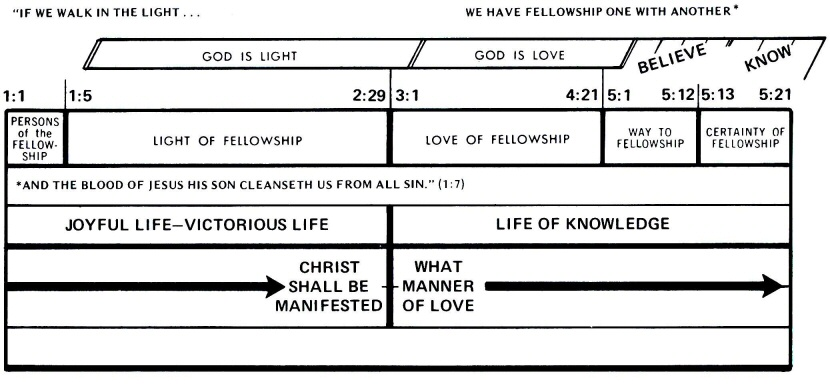
FELLOWSHIP WITH GOD AND HIS CHILDREN
Click chart to enlarge
Charts from Jensen's Survey of the NT - used by permission
Another Overview Chart - 1 John - Charles Swindoll
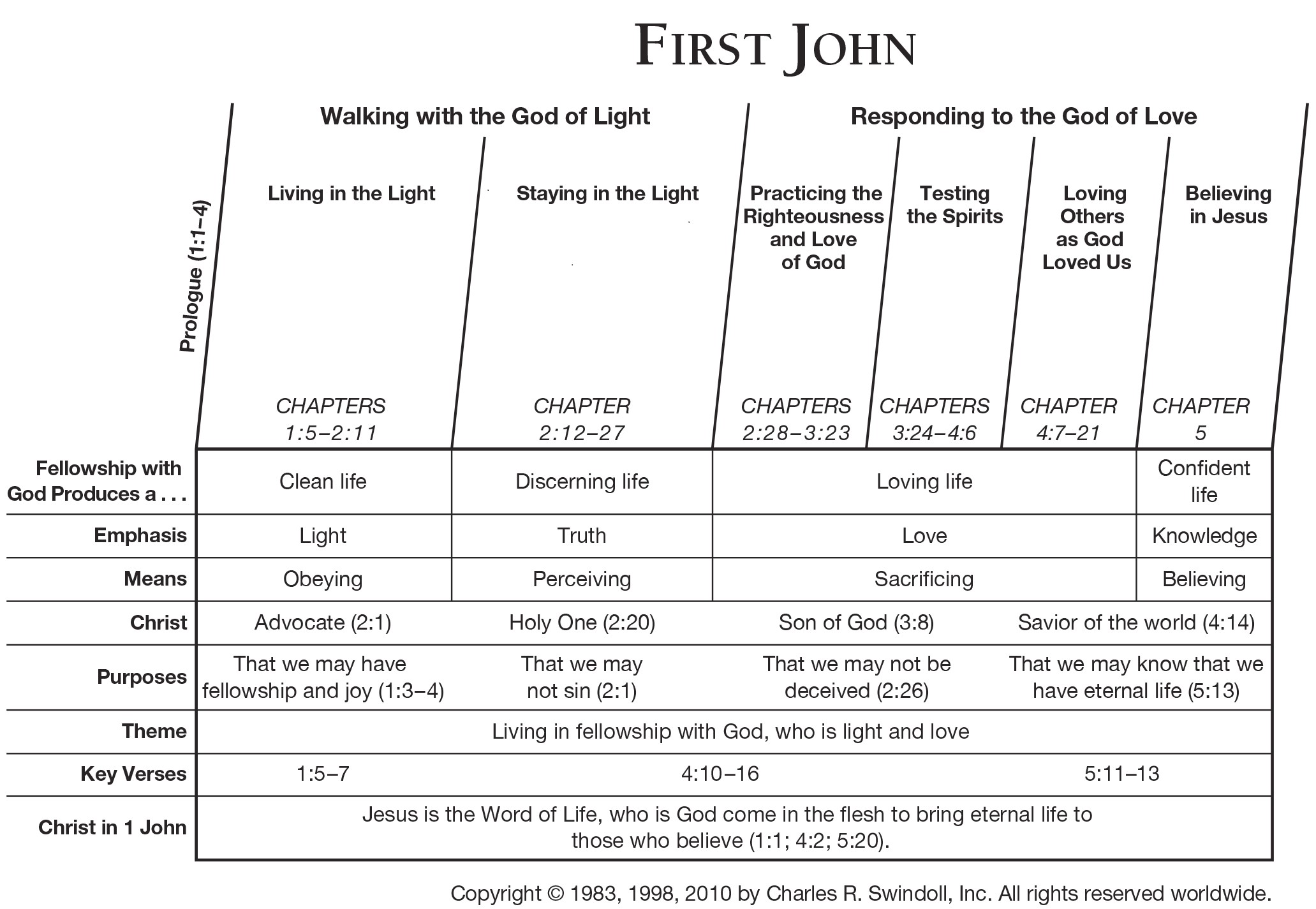
| BASIS OF FELLOWSHIP | BEHAVIOR OF FELLOWSHIP | ||||
| Conditions of Fellowship |
Cautions of Fellowship |
Fellowship Characteristics |
Fellowship Consequences |
||
| Meaning of Fellowship 1 Jn 1:1-2:27 |
Manifestations of Fellowship 1 Jn 2:28-5:21 |
||||
| Abiding in God's Light |
Abiding in God's Love |
||||
| Written in Ephesus | |||||
| circa 90 AD | |||||
| From Talk Thru the Bible | |||||
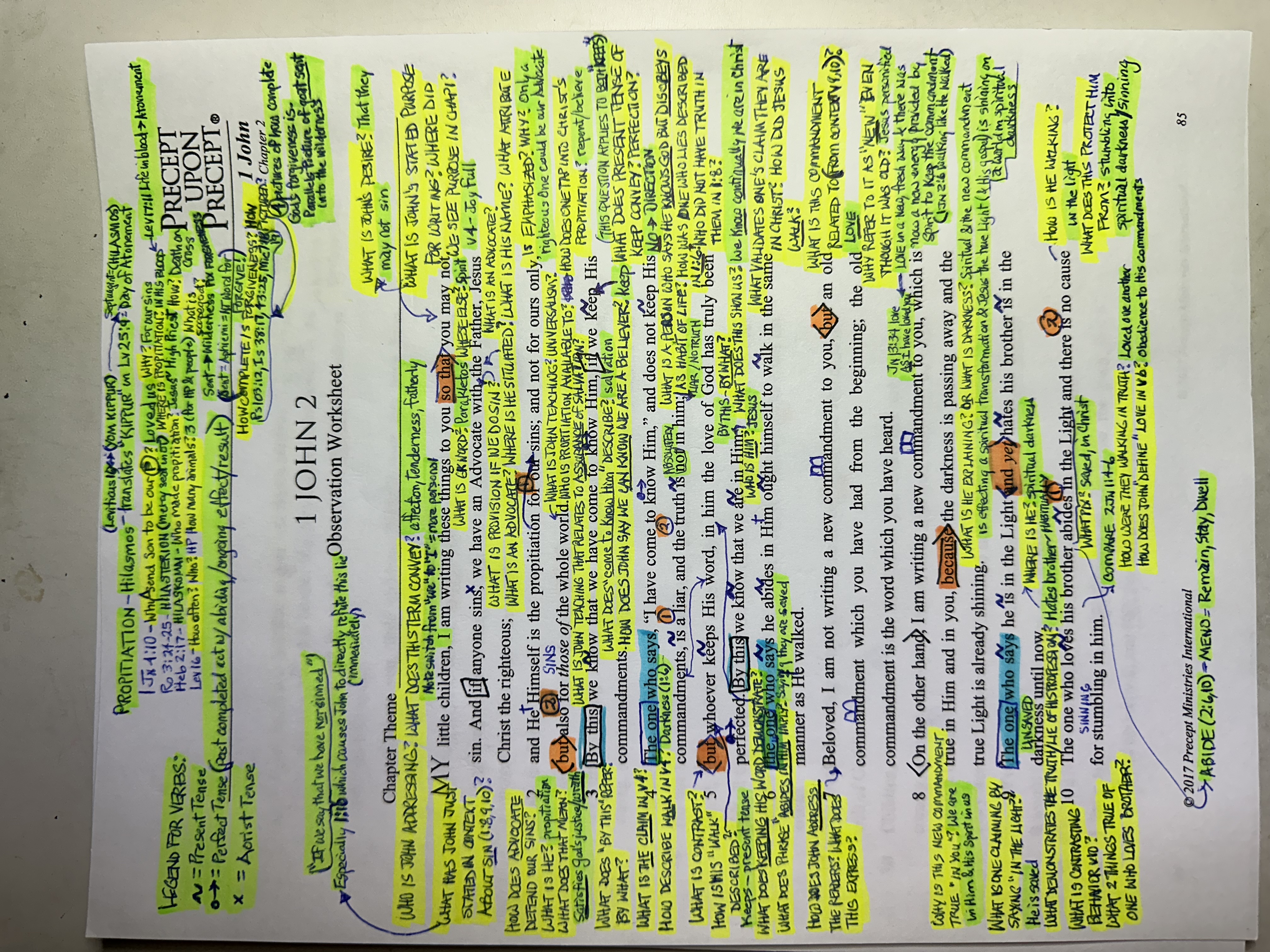
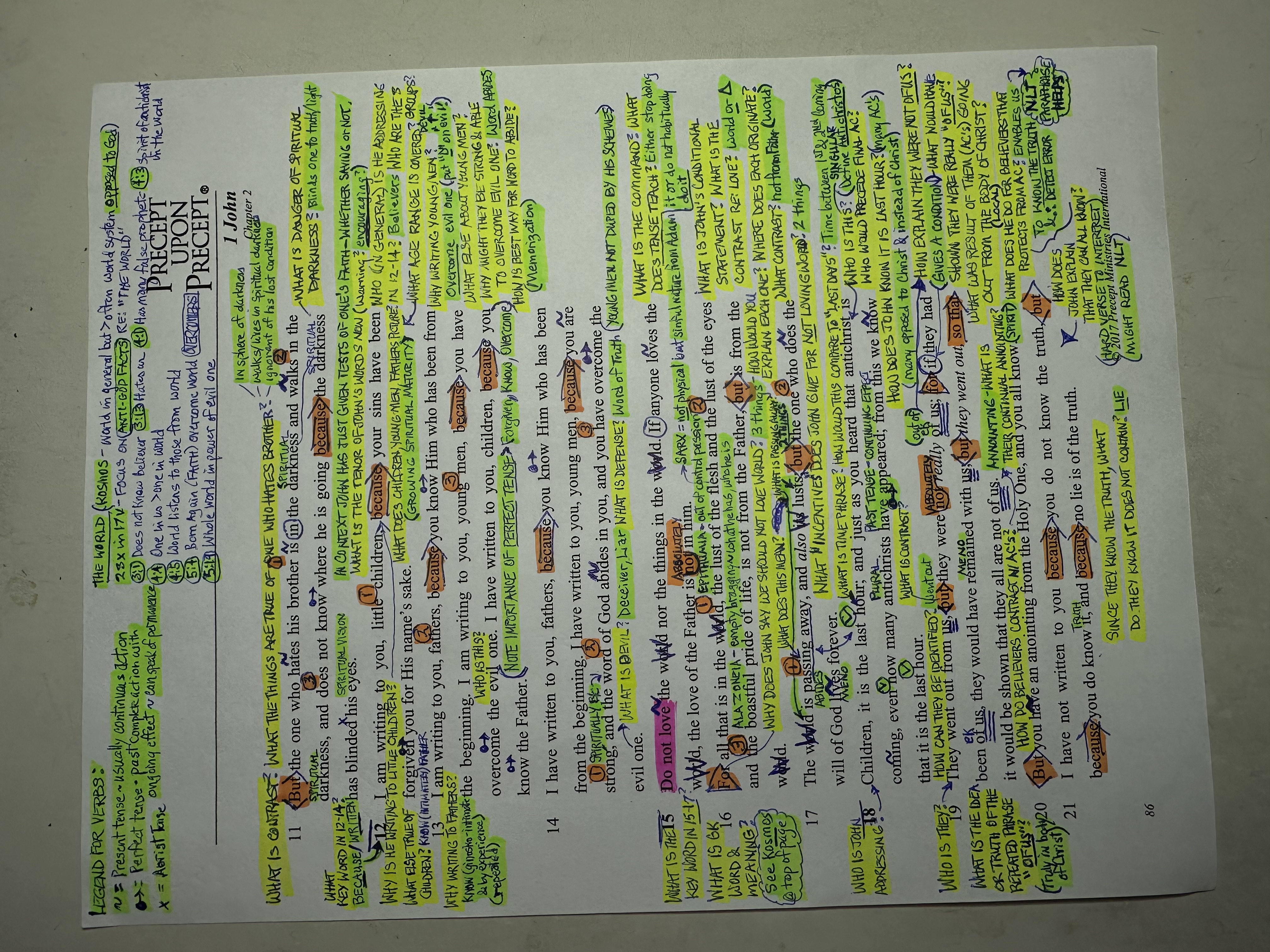
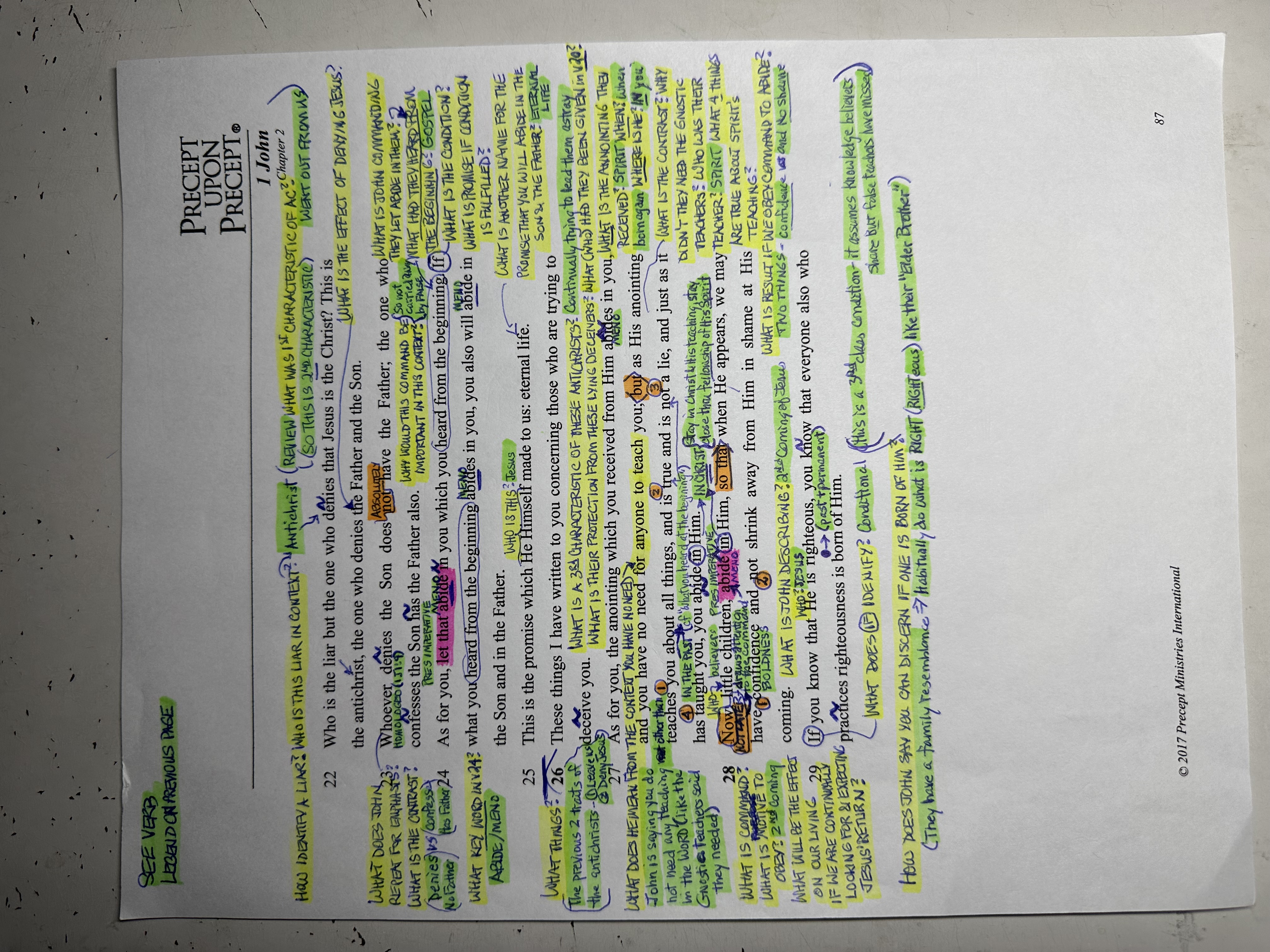
What is this? On the photograph of the Observation Worksheet for this chapter you will find handwritten 5W/H questions (Who? What? Where? When? Why? How?) on each verse to help you either personally study or lead a discussion on this chapter. The questions are generally very simple and are stated in such a way as to stimulate you to observe the text to discern the answer. As a reminder, given the truth that your ultimate Teacher is the Holy Spirit, begin your time with God with prayer such as Psalm 119:12 "Blessed are You, O LORD; Teach me Your statutes." (you can vary it with similar prayers - Ps 119:18, 26, 33, 64, 66, 68, 108, 124, 135, 171, etc) The questions are generally highlighted in yellow and the answers in green. Some questions have no answers and are left to your observations and the illuminating/teaching ministry of the Holy Spirit. Some qualifying thoughts - (1) Use "As is" - these are handwritten and will include mistakes I made, etc. (2) They may not be the best question for a given verse and my guess is that on some verses you will think of a far superior 5W/H question and/or many other questions.
Dr Howard Hendricks once gave an assignment to his seminary students to list as many observations as they could from Acts 1:8. He said "So far they’ve come up with more than 600 different ones! Imagine what fun you could have with 600 observations on this passage. Would you like to see Scripture with eyes like that?" (P. 63 Living by the Book - borrow) With practice you can! And needless to say, you will likely make many more observations and related questions than I recorded on the pages below and in fact I pray that the Spirit would indeed lead you to discover a veritable treasure chest of observations and questions! In Jesus' Name. Amen
Why am I doing this? Mortimer Adler among others helped me develop a questioning mindset as I read, seeking to read actively rather than passively. Over the years I have discovered that as I have practiced reading with a 5W/H questioning mindset, it has yielded more accurate interpretation and the good fruit of meditation. In other words, consciously interacting with the inspired Holy Word of God and the illuminating Holy Spirit has honed my ability to meditate on the Scripture, and my prayer is that this tool will have the same impact in your spiritual life. The benefits of meditation are literally priceless in regard to their value in this life and in the life to come (cf discipline yourself for godliness in 1Ti 4:8.) For some of the benefits - see Joshua 1:8 and Psalm 1:2-3. It will take diligence and mental effort to develop an "inductive" (especially an "observational"), interrogative mindset as you read God's Word, but it bears repeating that the benefits in this life and the rewards in the next will make it more than worth the effort you invest! Dear Christian reader let me encourage you to strongly consider learning the skills of inductive Bible study and spending the rest of your life practicing them on the Scriptures and living them out in your daily walk with Christ.
Although Mortimer Adler's advice is from a secular perspective, his words are worth pondering...
Strictly, all reading is active. What we call passive is simply less active. Reading is better or worse according as it is more or less active. And one reader is better than another in proportion as he is capable of a greater range of activity in reading. (Adler's classic book How to Read a Book is free online)
John Piper adds that "Insight or understanding is the product of intensive, headache-producing meditation on two or three verses and how they fit together. This kind of reflection and rumination is provoked by asking questions of the text. And you cannot do it if you hurry. Therefore, we must resist the deceptive urge to carve notches in our bibliographic gun. Take two hours to ask ten questions of Galatians 2:20 and you will gain one hundred times the insight you would have attained by reading thirty pages of the New Testament or any other book. Slow down. Query. Ponder. Chew.... (John Dewey rightly said) "People only truly think when they are confronted with a problem. Without some kind of dilemma to stimulate thought, behavior becomes habitual rather than thoughtful.”
“Asking questions is the key to understanding.”
--Jonathan Edwards
That said, below are the 5W/H questions for each verse in this chapter (click page to enlarge). This is not neatly typed but is handwritten and was used for leading a class discussion on this chapter, so you are welcome to use it in this "as is" condition...
 |
 |
 |
1 John 2:16 For all that is in the world, the lust of the flesh and the lust of the eyes and the boastful pride of life, is not from the Father, but is from the world. (NASB: Lockman)
Greek: hoti pan to en to kosmo, e epithumia tes sarkos kai e epithumia ton ophthalmon kai e alazoneia tou biou, ouk estin (3SPAI) ek tou patros all' ek tou kosmou estin. (3SPAI)
Amplified: For all that is in the world—the lust of the flesh [craving for sensual gratification] and the lust of the eyes [greedy longings of the mind] and the pride of life [assurance in one’s own resources or in the stability of earthly things]—these do not come from the Father but are from the world [itself]. (Amplified Bible - Lockman)
ASV: For all that is in the world, the lust of the flesh and the lust of the eyes and the vain glory of life, is not of the Father, but is of the world.
Barclay: For everything that is in the world—the flesh’s desire, the eye’s desire, life’s empty pride—does not come from the Father but comes from the world.
BBE: Because everything in the world, the desire of the flesh, the desire of the eyes, and the pride of life, is not of the Father but of the world.
GWT: Not everything that the world offers—physical gratification, greed, and extravagant lifestyles—comes from the Father. It comes from the world, and (GWT)
ICB: These are the evil things in the world: wanting things to please our sinful selves, wanting the sinful things we see, being too proud of the things we have. But none of those things comes from the Father. All of them come from the world. (ICB: Nelson)
ISV: For everything that is in the world—the desire for fleshly gratification, the desire for possessions, and worldly arrogance—is not from the Father but is from the world.
KJV: For all that is in the world, the lust of the flesh, and the lust of the eyes, and the pride of life, is not of the Father, but is of the world.
Law - “Do not court the intimacy and the favour of the unchristian world around you; do not take its customs for your laws, nor adopt its ideals, nor covet its prizes, nor seek fellowship with its life.”
Macent: for what the world is so full of, sensuality, avarice, and pride, is not deriv'd from the creator, but is the offspring of a vicious world.
MLB (Berkley): because everything in the world, the passions of the flesh, the desires of the eyes, and the proud display of life have their origin not from the Father but from the world.
NAB: For all that is in the world, sensual lust, enticement for the eyes, and a pretentious life, is not from the Father but is from the world.
NCV: These are the ways of the world: wanting to please our sinful selves, wanting the sinful things we see, and being too proud of what we have. None of these come from the Father, but all of them come from the world. (NCV)
NIV: For everything in the world--the cravings of sinful man, the lust of his eyes and the boasting of what he has and does--comes not from the Father but from the world. (NIV - IBS)
NJB: because everything there is in the world— disordered bodily desires, disordered desires of the eyes, pride in possession— is not from the Father but is from the world.
NLT: For the world offers only a craving for physical pleasure, a craving for everything we see, and pride in our achievements and possessions. These are not from the Father, but are from this world. (NLT - Tyndale House)
Phillips: For the whole world-system, based as it is on men's primitive desires, their greedy ambitions and the glamour of all that they think splendid, is not derived from the Father at all, but from the world itself. (Phillips: Touchstone)
TEV: Everything that belongs to the world—what the sinful self desires, what people see and want, and everything in this world that people are so proud of—none of this comes from the Father; it all comes from the world.
Wuest: Because everything which is in the world, the passionate desire of the flesh, and the passionate desire of the eyes, and the insolent and empty assurance which trusts in the things that serve the creature life, is not from the Father as a source but is from the world as a source.
Young's Literal: For the things in the world—the cravings of the earthly nature, the cravings of the eyes, the show and pride of life—they all come, not from the Father, but from the world.
- Nu 11:4,34; Ps 78:18,30-31; Pr 6:25; Matthew 5:28; Romans 13:14; 1Co 10:6; Galatians 5:17,24; Ephesians 2:3; Titus 2:12; 3:3; 1Pe 1:14; 2:11; 4:2,3; 2Pe 2:10,18; Jude 1:16, 17, 18
- 1 John 2 Resources - Multiple Sermons and Commentaries
- Take this self assessment What You Really Love
Related Passages:
Numbers 11:4 The rabble who were among them had greedy desires; and also the sons of Israel wept again and said, “Who will give us meat to eat?
Numbers 11:34 So the name of that place was called Kibroth-hattaavah, because there they buried the people who had been greedy.
Psalms 78:18; 30-31 And in their heart they put God to the test By asking food according to their desire. 30 Before they had satisfied their desire, While their food was in their mouths, 31 The anger of God rose against them And killed some of their stoutest ones, And subdued the choice men of Israel.
1 Corinthians 10:6+ Now these things happened as examples for us, so that we would not crave evil things as they also craved.
Galatians 5:17 For the flesh sets its desire against the Spirit, and the Spirit against the flesh; for these are in opposition to one another, so that you may not do the things that you please.
Ephesians 2:3 Among them we too all formerly lived in the lusts of our flesh, indulging the desires of the flesh and of the mind, and were by nature children of wrath, even as the rest.
Titus 2:12 instructing us to deny ungodliness and worldly desires and to live sensibly, righteously and godly in the present age,
Titus 3:3 For we also once were foolish ourselves, disobedient, deceived, enslaved to various lusts and pleasures, spending our life in malice and envy, hateful, hating one another.
1 Peter 1:14 As obedient children, do not be conformed to the former lusts which were yours in your ignorance,
1 Peter 2:11 Beloved, I urge you as aliens and strangers to abstain from fleshly lusts (epithumia) which wage war (strateuomai - present tense - continually) against the soul.
THE THINGS WE ARE
NOT TO LOVE
For (See value of pausing to ponder this term of explanation) all that is in the world (kosmos), the lust (epithumia) of the flesh (sarx) - For explains 1 John 2:15 explaining why the love of the world will displace the love of God. The following explains why worldliness excludes God’s love or is incompatible with the love for God. All (pas) means all without exception. In the world is everything that belongs to the sphere ("in the") of the world that is alienated from God, as qualified or explained by the three succeeding phrases. Obviously John is not speaking about all the inanimate or material objects of the world, but about the anti-god attitudes of the world composed of people. The lust of the flesh refers to those strong desires or cravings for gratification which originate from our fallen flesh (sarx), our sin nature inherited from Adam (Ro 5:12 cf Sin = Principle, Gal 5:17). James says each person is continually "tempted (present tense) when he is carried away (exelko - present tense) and enticed (deleazo - present tense) by his own lust." (James 1:14, cf Ro 13:14 "make no provision [present imperative with a negative] for the flesh [sarx] in regard to its lusts [epithumia]) As an aside, the best way to defeat the desire of the the lust (epithumia) of the flesh (sarx) is to obey the command to continually "walk by the Spirit" (present imperative see our need to depend on the Holy Spirit to obey) (Gal 5:16)
Lange explains that for is causal and means "because there is nothing in the world, the kosmos, which is of the Father, the love of the world is utterly incompatible with the love of the Father. (1 John 2 Commentary)
Harris writes that the introductory for "gives the reason why the love of the Father is not in the person who loves the world: it is because everything in the world does not come from the Father but from the world. The construction used in both these phrases is the preposition ek (from, out of) followed by the finite verb estin (is - present tense = continually), which in Johannine usage indicates ‘origin from’ and/or ‘adherence to.’ (Exegetical Commentary on 1 John 2:12-17)
Marvin Vincent explains the "all" - "Not all things severally, but all that is in the world collectively, regarded as a unit."
Gary Derickson - When John says all, he indicates that no aspect of the world system is excluded. Its values and attitudes, even those we do not recognize as evil, stand in opposition to God. That is not to say that every value in every culture is evil. Many of the values of any culture may yet be traced back to divine revelation and parallel God’s values. For example, murder is rejected by pagan cultures as well as Christian, even when they have not had even a trace of Christian influence. However, that caveat aside, the values in view do cover every area of life, and so are described in these broad terms.(1, 2 & 3 John: Evangelical Exegetical Commentary)
The problem is not that God created the material things of the world.
The problem is that people have made these things into idols.
-- Daniel Akin
Adam Clarke writes that "All that it can boast of, all that it can promise, is only sensual, transient gratification, and even this promise it cannot fulfill; so that its warmest votaries (devoted admirers) can complain loudest of their disappointment.
B F Westcott - In moral and spiritual things there is a law of equilibrium. Nothing rises higher than its source. The desire of things earthly as ends in themselves comes from the world and is bounded by the world. It is therefore incompatible with the love of the Father… It is the false view of them which makes them idols. (1 John 2 Commentary)
D Edmond Hiebert - As Jackman notes, "The `worldly' characteristics of which the verse speaks are in fact reactions going on inside us, as we contemplate the environment outside. John's three articular designations seem best understood as denoting the three basic spheres of worldliness. Although they do not offer exact parallels, these three realities are seen in the accounts of the temptation of Eve in the Garden (Ge 3:6) and of Jesus in the wilderness (Luke 4:1-12). (The Epistles of John An Expositional Commentary D. Edmond Hiebert) (See Hiebert's Excellent Online Paper on 1 John 2:2-17 in Bibliotheca Sacra)
Steven Cole adds that…
Many have pointed out how the three aspects of temptation listed here parallel the way that Satan tempted Eve. She saw that the forbidden fruit was good for food (Ge. 3:6), which was an appeal to the lust of the flesh. She saw “that it was a delight to the eyes.” This appealed to the lust of the eyes. She also saw “that the tree was desirable to make one wise.” This appealed to the boastful pride of life.
The same pattern occurs in Satan’s temptation of Jesus (Luke 4:1-12). Satan urged Jesus to turn the stones into bread (the lust of the flesh). He showed Him all the kingdoms of the earth, offering to give them to Him (the lust of the eyes). He encouraged Him to jump off the pinnacle of the temple, which could have been a source of pride in this miraculous accomplishment. (Choose Your Love: the World or the Father? 1 John 2:15-17)
Boice observes that in this verse John "is not thinking then so much of materialism (“things”) as he is of the attitudes that lie behind materialism. For he knows, as we should all know, that a person without worldly goods can be just as materialistic as a person who has many of them; and, conversely, a rich person can be quite free from this and any other form of worldliness. John is actually thinking of selfish ambition, pride, the love of success or flattery, and other such characteristics. Law recognizes this in his excellent rephrasing of the apostle’s appeal. He writes, “Do not court the intimacy and the favour of the unchristian world around you; do not take its customs for your laws, nor adopt its ideals, nor covet its prizes, nor seek fellowship with its life.” The NEB says, “Do not set your hearts on the godless world or anything in it.” (Borrow The Epistles of John : an expositional commentary)
World (2889) (kosmos related to the verb kosmeo = to order or adorn, to put in order [Mt 25:7 = "trimmed"], to adorn literally [1Ti 2:9], to adorn figuratively [Titus 2:9]) means essentially something that is well-arranged, that which has order or something arranged harmoniously. Kosmos refers to an ordered system or a system where order prevails. As explained below however, kosmos as used here in James 4:4 and many places in the NT, takes on a considerably more negative shade of meaning. In this sense kosmos is much like the Greek word for flesh (sarx), which can be a neutral word, but which many times in the NT takes on an evil connotation.
Related Resources:
- An Out-of-this-World Experience A Look at Kosmos in the Johannine Literature
- 6 page article on Kosmos in New International Dictionary of NT Theology
The basic meaning of order leads to the two main uses…
(1) Adornment, decoration, eternal adorning (used this way in NT only in 1Pe 3:3, where kosmos speaks of the woman wearing that which is fitting with her character as a believer and not incongruous or "out of order". In the context of Jas 4:4 she should not be a believer who seeks external adornment that mimics that of the world [cp "friendship with the world"]! Beloved, a believing woman's attire should always be so "ordered" as to draw attention to her face, not her form! Compare God's desired "adornment" in 1Pe 3:4)
(2) The world, which has in turn a variety of nuances which must be determined by examining the context in which it is used.
Trench summarizes the definition of kosmos, the anti-God world system, as "All that floating mass of thoughts, opinions, maxims, speculations, hopes, impulses, aims, aspirations, at any time current in the world, which it may be impossible to seize and accurately define, but which constitutes a most real and effective power, being the moral, or immoral atmosphere which at every moment of our lives we inhale, again inevitably to exhale."
Kosmos/kosmeo give us our English words cosmos (the ordered universe), cosmopolitan (literally a citizen of the world!) and cosmetics (those things we put on in order to bring order out of "chaos"!) English terms. A matter of "cosmic" significance, is something which is important for the whole world. When one speaks of a "cosmopolitan" city, it means a city which has citizens from many parts of the world.
Kosmos is the absolute antithesis of chaos (a Greek word meaning a rude, unformed mass), chaos being the fantasized condition with which the theory of evolution begins! The Bible on the other hand uses kosmos to describe the original condition of the universe (cp kosmos in 2Pe 3:6) as one of perfection ("it was very good" Ge 1:31, not very chaotic! Kosmos is used the first time in LXX of Ge 2:1 all their hosts = "and the whole world". The sons of God (the angels) did not shout for joy over chaos, but kosmos when they saw this universe come into existence by the creative fiat of God (Job 38:4, 5, 6, 7)!
A W Pink writes that worldly lusts "are those affections and appetites which dominate and regulate the man of the world. It is the heart craving worldly objects, pleasures, honors, riches. It is an undue absorption with those things which serve only a temporary purpose and use. "Worldly lusts" cause the things of Heaven to be crowded out by the interests and concerns of earth. This may be done by things which are quite lawful in themselves—but through an immoderate use they gain possession of the heart. "Worldly lusts" are "the lust of the flesh, and the lust of the eyes, and the pride of life" (1 John 2:16). (Grace Preparing for Glory)
THE STRONG DESIRES
FOR EVIL WITHIN US
Paul reminds us this battle is one that we will wage every day -- it is a battle we cannot win on our own but only as we begin each morning surrendering our will to the sweet, perfect will of the all-powerful Holy Spirit of God! Why… (see the "for" = a term of explanation).
(Gal 5:17) For the flesh sets its desire (present tense = continually!) against the Spirit, and the Spirit against the flesh; for (another term of explanation!) these are in opposition to one another, so that (another term of explanation!) you may not do the things that you please.
(Gal 5:24) Now those who belong to Christ Jesus have crucified the flesh with its passions and desires.
Marvin Vincent explains that the lust of the flesh as used by John in this verse refers in essence to our "Sensual appetite. The desire which resides in the flesh, not the desire for the flesh. For this subjective usage of the genitive with lust, see John 8:44; Ro 1:24; Re 18:14. Compare 1Pe 2:11; Titus 2:12. The lust of the flesh involves the appropriation of the desired object.
Gary Burge sums up lust of the flesh as "any desire, any sinful interest, that draws us away from God or at least makes continuing fellowship with him impossible." (See The Letters of John - Page 115)
Jamieson explains that the lusts of the flesh "is the lust which has its seat and source in our lower animal nature. Satan tried this temptation the first on Christ: Lk 4:3, “Command this stone that it be made bread.” Youth is especially liable to fleshly lusts. (1 John 2 Commentary)
John MacArthur writes that "The expression lust of the flesh brings to mind primarily sexual sins, but, while they are included in its definition, the phrase is certainly not limited to that meaning. The base desire of the human heart perverts and distorts all normal desires (Jer 17:9), sending them into a relentless, slavish pursuit of evil that exceeds the proper limits of what is good, reasonable, and righteous—any attitude, speech, or action that opposes God's law (cf. Ro 7:5; Ro 8:7). Those lusts include all the immoral excesses about which Paul warned the Galatians: (Gal. 5:19, 20, Gal 5:21; cf. Ro 1:24-32; 1Cor. 6:9-10) Those sinful attitudes and actions are primary characteristics of the world system and are irresistibly appealing to the corruption of the unconverted soul. (See 1-3 John MacArthur New Testament Commentary - Page 87
Constable writes that "The lust of the flesh is the desire to do something apart from the will of God. The lust of the eyes is the desire to have something apart from the will of God. The pride of life is the desire to be something apart from the will of God. The first desire appeals mainly to the body, the second to the soul, and the third to the spirit. Perhaps the most common manifestation of the lust of the flesh in modern western civilization is illicit sex (hedonism, idolizing pleasure). Perhaps the most common manifestation of the lust of the eyes is excessive buying (materialism, idolizing possessions). Perhaps the most common manifestation of the pride of life is trying to control (egoism, idolizing power). (1 John Expository Notes) (Bolding, color and italics added for emphasis)
The lust of the flesh was Israel's problem from the outset of her liberation from bondage in Egypt…
Ps 78:18 And in their heart they put God to the test By asking food according to their desire.
Note: Acting on the lust of the flesh is to put God to the test!
Ps 78:30 Before they had satisfied their desire, While their food was in their mouths, 31 The anger of God rose against them And killed some of their stoutest ones, And subdued the choice men of Israel.
Lust (1939) (epithumia from epi = at, toward {the preposition "epi-" in the compound is directive conveying the picture of "having one’s passion toward"} + thumos = passion. Cognate verb epithumeo means to set heart upon) is a neutral term denoting the presence of strong desires or impulses, longings or passionate craving (whether it is good or evil is determined by the context) directed toward an object. Drive/passion directed at an object (epi = toward) most often in NT describes depraved cravings and inner vile unrestrained desires from our fallen flesh nature. There are a few occasions where that can mean a craving for the right thing but usually a bad thing in the NT uses. Lusts denote the varied cravings of fallen human nature pursued in the interest of self in self-sufficient independence of God. (Click article in ISBE)
Two of the Ten Commandments are warnings against covetousness, which is expressed in the LXX by the verb epithumeo: “You shall not desire (Lxx - epithumeo) your neighbor’s wife; you shall not desire (Lxx - epithumeo) your neighbor’s house” (Exod 20:17; Deut 5:21)
Hiebert sums up the meaning of epithumia in the 3 uses in 1Jn 2:16, 17 - "Lust" is here collective, denoting the varied cravings of fallen human nature pursued in the interest of self in self-sufficient independence from God. . The genitive "of the flesh" is not objective, "lust for the flesh," but subjective, the lust which has its seat in "the flesh," man's fallen nature with its disposition of hostility toward God (Westcott = the desire of the flesh, the desire of which the flesh is the seat.) Plummer calls attention to the fact that John did not say "the lust of the body." The cravings which God has placed in the human body in themselves are not sinful; they are God-given and essential for continuance of life here on earth. But they readily be-come sinful when used for illegitimate ends. The reference is to those temptations that arise from within. (The Epistles of John An Expositional Commentary D. Edmond Hiebert) (See Hiebert's Excellent Online Paper on 1 John 2:2-17 in Bibliotheca Sacra)
Epithumia is used 38 times in the NAS - coveting, 2; desire, 4; desires, 8; earnestly, 1; impulses, 1; long, 1; lust, 5; lustful, 1; lusts, 15 (NASB). Other versions translate epithumia as strong impulses or desires, yearnings, longings after. Mk. 4:19; Lk. 22:15; Jn. 8:44; Rom. 1:24; 6:12; 7:7, 8; 13:14; Gal. 5:16, 24; Eph. 2:3; 4:22; Phil. 1:23; Col. 3:5; 1 Thess. 2:17; 4:5; 1 Tim. 6:9; 2 Tim. 2:22; 3:6; 4:3; Titus 2:12; 3:3; James. 1:14, 15; 1 Pet. 1:14; 2:11; 4:2, 3; 2 Pet. 1:4; 2:10, 18; 3:3; 1 Jn. 2:16, 17; Jude 1:16, 18; Rev. 18:14
W. E. Vine summarizes epithumia as follows: epithumia denotes "strong desire" of any kind, the various kinds being frequently specified by some adjective (see below). The word is used of a good desire only in Lk 22:15; Phil 1:23 [note]; 1Thes 2:17 [note]. Everywhere else it has a bad sense. In Ro 6:12 [note] the injunction against letting sin reign in our mortal body to obey the "lust" thereof, refers to those evil desires which are ready to express themselves in bodily activity. They are equally the "lusts" of the flesh, Ro 13:14 [note]; Gal 5:16 [note], Gal 5:24 note]; Eph 2:3 [note]; 2Pe 2:18 [note]; 1Jn 2:16, a phrase which describes the emotions of the soul, the natural tendency towards things evil. Such "lusts" are not necessarily base and immoral, they may be refined in character, but are evil if inconsistent with the will of God. Other descriptions besides those already mentioned are: "of the mind," Ephesians 2:3 [note]; "evil (desire)," Colossians 3:5 [note]; "the passion of," 1Thessalonians 4:5 [note], RV; "foolish and hurtful," 1Ti 6:9; "youthful," 2Ti 2:22 [note]; "divers," 2Ti 3:6 [note]; Titus 3:3 [note]; "their own," 2Ti 4:3 [note]; 2Pe 3:3 [note]; Jude 1:16; "worldly," Titus 2:12 [note]; "his own," Jas 1:14 [note]; "your former," 1P 1:14 [note], RV; "fleshly," 1Pe 2:11 [note]; "of men," 1Pe 4:2 [note]; "of defilement," 2Pe 2:10 [note]; "of the eyes," 1Jn 2:16; of the world ("thereof"), 1Jn 2:17; "their own ungodly," Jude 1:18. In Re 18:14 [note] "(the fruits) which thy soul lusted after" is, lit., "of thy soul's lust." (Vine's Expository Dictionary of Old Testament and New Testament Words)
Vine adds that lust - describes the inner motions of the soul, the natural tendency of men in their fallen estate toward things evil and toward things forbidden." Vine further adds that the phrase the lust of the flesh "stands for the temptation which proceeds from our corrupt nature, a nature which, owing to sin, stands opposed to the will and commandments of God. (Collected writings of W. E. Vine. Nashville: Thomas Nelson)
Sin within fallen man is often personified in Paul's writings and is portrayed as an organized power [think of SIN as an evil "king" for example] which ever seeks to rule our will and act out through the members of the body. Thus we see Paul explain that "Sin (the source of the desires)… produced in (him) coveting (epithumia) of every kind." (Ro 7:8)
Lusts occur in our mind and are not actually physical actions per se although they may (and frequently do) lead to physical actions. Thus James warns us of the evil character of "lusts" writing that "each one is tempted when he is carried away and enticed by his own lust. Then when lust has conceived, it gives birth to sin and when sin is accomplished, it brings forth death." (Jas 1:14,15)
We can't afford to play with fire
Nor tempt a serpent's bite;
We can't afford to think that sin
Brings any true delight.
-- Anon.
Warren Wiersbe writes that "these fundamental desires of life are the steam in the boiler that makes the machinery go. Turn off the steam and you have no power. Let the steam go its own way and you have destruction. The secret is in constant control. These desires must be our servants and not our masters; and this we can do through Jesus Christ. (Bible Exposition Commentary)
Love can wait and worship endlessly;
lust says, "I must have it at once.
-- Oswald Chambers
Paul instructs the Ephesians that "in reference to (their) former manner of life (as unbelievers), (they were to) lay aside the old self, which (was) being corrupted in accordance with the lusts of deceit. (Eph 4:22)
In other words, lusts deceive us and lead us astray, promising more than they deliver and producing (spiritual, soul) corruption when "conceived".
Peter reiterates the detrimental effect of lust, writing about "the corruption (moral decay - corruption is much deeper than defilement on the outside - it is decay on the inside) that is in the world by lust." (2Pe 1:4)
Believers unfortunately are still
continually assailed by lusts.
Paul exhorts believers not to "Therefore do not let Sin reign (present imperative with a negative see our need to depend on the Holy Spirit to obey) in your mortal body that you should obey its lusts (Ro 6:12)
In this passage Paul is implying that Sin will try to usurp the "throne" of our heart by lobbing fiery missiles laden with lustful thoughts (not restricted to sexual lusts but are quite variegated or multi-colored!)
In a similar warning, Peter urges us "as aliens and strangers to abstain from (present tense continually hold yourself away from - you can only do this as you depend on the Holy Spirit to obey) fleshly lusts, which (strateuomai - continually - present tense) wage war (describing not just a battle but a veritable military campaign) against the soul. (1Pe 2:11)
Believers are called to "flee (present imperative see our need to depend on the Holy Spirit to obey) from youthful lusts (a warning against contamination from one’s own evil propensities -- It is not sufficient to guard against evil in others, we must be watchful against evil within) and pursue (present imperative see our need to depend on the Holy Spirit to obey) righteousness, faith, love and peace, with those who call on the Lord from a pure heart. (2Ti 2:22)
In this letter Paul writes the wonderful truth that the "grace of God has appeared (one important effect of this grace is that believers need not try to "fight" lusts in their own strength but in dependence of God's grace or enabling power - see Spirit of grace Heb 10:29)" and is continually "instructing (paideuo - present tense) us to deny (arneomai - aorist tense - once and for all refuse to follow or agree with evil strong desires coming from the evil world system ruled by Satan and opposed to God) ungodliness and worldly desires (lusts) and to live sensibly, righteously and godly in the present age. (Titus 2:12)
In Romans Paul commands believers to "Put on (aorist imperative = urgent command to do this now and first - see our need to depend on the Holy Spirit to obey) the Lord Jesus Christ and make (present imperative with a negative see our need to depend on the Holy Spirit to obey -- act of making prior preparation) for the flesh (here it means the seat of SIN in man) in regard to its lusts. (Ro 13:14)
The Jewish historian Josephus, speaking of Cleopatra, says "She was an expensive woman, enslaved to lusts."
Lusts acted upon are indeed costly! David experienced lifelong agony as result of temporal indulging of his lust. (Ponder 2Sa 11:1-5 with 2Sa 12:1-19)
Sin will take you further than you ever wanted to stray!
Cost you more than you ever dreamed you would pay!
Keep you longer than you ever thought you would stay!
A Christian, writing anonymously in Leadership magazine, told of his ten-year bondage to lust, which included a regular diet of pornography. During this time, he conducted Christian conferences and seminars across the country. The agony of his inner conflict finally became unbearable. To his horror, he realized that such pleasures as a breathtaking sunset or the soft spray of an ocean breeze no longer excited him. His obsession with lust had dulled his appreciation of life's finest enjoyments and prevented the joy of fellowshipping with Jesus. Although he had been outwardly faithful to his wife, not having engaged in adultery, he had sinned against her, and their relationship had suffered. When he turned anew to God, he realized that a necessary step in breaking his lustful pattern was a long talk with his mate. The whole experience was painful and awkward, but the repentance was genuine. She forgave him, and love returned to their marriage. Repentance, though painful, results in life's true pleasure—communion with God and spiritual oneness with fellow believers. Repentance means not only a heart broken for sin but from sin. —D. J. De Haan (Reprinted by permission from Our Daily Bread Ministries. Please do not repost the full devotional without their permission.)
Satisfaction -
Albert Lee - Pornography, once a secretive backdoor industry, is now out in the open. The easy access and anonymity of the Internet have turned it into a multibillion-dollar-a-year “business.” But it leaves a trail of broken families, ineffective Christian leaders, and men who have lost the respect of their loved ones.
The apostle John was known for his great love for Christ and His church. In 1John 2:12-17, he warned fathers and young men against these three lusts:
The lust of the flesh—the insatiable appetite to indulge in pleasures that inflame the flesh but never satisfy.
The lust of the eyes—wandering eyes that continually want more riches and possessions but always remain covetous.
The pride of life—the vain mind that thirsts for man’s applause. But the glory evaporates quickly.
Pornography damages users and victims alike. It feeds lustful desires in ways that can never satisfy. True satisfaction is found only when we give our affections to eternal things—to a right relationship with our heavenly Father and with those He has created in His image.
“The world is passing away, and the lust of it; but he who does the will of God abides forever” (1Jn 2:17).
Many Christian men struggle with the temptations of pornography. Find help by reading When A Man’s Eye Wanders- Breaking The Power Of Pornography -
Inner peace springs out of inner purity.
Editorial Comment - I also have three other recommendations -
- Internet Accountability and Filtering - Covenant Eyes is a filter that allows access to everything but logs every location visited and scores for appropriateness - would also be great to monitor you computer savy kids, as it keeps a running complete log of every place visited! Ultimately your best monitor will be the one you cannot fool or turn off, the indwelling Holy Spirit. Listen to Him, if He warns you to FLEE!
- There is an excellent book by Steve Gallagher (albeit it does get a bit graphic at times!) Borrow At The Altar of Sexual Idolatry and At the Altar of Sexual Idolatry Workbook
- Vidangel.com - This service allows you to filter language and sex - not all movies are available but there is a good selection and it is getting much better (Oct, 2024). You will generally experience minimal if any loss of continuity in the movie. This service is worth the price so that you are not defiled by the increasing offensive language on just about anything you watch. And remember when you watch R and MA rated movies you are quenching/grieving the Holy Spirit (Eph 4:30, 1Th 5:19) so do not be surprised if you are not experiencing His power in your life! God is serious about sin and calls for His children to be holy in an increasingly unholy world! Subscribe to this service.
My Way (The Flesh)
For more than five decades, Frank Sinatra has been one of America’s most popular entertainers. Perhaps he is best known for the song “My Way.” Apparently it has struck a responsive chord among his fans. What chord is that? Self-will (Ed: Another way to describe the middle letter of "sIn" or our fallen flesh!). It’s the dominant desire of human beings to do things their own way. And that’s exactly how the song ends: “I did it my way.”
In the ordinary affairs of life, the exercise of self-determination may be commendable. But in relationship to God, our way is never (the right way). Our self-will must be subordinated to His will, as our Savior submissively prayed in Gethsemane’s Garden, “Not My will, but Yours, be done” (Lk. 22:42, cp 1Jn 2:6, 1Pe 2:21, 1Cor 11:1).
Regardless of how painful the surrender of our will may seem, obedience to God saves us from unhappy loss in this world and irrecoverable loss in the world to come. Proverbs 14:12 reminds us that a sinful insistence on self-will can be self-destructive: “There is a way that seems right to a man, but its end is the way of death.” Trustful obedience to God’s way, however, brings blessing both now and forever.
Whenever you feel like saying, “I want to do it my way,” remember that Jesus did it His Father’s way. - Vernon C Grounds (Reprinted by permission from Our Daily Bread Ministries. Please do not repost the full devotional without their permission.)
Have Thine own way, Lord! Have Thine own way!
Thou art the Potter, I am the clay;
Mold me and make me after Thy will,
While I am waiting, yielded and still.
—Pollard
In His will is our peace. —Dante
In summary, the lusts John refers to are the sensual bodily appetites that proceed from within our evil nature (fallen flesh). (cp Jas 1:14)
THE LUST OF THE FLESH
THE BEAST WITHIN!
Lust of the flesh - This describes the passionate desire or the craving that comes from the evil nature, the flesh. In other words the evil craving has its origin in the fallen flesh.
Various renderings of lust of the flesh: ISV = the desire for fleshly gratification. Phillips paraphrase = men's primitive desires. NCV = wanting to please our sinful selves. NIV = the cravings of sinful man. NJB = disordered bodily desires. NLT = a craving for physical pleasure. Young's Literal = the cravings of the earthly nature.
Flesh (4561) (sarx) is used 147 times in the NT and a simple definition is difficult because sarx has many nuances (e.g., some Greek lexicons list up to 11 definitions for sarx!). The diligent disciple must carefully observe the context of each use of sarx in order to accurately discern which nuance is intended. The range of meaning extends from the physical flesh (both human and animal), to the human body, to the entire person, and even to all humankind!
Daniel Akin on flesh - We are not sinful because we sin. We sin because we are sinful. Sin is fun, enticing, attractive. We are drawn to it like a fly to flypaper, like a fish to a baited hook.
In the context of 1Jn 2:15-17, John uses flesh with it's moral/ethical sense. Flesh here refers to the totally depraved nature as governing the individual’s reason, will, and emotions. It describes that outlook which is totally orientated toward self, which is prone to commit sins, which is opposed to God and which pursues its own ends in self-sufficient, independence from God. Flesh is that ugly complex of human sinful desires that includes the ungodly motives, affections, principles, purposes, words, and actions that sin generates through our bodies. Sarx as used in this manner denotes the entire fallen human being—not just the sinful body but the entire being, including the soul and mind, as affected by sin. To live according to the flesh is to be ruled and controlled by that evil complex. Because of Christ’s saving work on the believer's behalf, the sinful flesh no longer reigns over us, to debilitate us and drag us back into the pit of depravity into which we were all born.
Flesh is that urge within us toward total autonomy and rebellion, toward being our own "little gods" accountable to no one, responsible to no one, obeying no one, respecting no one, and running our own little worlds to suit ourselves. It is that continual tug of self-centeredness and selfishness within each of us that fights to keep us from being wholly devoted to God.
Born again believers need to understand that there is still this remnant of the flesh within our physical bodies of flesh. In contrast to the unregenerate man, believers now have the power led by the Holy Spirit to say "yes" to God and "no" to the flesh, whereas before the co-crucifixion explained by Paul in Romans 6 (Ro 6:1, 2, 3, 4, 5, 6, 7, 8, 9, 10, 11-see notes on Ro 6:1-3; 6:4-5; 6:6-7; 6:8-10; 6:11) took place we had no choice but to obey Sin, which ruled unopposed in our bodies. The apostle Paul teaches that in believers, the flesh is opposed to Spirit (Gal 5:17). While the unbeliever can live only in the flesh, the believer can now live in the Spirit although he can fall back into living according to the Spirit. And so the apostle Paul repeatedly encourages believers to overcome the deeds of the flesh in the only way possible - by living in the Spirit (see Gal 5:16, Gal 5:18, Gal 5:25)
To live according to the flesh is to be ruled and controlled by the flesh. Because of Christ’s saving work on our behalf, the sinful flesh no longer reigns over us, to debilitate us and drag us back into the pit of depravity into which we were all born.
J Vernon McGee has a simple classification for sarx writing that "it can be used in three different ways. It can speak of the body, the physical body that we have, the meat that is on the bones. It can speak of weakness, meaning that which is psychological. It can also mean that corrupt nature which you and I have, that fallen nature. That is the spiritual meaning. So this word can be used in a physical sense, in a psychological sense, and in a spiritual sense. Paul uses the word flesh in all three senses but more frequently in the sense of the old Adamic, fallen nature. (See Thru the Bible Vol. 45: The Epistles 2 Corinthians)
John Piper defines flesh (in its moral/ethical sense) as "the old ego that is self-reliant and does not delight to yield to any authority or depend on any mercy. Flesh craves the sensation of self-generated power and loves the praise of men… in its conservative form it produces legalism -- keeping rules by its own power for its own glory… (in its more liberal form) produces grossly immoral attitudes and acts (Gal 5:19, 20, 21-see notes Gal 5:19; 20; 21) The flesh is the proud and unsubmissive root of depravity in every human heart which exalts itself subtly through proud, self-reliant morality, or flaunts itself blatantly through self-assertive, authority-despising immorality. (Read John Piper's full sermon Walk By the Spirit!)
Harry Ironside - It is not that the flesh (referring to the moral/ethical meaning) is, or ever will be, in any sense improved. The flesh in the oldest and godliest Christian is as incorrigibly evil as the flesh in the vilest sinner… All efforts to reform or purify it are in vain. The law only demonstrates its incurable wickedness. And this explains why the natural man is so completely unprofitable… To say so would be to declare that man is not a responsible creature but is simply the victim of a hard, cruel fatalism. But although he knows the evil and approves the good, the natural man inclines toward the wrong and fails to do the right. Because he is dominated by the flesh, to which he yields his members as instruments of unrighteousness (Ro 6:13), he is powerless to change his nature. The natural man therefore cannot really please God." (Romans 8 Commentary) (Bolding added)
Larry Richards summarizes flesh (specifically the moral/ethical aspect) writing that ""flesh" is a complex word with many meanings… The NT emphasizes humanity's moral inadequacy. When they are isolated from God, human beings are energized by evil desires and guided by perceptions that distort God's will and His nature. The word "flesh" reminds us that we are caught in the grip of sin. Even a desire for righteousness cannot enable us to actually become righteous. God deals with our flesh in a surprising way. He does not free us now from the fleshly nature. Instead, he provides a source of power that will release us from the domination of the flesh. Jesus has paid for sins generated by our flesh, whether sins of our past or those yet in our future. But Jesus has also provided us with his Holy Spirit. The Spirit lives within us, and He is the source of new desires and a new perspective. Even more, the spiritual power unleashed in the resurrection is made available to us in the Spirit… If we choose to rely on the Spirit and if we commit ourselves to His control, we will experience a resurrection kind of life--now. The limits imposed by our fleshly human nature will no longer contain us, and we will be freed from the mastery of the flesh." (BORROW Expository Dictionary of Bible Words) (Bolding added)
Lewis Sperry Chafer wrote that flesh (the moral/ethical definition) is "Any aspect of life or conduct which is undertaken in dependence upon the energy and ability of the flesh is, to that extent, purely legal in character, whether it be the whole revealed will of God, the actual written commandments contained in the Law, the exhortations of grace, or any activity whatsoever in which the believer may engage.
Middletown Bible Church has an instructive note on explaining that…
There are five things that will never happen to the flesh (referring to the moral/ethical aspect):
1) The flesh cannot be changed. The rebellious, non-submissive flesh will never be transformed into submissive, obedient flesh. God’s method of dealing with the flesh is not to change it but to CONDEMN IT (Ro 8:3) and crucify it (Gal 5:24; Gal 2:20 and compare Ro 6:6).
2) The flesh cannot be reformed. It cannot be corrected or restored to purity. That which is corrupt remains corrupt. That which is desperately wicked remains desperately wicked (Jer 17:9). The Church was reformed (we speak of the Protestant "Reformation") and restored to some degree of purity but the flesh will never have a reformation. Two thousand years ago it did not have a reformation but it had a crucifixion!
3) The flesh can never be trained. The flesh is stubborn. It refuses to change its ways. It’s immutable. You can never teach the flesh how to please God. The flesh is incorrigible--incapable of being corrected or amended. The flesh refuses to change its ways. The works of the flesh always remain the same (Gal 5:19, 20, 21-see notes Gal 5:19; 20; 21).
4) The flesh cannot be improved. It always remains as it is: depraved, corrupt, wicked, sinful, evil, anti-God, rebellious, stubborn, proud, etc.
5) The flesh cannot be reconciled to God. It is always and ever opposed to God (Gal 5:17). It will never be at peace with God; instead there is constant war. God can never be brought into harmony with that which is out of harmony with His holy and righteous character.
Finally Wuest emphasizes that in using the word flesh, the apostle John "has no reference to the physical body except as that body is controlled or energized by the evil nature. The physical body and its members in themselves have no evil desires except as controlled by the totally depraved nature. To say that the physical body of itself has evil desires is Gnosticism, the heresy that matter is inherently evil. (Eerdmans Publishing - used by permission)
And the lust of the eyes: kai e epithumia ton ophthalmon:
- Genesis 3:6; 6:2; Joshua 7:21; Job 31:1; Ps 119:36,37; Ecclesiastes 5:10,11; Matthew 4:8; Luke 4:5
- 1 John 2 Resources - Multiple Sermons and Commentaries
Related Passages:
Genesis 6:2 that the sons of God saw that the daughters of men were beautiful; and they took wives for themselves, whomever they chose.
Psalm 101:3 (DAVID) I will set (THIS IS THE KEY - ONCE IT IS BEFORE YOUR EYES, YOU ARE DOOMED!) no worthless thing before my eyes; I hate the work of those who fall away; It shall not fasten its grip on me.
THE PROBLEM WITH
OUR EYES
Our eyes, when gazing on sinful objects,
are out of their calling and God's keeping.
-- Thomas Fuller
And the lust (epithumia) of the eyes (opthalmos) ("eyes hungry for all they see") - Our eyes, like our natural desires, are not evil. Pr 20:12 says "The hearing ear and the seeing eye, The LORD has made both of them." But because the eyes are the "windows" of the mind, they provide the avenue by which sinful desires enter into our thoughts and thoughts when incubated often become acts and actions. The eyes of fallen man say, “play now and pay later (or never!)." Men being creatures of sight, must be especially on guard. "I see it. I want it. I take it!" Have you ever done that? I call this the "Achan syndrome" (read the instructive, frightening account in Joshua 7:1-26, esp Josh 7:1, 11, 12, 18, 19, 20, 21, 25, 26).
(Achan answering Joshua) when I SAW among the spoil a beautiful mantle from Shinar and two hundred shekels of silver and a bar of gold fifty shekels in weight, then I COVETED (Lxx = enthumeomai = Achan thought carefully about, pondered on, reflected inwardly regarding) them and TOOK them; and behold, they are CONCEALED (Heb = taman = they were hidden by covering over so that they could not be found; Lxx = egkrupto = to put something into something so as to hide out of sight) in the earth inside my tent with the silver underneath it. (Joshua 7:21)
Comment: Note the principle of progression of the passion to possess - "I saw… I coveted… took." Note also what we do with our sin! We hide our sin from others [cp Ge 3:10] and we think (foolishly) even from God Himself (cp Achan "concealed", see Nu 32:23, Ps 90:8, Isa 3:11)
Daniel Akin has an interesting quote - Dodd notes that the desire of the eyes can be understood as “the tendency to be captivated by the outward show of things, without enquiring into their real values.”250 This insight cuts to the heart of the issue in that all of these temptations of the world focus on enjoyment in the present without an analysis or understanding of the future ramifications. How an action, or its value, compares with the worth of the eternal things that come from God must always be factored into the equations of life.
Wuest writes that the lust of the eyes refers to "the passionate cravings of the eyes for satisfaction, these cravings finding their source in the evil nature." (Eerdmans Publishing - used by permission)
A little will satisfy nature; less will satisfy grace;
nothing will satisfy men's lusts.
-- Thomas Brooks
Hiebert explains that lust of the eyes refers to "the cravings and lusts stimulated by what is seen. Now the reference is to those lusts which are aroused by what enters through the eye-gate. The reference is not merely to physical sight but includes intellectual visualization. One may understand the expression "the lust of the eyes," appearing only here in the New Testament, in two different ways. The reference may be to the craving to acquire the things seen. So understood, the expression "points to man's covetous and acquisitive nature." Or, as Plummer notes, the lust may be "the desire of seeing unlawful sights for the sake of the sinful pleasure to be derived from the sight; idle and prurient curiosity. The expression may well include both aspects. Some things an individual observes readily stimulate the craving to possess; other things he may desire to feast his eyes on without personally possessing. Under either view, "In a day of billboard advertising, movie and television screens, and eye-catching magazine spreads, this aspect of the world is predominant." (Ed: And this comment antedates the Internet, a vehicle for heretofore unspeakable visual evils! Maranatha!) (The Epistles of John An Expositional Commentary D. Edmond Hiebert) (See Hiebert's Excellent Online Paper on 1John 2:2-17 in Bibliotheca Sacra)
In this section John emphasizes our intractably covetous nature even from the time of infancy (Ps 51:5). The eyes serve as the window (Mt 6:22) by which the fallen flesh is "energized" to covet that which is seen with the purpose that it take it and might be gratify the flesh (albeit only temporarily and incompletely! Contrast Ps 16:11) as portrayed in Jas 1:14.
Eve fell prey to her eyes, Moses recording that "When the woman saw that the tree was good for food, and that it was a delight (Heb = desirable) to the eyes, and that the tree was desirable to make one wise, she took from its fruit and ate; and she gave also to her husband with her, and he ate. (Ge 3:6)
Solomon whose eyes saw all that the world had to offer and who partook of most of this world's offering had this warning "Do not desire (cp use of this Hebrew verb in Dt 5:21 = It is the first verb - covet. NB: Strong desires usually lead to taking!) her beauty in your heart, nor let her capture you with her eyelids. (Pr 6:25, for context read Pr 6:20-24)
Comment: Note that this evil desire is rooted in our heart (Jer 17:9) which is tantamount to our fallen flesh and that it seeks to take us prisoner The Greek rendering of the Hebrew is intriguing for it is translated "Let not the desire of beauty overcome (LXX = Greek nikao [word study] = defeat, conquer, prevail, be victor over) thee"! If God inspired this instruction, He obviously must and does enable the believer to fight against the "lust of the eyes" in the form of the fem fatale (cp His instruction to Cain "You must master it". - Ge 4:6,7). Men, notice carefully - Don't set your "eye" on her "eyelids" or you run the risk of being captured!
The Christian life is not a collection of do's and don'ts, but instead is a faith-filled daily walk surrendered to and guided by the Holy Spirit Who indwells us (Eph 5:18, Gal 5:16, Ro 8:13). He alone can enable us to bear the fruit of self-control (Gal 5:23) and give us direction through the principles in Scripture (cp Ps 119:9, 11). With His help, we can set good standards for our behavior and walk forth into the enemy territory of the "world" as more than conquerors through Christ! (Ro 8:37KJV) Fellow believer, isn't it our natural tendency to look at all the things we "can't" do so that we might thereby be holy as He is holy (and even make a mental "list" of these do's and don'ts)? We need to ask God to open the eyes of our heart to know… the surpassing greatness of His power (dunamis) in us who believe (Eph 1:18, 19) so that we are empowered to fight the good fight of faith and will not have to suffer the certain consequences of bad choices.
Matthew Henry wisely wrote - "Natural desires are at rest when that which is desired is obtained (cp the wisdom of Solomon - Pr 5:18, 19-notes), but corrupt desires are insatiable. Nature is content with little, grace with less, but lust with nothing."
In the oldest book in the Bible, Job (see the character of Job in Job 1:1 -- Why did he continually turn away from evil? "fearing God") understood that a man's eyes needed to be continually protected so that they might not see, covet and take one who was not one's own…
I have made a covenant with my eyes. How then could I gaze (Hebrew = bin/biyn = not just a casual or accidental, unavoidable glance, but careful consideration. The Lxx translate bin with suniemi = to understand!) at a virgin?" (Job 31:1-see comment)
Amplified = I dictated a covenant (an agreement) to my eyes; how then could I look [lustfully] upon a girl?) (See a similar principle of the vital importance of guarding one's heart in Pr 4:23, cp Pr 4:25, 26, 27)
The psalmist also understood the wickedness of his own heart (Jer 17:9, Ge 8:21) and wisely pleaded with Jehovah to…
Turn away (A command in Hebrew. A pleading with God to do this!) my eyes from looking at vanity, and revive me in Thy ways. (Ps 119:37) (NET Bible note "Make my eyes pass by from looking at what is worthless.")
King David, (a man after God's own heart! Acts 13:22) who in his late 40's or early 50's had a serious spiritual "eye problem" (2Sa 11:1, 2 "saw a woman"… "so David… " 2Sa 11:3,4 , cp 2Sa 12:9, 10 what David despised!!) declared…
I will set no worthless (Heb = beliyyaal = evil, naughty, ungodly, wicked, and fittingly used for Satan = 2Co 6:15) thing before my eyes; I hate the work of those who fall away ("the doing of swerving [deeds] I hate"); It shall not fasten (Heb = dabaq = to stick like glue! Used in Ge 2:24 of husband to cling to his wife) its grip on me. (Ps 101:3)
Jesus warned of the path down which our eyes will lead us if they are not continually guarded…
but I say to you, that everyone who looks (present tense = emphasizes not just a glance but a continual gaze!) on a woman to lust (epithumeo) for her has committed adultery with her already in his heart. “If your right eye makes you stumble, tear it out and throw it from you; for it is better for you to lose one of the parts of your body, than for your whole body to be thrown into hell. (Mt 5:28-29)
What lust is so sweet or profitable
that is worth burning in hell for?
-- William Gurnall
Jamieson comments that the lusts of the eyes serve as "the avenue through which outward things of the world, riches, pomp, and beauty, inflame us. Satan tried this temptation on Christ when he showed Him the kingdoms of the world in a moment. By the lust of the eyes David (2Sa 11:2) and Achan fell (Joshua 7:21). Compare David’s prayer, Ps 119:37; Job’s resolve, Ps 31:1; Mt 5:28. The only good of worldly riches to the possessor is the beholding them with the eyes. Compare Lk 14:18, “I must go and see it.” (1 John 2 Commentary)
I Howard Marshall on lust of the eyes - The eyes are often the source of desire, and the thought here is of the greed which is aroused by what one sees. One may think particularly of the desire to watch things which give sinful pleasure, as in the case of pornography, or of the tendency to be captivated by outward, visible splendor and show, but more probably the basic thought is of greed and desire for things aroused by seeing them. (Borrow The Epistles of John)
Adam Clarke writes that lust of the eyes speaks of "Inordinate desires after finery of every kind, gaudy dress, splendid houses, superb furniture, expensive equipage, trappings, and decorations of all sorts.
Wuest writes that here "John speaks of one of the manifestations of the evil nature, the lust of the eyes, namely the passionate cravings of the eyes for satisfaction, these cravings finding their source in the evil nature. (Eerdmans Publishing - used by permission)
H A Ironside has an interesting interpretation of this section writing that "I remember when I was a young Christian, my world against which I had to guard most was the world of polite literature. I used to love it, its poetry, its essays, its wonderful books, and I appreciate them yet in a certain sense, but I had to remember this, that if ever these things came in between my soul and my love for this blessed Book, I had to turn away from them and give my time and attention to this Book, and so it is with many things. There was a young lady with great musical ability preparing to go on the concert stage when the Lord saved her. She said one day, "You know I have made a wonderful discovery; my very love for music is coming in between my soul and Christ," and that young woman for eight years would not touch a musical instrument, for she was afraid she would become so absorbed that she would not enjoy the things of God. The time came when she said, "I cannot enjoy music for its own sake, but I, can use it as a vehicle to bless the souls of men," and she gave her talent to Christ, and He used it in attracting people to hear the gospel. No matter what it is, if you lay it down at Jesus' feet and use it for Him, you do not need to be afraid of it. But do not put your work before Jesus Christ. Sometimes a fine house is "the world." Here is a Christian, and while he is little in his own eyes and has not much means, he lives in a quiet little home, but the Lord trusts him with a good deal of money, and he immediately says, "I must have a better house now; I must have some style about me; I must have magnificent furniture and draperies." What for? Is he any more comfortable? He can eat just three meals a day, he can sleep in just one bed at a time, and sit in just one chair at a time, but he feels he must impress people. Beauty, too, can get in between you and Christ, and it will prove to be "the world" if one is not careful. (1 John 2 Commentary)
And the boastful pride of life: kai e alazoneia tou biou:
Amplified: the pride of life [assurance in one’s own resources or in the stability of earthly things]
Barclay: life’s empty pride
ICB: being too proud of the things we have
ISV: the desire for possessions, and worldly arrogance
MLB the proud display of life
NCV: being too proud of what we have.
NIV: boasting of what he has and does
NJB: pride in possession
NLT: pride in our achievements and possessions.
- Esther 1:3-7; Ps 73:6; Daniel 4:30; Revelation 18:11-17
- 1 John 2 Resources - Multiple Sermons and Commentaries
PRIDE THE
"BIG I"
Boastful pride (alazoneia) of life (bios) ("material life that inflates self-assurance") - NET translation "the arrogance produced by material possessions" (1Jn 2:16NET) Wuest paraphrases IT "the insolent and empty assurance which trusts in the things that serve the creature life". (See other translations above). John is referring to anyone who puts confidence or self-worth in possessions, expressive of an attitude that excludes God.
Gary Burge - John has in mind an attitude of pretentious arrogance or subtle elitism that comes from one’s view of wealth, rank, or stature in society. It is an overconfidence that makes us lose any notion that we are dependent on God. (See The Letters of John - Page 116)
D Edmond Hiebert observes that "While the two preceding aspects are inward, relating to what one wants, this is outward, relating to what one has or professes to have. (Online Paper on 1 John 2:2-17 in Bibliotheca Sacra)
Daniel Akin - This pride that results from and in worldly possession is an affront to God, for it leads to a glorification of the self and a failure to realize the dependence of humanity upon God, the Creator, for existence. In this area of temptation, individuals make idols of their livelihood, social standing, and any other status symbol that the world determines is important but that matters little to God.252 Pride, prestige, power, and position count for nothing in the kingdom of God. The value system of this world is turned on its head when God provides the evaluation. (See 1,2,3 John: An Exegetical and Theological Exposition)
From his sermon The Love that God Hates, Akin adds "Pride – vain glory, boasting arrogance. Refers to the braggart who exaggerates what he has in order to impress others. It is the “I, me, my” person. Pride of life – speaks of the person who glorifies himself rather than God. He or she makes an idol of their stuff, their career, their achievements, their social standing. Pride, power, possessions, prestige, and position is what life is all about. This person fails to see that the Lord Jesus, the King of Glory, turned the value system of this world and all this stuff on its head."
I Howard Marshall on Boastful pride of life - The third feature is pride in possessions. The word for “possessions” is literally “life,” a word that can be used of the things that support life (cf. Mk. 12:44). The word “pride” refers to boasting and arrogance, but it conveys a strong hint of the ultimate emptiness of boasting; it means the braggadocio which exaggerates what it possesses in order to impress other people. (Borrow The Epistles of John)
Barker writes that the boastful pride of life "will be reflected in whatever status symbol is important to me or seems to define my identity. When I define myself to others in terms of my honorary [or earned] degrees, the reputation of the church I serve, my annual income, the size of my library, my expensive car or house, and if in doing this I misrepresent the truth and in my boasting show myself to be only a pompous fool who has deceived no one, then I have succumbed to what John calls the pride of life. (SEE The Expositor's Bible Commentary - Abridged Edition)
Jamieson comments on the boastful pride of life as "literally, “arrogant assumption”: vainglorious display. Pride was Satan’s sin whereby he fell and forms the link between the two foes of man, the world (answering to “the lust of the eyes”) and the devil (as “the lust of the flesh” is the third foe). Satan tried this temptation on Christ in setting Him on the temple pinnacle that, in spiritual pride and presumption, on the ground of His Father’s care, He should cast Himself down. The same three foes appear in the three classes of soil on which the divine seed falls: the wayside hearers, the devil; the thorns, the world; the rocky undersoil, the flesh (Mt 13:18–23; Mk 4:3–8). The world’s awful anti-trinity, the “lust of the flesh, the lust of the eyes, and the pride of life,” similarly is presented in Satan’s temptation of Eve: “When she saw that the tree was good for food, pleasant to the eyes, and a tree to be desired to make one wise,” Ge 3:6 (one manifestation of “the pride of life,” the desire to know above what God has revealed, Col 2:8, the pride of unsanctified knowledge). (1 John 2 Commentary)
Adam Clarke writes boastful pride of life speaks of "Hunting after honors, titles, and pedigrees; boasting of ancestry, family connections, great offices, honorable acquaintance, and the like.
H A Ironside says that the boastful pride of life is the
The ostentation of living, trying to make an appearance before others, the vainglory (excessive or ostentatious pride especially in one’s achievements) of the world. I think sometimes if some Christians took two-thirds of the money that they put into a mansion down here, and invested it in sending the gospel to a lost world, they would have a much finer mansion up there.
"Love not the world, neither the things that are in the world… The world passeth away, and the lust thereof."
I was passing along the street the other day with a friend, and he said, as he pointed out one house after another, "There is an awful lot of tragedy connected with that house. A man built this great home for his beautiful wife, and suddenly she died. Here is a house that had much money put into it, but there was a suicide in the family, and now no one cares to live in it."
There is no real joy in these things. As Christians, ours are the only joys that last forever; ours are the things that will never pass away, and yet to think that we can be so foolish and invest so much in that which is simply fleeting and will leave us dissatisfied and unhappy at last. (1 John 2 Commentary)
Steven Cole notes that…
While the lust of the flesh and lust of the eyes refer to the desire to have what you do not have, the boastful pride of life refers to sinful pride over what you do have. It is the desire to be better than others so that you can glory in yourself and your accomplishments.
There is a proper sense, of course, of doing your best in school, athletics, or at work in order to be a good steward of God’s gifts and to bring glory to Him. But it’s easy to forget that He gave you everything that you have (1Cor. 4:7) and to start boasting in your achievements and possessions as if you attained these things by your own intelligence or hard work. It’s easy to think like Nebuchadnezzar, who said (Da 4:30),
“Is this not Babylon the great, which I myself have built as a royal residence by the might of my power and for the glory of my majesty?”
God immediately drove him out into the fields to live as a wild beast until his heart was humbled!
We all battle these temptations daily, and we often fail. But John’s point is, if you go on yielding to the lust of the flesh, the lust of the eyes, and the boastful pride of life as your way of life, you are not maintaining love for the Father. Rather, you are maintaining love for the world. Worldly people wallow in these things; God’s children fight them continually. How do we maintain our love for the Father? (click here for Pastor Cole's answer to "how we maintain our love for the Father") (Choose Your Love: the World or the Father?)
The NET Bible note comments that in this context, alazoneia refers to "The arrogance produced by material possessions. The person who thinks he has enough wealth and property to protect himself and insure his security has no need for God (or anything outside himself). (See related comment below on "bios")
Boastful (212) (alazoneia - related word alazon) according to Thayer refers (a) in secular writings (from Aristophanes down) generally to empty, braggart talk sometimes also empty display in act, swagger, (b) an insolent and empty assurance, which trusts in its own power and resources and shamefully despises and violates divine laws and human rights and (c) an impious and empty presumption which trusts in the stability of earthly things (Jas 4:16). It speaks more of one's pretension and arrogance in word and deed than referring simply to “pride” alone (see Barclay's note below for more detail). This term was common in the Greco-Roman world as a vice of the wealthy and powerful who abused their social inferiors and whose boastfulness and actions indicated that they thought of themselves as gods in a pejorative sense.
The only other NT use of alazoneia is by James…
James 4:16 But as it is, you boast in your arrogance; all such boasting is evil.
Vincent writes that alazoneia mean "originally, empty, braggart talk or display; swagger; and thence an insolent and vain assurance in one’s own resources, or in the stability of earthly things, which issues in a contempt of divine laws. The vainglory of life is the vainglory which belongs to the present life. (In his note on Jas 4:16 Vincent writes) The kindred word alazon, a boaster, is derived from ale, a wandering or roaming; hence, primarily, a vagabond, a quack, a mountebank. From the empty boasts of such concerning the cures and wonders they could perform, the word passed into the sense of boaster. One may boast truthfully; but alazoneia is false and swaggering boasting. Revised (of Jas 4:16KJV) renders vauntings, and rightly, since vaunt is from the Latin vanus, empty, and therefore expresses idle or vain boasting.
Dodd on alazon - The alazōn is a conceited, pretentious humbug. He is thus described in the Characters of Theophrastus:
‘The Alazon is the kind of person who will stand on the mole and tell perfect strangers what a lot of money he has at sea, and discourse of his investments, how large they are, and what gains and losses he has made, and as he spins his yams he will send his boy to the bank—his balance being a shilling. If he enjoys company on the road, he is apt to tell how he served with Alexander the Great, how he got on with him, and how many jewelled cups he brought home; and to discuss the Asiatic craftsmen, how much better they are than any in Europe—never having been away from Athens. He will say that he was granted a free permit for the export of timber, but took no advantage of it, to avoid ill-natured gossip; and that during the corn-shortage he spent more than fifteen hundred pounds in gifts to needy citizens. He will be living in a rented house, and will tell anyone who does not know the facts that this is the family residence, but he is going to sell it because it is too small for his entertainments’ (Characters, No. 23: my translation, abridged). The Johannine Epistles
Barclay notes that alazon and the related word alazoneia have…
behind them a most interesting picture, which makes them all the more vivid and meaningful. The Greeks derived them from ale, which means a wandering about; and an alazon was one of these wandering quacks who could be found shouting their wares in every market-place and in every fair-ground, and offering to sell men their patent cure-alls.
Plutarch, for instance, uses it to describe a quack doctor (Plutarch, Moralia 523). It was the word for these quacks and cheapjacks who travelled the country and set up their stalls wherever crowds gathered, to sell their patent pills and potions, and to boast that they could cure anything.
So in Greek the word came to mean a pretentious braggart. The Platonic Definitions define alazoneia as `the claim to good things which a man does not really possess'.
Aristotle defines the alazon as the man `who pretends to praiseworthy qualities which he does not possess, or possesses in a lesser degree than he makes out' (Aristotle, Nicomachean Ethics 1127a 21). Again in the Rhetoric (1384a 6) he says that 'it is the sign of alazoneia to claim that things it does not possess belong to it'.
Plato uses the word alazon to describe the 'false and boastful words' which can get into a young man's mind and drive out `the pursuits and true words which are the best guardians and sentinels in the minds of men who are dear to the gods' (Plato, Republic 560c).
In the Gorgias Plato draws a picture of the souls of men before the judge in the afterworld, souls 'where every act has left its smirch, where all is awry through falsehood and imposture, alazoneia, and nothing straight because of a nurture that knew not the truth' (Plato, Gorgias 525a).
Xenophon tells how Cyrus the Persian king, who knew men, defined the alazon: 'The name alazon seems to apply to those who pretend that they are richer than they are, or braver than they are, and to those who promise to do what they cannot do, and that, too, when it is evident that they do this only for the sake of getting something or making some gain' (Xenophon, Cyropaedia 2.2.12).
In the Memorabilia he tells how Socrates utterly condemned such imposters. Socrates said they are found in every walk of life, but they were worst of all in politics. 'Much the greatest rogue of all, is the man who has gulled his city into the belief that he is fit to direct it' (Xenophon, Memorabilia 1.7.5).
Theophrastus has a famous character sketch of the alazOn. 'Alazoneia', he begins, 'would seem to be, in fact, pretension to advantages which one does not possess'. The alatan is the man who will stand in the market-place and talk to strangers about the argosies he has at sea and his vast trading enterprises when his bank balance is precisely tenpence l He will tell of the campaigns he served with Alexander the Great, and how he was on terms of personal intimacy with him.
He will talk about the letters which the chiefs of the state write to him for help and advice. When he is living in lodgings he will pretend that the house in which his room is situated is the family mansion, and that he is thinking of selling it because it is not commodious enough for the entertaining which he has to do (Theophrastus, Characters 23).
The alazan was the braggart and the boaster out to impress men; the man with all his goods in the shop window; the man given to making extravagant claims which he can never fulfil. But we have still to see the alazon in his most damaging and dangerous form.
It was not so very dangerous for a man to lay claim to a business or a fortune which he did not possess; but in the days of the NT there were men who made claims which were exceedingly dangerous.
These men were the Sophists. The Sophists were Greek wandering teachers who claimed to sell knowledge; and, in effect, the knowledge they claimed to sell was the know-ledge of how to be a success in life. The Greeks loved words; and the Sophists claimed to give men subtle skill in words, so that, in the famous phrase `they could make the worse appear the better reason'. They claimed to give men that magic of words which would make the orator the master of men.
Aristophanes pillories them in The Clouds. He says the whole object of their teaching was to teach men to fascinate the jury, to win impunity to cheat, and to find an argument to justify anything. Isocrates, the great Greek teacher, hated them. `They merely try,' he said, 'to attract pupils by low fees and big promises' (Isocrates, Sophist 10. 193a).
He said : `They make impossible offers, promising to impart to their pupils an exact science of conduct by means of which they will always know what to do. Yet for this science they charge only £15 or £20… They try to attract pupils by the specious titles of the subjects which they claim to teach, such as Justice and Prudence.
`But the Justice and Prudence which they teach are of a very peculiar sort, and they give a meaning to the words quite different from that which ordinary people give; in fact they cannot be sure about the meaning themselves, but can only dispute about it. Although they profess to teach justice, they refuse to trust their pupils, and make them deposit the fees with a third party before the course begins' (Isocrates, Sophist 4. 291d).
Plato savagely attacks them in his book called The Sophist : 'Hunters after young men of wealth and position, with sham education as their bait, and a fee for their object, making money by a scientific use of quibbles in private conversation, while quite aware that what they are teaching is wrong.'
It is these men, and the like of them, of whom the NT is thinking, and against whom it warns the Christian. The warning is against the false teacher who claims to teach men the truth, and who does not know it himself. The world is still full of these people who offer men a so-called wisdom, who shout their wares wherever men meet, who claim to have the cure and the solution to everything. How can we distinguish these men?
(i) Their characteristic is pride. In the Testament of Joseph, Joseph tells how he treated his brethren : 'My land was their land, and their counsel my counsel. And I exalted myself not among them in arrogance (alazoneia) because of my worldly glory, but I was among them as one of the least' (Testament of Joseph 17. 8). The alazon is the teacher who struts as he teaches, and who is fascinated by his own cleverness.
(ii) Their stock in trade is words. The Sophist defended himself to Epictetus that the young men came to him looking for someone to teach them. 'To teach them to live?' demands Epictetus. And then he answers his own question : 'No, fool; not how to live, but how to talk; which is also the reason why he admires you' (Epictetus, Discourses 3.23). The alazon seeks to substitute clever words for fine deeds.
(iii) Their motive is profit. The alazon is out for what he can get. Prestige for his reputation and money for his pocket is his aim. The programme he preaches is designed to return his party to power and himself to office.
The alazon is not dead. There are still the teachers who offer worldly cleverness instead of heavenly wisdom; who spin fine words which never end in any lovely action; whose teaching is aimed at self-advancement and whose desire is profit and power. (BORROW New Testament Words page 46)
Help me, Lord, to live my life
Free from selfishness and strife
So that others clearly see
Changes You have made in me.
-- Sper
Of life (979) (bios; English biology) refers to everyday life including the daily functions of one's life on earth, such as our natural preoccupation with food, clothing and shelter (Lk 8:14, 1Ti 2:2, 2Ti 2:4, 1Pe 4:3). In this sense bios refers to the necessities of life and includes those pursuits and occupations pertaining to civil life. Bios focuses more on possessions, occupation, and status—the things that make up life—than on living, breathing, or being alive. That which sustains life. Bios can also refer to one's livelihood or means of subsistence including property, worldly goods, how one makes a living (1Jn 3:17)
Wuest contrasts bios with zoe, the latter term referring to "life in the sense of one who is possessed of vitality and animation. It is used of the absolute fulness of life, both essential and ethical, which belongs to God. It is used to designate the life which God gives to the believing sinner, a vital, animating, spiritual, ethical dynamic which transforms his inner being and as a result, his behavior.
BDAG states that bios refers to…
life in its appearance and manifestations freq. distinguished from zoe, the condition of being alive… Although there is freq. overlapping in usage, bios may be said to denote the manner in which one’s zoe, finds expression and the latter term may be used to connote quality of existence as such (cp. IPriene 105, 10 the birth of Augustus marked the ‘beginning of life (bios) and living (zoe)… Cass. Dio 69, 19 ‘Here lies Similis, alive [bios] for a number of years, but really living [zoe] for seven’.). Hence, as the semantic history shows, the loss of bios need not terminate zoe (q.v.). (Eg, compare the zoe of a believer in 1Jn 2:17b = "abides forever"!)
(1) Life and activity associated with it… 2 Cl 1:6.(chronos tou biou) = time of life; (eiserchesmai eis ton biou) = come to life Dg 1 (which speaks) of a new way of living. The present life and its pleasures (hedone). Contrasted with bios is life beyond the grave (coming lifebut different (heteros biou) = which involves punishment. The affairs of everyday life (2Ti 2:4).
(2) Resources needed to maintain life, means of subsistence, specifically property, worldly goods (1Jn 3:17) (borrow A Greek-English lexicon of the New Testament, and other early Christian literature)
Hiebert explains that of life is "The genitive "of life" (tou biou) and is the same word rendered "this world's goods" in Jas 3:17. The term occurs ten times in the New Testament (Mk 12:44; Lk 8:14, 43; 15:12, 30; 21:4; 1Ti 2:2; 2Ti 2:4; 1Jn 2:16; 3:17) and basically denotes "the means of life, livelihood." John's expression, "the boastful pride of life," appearing only here in the New Testament, portrays an attitude of boastfulness and a hollow self-exaltation based on material possessions or social prominence. It is the disposition to "show off" before others on the basis of worldly possessions or personal abilities and achievements. Thus as Plummer notes, "The first two may be the vices of a solitary; the third requires society. We can have sinful desires when we are alone, but we cannot be ostentatious without company. (The Epistles of John An Expositional Commentary D. Edmond Hiebert) (See Hiebert's Excellent Online Paper on 1 John 2:2-17 in Bibliotheca Sacra)
The NET Bible note comments that in 1John 2:16…
The genitive biou (bios) is difficult to translate:
(1) Many understand it as objective, so that bios, "material life", becomes the object of one's alazoneia ("pride" or "boastfulness"). Various interpretations along these lines refer to boasting about one's wealth, showing off one's possessions, boasting of one's social status or lifestyle.
(2) It is also possible to understand the genitive as subjective, however, in which case the biou itself produces the alazoneia. In this case, the material security of one's life and possessions produces a boastful overconfidence. This understanding better fits the context here: The focus is on people who operate purely on a human level and have no spiritual dimension to their existence. This is the person who loves the world, whose affections are all centered on the world, who has no love for God or spiritual things ("the love of the Father is not in him," 1Jn 2:15). (NET Bible)
Bios - 11 uses in the NT…
Mark 12:44 for they all put in out of their surplus, but she, out of her poverty, put in all she owned, all she had to live on."
NET Note: The contrast between this passage Mk 12:41-44 and what has come before in Mk 11:27-12:40 is remarkable. The woman is set in stark contrast to the religious leaders. She was a poor widow, they were rich. She was uneducated in the law, they were well educated in the law. She was a woman, they were men. But whereas they evidenced no faith and actually stole money from God and men (cp Mk 11:17) she evidenced great faith and gave out of her extreme poverty everything she had. (NET Bible)
Luke 8:14 "And the seed which fell among the thorns, these are the ones who have heard, and as they go on their way they are choked with worries and riches and pleasures of this life, and bring no fruit to maturity.
NET Note: On warnings about the dangers of excessive material attachments, described here as the worries and riches and pleasures of life, see Lk 12:12-21; 16:19-31. The verb (telesphoreo = fruit to maturity) means "to produce mature or ripe fruit" (L&N 23.203). Once again the seed does not reach its goal. (NET Bible)
Luke 8:43 And a woman who had a hemorrhage for twelve years, and could not be healed by anyone, (bios not in this version but is in the ESV - see explanation below)
Note the difference in the ESV Luke 8:43 And there was a woman who had had a discharge of blood for twelve years, and though she had spent all her living (bios) on physicians, she could not be healed by anyone.
NET Bible note explains: Most MSS, including the majority of later MSS (a[* C] A L W Q X [Y] ¦(1, 13 )33 [1424] Û [lat sy(c,p,h)]) read here, "having spent all her money on doctors." Uncertainty over its authenticity is due primarily to the fact that certain important witnesses do not have the phrase (e.g., î(75 )B [D] 0279 sy(s )sa Or). This evidence alone renders its authenticity unlikely. It may have been intentionally added by later scribes in order to harmonize Luke's account with similar material in Mark 5:26 (see TCGNT 121). NA(27) includes the words in brackets, indicating doubt as to their authenticity. (NET Bible)
Luke 15:12 and the younger of them said to his father, 'Father, give me the share of the estate that falls to me.' And he divided his wealth between them.
Luke 15:30 but when this son of yours came, who has devoured your wealth with harlots, you killed the fattened calf for him.'
NET Note: Note the younger son is not "my brother" but this son of yours (an expression with a distinctly pejorative nuance). This is another graphic description. The younger son's consumption had been like a glutton. He had both figuratively and literally devoured the assets which were given to him. The charge concerning the prostitutes is unproven, but essentially the older brother accuses the father of committing an injustice by rewarding his younger son's unrighteous behavior. (NET Bible)
Luke 21:4 for they all out of their surplus ("out of what abounded to them") put into the offering; but she out of her poverty put in all that she had to live on (bios)." ("put in her entire livelihood.")
1Timothy 2:2 for kings and all who are in authority, in order that we may lead a tranquil and quiet life in all godliness and dignity.
2Timothy 2:4 No soldier in active service entangles himself in the affairs of everyday life, so that he may please the one who enlisted him as a soldier.
1 John 2:16 For all that is in the world, the lust of the flesh and the lust of the eyes and the boastful pride of life, is not from the Father, but is from the world.
1 John 3:17 But whoever has the world's goods, and beholds his brother in need and closes his heart against him, how does the love of God abide in him?
NET Note: Here bios refers to one's means of subsistence - material goods or property (NET Bible)
1Pe 4:3 For the time already past (referring to the readers' behavior in time past) is sufficient for you to have carried out the desire of the Gentiles (used here of those who are not God's people), having pursued a course of sensuality (literally sensualities = plural), lusts, drunkenness, carousals, drinking parties and abominable idolatries (The Greek words here all occur in the plural and describe their common practice in the past)
Bios - 24 times in the non-apocryphal Septuagint (LXX) - Ezra 7:26; Esther 3:13; Job 7:1, 6, 16; 8:9; 9:25; 10:5, 20; 12:12; 14:5f, 14; 15:20; 21:13; Pr 3:2, 16; 4:10; 5:9; 16:17; 31:3, 12, 14; Song 8:7
Bishop Trench has the following notes on bios as compared to zoe "The Latin language and the English not less are poorer than the Greek, in having but one word, the Latin ‘vita,’ the English ‘life,’ where the Greek has two. There would, indeed, be no comparative poverty here, if zoe and bios were merely duplicates. But, contemplating life as these do from very different points of view, it is inevitable that we, with our one word for both, must use this one in very diverse senses; and may possibly, through this equivocation, conceal real and important differences from ourselves or from others; as nothing is so effectual for this as the employment of equivocal words. (Synonyms of the New Testament)
Marvin Vincent commenting on John 1:4 "in Him (the Word = Jesus, Jn 1:14) writes that "He was the fountain of life — physical, moral, and eternal — its principle and source. Two words for life are employed in the New Testament: bios and zoe. The primary distinction is that zoe means existence as contrasted with death, and bios, the period, means, or manner of existence. Hence bios is originally the higher word, being used of men, while zoe is used of animals. We speak therefore of the discussion of the life and habits of animals as zoology; and of accounts of men’s lives as biography. Animals have the vital principle in common with men, but men lead lives controlled by intellect and will, and directed to moral and intellectual ends. In the New Testament, bios means either living, i.e., means of subsistence (Mark 12:44; Luke 8:43), or course of life, life regarded as an economy (Luke 8:14; 1Ti 2:2; 2Ti 2:4). zoe occurs in the lower sense of life, considered principally or wholly as existence (1Pe 3:10; Acts 8:33; 17:25; Heb 7:3). There seems to be a significance in the use of the word in Luke 16:25: “Thou in thy lifetime (zoe) receivedst thy good things;” the intimation being that the rich man’s life had been little better than mere existence, and not life at all in the true sense. But throughout the New Testament zoe is the nobler word, seeming to have changed places with bios. It expresses the sum of mortal and eternal blessedness (Mt 25:46; Lk 18:30; Jn 11:25; Acts 2:28; Ro 5:17; 4:4), and that not only in respect of men, but also of God and Christ. So here. Compare Jn 5:26; 14:6; 1Jn 1:2. This change is due to the gospel revelation of the essential connection of sin with death, and consequently, of life with holiness. “Whatever truly lives, does so because sin has never found place in it, or, having found place for a time, has since been overcome and expelled” (Trench).
Is not from the Father but is from the world: ouk estin (3SPAI) ek tou patros all' ek tou kosmou estin. (3SPAI):
- James 3:15
- 1 John 2 Resources - Multiple Sermons and Commentaries
A STRIKING
CONTRAST
Is (ouk - absolutely) not from the Father (pater) but is (present tense) from (ek - out of) the world (kosmos) - John refers to the the 3 categories he has just described that make up the anti-God world (kosmos) and are absolutely not from God. This helps understand his declaration "If anyone loves the world, the love of the Father is not in him." How could it be? It cannot be because he is loving everything the Father hates. This should convince every believer not to love the world!
Bob Utley adds that "There are two reasons Christians must not love the world: (1) that love is not from the Father (cf. 1Jn 2:16) and (2) the world is passing away (cf. 1Jn 2:17, 2 Pet. 3:7,10,12).
The daily challenge for every believer is
how to be IN the world and yet not OF the world.
I Howard Marshall on not from the Father - Not from God but from the world....expresses a sense of human self-sufficiency and independence from God and of human greed over against the needs of other people (1Jn 3:17).(Borrow The Epistles of John)
Adam Clarke writes not from the Father indicates that "Nothing of these inordinate attachments either comes from or leads to God. They are of this world; here they begin, flourish, and end. They deprave the mind, divert it from Divine pursuits, and render it utterly incapable of spiritual enjoyments.
A man can be outwardly conformed to the Christian way of life
while he is inwardly conformed to the spirit of this world.
-- Sinclair Ferguson
Daniel Akin - His is a real Cinderella story. He played quarterback at a small obscure college (Northern Iowa). The NFL had no use for him so he was forced to play in Europe and then Arena Football back in the US. He married an abandoned divorcee on food stamps and worked in a grocery store after being cut by the Green Bay Packers making $5.50 an hour stocking shelves. God, however, had something special for him. In 2000 he led the St. Louis Rams to the Super Bowl. In 2001 he was named the NFL’s MVP. His name is Kurt Warner (Read Wikipedia) and he is a wonderfully committed Christian. Commenting on his playing days in Europe he said, “I really got to know the Lord there, because of all the temptations from the devil in Amsterdam. Drugs, women, promiscuity everywhere you go. The devil tried to get me to fall, but I gave my life completely to the Lord.” When asked what he wanted his football epitaph to be he simply said, “He used his football platform to work for Jesus.” (World, 2-19-02, p. 11).
The world loves us in order to abuse us and destroy us. Jesus loves us in order to save us and use us. The world’s glory is for a moment, but God’s glory is forever. “He who does the will of God, he will abide forever.”
Adrian Rogers (Sermon - Overcoming) First of all, the lust of the flesh. And, I’m telling you, more and more and more, you are going to have to say, “Dear God give me power to overcome the lust of the flesh.” The other night I was sitting, watching television, just going through the channels, and I looked at something and I said, “Dear God what on earth is that? How did that get in on public television?” The devil said, “Why don’t you watch that?” The Lord said, “You have no business watching that.” Do you ever face anything like that? Don’t look so holy.
Passions Now dear friend, that’s what we call the lust of the flesh. That deals with our passions. Now I’m not just talking about erotic passions. It’s anything that tells you to pamper the flesh so that you will do something contrary to the will of God. That is what we call the lust of the flesh. And so, that deals with passions. And, then look if you will, here. And, all that is of the world, the lust of the flesh and then the lust of the eyes.
Possessions Now what does he mean with the lust of the eyes. Well, that deals with possessions, not passions, but possessions. You know the eyes just simply see things and they want those things. You’re eyes have an appetite. Have you ever heard the expressions, “feast your eyes on that?” Just as your flesh has an appetite, your eyes have an appetite. And, many of us have a desire to acquire and to have things. You see, the lust of the flesh deals with doing, but the lust of the eyes deals with having. Now, let’s go on and look at what he says, the lust of the flesh, the lust of the eyes, and then he says, the pride of life, the pride of life.
Positions First of all, passions, secondly possessions, and thirdly positions. That’s the pride of life. To be something, to be somebody. Now there’s nothing wrong with holy ambition, but he’s talking here about unholy ambition. To try to be first, to put yourself ahead. To somehow be the biggest, the greatest, the smartest, the grandest, or whatever it is. This is what motivates so many people. Drive the car that’ll make your neighbors envious. Madison Avenue knows how to work all three of these. These things are not new. They’re just as old as they can be. When the devil saw Eve in the Garden of Eden he said, “Eat that fruit.” What was that? The lust of the flesh. And, then he said that the tree was beautiful. What was that? The lust of the eyes. Desire to make one wise, what was that? The pride of life. You see, that’s not new. That’s as old as the Garden of Eden. When the Lord Jesus Christ was here on earth, how did the devil tempt the Lord Jesus? He said, “Turn these stones into bread.” What is that? The lust of the flesh. Then he said to the Lord Jesus, “I’ll give you all the kingdoms of the world if you’ll fall down and worship me.” What is that? The lust of the eyes. You can have all of this. And then he said, “Cast yourself down from the temple.” What’s that? The pride of life. That is, you just come floating into the temple court and everybody will say, “Isn’t he wonderful. Look what He did as He just floated down on angels wings.”
The devil knows how to get us. You see, but my dear friend, all of these are substitutes for what God wants us to have, because dear, we are suppose to do something, but what are we to do? Do the will of God. We are supposed to have something, but what? Have what He wants us to have. We are to be something, but to be what He wants us to be. And, if the devil can’t get you any other way, dear friend, he’ll just simply get you to do a good thing the wrong way. Now, you’re going to be pressured. There’s going to be unbelievable pressure this world’s system. Now, let me tell you about the world. We have been saved out of this world, but we are in the world. We are sent back to the world to witness to the world and that’s the only business we have in the world. We are not to conform to the world. We are not to condemn the world. We are not to compromise with the world, but we are to confront the world, and we are to overcome the world with the gospel of our Lord and Savior Jesus Christ. Now, there you’re going to meet tremendous opposition. And, don’t get the idea that because you’re saved, you’re not going to have any opposition. As a matter of fact, that’s really when you’re opposition begins. I’ve said it before. If you’ve never met the devil it’s because you and the devil have been going in the same direction. You turn around, you start to live for God, and you’re going to have a collision with a system that I call Satan’s system and that the Bible calls the world.
THE ANTIDOTE FOR LOVE OF THE WORLD - "You shall love the Lord your God with all your heart" (Deuteronomy 6:5).
Many people come to a sad end because they worship wrong gods. Some are wicked, having made a god out of sensual pleasure. Others are decent people, yet they too have worshiped the wrong god.
After a young farmer committed suicide, his wife said,
Farming wasn't just a job with Floyd. It was his identity, his nationality, his religion. Working with the ground gave us both a sense of connection with the Almighty. But it had gone sour by the time Floyd killed himself.
My heart goes out to people like Floyd. They have a deep appreciation of God's natural world and are willing to work hard. But when-ever an occupation or anything temporal takes priority in life, it be-comes our god. The apostle John admonished us,
Do not love the world or the things in the world… For all that is in the world—the lust of the flesh, the lust of the eyes, and the pride of life—is not of the Father but is of the world (1John 2:15, 16).
This can apply to any earthly pursuit that becomes central in our lives. When we love anything more than the true and living God revealed in the Bible, we are worshiping it. Whatever it is, it won't last. (1Jn 2:17 )
And it won't be able to help us when our plans shatter, our health fails, or death beckons. Only the true God can help us then. —Herbert V. Lugt (Our Daily Bread, Copyright RBC Ministries, Grand Rapids, MI. Reprinted by permission. All rights reserved)
The "world" is whatever cools our affection for Christ.
There's no room for double occupancy in the Christian's heart.
The lust of the flesh, the lust of the eyes, and the pride of life—is not of the Father. — 1 John 2:16
Today's Scripture : Nehemiah 4:7-18
The 4,000-mile-long Great Wall of China was built to keep out invaders from the north. The first wall was constructed by Shi Huangdi, the first emperor of China, who lived between 259 and 210 bc. But in ad 1644 the Manchus broke through the Great Wall and overran China. They did this by bribing a general of the Ming dynasty to open the gates.
During the reconstruction of ancient Jerusalem, Nehemiah understood the acute danger posed by those who opposed the rebuilding of the city’s ruined walls. So he commanded constant vigilance. Half of the workers were to stand watch while half rebuilt the walls (Neh. 4:13-18).
As Christians, we must be vigilant that nothing breaches our spiritual defenses. Even the most mature believer can never afford to let down his guard.
The apostle John warns us of enemies from three quarters. He identifies them as “the lust of the flesh, the lust of the eyes, and the pride of life” (1 John 2:16). These enemies lure us away from God and His Word and leave a gap for the enemy to sneak in.
Let’s be alert to what entices us today. A lapse opens the door to sin, which in turn may develop into a habit that overwhelms us. Don’t permit a breach in the wall. By: C. P. Hia (Reprinted by permission from Our Daily Bread Ministries. Please do not repost the full devotional without their permission.)
It may not be some heinous deed
That chills our hearts and chokes the seed;
It’s often just a trifling toy
That grabs our eye and steals our joy.
—Gustafson
The world is passing away, and the lust of it;
but he who does the will of God abides forever. —1 John 2:17
Disappointing Sideshows - Joe Stowell
For everything in the world—the cravings of sinful man, the lust of his eyes and the boasting of what he has and does—comes not from the Father but from the world." 1 John 2:16
When I was a boy, one of the biggest annual events in town was the circus. My dad would take us early in the morning to watch the circus trains unload the tigers, lions, elephants, monkeys, and all the other animals and paraphernalia that made the circus so intriguing.
Once the circus was set up, great attractions were lined along the midway. The midway was the walkway leading to the big tent. Vendors hawked their wares, happy music played, the smell of hot dogs and cotton candy mingled in the air, and multicolored balloons bounced in the wind. With bursts of laughter and excited screams, customers twisted and turned on amusement rides. The midway was almost more than a boy could take.
The most intriguing sights of all for me were the sideshows. Large posters advertised all kinds of physical deformity and daring feats of bravery—a man with three eyes, a bearded woman, sword-swallowers, and fire-eaters. I would pull on my dad’s hand and beg him to take me to see them, only to hear him say, “Joe, it’s a waste of money. It’s not all it’s cracked up to be.”
This is the warning we see in 1 John 2:16. The world is a lot like the midway. Much of it is exciting. But as our Father walks us through experiences, He warns us of what will disappoint us, waste our resources, and distort and destroy us. It’s the sideshows that seduce us and endanger our experience here. Our world constantly puts us in tension with all that it offers.
This tension forces us to make up our minds about whom or what we will believe and follow. Will it be our Father or the sideshow?
When I grew up and went to the circus on my own, I couldn’t wait to put up my own money to see the sideshows—only to find out that my father had been right. My money was wasted.
It’s like that in life, but the stakes are far greater.
YOUR JOURNEY…
What sideshows threaten to seduce and distract me?
What will I do to turn from them?
How can I learn to follow Jesus more faithfully?
Where is my heart for God? for the world? How can I show my love for God today?
A man visiting a distant city made no comment when his friends showed him one of the city's most impressive buildings. Disappointed at his silence, one of the friends finally asked, "Don't you think it's beautiful?" "No, not really," he responded. "I've been to Rome, you see." Because he had seen the magnificent structures of Rome's glorious past, the building his friends showed him did not impress him. It suffered tragically by comparison.
C. H. Spurgeon, commenting on that story, said "O believer, if the world tempts you with its rare sights and curious prospects, you may well scorn them, having been by contemplation in heaven, and being able by faith to see infinitely better delights every hour of the day."
Believers who through faith in God's Word have had a foretaste of heaven and have considered their glorious spiritual blessings in Christ Jesus are not attracted by the enchantments of this world. They're not impressed by its empty baubles. They're not enamored with its allurements. Recognizing that which has genuine worth and lasting value, they respond to the earthly and temporal by saying,
"Take the world, but give me Jesus." —R. W. De Haan (Our Daily Bread, Copyright RBC Ministries, Grand Rapids, MI. Reprinted by permission. All rights reserved)
The world cannot distract us
when Christ attracts us.
In the morning when I rise
Give me Jesus
Give me Jesus
Give me Jesus
You can have all this world
But give me Jesus.
(Sung by Jeremy Camp)
WHAT SCENT ARE YOU TRACKING - THE WORLD'S OR HEAVEN'S?
A MAN bought a new hunting dog. Eager to see how the dog would perform, the man took him out to track a bear. No sooner had they gotten into the woods than the dog picked up the trail. Suddenly he stopped, sniffed the ground, and headed in a new direction. He had caught the scent of a deer that had crossed the bear's path. A few moments later he halted again, this time smelling a rabbit that had crossed the path of the deer. On and on it went until finally the breathless hunter caught up with his dog, only to find him barking triumphantly down the hole of a field mouse.
Sometimes Christians are like that hunting dog. We start out on the right trail, following Christ. But soon our attention is diverted to things of lesser importance. One pursuit leads to another until we've strayed far from our original purpose. Apparently this is what happened to one of the apostle Paul's companions, for Paul wrote to Timothy, "Demas has forsaken me, having loved this present world." (2Ti 4:10)
Every day we must renew our dedication to Christ or we will be drawn away by the lust of the flesh, the lust of the eyes, or the pride of life (1Jn 2:15-17). These worldly influences can divert even the most devout Christian. We easily pick up another scent and follow another trail, perhaps the pursuit of wealth, power, prestige, or pleasure. When we realize that has happened, we must admit our waywardness and ask God to get us back on the right trail. —D J De Haan (Our Daily Bread, Copyright RBC Ministries, Grand Rapids, MI. Reprinted by permission. All rights reserved) (Bolding added)
LAST week I got a letter from my credit card company telling me that I was one of their most valued customers. "We would like to raise your buying power by $3,000," the letter said. The next day, because I was late in sending a payment of $36.96, I received another letter from the same company. This one said if I didn't pay up immediately, they would take action against me.
So which am I? A valued customer or a loser? With one voice they urged me to go out and spend more of their money. With another they implied that I couldn't be trusted with what they had already loaned to me.
Commercials and advertisements send the same kind of conflicting messages. Some urge us to spend our lives in indulgent behavior. Others warn us of the dangers of doing so—addiction, debt, disease, death, and poverty.
The Bible, however, is consistent in its message. It urges us to spend our lives in controlled, unselfish behavior, for which there are no harmful consequences. If we follow God's plan and listen to His Word rather than to our own lusts, we'll not have to live with the anxiety that results from following mixed signals. —D C Egner (Reprinted by permission from Our Daily Bread Ministries. Please do not repost the full devotional without their permission.)
Illustration of 1Jn 2:15-17 - Today in the Word
When rescuers were finally able to pull a middle-aged man from the wreckage of a horrible car accident, he was taken to a nearby hospital. But it soon became apparent that he would die. As the chaplain comforted him, the man, who was a Christian, exclaimed, “As I look squarely at eternity, I realize now just how much I wasted my life on things that don’t matter.”
What a sad revelation! Today’s passage offers a strong challenge to those who “waste their lives on things that don’t matter.” John opens this passage with uncompromising words: “Do not love the world or anything in the world.” At first glance, verse 15 may seem at odds with John 3:16: “For God so loved the world that he gave his one and only Son.” Most likely, John is using the word world differently in these two texts. In John 3:16, world refers to the lost people of the world, whereas in 1 John 2:15, world refers to an entire system of beliefs and values–what we might call a “worldview.” This worldview is completely opposed to God and His ways.
To clarify what he means, John lists three elements of this worldview in verse 16. First, he warns against “cravings.” These are misplaced appetites for some of our most powerful drives such as for food, for intimacy, and for recognition.
Next, John talks about the “lust of the eyes.” This includes both what we can see and what we can imagine. This can best be summarized as our tendency to look at the external qualities without really inquiring about what’s inside. For example, many people are tempted by the pursuit of wealth because of all they imagine it will enable them to possess.
Finally, John addresses pride, or that self-sufficiency that attempts to manufacture what God has promised–or what He has forbidden–rather than humbly allowing Him to give what we need.
TODAY ALONG THE WAY- Today’s passage doesn’t condemn everything material as evil. Instead, it focuses on the affection that we have for the “stuff” around us. In others words, it’s not so much about what kind of car we drive, but rather the reasons we might have for wanting it or the intensity of our desire for it. What John is saying, however, is that we can’t ever let these things distract us from the eternal: God Himself. All these things will eventually be gone, but God is everlasting. That’s a reminder we all need to hear again. (MBI - Today in the Word)
BEWARE OF YOUR OWN LUSTS! > Consumed by Their Own Lust
Radio personality Paul Harvey tells the story of how an Eskimo kills a wolf. The account is grisly, yet it offers fresh insight into the consuming, self-destructive nature of sin.
First, the Eskimo coats his knife blade with animal blood and allows it to freeze. Then he adds another layer of blood, and another, until the blade is completely concealed by frozen blood.
Next, the hunter fixes his knife in the ground with the blade up. When a wolf follows his sensitive nose to the source of the scent and discovers the bait, he licks it, tasting the fresh frozen blood. He begins to lick faster, more and more vigorously, lapping the blade until the keen edge is bare. Feverishly now, harder and harder the wolf licks the blade in the arctic night. So great becomes his craving for blood that the wolf does not notice the razor-sharp sting of the naked blade on his own tongue, nor does he recognize the instant at which his insatiable thirst is being satisfied by his OWN warm blood. His carnivorous appetite just craves more—until the dawn finds him dead in the snow!”
Dr. George Sweeting wrote in Special Sermons For Special Days It is a fearful thing that people can be “consumed by their own lusts.” Only God’s grace keeps us from the wolf’s fate. -- Chris T. Zwingelberg
This powerful illustration from Paul Harvey—of a wolf unknowingly killing itself by licking a blood-covered knife—perfectly portrays the deceptive, destructive nature of sin. It highlights how sin, like the frozen blood, disguises itself as harmless or satisfying, yet ultimately leads to self-destruction. The wolf’s inability to recognize that it is consuming its own lifeblood mirrors how sinners become consumed by their own appetites, often without realizing their peril until it’s too late.
Below are Scriptures that beautifully complement this illustration and can be used in teaching, preaching, or devotional writing:
Scriptures That Align with This Illustration
1. James 1:14–15 But each one is tempted when he is carried away and enticed by his own lust. Then when lust has conceived, it gives birth to sin; and when sin is accomplished, it brings forth death.
Key Connection: Just as the wolf is drawn by its appetite and unknowingly seals its doom, so those who are lured by sinful desires will inevitably find that sin leads to spiritual death.
2. Romans 6:23 For the wages of sin is death, but the free gift of God is eternal life in Christ Jesus our Lord.
Key Connection: The wolf’s fatal appetite mirrors the consequence of sin—death. Only God's grace rescues us from this fate through Christ.
3. Proverbs 14:12 There is a way which seems right to a man, but its end is the way of death.
Key Connection: The wolf thinks it is feeding itself, but is destroying itself. Sin often appears satisfying, even harmless, until its deadly end is revealed.
4. Galatians 6:7–8 Do not be deceived, God is not mocked; for whatever a man sows, this he will also reap.
For the one who sows to his own flesh will from the flesh reap corruption, but the one who sows to the Spirit will from the Spirit reap eternal life.Key Connection: The wolf "sows to the flesh" and reaps corruption—death. Habitual sin is self-sabotaging.
5. 2 Peter 2:19 …by what a man is overcome, by this he is enslaved.
Key Connection: The wolf is overcome by its appetite—its own nature—just as sinners can become enslaved by their own desires until it destroys them.
6. Proverbs 5:22 His own iniquities will capture the wicked, and he will be held with the cords of his sin.
Key Connection: Sin is not something merely external—it comes from within and traps us. The wolf is literally consuming and being trapped by its own blood.
7. Jeremiah 17:9 The heart is more deceitful than all else and is desperately sick; who can understand it?
Key Connection: Like the wolf deceived by its own hunger, the human heart deceives itself into thinking sinful desires will satisfy.
8. Hebrews 3:13 But encourage one another day after day… so that none of you will be hardened by the deceitfulness of sin.
Key Connection: Sin deceives—and that deception leads to spiritual death if unchecked, just like the wolf’s fatal ignorance.
9. Isaiah 59:2 But your iniquities have made a separation between you and your God, and your sins have hidden His face from you so that He does not hear.
Key Connection: The wolf’s insatiable appetite leads to separation from life, just as sin separates us from God—unless we repent.
LEAVE THE DOG HOME
The story is told of a man who liked to hunt pheasants. He thought he could do better if he had a dog to help him, so he bought one. However, he was disappointed when he discovered that the dog was interested only in chasing rabbits. The man had acquired a hound dog when what he needed was a bird dog. So instead of hunting pheasants, as he really wanted to, the-man spent his time doing what his dog preferred. Finally the hunter decided he had better leave the dog at home.
The hunter solved his problem by taking decisive action. He equipped himself for pheasant hunting and went out without the distracting dog. That's what we must do in the spiritual realm. As we prepare for each day, let's choose to obey the injunction, "Put on the Lord Jesus Christ, and make no provision for the flesh, to fulfill its lusts." (Ro 13:14) When we yield to Christ, rely on His strength, and put Him first, we will reject the evil impulses that arise from the law of sin in our members. That's how we "leave the dog at home." —R. W De Haan (Reprinted by permission from Our Daily Bread Ministries. Please do not repost the full devotional without their permission.)
IF YOUR CHRISTIAN LIFE IS A DRAG,
WORLDLY WEIGHTS MAY BE KEEPING YOU DOWN.
1 John 5:13 THESE THINGS I have written to you who believe in the name of the Son of God, so that you may know that you have eternal life.
THESE THINGS: This phrase has reference to all that John has written in his letter. (The MacArthur Bible Commentary)
TRUE CHRISTIAN
I. DOCTRINAL TESTS
1. Scriptural views of SIN
Confesses sin.
1 John 1:9 If we confess our sins, He is faithful and just and will forgive us our sins and purify us from all unrighteousness.
2. Scriptural views of JESUS
Believes Jesus is man.
1 John 4:2 This is how you can recognize the Spirit of God: Every spirit that acknowledges that Jesus Christ has come in the flesh is from God
Believes Jesus is God.
1 John 4:15 If anyone acknowledges that Jesus is the Son of God, God lives in him and he in God.
Believes Jesus is the Messiah.
1 John 5:1 Everyone who believes that Jesus is the Christ is born of God
II. ETHICAL/MORAL TESTS
1. Obeys God
Obeys/Keeps God's commands.
1 John 2:3 By this we know that we have come to know Him, if we keep His commandments.
1 John 3:24 The one who keeps His commandments abides in Him, and He in him.
Does God's will.
1 John 2:17 the one who does the will of God lives forever.
2. Lives a righteous life (a life of holiness)
Walks in the light.
1 John 1:7 but if we walk in the Light as He Himself is in the Light, we have fellowship with one another, and the blood of Jesus His Son cleanses us from all sin.
Walks as Jesus did.
1 John 2:6 Whoever claims to live in Him must walk as Jesus did.
Practices righteousness.
1 John 2:29 If you know that He is righteous, you know that everyone also who practices righteousness is born of Him.
1 John 3:7 Little children, make sure no one deceives you; the one who practices righteousness is righteous, just as He is righteous
Purifies himself.
1 John 3:3 And every one who has this hope fixed on Him purifies himself, just as He is pure.
Does not practice sin.
1 John 3:9 No one who is born of God practices sin, because His seed abides in him
1 John 5:18 We know that anyone born of God does not continue to sin
3. Loves the brethren
Loves the brethren.
1 John 2:10 The one who loves his brother abides in the Light
1 John 3:14 We know that we have passed out of death into life, because we love the brethren. He who does not love abides in death.
1 John 4:7 Beloved, let us love one another, for love is from God; and everyone who loves is born of God and knows God.
1 John 4:12 if we love one another, God abides in us
Meets his brother's needs.
1 John 3:17 But whoever has the world's goods, and sees his brother in need and closes his heart against him, how does the love of God abide in him?
Loves with actions and truth.
1 John 3:18 Dear children, let us not love with words or tongue but with actions and in truth.
4. Does not love the world
Does not love the world.
1 John 2:15 Do not love the world nor the things in the world. If anyone loves the world, the love of the Father is not in him.
Overcomes the world.
1 John 5:4 every one born of God overcomes the world. This is the victory that has overcome the world, even our faith.
5. Perseveres
Remains with us.
1 John 2:19 They went out from us, but they did not really belong to us. For if they had belonged to us, they would have remained with us; but their going showed that none of them belonged to us.
Overcomes false teachers/teaching.
1 John 4:4 You, dear children, are from God and have overcome them, because the one who is in you is greater than the one who is in the world.
Listens to God's people.
1 John 4:6 We are from God, and whoever knows God listens to us; but whoever is not from God does not listen to us. This is how we recognize the Spirit of truth and the spirit of falsehood.
6. Has the Holy Spirit
1 John 2:20 But you have an anointing from the Holy One, and all of you know the truth.
1 John 3:24 And this is how we know that He lives in us: We know it by the Spirit He gave us.
1 John 3:24 And this is how we know that He lives in us: We know it by the Spirit He gave us.
FALSE CHRISTIAN/PROFESSOR
I. DOCTRINAL TESTS
1. Unscriptural views of SIN
Claims to be without sin.
1 John 1:8 If we say that we have no sin, we are deceiving ourselves and the truth is not in us.
1 John 1:10 If we say that we have not sinned, we make Him a liar and His word is not in us.
2. Unscriptural views of JESUS
Denies that Jesus is the Messiah.
1 John 2:22 Who is the liar but the one who denies that Jesus is the Christ?
Denies Jesus.
1 John 2:23 Whoever denies the Son does not have the Father; the one who confesses the Son has the Father also.
Does not believe testimony about Jesus.
1 John 4:3 every spirit that does not confess Jesus is not from God
1 John 5:10 Anyone who believes in the Son of God has this testimony in his heart. Anyone who does not believe God has made him out to be a liar, because he has not believed the testimony God has given about his Son.
II. ETHICAL/MORAL TESTS
1. Does not obey God
Does not do what Jesus commands.
1 John 2:4 The man who says, "I know him," but does not do what He commands is a liar, and the truth is not in him.
2. Lives a sinful life.
Walks in the darkness.
1 John 1:6 If we say that we have fellowship with Him and yet walk in the darkness, we lie and do not practice the truth
Practices sin.
1 John 3:6 No one who lives in him keeps on sinning. No one who continues to sin has either seen Him or known Him.
1 John 3:8 the one who practices sin is of the devil
Does not practice righteousness.
1 John 3:10 By this the children of God and the children of the devil are obvious: anyone who does not practice righteousness is not of God, nor the one who does not love his brother.
3. Does not love the brethren
Hates the brethren.
1 John 2:9 The one who says he is in the Light and yet hates his brother is in the darkness until now.
1 John 2:11 But the one who hates his brother is in the darkness and walks in the darkness
1 John 3:15 Everyone who hates his brother is a murderer; and you know that no murderer has eternal life abiding in him.
1 John 4:20 If anyone says, "I love God," yet hates his brother, he is a liar. For anyone who does not love his brother, whom he has seen, cannot love God, whom he has not seen.
Does not love the brethren.
1 John 3:10 By this the children of God and the children of the devil are obvious: anyone who does not practice righteousness is not of God, nor the one who does not love his brother.
1 John 3:14 We know that we have passed out of death into life, because we love the brethren. He who does not love abides in death.
1 John 4:8 Whoever does not love does not know God, because God is love.
Shows no mercy to needy brethren.
1 John 3:17 If anyone has material possessions and sees his brother in need but has no pity on him, how can the love of God be in him?
4. Loves the world
Loves the world.
1 John 2:15 Do not love the world or anything in the world. If anyone loves the world, the love of the Father is not in him.
Has worldly values.
1 John 4:5 They are from the world and therefore speak from the viewpoint of the world, and the world listens to them.
5. Does not persevere
Abandons the brethren.
1 John 2:19 They went out from us, but they did not really belong to us. For if they had belonged to us, they would have remained with us; but their going showed that none of them belonged to us.
Does not listen to God's people.
1 John 4:6 We are from God, and whoever knows God listens to us; but whoever is not from God does not listen to us.
6. Does not have the Holy Spirit
1 John 2:20 But you have an anointing from the Holy One, and all of you know the truth.
1 John 3:24 And this is how we know that He lives in us: We know it by the Spirit He gave us.
1 John 3:24 And this is how we know that He lives in us: We know it by the Spirit He gave us.