1 John 3:2
1 John 3:3
1 John 3:4
1 John 3:5
1 John 3:6
1 John 3:7
1 John 3:8
1 John 3:9
1 John 3:10
1 John 3:11
1 John 3:12
1 John 3:13
1 John 3:14
1 John 3:15
1 John 3:16
1 John 3:17
1 John 3:18
1 John 3:19
1 John 3:20
1 John 3:21
1 John 3:22
1 John 3:23
1 John 3:24
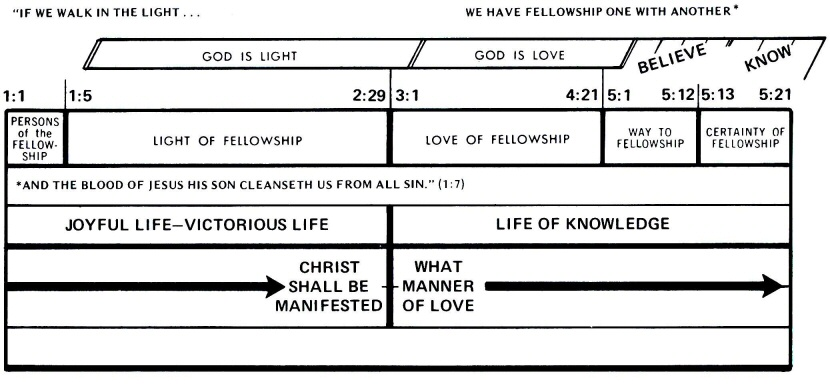
FELLOWSHIP WITH GOD AND HIS CHILDREN
Click chart to enlarge
Charts from Jensen's Survey of the NT - used by permission
Another Overview Chart - 1 John - Charles Swindoll
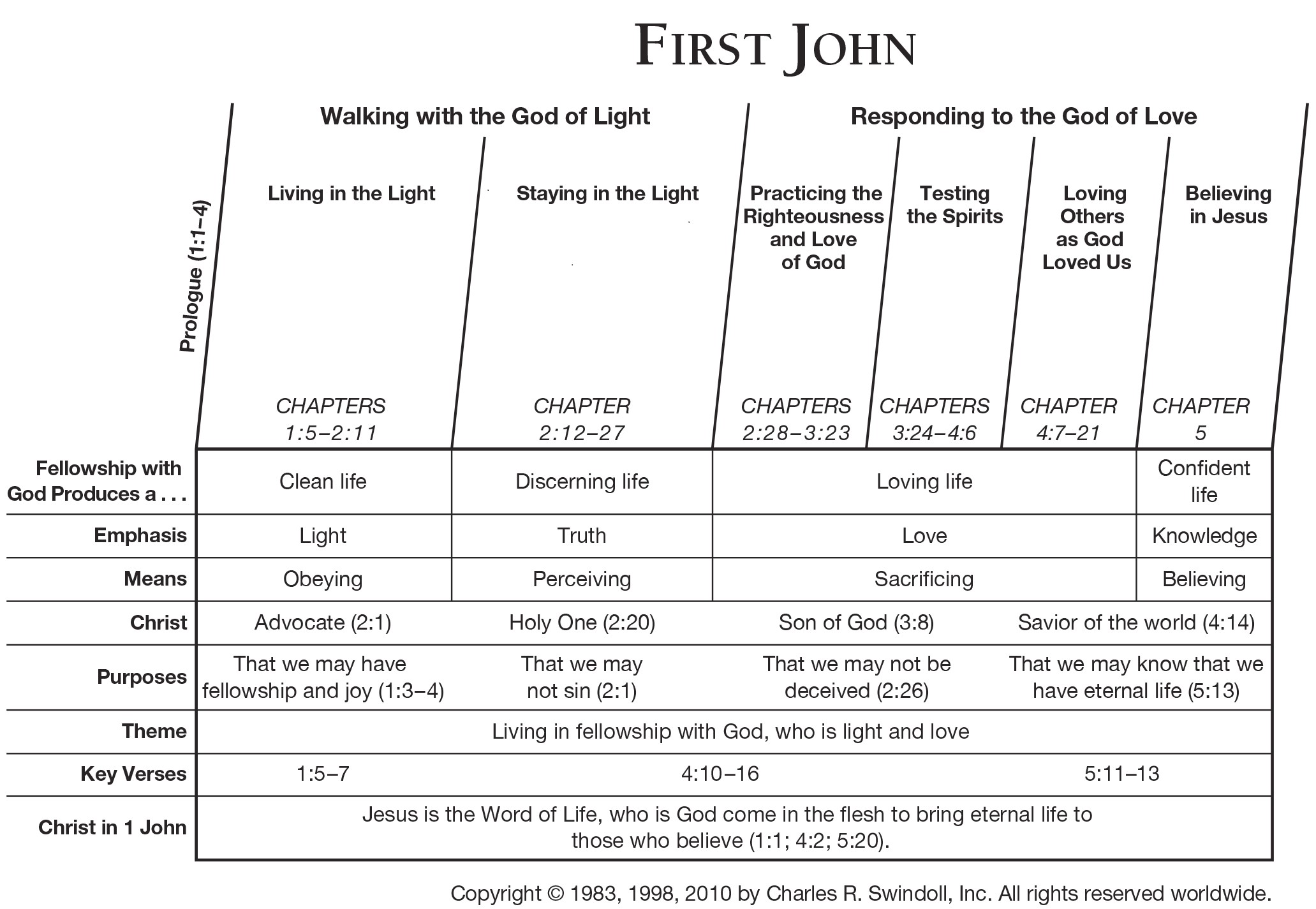
| BASIS OF FELLOWSHIP | BEHAVIOR OF FELLOWSHIP | ||||
| Conditions of Fellowship |
Cautions of Fellowship |
Fellowship Characteristics |
Fellowship Consequences |
||
| Meaning of Fellowship 1 Jn 1:1-2:27 |
Manifestations of Fellowship 1 Jn 2:28-5:21 |
||||
| Abiding in God's Light |
Abiding in God's Love |
||||
| Written in Ephesus | |||||
| circa 90 AD | |||||
| From Talk Thru the Bible | |||||
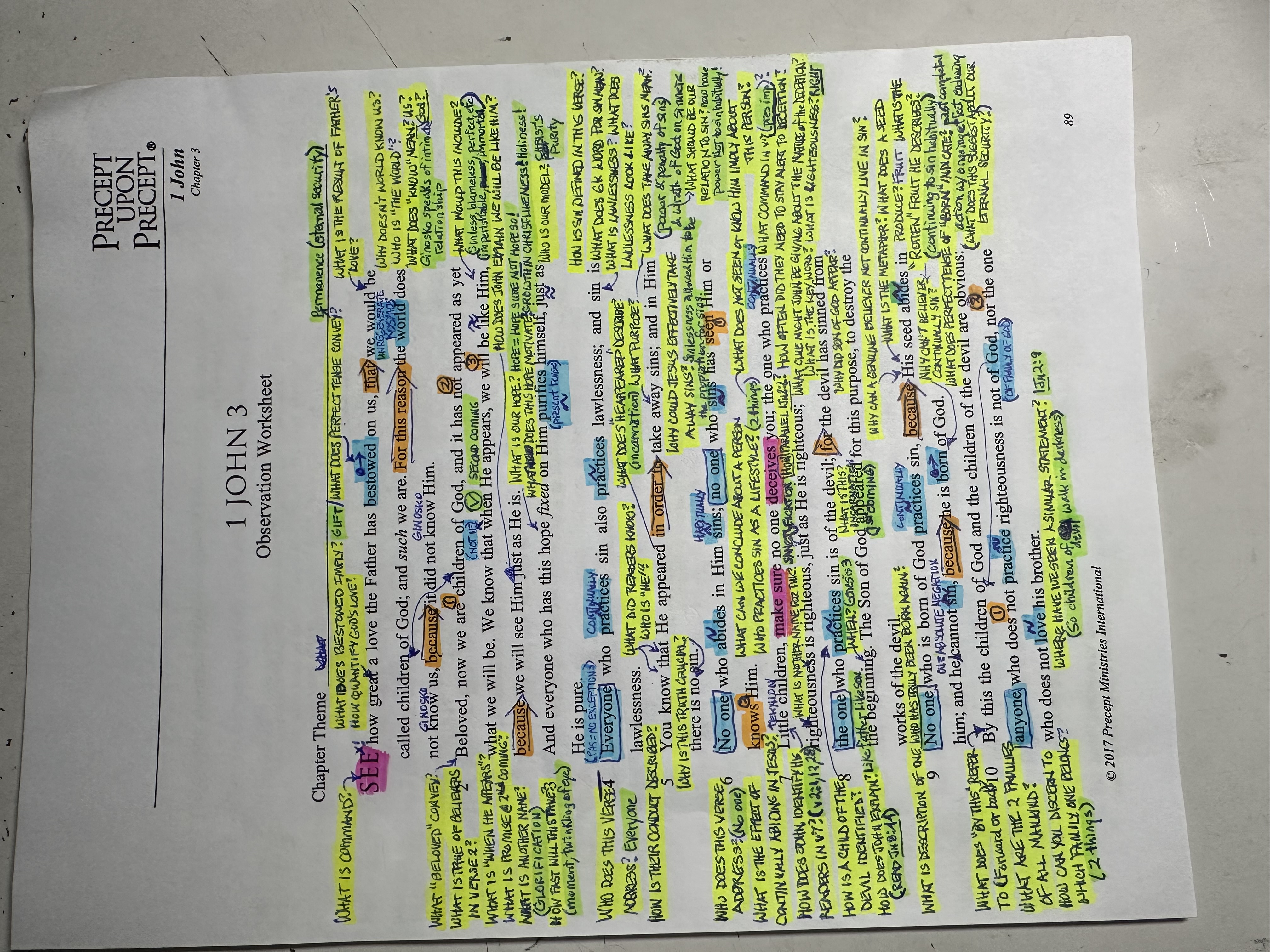
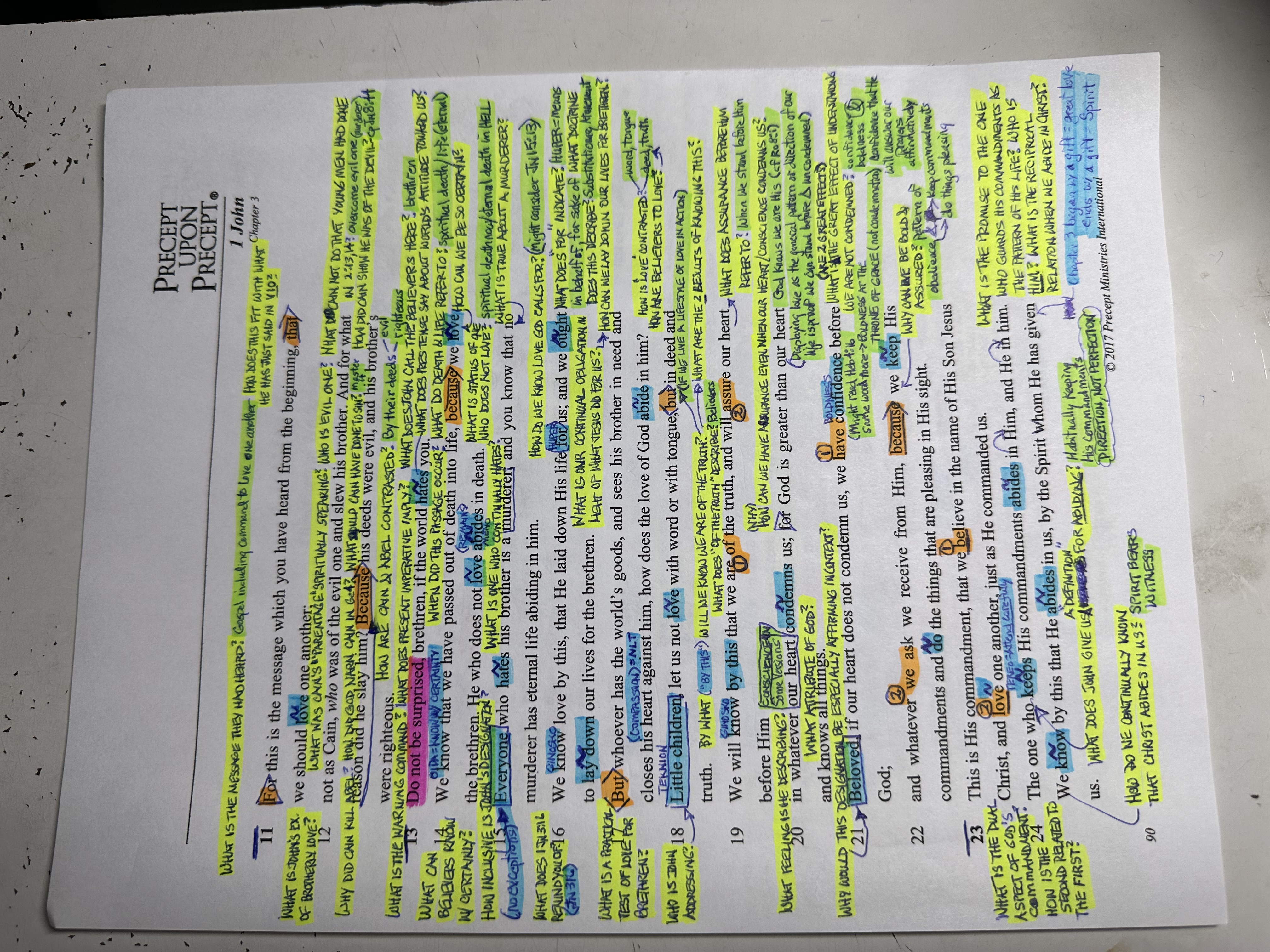
What is this? On the photograph of the Observation Worksheet for this chapter you will find handwritten 5W/H questions (Who? What? Where? When? Why? How?) on each verse to help you either personally study or lead a discussion on this chapter. The questions are generally very simple and are stated in such a way as to stimulate you to observe the text to discern the answer. As a reminder, given the truth that your ultimate Teacher is the Holy Spirit, begin your time with God with prayer such as Psalm 119:12+ "Blessed are You, O LORD; Teach me Your statutes." (you can vary it with similar prayers - Ps 119:18, 26, 33, 64, 66, 68, 108, 124, 135, 171, etc) The questions are generally highlighted in yellow and the answers in green. Some questions have no answers and are left to your observations and the illuminating/teaching ministry of the Holy Spirit. Some qualifying thoughts - (1) Use "As is" - these are handwritten and will include mistakes I made, etc. (2) They may not be the best question for a given verse and my guess is that on some verses you will think of a far superior 5W/H question and/or many other questions.
Dr Howard Hendricks once gave an assignment to his seminary students to list as many observations as they could from Acts 1:8. He said "So far they’ve come up with more than 600 different ones! Imagine what fun you could have with 600 observations on this passage. Would you like to see Scripture with eyes like that?" (P. 63 Living by the Book - borrow) With practice you can! And needless to say, you will likely make many more observations and related questions than I recorded on the pages below and in fact I pray that the Spirit would indeed lead you to discover a veritable treasure chest of observations and questions! In Jesus' Name. Amen
Why am I doing this? Mortimer Adler among others helped me develop a questioning mindset as I read, seeking to read actively rather than passively. Over the years I have discovered that as I have practiced reading with a 5W/H questioning mindset, it has yielded more accurate interpretation and the good fruit of meditation. In other words, consciously interacting with the inspired Holy Word of God and the illuminating Holy Spirit has honed my ability to meditate on the Scripture, and my prayer is that this tool will have the same impact in your spiritual life. The benefits of meditation are literally priceless in regard to their value in this life and in the life to come (cf discipline yourself for godliness in 1Ti 4:8+.) For some of the benefits - see Joshua 1:8+ and Psalm 1:2-3+. It will take diligence and mental effort to develop an "inductive" (especially an "observational"), interrogative mindset as you read God's Word, but it bears repeating that the benefits in this life and the rewards in the next will make it more than worth the effort you invest! Dear Christian reader let me encourage you to strongly consider learning the skills of inductive Bible study and spending the rest of your life practicing them on the Scriptures and living them out in your daily walk with Christ.
Although Mortimer Adler's advice is from a secular perspective, his words are worth pondering...
Strictly, all reading is active. What we call passive is simply less active. Reading is better or worse according as it is more or less active. And one reader is better than another in proportion as he is capable of a greater range of activity in reading. (Adler's classic book How to Read a Book is free online)
John Piper adds that "Insight or understanding is the product of intensive, headache-producing meditation on two or three verses and how they fit together. This kind of reflection and rumination is provoked by asking questions of the text. And you cannot do it if you hurry. Therefore, we must resist the deceptive urge to carve notches in our bibliographic gun. Take two hours to ask ten questions of Galatians 2:20+ and you will gain one hundred times the insight you would have attained by reading thirty pages of the New Testament or any other book. Slow down. Query. Ponder. Chew.... (John Dewey rightly said) "People only truly think when they are confronted with a problem. Without some kind of dilemma to stimulate thought, behavior becomes habitual rather than thoughtful.”
“Asking questions is the key to understanding.”
--Jonathan Edwards
That said, below are the 5W/H questions for each verse in this chapter (click page to enlarge). This is not neatly typed but is handwritten and was used for leading a class discussion on this chapter, so you are welcome to use it in this "as is" condition...
 |
 |
1 John 3:3 And everyone who has this hope fixed on Him purifies himself, just as He is pure. (NASB: Lockman):
kai pas o echon (PAPMSN) ten elpida tauten ep' auto hagnizei (3SPAI) heauton kathos ekeinos hagnos estin. (3SPAI)
Amplified: And everyone who has this hope [resting] on Him cleanses (purifies) himself just as He is pure (chaste, undefiled, guiltless). (Amplified Bible - Lockman)
ASV: And every one that hath this hope set on him purifieth himself, even as he is pure.
BBE: And everyone who has this hope in him makes himself holy, even as he is holy.
CEV: This hope makes us keep ourselves holy, just as Christ is holy (CEV)
GWT: So all people who have this confidence in Christ keep themselves pure, as Christ is pure. (GWT)
ICB: Christ is pure. And every person who has this hope in Christ keeps himself pure like Christ (ICB: Nelson)
ISV: Everyone who has this hope based on him keeps himself pure, just as he is pure.
KJV: And every man that hath this hope in him purifieth himself, even as he is pure.
Macent: he that hath such an expectation should purify himself, even as he is pure
MLB (Berkley): And everyone who has this hope resting on Him, purifies himself as He is pure
Moffatt: And everyone who rests this hope on him, purifies himself as he is pure.
Montgomery: And every one who is holding this hope in him is purifying himself, even as he is pure
NCV: Christ is pure, and all who have this hope in Christ keep themselves pure like Christ. (NCV)
NET: And everyone who has this hope focused on him purifies himself, just as Jesus is pure). (NET Bible)
NIV: Everyone who has this hope in him purifies himself, just as he is pure (NIV - IBS)
NJB: Whoever treasures this hope of him purifies himself, to be as pure as he is (NJB)
NLT: And all who have this eager expectation will keep themselves pure, just as he is pure. (NLT - Tyndale House)
Phillips: Everyone who has at heart a hope like that keeps himself pure, for he knows how pure Christ is. (Phillips: Touchstone)
TEV: Everyone who has this hope in Christ keeps himself pure, just as Christ is pure.
TLB: And everyone who really believes this will try to stay pure because Christ is pure
Weymouth: And every man who has this hope fixed on Him, purifies himself so as to be as pure as He is
Wuest: And everyone who has this hope continually set on Him is constantly purifying himself just as that One is pure.
Young's Literal: and every one who is having this hope on him, doth purify himself, even as he is pure
And everyone who has this hope fixed on Him purifies himself, just as He is pure: kai pas o echon (PAPMSN) ten elpida tauten ep' auto hagnizei (3SPAI) heauton kathos ekeinos hagnos estin. (3SPAI):
- everyone who has this hope Romans 5:4,5; Colossians 1:5; 2Thessalonians 2:16; Titus 3:7; Hebrews 6:18
- purifies - Acts 15:9; 2Corinthians 7:1; Hebrews 12:14; 2Peter 1:4; 3:14
- just as He is pure 1Jn 2:6; 4:17; Matthew 5:48; Luke 6:36; Hebrews 7:26
- Click to listen to the timeless, raspy voiced exposition of 1Jn 3:3 by Dr J Vernon McGee
- 1 John 3 Resources - Multiples Sermons and Commentaries
1Jn 3:1: WHAT WE ARE
1Jn 3:2: WHAT WE SHALL BE
1Jn 3:3: WHAT WE SHOULD BE
Doctrine always demands duty. What you believe should motivate and energize how you behave. Proper creed should always breed proper conduct. Supernatural truth calls first for a surrender of self and then for a supernatural response!
John has just explained the doctrines regarding the believer's privileged position as children of God and then elaborated on their prophetic hope of being like Christ. Based on and motivated by these great doctrinal truths, John now insists that all believers pursue purity in their life using as their example the perfect purity of their Lord.
The Costa Ricans have a saying known as "pura vida" which means "pure life", and this is exactly what John is calling for in the life of all God's children --
"Pura Vida"!
Restated, the apostle John's "template" for Pura Vida is...
Those who have become children of God in the past now have the sure hope of glory in the future which motivates holy living in the present !
Note that believers don't live holy lives to prove they are children of God, but they live holy lives because they are children of God. To invert the divine pattern is to open one's self to the subtle trap of legalism and self-righteousness. Paul's words ring true 2000 years later...
Are you so foolish? Having begun by the Spirit, are you now being perfected by the flesh? (Gal 3:3+) (Take a moment and speak this question to your own soul dear holy one [saint] of the Holy One of Israel.)
An unbeliever who sins is a creature sinning against his Creator.
A Christian who sins is a child sinning against his Father.
The unbeliever sins against law; the believer sins against love.
Warren Wiersbe comments that John has told us what we are (1Jn 3:1+) and what we shall be (1Jn 3:2+). Now, in 1Jn 3:3, he tells us what we should be. In view of the return of Jesus Christ, we should keep our lives clean. All this is to remind us of the Father’s love. Because the Father loved us and sent His Son to die for us, we are children of God. Because God loves us, He wants us to live with Him one day. Salvation, from start to finish, is an expression of the love of God. We are saved by the grace of God (Ep 2:8, 9+; Titus 2:11+, 12+, 13+, 14, 15+), but the provision for our salvation originated in the love of God. And since we have experienced the love of the Father, we have no desire to live in sin. An unbeliever who sins is a creature sinning against his Creator. A Christian who sins is a child sinning against his Father. The unbeliever sins against law; the believer sins against love. This reminds us of the meaning of the phrase so often repeated in the Bible: the fear of the Lord (Ed: See the 25 uses = 2Chr 19:7, 9; Job 28:28; Ps 19:9; 34:11; 111:10; Pr 1:7, 29; 2:5; 8:13; 9:10; 10:27; 14:26, 27; 15:16, 33; 16:6; 19:23; 22:4; 23:17; Isa 11:2, 3; 33:6; Acts 9:31; 2Cor 5:11) This phrase does not suggest that God’s children live in an atmosphere of terror, “for God hath not given us the spirit of fear” (2Ti 1:7+). Rather, it indicates that God’s children hold their Father in reverence and will not deliberately disobey Him or try His patience (cp 1Pe 1:17+) (Bible Exposition Commentary) (Bolding and color added)
And (kai) is the very first word which reminds us that the truth of this passage is intimately connected with and predicated upon the previous verse, especially His appearing and our glorification.
D Edmond Hiebert - The past experience of regeneration brings with it a living hope for the future, and this hope motivates present Christian living
Lloyd-Jones writes that in the previous passage (1Jn 3:2)...
We have been on the mountain of God, and we were shown things unseen. We were given that glimpse of glory, of the glory that awaits us and the astounding and amazing things to which we are heirs. But here we are now, as it were, back to earth again. We are reminded that before we enter into that glory and enjoy it in all its fulness, certain things remain and abound. We are still men and women in the (physical) flesh, in this world (Jn 17:11, 15, 16, 18) which, John has already told us, does not know us (1Jn 3:1). It does not understand us and, indeed, it is opposed to us and inimical to our highest and best interests (Jn 15:18, 19, 20). Yet though we do feel that, we must be very careful—and that is the point I want to emphasize most of all here—we must be very careful lest we regard this third verse as some sort of anticlimax after the second. It is not an anticlimax, and to regard it as such is simply a manifestation of our sinful nature...
There is a sense in which we can say that the whole object of 1Jn 3:2 is to lead to 1Jn 3:3, and if we fail to regard the second verse in that light, if we fail to see that its real object and purpose is to prepare the way for this third verse, then we have abused the second verse entirely, and we have failed to appreciate its true message to us...
You and I, having had a vision of glory, have to come down and translate it into practice and put it into daily operation, and if it does not lead to that, then we are abusing the Scripture.
Now there is a logical connection between these two verses. John does not argue about it, he just states it—‘every man that hath this hope in him purifieth himself, even as he is pure.’ There is no need to discuss it; the one thing follows the other as the night follows the day. Therefore this third verse is one which comes to us as a very real and a very sure test; the extent to which I have really grasped the teaching of 1Jn 3:2 is proved by the extent to which I implement verse 3. We can put it this way: it is what we are and what we do that really proclaims our belief and our profession.
That is the great theme in the epistle of James which has been so misunderstood—‘faith without works is dead’ (James 2:20)—and no one must dispute it. There is no disputation between James and John; both are saying the same thing—namely, that the profession of faith is of no avail unless it leads to this particular practice. Therefore we can put it the other way round with James and say that the real test of our profession is not so much what we are as what we do. (Children of God: 1 John 3)
Everyone (3956) (pas) means all without exception who have made a point to focus their eyes on the Eastern skies, the things above, the things of eternity, the unseen over the seen, the eternal over the temporal...all of these is who John is referring to in this verse. Sadly not all believers will fix their eyes on Jesus, waiting expectantly in anticipation of His return which is imminent. Nothing is left to be fulfilled on God's prophetic timetable in order for Christ to return. He could come at any moment. He might come today! Are you ready for His appearing (cp 1Jn 2:28)? Are you living for His appearing? The purifying impact of this eschatological hope should be operative in the life of every true believer.
My hope for the future enables me
to pursue holiness in the present.
-- Daniel Akin
Who has (2192) (echo) means to have, to hold or to possess and the present tense "pictures the individual as actively possessing and treasuring this hope as a sure possession." (Hiebert) This possession is not a tangible object to be touched but a truth which transforms.
R C H Lenski makes an interesting statement of having this hope worth pondering - There is no exception. He who stops purifying himself has dropped this hope from his heart....To claim that we are God’s children, who have been born of him, to claim the hope of heaven and glory and yet to stop self-purification is to be lying (1Jn 1:6).....The world is full of men who have a certain kind of hope, but see on what it rests—not on Christ, on his blood and expiation (1:7; 2:2), on his promise (2:25). They invent their own foundation for the hope they have. It is sand, is swept away when the great flood comes (Matt. 7:24–27). (Borrow The Interpretation of the Epistles of St. Peter, St. John and St. Jude )
Paul explains that a Biblically based...
hope does not disappoint, because the love of God has been poured out within our hearts through the Holy Spirit who was given to us. (Ro 5:5+)
Paul encourages the saints at Colossae with the truth that there is a...
hope laid up (perfect tense = has been laid away in times past with the present result that it is reserved for and awaiting you, out of reach of all enemies and sorrows) for you in heaven, of which you previously heard in the word of truth, the gospel (Colossians 1:5 - +)
Comment: The Gospel is good news for many reasons but here we see it is such good news because it provides a sure (laid up) hope to all those outside of Christ, who are hopeless ("having no hope" Eph 2:12+).
Wuest: This hope is laid up in heaven, all of which means that the saints will enjoy it in the future life. There are treasures in heaven earned by the saints while on earth (Mt 6:20+), our citizenship is in heaven (Php 3:20+), and we have an inheritance reserved for us in heaven (1Pe 1:4+).
Believers have an eternal hope in eternal life for they have been...
justified by His grace (and)...made heirs according to the hope of eternal life. (Titus 3:7+)
We can pray for one another based on the certainty of the good hope our Father graciously bestows on each of His children...
Now may our Lord Jesus Christ Himself and God our Father, who has loved us and given us eternal comfort and good hope by grace comfort and strengthen your hearts in every good work and word. (2 Thessalonians 2:16, 17)
This hope - It is interesting and somewhat surprising that this is the only use of the word hope in all of John's writings (not even found in the Revelation!).
The saint's hope is not a
"hope so" but a "hope sure!"
Hope (1680) (elpis) (See also left column labeled "Definition of Hope") in Scripture is not the world's definition "I hope so" with rare exception (see Acts 27:20+). Instead Biblical hope is a desire for some future good with the expectation of obtaining it. Hope is confident expectancy. It's the absolute certainty of future good or that God will do good to us in the future. It is a solid rock we can stand on, for our hope is built on nothing less than Jesus' blood and righteousness! (Play this great hymn My Hope Is Built on Nothing Less). It is full assurance (Heb 6:11+). Hope is the opposite of despair (a state in which all hope is lost or absent). In fact the believer's cry (to other believers) could be "Don't despair--help {the "Helper"} is on the way!"
Morally pure living is the response
f those who hope to become like Jesus at His return
-- Gary Derickson
As believers, our hope is not in circumstances or optimistic desires for a better tomorrow. Our hope is not centered in a concept but focused on a living person, Paul explaining that "Christ Jesus [is] our hope" (1Ti 1:1YLT+)
Our blessed hope is a catalyst
prompting pursuit of personal holiness
The NLT translates hope in 1Jn 3:3NLT as "eager expectation" which gives a good picture of the action that hope in the heart should produce.
Jesus said that He was returning to heaven to prepare a place for us (John 14:2+). Then He added these wonderful words of hope (Jn 14:3+),
If I go and prepare a place for you, I will come again and receive you to Myself, that where I am, there you may be also.
He didn’t leave us forever! He’s coming back for us, and when that happens, we will go to be with Him in the place that He has prepared for us! All of our hope should be fixed on Him.
Christians who fix their hope (their confident expectation) upon Christ’s return,
will purify themselves, not ceremonially but morally
-- John Stott
The UBS Handbook Series has an interesting analysis of the nuances of Biblical hope noting that "There are to be distinguished four main semantic components which combine in various ways to represent the concept of “hope.” These are, (1) time, for hope always looks to the future; (2) anticipation, for there is always some goal to the time span; (3) confidence, namely, that the goal hoped for will occur; and (4) desire, since the goal of hoping is represented as a valued object or experience." (The United Bible Societies' New Testament Handbook Series)
David Guzik - Having the anticipation of being with Jesus, of the soon coming of Jesus Christ, can have a marvelous purifying effect in our lives. It makes us want to be ready, to be serving Him now, to be pleasing Him now.
The hope John describes includes three primary factors:
Christ’s appearing, the believer’s seeing Him, and the believer’s becoming as He is
-- Daniel Akin
D Edmond Hiebert says that "Christian hope is assured of future realization because it is grounded in the person of Christ and His sure word...Our eschatological hope has objective validity and will certainly be fulfilled because Christ Himself is the guarantee of its fulfillment."
Hope as the world typically defines it is a desire for some future occurrence of which one is not absolutely assured of attaining. The ancient world did not generally regard hope as a virtue, but merely as a temporary illusion. Historians tell us that a great cloud of hopelessness covered the ancient world. Philosophies were empty; traditions were disappearing; religions were powerless to help men face either life or death.
Hope is the looking forward to something with some reason for confidence respecting fulfillment. Peter used this truth to encourage the suffering saints writing
Therefore (on the basis of the salvation and the "living hope" they now possessed) (to) gird your minds for action, keep sober in spirit, fix your hope (elpizo - verb form of elpis) completely on the grace to be brought to you at the revelation of Jesus Christ." (1Pe 1:13+)
Elpis - 53x in 48v in the NAS - Acts 2:26; 16:19; 23:6; 24:15; 26:6, 7; 27:20; 28:20; Ro 4:18; 5:2, 4, 5; 8:20, 24; 12:12; 15:4, 13; 1Co. 9:10; 13:13; 2 Co. 1:7; 3:12; 10:15; Gal. 5:5; Eph. 1:18; 2:12; 4:4; Phil. 1:20; Col. 1:5, 23, 27; 1Th 1:3; 2:19; 4:13; 5:8; 2Th 2:16; 1Ti 1:1; Titus 1:2; 2:13; 3:7; Heb. 3:6; 6:11, 18; 7:19; 10:23; 1Pe 1:3, 21; 3:15; 1Jn. 3:3
Related Resource:
- In depth study of Biblical hope - discussion and chart summarizing the definition of, source of, stabilizing effect of and sanctifying effect of hope.
Spurgeon - Oh, what a blessed hope this is, — that, though we fall asleep, we shall surely wake again; and when we awaken, it will be in the likeness of the great Head of the family, and we ourselves shall be heirs of an inheritance in which there will be no sin and no corruption. That inheritance is kept for us, and we are kept for it; so the double keeping makes it doubly sure. Happy are the people to whom these verses apply. (1Peter 1- Commentary)
The hope John describes in this verse is not "a" hope, but is "the" (definite article is present in the Greek) hope. So what? The preceding definite article (like our English "the") defines this hope as specific and not general. Our hope is not in our government, not in mankind, not in angelic beings, not in anything this world or the invisible world has to offer, save one thing and that is the sure hope, the blessed hope of the appearing of our Lord and Savior Jesus Christ. And coupled with that hope is the hope (the certainty) that we will be changed and we will be like Him when we see Him as He is!
Steven Cole notes that "Hope is one of the three cardinal virtues that Paul mentions in 1Cor 13:13, faith, hope, and love. Christians should be people of hope, because we fix our hope on Jesus, Who never disappoints... God promises hope to His people. Memorize some verses on hope, such as Ro 15:13 (+) Now may the God of hope fill you with all joy and peace in believing, so that you will abound (perisseuo - present tense = continually superabound) in hope by the power (dunamis) of the Holy Spirit. Our God is the God of hope, and the hope that He gives centers on the Lord Jesus Christ.(The Purifying Hope)
Fixed on Him - Literally the Greek reads "who has this hope upon Him", fixed having been added by the translators. The NET Bible utilizes the verb "focused" to add clarity. Moffatt renders it as "everyone who rests this hope on Him".
Sam Storms “Just as the vision of Christ in the future will sanctify us wholly, the vision of Christ in the present (in Scripture) sanctifies us progressively. It is our experience of Christ that sanctifies” (1 John 2:28-3:3)
On Him (ep' auto) This phrase pictures the sure, unchanging foundation of a believer's hope. It pictures the believer's hope "resting" on Him, grounded on His promises, which are "yea and amen" (2Co 1:20KJV). And so this hope not upon a generality or even a truth (which it is in one sense) but better yet rests upon a the Person, Christ Jesus. John has just explained that the believer's hope is based upon the truth that Christ has promised to return.
I WILL
RETURN
From 1942 to 1945, General Douglas MacArthur served as the commander of Allied forces in the Pacific. When it became clear in 1942 that Bataan, the last American foothold in the Philippines, would fall to the Japanese, President Roosevelt ordered MacArthur to leave. As he left on March 11 MacArthur uttered his famous promise, “I shall return. Don’t give in." And a little Pilipino answered "I will not give in...I will fight until you return." General MacArthur kept his promise and did return in October of 1944.
When Jesus left His disciples, He promised He would return (Jn 14:2, 3) and when He did return He would take His own to be with Him (1Th 4:16+, 1Th 4:17+). As Jesus ascended from the mount of Olives two angelic beings encouraged the forlorn disciples...
Men of Galilee, why do you stand looking into the sky? This Jesus, who has been taken up from you into heaven, will come in just the same way as you have watched Him go into heaven. (Acts 1:11)
Jesus had ascended but the battle was still raging and in fact would get worse. But He promised to return again. How will believers today survive? Jesus Christ is coming again and He is our Blessed Hope.
Note how the truth of our Blessed Hope motivates us to holy living...
For the grace of God has appeared (= incarnation of Christ), bringing (making available) salvation (justification = past tense salvation) to all men ("all" who believe), 11 instructing (paideuo = in the present tense = continually rearing us up like a parent does his children! What is "child rearing" us? In context the "Grace of God"! How else could we "deny ungodliness" except by the transforming power of amazing grace?!) us to deny (arneomai) ungodliness (asebeia) and worldly desires (epithumia) and to live sensibly (sophronos), righteously (dikaios) and godly (eusebos) in the present age (cp Gal 1:4) (= progressive sanctification - present tense salvation - This parallels the one who continually "purifies himself just as He is pure"), 12 looking for (prosdechomai - present tense = looking expectantly for Jesus' return as the habit of one's life) the blessed hope and the appearing of the glory of our great God and Savior, Christ Jesus (glorification = future tense salvation. This parallels the time "when we see Him we shall be like Him" 1Jn 3:2). (Titus 2:11+, Titus 2:12+, Titus 2:13+)
Blessed assurance, Jesus is mine!
Oh, what a foretaste of glory divine!
Heir of salvation, purchase of God,
Born of His Spirit, washed in His blood.
Perfect submission, all is at rest,
I in my Savior am happy and blest:
Watching and waiting, looking above,
Filled with His goodness, lost in His love.
-- Fanny Crosby
Fanny Crosby was blind but was “watching and waiting” by faith, and we too must set our eyes on the hope we have, that we will one day see His face and be like Him.
Beloved child of God, you can mark down this maxim --
What you are looking for
will determine
What you are living forEither...
TIME
or
ETERNITY!
See related discussion Redeem the Time and my youtube video on Redeeming the Time.
Purifies himself - Note that John does not say everyone ought to purify himself. Instead he flatly states that purification is what a believer does, and therefore this passage becomes a stringent test of what/who we really are! John's point is that everyone who genuinely possesses the objective hope of the Lord's promised return purifies himself. The verb hagnizo (see below) is in the present tense which calls for an ongoing practice of purification - we are to make and keep ourselves pure. It describes a process and hopefully progress but not an "arrival" in this life, and yet a goal we can run toward as we contemplate His appearing when we will "arrive" (glorification). The active voice indicates that this purification of calls for a volitional choice. The one who possesses the hope of Christ's return and of being like Him, is the one who willingly and repeatedly exercises self-purification.
Living He loved me; dying He saved me;
Buried, He carried my sins far away;
Rising He justified freely forever;
One day He’s coming—Oh glorious day!
(Play this Hymn)
That glorious day is indeed coming and John sees it as an awesome hope
for the future and a powerful motivation for the present.
Daniel Akin - That glorious day is indeed coming and the apostle John sees it as an awesome hope for the future and a powerful motivation for the present. Because I am going to be like Him in the future and for all eternity, such a promise has a wonderful transforming power in the present. My future impacts my life today!
It is important to emphasize that on one hand believers are responsible for carrying out their own (self) purification, but on the other hand, this supernatural work necessitates continual dependence on the power of the indwelling Spirit (cp Ro 8:13+; Gal 5:16+). Paul outlines the two aspects of our present walk and work of purification (God's sovereignty, Man's responsibility) in his letter to the saints at Philippi commanding them to...
work out (present imperative = calls for a lifelong pursuit of purity and holiness, continually striving to be like Christ, realizing in this life we will continually fall short) your salvation with fear and trembling for it is God Who is at work in you, both to will and to work for His good pleasure. (Php 2:12+, Php 2:13+)
Arnold adds "The hope of the coming of Christ produces a desire to live for Jesus Christ right now. We know we may meet him face to face at any given moment and we want to be ready and meet him with boldness and confidence. The Apostle John is stressing man’s responsibility to exercise his will in living the Christian life. The real sanctifier is God, the Holy Spirit, but we must, by an act of our wills, appropriate the power of the Spirit. The Holy Spirit is the means God has provided for the Christian to progressively purify himself in this life. A supernatural power is given to live the supernatural Christian life."
The hope of being like Christ in the future expresses itself
in an effort to purify oneself to be like him in the present.
-- Colin Kruse
John MacArthur - The idea of purifying oneself does not mean believers can generate their own sanctification. Rather, it emphasizes that the sanctifying work of the Holy Spirit does not take place apart from the believer’s obedience and use of the means of sanctifying grace. (1-3 John MacArthur New Testament Commentary - Page 117)
Osborne -This is an ongoing purification process, which begins at rebirth and continues until the day we see Jesus. The more pure we become, the clearer our view will be of Jesus, who is pure through and through. The Gospel of John, 1-3 John - Page 348
William MacDonald - It has long been recognized by Christians that the hope of the imminent return of Christ has a sanctifying influence in the life of the believer. He does not want to be doing anything that he would not want to be doing when Christ returns. (Borrow Believer's Bible Commentary)
Simon Kistemaker - The believer lives in the hope of becoming conformed to Jesus Christ, and the more he contemplates this truth the more he purifies himself of sin. He seeks to cleanse himself from sin that contaminates body and soul; constantly he strives for holiness in reverence to God (2 Cor. 7:1).
Concealed as yet this honour lies,
By this dark world unknown,—
A world that knew not when he came,
Even God’s eternal Son.
High is the rank we now possess;
But higher we shall rise;
Though what we shall hereafter be
Is hid from mortal eyes.
Our souls, we know, when he appears,
Shall bear his image bright;
For all his glory, full disclosed,
Shall open to our sight.
A hope so great, and so divine,
May trials well endure;
And purge the soul from sense and sin,
As Christ himself is pure
Purifies (48) (hagnizo from hagnos = freedom from defilements or impurities; see also word study on related word hagios [word study] = holy, saint) in the literal sense refers to ceremonial washings and purifications undertaken to purify oneself from ritual defilement. In the context of this ceremonial purification the idea was withdrawal from the profane (common) and dedication to God, thereby making one ceremonially ready. This sense is seen in the OT uses in the Septuagint (LXX), where hagnizo was used of the the Nazirites who took upon themselves a temporary or a life-long vow to abstain from wine and all kinds of intoxicating drink, from every defilement and from shaving the head. Luke seems to make allusion to a similar Nazirite-like practice by Paul in Acts 21:24, 26, 24:18.
Vincent adds that hagnizo was used in The Septuagint translation of the Old-Testament (as a) technical term for the purification of the people and priests (Jos 3:5; 1Chr 15:12; 1Sa 16:5). Also, of the separation from wine and strong drink by the Nazirite (Nu 6:2, 3, 4, 5, 6).
Hagnizo basically denotes a removal of that which disqualifies one for acceptable worship, the removal of which results in a condition of purity and chastity. The figurative uses of hagnizo emphasize the idea of one's heart being fully devoted to the Lord and to His will and way.
The only other use of hagnizo by the apostle John describes is with a literal sense to describe Jewish ceremonial purification...
Now the Passover of the Jews was at hand, and many went up to Jerusalem out of the country before the Passover, to purify themselves. (Jn 11:55)
Three NT uses of hagnizo emphasize are figurative and speak of ethical/moral or internal/heart purification -- 1Jn 3:3 and in the following two passages...
James 4:8+ Draw near (eggizo in the aorist imperative = command to carry this out immediately. Don't procrastinate beloved. Do it now and do it effectively!) to God and He will draw near to you. Cleanse (katharizo in the aorist imperative) your hands, you sinners (hamartolos); and purify (hagnizo in the aorist imperative) your hearts (kardia), you double-minded (dipsuchos).
Since you have in obedience (hupakoe) to the truth purified (katharizo in the perfect tense = past completed action with ongoing effect/result) your souls for a sincere (anuopkritos) love of the brethren, fervently love (agapao in the aorist imperative = command to carry this out immediately and effectively. God's commands always include His enablements = You now have a new heart and His supernatural power) one another from the heart (1Pe 1:22+)
Comment: Peter says a person is purified when he obeys the truth (the Word of God, the Gospel ~ "seed which is...imperishable...the living and abiding Word of God" 1Pe 1:23+) and in this context Peter is referring to the initial experience of salvation (justification = past tense salvation) by grace through faith (Eph 2:8, 9+).
The NET Bible comments that "In this context the use of hagnizo would remind the readers that, if they have the future hope of entering the Father's presence ("seeing him as he is" 1Jn 3:2+), they need to prepare themselves by living a purified lifestyle now, just as Jesus lived during His earthly life and ministry (cp 1Jn 2:6) This serves to rebut the opponents' claims to moral indifference, that what the Christian does in the present life is of no consequence.
In sum, while hagnizo can refer to ceremonial purification (external), the apostle John uses it to describe daily spiritual purification of one's heart (internal).
D Edmond Hiebert makes the point that in 1Jn 1:7...John states that it is the blood of Christ that cleanses us, whereas here in 1Jn 3:3 he speaks of self-purification. Both are true and necessary. As the begrimed workman must personally apply the soap and water to be cleansed, so the believer appropriates the God-given means of cleansing from moral defilement that may have been incurred in daily life. Included in this self-purification is the believer's renunciation of objects, activities, and attitudes which he finds to be defiling. (Ed: And I would add doing so in reliance upon the filling and controlling of the indwelling Spirit and the strengthening power of the grace in Christ Jesus - cp 2Ti 2:1+, 2Co 12:9+; 2Co 12:10+)Theology speaks of this repeated cleansing as "progressive sanctification" (cf. 2Cor 7:1). In 1Pe 1:22 Peter uses this verb in the perfect tense, "seeing ye have purified your souls in your obedience to the truth" (ASV), to denote the cleansing that took place at regeneration (cf. Jn 13:10; 15:3; 17:19). That initial purification with its transforming result is the necessary antecedent to this personal self-cleansing in daily experience. The more intimate the believer's fellowship with God, who is "light" (1Jn 1:5), the more conscious he becomes of his need to cleanse himself from all that is moral darkness (1Jn 1:5, 6, 7). The more he contemplates this assured hope of being conformed to the image of Christ, the more eagerly will he strive for present personal purity (Php 3:13,14).
THREE TENSES OF
SALVATION IN
1 John 3:1-3
As alluded to above, there are three tenses of salvation (See Three Tenses of Salvation) past tense (justification), present tense (sanctification, growth in holiness, increasing Christ-likeness) and future tense (glorification) and 1 John 3:1,2,3 the apostle alludes to each of these three tenses. In 1Jn 3:1+, John states we are children of God which implies that we have been justified by faith or past tense salvation. In 1Jn 3:2+ he explains that we shall be like Him which equates with future tense salvation (glorification). Finally here in 1Jn 3:3 he describes the saint's daily spiritual purification, which equates with present tense salvation (progressive sanctification).
Moral purity or holiness is a frequent theme in the New Testament. The word for saints is hagios which is translated "holy" or "holy ones" and means those who are sanctified or set apart from the profane world and unto the holy God. It follows that we who are now positionally holy or set apart in Christ (justified = past tense salvation) should strive according to His power which mightily works within us to be experientially holy (progressive sanctification = present tense salvation) as He is holy (1Pe 1:15, 16+) (See also the Three Tenses of Salvation)
Acts 15:9+ and He made no distinction between us (Jews) and them (Gentiles), cleansing (katharizo) their hearts (kardia) by faith (pistis) (referring to their initial sanctification or setting apart = justification = were declared righteous by faith [cp Ro 3:24+, Ro 3:25NLT+, Ro 3:28+).
Titus 2:14+ (Christ) gave Himself for (= in our place = substitutionary sacrifice) us, that He might redeem (lutroo) us from every lawless (anomia) deed and purify (katharizo) for Himself a people for His own possession, zealous for good deeds.
Hebrews 12:14+ Pursue (present imperative = make this your habitual practice, empowered by the indwelling Spirit, one fruit of which is peace- Gal 5:22+) peace (eirene) with all men, and the sanctification (holiness - hagiasmos) without which no one will see the Lord. (This verse describes present tense salvation = progressive sanctification)
2 Peter 1:4+ For by these (What? His glory and excellence just mentioned - 2Pe 1:3+) He has granted (perfect tense = past completed action with present ongoing result/effect) to us His precious and magnificent promises, so that by them you may become partakers of the divine nature, having escaped (apopheugo) the corruption (phthora) that is in the world (kosmos) by lust (epithumia).
2 Peter 3:11+ Since all these things are to be destroyed in this way (2Pe 3:10+), what sort of people ought you to be in holy conduct and godliness, 12 looking for and hastening the coming of the day of God, on account of which the heavens will be destroyed by burning, and the elements will melt with intense heat!
2Peter 3:14+ Therefore, beloved, since you look for these things (What things? "new heavens and a new earth, in which righteousness dwells" 2Pe 3:13+) , be diligent to be found by Him in peace, spotless and blameless,
Notice the following passages which illustrate a similar pattern of promises and privilege position as children of God followed by an exhortation to purify ourselves
THE PROMISES
AND PRIVILEGED POSITION
2Cor 6:14-18+Do not be bound (present imperative) together with unbelievers; for what partnership have righteousness and lawlessness (anomia), or what fellowship has light with darkness (skotos)? 15 Or what harmony has Christ with Belial, or what has a believer (pistos) in common with an unbeliever? 16 Or what agreement has the temple of God with idols (eidolon )? For we are the temple of the living God; just as God said, "I WILL DWELL IN THEM AND WALK AMONG THEM; AND I WILL BE THEIR GOD, AND THEY SHALL BE MY PEOPLE.17 "Therefore, COME OUT (aorist imperative = Now! Don't hesitate or procrastinate!) FROM THEIR MIDST AND BE SEPARATE (aorist imperative)," says the Lord. "AND DO NOT TOUCH (present imperative) WHAT IS UNCLEAN; and I will welcome you. 18 "And I will be a father to you, and you shall be sons and daughters to Me," says the Lord Almighty (pantokrator).
THE PROPER PERSUASION
(EXHORTATION)
2 Corinthians 7:1+Therefore (see term of conclusion), having (present tense = possessing = our present and continual possession now and throughout eternity!) these promises (see above), beloved (What would happen beloved if we daily recalled these precious promises to our mind? Would not our resolve and motivation for holy living be animated and strengthened daily?! Cp the motivating power of our privileged position as children of God in 1Jn 3:1+), let us (Paul includes himself in this exhortation - we can never be pure and holy enough in this life!) cleanse (katharizo) ourselves (empowered by the Spirit - cp Php 2:13NLT+) from all defilement (molusmos) of flesh and spirit, perfecting (epiteleo - present tense = this is a daily, lifelong process - it should be every believer's lifestyle) holiness in the fear (phobos) of God (cp 1Pe 1:17+).
Himself (1438) (heautou) technically is a reflexive pronoun which refers the action of a verb back to its own subject. In this case the action is purification which one does to oneself. It serves to emphasize that believers are to look in the mirror at our "moral dirt" instead of pointing fingers at the unholy behavior of those around us!
D Edmond Hiebert adds that "himself marks that the conscious need for purification centers in his own being."
Live now as you shall wish you had lived
when you stand at the judgment seat of Christ!
—Culbertson
Martyn Lloyd-Jones asks a pertinent question in light of John's declaration that everyone with this hope purifies himself...
Why do we therefore fail so much in practice? The answer, it seems to me, is that our belief is defective; if only we really did see ourselves as we are depicted in the New Testament, the problem of conduct would immediately be solved. So the real trouble with most Christian people is not so much in the realm of their conduct and practice as in the realm of their belief, and that is why the Church, whenever she puts too much emphasis upon conduct and behaviour and ethics, always leads eventually to a state and condition in which Christian people fail most of all in that respect.
This is a very subtle matter. Of course the tendency is for people to argue like this: ‘Ah,’ they say, ‘there is not much point in talking to us about doctrine; you have to remind people of their practical duty.’ So holiness teaching not infrequently becomes a constant repetition of certain duties which we are to carry out. I agree that we do have to do these things, but I say that the ultimate way of carrying out these duties, and really practicing these things, is to have such a grasp and understanding of the doctrine that the practice becomes inevitable. And that is, of course, precisely what the New Testament always does. (Children of God: 1 John 3)
PAUL AGREES WITH JOHN:
IT'S TIME TO WAKE UP!
In Romans 13:11-14 Paul teaches a similar association of the anticipation of Christ's second coming (cp 1Jn 3:2) as motivation for the working out of our salvation by carrying out daily purification (1Jn 3:3)...
11 And this do (love - Ro 13:10+), knowing the time (kairos), that it is already the hour for you to awaken from sleep (metaphor = spiritual sleep); for now salvation (soteria) is nearer to us than when we believed. (When we believed = were justified [declared righteous] = "past tense salvation". Salvation...nearer = "future tense salvation" = glorification, which will occur when Christ returns ~ 1Jn 3:2)
12 The night (this present evil age, Gal 1:4+, cp "night people" in 1Th 5:5+, 1Th 5:6, 7+) is almost gone (cp fate of this evil world system = 1Jn 2:17+), and the day is at hand (What day? His Second Coming). Let us therefore (Why "therefore"? What is the motivation for the following exhortation? Clue: Check your watch!) lay aside (apotithemi = throw them off like dirty, filthy, smelly clothes!) the deeds of darkness and put on (enduo) the armor of light (Believers are in one sense ["positionally"] already "light in the Lord" [Eph 5:8+] but now based on our position each of us are called to "walk in the light" 1Jn 1:7 carrying out our daily process of purification or sanctification, 1Jn 3:3)
13 Let us behave properly as in the day (~ Walking in the light), not in carousing and drunkenness, not in sexual promiscuity and sensuality, not in strife and jealousy (~ Walking in the darkness, in the night).
14 But (Change of direction = from living like "night" [Jn 3:19, 20+] people to living like "light" people. [Jn 3:21+ - note all the verbs here are present tense = our daily practice is to come to the light]) put on (aorist imperative = Do it now! Don't hesitate or procrastinate! See Col 3:12-15+ for what it looks like to "put on Jesus") the Lord Jesus Christ (In a sense we are already clothed in His righteousness [1Co 1:30+, Jn 8:12+] but now as part of our progressive work of purification we are to actively, continually pursue righteousness [1Ti 6:11+, cp 2Ti 2:22+]) and make no (present imperative = Stop planning your sinning! Remember sin begins with your thought life - there sin is hatched as lust carries you away and entices you - if you take the "bait" of that lustful thought, you're "hooked" Jas 1:14, 15+) provision (pronoia = thinking about it beforehand - you know exactly what this means!) for the flesh in regard to its lusts (epithumia = strong desires which God gave us to be gratified according to His good and perfect will, but which we instead to often seek [urged on by our flesh] to gratify in an ungodly way, not in keeping with His will, eg, see 1Th 4:1+, 1Th 4:3+). (Ro 13:11+, Ro 13:12+, Ro 13:13, 14+)
THOUGHT: When the alarm goes off in the morning, you wake up! When you know the time of His return is nigh, you wake up spiritually and put on holy clothes that enable daily purification as an ongoing process.
Steven Cole writes that...
The holiness of God and of the Lord Jesus Christ is a frequent theme in 1John. In 1Jn 1:5, he told us, “God is light, and in Him there is no darkness at all.” In 1Jn 2:1, he refers to Jesus as “Jesus Christ the righteous.” In 1Jn 2:20, he refers to Jesus as “the Holy One.” In 1Jn 2:29, he again affirms that “He is righteous.” Here, he says, “He is pure.” The word originally referred to ceremonial purity, but it came to mean that which is “pure in the highest sense” (R. C. Trench, Synonyms of the New Testament). It refers to freedom from all defilement of sin, especially moral sin.
As we’ve seen, in that glorious future day when we see Jesus, that vision will transform us. But I also believe that to the extent that we presently see Jesus in His holiness with the eyes of faith, to that same extent He will transform us into His glory. Paul says essentially the same thing (2Co 3:18+) "But we all, with unveiled face, beholding as in a mirror the glory of the Lord, are being transformed into the same image from glory to glory, just as from the Lord, the Spirit." There is a similar thought in John 14:21+, where Jesus says, "He who has My commandments and keeps them is the one who loves Me; and he who loves Me will be loved by My Father, and I will love him and will disclose Myself to him." If we want Jesus to disclose or reveal Himself to us, we must obey Him. It becomes, not a vicious cycle, but a victorious cycle, where when we obey, we see more of Jesus; this in turn makes us more like Him, which means that we see even more of Him. There is a transformational power in seeing Jesus for Who He is, the Holy One. Of course, our only source for this knowledge is His Word. Thus we must fix our hope on Him and we must come to know Him in His holiness.
We must purify ourselves now so that we will grow to be like Him. - John says (1Jn 3:3),"Everyone who has this hope fixed on Him purifies himself." We need to maintain the biblical balance here. In Romans 8:29, Paul says that God has predestined us to become conformed to the image of His Son. In that sense, it’s a done deal and clearly, God does it. Yet at the same time, John says that we must purify ourselves. Paul says (2Co 7:1), “Therefore, having these promises, beloved, let us cleanse ourselves from all defilement of flesh and spirit, perfecting holiness in the fear of God.” He commands Timothy to keep himself pure [lit.] from sin (1Ti 5:22). James 4:8 commands, “Cleanse your hands, you sinners; and purify your hearts, you double-minded.” 1 Peter 1:22 says that believers have purified their souls. So, there is a definite sense in which we must be active in the process of purification from sin.
The other side is that only the blood of Jesus can cleanse us (1Jn 1:7, 9). We are clean through the washing of water with the Word (Ep 5:26). So God’s Word and His Holy Spirit are like the soap and water. But we’ve got to apply it to the dirt of our sin. The Word is also like a mirror, revealing to us the dirt on our faces. When it does that, rather than ignoring it, we must confess our sins to the Lord, apply His shed blood as our source of cleansing, and take the necessary steps to avoid that sin in the future. In brief, if you can’t imagine Jesus Christ, the righteous one, doing something, then you shouldn’t do it either. Clean the filth out of your life, be-ginning on the thought level.
Conclusion - Maybe you’re thinking, “But it’s hard to let go of my sins!” If we’re honest, we sin because we enjoy sinning, at least for the moment. We don’t consider the long-term consequences. So we need motivation for purity. John says that our motivation should be that we are God’s beloved children and that Jesus is coming to make us pure. These facts should motivate us to purify our lives now.
ILLUSTRATION When Jimmy Carter was President, to promote his populist image, on several occasions he spent the night in the homes of common people. Of course, he didn’t drop in unannounced! Those people had fair warning that he was coming on a particular date, and I’m sure that they had to agree to the visit. But, if you knew that the President would come at some unknown date to stay in your home, and that the news cameras would be there to broadcast the state of your living room to the entire world, I’ll bet that you’d be motivated to clean house!
Jesus is coming. When you see Him in His glory, you will be like Him. If you have your hope fixed on Him, you’ll start cleaning house now! You don’t want the Lord who is pure to come to a filthy house! (The Purifying Hope)
Just as He is Pure (hagnos) - Christ is our pattern for purity, our example of excellence. As John said "He must increase and we must decrease" (Jn 3:30) Just as (kathos) is used in the sense of comparison, meaning in this way Christ walked while on earth. See article on Walking Like Jesus Walked!.
Prophetic truth calls us not only to preparation
and expectation but also to purification.
-- Vance Havner
Peter alludes to Christ pattern of purity in the way He responded to suffering, writing that...
For you have been called for this purpose (to suffer) , since Christ also suffered for you, leaving you an example for you to follow in His steps, (1Pe 2:21+)
Earlier in first John, the apostle had emphasized the importance of a walk that corresponds to one's talk (profession) writing that...
the one who says he abides in Him ought (Not a suggestion but an obligation, we in a sense owe this to Him, however not in any meritorious sense) himself to walk in the same manner as He (Christ) walked. (1Jn 2:6+)
He is (2076) (estin) is the present tense indicates Jesus' immutable (unchanging) holy nature. In other words His unchanging nature guarantees his eternal purity. He is the eternally pure one! One of the very names given to Jesus is "Holy One" speaks of His uncompromising surpassing holiness. He was pure on earth and will remain pure throughout eternity! Note that John does not say “just as He (Christ) purifies Himself” because our Lord never had to purify Himself. For believers purification it is a gradual process (cp progressive sanctification) but with Jesus, it is a fact.
Purity is His inherent quality.
-- R C H Lenski
D Edmond Hiebert writes that "The added words "even as he is pure" set before the believer the pattern for his self-purification. "Even as He" makes clear that "we are not to judge our lives by other peoples', but by Christ's, who is the standard or goal toward which we are to move.''"He" renders the demonstrative pronoun "that one" (ekeinos), which in this epistle seems always to refer to Christ (1Jn 2:6; 3:3, 5, 7, 16; 4:17; 5:16), and sets Him apart from other individuals. As a man among men, Jesus was "pure" (hagnos), morally blameless, uncontaminated and sinless in character and conduct.John does not say "even as that one purified himself" but rather "is pure," thus asserting His unchanging nature. The incarnate and glorified Christ ever remains "pure" and "sinless." As such He is the perfect model, challenging believers constantly to purify themselves. Culpepper comments, "Those who hope for heavenly rewards but do not pursue righteousness have pipe dreams, not hope."
Pure (hagnos) means freedom from defilements or impurities and figuratively as used in this verse describes what is morally undefiled and when used ceremonially describes that which has been so cleansed that it is fit to be brought into the presence of God and used in His service. Although hagnos refers primarily to that which is inwardly pure, this purity also affects a person’s conduct. The word pure means “free from contamination” and is used of ceremonial cleansings (John 11:55), cleansing of the heart (Jas 4:8), and even cleansing of the soul (1 Pet 1:22). Here it is used in reference to one’s total life. The template for pure conduct is the Lord Jesus Christ, as summarized by the writer of Hebrews...
For it was fitting that we should have such a high priest, holy, innocent, undefiled, separated from sinners and exalted above the heavens who does not need daily, like those high priests, to offer up sacrifices, first for His own sins, and then for the sins of the people, because this He did once for all when He offered up Himself. (He 7:26, 27+)
The root word hagnos describes what is morally undefiled and when used ceremonially describes that which has been so cleansed that it is fit to be brought into the presence of God and used in His service. James uses this root word hagnos in his list of characteristics of heavenly wisdom (Jas 3:17). Hagnos describes a purity which affects a not only a person’s motives but also their conduct.
Hagnos is always with a moral sense but is not limited to sins of the flesh, but covering purity in motives as well as in acts. In 2Co 11:2, of virgin purity. In James 3:17, as a characteristic of heavenly wisdom.
Hagnos means free from admixture of evil, and is once applied to God, John writing that "just as He is pure (hagnos) (1Jn 3:3)
William Barclay (critique) emphasizing the secular origin and use of the root word hagnos writes that "hagnos and its root meaning is pure enough to approach the gods. At first it had only a ceremonial meaning and meant nothing more than that a man had gone through the right ritual cleansings. So, for instance, Euripides can make one of his characters say, “My hands are pure, but my heart is not.” At this stage hagnos describes ritual, but not necessarily moral, purity. But as time went on the word came to describe the moral purity which alone can approach the gods. On the Temple of Aesculapius at Epidaurus there was the inscription at the entrance: “He who would enter the divine temple must be pure (hagnos); and purity is to have a mind which thinks holy thoughts."
NIDNTT has this note on the classic use in Greek...hagnos, adj. from the verb. hazomai which is in turn derived from hagiomai, to stand in awe of someone, originally meant that which inspires (religious) awe, tabu (Godliness, art. sebomai). In secular Gk. usage hagnos is found from Homer onwards. In religious language it is primarily an attribute of deity; then it refers to things having some relation to the deity. It thus comes to mean holy, in the sense of pure. Ritual purity is in mind here, e.g. avoidance of blood-guilt, touching corpses. Since to the primitive mind sexual intercourse also makes a person ritually unclean, hagnos came to mean chaste. The originally cultic, religious term was then transferred to the sphere of morality, and is frequently used in the Hellenistic period in the sense of innocent, morally faultless. It is also used as a compliment for faultless execution of office. From hagnos are derived the verb hagnizo, to purify (by means of expiatory rites), first found in Soph., and the cognate noun hagnismos, purification. Both terms are limited to the cultic sphere. hagneia, a noun derived from hagnos, is likewise found first in Soph., and is used of cultic purity, chastity, purity of mind. Another noun derived from hagnos is hagnotes, which is unknown outside the NT and means purity, moral blamelessness. More common in the LXX is the verb hagnizo, which describes the measures taken to achieve eligibility for the cult. Whereas hagios (holy) always includes the thought of the power and might of that which is holy, hagnizo expresses consistently the removal of what is not seemly (e.g. Ex 19:10, washing of garments; Nu 6:3, abstinence from alcohol [Nazirites]), especially in the sense, to purify oneself from sin or uncleanness (hith. of chata', e.g. Nu 8:21; 19:12). hagneia also refers in the OT (Nu 6:2-21, law of the Nazirite; 2Chr 30:19, sanctuary) and Apocrypha (1Macc. 14:36, temple) to ritual purity. (Online New International Dictionary of NT Theology)
TODAY ALONG THE WAY - Consider parallels between physical and spiritual birth. We’ve listed a few in today’s study, but you’ll no doubt come up with several more. For example, just as we are born into a certain physical family, so too we are forever born again into the family of God. Just as physical families have certain family resemblances, so too members of God’s family resemble each other to the extent that they resemble their Father. What are some other ways in which physical birth and childhood illustrate being a child of God?
MORE PURITY
GIVE TO ME
THE "MEASURING DAY" Till we all come . . . unto a perfect man, unto the measure of the stature of the fullness of Christ. Ephesians 4:13 -
God wants us to grow in grace and advance in spiritual knowledge. Therefore, along with His Word, He gives us Christian leaders who, because of their maturity, can act as ministers and teachers to edify us (Eph. 4:11), give us a broader insight into the deeper life of consecration, and instill in our hearts a better understanding of the true wisdom which is from above. As we thus mellow and mature through grace we shall grow "unto .. . the measure of the stature . . . of Christ!"
Peloubet's Notes relates in substance the following incident: It is said that those who .wished to qualify for positions in the elite guard of King Frederick of Prussia were required to measure up to a certain commanding stature. A Christian lady thought so much about this annual "Measuring Day" ceremony that when she went to bed one evening she had a dream in which she imagined there was a day when everyone's growth in grace was similarly computed. An angel stood with a tall, golden rod in his hand over which was fastened a scroll on which appeared these words: "The measure of the stature of the perfect man." The angel inscribed in a large book all the important statistics as the people came up one at a time in response to the calling of their names. The instant anyone touched the rod an astounding thing happened — each shrank or increased in size to his or her true spiritual dimensions! Everyone, including the recording angel, could thus miraculously see what otherwise would have been perceived only by the eye of God.
If today were the "Measuring Day" (and it may well be if Jesus suddenly returns), would you be ashamed of your spiritual stature? Take inventory; is your soul shrinking from "malnutrition," or are you feeding on the Living Bread, and thus daily attaining a little more of the "stature of the fullness of Christ"?
More purity give me, more strength to o'ercome;
More freedom from earth-stains, more longing for Home;
More fit for Thy kingdom, more used would I be;
More blessed and holy, more, Saviour, like Thee.
—P. P. Bliss
Thomas Watson warns of the deceptive danger of a false hope for "A false hope is an UNCLEAN hope. A man hopes—but continues in his sins. It is vain to speak of hopes of salvation—and have the marks of damnation. True hope is a helmet made of pure metal. 1John 3:3: "He who has this hope purifies himself." (The Fight of Faith Crowned)
J C Ryle speaking of the great worth of assurance of our salvation (this is point #4 of 4) writes that...
Assurance is to be desired because it tends to make the holiest Christians. This, too, sounds incredible and strange, and yet it is true. It is one of the paradoxes of the gospel, contrary at first sight to reason and common sense, and yet it is a fact. Cardinal Bellarmine was seldom more wide of the truth than when he said, "Assurance tends to carelessness and sloth." He who is freely forgiven by Christ will always do much for Christ’s glory, and he who enjoys the fullest assurance of this forgiveness will ordinarily keep up the closest walk with God. It is a faithful saying and worthy to be remembered by all believers: "He who has hope in Him purifies himself, even as He is pure" (1 John 3:3). A hope that does not purify is a mockery, a delusion, and a snare.
None are so likely to maintain a watchful guard over their own hearts and lives as those who know the comfort of living in close communion with God. They feel their privilege and will fear losing it. They will dread falling from the high estate, and marring their own comforts, by bringing clouds between themselves and Christ. He who goes on a journey with little money about him takes little thought of danger and cares little how late he travels. He, on the contrary, that carries gold and jewels will be a cautious traveler. He will look well to his roads, his lodgings and his company and run no risks. It is an old saying, however unscientific it may be, that the fixed stars are those which tremble most. The man that most fully enjoys the light of God’s reconciled countenance will be a man tremblingly afraid of losing its blessed consolations and jealously fearful of doing anything to grieve the Holy Spirit. (Assurance)
Alleine writes that "If your hope is worth anything, it will purify you from your sins (1 John 3:3)—but cursed is that hope which cherishes men in their sins. (Alarm to the Unconverted)
Thomas Brooks speaks of the purification that hope provokes writing that "The assured Christian knows, that it is dangerous to sin against light, that it is more dangerous to sin against love, that it is most dangerous to sin against love revealed and manifested to the soul. To sin under assurance, is to sin against the great mercies of God, it is to sin against the highest hopes of glory; and this will certainly provoke God to be angry. God may well say to such a Christian, "Is this your kindness to your best friend?" (HEAVEN ON EARTH)
Bishop J C Ryle notes that "The third mark of the new birth is "holiness." What says the apostle John again? "You know that everyone who practices righteousness is born of him." (1Jn 2:29) "And everyone who thus hopes in Him purifies himself as He is pure." (1Jn 3:3) The true children of God delight in making the law their rule of life; it dwells in their minds, and is written upon their hearts, and it is their food and drink to do their Father's will. They know nothing of that spirit of bondage which false Christians complain of; it is their pleasure to glorify God with their bodies and souls, which are His; they hunger and thirst after tempers and dispositions like their Lord's. They do not rest content with sleepy wishing and hoping—but they strive to be holy in their whole life—in thought, in word, and in deed; it is their daily heart's prayer, "Lord what will You have us to do?" and it is their daily grief and lamentation that they come so short and are such unprofitable servants. Beloved, remember where there is no holiness of life there cannot be much work of the Holy Spirit. (See all 8 "marks" in Ryle's paper Regeneration)
John Angell James, (1859) has a chapter entitled A Purifying Hope...
The apostle John has set this quality and operation before us in a clear and positive manner—"Every man that has this hope (in Christ), in him, purifies himself, even as he is pure," 1John 3:3.
Every view we can take of the work of redemption, shows its connection with holiness. The Father has "chosen us before the foundation of the world, that we might be holy." The Son did not die merely to save us from hell, and bring us to heaven—but to "redeem us from all iniquity, and purify unto himself a peculiar people, zealous for good works." The Spirit is given to "create us anew unto good works." If we are called, it is "with a holy calling." If we are afflicted, it is that we might "be partakers of God's holiness." If we possess the Scriptures, it is "that we might be sanctified by the truth."
Holiness is the image of God, stamped upon man's soul at his creation—which Satan marred, when his malignity could not reach the divine original. And to restore us to holiness, is the ultimate object of redeeming mercy. What would justification be without holiness—but like throwing a vestment of purple and gold over a leprous body? What is heaven—but the region, the home, the very center of holiness? Take away holiness from an angel, and he becomes a devil. Add holiness to the nature of a devil, and he becomes an angel. Were a man without holiness to enter heaven, its blessed inhabitants would run from him with horror and alarm—as we would run from a person with the plague! Without holiness, a soul in heaven would be like a nauseated man at a feast; he would desire nothing, taste nothing, relish nothing. Hence, therefore, the meaning and force of the apostle's declaration, that hope is the great purifier. Fear of hell may do something in this way—hope of heaven will do more!
The MODEL of Christian holiness is Christ, not merely in his divine—but in his human nature; and that nature, not only in its heavenly—but in its earthly state. Christ as the man of sorrows—as exposed to temptation—as subject to affliction—as the servant of God—as the Son learning obedience by the things which he suffered—as separate from sin and sinners, though dwelling in the midst of them. Here is our model; the infinite, eternal, almighty God, exhibited in the miniature form of the perfect man, presented in dimensions the eye can comprehend. In our zeal for Christ's divinity, let us not forget his humanity. The man Christ, the divine man, the model man, must be before us, and our eye must be ever upon our copy and our page.
"Every man who has this hope in him, purifies himself." While as a weak, ignorant and sinful creature, his dependence is to be upon the Spirit of God. But as a rational creature, he is to exert all his faculties of intellect, heart, will, conscience, memory, in this great work of moral purification. The apostle teaches us in this language that each individual's moral cleansing depends, under God, principally upon himself—not upon ministers, nor sermons, nor ordinances, nor books—but upon himself—upon his care to watch over the motions of his own heart—upon his vigilance to guard against temptations from without—upon his meditation upon Christ's example—upon his assiduity to seek, by prayer, the support of God's grace.
A man that would cleanse his person from defilement would not merely place himself beneath a falling shower of rain—but would collect the descending water and apply it to his body. He would purify himself—and so must we our souls.
Hope prompts to this purification; helps us in it; and gives energy and success to our endeavors. All men act as they hope—their desires and expectations dictate and ensure the appropriate conduct. This is an instinct of their nature, a moral necessity, an infallible result. If a man has before him any worldly object of desire and expectation—and there is some prerequisite which he must possess, in order to gain his ulterior end—he will labor to secure this prerequisite as absolutely indispensable. Now the Christian's desire and expectation are fixed upon heaven, his heart is upon heaven—but he is told "without holiness no man shall see the Lord." Then he knows, he feels, he determines, that he must be holy.
If we have some cherished object of desire, and there is something which must fit us for enjoying it when it is possessed, we naturally labor to gain that preparedness. The Christian knows that he could not enjoy heaven without holiness, if he were admitted to its felicities—and therefore his hope sets him upon this personal purification as his "fitness for the inheritance of the saints in light." The desire and expectation of an earthly object makes us eager at once to get as much of it as we can, even before we come into full possession and fruition.
The Christian knows that the chief felicity of heaven consists in absolute sinless perfection. It is his bliss to think that there he shall, according to his measure, be as holy as God is holy. It would be no heaven to him—if he must take his sin with him. Holiness is the richest, ripest fruit that grows on the tree of life, in the midst of the paradise of God. The believer's hope therefore prompts him to hunger and thirst after righteousness, as a means of enjoying a pledge, a foretaste of heavenly bliss. Hope like the truehearted spies sent by Joshua to search the promised land, crosses the Jordan, and plucking the grapes of Eshcol, returns to bid the soul go forward.
When we are very intent on gaining an object, we are very glad to meet with evidence that we are in the right way to obtain it, and we search very diligently for as much proof as we can accumulate. What is the evidence, the only evidence, that can be depended on that we are going to heaven? Holiness—conformity to the example of Christ. Now he who is in earnest to reach the heavenly Canaan, whose heart is set on that sublime and glorious object, will feel an intense solicitude to know if he is in the way to it. A serious doubt on this subject is distressing to him. Knowing that holiness is the proof of safety, he will ever be anxious to conform himself to the example of Christ. He who is studying the life of Jesus, as a child studies his copy to do reproduce it, need not doubt his state. He may not, and will not be a perfect resemblance to Christ, any more than the boy at school will equal his copy—but the great Master will approve of the sincere and diligent attempt to do well, although there may be some defects, and dissimilarities, and the writing have some irregularities, and the page some blots.
Nor is this all; the very contemplation of heaven, in which hope indulges—has a transforming power. This passion naturally and necessarily assimilates the mind of the person who cherishes it, to the object which he has before him. The miser becomes more miserly; the sensualist more sensual; the ambitious man more ambitious; the warrior more warlike—by their hopes. Desire and expectation, in relation to earthly things, have a mighty power of assimilation, and may be carried to such an extent, that the man's soul becomes quite possessed with the object on which his heart is set. So is it, in rational measure, with the expectants of eternal glory.
What is heaven? We have again and again answered that question. It is not a Roman Elysium; nor a Mohammedan Paradise—but a state where we shall see Christ as he is, and be like him. It is the region of moral purity. Its inhabitants are holy—the holy Father, the holy Savior, the holy Spirit, holy angels, and holy men. Its occupations are holy—the service of God—the song of cherubim and seraphim, crying Holy, Holy, Holy, Lord God Almighty; and all other things in harmony with this sacred employment and felicity.
Now every contemplation of this holy heavenly state tends to assimilate the soul to its likeness. While gazing upon it, delighting in it, longing for it—we grow in resemblance to it. Like as when a man turns his face to the sun, its rays fall and dwell upon his countenance; or as when a polished mirror is turned to the great luminary, it reflects its splendor—so the soul of the believer turned heavenwards, becomes heavenly.
If, then, hope produces holiness, how important is it to keep up the power of the cause—in order to the production of the effect. Despondency has a chilling, withering influence upon the holy energies of the soul, like the cold north wind on flowers and blossoms. While hope is the sunshine of the soul, which cherishes the moral vegetation, and makes it look verdant and flourishing. The Christian who would grow in grace, and make advances in spiritual purity, should keep up a good hope. His doubts and fears are not only hindrances to his happiness—but to his holiness also. Despondency is not only uncomfortable—but unholy. (From the book CHRISTIAN HOPE)
And every one that hath this hope set on him purifieth himself, even as he is pure.—1 John 3:3.
1. ST. JOHN has been urging upon his poor, obscure brethren the fact that now, even in this life, with its infirmities, and weaknesses, and limitations, and sins, men are the children of God; that the very fact that God calls us children reveals the greatness of His love for us; that sonship here is a promise of glory hereafter; that that hereafter is to be lived with Christ, and in a state of likeness to Christ; that though we cannot form a definite conception of the greatness, and glory, and dignity of sonship in the Father’s house, yet we may know that as He—the Christ—is, so shall we be:
Soul and body
Shall His glorious image bear.
This hope is a light that burns above the darkness of this world’s troubled sea, and to it they may look as to the beacon light which directs them home. Beyond the sorrows, and persecutions, and wearinesses of life, they may look for their perfect consummation and bliss, of both body and soul, in the heavenly kingdom, in the Father’s House, towards which they are all hastening. And then from the unimaginable splendours of this Beatific Vision he passes to the plainest practical talk:—If you entertain this hope, you must remember that there are conditions connected with it; to be Jesus Christ’s there, you must be Jesus Christ’s here; to attain to the fulness of His likeness in heaven, you must have here and now the elements of His character; sonship in heaven means sonship on earth; seeing God there means purity here. “Every man that hath this hope set on him purifieth himself, even as he is pure.”
2. So when in this chapter St. John has for an instant opened for us the door leading into the future home of the redeemed, he shuts it again, brings us back to earth once more, and says to us, as stated in the text, that the matter immediately before us is not what we are going to be there, but what we are going to be and do here, and that the only legitimate effect of the glimpse he has just given us into the celestial world will be to steady and encourage the steps that are to be taken by us in this world. “And every man that hath this hope set on him purifieth himself, even as he is pure.” That preserves the continuity between the life there and the life here, but the use to which he puts that continuity is to enhance our interest in this world rather than to diminish that interest.
¶ This is the only time in John’s Epistle that he speaks about hope. The good man, living so near Christ, finds that the present, with its “abiding in him,” is enough for his heart. And though he was the Seer of the Apocalypse, he has scarcely a word to say about the future in this letter of his; and when he does, it is for a simple and intensely practical purpose, in order that he may enforce on us the teaching of labouring earnestly in purifying ourselves.1
I THE CHARACTER OF CHRISTIAN HOPE
1. The Christian has a hope peculiar to himself.—It is the hope of being like Jesus Christ. “We shall be like him for we shall see him as he is.” Now some would not put it in that way: they would say that their hope as Christians is to tread the golden streets, pass within the pearly gates, listen to the harpers harping with their harps, and, standing upon the sea of glass, be for ever free from toil and pain. But those are only the lower joys of heaven, except so far as they indicate spiritual bliss. The real truth, the truth that is contained in these metaphors and figures, and underlies them all, is that heaven is being like our Lord. While it will consist in our sharing in the Redeemer’s power, the Redeemer’s joy and the Redeemer’s honour, yet, it will consist mainly in our being spiritually and morally like Him—being purified as He is pure. And if we may become like Jesus Christ as to His character—pure and perfect—how can any other joy be denied us? If we shall have that, surely we shall have everything. This, then, is our hope—that we shall be like Him for we shall see Him as He is.
¶ One of the greatest fallacies under which men live is hoping for heaven when they themselves are out of sympathy with heaven. Heaven is not infrequently regarded as a place to which admission is gained by some lenient act of Divine amnesty, or by some special pleading of a mediator—human or Divine—or by some clever piece of juggling at the last moment. Instead of this the Bible tells us—if it tells us anything at all about that other life—that heaven is not a place into which we are admitted, but a life into which we must grow. Heaven is not location, or circumstantial environment: Heaven is character. What we are here determines whether we shall have heaven or hell in the life to come.
Life, like a dome of many coloured glass,
Stains the white radiance of Eternity.1
2. This hope goes beyond the present life.—It is far above man: it is set on God. In climbing towards it, he must leave all meaner things behind and beneath him. The hope of the Christian is the one worthy, enduring hope that is capable of lifting man above the earth and leading him to heaven. For all earthly and human ideals are too near the man to last him more than a little while. No sooner does he propose one such to himself, and begin to mount towards it, than it begins to lose its excellence as he draws nigh to it, and soon it has no power to hold his affections. There is no imaginable state that he cannot so disenchant except heaven, and no model that he cannot unidealize except the Son of God. Therefore every mere earthly hope is unworthy to rule a man and, if he have no higher, will at last degrade him; because man is greater than any earthly honour he can aspire to, and greater than the world that he lives in, and greater than all its achievements and glories—yes, greater than anything except God. Sic itur ad astra: This is the way to the stars. And Jesus, our elder brother, has gone before, and opened the way for aspiring man to follow. Behold they go to Him, out of every nation and every land, the leal, the loving, the true-hearted, even those who believe on His name. One by one they shake off all meaner desires, and lay all meaner purposes down, and as they climb towards Him along the various paths of suffering and of duty, their hearts are filled with a common hope—to be like Him, and see Him as He is.
¶ In a letter to Bishop King, Dr. Bright wrote: “Blessed are they that hope,” is not formally among the Beatitudes; but it is, as you have made us feel, a summary of very much of the New Testament teaching.1
3. This hope, being unworldly, does not appeal to mercenary instincts.—It does not centre itself on surroundings like Mohammed’s Paradise or the Elysian fields. Lower motives inevitably appeal more strongly to self-interest. People are often struck by seeing the indifference of Mohammedans in the face of death; soldiers have often testified how bravely they will go to death, and have argued that their religion must be more of a reality to them than ours. No doubt the lower, more mercenary conceptions of reward hereafter would make men more careless of their lives than the Christian one of being with Christ. The certainty that he was to pass into a sensual paradise would cause a sensual man, perhaps, even to put an end to himself. But one has yet to learn that there is really anything great in absolute indifference to death. Whatever the relative value of this life and the next, this is certain, that this life has a value, that in it man has a work to do, that it is wrong to try to shorten it, and that, therefore, indifference to its sudden close is no real sign of greatness. That is one thing; another is that, even granting that lower conceptions do produce greater indifference and consequent carelessness in the face of death than the higher ones, at any rate with the mass of mankind, yet we can never say, with the memory of Gordon and Havelock and a host of others before us, that the Christian conception, when realized, does not help men to die quite as bravely as any other conception, when there is any real and adequate reason.
¶ The hope of reward is a powerful agent, in fact the only effective one. Our Lord said so when He was among men. But neither Jesus nor the beloved disciple would have held out heaven as the object of men’s desire without first revealing heaven to them. Jesus brought heaven down to men, in His own person. He said, “Come unto me, all ye that labour and are heavy laden, and I will give you rest.” He said, “I and the Father are one,” and “He that hath seen me hath seen the Father.” He showed to them in His daily companionship that every lovely deed and word He enforced was but an expression of His own nature. He told them He should leave them and go to the Father. He said that in that Father’s house were many mansions; that He should go to prepare a place for them, and that where He was there they should be. Was there any fear, when He had taught these lessons, and inspired this spirit, that the disciples, who looked up to Him with adoring love, would think of heaven as a place of selfish luxury? According to their view of Him would be their view of heaven.1
I do not love thee, Lord, my part and lot,
For that bright heaven thou hast promised me;
I am not moved by fear because I see
A yawning hell for those who love thee not;
’Tis thou thyself dost move me; salt and hot
The tears flow down my cheeks to think on thee
Nailed to the cross and mocked, that men might be
Freed by thy death on that accursed spot.
Thy love hath moved me; and I see it clear
That, even robbed of heaven, I should love;
And freed of hell and torment, I should fear.
For, giving nothing, thou wert still as dear,
And had I naught to hope one day above,
No less to thee, O Lord, my soul must move.2
4. If the future is not a hope it will be a fear.—If we resolve to forego the hope, we shall still be haunted by the fear that in that sleep of death there will come dreams, and that these dreams may be of darkness rather than of light. The love of God and of His righteousness is the key to the appreciation of heaven. Eye hath not seen, nor ear heard, nor the heart of man conceived it, because it is spiritually discerned. We may speculate fancifully on its nature; we may cultivate curiosity till we bring ourselves, when on the brink of death, to say with the famous Frenchman, “Now for the great secret”; but we have not been raised by such speculations any nearer to the height to which God is ever calling us. For He is calling us to hope, and to hope for Him.
¶ It would not, perhaps, be true to say that fearlessness is always the product of hope; it is true to say that, where hope is, fear cannot be. Hope, in the deepest, truest sense of the word, “casteth out fear, because fear hath torment.” Bunyan, in his great classic, makes this clear to us, in his delineation of the man whom he names Hopeful. In the dungeon of Giant Despair, with his companion, Christian, it is the younger pilgrim who consoles and enheartens the older. And when the two enter together the last river, and Christian cries out, “I sink in deep waters; the billows go over my head,” Hopeful calmly replies, “Be of good cheer, my brother; I feel the bottom, and it is good.”1
II THE OPERATION OF CHRISTIAN HOPE
1. The Christian hope has a purifying power.—There are very few religions which have not made purifying of some kind a part of their duty. The very savage, when he enters (as he fancies) the presence of his God, will wash and adorn himself that he may be fit, poor creature, for meeting the paltry God which he has invented out of his own brain; and he is right as far as he goes. The Englishman, when he dresses himself in his best to go to church, obeys the same reasonable instinct. Whatsoever we respect and admire we shall also try to copy, if it be only for a time. If we are going into the presence of a wiser man than ourselves, we shall surely recollect and summon up what little wisdom or knowledge we may have; if into the presence of a holier person, we shall try to call up in ourselves those better and more serious thoughts which we so often forget, that we may be, even for a few minutes, fit for that good company. And if we go into the presence of a purer person than ourselves, we shall surely (unless we be base and brutal) call up our purest and noblest thoughts, and try to purify ourselves, even as they are pure. It is true what poets have said again and again, that there are women whose mere presence, whose mere look, drives all bad thoughts away—women before whom men dare no more speak, or act, or even think, basely, than they would dare before the angels of God.
¶ It has been truly said that children cannot be brought up among beautiful pictures, even among any beautiful sights and sounds, without the very expression of their faces becoming more beautiful, purer, gentler, nobler; so that in them are fulfilled the words of the great and holy Poet concerning the maiden brought up according to God, and the laws of God—
And she shall lean her ear
In many a secret place
Where rivulets dance their wayward round,
And beauty born of murmuring sound
Shall pass into her face.
But if mere human beings can have this “personal influence,” as it is called, over each others’ characters, if even inanimate things, if they be beautiful, can have it—what must be the personal influence of our Lord Jesus Christ?1
¶ From Bethel “Jacob went on his journey” (Gen. 29:1). He “lifted up his feet,” as the livelier Hebrew has it. He went forward with a new buoyancy in his step and a higher courage in his heart. He was animated by the hope which always thrills the soul when it is fresh from real communion with God. There are spiritual experiences after which “we become physically nimble and lightsome; we tread on air; life is no longer irksome, and we think it will never be so.” It is a rapture to face the unknown future, if God has promised to be with us and guide us. As the Hebrew prophet says: “They that wait upon the Lord shall renew their strength; they shall mount up with wings as eagles; they shall run, and not be weary; they shall walk, and not faint.”2
2. This hope will materially weaken our hold on this world.—What is wealth, when we have illimitable riches laid up in heaven? What are pleasures, when we have before us endless joys—the most pure and intelligent that the wisdom and resources of God can create? What are earthly attachments, when compared with the society of saints and angels, and, above all, the Lord Himself, which awaits the child of God? What is knowledge—even the profoundest that earth’s sages can fathom—compared with that ocean of all that is knowable in the near future? While it is certainly a gain to have a cupful of knowledge instead of a thimbleful, yet, in either case, it is a mere nothing in comparison with knowing fully, even as we have been known fully.
Clearly, then, just in proportion to our having such bright hopes lighting up the gloomy recesses of our earthly lives shall we be able to sit loosely to the things of only passing interest, and set our affections on heavenly things. We shall use earth’s mammon only as a handmaid to add lustre to the “everlasting habitations.”
¶ We cling too much to this world’s affairs. Many of us are like the little boy of whom Mr. McNeill tells, who was one day playing with a vase, and who put his hand into it and could not withdraw it. The father failed to free his boy’s hand, and was talking of breaking the vase. But he suggested another trial first. He told his boy to open his hand and hold his fingers straight out and then to pull his hand away. To his astonishment the little fellow said that he could not put his fingers out as his father had shown him, for if he did he would have to drop his penny. He had been holding on to a penny all the time.1
3. This hope will supply courage and patience.—There is nothing that makes a man so downhearted in his work of self-improvement as the constant and bitter experience that it seems to be all of no use; that he is making so little progress; that with immense pains, like a snail creeping up a wall, he gets up, perhaps an inch or two, and then all at once he drops down, and farther down than he was before he started. Slowly we manage some little, patient self-improvement; gradually, inch by inch and bit by bit, we may be growing better, and then there comes some gust and outburst of temptation; and the whole painfully reclaimed soil gets covered up by an avalanche of mud and stones, which we have to remove slowly, barrow-load by barrow-load. And then we feel that it is all of no use to strive, and we let circumstances shape us, and give up all thoughts of reformation. To such moods, then, there comes, like an angel from Heaven, that holy, blessed message, “We shall be like him, for we shall see him as he is.” Every inch that we make now will tell then, and it is not all of no use. Set your heart to the work, it is a work that will be blessed and will prosper.
¶ I think this was the first year that I took a leading part in opposing the Adjournment for the Derby (which Tom Hughes had previously engineered) and was beaten by about three to one. This was one of the many “Forlorn Hopes” which I have lived to see successful—for I think the Derby adjournment is now virtually killed. In those days everyone laughed at the idea of stopping the scandal. Surely the words of Charles Greville (himself a Turfite) in his Journal indicate the true nature of racing—“Then the degrading nature of the occupation; mixing with the lowest of mankind and absorbed in the business for the sole purpose of getting money, the consciousness of a sort of degradation of intellect, the conviction of the deteriorating effect upon both the feelings and the understanding—all these things torment me, and often turn my pleasure to pain.” How often in looking back on these forlorn hopes do I think of the lines—
Though beaten back in many a fray,
Yet freshening strength we borrow:
And where the vanguard halts to-day
The rear shall camp to-morrow.1
¶ Two serious defeats had within the week been inflicted upon the British forces in South Africa. Cronje, lurking behind his trenches and his barbed wire entanglements, barred Methuen’s road to Kimberley, while in the northern part of Cape Colony Gatacre’s wearied troops had been defeated and driven by a force which consisted largely of British subjects. But the public at home steeled their hearts and fixed their eyes steadily upon Natal. There was their senior General, and there the main body of their troops. As brigade after brigade and battery after battery touched at Cape Town, and were sent on instantly to Durban, it was evident that it was in this quarter that the supreme effort was to be made, and that there the light might at last break. In club, and dining-room, and railway car—wherever men met and talked—the same words might be heard: “Wait until Buller moves.” The hopes of a great empire lay in the phrase.2
¶ It is neither blood nor rain that has made England, but hope—the thing all those dead men have desired. France was not France because she was made to be by the skulls of the Celts or by the sun of Gaul. France was France because she chose.3
¶ Westcott gave us hope, in an age which needed, above all things, to be saved from hopelessness. “We can keep hope fresh,” so he cried to us of the Christian Social Union.
Hope, the paramount duty which Heaven lays,
For its own honour, on man’s suffering heart.
This is the debt that we owe to him—to cling to the high hopes with which he was inspired—even though we “see not our token, and there is no prophet more; no, not one among us who under-standeth any more.”1
We are of those who tremble at Thy word;
Who faltering walk in darkness toward our close
Of mortal life, by terrors curbed and spurred:
We are of those.
We journey to that land which no man knows
Who any more can make his voice be heard
Above the clamour of our wants and woes.
Not ours the hearts Thy loftiest love hath stirred,
Not such as we Thy lily and Thy rose:—
Yet, Hope of those who hope with hope deferred,
We are of those.2
III THE PATTERN OF PURITY
1. Christ is the Pattern—“as he is pure.”—He exhibits perfection in the inner and outer life. The inner life consists in oneness with Christ, the outer life in intercourse with our fellow-men. The two are well combined in those words of St. Peter: “What manner of persons ought ye to be in all holy conversation and godliness?” This holiness of character has its root in its close companionship with Christ, and is exhibited in all manner of Christian conversation. Look at the Pattern. His holiness was pre-eminently practical. Look at His submission to His mother when He was “subject unto her,” His care for her in His dying hour, His compassion for the multitude, His love for His chosen flock, His faithfulness to those whom He loved, His meekness and gentleness, His sinless purity, His forgiveness of wrong, His delight in the Father’s will, His absolute submission to the Father’s purpose, His marvellous self-sacrifice, giving Himself “a ransom for many.”
¶ In the Standard Office of the British Government there is a bronze bar, a yard long, the unit of measurement throughout the British Empire. Everything is measured by reference to that bit of metal. It is the final court of appeal in the matter of measurement. The interesting thing about it is that it is reputed to be the same length as the arm of the king in whose reign it was made. So that we really measure by reference to a royal arm. It is in the realm of heart and soul as in the realm of the market-place: our unit of measurement is something about a King—not the sweep of His arm, but the heart and the life of Him.
¶ In white all the colours are blended. A perfectly white substance combines all the colours of the rainbow merged in true proportion; but green or indigo, or red are only the reflections of a part of the solar rays. So John, Peter, Paul—these are parts of the light of heaven; these are differing colours, and there is a beauty in each one of them. But if you want to get the whole you must get to Christ the perfect Lord, for all the light is in Him. In Him is not the red or the blue, but in Him is light, the true light, the whole of it. You are sure to get a lop-sided character if any man shall be the copy after which you write. If we copy Christ we shall attain a perfect manhood through the power of His Spirit.1
2. The Pattern is an everlasting challenge to us.—The promise of likeness to God does not mean perfect freedom from sin now, far from it; but it does mean progressive growth, gradual conquest, ever, in some small way, coming to know God and His purposes better, and so growing, even if it be in ways almost undiscernible, to a likeness of something in Him. Every man that hath this hope in Christ, every one, that is, who realizes the blessing of His Baptism, the dignity of his being God’s child, this manner of love whereby he, all unworthy, is called the son of God, and sees that this is but the beginning; that God means to lead him onwards to the full knowledge of Himself, till, at last, he is counted worthy to see His face—every man to whom these thoughts and hopes are real will long to use every means given of God for his cleansing, will suffer no lower ideal to overshadow and obscure his hope.
¶ In the beautiful legends which tell us of Arthur and the Knights of the Round Table, one knight is described as the bright and consummate flower of chivalry, the brave and spotless Sir Galahad—whose good blade carved the casques of men, whose tough lance thrusted sure, whose strength was as the strength of ten, because his heart was pure. It was no fond tale, no idle fancy; for many Sir Galahads have lived since Christ came to show men how to be great; and such are the men who have done all the fairest and gentlest deeds of human history. And sordid and commonplace as the world seems to have grown, the only real leaders of men are the men who, like Sir Galahad, are high-minded and pure-hearted. The time was when such rode forth in armour to resist the spoilers, and keep the far frontiers of Christendom against the heathen invader. Now, however, they do the less conspicuous but not less glorious part. In every Christian community there are pure-hearted Christian men who are the real champions of right, the warders of all that men cherish and hold dear—men who are kept stainless and pure by the high hope of their Christian calling; men whose high-mindedness gives tone to our society, who are the real defenders of public safety and domestic peace. These are the true defenders of our country, the unconscious champions of its homes—men to whose star-eyed vision the Christian’s hope has risen, and whom by God’s grace it has purified and is keeping pure.1
3. How then is our purification to be effected?—The answer is, and must be, that it is the work of the Spirit. But as, on the one hand, there would be nothing so vain as to try to do the Spirit’s work for ourselves, so, on the other hand, there is nothing so useless as to expect the Spirit to do our work. There is a purification which God alone can effect for us. There is another purification which God cannot and will not do. Sin is forgiven, sinfulness is removed, grace is bestowed by God. None of these things can be obtained by man. But grace must be used by man like all other gifts of God. He must learn to be obedient, he must learn to avoid sin, he must learn to be active in goodness, by the use of grace; not by merely standing still as if he were asleep or dead. Whatever may be the source of his activity, he must, so far as he knows, choose, determine, plan, persevere in the way of holiness, as much as in the way of learning, in the way of working, counselling, or pursuing any other energy which God has set before men. And it is plain that unless it were so we should not enjoy the human freedom, the human faculties in that thing which most belongs to humanity—the knowledge and love of God.
¶ See how he does not take away freewill in that he saith, “purify himself.” Who purifieth us but God? Yea; but God doth not purify thee if thou be unwilling. Therefore, in that thou joinest thy will to God, in that thou purifiest thyself, thou purifiest thyself not by thyself, but by Him who cometh to inhabit thee.1
¶ To have communion with Jesus Christ is like bringing an atmosphere round about us in which all evil will die. If you take a fish out of water and bring it up into the upper air, it writhes and gasps, and is dead presently; and our evil tendencies and sins, drawn up out of the muddy depths in which they live, and brought up into that pure atmosphere of communion with Jesus Christ, are sure to shrivel and to die, and to disappear. We kill all evil by fellowship with the Master. His presence in our lives, by our communion with Him, is like the watchfire that the traveller lights at night—it keeps all the wild beasts of prey away from the fold.2
¶ I saw a smith the other day cleaning his grimy workshop. Through one high and narrow window streamed a golden ray of sunshine, and where the beam fell the broom swept. But under benches and dark corners one caught a suggestion of cobwebs and long-gathered dust on them. The smith took a piece of burnished tin, and catching on its face the ray of sunshine, he flashed it into the hiding-places of ancient dirt and disorder, and straightway followed the cleansing. It is a homely parable. Every man with “this hope set on him purifieth himself”; will send its flashlight into the dark places of the heart where hidden foulness still lurks, and by its revealing straightway set about self-cleansing. The vision splendid is greatly practical. You can do so many things by it. You can harness a stubborn temper with it, bridle an ill tongue, cauterize with the fire of it a hidden plague spot, yoke it to a sluggard self so slow to seek another’s good at any cost of comfort. “Every man that hath this hope set on him purifieth himself.”3
Then life is—to wake, not sleep,
Rise and not rest, but press
From earth’s level, where blindly creep
Things perfected, more or less,
To the heaven’s height, far and steep,
Where, amid what strifes and storms
May wait the adventurous quest,
Power is Love—transports, transforms
Who aspired from worst to best,
Sought the soul’s world, spurned the worms!
I have faith such end shall be:
From the first, Power was—I knew.
Life has made clear to me
That, strive but for closer view,
Love were as plain to see.
When see? When there dawns a day,
If not on the homely earth,
Then yonder, worlds away,
Where the strange and new have birth,
And Power comes full in play.
LITERATURE
Ainger (A.), Sermons in the Temple Church, 13.
Bushnell (H.), The New Life, 176.
Campbell (R. J.), A Faith for To-day, 107.
Cooper (T. J.), Love’s Unveiling, 144.
Dale (R. W.), Christian Doctrine, 198.
Davies (D.), Talks with Men, Women and Children, v. 162.
Davies (J.), The Kingdom without Observation, 84.
Eadie (J.), The Divine Love, 104.
Eyton (R.), The True Life, 207.
Farrar (F. W.), Truths to Live By, 61, 197.
Glazebrook (M. G.), The End of the Law, 71.
Harris (S. S.), The Dignity of Man, 222.
Hoare (E.), Great Principles of Divine Truth, 256.
Holland (W. L.), The Beauty of Holiness, 68.
Hopkins (E. H.), The Law of Liberty in the Spiritual Life, 1.
McGarvey (J. W.), Sermons (1894), 16.
Maclagan (P. J.), The Gospel View of Things, 57, 130
Maclaren (A.), A Year’s Ministry, i. 3.
Murray (A.), Like Christ, 241.
Parkhurst (C. H.), A Little Lower than the Angels, 91.
Punshon (W. M.), Sermons, i. 66.
Pusey (E. B.), Parochial and Cathedral Sermons, 479.
Robertson (F. W.), The Human Race, 43.
Smellie (A.), In the Secret Place, 65.
Spurgeon (C. H.), Metropolitan Tabernacle Pulpit, xliii. (1897) 133.
Spurgeon (C. H.), Grace Triumphant, 199.
Talbot (E. S.), Some Titles and Aspects of the Eucharist, 19.
Vincent (M. R.), The Covenant of Peace, 174.
Westcott (B. F.), Village Sermons, 82.
Reader, We must be holy on earth before we die—if we desire to go to heaven after death! If we hope to dwell with God forever in the life to come—we must endeavor to be like Him in the life that now is. We must not only admire holiness, and wish for holiness—we must be holy.
Holiness cannot justify and save us. Holiness cannot cover our iniquities, make satisfaction for transgressions, pay our debts to God. Our best works are no better than filthy rags, when tried by the light of God's law. The righteousness which Jesus Christ brought in, must be our only confidence—and the blood of His atonement, our only hope. All this is perfectly true, and yet we must be holy.
We must be holy—
because God in the Bible plainly commands it. "As He who has called you is holy—so be holy in all manner of conversation; because it is written, Be holy—for I am holy" (1Peter 1:15, 16+).
We must be holy—
because this is one great end for which Christ came into the world. "He died for all, that those who live should not henceforth live unto themselves, but unto Him who died for them, and rose again" (2Cor. 5:15).
We must be holy—
because this is the only sound evidence that we have a saving faith in Christ. "Faith, if it has not works, is dead, being alone." "As the body without the spirit is dead, so faith without works is dead also" (James 2:17+, Jas 2:26+).
We must be holy—
because this is the only proof that we love the Lord Jesus Christ in sincerity. What can be more plain than our Lord's own words? "If you love Me—keep my commandments." "He who has my commandments, and keeps them—he it is that loves Me." (Jn 14:15, 21).
We must be holy—
because this is the only sound evidence that we are God's children. "As many as are led by the Spirit of God, they are the sons of God." "Whoever does not righteousness is not of God" (Ro 8:14+; 1Jn 3:10).
Lastly, we must be holy—
because without holiness on earth, we should never be prepared and fit for heaven. It is written of the heavenly glory, "There shall never enter into it anything that defiles, neither whatever works abomination, or makes a lie" (Rev. 21:27+). Paul says expressly, "Without holiness, no man shall see the Lord!" (Heb 12:14+).
Ah, reader, the last text I have just quoted is very solemn. It ought to make you think. It was written by the inspiration of God—it is not my private fancy. Its words are the words of the Bible—not of my own invention. God has said it, and God will stand to it:
"Without holiness, no man shall see the Lord."
What tremendous words these are! What thoughts come across my mind as I write them down! I look at the world—and see the greater part of it lying in wickedness! I look at professing Christians—and see the vast majority having nothing of Christianity, but the name! I turn to the Bible, and I hear the Spirit saying, "Without holiness, no man shall see the Lord."
Surely it is a text that ought to make you consider your ways, and search your hearts. Surely it should raise within you solemn thoughts, and send you to prayer.
You may try to put me off by saying you feel much, and think much about these things—far more than many suppose. I answer, This is not the point. The poor lost souls in hell, do as much as this! The great question is, not what you think and what you feel—but what you DO. Are you holy?
You may say, It was never meant that all Christians should be holy, and that holiness such as I have described is only for great saints, and people of uncommon gifts. I answer, I cannot see this in Scripture. I read that "every man who has hope in Christ, purifies himself" (1John 3:3). "Without holiness, no man shall see the Lord." (Heb 12:14+)
You may say, It is impossible to be so holy, and to do our duty in this life at the same time—the thing cannot be done. I answer, You are mistaken—it can be done. With God on your side, nothing is impossible. It has been done by many: Moses, and Obadiah, and Daniel, and the servants of Nero's household, are all examples that go to prove it.
You may say, If you were so holy—you would be unlike other people. I answer, I know it well—it is just what I want you to be. Christ's true servants always were unlike the world around them—a separate nation, a peculiar people; and you must be so too, if you would be saved.
You may say, At this rate, very few will be saved. I answer—I know it. Jesus said so eighteen hundred years ago. Few will be saved, because few will take the trouble to seek salvation. Men will not deny themselves the pleasures of sin and their own way for a season; for this they turn their backs on "an inheritance that is imperishable, uncorrupted, and unfading!" (1Pe 1:4+) "You will not come to Me," says Jesus, "that you might have life" (John 5:40).
You may say, These are hard sayings—the way is very narrow. I answer, I know it! Jesus said so, eighteen hundred years ago (Mt 7:13, 14+). He always said that men must take up the cross daily (Mk 8:34), that they must be ready to cut off hand or foot (Mt 5:30+)—if they would be His disciples. It is in true religion, as it is in other things, "There are no gains without pains." That which costs nothing is worth nothing!
Reader, whatever you may think fit to say, you must be holy—if you would see the Lord in eternal glory. Where is your Christianity, if you are not holy? Show it to me without holiness, if you can. You must not merely have a Christian name and Christian knowledge, you must have a Christian character also. You must be a saint on earth—if ever you mean to be a saint in heaven. God has said it, and He will not go back, "Without holiness, no man shall see the Lord." "The Pope's calendar," says one, "only makes saints of the dead; but Scripture requires sanctity in the living."
"Let not men deceive themselves," says Owen, "sanctification is a qualification indispensably necessary, unto those who will be under the conduct of the Lord Jesus unto salvation. He leads none to heaven—but whom He sanctifies on the earth. This living Head will not admit of dead members!"
Surely you will not wonder that Scripture says, "You must be born again" (John 3:7). Surely it is clear as noon-day, that many of you need a complete change—new hearts, new natures—if ever you are to be saved. Old things must pass away, you must become new creatures! (2Co 5:17) Without holiness, no man, be he who he may—no man shall ever see the Lord.
Reader, consider well what I have said. Do you feel any desire to be holy? Does your conscience whisper, "I am not holy yet—but I would like to become so"? Listen to the advice I am going to give you. May the Lord grant you may take it and act upon it!
Would you be holy? Would you become a new creature? Then begin with Christ! You will do just nothing, until you feel your sin and weakness—and flee to Him! He is the beginning of all holiness. He is not only wisdom and righteousness to His people—but sanctification also. Men sometimes try to make themselves holy first—and sad work they make of it! They toil, and labor, and turn over many new leaves, and make many changes—and yet, like the woman with the issue of blood—they feel nothing bettered, but rather worse. They run in vain, and labor in vain! Little wonder, for they are beginning at the wrong end! They are building up a wall of sand—their work runs down as fast as they throw it up. They are baling water out of a leaky vessel; the leak gains on them; not they on the leak. Other foundation of holiness, can no man lay, than that which Paul laid, even Christ Jesus. Without Christ, we can do nothing. It is a strong but true saying of Traill's, "Wisdom outside of Christ—is damning folly! Righteousness outside of Christ—is guilt and condemnation! Sanctification outside of Christ—is filth and sin! Redemption outside of Christ—is bondage and slavery!"
"But from Him you are in Christ Jesus--who for us became wisdom from God, as well as righteousness, sanctification, and redemption." 1Corinthians 1:30
Would you be holy? Would you be partakers of the Divine nature? (2Pe 1:4+) Then go to Christ! Wait for nothing! Wait for nobody! Do not linger! Think not to make you yourself ready. Go, and say to Him, in the words of that beautiful hymn—
Nothing in my hand I bring,
Simply to Your cross I cling!
Naked, flee to You for dress;
Helpless, look to You for grace!
Rock of Ages
There is not a brick nor a stone laid in the work of our sanctification, until we go to Christ. Holiness is His special gift to His believing people. Holiness is the work He carries on in their hearts, by the Spirit whom He puts within them (Ed: See especially Ezekiel 36:27. Who accomplishes the first part of the verse? ...the second half of the verse?!). He is appointed a Prince and a Savior, to give repentance as well as remission of sins. To as many as receive Him—He gives power to become sons of God (Jn 1:12KJV). Holiness does not come by blood—parents cannot give it to their children. Holiness does not come by the will of the flesh—man cannot produce it in himself. Holiness does not comes by the will of man—ministers cannot give it you by baptism (Jn 1:13). Holiness comes from Christ! It is the result of vital union with Him. It is the fruit of being a living branch of the true vine. Go then to Christ, and say, "Lord, not only save me from the guilt of sin, but send the Spirit, whom You did promise, and save me from its power. Make me holy! Teach me to do Your will."
Would you continue holy, when you have once been made so? Then abide in Christ. He says Himself,
"Abide in Me, and I in you. He who abides in Me, and I in him—brings forth much fruit" (Jn 15:4, 5).
Jesus is the Physician to Whom You must daily go, if you would keep well. He is the Manna which you must daily eat (Mt 4:4, cp Job 23:12+), and the Rock of which you must daily drink (1Co 10:4, Jn 7:37, 38). His arm is the arm on which you must daily lean, as you come up out of the wilderness of this world. You must not only be rooted, you must also be built up in Him (Col 2:7+).
Reader, may you and I know these things by experience, and not by hearsay only! (cp Jas 1:22+, Jas 1:25+, Jas 1:26, 27+) May we all feel the importance of holiness, far more than we have ever done yet! May our years he holy years with our souls, and then I know they will be happy ones! But this I say once more, "We must be holy!" (Lev 11:44) (We Must Be Holy)
John MacArthur - THE END OF GROWTH 1 JOHN 3:3 Truth for Today: A Daily Touch of God's Grace - Page 76
2 Peter 3:18 commands believers to “grow in the grace and knowledge of our Lord and Savior Jesus Christ.” Your response to this verse is either action or inaction. If you desire to mature in Christ, you will experience blessing, usefulness, and victory by following the biblical path of glorifying God. And as David discovered, you will also experience joy: “I have set the Lord always before me…. Therefore my heart is glad” (Ps. 16:8, 9).
The apostle John summed up the goal of spiritual growth when he said, “Beloved, now we are children of God; and it has not yet been revealed what we shall be, but we know that when He is revealed, we shall be like Him, for we shall see Him as He is” (1 John 3:2). The growth process will end on the day that we see Jesus Christ and become like Him.
James Smith - THE PURIFYING HOPE.1 John 3:2, 3.
1. What is this hope? It is the hope of—
1. HIS APPEARING. "We know that when He shall appear." He will come again according to His promise (John 14:3). "Christ, who is our life, shall appear" (Col. 3:4).
2. BEING LIKE HIM. "We shall be like Him." This mortal shall put on immortality. "Our vile body shall be fashioned like unto His glorious body" (Phil. 3:21).
3. SEEING HIM. "We shall see Him as He is." "I will behold Thy face in righteousness, I shall be satisfied when I awake in Thy likeness" (Psa. 17:15). "Now we see through a glass darkly, but then face to face" (1 Cor. 13:12). What a bright and glorious prospect!
2. What is the effect of this hope? "He that hath this hope in Him purifieth himself even as He is pure." There is—
1. PERSONAL PURITY. "Purifieth himself." This sure and blessed hope constrains to voluntary purity. It is intensely practical (1 John 3:5), as all real faith is.
2. PURITY AFTER HIS EXAMPLE. "As He is pure." He willingly separated Himself unto God for the joy that was set before Him. Be ye holy, for I am holy. I live, yet not I, but Christ liveth in me. Those who look for His coming will long to live like Him, that there be no shame before Him at His appearing (1 John 2:28).
3. PURITY AS AN EVIDENCE OF FAITH. Every man that hath this hope purifieth himself. If a man is not seeking to purify himself, it is clear that this hope is not in him, there is no faith in the coming Saviour. "Dearly beloved, let us cleanse ourselves" (2 Cor. 7:1).
Joseph Stowell - WHATEVER HAPPENED TO HEAVEN?—1 John 3:3
It is interesting to note that when Christ came, the disciples were frightfully naive about heaven. One might assume that having been schooled in Judaism they would have a keen understanding of the world to come. Yet their thoughts of a future paradise focused on the dream that a messiah would overthrow the Roman occupation, establish his rule on earth, and restore Israel to its former glory. It was not heaven there but heaven here that they anticipated.
In fact, the whole religious environment of Christ’s day minimized the thought of heaven. One of the major religious groups were the Sadducees. They were wealthy materially, which made even the thought of heaven superfluous, and their theology actually denied the resurrection and the thought of an afterlife. Both their theology and their affluence made heaven unnecessary. The Pharisees, on the other hand, affirmed the reality of a life to come, yet, as one writer observed, “They were primarily concerned with the ritual dimension of Judaism.”
Given these prevailing religious attitudes, it’s no wonder that the disciples’ view of heaven was dim. As such, it brought confusion to their hearts about Christ’s mission and anxiety within when He told them He was leaving.
But all that changed after the Resurrection and Ascension. Heaven was real and compelling to the early church. They could take the flame of the fire and the torture of hungry lions because they knew that all that was better was yet to come. That this was indeed what Thomas Hobbes was to call the “nasty, brutish, and short” world. The idea that heaven was “far better” (Philippians 1:23 KJV) was a realization that enabled them to hold life loosely here and live for Christ regardless of the cost. And, as John said, living in the hope of seeing Jesus face-to-face was a motivation to purity in their lives.
To this day, affluence and a preoccupation with earthside rules and rituals dim our view of heaven. It’s only when heaven is in full view that our lives start functioning as they should.
Is heaven in clear view for you on a regular basis?
If it were, what difference would it make?
Blessed are those whom the Lord finds watching,
In His glory they shall share;
If He shall come at the dawn or midnight,
Will He find us watching there?
--Crosby
1 JOHN 3:3 The one great characteristic of John Hyde was holiness. I do not mention prayerfulness now, for prayer was his life work. I do not especially call attention to soul-winning, for his power as a soul-winner was due to his Christ-likeness. God says, “without holiness no man shall see the Lord.”
His life was a witness to the power of Jesus’ blood to cleanse from all sin. “There is no power on the world so irrepressible as the power of personal holiness.” A man’s gifts may lack opportunity. The spiritual power of a consecrated will needs no opportunity, and can enter where doors are shut. In this strange and tangled business of human life there is no energy that so steadily does its work as the mysterious, unconscious, silent, unobtrusive, impenetrable influence which comes from a man who has done with all self-seeking. And herein lay John Hyde’s mystical power and great influence. Multitudes have been brought to their knees by prayer he uttered when filled with the Spirit.
Chris Tiegreen - Shaped by Hope The One Year Heaven on Earth Devotional: 365 Daily ... - Page 139
All who have this eager expectation will keep themselves pure, just as he is pure. 1 John 3:3
IN WORD
The world is full of false religious impulses —disciplines that change behavior without changing the heart, self-inflicted punishments as signs of penance, superficially imposed attitudes that only mask deeper flaws, and many more. At the root of many of these impulses is a desire to be pure. That’s a good desire that reflects the truth of our impure condition, but human beings seem to be woefully ignorant of how to fulfill that desire. Most attempts are full of self-effort, and a corrupt self can never make itself pure. That would be like a fire trying to put itself out with fire, or a mud puddle trying to cleanse itself with more mud. It won’t happen. When the source is the same as the subject, nothing is going to change.
So how can this God-given desire for purity be fulfilled? By looking to the source. John introduces this thought by directing our attention to the Father’s love (1 John 3:1), and emphasizes that we will be changed simply by seeing Jesus (3:2). Or as is often said, we become what we behold.
We always grow in the direction of our loves, don’t we? It’s natural. Whatever we love, whatever we gaze at affectionately, whatever we truly long for tends to shape us. Boys don’t try to act like their favorite athlete; they just do. Young musicians don’t work at emulating their favorite star; they just do. Lovers don’t impose painful disciplines in order to draw close to each other; they just do. So if we see divine love and gaze at the One who embodies it, we are filled with reciprocating love and become like Him. We are transformed by our hearts’ affections.
IN DEED
That’s how change happens in the Kingdom culture. It isn’t a set of rules no one wants to obey. It’s an environment that captivates our hearts, draws us to the King, and shapes us to be like Him. We are filled with hope in His coming, and like a bride or groom anticipating the wedding, our longings do the work of preparing us. In the process, we become pure just as He is pure.
Greg Laurie - A CHANGED LIFE
And everyone who has this hope in Him purifies himself, just as He is pure. (1 John 3:3)
Most Christians would readily agree with the simple truth that Jesus Christ is coming back again. But here is the question: If we believe that, how should it affect the way we live? We should be interested in taking the great truths of the Christian life and applying them to the way that we live. James 5:8 tells us, “You also be patient. Establish your hearts, for the coming of the Lord is at hand.”
It is important to remember that God did not give us the prophecies of Scripture to entertain or tantalize us. Rather, these truths were given to us for a number of reasons. One of them is to motivate us toward personal godliness and bold evangelism. The truth of the soon return of Christ should cause us to want to live a holy life, and it should have a purifying effect on us. It should keep us on our toes spiritually.
It is interesting that when God points out what is wrong with a nation spiritually, He doesn’t point His finger at the government; He points His finger at the church. God says that when a nation is sick, it is because there is a problem in His church. But He also tells us how to fix it: “If My people who are called by My name will humble themselves, and pray and seek My face, and turn from their wicked ways, then I will hear from heaven, and will forgive their sin and heal their land” (2 Chronicles 7:14).
What it comes down to is how the teaching that Christ is coming back affects you. Don’t worry about the rest of the world. Don’t even worry about your Christian friends. How does this truth affect you?
Joe Stowell - What Are You Aiming For?
“Everyone who has this hope in him purifies himself, just as he is pure.” 1 John 3:3
Let’s talk about heaven. If you’re like me, it’s hard to get your head around it and harder still to let it grip your heart. While most of us believe that heaven exists, we go on with life as though this is the only world that matters.
Nearly every spiritual dysfunction in our lives can be traced back to the fact that heaven does not really have a hold on us. C. S. Lewis had it right when he said: “Aim at heaven and you will get earth thrown in. Aim at earth and you get neither.”
So, how do we “aim at heaven”? First, we recognize that this physical body is not all there is—“what we will be has not yet appeared” (1 John 3:2). In fact, earth is simply a dress rehearsal for the great world to come. All the pain and toil here is temporary. Poverty isn’t permanent. Illness is transient. For followers of Jesus, death is but a door to all that is far better. As we read in Revelation, there shall be no sorrow, no more crying, no more death, and he shall wipe away every tear (Revelation 21:4).
Aiming at heaven also involves keeping Jesus in our sights. Looking forward to the day when “we shall see Him as He is” fills us with hope—not a worldly, wish-list kind of hope, but a hope that reflects the certainty of what is to come. It’s the kind of hope that keeps us from distractions and rivets our attention on what really matters in the long run; the kind of hope that purifies us.
Maybe you’ve never thought of it like this before, but one of the strongest motivations for purity is connected to the return of Jesus. Because, let’s face it, there are some places we just wouldn’t want to be when He comes back. We might hope He doesn’t examine the places the Internet has taken us, or that He doesn’t see our attitudes toward others. If we really believed that today might be our last, we might finally be ready to forgive, to ask for forgiveness, or maybe even to share the love of Jesus with someone.
So, how about it? Let’s stop aiming at earth and turn our hearts toward heaven!
YOUR JOURNEY…
What did C. S. Lewis mean when he said, “you get earth thrown in” if you’re aiming for heaven? Could it be what Jesus meant in Matthew 6:33? What are you aiming for—earth or heaven? Do your thoughts, attitudes, and actions support your answer?
Think of some practical, tangible ways that you can be more heavenly minded. (And don’t worry, it won’t make you of “no earthly good”!)
How would focusing on heaven stir your heart to purity?
Joe Stowell - Dirty Windows -
A friend of mine, Bud Wood, founded Shepherds Home in Wisconsin for boys and girls with developmental disabilities. The original ministry opened its doors in 1964 to 36 children, providing them a loving residential environment and a school that would focus on their unique needs, helping them to reach their potential. Most importantly, this ministry started with a primary goal of sharing God’s love with the residents and encouraging them toward a personal and growing walk with Jesus. Many of those original residents, now adults, still reside at Shepherds. The home, now known as Shepherds Ministries, has grown to include vocational training and a variety of other ministries all clustered around that central passion for delivering and living out the gospel.
I remember Bud asking me one time, “Hey, Joe, do you know what our biggest maintenance problem at Shepherds is?”
“I have no idea,” I replied.
“Dirty windows. Our kids press their hands and faces against the windows because they’re looking to the sky to see if today might be the day that Jesus will return for them and take them to His home where they will be healed and complete.”
I love that! Talk about having your priorities in the right place. One of the hallmarks of a committed follower of Jesus is a longing for His return.
That’s what Paul anticipates as he writes to Timothy in the waning days of his earthly ministry. He acknowledges that he is “being poured out like a drink offering” and humbly states, “I have fought the good fight, I have finished the race, I have kept the faith” (2 Timothy 4:6-7). But rather than spending his last days looking in the rearview mirror, Paul continues to look forward to the “crown of righteousness, which the Lord . . . will award to me on that day” (2 Timothy 4:8).
Notice that the crown isn’t some merit award for Paul’s years of distinguished service. It isn’t the “Church Planter of the Year” trophy. And it isn’t exclusive to Paul. He makes that plainly clear when he adds, “and not only to me, but also to all who have longed for his appearing.” The “crown of righteousness” is available to all followers of Christ who live righteously because they have organized their lives around longing for Him to return—with the expectation that it could be any minute now!
That longing and expectation will change our priorities as well. It will make us think a whole lot less about how to build our kingdom and a whole lot more about His. It will pull our attention away from materialism and the accumulation of earthbound possessions and point us toward investment in that which is eternally significant. It will lift us from our anxieties and even the weight of this life’s difficulties, reminding us each day that something better awaits us. And 1 John 3:2-3 reminds us that our hope in the Lord’s return will motivate us toward purity, so that we want to be righteously pure and ready when Jesus comes for us.
You may have decorated your windows for Christmas, but have you gone to them recently to see if the Jesus of Christmas is coming back again for you? Go ahead, smudge up a window or two! Life will be wonderfully different if you keep your eyes to the sky!
YOUR JOURNEY…
How often do you spend time thinking about the return of Jesus?
How would it change your plans for the next 24 hours if you genuinely believed that Jesus could arrive at any moment? How about the next week? What about the next year?
What steps can you take to regularly remind yourself that Jesus could be returning at any moment? What would it look like to “smudge up some windows” as you watch for Christ’s return in your home?
F B Meyer - OUR SHEET ANCHOR!
"That we be no more children, tossed to and fro, and carried about with every wind of doctrine; but speaking the truth in love, may grow up into Him in all things."-- Eph 4:14, 15.
"'Every man that hath this hope in him purifieth himself, even as He is pure."-- 1Jn 3:3.
OUR DESTINY is the highest possible--"We shall be like Him." For this we were created, redeemed, and sanctified, that we should be conformed to the image of God's Son, that He might be the First Born among many brethren (Ro 8:29).
The Apostle says that those who have this Hope will purify themselves. A young friend of mine once asked me if I would try to see her lover, as my train stopped at a wayside station in a far-distant western State. It was a dark night when we arrived, and a hurried conversation took place on the steps of the great Pullman car. I found that amid the many temptations of a rancher's life, this young fellow was holding on to purity and truth. He said that he had very infrequent opportunities of attending any religious services, but that the letters which came from the old country had been his sheet anchor. I understood what he meant. He realized the strong drift of circumstances, but to be loved by a sweet pure girl, who made him the object of her incessant prayer, and to receive her inspiring letters, kept him from yielding to the evil which enveloped him as an atmosphere; the thought that before long he might claim her as his bride helped to purify and steady his life. So the expectation of being with, and like Christ, should be to us as a sheet-anchor, who bear His Name.
To see Christ face to face, to be with Him in unbroken fellowship, and to be like Him--this is the threefold destiny of every Christian soul. But how little can we imagine our future life! We strive to penetrate the dense veil of mist in vain--what the resurrection body will be like; what the converse with holy beings will amount to; what ministry may be assigned to us--we know not what we shall be, but "we know that we shall be like Him"--and it is enough! All that we have ever dreamed and hoped for will find its flower and fruitage in that glad summer time.
PRAYER
O God, it is my earnest desire that I may not only live, but grow: grow in grace, and in the knowledge of my Lord and Saviour Jesus Christ. May I grow in patience and fortitude of soul, in humility and zeal, in spirituality and a heavenly disposition of mind. AMEN.
Vance Havner - The early Christians looked for His return. Preparation was accompanied by expectation. It is true that Jesus did not return during their lifetime, but no one is mistaken when he lives as though He might come anytime. It is always proper to live, looking for that blessed hope, and remembering that unto them that look for him, He shall appear the second time without sin unto salvation.
These believers lived in the light of the Lord's return. What good does it do to speak much of His appearing? Well, for one thing, "... every man that hath this hope in him purifieth himself, even as he is pure" (1 John 3:3), and we are sadly in need of cleansing ourselves from all filthiness of the flesh and spirit, perfecting holiness in the fear of God. That is what revival means and surely we need revival.
Also, when men love His appearing and look for Him, they make good witnesses, missionaries, and evangelists. All one needs to do to prove that is to check the list of God's servants who have been most greatly used as ambassadors of Christ and fishers of men.
It is indeed a strange and sinister silence that has fallen over so much of the church today, that so many who name the name of Christ speak not a word of His return. We can understand why the world is dumb because it is also blind—blinded by the gods of this age to all the Revelation of God; but remember that David's greatest worry, in the passage with which we started, was that his own kinsmen of Judah should be the last to welcome him. Have you noticed the words he used? "Ye are my brethren, my bones and my flesh" (2 Samuel 19:10). Does not that remind you of another verse, "For we are members of his body, of his flesh, and of his bones" (Ephesians 5:30). If it grieved David that his kinsmen in the flesh should be so slow to speak of his return, what must our Lord think of us, the members of His body the church, when we speak not a word to welcome Him again? May God loosen the strings of our tongues and make us all members of His reception committee!
Why say ye not a word of bringing back the King?
Why speak ye not of Jesus and His reign?
Why tell ye of His Kingdom and of its glorious reign
But nothing of His coming back again?
Dost thou not want to look upon His loving face?
Dost thou not want to see Him glorified?
Wouldst thou not hear His welcome and in that very place
Where years ago we saw Him crucified?
O hark! Creations' groans, how can they be assuaged?
How can our bodies know redemptive joy?
How can the war be ended in which we are engaged
Until He come the lawless to destroy?
"Why speak ye not a word of bringing back the King?"
Anne Ortlund - Everyone who has this hope in him purifies himself (1 John 3:3). (Borrow Fix your eyes on Jesus)
Let's pray together: O Lord God, we have all eternity to enjoy our rewards, as Amy Carmichael said, and only a few short years to win them. Lord, write eternity on my eyes. May I see all things from Your perspective -- and most of all, may I see You Yourself. O Lord, I want to live at this moment, and the rest of this day, and the rest of my life, so that I can continually say, "Come, Lord Jesus! Come soon! Come now!" Fix my eyes on You. In Your precious name, amen.
Lord of the cloud and fire,
I am a stranger, with a stranger's indifference;
My hands hold a pilgrim's staff,
My march is Zionward,
My eyes are toward the coming of the Lord.
--Old Puritan prayer.
James Smith - THE LORD IS AT HAND. Philippians 4:5.
Therefore—
1. Be diligent, 2 Peter 3:14
2. Be prayerful, Mark 13:33; Luke 21:36
3. Be patient, James 5:8
4. Be pure, 1 John 3:3
5. Be watchful, Mark 13:36, 37
6. Be hopeful, Luke 21:28; Rom. 8:19-23
7. Be ready, Matt. 24:44
8. Be comforted 1 Thess. 4:18
ILLUSTRATION - Martha Snell Nicholson, who, for more than thirty-five years was an invalid, bound to her bed, and yet whose spirit was triumphant in Christ said: “The best part is the blessed hope of his soon coming. How I ever lived before I grasped that wonderful truth, I do not know. How anyone lives without it these trying days I cannot imagine. Each morning I think, with a leap of the heart, ‘He may come today.’ And each evening, ‘When I awake I may be in glory.’ Each day must be lived as though it were to be my last, and there is so much to be done to purify myself and to set my house in order. I am on tiptoe with expectancy (ED: REMEMBER SHE IS CONFINED TO HER BED! ARE YOU AS CONVICTED AS I AM?). There are no more grey days—for they’re all touched with color; no more dark days—for the radiance of His coming is on the horizon; no more lonely days, with His footstep coming ever nearer, and the thought that soon, soon, I shall see His blessed face and be forever through with pain and tears.”
Blessed are those servants whom the master, when he comes, will find watching. Luke 12:37+
Dean Frederic Farrar was a personal friend of Queen Victoria of England. On one occasion he told of a conversation he had with Her Majesty after she had heard one of her chaplains preach a message on Christ's return. She said, "Oh, Dean Farrar, how I wish the Lord would come during my lifetime!" When he asked why she desired this, her countenance brightened, and with deep emotion she replied, "Because I would love to lay my crown at His blessed feet in reverent adoration!"
This way of thinking touches the heart and motivates a person to godly living and a hopeful expectation of seeing Jesus face to face. The apostle John said that everyone who has the hope of Christ's return burning brightly in his heart "purifies himself, just as He is pure" (1 John 3:3). These folks are living for His glory and want to give Him praise and adoration for all He has done for them.—H. G. Bosch (Reprinted by permission from Our Daily Bread Ministries. Please do not repost the full devotional without their permission.)
WILL CHRIST'S RETURN FIND US ANXIOUS OR ANTICIPATING
(see 1 John 2:28+)
Robert Neighbour - The Purifying Hope
"And every one that hath this hope in Him purifieth himself, even as He is pure" (I John 3:3).
There is no doctrine that holds a stronger incentive to purity of living, than does the doctrine of the Second Coming of Christ.
It was the evil servant who said, "My Lord delayeth His coming," and who began to eat and to drink with the drunken.
Illustration: Dr. A. J. Gordon of Boston used to tell how, once, when he was about to make a preaching tour his two little girls asked him the day of his return, desiring to meet him at the train. He told them that he would return the next week, on a certain train, on either Tuesday or Wednesday or Thursday or Friday. When the stated Tuesday arrived the children dressed in their best Sunday white and went down to meet their father. But Dr. Gordon did not arrive. Wednesday and Thursday was just as disappointing to the children. Friday came, and, as the girls, clothed with the same white dresses, knew that papa must come, their hearts were filled with joy. After the happy greeting was over, Dr. Gordon said his wife remarked: "The next time you leave the city, tell the children that you will come home Tuesday or Wednesday or Thursday or Friday — it was never so easy to keep the children's dresses white."
And what manner of persons ought we to be, seeing that we are looking for Christ's return? Certainly we should give ourselves over to holy behavior and to Godliness.
Christians who are of the day, anticipating the coming of the Lord, should watch and be sober, "putting on the breastplate of faith and love and for an helmet, the hope of salvation" (I Thess. 5:1-9).
It is in view of the coming of Christ that believers are admonished to give all diligence, and to add to their faith, virtue; and to virtue, knowledge; and to knowledge, temperance; and to temperance, patience; and to patience, Godliness; and to Godliness, brotherly kindness; and to brotherly kindness love (II Peter 1:5-8).
These are the graces which accompany the life gripped by the power and the coming of our Lord Jesus, and the one who lacks these graces, is blind and cannot see afar off.
In Colossians 3:4 we read that "when Christ Who is our Life, shall appear, then shall we also appear with Him in glory." It is the next verse that adds: "Mortify therefore your members which are upon the earth."
Surely Christ's coming is a purifying hope.
James Smith - OUR FELLOWSHIP IS WITH HIS SON. 1 John 1:3.
1. With His death, Gal. 2:20.
2. With His life, Gal. 2:20; Col. 3:1-3.
3. With His nature, 2 Peter 1:4.
4. With His Name, Eph. 3:14, 15.
5. With His service, John 17:18.
6. With His sufferings, 1 Peter 4:13.
7. With His glory, Rom. 8:17; John 17:24; Rev. 20:4.
1 John 3:1-3 Unprepared
A small boy, Paul Haley lived in Denver, suffering from terminal cancer. President Dwight Eisenhower often vacationed in Denver and learned of this boy’s illness. One day he drove up to the lad’s house in the presidential limousine. His father came to the door, unshaven, hair uncombed, blue jeans, dirty T-shirt. The President gave Paul a gift, picked him up, and took him out to see the limousine. Within 20 minutes the President was gone, and all the neighborhood was abuzz with the excitement of the visit.
World Aflame, Billy Graham, 1966
Robert Neighbour - Second Coming Instils Sanctification
"And every man that hath this hope in Him purifieth himself, even as He is pure" (I John 3:3).
God wants us to be preserved blameless unto the Coming of the Lord. As we consider the thought of Christ's imminent Return, we are led to separate ourselves from the world.
If Christ may appear at any moment, we should at every moment be living soberly, righteously and Godly in this present world.
When the Coming of Christ grips the heart and the life, it purifies the heart and the life.
Illustration: Brother Dowkont, of New York city, told us that his little boy one day said: "Papa, may Jesus come again at any moment?" The father answered, "Yes." Then after a few moments of reflection, the young lad said:—"Then, papa, we'll have to be on the job all the time."
In Colossians 3:4 we read of Christ's Appearing in glory and of our appearing with Him. Then in verse 5 we get the aftermath: "Mortify therefore your members which are upon the earth".
Sanctification and the separated, cleansed, and dedicated life is all intimately connected with the Second Coming of Christ.
When Christ's Second Coming
Grips firmly the heart,
From sin and all evil
We surely will part;
The Hope will correct us,
Our hearts sanctify,
And we will rejoice that
His Coming is nigh.
C H Spurgeon - My Sermon Notes
1 John 3:3—“And every man that hath this hope in him purifieth himself, even as he is pure.”
The Christian is a man whose main possessions lie in reversion.
Most men have a hope, but his is a peculiar one; and its effect is special, for it causes him to purify himself.
I. THE BELIEVER’S HOPE. “Everyone that hath this hope in him.”
1. It is the hope of being like Jesus.
Perfect, Glorious, Conqueror over sin, death and hell.
2. It is based upon divine love. See verse 1.
3. It arises out of sonship. “Called the sons of God.”
4. It rests upon our union to Jesus. “When he shall appear.”
5. It is distinctly hope in Him. “We shall be like him,” etc.
6. It is the hope of his second Advent.
II. THE OPERATION OF THAT HOPE. “Purifieth.”
It does not puff up, like the conceit of Pharisees.
It does not lead to loose living, like the presumption of Antinomians.
It shows us what course is grateful, is congruous to grace, is according to the new nature, and is preparatory to the perfect future.
1. The believer purifies himself from—
His grosser sins. From evil company, etc.
His secret sins, neglects, imaginings, desires, murmurings, etc.
His besetting sins of heart, temper, body, relationship, etc.
His relative sins in the family, the shop, the church, etc.
His sins arising out of his nationality, education, profession, etc.
His sins of word, thought, action, and omission.
2. He does this in a perfectly natural way.
By getting a clear notion of what purity really is.
By keeping a tender conscience, and bewailing his faults.
By having an eye to God and his continual presence.
By making others his beacons or examples.
By hearing rebukes for himself, and laying them to heart.
By asking the Lord to search him, and practising self-examination.
By distinctly and vigorously fighting with every known sin.
3. He sets before him Jesus as his model. “He purifieth himself, even as HE is pure.”
Hence he does not cultivate one grace only.
Hence he is never afraid of being too precise.
Hence he is simple, natural, and unconstrained.
Hence he is evermore aspiring after more and more holiness.
III. THE TEST OF THAT HOPE. “He purifieth himself.”
Actively, personally, prayerfully, intensely, continually, he aims at the purification of himself, looking to God for aid.
Some defile themselves wilfully.
Some take things as they are.
Some believe that they need do purifying.
Some talk about purity, but never strive after it.
Some glory in that which is a mere counterfeit of it.
The genuine Hoper does not belong to any of these classes: he really and successfully purifies himself.
What must it be to be without a good hope?
How can there be hope where there is no faith?
Grace adopts us; adoption gives us hope; hope purifies us, till we are like the Firstborn.
ANIMATING WORDS
1. First, The Workman. “Every one that hath this hope in him,” every one that looks to be like the Lord Jesus in the Kingdom of Glory is the man that must set about this task. 2. Secondly, The work is a work to be wrought by himself. He is a part of the Lord’s husbandry, and he must take pains as it were to plough his own ground, to weed his own corn, he must purify himself; this is his present and personal work. 3. Thirdly, the pattern by which he must be directed is the Lord Jesus: his purity. Take him for a pattern and instance; look unto him that is the author and finisher of our faith; as you have seen him do, so do you; as he is pure, so labour you to express in your lives the virtue of him who hath redeemed you.—Richard Sibbes.
Then thou comportest with thy hopes of salvation when thou labourest to be as holy in thy conversation as thou art high in thy expectation This the apostle urgeth from the evident fitness of the thing, 2 Pet. 3:11: “What manner of persons ought ye to be in all holy conversation and godliness, looking for and hastening unto the coming of the day of God?” Certainly, it becomes such to be holy, even to admiration, who look for such a blessed day: we hope then to be like the angels in glory, and therefore should, if possible, live now like angels in holiness. Every believing soul is Christ’s spouse. The day of conversion is the day of espousals, wherein she is betrothed by faith to Christ, and, as such, lives in hopes for the marriage-day, when he shall come and fetch her home to his father’s house, as Isaac did Rebekah to his mother’s tent, there to dwell with him, and live in his sweet embraces of love, world without end. Now, would the bride have the bridegroom find her in sluttery and vile raiment? No, surely: “Can a bride forget her attire?” Jer. 2:32. Was it ever known that a bride forgot to have her wedding clothes made against the marriage-day, or to put them on when she looks for her bridegroom’s coming? Holiness is the raiment of needlework in which, Christian, thou art to be brought to thy King and husband: Ps. 45:14. Wherefore is the wedding-day put off so long, but because this garment is so long a-making? When this is once wrought, and thou art ready dressed, then that joyful day comes. Remember how the Holy Spirit wordeth it in the Book of Revelation, “the marriage of the Lamb is come, and his wife hath made herself ready:” Rev. 19:7.—William Gurnall.
A good hope, through grace, animates and gives life to action, and purifies as it goes; like the Highland stream that dashes from the rock, and purifies itself as it pursues its course to the ocean.—H. G. Salter.
The Christian needs Christ in his redemption as the object of Faith, for salvation; Christ himself the object of Love, for devotion and service; and Christ in his coming glory, the object of Hope, for separation from the world.—W. Haslam.
The biographer of Hewitson says of him: “He not only believed in the speedy appearing, but loved it, waited for it, watched for it. So mighty a motive power did it become, that he ever used to speak of it afterwards as bringing with it a kind of second conversion.”
A. J. Gordon, D.D
Martyn Lloyd-Jones also speaks to the subject of holiness based on 1Jn 3:1-3. He reasons that based on our position as children of God (1Jn 3:1) and our sure hope of being like Him in that future glorious day when we see Christ as He is now (glorified in splendor and majesty) (1Jn 3:2), His children will volitionally, actively, continually seek to purify their hearts from the contamination of the world, the flesh and the devil's fiery missiles (1Jn 3:3). With this background, the good doctor writes that...
We cannot very well look at this verse (1Jn 3:3) without observing the way in which the New Testament always presents its teaching with regard to this whole question of holiness.
HOLINESS...
DEDUCTION FROM DOCTRINEHere, I think, is a great corrective to what has so often taken place, and still does take place, in connection with this matter.
Holiness, according to the New Testament, is an inevitable deduction from doctrine; it must never be regarded as something in and of itself.
In other words, we must never approach the holy life simply in terms of living the holy life. And that, I think, is where the whole idea of monasticism and asceticism went astray. But the monastic conception of holiness is not, of course, confined to Roman Catholicism by any means. There are large numbers of evangelical people who clearly have a false idea of holiness; it is regarded as something in and of itself, something one has to go in for because of its nature, because it is a particular kind of life.
But that is never the teaching of the New Testament.
Holiness is something that follows and is an inevitable deduction from doctrine, from an understanding of our position as Christian people.
And especially, I think, we must admit that the New Testament presents its teaching and doctrine of holiness in terms of this great truth concerning the blessed hope (Ed: See relationship between living for Christ in Titus 2:12+ and looking for Christ in Titus 2:13+).
It is after it has told us what we are and who we are and of the hope that lies before us that the New Testament brings in this doctrine of holiness and sanctification and Christian behaviour. I must therefore never talk about this idea of living the holy life because it is a good life in and of itself. Rather, my only reason for being holy is that I am a child of God (1Jn 3:1+) and that I am destined for glory (1Jn 3:2+), and if I do not practise holiness in those terms I will sooner or later inevitably go astray.
That is, of course, what has happened with this other teaching of holiness. When you make holiness a thing of itself, you then produce your rules and regulations. You begin to pay too much attention to little details; you become legalistic without realising it; you become self–righteous because you have carried out your duties, and you forget the real objective for which you have originally set out.
HOLINESS
WE...DO
BECAUSE...WE...ARESecondly, holiness is not something we are called upon to do in order that we may become something; it is something we are to do because of what we already are.
Take this whole question of Lent. There is a great deal of teaching on this subject which really amounts to this: that we are to be holy and live the holy life in order that we may become truly Christian. Every phase or aspect of the doctrine of justification by works really teaches that; so any suggestion we may have in ourselves that we are to deny ourselves certain things, that we are not to do certain things, and that we are to discipline ourselves in order that we may become Christian is a denial of the doctrine of justification by faith (Ed: Contrast "grace denial" in Titus 2:12+) . But I am not to live a good and holy life in order that I may become a Christian; I am to live the holy life because I am a Christian (Ed: This is the apostle John's "template" - Those who have become children of God in the past and have the sure hope of glory in the future will live holy lives in the present!). I am not to live this holy life in order that I may enter heaven; it is because I know I am going to enter heaven that I must live this holy life.
That is the emphasis here—
‘Every man that hath this hope in him purifieth himself, even as he is pure.’
I am not to strive and sweat and pray in order that at the end I may enter into heaven. No; I start rather from the standpoint that I have been made a child of God by the grace of God in the Lord Jesus Christ. I am destined for heaven; I have an assurance that I have been called to go there and that God is going to take me there, and it is because I know this that I am preparing now. I must never regard that as contingent and uncertain in order that I may make it certain. It is exactly the other way round: it is because I know I am going to meet God that I must prepare to meet Him.
HOLINESS...
ALL...ARE CALLEDThirdly, I must never conceive of holiness or sanctification as a kind of higher or happier or holier life which we are meant to enjoy as Christians and into which I ought to be entering.
I must regard it rather as a life to which all Christians are inevitably called and which every Christian ought therefore automatically to be living. Now far too often the subject of holiness is handled like this:
We are told that there is a wonderful life which you can live—a life with a capital L—a life of happiness and joy and peace. ‘Why don’t you enter into this life?’ we are asked. Indeed, we are told that there are two types of Christians, the ordinary Christian and then the Christian who has had some kind of double blessing. You can be a Christian without that, but how foolish you are not to take this higher something which is there for you. I say there is no such definition in the New Testament at all. Holiness is something that is applicable to every Christian, not something which is some kind of extra. It is the norm of the Christian life, the life that everyone who has truly seen the doctrine is doing his or her utmost to live and to practise, with none of this division or dichotomy. All Christians, if they understand the doctrine truly, may be, and are, living this kind of life. It is not something in a separate category and department; it is something that flows out of the life that is in them; it is an inevitable expression of what they have received.
HOLINESS...
SOMETHING...WE WORK OUTOr, lastly, let me put it like this: The holiness of which the New Testament speaks and the holy life, the life of sanctification which John talks of, is not so much something which we receive as a gift—it is rather something which we work out. Now here again I think this correction is needed. How often is the holiness doctrine presented in that form. We are told that as you have received your justification by faith as a gift, so you must now receive this gift of sanctification and holiness as a gift. So people get the idea that this life of holiness is something which comes to you perhaps in a meeting or a convention. You suddenly get it; you went to the meeting without it and then suddenly you got it.
But surely this is a denial of this very teaching which John is holding before us. No; the position is rather this—not that it suddenly comes to me and I receive some special or exceptional blessing; the position, rather, is that I am reminded of the doctrine, I am reminded that I am a child of God, I am told of the inheritance that awaits me. I have been given a glimpse of the vision of the glory that awaits me beyond death and the grave, and having seen it I am told,
‘Now then, in the light of that, proceed to work this out, purify yourselves even as he is pure.’
It is not a gift received but something which I must work out and put into practise. Consider how the Apostle Paul puts the same thing in Philippians 2:12 (+), Php 2:13 (+):
‘Work out your own salvation with fear and trembling: for it is God which worketh in you both to will and to do.…’
And because of that you work it out. It is not some mystical experience that suddenly comes to us, but the outworking of the doctrine and the truth which we claim to believe.
Now all that is surely something of which we are reminded as we take a superficial glance at this third verse in its connection with the second verse, and we can put the teaching like this:
IF I REALLY
BELIEVE...If I really believe what that second verse has told me, if I really know that I am a child of God, with all that that means, if I believe and know that I am destined for eternal glory in the presence of God the Father, if I really believe that the Lord Jesus Christ is going to return again (Jn 14:3), to be ‘manifested,’ as John puts it, in this world as the King of kings and Lord of lords (Re 19:16+, Re 1:7+), if I believe He is coming to judge the world and to destroy everything that is evil and vile out of the universe as a whole (2Ti 4:1+), if I believe that I am going to be with Him in that glory (2Cor 5:8, 1Th 4:16+, 1Th 4:17+), if furthermore I believe that I am going to see Him as he is (1Jn 3:2+), if I really believe that I am going to be like Him (1Cor 15:51, 52, 53, 54), that my very body shall be glorified (Ro 8:30, Php 3:20, 21+), and that I shall be faultless and blameless and spend my eternity in His holy presence (Col 1:22+, Jude 1:24, 25), if I really believe all that, says John, then of necessity this must follow.
What is it, then, that follows? The first thing that John tells us is that anyone who really believes that and has ‘this hope in him purifieth (hagnizo) himself.’ Now it is very important that we should realise that ‘him’ does not refer to the man himself, but to Christ. John does not say, ‘Every man that hath this hope within himself,’ but ‘Every man that hath this hope in him,’ in the Christ of whom he has just been speaking in 1Jn 3:2, in the Second Coming and in the power of our Lord to change our vile body so that it may be fashioned like unto His glorious body. It is the hope that is in Christ (1Ti 1:1), in all that He is going to bring into the world and in all that He will do.
So, then, men and women who have this hope purify (hagnizo) themselves, and this is a very interesting and a most important word. It is a very positive word; we must never think of it as negative. There is a difference between purifying (hagnizo) and cleansing (katharizo). We have considered 1Jn 1:9
‘If we confess our sins, he is faithful and just to forgive us our sins, and to cleanse (katharizo) us from all unrighteousness,’
and the main difference between the two words is that between an external action and an internal action. To cleanse is to deliver, on the surface, from evil and pollution and all that is unworthy; purification is something that happens within, in the spirit and in the mind and in the essential nature. Therefore to purify means, in a sense, not only to get rid of the tarnishing effect of sin upon me, but also to avoid sin in my whole nature and in my whole being; so what I am told is that, as a Christian, I inevitably purify myself.
This means not only that I try to separate myself from the sins which I have committed in the past; it includes that, but it goes well beyond it. It means that with the whole of my being I shun sin, I avoid it (cp 1Pe 2:11+). I have a desire within me to be like Christ; I am striving to be like the Lord Himself. It is not just that I do not sin, but that I am positively and actively pure even as He was pure (Ed: This is ever a progressive process in this life and only an "arrival" in the life to come!). That is the whole idea of this word (hagnizo); it is a deeper and more profound word than just the idea of cleansing and of getting rid of the effects of sin upon the surface.
It is indeed perfectly expressed in just one phrase; people who are concerned about purifying themselves are those who want to be like the Lord Jesus Christ. They do not any longer merely think of just being a little bit better than obvious sinners in the world, nor a little bit better than they once were. Their whole idea is intensely positive and active. They say, ‘I want my nature to be such that I shall love the light and hate the darkness instead of loving the darkness and hating the light. (cp Jn 3:19, 20, 21, Ep 5:8+, Ep 5:9+, Ep 5:11, 12+) I want my whole being to be a positive desire to be like Christ and to be well—pleasing in His sight.’ (2Co 5:9, cp Ep 5:10+, Col 1:9+, Col 1:10+, 1The 4:1+, Heb 13:20, 21+) That, according to John, is the feeling of the men and women who truly understand this promise of the glory that yet awaits them.
HOW AM I TO
PURIFY MYSELF?Secondly, how do I do this? And here again we have to put it in the form perhaps of a criticism of a particular teaching. How am I to purify myself? Well, according to John, it is an active process, not a passive one; ‘Every man that hath this hope in him purifieth (hagnizo = present tense = process; active voice = volitional choice) himself.’ He does not submit to purification; he purifies himself. The whole emphasis is upon the activity. In other words, the New Testament teaching about holiness is not one which tells me that all I have to do is to let myself go and to surrender myself, to give up effort and striving. It is not just telling me that all I have to do is to die and get rid of myself and forget myself and then life will come in. No! It is active, and I am told to purify myself ‘even as he is pure.’
Now that is a doctrine which is not confined to John; you will find it everywhere in the New Testament. Take, for instance, the Apostle Paul in 2Corinthians 7:1+
‘Having these promises, let us cleanse ourselves from all filthiness of the flesh and spirit, perfecting holiness in the fear of God.’
That is an identical statement with the verse that we are considering here. Let us ‘ cleanse ourselves,’ not submit passively to some process which will cleanse us. Take also Hebrews 6:11, 12 (+) where we are exhorted to show some diligence in this matter of ‘the full assurance of hope unto the end’; we are not to be slothful, but, like those who have gone before us, we must be diligent and press on and strive to perfect ourselves because of the hope that is set before us.
There are many other terms in the New Testament which suggest the same thing. Take those words which are used by the Apostle Paul in various places:
Mortify (aorist imperative = command to do this now! Don't hesitate or procrastinate!) therefore your members which are upon the earth (Colossians 3:5+).
I have to do that; these members will not agree to be mortified; I have to take them, and I have to punish my body (1Cor 9:27, cp Ro 6:13+). I am enabled to do that by the Holy Spirit Who has been given to me (Ro 8:13+, Gal 5:16+, Gal 5:18+; Gal 5:25+); yes, and that is included in the fact that I am a child of God (See Jn 1:12; Jn 11:52; Ro 8:16+; Ro 8:21+; Ro 9:8+; Php 2:15+; 1 Jn 3:1+; 1Jn 3:2+; 3:10; 5:2). I have been born again, I have received a new nature (2Co 5:17), and the Holy Spirit is in me (Ro 8:9+). Therefore, because of that, I must do this, I must purify myself even as He is pure.
HOW AM I TO DO THIS?
LOOKING AT HIM...
HIS PERFECT LIFE...
THINGS ABOVEBut, still more in detail, how am I to do this? Well, this is the way in which the New Testament indicates that the process must be followed up: I purify myself by considering Him, by looking at Him and His perfect life (Heb 12:2+; Heb 12:3+; cp Nu 21:7, 8, 9, Jn 3:14, 15; Isa 45:22KJV - saved the first time [justified] and then saved every day [progressive sanctification] - see Three Tenses of Salvation, cp "know God" = this counters lustful passion - see 1Th 4:5+); that is the pattern I am to follow (1Pe 2:21+). We are reminded of that by the Apostle Paul. God has called us that we may be ‘conformed to the image of his Son’ (Romans 8:29+). So if that is God’s plan and purpose for me, then the first thing I must do is to look at the Lord Jesus Christ, to look at the way He conducted Himself in this life and world (Mt 11:29, Jn 13:15, 16, 17, Jn 14:35, 2Co 11:1, Ep 5:2+, Php 2:5+, 1Jn 1:7, 2:6, 1Jn 3:16). I am to be like Him, so I consider Him. I realise that is what I am destined for, so I begin to put it into practise.
The other way in which it is put is this: we are told to
‘set (present imperative = command to do this daily) your affection on things above, not on things on the earth’ (Colossians 3:2+, cp Col 3:1+).
Again observe the activity—set your affections on things above. Read your Bible every day; meditate upon eternity and the glory that awaits you (1Pe 1:13+); think about these things (Php 4:8+, Php 4:9+); reflect upon the glory. Do not let your mind be set upon things that are on the earth; deliberately refuse to do so.
Or consider again:
for our light affliction, which is but for a moment, worketh for us a far more exceeding and eternal weight of glory; while we look not at the things which are seen, but at the things which are not seen: for the things which are seen are temporal; but the things which are not seen are eternal’ (2Corinthians 4:17, 18).
We must look at the things that are not seen, so we meditate upon them; and having looked at Him and having followed Him, and while we are looking and setting our affection on the things which are above, we must do our utmost to see that vision of glory more and more clearly (1Jn 3:2). We must not love the world (cp 1Jn 2:15+). We must mortify our members that are upon the earth. We must crucify the flesh (Gal 5:24+). And as we do all these things we shall be purifying ourselves even as He is pure. That is how it is to be done.
THE ENCOURAGEMENTS...
THE MOTIVES...
TO PURIFYThen, lastly, what are the encouragements and the motives for Christians to purify themselves in this way? I think they are quite self–evident. Is it not a matter of what we might call Christian common sense? If I believe that I am a child of God and that I am really going to heaven and to glory, if I believe that this uncertain life of mine may suddenly come to an end at any moment (Jas 4:14, Ps 39:5+, 1Pe 1:24+) and then I shall be with the Lord in all the glory and perfection, is it surely not common sense that I ought to be preparing myself for that? Is it not hopelessly illogical and unreasonable to go on living in antithesis to that to which I am called? It is not a matter to be argued; there is a sense in which we should never have to appeal to Christian people to live a holy life. What John does is what we all ought to do. If we believe this, if we claim this, then it is consistent, it is a matter of common sense, it is a matter of logic, it is a matter of being reasonable that we should do so.
But there are further inducements given us in the Bible. Because of our frailty, another great reason for purifying ourselves is that we may not find ourselves feeling ashamed when we arrive in glory. John has told us that in the previous chapter and the twenty–eighth verse:
And now, little children, abide in him; that when he shall appear, we may have confidence, and not be ashamed before him at his coming. (1Jn 2:28)
This means that if you are a child of God, you are going to see Him when He comes; you will see Him as He is, for the first time. You will really understand what your salvation meant to Him and what it cost Him when you look into His face and into His blessed eyes. ‘And if you do not want to feel ashamed,’ says John, ‘if you do not want to feel you are a cad and that you have been a fool because you have kept your gaze fixed upon the little things of earth with their foulness and their unworthiness, then prepare for the vision now; be ready for its coming, and avoid that sense of shame.’
But that is negative. An even stronger reason for purifying ourselves is that we all ought to have a positive desire to be like Him. We ought to be filled with a yearning and a longing to live this glorious, wondrous life that Christ has made possible for us by His death and resurrection. Should not we all be animated by a desire to please Him if we really believe He came from heaven to earth? If we really believe that He suffered the agony of the cross and shed His holy blood that we might be redeemed and rescued, if we really believe that and love Him, should not our greatest desire be to please Him?
That is the reason for holy living, that is the New Testament appeal for holiness; it is an appeal to our sense of honour, to our sense of love and gratitude. But if you want a final appeal, let me appeal to you in terms of the time element. ‘He that hath this hope in him,’ those who believe they are going to see Him and be like Him and be with Him, purify themselves even as He is pure, and they feel there is not a moment to be lost. Oh, the unworthiness that is in me! Not only the sins I have committed and still commit, but the evil nature, the unworthiness in me, all these things which I have to mortify. There is so much to be done, and time is uncertain. We do not have a moment to spare or to waste. We may find ourselves with Him, facing Him, at any moment.
That is the spirit of the New Testament—people pressing on towards the mark, straining at the leash, looking forward, going forward with all their might (cp Php 3:14+). And because they are looking at the vision of glory for which they are destined, they are pressing on towards it and towards Him, forgetting the things that are behind (Php 3:13+), redeeming the time (Eph 5:16+, Ro 13:11+), buying up the opportunity (Gal 6:10, Col 4:5+, Eccl 9:10), using every second because of the certainty that they will see Him as He is and that they will be like Him. God grant that this inevitable logic may be plain and clear to each and every one. (Children of God: 1 John 3)