1 Peter 3:2
1 Peter 3:3
1 Peter 3:4
1 Peter 3:5
1 Peter 3:6
1 Peter 3:7
1 Peter 3:8
1 Peter 3:9
1 Peter 3:10
1 Peter 3:11
1 Peter 3:12
1 Peter 3:13
1 Peter 3:14
1 Peter 3:15
1 Peter 3:16
1 Peter 3:17
1 Peter 3:18
1 Peter 3:19
1 Peter 3:20
1 Peter 3:21
1 Peter 3:22
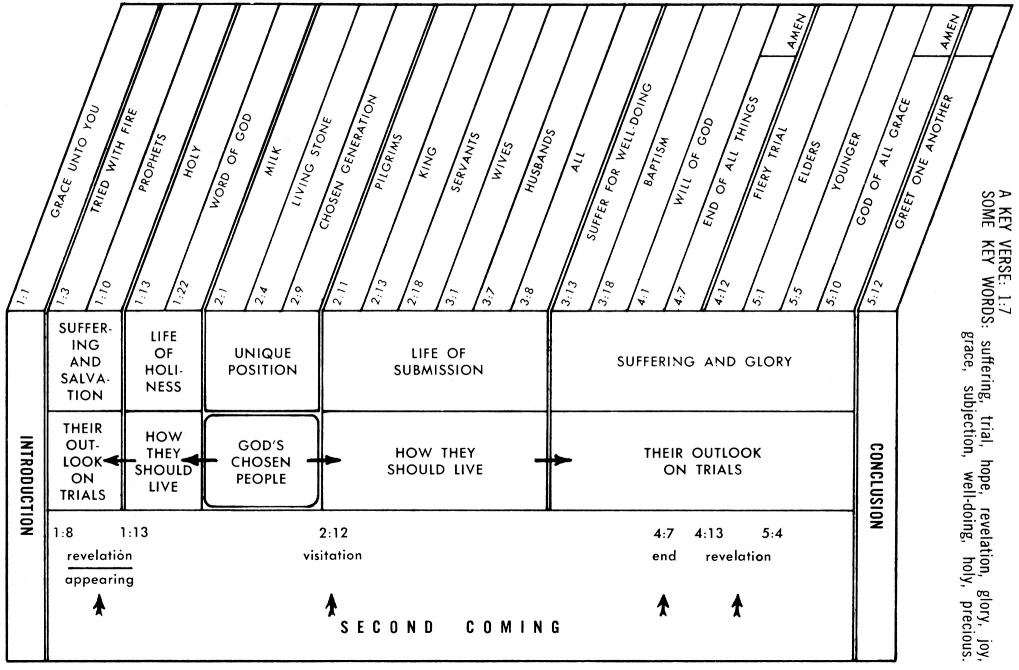
1 Peter: Trials, Holy Living & The Lord's Coming
Click chart to enlarge
Chart from Jensen's Survey of the NT - used by permission
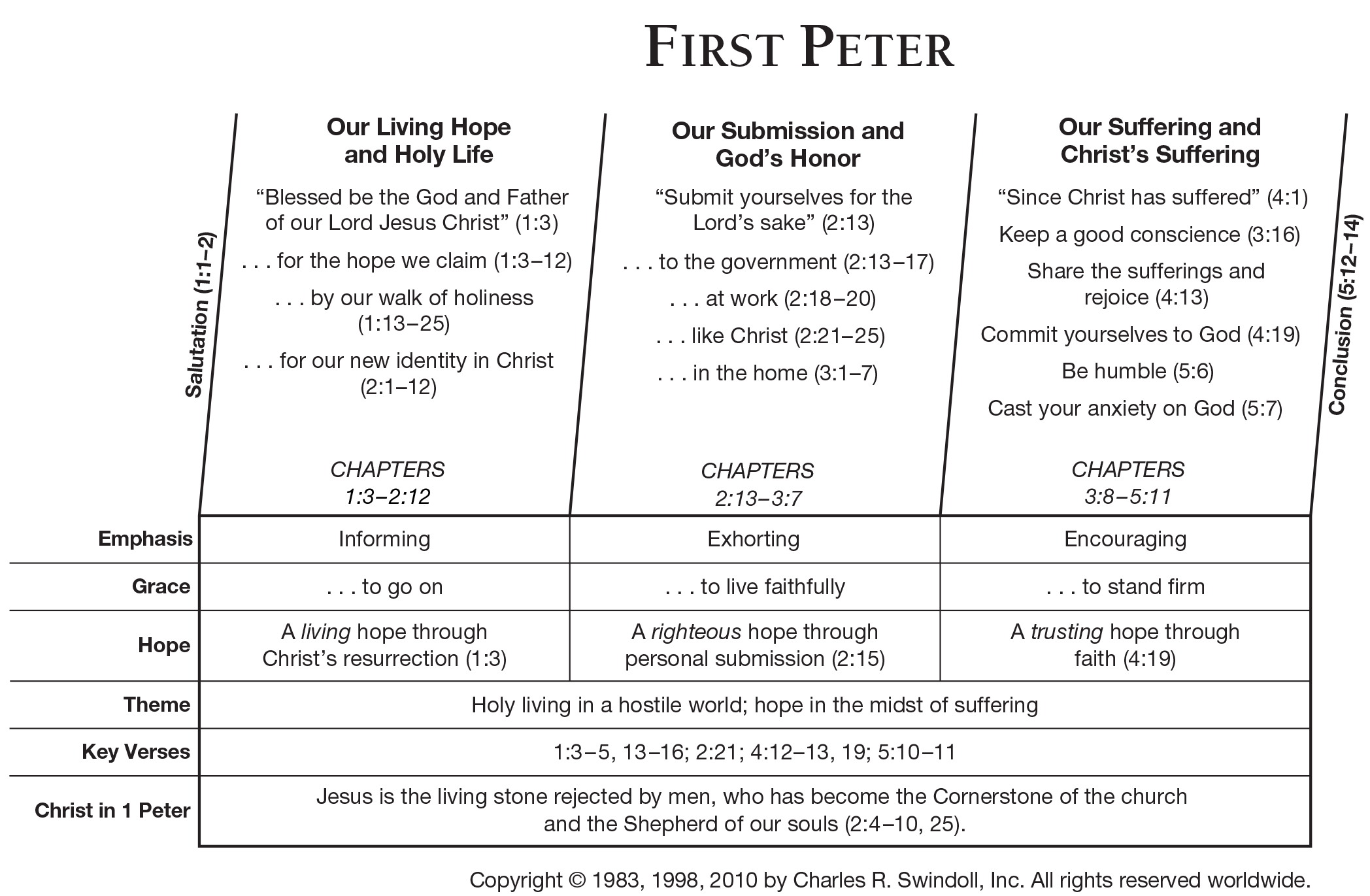
See Another Chart from Charles Swindoll
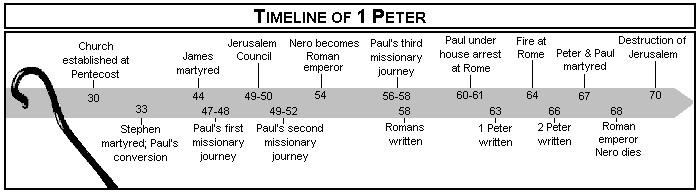
Source: Borrow Ryrie Study Bible
Click to enlarge
1 Peter 3:1 In the same way, you wives, be submissive to your own husbands so that even if any of them are disobedient to the word, they may be won without a word by the behavior of their wives, (NASB: Lockman)
Greek: Homoios [ai] gunaikes hupotassomenai (PPPFPN) tois idiois andrasin, hina kai ei tines apeithousin (3PPAI) to logo dia tes ton gunaikon anastrophes aneu logou kerdethesontai (3PFPI)
Amplified: IN LIKE manner, you married women, be submissive to your own husbands [subordinate yourselves as being secondary to and dependent on them, and adapt yourselves to them], so that even if any do not obey the Word [of God], they may be won over not by discussion but by the [godly] lives of their wives, (Amplified Bible - Lockman)
NLT: In the same way, you wives must accept the authority of your husbands, even those who refuse to accept the Good News. Your godly lives will speak to them better than any words. They will be won over (NLT - Tyndale House)
Phillips: In the same spirit you married women should adapt yourselves to your husbands, so that even if they do not obey the Word of God they may be won to God without any word being spoken (Phillips: Touchstone)
Wuest: In like manner, wives, put yourselves in subjection to your own husbands with implicit obedience, in order that even though certain ones obstinately refuse to be persuaded by the Word and are therefore disobedient to it, they may through the manner of life of the wives without a word [from the wives] be gained,
Young's Literal: In like manner, the wives, be ye subject to your own husbands, that even if certain are disobedient to the word, through the conversation of the wives, without the word, they may be won,
IN THE SAME WAY YOU WIVES: Homoios (ai) gunaikes:
- Ge 3:16; Esther 1:16-20; Ro 7:2; 1Co 11:3; 14:34; Ep 5:22, 23, 24,33; Col 3:18; 1Ti 2:11,12; Titus 2:3, 4, 5, 6
- 1 Peter 3 Resources- Multiple Sermons and Commentaries
Lenski sees…
The entire series of admonitions from 1Pe 2:13 to 1Pe 3:12 is conceived as a unit.
In the same way (3668) (homoios from hómoios = like, resembling) means similarly, likewise, of equal degree or manner and denoting perfect agreement. In like manner. Equally. Too. In the same way. Similar in some respect. Resembling. In most of the NT uses homoios conveys the sense of "to do likewise".
In the present context Peter appears to refer to the previous calls to submission - so just as all Christians should submit to the governing authorities (1Pe 2:13), as slaves should submit to their masters (1Pe 2:18), and as Christ gave us His perfect example of willing and complete submission (1Pe 2:21,22,23, 1Pe 2:24, 25), Peter says in the same way wives are to submit to their own husbands.
Homoios - 30x in 30v -
Mt 22:26; 26:35; 27:41; Mk 15:31; Luke 3:11; 5:10, 33; 6:31; 10:32, 37; 13:3; 16:25; 17:28, 31; 22:36; Jn 5:19; 6:11; 21:13; Ro1:27; 1Co 7:3, 4, 22; He 9:21; Jas 2:25; 1Pe 3:1, 1Pe 3:7; 1Pe 5:5; Jude 1:8; Rev 2:15; Re 8:12.
NAS = like manner(1), likewise(12), same(3), same thing(1), same way(11), similar way(1), so(2), way(1).
Homoios - 8x in the non-apocryphal Septuagint (LXX) - 1 Chr 28:16; Esther 1:18; Job 1:16; Ps 68:6; Pr 1:27; 4:18; Ezek 14:10; 45:11
Proverbs 4:18 But the path of the righteous is like (Lxx = homoios) the light of dawn, That shines brighter and brighter until the full day.
Ezekiel 14:10 "They will bear the punishment of their iniquity; as the iniquity of the inquirer is, so (Lxx = homoios - in like manner) the iniquity of the prophet will be,
BE (let it be your habit to be) SUBMISSIVE TO YOUR OWN HUSBANDS: hupotassomenai (PPPFPN) tois idiois andrasin:
- 1 Peter 3 Resources- Multiple Sermons and Commentaries
Be submissive (5293) (hupotasso = hupo = under + tasso = arrange in an orderly manner) (Used repeatedly by Peter - 1Pe 2:13, 18; 3:1, 5, 22; 5:5) in the passive voice (as in this verse) means to submit oneself, to subordinate oneself, to obey, to place oneself under, to put oneself under orders, to align oneself under the authority of another. Hupotasso in this present use has in view the maintenance of God’s willed order, not personal inferiority of any kind. This word may denote either voluntary or forced behavior, but not any sense of inferiority.
Hupotasso - 38x in 31v - NAS - put in subjection(5), subject(16), subjected(7), subjecting(1), subjection(4), submissive(3), submit(2).
Luke 2:51; 10:17, 20; Rom 8:7, 20; 10:3; 13:1, 5; 1 Cor 14:32, 34; 15:27f; 16:16; Eph 1:22; 5:21, 24; Phil 3:21; Col 3:18; Titus 2:5, 9; 3:1; Heb 2:5, 8; 12:9; Jas 4:7; 1 Pet 2:13, 18; 3:1, 5, 22; 5:5.
Hupotasso was used as military term to describe soldiers submitting to their superior or slaves submitting to their masters. The word has primarily the idea of giving up one’s own right or will. It meant to arrange [as for example troop divisions] in a military fashion under the command of a leader. Submission then is not so much to a person per se as to the position of rank that is established to ensure order rather than chaos. The buck private in the army may be a "better person" than the five-star general, but he is still a buck private. Slaves in the average Roman household in fact were "better people" in many ways when compared to their masters, yet they still had to be under authority to ensure order in the household. In non-military use hupotasso described "a voluntary attitude of giving in, cooperating, assuming responsibility, and carrying a burden".
Hupotasso is not a spineless submission but, as one writer has eloquently described it, a "voluntary selflessness."
Constable paraphrasing material from the Family Life Conference writes "Submission involves at least four things. First, it begins with an attitude of entrusting oneself to God (1Pe 2:23, 1Pe 2:24, 25). The focus of our life must be on Jesus Christ. Second, submission requires respectful behavior (1Pe 3:1,2-notes). Nagging is not respectful behavior. Third, submission involves the development of a godly character (1Pe 3:3, 4, 1Pe 3:5). Fourth, submission includes doing what is right (1Pe 3:6). It does not include violating other Scriptural principles. Submission is imperative for oneness in marriage. (Expository Notes)
Keep the historical context in mind reference to pagan husbands should be understood against the social background in which a wife was expected to accept the customs and religious rites of her husband.
Submission for Paul and Peter is a voluntary submission based on one’s own recognition of God’s order. It is the submission which is based on the death of pride on one hand and the desire to serve on the other. Ideally it is the submission not of fear but of perfect love. Christ Himself is the perfect example (1Pe 2:21,22,23, 1Pe 2:24, 25) of a servant Who submitted without reservation to His Father's perfect will (Php 2:5, 6, 7 Php 2:8). Thus there is nothing degrading about submitting to authority and accepting God’s ordained order that alone ensures the proper functioning of the marriage bond between a husband and wife.
The present tense of the verb hupotasso calls for a attitude (make it a continual practice) of willingness to be under the order established by God. For women this does not come naturally (nor does it come naturally for men because of our fallen nature) because of sin entering the perfect environment in Genesis 3.
As a result of Eve's usurpation of Adam's headship, part of the consequence of her sin was that her desire would be for her husband (Genesis 3:16). Genesis 3:16 could be interpreted as a passionate yearning or longing for one's husband but the difficulty with that interpretation is fourfold:
(1) The statement by God is clearly given in the context of judgment for sin.
(2) The root word (shuwq Strong's # 7783) for "desire" (teshuwqah: Strong's #8669) according to Strong's Hebrew lexicon means to "overflow" and (from another source) the Arabic root means "to control", either definition lending itself to the interpretation that Eve's desire would be to rule over Adam.
(3) The Greek translation (Septuagint) for "desire" is the verb apostrepho can mean to turn away from or abandon a former relationship or association which certainly does not picture the woman longing for the man.
(4) The closest contextual use of the same Hebrew word is (Gen 4:7) where God tells Cain that sin's "desire" is to rule over him but that he must master it. Clearly the meaning of desire here conveys a negative meaning of sin desiring to rule over, dominate and control Cain.
The newly published conservative, evangelical Net Bible translates Genesis 3:16 this way
"To the woman he said, "I will greatly increase your labor pains; with pain you will give birth to children. You will want to control your husband, but he will dominate you."
The majority of evangelical, conservative commentaries on Ge 3:16 definitely favor the interpretation that Eve would have latent within her fallen nature, her flesh, the desire to rule over, dominate and be independent of her husband. If one accepts this interpretation of (Gen 4:7) as reasonable, it would certainly explain why even the most devout, godly and "dead to self" wife would still have a tendency to chaff at God's call for her to submit to her husband. In a class I led on "Marriage without Regrets" one meek, mild, godly young woman raised her hand and confessed how during the preceding week's homework on submission she had experienced a feeling of resentment rising up from deep within and how this feeling surprised her. If one understands the "root cause" of this fleshly reaction from a study of (Gen 4:7), it at least helps one be aware of where the resistance might originate from.
Constable notes that the reason Peter calls for wives to be submissive is "that God has so ordered the human race that we must all observe His structure of authority so that peace and order may prevail. (Constable's Expository Notes on the Bible)
Lenski - All Scripture, in particular also the New Testament, asks Christian wives to be subject to their husbands, and what is asked of the husbands should certainly make any wife’s subjection a delight instead of an infliction.
Matthew Henry…
Lest the Christian matrons should imagine that their conversion to Christ, and their interest in all Christian privileges, exempted them from subjection to their pagan or Jewish husbands, the apostle here tells them,
In what the duty of wives consists. In subjection, or an affectionate submission to the will, and obedience to the just authority (Ed: Husbands note the "modifier" = just!), of their own husbands, which obliging conduct would be the most likely way to win those disobedient and unbelieving husbands who had rejected the word, or who attended to no other evidence of the truth of it than what they saw in the prudent, peaceable, and exemplary conversation of their wives. Learn,
[1.] Every distinct relation has its particular duties, which ministers ought to preach, and the people ought to understand.
[2.] A cheerful subjection, and a loving, reverential respect, are duties which Christian women owe their husbands, whether they be good or bad; these were due from Eve to Adam before the fall, and are still required, though much more difficult now than they were before, Ge 3:16,1Ti 2:11.
{Following notes are from NET Bible and address Matthew Henry's comments on Genesis 3:16…
In Genesis 3:16 God pronounces Eve's (and women's) consequences subsequent to and because of her "Fall" into and then under the dominion of sin.
(NET Bible) Genesis 3:16: To the woman he said, I will greatly increase your labor pains with pain you will give birth to children. You will want to control your husband 48 but he will dominate49 you.”
48 Hebrew “and toward your husband [will be] your desire.” The nominal sentence does not have a verb; a future verb must be supplied, because the focus of the oracle is on the future struggle. The precise meaning of the noun tesuqah, “desire”) is debated. Many interpreters conclude that it refers to sexual desire here, because the subject of the passage is the relationship between a wife and her husband, and because the word is used in a romantic sense in Song 8:6. (My note : this is an error - " desire " is actually in Song 7:10 not Song 8:6) However, this interpretation makes little sense in Ge 3:16. First, it does not fit well with the assertion “he will dominate you.” Second, it implies that sexual desire was not part of the original creation, even though the man and the woman were told to multiply. And third, it ignores the usage of the word in Genesis 4:7 where it refers to sin’s desire to control and dominate Cain. (Even in Song of Songs it carries the basic idea of “control,” for it describes the young man’s desire to “have his way sexually” with the young woman.)
In Ge 3:16 the Lord announces a struggle, a conflict between the man and the woman. She will desire to control him, but he will dominate her instead. This interpretation also fits the tone of the passage, which is a judgment oracle. See further Susan T. Foh “What is the Woman’s Desire?” Westminster Theological Journal 37 (1975): 376-83 ( Note : Annual subscription to view full article but allows access to literally thousands of fully searchable conservative journals.).
49 The Hebrew verb mashal means “to rule over,” but in a way that emphasizes powerful control, domination, or mastery. This also is part of the baser human nature. The translation assumes the imperfect verb form has an objective/indicative sense here. Another option is to understand it as having a modal, desiderative nuance, “but he will want to dominate you.” In this case, the Lord simply announces the struggle without indicating who will emerge victorious.}
[3.] Though the design of the word of the gospel is to win and gain souls to Christ Jesus, yet there are many so obstinate that they will not be won by the word.
[4.] There is nothing more powerful, next to the word of God, to win people, than a good conversation, and the careful discharge of relative duties.
[5.] Irreligion and infidelity do not dissolve the bonds, nor dispense with the duties, of civil relations; the wife must discharge her duty to her own husband, though he obey not the word. (Matthew Henry Complete Commentary)
Own (2398) (idios) means belonging to oneself and not to another, one’s own, peculiar. It denotes "ownership".
Husbands (435) (aner) means man, an adult male person. Aner is used to speak of men in various relations and circumstances where the context determines the proper meaning, as in this verse clearly referring to husbands.
Peter does not require women to be subordinate to men in general but to their husbands as a function of order within the home. A wife is to accept her place in the family under the leadership of her husband whom God has placed as head in the home.
Plutarch writing in a secular connotation said that wives were to subordinate themselves and the man is to exercise control
"as the soul controls the body, by entering into her feelings and being knit to her through goodwill."
Rienecker in the Linguistic Key to the NT adds that "submission of wives to their husbands should be viewed in the light of the society of that day especially in the light of the wild activities of women in the worship of Dionysus and Isis". He goes on to add that Plutarch wrote that wives were to subordinate themselves, and the man was to exercise control "as the soul controls the body, by entering into her feelings and being knit to her through goodwill".
In every sphere of ancient civilization, women had no rights at all. Under Jewish law a woman was a thing; she was owned by her husband in exactly the same way as he owned his sheep and his goats; on no account could she leave him, although he could dismiss her at any moment. For a wife to change her religion while her husband did not was unthinkable. In Greek civilization the duty of the woman was "to remain indoors and to be obedient to her husband." It was the sign of a good woman that she must see as little, hear as little and ask as little as possible. She had no kind of independent existence and no kind of mind of her own, and her husband could divorce her almost at caprice, so long as he returned her dowry.
Under Roman law a woman had no rights. In law she remained forever a child. When she was under her father she was under the patria potestas, the father's power, which gave the father the right even of life and death over her; and when she married she passed equally into the power of her husband. She was entirely subject to her husband and completely at his mercy.
The Roman Cato wrote: "If you were to catch your wife in an act of infidelity, you can kill her with impunity without a trial."
What a contrast with Christianity which commands husbands to love their wives unconditionally!
Roman matrons were prohibited from drinking wine, and Egnatius beat his wife to death when he found her doing so.
Sulpicius Gallus dismissed his wife because she had once appeared in the streets without a veil.
Antistius Vetus divorced his wife because he saw her secretly speaking to a freed woman in public.
Publius Sempronius Sophus divorced his wife because once she went to the public games.
The whole attitude of ancient civilization was that no woman could dare take any decision for herself. What, then, must have been the problems of the wife who became a Christian while her husband remained faithful to the ancestral gods? It is almost impossible for us to realize what life must have been for the wife who was brave enough to become a Christian.
Dave Roper writes that Peter's exhortation…
is not popular counsel today. At this particular point in history it usually is rejected out of hand. And it does seem difficult to follow, in the face of all the gains made by the women's movements of our day--particularly the overthrowing of some of the domestic tyranny and job discrimination that women have endured.
There are a number of things we need to know about the submission Peter is talking about. The Greek term means "standing under the authority of" someone else. There have been attempts to retranslate it, but there really is no legitimate way. It is a military term used both in biblical and classical Greek to refer to someone's being placed under the authority of someone else. It means to "rank in order," or to "place under the leadership" of someone else. So the term does mean what our English word means.
(1) But we need to realize first of all that it is not only women who are to submit. Very often this passage is taught as though wives are to submit to their husbands, yet the husbands can trip through life totally unsubmissive to anyone and do as they please. But Peter repeatedly has underscored the fact that submission is demanded of all believers (cp Ep 5:21), whether they be male or female. It is just as much a requirement of men as of women to be submissive to authority, and Peter has spelled out a number of areas where they are to be submissive-to government, to their employers, to the needs of others around them, and ultimately, to God.
God knows that we have authority
only when we place ourselves under authority.
It is the worst kind of slavery to rebel against all authority. A very wise centurion once said to Jesus,
"I am a man under authority, and I can say to this man, 'Come', and to this man, 'Go.'" (Mt 8:9, Lk 7:8)
He recognized that we have authority only when we ourselves are under authority. So Peter is very quick to point out that it is not only women who must submit to authority, but men also.
(2) Secondly, Peter points out that the submission of women to their husbands is parallel to Jesus' submission to authority. The chapter begins with the words, "In the same way". In the Greek it is just one word: "Likewise."
This refers back to the previous context, which is a reference to Christ:
who committed no sin, nor was any deceit found in His mouth; and while being reviled, He did not revile in return; while suffering, He uttered no threats, but kept entrusting Himself to Him who judges righteously (1Pe 2:22, 23)
Jesus was cruelly and unjustly treated, and he submitted to it. Yet there is no indignity attached to that. There was poise and dignity in Jesus' submission to authority. So submission is ennobling, not demeaning.
(3) And thirdly, Peter says in this passage that the submission is to be to the woman's own husband, not to men in general. I see no indication anywhere in Scripture that women are to be submissive to the leadership of men in general. There are two areas of submission only, and they are clearly spelled out in Scripture: submission to your husband and, within the church, submission to men in authority there. But outside those two spheres women can legitimately exercise leadership. The Bible says nothing in this regard about politics or education or industry, The Old Testament is replete with examples of women who are outstanding leaders: Deborah, Jael, Huldah the prophetess. So this is not an attempt to repress women. But within the home there is to be an order of authority, an order which is ennobling. The man is to be submissive to his Lord, and the wife is to be submissive to her husband. (Healing a Hurting Marriage) (Bolding added)
Today in the Word - A magazine for Christian leaders published a cartoon that showed a pastor peering out anxiously from inside a World-War-II-style bunker, which was behind the pulpit. The well-protected pastor announced, “My text for today is 1 Peter 3:1-7.”
Today, it’s very socially and politically incorrect to suggest that marriage is built on a wife’s loving submission and respect and a husband’s loving tenderness and consideration. We shouldn’t be surprised that the world labels this concept outmoded, even dangerous. As the magazine cartoon suggests, Christians often seem just as reluctant to stand by what the Bible teaches. However, Peter lets us know that couples need these qualities for the success of their relationship. Moreover, this issue affects how God relates to us.
Tommy Nelson, puts it on the line for married believers.
If your relationship to God does not show itself in being a tender husband and a responsive and respectful wife, then it is not penetrating the most essential area of your life.
This requires serious reflection. Our reading indicates how essential the relationship between a wife and husband is. Much of a woman’s sense of self is tied to the way she presents herself, both outwardly and inwardly. The Bible has been accused of trying to shut away women at home in a subservient role, but that distorts Peter’s message. Accepting her husband’s leadership is not a statement of a wife’s inferiority. Both partners are equally valuable before God.
Peter’s caution against a woman investing her wealth and worth in her physical appearance to the detriment of her spirit reflects the same principle Jesus taught on several occasions. That is, believers cannot afford to invest their resources in things on earth to the neglect of eternal issues (Matt. 6:19, 20, 21; Luke 12:21).
TODAY ALONG THE WAY -You may recall the blast of media criticism that erupted in 1998 when a major Christian group dared to state that a wife should “lovingly submit” to her husband”
SO THAT EVEN IF ANY OF THEM ARE DISOBEDIENT TO THE WORD: hina kai ei tines apeithousin (3PPAI) to logo:
- 1 Peter 1:22; 4:17; Ro 6:17; 10:16; 2Th 1:8; Heb 5:9; 11:8
- 1 Peter 3 Resources- Multiple Sermons and Commentaries
The word “if” represents a fulfilled condition. The "if" in this passage introduces a first class conditional clause which assumes the reality of the condition… specifically that the husbands of some of the woman reading the letter were in fact unsaved and disobedient to the word.
Disobedient (544) (apeitheo from "a" = negating what follows, without + peithes = obedient) literally describes one who refuses to be persuaded and who disbelieves willfully and perversely. They are unpersuaded and express an obstinate rejection to the will of God.
Apeitheo is an attitude (present tense) of unbelief which involves deliberate disobedience and conscious resistance to authority. There were disobedient husbands then just as there are today. The present tense indicates that this is their lifestyle, the way the carry on their life is in continual disobedience against God! To be sure, we all disobey from time to time. That is not what Peter is referring to here. Instead he is describing the individual with an unregenerate heart who habitually, continually disobeys (as a lifestyle) what he or she knows to be the truth.
Apeitheo - 14x in 14v - NAS = disbelieved(1), disobedient(10), do not obey(1), obey(2).
John 3:36; Acts 14:2; 19:9; Rom 2:8; 10:21; 11:30f; 15:31; Heb 3:18; 11:31; 1 Pet 2:8; 3:1, 20; 4:17.
Apeitheo is translated in the KJV as believe not, 8; disobedient, 4; obey not, 3; unbelieving, 1 and in the NAS it is rendered - disbelieved, 1; disobedient, 10; do not obey, 1; obey, 2.
Apeitheo means not to allow oneself to be persuaded; not to comply with and to refuse or withhold belief (in the truth, but elsewhere in Christ, in the gospel)
Apeitheo speaks of a stubborn, stiff-necked attitude. It speaks of disbelief manifesting itself in disobedience. It is opposed to pisteuo, the verb translated "believe".
Marvin Vincent in discussing apeitheo in John 3:36 writes that "Disbelief is regarded in its active manifestation, disobedience. The verb peitho means to persuade, to cause belief, to induce one to do something by persuading, and so runs into the meaning of to obey, properly as the result of persuasion… Obedience, however, includes faith. (Ed Note: See discussion of phrase "obedience of faith" at Romans 1:5)." (Vincent, M. R. Word studies in the New Testament Vol. 2, Page 1-109)
From the above comments, it should not surprise you to discover that in the New Testament the word group translated disobey, disobedience, etc (apeitheo and related words) does not stand in contrast with obedience but in contrast with faith!
The word (3056) (logos from lego = to speak intelligently source of English "logic, logical") (Click for in depth discussion of lógos) means something said and describes a communication whereby the mind finds expression in words.
The Christian wife is exhorted to be in subjection to her unsaved husband, in order that he might won without a word, not "the Word" (the gospel), be won by the behavior of the wife. Keep in mind the social context of Paul's time, in which a wife was expected to accept the customs and religious rites of her husband.
THEY MAY BE WON WITHOUT A WORD BY THE BEHAVIOR OF THEIR WIVES: dia tes ton gunaikon anastrophes aneu logou kerdethesontai, (3PFPI):
- 1Co 7:16; Col 4:5
- Won: Pr 11:30; 18:19; Mt 18:15; 1Co 9:19, 20, 21, 22; Jas 5:19,20
- 1 Peter 3 Resources- Multiple Sermons and Commentaries
Spurgeon writes -Could any men be won to Christ without the Word? Yes, it was even so in the apostle’s day. When they refused to attend the little Christian meetings that were being held, and so could not hear what was there said, yet, at home, they saw the change that the gospel of Christ had wrought in their wives, and they said, “She is quite different from what she used to be. Certainly, she is a far better wife than any heathen woman is; there must be something in the religion which can make such a change as that.” In this way, without the Word, many of them were won to Christ by the godly conversation of their wives. (1 Peter 3 Commentary)
Won (2770) (kerdaino from kerdos = gain) means literally to procure an advantage or profit, to acquire by effort or investment (as in the parable of the talents Mt 25:16,17, 20, 22; James 4:13 = "make a profit").
Gain also conveys the idea of to win in (Mt 18:15) apparently the "gain" being that the reproved brother repents. Peter also uses kerdaino figuratively of a submissive wife winning her husband.
Kerdaino in the present context is applied figuratively of gaining or winning someone over to one's side, in this case to the side of Christ.
Kerdaino - 17x in 16v - Matt 16:26; 18:15; 25:16f, 20, 22; Mark 8:36; Luke 9:25; Acts 27:21; 1 Cor 9:19, 20, 21, 22, Phil 3:8; Jas 4:13; 1 Pet 3:1. NAS = gain(2), gained(4), gains(2), incurred(1), profit(1), win(5), won(2).
Vine writes that kerdaino is used metaphorically
metaphorically, (a) to win persons, said (1) of gaining an offending brother who by being told privately of his offence, and by accepting the representations, is won from alienation and from the consequences of his fault, Mt. 18:15; (2) of winning souls into the Kingdom of God by the Gospel, 1Co 9:19, 20 (twice), 21, 22, or by godly conduct, 1Pe 3:1 (R.V., “gained”); (3) of so practically appropriating Christ to oneself that He becomes the dominating power in and over one’s whole being and circumstances, Phil. 3:8 (R.V., “gain”) (Vine, W E: Vine's Complete Expository Dictionary of Old and New Testament Words. 1996. Nelson)
Behavior (391) (anastrophe [word study] from anastrepho = to turn up, to move about <> aná = again, back + strepho = turn) literally describes a turning around or turning back and is used figuratively to refer to one's conduct, especially focusing on our daily behavior and our general deportment. In essence anastrophe deals with on the whole manner of one's life.
Anastrophe is used of public activity, life in relation to others. Being set apart from the world and to God, wives were to show themselves holy in all their dealing with others.
Anastrophe - 13x in 13v- Gal 1:13; Eph 4:22; 1 Tim 4:12; Heb 13:7; Jas 3:13; 1 Pet 1:15, 18; 2:12; 3:1f, 15; 2 Pet 2:7; 3:11. NAS = behavior(6), conduct(4), manner of life(2), way of life(1).
Marvin Vincent writes that behavior (anastrophe) is
a favorite word with Peter; used eight times in the two epistles… The process of development in the meaning of the word is interesting. 1. A turning upside down. 2. A turning about or wheeling. 3. Turning about in a place, going back and forth there about one’s business; and so, 4, one’s mode of life or conduct. This is precisely the idea in the word conversation (Lat., conversare, to turn round) which was used when the AV (KJV) was made, as the common term for general deportment or behavior… "
Note that Peter does not advise the wife to leave her heathen husband (1Cor 7:13, 14, 15, 16). Peter does not tell her to insist that there is no difference between slave and freeman, Gentile and Jew, male and female (Col 3:11), but that all are the same in the presence of the Christ whom she has come to know. Peter wants the Christian women to win their husbands by a life of reverence and purity expressed in a submissive attitude that honors him as the head of the home. It is the character and conduct of the wife that will win the lost husband—not arguments, but such attitudes as submission, understanding, love, kindness, patience. These qualities are not manufactured; they are the fruit of the Spirit that come when we are submitted to Christ .
The New Living Translation has a very nice paraphrase of this verse
In the same way, you wives must accept the authority of your husbands, even those who refuse to accept the Good News. Your godly lives will speak to them better than any words. They will be won over
Without a word does not however mean “without the Word of God”. There is no definite article before the second use of the word word No one has ever been won to the Lord Jesus apart from the Word of God because salvation comes through the Word. Jesus clearly explained one has to hear the "word" before he or she can "believe" the word, declaring
"Truly, truly, I say to you, he who hears My word, and believes Him who sent Me, has eternal life, and does not come into judgment, but has passed out of death into life." (Jn 5:24).
There is a play on the word logos. The wives are to remain silent—without a word—so that the husbands disobedient to “the word” may be converted!
What without a word really means is in essence “without talk, without a lot of speaking.” How true it is that Christian wives who preach at their husbands often only drive them farther away from the truth. Peter was not forbidding speaking to unsaved husbands about the Lord or sharing Scripture if the husband would be receptive. His point was that a godly wife’s conduct is going to be more influential than anything she may say.
John MacArthur adds…
So how do you win an unsaved partner? By living an exemplary Christian life. Just that simple, just that simple. Whether you are in the government, seeing yourself as a citizen. On the job as an employee. In the home as a marriage partner. The role is always the same, you submit to God's ordained pattern for that social relationship, and you live it out to the maximum to please God. And God will honor you as a testimony wherever you are. (1 Peter 3:1-7)
Peter is exhorting these wives who have given the gospel to their husbands time after time, to stop talking about it lest they start nagging, and instead, live the gospel before them. If the husband is so obstinate as to refuse to listen to her, well then, the next best thing is to keep quiet and let the gospel speak through a Christ like life. He may refuse to listen to her words, but he cannot but see the Lord Jesus in her life.
An excellent example of such a godly wife (and mother) was Monica, the mother of Augustine. God used Monica’s witness and prayers to win both her son and her husband to Christ, though her husband was not converted until shortly before his death. Augustine wrote in Confessions,
“She served him as her lord; and did her diligence to win him unto Thee… preaching Thee unto him by her conversation [behavior]; by which Thou ornamentest her, making her reverently amiable unto her husband.”
In the context of Peter's exhortation, it is interesting to contrast that of pagan writer Plutarch (AD50-120) who said that “it is becoming for a wife to worship and know only the gods that her husband believes in, and to shut the front door tight upon all queer rituals and outlandish superstitions.”
Spurgeon…
A husband was a very loose, depraved man of the world, but he had a wife who for many years bore with his ridicule and unkindness, praying for him night and day. One night, being at a drunken feast with a number of his companions, he boasted that his wife would do anything he wished; she was as submissive as a lamb. "Now," he said, "she has gone to bed hours ago, but if I take you all to my house at once, she will get up and entertain you and make no complaint." The matter ended in a bet, and away they went.
In a few minutes she was up and remarked that she was glad that she had two chickens ready, and if they would wait she would soon have a supper spread for them. The table was spread, and she took her place at it, acting the part of hostess with cheerfulness. One of the company exclaimed, "Madam, I am at a loss to under-stand how it is you receive us so cheerfully, for being a religious person you cannot approve of our conduct."
Her reply was, "I and my husband were both formerly unconverted, but by the grace of God I am now a believer in the Lord Jesus. I have daily prayed for my husband and done all I can to bring him to a better mind. But as I see no change in him, I fear he will be lost forever. And I have made up my mind to make him as happy as I can while he is here."
They went away, and her husband said, "Do you really think I shall be unhappy forever?"
"I fear so," said she. "I would to God you would repent and seek forgiveness." That night patience accomplished her desire. He was soon found with her on the way to heaven. (C H Spurgeon)
Christ's Agents - We as believers in Christ are called to be witnesses to our world (Acts 1:8). It's not always easy. Sometimes we are treated rudely or unkindly. It's then that our actions and behavior can be our most effective testimony.
Take, for example, a Christian woman who is married to an unbelieving husband. The apostle Peter said that she can "without a word" win her husband by her "conduct" (1Pe 3:1). The principle here is this: A believer's life can be a powerful example and testimony of God's love and grace.
We may be inclined to feel sorry for ourselves and our fellow Christians when we suffer for our faith in Jesus. Yet we need to remind one another that our purpose in society is to be agents of God's unceasing love, and bold messengers of the gospel in word and deed. It's not to have a life that's free of trouble.
We are followers of the One who has promised, "I will never leave you nor forsake you" (He 13:5). So no matter how difficult life may be, for Christ's sake and for the sake of others we must persevere. We need to persevere in our godly conduct—because we are Christ's agents in this world. — Haddon W. Robinson
In our daily life and service
Let us true disciples be;
Being meek when others hurt us,
Lord, in us may they see Thee! —Bosch
When our lives honor Christ,
even silence is eloquent.
Loud Silence - The world famous master of mime, Marcel Marceau, was asked what the difference was between regular acting and pantomime. Marceau's response was interesting. He said, "In the case of a bad actor, the words are there even if the actor is no good. But when a mime is not good, there is nothing left. A mime must be very clear and very strong."
The same thing is true of the Christian's witness. If a believer's verbal testimony is rejected, it may be wise for him to say no more. But it's then that silence should speak so clearly that no one can mistake the message.
For example, in the case of a married couple, the wife's quiet reverence for God should be crystal-clear to her unbelieving husband so that he may be won "without a word" (1 Pet. 3:1-2). Husbands are reminded by Peter to live with their wives with understanding and honor (v.7). If the wife is the one who needs a wordless witness, then the husband's character and treatment of her should reflect his relationship to Jesus Christ.
These truths apply to every believer, married or not. If we are in a situation where our actions alone have to do the talking, let's make sure they are coming through loud and clear for Christ. — Mart De Haan
Sometimes our witness will be spurned
And nothing's left to say;
But if our lives are true to Christ,
His love we will convey. --DJD
Steven Cole
Someone has said, “Usually the husband regards himself as the head of the household, and the pedestrian has the right of way. And, usually, both of them are safe until they try to prove it” (Reader’s Digest [2/83]).
Preachers are probably safe until they speak on a text which tells wives to submit to disobedient husbands!
These verses are tough to explain and apply in light of our modern culture. It’s tough enough to teach about the submission of wives to godly husbands. But to teach that wives should submit even to husbands who are ungodly seems cruel and insensitive. Wife abuse is widespread, even, sad to say, among evangelicals. Most of us are familiar with the family patterns in alcoholic homes, where a wife “enables” the husband in his wrong behavior. Many would argue that the wife’s submission contributes to these problems rather than solves them. Is a wife supposed to submit in such situations? If so, what does that mean?
Furthermore, we live in a society that values individual rights, especially of those who are pushed down by the system (such as women). We’re constantly encouraged to stand up for our rights and to fight back when we’re wronged. Self-fulfillment is a supreme virtue in America, and those who are unfulfilled because of a difficult marriage are encouraged to do what they have to do to seek personal happiness.
Submission to one’s difficult husband is not usually one of the action points! Christian psychologist James Dobson wrote a book encouraging wives with disobedient husbands to practice “tough love.” How does this fit in with submission?
To understand our text, we must see that Peter’s theme (which began at 1Pe 2:11) is still Christian witness in an alien world. In that society, a woman was expected to accept her husband’s religion. If a wife became a Christian, she was viewed as being insubordinate. Thus the conversion of women was a culturally explosive situation. Peter didn’t want to compound the problem with a wife’s defiant behavior. So he gives instruction on how Christian women could live with their unbelieving mates in a way that would bear witness for Christ.
We need to understand several things in approaching this text.
First, the qualities Peter encourages these women to adopt apply to all Christians, both men and women. We all are to develop a submissive spirit, to be chaste, reverent, gentle and quiet, with an emphasis on the inner person rather than on outward appearance. So even though I direct my comments to wives who have unbelieving husbands, the principles apply to us all, men and women alike.
Second, Peter’s comments do not give warrant for a Christian to enter a marriage with an unbelieving mate. Scripture is clear that believers are not to be unequally yoked with unbelievers (2Co 6:14; Ex 34:12, 13, 14, 15, 16; Ezra 9:1, 2, 3, 4). Peter was writing to women who had become Christians after marriage, but whose husbands were not yet believers.
Also, the Apostle Paul clearly states that if an unbelieving mate consents to live with a believer, the believer must not initiate a divorce (1Co 7:12, 13). Rather, the believing wife should follow the principles Peter sets forth here, namely, that …
A Christian wife should live with a difficult husband so that he is attracted to Christ by her behavior.
Peter’s point is that godly conduct is a powerful witness, much more powerful than words without conduct. He does not mean that verbal witness is not important. In the proper context, words are essential to communicate the content of the gospel. Peter’s point is that
disobedient husbands are more likely to be won by godly practice than by preaching from their wives. They will notice attractive behavior and through it be drawn to the source of that behavior—a relationship with Jesus Christ. I want to look at seven aspects of such attractive behavior and then answer three practical questions that arise.
1. Attractive behavior involves submission.
“In the same way” points back to 1Pe 2:13 & 1Pe 2:18. It does not mean that wives are to submit exactly as slaves submit to their masters (1Pe 2:18; the word “likewise” in 1Pe 3:7 is the same Greek word), but rather it connects this section to the whole discourse on Christian submission to authority. Those who argue for “evangelical feminism” quickly go to Ephesians 5:21 and point out that both husbands and wives are to submit to one another. They make that verse the all-governing one and explain 1 Peter as applying only to the first century because of cultural considerations. But we can’t throw out the submission of wives to husbands so easily. Paul recognizes a sense in Christian marriage in which each partner submits to the other under Christ, but he also goes on to state that the husband is the head of the wife, just as Christ is the head of the church. There is a sense in which Christ submits Himself to the church in self-sacrificing service, but at the same time, clearly He is in authority over the church. Before the late 20th century, it never occurred to scholars to interpret these texts the way modern evangelical feminists do. So I think we must interpret and apply them as written. Before we look at what submission means, note two things about authority and submission.
First, the purpose of authority is to protect and bless those under authority, not to benefit the one in authority. Because of sin, those in authority commonly abuse it and God will hold them accountable. But just because the one in authority abuses his position does not give those under authority the right to resist, unless they must resist in order to obey God.
Second, God never tells husbands to get their wives to submit to them. All the commands to submit are directed to wives, not to husbands.
A husband who focuses on his authority is out of line. His responsibilities are to love his wife sacrificially (Ep 5:25) and to live with her in an understanding way, granting her honor (1Pe 3:7). Not once is there a command to husbands to get their wives into submission.
A husband who suppresses, restricts, or puts down his wife is not exercising proper authority.
What, then, does submission mean? The Greek word is a military term meaning to place in rank under someone. But the biblical spirit of submission involves far more than just grudgingly going along with orders (as often happens in the military). Rather, submission is the attitude and action of willingly yielding to and obeying the authority of another to please the Lord. Some say that the Bible never tells a wife to obey her husband, but Peter holds up Sarah’s obedience to Abraham as an example of biblical submission.
Attitude is crucial. A disobedient little boy was told to sit in the corner. He said, “I may be sitting on the outside, but I’m standing on the inside.” That’s defiance, not submission. On the other hand, a person under authority can be strong in arguing for a point of view and yet have a submissive attitude. Submission involves an attitude of respect and a recognition of the responsibility of the one in authority.
Rather than trying to thwart his will through manipulation or scheming, a submissive wife will seek to discover what her husband wants and do it to please him, as long as it doesn’t involve disobedience to God.
When Peter says that Sarah called Abraham lord, he is not setting down a mandate for all times. I heard of a wife who fell into bed and exclaimed, “Lord, I’m tired!” Her husband calmly said, “My dear, in the privacy of our own bedroom, you can call me Jim.”
Proper submission doesn’t require addressing your husband as lord. But the principle is, submission is reflected by your speech. The tone of your voice and the words you speak reflect whether you respect your husband and are in submission to him, or whether you’re in a power struggle against him.
The source of many marital problems is that the wife is seeking to control the husband to meet what she perceives as her needs and the husband is seeking to dominate the wife to meet what he perceives as his needs. So you have a constant tug of war going on. That’s not the biblical pattern for husbands or wives.
The biblical pattern is for the wife to yield control to the husband and to do all she can to please him and make him prosper. The husband is not to dominate, but to do all he can to bless and protect his wife so that she prospers in the Lord.
Here’s the catch: You can’t wait for your partner to come up to some acceptable level of performance before you start to do your part. You must obey what God has told you to do and let Him take care of your partner.
2. Attractive behavior involves purity.
“Chaste” (1Pe 3:2) can be translated “purity” (NIV). It is used in the New Testament to refer to abstaining from sin (1Ti 5:22). John uses this word when he tells us to purify ourselves just as Jesus is pure (1Jn 3:3). This means that a wife who wants to win her husband to Christ must live in obedience to God. She will be morally pure. Her husband won’t distrust her because she’s a flirt with other men. She won’t use deception or dishonesty to try to get her own way. She will learn to handle anger in a biblical way. Her hope will be in God (1Pe 3:5) so that she will have a sweet spirit, even toward a difficult husband. He will see Christlikeness in her.
3. Attractive behavior involves reverence.
This could mean respect toward her husband (which a wife is to show, Eph. 5:33), but because Peter’s uses of “fear” in the preceding context refer to reverence toward God (1Pe 2:17, 18), I take it that way here.
The idea is that a godly wife will live in the fear of God, aware that He sees all that is going on (“in the sight of God,” 3:4). To live in the fear of God means that we recognize His holiness and wrath against all sin and therefore live obediently, even when it’s hard.
4. Attractive behavior involves not nagging.
Peter says that the disobedient husbands may be won without a word as they observe (not, “hear about”) the pure and reverent behavior of their wives. By “without a word” he doesn’t mean that a wife is to be mute. He means that she must not nag or preach to her husband.
Nothing will drive a man further from the Lord than a nagging wife. Solomon said it 3,000 years ago, and it’s still true, “It is better to live in a corner of a roof, than in a house shared with a contentious woman” (Pr 21:9). And, “the contentions of a wife are a constant dripping” (Pr 19:13b). Nagging will drive your husband crazy, but it won’t drive him to Christ.
I heard about a husband who nicknamed his wife Peg although that wasn’t her name. When he was asked why, he replied, “Well, Peg is short for Pegasus who was an immortal horse, and an immortal horse is an everlasting nag, so that’s why I call my wife Peg!”
Nagging will do one of two things to men: Either it will make him resist and become obstinate, or he will give in to keep the peace. Either response is not good for the wife. If the husband becomes more obstinate, he can become abusive. This creates distance in the relationship. If he gives in to keep the peace, he becomes passive and the wife is put in the role of the decision maker, out from under the covering of blessing and protection that God designed proper authority to be.
Thus attractive behavior involves submission, purity, reverence toward God, and not nagging.
5. Attractive behavior involves a gentle and quiet spirit.
Peter says that such a spirit is precious in the sight of God. I would also add that it is precious in the sight of a husband!
What does it mean? “Gentle” is the word sometimes translated “meek.” It is used of Jesus (Mt 11:29; 21:5). It does not mean weakness of the Casper Milquetoast variety, but rather strength under submission or control. A horse that is powerful but responsive to the slightest tug of its master is a “gentle” horse. So it refers to a wife who is not selfishly assertive, but rather who yields her rights without yielding her strength of character.
“Quiet” does not mean mute, but rather tranquil or calm, not combative. A quiet woman exudes a confidence in her role and giftedness. She is not out to prove anything, because she is secure in who she is in the Lord. She may be “quiet” and yet be articulate and persuasive in presenting her point of view. But she doesn’t do it in a demanding or obnoxiously assertive way. She is at peace with herself in the Lord. The word “spirit” hints that these qualities are broad enough to allow room for personality differences.
6. Attractive behavior involves doing what is right.
You have become Sarah’s children “if you do what is right.” Peter emphasizes this concept (1Pe 2:12, 14, 15, 20; 1Pe 3:6, 11, 13, 16, 17; 1Pe 4:19). It always occurs in the context of others doing wrong toward us and points to the fact that our behavior shouldn’t be determined by how others treat us. We’re so prone to react to wrong treatment with more wrong treatment and then to blame our sin on the other person’s sin.
But God wants us to be prepared to respond to wrongs against us by doing what is right. If your husband yells at you and you yell back, it escalates the conflict. He will yell louder, then you yell louder yet, and if things get out of hand, he may lose control and say all sorts of nasty things that he wouldn’t say when he’s more rational or he may even hit you. But if he yells at you and you calmly respond, “I can understand why you’re upset. What can I do to help?” you’ve just de-escalated the quarrel. How can a man fight with that kind of response?
7. Attractive behavior involves an emphasis on the inner person over outward appearance.
The point of 1Pe 3:3, 4 is not that a woman should neglect her outward appearance, but rather that her emphasis should be on the inner person. He is not forbidding all braiding of hair or wearing of jewelry, or else he’s also forbidding wearing dresses! Peter’s point is that the emphasis should be on attractive character qualities, which are imperishable, not on elaborate outward attractiveness, which necessarily fades with age.
Inner beauty is attractive even to a godless husband, and it enhances a woman’s outward appearance.
A young officer who was blinded during a war met and later married one of the nurses who took care of him in the hospital. One day he overheard someone say, “It was lucky for her that he was blind, since no one who could see would marry such a homely woman.” He walked toward the voice and said, “I overheard what you said, and I thank God from the depths of my heart for blindness of eyes that might have kept me from seeing the marvelous worth of the soul of this woman who is my wife. She is the most noble character I have ever known; if the conformation of her features is such that it might have masked her inward beauty to my soul then I am the great gainer by having lost my sight.” (Donald Barnhouse, Let Me Illustrate [Revell], p.156.)
Outer beauty fades, but inner beauty grows stronger over time.
So Peter’s point is that a Christian wife should live with an unbelieving husband so that he is attracted to Christ by her beautiful behavior.
CONCLUSION
I want to conclude by briefly answering three practical questions that arise on this topic:
1) Must a wife submit to an abusive husband?
Peter’s words, “even if any of them are disobedient to the word” show that he wasn’t just thinking about nice husbands. So we must conclude that a wife may need to submit to some abuse. The difficult question is, How much? My view is that a wife must submit to verbal and emotional abuse, but if the husband begins to harm her physically, she needs to call civil or church authorities. There are civil laws against battery and it is proper for an abused wife to call in authorities to confront and deal with a husband who violates the law. Although physical abuse is not a biblical basis for divorce, I would counsel separation in some cases to protect the wife while the husband gets his temper under control. But even in such situations, a Christian wife must not provoke her husband to anger and she must display a gentle spirit. I take the words, “without being frightened by any fear” to mean that a woman should not fear her husband’s intimidation more than she fears God (see 1Pe 3:2, “with fear” [of God]; 1Pe 3:14, 15). If he tries to scare her into giving up her faith, she must not go along with him.
2) Must a wife submit to a husband who asks her to do something wrong?
Some say that because Sarah went along with Abraham’s sinful schemes to pawn her off as his sister (Ge 12:10-20; 20:1-18), that wives should obey their husbands even when they’re told to do something sinful. But that would be a violation of the higher principle that we must obey God rather than men (Acts 5:29). Peter’s words, “do what is right” (1Pe 3:6), show that he is not counseling sinful behavior in the name of submission to a disobedient husband. But, again, if you as a wife must disobey your husband in order to obey God, you can do it in a submissive spirit, letting him know that you love him and want to please him, but it is more important that you obey God.
3) Can a wife be submissive and yet confront her husband’s sin?
In other words, is there a proper place for “tough love”? I think the answer is “Yes, but be careful!” Love seeks the highest good of the one loved, and sometimes that means confronting sin. But sometimes love covers a multitude of sins (1Pe 4:8), so love doesn’t mean jumping on your husband’s every sin as if you were the Holy Spirit. If you must confront, you should do it in as appealing a way as possible, so that your husband can see that you really care for him. You may say, “Honey, I love you and I value our relationship. But when you drink, it hurts both you and our relationship. You need to get help. I’m not going to cover for your behavior the next time you’re drunk.”
Several years ago a woman in my church came to me, accompanied by two elders’ wives. They proceeded to tell me how unbearable her home life was. Her husband, who had made a profession of faith in Christ after I had shared the gospel with him, was an alcoholic. He was also devoted to his job more than to his family. He was not meeting his wife’s emotional needs. They all had read James Dobson’s Love Must Be Tough and agreed that she needed to create an ultimatum by leaving her husband if he didn’t stop drinking and begin acting toward his family as he should.
I listened and then gently asked where in the Bible they found warrant for a wife leaving her husband because of drinking. One of the elder’s wives, who was on the staff of a Christian organization, exploded at me for my insensitivity in quoting Bible verses at this hurting woman. I calmly replied that the Bible was my only guide for such situations and that if they didn’t want to follow that, I couldn’t help them. I proceeded to explain the concept of 1 Peter 3 and of Hebrews 12, that God sometimes puts us in difficult situations to refine our faith, but that we must obey His Word to reap the benefits. They left my office and the woman began to apply 1 Peter 3 to herself. The Lord began showing her many ways that she was being selfish and manipulative. She began to seek to please her husband and submit to him. Eventually, he quit drinking and began spending more time with his family. A few months ago, the wife thanked me and said that if I had not stood my ground that day she came to me, she and her husband would be divorced today.
That woman proved what Peter is saying here, that a Christian wife’s behavior should be so beautiful that it attracts her difficult, disobedient husband to her Savior. That should be your overall goal in all your dealings with your husband. Next week I’ll hit the husbands, but today I ask each wife, even if your husband is a believer, to take a look at your behavior in this spiritual mirror and ask, “Is it attractive? Does it make my husband want to follow my Lord Jesus Christ?” (Sermon)
1 Peter 3:2 as they observe your chaste and respectful behavior. (NASB: Lockman)
Greek: epopteusantes (AAPMPN) ten en phobo hagnen anastrophen humon
Amplified: When they observe the pure and modest way in which you conduct yourselves, together with your reverence [for your husband; you are to feel for him all that reverence includes: to respect, defer to, revere him—to honor, esteem, appreciate, prize, and, in the human sense, to adore him, that is, to admire, praise, be devoted to, deeply love, and enjoy your husband]. (Amplified Bible - Lockman)
NLT: by watching your pure, godly behavior. (NLT - Tyndale House)
Phillips: simply by seeing the pure and reverent behavior of you, their wives. (Phillips: Touchstone)
Wuest: having viewed attentively your pure manner of life which is accompanied by a reverential fear;
Young's Literal: having beheld your pure behavior in fear,
AS THEY OBSERVE: epopteusantes (AAPMPN):
- 1Pet 3:16; 1:15; 2:12; Php 1:27; 3:20; 1Ti 4:12; 2Pe 3:11
- 1 Peter 3 Resources- Multiple Sermons and Commentaries
Observe (2029) (epoteuo from epoptes = an eyewitness, a supervisor, a beholder, an inspector, an onlooker. This means the husbands observe closely and intently (at least some do).
Among the Greeks the word was used of those who had attained to the third grade, the highest, of the Eleusinian mysteries, a religious cult at Eleusis, with its worship, rites, festival and pilgrimages; this brotherhood was open to all Greeks) means to be a spectator, to be an overseer, to view carefully, to watch over a period of time. It means to to observe something, implying both continuity and intent. The unsaved watch the saved very carefully.
Peter in the only other NT use of epoteuo exhorted his readers to
Keep your behavior (one’s manner of life) excellent (Gk means lovely, winsome, gracious, noble) among the Gentiles, so that in the thing in which they slander (literally speak against, often involving speaking evil of or with a suggestion of being false and exaggerated) you as evildoers (early Christians were falsely accused of rebellion against the government with such false accusations as: terrorism - burning Rome, atheism - no idols or emperor worship, cannibalism - rumors about the Lord’s Supper, immorality - because of their love for one another, damaging trade and social progress, and leading slaves into insurrection), they may on account of your good deeds (click study on good deeds), as they observe (closely and intently - epoteuo) them (pagans are on the watch for slips in moral conduct by those Who Name Jesus as Lord and Savior), glorify (give a proper opinion of) God in the day of visitation (common phrase in OT warning of God’s “visitation” drawing near in either judgment or blessing and in NT speaks of redemption)." (see note 1 Peter 2:12).
MacArthur explains that
Peter was teaching that when the grace of God visits the heart of an unbeliever, he will respond with saving faith and glorify God because he remembers the testimony of believers he had observed. Those who don’t believe will experience the visitation of His wrath in the final judgment. (MacArthur, J.: The MacArthur Study Bible Nashville: Word)
Almost inevitably we will be criticized and so we need to remember that unsaved husbands and others not saved are observing our conduct closely and intently.
Application: Applying the truths just discussed, the question is "How would the unbelievers in your office, school, home, etc describe YOUR behavior?"
YOUR CHASTE AND RESPECTFUL BEHAVIOR: ten en phobo hagnen anastrophen humon:
- 1Pet 3:5,6,15; Ep 5:33; 6:5; Col 3:22
- 1 Peter 3 Resources- Multiple Sermons and Commentaries
Peter now describes a number of characteristics which describe this submission, descriptions of the behavior of the wife illustrating how she is to work out her submission.
Chaste (53)(hagnos) means freedom from defilements or impurities. Hagnos describes what is morally undefiled and when used ceremonially describes that which has been so cleansed that it is fit to be brought into the presence of God and used in His service. Although hagnos refers primarily to that which is inwardly pure, this purity also affects a person’s conduct. Here it indicates the irreproachable conduct of the wife.
Hagnos means free from admixture of evil, and is once applied to God, John writing that
everyone who has this hope fixed on Him purifies himself, just as He is pure (hagnos) (1Jn 3:3)
Hagnos is used 8 times in the NT in the NASB and is translated: chaste, 1; free from sin, 1; innocent, 1; pure, 5.
2 Corinthians 7:11 For behold what earnestness this very thing, this godly sorrow, has produced in you: what vindication of yourselves, what indignation, what fear, what longing, what zeal, what avenging of wrong! In everything you demonstrated yourselves to be innocent (hagnos) in the matter.
2 Corinthians 11:2 For I am jealous for you with a godly jealousy; for I betrothed you to one husband, that to Christ I might present you as a pure (chaste) virgin.
Philippians 4:8 Finally, brethren, whatever is true, whatever is honorable, whatever is right, whatever is pure, whatever is lovely, whatever is of good repute, if there is any excellence and if anything worthy of praise, let your mind dwell on these things.
1 Timothy 5:22 Do not lay hands upon anyone too hastily and thus share responsibility for the sins of others; keep yourself free from sin (morally and ethically pure)
Titus 2:5 to be sensible, pure (chaste), workers at home, kind, being subject to their own husbands, that the word of God may not be dishonored.
James 3:17 But the wisdom from above is first pure, then peaceable, gentle, reasonable, full of mercy and good fruits, unwavering, without hypocrisy.
1 Peter 3:2 as they observe your chaste and respectful behavior.
1 John 3:3And everyone who has this hope fixed on Him purifies himself, just as He is pure.
In the Septuagint (LXX) hagnos is found 8 times (Lev. 23:40; Job 40:22; Ps. 12:6; 19:9; Prov. 15:26; 19:13; 20:9; 21:8) and often signifies ceremonial purification and/or moral and ethical purity.
Psalm 12:6 The words of the LORD are pure (Hebrew = tahowr = pure, ceremonially clean as it referred to animals, ethically pure; Lxx = hagnos) words; As silver tried in a furnace on the earth, refined seven times. (See Spurgeon's Comment)
Psalm 19:9 The fear of the LORD is clean (pure) (Hebrew = tahowr = pure, ceremonially clean as it referred to animals, ethically pure; Lxx = hagnos), enduring forever; The judgments of the LORD are true; they are righteous altogether. (See Spurgeon's Comment)
Proverbs 15:26 (KJV) The thoughts of the wicked are an abomination to the LORD: but the words of the pure (Hebrew = tahowr = pure, ceremonially clean as it referred to animals, ethically pure; Lxx = hagnos) are pleasant words.
Hagnos is always with a moral sense but is not limited to sins of the flesh, but covering purity in motives as well as in acts. In 2Co 11:2, of virgin purity. In James 3:17, as a characteristic of heavenly wisdom.
Barclay (critique) emphasizing the secular origin and use writes that…
"hagnos and its root meaning is pure enough to approach the gods. At first it had only a ceremonial meaning and meant nothing more than that a man had gone through the right ritual cleansings. So, for instance, Euripides can make one of his characters say, “My hands are pure, but my heart is not.” At this stage hagnos describes ritual, but not necessarily moral, purity. But as time went on the word came to describe the moral purity which alone can approach the gods. On the Temple of Aesculapius at Epidaurus there was the inscription at the entrance: “He who would enter the divine temple must be pure (hagnos); and purity is to have a mind which thinks holy thoughts. (Barclay, W: The Daily Study Bible Series. The Westminster Press)
Chaste is defined by Webster as free from all taint of what is lewd or salacious and implies a refraining from acts or even thoughts or desires that are not virginal or not sanctioned by marriage vows.
Hagnos refers to the irreproachable conduct of a godly wife. The believing wife must live with the conscious awareness and conviction that all life is lived in the presence of Christ. (Eph 5:21). Purity of life with reverence for God is what the unsaved husband should observe consistently.
J H Jowett asks and then poetically answers…
Where does the apostle begin in his portraiture of the ideal wife? “Chaste behaviour.” [1Pe 3:2] the first element in worthy womanhood is the wearing of the white robe. The spirit is perfectly clean. “The King’s daughter is all glorious within.” All her powers consort together like a white-robed angel-band. In every room of her life one can find the fair linen, “clean and white.” In the realm of the imagination her thoughts hover and brood like white doves. In the abode of motive her aspirations are as sweet and pure as the breathings of a little child. In the home of feeling, her affections are as incorruptible as rays of light. If you move among the powers of her speech, on the threshold of her lips you will find no stain, no footprint of “anything that defileth or worketh abomination, or maketh a lie.” In the inner life of the ideal woman, no unclean garment can be found, for everything wears the white robe. The spirit is “chaste.” But chasteness is more than cleanliness. The stone is not only white, it is chiseled into delicacy. Character is not left in the rough; it is refined into thoughtful finish. The substance is not only pure, it is worked into beauty. It is not only true in matter, it is consummated in exquisite manner. If the analogy of purified womanhood is to be found in the whiteness of the snow, its finish is to be found in the graceful curves and forms of the snowdrift. “Chaste behaviour” is just the refined purity of all the activities of the inner life.
Refined purity is therefore the primary element in the ideal wife, and it is the first essential in human communion. There can be no vital communion where both the communicants are not clean.
When dirt intrudes, fellowship is destroyed.
Corruption is the antagonist of cohesion.
“The wicked shall not stand.” (Ps 1:5) Their very uncleanness eats up the consistency and brings the structure to ruin. “When uncleanness breaks out in the family circle, the family cannot “stand.”
If envy take up its abode, or jealousy, or any type of carnal desire, the fair and beautiful circle is broken. The great family of the redeemed, “the multitude whom no man can number,” are one in the wearing of the “white robe.” Their consistency and solidarity are found in their purity, and in the absence of all the alienating forces of uncleanness and defilement.
It is not otherwise in the relationship of husband and wife.
The wearing of the white robe
is the primary essential to their communion.
“Keep thy garments always white”! Does the ideal appear insuperable? Then let me proclaim another word: “They shall walk with Me in white!” That is not a command; the words enshrine a promise. “Walking with Me, they shall be white.” The whiteness is the result of the companionship. “I will sprinkle clean water upon you, and ye shall be clean.” (Ezek 36:25) The sprinkling is not a transitory act; it is a permanent shower (cp Ezek 36:26, 27). The forces of the cleansing Spirit are sprayed upon our powers just as the antiseptic is sprayed upon the exposed wound to ward off and destroy the subtle forces of contamination and defilement. To be a companion of the Lord is to have the assurance of purity. “The fear of the Lord is clean.” (Ps 19:9) (Epistles of St. Peter - J H Jowett)
Respectful (5401) (phobos) literally means fear but in context conveys the meanings of honoring or reverencing her husband. Phobos reflects her attitude toward her husband that parallels her attitude toward God’s will.
The Amplified Version describes the wife's reverence for her husband as follows…
"… you are to feel for him all that reverence includes: to respect, defer to, revere him—to honor, esteem, appreciate, prize, and, in the human sense, to adore him, that is, to admire, praise, be devoted to, deeply love, and enjoy your husband."
George Müller told of a wealthy German whose wife was a devout believer. This man was a heavy drinker, spending late nights in the tavern. She would send the servants to bed, stay up till he returned, receive him kindly, and never scold him or complain. At times she would even have to undress him and put him to bed. One night in the tavern he said to his cronies,
“I bet if we go to my house, my wife will be sitting up, waiting for me. She’ll come to the door, give us a royal welcome, and even make supper for us, if I ask her.”
They were skeptical at first, but decided to go along and see. Sure enough, she came to the door, received them courteously, and willingly agreed to make supper for them without the slightest trace of resentment. After serving them, she went off to her room. As soon as she had left, one of the men began to condemn the husband. “
What kind of a man are you to treat such a good woman so miserably?”
The accuser got up without finishing his supper and left the house. Another did the same and another till they had all departed without eating the meal. Within a half hour, the husband became deeply convicted of his wickedness, and especially of his heartless treatment of his wife. He went to his wife’s room, asked her to pray for him, repented of his sins, and surrendered to Christ. From that time on, he became a devoted disciple of the Lord Jesus. Won without a word!
George Müller advised: Dearly beloved, don’t be discouraged if you have to suffer from unconverted relatives. Perhaps very shortly the Lord may give you the desire of your heart, and answer your prayer for them. But in the meantime, seek to commend the truth, not by reproaching them on account of their behavior toward you, but by manifesting toward them the meekness, gentleness and kindness of the Lord Jesus Christ.
1 Peter 3:3 Your adornment must not be merely external--braiding the hair, and wearing gold jewelry, or putting on dresses; (NASB: Lockman)
Greek: on esto (3SPAM) ouch o exothen emplokes trichon kai peritheseos chrusion e enduseos himation kosmos,
Amplified: Let not yours be the [merely] external adorning with [elaborate] p interweaving and knotting of the hair, the wearing of jewelry, or changes of clothes; (Amplified Bible - Lockman)
NLT: Don't be concerned about the outward beauty that depends on fancy hairstyles, expensive jewelry, or beautiful clothes (NLT - Tyndale House)
Phillips: Your beauty should not be dependent on an elaborate coiffure, or on the wearing of jewellery or fine clothes, (Phillips: Touchstone)
Wuest: let your adornment not be that adornment which is from without and merely external, namely, an elaborate gathering of the hair into knots, and a lavish display of gold ornaments, or the donning of apparel,
Young's Literal: whose adorning -- let it not be that which is outward, of plaiting of hair, and of putting around of things of gold, or of putting on of garments,
YOUR ADORNMENT MUST NOT BE MERELY EXTERNAL: on esto (3SPAM) ouch o exothen:
- 1Ti 2:9,10; Titus 2:3-15; Ro 12:2)
- 1 Peter 3 Resources- Multiple Sermons and Commentaries
Adornment (2889) (kosmos) (see study verb form kosmeo) means literally “an ordered system” and speaks of that which is congruous, fitting. The idea is that the wife's clothing on the outside of the body should be an expression of what is in the heart.
External (1855) (exothen from exo= out + suffix –then = from or at a place) means from without, outwardly.
Exothen - 13x in 12v - Matt 23:25, 27f; Mark 7:15, 18; Luke 11:39f; 2 Cor 7:5; 1 Tim 3:7; 1 Pet 3:3; Rev 11:2; 14:20
Must not be - Not is absolute negation = no exceptions.
Be (2077) (eimi = to be) is present imperative.
As the Christian wife thus seeks to live before her husband, the apostle commands (present imperative = continuous or habitual action called for) her not to depend upon outward adornment to win her husband to the Lord. Her adornment must come from within, from a heart permeated with the beauty and fragrance of Christ for it the presence of the Lord Jesus in the life of the wife that will attract the disobedient husband and not the adornment she puts on.
BRAIDING THE HAIR: emplokes trichon:
- 1 Peter 3 Resources- Multiple Sermons and Commentaries
Braiding (1708) (emploke from empléko = to interweave, braid in, entangle <> from en = in + pléko = connect, tie, twine/braid) refers to a braiding, an intertwining or a plaiting as of the hair in ornamentation.
Hair (2359) (thrix) the hairs of the head.
She is not to depend upon the plaiting of the hair in her effort to win her husband to the Lord. Reference is made here to the extravagant and costly excesses to which women of the first century went in hair ornament. The braiding of hair along with bright clothes was important in the cult of Artemis (Diana) and Isis.
Vincent quotes an ancient writing that gives additional insight into why Peter's instruction is so specific:
"The attendants will vote on the dressing of the hair as if a question of reputation or of life were at stake, so great is the trouble she takes in quest of beauty; with so many tiers does she load, with so many continuous stories does she build up on high her head. She is as tall as Andromache in front, behind she is shorter. You would think her another person”.
Thus, extravagant excesses and intricate artificiality of hair dress are forbidden the Christian woman as adornment. Ornaments of gold were worn round the hair as nets and round the finger, arm, or ankle. (Things have not changed much have they?)
AND WEARING GOLD JEWELRY: kai peritheseos chrusion:
- Ge 24:22, 47, 53; Ex 3:22; 32:2; 33:4; 35:22; 38:8; 2Ki 9:30; Esther 5:1; Ps 45:9; Is 3:18-24; 52:1; 61:10; Je 2:32; 4:30; Ezekiel 16:7-13; 23:40
- 1 Peter 3 Resources- Multiple Sermons and Commentaries
Wearing (4025) (perithesis from peri = around + tithemi = place) means literally “to place around or hang around,” as one hangs ornaments around a Christmas tree.
Gold (5553) (chrusion) is literally gold as in the earth and mined from the earth. It is also used to represent the things made of gold (as here) such as gold jewelry or gold coins (Acts 3:6).
Chrusion - 12x in 12v - Acts 3:6; 20:33; 1 Tim 2:9; Heb 9:4; 1 Pet 1:7, 18; 3:3; Rev 3:18; 17:4; 18:16; 21:18, 21
The wearing of jewelry is not forbidden here, but it is clearly not to be a gaudy, conspicuous, extravagant display. This would hardly serve to win a disobedient husband to Christ.
OR PUTTING ON DRESSES: e enduseos himation kosmos:
- 1 Peter 3 Resources- Multiple Sermons and Commentaries
Putting on (1745) (endusis from enduo = put on in turn from en = in + duo = sink, go in or under, to put on) is used only here in the NT and means the putting on or wearing of clothes. In one secular writing it is used to describe "a beloved spouse who attired herself unobtrusively 'ornatus non conspiciendi'")
So here Peter says that dependence upon apparel is forbidden. The purpose of clothing is for the protection of the body and what Peter is forbidding is the donning of apparel for the purpose of making ourselves pleasing in the eyes of the unsaved so that we may win them to a saving faith in the Lord Jesus.
Wuest has an instructive question asking…
"Why does not dependence upon outward adornment help us to win souls to the Lord Jesus? First, it is because the Holy Spirit does not use the styles of the world in winning a soul to the Lord, as He seeks to work through the believer. Second, it is because such an elaborate display satisfies the lust or desire of the eyes of the unsaved one whom we are seeking to win. When a Christian worker thus appeals to the fallen nature of the sinner, she cannot at the same time appeal to him to trust in the Lord Jesus. Third, it is because such a display destroys the personal testimony of the soul winner. We may be fundamental in our doctrine, and yet defeat the power of the Word we give out by the modernism of our appearance. The unsaved person will say, “What you appear to be on the outside speaks so loudly I cannot hear what you are saying.” For these reasons, no dependence must be placed upon outward adornment as we seek to win the lost. Instead of this, we are to depend upon the hidden person of the heart. (see v4) The expression refers to the inner heart life of the Christian in which the Lord Jesus reigns supreme. When we depend upon that (Him) for our adornment, then the Lord Jesus is seen in the life, His beauty, His sweetness, His simplicity. (cf Ro 13:14 ) This the Holy Spirit uses as He gently woos a soul to the Savior. The more of the Lord Jesus which the sinner sees in the believer’s life, the more powerful is the latter’s testimony, the more usable her words, usable to the Holy Spirit (cf Jn 3:30). Alas, as someone has said, “What cheap perfume we sometimes use” This brings us to certain principles regarding adornment. If a personality is to be seen at its best, it must be seen alone, not merged with another personality. Either the Lord Jesus is seen in all His beauty, or the personality of the believer is seen and her adornment. The Holy Spirit attracts sinners to the Lord Jesus, not by displaying the latest styles in dress, but by exhibiting the Lord Jesus. If the sinner is attracted by the modernism of the believer’s adornment, the fundamentalism of the believer’s doctrine will be neutralized. When a Christian woman depends upon the Lord Jesus for her adornment, the manner of wearing the hair, the kind and amount of ornament she wears, and the kind of clothing she puts on, will all be in keeping with the purity, simplicity, and beauty of the Lord Jesus. All will be attractive without attracting from the Lord Jesus. All will be beautiful without detracting from Him. All will have character without attracting one to the person herself. Then the sinner will see the Lord Jesus in the heart and life of the believer, and in her adornment as well. Then will the Holy Spirit be able to work through the soul winner, attracting sinners to the Savior.
Beautiful People - Our society idolizes the so-called "beautiful people" -popular entertainers and models whose youthful faces dominate the pages of the magazines at the supermarket checkout. But such attractiveness has nothing to do with the kind of beauty that delights the heart of God.
We tend to think of beauty in terms of something lovely that evokes a feeling of pleasure within us. But God wants us to place more value on what's in a person's heart than we do on superficial things (1Pe 3:3, 4).
As William Dyrness explains, something is lovely by God's standards "if it displays the integrity that characterizes creation and that in turn reflects God's own righteousness." In other words, a truly beautiful person is one who serves God's purposes.
Regardless of our outward appearance, then, all of us can be beautiful. By God's transforming grace, we can have the beauty of holiness and integrity that mirrors the character of His Son. As we devote ourselves wholeheartedly to the fulfillment of the Lord's purposes in our lives, we will develop the kind of God-honoring beauty that does not fade (Pr 31:30). That's the only way to become one of the truly beautiful people.-- VC Grounds (Our Daily Bread, Copyright RBC Ministries, Grand Rapids, MI. Reprinted by permission. All rights reserved)
Let the beauty of Jesus be seen in me,
All His wonderful passion and purity;
O Thou Spirit divine, all my nature refine,
Till the beauty of Jesus be seen in me.
Beautiful people are those who mirror Christ.
Happily Ever After? - Despite what we've heard in countless fairy tales, there's no guarantee that people who get married will live happily ever after. Things go wrong—sometimes terribly wrong. Even with the best of intentions, we may find ourselves in a house full of resentment, hostility, unrest, and misery. There is no heartache quite like the heartache of an unhappy marriage.
Yet, a difficult marriage can be the setting in which God can deal with "the hidden person of the heart" (1Pe 3:4). Instead of focusing only on what is wrong with our partner, we need to open our heart to the Lord and ask Him to confront the evil in us. He will begin to do so—gently, gradually, graciously. We will begin to see ourselves as we are—and not as the thoughtful, patient, polite, gracious, giving, and self-controlled person we had imagined ourselves to be. We will come to see how much we ourselves need the Savior's forgiveness and the Spirit's help to do what is right and loving (1Pe 3:1-12), even when we have been wronged.
Our growth in grace may change our spouse, or it may not. There are no guarantees in life except God's love. But with His help, we can change. Although all our marriage ills may not be cured, God's grace can make us well. — David H. Roper (Our Daily Bread, Copyright RBC Ministries, Grand Rapids, MI. Reprinted by permission. All rights reserved)
"For better or for worse," we pledge,
Through sickness and through strife;
And by the help and grace of God
We'll keep these vows for life. —D. De Haan
Success in marriage is not finding the right person
but becoming the right person.
1 Peter 3:4 but let it be the hidden person of the heart, with the imperishable quality of a gentle and quiet spirit, which is precious in the sight of God. (NASB: Lockman)
Greek: all' o kruptos tes kardias anthropos en to aphtharto tou praeos kai hesuchiou pneumatos, o estin (3SPAI) enopion tou theou poluteles.
Amplified: But let it be the inward adorning and beauty of the hidden person of the heart, with the incorruptible and unfading charm of a gentle and peaceful spirit, which [is not anxious or wrought up, but] is very precious in the sight of God. (Amplified Bible - Lockman)
NLT: You should be known for the beauty that comes from within, the unfading beauty of a gentle and quiet spirit, which is so precious to God. (NLT - Tyndale House)
Phillips: but on the inner personality - the unfading loveliness of a calm and gentle spirit, a thing very precious in the eyes of God. (Phillips: Touchstone)
Wuest: but let that adornment be the hidden personality in the heart, imperishable in quality, the adornment of a meek and quiet disposition, which is in the sight of God very costly.
Young's Literal: but -- the hidden man of the heart, in the incorruptible thing of the meek and quiet spirit, which is, before God, of great price,
BUT LET IT BE THE HIDDEN PERSON OF THE HEART: all o kruptos tes kardias anthropos:
- Ps 45:13; 51:6; Mt 23:26; Lk 11:40; Ro 2:29; 6:6; 7:22; 2Co 4:16; Ep 4:22-24; Col 3:3,9,10
- 1 Peter 3 Resources- Multiple Sermons and Commentaries
Let it be - Not in Greek but implied by the context.
Spurgeon - There is no ornament like that. No taste can ever conceive anything so lovely as a holy character. No expensive materials, and no ingenious fashioning of them, can ever produce such true beauty as “a meek and quiet spirit.” You must have known some godly matrons, venerable Christian women, whose gentle piety has blessed the whole household of which they formed a part. They attained supreme authority over all simply by yielding; they gained a queenly position in the house by gentleness and quietness. Nobody dared to offend them; — not because they would have been in a passion, but because they were themselves so inoffensive, so kind, so gentle. (1 Peter 3 Commentary)
Hidden (2927) (kruptos from verb krupto = to keep secret or hidden; English - cryptic) secret, concealed. It describes that which is unknown because it is being kept secret. Something hidden, where it cannot be seen by others (Mt 6:4, Mt 6:6, Mt 6:18).
Kruptos - 17x in 15v - Matt 6:4, 6; 10:26; Mark 4:22; Luke 8:17; 12:2; John 7:4, 10; 18:20; Rom 2:16, 29; 1 Cor 4:5; 14:25; 2 Cor 4:2; 1 Pet 3:4. NAS = hidden(5), inwardly(1), secret(7), secrets(2), things hidden(2).
The idea of hidden person of the heart is that…
the personality of the Christian woman is made beautiful by the ministry of the Holy Spirit in glorifying the Lord Jesus and manifesting Him in and through her life… The adornment must be spiritual, not physical. Personality is after all far more important than either physical beauty or the adornment which mere clothing affords. A person ought to be bigger than any consideration of outward decoration. One can dress up a fence post. If one finds it necessary to depend upon either physical beauty or clothing in order to make a favorable impression upon others, that fact shows that that person realizes his lack of those personal and spiritual qualities that make a virile Christian character." (Wuest, K. S. Wuest's Word Studies from the Greek New Testament: Eerdmans)
The hidden person of the heart is the best sermon the wife could preach to win her husband for Christ. There are few passages where the value of a lovely Christian life is so vividly stressed.
Heart (2588) (kardia) does not refer to the physical organ but is always used figuratively in Scripture to refer to the seat and center of human life. The heart is the center of the personality, and it controls the intellect, emotions, and will. No outward obedience is of the slightest value unless the heart turns to God.
Hughes explains that what Paul is saying here is that…
The heart is the wellspring of man’s spiritual life, and that is where the Roman Christians’ obedience was rooted. It was not just a formal obedience—it came from the center of their being. This is the example of slavery Paul holds up for us all: a heartfelt obedience to Christ and his Word. It is an obedience which brings liberation. (Hughes, R. K. Romans: Righteousness from heaven. Preaching the Word. Wheaton, Ill.: Crossway Books)
The Scottish writer John Eadie says that…
The “heart” belongs to the “inner man,” is the organ of perception as well as of emotion; the centre of spiritual as it is physically of animal life.
Vine writes that kardia…
came to denote man’s entire mental and moral activities, and to stand figuratively for the hidden springs of the personal life, and so here signifies the seat of thought and feeling. (Vine, W. Collected writings of W. E. Vine. Nashville: Thomas Nelson )
MacArthur commenting on kardia writes that…
While we often relate heart to the emotions (e.g., “He has a broken heart”), the Bible relates it primarily to the intellect (e.g., “Out of the heart come evil thoughts, murders, adulteries, fornications, thefts, false witness, slanders,” Mt 15:19). That’s why you must “watch (command to watch) over your heart with all diligence” (Pr 4:23 ). In a secondary way, however, heart relates to the will and emotions because they are influenced by the intellect. If you are committed to something, it will affect your will, which in turn will affect your emotions." (Drawing Near- Daily Readings for a Deeper Faith)
MacArthur adds that
In most modern cultures, the heart is thought of as the seat of emotions and feelings. But most ancients—Hebrews, Greeks, and many others—considered the heart to be the center of knowledge, understanding, thinking, and wisdom. The New Testament also uses it in that way. The heart was considered to be the seat of the mind and will, and it could be taught what the brain could never know. Emotions and feelings were associated with the intestines, or bowels." (MacArthur, J: Ephesians. 1986. Chicago: Moody Press)
WITH THE IMPERISHABLE QUALITY OF A GENTLE: en to aphtharto tou praeos:
- 1 Peter 3:15; Ps 25:9; 147:6; 149:4; Is 11:4; 29:19; 57:15; 61:1; Mt 5:5; 11:29; Mt 21:5; 2Co 10:1; Gal 5:23; Ep 4:2; Col 3:12; 2Ti 2:25; Titus 3:2; Jas 1:21; 3:13, 14, 15, 16, 17
- 1 Peter 3 Resources- Multiple Sermons and Commentaries
Imperishable (862) (aphthartos from a = negates what follows + phtheiro = to corrupt) means nothing can corrupt or ruin, not liable to pass away, not subject to corruption, decay or dissolution and so imperishable. Absolutely nothing can ruin your eternal inheritance beloved. In secular Greek aphthartos described something that had not been ravaged by an invading army.
Aphthartos - 8x in 8v - Mark 16:8; Rom 1:23; 1 Cor 9:25; 15:52; 1 Tim 1:17; 1 Pet 1:4, 23; 3:4. NAS = immortal(1), imperishable(4), imperishable quality(1), incorruptible(1).
Note that the gentle or meek spirit here is in fact a word of power, not of weakness as many think.
Lenski - Without the incorruption of a meek and quiet spirit the hidden man of the heart would be filled with a vain, proud, self-assertive spirit, the mark of an unregenerate heart. Pneuma (spirit) is to be understood in the ethical sense of temperament or character. Peter does not name the virtues when he uses the nouns “meekness” and “quietness” because he does not want to parallel them with the outward ornamentation of the body. These Christian virtues are far more than adornments which are put on for a while so that men may see and admire them and are then taken off again. Peter avoids such a parallel. The incorruption is permanently connected with the hidden man of the heart, and it is the meek and quiet spirit (appositional genitive) which constitutes this thing that is incorruptible. In 1:7 Peter says of gold that it is “perishing”; in 1:18 gold and silver are termed “corruptible things.” This indicates why he now uses “incorruption.” The meek and quiet spirit in the heart is imperishable; it is the true beauty, not one that is put on, but one that is inherent; it is not an earthly, bodily, outward thing but is inherent in the soul.
Gentle (4239(praus, cf prautes for study of related noun "gentleness') refers to one who is not overly impressed by a sense of one’s self-importance and is gentle, humble, considerate, meek and unassuming.Praus - 4x in 4v - Matt 5:5; 11:29; 21:5; 1 Pet 3:4
Praus describes the man or woman whose temper is always under complete control. He or she knows when to be angry and when not to be angry. He or she patiently bears wrongs to himself or herself but is ever chivalrously ready to spring to the help of others who are wronged.
Lenski - The two adjectives “meek and quiet” match the participle “continuing in subjection” and bring out the true Christian character of the wife’s submissiveness. Although it is inward, these adjectives state that this spirit at the same time manifests itself outwardly by the entire conduct. Paganism knew meekness as a human virtue only to a slight degree, only in the sense of an equitable mind; the Scriptures elevate meekness and regard it as a spiritual virtue that is pleasing to God. Paganism despised the person who was not masterful, who did not assert his own will and make others bow to it; Christianity elevated lowliness and did not regard it as a form of weakness but as a mark of inner, spiritual strength. See what Jesus says about the meek in Mt 5:5; so meekness is ever extolled. It springs from our relation to God, from the consciousness of our sinfulness and thus extends also to men and suggests a willing bearing of what their sins inflict upon us (see Trench). All this was beyond the pagan conception because it belongs to our regenerate spirit or character, to our life in the kingdom. This meekness is always quiet; loudness, intemperate, irate speech and action are foreign to it. A steady, balanced strength keeps it on an even keel. Such a Christian wife is a treasure for any husband. When a heathen husband sees that by conversion his wife is changed from vanity, love of display, and other feminine vices to the true beauty of a new spirit, he must surely be drawn to a religion that is able to produce such wonders of grace. Paul notes cases of the opposite kind, where the unbelieving spouse may even depart and thus break up the marriage (1Cor. 7:15); Peter passes these cases by, they are not pertinent to his simple admonitory purpose.
Praus is used 4 times in the NT in the NASB (Mt 3x; 1Pet) (see uses in Matthew below) and is always translated "gentle" but could be translated as “meek” or “tender.”
Praus and prautes convey the idea of tenderness and graciousness, and can be accurately translated “meekness” and “meek” respectively. But unlike those English words, the Greek terms do not connote weakness but rather power under control. The adjective praus was often used of a wild horse that was broken and made useful to its owner. For believers, to be gentle is to be willingly under the sovereign control of God. Numbers 12:3 describes Moses as
“very meek, above all the men which were upon the face of the earth.”
Yet that same Moses could act decisively, and flared up in anger when provoked.
Praus is often used of a gentle voice, a gentle breeze, or a gentle animal. As noted above the Greeks characterized meekness as power under control and in the case of the Spirit filled believer this means that he or she is under the control of God's Spirit. From a practical standpoint, the individual who is "praus" exhibits a freedom from malice, bitterness, or any desire for revenge. The only way to truly define meekness is in the context of relationships because it refers to how we treat others. A gentle spirit should characterize our relationship with both man and God.
How would you describe your attitude, beloved? Are you meek, humble, gentle, and mild, or do you tend to display an arrogant, selfish attitude toward others? Test yourself with the following questions: Are you harsh? If you are mean in your treatment of others, if there is an absence of gentleness in your treatment of others, take heed. Are you continually grasping? If you make sure you always get yours first, if numero uno is the subtle driving force in your life, if you care little about how your actions affect others, beware. Are you vengeful? If you are known as someone never to cross, if you always get your "pound of flesh," be on your guard. Are your emotions uncontrolled? If rage fills your soul so that life is a series of explosions occasioned by the "fools" in your life, watch out. None of these traits emanates from a meek, gentle spirit.
Gentleness is a God-honored character trait, one the nine fold aspects of the fruit of the Spirit (Gal 5:23) and is never bitter, malicious, self-seeking, self-promoting, arrogant, or vengeful.
The person who is "gentle" or "meek" sees everything as coming from God and accepting it without murmuring and without disputing. Meekness and weakness are not synonymous.
The "gentle, meek" person (empowered by the indwelling Spirit, gentleness being one aspect of the Spirit's fruit, Gal 5:23) is enabled to say
"God, in this situation (whatever it might be), You are in control. You are sovereign and You rule over all. You have a purpose and that one aspect of Your purpose is to make me more like Christ."
Gentleness or meekness is to characterize everyone in the kingdom of God. In the Sermon on the Mount, Jesus said,
Blessed are the gentle (praus), for they shall inherit the earth (Mt 5:5).
Our Lord used praus of Himself in His famous invitation to all who are weary and heavy laden to
Take My yoke upon you and learn from Me, for I am gentle (praus) and humble in heart (Mt 11:29).
In fulfillment of Zechariah's prophecy (Zech 9:9), as Jesus prepares for His triumphal entry in His last week in Jerusalem, Matthew records
BEHOLD YOUR KING IS COMING TO YOU, GENTLE (praus), AND MOUNTED ON A DONKEY, EVEN ON A COLT, THE FOAL OF A BEAST OF BURDEN.' (Mt 21:5)
Robert Johnstone (in his excellent nineteenth-century commentary on James) has some insightful comments on meek or gentle writing…
I do not know that at any point the opposition between the spirit of the world and the Spirit of Christ is more marked, more obviously diametrical, than with regard to this feature of character. That “the meek” should “inherit the earth”—they who bear wrongs, and exemplify that love which “seeketh not her own," (1Co 13:5)—to a world which believes in high-handedness and self-assertion, and pushing the weakest to the wall, a statement like this of the Lord from heaven cannot but appear an utter paradox. The man of the world desires to be counted anything but “meek” or “poor in spirit,” and would deem such a description of him equivalent to a charge of unmanliness. Ah, brethren, this is because we have taken in Satan’s conception of manliness instead of God’s. One Man has been shown us by God, in Whom His ideal of man was embodied; and He, “when He was reviled, reviled not again; when He suffered, threatened not, but committed Himself to Him that judgeth righteously” (1Peter 2:21-23); He for those who nailed Him to the tree prayed, “Father, forgive them; for they know not what they do.” (Lu 23:34, cf Acts 7:60) The world’s spirit of wrath, then, must be folly; whilst than a spirit of meekness like His, in the midst of controversy, oppositions, trials of whatever kind, there can be no surer evidence that “Jesus is made of God to His people wisdom. (Johnstone, Robert : A Commentary on James. Edinburgh: Banner of Truth, 1977, p261–62)
Strong's note on praus states that
"Meekness toward God is that disposition of spirit in which we accept His dealings with us as good, and therefore without disputing or resisting.
In the OT, the meek are those wholly relying on God rather than their own strength to defend them against injustice. Thus, meekness toward evil people means knowing God is permitting the injuries they inflict, that He is using them to purify His elect, and that He will deliver His elect in His time." (cf Isaiah 41:17)
William Barclay (critique) has a lengthy discussion of praus (and the related word prautes) writing that praus has two main lines of meanings…
(a) Aristotle, the great Greek thinker and teacher, has much to say about praotēs (related to praus). It was his custom to define every virtue as the mean between two extremes. On one side there was excess of some quality, on the other defect; and in between there was exactly its right proportion. Aristotle defines praotēs (related to praus) as the mean between being too angry and never being angry at all. The man who is praus is the man who is always angry at the right time and never angry at the wrong time. To put that in another way, the man who is praus is the man who is kindled by indignation at the wrongs and the sufferings of others, but is never moved to anger by the wrongs and the insults he himself has to bear. So, then, the man who is (as in the Authorized Version), meek is the man who is always angry at the right time but never angry at the wrong time.
(b) There is another fact which will illumine the meaning of this word. Praus is the Greek for an animal which has been trained and domesticated until it is completely under control. Therefore the man who is praus is the man who has every instinct and every passion under perfect control. It would not be right to say that such a man is entirely self-controlled, for such self-control is beyond human power; but it would be right to say that such a man is God-controlled. (Barclay, W: The Daily Study Bible Series. The Westminster Press)
Praus conveys the idea of "controlled strength" and is that humble and gentle attitude that expresses itself in a patient submissiveness.
Think about it… if gentleness or meekness governs the circumstances we encounter rather than the circumstances governing us, it has to be powerful.
Meekness is the opposite of self-assertiveness and self-interest.
Meekness is an equanimity of spirit that is neither elated nor cast down because it is not occupied with self at all.
The perfect example of praus is our Lord Jesus Christ and how He walked and responded even to those who mistreated and falsely accused Him (1Pe 2:18; 19; 20; 21; 22; 23; 24; 25-see notes 1Pe 2:18; 19; 20; 21; 22; 23; 24; 25). He did not operate with deceit, did not return derogatory remarks and did not threaten even though He had more right to do so as Creator than anyone ever created. He kept His mouth closed & prayed. He continually entrusted Himself to God, knowing that God knew his unjust treatment & that He would judge righteously. Jesus' purpose was not to judge (at least not as a Man) but to win over the sinner. Jesus then is the wife's (and all believer's) Example, Role model and most importantly our Enabler (through the Spirit of Christ Who indwells all believers) to supernaturally exhibit this gentle spirit. (1Thessalonians 5:24-ntoe).
So in Peter's message to the wife is to do all you can to win your husband with your meekness & with a quiet spirit, with that tranquility that arises from within and remains unshaken by circumstances. This is not an easy command, especially in our modern liberated feminist era where women are taught independence & self-assertion. Yet God speaks there truths for He knows & understands the hearts of all mankind and He knows what is best. That is why He tells us not to lean on our own understanding but to acknowledge Him in all our ways and He is responsible to make our paths straight. His thoughts & ways are much higher than ours. Peter says to the wife to take the high road that she might live in the highest plane.
Here is the KEY to this dynamic -- it is in a sense letting go of trying to "work" on one's husband, giving up on one's own (self) efforts and trusting God to work on him. All the while the wife by God's grace exercises the godly discipline of a gentle and quiet spirit. Now we begin to see why it is characterized as "precious". It is not the wife's job to make the husband holy. It is God's job and only within His power.
J H Jowett asks and then poetically answers…
What is the second element in the portraiture of the ideal wife? “A meek and quiet spirit.” [1Pe 3:4] There is nothing cringing or servile in the disposition. It is infinitely removed from the saddening, paralyzing obeisance of the slave. “I am meek,” cries the Master; and can we detect anything fawning or fearful about the Son of Man? In the interpretation of the great word, let us eliminate from our minds every suggestion of servility and servitude. Meekness is just the opposite to self-aggressiveness and violent self-assertion. Meekness is just self-suppression issuing in beneficent service. Meekness does not tread the narrow path of a selfish ambition, tending only to some self-enriching end. Meekness takes broad, inclusive ways to large and unselfish ends. Meekness seeks the enrichment of life through the comprehension of the many. Self-assertion may appear to succeed, but it never really wins. It may gain a telescope, but it loses an eye. It may win an estate, but it loses the sense of the landscape. It may gain in goods what it loses in power. “It may gain the whole world, and lose its own soul.” The meek are the only true “heirs.” They gain an ever finer perceptiveness, and life reveals itself in richer perfumes and flavors and essences with every passing day. “The meek shall inherit the earth.”
“A meek and quiet spirit.” A quiet spirit! The opposite to that which we describe as “loud.” The “loud” woman is the ostentatious woman, moving about in broad sensations. “He shall not cry”; there was nothing loud about Him, quite an absence of the scream: “neither shall any man hear His voice in the streets”; there shall be nothing about Him of the artifice of self-advertisement. The Master was never “loud,” and so He was a most winsome and welcome companion. The “loud” woman is never companionable. The difference between a “loud” woman and a woman of “quiet spirit” is the difference between fireworks and sunshine, between a quiet, genial glow and a crackling bonfire. The apostle contrasts the “quiet spirit” with the love of sensational attire and loud adornments, the disposition to arrest attention by vulgar dazzle and display. The disposition is a fatal foe to real communion. After all, we cannot bask in the glare of fireworks; we rejoice in the quiet sunlight. Home is made of quiet materials, and one of the elements in the constitution of beautiful wedded fellowship is “a meek and quiet spirit, which is in the sight of God of great price.” (Epistles of St. Peter - J H Jowett)
AND QUIET SPIRIT (disposition) WHICH IS PRECIOUS IN THE SIGHT OF GOD : kai hesuchiou pneumatos : o estin (3SPAI) enopion tou theou poluteles:
- Ps 131:2; Jer 51:59; 1Th 4:11; 2Th 3:12; 1Ti 2:2) (1Sa 16:7; Ps 147:10,11; 149:4; Lk 16:15
- 1 Peter 3 Resources- Multiple Sermons and Commentaries
Quiet (2272) (hesuchios) means quiet, tranquil (free from agitation of mind or spirit and suggesting a suggests a very deep quietude or composure), without turmoil, well ordered or undisturbed from without and exhibiting a peaceful attitude. It does not mean she should be silent at all times and never express an opinion. Compare the description of a "virtuous woman" (Pr 31:10-31).
The only other NT use of hesuchios is 1Timothy…
1Ti 2:2 for kings and all who are in authority, so that we may lead a tranquil and quiet life in all godliness and dignity.
Spirit - In this context refers to one's general disposition.
Precious (4185) (poluteles is from polus = much or great + telos = expense or cost) means very expensive, costly or sumptuous and in the present context means "very precious".
Poluteles - 3x in 3v - Mk 14:3; 1Ti 2:9; 1Pe 3:4 NAS = costly(1), precious(1), very costly(1).
Lenski
In order to produce this inner, spiritual excellence and beauty in every wife and woman he sends us his Word and Spirit.
In the sight of God - The Greek word enopion (from en = in + ops = face or eye) is literally in the face of, in the presence of and thus before. This picture makes her manifestation of a gentle and quiet spirit virtually a sacrificial act of worship! The corollary is God is the Spectator of such a life lived (cp Pr 15:3 Pr 5:21, Job 34:21, 22 )
Cultural context -- Christianity came into a world of luxury and decadence combined. Purple was the favourite colour for clothes. One pound weight of the best Tyrian purple wool, strained twice through, cost 1,000 denarii, 43.50 pounds. A tyrian cloak of the best purple cost well over 100 pounds. In one year silks, pearls, scents and jewelry were imported from India to the value of 1,000,000 pounds. Similar imports of luxury came from Arabia. Diamonds, emeralds, topazes, opals and the sardonyx were favourite stones. Struma Nonius had a ring valued at 21,250 pounds. Pearls were loved most of all. Julius Caesar bought for Servilia a pearl which cost him 65,250 pounds. Earrings were made of pearls and Seneca spoke of women with two or three fortunes in their ears. Slippers were encrusted with them; Nero even had a room whose walls were covered with them. Pliny saw Lollia Paulina, wife of Caligula, wearing a dress so covered with pearls and emeralds that it had cost 450,000 pounds.
The Birthmark - Charles William Eliot (1834-1926), former president of Harvard University, had a birthmark on his face that bothered him greatly. As a young man, he was told that surgeons could do nothing to remove it. Someone described that moment as “the dark hour of his soul.” Eliot’s mother gave him this helpful advice: “My son, it is not possible for you to get rid of that hardship. But it is possible for you, with God’s help, to grow a mind and soul so big that people will forget to look at your face.”
PRECIOUS (Source unknown)
”Of great price, costly, valuable, very dear, highly esteemed, expensive.” People and things are said to be precious to us; yet, how much more precious to us should things of a spiritual nature be. Peter loved to use the word, “precious” in his epistles. Note Peter’s precious treasures.
1. Precious Trials—”That the trial of your faith, being much more precious than of gold that perisheth” (1Pe 1:7).
2. Precious Blood—”Redeemed with the precious blood of Christ, as of a lamb without blemish and without spot” (1Pe 1:18, 19).
3. Precious Corner Stone—”To whom coming, as unto a living stone, chosen of God, and precious, a chief corner stone, elect, precious” (1Pe 2:4, 6).
4. Precious Lord—”Unto you therefore which believe He is precious” (1Pe 2:7).
5. Precious Faith—”To them that have obtained like precious faith with us through the righteousness of God and our Saviour Jesus Christ” (2Pe 1:1).
6. Precious Promises—”Whereby are given unto us exceeding great and precious promises: that by these ye might be partakers of the divine nature, having escaped the corruption that is in the world through lust” (2Pe 1:1).
7. Precious Death—”Precious in the sight of the LORD is the death of His saints” (Ps 116:15)
This last verse is not from Peter, but should be included in the list of God’s precious things, serving, as it does, as the final evaluation of the things of this life. It is a precious, comforting thought to know that to
be absent from the body (is) to be present with the Lord (2Cor 5:8).