1 Timothy 6:2
1 Timothy 6:3
1 Timothy 6:4
1 Timothy 6:5
1 Timothy 6:6
1 Timothy 6:7
1 Timothy 6:8
1 Timothy 6:9
1 Timothy 6:10
1 Timothy 6:11
1 Timothy 6:12
1 Timothy 6:13
1 Timothy 6:14
1 Timothy 6:15
1 Timothy 6:16
1 Timothy 6:17
1 Timothy 6:18
1 Timothy 6:19
1 Timothy 6:20
1 Timothy 6:21
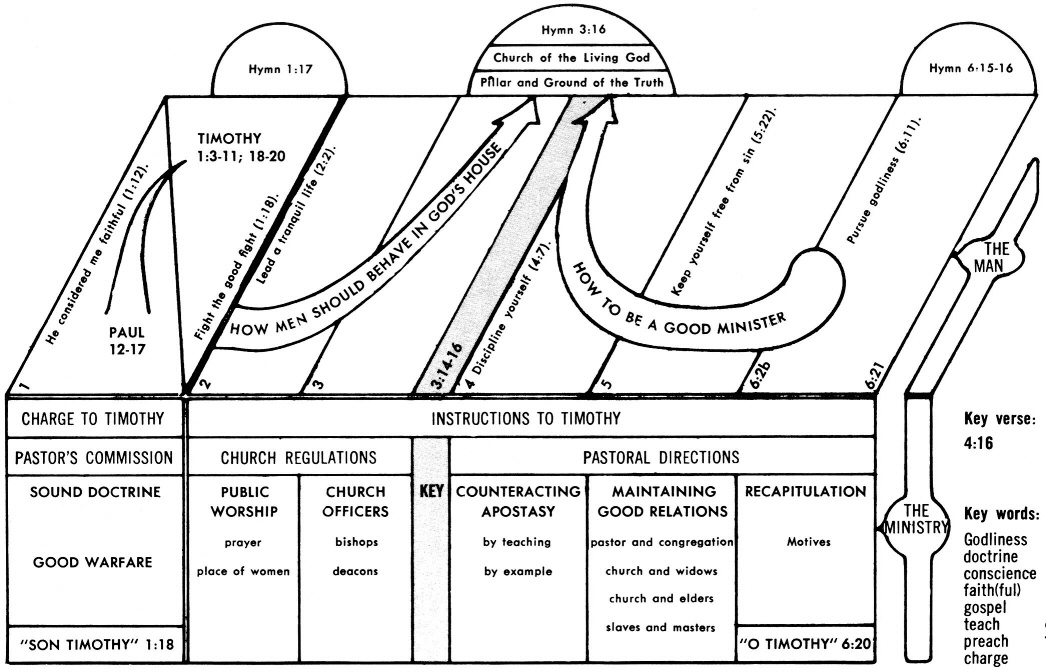
GODLINESS AND PASTORAL CARE
Click chart to enlarge
Charts from Jensen's Survey of the NT - used by permission
Another Overview Chart - 1 Timothy - Charles Swindoll
| THE PASTOR'S PRIMER: PAUL'S PRACTICAL PASTORAL INSTRUCTIONS REGARDING THE LOCAL CHURCH |
||||
| 1 Timothy 1 | 1 Timothy 2-3 | 1 Timothy 4 | 1 Timothy 5 | 1 Timothy 6 |
| TIMOTHY'S CHARGE… |
TIMOTHY'S INSTRUCTIONS… |
|||
| Concerning Sound Doctrine |
Concerning Prayer & Church |
Concerning Last Days Apostasy |
Concerning Widows & Elders |
Concerning Conflict & Contentment |
| Danger of False Doctrine |
Public Worship Church Officers |
Antidote for Apostasy |
Pastoral Duties Toward Others |
Instructions for the Man of God |
| Warning | Worship | Wisdom | Widows | Wealth |
| Written in Macedonia Circa 62-64AD |
||||
1 Timothy 6:15 which He will bring about at the proper time--He who is the blessed and only Sovereign, the King of kings and Lord of lords (NASB: Lockman)
Greek: en kairois idiois deixei (3SFAI) o makarios kai monos dunastes o basileus ton basileuonton (PAPMPG) kai kurios ton kurieuonton, (PAPMPG)
Amplified: Which [appearing] will be shown forth in His own proper time by the blessed, only Sovereign (Ruler), the King of kings and the Lord of lords, (Amplified Bible - Lockman)
ESV: which he will display at the proper time—he who is the blessed and only Sovereign, the King of kings and Lord of lords,
KJV: Which in his times he shall shew, who is the blessed and only Potentate, the King of kings, and Lord of lords;
Moffatt: which will be brought about in due time by that blessed and only Sovereign, King of kings and Lord of lords,
NET: — whose appearing the blessed and only Sovereign, the King of kings and Lord of lords, will reveal at the right time.
NLT: For at just the right time Christ will be revealed from heaven by the blessed and only almighty God, the King of all kings and Lord of all lords. (NLT - Tyndale House)
Phillips: This will be, in his own time, the final denouement of God, who is the blessed controller of all things, the king over all kings and the master of all masters, (Phillips: Touchstone)
TLB: For in due season Christ will be revealed from heaven by the blessed and only Almighty God, the King of kings and Lord of lords,
Weymouth: I charge you—as in the presence of God who gives life to all creatures, and of Christ Jesus who at the bar of Pontius Pilate made a noble profession of faith—
Wuest: which He will expose to the eyes in strategic seasons having a unique character all their own, the One who is the blessed and only Sovereign, the King of those who are reigning as kings, and Lord of those who are ruling as lords
Young's Literal: which in His own times He shall shew -- the blessed and only potentate, the King of the kings and Lord of the lords
WHICH HE WILL BRING ABOUT AT THE PROPER TIME: en kairois idiois deixei (3SFAI):
- Which: 1Ti 1:11,17 Ps 47:2 83:18 Jer 10:10 46:18 Da 2:44-47 4:34 Mt 6:13
THE SECOND COMING IS SURE:
THE SOVEREIGN GOD
DETERMINES THE MOMENT
He - This pronoun refers to God the Father Who is sovereign and in control over the First and Second Comings of the Messiah. Beloved of the Father (1Th 1:4-note), as those who are now privileged to live between the two comings of Christ (the so called "church age"), are we not comforted that He controls the beginning and the end! And if He is sovereign over history, can we not trust Him to reign and rule over our life and all our multicolored (poikilos) trials (1Pe 1:6-note), for which He sovereignly provides His multicolored (poikilos) grace (1Pe 4:10-note)! May our Father grant us His grace to reject self reliance and a heart that strives to rely solely and wholly on His sovereignty (and sovereign grace) in Christ Jesus, the One Who has come and Who will soon come to take us home. Amen
Which - Although it may seem overly simplistic, it is always good to practice interrogating the text with the 5W/H'S. In this case we can ask simple questions like "What is which?" "To what does this refer?" which forces us to check the context for the answer, which as in this case is usually relatively straightforward, but at times can be problematic. When you encounter passages that are difficult, don't worry. Just move on. As you read and re-read a given section, your Teacher, the Holy Spirit, will usually uncover the answers that are not as obvious on the initial reading. In fact, one of the keys of inductive Bible study is reading the text over and over (See observation), but not in a mechanical or pedantic manner, but each time with a specific purpose. For example, you might read through First Timothy one time to specifically observe what the text teaches about God or Jesus, another time through might be to discern what Paul says about himself, another time looking for what he says about Timothy, another time observing for instructions or commands, another time observing for words or phrases that are repeated or seem to have special emphasis (See key words) in the context of this letter (See Keep Context King). As you read through each time seeking to observe with a purpose, maximize your efforts by recording a list of what the text teaches about each topic. Use the actual words of Scripture in your list. Don't paraphrase. To facilitate this exercise, you might print out a copy of First Timothy, leaving wide margins on both sides where you can mark the text (See mark key words) and record your observations. Be sure to use a more literal Bible translation for this more serious type of study (Bible Versions compared for how literal)
The NET Bible note comments that which indicates that this entire passage is "a relative clause which refers back to appearing in 1Ti 6:14."
Wuest agrees adding that "The word which is a relative pronoun in the Greek text referring back to the word appearing. The connection is as follows: "Which appearing in His own times He will expose to the eyes, He who is the blessed and only Potentate, etc."
The truths about God in this passage and the following one serve to amplify the promise of Christ's return, which in turn would serve to strengthen and encourage young, "timid" (2Ti 1:7-note) Timothy to continue to "flee… follow… fight the good fight of faith." The truth is that the Father controls and determines the moment when the Son will return as Victorious Warrior Who will put an end to the struggle against the powers of evil.
Will bring about - Wuest paraphrases it "He will expose to the eyes". "God will make that happen at the right time." (International Children's Bible) "In His own time will be publicly displayed." (Christian Counselor's NT), "He will make clear" (BBE).
Barnes: The idea here is, that all the sovereigns of the earth are under his sway; that none of them can prevent the accomplishment of his purposes; and that he can direct the winding up of human affairs when he pleases.
Bring about (1166)(deiknuo) means to show, to make known or to manifest. Deiknuo draws attention to something by visual, auditory, gestural, or linguistic means so that it can be apprehended by the senses (cp Christ's appearing - "Every eye will see Him!" Rev 1:7). Deiknuo is also used in the sense of showing something so as to prove it is true or to make it clear by evidence (e.g., "We know that, when He appears… we shall see Him just as He is.")
It is interesting that 8 of 33 uses are in the book of the Revelation, the book that culminates with the appearing of our Lord Jesus Christ which God will bring about…
Rev 1:1 The Revelation of Jesus Christ, which God gave Him to show (deiknuo) to His bond-servants, the things which must shortly take place; and He sent and communicated it by His angel to His bond-servant John
Rev 4:1b "Come up here, and I will show you what must take place after these things."
Rev 17:1b "Come here, I shall show you the judgment of the great harlot who sits on many waters,
Rev 21:9b "Come here, I shall show you the bride, the wife of the Lamb."
Rev 21:10 And he carried me away in the Spirit to a great and high mountain, and showed me the holy city, Jerusalem, coming down out of heaven from God,
Rev 22:1 And he showed me a river of the water of life, clear as crystal, coming from the throne of God and of the Lamb,
Rev 22:6 And he said to me, "These words are faithful and true"; and the Lord, the God of the spirits of the prophets, sent His angel to show to His bond-servants the things which must shortly take place.
Rev 22:8 And I, John, am the one who heard and saw these things. And when I heard and saw, I fell down to worship at the feet of the angel who showed me these things.
HE MAKES ALL THINGS
BEAUTIFUL
IN HIS OWN TIME!
At the proper time (kairos) - "at just the right time" (NLT). "In due season" (The Living Bible). "In His times." (KJV). "In His own good time." (Centenary). The Greek is more accurately rendered by the Amplified Version which has "in His own proper time". The NAS neglects to pick us the nuance of "His own"
His own (2398)(idios) is an adjective which means that this time is distinctively characteristic of God. It is a time that peculiarly, privately, and personally is possessed by Him.
Hiebert - Paul indicates that the longed-for return of Christ as to its actual occurrence was wholly in the hands of God. The Second Advent, like the First, will occur in the time ordered and appointed by the Father. Paul’s statement is not that Christ will display His appearing, but that the Father will display it. The same God that preserves all things will effect the Second Coming. This thought draws out of Paul a doxology of praise to the Father. (Borrow First Timothy- Everyman's Bible Commentary - excellent resource)
There was an old song from my pre-Christian days entitled "Turn, Turn, Turn," sung by the Birds and based (I suppose) on Ecclesiastes 3, where Solomon writes…
There is an appointed time for everything.
And there is a time for every event under heaven…
He has made everything beautiful in His time
Ec 3:1, Ec 3:11KJV
Comment: Indeed at the terminus of this present age, the Son of Righteousness will arise and return with healing in His wings (Malachi 4:2). The Beautiful One (Play: Jeremy Camp's Beautiful One) will then make all things beautiful for those who belong to Him. Pause and thank Him for this blessed hope as you listen to the beautiful old (circa 1980's) Maranatha chorus entitled…In His Time
At the proper time - More literally "In His own seasons". Identical phrase in 1Ti 2:6 (First Coming - specifically the crucifixion) and Titus 1:3-note (Manifested the truth of eternal life in His Word about Christ). Compare the phrase "fullness of time" (Gal 4:4 - First Coming). Here are all the uses of "proper time" in Scripture (in the NAS95): Nu 23:23; Eccl 8:5, 6; Mt 24:45; Lk 1:20; 12:42; 1Ti 2:6; 6:15; Titus 1:3; Heb 11:11-note; 1Pe 5:6-note.
This time phrase ("at the proper time") is first in the Greek sentence which signifies that it is a point of emphasis. As discussed above, whenever you encounter a time phrase or "time sensitive word" (eg, until, then, etc), pause and interrogate the expression of time. For example, "To what time is Paul referring?" "What happens at the proper time?" "How should the truth about the proper time effect my daily life?" (Obviously an application type question). In context, Paul teaches that the Second Coming, the appearing of our Lord Jesus Christ, will occur at the proper time. This is the time that the Father specifies and which no man knows or even expects (ie, it will catch the world "off guard!") because it is God the Father's own personal time only known to Him.
Mt 24:35, 36 Heaven and earth will pass away, but My words shall not pass away. But of that day and hour no one knows, not even the angels of heaven, nor the Son, but the Father alone.
Read the following passages, all of which in some way refer to the Father's personal, peculiar, private proper time of bringing about the appearing of our Lord Jesus Christ. See if you notice a common theme in these passages in regard to how we as believers should conduct ourselves in this present evil age.
Acts 1:7 He said to them (Jesus answering the Acts 1:6 question from His disciples), "It is not for you to know times (chronos) or epochs (kairos - same word translated "proper time" in 1Ti 6:15) which the Father has fixed by His own authority;
Zech 14:7 (Context Zech 14:1-6) For it will be a unique day which is known to the LORD, neither day nor night, but it will come about that at evening time there will be light.
Mt 24:42 (In the context of describing the "faithful and sensible slave" Mt 24:45 Jesus warned… ) "Therefore be on the alert (gregoreuo in the present imperative), for you do not know which day your Lord is coming. 43 But be sure of this, that if the head of the house had known at what time of the night the thief was coming, he would have been on the alert and would not have allowed his house to be broken into. 44 For this reason you be (present imperative) ready (Gk - hetoimos = prepared) too; for the Son of Man is coming at an hour when you do not think He will. 45 Who then is the faithful and sensible slave whom his master put in charge of his household to give them their food at the proper time (kairos)? 46 Blessed is that slave whom his master finds so doing when he comes. 47 Truly I say to you, that he will put him in charge of all his possessions.
Mt 25:13 "Be on the alert (gregoreuo in the present imperative) then (Why? in view of the danger just described - Mt 25:1-10, 11, 12), for (term of explanation - what is Jesus explaining?) you do not know the day nor the hour. (What time? The day of His appearing).
Mk 13:33 (See context - Mk 13:35-37) "Take heed, (blepo in the present imperative = command calling for continual attention!) keep on the alert (agrupneo in the present imperative) for you do not know when the appointed time (kairos) is.
Luke 12:35 "Be dressed (present imperative = continually in a state of) in readiness (perizonnumi = girded), and keep your lamps alight. 36 And be like men who are waiting for their master when he returns from the wedding feast, so that they may immediately open the door to him when he comes and knocks. 37 Blessed are those slaves whom the master shall find on the alert when he comes; truly I say to you, that he will gird himself to serve, and have them recline at the table (first century middle eastern meals were not eaten while sitting at a table, but while reclining on one’s side on the floor with the head closest to the low table and the feet farthest away), and will come up and wait on them. 38 Whether he comes in the second watch, or even in the third, and finds them so, blessed are those slaves. 39 "And be sure of this, that if the head of the house had known at what hour the thief was coming, he would not have allowed his house to be broken into. 40 "You too, be (present imperative) ready (Gk - hetoimos = prepared); for the Son of Man is coming at an hour that you do not expect. (the verb means that does not seem proper or best)"
Comment: Observe verse 37 - Who will gird himself? The master! Many commentators feel and I agree that this is a description of Jesus serving us in the future.
J C Ryle writes - "This is perhaps one of the most wonderful promises made to believers in the New Testament. It must probably be interpreted figuratively. It means that there is no limit to the honor and glory which the Lord Jesus will bestow on those who are ready to meet him at his second coming."
Luke 21:34 "Be on guard (prosecho in the present imperative - command to always keep our guard up spiritually speaking), that your hearts may not be weighted down with dissipation and drunkenness and the worries of life, and that day (To what day is Jesus referring?) come on you suddenly like a trap; 35 for it will come upon all those who dwell on the face of all the earth. 36 "But keep on the alert (agrupneo in the present imperative) at all times, praying in order that you may have strength to escape all these things that are about to take place, and to stand before the Son of Man."
Romans 13:11-note And this do, knowing the time, that it is already the hour for you to awaken from sleep; for now salvation is nearer to us than when we believed. 12-note The night is almost gone, and the day is at hand. Let us therefore lay aside the deeds of darkness and put on the armor of light. 13-note Let us behave properly as in the day, not in carousing and drunkenness, not in sexual promiscuity and sensuality, not in strife and jealousy. 14-note But put on (aorist imperative) the Lord Jesus Christ, and make no provision (present imperative) for the flesh in regard to its lusts.
1Th 5:1-note Now as to the times (chronos) and the epochs (kairos), brethren, you have no need of anything to be written to you. 2 For you yourselves know full well that the day of the Lord will come just like a thief in the night. 3 While they are saying, "Peace and safety!" then (expression of time) destruction will come upon them suddenly like birth pangs upon a woman with child; and they shall not escape. 4 But you, brethren, are not in darkness, that the day should overtake you like a thief; 5 for you are all sons of light and sons of day. We are not of night nor of darkness; 6 so then let us not sleep as others do, but let us be alert and sober.
1Pe 4:7 The end of all things is at hand; therefore, be of sound judgment (aorist imperative) and sober spirit (aorist imperative) for the purpose of prayer.
Rev 16:15 Behold, I am coming like a thief. Blessed is the one who stays awake and keeps his garments, lest he walk about naked and men see his shame.
Proper time (season) (2540)(kairos) means a point of time or period of time frequently with the implication of being especially fit for something but without emphasis on precise chronology (about when it will take place or how long it will last, etc). Kairos describes a moment as especially appropriate, presenting the favorable time or season for something to occur, specifically the return of Christ.
Hiebert writes that the truth that God will bring about the return of His Son "draws out of Paul a doxology of praise to the Father. It contains a sevenfold description of God. 1) “The blessed and only Potentate” points to the character and the universal authority of Him who will bring back Christ in open glory. “The first epithet describes the perfection of bliss enjoyed by the First Person of the Trinity; the second, the uniqueness and absoluteness of His power” (Pope). 2 and 3) “The King of kings, and Lord of lords” is descriptive of His sovereign authority and rule. He is King over all those acting as kings, and Lord over all those acting as lords over others. 4) “Who only hath immortality,” that is, immortality as an essential, underived attribute. The word here rendered “immortality” is literally “deathlessness” and speaks of His absolute deathless existence. The adjective in 1Ti 1:17 translated “immortal” comes from a different word which means “not liable to corruption or decay.” His deathless, unchanging existence precludes any decay, corruption, or degeneration in His being. 5) “Dwelling in light unapproachable” speaks of the inaccessibility of God to human senses. He dwells in an atmosphere too glorious for mortal creatures to approach. 6 and 7) The relative clauses, “whom no man hath seen, nor can see” emphasize the essential nature of God as invisible. Finite man never has seen God in His eternal essence, nor can he do so (cf. John 1:18). “The vision of God, however, is in some sense promised to the saints (cf. Matt. 5:8; 1 Cor. 13:12; 1 John 3:2; Rev. 22:4); but such vision can never be complete sight, since in the nature of things the finite can never perfectly comprehend the Infinite” (Harvey). (Borrow First Timothy- Everyman's Bible Commentary - excellent resource)
HE WHO IS THE BLESSED AND ONLY SOVEREIGN, THE KING OF KINGS AND THE LORD OF LORDS: o makarios kai monos dunastes o basileus ton basileuonton (PAPMPG) kai kurios ton kurieuonton, (PAPMPG):
- King: Ezra 7:12 Pr 8:15 Rev 17:14 19:16)
ANOTHER DIVINE
DOXOLOGY
Now Paul describes attributes of God which "enable" God to accomplish everything He promises, in this context, the "re-appearing" of our Lord Jesus Christ. But beloved, remember that He is (as Paul says in Titus 1:2-note) the "Non-lying" God! (cp Nu 23:29, 1Sa 15:28, Heb 6:17-note, Heb 6:18-note) It therefore behooves as His dear children to lay hold by grace through faith of all of His "precious and magnificent promises (e.g. see Ezekiel 36:26, 27), in order that by them you might become partakers of the divine nature, having escaped the corruption that is in the world by lust." (2Peter 1:4-note) Stated another way, in view of the fact that "God… cannot lie (and) promised long ages ago", we need to study His Word diligently (2Ti 2:15KJV-note), as would a prospector looking for perishable gold (1Pe 1:18-note contrasted with our "gold" which is eternal! Read Ps 12:6-note, Pr 30:5, Isaiah 40:8, 55:11, 1Pe 1:25-note, Ps 119:89-note, Mt 24:35), so that we might know our "possessions" (all the promises of God which in Christ are yea and amen! - 2Cor 1:20KJV) and thereby be able and zealous to possess our possessions now, in this life (cp God's promise to Joshua - Josh 1:3 - note that God had already given ["I have given" = past tense] the land to him! But to NT believers, it is not a land He has given, but a life He has promised [2Ti 1:1-note] a life here and now that Jesus desires that we possess abundantly in Him - Jn 10:10b, cp Col 3:4-note, 2Cor 4:10, 11, Jn 20:31, 1Jn 5:11, 12, 13). May God grant us His Spirit's inner strengthening and His transforming, sufficient grace that we might by faith lay hold of our promised possessions, doing so for His renown, acclaim and glory through Christ Jesus our Lord. Amen.
Earlier in the context of describing the First Coming Paul had broken into a doxology (doxa = glory, praise + lego = to speak) declaring…
Now to the King eternal, immortal, invisible, the only (monos - same adjective here in 1Ti 6:15) God, be honor and glory forever and ever. Amen. (1Ti 1:17)
Now in the context of the Second Coming, he again breaks into a doxology.
Paul uses monos (only) in another doxology declaring "to the only wise God, through Jesus Christ, be the glory forever. Amen." (Ro 16:27-note). (Compare similar idea regarding the exclusivity of our great God = Rev 15:4-note "Thou alone art holy"). God Himself testified that He was the "only" God asking…
Is there any God besides Me,
Or is there any other Rock?
I know of none.
Isaiah 44:8
Gordon Fee comments that "Ephesus (Ed: Timothy was thought by most scholars to be the pastor of the church at Ephesus at this time) was not only the haven of Artemis, but an early center of emperor worship as well. This doxology, therefore, is Paul’s parting shot that the God with Whom the church has to do in the Gospel of Christ is none other than the supreme Ruler of the universe, the Lord over all other lords. (New International Biblical Commentary: 1 and 2 Timothy, Titus. Hendrickson Publishers. 1988)
Wuest adds that "The Roman emperors were called "saviour of the world."
The Blessed - "Who is perfectly happy" (Mace Version). Note that "blessed" (makarios) and "only" (monos) are both adjectives modifying "Sovereign".
Blessed is used as a Name for God in the high priest's question of Jesus at his mock trial "But He kept silent, and made no answer. Again the high priest was questioning Him, and saying to Him, "Are You the Christ, the Son of the Blessed One?" And Jesus said, "I am; and you shall see THE SON OF MAN SITTING AT THE RIGHT HAND OF POWER, and COMING WITH THE CLOUDS OF HEAVEN." (Mk 14:61-62+)
Earlier Paul had referred to "the glorious gospel of the blessed God, with which I have been entrusted." (1Ti 1:11+)
Writing to Titus, Paul described the Second Coming as "… the blessed hope and the appearing of the glory of our great God and Savior, Christ Jesus." (Titus 2:13-note)
Blessed (3107)(makarios from root makar, but others say from mak = large or lengthy) means to be happy, but not in the usual sense of happiness based on positive circumstances (i.e., on what "happens"). From the Biblical perspective Makarios describes one free from daily cares and worries because his every breath and circumstance is in the hands of His Maker Who gives him such an assurance (such a "blessing"). By using makarios, Paul is saying the transcendent, self-existent God is “happy,” “content,” or “fulfilled”.
The Blessed One is in turn the source of all spiritual blessings (cp Ps 1:1-note; which in the Septuagint [Lxx] uses makarios, as do the following OT passages - Job 5:17KJV, Ps 32:1, 2, Ps 33:12, Ps 34:8, Ps 40:4; Ps 41:1; Ps 65:4; Ps 84:4, 5, 12; Ps 89:15; Ps 94:12; Ps 106:3; Ps 112:1; Ps 119:1, 2; Ps 127:5; Ps 128:1, 2; Ps 137:8, 9; Ps 144:15; 146:5; Pr 3:13; 8:32; 20:7; 28:14; Isa 30:18; 56:2; Da 12:12 - this would make an interesting study - Observe these OT uses of makarios for the conditions associated with the blessing. My guess is you would be blessed, pun intended!). The Beatitudes that introduce the Sermon on the Mount each begin with this same word "makarios."
In other words, as John MacArthur puts it God has no "unhappiness, frustration, and anxiety. He is content, satisfied, at peace, fulfilled, and perfectly joyful. While some things please Him and other things do not, nothing alters His heavenly contentment. He controls everything to His own joyous ends. Those who enter into a relationship with God enter into His calm. They can be unperturbed because He is unperturbed. The Psalmist wrote, “How blessed are all who take refuge in Him” (Ps 2:12; cf.. 34:8; 40:4; 84:12; 112:1; 128:1 [Ed: See more uses of makarios in the OT above])! Scripture describes the blessed as those whom God chooses (Ps. 65:4), those who know Christ (Mt. 16:16, 17), those who believe the Gospel (Gal 3:9), those whose sins are forgiven (Ro 4:7), those to whom God grants righteousness apart from works (Ro 4:6-9), and those who obey the Word (James 1:25). No matter what the opposition, no matter what trials or persecutions he faces, the man of God can be at peace. That peace is not based on external circumstances but on the knowledge that God is in control. Believers are blessed because they are in union with the God who is blessed. (1 Timothy Moody Press) (Bolding added)
In this passage blessed (like "only"-monos) is an adjective modifying God, saying in essence that God is the sovereign one Who has and Who bestows all blessedness (happiness).
Schuetze says it this way "All happiness and blessedness are personified in him, come from him, and are found only in his presence. (1 Timothy, 2 Timothy, Titus. Northwestern Pub. House)
Greek used makarios to refer to their so called gods calling them "the blessed ones!" How deceitful is the heart! These pagans thought their pseudo-gods were "blessed" because they had achieved a state of happiness and contentment in life that was beyond all cares, labors, and even death. The blessed ones were beings who lived in some other world away from the cares and problems and worries of ordinary people. In the pagan world of Greek mythology, to be blessed, one had to be a god. Homer used makarios to describe a state unaffected by the world of men, for the latter were subject to poverty, weakness, and death. The Greeks also used makarios in reference to the dead who were "the blessed ones", men and women who, through death, had reached the other world of the gods and so were now beyond the cares and problems and worries of earthly life. To be blessed, you had to be dead, a state many of us have felt like we would just as well experience because of the nature of our manifold troubles and afflictions at the time.
King of kings - More literally this reads "The King of those who reign as kings" (The first "king" is a noun and the second is the verb form). This title and the following ("Lord of lords") serve to even further amplify and/or magnify the fact that He is the Sovereign one, the one Who alone rules and reigns over all men, all angelic hosts, and all creation.
This exact phrase "King of kings" occurs 6 times in Scripture, used three times to describe men (Ezra 7:12, Ezek 26:7, Da 2:37) and used three times to describe God (1Ti 6:15, Rev 17:14-note, Rev 19:16-note). For example, in Ezra 7:12 the title is used of Artaxerxes for king of kings, a common title for Persian kings. Indeed, the New Testament's use of this title may have been a direct rebuttal against the kings of the earth who thought themselves supreme (cp Da 11:36-note where "king" = Antichrist, cp also Rev 17:1-note, Rev 17:2-note, Rev 17:12-note, Rev 17:13-note), saying, in essence, there is One greater! In the present passage King of kings is used of God the Father, whereas it refers to God the Son in Rev 17:14-note and Rev 19:16-note, where in context it signifies His "victorious Name."
Ambrose, Bishop of Milan (circa 333-397AD) and teacher of Augustine helps us understand how the same title (Lord of lords) can be used of both the Father and the Son…
THE SOVEREIGN SON INSEPARABLE FROM THE FATHER: When I speak of the Father, I do not make separation of the Son, because the Son is in the bosom and the solitude of the Father. (Jn 1:18) When I speak of the Son alone, I also associate the Father, even as the Son also associated Him, saying, “Behold the hour is coming for you to leave Me alone. But I am not alone, because the Father is with Me.” (Jn 16:32) In this way is the Father called “the blessed and only Sovereign” (Ed: And both can be called "King of kings and Lord of lords") —in such a way that the Son, Who is always in the Father, is not separated from Him. (From THE PRAYER OF JOB AND DAVID 2.4.15)
OUR POTENTATE IS "POTENT"
OUR GOD IS ABLE
The only Sovereign (KJV "Only Potentate") - Paul uses the adjective only (monos = "pertaining to being the only entity in a class" [BDAG]) underscores his monotheistic belief, that there is only one God, one "Potentate". The only one Who "Holds sway" (NEB). "Only Ruler" (Darby)
As Patrick Fairbairn says God is the only one "in the universe possessed of independent right and absolute sovereignty."
See study of God's attribute: Sovereign
Webster defines "Potentate" as one who possesses great power or sway and as applied to God is expressive of His transcendent power and authority. Potentate is from Latin "potentatus" = dominion ruler from Latin posse = to be able. Indeed our God is Sovereign, our God is able. What effect would these truths about God have on Timothy's ability to fight the good fight of faith? Clearly when one knows they are on the winning team, of the only God and the only God Who is able, we have nothing to fear.
How "potent" is our blessed and only Sovereign? Read the following introduction from Psalm 2 and be encouraged that our God is sovereign and in control of the universe, not to mention the very hairs of our head! Let us cast away all tendency to fret and worry (Ps 37:1, 7, 8-note, Pr 24:19, Mt 6:25-note, Mt 6:31-note, Mt 6:34-note, Mt 10:19, Lk 12:22, Php 4:6-note, Php 4:7-note). He is the same God yesterday, today and forever (cp Heb 13:8-note). Hallelujah! Amen.
WHY are the nations in an uproar, And the peoples devising a vain thing? The kings of the earth take their stand, And the rulers take counsel together Against the LORD and against His Anointed: “Let us tear their fetters apart, And cast away their cords from us!” He who sits in the heavens laughs, The Lord scoffs at them. Then He will speak to them in His anger And terrify them in His fury: “But as for Me, I have installed My King Upon Zion, My holy mountain.” Psalm 2:1–6 (See Notes by Tony Garland and/or by C H Spurgeon)
As John Stott comments "our confidence in God’s perfect timing, and our consequent willingness to leave things in his hands, arise from the kind of God we know him to be." (Guard the truth : the message of 1 Timothy & Titus. InterVarsity Press)
Sovereign (1413) (dunastes from dunamai = to be able) describes one who is possessor of power or authority, who occupies high position and was used especially of independent rulers of territories (Lk 1:52). Dunastes in the Septuagint and the NT is used of one who is in a position of authority and who possesses the inherent right to command or rule over others. It is helpful to remember that all of the words with the stem "duna-" (or "dyna-") convey the basic sense of having intrinsic or inherent ability or capability. In other words, God's ability (or power) is intrinsic and integrally related to Who He is. His ability is not delegated to Him from some other "power" therefore He has to rivals! No created entity can make such a claim. Even the forces of evil cannot claim such absolute power. What Satan does, God allows. Believers must relinquish reliance of their fleshly "power" (even that being allowed by God) and rely on His supernatural power in order to live and work supernaturally (cp Jn 15:5, Acts 1:8, etc). The struggle between believers and Satan is not so much a "power struggle" as it is a "truth struggle" and the "battlefield" is our minds. The best antidote for Satan's tactics is truth, which is why even the Lord Jesus repelled his temptations by relying on the Word of truth (all quotes from Deuteronomy - Mt 4:1-11). Believers have access to the same "power source" today, which underscores why serious (in contrast to superficial) Bible study (e.g.,
inductive Bible study) and Bible memorization (See Memory Verses by Topic) are disciplines so vital to the so-called "victorious Christian life." If you are not seriously studying the Word as if your spiritual depended on it, then, frankly, you are deceived and setting yourself up for continual defeat in spiritual warfare.
Many passages in Scriptures affirm God's sovereignty. For example in Isaiah God declares…
Even from eternity I am He; And there is none who can deliver out of My hand; I act and who can reverse it? Isaiah 43:13 (See also Isaiah 40:25-31)
Vincent notes that this verse is the only use of dunastes to describe God. He adds that in Classic Greek writings dunastes was…
applied to Zeus (Sophocles Antig. 608). In Aesch. Agam. 6, the stars are called bright rulers (lamproi dunastai), as the regulators of the seasons.
The only other uses of dunastes in the NT are…
Luke 1:52 "He has brought down rulers from their thrones, And has exalted those who were humble.
Acts 8:27 And he arose and went; and behold, there was an Ethiopian eunuch, a court official of Candace, queen of the Ethiopians, who was in charge of all her treasure; and he had come to Jerusalem to worship.
Dunastes is use in 73 verses in the Greek (Septuagint = Lxx) (often translated as "ruler" but not necessarily divine, adversary - Job 6:23, tyrants or oppressors - Job 27:13) (34x in the apocrypha and 39x in the non-apocrypha) - Ge 49:24; 50:4; Lev 19:15; Jda. 5:9; 1Sa 2:8; 1Chr 28:1; 29:24; Jdt 2:14; 9:3; 2 Macc 3:24; 9:25; 12:15, 28; 15:3, 4, 5, 23, 29; 3 Macc 2:3; 5:51; 6:4, 39; Ps 71:12; Odes 3:8; 4:14; 9:52; Pr 1:21; 8:3, 15; 14:28; 17:26; 18:16, 18; 23:1; 25:6f; 31:4; Job 5:15; 6:23; 9:22; 12:19; 13:15; 15:5, 20; 27:13; 29:12; 36:22; Wis 5:23; 8:11; Sir 4:27; 7:6; 8:1; 10:3, 24; 11:6; 13:9; 16:11; 41:17; 46:5, 7, 16; Amos 6:7; Nah 3:18; Hab 3:14; Isa 5:22; Jer 41:19; Dan 2:10; 8:24; 9:6, 8; 11:5, 15; Dat. 3:94; There is one familiar verse that uses dunastes…
Job 13:15 (NAS) "Though He slay me, I will hope in Him. Nevertheless I will argue my ways before Him.
Job 13:15 (English of the Lxx) Though the Mighty One (dunastes) should lay hand upon me, forasmuch as he has begun, verily I will speak, and plead before him
Wuest comments that dunastes is related to the noun "dunamis meaning "strength, power, ability." It is the word used in Romans 1:16-note, where the Gospel is the power (dunamis) of God resulting in salvation. Here our word (dunastes) refers to one who has power such as a prince, a high officer, a royal minister. God is called a potentate from the viewpoint of His power. He is a ruler by virtue of the fact that He has the power and ability to rule. (Wuest, K. S. Wuest's Word Studies from the Greek New Testament: Eerdmans)
JEHOVAH IS
LORD OF ALL
Lord of lords - Paul had just said God was Sovereign (Ruler, Potentate) with the description as Lord of lords His sovereign rule is explicitly seen. This phrase actually combines the related noun (kurios) the verb from (kurieuo) and more literally reads "Lord of those who rule as lords". Darby translates it "Lord of those that exercise lordship."
Deuteronomy 10:17 " For the LORD your God is the God of gods and the Lord of lords, the great, the mighty, and the awesome God Who does not show partiality, nor take a bribe.
Ps 136:3 Give thanks to the Lord of lords, For His lovingkindness is everlasting.
Spurgeon Comments: There are lords many, but Jehovah is the Lord of them. All lordship is vested in the Eternal. He makes and administers law, he rules and governs mind and matter, he possesses in himself all sovereignty and power. All lords in the plural are summed up in this Lord in the singular; he is more lordly than all emperors and kings condensed into one. For this we may well be thankful, for we know the superior Sovereign will rectify the abuses of the underlings who now lord it over mankind. He will call these lords to his bar, and reckon with them for every oppression and injustice. He is as truly the Lord of lords as he is Lord over the meanest of the land, and he rules with a strict impartiality, for which every just man should give heartiest thanks.
William De Burgh comments on the Lord of lords. The meaning of the title "Lord", as distinct from "Jehovah" and "God", is "Governor." And in this view also he is eminently entitled to praise and thanksgiving, in that his rule and government of the world are also eminently marked by "mercy" and "goodness": not the display of power only, but of power declared chiefly in showing mercy and pity: as again all subject to that rule are witnesses. Such is God in himself. Nor is it without intention that the doxology is threefold, indicating, doubtless, like the threefold invocation of the Name of the Lord in the blessing of the people (Numbers 6:24-26) God in Trinity, "Father, Son, and Holy Ghost", as now fully revealed. --.
Rev 17:14-note "These will wage war against the Lamb, and the Lamb will overcome them, because He is Lord of lords and King of kings, and those who are with Him are the called and chosen and faithful."
Rev 19:16-note And on His robe and on His thigh He has a name written, "KING OF KINGS, AND LORD OF LORDS."
Nebuchadnezzar made a similar declaration after Daniel had successfully revealed and interpreted the king's dream…
Da 2:47-note The king answered Daniel and said, "Surely your God is a God of gods and a Lord of kings and a revealer of mysteries, since you have been able to reveal this mystery."
Lord (2962) (kurios from kuros = might or power) has the main sense of a supreme one, one who is sovereign and possesses absolute authority, absolute ownership and uncontested power. The reader should also be aware that kurios is used over 9000 times in the Septuagint (LXX) (usually to translate the Hebrew "YHWH" or Jehovah, eg, Ge 2:8 where LORD = Jehovah = Kurios in Lxx) and over 700 times in the New Testament!
Boice adds that "Citizens of the empire were required to burn a pinch of incense to the reigning Caesar and utter the words Kyrios [kurios] Kaisar (“Caesar is Lord!”). It is this that the early Christians refused to do and for which they were themselves thrown to the wild lions or crucified. It was not that Christians were forbidden to worship God. They were free to worship any god they chose so long as they also acknowledged Caesar. Romans were tolerant. But when Christians denied to Caesar the allegiance that they believed belonged to the true God only, they were executed. (Daniel: An Expositional Commentary)
THOUGHT : Lord is not merely a name in the sense of being a title, but also signifies a call to action, so that every saint should willingly, reverently bow down to the Lord. If Christ is our Lord, we are to live under Him, consciously, continually submitting our will to His will, as His loyal, loving bondservants ("love slaves"), always seeking first His Kingdom and His righteousness (Mt 6:33-note). According to this practical working "definition" beloved we all need to ask ourselves "Is Jesus Christ my Lord?". "Do I arise each day, acknowledging this is the day the Lord hath made?" (Ps 118:24-note) "Do I surrender my will to His will as I begin each day?" (cp Ro 12:1-note, Ro 12:2-note) Beloved, don't misunderstand. None of us have "arrived" in this area of Jesus as Lord of our lives. And it is precisely for that reason that Peter commands us to continually "grow (present imperative) in the grace (unmerited favor, power to live the supernatural, abundant life in Christ) and knowledge (not just intellectual but transformational) of our Lord and Savior Jesus Christ. To Him be the glory, both now and to the day of eternity. Amen." (2Pe 3:18-note) You say "But I've failed. I've fallen in that sin again." Beloved, do not be discouraged. Don't "throw in the towel" as they say. Confess. Repent. Press on (continually = present tense) "toward the goal for the prize of the upward call of God in Christ Jesus." (Php 3:14-note) Remember, that it is always too soon to quit when you have His Word which promises "that He who began a good work in you will perfect it until the day of Christ Jesus." (Php 1:6-note) Amen.
Lords (2961)(kurieuo from noun kurios = master - power of control rather than physical strength) means to rule or have dominion over and speaks of individuals who exercise authority or have control over others and in the present tense speaks of their continuing lordship.
George Knight sums up Paul's description of God in 1Ti 6:15 remarking that…
The statement in its entirety says that God is the possessor of the highest power over all who possess power and has full control over all who exercise control (cf. Is. 40:12–31; Dn. 4:35). (Knight, George W.: The Pastoral Epistles: A Commentary on the Greek Text. W. B. Eerdmans; Paternoster Press. 1992)
Comment: Clearly this truth should give Timothy great comfort in his spiritual struggles, especially if he recalled David's OT testimony that "the battle is the LORD's and He will give you (Goliath) into our hands." (1Sa 17:47)