2 Peter 1:2
2 Peter 1:3
2 Peter 1:4
2 Peter 1:5
2 Peter 1:6
2 Peter 1:7
2 Peter 1:8
2 Peter 1:9
2 Peter 1:10
2 Peter 1:11
2 Peter 1:12
2 Peter 1:13
2 Peter 1:14
2 Peter 1:15
2 Peter 1:16
2 Peter 1:17
2 Peter 1:18
2 Peter 1:19
2 Peter 1:20
2 Peter 1:21
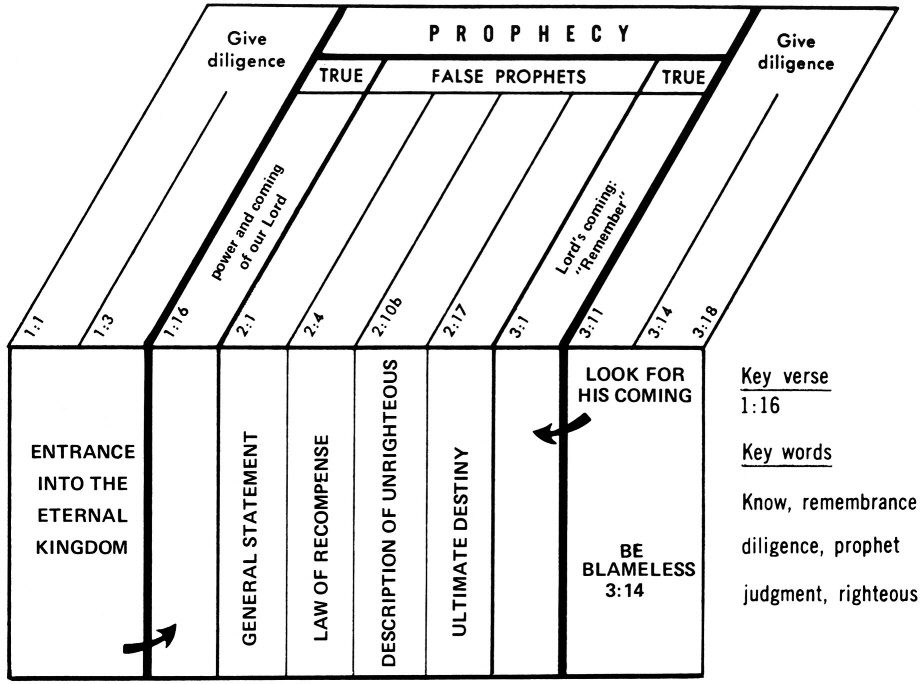
2 Peter: True and False Prophecy
Click chart to enlarge
Chart from Jensen's Survey of the NT - used by permission
|
2 PETER |
||||||||
| Cultivation of Christlike Character |
Condemnation of False Teachers |
Confidence in the Return of Christ |
||||||
| Greeting to Saints 2Pe 1:1-2 |
Growth in Christ 2Pe 1:3-14 |
Grounds |
Danger of |
Demise of |
"Decor" of |
Mockers in |
Manifest |
Maturity in light of that |
| Know Your Salvation |
Know |
Know Your Adversaries |
Know |
|||||
| True Prophecy (True Knowledge) |
False Prophets (False Teachers) |
Final Prophecy (Day of the Lord) |
||||||
| Holiness | Heresy | Hope | ||||||
| Development of Faith |
Denunciation of False Teachers |
Design of The Future |
||||||
2 Peter 1:10 Therefore, brethren, be all the more diligent to make certain about His calling and choosing you; for as long as you practice these things, you will never * * stumble (NASB: Lockman)
Greek: dio mallon, adelphoi, spoudasate (2 PAAM) bebaian humon ten klesin kai eklogen poieisthai; (PMN) tauta gar poiountes (PAPMPN) ou me ptaisete (2 PAAS) pote;
Amplified: Because of this, brethren, be all the more solicitous and eager to make sure (to ratify, to strengthen, to make steadfast) your calling and election; for if you do this, you will never stumble or fall. (Amplified Bible - Lockman)
Barclay: So, brothers, be the more eager to confirm your calling and your choice. For, if you do practice these virtues, you will never slip; (Westminster Press)
GWT: Therefore, brothers and sisters, use more effort to make God's calling and choosing of you secure. If you keep doing this, you will never fall away. (GWT)
KJV: Wherefore the rather, brethren, give diligence to make your calling and election sure: for if ye do these things, ye shall never fall:
NLT: So, dear friends, work hard to prove that you really are among those God has called and chosen. Doing this, you will never stumble or fall away. (NLT - Tyndale House)
Phillips: Set your minds, then, on endorsing by your conduct the fact that God has called and chosen you. If you go along the lines I have indicated above, there is no reason why you should stumble (Phillips: Touchstone)
Wuest: Wherefore, brethren, exert yourselves the more, and bend every effort to make for yourselves your divine call [into salvation] and your divine selection [for salvation] things that have been confirmed, for doing these things, you will never stumble, (Eerdmans)
Young's Literal: wherefore, the rather, brethren, be diligent to make steadfast your calling and choice, for these things doing, ye may never stumble,
THEREFORE BRETHREN: dio mallon, adelphoi:
- 2 Peter 1 Resources - Multiple Sermons and Commentaries
- 2 Peter 1:8-11 The Benefits of Growing in Godliness - Steven Cole
- 2 Peter 1:5-11 Reasons People Lack Assurance, Part 1 - John MacArthur
- 2 Peter 1:5-11 Reasons People Lack Assurance, Part 2 - John MacArthur
- 2 Peter 1:5-11 Reasons People Lack Assurance, Part 3 - John MacArthur
- 2 Peter 1:8-11 Virtue and Assurance, Part 2 - John MacArthur
Why the "therefore"? Because of our provision (everything pertaining to life and godliness" "His precious & magnificent promises") and our ''potential'' ("partakers of the divine nature"). In fact this verse closely parallels Peter's exhortation to diligence in (v5).
"Therefore" ties these great truths together.
Peter is saying that on the basis of everything I have said
"Therefore, brethren be all the more diligent… "
In this verse and the next Peter gives the 2 results of spiritual growth, the first relating to this present life (assurance of salvation) and the second to the future (abundant entrance into God's eternal kingdom)
Though God is “sure” who His elect are and has given them an eternally secure salvation (see notes 1 Peter 1:1; 1:2; 1:3; 1:4; 1:5; cf. see note Romans 8:28ff) (click for John MacArthur's 8 Sermon series on assurance of salvation and scroll down to "Reasons People Lack Assurance" and "Tests of Assurance), believers often do not have assurance of their salvation. Security is the Holy Spirit revealed objective fact that salvation is forever (see note Romans 8:16). Assurance is one’s (subjective) confidence that he or she possesses eternal salvation. In other words, believers who pursue the spiritual qualities delineated by Peter guarantees to themselves by the fruit God brings forth through them that they are called and chosen (elect) by God unto salvation.
BE ALL THE MORE DILIGENT: mâllon spoudasate (2 PPAAM):
- 2Pe 1:5 3:17
- 2 Peter 1 Resources - Multiple Sermons and Commentaries
- 2 Peter 1:8-11 The Benefits of Growing in Godliness - Steven Cole
- 2 Peter 1:5-11 Reasons People Lack Assurance, Part 1 - John MacArthur
- 2 Peter 1:5-11 Reasons People Lack Assurance, Part 2 - John MacArthur
- 2 Peter 1:5-11 Reasons People Lack Assurance, Part 3 - John MacArthur
- 2 Peter 1:8-11 Virtue and Assurance, Part 2 - John MacArthur
PETER IS CALLING FOR
AN ENERGETIC EFFORT
Diligent (4704) (spoudazo [word study] from the noun spoude [word study] Peter used earlier in 2Pe 1:5) means to do something in a hurry with intense effort and motivation or involving earnest application to some specific pursuit. In using this word Peter is conveying a sense of urgency and eagerness.
Spoudazo is aorist active imperative which commands a definitive action and conveys a sense of urgency. Make certain of His calling now. Don't put this off!
Spoudazo calls for an intense effort and an eagerness of spirit applied to the believer's walk. This effort is important as it will solidify their sense of assurance that the individual is truly a child of God and a member of His family.
Spoudazo - 11x in 11v - Gal 2:10; Eph 4:3; 1 Thess 2:17; 2 Tim 2:15; 4:9, 21; Titus 3:12; Heb 4:11; 2 Pet 1:10, 15; 3:14. NAS = diligent(6), eager(2), make every effort(3).
The writer of Hebrews conveys a parallel thought (Heb 6:11) expressing the
"desire that each one of (his readers) show the same diligence so as to realize the full assurance of hope until the end".
Are you struggling with lack of assurance that you are genuinely saved, delivered from the wrath to come? Peter is writing a great prescription for what ails you.
TO MAKE CERTAIN : poieisthai (PMN) bebaios:
- 2Ti 2:19 Heb 6:11,19 1Jn 3:19, 20, 21
- 2 Peter 1 Resources - Multiple Sermons and Commentaries
- 2 Peter 1:8-11 The Benefits of Growing in Godliness - Steven Cole
- 2 Peter 1:5-11 Reasons People Lack Assurance, Part 1 - John MacArthur
- 2 Peter 1:5-11 Reasons People Lack Assurance, Part 2 - John MacArthur
- 2 Peter 1:5-11 Reasons People Lack Assurance, Part 3 - John MacArthur
- 2 Peter 1:8-11 Virtue and Assurance, Part 2 - John MacArthur
THE ASSURANCE OF
OUR SALVATION ASSURED!
Make (4160) (poieo) means make or do. Poieo is in the present tense which calls for continuous effort -- making certain (strengthening our assurance of salvation) is to be a lifelong process, and as such is synonymous with progressive sanctification (holiness). Poieo is also in the middle voice which calls for the reader to personally initiate this action and to participate in the effects of the development of the virtues leading to holiness. Peter is saying "make certain for yourself". So if we are diligently supplying these qualities, and they are increasing, we can know that we have salvation and can avoid the awful struggle of doubt and fear associated with a lack of assurance.
Wayne Grudem writes that "The way that we confirm our call and election, then, is to continue to grow in “these things.” (Ed: The "things" mentioned in 2Pe 1:5; 1:6; 1:7 - see notes) This implies that our assurance of salvation can be something that increases over time in our lives. Every year that we add to these character traits in our lives, we gain greater and greater assurance of our salvation. Thus, though young believers can have a quite strong confidence in their salvation, that assurance can increase to even deeper certainty over the years in which they grow toward Christian maturity. If they continue to add these things they will confirm their call and election and will “never fall.” (Grudem, W: Systematic Theology: An Introduction to Biblical Doctrine. IVP; Zondervan, 1994) (Bolding added)
Certain (949) (bebaios from baino = to go, walk, step) describes that which is fixed, stable, sure, attested to and certified. It is something which is unwavering and persistent and thus can be relied on or depended on. It pertains to that which is known with certainty. It refers to something that has validity over a period of time (e.g., the promise made to Abraham remained valid to NT believers, see note Romans 4:16). Figuratively bebaios refers to that upon which one may build, rely or trust.
Bebaios is something that can be relied on not to cause disappointment for it is reliable and unshifting. In practice, though not originally, bebaios is close to pistos (4103) (trustworthy, dependable, reliable, faithful)
Bebaios - 8x in 8v. Translated a variety of ways in the NAS = certain, 1; firm, 2; firmly grounded, 1; guaranteed, 1; more sure, 1; steadfast, 1; unalterable, 1; valid, 1.
Romans 4:16 (note) For this reason it is by faith, that it might be in accordance with grace, in order that the promise may be certain to all the descendants, not only to those who are of the Law, but also to those who are of the faith of Abraham, who is the father of us all,
2 Corinthians 1:7 and our hope for you is firmly grounded, knowing that as you are sharers of our sufferings, so also you are sharers of our comfort.
Hebrews 2:2 (note) For if the word spoken through angels proved unalterable, and every transgression and disobedience received a just recompense,
Hebrews 3:14 (note) For we have become partakers of Christ, if we hold fast the beginning of our assurance firm until the end;
Hebrews 6:19 (note) This hope we have as an anchor of the soul, a hope both sure and steadfast and one which enters within the veil,
Hebrews 9:17 (note) For a covenant is valid only when men are dead, for it is never in force while the one who made it lives.
2 Peter 1:10 (note) Therefore, brethren, be all the more diligent to make certain about His calling and choosing you; for as long as you practice these things, you will never stumble;
2 Peter 1:19 (note) And so we have the prophetic word made more sure, to which you do well to pay attention as to a lamp shining in a dark place, until the day dawns and the morning star arises in your hearts.
TDNT says that bebaios means “standing firm on the feet,” “steadfast,” “maintaining firmness or solidity,” “steadfast for …” Hence “firm” in the sense of having inner solidity. In respect of abstract things and persons bebaios thus comes to mean “steady,” “sure,” “reliable” “steadfast,” or “certain. " (Kittel, G., Friedrich, G., & Bromiley, G. W. Theological Dictionary of the New Testament. Eerdmans)
Bebaios has a legal sense, signifying a legal guarantee, obtained by the buyer from the seller, to be gone back upon should a third party claim the thing. Thus in classic Greek bebaios described a warranty deed somewhat like a guarantee one might have today on an automobile or similar product. A holy life is like a "guarantee" demonstrating one's calling and election to others as well as to one's self.
Peter uses bebaios describing the Word of God, writing that
we have the prophetic word [made] (not in Greek. Literally = "word more sure") more sure, to which you do well to pay (close) attention (nautical term that meant to hold a ship in a direction and so to sail towards!) as to a lamp shining in a dark (miry, filthy, murky, dismal, dark) place, until the day dawns (shines through, breaks forth) and the morning star arises in your hearts. (see note 2 Peter 1:19)
What Peter is saying (although the translations in some versions make this meaning difficult to discern) is not that the eyewitness account of Christ's majesty at the transfiguration confirmed the Scriptures, but that the prophetic word is a more reliable attestation or verification of the teachings about the person, atonement, and second coming of Christ than even the genuine first hand experiences of the apostles themselves. Courson has an interesting comment on this passage adding that
If someone offered you the choice of either being on Mount Hermon with Jesus, seeing Moses and Elijah, hearing a voice from heaven—or having the Old Testament, most of us would choose to see the Lord glowing, to see Moses and Elijah, to hear a voice from heaven. But Peter would choose otherwise. Why? Because experiences fade, but the Word endures. The problem with experiences is that all they produce is a craving to see more… Having been around for a while, I would rather hear a great Bible study and be fed from the Scriptures than see a bunch of experiences unfolding. There was a time when this was not true in my life. But the longer I walk with the Lord, the more I realize that experiences fade—even the valid ones, even the wondrous ones. Only the Word endures. (Courson, J. Jon Courson's Application Commentary. Page 1589. Nashville, TN: Thomas Nelson)
The writer of Hebrews uses bebaios reminding his Jewish readers, some of whom were teetering on going back to Judaism, that in Christ we have a hope set before us and
This hope we have as an anchor (that which forms a bend i.e., an anchor and can stabilize the thing to which it is attached) of the soul, a hope both sure (does not totter, cannot be thrown down, steady, immovable, safe, secure from peril) and steadfast (bebaios) and one which enters within the veil, where Jesus has entered as a forerunner for us, having become a high priest forever according to the order of Melchizedek." (He 6:19, 20-see notes Hebrews 6:19; 20)
Comment: Vincent says means here a hope that sustains one’s steps in going, one that does not break down under what steps upon it
MacDonald comments that
"In the storms and trials of life this hope serves as an anchor of the soul. The knowledge that our glorification is as certain as if it had already happened keeps us from drifting on the wild waves of doubt and despair. The anchor is not cast in the shifting sands of this world but takes hold in the heavenly sanctuary. Since our hope is the anchor, the meaning is that our hope is secured in God’s very Presence behind the veil. Just as sure as the anchor is there, we shall be there also." (MacDonald, W & Farstad, A. Believer's Bible Commentary: Thomas Nelson)
Bebaios was used of confirming something as in the legal terminology of validating a will. So a Christian by growing in grace becomes assured (stabile, secure in the salvation, having assurance of their salvation) of having been called and elected by God. This stresses the responsibility of the believer to live in conformity to his calling into a partaking of the divine nature in Christ Jesus (2Pe 1:4).
The exhortation is that the believer should make sure of the fact that he is saved by seeing to it that the Christian graces superabound in his life. There is no idea here of making sure that we retain our salvation but that we possess salvation.
Spurgeon comments that "Full assurance is an excellent attainment. It is profitable for a man to be certain in this life, and absolutely sure of his own calling and election. But how can he be sure? Now, many of our more ignorant hearers imagine that the only way they have of being assured of their election is by some revelation, some dream, and some mystery. I have enjoyed very hearty laughs as the expense of some people who have trusted in their visions. Really, if you had passed among so many shades of ignorant professing Christians as I have; and had to resolve so many doubts and fears, you would be so infinitely sick of dreams and visions that you would say, as soon as a person began to speak about them, "Now, do just hold your tongue." "Sir," said a woman, "I saw blue lights in the front parlor when I was in prayer, and I thought I saw the Saviour in the corner, and I said to myself I am safe."
Peter is not necessarily urging the readers to engage in more strenuous activities per se. A believer's spiritual growth confirms that God has called and chosen him. The "blighted" condition pictured in 2Pe 1:9 destroys such personal assurance.
In 1654 Thomas Brooks wrote the following statement regarding the believer's assurance of salvation…
Assurance is the believer's ark where he sits like Noah, quiet and still in the midst of all distractions and destructions, commotions and confusions… Most Christians live between fears and hopes and hang, as it were, between heaven and hell. Sometimes they hope that their state is good, other times they fear that their state is bad. Now they hope that all is well and that it shall go well with them forever. And then they fear that they shall perish by the hand of such a corruption or by the prevalency of such to temptation. And so they are like a ship in a storm, tossed here and there. (Heaven on Earth by Thomas Brooks written in 1654)
Charles Haddon Spurgeon wisely reminds us that "Faith saves us, but assurance satisfies us… Full assurance is not essential to salvation, but it is essential to satisfaction… No believer should be content with hoping and trusting, he should ask the Lord to lead him on to full assurance, so that matters of hope may become matters of certainty.
Related Resources on Assurance:
- William Plumer - Assurance of Grace and Salvation - What It It? How to Attain It. Why More Do not Enjoy It.
- J C Ryle - Assurance
- Thomas Brooks - "Heaven on Earth" (Read intro to this book) - Assurance has amazing transforming powers. It changes iron to gold, ignominies to crowns, and all sufferings to delights!
- Thomas Brooks - Precious Remedies Against Satan
Thomas Brooks exhorts us to…
Let heaven be a man's object, and earth will soon be his abject. Assurance of more great and glorious things, breed in the soul a holy scorn and contempt of all these poor, base worldly things —which the soul before valued above God, Christ and heaven.
The more the soul is conformed to Christ, the more confident it will be of its interest in Christ.
Many a Christian has his pardon sealed in the court of heaven before it is sealed in the court of his own conscience.
Though no man merits assurance by his obedience, yet God usually crowns obedience with assurance.
Perfect signs of grace can never spring from imperfect grace.
Genuine holiness will yield you a heaven hereafter; but genuine assurance will yield you a heaven here. He who has holiness and knows it, shall have two heavens —a heaven of joy, comfort, peace, contentment, and assurance here—and a heaven of happiness and blessedness hereafter.
Genuine assurance will be a spring of joy and comfort in you. It will make heavy afflictions light, long afflictions short, and bitter afflictions sweet. It will make you frequent, fervent, constant, and abundant in the work of the Lord. It
will strengthen your faith, raise your hope, inflame your love, increase your patience, and brighten your zeal. It will make every mercy sweet, every duty sweet, every ordinance sweet, and every providence sweet. It will rid you of all your sinful fears and cares. It will give you ease under every burden, and make death more desirable than life. It will make you more strong to resist temptation, more victorious over opposition, and more silent in every difficult condition.
Genuine assurance will turn… every winter night into a summer's day, every cross into a crown, and every wilderness into a paradise.
Genuine assurance will be… a sword to defend you, a staff to support you, a cordial to strengthen you, a medicine to heal you, and a star to lead you.
Well, remember this—next to a man's being saved, it is the greatest mercy in this world—to know that he is saved.
ABOUT HIS CALLING: ten klêsin:
- Ro 1:1, 7, 8:28, 29, 30; 8:30, 9:24; 1Cor 1:2, 1Cor 1:9; 1Cor 1:24, 1Cor 1:26, Gal 1:6; Eph 1:18, 4:1, 1Thes 2:12; 2Thes 2:14; 2Ti 1:9; Heb 3:1; 1Pet 2:9,21;2 Pet 1:10;Jude 1:1, Rev 17:14,
- 2 Peter 1 Resources - Multiple Sermons and Commentaries
- 2 Peter 1:8-11 The Benefits of Growing in Godliness - Steven Cole
- 2 Peter 1:5-11 Reasons People Lack Assurance, Part 1 - John MacArthur
- 2 Peter 1:5-11 Reasons People Lack Assurance, Part 2 - John MacArthur
- 2 Peter 1:5-11 Reasons People Lack Assurance, Part 3 - John MacArthur
- 2 Peter 1:8-11 Virtue and Assurance, Part 2 - John MacArthur
GOD'S CALLING
Note that "calling and choosing" are modified by a single definite article (ten) and thus are viewed in essence as a "unit", for both acts are integrally, intimately related to the origin and efficacy of our salvation by grace through faith.
Calling (2821) (klesis [word study] from kaleo = to call. See also study of related word - kletos) means a call and was used for an invitation to a banquet. In the NT the word is used metaphorically of the call or invitation to come into the kingdom of God with all its privileges. Here "klesis" refers to the divine call by which Christians are introduced into the privileges of the gospel. God’s invitation (klesis) to man to accept the benefits of His salvation is what this calling is all about, particularly in the gospels. It is God’s first act in the application of redemption according to His eternal purpose (Ro 8:28). A distinction is made between God’s calling and men’s acceptance of it (Mt 20:16).
Klesis is used 11 times in the NT in the NAS (Click study of related word kletos, and a discussion of who are "the called")
Romans 11:29 (note) for the gifts and the calling of God are irrevocable.
1 Corinthians 1:26 For consider your calling, brethren, that there were not many wise according to the flesh, not many mighty, not many noble;
1 Corinthians 7:20 Let each man remain in that condition in which he was called.
Ephesians 1:18 (note) I pray that the eyes of your heart may be enlightened, so that you may know what is the hope of His calling, what are the riches of the glory of His inheritance in the saints,
Ephesians 4:1 (note) therefore, the prisoner of the Lord, entreat you to walk in a manner worthy of the calling with which you have been called,
Ephesians 4:4 (note) There is one body and one Spirit, just as also you were called in one hope of your calling;
Philippians 3:14 (note) I press on toward the goal for the prize of the upward call of God in Christ Jesus.
2 Thessalonians 1:11 To this end also we pray for you always that our God may count you worthy of your calling, and fulfill every desire for goodness and the work of faith with power;
2 Timothy 1:9 (note) who has saved us, and called us with a holy calling, not according to our works, but according to His own purpose and grace which was granted us in Christ Jesus from all eternity,
Hebrews 3:1 (note) Therefore, holy brethren, partakers of a heavenly calling, consider Jesus, the Apostle and High Priest of our confession.
2 Peter 1:10 (note) Therefore, brethren, be all the more diligent to make certain about His calling and choosing you; for as long as you practice these things, you will never stumble;
Klesis can also refer to a call unto Christian service or ministry. That the calling is to more than a Christian profession is clear from the experiences which Paul associates with it. (see note Romans 1:1) No one can be a chosen one unless he is a called one. The initiative always comes from God.
Louw Nida defines klesis as an
urgent invitation to someone to accept responsibilities for a particular task, implying a new relationship to the one who does the calling; the station in life or social role which one has."
Vine says klesis
a calling, is always used in NT of that calling the origin, nature and destiny of which are heavenly (the idea of invitation being implied); it is used esp of God's invitation to man to accept the benefits of salvation.
In the present context klesis refers to those who have been summoned by God (the following phrases are meant to be read as one long sentence which gives a Biblical statement regarding calling)…
The called are those who have been summoned by God… called…
- according to His purpose (Kletos - Ro 8:28)
- to salvation (Kaleo - Ro 8:30)
- saints by calling (Kletos - 1Co 1:2)
- both Jews and Greeks (Kletos - 1Co 1:24)
- having been called (kaleo) "with a holy" calling (klesis) (2Ti 1:9)
- heavenly calling (klesis) (Heb 3:1)
- out of darkness into His marvelous light (Kaleo - 1Pe 2:9)
- to walk worthy (Kaleo - Ep 4:1)
- by grace (Kaleo - Gal 1:6)
- not from among Jews only, but also from among Gentiles (Kaleo - Ro 9:24)
- through the "gospel" that we "may gain the glory of our Lord Jesus Christ" (Kaleo - 2Th 2:14)
- and be brought "into fellowship with His Son, Jesus Christ our Lord" (Kaleo - 1Co 1:9)
- and return in triumph "with Him" at the end of this age (Kletos - Re 17:14).
God's great doctrine of our calling should cause all the "called of Jesus Christ" to exclaim "Glory!"
While God’s choice of the elect is firm and certain in God (2Ti 2:9-see note), it may not always be obvious to the individual Christian.
McGee summarizes Peter's command explaining that…
In other words, the security of the believer is objective; it is something that cannot be disturbed. However, your assurance can certainly be disturbed by the life you live. If your life is not lived in sincerity and truth, you are bound to lie on your bed at night and wonder if you really have been born again. While it is true that Christ has done everything necessary to save you and keep you saved, your Christian life to be meaningful is something that you have to work at.
Who are the CALLED? Well, they are those who have heard. The Lord Jesus made it clear when He said,
"My sheep hear My voice, and I know them, and they follow Me” (Jn 10:27).
If you are following someone or something else, you haven’t heard Him, you are not one of His sheep. The ones who hear and follow Him are the called ones. Let’s not argue about election. It is as simple as this: He calls, and you answer. If you have answered, you are among the elect, one of “the called of Jesus Christ.” Paul assures the Roman Christians that they are called ones. In the writings of both Paul & Peter when they mention "called" ("call", "calling", etc), the reference is to an "effectual" call, that is a call which is answered & thus "the called" equates essentially with those who are "the chosen" or "the elect".
Note that the gospels use the term called differently -- in (Mt 22:1-13,14) many were "called" to the "wedding feast" but few were "chosen", so in the gospels the term "call… " was not synonymous with an effectual call to salvation.
Spurgeon makes the distinction between "general" and "special" calling writing that…
By the word "calling" in Scripture, we understand two things—one, the general call, which in the preaching of the gospel is given to every creature under heaven; the second call (that which is here intended) is the special call—which we call the effectual call, whereby God secretly, in the use of means, by the irresistible power of his Holy Spirit, calls out of mankind a certain number, whom he himself hath before elected, calling them from their sins to become righteous, from their death in trespasses and sins to become living spiritual men, and from their worldly pursuits to become the lovers of Jesus Christ."
Peter pointed out that “calling” and “election” go together. The same God who elects His people also ordains the means to call them. The two must go together, as Paul wrote to the Thessalonians
God has chosen you from the beginning for salvation through sanctification by the Spirit and faith in the truth… It was for this He called you through our gospel,” (2Th 2:13,14).
We do not preach election to unsaved people; we preach the Gospel (cf 1Cor 1:17,23,2:2). But God uses the inherent power (Ro 1:16, 1Cor 1:18) of the Gospel to call sinners to repentance, and then those sinners discover that they were of the elect, chosen by God! Let's face it this truth is too mysterious & too deep for finite human minds to comprehend (cf Dt 29:29).
If you walk around with your eyes closed, you will stumble! But the growing Christian walks with confidence because "sees where he is going" & he knows he is secure in Christ. It is not our profession of faith that guarantees that we are saved but it is our progression in the faith that gives us assurance. The person who claims to be a child of God but whose character and conduct give no evidence of spiritual growth is deceived and heading for judgment & eternal torment in the lake of fire (Titus 1:16)
Excerpt from John Brown's Discourse - (click for entire work)
I now proceed to attempt an answer to the second question, What does the apostle call on these persons to do who have obtained like precious faith with the apostles; are in possession of grace and peace, but need more of both; and are the called and chosen of God? He calls on them to “give all diligence to add to their faith virtue, to virtue knowledge, to knowledge temperance, to temperance patience, to patience godliness, to godliness brotherly kindness, and to brotherly kindness charity:” and he calls on them to “give all diligence to make their calling and election sure.” These two injunctions, though lying at some distance from each other in the text, ver. 5 and 10, are closely connected. ‘The making sure their calling and election,’ seems the duty which it is the primary object of the apostle to enjoin. Everything which precedes its injunction in ver. 10 seems plainly intended to bear on it. This appears to be intimated by the manner in which it is introduced: “Wherefore the rather,” looking back to all that had been said. The injunction in the 5th and 6th verses contains a statement of the way in which the injunction in the 10th verse is to be complied with. It is by “giving all diligence to add to his faith virtue, and to virtue knowledge, and to knowledge temperance, and to temperance patience, and to patience godliness, and to godliness brotherly kindness, and to brotherly kindness charity,” that the Christian is to “make his calling and his election sure.” The order, then, best fitted to bring the whole subject, in a satisfactory form, before the mind, seems to be, to explain first, what the apostle would have Christians to do—“make their calling and election sure;” then, how he would have them to do it; and then, show how the means pointed out by the apostle are fitted to gain the end proposed.
Let us then inquire what the apostle calls on Christians here to do; or, in other words, What does he mean by their “making their calling and election sure?” “The calling” here referred to is, as we have already shown, in the last section, the being brought to faith and obedience, and to the enjoyment of the blessings connected with these—“grace and peace,” through the word of the truth of the Gospel, attended by the glorious power of the Holy Ghost; and “election” is either the sovereign eternal choice of God, of which calling and all other heavenly and spiritual blessings are to be considered as the results, or the manifestation of this, in the actually selecting, from among the mass of mankind, of the chosen ones, by their effectual calling, and making them a part of His “peculiar people,” His “holy nation,” His “inheritance,” His “purchased possession.”
The question, then, now before us is, What is meant by “making sure this calling and election?” Some interpreters have supposed that as, by an ordinary figure of speech, faith, which properly means believing, is sometimes used to denote the truth which is believed; hope, which properly means expecting, is sometimes used to signify the thing hoped for; so calling and election here do not mean so much, if at all, the being called, the being elected, as the glorious state of holy happiness to which Christians are called and chosen, and that for a Christian to “give diligence to make sure his calling and election,” is just an expression synonymous with “to seek for glory, honour, and immortality”—to endeavour to obtain personal possession of “the salvation that is in Christ, with eternal glory,” to which they have been called—to “lay hold on the eternal life” to which they have been chosen.
This is, however, an unwarranted interpretation, not only of the words “calling” and “election,” but also of the expression “make sure,” which does not mean to secure something future, but to establish or make sure something that is understood already to exist. On this principle, it is plain also, that the words cannot signify, ‘Give all diligence to secure that ye may be called and chosen.’ The persons here addressed had, if their profession was genuine, been called by a glorious power, and this call was at once the evidence that they had been from eternity elected of God, and the means by which He had selected them and separated them from the world.
The question naturally occurs here, How can the calling and election of such persons be made sure? The calling and the election, supposing them really to have taken place, are as sure as they can be. This calling is without repentance: “The purpose of God, according to election, stands.” Whom God thus calls and chooses, He never rejects. The making sure refers not to the existence but to the evidence, of the facts referred to. For a Christian to “make his calling and election sure,” is to afford satisfactory evidence that he has been called and elected. The meaning is, ‘Seek diligently to make it evident, both to yourselves and others, that you are indeed called and elected.’ The force of the expression before us is illustrated by a phrase in the 19th verse of this chapter: “We have a more sure word of prophecy,” or rather, as I shall endeavour to show, by and by, ‘We have the word of prophecy more confirmed.’ The word of prophecy in itself, could never become surer. Its certainty rests on the immutability and veracity of God; but the truth of the word of prophecy was more confirmed; that is, they who lived in the times of the apostles, when so many of its strangest declarations were accomplished, had stronger evidence of its being sure than they who lived at a period when almost all prophecy was unfulfilled prophecy. There are two men, both of them called and chosen; their calling and election are equally sure, in the sense that it is certain they are so called and chosen; but the one man may not be sure whether he is called and chosen or not, and be full of doubts and fears; the other may be satisfactorily convinced that he is called and chosen, and have abundant consolation and good hope. All who know them may stand in doubt in reference to the one, and have no doubt at all about the other. The apostle’s injunction on Christians is, that they should be diligent in endeavouring to secure that which will afford satisfactory evidence, to themselves and to others, that they are indeed the called and the chosen of God.
It is necessary that those who profess to be “called and chosen,” should inquire whether they are so indeed; for many suppose themselves called and chosen who have no satisfactory evidence that they are—nay, who have abundant and most satisfactory evidence, if they would but attend to it, that they are not. Because they hear what they think is the Gospel, and what may very possibly be the Gospel, they think they are among the called; and because they are members of a society which is called a Christian church, and very probably may be so, they think they are among the chosen, the selected ones, while their whole temper and behaviour make it evident that, if the call of the Gospel has come to them, it never has come with power—that they are yet in ignorance, error, unbelief, and disobedience—and that, if they are nominally among the “children of God,” they are in reality among “the children of the wicked one.”
A mistake here must be dangerous, and, if persevered in, fatal. He who thinks himself called when in reality he is not, is in far greater danger of never being called than he who is quite conscious that he is an entire stranger to what is termed the Christian calling, and quite careless about it. He who thinks he is among the chosen ones, when in reality he is not, is less likely ever to be among them than he who is quite aware that he is entirely of the world, and has no claim, as he has no desire, to be classed among Christians. Hypocrites and self-deceivers are in the most hazardous circumstances of any class of men—“Publicans and harlots enter into the kingdom of God before them;” and wherever a profession is made, men should give diligence to make the calling and the election they lay claim to sure, lest they be found at last to have been hypocrites or self-deceivers. The result of seeking after evidence may be, in very many cases would be, that no satisfactory evidence of calling and election exists. So far from their calling and election being established, what they supposed to be so would turn out to be pretence and delusion. This is painful; but is it not much better to be made aware of this now than to dream on till they wake in hell? The blessings they supposed themselves possessed of are yet within reach; and, if honestly sought for, will assuredly be found. If the delusion continue, they will never be found, for they never will be sought for.
If it be good for the hypocrite and self-deceiver to know that they are hypocrites and self-deceivers, it is good for the genuine Christian to know that he is not a hypocrite or self-deceiver. It is good for him to have his calling and election made sure to himself—to know what, by the grace of God, he really is. It promotes his comfort, it promotes his holiness. A Christian in doubt about his calling and election must be unhappy. On the other hand, an inward, well-grounded conviction, that he is among the “called and chosen” who form the Lamb’s army, must be productive of inward satisfaction and peace.
It sanctifies as well as solaces the mind. It gives definite direction and increased ardour to gratitude for heavenly and spiritual blessings. How can a man very strongly feel, or very intelligibly express, gratitude for blessings which he is not sure whether he possesses or not? It increases hope, not by giving it a new basis, but by showing that we are indeed resting on the only sure foundation. It makes us, with enlarged hearts, run in the way of God’s commandments. How closely connected is our sanctification with the having our calling and election made sure, must be obvious, when we consider that it is only in the degree in which we understand and believe the Gospel, and live under its influence, that we can be assured of our calling and election. Every satisfactory proof of these is the exercise of some holy principle, the discharge of some commanded duty. The Christian, as will come out more fully in a subsequent part of our discussions, cannot grow in well-grounded assurance of his calling and election, except by growing in knowledge, faith, and holiness; and when he does thus grow, his calling and election are assured to him, without his making them the subject of direct and anxious inquiry. He cannot doubt, if he would.
While it is of great importance to every one who professes to have been called and chosen to know whether this professed calling and election can be established, confirmed, made sure, by satisfactory, appropriate evidence; while it is of great importance to the true Christian to have the calling and election he has obtained from God so confirmed to him by satisfactory and appropriate evidence as that he cannot doubt of them; it is also of great importance to the unbelieving world that the calling and election of Christians should be made sure, or confirmed, by such evidence as it is capable of forming a judgment about, and being impressed with. The world does not believe either in the calling or the election of Christians. To it these are mere cant terms, to which it attaches no very definite meaning. But it understands well enough that Christians profess to have been led, by a divine influence, to embrace certain views, and prosecute certain objects—views and objects which necessitate their separation from the great body of their fellow-men in a variety of respects, and form them to a character, and bind them to a line of conduct, different from the “course of the world;” and when the world sees men laying claim to the Christian name, no better—it may be, in some respects, worse, than those who make no such claims, it naturally enough comes to the conclusion that either these men are hypocrites, or, if not, Christianity is but a name.
But when Christians “make their calling and election sure,” by “a conversation becoming the Gospel;” when worldly men see Christians acting a part which they cannot help approving, and even admiring—a part, they know well, their principles could never enable them to act—discovering a patience and fortitude under suffering, a meekness amid provocation, incorruptible integrity in spite of the strongest temptations, self-sacrifice in the cause of humanity;—they are constrained to say, not only that these are wonderful people, but that these strange effects must have an adequate cause. There is such a thing as Christian principle; it is a powerful thing; and the effect in every such case should be—in many cases is—the conclusion, ‘God is with these men of a truth; that must be good which produces such good effects.’ Oh, what have professed—nay real Christians to answer for, in reference to the unbelief and destruction of worldly men, in consequence of their not making “their calling and election sure;” in consequence of their not manifesting the dispositions, and following the conduct, which would constrain the world to say, ‘These are Christians; and if these are Christians who are ever telling us that they are by no means so good as their religion is, what must Christianity be?’ Thus, reproach is borne down, infidelity disarmed, the ignorance of foolish men put to shame, and men constrained to “glorify God in the day of visitation.”
Thus to “make their calling and election sure,” Christians must give “all diligence.” The object to be gained deserves diligence; it cannot be gained without diligence; and with diligence, properly directed as to its end, and properly guided in its movements, it will assuredly be gained.
The ascertaining, then, our “calling and election,” both to ourselves and to others—the proving it to be something more than an abstraction and a name; the making evident that we are called by a glorious power to be a peculiar people—is the duty which the apostle here enjoins. To perform it, there must evidently be a distinct apprehension of what our Christian calling and election are, and satisfactory evidence afforded that calling and election are realities—realities in us. It is of infinite importance that every man professing to be called and chosen should make sure whether he be so or not. It is of the highest importance, both to themselves and to the world, that they who are really called and chosen should give full proof of their calling and election.
§ 3. HOW? THE MANNER IN WHICH THE DUTY ENJOINED IS TO BE DONE BY THE PERSONS ADDRESSED (See page 58)
But how are they to do so? This forms the third of the questions which must be put and answered, in order to our understanding the text, and deriving from it those practical advantages which it, when rightly understood, is calculated to communicate. How are Christians to make their calling and election sure? The general answer is, by “giving diligence “—by earnestly and assiduously using the appropriate means. But what are these means?
Are we to be diligent in seeking to lay hold on the records of the eternal counsels, and secret operations of God on the minds and hearts of men, that we may peruse it for ourselves and expose it to the view of the world, and say, ‘there is the register of the time and date of my conversion,’ and ‘there is my name written among “them who shall be the heirs of salvation” by the hand of God, before the foundation of the world?’ “All diligence” employed in such a search would be worse than lost. It is not in this way that any man can “read his title clear to mansions in the skies.” To expect to have our calling and election made sure, in any way analogous to this—such as a conviction darted into the mind as by immediate revelation—is deplorable delusion.
Are we, then, to be diligent in scrutinizing the state of our own minds and hearts, that we may find there what will make our “calling and election sure?” I would not wish to say a single word in disparagement of self-examination, an exercise so plainly commanded in Scripture, and so obviously fitted to serve many important purposes, especially as it is an exercise to which those who need it most are so strongly disinclined. But, I must say, that we sadly mistake, when we go to the utterances of our conscience for a ground of hope. If the heart is at all honest, its declaration will be, ‘I condemn you; if you wish a ground of hope, you must seek it elsewhere.’
And, even to serve as a source of evidence that we are called and chosen, self-examination requires to be cautiously conducted; for, to the person ignorant of what is implied in being called and chosen, and unaware of the deceitfulness of the heart, such self-examination as he is likely to institute will end in a self-flattering verdict, saying that all is safe where there is no safety; all is right where all is wrong; “peace, peace, where there is no peace.” And, on the other hand, to the man who has such views on these subjects as the Scriptures, carried home by the Spirit, produce—if the faith of the truth respecting the free grace of God and the Saviour’s finished work and the Spirit’s all-powerful energy, is under a temporary eclipse—self-examination, however honest and thorough, is likely to increase, rather than diminish, doubt and perplexity; and just so much the more likely to produce such an effect, the more honest and thorough it is. The more diligently we dig into our own hearts, the less sure do our calling and election seem to become. Thorough self-examination is of great use as a means to prevent our forming a too favourable view of our own state and character, and, by shewing us what is wanting and what is wrong, to lead us to use the appropriate means for having the former supplied, and the latter corrected. But not only are we wrong, utterly wrong, when we seek to discover in ourselves something on which we may rest our hope of pardon; we are wrong, too, when we seek solely or chiefly, in the state of our minds and hearts, at the time of self-inquiry, the evidence that we have been pardoned—called—chosen. As the glorious finished work of Christ is the only ground of hope, the best evidence that I am resting on it, is not the recollected, but the present faith of that truth—and that present faith, manifesting its existence and power in working by love, purifying the heart, overcoming the world. It is by following out the faith of the Gospel to its natural results on the mind, the heart, and the conduct—the giving ourselves up to its influence, that we are sanctified, and made to know that we are sanctified; it is thus that “we make our calling and election sure.”
The doctrine of the apostle seems to be—we are to “give all diligence to add to our faith, virtue; to virtue, knowledge; to knowledge, temperance; to temperance, patience; to patience, godliness; to godliness, brotherly-kindness; to brotherly-kindness, charity”—it is by being thus diligent that we are to make our “calling and election sure”—afford satisfactory evidence both to ourselves and others, that we have been called and selected by God.
These words contain a very condensed, yet a very comprehensive, summary of Christian morals, exhibiting in a striking point of view that character of connection, consistency, symmetry, and completeness, by which the morality of the Bible is so palpably and so favourably distinguished from the morality taught in the schools of heathen philosophy, and exemplified in the characters of the heroes and sages of ancient Greece and Rome. The heathen morality is not based on sound principles, and in its details there is much wanting and much wrong. It errs equally by defect and excess, so that the best portions of it have been justly enough termed, “glittering fragments,” and “splendid enormities.” It presents rather the materials of a system, than a system itself solidly founded and fitly framed; and when the attempt is made to construct such a system out of these materials, they are found not to suit each other—they will not dovetail into each other—they will not cohere—the foundation is sometimes too wide, sometimes too narrow, and the result is a structure destitute of proportion, strength and stability. However grand and beautiful detached portions of the building may be, there is a general want of congruity, and it is found, in a great measure, if not entirely, unfit for the purpose for which it is professedly raised—the right regulation of the dispositions and conduct of men.
It is altogether otherwise with the morality of divine revelation, especially in the completed form which it wears in the New Testament. The morality of the New Testament is based on such wide and accurate views, in reference to the constitution and relations of man, as naturally to suggest, when you take into consideration the circumstances of the sacred writers, strong corroborative evidence of the superhuman origin of the books in which it is unfolded. How else should Peter, and James, and John, Galilean fishermen, rise as moralists so far above the profoundest thinkers among the Greeks and Romans? How is it that Jews—in many cases unlettered Jews—have given to the world the only complete and consistent system of morals it has ever seen? No well informed man can deny the premises in this argument, and it is difficult to perceive how he can escape from the conclusion.
Of those qualities in the morality of the New Testament, to which we have adverted, the passage before us furnishes us with a striking illustration. At first sight, the enumeration of those mental dispositions and habits, contained in these verses, may seem a “merely vague and fortuitous congeries of moral qualities,”—some of them not very clearly or completely distinct from others, and not so arranged as to indicate any mutual relation to each other. This impression, however, is caused in a great measure by the looseness of our English translation, which, certainly, in more than one instance, but imperfectly brings out the sense of the apostle. For, first, the term rendered “add,” has a wider and more distinctive meaning than our word, properly signifying ‘to bring together—into proper combination and correspondence.’ It indicates not merely the adding the quality spoken of, to that immediately preceding, as unconnected items; but the com-mixture of the whole as a set of ingredients, all of which are necessary to the production of the desired result—the making Christian “calling and election sure,” in the reallization of the virtues of the Christian character, and the performance of the duties of the Christian life. The phraseology would have suited the making up of a medicine composed of various articles, the efficacy of which, as a remedy, depended on these component ingredients being duly proportioned and intimately combined. Then, the word rendered “virtue” means, not moral excellence in general, but energy, courage; the word rendered “temperance” means, not merely moderation in the indulgence of the appetites, but self-command; and the word rendered “charity” menas, neither almsgiving nor love in the widest sense, but universal benevolence, as contra-distinguished from “brotherly-kindness.”
Something approaching to the view of Christian morals, in their mutual connection and completeness, exhibited by the apostle here, may, perhaps, be thus given in a brief paraphrase on his words—‘Having believed the Gospel (for the apostle presumes they all had faith), see that under its influence you display that energy which is necessary to its open, fearless profession—to the discharge of the numerous and difficult duties which grow out of it—and to the endurance of the varied and severe trials to which your attachment to it may expose you; and see, too, that this energy, based on faith, be regulated by a wise use of wide and enlightened views of what is true, and right, and becoming; see that, as your faith is not pusillanimous, your energy be not rash and ill-directed; and let this character of energetic, enlightened faith manifest itself in the manner in which you conduct yourselves in reference to the good and evil of the present state—producing self-possession, self-mastery—at once making you moderate in all your affections and pursuits, in reference to its enjoyments; preventing the world from lording it over you, and rendering you superior to its disordering influences; and preserving you from succumbing under the pressure of its afflictions. Farther, let that connection with God, with which your faith makes you acquainted, have its due, i.e. a supreme and constant influence over your minds. Cultivate communion with God in all appropriate and appointed methods, and let all your virtues, all your duties, have a decidedly religious character. Whatsoever you do, do it as to God and not to man. But let not your piety be ascetic or unsocial. You are connected with your fellow-men—specially with those who are your fellow-Christians standing in the same spiritual relation to God as you do, love them as brethren—cultivate and manifest a peculiar affection to them. But forget not that you are also connected with all mankind—that you are citizens of the world as well as members of the Church; and cultivate and manifest a benevolent affection to every human being, so that you may “do good to all men as you have opportunity,” while you do good specially “to those who are of the household of faith.” ’
This is Christian character, this is Christian conduct, and it is by cultivating the one, and exemplifying the other, that the Christian calling, and the Christian election, are to be made sure. How complete! how symmetrical! is this view of human duty. Everything is here, and in the right place and order. First comes an energetic, enlightened faith in God—the grand principle of conduct; then personal virtue, consisting in temperance and patience, enlivened and sustained by godliness; then social virtue, first, in reference to fellow-Christians—“brotherly-kindness;” second, in reference to mankind at large—“charity.” “Such is the edifice which,” to use the words of an accomplished preacher, to whom I feel indebted for giving greater consistency and completeness to the view I had formed on this passage, “every individual Christian, as a wise, diligent, and honest workman, is to build on the foundation of the common faith—faith like precious with that of the apostles.” “The series begins in faith and ends in love; it touches at the one extremity all that is revealed of God and the infinite; and on the other, all that belongs to the world and man—while between the two are placed, in their order, whatever can be required for practical goodness, for the various utterances of a manifold virtue, for the personal and relative, the active and the passive, the divine and the human.”
What is the only safe ground of a sinner’s hope? How does that only safe ground become the ground of my hope? And how am I to know that that only safe ground has become, and continues to be, the ground of my hope, so that I may be assured that my hope is not the “hope of the hypocrite,” that “shall perish,” but “the hope that maketh not ashamed? “These are three questions to which it deeply concerns every man to seek for satisfactory answers. Each has its own answer, and it is dangerous to mistake the answer of one of them, for the answer of either of the others. The only safe ground of the sinner’s hope is the sovereign mercy of God, exercised in consistency with His righteousness, through the atoning sacrifice of His Son, made known to us in the Gospel revelation. The only way in which this only safe ground of hope can become the ground of my hope, is by my believing the word of the truth of the Gospel; and the only way in which I can obtain permanent, satisfactory evidence, that the only safe ground of hope has become the ground of my hope, is by continuing to believe the Gospel, and by living under the influence of the Gospel believed.
The fifth, sixth, and seventh verses of this chapter may be considered as the apostle’s answer to the third question. These words are his directory to believers how to “make their calling and their election sure.” It is as if he had said, ‘Ye have “obtained like precious faith” with us, the apostles. Hold fast that faith, nothing can be done without it; and “add to that faith, virtue; and to virtue, knowledge; and to knowledge, temperance; and to temperance, patience; and to patience, godliness; and to godliness, brotherly-kindness; and to brotherly-kindness, charity.” Thus, and thus only, will you “make your calling and election sure;” thus you shall “never fall, but have ministered to you an abundant entrance into the everlasting kingdom of our Lord and Saviour Jesus Christ.” ’
The sum of this statement is, ‘If you would prove to yourselves or others that ye are the called and elected of God, be, and do, what the called and elected of God are called and elected to be and do. If you would know that you are Christians—be Christians.’ In these words he shows what the called and elected of God are called and elected to be and do. He gives us a very brief, and yet a very complete view of Christian disposition and conduct, and suggests much important instruction to the individual believer, as to how he is to realize these in his own experience.
CHOOSING: kai eklogen:
- Ro 8:28, 29, 30, 31 1Th 1:3,4 2Th 2:13,14 1Pe 1:2
- 2 Peter 1 Resources - Multiple Sermons and Commentaries
- 2 Peter 1:8-11 The Benefits of Growing in Godliness - Steven Cole
- 2 Peter 1:5-11 Reasons People Lack Assurance, Part 1 - John MacArthur
- 2 Peter 1:5-11 Reasons People Lack Assurance, Part 2 - John MacArthur
- 2 Peter 1:5-11 Reasons People Lack Assurance, Part 3 - John MacArthur
- 2 Peter 1:8-11 Virtue and Assurance, Part 2 - John MacArthur
GOD'S CHOOSING
See C H Spurgeon's sermon entitled Election
Choosing - That is "election". Election is the benevolent purpose of God by which any are chosen unto salvation so that they are led to embrace and persevere in Christ’s bestowed grace and the enjoyment of its privileges and blessings here and hereafter.
Choosing (1589) (ekloge from eklegomai [eklego] in turn from ek = out + lego = select, choose, eklegomai meaning to choose or select for oneself, but not necessarily implying rejection of what is not chosen. See study of related word eklektos = elect) means literally a choosing out, a picking out, a selection or an election (2Pe 1:10, 1Th 1:4 - referring to God's selection of believers). In the passive sense ekloge refers to God's selection for a purpose or task. In other words it represents a special choice as when God referred to Paul as "my chosen instrument" (Acts 9:15). In Ro 11:28 ekloge speaks of God's choice of Israel, who were selected by Him to carry out His specific plan of redemption for mankind.
Ekloge is used 7 times in the NT in the NASB
Acts 9:15 But the Lord said to him, "Go, for he is a chosen instrument of Mine, to bear My name before the Gentiles and kings and the sons of Israel;
Romans 9:11 (note) for though the twins were not yet born, and had not done anything good or bad, in order that God's purpose according to His choice might stand, not because of works, but because of Him who calls,
Romans 11:5 (note) In the same way then, there has also come to be at the present time a remnant according to God's gracious choice.
Romans 11:7 (note) What then? That which Israel is seeking for, it has not obtained, but those who were chosen obtained it, and the rest were hardened;
Romans 11:28 (note) From the standpoint of the gospel they are enemies for your sake, but from the standpoint of God's choice they are beloved for the sake of the fathers;
1 Thessalonians 1:4 (note) knowing, brethren beloved by God, His choice of you;
2 Peter 1:10 Therefore, brethren, be all the more diligent to make certain about His calling and choosing you; for as long as you practice these things, you will never stumble;
Related Resources:
John Piper writes that "The danger described in 2 Peter 1:8,9 (as an incentive to advance in the fruits of faith) is not the danger of slipping into the kingdom with no rewards. It is the danger of not being saved at all. When Peter says, "Be zealous to confirm your call and election," he means that our lack of diligence in Christian graces may be a sign that we were never called and are not among the elect. (from Confirm Your Election )
Wuest adds that "Alford says of the Christian’s act of making his calling and election sure, secure, firm, “for both (the calling and election), in as far as we look on them from the lower side, not able to penetrate into the counsels of God, are insecure unless established by holiness of life. In His foreknowledge and purpose, there is no insecurity, no uncertainty; but in our vision and apprehension of them as they exist in and for us, much, until they are pointed out.” The exhortation is that the believer should make sure of the fact that he is saved by seeing to it that the Christian graces superabound in his life. There is no idea here of making sure that we retain our salvation but that we possess salvation. (Word Studies - Eerdmans)
Peter says, "Confirm your election! Make sure of it!" How? By standing in your faith and pressing on (by faith not sight, remembering that "faith" is an "action" verb and calls for Spirit enabled, grace filled obedience) to virtue, knowledge, self-control, patience, godliness, brotherly affection and love - in short, zealously work out your holiness in the sanctification process.
In his First Epistle John said "We know that we have passed out of death into life (IN OTHER WORDS WE HAVE TRULY BEEN BORN AGAIN), because we love (agapao in the present tense = love others as our habitual practice, not perfection but direction. The pattern of our life is that we are generally loving those in the family of God and of course the only way to love with self-less, Christ-like agapao love is by dependence on the enabling power of the Spirit Who brings forth the fruit of love in believers - Gal 5:22) the brethren. He who does not love (agapao in present tense = as our general practice) abides in death." (1Jn 3:14-see commentary for more clarification)
The confirmation of our election is one benefit of our growth in grace (cp 2Pe 3:18) (progressive sanctification). God predestined all the elect to be conformed to the image of Christ (Ro 8:29). It follows that the reassuring evidence of our election is ultimately our continually growth in Christ-likeness. This begs the question "What is your 'assurance quotient' regarding your salvation?" (cp 1Jn 5:13)
FOR AS LONG AS YOU PRACTICE THESE THINGS: tauta gar poiountes (PAPMPN):
- Ps 15:5 Isa 56:2 Mt 7:24,25 LK 6:47, 48, 49 1Jn 3:19 Rev 22:14
- 2 Peter 1 Resources - Multiple Sermons and Commentaries
- 2 Peter 1:8-11 The Benefits of Growing in Godliness - Steven Cole
- 2 Peter 1:5-11 Reasons People Lack Assurance, Part 1 - John MacArthur
- 2 Peter 1:5-11 Reasons People Lack Assurance, Part 2 - John MacArthur
- 2 Peter 1:5-11 Reasons People Lack Assurance, Part 3 - John MacArthur
- 2 Peter 1:8-11 Virtue and Assurance, Part 2 - John MacArthur
PRACTICE, PRACTICE, PRACTICE!
ENABLED BY THE HOLY SPIRIT!
The word order in Greek is actually "these things" first giving them emphasis.
These things (tauta) refers to (2Pe 1:5, 6, 7).
Practice (4160) (poieo) means to do or practice. The present tense active participle indicates that by a choice of one's will we are continuously in the process of nurturing and developing these Christian qualities. Present tense also calls for a lifelong habit of pursuing holiness - direction not perfection is the point! It is axiomatic that you are living like where you are destined to end up (heaven or hell!) The Christian virtues are not the wages beggars pay to earn entrance into God's eternal kingdom, but are the evidence that our trust in God's promise is genuine. This "evidence" serves as confirmation of our divine call and election. James 2 teaches a similar idea that faith alone saves but the faith that saves is not alone. Faith that saves is a working faith or is a faith that has works. (Jas 2:14-26 - see in depth commentary notes = Jas 2:14 ; 15; 16; 17; 18; 19; 20; 21; 22; 23; 24; 25; 26)
A CAVEAT
Dear reader, please do not misinterpret what Peter is saying. He is not saying "practice makes perfect" for that would suggest we in our own strength could attain and maintain perfection (Read Paul's comment in Gal 3:3). Instead Peter is describing a practice that is continually to be carried out (present tense), but one which can only successively be carried out as we rely on the Holy Spirit. Because we have the Holy Spirit indwelling us forever (even throughout eternity beloved! cp Jn 14:16), we are supernaturally enabled to practice these things (Php 2:13NLT) and need to daily practice walking (our responsibility Php 2:12) in reliance on His power (God's provision) and not our own power (cp Paul's command to walk by the Spirit in Gal 5:16 - See discussion of our need for the Spirit to obey this command)! Will we practice this walk perfectly? Clearly none of us do! We sin daily and probably even hourly (unless we are asleep)! Only one Man was able to "practice" this walk perfectly, the God-Man, Christ Jesus. Genuine believers, while not achieving perfection (in this life) in their walk of sanctification (or holiness), will invariably demonstrate to themselves and to the world that they are the "real deal" because of the DIRECTION of their life. In other words genuine believers will be shown genuine by their progressive growth in Christ-likeness (some grow faster than others so beware of comparing yourself to other saints!). Conversely, a person who let's say for purposes of illustration has a period of time in which he or she appears to be practicing these things (those qualities enumerated in 2 Peter 1:5-7), but in time this individual begins to veer away from them and for the remainder of their life never practices them again (can a believer experience a "season" of sin in which he or she might appear to be walking in the wrong direction? Of course, but it will not be their lifestyle for their entire life. If it is, then they have cause to pause and examine themselves whether they really are a believer - 2 Cor 13:5). By this failure to "practice these things," he or she is demonstrating to themselves and to the world the DIRECTION of their life. The "direction" of a Spirit enabled believer's walk is toward HEAVEN while the direction of the walk of one who is not a genuine believer is toward ETERNAL SEPARATION from their Creator (one of the most awful, tragic descriptions of eternal hell in all of Scripture - Read 2 Thes 1:6-8, 9-10, cp Mt 25:41-46, Mt 7:21-23)
No Fail Recipe - Like most people who cook, I have a favorite recipe. Mine is for a scrumptious banana cake. Handed down from my mother, it's a no-fail recipe--that is, if you follow the directions exactly. I've shared it with friends, and most of them have had good results. One or two, however, said the recipe was no good. Later I discovered they had omitted some ingredients and substituted others.
The apostle Peter gave us the recipe for effective Christian living. The two main ingredients God provides are His divine power (2Pe 1:3) and His precious promises (v.4). As we thoroughly blend His power and promises into our believing and living, we'll be more like Christ.
Then Peter listed the ingredients we must add to our faith: virtue, knowledge, self-control, perseverance, godliness, brotherly kindness, and love (2Pe 1:5, 6, 7). If we include each of these, we'll not be unfruitful, nor will we stumble in our walk with the Lord (2Pe 1:8). Anyone who omits these vital ingredients is shortsighted, even blind, and "has forgotten that he was cleansed from his old sins" (2Pe 1:9).
Don't change God's ingredients and then blame His recipe when things go wrong. Instead, follow His instructions diligently. His recipe brings spiritual success. — Joanie Yoder (Our Daily Bread, Copyright RBC Ministries, Grand Rapids, MI. Reprinted by permission. All rights reserved)
Oh, help me, Lord, to take by grace divine
Yet more and more of that great love of Thine,
That day by day my heart may give to Thee
A deeper love, and grow more constantly. --Mountain
Obedience to God's Word
is the recipe for spiritual success.
YOU WILL NEVER STUMBLE: ou me ptaisete (2 PAAS) pote:
- 2Pe 3:17 Ps 37:24 62:2,6 112:6 121:3 Mic 7:8 Ac 20:24,25 1Pe 1:5 Rev 3:10,11
- 2 Peter 1 Resources - Multiple Sermons and Commentaries
- 2 Peter 1:8-11 The Benefits of Growing in Godliness - Steven Cole
- 2 Peter 1:5-11 Reasons People Lack Assurance, Part 1 - John MacArthur
- 2 Peter 1:5-11 Reasons People Lack Assurance, Part 2 - John MacArthur
- 2 Peter 1:5-11 Reasons People Lack Assurance, Part 3 - John MacArthur
- 2 Peter 1:8-11 Virtue and Assurance, Part 2 - John MacArthur
NO, NOT EVER
STUMBLE!
Never (actually two separate Greek negatives, ou 3756 = absolute negation + me 3361 = relative negation) is a strong double negative which is combined with pote (4218) which means never, at any time, once, ever.
Literally one could translate this combination as "no not never" will you stumble!" There could not be a much clearer picture of eternal security. Peter is saying "absolutely not ever or never in any way ever!" He is not saying that believers will never sin. We all stub our "spiritual toes" and lose our spiritual stability and focus for that moment. This is not what Peter is talking about.
Stumble (4417) (ptaio) means literally to loose one's footing and so to fall, stumble or “to be tripped up”. To lose one’s footing. Wuest notes that ptaio was used in secular Greek writings to refer to a “sure-footed as a horse that does not stumble” (Xenophon), and thus of a good man (Epictetus, Marcus Antoninus) (Robertson). All the NT uses of ptaio are figurative and mean to err (wander from the right way; miss the right way; to commit error). To sin. To make a mistake. To "slip". To fail to keep the law of God. In the Septuagint, ptaio is used for the defeat of an army, e.g., 1Sa 4:2 ("defeated before the Philistines" - Lxx translates defeated with ptaio = "men of Israel fell before the Philistines"), 1Sa 4:10, 2Sa 10:15 (defeated translated with ptaio).
Peter uses ptaio figuratively meaning to experience disaster, be ruined, fall into misery, become wretched, be lost. Peter's point is that such a disaster simply cannot ever happen to a genuine believer. Peter uses a strong double negative (ou me, where ou = absolute negation; me = relative negation) with the aorist subjunctive has the force of an categorical denial. In addition the fact that the double negative is placed first in the Greek sentence adds even further emphasis. In sum, in this section, Peter is not teaching that a genuine believer can lose their salvation. He is talking about the added assurance that a genuine believer will have if they live a holy life.
Jude the half-brother of Jesus gives us one of the greatest encouragements in all of Scripture that genuine believers will not stumble...
Now to Him Who is able (through the effective ministry of God's Spirit in us Who has the power) to keep you from stumbling, and to make you stand in the presence of His glory blameless with great joy, to the only God our Savior, through Jesus Christ our Lord, be glory, majesty, dominion and authority, before all time and now and forever. Amen. Jude 1:24-25
Ptaio - 5x in 4v -
Romans 11:11 I say then, they did not stumble so as to fall, did they? May it never be! But by their transgression salvation has come to the Gentiles, to make them jealous.
Comment: Stumble in this verse means to make a mistake, to go astray, to sin. Denney writes that "The subject is the mass of the Jewish nation, all but the elect remnant. The contrast here between stumbling and falling shows that by the latter is meant an irremediable fall from which there is no rising."
TDNT - In Rom. 11:11 the basic sense “to stumble” is plain, and there is perhaps a distinction from falling inasmuch as those who merely stumble may regain their balance, but falling has the greater finality of eternal ruin. Such a fall is not the purpose of the stumbling of the Jews.
Rienecker adds that "A man who stumbles may recover himself, or he may fall completely. The word is used here of a completely irrevocable fall—to fall to rise no more—as the sprawling on one’s face puts a runner out of the race (New Linguistic & Exegetical Key to the Greek New Testament)
James 2:10 For whoever keeps the whole law and yet stumbles in one point, he has become guilty of all.
Comment: James is speaking particularly about the tongue (vv. 1-12). Honesty compels us to say that in our speech "we all stumble in many ways" (NASB, NIV). Connecting this verse with the admonition of the previous verse, J. H. Ropes makes this interesting observation: "All men stumble, and of all faults those of the tongue are the hardest to avoid. Hence the profession of teacher is the most difficult mode of life conceivable" (ICC, James, 228).
James 3:2 For we all stumble in many ways. If anyone does not stumble in what he says, he is a perfect man, able to bridle the whole body as well.
2 Peter 1:10 Therefore, brethren, be all the more diligent to make certain about His calling and choosing you; for as long as you practice these things, you will never stumble;
Ptaio - 11 uses in the Septuagint (LXX) - Deut 7:25; 1 Sam 4:2, 3, 10; 7:10; 2 Sam 2:17; 10:15, 19; 18:7; 1 Kgs 8:33; 2 Kgs 14:12; 1 Chr 19:19
Deuteronomy 7:25 "The graven images of their gods you are to burn with fire; you shall not covet the silver or the gold that is on them, nor take it for yourselves, or you will be snared (Heb = yaqos - to catch by means of bait, in context being the desire for other gods; Lxx = ptaio) by it, for it is an abomination to the LORD your God.
What's the Message - Idols will make us stumble because they ensnare us! This is one reason John commanded believers to constantly (enabled by the power of the Holy Spirit Who gives us the desire and the power - Php 2:13NLT) NOT to fall into the clutches of seductive, subtle idols which in our modern world aren't innocent appearing little stone statues but anything that seeks to insert itself between us and our Creator God! And so John says "Little children, guard (phulasso in the = Do this without delay! It is urgent! Beware - Don't rely on YOUR own power, but rely on the SPIRIT in you to obey this command! See discussion of commands and need for the Spirit) yourselves from idols." (1 John 5:20)
Spurgeon reminds us to
Mark the difference between falling and falling away. The true believer can never fall away and perish; but he may fall and injure himself. (Particular Election)
To reiterate, understand what Peter is not saying. He is not saying that a believer's efforts merit salvation (the price was paid in full at Calvary). On the other hand Peter is saying that a saint's good works, good deeds, application of diligence in their faith, disciplining of themselves for godliness, pursuit of holiness, etc (all of these terms are essentially synonymous, and all speak of progressive sanctification or being setting apart more & more from the world and more & more unto God)… all of these are a visible manifestation to other men and an internal confirmation to the believer that they are genuine. By manifesting the fruit of the Spirit, we can provide unmistakable evidence that we truly belong to Him. A holy life proves the reality of our salvation.
Below are thoughts by seasoned expositors (although you may not be as familiar with Hiebert… you might want to purchase one of his excellent commentaries on 1Peter, 2 Peter, Jude, James, 1Thess to supplement your inductive study of those books - Click list of highly recommended books from Grace Books International's Timothy Library) on what Peter means to "never stumble"
Hiebert writes that
The aorist tense here points to a stumbling that is final, a fall from which there is no arising ((Ro 11:11, Heb 6:6, 10:26; 1Jn 5:16 "sin to death"). This does not mean that those who are "DILIGENT TO MAKE CERTAIN" will “never sin,” but that they will be kept from an irretrievable fall, they will complete their journey to their destination. [Ed note: they will hold fast to the end as in Heb 3:6,14 & this fact proves they are saved… if one falls away he can have no such assurance] They are assured spiritual “surefootedness” on their way to the eternal kingdom.
John MacArthur offers another thought on "never stumble" writing that this means…
"You will never fall into doubt, despair, depression, grief, fear about your spiritual condition. You'll always have confidence, you'll always have assurance. Why? Because your calling and election will be sure in your mind. Why? Because you're pursuing these virtues, you see them on the increase, you know God is producing them in your life and because you can see it and it's visible and it's evidence, you know your spiritual condition, you know you've been saved, you know you've been called by God, you know you've been elected before the foundation of the world. And in the confident knowledge of that you enjoy the fullness of assurance. Beloved, what Peter is saying and what I'm saying to you is that assurance is directly tied to how you live your life. Everybody would like to be sure about their salvation, nobody wants to live their life in doubt. And yet I would guess that many, if not most, Christians do live in doubt. Some people say, "Well, all you have to do to be assured is to go way back to some point in time when you signed on the dotted line, that's all the assurance you ever need," that's not what the Scripture says. If you want to make your calling and election sure, you're going to make it sure by virtues that are visible in your life, produced by the Spirit of God as you pursue those virtues. And as you pursue those things and you see that you are useful to God and fruitful and these are increasing in your life, you'll never stumble in to doubt, despair, fear, and questioning." (Related Sermon)
In another note, MacArthur writes that 2Pe 1:10 "expresses the bull’s-eye Peter has been shooting at in 2Pe 1:5, 6, 7, 8, 9. Though God is “sure” who His elect are and has given them an eternally secure salvation, the Christian might not always have assurance of his salvation. Security is the Holy Spirit revealed fact that salvation is forever. Assurance is one’s confidence that he possesses that eternal salvation. In other words, the believer who pursues the spiritual qualities mentioned above guarantees to himself by spiritual fruit that he was called (cf. 2Pe 1:3) and chosen by God to salvation." (MacArthur Study Bible Nashville)
J Vernon McGee has some insightful thoughts on this passage writing that "Give diligence to make your calling and election sure”—he means, of course, more sure. In other words, the security of the believer is objective; it is something that cannot be disturbed. However, your assurance can certainly be disturbed by the life you live. If your life is not lived in sincerity and truth, you are bound to lie on your bed at night and wonder if you really have been born again. While it is true that Christ has done everything necessary to save you and keep you saved, your Christian life to be meaningful is something that you have to work at. I have been married for a long time, and I never have to lie awake at night and wonder whether or not I am married; but to make my marriage meaningful, I have to work at it, and I have been working at it for a long, long time. Likewise in your Christian life, “make your calling and election more sure.” That is, let it become subjective in your own heart—to know that you are a child of God. “For if ye do these things, ye shall never fall.” I have talked with many Christians who have gotten into sin. It is very interesting to me that I have never yet talked to one who had the assurance of his salvation before he got into sin. You see, the person who lacks assurance lacks a solid foundation under him." (McGee, J V: Thru the Bible Commentary: Thomas Nelson) (Bolding added) (Listen to Dr McGee's Mp3)
Warren Wiersbe also gives his usual wise counsel on this this passage "Peter also pointed out that election is no excuse for spiritual immaturity or for lack of effort in the Christian life. Some believers say, “What is going to be is going to be. There is nothing we can do.” But Peter admonishes us to “be diligent.” This means “make every effort.” (He used this same verb in 2Peter 1:5.) While it is true that God must work in us before we can do His will (Php 2:12, 13-see note Php 2:12; 13), it is also true that we must be willing for God to work, and we must cooperate with Him. Divine election must never be an excuse for human laziness. The Christian who is sure of his election and calling will never “stumble” but will prove by a consistent life that he is truly a child of God. He will not always be on the mountaintop, but he will always be climbing higher. If we do “these things” (the things listed in 2Peter 1:5–7, cf. 2Pe 1:8), if we display Christian growth and character in our daily lives, then we can be sure we are converted and will one day be in heaven." (Wiersbe, W: Bible Exposition Commentary. 1989. Victor) (Bolding added)
Regarding "Make your calling and election sure" C H Spurgeon wrote…
When Mr. Whitefield was once asked to use his influence at a general election, he returned answer to his lordship who requested him that he knew very little about general elections, but that if his lordship took his advice, he would make his own particular "calling and election sure." It was a very proper remark.
I beseech you, give no sleep to your eyes till you have read your title clear to mansions in the skies. Shall your eternal destiny be a matter of uncertainty to you? What! Is heaven or hell involved in this matter, and will you rest until you know which of these shall be your everlasting portion? Are you content while it is a question whether God loves you or is angry with you?
David W. Folsom, author of the book Assets Unknown, estimates that there are over one trillion dollars worth of unclaimed property in the United States held in federal and state accounts, waiting to be claimed by the rightful owners. These assets include stocks and bonds, unclaimed pension and insurance benefits, and uncashed dividend checks. This staggering figure illustrates the “high cost of forgetting what you own.” As Christians we are “co-heirs with Christ” (Rom. 8:17); we can’t afford to lose sight of what God is holding in store for us. For-getting spiritually costs more than forgetting financially.
Peter desired that his readers not forget what they learned. To the apostle, faith in Christ was far too “precious” (v. 1) to be allowed to slip away. The challenge for believers--then and now--is to make our “calling and election sure.” This entails both God’s choice of His own and His action in bringing His chosen ones to Himself. Rather than forgetting who we are and where we have come from, we need to do the things that will spiritually strengthen us. In this way, we can guard ourselves against falling into temptation or believing the lies of the deceivers. Peter knew these believers in Asia Minor were well-established in the faith. But he also realized how powerful the lure of false teaching would be for them, especially after he and the other apostles were gone. This was a critical issue for Peter; when he wrote this letter he knew that he was not going to live much longer. Jesus had revealed this to the faithful disciple who had loved and served Him for so long. The Lord had predicted Peter’s martyrdom years earlier (John 21:18-19). Many historians believe that Peter was put to death in Rome shortly after 2 Peter was written. (Today in the Word)
Preparing Or Enjoying? - When you're 9 years old, you don't want to think a lot about the future. That's why it sometimes doesn't do any good to explain to my son Steven the long-term advantages of struggling through long division and practicing the piano. While I'm trying to convince him that he needs to be preparing for his future, his mind is set on enjoying the present.
All of us have that tension in our lives. Like children basking in the freedom of a summer day, we would prefer to spend our time enjoying life--playing, engaging in recreation, even savoring the joys of working at a job we love--instead of doing the hard work of preparing for our future.
If you have put your wholehearted faith in Jesus Christ to save you, you have the assurance of a future with Him in heaven. That might cause you to sit back and relax, thinking that the rest of life is just a vacation. Yet that's not what the Bible teaches.
In Philippians 2:12, Paul said to "work out" our salvation. And in 2 Peter 1:8, the call is to add godly character qualities to our lives. As we do these things, we are preparing for the time when we will be with our Lord.
Coasting is not an option. Let's prepare ourselves for service here on earth and for eternity with God in heaven. --J D Brannon (Our Daily Bread, Copyright RBC Ministries, Grand Rapids, MI. Reprinted by permission. All rights reserved)
All things of earth are but a mist
That soon will fade away;
What lasts throughout eternity
Is what we do today. --DJD
Now is the time to invest in eternity.
Wherefore the rather, brethren, give diligence to make your calling and election sure: for if ye do these things, ye shall never fall: For so an entrance shall be ministered unto you abundantly into the everlasting kingdom of our Lord and Saviour Jesus Christ. - 2 Peter 1:10-11
Octavius Winslow - Evening Thoughts - The doctrine of an assured belief of the pardon of sin, of acceptance in Christ, and of adoption into the family of God, has been, and yet is, regarded by many as an attainment never to be expected in the present life; and when it is expressed, it is viewed with a suspicion unfavorable to the character of the work. But this is contrary to the Divine word, and to the concurrent experience of millions who have lived and died in the full assurance of hope. The doctrine of assurance is a doctrine of undoubted revelation, implied and expressed. That it is enforced as a state of mind essential to the salvation of the believer, we cannot admit; but that it is insisted upon as essential to his comfortable and holy walk, and as greatly involving the glory of God, we must strenuously maintain. Else why these marked references to the doctrine? In Col. 2:1, 2, Paul expresses "great conflict" for the saints, that their "hearts might be comforted, being knit together in love, and unto all riches of the full assurance of understanding." In the Epistle to the Hebrews, 7:11, he says, "We desire that every one of you do show the same diligence to the full assurance of hope unto the end." In chap. 10:22, he exhorts them, "Let us draw near with a true heart, in full assurance of faith." And to crown all, the apostle Peter thus earnestly exhorts, "Why the rather, brethren, give diligence to make your calling and election sure." We trust no further proof from the sacred word is required to authenticate the doctrine. It is written as with a sunbeam, "The Spirit itself bears witness with our spirit, that we are the children of God."
It is the duty and the privilege of every believer diligently and prayerfully to seek the sealing of the Spirit. He rests short of his great privilege, if he slights or undervalues this blessing. Do not be satisfied with the faint impression, which you received in conversion. In other words, rest not content with a past experience. Many are satisfied with a mere hope that they once passed from death unto life, and with this feeble and, in many cases, doubtful evidence, they are content to pass all their days, and to go down to the grave. Ah, reader, if you are really converted, and your soul is in a healthy, growing, spiritual state, you will want more than this. And especially, too, if you are led into deeper self-knowledge-a more intimate acquaintance with the roughness of the rough way, the straitness of the strait path, you will want a present Christ to lean upon, and to live upon. Past experience will not do for you, save only as it confirms your soul in the faithfulness of God. "Forgetting those things that are behind," you will seek a present pardon, a present sense of acceptance; and the daily question, as you near your eternal home, will be, "how do I now stand with God?-is Jesus precious to my soul now?-is He my daily food?-what do I experience of daily visits from and to Him?-do I more and more see my own vileness, emptiness, and poverty, and His righteousness, grace, and fullness?-and should the summons now come, am I ready to depart and to be with Christ?" As you value a happy and a holy walk-as you would be jealous for the honor and glory of the Lord-as you wish to be the "salt of the earth," the "light of the world"-to be a savor of Christ in every place-oh, seek the sealing of the Spirit. Rest not short of it-reach after it-press towards it: it is your duty-oh that the duty may be your privilege; then shall you exclaim with an unfaltering tongue, "Abba; Father," "my Lord my God!" (Evening Thoughts or Daily Walking With God November)
2 Peter 1:11 for in this way the entrance into the eternal kingdom of our Lord and Savior Jesus Christ will be abundantly supplied to you. (NASB: Lockman)
Greek: houtos gar plousios epichoregeqesetai (3SFPI) humin e eisodos eis ten aionion basileian tou kuriou hemon kai soteros Iesou Christou.
Amplified: Thus there will be richly and abundantly provided for you entry into the eternal kingdom of our Lord and Savior Jesus Christ. (Amplified Bible - Lockman)
KJV: For so an entrance shall be ministered unto you abundantly into the everlasting kingdom of our Lord and Saviour Jesus Christ.
NLT: And God will open wide the gates of heaven for you to enter into the eternal Kingdom of our Lord and Savior Jesus Christ. (NLT - Tyndale House)
Phillips: and if you have lived the sort of life I have recommended God will open wide to you the gates of the eternal kingdom of our Lord and Saviour Jesus Christ. (Phillips: Touchstone)
Wuest: for in this way the entrance shall be richly provided for you into the eternal kingdom of our Lord Jesus Christ. (Eerdmans)
Young's Literal: for so, richly shall be superadded to you the entrance into the age-during reign of our Lord and Saviour Jesus Christ.
FOR IN THIS WAY THE ENTRANCE: houtos gar plousios epichoregethesetai (3SFPI) humin e eisodos:
- Mt 25:34 2Co 5:1 2Ti 4:8 Rev 3:21
- 2 Peter 1 Resources - Multiple Sermons and Commentaries
- 2 Peter 1:8-11 The Benefits of Growing in Godliness - Steven Cole
- 2 Peter 1:5-11 Reasons People Lack Assurance, Part 1 - John MacArthur
- 2 Peter 1:5-11 Reasons People Lack Assurance, Part 2 - John MacArthur
- 2 Peter 1:5-11 Reasons People Lack Assurance, Part 3 - John MacArthur
- 2 Peter 1:8-11 Virtue and Assurance, Part 2 - John MacArthur
THE WAY INTO
GOD'S KINGDOM
What "way"? By diligent pursuit of the virtues and the blessing of assurance that accompany them as you pursue diligently. Peter is saying that in the future when you enter in to the eternal kingdom, you will receive an abundant reward. So Peter is saying that If you pursue virtue in your life, you'll not only enjoy assurance here but you'll enjoy reward in the life to come. Paul instructed Timothy is a parallel passage to
"discipline (present imperative see our need to depend on the Holy Spirit to obey) yourself for the purpose of godliness" for "godliness is profitable for all things, since it holds promise for the present life and also for the life to come." (see notes 1Timothy 4:7; 4:8).
And so the entrance into the eternal Kingdom looks at our hope in the future.
Entrance (1529) (eisodos from eis = into + hodos =road, highway) means the way in or the road into.
The definite article appear before the eisodos in the Greek text, pointing to a particular road.
Our Lord said that "I am the (definite article = the one and only) way" (John 14:6).
The writer of Hebrews describes how the way was opened initially saying
"Therefore, brethren, since we have confidence to enter the holy place by the blood of Jesus, by a new and living way which He inaugurated for us through the veil, that is, His flesh" (Heb 10:19, 20)
Our Lord Jesus Christ then is "the Road" and the "Entrance" into the eternal kingdom by virtue of His precious blood. Peter had just said we won't stumble… we are on the highway of holiness [Isa 35:8] so to speak.
INTO THE ETERNAL KINGDOM: eis ten aionion basileian:
- Isa 9:7 Da 7:14,27 Rev 5:10
- 2 Peter 1 Resources - Multiple Sermons and Commentaries
- 2 Peter 1:8-11 The Benefits of Growing in Godliness - Steven Cole
- 2 Peter 1:5-11 Reasons People Lack Assurance, Part 1 - John MacArthur
- 2 Peter 1:5-11 Reasons People Lack Assurance, Part 2 - John MacArthur
- 2 Peter 1:5-11 Reasons People Lack Assurance, Part 3 - John MacArthur
- 2 Peter 1:8-11 Virtue and Assurance, Part 2 - John MacArthur
Eternal (166) (aionios from aion = age) means perpetual, eternal, everlasting, without beginning or end, that which always. It comes as near to the idea of eternal as the Greek can put it in one word. It is a difficult idea to put into language. Sometimes we have "ages of ages" (aiônes tôn aiônôn).
Kingdom (932) (basileia from basileus = a sovereign, king, monarch) denotes sovereignty, royal power, dominion and then the territory or people over whom the king rules. In this present evil age, the Kingdom of God is the sphere in which God is acknowledged as King. Is He your King? Is He King of your heart, which shows forth in loving obedience?
Every believer entered into the "eternal kingdom" when God "rescued us from the domain of darkness, and transferred us to the kingdom of His beloved Son" (Col 1:13) by "opening (our) eyes so that (we might) turn from darkness to light and from the dominion of Satan to God". (Acts 26:18, cf John 3:1-15) Therefore we are now living in the present form of God's Kingdom under the rule of Christ. The present phase of God's kingdom involves suffering for those who enter it. (2Th 1:3, 4, 5, Acts 14:22, 2 Cor 4:17-18, 1 Peter 1:6-7) but the future aspect of this eternal kingdom is associated with rewards for the faithful.
At the moment of salvation the fact of our entrance into the eternal Kingdom was settled, but the manner of that entrance was not settled. How grandiose our eternal reward is will be related to how diligent we pursue the virtues in the previous section.
THOUGHT: Beloved, it is worthwhile to be diligent to see to it that the qualities discussed earlier are increasing for as someone has well said by so doing we have
Both "eternal" and "kingdom" are common in the NT, but this combination ("eternal kingdom") occurs only here in the NT. In other words, this kingdom has the quality of being “eternal,” which means more than endless duration. It is beyond time. It is beyond space and is in the presence of our Lord and Savior at which time there will be an abundant supply to us because we have diligently and faithfully pursued these virtues.
“Eternity will not be endless sequence as much as it will be the presence of the One in whom time ceases to have significance.” (Mounce)
Vincent adds that "In the first epistle, Peter designated the believer’s future as an inheritance; here he calls it a kingdom. Eternal is better than everlasting, since the word includes more than duration of time."
OF OUR LORD AND SAVIOR JESUS CHRIST: tou kuriou hemon kai soteros Iesou Christou:
- 2Pe 1:1
- 2 Peter 1 Resources - Multiple Sermons and Commentaries
- 2 Peter 1:8-11 The Benefits of Growing in Godliness - Steven Cole
- 2 Peter 1:5-11 Reasons People Lack Assurance, Part 1 - John MacArthur
- 2 Peter 1:5-11 Reasons People Lack Assurance, Part 2 - John MacArthur
- 2 Peter 1:5-11 Reasons People Lack Assurance, Part 3 - John MacArthur
- 2 Peter 1:8-11 Virtue and Assurance, Part 2 - John MacArthur
Our is confessional. Believers acclaim Him as Lord of their lives since He first came into their lives as Savior.
The risen Christ is now enthroned at the Father’s right hand and when He returns to earth, His kingdom will be visibly manifest for all (Mt 13:40,41;42-43 25:31). His return will mark the end of the present phase of the eternal kingdom and will inaugurate the earthly messianic phase of the "eternal kingdom" (Rev 20:1ff, see simple prophetic timeline).
In His mediatorial capacity, Christ must reign till He has put all enemies under His feet (1Cor 15:25), and when that glorious end shall have come, He will deliver up the kingdom to God the Father and this eternal kingdom will continue forever.
WILL BE ABUNDANTLY SUPPLIED TO YOU : epichoregethesetai (3SFPI) plousios:
- Ps 36:8 Song 5:1 Isa 35:2 Jn 10:10 Eph 3:20 Heb 6:17
- 2 Peter 1 Resources - Multiple Sermons and Commentaries
- 2 Peter 1:8-11 The Benefits of Growing in Godliness - Steven Cole
- 2 Peter 1:5-11 Reasons People Lack Assurance, Part 1 - John MacArthur
- 2 Peter 1:5-11 Reasons People Lack Assurance, Part 2 - John MacArthur
- 2 Peter 1:5-11 Reasons People Lack Assurance, Part 3 - John MacArthur
- 2 Peter 1:8-11 Virtue and Assurance, Part 2 - John MacArthur
ASSURANCE IN THIS LIFE
ABUNDANCE IN THE LIFE TO COME!
You supply the virtues above and God will supply the entrance. We are to furnish in our faith (albeit also a gift from God): the reward shall be furnished unto us.
Abundantly (4146) (plousios) means richly, copiously and suggests a warm welcome, as of a son returning in triumph.
Plousios - 4x in 4v - Col 3:16; 1Ti 6:17; Titus 3:6; 2Pe 1:11. NAS = abundantly(1), richly(3).
It has been suggested that the underlying picture may be that of the return of a victor in the Olympic games. When the victor returned home, the people of the town would welcome him with honor and escort him into the city through a specially prepared entrance through the city wall!
Dearly beloved, the believer who is diligent to pursue godliness and holiness is not the one who will barely "make it" into the kingdom or "be saved only as one escaping through the flames". There is herein is an intimation that heaven’s society will not be "classless" but to speculate at this time would not be wise. Suffice it to say that good stewardship of Christ’s riches will bear eternal proceeds. The Christian, endowed with wealth through Christ’s provision, invests and saves for future wealth (1Ti 6:19). The thought of God’s lavish reward should spur every saint to set their mind to seek "lavish living" for Him. Abundant sowing will be followed by abundant reaping as Jesus taught in (Lk 6:38).
Jamieson has an interesting thought that that "the reward of grace hereafter shall correspond to the work of grace here."
Caffin observes that Peter "seems to imply that there will be degrees of glory hereafter proportioned to our faithfulness in the use of God's gifts here." (cf 1Cor 3:12-15, 2Cor 5:10) (quoted by Hiebert)
Supplied (2023) (epichoregeo [word study]) means lavishly supplied. It literally meant one who provided out of his own expense with the sense of to convey as a gift (2Co 9:10). Epichoregeo described the practice in Greece where the state established a chorus but a choirmaster (choregus = director) paid the expenses for training and was responsible for supplying everything needed for choir & never meant sparingly but supply lavishly for a noble performance.
The passive voice of epichoregeo indicates that this entry will not be a matter of the saint's own achievement but will be the generous provision of God. A saint's responsibility is to supply the virtues in (2Pe 1:5-7) and God will abundantly supply the entrance.
Epichoregeo - 5x in 5v - 2 Cor 9:10; Gal 3:5; Col 2:19; 2 Pet 1:5, 11. NAS = provides(1), supplied(2), supplies(1), supply(1).
Vincent comments "We are to furnish in our faith: the reward shall be furnished to us. Richly, indicating the fulness of future blessedness. Professor Salmond observes that it is the reverse of ‘saved, yet so as through fire.’ (1Cor 3:15).
The well known theologian B. B. Warfield years ago succinctly summed up this section
Peter exhorts us to make our calling and election sure, precisely by diligence in good works. He does not mean that by good works we may secure from God a degree of election. He means that by expanding the germ of spiritual life which we have received from God into its full effervescence by working out our salvation, of course not without Christ but in Christ, we can make ourselves sure that we have really received the election to which we make claim. Good works become thus the mark and test of election. And when taken in the comprehensive sense in which Peter is here thinking of them, they are the only marks and test of election. We can never know that we are elected of God to eternal life except by manifesting in our lives the fruits of election… faith and virtue, knowledge and temperance, patience and godliness, love of the brethren. It is idle to seek assurance of election outside holiness of life. Precisely what God chose His people to before the foundation of the world was that they should be holy. Holiness because it is the necessary product is therefore the sure sign of election
This future forever kingdom is the goal/destination of our passing pilgrimage.
As MacArthur writes "If you are truly a Christian and… you do not diligently pursue moral virtue, you will live in doubt… depression… fear… despair and you will worry about your spiritual condition and you will wonder if you're really saved because you're not seeing the increase of those moral virtues. And beyond that, while in the future, you will enter into the Kingdom, you will find that you are not going to receive an abundant supply of reward in that day. You will receive praise from God but it will not be to the degree that it might have been if you had pursued virtuous things. It seems so basic that we live our Christian lives in the light of an eternal reward, that we are endeavoring to lay up treasure in heaven, that we are pursuing the virtuous things of gold, silver and precious stones and not the lesser things of wood, hay and stubble. For those who have diligently, faithfully pursued holiness, their reward will be abundantly supplied… A person who is at all conversant with the spiritual life knows as certainly whether he indeed enjoys the light of God's countenance or whether he walks in darkness, as a traveler knows whether he travels in sunshine or in rain. Look at your life. You don't see moral virtue, you don't have any evidence to verify your salvation. Look at your life. You see these things in your life, not obviously in perfection, but there and increasing, and you know you walk in the light.
W H Griffith Thomas tells of… A Christian on his deathbed spoke these words:
‘I shall be satisfied if I can but creep into heaven on my hands and knees.’
We can easily understand the spirit which prompted those words; he felt his service was as nothing compared with his need for God’s mercy. At the same time there is another sense in which the words are not rightly applicable to the Christian, or Peter speaks of our having an abundant entrance given us in the everlasting kingdom (2 Peter 1:11).
In keeping with this, Paul constantly emphasized the Christian life with words such as wealth, riches, abundance, and he prayed that Christians might be
‘filled with all the fullness of God’ (Ep 3:19)
Paul was not satisfied with a bare entrance into heaven. His desire was that both he and his converts would have the fullest possible Christian life here below, and then enter fully into the joy of the Lord above. This is the true Christian life—the life of fullness, power, depth and reality.” (W. H. Griffith Thomas)
F B Meyer (Our Daily Homily) - writing on 2 Peter 1:11 An entrance shall be ministered unto you abundantly. - There are two ways of entering a port. A ship may come in, waterlogged and crazy, just kept afloat by continual working at the pumps; or it may enter with every sail set, her pennon floating at the masthead. The latter is what the apostle desires for himself and those whom he addresses. He desired that an entrance abundant should be ministered unto them.
An abundant entrance is really a choral entrance. The idea may be illustrated from the entrance of a Roman conqueror to his city, whence he bad been sent out to war. Amid the crowds of spectators, the procession climbed slowly to the capital, while sweet incense was poured on the air, and music raised her sweetest and most inspiring strains. Will your entrance into heaven be like that? Will you enter it, saved so as by fire, or to receive a reward? Will you come unrecognized and unknown, or be welcomed by scores and hundreds to whom you have been the means of blessing, and who will wait you? Will your coming make music right through the home of God? This is the meaning of the choral entrance. It reminds us of those words of Christ about the friends whom we have made by the right use of money welcoming us into eternal habitations.
The conditions on which that choral welcome will be afforded are clearly enunciated here. Look back to 2 Peter 1:5–6 (r.v.). There the identical word of the choir occurs again, translated “supply.” It is as though these eight Christian graces composed the octave choir, and that our diligence in acquiring and cultivating these will be rewarded hereafter by the choral welcome into the eternal kingdom of the Lord Jesus. Wherefore give diligence.
Travel Light - As Christians, we need to think of ourselves as travelers who are just passing through this sinful world. We are not permanent residents, but pilgrims on a journey to a better land. Therefore, we need to “travel light,” not burdening ourselves with an undue attachment to the material things of life. the more we care for the luxuries and possessions of earth, the more difficult will be our journey to heaven.
The story is told about some Christians who were traveling in the Middle East. They heard about a wise, devout, beloved, old believer, so they went out of their way to visit him. When they finally found him, they discovered that he was living in a simple hut. All he had inside was a rough cot, a chair, a table, and a battered stove for heating and cooking. The visitors were shocked to see how few possessions the man had, and one of the blurted out, “Well, where is your furniture?” The aged saint replied by gently asking, “Where is yours?” The visitor, sputtering a little, responded, “Why, at home, of course. I don’t carry it with me, I’m traveling.” “So am I,” the godly Christian replied. “So am I.”
This man was practicing a basic principle of the Bible: Christians must center their affections on Christ, not on the temporal things of this earth. Material riches lose their value when compared to the riches of glory. To keep this world’s goods from becoming more important to us than obeying Christ, we need to ask ourselves, “Where is our furniture?”
HIS BEST
“God has His best things for the few
Who dare to stand the test,
God has His second choice for those
Who will not take His best.
And others make the highest choice,
But when by trials pressed,
They shrink, they yield, they shun the Cross,
And so they lose His best.
“I want in this short life of mine
As much as can be pressed
Of service true for God and man—
Help me to be Thy best.
I want among the victor-throng
To have my name confessed,
And hear the Master say at last—
‘Well done! you did your best.’”
---Unknown
‘An entrance… my decease.’ — 2Peter 1:11,15.
I DO not like, and do not often indulge in, the practice of taking fragments of Scripture for a text, but I venture to isolate these two words, because they correspond to one another, and when thus isolated and connected, bring out very prominently two aspects of one thing. In the original the correspondence is even closer, for the words, literally rendered, are ‘a going in’ and ‘a going out.’ The same event is looked at from two sides. On the one it is a departure; on the other it is an arrival That event, I need not say, is Death.
I note, further, that the expression rendered, ‘my decease,’ employs the word which is always used in the Greek translation of the Old Testament to express the departure of the Children of Israel from bondage, and which gives its name, in our language, to the Second Book of the Pentateuch. ‘My exodus’ — associations suggested by the word can scarcely fail to have been in the writer’s mind.
Further, I note that this expression for Death is only employed once again in the New Testament — viz., in St. Luke’s account of the Transfiguration, where Moses and Elias spake with Jesus ‘concerning His decease — the exodus — which He should accomplish at Jerusalem.’ If you look on to the verses which follow the second of my texts, you will see that the Apostle immediately passes on to speak about that Transfiguration, and about the voice which He heard then in the holy mount. So that I think we must suppose that in the words of our second text he was already beginning to think about the Transfiguration, and was feeling that, somehow or other, his ‘exodus’ was to be conformed to his Master’s.
Now bearing all these points in mind, let us just turn to these words and try to gather the lessons which they suggest.
I. The first of them is this, the double Christian aspect of death.
It is well worth noting that the New Testament very seldom condescends to use that name for the mere physical fact of dissolution. It reserves it for the most part for something a great deal more dreadful than the separation of body and soul, and uses all manner of periphrases, or what rhetoricians call euphemising, that is. gentle expressions which put the best face upon a thing instead of the ugly word itself. It speaks, for instance, as you may remember, in the context here about the ‘putting off’ of a tent or ‘a tabernacle,’ blending the notions of stripping off a garment and pulling down a transitory abode. It speaks about death as a sleep, and in that and other ways sets it forth in gracious and gentle aspects, and veils the deformity, and loves and hopes away the dreadfulness of it.
Now other languages and other religions besides Christianity have done the same things, and Roman and Greek poets and monuments have in like manner avoided the grim, plain word — death, but they have done it for exactly the opposite reason from that for which the Christian does it. They did it because the thing was so dark and dismal, and because they knew so little and feared so much about it. And Christianity does it for exactly the opposite reason, because it fears it not at all, and knows it quite enough. So it toys with leviathan, and ‘lays its hand on the cockatrice den,’ and my text is an instance of this.
‘My decease.., an entrance.’ So the terribleness and mystery dwindled down into this — a change of position; or if locality is scarcely the right class of ideas to apply to spirits detached from the body — a change of condition. That is all.
We do not need to insist upon the notion of change of place. For, as I say, we get into a fog when we try to associate place with pure spiritual existence. But the root of the conviction which is expressed in both these phrases, and most vividly by their juxtaposition, is this, that what happens at death is not the extinction, but the withdrawal, of a person, and that the man is, as fully, as truly as he was, though all the relations in which he stands may be altered.
Now no materialistic teaching has any right to come in arid bar that clear faith and firm conclusion. For by its very saying that it knows nothing about life except in connection with organisation, it acknowledges that there is a difference between them. And until science can tell me how it is that the throb of a brain or the quiver of a nerve, becomes transformed into morality, into emotion, I maintain that it knows far too little of personality and of life to be a valid authority when it asserts that the destruction of the organisation is the end of the man. I feel myself perfectly free — in the darkness in which, after all investigation, that mysterious transformation of the physical into the moral and the spiritual lies — I feel perfectly free to listen to another voice, the voice which tells me that life can subsist, and that personal being can be as full — ay, fuller — apart altogether from the material frame which here, and by our present experience, is its necessary instrument. And though accepting all that physical investigation can teach us, we can still maintain that its light does not illumine the central obscurity; and that, after all, it still remains true that round about the being of each man, as round about the being of God, clouds and darkness roll,
‘Life and thought have gone away,
Side by side,
Leaving door and window wide.’
That, and nothing more, is death —
‘My decease.., an entrance.’
Then, again, the combination of these two words suggests to us that the one act, in the same moment, is both departure and arrival. There is not a pin-point of space, not the millionth part of a second of time, intervening between the two. There is no long journey to be taken. A man in straits, and all but desperation, is recorded in the old Book to have said: ‘There is but a step between me and death.’ Ah, there is but a step between death and the Kingdom; and he that passes out at the same moment passes in.
I need not say a word about theories which seem to me to have no basis at all in our only source of information, which is Revelation; theories which would interpose a long period of unconsciousness — though to the man unconscious it be no period at all — between the act of departure and that of entrance. Not so do I read the teaching of Scripture: ‘This day thou shalt be with Me in Paradise.’ We pass out, and as those in the vestibule of a presence-chamber have but to lift the curtain and find themselves face to face with the king, so we, at one and the same moment, depart and arrive.
Friends stand round the bed, and before they can tell by the undimmed mirror that the last breath has been drawn, the saint is ‘with Christ, which is far better.’ To depart is to be with Him. There is a moment in the life of every believing soul in which there strangely mingle the lights of earth and the lights of heaven. As you see in dissolving views, the one fades and the other consolidates. Like the mighty angel in the Apocalypse, the dying man stands for a moment with one foot on the earth and the other already laved and cleansed by the waters of that sea of glass mingled with fire which is before the Throne,’ ‘Absent from the body; present with the Lord.’
Further, these two words suggest that the same act is emancipation from bondage and entrance into royalty.
‘My exodus.’ Israel came out of Egyptian servitude and dropped chains from wrists and left taskmasters cracking their useless whips behind them, and the brick kilns and the weary work were all done when they went forth. Ah, brethren, whatever beauty and good and power and blessedness there may be in this mortal life, there are deep and sad senses in which, for all of us, it is a prison-house and a state of captivity. There is a bondage of flesh; there is a dominion of the animal nature; there are limitations, like high walls, cribbing, cabining, confining tin — the limitations of circumstance. There is the slavery of dependence upon this poor, external, and material world. There are the tyranny of sin and the subjugation of the nobler nature to base and low and transient needs. All these fetters, and the scars of them, drop away. Joseph comes out of prison to a throne. The kingdom is not merely one in which the redeemed man is a subject, but one in which he himself is a prince. ‘Have thou authority over ten cities.’ These are the Christian aspects of death.
II. Now note, secondly, the great fact on which this view of death builds itself.
I have already remarked that in one of my texts the Apostle seems to be thinking about Jesus Christ and His decease. The context also refers to another incident in his own life, when our Lord foretold to him that the putting off his tabernacle was to be ‘sudden,’ and added: ‘Follow thou Me.’
Taking these allusions into account, they suggest that it is the death of Jesus Christ — and that which is inseparable from it, His Resurrection — that changes for a soul believing on Him the whole aspect of that last experience that awaits us all. It is His exodus that makes ‘my exodus’ a deliverance from captivity and an entrance upon royalty.
I need not remind you, how, after all is said and done, we are sure of life eternal, because Jesus Christ died and rose again. I do not need to depreciate other imperfect arguments which seem to point in that direction, such as the instincts of men’s natures, the craving for some retribution beyond, the impossibility of believing that life is extinguished by the fact of physical death. But whilst I admit that a good deal may be said, and strong probabilities may be alleged, it seems to me that however much you may argue, no words, no considerations, moral or intellectual, can suffice to establish more than that it would be a very good thing if there were a future life and that it is probable that there is. But Jesus Christ comes to us and says, ‘Touch Me, handle Me; a spirit hath not flesh and bones as I have. Here I am. I was dead; I am alive for evermore.’ So then one life, that we know about, has persisted undiminished, apart from the physical frame, and that one Man has gone down into the dark abyss, and has come up the same as when He descended. So it is His exodus — and, as I believe, His death and Resurrection alone — on which the faith in immortality impregnably rests.
But that is not the main point which the text suggests. Let me remind you how utterly the whole aspect of any difficulty, trial, or sorrow, and especially of that culmination of all men’s fears — death itself — is altered when we think that in the darkest bend of the dark road we may trace footsteps, not without marks of blood in them, of Him that has trodden it all before us. ‘Follow thou Me,’ He said to Peter; and it should be no hard thing for us, if we love Him, to tread where He trod. It should be no lonely road for us to walk, however the closest clinging hands may be untwined from our grasp, and the most utter solitude of which a human soul is capable may be realised, when we remember that Jesus Christ has walked it before us.
The entrance, too, is made possible because He has preceded us. ‘I go to prepare a place for you.’ So we may be sure that when we go through those dark gates and across the wild, the other side of which no man knows, it is not to step out of ‘the warm precincts of the cheerful day’ into some dim, cold, sad land, but it is to enter into His presence.
Israel’s exodus was headed by a mummy case, in which the dead bones of their whilom leader were contained. Our exodus is headed by the Prince of Life, who was dead and is alive for evermore.
So, brethren, I beseech you, treasure these thoughts more than you do. Turn to Jesus Christ and His resurrection from the dead more than you do. I may be mistaken, but it seems to me that the Christianity of this day is largely losing the habitual contemplation of immortality which gave so much of its strength to the religion of past generations. We are all so busy in setting forth and enforcing the blessings of Christianity in its effects in the present life that, I fear me, we are largely forgetting what it does for us at the end, and beyond the end. And I would that we all thought more of our exodus and of our entrance in the light of Christ’s death and resurrection. Such contemplation will not unfit us for any duty or any enjoyment. It will lift us above the absorbed occupation with present trivialities, which is the bane of all that is good and noble. It will teach us ‘a solemn scorn of ills.’ It will set on the furthest horizon a great light instead of a doleful darkness, and it will deliver us from the dread of that ‘shadow feared of man,’ but not by those who, listening to Jesus Christ, have been taught that to depart is to be with Him.
III. Now I meant to have said a word, in the close of my sermon, about a third point — viz., the way of securing that this aspect of death shall be our experience, but your time will not allow of my dwelling upon that as I should have wished. I would only point out that, as I have already suggested, this context teaches us that it is His death that must make our deaths what they may become; and would ask you to notice, further, that the context carries us back to the preceding verses. ‘An entrance shall be ministered unto you abundantly.’ We have just before read, ‘If these things be in you and abound, they make you that ye shall neither be barren nor unfruitful in the knowledge of our Lord Jesus Christ’; and just before is the exhortation, ‘giving all diligence, minister to your faith virtue.’
So the Apostle, by reiterating the two words which he had previously been using, teaches us that if death is to be to us that departure from bondage and entrance into the Kingdom, we must here and now bring forth the fruits of faith. There is no entrance hereafter, unless there has been a habitual entering into the Holy Place by the blood of Jesus Christ even whilst we are on earth. There is no entrance by reason of the fact of death, unless all through life there has been an entrance into rest by reason of the fact of faith.
And so, dear brethren, I beseech you to remember that it depends on yourself whether departing shall be arrival, and exodus shall be entrance. One thing or other that last moment must be to us all — either a dragging us reluctant away from what we would fain cleave to, or a glad departure from a foreign land and entrance to our home. It may be as when Peter was let out of prison, the angel touched him, and the chains fell from his hands, and the iron gate opened of its own accord, and he found himself in the city. It is for you to settle which of the two it shall be. And if you will take Him for your King, Companion, Saviour, Enlightener, Life here, ‘the Lord shall bless your going out and coming in from this time forth and even for (2 Peter 1:11, 15 Going Out and Going In)
O THOU MOST HIGH,
In the way of Thy appointment I am waiting for Thee,
My desire is to Thy Name,
My mind to remembrance of Thee.
I am a sinner, but not insensible of my state.
My iniquities are great and numberless,
but Thou art adequate to my relief, for Thou art rich in mercy;
the blood of Thy Son can cleanse from all sin;
the agency of Thy Spirit can subdue my most powerful lusts.
Give me a tender, wakeful conscience
that can smite and torment me when I sin.
May I be consistent in conversation and conduct,
the same alone as in company,
in prosperity and adversity,
accepting all thy commandments as right,
and hating every false way.
May I never be satisfied with my present spiritual progress,
but to faith add virtue, knowledge, temperance, godliness, brotherly kindness, charity.
May I never neglect
what is necessary to constitute Christian character,
and needful to complete it.
May I cultivate the expedient,
develop the lovely,
adorn the gospel,
recommend the religion of Jesus,
accommodate myself to thy providence.
Keep me from sinking or sinning in the evil day;
Help me to carry into ordinary life portions of divine truth
and use them on suitable occasions, so that
its doctrines may inform,
its warnings caution,
its rules guide,
its promises comfort me.