2 Peter 1:2
2 Peter 1:3
2 Peter 1:4
2 Peter 1:5
2 Peter 1:6
2 Peter 1:7
2 Peter 1:8
2 Peter 1:9
2 Peter 1:10
2 Peter 1:11
2 Peter 1:12
2 Peter 1:13
2 Peter 1:14
2 Peter 1:15
2 Peter 1:16
2 Peter 1:17
2 Peter 1:18
2 Peter 1:19
2 Peter 1:20
2 Peter 1:21
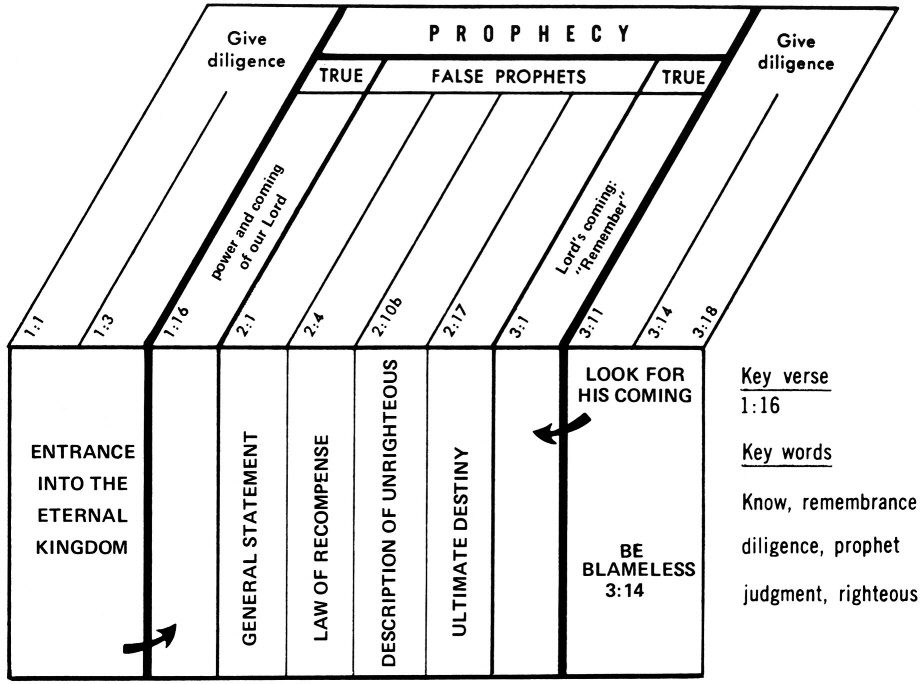
2 Peter: True and False Prophecy
Click chart to enlarge
Chart from Jensen's Survey of the NT - used by permission
|
2 PETER |
||||||||
| Cultivation of Christlike Character |
Condemnation of False Teachers |
Confidence in the Return of Christ |
||||||
| Greeting to Saints 2Pe 1:1-2 |
Growth in Christ 2Pe 1:3-14 |
Grounds |
Danger of |
Demise of |
"Decor" of |
Mockers in |
Manifest |
Maturity in light of that |
| Know Your Salvation |
Know |
Know Your Adversaries |
Know |
|||||
| True Prophecy (True Knowledge) |
False Prophets (False Teachers) |
Final Prophecy (Day of the Lord) |
||||||
| Holiness | Heresy | Hope | ||||||
| Development of Faith |
Denunciation of False Teachers |
Design of The Future |
||||||
2 Peter 1:15 And I will also be diligent that at any time after my departure you will be able to call these things to mind. (NASB: Lockman)
Greek: spoudaso (1SFAI) de kai hekastote echein (PAN) humas meta ten emen exodon ten touton mnemen poieisthai. (PMN)
Amplified: Moreover, I will diligently endeavor [to see to it] that [even] after my departure (decease) you may be able at all times to call these things to mind. (Amplified Bible - Lockman)
KJV: Moreover I will endeavour that ye may be able after my decease to have these things always in remembrance.
NLT: So I will work hard to make these things clear to you. I want you to remember them long after I am gone. (NLT - Tyndale House)
Wuest: Indeed, I will do my best also that on each occasion when you have need after my departure you will be able to call these things to remembrance (Eerdmans Publishing)
Young's Literal: and I will be diligent that also at every time ye have, after my outgoing, power to make to yourselves the remembrance of these things.
AND I WILL ALSO BE DILIGENT THAT AT ANY TIME: spoudaso (1SFAI) de kai hekastote:
- Dt 31:19-29 Jos 24:24, 25, 26, 27, 28, 29 1Ch 29:1-20 Ps 71:18 2Ti 2:2 Heb 11:4)
Be diligent (4704) (spoudazo from spoude = haste) conveys the idea of hastening to do something with the implication of associated energy or with intense effort and motivation. Spoudazo speaks of intensity of purpose followed by intensity of effort and concentration toward the realization of that purpose.
Spoudazo is found 11 times in the NT and is translated: diligent, 6; eager, 2; make every effort, 3.
Note that Peter uses this verb and the corresponding noun (spoude) (Click for in depth study of spoude) more than any other NT book. Ask yourself "Why"? What is the problem looming on the "spiritual horizon"?
Spoudazo is used in the papyri in such senses as “do your best, take care, hurry on the doing of something.”
Spoudazo is marked by careful unremitting attention or persistent application. The idea is give maximum effort, do your best, spare no effort, hurry on, be eager! Hasten to do a thing, exert yourself, endeavour to do it. It means not only to be willing to do with eagerness, but to follow through and make diligent effort. Give your utmost for His highest!
In other words spoudazo does not stop with affecting one's state of mind, but also affects one's activity.
Spoudazo conveys the idea of exertion. It means to be conscientious, zealous and earnest in discharging a duty or obligation.
The verb speaks of intensity of purpose followed by intensity of effort toward the realization of that purpose.
To be diligent is to exert steady, earnest, and energetic effort and suggests earnest application to some specific object or pursuit. The idea is careful and persevering in carrying out tasks or duties. It means to be assiduous (marked by careful unremitting attention or persistent application).
Spoudazo basically means to make haste, and from that come the meanings of zeal and diligence. One commentator describes it as a holy zeal that demands full dedication.
Wuest says that spoudazo means "to make haste, do one’s best, take care, desire. The idea of making haste, being eager, giving diligence, and putting forth effort are in the word. The word speaks of intense effort and determination." (Wuest Word Studies - Eerdman Publishing Company Volume 1, Volume 2, Volume 3 - used by permission)
Peter is saying I will be in a hurry, make haste, be in earnest, concentrate my energy on the achievement of the goal to stir you up. Peter knew that he would soon die, so he wanted to take care of his spiritual responsibilities before it was too late. You and I do not know when we will die, so we had better start being diligent today!
Here are the 11 uses of spoudazo in the NT (click for context)
Galatians 2:10 remember the poor-- the very thing I also was eager to do.
Ephesians 4:3 (note) being diligent to preserve the unity of the Spirit
1Thessalonians 2:17 (note) were all the more eager with great desire to see your face.
2 Timothy 2:15 (note) Be diligent (aorist imperative) to present yourself approved to God as a workman who does not need to be ashamed handling accurately the word of truth
2 Timothy 4:9 (note) Make every effort (aorist imperative) to come to me soon;
2 Timothy 4:21 (note) Make every effort (aorist imperative) to come before winter.
Titus 3:12 (note) Make every effort (aorist imperative) to come to me at Nicopolis,
Hebrews 4:11 (note) Let us therefore be diligent to enter that rest,
2 Peter 1:10 (note) Therefore, brethren, be all the more diligent (aorist imperative = Do this now! Command can convey a sense of urgency) to make certain about His calling (see klesis) and choosing (ekloge ~ election) you; for as long as you practice these things, you will never stumble;
2 Peter 1:15 (note) And I will also be diligent that at any time after my departure
2 Peter 3:14 (note) Therefore, beloved, since you look for these things, be diligent (aorist imperative) to be found by Him in peace, spotless and blameless
AFTER MY DEPARTURE YOU MAY BE ABLE: echein (PAN) humas meta ten emen exodon:
Departure (1841) (exodos from ex = out + hodos = way) (cf earlier use of "eisodos from eis = into + hodos = way" referring to entry into heaven <> here Peter refers to exit out of earth!) is literally "the road out" or "the way out"! The more familiar spelling Exodus is simply a transliteration of the Greek Exodos into English.
Exodos was used as a euphemism describing one's departure from among the living (the one who dies has the illusion of a choice and the mourner finds consolation in the theme) for death.
Peter is not "dying" but just departing for home!
Vincent writes that exodos means
a journeying; and thus corresponds to the Latin decessus, a going away, whence the word decease. (Vincent, M. R. Word studies in the New Testament. Vol. 1, Page 3-344)
The Greek term exodos is rarely used to refer to death when by itself, noting rather a transfer and not a termination. As someone has said this word indicates the difference between dying and perishing.
There are only 3 uses of exodos in the NT (Lu 9:31, Heb 11:22, 2 Pe 1:15), however there are 55 uses of exodos in the Septuagint (LXX) (Ex 19:1; 23:16; Num. 33:38; 35:26; Jdg. 5:4, 31; 1 Sam. 29:6; 2 Sam. 1:20; 3:25; 22:43; 1 Ki. 2:37; 3:7; 5:17; 10:28f; 20:34; 2 Ki. 19:27; 1 Chr. 5:16; 20:1; 2 Chr. 1:16; 9:28; 16:1; 23:8; 32:30; Neh. 4:21; Job 38:27; Ps. 19:6; 65:8; 75:6; 105:38; 113:9; 121:8; 144:13; Pr 1:20; 4:23; 8:35; 24:27; 25:13, 26; 30:12; Isa. 37:28; 51:20; Jer. 11:13; Lam. 2:19, 21; 4:1, 5, 8, 14; Ezek. 42:11; 43:11; 44:5; 47:3; Dan. 9:25; Mic. 5:2). Here are a few representative OT uses…
Exodus 19:1 In the third month after the sons of Israel had gone out (Lxx = exodus or departure) of the land of Egypt, on that very day they came into the wilderness of Sinai.
Psalm 105:38 (See Spurgeon's note) Egypt was glad when they departed; (Lxx = their exodus) For the dread of them had fallen upon them.
Psalm 121:8 (See notes Psalm 121: A Commentary) The LORD will guard your going out and your coming in From this time forth and forever.
Proverbs 4:23 Watch over your heart with all diligence, For from it flow the springs (Lxx = the goings out of life).
In Hebrews 11:22 (see notes) Exodos indicates movement from one geographical area to another, or departure, the writer of Hebrew recording that
By faith Joseph, when he was dying, made mention of the exodus of the sons of Israel, and gave orders concerning his bones.
And so the writer of Hebrews applies the word to the children of Israel’s departure out of Egypt from the Septuagint translation (Greek translation of the Hebrew) arrived at the title of the second book of Moses that we know as "Exodus".
On the Mount of Transfiguration, Jesus, Moses, and Elijah spoke of Jesus’ “departure” Luke recording that…
behold, two men were talking with (the transfigured Christ); and they were Moses and Elijah, who, appearing in glory, were speaking of His departure which He was about to accomplish at Jerusalem. (Lu 9:31).
As noted above this exodos (from this body) contrasts with a believer’s “entrance” into (“going into”) God’s kingdom (see note 2 Peter 1:11).
J Vernon McGee has an interesting note on exodos writing that all it means is that Peter will…
just be moving out of his house, his tabernacle, down here; he will be putting it off as if it were a garment, and he will be making his exodus. Now the word exodus implies that death doesn’t end it all. When the children of Israel went out of Egypt, the Egyptians said, “We are through with them. This ends it.” But it didn’t end it. Israel continued on in the wilderness and finally entered into the Promised Land, and Egypt doesn’t seem to be through with them even to this good day! And for this man Peter, death was merely an exodus; it wasn’t an end to it all. (McGee, J V: Thru the Bible Commentary: Nashville: Thomas Nelson)
TO CALL THESE THINGS TO MIND: ten touton mnemen poieisthai (PMN):
- 2Pe 1:4, 5, 6, 7,12
More literally this phrase reads
to continually (present tense) make to yourselves the remembrance of these things.
To use an educational term, Peter wants his readers to "over learn" the basic truths so that after his death they will never forget them.
2 Peter 1:16 For we did not follow cleverly devised tales when we made known to you the power and coming of our Lord Jesus Christ, but we were eyewitnesses of His majesty. (NASB: Lockman)
Greek: Ou gar sesophismenois (RPPMPD) muthois exakolouqhsantes egnorisamen (AAPMPN) humin ten tou kuriou hemon Iesou Christou dunamin kai parousian, all' epoptai genethentes (AAPMPN) tes ekeinou megaleiotetos.
Amplified: For we were not following cleverly devised stories when we made known to you the power and coming of our Lord Jesus Christ (the Messiah), but we were eyewitnesses of His majesty (grandeur, authority of sovereign power). (Amplified Bible - Lockman)
KJV: For we have not followed cunningly devised fables, when we made known unto you the power and coming of our Lord Jesus Christ, but were eyewitnesses of his majesty.
NLT: For we were not making up clever stories when we told you about the power of our Lord Jesus Christ and his coming again. We have seen his majestic splendor with our own eyes. (NLT - Tyndale House)
Wuest: For we did not follow out to their termination cleverly devised myths when we made known to you the power and personal coming of our Lord Jesus Christ, but became spectators of that One’s magnificence. (Eerdmans Publishing - used by permission)
Young's Literal: For, skilfully devised fables not having followed out, we did make known to you the power and presence of our Lord Jesus Christ, but eye-witnesses having become of his majesty--
FOR WE DID NOT FOLLOW : Ou gar … exakolouthesantes (AAPMPN):
- 2Pe 3:3,4; 1Cor 1:17,23; 2:1,4; 2Co 2:17; 4:2; 12:16,17; Ep 4:14; 2Th 2:9; 1Ti 1:4; 4:7; Titus 1:14)
Note that not is emphatic and is (ou) indicating absolute negation of what follows. The aorist tense here also underscores that this event did not occur at all. It is thus a strong denial by Peter.
We did not follow (1811) (exakoloutheo from ek = out, used intensively here + akoloutheo = to be a follower in turn from a = union, likeness + keleuthos = a way = one going in the same way) is a strong compound which literally means to follow but is used only figuratively in the NT to mean to conform to, to closely imitate another's behavior or to pursue closely. Here is 2Peter 1:16 the idea is to follow one's teaching so as to accept it as the authoritative determinant of one's thoughts and/or actions. Hence it conveys the idea of not only following but of obeying.
In Greek use the root verb akoloutheo conveyed the sense of following that led to intellectual, moral, and religious following. In the LXX akoloutheo is used in Judges 2:12 to describe Israel who "followed after other gods from among the gods of the peoples who were around them and bowed themselves down to them". Akoloutheo was used to describe the following of a disciple after the mentor as of Elisha after Elijah (se 1 Kings 19:20-21). The same is true of rabbis and their students; the former go on ahead, and the latter follow them. This background helps understand the sense with which Peter denies following cleverly devised tales.
Exakoloutheo is used only in 2 Peter in the NT…
2 Peter 2:2 (note) And many will follow their sensuality, and because of them the way of the truth will be maligned
2 Peter 2:15 (note) forsaking the right way they have gone astray, having followed the way of Balaam, the son of Beor, who loved the wages of unrighteousness
Exakoloutheo in this context implies (1) Some religious writers did imitate (2) We must refer to other NT writers and in the immediate context of the Transfiguration would be James and John. John referred to this experience in Jn 1:14
“We beheld His GLORY as of the only begotten from the Father, full of grace and truth.”
Exakoloutheo is used 4 times in the Septuagint (LXX) (Job 31:9; Isa. 56:11; Jer. 2:2; Amos 2:4)…
Job 31:9 "If my heart has been enticed (Hebrew = pathah = to be persuaded, enticed, deceived; Lxx = exakoloutheo = follow after) by a woman, Or I have lurked at my neighbor's doorway,
Isaiah 56:11 And the dogs are greedy, they are not satisfied. And they are shepherds who have no understanding; They have all turned to their own way (Lxx = exakoloutheo = followed after), Each one to his unjust gain, to the last one.
Jeremiah 2:2 "Go and proclaim in the ears of Jerusalem, saying, 'Thus says the LORD, "I remember concerning you the devotion of your youth, The love of your betrothals, Your following after (Hebrew = yalak = walk; Lxx = exakoloutheo) Me in the wilderness, Through a land not sown.
Amos 2:4 Thus says the LORD, "For three transgressions of Judah and for four I will not revoke its punishment, Because they rejected the law of the LORD And have not kept His statutes; Their lies also have led them astray, Those after which their fathers walked. (Lxx = exakoloutheo)
CLEVERLY DEVISED TALES: Ou gar sesophismenois (RPPMPD) muthois:
Related resource: see Master's Seminary Journal article - 2 Peter 1:16-21 The Only Sure Word
Cleverly devised (4679) (sophizo from sophos = wise) meant to be skilled in formulating or creating something in an artful manner, to render wise and in a sinister meaning to form sophisms (arguments apparently correct in form but actually invalid, especially arguments used to deceive).
Cunningly devised characterized these tales because they devised by human wisdom, subtly and slyly concocted and motivated by personal interests. Sophizo is used only here and 2Ti 3:15, in which latter passage it has a good sense, to make thee wise.
Sophizo is perfect tense which identifies the tales as having the abiding character of seeming sophistication or spurious wisdom.
Sophizo was used by Classic Greek writers with the meaning of deceive or delude. This epithet was occasionally applied to ''quack'' doctors. Peter is saying they did not follow cunningly, skillfully and artfully devised vain imaginings of men (fables, tales, myths). Apparently clever tales" were in existence that denied a future aspect of eschatology (eg, see note 2 Timothy 2:18, 2Thes 2:1ff) or else reinterpreted it so as to lose its intended meaning. The specific point in view was most likely in the context of this verse the second coming of Jesus. There were men mocking the 2nd coming (cf note 2 Peter 3:4). Why? Because He is coming not for salvation but for judgment (see note Hebrews 9:28).
Tales (3454) (muthos; English = myth, mythology) (Click word study on muthos) describes that which is fabricated by the mind in contrast to reality. Muthos in this verse is used in a derogatory, negative sense, referring to stories that are not true or that are just imaginary tales, but which are proclaimed and believed by some people to be true.
It is sad that myth is a word that some so-called theologians of the liberal mindset use to describe the Scriptures, saying for example that the Bible contains myths and even going so far as to say that such myths are an important part of religious truth! The book of Genesis is frequently treated as myth by such men who profess to be wise but have become fools and who regardless of their "belief" today will one day be forced to bow their knee and confess with their tongue that Jesus Christ is Lord to the glory of the Father! And that is no myth!
Vine has this note on muthos - The first syllable comes from a root mu—, signifying to close, keep secret, be dumb; whence, muo, to close (eyes, mouth) and musterion, a secret, a mystery; hence, a story, narrative, fable, fiction (Eng., myth). The word is used of Gnostic errors and of Jewish and profane fables and genealogies.
The essential nature of myths is that they represent man made substitutes for God's breathed word. They are humanly concocted stories that have no basis in fact.
The Greek and Roman world abounded in stories about the gods, mere human speculations that tried to explain the world and its origin. All Jewish and Grecian myths and fables are based on a pantheistic form of evolutionism and denial of true creation. Modern equivalents include Darwinianism or New Age pantheism.
There may be much logic and reasoning in a myth (especially the more ''cleverly devised"). In the NT, however, the word “myth” does not have the meaning of being a vehicle of some lofty truth as in the early use of the word (eg "Aesop's Fables"). Although lógos and múthos begin together with the thought, intelligence, or mind, they part ranks since the first ends in the kingdom of light and truth and the second in the kingdom of darkness and lies. Some like Joseph Campbell (who had an extremely popular public television program called "The Power of Myth") are the opinion that life can be expressed only in terms of myth. Some so called "scholars" think the stories of Genesis are myths. My son called me desperate one night from the Baptist school Baylor University in a panic because his OT religion class teacher was teaching that Genesis was just a myth and he had written a book to back up his hypothesis. So myths can disturb saints.
Philo, sees that biblical religion differs from pagan religion by reason of its basis in history rather than myth, although he himself, with his allegorizing, treats the biblical history as though it were myth when he finds difficult passages.
Origen follows a similar course, especially in answer to the charge of Celsus that the biblical stories are inferior and valueless even as myths (the common accusation of educated pagans; cf. Porphyry and Julian). 2 Peter, however, insists on the historical reality of the Christian message on the basis of the prophetic word and the apostolic eyewitness.
WHEN WE MADE KNOWN TO YOU THE POWER AND COMING OF OUR LORD JESUS CHRIST: egnorisamen (AAPMPN) humin ten tou kuriou hemon Iesou Christou dunamin kai parousian :
- Mt 28:18; Mk 9:1; Jn 17:2; Ro 1:4; 1Co 5:4; Php 3:21
- Mal 3:2; 4:5; Mt 16:28; 24:3;24:27 1Co 1:7; Jude 1:14; Rev 1:7
THE SON
COMING IN POWER
Made known (1107) (gnorizo) means to cause information to be known by someone by communicating things before unknown or reasserting things already known.
In the NT gnorizo is used of God making known to the shepherds the events of Jesus' birth (LK 2:15), of Jesus making known to His disciples all that He heard from the Father (Jn 15:15), of Paul making "known to (the Corinthians) the gospel which (he had) preached… which also (they) received, in which also (they stood)." (1Co 15:1), etc.
Thus gnorizo was somewhat of a technical term for imparting a new revelation, something previously hidden, but now revealed.
Gnorizo is in the aorist tense which speaks of a completed action in the past.
The power and coming are united under one definite article (ten) and thus denote two aspects of one concept, the glorious return of our Lord Jesus Christ. (See Torrey's "Excellency & Glory of Christ" or the wonderful topic the "Power of Christ")
Power (1411) (dunamis [word study]) refers to inherent power residing in someone (here of course our Lord Jesus) by virtue of his nature (inherently omnipotent God). Assuming that Peter is referring to the triumphant return of Christ will be visibly inaugurated in power (cf 2Th 2:8, Re 19:11; 12; 13; 14; 15; 16-see notes Re 19:11; 12; 13; 14; 15; 16, Torrey's Topic "2nd Coming").
Coming (3952) (parousia) is a combination of two Greek words para = with, alongside + ousia = being (ousia is the participial form of the verb eimi = to be) which together literally mean to be alongside.
See related study on Imminency, Imminent - Christ's Second Coming
Most lexicons in fact state that parousia is derived from pareimi (from para = near, with + eimi = to be) which means to be present, to be nearby, to have come.
Parousia then literally means a being beside or a presence. The word denotes both an arrival and a consequent presence with.
Parousia conveys the thought of an arrival (advent or coming) of a person to a place plus the idea of their presence at that place until a certain event transpires. The word parousia has no English equivalent and therefore is often transliterated in writings.
John MacArthur - Parousia refers to more than just coming; it includes the idea of “presence.” Perhaps the best English translation would be “arrival.” The church’s great hope is the arrival of Jesus Christ when He comes to bless His people with His presence. That glorious truth appears in more than 500 verses throughout the Bible. (Macarthur J. James. Moody or Logos) (Bolding added)
Parousia - 24x in 24v in the NT (none in non-apocryphal Septuagint) -Mt 24:3, 27, 37, 39; 1 Cor 15:23; 16:17; 2 Cor 7:6f; 10:10; Phil 1:26; 2:12; 1 Thess 2:19; 3:13; 4:15; 5:23; 2 Thess 2:1, 8, 9; Jas 5:7f; 2 Pet 1:16; 3:4, 12; 1 John 2:28
NAS = coming - 22x and presence-2x.
Note that parousia is used 3 times by Peter in this brief letter.
In an ancient Greek letter a lady speaks of the necessity of her parousia in a place in order to attend to matters relating to her property there. Moulton and Milligan have these secular quotes…
the repair of what has been swept away by the river requires my presence
“we await your presence,” (a man to his “brothers)
it is no use if a person comes too late for what required his presence
In another secular Greek writing we find parousia used to refer to the coming of a king or other noted official (see note below). In the visit of the ruler was accompanied by magnificent ceremonies, delicacies to eat, gifts of money, street improvements, new buildings, addressing of complaints and requests! Sounds like the coming of the King to take His throne in the 1000 year Millennial or Messianic Kingdom!
Moulton and Milligan - What, however, more especially concerns us in connexion with the NT usage of parousia is the quasi-technical force of the word from Ptolemaic times onwards to denote the “visit” of a King, Emperor, or other person in authority, the official character of the “visit” being further emphasized by the taxes or payments that were exacted to make preparations for it. Thus in P Petr II. 39(e)18 (iii/b.c.) mention is made of contributions for a “crown” (stephanou) to be presented to the King on his “arrival” (parousias), and in a letter of b.c. 264 or 227, P Grenf II. 14(b)2, a certain Appenneus writes that he has prepared “for the visit of Chrysippus” (the dioecetes) by laying in a number of birds for his consumption. Other examples from the papyri are P Par 26i. 18 (b.c. 163–2) (= Selections, p. 15), where the Serapeum Twins lay their grievances before King Ptolemy Philometor and Queen Cleopatra on the occasion of their royal visits to Memphi… “the 80 artabae of wheat for the supplies imposed in connexion with the King’s visit” (Edd.).
Deissmann has a fascinating, albeit lengthy note on parousia writing that…
Yet another of the central ideas of the oldest Christian worship receives light from the new texts, viz. parousia, “advent, coming,” a word expressive of the most ardent hopes of a St. Paul. We now may say that the best interpretation of the Primitive Christian hope of the Parousia is the old Advent text, “Behold, thy King cometh unto thee.” From the Ptolemaic period down into the 2nd cent. a.d. we are able to trace the word in the East as a technical expression for the arrival or the visit of the king or the emperor. The parousia of the sovereign must have been something well known even to the people, as shown by the facts that special payments in kind and taxes to defray the cost of the parousia were exacted, that in Greece a new era was reckoned from the parousia of the Emperor Hadrian, that all over the world advent-coins were struck after a parousia of the emperor, and that we are even able to quote examples of advent-sacrifices.
The subject of parousia dues and taxes in Egypt has been treated in detail by Wilcken. The oldest passage he mentions is in the Flinders Petrie Papyrus II. 39 e, of the 3rd cent. b.c., where, according to his ingenious interpretation, contributions are noted for a crown of gold to be presented to the king at his parousia. This papyrus supplies an exceptionally fine background of contrast to the figurative language of St. Paul, in which Parousia (or Epiphany, “appearing”) and crown occur in collocation. While the sovereigns of this world expect at their parousia a costly crown for themselves, “at the parousia of our Lord Jesus” the apostle will wear a crown—the “crown of glory” (see note 1Thessalonians 2:19) won by his work among the churches, or the “crown of righteousness” which the Lord will give to him and to all them that have loved His appearing (see note 2 Timothy 4:8).
I have found another characteristic example in a petition, circa 113 b.c., which was found among the wrappings of the mummy of a sacred crocodile. A parousia of King Ptolemy, the second who called himself Soter (“saviour”), is expected, and for this occasion a great requisition has been issued for corn, which is being collected at Cerceosiris by the village headman and the elders of the peasants. Speaking of this and another delivery of corn, these officials say: "and applying ourselves diligently, both night and day, unto fulfilling that which was set before us and the provision of 80 artabae which was imposed for the parousia of the king" …
Are not these Egyptian peasants, toiling day and night in expectation of the parousia of their saviour king, an admirable illustration of our Lord’s words (Luke 18:7) about the elect who cry day and night to God, in expectation of the coming of the Son of Man (Luke 18:8)?
Again among the Tebtunis Papyri there is a bill, from the end of the 2nd cent. b.c., which mentions “the parousia of the king,” while an ostracon of the 2nd cent. b.c., from Thebes, reckons the expenses of the “parousia of the queen.”
As in Egypt, so also in Asia: the uniformity of Hellenistic civilisation is proved once more in this instance. An inscription of the 3rd cent. b.c. at Olbia mentions a parousia of King Saitapharnes, the expenses of which were a source of grave anxiety to the city fathers, until a rich citizen, named Protogenes, paid the sum—900 pieces of gold, which were presented to the king.
Next comes an example of great importance as proving an undoubted sacral use of the word, viz. an inscription of the 3rd. cent. b.c., recording a cure at the temple of Asclepius at Epidaurus, which mentions a parousia of the healer (saviour) god Asclepius.
Other examples of Hellenistic age known to me are a passage in Polybius referring to a parousia of King Antiochus the Great, and two letters of King Mithradates VI. Eupator of Pontus at the beginning of his first war with the Romans, 88 b.c., recorded in an inscription at Nysa in Caria. The prince, writing to Leonippus the Praefect of Caria, makes twofold mention of his own parousia, i.e. his invasion of the province of Asia.
It is the legitimate continuation of the Hellenistic usage that in the Imperial period the parousia of the sovereign should shed a special brilliance. Even the visit of a scion of the Imperial house, G. Caesar († 4 a.d.), a grandson of Augustus, was, as we know from an inscription, made the beginning of a new era in Cos. In memory of the visit of the Emperor Nero, in whose reign St. Paul wrote his letters to Corinth, the cities of Corinth and Patras struck advent-coins. Adventus Aug(usti) Cor(inthi) is the legend on one, Adventus Augusti on the other. Here we have corresponding to the Greek parousia the Latin word advent, which the Latin Christians afterwards simply took over, and which is today familiar to every child among us. How graphically it must have appealed to the Christians of Thessalonica, with their living conception of the parousiae of the rulers of this world, when they read in St. Paul’s second letter of the Satanic “parousia” of Antichrist, who was to be destroyed by “the manifestation of the parousia” of the Lord, Jesus!
A whole host of advent-coins resulted from the numerous journeyings of the Emperor Hadrian; we have specimens, I suppose, from most of the Imperial provinces, and these, it may be remarked, were official coinages of the Empire. The arrival of Hadrian at Rome on 9 July, 118, was even celebrated by the Arval brothers with solemn sacrifices in the Emperor’s presence, to which the inscriptions containing the Acts of their college bear record. The parallelism between the Hellenistic and the Imperial period is seen also in the fact that the expenses attending a parousia of the sovereign were considerable.
How deeply a parousia stamped itself on the memory is shown by the eras that were reckoned from parousiae. (Ed note: Think about this secular use in light of the truth of the new Millennium inaugurated by our Lord's glorious parousia!) We have heard already of an era at Cos dating from the epiphany of G. Caesar, and we find that in Greece a new era was begun with the first visit of the Emperor Hadrian in the year 124;—the magnificent monuments in memory of that parousia still meet the eye at Athens and Eleusis. There is something peculiarly touching in the fact that towards the end of the 2nd century, at the very time when the Christians were beginning to distinguish the “first parousia” of Christ from the “second,” an inscription at Tegea was dated: in the year 69 of the first parousia of the god Hadrian in Greece.
To make the circle of Hellenism complete once more, this inscription from Arcadia gives us again the word parousia, which we found in Egypt, Asia Minor, and the New Testament. In Greece, however, a synonym is more usual.
Even in early Christian times the parallelism between the parobusia of the representative of the State and the parousia of Christ was clearly felt by the Christians themselves. This is shown by a newly discovered petition of the small proprietors of the village of Aphrodite in Egypt to the Dux of the Thebaid in the year 537–538 a.d., a papyrus which at the same time is an interesting memorial of Christian popular religion in the age of Justinian.
“It is a subject of prayer with us night and day, to be held worthy of your welcome parousia.”
The peasants, whom a wicked Pagarch has been oppressing, write thus to the high official, after assuring him with a pious sigh at the beginning that they awaited him
“as they watch eagerly from Hades for the future parousia of Christ the everlasting God.”
(Deissmann, A., & Strachan, L. R. M.. Light from the Ancient East the New Testament illustrated by recently discovered texts of the Graeco-Roman World. Page 372. London: Hodder & Stoughton. 1910)
As Jesus sat with Peter and James and John and Andrew "on the Mount of Olives, the disciples came to Him privately, saying, "Tell us, when will these things be, and what will be the sign of Your coming, (parousia) and of the end of the age? (Mt 24:3)
This passage begins what is commonly referred to as the "Olivet Discourse" (Click for a discussion on Mt 24 entitled "When Jesus Returns to the Earth: Where Will the Church Be?")
Parousia refers to the Second Coming of the Lord, but be aware that the Second Coming is not just a single event taking place at a particular time. Rather the Second Coming is composed of a series of events. One can understand which event is being referred to only by a careful examination of the context ("Context is king" in interpretation in Inductive Bible Study!)
Brooke on the secular use of parousia - From the Ptolemaic period to the second century AD there is abundant evidence that in the East the word was the usual expression for the visit of a King or Emperor. In Egypt, special funds were raised by taxation to meet the expenses of such visits. In Greece a new era was reckoned from the visit of Hadrian. The earliest mention is rightly interpreted by Wilcken to refer to the collection made to provide a crown to be presented on the occasion of the visit; and in the Tebtunis Papyri there is an interesting description of the efforts made by the village elders in connection with the expected visit of Ptolemy II. The word is also used of the appearance of the god Asclepios in his temple. In Latin, Adventus was used in the same way. Cf. the coins struck to commemorate Nero’s visit to Corinth, Adventus Aug. Cor. Altars were also erected to commemorate visits of members of the Imperial family, as in Cos, in memory of the visit of C. Caesar (a.d. 4). The word was naturally used by Christians of the advent of their King (A critical and exegetical commentary on the Johannine epistles)
Barclay - In secular Greek this is the ordinary word for someone's presence or arrival. But it has two other usages, one of which became quite technical. It is used of the invasion of a country by an army and specially it is used of the visit of a king or a governor to a province of his empire. So, then, when this word is used of Jesus, it means that his Second Coming is the final invasion of earth by heaven and the coming of the King to receive the final submission and adoration of his subjects. (Daily Study Bible - James)
Raymond Brown - In the ancient world parousia has a pertinent twofold sense: (1) the coming of a hidden divinity who makes his presence felt by his power or miracles; (2) the visit of a king or emperor to a province (Latin: adventus). Christians took over the second aspect in their picture of how Christ would come back. (The Epistles of John: translated, with introduction, notes, and commentary-Anchor Yale Bible).
Marshall adds that parousia "was used for the visit of a ruler to some part of his dominions, an occasion for celebration and rejoicing. Even today, although we have become accustomed to seeing the face of the monarch or president on TV, people will still turn out in great numbers on state occasions to see and cheer the ruler; how much more must this have been the case in the ancient world where to see the emperor was possibly the event of a lifetime. It is this kind of atmosphere which is conveyed by this word. It conceives of the return of Jesus to this world in visible splendor, like a monarch (cp Rev 19:14-16-note). (The New International Commentary on the New Testament)
In sum, the period referred to as the Parousia (coming) of Christ has a beginning, a course and a final conclusion. Although there is not uniform agreement, most conservative evangelical scholars would agree that the Parousia of Jesus Christ begins with the Rapture, when He comes for His saints, as mentioned discussed by Paul in (1Th 4:16). (For more on His coming see "The Comfort of His Coming (4:13-18)")
This first phase is to followed by the period of His presence with the saints when, having come to the air for them, and received them to Himself, He will take them to the place prepared for them, the Father’s “House,” (cf Jn 14:2).
At the end of the second half of Daniel's Seventieth Week (the last 3.5 year period being referred to as the "Great Tribulation") Matthew records that
"then the sign (the sign is not mystical but is Christ coming on the clouds) of the Son of Man will appear in the sky, and then all the tribes of the earth will mourn, and they will see the SON OF MAN COMING ON THE CLOUDS OF THE SKY with power and great glory. And He will send forth His angels with A GREAT TRUMPET and THEY WILL GATHER TOGETHER His elect from the four winds, from one end of the sky to the other." (Mt 24:30-31)
At that time Christ will come with His saints in manifest glory and will the overthrow of His foes and establish His kingdom on earth. (unless you do not believe the 1000 years is a literal period of time). (Click Chart summary of Daniel's Seventieth Week) (Click comparison of Day of the Lord, Day of Christ)
Below are the seventeen out of 24 uses of parousia that refer to the return of Christ: (an interesting inductive study would be to simply list the truths associated with the coming of the Lord from these passages - be sure to check the context)
Mt 24:3 And as He was sitting on the Mount of Olives, the disciples came to Him privately, saying, “Tell us, when will these things be, and what will be the sign of Your coming, and of the end of the age?”
Mt 24:27 “For just as the lightning comes from the east, and flashes even to the west, so shall the coming of the Son of Man be.
Mt 24:37 “For the coming of the Son of Man will be just like the days of Noah… 39 and they did not understand until the flood came and took them all away; so shall the coming of the Son of Man be.
1Cor 15:23 But each in his own order: Christ the first fruits, after that those who are Christ’s at His coming,
1Thes 2:19 (note) For who is our hope or joy or crown of exultation? Is it not even you, in the presence of our Lord Jesus at His coming?
1Thes 3:13 (note) so that He may establish your hearts unblamable in holiness before our God and Father at the coming of our Lord Jesus with all His saints.
1Thes 4:15 (note) For this we say to you by the word of the Lord, that we who are alive, and remain until the coming of the Lord, shall not precede those who have fallen asleep.
1Thes 5:23 (note) Now may the God of peace Himself sanctify you entirely; and may your spirit and soul and body be preserved complete, without blame at the coming of our Lord Jesus Christ.
2Thes 2:1 Now we request you, brethren, with regard to the coming of our Lord Jesus Christ, and our gathering together to Him… 8 And then that lawless one will be revealed whom the Lord will slay with the breath of His mouth and bring to an end by the appearance of His coming
James 5:7 Be patient, therefore, brethren, until the coming of the Lord. Behold, the farmer waits for the precious produce of the soil, being patient about it, until it gets the early and late rains. 8 You too be patient; strengthen your hearts, for the coming of the Lord is at hand.
2 Peter 1:16 (note) For we did not follow cleverly devised tales when we made known to you the power and coming of our Lord Jesus Christ, but we were eyewitnesses of His majesty.
2 Peter 3:4 (note) and saying, “Where is the promise of His coming? For ever since the fathers fell asleep, all continues just as it was from the beginning of creation.”
2 Peter 3:12 (note) looking for and hastening the coming of the day of God, on account of which the heavens will be destroyed by burning, and the elements will melt with intense heat!
1Jn 2:28 And now, little children, abide in Him, so that when He appears, we may have confidence and not shrink away from Him in shame at His coming.
APPLICATION: The sure hope of Christ’s return motivates believers (or at least this truth should renew our minds, motivate and energize us) to seek to order our lives in light of the truth that they shall soon see Jesus at His coming.
Dearly beloved are you looking for His parousia,
and living as if it could be today?
For completeness below are the 10 other NT uses of parousia which do convey a general and not an eschatological meaning…
1 Corinthians 16:17 And I rejoice over the coming of Stephanas and Fortunatus and Achaicus; because they have supplied what was lacking on your part.
2 Corinthians 7:6 But God, who comforts the depressed, comforted us by the coming of Titus; 7 and not only by his coming, but also by the comfort with which he was comforted in you, as he reported to us your longing, your mourning, your zeal for me; so that I rejoiced even more.
2 Corinthians 10:10 For they say, "His letters are weighty and strong, but his personal presence is unimpressive, and his speech contemptible."
Philippians 1:26 (note) so that your proud confidence in me may abound in Christ Jesus through my coming to you again.
Philippians 2:12 (note) So then, my beloved, just as you have always obeyed, not as in my presence only, but now much more in my absence, work out your salvation with fear and trembling
2Thes 2:9 that is, the one whose coming (this coming of the Antichrist which is the counterfeit "coming") is in accord with the activity of Satan, with all power and signs and false wonder
BUT WE WERE EYEWITNESSES OF HIS MAJESTY: all' epoptai genethentes (AAPMPN) tes ekeinou megaleiotetos:
- Mt 17:1, 2, 3, 4, 5; Mk 9:2; Lk 9:28, 29, 30, 31, 32; Jn 1:14; 1Jn 1:1, 2, 3; 4:14)
SEEING THE
SUPERNATURAL
We were (ginomai) is aorist tense meaning that at some point in time they (Peter, James, John) became (literally "having become") eyewitnesses.
Eyewitnesses (2030) (epoptes from epi = upon, over + optanomai = see, perceive) is literally an "over seer" and then a spectator or eye witness of anything. It refers to those who have first-hand acquaintance with something and so are those who see with their eyes with implication of careful scrutiny or of being a watchful observer. It refers to Inspector, onlooker, an eyewitness.
Peter's use of epoptes stresses his close and careful inspection of our Lord's majesty.
William Barclay explains the background on epoptes writing that - In the Greek usage of Peter’s day this was a technical word. We have already spoken about the Mystery Religions. They were all of the nature of passion plays, in which the story of a god who lived, suffered, died, and rose again was played out. It was only after a long course of instruction and preparation that the worshipper was finally allowed to be present at the passion play, and to be offered the experience of becoming one with the dying and rising "god". When he reached this stage, he was an initiate and the technical word to describe him was epoptes; he was a privileged eye-witness of the experiences of God. So Peter says that the Christian is an eye-witness of the sufferings of Christ. With the eye of faith he sees the Cross; in the experience of faith he dies with Christ to sin and rises to righteousness. His faith has made him one with Jesus Christ in his death and in his risen life and power. ( Daily Study Bible)
Among Greeks epoptes was used of those who had attained to the third grade, the highest, of the Eleusinian mysteries, a religious cult at Eleusis, with its worship, rites, festival and pilgrimages a brotherhood open to all Greeks. Peter clearly felt that he, James and John were lifted to "the highest stage of initiation" so to speak at the transfiguration of Christ.
Epoptes (from Pindar, 5th cent. B.C.) was also used as an epithet for the gods (Zeus, Poseidon, Apollo), for men were deceived into thinking that they were under their watchful eyes.
Anchor Bible Dictionary adds that in the…
Eleusinian mysteries the highest stage of initiation was designated that of “beholding” (Gk epopteia), and one who attained such an initiatory status was called “beholder” (Gk epoptes). (Freedman, D. N. (1996, c1992). The Anchor Bible Dictionary. New York: Doubleday)
Majesty (3168) (megaleiotetos from megaleios = magnificent, mighty, great from megas = great, English word = mega = of highest level of rank, excellence or importance) refers to the quality or state of being foremost in esteem, grandeur, splendor, sublimity, majesty. It defines the quality or state of being foremost in esteem, grandeur, sublimity, majesty.
Megaleiotetos is used only 2 other times in the NT. It is translated as: greatness, 1; magnificence, 1; majesty, 1.
And they were all amazed at the greatness of God. But while everyone was marveling at all that He was doing, He said to His disciples (Luke 9:43)
"And not only is there danger that this trade of ours fall into disrepute, but also that the temple of the great (idolatrous) goddess Artemis be regarded as worthless and that she whom all of Asia and the world worship should even be dethroned from her magnificence" (Acts 19:27)
In context megaleiotetos refers to the visible splendor of Christ's divine majesty as it appeared at His transfiguration.
2 Peter 1:17 For when He received honor and glory from God the Father, such an utterance as this was made to Him by the Majestic Glory, "This is My beloved Son with Whom I am well-pleased "-- (NASB: Lockman)
Greek: labon (AAPMSN) gar para theou patros timen kai doxan phones enechtheises (APPFSG) auto toiasde hupo tes megaloprepous doxes, O huios mou o agapetos mou hotos estin, (3SPAI) eis on ego eudokesa (1SAAI)
Amplified: For when He was invested with honor and glory from God the Father and a voice was borne to Him by the [splendid] Majestic Glory [in the bright cloud that overshadowed Him, saying], This is My beloved Son in Whom I am well pleased and delight, (Amplified Bible - Lockman)
KJV: For he received from God the Father honour and glory, when there came such a voice to him from the excellent glory, This is my beloved Son, in whom I am well pleased.
NLT: And he received honor and glory from God the Father when God's glorious, majestic voice called down from heaven, "This is my beloved Son; I am fully pleased with him." (NLT - Tyndale House)
Wuest: For having received from the presence of God the Father honor and glory, there was borne along by the sublime glory such a voice, My Son, the beloved One, this One is, in whom I am well pleased (Eerdmans Publishing - used by permission)
Young's Literal: for having received from God the Father honour and glory, such a voice being borne to him by the excellent glory: 'This is My Son -- the beloved, in whom I was well pleased;'
FOR WHEN HE RECEIVED HONOR AND GLORY: labon (AAPMSN) gar para theou patros timen kai doxan:
For (1063) (gar) is used by Peter to point to the evidence that justifies his previous incredible assertion of what he had seen. Now he describes the event. Peter's detailing his experience of the transfiguration (the only explicit mention in the NT outside the gospels, all written by men who themselves were not eyewitnesses) gave firm authentication of his message concerning Christ's return in glory.
Received (2983) (lambano) is aorist tense pointing to a completed past action, a definite historical event, in context the Transfiguration, where God the Father audibly honored the incarnate Christ. Peter wrote what only an eyewitness to this event could have written describing the Transfiguration of Jesus.
Honor (5092) (time) denotes the exalted status which the proclamation of sonship implies while "glory" points to the ethereal radiance of the transfigured Jesus, a participation in that splendor of light which according to OT conceptions belongs to God's very being.
Glory (1391) (doxa from dokéo = think, recognize) means to give a proper opinion of. Glory' speaks of a manifestation of God's true nature, presence, or likeness.
Vine writes that
the basic idea in the word doxa, glory, is that of manifestation. The glory of God is the manifestation of His Being. His character and His acts. (Collected writings of W. E. Vine)
FROM GOD THE FATHER SUCH AN UTTERANCE AS THIS WAS MADE TO HIM BY THE MAJESTIC GLORY: para theou patros phones enechtheises (APPFSG) auto toias de hupo tes megaloprepous doxes:
- Mt 11:25, 26, 27; 28:19; Lk 10:22; Jn 3:35; 5:21-23,26,36,37; Jn 6:27,37,39; 10:15,36; 13:1, 2, 3; 14:6,8,9,11; 17:21; 20:17; Ro 15:6; 2Co 1:3; 11:31; 2Jn 1:3; Jude 1:1)
GOD'S GREAT NAME:
THE MAJESTIC GLORY!
Note that the Greek places this at beginning for emphasis… literally "received… from God the Father" (Jas 1:17, Ro 11:36) (See Torrey's Topic "Cloud of Glory")
Such as (toiasde) of this kind or sort, such as this, referring to what follows with a suggestion of unusual aspect or with an implied suggestion of something excellent or admirable.
Was made (5342) (phero) (aorist tense, passive voice form is enéchthen = "having been brought") means literally to bring or to bear.
The sense of the word here is to make a word, speech, announcement charge and it used of a divine proclamation
"when that voice was conveyed" [Net]
"such a voice being borne" [Young's Literal]
"there was borne along by the sublime glory such a voice" (Wuest)
Majestic (3169) (megaloprepes from megas = great + prépo = it is becoming) is literally that which is becoming to greatness.
Megaloprepes means very wonderful, resplendent, impressive, sublime (tending to inspire awe usually because of elevated quality and implies an exaltation or elevation almost beyond human comprehension) glorious, magnanimous.
Thayer defines the word as
befitting a great man, magnificent, splendid, full of majesty.
Megaloprepes was used in the papyri as a term of honor and respect for political personalities ("befitting a great man"). BDAG has this secular use -- "the impressive character of your hospitality".
As preparations were made for the reception of a Roman senator in Egypt the instructions were "let him be received with special magnificence" (Moulton and Milligan)
Megaloprepes is used in other sentences “the most magnificent secretary”, “on the inquiry of his magnificence I told him what was fitting about your magnificence,” and “since your magnificence’s obedient servants and their children are ill, I hope your highness will excuse my account” (ibid) It was common for the Jews to use such statement when referring to God Himself.
Megaloprepes is used in the Septuagint (LXX) (Greek translation of the Hebrew OT) in (Dt 33:26) as an epithet (a characterizing word or phrase occurring in place of the name of the person, i.e. "God") of God…
"There is none like the God of Jeshurun ("upright one," poetic name for Israel), Who rides the heavens to your help (LXX = boethos see study of related word boetheos), and through the skies in His majesty (LXX = megaloprepes = "the magnificent One") (Dt 33:26)
The Majestic Glory is a name for God as alluded to in (Ex 16:10; Nu 14:10) indicating that God Himself (manifest as the "Shechinah Glory") exalted Christ.
Click for a chart, timeline and references regarding the "Excellent Glory" of God, otherwise known as the Shekinah Glory of the LORD (Past, Present and Future)
Vincent says
the phrase excellent glory refers to the bright cloud which overshadowed the company on the transfiguration mount, like the Shekinah above the mercy-seat.”
Easton's Bible Dictionary notes that Shechinah (see Shekinah) was
A Chaldee word meaning resting-place, not found in Scripture, but used by the later Jews to designate the visible symbol of God's presence in the tabernacle, and afterwards in Solomon's temple. When the Lord led Israel out of Egypt, he went before them "in a pillar of a cloud." This was the symbol of his presence with His people. For references made to it during the wilderness wanderings (Ex 14:20; 40:34, 35, 36, 37, 38; Lv 9:23,24; Nu 14:10; 16:19,42.)"
Smith's Bible Dictionary adds that the term Shekinah
is not found in the Bible. It was used by the later Jews, and borrowed by Christians from them, to express the visible majesty of the divine Presence especially when resting or dwelling between the cherubim on the mercy seat in the tabernacle and in the temple of Solomon, but not in the second temple. The use of the term is first found in the Targums (Aramaic translation of the OT), where it forms a frequent periphrasis for God, considered its dwelling among the children of Israel. The idea which the different accounts in Scripture convey is that of a most brilliant and glorious light, enveloped in a cloud, and usually concealed by the cloud, so that the cloud itself was for the most part alone visible but on particular occasions the glory appeared. The allusions in the New Testament to the Shechinah are not infrequent. (Lk 2:9; Jn 1:14; Ro 9:4)
THIS IS MY BELOVED SON: o huios mou o agapetos mou houtos estin (3SPAI):
JESUS CHRIST
GOD'S BELOVED SON
Click meditate on the 9 uses of "beloved Son" in the NT - note one use refers to Timothy
Beloved (27) (agapetos) means one who is dear or very much loved and speaks of a love called out of one’s heart by preciousness of the object loved. (Click for an in depth word study of the noun agape).
Son (5207) (huios) refers to a male offspring or descendant. The "Son" of God is the One Who has the essential characteristics and nature of God.
My beloved Son means “This One is in essence with Me.” The Father is affirming the deity of Christ (cf. Mt 17:5; LK 9:27, 28, 29, 30, 31, 32, 33, 34, 35, 36).
Witnesses are people who tell accurately what they have seen and heard (Acts 4:20), and Peter was a faithful witness. Is Jesus Christ of Nazareth the Son of God? Yes, He is! How do we know? The Father said so! This was God’s divine affirmation of everything Jesus had done and was about to do. The Transfiguration assured the disciples that their commitment was well placed and their eternity was secure. Jesus was truly the Messiah, the divine Son of God. On earth, Jesus appeared as a man, a poor carpenter from Nazareth turned itinerant preacher. But at the Transfiguration, Jesus’ true identity was revealed with the glorious radiance that he had before coming to earth (Jn 17:5; see note Philippians 2:6) and that he will have when he returns in glory to establish his kingdom (Revelation 1:14; Re 1:15).
IN WHOM I AM WELL- PLEASED: eis on ego eudokesa (1SAAI) :
- Mt 3:17; 17:5; Mk 1:11; 9:7; Lk 3:22; 9:35 Isa 42:1; 53:10; Mt 12:18
JESUS THE SON THAT
PLEASES THE FATHER
The "I" (ego) is emphatic and thus the idea "I, even I".
Well pleased (2106) (eudokeo from eu = good + dokeo = to think & so literally to think good of) means to be well pleased and to think well of something by understanding not only what is right and good, as in dokeo, but stressing the willingness and freedom of an intention or resolve regarding what is good.
Eudokeo conveys a strong element of emotional satisfaction and delight.
The aorist tense could be "timeless aorist" meaning that the Father's good pleasure rested on Jesus before He came into the world and still rests on Him. Alternatively one could view this as "historical aorist" which expresses the Father's delight in the incarnate Son, Who in His perfection and glory has committed Himself to the work of human redemption. Both are certainly apropos.
The Father took great pleasure and delight in His Son and so should we. Let us bow low and worship the Beloved Son with holy lives and then with holy lips (cf 1Pe 1:13; 1Pe 1:14; 1Pe 1:15).
There are 3 instances in the Gospels where an audible voice spoke to Jesus: (1) His baptism (Mt 3:16, 17), (2) His transfiguration (Mt 17:5) (3) when certain Greeks during Passion week requested an interview with Him (Jn 12:20-28).
During the Transfiguration, a cloud appeared and enveloped the group on the mountain (Jesus, Elijah, Moses, Peter, James, and John). God’s voice came by the Majestic Glory, singling out Jesus from Moses and Elijah as the long-awaited Messiah who possessed divine authority. As he had done at Jesus’ baptism (Mk 1:11), God gave verbal approval of his Son. Peter and the apostles knew what they were talking about when they preached; this is the meaning of the reminder here. Could the false teachers come up with this kind of authority?
2 Peter 1:18 and we ourselves heard this utterance made from heaven when we were with Him on the holy mountain. (NASB: Lockman)
Greek: kai tauten ten phonen hemeis ekousamen (1PAAI) ex ouranou enechtheisan (APPFSA) sun auto ontes (PAPMPN) en to hagio horei
Amplified: We [actually] heard this voice borne out of heaven, for we were together with Him on the holy mountain. (Amplified Bible - Lockman)
KJV: And this voice which came from heaven we heard, when we were with him in the holy mount.
NLT: We ourselves heard the voice when we were there with him on the holy mountain. (NLT - Tyndale House)
Wuest: And this voice we heard borne along, out from heaven, when we were with Him in the holy mountain. (Eerdmans Publishing - used by permission)
Young's Literal: and this voice we -- we did hear, out of heaven borne, being with him in the holy mount.
AND WE OURSELVES HEARD: kai tauten ten phonen hemeis ekousamen (1PAAI):
The pronoun "we" is emphatic, emphasizing it was not just Peter who heard but also John and James who heard and therefore witnessed this pronouncement. Here is the testimony of three witnesses, which according to Matthew 18 is authoritative and competent, where Jesus Himself declared (quoting the ancient law of the Jews from Dt 19:15)…
"But if he does not listen to you, take one or two more with you, so that BY THE MOUTH OF TWO OR THREE WITNESSES EVERY FACT MAY BE CONFIRMED (literally = "every spoken word may stand"). (Mt 18:16)
Experiences fade, but the Word of God remains!
Experiences are subjective, but the Word of God is objective.
Experiences may be interpreted in different ways by different participants, but the Word of God gives one clear message.
What we remember about our experiences can be unconsciously distorted, but the Word of God remains the same and abides forever.
When we study 2Peter 2, we discover that apostate teachers try to turn people away from the Word of God and into “deeper experiences” that are contrary to the Word. These false teachers use “plastic words” instead of God’s inspired Word (2Pe 2:3), and they teach “damnable heresies” (2Pe 2:1). In other words, this is really a matter of life and death! If a person believes the truth, he will live. If he believes lies, he will die. It is the difference between salvation and condemnation.
THIS UTTERANCE MADE FROM HEAVEN WHEN WE WERE WITH HIM ON THE HOLY MOUNTAIN: kai tauten ten phonen… ex ouranou enechtheisan (APPFSA) sun auto ontes (PAPMPN) en to hagio orei:
- Ge 28:16,17; Ex 3:1;3:5 Josh 5:15; Isa 11:9; 56:7; Zec 8:3; Mt 17:6)
A MOUNTAIN TOP
EXPERIENCE
Were with Him (literally "being with Him") adds the testimony of Jesus' physical appearance. In sum, Peter is saying that all three of the disciples witnessed the Transfiguration by sight, by hearing and by physical presence. There is no doubt that it was a real appearance of the pre-incarnate glory (at least in part) of the Lord Jesus Christ.
Mountain (3735) (oros) is a relatively high elevation of land which contrasts with bounos (1015) or `hill' which by comparison is somewhat lower. Which specific mountain on which this event transpired is not absolutely certain. Many favor Mount Hermon, the highest mountain near Caesarea Philippi (cf to the mention of this city in Mark 8:27, and then the mention of the Transfiguration in Mark 9:7).
Holy (40) (hagios) means set apart for God’s use or rendered sacred by His divine presence and in context the latter nuance is most apropos because the truth is that…
Wherever God is,
There it is holy
How incredible then that in this present age of grace the "Beloved Son" Himself dwells in (see note Romans 8:9) the "holy temples" of His sons and daughters who are being prepared for eternal glory.
APPLICATION: How are you doing? Does your daily conduct recently match your holy character?
"Or do you not know that your body is a temple of the Holy Spirit Who is in you, Whom you have from God & that you are not your own? For you have been bought with a price: therefore glorify God in your body." 1Cor 6:19 , 1Co 6:20).
As John Calvin wrote "Wherever God appears, He sanctifies everything by the savor of His presence inasmuch as He is the source of all holiness."
Here is the testimony of three witnesses (Peter, James, John), which according to (Mt 18:16) is authoritative and competent. Peter adds the testimony of physical appearance: we were with Him on the holy mountain. It was a real-life situation; there could be no question about that.