2 Peter 1:2
2 Peter 1:3
2 Peter 1:4
2 Peter 1:5
2 Peter 1:6
2 Peter 1:7
2 Peter 1:8
2 Peter 1:9
2 Peter 1:10
2 Peter 1:11
2 Peter 1:12
2 Peter 1:13
2 Peter 1:14
2 Peter 1:15
2 Peter 1:16
2 Peter 1:17
2 Peter 1:18
2 Peter 1:19
2 Peter 1:20
2 Peter 1:21
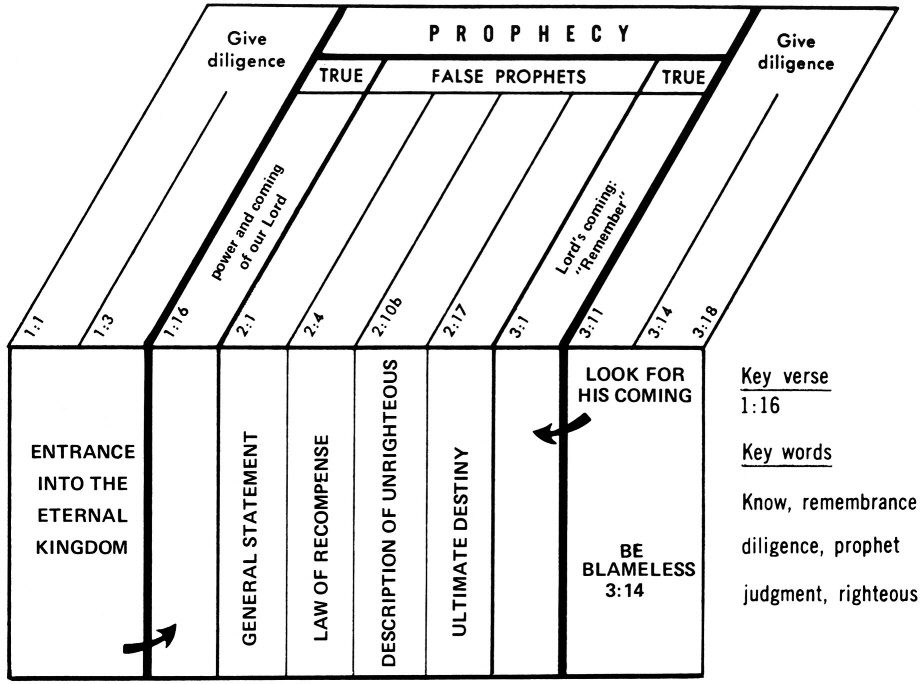
2 Peter: True and False Prophecy
Click chart to enlarge
Chart from Jensen's Survey of the NT - used by permission
|
2 PETER |
||||||||
| Cultivation of Christlike Character |
Condemnation of False Teachers |
Confidence in the Return of Christ |
||||||
| Greeting to Saints 2Pe 1:1-2 |
Growth in Christ 2Pe 1:3-14 |
Grounds |
Danger of |
Demise of |
"Decor" of |
Mockers in |
Manifest |
Maturity in light of that |
| Know Your Salvation |
Know |
Know Your Adversaries |
Know |
|||||
| True Prophecy (True Knowledge) |
False Prophets (False Teachers) |
Final Prophecy (Day of the Lord) |
||||||
| Holiness | Heresy | Hope | ||||||
| Development of Faith |
Denunciation of False Teachers |
Design of The Future |
||||||
2 Peter 1:8 For if these qualities are yours and are increasing, they render you neither useless nor unfruitful in the true knowledge of our Lord Jesus Christ. (NASB: Lockman)
Greek: tauta gar humin huparchonta (PAPNPN) kai pleonazonta (PAPNPN) ouk argous oude akarpous kathistesin (3SPAI) eis ten tou kuriou hemon Iesou Christou epignosin;
Amplified: For as these qualities are yours and increasingly abound in you, they will keep [you] from being idle or unfruitful unto the [full personal] knowledge of our Lord Jesus Christ (the Messiah, the Anointed One). (Amplified Bible - Lockman)
Barclay: For, if these things exist and increase within you, they will make you not ineffective and not unfruitful in your progress towards the knowledge of our Lord Jesus Christ. (Westminster Press)
GWT: If you have these qualities and they are increasing, it demonstrates that your knowledge about our Lord Jesus Christ is living and productive (GWT)
KJV: For if these things be in you, and abound, they make you that ye shall neither be barren nor unfruitful in the knowledge of our Lord Jesus Christ.
NLT: The more you grow like this, the more you will become productive and useful in your knowledge of our Lord Jesus Christ. (NLT - Tyndale House)
Phillips: If you have these qualities existing and growing in you then it means that knowing our Lord Jesus Christ has not made your lives either complacent or unproductive. (Phillips: Touchstone)
TEV: These are the qualities you need, and if you have them in abundance, they will make you active and effective in your knowledge of our Lord Jesus Christ
Wuest: For if these things are your natural and rightful possession, and are in superabundance, they so constitute you that you are not idle nor unfruitful in the full knowledge of our Lord Jesus Christ. (Eerdmans)
Young's Literal: for these things being to you and abounding, do make you neither inert nor unfruitful in regard to the acknowledging of our Lord Jesus Christ
FOR IF THESE ARE YOURS: tauta gar humin huparchonta (PAPNPN) :
- are yours - Jn 5:42 2Co 9:14 13:5 Php 2:5 Col 3:16 Philemon 1:6
- 2 Peter 1 Resources - Multiple Sermons and Commentaries
Spurgeon asks "What Christian ever wishes to be barren or unfruitful? Is it not the aspiration of every branch in the true vine to bring forth much fruit?"
For (1063) (gar) is a term of explanation, a marker showing the cause for something, which should always prompt a pause to ponder what the author is explaining.
For is at the beginning of each of these verses and introduces a positive and a negative incentive to grow spiritually. Note that NASB adds "if" to the translation which suggests that some might not have the qualities mentioned in (see notes 2 Peter 1:5; 1:6; 1:7) but in fact that is not at all what the word "are" (see below) indicates as this verb clearly indicates that there is no doubt about the the reader's possession of these qualities at least in some measure.
"These" refers to the possession and progress in the Christian virtues just delineated. What would you say about a person who evidences none of these qualities?
John Calvin - "you will at length prove that Christ is really known by you, if ye be endued with virtue, temperance, and the other endowments. For the knowledge of Christ is an efficacious thing and a living root, which brings forth fruit."
Are (present tense)(5225)(huparcho from hupo - under + archê - a beginning) means to be, to be in existence, involving an existence or condition both previous to the circumstances mentioned and continuing after it. Huparcho emphasizes that these spiritual qualities (2Pe 1:5, 6, 7-see notes 2 Peter 1:5; 1:6; 1:7) “belong to” all Christians at least to some degree and are "at their disposal" so to speak. The phrase "are yours" (humin huparchonta) is a strong expression denoting that which actually exists as one's possession.
Huparcho for example was used of a property, indicating one owned it and could dispose of it as he desired (cf of Barnabas' tract of land Acts 4:37).
The NIV picks us this truth better than most of the other translations using the word "possess" (present participle would more literally be "continually possessing" ~ their continual possession whether you feel like it or not). Phillip's paraphrase also conveys this truth --"If you have these qualities existing… ".
These wonderful characteristics of the "divine nature" (2Pe 1:5, 6, 7-see notes 2Pe 1:5; 1:6; 1:7) have become a rightful part of the new creation you are in Christ, not a mere fleeting manifestation. Maybe you don't feel very "godly" as you read these words and the enemy is bombarding your mind (that's where the real "spiritual war" is waged in every saint and that battle is over truth versus lies, falsehood and error) with "fiery missiles" saying things like "Who do you think you are? You're not acting very godly". You need to take those thoughts captive (2Cor 10:5-note) and instead let your mind dwell on the truth about you (Php 4:8-note) - you dearly beloved are a possessor of "godliness".
Now live out the truth you know, for as a man or woman thinks within themselves so they are (Pr 23:7).
To reiterate, since you have become partakers of the divine nature, all of the qualities (2Pe 1:5, 6, 7-see notes 2 Peter 1:5; 1:6; 1:7) and more reside in you right now no matter how you "feel" (remember "feelings" can often be deceiving). The truth about you is that the resurrected Christ now lives in you in the form of the Holy Spirit (Col 1:27-note, 1Co 3:16, 6:19-note).
Peter is exhorting every saint to choose now to allow Him to express Himself through you. And it is a voluntary choice we must each make and make each day… many times during the day. God won't force us to deny ourselves and to set our mind on the things of the Spirit rather than the things of the flesh. We each must do that. But oh the rewards for letting the Spirit fill us and control us (Eph 5:18-note, Gal 5:16-note). The more we choose as His bondservants to allow Jesus to be the Lord and Master of every area of our life (see notes on Romans 12:1, 12:2) the more these qualities will increase and superabound, bearing much fruit, fruit that remains for eternity. Why are we so stubborn, hard headed, rebellious and resistant to the Word and the Spirit when all God wants to do is pour forth blessing upon our life?!
Wuest adds that huparcho "refers to an antecedent condition protracted into the present. It speaks of possession." (Wuest goes on to quote Marvin Vincent) “In the sense of 'being' the verb is stronger than the simple einai ‘to be’; denoting 'being' which is from the beginning, and therefore attaching to a person as a proper characteristic, something belonging to him, and so running into the idea of rightful possession as above.” Thus, the possession of the Christian virtues by the believer is a natural, expected thing by reason of the fact that he has become a partaker of the divine nature. And they are not a spasmodic possession either, present one day and absent the next. Indeed, if they were not present in the life, one could well discount the person’s claim of being a child of God." (Wuest, K. S. Wuest's Word Studies from the Greek New Testament: Eerdmans)
If these qualities are not 'yours'' then one must be circumspect and consider Paul's serious warning to…
Test (present imperative) yourselves to see if you are in the faith; examine (present imperative) yourselves! Or do you not recognize this about yourselves, that Jesus Christ is in you--unless indeed you fail the test? (2Co 13:5-note)
In this preceding verse ''yourselves'' is emphatic! How does one assess whether he "fails the test"? There is no power of Christ in their life over sin, no progressive sanctification, none of the virtues listed above, no spiritual fruit, etc.
Why should we study these qualities in detail? If we don't know what they mean how can we even discern whether they are present and increasing? Also if these character traits reflect the "real thing" (genuine Christianity being lived out), then we must know them in order to be able to detect the counterfeit described in the next chapter.
AND ARE INCREASING: kai pleonazonta (PAPNPN) :
- 1Co 15:58; 2Co 8:2; 2Co 8:7 Php 1:9; Col 2:7; 3:16; 1Th 3:12; 4:1; 2Th 1:3
- 2 Peter 1 Resources - Multiple Sermons and Commentaries
Increasing (4121) (pleonazo from pleion = more) means to bring forth in abundance, to become more and more so as to be in abundance and finally to even superabound. The present tense pictures them as ideally continually increasing. Don't read over this section too quickly without asking yourself, "Are these qualities truly increasing in my life or am I in a spiritual rut?" Dearly beloved, life is too short and eternity too long to not be soberly circumspect and "brutally" honest with ourselves!
J. Vernon McGee quips "Here he starts multiplying again. Peter is great with mathematics." (Thru the Bible Commentary: Thomas Nelson)
Peter desires that the qualities (2Pe 1:5, 6, 7-see notes 2Pe 1:5; 1:6; 1:7) (these things) ought not to be static but to be continually increasing in every believer’s life. Some believers may feel good that these qualities are seen in themselves from time to time. But Peter says they should continually (pleonazo is in the present tense = continuous action) superabound in us. There are degrees of ownership of these qualities, implying degrees of productivity in one’s intimacy with Christ. To keep growing in these qualities, one must practice them in the real life classroom of life. Lack of spiritual growth in these areas is a sign of spiritual deterioration. We need to apply all diligence for this is a serious issue for our spiritual health.
MacArthur explains that increasing means "to have more than is necessary" or "to bring forth in abundance." There ought to be enough fruit in your life to prove beyond a shadow of a doubt whom you belong to. God is not interested in a marginal manifestation. Some Christians will manifest some productivity, then manifest nothing. However, there should be more fruit in a believer's life than necessary to prove he is a believer. Many unbelievers have difficulty understanding Christianity because so many Christians manifest no fruit. Many people claim to be Christians, but there's nothing in their life to support their claim."
In (Jn 15:5) Jesus taught that a disciple should bring forth ''much fruit" (see discussion below on "What is fruit according to the Word of God?) for as we bring in a bountiful crop, we bring glory to our heavenly Father and also prove ourselves to be His disciples (Mt 5:16-note, Jn 15:8). If you are becoming more and more like Jesus Christ (Christ is increasing & you are decreasing Jn 3:30-note) you have the kind of character and conduct that God can trust with blessing and are fruitful because you are faithful. Although these character qualities exist in a seed state in every believer (we're all complete in Christ and are possessors of His divine nature), one must continually cultivate them (pull out the weeds of defilement 2Cor 7:1-note,Jas 1:27-note, water with the Word Eph 5:26-note, etc) so that they increase and produce fruit that remains (Jn 15:16)

Wuest comments on saints "increasing" in the fruit of the virtues just mentioned "The Spirit-filled life is the overflowing life. It is like an artesian well whose source is higher than its outflow, the outflow being spontaneous by reason of that fact. The source of the Christian life is God; the outflow, through the believer. But the Christian life that does not run over, or overflow with spiritual blessings to others, is never a source of spiritual refreshment to others. A farmer once said to his helper who always filled the buckets of grain only three fourths full when they should have been full, “the buckets are never full until they are running over.” So a Christian is never filled with the Spirit and spiritual blessings until his life is running over with the good things of God, refreshing the lives of others." (Word Studies - Eerdmans)
Related Resource:
- Spirit filled believers are like artesian wells = great illustration of the "Spirit controlled Christ life"
THEY RENDER YOU NEITHER USELESS: kathistesin (3SPAI) ouk argous :
- they render: Jn 15:7,8 2Co 5:13, 14, 15, 17
- Useless - Pr 19:15; Mt 20:3,6; 25:26; Ro 12:11; 1Ti 5:13; Heb 6:12
- 2 Peter 1 Resources - Multiple Sermons and Commentaries
GLORIFYING OUR FATHER
WHO ART IN HEAVEN
Jesus taught that "My Father is glorified by this, that you bear much fruit, and so prove to be My disciples." And how are we to bear much fruit?
“I am the vine, you are the branches; he who abides in Me and I in him, he bears much fruit, for apart from Me you can do nothing. 7 “If you abide in Me, and My words abide in you, ask whatever you wish, and it will be done for you. (Jn 15:5,7)
When these qualities are increasing they "make you not idle nor unfruitful".
THOUGHT - Our time to plant seeds is short but the harvest will last for all eternity. Are you busy (enabled by God's Spirit) casting out Gospel seeds and carrying out good (Spirit empowered and God glorifying) works? Then you are assuring yourself an abundant entrance into Heaven beloved! (2 Pe 1:11+) And throughout eternity you will not regret your decision to be a Gospel seed sower for the Lamb (Ps 126:6, Eccl 11:1). Amen!
Render (2525) (kathistemi from katá = down + histemi = to stand) means literally “to stand or set down". Most NT uses refer to "setting someone in office" or appointing or assigning a person to a position of authority, to put in charge, to appoint one to administer an office or to constitute.
A saint's superabounding possession of the qualities Peter has just described constitutes them as "neither useless nor unfruitful". The tense is present which indicates that they are continually rendered useful and fruitful. Yes, Lord, let it be so by Thy Spirit, for Thy glory. Amen.
Only one life
Twill soon be past
Only what's done
For (in) Christ will last!
Vincent comments that the primary meaning of kathistemi is to set down, it is used in classical Greek of bringing to a place, as a ship to the land, or a man to a place or person; hence to bring before a magistrate… From this comes the meaning to set down as, i.e., to declare or show to be; or to constitute, make to be. (Word studies in the New Testament: Vol. 3, Page 1-64)
Kathistemi - 21x in 20v-
Matt 24:45, 47; 25:21, 23; Luke 12:14, 42, 44; Acts 6:3; 7:10, 27, 35; 17:15; Rom 5:19; Titus 1:5; Heb 5:1; 7:28; 8:3; Jas 3:6; 4:4; 2 Pet 1:8
THOUGHT - As you read this note, the truth is that if you are a believer, you are either in one of two states -- advancing or regressing on the highway of holiness (Isa 35:8) -- "Onward ho!" should be the believer's byword. No standing still. And oh to yearn for the fruit borne by running the course with endurance (Heb 12:2+) and pressing on toward the goal for the prize of the upward call (Php 3:14+). The one who runs the race, fights the fight (1 Ti 6:12+) and keeps the faith (2 Ti 4:7+) is the one who realizes strength in their spirit and security in their salvation. Failure to persevere in the development of this Christian character leads to barrenness, unfruitfulness, blindness, shortsightedness, and forgetfulness. So let your light shine (Mt 5:16+) and press on so that you are not trampled on like "tasteless salt" thrown out under the feet of men. (Mt 5:13-16+)
Laziness casts into a deep sleep,
And an idle man will suffer hunger.
Proverbs 19:15
NEITHER USELESS: ouk argous:
- 2 Peter 1 Resources - Multiple Sermons and Commentaries
Neither (3756) is ouk conveying absolute negation in the Greek. This negative combined with the two adjectives that follow gives the force of a strong positive assertion.
Useless (692) (argos from a = without + érgon = work) literally means without work, without labor, doing nothing, as one not working the ground and so living without labor. As employed in the New Testament, argos always describes something inoperative or unserviceable. Argos describes that which is not working, ineffective, barren, yielding no return or worthless, not accomplishing anything.
Argos was used to describe money that was yielding no interest or of a field lying fallow.
Argos conveys several ideas depending on the context - (1) unemployed - without anything to do (Mt 20:3,6, 1Ti 5:13); (2) being unwilling to work, wanting nothing to do, shunning the labor which one ought to perform - idle, neglectful or lazy (as used in Titus 1:12) and (3) unproductive - useless, unprofitable or worthless (Jas 2:20, 2Pe 1:8-note; Mt 12:36).
Gilbrant - among classical writers this adjective describes someone or something (e.g., a field or money) as “inactive, lazy, or idle.” Both the verb argeō and the adjective (the opposite of energes “active”) occur extensively in papyri. For example, elaiourgiou argou equals “an oil press which is out of working order”; the derived noun, argia, can mean “holiday” (Moulton-Milligan). The Septuagint’s limited usage of argos occurs primarily (four out of five times) in the apocryphal writings. Joshua ben Sira advised not to consult a lazy (argos) man about work (Sirach 37:11; cf. Sirach 30:36, the verb).New Testament usage accords with the pattern established by classical and Septuagintal usage. People are “idle” or “not working” (Matthew 20:3,6), and words can be “careless” (argos, Matthew 12:36). Work had a positive value in Greek culture as well as in a Hebrew environment. “Laziness is a disgrace” (Hesiod Works and Days 307ff.); but work is closely associated with virtue (aretē). (Compare Paul’s probable allusion to the Greek poet Epimenides: “Cretans are always liars, evil brutes, lazy [argos] gluttons” [Titus 1:12, NIV].) In a play on words James says that faith without works (ergōn) is “idle” (argē, James 2:20; variant readings here include “dead” [nekra] and “empty” [kenē]). Perhaps in a veiled reference to the opponents Peter used litotes (a positive statement expressed in negative terms) to urge action on the part of believers. “For if these things are yours and abound, they keep you from being ineffective (argē) or unfruitful (akarpos)” (2 Peter 1:8, RSV). In other words, such things will make one “effective” and “fruitful.” “Idleness” joins with “foolish talk” (phluaros) in 1 Timothy 5:13 to characterize those women who had been duped by the false teachers. Being idle they went from house to house spreading the gangrenous teachings. “Idleness” thus is paradoxically an “active” passivity that disrupts the rest of the community. (Complete Biblical Library Greek-English Dictionary)
Argos is used 7 times in the NT (see uses below) and is translated in the NASB as: careless, 1; idle, 4; lazy, 1; useless, 2. KJV translates it as: barren, 1; idle, 6; slow, 1. Argos is found once in the Septuagint (LXX) (1 Ki 6:7)
Matthew 12:36 "And I say to you, that every careless (literally "not working", barren, unproductive) word that men shall speak, they shall render account for it in the day of judgment.
Comment: Re-read this verse and think about the implications of what comes out of our mouths. Are our words "working" - ergon - words, words that are productive and which edify? "Not working" words include those that are flippant, irresponsible, hypocritical or in any way inappropriate. cf Eph 4:29+.
Matthew 20:3 "And he went out about the third hour and saw others standing idle in the market place;
Matthew 20:6 "And about the eleventh hour he went out, and found others standing; and he said to them, 'Why have you been standing here idle all day long?'
1 Timothy 5:13 And at the same time they (younger widows) also learn to be idle, as they go around from house to house; and not merely idle, but also gossips and busybodies, talking about things not proper to mention.
James 2:20+ But are you willing to recognize, you foolish fellow, that faith without works is useless (unprofitable, worthless - carries the idea of fruitlessness - see parallel thought in Mt 7:19-note)?
Comment: What does a fruitless life demonstrate?
James 2:20KJV (based on the Textus Receptus) - But wilt thou know, O vain man, that faith without works is dead?
Comment: Note that the Textus Receptus has nekros in place of argos.
Titus 1:12+ One of themselves, a prophet of their own, said, "Cretans are always liars, evil beasts, lazy gluttons."
Argos can pertain to being without anything to do, unemployed or idle. In this sense it does not necessarily connote laziness but merely points up the fact that they were unemployed at the time. For example in Jesus' parable of the vineyard He related how the landowner went to hire laborers "And he went out about the third hour and saw others standing idle in the market place." (Mt 20:3).
Argos is not a picture of one who is unavoidably unemployed but of one who avoids labor for which he or she should assume responsibility ("we are His workmanship" Eph 2:10-note).
James (Jas 2:20) uses argos to describe a faith that fails to show itself in works. Jesus warned that
“Every tree that does not bear good fruit, is cut down and thrown into the fire” (Mt 7:19-note).
A fruitless life is proof that one does not belong to God and is unacceptable to God, because this life does not have His divine life within. Faith apart from works is head belief, and therefore dead belief.
Argos is like money gaining no interest and fertile land yielding no crops.
Argos describes that which does not fulfill its purpose. In a spiritual sense argos means "to produce no good for God." With the virtues mentioned above increasing in one’s life (see notes 2 Peter 1:5; 1:6; 1:7), a Christian will not be useless or effective.
Peter's point is that in contrast to being barren, inactive, indolent, and useless, if these virtues are increasing in one’s life, this Christian's life will not be useless or ineffective.
Paul in a parallel passage writes
"So then, while we have opportunity (see in depth study of this word kairos), let us do good (not only being useful or profitable to them, but also doing what is for their spiritual good and advantage; see study of good deeds) to all men, and especially to those who are of the household of the faith (the first test of our love for God is our love for His other children, our brothers and sisters in Christ)." (Gal 6:10+)
MacArthur gives an example to illustrate "useless" - "People have said to me, "I have a friend who received Christ and came to church and Bible study for awhile. But now he never comes. He just doesn't seem interested. I can't figure out if he's a Christian or not." I have had the same problem. There was a man who used to come to Grace Church and teach in the children's department. But he has not darkened our door for many years. People have asked me if he's a believer. To be perfectly honest, I haven't the faintest idea because he is indistinguishable from an unbeliever. He is argos-- dead and barren."
We probably all know someone like this. How eternally tragic to be a believer blessed with every spiritual blessing in the heavenly places in Christ, possessing every accoutrement necessary for life and godliness, including access to all of God's precious and magnificent promises, and most significantly to be a sharer in God's divine nature… and yet despite all these spiritual advantages, to still be utterly useless to God, spiritually bankrupt so to speak! Can you imagine what that day will be like for these saints when they
"appear before the judgment seat of Christ, so that each one may be recompensed for his deeds in the body, according to what he has done, whether good or bad" (2Cor 5:10+)
and
"each man's work will become evident; for the day will show it because it is to be revealed with fire, and the fire itself will test the quality of each man's work. If any man's work which he has built on it remains, he will receive a reward. If any man's work is burned up, he will suffer loss; but he himself will be saved, yet so as through fire." (1Cor 3:13, 14, 15)
MacDonald adds these thoughts on the "useless" life:
"Only the life lived in fellowship with God can be truly effective. The guidance of the Holy Spirit eliminates barren activity and insures maximum efficiency. Otherwise, we are shadow-boxing, or sewing without thread."
In this section, it is clear that Peter's desire is that believers "grow in the grace and knowledge of our Lord and Savior Jesus Christ" (2Pe 3:18-note) as expressed in this little poem by Eliza Hewitt
More about Jesus would I know,
More of his grace to others show;
More of his saving fullness see,
More of his love who died for me.
NOR UNFRUITFUL: oude akarpous kathistesin (3SPAI):
- Mt 13:22; Jn 15:2;Jn 15:6; Titus 3:14
- 2 Peter 1 Resources - Multiple Sermons and Commentaries
A SPIRITUAL OXYMORON
AN UNFRUITFUL LIFE
This is an oxymoron for a believer, for it is a contradiction of terms. Believers bear fruit. No fruit signifies no root! And no root equates with a dead plant!
Unfruitful (175) (akarpos from a = without + karpos = fruit, produce) means barren, without fruit or unprofitable. Akarpos pictures a tree without fruit under the most favorable of circumstances.
Akarpos -7x in 7v - Mt 13:22; Mk 4:19; 1Cor 14:14; Ep 5:11; Titus 3:14; 2Pet 1:8; Jude 1:12
Unfruitful saints remain “infants in Christ” (1Cor 3:1), in continual need of spiritual “milk” rather than solid food (Heb 5:12-note, He 5:13, 14-note) and are "tossed here and there by waves and carried about by every wind of doctrine" (Ep 4:14-note). Believers on the other hand are commanded to continually, habitually “grow in the grace and knowledge of our Lord and Savior Jesus Christ” (2Pe 3:18-note).
Writing to Titus on the Isle of Crete inhabited by those who "are always liars, evil beasts, lazy (argos) gluttons" (Titus 1:12-note), Paul encouraged Titus to "let our people also learn (through practice) to engage (become experienced) in good deeds to meet pressing needs, that they may not be unfruitful (akarpos)." (Titus 3:14-note) Paul is emphasizing that genuine good deeds are a platform for witnessing effectively. He knew also that though grace is the root (Titus 3:7-note), good deeds are to be the fruit (cf. Eph 2:10-note) of the tree of salvation.
Jude gave us an example to avoid writing of those who had crept in and turned the grace of God into licentiousness, adding that
"These men are those who are hidden reefs in your love feasts when they feast with you without fear, caring for themselves; clouds without water, carried along by winds; autumn trees without fruit, (akarpos) doubly dead, uprooted. wild waves of the sea, casting up their own shame like foam; wandering stars, for whom the black darkness has been reserved forever." (Jude 1:12, 13-note)
Jude pictures an orchard in autumn, the time when the farmer expects fruit. But these trees are fruitless! Not only are they fruitless, but they are also rootless (“uprooted”).
Jesus helps us understand why the word of God may not be unfruitful (akarpos) in a person's life, teaching His disciples that "the worries of the world and the deceitfulness of riches, and the desires for other things enter in & choke the word & it becomes unfruitful." (Mk 4:19)
It follows that these same distractions can contribute to a believer's failure to bear fruit. On the other hand you need to remember that if you don't see fruit in your life, you cannot be sure you are a Christian. If you're a true Christian, there should be fruit, but as most us know too well, times of rebellion and unconfessed sin can lead us into times of barrenness in our walk with the Lord.
In a section describing the unregenerate Paul exhorts believers not to "participate in the unfruitful (akarpos) deeds of darkness, but instead even expose them." (Eph 5:11-note)
MacDonald writes that "These works of darkness are unfruitful as far as God and men are concerned. It was this feature of utter barrenness that once prompted Paul to ask the Roman Christians, “What fruit did you have then in the things of which you are now ashamed?” (see note Romans 6:21)." (MacDonald, W. Believer's Bible Commentary Nashville: Thomas Nelson.)
Be careful in interpreting this section of Scripture for Peter does not teach that a person must work to earn salvation. We do not work to be saved but because we have been saved. Faith alone saves but saving faith is never alone. A living faith works (Jas 2:14ff-notes), but as Peter has taught us it is a faith has been received (2Pe 1:1- note). Peter is in no way in this text implying that one can lose their salvation. Quite to the contrary, Peter wants us to have assurance of our salvation and fruitfulness is one of the best indicators that we genuinely belong to the Lord (e.g., see study on Good Deeds , 2Ti 2:14-note, Eph 2:10-note , Easton on "Good Works", Torrey's Topic "Good Works").
APPLICATION: Do you desire to see fruit in your life? What better "formula" for fruitfulness than that given by the psalmist in Psalm 1 below. Meditate on this passage. Memorize it so you will be able to meditate on it as you walk about. Then live it out and experience the assurance that comes from being a fruitful saint in "season".
who does not walk in the counsel of the wicked,
nor stand in the path of sinners,
nor sit in the seat of scoffers!
But his delight is in the law of the LORD,
And in His law he meditates day and night
And He will be like a tree firmly planted by streams of water,
which yields its fruit in its season
And in whatever he does, he prospers."
(Ps1:1-note, Ps 1:2-note, Ps 1:3-note)
MacDonald has some pithy comments on "unfruitfulness": "It is possible to have considerable knowledge of the Lord Jesus Christ and yet to be unfruitful in that knowledge. Failure to practice what we know leads inevitably to barrenness. Inflow without outgo killed the Dead Sea, and it kills productivity in the spiritual realm as well." (Believer's Bible Commentary)
John MacArthur writes that "When these Christian qualities are not present in a person's life (see notes 2 Peter 1:5; 1:6; 1:7), he will be indistinguishable from an evildoer or a superficial believer. But when these qualities are increasing in a Christian’s life, there is the manifestation of “the divine nature” (v4) within the believer "
There’s no fruit on broken branches, and there’s no life without fruit. Fruit harbors the seed, which perpetuates the life of the species. A true disciple has life flowing from Jesus, and his own character and power shape the disciple’s attitudes and behaviors. If one totally lacks these qualities then he needs to meditate on Peter's exhortation in (2Pe 1:10-note). Bearing fruit was important to Jesus’ teaching (John 15:1-8). Fruit growing on a tree describes genuine disciples of Jesus. True disciples become fruitful by God’s power. Does your daily conduct result in fruitful impact on those around you?
Spurgeon in Faith's Checkbook (May 27): "If we desire to glorify our LORD by fruitfulness, we must have certain things within us; for nothing can come out of us which is not first of all within us. We must begin with faith, which is the groundwork of all the virtues; and then diligently add to it virtue, knowledge, temperance, and patience. With these we must have godliness and brotherly love. All these put together will most assuredly cause us to produce, as our life fruit, the clusters of usefulness, and we shall not be mere idle knowers but real doers of the Word. These holy things must not only be in us, but abound, or we shall be barren. Fruit is the overflow of life, and we must be full before we can flow over. We have noticed men of considerable parts and opportunities who have never succeeded in doing real good in the conversion of souls; and after close observation we have concluded that they lacked certain graces which are absolutely essential to fruit bearing. For real usefulness, graces are better than gifts. As the man is, so is his work. If we would do better, we must be better. Let the text be a gentle hint to unfruitful professors and to myself also."
Steven Cole - THERE IS A DIRECT LINK BETWEEN GROWTH IN GODLINESS AND FRUITFULNESS. Peter states his point negatively to call attention to what happens if you do not grow in godliness: you will live a useless, unfruitful life. Nobody in their right mind would set out at age 20 and say, “I’d like to waste my life!” Nobody writes out a plan for a wasted life: “I think I’ll devote three hours per day, 21 hours per week, to watching television!” (That is the national average!) “I also plan to become addicted to alcohol and drugs. I plan to live so selfishly and with such disregard for others that I will shred all of my relationships. Also, I plan to spend far more than I earn so that I will run up huge debts.” No one plans to be useless and unfruitful! And yet, many people end up that way!
But, to put it positively, how can I be useful and fruitful in my Christian life? How can I use the time, talents, and treasure that God has entrusted to me so that one day I will hear, “Well done, good and faithful servant”? It’s easy to be busy in the Lord’s work, but I don’t want to be just busy—I want to be useful and fruitful.
As a pastor, it’s easy to fall into the trap of thinking that fruitfulness is measured in terms of numbers: “If I can pastor a large, growing church, write best-selling books, and travel all over the world to influence thousands of other Christian leaders, I will be fruitful.” Ministering to large numbers may indicate success in human terms, but we need to measure fruitfulness by God’s criteria. In church history, there are a few well known men like Martin Luther, John Calvin, Jonathan Edwards, Charles Spurgeon, and Martyn Lloyd-Jones. But there are thousands of faithful, fruitful men and women whose names are known only to God. What distinguished these faithful saints to God and made them fruitful was that they devoted themselves to growing in godliness.
In 1981, I read the two-volume autobiography of C. H. Spurgeon. He was an amazing man whom God used mightily. One day as I was jogging in the woods, I asked the Lord one of those “far beyond all you can ask or think” prayers. I prayed, “Lord, use me as You used Spurgeon!” I didn’t hear any voice, but almost instantly the thought popped into my mind, which I believe was from the Lord, “Which Spurgeon? Charles or John?”
I stopped jogging and just stood there so I could think about the implications of that question. John Spurgeon was the father of the famous Charles. He was a faithful pastor in England for many years. He actually outlived his famous son. If it had not been for the famous Charles Spurgeon, no one would have ever heard of John Spurgeon. Yet, he and thousands of others like him were godly, fruitful servants of the Lord. It was as if the Lord was saying to me, “You focus on being as faithful and godly as John Spurgeon and leave it to Me as to whether you become as influential as Charles Spurgeon!” Peter is telling us, “Focus on growing in godliness and you will be fruitful in your Christian life.”
B. IF YOU TRULY KNOW CHRIST, YOU WILL WANT TO BE USEFUL AND FRUITFUL IN SERVING HIM.
When Peter says, “in the true knowledge of our Lord Jesus Christ,” is he talking about growing to know Christ more deeply as you grow in godliness, or is he talking about coming to know Christ at the point of conversion as the basis for growing in godliness? There could be some of both here. Peter later talks about growing to know Christ more deeply (2 Pet. 3:18). But since Peter has talked about “the true knowledge of Christ” in reference to conversion (1:3), I understand him here (1:8) to be saying, “If you have truly come to know the Lord Jesus Christ, you will be growing in godliness and seeking to be useful and fruitful in serving Him.”
John Calvin observes (Calvin’s Commentaries [Baker], on 2Peter 1:8, p. 374), “For the knowledge of Christ is an efficacious thing and a living root, which brings forth fruit.” In other words, if God has opened your eyes to the glory of the gospel of Christ (2Cor. 4:6), so that you have come to know Him, your life will show it. You will be growing in the godly character qualities that Peter lists (2Pe 1:5-7). And you will be seeking to make your life useful and fruitful to the Master who shed His blood to redeem you. If you’re not living with a view to how God can use you to bear fruit for His kingdom, then you’re wasting your life.
This does not mean that you must go into so-called “full time Christian ministry.” Rather, it means that in whatever situation you find yourself, whether at home, at school, or at work, you have the mindset that you want to be useful and fruitful for the Lord Jesus Christ. Life is a vapor (James 4:14)! Don’t waste it living for selfish pursuits or for things that will perish. Live so as to grow in godliness so that you will be a clean vessel, “useful to the Master, prepared for every good work” (2Ti 2:21b). (The Benefits of Growing in Godliness 2 Peter 1:8-11)
(Heb 13:15-note) says when we "offer up a sacrifice of praise to God, that is, the fruit of lips that give thanks to His name".
Spiritual fruit should be the natural outflow of genuine Biblical repentance (Mt 3:8, Lk 3:8).
The quality of one's spiritual fruit determines the "type" of tree whether "good" or "bad" (Mt 7:15, 16, 17, 18, 19, 20) (see notes Matthew 7:15; 7:16; 7:17; 7:18; 7:19; 7:20)
When the "seed" of the Word of God falls in "an honest and good heart", this heart will hold the Word fast and will "bear fruit with perseverance", bringing forth "a hundredfold, some sixty, and some thirty" (Lk 8:15, Mt 13:8, Mk 4:8) and the dynamic process of bearing much fruit will glorify the Father and prove that an individual is truly His disciple (Jn 15:8) which is simply saying another way what Peter teaches in this verse in 2 Peter. Jesus taught that the seed (figuratively referring to Himself but the principle broadly applicable to every saint) that "falls into the earth and dies… bears much fruit." (Jn 12:24).
In (Jn 15:5) Jesus also taught one of the most essential of all principles in "spiritual horticulture" when He instructed His disciples: "I am the vine, you are the branches. He who abides in Me & I in him, he bears much fruit, for apart from Me you can do nothing." Jesus goes on to explain that disciples have been chosen (elected) by Himself to go and bear fruit which remains (Jn 15:16) Jesus explained what "fruit which remains" means, when He taught that disciples who are active in sowing or reaping lost souls are actually "gathering fruit for life eternal" when they will all "rejoice together." (Jn 4:36)
Paul refers to "holiness" (sanctification) & eternal life as fruits ("benefit") that are to be the natural outcome in the lives of those men and women who have been "freed from sin and enslaved to God". (Ro 6:22-note)
Paul speaks of giving money in support of the ministry as fruit ("the profit [karpos] which increases to your account") (Php 4:17-note, cf Ro 15:28-note).
In (Ro1:13-note) Paul is probably referring to winning souls to Christ as fruit. In (1Co16:15) Paul speaks of the house of Stephanas as "the first fruits of Achaia."
Paul adds that every saint has the potential to bear much fruit because when they were born again they were "filled with the fruit of righteousness which comes through Jesus Christ, to the glory and praise of God." (Php 1:11-note) Although all saints have the potential for "much fruit", Paul taught that difficult labor is called for reminding Timothy (and all disciples) that "the hard-working farmer ought to be the first to receive his share of the crops (fruit). " (2Ti 2:6-note, cf Jas 5:7)
The writer of Hebrews reminds us that God's loving hand of discipline will yield the "fruit" of the peace of God associated with a life that is lived in accordance with His holy standards, writing that "All discipline for the moment seems not to be joyful, but sorrowful; yet to those who have been trained by it, afterwards it yields the peaceful fruit of righteousness." (Heb 12:11-note, cf Jas 3:17, 18).
So my brother and my sister, you have been made "adequate, equipped for every good work" by the Word of God (2Ti 3:16, 17-notes), so go forth from this day bearing much fruit, so that when the Son of Man returns with power & great glory, He may say "'Well done, good & faithful slave. You were faithful with a few things, I will put you in charge of many things; enter into the joy of your Master." (Mt 25:21)
And I love the fascinating, albeit enigmatic last mention of "fruit" in the Word of God when John writes of our eternal home with our Heavenly Father and Christ Jesus our Lord, describing the glorious "river of the water of life, clear as crystal, coming from the throne of God and of the Lamb, in the middle of its street. On either side of the river was the tree of life, bearing twelve kinds of fruit, yielding its fruit every month; and the leaves of the tree were for the healing of the nations." (Rev 22:1-note; Rev 22:2-note )
"Oh, the depth of the riches both of the wisdom and knowledge of God ! How unsearchable are His judgments and unfathomable His ways !… For from Him and through Him and to Him are all things. To Him be the glory forever. Amen" (Ro 11:33-note, Ro 11:36-note)
MacArthur adds that "Spiritual "fruit" then can be winning people to Christ and investing in His Kingdom. fruit can be praying and praising. It is every righteous act. Behind the act is the attitude, for "the fruit of the Spirit is love, joy, peace, long-suffering, gentleness, goodness, faith, meekness, self-control" (Gal 5:22, 23-note). You begin with the fruit of the Spirit and follow that with the act. If you act without the right attitude, that's legalism. I pray we might be a sacrificial, productive, and fruitful people. Fruit is not the result of standing around and doing nothing. It doesn't come from signing on a dotted line to be involved in a ministry. Fruit results when the things of (2Pe 1:5, 6, 7) are manifest in your life. Only then will God produce fruit in you."
Our Daily Bread has a devotional entitled "Holy Fruit" that illustrates the truth in Peter's exhortation…
Billy Graham told about the conversion of H. C. Morrison, the founder of Asbury Theological Seminary. He said that Morrison, a farm worker at the time, was plowing in a field one day when he saw an old Methodist preacher coming by on his horse.
Morrison knew the elderly gentleman to be a gracious, godly man. As he watched the old saint go by, a great sense of conviction of sin came over Morrison and he dropped to his knees. There between the furrows in his field, alone, he gave his life to God.
When he concluded the story, Billy Graham earnestly prayed, "Oh, God, make me a holy man."
Augustine said, "Do you wish to be great? Then begin by being." True and lasting greatness stems from what we are. Though we may seem to be doing nothing at all, we can be doing everything worthwhile if our lives are being styled by God's grace. Even if we are set aside through old age, sickness, or seclusion, we can still be productive. Are you bedridden or house-bound? Your holy life can still bear fruit.
This can happen only as we stay in close relationship with Jesus (John 15:1, 2, 3, 4, 5, 6,7, 8, 9, 10, 11). Only then will we have the fruit that "remains" (Jn 15:16). —D H R (Our Daily Bread, Copyright RBC Ministries, Grand Rapids, MI. Reprinted by permission. All rights reserved)
I lived so that all whom I met could see
His Holy Spirit shining through me;
O friend, is this what our hearts can say
As we sit and think at the close of day? —Nicholson
The most powerful testimony is a holy life.
In growing a healthy, fruit-bearing church, try this plan.
Plant three rows of squash:
• Squash gossip.
• Squash criticism.
• Squash indifference.
Plant seven rows of peas:
- • Prayer
- • Promptness
- • Perseverance
- • Politeness
- • Preparedness
- • Purity
- • Patience
Plant seven heads of lettuce:
- • Let us be unselfish and loyal.
- • Let us be faithful to duty.
- • Let us search the Scriptures.
- • Let us not be weary in well-doing.
- • Let us be obedient in all things.
- • Let us be truthful.
- • Let us love one another.
No garden is complete without turnips:
- • Turn up for church.
- • Turn up for meetings, in prayer, and Bible study.
- • Turn up with a smile, even when things are difficult.
- • Turn up with determination to do your best in God’s service.
After planting, may you grow in grace and in the knowledge of our Lord and Savior Jesus Christ (2 Peter 3:18). And may you reap rich results. (Morgan, R. J. Nelson's complete book of stories, illustrations, and quotes Page 122. Nashville: Thomas Nelson Publishers)
IN THE TRUE KNOWLEDGE: eis ten tou kuriou hemon Iesou Christou epignosin:
- 2 Peter 1 Resources - Multiple Sermons and Commentaries
"In" is eis the preposition indicating "into" and has the idea of penetrating. Here the object is epignosis implying an intimate and growing knowledge of the Lord Jesus Christ.
True knowledge (1922) (epignosis from epí = upon + ginosko = to know) conveys the thought of a more full, larger and thorough knowledge. It also conveys the idea of an intimate and personal relationship than the simple term.
Epignosis is knowledge "of" Him, not just "about" Him And thus Peter with this simple choice of the preposition "eis" conveys the idea that we are continually to advance into an ever greater measure of the full knowledge of Christ. Knowledge of Christ is the goal toward which a saint's spiritual growth aims and toward which we are to be continually advancing. This goal is reminiscent of Paul's desire in (Php 3:10-note)
"know Him and the power of His resurrection & the fellowship of His sufferings, being conformed to His death".
Cultivation of the virtues (2Pe 1:5, 6, 7-notes 2Pe 1:5; 6; 7) will cause Peter's reader's knowledge of Christ to be productive in practical ways and prevent believers from becoming spiritually nearsighted and blind so that they forget that they are new creatures in Christ with a new divine nature.
It is interesting that Greek philosophers saw philosophical knowledge as the key to changing people’s behavior, whereas Peter sees a true knowledge of our Lord Jesus Christ as the goal of our spiritual growth (2Pe 3:18-note).
A lazy indifference to or disparagement of a growing knowledge of our Lord Jesus is fundamentally opposed to the very nature of the Christian life, for as Paul says "Christ [is] our life" (Col 3:4-note) and in "are hidden all the treasures of wisdom and knowledge." (Col 2:3- note) It follows that we will never fully apprehend all of Who Christ is in this life, but there can be no greater, more worthy goal for one's passions and desires to be aimed toward.
Vincent writes that the "idea is not idleness in the knowledge, but idleness in pressing on and developing toward and finally reaching the knowledge." (Vincent, M. R. Word studies in the New Testament. Vol. 1, Page 3-681).
OF OUR LORD JESUS CHRIST: tou kuriou hemon Iesou Christou:
- 2 Peter 1 Resources - Multiple Sermons and Commentaries
JESUS IS LORD
We don't make Jesus Lord of our lives. If we are genuine believers, He IS Lord of our lives! Read Romans 10:9-10+
that if you confess with your mouth Jesus as Lord, and believe in your heart that God raised Him from the dead, you will be saved; 10 for with the heart a person believes, resulting in righteousness, and with the mouth he confesses, resulting in salvation.
Compare Paul's prayer in where he is interceding for the saints in Colossae asking that they
"may be filled with (controlled by) the knowledge (epignosis) of His will in all spiritual wisdom & understanding, so that (marks the "purpose") [they] will walk in a manner worthy of the Lord, to please Him in all respects, bearing fruit in every good work and increasing (auxano, the same verb used by Peter in 2Pe 3:18-note) in the knowledge (epignosis) of God… " (Col 1:9, 10, 11, 12-see note Col 1:9; 10; 11; 12)
So Paul is praying for the saints to live out (walk) the spiritual wisdom & understanding that fills them, and that the natural outflow of their obedient lifestyle would be usefulness (pleasing our heavenly Father in all respects) and fruitfulness (continuously bearing fruit) and that in turn they would be growing in intimacy (increasing in the knowledge) with their Lord Jesus Christ.
Failure to practice what we know ("walk in a manner worthy of the Lord") leads inevitably to barrenness. Inflow without outgo killed the Dead Sea, and it kills productivity in the spiritual realm as well.
THOUGHT: Are you fruitful and useful? If not consider praying Paul's great prayer that God will make you fruitful and useful in His kingdom work and instead of being like the Dead Sea, from your "innermost being will flow rivers of living water." (Jn 7:38+)
Lord (master, owner)(2962)(kurios from kuros = might or power) has a variety of meanings/uses in the NT and therefore one must carefully examine the context in order to discern which sense is intended by the NT author. For example, some passages use kurios only as a common form of polite address with no religious/spiritual meaning. The reader should also be aware that in view of the fact that kurios is used over 9000 times in the Septuagint (LXX) and over 700 times in the NT, this discussion of kurios at best only "skims the surface" of this prodigious, precious word.
In short, Jesus is Sovereign, Possessor, Owner, and Master of every believer because He has "redeemed (lutroo - paid the ransom price, purchasing us off the slave block, enslaved to sin and Satan, rescuing us, setting us free to be free indeed - Jn 8:36) (NOT) with perishable things like silver or gold from your futile way of life inherited from your forefathers, but with precious blood, as of a lamb unblemished and spotless, the blood of Christ." (1 Pe 1:18-19+, read 1 Cor 6:20+, Titus 2:14+)
At the outset should be noted that in the NT Jesus is referred to as Lord (Kurios) more frequently than by any other title. Therefore it behooves us to understand the truth concerning Jesus as Lord and not allow ourselves to become side tracked in debate over so-called "Lordship salvation". The indisputable Biblical facts are that faith in Jesus saves and Jesus is Lord. This confession of "Jesus is Lord" became a direct affront to the practice of emperor worship. Certain cities even built temples for Caesar-worship as was the case in Smyrna where the command was to honor the emperor by confessing "Caesar is Lord". To declare "Jesus is Lord" became a crime punishable by death, resulting in the martyrdom. I think the first century believers understood "Lordship" in a way modern believers would find it difficult to comprehend! (cp Jesus' "prophetic" warning in Mt 10:22, 23, 24, 25 where "master" is kurios)
Lord is not merely a name that composes a title, but signifies a call to action so that every saint should willingly, reverently bow down to Jesus Christ. If Christ is our Lord, we are to live under Him, consciously, continually submitting our wills to him as His loyal, loving bondservants ("love slaves"), always seeking first His Kingdom and His righteousness (Mt 6:33-note). According to this practical working "definition" beloved we all need to ask ourselves "Is Jesus Christ my Lord?". "Do I arise each day, acknowledges this is the day the Lord hath made?" (Ps 118:24-note) "Do I surrender my will to His will as I begin each day?" (cp Ro 12:1-note, Ro 12:2-note) Beloved, don't misunderstand. None of us have "arrived" in this area of Jesus as Lord of our lives. And it is precisely for that reason that Peter commands us to continually "grow (present imperative) in the grace (unmerited favor, power to live the supernatural, abundant life in Christ) and knowledge (not just intellectual but transformational) of our Lord and Savior Jesus Christ. To Him be the glory, both now and to the day of eternity. Amen." (2Pe 3:18-note) So do not be discouraged. Don't "throw in the towel" as they say. Keep on keeping on, pressing (continually = present tense) "on toward the goal for the prize of the upward call of God in Christ Jesus." (Php 3:14-note)
Boice adds that "Citizens of the empire were required to burn a pinch of incense to the reigning Caesar and utter the words Kyrios Kaisar (“Caesar is Lord!”). It is this that the early Christians refused to do and for which they were themselves thrown to the wild lions or crucified. It was not that Christians were forbidden to worship God. They were free to worship any god they chose so long as they also acknowledged Caesar. Romans were tolerant. But when Christians denied to Caesar the allegiance that they believed belonged to the true God only, they were executed." (Daniel: An Expositional Commentary)
The main sense of kurios is that of a supreme one, one who is sovereign and possesses absolute authority, absolute ownership and uncontested power.
Kurios is used of the one to whom a person or thing belonged, about which he has the power of deciding, the one who is the master or disposer of a thing (Mk 7:28)
Thayer says kurios is "he to whom a person or thing belongs, about which he has the power of deciding; master, lord."
In classical Greek, kurios was used of the false gods, such as Hermes, Zeus, etc. Kurios was also used in secular Greek to identify the head of the family, who was lord of his wife and children (compare 1Sa 1:8, Ge 18:22 referred to in the NT - 1Pe 3:6-note where "lord" = kurios)
Detzler on kurios - "In the earliest Greek this word meant "to have power or authority." Later it came to describe one who is in control. As classical Greek developed, it became a title for men of importance. Since the gods of ancient Greece were neither creators nor lords of their fate, pagan deities were not called "lord" until much later. By the time of Christ, kings had come to be called "lord." This was true of the Roman Emperor Caligula (A.D. 37-41). It was also true of Candace, the fabled queen of upper Egypt (Ac 8:27). So too Herod the Great, Herod Agrippa I, and Herod Agrippa II were called "lord." (Wayne A Detzler. New Testament Words in Today's Language)
When one referred to someone as "Lord" they were not only acknowledging the position of authority, but they were also referring to someone who, in that position of authority had a concern and a passion for others who are under his authority.
Carpenter and Comfort comment that…
The Jews who first followed Jesus would have been aware that God was repeatedly called “Lord” in the Greek Old Testament (Septuagint - LXX). Thus, they knew what they were saying when they called Jesus “Lord.” To call Him Lord was to call Him “God.” When Thomas encountered the risen Christ, he proclaimed to Jesus, “My Lord and my God” (Jn 20:28). (Holman Treasury of Key Bible Words: 200 Greek and 200 Hebrew Words Defined and Explained)
Comment: Although I agree with the preceding statement, it does need to be qualified by the fact that sometimes Jesus is addressed as "Lord" by individuals in a context which does not strongly suggest they understood that they were alluding to His deity. Clearly Thomas acknowledged and confessed Jesus as Lord and as God, but examination of passages earlier in the disciples' time with Jesus are not always convincing that they fully understood He was Jehovah of the OT.
Wayne Barber - When you refer to Jesus as Lord Jesus Christ, you’re not just referring to the position He holds, but you’re referring to the compassion He feels for the people whom He oversees… Whatever He does in the authoritative position that God has put Him in is for our good.
The Garden - Imagine the beauty of fields where the tassels of dark green corn and heads of golden wheat wave gently in the breeze. Or picture in your mind gardens where magnolias bloom, roses spill out their perfume, and pansies lift their faces toward the sun.
Then think of a plot of land that is a monument to neglect--overgrown with weeds that choke out the growth of what is good, useful, and beautiful.
Now let's envision another kind of garden, one that has to do with spiritual realities. The apostle Peter told us how we can avoid being "barren" and "unfruitful" (2Pe 1:8). He encouraged believers to be diligent and spiritually productive, developing the character qualities of faith, virtue, knowledge, self-control, perseverance, godliness, brotherly kindness, and love (2Pe 1:5, 6, 7).
Doing this requires effort. It demands that we work on our relationship with God--reading the Bible regularly, praying often, resisting temptation, focusing on obedience to Him, and reaching out to others in love. Peter mentioned the additional benefits of fruitfulness: a growing assurance, spiritual stability, and a rich welcome into the eternal kingdom of our Savior (2Pe 1:10, 11).
How productive is your life's garden? --H V Lugt (Our Daily Bread, Copyright RBC Ministries, Grand Rapids, MI. Reprinted by permission. All rights reserved)
The Master is seeking a harvest
In lives He's redeemed by His blood;
He seeks for the fruit of the Spirit,
And works that will glorify God.
--Lehman © 1924 H. S. Lehman
A fruitful life is a joyful life.
2 Peter 1:9 For he who lacks these qualities is blind or short-sighted, having forgotten * his purification from his former sins. (NASB: Lockman)
Greek: os gar me parestin (3SPAI) tauta, tuphlos estin (3SPAI) muopazon, (PAPMSN) lethen labon (AAPMSN) tou katharismou ton palai autou hamartion.
Amplified: For whoever lacks these qualities is blind, [spiritually] shortsighted, seeing only what is near to him, and has become oblivious [to the fact] that he was cleansed from his old sins (Amplified Bible - Lockman)
GWT: If these qualities aren't present in your life, you're shortsighted and have forgotten that you were cleansed from your past sins. (GWT)
KJV: But he that lacketh these things is blind, and cannot see afar off, and hath forgotten that he was purged from his old sins.
NLT: But those who fail to develop these virtues are blind or, at least, very shortsighted. They have already forgotten that God has cleansed them from their old life of sin. (NLT - Tyndale House)
Phillips: The man whose life fails to exhibit these qualities is short-sighted - he can no longer see the reason why he was cleansed from his former sins. (Phillips: Touchstone)
Wuest: for he to whom these things are not present is blind, being short-sighted, having taken forgetfulness of the cleansing of his old sins. (Eerdmans)
Young's Literal: for he with whom these things are not present is blind, dim-sighted, having become forgetful of the cleansing of his old sins;
FOR HE WHO LACKS THESE QUALITIES: os gar me parestin (3SPAI) tauta:
- 2 Peter 1 Resources - Multiple Sermons and Commentaries
For (gar) is term of explanation, a marker showing the cause for something which always should prompt you to ask "What is being explained?" In this case Peter introduces a further incentive to grow which is in fact the "blighting effect of the failure to grow". (Hiebert)
Lacks - This is actually a combination of the Greek negative "me" (3361) and the verb (3918) pareimi which means to be near at hand or to be present at a particular time and place. Pareimi is in the present tense so literally Peter is saying these things (tauta) are not continually near by at hand.
Rotherdam translates it "He to whom these things are not present" which states the tragic condition of the one who claims to have faith without works… He shows no evidence of a productive faith."
McGee adds that "Peter is touching on something which is very important to us; that is, sterility in the lives of many church members in our day. Their lack of enthusiasm will eventuate in their not being sure that they were ever really saved… If you have the idea that you can live a careless life and still be a Christian and know it, you are wrong. It is impossible. You may be a Christian, but you sure won’t know it. Many years ago a young preacher in Cannon Beach, Oregon, said to me one evening, “There are many Christians who believe in the security of the believer, but they do not have the assurance of their salvation.” You see, the security of the believer is objective; the assurance of salvation is subjective." (Bolding added) (Thru the Bible Commentary: Thomas Nelson)
IS BLIND: tuphlos estin (3SPAI):
- Jn 9:40,41; 2 Cor 4:3,4; 1Jn 2:9-11; Rev 3:17
- 2 Peter 1 Resources - Multiple Sermons and Commentaries
SPIRITUAL BLINDNESS
The tense (estin = present tense) marks this moral and spiritual blindness as an ongoing condition.
Blind (5185) (tuphlos from tuphloo/typhloo = envelop with smoke, be unable to see clearly) can refer to literal blindness or figuratively to being blind to spiritual truths, unable to see them clearly.
The unsaved person is in the dark because Satan has blinded his mind (2Cor 4:3,4-note, Re 3:17-note). The believer's "spiritual eyes" have been "opened" so that they are now able to see spiritual truth or to “see” the “unseen.” (cf Mt 13:14, 15, 16, 17, Acts 26:18, He 11:1-note, 1Pe 1:8-note, 2Co 4:16-18-note). Our "spiritual eyesight" is divinely given at the time of conversion and spiritual illumination continues to take place through the ministry of the Holy Spirit (1Co 2:6-16, Eph 1:18-note).
Improper diet can affect visual acuity not only in the physical realm but also in the spiritual realm. The unsaved person is in the dark because Satan has blinded his mind (2Cor 4:3,4-note). Jesus taught that "unless one is born again he cannot see the kingdom of God." (Jn 3:3). But after God has opened our spiritual eyes to see the things of God, it is important that we eat the proper diet (the Word of God), disciplining ourselves for development of the godly traits in (2Pe 1:5-note, 2Pe 1:6-7-note) and in so doing increasing our spiritual vision that we might see with "20/20" eternal vision. An example not uncommon in many churches in America are shortsighted saints who see the spiritual needs in their own life and their home church but have no vision for a lost world in desperate need of hearing the gospel of Jesus Christ. And so they are useless and unfruitful.
Wuest adds “He cannot see the things of heaven, though he may be quick enough in regard to worldly matters.” (Eerdmans)
Piper comments that "The problem with the person who does not strive toward all the fruit of faith is that he is blind in two directions. When he looks to the future it's all a haze and the promises of God are swallowed up in a blur of worldly longings. I think that is what it means by shortsighted. And when he looks to the past the forgiveness that made him so excited at first is well-nigh forgotten… " (Click to read full sermon "Confirm Your Election")
OR SHORTSIGHTED: muopazon:
- 2 Peter 1 Resources - Multiple Sermons and Commentaries
SPIRITUAL MYOPIA
Myopia is a condition of the eye in which parallel rays are focused in front of the retina. Nearsighted people focus right in front of them, but the further out they look, the worse their vision becomes. Distant things are not in focus. That's what Peter is referring to spiritually.
Shortsighted (3467) (muopazo from múo =shut + ops = eyes & source of English "myopia”) is literally one who is unable to see far off or who squints like one who cannot see clearly. He is myopic or nearsighted. Figuratively as used by Peter muopazo refers to one who lacks foresight or discernment & thus holds a narrow view of something.
A professing Christian who is not working out his salvation with diligence as discussed in (2Pe 1:5-note, 2Pe 1:6-7-note) has "spiritual myopia" and is unable to discern his true spiritual condition. Such a person will likely have a lack of assurance of salvation. He focuses on the earth and the things of the earth--the passing fads and fashions of the time. By the time he tries to look to eternity, it is so out of focus he can't perceive it. He is a victim of spiritual myopia. This person lacks the ability to see beyond the temporal to the eternal in everyday life situations and will live in doubt and fear as a useless, unfruitful believer. One can see no difference between this person's life and that of the lost man which is a sad commentary on any saint's life! Such a believer has spiritual myopia and so does not magnify the grace of Christ, for the fruit of his life does not evidence the qualities cited above.
Jesus admonished His somewhat shortsighted disciples
"Do you not say, 'There are yet four months, and then comes the harvest'? Behold I say to you lift up your eyes and look on the fields, that they are white for harvest. "Already he who reaps is receiving wages and is gathering fruit for life eternal; so that he who sows and he who reaps may rejoice together.” (Jn 4:35).
Life is too brief and the needs of the world too great for God’s people to be walking around with their eyes squinted because they cannot see clearly! When you ignore the eternal perspective and stare at the things of the earth long enough, one day you'll look up and you won't have any eternal vision. Be fruitful; don't be barren.
THOUGHT: Let your life refute the cynic who said, ‘Christianity is an initial spasm followed by chronic inertia.’ Fix your eyes on Jesus (see Fix Your Eyes On Jesus - 44 excellent meditations), constantly conscious of His imminent return for…
"When the heart has lost interest in the invisible,
memory is brittle relative to things spiritual."
-- Williams quoted by Hiebert
F B Meyer in his devotional for September 6 (Our Daily Walk) entitled "The Cure for Short Sight" writes…
THE CHRISTIAN graces which we have to supply present themselves to the Apostle s mind as the golden links of a chain or necklace, which begins with Faith, and ends with Love, so that Faith and Love clasp in the centre (2Pe 1:5, 6, 7).
The idea of lavish expenditure is here associated with the word translated "Supply" (2Pe 1:5, 6, 7, 8, 9, 10, 11). Among the ancient customs of Greece, was the expression of goodwill to society on the part of leading citizens by the provision of public entertainments, in honour of benefactors, or generals returning victorious from war. Rich men craved permission to bear the cost, as in modem days men will endow hospitals and libraries.
So the Apostle says, See to it that you spare no cost in the glorious provision of "these things"; spare neither thought nor pains, if only these Christian graces are in you and abound. Then, for you also, there will be a profuse expenditure of Heavenly welcome. You will not enter the Heavenly City unnoticed and alone. A choral and processional greeting will be yours. You will not enter the port like some water-logged vessel, but with colours flying and all sails set! (2Pe 1:11-note)
Notice the order of these graces. Each is in the other like those Chinese boxes, each of which contains a number of smaller ones which fit inside. Opening the one marked Faith, manly courage should be discovered; opening courage, knowledge should present itself; from knowledge, we should come on self-control; within self-control should be patience; inside patience we have towards men should be godliness towards God; then we find brotherly love; and finally we come on Love!
The Apostle says that those who lack "these things" are short-sighted--they see only the things of this world, not the real things of eternity. The tenth verse warns us that the careful culture of these things in the heart will prevent stumbling in the outward life (Jud1:20-24). So many people wait to feel good before they act goodness. The Divine method is to step out on the path of obedience to Christ, believing that He will supply the needed grace.
PRAYER: Accept, O Most Merciful Father, of this renewed dedication which we make of ourselves, our bodies, souls, and spirits unto Thee. Grant that we may be like Jesus, pure and undefiled, meek and gentle, peaceable, patient, contented and thankful. AMEN. (F B Meyer. Our Daily Walk)
HAVING FORGOTTEN: lethen labon (AAPMSN):
Literally you have received forgetfulness.
- 2 Peter 1 Resources - Multiple Sermons and Commentaries
Having forgotten (2983) (lethe from which we derive our English word “lethargy”) and means to not recall information and thus to lose sight of its significance. To escape notice. This is the only NT use of lethe. The original Greek is actually an idiom composed of two Greek words, lethe and lambano, which literally means receiving forgetfulness of something (i.e., forget something). There are 4 uses in the Septuagint - Lev 5:15; Num 5:27; Deut 8:19; Job 7:21.
Lethe can be translated as to forget, to not remember, to lose sight of, or even to ignore.
Collins English Dictionary on lethe - Greek myth. a river in Hades that caused forgetfulness in those who drank its waters. 2 forgetfulness. [C16: via Latin from Greek, from lēthē oblivion]
The mythical river Lethe was supposed to cause forgetfulness of the past to those who drank of it. Liddell Scott add that after Homer, of a place of oblivion in the lower world. In one sense all believers are to forget the past for "if anyone is in Christ, he is a new creature; the old things passed away; behold, new things have come" (2Cor 5:17-note) .
We should not be haunted by guilt, for our past sins which have been forgiven.
Neither should we rest upon the laurels of past achievements but like Paul (who had a few sins he needed to forget and a few laurels he might remember) we need to forget "what lies behind & reaching forward to what lies ahead, … press on toward the goal for the prize of the upward call of God in Christ Jesus.” (Php 3:13, 14-see notes Php 3:13; 3:14).
Smith - SINS FORGOTTEN. - In Greek mythology we read of a river in hell called lethe. Its waters were said to cause forgetfulness of the past to all who drank. The rich man in Luke 16:22-31 would have been glad to have drank such water. The river of forgetfulness is not in hell, but in Heaven. It comes from the very heart of God. "Their sins and iniquities will I remember no more" (Heb. 10:17-note). Blessed lethe! (Handfuls of Purpose)
Wikipedia - In Greek mythology, Lethe was one of the five rivers of Hades. Also known as the Ameles potamos (river of unmindfulness), the Lethe flowed around the cave of Hypnos and through the Underworld, where all those who drank from it experienced complete forgetfulness. Lethe was also the name of the Greek spirit of forgetfulness and oblivion, with whom the river was often identified. In Classical Greek, the word lethe literally means "oblivion", "forgetfulness", or "concealment".[1] It is related to the Greek word for "truth", aletheia, which through the privative alpha literally means "un-forgetfulness" or "un-concealment". (See full article Lethe - Wikipedia)
Foster - The Greek religion taught that the river Lethe rendered the blessed entirely oblivious to all that had occurred in life and thus assured their happiness.
J D Parker mentions lethe in his message on "The land of forgetfulness" - There is a fabled river in ancient mythology called Lethe,--simply meaning forgetfulness. The idea of the fabulist was that whoever drank water out of that river instantly forgot everything that had happened; all the past was a forgotten dream. Nay, more than this, consciousness itself was not left after the Lethal water was taken. The man who drank one draught of the water of Lethe, oblivion, was not aware of his own existence; that draught had utterly extinguished him. Men have often longed for a draught of that water; men have sighed for the land of forgetfulness; souls, harps on which music was meant to be played, have desired with unspeakable earnestness to be allowed to die, to forget, to be forgotten.
I. In some aspects the land of forgetfulness is A DESIRABLE LAND. There are moments when we want to enter it and be enfranchised in it for ever. There are things that other people have done to us that we long to forget; if we could wholly forget them life would be sweeter, friendship would be dearer, the outlook would be altogether more inviting. What is it that makes the land of forgetfulness a land in poetry, a land inaccessible? Is there no potion that the soul may take? there are potions that the body may drink, but we do not want to drink our bodies into some lower level and some baser consciousness; we are inquiring now about soul-potions, drinks that affect the mind, draughts that lull the soul.
II. There are other aspects in which the land of forgetfulness is AN ATTAINABLE LAND. We can so live as to be forgotten. Men can live backwards. Men can be dead whilst they are alive, and forgotten while they are present to the very eyes. What is there to remember about them? Beginning as ciphers they have continued as ciphers; they have never done anything for the world, or for any individual in the world. Where are the parts of character on which we can lay hold and say, By these we shall remember you evermore?
III. But the land of forgetfulness is in fact AN IMPOSSIBLE LAND. Effects follow causes: deeds grow consequences. The Lord forgets nothing: but after a process known to us by the sweet name “forgiveness” there comes the state in the Divine mind which is known by the human word “forgotten.” Sometimes we say we can forgive but never forget. Then we cannot forgive; and if we cannot forgive we cannot pray; if we cannot forgive we cannot believe. Forgiveness is the true orthodoxy. Largeness, sensitiveness, responsiveness of heart, slavery to love, that is orthodoxy. (J. Parker, D. D.)
When we fail to "press on" and diligently pursue the spiritual virtues Peter has enumerated above, we begin to develop "spiritual amnesia" so to speak. Such a person, unable to discern his spiritual condition, will have no confidence about his profession of faith. He may be saved and possess all the blessings Peter has described but without the personal pursuit of holiness described in (2Pe 1:5-note, 2Pe 1:6-7-note), he will very likely live in doubt and fear. Note that some commentators say this phrase refers to unbelievers, but this fails to take into account the context of his readers (like faith, partakers of divine nature, etc).
Wuest has a pithy description of this forgetful saint as one "who has wandered far from the sanctifying work of the Holy Spirit. He is carrying around with him his justification, but not availing himself of his sanctification. He is not stone blind. He has some spiritual sight But the light of the Word dazzles his sin-sick soul as he turns his dimmed, spiritual eyes away, a sad situation in which to be. (Eerdmans) (Word Studies - Eerdmans)
HIS PURIFICATION: tou katharismou:
- 2Peter 2:18, 19, 20; Ro 6:1, 2, 3, 4,11; Eph 5:26; Heb 9:14; 1Pe 3:21; 1Jn1:7
- 2 Peter 1 Resources - Multiple Sermons and Commentaries
Purification (2512) (katharismos from katharizo = make clean from which come our English words cathartic or catharsis which means a cleansing) describes the process of making clean, cleansing, purifying, freeing from filth. Although the cleansing could refer to literal cleansing from physical stain or contamination, all NT uses refer to cleansing either from the "stain" of sin, an "inward contamination" (Heb 1:3-note, 2Pe 1:9) or ritual cleansing as prescribed in the law of Moses (Mk 1:44, Lk 2:22, 5:14) or by Jewish customs (Jn 2:6).
Katharismos - 7v - Mark 1:44; Luke 2:22; 5:14; John 2:6; 3:25; Heb 1:3; 2Pet 1:9
The verb form (katharizo) was used to refer to cleansing from leprosy in (Mt 8:2-3) where "Jesus stretched out His hand and touched (the leper), saying, "I am willing; be cleansed. (katharizo)" And immediately his leprosy was cleansed (katharizo)."
Can you imagine a leper who was once cleansed "forgetting" his former repugnant condition? Hardly. And yet Peter says that failure to diligently pursue holiness leads believers ("spiritually cleansed lepers") to develop spiritual amnesia as it were.
If we forget what God has done for us, we will not be very excited or likely to share Christ with others. Not only that but we leave ourselves open to the temptations and lies of the evil one and the false teachers described in Chapter 2.
FROM HIS FORMER SINS: ton palai autou hamartion:
- 2 Peter 1 Resources - Multiple Sermons and Commentaries
Former (old) (3819) (palai) refers to that which is in the past or lies behind. These old sins have been cast into the sea forever and God has posted a "No Fishing" sign.
Sins (266) (hamartia) originally had the idea of missing mark as when hunting with a bow and arrow. Later it came to mean missing or falling short of any goal, standard, or purpose. Hamartia in the Bible means to miss God's mark and ultimately to miss the true purpose and end of our lives which is God Himself.
John MacArthur summarizes this section writing that "Where you have the increase of moral virtue, you have the evidence of salvation. Where you have the absence of the increase of moral virtue, you have the lack of assurance of salvation. One's assurance of salvation is directly related to what's going on in his life. Those people who do not see the virtues on the increase in their life will not remember that they have been purged… the failure to diligently pursue spiritual virtues produces spiritual amnesia. The failure to pursue moral excellence in one's life, the failure to pursue these seven virtues will dim one's vision of his own spiritual condition. And there will be no memory of salvation at some point. And one will not know whether he's really saved. Oh he may remember some external activity that he might have gone through at the moment that he was saved, but he will not have the confidence of salvation… Now mark this, that kind of forgetfulness leads to repeating the old sins. So there you have two options… A believer who has these qualities and virtues increasing will enjoy assurance because he'll see the fruit and the usefulness in his own life. And he'll see that he's in the true knowledge of our Lord Jesus Christ. On the other hand, a believer who does not pursue these virtues and lacks these qualities increasing will forfeit assurance."
Matthew Henry sums up this saint's sad state writing that "This present evil world he can see, and dotes upon, but has no discerning at all of the world to come, so as to be affected with the spiritual privileges and heavenly blessings thereof. He who sees the excellences of Christianity must needs be diligent in endeavors after all those graces that are absolutely necessary for obtaining glory, honour, and immortality; but, where these graces are not obtained nor endeavored after, men are not able to look forward to the things that are but a very little way off in reality, though in appearance, or in their apprehension, they are at a great distance, because they put them far away from them; and how wretched is their condition who are thus blind as to the awfully great things of the other world, who cannot see any thing of the reality and certainty, the greatness and nearness, of the glorious rewards God will bestow on the righteous, and the dreadful punishment he will inflict on the ungodly! But this is not all the misery of those who do not add to their faith virtue, knowledge, etc. They are as unable to look backward as forward, their memories are slippery and unable to retain what is past, as their sight is short and unable to discern what is future; they forget that they have been… laid under the obligations to holiness of heart and life… engaged in a holy war against sin, and are solemnly bound to fight against the flesh, the world, and the devil. Often call to mind, and seriously meditate on, your solemn engagement to be the Lord’s (holy bride), and your peculiar advantages and encouragements to lay aside all filthiness of flesh and spirit (having escaped the corruption which is in the world by lust)."
Steven Cole - Some understand 2Pe 1:9 to be referring to those who are not truly saved, who may have been following the false teachers. One reason for this view is that Peter changes from the second person in verse 8 to the more impersonal third person in verse 9, but then reverts back to the second person, along with the warm “brethren” (the only time Peter uses that word) in 2Pe 1:10. Also, the word “blind” seems to fit the unbelieving, but not true believers. But to say that those in 2Pe 1:9 are not truly saved, you must say that they were never really purified from their former sins; they only claimed to be purified, perhaps through baptism.
I think, rather, that Peter was talking about some in the church who truly had been purified from their sins, but now they were drifting. Peter shifts from “you” to “he” so as not directly to accuse the majority of his readers. But if his word of warning applied to some, they should take heed. “Blind” and “short-sighted” are used somewhat synonymously. The literal translation is, “they are blind, being short-sighted.” These people were so focused on their present circumstances that they were not growing in the qualities mentioned in 2Pe 1:5-7. They had become virtually blind to what Christ had done for them in cleansing them from their sins. This forgetful and willful blindness, due to their temporal focus, quenched their motivation to be diligent to grow in godliness.
So Peter brings us back to motivation. To grow in godliness requires applying all diligence, because you won’t grow effortlessly. Growth in godliness requires hard work and discipline over the long haul. What motivates you to keep at it? Answer: Remember what Christ did for you! He shed His blood on the cross to purify you from your sins. Remembering God’s grace shown to you at the cross will motivate you to apply all diligence to keep growing in godliness. Without keeping the cross in view, you will drift into ungodly living and will waste your life in light of eternity. So the first benefit of growing in godliness is fruitfulness in the knowledge of our Lord Jesus Christ. (The Benefits of Growing in Godliness 2Peter 1:8-11)
Identity Crisis - Several years ago I read about a young husband who forgot that he was married. According to the newspaper account, the day after the newlyweds returned from their honeymoon, the husband was 3 hours late getting home from the office. Dinner was burned--and his bride was burning mad. He had absentmindedly gone to his mother's house!
That's a funny story. But when people who belong to the Savior suffer from a similar memory problem, it's not very humorous. The apostle Peter reminded those of us who have entered into a relationship with Jesus that we are not what we used to be. As God's people, we should always keep in mind that we have been cleansed from our old sins (2Pe 1:9) and that we have a new purpose in life.
We who are united to Christ need to remind ourselves continually that we belong to Him, and we are to choose to live for His glory. By studying the Scriptures, communing with the Father, and fellowshiping with His children, we can avoid the spiritual identity crisis of forgetting who we are.
Believer, you have been spiritually reborn into God's family. Failing to remember this will result in something far more serious than a burned dinner (2Pe 1:8, 9, 10, 11). --M R De Haan II (Our Daily Bread, Copyright RBC Ministries, Grand Rapids, MI. Reprinted by permission. All rights reserved)
Yes, I know Him as my Savior,
For my sins are washed away;
And I'll never cease to praise Him
For this truth through endless day. --Hallan
Your identity crisis
is resolved when you identify with Christ.
O THOU MOST HIGH,
In the way of Thy appointment I am waiting for Thee,
My desire is to Thy Name,
My mind to remembrance of Thee.
I am a sinner, but not insensible of my state.
My iniquities are great and numberless,
but Thou art adequate to my relief, for Thou art rich in mercy;
the blood of Thy Son can cleanse from all sin;
the agency of Thy Spirit can subdue my most powerful lusts.
Give me a tender, wakeful conscience
that can smite and torment me when I sin.
May I be consistent in conversation and conduct,
the same alone as in company,
in prosperity and adversity,
accepting all thy commandments as right,
and hating every false way.
May I never be satisfied with my present spiritual progress,
but to faith add virtue, knowledge, temperance, godliness,
brotherly kindness, charity.
May I never neglect
what is necessary to constitute Christian character,
and needful to complete it.
May I cultivate the expedient,
develop the lovely,
adorn the gospel,
recommend the religion of Jesus,
accommodate myself to thy providence.
Keep me from sinking or sinning in the evil day;
Help me to carry into ordinary life portions of divine truth
and use them on suitable occasions, so that
its doctrines may inform,
its warnings caution,
its rules guide,
its promises comfort me.
---The Valley of Vision (Banner of Truth, 1975, p109)