2 Peter 2:2
2 Peter 2:3
2 Peter 2:4
2 Peter 2:5
2 Peter 2:6
2 Peter 2:7
2 Peter 2:8
2 Peter 2:9
2 Peter 2:10
2 Peter 2:11
2 Peter 2:12
2 Peter 2:13
2 Peter 2:14
2 Peter 2:15
2 Peter 2:16
2 Peter 2:17
2 Peter 2:18
2 Peter 2:19
2 Peter 2:20
2 Peter 2:21
2 Peter 2:22
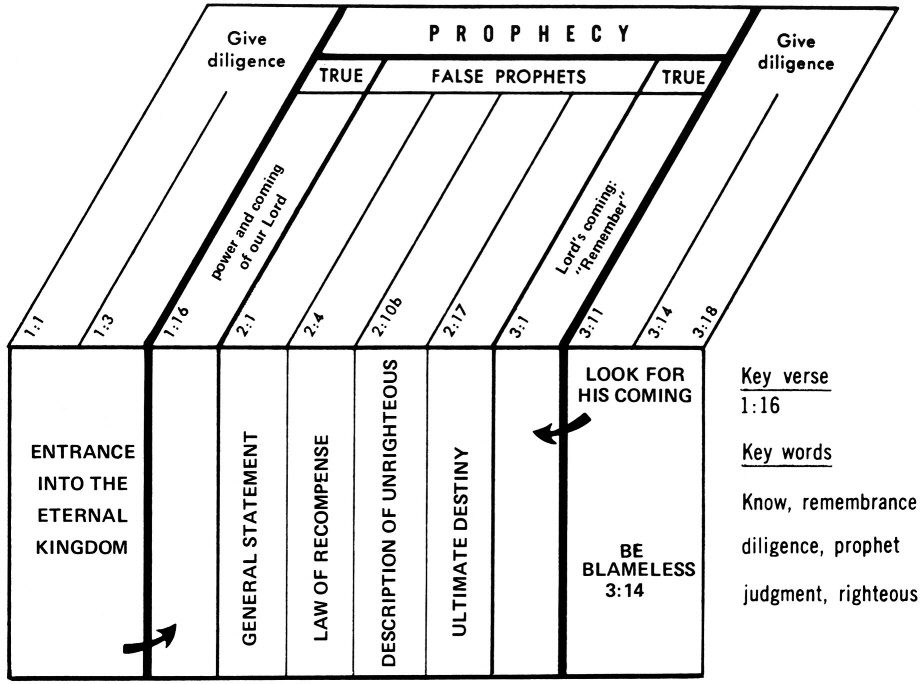
2 Peter: True and False Prophecy
Click chart to enlarge
Chart from Jensen's Survey of the NT - used by permission
|
2 PETER |
||||||||
| Cultivation of Christlike Character |
Condemnation of False Teachers |
Confidence in the Return of Christ |
||||||
| Greeting to Saints 2Pe 1:1-2 |
Growth in Christ 2Pe 1:3-14 |
Grounds |
Danger of |
Demise of |
"Decor" of |
Mockers in |
Manifest |
Maturity in light of that |
| Know Your Salvation |
Know |
Know Your Adversaries |
Know |
|||||
| True Prophecy (True Knowledge) |
False Prophets (False Teachers) |
Final Prophecy (Day of the Lord) |
||||||
| Holiness | Heresy | Hope | ||||||
| Development of Faith |
Denunciation of False Teachers |
Design of The Future |
||||||
2 Peter 2:1 But false prophets also arose among the people, just as there will also be false teachers among you, who will secretly introduce destructive heresies, even denying the Master who bought them, bringing swift destruction upon themselves. (NASB: Lockman):
Egenonto (3PAMI) de kai pseudoprophetai en to lao, os kai en humin esontai (3PFMI) pseudodidaskaloi, hoitines pareisachousin aireseis apoleias, kai ton agorasanta (AAPMSA) autous despoten arnoumenoi, (PMPMPN) epagontes (PAPMPN) heautois taxinen apoleian
Amplified: But also [in those days] there arose false prophets among the people, just as there will be false teachers among yourselves, who will subtly and stealthily introduce heretical doctrines (destructive heresies), even denying and disowning the Master Who bought them, bringing upon themselves swift destruction. (Amplified Bible - Lockman)
NET: But false prophets arose among the people, just as there will be false teachers among you. These false teachers will infiltrate your midst with destructive heresies, even to the point of denying the Master who bought them. As a result, they will bring swift destruction on themselves. (NET Bible)
NLT: But there were also false prophets in Israel, just as there will be false teachers among you. They will cleverly teach their destructive heresies about God and even turn against their Master who bought them. Theirs will be a swift and terrible end. (NLT - Tyndale House)
Phillips: But even in those days there were false prophets, just as there will be false teachers among you today. They will be men who will subtly introduce dangerous heresies. They will thereby deny the Lord who redeemed them, and it will not be long before they bring on themselves their own downfall. (Phillips: Touchstone)
Wuest: But there arose also false prophets among the people, even as also. among you there shall be false teachers, who will be of such a character as to bring in alongside (of true doctrine) destructive heresies, even denying the Lord who purchased them, bringing upon themselves swift destruction. (Eerdmans)
Young's Literal: And there did come also false prophets among the people, as also among you there shall be false teachers, who shall bring in besides destructive sects, and the Master who bought them denying, bringing to themselves quick destruction,
BUT FALSE PROPHETS ALSO AROSE AMONG THE PEOPLE: Egenonto (3PAMI) de kai pseudoprophetai en to lao:
- But false prophets also arose among the people Dt 13:1-2; 13:3 1Ki 18:19-22; 22:6; Neh 6:12-14; Isa 9:15; 56:10,11; Jer 6:13, Jer 14:13-15; 23:16,17,25-32; [Read esp Jer 23:9-32] Jer 27:14,15; 28:15-17; 29:8,9; 29:31,32 Jer 37:19; Lam 2:14; Ezek 13:3-18; Hos 9:8; Mic 2:11; 3:5,11; Zech 13:3,4; Mt 7:15; Lk 6:26; Ro 16:18
- See book of Jude for parallel on false teachers - Jude 1:1-25
- 2 Peter 2 Resources - Multiple Sermons and Commentaries
- 2 Peter 2:1-3 A Portrait of False Teachers, Pt. 1 - John MacArthur
- 2 Peter 2:1-3 A Portrait of False Teachers, Pt. 2 - John MacArthur
HISTORY WILL
REPEAT ITSELF
But false prophets (pseudoprophetes) also arose among the people - BUT (de) draws a dramatic contrast between God's true prophets who under the influence of Holy Spirit wrote the inerrant OT Scriptures (2Pe 1:21) and the pernicious pseudo prophets who were nicely summed up by the true prophet Jeremiah (Lamentations 2:14) "Your prophets have seen for you false and foolish visions & they have not exposed your iniquity so as to restore you from captivity, but they have seen for you false and misleading oracles." These purveyors an anti-biblical lies have come in the past to ancient Israel and they will come in the future to the church (as false teachers). As they say "some things never change." The phrase among the people (en to lao) refers to these false prophets arising in Israel as distinct from the Gentile world. Where God's truth is presence the counterfeit is not far behind.
Note that their teaching failed to bring about holiness and true spiritual freedom as Peter amplifies in the remainder of this chapter. Notice also their effect on those they deceive - "The prophets prophesy falsely,and the priests rule on their own authority and My people love it so!… " (Jer 5:31) Does this not sound like some of Paul's last warnings to Timothy writing
I solemnly charge you in the presence of God and of Christ Jesus, who is to judge the living and the dead, and by His appearing and His kingdom: 2 preach the word; be ready in season and out of season; reprove, rebuke, exhort, with great patience and instruction. 3 For the time will come when they will not endure sound doctrine; but wanting to have their ears tickled, they will accumulate for themselves teachers in accordance to their own desires, 4 and will turn away (active voice = choice of their sin-driven will) their ears from the truth and will turn aside (passive voice - outside demonic forces will shoot fiery missiles of myths) to myths. (2Ti 4:1-4)
Arthur Pink - False prophets are to be found in the circles of the most orthodox, and they pretend to have a fervent love for souls, yet they fatally delude multitudes concerning the way of salvation. The pulpit, platform, and pamphlet hucksters have wantonly lowered the standard of divine holiness and so adulterated the Gospel in order to make it palatable to the carnal mind.”
John Piper - Chapter one is mainly an encouragement to avail ourselves of God's power to lead lives of godliness and love. Chapter two is mainly a warning against the destruction that will befall those who don't avail themselves of this power. If chapter one is the carrot, chapter two is the crack of the whip over our heads. There are no commands, no admonitions, no imperatives in chapter two; just pure, terrifying description of what will happen to those who fall prey to the false teachers in the church." (See full sermon Destruction Is not Sleeping)
Hiebert quoting Anstadt observes that "The transition to this new subject is natural. "When the fortifications have been built, and the armor has been put on, and the weapons have been provided, then it is time to meet the enemy."
How to Discern a False Prophet
Deuteronomy 13:1-5, Deuteronomy 18:20-22
"If a prophet or a dreamer of dreams arises among you and gives you a sign or a wonder, and the sign or the wonder comes true, concerning which he spoke to you, saying, 'Let us go after other gods whom you have not known and let us serve them,' you shall not listen to the words of that prophet or that dreamer of dreams; for the LORD your God is testing you to find out if you love the LORD your God with all your heart and with all your soul. "You shall follow the LORD your God and fear Him; and you shall keep His commandments, listen to His voice, serve Him, and cling to Him. But that prophet or that dreamer of dreams shall be put to death, because he has counseled rebellion against the LORD your God who brought you from the land of Egypt and redeemed you from the house of slavery, to seduce you from the way in which the LORD your God commanded you to walk. So you shall purge the evil from among you. (Deut 13:1-5)
But the prophet who speaks a word presumptuously in My name which I have not commanded him to speak, or which he speaks in the name of other gods, that prophet shall die. "You may say in your heart, 'How will we know the word which the LORD has not spoken?' "When a prophet speaks in the name of the LORD, if the thing does not come about or come true, that is the thing which the LORD has not spoken. The prophet has spoken it presumptuously; you shall not be afraid of him' (Deut 18:20-22)
False prophets (5578)(pseudoprophetes) are men who falsely claim to be prophets of God and/or who prophesy falsely. They utter falsehoods under the name of divine prophecies. Such men falsely assume the work of a prophet when pretending to foretell things to come (Mt. 24:11, 24) or they teach false doctrines in the name of God (Mt 7:15 [note], Lk 6:26, Acts 13:6, 2Co 11:13, 1Jn 4:1; Revelation 16:13 [note]; Revelation 19:20 [note], used in Septuagint of Jer 6:13) Wherever important truth is at stake these counterfeits will offer their wares. In the Old Testament men claimed to speak from God when he had not sent them (Dt 18:20) Satan’s counterfeits with their insidious activities have always been present and will be especially prevalent during the time just before Jesus makes His triumphant return (Mt. 24:11, 24). Peter warns the saints stabilized by the truth in Chapter 1 to be alert to the false in Chapter 2.
Paul Apple introduces this next section with a pithy question…
What does a Pigpen smell like?
Matt. 7:15-23 important to examine the fruit
Matt. 13:24-30,36-43 the enemy is busy sowing tares among the Christian churches.
Why does Peter feel that it is necessary to warn his readers about false teachers? (cf. similar message in Jude - see above)
Historical Context: time of the apostles is fading; it has been over 30 years since the ascension of Christ; false teachers have crept into the church and are gaining momentum; Peter wants to go on record on these issues before he is gone
cf. Battle for the Bible by Harold Lindsell -- deals mainly with issues of inerrancy and with the trend toward apostasy in major mainline denominations and seminaries; no wonder that the people are being taught error when you look at what the seminary professors no longer believe
cf. the battle back in the 1920s with Modernism; a series of books called the The Fundamentals was published (Ed: see emerging church below).
cf. illustration regarding roommate of R. C. Sproul who went before the examining board on his oral exam and did not tell them where he was waffling so that he could get his diploma; he ended up on the board that was asking the questions of R. C. Sproul! (Reference)
QUESTION - What does the Bible say about false prophets?
ANSWER - A false prophet is a person who spreads false teachings or messages while claiming to speak the Word of God. In the Bible, false prophets also spoke on behalf of false gods. False prophets functioned in their prophetic role illegitimately or for the purpose of deception. The Bible denounces false prophets for leading people astray.
In the Old Testament, the actual term false prophet does not occur, but references to false prophets are evident and abundant. In the book of Jeremiah, we encounter a clear description of false prophets: “Then the LORD said to me, ‘The prophets are prophesying lies in my name. I have not sent them or appointed them or spoken to them. They are prophesying to you false visions, divinations, idolatries and the delusions of their own minds’” (Jeremiah 14:14; see also Jer 23:21–33; Zechariah 10:2).
The primary difference between men like Jeremiah—a true prophet of God—and false prophets was their source of information. Rather than speak the Word of the Lord, false prophets delivered messages that originated in their own hearts and minds: “This is what the LORD Almighty says: ‘Do not listen to what the prophets are prophesying to you; they fill you with false hopes. They speak visions from their own minds, not from the mouth of the LORD’” (Jeremiah 23:16; see also 14:14; 23:25–32; Ezekiel 13:1–7). God distances Himself from all false prophets: “I did not send these prophets, yet they have run with their message; I did not speak to them, yet they have prophesied” (Jeremiah 23:21).
Another difference between true prophets and false prophets in the Bible is motivation. True prophets are motivated by loyalty to God above all else, whereas false prophets are motivated by self-interest and a desire to be popular among the people (1 Kings 22:13–14). While Jeremiah foretold the grim truth of coming desolation upon Jerusalem (Jeremiah 4), the false prophets promised peace (Jeremiah 6:14; 8:11). Naturally, the people of Judah preferred the pleasant messages of the false prophets: “Don’t tell us what is right. Tell us nice things. Tell us lies” (Isaiah 30:10, NLT).
Often false prophets were hired for payment or spoke their messages for financial gain: “Her leaders judge for a bribe, her priests teach for a price, and her prophets tell fortunes for money. Yet they look for the LORD’s support and say, ‘Is not the LORD among us? No disaster will come upon us’” (Micah 3:11; see also Nehemiah 6:12–13; Jeremiah 6:13–14; Ezekiel 13:19; 2 Peter 2:1–3).
Israel could not always discern the difference between a true and false prophet. In 1 Kings 22, King Jehoshaphat of Judah sought counsel from the Lord before he and King Ahab of Israel embarked on their mission to retake the city of Ramoth in Gilead. Jehoshaphat heard the predictions of victory from Ahab’s 400 counselors but suspected that these men were false prophets who did not have the mind of the Lord. Jehoshaphat’s suspicions were correct: they were Ahab’s “yes men,” false prophets who had no concern for relating the true Word of God. They merely said what the king wanted to hear and collected their salary from the royal treasury.
Jehoshaphat asked if there was another prophet who could give a second opinion. Ahab called for the prophet Micaiah, albeit reluctantly: “I hate him,” Ahab complained, “because he never prophesies anything good about me, but always bad” (1 Kings 22:8). True to form, Micaiah prophesied that Ahab would be killed in the battle and Israel would be “scattered on the hills like sheep without a shepherd” (verse 17). Micaiah, whose words came to pass, proved to be the true prophet of God. None of the false prophets in Ahab’s court could keep the king alive.
The punishment specified for false prophets in the Old Testament was severe: “If any prophet dares to speak a message in My name that I have not commanded him to speak, or to speak in the name of other gods, that prophet must be put to death” (Deuteronomy 18:20).
In the New Testament, Jesus taught about false prophets in His Sermon on the Mount: “Watch out for false prophets. They come to you in sheep’s clothing, but inwardly they are ferocious wolves. By their fruit you will recognize them. Do people pick grapes from thornbushes, or figs from thistles? Likewise, every good tree bears good fruit, but a bad tree bears bad fruit. A good tree cannot bear bad fruit, and a bad tree cannot bear good fruit” (Matthew 7:15–18).
Jesus went on to explain the grave consequences of being a false prophet: “Every tree that does not bear good fruit is cut down and thrown into the fire. Thus, by their fruit you will recognize them. Not everyone who says to me, ‘Lord, Lord,’ will enter the kingdom of heaven, but only the one who does the will of my Father who is in heaven. Many will say to me on that day, ‘Lord, Lord, did we not prophesy in your name and in your name drive out demons and in your name perform many miracles?’ Then I will tell them plainly, ‘I never knew you. Away from me, you evildoers!’” (Matthew 7:19–23).
The Bible describes false prophets as adulterous (Jeremiah 23:14), treacherous (Zephaniah 3:4), drunkards (Isaiah 28:7), wicked (Jeremiah 23:11), liars (Jeremiah 14:14; 23:14), and associated with divination and witchcraft (Jeremiah 14:14; Ezekiel 22:28; Acts 13:6). Scripture teaches believers to be diligent in faith and devotion to Christ’s teachings so that they will be able to spot false prophets and false teachers quickly (2 Peter 1:10; 1:19—2:1; 1 John 4:1). Thankfully, the Bible outlines foolproof tests for recognizing a false prophet. The key is to know what a true prophet is like:
• A true prophet’s words will be fulfilled (Deuteronomy 18:21–22; Jeremiah 28:8–9).
• A true prophet’s teachings are consistent with Scripture (2 Peter 1:20–21; Revelation 22:18–19).
• A true prophet’s teachings will encourage righteous behavior and provide spiritual benefit (Deuteronomy 13:1–4; Jeremiah 23:13–14, 32; Ezekiel 13:17–23; 14:4–8; Lamentations 2:14).
• A true prophet’s life will reflect a divine call (Isaiah 28:7; Jeremiah 23:10–11, 14; 29:9; Zephaniah 3:4; Matthew 7:15–20).
• A true prophet will acknowledge Jesus Christ as divine (1 John 4:1–6). GotQuestions.org
QUESTION - . How can I recognize a false teacher / false prophet? Watch the accompanying video
ANSWER - Jesus warned us that “false Christs and false prophets” will come and will attempt to deceive even God’s elect (Matthew 24:23-27; see also 2 Peter 3:3 and Jude 17-18). The best way to guard yourself against falsehood and false teachers is to know the truth. To spot a counterfeit, study the real thing. Any believer who “correctly handles the word of truth” (2 Timothy 2:15) and who makes a careful study of the Bible can identify false doctrine. For example, a believer who has read the activities of the Father, Son, and Holy Spirit in Matthew 3:16-17 will immediately question any doctrine that denies the Trinity. Therefore, step one is to study the Bible and judge all teaching by what the Scripture says.
Jesus said “a tree is recognized by its fruit” (Matthew 12:33). When looking for “fruit,” here are three specific tests to apply to any teacher to determine the accuracy of his or her teaching:
1) What does this teacher say about Jesus? In Matthew 16:15-16, Jesus asks, “Who do you say I am?” Peter answers, “You are the Christ, the Son of the living God,” and for this answer Peter is called “blessed.” In 2 John 9, we read, “Anyone who runs ahead and does not continue in the teaching of Christ does not have God; whoever continues in the teaching has both the Father and the Son.” In other words, Jesus Christ and His work of redemption is of utmost importance; beware of anyone who denies that Jesus is equal with God, who downplays Jesus’ sacrificial death, or who rejects Jesus’ humanity. 1John 2:22 says, “Who is the liar? It is the man who denies that Jesus is the Christ. Such a man is the antichrist—he denies the Father and the Son.”
2) Does this teacher preach the gospel? The gospel is defined as the good news concerning Jesus’ death, burial, and resurrection, according to the Scriptures (1 Corinthians 15:1-4). As nice as they sound, the statements “God loves you,” “God wants us to feed the hungry,” and “God wants you to be wealthy” are not the complete message of the gospel. As Paul warns in Galatians 1:7, “Evidently some people are throwing you into confusion and are trying to pervert the gospel of Christ.” No one, not even a great preacher, has the right to change the message that God gave us. “If anybody is preaching to you a gospel other than what you accepted, let him be eternally condemned!” (Galatians 1:9).
3) Does this teacher exhibit character qualities that glorify the Lord? Speaking of false teachers, Jude 11 says, “They have taken the way of Cain; they have rushed for profit into Balaam’s error; they have been destroyed in Korah’s rebellion.” In other words, a false teacher can be known by his pride (Cain’s rejection of God’s plan), greed (Balaam’s prophesying for money), and rebellion (Korah’s promotion of himself over Moses). Jesus said to beware of such people and that we would know them by their fruits (Matthew 7:15-20).
For further study, review those books of the Bible that were written specifically to combat false teaching within the church: Galatians, 2 Peter, 1 John, 2 John, and Jude. It is often difficult to spot a false teacher/false prophet. Satan masquerades as an angel of light (2 Corinthians 11:14), and his ministers masquerade as servants of righteousness (2 Corinthians 11:15). Only by being thoroughly familiar with the truth will we be able to recognize a counterfeit. GotQuestions.org
Related Resources:
- Should we allow false teachers into our home? | GotQuestions.org
- What is the definition of heresy? | GotQuestions.org
- What are false apostles? | GotQuestions.org
- What is false doctrine? | GotQuestions.org
- What does it mean that false prophets are wolves in sheep’s clothing (Matthew 7:15)? | GotQuestions.org
- Was Nostradamus a true prophet of God? | GotQuestions.org
- Should Christians judge the teachings of their leaders? | GotQuestions.org
- Pretended to be sent by God -Jeremiah 23:17,18,31
- Not sent or commissioned by God - Jeremiah 14:14; 23:21; 29:31
- Made use of by God to prove Israel -Deuteronomy 13:3
DESCRIBED AS
- Light and treacherous -Zephaniah 3:4
- Covetous -Micah 3:11
- Crafty -Matthew 7:15
- Drunken -Isaiah 28:7
- Immoral and profane -Jeremiah 23:11,14
- Women sometimes acted as -Nehemiah 6:14; Revelation 2:20
- Called foolish prophets -Ezekiel 13:2
- Compared to foxes in the desert -Ezekiel 13:4
- Compared to wind -Jeremiah 5:13
- Influenced by evil spirits -1 Kings 22:21,22
PROPHESIED
- Falsely -Jeremiah 5:31
- Lies in the name of the Lord -Jeremiah 14:14
- Out of their own heart -Jeremiah 23:16,26; Ezekiel 13:2
- In the name of false gods -Jeremiah 2:8
- Peace, when there was no peace -Jeremiah 6:14; 23:17; Ezekiel 13:10; Micah 3:5
- Often practiced divination and witchcraft -Jeremiah 14:14; Ezekiel 22:28; Acts 13:6
- Often pretended to dreams -Jeremiah 23:28,32
- Often deceived by God as a judgment -Ezekiel 14:9
THE PEOPLE
- Led into error -Jeremiah 23:13; Micah 3:5
- Made to forget God’s name by -Jeremiah 23:27
- Deprived of God’s word by -Jeremiah 23:30
- Taught profaneness and sin by -Jeremiah 23:14,15
- Oppressed and defrauded by -Ezekiel 22:25
- Warned not to listen to -Deuteronomy 13:3; Jeremiah 23:16; 27:9,15,16
- Encouraged and praised -Jeremiah 5:31; Luke 6:26
- Mode of trying and detecting -Deuteronomy 13:1,2; 18:21,22; 1John 4:1-3
PREDICTED TO ARISE
- Before destruction of Jerusalem -Matthew 24:11,24
- In the latter times -2 Peter 2:1
- Judgments denounced against -Jeremiah 8:1,2; 14:15; 28:16,17; 29:32
- Involved the people in their own ruin -Isaiah 9:15,16; Jeremiah 20:6; Ezekiel 14:10
JUST AS THERE WILL ALSO BE FALSE TEACHERS AMONG YOU : os kai en humin esontai (3PFMI) pseudodidaskaloi:
- Just as there will also be false teachers Mt 24:5,11,24; Mk 13:22; Lk 21:8; Acts 20:29-30; 1Cor 11:19; 2Cor 11:13-14; 2Cor 11:15 Gal 2:4, Gal 4:17; Eph 4:14; Col 2:8; 2:18; 2Thes 2:3-12; 1Ti 4:1-3; 2Ti 3:1-9; 4:3; Titus 1:11; 1Jn 2:18; 2:19 2:26 4:1; Jude 1:18; Rev 2:9; 13:14
- 2 Peter 2 Resources - Multiple Sermons and Commentaries
- 2 Peter 2:1-3 A Portrait of False Teachers, Pt. 1 - John MacArthur
- 2 Peter 2:1-3 A Portrait of False Teachers, Pt. 2 - John MacArthur
Acts 20:27-30 “For I did not shrink from declaring to you the whole purpose of God (NLT = "all that God wants you to know."). 28 Be on guard (present imperative see our need to depend on the Holy Spirit to obey) for yourselves and for all the flock, among which the Holy Spirit has made you overseers, to shepherd the church of God which He purchased with His own blood. “I know that after my departure savage wolves will come in among you (PAUL IS ADDRESSING THE ELDERS AT THE CHURCH AT EPHESUS WHERE HE HAD TAUGHT FOR 3 YEARS!), not sparing the flock; 30 and from among your own selves men will arise, speaking perverse things, to draw away the disciples after them. 31 “Therefore be on the alert (present imperative see our need to depend on the Holy Spirit to obey), remembering that night and day for a period of three years I did not cease to admonish each one with tears. 32 “And now I commend you to God and to the word of His grace (NOTE - BEST DEFENSE AGAINST FALSE IS THE TRUTH!), which is able to build you up and to give you the inheritance among all those who are sanctified. (NOTE: THIS PASSAGE SHOULD BE EMBLAZONED ON A PLAGUE THAT SETS ON THE DESK OF EVERY GODLY PASTOR AND ELDER!)
PROPHECY OF
FALSE TEACHERS EMERGING
Just as there will also be false teachers (pseudodidaskalos) among you - The title is more than a title for in recent years there has been a false teaching emerging in what is ironically known as the "emerging / emergent church movement!" Will be (esontai) is future tense indicating this is a prophecy. Peter saw it coming over 2000 years ago! And do not miss the phrase "among you" which is more literally "in you," or "in your midst" (See Paul's warning to the church at Ephesus). These deceitful servants of Satan (cf 2Co 11:13-15) will infiltrate and intermingle with God's saints. The point is clear "among" indicates this is an "inside job" so to speak, just as Paul had warned the Ephesian elders would occur upon his departure.
"Whenever God erects a house of prayer, the Devil always builds a chapel there."
-- Daniel Defoe (of Robinson Crusoe fame)
The point is that whenever the true work of God is found it is not long before satanic counterfeits began to infiltrate.
As Peter illustrates in this chapter, this is exactly the modus operandi of these evil men who traffic in lies and deceit just like their father the devil (Jn 8:44). They use deadly doctrines to shape the will of the unsuspecting "sheep". The term for false teachers in unique to Peter and could refer to either those whose claim to be teachers is false because they have not been authorized as teachers in the Church or it could refer to those who were teaching what is false or perverse. Probably the term encompasses both ideas. The context suggest that they do not claim to present a new revelation from God (like a false prophet might do) but rather offer their teachings as accredited and authentic truth.
Rob Salvato…when it comes to the Church today there are some who feed their flocks what amounts to spiritual Ice Cream Cake & candy – (A) Feel good sermons – whose aim is to make people feel happy / to help them feel good about themselves. (B) Sermons where people are never CONVICTED / CONFRONTED or CHALLENGED – (1) Although the Congregation is Happy – not Healthy (C) Then there are other “Spiritual leaders or Movements” Who feed their Congregations or followers – what amounts to Poison (1) Causing their Congregations to never come to life / but remaining dead in their Sins (Sermon)
Criswell defines a "false teacher" as "a suave, affable, personable, scholarly man who claims to be the friend of Christ. He preaches in the pulpit, he writes learned books, he publishes articles in the religious magazines. He attacks Christianity from within. He makes the church and the school a lodging place for every unclean and hateful bird. He leavens the meal with the doctrine of the Sadducees." (Believer's Study Bible)
MacDonald - These false teachers take their place inside the church. They pose as ministers of the gospel. This is what makes the peril so great. If they came right out and said they were atheists or agnostics, people would be on guard. But they are masters of deception. They carry the Bible and use orthodox expressions —though using them to mean something entirely different. The president of a liberal theological seminary acknowledged the strategy as follows: '"Churches often change convictions without formally renouncing views to which they were previously committed, and their theologians usually find ways of preserving continuity with the past through re-interpretations. (Believer's Bible Commentary: Thomas Nelson)
False Teachers (5572) (pseudodidaskalos from pseudes = untrue, deceitful, lying, wicked + didaskalos = Instructor, master, teacher = one who provides instruction) means literally false teachers or in this context those who parade themselves as Christian teachers, pastors, evangelists, etc, but who teach false doctrine. They are the antithesis of the apostles, teaching a false message of human invention rather than the apostolic message based on divinely inspired words. The root word didasko is interesting because it means to teach so as to shape the will of the one being taught by the content of taught. "Diogenes, the great cynic philosopher, spoke of the false teachers of his day whose method was to follow wherever the applause of the crowd led. One of the first characteristics of the false prophet is that he tells men what they want to hear and not the truth they need to hear (cf 2Ti 4:3)." (Barclay - see also note below)
Gilbrant - Although this term appears only once in the New Testament (2 Peter 2:1) and nowhere else in all of Greek literature, the problem of false teachers, false prophets, and false christs was common in the Early Church. From the very beginning, Jesus warned of those who would arise and lead many away from the Faith (Matthew 24:5,11,23,24). Paul struggled against the false teachers at Corinth (2 Corinthians 11), against the Judaizers at Galatia (Galatians 1:6), against the false teachers at Colossae (Colossians 2:8,16-23), and against the false teachers who disturbed the Thessalonians (2Th 2:2,3).
The writer of 2 Peter warned his readers about false teachers who would inevitably seek to carry them away by twisting Scripture (2 Peter 3:16,17) and who, in their greed, would exploit them with false words (2Pe 2:3). He characterized them as “bold and willful” in their sin (2Pe 2:10, RSV). Such teachers were “waterless springs and mists driven by a storm” (2Pe 2:17, RSV). They promised freedom but were themselves slaves to their own sin and passions (2:19). (Complete Biblical Library - Incredible Resource)
William Barclay summarizes false teachers - THE WORK OF FALSEHOOD ( 2 Peter 2:2-3 )
2 Peter 2:2-3 And many will follow the way of their blatant immoralities and through them the true way will be brought into disrepute. In their evil ambition they will exploit you with cunningly forged arguments. Their sentence was settled long ago, and now it is not inactive, and their destruction is not asleep.
In this short passage we see four things about the false teachers and their teaching.
(i) We see the cause of false teaching. It is evil ambition. The word is pleonexia ; pleon means more and -exia comes from the verb echei , which means to have. Pleonexia is the desire to possess more but it acquires a certain flavour. It is by no means always a sin to desire to possess more; there are many cases in which that is a perfectly honourable desire, as in the case of virtue, or knowledge, or skill. But pleonexia comes to mean the desire to possess that which a man has no right to desire, still less to take. So it can mean covetous desire for money and for other people's goods; lustful desire for someone's person; unholy ambition for prestige and power. False teaching comes from the desire to put its own ideas in the place of the truth of Jesus Christ; the false teacher is guilty of nothing less than of usurping the place of Christ.
(ii) We see the method of false teaching. It is the use of cunningly forged arguments. Falsehood is easily resisted when it is presented as falsehood; it is when it is disguised as truth that it becomes menacing. There is only one touchstone. Any teacher's teaching must be tested by the words and presence of Jesus Christ himself.
(iii) We see the affect of the false teaching. It was twofold. It encouraged men to take the way of blatant immorality. The word is aselgeia which describes the attitude of the man who is lost to shame and cares for the judgment of neither man nor God. We must remember what was at the back of this false teaching. It was perverting the grace of God into a justification for sin. The false teachers were telling men that grace was inexhaustible and that, therefore, they were free to sin as they liked for grace would forgive.
This false teaching had a second effect. It brought Christianity into disrepute. In the early days, just as now, every Christian was a good or bad advertisement for Christianity and the Christian Church. It is Paul's accusation to the Jews that through them the name of God has been brought into disrepute (Romans 2:24). In the Pastoral Epistles the younger women are urged to behave with such modesty and chastity that the Church will never be brought into disrepute ( Titus 2:5). Any teaching which produces a person who repels men from Christianity instead of attracting them to it is false teaching, and the work of those who are enemies of Christ.
(iv) We see the ultimate end of false teaching and that is destruction. Sentence was passed on the false prophets long ago; the Old Testament pronounced their doom ( Deuteronomy 13:1-5). It might look as if that sentence had become inoperative or was slumbering, but it was still valid, and the day would come when the false teachers would pay the terrible price of their falsehood. No man who leads another astray will ever escape his own judgment.
QUESTION - What is the emerging / emergent church movement?
ANSWER - The emerging, or emergent, church movement takes its name from the idea that as culture changes, a new church should emerge in response. In this case, it is a response by various church leaders to the current era of post-modernism. Although post-modernism began in the 1950s, the church didn’t really seek to conform to its tenets until the 1990s. Post-modernism can be thought of as a dissolution of "cold, hard fact" in favor of "warm, fuzzy subjectivity." The emerging / emergent church movement can be thought of the same way.
The emerging / emergent church movement falls into line with basic post-modernist thinking—it is about experience over reason, subjectivity over objectivity, spirituality over religion, images over words, outward over inward, feelings over truth. These are reactions to modernism and are thought to be necessary in order to actively engage contemporary culture. This movement is still fairly new, though, so there is not yet a standard method of "doing" church amongst the groups choosing to take a post-modern mindset. In fact, the emerging church rejects any standard methodology for doing anything. Therefore, there is a huge range of how far groups take a post-modernist approach to Christianity. Some groups go only a little way in order to impact their community for Christ, and remain biblically sound. Most groups, however, embrace post-modernist thinking, which eventually leads to a very liberal, loose translation of the Bible. This, in turn, lends to liberal doctrine and theology.
For example, because experience is valued more highly than reason, truth becomes relative. Relativism opens up all kinds of problems, as it destroys the standard that the Bible contains absolute truth, negating the belief that biblical truth can be absolute. If the Bible is not our source for absolute truth, and personal experience is allowed to define and interpret what truth actually is, a saving faith in Jesus Christ is rendered meaningless.
Another area where the emerging / emergent church movement has become anti-biblical is its focus on ecumenism. Unity among people coming from different religious backgrounds and diversity in the expression of corporate worship are strong focuses of the emergent church movement. Being ecumenical means that compromise is taking place, and this results in a watering down of Scripture in favor of not offending an apostate. This is in direct opposition to passages such as Revelation 2:14-17, Jesus’ letter to the church of Pergamum, in which the Church is warned against tolerating those who teach false doctrine.
False doctrine seems to abound within the emerging / emergent church movement, though, as stated previously, not within every group espousing emerging / emergent church beliefs. Because of this, care must be taken when deciding whether or not to become involved with an emergent church group. We all need to take heed of Matthew 7:15-20, "Watch out for false prophets. They come to you in sheep’s clothing, but inwardly they are ferocious wolves. By their fruit you will recognize them. Do people pick grapes from thorn bushes, or figs from thistles? Likewise every good tree bears good fruit, but a bad tree bears bad fruit. A good tree cannot bear bad fruit, and a bad tree cannot bear good fruit. Every tree that does not bear good fruit is cut down and thrown into the fire. Thus, by their fruit you will recognize them."
While seeking new ways to witness to a changing culture is admirable, utilizing ways which compromise the Truth of the Gospel in any way is nothing more than promoting false doctrine and leading others away from Christ instead of to Him. GotQuestions.org
WHO WILL SECRETLY INTRODUCE: hoitines pareisaxousin (3PFAI):
- 2 Peter 2 Resources - Multiple Sermons and Commentaries
- 2 Peter 2:1-3 A Portrait of False Teachers, Pt. 1 - John MacArthur
- 2 Peter 2:1-3 A Portrait of False Teachers, Pt. 2 - John MacArthur
Apple - they come in secretly with a hidden agenda; they smile and sign your doctrinal statement and profess to agree with you; then they have opportunity to teach; then they start to sneak in their false doctrine in subtle ways (2 Peter Commentary Notes)
Secretly introduce (3919) (pareisago from pará = unto or at the side of + eiságo = bring in, introduce) means to bring in by the side of (secretly and craftily), introduce surreptitiously (the root derivation of surreptitious means to "secretly snatch") or bring in under false pretenses. The metaphor (picture) is of spies or traitors stealthily introducing themselves into an enemy’s camp.
Lenski says that the full force of the verb means to bring in "sneakingly, covertly, so that unwary, simple people will not note what these teachers are bringing in."
These false teachers will present a clever, even catchy attractive message in which they will secretly introduce error alongside of the truth. The majority of their message is orthodox but the small percentage of doctrinal "poison" is enough to bring about destruction of souls.
Rob Salvato - Word Secret is Subtle – a subtle deception – The right terminology is used but in the wrong way. They will talk about Jesus and talk about God – they will show up at your door mentioning things like Salvation and end times. The point is that their terminology is correct but the way it is used is wrong. It is interesting to note that most members of cult groups used to belong to an Evangelical or Christian Church! (Ed: What's wrong with that picture?) (Sermon)
Calvin adds a picturesque thought that these men
creep in by oblique turnings, as through burrows under ground.
Paul used the related noun form of pareisago (pareisaktos) when he warned the Galatian church about the
false brethren secretly brought in (pareisaktos) who had sneaked in (pareiserchomai from para = alongside + eiserchomai = to enter) to spy out our liberty which we have in Christ Jesus, in order to bring us into bondage." (Gal 2:4)
Note again the effect of false doctrine… bondage not freedom.
Jude had a similar warning
For certain persons have crept in unnoticed, (pareisduno from para = alongside + eisdúo = enter in) those who were long beforehand marked out for this condemnation, ungodly persons who turn the grace of our God into licentiousness and deny our only Master and Lord, Jesus Christ. (Jude 1:4)
How do we detect their subtle seduction? Here's an illustration…
A Chinese boy who wanted to learn about jade went to study with a talented old teacher. This gentle man put a piece of the precious stone into his hand and told him to hold it tight. Then he began to talk of philosophy, men, women, the sun and almost everything under it. After an hour he took the stone and sent the boy home. The procedure was repeated for several weeks. The boy became frustrated. When would he be told about the jade? He was too polite, however, to question the wisdom of his venerable teacher. Then one day, when the old man put a stone into his hands, the boy cried out instinctively, “That’s not jade!” - Haddon Robinson, Biblical Preaching
Guglielmo commenting on this illustration says…
I truly believe that is why the so-called Christian movements take people away from God’s Word or bring them to a translation of the Bible that does not follow what the Greek or Hebrew text is saying. By dumbing people down regarding the Bible, you can get them to believe anything and that is what we are seeing today! (The Emerging Church - another sermon with some thoughts on Emerging Church)
DESTRUCTIVE HERESIES: haireseis apoleias
- Literally heresies of destruction, the product of the heresies being destruction.
- 2 Peter 2 Resources - Multiple Sermons and Commentaries
- 2 Peter 2:1-3 A Portrait of False Teachers, Pt. 1 - John MacArthur
- 2 Peter 2:1-3 A Portrait of False Teachers, Pt. 2 - John MacArthur
Leighton calls us to "Note carefully that heresy in the New Testament implies false conduct and not erroneous opinion only. The root idea is that of choice, indicating deliberate and willful severance from right thought and righteous paths." (Leighton, R., & Thomas, G. 1, 2 Peter. The Crossway classic commentaries. Wheaton, Ill.: Crossway Books)
Adam Clarke- Damnable heresies - Heresies of destruction; such as, if followed, would lead a man to perdition. And these they will bring in privately-cunningly (pareisago), without making much noise, and as covertly as possible. It would be better to translate destructive heresies than damnable.
Destructive (684) (apoleia from apo = marker of separation, away from + olethros = ruin, death but not annihilation) refers to destruction of persons, objects, or institutions. The "doctrine" of these false teachers is potentially deadly as pictured by this word (apoleia) which ultimately pictures separation from God, an utter, hopeless ruin & loss of well-being and all that gives worth to existence. Out of the 18 NT uses of apoleia 5 occur in this short epistle (2Pe 2:1 twice; 2Pe 2:3; 3:7,16) and refer primarily to eschatological (theology concerned with the final events in the history of the world) judgment which does not mean extinction but ruination, not loss of being but loss of well being.
Apoleia - 18x in 17v - NAS = destruction(13), destructive(1), perdition(1), perish(1), waste(1), wasted(1).
Mt 7:13; 26:8; Mk 14:4; Jn 17:12; Acts 8:20; Ro 9:22; Php 1:28; 3:19; 2 Th 2:3; 1Ti 6:9; Heb 10:39; 2 Pe 2:1, 3; 3:7, 16; Rev 17:8, 11.
Heresies (139) (hairesis from haireo = to choose or select) means primarily a choice so originally hairesis did not initially convey an evil connotation. The root word means to choose and so hairesis was used for a philosopher’s school of followers or for any band of people who chose to follow him because they shared his beliefs. Hairesis primarily meant a choosing and then that which is chosen or an opinion with the implication that it is a deliberate self-chosen opinion. Because the views espoused were frequently substitutes for the truth, the term came to denote erroneous or heretical teachings.
Hairesis - 9x in 9v - NAS = factions(2), heresies(1), sect(6).
Acts 5:17; 15:5; 24:5, 14; 26:5; 28:22; 1 Cor 11:19; Gal 5:20; 2 Pet 2:1
Heresies then are self-designed religious lies which lead to division and faction (cf. 1Cor 11:19; Gal 5:20). The tragedy of life is that people who hold different views very often finish up by disliking, not each others’ views, but each other. It should be possible to differ with a man and yet remain friends.
These false teachers taught heresies of destruction forcing the unwary to make choices that led away from the Light and into Darkness, Death & Damnation.
Heresies came to mean sect, party like Pharisees or Sadducees. Promoting a party spirit in a church is one of the works of the flesh (Gal 5:20). Whenever a church member says to another member, “Are you on my side or the pastor’s side?” he is promoting a party spirit and causing division. A false teacher forces you to make a choice between his doctrines and the doctrines of the true Christian faith. These false teachers brought in their self-chosen teachings that altered the sound doctrinal foundation of Christianity and so threatened to destroy the body of Christ.
Related Resources:
- What is the definition of heresy?
- How can I recognize a false teacher / false prophet?
- Should we allow false teachers into our home?
- What is false doctrine?
- What is heterodoxy? What does it mean for something to be heterodox?
- What is apostasy and how can I recognize it?
EVEN DENYING: kai… arnoumenoi (PMPMPN):
- Mt 10:33; Lk 12:9; Acts 3:13; 14; 2Ti 2:12,13; Jude 1:4; Rev 2:13; 3:8
- 2 Peter 2 Resources - Multiple Sermons and Commentaries
- 2 Peter 2:1-3 A Portrait of False Teachers, Pt. 1 - John MacArthur
- 2 Peter 2:1-3 A Portrait of False Teachers, Pt. 2 - John MacArthur
Denying (720) (arneoma) means to say one does not know about or is in any way related to a person or event. The present tense indicates that this denial was not a solitary or momentary denial (like Peter before the Cross and before he received the Spirit) but a continual repudiation of the claims of the Master upon them. Peter's point is that they do not belong to the Master. They are not individuals who believe in Christ and are saved.
To deny carries idea of conscious, purposeful action of the will. These false teachers deny the Master and thus deny the deity of Jesus Christ, and if they do away with His deity they destroy the entire body of Christian truth for if Christ is not Who He claimed to be, there is no Christian faith.
Deny is a significant word coming from Peter for Jesus had prophesied that Peter would deny Him!
Truly I say to you that this very night, before a rooster crows, you will deny Me three times." which is exactly what he did (Mt 26:34, 35,70, 75)
Peter knew, by bitter repentance, what a fearful thing it is to deny the Lord (Lk 22:61, 62). Peter's denial was a momentary lapse, wholly different from the persistent damning denial of the Master by the false teachers for as Jesus taught
whoever denies Me before men, I will also deny him before My Father who is in heaven. (Mt 10:33)
- In doctrine -Mark 8:38; 2 Timothy 1:8
- In practice -Philippians 3:18,10; Titus 1:16
- A characteristic of false teachers -2 Peter 2:1; Jude 1:4
- Is the spirit of Antichrist -1 John 2:22, 23; 4:3
- Christ will deny those guilty of -Matthew 10:33; 2 Timothy 2:12
- Leads to destruction -2Peter 2:1; Jude 1:4,15
Exemplified
- Peter -Matthew 26:69, 70, 71, 72, 73, 74, 75
- The Jews -John 18:40; Acts 3:13,14
THE MASTER: autous despoten:
- 2 Peter 2 Resources - Multiple Sermons and Commentaries
- 2 Peter 2:1-3 A Portrait of False Teachers, Pt. 1 - John MacArthur
- 2 Peter 2:1-3 A Portrait of False Teachers, Pt. 2 - John MacArthur
Master (1203) (despotes; English = despot = often conveys a bad connotation but not so in this use by Peter) originally indicated absolute, unrestricted authority, whether human authority or divine authority, so that the Greeks refused the title to any but the gods. The despotes is the undisputed Owner.
In NT despotes and kurios are used interchangeably of God and of the master of the house who exercises full authority over his family and household servants.
Despotes - 10x in 10v - Luke 2:29; Acts 4:24; 1 Tim 6:1f; 2 Tim 2:21; Titus 2:9; 1 Pet 2:18; 2 Pet 2:1; Jude 1:4; Rev 6:10. NAS = Lord(3), Master(3), masters(4).
Despotes is the One Who alone has supreme authority and in the present context implies a master-servant relationship, based on the fact that they were bought by the Master to be His own servants.
How do they "deny" Him? Given the description of these men that follows in this chapter, I like John Calvin's thoughts on their mode of denial.
Calvin - Though Christ may be denied in various ways, yet Peter, as I think, refers here to what is expressed by Jude, that is, when the grace of God is turned into lasciviousness; for Christ redeemed us, that He might have a people separated from all the pollutions of the world, and devoted to holiness ,and innocency. They, then, who throw off the bridle, and give themselves up to all kinds of licentiousness, are not unjustly said to deny Christ by Whom they have been redeemed. Hence, that the doctrine of the gospel may remain whole and complete among us, let this be fixed in our minds, that we have been redeemed by Christ, that He may be the Lord of our life and of our death, and that our main object ought to be, to live to Him and to die to Him."
John MacArthur agrees adding that "Though their heresies may include the denial of the virgin birth, deity, bodily resurrection, and second coming of Christ, the false teachers’ basic error is that they will not submit their lives to the rule of Christ. All false religions have an erroneous Christology." (bolding added) (MacArthur Study Bible)
WHO BOUGHT THEM: kai ton agorasanta (AAPMSA):
- Dt 32:6; Acts 20:28; 1Cor 6:19, 20; 7:23; Gal 3:13; Eph 1:7; Heb 10:29; 1Pet 1:8; Rev 5:9
- 2 Peter 2 Resources - Multiple Sermons and Commentaries
- 2 Peter 2:1-3 A Portrait of False Teachers, Pt. 1 - John MacArthur
- 2 Peter 2:1-3 A Portrait of False Teachers, Pt. 2 - John MacArthur
Bought (59) (agorazo from agora = the market place, place of public assembly, town square where things such as slaves were presented for sale or where trials were held) literally means to buy in the marketplace, doing business in the agora (Mt 13:44), acquiring something (goods or services) in exchange for money. It meant to secure the rights to someone by paying a price and thus acquiring them as one's property (as here in 2Pe 2:1 - used this way also in 1Co 6:20 and 1Co 7:23). All of the uses of agorazo in the Gospels refer to literal buying and selling (see Mt 13:44, 46; 14:15; 21:12; 25:9f; 27:7; Mark 6:36, 37; 11:15; 15:46; 16:1; Luke 9:13; 14:18, 19; 17:28; 19:45; 22:36; Jn 4:8; 6:5; 13:29).
Agorazo emphasizes the market imagery of purchasing goods. In such an exchange, the goods are "set free" from the seller (the previous owner), usually to be possessed by the purchaser.
When Peter speaks of being bought or ransomed by Christ, he is picturing us as slaves of sin and Satan and of being purchased and made free from sin to serve Christ and glorify God. See study on Kinsman-Redeemer or Goel.
Jesus' "mission" in coming to earth was specifically to "give His life a ransom for ( = idea of as a substitute) many." (Mark 10:45) and to pay the price to set men free from enslavement to the power of their old sin nature inherited from Adam. In this case the purchase price was the "precious blood, as of a lamb unblemished and spotless, the blood of Christ" (1Pe1:18,19)
True believers understand and willingly confess that they are no longer their "own" for they "have been bought with a price." (1Cor 6:19, 1Co 6:20)
In contrast, these false teachers continue to deny Christ.
Leighton - How solemn is the thought that these men were fighting against the divine purchase of redemption. In the New Testament sense of the word, heresy is always a denial of Christ, for it is the determination to go our own way and to set at nought his personal work and authority. (Leighton, R., & Thomas, G. 1, 2 Peter. The Crossway classic commentaries. Wheaton, Ill.: Crossway Books)
Wuest - The word in classical use meant “to purchase in the market place,” and was used of the purchase of slaves in the slave-market. Our Lord’s precious, outpoured blood was the ransom paid to redeem slaves of sin from that slavery. His death satisfied the just demands of the High Court of Heaven, paying the penalty for the sinner, and making a way whereby a righteous God could be just and at the same time the justifier of the believing sinner. Strachan says: “The denial seems to have consisted in an inadequate view of the Person and Work of Christ, and their relation to the problem of human sin.” Of course, such a person is unsaved. We make this point here in order that when we approach the subject matter dealing with the utter destruction of these false teachers, we may he guided by our context. These are not misguided Christians, but heretics. (Wuest's Word Studies from the Greek New Testament)
John Piper adds an interesting comment that…
the context in 1 Corinthians… has to do with sexual morality (1Cor 6:19, 1Co 6:20). To be bought by Christ is to be freed from the domination of sexual passions that drive one into sexual preoccupations and illicit sexual intercourse. We belong to a new Master Whose promises are so superior to the promises of sex that (as 2Pe 1:4 [note] says) we can escape from the lordship of passion. When this happens we exalt Christ and affirm His worth. But if we live in the grip of sexual domination we belittle Christ and "deny the Master Who bought us." (Destruction Is Not Sleeping)
Christ's sacrificial death was applicable to all men but efficacious only for those who willingly, readily accept this gift like a beggar would a gratuitous handout (He would simply hold out his hand and accept the gratuity). Christ's death provided for
the propitiation (satisfactory payment) for… sins… of the whole world" (1Jn 2:2, cf 1Ti 2:6, Heb 2:9)
By making satisfactory payment, Christ made salvation available to all men. This "satisfactory payment" is only made effective in the hearts of those exercising a living, obedient faith in their Master and Redeemer. In fairness it should be noted that not all evangelicals agree with the statement I just made, which reflects what they would refer to as "unlimited atonement". Their view by contrast is referred to as "limited atonement", a view I do not espouse. A detailed discussion of these views is beyond the scope and intent of these notes. (
We all owed a debt we could never pay. He paid a debt He did not owe! Christ freed us from our our debt, our sin liability (its wages = death and payment necessitates a death, in this case Christ's substitutionary death.)
Christ’s death is sufficient for all, but is efficient only for those who believe.
Peter is asserting that Christ bought the potential for salvation even for these false teachers, but they were not saved as is clearly indicated by their habitual, continuous (present tense) repudiation of Christ their Master. In other words, their price for redemption had been paid in full (Jn 19:30) but they had not received the Redeemer (cp Jn 1:11) by grace through faith (Ep 2:8, 9) and therefore were still dead in their trespasses and sins (Ep 2:1).
As discussed briefly above, this section is a strong argument for what is known theologically as unlimited atonement (the view that Christ died for everyone, even for these unsaved false teachers) and against limited atonement (the view that Christ died only for those whom He would later save). It should be noted that although I have presented the interpretation that this section of Scripture (et al) supports unlimited atonement, if you stoutly hold to the "Reformed tradition" you will doubtless take umbrage with my view and I certainly am not offended. It is beyond the scope of these notes to address this doctrine in depth. I would refer you to a Scripturally based discussion from a noted Christian apologist, Ron Rhodes (See The Case for Unlimited Atonement by Ron Rhodes or A Defense of Unlimited Atonement by George Zeller)
BRINGING SWIFT DESTRUCTION: epagontes (PAPMPN) heautois tachinen apoleian:
- 2Peter 2:3; Mal 3:5; Php 3:19
- 2 Peter 2 Resources - Multiple Sermons and Commentaries
- 2 Peter 2:1-3 A Portrait of False Teachers, Pt. 1 - John MacArthur
- 2 Peter 2:1-3 A Portrait of False Teachers, Pt. 2 - John MacArthur
Jamieson, Fausset & Brown comment that "Man brings upon himself the vengeance which God brings upon him."
God will not long tolerate willful rebellion. Peter delineates the definitive doom due denying deceivers.
Bringing (1863) (epago) means to bring something upon someone. This verb is in the present tense indicating that these false teacher's persistent denial of the Master initiated a process that ultimately and surely would culminate in their utter swift (tachinos = speedy, impending) ruin, a ruin which includes loss of eternal life, eternal misery, loss of well being, loss of purpose for which they were created and worst of all exclusion from the Kingdom and presence of the Living and True God.
Swift (5031) (tachinos) means near at hand or impending and thus emphasizes the fact that this destruction is coming soon (its imminent - the idea of imminent is that it could happen at any time).
Destruction (684) (apoleia from apo = marker of separation, away from + olethros = ruin, death but not annihilation) refers to destruction of persons, objects, or institutions.
Swift destruction paints a haunting picture, even as the ground literally swallowed up rebellious Korah and Dathan and…
they went down quick into the pit.” (Nu 16:30 KJV)
This is a serious warning for any false teacher. (cf Pr 29:1, 2Th 1:7, 8, 9, 10)
Jamieson, Fausset & Brown add this note of tragic irony - Even the ungodly were bought by His “precious blood." It shall be their bitterest self-reproach in hell, that, as far as Christ’s redemption was concerned, they might have been saved.