2 Peter 2:2
2 Peter 2:3
2 Peter 2:4
2 Peter 2:5
2 Peter 2:6
2 Peter 2:7
2 Peter 2:8
2 Peter 2:9
2 Peter 2:10
2 Peter 2:11
2 Peter 2:12
2 Peter 2:13
2 Peter 2:14
2 Peter 2:15
2 Peter 2:16
2 Peter 2:17
2 Peter 2:18
2 Peter 2:19
2 Peter 2:20
2 Peter 2:21
2 Peter 2:22
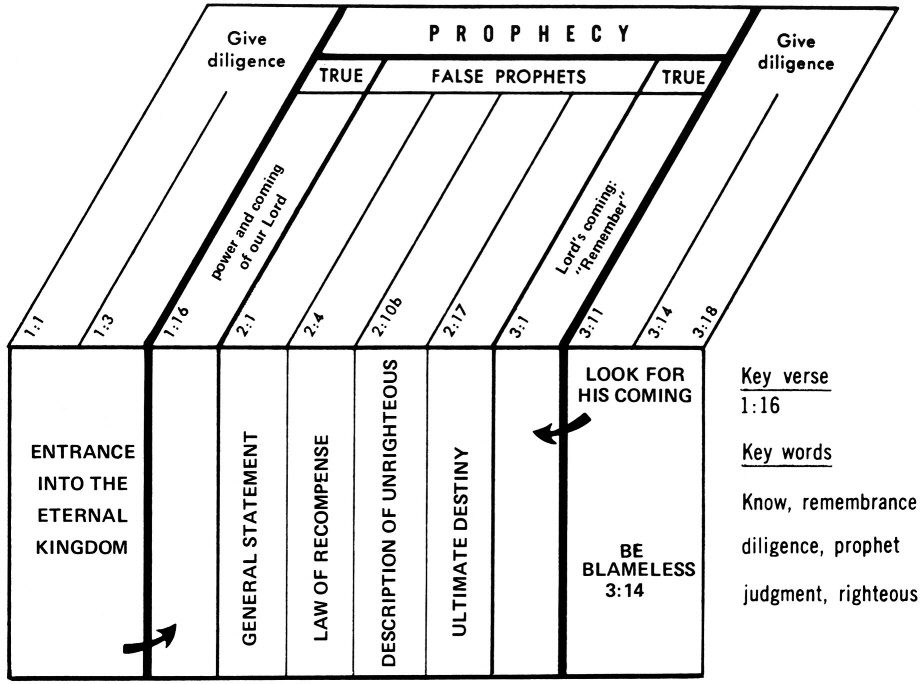
2 Peter: True and False Prophecy
Click chart to enlarge
Chart from Jensen's Survey of the NT - used by permission
|
2 PETER |
||||||||
| Cultivation of Christlike Character |
Condemnation of False Teachers |
Confidence in the Return of Christ |
||||||
| Greeting to Saints 2Pe 1:1-2 |
Growth in Christ 2Pe 1:3-14 |
Grounds |
Danger of |
Demise of |
"Decor" of |
Mockers in |
Manifest |
Maturity in light of that |
| Know Your Salvation |
Know |
Know Your Adversaries |
Know |
|||||
| True Prophecy (True Knowledge) |
False Prophets (False Teachers) |
Final Prophecy (Day of the Lord) |
||||||
| Holiness | Heresy | Hope | ||||||
| Development of Faith |
Denunciation of False Teachers |
Design of The Future |
||||||
2 Peter 2:17 These are springs without water and mists driven by a storm, for whom the black darkness has been reserved. (NASB: Lockman)
Greek: houtoi eisin (3PPAI) pegai anudroi kai homichlai hupo lailapos elaunomenai, (PPPFPN) ois o zophos tou skotous teteretai. (3SRPI)
Amplified: These are springs without water and mists driven along before a tempest, for whom is reserved forever the gloom of darkness. (Amplified Bible - Lockman)
NET: These men are waterless springs and mists driven by a storm, for whom the utter depths of darkness have been reserved. (NET Bible)
NJB: People like this are dried-up springs, fogs swirling in the wind, and the gloom of darkness is stored up for them. (NJB)
NLT: These people are as useless as dried-up springs of water or as clouds blown away by the wind--promising much and delivering nothing. They are doomed to blackest darkness (NLT - Tyndale House)
Phillips: These men are like wells without a drop of water in them, like the changing shapes of whirling storm-clouds, and their fate will be the black night of utter darkness (New Testament in Modern English)
Wuest: These are springs without water, and mists driven by a tempest, for whom the blackness of the darkness has been reserved.
Young's Literal: These are wells without water, and clouds by a tempest driven, to whom the thick gloom of the darkness to the age hath been kept;
THESE ARE SPRINGS WITHOUT WATER: houtoi eisin (3PPAI) pegai anudroi:
- Torrey's Topic Fountains & Springs
- Job 6:14, 15, 16, 17; Jer 14:3; Hos 6:4; Jude 1:12; Jude 1:13
- 2 Peter 2 Resources - Multiple Sermons and Commentaries
"WATERLESS" PROMISES
TO THIRSTING SOULS
These - Who are these? Clearly these are the false teachers who were filled with false promises!
Peter paints "word pictures" which powerful demonstrate that false teachers offer nothing because they have nothing to offer!
In a parallel passage Jude writing of those who have crept into the church and are turning the grace of God into licentiousness...
These men are those who are hidden reefs in your love feasts when they feast with you without fear, caring for themselves; clouds without water, carried along by winds; autumn trees without fruit, doubly dead, uprooted; wild waves of the sea, casting up their own shame like foam; wandering stars, for whom the black darkness has been reserved forever. (Jude 1:12-13+)
"These men are like wells without a drop of water in them" (Phillips) and are as "useless as dried-up springs of water" (NLT) is a striking picture of these "empty cisterns" which would be a major disappointment to a thirsty tongue in a hot and dry land.
Clearly "these" refers not to their victims but to the false teachers and now illustrates their deceptive character and as you might imagine "are" is present tense indicating that these men are continually manifesting the character Peter describes here.
Springs (4077) (pege) refers to a source that is not stagnant (like a well) but a source that gushes out or flows like a spring (James 3:11, 12) or a fountain "living" and leaping forth out of the ground. Jesus used pege figuratively to refer to a spiritual well or source of inner nourishment (Jn 4:14, cp Jn 7:37-39) even as He was sitting by a literal well (Jn 4:6).
Friberg - (1) literally spring, fountain, (living) well, as a source of water; to be distinguished from frear (cistern or reservoir for storing surface water) (cf. Jn 4.6 and Jn 4.11); (2) metaphorically, the fountain of the water of life, identified in Jn 4.14 as eternal life; (3) figuratively in Mk 5.29 as a hemorrhaging, issue or flow of blood; (4) metaphorically and plural in 2Pe 2.17 presumptuous sinners who resemble dried up springs.
Jesus used pege figuratively to refer to the fountain of the water of life in Jn 4:14 as associated with eternal life.
Mark uses pege to refer to the flow of blood that ceased when she touched Jesus' garment (Mark 5:29, cp Lk 8:46, 47+)
This word pege was used as a symbol of the promised future satisfaction saints will enjoy at the "springs of the water of life" (Rev 7:17; Re 21:6), keeping in mind that Scripture often uses water as a metaphor for truth which nourishes and sustains spiritual life, Solomon for example writing that "The teaching of the wise is a fountain of life, To turn aside from the snares of death." (Pr 13:14, contrast Lam 2:14)
Pege - 11x in 10 v. NAS renders pege as - flow(1), fountain(1), spring(1), springs(5), well(3).
Mark 5:29 Immediately the flow of her blood was dried up; and she felt in her body that she was healed of her affliction.
John 4:6 and Jacob's well was there. So Jesus, being wearied from His journey, was sitting thus by the well. It was about the sixth hour.
John 4:14+ but whoever drinks of the water that I will give him shall never thirst; but the water that I will give him will become in him a well of water springing up to eternal life."
James 3:11+ Does a fountain send out from the same opening both fresh and bitter water?
2 Peter 2:17 These are springs without water and mists driven by a storm, for whom the black darkness has been reserved.
Revelation 7:17+ for the Lamb in the center of the throne will be their shepherd, and will guide them to springs of the water of life; and God will wipe every tear from their eyes."
Revelation 8:10+ The third angel sounded, and a great star fell from heaven, burning like a torch, and it fell on a third of the rivers and on the springs of waters.
Revelation 14:7+ and he said with a loud voice, "Fear God, and give Him glory, because the hour of His judgment has come; worship Him who made the heaven and the earth and sea and springs of waters."
Revelation 16:4+ Then the third angel poured out his bowl into the rivers and the springs of waters; and they became blood.
Revelation 21:6+ Then He said to me, "It is done. I am the Alpha and the Omega, the beginning and the end. I will give to the one who thirsts from the spring of the water of life without cost.
There are some 100 uses of pege in the Septuagint (LXX) --
Ge 2:6; 7:11; 8:2; 14:7; 16:7; 24:13, 16, 29, 30, 42, 43, 45; Ex 15:27; Lev 11:36; 12:7; 20:18; Nu 33:9; 34:11; Deut 8:7, 15; 33:13; Jos 15:7, 9; 17:7; 18:15, 16, 17; 19:29, 37; 21:29; Jdg 7:1; 15:19; 2Sa 17:17; 1Ki 1:9; 18:5; 2Ki 3:19, 25; 2Chr 32:3, 4f; Neh 2:13; Esther 1:1; 10:3; Job 38:16; Ps. 18:15; 36:9; 42:1; 68:26; 74:15; 104:10; 114:8; Pr 4:21; 5:15, 16, 18; 6:11; 8:23, 28; 9:18; 10:11; 13:14; 14:27; 16:22; 18:4; 25:26; Eccl. 12:6; Song 4:12, 15; Is 12:3; 35:7; 41:18; 49:10; 58:11; Je 2:13; 9:1; 17:13; 51:36; Ezek 25:9; Ho 13:15; Joel 3:18
A flowing fountain in the desert would draw men to itself because it promises water to drink. These false teachers promise but fail to produce. In marked contrast to the "promises" the false teachers make, God's promise of an ever flowing source of water of life is sure and steadfast for He is faithful and has the power to fulfill every promise He makes. The false teachers entice the unstable to fix their eyes on the temporal & the trivial, whereas the Word of God and His true teachers direct our eyes to the eternal & the excellent.
Without water (504)(anudros from a = without + húdor = water) means waterless, which can describe a dry place or a desert (Lxx of Isa 43:19, cf Mt 12:43). In the present context anudros refers metaphorically to person who teaches and behaves in a way without value to others.
Kenneth Wuest - Anudros is "an oriental expression where the green verdure excites the traveler's hope of water, only to have it often disappointed. Such are these false teachers. Where one looks for a clear spring of water, the living Word of God, there is a spring gone dry."
The picture is of teachers who aroused great expectations which they are unable to fulfill. These men have no "life giving water" to dispense in the end only deluding those who have placed their trust in them. What is unbelievable is that the false teachers could make people believe their empty promises and enticements. The followers actually believed they were getting “water” (springs without water = looks like a spring but has no water & therefore is really NOT a spring!)
What a contrast these deceivers are to the True Teacher Jesus who said that
"whoever drinks of the water that I shall give him shall never thirst; but the water that I shall give him shall become in him a well (pege) of water springing up to eternal life" (Jn 4:14+) and He added later that of those who believed in Him "'from (their) innermost being will flow rivers of living water." (Jn 7:38+)) (see Hungering and Thirsting for Righteousness)
False teachers present a pretense of "spiritual water" to quench the thirsty soul, but they actually have nothing to give. In this way they were like "broken cisterns that can hold no water" (Jer 2:13 cf Is 58:11, Pr 10:11, 13:14). You may drink repeatedly at the broken cisterns of the world and never find satisfaction, but you may take one drink of the Living Water through faith in Jesus Christ, and you will be satisfied forever.
These false teachers remind one of the OT false prophets who spoke lies (God described their words as like "straw" rather than "grain" Jer 23:28) to the Jews remaining in Judah even after God had punished the 10 northern tribes with exile into Assyria (Jer 23:28), God's assessment of these OT prophets closely parallels Peter's description in this chapter --
"Behold, I am against those who have prophesied false dreams," declares the LORD, "and related them and led My people astray by their falsehoods and reckless boasting; yet I did not send them or command them, nor do they furnish this people the slightest benefit," declares the LORD." (Jer 23:32),
Like the metaphors (a metaphor is a figure of speech in which a word or phrase literally denoting one kind of object or idea is used in place of another to suggest a likeness or analogy between them) of dried up water and mist, these men can offer nothing because they have nothing (spiritually beneficial) to offer.
John Calvin - They show by these two metaphors, that they had nothing within, though they made a great display.
Steven Cole says this comparison of these men to waterless springs "means that like a dry oasis in the desert or a cloud that looks like rain, but just blows over, these false teachers promise to quench your thirst, but they don’t deliver. These men were eloquent and persuasive. But rather than calling people to holiness and love for God, they appealed to their fleshly lusts and greed. They told them that God didn’t want them to deprive themselves of the pleasures of sex. They said, “We’re under grace! We’re free from the law. So indulge yourselves!”...As with all false teaching, there is both truth and error mingled together in those statements. God created sex to be enjoyed between a man and a woman who are committed to one another in marriage. In that context, it is a good gift to be enjoyed. But taken out of that context and pursued just to fulfill lust, it leads to slavery to sin. The world has psychologized lust as “sexual addiction,” but Peter calls it being a slave of corruption. The same is true when a person yields to greed, often expressed by compulsive gambling or stealing. He isn’t “addicted,” as if he were the victim of a disease. Rather, he has willingly become the slave of sin. Beware of any teaching that appeals to your fleshly desires, outside of the boundaries that God has prescribed for proper enjoyment. Sex and material things have their rightful place. But when they become the consuming object of our lives, we’ve fallen prey to false teaching." (A Sad Portrait to Study)
The very nature of hypocrisy is that one does not have what he pretends to have.
Wiersbe has a poignant comment "A spring without water is not a spring at all! A well is still called a well even if the water is gone, but a spring ceases to exist if the water is not flowing There is in mankind an inborn thirst for reality, for God. “Thou hast made us for Thyself,” said Augustine, “and our hearts are restless until they rest in Thee.” People attempt to satisfy this thirst in many ways, and they end up living on substitutes. Only Jesus Christ can give inner peace and satisfaction." (Wiersbe, W: Bible Exposition Commentary)
MISTS DRIVEN BY A STORM: kai homichlai hupo lailapos elaunomenai (PPPFPN):
- 2 Peter 2 Resources - Multiple Sermons and Commentaries
PICTURE OF EMPTY PROMISES
OF FALSE TEACHERS
The promises of Jim Jones were not only empty but tragically they were deadly!
Here we see the KJV has a different Greek word (nephele) translated "clouds". The best Greek manuscripts have homichlai instead and thus the preferred translation is "mists" which describes an atmospheric condition that darkens the sky but not so thick as actual clouds. A dark of the sky would hold the promise of rain, but sometimes the storm would blow by, leaving the land dry and hot. The false teachers similarly seemed to promise spiritual "rains", but were all show with no substance (cf. Jude 1:12+).
Like clouds and wind without rain Is a man who boasts of his gifts falsely. (Pr 25:14)
Driven (present tense)(1643)(elauno) means to urge, drive or propel along, to drive (of ships - Jas 3:4+, of "mists driven by a storm" = 2 Pe 2:17). BDAG has a more figurative meaning = "Of a spirit who drives a possessed person." (Lk 8:29+ of the man who would "be driven by the demon into the desert.") In John 6:19 elauno means "rowed" (the boat) (cf similar sense in Mk 6:48 = "straining at the oars," where oars is the verb elauno - so they were propeling the boat by rowing with oars; cf similar use in Isa 33:21).
Gilbrant - Outside the New Testament elauno is used in the sense of driving chariots, driving off stolen horses, and persecution (driving to extremes). Sometimes elaunō describes the act of striking with a weapon and forging metal.(Complete Biblical Library Greek-English Dictionary)
Ryrie - The barrenness of the false teachers mocks the thirsty soul who sincerely wants to learn God's way from them. mists driven by a storm. These mists, like the false teachers, seem to promise refreshment but in reality do no good. the black darkness. I.e., eternal torment (cf. Mt. 8:12). (The Ryrie Study Bible)
The NLT paraphrases it "as clouds blown away by the wind--promising much and delivering nothing."
Needy people go to them for refreshment and for relief from spiritual thirst but are disappointed.
Storm (2978) (lailaps) refers to a whirlwind, a tempestuous wind, a squall or a violent wind. Wuest says lailaps is "The Greek word is used of a furious storm or hurricane. It never refers to a single gust, nor a steadily blowing wind, however violent, but to a storm breaking forth from black thunder-clouds in furious gusts, with floods of rain, and throwing everything topsy-turvy. According to Aristotle, it is a whirlwind revolving from below upwards. It is used in the LXX of the whirlwind out of which God answered Job."
Vincent adds that lailaps is "Distinctively a furious storm or hurricane. Compare Septuagint, Job 38:1, of the whirlwind out of which God answered Job. See, also, Job 21:18... Mr. Macgregor (“Rob Roy on the Jordan”) says that “on the sea of Galilee the wind has a singular force and suddenness; and this is no doubt because that sea is so deep in the world that the sun rarefies the air in it enormously, and the wind, speeding swiftly above a long and level plateau, gathers much force as it sweeps through flat deserts, until suddenly it meets this huge gap in the way, and it tumbles down here irresistible.”
Thayer explains "It is never a single gust, nor a steadily blowing wind, however violent, but a storm breaking forth from black thunder-clouds in furious gusts, with floods of rain, and throwing everything topsy-turvy. According to Aristotle, it is `a whirlwind revolving from below upward."
The 2 other uses of lailaps are in the gospels describing the disciples in the boat with Jesus as the tempestuous wind whipped up a great a storm, Mark and Luke recording the same event...
And there arose a fierce gale of wind (violent storms often occurred because the valleys descending to the lake which was 700 ft below sea level, the valleys thus acting as wind tunnels), and the waves were breaking over the boat so much that the boat was already filling up. (Mark 4:37+)
But as they were sailing along He fell asleep; and a fierce gale of wind descended upon the lake, and they began to be swamped and to be in danger. (Luke 8:23+)
Septuagint - Job 21:18; Job 38:1 = "Then the LORD answered Job out of the whirlwind (Lxx = lailaps) and said..."; Jer. 25:32.
These false teachers were like these violent "storms" producing theatrics, noise, motion, and something to watch, but nothing profitable happens. In fact, their "storms" ultimately brought destruction to their adherents.
The farmer sees the clouds and prays they will empty rain on his parched fields but clouds are not much good at watering dry fields! The false teachers have nothing to give spiritually because they are spiritually dead and thus empty. What a sad, tragic picture Peter is painting of "mists" (or clouds) that portend the promise of precious rain to placate a prolonged drought on the land...then suddenly a windstorm sweeps in and drives the promising clouds away. Hopes are dashed and parched tongues are left unsatisfied. And so it is with the lot of those who follow these spiritual charlatans who make promises of health and wealth and worldly success and are in no way able to deliver. And the lives of their followers lie fallow, barren and unfruitful. Surely these false teachers are "earning" their just recompense! Woe! This chapter is characterized by a dramatic use of word pictures (and metaphors) building in momentum to reach its dramatic climax in the last description in 2 Peter 2:22 - Notes).
Wycliffe Bible Commentary has an interesting note "The basic condemnation of false doctrine is its utter spiritual barrenness. It is this feature of the movement known as ‘religious liberalism’ that has caused great numbers of spiritually hungry people to desert coldly formal churches. It has also finally given rise to defection from ‘liberalism,’ even by intellectuals and scholars. This defection, known as “neo-orthodoxy,” is a reactionary movement which, sadly enough, is still unwilling to own the full authority of Scripture." (Wycliffe Commentary)
J. Vernon McGee as always has a salty but relevant comment writing that "As a boy I lived in West Texas. We left there in the third year of a three-year drought. I can remember when we would go into the fields and chop cotton—believe me, in those days cotton didn’t grow well in that country even if there was rain. But sometimes late in the afternoon big thunderheads, big clouds, would gather overhead, and there would be lightning. We’d think, My, we are going to have rain —but we didn’t have rain. How dry it was! Many people are following false teachers who are like that. They are “wells without water.” They are like clouds, beautiful clouds. Oh, how tremendous it is to see and hear these folks. They are very impressive, but there is no water in the well, and there is no rain in the clouds. People are thirsting today for the Word of God, and yet it is not being given to them." (Thru the Bible)
FOR WHOM THE BLACK DARKNESS HAS BEEN RESERVED: ois o zophos tou skotous teteretai (3SRPI):
- Torrey's topic "Darkness"
- ISBE has an excellent short article on "Darkness" as described in Scripture.
- 2Pet 2:4; Mt 8:12; Mt 22:13; 25:30;Jude 1:6 Jude 1:13
- 2 Peter 2 Resources - Multiple Sermons and Commentaries
A RESERVATION FOR
BLACK DARKNESS!
Have you ever driven up to a motel or hotel and went up the reservation desk to check in and the clerk said "Sorry, we do not seem to have your name in our system!" And it is late and night and you've been driving all day and the kids are screaming. Well no need for the offenders in this passage to worry about their reservation! It is divinely guaranteed!
This chapter begins with a message for believers to beware of false teachers, but in this section the emphasis is for false teachers to beware for they are doomed unless God grants them repentance leading to a knowledge of the truth.
FOR WHOM THE BLACK DARKNESS HAS BEEN RESERVED - Here is a reservation one does not have to make for themselves. God will take care of the "arrangements!" And they will be permanent!
Black (2217) (zophros) blackness, the blackness of (i.e., the densest) darkness, gloom of the nether world in Homer (see below), groom (as shrouding like a cloud). Zophos describes darkness that ranges from partial to total and conveys a suggestion of foreboding and gloom and in here specifically referring to the thick darkness associated with the region of those who are lost, "a designation for the underworld." Zophos is used two times each by Peter and Jude--twice to describe the darkness in which fallen angels are now held (2Pe 2:4; Jude 6) and twice to describe the coming final judgment (2 Pe 2:17; Jude 13).
Liddell-Scott - the gloom of the world below, nether darkness.
Zophos is used 5 times in the NAS and is translated: black, 2; darkness, 2; gloom, 1.
Hebrews 12:18-note For you have not come to a mountain that can be touched and to a blazing fire, and to darkness and gloom and whirlwind,
2 Peter 2:4-note For if God did not spare angels when they sinned, but cast them into hell and committed them to pits of darkness, reserved for judgment;
2 Peter 2:17 These are springs without water and mists driven by a storm, for whom the black (= zophos) darkness (= skotos) has been reserved.
Jude 1:6-note And angels who did not keep their own domain, but abandoned their proper abode, He has kept in eternal bonds under darkness for the judgment of the great day,
Jude 1:13-note wild waves of the sea, casting up their own shame like foam; wandering stars, for whom the black (= zophos) darkness (= skotos) has been reserved forever.
Marvin Vincent writes that zophos is
Peculiar to Peter and Jude. Originally of the gloom of the nether world, So Homer:
“These halls are full
Of shadows hastening down to Erebus
Amid the gloom (zophos).” Odyssey, xx., 355.
When Ulysses meets his mother in the shades, she says to him:
“How didst thou come, my child, a living man,
Into this place of darkness? (zophos).” Odyssey, xi., 155.
Compare Jude 1:13. So Milton:
“Here their prison ordained
In utter darkness, and their portion set
As far removed from God and light of heaven
As from the centre thrice to the utmost pole.” Paradise Lost, i., 71–74.
And Dante:
“That air forever black.” Inferno, iii., 329.
Darkness (4655) (skotos from skia = shadow thrown by an object. Skia it can assume the meaning of skotos and indicate the sphere of darkness) is literally that sphere in which light is absent. The phrase "the outer darkness" refers to the place of punishment or exclusion from God Who is light! Friberg - darkness; (1) literally, as an enveloping sphere where light (phos) is absent darkness, gloom, obscurity (Mt 27.45); in relation to the world, as the primitive chaos before light was created (2Co 4.6); idiomatically - literally the outer darkness, i.e. the place of punishment, as the region of future exclusion from the kingdom of God (Mt 8.12); (2) figuratively, as an absence of moral and spiritual renewal ignorance, lack of understanding (Acts 26.18); metaphorically, as the domain under the authority of the devil and demons realm of evil, evil world (Lk 22.53; Eph 6.12) (Borrow Analytical Lexicon of the Greek New Testament )
NIDNTT explains that "In classic Gk. darkness applies primarily to the state characterized by the absence of light (phos) without any special metaphysical overtones. The thought is chiefly of the effect of darkness upon man. In the dark man gropes around uncertainly (Plato, Phaedo, 99b), since his ability to see is severely limited. Thus the man who can see may become blind in the darkness, and no longer know which way to turn. Hence darkness appears as the “sphere of objective peril and of subjective anxiety” (H. Conzelmann, TDNT VII 424). Since all anxiety ultimately derives from the fear of death, the ominous character of darkness culminates in the darkness of death which no man can escape (cf. Homer, Il., 4, 461). Darkness is therefore Hades, the world of the dead, which already reaches out into our world in the mythical figures of the Eumenides, the children of Skotos and Gaia (Soph., Oedipus Coloneus, 40). Freed from their proper, temporal sense, the words of this group can be used in a metaphorical sense to describe human ways of life and behaviour. Thus they can describe a man’s seclusion or obscurity. They can also indicate the secrecy, furtiveness or deceitfulness of his activity, the abstruseness of his speech, lack of enlightenment, insight and knowledge. “The word does not attain to high conceptual rank in philosophy. Mention of darkness serves to set off light; it has no philosophical content of its own” (TDNT VII 425 f.). (See online discussion in the New International Dictionary of NT Theology)
Skotos can refer to literal darkness as occurred on the day of Jesus' crucifixion (Mt 27:45) or darkness as opposed to light in the creation (2Cor 4:6).
Skotos is used as another name for the place of punishment, eternal misery and eternal separation from God (the meaning of skotos here in 2Peter) .
Skotos is used 30 times in the NAS and is translated "darkness" every time! -- Matt. 4:16; 6:23; 8:12; 22:13; 25:30; 27:45; Mk. 15:33; Lk. 1:79; 11:35; 22:53; 23:44; Jn. 3:19; Acts 2:20; 13:11; 26:18; Rom. 2:19; 13:12; 1 Co. 4:5; 2 Co. 4:6; 6:14; Eph. 5:8, 11; 6:12; Col. 1:13; 1 Thess. 5:4, 5; 1 Pet. 2:9; 2 Pet. 2:17; 1 Jn. 1:6; Jude 1:13
Skotos figuratively can refer to spiritual darkness (including a lack of understanding) as in the following examples
(Jesus declared) And this is the judgment, that the light is come into the world, and men loved the darkness rather than the light; for their deeds were evil. (John 3:19+)
(the Gospel would) to open their eyes so that they may turn from darkness to light and from the dominion of Satan to God, in order that they may receive forgiveness of sins and an inheritance among those who have been sanctified by faith in Me.' (Acts 26:18+)
If we say that we have fellowship with Him and yet walk in the darkness, we lie and do not practice the truth (truth is not only something we should believe and teach but also something we should practice, otherwise our life is a "lie") (1 John 1:6+)
And do not participate in the unfruitful deeds of darkness, but instead even expose them; (Ephesians 5:11+)
For He delivered us from the domain of darkness, and transferred us to the kingdom of His beloved Son, (Colossians 1:13+)
The night is almost gone, and the day is at hand. Let us therefore lay aside the deeds of darkness and put on the armor of light. (Romans 13:12+)
Absence of light leaves room for evil and sin. In this sense darkness may be described as evil.
In his first epistle Peter used skotos figuratively explaining to the believers that...
you are A CHOSEN RACE, A royal PRIESTHOOD, A HOLY NATION, A PEOPLE FOR God's OWN POSSESSION, that you may proclaim the excellencies of Him who has called you out of darkness (the moral and spiritual condition that enshrouds this present world and all those who do not know Christ) into His marvelous light (1 Peter 2:9+)
Darkness is used to describe the spiritual powers of Satan and his evil empire...
"While I was with you daily in the temple, you did not lay hands on Me; but this hour and the power of darkness are yours." (Luke 22:53+)
For our struggle is not against flesh and blood, but against the rulers, against the powers, against the world forces of this darkness, against the spiritual forces of wickedness in the heavenly places. (Ephesians 6:12+)
In Acts 13:11+ skotos is used to refer to physical blindness or inability to see (literally).
Note that skotos is the essence of darkness, darkness itself and as applied to sin is the essence of sin. On the other hand the closely related word skotia speaks more of the consequence of darkness, and so the consequences of sin is the darkness that man has to live in, that darkness entering into Adam in the Garden of Eden.
Ponder what Peter is saying in view of John's declaration...
And this is the message we have heard from Him and announce to you, that God is light, and in Him there is no darkness at all. (1John 1:5+)
The opposite of light is absolute darkness. Where God is there can be no darkness. Conversely where the darkness is indicates separation from God. God’s children have been "qualified... to share in the inheritance of the saints in light... delivered... from the domain of darkness and transferred... to the kingdom of His beloved Son" (Col 1:12-13+). The children of the devil, especially his servants who masquerade as ambassadors of light, walk around in spiritual darkness (and separation from God) today, but their darkness is but a foretaste of the utter "black darkness" that awaits them when they die. Not only is their eternal destiny of purposeless existence horrible but Peter graphically describes their present life as utter emptiness and purposelessness. All life lived without the spiritual goals of glorifying God and worshiping Him is an empty and purposeless existence.
Jesus described the final destination of the lost declaring...
but the sons of the kingdom (speaking of the Jews who had the special privilege as the chosen nation) shall be cast out into the outer darkness (the final hell); in that place there shall be weeping and gnashing of teeth." (Mt 8:12+)
"Then the king said to the servants, 'Bind him hand and foot, and cast him into the outer darkness; in that place there shall be weeping and gnashing of teeth (describes the extreme torment that sadly will be true in hell).' (Mt 22:13+)
"And cast out the worthless slave into the outer darkness; in that place there shall be weeping and gnashing of teeth. (Mt 25:30+)
Earlier Peter had reminded his readers...
For if God did not spare angels when they sinned, but cast them into hell and committed them to pits of darkness, reserved for judgment (2 Peter 2:4+)
Jude has a parallel description writing that...
And angels who did not keep their own domain, but abandoned their proper abode, He has kept in eternal bonds under darkness for the judgment of the great day. (Jude 1:6+)
(The men who have crept into the church and are turning the grace of God into licentiousness are like) wild waves of the sea, casting up their own shame like foam; wandering stars, for whom the black darkness has been reserved forever. (Jude 1:13+)
"The gloom of darkness is stored up for them" (NJB) or even more literally "the blackness of darkness."
Here Peter once again sounds the knell of doom for the false teachers consigning them to "black darkness" which is simply beyond human comprehension.
Black as explained above (see zophos) describes darkness that ranges from partial to total and conveys the idea of foreboding and gloom and here specifically referring to the thick darkness associated with the region of those who are lost.
The addition of "black" to "darkness" (skotos, the essence of darkness) would seem unnecessary but is Peter's way of "multiplying" the horror and terror of the deserved fate of these men. Jesus uses a similar description three times in Matthew, stating for example that
"the sons of the kingdom will be cast out into the outer darkness; in that place there will be weeping and gnashing of teeth." (Mt 8:12+; cf Mt 22:13+; Mt 25:30+)
See numerous Scriptures in Torrey's Topic Punishment of the Wicked
Wiersbe has an instructive note writing that "These apostates promise to lead people into the light, but they themselves end up in the darkest part of the darkness! (see Jude 1:6, 1:13) The atmosphere of hell is not uniform: some places will be darker than others. How tragic that innocent people will be led astray by these apostates and possibly end up in hell with them." Compare James' fearful warning that "not many of you become teachers, my brethren, knowing that as such we shall incur a stricter judgment." (Jas 3:1+) Note that in (2 Peter 2:4+) Peter speaks of the wicked angels presently in “chains of utter darkness,” while the final fate of the false teachers is a darker place still! Woe! (Bible Exposition Commentary. 1989. Victor)
Calvin says Peter pronounces "on them the dreadful judgment of God, that fear might restrain the faithful. By naming the mist or the blackness of darkness, he alludes to the clouds which obscure the air; as though he had said, that for the momentary darkness which they now spread, there is prepared for them a much thicker darkness which is to continue for ever."
Wayne Barber makes a distinction between the two Greek words, skotos and skotia...in his sermon on 1John (1Jn 1:5-10 - Evidence of Christianity)
The term "darkness" is found in 1 John several times. I want to make sure we understand what it means. It is found in 1Jn 1:5, 6, and in 1Jn 2:8, 9, 11. There are two different words used for darkness. The first word is in 1Jn 1:5. It is the word skotia. In 1Jn 1:6 it is the word skotos.
Now if you look in a Greek lexicon, you are going to find in 1Jn 1:5 it says skotia means darkness and skotos in 1Jn 1:6 means darkness. That is all they are basically say but if you run both words through the NT, you will discover that there is a significant difference in verses 1Jn 1:5 and 1Jn 1:6. Skotia (1Jn 1:5) is the word John uses 98% of the time in both his gospel and his epistles. Skotos is rarely used and in fact, it is only used by John in 1Jn 1:6 and in Jn 3:19. Let me show you the difference. The word in 1Jn 1:5, skotia, means the result of darkness. If I walk outside in the darkness and fall over a stump and break my leg, I have been out in the darkness. But I have suffered the consequence of being in that darkness. The word skotos in 1Jn 1:6 means the essence of darkness itself. Let’s look over in John 3:19 (which uses skotos). I want you to see what this darkness is. Why does John bring up the word "darkness" and contrast it with light? The answer is that he is dealing with false doctrine. Any false doctrine is darkness. It is clear here that darkness is the environment in which men seek to hide their sin. And this is the judgment, that the light is come into the world, and men loved the darkness." This is not the consequence of the darkness because they haven’t realized that yet, but they love the essence of darkness. They love the darkness "rather than the light; for their deeds were evil. (John 3:19)
John 3:20 says For everyone who does evil hates the light, and does not come to the light lest his deeds should be exposed.
So we see that darkness, skotos, is something that hides a man’s sin. He likes it because no one knows what is going on in the darkness. But Jesus is the light, and when Jesus comes into a man’s life, He turns on the light and exposes what is going on. That is why men would not respond to the light. That is the judgment that has come into the world.
In 1 John 1:6 we see a very similar truth. John writes says, If we say that we have fellowship with Him and yet walk in the darkness, we lie and do not practice the truth."
"Lie" and "practice" are in the present tense, so they should read "lying" and "practicing." In other words, John is saying, "You can’t say you know Christ and seek to go off in the darkness and hide your sin. You cannot do that and claim to be a believer." (1Jn 1:5-10 - Evidence of Christianity)
Related Resources:
- Baker Evangelical Dictionary Darkness
- Charles Buck Dictionary Darkness
- Easton's Bible Dictionary Darkness
- Fausset Bible Dictionary Darkness
- Holman Bible Dictionary Darkness
- Hastings' Dictionary of the Bible Darkness
- Hastings' Dictionary of the NT Darkness (2) Darkness
- Kitto Biblical Cyclopedia Darkness
- McClintock and Strong's Bible Encyclopedia Darkness
- The Jewish Encyclopedia Darkness
- What is spiritual darkness?
- What is the outer darkness in Matthew 22:13?
Has been reserved (5083) (tereo used 4x in this epistle Click for all 4 uses) (Click study on tereo) means to keep in view, keep one's eye upon, to observe attentively. Laid up and kept is the idea. The verb signifies keeping as the result of guarding. In the present context tereo means to keep in store "the chilling horror associated with darkness" for these false teachers.
Tereo describes "the centurion, and those who were with him keeping guard (tereo) over Jesus" (Mt 27:54)
After the Philippian chief magistrates had Paul and Silas beaten with rods "and...inflicted many blows upon them, they threw them into prison, commanding the jailer to guard (tereo) them securely" (Ac 16:23).
Herod after putting James to death with the sword, seized Peter and he "was kept (tereo) in the prison, but prayer for him was being made fervently by the church to God." (Acts 12:5) Prisons are no match for prayers, however, as both friend and foe soon learned (read Acts 12).
The perfect tense conveys the thought that it “has been reserved at some time in the past with the present result that it is kept in store” and thus presents their doom as permanently, firmly fixed and indubitably certain. The wicked are reserved for hell and hell is in turn reserved for the wicked (cf 2 Peter 2:9-note).
Pretending to be ministers of the gospel, these men have bad news not good news to offer. People go to them for bread and get a stone. The penalty for such deception is an eternity (see parallel verse Jude 1:13 which adds "forever") in the blackness of darkness . Their fate is in stark contrast to every believer's "inheritance which is imperishable and undefiled and will not fade away, reserved {tereo} in heaven," (1 Peter 1:4-note)
In his book Modern Heresies, John Krumm says, "a man has as his eternal destiny whatever he sets his heart on. If he sets his heart on himself, he can live for himself for all eternity. The doctrine of heaven and hell pays this ultimate tribute to man's freedom. God will respect human integrity throughout eternity and if man insists on rejecting God's offers of mercy and of love, then he must live outside their influence..."
John Piper sums up this verse with a call for discernment "O what a need there is in the church for discernment between waterless springs and springs of living water! The one bubbles up unto eternal life. The other sinks down into the gloom where there is weeping and gnashing of teeth. We must become a deeply discerning people."