2 Peter 2:2
2 Peter 2:3
2 Peter 2:4
2 Peter 2:5
2 Peter 2:6
2 Peter 2:7
2 Peter 2:8
2 Peter 2:9
2 Peter 2:10
2 Peter 2:11
2 Peter 2:12
2 Peter 2:13
2 Peter 2:14
2 Peter 2:15
2 Peter 2:16
2 Peter 2:17
2 Peter 2:18
2 Peter 2:19
2 Peter 2:20
2 Peter 2:21
2 Peter 2:22
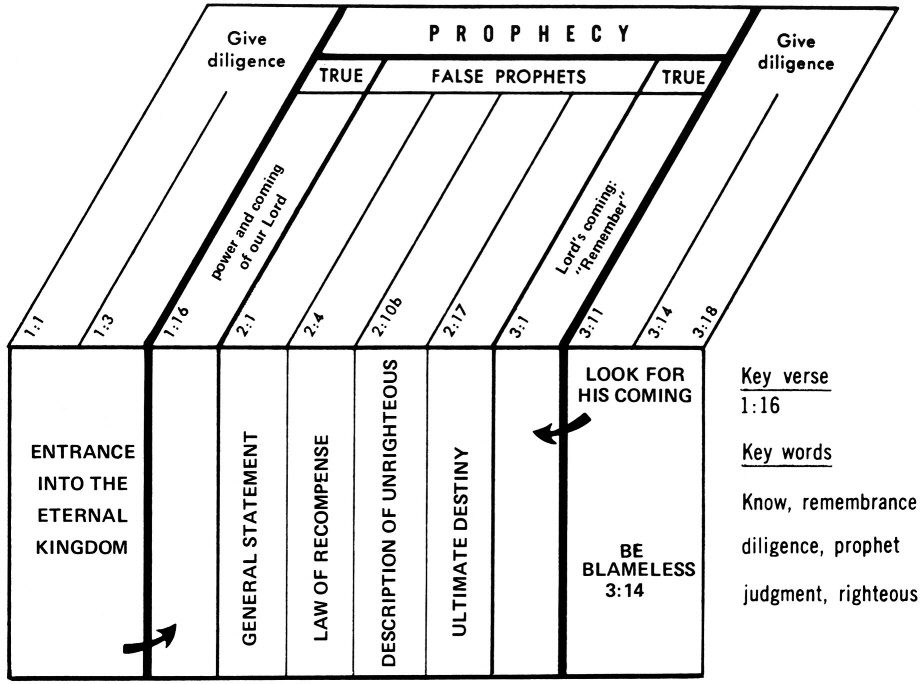
2 Peter: True and False Prophecy
Click chart to enlarge
Chart from Jensen's Survey of the NT - used by permission
|
2 PETER |
||||||||
| Cultivation of Christlike Character |
Condemnation of False Teachers |
Confidence in the Return of Christ |
||||||
| Greeting to Saints 2Pe 1:1-2 |
Growth in Christ 2Pe 1:3-14 |
Grounds |
Danger of |
Demise of |
"Decor" of |
Mockers in |
Manifest |
Maturity in light of that |
| Know Your Salvation |
Know |
Know Your Adversaries |
Know |
|||||
| True Prophecy (True Knowledge) |
False Prophets (False Teachers) |
Final Prophecy (Day of the Lord) |
||||||
| Holiness | Heresy | Hope | ||||||
| Development of Faith |
Denunciation of False Teachers |
Design of The Future |
||||||
2 Peter 2:18 For speaking out (PMPMPN) arrogant words of vanity they entice (3PPAI) by fleshly desires, by sensuality, those who barely escape (PAPMPA) from the ones who live (PPPMPA) in error, (NASB: Lockman)
Greek: huperogka gar mataiotetos phtheggomenoi (PMPMPN) deleazousin (3PPAI) en epithumiais sarkos aselgeiais tous oligos apopheugontas (PAPMPA) tous en plane anastrephomenous, (PPPMPA)
Amplified: For uttering loud boasts of folly, they beguile and lure with lustful desires of the flesh those who are barely escaping from them who are wrongdoers. (Amplified Bible - Lockman)
NET: For by speaking high-sounding but empty words they are able to entice, with fleshly desires and with debauchery, people who have just escaped from those who reside in error.
NJB: With their high-sounding but empty talk they tempt back people who have scarcely escaped from those who live in error, by playing on the disordered desires of their human nature and by debaucheries (NJB)
NLT: They brag about themselves with empty, foolish boasting. With lustful desire as their bait, they lure back into sin those who have just escaped from such wicked living. (NLT - Tyndale House)
Phillips: With their high-sounding nonsense they use the sensual pull of the lower passions to attract those who were just on the point of cutting loose from their companions in misconduct. (Phillips: Touchstone)
Wuest: For when they are uttering extravagant things that are in their character futile, they are alluring by means of the cravings of the flesh [the totally depraved nature], by means of wanton acts, those who are just about escaping from those who are ordering their behavior in the sphere of error. (Eerdmans)
Young's Literal: for overswellings of vanity speaking, they do entice in desires of the flesh -- lasciviousnesses, those who had truly escaped from those conducting themselves in error
FOR SPEAKING OUT ARROGANT (swollen, excessive sized) WORDS OF VANITY: huperogka gar mataiotetos phtheggomenoi (PMPMPN):
- Ps 52:1-3; 73:8,9; Da 4:30; 11:36; Acts 8:9; 2Th 2:4; Jude 1:15,16; Rev 13:5,6 Rev 13:11
- 2 Peter 2 Resources - Multiple Sermons and Commentaries
(Jude 1:15) to execute judgment upon all, and to convict all the ungodly of all their ungodly deeds which they have done in an ungodly way, and of all the harsh things which ungodly sinners have spoken against Him.”
These men continually ("speaking" is present tense) are "uttering loud boasts of folly" (RSV), using "big, empty words" (NEB), which amount to "high-sounding nonsense" (Phillips) and "are in their character futile" (Wuest).
As in the propagation of all heresy, human speech is the weapon that false teachers aim at their targets. These teachers are eloquent promoters of their doctrines. They know how to impress people with their vocabulary using “inflated words that say nothing” (literal translation)."
Do not be impressed with religious oratory. Paul the greatest theologian (other than Jesus) preached to express and not to impress. He knew the difference between communication and manipulation.
Speaking out (5350) (phtheggomai) sound a tone, speak with focus upon verbal sound rather than upon content. The present tense indicates this is the continual practice - they live to speak this way. This should allow us to detect them in our midst!
Hiebert says "it was used chiefly of loud talk. These false teachers substituted "fervid enthusiasm for moral sanity." (ref)
Peter used in above to describe Balaam's donkey speaking in the voice of a man (one has to wonder whether Peter intended any parallel? The dumb donkey speaking truth, the false teachers speaking lies & error!) (2Pe 2:16).
According to Rienecker phtheggomai is "especially used of a portentous prophetic utterance."
Arrogant (5246)(huperogkos from hupo = above + ogkos = swelling) literally refers to that which has great swelling or is oversized, and conveys the idea of something larger than it has any right to be. "They impress people with their vocabularies and oratory, but what they say is just so much hot air.” (Wiersbe)
So Peter is describing boastful, pompous, haughty, tumid, grand, inflated, bombastic words the goal of such pretentious palaver (misleading, beguiling speech) meant to impress and entice. High sounding words make a great cover for false teaching. The word huperogkos means unnaturally swollen and when applied to the pontification of these deceivers it describes big, ponderous words, this ostentatious verbosity being their "weapon" to ensnare the unwary and licentiousness the bait on their hook. Jude has a similar description...
These are grumblers, finding fault, following after their own lusts; they speak arrogantly (huperogkos), flattering people for the sake of gaining an advantage. (Jude 1:16)
John Calvin has an interesting description of these false teachers (you may have to read it slowly because of his old English but it's worth laboring over):
He means that they dazzled the eyes of the simple by high-flown stuff of words, that they might not perceive their deceit...He then says that they used an inflated kind of words and speech, that they might fill the unwary with admiration. And then this grandiloquence, which the ample lungs of the soul send forth, was very suitable to cover their shifts and trumperies (from a French word meaning to cheat then to deceive and thus meaning useless or worthless). There was formerly a craft of this kind in Valentinus, and in those like him, as we learn from the books of Irenaeus. They made words unheard of before, by the empty sound of which, the unlearned being smitten, they were ensnared by their reveries...they talk most confidently of the Spirit and of spiritual things, as though they roared out from above the clouds, and fascinate many by their tricks and wiles...The state of the case is this, that when the difference between good and evil is removed, everything becomes lawful; and men, loosed from all subjection to laws, obey their own lusts...they make anything they please lawful; for as the lusts of men are headstrong and craving, as soon as liberty is offered, they lay hold on it with great avidity; but soon afterwards the strangling hook within is perceived...Let us be reminded of what we ought especially to beware of, after having been once enlightened, that is, lest Satan entice us under the pretense of liberty, so as to give ourselves up to lasciviousness to gratify the lusts of the flesh. But they are safe from this danger who seriously attend to the study of holiness.
MacDonald - This is an accurate description of the words of many liberal preachers and false cultists. They are accomplished orators, holding audiences spellbound by their grandiose rhetoric. Their erudite vocabulary attracts undiscerning people. What their sermons lack in content, they make up for in a dogmatic, forceful presentation. But when they have finished they have said nothing. As an example of this sort of sterile sermon, here is a quotation from a well-known theologian of our day: It is not a relationship of either parity or disparity, but of similarity. This is what we think and this is what we express as the true knowledge of God, although in faith we still know and remember that everything that we know as “similarity” is not identical with the similarity meant here. Yet we also know and remember, and again in faith, that the similarity meant here is pleased to reflect itself in what we know as similarity and call by this name, so that in our thinking and speaking similarity becomes similar to the similarity posited in the true revelation of God (to which it is, in itself, not similar) and we do not think and speak falsely but rightly when we describe the relationship as one of similarity."
Vanity (3153)(mataiotes from mataios = vain, empty <> derived from maten = to no purpose or in vain) means that which is unprofitable, worthless and devoid of truth and which therefore lack the ability to produce any spiritual benefit.
Thayer says mataiotes is a "purely Biblical and ecclesiastical word" which describes "what is devoid of truth and appropriateness". It defines the inability to reach a goal or achieve a purpose.
Mataiotes describes the state of being without use or value, emptiness, futility, purposelessness, transitoriness. It has the quality of being empty, fruitless, nonproductive, useless. Mataiotes speaks of want of attainment with the idea of aimlessness or of leading to no object or end.
It wasn't that their words lacked any content at all, but just that they lacked truth and so were fruitless, ineffective, ineffectual and unproductive. Their words as grandiloquent and bombastic as they sounded, were analogous to the "springs without water" -- they produced nothing of eternal value or spiritual significance. Don't be deceived - these false teachers are masters of deceit and have the uncanny ability to clothe futile, meaningless thought with pseudo-intellectual and speciously spiritual verbiage. Such high-sounding words by which they sought to impress and deceive people were actually worthless, being no different from the sound a donkey makes!
Wuest adds that mataiotes is "used especially of moral insincerity. The verbose speech of these false teachers was futile in that it did not fulfill that for which speech was intended, to convey accurate and true information. All it did was to allure like bait the hearers so that they would become followers of the false teachers."
MacArthur - The false teachers deceive the weak with high sounding words that masquerade as scholarship or profound spiritual insight, and even as direct revelation from God. They may contradict the plain historic teachings of Scripture which in some cases they are not able to explain properly because of their lack of adequate training and divine wisdom (cf 1Cor 2:14). In reality, they say nothing genuinely scholarly, or spiritual, or divine.
This over swollen profitless words don't result in freedom but to the contrary result in bondage for their listeners, because in their deception, they bait people to live sensually in the name of God instead of living wholly, Holy lives set apart from the world and unto the pleasure and glory of God. The World lives sensually and is enslaved to the lusts of the flesh & the eyes. True believers have been freed from enslavement to that evil monster called "lust" (2Pe 1:4) & should live as children of light, in the freedom that Christ Alone provides (Gal 5:1)
THEY (continually) ENTICE BY FLESHLY DESIRES BY SENSUALITY: deleazousin (3PPAI) en epithumiais sarkos aselgeiais:
- 2 Peter 2 Resources - Multiple Sermons and Commentaries
Now Peter unveils the pernicious activity of these false teachers.
Entice (1185)(deleazo from delear = to bait, entrap) means to trap by using bait, and so to ensnare, lure or beguile. These men are like fishermen baiting the hook. Remember that the "enticement" always has a bait. The present tense indicates that they live to entice others and draw them into their snare.
And so these false teachers Peter describes would dangle the "baited lure" in front of their unsteady victims causing them to look away from the Lord Jesus and His Word. By their sensual propaganda, they ensnare (2Pe 2:14) and it may be that they take for their targets new converts to Christianity from paganism. Seduction, rather than the winsomeness of truth, is their ploy. They offer people a kind of religion that they can embrace and still hold on to their fleshly desires and sensuality.
Death to self and pursuit of holiness are certainly not their major teachings! (e.g. Mk 8:34, et al, 2Cor 7:1 Heb 12:14, Torrey's Topic Holiness)
Beware of any teacher who mixes culture and Christianity without drawing clear lines regarding moral and ethical behavior! Anyone who omits teaching self-denial (Torrey's Topic Self Denial) and loyalty to God (Mk 12:30-31) as more important than personal pleasure may be appealing to the sinful nature.
Judge teachers by checking their substance and observing their moral behavior. A salvation that is future only, that allows people to indulge every sinful desire and passion here on earth without punishment, can be enticing.
Desires (1939) (epithumia from epí = indicating motion upon or towards or intensifying the meaning of + thumós = passion).(8/38 NT uses by Peter - see 1 Peter, 2 Peter) means a strong desire or passion directed toward an object and so refers to lusting or craving, even a kind of out-of-control craving. Desires can be for something good but in the present context are for that which is forbidden and sinful and describes depraved cravings & inner vile unrestrained longings emanating from our fallen nature, here referred to as our "fleshly" nature, which are self-centered and opposed to the will of God. Desires are those impelling urges screaming for self gratification and which destroy the inner man by corrupting, and thus brings into a worse state.
Fleshly (4561) (sarx) can refer to the human body of flesh and blood but clearly that is not the meaning in the present context.
John Piper has an excellent "working definition" on the flesh as "the old ego that is self-reliant and does not delight to yield to any authority or depend on any mercy. It craves the sensation of self-generated power and loves the praise of men...in its conservative form it produces legalism -- keeping rules by its own power for its own glory...we see that the flesh also (in its more liberal form) produces grossly immoral attitudes and acts (as defined in Gal 5:19-21 -see notes Gal 5:19; 5:20; 5:21)...The flesh is the proud and unsubmissive root of depravity in every human heart which exalts itself subtly through proud, self-reliant morality, or flaunts itself blatantly through self-assertive, authority-despising immorality." (Read the full sermon Walk by the Spirit)
That's the "animal" that these false teachers are appealing to via the bait of sensuality. However don't think of “the lusts of the flesh” only in terms of sexual sins, for the flesh has other appetites. Read the list given in Gal 5:19-21 and you will see the many different kinds of “bait” the apostates have available for baiting their traps.
Sensuality (766) (aselgeia from aselges = licentious <> a = negates next word + selges = continent) originally referred to any excess or lack of restraint and came to be associated primarily with unbridled desire and sexual excess. The lurid picture conveyed by this word is that of uninhibited sexual indulgence without shame and without concern for what others think or how they are affected (or infected). Thayer’s note on this word as it is used in this passage is as follows: ”wanton. acts or manners, as filthy words, indecent bodily movements, unchaste handling of males and females.”
Aselgeia is a plural noun denoting various kinds of sexual excesses. This suggests that the heretical teachers clearly were implying that once the soul is saved, what is done in the body is of no importance. These men proclaim a message that appeals to one's eyes and ears.
Matthew Henry adds an apt description of these men and their methods - By application and industry men attain a skillfulness and dexterity in promoting error. They are as artful and as successful as the fisher, who makes angling his daily employment. The business of these men is to draw disciples after them, and in their methods and management there are some things worth observing, how they suit their bait to those they desire to catch. Erroneous teachers have a peculiar advantage to win men over to them, because they have sensual pleasure to take them with; whereas the ministers of Christ put men upon self-denial, and the mortifying of those lusts that others gratify and please: (Col 3:5) wonder not therefore that truth prevails no more, or that errors spread so much."
THOSE WHO BARELY ESCAPE FROM THE ONES WHO LIVE IN ERROR: tous oligos apopheugontas (PAPMPA) tous en plane anastrephomenous (PPPMPA):
- 2Pe 2:14
- 2 Peter 2 Resources - Multiple Sermons and Commentaries
The pompous propaganda and sensual license promoted by the false teachers appeals to people who are just learning the gospel and weighing its claim on their lives.
Barely (3641) (oligos) very recently, in a small degree, slightly, a little.
Escaped (668) (apopheugo from apo = separation, departure + pheugo = run away, seek safety by flight) means to escape completely or flee away from. The present tense pictures this escape as a process and in the participle form is better translated "barely escaping". Most commentaries do not interpret these individuals as truly saved and fact that they are constantly (see present tense below) living in error as their lifestyle strongly supports this interpretation.
Live (390) (anastrepho from aná = again, back + strépho = turn) in the passive voice (as here) conveys a reflexive sense of turning back and forth in a place and so meaning to live or stay somewhere. Figuratively anastrepho refers to one's moral conduct or behavior. The present tense signifies they are continually conducting their life in the sphere of "error".
Error (4106) (plane) means straying from the path of truth or wandering out of the right way and thus living in error, delusion, deceit, deception to which one is subject. Plane is used only 10x in the NT but each use is instructive and I would suggest studying these uses in context by clicking on the links (Mt 27:64; Ro 1:27; Eph 4:14; 1Th 2:3; 2Th 2:11; Jas 5:20; 2Pet 2:18; 3:17; 1Jn 4:6; Jude 1:11).
Josephus uses plane in the following exhortation --
It is also a duty to show the roads to those who do not know them, and not to esteem it a matter for sport, when we hinder others’ advantages, by setting them in a wrong way (plane = error).
These false teachers had a duty to show the "right roads to those who do not know them" but instead were "setting them in a wrong way"
Peter ends his letter warning the genuine believers to
be on (their) guard so that (they) are not carried away by the ERROR of unprincipled men and fall from (their) own steadfastness. (2Pe 3:17)
The picture here is of people who have been given some information about God and His salvation and are interested in learning more, but they have not yet accepted Christ as Savior. They have been associating with a crowd of people who, literally, order their whole lives around error--that is, willingly reject God and want nothing to do with living under His domain.
Wiersbe - the apostate minister will try to avoid “putting people on a guilt trip.” He will tell his listeners how good they are, how much God loves them and needs them and how easy it is to get into the family of God. In fact, he may tell them they are already in God’s family and just need to start living like it! The apostate avoids talking about repentance, because egotistical men do not want to repent.
What is the antidote for the poison of these sinister deceivers?
Matthew Henry has some good advice - Be therefore always upon your guard, maintain a godly jealousy of yourselves, search the scriptures, pray for the Spirit to instruct and establish you in the truth, walk humbly with God, and watch against every thing that may provoke him to give you up to a reprobate mind, that you may not be taken with the fair and specious pretences of these false teachers, who promise liberty to all who will hearken to them, not true Christian liberty for the service of God, but a licentiousness in sin, to follow the devices and desires of their own hearts