2 Peter 2:2
2 Peter 2:3
2 Peter 2:4
2 Peter 2:5
2 Peter 2:6
2 Peter 2:7
2 Peter 2:8
2 Peter 2:9
2 Peter 2:10
2 Peter 2:11
2 Peter 2:12
2 Peter 2:13
2 Peter 2:14
2 Peter 2:15
2 Peter 2:16
2 Peter 2:17
2 Peter 2:18
2 Peter 2:19
2 Peter 2:20
2 Peter 2:21
2 Peter 2:22
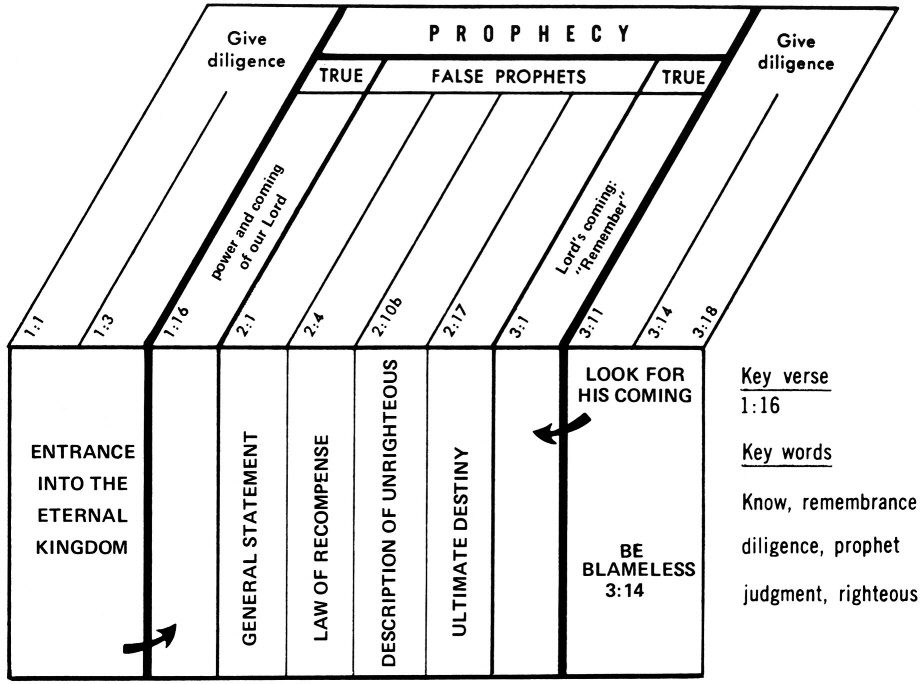
2 Peter: True and False Prophecy
Click chart to enlarge
Chart from Jensen's Survey of the NT - used by permission
|
2 PETER |
||||||||
| Cultivation of Christlike Character |
Condemnation of False Teachers |
Confidence in the Return of Christ |
||||||
| Greeting to Saints 2Pe 1:1-2 |
Growth in Christ 2Pe 1:3-14 |
Grounds |
Danger of |
Demise of |
"Decor" of |
Mockers in |
Manifest |
Maturity in light of that |
| Know Your Salvation |
Know |
Know Your Adversaries |
Know |
|||||
| True Prophecy (True Knowledge) |
False Prophets (False Teachers) |
Final Prophecy (Day of the Lord) |
||||||
| Holiness | Heresy | Hope | ||||||
| Development of Faith |
Denunciation of False Teachers |
Design of The Future |
||||||
2 Peter 2:20 For if, after they have escaped (AAPMPN) the defilements of the world by the knowledge of the Lord and Savior Jesus Christ, they are again entangled in (APPMPN) them and are overcome (3PPPI) the last state has become (3SRAI) worse for them than the first. (NASB: Lockman)
Greek: ei gar apophugontes (AAPMPN) ta miasmata tou kosmou en epignosei tou kuriou [hemon] kai soteros Iesou Christou toutois de palin emplakentes (APPMPN) hettontai, (3PPPI) gegonen (3SRAI) autois ta eschata cheirona ton proton
Amplified: For if, after they have escaped the pollutions of the world through [the full, personal] knowledge of our Lord and Savior Jesus Christ, they again become entangled in them and are overcome, their last condition is worse [for them] than the first. (Amplified Bible - Lockman)
NET: For if after they have escaped the filthy things of the world through the rich knowledge of our Lord and Savior Jesus Christ, they again get entangled in them and succumb to them, their last state has become worse for them than their first. (NET Bible)
NLT: And when people escape from the wicked ways of the world by learning about our Lord and Savior Jesus Christ and then get tangled up with sin and become its slave again, they are worse off than before. (NLT - Tyndale House)
Phillips: If men have escaped from the world's contaminations through knowing our Lord and saviour Jesus Christ, and then become entangled and defeated all over again, their last position is far worse than their first. (Phillips: Touchstone)
Wuest: For if, having escaped the pollutions of the world by an experiential knowledge of the Lord and Saviour Jesus Christ, in these moreover again being entangled, they have been overcome with the result that they are in a state of subjugation, the last things have become to them worse than the first ones
Young's Literal: for, if having escaped from the pollutions of the world, in the acknowledging of the Lord and Saviour Jesus Christ, and by these again being entangled, they have been overcome, become to them hath the last things worse than the first,
FOR IF AFTER THEY HAVE ESCAPED: ei gar apophugontes (AAPMPN):
- Mt 12:43, 44, 45; Lk 11:24, 25, 26; Heb 6:4, 5, 6, 7, 8; 10:26,27
- 2 Peter 2 Resources - Multiple Sermons and Commentaries
For - term of explanation. What is Peter explaining?
If is a first class conditional clause and assumes that the following statement ("have escaped") is true. Who are "they"? This is variously interpreted as either the false teachers or their victims, but the proximity to the false teachers in (2Pe 2:19) makes them the most natural antecedent of "they".
Furthermore, the teachers are the main subject of the whole chapter. Finally, in (2Pe 2:1- note) we see that the false teachers are described as continually denying their Master, Jesus Christ. It seems therefore most fitting that Peter is referring here to the false teachers who were not far from the kingdom of God but who did not obey the truth they knew and so were still under the wrath of God (Jn 3:36-note).
So clearly they are unbelievers even though they had a clear knowledge of the Way of salvation. They may have for a time "escaped the defilements" but they were never saved and thus this passage is not a proof text that one can use to support the false teaching that a person can lose their salvation. This passage emphasizes the importance of interpreting Scripture in its proper context and not just from a verse in a vacuum. If one looks carefully at the behavior of these men in the preceding description, it is clear that they repeatedly demonstrated a lifestyle diametrically opposed to the Lordship of Jesus Christ.
Escaped (668) (apopheugo from from apo = marker of dissociation implying a rupture from a former association + pheugo = run away, seek safety by flight) means to escape completely, flee away from. (Used only in 2Peter - 2 Pet. 1:4; 2:18, 20)
The aorist tense indicates that this escape was an actual event at some time in the past. At some point in time, these false teachers and their followers wanted to escape the moral contamination of the world system and sought religion, even Jesus Christ (on their terms though, not His).
These false teachers had never genuinely been converted to Christ. They heard the true gospel and moved toward it, but then rejected the Christ of that gospel. This is a picture of apostasy like that described in (He 10:26, 27-notes v26; 27). It is interesting that Peter did not use the perfect tense for escaped, which would have indicated this was their permanent condition. These men were never saved, period. Their greater accountability will warrant their being cast into the deepest darkness.
THE DEFILEMENTS OF THE WORLD BY THE KNOWLEDGE OF THE LORD AND SAVIOR JESUS CHRIST: ta miasmata tou kosmou en epignosei tou kuriou (hemon) kai soteros Iesou Christou:
- 2 Peter 2 Resources - Multiple Sermons and Commentaries
Defilements (3393) ("pollutions", "filthy things", "contaminations", "world's filth") (miasma see study of related word miasmos) describes the state of being tainted or stained by evil and refers to ‘impurity, impure, tainted, defilement, foulness or pollution.' Miasma is the resulting state.
This is the only NT use of miasma but there are 3 uses in the Septuagint - Lev. 7:18; Jer. 32:34; Ezek. 33:31.
Miasma then has the idea of putrid or poisonous vapors. Morally, the world gives off a deadly influence. Josephus uses miasma to describe the condition of Jerusalem just prior to its sacking by the Romans (70AD)
the city was all over polluted (miasma) with such abominations...so that the city was filled with sadness.
Thayer defines as miasma "that which defiles and explains it in its occurrence here as “vices the foulness of which contaminates one in his intercourse with the ungodly mass of mankind. (~"the world" - see below).
As Calvin phrases it, "we roll in filth and are wholly polluted, until we renounce the world."
Defilement refers to what is on the outside. But true believers have
escaped the corruption that is in the world through lust (see note 2 Peter 1:4)
Corruption is much deeper than defilement on the outside: it is decay on the inside. True believers have received a new nature, a divine nature, and they have new and different appetites and desires. They have been transformed from pigs and dogs into sheep!
World (2889) (kosmos - "cosmopolitan") refers in this context to the corrupt world system of evil of which Satan is the head, all unsaved people his servants, together with the pursuits, pleasure, purposes, people, and places where God is not wanted and the inhabitants are living (and since the garden have always lived) alienated and apart from God.
Adam Clarke has this vivid description of the defilements of the world - The word (miasma) was anciently used, and is in use at the present day, to express those noxious particles of effluvia proceeding from persons infected with contagious and dangerous diseases; or from dead and corrupt bodies, stagnant and putrid waters, marshes etc., by which the sound and healthy may be infected and destroyed. The world is here represented as one large, putrid marsh, or corrupt body, sending off its destructive miasmata everywhere and in every direction, so that none can escape its contagion, and none can be healed of the great epidemic disease of sin, but by the mighty power and skill of God. Augustine has improved on this image: "The whole world," says he, "is one great diseased man, lying extended from east to west, and from north to south; and to heal this great sick man, the almighty Physician descended from heaven.
Knowledge (1922) (epignosis from gnosis = knowledge gained by experience + epi = direction toward or intensification of the gnosis) (4 of 20 NT uses are in 2Peter - see below) means a full, precise knowledge thus signifying a more complete, more thorough, larger knowledge than that found in gnosis.
Here are the 20 uses of epignosis in the NT -
Rom. 1:28; 3:20; 10:2; Eph. 1:17; 4:13; Phil. 1:9; Col. 1:9, 10; 2:2; 3:10; 1Tim. 2:4; 2Tim. 2:25; 3:7; Titus 1:1; Philemon 1:6; Heb. 10:26; 2 Pet. 1:2, 3, 8; 2:20
Epignosis also implies a more intimate and personal relationship than gnosis. The learner exhibits a more thorough participation in the acquiring of knowledge. In the NT epignosis often refers to knowledge which should influence one's spiritual conduct in contrast to gnosis which Vincent says
may be concerned with the intellect without affecting the character
Epignosis is a knowledge that speaks of personal involvement. Peter's point is quite clear - he is saying that these individuals had experienced an intimate knowledge of Jesus Christ, and that knowledge included the truth about His being "Lord" (kurios - Master, Ruler, Absolute ownership, total power, supreme in authority) and "Savior" (Soter - Deliverer, Preserver, Protector, Healer Who rescues from danger or destruction and brings into a state of prosperity and blessedness). But knowledge alone, even the more intimate knowledge of epignosis, does not save a person, although it will make them more accountable at the judgment of unbelievers. For epignosis to be of any spiritual value, there must be a heart submission to that knowledge and a conduct which is in accord with that yieldedness.
As Paul says
in reference to your former manner of life, you lay aside the old self, which is being corrupted in accordance with the lusts of deceit, and that you be renewed in the spirit of your mind" (See notes Ephesians 4:22; 4:23, see Torrey's Topic "Self Denial")
Anything less is an eternally deadly self-delusion.
Wiersbe - Sinful tendencies do not disappear when a person reforms; they merely hibernate and get stronger. Holiness is not simply refusing to do evil things, for even unsaved people can practice self-control. True holiness is more than conquering temptation: it is conquering even the desire to disobey God.
Matthew Henry comments on the effect of "knowledge" on these men - (They) are not savingly renewed in the spirit of their mind. A religious education has restrained many whom the grace of God has not renewed: if we receive the light of the truth, and have a notional knowledge of Christ in our heads, it may be of some present service to us; but we must receive the love of the truth, and hide God’s word in our heart, or it will not sanctify and save us." These men may have external "religious reformation" but not true internal "righteous renewal." As Peter alludes to in the last verse their outward pollution was washed away, but the inward corruption was still there.
THEY ARE AGAIN ENTANGLED IN THEM AND ARE OVERCOME: toutois de palin emplakentes (APPMPN) hettontai (3PPPI):
- 2 Peter 2 Resources - Multiple Sermons and Commentaries
- What is apostasy and how can I recognize it?
By using the word again (palin = back, back again, again -- implying a return back to a former place, state or act) Peter implies that they actually do return to a former place of defilement by the world (cf with picture in 2 Peter 2:22 [note])
The verb entangled is in the aorist tense indicating an actual event or act. They really did go "backward" rather than "forward" so to speak.
Entangled (1707) (empleko from en = in + pléko = tie, braid, twist - pléko is used of the Roman soldiers "weaving a crown of thorns" to mock Jesus in Mt 27:29) means in general to interconnect closely and so to wrap or twist together and thus entwine, intertwine, braid, entangle and finally to be caught in. Figuratively empleko means to become involved in an activity to the point of interference with other activities or objectives.
Related Resource:
BDAG's lexicon has a picturesque definition of empleko stating that it means "to be involuntarily interlaced to the point of immobility" and was used "literally of sheep whose wool is caught in thorns" and of the "hares (rabbits) who are caught in thorns; Aesop's Fables (Arndt, W., Danker, F. W., & Bauer, W. A Greek-English Lexicon of the New Testament and Other Early Christian Literature)
The picture of a sheep whose wool has been caught in thorns illustrates the difference between involvement and entanglement - one is entangled when he is not free to get loose! When the affairs of this life hem us in so tightly that we can't get loose to fulfill our Captain's commands then we have become entangled in the "thorns" of non-eternal pursuits. The world's pleasures can easily entwine us especially in hedonistic America!
Empleko refers to the act of getting so involved in something that one becomes restricted and controlled, no longer free to do what one should do.
Liddell and Scott write that empleko was used in secular writing meaning "to entwine one's hand in another's clothes, so as to hold him."
Empleko is used only once in the (non-apocryphal) LXX in Proverbs where the translation of the Greek is "He that walks justly is assisted: but he that walks in crooked ways shall be entangled therein."
In the present context, Peter pictures these individuals as intertwined and intimately blended with the defilements of the world, hopelessly trapped like fish within a net. So this is not a picture of accidental or subtle touching but an intimate interweaving with the forces of this world that bring about spiritual pollution of one's soul and which makes separation difficult.
The picture of this verb is to be so involved as to experience severe restrictions as to what one can do. Paul reminded Timothy that
no soldier in active service entangles himself in the affairs of everyday life, so that he may please the one who enlisted him as a soldier (see note 2 Timothy 2:4)
Entanglement disables one's freedom to function.
Entangle - to involve in or as in a tangle; catch, as in a net, vine, etc., so that escape is difficult; ensnare or enmesh; to wrap or twist together; "interweave"; to twist or interweave in such a manner as not to be easily separated
Spurgeon - If you go down to destruction from the borders of salvation, it will be sevenfold destruction. If you die with Jesus weeping over you, as he did over Jerusalem, you will die horribly. If you sink down to hell with that word in your ears, "How often would I have gathered you, as a hen gathers her chickens under her wings, and you would not" (Mt 23:37), your sinking will be like that of a millstone in the sea. If you perish under a gospel ministry, it were better for you that you had never been born. (2 Peter 2:21 Comment)
Thomas Adams...
I. A PROPOSITION.
1. “They have escaped.” Next to the finding an unexpected benefit, it is a great happiness to escape an unsuspected danger; yea, the escaping of a great danger is more joy than the receiving of an ordinary benefit.
2. “The pollutions of the world.”
(1) The pollutions which we contract from the riches of the world.
(2) The pollutions we derive from the honours and dignities of the world pride here challengeth the first place, and let her have it, even to be the queen of all sordid filthiness.
(3) The pollutions we deduce from the pleasures of the world. Oh, what a torrent of turpitudes here stream in upon us!
(a) Immoderate diet.
(b) Drunkenness.
(c) Lust.
3. “Through the knowledge,” etc.
(1) There is no knowledge to do good in corrupted nature and filthiness of the flesh.
(2) There is no escaping out of this filthiness and corruption, but by knowledge.
(3) No knowledge can deliver us, but that of our Saviour Christ.
(4) No knowledge of our Saviour can effect this, but that which is sanctified with faith and repentance.
II. A SUPPOSITION.
1. The easiness of falling back. “If” — it is no impossible thing. Yes, the commonness proves it too easy. Man goes forth in the morning weak and unarmed, to encounter with powers and principalities. To fight this combat he takes a second with him, and that is his flesh, a familiar enemy, a friendly traitor; the devil comes against him with his second, too, and that is the world. Soon doth the flesh revolt to the world, and both stick to Satan; so here is terrible odds, three to one.
2. The difficulty of recovering them, after their relapse.
(1) “They are entangled,” as birds are caught in an evil net; where the more they struggle to get out, the faster they stick.
(2) “And overcome.” That which puts a man from the use of his reason, and a Christian from his exercise of religion, overcomes him. The ambitious are overcome with the desire of honour, so that they are not their own men. Of all, the worldlings are basely overcome; for they think they have the world in a string, when the world hath them in a strong chain.
(3) “Entangled and overcome” — put them both together. It is the depth of misery to fall under the curse of Ham, a servant of servants.
III. A CONCLUSION. “The latter end is worse,” etc.
1. Their sins are worse now than they were at first, therefore their estates must needs be so.
2. Besides all their other sins, they have the sin of unthankfulness to answer for.
3. Because custom in sin hath deadened all remorse for sin.
4. Because their hypocrisy prevents all ways of remedy.
5. Because they wilfully destroy themselves by renouncing all gracious remedies.
6. Because a relapse is even more dangerous than the first sickness; sooner incurred, more hardly cured. (The Biblical illustrator)
A C Gaebelein - Does this mean that these persons were at one time really begotten again, having received life and the Holy Spirit by trusting on Christ? These false teachers certainly were never born again; the description which we have of them is the proof of it. The last verse of this chapter gives the conclusive evidence. Believers, true Christians, are never compared to dogs or swine; they are the sheep of His flock. A sheep cannot be transformed into a dog or a swine, nor will a sheep do what a dog or a swine does. They were therefore never the true children of God. They had escaped the outward pollutions of the world, which is a different thing from the escape of the corruption which is in the world by lust; the latter stands for the inward deliverance by the new birth, the former for an outward reformation which had taken place when they professed the knowledge of the Lord and Saviour Jesus Christ, when for a time forsaking their evil ways so that they escaped the pollutions. But not having a new nature they became entangled therein and overcome, so that it was worse with them than in the beginning, before they had made a profession. They had known the way of righteousness as made known in the gospel of Christ, but the life which is offered in that way of righteousness, with the fruits of righteousness which follow, they had never accepted by a living faith. And this seems to be the case with the vast majority of the false teachers of today, the destructive critics, and those who deny the deity of our Lord. They were never born again; they never had a true experience of real salvation, hence they are but natural men, not having the Spirit. (Commentary on 2 Peter - by A C Gaebelein)
Are overcome (2274) (hettao or hettaomai or hessaomai from hetton = less, inferior) first means to be less or inferior. The idea is to be put to the worse and hence to be defeated or conquered. To succumb. To be vanquished, subdued and enslaved or overcome as in a conflict or a lawsuit. To be forced to yield. The idea is of suffering a defeat that so that what conquers now has mastery over the defeated party.
Hettao means to be vanquished as in a military battle alluding to the ancient law of war in which those who were defeated were taken captive by the conquerors and became their servants.
The present tense indicates the continual overpowering of these men by lust and corruption. The moral and ethical influence of the Word of God had acted as a detergent and a deterrent upon these false teachers to the end that their outward lives had been relatively pure. But as they persisted in their false teaching that grace gave license to sin, they became entangled and overcome in their former licentious ways.
Josephus provides us with a helpful illustration of the verb hettao describing Jacob as being overcome by his love for Rebekah...
Jacob was quite overcome (hettao), not so much by their kindred, nor by that affection which might arise thence, as by his love to the damsel, and his surprise at her beauty, which was so flourishing, as few of the women of that age could vie with. He said then, "There is a relation between thee and me, elder than either thy or my birth, if thou be the daughter of Laban (The works of Josephus Ant I, xix 5)
Adam Clarke comments that the idea of overcome...
is an allusion to the ancient custom of selling for slaves those whom they had conquered and captivated in war. The ancient law was, that a man might either kill him whom he overcame in battle, or keep him for a slave. These were called servi, slaves, from the verb servare, to keep or preserve. And they were also called mancipia, from manu capiuntur, they are taken captive by the hand of their enemy. Thus the person who is overcome by his lusts is represented as being the slave of those lusts (see Ro 6:16-note).
THE LAST STATE HAS BECOME (and remains) WORSE FOR THEM THAN THE FIRST: gegonen (3SRAI) autois ta eschata cheirona ton proton:
- Nu 24:20; Dt 32:29; Php 3:19
- Torrey's Topic Apostates
- What is apostasy and how can I recognize it?
- 2 Peter 2 Resources - Multiple Sermons and Commentaries
Imagine the disappointment of the person who thinks he has been delivered, only to discover that, in the end, he is in worse shape than when he started!
Last (2078) (eschatos- eschatology or study of the Biblical events of the last times) pertains to being last in a series of events.
Become (1096) (ginomai) means to come into existence. Ginomai in this passage is in the perfect tense indicating that this is their permanent condition -- they became worse at some point in time in the past and remain in their degraded state. And so a state of apostasy is in fact worse than a state of ignorance.
Worse (5501) (cheiron) more evil or aggravated. (See 11 uses in NT - Matt. 9:16; 12:45; 27:64; Mk. 2:21; 5:26; Lk. 11:26; Jn. 5:14; 1 Tim. 5:8; 2 Tim. 3:13; Heb. 10:29; 2 Pet. 2:20)
Their final spiritual state is inferior in rank, dignity, goodness, excellence, or condition. These false teachers are lost, eternally damned men: The clearest indication that these men were never born again is that there is no lasting change in their nature. This absence of permanent change in their nature (in contrast to 2Co 5:17) shows that they were always lost and were never born again. If you are truly born again, then you continue in the faith! [see Paul's "definition" of the true "gospel" - 1Cor 15:1, 2, 3, 4, 5, 6, 7, 8 -see notes 15:1; 15:2; 15:3; 15:4; 15:5; 15:6 ; 15:7; 15:8;]. All believers may have seasons when sin drags them down (but they are the most miserable of all individuals to be around) but those times should pass and should not the habit of our life.
Steven Cole -
Do these verses refer to the false teachers or to those who follow them? Probably due to the context, the focus is mainly on the false teachers. But it also applies to those who fall for their deceptive teaching. For a while, they had escaped the defilements of the world by knowing Christ as Lord and Savior. But then they got entangled in these defilements again. This last state was worse than the first. Peter compares it to a dog returning to its vomit (Prov. 26:11) or a pig after washing returning to the mire.
These verses raise two questions: First, what does Peter mean when he says that their latter state is worse than the first? Second, is Peter saying that believers can lose their salvation?
Peter may mean two things when he says that their latter state is worse than the first. It may be worse because if a person has heard the gospel and had some experience of the Christian life, it will be more difficult to restore him to a true knowledge of Jesus Christ. If you try to talk with him about what it really means to follow Christ, he is likely to say, “Been there, done that. It didn’t work for me.” (See Matthew 12:43-45.)
Peter may also mean that their latter state is worse than the first because everyone will be judged on the amount of light which they rejected (see Matt. 11:21-24; Luke 12:47-48). These people had been exposed to a lot of truth, but they turned their backs on it to pursue their own sinful lusts. They will be judged accordingly.
In response to the second question, the simple answer is, “No, a believer cannot lose his salvation.” Those whom God saves, He keeps (Phil. 1:6-note). Jesus said that He would not lose any of those that the Father had given to Him (John 6:39-40). No one can snatch His sheep from His hand (John 10:28).
But, to ask if a believer can lose his salvation is really the wrong question. The right question is, “What does it mean to be a true believer in Jesus Christ?” Or, “what is true saving faith?” In a nutshell, when God saves you, He changes your heart (2Cor 5:17-note, Ezek 36:26-27-note). He imparts new life to you so that your desires are changed. You now love God and seek to please Him. You want to grow to know Him. You love His Word. You hate your sin and strive against it. In other words, genuine saving faith always results in a life of growing godliness and obedience to Christ (see James 2:14-26-note & 1 John 3:4-10). If that is not your experience, you may need to go back and make sure that God has truly changed your heart through faith in Christ. (2Cor 13:5-note)
But, how then do we explain Peter’s words here? He says that these people had escaped the defilements of the world. They knew Jesus as Savior and Lord. They knew the way of righteousness. For a while, at least, they had received the holy commandment of God’s Word. Some would say that they were truly saved, but they would lose their rewards. But Peter’s language doesn’t allow for that. That view flies in the face of chapter 2 and the entire letter (Schreiner, p. 364).
Probably we should understand Peter as using Christian terms to describe these false Christians because for a while, they gave every appearance of being Christians (Schreiner, p. 364). Like the seed sown on the rocky ground and that sown on the thorny ground, for a while they gave the appearance of new life. But they did not persevere and bear fruit unto eternal life (Lk 8:15). Genuine saving faith perseveres on the path of righteousness (Mt 24:13). This is not to say that Christians never sin. Sometimes they sin "big time.' But when they do, they genuinely repent and get back on the path. False believers, like these false teachers, are like dogs that go back to their vomit or pigs that return to the mire. They cleaned up the outside, but their basic nature never changed. Eventually, they act according to their true nature. They do not love God or the way of righteousness described in His Word because they have not been born again. (A Sad Portrait to Study)
John Piper adds the following comment...
Peter pictures the real possibility in verse 20 that by learning of Christ some people make a start in the Christian life, and by all outward appearances have escaped from the defilements of the world. Then the cares and riches and pleasures of life (as Jesus says) choke the young plant and it withers and bears no fruit and dies (Lk 8:14)...notice the principle that the more you know of Christ and his way the more severe will be your judgment for not trusting and obeying Christ. Better never to have known the way, Peter says in verse 21. And in this he simply preserves the teaching of Jesus. He said, "Woe to you Chorazin and Bethsaida! For if the mighty works done in you had been done in Tyre and Sidon, they would have repented long ago in sackcloth and ashes. But I tell you, it shall be more tolerable on the day of judgment for Tyre and Sidon than for you" (Mt 11:21,22.23, 24) The more evidence you have of Christ's reality, the more severe your judgment for not repenting. "Everyone to whom much is given, of him much will be required" (Lk 12:47,48)...Peter is not teaching that God's elect can lose their salvation. He is most definitely teaching that church members can be lost and people who make outward professions of faith and even begin to clean up their lives can turn away from Christ and be lost." But in verse 22 he explains to us in a proverb that we should not be overly surprised at this: dogs characteristically return to their vomit; and no matter how clean you make a pig on the outside, if it is still a pig it will return to the mire. In other words, those who leave the way of righteousness, never to return, simply show that their inner nature had never been changed. This was Peter's way of saying what 1Jn 2:19 says, "They went out from us, but they were not of us, for if they had been of us, they would have continued with us; but they went out that it might be plain that they are all not of us." Or as Jesus said, "He who endures to the end will be saved" (Mt 10:22). Or as Hebrews puts it, "We share in Christ if we hold our first confidence firm to the end" (He 3:14-note). Or as Paul says, "I preached to you the gospel which you received, in which you stand, by which you are saved, if you hold it fast" (1 Cor 15:1,2) The whole New Testament is agreed: there is no salvation apart from persevering faith. And persevering faith always works itself out in the way of righteousness. Therefore to abandon the way of righteousness is to exclude oneself from salvation." (Read full sermon Better Never to Have Known the Way )
This section of Scripture brings to a head one of those thorny issues we would all rather avoid, lest we be accused of being "unloving" or too "narrow" in our interpretation of Scripture. But heaven and hell hang in the balance depending on one's interpretation and application of the truth in 2 Peter 2.
How do we know the apparent "change" in these men Peter is describing was not a true supernatural change in their heart and that they were never really made new creatures in Christ (2Cor 5:17)?
Examine their "works". The context (2Pe 2:22-note) makes it quite clear that they returned to their natural fleshly behavioral patterns just like any dog or sow would do once given the chance. You can wash the pig's exterior of the mud & filth and it may look sparkling clean on the outside but it is still a pig inside...it returns to wallow in the mire! Peter is saying that you can discern that these men were never caused to be born again because they return to do the things they did before they knew the way of righteousness. John teaches the same truth when he says that those who practice lawlessness as a habit of their life are showing their true nature and are not new creatures in Christ (read the entire chapter 1John 3). By this the children of God and the children of the devil are obvious: anyone who does not continuously practice righteousness is not of God. And once you are caused to be born again, you cannot be "unborn" (either in the physical or spiritual world) so to say these men have simply lost their salvation is nonsense. The reason this whole area is so difficult for many people to understand and accept is because we in modern day Christendom have so watered down the Gospel of Jesus Christ to the point that we have many who while professing faith in Christ possess or demonstrate no permanent radical change in their lifestyle. In addition the false teaching oozes in which says "See there...they professed Christ and were saved but now they are living for the devil, so their lifestyle proves they have lost their salvation." On the other side truth is twisted to say that once a person professes faith in Christ, that act alone ensures his genuine regeneration and even though he is living for the devil it is just because he is "backslidden" or is a "fleshly Christian." (Be wary of a writer by the name of Zane Hodges who holds what in my opinion is a deceptive and dangerous doctrine. Unfortunately he has authored the commentary sections on Hebrews and 1 John in the generally excellent Bible Knowledge Commentary!) And this gets back to our "works" or "deeds". Works/deeds do not save us but they are indicators whether one has had a radical change in their heart and not just a one time profession without genuine "possession" (Titus 1:16-note, Lk 8:15, Jas 2:14, 17, 19, 20- see notes 2:14; 2:15; 2:17; 2:19; 2:20). Scripture teaches that we are saved by faith alone (Eph 2:8,9 -see notes 2:8; 2:9) but Scripture also teaches that there is a quality of belief or "faith" which does not save (cp Jas 2:19-note, Jn 8:30, 31,44, 47 and note the final "deed" of those Jews who had professed to believe in Jesus! = Jn 8:58, 59) Do not be deceived. Go to God's Word and check out what He says about genuine salvation, especially what the Lord Jesus Christ has to say. To reiterate if any man is truly in Christ he is a new creature. Conversely if his old lifestyle has not passed away and been replaced by a new heart hunger for God & for His Word & for His children, then that person is of all people the most deceived and is destined for the Lake of fire assuming he never experiences genuine salvation. The road to eternal life is narrow and sadly few will traverse this path. The road to eternal destruction and eternal torment is wide & many will unfortunately travel this path. (Mt 7:13, 14-note). There are many who will think they were genuinely saved until the day they draw their last breath and they awake and find they are absent from the body but not present with the Lord Jesus. Jesus sternly and lovingly warned that not everyone who calls Him "Lord" is genuinely born again. (Heb 7:21-note).
Biblical Illustrator - Necessity of perseverance in well-doing: — If it be not enough for a Christian to begin well unless he continue in the profession and doing of that wherein he hath begun, then follows it that perseverance is so needful, as without which we cannot see the face of God. This is required in the performance of every duty. Is it prayer? we must always pray. Is it thanksgiving? we must in all things give thanks. Is it fasting? we must continually cease from sin. Is it faith? we must never be without it. Is it obedience to God’s commandments? we must always perform it. Is it love unto our neighbors? we must continue therein. The like may be said of every other duty. It is not enough for a time to escape them who live in error, and thereafter give way unto them, but as Caleb and Joshua constantly followed the Lord, and were partakers of the promised land, so must we constantly go on in the course of godliness that we may obtain that kingdom of heaven. (A. Symson.)
2 Peter 2:21 For it would be (3SIAI) better for them not to have known (RAN) the way of righteousness, than having known (AAPMPD) it, to turn away (AAN) from the holy commandment handed (AAPFSG) on to them. (NASB: Lockman)
Greek: kreitton gar en (3SIAI) autois me epegnokenai (RAN) ten hodon tes dikaiosunes h epignousin (AAPMPD) hupostrepsai (AAN) ek tes paradotheises (AAPFSG) autois hagias entoles.
Amplified: For never to have obtained a [full, personal] knowledge of the way of righteousness would have been better for them than, having obtained [such knowledge], to turn back from the holy commandment which was [verbally] delivered to them. (Amplified Bible - Lockman)
NET: For it would have been better for them never to have known the way of righteousness than, having known it, to turn back from the holy commandment that had been delivered to them. (NET Bible)
NLT: It would be better if they had never known the right way to live than to know it and then reject the holy commandments that were given to them. (NLT - Tyndale House)
Phillips: It would be better for them not to have known the way of goodness at all, rather than after knowing it to turn their backs on the sacred commandments given to them. (Phillips: Touchstone)
Wuest: for it were better for them not to have known the way of righteousness than, having known it, to turn back from the holy commandment which was delivered to them.
Young's Literal: for it were better to them not to have acknowledged the way of the righteousness, than having acknowledged it, to turn back from the holy command delivered to them,
FOR IT WOULD HAVE BEEN BETTER FOR THEM NOT TO HAVE KNOWN THE WAY OF RIGHTEOUSNESS: kreitton gar en autois me epegnokenai (RAN) ten hodon tes dikaiosunes:
- Mt 11:23; Mt 11:24 Mk 9:42, Lk 12:47; Jn 9:41; 15:22) (Pr 12:28; 16:31; Mt 21:32
- 2 Peter 2 Resources - Multiple Sermons and Commentaries
For - term of explanation. What is Peter explaining?
Better (2909)(kreitton/kreisson) more useful, more profitable more advantageous, greater, superior; greater advantage. Here are the 19 uses in the NT - 1 Co. 7:9, 38; 11:17; Phil. 1:23; Heb. 1:4; 6:9; 7:7, 19, 22; 8:6; 9:23; 10:34; 11:16, 35, 40; 12:24; 1 Pet. 3:17; 2 Pet. 2:21
Have known (1921) (epiginosko) know fully, gain or receive full knowledge of, become fully acquainted with. Knowledge is necessary, but knowledge alone is insufficient for salvation. One must not only know the basic facts about salvation but must receive Christ as personal Savior in true repentance and faith. So it is in some ways better not to know the Way, the Truth, the Life because Knowledge increases responsibility & men will be judged according to the light given them (see Mt 10:15) Knowledge without obedience is dangerous. Jesus said of Judas that it would have been better for him not to have been born than to have turned from the truth he had known (cf Mt 26:24).
Epiginosko is used 44 times in the NT -
Matt. 7:16, 20; 11:27; 14:35; 17:12; Mk. 2:8; 5:30; 6:33, 54; Lk. 1:4, 22; 5:22; 7:37; 23:7; 24:16, 31; Acts 3:10; 4:13; 9:30; 12:14; 19:34; 22:24, 29; 23:28; 24:8, 11; 25:10; 27:39; 28:1; Rom. 1:32; 1 Co. 13:12; 14:37; 16:18; 2 Co. 1:13, 14; 6:9; 13:5; Col. 1:6; 1 Tim. 4:3; 2 Pet. 2:21
The Way of Righteousness ("way" = hodos = road, path or highway leading to another place, in this context leading to the "kingdom of God", Jesus Himself being "the [only] Way" of access to God the Father and eternal life in His presence, cf Jn 14:6) is a specific phrase found 5x in the NASB (click for all 5 uses).
Righteousness (1343)(dikaiosune) is all that God is, all that He commands, all that He demands, all that He approves, and all that He provides through Christ's substitutionary sacrifice. See Mt 5:20, Ro 1:16-17.
Righteousness” is derived from a root word that means “straightness” and thus it refers to a state that conforms to an authoritative standard.
God’s character is both the authoritative "standard" and the source of the only righteousness acceptable to God. When men's character and actions are used to define the standard of righteousness ("self righteousness"), their attempts always fall short of God's perfect standard. Jesus emphasized the inability of man's innate righteousness to satisfy God's perfect standard declaring
that unless your righteousness surpasses that of the scribes and Pharisees, you will not enter the kingdom of heaven." (see note Matthew 5:20)
The "Way of righteousness" stresses the moral conduct of those who truly follow Christ as Lord and Savior.
- Believing God -Mark 11:22; John 14:11,12
- Fearing God -Ecclesiastes 12:13; 1 Peter 2:17
- Loving God -Deuteronomy 6:5; Matthew 22:37
- Following God -Ephesians 5:1; 1 Peter 1:15,16
- Obeying God -Luke 1:6; 1 John 5:3
- Rejoicing in God -Psalms 33:1; Habakkuk 3:18
- Believing in Christ -John 6:29; 1 John 3:23
- Loving Christ -John 21:15; 1 Peter 1:7,8
- Following the example of Christ -John 13:15; 1 Peter 2:21, 22, 23, 24
- Obeying Christ John 14:21; 15:14
LIVING
- To Christ Romans 14:8; 2 Corinthians 5:15
- To righteousness -Micah 6:8; Romans 6:18; 1 Peter 2:24
- Soberly, righteously, and godly -Titus 2:12
WALKING
- Honestly 1 Thessalonians 4:12
- Worthy of God -1 Thessalonians 2:12
- Worthy of the Lord -Colossians 1:10
- In the Spirit -Galatians 5:25
- After the Spirit -Romans 8:1
- In newness of life -Romans 6:4
- Worthy of vocation -Ephesians 4:1
- As children of light -Ephesians 5:8
- Rejoicing in Christ -Philippians 3:1; 4:4
- Loving one another -John 15:12; Romans 12:10; 1 Corinthians 13:1-13; Ephesians 5:2; Hebrews 13:1
- Striving for the faith -Philippians 1:27; Jude 1:3
- Putting away all sin -1 Corinthians 5:7; Hebrews 12:1
- Abstaining from all appearance of evil -1 Thessalonians 5:22
- Perfecting holiness -Matthew 5:48; 2 Corinthians 7:1; 2 Timothy 3:17
- Hating defilement -Jude 1:23
- Following after that which is good -Philippians 4:8; 1 Thessalonians 5:15; 1 Timothy 6:11
- Overcoming the world -1 John 5:4,5
- Adorning the gospel -Matthew 5:16; Titus 2:10
- Showing a good example -1 Timothy 4:12; 1 Peter 2:12; Titus 2:7
- Abounding in the work of the Lord 1 Corinthians 15:58; 2 Corinthians 8:7; 1 Thessalonians 4:1
- Shunning the wicked -Psalms 1:1; 2 Thessalonians 3:6
- Controlling the body -1 Corinthians 9:27; Colossians 3:5
- Subduing the temper -Ephesians 4:26; James 1:19
- Submitting to injuries -Matthew 5:39-41; 1 Corinthians 6:7
- Forgiving injuries -Matthew 6:14; Romans 12:20
- Living peaceably with all -Romans 12:18; Hebrews 12:14
- Visiting the afflicted -Matthew 25:36; James 1:27
- Doing as we would be done by -Matthew 7:12; Luke 6:31
- Sympathising with others -Galatians 6:2; 1 Thessalonians 5:14
- Honouring others -Psalms 15:4; Romans 12:10
- Fulfilling domestic duties -Ephesians 6:1-8; 1 Peter 3:1-7
- Submitting to Authorities -Romans 13:1-7
- Being liberal to others -Acts 20:35; Romans 12:13
- Being contented -Philippians 4:11; Hebrews 13:5
- Blessedness of maintaining -Psalms 1:1-3; 19:9-11; 50:23; Matthew 5:3-12; John 15:10; 7:17
THAN HAVING KNOWN IT TO TURN AWAY FROM THE HOLY COMMANDMENT DELIVERED TO THEM: e epignousin (AAPMPD) hupostrepsai (AAN) ek tes paradotheises (AAPFSG) autois hagias entoles:
- Ps 36:3,4; 125:5; Ezek 3:20; 18:24; 23:13; Zep 1:6 cf Heb 6:4-8; 10:26,27
- Torrey's Topic Apostates
- What is apostasy and how can I recognize it?
- 2 Peter 2 Resources - Multiple Sermons and Commentaries
Known (1921) (epiginosko) means to know fully, gain or receive full knowledge of, become fully acquainted with. The phrases way of righteousness and holy commandment (cf Jesus' "foremost" commandment in Mk 12:30-31) emphasize the ethical content of the knowledge the false teachers had. They knew what was right and holy, but they deliberately chose to do what was wrong and corrupt. They had knowledge of salvation and could use the language of the church, but they lacked that true saving experience with the Lord. They never trusted Christ and became His sheep. Like a person sinking in quicksand who refuses to grab the rope thrown to him or her, those who turn away from Christ's way of righteousness and His holy commandment cast aside his or her only means of escape.
Turn away from (5290) (hupostrepho from hupo = under + strepho = to turn, to change) means to turn back from or to return (go back to a location).
Peter uses hupostrepho figuratively meaning these men made a definite turn back to (aorist tense = completed effective action in the past) a previous belief. The made a change to their former belief which describes the perversion and defection of the false teachers. They professed "the way of righteousness" and had access to the true teachings of Scripture ("the holy commandment") but by their lives they demonstrated that they had chosen to reject Christ so they turned back to the Christ-rejecting, godless belief..
Friberg - intransitively in the NT turn back, return; with eis and the accusative of place or state be again in, return to (Luke 1.56); with apo, and the genitive return from (Lk 4.1); with ek and the genitive turn away from (2P 2.21)
NAS Usage: return(6), returned(22), returning(3), started back(1), turn away(1), turned back(1), went back(1).
Hupostrepho - 35x in 35v -
Luke 1:56 And Mary stayed with her about three months, and then returned to her home.
Luke 2:20 The shepherds went back, glorifying and praising God for all that they had heard and seen, just as had been told them.
43 and as they were returning, after spending the full number of days, the boy Jesus stayed behind in Jerusalem. But His parents were unaware of it,
45 When they did not find Him, they returned to Jerusalem looking for Him.
Luke 4:1 Jesus, full of the Holy Spirit, returned from the Jordan and was led around by the Spirit in the wilderness
14 And Jesus returned to Galilee in the power of the Spirit, and news about Him spread through all the surrounding district.
Luke 7:10 When those who had been sent returned to the house, they found the slave in good health.
Luke 8:37 And all the people of the country of the Gerasenes and the surrounding district asked Him to leave them, for they were gripped with great fear; and He got into a boat and returned.
39 "Return to your house and describe what great things God has done for you." So he went away, proclaiming throughout the whole city what great things Jesus had done for him.
40 And as Jesus returned, the people welcomed Him, for they had all been waiting for Him.
Luke 9:10 When the apostles returned, they gave an account to Him of all that they had done. Taking them with Him, He withdrew by Himself to a city called Bethsaida.
Luke 10:17 The seventy returned with joy, saying, "Lord, even the demons are subject to us in Your name."
Luke 11:24 "When the unclean spirit goes out of a man, it passes through waterless places seeking rest, and not finding any, it says, 'I will return to my house from which I came.'
Luke 17:15 Now one of them, when he saw that he had been healed, turned back, glorifying God with a loud voice,
18 "Was no one found who returned to give glory to God, except this foreigner?"
Luke 19:12 So He said, "A nobleman went to a distant country to receive a kingdom for himself, and then return.
Luke 23:48 And all the crowds who came together for this spectacle, when they observed what had happened, began to return, beating their breasts.
56 Then they returned and prepared spices and perfumes. And on the Sabbath they rested according to the commandment.
Luke 24:9 and returned from the tomb and reported all these things to the eleven and to all the rest.
33 And they got up that very hour and returned to Jerusalem, and found gathered together the eleven and those who were with them,
52 And they, after worshiping Him, returned to Jerusalem with great joy,
Acts 1:12 Then they returned to Jerusalem from the mount called Olivet, which is near Jerusalem, a Sabbath day's journey away.
Acts 8:25 So, when they had solemnly testified and spoken the word of the Lord, they started back to Jerusalem, and were preaching the gospel to many villages of the Samaritans.
28 and he was returning and sitting in his chariot, and was reading the prophet Isaiah.
Acts 12:25 And Barnabas and Saul returned from Jerusalem when they had fulfilled their mission, taking along with them John, who was also called Mark.
Acts 13:13 Now Paul and his companions put out to sea from Paphos and came to Perga in Pamphylia; but John left them and returned to Jerusalem.
34 "As for the fact that He raised Him up from the dead, no longer to return to decay, He has spoken in this way: 'I WILL GIVE YOU THE HOLY and SURE blessings OF DAVID.'
Acts 14:21 After they had preached the gospel to that city and had made many disciples, they returned to Lystra and to Iconium and to Antioch,
Acts 20:3 And there he spent three months, and when a plot was formed against him by the Jews as he was about to set sail for Syria, he decided to return through Macedonia.
Acts 21:6 Then we went on board the ship, and they returned home again.
Acts 22:17 "It happened when I returned to Jerusalem and was praying in the temple, that I fell into a trance,
Acts 23:32 But the next day, leaving the horsemen to go on with him, they returned to the barracks.
Galatians 1:17 nor did I go up to Jerusalem to those who were apostles before me; but I went away to Arabia, and returned once more to Damascus.
Hebrews 7:1 For this Melchizedek, king of Salem, priest of the Most High God, who met Abraham as he was returning from the slaughter of the kings and blessed him,
2 Peter 2:21 For it would be better for them not to have known the way of righteousness, than having known it, to turn away from the holy commandment handed on to them.
Hupostrepho - 12v in the non-apocryphal Septuagint - Ge 8:7, 9; 43:10; Ex 32:31; Josh 2:23; Jdg 3:19; 7:15; 14:8; 21:23; Esther 6:12; Pr 23:5; Da 6:18. The Septuagint Lexicon says hupostrepho usually means to return, to turn back.
J Vernon McGee would sometimes conclude his messages with this statement
Friends, if you came in here today unsaved and you walk out of here unsaved, I am the worst enemy that you have ever had, because you have heard the gospel and you can never go into the presence of God and tell Him that you have never heard the gospel. You have heard it, and it will be worse for you when God pronounces judgment than for any heathen in the darkest part of the earth today.
John MacArthur notes one important point Peter implies is that these false teachers
were not made outside Christianity. They are always bred in the church, half in and half out; but eventually they reject the truth and try to seduce others in their attempt to fulfill their self-gratification
Life Application Bible has a great illustration of the final "end zone" of these deceived deceivers
Pity the football player who runs a full sprint into the wrong end zone, scoring against his own team, like USC’s ““Wrong-Way” Riegels at the 1929 Rose Bowl. No one ever forgets that kind of mistake. It lives in history books. Peter pities those who know God, then turn away. To have the truth but follow evil is as low as life gets. If you are discouraged, tempted to quit, or running with the opposition, God wants you back. Find a Christian friend who will hear you out, pray with you, and become your spiritual coach, helping clarify your goals through the confusion and doubt." (link and bolding added)