2 Peter 2:2
2 Peter 2:3
2 Peter 2:4
2 Peter 2:5
2 Peter 2:6
2 Peter 2:7
2 Peter 2:8
2 Peter 2:9
2 Peter 2:10
2 Peter 2:11
2 Peter 2:12
2 Peter 2:13
2 Peter 2:14
2 Peter 2:15
2 Peter 2:16
2 Peter 2:17
2 Peter 2:18
2 Peter 2:19
2 Peter 2:20
2 Peter 2:21
2 Peter 2:22
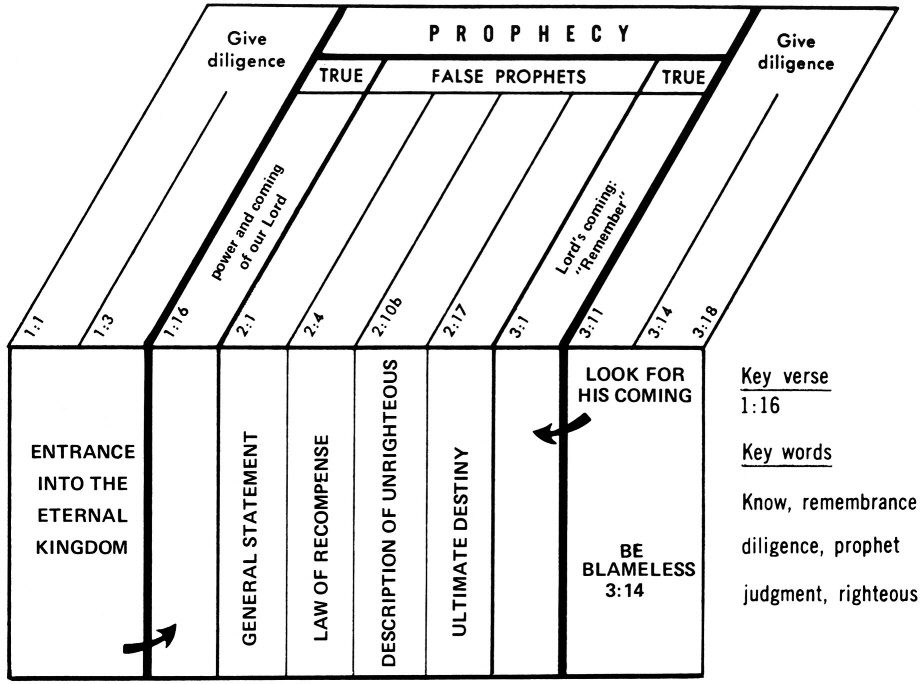
2 Peter: True and False Prophecy
Click chart to enlarge
Chart from Jensen's Survey of the NT - used by permission
|
2 PETER |
||||||||
| Cultivation of Christlike Character |
Condemnation of False Teachers |
Confidence in the Return of Christ |
||||||
| Greeting to Saints 2Pe 1:1-2 |
Growth in Christ 2Pe 1:3-14 |
Grounds |
Danger of |
Demise of |
"Decor" of |
Mockers in |
Manifest |
Maturity in light of that |
| Know Your Salvation |
Know |
Know Your Adversaries |
Know |
|||||
| True Prophecy (True Knowledge) |
False Prophets (False Teachers) |
Final Prophecy (Day of the Lord) |
||||||
| Holiness | Heresy | Hope | ||||||
| Development of Faith |
Denunciation of False Teachers |
Design of The Future |
||||||
2 Peter 2:4 For if God did not spare (3SAMI) angels when they sinned (AAPMPG), but cast them into hell (AAPMSN) and committed (3SAAI) them to pits of darkness, reserved (PPPMPA) for judgment; (NASB: Lockman)
Greek: Ei gar o theos aggelon hamarthsanton (AAPMPG) ouk epheisato, (3SAMI) alla seirais zophou tartarosas (AAPMSN) paredoken (3SAAI) eis krisin teroumenous, (PPPMPA)
Amplified: For God did not [even] spare angels that sinned, but cast them into hell, delivering them to be kept there in pits of gloom till the judgment and their doom. (Amplified Bible - Lockman)
NET: For if God did not spare the angels who sinned, but threw them into hell and locked them up in chains in utter darkness, to be kept until the judgment, (NET Bible)
NLT: For God did not spare even the angels when they sinned; he threw them into hell, in gloomy caves and darkness until the judgment day. (NLT - Tyndale House)
Phillips: For if God did not spare angels who sinned against him, but banished them to the dark imprisonment of hell till judgment day: (New Testament in Modern English)
Wuest: For, in view of the fact that God did not spare angels who sinned, but having thrust them down into Tartarus, committed them to pits of nether-world gloom, being reserved for judgment,
Young's Literal: For if God messengers who sinned did not spare, but with chains of thick gloom, having cast them down to Tartarus, did deliver them to judgment, having been reserved,
FOR IF GOD: ei gar o theos:
For (gar) introduces the evidence that shows that God will indeed carry out His sentence against the false teachers. Literally Peter says "the God" and then declares a solemn reality as a grim message of warning. "The God" does not condone sin and all creation stands accountable to Him for their actions. This simple but profound truth should cause us all to pause and consider carefully our thoughts, words and deeds each day God grants us to take another breath.
The "if" (ei) in this sentence does not imply doubt but is what is referred to as a "first class condition" which in plain English means that the three examples of God's past judgment that follow are assumed true. One can usually translate first class conditional statements with "since". In this case Peter is saying that there is no doubt about the fact that God intervened in world history to bring just judgment and the judgment just announced (2 Pe 2:3) upon the false teachers is perfectly concordant with God's dealings with evil in the past. As an aside verses (2 Pe 2:4-10a) are all one complex sentence in the Greek and represent one of the longest in the NT. This is significant in aiding your understanding of what Peter is saying, because verses (2 Pe 2:4-8) compose the conditional statement and (2 Pe 2:9-10a) deal with Peter's conclusion. What Peter does in (2 Pe 2:4-9) is to "accumulate examples" of God's past intervention in the affairs of mankind to make the conclusion in (2 Pe 2:9-10a) all that more forceful and emphatic. All three of Peter's examples (Angels, worldwide Flood, Sodom & Gomorrah) follow chronologically, one after another in Genesis and clearly illustrate that neither rank, strength nor numbers shield rebellious evil from God's just vengeance. Little wonder that false teachers so often deceptively attempt to ascribe the truth of Genesis to the realm of myth or fable!
DID NOT SPARE ANGELS: aggelon hamartesanton ouk epheisato (AMI):
- 2Pe 2:5; Dt 29:20; Ps 78:50; Ezek 5:11; 7:4,9; Ro 8:32; 11:21) (angels Job 4:18; Lk 10:18; Jn 8:44; 1Jn 3:8; Jude 1:6
Spare (5339) (pheidomai [word study]) means to treat leniently or withhold punishment that their sin justly deserved.
The aorist tense indicates a past completed effectual action. God actually did not spare the supernatural beings when they sinned and it follows He will not grant clemency to the false teachers.
Peter's assertion "negates the sentimental view of the divine character that as a God of love and mercy He will not thus punish any of His creatures. God's holiness demands that sin receive its just recompense. But it is eminently true that God has ''no pleasure in the death of the wicked" (Ezek 33:11, 18:23) and therefore "He who did not spare (pheidomai) His own Son, but delivered (paradidomi translated "committed" below) Him over for us all… (Ro 8:32) that He might freely offer forgiveness to all on the basis of His atoning work. The expression employed is the same but how different the activity envisioned!" (Hiebert).
"O the deep, deep love of Jesus, vast, unmeasured, boundless, free! Rolling as a mighty ocean in its fullness over me! Underneath me, all around me, is the current of Thy love Leading onward, leading homeward to Thy glorious rest above!" (play tune)
Angels (32) (aggelos/angelos) (Torrey's Topic gives an excellent Scriptural overview of "Angels") means a messenger who speaks and/or acts in place of one who has sent him. Although aggelos can refer to men, in this context Peter is referring to a transcendent being with power to carry out various missions or tasks. Aggelos then are created supernatural beings that attend upon or serve as a messengers of a superior supernatural entity.
Peter's mention of "angels" would doubtless have gotten the attention of his readers since those with a Jewish background knew the high esteem Jews ascribed to angelic being. And yet despite their exalted status, these supernatural beings were not exempt from God's judgment when they sinned. Indeed some of the false teachers may be men of an exalted status before men, but their position in man's eyes would not relinquish them from their guilt before a holy God. God is not impressed by what unfortunately too often impresses men.
WHEN THEY SINNED: hamartesanton (AAPMPG):
Whey they sinned - This indicates that the angels (1) knew God's "mark" (perfect righteousness and obedience) and (2) had a will which allowed them to make a volitional choice (Sinned is active voice = they made a choice, a decision to miss God's mark!)
Sinned (264) (hamartano) means to miss the mark and in context means to act contrary to the will and law of God. The aorist tense points to a completed past action, so that even if we disagree about the nature of the angelic sin, the aorist tense clearly says "they actually did commit sin" against God.
What event or events is Peter referring to here? When did the angels sin? Peter does not elaborate and even the best parallel Scripture in Jude does not totally clarify this intriguing statement.
Jude writes that
"angels who did not keep their own domain, but abandoned their proper abode, He has kept in eternal bonds under darkness for the judgment of the great day, just as Sodom and Gomorrah and the cities around them, since they in the same way as these indulged in gross immorality and went after strange flesh, are exhibited as an example in undergoing the punishment of eternal fire." (Jude 1:6-7-note)
This area has engendered some heated discussion and although not without some "loopholes" many evangelical commentators feel that there was a "special outbreak" of angelic evil in Genesis (especially Ge 6:2):
"the sons of God saw that the daughters of men were beautiful and they took wives for themselves whomever they chose."
The identity of the "sons of God" is the key term (click here to study for yourself the 5 uses in 0T) in unlocking this passage and although it is disputed, many conservative commentators like John MacArthur, et al believe that Genesis is describing supernatural (angelic) beings who cohabited (sexually) with human women ("daughters of men") and thus "did not keep their own domain but abandoned their proper abode". (Jude 1:6,7) Others, like J Vernon McGee do not accept the Genesis passage as a reference to angels cohabitating with women.
BUT CAST THEM INTO HELL: alla seirais zophou tartarosas (3SAAI):
- Isa 14:12; Mt 8:29; 25:41; Mk 5:7; Lk 8:31; Rev 12:7, 8, 9; 20:2,3,10 20:2,3,10
Cast … into hell is one word in the Greek, the unusual word tartaroo (5020), which is derived from Tártaros which describes the subterranean doleful and dark abyss of mythology where demigods were punished. Greek mythology taught that Tártaros was a place lower than Hades (86) (the NT term corresponding to the OT term Sheol in the OT (7585) reserved for the most wicked of human beings, gods, and demons where divine punishment was meted out. Jewish apocalyptic literature described Tártaros as the place where fallen angels were sent as the lowest, darkest, gloomiest hell, the deepest pit and the most terrible place of torture and suffering. This term came later to refer to the region of the lost dead. It is found only once in the NT in its verbal form in this verse.
Tartarus is mentioned in the pseudepigraphal book of Enoch as the place where fallen angels are confined. It is found only in its verbal form in 2 Pet. 2:4 meaning to cast into or consign to Tartarus. The use of the aorist tense pictures the "casting" as a completed past event. Peter seems to regard Tártaros like Hades/Sheol is only a temporary place of detention for these wicked angels who in the day of judgment will be thrown "into the eternal fire which has been prepared for the devil and his angels." (Mt 25:41, cf Rev 20:2,3,10) Although it is difficult to state with absolute certainty, The sinning angels are being held in this netherworld dungeon until the day of final judgment. Peter’s usage of this term by no means suggests that Peter believed in the mythological stories about Tartarus but only borrowed the word from their vocabulary.
NET Note - "“casting them into Tartarus” or “holding them captive in Tartarus.” This verb, ταρταρόω (tartaroō), occurs only here in the NT, but its meaning is clearly established in both Hellenistic and Jewish literature. “Tartarus [was] thought of by the Greeks as a subterranean place lower than Hades where divine punishment was meted out, and so regarded in Israelite apocalyptic as well” (BDAG 991 s.v.). Grammatically, it has been translated as an indicative because it is an attendant circumstance participle.
Related Resources:
- Eternal Punishment
- What is Tartarus? | GotQuestions.org
- What is the outer darkness in Matthew 22:13? | GotQuestions.org
- What is the bottomless pit (Revelation 9:1-12)? | GotQuestions.org
- Does hell exist? | GotQuestions.org
- Where is hell? What is the location of hell? | GotQuestions.org
- What does hell look like? How hot is hell? | GotQuestions.org
- Is hell real? Is hell eternal? | GotQuestions.org
- How can I not go to hell? | GotQuestions.org
AND COMMITTED THEM TO PITS OF DARKNESS: paredoken eis krisin teroumenous (3SAAI) seirais zophou:
- Job 21:30 Jude 1:6, 13
Committed (3860) (paradidomi from para = alongside, beside + didomi = give) means to give alongside, to surrender, to yield, or to deliver one over into the hands or power of someone else. This action involves either the handing over of a presumably guilty person for punishment by authorities or the handing over of an individual to an enemy who will presumably take undue advantage of the victim.
Peter's use of this verb conveys the picture of handing these evil angels over to the jailer for imprisonment. (cf Acts 8:3, 12:4) Aorist tense signifies a past completed action and indicative is the mood of reality. This event really happened and is a picture of what will happen to the false teachers! Woe! Paradidomi is used 3x in Romans 1 explaining God's giving the sinful, truth rejecting world over to the power of
"the lusts of their hearts to impurity, to degrading passions, & to a depraved mind" (Ro 1:24,26,28-note).
Pits of darkness is an unusual expression and how one translates it depends on which Greek manuscript you favor.
Hiebert says that the original Greek "manuscript evidence is about evenly divided between "pits" (sirois or seirois) and "chains" (seirais)."
And so we see that the NET Bible favors seirais translating it "locked them up in chains in utter darkness" and adds
Similarly the KJV and NKJV translate it "chains of darkness", whereas NASB, Amplified ("pits of gloom"), NIV ("gloomy dungeons"), NLT ("in gloomy caves and darkness") favor sirois or seirois.
The point is that neither is very attractive and both portend of the certain fate of the false teachers, utterly separated from the light and glory of God. This is a bleak and hopeless picture Peter is painting of the final resting place for these wicked men (cf 2Th 1:7, 8, 9). Woe!
NET Note - The reading (seirais, “chains”) is found in ?72 P Ψ 33 1739 ? vg sy, while (sirois [or seirois], “pits”) is found in א A B C 81 pc. The evidence is thus fairly evenly divided. Internally, the reading adopted here (σειραῖς) is a rarer term, perhaps prompting some scribes to replace it with the more common word. However, this more common term is not a synonym and hence does not follow the normal pattern of scribes. As well, the use of the genitive ζόφου (zophou) in “chains of darkness” is a bit awkward (a rare genitive of place), perhaps prompting some scribes to change the imagery to “pits of darkness” (in which case ζόφου is an attributive genitive). A further point that complicates the issue is the relationship of 2 Peter to Jude. Jude’s parallel (v. 6) has (desmois, “chains”). Apart from the issue of whether 2 Peter used Jude or Jude used 2 Peter, this parallel suggests one of two possibilities: either (1) since these two books obviously have a literary relationship, σειραῖς is original, or (2) early scribes, recognizing that these two books shared their material, changed σειροῖς to σειραῖς to conform the wording, at least conceptually, to Jude 6. On balance, σειραῖς looks to be original because scribes were not prone to harmonize extensively between books other than the Gospels (although 2 Peter and Jude do display some of this harmonizing). Further, such harmonization is often, if not usually, verbally exact, but δεσμοῖς is not a variant here.
Darkness (2217) (zophos [word study]) that ranges from partial to total and conveys a foreboding & gloom associated with the underworld, region of the lost.
Zophos - 5x in 5v - Heb 12:18; 2 Pet 2:4, 17; Jude 1:6, 13 and is rendered in NAS as black(2), darkness(2), gloom(1).
RESERVED FOR JUDGMENT: eis krisin teroumenous (PPPMPA) eis krisin:
Reserved (5083) (tereo) (Click here for an in depth word study on tereo) means to keep one's eye on something or in this case someone (sinning angels), keeping them in view and so guarding over them making certain that they continually (present tense calls for a continual action) are retained in custody in chains in the dungeon of gloom. The idea of "reserved" as it is translated here in the NASB is that the incarceration of these fallen angels in Tártaros was with a view to their future punishment. God passed judgment on them when He cast them into the "holding tank" of Tártaros, but that is not their final "resting place" for the "worst is yet to come" in that future day of retribution!
Tereo - 70x in 64v -
Matt 19:17; 23:3; 27:36, 54; 28:4, 20; John 2:10; 8:51f, 55; 9:16; 12:7; 14:15, 21, 23f; 15:10, 20; 17:6, 11f, 15; Acts 12:5f; 15:5; 16:23; 24:23; 25:4, 21; 1 Cor 7:37; 2 Cor 11:9; Eph 4:3; 1 Thess 5:23; 1 Tim 5:22; 6:14; 2 Tim 4:7; Jas 1:27; 2:10; 1 Pet 1:4; 2 Pet 2:4, 9, 17; 3:7; 1 John 2:3ff; 3:22, 24; 5:3, 18; Jude 1:1, 6, 13, 21; Rev 1:3; 2:26; 3:3, 8, 10; 12:17; 14:12; 16:15; 22:7, 9. The NAS renders tereo as continue(m)(1), guard(2), guards(1), heed(2), heeds(1), held(1), keep(27), keep watch over(1), keeping(1), keeping guard over(1), keeps(9), kept(11), kept in custody(4), observe(3), preserve(1), preserved(1),reserved(4), watching over(1).
Judgment (2920)(krisis from krino = to judge, decide) means a decision or judgment, verdict, justice, court (tribunal). The first use is by Jesus in the Sermon on the Mount declaring "‘Whoever commits murder shall be liable to the court." ("in danger of judgment") (Mt 5:21, cp also Mt 5:22) Mt 10:15, 11:22, 24 all describe Jesus' sobering warning to the Jews of a specific future and frightening "day of judgment." (cp "sentence of hell" Mt 23:33, see also 2 Peter 2:9, 11, 3:7, 1 John 4:17) In Jn 5:24 Jesus gives sinners the way of escape, the way to miss the horrible day of judgment (Heb 10:27)! In Mt 12:18 God's judgment is equated with justice, for He is the righteous and just Judge (cp Mt 12:20, 23:23, Rev 16:7). Note the striking contrast in Jn 5:29 "those who did the good deeds to a resurrection of life, those who committed the evil deeds to a resurrection of judgment." There is no such thing as reincarnation but only one life, one death, one judgment (Heb 9:27)
Friberg -
(1) as the action of a judge decision, judgment (Jn 5.30); especially as the activity of God in a final time for judging, day of judgment (Mt 10.15); in an unfavorable sense condemnation, punishment (Rev 18.10 );
(2) as a personal evaluation of someone else's actions judgment (Jn 7.24 );
(3) as the standard by which judgments and evaluations are to be made right, justice (Mt 12.18);
(4) as the basis on which a judgment is made reason for a judgment (Jn 3.19) (Analytical Lexicon)
Gingrich -
1. judging, judgment Mt 10:15; Lk 10:14; Jn 5:30; 2 Th 1:5; Heb 9:27; 2 Pet 2:9; Jude 1:6. act as judge John 5:27. Condemnation, punishment Mt 23:33; John 5:24, 29; Heb 10:27; Jas 5:12; Rev 18:10; 19:2 .
2. board of judges, local court Mt 5:21f.
3. right in the sense of justice, righteousness Mt 12:18, 20; 23:23; Lk 11:42. This meaning is also possible for Jn 7:24; 12:31; Ac 8:33 and others. [crisis]
Krisis - 46v Usage: court(2), judgment(38), judgments(2), justice(4), sentence(1).
Matthew 5:21 "You have heard that the ancients were told, 'YOU SHALL NOT COMMIT MURDER ' and 'Whoever commits murder shall be liable to the court.'
Matthew 5:22 "But I say to you that everyone who is angry with his brother shall be guilty before the court; and whoever says to his brother, 'You good-for-nothing,' shall be guilty before the supreme court; and whoever says, 'You fool,' shall be guilty enough to go into the fiery hell.
Matthew 10:15 "Truly I say to you, it will be more tolerable for the land of Sodom and Gomorrah in the day of judgment than for that city.
Matthew 11:22 "Nevertheless I say to you, it will be more tolerable for Tyre and Sidon in the day of judgment than for you.
Matthew 11:24 "Nevertheless I say to you that it will be more tolerable for the land of Sodom in the day of judgment, than for you."
Matthew 12:18 "BEHOLD, MY SERVANT WHOM I HAVE CHOSEN; MY BELOVED IN WHOM MY SOUL is WELL-PLEASED; I WILL PUT MY SPIRIT UPON HIM, AND HE SHALL PROCLAIM JUSTICE TO THE GENTILES.
Matthew 12:20 "A BATTERED REED HE WILL NOT BREAK OFF, AND A SMOLDERING WICK HE WILL NOT PUT OUT, UNTIL HE LEADS JUSTICE TO VICTORY.
Matthew 12:36 "But I tell you that every careless (ARGOS = "NON WORKING" - unemployed, unprofitable, worthless, useless) word that people speak, they shall give an accounting for it in the day of judgment.
Matthew 12:41 "The men of Nineveh will stand up with this generation at the judgment, and will condemn it because they repented at the preaching of Jonah; and behold, something greater than Jonah is here.
Matthew 12:42 "The Queen of the South will rise up with this generation at the judgment and will condemn it, because she came from the ends of the earth to hear the wisdom of Solomon; and behold, something greater than Solomon is here.
Matthew 23:23 "Woe to you, scribes and Pharisees, hypocrites! For you tithe mint and dill and cummin, and have neglected the weightier provisions of the law: justice and mercy and faithfulness; but these are the things you should have done without neglecting the others.
Matthew 23:33 "You serpents, you brood of vipers, how will you escape the sentence of hell?
Luke 10:14 "But it will be more tolerable for Tyre and Sidon in the judgment than for you.
Luke 11:31 "The Queen of the South will rise up with the men of this generation at the judgment and condemn them, because she came from the ends of the earth to hear the wisdom of Solomon; and behold, something greater than Solomon is here.
Luke 11:32 "The men of Nineveh will stand up with this generation at the judgment and condemn it, because they repented at the preaching of Jonah; and behold, something greater than Jonah is here.
Luke 11:42 "But woe to you Pharisees! For you pay tithe of mint and rue and every kind of garden herb, and yet disregard justice and the love of God; but these are the things you should have done without neglecting the others.
John 3:19 "This is the judgment, that the Light has come into the world, and men loved the darkness rather than the Light, for their deeds were evil.
John 5:22 "For not even the Father judges anyone, but He has given all judgment to the Son,
John 5:24 "Truly, truly, I say to you, he who hears My word, and believes Him who sent Me, has eternal life, and does not come into judgment, but has passed out of death into life.
John 5:27 and He gave Him authority to execute judgment, because He is the Son of Man.
John 5:29 and will come forth; those who did the good deeds to a resurrection of life, those who committed the evil deeds to a resurrection of judgment.
John 5:30 "I can do nothing on My own initiative. As I hear, I judge; and My judgment is just, because I do not seek My own will, but the will of Him who sent Me.
John 7:24 "Do not judge according to appearance, but judge with righteous judgment." (Only possible as we are filled with the righteous Spirit!)
John 8:16 "But even if I do judge, My judgment is true; for I am not alone in it, but I and the Father who sent Me.
John 12:31 "Now judgment is upon this world; now the ruler of this world will be cast out.
John 16:8 "And He, when He comes, will convict the world concerning sin and righteousness and judgment;
John 16:11 and concerning judgment, because the ruler of this world has been judged.
Acts 8:33 "IN HUMILIATION HIS JUDGMENT WAS TAKEN AWAY; WHO WILL RELATE HIS GENERATION? FOR HIS LIFE IS REMOVED FROM THE EARTH."
2 Thessalonians 1:5 This is a plain indication of God's righteous judgment so that you will be considered worthy of the kingdom of God, for which indeed you are suffering.
1 Timothy 5:24 The sins of some men are quite evident, going before them to judgment; for others, their sins follow after.
Hebrews 9:27 And inasmuch as it is appointed for men to die once and after this comes judgment,
Hebrews 10:27 but a terrifying expectation of judgment and THE FURY OF A FIRE WHICH WILL CONSUME THE ADVERSARIES.
James 2:13 For judgment will be merciless to one who has shown no mercy; mercy triumphs over judgment.
James 5:12 But above all, my brethren, do not swear, either by heaven or by earth or with any other oath; but your yes is to be yes, and your no, no, so that you may not fall under judgment.
2 Peter 2:4 For if God did not spare angels when they sinned, but cast them into hell and committed them to pits of darkness, reserved for judgment;
2 Peter 2:9 then the Lord knows how to rescue the godly from temptation, and to keep the unrighteous under punishment for the day of judgment,
2 Peter 2:11 whereas angels who are greater in might and power do not bring a reviling judgment against them before the Lord.
2 Peter 3:7 But by His word the present heavens and earth are being reserved for fire, kept for the day of judgment and destruction of ungodly men.
1 John 4:17 By this, love is perfected with us, so that we may have confidence in the day of judgment; because as He is, so also are we in this world.
Jude 1:6 And angels who did not keep their own domain, but abandoned their proper abode, He has kept in eternal bonds under darkness for the judgment of the great day,
Jude 1:9 But Michael the archangel, when he disputed with the devil and argued about the body of Moses, did not dare pronounce against him a railing judgment, but said, "The Lord rebuke you!"
Jude 1:15 to execute judgment upon all, and to convict all the ungodly of all their ungodly deeds which they have done in an ungodly way, and of all the harsh things which ungodly sinners have spoken against Him."
Revelation 14:7 and he said with a loud voice, "Fear God, and give Him glory, because the hour of His judgment has come; worship Him who made the heaven and the earth and sea and springs of waters."
Revelation 16:7 And I heard the altar saying, "Yes, O Lord God, the Almighty, true and righteous are Your judgments."
Revelation 18:10 standing at a distance because of the fear of her torment, saying, 'Woe, woe, the great city, Babylon, the strong city! For in one hour your judgment has come.'
Revelation 19:2 BECAUSE HIS JUDGMENTS ARE TRUE AND RIGHTEOUS; for He has judged the great harlot who was corrupting the earth with her immorality, and HE HAS AVENGED THE BLOOD OF HIS BOND-SERVANTS ON HER."
Related Resources
- What are all the different judgments in the Bible? | GotQuestions.org
- What is Judgment Day? | GotQuestions.org
- What is the Great White Throne Judgment? | GotQuestions.org
- What happens at the final judgment? | GotQuestions.org
2 Peter 2:5 and did not spare (3SAMI) the ancient world, but preserved (3SAAI) Noah, a preacher of righteousness, with seven others, when He brought (AAPMSN) a flood upon the world of the ungodly; (NASB: Lockman)
Greek: kai archaiou kosmou ouk epheisato, (3SAMI) alla ogdoon Noe dikaiosunes keruka ephulaxen (3SAAI) , kataklusmon kosmo asebon epaxas (AAPMSN)
Amplified: And He spared not the ancient world, but preserved Noah, a preacher of righteousness, with seven other persons, when He brought a flood upon the world of ungodly [people]. (Amplified Bible - Lockman)
NET: and if he did not spare the ancient world, but did protect Noah, a herald of righteousness, along with seven others, when God brought a flood on an ungodly world, (NET Bible)
NLT: And God did not spare the ancient world--except for Noah and his family of seven. Noah warned the world of God's righteous judgment. Then God destroyed the whole world of ungodly people with a vast flood. (NLT - Tyndale House)
Phillips: if he did not spare the ancient world but only saved Noah (the solitary voice that cried out for righteousness) and his seven companions when he brought the flood upon the world in its wickedness; (New Testament in Modern English)
Wuest: and did not spare the ancient world, but preserved Noah as the eighth person [to be preserved], a proclaimer of righteousness, having let loose the deluge upon the world of those who were destitute of reverential awe towards God,
Young's Literal: and the old world did not spare, but the eighth person, Noah, of righteousness a preacher, did keep, a flood on the world of the impious having brought,
AND DID NOT SPARE THE ANCIENT WORLD: kai archaiou kosmou ouk epheisato: (3SAMI) kai archaiou kosmou:
- Ge 6:1-8; Job 22:15,16; Mt 24:37, 38, 39; Lk 17:26,27; Heb 11:7
And (2532) (kai) indicates that Peter is continuing his illustrations of God's righteous judgment upon evil.
Spare (5339) (pheidomai) means to treat leniently, to forbear, to spare. To avoid or refrain from doing something. To save someone from trouble, loss or discomfort (2Co 1:21, 1Co 7:28, With a negative = Acts 20:29, Ro 8:32) To prevent trouble from happening to someone (e.g., see Lxx uses - Ge 19:16 where "put him outside the city" is translated with pheidomai = "the Lord spared him"!, Ge 20:6).
In the Septuagint (LXX) translation of the following OT passages pheidomai is repeatedly used to translate the phrase "shall not show pity" - Dt 7:16, 13:8, 19:13, 21, 25:12 (cp 1Sa 15:3). From these uses we see that pheidomai clearly is a tangible demonstration of showing pity.
Pheidomai - 10x - NAS = refrain, 1; spare, 8; sparing, 1.
Acts 20:29; Ro 8:32; 11:21; 1Co 7:28; 2Cor 1:23; 12:6; 13:2; 2Pet 2:4, 5.
Pheidomai - 76x in the non-apocryphal Septuagint (LXX) -
Ge 19:16; 20:6; 22:12, 16; 45:20; Ex 2:6; Deut 7:16; 13:8; 19:13, 21; 25:12; 33:3; 1 Sam 15:3; 24:10; 2 Sam 12:4, 6; 18:5, 16; 21:7; 2 Kgs 5:20; 2 Chr 36:15, 17; Neh 13:22; Es 4:17; Job 6:10; 7:11; 16:5, 13; 20:13; 27:22; 30:10; 33:18; 42:3; Ps 19:13; 72:13; 78:50; Pr 6:34; 10:19; 13:24; 16:17; 17:27; 21:14; 24:11; Eccl 2:25; Isa 13:18; 14:6; 54:2; 58:1; 63:9; Jer 13:14; 14:10; 15:5; 17:17; 21:7; 50:14; 51:3; Lam 2:2, 17, 21; 3:43; Ezek 5:11; 7:4, 9; 8:18; 9:5, 10; 16:5; 20:17; 24:21; 36:21; Joel 2:17f; 3:16; Jonah 4:10f; Hab 1:17; Zech 11:6
Paul says for example that "I would like to spare you a great deal of trouble, by offering good advice about marriage" (paraphrase of 1Cor 7:28) Paul is saying that since marriage can involve conflicts, demands, difficulties, and adjustments that singleness does not, since marriage presses two fallen people into intimate life and this leads to inevitable “trouble.” The troubles of singleness may be exceeded by the conflicts of marriage. He wants to spare those who are single this "trouble".
Paul in making addressing the question "would God do less for His children than He did for His enemies?" records that
"He who did not spare His own Son, but delivered Him up for us all (the greatest exhibition of the love of God toward us), how will He not also with Him freely give (to bestow out of grace) us all things?" (see note Romans 8:32)
The Septuagint or LXX uses pheidomai in a parallel OT passage where God has asked Abraham to sacrifice Isaac and who was willing to obey. The Lord declared to Abraham
"Do not stretch out your hand against the lad, and do nothing to him; for now I know that you fear God, since you have not withheld (Lxx = pheidomai) your son, your only son, from Me.” (Ge 22:12) and later says
"By Myself I have sworn, declares the Lord, because you have done this thing, and have not withheld (Lxx = pheidomai) your son, your only son." (Ge 22:16)
Addressing the Gentiles in his letter to the Romans Paul teaches that
"if God did not spare (pheidomai) the natural branches, neither will He spare (pheidomai) you." (see note Romans 11:21)
The Gentiles should not expect to be spared if they sin against the truth of the gospel.
The ancient world describes the world before the Noachian flood. Clearly God did not refrain from judging and punishing them with the flood and death. This should serve as a warning and not some myth to be scoffed at as if it never happened!
Ancient (744) (archaios from arche = beginning) is strictly speaking that which has been from the beginning. Archaios reaches back to a beginning, whenever that beginning may have been. Archaios is contrasted with another Greek word for "old", palaios which describes that which has existed a long period of time.
TDNT says archaios "means “from the beginning,” then “past” or “old,” often with a reference to origins and with something of the dignity of “ancient.” In the LXX it can sometimes have the sense of pre-temporal, as in Is 37:26… in 2Co 5:17 pre-resurrection (Ed: Before our "co-crucifixion" and "co-resurrection" with Christ) religious relations and attitudes are in view.
Archaios is used of Satan the "serpent of old" [from the beginning] in Rev 12:9-note and Re 20:2-note.
In the beginning of creation, at the time of the fall of man, sinless Adam became sinner Adam, and henceforth gave birth to a continual stream of "little sinners" for all were in a spiritual sense born "in Adam" (cp Ro 5:12-note, Eph 2:1-note, 1Co 15:22). At regeneration, the new birth, sinners were taken from "in Adam" and transferred to our new spiritual position as saints who are now and forever "in Christ" as described in the present passage.
Archaios when used of things, as here, means "old-fashioned, "antiquated" or "worn out".
Archaios can also mean that which is ancient or old and thus speaks of former things or of what was long ago…
- "the ancient world" (before the flood) = 2Pe 2:5-note
- "the early days" = Acts 15:7
- "from ancient generations" = Acts 15:21
- "a disciple of long standing" =Acts 21:16
- "the ancients" = Mt 5:21-note and Mt 5:33-note
- "prophets of old" = Lk 9:8, 19
Archaios - 11x in 11v in the NAS -
Mt 5:21-note, Mt 5:33-note; Lk 9:8, 19; Acts 15:7, 21; 21:16; 2Cor 5:17-note; 2Pe 2:5-note; Rev 12:9-note Re 20:2-note
Archaios - 19x in the non-apocryphal Septuagint (LXX) -
Jdg 5:21; 1Sa 24:13; 1 Kgs 2:35; 4:30; Ps 44:1; 77:5; 79:8; 89:49; 139:4; 143:5; Isa 22:9, 11; 23:17; 25:1; 37:26; 43:18; Lam 1:7; 2:17; Ezek 21:21;
World (2889) (kosmos [word study]) in context is referring primarily to the people who inhabited the earth prior to the flood but kosmos also includes the idea of this present world system ideologically and behaviorally diametrically opposed to God and all He represents as summed up by God's own appraisal in Genesis
"the LORD saw that the wickedness of man was great on the earth, and that every intent of the thoughts of his heart was only evil continually" (Ge 6:5)
BUT PRESERVED NOAH A PREACHER OF RIGHTEOUSNESS WITH SEVEN OTHERS: alla ogdoon Noe dikaiosunes keruka ephulaxen (3SAAI):
But (235) (alla) is a conjunction that draws our attention to a contrast. Here Peter marks the antithesis between God's judgment on the world and His preservation of Noah and family.
Preserved (5442) (phulasso [word study]) means to be on guard to keep something from being lost or perishing. It includes the idea of protecting someone and keeping them in safe custody. Use of phulasso often implies an assault from without. God was on guard to keep Noah from perishing. God's man is immortal until he has finished his God given task (cp the two witnesses in Rev 11:7-note)
The aorist tense speaks of a past completed effective action. As an manifestation of God's amazing grace, He "protected, preserved, guarded" Noah and his family from the destructive flood. In the midst of wrath we see Peter's first example of God remembering mercy, preserving the righteous amid judgment. This truth and that concerning Lot below should encourage all God's children that even in the face of escalating wickedness (as in America at the dawn of the new millennium), God is ever at work bringing about the salvation of those who believe and obey His Word. (cf Gen 6:8, 9)
Phulasso - 31x in 31v - Matt 19:20; Mark 10:20; Luke 2:8; 8:29; 11:21, 28; 12:15; 18:21; John 12:25, 47; 17:12; Acts 7:53; 12:4; 16:4; 21:24f; 22:20; 23:35; 28:16; Rom 2:26; Gal 6:13; 2 Thess 3:3; 1 Tim 5:21; 6:20; 2 Tim 1:12, 14; 4:15; 2 Pet 2:5; 3:17; 1 John 5:21; Jude 1:24. The NAS renders phulasso as abstain(1), guard(8), guarded(1), guarding(1), guards(1), keep(5), keeping(2), keeps(1),kept(4), kept under guard(1), maintain(1), observe(2), preserved(1), protect(1), watching(1).
Francis Schaffer had an interesting comment on Noah who he refers to as
"One Man Left in the Godly Line --- Genesis 6:5-12 brings us to a point in history where there is only one man left in the godly line. “Isn’t it strange that only one man is left in the godly line?” But surely Scripture points out that this is the general course of every era. Man’s heart is in rebellion against God, and the rebellious heart must be taken into account in balance with the factor of a sufficient knowledge of God. In each era the case is similar. For example, by the time of Abraham, the world had thrown away almost all of its knowledge of the true God. Likewise, by the time of Christ, the Jews had so turned from God that only a minority accepted their Old-Testament-prophesied Messiah. And we are amply warned that the end of our own era will be exactly the same. Because of the rebellion of man’s heart the course is not upward. Therefore, speaking of the end of our age, Jesus could say, “When the Son of man cometh, shall he find faith on the earth?” (Lk 18:8)… Jesus expressly connects the time of Noah with the time of His second coming."
Related Resource:
- Who was Noah in the Bible? | GotQuestions.org
- What was it like in the days of Noah? | GotQuestions.org
Seven others" (ogdoos) speaks of Noah, the eighth person. The Greek reads more literally "as an eighth one, Noah" and is a Greek idiom which means "Noah and seven others." (1Pe 3:20-note) Don't attempt to search for some "mystical" meaning in the number "eight". It is "mystery" enough that God would desire to preserve even one!
Preacher (2783)(kerux [word study]) describes a herald (town crier, messenger, proclaimer) who was an honored spokesman entrusted with a message from an emperor, king, magistrate, prince, military commander, etc and which he was to faithfully and reliably proclaim to the intended audience, especially the masses in regard to the imperial herald. The kerux, who often served as a close confidant of the king, would travel throughout the realm announcing to the people whatever the king wished to make known. It is this note of authoritative declaration that is so appropriately transferred to the proclamation of the gospel.
Kerux - 3x in 3v - 1Ti 2:7; 2Ti 1:11; 2 Pet 2:5
This proclamation was given with a sense of formality, gravity and authority which must be heeded. The verb form of (kerux) is used by Paul in 2Ti 4:2 (see note) to exhort Timothy to "preach the Word in season and out".
Noah (note) was vested with God's authority and entrusted with His "official" message which he faithfully proclaimed to the antediluvian world for 120 years (Ge 6:3), warning of coming judgment and showing the way of personal salvation. Why? Because God is "not wishing for any to perish but for all to come to repentance." (2Pe 3:9-note)
Kerux in the NT described those employed by God in the work of proclaiming salvation (1Ti 2:7-note). How did Noah "preach"? Surely his life lived as salt and light in the midst of a crooked and perverse generation "preached loudly and clearly". Certainly every hammer blow to the ark stirred questions in a world that had never even experienced rain. Noah's answer to those who ask him to given an explanation of the hope that he possessed surely included a warning of coming judgment and a plea for righteousness.
William Barclay writes that …
Kerux is the Greek word for herald, and the herald was the man who brought a message direct from the king. This word tells us of certain characteristics of the preaching of Jesus and these are characteristics which should be in all preaching.
(i) The herald had in his voice a note of certainty. There was no doubt about his message; he did not come with perhapses and maybes and probably’s; he came with a definite message. Goethe had it: “Tell me of your certainties: I have doubts enough of my own.” Preaching is the proclamation of certainties, and a man cannot make others sure of that about which he himself is in doubt.
(ii) The herald had in his voice the note of authority. He was speaking for the king; he was laying down and announcing the king’s law, the king’s command, and the king’s decision. As was said of a great preacher, “he did not cloudily guess; he knew.” Preaching, as it has been put, is the application of prophetic authority to the present situation.
(iii) The herald’s message came from a source beyond himself; it came from the king. Preaching speaks from a source beyond the preacher. It is not the expression of one man’s personal opinions; it is the voice of God that Jesus spoke to men. (Barclay, W: The Daily Study Bible Series. The Westminster Press or Logos)
Righteousness (1343) (dikaiosune) stated simply is all that God is, all that He commands, all that He demands, all that He approves, and best of all, all that He provides through Christ's substitutionary sacrifice.
Righteousness is derived from a root word that means “straightness” and thus it refers to a state that conforms to an authoritative standard. God’s character is both the authoritative "standard" and the source of the only righteousness acceptable to God. When men's character and actions are used to define the standard of righteousness ("self righteousness"), their attempts always fall short of God's perfect standard. Jesus emphasized the inability of man's innate righteousness to satisfy God's perfect standard declaring
"that unless your righteousness surpasses that of the scribes and Pharisees, you will not enter the kingdom of heaven." (see note on Matthew 5:20)
Where is God's righteousness revealed? Paul says that "the righteousness of God is revealed" in the gospel (Ro 1:16, 17-note) and that this gospel was "promised beforehand through His prophets in the holy Scriptures." (Ro 1:2-note, cf Acts 10:43) So it seems reasonable to deduce that for 120 years Noah proclaimed the gospel to the ungodly world who had suppressed "the truth in unrighteousness" (Ro 1:18-note).
Although Peter's purpose here is not to explain the "way of salvation" in the OT, I will digress for a moment to address this issue because I have encountered a number of otherwise edified saints who sincerely thought that Old Testament righteousness was obtained by obedience (or works) rather than by faith. Noah although described as righteous and blameless (Ge 6:8, 9) achieved this "distinction" not by his works but by faith (which showed itself to be genuine by his subsequent "works" or obedience) as the writer of Hebrews teaches
"By faith Noah, being warned by God about things not yet seen, in reverence prepared an ark for the salvation of his household, (here we see Noah's "works" that emanate from his genuine faith… his works did not save him but did prove he had saving faith) by which he condemned the world, and became an heir of the righteousness which is according to faith. (see note Hebrews 11:7).
Although we do not know exactly how Noah heard the "gospel" we do know from the above Scriptures (Ro 1:2-note, cf Acts 10:43) and from Galatians that the gospel was preached to Abraham and God's righteousness was imputed to (reckoned or placed upon) Abraham's spiritual "ledger" or account based upon his faith. Paul writes that
Even so Abraham BELIEVED GOD, AND IT WAS RECKONED (imputed or reckoned) TO HIM AS RIGHTEOUSNESS. (Ge 15:6-note) 7 Therefore, be sure that it is those who are of faith who are sons of Abraham. 8 The Scripture, (referring to the Old Testament) foreseeing that God would justify (declare them to be righteous) the Gentiles by faith, preached the gospel beforehand to Abraham, saying, "ALL THE NATIONS WILL BE BLESSED IN YOU. (Gal 3:6, 7, 8-note)
The "way of salvation" in both the Old and New Testaments is the same
"for by grace you have been saved through faith and that not of yourselves, it is the gift of God not as a result of works, so that no one may boast. For we are His workmanship, created in Christ Jesus for good works which God prepared beforehand so that we would walk in them." (see notes Ephesians 2:8; 9; 10) (Torrey's Topic Justification Before God)
Question: What does it mean that Noah was a preacher of righteousness (2 Peter 2:5)?
Answer: In his second epistle, Peter provides several past examples of God’s judgment, with one of them being the flood described in the book of Genesis. In referencing the flood, Peter mentions Noah as “a preacher of righteousness” (2 Peter 2:5).
The Greek word for preacher is better translated “herald” and refers to an official entrusted with making public proclamations, especially those that are of a transcendent nature. Although we aren’t given the exact content of what Noah preached to those around him, other than the mention of “righteousness,” we can get an idea by examining a couple of Bible passages.
Noah’s world is described as being “corrupt in the sight of God, and the earth was filled with violence. God looked on the earth, and behold, it was corrupt; for all flesh had corrupted their way upon the earth” (Genesis 6:11–12). In His grace, God commissioned Noah to build an ark to preserve himself and his family from the upcoming judgment by water (verse 14).
The long time (possibly 120 years; see Genesis 6:3) it took for Noah and his family to build the ark naturally afforded him the opportunity to share with those around him the reason for the ark’s construction. Apocryphal books such as Jubilees and works like Josephus’ Antiquities contain vague mentions of Noah’s preaching, and one work from ancient history—the Sibylline Oracles—describes Noah’s preaching in this way:
“Single among all men, most just and true,
Was the most faithful Noah, full of care
For noblest works. And to him God himself
From heaven thus spoke: ‘Noah, be of good cheer
In thyself and to all the people preach
Repentance, so that they may all be saved.
But if, with shameless soul, they heed me not
The whole race I will utterly destroy”’ (Book I, lines 155–161).
The only portion of the Bible that alludes to Noah’s subject matter is Hebrews 11:7: “By faith Noah, being warned by God about things not yet seen, in reverence prepared an ark for the salvation of his household, by which he condemned the world, and became an heir of the righteousness which is according to faith” (NASB, emphasis added).
According to 1 Peter 3:19–20, it was Jesus Himself who, in the Spirit, preached “to those who were disobedient long ago when God waited patiently in the days of Noah while the ark was being built.” We take this to mean that, when Noah preached righteousness, he did so by the power of the Spirit of Christ: that is, it was the message of Christ, delivered in the power of Christ, that Noah proclaimed. The ungodly men of Noah’s day had a chance to repent and be saved as Christ preached to them spiritually through Noah. Unfortunately, they rebelled against the truth, refused the ark, and drowned in the flood.
In addition to Noah’s proclamations to the unbelieving world of his day was his “wordless preaching.” In the very construction of the ark, Noah bore witness to righteousness. Every hammer blow, every pounding of a nail was a call to repentance and a declaration that judgment was coming.
Jesus called out the fact that Noah’s contemporaries ignored the message that would have saved them. At the same time, the Lord warned us of making the same mistake: “Just as it was in the days of Noah, so also will it be in the days of the Son of Man. People were eating, drinking, marrying and being given in marriage up to the day Noah entered the ark. Then the flood came and destroyed them all” (Luke 17:26–27).
The point of Peter referencing Noah and others like him in his second epistle is that, if God did not spare the ancient world who rejected Noah’s warnings, how much less can He be expected to spare those who dismiss His calls to repentance today? GotQuestions.org
WHEN HE BROUGHT A FLOOD UPON THE WORLD OF THE UNGODLY: kataklusmon kosmo asebon epaxas (AAPMSN):
- See Torrey's Topic Deluge
Brought… upon (1863) (epago from epí = upon + ágo = lead away) means to cause something to befall one, usually something evil, although in the present context something quiet just and right because of their evil behavior. Epago was used to describe “setting on or letting loose” the dogs! The "Hound of heaven" so to speak will be let loose on these ungodly false teachers.
Epago - 3x in 3v - Acts 5:28; 2Pet 2:1, 5
Flood (2627) (kataklusmos from kata = an intensifier or meaning against, down upon + klúzo = to dash, flood) literally describes a dashing down upon and then an overflowing, a deluge or destruction by water overflowing. (note)
Kataklusmos - 4x in 4v - Matt 24:38, 39; Luke 17:27; 2Pet 2:5
This dramatic Greek word gives us the word "cataclysm" (which Webster defines as a momentous and violent event marked by overwhelming upheaval and demolition or an event that brings great changes, a violent upheaval, another name for catastrophe). The coming of the cataclysmic flood and the preservation of Noah were both the work of God and both occurred simultaneously. It is interesting that in the first verse Peter described these false teachers as bringing destruction upon themselves but here God Himself is clearly the "Bringer". God's "bringing" is therefore clearly justified and is not based on divine whim or caprice.
Barnes writes that Peter's
argument here is, that if God would cut off a wicked race in this manner, the principle is settled that the wicked will not escape. (Barnes Notes on the NT)
World (2889) (kosmos) in context is referring primarily to the people who inhabited the earth prior to the flood but kosmos also includes the idea of this present world system ideologically and behaviorally diametrically opposed to God and all He represents as summed up by God's own appraisal in Genesis
"the LORD saw that the wickedness of man was great on the earth, and that every intent of the thoughts of his heart was only evil continually" (Ge 6:5)
Ungodly (765) (asebes from a = w/o + sébomai = worship, venerate) means lack of interest in the things of God and a behavior and lifestyle consistent with such an irreverent attitude. See the depth study of the related word ungodliness (asebeia [word study]). It pertains to violating norms for a proper relation to deity, and in short means irreverent (lacking proper respect of God) or impious. Living as if God does not exist and with no regard for Him.
Asebes is used 8 times in the NT…
Romans 4:5-note But to the one who does not work, but believes in Him who justifies the ungodly, his faith is reckoned as righteousness,
Romans 5:6-note For while we were still helpless, at the right time Christ died for the ungodly.
1Timothy 1:9 realizing the fact that law is not made for a righteous man, but for those who are lawless and rebellious, for the ungodly and sinners, for the unholy and profane, for those who kill their fathers or mothers, for murderers
1 Peter 4:18-note And if it is with difficulty that the righteous is saved, what will become of the godless man and the sinner?
2 Peter 2:5 and did not spare the ancient world, but preserved Noah, a preacher of righteousness, with seven others, when He brought a flood upon the world of the ungodly; 6 and if He condemned the cities of Sodom and Gomorrah to destruction by reducing them to ashes, having made them an example to those who would live ungodly thereafter;
2Peter 3:7-note But the present heavens and earth by His word are being reserved for fire, kept for the day of judgment and destruction of ungodly men.
Jude 1:4 For certain persons have crept in unnoticed, those who were long beforehand marked out for this condemnation, ungodly persons who turn the grace of our God into licentiousness and deny our only Master and Lord, Jesus Christ. 15 to execute judgment upon all, and to convict all the ungodly of all their ungodly deeds which they have done in an ungodly way, and of all the harsh things which ungodly sinners have spoken against Him."
Asebes - 185 times in the non-apocryphal Septuagint (LXX)
Ge 18:23, 25; Ex 9:27; 23:7; Deut. 25:1; Job 3:17; 8:13, 19f, 22; 9:24, 29; 10:3, 15; 11:20; 15:20, 34; 16:11; 18:5; 20:5, 29; 21:7, 16f, 28; 22:18; 24:2, 6; 27:7f, 13; 32:3; 34:8, 18, 26; 36:6, 12, 18; 38:13, 15; 40:12; Ps. 1:1, 1:4-6; 9:5; 10:2, 13; 11:5; 12:8; 17:9, 13; 26:5, 9; 31:17; 37:28, 35, 38; 51:13; 58:10; Prov. 1:7, 10, 22, 32; 2:22; 3:25, 33, 35; 4:14, 19; 9:7; 10:3, 6f, 11, 15f, 20, 24f, 27f, 30, 32; 11:3, 7ff, 11, 18f, 23, 31; 12:5ff, 10, 12, 21, 26; 13:5f, 9, 19, 22, 25; 14:11, 19, 32; 15:6, 8f, 18, 28f; 16:2, 4; 17:23; 18:3, 5, 22; 19:28; 20:26; 21:4, 7, 10, 12, 22, 26f, 29f; 24:15f, 20, 22, 24; 25:5, 26; 28:1f, 12, 24, 28; 29:2, 7, 16; Eccl. 3:16f; 7:15, 25; 8:10, 13f; 9:2; Isa. 5:23; 11:4; 13:11; 24:8; 25:2, 5; 26:10, 19; 28:21; 29:5; 33:14; 48:22; 55:7; 57:21; Jer. 5:26; 12:1; 23:19; 25:31; 30:23; Ezek 20:38; 33:8f, 11f, 14; Hos. 14:9; Hab 1:4, 9, 13
Read and study Psalm 1, an excellent summary of the righteous versus the ungodly (wicked).
Psalm 1:1 How blessed is the man who does not walk in the counsel of the wicked (Lxx = asebes), nor stand in the path of sinners, nor sit in the seat of scoffers!
4 The wicked (Lxx = asebes) are not so, but they are like chaff which the wind drives away.
5 Therefore the wicked (Lxx = asebes) will not stand in the judgment, nor sinners in the assembly of the righteous.
6 For the LORD knows the way of the righteous, but the way of the wicked (Lxx = asebes) will perish.
After you've compared and contrasted the godly (righteous) and ungodly (wicked) look over the verse by verse notes - Psalm 1:1; Psalm 1:2; Psalm 1:3; Psalm 1:4; Psalm 1:5; Psalm 1:6
Asebes describes the person without reverence for God, not by merely being irreligious, but by acting in contravention of God’s demands. Clearly "ungodly" is an apt description of all who are unsaved.
The ungodly man or woman is the one who has little or no time for God in their life. They have deceived themselves into believing that they can rule God out of their affairs and their thinking even though God is the greatest Being in the universe, the One Who makes sense out of life, the One around Whom all of life revolves and without Whom no creature could even take a breath. To eliminate such a Glorious Being from one's thinking is what it means to be ungodly.
Ungodly means want or lack of reverence or piety toward God (which speaks of one's heart attitude) and thus living without regard for God and in a way that denies His existence and right as Supreme Ruler and Authority (which speaks of one's actions emanating from one's attitude). Asebes suggests a disregard of the existence of God, a refusal to retain Him in knowledge and a habit of mind leads to open rebellion. It is a general reference to all that is anti-God.
Jude writes that the ungodly will infiltrate the true church of God, for even in his day
"certain persons have crept in unnoticed, those who were long beforehand marked out for this condemnation, ungodly persons who turn the grace of our God into licentiousness and deny our only Master and Lord, Jesus Christ." (Jude 1:4)
Ungodly is one of Jude’s favorite words. While these men claimed to belong to God, they were, in fact, ungodly in their thinking and their living. They might have “a form of godliness,” but they lacked the force of godliness that directs one's thinking and actions "Godward". It is a basic principle, that doctrinal deviation often accompanies and often justifies ethical and moral sin. Their lack of reverence for God was demonstrated by the fact that they infiltrated the church of God to corrupt it and gain riches from its people.
The Bible declares that there is hope even for the ungodly
for while we were still helpless, at the right time Christ died for the ungodly" (Ro 5:6-note) and for the one who "believes in Him who justifies the ungodly, his faith is reckoned as righteousness" (Ro 4:5-note)
Ungodly is used in this verse generally, as characterizing mankind lying universally in sin, thus setting before us the great contrast of man in his own worthlessness and God in His mercy in justifying by faith. Where faith is not exercised, man remains ungodly and therefore exposed to the wrath of God.
Peter explains that for the unjustified ungodly individual
"the present heavens and earth by His word are being reserved for fire, kept for the day of judgment and destruction (the state after death wherein exclusion from salvation is a realized fact, wherein ungodly men, instead of becoming what they might have been, are lost and ruined, not annihilated, as some falsely teach) of ungodly men." (see note 2 Peter 3:7)
In short, the earth is personified as a man waiting for the day of judgment and destruction of ungodly men.
Paul gives a concise, accurate description of the "ungodly" in Romans writing that they are
"filled with all unrighteousness, wickedness, greed, evil; full of envy, murder, strife, deceit, malice; they are gossips, slanderers, haters of God, insolent, arrogant, boastful, inventors of evil, disobedient to parents, without understanding, untrustworthy, unloving, unmerciful." (see note Romans 1:29-31)
John MacArthur writes that the lifestyle of the ungodly
"is inevitably empty, vain, and void of substance. The life of an unbeliever is bound up in thinking and acting in an arena of ultimate trivia. He consumes himself in the pursuit of goals that are purely selfish, in the accumulation of that which is temporary, and in looking for satisfaction in that which is intrinsically deceptive and disappointing. The unregenerate person plans and resolves everything on the basis of his own thinking. He becomes his own ultimate authority and he follows his own thinking to its ultimate outcome of futility, aimlessness, and meaninglessness—to the self–centered emptiness that characterizes our age… The second characteristic of ungodly persons is ignorance of God’s truth. Their thinking not only is futile but spiritually uninformed… Fallen mankind has a built–in inability to know and comprehend the things of God—the only things that ultimately are worth knowing… the ungodly are unresponsive to truth (cf. Isa 44:18, 19, 20 see1Th 4:5- note). Just as a corpse cannot hear a conversation in the mortuary, the person who is spiritually “dead in [his] trespasses and sins” (Ep 2:1-note) cannot hear or understand the things of God, no matter how loudly or clearly they may be declared or evidenced in his presence… The knowledge that the ungodly person hates is not practical, factual knowledge. On the contrary, he prides himself in how much he knows. (MacArthur, J: Ephesians. Chicago: Moody Press)
The attitude of the ungodly man or woman "is nowhere more clearly exposed than in the popular admonition to do one’s own thing. Man’s “own thing” is sin, which characterizes his whole natural being. Self-will is the essence of all sin. Although Satan was responsible for their being tempted to sin, it was the voluntary placing of their own will-s above God’s that caused Adam and Eve to commit the first sin." (MacArthur, J: Romans 1-8. Moody)
Hiebert draws a sobering conclusion from this verse writing that…
"The example warns that even though the whole world may be involved in sin and corruption, man cannot sin with impunity. The fact that vast numbers are participating in and condoning sin may harden evil-doers in their wickedness, but their numbers will never shelter them from the wrath of God."
Related Resources:
- What was the purpose of the flood in the time of Noah? Why did God flood the earth? | GotQuestions.org
- Why did God send the flood when He knew sin would continue after the flood? | GotQuestions.org
- Was Noah’s flood global or local? | GotQuestions.org
- When was Noah’s flood? | GotQuestions.org
- What is the definition of antediluvian? | GotQuestions.org
- Were fish and sea creatures also destroyed during the Flood (Genesis 6-8)? | GotQuestions.org
- Did the Bible copy the Flood account from other myths and legends? | GotQuestions.org
- Why did God also destroy animals in the Flood (Genesis 6-8)? | GotQuestions.org
- How was the flood in the time of Noah just? | GotQuestions.org
- What similarities are there between the Gilgamesh flood account and the biblical flood account? | GotQuestions.org
- Can the flood mentioned in Genesis be proven? | GotQuestions.org
- What was the purpose of the flood in the time of Noah? Why did God flood the earth? | GotQuestions.org