2 Peter 2:2
2 Peter 2:3
2 Peter 2:4
2 Peter 2:5
2 Peter 2:6
2 Peter 2:7
2 Peter 2:8
2 Peter 2:9
2 Peter 2:10
2 Peter 2:11
2 Peter 2:12
2 Peter 2:13
2 Peter 2:14
2 Peter 2:15
2 Peter 2:16
2 Peter 2:17
2 Peter 2:18
2 Peter 2:19
2 Peter 2:20
2 Peter 2:21
2 Peter 2:22
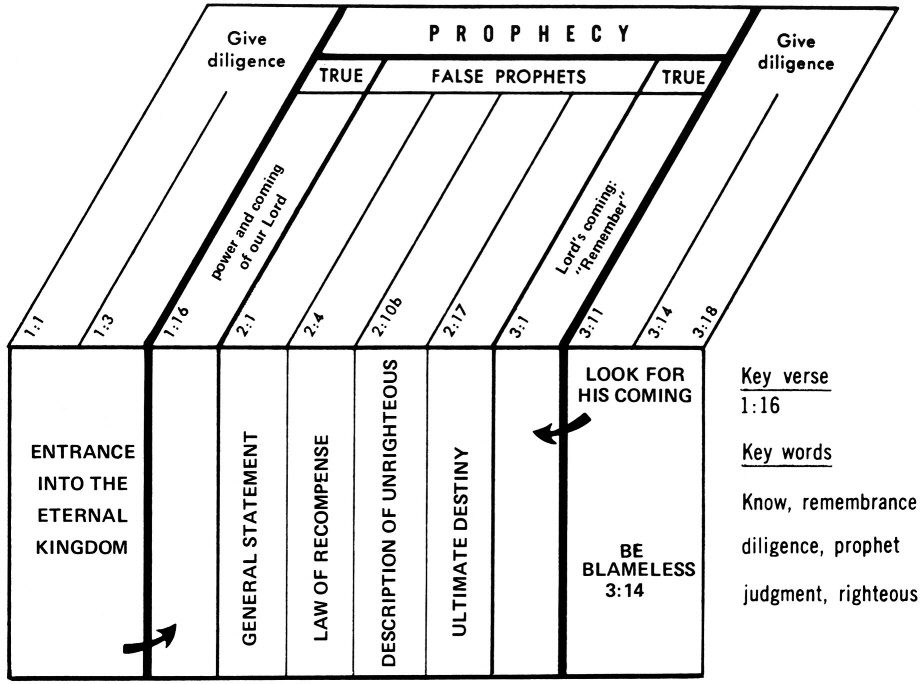
2 Peter: True and False Prophecy
Click chart to enlarge
Chart from Jensen's Survey of the NT - used by permission
|
2 PETER |
||||||||
| Cultivation of Christlike Character |
Condemnation of False Teachers |
Confidence in the Return of Christ |
||||||
| Greeting to Saints 2Pe 1:1-2 |
Growth in Christ 2Pe 1:3-14 |
Grounds |
Danger of |
Demise of |
"Decor" of |
Mockers in |
Manifest |
Maturity in light of that |
| Know Your Salvation |
Know |
Know Your Adversaries |
Know |
|||||
| True Prophecy (True Knowledge) |
False Prophets (False Teachers) |
Final Prophecy (Day of the Lord) |
||||||
| Holiness | Heresy | Hope | ||||||
| Development of Faith |
Denunciation of False Teachers |
Design of The Future |
||||||
2 Peter 2:6 and if He condemned (3SAAI) the cities of Sodom and Gomorrah to destruction by reducing them to ashes (AAPMSN) having made (RAPMSN) them an example to those who would live (PAPNPG) ungodly lives thereafter; (NASB: Lockman)
Greek: kai poleis Sodomon kai Gomorras tephrosas (AAPMSN) [katastrophe] katekrinen, (3SAAI) hupodeigma mellonton (PAPNPG) asebesin tetheikos, (RAPMSN)
Amplified: And He condemned to ruin and extinction the cities of Sodom and Gomorrah, reducing them to ashes [and thus] set them forth as an example to those who would be ungodly (Amplified Bible - Lockman)
NET: and if he turned to ashes the cities of Sodom and Gomorrah when he condemned them to destruction, having appointed them to serve as an example to future generations of the ungodly, (NET Bible)
NLT: Later, he turned the cities of Sodom and Gomorrah into heaps of ashes and swept them off the face of the earth. He made them an example of what will happen to ungodly people. (NLT - Tyndale House)
Phillips: and if God reduced the entire cities of Sodom and Gomorrah to ashes (when he sentenced them to destruction as a fearful example to those who wanted to live in defiance of his laws), (Phillips: Touchstone)
Wuest: and the cities of Sodom and Gomorrah having reduced to ashes, He condemned them to destruction, having constituted them a permanent example to the ungodly of things about to come
Young's Literal: and the cities of Sodom and Gomorrah having turned to ashes, with an overthrow did condemn, an example to those about to be impious having set them;
AND IF HE CONDEMNED THE CITIES OF SODOM AND GOMORRAH TO DESTRUCTION BY REDUCING THEM TO ASHES: kai poleis Sodomon kai Gomorras tepherosas (AAPMSN) katastrophe katekrinen (3SAAI):
- Ge 19:24,25; Ge19:28 Dt 29:23; Isa 13:19; Jer 50:40; Ezek 16:49, 50, 51, 52, 53, 54, 55, 56; Hos 11:8; Amos 4:11; Zeph 2:9; Lk 17:28, 29, 30; Jude 1:7
- 2 Peter 2 Resources - Multiple Sermons and Commentaries
If is added by the translators. There is no question as to the historicity of this event in Peter's mind as indicated by the aorist tense of condemned.
Condemned (2632) (katakrino from katá = against + krino = judge) indicating a completed action in the past. God certainly did destroy these two cesspools of sexual perversion. Katakrino means to pronounce sentence against, condemn, adjudge guilty and always denotes passage of an adverse sentence. The Judge passed judgment on these cities and sentence was handed down as it would be to any guilty criminal.
Katakrino - 18x in 18v - Matt 12:41f; 20:18; 27:3; Mark 10:33; 14:64; 16:16; Luke 11:31f; John 8:10f; Rom 2:1; 8:3, 34; 14:23; 1 Cor 11:32; Heb 11:7; 2 Pet 2:6. NAS = condemn(9), condemned(8), condemns(1).
God's assessment of the cities of Sodom & Gomorrah (cf Jude 1:7) in Ge 13:13 was that "the men of Sodom were wicked exceedingly and sinners against the LORD."
Destruction (2692) (katastrophe from katá = down + strepho to turn conveying the idea of turning upside down) is a different word than Peter has been using for destruction (apoleia) above. Katastrophe means to turn upside down which describes a condition of something in total disarray, in total destruction and in utter ruin with the implication that nothing is in its customary place or position.
Catastrophe in English = the final event of the dramatic action especially of a tragedy; a momentous tragic event ranging from extreme misfortune to utter overthrow or ruin; a violent usually destructive natural event. It also means the change which produces the final event of a dramatic piece or the unfolding and winding up of the plot, clearing up difficulties, and closing the play. Thus the ancients divided a play into the protasis, epitasis, catastasis, and catastrophy. The destruction of Sodom and Gomorrah was the "winding up of the plot, the closing of the drama" so to speak!
The only other NT use is by Paul...
2 Timothy 2:14-note Remind them of these things, and solemnly charge them in the presence of God not to wrangle about words, which is useless and leads to the ruin of the hearers.
Comment: Paul uses katastrophe figuratively describes the state of continually (present tense) being intellectually upset to the point of being spiritually ruined. Continual word battles with others are not the way to share the truth of the gospel and in fact result in catastrophe which Webster defines as a "momentous tragic event ranging from extreme misfortune to utter overthrow or ruin". In spiritual matters especially, we are to be continually on guard not to engage in arguments or controversies, fighting battles with our words. It may "make us feel good" the the end does not justify the means!
Katastrophe is vividly portraying in the devastating effects produced when "the LORD rained on Sodom & Gomorrah brimstone & fire from the LORD out of heaven & He overthrew (LXX = katastrepho verb form of katastrophe) those cities and all the valley and all the inhabitants of the cities and what grew on the ground." (Ge 19:24, 25)"
The overthrow of these cities was so complete that even their location has become a matter of some uncertainty. The utter destruction of these abominable cesspools of sexual profligacy is Peter's third illustration of "coming attractions" for the sensual and immoral false teachers.
Reducing to ashes (5077) (tephroo) is used only here in the NT, meaning to cover with ashes.
Tephroo is found in a description by the Roman historian Dio Cassius who used the word to describe the inner part of the destructive volcano Mount Vesuvius that was constantly growing brittle and being reduced to ashes so that the center section settled over time and became concave. The related word tephra was frequently used of the ashes of a funeral pile!
HAVING MADE THEM AN EXAMPLE TO THOSE WHO WOULD LIVE UNGODLY THEREAFTER: hupodeigma mellonton (PAPNPG) asebesin tetheikos (RAPMSN):
- Nu 26:10; Dt 29:23; 1Cor 10:11
- 2 Peter 2 Resources - Multiple Sermons and Commentaries
Having made (5087) (tithemi) means to set or place and in the present context conveys the meaning of to cause a state to be or to bring about. God brought about the destruction of Sodom and Gomorrah that they might serve as warning signs to all future generations. The perfect tense of the verb marks the event as a past completed action with continuing effect, in this case the effect being that of producing an abiding memorial for all succeeding generations to recall as the divinely ordained "reaping" to all who would dare sow such flagrant ungodly behavior. This example has lasting validity. Let the false teachers take note! And let us all remember the example of the wages of the sin of Sodom and Gomorrah for God is not mocked and will not "wink" at sin.
Example (5262) (hupodeigma from hupo = under + deiknuo = to show, to point to something, to make known the character or significance of something) means literally that which is shown below. It means an example, pattern, illustration. It refers to a sign suggestive of anything, an outline, a delineation, a suggestion. It refers to a model or pattern of behavior used for purposes of moral instruction, on the one hand to be carefully imitated but clearly in the present context a pattern to be assiduously avoided. Barclay writes that hupodeigma means "a specimen, or, still better, a sketch-plan. Vine writes that hupodeigma signifies - (a) a sign suggestive of anything, the delineation or representation of a thing, and so, a figure, “copy”; in Heb. 9:23 (b) an example for imitation, John 13:15; Jas. 5:10; for warning, Heb. 4:11; 2Pet. 2:6. Hupodeigma was the Greek word for a sculptor’s or a painter’s model, or an architect’s plan. In the "pattern" of Sodom & Gomorrah, God sent an unmistakable message to all future generations that wickedness, and specifically in the context of Chapter 2, false teaching will incur the devastating judgment of a Holy and Righteous Judge.
Those who would live ungodly - more literally it reads of any about to be living ungodly.
As Hiebert says "The expression looks forward to any who in the future will be turning to impious living in disregard of the command and actions of God. (ref)
2 Peter 2:7 and if He rescued (3SAMI) righteous Lot, oppressed (PPPMSA) by the sensual conduct of unprincipled men (NASB: Lockman)
Greek: kai dikaion Lot kataponoumenon (PPPMSA) hupo tes ton athesmon en aselgeia| anastrophes errhusato; (3SAMI)
Amplified: And He rescued righteous Lot, greatly worn out and distressed by the wanton ways of the ungodly and lawless— (Amplified Bible - Lockman)
NET: and if he rescued Lot, a righteous man in anguish over the debauched lifestyle of lawless men, (NET Bible)
NLT: But at the same time, God rescued Lot out of Sodom because he was a good man who was sick of all the immorality and wickedness around him. (NLT - Tyndale House)
Phillips: and yet saved Lot the righteous man, in acute mental distress at the filthy lives of the godless - (Phillips: Touchstone)
Wuest: and righteous Lot, completely worn down by the manner of life of the lawless in the sphere of unbridled lust He delivered,
Young's Literal: and righteous Lot, worn down by the conduct in lasciviousness of the impious, He did rescue,
AND IF HE RESCUED RIGHTEOUS LOT: kai dikaion Lot...errhusato (3SAMI):
- Ge 19:16, 22, 29, 1Cor 10:13
- 2 Peter 2 Resources - Multiple Sermons and Commentaries
Literally the Greek (including the word order) reads (although it does not make a good English sentence)...
And righteous Lot, being worn down by the of the irreverent in debauchery behavior He rescued.
If - This word is not present in the Greek but has been added by translators of the NAS. The rescue of Lot is not an "iffy" proposition but is a past completed historical event as indicated by Peter's use the aorist tense (of rhuomai) which in context signifies a completed action in the past. The middle voice is significant also because it conveys the picture of the Subject (God) initiating the action ("operation rescue") and participating in the effects or results of the rescue operation! The middle voice conveys a "reflexive" sense and thus it could also be translated "God Himself".
Rescued (4506) (rhuomai from rhúo = to draw, drag along the ground) means to draw or snatch to oneself, invariably from danger, evil or an enemy. This basic idea is that of bringing someone out of severe and acute danger, and so to save, rescue, deliver, preserve.
Rhuomai - 17x in 15v - Mt 6:13; 27:43; Luke 1:74; Ro7:24; 11:26; 15:31; 2Co 1:10; Col 1:13; 1Th 1:10; 2Th 3:2; 2Ti 3:11; 4:17, 18; 2Pe 2:7, 9. NAS = deliver(3), delivered(1), Deliverer(1), rescue(3), rescued(7), rescues(1), set...free(1). It is notable that this great Greek verb is used some 143x in the OT (Septuagint - LXX)
Rhuomai emphasizes the greatness of the peril from which the deliverance is given by a mighty act of power. A great illustration of this word as follows: While floating in a river, I fell out of the inflated inner tube and was suddenly trapped under a massive weight of water pouring through a narrow spillway onto my head, the weight preventing me from standing up even though the water was less than 4 feet deep. I was utterly helpless to save myself. I was however able to out my hand up through the water and a family playing in the nearby eddy saw it, grabbed hold and snatched me to the side so that I was able to stand up and could breath again. There I was beside the river safe in the presence of those who had pulled me out, yet still in the presence of the dangerous spillway. I had been snatched out of imminent danger and possible drowning. This is what rhuomai means.
Righteous (1342) (dikaios from dike = right, just) defines that which is in accordance with high standards of rectitude. It is that which is in right relation to another and so in reference to persons defines the one who is morally and ethically righteous, upright or just.
The meaning of the root word dike is based on the assumption that men expect a certain standard of behavior and if this is not attained judgment may result. It follows that the basic meaning of the adjective dikaios describes that which is proper, right, fitting, fair, righteous, just (acting or being in conformity with what is morally upright or good). From a legal viewpoint dikaios refers to one who is law-abiding (doing all that law or justice requires), honest and good in behavior and from a religious viewpoint one who is rightly related to God. In simple terms this trait describes being in accordance with what God requires. The righteous man does what he ought. He is the person who conforms to the standard, will or character of God.
Righteous Lot's rescue is described in vivid terms in Genesis 19...
hesitated. So the men seized his hand and the hand of his wife and the hands of his two daughters, for the compassion of the LORD was upon him and they brought him out and put him outside the city." (Ge 19:16).
Notice "why" God rescued Lot! Clearly Lot's escape from Sodom's fate was not due to his own timely foresight but wholly to the God's intervention on his behalf. In fact Scripture teaches that God acted in response to Abraham's intercession (Ge 19:29, cf Jas 5:16).
Abraham outside of Sodom had more influence than Lot inside the city. Tragically although he was delivered, Lot lost not only his testimony to his own family for his married daughters and their husbands laughed at his warning but he also lost his wife who disobeyed God and was killed. Our choices may be personal but the consequences are not necessarily private but may (and most likely will) affect those around us, especially those nearest and dearest. Lot would have done well to read and heed Solomon's advice:
My son, give attention to my words. Incline your ear to my sayings. Do not let them depart from your sight. Keep them in the midst of your heart. For they are life to those who find them & health to all their body. Watch over your heart with all diligence, for from it flow the springs of life" (Pr 4:20, 21, 22, 23- see notes on guarding your heart in Proverbs 4:23)
We all do well to do likewise. Lot had entered Sodom and then Sodom had entered Lot and he and his loved ones found it difficult to leave. Oh, righteous saint, beloved of God, have you been drawn into the worldliness and sensuality of Sodom so that now it's in you and in your loved ones? God is still in the "delivery" business. Cry out. Repent. Return. Do the deeds you did at first.
Despite Lot's compromises, God still considered him righteous or justified by faith as discussed above. When did Lot exercise faith? We cannot be sure from the Scripture but it is clear that although he had to be seized by the hand to leave the wicked city, he did obey God and did not look back as his wife did. (Ge 19:17,19:26, Lk 17:32)
It is intriguing that although 3 times in 2 verses Peter emphasizes that Lot was righteous, the rabbinical interpreters of the Old Testament were not so generous in their evaluation of Lot's character, measuring him by the absolute standard of the Law and regarding him as a notorious sinner!
OPPRESSED BY THE SENSUAL CONDUCT OF UNPRINCIPLED MEN: kataponoumenon (PPPMSA) hupo tes ton athesmon en aselgeia anastrophes:
- Ge 13:13; 19:7,8; Ps 120:5; Jer 9:1, 2, 3, 4, 5, 6; 23:9
- 2 Peter 2 Resources - Multiple Sermons and Commentaries
Oppressed (2669) (kataponeo from kata = down and so gives the force of "worn down"+ poneo = labor from ponos = pain or toil) means to wear down by labor or toil (cf only other NT use Acts 7:24) and then figuratively to oppress, mistreat, trouble, afflict or vex (vex means to upset or agitate a person's composure), describing Lot's inner reaction to the unceasing evil that surrounded him day and night. In Greek secular use kataponeo conveyed the idea of to subdue after a hard struggle or in its passive sense to be so subdued.
Acts 7:24 "And when he (Moses) saw one of them (his Hebrew "brethren") being treated unjustly, he defended him and took vengeance for the oppressed (present tense) by striking down the Egyptian.
In the apocryphal book 3 Macc 2:2 the supplicant prays
"give attention to us who are suffering grievously (kataponeo) from an impious and profane man, puffed up in his audacity and power." (RSV)
And in 3 Macc 2:13
see now, O holy King, that because of our many and great sins we are crushed with suffering (kataponeo), subjected to our enemies, and overtaken by helplessness.
The picture presented here by Peter is of Lot being (present tense indicates continual action and passive voice indicates the action is exerted from outside source, in this case Sodomites, etc) continually worn down and exhausted by toil and hence deeply distressed ("sore distressed") by the lifestyle of his fellow citizens. The present passive as noted indicates that their evil lives continued to be a burdensome weight upon Lot personally. It is amazing (and to some extent encouraging) that Lot had not allowed his conscience to become so dulled that he was no longer pained by what he witnessed. As someone has well said "Our great security against sin lies in being shocked at it."
THOUGHT - Does the bold faced sin which is ravaging and destroying the very fabric of the character and integrity of America still shock you or do you no longer even blush when you see and hear the sensual conduct of unprincipled men on the television and the movies, even "PG" rated movies (!)? We as the "Bride" of Christ are in a dire state when we reach this "nadir" (the lowest point) [cf unfaithful Israel, Jer 6:15, 8:12] and we need to recall the truth of our Blessed Hope (Titus 2:13-note) in Rev 19:7-note, Rev 19:8-note. Are we (you) making ourselves (yourself) ready for the return of our Bridegroom?
By (5259) (hupo) is a preposition which conveys the "directional sense" of "under" or "beneath". Hupo frequently meant not simply to be beneath but even to be under the control of something or someone. In the present context it is as if Lot was continually under the "control" of the immoral and wicked influences with the result that he was "completely worn down" (Wuest) and in "acute mental distress" (Phillips).
Interestingly, Lot's great pain at the evil around him was in fact evidence of his own upright character. Does the blatant shameless parade of immorality in America wear you down? May our Lord come soon and rescue us, snatching us from the wrath to come (1Th 1:10-note)
Wiersbe adds a note of urgency - God’s people, as weak as they are, will be delivered from judgment by the grace and mercy of God. God could not judge Sodom until Lot and his family were out of the city. Likewise, it is my belief that God will not send wrath on this world until He takes His own people out and home to heaven. “For God hath not appointed us to wrath, but to obtain salvation by our Lord Jesus Christ, who died for us, that, whether we wake or sleep [live or die], we should live together with Him” (1Th 5:9,10-note) One day soon, the fire will fall. Are you ready?" (Wiersbe, W: Bible Exposition Commentary. 1989. Victor)
Sensual (766) (aselgeia [word study]) was discussed earlier in this chapter (click for detailed discussion) and here is modified by the little Greek preposition en in what the Greek refers to as "locative of sphere" a fancy way of indicating that the Sodomites were living and conducting their lives "in the sphere" (sphere = an area or range over or within which someone or something acts, exists, or has influence or significance) of unbridled, insatiable desire for pleasure and sexual excess and with a total absence of restraint. The vile lives of the people of these two cities wore Lot down as his own conscience and soul rebelled against the filth that he continually witnessed around him. Aselgeia - 10x in 10v - Mark 7:22; Rom 13:13; 2 Cor 12:21; Gal 5:19; Eph 4:19; 1 Pet 4:3; 2 Pet 2:2, 7, 18; Jude 1:4. NAS = licentiousness(1), sensual(1), sensuality(8).
Related Resource:
- See study of meaning and significance of locative of sphere
Unprincipled (113) (athesmos from negative "a" = without + thesmos = law or custom although not referring to laws enacted by lawmakers but that which became prevalent by custom and was expected to be observed as if it were law) describes those who are rebellious and refuse to be subject to legal requirements. Unseemly. Disgraceful. Morally corrupt. Athesmos is the opposite of dikaios, righteous or just. TDNT = "Originally “illegal” or “impious,” of acts, foods, persons." Friberg = "of a person who breaks through the restraint of law to satisfy selfish desire" Thayer = "of one who breaks through the restraints of law and gratifies his lusts" Athesmos was used of one who defied the restraints of divinely sanctioned limits and gratifies his or her fleshly lusts. The word is stronger than anomos “lawless” (in verse 8 below), because it pictures open rebellion against that which had divine approval. The idea is to violate the "laws of nature" and conscience. They were audaciously wicked.
The only other NT use of athesmos is 2Peter 3:17 You therefore, beloved, knowing this beforehand, be on your guard so that you are not carried away by the error of unprincipled men and fall from your own steadfastness
Conduct (391) (anastrophe from verb anastrepho = to turn up, to move about <> aná = again, back + strepho = turn) literally means "a turning about" and in the NT refers to how one conducts one's life, with a focus on everyday behavior. It refers to how we live or conduct ourselves. Anastrophe - 13x in 13v - Gal 1:13; Eph 4:22; 1 Tim 4:12; Heb 13:7; Jas 3:13; 1 Pet 1:15, 18; 2:12; 3:1f, 16; 2 Pet 2:7; 3:11. NAS = behavior(6), conduct(4), manner of life(2), way of life(1).
How Lot could be so oppressed, how he could be called a righteous man, and yet offer to turn his two daughters over to the wicked townsmen to be sexually abused is difficult to understand apart from a knowledge of the code of honor characteristic of that day. Ancient hospitality obliged a host to protect his guests in every situation.
2 Peter 2:8 (for by what he saw and heard that righteous man, while living (PAPMSN) among them, felt his righteous soul tormented (3SIAI) day after day by their lawless deeds ), (NASB: Lockman)
Greek: blemmati gar kai akoe o dikaios egkatoikon (PAPMSN) en autois hemeran ex hemeras psuchen dikaian anomois ergois ebasanizen; (3SIAI)
Amplified: For that just man, living [there] among them, tortured his righteous soul every day with what he saw and heard of [their] unlawful and wicked deeds— (Amplified Bible - Lockman)
NET: (for while he lived among them day after day, that righteous man was tormented in his righteous soul by the lawless deeds he saw and heard) (NET Bible)
NLT: Yes, he was a righteous man who was distressed by the wickedness he saw and heard day after day. (NLT - Tyndale House)
Phillips: Lot, remember, was a good man suffering spiritual agonies day after day at what he saw and heard of their lawlessness - (Phillips: Touchstone)
Wuest: for, in seeing and hearing, the aforementioned righteous one, having settled down permanently among them, day in, day out, tormented his righteous soul with their lawless works.
Young's Literal: for in seeing and hearing, the righteous man, dwelling among them, day by day the righteous soul with unlawful works was harassing.
FOR BY WHAT HE SAW AND HEARD THAT RIGHTEOUS MAN WHILE LIVING AMONG THEM: blemmati gar kai akoe o dikaios egkatoikon (PAPMSN):
- Pr 25:26; 28:12; 1Ti 1:9; Jas 5:16
- 2 Peter 2 Resources - Multiple Sermons and Commentaries
Pr 25:26 Like a trampled spring and a polluted well Is a righteous man who gives way before the wicked. (Mt Henry "When the righteous are led into sin, it is as hurtful as if the public fountains were poisoned." If the godly compromise with the wicked, it is like polluting a fountain or muddying a spring.)
For (1063) (gar) introduces an added explanation of the situation that caused Lot such pain. "By what he saw and heard" is placed first in the Greek for emphasis and underscores the cause of his distress: he saw evil and he heard evil over and over (as imperfect tense below suggests)
Saw (990) (blemma from blepo = to see) describes the act of seeing or what is seen.
Heard (189) (akoe from akouo = to hear; see related verb hupakouo) is the act, the sense or the thing heard.
Righteous (1342) (dikaios from dike = right, just) defines that which is in accordance with high standards of rectitude. It is that which is in right relation to another and so in reference to persons defines the one who is morally and ethically righteous, upright or just.
If we had only the OT account of Lot, we might not think Lot was a true believer at all. In Genesis he almost appears as a status-seeking opportunist, willing to put up with sin and corruption in order to make a place and name for himself in the world. But Peter under the inspiration of the Spirit reiterates (3x) that he was a righteous man.
Wiersbe has an interesting analysis of this "righteous man"
When Lot had to choose a new area for his home, he measured it by what he had seen in Egypt (Ge 13:10). Abraham took Lot out of Egypt, but he could not take Egypt out of Lot. Lot “pitched his tent toward Sodom” (Ge 13:12), and then finally moved into Sodom (Ge 14:12). God even used a local war to try to get Lot out of Sodom, but he went right back. That is where his heart was. (Wiersbe, W: Bible Exposition Commentary. 1989. Victor or Logos) (bolding added)
Living among (1460) (egkatoikeo from en = in or among + katoikeo = to dwell) used only here in the NT and indicating that Lot had permanently settled "down among them."
Lot had chosen his "bed" and now was forced to live with the mental anguish that decision was reaping. Lot could have voluntarily moved out of this sexual cesspool had he so chosen but even when confronted with God's decree against the city he "hesitated" and finally God's divine emissaries had to seize him by the hand to extirpate him from Sodom! (Gen 19:16)
FELT HIS RIGHTEOUS SOUL TORMENTED DAY AFTER DAY WITH THEIR LAWLESS DEEDS: en autois hemeran ex hemeras psuchen dikaian anomois ergois ebasanizen (3SIAI) :
- Ps 119:136, 139;158 Ps 101:3, Ezek 9:4; 9:6 Mal 3:15,16, 17
- 2 Peter 2 Resources - Multiple Sermons and Commentaries
Tormented (928) (basanizo from basanos - see below) means literally to rub on the touchstone (basanos) or to test by means of the touchstone and then to test or make proof of anything.
Basanos - our English word basanite indicates
[a] basically, a touchstone to test gold and other metals [Basanite was used in this way - If you use one thing as a touchstone of another, you use it as a test by which you judge the second thing = a 'Lydian stone'] used for testing gold because pure gold rubbed on it left a peculiar mark];
[b] Basanos described the instrument of torture by which slaves were tortured; i.e., were forced to reveal the truth by torturing them [see metaphor]; and
[c] torment or acute pain).
The verb basanizo means literally to rub on the touchstone (basanos) or to test by means of the touchstone and then to test or make proof of anything.
Figuratively, the verb basanizo refers to any severe distress, and so means to afflict, to harass, to vex, to torment. Basanizo then can mean to subject one to severe torment or distress, as with diseases (Mt 8:6), with birth pangs (Re 12:2), by the threat of Jesus' punishment of demonic spirits (Mt 8:29, Mk 5:7, Lk 8:28), by prophetic warnings (Re 11:10), of the torment associated with God's righteous judgment (Re 14:10, 20:10)
In some contexts basanizo conveys the idea of subjecting to punitive judicial torture or to question by judicial torture (2Macc 7:13 "When he too had died, they maltreated and tortured the fourth the same way", 4Macc 6:5 "But the courageous and noble man, as a true Eleazar, was unmoved as though being tortured by a dream".).
The cognate noun basanismos is used in Rev 9:5; 14:11; 18:7, 10, 15 and means testing by torture and then the extreme distress of this torture (thus the torment) or the severe suffering and pain associated with the torture.
Basanizo is derived from basanos which describes severe pain brought about by punitive torture [Lk 16:23]. Basanos conveys the original idea of a "touchstone" or a black Lydian stone used to test the purity of precious metals such as gold and which came to describe the testing procedures by which the quality of something was tried and figuratively was used to describe procedures used to torture or torment by which one would be forced to give a confession or speak the truth!
One gets an accurate picture of the meaning of basanizo in the descriptions of Jesus' disciples in the boat that was being battered by the waves (Mt 14:24), of the servant who was tormented by paralysis (Mt 8:6) and of the pain of childbirth as used figuratively in (Rev 12:2-note).
Webster's Dictionary helps paint the picture of Lot's sad, dismal condition, defining the verb "torment" as...
to inflict torture (as by rack or wheel), to cause severe usually persistent or recurrent distress of body or mind or to inflict on a person something that is hard to bear!!!
THE TORMENT OF
AN UNFORGIVING HEARTComment: As an aside, the related noun form basanistes is used once in Scripture in the the parable of the unforgiving servant (Mt 18:34) who his lord (kurios - master) handed over to the torturers (basanistes) until the debt should be paid in full (Note the "time phrase" until - which could range from few seconds to one's entire life, in the case of unyielding unforgiveness!). The picture is clearly that the sin of unforgiveness extracts a fearful toll on the one who chooses to hold tight to their unforgiveness and not to "cancel the debt" of the one who has "injured" them in thought, word or deed. For more discussion of this vitally important topic of forgiveness/unforgiveness see notes on Ephesians 4:32, Colossians 3:13, Matthew 6:12. As discussed in those notes, the number one problem in Christian churches in America is UNFORGIVENESS (from Bryon Paulus, director of Life Action Revival Ministries, a revival oriented ministry, who based his conclusion is based on their experience with 100's of churches and millions of believers over the past several decades). It follows that it behooves every shepherd to (in my humble opinion) to lead his flock at least once a year back into the green pastures and refreshing waters of the doctrinal truths on forgiveness (doctrine directs duty, revelation calls for a reasoned response, creed calls for conscious conduct, precepts precede and lead to appropriate practice), so that the sheep might be set free from their entrapment in the "brambles and thorns" wrought by a spirit of unforgiveness. I dare say that there would be families and marriages restored and revived, "factious friends" once again made friends, walls of resentment ripped down by the Word and Spirit of Truth, etc, etc. Jesus came to set the captives free (cf Lk 4:18, Jn 8:31, 32, 36) and unforgiveness is the number "prison" of each person's own making, and will yield rotten fruit "until" the debt has been paid from the heart (cf Mt 18:34, 35).
Torment suggests persecution or the repeated inflicting of suffering or annoyance (as a horse tormented by flies).
Basanizo is in the imperfect tense which clearly conveys the idea of Lot's soul tortured and tormented over and over, again and again! His witness or awareness of every "lawless deed" of the Sodomites was like a "dagger" in his soul! Just when he was recovering from one "wave" of wickedness so to speak, another came crashing down on him (cp the picture of the boat in Mt 14:24). Lot was undoubtedly the most pained man in Sodom.
Basanizo is used of literal torture in a judicial examination, although here Peter uses it figuratively describing the severe mental pain which Lot continued to inflict upon himself. As alluded to earlier, it was this pain which was one "proof" of his inner righteousness.
Basanizo - 12x in 12v - Mt 8:6, 29; 14:24; Mark 5:7; 6:48; Luke 8:28; 2 Pet 2:8; Rev 9:5; 11:10; 12:2; 14:10; 20:10. NAS = battered(1), felt...tormented(1), pain(1), straining(1), torment(4), tormented(4).
Matthew 8:6 and saying, "Lord, my servant is lying paralyzed at home, fearfully tormented."
Matthew 8:29 And they cried out, saying, "What business do we have with each other, Son of God? Have You come here to torment us before the time?"
Matthew 14:24 But the boat was already a long distance from the land, battered by the waves; for the wind was contrary.
Mark 5:7 and shouting with a loud voice, he said, "What business do we have with each other, Jesus, Son of the Most High God? I implore You by God, do not torment me!"
Mark 6:48 Seeing them straining at the oars, for the wind was against them, at about the fourth watch of the night He came to them, walking on the sea; and He intended to pass by them.
Luke 8:28 Seeing Jesus, he cried out and fell before Him, and said in a loud voice, "What business do we have with each other, Jesus, Son of the Most High God? I beg You, do not torment me."
2 Peter 2:8-note (for by what he saw and heard that righteous man, while living among them, felt his righteous soul tormented day after day by their lawless deeds),
Revelation 9:5-note And they were not permitted to kill anyone, but to torment for five months; and their torment was like the torment (basanismos) of a scorpion when it stings a man.
Revelation 11:10-note And those who dwell on the earth will rejoice over them and celebrate; and they will send gifts to one another, because these two prophets tormented (not just their deeds but their words of truth were received even as torture in the souls of the earth dwellers! The Word of God comforts the afflicted but afflicts the "comfortable" [comfortable in their sin]) those who dwell on the earth.
Revelation 12:2-note and she was with child; and she cried out, being in labor and in pain (basanizo) to give birth.
Revelation 14:10-note he ("beast worshipers" Re 14:9-note, cf Re 21:8-note, 2Th 1:7, Re 19:20-note) also will drink of the wine of the wrath of God, which is mixed in full strength in the cup of His anger; and he will be tormented with fire and brimstone in the presence of the holy angels and in the presence of the Lamb.
Revelation 20:10-note And the devil who deceived them was thrown into the lake of fire and brimstone, where the beast and the false prophet are also; and they will be tormented day and night forever and ever.
Day after day (hemeran ex hemeras) is like our colloquial expression "day in, day out" and this small detail makes it quite clear that Lot did not isolate himself from normal contact with his neighbors.
Lawless (459) (anomos from a = without + nomos = law; see study of related word anomia) means literally without law and thus lawless. Recognizing no law in 1Ti 1:8. In 1Co 9:21 anomos refers to not so much to those who transgress the law but those who either do not have, know or acknowledge the law (i.e., Gentiles). It describes transgressors, those who step across the the line (law), thus passing over or beyond a limit. They live without regard to law, in the sense of refusing to obey laws.
Lawless = Not subject to law; unrestrained by law, disobedient to the law, contrary to or heedless of the law, uncontrolled; unbridled. Synonyms of lawless = anarchic, chaotic, disorderly, insubordinate, insurgent, mutinous, rebellious, reckless, riotous, seditious, ungoverned, unrestrained, unruly, wild
Vine notes that in 2Peter anomos conveys...the thought is not simply that of doing what is unlawful, but of flagrant defiance of the known will of God.
TDNT writes that anomos...has the objective sense of “having no law” and the subjective sense of “paying no heed to law.” The Jews often use the term for the Gentiles with some vacillation of sense. (Kittel, G., Friedrich, G., & Bromiley, G. W. Theological Dictionary of the New Testament. Eerdmans)
Richards explains that anomos refers to...actions that are not outside the governance of law but are in active violation of either divine or innate moral principles. The apostle John says, "Everyone who sins breaks the law; in fact, sin is lawlessness (related word anomia)" (1Jn 3:4). The seriousness of lawlessness is seen in its association with the virulent outbreak of Satanic power destined for history's end (2Th 2:3, 7, 8).
UBS Handbook says anomos...is used of people who disregarded divine and human laws and ordinances. (The United Bible Societies' New Testament Handbook Series or Logos)
Jamieson writes that anomos describes those who...set at defiance the laws of nature, as well as man and God.
Anomos describes the consequence of having no fear of God and therefore feeling completely free to live without constraining laws, indulging our sinful desires. Day in and day out Lot observed their deeds characterized as anomos, as contrary to and in defiance of the known will of God. Lot saw and heard this "in your face" attitude and actions every day and it tortured his righteous soul which is another reference to the inner moral condition of Lot. Peter uses the "soul" to describe the seat and center of the inner man and especially the center of one's feelings and emotions.
NIDNTT has an informative note on the root word "nomos" which means law or norm...The noun nomos is formed from the vb. nemo, distribute, deal out, assign, grant, especially in the sense of assigning property, apportioning pasture or agricultural land (cf. nome, pasture). In other words, the reference is to those processes which are essential whenever men live together in a community, whether small or great. Relationships to earthly possessions have to be determined in a legally binding fashion, so that private and communal ownership may become a reality. Thus the basic vb. covers all shades of meaning from merely handing something over for a given period of time, right through to transferring something, once and for all, to the ownership of another person. By means of appropriate prepositions, personal or non-personal objects, and other qualifying phrases, ethical value-judgment can be expressed: to grant equally, exercise fairness, be impartial, also to favour, pass over, reject. The same vb. can also indicate the result of distributing property: to appropriate, own or possess, occupy, utilize; pass. to belong to. The communal aspect can still be seen in the mid.: to distribute (e.g. an inheritance) between one another.
Anomos - 9x in 6v (not counting Mk 15:28 because it is not in all manuscripts) - Mark 15:28, Luke 22:37; Acts 2:23; 1 Cor 9:21; 2 Thess 2:8; 1 Tim 1:9; 2 Pet 2:8. NAS = godless men(1), lawless(2), lawless one(1), transgressors(2), without the law(1), without law(1), without law(2).
Mark 15:28 [And the Scripture was fulfilled which says, “And He was numbered with transgressors.”] (Not in all Greek manuscripts which is why it is in brackets)
Luke 22:37 "For I tell you that this which is written must be fulfilled in Me, 'AND HE WAS NUMBERED WITH TRANSGRESSORS'; for that which refers to Me has its fulfillment."
Acts 2:23 this Man, delivered over by the predetermined plan and foreknowledge of God, you nailed to a cross by the hands of godless men (in context refers primarily to the Romans, i.e. Gentiles) and put Him to death.
1 Corinthians 9:21 to those who are without law, as without law, though not being without the law of God but under the law of Christ, so that I might win those who are without law.
2 Thessalonians 2:8 Then that lawless one (the Antichrist) will be revealed whom the Lord will slay with the breath of His mouth and bring to an end by the appearance of His coming;
1 Timothy 1:9 realizing the fact that law is not made for a righteous person, but for those who are lawless and rebellious, for the ungodly and sinners, for the unholy and profane, for those who kill their fathers or mothers, for murderers
2 Peter 2:8 (for by what he saw and heard that righteous man, while living among them, felt his righteous soul tormented day after day by their lawless deeds),
The contemporary application is plain. To what extent are Christians living today in a godless and thus lawless society "tormented" and "tortured" by what they see.